CSArts-SGV and Media V Premiere ‘The Merry Wives of Windsor High’

Originally published on 26 November 2018 in the Pasadena Independent, Arcadia Weekly, and Monrovia Weekly
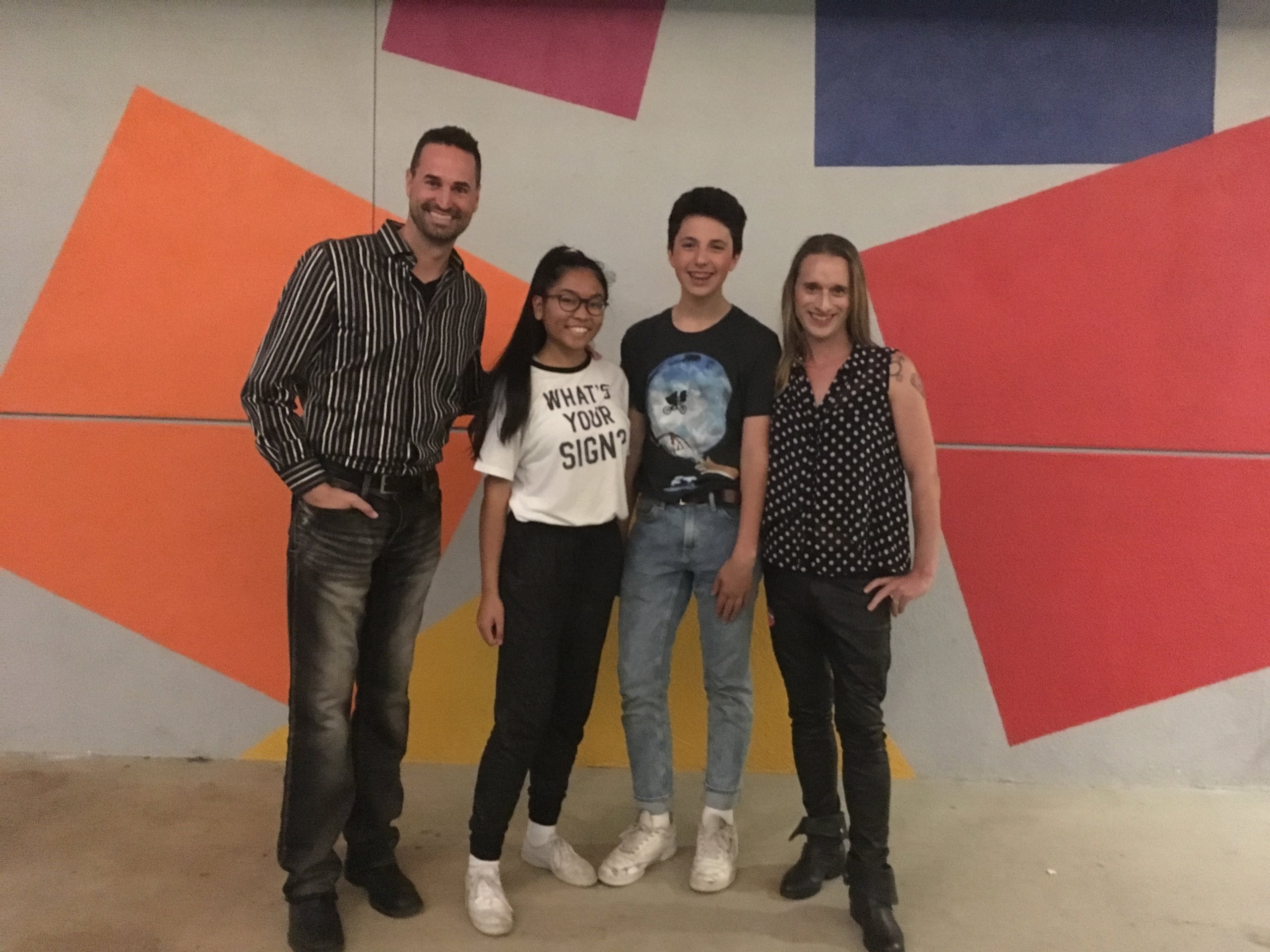
Jay Wallace (left) and Jer Adrianne Lelliott (right) flank Melissa Bautista and Mateo Alfonso | Photo By May S. Ruiz / Beacon Media News

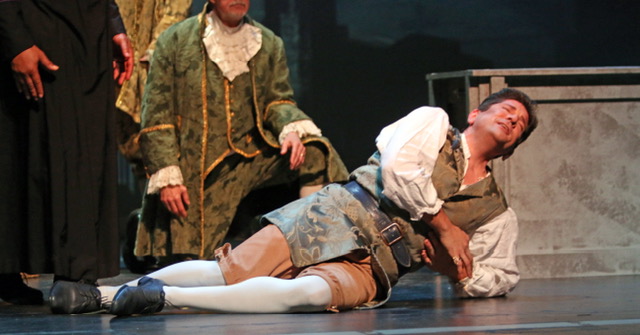
This weekend, California School of the Arts-San Gabriel Valley (CSArts-SGV) and mediaV, a Santa Monica-based production company, will jointly premiere a retelling of William Shakespeare’s ‘The Merry Wives of Windsor.’ Renamed ‘The Merry Lives of Windsor High,’ it will be held on Friday and Saturday, November 30 and December 1, at the Duarte Performing Arts Center.

This production is the first ‘Incubator Project’ developed by the partners, an incredible one-of-a-kind collaboration that gives students of CSArts-SGV’s Musical Theatre Conservatory the opportunity to be the first to originate and produce a series of brand-new rock musicals.

MediaV founders and philanthropists Russell Meyer and Marcy Shaffer have pledged a gift of $50,000 to CSArts-SGV over the next two years to support the creation of two world premieres, with the intention to continue collaborating over the next several years. Using the works of William Shakespeare as source material, the Incubator Project will create modern and relevant musicals that would subsequently be offered for public license and performance.

“We are thrilled to be given the opportunity to create and contribute original works to the catalog of musicals available today,” pronounces CSArts-SGV Chair of Theatre Jay Wallace. “We hope the material will gain momentum and be performed by high school, college, and community programs across the country.”

Jer Adrianne Lelliott, who directed last year’s CSArts-SGV’s production of Oscar Wilde’s ‘The Importance of Being Earnest’ will be directing ‘The Merry Lives of Windsor High.’ A theater actor since early childhood, she played Chip in the original Los Angeles cast of Disney’s ‘Beauty and the Beast’ at age 12. She attended film school at Loyola Marymount University and upon completion returned to theatre. She earned her MFA in Acting at Cal State Fullerton, after which she started working professionally in regional theatres all over the United States.

The founding artistic director of Coeurage Theatre Company, Lelliott’s theatrical directing highlights include Carla Ching’s Blackbird, as well as Vieux Carré, The Woodsman, and Andronicus for Coeurage.

As an actor, Lelliott has appeared at Kirk Douglas Theatre, Pasadena Playhouse, La Jolla Playhouse, Chance Theatre, Laguna Playouse, La Mirada Theatre for the Performing Arts, MainStreet Theatre Company, and Disney on Broadway.

Lelliott’s television credits include Sweet Justice, Picket Fences, Journey of the Heart, Melrose Place, Walker Texas Ranger, Life with Louie, The Practice, Ambushed, Safe Harbor, Providence, 7th Heaven, Disappearance, Smallville, The Handler, NCIS: Los Angeles, and Ctrl Alt Delete, among many others. Film credits include Jack, Ambushed, Diplomatic Siege, Betrayal, Race You to the Bottom, Driftwood, and more.
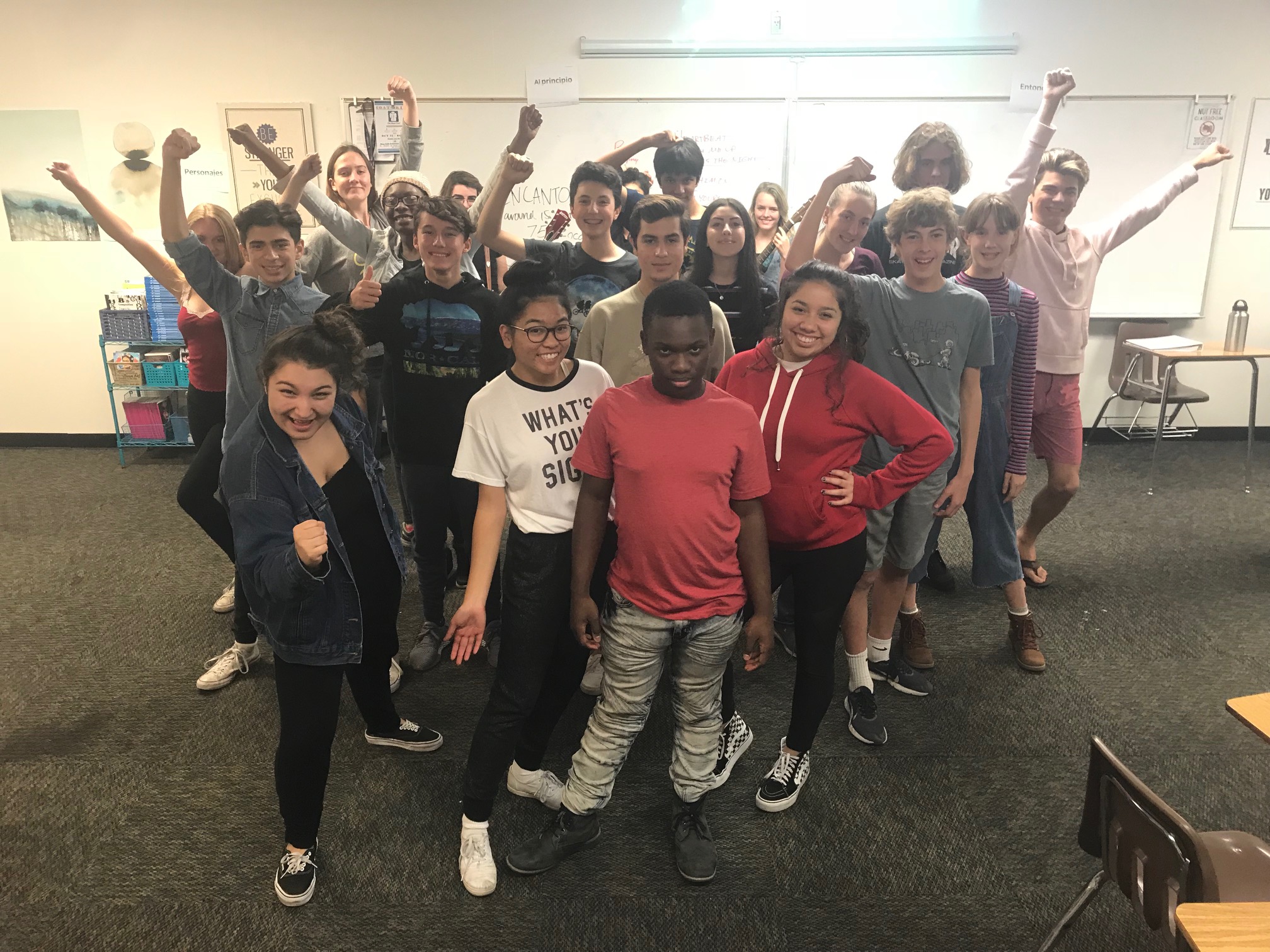
Students in rehearsal | Courtesy photo / CSArts-SGV

Distinguishing between the two productions she helmed at CSArts-SGV, Lelliott states, “Last year’s was straight-on Oscar Wilde, a dead playwright, so the script was set in stone. While this year, the script is continually developing and revising as we go.

“Jay and I have been talking since spring, planning with the creators and writers. There have been numerous phone calls and face-to-face meetings. They were here two days ago to see our progress and making script changes as they watched students in rehearsals.”

That so much is riding on this Incubator Project is not lost on the students. Pasadenan Melissa Bautista, who’s in 11th grade and attends the Musical Theatre Conservatory, says, “My parents understand that being a junior and participating in a production is a big responsibility so they could be knocking on my door at 3 am to check if everything’s fine.

“I constantly juggle between doing homework and going to rehearsals. We have a buffer from 4:45 to 5:30 so that’s usually the time I do homework. I also eat snacks and drink water to replenish my energy. We’re not always on during rehearsals so I use the in-between times, too.”

“It’s very much about time management,” inserts Wallace.

Concurs Mateo Alfonso, a 9th grade student from Monrovia who’s also in the Musical Theatre Conservatory, “My parents know that if I get into a show I’ll be in rehearsals until 8:30 pm and that’s just a commitment you have to make when you dedicate yourself to the Arts and you’re doing what you love.”

“In this musical, I play Tess, the coffee girl who works at the brewery,” describes Bautista. “She’s a senior and she’s trying to raise money to go to college; she’s also the friend that everyone goes to for advice. She just happens to be caught in the middle of all the drama.”

“Tess loves her friends with all her heart, a trait that’s close to me as a person,” Bautista continues. “But as kind-hearted as she is, she’s sassy and sarcastic at the same time. She stands up for herself, which is something I aspire to.

“In previous roles I was someone flighty. But this time, my character is very down to earth, a great advice-giver, and a very supportive friend. This gives me the opportunity to be seen as someone who’s not just an airhead, or that high-pitch voiced, quirky girl, but someone with more substance.”

Alfonso couldn’t say much about his character beyond, “I play the role of Oliver who’s a senior and a soccer fan; he’s the twin brother of Olivia. I would like the audience to see what a high schooler is really like. Playing the character of someone who’s shy, I relate to him. However, unlike the role I portrayed last year who holds a lot inside, in this musical my character shows that you don’t have to pretend, you just have to be yourself.”
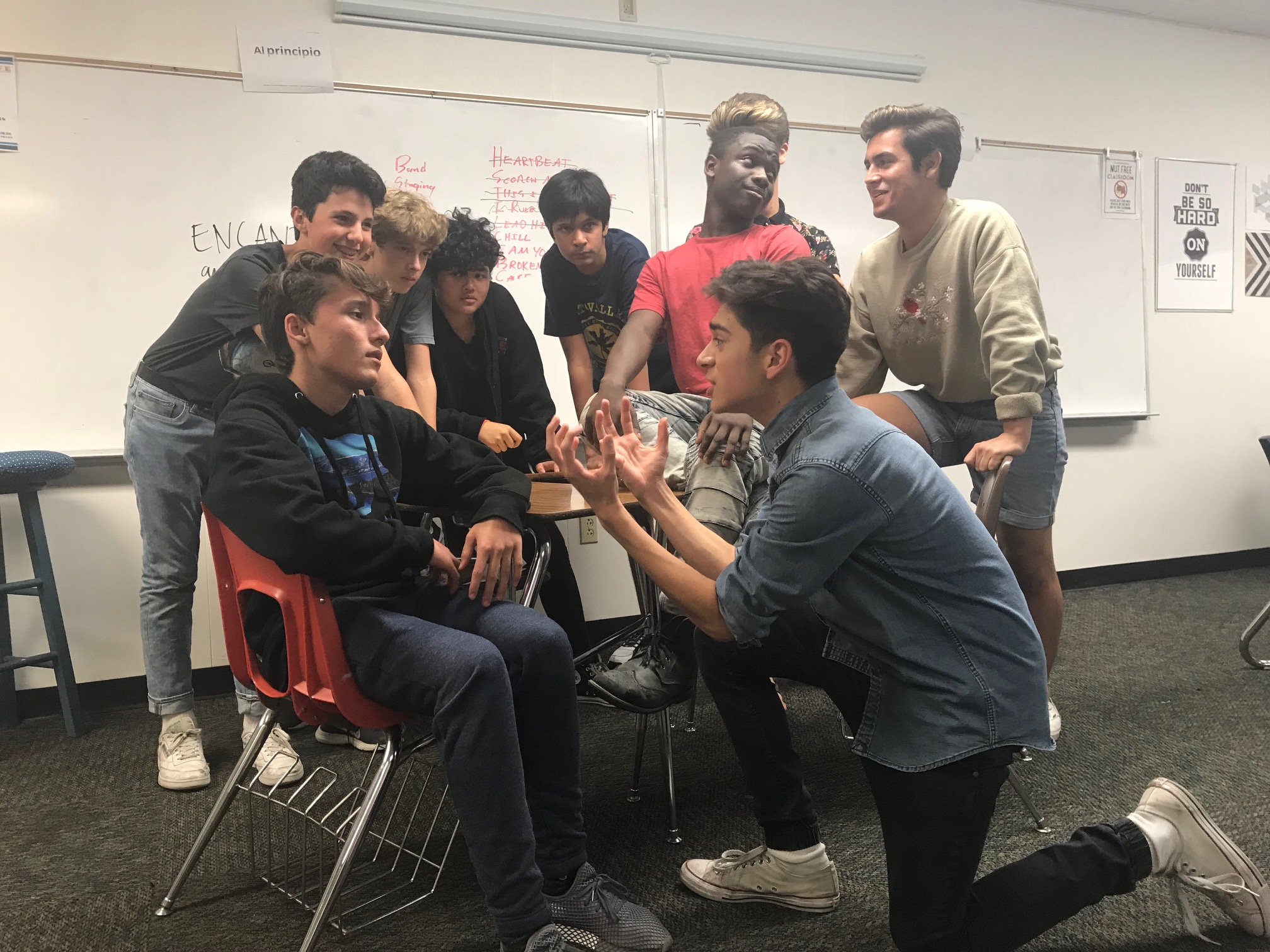
Getting in character | Courtesy photo / CSArts-SGV

Asked if she gave Bautista and Alfonso direction on how to act like senior students on the show, Lelliott  remarks, “First of all, I’d like to commend Mateo for doing a great job of talking around a major spoiler. But to answer your question, they’re giving me pointers! Actually, what’s important to us and the creators is that it reflects our campus and students. They chose our school because they wanted our population so when they present the work to other colleges and universities they can show the crème de la crème. Most of the characters in the play are high school seniors with the exception of one; we have one 8th grader who cracked that age criterion and managed to get in the play.”

“I directed it just like I would professional theatre,” asserts Lelliott. “These young people are as professional as some of the adults I work with; their training is excellent. It’s collaborative as to who they are. I also cast all 26 of them for specific reasons – they were as close as possible to the characters they play and we want their personalities to shine through.

“But beyond that, I gave them notes as to how they could make clear their objectives, staging – making sure the audience can see their faces and hear their voices, and technique. The good thing about teaching and then directing them is that we have a shared vocabulary, so when I say ‘You have to raise the stakes here,’ they know what that means.”

“I would say that this is a broader philosophy of how we approach all our productions here. There should be a collaborative effort, we should show respect, we have a mutual language. We certainly value having a polished professional product and the shows we have mounted, thus far, have demonstrated that. However, process is probably the most vital component to everything that we do. Our philosophical goal throughout the conservatory and theatre acting is our growth, whether as artists or as individuals. It’s up to us as the leaders at CSArts-SGV to inspire them to achieve their potential through the process.”

Speaking of the process, Lelliott discloses, “Tonight, we’re just working on songs. There are 20 songs, bookended with big company musical numbers. In between there are quartets, trios, duets, solos, and reprises. My musical director and choreographer are there; I’ll put the students up, we have a running order. They’ll get notes specifically for vocal and choreo.

“Tomorrow, there won’t be any music, we’ll just be concentrating on staging scenes. Sometimes it will be like a three-ring circus, where I’ll be working on acting with students, while the musical director will be doing songs with them, and the choreographer will be working with other students on the dancing.”

“The reason ‘Hamilton’ is so much better than everything else that came out on Broadway is that the producers gave it extra time, which doesn’t usually happen with union contracts,” expounds Lelliott. “They didn’t just go in with a script and put on the show, it was an evolving process.

“That’s the same thing here. While we didn’t make major revisions, the writers came in and we all watched it and we were thrilled with it. Then we decided we could streamline the opening number to make it even faster. We’ll turn in a show in 90 minutes, with no intermission. People can see the show then grab lunch afterwards.”

“I think one of the things that we considered is what’s happening in the world right now,” Wallace says further. “Some of the revisions that were made were to make it more relevant to the audience.”

Lelliot clarifies, “The show doesn’t really touch on social issues. I’m going to riff off what Mateo said earlier – it touches on them by not touching on them. What people will see up there is a really diverse, inclusive cast. It will honor, even as we shatter, a lot of archetypes and stereotypes in a school setting – the jocks, the cheerleaders, and the brains. We’ll see more three-dimensional characters and, in so doing, I suppose there will be an undercurrent of social justice, if you will. But the real justice of it, really, is that we’ll be presenting a more idyllic world which is what CSArts-SGV embodies – a beautiful culture – and how well that works when we don’t label people.”
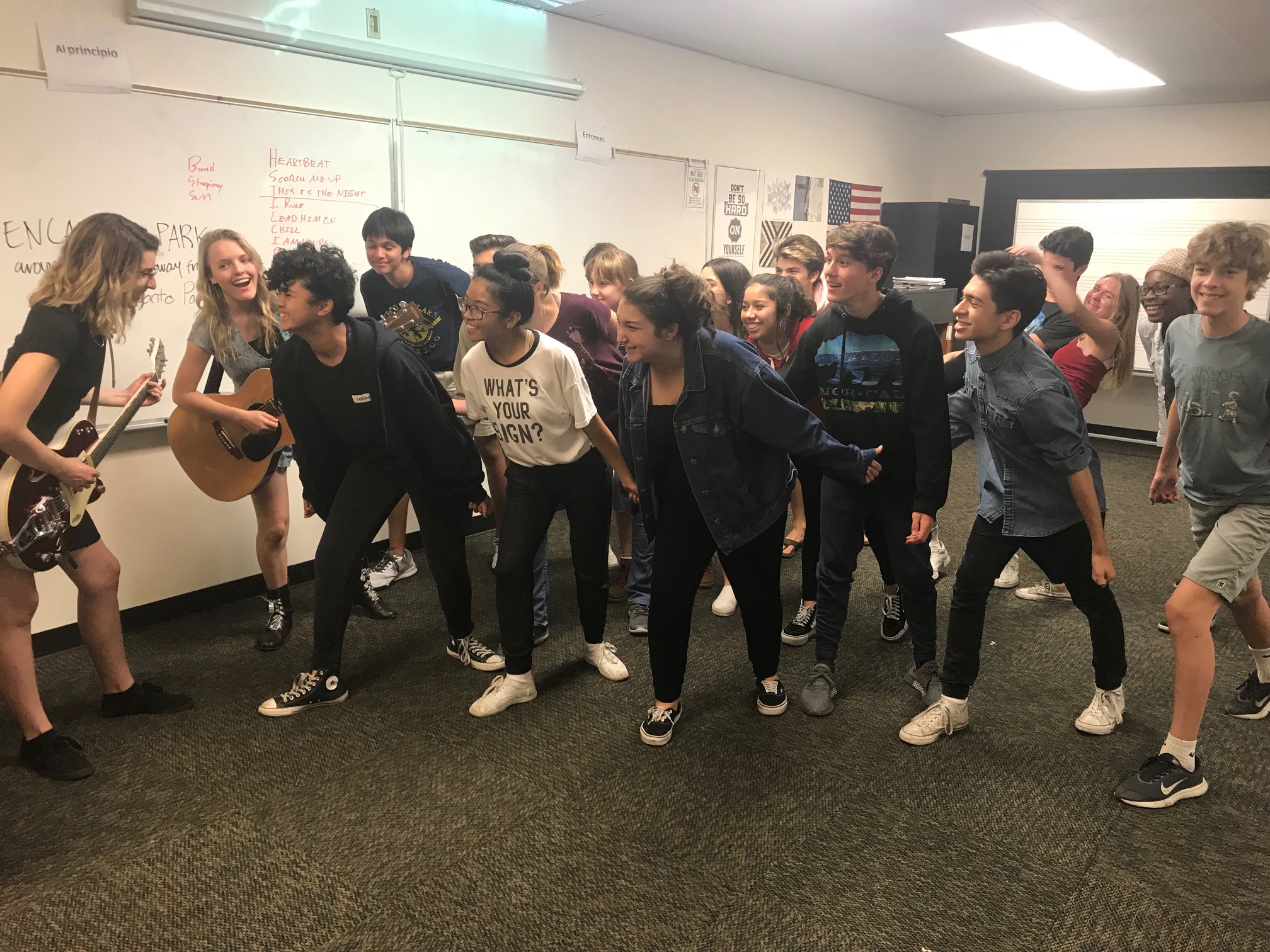
Rehearsing the songs with the choreography | Courtesy photo / CSArts-SGV

This first incubator project has another outcome, explains Wallace, “Something interesting I want to touch on is that this is also linked to a course that we’ll offer in the spring which will be led by the person who will direct next year’s incubator project. Students will develop the actual product as well as get exposure to what it’s like to put on a brand-new musical, to promote it, to learn how to be marketing savvy. An important part of that course will be workshopping next spring’s incubator so by the time we get into the Fall we’re ready to rock and roll, literally.

“We’re exploring how we can tap into the youth who may not be trained in those, but who are so innovative. We’d like to utilize that to build a framework together that will become the foundation of future incubator projects, so when these students graduate our school they’ll have a major head start on collaborating and originating new material.”

When queried how he found a teacher to teach the course, Wallace replies, “I started from the creative side – who would be the most ideal person to lead the incubator project. It’s important that it’s always somebody who has experience in generating their own product, in promoting their own image and product; someone who has an understanding of the means to engage on a collaborative effort. And, first and foremost, someone who can connect with students.

“This opportunity for us to originate a musical and to collaborate with professional talent, is almost unheard of even at the collegiate level, and certainly not at the high school level. I’d be very surprised if there were anything like this anywhere in the country. The shakers at media V deserve a lot of credit for that vision and for coming to us to partner with them. It’s a real sign of reinvesting in youth and theatre arts, specifically musical theatre, and allowing these students to develop through that process. It’s extremely unique and, quite honestly, a blessing. And to do this in the second year of our school is just insane.”

As the chair of the theatre department, Wallace is aware that the onus to make a success of the project falls squarely on him, “My philosophy is ‘This is my challenge and my opportunity. Embrace it.’”

It is that spirit of ownership that Wallace displays that has made such a tremendous success of all CSArts-SGV’s theatre productions. Bravo!

Bone Kettle Serves Up Delicious Southeast Asian Cuisine with a Twist

Originally published on 20 November 2018 in the Pasadena Independent, Arcadia Weekly, and Monrovia Weekly

The chicken wings are a favorite among diners at Bone Kettle | Courtesy photo

By Brianna Chu and May S. Ruiz

Old Pasadena is a commercial district on the westernmost part of the city comprising 22 blocks where an eclectic mix of enterprises happily co-exist. There are museums and hotels, hotels converted into residential apartments and office spaces. There are a multitude of businesses – clothing retailers and coffee shops, dining venues and dress accessories stores, cosmetics shops and cinemas, jewelry and kitchen stores, nightclubs and sports bars, tech-selling stores and telecommunications service providers – housed in beautifully restored, historic buildings. You name it, it’s there.

Bone Kettle, an Indonesian fusion restaurant on North Raymond Avenue, has recently joined the numerous food establishments in this melting pot Pasadenans refer to as Old Town. It is co-owned by the Tjahyadi Brothers, Eric and Executive Chef Erwin, who immigrated to the San Gabriel Valley from Indonesia with their parents over two decades ago. They arrived with practically only the clothes on their back, except for an English dictionary to help them get by in their adopted country, and a few Indonesian cookbooks to remind them of home.

After 20 years, Chef Erwin went back to Indonesia on a quest of self-discovery. Through his travels in his birthplace, he reconnected with his childhood as he once more smelled the fragrance of spices that flavored the complex dishes he grew up with.

That reminder of his heritage inspired Chef Erwin to open a restaurant which deliciously blends heirloom recipes from his mother’s and grandmother’s cookbooks with local California ingredients and French classical techniques. His training at Le Cordon Bleu in Pasadena and apprenticeships under Wolfgang Puck and Trey Foshee have prepared him for the intricacies of creating unforgettable dishes. Thus, Bone Kettle was born.

Chef Erwin | Courtesy photo

“Living in the San Gabriel Valley, we would frequent Pasadena,” Chef Erwin informs us by email on his choice of restaurant location. “And it’s always been a dream to open in Old Town. It’s charming and rich in history; we love all the old buildings. Being here makes us feel like we’re part of not only a community but of something bigger.

“Because of the emergence of ever more Asian restaurants in Pasadena, we felt the city is prime for our food. At the same time, we felt compelled to represent our cuisine in our own authentic voice and perspective.”

And the community has been exceptionally welcoming, discloses Chef Erwin. “The reaction has been positive and overwhelmingly warm. We love it when customers are able to make a very personal connection and relate the cooking experience with their own. They appreciate that Bone Kettle is a family-run restaurant for Pasadena families and friends. In turn, we are enjoying getting to know our diners and making new friends.

“We want our patrons to remember their dinner at Bone Kettle as something that reflects the highest standards of quality food, with imaginative dishes of great flavors,” adds Chef Erwin. “I hope that through the food we serve, they see that we passionately care about the guest experience. And that, ultimately, we are able to tell our story.

Brianna’s review below speaks to Chef Erwin’s love of food and culinary mastery.

When my old high school friends and I met up after we all graduated to share our experiences over the past four years, we noticed that despite the disparate locations in which we studied, all of us missed the range of food available here in Los Angeles County. Even just in the Pasadena area, we do not lack for diversity of cuisines; the Bone Kettle in Old Town exemplifies the broad variety of food which we enjoy.

Bone Kettle’s modern interior | Courtesy photo

You can expect an Indonesian and Southeast Asian food experience when coming to the Bone Kettle, a small, family-owned restaurant and bar with a modern and chic atmosphere on Raymond Avenue. It’s only about a year and a half old, and full of surprising contrasts. While it has a young and modern feel not only in its decor, but also by its playlist – when we came in, there was relaxed electronic music softly playing – the restaurant feels homey and comfortable, too, as the head chef’s father served us plates that his son had just made, explaining to us what the dish was.

May and I aren’t particularly big fans of alcohol, so we ordered two non-alcoholic drinks: the dragonfruit lychee lemonade, and a raspberry and yuzu drink. The dragonfruit lemonade tastes entirely like lychee and dragonfruit, which definitely brought me back to my childhood eating dragonfruit and lychee jellies. The raspberry and yuzu drink was a gorgeous ombré of light lilac into deep magenta and tasted as close to candy as actual fruit can, while also having an incredibly refreshing and fragrant taste.

We were pleasantly bombarded with samples of many of Bone Kettle’s small sharing plates. Shortly after we sat down, two dishes were placed on our table. While slightly spicy, the papaya and shrimp salad was also tangy and delightfully crunchy. Tips of salty, fall-off-the-bone tender oxtail with freshly fried and crisp slices of potato followed, in perfect contrast to the salad.

One of the restaurant’s favorites, the oxtail dumpling, is understandably popular. The dumpling was served in deeply savory and rich but also slightly acidic sauce, complementing the succulent oxtail dumpling, whose filling dripped with au jus and marinade.

The oxtail dumplings are rich in flavor | Courtesy photo

Their kroket are fluffy and delicate, filled with an incredibly smooth paste of beef with pieces of carrot and peas, but surprisingly, it was served in hoisin sauce. The combination dumbfounded me; I could never have imagined that these two things would ever taste great together, let alone be found in the same dish, but I was pleasantly surprised by the depth that the hoisin sauce brought to the lighter, more one-toned kroket.

I managed to snag a bite of deeply umami and also somehow cheesy tartare, which was served on a shrimp cracker; after which, we were treated to shots of the restaurant’s famous bone broth – incredibly rich but eminently drinkable. Every sip is clearly imbued with the incredible flavor of bone marrow. This is not a broth that is merely a vessel for other ingredients – it has its own flavor that demands attention. When waiters circled back with second rounds of bone broth, hands from all tables immediately reached towards the tray for seconds.

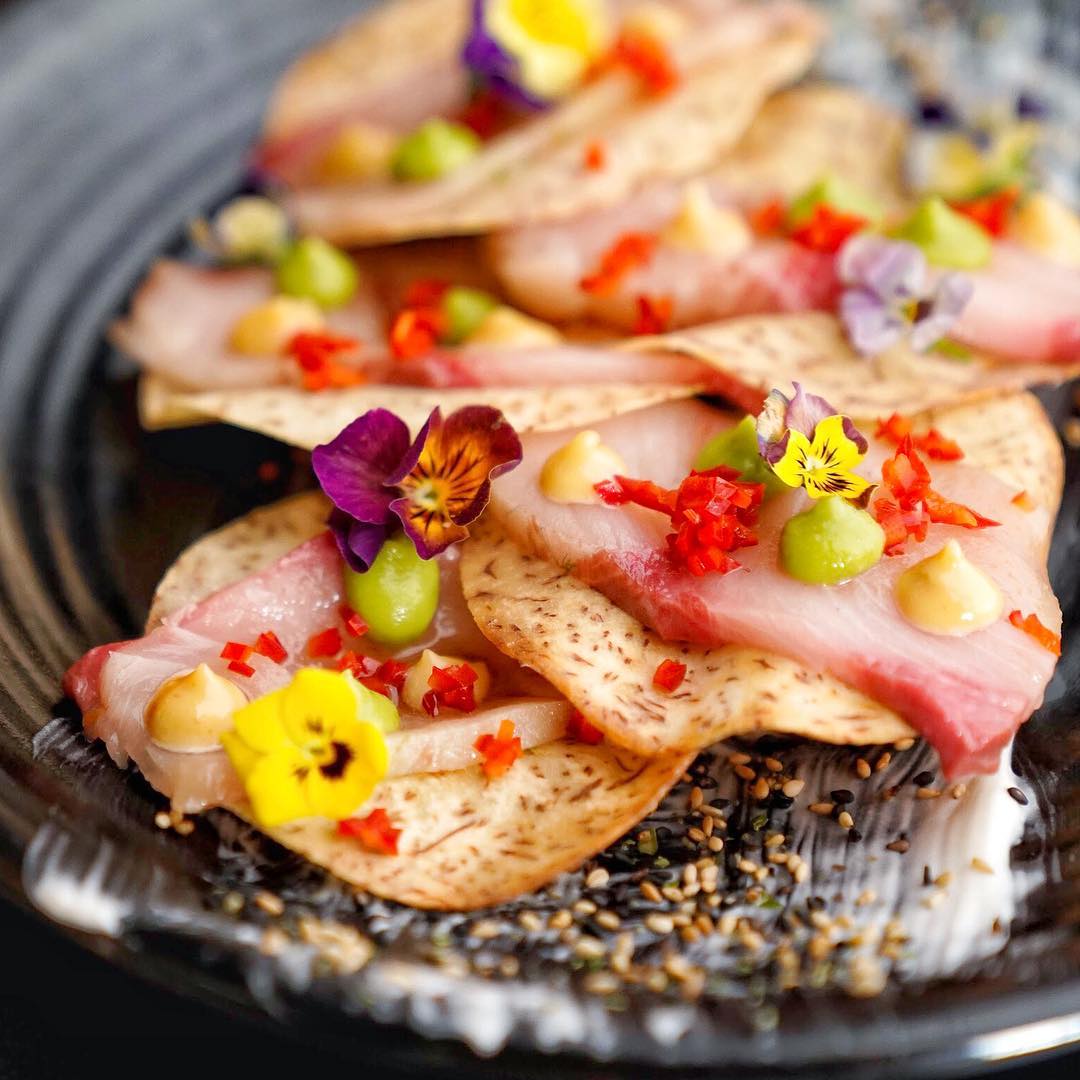
Even more irresistible bites followed: Hamachi crudo with green onions and peppers and fried chicken wings. The sweetness of the fresh yellowtail made the crudo light and addictive, with a light pop of heat from the peppers. I had my eye on the tray as it went around the room and I unabashedly took the last one when it was offered.

The hamachi crudo with green onions and peppers | Courtesy photo

The fried chicken wings with Thai chilis and a sweet sauce are another of the Bone Kettle’s popular dishes, for a reason – the wing was perfectly crispy, the sweetness from the sauce woken up by the kick of the Thai chili, and the chicken was juicy and perfectly cooked. May started volunteering me to take every leftover sample of food they brought out. I protested, but mostly out of pride…

A third round of broth came out – and it was gone in a matter of seconds. As I drank the broth, I marveled at its richness, but as soon as I finished a sip, I noticed how light it was and immediately reached for more.

The penultimate appetizer was a Rendang rice fritter with a filling of short rib, slow cooked for 15 hours, and cheese. The cheese really shone through, and the pulled short rib was pillow-soft. In the cross-section of my bite, I could see each individual grain of rice used to make the coating. The rice was crispy on the outside, and not too soft within, maintaining the structural integrity of each grain of rice for some texture.

The rendang rice fritter has a filling of short ribs slow cooked for 15 hours | Courtesy Photo

The finale: a platter of drier, crunchy coconut-braised fried chicken with a spicy salsa made from an unusual set of vegetables.

As the restaurant is sandwiched between a burger joint and a barbecue place, some might think that the Bone Kettle would struggle to compete with such classic American favorites. However, I’d argue that the Bone Kettle is perfectly situated to exemplify the diversity of flavors in Southern California.

The Bone Kettle is the kind of place where I’d want to take my girlfriends to on a weekend for some good food, and catch up on our weeks. I can’t wait to go back and see what more delights they have to offer on their full menu!

Brianna Chu, a guest opinion writer for Beacon Media, was born and raised in Pasadena. She loves to cook and to eat, is a lifelong viewer of Food Network, and enthusiastically introduced the tradition of Thanksgiving dinners to her British and European friends while earning her degree at the University of St Andrews. While they absolutely hated going around the table and saying what they were grateful for every year, they also loved the excuse to get together and feast with friends enough to endure it anyway.

The Pie Hole Offers Fare from Original Recipes

Originally published on 19 November 2018 in the Pasadena Independent, Arcadia Weekly, and Monrovia Weekly

The chicken pot pie and salted caramel pecan pie, served in pie tins, and a cup of latte | Photo by May S. Ruiz / Beacon Media News

By Brianna Chu and May S. Ruiz

The Pie Hole, located at the Indiana Colony in  Old Pasadena, serves up the kinds of pies that are not found at regular cafés, diners, or restaurants. That’s because the items on its menu were created by Becky Grasley who comes from a long line of bakers and cooks in rural Pennsylvania, where pie is a way of life.

Grasley and the other women in her family showed their love through baking and marked the seasons with the pies they made. She continued this tradition with her own children, using recipes that have been passed on from one generation to the next. She baked pies after school and took them to the fair, where her apple pie won the blue ribbon.

Years later, when her children were grown, Grasly spent a Thanksgiving weekend baking countless pies for friends and family at a remote cabin. And her life-long dream of opening up a pie shop got closer to actuality.

With co-founder Sean Brennan, whose restaurant experience balanced her pie-making skills, Grasley established their first eating place in October 2011, at the Arts District in Los Angeles known as Bloom Square, in honor of a local legend and activist who owned a neighborhood convenience store. They named it The Pie Hole and it became an instant hit.

Brennan, speaking with us via e-mail, answers questions that range from where they choose to open shop to how they keep the standards in all locations. “From a real estate perspective, we look for terrific neighborhoods that don’t have great pie restaurants. Realistically, our regulars tell us where they want us to be. People invite us all the time, on social media and at our restaurants, to come to their neighborhood. And Pasadena is a perfect example – we had so many fans visiting our Arts District restaurant asking us to open in Pasadena, so we did.”

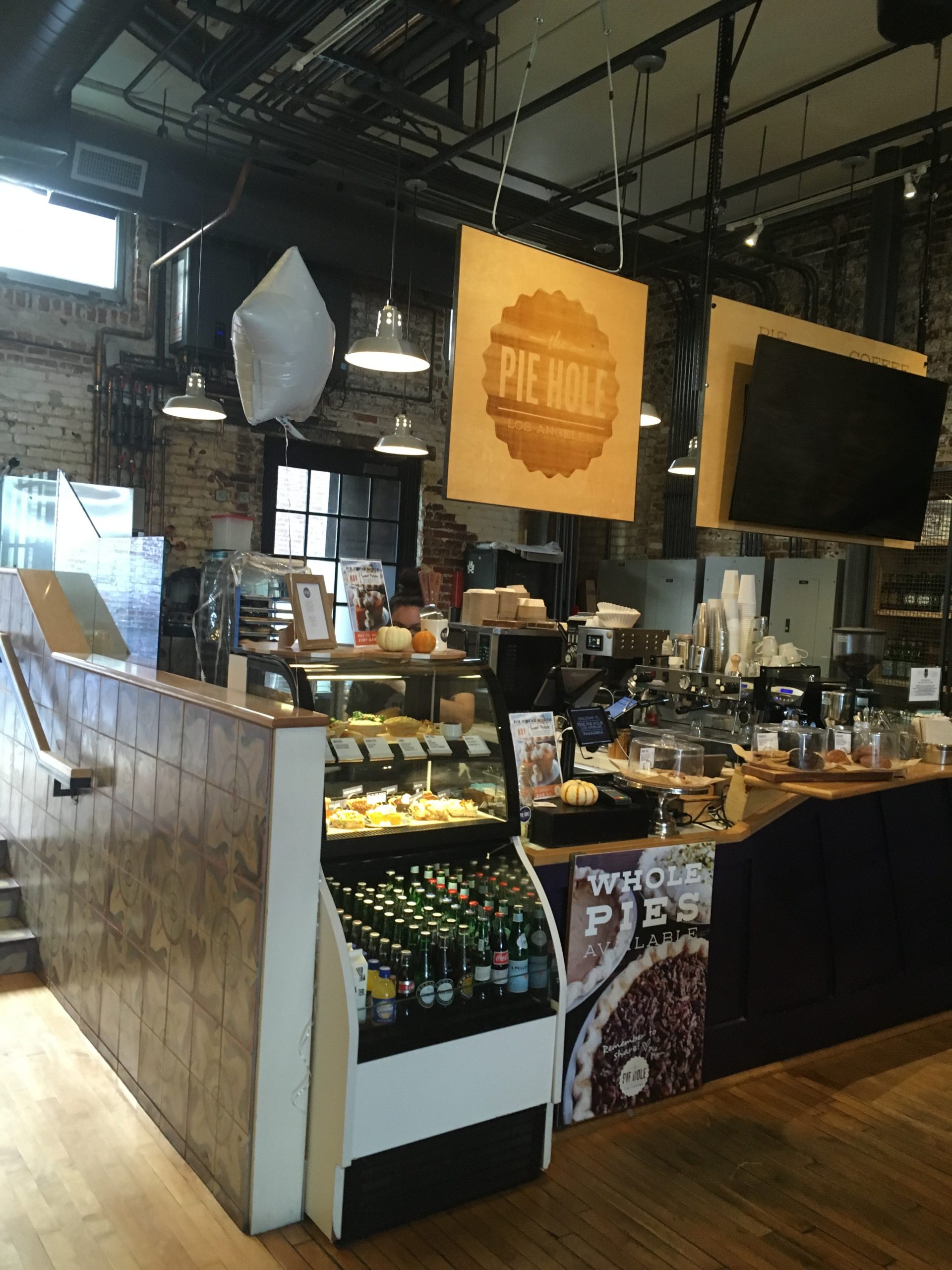
The Pie Hole in Old Pasadena | Photo by Brianna Chu / Beacon Media News

Word about The Pie Hole spread and to date there are ten locations – eight in the Los Angeles area and two in Tokyo, Japan. The Arts District, Hollywood, and Pasadena locations are owned by Grasley and Brennan and the others are either franchises or licensing agreements.

“Whether they’re owned  by The Pie Hole or franchises, all of our restaurants are teams and they undergo a rigorous training program,” Brennan points out. “We start with selecting the right people – those who love coffee and pie. We always have open lines of communication and a great collaborative culture. Our chefs in Japan are constantly talking with our chefs in L.A. We also spend a lot of time visiting all of our restaurants to make sure everything is up to our standards.”

Ensuring that the quality is maintained means all pies are made with the same ingredients and undergo the same process in all their restaurants. Their founder’s recipe for Mom’s Apple Crumble, for instance, contains two pounds of Granny Smith apples. The Earl Grey Tea pie, infused white chocolate mousse with a layer of dark chocolate ganache and salted pistachios, is a house invention and a masterpiece that takes 24 hours to make.

Besides signature pot pies, individual pot pies, and hand pies, the restaurant offers galettes, breakfast quiches, and salads. Hot and iced coffee – either espresso or their own specialty blend, specialty and seasonal specialty lattes – are wonderful accompaniments to all the food items.

“We have mostly the same menu at all of the restaurants, using our Arts District shop as a culinary incubator where we test new recipes and pies,” explains Brennan. “However, we regularly add new pies and specialty coffee drinks, including the Pie of the Month and Drink of the Month. The November  pie of the month is a sweet potato pie with brown butter sage in a butter crust, topped with marshmallows; the drink is spicy mocha made with our signature house blend, chocolate syrup, and ground ancho chili pepper.”

However much her business has grown, Grasley isn’t about to stop there just yet. She would like to add more locations and novel items. The Pie Hole is now open for breakfast with its new breakfast pies. Most recently, in time for pie season, it introduced Pie Holes – small, round, two-bite pies perfect for a quick snack and eating on the go. Available in four flavors, they are priced at $1.00 each or $12.00 for a baker’s dozen.

Brianna’s review below provides highlights about The Pie Hole’s food and ambience.

Tucked into the back corner of Indiana Colony’s marketplace space, The Pie Hole sits amidst the company of a juice bar, an ice cream vendor, and a tea and herb-selling stall. It’s the kind of place that seems geared towards attracting young adults who want the ready availability of caffeine, food, and WiFi of a Starbucks, but with a hipper vibe.

The café was kind enough to offer us each a savory and sweet pie, along with a drink of our choice. May opted for the classic latte and I chose a cold brew coffee; we were both very pleased with our coffees, May especially. I was given both sugar and simple syrup to sweeten my cold brew, which was a thoughtful touch.

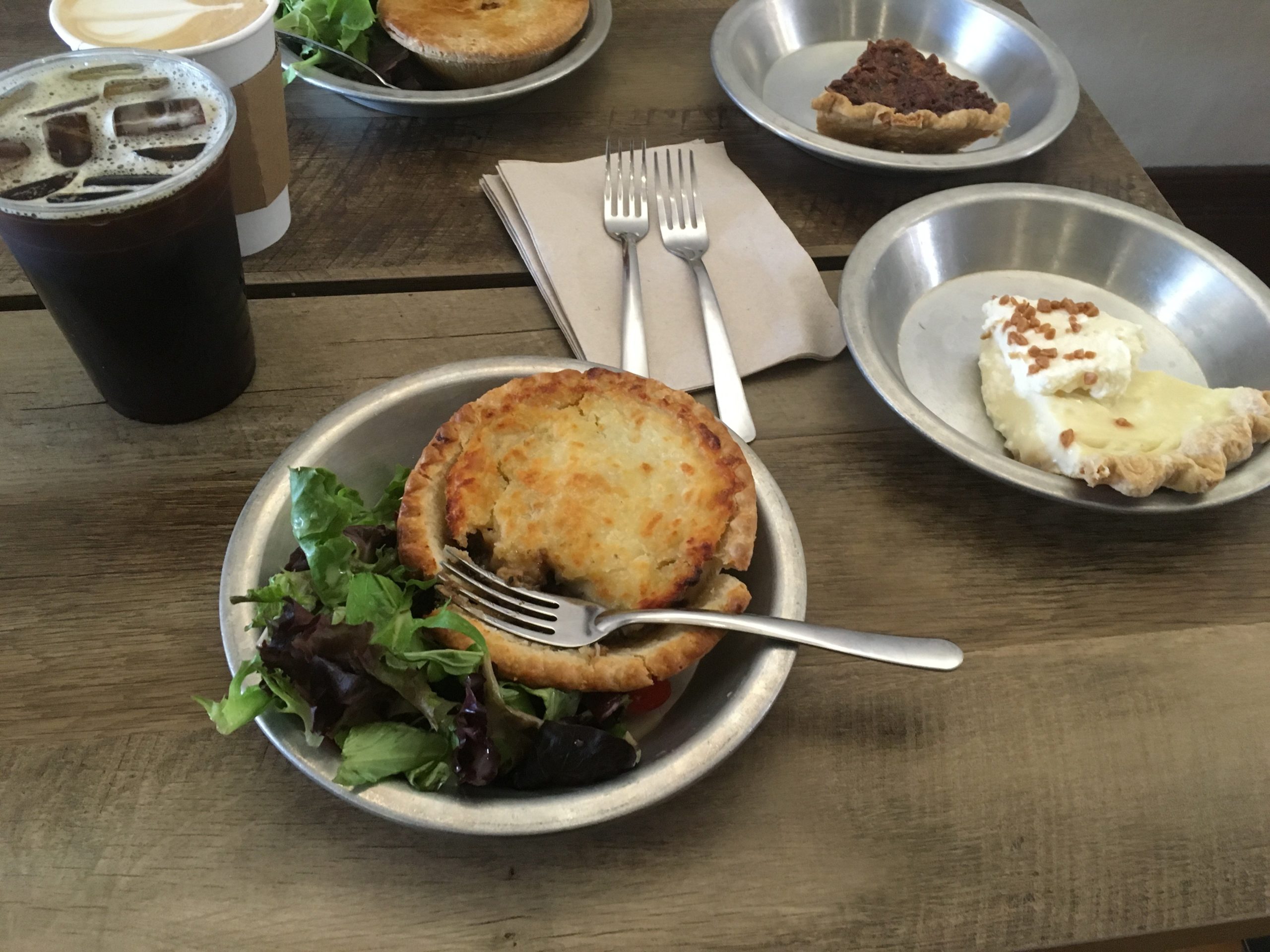
Shepherd’s pie, banana cream pie, and cold brew coffee | Photo by Brianna Chu / Beacon Media News

We sampled some classic pies, the chicken cornbread and shepherd’s pie, and May picked the salted caramel pecan for her dessert while I selected the banana cream. The staff were friendly and helpful, and we received our food shortly after ordering.

Each pie was served in a metal pie tin, which emphasized the hip vibe – there’s a growing trend of restaurants using unorthodox objects in lieu of plates, and the trend is polarizing, to say the least, but I felt that in this case it actually made sense.

The Pie Hole’s chicken pot pie is a twist on the classic, what with the cornbread incorporated into their filling and the inclusion of red bell peppers instead of the staple carrots and peas. I hesitate to opine on the chicken pot pie, as I enjoy the traditional chicken pot pie and the red bell pepper isn’t quite my taste, but I will say that I couldn’t quite pick out the cornbread in their filling.

Their shepherd’s pie is more along the lines of the classic, complete with a topping of mashed potatoes. Perhaps it was just a fluke of the batches, but we found that the shepherd’s pie tasted a tad too salty for our palate, becoming less easy to eat after running out of the accompanying side salad to temper it; and the salted caramel pecan pie fell a little on the sweet side for May.

However, the banana cream pie was everything I hoped for; a big plus for me was that the pudding tasted homemade, without the slight aftertaste of the store-bought variety. The banana slices were visible and texturally present in the pie, and the shards of toffee on top provided a welcome pop of sweetness and textural contrast. The consistent high point, for me, was the pie crusts – which were dependably buttery, flaky, and everything I’ve come to expect in a good pie crust.

The newly introduced, snack-sized pie holes | Photo by May S. Ruiz / Beacon Media News

Two weeks after we initially visited, we were invited back to experience their newest offering – the rather fitting pie hole. Self-enclosed mini pie bites, these pie holes currently come in four flavors: caramel apple, blueberry, Mexican chocolate, and Nutella. For me, each pie hole is about a four bite proportion, a perfectly snack-able size.

Both the caramel apple and blueberry were excellent, slightly warm, and not too sweet – and I’m not even much of a caramel fan, either. The Mexican chocolate and Nutella bites were definitely much sweeter, but they were also served cold, so they were on the hard side. Like our last visit, the drinks were great – May loved her salted caramel latte, and my pumpkin pie latte was exactly what I thought it would be – the Pie Hole’s smoother and classier version of the popular Pumpkin Spice latte.

All in all, I would consider returning; and in fall, an afternoon outing in Old Pasadena definitely benefits from a good slice of pie.

Brianna Chu, a guest opinion writer for Beacon Media, was born and raised in Pasadena. She loves to cook and to eat, is a lifelong viewer of Food Network, and enthusiastically introduced the tradition of Thanksgiving dinners to her British and European friends while earning her degree at the University of St Andrews. While they absolutely hated going around the table and saying what they were grateful for every year, they also loved the excuse to get together and feast with friends enough to endure it anyway.

Celestino: Creating Memorable Sicilian Dining Experiences

Originally published on 12 November 2018 in the Pasadena Independent, Arcadia Weekly, and Monrovia Weekly

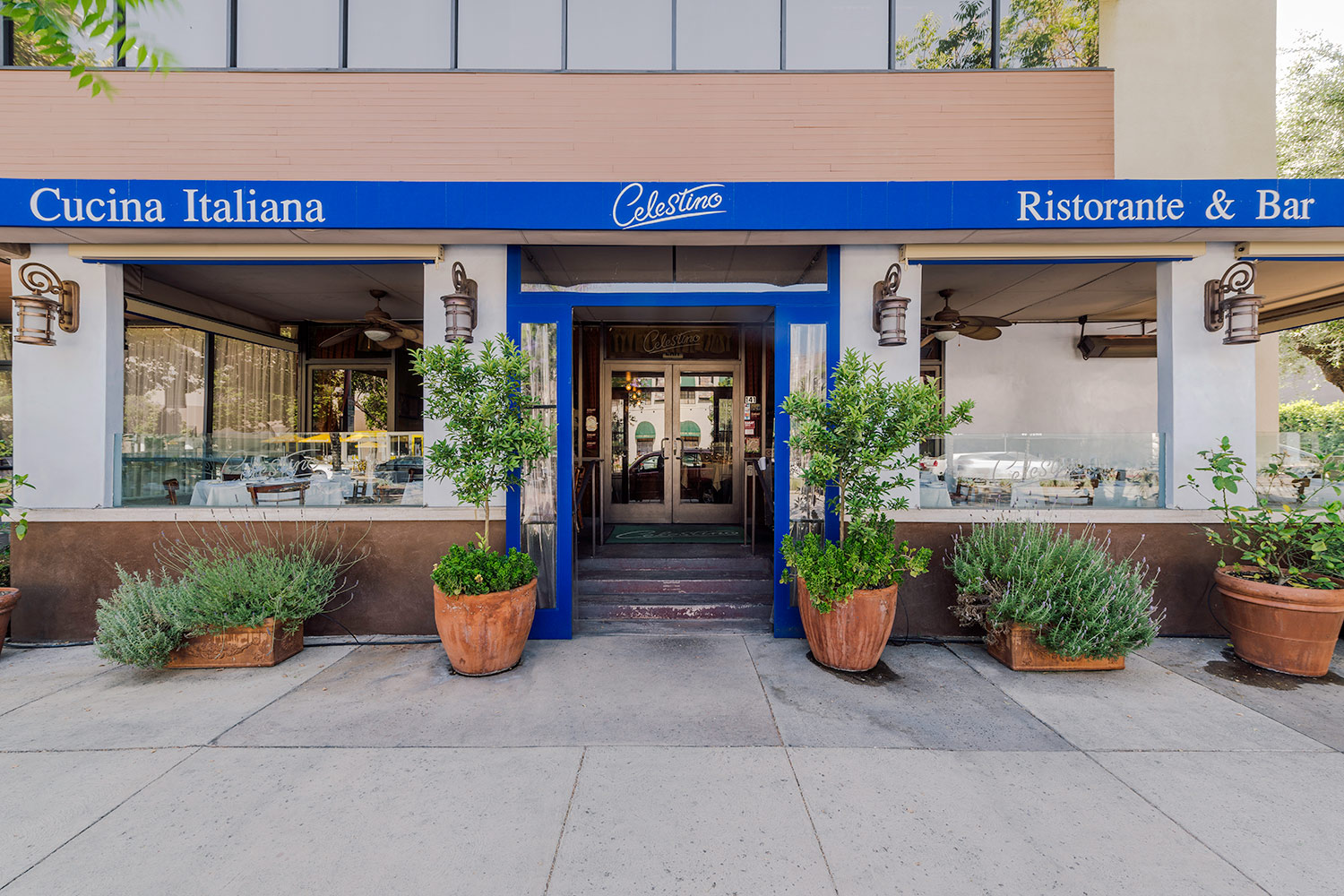
Celestino, at 141 South Lake Avenue in Pasadena, has been a favorite among diners for over 20 years | Courtesy photo / Alen Lin

By Brianna Chu and May S. Ruiz

Celestino, at the South Lake Avenue District, has been a celebrated restaurant among diners looking for authentic Italian cuisine. For over 20 years, it has attracted locals and visitors to Pasadena with its seasonal fares made with the finest and freshest ingredients.

Owner Calogero Drago, one of the famed Drago Brothers who operate several restaurants in the Los Angeles area, is legendary for his exuberance. He dashes through the restaurant, making his rounds from table to table, imbuing an atmosphere of cheerful energy and enthusiasm. It wouldn’t be a surprise to anyone that he actually knows diners by name and is aware of their food preference. Because of the personal relationships he has built with diners, people travel to Pasadena to enjoy the food as much as the friendship.

However, Drago doesn’t rely on goodwill alone. Celestino is, after all, a restaurant; so he ensures that diners are never disappointed and comes up with dishes that make their experience memorable. During a recent private tasting dinner, he inaugurated his seasonal menu featuring mushrooms and truffles – those rare and coveted fungi which make for the most sublime food creations.

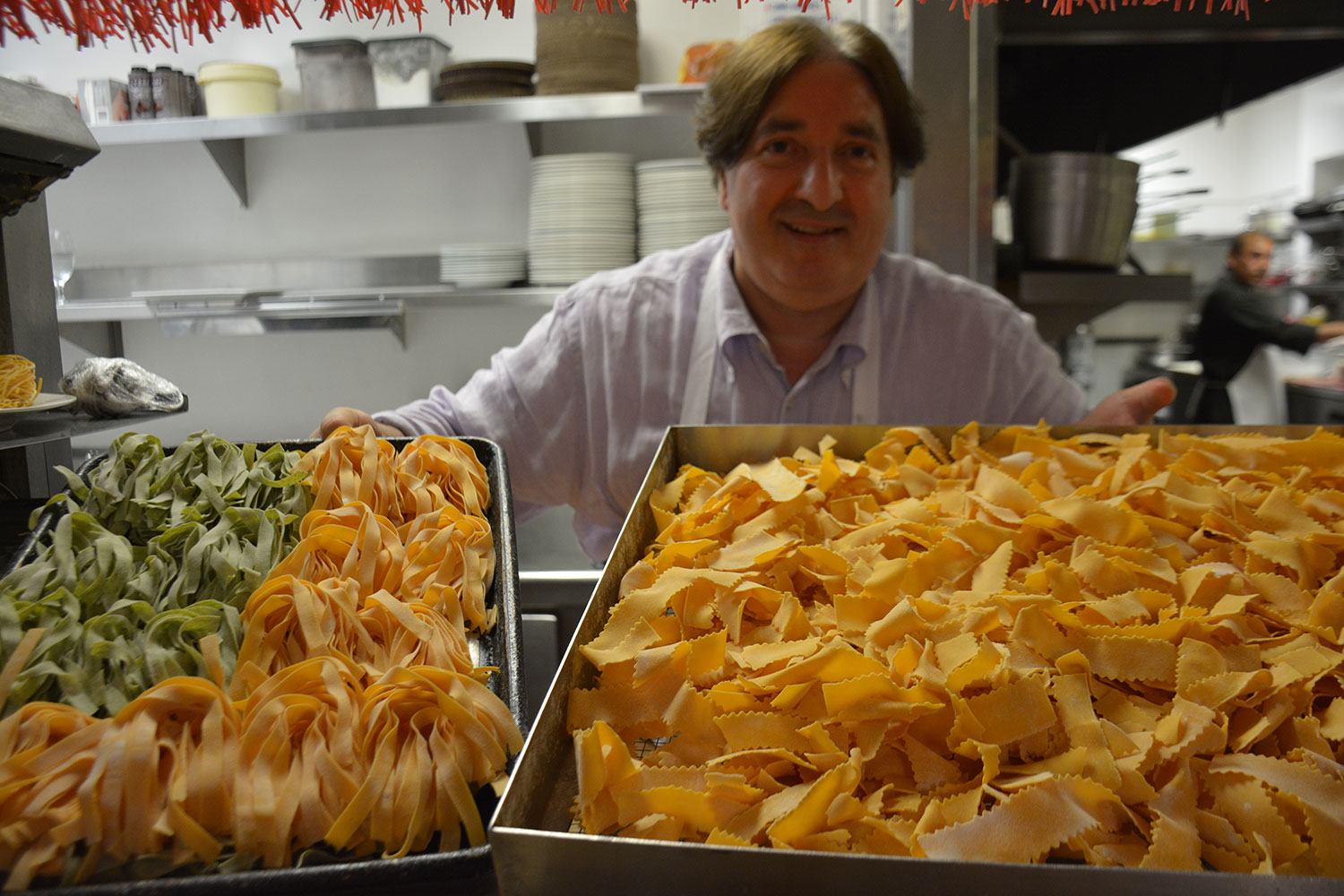
Calogero Drago shows’ off Celestino’s handmade pasta | Courtesy photo / acuna-hansen

And after reading Brianna’s review below, you’ll appreciate why Celestino is the acclaimed restaurant that it is.

Italian cuisine is fairly ubiquitously loved, making the search for a great Italian restaurant a challenging one. Even novice cooks can tackle some classic and comforting Italian dishes, thus raising the bar for finding an Italian spot that is truly worth going out for. Ambience, too, is especially important; we want the kinds of places we can rely upon for any occasion – birthdays, weekend dinners with family, dates – and the mere mention of Italian restaurants conjures images of candlelight, warmth, red-checked tablecloths, and great hospitality. The balance? Food that is indulgent yet not overwhelming, and of a quality that I couldn’t imagine easily replicating in my own kitchen.

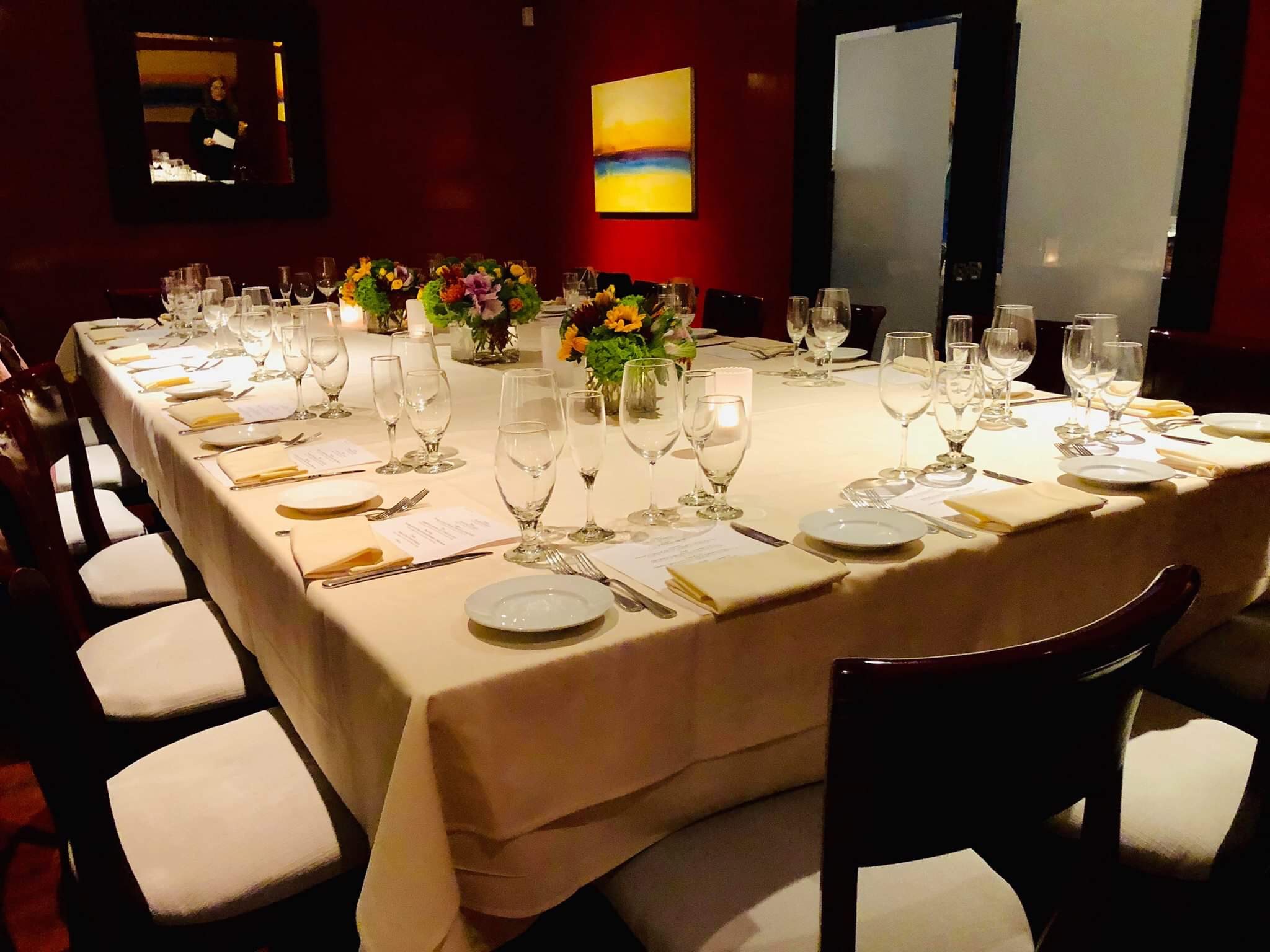
These were my expectations when we walked into Celestino. For 7 pm on a Wednesday night, the cozy restaurant was already filling up, and my high hopes raised higher still when we were immediately greeted by the friendly face of its owner, Calogero Drago. We were directed to a softly lit table in Celestino’s Lake Room, which, with deep red, fresco-textured walls and flickering candlelight, fit the image of your favorite upscale Italian restaurant.

The Lake Room |Courtesy photo / TinTin Beligan

Over the course of the evening, we were treated to small plates of six different appetizers, a choice between an entreé of sole or veal scalloppini, and a dessert of panna cotta in a tasting menu prepared to showcase Celestino’s seasonal dishes.

The tasting commenced with an eggplant polpettine, a little “meat”-ball which had a crisp outer shell and surprisingly cheesy pureé of eggplant.

The following pumpkin soup subverted my expectation – the pumpkin element came from the seeds, and was not the main component of the soup. The pumpkin seeds provided texture and nuttiness to the thin, spring green soup, which also featured tender cooked squid.

Next, the burrata antipasto – accompanied by a tomato sauce on a bed of arugula. The skin of the freshly-made cheese was resilient and slightly resistant to being cut, and once my fork broke through, the texture of the cheese within was incredibly silky and creamy in taste – as buttery as its name suggests.

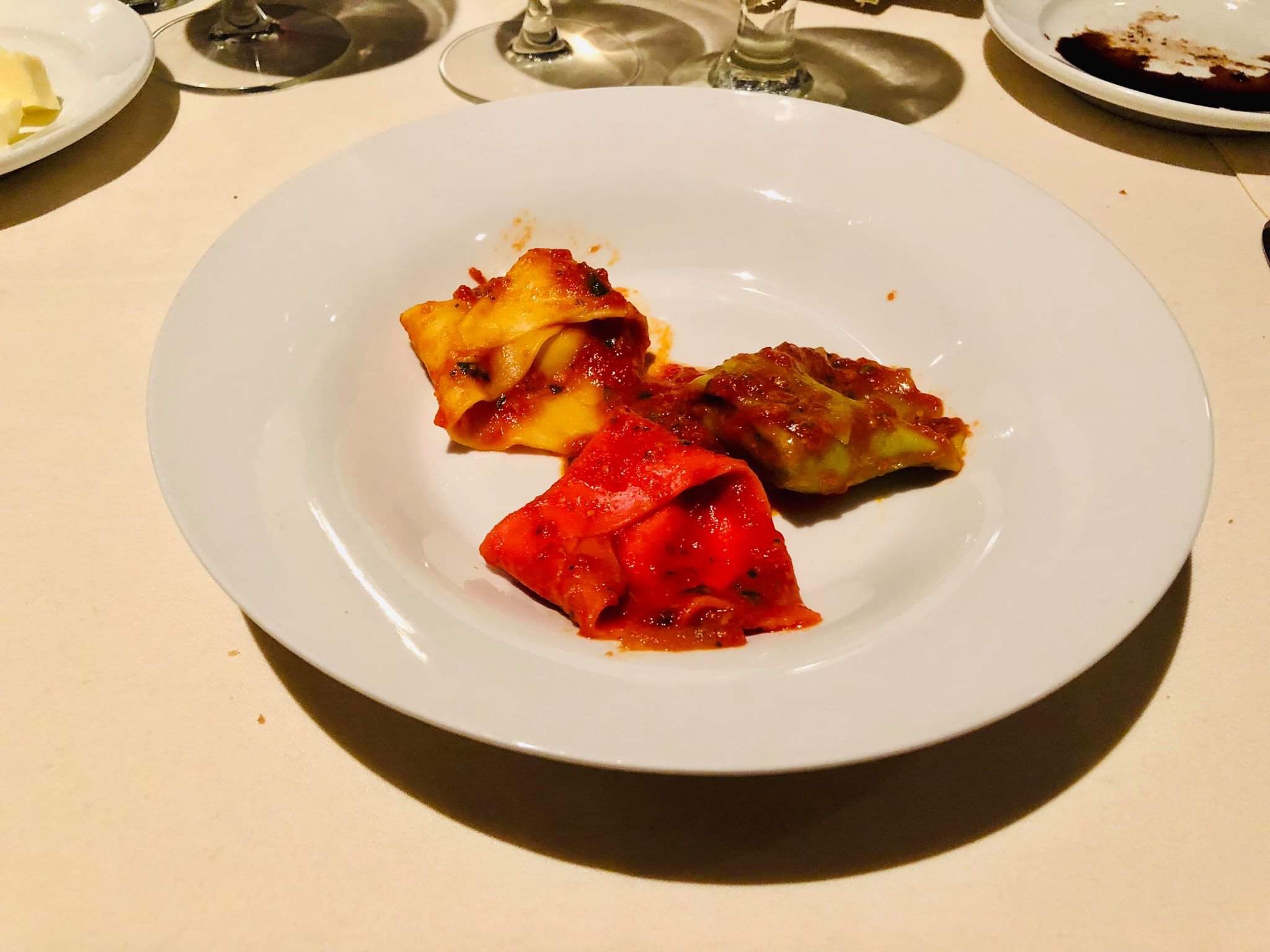
Tortelloni stuffed with mixed seafood and spicy tomato sauce | Courtesy photo / TinTin Beligan

The penultimate appetizer was mixed seafood tortelloni, which are the larger cousin of tortellini. Each tortelloni was handmade, Drago told us (an assertion supported by the bite of the dough), and was the perfect two-bite size proportion. The cioppino sauce in which the tortelloni were served was gently spicy: enough to warm the tongue, but certainly nowhere near overpowering to interfere with any of the flavors of the sauce itself.

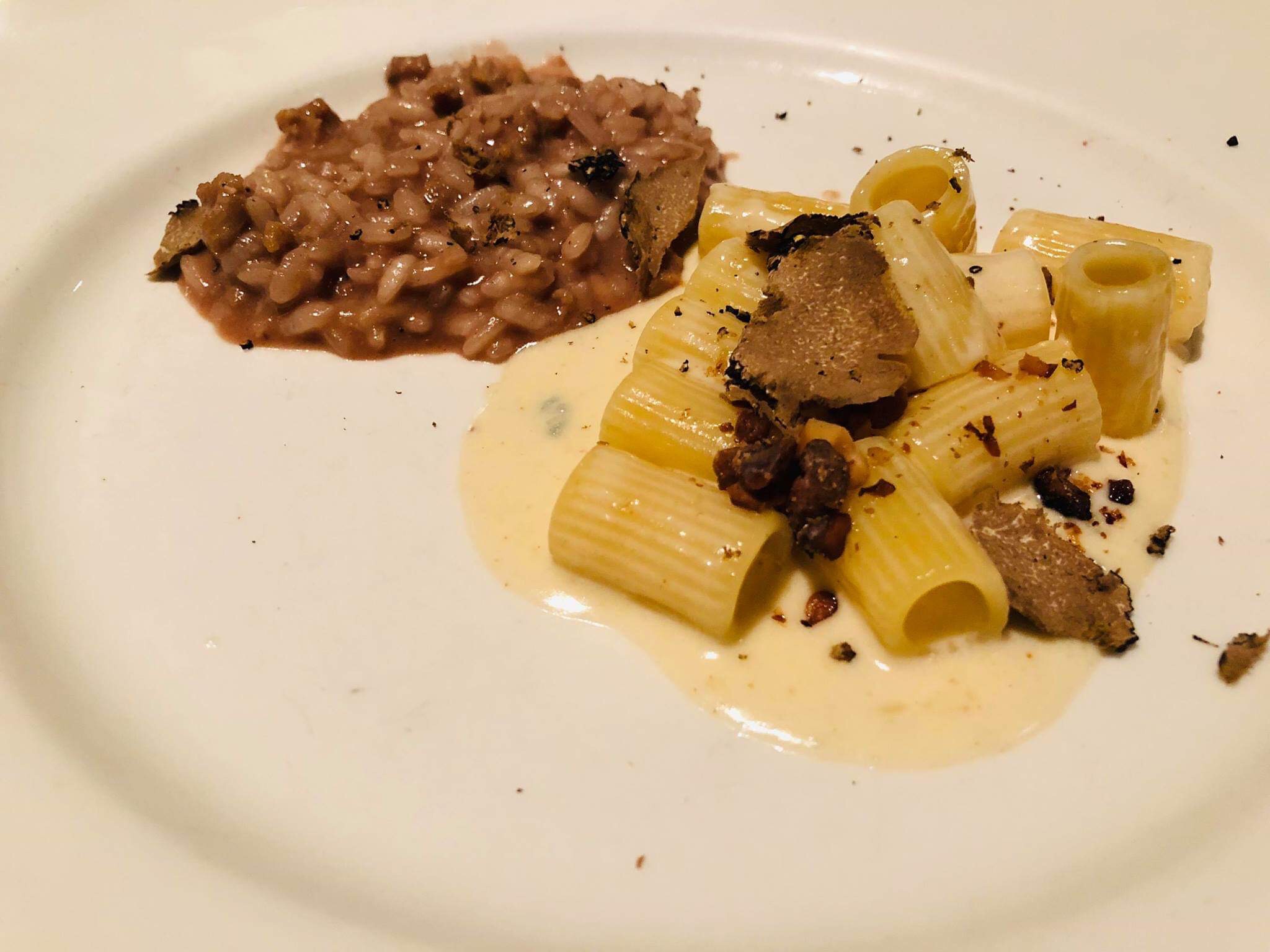
Risotto and bambolotti | Courtesy photo / TinTin Beligan

When the risotto and bambolotti combination came out, the room was delighted by the simultaneous entrance of waiters holding truffles and graters in their hands. The risotto was rich and savory, and the slight sweetness and tang of the Nero D’Avola red wine was clearly present. Of course, the topping of truffle shavings added depth and earthiness to the already rich risotto. The bambolotti with gorgonzola, hazelnuts, and fresh black truffle was outstanding.

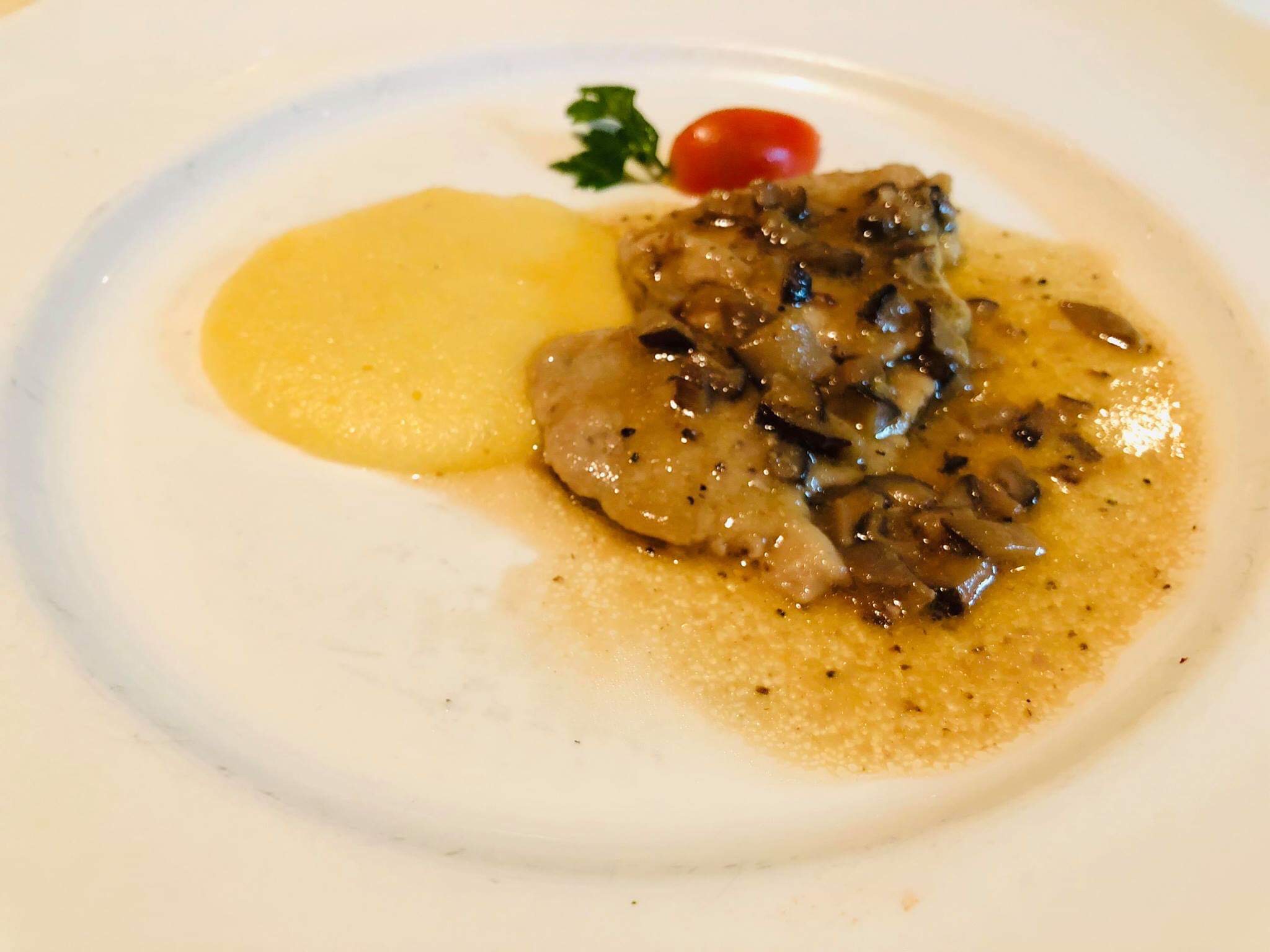
My chosen entreé of veal scalloppini was tender and delicious, but the polenta that accompanied it actually caught more of my attention, perhaps because it provided relief from the heaviness of eating the risotto and scalloppini back-to-back.

Veal scalloppini with mushroom and soft polenta | Courtesy photo / TinTin Beligan

For me, however, the dessert was quite literally the showstopper of the entire dinner. After so many courses, everyone was quite full, but the panna cotta perfectly contrasted against some of the heavier elements of the meal. The cream was lightly sweetened and both the flecks and flavor of vanilla bean shone through. The strawberries seemed to have been macerated in the limoncello, so the flavors were happily married by the time it reached us. Despite how full I was, I found the panna cotta dangerously easy to eat.

Panna cotta with strawberries and limoncello | Courtesy photo / TinTin Beligan

As we walked out to our car, we passed the kitchen, where I noticed trays of what appeared to be freshly-made tagliatelle nests on sheet pans laying on the order counter; and I wondered how I could have lived in Pasadena most of my life without ever eating at Celestino. The atmosphere is comfortable and welcoming, which seems to be a reflection of the joy and heritage of its Sicilian owner, and the food is a celebration of authentic Italian cuisine.

After some reviewing of Celestino’s online menu, it must also be noted that not all the dishes we tasted are present on the online menu, and there does not appear to be a dessert menu online either, despite the inclusion in the photo gallery of the truly excellent panna cotta. The items sampled that do seem to appear are the burrata antipasto, the truffle risotto, the veal scalloppini, and the sole (the alternate entreé choice). The lack of inclusion of these items on the menu is perhaps unsurprising, as Drago has been known to spontaneously invent new culinary offerings. To truly know what Celestino has to offer, I have a feeling you must just visit and find out yourself; and I personally plan to return just to see what new treats Drago has concocted.

Brianna Chu, a guest opinion writer for Beacon Media, was born and raised in Pasadena. She loves to cook and to eat, is a lifelong viewer of Food Network, and enthusiastically introduced the tradition of Thanksgiving dinners to her British and European friends while earning her degree at the University of St Andrews. While they absolutely hated going around the table and saying what they were grateful for every year, they also loved the excuse to get together and feast with friends enough to endure it anyway.

Arcadia Brothers Receive Outstanding Young Philanthropists Award

Originally published on 12 November 2018 in the Pasadena Independent, Arcadia Weekly, and Monrovia Weekly

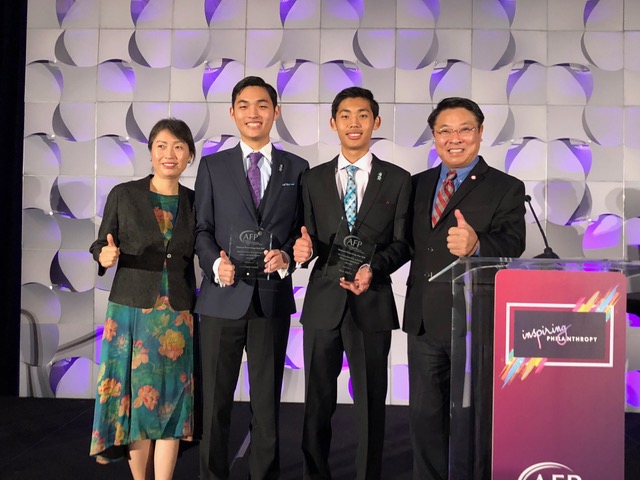
The Dong family (left to right) Charity, Richard, Eric, and Edward at the 33rd Annual Celebration of National Philanthropy Day Awards Luncheon | Courtesy photo / AFP/GLAC

Eric and Richard Dong, Arcadia residents and San Marino High School students, were named Outstanding Young Philanthropists by the Association of Fundraising Professionals, Greater Los Angeles Chapter (AFP/GLAC). They received the award at the 33rd Annual Celebration of National Philanthropy Day Awards Luncheon held on Wednesday, November 7, 2018 at the JW Marriott Los Angeles at LA Live.

The award recognizes individuals who exhibit a philanthropic philosophy that includes providing financial and volunteer assistance to meet community needs. Nominated by Dana Bean, Director of Development and Communications for Union Station Homeless Services in Pasadena, the Dong brothers were chosen by an AFP committee from a number of deserving candidates.

In her introduction of the awardees during the ceremony, Anne Miskey, CEO of Union Station, recalled, “We received a phone call from Richard and Eric, who were on their high school spring break. They said they heard about our organization from friends and they wanted to volunteer for us. Because they’re incredible pianists they started offering piano lessons for some of the kids in our family center. They were a big hit.

“But they didn’t stop there. Eric and Richard fund-raised from family and friends to give us a financial donation. Still, their generosity didn’t stop there. Their father, Ed, taught them how to invest in the stock market when they were young children and I asked them to talk to my kids.”

Continued Miskey, “They didn’t stop there either. With the profits they made from their investments, this past summer they established the Richard and Eric Dong Endowment Fund for Union Station. It is designed to provide scholarships for children in sports, music and the arts, leadership, and human rights promotion; to purchase books for the family library; to fund staff appreciation and recognition; and to finance the Robert F. Kennedy Human Rights educational programs.”

When he took to the podium, Richard declared, “This is a great honor! How we’ve dreamed of receiving this prestigious award! And yet, when it came true, it was a surprise. We are sincerely grateful to the AFP and the committee for voting for us, and to Ms. Dana Bean and Union Station Homeless Shelter Services for nominating us. It has been our pleasure to be involved with this wonderful organization and its caring staff.”

Eric added, “National Philanthropy Day is a special day. Richard and I learned from home and the schools we’ve attended, that philanthropy is an American virtue. It is something that he and I have tried to practice since our middle-school years. We believe there is no age limit when it comes to education, leadership, and philanthropy. They’re all essential to a great country like ours.

“The words of Robert F. Kennedy, ‘Our future is not a gift, it is an achievement,’ deeply resonate in us. They empower us to help, to share, and to contribute. We are confident that together, we can make the world a better place.”

As recipients of the Young Philanthropists Award, Eric and Richard join an impressive group of community leaders who have shaped the spirit of giving and service in the Greater Los Angeles area.

Eric’s and Richard’s parents, Charity and Ed, instilled in them the values that make them such extraordinary young men. For that, we are profoundly thankful.

Making Panto a Holiday Tradition in America

Originally published on 5 November 2018 in the Pasadena Independent, Arcadia Weekly, and Monrovia Weekly

Shown during the launch of ‘The Wonderful Winter of Oz’ are, from left to right: Kris Lythgoe, Becky Lythgoe, Julietta Perez, and Darrell Brooke | Courtesy photo / Kareem Cervantes

A decade ago there would have been no place to take in a Panto show in Southern California. But in 2010 the Lythgoes, known for their creativity and involvement in television hits ‘American Idol’ and ‘So You Think You Can Dance,’ changed all that when they mounted their first Panto production in North Hollywood.

In 2013 Lythgoe Family Panto took its Christmas show to the Pasadena Playhouse where it gained such a huge following that two years ago they had to move to a larger venue. This year will be their second time at the Pasadena Civic Auditorium, their ninth in Southern California.

Kris and Becky Lythgoe, the couple behind the Panto company, together with Sheldon Epps, erstwhile Artistic Director of the Pasadena Playhouse and a Lythgoe Panto producer, launched this year’s ‘The Wonderful Winter of Oz’ at a party held recently at Bistro 45.

Enlightening us on why they want Panto to be an American tradition, Kris states, “I was raised in England, where there is a vehicle that introduces theater to kids called Panto. My childhood memories include seeing “The Grinch,’ ‘A Christmas Carol,’ and ‘The Nutcracker’ in Panto, which were so exciting for children because they were interactive. The shows had pop music and all the kids would be jumping up and down, swinging from the aisles and everything. It was a fun way to get them interested in theater. Now that I’ve moved here, I would like to be able to do the same thing for my children.”

Becky elaborates, “Kris came to America to start creating shows like ‘American Idol.’ In 2009, when our son was three years old and we wanted to see a show, he realized there was no affordable family show for parents to take their kids to, as his parents did in England.

“Kris’s mum used to direct Pantos and his dad used to write them back in England. So he and his mum said ‘Why don’t we do a Panto here?’ When he told me about his vision I knew exactly what to do with it. We started a company and produced ‘Cinderella,’ which we showed in North Hollywood.”

The reception for their first Panto was very warm, recalls Becky. “It was welcomed, really. There seemed to be a hunger for this kind of show where the entire family can have a great time. We have jokes and songs that kids, parents, and grandparents can appreciate and we have stars from several generations on our show.

“This is what made ‘American Idol’ popular as well – it’s multi-generational. I think American audiences revel in these kinds of shows. We’re loud people, we love to boo or clap, we love to share, we’re not shy with our opinions.”

Chimes in Kris, “I think there was a need for a family experience, especially at this time when people tend to watch YouTube by themselves. Panto brings together several generations – we might get something different from it, but we’re all watching the same show.

Epps recounts how he became involved, “They had some success in North Hollywood but they really wanted to be in a theater and producing organization, where they had more of a support system. At the same time, I had been looking for an entertainment show for the holidays that would appeal not only to children, but to families as well.

“I went to see ‘Snow White’ at El Portal and I really loved it; I thought it was great work. So I told them to come over to The Playhouse and see how it goes. We were lucky enough to have Ariana Grande for our first Playhouse show and it was a really big success. Becky is in charge of casting and she’s tenacious about going after people – making phone calls, knocking on doors, and calling on friends. That’s how she gets such a great cast which draws people to our shows.”

Becky says, “To get stars like Ariana Grande and Gordon Fisher as we had in the past, we needed to have a short run and a bigger venue. At the same time, as we’ve grown, we felt it was appropriate to partner with the city. We still collaborate with The Playhouse for an education outreach and development that is financed by the Pantos and we feel truly part of the community now.

“Pasadena is like New York to me in that it supports the Arts as much as it encourages family endeavors. So I felt this should be the heart of our work. Now we’ve expanded to Laguna, Nashville, and San Diego. As we take it nationally and extend it to television audiences, I would like to keep Pasadena as the epicenter of our ventures. We would like to make Panto a destination in Pasadena during the Christmas season much like the Rose Parade and Rose Bowl Game.”

Lesley Brander-Epps and Sheldon Epps | Courtesy photo / Kareem Cervantes

Concurs Epps, “I remember the first time I mentioned Panto and people asked ‘Is that like Marcel Marceau?’ It has since become so hugely successful that it turned into a sort of Pasadena holiday tradition to the point where people say ‘We’re going to see the Panto. I don’t know what the show is, but I’m going to see it.’

“I’ve produced seven Pantos since it started at The Playhouse. Last year I directed my first Panto, ‘Beauty and the Beast – A Christmas Rose,’ our first at the Civic Auditorium, and I will be directing it again this holiday season when the show goes to Laguna Playhouse.

“What I love about this Panto is that the audience that saw it seven years ago have returned and they now have children who are coming to see it for the first time. It’s a perpetuating enterprise. That’s a far cry from when people thought of it as a mime show.”

It’s very rewarding to the Lythgoes to hear that audiences recognize their efforts at making Panto relatable. Kris states, “I’ve been here for 15 years, which is most of my adult life, so I understand American culture and the jokes. I make sure I take out the British-ness out of it to make it reflective of the American way of life.”

Asked to distinguish between English and American Panto, Kris replies, “People tell us British Panto is more boring than its American counterpart. Most of the fairytales have been adapted into Disney movies which are very popular so everyone is familiar with them. We also hire professional performers so the singing is far superior.”

Adds Becky, “We also use better props. For instance, if an actor refers to a horse, there will be an actual horse on stage or, at the very least, something resembling it. The quality of our productions is definitely higher.”

As the writer, Kris likewise has to keep coming up with interesting shows. He discloses, “While it’s getting harder and harder to decide what stories to adapt to Panto, there remain several fairy tales from The Brothers Grimm and Hans Christian Andersen. However, I’m not limiting myself to European fairy tales – ‘The Wizard of Oz’ is a very American story.”

“‘The Wonderful Winter of Oz’ is a play on the Frank Capra classic, the ultimate American fairy tale,” describes Kris. “It follows the same story line, except that Dorothy gets swept away by a blizzard instead of a tornado, and it’s interactive. We have famous actors playing the various characters but our biggest ‘get’ is Kermit the Frog who’ll be our Wizard. And the reason we wanted him is because Emerald City is green.”

Interjects Becky, “And also because Kermit sings the ‘Rainbow Connection’ and the song Dorothy sings is ‘Somewhere Over the Rainbow.’ So there are those links.”

“This is the first time Kermit will be in Pasadena so we’re very excited,” states a giddy Kris. To which Becky inserts, “This will also mark the first time Kermit will be on stage to play a role other than himself.”

Not even Kermit is immune to the attractions of Panto. The Lythgoes have outdone themselves again.

Arcadia Tenor is a Featured Soloist in the Verdi Chorus 35th Anniversary Concert

Originally published on 5 November 2018 in the Pasadena Independent, Arcadia Weekly, and Monrovia Weekly

A peacock in the L.A. County Arboretum in Arcadia

Tenor Todd Wilander grew up in Arcadia, attended Arcadia High School in the late 1980s, then went to California State University in Los Angeles (Cal State). Little did he know then that he would be traveling the globe, performing the works of venerated opera composers in world-famous concert halls.

Wilander is one of four featured guest soloists in the Verdi Chorus 35th anniversary season which culminates with its Fall 2018 concert ‘Passione! Opera!’ for two performances only at the First United Methodist Church in Santa Monica on November 10 and 11 at 7:30 pm. He has been praised by the New York Times for his ‘brave, vocally assured portrayals,’ and he has returned for eight seasons, thus far, with The Metropolitan Opera.

Tracing his extraordinary path that led to opera, Wilander recalls, “At Arcadia High, I was a member of ‘Chanteurs,’ which was like a ‘Glee’ group; we wore sequined vests and we sang show tunes and rock n’ roll. I also sang in the Arcadia Presbyterian church choir with my mom and grandma – I was a back-up singer with a bunch of adults, not really knowing what I was doing but I had a big voice and a natural talent.

“Dr. Thomas Miyake, who was the choir conductor and head of church music at the Arcadia Presbyterian Church, was also a professor in Music Studies and the Choir Director at Cal State. When I was looking at colleges for my undergrad work, he mentioned that he could get me a scholarship if I was interested in attending Cal State.

“At Cal State I was encouraged by Professor Pollyanne Baxter and the school pianist, Twyla Meyer, who I still see often. Both became my biggest academic supporters.

“I also became active in student politics – I was the president of the student body made up of 20,000 students. Political science had also been an interest and that gave me the opportunity to meet Bill Clinton and Pete Wilson. However, I decided to pursue singing and went to Northwestern University in Chicago to earn my Master’s degree.”

“From Chicago, I moved to Kansas City,” continues Wilander. “It was while I was there that I tried out for The Metropolitan Opera competition which it holds ever year. I made the first round then I went to New York with 25 other competing singers. The next round whittled it down to ten competitors, until five winners were chosen and I was one of them.

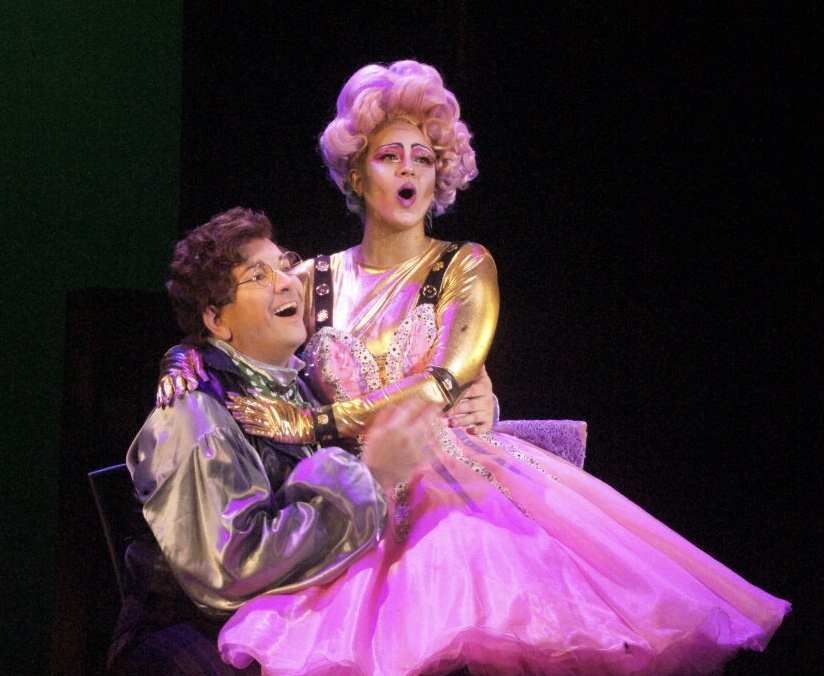
From the opera ‘Lucia di Lammermoor’ by Donizetti, singing the role of Edgardo, with the Boheme Opera of New Jersey | Courtesy photo / Boheme Opera

“Winning a competition by The Metropolitan Opera in 2000 was a big deal as it opened many doors. The next year I won a foundation competition and moved to Berlin where I lived and worked for three years; I was in my 20s. That led to performances in Italy and elsewhere in the world.”

In the years hence, Wilander has performed in 20 countries. And if this year’s engagements were any indication, he could be looking forward to seeing many more places.

“I was in San Francisco in January, San Luis Obispo in February, Alaska in March, Mississippi in April, then in Barbados for a week, and Germany for two months,” Wilander details. “I came back here and did a concert for my stepmom Marilynne held at the First Methodist Church in Pasadena, where she has been a member of for 50 years. I just finished an opera in New Hampshire.”

Wilander’s association with Verdi Chorus began almost two decades ago. He relates, “I knew Anne Marie Ketchum, Verdi Chorus’s conductor and founding artistic director, when I was a Cal State undergrad. She was in charge of the Pasadena City College (PCC) opera theater program at that time. Someone told me they were doing a Bernstein/Gershwin revue and they needed some male tenors so I called her up. To this day, I think fondly of that concert because those two composers are such geniuses.

“Anne Marie and I became friends and we would get in touch from time to time. Around 2013, we met for lunch and she told me about Verdi Chorus. She said they hold two big concerts a year and invited me to be a tenor soloist; I think this will be my fourth time with the group.”

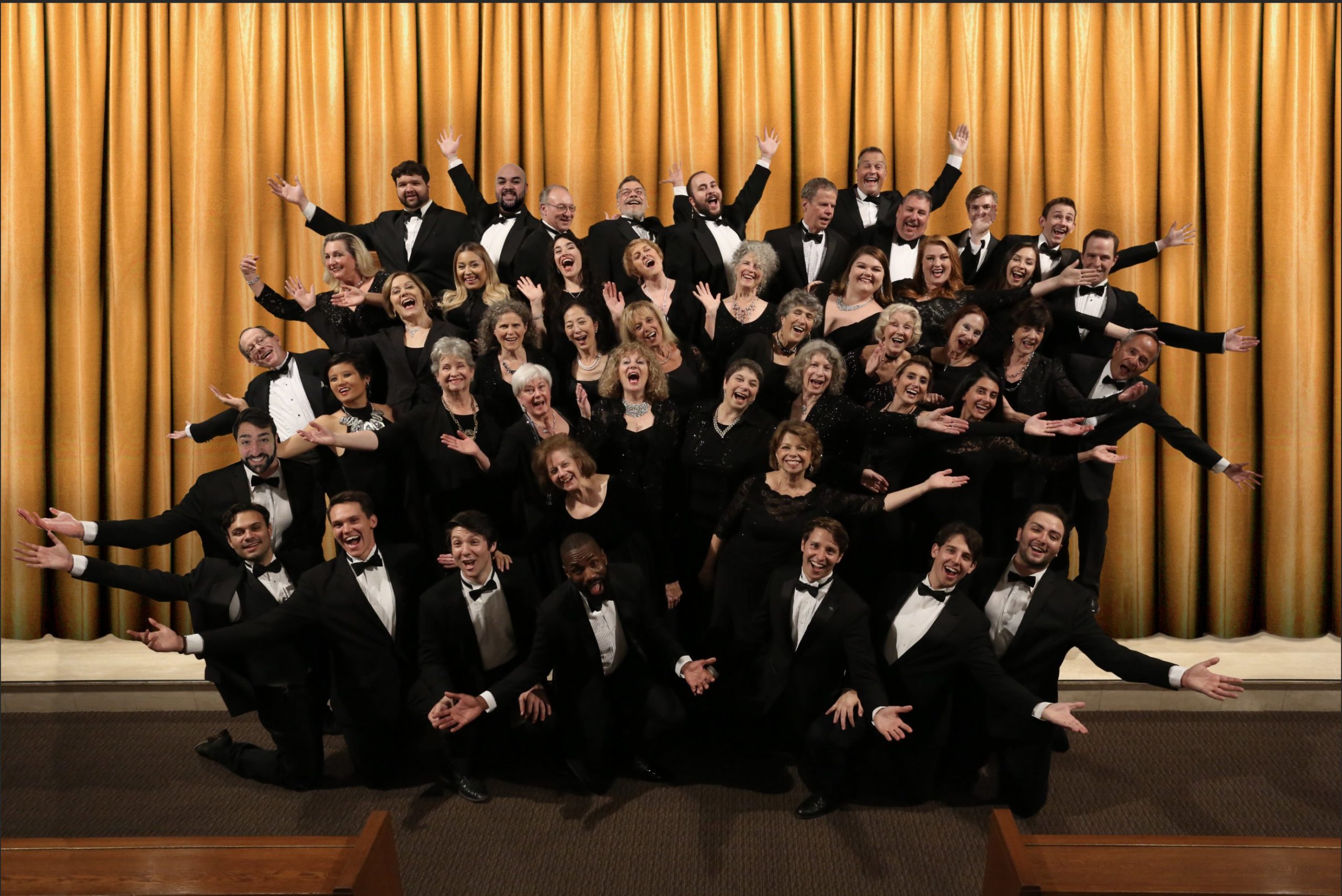
The Verdi Chorus | Courtesy photo / Tim Berreth

The Verdi Chorus was founded in 1983 at the Verdi Restaurant in Santa Monica. When the restaurant closed in 1991, the Verdi Chorus continued. It is the only choral group in Southern California that focuses primarily on the dramatic and diverse music of the opera chorus. Every Monday night, over 50 singers from every walk of life, ranging in age from 18 to 80, gather together to become the Verdi Chorus.

“This concert is a great opportunity for people to hear a wide variety of the Top Ten Opera,” Wilander describes. “It’s not a full stage A to Z production – we’ll do selections from Verdi’s ‘Aida’ and Boito’s ‘Mephistopheles.’ We’ll do a big chunk of ‘The Tales of Hoffman’ by Offenbach and ‘Samson and Delilah’ by Saint-Saens. So it’s French, German, and Italian.”

“There will be no orchestra, only a piano. While it’s not the same thing as an opera in the sense that the performers will be in tuxedos and gowns, I will still be able to do a limited amount of acting a role. So it’s really about making music with the voice and connecting with the pianist and the audience.”

Opera takes Wilander all over the world and he lives full-time in Manhattan, where he’s had an apartment in Washington Heights for the past ten years. But when he isn’t touring, he returns to Arcadia and picks up where he left off.

“I’m an only child and my parents have always been very supportive of me and my career,” Wilander discloses. “My mom was a huge influence in my life as a musician and as a human being. She always encouraged me to follow my passions and to do my best to make the world a better place. A few days before she passed away in 2010, she told me that every time I perform on stage and feel the spotlight following me, ‘Just know that it is me, beaming down on you from the heavens with grandma. Our hearts are full of pride that you’re sharing with everyone your God-given gifts.’ I still think of her words daily and am continually grateful.

“Her service was held at Lake Avenue (Congregational) Church in Pasadena. About 80 choir members sang and it was absolutely beautiful. Every Christmas I come back to sing with the Lake Avenue choir led by Worship Music Director Duane Funderburk.

“To this day, I stay with my dad when I’m in town. And with my mom gone, he makes sure I know that he is behind me emotionally, financially, and spiritually. Having that unconditional support is a blessing in this kind of work with such highs and lows. You could be performing in front of 2,000 people only to go back to a hotel and be by yourself. There are no groupies for opera singers.”

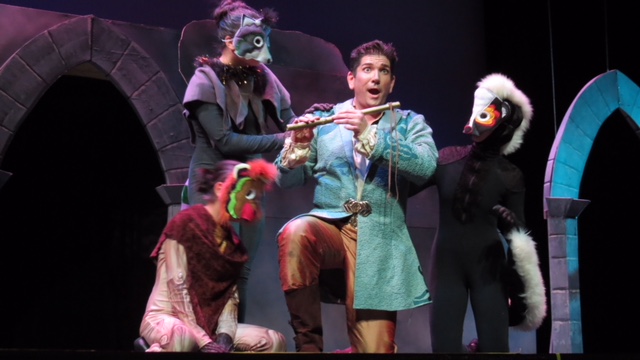
Todd Wilander as Tamino in Mozart’s ‘Magic Flute’ at Opera Fairbanks, Alaska | Courtesy photo / Opera Fairbanks

“There are gratifying moments, however,” Wilander quickly adds. “Like when someone says to me ‘Your passion made me feel something,’ or ‘That song was what my father listened to,’ or ‘Even if you were singing in French, I followed your character so well I understood his heartache.’”

Asked if he has a favorite opera, Wilander quips, “My funny answer is ‘the next job I’ll be doing.’ Clever remarks aside, I’ve had the most success with Italian composers like Donizetti, who wrote ‘L’elisir d’amore’ (The Elixir of Love). He composed operas about English Royals – ‘Elisabetta,’ ‘Anna Bolena’ ‘Maria Stuarda.’ I love historical operas. While he embellished here and there, his operas were pretty accurate.

“Now that I’m older and my voice has settled more, I can sing a lot of Donizetti’s works. In the same way that now I can do Wagner … which is great because his works are harder to cast. Twenty-year olds can’t possibly sing Wagner or they’ll ruin their vocal chords. Singers have to move on to the operas as they gain age and wisdom and emotional connectedness with the character.

“I can execute more Verdi and Puccini and I can project against a 60-piece orchestra, that’s very lush and big. Opera singers don’t wear microphones so shows are usually not held on consecutive evenings to give us time to rest our voice.”

Todd Wilander singing the title role of Hoffman in the opera ‘Tales of Hoffman,’ by Offenbach, at Opera North summer festival | Courtesy photo / Opera North

Wilander has sung in so many operas but every new role still induces the same thrill as when he first started out. He happily divulges, “My next big engagement will be with Opera New Jersey in March when I get to be Radames in Verdi’s ‘Aida.’ Then in April, I will be with the Tampa Bay Opera in Florida to sing in Puccini’s ‘La Boheme’ as Rodolfo. Other opportunities coming up include a concert in Germany and other New York concerts in the Spring. I don’t have a dream role but there are some roles I would like to perform again; and I’d love to do ‘Tosca’ one day.”

What the future holds can sometimes be a complete surprise as in Wilander’s case. “I didn’t grow up with opera; my parents didn’t either. They took me to The Ahmanson in downtown L.A. and we watched musical theater. I’d only sung Latin in Church when I was young. My love for opera started in college, but even then Cal State didn’t have an opera program.

“But opera has been a part of who I am as a person and I can’t imagine life without it. After all these years, I am still amazed at how each live performance is different because anything can happen. There was one concert when I slipped and slid across the entire length of the stage, but I didn’t skip a beat singing. There are nights when someone would be in remarkable form, or a singer would be struggling, or someone had a fight with his girlfriend so his head would be in a bad place. But all those emotions could be transferred to the words you’re singing.

“Opera is such a wonderful art form that imbues all kinds of sensations and experiences. It isn’t just a bunch of people in costume, singing in a foreign language. It transports audiences to places – fighting wars, falling in love, being rejected – to make the characters and stories a part of them.”

“There’s a reason that opera has lasted over 400 years – because it tells a story of love, passion, betrayal, anger, of human emotions every one of us goes through each day. And, in the world we live in today, it’s good to be reminded that there’s more than what we see on CNN and Fox News. There’s more humanity and love to go around.”

Charles W. Eliot Arts Magnet Academy Inaugurates its Own Costume Shop

Originally published on 30 October 2018 in the Pasadena Independent, Arcadia Weekly, and Monrovia Weekly

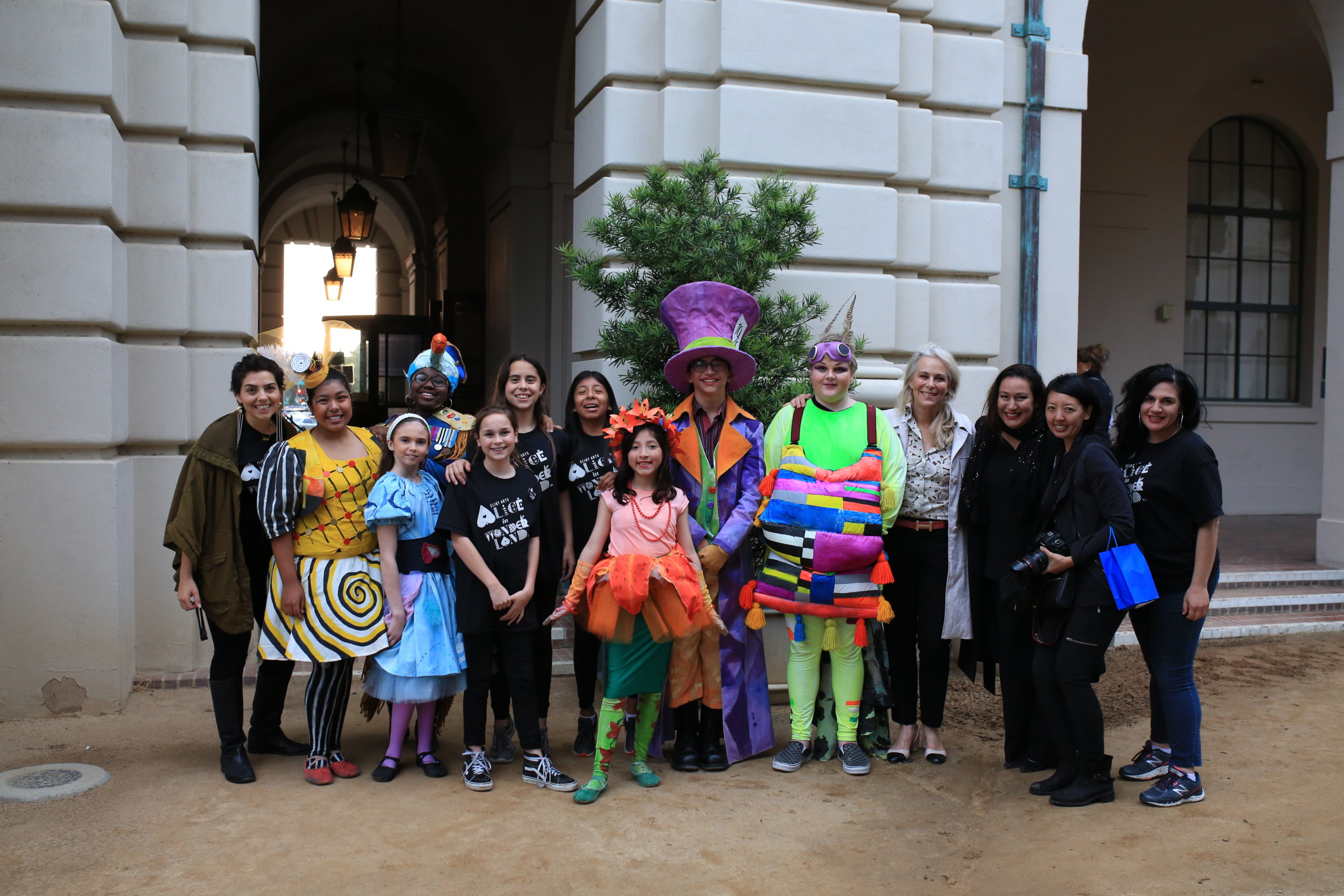
The Eliot Arts team poses with its newest fan, actress Jane Kaczmarek, at Pasadena Educational Foundation’s ‘Breakthrough Student Interactive Showcase’ at their annual ‘Celebrating Our Schools’ event. Left to right, Drama teacher Micol Issa, student actors and costume designers, Kaczmarek, Principal Lori Touloumian, Visual Artist-in-Residence Liane Shih, and Theatre Artist-in-Residence Lory Tatoulian | Courtesy photo / Molly O’Keeffe

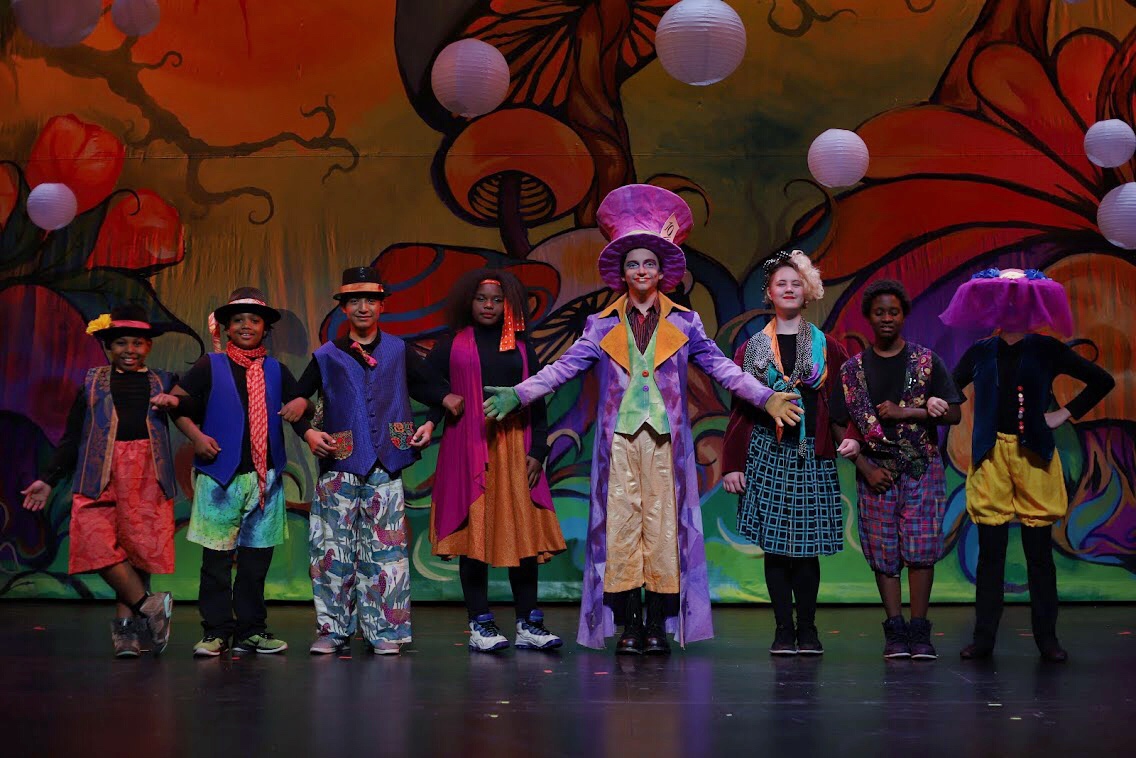
The middle school musical was ‘Alice in Wonderland.’ As the students were getting ready for rehearsals, Micol Issa, 6th grade English and Drama teacher at Charles W. Eliot Arts Magnet Academy (Eliot) in Altadena, who was also directing the production, had a sudden inspiration, “Instead of shopping for costumes for the show, why don’t we make them ourselves?”

Never mind that it was January and the production was slated for May. Indeed, many would have found that prospect daunting. Where would they find designers? Who, besides Issa, even knew how to sew?

But Eliot was the top Arts School in the Pasadena area and it had a reputation to uphold. So everyone got behind her idea quickly. Students, parents, teachers, and administrators sprang to action to make Issa’s brainstorm a reality.

Issa’s ambitious concept would not have been do-able had it not been for a grant that transformed the school to what it is today. Lori Touloumian, Eliot principal, informs, “In 2013, this school, then known as Eliot Middle School, was one of four academic institutions awarded the magnet schools assistance program grants of $7.9 million each to have its own integrated theme. Eliot, in particular, was designated as a Visual and Performing Arts (VAPA) school.

“To ensure cohesion of the district’s schools and initiatives, there is one person who has oversight over all the magnet programs. We’re fortunate to have Shannon Mumolo in this capacity. As the Magnet Schools Assistance Program (MSAP) Program Director for the Pasadena Unified School District, she oversees the budget and implementation of magnet programs funded by the U.S. Department of Education. She has been an MSAP Project Director since 2015 and previously served as the MSAP Site Coordinator for Eliot Arts Magnet.”

“Through the grant, our teachers went through specialized training on how to integrate the experiential approach to art into the core classes of English, history, math, and science,” discloses Touloumian. “We have resident artists who work with teachers on site during the school day and after school who work directly with students on various projects. We’ve also partnered with the Huntington Library to offer free after-school programs every Tuesday and Thursday afternoon.

“While adhering to the district’s established curriculum for the scope and sequence of the arts program, the teachers have been empowered to make decisions in terms of what art project they will do in their core class and they are free to set up the time with the resident artists. The school follows the common core standards and the artists in residence come in with expertise in the arts standards to weave the two together.”

In Eliot’s new costume shop, parents and artists-in-residence taught students how to sew their own costumes such as the shorts and pantaloons worn by guests to the Mad Hatter’s tea party. The Mad Hatter wore a handmade hat and hand-painted jacket designed by students themselves | Courtesy photo / Marc Flores

Touloumian says further, “Additionally, we were to able create art-maker spaces on campus – we  revamped our dance rooms with more equipment, we transformed a former parent room into an art gallery which is now utilized as a community center where our students and community artists can hang their art, and we added a ceramics room and a media lab on campus.

“We are now a fully integrated arts academy. Students can choose what elective classes they want to be in but even if they choose not to attend a specific elective class they may still have the visual arts experience in their English, history, math, or science class, or after school.”

Cheili Lopez, a 7th grade student who participates in the arts classes and after-school program, says “I’ve just started the printing shop on Tuesdays and Thursdays with Mr. Duffy, and on Fridays I go to the costume shop. Through the arts classes, I’ve been able to make things for my family – I sewed an apron for my mom and I made a jug in ceramics class which I gave to my parents for Christmas. They were very happy because the items weren’t store-bought; I made them myself.”

“Everything we do here is connected to the Arts,” Issa explains. “We’re trying to rebuild the school culture and create spaces for kids to have multiple avenues of access to the Arts. Not everyone wants to act, but this is another way for kids to participate in the making of performances, and Cheili is an example of that.

We realized that something we needed, not just for the drama and choir program but also for dance classes, was a costume shop. That was the goal we tried to work towards last year, which launched us into this next level. Now, we have six sewing machines, two sergers, and an embroidery machine. We basically have a sewing club that meets every Friday after school.”

“In the past, we assigned people to find the costumes for specific characters,” details Issa. “But, like I said, we need costumes for all our productions so I took the idea of having a costume shop to Denise, the artist in residence. She, in turn, went to Lori and said ‘If you will okay the costume shop, I’ll write the grant,’ and she did.

“Of course, I had to justify why I thought a costume shop was necessary. I argued that it’s something that would be great for the program as a whole and we had the expertise on how to run a costume shop on campus. Denise and I know how to sew, then we discovered that so many parents also have that skill. So what it really did was brought more people on campus.

“Through Facebook, people shared with everyone our donation list and what I was hoping to accomplish. People donated patterns and dropped off whatever they could contribute. Everyone was happy to give and appreciated that we were teaching kids how to sew.”

A visit to a museum was the inspiration for their musical’s look. Issa recounts, “I went to an exhibition of Marc Chagall costumes at LACMA and I was astonished because it was exactly what I envisioned for ‘Alice in Wonderland.’ So I took the kids on a field trip to see the show and when we came back we started designing.

Students fused the modernist styles of the Bauhaus movement with the loose painting styles of artist Marc Chagall to design each of the show’s whimsical costumes | Courtesy photo / Shannon Mumolo

“We found real pictures of the Chagall costumes. And under the guidance of our artist in residence, we taught the kids how to draw and make patterns, to paint them with colors, and to sew inside out.

“Because of the large number of costumes that needed to be finished, it was a community effort. Students, teachers, and parents spent a lot of late nights and weekends sewing. And, while not each costume was made entirely by kids, they worked on every one.”

Lopez was one of the students who made the costumes and she acquiesces, “Each costume was a group effort. Several students worked with an adult to work on one and when we didn’t finish that day, we went back to it the following afternoon.”

The experience proved to be constructive for Lopez not only because she learned how to sew. She says, “We do a lot of projects in regular school so doing the after-school costume shop helps me collaborate with other students.”

Issa points out, “What they do in the costume shop translates, however indirectly, with their core classes. They go through the same procedure of calculating, of figuring out a problem, much like in math class. They have to assess how thick they need to make the paint to have the effect that they want. So they experiment with a lot of color samples to figure out what consistency to use so it doesn’t just turn into watercolor but, at the same time, doesn’t make the fabric super stiff. That’s a process that applies in science class.”

“The show ran for three days and all the costumes held up,” Issa says with pride. “There were minor repairs which we made between shows. The incredible thing about this, also, is that it gave me additional crew on top of the stage team. From now on, the costume crew is in charge of queue-ing the costumes – making sure they’re in the right place – and noting what needs to be repaired so we can make them the next day.

Eliot’s spring musical proved to be a smashing success. Raves Issa, “Our ticket sales for the show was tremendous. We sold over $1,000, which was more than what our previous shows generated. Then, on October 10, we held our first official gallery opening featuring the costumes from last school year’s spring musical ‘Alice in Wonderland Jr.’ We invited the District and Community Arts Team, and all our Altadena, Pasadena, and Sierra Madre partners – from dance to theater companies – and they all came to see the exhibit.”

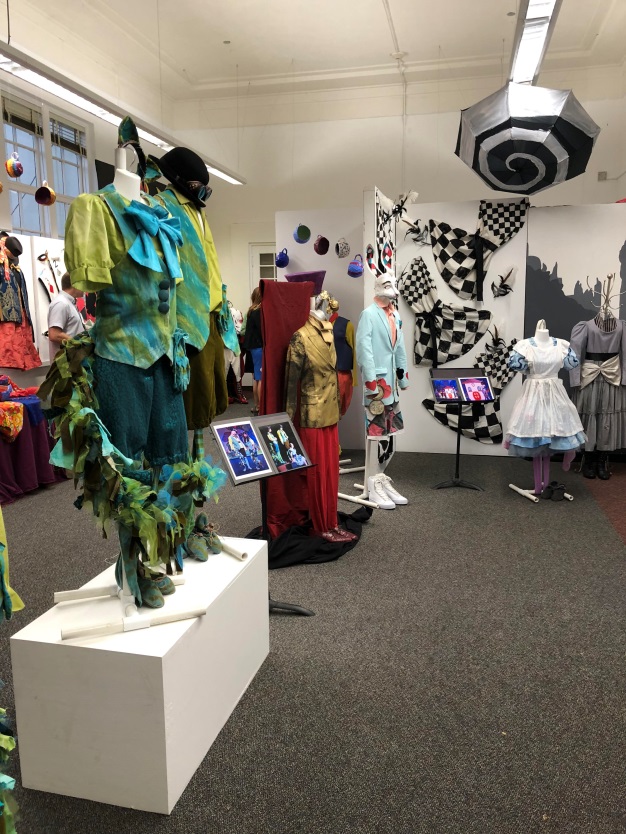
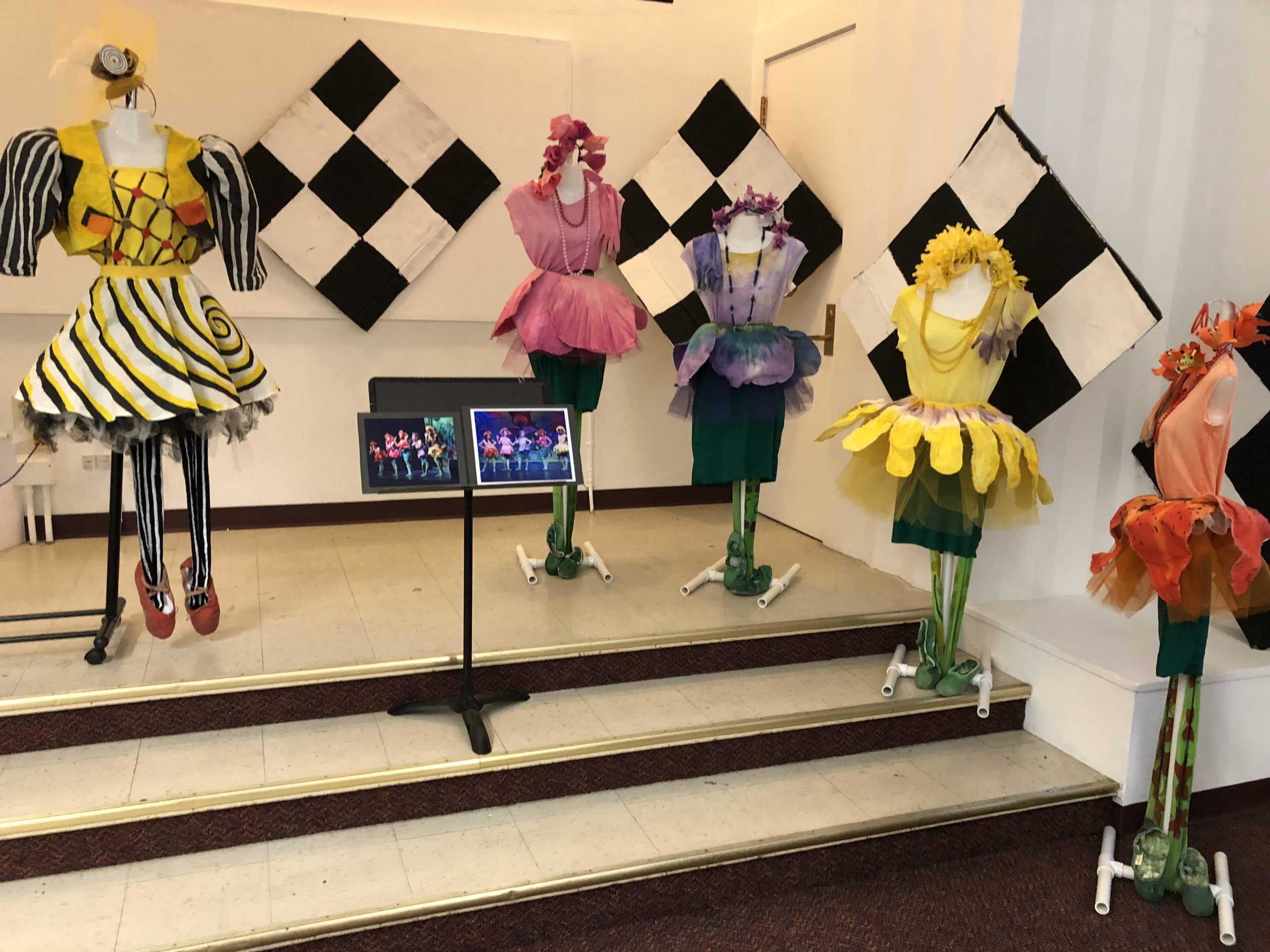
The show’s handmade costumes were installed in the school’s art gallery this fall for the opening exhibition: Chagall and the Bauhaus Meet Alice in Wonderland. They will be on display until December 2018 | Courtesy photo / Shannon Mumolo

The display, which goes on until December, highlights a very specific artistic vision. Issa describes, “The costumes in Eliot’s production of Disney’s ‘Alice in Wonderland’ are unlike any other version of the show you have seen because it was inspired by the artist Marc Chagall and the Bauhaus design movement.

“Chagall, well known for his paintings and stained glass windows, also designed costumes for the Metropolitan Opera and New York City Ballet. You will see some of his designs and paintings represented in our own costumes and sketches. As we researched and sketched our vision for Wonderland into life, we decided to add in the modern and otherworldly influence of the Bauhaus design movement. Categorized by basic shapes, lines, and spirals, we fused the modernist style of the Bauhaus movement with the loose painting styles of Chagall.”

“We’ve had previous exhibits but they were open after school mainly for parents and students,” clarifies Issa. “This was our first gallery opening held on a specific night for the entire community, complete with a bake and beverage sale. It demonstrates the amazing work that can be done when students, teachers, parents, and community partners collaborate. We’ll be forever grateful for the generosity of the Pasadena Showcase for the Arts and the Pasadena Educational Foundation for their support in making Eliot a premier arts school in the area.

“It was truly a project that involved a great many students – 140 kids took part in our costume shop, out of our total student population of 545. That’s 23% of the student body. What’s more, this endeavor inspired others so we have doubled our numbers in the costume shop. Even those students who weren’t able to participate in the after-school program worked around their schedule to be in the costume shop.

“We started the Friday costume shop early this school year so we could teach the kids sooner and, in time, they would be able to sew the bulk of the costumes themselves. Our next musical is ‘Hairspray’ and we’re creating the costumes again. But because this show happens in our world, we’ll probably use some of the basic costumes we already have, instead of making them from scratch. That’s the cool thing about having a costume shop – it has given us the ability to use  something that already exists by altering it to fit our needs.”

Issa is now just entering her third year at Eliot but, already, she has been instrumental in giving it the distinction of being the only middle school with a costume shop. But, more importantly, she  has successfully incorporated in its program an invaluable skill that will serve middle school students long after they leave Eliot. Nay, for life.

Addressing Anxiety and Depression on Campus

Originally published on 23 October 2018 in the Pasadena Independent, Arcadia Weekly, and Monrovia Weekly

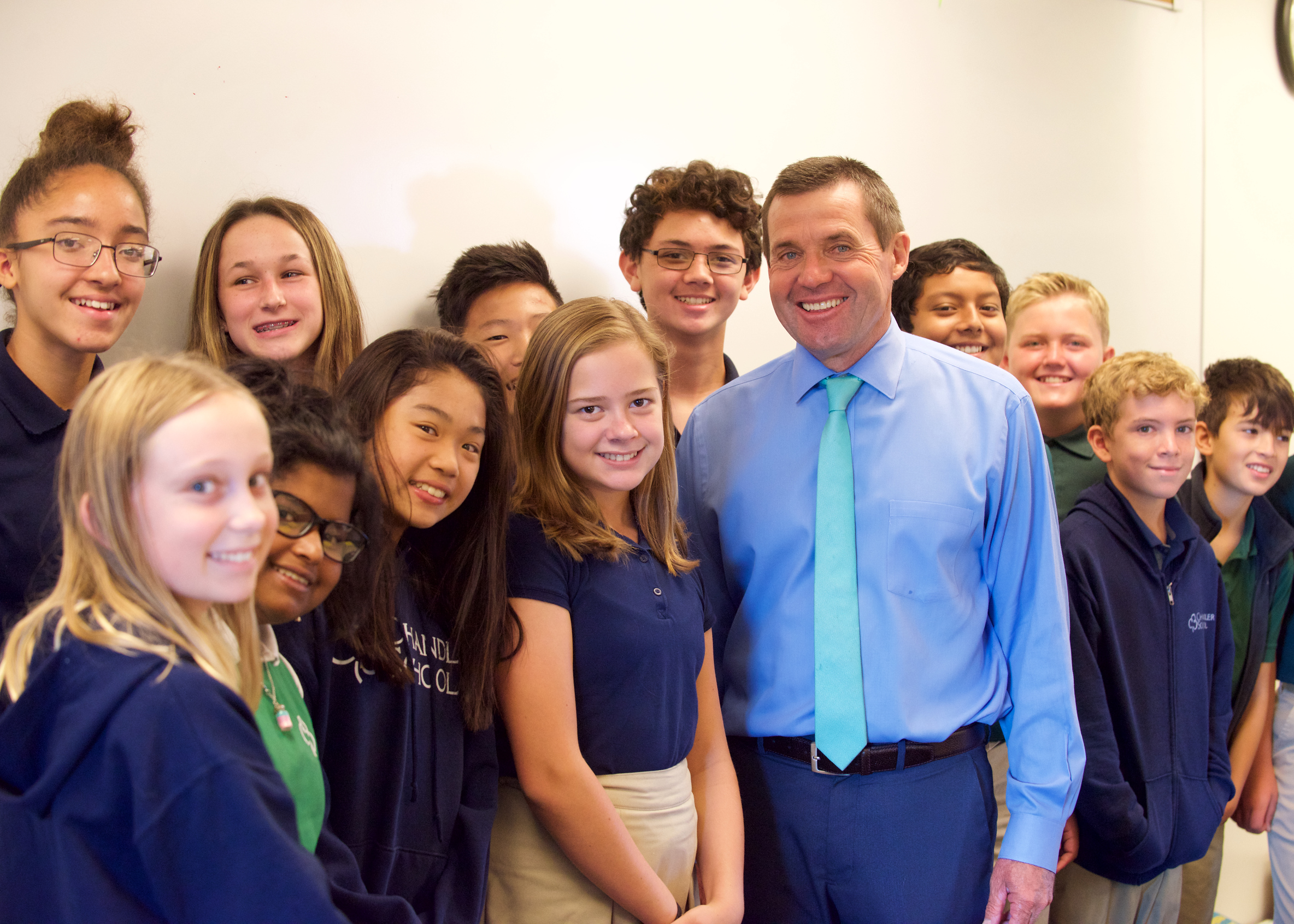
John Finch, headmaster of Chandler School, with middle-school students in his Ethical Perspectives class | Courtesy photo / Tim Teague

In an article which published last April in Time magazine, Katie Reilly reported that record numbers of college students are seeking treatment for anxiety and depression, and schools can’t keep up. She further described that when UCLA offered, for the first time, all incoming students a free online screening for depression, more than 2,700 students opted in.

Following that article, UCLA announced the launch of its ‘Depression Grand Challenge.’ This project, that spans a decade, will study 100,000 of students who have used its health care system for any reason. It is a sweeping initiative that brings to the fore the mental health issues that have long existed but have never been fully addressed until now.

However, anxiety and depression often predate college. High school students, most especially in the San Gabriel Valley, are faced with daunting competition when they start applying to colleges. Students in the area have earned perfect GPAs, SAT, and ACT scores; were the president of their school’s Student Council; have played at least one musical instrument, have won multiple gold Young Musicians’ Competition awards, and have performed at Carnegie Hall; have been deeply involved in a social, community, or philanthropic cause. They are over-scheduled, sleep-deprived, and hell-bent to stand out from other over-achievers. It’s no wonder, then, that they are riddled with anxiety that often leads to depression.

David Burge, who just completed his term as the President of NACAC (National Association for College Admission Counseling) states, “There is no doubt that the college application and selection process is daunting and is a cause of much of the anxiety and depression on high school campuses.

“What we’re finding is that there are more and more students in high school who are receiving treatments for anxiety and depression, including medication and talk therapy. So it’s only natural for them to continue to seek treatment when they get on the college campus. Sometimes the stress of college accentuates their pre-existing conditions.”

“We, at NACAC, are teaching students and parents to look beyond the Ivies and the most selective universities when they embark on their college search. As long as we continue to value exclusivity as a surrogate for quality, the competition perpetrated by these very universities will continue,” Burge pronounces.

To say, though, that the college application is the reason for the mental health concerns plaguing our country’s youth is too simplistic.

Depression among students is on the rise | Courtesy photo

Myra McGovern, Vice-President for Media at NAIS (National Association of Independent Schools), says, “The theories about why today’s students are going through anxiety and depression run the gamut. Some are backed by science and some are anecdotal. One of the things I’ve heard is that parents these days aren’t doing much about the issue because they think their generation had it harder.

“Some of us think that children didn’t get to experience the violence of wars and the hardship that accompanied such, which made them more fragile. But one could argue that children have seen more wars in their lifetime. There have been more media coverage of school shootings, that began in Columbine; and of terrorism and international threats, since 9-11.”

“I think that while the potential dangers may not have statistically grown, the exposure brought on by media has increased dramatically,” explains McGovern. “In the past, most teenagers didn’t read the newspapers; but these days, through social media, they know what’s happening in the world in real time.

“Consider your biological fear response – from the adrenaline rush, to the tightening in your chest and the dry mouth – when you hear of something horrible happening. Our body hasn’t really changed from the time of lions chasing people. Yet we’re more exposed to technological lions (stimulus) when our survival instinct hasn’t quit adapted to technological reality.”

McGovern elaborates, “Perhaps, too, children’s increased interface through technology is changing the way they relate and cope. The social pressures the older generations had to contend with are definitely different from what today’s youth deal with.

“There’s also our perception of our role as parents. Because of our own anxieties about our children’s lives, we are constantly hand-holding them and, in the process, taking away some of the opportunity for them to practice making decisions. It affects their confidence level at being able to navigate the challenges the world throws at the them as they become teenagers and young adults.”

“Another theory has to do with what people are consuming and the chemicals they’re exposed to,” adds McGovern. “But whatever the cause is, there’s a consensus that children and adults are struggling more with anxiety and depression.

“What I want to emphasize is that I don’t believe there’s one right solution for everyone. Part of the solution is considering children as individuals with specific needs. Prioritizing to invest in our future on the front end could reap benefits in the long term,” McGovern concludes.

Building the groundwork for sending happy and healthy kids to high school and beyond is a mandate that John Finch, headmaster of Chandler, a K-8th grade school in Pasadena, takes to heart.

Chandler students gather together as the school day begins | Courtesy photo / Tim Teague

“We establish an environment where there are high expectations, but low stress,” Finch declares. “We pay careful attention to the volume of work we ask the students to do. We don’t try to fit round pegs into square holes – we provide a program that meets their needs and adjust our program so that each child feels recognized, respected, and challenged.

“As we challenge our students, requiring them to do good work, we are equally careful about how we manage expectations. We have to be mindful that doing otherwise leads us to the same path we’ve been going on, with more kids falling out in the end.”

“Socially, we want to create an environment where children are kind to each other, respect and help each other,” states Finch. “We’re intolerant when it comes to bullying. At the same time, we want to establish an atmosphere where kids can be resilient and gritty. We want for them to pursue their interests by trial and error. And if they fail, we’ll help them try again. We want kids to understand they’re being supported by a tight adult network that encourages them. We want them to feel that there’s a balanced foundation of care and love.”

Finch points out, “I think students who spend too much time on screens and not enough time interacting with others can become isolated and lonely. That isolation and loneliness can manifest themselves in anxiety and depression. We have to be cautious, conscientious, and deliberate in urging our kids to shut their screens down, to spend more time interacting and socializing with friends and family.”

“Increasingly, I hear principals say their biggest concern is not so much the achievement, but the well-being of their students,” discloses Finch. “Something’s changing and we have to find the cause and respond accordingly. We’re not doing kids any favor if they’re leaving our schools feeling anxious or depressed – whether it’s because they’re over-burdened by expectations, they feel something is lacking, or they can’t cope with the independence they get as they grow older.

“Ten years ago schools were adding technology and computer positions. Now schools are augmenting learning and emotional support. Once we saw that technology had a transformative impact on the program, the next step was to become intentional in meeting the social and emotional needs of students.

“For us, it’s been helpful to have a buddy program. Older kids interact with the younger ones to give them a sense of responsibility and community obligation. For younger kids, it’s a way for them to look up to older students as role models. Those friendships that develop in multi-age groups make a vast difference in school life.”

“We also have a school psychologist to give professional help,” adds Finch. “Teachers meet regularly and when they hear a student’s name come up more than once as someone who’s not completing work, is tired, or isn’t eating well, they let the administrator know.

“There have been circumstances when kids approached the administrator to say they’re worried about one of their friends. We investigate all these observations and we bring in the psychologist whenever it’s warranted.”

“In a small private school with an adult-student ratio of 1 to 7, it’s very hard for the child to slip through the cracks,” assures Finch. “We’re capable of arresting something before it becomes too dark. And we make sure we have the support and place to take care of it.

“I’m interested in empowering teachers to not only provide excellent teaching but, more importantly, to look after the welfare of students in their charge. At the same time, I also know that families are our partners in addressing the issues of anxiety and depression.”

It’s heartening to know that parents, teachers, and school administrators are acknowledging that there is a mental health problem affecting a large number of students. It is a first step in the right direction.

That schools are also now taking active measures to help students get through their anxiety and depression is certainly a lifeline for those who’ve been feeling despondent and alone. There is hope yet.

L.A. County Arboretum’s ‘Moonlight Forest’ Brings People Together in San Gabriel Valley

Originally published on 16 October 2018 in the Pasadena Independent, Arcadia Weekly, and Monrovia Weekly

A ‘Moonlight Forest’ display at The Arboretum | Courtesy photo / Tianyu Arts & Culture, Inc.

Be transported to an enchanted evening wonderland when the Los Angeles County Arboretum and Botanic Garden (The Arboretum) in Arcadia displays hundreds of magnificent lanterns depicting exotic animals, shimmering flowers, whimsical pandas, soaring dragons, and other themes to create a mesmerizing ‘Moonlight Forest.’

The Lantern Art Festival celebrates the time-honored tradition of lantern-making and features Chinese performing arts and crafts. It goes on from October 26, 2018 through January 6, 2019, 5:30 to 10 pm.

Richard Schulhof, CEO of The Arboretum declares, “Our vision for the Lantern Art Festival is to commemorate this wonderful traditional art form from China and set the lanterns amidst the landscape of the L.A. County Arboretum. It’s nature meeting art and culture, and bringing together the different communities in Los Angeles.

“Spanning a mile’s path of travel, the lantern displays will begin from the lawn area, then goes into the forest and around the lake, and by our landmark Queen Anne Cottage. In addition to the lanterns, we’ll have traditional Chinese performing arts – acrobats, face-changing dancers, and jugglers. We’ll have food trucks and various libations.”

Richard Schulhof looks at the animal lanterns | Photo by May S. Ruiz / Beacon Media News

‘Moonlight Forest’ is the culmination of a year’s planning and preparation. Relates Schulhof, “Last October, Tianyu Arts & Culture Inc., the American subsidiary of the international design and manufacturing company Sichuan Tianyu Culture Communication Co., contacted me to discuss a possible collaboration.

“I familiarized myself with the art form and the company’s work by visiting the different lantern festivals they were holding in Charlotte, Virginia Beach, and Las Vegas. I learned that lantern art utilized traditional materials that were used 500 years ago. The advent of new materials and construction methods allowed for an elaboration of this traditional art form and the lanterns you currently see represent that.

“The center for this craft is a town named Zigong in Sichuan, near the city of Chengdu, where this art form is still practiced today. Tianyu Arts & Culture creates festivals all over the world – Europe, Australia, and North America. It’s quite surprising that there has never been one of this scale in the San Gabriel Valley. And given the confluence of cultures in the region, particularly East Asian, it’s only fitting and natural to bring the lantern art festival here. We’re thrilled that this debut event is happening here at The Arboretum because I see this as a meeting place of cultures.”

The lanterns reflect three themes: Chinese culture – iconic images and traditional themes like the harvest moon feast; nature – animals and plants; and children – fairy tales and fables to delight kids and the child in all of us.

Schulhof’s excitement about this event is abundantly evident when he takes me on a tour of The Arboretum grounds where workers are busy setting up structures on which the lanterns will be installed. He explains that some of the exhibitions are quite complex and points to a large construction underway that he presumes will be that of the Forbidden City, which used to be the imperial palace in the Ming and Qing Dynasties.

A display of a man serving tea | Photo by May S. Ruiz / Beacon Media News

As we approach a display of a man serving tea, Schulhof stops and gets out of the golf cart he’s driving to enthuse, “When I was in Kunming, in Yunnan province, I was hosted by the Kunming Botanical Garden and the server was dressed just like this. They carried teakettles with these long spouts and they could pour tea into your cup from six feet away. It was absolutely amazing to see that.”

At this point we’re attracting the curiosity of people who are on their morning walk at the garden. Schulhof very animatedly enlightens the little group about the lanterns with the enthusiasm and exuberance of a little boy showing off his prized toy collection.

We reach an area with the animal lanterns and there are lions, tigers, giraffes, pandas, and some animals indigenous to California – bears and coyotes. Schulhof points out little details on them, like the hand-painted eyes of the animals.

“And because this is The Arboretum, there will be a couple of peacock lanterns. They’re the most spectacular peacock lanterns they’ve ever done! People here have very high expectations when it comes to peacocks,” Schulhof tells a couple of ladies who are also inspecting the array before us.

Schulhof stands next to a terracotta soldier | Photo by May S. Ruiz / Beacon Media News

The lanterns of the terracotta warriors from Xi’an province are Schulhof’s particular favorite and he walks over to where the figures are clustered. He informs with confidence, “If you look closely you’ll see that the soldiers have different faces and when illuminated they are glowing, golden beams.”

There’s quite an interesting bit of Chinese history connected to the terracotta army. The first Qin Emperor, Qin Shi Huang, who ruled from 247 to 210 BC, built this army of warriors, chariots, and horses made entirely of clay and were buried with him to guard him in his afterlife. They remained there undiscovered until 1974 when they were excavated by accident by local farmers. Today the Mausoleum of the first Qin Emperor is a UNESCO World Heritage site.

Our tour ends at the lawn and fountain area, and Schulhof directs my attention to a tree, “The Arboretum was founded in 1948 and one of its goals was to bring new plants to Los Angeles to beautify the city. That is the silk floss tree from South America, one of our most successful introductions, and this is its peak blooming period. We have several of them all over the garden; so people will be enjoying the lanterns and our beautiful silk floss plants at the height of blossom all at once.

Photo by May S. Ruiz / Beacon Media News

“Every year, 400,000 people visit The Arboretum. What they see during the day doesn’t even compare to what they’ll see at night during our ‘Moonlight Forest.’ The Lantern Art Festival, with its more than 60 exhibits and over 500 lanterns, gloriously demonstrates the artistry, craft, and skill of Sichuan artisans and will surely add some magic to the visitor experience.”

Schulhof is familiar with Sichuan province, where this craft originated. Back in 1997, when he served as Executive Director of Descanso Gardens, he was in Sichuan collecting camellias. But because he was in the countryside, he didn’t see any lanterns.

Starting next week, and for ten weeks thereafter, the lanterns that eluded Schulhof in Sichuan two decades ago will be the magnificent centerpiece at The Arboretum’s ‘Moonlight Festival.’ And he is hoping that not only do they bring delight and joy to those who behold their splendor, but also bring together the various communities in the San Gabriel Valley in one magical celebration.