Arcadia Tenor is a Featured Soloist in the Verdi Chorus 35th Anniversary Concert

Originally published on 5 November 2018 in the Pasadena Independent, Arcadia Weekly, and Monrovia Weekly
A peacock in the L.A. County Arboretum in Arcadia

Tenor Todd Wilander grew up in Arcadia, attended Arcadia High School in the late 1980s, then went to California State University in Los Angeles (Cal State). Little did he know then that he would be traveling the globe, performing the works of venerated opera composers in world-famous concert halls.

Wilander is one of four featured guest soloists in the Verdi Chorus 35th anniversary season which culminates with its Fall 2018 concert ‘Passione! Opera!’ for two performances only at the First United Methodist Church in Santa Monica on November 10 and 11 at 7:30 pm. He has been praised by the New York Times for his ‘brave, vocally assured portrayals,’ and he has returned for eight seasons, thus far, with The Metropolitan Opera.

Tracing his extraordinary path that led to opera, Wilander recalls, “At Arcadia High, I was a member of ‘Chanteurs,’ which was like a ‘Glee’ group; we wore sequined vests and we sang show tunes and rock n’ roll. I also sang in the Arcadia Presbyterian church choir with my mom and grandma – I was a back-up singer with a bunch of adults, not really knowing what I was doing but I had a big voice and a natural talent.

“Dr. Thomas Miyake, who was the choir conductor and head of church music at the Arcadia Presbyterian Church, was also a professor in Music Studies and the Choir Director at Cal State. When I was looking at colleges for my undergrad work, he mentioned that he could get me a scholarship if I was interested in attending Cal State.

“At Cal State I was encouraged by Professor Pollyanne Baxter and the school pianist, Twyla Meyer, who I still see often. Both became my biggest academic supporters.

“I also became active in student politics – I was the president of the student body made up of 20,000 students. Political science had also been an interest and that gave me the opportunity to meet Bill Clinton and Pete Wilson. However, I decided to pursue singing and went to Northwestern University in Chicago to earn my Master’s degree.”

“From Chicago, I moved to Kansas City,” continues Wilander. “It was while I was there that I tried out for The Metropolitan Opera competition which it holds ever year. I made the first round then I went to New York with 25 other competing singers. The next round whittled it down to ten competitors, until five winners were chosen and I was one of them.

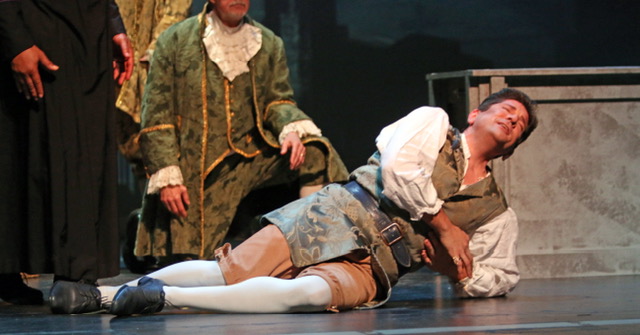
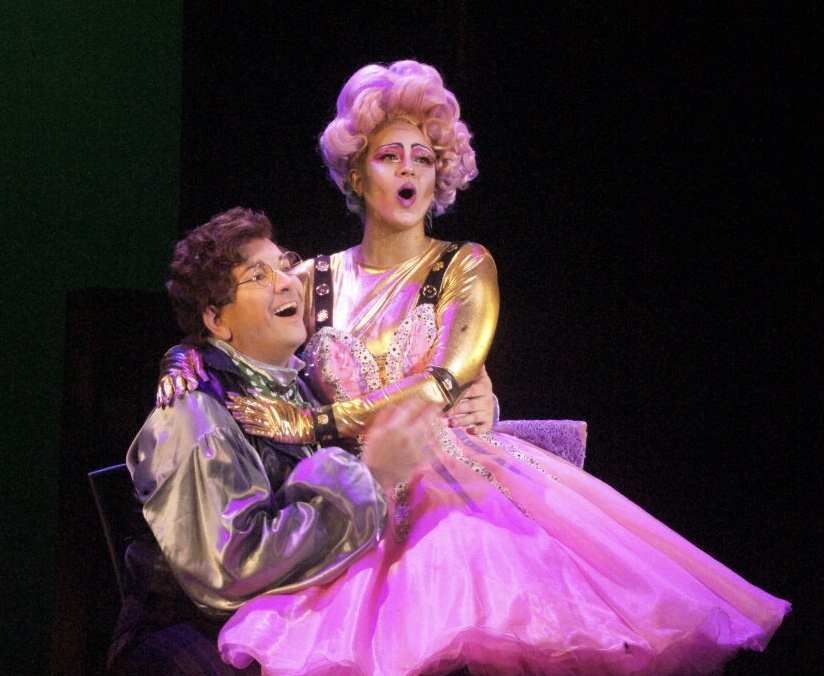
From the opera ‘Lucia di Lammermoor’ by Donizetti, singing the role of Edgardo, with the Boheme Opera of New Jersey | Courtesy photo / Boheme Opera

“Winning a competition by The Metropolitan Opera in 2000 was a big deal as it opened many doors. The next year I won a foundation competition and moved to Berlin where I lived and worked for three years; I was in my 20s. That led to performances in Italy and elsewhere in the world.”

In the years hence, Wilander has performed in 20 countries. And if this year’s engagements were any indication, he could be looking forward to seeing many more places.

“I was in San Francisco in January, San Luis Obispo in February, Alaska in March, Mississippi in April, then in Barbados for a week, and Germany for two months,” Wilander details. “I came back here and did a concert for my stepmom Marilynne held at the First Methodist Church in Pasadena, where she has been a member of for 50 years. I just finished an opera in New Hampshire.”

Wilander’s association with Verdi Chorus began almost two decades ago. He relates, “I knew Anne Marie Ketchum, Verdi Chorus’s conductor and founding artistic director, when I was a Cal State undergrad. She was in charge of the Pasadena City College (PCC) opera theater program at that time. Someone told me they were doing a Bernstein/Gershwin revue and they needed some male tenors so I called her up. To this day, I think fondly of that concert because those two composers are such geniuses.

“Anne Marie and I became friends and we would get in touch from time to time. Around 2013, we met for lunch and she told me about Verdi Chorus. She said they hold two big concerts a year and invited me to be a tenor soloist; I think this will be my fourth time with the group.”

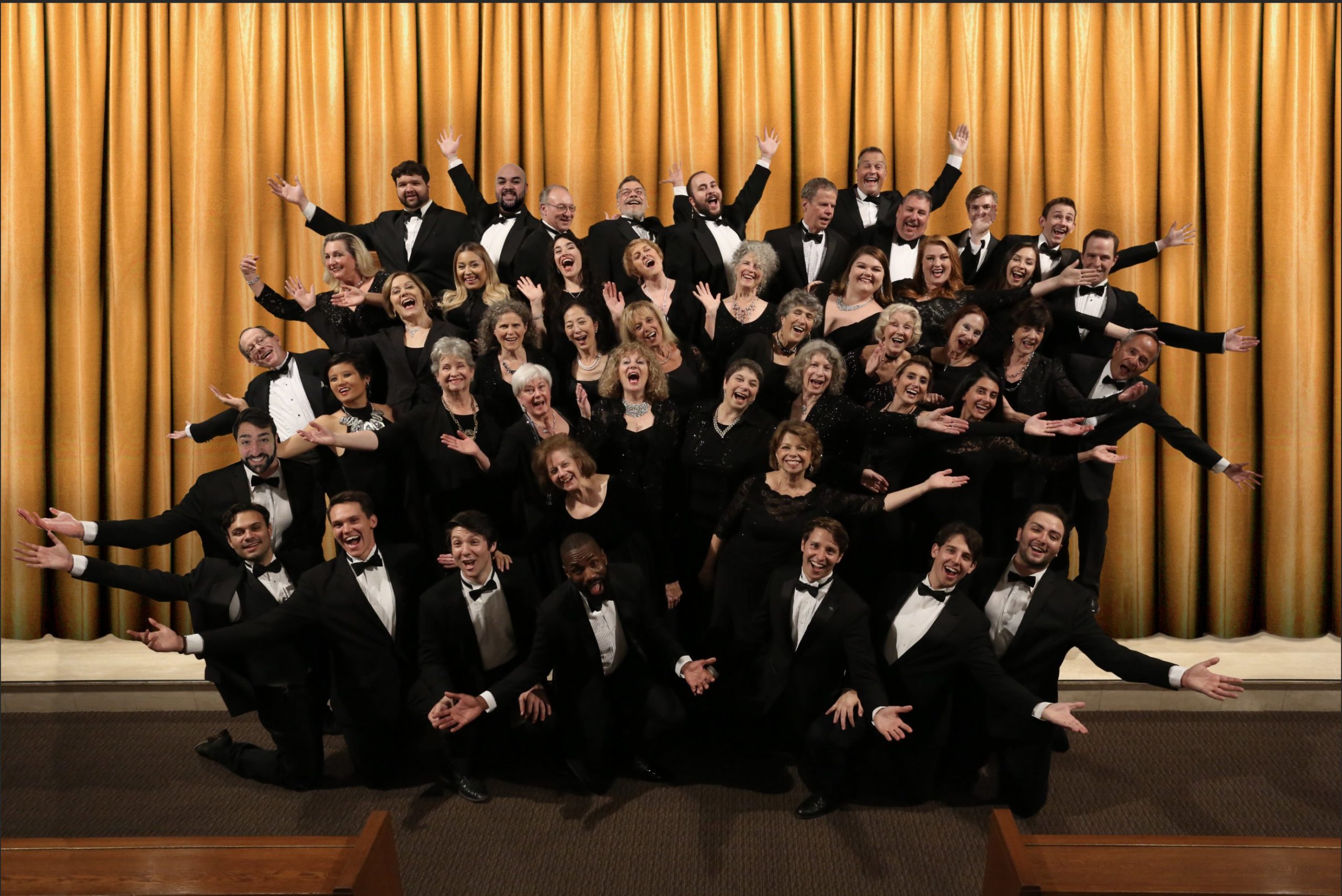
The Verdi Chorus | Courtesy photo / Tim Berreth

The Verdi Chorus was founded in 1983 at the Verdi Restaurant in Santa Monica. When the restaurant closed in 1991, the Verdi Chorus continued. It is the only choral group in Southern California that focuses primarily on the dramatic and diverse music of the opera chorus. Every Monday night, over 50 singers from every walk of life, ranging in age from 18 to 80, gather together to become the Verdi Chorus.

“This concert is a great opportunity for people to hear a wide variety of the Top Ten Opera,” Wilander describes. “It’s not a full stage A to Z production – we’ll do selections from Verdi’s ‘Aida’ and Boito’s ‘Mephistopheles.’ We’ll do a big chunk of ‘The Tales of Hoffman’ by Offenbach and ‘Samson and Delilah’ by Saint-Saens. So it’s French, German, and Italian.”

“There will be no orchestra, only a piano. While it’s not the same thing as an opera in the sense that the performers will be in tuxedos and gowns, I will still be able to do a limited amount of acting a role. So it’s really about making music with the voice and connecting with the pianist and the audience.”

Opera takes Wilander all over the world and he lives full-time in Manhattan, where he’s had an apartment in Washington Heights for the past ten years. But when he isn’t touring, he returns to Arcadia and picks up where he left off.

“I’m an only child and my parents have always been very supportive of me and my career,” Wilander discloses. “My mom was a huge influence in my life as a musician and as a human being. She always encouraged me to follow my passions and to do my best to make the world a better place. A few days before she passed away in 2010, she told me that every time I perform on stage and feel the spotlight following me, ‘Just know that it is me, beaming down on you from the heavens with grandma. Our hearts are full of pride that you’re sharing with everyone your God-given gifts.’ I still think of her words daily and am continually grateful.

“Her service was held at Lake Avenue (Congregational) Church in Pasadena. About 80 choir members sang and it was absolutely beautiful. Every Christmas I come back to sing with the Lake Avenue choir led by Worship Music Director Duane Funderburk.

“To this day, I stay with my dad when I’m in town. And with my mom gone, he makes sure I know that he is behind me emotionally, financially, and spiritually. Having that unconditional support is a blessing in this kind of work with such highs and lows. You could be performing in front of 2,000 people only to go back to a hotel and be by yourself. There are no groupies for opera singers.”

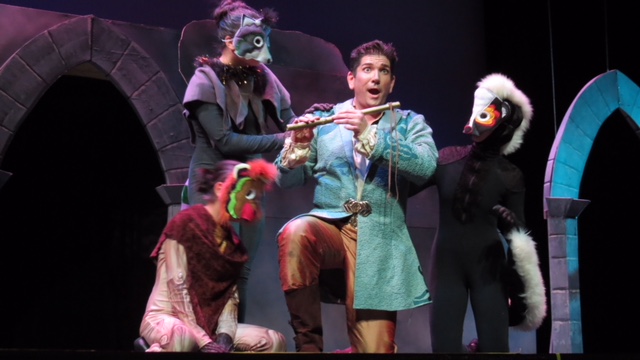
Todd Wilander as Tamino in Mozart’s ‘Magic Flute’ at Opera Fairbanks, Alaska | Courtesy photo / Opera Fairbanks

“There are gratifying moments, however,” Wilander quickly adds. “Like when someone says to me ‘Your passion made me feel something,’ or ‘That song was what my father listened to,’ or ‘Even if you were singing in French, I followed your character so well I understood his heartache.’”

Asked if he has a favorite opera, Wilander quips, “My funny answer is ‘the next job I’ll be doing.’ Clever remarks aside, I’ve had the most success with Italian composers like Donizetti, who wrote ‘L’elisir d’amore’ (The Elixir of Love). He composed operas about English Royals – ‘Elisabetta,’ ‘Anna Bolena’ ‘Maria Stuarda.’ I love historical operas. While he embellished here and there, his operas were pretty accurate.

“Now that I’m older and my voice has settled more, I can sing a lot of Donizetti’s works. In the same way that now I can do Wagner … which is great because his works are harder to cast. Twenty-year olds can’t possibly sing Wagner or they’ll ruin their vocal chords. Singers have to move on to the operas as they gain age and wisdom and emotional connectedness with the character.

“I can execute more Verdi and Puccini and I can project against a 60-piece orchestra, that’s very lush and big. Opera singers don’t wear microphones so shows are usually not held on consecutive evenings to give us time to rest our voice.”

Todd Wilander singing the title role of Hoffman in the opera ‘Tales of Hoffman,’ by Offenbach, at Opera North summer festival | Courtesy photo / Opera North

Wilander has sung in so many operas but every new role still induces the same thrill as when he first started out. He happily divulges, “My next big engagement will be with Opera New Jersey in March when I get to be Radames in Verdi’s ‘Aida.’ Then in April, I will be with the Tampa Bay Opera in Florida to sing in Puccini’s ‘La Boheme’ as Rodolfo. Other opportunities coming up include a concert in Germany and other New York concerts in the Spring. I don’t have a dream role but there are some roles I would like to perform again; and I’d love to do ‘Tosca’ one day.”

What the future holds can sometimes be a complete surprise as in Wilander’s case. “I didn’t grow up with opera; my parents didn’t either. They took me to The Ahmanson in downtown L.A. and we watched musical theater. I’d only sung Latin in Church when I was young. My love for opera started in college, but even then Cal State didn’t have an opera program.

“But opera has been a part of who I am as a person and I can’t imagine life without it. After all these years, I am still amazed at how each live performance is different because anything can happen. There was one concert when I slipped and slid across the entire length of the stage, but I didn’t skip a beat singing. There are nights when someone would be in remarkable form, or a singer would be struggling, or someone had a fight with his girlfriend so his head would be in a bad place. But all those emotions could be transferred to the words you’re singing.

“Opera is such a wonderful art form that imbues all kinds of sensations and experiences. It isn’t just a bunch of people in costume, singing in a foreign language. It transports audiences to places – fighting wars, falling in love, being rejected – to make the characters and stories a part of them.”

“There’s a reason that opera has lasted over 400 years – because it tells a story of love, passion, betrayal, anger, of human emotions every one of us goes through each day. And, in the world we live in today, it’s good to be reminded that there’s more than what we see on CNN and Fox News. There’s more humanity and love to go around.”

Charles W. Eliot Arts Magnet Academy Inaugurates its Own Costume Shop

Originally published on 30 October 2018 in the Pasadena Independent, Arcadia Weekly, and Monrovia Weekly

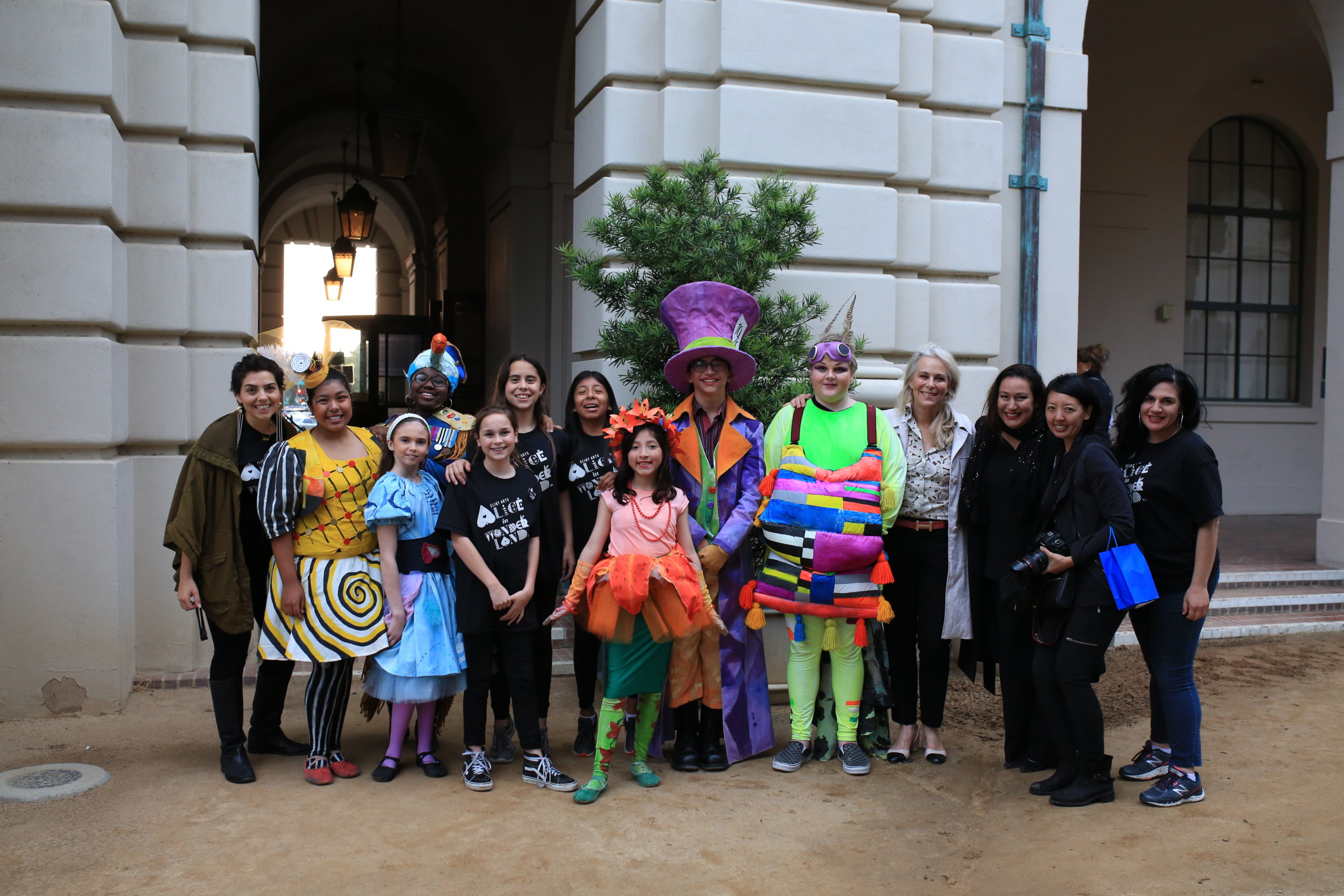
The Eliot Arts team poses with its newest fan, actress Jane Kaczmarek, at Pasadena Educational Foundation’s ‘Breakthrough Student Interactive Showcase’ at their annual ‘Celebrating Our Schools’ event. Left to right, Drama teacher Micol Issa, student actors and costume designers, Kaczmarek, Principal Lori Touloumian, Visual Artist-in-Residence Liane Shih, and Theatre Artist-in-Residence Lory Tatoulian | Courtesy photo / Molly O’Keeffe

The middle school musical was ‘Alice in Wonderland.’ As the students were getting ready for rehearsals, Micol Issa, 6th grade English and Drama teacher at Charles W. Eliot Arts Magnet Academy (Eliot) in Altadena, who was also directing the production, had a sudden inspiration, “Instead of shopping for costumes for the show, why don’t we make them ourselves?”

Never mind that it was January and the production was slated for May. Indeed, many would have found that prospect daunting. Where would they find designers? Who, besides Issa, even knew how to sew?

But Eliot was the top Arts School in the Pasadena area and it had a reputation to uphold. So everyone got behind her idea quickly. Students, parents, teachers, and administrators sprang to action to make Issa’s brainstorm a reality.

Issa’s ambitious concept would not have been do-able had it not been for a grant that transformed the school to what it is today. Lori Touloumian, Eliot principal, informs, “In 2013, this school, then known as Eliot Middle School, was one of four academic institutions awarded the magnet schools assistance program grants of $7.9 million each to have its own integrated theme. Eliot, in particular, was designated as a Visual and Performing Arts (VAPA) school.

“To ensure cohesion of the district’s schools and initiatives, there is one person who has oversight over all the magnet programs. We’re fortunate to have Shannon Mumolo in this capacity. As the Magnet Schools Assistance Program (MSAP) Program Director for the Pasadena Unified School District, she oversees the budget and implementation of magnet programs funded by the U.S. Department of Education. She has been an MSAP Project Director since 2015 and previously served as the MSAP Site Coordinator for Eliot Arts Magnet.”

“Through the grant, our teachers went through specialized training on how to integrate the experiential approach to art into the core classes of English, history, math, and science,” discloses Touloumian. “We have resident artists who work with teachers on site during the school day and after school who work directly with students on various projects. We’ve also partnered with the Huntington Library to offer free after-school programs every Tuesday and Thursday afternoon.

“While adhering to the district’s established curriculum for the scope and sequence of the arts program, the teachers have been empowered to make decisions in terms of what art project they will do in their core class and they are free to set up the time with the resident artists. The school follows the common core standards and the artists in residence come in with expertise in the arts standards to weave the two together.”

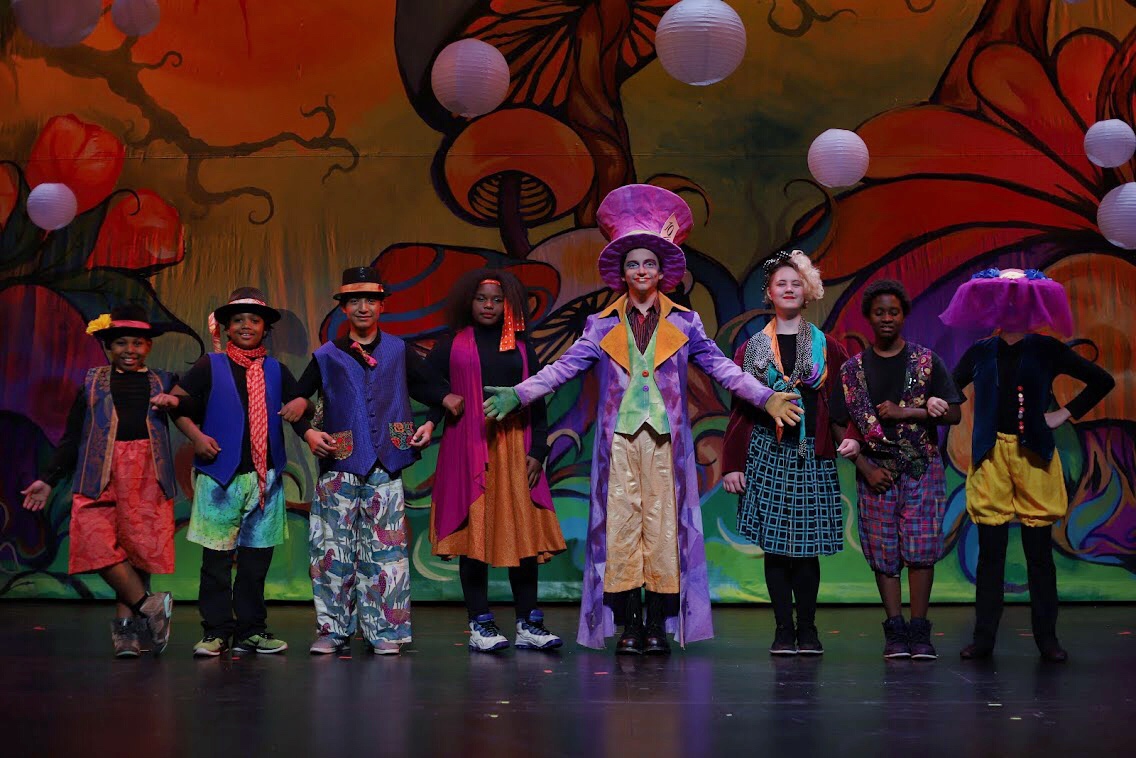
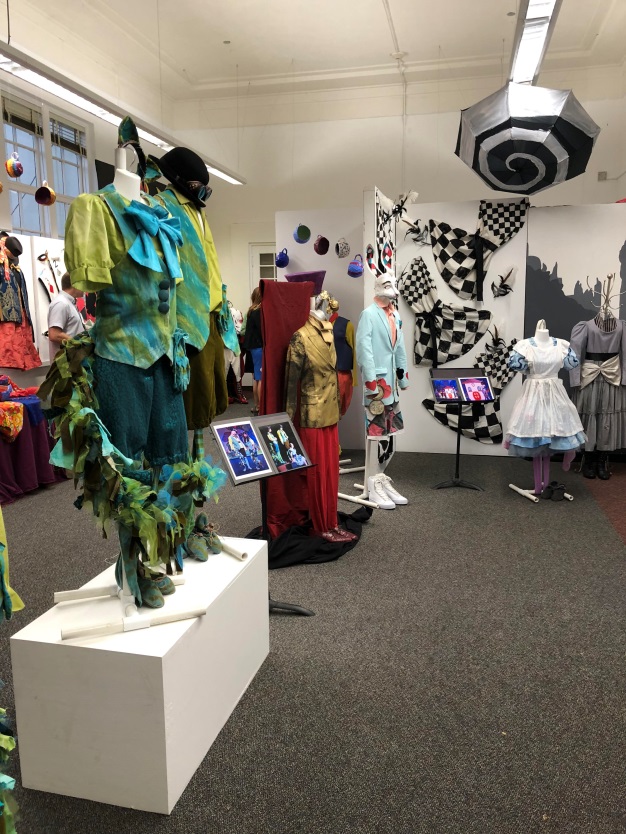
In Eliot’s new costume shop, parents and artists-in-residence taught students how to sew their own costumes such as the shorts and pantaloons worn by guests to the Mad Hatter’s tea party. The Mad Hatter wore a handmade hat and hand-painted jacket designed by students themselves | Courtesy photo / Marc Flores

Touloumian says further, “Additionally, we were to able create art-maker spaces on campus – we  revamped our dance rooms with more equipment, we transformed a former parent room into an art gallery which is now utilized as a community center where our students and community artists can hang their art, and we added a ceramics room and a media lab on campus.

“We are now a fully integrated arts academy. Students can choose what elective classes they want to be in but even if they choose not to attend a specific elective class they may still have the visual arts experience in their English, history, math, or science class, or after school.”

Cheili Lopez, a 7th grade student who participates in the arts classes and after-school program, says “I’ve just started the printing shop on Tuesdays and Thursdays with Mr. Duffy, and on Fridays I go to the costume shop. Through the arts classes, I’ve been able to make things for my family – I sewed an apron for my mom and I made a jug in ceramics class which I gave to my parents for Christmas. They were very happy because the items weren’t store-bought; I made them myself.”

“Everything we do here is connected to the Arts,” Issa explains. “We’re trying to rebuild the school culture and create spaces for kids to have multiple avenues of access to the Arts. Not everyone wants to act, but this is another way for kids to participate in the making of performances, and Cheili is an example of that.

We realized that something we needed, not just for the drama and choir program but also for dance classes, was a costume shop. That was the goal we tried to work towards last year, which launched us into this next level. Now, we have six sewing machines, two sergers, and an embroidery machine. We basically have a sewing club that meets every Friday after school.”

“In the past, we assigned people to find the costumes for specific characters,” details Issa. “But, like I said, we need costumes for all our productions so I took the idea of having a costume shop to Denise, the artist in residence. She, in turn, went to Lori and said ‘If you will okay the costume shop, I’ll write the grant,’ and she did.

“Of course, I had to justify why I thought a costume shop was necessary. I argued that it’s something that would be great for the program as a whole and we had the expertise on how to run a costume shop on campus. Denise and I know how to sew, then we discovered that so many parents also have that skill. So what it really did was brought more people on campus.

“Through Facebook, people shared with everyone our donation list and what I was hoping to accomplish. People donated patterns and dropped off whatever they could contribute. Everyone was happy to give and appreciated that we were teaching kids how to sew.”

A visit to a museum was the inspiration for their musical’s look. Issa recounts, “I went to an exhibition of Marc Chagall costumes at LACMA and I was astonished because it was exactly what I envisioned for ‘Alice in Wonderland.’ So I took the kids on a field trip to see the show and when we came back we started designing.

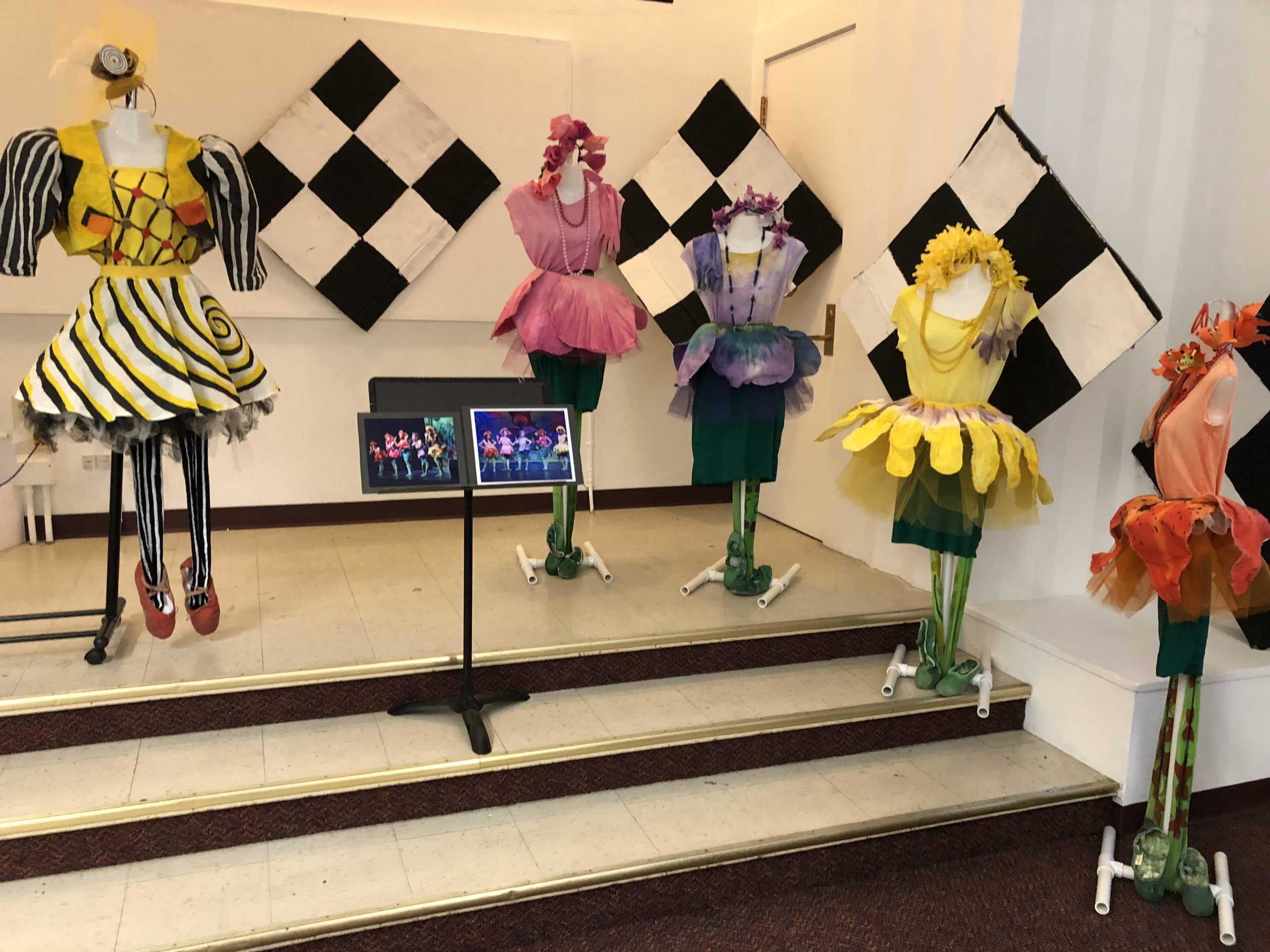
Students fused the modernist styles of the Bauhaus movement with the loose painting styles of artist Marc Chagall to design each of the show’s whimsical costumes | Courtesy photo / Shannon Mumolo

“We found real pictures of the Chagall costumes. And under the guidance of our artist in residence, we taught the kids how to draw and make patterns, to paint them with colors, and to sew inside out.

“Because of the large number of costumes that needed to be finished, it was a community effort. Students, teachers, and parents spent a lot of late nights and weekends sewing. And, while not each costume was made entirely by kids, they worked on every one.”

Lopez was one of the students who made the costumes and she acquiesces, “Each costume was a group effort. Several students worked with an adult to work on one and when we didn’t finish that day, we went back to it the following afternoon.”

The experience proved to be constructive for Lopez not only because she learned how to sew. She says, “We do a lot of projects in regular school so doing the after-school costume shop helps me collaborate with other students.”

Issa points out, “What they do in the costume shop translates, however indirectly, with their core classes. They go through the same procedure of calculating, of figuring out a problem, much like in math class. They have to assess how thick they need to make the paint to have the effect that they want. So they experiment with a lot of color samples to figure out what consistency to use so it doesn’t just turn into watercolor but, at the same time, doesn’t make the fabric super stiff. That’s a process that applies in science class.”

“The show ran for three days and all the costumes held up,” Issa says with pride. “There were minor repairs which we made between shows. The incredible thing about this, also, is that it gave me additional crew on top of the stage team. From now on, the costume crew is in charge of queue-ing the costumes – making sure they’re in the right place – and noting what needs to be repaired so we can make them the next day.

Eliot’s spring musical proved to be a smashing success. Raves Issa, “Our ticket sales for the show was tremendous. We sold over $1,000, which was more than what our previous shows generated. Then, on October 10, we held our first official gallery opening featuring the costumes from last school year’s spring musical ‘Alice in Wonderland Jr.’ We invited the District and Community Arts Team, and all our Altadena, Pasadena, and Sierra Madre partners – from dance to theater companies – and they all came to see the exhibit.”

The show’s handmade costumes were installed in the school’s art gallery this fall for the opening exhibition: Chagall and the Bauhaus Meet Alice in Wonderland. They will be on display until December 2018 | Courtesy photo / Shannon Mumolo

The display, which goes on until December, highlights a very specific artistic vision. Issa describes, “The costumes in Eliot’s production of Disney’s ‘Alice in Wonderland’ are unlike any other version of the show you have seen because it was inspired by the artist Marc Chagall and the Bauhaus design movement.

“Chagall, well known for his paintings and stained glass windows, also designed costumes for the Metropolitan Opera and New York City Ballet. You will see some of his designs and paintings represented in our own costumes and sketches. As we researched and sketched our vision for Wonderland into life, we decided to add in the modern and otherworldly influence of the Bauhaus design movement. Categorized by basic shapes, lines, and spirals, we fused the modernist style of the Bauhaus movement with the loose painting styles of Chagall.”

“We’ve had previous exhibits but they were open after school mainly for parents and students,” clarifies Issa. “This was our first gallery opening held on a specific night for the entire community, complete with a bake and beverage sale. It demonstrates the amazing work that can be done when students, teachers, parents, and community partners collaborate. We’ll be forever grateful for the generosity of the Pasadena Showcase for the Arts and the Pasadena Educational Foundation for their support in making Eliot a premier arts school in the area.

“It was truly a project that involved a great many students – 140 kids took part in our costume shop, out of our total student population of 545. That’s 23% of the student body. What’s more, this endeavor inspired others so we have doubled our numbers in the costume shop. Even those students who weren’t able to participate in the after-school program worked around their schedule to be in the costume shop.

“We started the Friday costume shop early this school year so we could teach the kids sooner and, in time, they would be able to sew the bulk of the costumes themselves. Our next musical is ‘Hairspray’ and we’re creating the costumes again. But because this show happens in our world, we’ll probably use some of the basic costumes we already have, instead of making them from scratch. That’s the cool thing about having a costume shop – it has given us the ability to use  something that already exists by altering it to fit our needs.”

Issa is now just entering her third year at Eliot but, already, she has been instrumental in giving it the distinction of being the only middle school with a costume shop. But, more importantly, she  has successfully incorporated in its program an invaluable skill that will serve middle school students long after they leave Eliot. Nay, for life.

Addressing Anxiety and Depression on Campus

Originally published on 23 October 2018 in the Pasadena Independent, Arcadia Weekly, and Monrovia Weekly

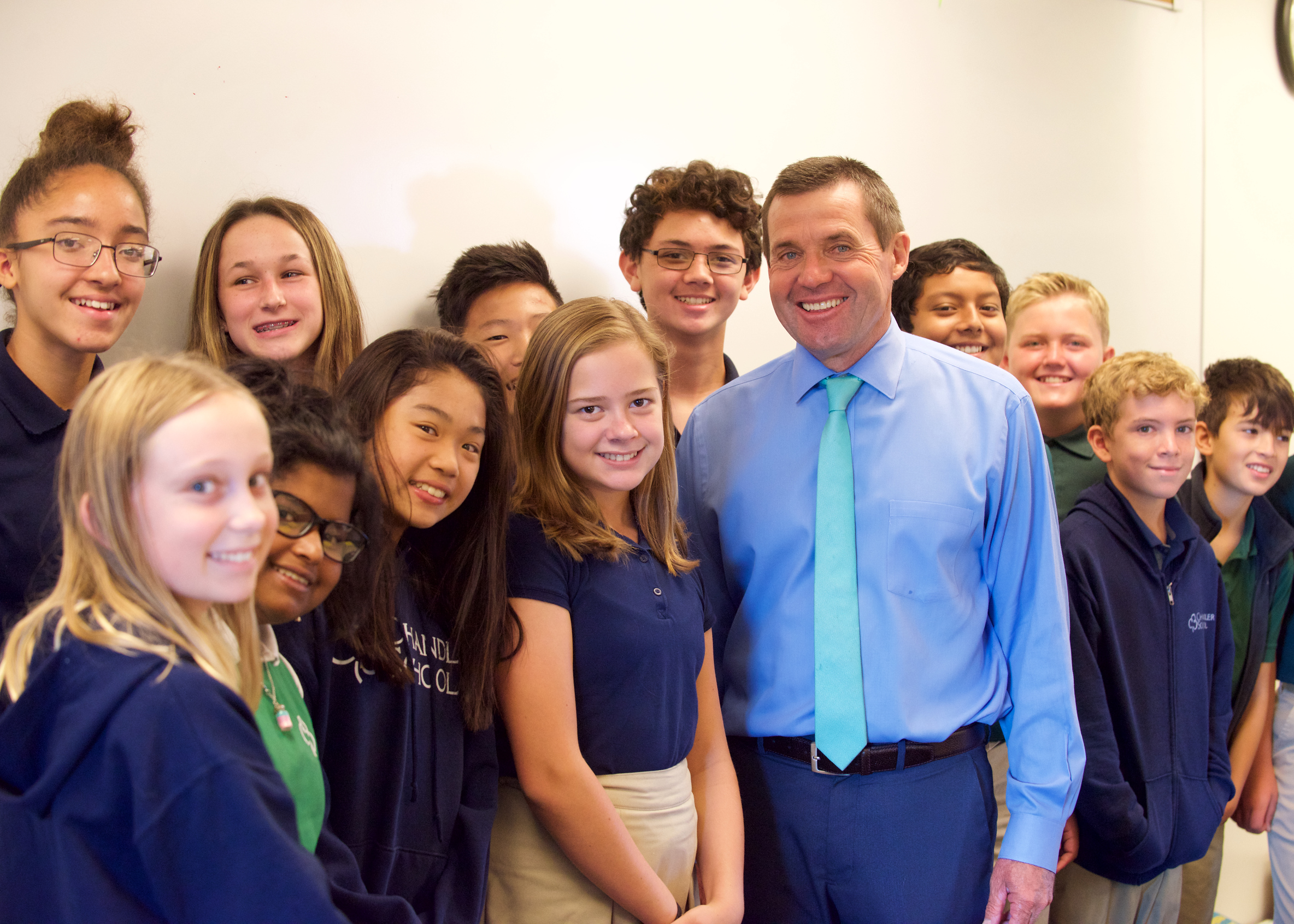
John Finch, headmaster of Chandler School, with middle-school students in his Ethical Perspectives class | Courtesy photo / Tim Teague

In an article which published last April in Time magazine, Katie Reilly reported that record numbers of college students are seeking treatment for anxiety and depression, and schools can’t keep up. She further described that when UCLA offered, for the first time, all incoming students a free online screening for depression, more than 2,700 students opted in.

Following that article, UCLA announced the launch of its ‘Depression Grand Challenge.’ This project, that spans a decade, will study 100,000 of students who have used its health care system for any reason. It is a sweeping initiative that brings to the fore the mental health issues that have long existed but have never been fully addressed until now.

However, anxiety and depression often predate college. High school students, most especially in the San Gabriel Valley, are faced with daunting competition when they start applying to colleges. Students in the area have earned perfect GPAs, SAT, and ACT scores; were the president of their school’s Student Council; have played at least one musical instrument, have won multiple gold Young Musicians’ Competition awards, and have performed at Carnegie Hall; have been deeply involved in a social, community, or philanthropic cause. They are over-scheduled, sleep-deprived, and hell-bent to stand out from other over-achievers. It’s no wonder, then, that they are riddled with anxiety that often leads to depression.

David Burge, who just completed his term as the President of NACAC (National Association for College Admission Counseling) states, “There is no doubt that the college application and selection process is daunting and is a cause of much of the anxiety and depression on high school campuses.

“What we’re finding is that there are more and more students in high school who are receiving treatments for anxiety and depression, including medication and talk therapy. So it’s only natural for them to continue to seek treatment when they get on the college campus. Sometimes the stress of college accentuates their pre-existing conditions.”

“We, at NACAC, are teaching students and parents to look beyond the Ivies and the most selective universities when they embark on their college search. As long as we continue to value exclusivity as a surrogate for quality, the competition perpetrated by these very universities will continue,” Burge pronounces.

To say, though, that the college application is the reason for the mental health concerns plaguing our country’s youth is too simplistic.

Depression among students is on the rise | Courtesy photo

Myra McGovern, Vice-President for Media at NAIS (National Association of Independent Schools), says, “The theories about why today’s students are going through anxiety and depression run the gamut. Some are backed by science and some are anecdotal. One of the things I’ve heard is that parents these days aren’t doing much about the issue because they think their generation had it harder.

“Some of us think that children didn’t get to experience the violence of wars and the hardship that accompanied such, which made them more fragile. But one could argue that children have seen more wars in their lifetime. There have been more media coverage of school shootings, that began in Columbine; and of terrorism and international threats, since 9-11.”

“I think that while the potential dangers may not have statistically grown, the exposure brought on by media has increased dramatically,” explains McGovern. “In the past, most teenagers didn’t read the newspapers; but these days, through social media, they know what’s happening in the world in real time.

“Consider your biological fear response – from the adrenaline rush, to the tightening in your chest and the dry mouth – when you hear of something horrible happening. Our body hasn’t really changed from the time of lions chasing people. Yet we’re more exposed to technological lions (stimulus) when our survival instinct hasn’t quit adapted to technological reality.”

McGovern elaborates, “Perhaps, too, children’s increased interface through technology is changing the way they relate and cope. The social pressures the older generations had to contend with are definitely different from what today’s youth deal with.

“There’s also our perception of our role as parents. Because of our own anxieties about our children’s lives, we are constantly hand-holding them and, in the process, taking away some of the opportunity for them to practice making decisions. It affects their confidence level at being able to navigate the challenges the world throws at the them as they become teenagers and young adults.”

“Another theory has to do with what people are consuming and the chemicals they’re exposed to,” adds McGovern. “But whatever the cause is, there’s a consensus that children and adults are struggling more with anxiety and depression.

“What I want to emphasize is that I don’t believe there’s one right solution for everyone. Part of the solution is considering children as individuals with specific needs. Prioritizing to invest in our future on the front end could reap benefits in the long term,” McGovern concludes.

Building the groundwork for sending happy and healthy kids to high school and beyond is a mandate that John Finch, headmaster of Chandler, a K-8th grade school in Pasadena, takes to heart.

Chandler students gather together as the school day begins | Courtesy photo / Tim Teague

“We establish an environment where there are high expectations, but low stress,” Finch declares. “We pay careful attention to the volume of work we ask the students to do. We don’t try to fit round pegs into square holes – we provide a program that meets their needs and adjust our program so that each child feels recognized, respected, and challenged.

“As we challenge our students, requiring them to do good work, we are equally careful about how we manage expectations. We have to be mindful that doing otherwise leads us to the same path we’ve been going on, with more kids falling out in the end.”

“Socially, we want to create an environment where children are kind to each other, respect and help each other,” states Finch. “We’re intolerant when it comes to bullying. At the same time, we want to establish an atmosphere where kids can be resilient and gritty. We want for them to pursue their interests by trial and error. And if they fail, we’ll help them try again. We want kids to understand they’re being supported by a tight adult network that encourages them. We want them to feel that there’s a balanced foundation of care and love.”

Finch points out, “I think students who spend too much time on screens and not enough time interacting with others can become isolated and lonely. That isolation and loneliness can manifest themselves in anxiety and depression. We have to be cautious, conscientious, and deliberate in urging our kids to shut their screens down, to spend more time interacting and socializing with friends and family.”

“Increasingly, I hear principals say their biggest concern is not so much the achievement, but the well-being of their students,” discloses Finch. “Something’s changing and we have to find the cause and respond accordingly. We’re not doing kids any favor if they’re leaving our schools feeling anxious or depressed – whether it’s because they’re over-burdened by expectations, they feel something is lacking, or they can’t cope with the independence they get as they grow older.

“Ten years ago schools were adding technology and computer positions. Now schools are augmenting learning and emotional support. Once we saw that technology had a transformative impact on the program, the next step was to become intentional in meeting the social and emotional needs of students.

“For us, it’s been helpful to have a buddy program. Older kids interact with the younger ones to give them a sense of responsibility and community obligation. For younger kids, it’s a way for them to look up to older students as role models. Those friendships that develop in multi-age groups make a vast difference in school life.”

“We also have a school psychologist to give professional help,” adds Finch. “Teachers meet regularly and when they hear a student’s name come up more than once as someone who’s not completing work, is tired, or isn’t eating well, they let the administrator know.

“There have been circumstances when kids approached the administrator to say they’re worried about one of their friends. We investigate all these observations and we bring in the psychologist whenever it’s warranted.”

“In a small private school with an adult-student ratio of 1 to 7, it’s very hard for the child to slip through the cracks,” assures Finch. “We’re capable of arresting something before it becomes too dark. And we make sure we have the support and place to take care of it.

“I’m interested in empowering teachers to not only provide excellent teaching but, more importantly, to look after the welfare of students in their charge. At the same time, I also know that families are our partners in addressing the issues of anxiety and depression.”

It’s heartening to know that parents, teachers, and school administrators are acknowledging that there is a mental health problem affecting a large number of students. It is a first step in the right direction.

That schools are also now taking active measures to help students get through their anxiety and depression is certainly a lifeline for those who’ve been feeling despondent and alone. There is hope yet.

L.A. County Arboretum’s ‘Moonlight Forest’ Brings People Together in San Gabriel Valley

Originally published on 16 October 2018 in the Pasadena Independent, Arcadia Weekly, and Monrovia Weekly

A ‘Moonlight Forest’ display at The Arboretum | Courtesy photo / Tianyu Arts & Culture, Inc.

Be transported to an enchanted evening wonderland when the Los Angeles County Arboretum and Botanic Garden (The Arboretum) in Arcadia displays hundreds of magnificent lanterns depicting exotic animals, shimmering flowers, whimsical pandas, soaring dragons, and other themes to create a mesmerizing ‘Moonlight Forest.’

The Lantern Art Festival celebrates the time-honored tradition of lantern-making and features Chinese performing arts and crafts. It goes on from October 26, 2018 through January 6, 2019, 5:30 to 10 pm.

Richard Schulhof, CEO of The Arboretum declares, “Our vision for the Lantern Art Festival is to commemorate this wonderful traditional art form from China and set the lanterns amidst the landscape of the L.A. County Arboretum. It’s nature meeting art and culture, and bringing together the different communities in Los Angeles.

“Spanning a mile’s path of travel, the lantern displays will begin from the lawn area, then goes into the forest and around the lake, and by our landmark Queen Anne Cottage. In addition to the lanterns, we’ll have traditional Chinese performing arts – acrobats, face-changing dancers, and jugglers. We’ll have food trucks and various libations.”

Richard Schulhof looks at the animal lanterns | Photo by May S. Ruiz / Beacon Media News

‘Moonlight Forest’ is the culmination of a year’s planning and preparation. Relates Schulhof, “Last October, Tianyu Arts & Culture Inc., the American subsidiary of the international design and manufacturing company Sichuan Tianyu Culture Communication Co., contacted me to discuss a possible collaboration.

“I familiarized myself with the art form and the company’s work by visiting the different lantern festivals they were holding in Charlotte, Virginia Beach, and Las Vegas. I learned that lantern art utilized traditional materials that were used 500 years ago. The advent of new materials and construction methods allowed for an elaboration of this traditional art form and the lanterns you currently see represent that.

“The center for this craft is a town named Zigong in Sichuan, near the city of Chengdu, where this art form is still practiced today. Tianyu Arts & Culture creates festivals all over the world – Europe, Australia, and North America. It’s quite surprising that there has never been one of this scale in the San Gabriel Valley. And given the confluence of cultures in the region, particularly East Asian, it’s only fitting and natural to bring the lantern art festival here. We’re thrilled that this debut event is happening here at The Arboretum because I see this as a meeting place of cultures.”

The lanterns reflect three themes: Chinese culture – iconic images and traditional themes like the harvest moon feast; nature – animals and plants; and children – fairy tales and fables to delight kids and the child in all of us.

Schulhof’s excitement about this event is abundantly evident when he takes me on a tour of The Arboretum grounds where workers are busy setting up structures on which the lanterns will be installed. He explains that some of the exhibitions are quite complex and points to a large construction underway that he presumes will be that of the Forbidden City, which used to be the imperial palace in the Ming and Qing Dynasties.

A display of a man serving tea | Photo by May S. Ruiz / Beacon Media News

As we approach a display of a man serving tea, Schulhof stops and gets out of the golf cart he’s driving to enthuse, “When I was in Kunming, in Yunnan province, I was hosted by the Kunming Botanical Garden and the server was dressed just like this. They carried teakettles with these long spouts and they could pour tea into your cup from six feet away. It was absolutely amazing to see that.”

At this point we’re attracting the curiosity of people who are on their morning walk at the garden. Schulhof very animatedly enlightens the little group about the lanterns with the enthusiasm and exuberance of a little boy showing off his prized toy collection.

We reach an area with the animal lanterns and there are lions, tigers, giraffes, pandas, and some animals indigenous to California – bears and coyotes. Schulhof points out little details on them, like the hand-painted eyes of the animals.

“And because this is The Arboretum, there will be a couple of peacock lanterns. They’re the most spectacular peacock lanterns they’ve ever done! People here have very high expectations when it comes to peacocks,” Schulhof tells a couple of ladies who are also inspecting the array before us.

Schulhof stands next to a terracotta soldier | Photo by May S. Ruiz / Beacon Media News

The lanterns of the terracotta warriors from Xi’an province are Schulhof’s particular favorite and he walks over to where the figures are clustered. He informs with confidence, “If you look closely you’ll see that the soldiers have different faces and when illuminated they are glowing, golden beams.”

There’s quite an interesting bit of Chinese history connected to the terracotta army. The first Qin Emperor, Qin Shi Huang, who ruled from 247 to 210 BC, built this army of warriors, chariots, and horses made entirely of clay and were buried with him to guard him in his afterlife. They remained there undiscovered until 1974 when they were excavated by accident by local farmers. Today the Mausoleum of the first Qin Emperor is a UNESCO World Heritage site.

Our tour ends at the lawn and fountain area, and Schulhof directs my attention to a tree, “The Arboretum was founded in 1948 and one of its goals was to bring new plants to Los Angeles to beautify the city. That is the silk floss tree from South America, one of our most successful introductions, and this is its peak blooming period. We have several of them all over the garden; so people will be enjoying the lanterns and our beautiful silk floss plants at the height of blossom all at once.

Photo by May S. Ruiz / Beacon Media News

“Every year, 400,000 people visit The Arboretum. What they see during the day doesn’t even compare to what they’ll see at night during our ‘Moonlight Forest.’ The Lantern Art Festival, with its more than 60 exhibits and over 500 lanterns, gloriously demonstrates the artistry, craft, and skill of Sichuan artisans and will surely add some magic to the visitor experience.”

Schulhof is familiar with Sichuan province, where this craft originated. Back in 1997, when he served as Executive Director of Descanso Gardens, he was in Sichuan collecting camellias. But because he was in the countryside, he didn’t see any lanterns.

Starting next week, and for ten weeks thereafter, the lanterns that eluded Schulhof in Sichuan two decades ago will be the magnificent centerpiece at The Arboretum’s ‘Moonlight Festival.’ And he is hoping that not only do they bring delight and joy to those who behold their splendor, but also bring together the various communities in the San Gabriel Valley in one magical celebration.

The Playhouse Celebrates Halloween with ‘The Woman in Black’

Originally published on 15 October 2018 in the Pasadena Independent, Arcadia Weekly, and Monrovia Weekly

Bradley Armacost and Adam Wesley Brown in Susan Hill’s ‘The Woman in Black’ at the Cleveland Playhouse | Courtesy photo / Roger Mastroianni

London’s second longest-running West End play ‘The Woman in Black’ will premiere on the West Coast at the Pasadena Playhouse from October 17 to November 11, just in time for Halloween. With all the stage wizardry that has led audiences in London to shriek in fear for over 28 years, it promises to live up to its reputation as one of the most terrifying theater events ever mounted.

Adapted by Stephen Mallatratt from a novel by Susan Hill, the play is directed by Robin Herford, who has also helmed all its productions in Tokyo, India, Singapore, Hong Kong, Australia, and New Zealand. He is recreating his original staging for the first time in the United States with Bradley Armacost as Arthur Kipps and Adam Wesley Brown as The Actor.

Hill’s Gothic ghost story is set in an isolated windswept mansion which has secrets hidden behind its shuttered windows. There, a young lawyer encounters horrific visions in the house set amidst the eerie marshes and howling winds of England’s forbidding North Coast.

Years later, he tells his frightening tale to exorcise the terror that grips his soul. Mallatratt’s adaptation is a play within a play, with Kipps rehearsing with an actor to perform the story for his family and friends, thereby making him relive the haunting of Eel Marsh House.

It all begins innocently enough, but as he reaches further into his darkest memories, he quickly finds that there is no turning back. With just two actors, ‘The Woman in Black’ gives audiences an evening of unremitting drama and sheer theatricality as they are transported into a chilling and ghostly world.

Speaking by phone, Armacost describes how he almost didn’t get the role of Arthur Kipps, “Robin Herford cast the play in Chicago at the same time I was playing in Washington D.C. so I wasn’t able to come to the audition. When they had finished casting, he asked if there was someone else they were thinking of for the role and my name came up.

“I did a scene on my iPhone and sent it to the casting director, who passed it on. They caught up with me at an airport where we had a casting session of sorts. I had a half-hour Skype conversation on my iPad with Robin, who was in London. We got on quite well and the next thing I knew I had the role; I found it funny because he had no idea if I even had a leg since all he could see was my face.

“Robin came in from London for the two-and-a-half week rehearsal in Chicago and stayed through the opening in Cleveland. He had to fly back to London for opening night of the 12,000th performance of ‘The Woman in Black’ in London.”

While it has been running in London for almost three decades, Armacost hadn’t seen it. “I was unfamiliar with the play but I knew there was a 2012 film with Daniel Radcliffe whom everyone knows as Harry Potter. I’m surprised my son didn’t bring it to my attention.

Adam Wesley Brown and Bradley Armacost in Susan Hill’s ‘The Woman in Black’ at the Cleveland Playhouse | Courtesy photo / Roger Mastroianni

“I was told, though, that while the film has the same subject and is taken from the same novel by Susan Hill, it is completely different. In the film there are other actors performing various parts; in the play there are just two of us and we act out all the characters. I perform at least seven characters and my partner plays three. With only two actors on stage, you quickly realize that if he’s not talking, I am. And if I’m not talking, he is.”

That puts a lot of the burden of having to memorize so much dialogue on both actors. But that didn’t daunt Armacost. He says, “First of all, Susan has a good story and Stephen has written a magnificent script. There’s no fat on it, no unnecessary word. It’s to the point, so it’s quite easy to memorize and perform. There are silences in it but, hopefully, those are the moments when the audiences are most at the edge of their seats.”

Continues Armacost, “I can practically set my watch  and count three, two, one and … there’s a scream. There were times when someone in the audience would call out ‘Don’t go in that door!’ You can practically see them jumping in other people’s laps. The audience reaction is like an electric shock. The play opens and the audience is on an electric wire which keeps us moving. It may be one of the reasons the play is easy to memorize. It’s no wonder it has run for as long as it has. It’s truly a joy to perform in this play; it’s such an audience pleaser.

“It’s truly an honor to be involved in this production. We were very fortunate to be working with Robin who has been touring this play and has directed it for 30 years. While he has shared some short cuts on how to interpret it, he’s given us a free hand in making it our own. Every so often during rehearsal, in his very British way, he would say, ‘You might try ….’”

Asked what he finds compelling about ‘The Woman in Black,’ Armacost replies, “What truly stands out in this production is that everyone in the audience is another character and brings his or her own imagination. One dog on the stage can be as many different breeds as there are people in the audience. Each one envisions his own picture of what the scary mansion looks like. I think when audience members are that invested, they have a greater appreciation of the play.

“This is for someone who enjoys mystery and likes crossword and jigsaw puzzles; it’s a thinking person’s frightening tale. It’s not a life transforming play, it’s just a communal experience where the person next to you jumps and you do the same. Then you share a laugh together. And in times like these, when even the news is sometimes frightening, it’s fun to just be able to say ‘for the next two hours I will listen to this story and be like a kid again.’

“And, for me, it’s a delight to be a part of this clever production. The play, which only has two chairs and one doorway, holds the audience captive. It’s remarkable how something so seemingly uncomplicated has managed to frighten audiences for over a quarter century.”

‘Rosencrantz and Guildenstern are Dead’ Comes to Life at A Noise Within

Originally published on 8 October 2018 in the Pasadena Independent, Arcadia Weekly, and Monrovia Weekly

Pictured left to right: Rafael Goldstein and Kasey Mahaffy. – Photo by Craig Schwartz

Tom Stoppard’s ‘Rosencrantz and Guildenstern are Dead’ was first performed at the Edinburgh Festival Fringe (The Fringe) in 1967 to great acclaim. It established him as one of the greatest playwrights in modern times and his work, which puts to the fore two of Shakespeare’s minor characters in ‘Hamlet,’ has been staged throughout the western world.

Pasadenans will get to experience Stoppard’s brilliance when ‘Rosencrantz and Guildenstern are Dead’ goes on stage at A Noise Within from October 7 to November 18. Directed by ANW Producing Director, Geoff Elliott, it stars resident artists Kasey Mahaffy as Rosencrantz and Rafael Goldstein as Guildenstern.

A Nosie Within distinguishes itself as one of the few repertory theatre organizations with a resident company. The resident actors’ genuine regard for one another manifests itself on stage and makes for richer, more nuanced performances.

“Rafael and I have known each other for four years,” Mahaffy discloses. “We know each other’s secrets, we’re two halves of the same coin. So we started the foundation from day one, jumping off from a place that some actors could only be familiar with on opening night.”

“I’ve worked with him in about half a dozen plays and I have admired him greatly as an artist. But our joke was that we never shared a word together. Even in ‘Henry V,’ where he played the king and I was the dauphin from France, his mortal enemy, we didn’t share a minute of stage time. We just never got a moment together. Finally, they threw us a bone. Now all we do is hang out and we’re sick of other,” quips Mahaffy.

“But, seriously, I’m grateful every day that Rafael is my screen partner and my safety net,” Mahaffy says hastily. “He’s incredibly prepared and diligent, which I expected coming in. He’s always fun to hang out with and joke with backstage.”

“What I like about Kasey is that he’s a grounding presence for me,” declares Goldstein. “I tend to spin off into the abyss. And Kasey is very practical; he listens and he responds. Every actor needs that and I have it in spades with him. His sense of humor leavens the existential morass that we find ourselves in in this play. He has all the laugh lines, as well. It’s been nice to sort of play the straight man to his comic character.”

“Like in any true functioning relationship, these two individuals, while widely different, need each other,” Mahaffy elucidates. “Guildenstern is a cerebral, logistical, driven character. And Rosencrantz is all fart jokes. But what’s so cool in Stoppard’s writing is that when one character  loses perspective and spins out, and both of us do it multiple times on the show, the other one immediately rises to the challenge and rescues the other. Every single moment in this play is a scale that he and I are leveling.”

Pictured left to right: Rafael Goldstein, Paul David Story, and Kasey Mahaffy | Photo by Craig Schwartz

‘Rosencrantz and Guildenstern are Dead’ is not new to Mahaffy. “When I was doing my undergraduate thesis back in 2000, I had the role of Guildenstern. It’s amazing to hear those words again 18 years later. The dialogue is just fast, fast, fast, boom, boom, boom, like a tennis match. The problem is, sometimes I say his lines. It’s been 18 years but it sticks in the brain. So one of the great things about playing with him is that he’s shown me how to do that part. And how terribly bad I was when I did it then,” he admits with a laugh.

Goldstein says, “The virtue of him having done it before is that he was able to warn me about the pitfalls of this role too, and how to navigate them. He has something of a map to guide me about the play generally, like how the audience would react. Granted, that would change, but it’s something to have in the back of my head.”

Revisiting the play almost two decades later has given Mahaffy a better, deeper sense of it. “It is the heart of what I want to talk about today. The play, while told through comedy and existential theatrical device, is a treatise on life. More specifically, it is about these two characters who are stuck and are searching for their next move. They’re waiting for signs from the universe, other people, other souls, to tell them what they should do next. Like most of us, they are terrified about mortality and death. When I performed this at 20 years old, I was saying the words but I didn’t have a visceral understanding of their significance.

“This summer, my brother passed away prematurely, at 42 years old, and left a wife and two daughters. My parents were devastated and I’ve been reeling from it since. It made me think about what it means to me as a brother and as a son. As an artist, I have to put my life on stage no matter what’s going on in my life, whether it’s good or bad. There’s the line in the play …”

And Goldstein supplies the line, “There is no applause, there is only silence.”

“Yes. When you die, there is no applause, only silence and second hand clothes,” picks up Mahaffy. “Tom Stoppard is a certifiable genius. You can say those things when you’re in college but it’s not until you’re a 39-year-old man holding your brother’s shoes which were gifted to you … these second-hand shoes … that the gut punch meaning to the lines is actually delivered.”

“The theme of the play is Rosencrantz’s and Guildenstern’s imminent death,” Goldstein addresses further. “They know something is amiss, but they have an inkling, as we all do. We have an understanding that death is coming. And it’s every human’s journey how to reconcile the ultimate irrationality of our own demise. Moving through the world with that knowledge, how does one confront the absurdities of everyday life? How does one control aspects of one’s life to better comprehend the current situation? There is the questioning which activates a lot of philosophical ideas.”

“Tom Stoppard’s characters are people seeking agency in their life,” describes Mahaffy. “He wants to explore the questions ‘Are we subjugated to fate?’ ‘Are we tools at the hand  of God?’ ‘Or do we have our own power?’ ‘Are we the captain of our own ship?’ That’s the crux of what he wrote at 26 years old. He was still a baby! Such genius!”

Pictured left to right: Rafael Goldstein, Wesley Mann, and Kasey Mahaffy | Photo by Craig Schwartz

Goldstein enlarges on that thought, “The question, ‘Are we the captain of our ship, or are we set on a predetermined path?’ is completely outside of our understanding and perception. Are we just being moved along inexorably towards a predetermined end and no matter what we do, no matter what flailing action we might take to avoid certainties, we’re going to meet our end? You know, you can do as many push-ups as you want, you’re still gonna die!

“The play focuses on two minor characters in Hamlet. The title comes from a line in it, ‘Rosencrantz and Guildenstern are dead.’ There is no question. But to them, there has to be a possibility of reprieve, which they’re searching for in the entire play.”

Expounds Mahaffy, “The characters are determined to take a grip of their circumstances. They  wonder if they should turn right instead of left, forward or backward. They ask The Player, ‘What do we do? We don’t know how to act.’ And The Player answers, ‘Relax. Respond. That’s all we can do as humans.’

“This is a play about language and dialogue. Our set, even as it’s beautifully designed, is quite simple. It’s pretty much a stage with lights. I think it’s going to be a major treat for anyone who appreciates language and humor. And I want to make this clear, you don’t have to know Shakespeare. We don’t speak in Shakespeare vernacular. We talk like two people in 2018. It’s wildly funny and terribly heartbreaking all at once. It’s everything you want theater to be.”

“We’ll be wearing clothes that convey an Elizabethan flavor, but the way we speak to one another in the play is thoroughly recognizable,” Goldstein emphasizes. “Geoff Elliott, our director, has stressed for us to understand the words and communicate them as simply as we can. There is very little varnish to the way we interact with each other. It’s unadorned and straightforward. It’s two people just trying to survive and using the other person as a buoy, or a sounding board. That’s invaluable direction given the philosophical themes of the play. This is undeniably one of the greatest plays in the past century and I think people will come way from the production appreciating that.”

Even if not everyone agrees with Goldstein’s assertion, the one indisputable certainty is that Tom Stoppard didn’t let Rosencrantz and Guildenstern go down without a fight.

Enjoy a Delightful Twilight Tasting and Support Families Forward

Originally published on 5 October 2018 in the Pasadena Independent, Arcadia Weekly, and Monrovia Weekly

The ‘Labrateers’ will perform to a packed tent again this year at Twilight Tasting | Photo by Stevie Dominguez

If your idea of an enjoyable evening is sampling a wide variety of fares downed with craft beer and locally distilled spirits, then you’re in for a real treat. Families Forward Learning Center is holding its 8th Annual Twilight Tasting on Saturday, October 13, from 6 to 10 pm, at 980 N. Fair Oaks Avenue in Pasadena, and promises food and beverage aplenty

Established in 1961 as Mothers’ Club, it was originally located on Orange Grove Blvd. Its programs expanded and, in time, it outgrew that center. Using funds raised through a capital campaign, it purchased its present 10,000-square-foot building in the heart of Northwest Pasadena in 2006.

A team of education, planning, and design professionals transformed the property into a facility that could support and promote learning for thousands of families over the decades. The designated Gold-Level LEED-certified sustainable building houses five age-appropriate classrooms for children aged 0-5, an outdoor learning center, a parent education center, library, quiet room, nutrition kitchen, social kitchen, and administrative offices.

It was renamed Families Forward last September to expressly reflect its mission – to prepare families living in isolation and poverty to succeed in school and in life, through two-generation learning programs.

The two-generation program consists of a morning and an afternoon session covering early childhood education (ECE), parent education, adult education, mental health support and leadership training.

Additionally, Families Forward offers a weekly Teen Parenting on Thursday afternoons, a weekly Fathers Support Group on Wednesday evenings, and Early Readers’ Book Club one Saturday morning per month.

Parent and child learn side by side at Families Forward, investing in the success of the entire family | Photo courtesy of Families Forward

Berit Anderson, Manager for Communications and Events at Families Forward, describes, “Our tutoring and learning program is geared for children between zero and five years old, when the early development crucial to their growth, is taking place. We want to ensure that children are fully prepared to transition to kindergarten.

“Our adult program encompasses adult education, parenting education, and mental health services in partnership with Pacific Oaks. To accommodate families’ specific needs, we partner with several organizations in the community for services we cannot provide here at the center. For instance, we collaborate with Pasadena City College to offer ESL (English as a Second Language) classes.”

A resource and a safety net for the 83 percent of families who are living at, or below, the federal poverty level, Families Forward currently serves 116 children, or 100 families, who live in the neighborhood. It is open from 8:30 am to 5:30 pm. Morning program hours are from 9 to 11 am and afternoon programs are from 1 to 4:30 pm.

Families Forward has nine people in its administrative staff and three credentialed teachers. It is funded by the California teachers program, Head Start, the federal government, individual and company donors, and community supporters.

Sixteen local restaurants and businesses will serve tastings of their cuisine to event guests | Photo courtesy of Families Forward

“Twilight Tasting started eight years ago to create an opportunity for people to come in to our center,” Anderson discloses. “We have our Back to School Night before the event, so all the classrooms will display the children’s artwork. After that, people can walk around to enjoy a beer, wine, and food festival held here in our teaching spaces and the parking lot.

“We call restaurants, food, and drink companies to take part in the event. There will be 16 restaurants, some of whom are coming back from previous years’ participation, with tables and tastings throughout the evening for 300 attendees. We’ve also created relationships with businesses throughout the year and it’s a good chance for them to promote their restaurant. They’ll get face-time with our patrons, community leaders, and people in the area. It’s also an opportunity for them to show their support for our organization.

“We’re very grateful to have Boomtown Brewery, Braise & Crumble, Califia Farms, El Cholo Café, El Portal, Everson Royce, Hope Café & Catering, Kitchen Mouse, Mt. Lowe Brewing Co., Panda Express, Pasadena Sandwich Company, Semolina Artisanal Pasta, Siera Fusion, Stark Spirits, and Mendocino Farms this year.”

Anderson says further, “Our Twilight Tasting will again feature a live band, and a wine pull. Additionally, we’ll have an auction and a mobile bidding. Auction items include a Staples Center suite for either a Clippers or Kings game, which comes with VIP parking; tickets to Disneyland; a couple of vacation getaways – to Las Vegas at the Cosmo, and the W Hotel in Hollywood. We will also have some artwork pieces made by the children, which will be professionally framed.

“Tickets are $120 and can be purchased online and at the venue, right up to the event. We’re launching our online auction starting Wednesday, October 3, for those who couldn’t attend but would like to participate, and will be open until the end of the event.”

“We were one of the first organizations in Pasadena to have a tasting event,” Anderson declares. “We hold a gala every year but we wanted to create something more intimate and casual, an occasion for people to just have a great time.”

That you will be contributing to a worthy cause while indulging your inner foodie only makes Twilight Tasting twice as satisfying. See you at the party!

Making College Decisions Based on Passion and Earning Potential

Originally published on 28 September 2018 in the Pasadena Independent, Arcadia Weekly, and Monrovia Weekly

Looking forward to a bright career after graduating from college | Photo by May S. Ruiz / Beacon Media News

In a few weeks high school seniors applying to UC and Cal State schools, or other universities through early action or early decision, will be sending out their applications. It is the last step in this grueling process that begins in 9th grade when they start to build their transcript.

These 18-year-olds spent four years of their life burnishing their resume with the hope that the admissions officers in the college of their dreams will admit them. A lot of them have a 4.0 GPA and perfect SAT scores, took a dozen AP courses, helped build houses in far-flung corners of the world, and acquired internships in the field they are passionate about.

What these students may not have thought of, though, is the price tag of a college degree. And the cost of tuition, books, accommodations, and meals is increasing every year. However, not every parent can afford to pay for their children’s college education, necessitating young people to get student loans.

A generation of young graduates is heading out into the world looking forward to a bright career but, at the same time, is carrying a huge burden on its shoulders. Student debt is now at a staggering $1.5 trillion.

So while students should follow their passion when they choose what to major in, it is as essential for them to balance their decisions with the realities of life beyond college and consider schools with the best earning potential.

To help parents and students make informed choices, PayScale, Inc., the world’s leading provider of on-demand compensation data and software, released its annual College Salary Report for the 2018-2019 school year. It is the only organization offering insightful, real time data based on crowdsourced figures and hundreds of compensable factors for both employers and employees to help them make important compensation decisions.

PayScale’s 2018-2019 College Salary Report uses data collected from more than 3.2 million college alumni, providing estimates of early and mid-career pay for 2,646 associate and bachelor’s degree-granting schools in the United States.

Lydia Frank | Courtesy photo

Lydia Frank, PayScale’s Vice-President details their organic growth, “The company was established in 2002 to help individuals understand how much they should be earning at their jobs. From there, we moved on to providing compensation information to employers.

“In 2008, we realized we had all this great data around what school people attended, what they majored in, and what they ultimately ended up earning – the kind of material parents and students need when they start their college search.”

“So we launched the College Salary Report ten years ago precisely to help parents and students make decisions as to what major to choose and what college to attend,” explains Frank. “We want to give them the information on how this will impact earning potential after graduation.

“There’s a lot of material out there telling students which college to attend based on reputation, teaching staff, and amenities available, but there aren’t any information out in the market about what they will be earning as a graduate from a particular school. We thought it was something unique we could bring to bear.”

“We didn’t expect it to take off the way that it did when we started it in 2008,” Frank discloses. “I think it became pretty obvious that we were unique in our ability to be able to provide this information so it became more mission-based – that we had to put it out there because it’s really valuable. It helps students figure out how much they should be borrowing and it gives them an idea what their income will be after graduating.”

Adds Frank, “The other piece of this is a report we put out in the spring of 2010, called College Return on Investment, which details how much it will cost to attend a particular school and the earning potential of its alumni.”

PayScale’s 2018-2019 College Salary Report shows the top 50 schools offering Bachelor’s degrees fall into 16 states, with California and New York home to 22 of them.

For associate degrees, nursing and healthcare provide the biggest payoff for graduates at half the cost of a four-year institution. Helene Fuld College of Nursing tops the list of schools in this category, followed by Pacific Union College, and Cochran School of Nursing. The majority of the highest-earning two-year programs are schools with strong reputations and a specific focus in nursing and healthcare professions.

Among four-year institutions, private schools fare better, with seven out of the top ten schools. Harvey Mudd retained the number one slot, with a mid-career pay of $157,400, $7K above the Massachusetts Institute of Technology (MIT), which placed second. Princeton, last year’s runner-up, fell to 9th place. The U.S. Naval Academy, the California Institute of Technology (Caltech), and Stanford round up the top five.

Courtesy illustration

Ivy League universities, elite technical institutions, and military academies continue to top the list. Harvey Mudd College is a Liberal Arts school that grants degrees in only science, engineering, and mathematics. It is a member of the Claremont Colleges, and its fellow member schools – Claremont McKenna, Pomona, Pitzer, and Scripps – rank 43rd, 67th, 355th, and 374th, respectively. Colorado is the first interior state to appear on the list, with the Colorado School of Mines in 11th place and the U.S. Air Force Academy in 16th.

Looking at the best schools by major, Vanderbilt for Communications, Newman University for Education, and Union College in New York for Humanities have the highest earnings for graduates but they do not appear in the top 50 schools in the annual report.

Most of the highest-paying two-year majors are technology-focused, with software engineering in the top spot. Construction project management is the first non-tech-focused major in the list, ranking 4th. Engineering and math dominate the bachelor’s rankings, but petroleum engineering majors make far and away the most money mid-career. Operations research & industrial engineering, a newly included major, comes in second place, followed by actuarial mathematics.

STEM topped the list in terms of earning potential, as expected. However, students who want to pursue a Liberal Arts degree could take comfort in the fact that they will be able to catch up.

“Graduates with an Arts degree tend to not make a lot out of the gate but they end up making more mid-career,” reveals Frank. “We had some interesting findings when we looked at mid-career earnings at 10+ years. Degrees like Philosophy start to float up there. So it’s not that you shouldn’t major in Liberal Arts, you just have to know that it would take longer for you to be able to pay off debt. That you have to really be careful about how you fund your education.”

Indeed a Liberal Arts degree gives one a wide scope of knowledge which applies across fields. Some of the biggest names in business today majored in courses which their parents could have thought made them totally unemployable. Carly Fiorina, the former CEO of Hewlett-Packard, graduated from Stanford University with a B.A. in Medieval History and Philosophy.

Young people really can’t know how far they can go and what they can achieve based on their college degree. It’s up to them to make their own fortune.

‘A Picture of Dorian Gray’ Depicts the Outcomes of Disregard for Consequences

Originally published on 24 September 2018 in the Pasadena Independent, Arcadia Weekly, and Monrovia Weekly

Dorian Gray | Courtesy photo / A Noise Within

‘A Picture of Dorian Gray,’ a play adapted from Oscar Wilde’s novella ‘The Picture of Dorian Gray,’ goes on stage from September 23 to November 16 at A Noise Within in Pasadena. Adapted and directed by Boston Court Pasadena’s Co-Artistic Director, Michael Michetti, its three main characters are Colin Bates as Dorian Gray, Frederick Stuart as Lord Henry Wotton, and Amin El Gamal as Basil Hallward.

Wilde’s Dorian Gray is so entranced by the beauty of his own portrait that he sells his soul to preserve his youth and pays a price. Michetti’s adaptation, first produced at Boston Court Pasadena in 2006, explores the idolization of beauty and youth in an intimate, psychological journey. Avoiding the Gothic horror approach to the tale altogether, it follows instead the consequences of Dorian’s hedonistic lifestyle.

Explains Michetti of the remount, “When I did ‘A Picture of Dorian Gray’ 12 years ago at Boston Court, it was really successful and I was very proud of it. But I really didn’t think I was done with it and I thought this would be an opportunity to come back to it.

“The theatre space and timing are different. It’s a new collaboration with a whole new set of actors, with specific experiences and talents they bring to the production. However, the political and thematic content we’re dealing with now are the same things I was interested in exploring 12 years ago. That said, several things have transpired since – for one, gays have achieved marriage equality. So this play is thematically timely to me.

“The script has basically the same approach and ideas; I’ve added some things but not significant ones. Part of what this adaptation is embracing in the Oscar Wilde original is Dorian’s sexual orientation, an aspect many adaptations have erased. In fact, there wasn’t any hint of it in the 1945 film version. That was one of the things that was important for me to restore.”

“A lot of the people who read the novella thought of it as a Gothic horror story,” Michetti adds. “However, I think that was the least interesting part of the story. There’s obviously a supernatural and dark element to it but, for me, Wilde wrote a very psychologically truthful tale about what it was like to pursue pleasure without regard to the consequences. Because Dorian has great privilege of wealthy and beauty, it’s easier for him to get the things he wants in life. He spends a great part of his life causing damage to people.

“Following its dramaturgy, this is a cautionary tale. At the end of the novel, Dorian grasps that the toll of leading such hedonistic life was too great and he decides, too late, to make a change. But he definitely is realizing the consequences of his past behavior, is regretting it, and is atoning for it. It’s a reminder that we should stop to consider the people around us and the contributions we’re making to humankind.”

A Portrait of Oscar Wilde | Courtesy photo

“Here’s an  interesting point – pursuit of pleasure, acquisition of beautiful things, appreciation of beauty – those were components of the aestheticism in the late 1870s,” Michetti expounds. “Aestheticism values art more than social and political themes: art for art’s sake. Oscar Wilde was considered one of the most prominent proponents of it. He was, at the time, a big celebrity who embraced it and became the public face for the movement.

“The aesthetic movement is a hedonistic approach to life. So while the novel’s protagonist is pursing these things, Oscar Wilde is saying there’s a price to pay for following these theories to their logical end.”

Oscar Wilde once said  that ‘Dorian Gray’s’ three central characters are all aspects of himself: “Basil Hallward is what I think I am; Lord Henry what the world thinks of me; Dorian is what I would like to be – in other ages, perhaps.”

Michetti finds Wilde’s description fascinating. “There is something thought-provoking about the three characters as a triumvirate. Within that, Harry is the proponent of the movement and he stands by it to the end. He says we can’t change, we are who we are; and he doesn’t want Dorian to change because he believes aestheticism is worth pursing at whatever cost. Meanwhile, Basil is destroyed in the course of the play. And Dorian is the one who develops a conscience and decides to change.

“There are three actors playing the three different characters who are all aspects of Oscar Wilde. There’s that remarkable bond they carry with them during all that time. They are people who care very much for one another.

“When the play begins Harry and Basil have been long-time friends, they were in school together. Basil meets and falls for Dorian and introduces him to Harry – it’s a triangle with connections as well as conflicts. As soon as Harry comes into Dorian’s life, Basil becomes a third wheel. We have talked a lot with the three actors about the fact that there are reflecting and mirroring between them, yet the characteristics of the actors and the characters are very distinctive.

“Basil and Dorian are contrasts in a lot of ways. Dramaturgically and psychologically, Basil is the embodiment of Dorian’s conscience – he’s the one who wants Dorian to behave righteously, to take responsibility for his actions, and to lead an honest and fulfilling life. Dorian reaches a point of being so fearful of the consequences that he avoids Basil and their friendship suffers for it. Ultimately, I think, the reason for Dorian’s big conversion is the recognition that killing Basil is a big loss and he has a lot of guilt over that. He comes to an appreciation for what Basil wants for him to see in the world.”

Michetti continues, “The second metaphor in the story is Dorian’s portrait which is both aging and taking on the physical manifestation of his sins so that he isn’t affected.  I find that symbolism a little too simple because even though his appearance isn’t affected, Dorian has guilt and fear beneath. But there’s something addictive about his continuing pursuit of pleasure, beauty, and experiences. It’s almost that of an addict getting a high for a while, then he crashes, and he begins again. That is very much the cycle that Dorian is deeply in.”

This adaptation of ‘A Picture of Dorian Gray’ does not show the portrait at all, which could be a tough sell to the audience who can’t actually see it.

Michael Michetti | Courtesy photo / A Noise Within

“The reason I decided not to have the picture is that, in most adaptations, when the portrait is shown and the effect it’s had on it, the whole revelation is a little cheesy to me,” rationalizes Michetti. “I never got convinced because it should be terrifying and it always fell short of what I had imagined. And then, too, how grotesque could you make it so we could understand his moral decay and give it the right impact?

“Previous adaptations emphasized the horror aspects instead of the psychological feature. There is undeniably a supernatural element to it; you can’t tell the story without that. However, I didn’t really want to be focusing on that but on the humanity of it. I think the audience will hear the story in a different way because of how we’re framing it. And focusing on the psychological instead of the supernatural is what makes that possible. I hope that our audiences understand that kind of storytelling and find it dynamic and compelling.”

Michetti says further, “The story has universal themes. I think we are all guilty of the things that Dorian does – we all want to stay young, we all feel that sense of loss when we begin to age, we all seek pleasure to try to numb the feelings of fear or failure. While Dorian is an antihero, we can relate to him and we see ourselves reflected in him. We may not go to the extreme that he does, but we comprehend some of the temptations he had. I would like our audience to treat it as an admonition to make different choices because we see how badly Dorian’s life ends.

“At the same time, I hope that, in the adaptation of the play and the depiction of the character, we find him appealing and relatable before we find his behavior repellent. While Dorian doesn’t begin as the shining example of magnanimity, he is a very relatable person before he begins his decline.

“Finally, I would like people, who feel they know the story, to be taken aback – to think they heard it in a new way. I would like to make them recognize other aspects of it they had not previously been conscious of, or didn’t know were there. For me it all comes back to the appreciation of Wilde and how inspired this novel is, how deeply he understands humanity. That we can use his words and tell the story that feels fresh and relevant in the 21st century is surprising for a work that’s 125 years old.”

Basil is played by Amin El Gamal, whom Michetti had not previously worked with. He states, “Amin has auditioned for me before and I’ve seen his work as a fan. He was definitely the first person I thought of.”

Basil (back) paints a portrait of Dorian (foreground) as Harry looks on | Photo by Craig Schwartz

El Gamal confesses, “I never read the book in school and didn’t come across it until after college. I have never been in a production of Dorian Gray before but I know the trope about the picture that ages.

“It was very insightful of Michael to have thought of me in the role of Basil. He’s a character I think I relate to strongly, although I’ve never seen productions where the characteristics brought out in this adaptation were showcased. I was really excited to be approached for a role where I can share my existential qualities, which I was surprised that Michael has perceived.

“When he sent the script to me, I was astonished and, quite frankly, I felt exposed. But it has also been a delight because my goal as a person of color is not to play my ethnicity but to use my resources and my qualities as a person as the basis for my art. I felt that Michael acknowledged that. I was disappointed that I couldn’t do it because the script came too late – I was already committed to another project.”

Interjects Michetti, “I cast another actor but he dropped out. So I approached Amin again and, by that time, his project had fallen apart. So this feels like fate.”

“As excited as I was to play this character, I was also afraid of what that psyche would unearth for me,” El Gamal continues. “Fortunately, the process has been fruitful. I really feel that an actor’s main tool is his life experience, but there are times when I have to use my imagination. This play really required that creativity.

“I’m very sensitive to the fact that people can be like Basil or Harry. I can certainly relate to both Harry’s wanting to pursue his goals with enthusiasm in the same way that I appreciate Basil’s sense of morality. But there has to be a balance to not be overburdened with the morals and live life to the fullest.”

“Michael challenged me to find more complexity in the characters,” discloses El Gamal. “He didn’t want us to depict Basil and Harry as the angel and the devil on Dorian’s shoulder. That the evil and the good are not too far apart, there’s a grey area where a person can be both. Basil certainly isn’t perfect. Both characters had an important role in Dorian’s life – if it wasn’t for Basil, he wouldn’t have met Harry.”

“Basil is very passive in the beginning of the story,” says El Gamal of his character. “When Dorian starts pursuing worldly pleasures, he pulls away – he leaves the country and isn’t a part of Dorian’s life for a while. He goes through a drought in his art after Dorian basically abandoned their relationship. He might have resorted to drug and substance abuse, he’s alone and lonely. Although he still has a deep love for Dorian and when he sees the deterioration of the portrait, he stages an intervention.

“But through it all, he’s not a victim. His character arc is hopeful – he’s planning on opening a studio in Paris where he would create his next masterpiece – despite its sad ending. It was a productive life cut short. I hope I am able to convey everything that is going on with Basil.”

“Oscar Wilde anticipated homosexuality as an identity, the idea of two men being in love,” marvels El Gamal. “Basil embodies that identity at a time when that wasn’t recognized.”

In his depiction of Basil, El Gamal wants the audience to leave the theatre with something to reflect on. “I think in today’s social media and selfie-obsessed culture, people can feel disposable and we can forget to be respectful and communicative. I hope Basil, as a sort of advocate for kindness and basic human decency, reminds audiences to take a little better care of themselves and each other.”

Would that El Gamal’s wish is realized and the moral Michetti advances in ‘A Picture of Dorian Gray’ is heeded to make us a deliberate and thoughtful society.   

A Dash of Japanese Culinary Philosophy in a Simple Bowl of Ramen Noodles

Originally published on 18 September 2018 in the Pasadena Independent, Arcadia Weekly, and Monrovia Weekly

Sushi Roku in Pasadena’s Old Town serves only the freshest fish and highest quality food. Head Sushi Chef Manzo Kitaura creates beautiful sashimi plates | Photo by May S. Ruiz / Beacon Media News

We know that Californians have developed sophisticated palates when sushi and sashimi restaurants are as ubiquitous as eateries serving standard American fare. In the San Gabriel Valley, Japanese food is so mainstream that ramen noodle joints can be found at every strip mall.

So how did ramen and sushi become something akin to staple dining options? Well, we can say that it’s mostly because of the large Asian population in the area. There was a time, however, when this wasn’t the case, and we owe our appreciation for raw seafood to a very enterprising immigrant who introduced sushi to Los Angeles.

Noritoshi Kanai, the former chairman of Los Angeles Mutual Trading Co., Inc. (Mutual Trading), may have singlehandedly been responsible for bringing sushi to our local dining scene. It wouldn’t be an exaggeration to say that sushi eating in this country is intrinsically linked with the company.

Leading up to Mutual Trading’s 30th Annual Japanese Food & Restaurant Expo on September 22 at the Pasadena Convention Center, Atsuko Kanai, Executive Vice President, provides a very enlightening and fascinating history lesson in the sushi business in Southern California.

Atsuko says, “This trade show grew organically. We began as a Japanese food wholesaler and, as the business expanded, we started carrying specialty items for chefs like chinaware and professional knives specifically for Japanese food preparation. Our first show, in 1989, was a modest chinaware sale held in our office parking lot.

Mutual Trading’s 30th Annual Expo featured Japanese serving ware like sashimi/sushi platters and soup bowls, among other things | Photo by May S. Ruiz / Beacon Media News

“We continued holding our Japanese Restaurant Shows for 24 years at our own site using the warehouse area and the parking lot. Our staff designed and produced the event – from the theme that changed yearly, to product selection, to seminar highlights – and even procured special items aimed at filling customers’ needs.

“The corporation currently has 500 employees, with ten locations spanning the United States, Lima (Peru) and Tokyo (Japan). It began as a small enterprise in 1926 in Los Angeles when a group of ten Japanese businessmen in Little Tokyo formed a co-op to create an import channel for basic food commodities from Japan, mainly dried and canned. Back then, products were shipped in cargo freighters, taking months to travel across the Pacific.”

“In the 1960s Mutual Trading decided to focus on the foodservice trade and it has since become our forte,” continues Atsuko. “Our portfolio consists of specialty foods, chilled and frozen items, alcoholic beverages, and specialized restaurant equipment. And to help the industry continue growing and improving, we also offer educational services through our sushi and sake schools.

“Mr. Kanai’s involvement with the company began in 1951 when he opened Mutual Trading in Japan, serving as the export arm and procurement outfit for products headed for sales at Los Angeles Mutual Trading. He then immigrated to the U.S. in 1964 to manage LA Mutual, becoming president in 1976. He passed the position to the current president Kosei Yamamoto in 2011. The corporation is now a conglomerate under a publicly-traded company in Japan with Takara Shuzo International Co., Ltd. as major stockholder.”

Sushi’s rise as a gustatory star is as captivating a story as the Japanese way of life itself. It was during the 1964 Summer Olympics in Tokyo, that Japanese culture and cuisine gained international prominence.

It was also then that Japanese industries – the Toyotas and the Panasonics – were starting to establish their U.S. headquarters in Southern California. That brought Japanese expatriates into the area, all yearning for foods from back home.

Atsuko relates “Mr. Kanai and his business consultant, a Jewish-American gentleman named Harry Wolff, Jr., were also trying to figure out what items they could next bring into the country. They traveled all over Asia – the Philippines, Malaysia, Singapore – but those trips yielded no viable leads.

A selection of sushi items | Photo by May S. Ruiz / Beacon Media News

“One night, on a dare, Mr. Kanai took Mr. Wolff to a sushi shop behind their hotel in Ginza. To his surprise, the American ate every raw fish they were served. A week later, Mr. Kanai was presented a large bill from the sushi restaurant. Unbeknownst to him, Mr. Wolff had been visiting ‘his’ sushi man every evening before dinner to have his fill of sushi as appetizers.

“Not only was Mr. Wolff sold on sushi’s fresh appeal, he also believed Japanese chefs were great entertainers as they prepared the food in front of diners. He thought they were worldly – it didn’t matter that they really couldn’t speak English well – they had great charm and showmanship. He thought it was a great concept to take back to the U.S.

“Mr. Kanai took Chef Saito and his wife with him to Los Angeles to open the first sushi bar in America, in Little Tokyo, on the second floor of the Kawafuku Restaurant. Within a year the couple had made a small fortune and, upon returning to Japan, opened Shinnosuke Sushi, their very own restaurant in the fashionable Ginza district – a feat unheard of for such a young man to have achieved because sushi apprenticeship usually took a couple of decades at that time. News of his incredible accomplishment quickly spread, inspiring sushi chefs-in-training, with much encouragement from Saito, to head to America to become sushi pioneers.”

That was how, in 1965, edomae-style sushi first landed on American soil. Thereafter, young and ambitious sushi chefs came in droves to U.S., built a niche business, and found success.

A shortage in fatty tuna (toro), an important component in the sushi trade, could very well have spelled disaster for any Japanese restaurant. When this unfortunate episode occurred in the late 1960s and early 1970s, an innovative chef created the California Roll using avocado as a substitute.

There is a controversy as to who really invented the California Roll with several sushi chefs being credited with it. One account has it that Chef Ichiro Mashita of Tokyo Kaikan in Little Tokyo was the first in the world to reverse-roll the dark seaweed to hide it inside the white rice.

But whoever came up with that singular idea resolved not only the fatty tuna shortage crisis but also Americans’ trepidation at eating anything black in color. It was a masterstroke of genius. The creation of the California Roll is the very epitome of truth in the adage ‘Adversity is the mother of all invention.’ Today, even diners who can’t eat raw fish order the California Roll and get the satisfaction of saying they enjoy sushi.

The popular and universally-liked California Roll | Courtesy photo

Mutual Trading was running through an entrepreneurial spirit as well. It succeeded in the commercial frozen edamame import business in 1970. Then, in 1972, it became the first to import junmai shu, pure rice ingredient sake.

Furthermore, Mutual Trading offered benefits unprecedented then – profit sharing, stock options, and fully paid health insurance – a business-savvy move that espoused staff loyalty and ensured employment longevity.

James Clavell’s epic novel ‘Shogun’ was adapted for television and ABC aired the miniseries in 1980. It was a phenomenon among American viewers. Young people got enamored with Japanese culture and loved everything Japanese.

For a week, when the show was airing, Japanese restaurants were deserted, only to be overrun the following week by crowds of Americans queueing to eat sushi and other Japanese specialties. American entrepreneurs capitalized on the mystique of Japanese-owned restaurants as a trend and opened their sushi establishments. The renowned Teru Sushi in Hollywood was one of them.

As business evolved to attract new customers, sushi restaurants also came in various styles. California Beach in Hermosa Beach rode this tide – surf-and-sun-worshipping diners gladly waited for hours to get seated and ate sushi surrounded by much amplified rock n’ roll music. While they waited, they’d hang out on the sidewalk drinking tall bottles of Sapporo beer straight from the bottle. And that became an independent, fashionable pastime.

During Japan’s bubble economy in the 1980s, Mutual Trading brought in premium Jizake artisan micro-brewed sake priced at over six times that of domestically brewed sake. Though a tough sell at the outset, restaurateurs were educated on consumers’ appreciation for high quality products and it gained a foothold. There are now hundreds of premium brands available in America.

Various brands of sake were on display during Mutual Trading’s 30th Annual Expo | Photo by May S. Ruiz / Beacon Media News

The beginning of the new millennium was marked by recessions and made casual dining an inevitable choice for many Americans. So a new generation of Japanese food professionals invaded the foodservice landscape in the early 2000s and brought with them other genres of Japanese food – ramen, tonkatsu, izakaya, yakitori, curry, udon and soba.

With the ascent of Japanese food in our collective consciousness, Mutual Trading’s responsibility to advance quality assurance grew. In 2003, it constructed the first super-freezer (Minus 60 degrees F) storage facility on the West Coast. This technology guarantees that seafood arrives at restaurant kitchens at the same fresh state it was when first caught.

In 2008, Mutual Trading established Miyako Sushi and Washoku School. A brainchild of the famed Chef Katsuya and Noritoshi Kanai, it not only offers instruction to aspiring sushi chefs who wouldn’t otherwise have access to proper culinary preparation, but mentoring future generations of chefs as well.

Mutual Trading opened the Sake School of America in 2010 to afford trade professionals a better understanding and enjoyment of Japanese liquors. Wine fans and master sommeliers started to take interest in learning about sake and Shochu, an unexpected but lucky outcome.

UNESCO designated the washoku traditional Japanese food as an intangible cultural heritage in 2013.

There are 35,000 Japanese restaurants all over the U.S. today and Los Angeles Mutual Trading services 3,500 of them from San Luis Obispo to San Diego. Atsuko declares, “Every sales rep excels in Japanese food knowledge, and is a skilled Sake and Shochu adviser or sommelier. We don’t just sell food from Japan, we are trained to serve as ambassadors of Japanese food culture and as their promoters in faraway regions outside of Japan. Indeed, we are the stewards and staunch protectors of Japanese tradition and way of life.”

Sushi preparation and presentation are as much an art as they are a science. Explains Atsuko, “Sushi is always made of vinegar-ed rice and a topping – the acidic seasoning aids in suppressing deterioration. Green tea, which often accompanies sushi, is also a palate cleanser between each serving of sushi.

“Well-trained, professional sushi chefs would know which direction to cut the fish and which knife to use. Without the proper knife and technique, the sashimi would be cut to a curve; with a yanagi knife, it will stand upright when plated. They would know how to present the selection in an aesthetically pleasing way – pieces would have harmonious colors, and set asymmetrically, having highs and lows. They would know which season to select a certain fish that is not contaminated with parasites.”

Mutual Trading’s contribution to the success of the Japanese dining experience is vast. Atsuko states, “We’re importers and distributors and that’s where we excel. We have over 6,000 items in our inventory which we sell to our member restaurants and proprietors. Our product development and procurement team is constantly researching, and working very closely with suppliers. There are abundant possibilities and opportunities in the U.S, and Japan, and it’s our job to help our clients run their business efficiently and profitably.”

For all that Mutual Trading does to maintain the standards of authentic Japanese cuisine, however, there are natural obstacles that make it difficult for American restaurants to exactly replicate the sushi one can eat in Japan.

“Although close, sushi here is not the same as the ones found in Japan,” Atsuko clarifies. “Japan is a small country completely surrounded by water. This makes fresh seafood available year-round, sold at the many fresh fish markets dotting the coasts. There, it’s possible to deliver fish caught in the ocean, even live, within a day. Because of climatic and migration patterns, there is an ever-changing variety of fish and shellfish at Japanese markets. Restaurants can create local and culturally based cuisine around them.

“The United States is a big country, with coastal regions east and west, and a vast land mass in between. Fresh fish delivery isn’t viable with too many miles to cover. The fishery industry here began, and is still dominated by, cooked canned tuna. Many large fish though – tuna and yellowtail – are either farmed overseas and frozen, or caught at sea and frozen. In that sense, the quality of the fish is basically the same anywhere it’s served.”

A bowl of delicious ramen noodle soup | Courtesy photo

There is also the matter of keeping the taste of the food made here as authentic as dishes prepared in Japan.

Atsuko elucidates, “There are many factors that can change a cuisine when brought to another country. The first one that comes to mind is water. Most of Japan has soft water while California pulls hard, highly mineralized water from the Colorado River. Consider the most fundamental Japanese food ingredient dashi: soft water can extract umami essence easily, which hard water can’t do.

“Availability of ingredients is another factor. There are 47 different prefectures in Japan, with their unique micro-geographic characteristics. They individually have their locally-grown soy sauce, salt, chili peppers, miso, and vinegar to suit and enhance the distinctive taste of their regional cuisine. American restaurants are limited to what importers, like us, bring in. For instance, we carry about 100 types of soy sauce. That sounds like a lot, but there are thousands available in Japan.”

Mutual Trading’s mission is to bring the flavors of Japan to the people of the world. And while that might not be the same everywhere, there is one thing that remains constant.

“The Japanese culinary philosophy is backed by a thousand-year history and is based on highlighting the natural ingredients through minimal culinary alteration,” emphasizes Atsuko. “This philosophy is reflected in ingredient growing/harvesting, preparation techniques, tools and equipment, serving ware, and ambience. It starts from the birth of the ingredient to its consumption.”

“Two other philosophies underlie Japanese eating practice. The first one is ‘Itadakimasu,’ the mindful reverence to the food before eating it. It is Buddhist in origin and from it stems the practice of minimizing waste: eat all you take, and use the entire ingredient from top to bottom, head to tail.

“The second is ‘Omotenashi,’ the art of generous hospitality: preserving what the guest would delight in, and offering it subliminally. It’s like engaging in a thankful task, without calling attention to oneself to warrant a word of thanks. That mutual respect of giving thanks and receiving it is inherently understood. It’s so Zen-like.”

That ramen, once synonymous with the lowly ‘cup o’ noodles’ and consumed mainly by cash-strapped, dorm-dwelling college students, has been elevated to a loftier status as seen by the current craze for tonkatsu ramen, is proof that Americans’ fondness for Japanese food isn’t waning any time soon.

Sushi and sashimi, ramen and udon, with their distinctive flavors and style, have become profoundly appealing to a great many diners. That there is a Japanese culinary philosophy behind a serving of raw fish only makes eating sushi a sublimely pleasurable dining experience.