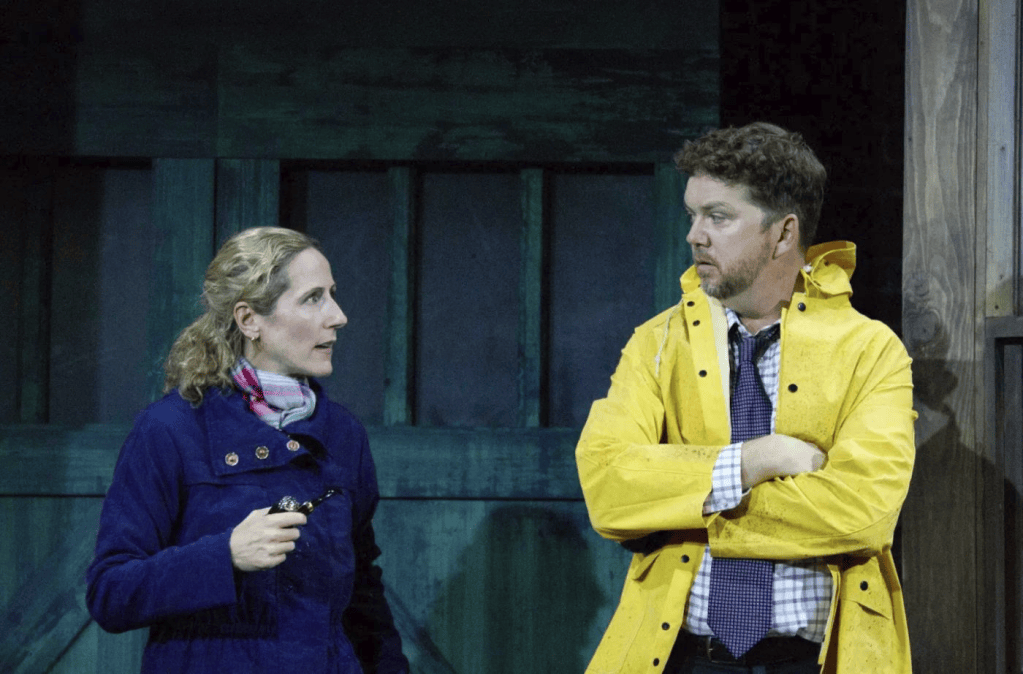
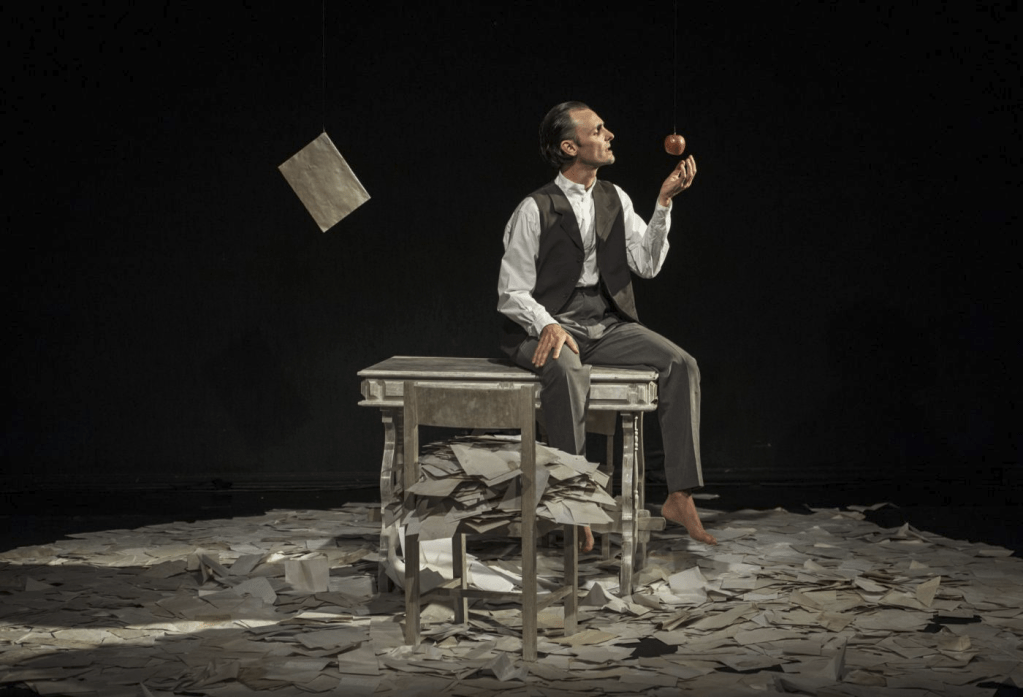
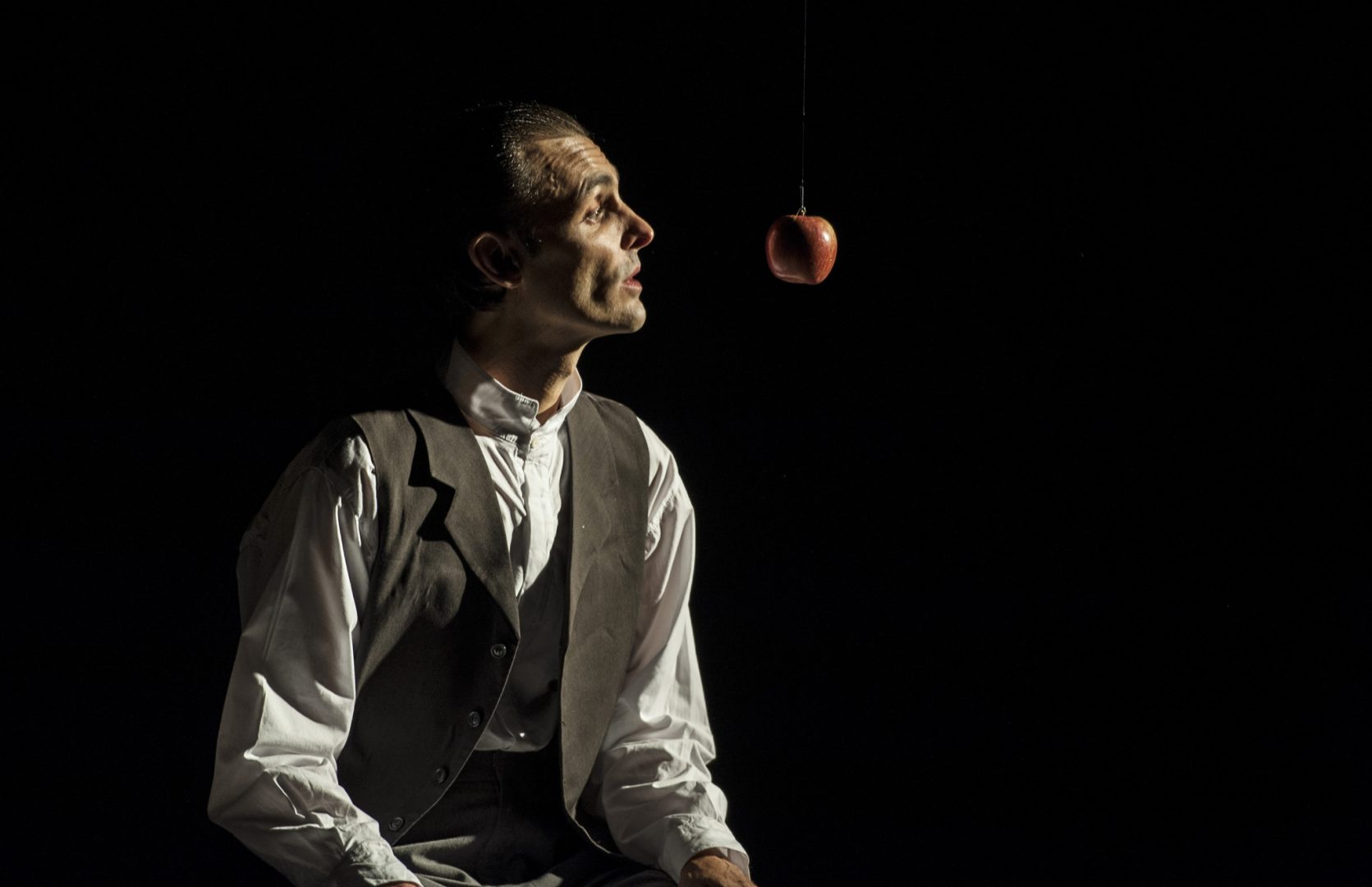
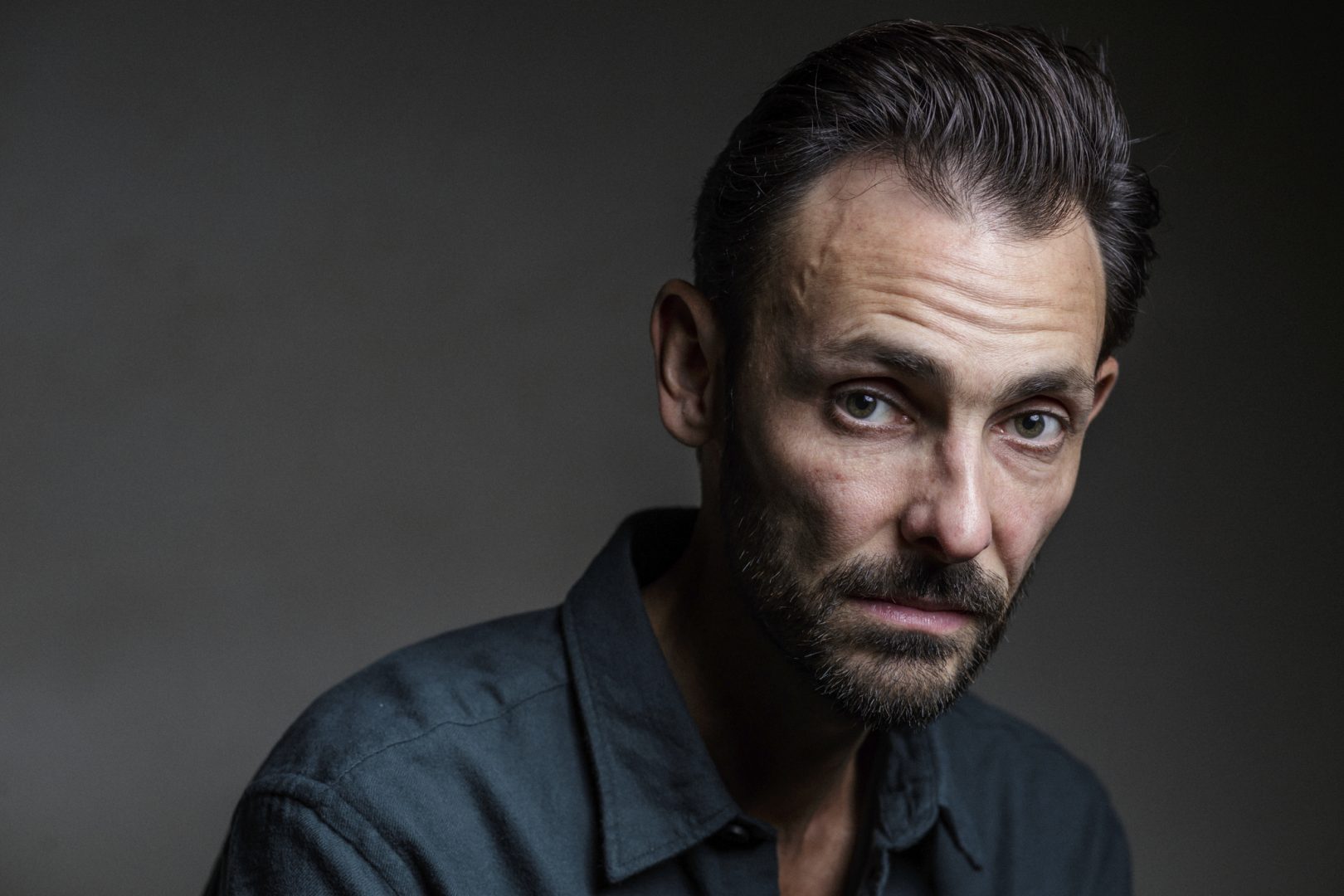
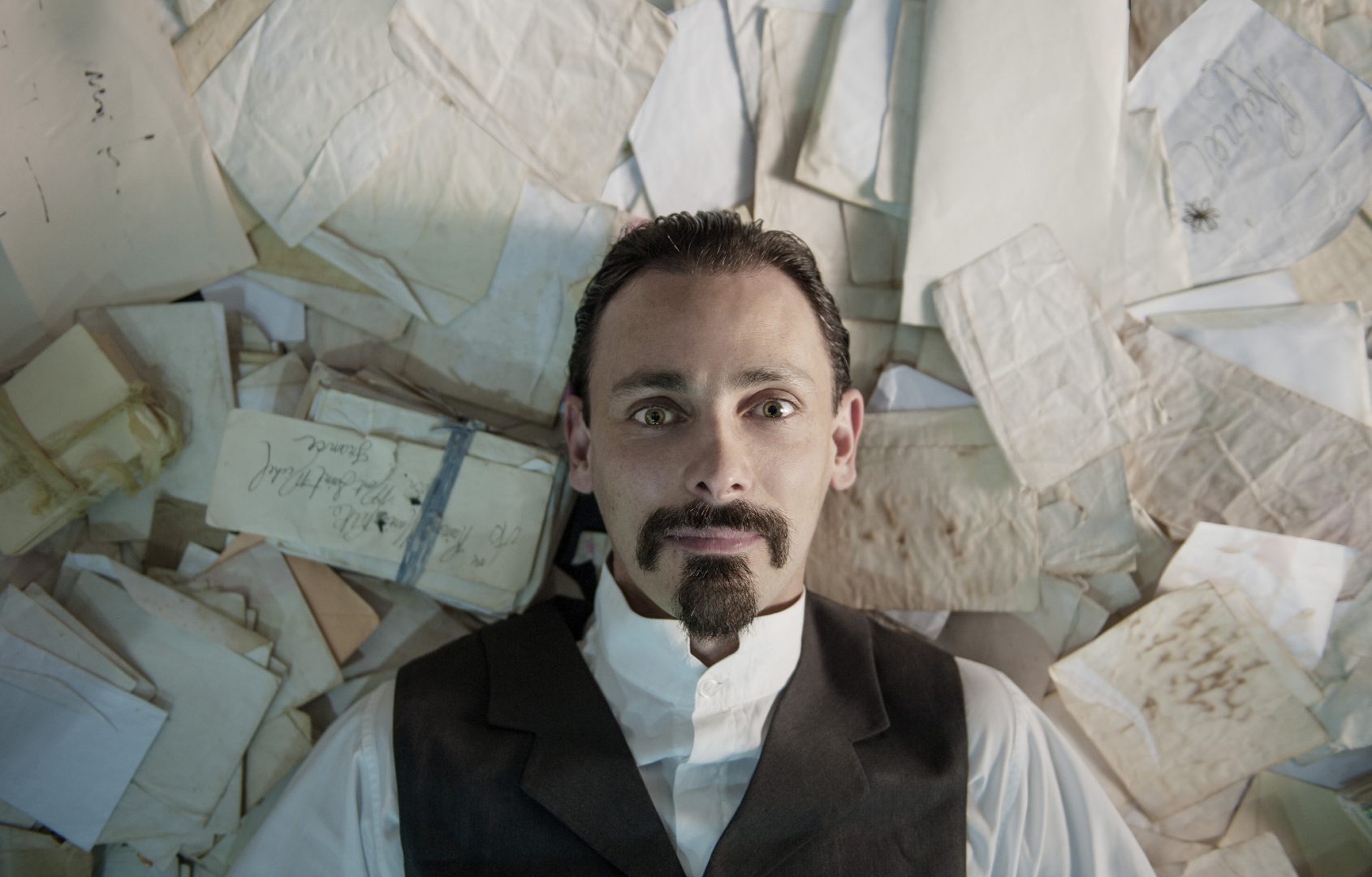
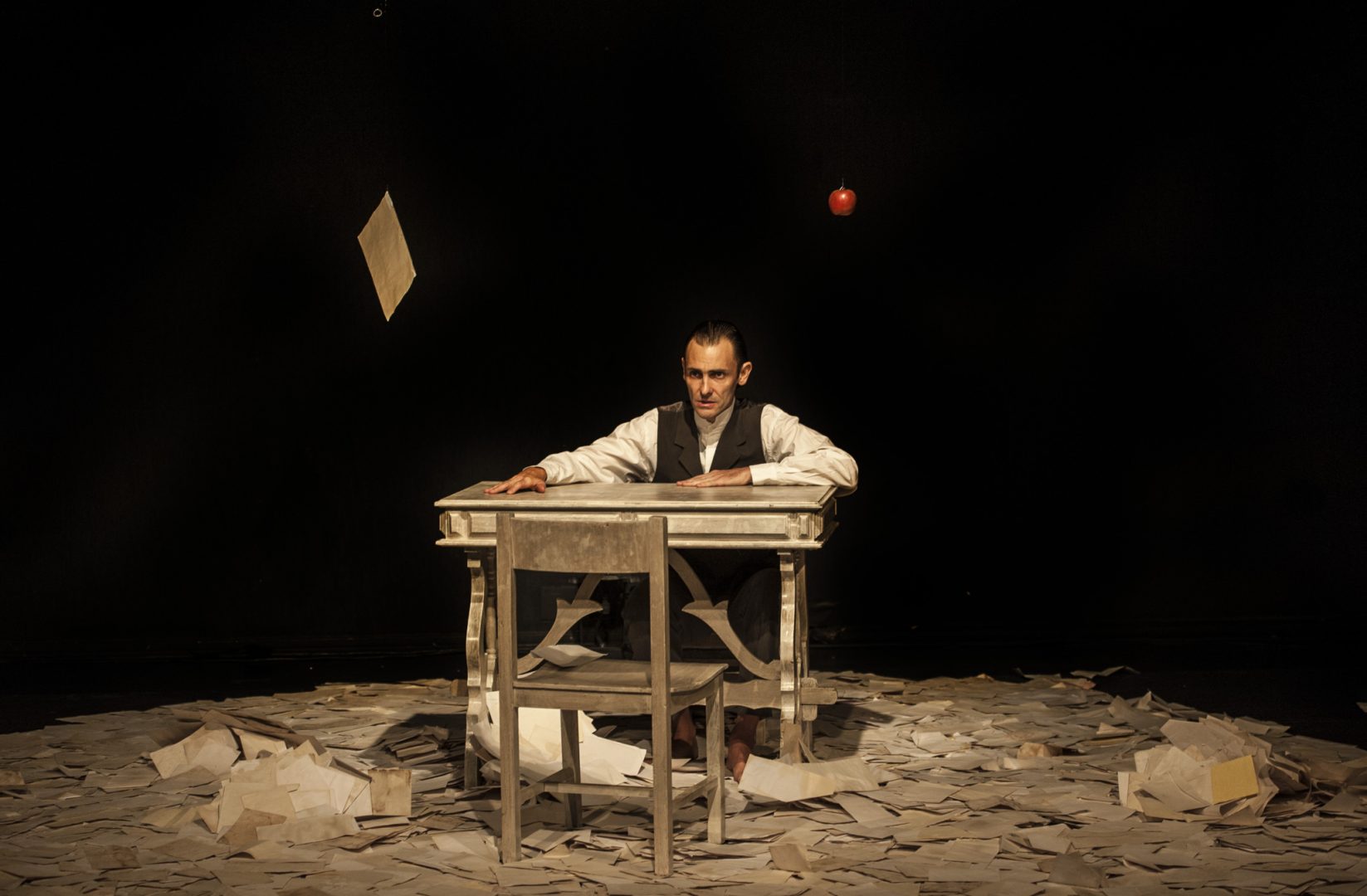
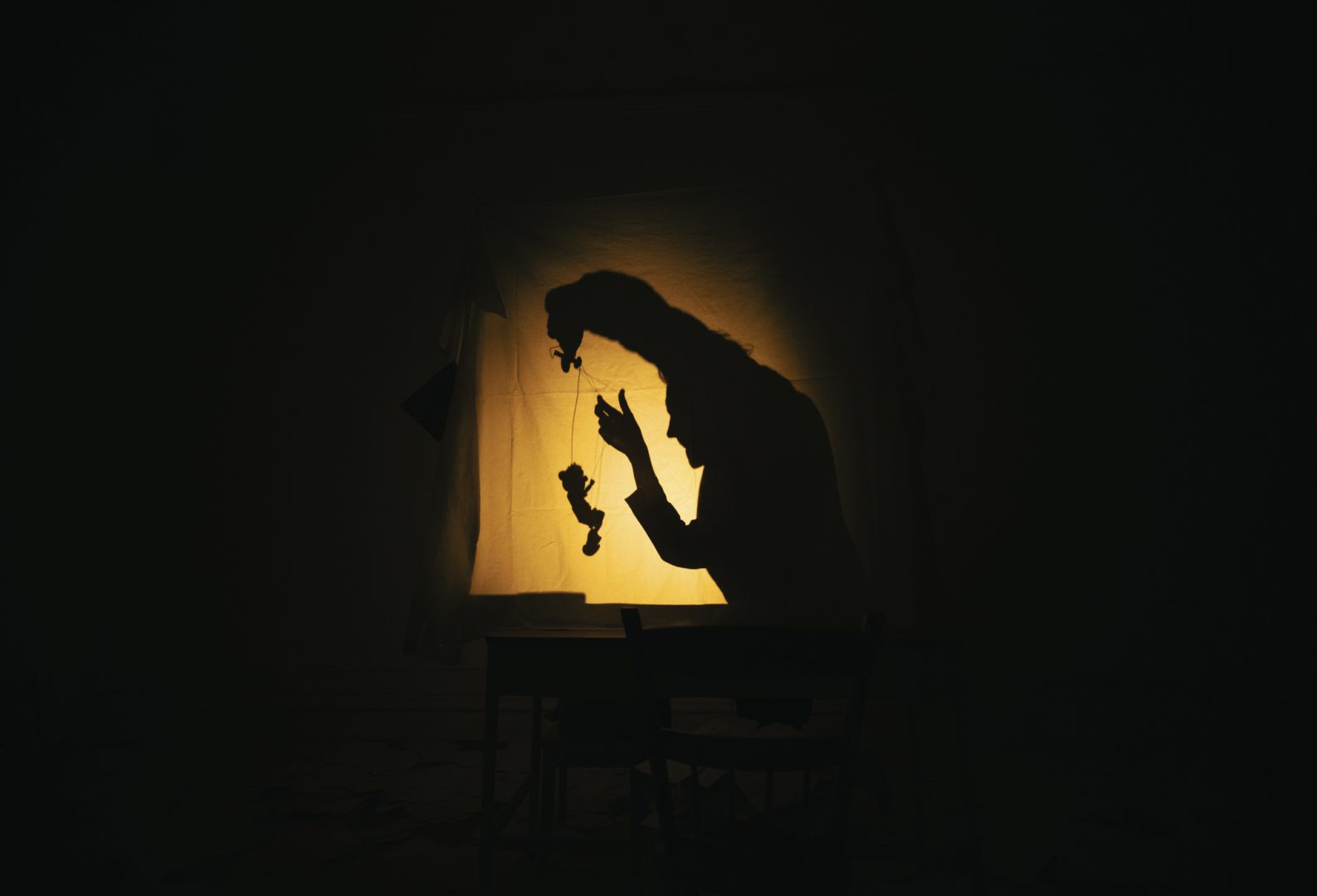
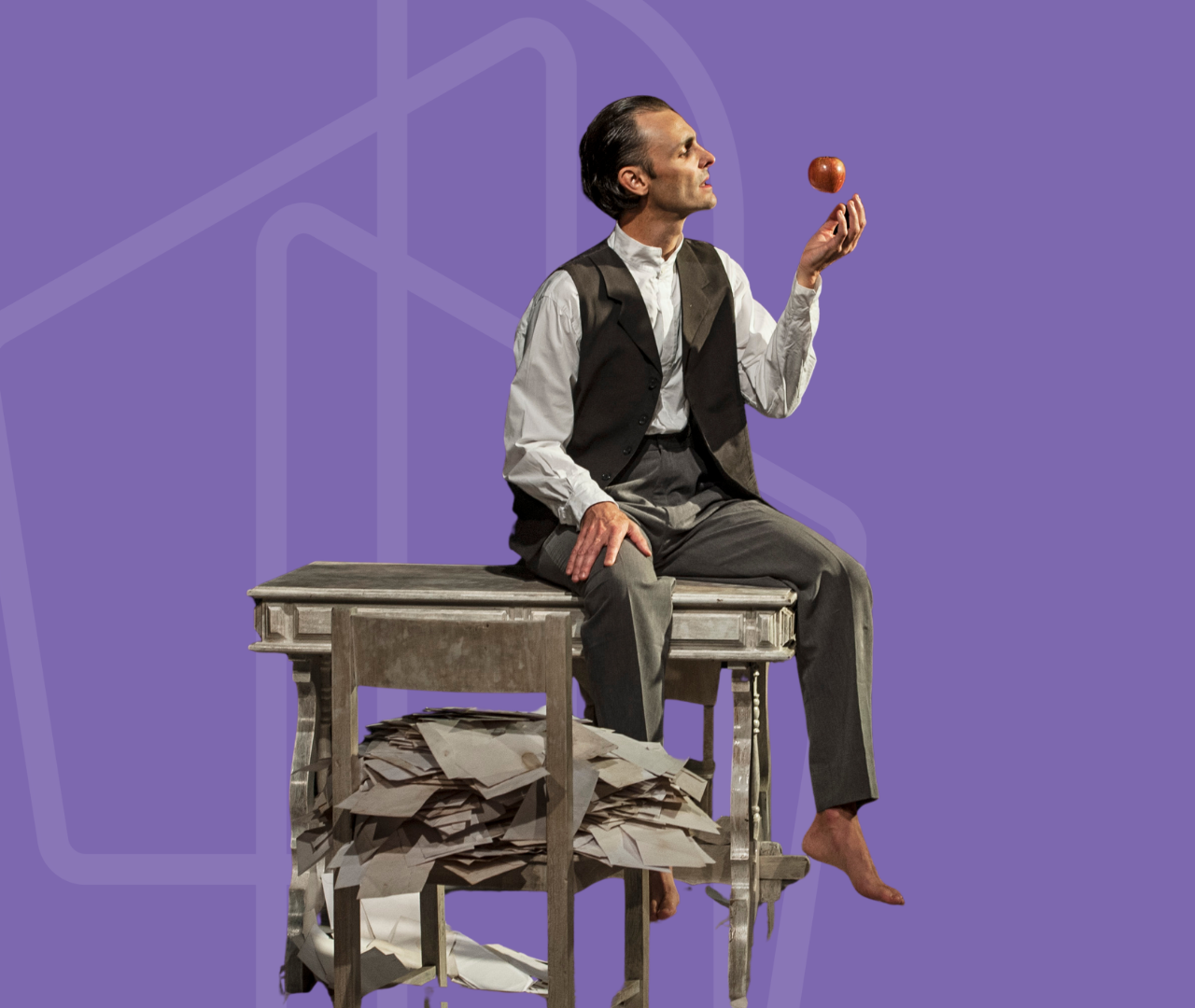
Liza Seneca as Rosemary Muldoon and Michael Kirby as Anthony Reilley. | Photo courtesy of The 6th Act
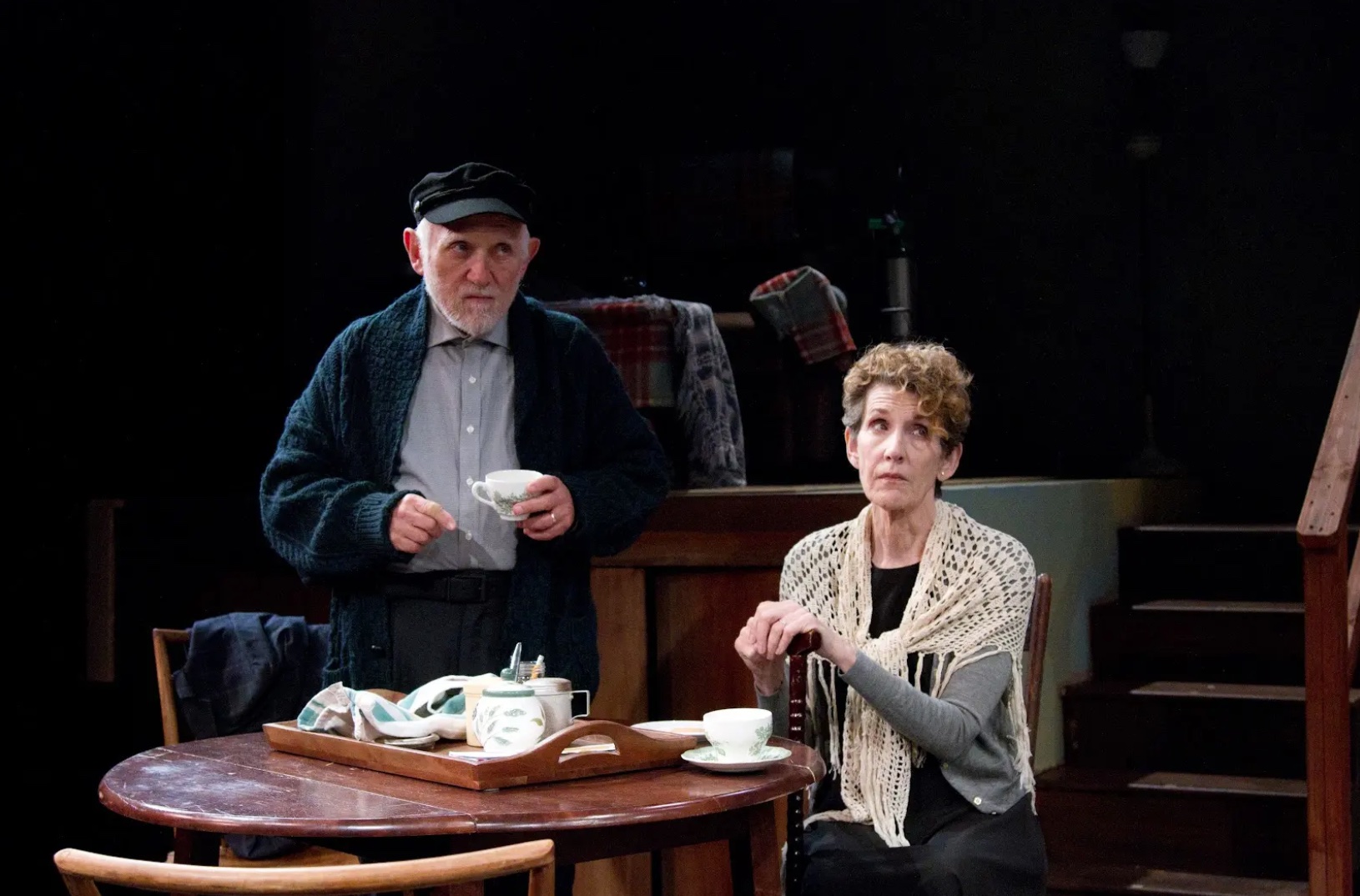
Outside Mullingar, a tender and humorous play set in pastoral Ireland, comes to the Sierra Madre Playhouse in conjunction with The 6th Act for 16 performances from the 2nd of October to the 25th. Directed by Matthew Leavitt, the play stars Michael Kirby as Anthony Reilly, Liza Seneca as Rosemary Muldoon, Armin Shimerman as Tony Reilly, and Kitty Swink as Aoife Muldoon.
Conceived by Tony/Pulitzer Prize/Academy Award-winning writer John Patrick Shanley, Outside Mullingar explores the balance between love and land, inheritance and independence, and the courage it takes to follow one’s heart. It is a deeply human story – warm, wistful, and full of hope that love can bloom late in life.
In the mist-shrouded farmlands of rural Ireland, Anthony and Rosemary live side by side, bound by family legacies, stubborn pride, and an unspoken longing that has lasted a lifetime. Anthony has spent his days quietly tending his father’s cattle farm, uncertain of his future and haunted by what might have been. Rosemary, his strong-willed neighbor, has waited years for him to see what’s been right in front of him all along.
Outside Mullingar premiered on Broadway in 2014 with Debra Messing and Brian F. O’Bryne. Leavitt’s production of the play with this current cast was previously staged at the Matrix Theatre in West Hollywood from June 5 to 22, 2025 and at the Skylight Theatre in Los Feliz from October 16 to November 9, 2025.
Armin Shimerman as Tony Reilly and Kitty Swink as Aoife Muldoon. | Photo courtesy of The 6th Act
The production has garnered considerable critical acclaim. Stage Raw declares, “This first-rate production is powered by outstanding cast performances. The infectious vibrancy and skill these four actors bring to their characters immediately beckons and is highly effective under director Matthew Leavitt’s perceptive direction.” LA Splash Magazine states, Outside Mullingar is “packed with laughs and sly comments about life.” It won Stage Raw’s Best Ensemble Award and was also included on both Stage Raw and Arts Beat LA’s “Top Ten” lists.
By email, Leavitt talks about The 6th Act, how he decides what plays to stage, what drew him to Outside Mullingar, and the audience takeaway.
“The 6th Act is a theatre company I co-founded with my producing partner Liza Seneca ten years ago, and, every year since then, we’ve been consistently producing several full productions, staged readings, and workshops,” Leavitt begins.
Leavitt is also a renowned playwright and a stage director himself. However, he has made a firm choice to never direct his own plays. He explains, “I love the collaborative process with the incredible directors I’ve been lucky enough to have helmed the plays I’ve written and could never have achieved what I have without them.”
“Liza brought this play to me; it had always been one of her dreams to do this play,” says Leavitt. “The minute I read it, I knew we had to do it. This play transports you to the most deeply enchanting romantic comedy, I think, in all of theatre, enormously enhanced by the unique and wonderful wit and charm of Ireland.”
It was also Seneca who suggested the cast. “Liza and I always collaborate on casting our shows, however Liza definitely knew these actors much better than I did entering the process,” adds Leavitt. “Now I am fortunate to call them all my dear friends, and they have been an absolute joy to work and collaborate with.
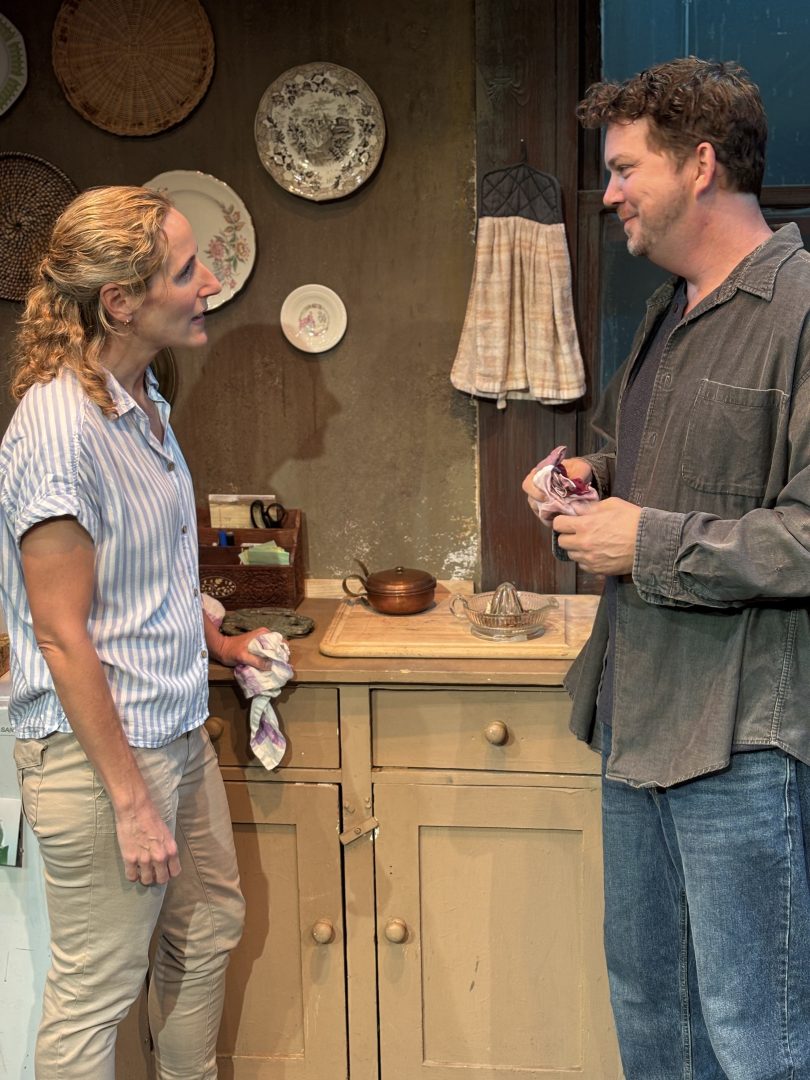
Liza Seneca and Michael Kirby. | Photo courtesy of The 6th Act
Leavitt’s iteration of Outside Mullingar is a departure from what has been staged on Broadway and the Geffen Playhouse. He elaborates, “I believe what makes our version stand out from previous ones is that I chose the approach to the play through the lens of an Irish fairy tale about true love. Plus our set – designed by the brilliant Mark Mendelson – is truly the fifth character, as it unfolds and turns the page of each chapter so gracefully, giving it that fairy tale essence. We have had dozens of people after our shows tell us they saw the Broadway production and believed ours was better. I genuinely believe we have captured something truly magical in our production.”
Perhaps it was that quality that inspired the Sierra Madre Playhouse’s creative team to invite Leavitt to stage the play here.
“We were approached by the Sierra Madre Playhouse to mount our production here, and it has been an absolute dream come true,” Leavitt discloses. “Every single person has been so overwhelmingly gracious and kind, we feel truly grateful and thrilled to have our production at this theater.”
Asked what he wants audiences to take away from the play, Leavitt replies, “Absolute enchantment, positivity, and belief in true love.”
With all the bewildering and depressing news we have been hearing and reading about lately, we are so ready to be charmed by a fairy tale love story set in the sweeping Irish countryside.
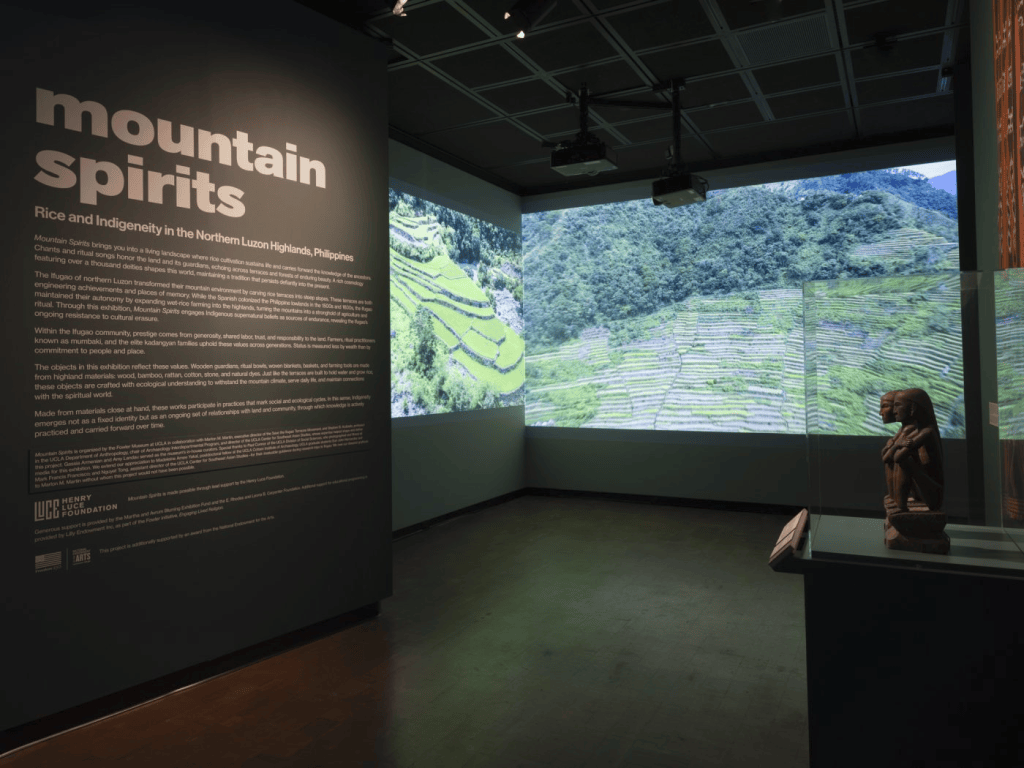
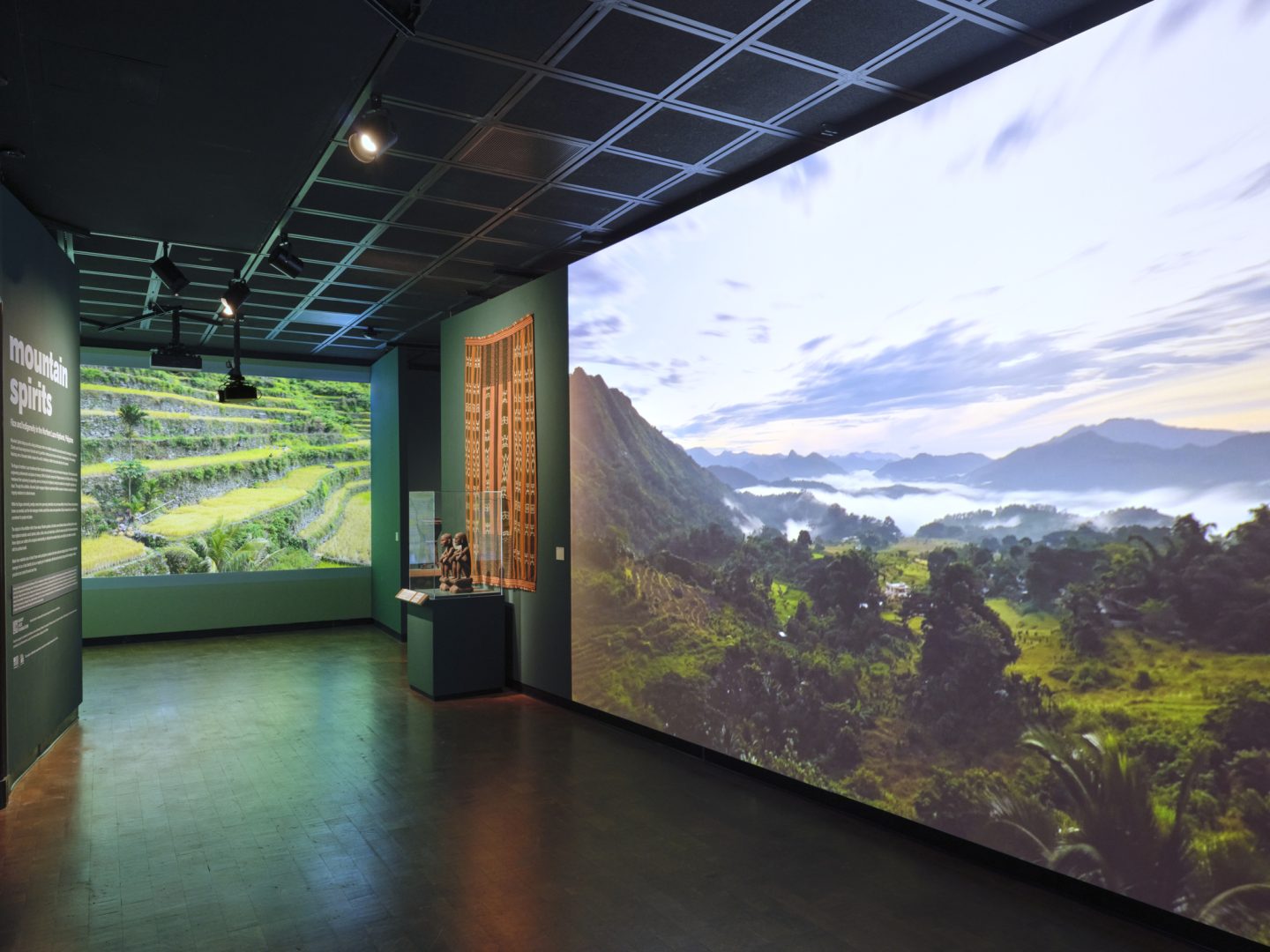
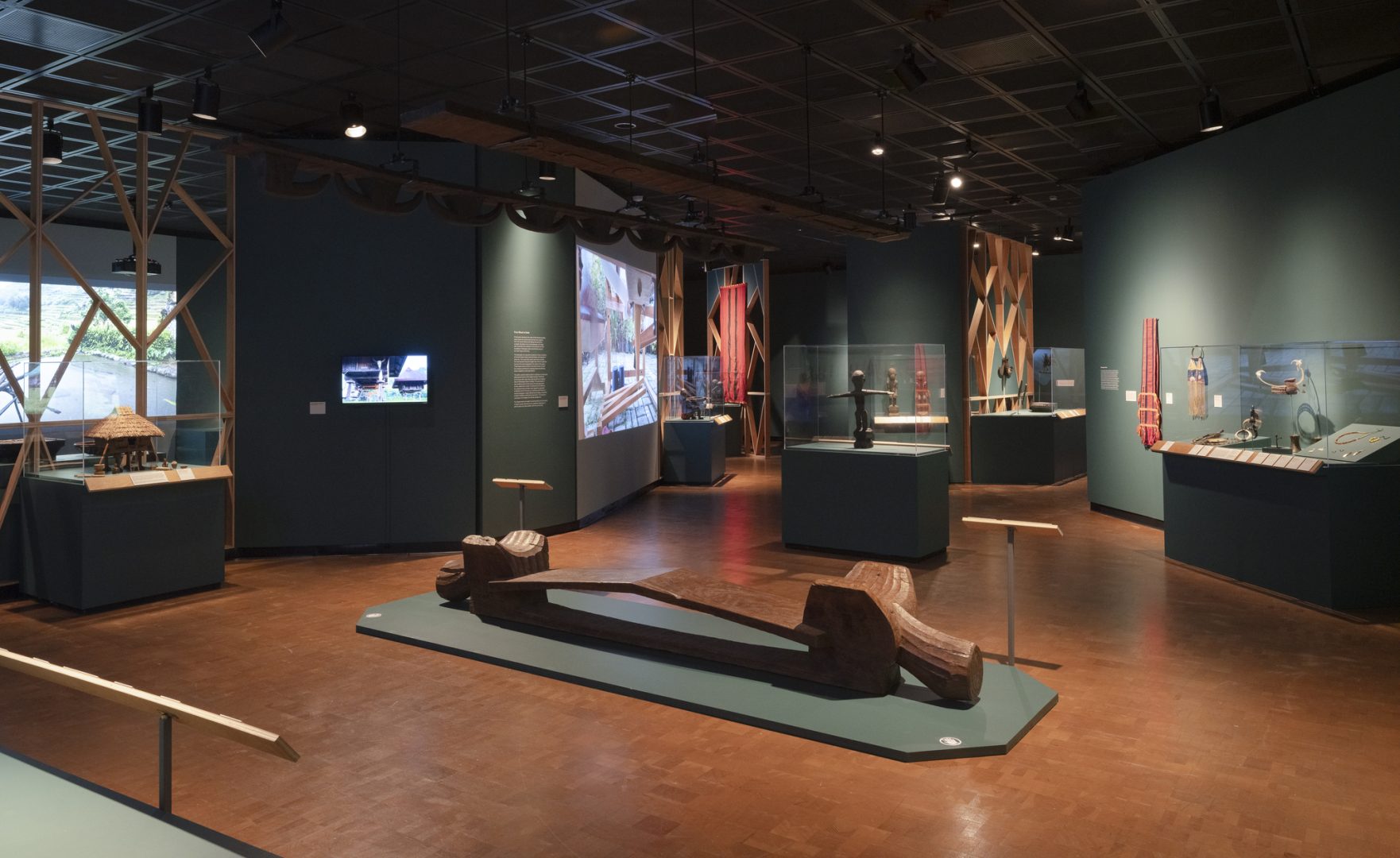
Mountain Spirits Installation. | Photo by Elon Schoenholz / Fowler Museum at UCLA
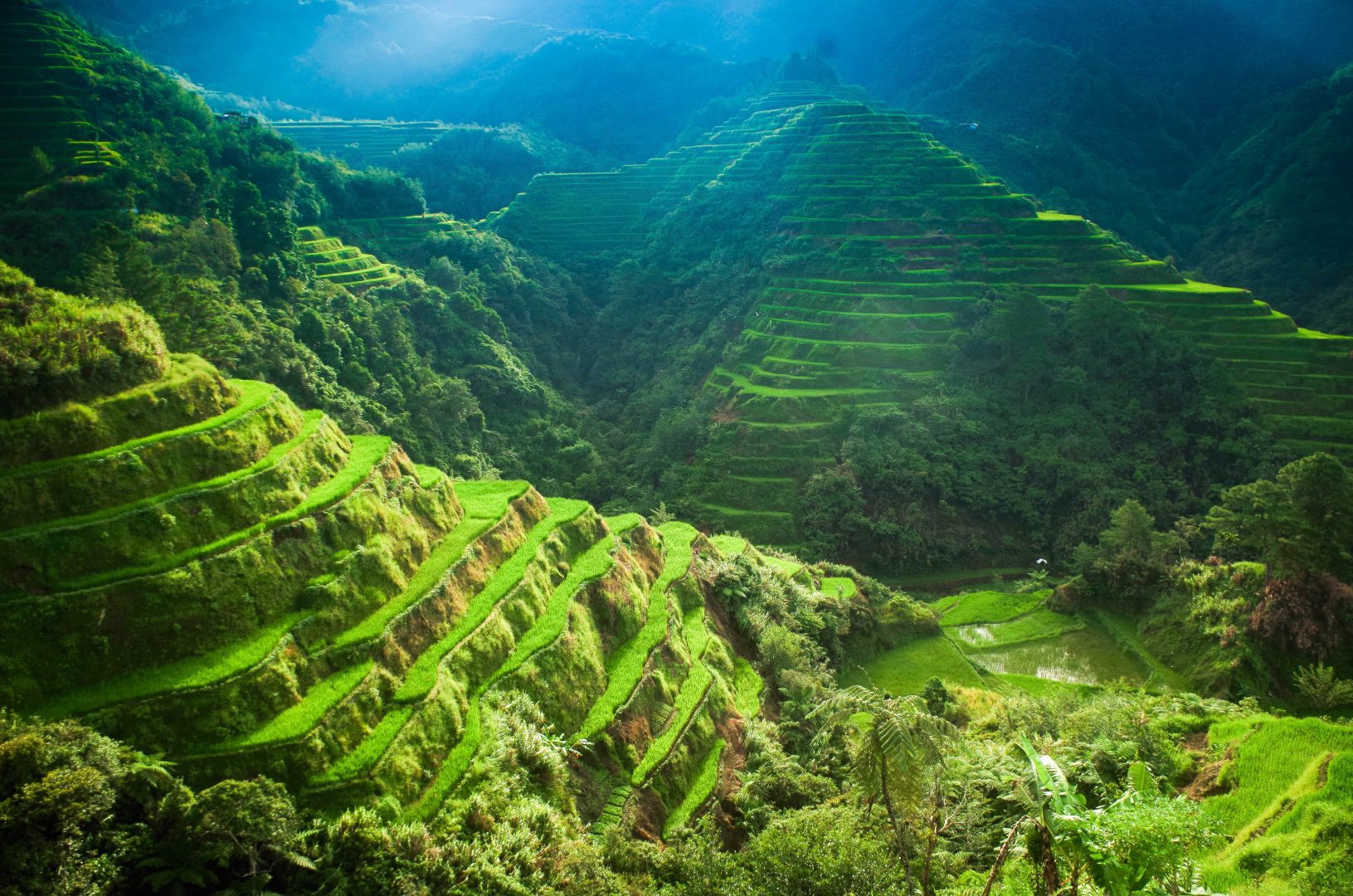
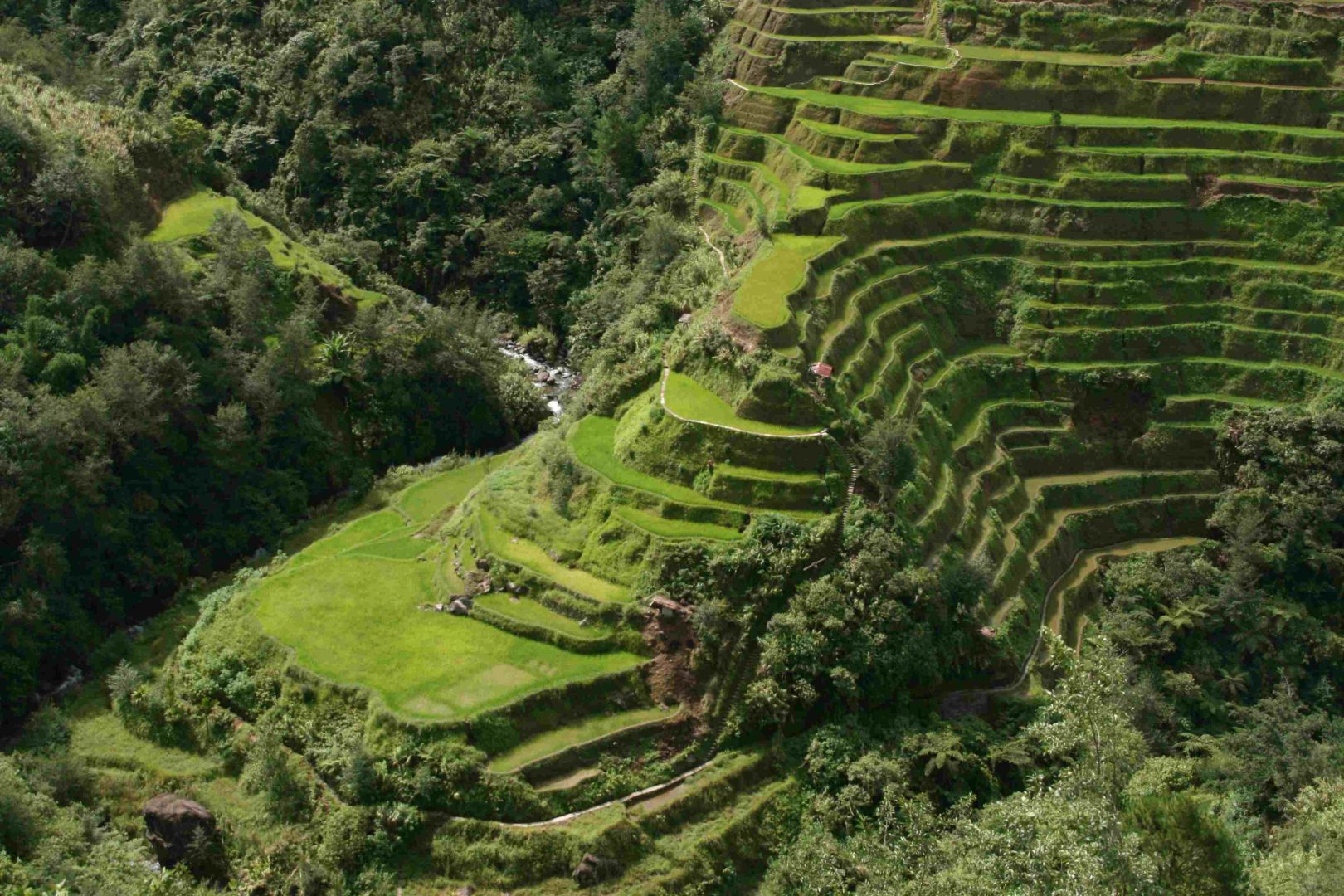
Filipinos lovingly refer to them as the Eighth Wonder of the World … and with good reason. The Ifugao Terracess in the Philippines are an awe-inspiring sight to behold! Painstakingly carved mostly by hand by the Ifugao of the Cordillera Mountains, they are an agricultural marvel that continues to nourish Filipinos to this day.
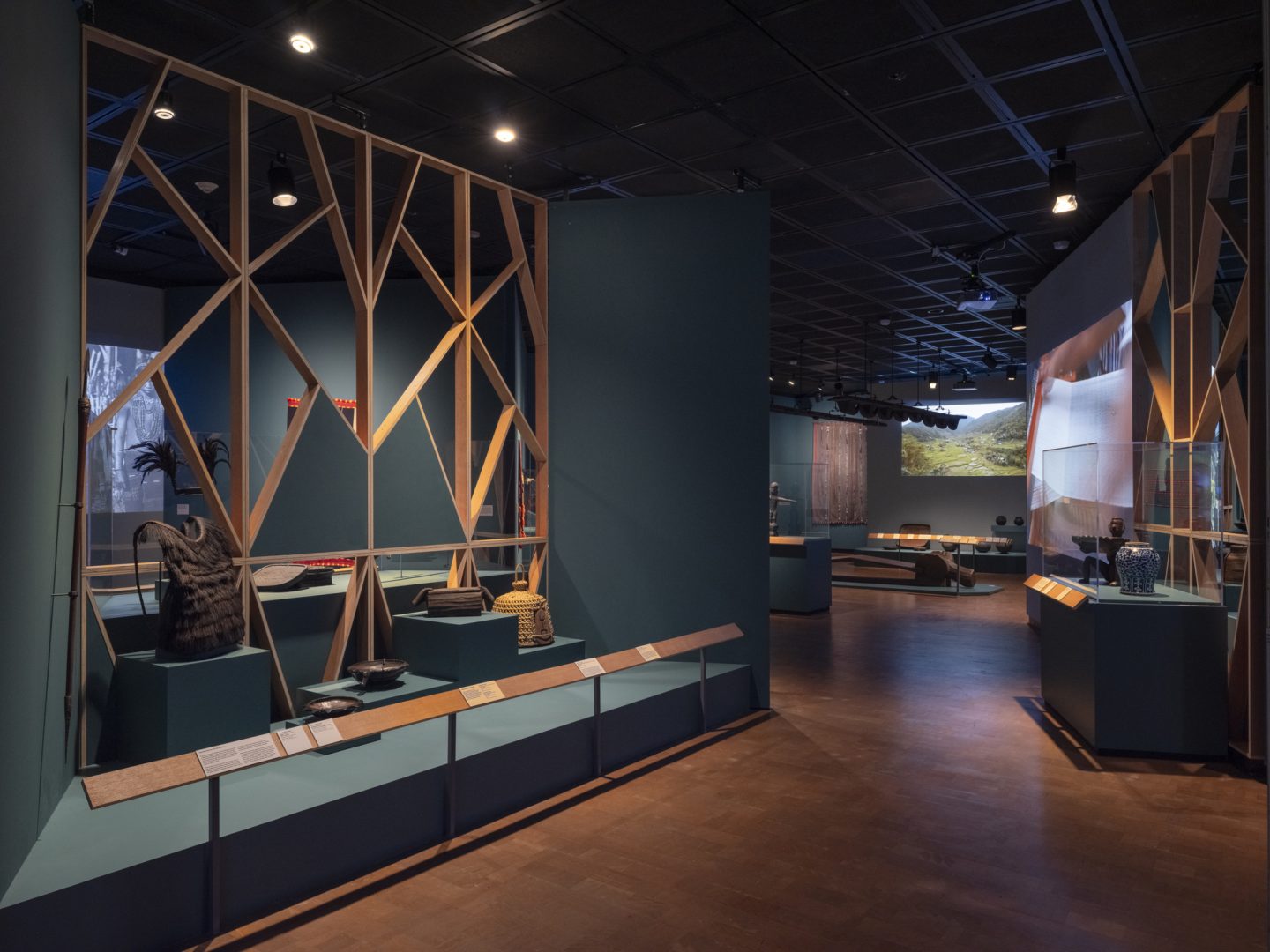
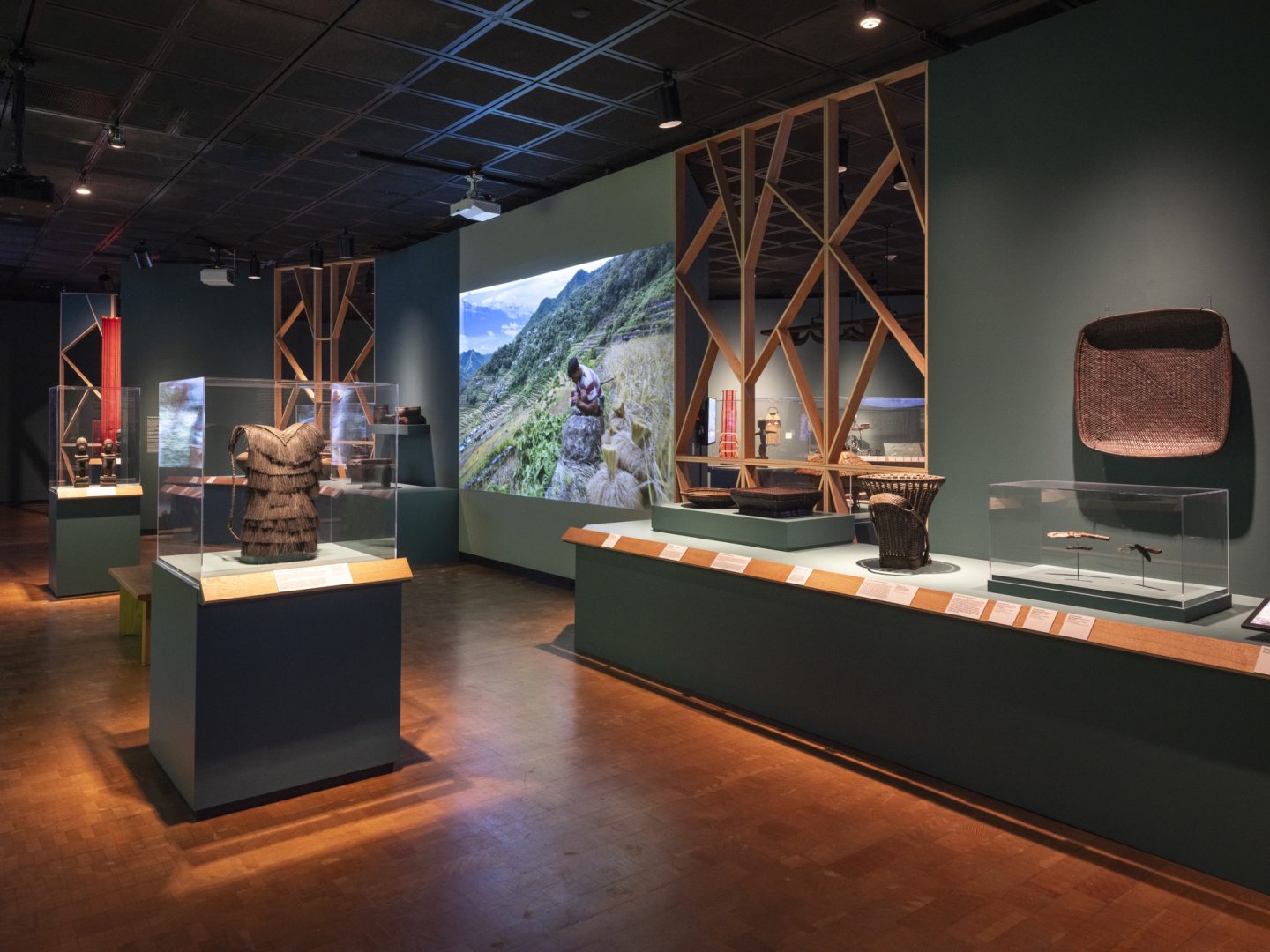
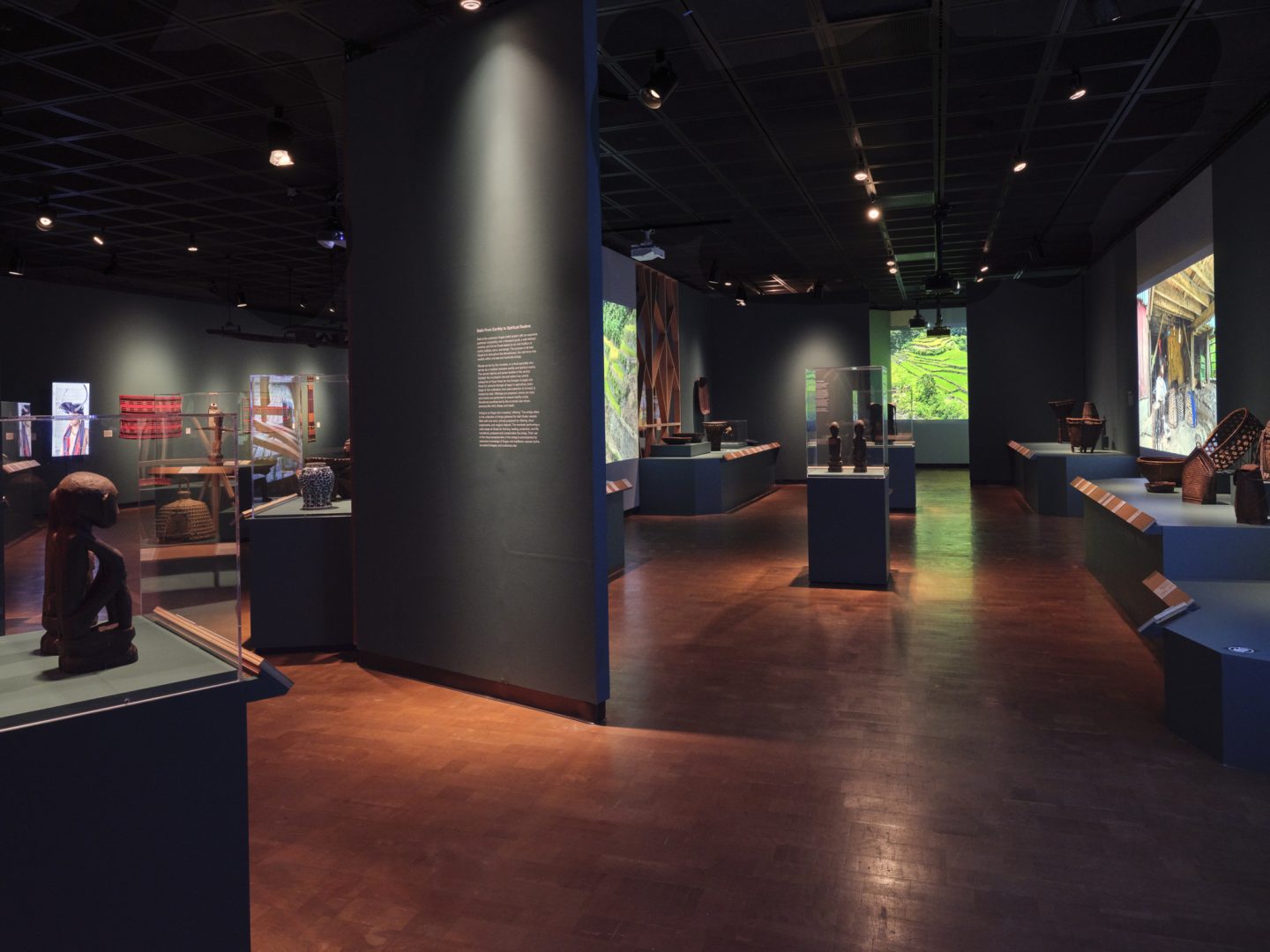
The Fowler Museum at UCLA showcases this magnificent place in an installation called Mountain Spirits: Rice and Indigeneity in the Northern Luzon Highland, Philippines. On view from April 12 through January 2027, the immersive exhibition invites visitors into a living cultural landscape where rice cultivation sustains life, memory, and spiritual practices. The show explores how – for hundreds of years – the Ifugao have shaped their mountainous surroundings through agriculture, ritual, and ancestral knowledge.
Stairways to Heaven. | Photo by Billy Palatino / Wikimedia Commons
Mountain Spirits focuses on a shift in history that recently came to light. Radiocarbon-dating surveys led by Stephen Acabado through the Ifugao Archeological Project – working with collaborating researchers – shattered the long-held belief that the rice terraces date back 2,000 years. Their findings have determined that these engineering and technological achievements were first constructed in the 16th century to defend and protect Ifugao indigeneity from invasions, particularly from Spanish colonization of the Philippine lowlands.
By moving into the highlands and expanding wet-rice agriculture, the Ifugao transformed steep mountainsides into irrigated fields supported by complex forest and water-management systems, ensuring both food security and political autonomy. Five terrace clusters in Ifugao Province have been designated UNESCO World Heritage Sites.
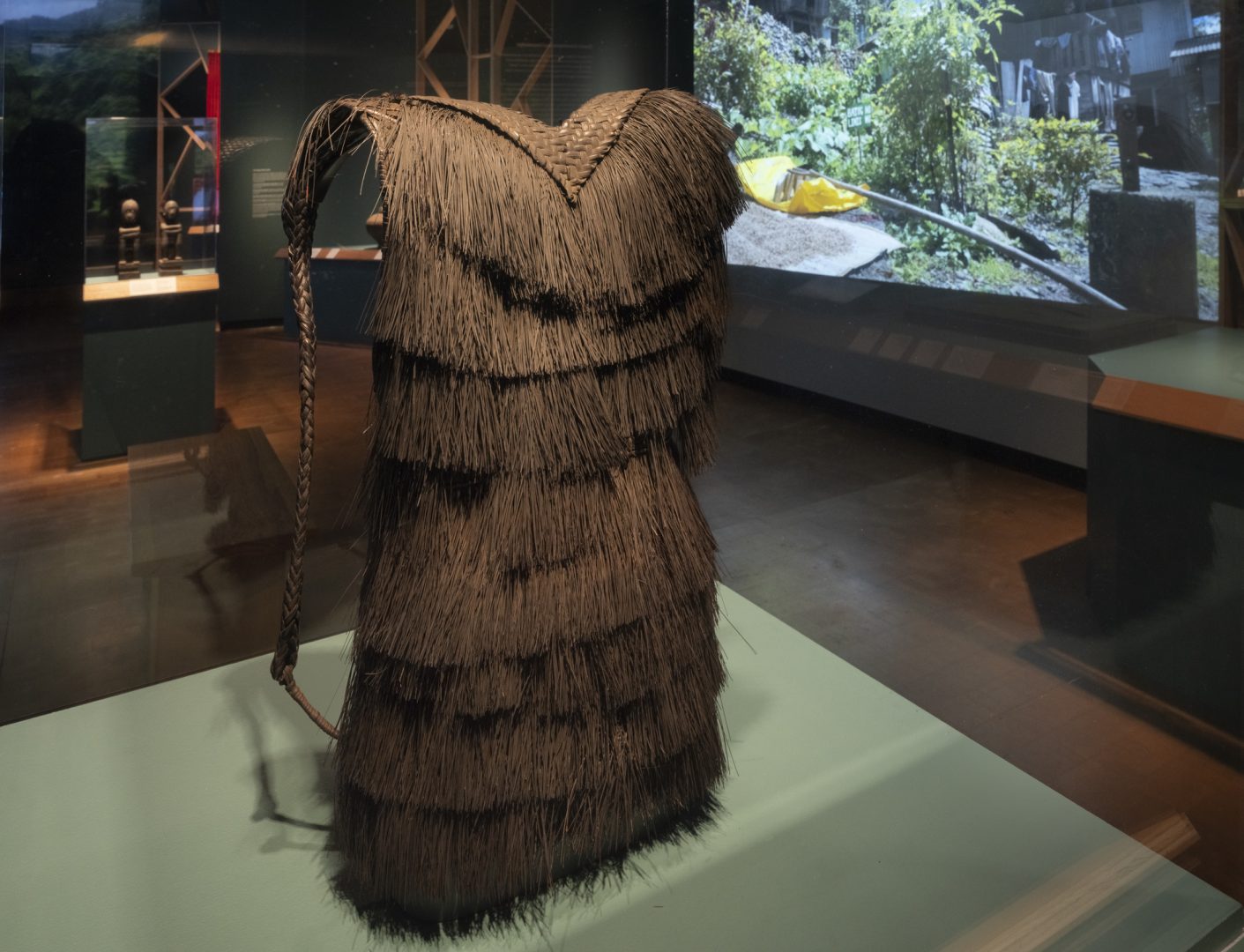
Mountain Spirits Installation. | Photo by Elon Schoenholz / Fowler Museum at UCLA
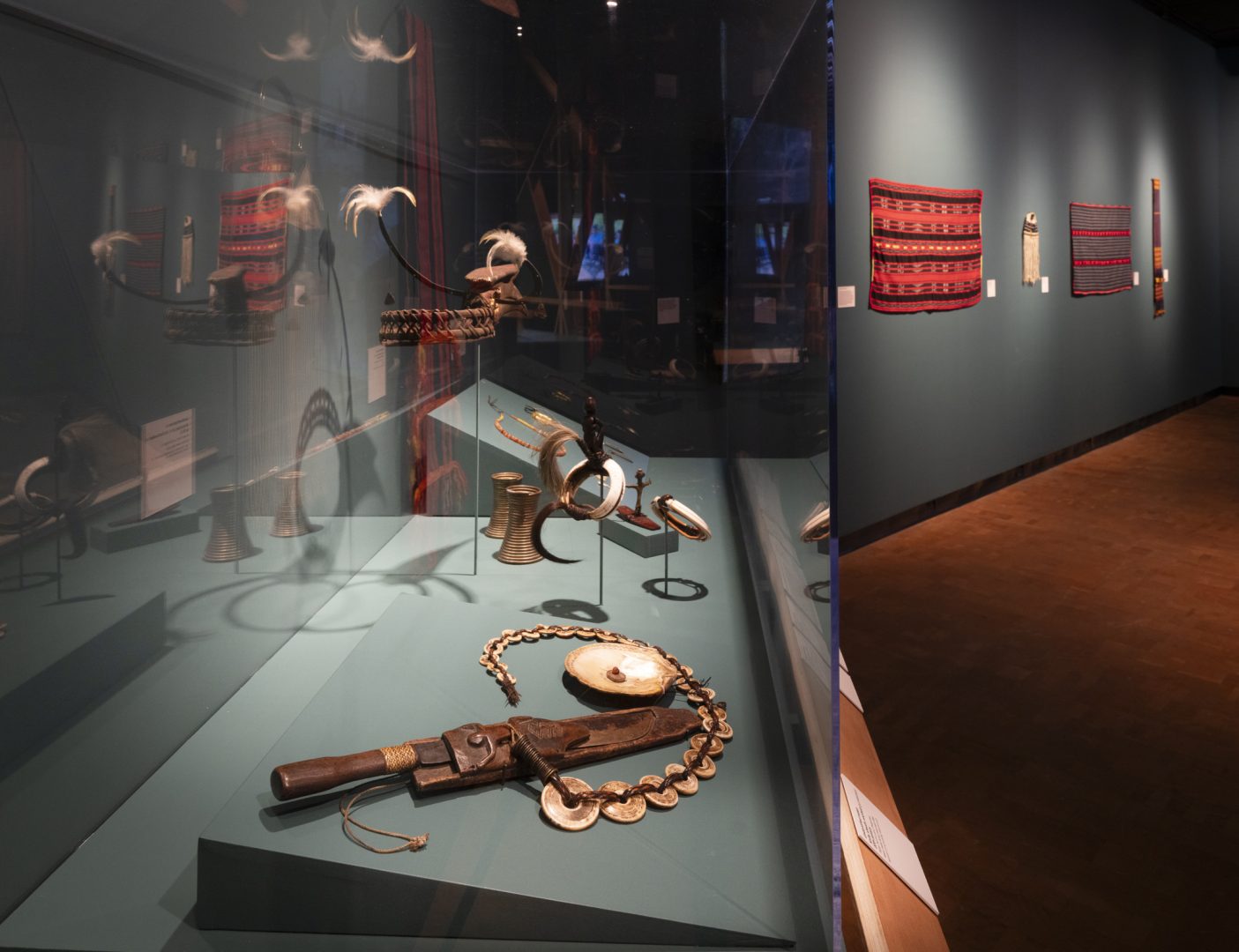
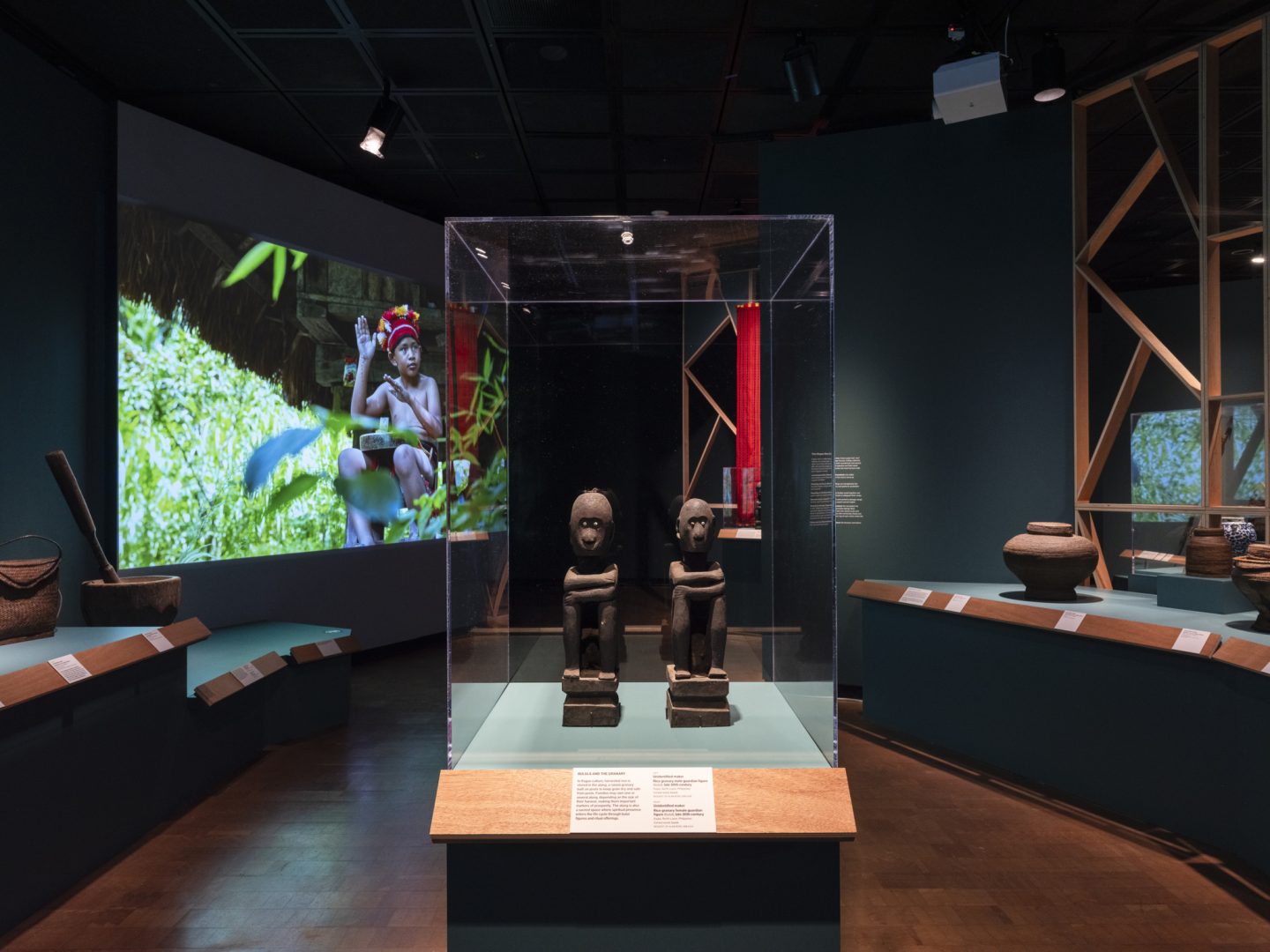
Through carved wooden figures, ritual objects, baskets, textiles, tools, and videos, Mountain Spirits shows rice not only as food, but as a sacred substance essential to Ifugao cosmology, social life, history, and identity. Drawing on the Fowler Museum’s holdings, the exhibition foregrounds Indigenous knowledge systems based on reciprocity and long-term environmental stewardship.
By email co-curators Gassia Armenian and Amy Landau discuss how the museum’s donation history has resulted in its extensive holdings of Philippine artifacts, past exhibitions related to them, the items on display in this show and which are the most significant, the public reaction, and the visitor takeaway.
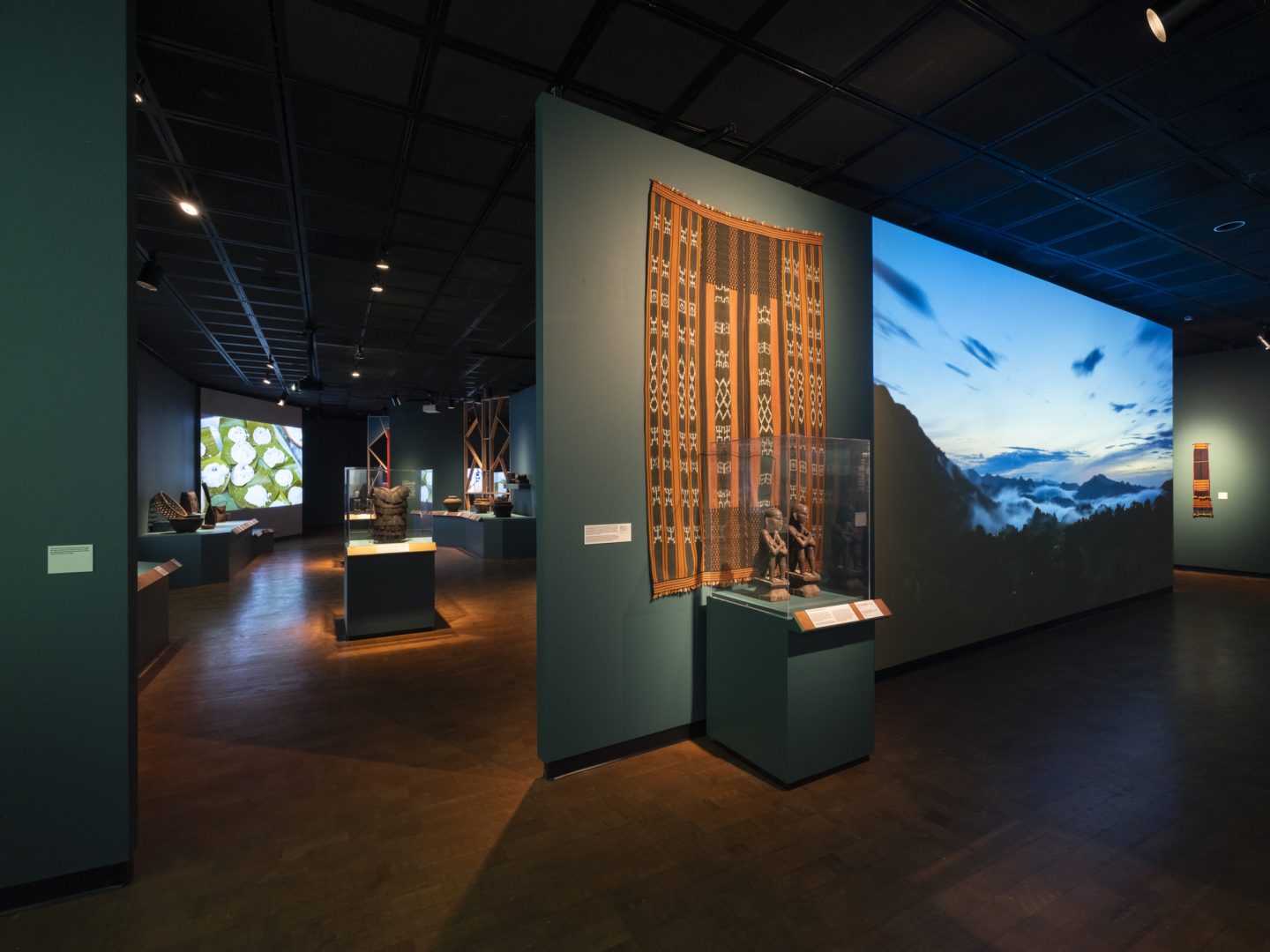
Mountain Spirits Installation. | Photo by Elon Schoenholz / Fowler Museum at UCLA
Armenian begins, “The Fowler Museum at UCLA was established in 1963 as the Museum and Laboratories of Ethnic Arts and Technology by Chancellor Franklin D. Murphy. Its early development was transformed by a landmark gift in 1965-1967, when the Wellcome Trust dispersed a portion of Sir Henry Wellcome’s vast ethnographic collection – over 30,000 objects in total – to UCLA. The Philippine objects included in that transfer constitute the earliest stratum of the Fowler’s Luzon holdings and provide the historical foundation for Mountain Spirits.”
“Subsequent decades brought further significant additions through private donations,” adds Armenian. “Among the most consequential donors were Helen and Dr. Robert Kuhn, prominent L. A. collectors whose gifts account for nearly one third of the objects in this exhibition. Further gifts came from Alan Rose, Mr. and Mrs. Thomas Davis, the Richard and Beth Rogers Foundation, Terry Beyer, Jovita Luglug, Jerome L. Joss, Mrs. David Melnikoff, and Mrs. Dorothy M. Cordry; each bringing their own collecting history to the Fowler’s holdings. Additional works were contributed by donors who requested anonymity, a wish the Fowler continues to honor.”
Mountain Spirits Installation. | Photo by Elon Schoenholz / Fowler Museum at UCLA
“Together, these gifts – named and anonymous – form the core of what Mountain Spirits presents to the public today, and reflect decades of sustained institutional commitment to Philippine material culture,” Armenian discloses. “The objects in Mountain Spirits are drawn from the Fowler Museum’s holdings built through donations spanning the mid-1960s to the late 1990s, a period that corresponds to a broader surge of collector and institutional interest in Southeast Asian and Indigenous Philippine art across the United States and Europe.”
The Fowler Museum has approximately 2,500 objects and textiles from the Philippines. Of this number, 800 objects and textiles are from the Ifugao of the North Luzon Peninsula – a solid representation of their arts, customs, traditions, and lifestyle.
Over its six-decade history of exhibitions and scholarly publications, the Fowler Museum has organized several exhibitions displaying Philippine artistry. In 1998, the exhibition Philippine Basketry of the Luzon Cordillera displayed a selection of 20th century wickerwork. This was followed by the exhibition Weavers’ Stories from Island Southeast Asia (August 1 – December 5, 2010). For this innovative exhibition, Senior Curator of Asian and Pacific Collections Roy W. Hamilton used videos recorded across eight sites in Indonesia, Malaysia, the Philippines, and Timor Leste, letting weavers and batik makers tell their stories in their own words.
Ifugao Terraces Close up. | Agricmarketing / Wikimedia Commons
The Philippines was also represented in Art of the Austronesians: The Legacy of Indo-Pacific Voyaging, which referenced Philippine material as part of the broader Austronesian migration story, and in The Art of Rice: Spirit and Sustenance in Asia (Fowler Museum, October 5, 2003 – April 25, 2004) curated by Roy W. Hamilton.
“Our current Mountain Spirits show includes textiles and basketry as part of its Ifugao-focused holdings,” stresses Armenian. “This landmark exhibition shifts the museum visitor’s role from passive viewer to active participant in a multi-sensory experience alongside the objects on display.”
Mountain Spirits Installation. | Photo by Elon Schoenholz / Fowler Museum at UCLA
Mountain Spirits unfolds across three thematic galleries. The first centers on tawid, or inheritance, highlighting how land, labor, and knowledge are passed down through farming tools and everyday objects adapted to a demanding mountain setting. The second explores baki, the Ifugao belief system, presenting ritual practices led by mumbaki – ritual specialists – who mediate between earthly and spiritual realms. Carved bulul rice guardians, ritual boxes, rice wine bowls, textiles, and offerings echo different stages of the rice cycle, which are accompanied by prayer, chant, and ceremony. The final gallery examines social rank and prestige, focusing on the kadangyan elite, whose generosity and sponsorship of major rituals, most notably the Hagabi, sustain community bonds and cultural continuity.
Landau relates the origins of this exhibition. “Mountain Spirits was spearheaded by Professor Stephen Acabado and Marlon Martin, whose longstanding collaboration with the Ifugao community provided its intellectual and community foundation. I joined the project as co-curator and Director of Interpretation, helping shape the narrative and visitor experience. From the outset, we wanted the exhibition to be immersive, which led us to collaborate with Paul Connor to connect the collections with the people, places, and traditions from which they come.”
Mountain Spirits Installation. | Photo by Elon Schoenholz / Fowler Museum at UCLA
To provide more details, Armenian recounts, “When Stephen and Marlon approached the Fowler Museum about a potential exhibition of Ifugao material culture to create generational continuity, they wanted to see ‘everything.’ This was, of course, a daunting task for the Collections Management team, led by Rachel Raynor and Isabella Kelly-Ramirez. They suggested that Martin spend time in the storerooms with Kelly-Ramirez to make a selection that would be representative of the over 800 items and be manageable enough to pull out and display in the conference room for further selection for the exhibition. Martin selected 450 objects and textiles.”
The various departments of the museum held a week-long meeting in the conference room with Martin and Acabado to go through the objects and discuss conservation issues and interpretation narratives. Martin wanted to include all 450 objects and textiles because they represented his ancestral traditions, customs, and handiwork.
Mountain Spirits Installation. | Photo by Elon Schoenholz / Fowler Museum at UCLA
At his juncture museum director Silvia Forni brought in Research Curator Gassia Armenian to trim down the list from 450 objects to 100-120, without altering the narrative of the exhibition.
“We selected objects that together tell the story of Ifugao life, highlighting the connections among agriculture, architecture, ritual, and community,” Landau describes. “The exhibition features 110 objects from the Fowler Museum’s Ifugao collection, complemented by immersive video, sound, archival photographs, and interpretive displays that place these cultural belongings within the broader story of Ifugao life.”
Mountain Spirits Installation. | Photo by Elon Schoenholz / Fowler Museum at UCLA
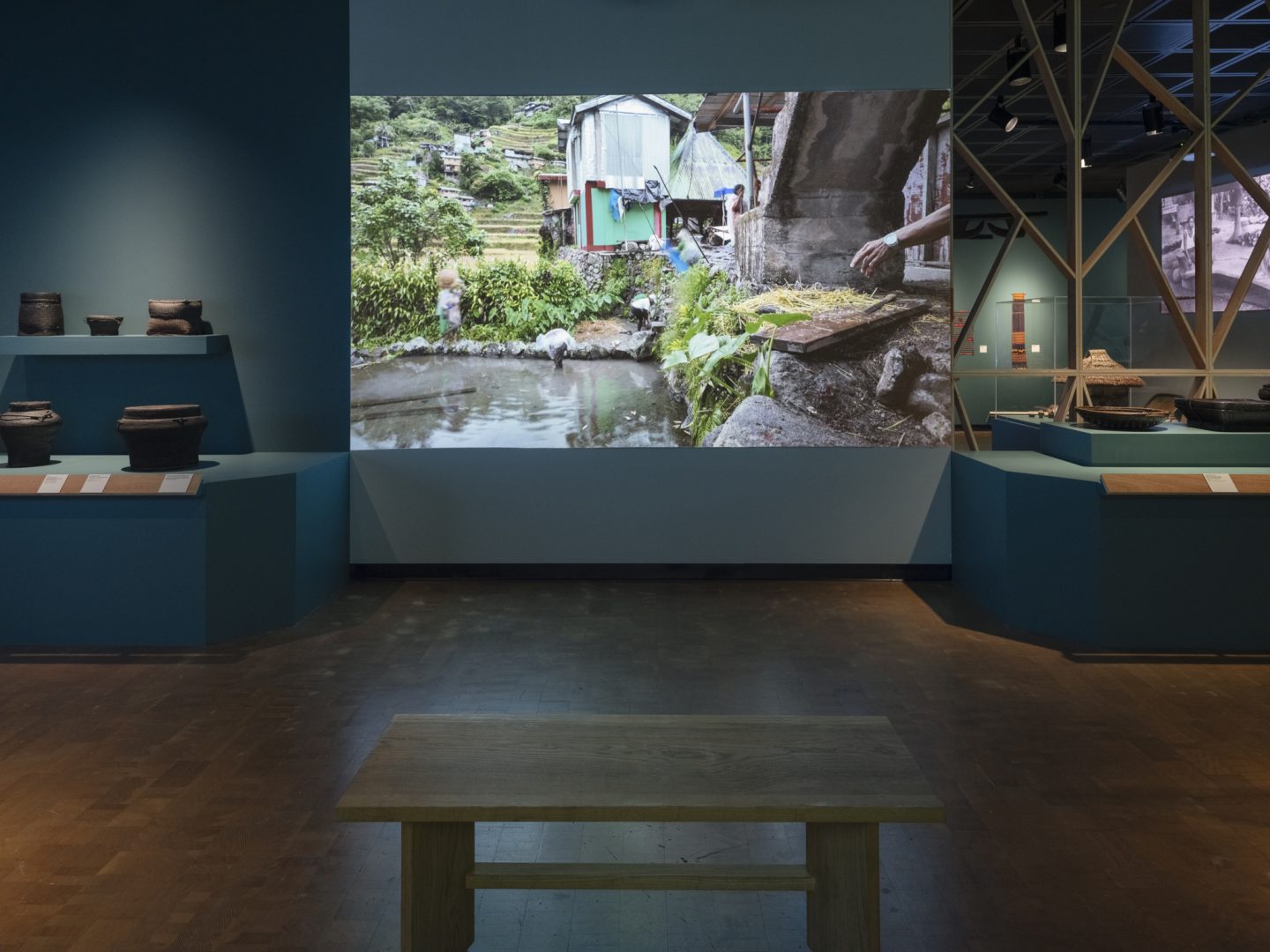
Landau says the three elements that capture the exhibition’s spirit are the model of the traditional Ifugao bale, Paul Connor’s immersive film, and the hagabi ceremonial bench. Together they represent architecture, continuity, and the values of generosity, leadership, and community that are central to Ifugao life.
“The second component: immersive, in situ film footage skillfully captured by Paul Connor, is important in telling this story,” observes Armenian. “This footage opens a multitude of new ways to view and appreciate the objects and textiles, creating a kind of ‘conversation’ between the objects and their natural habitat. It was remarkable to see the objects in action – during the planting and harvesting of rice, in the storage that followed, in sacrifices made to the ancestors, in rites and rituals, and, finally, in the sharing of the bounty with the community.”
Mountain Spirits Installation. | Photo by Elon Schoenholz / Fowler Museum at UCLA
Asked what one display embodies the spirit of the Ifugao people and the exhibition, Armenian replies, “You are putting me in a very tight situation. I love all the displays in the exhibition, particularly since I was involved in their installation. However, the section I love most is the one on rituals, where we have the opportunity to see the ritual objects that the mumbaki – the priest – uses to bless the rice fields and the harvest, as well as the objects he uses to bless the community.”
“I love this section because it shows us that, for the Ifugao, the bounty of the rice harvest is not meant for the wealth and prosperity of the individual who owns the field – it is meant to be shared by the community,” expounds Armenian. “After all, each member of the community had a role in the fields: from tilling the soil, to planting the seeds, to protecting the ecosystem of the terraces, to harvesting the crops, to storing the rice, pounding the rice, cooking the meal, blessing the fields, and blessing the community.”
Mountain Spirits Installation. | Photo by Elon Schoenholz / Fowler Museum at UCLA
Armenian hopes Mountain Spirits touches exhibition guests in a similar way. “I want the visitors to detach from their worries and daily routines and be transported to the Ifugao rice terraces and enjoy the power of the community and maybe return from their virtual trip with determination to empower their own communities and to start judging each other not by material and monetary wealth, but by the joy in their hearts.”
There has been considerable public interest in the exhibition since it opened in April. Landau says, “As Director of Education and Interpretation, I’ve been especially pleased by the strong interest in K-12 school tours. At the university level, we’ve welcomed not only UCLA classes but also courses from other colleges and universities across Southern California. I think that reflects one of the exhibition’s unique strengths: it is a university museum exhibition created through close collaboration among faculty, students, museum professionals, and the Ifugao community, making it a valuable resource for teaching and research.”
Mountain Spirits Installation. | Photo by Elon Schoenholz / Fowler Museum at UCLA
“One aspect that means a great deal to me is the collaboration behind this exhibition,” states Landau. “Paul Connor and I traveled to Ifugao twice in 2025, working closely with Professor Stephen Acabado, Marlon Martin, Madeleine Yakal, Earl John Hernandez, Mark Francis Francisco, Nguyet Tong, and the students of UCLA’s Southeast Asian Archaeology Lab, as well as members of the Ifugao community. The memories of traveling through one of the most breathtaking landscapes I have ever seen and getting to know Marlon Martin’s community have left an indelible impression upon me. We were building this exhibition through partnership and mutual respect, and I hope visitors can feel that throughout Mountain Spirits.”
Landau adds, “I certainly hope this exhibition encourages future collaborations and exhibitions that highlight Indigenous cultures throughout Southeast Asia. There are many important stories still to be shared, and I hope Mountain Spirits helps open the door to those possibilities.”
Ifugao Terraces of the Philippines. Photo by Raniel Jose Castaneda / Wikimedia Commons
“I hope visitors leave with a deeper appreciation that the Ifugao are not simply part of the past but a vibrant community whose knowledge, traditions, and stewardship endure today,” Landau says further. “I also hope they recognize the importance of Indigenous knowledge in addressing contemporary environmental and cultural challenges.”
The Ifugao Terraces are a testament to the Ifugao’s ingenuity in the face of necessity. Because of this collaborative exhibition, we are able to see them through a different lens and grasp their significance. More than a tourist attraction or a symbol of peaceful resistance to colonialism, the rice terraces are a living legacy that should be cultivated and safeguarded so future generations may continue to benefit from them.
An earlier version of this article used the term “Banaue Rice Terraces,” which the current version refers to as “Ifugao Terraces.” It is an important distinction, particularly in relation to the communities represented in the exhibition.
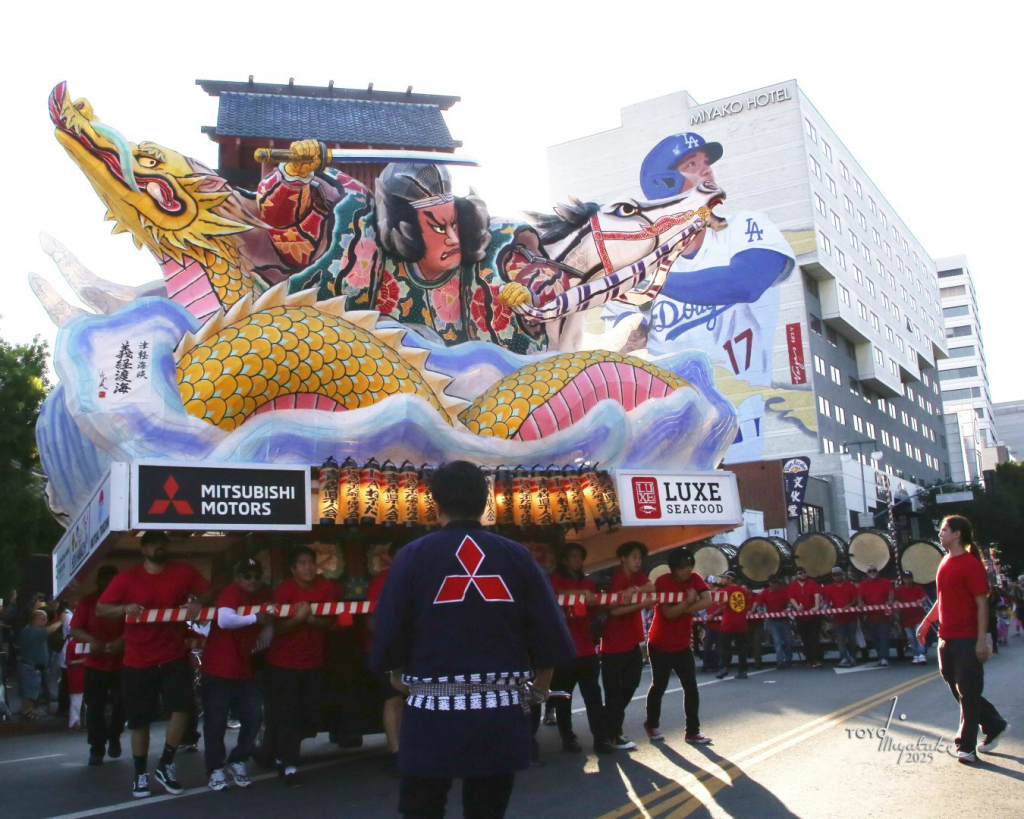
2025 Parade Float. | Photo courtesy of Toyo Miyatake for Nisei Week Festival
Every year in mid-August, Little Tokyo in downtown L.A. becomes the site of the Nisei Week Festival. According to cultural scholar and writer Dr. Oliver Wang, this event began in 1934 as a way to encourage cultural pride in the community by an emergent second generation of Japanese Americans – the Nisei – who wanted to stake out a space for themselves within a community that up to that point had been largely dominated by their Nikkei parents and their generation.
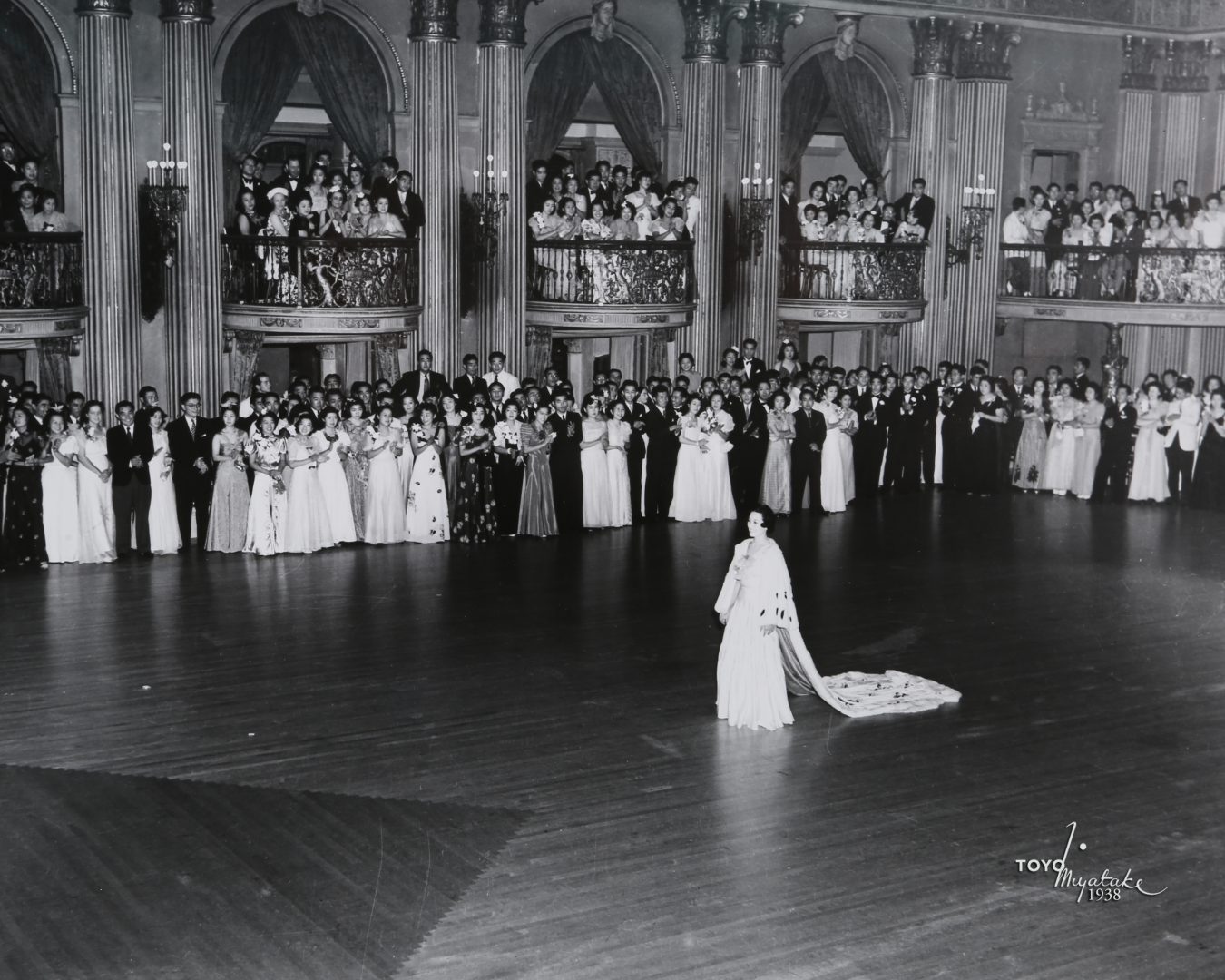
Nisei Week quickly grew to become an annual celebration of the Japanese American community and further anchored Little Tokyo as the center of the Nikkei community in the southland. As a tradition, it continued throughout the rest of the 1930s up to the summer of 1941 and went on hiatus because of the Japanese American incarceration. It resumed in 1949 and has been held every year since, except during the pandemic.
1938 Coronation of Nisei Week Queen Margaret Nishikawa. | Photo courtesy of Toyo Miyatake for Nisei Week Festival
What started as a weeklong celebration of Japanese culture and history meant to appeal to the Nisei later drew people from all over Southern California. Additionally, the event has extended beyond seven days to the multi-week event it is today that attracts 30,000 attendees from various ethnic groups.
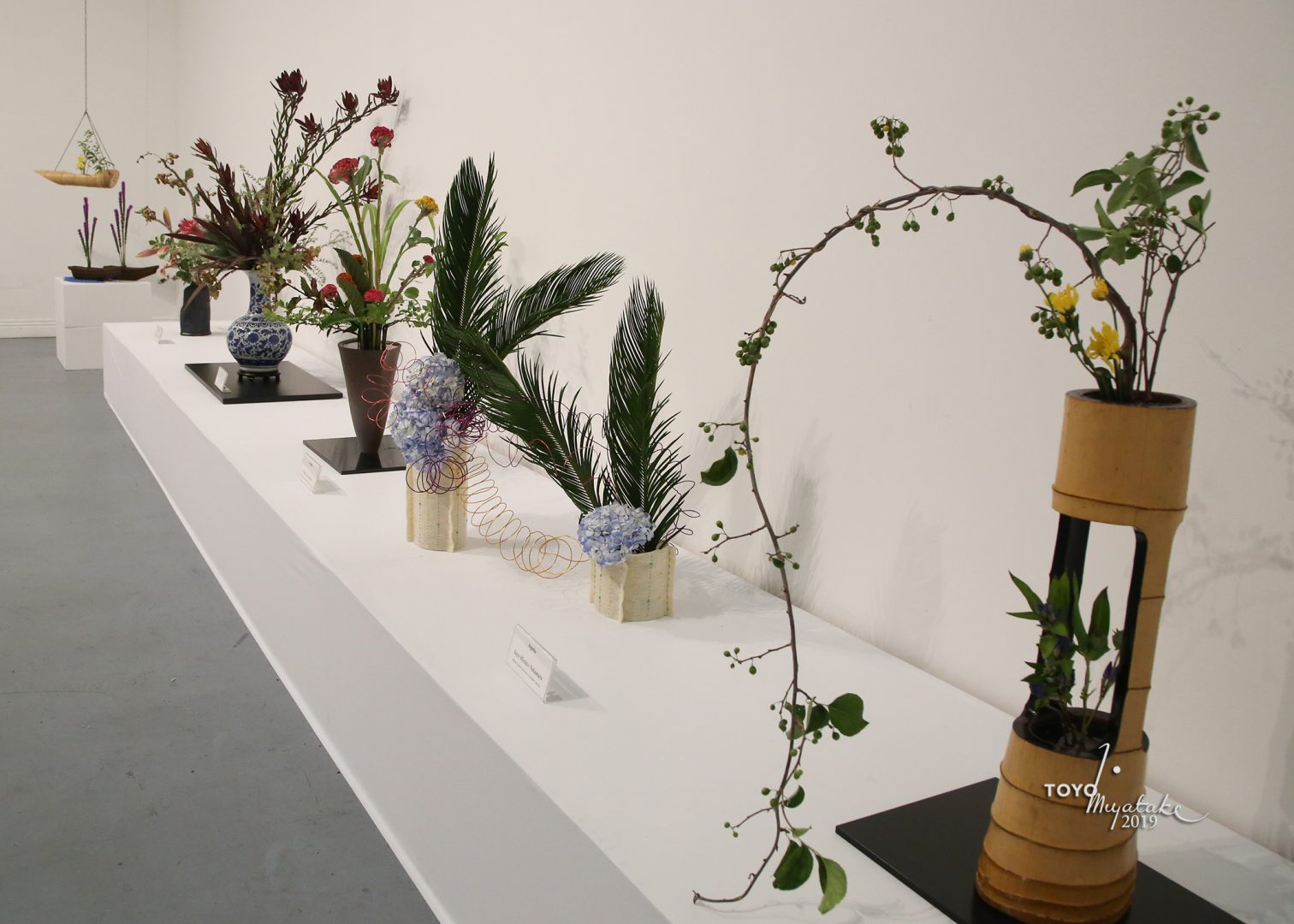
This year marks the 84th year the festival is being celebrated and will be held from August 15 through the 23rd. The Grand Parade featuring Japanese dancers, marching bands, musical groups, and floats will travel through the streets of Little Tokyo. The Japanese American Cultural and Community Center will host the Plaza Festival where food booths, live music, cultural exhibitions, and family games await visitors. Cultural exhibitions showcasing Japanese arts like bonsai, ceramics, ikebana flower arrangements, and tea ceremonies are not to be missed. Other special activities include the coronation of the Nisei Week Queen and Court and the Pioneer Spirit Awards Luncheon. Nisei Week Festival ends with the Ondo Public Street Dancing and Closing Ceremony.
2019 Ikebana flower arranging exhibition. | Photo courtesy of Toyo Miyatake for Nisei Week Festival
“As best we know, the Nisei Week Cruise was a phenomenon that started in the 1970s,” relates Wang. “And certainly by the late 70s into the 80s it became the single biggest annual gathering of Japanese American car fanatics. Thousands of people lined up on the sidewalks and watched hundreds of cars and motorcycles on the street going around the carnival grounds. It was a really huge deal for the car owners because they would spend their entire summer getting their cars ready.”
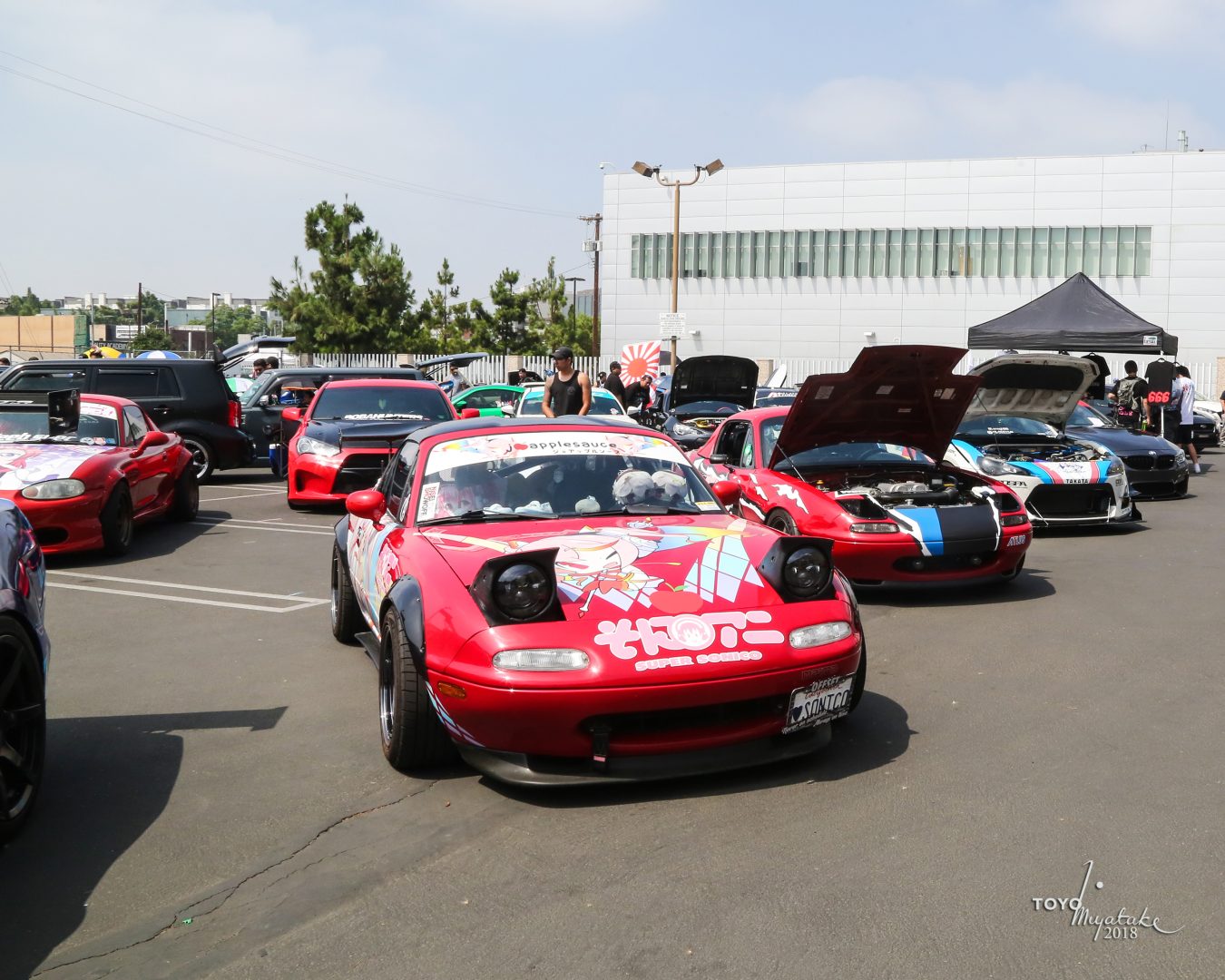
2018 Car Show Exhibition. | Photo courtesy of Toyo Miyatake for Nisei Week Festival
“Because it was the last major event of the summer, Nisei Week Cruise ended up becoming the ‘Super Bowl’ of cruises,” Wang adds. “It was the pinnacle event that people spent their entire summer getting their cars ready for. The last cruise occurred in the summer of 1988; by 1989 the organizers and the LAPD voted to shut it down. There had always been ambivalence among the organizers from the noise and safety point of view. By the 1990s Nisei Week began hosting a car show instead as a compromise.”
Helen Ota, the 2026 Nisei Week Festival president, reveals that there’s an event that will be featured for the first time this year.
“The JX Matsuri will take place on Sunday, August 16 at Weller Court,” says Ota. “This event is being organized by Japan Crossover (JX) and will be a call back to the days when Nisei Week had its popular carnival many years ago. There will be game booths, food, and entertainment from 11 a.m. to 4 p.m. When JX Matsuri concludes, the Grand Parade will begin, so the attendees will be able to stay afterwards to enjoy this beloved tradition.”
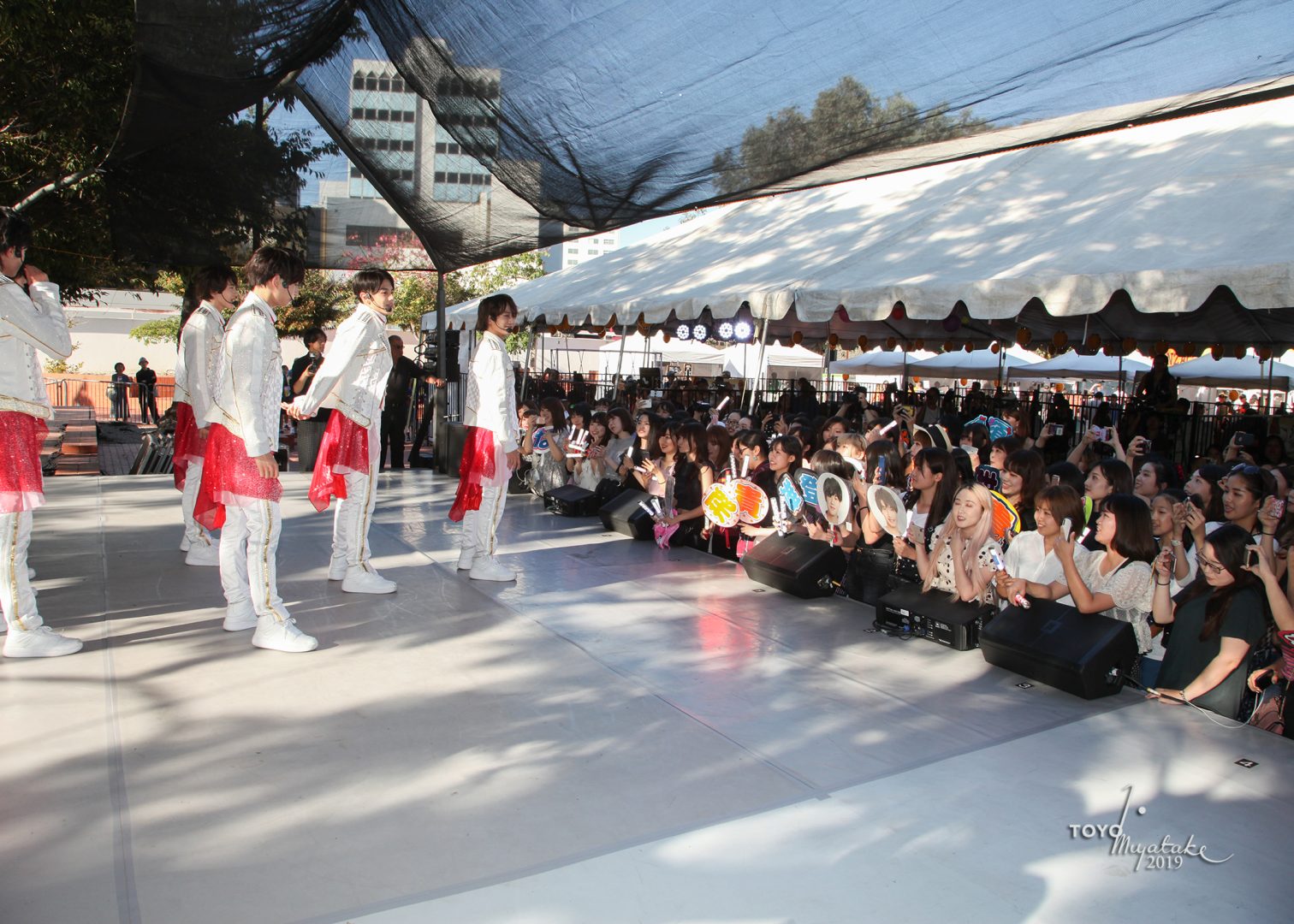
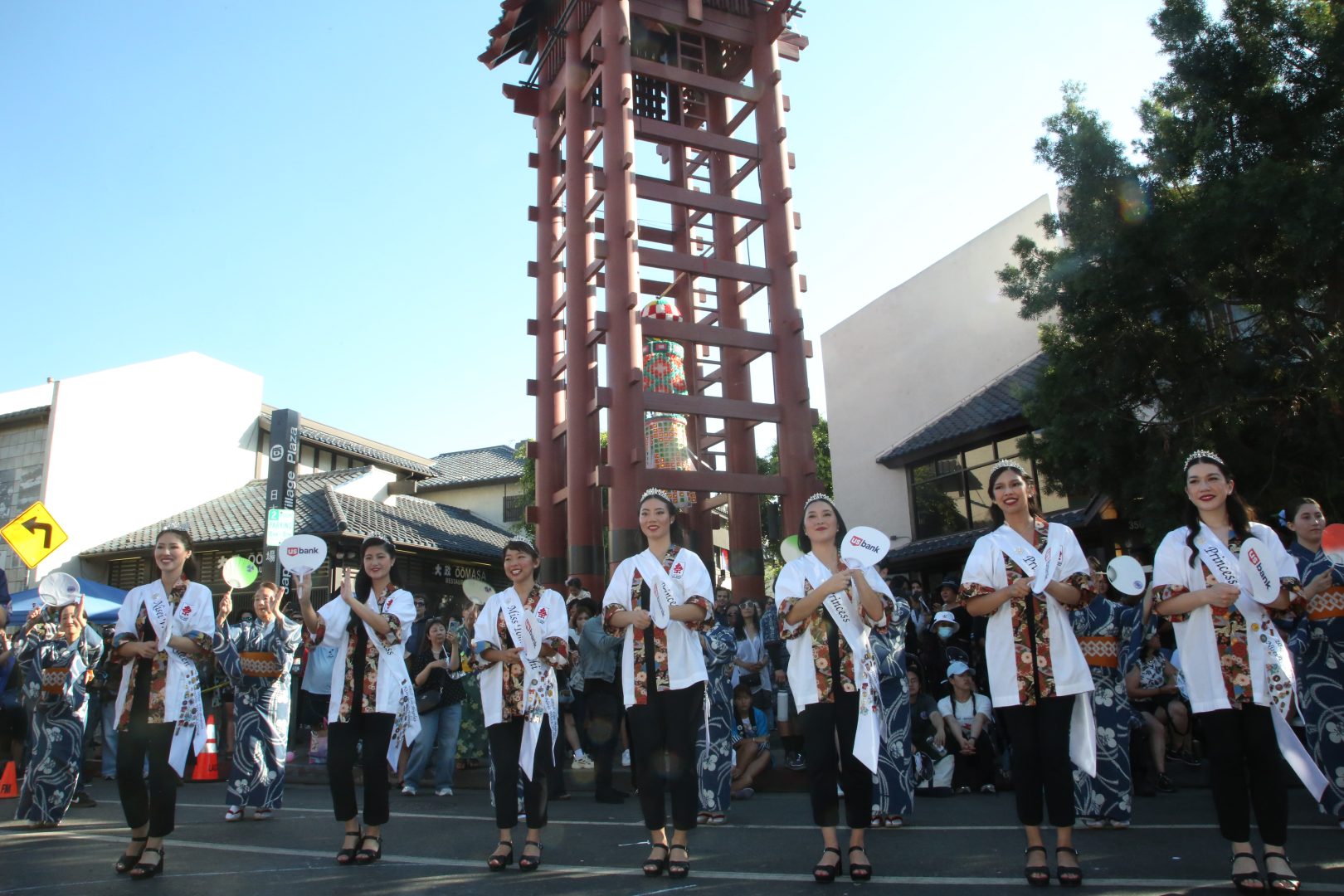
2019 Performers at Sunset Plaza. | Photo courtesy of Toyo Miyatake for Nisei Week Festival
But Nisei Week’s evolution isn’t only reflected by the activities. Ota declares, “The Nisei Week Japanese Festival has evolved over the years by engaging the rising generation to be involved as committee members and taking on leadership roles. At the same time, we look to our longstanding board members and volunteers to provide institutional knowledge to carry on the tradition and understand the significance of the Nisei Week Japanese Festival. This has allowed the Nisei Week Foundation to remain grounded in tradition while being mindful of who our audience is today and what they might be interested in seeing at the festival. Through this lens, we’ve been able to partner and collaborate with different organizations to continue to enhance the festival.”
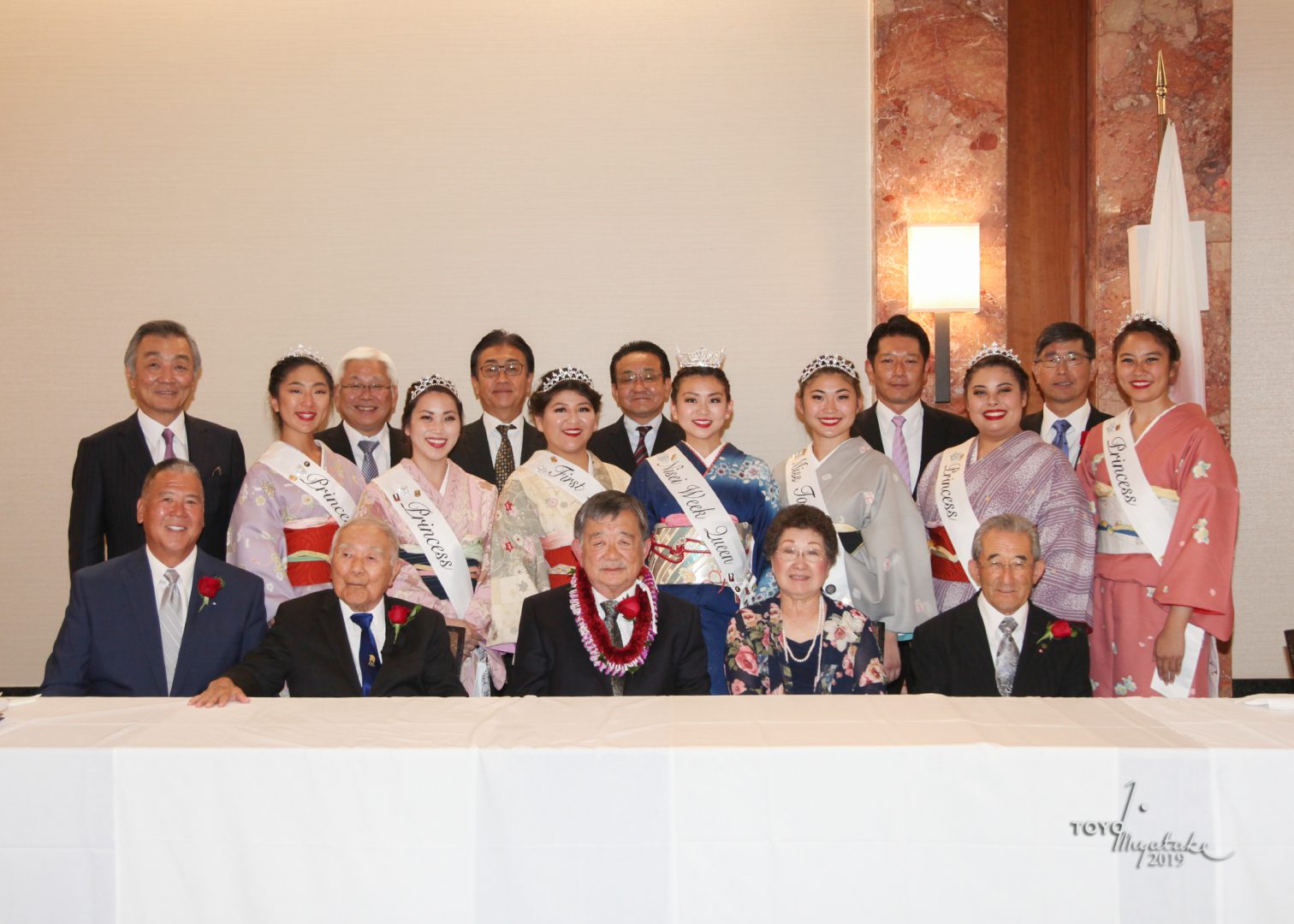
2019 Pioneer Spirit Awards Luncheon. | Photo courtesy of Toyo Miyatake for Nisei Week Festival
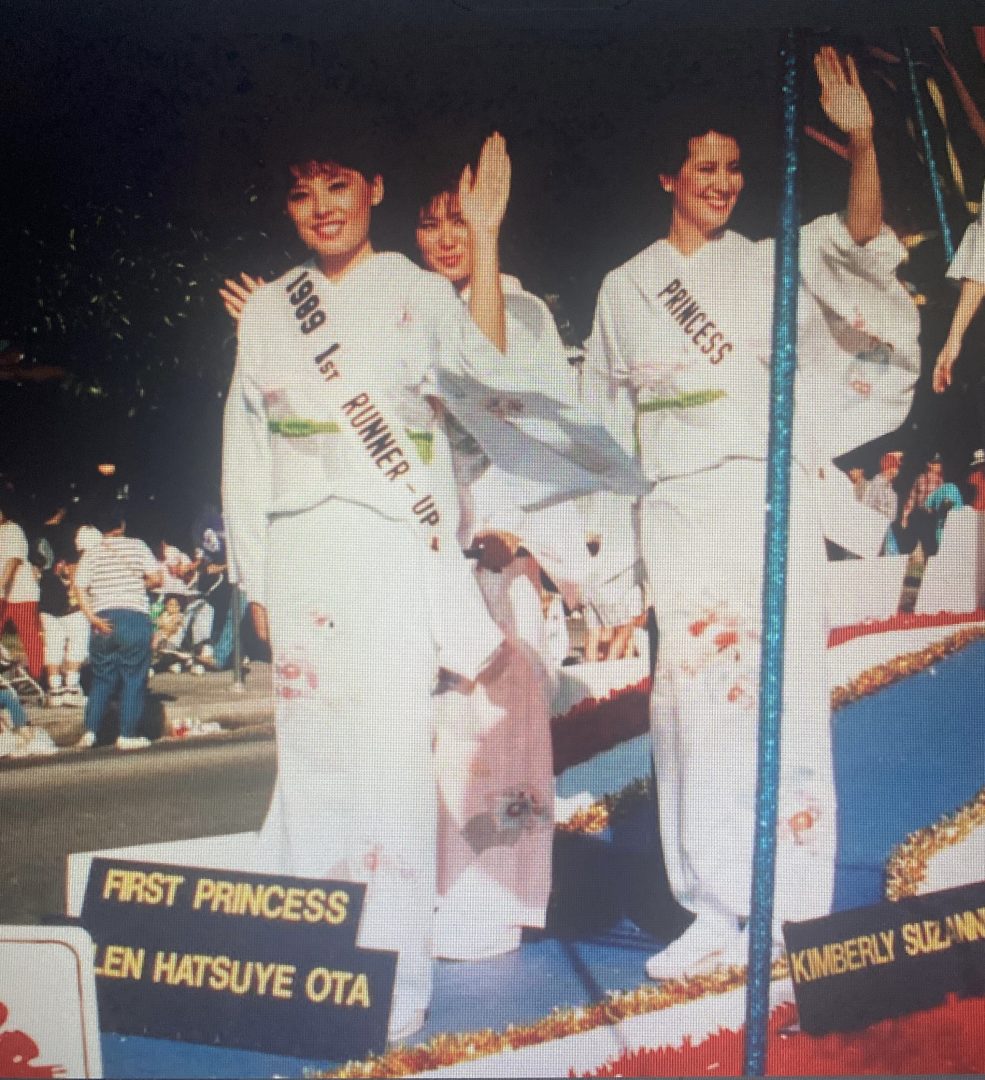
Unlike many L.A. area Japanese Americans, Ota didn’t go to Nisei Week growing up. Recalls Ota, “My first experience was participating in the Grand Parade in the 80s. I remember it being hot, but enjoying being part of the festival with the community. I started becoming involved with organizing Nisei Week ten years after I was on the Nisei Week Court. In 1999, I co-chaired the Queen & Court Program Committee and helped to initiate a leadership component within the program. I took on more leadership roles and learned much from my mentor, the late Frances Hashimoto. Soon after, I was elected as a board member of the Nisei Week Foundation.”
1989 First Princess Helen Hatsuye Ota at far left. | Photo courtesy of Helen Ota
Presiding over the yearly festival isn’t new to Ota. She says, “This is the third time I’m serving as president. The first year was in 2008 and the second time was in 2025. My responsibilities are to lead the Nisei Week Foundation board to plan for the festival every year, work with the different committees that organize each Nisei Week Japanese Festival event, collaborate with our partners and stakeholders, and work with the Little Tokyo community.”
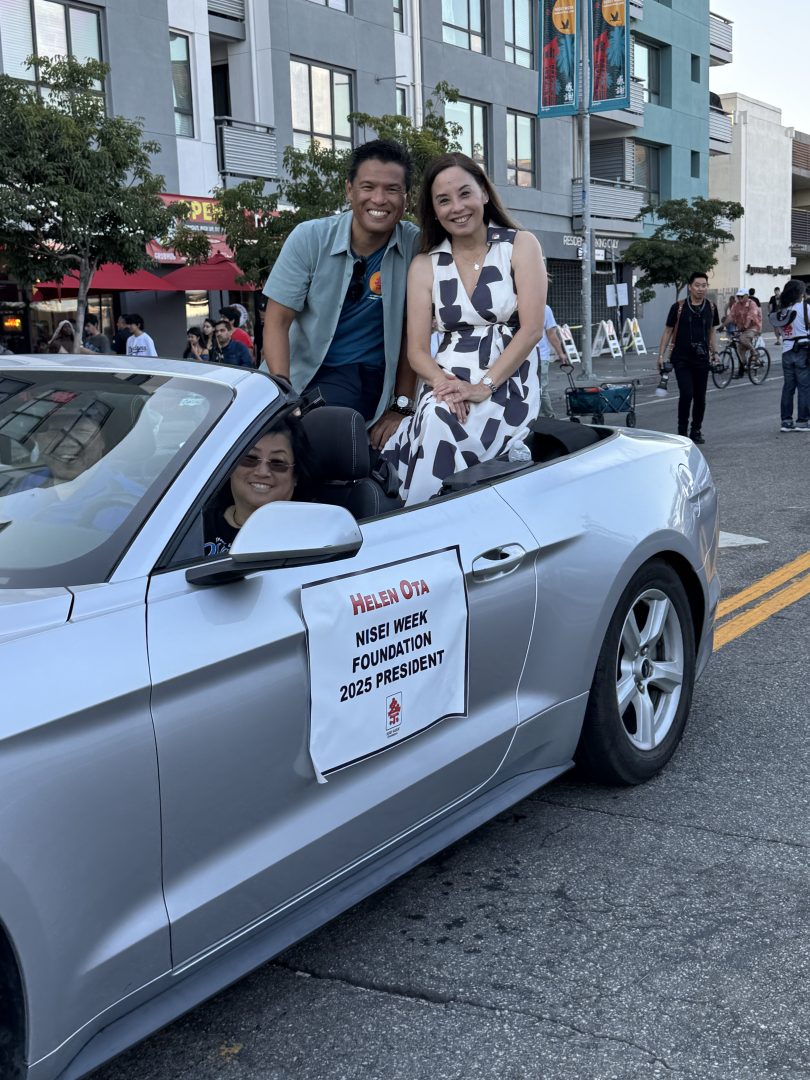
Helen Ota with husband Mike Palma in the 2025 Grand Parade. | Photo courtesy of Helen Ota
It is a role she doesn’t take lightly. “Having this position is very meaningful,” Ota explains. “It has allowed me to give back to Nisei Week and the community at large. I’ve been fortunate to have worked with several organizations and community leaders who inspire and provide me with great support. Serving as a representative of the Nisei Week Foundation and its festival has allowed me to appreciate Little Tokyo and the community with a grateful heart.”
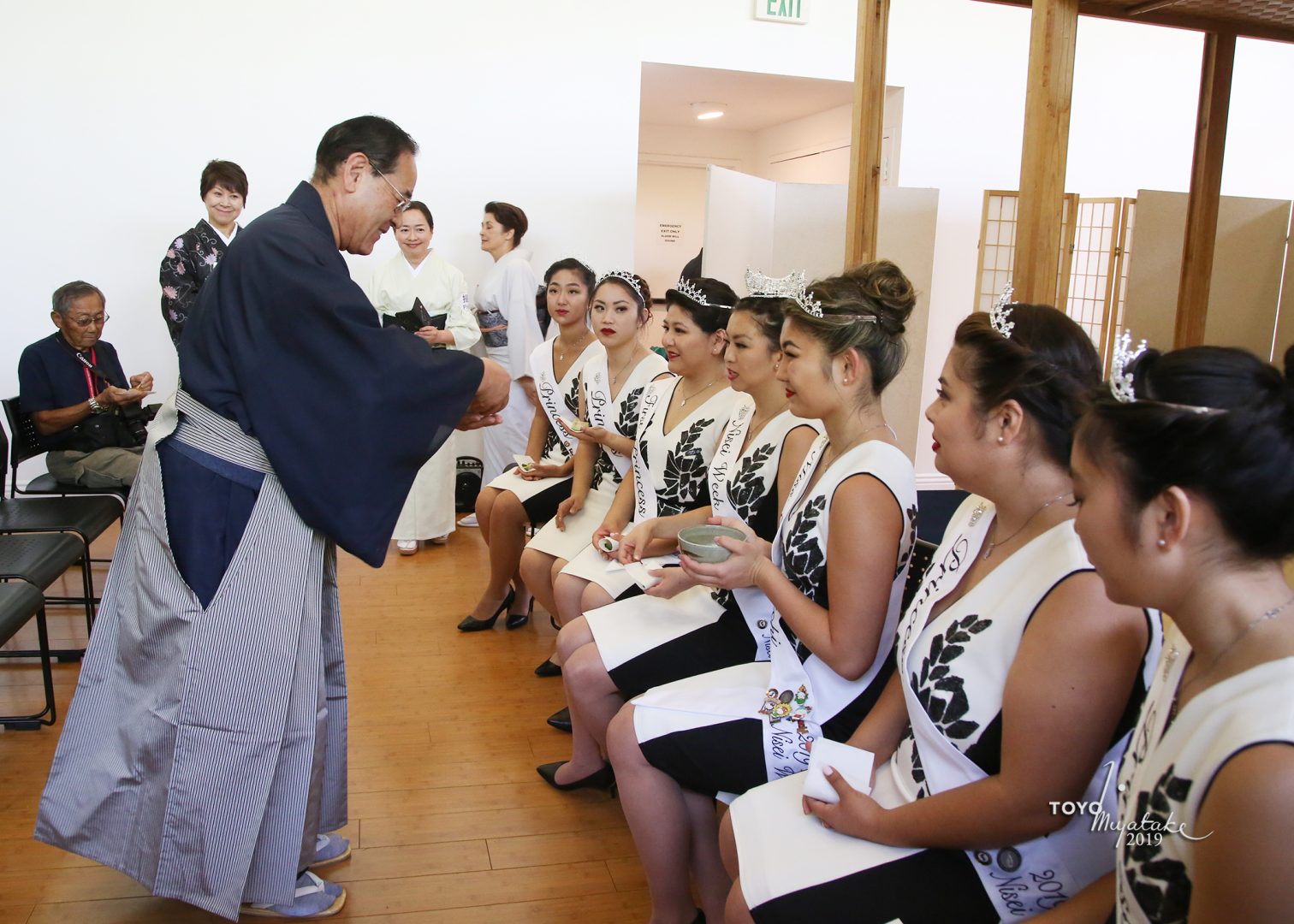
2019 Tea Ceremony Exhibition with the Queen and Court. | Photo courtesy of Toyo Miyatake for Nisei Week Festival
Nisei Week is an all-volunteer organization with no full time staff, with over a hundred volunteers involved throughout the year. According to Ota planning for each festival begins shortly after it ends in August.
“The Nisei Week Japanese Festival is a celebration of Japanese and Japanese American arts, culture, and community,” stresses Ota. “With only three historic Japantowns remaining in the U.S., we hope to connect communities throughout Southern California and beyond to Little Tokyo and discover the rich history and cultural arts it offers.”
2025 Closing Ceremony. | Photo courtesy of Toyo Miyatake for Nisei Week Festival
Asked if there has been a particularly memorable Nisei Week for her, Ota replies, “Each year has been memorable, which goes along with our theme this year, ‘ichigo ichie.’ It means one time, one meeting in Japanese and signifies that every moment is unique, unrepeatable, and should be treasured. Although we have a festival every August, each one has been a unique and remarkable experience because of the community and the people who come out to support us.”
For numerous Japanese Americans living in Southern California, Nisei Week is an annual tradition that was very much a part of their youth and a ritual they passed on to their children. And to this day multi-generational families go to Little Tokyo for the food, exhibitions, parades, and street dancing. For them it is an enjoyable summer adventure that, at the same time, preserves their cultural heritage.
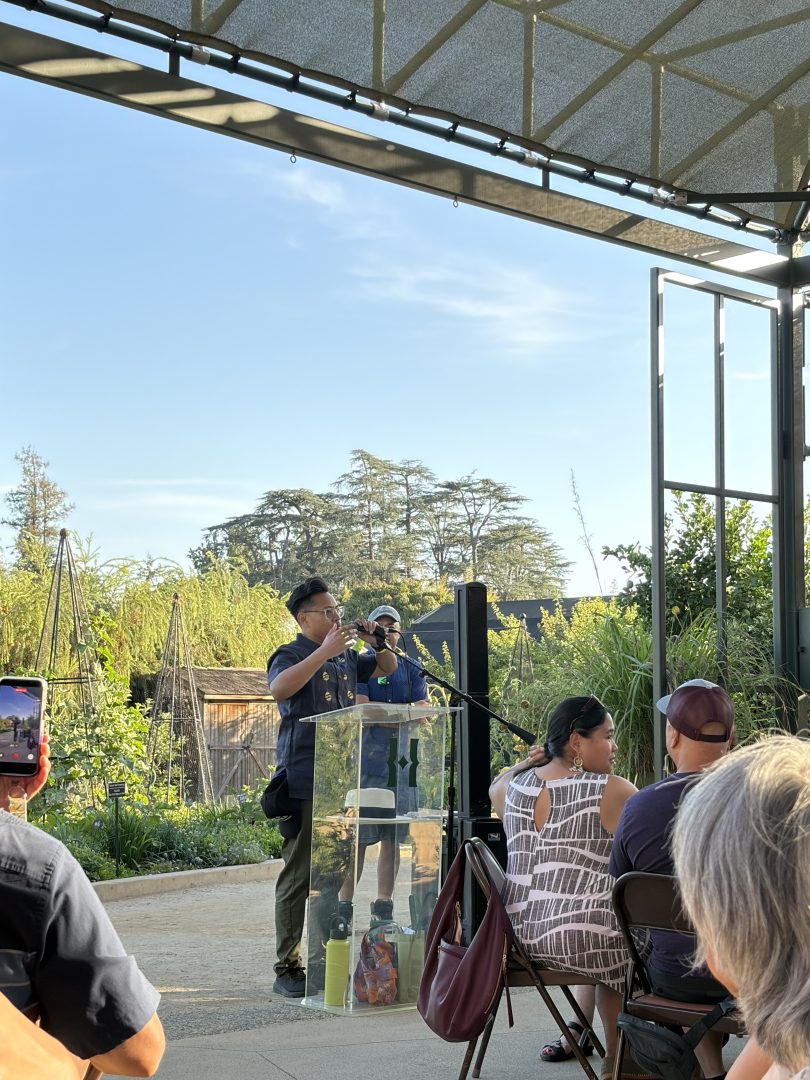
Co-presented by The Huntington and the Smithsonian Folklife Festival, the event was hosted by the team from This Filipino American Life podcast. Attendees pondered on the theme of This Land Is … and shared their lived Filipino experience in the United States.
This Land Is … Sunday Supper and Conversation series was conceived by Nenette Luarca-Shoaf, The Huntington’s Director of Education and Public Engagement. By email she discussed how it came about, her collaborators, and what programs are in the series, among other things.
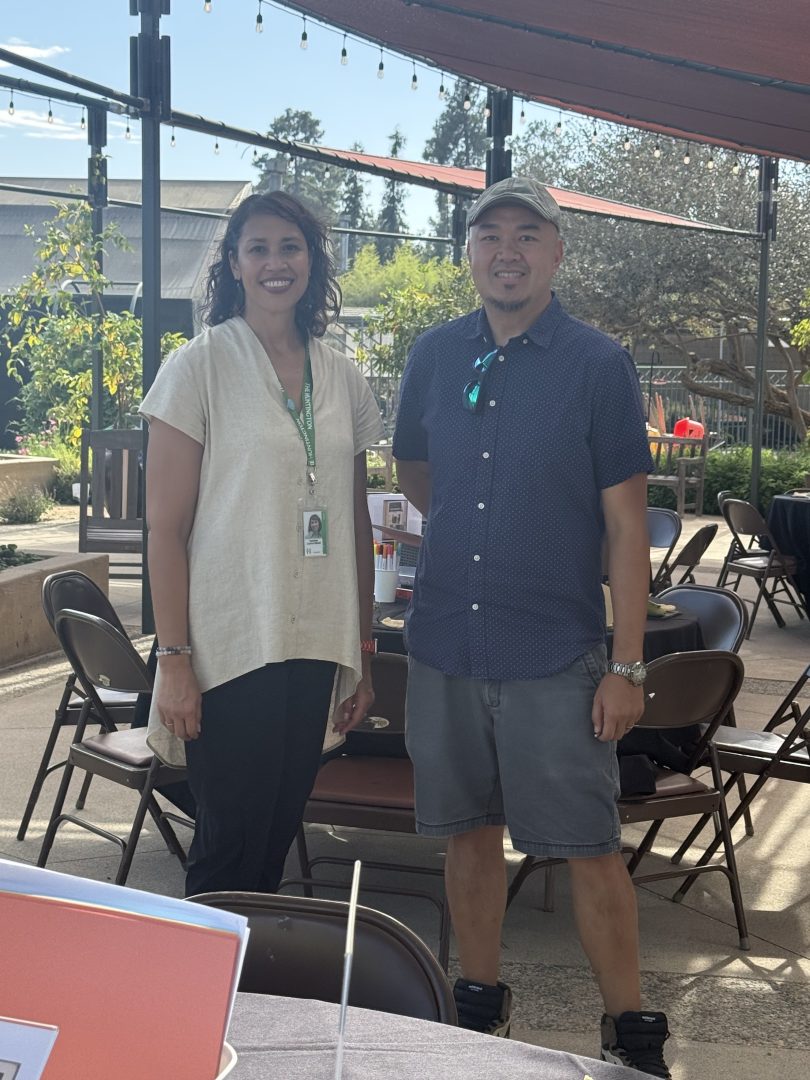
Nenette Luarca-Shoaf and Joseph Bernardo. | Photo by May S. Ruiz / Hey SoCal
“I first had the idea for the series a little more than a year ago as we brainstormed programs for The Huntington’s THIS LAND IS… initiative,” Luarca-Shoaf recalled. “Institutionally and within the Education division, we wanted to create opportunities for learning history while also reflecting on how those histories have shaped who we are today. I kept thinking about a family dinner or kitchen table and the way that current events and serious issues can be discussed by people with differing opinions, and how food can help to soften the edges of those encounters.”
“We always knew we wanted the programs to be co-created with local partner organizations so that we could tell a wide range of stories and bring together existing Huntington audiences with other communities,” continued Luarca-Shoaf. “It was also a great opportunity to partner with the Smithsonian Institution Folklife Festival, and they were especially keen for us to delve into Southern California traditions and culture. It is because of their co-sponsorship that we can make the series free to participants.”
“As plans developed for the ‘Filipino Food Magic’ program in March, I had the chance to meet Joe Bernardo over lunch with research fellow Cathy Ceniza Choy and Huntington curator Linde Lehtinen,” Luarca-Shoaf said further. “I floated the idea of partnering with the This Filipino American Life podcast on one of the Sunday Suppers and we continued to develop the program with our teams virtually and in-person.”
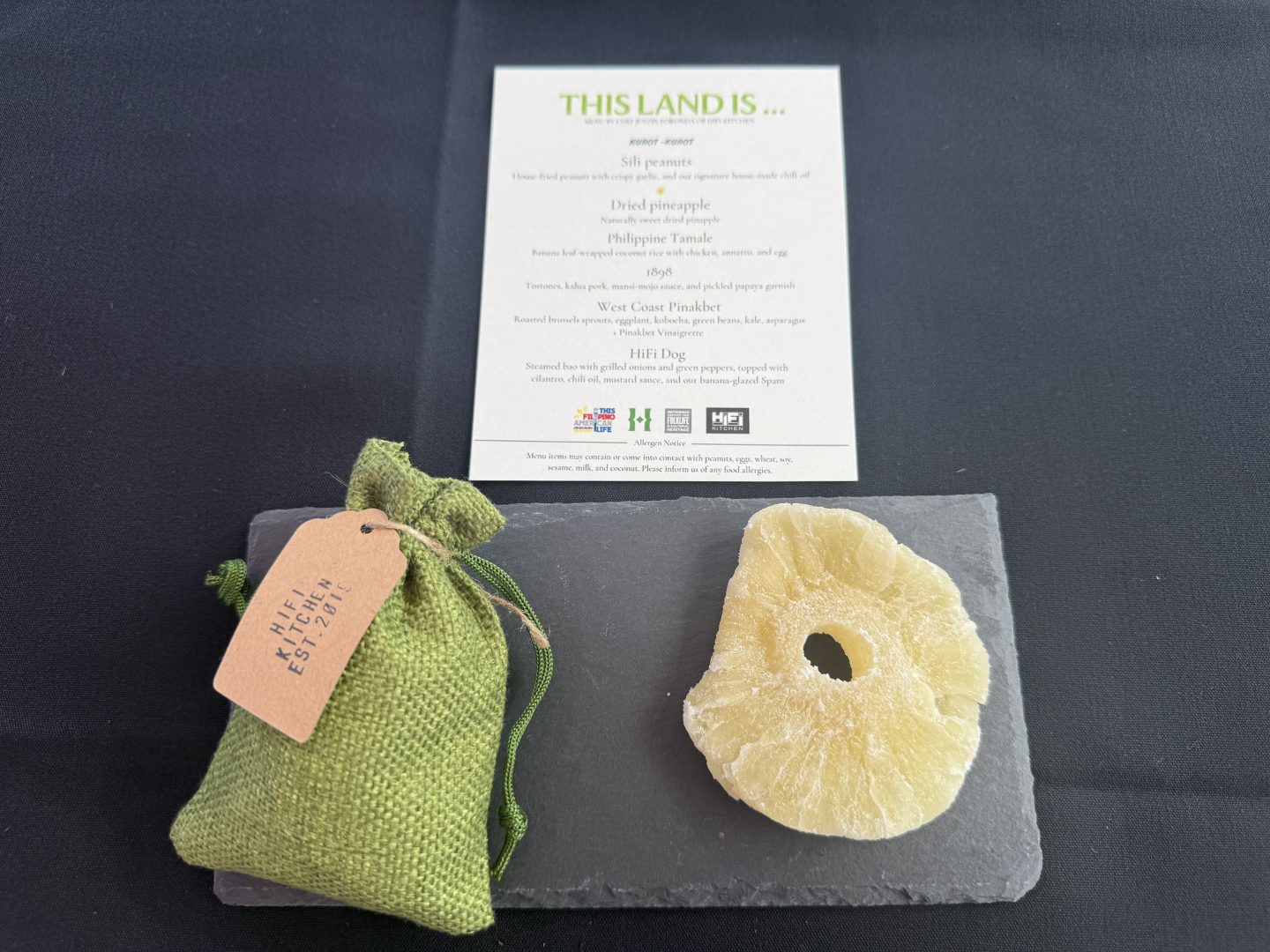
The Tasting menu card, a bag of peanuts, and dried pineapple on each place setting. | Photo by Brianna Chu / Hey SoCal
“We explored working with several different organizations and the Filipino supper turned out to be first because of scheduling,” explained Luarca-Shoaf. “However, it worked out well because of the way that the topic will survey centuries of history, dating back to the earliest cultural exchanges between the Philippines and the Americas. It allows us to show that American history is not just 250 years old, and that we need to think about how we are ‘setting the table’ for those who come after us.”
Luarca-Shoaf expanded on how the partnership with the This Filipino American Life podcast and Lehtinen informed The Huntington’s program.
“We drew a lot on Joe’s knowledge of Filipino diasporic history and were inspired by objects in The Huntington’s collection that photography curator Linde Lehtinen – one of the curators of the exhibition and someone who has been adding to the depth of our library collection relating to the Philippines – brought to our attention. One example is a scrapbook in The Huntington collection that visitors can see in the This Land Is… exhibition. It belonged to Domingo Salas, a Filipino chauffeur working in the first half of the 20th century and includes clippings from his life in Southern California as well as memories of home in the Philippines. We thought about the ways in which different generations document their lives and share their stories with the next generations, and also the way that food connects us to our memories and our heritage.”
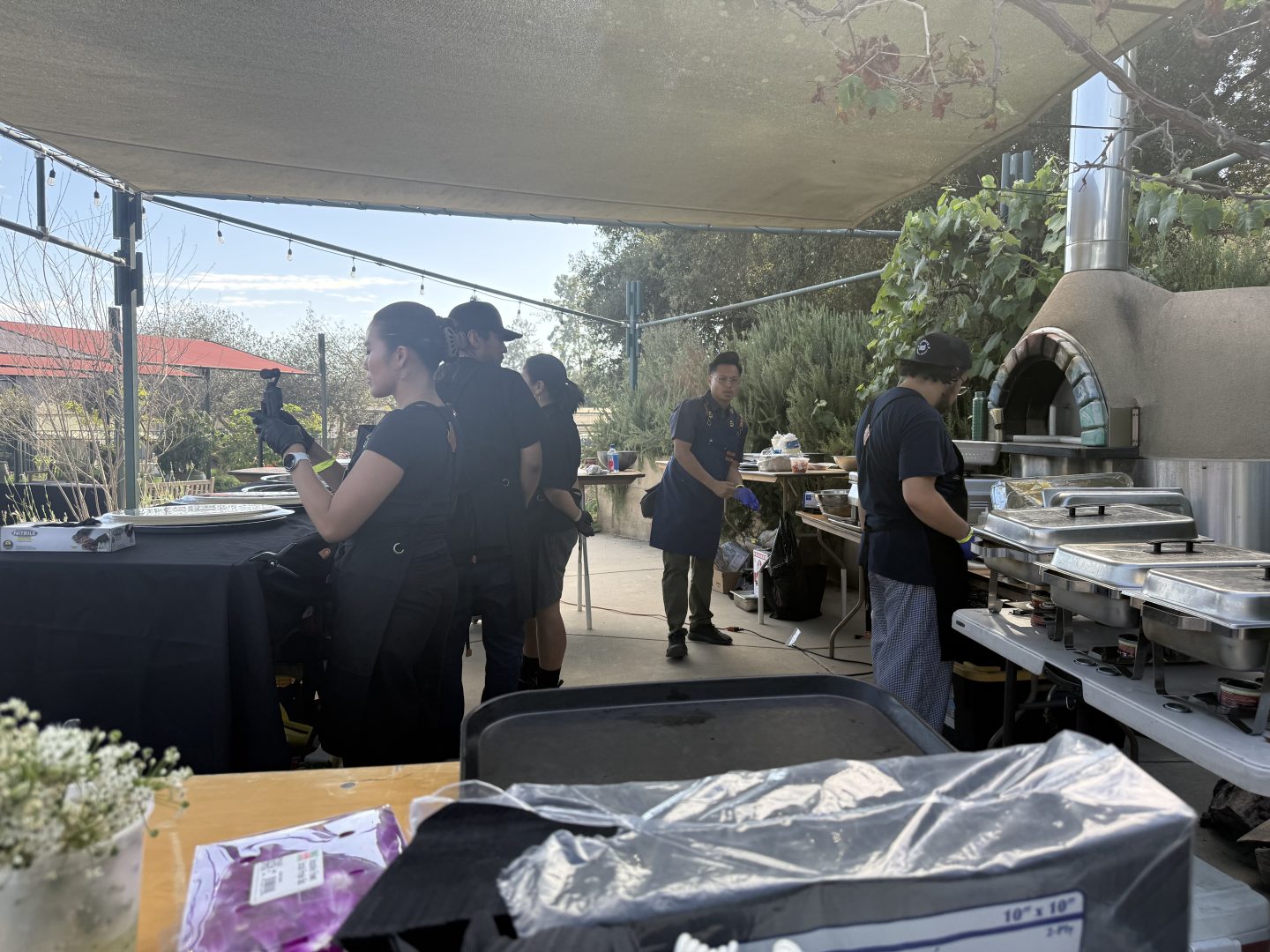
The HiFi Kitchen team busy at work. | Photo by May S. Ruiz / Hey SoCal
“Working with Justin Foronda of HiFi Kitchen has been exciting as well, as he understood what we were trying to do in showing how culture continues but also evolves, and he was able to create dishes that accompany each era of Filipino American history,” added Luarca-Shoaf.
Through the series, Luarca-Shoaf wants to bring together people from diverse backgrounds to learn from one another’s stories, find their common ground, and use history and creativity to look ahead. She hopes that partaking in a meal will help people create a sense of community and joy in the process. Taking their cue from Salas, her team will be making their own scrapbook pages during the program to document the evening and the ideas, memories, and experiences from their time together.
A total of three suppers and conversations have been planned for this year. On the last week of August, the program will feature Zocalo Public Square and discuss community-based agriculture. The LA Commons will take center stage on the first Sunday in October and look into healing in relationship to land and the connections between Leimert Park and Altadena.
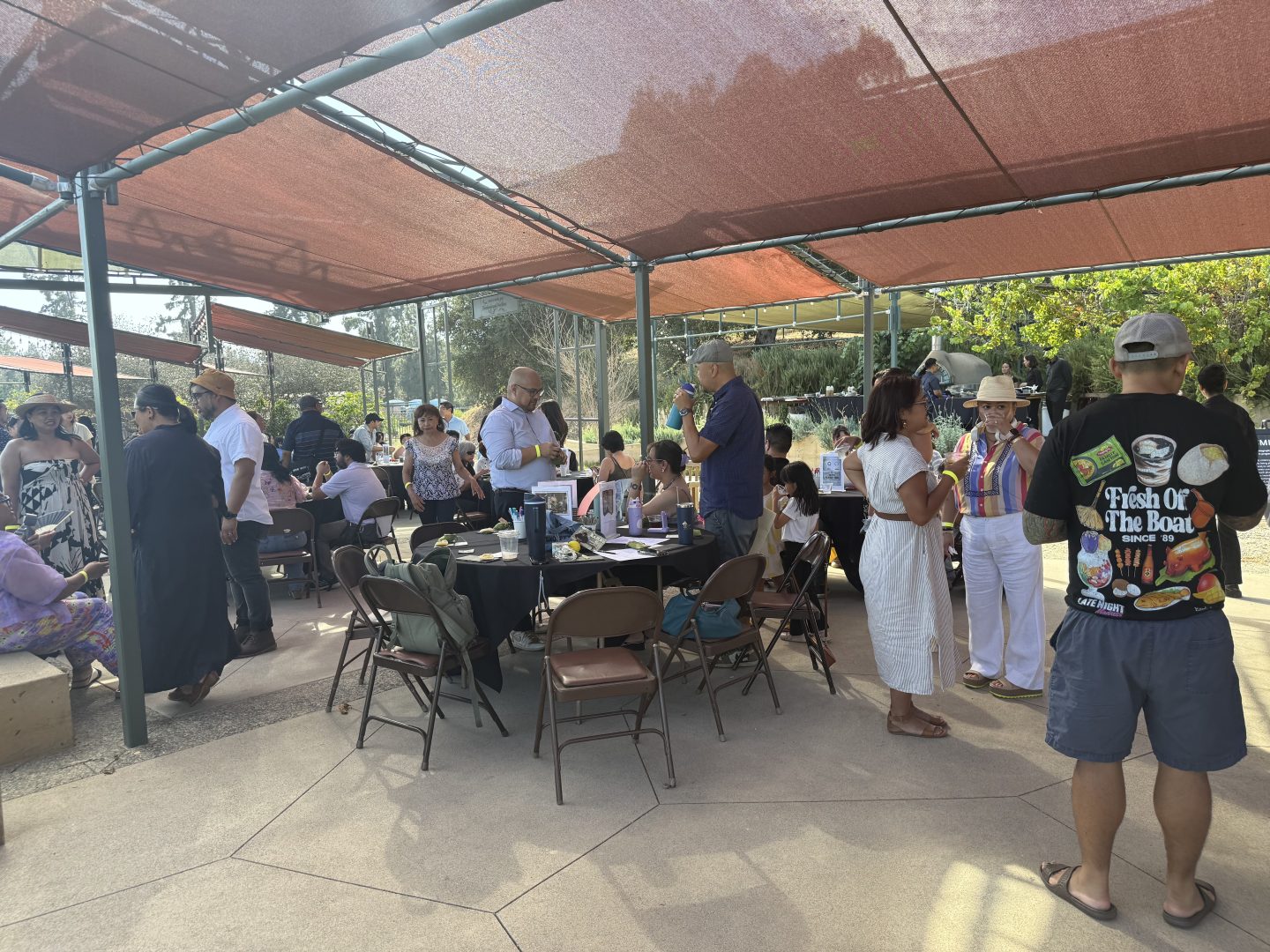
Attendees and participants at the This Filipino American Life event. | Photo by Brianna Chu / Hey SoCal
Luarca-Shoaf’s collaborator on this program, Joseph Bernardo, was one of the three original founders of the This Filipino American Life podcast. He earned a doctorate degree in Filipino American history and culture, a subject he had been studying for years. After leaving academia, he discovered podcasting as an ideal forum to share ideas and discuss issues affecting the Filipino American community in a fun and entertaining way. He approached Ryan Carpio, who worked with him at Mayor Garcetti’s Office, about starting a podcast; Carpio loved the idea at the outset.
Elaine Dolalas, who ran her own podcast – the now-defunct Oblivious Nerd Girl’s Great Idea – joined the team as a counterpart to Bernardo and Carpio’s perspective. She also brought on board her husband Mike, who had helped produce her previous podcasts and, like her, was also involved in L.A.’s Filipino American community. This Filipino American Life podcast was born and the three have been co-hosting it since. In 2024, Carpio stepped down and the team brought on Kat Carrido-Bonds.
“In the podcast, we explore the numerous experiences of being Filipino in the United States,” Bernardo stated by email. “Each of us have certain interests and we take turns coordinating an episode. If you look at our archive of episodes, we’ve covered so many political issues affecting our community or cultural phenomena we just want to dive into. We can discuss a certain topic like gentrification, Catholicism, undocumented immigration, or karaoke among ourselves or bring in an expert to interview. Our hope is that our discussions spark even more discussion and education in our community. Usually each episode runs 45 minutes to sometimes an hour-and-a-half, depending on the topic.”
Attendees at the event. | Photo by Brianna Chu / Hey SoCal
The team examines a specific topic on the podcast only once. Explained Bernardo, “There are very few issues that we come back to after we covered it. Not to say that there isn’t much to talk about something in view of a new set of political and social context. I think we’re just ready to move on after we finish one episode. However, we covered Filipino gangs twice – one from a member’s perspective, and the other from a cop’s perspective – and I think that’s the only time we returned to the same topic.”
Asked if there has been an episode that stood out for him in the years that he’s been hosting, Bernardo replies, “I’d say our interview with Maria Ressa, journalist and Nobel Peace Prize recipient, was the most star struck we’ve ever been. To think that someone that important and vital to both Filipinos, and the wider world, came to our podcast was something that will stick with us forever.”
This Filipino American Life podcast enjoys a loyal following and listeners frequently give them feedback. Bernardo said, “We used to get voicemails and play them on an episode, but folks stopped doing that. Maybe because nobody really leaves voicemails in general anymore? We’d regularly receive messages from Filipinos living in the Midwest or the South, where there aren’t too many Filipino American communities. They say that our podcast is one of the few ways that they connect to their heritage, which makes us feel honored and responsible for delivering meaningful content…. And having done the podcast for ten years, teaming with The Huntington and working on a project that helps spread awareness of the history and culture of Filipino Americans gives us reassurance that our work remains vital and necessary.”
Nenette Luarca-Shoaf. | Photo by May S. Ruiz / Hey SoCal
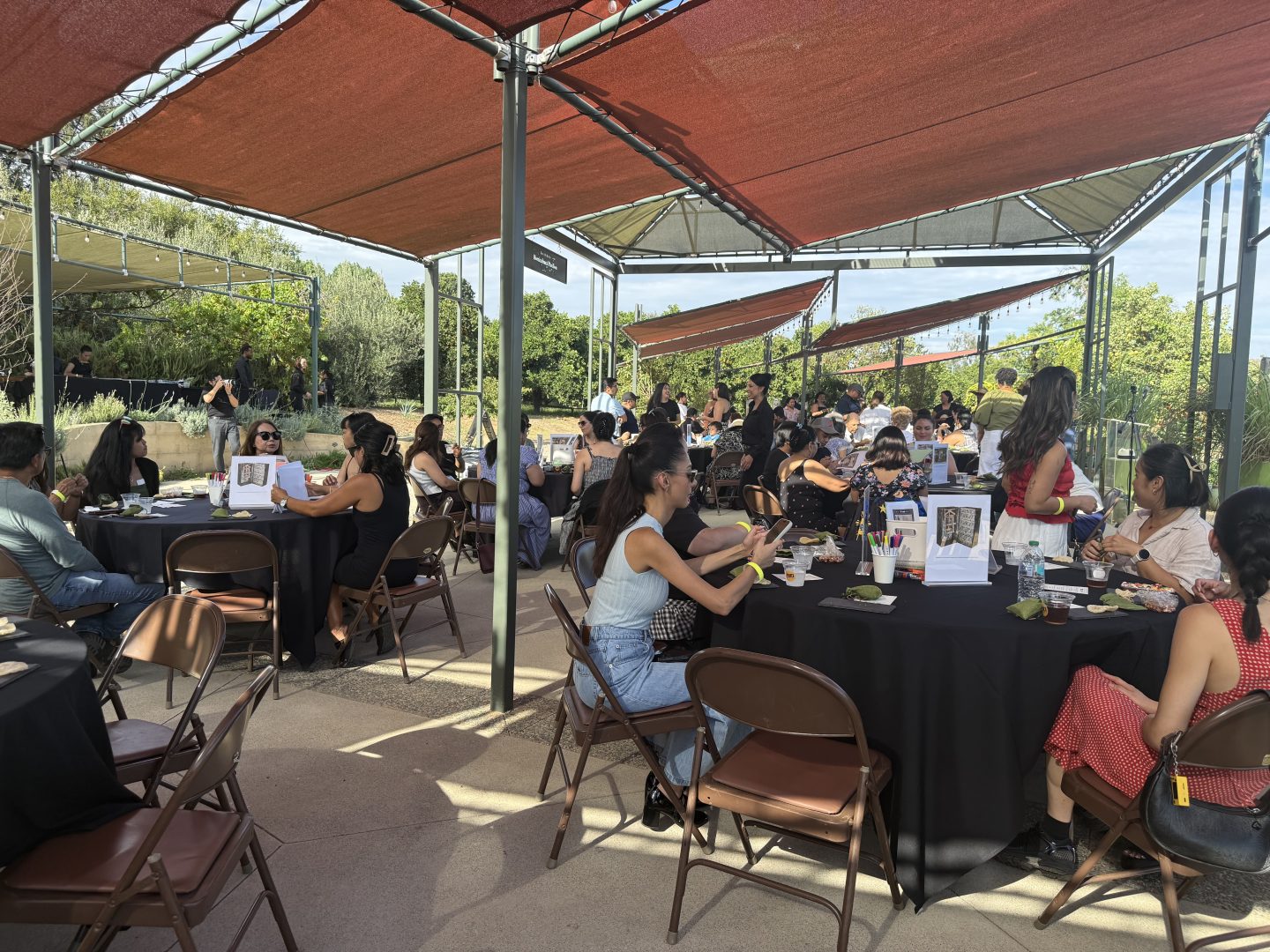
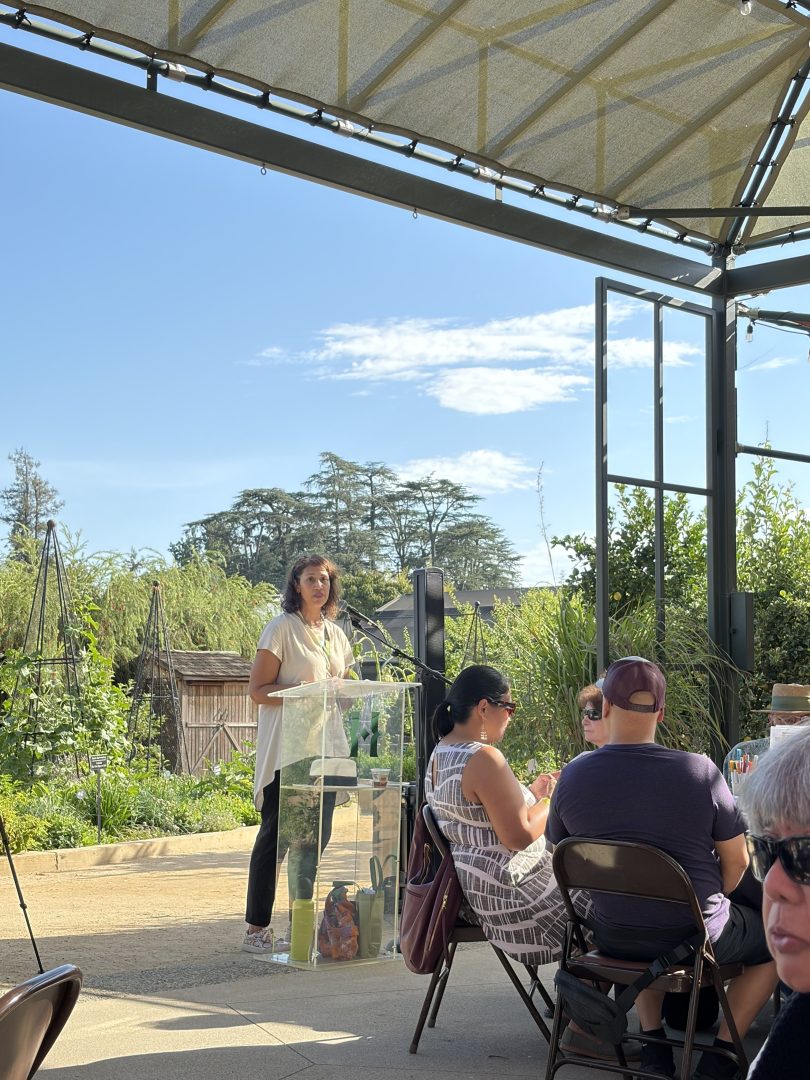
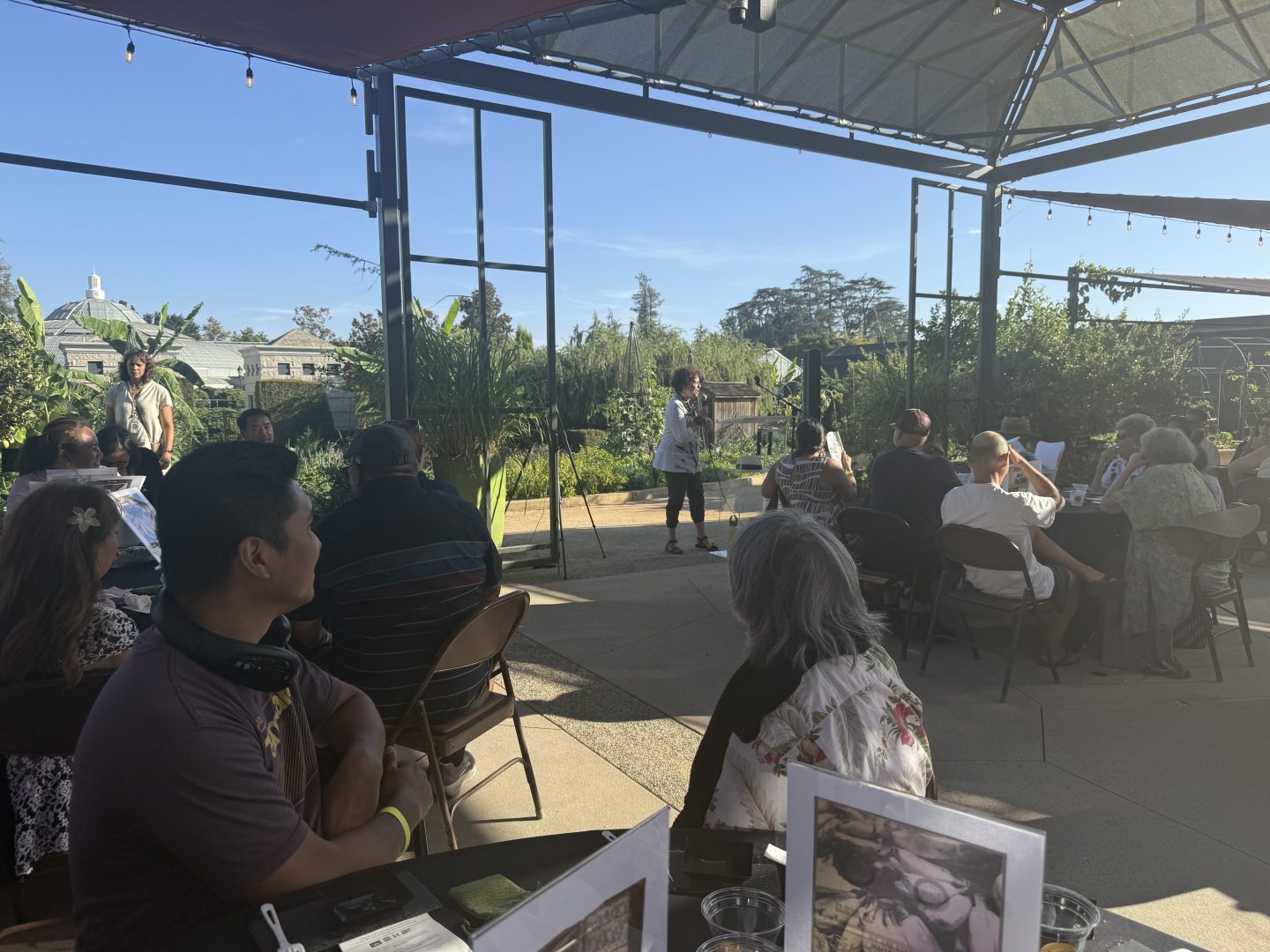
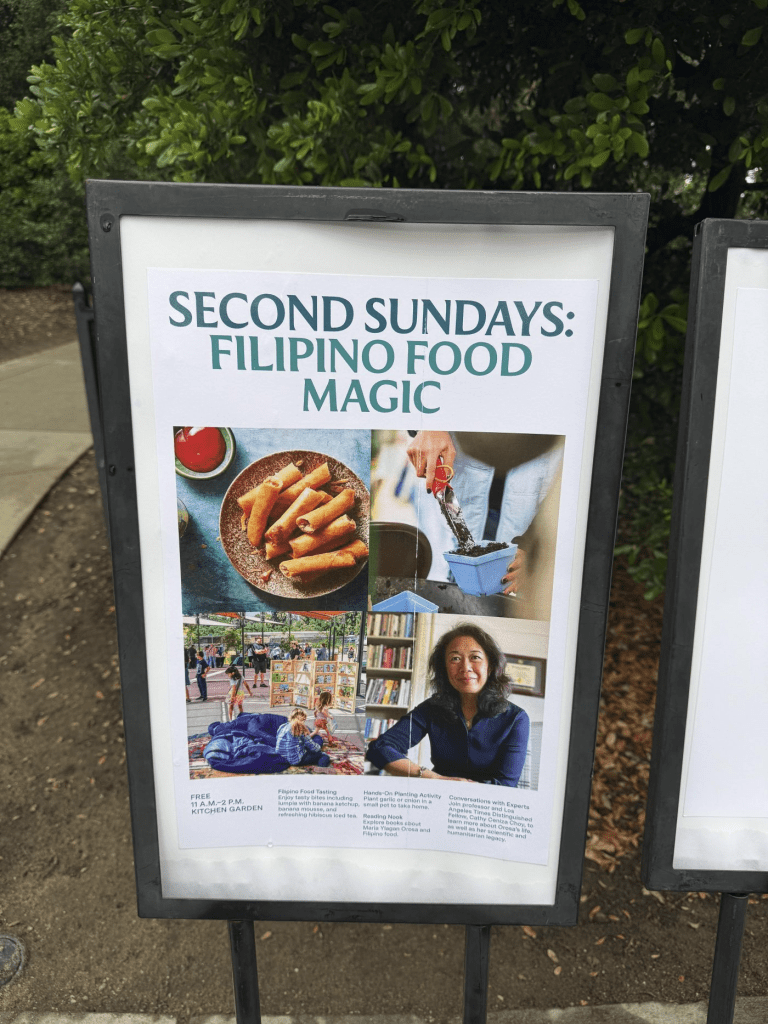
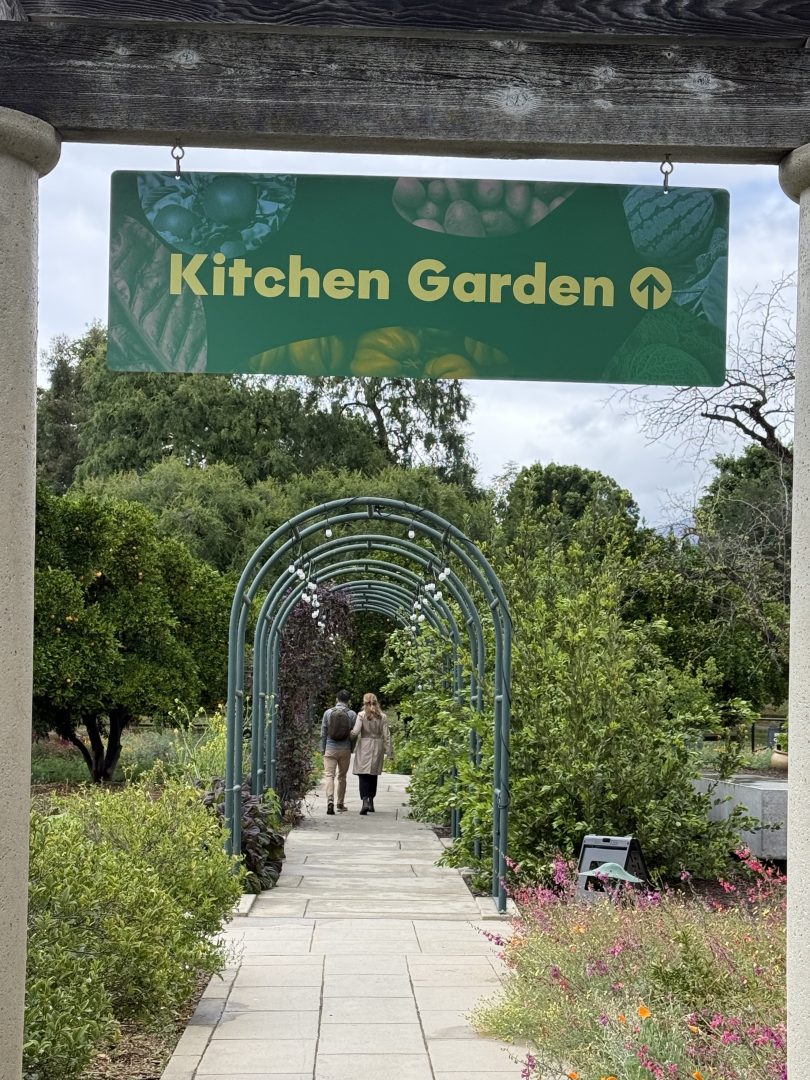
The Sunday Supper and Conversation featuring This Filipino American Life was a sold out event and had a long wait list. It took place at an outdoor venue – The Huntington’s Kitchen Garden – on a sweltering evening. The temperature was 93 degrees F but seemed even hotter because of the humidity. While one of the speakers commented on the Manila weather, everyone just laughed; not one of the 90 attendees complained.
In the spirit of exchange and sharing, Luarca-Shoaf asked us to take a few minutes to meet the people at our table and answer the question “What specific food or dish helps you feel connected to your family’s history?”
A few agreed on one particular food – kare-kare; other dishes mentioned were adobo, pinakbet, pochero, sinigang, and sisig. An animated conversation of which version of the dish one preferred, ingredients, and recipes ensued.
Before leading us into the shared history of the United States and the Philippines, Bernardo introduced his This Filipino American Life co-hosts. A trivia question started off the program: When was the first documented presence of Filipinos in what is now known as the United States?
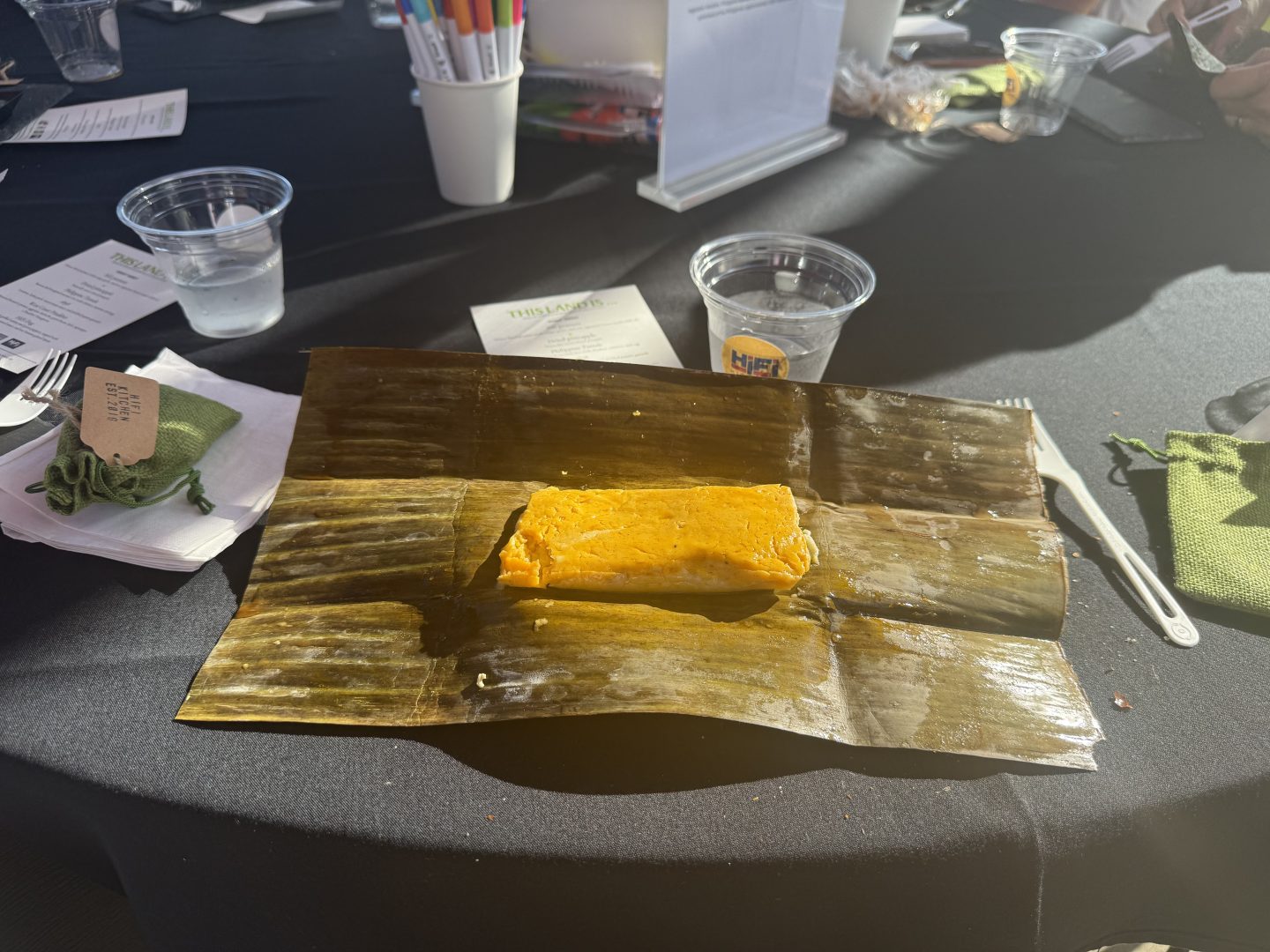
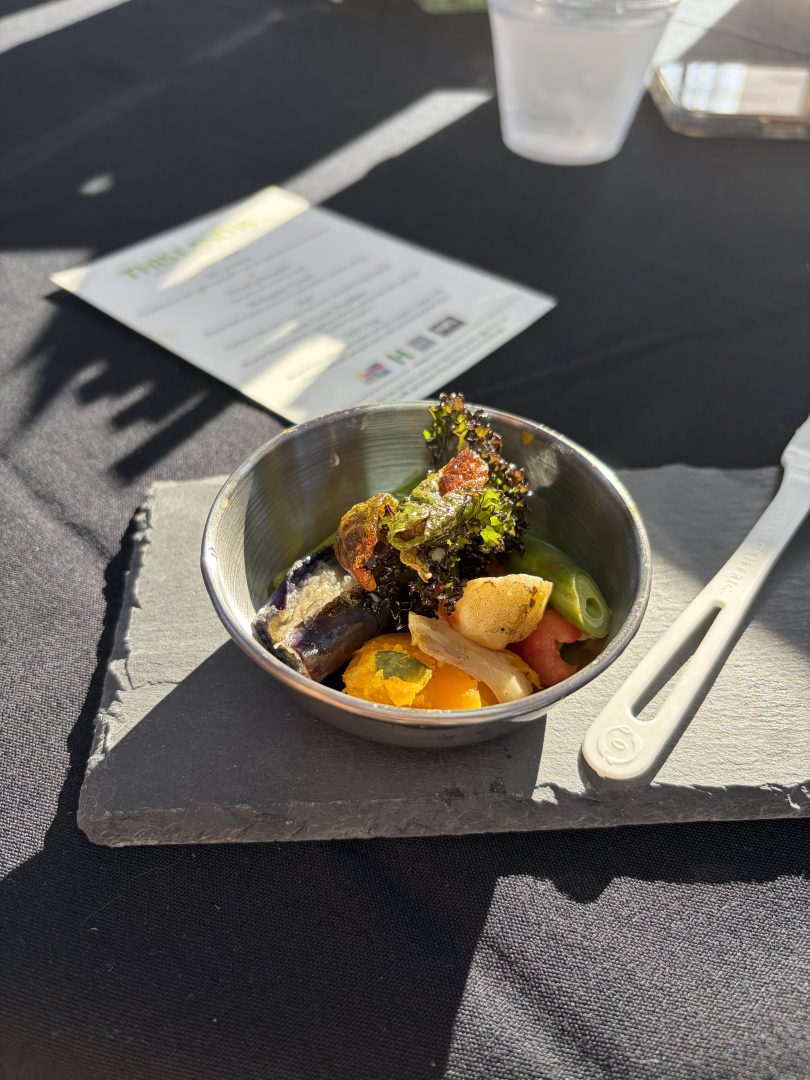
It was on October 18, 1587 that Filipinos landed on Morro Bay and it was the theme of the first dish on Foronda’s tasting menu – Philippine tamale. Bernardo also informed us the bag of peanuts and dried pineapple on each place setting represented the fruits and vegetables that were introduced to Filipinos at the time of the Manila Galleon Trade.
Philippine tamale; the first dish on the tasting menu.| Photo by Brianna Chu / Hey SoCal
Filipinos built the ships for the galleon trade established by the Spaniards. The economic trade route linked Asia, the Americas, and Europe from 1565 through 1815, according to Bernardo. The trade route brought goods from Asia to Acapulco, Vera Cruz, and onto Spain. It was one of the reasons Spain wanted to keep the Philippines as a colony.
Lehtinen provided imagery pertaining to that time period. On each table there was photograph in a Plexiglas which had a map of Asia and the ship that Magellan was on when he discovered the Philippines in 1521. It also visualized the spice trade and emphasized how Manila became the collecting hub for the trading activity.
Before the second course was served, a This Filipino American Life podcast co-host asked the next trivia question, “Besides the Philippines, name the other nations America colonized at the turn of the 20th century?”
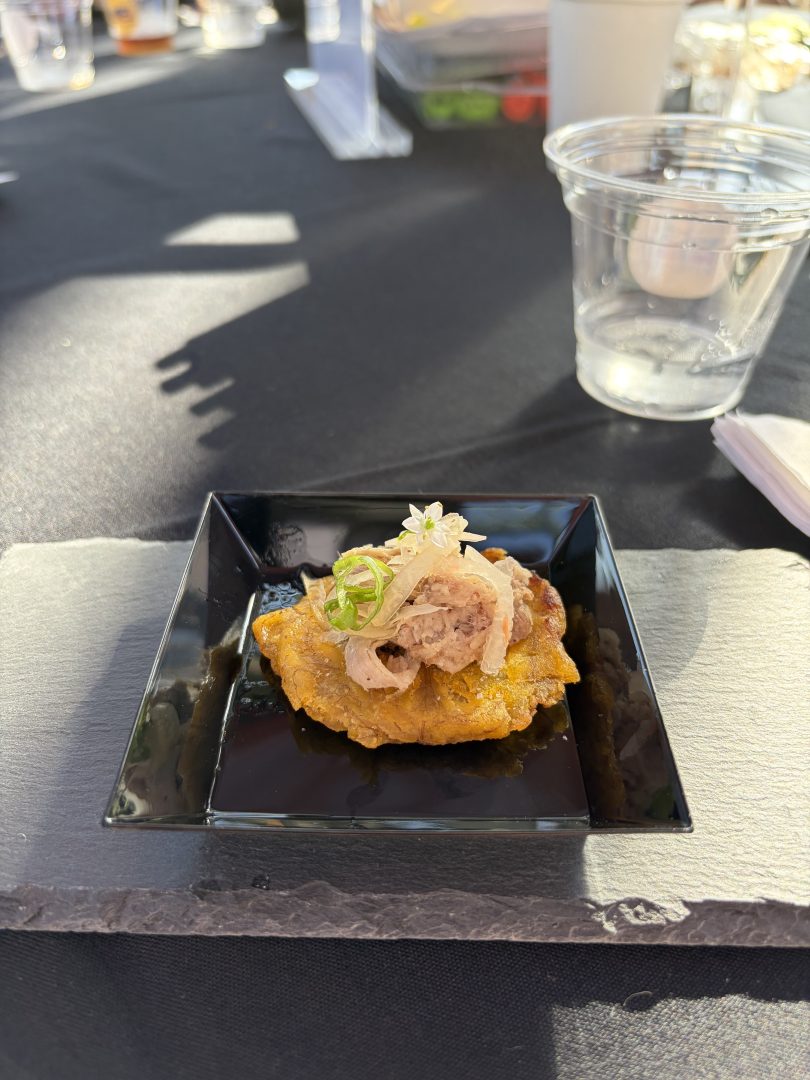
1898: tostones, Kalua pork, mansi-mojo sauce, and pickled papaya garnish. | Photo by Brianna Chu / Hey SoCal
Cuba, Guam, and Puerto Rico were also colonized by the U.S. in 1898. Bernardo discussed American Expansionism when it acquired the Philippines from Spain for $20M at the Treaty of Paris. At the same time that the United States was fighting the Spaniards, Filipino revolutionaries were engaged in its own war for independence against this new colonizer. Approximately 200,000 Filipinos died during the Filipino-American War.
The United States prevailed and reigned for 48 years and shaped Philippine culture and society. Examples of this are the form of government, Filipino economic dependence on the U.S., English as the medium of instruction, industries like nursing, and popular culture including food and food science, music, and sports.
Such was the long introduction to the next course – fittingly called 1898. Foronda informed us that it was influenced by Cuba, Guam, and Puerto Rico, and is eaten like a pizza.
In the spirit of community, Bernardo gave us the next table discussion question: “How did this history that we learned in course number 1 and 2 broaden your understanding of the United States?”
This prompted a lively discussion at our table that went beyond the scope of what was asked. Someone suggested that U.S. global trading was the precursor to globalization. Another posited that the two dishes were an amalgamation of cultures, to which someone supplemented that it started multiculturalism. A GenZer then argued that going down that line of reasoning meant nothing is indigenous anymore. Yet one person – an authority on Filipino Language, Literature, and Culture – referenced anthropologist Franz Boas’s historical particularism to argue her point.
Karen R. Lawrence, president of The Huntington. | Photo by May S. Ruiz / Hey SoCal
A special guest that afternoon was native Californian Sam Vong, who came all the way from Washington D.C. He talked about an exhibition he curated called “How Can You Forget Me: Filipino American Stories” currently on view at the Smithsonian’s Asian American Center at the National Museum of American History. It shines a light on Filipino migrant labor, community-building, and history in Stockton, California – the home of one of the largest Filipino communities outside of the Philippines in the 1930s.
Between the food tasting and history lesson, music by Filipino American artists played in the background while attendees got up to mingle or get a drink from a selection of spa water on a side table. Kat Carrido-Bonds, podcast co-host, acknowledged the individual who created the playlist for the evening. She then invited us to join them to celebrate This Filipino American Life podcast’s 10th anniversary party on August 8 at Hello Stranger in Little Tokyo. She also announced the next trivia question: “What is the name of the U.S. legislation that led to Philippine independence?”
Bernardo provided context for this next historical discussion. When the Philippines became a U.S. possession, Filipinos come to this country freely. A large wave of Filipinos – particularly men from the Ilocos region – migrated to the U.S. during the 1920s and 1930s to provide immigrant labor on the West Coast.
Foronda’s West Coast Pinakbet. | Photo by Brianna Chu / Hey SoCal
These Filipinos resettled in Los Angeles and neighboring areas like Orange County, the San Gabriel Valley, and the San Fernando Valley. They worked on the farms alongside the Mexicans, but also in the service industry as domestics, hotel workers, and restaurant busboys. Eventually, a Little Manila in L.A. was established and then later a Historic Filipino Town. This generation of Filipino Americans were the Manongs, an Ilocano term of respect that’s taken from the Spanish word for brother, hermano.
The passage of the Tydings-McDuffie Act in 1934 set the date for Philippine independence and the primary reason for that was to curb immigration.
One of the photographs on the tables was of an archival object in The Huntington’s collection – a scrapbook made by Domingo Salas. Lehtinen explained that it contained pictures that told the story of the man who compiled it. He was a Filipino who worked as a chauffeur in Pasadena in the early 20th century and was part of the Manong generation. He was a U.S. veteran and served in both WWI and WWII. He was born in 1899 and died in 1985; he is buried at Riverside National Cemetery.
Justin Foronda. | Photo by Brianna Chu / Hey SoCal
Lehtinen pointed out that the scrapbook reflected the anti-racial sentiments at that time. Salas had several photographs that showed him with white girlfriends, yet the U.S. Census records showed him as never having married – probably due to anti-miscegenation laws.
To discuss the present day, which Bernardo jokingly said was 1985, he invited his co-host Elaine Dolalas to ask the final trivia question: “What metropolitan area has the largest population of Filipinos in the United States?”
The answer is Los Angeles. Bernardo informed us there are over 700,000 Filipino Americans in the Greater L.A. area, which includes Orange, Riverside, Ventura counties, etc. Filipino immigration to the U.S. increased dramatically because of the 1965 Immigration Act which is the basis of immigration policies today. It prioritized family reunification as well as employment-based immigration. Many Filipinos came here as skilled professionals and their family members joined them later through sponsorships.
“As a result of the 1965 Immigration Act, many second generation Filipinos came of age in the 1980s and 1990s” Bernardo expounded. “We established many institutions and became leaders in respected fields, fighting for representation and social justice.… Many second and third generation Filipinos have developed a unique Filipino American culture and identity influenced by multi-ethnic environment, especially in California. Our food, culture, and sensibilities reflect that.”
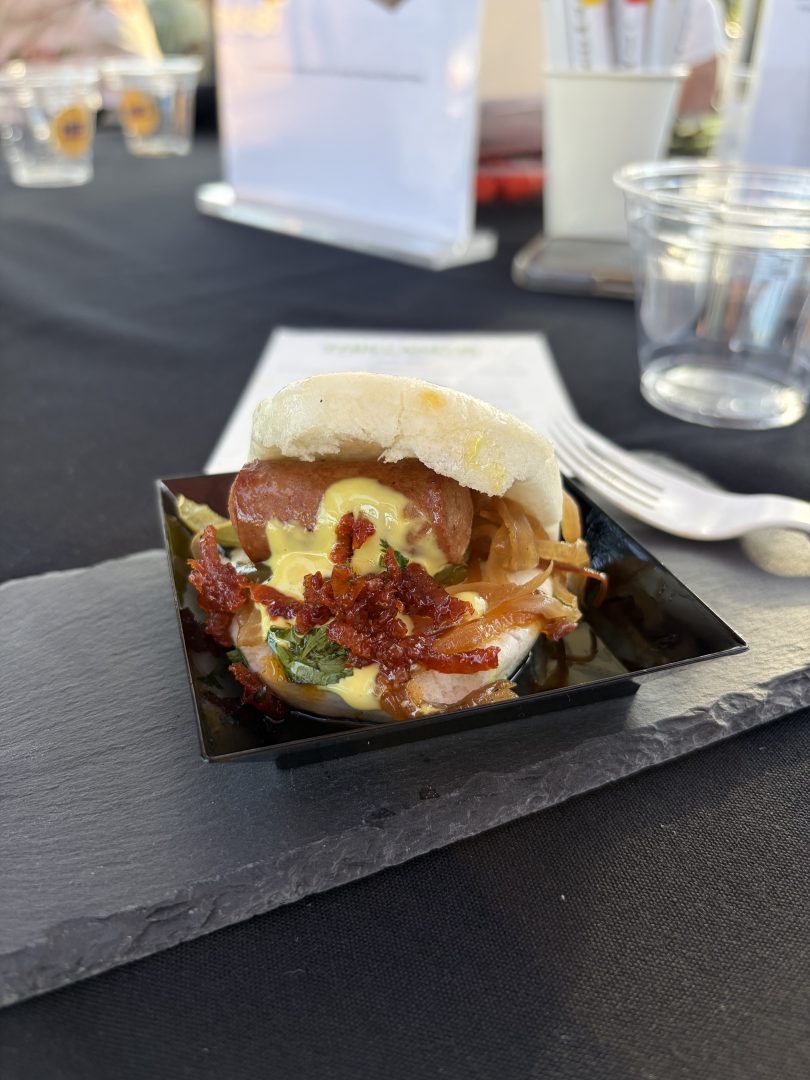
Today’s Filipino Americans were the inspiration for Foronda’s last tasting menu course, which he called HiFi Dog and he put in a bao.
HiFi Dog, Foronda’s version of the L.A. hot dog. | Photo by Brianna Chu / Hey SoCal .
Domingo Salas’s scrapbook was the inspiration for the artmaking project at close of the event. Luarca-Shoaf invited us to create our own scrapbook about the afternoon’s experience to share with others. They provided an instant camera, some sharpies, scissors, glue, and decorative paper for the project.
Luarca-Shoaf and her collaborators – Lehtinen, Bernardo and his This Filipino American Life podcast co-hosts, Foranda and his HiFi Kitchen team – methodically planned each segment of the event and made it such a success. They even managed to import Manila weather that reminded some of us of our homeland.
It’s worth noting that the Sunday Supper and Conversation series is part of The Huntington’s celebration of the 250th anniversary of the U.S. Declaration of Independence from British rule and, incidentally, marks the day the Philippines gained independence from American sovereignty on July 4, 1946.
The United States freed the Philippines 80 years ago, but many Filipinos today still feel a deep connection to America. For while the U.S. relinquished its hold on the Philippines, the ties that bind the two countries are forged within the hearts of the Filipino people.
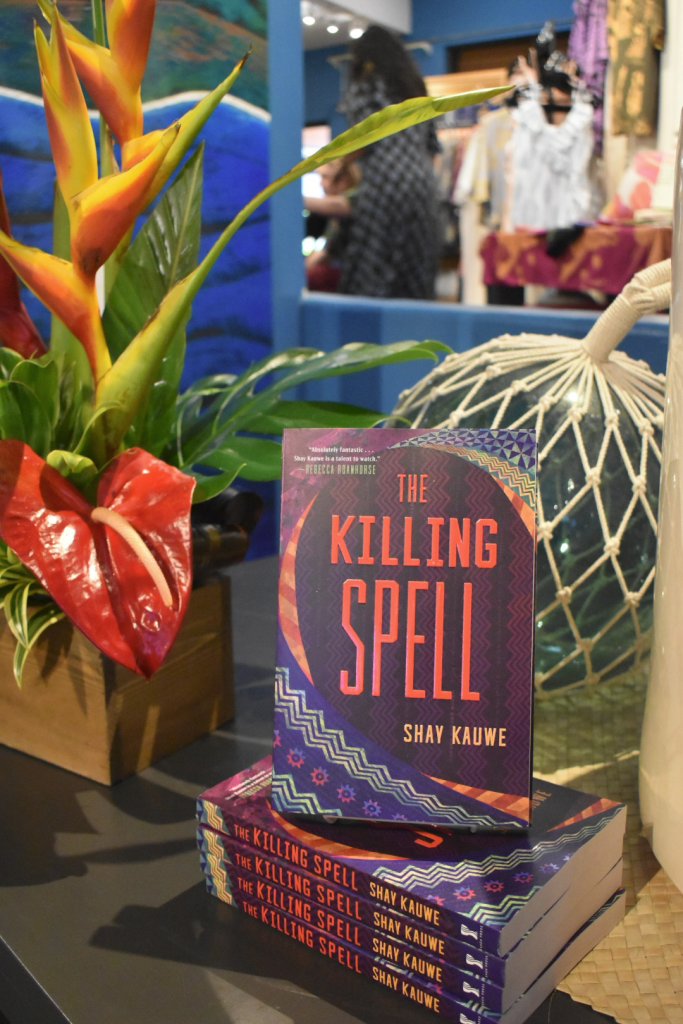
The Killing Spell, a young adult fantasy mystery set in L.A. – where the majority of Hawai‘i’s population fled to after a cataclysmic flood sank their islands – about 200 years into the future was released in the U.S. by Saga Press, an imprint of Simon & Schuster, on April 14. It is also available in Canada and the United Kingdom.
A debut book from Native Hawaiian Shay Kauwe, it follows the story of Kea Petrova – the youngest clan leader at the homestead – who ekes out a living by selling handcrafted magic spells. Her quiet life is upended by the murder by death spell of Angelo Reyes, a prominent Filipino activist, and she becomes the prime suspect. She has to act fast to find the killer and clear her name.
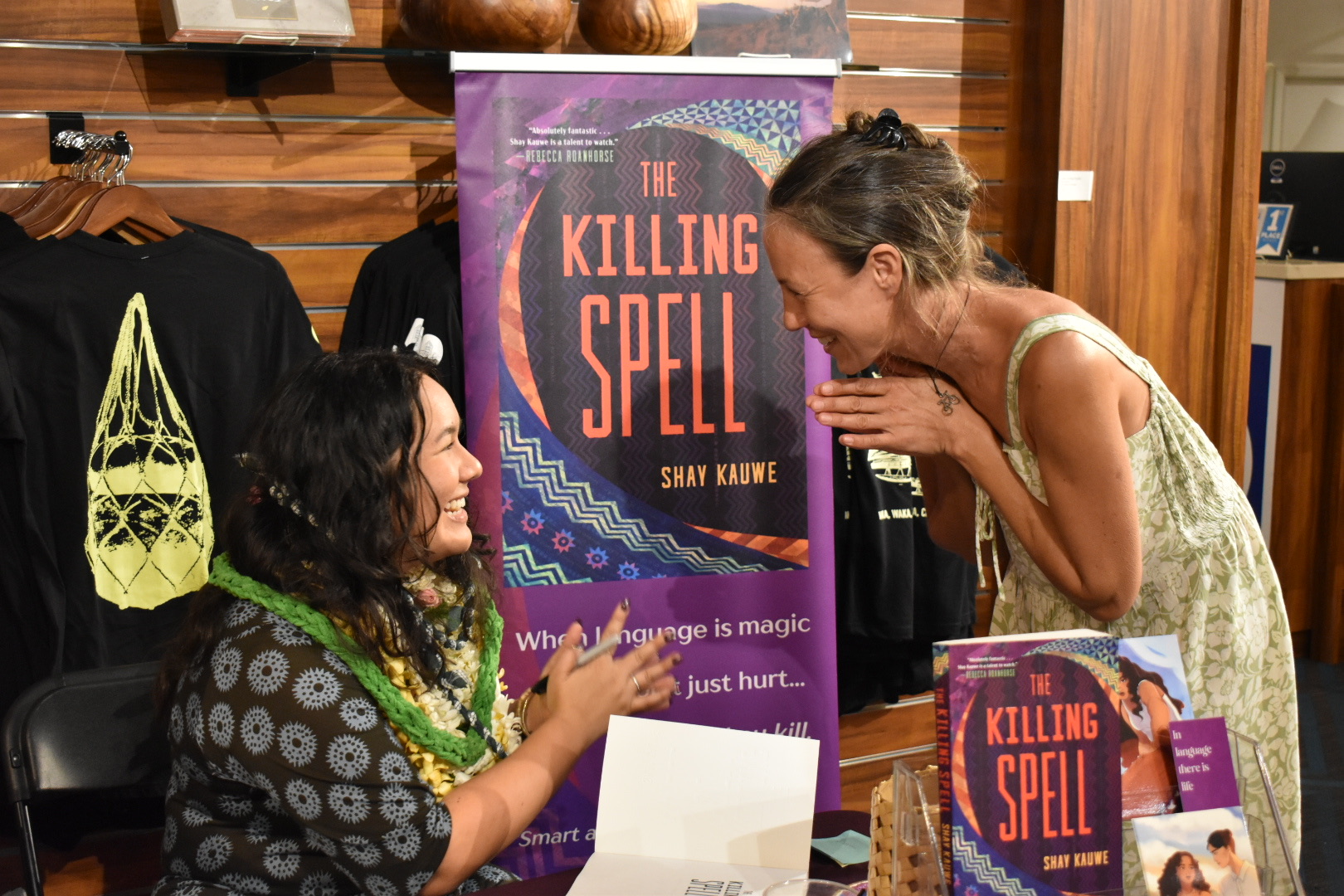
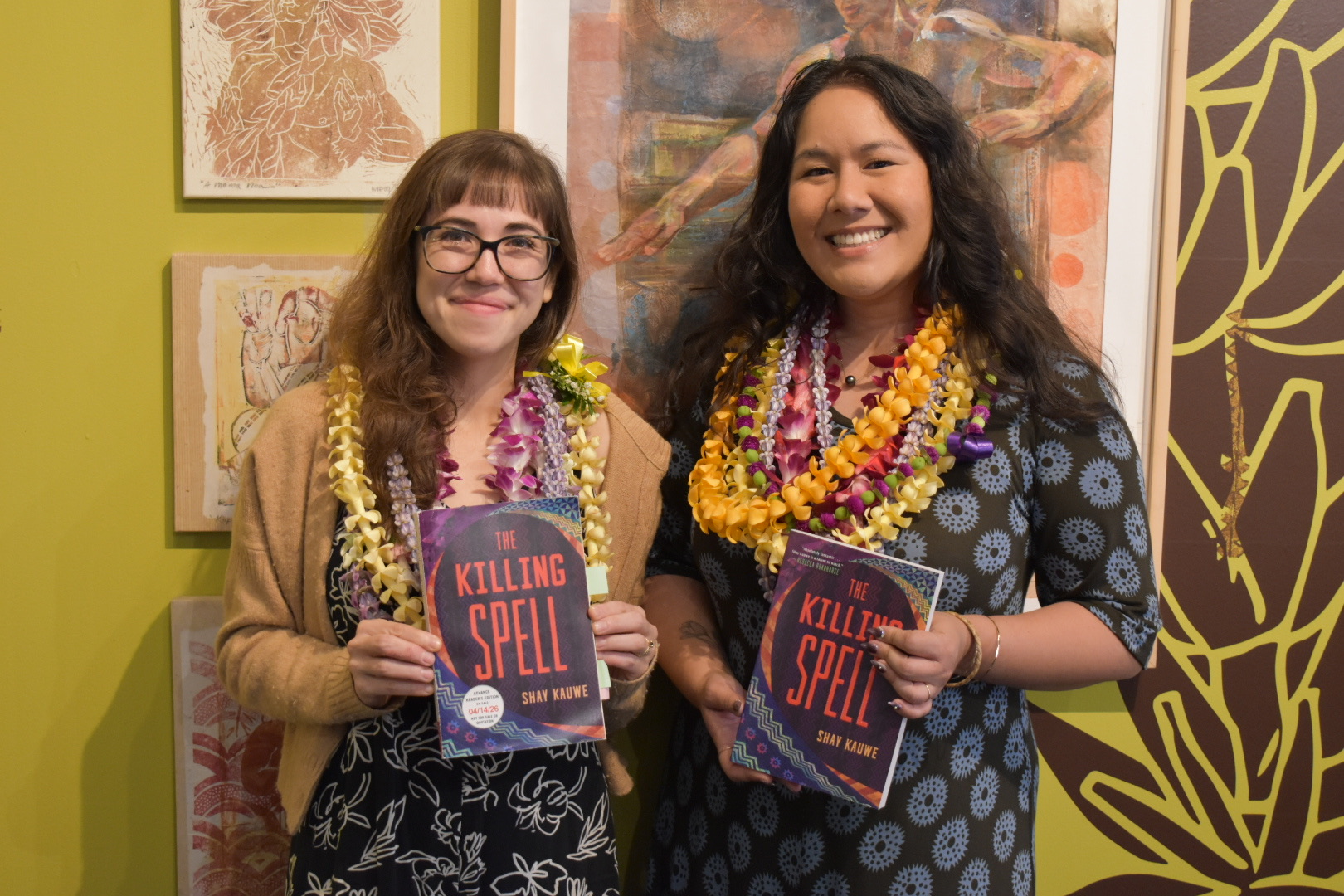
Shay Kauwe, at left, during the book launch. | Photo courtesy of Shay Kauwe / The Killing Spell
Language is at the heart of the tale. Throughout the book, Kauwe sprinkles Hawaiian phrases and one-word spells that will certainly delight logophiles. In her foreword, she explains that she included the diacritical marks to indicate how the words are pronounced to help readers. Linguaphiles will most assuredly agree with her when she says, “Languages are wonderful, beautiful, strange things that change and shift as they please.”
Kauwe’s love for language began in her childhood and she has always been partial to reading fantasy books. Some of those she enjoyed as a child – which have stood the test of time – are The Hero and the Crown by Robin McKinley and The Old Kingdom series by Garth Nix. But she never dreamed that she would one day join the ranks of fantasy authors. That happy outcome happened in a roundabout way.
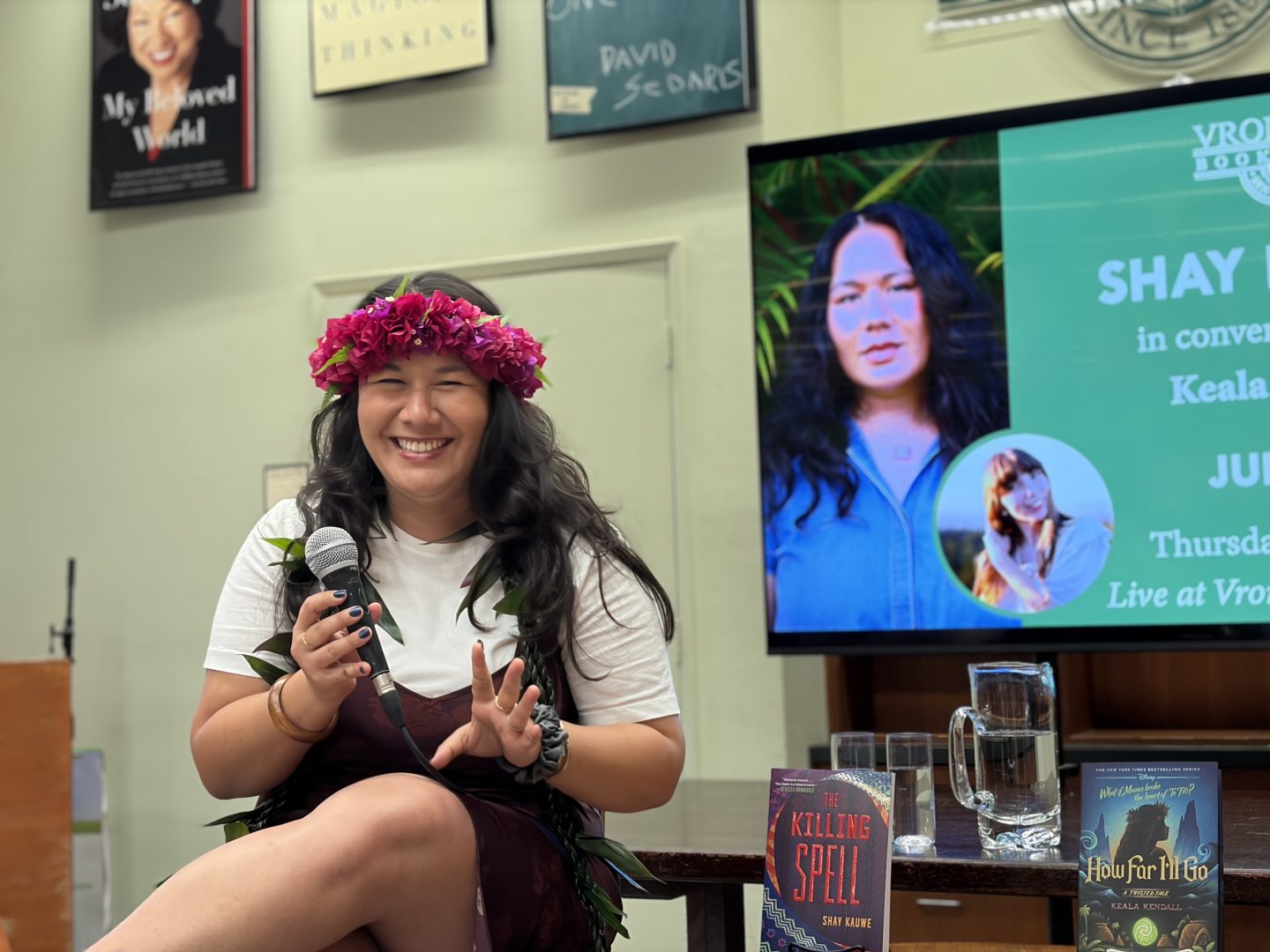
Shay Kauwe at the Vroman’s Bookstore event. | Photo courtesy of Shay Kauwe / The Killing Spell
“When I was 21, I moved to Russia – for a man. You can imagine how thrilled my parents were with that!” recounts Kauwe with irony. “But I was in love, and I knew that he was the one. (He was, too! We’ve been happily married now for ten years!) That said, I made this huge leap and began living in St. Petersburg, Russia, learning Russian by necessity without thinking too much about it.”
“There was this moment, maybe three years in, where I was sitting in our cold apartment in the middle of winter, watching Moana, and just sobbing,” Kauwe continues. “The language there, while not Hawaiian, was similar enough that I could make out words, and it struck me that here I was, half-way across the world, and I knew my partner’s mother tongue better than my own.”
“It was a lightbulb moment, and I knew then that I wanted to go home and learn Hawaiian,” adds Kauwe. “I foolishly thought it would be easy. I spoke Russian now! How hard could it be? So, I was incredibly frustrated when I couldn’t get things as quickly. Immersion was a huge part of my language learning process, and the hard truth is that as an adult, that isn’t a feasible option for many learners of Hawaiian. It is a consequence of colonization that we still have to deal with to this day. All of that frustration and shame, I took and funneled into this book, which is why it was so important for me to have a main character who struggled with relearning her indigenous tongue. “
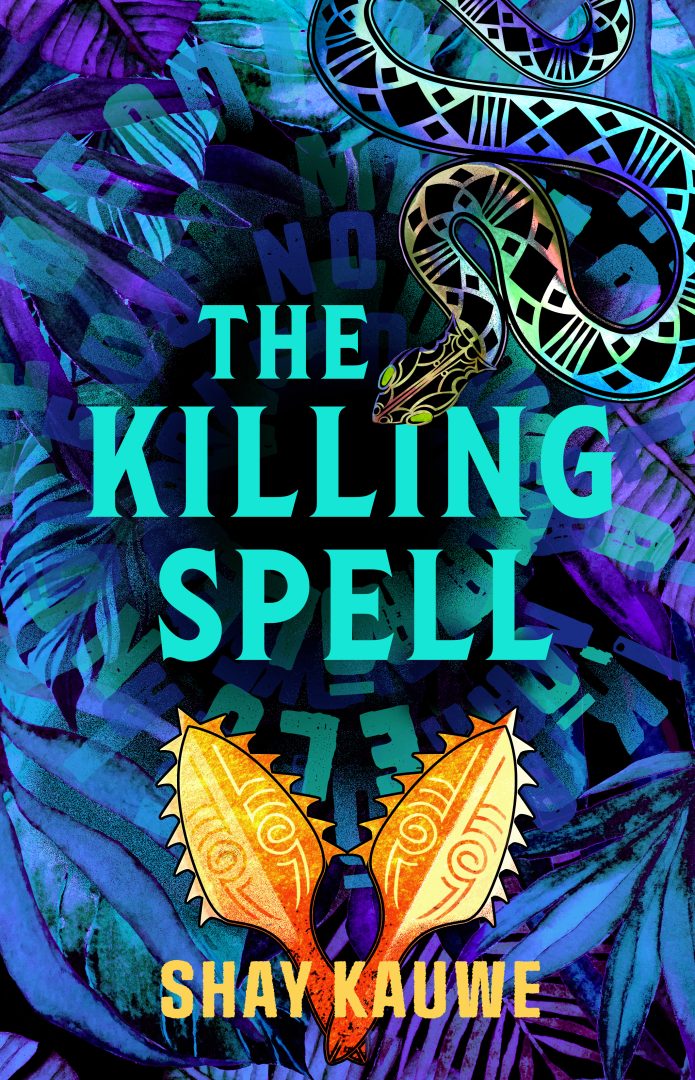
The Killing Spell’s U.K. book cover. | Photo courtesy of Shay Kauwe / The Killing Spell
Kauwe began writing The Killing Spell when she was still teaching. She was inspired by urban fantasy books which include the Kate Daniels series by Illona Andrews and the Mercy Thompson series by Patricia Briggs. She’s no longer in education, though she still has a full-time job and she admits that balancing working and writing is not easy. However, she has a rigid routine that helps her keep on track. She takes long walks in the mornings and listens to audiobooks to learn from writers she admires. When she gets home from work in the evenings, she writes between four to five hours, and tries to write at least 1,000 words a day.
Some authors get the inspiration for their characters from people they know or have met. But those in The Killing Spell are completely fictional and products of Kauwe’s imagination.
“I don’t base characters that I write off of real people, but I do use the names of family and friends quite often!,” Kauwe clarifies. “Hawaiian names aren’t super common to see in literature, and especially not in fantasy, so I love to include the names of loved ones in my books; they get a kick out of it. Granted, I always make sure that the character with their name is nothing like them.”
Shay Kauwe (on the right) at the book launch with conversation partner Megan Kamalei Kakimoto. | Photo courtesy of Shay Kauwe / The Killing Spell
However, Kauwe confesses that the book’s protagonist bears some resemblance to her. “Like many debut authors, I’m definitely guilty of inserting pieces of myself into Kea! We’re both stubborn, eldest daughters with a big sense of responsibility for our families. And also like Kea, I struggle with learning new languages. However, in writing The Killing Spell, I found a sense of catharsis, a way to have more patience with myself in learning Hawaiian.”
Kauwe also admits to having a favorite secondary character in her book. “Basilio was incredibly fun to write as he had a huge personality! I tend to like characters that are funny, charismatic, and enjoy teasing the people around them so Basilio fit the bill in every single way. I’d love to continue to write his story if possible.”
Additionally, Kauwe knew how her story would end at the outset. “Funny enough, I needed to rewrite my book about eight times throughout this process! However, the beginning and the ending never changed. I had a clear idea of what the emotional core and character arc for Kea would be, and that remained consistent during every revision. What changed was the progression of my plot and the clues that led Kea to her conclusion. The magic system also became a lot narrower in scope as I rewrote the book, so that greater emphasis was placed on language.”
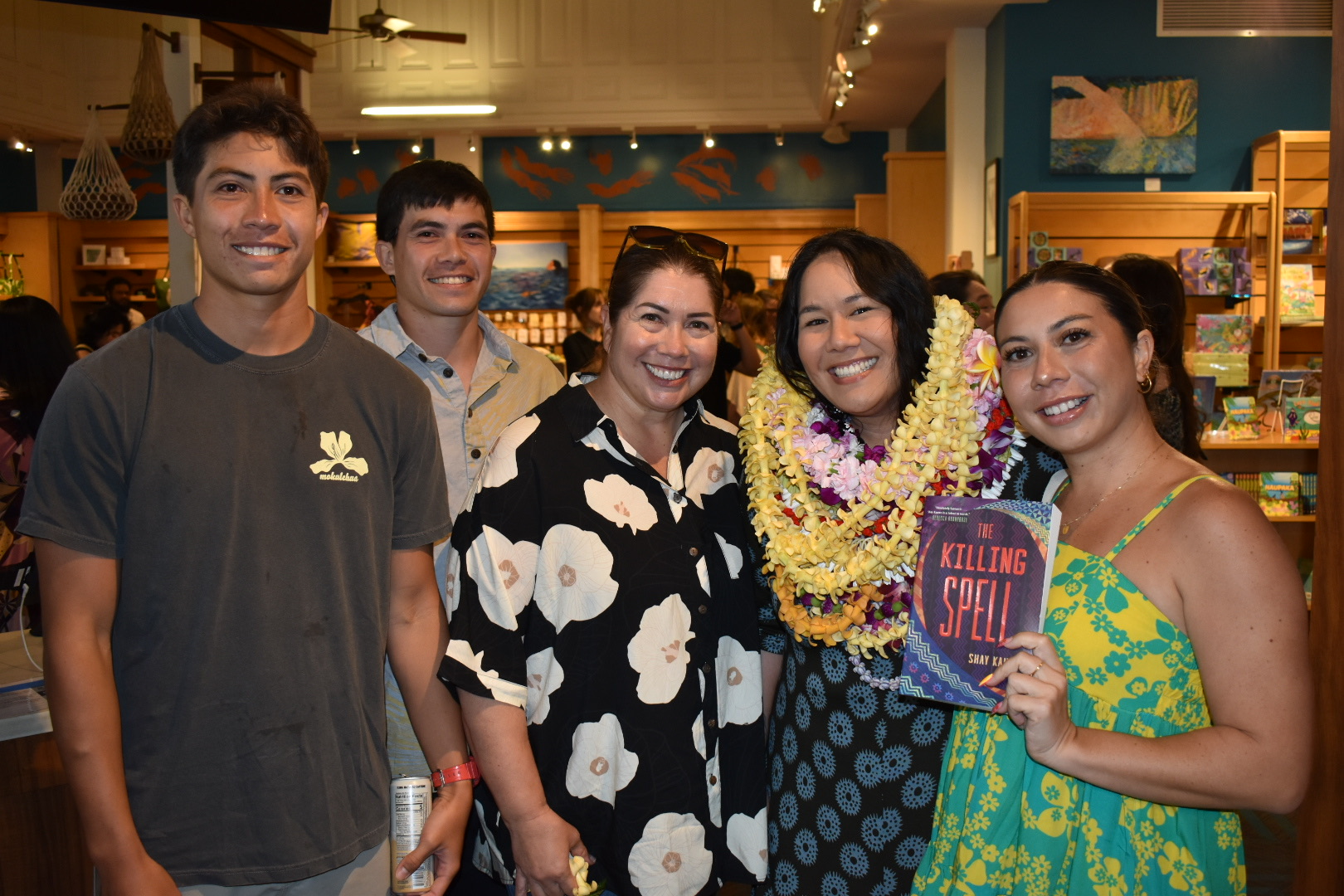
The author (second from right) with book launch event attendees. | Photo courtesy of Shay Kauwe / The Killing Spell
Instead of setting The Killing Spell in her native Hawai‘i, her book takes place in L.A. and the reason is twofold. “One, it was a nod at the reality of diaspora Hawaiians, who have in my lifetime become the majority which has been a wild shift to witness,” explains Kauwe. “Secondly, Hawaiʻi can often feel really isolated from the larger politics of the U.S. This book is a conversation about indigenous rights to land, water, language, and culture, and I wanted those conflicts rubbing right up against the policies of the U.S. rather than separated by an ocean.”
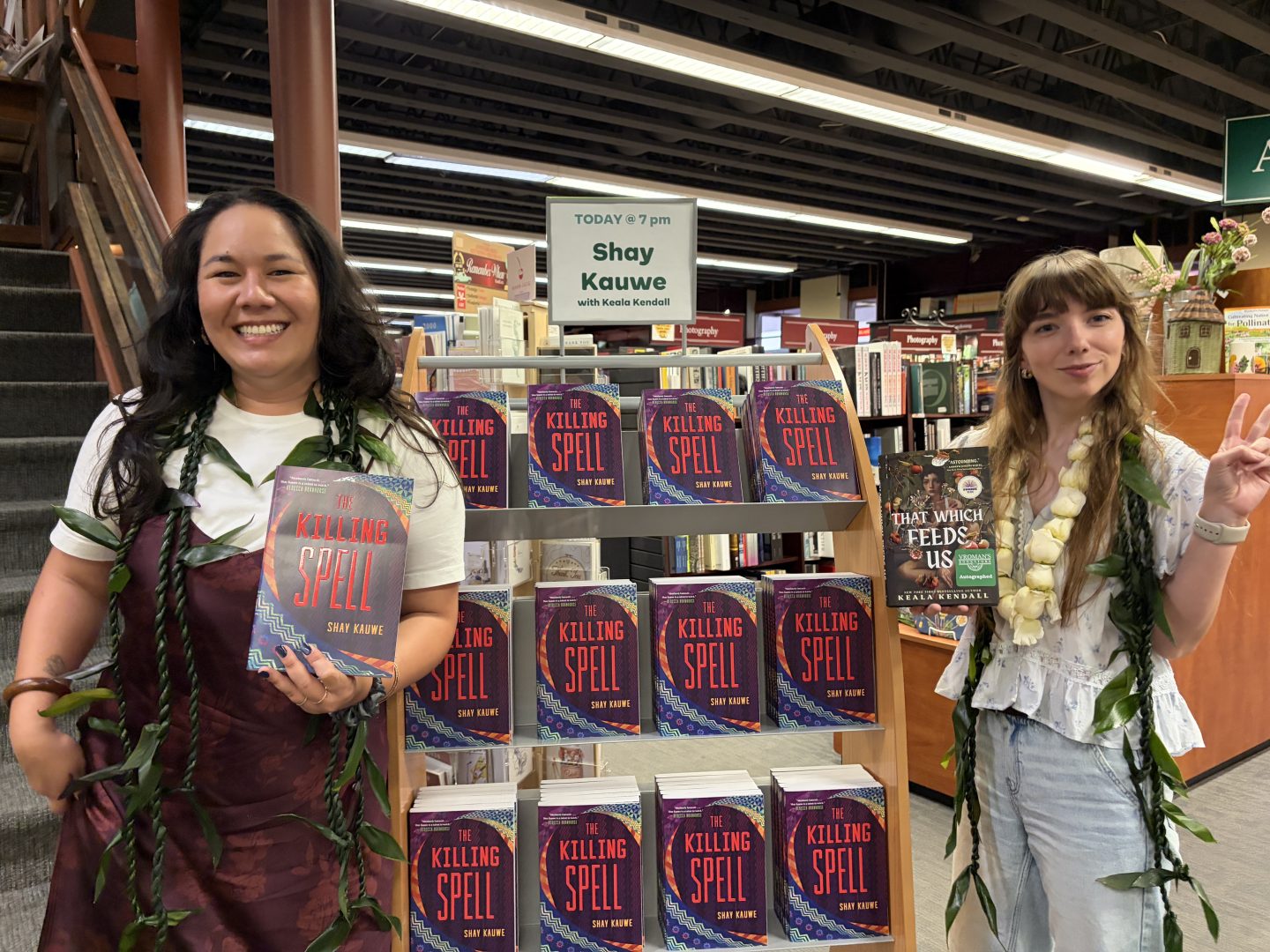
Promoting a book could be exhausting, but it most often proves to be a gratifying endeavor for authors. The Killing Spell’s publicity tour, which was split into two sections, was certainly more of the latter. It commenced with a book launch at the Bishop Museum’s book shop – Shop Pacifica run by the Hawaiian Council – in Honolulu. Kauwe’s conversation partner at the event was Megan Kamalei Kakimoto, the USA Today bestselling Hawaiian author of Every Drop a Man’s Nightmare and a 2026 National Book Foundation 5 Under 35 Honoree. She then embarked on a tour through the Hawaiian islands: Kahului, Maui; Līhuʻe, Kauaʻi; and Hilo, on the Big Island.
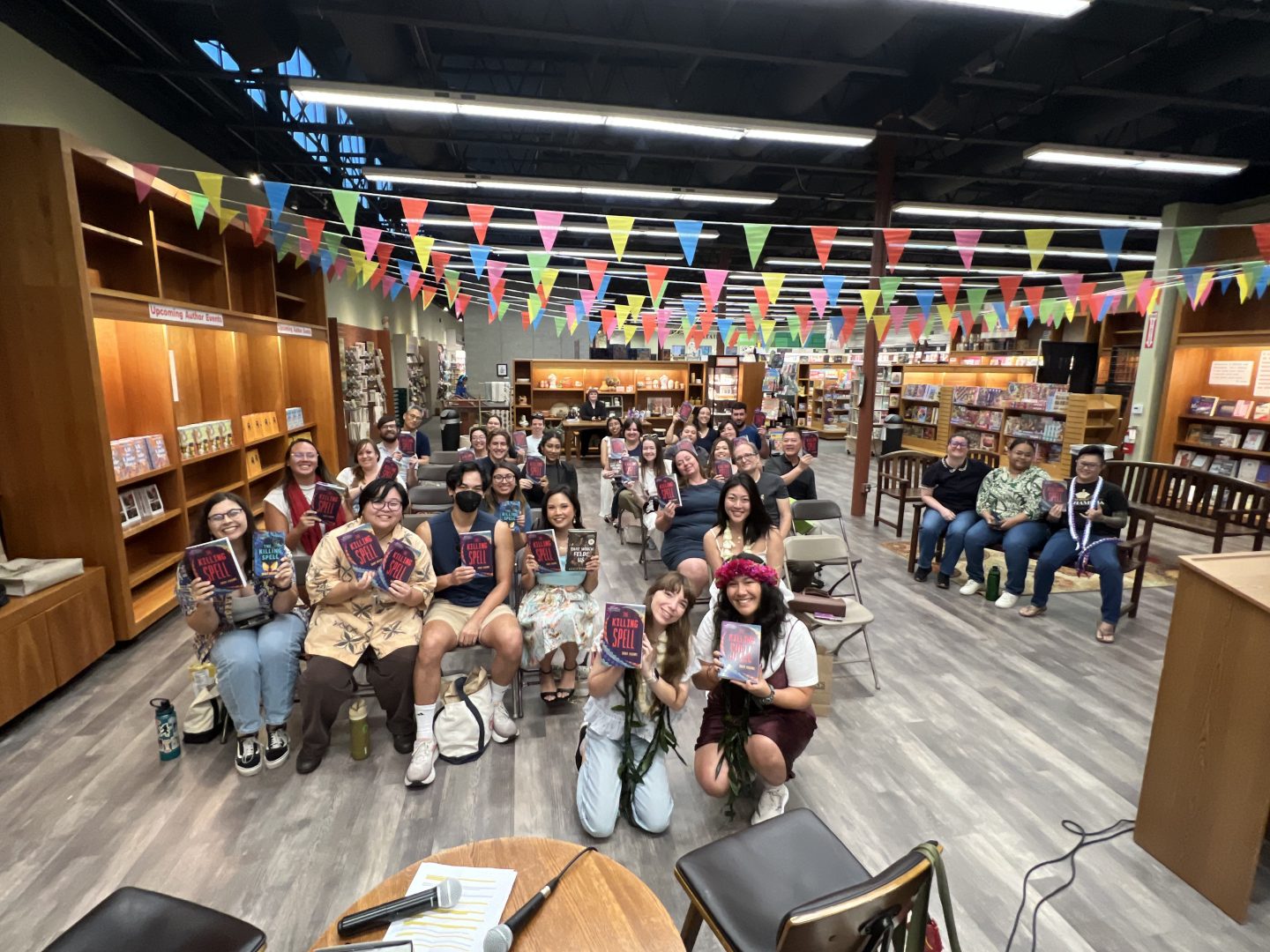
The Killing Spell’s book singing event at Vroman’s Bookstore in Pasadena. | Photo courtesy of Shay Kauwe / The Killing Spell
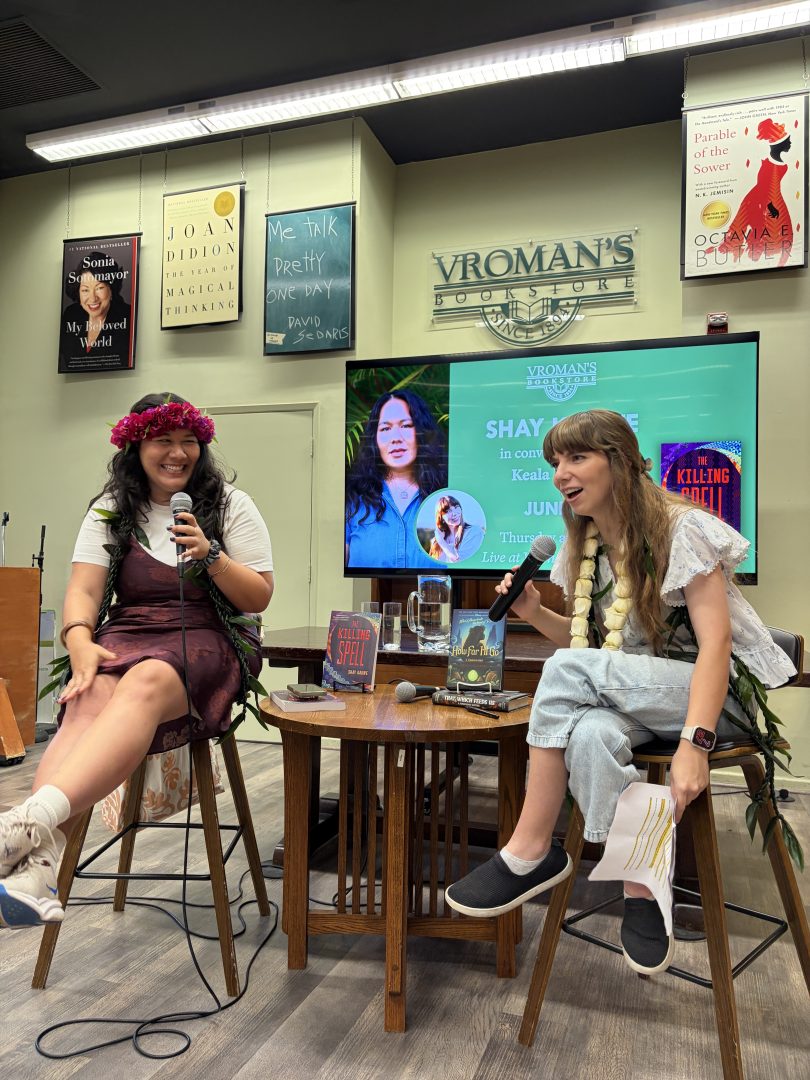
The second leg of the tour took Kauwe through prominent West Coast cities. The first stop was Los Angeles, California, and a book signing was held at Vroman’s Bookstore in Pasadena. Her conversation partner was NYT Bestselling Hawaiian author Keala Kendall of How Far I’ll Go: A Twisted Tale, and of the YA horror, That Which Feeds Us. From here she went to Seattle, Washington; and Portland, Oregon.
“My audience has been a lot of diaspora Hawaiians and Pacific Islanders, which is amazing since that’s exactly my target demographic,” Kauwe marvels. “It’s hard to pick which city has been the most enthusiastic audience because each stop has exceeded my wildest expectations in terms of turnout! I don’t know that many people personally from each city, so it’s been so cool to meet so many folks excited to read The Killing Spell. My most memorable event, though, has got to be heading out to Los Angeles! L.A. is the city that The Killing Spell takes place in, so there’s something super special about getting to do an event here.”
The author at the Vroman’s Bookstore event with conversation partner Keala Kendall. | Photo courtesy of Shea Kauwe / The Killing Spell
An important part of the book tour is the Q & A session, which was a revealing experience. “The most unexpected question that I got during book signings was what magical properties Hawaiian Pidgin would have as language!” discloses Kauwe. “And the truth is that I never really settled on a great answer to that. I’d love to know what features speakers of Pidgin think it should have.”
Kauwe was asked several interesting questions but one particular query was never brought up. “I wish people would ask more questions about Kea’s love interest, Sora,” she discloses. “I love my little red-eyed, grouchy man and think he’s such a fun character to have in the story.”
Asked if seeing the story end after ‘living’ with these characters for five years was a happy or bittersweet moment for her, Kauwe replies. “It’s definitely bittersweet to have this story end! I’d love to continue Kea’s story and dive deeper in the world of The Killing Spell and explore different languages like Russian and Japanese in more depth, as well as Sora’s family.”
The Killing Spell book display at Vroman’s Bookstore. | Photo courtesy of Shay Kauwe / The Killing Spell
As to The Killing Spell’s message or reader takeaway, Kauwe says, “It’s so important to learn our mother tongues, but we have to be kind to ourselves in the process. No one is perfect from the get-go, and quitting is the only way to truly fail at it.”
Readers who really liked The Killing Spell will be glad to know that Kauwe has something in store for them. “I have a book coming out next year which is totally separate from The Killing Spell. House of Salt will be my first foray into the horror genre. It’s a modern gothic set in Hawai’i, about a young Hawaiian woman who scams tourists out of their money by pretending to be a kahuna and ‘cleansing’ them of evil, but when she’s invited to the estate of a wealthy hotel heiress she discovers that the ghost lurking there may actually be real – and the only thing that might save them all is a real kahuna. I’m really excited for this book and can’t wait to have it out in the world!”
If The Killing Spell is any indication, Kauwe’s next book promises to be another page-turner. It’s hard to imagine now that this is the same practical kid who never thought writing and publishing a book would be something she’d accomplish in her lifetime.
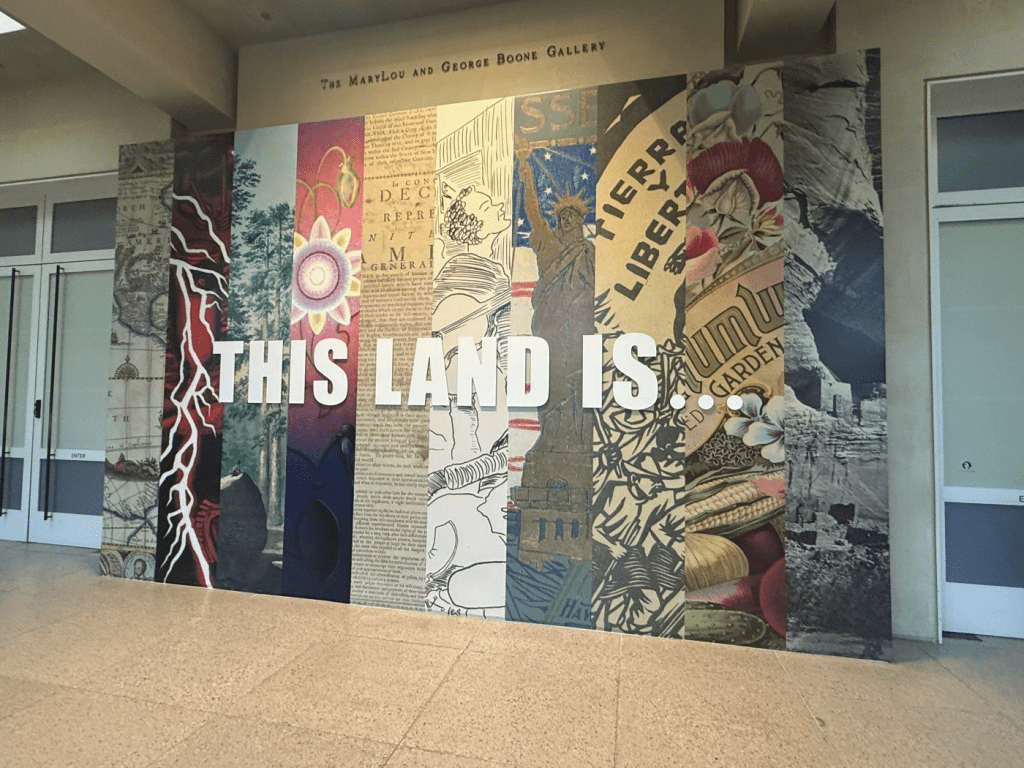
The “THIS LAND IS…” installation at the MaryLou and George Boone Gallery. | Photo by May S. Ruiz / Hey SoCal
A sweeping exhibition commemorating the 250th anniversary of the U.S. Declaration of Independence is now open at The Huntington. Called “THIS LAND IS …. Reflections for America at 250,” the show is on view from June 14 through Jan. 11, 2027 at the MaryLou and George Boone Gallery.
Co-curated by Josh Garrett-Davis (H. Russell Smith Foundation Curator of Western American History), Linde Lehtinen (Philip D. Nathanson Senior Curator of Photography), and Armando Pulido (assistant curator for special projects), the retrospective’s title was inspired by Woody Guthrie’s song “This Land is Your Land.”
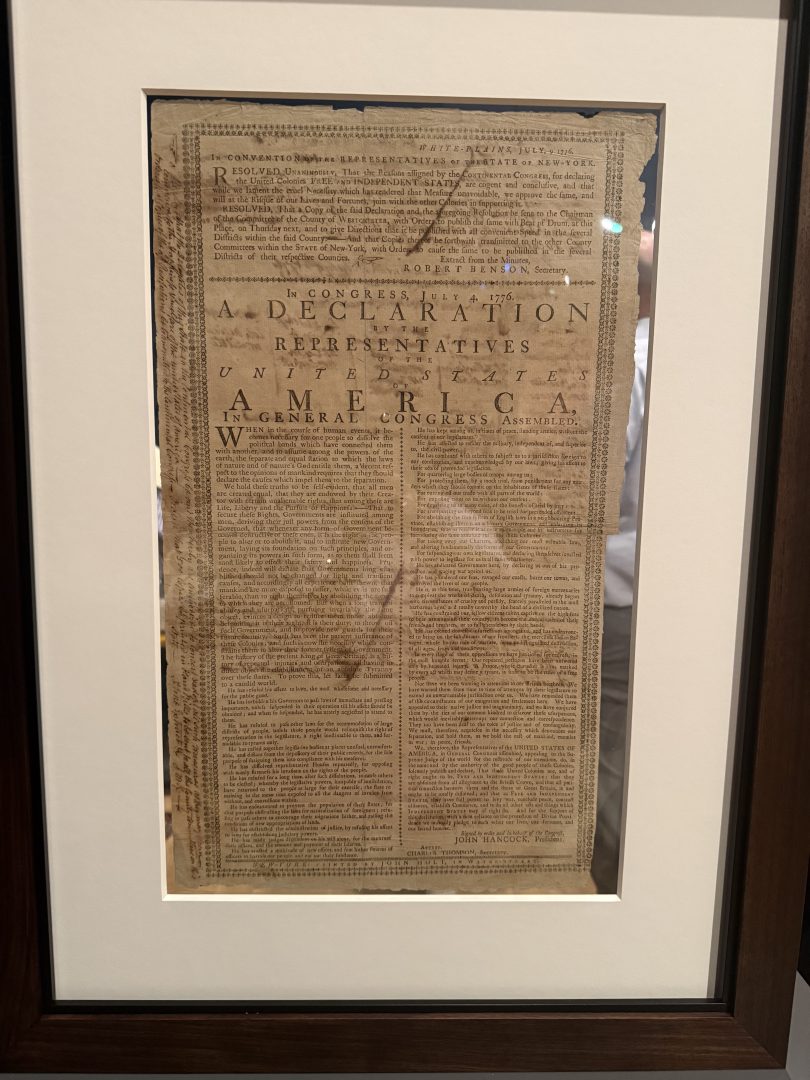
A copy of the Declaration of Independence. | Photo by May S. Ruiz / Hey SoCal
The exhibition comprises six thematic sections that link ecological concepts to cultural and historical meanings: Roots; Uprootings; Amendments; Edge Effects; Disturbances; and Regeneration. Among numerous displays, it showcases two annotated July 1776 copies of the Declaration of Independence, an inscribed Woody Guthrie guitar, historic documents including early Native American treaties and a Congressional resolution to pass the 13th Amendment, a manuscript by poet Walt Whitman, and contemporary photography by artist Cara Romero.
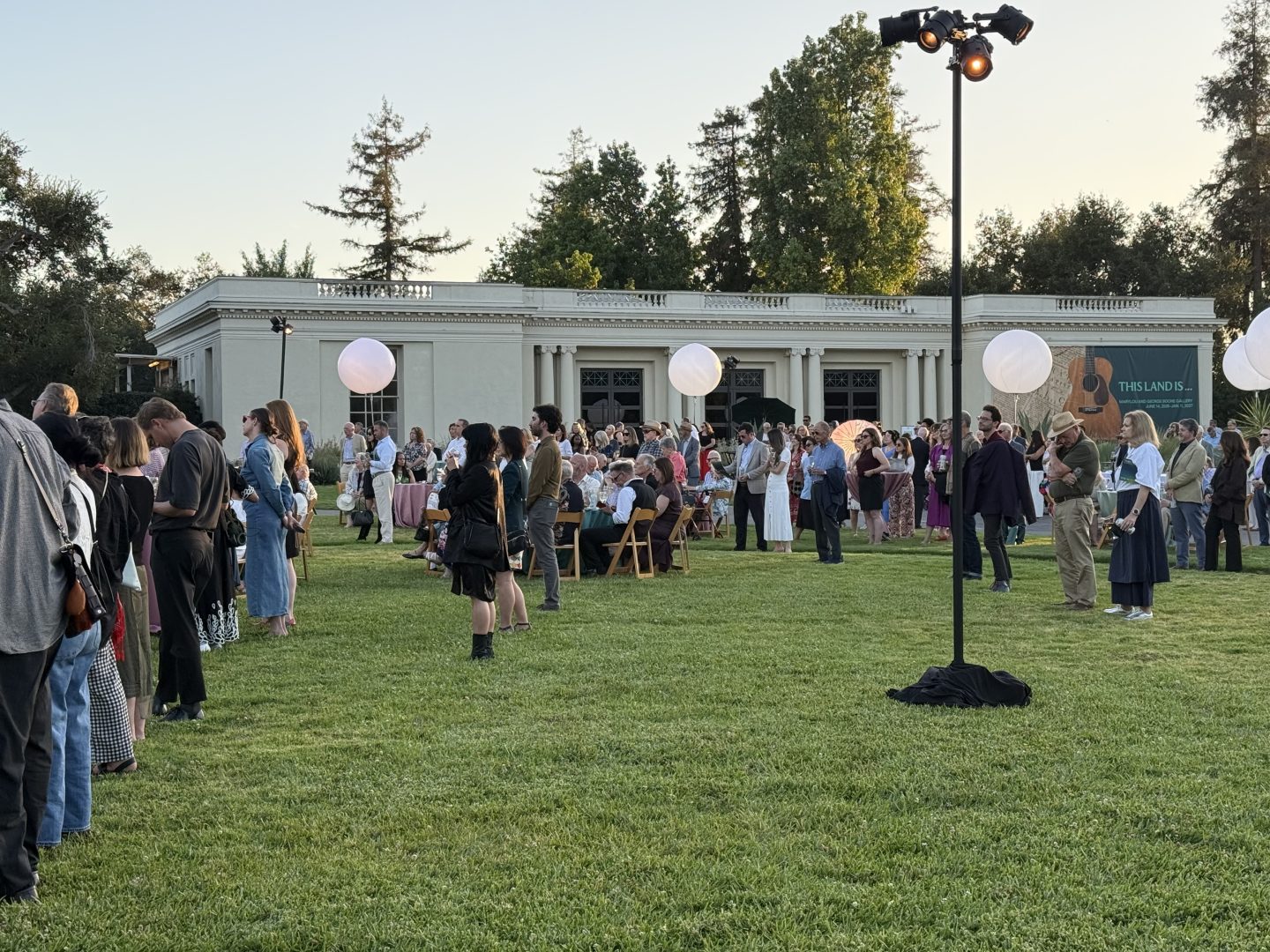
During the opening celebration and reception held on June 11 for the Society of Fellows, Avery Director of the Library Sandra Brooke Gordon remarked, “It should be no surprise that The Huntington would take to heart this essential American anniversary in 2026 just as it did a century ago. In March of 1927, only two months before Henry Huntington’s untimely death, because of the interest aroused for the 150th anniversary of the Declaration of Independence in 1926, the Library utilized the brand-new exhibition cases in its Main Hall to mount an exhibition of books and manuscripts relating to the history of the United States – from the discovery of America to the adoption of the Constitution.
Avery Director of Library Sandra Brooke Gordon. | Photo by May S. Ruiz / Hey SoCal
“The Library’s ‘America at 150’ show proved so popular that over 5,000 visitors were admitted to see it between March and December of 1927. A century later, the magnificent show that we’re celebrating tonight anchors a larger cross-Huntington ‘This Land Is …’ initiative that invites visitors to reflect on the American story from before 1776 to the present through the lens of the land.”
According to Gordon, the ‘This Land Is …’ initiative includes art museum installations, a new Oak Meadow Garden, and programs and events for a wide-range of audiences – including an all-day community festival which will be held Sunday, June 28. A companion volume ‘This Land Is … Field Notes on American Ground,’ edited by Josh Garrett-Davis and Linde Lehtinen, features essays from Huntington contributors and multiple other writers, scholars, and artists, reflecting on the theme of the land and our relationship to it.
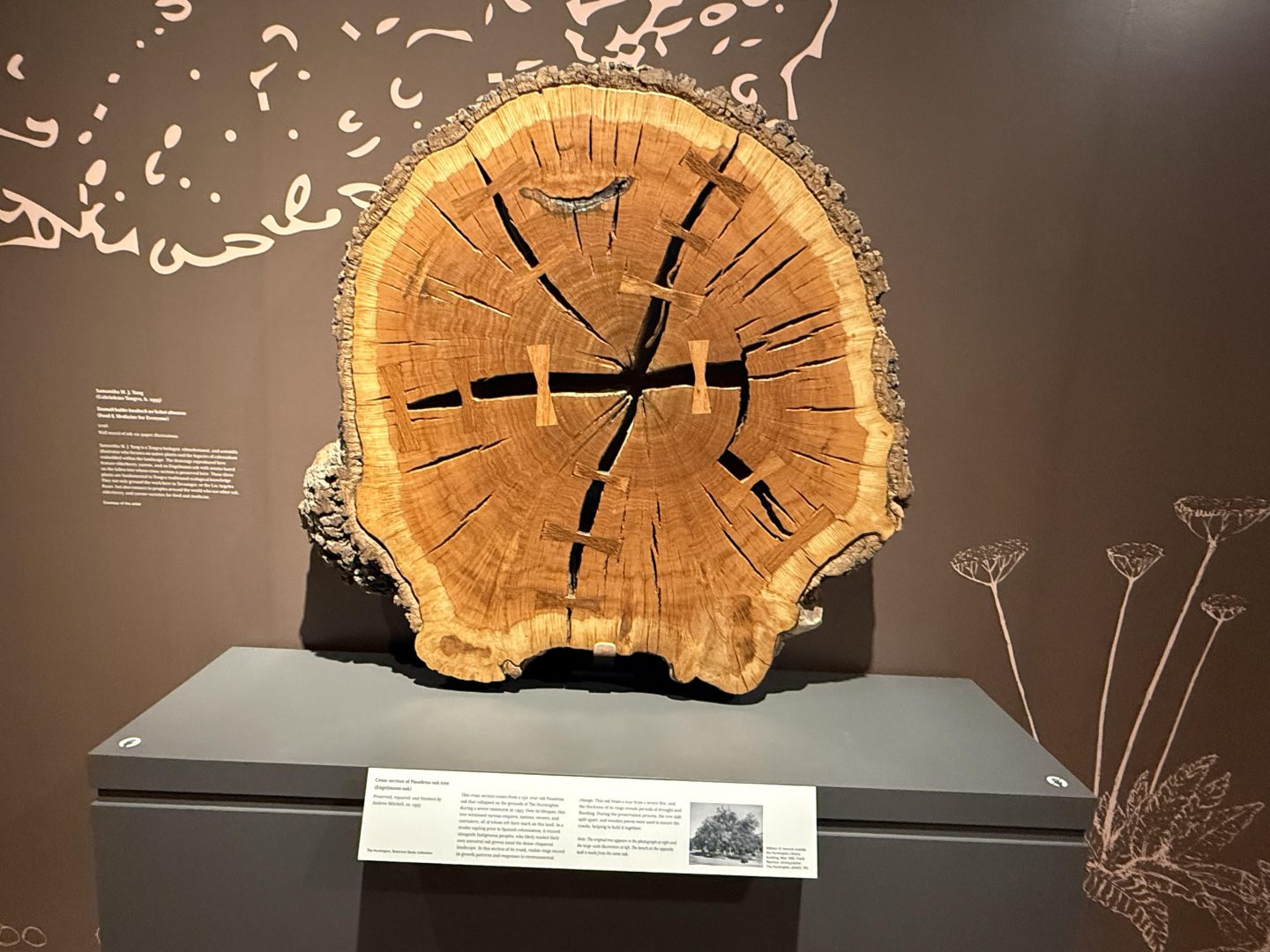
A cross-section of Pasadena oak tree. | Photo by May S. Ruiz / Hey SoCal
In addition to the Boone Gallery show, the “This Land Is …” initiative, the Art Museum (under the guidance of Hannah and Russell Kully Director Christina Nielsen) mounted a major reinstallation of its American galleries creating seven new areas dedicated to art of the Colonial Period through the Civil War and Reconstruction eras. These reimagined spaces examine issues of land, history, and identity within a global context. Recent acquisitions of works by Winslow Homer, Grafton Tyler Brown, Edward Mitchell Bannister, Argostino Brunias, Jean-Baptiste Carpeaux, and Nari Ward, along with historic documents such as a signed copy of the Emancipation Proclamation enhance the collection.
Also on view in the ‘Borderlands’ exhibition at the Virginia Steele Scott Galleries, are three new installations devoted to historic silhouettes by L.A. Laura Aguilar (1959-2018), Sandy Rodriguez (b.1975), and Mercedes Dorame (B. 1980).
Continued Gordon, “The Botanical Gardens, under the leadership of Telleen/Jorgensen Director Nicole Cavender, have created an Oak Meadow as their contribution to ‘This Land Is …’ It is a renovated garden space that helps connect the galleries at the heart of the campus with the outdoors while orienting us to the foothills of the San Gabriel Mountains and connecting us to the people who came before us.”
Guests at the Oak Meadow with the Virginia Steele Scott Galleries of American Art in the background. | Photo by May S. Ruiz / Hey SoCal
“More than 5,000 plants representing over 55 species – most of them native to California – have been planted here along with 22 trees, including 16 oak species. Oaks, of course, are America’s national tree and they anchor this cherished space at The Huntington visually, culturally, and environmentally,” added Gordon as she invited guests to look at the mountainscape behind us. “I think it is one of the most beautiful views in America.”
“‘This Land Is …’ the Boone Gallery exhibition is the Library’s prime offering for America at 250,” said Gordon. “The library is one of the nation’s chief repositories for historical Americana and is justifiably famous for its holdings of Washington, Jefferson, and others of the nation’s founders. As stewards of these collections – unparalleled West of the Mississippi – we’ve known for several years that it would be both our privilege and responsibility to share them with L.A. audiences and beyond in the year of America’s 250th birthday.
“The show has been three years in the making … and it comes at a time when America’s civic square can feel more fraught than fruitful – where the ideals of life, liberty, and the pursuit of happiness have never seemed more important that the pathways to achieving their promise as a nation isn’t always clear. The galleries of ‘This Land Is …‘ offer conversations across time and place among peoples grand and common, powerful and not. For all of them, as for all of us, land was and is a singular force central to questions of survival, identity, and belonging.
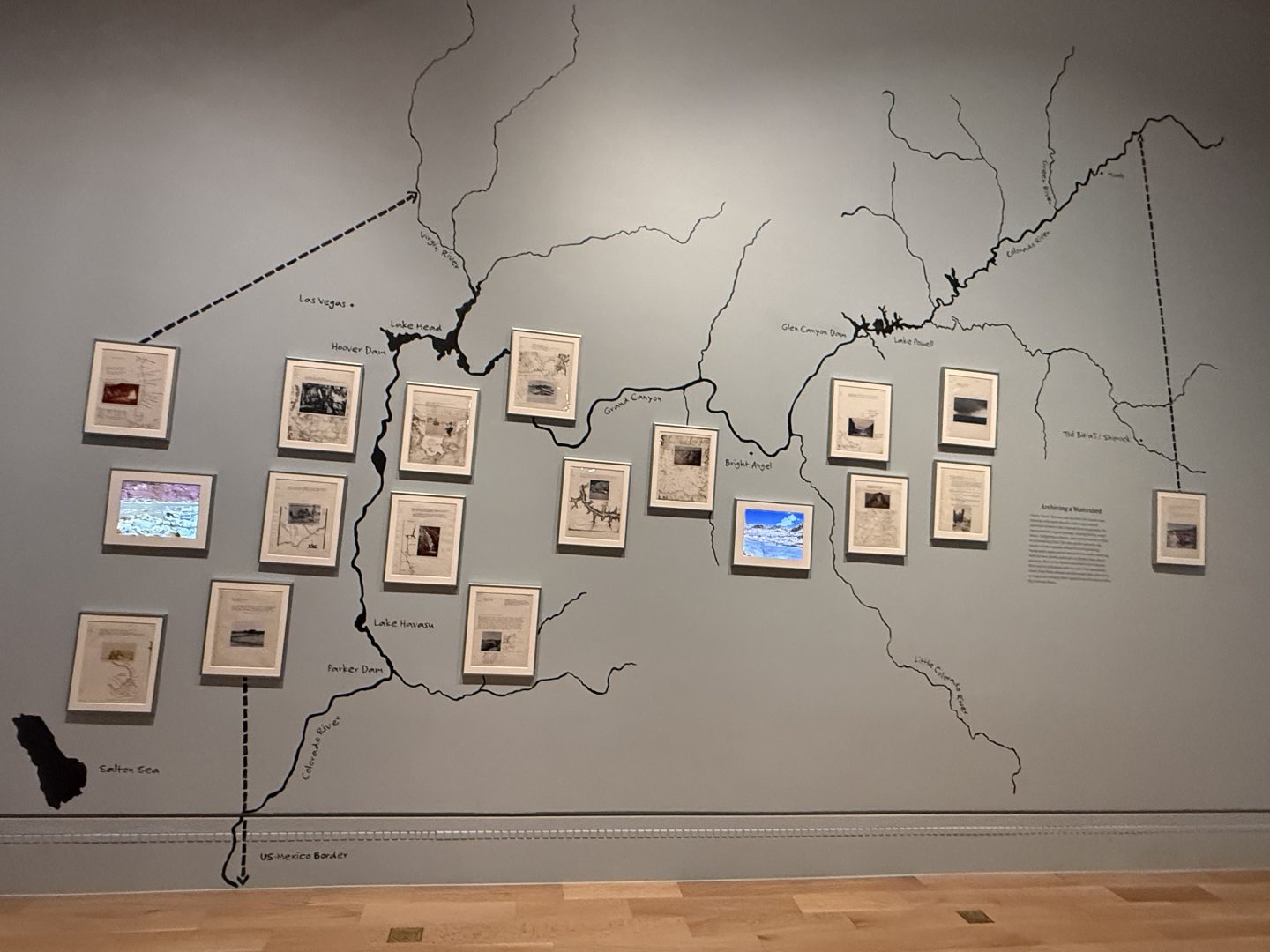
A collection of artifacts about the Colorado River from the archives of Otis Marston. | Photo by May S. Ruiz / Hey SoCal
“At a time when listening can seem in short supply, please spend some quality time in this exhibition, listen, and converse with the many people you’ll meet there – from Thomas Jefferson and Woody Guthrie, to the Kuromi family, Langston Hughes, Otis Marston, and Noni Olabisi. I can promise it will repay the investment of your time. And these conversations, I hope, will help us all think differently and more deeply about the meaning and the promise of this national anniversary,” Gordon exhorted.
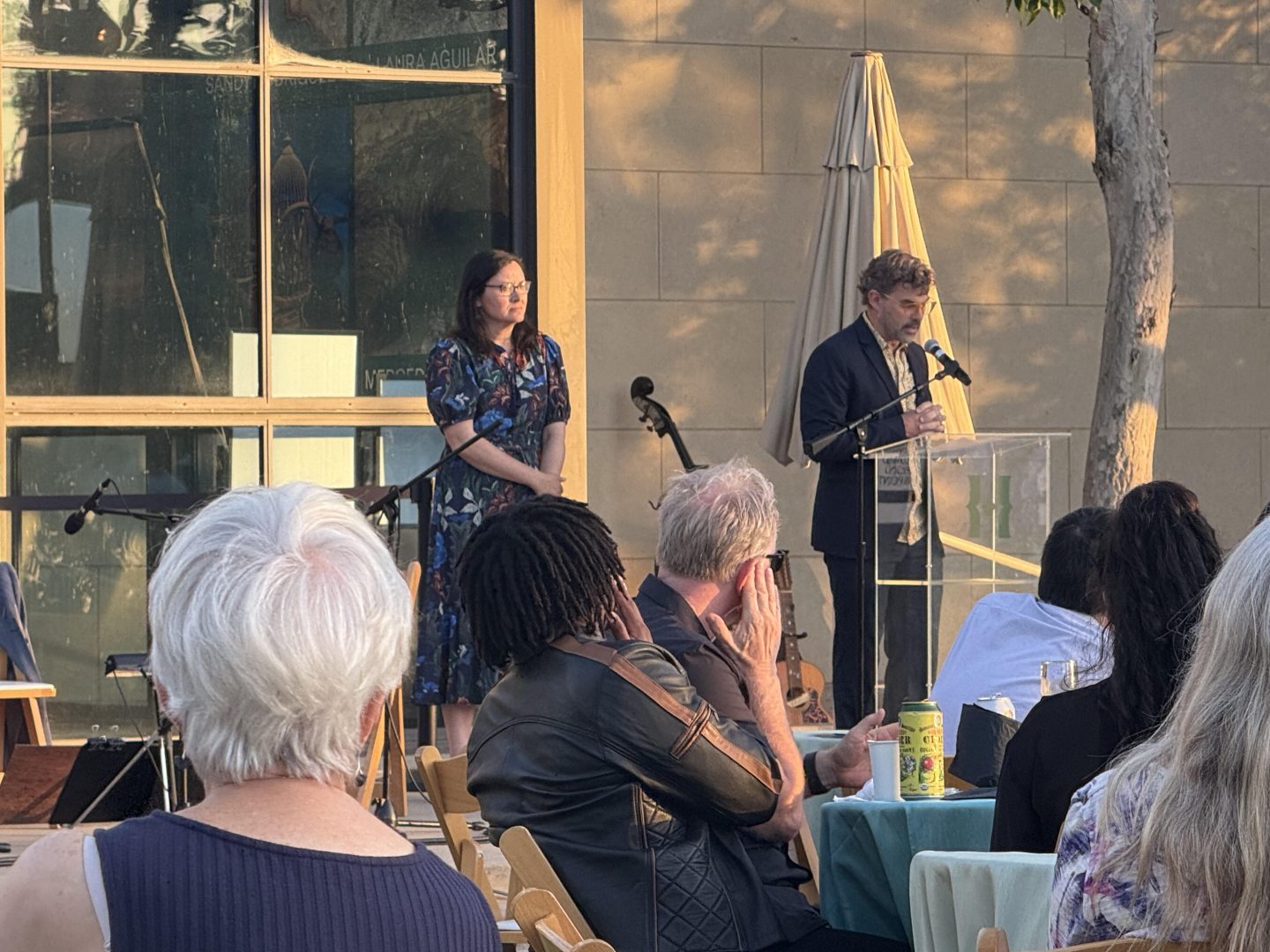
Because the exhibition is about land, Gordon acknowledged that The Huntington sits on the ancestral lands of the Gabrielino Tongva and Kizh nation peoples who continue to call this region home. She then presented the evening’s next speaker.
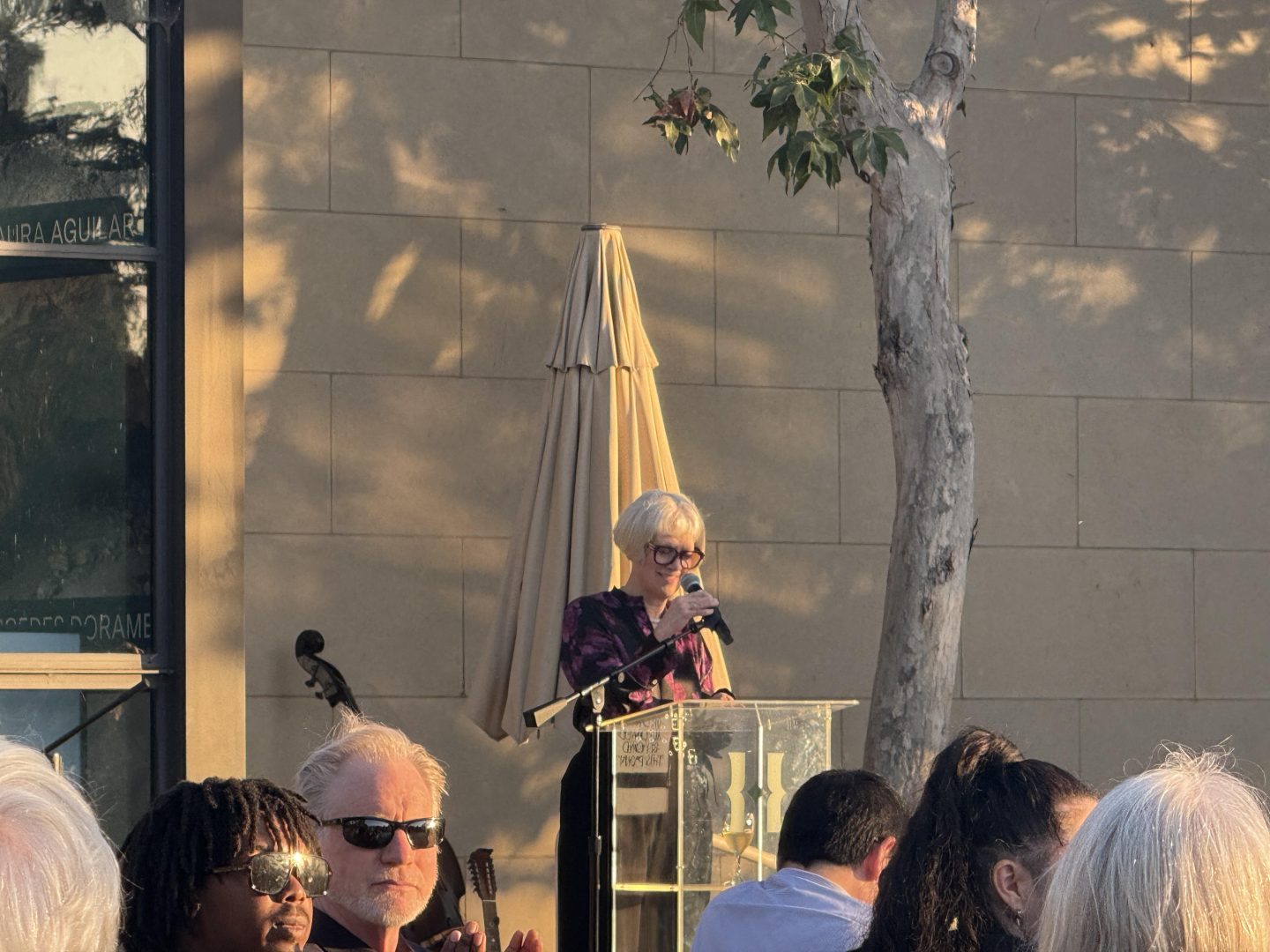
“We are privileged to have L.A.-based Tongva artist Mercedes Dorame here this evening to speak to this essential topic. Mercedes has been engaged with The Huntington for the past five years on a range of projects that integrate archival research and deep knowledge of the surrounding landscape. This has culminated in her installation ‘Deliquescence: Sites of Transformation’ that you can see in the American Art Gallery.”
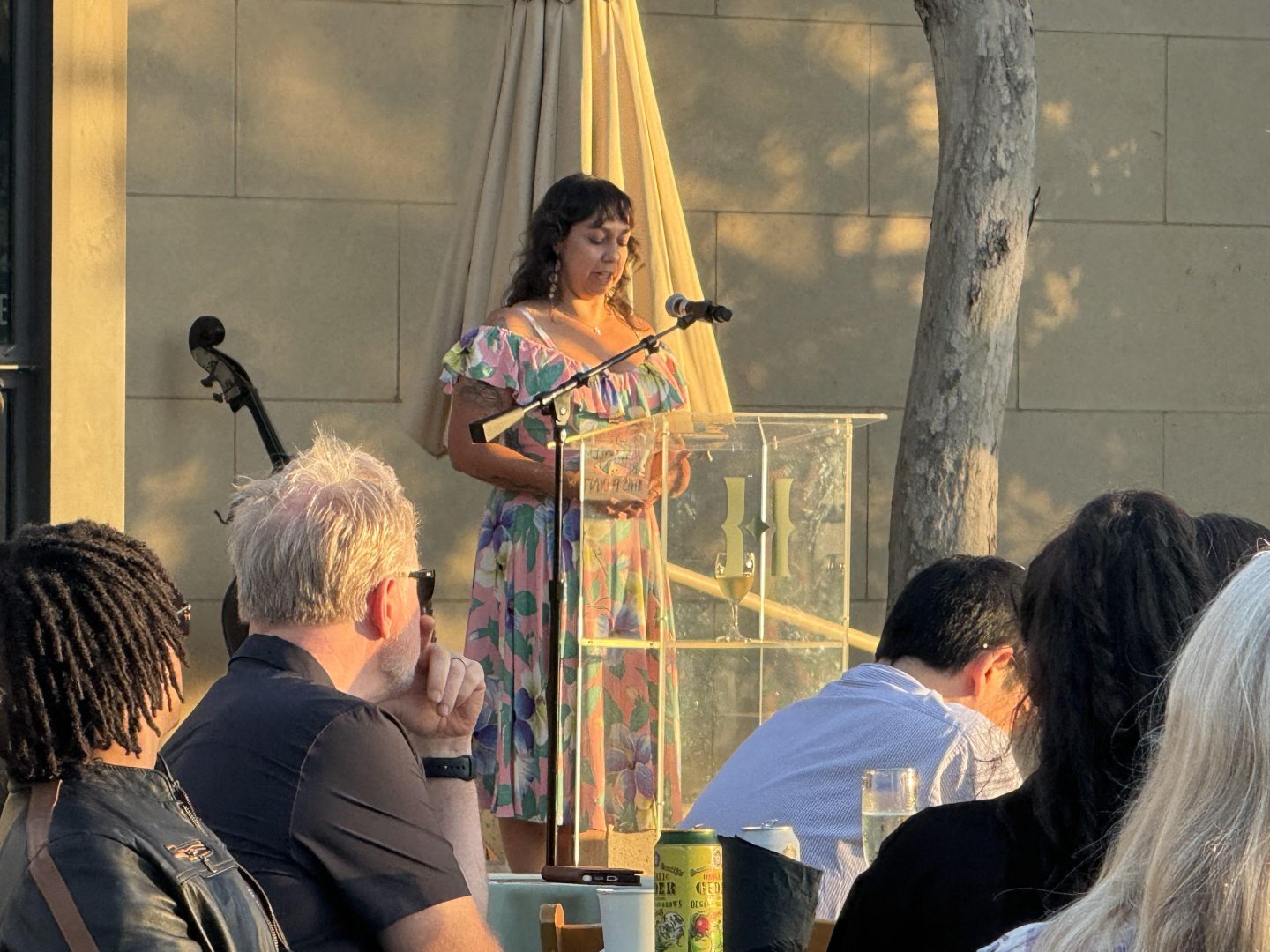
Mercedes Dorame. | Photo by May S. Ruiz / Hey SoCal
Dorame introduced herself by her Tongva name and the village where her ancestors hailed, then said, “In thinking about ideas of land and the exhibitions connected to the ‘This Land Is…’ and the 250th birthday of the United States, I moved into ideas of the land intersecting ancient time, deep time, and time immemorial. When for thousands of years my Tongva ancestors cared for this land, it is an honor and a pleasure to be standing here today in acknowledgement of this presence. The land nourishes us, it reciprocates, and is full of care. I always ask myself how we can mend, relearn, connect, and know the land better to build a more reciprocal relationship. I believe this question holds space for immense potential and inspiration for all of us.
“For me connecting care to the land is not about looking to the past but at the vital active present necessary exercise. It’s not metaphorical, it means feeling the bark of the oak tree, or smelling all the different amazing scents of the rose garden, or looking at the sage and thyme that bloom seasonally. As an artist and a Tongva culture-bearer, I hope to shape an experience that allows us to move to an environment with our hearts more open, more connected, and more full of love.”
George Washington (1732-1799)
Thomas Jefferson (1743-1826)
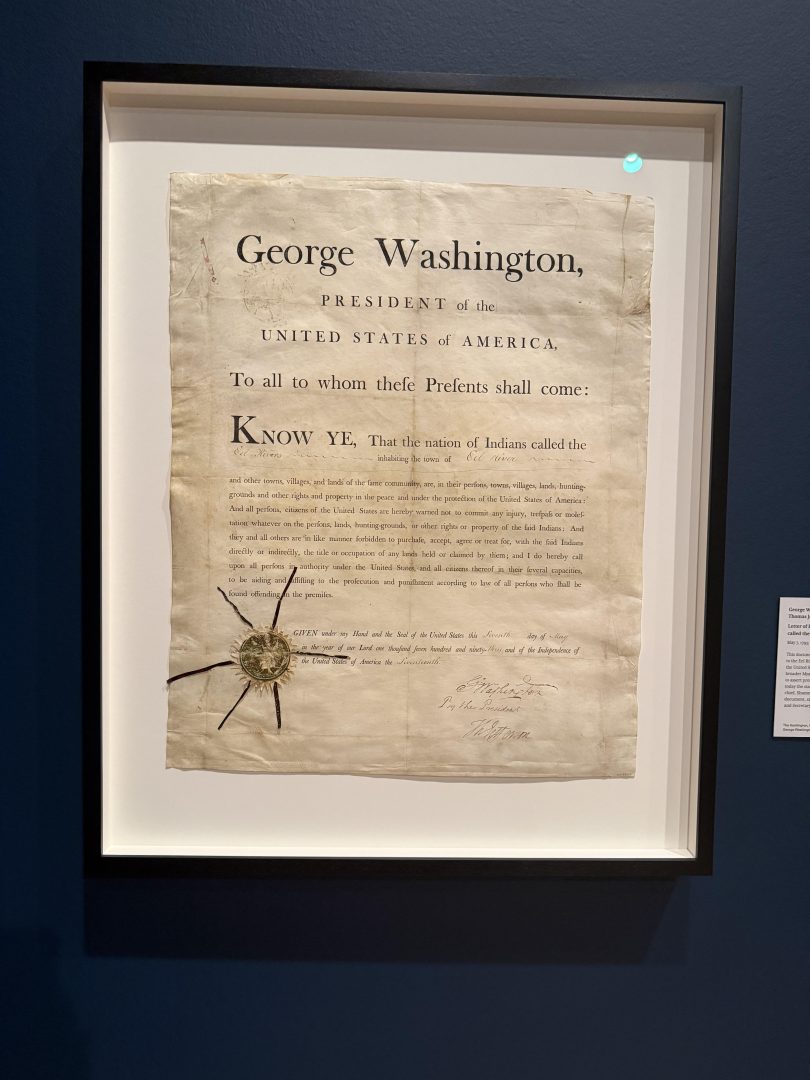
Letter of Protection to the Nation of Indians called Eel Rivers. | Photo by May S. Ruiz / Hey SoCal
Dorame sang a song which came from ancestral recordings that contain messages. She said it was her way of embodying hikaye – breath, spirit, and wind in the Tongva language. It translates to “My heart is with you, the sun is rising; my heart is with you, do not be afraid.”
Co-curators Josh Garrett-Davis and Linde Lehtinen took the stage to acknowledge the countless people who were part of this massive undertaking. He thanked Dorame for her artwork and contributions to the book and two other Tongva representatives who worked with them to learn about indigenous presence in this land – artist and illustrator Samantha MJ Yang, who created the design of the Pasadena oak tree on the title walls at the entrance to the exhibition, and Wallace Cleaves who lent a recording of the acorn song by his Tongva great-great-grandmother Narcisa Higuera – which could be heard in the living room area of the Boone Gallery.
“’This Land Is …’, among other things, calls our attention to the endless ways we all use land metaphors when we talk about history, art, and national experience,” declared Garrett-Davis. “Through conversations with our colleagues in the botanical division, especially, we settled on structuring this exhibition around six sections that link ecological and cultural themes…. (And) the process of curating the exhibition has brought us through many other land analogies. We tracked through fields of collections, we dug deep into boxes and shelves, and sometimes fell down rabbit holes into particular stories or archival objects.”
Co-curators Linde Lehtinen and Josh Garrett-Davis. | Photo by May S. Ruiz / Hey SoCal
Lehtinen continued with further acknowledgments and reflections using more land metaphors. “In our own backyard we want to thank all the incredible teams and colleagues at The Huntington who planted seeds, tended the sprouts of the exhibition, pruned out bad ideas, allowed us to cultivate the exhibition, and now hopefully watch it flourish. The project builds on the vision and the foundations established by our senior leadership, the advancement department, the president’s office, and other key stakeholders who made this possible.
“There may be many things around this particular anniversary, and indeed within this current national moment, that are seemingly thrown together and not really thought-out. That is not the case with this project. There is so much attention, precision, and passion woven into the many elements of ‘This Land Is …’ that nurtures and sustains us and shows what community and nation can be a their best.”
Gordon then came back one last time on the stage for a toast and said, “I would like to paraphrase Abraham Lincoln ‘Though passions may have strained, they must not break our bonds of affection. May the mystic cords of memory stretching over this broad land – and over this exhibition – inspire the better angels of our nature. To all of you and to this land!”
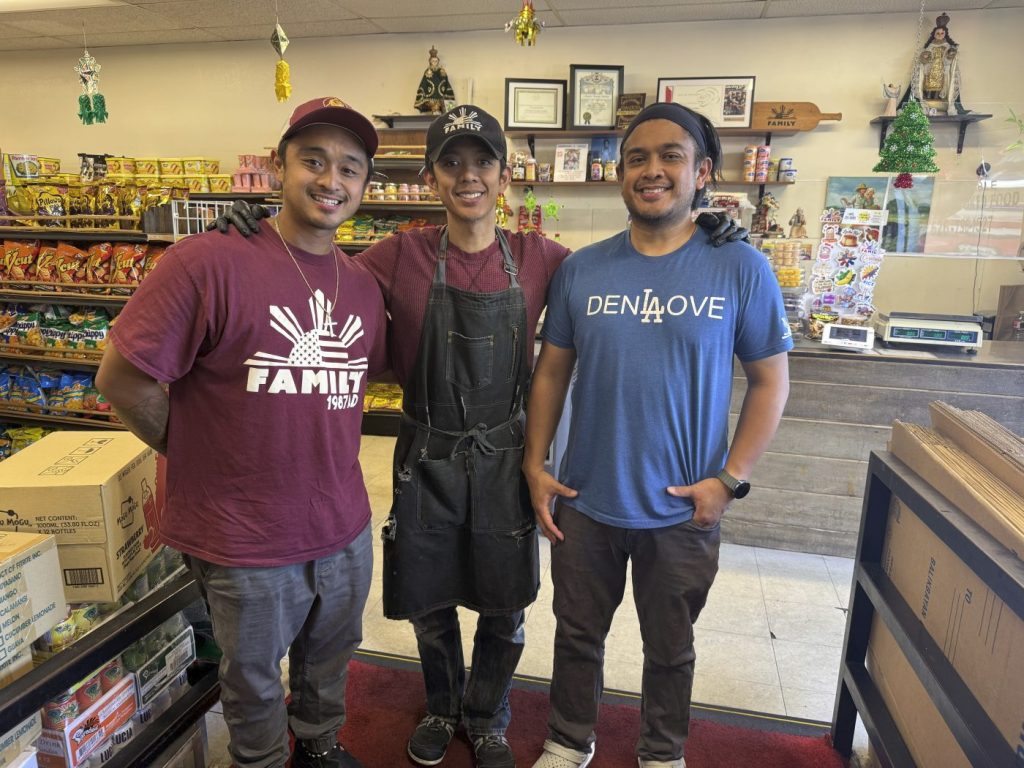
The Esteban brothers, also known as the Chaaste Brothers (from left): Gabriel, Christian, and Abraham. | Photo by May S. Ruiz / Hey SoCal
On October 5,1978, President Jimmy Carter signed a joint resolution for a week-long celebration of Asian American and Pacific Islanders’ contributions to the United States. The month of May was chosen for two historic events – on May 7, 1843, the first Japanese immigrant, Nakahama Manjirō, arrived in the United States. More than two decades later, on May 10, 1869, the golden spike was driven into the first transcontinental railroad, which was completed using Chinese labor.
In 1990, George H. W. Bush signed a bill passed by Congress to extend Asian-American Heritage Week to a month; May was officially designated as Asian/Pacific American Heritage Month two years later.
According to the U.S. Census Bureau, the AANHPI population in the U.S. is the fastest-growing racial group, with over 25 million people (nearly 8% of the total population) as of 2023. This diverse group includes around 25.8 million Asian Americans (alone or in combination) and roughly 1.6 million Native Hawaiian and Other Pacific Islander (NHPI) individuals.
There are 7 million to 7.2 million Asian Americans living in California as of 2023-2025, according to Pew Research Center. They make up approximately 18%-18.4% of the state’s total population, representing the largest Asian population in the continental United States.
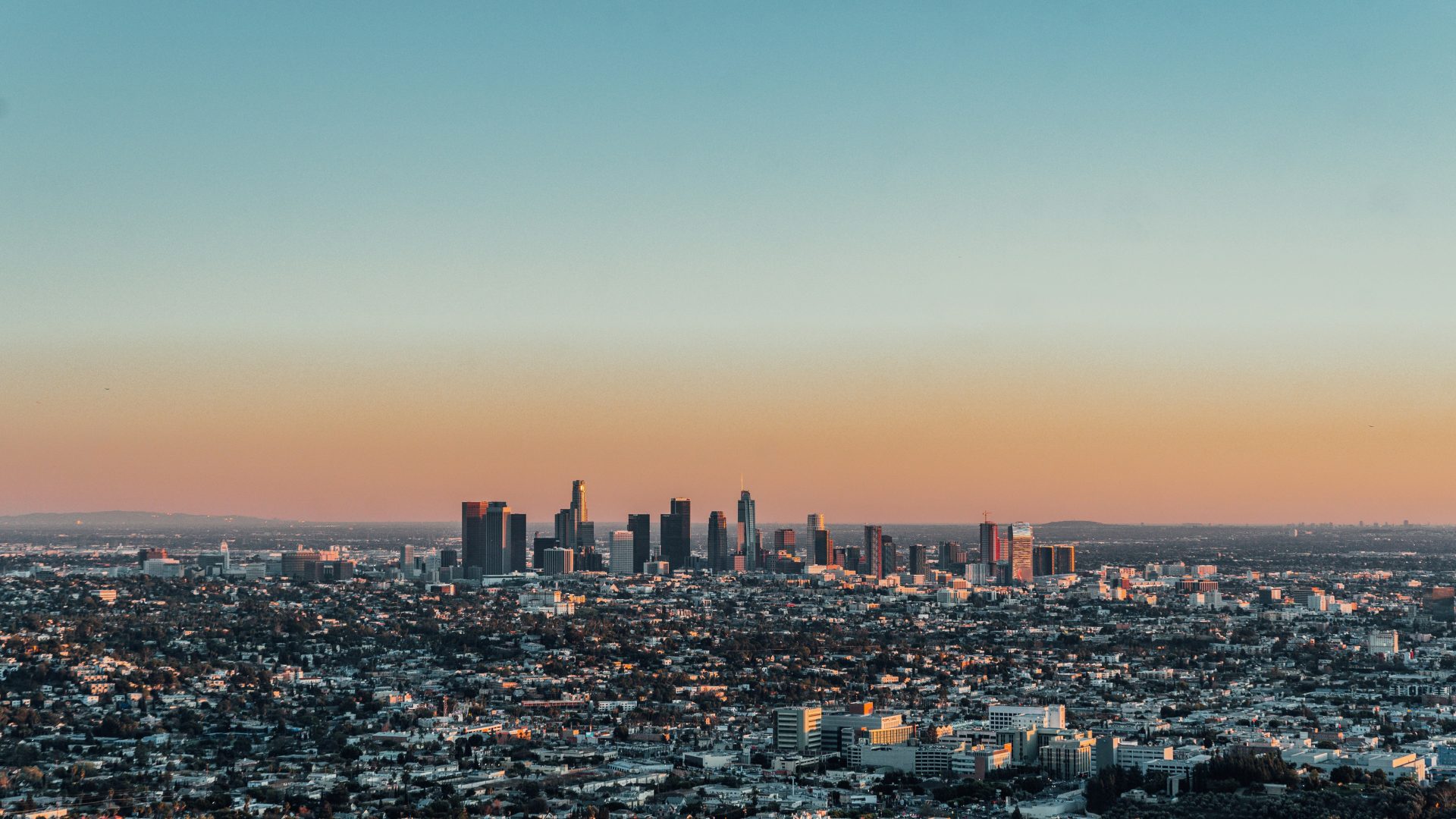
L..A. Skyline. | Photo by Josh Miller on Unsplash
Los Angeles County has the highest concentration of Filipinos in any U.S. county, often cited as the largest population outside of the Philippines. Filipinos were the earliest recorded Asian immigrants to the United States who landed on October 18, 1587 on what is now Morro Bay – a significant event that is commemorated as Filipino American History Month (FAHM). Based on Neilsberg Census estimates, L.A. county is home to approximately 416,221 Filipino residents, representing about 4.23% of county’s population as of 2025.
There is no official statistic on the Filipino population in the San Gabriel Valley and Pasadena, in particular. However, Asian Americans make up approximately 15.5% to 17.4% of the total city population according to the U.S. Census Bureau. While representing a smaller percentage of the overall city population than neighboring L.A., the Filipino community in the San Gabriel Valley is a visible and significant presence, with heavy representation in healthcare, nursing, and service industries.
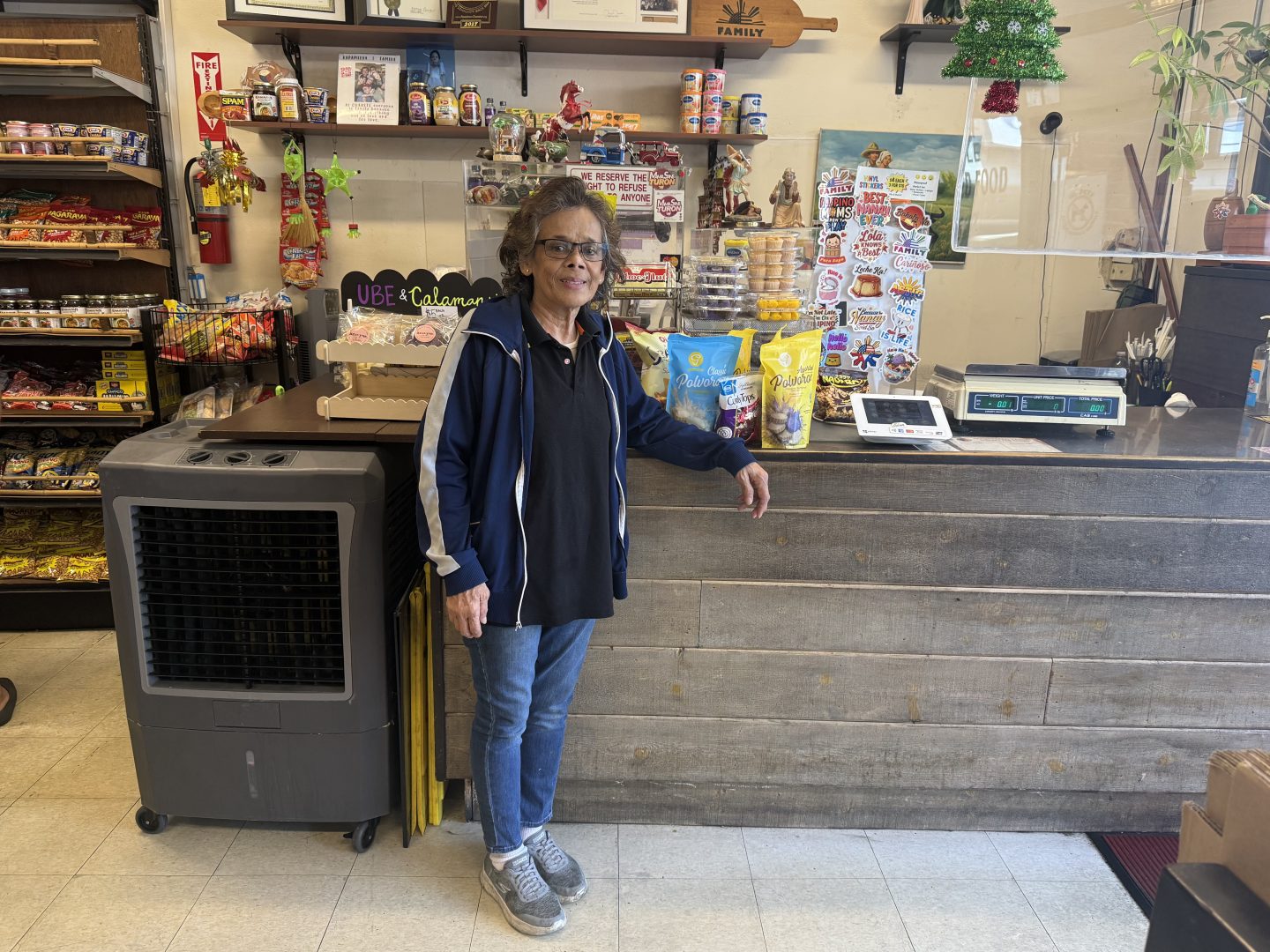
Susan Esteban, founder of Chaaste Family Market. | Photo by May S. Ruiz / Hey SoCal
Chaaste Family Market in Pasadena has been serving the Filipino community since 1987 when it was founded by Susan Esteban. Beginning in 2015, her three children – Christian, Abraham, and Gabriel – have been carrying on her legacy.
The Esteban family has deep roots in Pasadena, as Christian relates. “My grandfather was a POW in WWII when he arrived in Pasadena in 1949. He was one of the manongs (a term of respect for older brother or older male relative in the Philippine province of Ilocos) in Pasadena and was the first Asian to own a house in Loma Vista.”
“Several of our relatives were workers in Delano but they weren’t just farm pickers,” continues Christian. “They knew agriculture and planting seasons, were educated and conversant in both English and Spanish. They moved to Pasadena in the 1950s and formed one of the earliest Filipino working class communities here. They were able to acclimatize to the new place and do other jobs – they were jacks-of-all-trades and reliable employees. My uncle ‘Apo’ Ordinario, who was one of the first Filipinos born at The Huntington Hospital, worked for the Ballard family.”
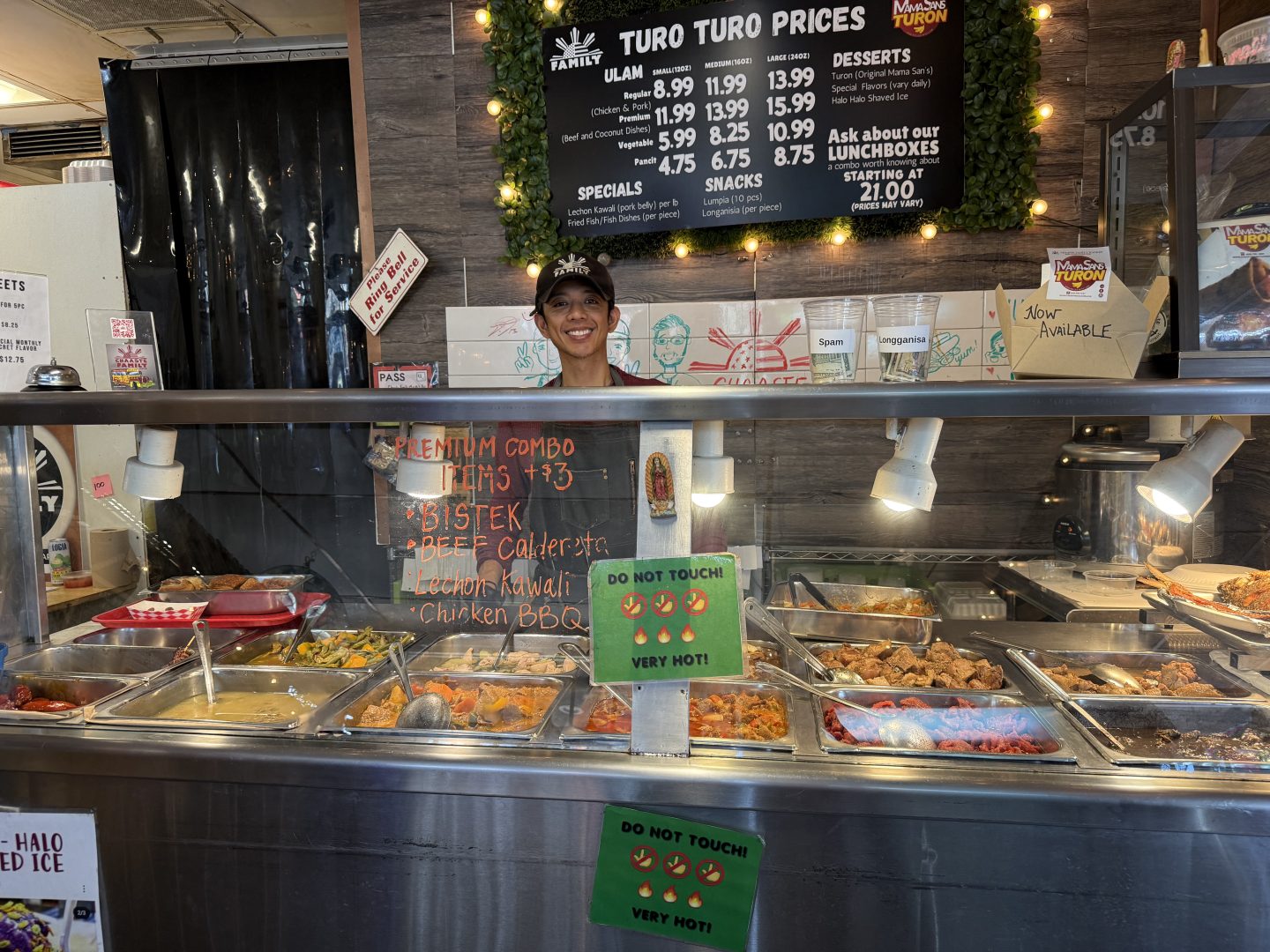
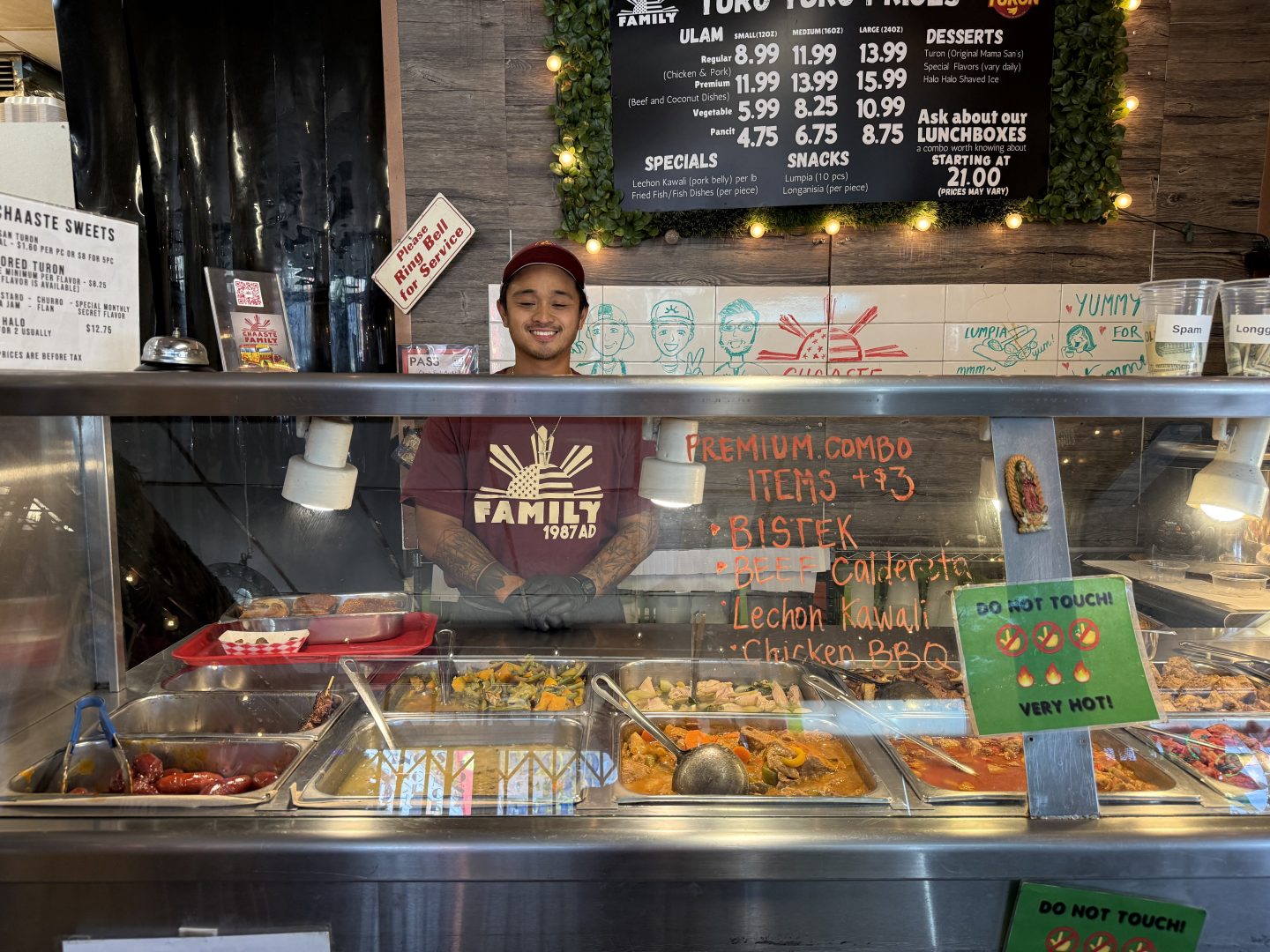
Christian Esteban and Chaaste Market’s hot food counter. | Photo by May S. Ruiz / Hey SoCal
“While my grandfather was given American citizenship by the U.S. government, his family was not,” Christian goes on to say. “He had to petition them separately and my dad, Arturo, arrived here when he was nine years old. My dad served in the Air Force and fought in Vietnam; he graduated from Cal State LA. He worked as an auditor at mostly aerospace companies – first at Lockheed, which moved to Phoenix, but he didn’t want to relocate; so he went to work for Northrop; then he was recruited by JPL, where he worked for about 25 years as senior auditor until he retired.”
Susan Torres (later Esteban) was able to immigrate to the U.S. through her uncle, who was an engineer. He was one of the Filipinos who took advantage of the 1965 Immigration and Nationality Act. She and Arturo met through mutual friends.
“My mom was a pioneering woman,” Christian claims proudly. “She was one of the first three Asians to work at Warner Brother Records. She was still employed there when she had me and when my brother was born three years later. After ten years, it became hard for her to raise two difficult boys – we were a handful. She had been entrepreneurial even at a young age, so she decided to open a store. Because Pasadena didn’t have a large Filipino population, she thought Eagle Rock would have been the ideal spot for it. But my dad insisted that it be located in Pasadena, and he prevailed.”
Chaaste Family Market opened its doors in 1987 in a nondescript corner on Allen Avenue and Corson Street, right next to the 210 freeway. The name is derived from their names – C for Christian, A for Abraham, the other A for Arturo, S for Susan, T for Torres (her maiden name) E for Esteban – and is pronounced “chaste.” Susan could have simply named it Esteban Family Market but Filipinos have a penchant for combining their first and second names like Marivic for Maria Victoria, for instance. She is also a devout Catholic so it was vital for her to practice Christian virtues and integrate them into all her endeavors.
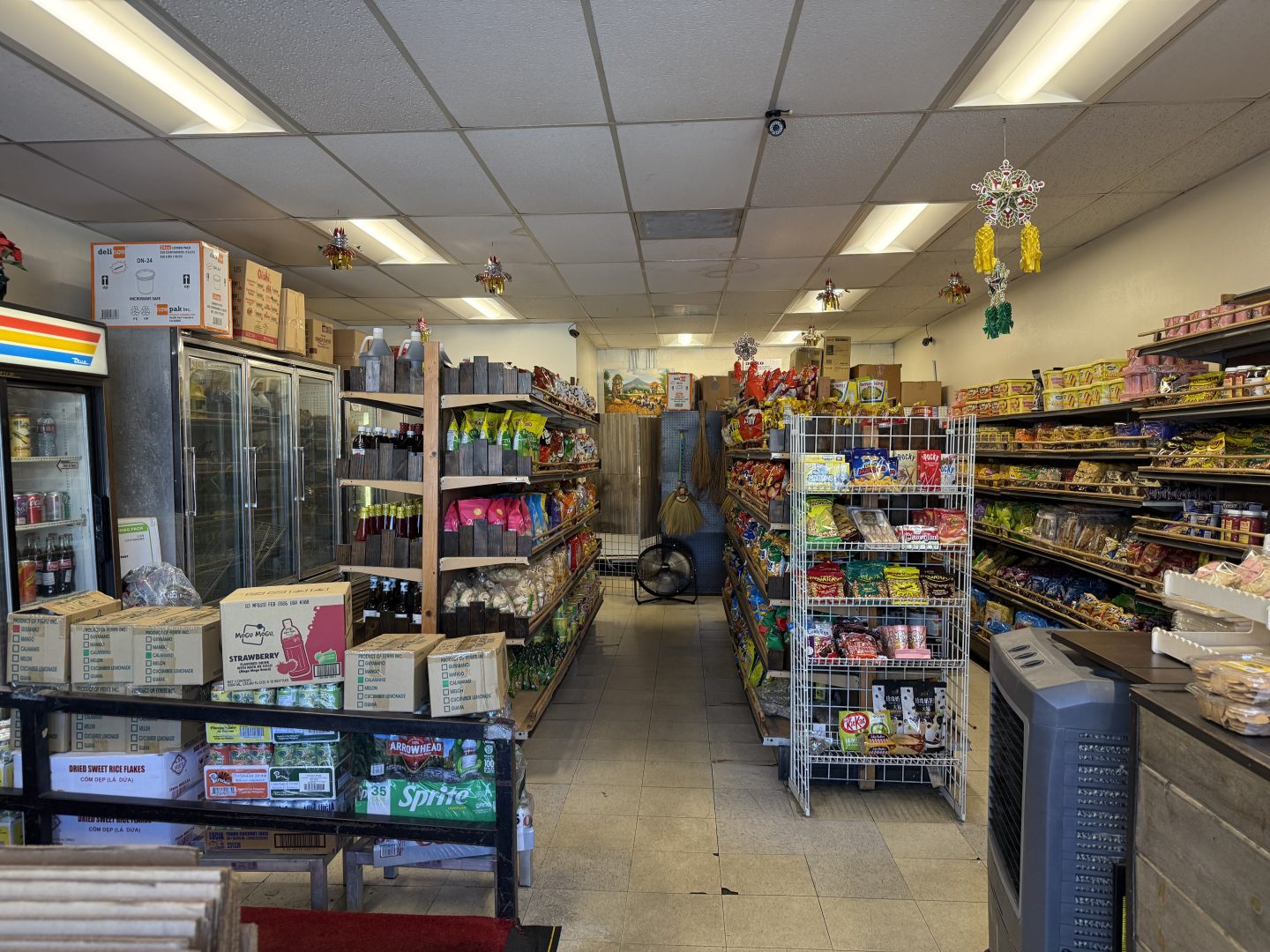
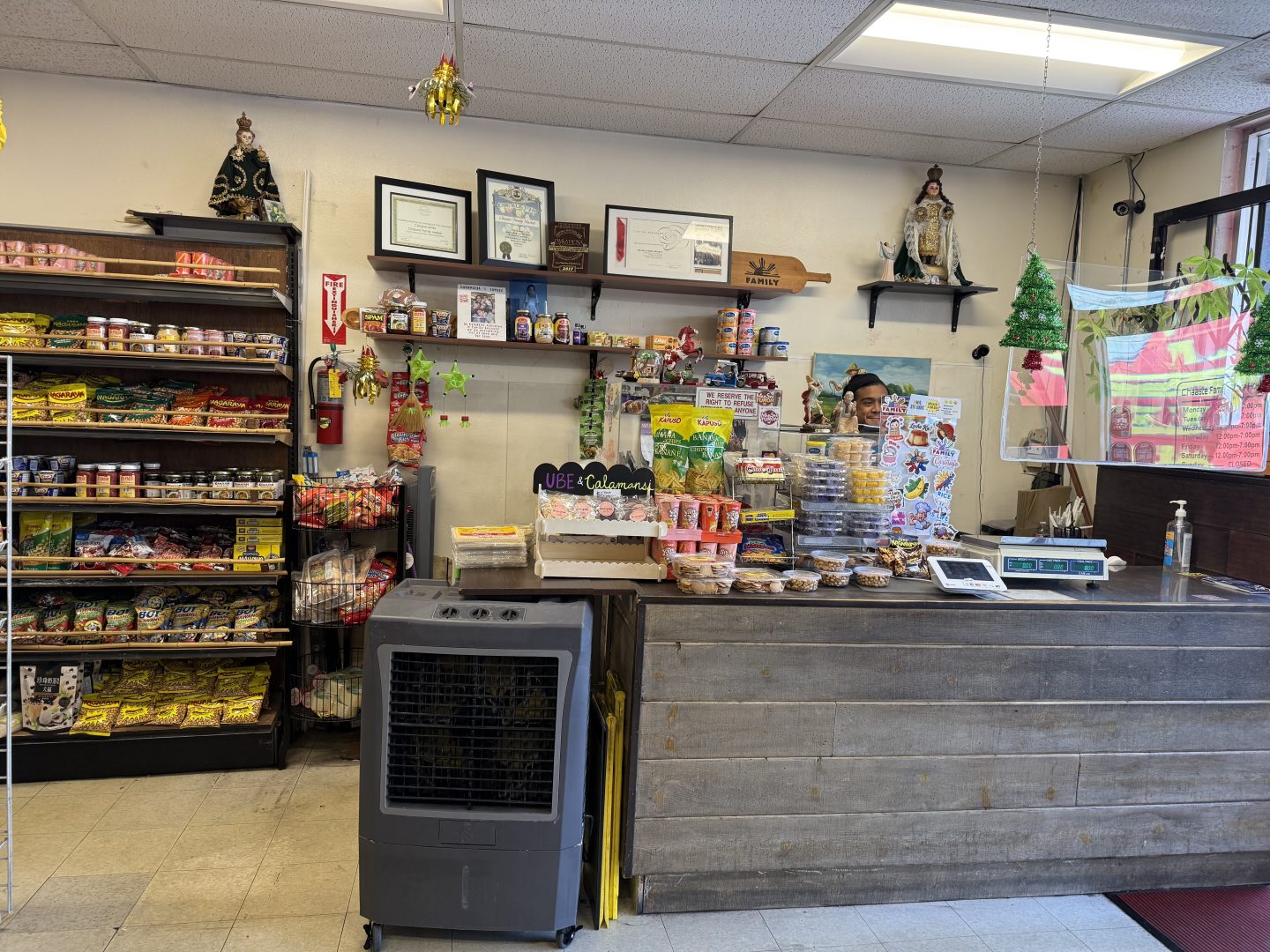
Chaaste Market’s displays and shelves of food and household items from the Philippines. | Photo by May S. Ruiz / Hey SoCal
Always someone to take things into her own hands, Susan did the marketing herself in the early days. Christian recalls, “Filipinos and Hispanics are mostly Catholic so my mom would go to the churches with flyers promoting the store. The Hispanic community kept us afloat; they came for our fresh produce – we didn’t have the hot food till 1995. This strip mall was a mini business hub for the Filipino community. My cousin owned the first video store two doors away; my uncle George had the small restaurant next door. The tax preparing business, the doctor’s office, and insurance company were Filipino-owned.”
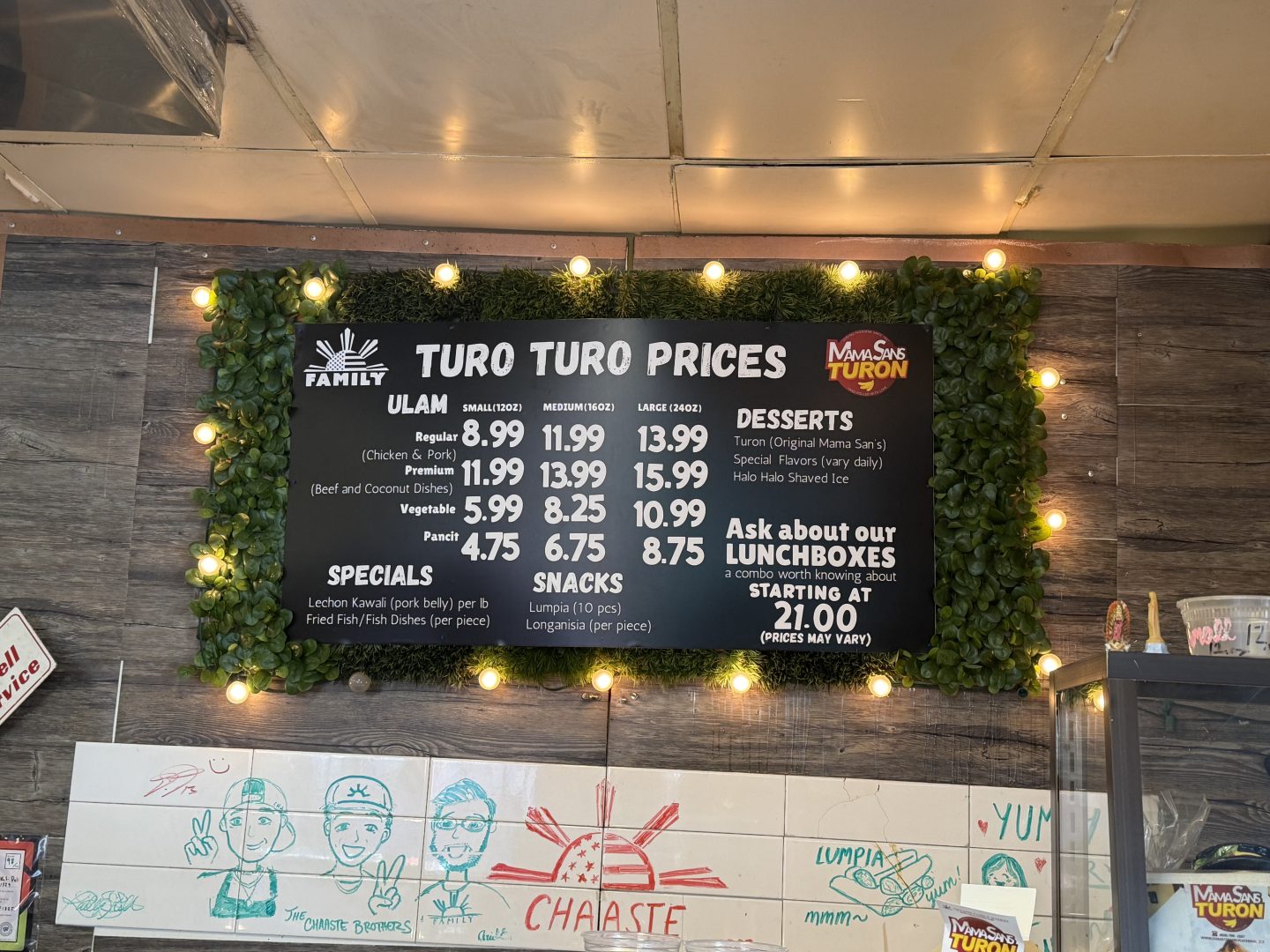
Christian explains how Chaaste Market started offering hot food, known as turo-turo (literally point-point because customers point to the food). “People who were employed at the hospitals and in the healthcare field, the post office, and other private companies would get out from work too tired to cook after a long day. They would stop at my Uncle George’s restaurant to pick up food on their way home. But he closed early and those who had to leave work a bit later had no place to get hot food, so they asked my mom to offer turo-turo in the store. While she could cook, she wasn’t a professional chef and didn’t know how to prepare food for a hundred people. But she learned through hard work and trial and error.”
The youngest Esteban, Gabriel, was born a few years after the market opened. Being a close-knit family, the entire family was involved in the business. Their relatives – uncles, aunt, cousins – helped out and Chaaste Market flourished. In the intervening years, the Filipino restaurant and video store closed. There are now only two remaining Filipino-owned businesses but Chaaste still acts as the glue the binds the Filipino American community in the western San Gabriel Valley.
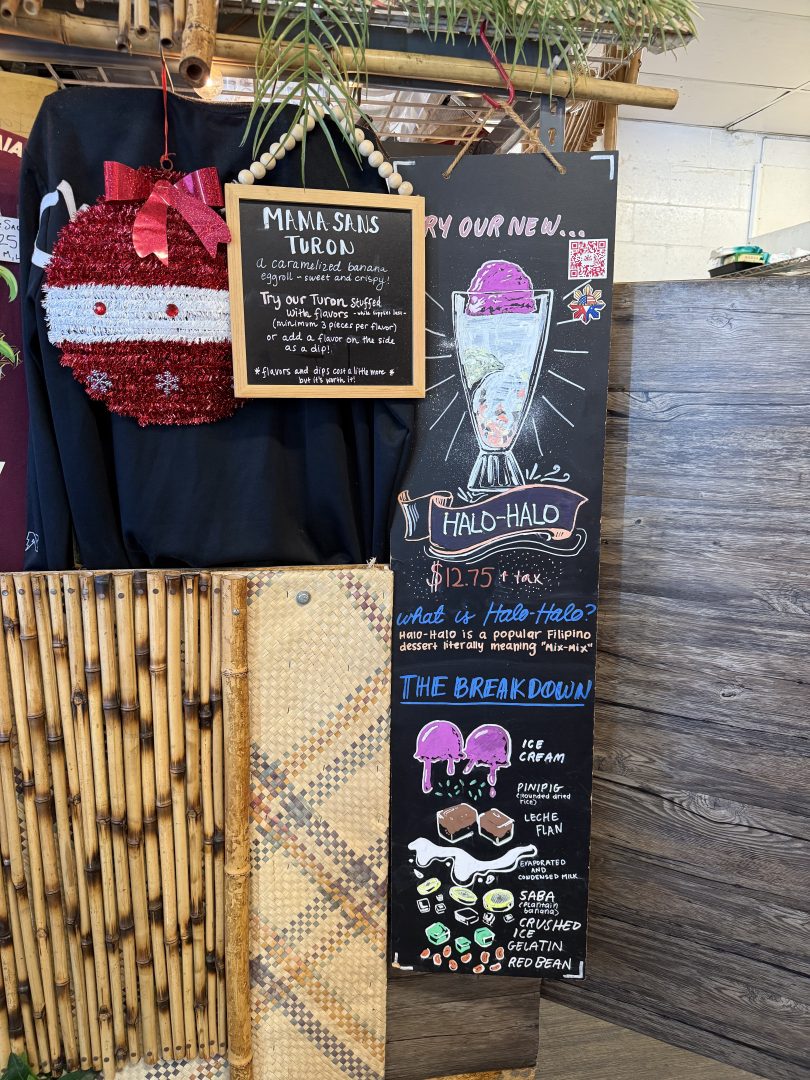
Drawing and explanation of halo-halo, a Filipino shaved ice dessert. | Photo by May S. Ruiz / Hey SoCal
Christian says about his upbringing, “My brothers and I have always been proud of being Filipino. But we were raised in Pasadena where the majority of the population is White, with some Blacks, Hispanics, and Asians. We went to private Catholic schools and grew up around non-Filipinos and we wanted to be like them, to fit in, to belong. So we had to adapt to our surroundings and to the way the kids we spent most of the day with ate, moved, and talked.”
Susan felt the only way for her children to really know what it meant to be Filipino was for them to live in the Philippines. “My mom sent us back to the Philippines in 2007 to attend university there and to learn about our culture,” Christian discloses. “I studied Film in Baguio where it’s cool and then worked in News and Public Affairs for GMA-7, traveling all over the country. The experience opened my eyes to a whole different world, the beauty of the Philippines, and the talent of Filipinos.”
“Being Filipino American and being Filipino are two distinct things,” clarifies Christian. “I thought I knew what it was to be Filipino, but it was only when I lived there that I recognized that it was a very different culture. I’m conversational in Tagalog and then I heard what the real Tagalog language is. I saw first-hand that Filipinos value education and have exceptional work ethic. Looking back now, it was that realization that gave me the passion to carry on my mom’s legacy through her store. I’m very proud of my heritage.”
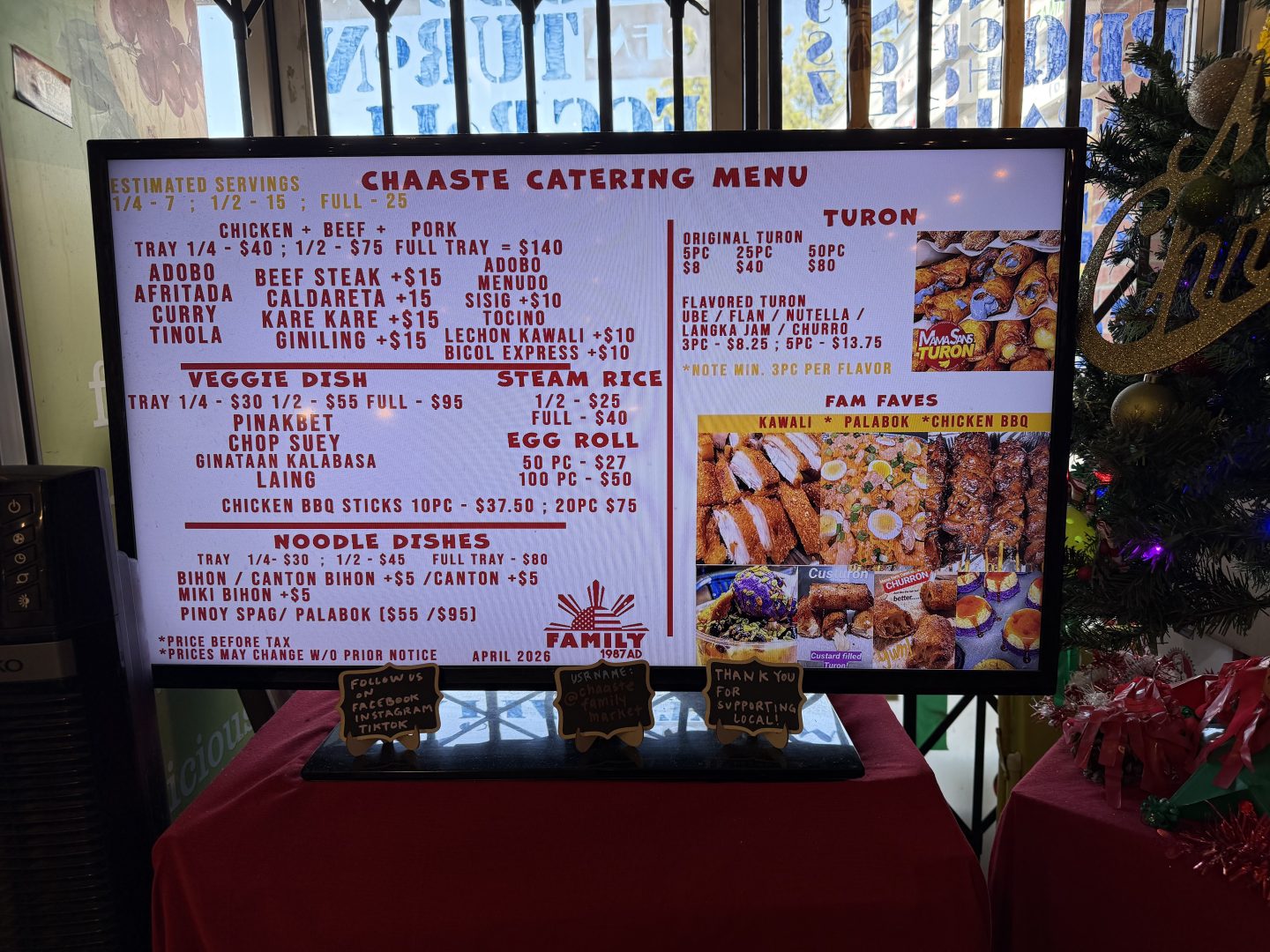
Hot food and dessert prices. | Photo by May S. Ruiz / Hey SoCal
When Arturo showed early signs of dementia (he has since passed away), Susan asked her children to come back to California. The store had been struggling to stay financially viable and she planned to close it. However, her children insisted they would take over and she could focus on their dad’s care.
“I really just wanted them to be here for emotional support,” Susan says. “With their excellent education, they were able to get wonderful jobs in the Philippines. They had enough work experience so it would have been easy for them to find professional employment here and earn good salaries.”
“It took a bit of convincing for my brothers, especially Abe, to go back to California,” admits Christian. “He attended Ateneo de Manila, and after graduation he was employed as systems operations manager at Hewlett Packard in the Philippines working with international companies.”
“But in the end, we love the store my mom built and we grew up thinking of it as our second home,” Christian emphasizes. “As kids my mom brought us back here from school and the parking lot was where we skateboarded. We’re connected to the store emotionally and spiritually; we grew up here with our cousins.”
Abraham behind the cashier by the store entrance, | Photo by May S. Ruiz / Hey SoCal
Abraham echoes Christian’s words. “HP offered to have me work remotely so I could stay on the job, which was very kind. But I declined because I also wanted to continue what Mom started 39 years ago. We’ve had a couple of proposals from people to buy the store and that would have been an opportunity for me and my brothers to find regular jobs, have weekends off, take a two-week vacation annually. However, the buyers weren’t Filipinos and they were going to convert it into something else altogether. And that outcome wasn’t something we wanted to see. It’s important for us to ensure that Filipino Americans in Pasadena and beyond have a place to come together as a community.”
That coming together as a community was on display last year after the Eaton Fire broke out. Chaaste Market organized a donation drive and filled half of the store with clothes and toiletries from Filipino Americans who wanted to help. The brothers posted it on Instagram and very quickly fire survivors came to avail themselves of the much-needed items.
Filipinos are, by nature, big-hearted and generous to a fault. But they are also very low-key; they don’t want to call attention to themselves and they avoid public accolades. They want to give quietly, even anonymously.
Chaaste Market table at Masters of Taste 2026 at the Rose Bowl. | Photo by May S. Ruiz / Hey SoCal
But the Esteban brothers broke the mold this past spring when Chaaste Market participated in Masters of Taste 2026, an annual event that attracts thousands of foodies from all over Southern California and gets much media coverage. They brought their own sound system to play Filipino music and Abraham talked about their store, to the delight of those who were in the long queue to sample their lumpiá and signature Mama San’s turón.
The pride in their heritage is the philosophy behind the store. Christian describes, “Chaaste Market is all about the Filipinos’ way of life, our attitudes, generosity, and openness. We always invite people to eat with us – kain na (let’s eat) is an everyday phrase we use. And my mom wanted to share that with our customers.”
Chaaste Market is open from Monday to Saturday. During the pandemic, they stopped carrying produce, removed the lunch/dinner tables, and shortened the hours to 12 pm to 7 pm (from the previous 11 am to 8 pm). Customers come primarily for the hot food and the store sells between 70 to 100 “to-go” boxes daily.
Gabriel behind the hot food counter. | Photo by May S. Ruiz / Hey SoCal
Susan is still actively involved and, to this day, Chaaste Market uses her recipes. Gabriel explains, “Initially, I wanted to do fusion so I could incorporate what I learned in culinary school but my mom was adamant about keeping it traditional. My mom didn’t teach me how to cook Filipino food; I picked it up from observing and watching her. But my two brothers and I spent several years in the Philippines so I was able to try all kinds of Filipino food. Now that I’ve been cooking over ten years, I’m inclined to keep it as it is, but working the kitchen more efficiently.”
“While some Filipino chefs put their own spin on Filipino food, I focus on different techniques in keeping the food hot,” Gabriel says further. “It took me about two to three years to learn that some dishes have to be prepared a certain way so they don’t spoil. Pasadena has very strict health inspection requirements. Health inspectors want food to be at a specific temperature and they don’t understand that a lot of our food are cooked with vinegar. For example, chicken adobo keeps cooking after it leaves the fire so there’s a potential for the chicken to get too dry and tough. That’s one of the reasons we stopped making pork barbecue, which was a very popular item.”
According to Gabriel beef steak is a favorite among customers and is one of Chaaste Market’s mainstays. He thinks the dish is popular because beef is expensive so it isn’t something being offered in most turo-turo places; it’s usually available only for catering. Other mainstay dishes are pork adobo and chicken adobo.
Chaaste Market’s catering menu board. | Photo by May S. Ruiz / Hey SoCal
“We have many vegetarian customers now so we have adjusted our menu to offer what the community wants,” adds Gabriel. “Most Filipino vegetable dishes are cooked with meat to give them more flavor. It took us a while to transition and offer a variety of dishes that vegetarians can eat. They’ve been surprisingly popular and we’re getting more customers in.”
The store has been getting media attention in recent years which has really boosted business. Gabriel recounts, “About ten years ago, a Filipino actress living here had a show in Echo Park and she asked us to cater turón. That’s how people first heard about us and customers started coming to Chaaste Market from the exposure. It’s such a blessing and a grace of God – we don’t advertise or promote the store. We don’t really know how to use social media and we’re busy working in the store that we have no time to post regularly.”
“It’s quite miraculous when bloggers and influencers come over,” says Gabriel in amazement. “A few months ago, Richard Antablian, who has a blog called ‘1 Hour Lunch Break’ on Instagram, Tik Tok, and YouTube showed up and just got food – which he ate in his car – and posted videos. About three days after he posted his blog, we got an influx of customers and we sold out in a couple of hours. A food blog called ‘The Infatuation’ has also been one of our supporters – we’re consisently on the top 10 on the list of food places in Pasadena. The LA Times has run a few articles about our food, and some local publications have featured us.”
“Fridays and Saturdays are our busiest days because we have both the catering and the turo-turo business,” Gabriel states further. “The media coverage has been bringing us catering customers from almost everywhere, who initially request our chicken barbecue, lumpiá, and turón. And when they come to pick up their order, they decide to get other dishes from our turo-turo.”
Blackboard with lyrics to Bahay Kubo (Nipa Hut), a Filipino folk song. | Photo by May S. Ruiz / Hey So Cal
For all the popularity Chaaste Market has gained and the success their business has reaped, the Esteban brothers never take anything or anyone for granted – they are humble and grateful, always. They greet all their patrons with a warm welcome. They happily chat with shoppers, many of whom they know by name. And they thank people for coming when they pay for their purchase.
The store is never empty of customers – Filipinos and non-Filipinos. There’s a constant stream of people from Pasadena and neighboring cities and from as far away as Santa Clarita, coming for the turo-turo and other Filipino items. For the majority of its customers, Chaaste Market is a regular stop from work on their drive home to buy hot food for their family.
But for some Filipinos, Chaaste Market is the place that brings back fond memories of their homeland – with the familiar objects and aromas. The lyrics of the long-forgotten first song they learned as toddlers, written on a blackboard in one corner, bring a smile. On the walls, drawings and references to-all-things-Filipino are nostalgic reminders of their youth all those years ago. Chaaste Family Market keeps the Filipino culture and traditions alive.
Masters of Taste 2026 host chefs Vanessa and Thomas Tilaka Kalb. | Photo by May S. Ruiz / Hey SoCal
After being sidelined last year by the Eaton and Palisades Fire, Masters of Taste returns to the Rose Bowl for the eighth time on a glorious afternoon on April 19. It’s a wonderful day to enjoy culinary delights and beverage offerings from over 200 participating restaurants, pastry shops, breweries, wineries, and beverage producers.
From its inception, Masters of Taste has been a sold-out event that attracts over 3,000 guests and garners media attention throughout Southern California and beyond. Over 100 culinary masters and restaurants present their finest fare and L.A.’s top sweet masters prepare delectable sweets.
Attendees patiently waiting for Masters of Taste to open. | Photo by May S. Ruiz / Hey SoCal
Leading beverage masters feature signature handcrafted cocktail tastings from over 25 spirit brands and bars, a premier 50-yard-line cocktail bar featuring top mixologists from L.A.’s most distinguished drinking destinations, select wineries, local craft breweries, cold-pressed juices, cold brew coffee. From 3 to 7 p.m., a deejay provides live entertainment while attendees eat and imbibe.
Every dollar raised at Masters of Taste benefits the work of Union Station Homeless Services to end homelessness. Since its inauguration, the event has donated millions of dollars to help countless families and individuals find a secure and welcoming place to call home.
Mini chocolate chip cookies and donuts from RicoRico Snack Bar in San Diego. | Photo by May S. Ruiz / Hey SoCal
Thirty minutes before Masters of Taste opens, the Rose Bowl’s parking lot starts filling with cars and a queue forms at the VIP line. A few minutes before 3:00 volunteers walk down the queue to put colored paper bracelets on our wrists and ask us to show a picture ID to make sure we’re old enough to drink alcohol. And another gives us clear plastic cups inscribed with the event name for our beverage.
We enter the Court of Champions where there are participating food trucks, and a few food and beverage vendors. We are immediately attracted to the warm mini chocolate chip cookies and donuts from RicoRico Snack Bar in San Diego. Joel, who is happily offering sweets, tells us this is the first time they’re participating.
Masters of Taste participants on the Rose Bowl field. | Photo by May S. Ruiz / Hey SoCal
As we munch on the sweets, we make our way onto the Rose Bowl field. We secure a table and begin our gastronomic journey. There are so many tantalizing foods and sweets and refreshing drinks that it’s difficult to decide which ones to sample.
Granville is offering mac & cheese, which is always a crowd-pleaser. Mark Dix, the Food and Beverage Director for the California-based Granville Restaurant Group, informs us that they’ve been participating since the Masters of Taste began. He says this is a fun way to donate to a worthy cause.
Chaaste Family Market serving lumpia and turon. | Photo by Brianna Chu / Hey SoCal
Sushi Roku is a first time participant in the event. Joe, who is giving out baked lobster rolls, declares Masters of Taste is doing a great job in making it something that people look forward to.
Christian Esteban of Chaaste Family Market, a local Filipino store that sells products imported from the Philippines as well as freshly cooked dishes, informs us this is their first time at Masters of Taste and they’re enjoying it thoroughly. They brought a sound system and his brother is playing Filipino music and talking about their store. Chaaste has been serving the Filipino community in the western San Gabriel Valley for the past 40 years.
Short rib pasta from Marina Restaurant. | Photo by Brianna Chu / Hey SoCal
An array of cheeses from Agnes Restaurant and Cheesery. | Photo by Brianna Chu / Hey SoCal
Along the end zone of the Rose Bowl’s 50-yard line is the large tent occupied by Agnes Restaurant and Cheesery where there is a dizzying amount of cheese on the tables. Vanessa and Thomas Tilaka Kalb, this year’s host chefs, gladly chat with us.
“Agnes opened five years ago and this is our fourth time at Masters of Taste,” Vanessa says.
Photo by May S. Ruiz / Hey SoCal
Adds Chef Tomas, “It’s our first time being the host chefs and it’s been so fun! We got 13 cheese makers from across the country to donate hundreds of pounds of cheese. We have a fondue fountain, raclette station, and mac & cheese station. I said that we were going to transform the Rose Bowl into a field of cheese – if you build it, they will come!”
At the raclette station a server carefully and meticulously scrapes melted cheese onto the crackers on our plate. The mac & cheese looks too tempting to ignore. And we sample a variety of cheese.
Mini chocolate and red velvet cakes from Lark Cake Shop. | Photo by May S. Ruiz / Hey SoCal
Volunteers are going around handing out bottled water even as we continue to enjoy the delicious bites. But we can only eat so much and we reluctantly give up; we’re simply too full to go on. However, we stop at the Lark Cake Shop table to get one last sweet – a red velvet cake.
It’s the perfect finish to a thoroughly enjoyable afternoon of gustatory delights at Masters of Taste. And it’s all for a worthwhile cause.
Ivo Müller. | Photo courtesy of Ivo Müller / One Million Words – Rilke
The Sierra Madre Playhouse presents the highly anticipated North American premiere of “One Million Words – Rilke,” a hit solo show inspired by the groundbreaking work of poet Rainer Maria Rilke. Created by and starring Ivo Müller, the play is slated to have six performances: April 24, 25, 26 and May 1, 2, 3, 2026.
Müller portrays both an actor from the present and a poet from the past who connect, exploring creativity, belonging, and what it means to stay grounded in a fast-moving world. Originally developed in Brazil, the show arrives in California during the centennial of Rilke’s passing (1875-1926), before heading to its UK premiere at the Edinburgh Festival Fringe.
Austrian poet Rainer Maria Rilke, who wrote in German, is widely regarded as a master of verse. He is celebrated as an idiosyncratic and expressive poet. According to scholars his work suggests mysticism – exploring themes of personal knowledge and incredulity.
A prolific poet, Rilke wrote hundreds of published poems – most notably The Book of Hours, New Poems, Duino Elegies, and Sonnets to Orpheus. He is also known to have been a great letter-writer, having penned an estimated 10,000 to 17,000 letters in his lifetime.
Ivo Müller. | Photo courtesy of Ivo Müller / One Million Words – Rilke
Directed by Arieta Corrêa, with Darrell Larson co-directing the English-language version, One Million Words – Rilke, tells the story of a writer who, for nearly a year, struggles to create poetry and can only express himself through letters. An actor uses these letters to navigate his own challenges in a place where even his name feels foreign, shaking the foundations of his identity.
Together, the poet and the actor explore themes of love, the creative process, and a sense of not belonging, highlighting the importance of being grounded in the present moment – topics that resonate deeply in today’s world.
Ivo Müller is a stage and screen actor whose work spans Europe, the US, and his native Brazil. His stage credits include a production of Twelve Angry Men with leading Brazilian theatre company Grupo Tapa, in addition to his long-running hit solo performance based on the writings of Rainer Maria Rilke.
Müller’s cinematic work includes Tabu, the multi-award-winning Portuguese film directed by Miguel Gomes, which received the Critics’ Best Picture Award at the Berlin International Film Festival in 2012. Müller has worked with major studios such as HBO, Sony, and Globo TV. His recent credits include Hebe: The Brazilian Star (2019), in which he portrayed an AIDS-stricken hairdresser in the biopic about a celebrated Brazilian television host; and Night Stage, which premiered at the Berlin International Film Festival in 2025.
Ivo Müller. | Photo courtesy of Ivo Müller / One Million Words – Rilke
Alongside his acting career, Müller also served as a teacher and acting coach on the award-winning documentary film Cine Marrocos (2019), collaborating with homeless people and refugees living in an abandoned movie theatre in São Paulo. Other stage credits include Stitching by Anthony Neilson, Huis Clos (No Exit) by Jean-Paul Sartre, The Widows by Arthur Azevedo, Camaraderie by August Strindberg, Bitter Sicilian by Luigi Pirandello, and Hecuba by Euripides.
By email, Müller discusses when his interest in Rilke’s work commenced, what the play means to him, the choice of title for it, its enigmatic theme, and the audience reaction.
“While working as an acting teacher at a public school when I was in my twenties, I discovered copies of ‘Letters to a Young Poet’ in the library,” begins Müller. “At the time I was a young actor pursuing art outside my comfort zone, far from where I was born and raised, so I related deeply to what he was saying to the young poet.”
Ivo Müller. | Photo courtesy of Ivo Müller / One Million Words – Rilke
Though Müller was drawn to all of Rilke’s works, one in particular made the biggest impression. He recalls, “Years later, when I decided to create something for the theater using that material, I began reading his poetry more extensively. Rilke seemed to ‘appear’ to me – in bookstores, in quotes from films I was watching. I read much of his work but, without a doubt, the Duino Elegies are the ones that resonated most with me.”
Müller refers to this play as the Rilke Project and whereas he has been doing this solo show for over a decade now, he didn’t possess enough confidence when he first performed it. That assuredness only came in later years. It has also gone through different versions and these iterations have taken him around the globe and keeps the play fresh.
“The first – ‘Letters to a Young Poet’ – was performed from 2010 to 2013, with long runs in São Paulo and tours across many cities in Brazil,” enlightens Müller. “Then I stopped. I had grown tired of it and didn’t want to continue with that version.”
“In 2018, I was invited by the Biblioteca Mário de Andrade in São Paulo to bring the piece back,” Müller continues. “They offered a small budget, and I spoke with director Arieta Corrêa about creating a new version, which we simply called Rilke. That version was performed until 2019. And in 2020, I presented it via live streaming – as many artists did during the pandemic.”
Ivo Müller. Photo courtesy of Ivo Müller / One Million Words – Rilke
To reach a wider audience as well as to reflect where he is in life, Müller translated it into English. He had been writing the English version on and off for at least five years, but in 2024 – when he had a clear deadline – the process became more intense and he worked on it almost daily.
“The English version transformed the piece once again – it became a new play, for new audiences,” pronounces Müller. “Because of all these shifts, neither the play or my performance ever felt repetitive. Every single one has been memorable and so challenging that each performance feels like a milestone for me.”
Asked what ‘One Million Words – Rilke’ means to him, Müller replies, “This project has been a refuge for me, especially in moments when I’m not working on other projects and anxiety starts to surface. Beyond that, it brings me a sense of peace. At times like these, when we live with the looming possibility of a major war, it reminds me why this play feels important. As the poet Marina Tsvetaeva wrote about Rilke, he is a kind of ‘antidote’ to violence and to the brutality of the battlefield.”
Photo courtesy of Ivo Müller / One Million Words – Rilke
“I titled it ‘One Million Words – Rilke’ because of the vast amount of material you find when you search for Rilke online,” explains Müller. “He wrote more than 13,000 letters, many of which have been translated into different languages. But also, I wanted the show to have a distinct and memorable name.”
“I’m not sure my performance ten years ago matched my abilities as an actor,” Müller discloses. “Perhaps I was too immature to take on a solo show when I first performed it in Portuguese. At the same time, it taught me so much – it has been a constant and intense form of training. Now, performing it in English truly aligns with where I am. It’s a character who has never fully belonged to the place he was born, who is a foreigner, who speaks with an accent.”
Workshopping the play to mounting it on the stage was a journey in itself. Relates Müller, “I had planned to workshop the show at the Hollywood Fringe in 2024, but I was invited to work in Brazil, so I cancelled the run. In the end, that project in Brazil was postponed. But things happen for a reason. Later that same year, Tony Torn and Lee Ann Brown offered me a slot to workshop the show in New York, at Torn Page – the historic brownstone in Chelsea where actors Geraldine Page and Rip Torn once lived. That’s where One Millions Words – Rilke in English was first performed.”
Ivo Müller. | Photo courtesy of Ivo Müller / One Million Words – Rilke
Every performance has been remarkable but one particular show stands out in Müller’s mind. He recalls, “Looking at the project as a whole, one of the most unforgettable moments happened during the run at the library I mentioned. It’s located in downtown São Paulo, and the performances were free – which brought in a very diverse audience. One day, a man came to speak with me after the show. He said he was there for the second time because the performance had somehow made him feel better. Then he told me he had been living on the streets and struggling with very negative, intrusive thoughts. But after watching the show, he said something had shifted. Those thoughts were no longer overwhelming him in the same way.”
As to what he wants his audience to take away, Müller declares, “Whatever they take away from the day they see the show. As writer Janet Flincher said after watching it, ‘the show has more ideas in an hour than you usually get in a month.’ And I like to write on the Playbill: ‘No, do not try to understand everything that is said. Instead, take a deep breath and let the words flow into your soul. And if some parts of the show bring you memories or if you zone out, that’s great. You should ‘travel’ and come back.’ I want the audience to tell the story with me, based on how they feel in that moment, on that particular day that they experience it.”
Those enigmatic words could only make us want to embark on a journey with him.
Event Signage at The Huntington.| Photo by May S. Ruiz / Hey SoCal
The name Maria Ylagan Orosa is not a household name to many Filipinos. But her invention, the quintessential Filipino sauce known as banana ketchup, is in almost every Filipino’s kitchen pantry.
Orosa’s life-work was the cornerstone of “Second Sundays: Filipino Food Magic” held on Sunday, April 12, from 11 am to 2 pm. It was inspired by L.A. Times Distinguished Fellow Catherine Ceniza Choy’s research on the history and scientific contributions of Orosa in collaboration with the archival collections at The Huntington Library, the experiential and teaching work of The Huntington’s Kitchen Garden, and public engagement work of The Huntington’s Education Division.
Second Sundays: Fiipino Food Magic featured a Filipino food tasting of lumpia (spring rolls) with banana ketchup, banana mousse, and hibiscus iced tea; a hands-on planting activity where attendees plant garlic or onion in a small pot to take home; a conversation with Choy to learn about Orosa’s life and her scientific and humanitarian legacy; and a reading nook where people can explore books about Orosa and Filipino food.
Photo by May S. Ruiz / Hey SoCal
Choy explained by email when and how Second Sundays: Filipino Food Magic came about.
“Since September 2025 when I started my tenure at The Huntington as the 2025-2026 Los Angeles Times Distinguished Fellow, I’ve been working collaboratively with many people at The Huntington, and primarily the following individuals who I like to call ‘The Filipino Food Magic Team’: Shannon McHugh (Assistant Director of Research); Linde Lehtinen (Curator of Photography); Carola Di Poi (Head Gardener, Kitchen Garden and James P. Folsom Experimental Ranch Garden); Thomas Smith (Experiential and Teaching Gardens Manager); Kim Tulipana (Associate Director of Public, School, and Digital Programs); and Aaron Spoto (Education & Visitor Engagement Specialist).
“The event came about as a result of our team’s desire to see scholarly research being done at The Huntington outside of the traditional classroom and library, and our hope to have this research more accessible to people of all ages and backgrounds.”
“As a historian, author, and professor of ethnic studies at UC Berkeley, I am thrilled to be part of this project and to have my research on Filipino food scientist Maria Ylagan Orosa reach a broad, multigenerational audience!” enthused Choy. “Orosa’s achievements in food science and technology (for example, her inventions of nutrition-rich powders called ‘magic food’ saved many American and Filipino prisoners-of-war during WWII; the palayók oven, which enabled Filipinos to cook without electricity; and the iconic Filipino sauce, banana ketchup) and her humanitarian ethos that emphasized science for the common good are admirable. And they deserve our attention.”
The Huntington’s kitchen garden. | Photo by May S. Ruiz / Hey SoCal
As if those accomplishments weren’t enough, Orosa also invented 700 recipes using common Philippine fruits and vegetables.
While researching Orosa’s life, Choy discovered something unexpected. “One thing I found out about Maria Ylagan Orosa that surprised me and made me laugh was that she promoted Philippine fruits and vegetables in her recipes and the baking of sweet treats like cakes and cookies!” Choy marveled. “That reminded me that food is about joy and health.”
“I love reading Orosa’s recipes, but I’m not a very good cook,” confessed Choy. “My husband Greg does most of our home cooking. However, I do enjoy cooking nilágang manók and chicken afritáda, and sharing these dishes with Greg and our two children, Maya and Louis, who are now adults! I am also the daughter of Filipino immigrants, and I appreciate being able to share my Filipino heritage with them through my research, writing, and cooking.”
“Although Orosa was born and raised in the Philippines and she focused her life’s work on Philippine social issues, the foundation of her training as a scientist was forged in the U.S. and she continued her professional development as a food scientist in the U.S. and other parts of the world,” Choy added. “I think that Maria Ylagan Orosa would be pleased to know that, in the present day, The Huntington’s Kitchen Garden is a place of discovery of nature, science, and creativity for people of all ages and backgrounds and that it is the site for a celebration of Orosa’s work in food science!”
A display of Filipino fruits and vegetables and books at Second Sundays: Filipino Food Magic. | Photo by May S. Ruiz / Hey SoCal
Choy has dedicated most of her professional life researching, writing, and teaching Asian American history and Filipinos American history, and The Philippines’s contributions to the world. She also thinks there is a dearth of Asian American biographies.
“My first book – Empire of Care: Nursing and Migration in Filipino American History, published by Duke University Press in 2003 – explored how and why the Philippines became the world’s leading exporter of nurses to Western countries like the United States,” Choy said. “My most recent book, Asian American Histories of the United States (Beacon Press, 2022), presents an overview of almost two hundred years of Asian American history for a general audience. I know from over twenty years of experience in academia that we need more Asian American biographies.”
It was a cloudy day in San Marino but the weather didn’t dampen the enthusiasm of the group of people – many of whom were Filipinos – gathered for Second Sundays: Filipino Food Magic. As modern Filipino songs played in the background, we enjoyed bites of delicious lumpiá dipped in banana ketchup, which we downed with refreshing iced hibiscus tea. Banana mousse was the excellent finish to a delightful late-morning culinary interlude.
Linde Lehtinen doing a Children’s Book Reading. | Photo by Brianna Chu / Hey SoCal
Lehtinen started the program with a Children’s Book Reading of “Maria Orosa: Freedom Fighter, Scientist, and Inventor from the Philippines” by Norma Olizon-Chikiamco. She said she practiced it the night before and her three-year-old daughter had approved. Her daughter joined her on the stage afterwards clearly proud of her mom’s performance.
A few grey clouds parted to let a burst of sunlight through as attendees walked around to peruse the display of Filipino fruits and vegetables and reading materials on a table. Some wandered over to the garden beds to examine the various plants.
At noon the Conversations with Experts segment followed with Choy, Carola Di Poi, and Shannon McHugh. McHugh told us that The Huntington’s Research Library has 11 million manuscripts, books, and photographs and every year 2,000 researchers come to work with the objects in the archives.
(Shown from left) Catherine Ceniza Choy, Carola Di Poi, and Shannon McHugh. | Photo by May S. Ruiz / Hey SoCal
“Of those 2,000 about 150 every year have come by a competitive application process and we fund them to live here for a number of months,” explained McHugh. “And about six of those are such talented researchers that we don’t ask them to apply, we just beg them to come work with us – and Cathy is one of those people.”
McHugh began the conversation with a question for Choy. “This day was planned around celebrating the Filipino food scientist Maria Orosa. Can you start by telling us about her?”
Choy informed us that Orosa, who was born in 1893 and died in 1945, was a scientist, an inventor, and a humanitarian. The breadth of her work goes far beyond her invention of banana ketchup, which is similar to tomato ketchup but uses bananas as its base because they grow abundantly in the Philippines.
Attendees at Second Sundays: Filipino Food Magic. | Photo by May S. Ruiz / Hey SoCal
“Orosa valued using local food sources, making sure that food was sustainable and reducing dependency on products imported from the U.S.,” enlightened Choy. “She founded a 4-H Program in the Philippines modeled after the same program here, which is about raising fruits, vegetables, and livestock at the local level. She encouraged Filipino families to have their own kitchen garden. And it is appropriate that we’re here at The Huntington’s kitchen garden.”
“What a pleasure it has been working with Shannon, who actually came up with the title Filipino Food Magic, as well as Carola, who is responsible for the planting bed dedicated to Maria Orosa. It has been a wonderful experience,” Choy added.
Di Poi discussed how she learned a lot about Orosa while collaborating with Choy and that the planting bed is comprised of seasonal items Filipinos use to cook their food. She answered questions from attendees about growing their plants and gave tips on how to keep them flourishing.
The Maria Orosa planting bed at The Huntington’s kitchen garden. | Photo by May S. Ruiz / Hey SoCal
It rained suddenly and stopped just as suddenly before Choy came back on the stage for a Children’s Book Reading of “Feeding the Fight: The Story of Maria Orosa” by Ceej Tantengco and Sabrina Schnabelm. Second Sundays: Filipino Food Magic then closed with another Conversation with Experts.
While Choy continues her research work, she has begun writing Orosa’s biography and anticipates to finish it in a year or two.
For Filipinos, the banana ketchup is never far from our dining table – it is a necessary condiment to all our fried dishes. Thanks to Choy and The Huntington we will soon know so much more about the woman behind our beloved kitchen staple.