‘With Love and a Major Organ’: Boston Court’s Last Play for the Season

Originally published on 27 September 2017 in the Pasadena Independent, Arcadia Weekly, and Monrovia Weekly

Boston Court Performing Arts Center in Pasadena ends its 2017 season with the West Coast premiere of Julia Lederer’s ‘With Love and a Major Organ’, from September 28 through November 5, 2017. 

Directed by award-winning co-artistic director, Jessica Kubzansky, ‘With Love and a Major Organ’ is a whimsical, quirky, and wildly original play that dissects physical human interaction in the age of technology. Its title alone is startling and it was what attracted her to the play at the outset.

Says Kubzansky, “I love this title and I think it’s deliciously funny. The story is about trying to connect in our ever more virtual world. There’s a character in the play who has been enclosed for years in her own privacy. She’s seeing an online therapist, Google Shrink, who recommends that she see more people so she speed-dates online. What’s contrapuntal to this is that she falls in love with a stranger she meets on the subway. She then gives her actual beating heart to this man and he disappears on her.”

‘With Love and a Major Organ’ follows the protagonist’s quest to retrieve her heart, accidentally cracking open those of others she meets on the way. The play is eccentric and edgy comedy about what it costs to give your heart away, and what happens when you discover you actually have one.

“To me one of the most profound ironies of our time is that we have never been more connected yet we have never felt more isolated,” Kubzansky declares. “There’s this amazing animation that someone made about people running around looking down on their phones – technology is changing their lives but they’re completely missing out on life around them. Technology is significantly improving our lives while considerably reducing our ability to connect.

Julia’s play is both truly hilarious and powerfully heartbreaking. She’s mining both the absurd lengths to which love will drive us and the deep loneliness that emanates from protecting our frequently bruised and broken hearts. Her text is poetry for the theatre and she pushes metaphor to its most surreal and deeply truthful limits.”         

Boston Court Performing Arts Center was founded in 2003 as a non-profit arts center dedicated to new and original works by living artists. Led by co-artistic theatre directors, Jessica Kubzansky and Michael Minetti, it has successfully established its place among the numerous theatre companies in Pasadena.    

“The journey has been exciting, challenging, and wonderful,” proclaims Kubzansky. “I’ve been extraordinarily privileged to have founded Boston Court with Michael. We had the thrilling task of creating the mission and vision for this place – it’s always stimulating for an artist to create what you want to share with the world.

We knew when we started that Boston Court is only four blocks from the Pasadena Playhouse; we realized we needed to offer something different. Frankly, the design of the place dictated many things: it’s beautiful but it’s also very intimate. It’s important for us to do risky, adventurous work because we have fewer seats to fill; we can afford to take chances in our programming.

Also, it’s imperative for me to do work that challenges both the artist and the audience – plays that encourage each artist to passionately pursue his own unique voice and vision. We don’t want cookie-cutter productions or something our audience can see somewhere else. We look for a variety of styles and we significantly reinvent the classic. The only time we wouldn’t re-envision a classic is when it’s  highly theatrical, textually rich, and visually arresting on its own – something we call a ‘Boston Court play’.

We put on four productions per season – usually one wildly re-envisioned classic; a world premiere; maybe one we had in our New Play Festival that subsequently ends up on our stage; and one that’s timely and needs to be done now. It’s all about passion and balance, but always the mandate is the same – it has to be highly theatrical, textually rich and visually arresting.”  

Kubzansky and Michetti actively seek out like-minded collaborators. She states, “When Michael and I meet with directors we would like to work with, we ask ‘What has been burning a hole in your gut? What do you need to talk about right now?’ Both of us have really astonishing experiences when it comes from our gut.”  

According to Kubzansky it took a while for them to fully grasp what sets Boston Court apart from other theatre companies in the area. She states, “It was much later, when our season had entirely world premieres and we had to extend every show, that it became clear to us that our audience liked the plays they’ve never heard of before. People now know that when they come to Boston Court, they will have a quality ride; they are confident that no matter what they see here it’s going to be a great evening.

Because our work is adventurous, it occasionally divides or offends people. But they also trust that they will see artistic excellence and the experience will be unlike what they get elsewhere. It’s incredibly important to us to take part in a cultural conversation that reflects the world as it is today. We ask our audience to be moved and to think – to crack open their heart and mind a little bit.  

In Los Angeles, you see a play, get in your car, and drive away. But in New York, after the show you go to a bar next door, bump into people who also saw the play, and have a discussion about it. We want to bring that kind of engagement in the L.A. theatre scene. Every Friday we have complimentary wine, sparkling water, and Chex Mix to encourage people to sit in our beautify lobby and have a dialogue about they had just seen.    

There’s a misconception that theatre-goers in Los Angeles don’t have the same passion for it as New Yorkers. It may be true that a much larger percentage of the population on the East Coast  sees a play on any given night – it’s so easy for them to go on the subway then get off after four stops. Los Angelenos are also passionate devotees and there are so many choices of theatres here, too. However, I think that geography has something to do with it – if you live in Venice and want to see a play here, you have to make a commitment in terms of the drive. Fortunately, Boston Court attracts subscribers from far afield – which is very thrilling. Pasadena is a beautiful place; it’s a really complex community and it’s exciting for us to be here.”

Before Boston Court existed the place it now occupies was a parking lot. It was purchased by philanthropist, Z. Clark Branson, to build a state-of-the art, intimate facility designed to bring artists and audience closer together. The 75-seat Marjorie Branson Performance Space and the 99-seat Main Stage are sites for the theatre’s season of bold, risky theatre and its eclectic, diverse music series. It is also the home of an annual New Play festival, an Emerging Artists Series, as well as Upfront, a rotating visual arts program.

As Kubzansky relates it, the theatre company’s name was born out of their desire to come up with a moniker that conjures permanence, heft, and gravitas. “We wanted something iconic like the Actors Theatre of Louisville or the Pasadena Playhouse – both of which were already taken. When we realized our building is located on Mentor Avenue and Boston Court, a lightbulb lit; we became Boston Court Performing Arts Center. We thought people will understand when they see that we named it after the street we’re on. 

What’s funny is that after we had our logo created, stationery printed, and signs put up, we received a letter from the City of Pasadena informing us that our address is in fact 70 N Mentor Avenue; Boston Court is actually our driveway,” Kubzansky says with a laugh.      

That inadvertent address error couldn’t have deterred its founders’ resolve to make their mark  on the city and theatre. Boston Court Performing Arts Center stands today as a stalwart advocate of artistic vision and inventive expression.                
Monrovia High School Students Perform on A Noise Within’s Stage

Originally published on 27 April 2017 in the Pasadena Independent, Arcadia Weekly, and Monrovia Weekly

This past Tuesday night, April 25th, 23 drama students from Monrovia High School (MHS) put on a production of Shakespeare’s ‘King Lear’ at A Noise Within (ANW) in Pasadena. The partnership was a first for both the high school and the classical theatre company.

Nathanael Overby, MHS drama teacher who came on board in 2012 and was responsible for expanding the school’s drama department, advanced the partnership with ANW. He states, “A Noise Within clearly takes a unique approach to theatre – they have a quality and creativity unequaled by other professional groups. That was something I wanted my students to emulate.”

“We have been performing on our stage, which is quite impressive, but being on a professional stage would be an exciting experience for my students,” continues Overby. “ I wrote a proposal to partner with ANW and discussed it with Patrick Garcia, the director of performing arts for the Monrovia Unified School District, who reached out to ANW. When ANW’s artistic directors agreed to it, I began working with Alicia Green, the director of Education and Community Outreach at ANW.”

Concurs Green, “The director, Patrick, and I came together to discuss the proposed partnership and we decided to do ‘Lear’ as it worked best for the school and us. From the outset Nate and I worked to ensure students had a great experience and understood what it takes to do a show in a professional space.”

Overby adds, “This partnership is so much more than the students being able to perform ‘King Lear.’  We were able to join ANW’s cast for their table read of ‘Lear’ and we watched ANW actors perform it on stage. This gave my students the opportunity to join a professional cast on their journey on a production – to experience what it’s like to put on a professional show by observing ANW’s cast at several different points in their process. Furthermore, I want to develop a connection with ANW to inspire my students to pursue work with them after they graduate.”                     

“All students attended first rehearsal, some attended opening night, and all students came to a student matinee in mid-March,” Green said the week before their performance. “We wanted to immerse them fully in every step of the way – what it takes to make a full production a reality!  Nate worked with the students at Monrovia on the show and I am looking forward to having them come for the first time on Monday, the 24th, to rehearse on our stage, and then perform it the following night.”

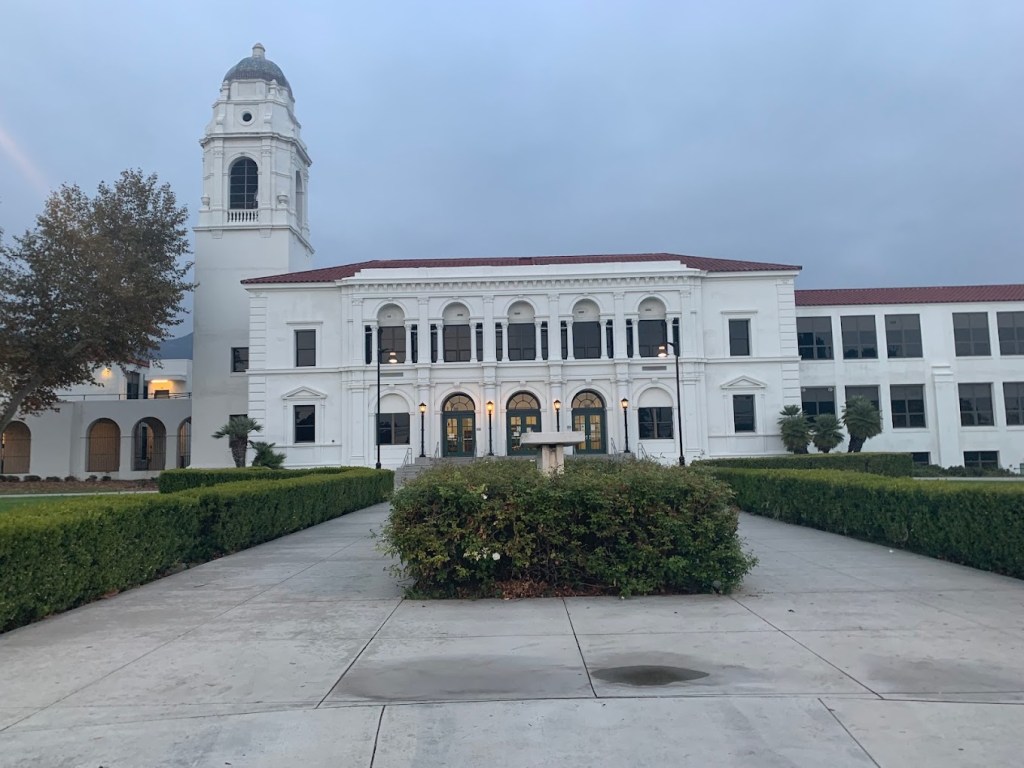
Monrovia High School | Photo by Alicia Valdez / Monrovia High School website

While the show was put on at ANW, it was truly a student production as Green relates, “Other than providing one tech person to help set up the lights/sound they need, their technical director and students will be running all of the technical elements and stage managing the show. We are here to support them, but this is their show and we encourage them to make the space their own!”

“We are constantly looking for ways to engage students in the world of classical theatre,” Green says about ANW’s outreach. “Equitable access is of key importance, and we continue to grow and develop our education program through attendance at student matinees and evening/weekend performances, in-school residencies and workshops, full-school partnership programs, pre-show engagement activities, post-show conversations with the artists and our free study guides. Ideally, every student would have the opportunity to participate in some way with our programing to enhance their education!”

A Noise Within has its ‘Summer with Shakespeare’ camp and Saturday conservatory classes where students perform on its stage and in the building. This past Tuesday’s performance of ‘King Lear’ by Monrovia High School students, however, was a first for this kind of project.

According to Overby, MHS had two drama classes back in 2012 when he came to teach at the school. He says, “Now we have a full-time department offering five different periods of drama, including a Stagecraft class and an Honors drama course. We also started out with one performance a year; we are currently producing three a year which includes at least one musical and one play. This year we produced ‘Dracula’ in October, ‘Urinetown the Musical’ in March, and now ‘Lear’.”

‘King Lear’ was the capstone to a great year for the school’s drama students. And what better venue to fully realize the essence of one of Shakespeare’s most celebrated works than in Pasadena’s premier classical theatre company. 

Indeed it was a dream come true for these Monrovia High School students. How propos that their performance took place towards the end of A Noise Within’s own season they called ‘Beyond our Wildest Dreams’.  

‘King Lear’ and ‘Man of La Mancha’ Share Similar Worlds at A Noise Within

Originally published on 14 February 2017 in the Pasadena Independent, Arcadia Weekly, and Monrovia Weekly

Resuming its 25th Anniversary celebration, ‘Beyond our Wildest Dreams’, A Noise Within puts on a production of William Shakespeare’s King Lear which will run in repertory with Man of La Mancha later in the spring. Geoff Elliott and Julia Rodriguez-Elliott, co-producing and artistic directors of ANW, have conceived these two shows to be seen on the same day, allowing them to fully speak to each other. 

Both shows share the same leading man (Geoff Elliott), the same director (Julia Rodriguez-Elliott) and the same scenic elements, enabling a quick turnover between matinee and an evening performance so the two productions can play on the same stage.  

Of the opportunity to perform both Lear and Cervantes/Don Quixote, Elliott pronounces, “I feel I know Lear. He is stripped of everything, and must face his worst demons to find tenderness and uncompromising love in a very violent world. Lear spends so much of the play terrified of losing his mind. Anyone who goes through a similar self-investigation can’t help questioning his sanity as so much of the world that we live in seems insane.”

Continues Elliott, “In his way, Cervantes/Don Quixote is Lear’s doppelganger. As he assumes Quixote’s persona, Cervantes gains the courage and the strength needed to face the uncertain future of the Inquisition. He, along with his fellow prisoners and, ultimately, the audience are transformed.”  


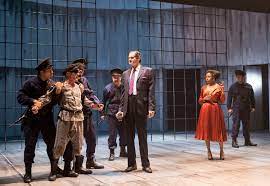
King Lear | Image taken from A Noise Within’s website

Says Rodriguez-Elliott, “In Lear, this personal journey of a family dealing with an ailing patriarch has global implications. The breakdown of a nation runs concurrent with Lear’s mental decline. At the beginning of the play, we see a man at the zenith of his power, a modern day dictator who is feared and has never heard the word NO. The world we enter is a violent, callous one. At the end, we see a man transformed.”

The world of La Mancha is as violent and callous as it is ripe and crying out for transformation. “Though many often associate Man of La Mancha with elaborate set pieces and fanciful costumes, its earliest stagings were sparse, encompassing the spirit of a rag-tag band of prisoners putting on a play with found objects,” explains Rodriguez-Elliott. “I wanted to return to those roots. Based on real-world prisoners, the conditions we’ve created for Cervantes and his fellow inmates are recognizable and terrifying.”

Audiences will likewise be transported to these worlds, in large part, because of the actors’ excellent portrayal of the characters they will inhabit for the next two hours. However, stage plays are a collaboration among many – actors and directors; as well as designers, which include costume, lighting, and set – and their success depends on how seamlessly these collaborators work together to create one magnificent piece.  

That Lear and La Mancha also share artistic team members – Fred Kinney (scenic), Angela Balogh Calin (costume), and Ken Booth (lighting) – makes for an exciting experience for the audience and for everyone involved in both productions as well.

Booth, ANW’s resident lighting designer, who has worked on over 40 productions for ANW since 1998 says, “I’m thrilled to be a part of it; this kind of challenge doesn’t happen a lot in small theatres. For Lear I am using a palette of warm and cold lighting, often in combination.  You don’t really see the source of light but it’s there being filtered through some unknown artificial source. Shifting the temperature of the lighting within a scene helps to punctuate or accent a moment. Highlighting one particular character helps create dramatic conflict within that character.”

“Lighting defines and redefines the performance space; it can influence the mood for the play and the audience. It enhances the atmosphere for the actors who are on stage to share their art and emotions with their audience,” Booth adds.

Man of La Mancha | Image taken from A Noise Within’s website

“Both Lear and La Mancha deal with a man with delusions of grandeur. The conflicts in both come not from without but from within the characters – their inner dilemmas of importance and immortality that affect them. To connect both stories, I will create lighting that seems omnipotent in certain scenes and confining for others. Beyond the giant set wall the plays share, you only see shafts of light that emanate from behind a window or door whenever it is opened. The wall is the horizon – there doesn’t seem to be an outside world – and for the most part the lighting of the wall is the same: a cool or bluish wash, beams of warm light seeping down; and a filtered break-up catching parts of it.”

Angela Balogh Calin, resident costume designer for ANW, has worked with Booth since 1998. She says she hasn’t done many shows when Booth didn’t light. “We go back a long time,” she declares. 

“Both Lear and La Mancha are going to have modern setting so costume-wise, I will give them a modern approach,” Calin discloses. “The clothes will be something the audience will be able to identify with; they will be easily recognizable. Lear will be eclectic, with 1950s flair.”

Lear and La Mancha will only be Fred Kinney’s second and third shows with ANW. An independent scenic designer, he was contracted for both shows last spring and immediately did his research. 

“I think Shakespeare’s work is better heard not read; so I watched a couple of film versions of Lear before I started conceptualizing the scenery,” Kinney reveals. “For La Mancha, I listened to the music and then watched the film. Then I came up with a concept that could work for both but different enough. They are unified in theme but the design will have enough variety to service the individual parts of the shows – the things that are unique to each production. I will have a base layer to which I can add elements to make the scenery distinctive to each.”

ANW provides a unique environment in which artists work together across decades. They are comfortable experimenting, trying new things; impressing as much as supporting each other show after show. These artistic relationships inform each of this repertory theatre company’s many exceptional productions for 25 years.

Booth expresses says it best when he says, “I want our audiences to remember what an otherworldly universe we created within our theatre for our interpretation of King Lear and, hopefully, they get a satisfying feeling of bittersweet closure. This is what I find exciting – the collaboration in putting on a production – to take a blank stage and create a beautiful picture that is like a painting come to life using the limited tools at our disposal.”

A Noise Within’s ‘A Christmas Carol’ is a Glorious Production

Originally published on 8 December 2016 in the Pasadena Independent, Arcadia Weekly, Monrovia Weekly, and Sierra Madre Weekly

The joyful observance of the holiday season isn’t complete without annual traditions one remembers with nostalgia. At A Noise Within (ANW), the classical repertory theatre company in Pasadena, it means a restaging of Charles Dickens’ A Christmas Carol. 

Celebrating its  25th anniversary and its fifth production of this time-honored tale, ANW will have 16 performances of A Christmas Carol starting Friday, December 2 and closing Friday, December 23, 2016. Producing Artistic Directors Geoff Elliott (who adapted the play from the novella) and Julia Rodriguez-Elliott co-direct this masterpiece about the redemptive power of love.       

Much like ANW’s ardent followers, the company’s resident artists look forward to this year-end event with anticipation. “Remounting our acclaimed presentation of Charles Dickens’ A Christmas Carol allows families to once again take a supremely theatrical journey, and celebrate the transformative power of forgiveness during the holidays,” says Elliott. She adds, “Ebenezer Scrooge’s rebirth from miserly curmudgeon to the epitome of love and generosity affirms our faith in the potent goodness of humanity during this beloved time of year.”   

“The beauty of going back to these great works is that you have a history with it – because they are in your muscle memory, you have the opportunity to discover new things,” explains Rodriguez-Elliott. “You don’t have the same pressure of having to create something for the first time; it’s very lived in.”

“For me there’s a unique aspect every year  – I can see something from a different perspective because I’m a year older,” Rodriguez-Elliott continues. “There are elements of a particular play that have altered because of where we are personally and where we are as a country. It takes on a different meaning for everyone, depending on where one is in life at that time.”

But wherever one finds himself in life, when the entire ensemble belts out Ego Plum’s majestic song ‘Glorious’ at the close, one will understand why it was undeniably worth the wait and coming back for. ANW’s A Christmas Carol is like aged wine – its flavor gets deeper and richer with each year. One could never have too much of it.               

One thing that will change annually is the casting of the Cratchit children. As Rodriguez-Elliott relates, “Last year, resident artist Freddy Douglas’s son, Eli, was too young but we knew at some point he would be right for Tiny Tim. He has a little sister who is in the wings getting ready for her turn. She knows all the songs and sings them in my ear during rehearsals.”

Ashlyn Woo, an eighth grader in Suzanne Middle School, plays Belinda Cratchit this year. She has previously attended the Fine Arts Academy of Dance and Summer with Shakespeare to prepare her for stage acting. While she has been in other shows, including the Nutcracker, this is her first professional performance in an ANW production. 

Enthuses Woo, “I found out I have been picked to play Belinda and be a part of the ensemble on a Friday after school. I read A Christmas Carol in seventh grade and now I’m a character in a production of it! How amazing is that!”

“To be in the show, I’ve had to do my homework in the car and sometimes during rehearsals,” Woo confides. “But it’s so worth it.”   

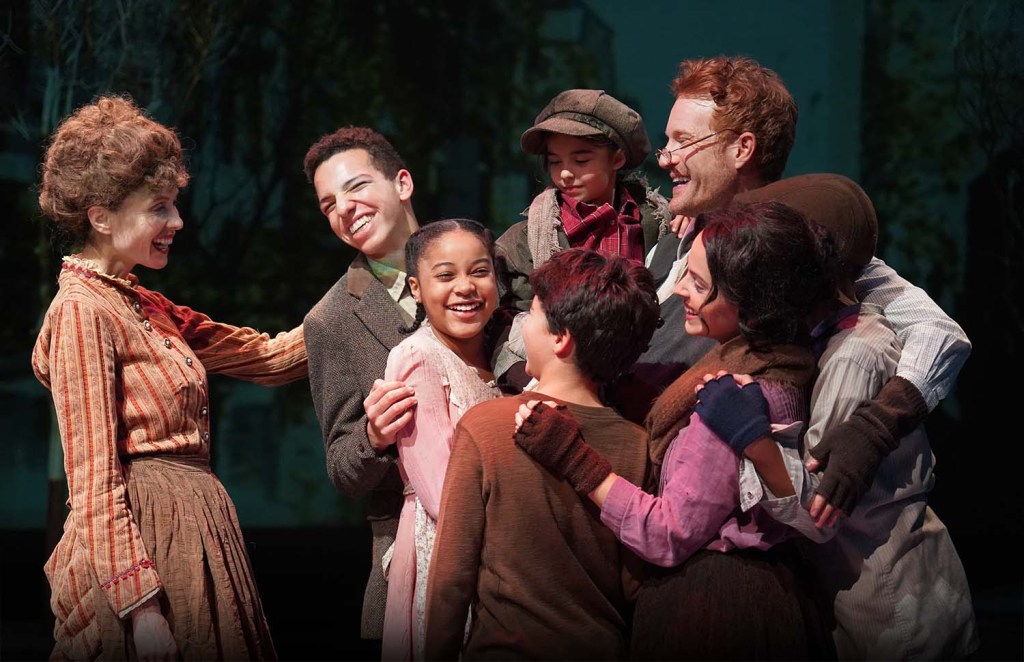
The Cratchits | Image taken from A Noise Within’s website

Another young actor debuting on A Christmas Carol as a Cratchit child is Samuel Genghis Christian. A sixth grader at Blair Middle School in Pasadena, he also trained at Summer with Shakespeare and Youth Conservatory at ANW.

Christian reveals, “I knew I wanted to perform on stage when I saw A Christmas Carol for the first time two years ago. It was one of the most exciting experiences of my life besides watching Harry Potter and the 2015 Super Bowl!”

“It was easy for me to get into the role once rehearsals started because I had seen the production before; I knew what it was going to be like,” adds Christian. “It’s such a wonderful show and I invited all my classmates and teachers to see it. My English class is coming to a student matinee.”

Of his time on the set of A Christmas Carol, Christian exclaims, “Everybody has been super nice to me and I feel really at home. It’s fantastalicious!”  Being in the company of talented ANW performers must produce such an incredible feeling if the experience moves one to invent words.

For Freddy Douglas, who is once more narrating, this year’s A Christmas Carol has greater significance as he shares the stage for the first time with his son, Eli Stuart. According to Douglas, Stuart hadn’t really shown an interest in acting until last year.

Says Douglas, “Eli saw A Christmas Carol last year and started singing ‘Glorious’, the final musical number on the show. Then seeing Apollo Dukakis in The Imaginary Invalid  caught his imagination and he agreed to have a go at Tiny Tim.”

Stuart is seven years old and attends second grade at Ivanhoe in Silverlake. Douglas states, “His teacher is working with us, helping him juggle the demands of school with that of the production.  He does extra reading on two show days.”

Douglas refrains from giving unsolicited advice to his young aspiring thespians. He discloses, “I just tell them to enjoy it and don’t bump into the furniture. However, this morning his four-year-old sister sang ‘The Charwoman Song’ about 50 times so he gets pointers from her.”

According to Stuart, “Working with my dad is a thrill; it feels special. I saw him on this show last year and I wanted to be on stage with him.” On the other hand, it was Douglas who was concerned. He confesses, “I was wondering if I might get very emotional after this song but so far I’ve managed to hold it together.”   

Sentiments like these are one of the reasons why ANW puts on A Christmas Carol every year.  As Rodriguez-Elliott points out, “It takes on a different meaning depending on where one is in life at that time.” 

ANW’s  ‘The Imaginary Invalid’ Makes for Uproarious Entertainment

Originally published on 20 October 2016 in the Pasadena Independent, Arcadia Weekly, Monrovia Weekly, and Sierra Madre Weekly

Moliere’s ‘The Imaginary Invalid’ opened at A Noise Within (ANW) over the weekend, a fitting final production of the fall in the repertory company’s 25th anniversary season. Long-time resident artists, Apollo Dukakis as Argan, and Debora Strang as Toinette, face off in this raucously hysterical play. At the helm is ANW co-producing director Julia Rodriguez-Elliott.    

On stage until the 19th of November, ‘The Imaginary Invalid’ tells the story of Argan, a man obsessed with his health and the lengths to which he will go to ensure that he will have a doctor to diagnose and cure his ailments. It’s a high comedy that calls for much sparring among the characters which the resident artists pull off with dexterity and aplomb.           

Rodriguez-Elliott says of working on the show with resident performers, “It usually isn’t until the third week of production that people begin to have a sense of each other and by week five it’s over. But here, we get right down to the task on the very first day of rehearsal so that the work becomes so much richer. I’ve observed guest artists begin to relax as they see the vocabulary of the place.” 

Strang immediately pipes in, “Apollo and I have played opposite each other on the stage so many times but as I look back on them I think we’ve had the same kind of relationship every single time.”

“It’s part of being in a company, as long-time colleagues we have such a familiarity and that instant connection. We’re there for each other,” Dukakis adds.

Dukakis has played ‘The Imaginary Invalid’s’ lead character, Argan, four times previously; the first one was 16 years ago. This time around, he was originally cast as the doctor but the actor who was to have played Argan had an emergency medical surgery one week into rehearsal.  Without too much preamble, Rodriguez-Elliott asked him to replace the lead and Dukakis graciously agreed.

ANW has produced Moliere and Shakespeare plays more than any other playwright’s.  

Molière as Argan in his play ‘Le Malade Imaginaire’. Illustration from Liebig collectible card series (‘Auteurs dramatiques comme Acteurs’/ ‘Famous Actor Playwrights’), 1921. M: (Real name Jan-Baptiste Poquelin) – portrait. French dramatist, comic playwright, and theatre director, 1646 – 1673 (Photo by Culture Club/Getty Images)

Rodriguez-Elliott rationalizes, “Moliere’s characters are people who are extremes; watching what happens when we’re obsessed fascinates me. His works give us the opportunity to play the characters with a humanity. It’s the same with Shakespeare when he writes ‘a street’ and you have no idea what that looks like and you have to create what the language of that particular production is going to be.”

“I find it interesting that both Moliere and Shakespeare wrote for repertory companies,” observes Strang. “I think every single character in their plays is rich and full-bodied because they had particular actors in mind. The fact they had repertory companies made them much stronger writers.”

Interjects Rodriguez-Elliott, “Even if Moliere and Shakespeare just had a sketch, they throw it to the repertory and they fill it out. That’s the power of having a company. It’s in that same vein that I was able to ask Apollo to fill in for the original actor playing Argan; I was very confident that we have resident artists who can handle the role. It was seamless, we moved the different actors to play the various characters. We didn’t have to scramble around to find someone.”

Rodriguez-Elliott says of ‘The Imaginary Invalid’, “This individual is in the throes of mental illness. The brilliance of Moliere is that he’s turned this destructive isolation into a sparkling, effervescent romp! So much of the comedy is about how oblivious Argan is to the vultures that are taking advantage of him, and the lengths in which people in his life navigate his neurosis.”                             

“It’s slapstick hilarity to watch the characters go right to the brink of insanity, but there is an underlying basis of reality – we are all blinded by our own behaviors,” Rodriguez-Elliott observes. “At the end of the play, Argan overcomes it all. What’s most interesting to me is his trajectory and his journey. It’s up to the audience to figure out if he ultimately finds enlightenment and takes ownership of his life as he becomes a doctor himself.” 

“I can have some high and mighty notion of what I think the audience should take away with them. But given what’s going on in the world right now it’s really great to be in a room with everyone just laughing hysterically … being together and having a really good time where we’re not dealing with complex issues, or things that are taxing and stressful,”  Rodriguez-Elliott concludes.

‘The Imaginary Invalid’ provides the perfect last fall production of ANW’s ‘Beyond our Wildest Dreams’ 2016-2017 season. It’s a blast of a play!

A Noise Within Unveils 25th Anniversary Season

Originally published on 21 April 2016 in the Pasadena Independent, Arcadia Weekly, Monrovia Weekly, and Sierra Madre Weekly

A Noise Within (ANW), the classical theatre repertory company based in Pasadena, is celebrating its 25th anniversary. Founders and Producing Artistic Directors, Geoff Elliott and Julia Rodriguez-Elliott, still find it amazing that they have reached that milestone. 

“If someone were to tell me a decade ago, when we were still in the cold, leaky Masonic Temple in Glendale, that I would be standing here in front of you today, I would never have believed it. I would have loved to hear it but I could not have imagined it to be the case. And yet here I am;  it’s simply beyond our wildest dreams,” Elliott humbly confessed before an audience of theatre supporters, artists-in-residence, and a few members of the press. 

On Tuesday, April 19, ANW officially began its 25th year celebration and unveiled its growth plans as well as the slate of play offerings for the 2016-2017 season. Michael Bateman, Managing Director, who opened that evening’s event described how the company plans to build on its success and thrive in the future. He also revealed how ANW will get the funding to support its grand initiatives.

The company’s ambitious growth plans include: continuing to invest in the artistic company – actors, designers, and directors; providing flexibility for ANW’s creative artists through ‘freedom funds’; maximizing educational outreach by providing additional transportation and ticket scholarships to underserved schools, and deeper engagement opportunities for teachers and for students, including sequential learning options and curriculum development assistance.

Continued Bateman, “While that sounds challenging, it is totally achievable. We are getting support for our initiatives through gifts and pledges. A single gift of $250,000 has been pledged by John and Barbara Lawrence, with $600,000 having been pledged overall. Jeanie Kay has pledged a bequest gift of $2.5 million; we are also hoping to find 25 new individuals, like Jeanie, to include ANW in their estate plans.”

After Bateman talked about the business of producing memorable plays,  Elliott and Rodriguez-Elliott took to the stage and announced ANW’s 2016-2017 season offerings. Amidst  

enthusiastic cheers from members of the company and theatre enthusiasts, who have been eagerly anticipating this announcement, they outlined each play – Tom Stoppard’s Arcadia; The Maids by Jean Genet; Moliere’s The Imaginary Invalid, adapted by Constance Congdon based on a new translation by Dan Smith; Shakespeare’s King Lear; Ah Wilderness! by Eugene O’Neill; Man of La Mancha by Dale Wasserman, music by Mitch Leigh and lyrics by Joe Darion; and A Christmas Carol by Charles Dickens, adapted for the stage by Geoff Elliott.

Geoff Elliott and Julia Rodriguez-Elliott | Courtesy Photo

“Four of the plays we are announcing for the 25th anniversary season speak loudly to us now from our history – The Imaginary Invalid, King Lear, Ah, Wilderness!, and Man of La ManchaArcadia and The Maids are new for us. Together, our actors, artists, and audience will take a journey through and beyond our wildest, and sometimes simply wild dreams – the same journey that Julia and I have taken over this past quarter-century,” Elliott pronounced.

And it has indeed been a journey that has surpassed all their expectations as they look back in time. As Rodriguez-Elliott remembers it, “In 1991 we were struggling students, fresh from American Conservatory Theatre, and we used our last $3,000 to produce Hamlet. It was a big success and we learned a lot very quickly – that Los Angeles was filled with well-trained talent, that there was an audience hungry to see plays of substance, that there were people and resources willing to support this effort, and that there was a press corps interested in writing about this work.

“All of this added up quickly to the beginnings of a community,” continues Rodriguez-Elliott. “In the nurturing of this idea of community, we found ourselves on a path that led to our next productions, the use of the Masonic Temple in Glendale, a 501(c)(3) designation, an administrative staff, and so on. We had suddenly built an organization, including a robust education program, which enabled us to share our love of the classics with local students.”

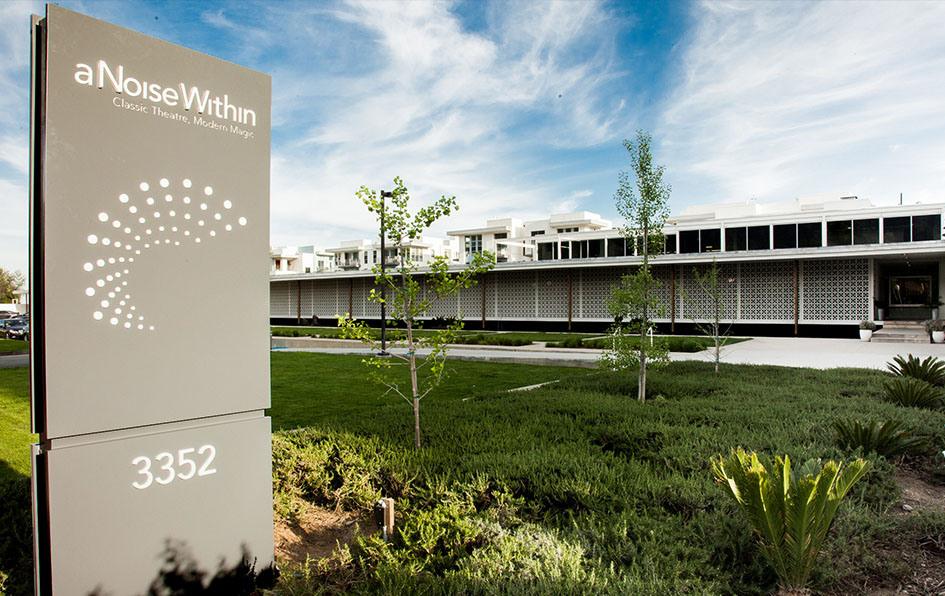
As ANW gained following, it also outgrew its venue. In the middle of the 2008 recession the company somehow managed to raise the $13.5 million needed to build its new home on 3352 East Foothill Blvd. in Pasadena. It is a three-story, 30,000 square foot facility with rehearsal space, scene and costume shops, classrooms, administrative offices, and a student learning resource center.

This new facility made it possible for the theatre company to increase its audience considerably, and in the last five years has surpassed its previous box office and attendance records annually. Each year ANW serves over 40,000 patrons from Southern California and elsewhere. It has also achieved the remarkable feat of 85% subscription theatre renewals, 12% more than the national average. And it still is adding new subscribers, increasing its total audience base every year.

The theatre company’s commitment to make theatre accessible to everyone is evidenced by its ‘Pay What You Can’ night for each production. Its Resident Artists also put on staged readings six times a year at no cost to the public.   

One of ANW’s distinguishing hallmarks is its educational outreach program. Thirty percent of its resources are dedicated to support schools, providing transportation for students to come to the theatre. It also offers: reduced ticket costs to attend a live on-stage performance; post-show discussions with the artists; in-class workshops; and standards-based study guides. It has served more than 250,000 students over the years; in the 2015-2016 season, 15,400 youths from 204 schools from 28 school districts participated in this program. Its acclaimed summer camp, ‘Summer With Shakespeare,’ has graduated nearly 900 students since its creation.

So much has happened in two and a half decades. Today ANW is considered one of the most successful theatre companies in the country. But the one thing that has remained constant is their unwavering artistic vision. As Rodriguez-Elliott says, “We focus on timeless works that speak to the human condition. It’s important for us to present these epics in an intimate setting, told with a personal and contemporary perspective – after all, what good are all these grand, sweeping narratives if no one can relate to them?” 

To celebrate its first quarter century, ANW is holding events across their disciplines. There will be a Summer with Shakespeare on July 16; The American Dream: A Resident Artist Reading Festival on July 22- 24, 2016 (an event which is free to the public); a free Open House on September 17, 2016; a Fashion Show featuring costumes the artists have worn in its productions

through the years on January 21, 2017; and a 25th Anniversary Gala at the California Club to commemorate 25 years of classic theatre on April 29, 2017.

Elliott and Rodriguez-Elliott have decidedly come very far from their humble beginnings when they used their last dime to produce Hamlet. And both are keenly aware that a loyal community of artists, students, theatre lovers, and friends will take the next 25-year journey with them to help ensure this art form remains flourishing for generations to come.            

Six Characters in Search of an Author Premieres at a Noise Within

Originally published on 14 April 2016 in the Pasadena Independent, Arcadia Weekly, Monrovia Weekly, and Sierra Madre Weekly

When Luigi Pirandello’s early play Six Characters in Search of an Author was first performed in 1921 at the Teatro Valle in Rome the audience protested with shouts of “manicomio!” (madhouse) because of the play’s irrational premise. Pirandello had to write a third edition in 1925 with a foreword to clarify the idea he wished to convey.

A precursor to the Theatre of the Absurd, Six Characters in Search of an Author, blurs the line between reality and illusion. It premieres at A Noise Within  (ANW) in Pasadena from March 27 to May 14, 2016 with Geoff Elliott and Julia Rodriguez-Elliott as co-directors.

Essentially a play within a play, it takes place in a rehearsal room where an acting company is working when they are interrupted by six people who come in from the street. They explain to the director that they are unfinished characters in search of an author to complete their story. While the director initially thinks them to be mad, he gives in to their claim as they relate their story. 

Elliott explains, “The director buys into it and agrees to stage their story.  But then a debate ensues as to who would best play the roles. The actors are convinced they are the ones who could bring the words to life and make these characters relatable human beings. Meanwhile the six characters argue that they should play themselves because anything otherwise would merely be an interpretation, and not who they really are.”  

Adds Rodriguez-Elliott, “This is why when Six Characters was first produced onstage there were protests. The play challenged the very nature of theatre; it showed how implausible theatre is. But when you parse it down to its most basic, it isn’t just an esoteric idea but a tale of passions.  It’s almost Shakespearean as it tackles infidelity, suicide and, possibly, incest. It is a story about a family seeking relief from a horrible event that has befallen them. And they believe that they would find that release they so desperately need if they could tell their story. It suggests theatre’s healing and therapeutic power.”

“Pirandello had these characters in his head who were so alive for him but he didn’t know how to use them or what play to put them in. Yet he couldn’t get them out of his mind,” Rodriguez-Elliott continues.

“They just wouldn’t leave him alone” Elliott interrupts with a laugh. “They kept causing great frustration so finally he gives in and lets them insert themselves into this rehearsal. I can’t help but think that writing this play must have been very cathartic for Pirandello. All writers or screenwriters, generally, dread to hand their work over to the actors because the actors will decide to rewrite it and make it into something they didn’t have in mind at all. What a joy it must have been for Pirandello to watch what happens when he haphazardly throws these characters into a play!”

Rodriguez-Elliott relates, “It’s quite fascinating – as we started working on the material, we saw the brilliance of Pirandello’s writing. We didn’t really completely comprehend it until we got into rehearsal and discovered its many facets. And, frankly, I found even more humanity in these individuals as we peeled away their layers.”

As Elliott puts it, “This play, more than any of the others we’ve done, reveals itself to us. It shows how your thoughts could change as you delve deeper into the story. It is fundamentally about a dysfunctional family. Who couldn’t relate to that?”

“Theatrically, it’s quite interesting to put on. We start out with a neutral rehearsal room with nothing much in the way of a set – a piano, some chairs, maybe. As the characters begin to tell their story, color is introduced; a garden comes to life; things appear and then disappear. The space takes on their reality at some point and you see that manifest itself through the pieces on the set. In a way it’s like our imagination; it can take us to certain places,” Rodriguez-Elliott elaborates.

“We hope Six Characters gives our audience a chance to experience theatre in its most non-linear sense and give in to it. Pirandello asks a lot of questions and puts them all out there. He doesn’t necessarily give us a solution nor neatly ties things together. It’s going to mean different things to disparate people; we can all observe the same event but each one of us would have a different perspective,” Rodriguez-Elliott concludes

In announcing the theatre company’s theme for the 2015-2016 season, Elliott declared, “As a recurring thematic element, ‘Breaking and Entering’ symbolizes breaking down the walls of ignorance or fear and summoning the personal courage to embrace a greater sense of truth. These plays are inhabited by characters who do just that.”

How apropos that Six Characters in Search of an Author culminates ANW’s impressive season staging groundbreaking masterpieces by playwrights who have given us permission to see beyond the obvious.                        

Shaw’s ‘You Never Can Tell’ on Stage at A Noise Within

Originally published on 10 March 2016 in the Pasadena Independent, Arcadia Weekly, Monrovia Weekly, and Sierra Madre Weekly

Students of English Drama would all be in agreement that George Bernard Shaw, who wrote over 60 plays in his lifetime, is one of the most revered writers of all time. This Nobel Prize- and Oscar-winning Irish playwright, critic and socialist influenced Western theatre, culture and politics from the 1880s to his death in 1950.     

One of Shaw’s earlier plays, You Never Can Tell, provides much hilarity for Drama scholars and theatre enthusiasts alike as it is performed onstage at A Noise Within (ANW), starting March 6 through May 15, 2016.  

Stephanie Shroyer, an Associate Professor of Theatre Practice and the Artistic Director at the USC School of Dramatic Arts, takes the helm for this production.  She describes what’s in store for its audience, “I believe Shaw is telling us that life is hard and we should cherish every moment because, really, you never can tell what good will come our way. This is a wise, warm, and terrifically funny play – after all, what other play about love opens in a dentist’s office, with a practitioner who becomes the major love interest, pulling his first tooth without using anesthesia because it is an extra five-shilling charge?”

This is Shroyer’s first time to direct You Never Can Tell and she is thrilled. “I’m a big fan of Shaw – I love his wit and provocative thinking. I didn’t know this play intimately well but fell in love with it after reading it.   

When we did a bit of research for the play, we found this to have been Shaw’s answer to some people’s request for material with popular appeal for the modern audiences of the late 19th century. While the characters are intellectualizing, it’s lighter in tone. I liken it to serving the play’s message with a spoonful of sugar,” Shroyer enthuses.

Shroyer also imagines some of the characters in this play are what one would expect to see from Commedia dell’arte stock characters, “I want to have the circumstances in the material performed to their fullest – the actors will use overemphasized hand movements and gestures to show the exaggerated points Shaw is making intellectually.”

Longtime ANW company performer, Deborah Strang, who plays Mrs.Clandon, articulates everyone’s sentiment that staging You Never Can Tell is an enjoyable experience, “I loved working with Stephanie when she directed Blood Wedding during ANW’s very early years, and I still enjoy collaborating with her to this day. She is a visual artist and her training as a dancer shows when she asks us to do something that comes from another world, in a way. But eventually we get that her approach is left brain-right brain. And she makes us all laugh. We have way too much fun in rehearsal there must be something wrong.  I’m sure it will all fall apart sometime.”

Unlike her director, Strang isn’t particularly the playwright’s fan. She confesses, “In a way Shaw is too smart for me; he’s very much an intellectual. I’m a little stupider than he – I constantly feel like he’s two beats ahead of me. But this piece might have changed my mind and I might have to reread him from this new angle.  his play and the people in it are so delightful. Whereas a lot of his work deals with ideas, this one is more about the characters. It’s almost like Oscar Wilde’s The Importance of Being Earnest without the irony. It’s a comedy, it’s fresh and delightful.  Every single character is lovable and charming.”  

You Never Can Tell is set in a seaside town and follows the story of Mrs. Clandon and her three children – Dolly, Phillip and Gloria – as they return to England after an 18-year stay in Madeira.  Mrs. Clandon, a woman whose sensibilities are caught between the tug of restrained Victorian manners and the modern ways, raised her children on her own and never told them their father’s identity. Through a comedy of errors, however, they end up inviting him to a family lunch.  Meanwhile, a dentist named Valentine has fallen in love with the eldest daughter, Gloria. But Gloria deems herself a modern woman and declares to have no interest in love or marriage. The play goes about with various scenarios of confused identities, with the wisdom coming from a sage waiter who dispenses it with the phrase “You Never Can Tell”.

This play performs in repertory with Shakespeare’s Romeo and Juliet and Luigi Pirandello’s Six Characters in Search of an Author.  Elliott says of You Never Can Tell, “As Romeo and Juliet shows an aspect of love, George Bernard Shaw shows us love – and heartbreak – in an entirely different, bright and very funny way. This early play of his, before Shavian became an adjective, gives us a chance to take great delight in his outrageous situations and voice with a kind of unique wordsmithing that allows us to bathe in his glorious use of English.” 

Shaw’s imposing body of work that we find irresistible to read or watch on stage – from acerbic satire to historical allegory – clearly exhibits why his plays endure to this day.                  

Shakespeare’s Romeo and Juliet as a Street Performance at A Noise Within

Originally published on 18 February 2016 in the Pasadena Independent, Arcadia Weekly, Monrovia Weekly, and Sierra Madre Weekly

Beginning this Valentine’s Day through the 8th of May, A Noise Within (ANW) will be staging the greatest love story of all time – William Shakespeare’s  Romeo and Juliet. 

Directed by Damaso Rodriguez, Artistic Director of Artists Repertory Theatre, Portland’s longest-running professional theatre company, this Romeo and Juliet will be a far departure from how Shakespeare’s work is traditionally presented: as a period piece, with lavish costumes and grand sets. Instead the play will be presented as a street performance, in a graffitied and littered alley with garbage bins scattered about.

The vision for this well-known play came about when Rodriguez visited Havana, Cuba and  met with artists who staged bare-bone productions for a few attendees in humble homes. He relates one memorable evening, “We walked through a courtyard overlooking balconies – it is a beautiful environment but all around you could see peeling plaster from 50 years of decay.  We entered a small house, with light bulbs in tomato cans for stage lighting, the actors wearing their own clothes. The audience was made up of 20 people who came that night. And they proceeded to tell their story. It was a Cuban play which, I think, was about their daily struggles for survival. While there was a language barrier, what united the performers with the audience was the art form. It was a truly transformative moment for me.”

“Theatre companies without much in the way of money put on plays using found objects for props and scenery, and in very low-tech, low-resource performance spaces. The plays with just the actors themselves having to rely on their skills were powerful and inspirational.  In this place where there are few resources, actors and audience link as a community with the compelling need to tell and hear stories joining them as one.”

“I wanted to bring this experience to Romeo and Juliet – costumes will be clothes that actors own, props are whatever they find in the street, and the setting urban. The play will exist in the telling rather than the trappings.” 

“It will be an unexpected environment that in no way resembles the characters’ wealth and class.   I hope that by stripping the play down to its most basic, it will focus on the language and clarify the intention of the characters,” Rodriguez discloses further.

ANW’s artistic director, Geoff Elliott reveals, “When we approached Damaso about directing for us this season, he responded by saying that he has wanted to do Romeo and Juliet because it deals with the most basic of human emotions – love, rashness, hate, fate – and tribalism, which drives just about anything we call news. Humans have passion, conduct war, and kill each other over a tribal conflict the origin of which no one can even remember. And I think that Damaso has found a direct and compelling way to tell this story.”

Rodriguez says, “I hope people who come to watch the play, after a few minutes just try to conceptualize these characters and see them as humans. I hope they see a clearer version of the story and realize the universal essence of Romeo and Juliet.”

“It is a raw and harsh environment, yet we have an optimistic view that their death has brought the conflict between these two families to an end. People will realize this tragedy happened because of two opposing rigid world views – that it took the death of these young characters to end hatred. Romeo and Juliet taught them to look at life differently,” Rodriguez adds.

“It’s arguably daunting to present such a classical material in an unexpected fashion because you could be working with actors who’ve done it before. People who love Shakespeare have certain expectations; also there are scholars who think Shakespeare has to be done a certain way. But in the end all I can do is forget about that. I have to believe that a director has to find an emotional connection and impulsive reaction to it, and share that with his collaborators,” Rodriguez states further.

“It’s quite liberating, actually, to not be restricted by expectations and standards. While A Noise Within has staged Romeo and Juliet twice, I didn’t necessarily set out to find a way to make it very different from what they did before. I didn’t burden myself with that concern; I am merely satisfying an urgent impulse. It’s hard enough to just unpack the language of Shakespeare. I simply want to make the storytelling as clear as he would have wanted for his audience,” concludes Rodriguez.              

During Shakespeare’s time some plays were presented outdoors. Theatregoers had to use their imagination – there were no backdrops, lighting, or props to speak of. Furthermore, his plays were not intended to be read but spoken aloud; the lack of background meant there was nothing to distract the audience from the actors’ words and movements.     

That ANW’s Romeo and Juliet would be staged as they were originally performed four hundred years ago is the perfect tribute to the Bard’s timeless work.  

‘A Christmas Carol’ at A Noise Within

Originally published on 26 November 2015 in the Pasadena Independent, Arcadia Weekly, Monrovia Weekly, and Sierra Madre Weekly

It has become an all-too common occurrence – hordes of buyers fighting over the last $99.00 BluRay disc player at a big box store the day after Thanksgiving, heralding the Christmas shopping season. But there was a time, before the Christmas spirit took on the guise of Black Friday doorbuster specials, when this season meant goodwill towards humankind.  

A Noise Within (ANW), a repertory theatre company in Pasadena, is bringing back the sentiments that this time of year should evoke. Beginning this Saturday, the 5th of December through Wednesday, the 23rd, San Gabriel Valley residents can come to enjoy its production of Charles Dickens’ timeless classic A Christmas Carol.

Julia Rodriguez-Elliott, ANW’s co-artistic director with her husband, Geoff Elliott, says this is the perfect antidote to the consumerism that has defined the Christmas season. She says, “A lot of people just want to break away from all the shopping during the holidays.”

This is the fourth year that ANW is mounting A Christmas Carol on their stage and Elliott and Rodriguez-Elliott are sharing directorial credits. This collaboration is hugely beneficial not just for the performers but for the audience as well. As Elliott succinctly puts it, “Co-directing makes sense; two heads are better than one.”

Being the more tech-minded director of the two, Rodriguez-Elliott concentrates on all the technical elements. She expands on this, “A director has to mind the lighting, costume, props and at the same time pay equal attention to the actors. When we co-direct, Geoff can give notes to the performers while I give feedback to the designers.”

“It isn’t that I don’t like the technical aspect of directing,” explains Elliott, “I have to say I enjoy it as well – though maybe not as much as Julia does – but I want to focus in greater detail  on the performers and the honesty of the moment.”

Rodriguez-Elliott, for her part, says “The more I do it, the more I appreciate the designers and what they bring – they can illuminate, elevate what you’re doing with the actors. A perfectly lit moment, or a visual scene done correctly, has an impact on the audience beyond what happens in the rehearsal room under fluorescent lights.”

This iteration of A Christmas Carol is Elliott’s 2000 adaptation from the original ANW production. He relates, “The original production was incredibly successful artistically but it was dark and bloody. When we decided to revisit it in 2000, we wanted to bring the light, the love between the Cratchits and other characters in the play. We needed a different take on it.”

The Cratchits | Courtesy Photo

A Noise Within’s move to its present home in Pasadena was the excellent time and opportunity to mount this ambitious endeavor. Explains Rodriguez-Elliott, “The Masonic Temple didn’t have enough seats so it didn’t make much sense production-wise. With a finite number of days we can play it based on our schedule and the holiday, we wouldn’t have enough performances.  In this venue, we can give this adaptation a full run.”

It is a fortunate outcome for many of us who remember reading Charles Dickens’ memorable work of fiction growing up. That it is performed – with actual people on stage – gives this novella much greater extent and meaning.      

A Christmas Carol is the ultimate story of redemption and transformation ever written,” Elliott proclaims. “While we present the play every year, it is never stale because we always find something different to do. Even the performers who think they might want to take a break from it after having done it several times, come back to it because they realize it is a living, breathing fabric.”

Adds Rodriguez-Elliott, “I am seeing it fresh because I am in a different place from where I was a year ago. And as a director there’s always that feeling of ‘Gosh I’m not happy with this’. We have that opportunity to improve on it every year or make it better. And this is exactly what A Christmas Carol is all about – a tale of how even the most miserly curmudgeon on earth can change for the better.” 

“As scary as some children might think of Marley, and the Ghosts of Christmas Past, Present and Future, they are there out of love,” Elliott expounds. “They are all benevolent ghosts who want to help Scrooge. This is the attraction of A Christmas Carol; it is why people come to see it. We all want a chance at redemption.”

At the end of A Christmas Carol, Scrooge is overwhelmed with joy at the chance to redeem himself and is grateful for having returned to Christmas Day. He rushes out into the streets to share his newfound spirit. And from that day on, he celebrates the season by giving to the poor and treating others with generosity, kindness, and warmth.

How impressively mesmerizing it must be to behold this final scene as it unfolds before us! Maybe for longer than a few lingering moments, we wouldn’t equate Christmas with doorbuster specials. When Elliott pronounces that “live theatre is here to stay – it’s life changing,” this must be what he means.