
‘A Christmas Carol’ at A Noise Within

Originally published on 26 November 2015 in the Pasadena Independent, Arcadia Weekly, Monrovia Weekly, and Sierra Madre Weekly

It has become an all-too common occurrence – hordes of buyers fighting over the last $99.00 BluRay disc player at a big box store the day after Thanksgiving, heralding the Christmas shopping season. But there was a time, before the Christmas spirit took on the guise of Black Friday doorbuster specials, when this season meant goodwill towards humankind.  

A Noise Within (ANW), a repertory theatre company in Pasadena, is bringing back the sentiments that this time of year should evoke. Beginning this Saturday, the 5th of December through Wednesday, the 23rd, San Gabriel Valley residents can come to enjoy its production of Charles Dickens’ timeless classic A Christmas Carol.

Julia Rodriguez-Elliott, ANW’s co-artistic director with her husband, Geoff Elliott, says this is the perfect antidote to the consumerism that has defined the Christmas season. She says, “A lot of people just want to break away from all the shopping during the holidays.”

This is the fourth year that ANW is mounting A Christmas Carol on their stage and Elliott and Rodriguez-Elliott are sharing directorial credits. This collaboration is hugely beneficial not just for the performers but for the audience as well. As Elliott succinctly puts it, “Co-directing makes sense; two heads are better than one.”

Being the more tech-minded director of the two, Rodriguez-Elliott concentrates on all the technical elements. She expands on this, “A director has to mind the lighting, costume, props and at the same time pay equal attention to the actors. When we co-direct, Geoff can give notes to the performers while I give feedback to the designers.”

“It isn’t that I don’t like the technical aspect of directing,” explains Elliott, “I have to say I enjoy it as well – though maybe not as much as Julia does – but I want to focus in greater detail  on the performers and the honesty of the moment.”

Rodriguez-Elliott, for her part, says “The more I do it, the more I appreciate the designers and what they bring – they can illuminate, elevate what you’re doing with the actors. A perfectly lit moment, or a visual scene done correctly, has an impact on the audience beyond what happens in the rehearsal room under fluorescent lights.”

This iteration of A Christmas Carol is Elliott’s 2000 adaptation from the original ANW production. He relates, “The original production was incredibly successful artistically but it was dark and bloody. When we decided to revisit it in 2000, we wanted to bring the light, the love between the Cratchits and other characters in the play. We needed a different take on it.”
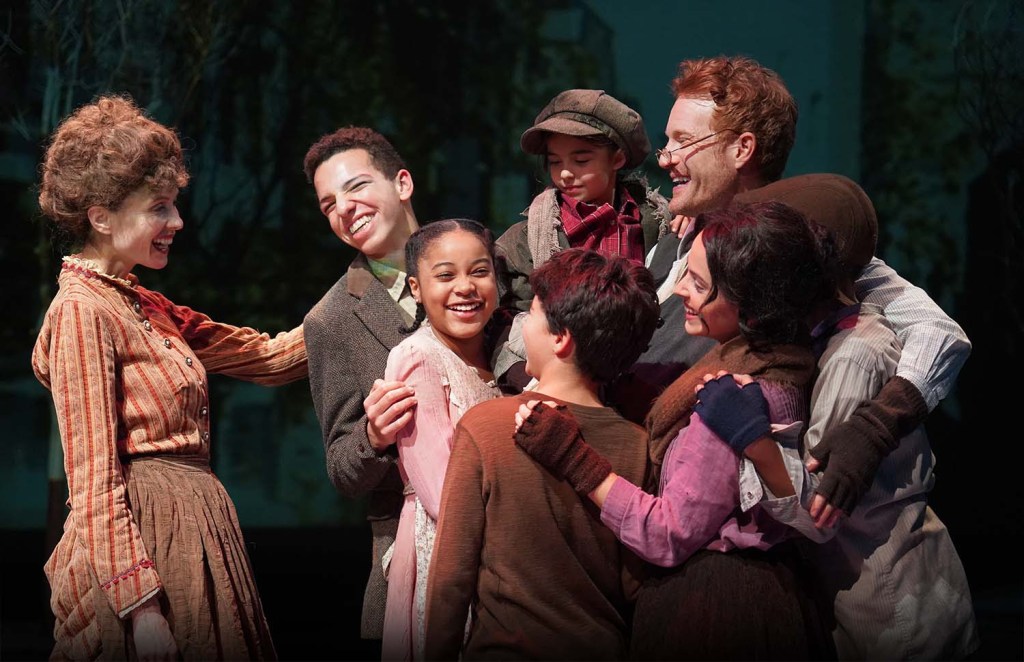
The Cratchits | Courtesy Photo

A Noise Within’s move to its present home in Pasadena was the excellent time and opportunity to mount this ambitious endeavor. Explains Rodriguez-Elliott, “The Masonic Temple didn’t have enough seats so it didn’t make much sense production-wise. With a finite number of days we can play it based on our schedule and the holiday, we wouldn’t have enough performances.  In this venue, we can give this adaptation a full run.”

It is a fortunate outcome for many of us who remember reading Charles Dickens’ memorable work of fiction growing up. That it is performed – with actual people on stage – gives this novella much greater extent and meaning.      

“A Christmas Carol is the ultimate story of redemption and transformation ever written,” Elliott proclaims. “While we present the play every year, it is never stale because we always find something different to do. Even the performers who think they might want to take a break from it after having done it several times, come back to it because they realize it is a living, breathing fabric.”

Adds Rodriguez-Elliott, “I am seeing it fresh because I am in a different place from where I was a year ago. And as a director there’s always that feeling of ‘Gosh I’m not happy with this’. We have that opportunity to improve on it every year or make it better. And this is exactly what A Christmas Carol is all about – a tale of how even the most miserly curmudgeon on earth can change for the better.” 

“As scary as some children might think of Marley, and the Ghosts of Christmas Past, Present and Future, they are there out of love,” Elliott expounds. “They are all benevolent ghosts who want to help Scrooge. This is the attraction of A Christmas Carol; it is why people come to see it. We all want a chance at redemption.”

At the end of A Christmas Carol, Scrooge is overwhelmed with joy at the chance to redeem himself and is grateful for having returned to Christmas Day. He rushes out into the streets to share his newfound spirit. And from that day on, he celebrates the season by giving to the poor and treating others with generosity, kindness, and warmth.

How impressively mesmerizing it must be to behold this final scene as it unfolds before us! Maybe for longer than a few lingering moments, we wouldn’t equate Christmas with doorbuster specials. When Elliott pronounces that “live theatre is here to stay – it’s life changing,” this must be what he means. 

Geoff Elliott Directs a Powerful ‘All My Sons’

Originally published on 5 November 2015 in the Pasadena Independent, Arcadia Weekly, Monrovia Weekly, and Sierra Madre Weekly

Geoff Elliott, co-artistic director (with his wife, Julia Rodriguez-Elliott) of famed Pasadena repertory company A Noise Within (ANW), and solo-directing this time, claims he is an actor first. This is most assuredly evident when you watch him on stage as he embodies the complex character, Joe Keller, paterfamilias in this 1947 Arthur Miller play, All My Sons.

Beacon’s Nathaniel Cayanan, in his review of ANW’s production, says, “Throughout the play, we’re put on a roller-coaster in which we’re at one point laughing at the liveliness and charm of Joe Keller, skillfully played by … Geoff Elliott, but at another point instantly entranced by the intense conflict boiling beneath the surface….”   

That Elliott is acting on stage while steering the course of the play is what makes his performance extraordinarily masterful.  He has wonderfully balanced his dual job of breathing life into Miller’s embattled Joe Keller and extracting the best work from his cast of talented actors.

As Elliott describes it, “…for actors, it’s very much about me and you, the two of us in the scene and what’s happening between us. The director, on the other hand, has a global perspective – he is thinking about the performances, and all other aspects of the production like the lighting, the sound, the set, the costumes.”

“Acting and directing are two very different experiences. But while the processes actors and directors go through are vastly different,” Elliott opines, “I think it’s healthy for all directors to have been actors at one point in their life, or at least to have trained because it’s really hard to know how vulnerable an actor is until you’ve done it yourself. I personally often find that there’s something missing when directors who have never acted try to articulate what it is they want to happen.”

Continues Elliott, “All actors bring something you’re not thinking of when you’re visualizing it.  It is when you get in the room with other artists that you begin to understand the play and where it needs to go. You have so many bright ideas before you go into the rehearsal room but you get in there and so much of what goes on is informed by those actors and what they’re bringing to it.  If you cast a production well you can trust they’re going to bring some really exciting stuff. I think a good director really pays attention to what the other artists are doing and helps them move along in that direction. You’re enlivened by the choices they’re making and that can make you think of something that enhances the play.”  

It is quite obvious then that Elliott has collaborated well with all the performers in ANW’s production of All My Sons. His passion for the play and his directorial choices made it a very realistic representation of life. As Cayanan further says in his review, “… However complex, this plot could have very easily been an overly melodramatic interpretation, but instead the play is well handled by a creative team that adeptly presents a very real and raw story of an American family of yesterday (and even today).”

Image of A Noise Within’s lobby taken from ANW website

All My Sons, Arthur Miller’s Tony Award-winning first hit play is the third offering in ANW’s 2015-2016 ‘Breaking and Entering’ season. Other cast members include Deborah Strang As Kate Keller, Rafael Goldstein as Chris Keller, Maegan McConnell as Ann Deever, Aaron Blakely as George Deever, Jeremy Rabb as Jim Bayliss, June Carryol as Sue Bayliss, E.K. Dangerfield as Frank Lubey, Natalie Reiko as Lydia Lubey, and Vega Pierce-English as Bert. The show opened on October 17, which was to have been Arthur Miller’s 100th birthday, and goes on stage through Saturday, November 21 with both a 2:00 pm matinee and evening performance at 8:00 pm.   

Asked if their iteration of this play is an homage to the late great playwright,  Elliott responds, “It may probably end up being such although I don’t know that we necessarily had that in mind.  But the greater reason for doing it is because of the fact that it’s an extraordinary masterpiece, and it’s so timely. This play could have been written yesterday. It will always be as timely as when he wrote it in 1947 – it’s true now as it was then.”  

Elliott elaborates on the play’s plot and his approach to it, “This play is about young love, and deep familial love. These are people who will sacrifice anything and everything to take care of their family and the ones who are precious to them. In the same vein, this is very much an ensemble piece, one that’s driven by performance, and it couldn’t be delivered without a magnificent company of actors, many of whom have been together for 20 years. This is among the most personally meaningful plays I have ever directed, and All My Sons is a wonderful introduction both to Arthur Miller and the work we do here at A Noise Within.”

“I hope people see themselves as they watch the play and understand that this is happening today. Decisions that hurt people are being made every day in America’s board rooms,”  Elliott concludes. He hopes people take home with them a lesson that Arthur Miller wanted to get through – past actions can come back to haunt us.

Under Elliott’s accomplished direction, A Noise Within’s All My Sons has created a memorable and soaring tribute to Arthur Miller’s legacy as a foremost American playwright. Elliott is proud of what they have produced and he hopes it proves to be an unforgettable theatre experience for many.  

Julia Rodriguez-Elliott’s Vision for ‘A Flea in her Ear’

Originally published on 24 September 2015 in the Pasadena Independent, Arcadia Weekly, Monrovia Weekly, and Sierra Madre Weekly

Slamming doors, running feet, one revolving bed platform, screaming women, a gun-toting husband, a trysting place, and mistaken identities – all these are what make A Flea in her Ear such a fun and hilarious treat of a play.

Hailed as the greatest of French farces, Georges Feydeau’s timeless classic will debut on September 12 at A Noise Within in Pasadena. This new version, written by David Ives was commissioned by the Chicago Shakespeare Theatre, and is the first show in the repertory theatre company’s 2015-2016 Breaking and Entering season.

A Flea in her Ear tells the story of Victor Chandebise and his wife, Raymonde. After Victor’s brief bout of impotence, Raymonde suspects him of having a wandering eye. She asks her friend, Lucienne, to send him a letter luring him into a rendezvous with a mysterious lady at a hotel to see if he will show up. While this piques his curiosity, he takes the precaution of sending someone in his stead. The ensuing mishaps – a Victor look-alike bellboy and several miscommunications – all make for a madcap production.    

For Julia Rodriguez Elliott, who is directing A Flea in her Ear, it is the realization of a long-held dream. “I have long wanted to do this play,” says Rodriguez Elliott, “because I’ve loved it from the very first time I saw it. Frankly, there are funny shows – and then there’s A Flea in her Ear.  While it is a great source of naughty fun and every single element of farce is here in force, David Ives’ recent translation is available to us which makes it truly performable for our audience.”

As reimagined by Rodriguez Elliott, this Flea in her Ear, originally set in La Belle Epoque, takes place in 1950s Paris. She explains “… I wanted to take it out of the stuffy drawing room and set in the ‘50s – before the sexual revolution, when married people didn’t go to couples therapy and didn’t talk about intimate issues. It was a time period when gender roles were clearly defined.”

Rodriguez Elliott likens A Noise Within’s iteration of  Flea as reflective of the comedy in the 1950s era. She says, “The two female leads – Raymonde and Lucienne – crazy, scheming closest friends, are a bit reminiscent of Lucy and Ethel from I Love Lucy. Just as in that show, there are gender differences afoot – and they are somewhat ahead of their time in taking matters into their own hands. What breezes in as a minor misunderstanding blows into a comic whirlwind of gale force.”

That A Noise Within has a pool of resident actors has ensured a seamless production. Rodriguez-Elliott says, “While Ives has taken into account modern humor, he also knows that in great comedy the laughs come out of the essential humanity of the characters, and this has to be played along with a split-second timing. All of this is helped greatly by a sense of trust among the cast – 80 percent of the cast come from our repertory actors – that allows them to have a great safety with each other to perform the precise physical comedy of the piece…. This absolutely underscores the underlying premise of repertory theatre, and A Noise Within is proud to be among the few national companies that adhere to this time-honored, but increasingly rare theatrical concept.”

To prepare her actors for the demanding and grueling physical effort required for this play,  Rodriguez-Elliott had them throwing tennis balls at each other around in a circle. As soon as they were adept at that, she added layers of complexity like having two tennis balls going around at the same time, or changing the workout to a hot potato mode. The actors did this while committing their lines to memory – physical motions and spoken words became one effortless exercise.

Actors go through intense rehearsals for several weeks. During dress rehearsals, typically held about five days before preview week, actors don their costumes, props appear, and the lighting comes on. All the elements slowly come together as the play comes alive. As exciting as that sounds, Rodriguez-Elliott says, “The first day of dress rehearsal is usually a disaster!” All of a sudden actors realize they need to change parts of what they had practiced to allow for costume requirements. The clothes they’re wearing may be difficult to walk in, or the prop might be cumbersome to hold. This is when they need to make adjustments and integrate these to the flow of the play.

During playpreviews, Rodriguez-Elliott would be furiously making notes, determining what works and what needs tweaking. According to her, “… sometimes the play the audience sees on Opening Night is very different from what we started out with. If we find that there are things that are not working with audiences on several nights, we’ll make changes.” The Opening Night production of A Flea in her Ear will have been the culmination of rigorous rehearsals and various changes. The process gives true meaning to the phrase ‘work in progress.’

A Flea in her Ear reflects the theme of the 2015-2016 season at its most literal. Rodriguez-Elliott describes it as a show where “the characters are breaking conventions in terms of their sexuality but by the end of the play the couples enter a new phase of their life together.” 

But not before much mayhem occurs, to the delight of its audience. Rodriguez-Elliott laughingly refers to the massive confusion that unfolds before us, “… it is a beautiful chaos.”