‘Starting Anew’ Exhibition Offers a Compelling Look at Pasadena’s History

Originally published on 11 February 2020 in the Pasadena Independent, Arcadia Weekly, and Monrovia Weekly

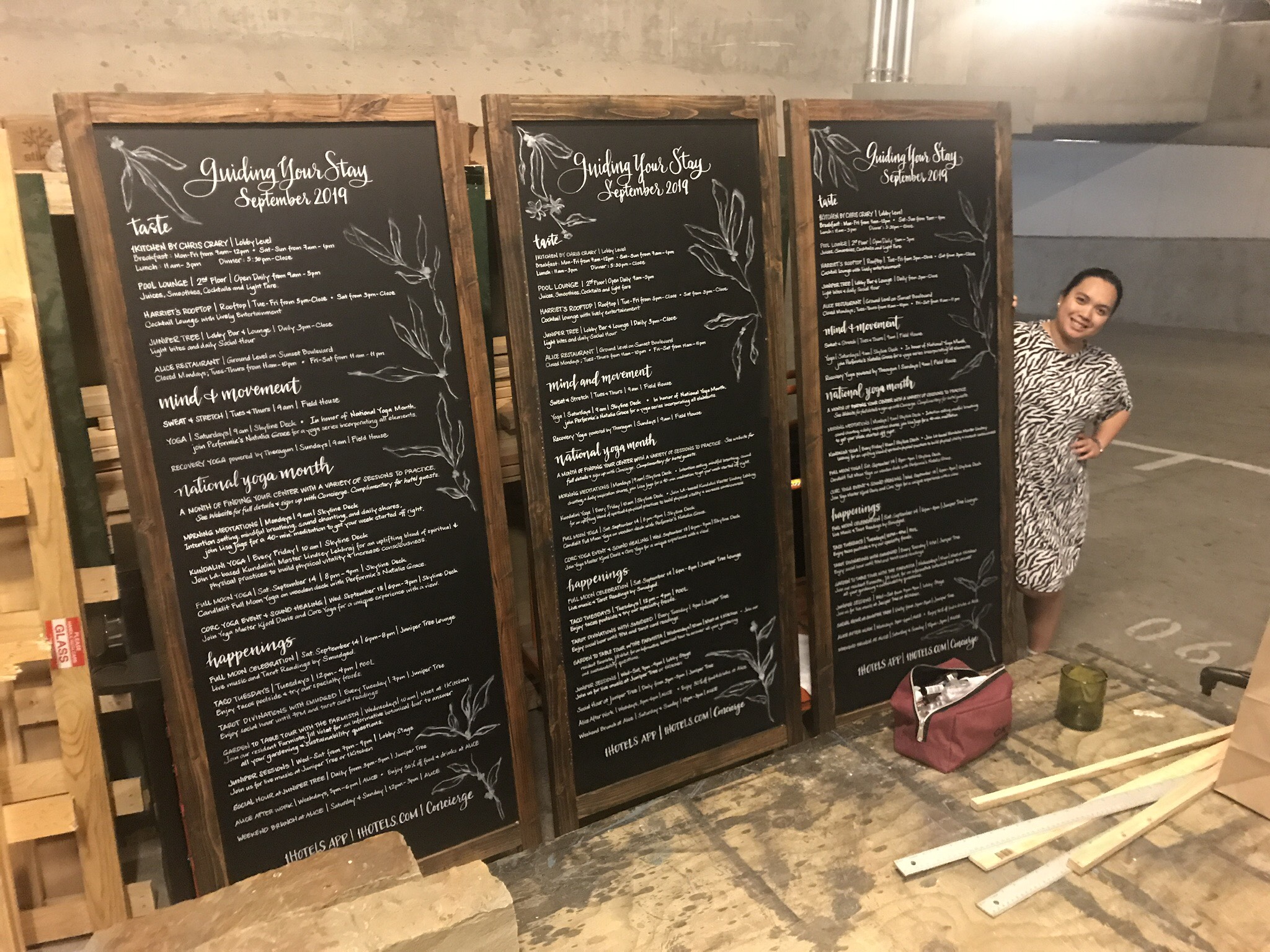
This image has an empty alt attribute; its file name is PMH-Signage-1-scaled.jpeg
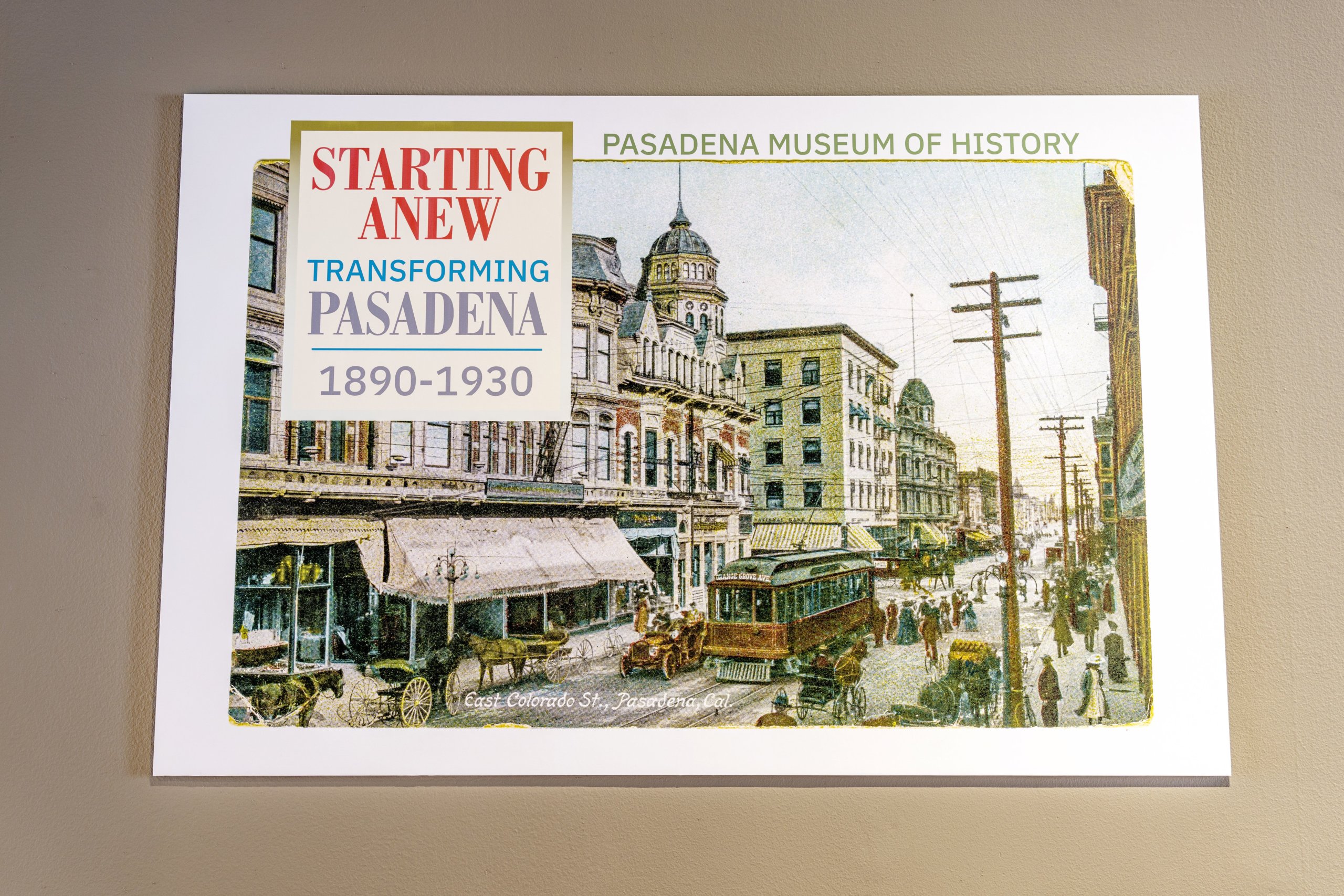
PMH’s ‘Starting Anew: Transforming Pasadena 1890-1930’ Exhibition Signage | Photo by Marlyn Woo/Joanne Wilborn / Pasadena Museum of History

Very few of us realize that the Pasadena we know and live in today was built in the early 20th century by dreamers with grand visions who settled here from the Midwest and the East Coast.  The Pasadena Museum of History (PMH) offers a compelling look at the most flourishing period in Pasadena’s history with an exhibition called ‘Starting Anew: Transforming Pasadena 1890 – 1930,’ on view until July 3, 2020.

I consider Pasadena my hometown and have lived here for 37 years. And while I dearly love my adopted city, I don’t know as much about it as I probably should. PMH’s exhibition provides that stimulating learning experience and Brad Macneil, Education Program Coordinator, who curated this show, happily gives me a tour.

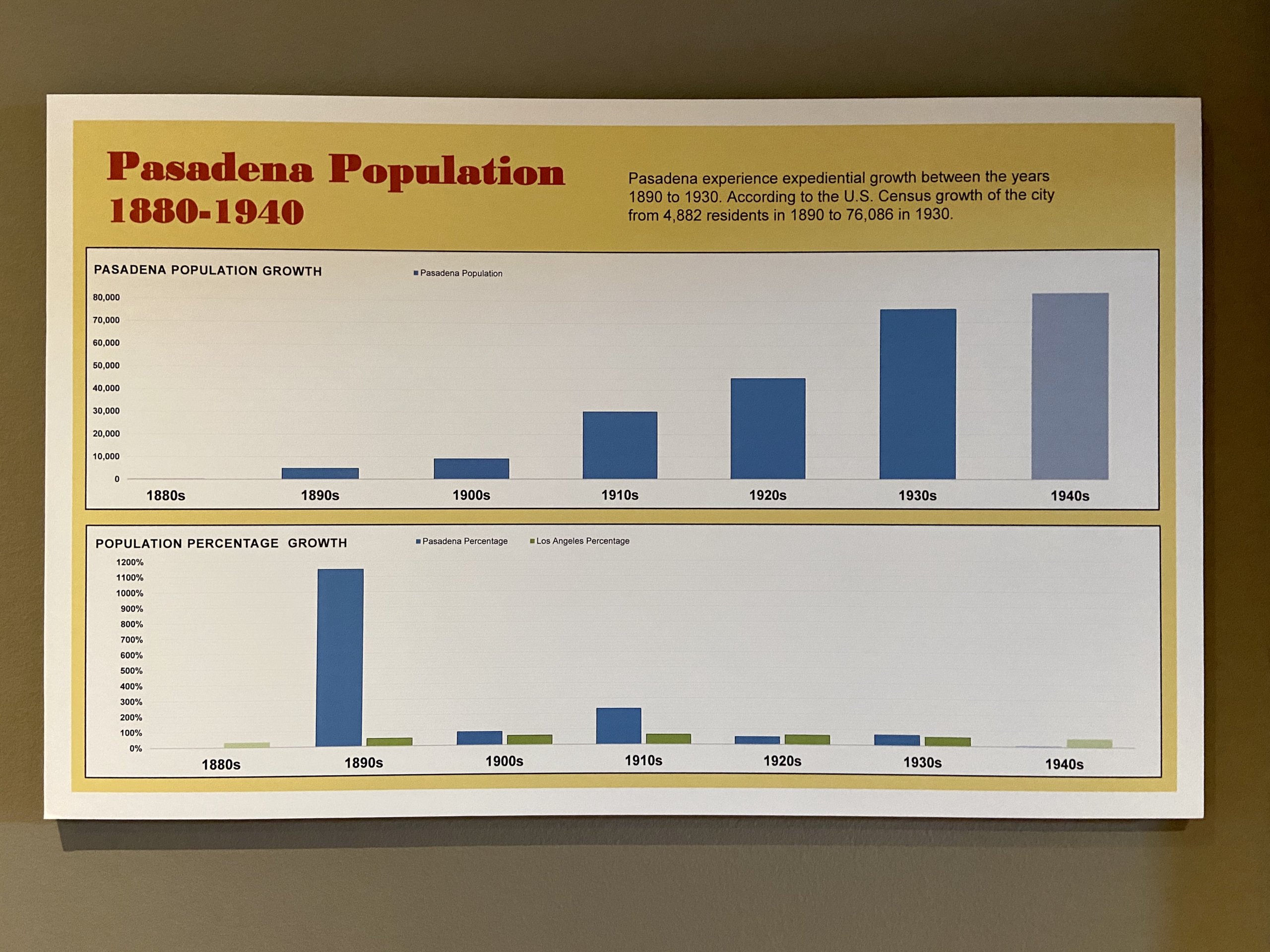
Our first stop is a chart which shows that population growth in Pasadena outpaced that of Los Angeles and then leveled off in 1930 when the depression hit. He discloses, “This was what sparked the idea for this exhibition. It was an amazing time in Pasadena’s history when the population went from below 5,000 to over 76,000 in just four decades. Today there are 150,000 – the population only doubled since. The city was transformed in so many different ways and our exhibit asks and answers a number of questions – why people came here, how they got here, where they lived, what they did, what kept them here.”

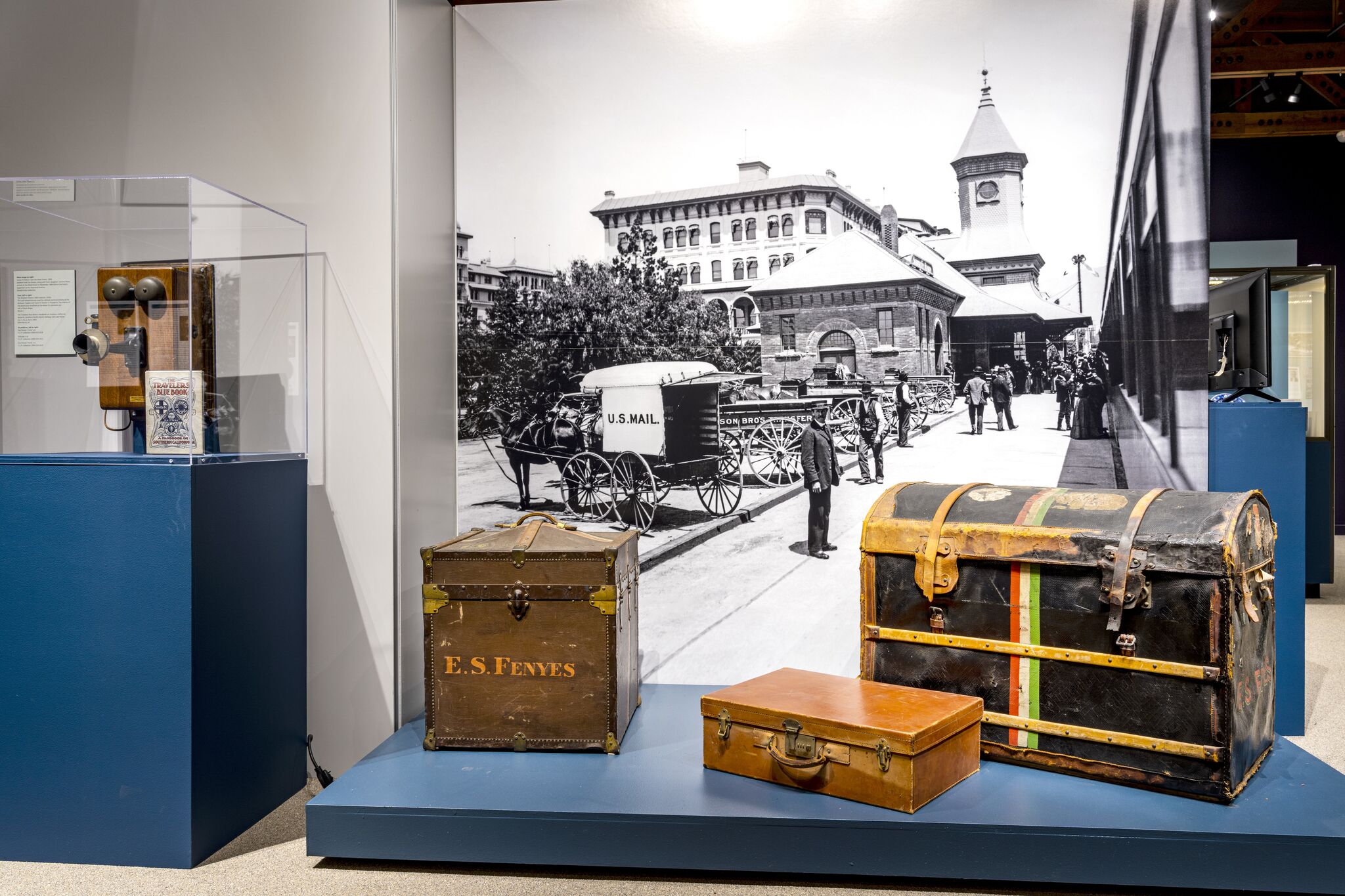
Macneil explains that the railway system started serving Pasadena in the mid-1880s, which caused the population to rise from 500 to 5,000 between 1880 and 1890. A photo of the Santa Fe Railway Depot and the Hotel Green greets us as we enter the first exhibition hall.

This image has an empty alt attribute; its file name is PMH-Population-Chart-scaled.jpg
Population Chart | Photo by Marlyn Woo/Joanne Wilborn / Pasadena Museum of History

“Part of our exhibit tells the story of Dr. Adalbert and Eva Fenyes,” Macneil narrates. “The couple met in Cairo, Egypt and were married in Budapest. It was during their honeymoon around the world that they heard about Pasadena. They arrived at this train station in 1896 as newlyweds, and they had with them Leonora, Eva’s teen-age daughter from her first husband. They stayed at the Hotel Green for about three days and fell in love with Pasadena. They immediately leased a house on the Arroyo, which they later bought. Subsequently, they built two mansions here. One of the wonderful things about this exhibit is that we are able to display the museum’s collection. These are the Fenyeses luggage here and that telephone over there was inside the depot.”

This image has an empty alt attribute; its file name is PMH-Train-station-1.jpeg
Santa Fe train depot, the Fenyeses’ luggage, and depot telephone | Photo by Marlyn Woo/Joanne Wilborn / Pasadena Museum of History

“Besides word-of-mouth, a marketing campaign touting the city’s natural beauty and health benefits lured people to the area,” adds Macneil. “In the late 1880s big, fancy hotels were being constructed, the first of which was the Raymond Hotel. It was built by entrepreneur Walter Raymond, who had been working for a company back East that brought tourists here and thought Pasadena could use a grand hotel. Other hotels then were Hotel Green, the Pintoresca, the Maryland, the Huntington (which was originally the Wentworth and is now The Langham), and the Vista del Arroyo.

“Each year thousands came to Pasadena for the seasons – from November through March. The population would go up and down. The wealthy people came from the Midwest like Indiana and Chicago, and the Northeast – Boston, Philadelphia, and New York. Because of the winter resort business, the whole town grew. Visitors needed service, which opened up employment opportunities. That brought in working class people from other parts of the country to get jobs in the railways, hotels, and in agriculture. Professionals also arrived – doctors, lawyers, newspaper publishers. Pasadena grew into a diverse community – there was already a large Mexican American population, then the Armenians, the Chinese, and the Japanese arrived. They came to either find a job or start a business.”

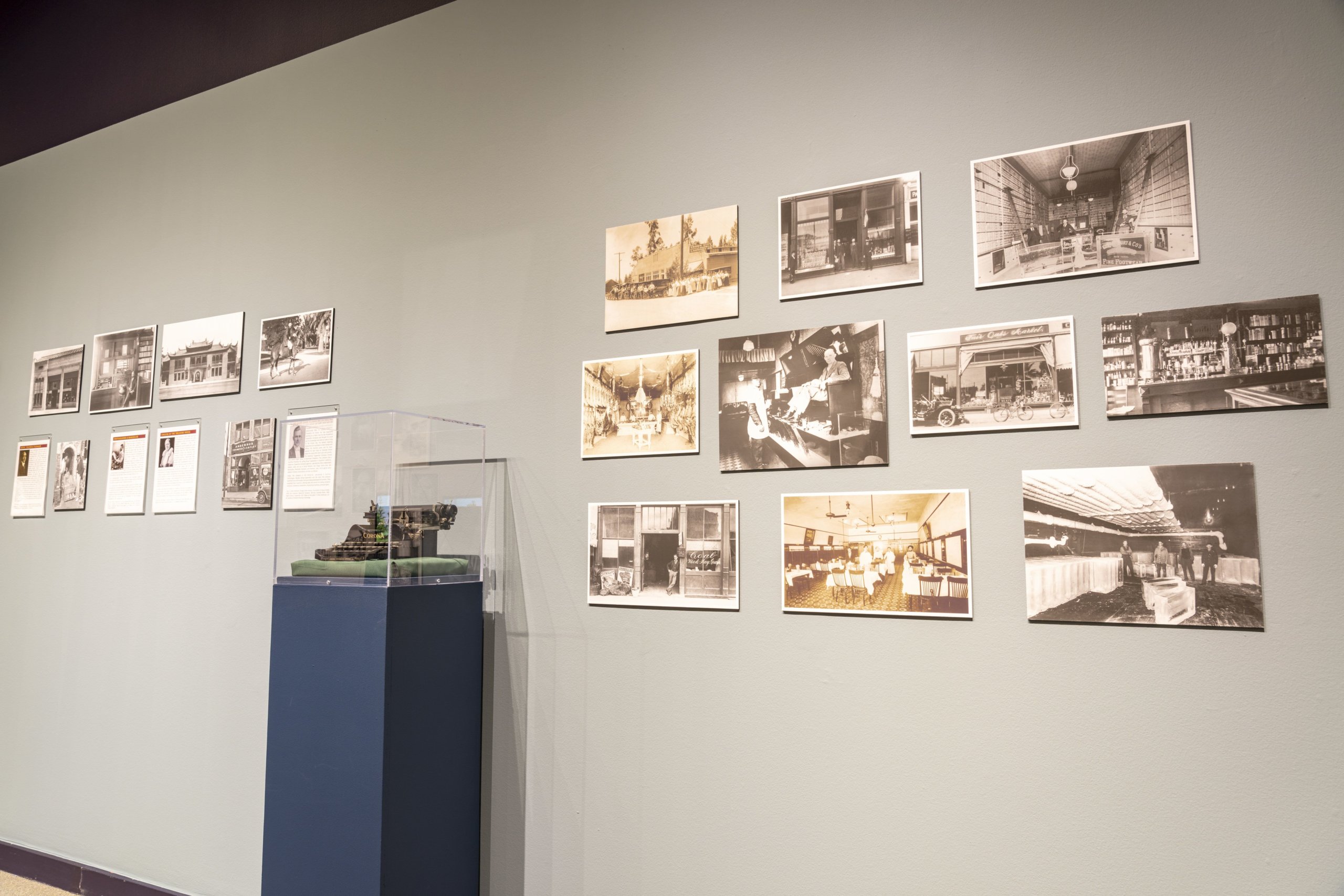
Pasadena was a great place to be an entrepreneur and PMH’s exhibition highlights four enterprising people who came here with very little yet built successful establishments. One of them was Elmer Anderson who arrived with nothing more than a typewriter repair kit and founded Anderson Typewriters. Known today as Anderson Business Technology, it has branches all over Southern California selling business equipment and is still being run by his descendants. The local store on Colorado Boulevard, near Arroyo Parkway, remains to this day.

Many of us will recognize the edifice resembling a Chinese Imperial Palace on Los Robles and Union Street as USC Pacific Asia Museum. Back in the 1920s it was Grace Nicholson’s Treasure House of Oriental Art. She came here with a small inheritance and opened a curio shop selling Native American arts and crafts. She developed great relationships with Native Americans in the Southwest and eventually started selling to the finest museums in the country, including the Smithsonian and Field Museum. She later switched to Asian artifacts and created her treasure house where she lived and worked.

Adam Clark Vroman, an avid book collector and photographer, moved to Pasadena from Illinois hoping the climate would help his wife recover from her illness. Unfortunately, she died two years later. Brokenhearted, he sold his book collection to raise the capital to open Vroman’s Bookstore. As he had no direct heir, he made arrangements for his employees to take over the store when he passed away. It was a remarkable demonstration of how much he cherished and took care of his staff. Some of the descendants of those employees run Vroman’s today and it remains a beloved Pasadena purveyor of books and gift items.

There was Ernest Batchelder who came here to teach art at Throop Institute. He later started his own business – making the eponymous tiles – and became the foremost proponent of the American Arts and Crafts Movement.

This image has an empty alt attribute; its file name is PMHG-Local-businesses2-scaled.jpeg
Local businesses | Photo by Marlyn Woo/Joanne Wilborn / Pasadena Museum of History

Architects and builders prospered at this time because people needed housing. Those who came here for work built bungalows and cottages. Macneil states, “The cost to build a house varied from under $1,000 up to $100,000. Between 1902 and 1918 the median value of local houses was $1,700 (these houses today cost over a million dollars). Those with wealth seasoned in Pasadena and stayed for months at a time. A number of them decided to build winter homes on Orange Grove Boulevard, otherwise known as Millionaires’ Row. Displays of some of these grand houses include Adolphus Busch’s; the Gamble house, which still exists today; the Merritt House, which is now surrounded by million-dollar condos.”

After the depression, the owners of these mansions couldn’t afford the upkeep and sold them. Of the 52 mansions, only six or eight of them remain; the rest have been razed to the ground to make room for apartments and condominiums. Of course, even these divided-up homes are not for the middle- and working-class as they lease for several thousand dollars a month or sell for millions.

One of the mansions that’s still around is the gorgeous Marshall-Eagle Estate built in 1919 for $500,000 (valued at $8 million at the time) and is now Mayfield School. The exhibition has a display  of it that tells its history and shows interiors shots.

Throughout the exhibit, PMH reveals the passage of time through changes in fashion and technology – dresses from the different decades; a high-wheeler bicycle; a carpet sweeper; an Edison machine; a record player; a gas-powered hair curler, one of the first dial telephones ever made, and an early typewriter. Macneil says students love to see and handle the typewriters but can’t figure out how to use the telephone.

Macneil leads me to the next display, saying, “Our story goes on about the Fenyeses becoming part of the community. Eva designs her first mansion, a Moroccan palace on Orange Grove Boulevard. This is Eva’s sketch of her mansion – there is an area that’s all glass, one of the first commissions of Walter Judson of Judson Stained Glass Studios. Her daughter Leonora grows in age, marries, and moves away. Eva gets immersed in the community business-wise by buying real estate and as a socialite by being involved with the art scene. Dr. Fenyes gets his medical practice going.
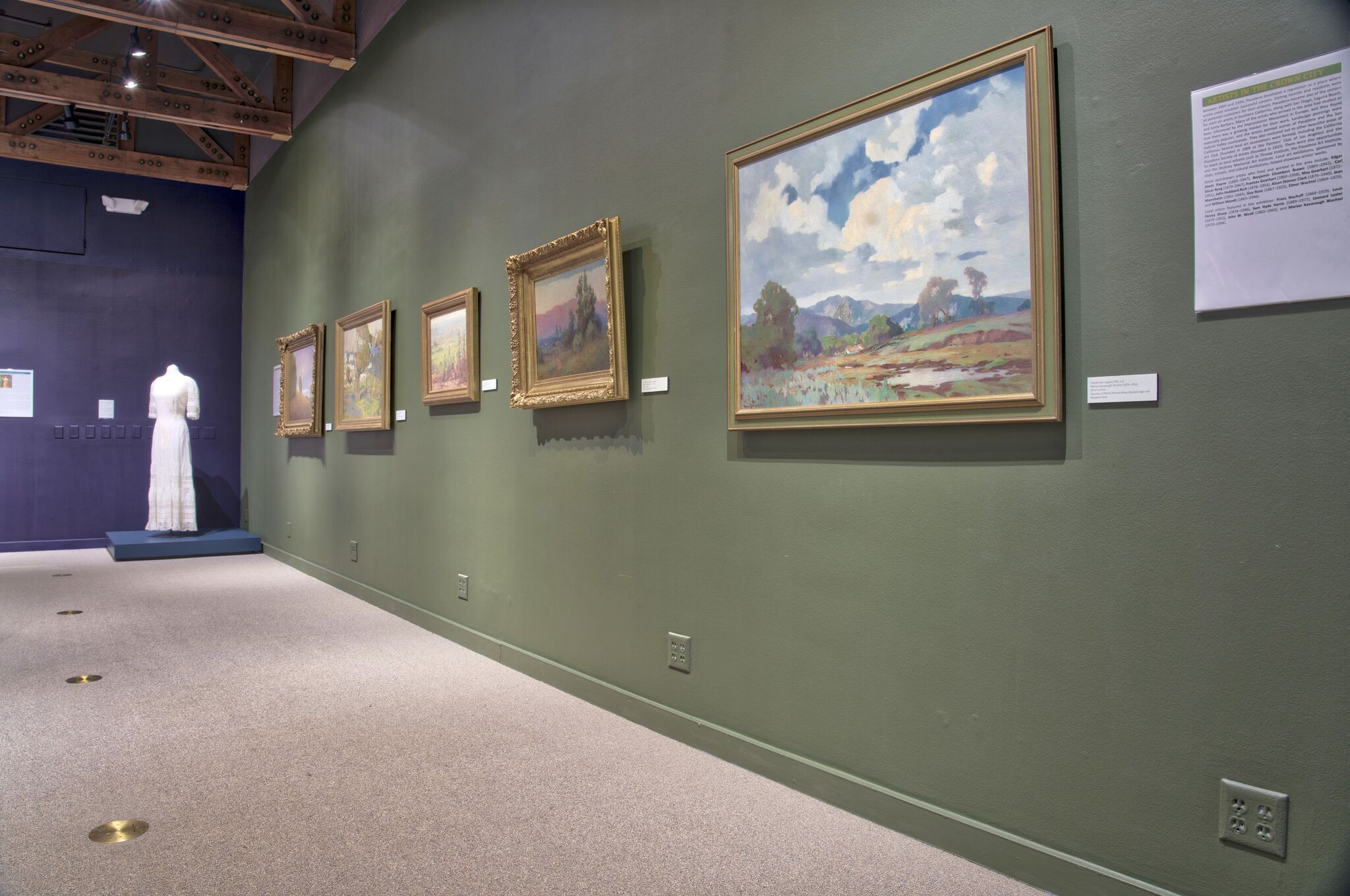
This image has an empty alt attribute; its file name is PMH-Artists-works-2.jpeg
Local artists’ works | Photo by Marlyn Woo/Joanne Wilborn / Pasadena Museum of History

“Pasadena was one of the main art colonies in California during this period, so we have here a wall of art featuring selected works of the artists who lived here then. One of Eva’s biggest legacy was being patron of the arts and helping other artists in the community. She was a prolific painter herself and we have a lot of her art at the mansion, some of which we show here.”
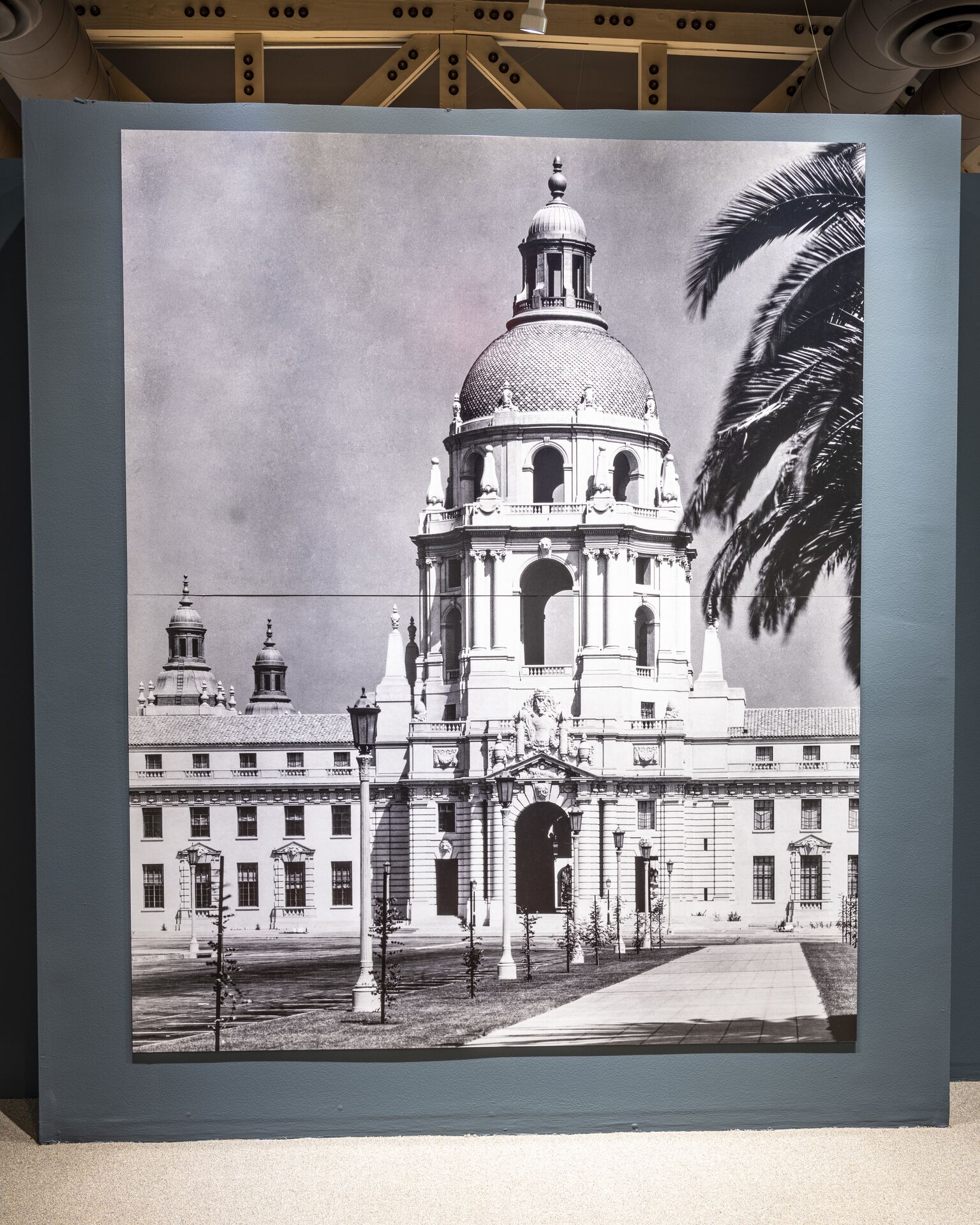
The second part of the exhibition, in the opposite hall, begins with an iconic image of City Hall and explores how the ‘City Beautiful Movement’ ushered the Golden Age of Pasadena. Macneil expounds, “In the Chicago Exposition of 1893, they built the White City. Many famous architects helped construct wonderful buildings, public plazas, and garden areas for the World Fair. The ‘City Beautiful Movement’ came out of that. The idea is that if you beautify the city with these magnificent public structures, it uplifts all the residents spiritually and morally.

This image has an empty alt attribute; its file name is PMH-Pasadena-City-Hall-1.jpeg
An image of the Pasadena City Hall leads us to the second part of the exhibit | Photo by Marlyn Woo/Joanne Wilborn /Pasadena Museum of History

“A lot of people from Pasadena were able to go the Chicago Exposition of 1893 and when they came back, this philosophy took off. They pulled people together, held meetings, and talked about what they could do. And the first thing they did was clean up the city. They got rid of the tacky real estate signs in the main part of town, tidied vacant lots, planted trees and flowers, painted buildings, and regulated architectural styles. It began in the early 1900s with input from various people in the city – movers and shakers as well as the general population. They came up with the plan for the city and things took off in the 1920s when money and the will were there. And so they erected grand public buildings. A main area was the Civic Center – City Hall, the Public Library, the Civic Auditorium. Most of what we identify with Pasadena today – the beautiful architecture, the cultural institutions – were built at this time.”

“There’s a section called ‘Nature versus Man-Made Beauty,’” Macneil goes on to say. “Out-of-towners came here because of the natural beauty of the area – like the Arroyo and the mountains. Then people created man-made parks bringing in trees from other parts of the world, changing  the landscape. We have images of Central Park by Castle Green, Library Park by the Senior Center, and Brookside Park. There’s Eva’s picnic basket because she enjoys going on picnics.”

Macneil points to the next section, “Here we talk about the various means of transportation. During this period of time, people got around town by walking. But there were also buggies and carts, trolley cars, and automobiles. But bicycles were the biggest thing – there were more bicycles per capita in Pasadena than any other city in the United States. This is an early-1900 map of the bike trails and roads in California.

“Because of the power of the bicyclists as a group, they put a lot of pressure to make the streets and signage better, even before they were done for cars. This is California Cycleway, an elevated tollway for bicycle traffic which ran from the Green Hotel to South Pasadena. It was planned to go all the way to Los Angeles but it was never completed because Horace Stubbins encountered legal battles with Henry Huntington over right-of-way. He decided not to pursue it, but the family did keep some of the right-of-way and was able to sell it to the state for the Pasadena freeway. This is still a dream of some people to build – imagine how wonderful it would be to ride your bicycle high above the streets on a road that ran along the Pasadena freeway.

The ‘Kids Corner’ has a display of things kids wore, what types of games they played, where they went to school. There are hands-on items like the stereoscope that kids can look through and see three-dimensional images.

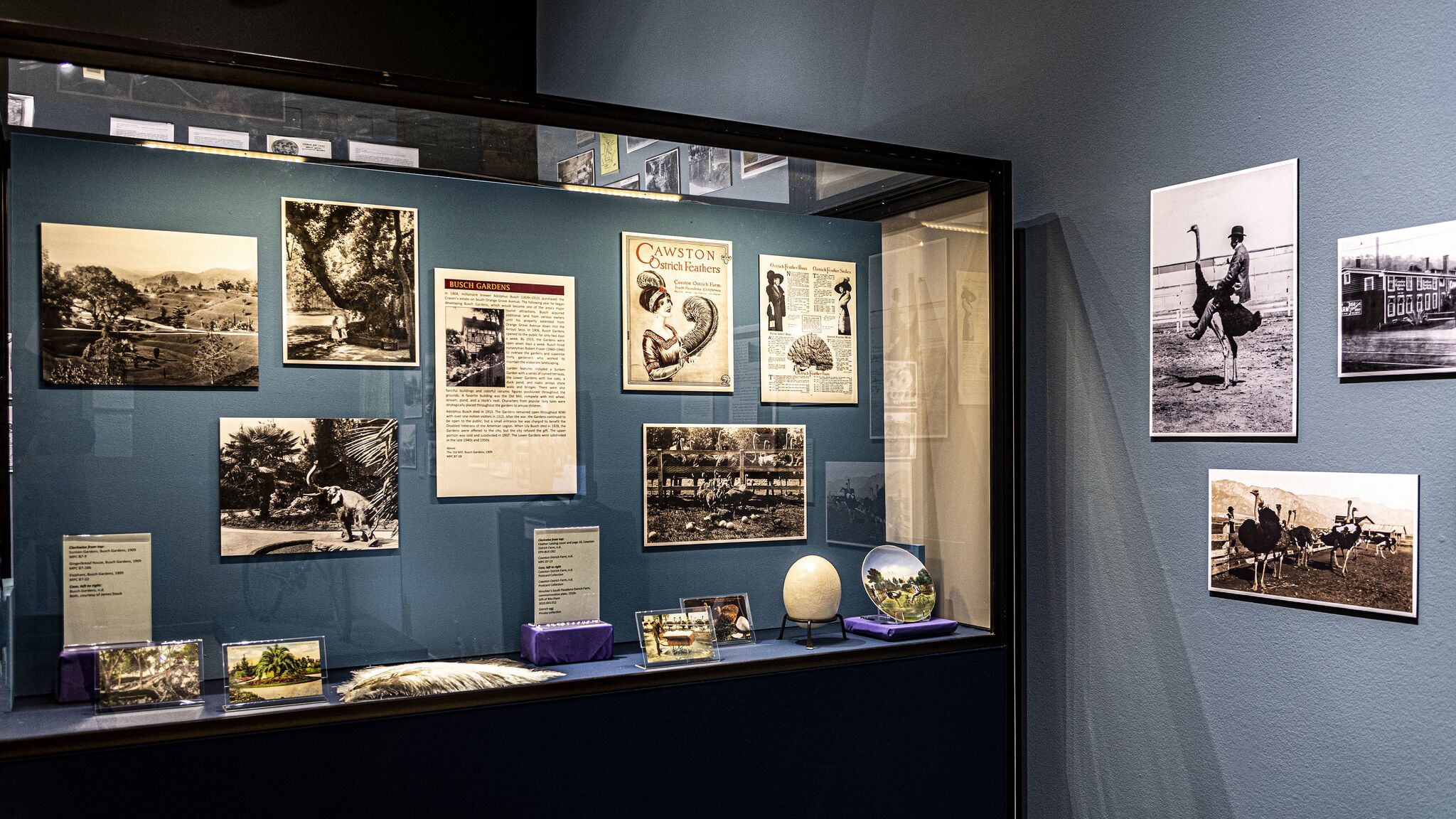
A section that Macneil calls ‘The Extraordinary Excursions’ features three early theme parks, the first of which is Busch Gardens. According to Macneil, Adolphus and Lilly Busch, of the Anheuser Busch and Budweiser fame, had a house on Millionaires’ Row. Adolphus bought approximately 37 acres, covering the area from his house on Orange Grove to the Arroyo, on which he created this magical park and opened it to the public for free. However, the park subsequently met the same fate as that of the grand estates in the area – it closed in the 1930s and 1940s and was subdivided. Lilly tried to make an arrangement for the city to take it over but it was too expensive for the city to maintain.

This image has an empty alt attribute; its file name is PMH-Ostrich-farm-1.jpeg
Cawston Ostrich Farm | Photo by Marlyn Woo/Joanne Wilborn / Pasadena Museum of History

Another was the Cawston Ostrich Farm. Macneil relates that entrepreneur Edwin Cawston, who had learned about ostriches and the ostrich feathers trade in South Africa, came in the late 1880s to open a business here. He had stores in New York, San Francisco, and Los Angeles selling feathers all over the world but it was in South Pasadena that he established one of the first ostrich farms in the country. At the same time, he created a beautiful park-like area where people could come and observe the ostriches’ little chicks, see the big birds being fed, and watch ostrich races. They could even ride on a cart behind the ostrich and, if they were brave, on the ostrich. It became quite a popular destination.

Around the corner you’ll come upon photographs of the Mount Lowe Railway, a series of scenic railroads which went up the mountains above Altadena, created by Thaddeus Lowe. Visitors taking the train up reached a beautiful destination with four hotels, a zoo, an observatory for star-gazing, and a golf course. Macneil says, “People would take the Pacific Railway from all over Southern California, but especially from Los Angeles, come into Pasadena and up to the foothills of Altadena. They’d get off the trolley car and on what they called the ‘white chariots’ that would take them on a steep incline. They would come up to the first hotel and alight there. Then they would get on a trolley car that wound around the mountains until they arrived at the topmost hotel – the Alpine Tavern.”

People got their entertainment during that period from the Pasadena Playhouse and cinemas which started out showing silent movies. “Then there was the Grand Opera House, which was located close to Green Hotel,” recounts Macneil. “It was built by entrepreneurs who brought great opera to town while simultaneously hoping it would help raise real estate values. However, it failed to take off partly because it competed with an opera house in Los Angeles which got the better acts.”

Macneil adds, “When I did my research, I used the city directories going back to the 1880s and found pages upon pages of clubs, associations, and societies where everybody belonged. People came together through their common interests – whether it was just for fun or for a civic purpose.

“We showcase three of these organizations: the Valley Hunt Club for men and women, started out in 1890 as a hunt club, as the name implies. It then became more of a social club and gave us the Tournament of Roses Rose Parade and Rose Bowl game. The Elks Club was a place for men to get together both socially and as a charitable group. The Shakespeare Club began as a women’s literary club to promote reading. All these three organizations were very involved with the community then and still are to this day. All these clubs, at one time or another, had entries in the Rose Parade and on display are trophies they had won. Some items are artifacts from the clubs.”

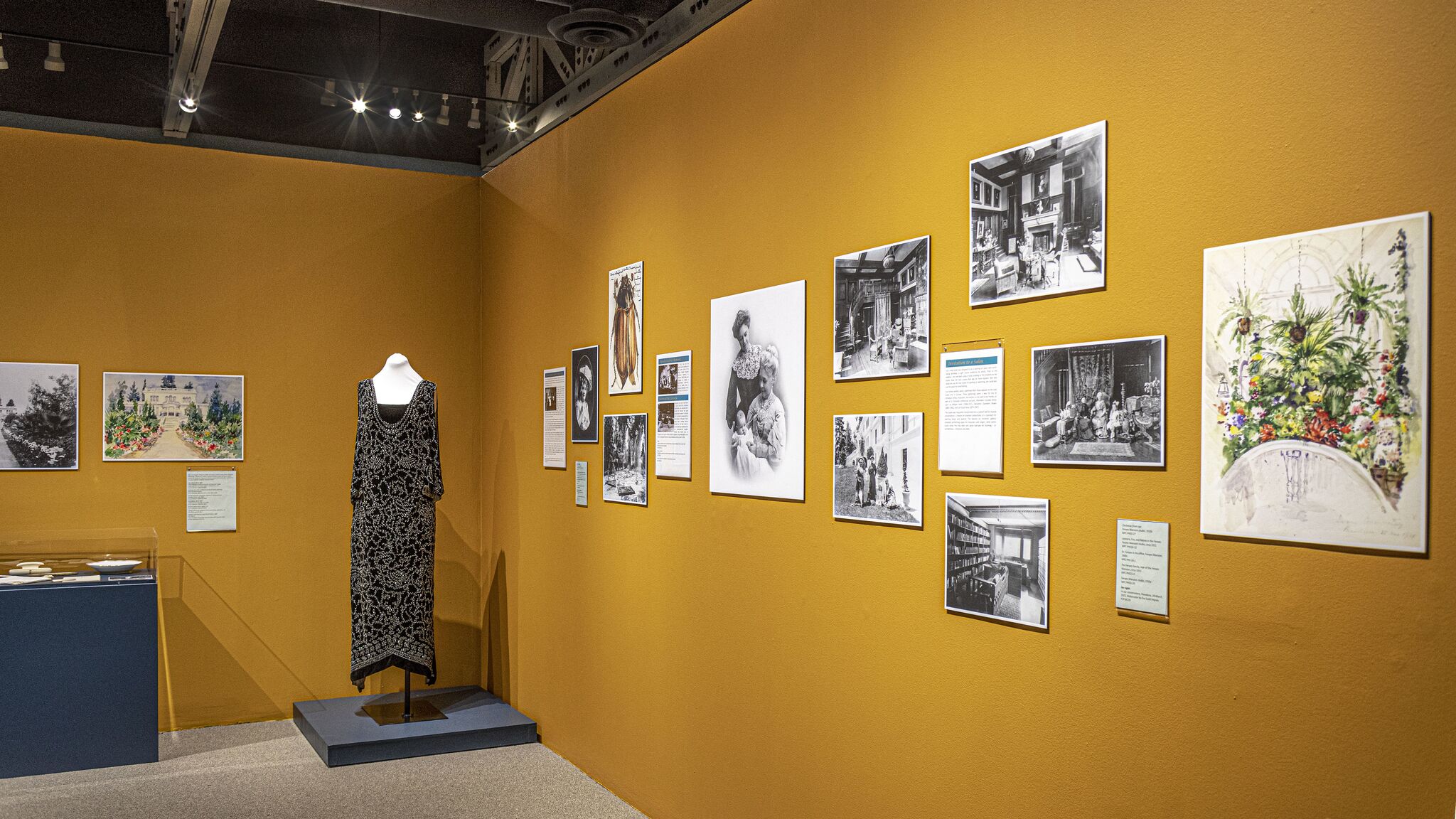
This image has an empty alt attribute; its file name is PMH-Fenyes-Wall2.jpeg
The Fenyeses display | Photo by Marlyn Woo/Joanne Wilborn / Pasadena Museum of History

Towards the end of the exhibit, the display talks about the Fenyeses selling their big Moroccan palace and downsizing to the mansion in 1906. This section explores the life of Eva and Dr. Fenyes from 1906 to 1930. While they were world travelers, Pasadena was their home base. They were involved in the community in different ways – she was still a socialite; he continued with his medical practice and, being an entomologist, his work with beetles. Leonora, Eva’s daughter, became widowed and came back to live with them. In 1911, Eva, Leonora, and Leonora II all lived here and created a wonderful bond of three generations.

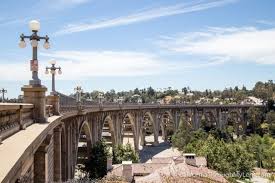
A wall of displays delves into the transformation of Pasadena. Macneil expounds, “Through the 1893 ‘City Beautiful Movement,’ city officials were able to hire architects from Chicago and established the Bennett Plan that created the Civic Center – the City Hall, the Library, and the Civic Auditorium. At the same time, more beautiful buildings were being erected and various infrastructure were being constructed. The Colorado Street Bridge was built in 1913 for people arriving by car to have a grand entrance into Pasadena. They also had plans for a beautiful art museum and school on Carmelita where the Norton Simon  is now, although that never came to fruition.”

The 1920s were the Golden Age of Pasadena when innumerable buildings featuring European architecture were constructed all over the city. Schools and city service structures were being upgraded; the Rose Bowl was built. PMH’s exhibit has a video that shows the changing cityscape.

“And then the depression hit and everything slowed down,” says Macneil. “The Civic Auditorium hadn’t been completely built. Fortunately, city officials were able to do some creative financing to finish it but several things which were on the planning stage stopped. The resort industry collapsed – hotels were torn down and were reused for other functions. The Vista del Arroyo, for instance, became a hospital; today it is the Court of Appeals. Of the hotels built during that period, only the Huntington Hotel still stands today. Population growth halted as well.

This image has an empty alt attribute; its file name is Colorado-Street-Bridge-1.jpg
Colorado Street Bridge | Courtesy Photo

“At the very end of the exhibit, we showcase PMH’s mission – capturing and gathering the history of Pasadena and the surrounding area and sharing it with the public. Our collection encompasses this productive and transformative period so our archives and collection department were quickly able to put together what we felt would represent that time.

On the Curator’s statement, Macneil confesses that while he was born and raised in the area – three generations of his family lived here – he didn’t fully appreciate Pasadena. It wasn’t until he went away for a while and then returned that he developed his deep love for the city. Through this exhibit, he hopes that he can share all that he has rediscovered

Macneil states, “We’re hoping parents come with their children to our exhibition. We’re purposefully keeping it open until July 3rd so students from both public and private schools can learn Pasadena’s history. How fun would it be for these young people to learn what happened a century before their time and then see the structures when they walk around the city.”

As PMH has detailed in the exhibition, some of the dreams of the city’s visionaries worked and some didn’t. But many of the magnificent and architecturally diverse structures from the city’s Golden Age remain and they are what give Pasadena the culture and history for which it is renowned. And through this exhibition, Macneil wants to remind people what we are capable of doing if we pull together as a community. The past can be used as a blueprint for the future.



The Huntington Continues Centennial Celebration with Float Entry in the 2020 Rose Parade

Originally published on 16 December 2019 in the Pasadena Independent, Arcadia Weekly, and Monrovia Weekly

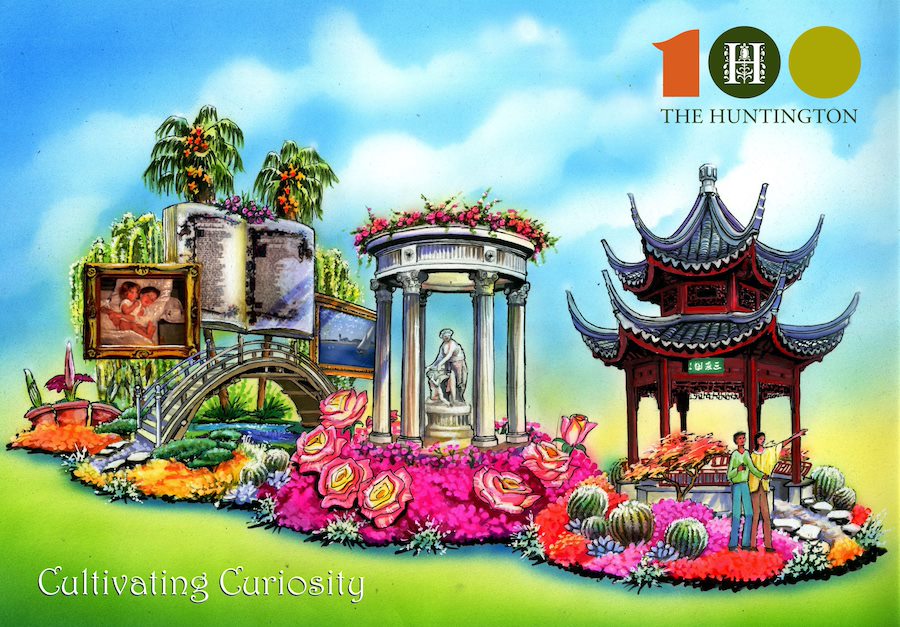
Artist’s rendering of The Huntington’s 2020 entry in the Rose Parade, designed by Phoenix Decorating Company. The float celebrates The Huntington’s 100th anniversary running from Sept. 2019 through Sept. 2020. – Courtesy photo / The Huntington Library, Art Museum, and Botanical Gardens

The Huntington Library, Art Museum, and Botanical Gardens will mark another historic event as its own float travels down Colorado Blvd. for the Rose Parade, 50 years since it last made an appearance at Pasadena’s famous New Year’s Day floral, equestrian, and marching band pageant.

Themed ‘Cultivating Curiosity,’ the 55-foot long float captures the spirit of The Huntington’s Centennial Celebration and highlights its rare research materials, inspiring art collections, and unparalleled botanical gardens which have made it a beloved destination that welcomes 750,000 visitors each year.

In 1969, the city of San Marino sponsored an entry that featured floral depictions of the institution’s world-renowned paintings ‘The Blue Boy’ and ‘Pinkie,’ an imposing replica of the historic Library building’s façade, and the Ellesmere manuscript of Chaucer’s ‘The Canterbury Tales.’ The float won the Grand Marshal’s Trophy. This year, The Huntington commissioned a float for the first time.

The Huntington’s float in the 1969 Rose Parade, sponsored by the city of San Marino. – Courtesy photo / The Huntington Library, Art Museum, and Botanical Gardens

Chatting with me by phone, Randy Shulman, The Huntington’s VP for Advancement and External Relations says “The last time we were represented at the Rose Parade, it was done by the city so it’s as if we’re doing it for the first time – it’s all Huntington content and people. It’s our centennial and it’s an opportunity to help celebrate and raise awareness of The Huntington and its centennial year.”

I ask why they’d never done it before and Shulman replies, “The Huntington is a non-profit that raises its operating expenses every year. External promotion is never going to be the top priority. Always, the top priorities will be running its education programs and doing its academic mission. The thought of doing a Rose Parade float is an exceptional moment so we need an exceptional moment. That’s why we chose to do it now.

“The decision to sponsor a Rose Parade float came out of a discussion of the Board and some of the people in our board community who said ‘This is a great moment.’ Our president, Karen Lawrence, joined The Huntington a little over a year ago and she was very quickly enthusiastic about it. So, we have a new president, it’s a new time, it’s a hundred years – all the planets aligned. Additionally, we were able to find private donors who would help us make it possible. Every dollar of the cost of the float is through donations, not through our operating budget.

“We had just told our entire donor community that we’re doing this float and if they wanted to volunteer we had 1,000 spots for people to volunteer and if they wanted to help by making a donation, that would be welcomed. And some people have done that. We posted the volunteer sign-up to help decorate our float on our website and spots were filled rapidly.”

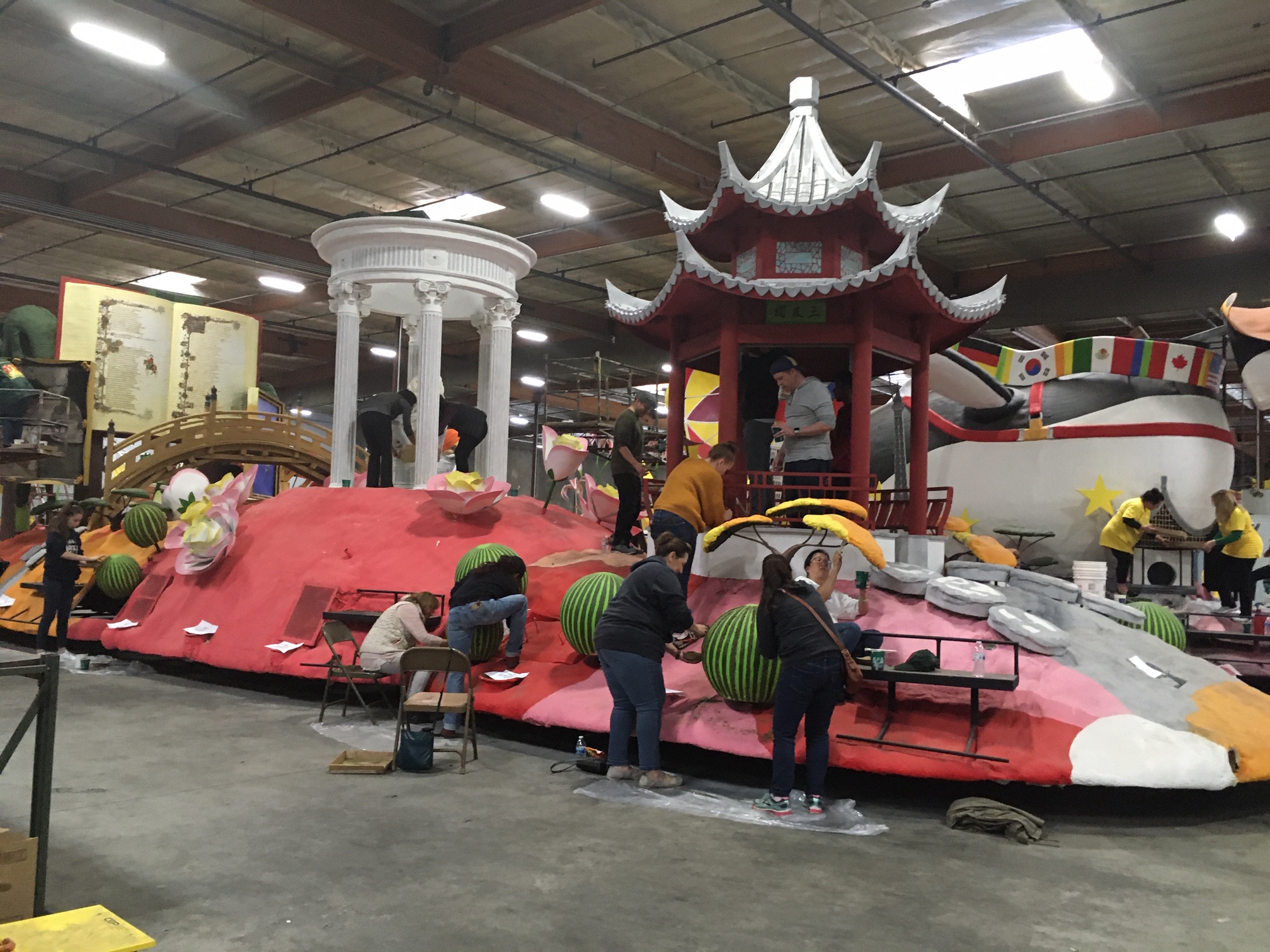
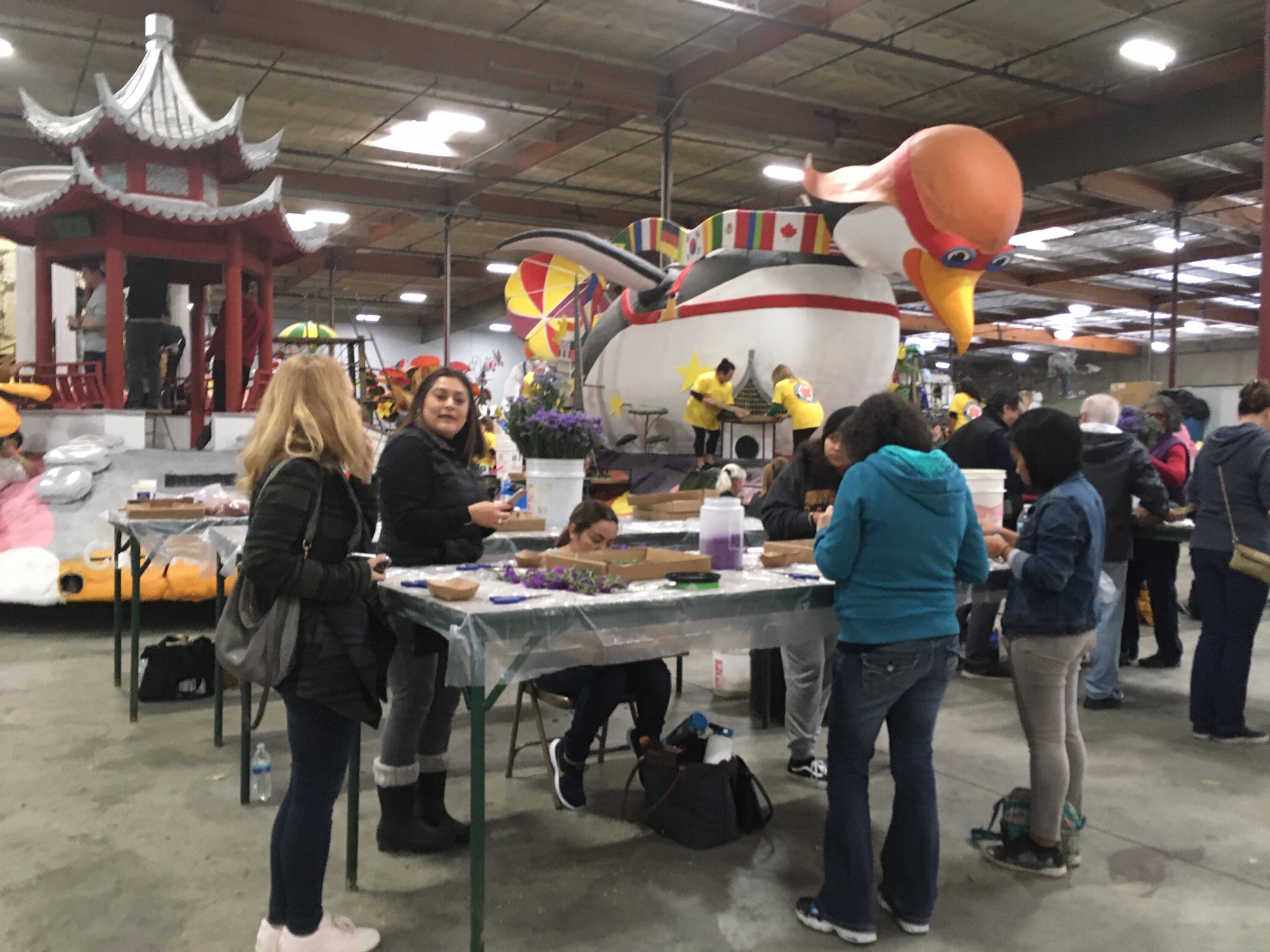
The Huntington’s float on the first day of decorating. – Photo by May S. Ruiz / Beacon Media News

Choosing the float builder was a competitive process. Shulman discloses, “We had the major builders provide proposals and we evaluated based on the design and the background of the float builder. The design of the float itself came out of a desire to represent not just the Huntington that people are familiar with, but one that integrates discovery and curiosity. We wanted to have some familiar things that people recognize as well as other things that people may not recognize. The end of the float is the ‘Stinky Flower’ which is a playful way of talking about The Huntington’s very unusual Botanical Garden collection. Some of the materials being used are grown here – seeds, pods, bark, and some leaves. And that’s really great – it talks about us and the place. It’s also fun for many people who have been here and walked the place to see the familiar sights depicted on the float.”

Given the numerous significant things at The Huntington, I inquire how difficult it was to come down to seven elements that would be represented on the float. Shulman responds, “We asked the directors of the Library, the Art Museum, and the Botanical Gardens for their thoughts. But, of course, things decided by a committee never work out because it’s hard for a lot of people to have a consensus. What we did want to do is to keep it simple, recognizable to a point, but we also wanted to have a sense of playfulness. What people won’t see on the float are some of the more recognizable items like ‘Blue Boy’ or Shakespeare’s folio. But that’s because we want the opportunity to show something very beautiful that people might not know about.

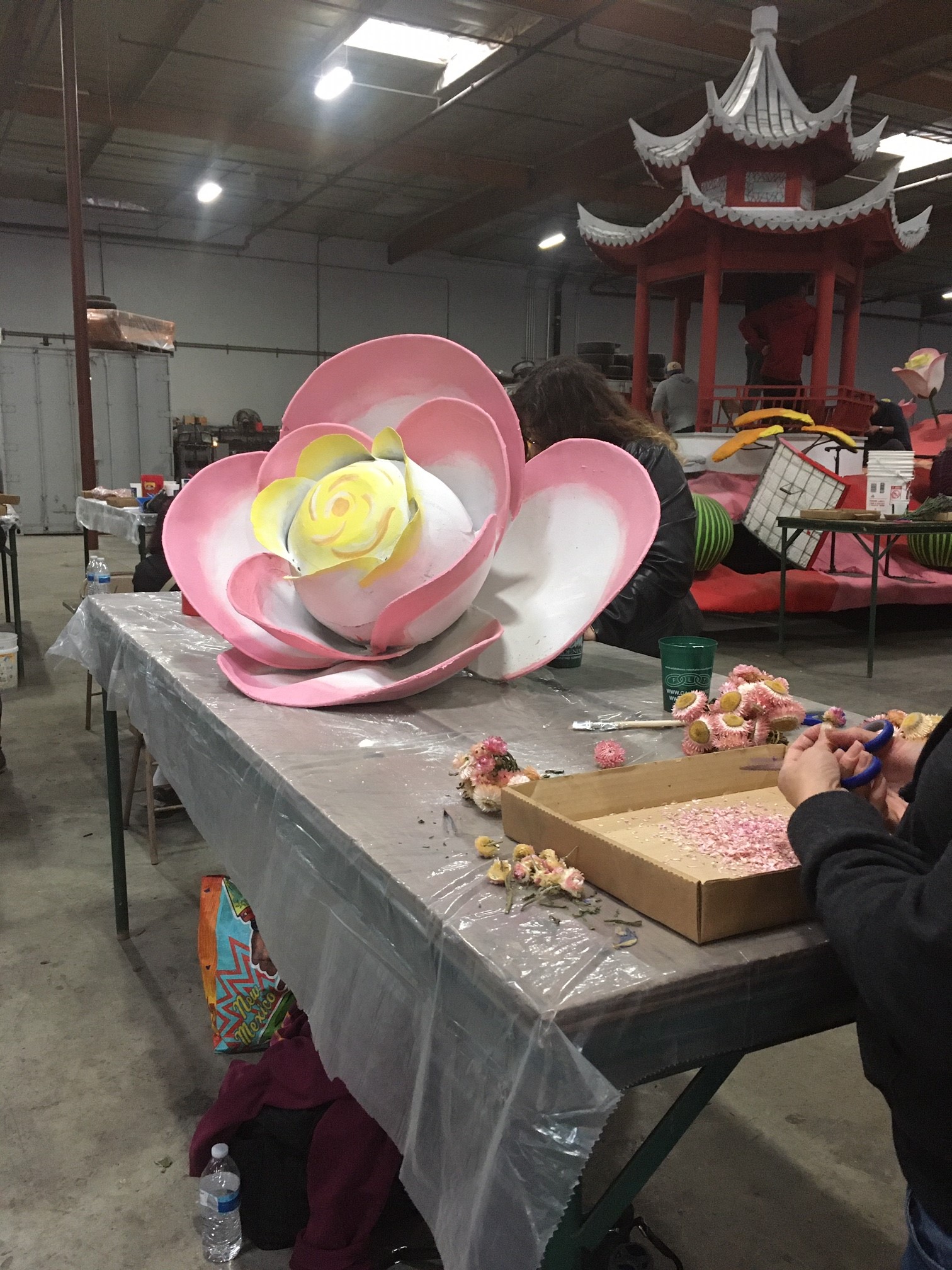
The float’s Huntington Centennial Rose. – Photo by May S. Ruiz / Beacon Media News

“That was one of our President’s goals. She wants to have that moment when people say ‘What is it? I have to go see.’ She wants to have people have that joy of discovering more about The Huntington. It’s a complex place. There’s so much happening here with the different collections in the gardens and there’s always something new to discover in the gallery as well. Our float is a manifestation of the joy of The Huntington’s 100 years – both getting to the hundred-year mark but also looking forward to the next centennial.”

The Huntington’s float will have eight riders and will be followed by six walkers as it makes the 5.5-mile journey down Colorado Blvd. The float riders will include four youth participants from The Huntington’s community partner programs with the Heart of Los Angeles (HOLA) and the Pablove Foundation; Huntington President Karen R. Lawrence; two lucky staff members who won a staff-wide raffle; and leadership donor and member of The Huntington’s Board of Governors Mei-Lee Ney. The walkers following the float will include five of The Huntington’s teen volunteers and one adult supervisor.

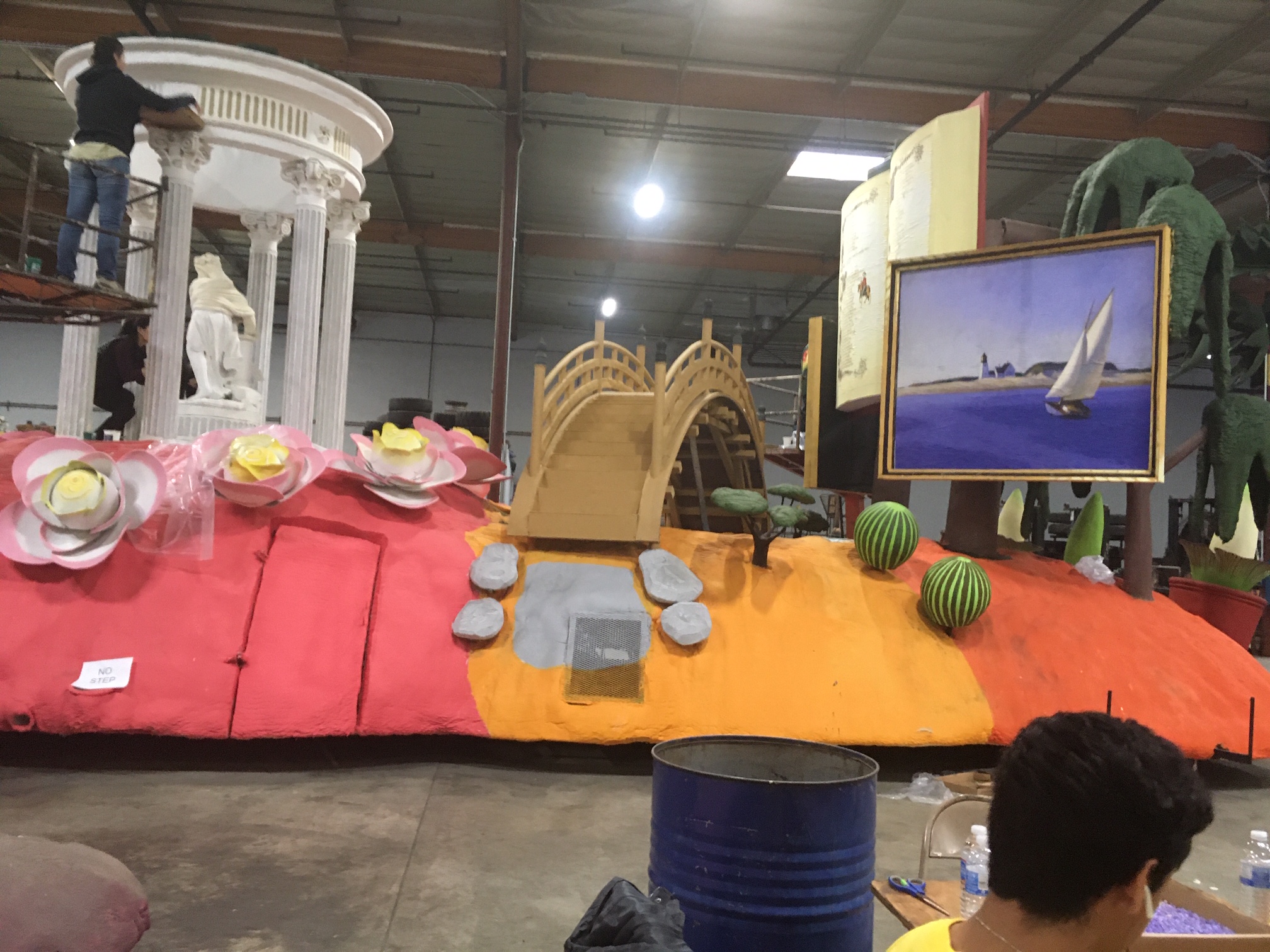
The elements on the float include the Tempietto, the Moon Bridge in the Japanese Garden, The Ellesmere Chaucer, and Edward Hopper’s ‘The Long Leg.’ – Photo by May S. Ruiz / Beacon Media News

It was the design submitted by prominent float builder Phoenix Decorating Company (PDC) that won The Huntington’s vote. Curious to see what the float looks like, I visit their Irwindale site on the first day that volunteers arrive to help decorate. Chuck Hayes, Sponsor Relations Manager at PDC, is a gregarious man who warmly welcomes me and eagerly explains their association with the San Marino institution.

“The Huntington said they wanted a 55-foot float and detailed the elements they wanted on it. We conferred with them throughout the conceptual process – we held multiple meetings, made many visits to the facility, and took several images from which to come up with a design. Our artist worked directly with their team to arrive at something that included the components and fitted their requirements. We’re the interpreter of their concept and all the materials we’re using on the float help realize that vision. It’s what makes me proud to be a float builder – to be able to honor organizations like The Huntington. Every single float we build is a unique prototype, each is a one-off, and has never been done before. Floats are built by hand from scratch – from the design stage to getting each petal onto the float.

“The Rose Parade is a Southern California tradition and, as a float builder, we always want to give our clients the greatest thrill at that moment when they walk up to see it for the first time. We build everything to scale so people who are watching it along the parade route can really focus on the float. There’s so much for them to take in – while the float is traveling down the five-and-a-half mile-parade route at 2.5 miles per hour, there might be a marching band in front and equestrian riders behind it. We made sure that people who have never been to The Huntington would be compelled to visit it after seeing this float.”

Hayes continues, “Phoenix has been an award-winning Rose Parade float builder for 37 years. We have a team of professionals that works year-round constructing and deconstructing floats. We begin in January when the Tournament of Roses announces the theme for any given year – for 2020 it’s ‘The power of Hope.’ That becomes our emphasis and it’s how we bring everyone into the fold. The client comes into the parade excited – some have never seen a float before, some have never commissioned one so they don’t know what’s involved. We sit with them and we tell them what we do, show them pictures of floats we’ve built and decorated. Sometimes, clients hear about something we’d done through word of mouth, or have seen a project we worked on like ‘Earth, Wind, and Fire’ which the Forum commissioned to celebrate their 50th anniversary. That’s what The Huntington was looking for – something uniquely theirs.

Volunteers work on The Huntington’s float. – Photo by May S. Ruiz / Beacon Media News

“We have anywhere from 25 to 40 people on staff – artists and construction crew – at various times. The number expands as the activity progresses and we hire crew chiefs and assistant crew chiefs who work on specific floats. The decoration can be done by the organization’s volunteers and by anyone who wants to decorate. They can sign up on our website, on the Kiwanis site, or through the ‘Petal Pushers.’ Our crew chiefs and assistant crew chiefs work with the volunteers who show them how to glue the materials onto the float. The Huntington brought so many volunteers to fill the decorating shifts. But if, for some reason, a client didn’t have people show up, their float would still be ready to go down Colorado Blvd. on New Year’s Day.”

On the day I visit Phoenix, a coordinator with Tournament of Roses (TofR) is there and Hayes introduces me to her. That also prompts him to expound, “This is the 131st year of the Rose Parade. If it wasn’t for them we wouldn’t have a parade. They give the opportunity for organizations like The Huntington to get worldwide exposure; I believe they said somewhere in the world, the parade is shown every day of the year – because of tape delays in other countries. There are over 700,000 on the parade route, a regional and national TV audience, and international viewers. And with social media, people can now react and let others know what floats they like in real time. Awareness about the parade just keeps expanding.”

People watching the Rose Parade on Colorado Blvd. and television viewers everywhere will have the delightful experience of seeing a Huntington float that depicts the following iconic elements in The Huntington’s collections:

The Pavilion of the Three Friends. – Courtesy Photo / The Huntington Library, Art Museum, and Botanical Gardens

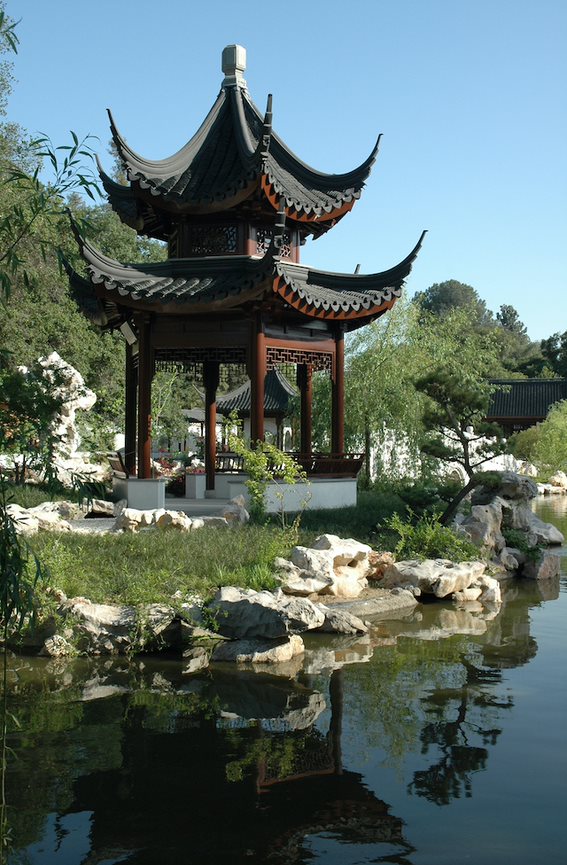
Pavilion of the Three Friends

Located in Liu Fang Yuan, the Chinese Garden at The Huntington, the Pavilion of the Three Friends is named for the ‘three friends of winter’: bamboo, pine, and plum. They are symbols of fortitude, integrity, and resilience. Carvings of these signature plants adorn the ceiling of the pavilion and also grow nearby.

The pavilion’s roof will be covered with eucalyptus leaves of green/grey. Painted tiles are made of light grey and dark grey lettuce seed. The main body is covered in red fine cut strawflower, white fine ground rice and light grey, light lettuce seed. Window insets are covered in light blue fine cut statice, green fine ground split pea, and shiny grey silverleaf.

The pathway of light is made of grey light lettuce seed; rocks of light grey, light lettuce seed and white fine ground rice; accents of green mood moss.

Maple trees have tops of orange and yellow dendrobs with underneath areas of green ground parsley flakes and branches of dark brown coffee.

Sculpted barrel cacti are covered in ground parsley flakes and light green carnation calyx. Flowers on top are bright yellow whole strawflowers. Juvenile golden barrel cacti are provided by Huntington Gardens. The area around small cacti is grey Spanish moss.

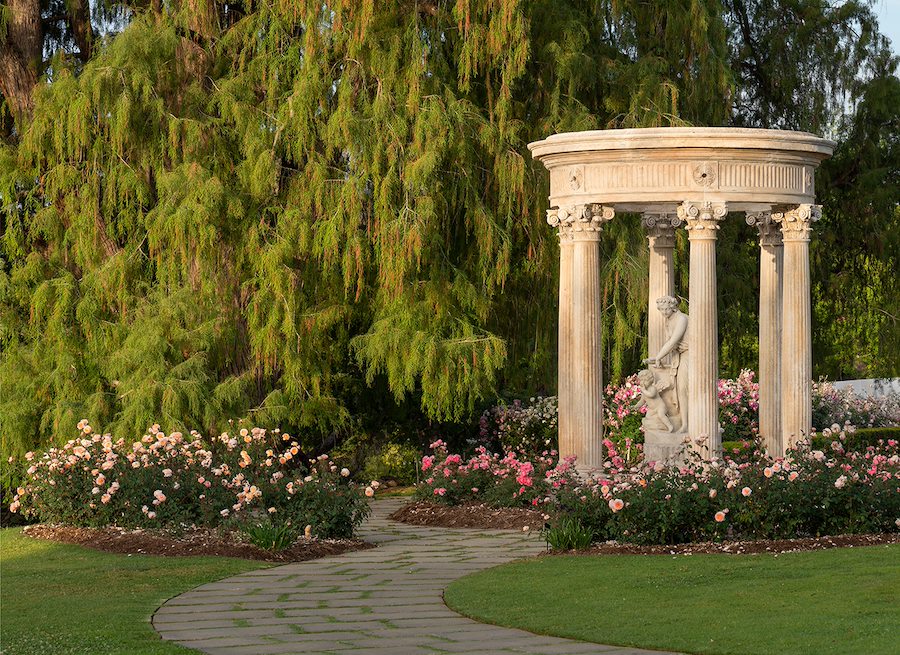
The Rose Garden Tempietto. – Photo by Alexander Vertikoff / The Huntington Library, Art Museum, and Botanical Gardens

Rose Garden Tempietto

The centerpiece of The Huntington’s historic Rose Garden, the 18th-century French stone tempietto houses a sculpture – Love, the Captive of Youth – which depicts Cupid and his captor, a fair maiden. Appropriately, the tempietto is encircled by a bed of ‘Passionate Kisses’ roses. The three-acre Rose Garden contains more than 3,000 individual plants and more than 1,250 different cultivated varieties (cultivars), including Huntington’s 100th, the newly hybridized rose marking The Huntington’s Centennial.

Rose Garden Tempietto is covered in white powdered rice, light grey ground white pepper, and dark grey poppy seed. Floral on top is made of green asparagus plumose, hot pink roses, and white and light pink dendrobs. Sculpted centennial rose petals are light pink and white gladiola petals, yellow and bronze fine cut strawflower, and white powdered rice.

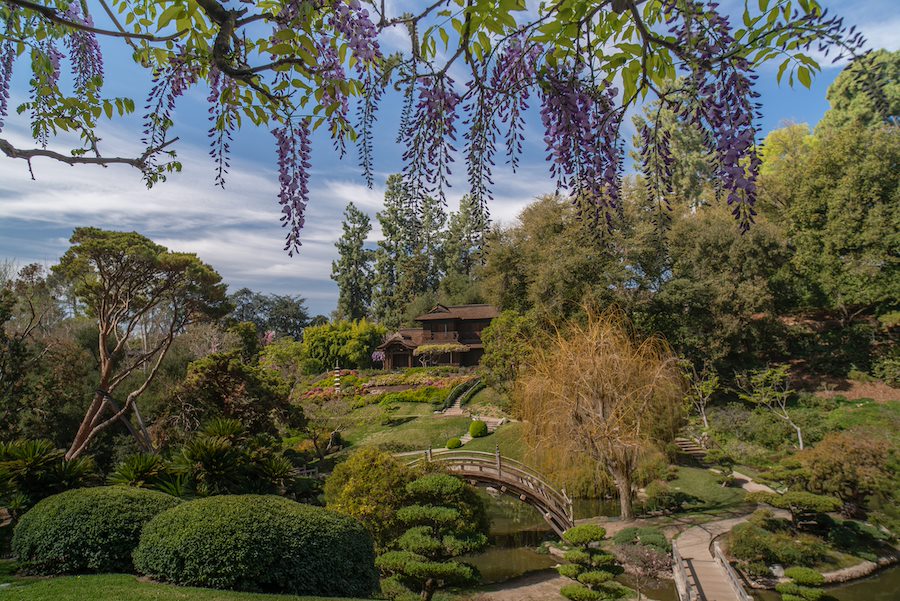
The Japanese Garden features a small lake spanned by a moon bridge, a traditional house, and trellises of wisteria. – Photo by Martha Benedict / The Huntington Library, Art Museum, and Botanical Gardens

Japanese Moon Bridge

Completed circa 1912, the distinctive Moon Bridge is an iconic feature of The Huntington’s celebrated Japanese Garden. Commissioned by Henry Huntington himself, the Moon Bridge was built by Japanese craftsman Toichiro Kawai. The bridge’s high arch and reflection in the still pond below form a circle, reminiscent of the moon.

Japanese Moon Bridge is comprised of tan paper bark with underneath coverage of tan fine walnut and dark brown coffee; finials of black seaweed. Bonsai trees have tops of green mood moss, underneath areas of green ground parsley flakes, with branches of dark brown coffee. The pond has edges of green mood moss and water of purple, light blue, and dark blue iris.

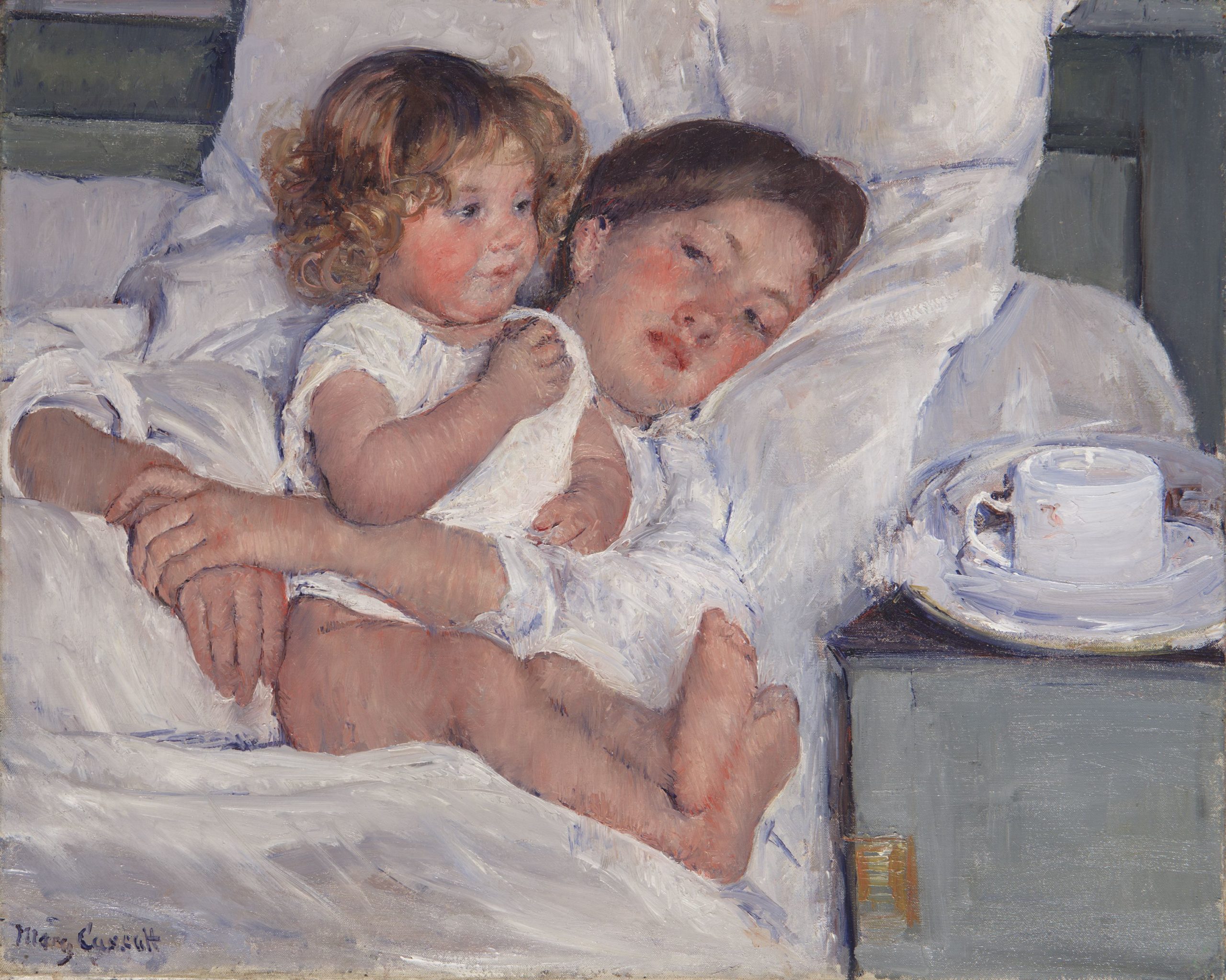
Mary Cassatt’s ‘Breakfast in Bed.’ – Courtesy photo / The Huntington Library, Art Museum, and Botanical Gardens

‘Breakfast in Bed’ by Mary Cassatt

Painted in 1897 by famed American Impressionist Mary Cassatt, ‘Breakfast in Bed’ is one of the most-beloved portraits in The Huntington’s collection. Cassatt’s work often depicts the social and private lives of women; she is well known for capturing the intimate bonds between mothers and children.

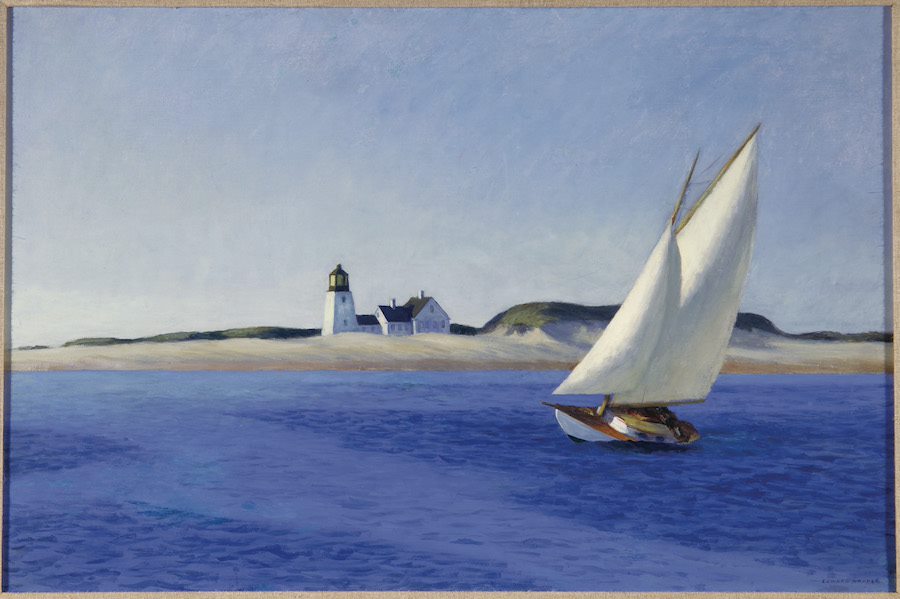
Edward Hopper’s ‘The Long Leg.’ – Courtesy photo / The Huntington Library, Art Museum, and Botanical Gardens

‘Long Leg’ by Edward Hopper

The ‘Long Leg’ by Edward Hopper was painted in 1935 and has been a favorite painting among Huntington visitors since its debut in 1984 as one of the artworks that established the American art collection. With a nearly all-blue composition, the painting reflects two of Hopper’s favorite themes: sailing and the sea. In 2011, as part of the U.S. Postal Service’s American Treasures series, the work was issued as a postage stamp.

‘Breakfast in Bed’ by Mary Cassatt and ‘Long Leg’ by Edward Hopper feature frames of dark brown coffee, gold clover seed and light yellow fine cut strawflower. Backs of black onion seed. Floragraphs of various spices and seeds.

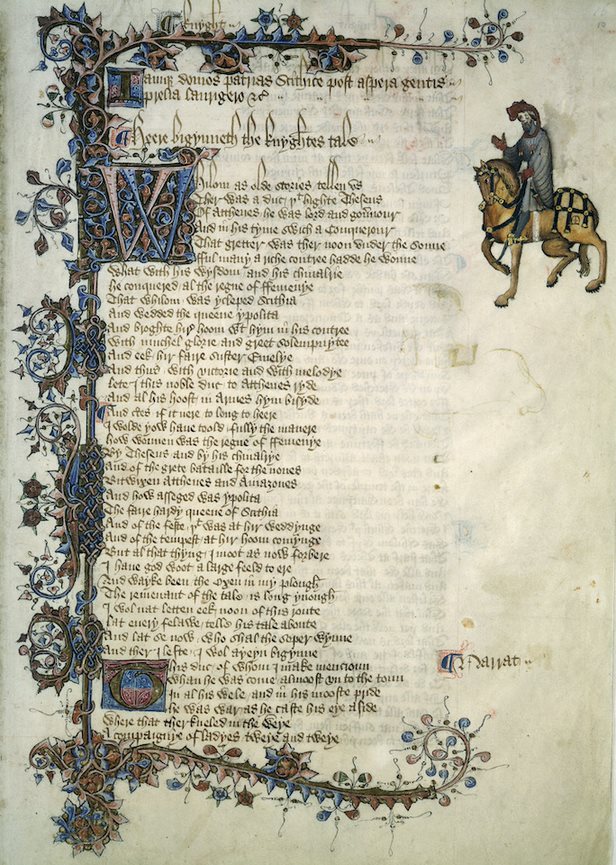
The Ellesmere manuscript of Geoffrey Chaucer’s ‘The Canterbury Tales.’ Shown is the introduction to ‘The Knight’s Tale.’ – Courtesy photo / The Huntington Library, Art Museum, and Botanical Gardens.

The Ellesmere Chaucer

The elaborately decorated Ellesmere manuscript of Geoffrey Chaucer’s ‘The Canterbury Tales’ was created sometime between 1400 and 1410. It contains what is believed to be a portrait of Chaucer as well as miniature paintings of 22 other fictional pilgrims who tell stories in order to enliven the journey from London to Canterbury. The medieval manuscript is on parchment.

The Ellesmere Chaucer has pages of white powdered rice, black onion powder and dark grey poppy seed. Binder is of red fine cut strawflower; floral top has green springeri, dark lavender roses, dark lavender carnations, and green leather fern.

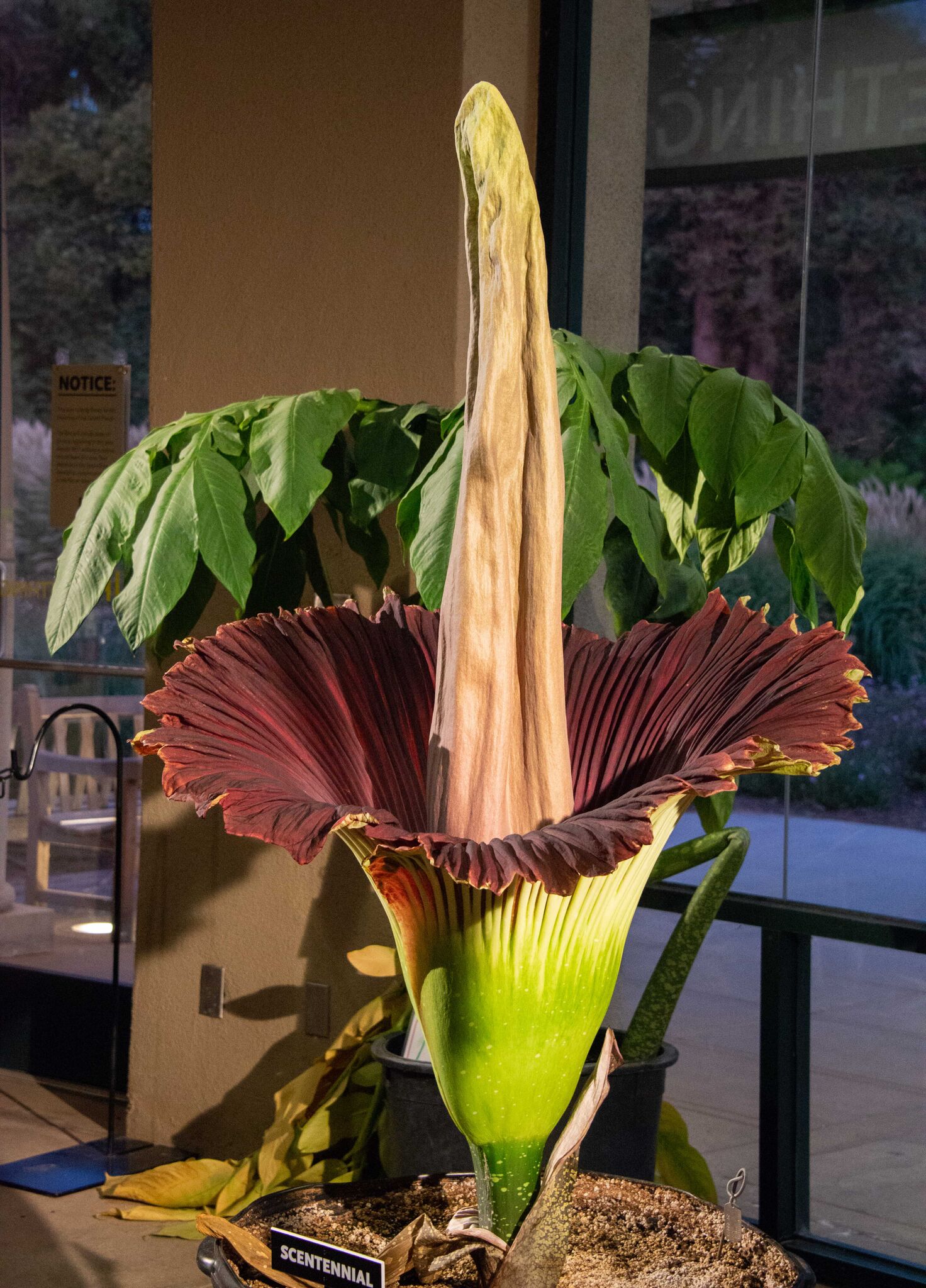
A Corpse Flower dubbed ‘Scentennial’ bloomed on July 24, 2019. – Photo by Deborah Miller / The Huntington Library, Art Museum, and Botanical Gardens

Corpse Flower

In August of 1999, a rare corpse flower bloomed at The Huntington—the first known flowering of this exotic species in the state of California. This exciting (and smelly) occurrence provided an opportunity for thousands of visitors to witness one of the wonders of the botanical world. Since that extraordinary event, The Huntington has produced nine additional blooms—most recently on July 24, 2019—and has shared seeds and pollen with botanical gardens across the country.

Palm tree fronds have tops of green komodor fern, underneath of green ground parsley flakes, floral of yellow and orange cymbidiums, and trunks of reddish/brown palm bark with fiber. The bases of palms are sago palms with green cycad leaves provided by Huntington Gardens.

Corpse flowers are crème sesame seed, green fine ground split pea, and dark purple and red fuzzy cut strawflower; pots of red fine cut strawflower.

Deck of green is made of springeri, hot pink and red roses, red anthuriums, light pink, orange and pink roses, peach anthuriums, peach roses, orange and white with green “geisha” anthuriums, green springeri, and white cattleyas. Green leather fern, white dendrobs, white tiger lilies, coco stix with powdered rice and white starburst mums.

In a news release the communications department sent out this summer, Karen Lawrence expressed the institution’s message. “The Huntington’s incomparable collections have had an extensive reach over the past century, and we expect them to continue to inspire visitors, new and old, for the next 100 years in powerful and unpredictable ways. We welcome the national and international exposure that this celebrated parade provides and look forward to this joyful moment during our Centennial as a way of sharing our treasures with audiences the world over.”

The Pasadena Playhouse Ushers the Holidays with Tree Lighting, Puppet Show, Songs, and Snow

Originally published on 9 December 2019 in the Pasadena Independent, Arcadia Weekly, and Monrovia Weekly

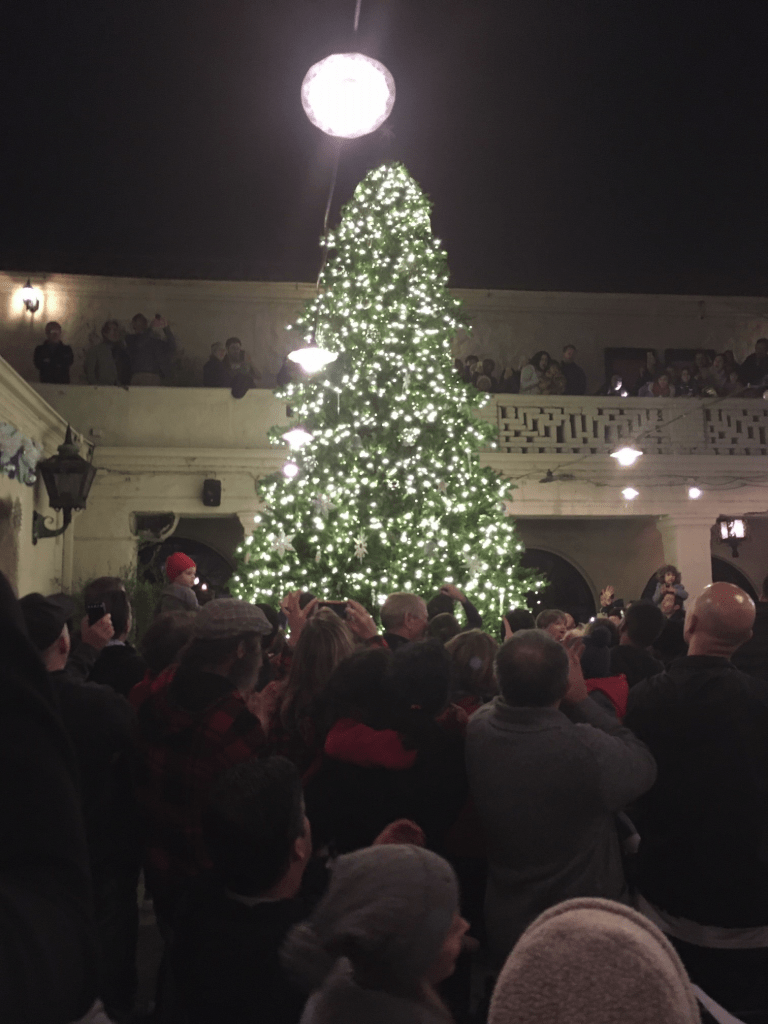
The Pasadena Playhouse’s lit Christmas tree | Photo by May S. Ruiz / Beacon Media News

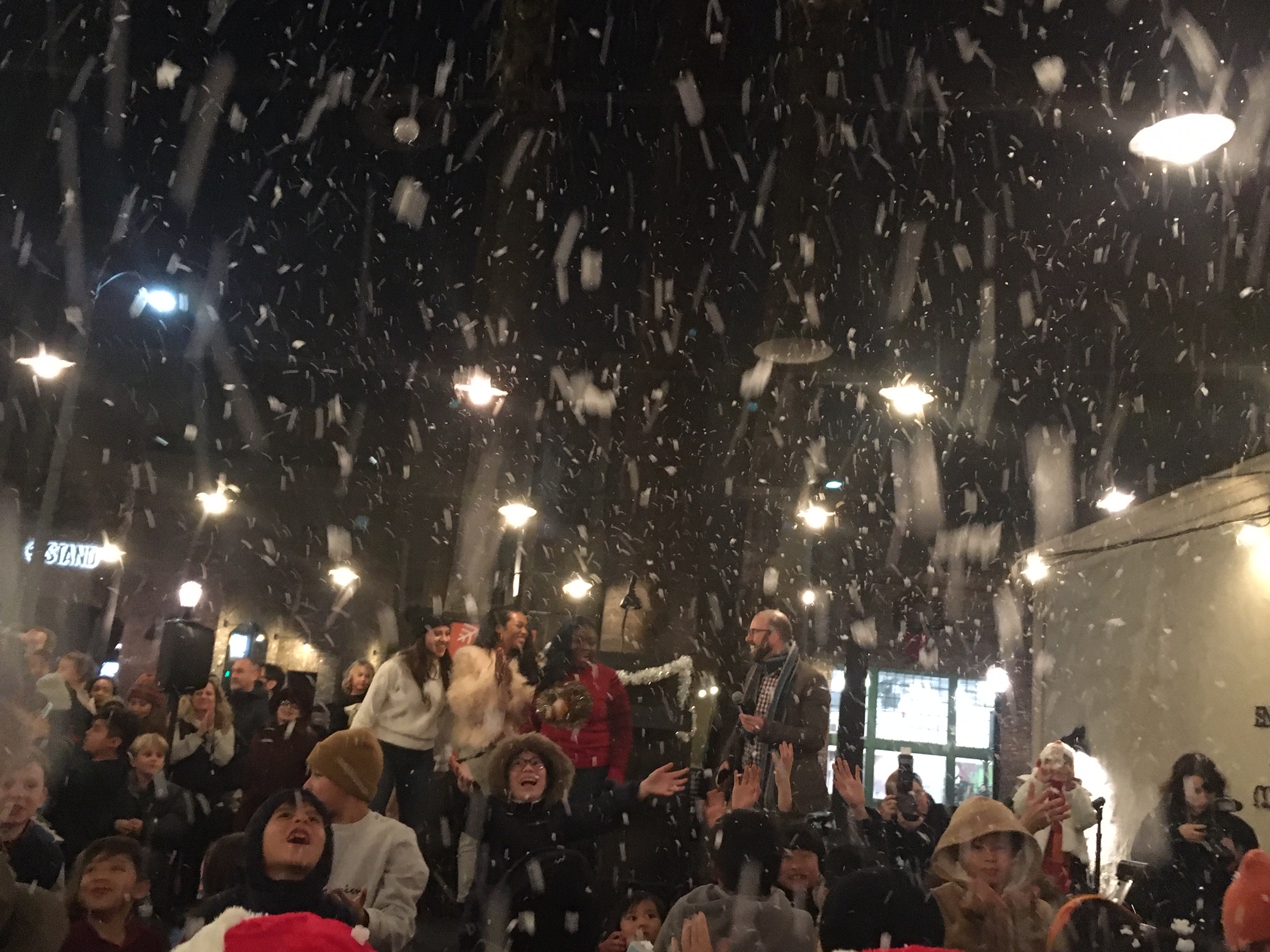
If you were at the Engemann Family Courtyard of the Pasadena Playhouse at 8:00 last Thursday evening, you would have been happily surprised by snow falling on your head. It was a fun final touch to The Playhouse’s tree lighting ceremony which started promptly at 7 pm.

Danny Feldman, Producing Artistic Director, whose brainchild it was to have a Christmas tree at the courtyard during the holidays, opened the ceremony with Playhouse District Association’s Executive Director, Brian Wallace. This year, the Playhouse is participating in the ‘Spark of Love’ Toy Drive with ABC7 and the Southern California Firefighters and Pasadena’s Fire chief was also on hand.

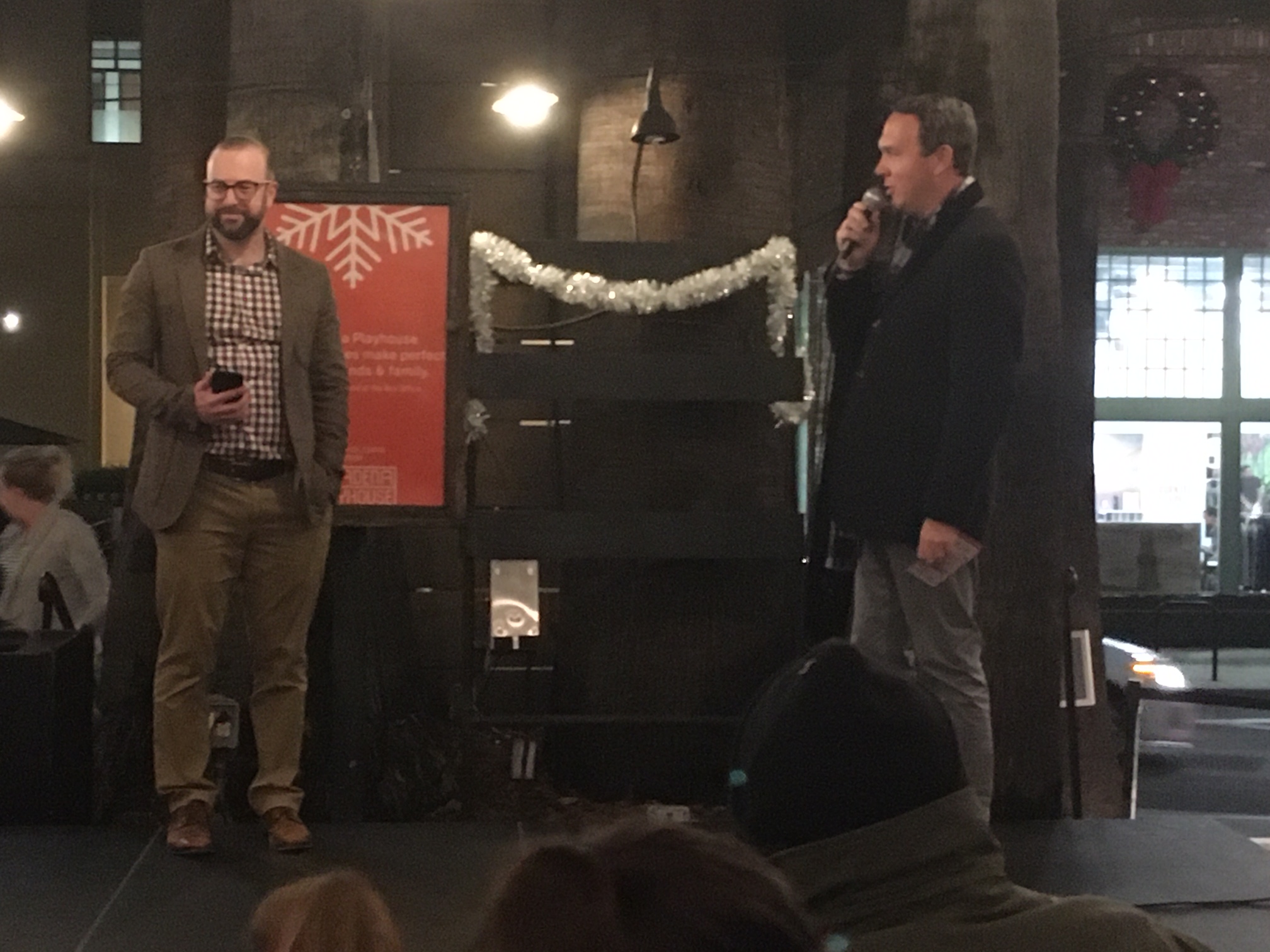
The public was treated to Christmas carols sung by The Marshall Fundamental Choir and by cast members of The Playhouse’s production of ‘Little House of Horrors’ – Brittany Campbell, Tickwanya Jones, and Cheyenne Isabel Wells. A performance by the Bob Baker Marionettes enthralled kids of all ages.

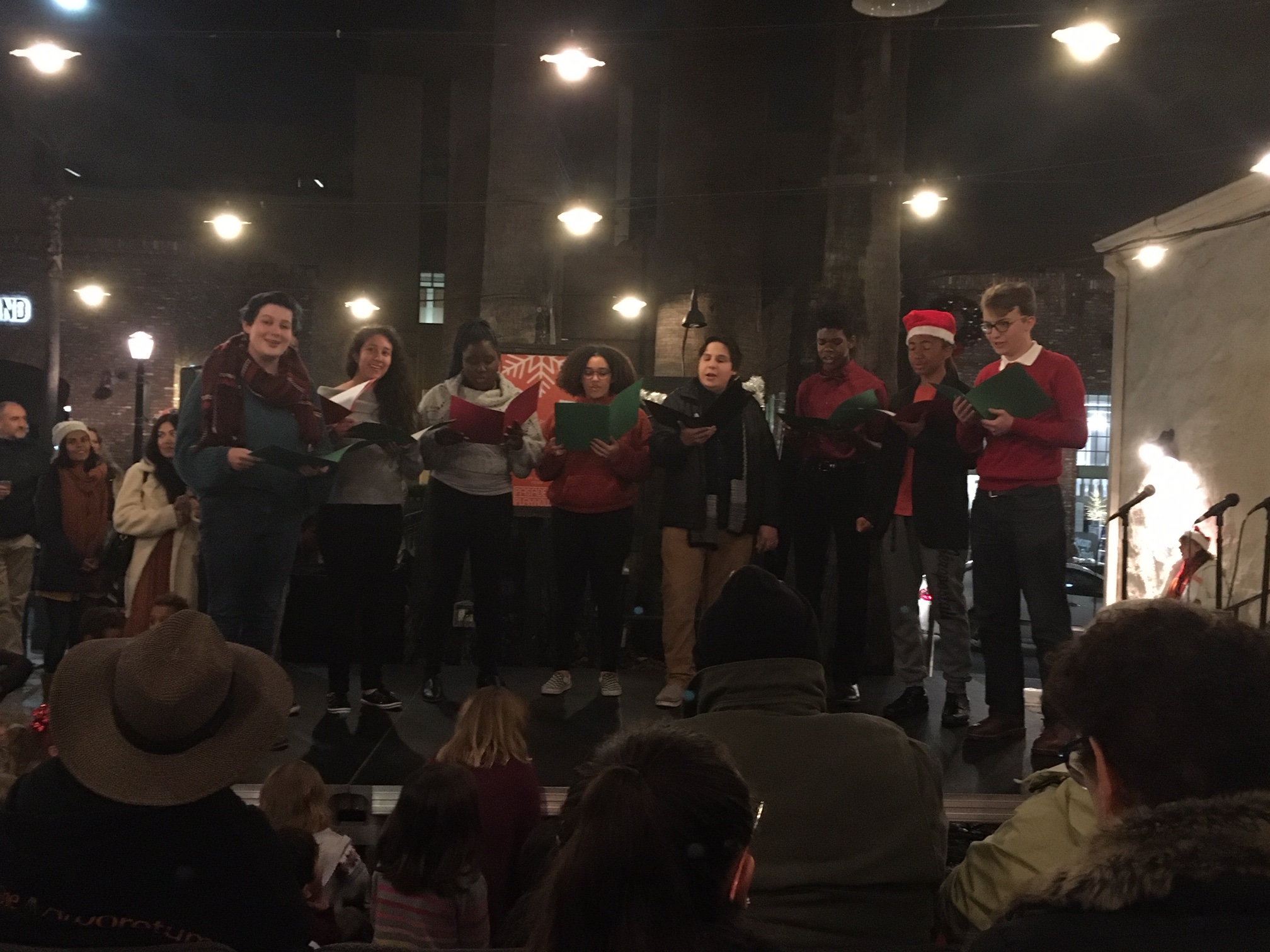
Pasadena Playhouse’s Producing Artistic Director Danny Feldman and Playhouse District’s Brian Wallace | Photo by May S. Ruiz / Beacon Media News

Sometime during the night, Feldman wrapped a scarf around his neck in anticipation of a rare snowfall. And we were not disappointed – we were soon covered in sudsy ‘snow’ after the Christmas tree was lit at 8:00.

Chatting with me directly after the ceremony, Feldman says, “This is my third tree lighting at the Pasadena Playhouse – we actually did one when I was barely starting here but we didn’t do it the following year. Then we got a new tree and this is our second year with the new tree. I’m Jewish but I love Christmastime. I love the idea of giving and of people enjoying the holidays together. Our world is so divisive and crazy so it’s good to have everyone coming into one space that’s nice and cozy like our courtyard to light a big tree and to celebrate.”

“My message year-round, not just at Christmas, is that the reason I love what I do is having the opportunity to bring strangers in our community collectively to sit in a room, then turn off the lights and let them play make-believe together,” Feldman remarks. “It reminds us of our shared humanity with these strangers sitting next to us. You watch a show like ‘The Great Leap’ and it awakens something in you personally but then you look over and the people next to you feel the same way. That, in our world of phones and Twitter, isn’t an experience we have often. And we have to fight to protect those shared experiences. To me, this Playhouse is a temple to that. It’s really the place of community coming together and connecting with one another. And so I spend every day trying to create the space for that to happen. And the holidays, in particular, is an important time to refresh or memory – to remind us of the importance of that.”

The Marshall Fundamental Choir | Photo by May S. Ruiz / Beacon Media News

The Tree Lighting occasion also included a show presented by professionals and students. Feldman explains, “We have partnerships with the public schools in Pasadena – every year we bring the entire PUSD 7th graders to see the play. What we often do is pick a different school each time to participate when we have an event. In the spring, we had a drum corps from one of the schools. We put on world-class plays but we also use our space to showcase local performers because we want to live up to our mission as a community gathering place.

“I grew up in the area and I’ve been to the Bob Baker Marionette Theatre in L.A. during school field trips. Watching a puppet show is a big deal for children. Adults see it from a different perspective but for a kid, just like the ones sitting at the front row today, it’s something entrancing. They focus on the movements of the marionettes and that’s magical.”

The Bob Baker Marionettes | Photo by May S. Ruiz / Beacon Media News

Feldman continues, “This year we wanted to do something that impacted the community in a bigger way. We knew that the Pasadena fire department has this drive so we called them and asked to partner with them – we’re one of their toys drop–off locations. We ask them to bring their fire truck, and speak to our audiences during holiday events.”

Recapping the year and looking forward to 2020, Feldman states, “This is one of our most successful years ever at The Playhouse. We had our big musicals – ‘Ragtime’ and ‘Little Shop of Horrors’ – and they were epic for us. They broke all sorts of records. For our Christmas show, we’re having the Bob Baker’s ‘Nutcracker’ at the Carrie Hamilton Theater from November 30 to December 29. Holding it at the smaller venue means the puppets will be right on eye level with the kids which makes for a really captivating show; we’re expecting it to be a big success.

“We’re starting 2020 with a really powerful play with Alfred Molina, who’s a brilliant actor. It’s called ‘The Father’ and it will run from February 5 to March 1. I don’t want to say too much about it but it’s an extraordinary performance that people will be talking about for many years to come.

‘Snow’ falls on Danny Feldman, cast members of ‘Little Shop of Horrors’ and a gleeful crowd | Photo by May S. Ruiz / Beacon Media News

“Then we’ll have Holland Taylor, an Emmy Award-winning, Tony-nominated actress, who most people know as the Mom from ‘Two and a Half Men.’ I saw her perform this show, ‘Ann,’ on Broadway in 2013 and it was, for me, one of the greatest nights of theatre – I loved it and I’ve been trying to get her to do that show here and she finally said yes. So we’re doing that from May 27 to June 28. It’s a brilliant play about Texas governor Ann Richards who was a powerful politician in a man’s world, who was a democratic governor in a Red State. Again, it’s a very timely piece at this divisive time – it shows how Richards’s work and what she fought for brought people together. Holland Taylor did all the research, wrote it, and performs the character of Ann Richards. The play is inspirational, hysterical, and fun.”

“Next summer we’re doing ‘Annie Get Your Gun,’ one of the greatest musicals of all time, which we’re putting a fresh, new spin on to update it. Musicals are expensive to produce but worth it, so we rely on philanthropic support. I wish we can do them all the tine – I love musicals and our audiences love them too. I think seeing a big musical like ‘Ragtime’ and ‘Little Shop of Horrors’ in a 650-seat theatre with a big orchestra and a big cast is a truly amazing sensory experience; you don’t get that in a big theatre. Our production of ‘Ragtime’ just got ‘Best Production,’ ‘Best Direction,’ ‘Best Choreography,’ Ovation nominations. So we’re building upon those,” Feldman says in closing.

And so, under Feldman’s stewardship, we can expect the Pasadena Playhouse to continue to astound us with fantastic shows, to rouse us with stirring plays and, always, to let us come together as a community in joyous appreciation of the performing art

Dr. Robert W. Winter: ‘Father of Historic Preservation’ Memorialized with a Permanent Tribute

Originally published on 13 November 2019 in the Pasadena Independent, Arcadia Weekly, and Monrovia Weekly

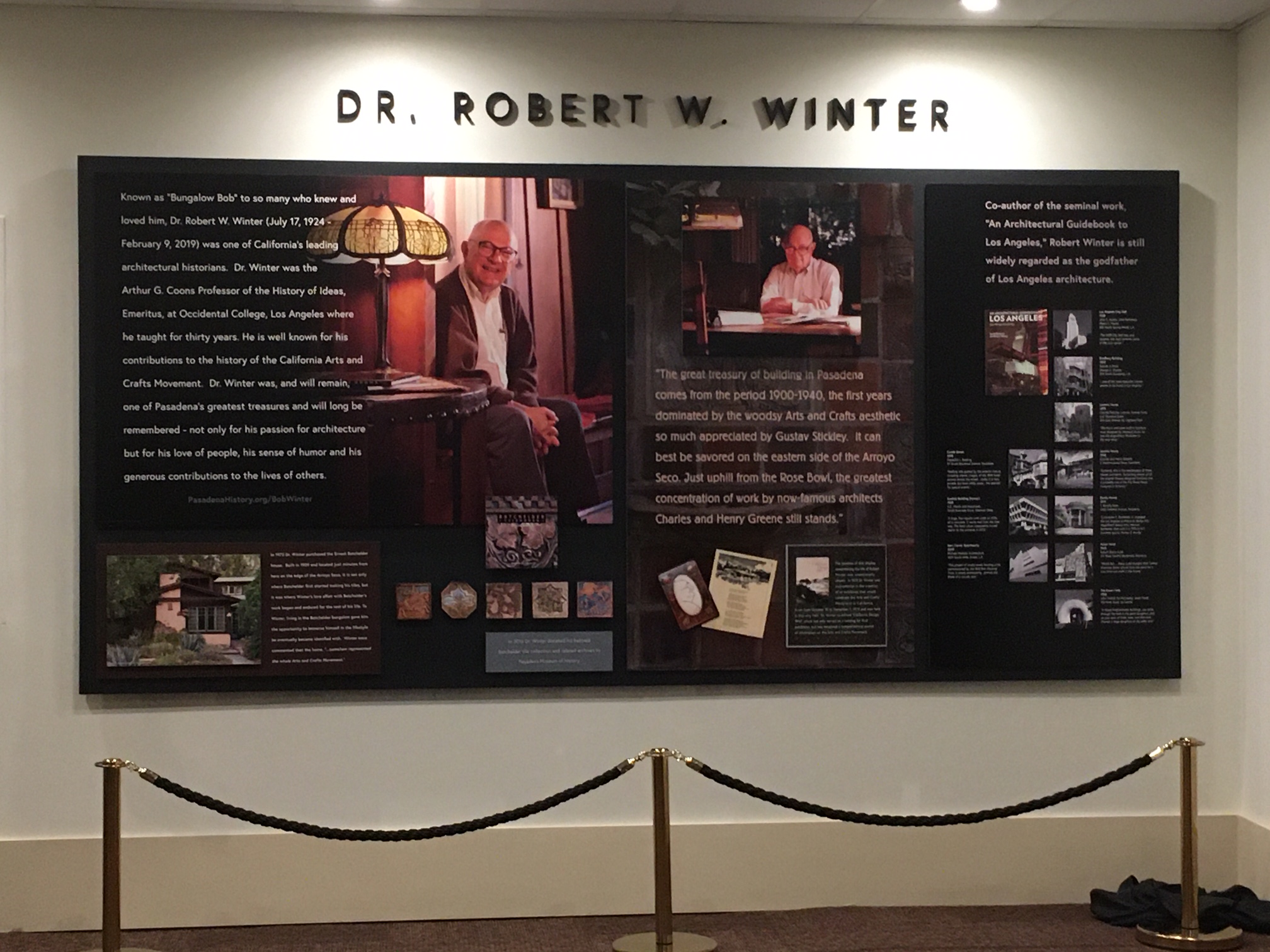
The Dr. Robert W. Winter Tribute at the Exhibition Hall of the Pasadena Convention Center | Photo by May S. Ruiz / Beacon Media News

Dr. Robert Winter, who passed away in February this year, was an inspiration to preservationists and architect buffs for over 50 years. He was hailed as the ‘Father of historic preservation in Pasadena.’ It was his campaign to effect an ordinance to establish a cultural heritage commission that eventually created the Pasadena Heritage. He was an influencer long before the term entered the pop culture lexicon.

To recognize his significant contributions to the Arts & Crafts movement on the West Coast, Pasadena Heritage’s Craftsman Weekend 2019 held on November 1 to 3 incorporated the inaugural Dr. Robert Winter Memorial Lecture and the unveiling of a permanent tribute commissioned by Pasadena Center Operating Company (PCOC) at the exhibition hall of the Pasadena Convention Center.

Directors of the Blinn Foundation, The Gamble House, and the Pasadena Museum of History – the organizations which partnered with the Pasadena Heritage for the event – spoke of Dr. Winter’s connections to their associations.

Author and historian Ann Scheid, who heads the Greene & Greene Archives at The Huntington Library and has co-authored a book about The Gamble House with Dr. Winter, was the first lecturer. She gave a short biography that covered his life and career, his passion for Craftsman homes as well as for martinis. She reminisced about his penchant for performing – whether when taking his Occidental College students on bus tours of architectural landmarks or when giving talks about the history of the Arts & Crafts movement on the West Coast. Her stories brought back happy memories for the audience who had been invited because they had close ties with him. Her lecture ended with a short video of Dr. Winter singing con brio the chorus to a song called ‘In the Land of the Bungalow.’

Patty Judy, Education Director of the Pasadena Heritage, explains, “It’s an old song written in the 1920s. As far as I know, Bob discovered it in his endless research of the Craftsman era and was just delighted with it, learned it, and often performed it just for fun – in classrooms, at lectures, and to close all kinds of presentations when he was asked to speak. As Ann said, he loved being a ‘performer.’ I think the song became tied to him because he sang it so often and so many who heard him speak over the years remember it.”

Participants in the Craftsman Weekend 2019 Show | Photo by May S. Ruiz / Beacon Media News

An open reception followed the lecture at the other side of the hall where people milled about and chatted as they enjoyed the drinks and finger foods. Then Dianne Philibosian, former chair of PCOC, alongside her husband Tom Seifert, asked all the guests to assemble for the unveiling of a special permanent display.

Says Judy, “Tom was a dear, close friend of Bob’s. He and Dianne were nearby neighbors who regularly checked in on him and helped out in recent years. The two of them spearheaded the effort to come up with a proper Pasadena tribute to Bob and we worked with them to create this event combining our lecture and the tribute unveiling.”

Philibosian discloses the reasoning for the choice of venue, “I thought the historic exhibition hall would be a really appropriate place to put up a lasting memorial. And in consultation with others, including PCOC Board members, city council members, Pasadena Heritage, and other friends and colleagues of Dr. Winter, we all agreed it was a most fitting location.”

The Pasadena Convention Center’s Exhibition Hall is indeed the perfect venue to house the tribute. It was here that ‘California Design 1910,’ an important exhibition of Arts & Crafts work, was held from October 15 to December 1, 1974. According to a news article published in the Pasadena Star-News on February 27, 2011, ‘California Design 1910’ was organized by Eudorah Moore and California Design, a spin-off from the Pasadena Art Museum. In the exhibition catalog, Moore wrote an introductory essay on ‘California and the Arts and Crafts Ideal’ and Dr. Winter followed with an extensive essay on ‘The Arroyo Culture.’ The author noted that the exhibition catalog is a veritable textbook on the Arts & Crafts peak period between about 1895 and World War I.

It took a village to create what Philibosian and Seifert envisioned. And during the unveiling, Philibosian acknowledged the Pasadena Heritage, the Gamble House, Pasadena Museum of History, and the Blinn House Foundation. She gave special thanks to Dale Brown of Onyx Architects, and graphic designer Scott Garland.

“When Dale Brown of Onyx Architects was asked to produce a tribute to Dr. Robert Winter he assigned Scott Garland, a local graphic designer who was born and raised in Pasadena and a graduate of Art Center College of Design,” Philibosian expounded. “As fate would have it, for 23 years Scott and his wife Karen lived in the 1911 historic landmark bungalow which would become the first historic district of Monrovia. During that time, their home was featured in the American Bungalow magazine and photographed by Alex Vertikoff. Scott even had his own copy of American Bungalow Style co-authored by Dr. Winter and Alex Vertikoff. Not only did Scott’s familiarity with the Arts and Crafts Movement influence his design decision but this project could not have been completed without the cooperation of many who graciously gave their time to be interviewed for this very piece behind us. Their insights and memories of ‘Bungalow Bob’ all contributed to what we hope will be a lasting and fitting tribute to this remarkable man.”

Mayor Tornek speaks of Dr. Winter’s significant contributions | Photo by May S. Ruiz / Beacon Media News

Pasadena elected officials, led by Mayor Terry Tornek, were on hand to celebrate the occasion. Mayor Tornek, whom Philibosian introduced as someone who greatly appreciates and promotes art and aesthetics of historic preservation in the city of Pasadena, gave his remarks.

“I’m delighted to see so many people turn out for this – this is really a great event for us (I have notes because Bob would expect no less). Dr. Robert Winter, as you heard in Ann’s wonderful speech, was a Pasadenan of national renown. And if we had a tradition of naming people as historic treasures, I think he would have been among the first to be identified. He was an inspiration, a writer, a mentor, a teacher, an instigator, and he was a dedicated proponent of good architecture and its effects on the community. He was both expert and charming which, I think, helps a lot in promoting a cause.
“We were so fortunate that his primary community was indeed Pasadena. An architectural historian, well-known author, professor of ideas (great title that was) at Occidental for many years, Dr. Winter taught generations how to look at and appreciate historic buildings and places throughout Los Angeles and across the country. In terms of his local impact, Bob was among the first to proclaim that the city of Pasadena needed a historic preservation ordinance to confer landmark status on key buildings, identify critical properties and, most of all, to protect them. He, along with his close friend, L.A. Times columnist Miv Schaaf, who lived around the corner, drafted our city’s cultural heritage ordinance and he served on the board of the first cultural heritage commission. Later he rejoined the commission and served again.

“He also called for an uprising of local residents to champion and support that ordinance and the work of the commission as well as the general cause of historic preservation in the city. And that, in fact, gave rise to the formation of Pasadena Heritage and its mission which has been so effective down through the years and, ultimately, led to my arrival as planning director for the city of Pasadena. I’m afraid that ‘Bungalow Bob’ was responsible for me being here as well.
“So I’m so pleased that the PCOC, with the encouragement of Dianne Philibosian, has taken the time to create this wonderful lasting tribute to Dr. Robert Winter and make it a place where lots of people will come and see it for years to come. We treasure our history in Pasadena – it means a lot to us and it’s responsible in many ways for the kind of community we are. People like ‘Bungalow Bob’ really are the key contributors to making that happen. It’s not just about the buildings, which are important, but it’s really about the sense of community that we’ve developed in Pasadena. So I’m grateful to Bob, I’m grateful to those of you who invested in spending time to remember him and to memorialize him, and I hope that going forward we can be worthy of the causes he championed but also be as good-humored about it as he was.”

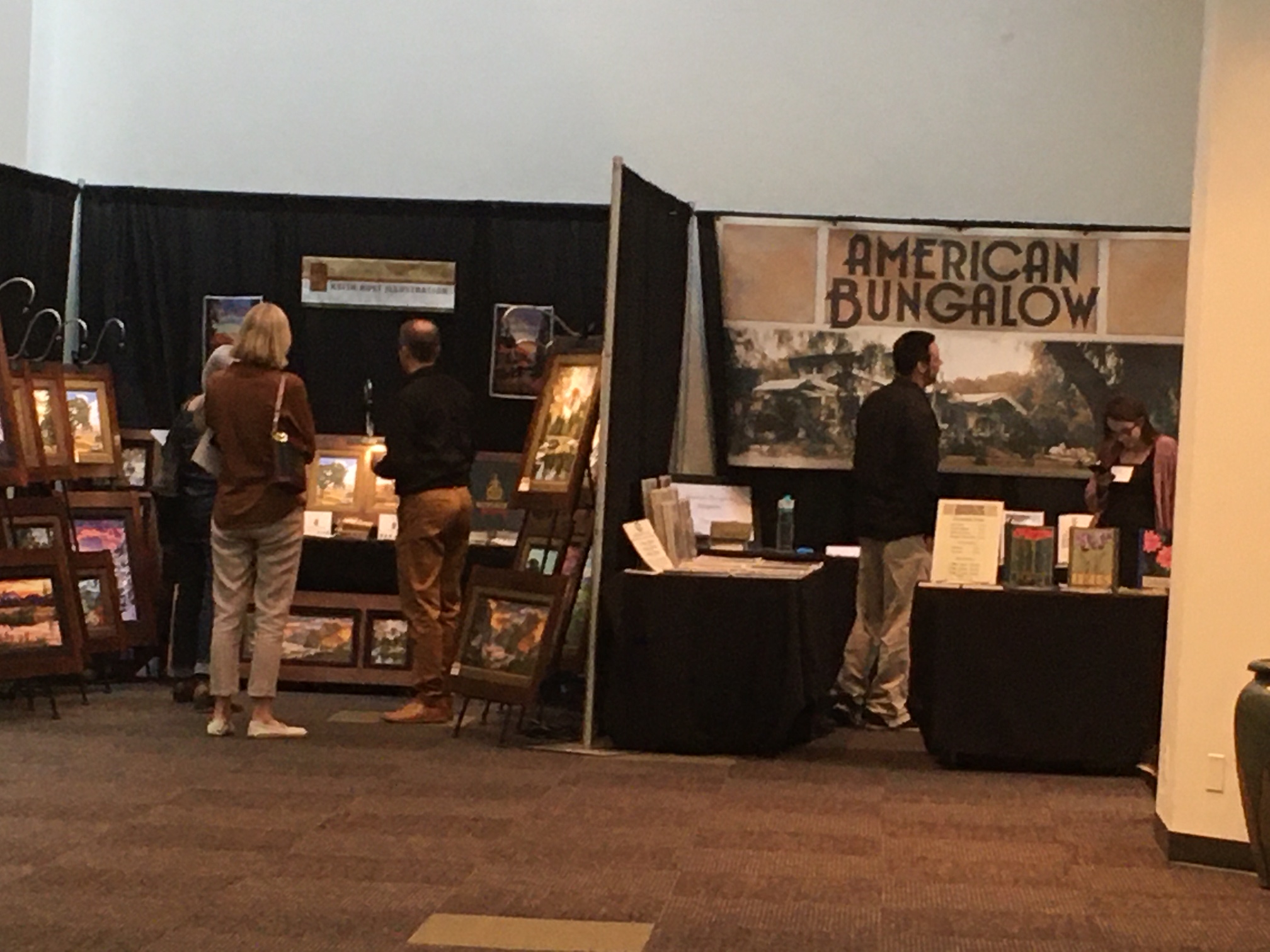
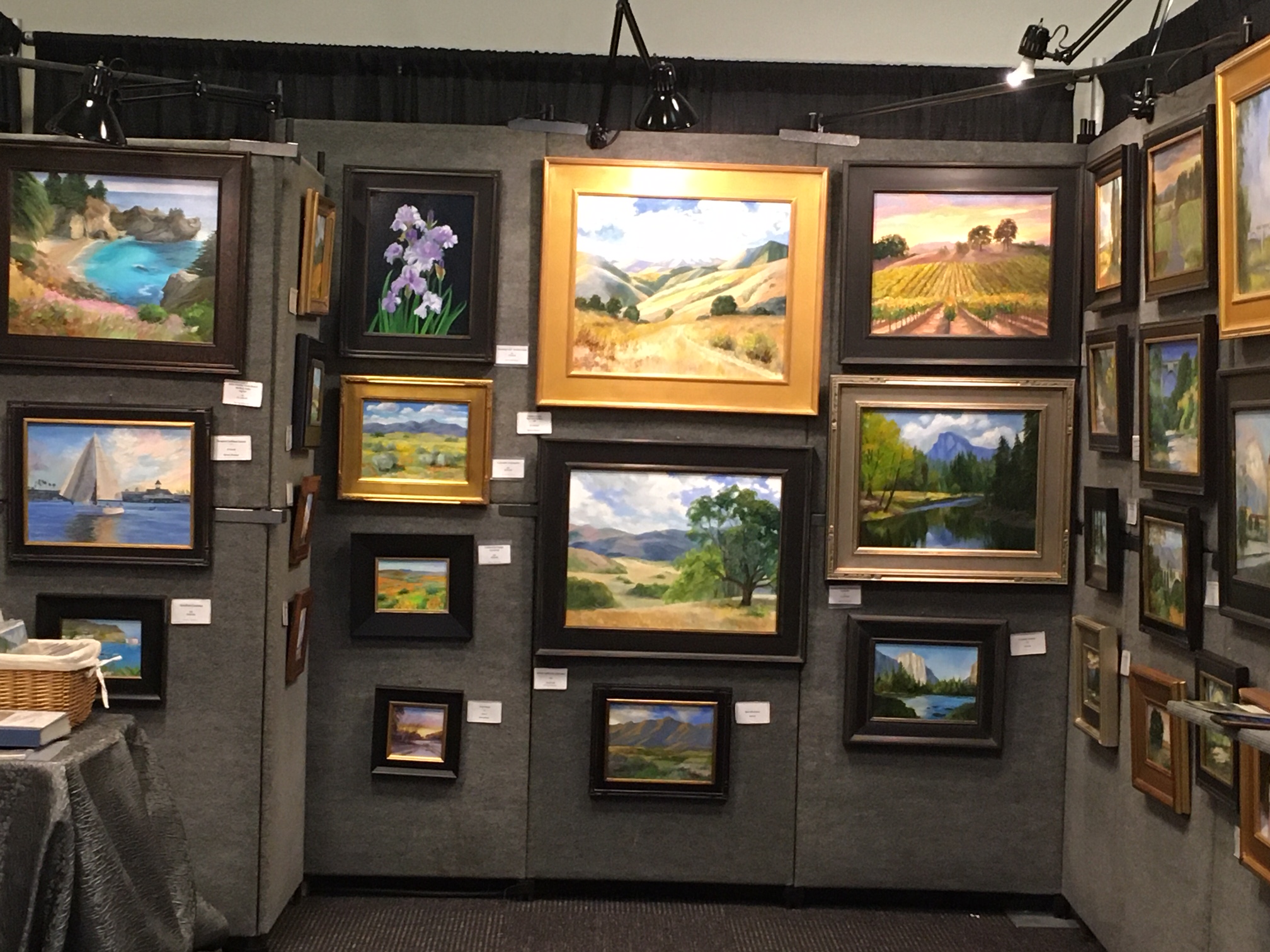
Karen Winters Fine Art display booth at Craftsman Weekend 2019 | Photo by May S. Ruiz / Beacon Media News

After the tribute was unveiled, everyone raised their champagne glass (not martini, which would have been his preference) to toast Dr. Robert W. Winter, Ph.D.

Seifert declared, “We thank you for your scholarship, your humor, your multiple contributions to so many fields of endeavor. May this wall commemorate your extraordinary legacy to the city of Pasadena.”

Then Philibosian recited Dr. Winter’s trademark song, “And all those who gaze upon it in the land of the bungalow, away from the ice and snow, away from the cold to the land of gold, out where the poppies grow, to the land of the setting sun and the home of the orange blossom, to the land of fruit and honey.” And Seifert ended it with, “In this land of your bungalow to Robert Winter Ph.D.”

Her emceeing duties finished, Philibosian returned to her table to chat with colleagues and other friends of the late Dr. Winter. She capped the evening with a wish, “We’re hoping this will be called the Robert Winter Historic Exhibition Hall – that as things evolve and progress, people will start calling it that.”

Let this mark the start of the fulfillment of that wish.

Pasadena’s Calligraphy Katrina Showcases Distinctive Art

Originally published on 19 September 2019 in the Pasadena Independent, Arcadia Weekly, and Monrovia Weekly

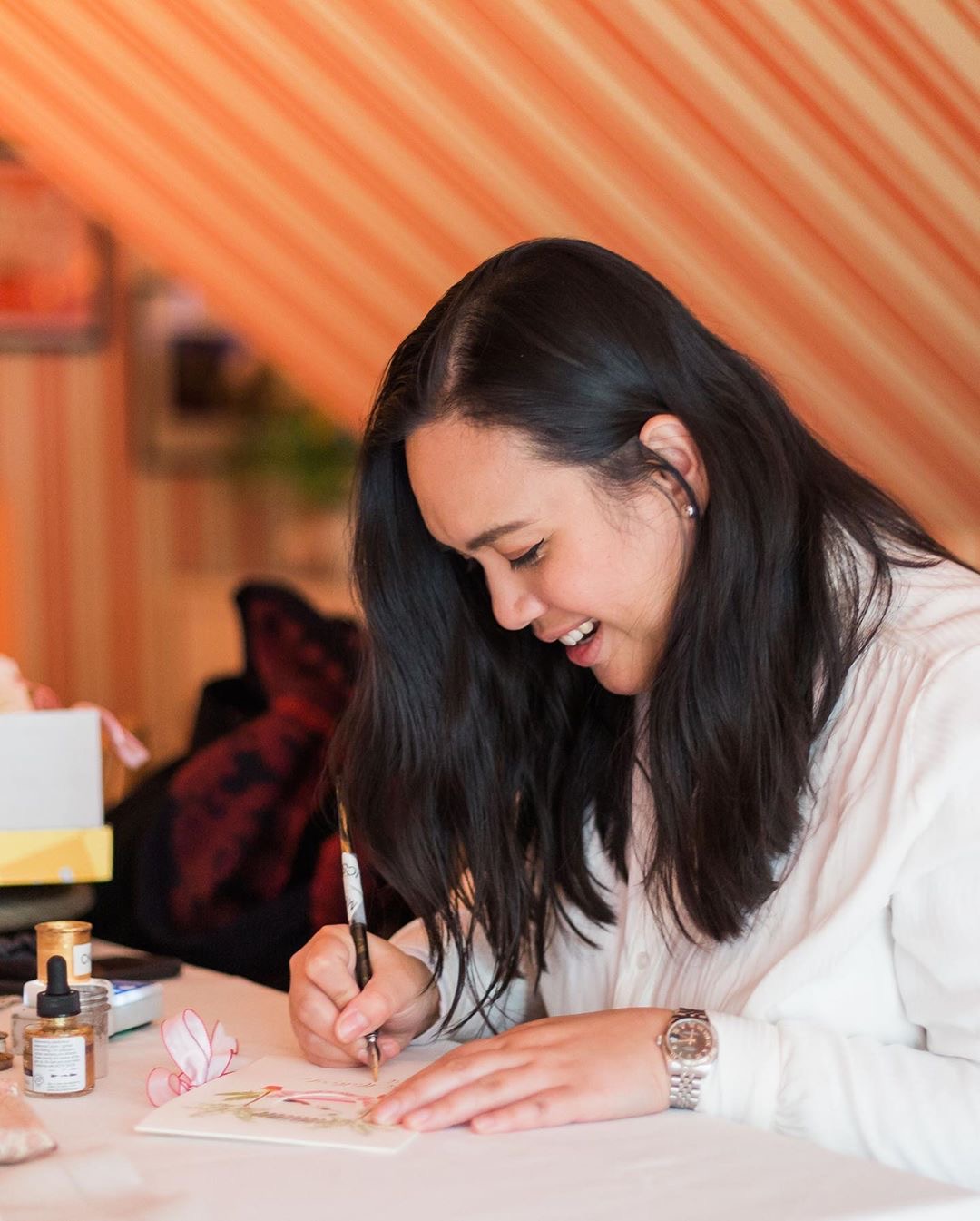
Katrina Centeno-Nguyen does on-site calligraphy | Courtesy photo / Calligraphy Katrina

Her Instagram followers watch her work her magic online in real time. She writes words – names, dates, places – on a blank space and it becomes a piece of art. All in a span of a few minutes. Her calligraphy pieces grace wedding receptions, Hollywood film openings, Grammy events, and the New York fashion scene.

Katrina Centeno-Nguyen was 19 when she opened her eponymous company, Calligraphy Katrina, 12 years ago. She does a brisk business with a pen bought from an art store, and an immigrant’s determination, perseverance, and work ethic. Her journey is a model for everyone who’s arriving in this country to look for opportunities.

Chatting with me one sunny morning from her home in Pasadena, Centeno-Nguyen talks about coming to California as a 13-year-old, being raised by a single mom, and finding her career in the most unexpected way.

“My parents decided to emigrate from the Philippines – my dad arrived in Pasadena in 1997 and my mom followed in 2000. Unfortunately, their marriage didn’t work out and they divorced soon after. So it was up to my mom to find a way to get me and my sister here.

“Immigrating into the U.S. at that time wasn’t as difficult as it is today but it was definitely not an easy process. As comfortably well-off, highly educated, and widely-traveled as we were when we lived in Manila, we were still technically from a third-world country. We were coming here as dependents so that also meant my mom had to show how her children, who were still in the Philippines, were being financially supported. Propitiously, my grandmother (my grandfather had passed away) had income from their family business and rental properties so she made sure we were looked after.

“In time, my mom had obtained gainful employment as an analyst and had enough resources to cover the expenses for the petition process and the means to support us once we got here. I came here in 2001 and my sister arrived in 2005; my brother was born here.”

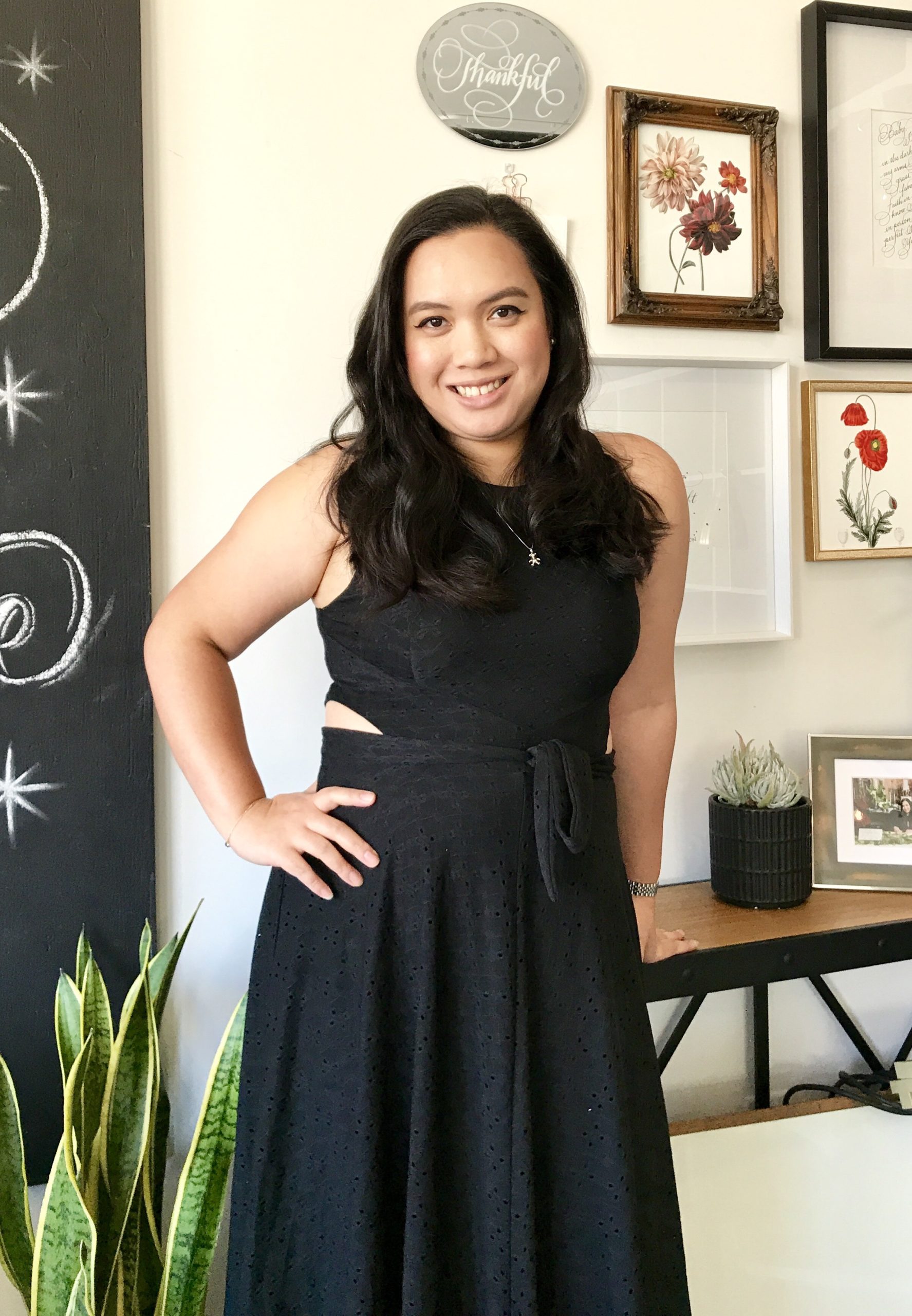
Katrina Centeno-Nguyen | Courtesy photo / Calligraphy Katrina

Continues Centeno-Nguyen, “I had finished 6th grade in Manila; I skipped middle school and went directly to 9th grade at Pasadena High School (PHS). That was quite an interesting cultural transition because I had gone to private schools in the Philippines and suddenly I was in a public school. Not only did it have a large population, students were talking back to their teachers!

“Though I have to say that socially, it wasn’t bad at all. PHS was a diverse school and a lot of students were culturally open because they also came from immigrant families. However, I had friends who weren’t necessarily immigrants. I was quite lucky because the classmates I hung out with were very much like me – we were all in the honors program; we mainly talked about school and homework. We studied and worked on projects in each other’s homes and, at the same time, had good, clean fun.

“Maybe my innocence also shielded me because I didn’t really know if bad things were happening. There might have been students who were doing drugs but I wasn’t aware of it. But the friends I had weren’t doing drugs either so there was no peer pressure. The core of our friendship was academics; it was why we became friends in the first place. We were nerds – we played chess and enjoyed physics class. We were also a good mix – some were in sports or arts; and we were volunteering in the same places. It was all about getting ready for college applications.”

Asked which college she went to, Centeno-Nguyen responds, “I actually didn’t attend college. We were still in the process of getting our residents’ visa; we didn’t become green card holders until 2007. Going to college as a non-immigrant was going to be quite expensive. Besides, I had to try to figure out a way to help my mom. While she had a great post, she had to work two jobs to enable her to support three children – in Pasadena, where it’s not cheap. So I took a full-time job as a nanny while I attended Le Cordon Bleu. It was also at this time that I started ‘Calligraphy Katrina.’”

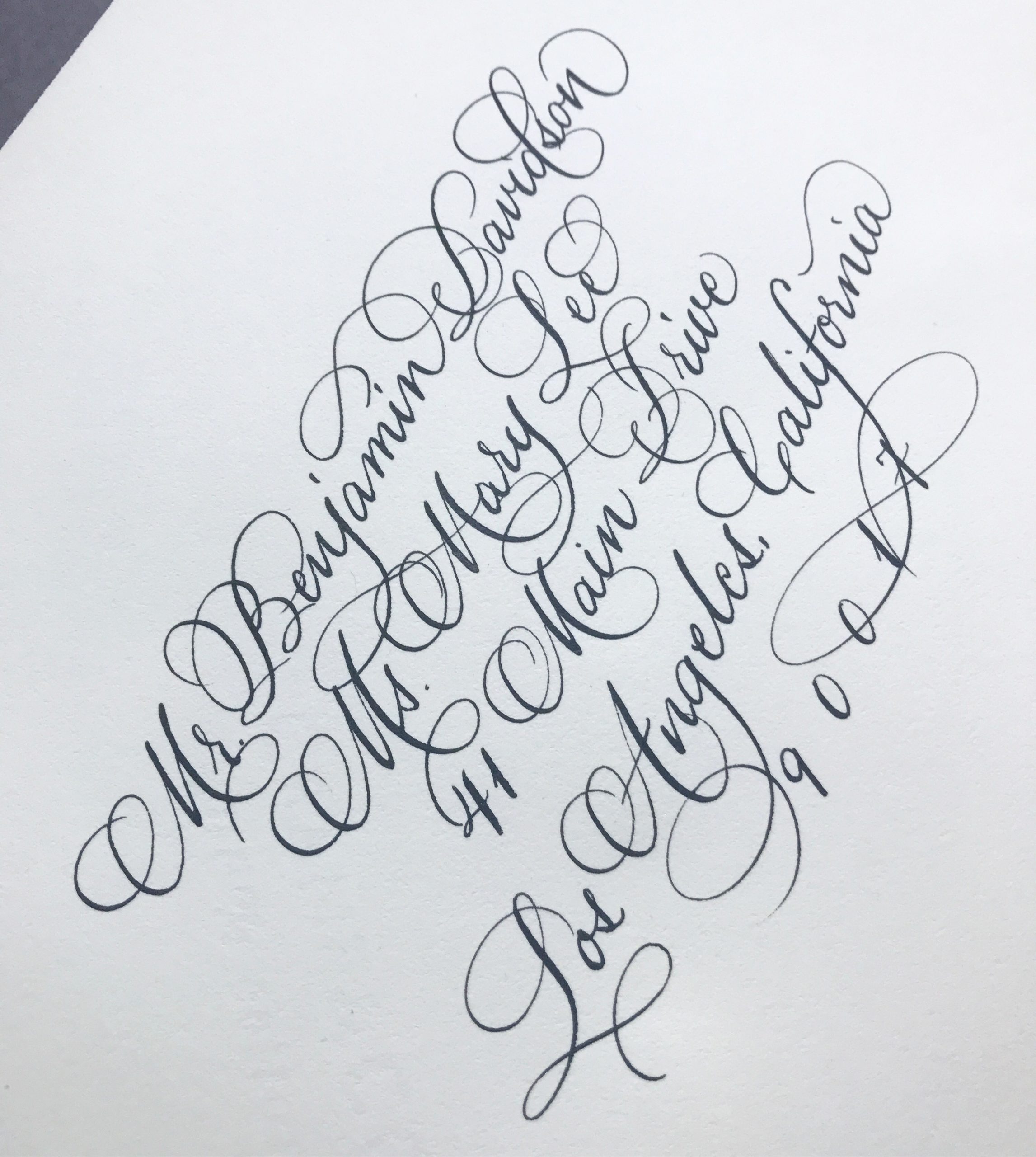
Being a calligrapher was the furthest thing from Centeno-Nguyen’s mind in terms of a career. She relates that she became one by happenstance, “I’ve always had good penmanship and one day, one of my nanny friends saw me writing my grocery list. She was getting married soon and asked if I could do her envelopes. She informed me that I could make money addressing wedding invitations. So I looked into how pricing worked, invested $10 on a few pens from an art store, and bought a couple of envelope packets from Target. That was how ‘Calligraphy Katrina’ started. I began with two fonts and created new ones as I went. Sometimes I’d make an accidental swish and I’d say  ‘Oh, that looks pretty cool. Let’s try that again.’

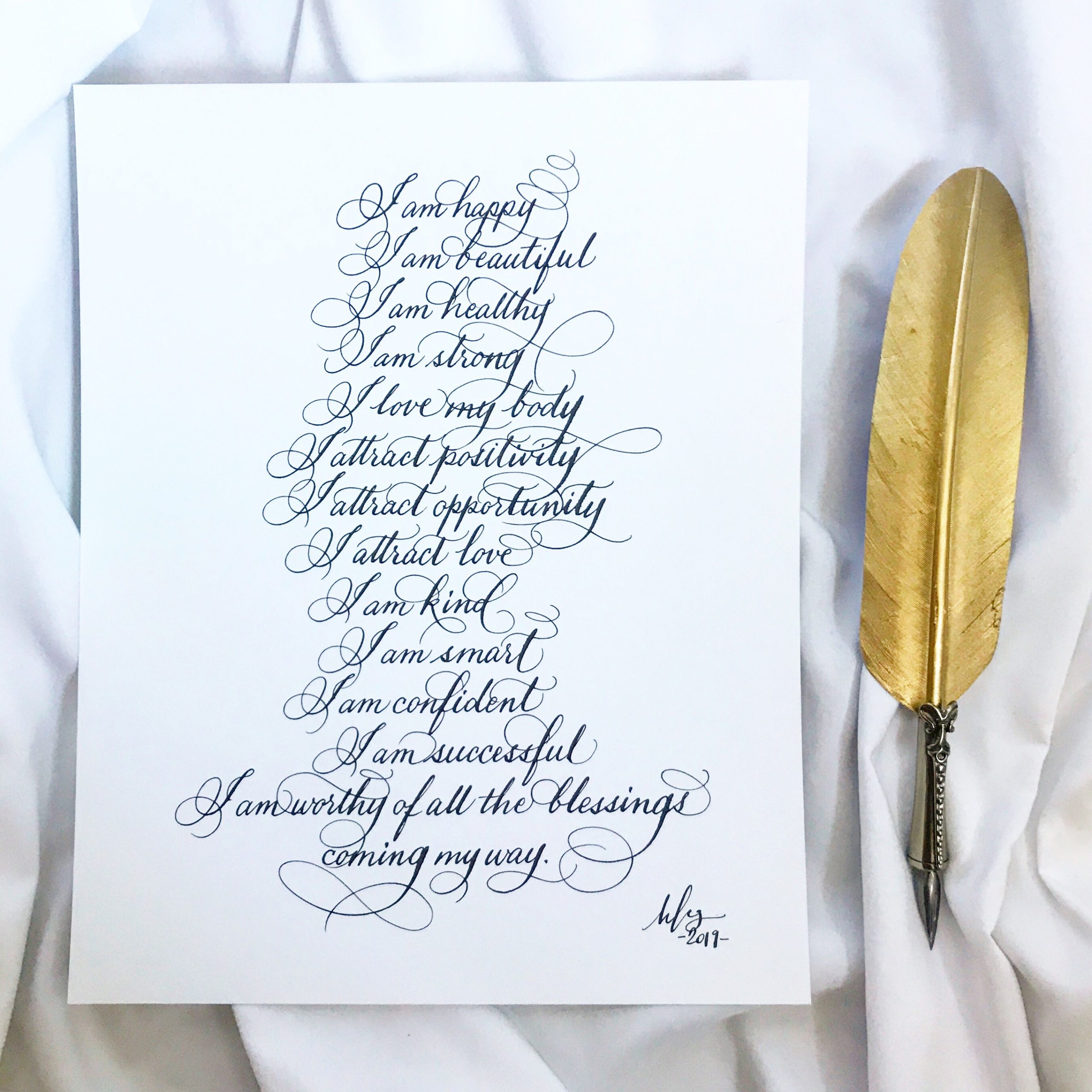
Centeno-Nguyen’s calligraphy | Courtesy photo / Calligraphy Katrina

Centeno-Nguyen was brought up with a discipline and work ethic that made the transition to life in the United States easier. And it proved helpful when she endured a punishing schedule as she was establishing her business.

She recalls, “After I’d been doing wedding invitations for a while, a stationery store called Paper Source in Beverly Hills started taking notice and they asked me to bring my work there. I was still working as a nanny then. I was also in the night class at culinary school and I was doing kitchen work because that was a requirement. My day commenced at 6:30 when I woke up and I was at work by 8:00. Fortunately, the family I worked for lived in Pasadena so it wasn’t a bad commute. I left their house at 5:30 and I was at school at 6:00, where I stayed until 11:00 pm.

“I squeezed the calligraphy project whenever I had the chance. Sometimes I worked on it when the child I was caring for was asleep; I did readings when he was playing. At times I did the calligraphy after school, before going to bed. That was my hustle in those early days. I also did a few hours in the kitchen during weekends because that was important. I had to balance it somehow.

“It was then I decided to give up culinary school. My mom questioned my decision when I had already paid a lot of money for it. But in the restaurant business, it’s either you own an establishment or you’re really brilliant. I was good, but not that good. To get financial backing, you have to know how to run a restaurant already, which I didn’t have any background on. At that time, too, a lot of restaurants were going under. It just so happened that my work was standing on its own and, because Calligraphy Katrina was my baby, I had a deep personal investment in it.”

Centeno-Nguyen recalls, “Facebook wasn’t as widely used as it is now; there was no Instagram. Social media wasn’t a thing yet. There were wedding blogs but the Internet wasn’t that huge so there weren’t as many venues for my work to be seen by a great many people. So I posted photos on Craigslist every week – that was my marketing. Even back then, people were paying $4 to $5 an envelope. I did it in a platform like Craigslist because I was learning how to run it. It didn’t feel ethical for me to charge someone $3 when I didn’t know what I was doing. But I also disclosed to my clients that I was new at this so they knew coming in that it was why I was charging only so much. It was a learning process for me and my clients were hiring me because they just wanted something handwritten. As my artistry and knowledge evolved, I started increasing my prices. But even now, as my experience has broadened, my prices aren’t as high in comparison to what other calligraphers charge.”

“Soon, I quit my job in the kitchen and as a nanny. The calligraphy work was already gaining traction and I was secure enough to focus entirely on it. Still, I was petrified. Obviously, I didn’t really know how it would turn out. My mom and I would go to Beverly Hills every single weekend. She worked a lot so it became our special time together – we’d hang out there and meet the brides that we got from Craigslist at Starbucks.

“At the time, there were only a few people who could be called calligraphers and they were very old school – very traditional. They were master penmen who belonged to a group and they were leery about me. I was 19 and I didn’t get a formal education on the art so I was the outsider. That’s also part of my insecurity as an artist. I once had the privilege of working alongside a full-pledged calligrapher who saw me as a non-calligrapher because my slants weren’t the right size for Spencerian. But I wasn’t doing Spencerian, it was simply my own handwriting. This is why I work at such great speed.”

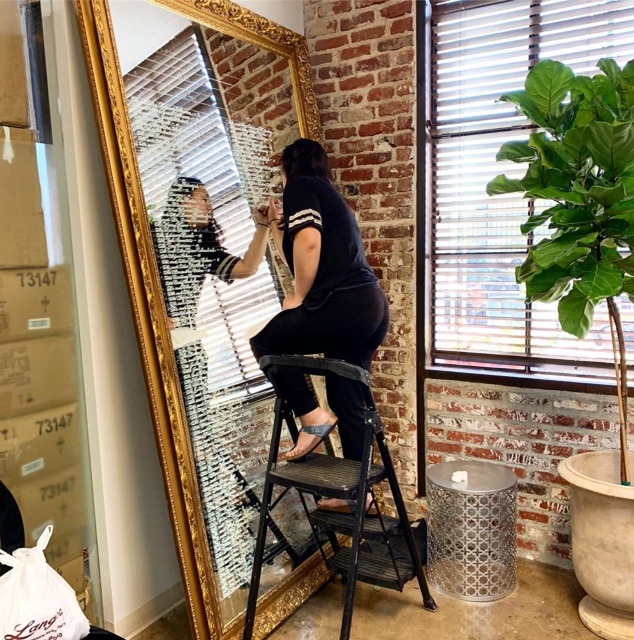
Centeno-Nguyen works on a mirror project | Courtesy photo / Calligraphy Katrina

“Not to diminish what they do, because it’s brilliant,” Centeno-Nguyen quickly says. “I wish I had that kind of knowledge but that sensibility is what differentiates my company from others. I do volume and I need to make that work. A lot of calligraphers say what I do isn’t calligraphy because I’m diminishing art. Every day, as an artist, I also have to account for my own individuality. Since I’m not conforming to the standard, am I a real artist? Do I feel like an actual calligrapher?
“Most calligraphers do this for the artistry of it. That’s not to say that I don’t, because I most certainly do. But it’s also my primary means of livelihood and I have to meet deadlines. My evolution as an artist is tied into the success of my company. I want to establish a stable business and a successful commercial venture. I have to look at it as ‘How can I make enough to support my family?’ And because I didn’t have the resources to do so, ‘Will I be able to ensure that my child goes to a four-year university?’ And ‘How is this  going to increase my income so I can enjoy my family?’ When I become financially comfortable then I can think about my artistry.”
If success were to be measured by one’s popularity on social media then Centeno-Nguyen has definitely attained it. People see her working on huge projects involving pop stars and runway models online. She’s on Reddit and has a loyal following on Instagram, which she finds incredible.

Calligraphy Katrina does a brisk business on envelope addressing for corporate clients | Courtesy Photo / Calligraphy Katrina

Centeno-Nguyen explains that how she got into the Hollywood industry was opportune. “In 2008, a new PR company needed 30 envelopes addressed, not right now but yesterday, and calligraphers in the city gave them a timeline of a week for the project. They called me and I said if they delivered the envelopes that morning, I would have them done by the end of the day. My company officially opened in August 2007 and we did one or two envelope projects a week. By January – February, we were already doing corporate work.

“Because of my pricing, which was like air for a PR company with a large budget, they asked me to do more things like place cards. This was also a young PR company gaining their traction, and it was beneficial to them that I was actually meeting their deadline. That PR company then talked about me to other PR companies. The buzz started from my speed – I could work on the fly. It was my ace and, for a long time, it was what made me stand out. And more corporate work came rolling in.”

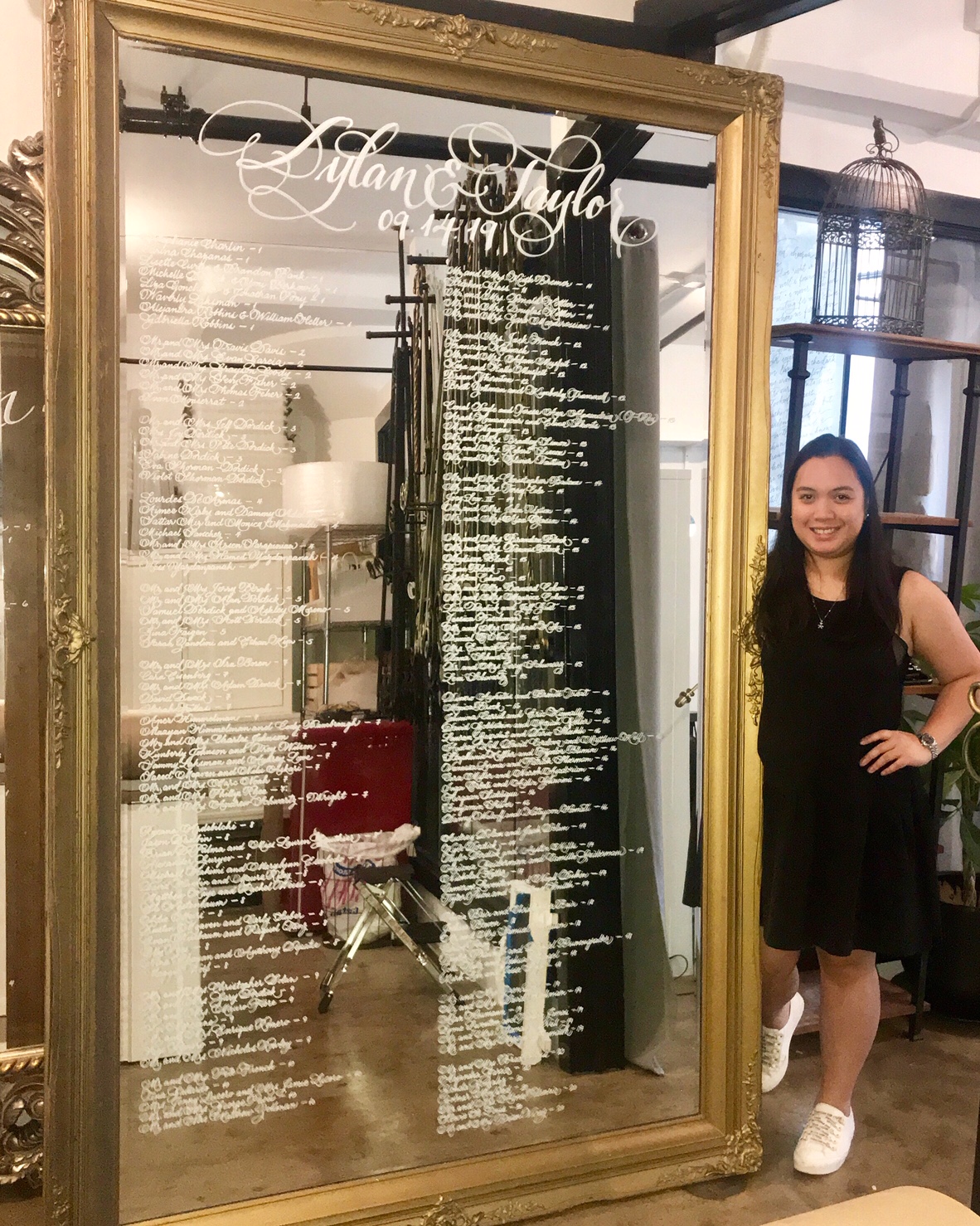
Mirror projects make up 50 percent of Calligraphy Katrina’s business | Courtesy photo / Calligraphy Katrina

Just like doing calligraphy work happened unexpectedly, working on mirrors wasn’t by design either. Centeno-Nguyen recounts, “We had a client who owned a mirror company and they were thinking of having a welcome sign for an event at the California Club. We discussed different things we could do on a mirror and we came up with a seating chart. They asked if I knew how to do one on a mirror and I said no but I’d figure it out. I didn’t know how I was going to grid it but being a nerd, I used math to measure it. I did it on site in four hours while they were setting up. I used a chalk and it looked really cool.

“This was ten years ago when I hadn’t seen anyone doing calligraphy on mirrors. No one cared for it because they said it was too hard to read. When I created calligraphy work on giant mirrors, though, everyone took note because it was different. After I did the videos, everybody wanted the mirror.”

“The mirrors are popular with weddings so 50 percent of our business comes from that and 50 percent is from corporate,” divulges Centeno-Nguyen. “We recently bought out a vintage store that carried antique mirrors from France when the owner decided to close shop last year because space rental was too expensive. We needed to have a place to store them so we opened a downtown studio. The way I see it, I’ve spent so much money buying them, I might as well have people come in to look at them. I got lucky because my space is a corner office so I get nice views on two realms. But it’s also very distracting because there’s constant activity outside and I want to see what’s happening. So I still work from home and the majority of my pens are here; that’s also because sometimes I write at 3:00 in the morning.”

Centeno-Nguyen at a recent corporate event | Courtesy photo / Calligraphy Katrina

Calligraphy Katrina operates smoothly with a lean staff, according to Centeno-Nguyen. “I have a house manager who’s also my daughter’s nanny, an assistant, and a driver who does all our runs in the city. This is my assistant’s first week – my previous production manager who worked with me for two-and-a-half years moved on to her dream job as a social worker. She was the one who helped me build this company to where it is now. She was with me during a difficult time. I had a tough pregnancy and I was on bed rest for nine weeks. My daughter was born at 29 weeks; she was 2 ½ lbs. and was at the Huntington Hospital for two months.

“We were also in the middle of a move to this house. I worked while I was bed-ridden and, because it relaxed me, I didn’t realize I was in labor. My daughter was born by Caesarean section at 12:03 in the morning after 26 hours of labor. New York is open at 6:00 am our time and I was on the phone taking notes because we were doing a show. It was much later they found out I was in the hospital. But I wasn’t going to miss that call. Giving birth isn’t an excuse; as long as I am awake I can write.”

Centeno-Nguyen’s reputation as a reliable artist who can get the work done fast is the reason she has long-standing clients. She’s been working with LACMA for almost ten years now and Chanel for nine years. On the morning we met, a delivery from LACMA arrived; there were several boxes of Chanel envelopes in the dining room for her to work on.

Twelve years after Centeno-Nguyen bravely took the leap to establish Calligraphy Katrina, she is a mainstay not only in the luxury bridal market, she’s also sought after by corporate clients including museums, fashion houses, The Grammys, and movie companies, among others.

When queried about which projects she enjoyed most, Centeno-Nguyen replies, “The Chanel fashion show was a fantastic gig. We’ve done a few fashion shows like YSL and Moschino and they were really fun, but the Chanel was doubly so because we were in New York for a whole week preparing for it. We even saw the rehearsal; it was like seeing a production come to life. But the most memorable one will always be my first mirror.”

It’s a sentiment shared by most immigrants – no matter how successful they become and how far they’ve come, they look back with gratitude at where they started.

The Huntington Launches Yearlong Centennial Celebration

Originally published on 10 September 2019 in the Pasadena Independent, Arcadia Weekly, and Monrovia Weekly

The Huntington President Karen R. Lawrence, announces the name change during the Centennial Celebration launch | Photo by Ryan Miller / The Huntington Library, Art Museum, and Botanical Gardens

The Huntington in San Marino officially launched its yearlong centennial celebration on Thursday, September 5, 2019. During her welcome speech at Rothenberg Hall, Huntington President Karen R. Lawrence expressed how Henry E. Huntington’s vision and legacy will live on in the next century.

“As I look out at you, the leaders of Southern California’s, and particularly L.A.’s, cultural, academic, and civic institutions, Huntington’s presence is demonstrably in evidence,” began Lawrence. “As the Director of our Botanical Gardens Jim Folsom recently reminded me, almost anything can grow in Southern California. He was correct.

“We brought everybody here today to celebrate the extraordinary fertility and vitality of our region – both a U.S. cultural capital and, as Huntington predicted, the leading edge of the Pacific Rim. Had his visionary red car trolley system been equally as durable, many of you, especially the west-siders, would have an easier commute.”

Continued Lawrence, “So 1919 was a very good year for the birth of L.A. institutions – from UCLA to the L.A. Philharmonic, to the iconic Musso & Frank Grill and Fosselman’s Ice Cream. In celebrating our hundredth, it’s not all about us; it’s about all of us. Because neighbors and partners have always been crucial in the life of The Huntington. As we celebrate the trust agreement in which Henry and Arabella Huntington gave their private treasures – at the time the New York Times called the greatest private library in the world, art and art collection, and expansive gardens and grounds – we also recognize that we wouldn’t be here were it not for George Ellery Hale, the renowned astronomer, who helped develop Caltech and who was the founding director of the Mount Wilson Observatory in Pasadena.

“In the Huntington’s archives, we have Hale’s correspondence with Huntington which shows that from 1906 to 1916, Hale politely badgered Huntington to place his private collection in a trust for the use and benefit of the many. As significantly though, he helped convince Huntington, the wealthy industrialist and collector, to see the value of his collection in a different way – more for the research and scholarship it would inspire than for its accumulation. Hale urged Huntington to establish a public institution; he wrote ‘There is now great need of a strong institution of broad scope, uniting all the intellectual interests of this region and the common folks.’ When he was later asked about the worth of his collection, Huntington replied that its value will be determined primarily by what he produces. Although these two men couldn’t possibly foresee what was produced during those hundred years, it’s a testament to their legacy and Arabella’s, that The Huntington attracts 1,700 visiting scholars in addition to over 750,000 visitors from around the world.

“So today we take a moment to acknowledge this Southern California history as well as to think about our future and the ideas that will propel us all for the next hundred years. For a person turning 100, it’s very natural to look back and reflect on the past. For an institution turning a hundred, a centennial is a moment to be like Janus – looking back and forward at the same time. Today we’re celebrating how far we’ve come and reflect on where we want to go. We’re thinking carefully about our mission and what it means to be among the oldest cultural and intellectual centers in this great region, which itself reflects the dynamic demographic evolution of our city, state, and country. We want to broaden our audiences and to focus on The Huntington’s ongoing role in the cultural fabric of Southern California and beyond.”

Lawrence declared, “The name of an institution reflects its relation to its audiences as well as its mission and ethos. In 1919 we began our journey as the Henry E. Huntington Library and Art Gallery. And, over time, we became more commonly known as the Huntington Library, Art Collections, and Botanical Gardens. Today I am pleased to announce a change in what we’re calling ourselves, that reflects both the increased breadth and depth of our art collections and their public purpose. We’re changing our name to The Huntington Library, Art Museum, and Botanical Gardens.”

As Lawrence said this, the name displayed on the screen behind her also changed and was met with enthusiastic applause from the audience.

The change from ‘collections’ to ‘museum’ more accurately describes The Huntington’s mission and programs, explained Lawrence. “Our art collections are more than a group of catalogued objects; they are carefully curated, interpreted, and exhibited for scholarship, education, and the broader public. An added benefit to this change is that we become more discoverable, particularly in online searches. This is important as we work to widen our audiences and accessibility.”

The Hammer Museum’s Director, Anne Philbin, talks about ‘Made in L..A. 2020’ | Photo by Ryan Miller / The Huntington Library, Art Museum, and Botanical Gardens

The Centennial Celebration, a yearlong series of exhibitions, public programs, and new initiatives running from September 2019 to September 2020, kicked off with an announcement of a collaboration between The Huntington and the Hammer Museum on ‘Made in L.A. 2020,’ the upcoming edition of the Hammer’s acclaimed biennial. The statement was made by Hammer Director Ann Philbin alongside Lawrence.

Opening June 7 and running through Aug. 30, ‘Made in L.A. 2020’ will take place at both institutions, providing visitors across the region an opportunity to experience the singular exhibition of contemporary art in Los Angeles. The exhibition, sponsored by Bank of America, will debut new installations, videos, films, sculptures, performances, and paintings from Los Angeles–based artists, many commissioned specifically for the exhibition.

‘Made in L.A. 2020’ is the fifth iteration of the internationally lauded Hammer biennial, and the second to take place at multiple venues. The biennial’s inaugural 2012 edition presented artists at the Hammer, LAXART, the Los Angeles Municipal Art Gallery at Barnsdall Art Park, and the Venice Beach Biennial. The 2020 edition seizes on an opportunity to connect an institution on the west side of Los Angeles with one on the east. It is co-curated by Tunisian-French writer and curator Myriam Ben Salah and Los Angeles–based curator Lauren Mackler. The Hammer’s Ikechukwu Onyewuenyi is assistant curator for performance.

“We are thrilled to be partnering with The Huntington on ‘Made in L.A. 2020’ to bridge the east and west sides of Los Angeles to highlight the works of art created across the region, with an emphasis on emerging and under-recognized artists,” said Hammer Director Ann Philbin. “This expression of our biennial―which spans roughly 25 miles―offers opportunities for discovery and surprise for ‘Made in L.A.’ visitors and gives the curators and artists a new platform for experimentation.”

“Creative collaborations are a hallmark of our Centennial Celebration,” Lawrence disclosed. “We will be engaging with our collections as well as with our audiences in exciting new ways. Joining forces with the Hammer for this remarkable exhibition is a perfect example of what we are setting out to do. ‘Made in L.A.’ celebrates the extraordinary, groundbreaking work of contemporary artists working in Southern California. We are honored to be a part of this year’s exhibition.”

“Los Angeles is the epicenter of the creative economy, with the arts bringing Angelenos together, attracting tourism, generating cultural dialogue, and serving as an economic driver for our region,” declared Raul A. Anaya, Bank of America market president for greater Los Angeles. “It’s why Bank of America invests in the arts and in institutions like the Hammer and The Huntington, and this specific partnership for ‘Made in L.A. 2020’ reflects our mutual commitment to L.A.’s incredibly diverse local artists.”

During the run of ‘Made in L.A. 2020,’ members and visitors to the Hammer will receive passes granting free admission to The Huntington to view ‘Made in L.A. 2020’ in full. There will also be joint programming at both the Hammer and The Huntington during the exhibition.

Looking ahead to the next 100 years, the directors of The Huntington’s three components – Library, Museum, and Botanical Gardens – spoke about the future and how The Huntington’s collections will contribute to their fields.

Sandra Luding Brooke, Avery Director or the Library speaks during The Huntington Library, Art Museum and Botanical Gardens Centennial Celebration Launch Event on Sept. 5, 2019, in San Marino, California | Photo by Ryan Miller / Capture Imaging

As the Avery Director of the Library, Sandra Luding Brooke oversees the 11 million items in the library collection. She said, “In 1925 Henry Huntington endorsed a vision for a repository of books and manuscripts of the greatest rarity and value focused on tracing the progress of our English-speaking people. Since then The Huntington’s collection has grown and persisted in more ways than what could have been imagined a century ago.

“Libraries must anticipate tomorrow and try to imagine what future researchers and viewers might want or need to know,” pronounced Brooke. “We must be judicious and imaginative in choosing what we preserve, and be fearless in seeking diverse and provocative voices. Libraries must batten their hatches to protect collections from the vicissitudes that are sure to come – natural disasters, social and economic upheavals, censorship, ignorance, and willful misapprehension. We also want to seize this moment and help our collections speak to current generations because cultivating a love and respect for documented history is the surest route to its survival and, perhaps, our own. So in the spirit of stepping out with optimism into our second century, the Library has made a small acquisition that won’t get on our shelves until just four years shy of The Huntington’s bicentennial. Until then the library’s purchase will be growing in the Norwegian wood. Artist Katie Patterson’s future library is a hundred-year literary artwork of an active indefatigable optimism. Five years ago, Patterson planted a forest of a thousand spruce trees in Norway. This forest will be held in trust until the year 2114 when the trees will be harvested, turned into paper, and provide the stock for the publication of 100 texts, until then held secret, by 100 writers. This little acquisition is a vote of confidence in the future of the environment, of art, of books and the written word, and of libraries. Yes, we are confident our librarian’s successors will not fail to claim The Huntington’s copy of this long-awaited anthology. But between now and 2114, we are equally confident that millions of other texts, images, and objects undiscovered and, as yet, uncurated will cross The Huntington’s threshold to join this great past, present, and future library.”

Christina Nielsen, Hannah and Russell Kully Director of the Art Museum | Photo by Ryan Miller / The Huntington Library, Art Museum, and Botanical Gardens

Christina Nielsen who, when she took the podium and introduced herself, said that for the past 10 minutes, she has been the director of The Huntington’s Art Museum. She started, “Now that we’re a museum I’d like to spend the next few minute considering what that term means. What it meant to Arabella and Henry, what it means today, and what it will likely mean in the future. Henry Huntington, entrepreneur and futurist, proponent of new technologies; Arabella Huntington, perhaps the greatest gilded-age collector you’ve never heard of – together they stand out among the likes of their peers such as Walters, Morgans, Fricks, and Gardners by bringing together objects from the past to actively shape a future. They founded the first Old Master Collection in Los Angeles which included Asian ceramics, Italian Renaissance pieces, French decorative arts, and British portraits from the 18th century, which allowed for connections across time and place. And they put their historic works in conversation with art from their day by placing sculpture on the grounds from artists of their time, including their daughter-in-law Anna Hyatt Huntington. They also gave us a framework for considering how to move forward, encouraging us to continue making connections across time and place, to invest in new technologies, and to share their collection with the public.

“So now the present moment. And might I suggest that, in many ways, the future is now and the future is here. The definition of ‘museum’ is quickly changing, as is the nature of our work. The International Council of Museums just released a new definition of museum as a ‘democratizing, inclusive, and polyphonic space for critical dialogue about the pasts and the futures.’”

“Our collection is indeed a treasure trove to be mined for thinking about making connections across time and place, how trade and exchange shaped objects, lives, and intellectual pursuits,” noted Nielsen. “But which stories do we choose to tell and who tells them? Recent partnerships here at Huntington, such as one with the Vincent Price Art Museum, allowed Carolina Caycedo, one of the great artists in the L.A. area, to produce a new work of art Apariciones/Apparitions which inserts back into the history of our founding narrative people and labor who’ve been lost over time.

“More specifically, ‘Blue Boy,’ our most iconic work, has continued to inspire over time, artists, much more recent than when he arrived in 1921. A young artist on leave from military duty in San Diego came to the Huntington and had an epiphany from the ‘Blue Boy.’ So did a young teenager who would come on visits to The Huntington on Saturday. And so we’re thinking very deeply about how to unlock more epiphanies from our people, in our galleries, and through expanded online resources. How do we share our collections beyond our walls? How do we reach other aspiring artists from South Los Angeles, San Diego, and from other places really far away – like Kansas City, Kosovo, or Kyoto. So in the context of The Huntington itself, what does our art collection mean? This is a multi-disciplinary institution and as the definition of art keeps changing and evolving, I was reminded recently by Jim Folsom that The Huntington itself is the original conceptual work of art.”

Nielsen said further, “This is the hotbed of the artistic world and we are so pleased to be working with the Hammer on ‘Made in L.A.,’ exemplifying what an extraordinary moment this is for our region. But I might suggest that ‘Made in L.A. 2020’ has a really important antecedent and that could be considered ‘Made in London 1770,’ because going back to Gainsborough and his fabulous ‘Blue Boy’ painting, what we’ve recently learned is that in fact Gainsborough, hundreds of years ago, just like the artists in our midst today, was absolutely pushing the envelope of what it meant to be a painter and what the medium could provide. And so I would say it makes absolute sense for us at The Huntington to be working with The Hammer and offering up our resources for artists, writers, performers, dancers, thinkers, in our midst.

“The past is not dead. In fact, as Socrates said, ‘It isn’t even past.’ It’s alive and waiting to be unlocked in the objects in our collection. I can’t begin to predict now how successors of ours a hundred years from now will do that, any more than Henry and Arabella could have predicted us sending rockets to the moon. But they believed in technology; they believed in sharing their collection to the public; and they believed in connections across time and space. I feel that if we hold true to these principles, we will be just fine over the course of the next hundred years. And, in closing, I offer another definition for our museum – that it should be not just a repository of things, but a collection of ideas and a place for sharing them with others.”

James Folsom, Telleen/Jorgensen Director of the Botanical Gardens speaks during The Huntington Library, Art Museum and Botanical Gardens Centennial Celebration Launch Event on Sept. 5, 2019, in San Marino, California | Photo by Ryan Miller / Capture Imaging

When it was his turn to speak, Director of Botanical Gardens James Folsom, who noted that he’s the old-timer at The Huntington, stated, “Last year we planted several hundred trees and we intend to plant more this year. We plant trees because during a storm in 2011, 700 trees fell in one evening. We plant because new opportunities arise – wonderful new trees become available. We plant trees because they provide structure to the landscape, which takes years to develop. We plant trees because on the 6th of July last year, the gardens experienced a record-high temperature of 118 degrees Fahrenheit leaving vegetation scorched throughout the landscape.

“We plant trees because that’s what gardeners do – observe, think, plant, cultivate, take our losses, make our moves, plan for change, and invest in energy and resources to create something that would be of worth for future generations. So what is that future, how far is that horizon? For trees, it’s 80 to 100 years – easily to the end of the century. But in all of our actions, even short-term plantings, we should build soil and capacity. Every act can be viewed as an investment. Gardens also plant ideas and inspiration – the beauty and power of life unfolding, the importance of cycles, the value in the glorious smell of fresh water and arable soil. The pay-off in planting is seeing the product of pure physical toil and recognizing the importance of plants as the givers of life and the bases of biodiversity.

“To me, the lessons we learn from gardening are crucial. In a perfect future, I imagine these Huntington gardens and the act of gardening will help form a better world. Fortunately, the structure we need for those lessons exists. The Huntington has collections, displays, beautiful facilities, and staff to see us to our second centennial.”

San Gabriel Valley Teens Receive ‘Youth of the Year’ Award

Originally published on 6 August 2019 in the Pasadena Independent, Arcadia Weekly, and Monrovia Weekly

Shown left to right: Eric and Richard Dong with Congresswoman Judy Chu | Courtesy Photo

Arcadia teens Richard and Eric Dong were honored with the ‘Youth of the Year’ distinction during Congresswoman Judy Chu’s 10th Annual Leadership Award ceremonies held last Sunday, July 28, from noon to 3 pm at the Arcadia Community Center. Awards were also given for Businessperson, Educator, and Volunteer of the Year, among others.

Richard graduated this past spring from San Marino High School (SMHS) and will be attending New York University this fall, while Eric is a rising senior at SMHS. The brothers are active volunteers and philanthropists, spending hours doing service at various community organizations and schools while endowing the same places with funds to support their mission.

Children of Chinese immigrants, Richard and Eric were instilled with the importance of contributing to society during their earliest years growing up in San Gabriel Valley. Both of them are gifted piano players and they happily share their passion for music. They perform at schools, chapels, central libraries, senior citizen and homeless centers, and for the public at Walt Disney Concert Hall in Los Angeles and Carnegie Hall in New York.

From their father, Richard and Eric learned the intricacies of the stock market that made them savvy investors. Using the financial gains from their investments, they established their first  endowment to their middle school (Clairbourn) in 2014 to provide scholarships for students in music and the arts. Heartened by its positive outcome, they continued to give more – to San Marino High School to fund school supplies and to the International Leadership Foundation (ILF) to support leadership training, US-China relations, human rights, and global democracy and governance initiatives in 2017. And, in 2018, they founded the Richard and Eric Dong Endowment Fund for Union Station to provide scholarships for children.

Additionally, Richard and Eric were recipients of the President’s Volunteer Service Award at Gold level, Congressional Award for Bronze and Silver Medal, and the 2018 Outstanding Young Philanthropist Award given by the Association of Fundraising Professionals.

In their acceptance speech at the awards ceremony, Richard and Eric acknowledged Congresswoman Chu for her continued encouragement and thanked Ivy Sun, honorary chairperson of ILF’s L.A. Chapter and former mayor of San Marino Richard Sun. They also expressed their deep gratitude to Anne Miskey, CEO of Union Station Homeless Services in Pasadena, for nominating them.

As always, the Dong brothers attributed Robert F. Kennedy’s words ‘Our future is not a gift, it is an achievement’ as their inspiration and for empowering them to do good work. Young people  in San Gabriel Valley would do well to emulate Richard’s and Eric’s exemplary undertakings.

Local Milliner Creates Spectacular Bespoke Hats

Originally published on 31 May 2019 in the Pasadena Independent, Arcadia Weekly, and Monrovia Weekly

Li wearing one of her bespoke fascinators | Courtesy photo / Handmade by Cissy Li

Americans, as a rule, don’t typically wear hats the way they do sunglasses as a fashion accessory. However, if it were up to Cissy Li, all ladies would be wearing hats wherever they go, most especially to weddings and other stylish events. To advance her lifestyle philosophy, she started creating headwear in 2006 from her Pasadena home for close friends. And, recently, she displayed her collection called ‘Handmade by Cissy Li’ at an exhibition held at Joann’s Fine Arts Ai+ Gallery on Mentor Avenue.

The path that led Li from Suzhou as a child growing up, to Milan as an haute couture model and, finally, to Pasadena as an artisanal milliner, is paved with extraordinarily good fortune.

“I’ve always loved design, fashion accessories, and modeling, ” Li proclaims. I double-majored in Fashion Design and Modeling at Suzhou University near Shanghai. After graduation, I moved to Beijing where I worked for two years at the government-owned modeling company in exchange for my free education. Knowing that modeling as a career usually has a short span – because agencies are always looking for 14- to 16-year-olds – in 1997, I went to the Lutzelau School in Switzerland and took a Hotel Management course to have a back-up plan. It’s now called Swiss IM&H (Swiss Institute for Management and Hospitality).”

Li as a runway model in Milan | Courtesy photo / Handmade by Cissy Li

“Fortuitously, I went to New York in 2000 for a modeling pageant and earned the top award for Best Runway Model,” discloses Li. “The prize was a contract with an agency in Milan called ‘Zoom.’ In the same year, I won the Universal Asian Supermodel pageant in Las Vegas and was selected one of the Top Five Models. As a professional runway model working in Milan, I was lucky enough to wear the clothes and accessories of French and Italian designers, including Ferre, Nina Ricci, and Valentino. And my love for hats was only reinforced. When you wear one, you can’t lower your head because it’s going to fall. That compels you to stand erect and maintain good posture – so hats make you look very elegant.”

“I considered quitting by 2003 because I thought I was too old for the profession. So I moved to the U.S. and taught at the Barbizon Modeling School in Las Vegas. We entered a competition in New York but one of the students dropped out. Consequently, my boss told me I had to be my student’s replacement because she had already paid the registration fee. I protested saying, ‘I’m 26! I’m too old to compete.’ She retorted with, ‘You’re Asian, they won’t be able to tell your age.’ So I went to New York and won! The prize was another contract to go to Italy. And I thought, I had just left Italy and now I’m being sent back there,” Li recalls with a laugh.

“I did one show to fulfill the contract but I couldn’t continue doing it,” says Li. “In this business you sign one contract with one agent and if they refer you to another you get double charged, so you don’t really make any money. The cost of living in Italy is high – renting an apartment and feeding yourself cost a lot. And then you have to pay the agency on top of that. Besides, I wanted to focus on a different career, so I came back to the U.S. I was working for Bellagio Hotel in Las Vegas as the Assistant Manager for Channel’s Fine Jewelry in 2005, when I met my future husband who’s from Pasadena. So I moved here and it was then I began making hats.”

Li’s interest in various crafts includes decoupage. She walks over to a side table, picks up a tray, and explains, “I created this with marble and gold leaf and it can be used for tea cups or as an Asian cheese board. It took three weeks to finish because the process involves layering the resin which needs to dry between applications. Additionally, there are several factors that affect it, like the weather and temperature. It has to be 70 degrees for the resin to adhere and, as you know, we had a long winter this year. For instance, these coasters took three months to complete. Taking all those into account, the pieces become too costly that I wouldn’t be able to sell them at a reasonable enough price for people to buy them so I give them to close friends as gifts. Handmade pieces are never perfect but these imperfections are what make them valuable. They’re evidence of being one-of-a-kind, and not commercially- or machine-made.”

The tools of Li’s trade | Courtesy photo / Handmade by Cissy Li

“I love art. Besides my kids, art is my passion,” Li emphasizes. “I draw, paint, and design. And, of course, I have my hat projects. But you couldn’t do that full time when you have little kids at home. Now that they’re older, I can do a little bit more. I always say you have to choose a job you like so it doesn’t become a chore. I get up at 6:45 or 7:00 to get my children ready for the day, drop them off at school, and then I work in my studio. I pick them up from school, help them with homework, finish dinner, then I go back to my studio. Sometimes I’m here late at night or until the early morning hours. I get only four or five hours of sleep but I don’t feel tired because I love it and I don’t regret putting in that many hours working on my hats. Look at my fingers – they look dirty because the materials I use, like beaver hair, require a lot of steaming, stretching, pressing, and pushing onto the felt. After four hours, I literally cannot lift my arms. I do it because it’s my passion; if it were only for the money, I’d stop after eight hours. But I put in 12 hours at a stretch working on one single hat.”

“Sorting the materials for making the hats is also time-consuming,” adds Li. “I get shipments from England, Ukraine, Russia, and the Czech Republic. Vendors send me pictures of the items but when they get here, the colors are different from what are in the photos. I’m very visual; I  can see the various hues. I’m also good with size and proportions so I have to sort and organize all the materials to make sure I put them together correctly. With items like flowers or feathers, you really need to source reliable vendors – I find them through friends’ introductions while some are very old and well-known houses, so I’m confident about their products. It’s also important to see them for yourself because you can’t tell their quality through photos. I travel to Europe every summer for two months and I visit my vendors between family holidays.”

Pretty in Pink | Courtesy photo / Handmade by Cissy Li

Li specializes in fascinators, which aren’t really hats but fashionable headdresses that Prince William’s wife Catherine, otherwise known as the Duchess of Cambridge, made extremely popular.

“Each fascinator takes me anywhere from two to three weeks to complete because I want to find the precise color,” Li expounds. “I’m not very particular with a lot of things in my life, I’m pretty easy-going, but I am exacting in my work. There was one peacock fascinator I worked on which took a month to finish and, in the process, I learned that peacocks have green or blue shoulders. Some of the feathers that arrived had green reflections, some had reddish blue, so when I put them together they looked like Chinese fried rice. I had to order from different vendors to get the specific shades and then match them correctly. One client bought it, but instead of wearing it on her head, she has it hanging on her wall along with other paintings – she treats it like a piece of art. Knowing that clients appreciate the outcome makes this work gratifying.”

Working tirelessly for several months, Li was able to create over 100 handmade hats for an event she fittingly called ‘An Affair to Remember.’

Li’s fascinators on display at ‘An Affair to Remember’ | Courtesy photo / Handmade by Cissy Li

“The show was meant as an exhibition and not as a sales event,” clarifies Li. “I wanted to give all my guests the chance to look at the hats and try them on. If someone were to buy a piece, then no one would be able to see it. However, a couple of  guests really wanted to buy the hats and they waited until after the end of the show to take the items. A friend and loyal customer from Newport Beach had planned on coming to the exhibition but wasn’t able to make it because she twisted her knee a few days before. When I posted pictures of the hats for the event, she called me to tell me which one she wanted to buy.

“My clients are usually people I already know. I haven’t really gone commercial because I have no time. I’m one person and I can’t do the marketing and production all at once. Hats are also a very individual thing so I don’t mass-produce. I do it the traditional way – with custom sizing, fitting, and so forth. I’m leaving in mid-June for my annual trip to Europe but I’m hoping to start a website when I come back, not to sell the products but to showcase the hats so people who want to buy them can contact me. It’s also tough to do an online business; the laws protect customers and not the sellers. Our hats are shipped in beautiful hard boxes but when customers decide to return them, they come back in such bad shape and you feel awful about the merchandise. People looking for a bespoke hat can come to my studio, select all the components, and get instructions on how to wear the hats. It’s really about mutual respect.”

Li modeling a designer gown at the Asian Pacific American Festival held this past weekend | Courtesy photo / Handmade by Cissy Li

As an aficionado, Li is convinced that no one carries off wearing hats with more aplomb than the English. And where does one find an abundance of hats in all their splendor but at The Royal Ascot. It’s also the perfect place to get ideas for her hats, so she makes it a point to go to the opening of the renowned horse races in June. It’s both a work and fun excursion because she takes her children with her and they’re usually there for the Royal Procession when the Queen is in attendance.

On one particular occasion, her daughter, Claire, was so entranced by Queen Elizabeth’s headwear. Having been around her mom as she fashioned spectacular hats for clients, Claire confidently declared that Li would one day be the first Chinese-American milliner to create a bespoke piece for the Queen. Any other mom would brush off that endorsement as merely child’s fancy, but Li took that to heart. For several months now, she’s been in contact with some people connected with The Royal Ascot to figure out how to make it possible. However, she’s also cognizant that there are so many hoops to go through.

“The Queen approves only one brand of hats and clothing for The Royal Ascot,” Li states. “Selling there is also complicated because of taxation laws and import regulations. I have to consider all the things that could possibly go wrong. Can you imagine if we got stopped at the airport as we’re leaving because I didn’t take care of every legality? What would have been such a happy trip would end up something I’d deeply regret.”

Whether Li succeeds in getting her hats worn by the Queen and the smart crowd attending The Royal Ascot or not, nothing can hinder her from creating headwear for ladies here. We don’t have to be royals to wear her spectacular fascinators. But donning her meticulously fashioned hats will certainly make us feel like princesses.

Arcadia’s Maki Hsieh is Honored 22nd District’s ‘Woman of the Year’

Originally published on 12 March 2019 in the Pasadena Independent, Arcadia Weekly, and Monrovia Weekly

Maki Hsieh (left) being honored by Senator Susan Rubio (right) | Courtesy photo / Arcadia Performing Arts Foundation

On March 4, Maki Hsieh, Arcadia Performing Arts Foundation Executive Director, was honored as the 2019 Woman of the Year by Senator Susan Rubio of the 22nd district. Since 1987, the California Legislative Women’s Caucus has awarded women in each State and Assembly district this recognition at a ceremony held at the California State Senate Chamber at the state capitol.

The day after the event, Hsieh is still in disbelief at the unexpected accolade. I’m sitting at her dining table to chat about the award, how she was chosen, and what it means to her.

“I didn’t know this was coming and I was caught completely by surprise!” Hsieh declares. “I spearheaded Arcadia’s first formal Chinese New Year’s festival in January. This was the first time the city sponsored it, and the foundation organized and helped promote it. Because it was a special event, elected public officials attended it and gave certificates.

“One of the officials was Senator Susan Rubio, who was a teacher at Monrovia for 17 years. She was really impressed by how hard the Foundation works for arts education and arts excellence in school. When it came time for her to honor her first ‘Woman of the Year,’ she and her staff went through a whole vetting process. She has a million people in her district and they looked at a lot of candidates. And my name came up.”

Continues Hsieh, “ Her team contacted me from Sacramento and asked me for my biography but  I really didn’t have one. The last time I wrote something about myself was for a press release that went out in 2017 when I was appointed Executive Director for the Foundation. So I dug up the press release from our website, downloaded the PDF, and sent it to them. When I asked what it was for, they said ‘We’re looking at ways to increase our arts outreach to the community so we wanted to learn more about you.’

“Then in February, her office kept trying to schedule time on my calendar. And every time they requested to reserve an appointment with me, they said ‘The senator would like to speak with you for a few minutes to tell you about the award.’ All along I thought it was about arts outreach. But, again, other things took precedence, like fundraising and dealing with a lot of issues.

Arcadia’s first official Chinese New Year Festival with Arcadia Mayor Sho Tay (far left), Congresswoman Judy Chu (center), Senator Susan Rubio, Mayor Pro Tem April Verlato, and Maki Hsieh (far right) | Courtesy photo / Arcadia Performing Arts Foundation

“Finally, they called and said, ‘Please, you have to speak with the senator for a few minutes.’ I was in Las Vegas then and this was when the city had three snowfall days for the first time in over a decade. I was stuck at the airport and couldn’t leave. But they insisted that Senator Rubio needed a few minutes to speak with me. So I asked, ‘What is this in regard to? If this relating to the art outreach program, I would be happy to connect with her at a later time.’ They still didn’t tell me what it was about or that the senator needed to speak with me because they had to book my flight.

“When we ultimately connected, I said ‘Thank you very much, Senator, for giving me a call. I look forward to hearing how you would like us to help you.’ And she said, ‘No, it’s not about you helping me. It’s about me honoring you!’ And I said, ‘Honoring me for what?’ Then she said, ‘Every year the California State Senate honors a ‘Woman of the Year’ from their district. This year I would like you to be my very first ‘Woman of the Year’ and we will fly you to Sacramento.’ It was an immense surprise to me, I started tearing up, and all I managed to utter was ‘Really?! Me?!’”

Hsieh adds, “Being bestowed this honor got me thinking about my mother’s journey. She started her new life in this country with nothing but a dream. She first came here in the 1950s to Sacramento, with two suitcases, not knowing any English. She was 19 years old. She toiled her way through Sacramento City College and then Cal State Sacramento – as a busser at Sacramento’s German restaurant; as a live-in maid at former Supreme Court Associate Justice Anthony Kennedy’s home, for free room and board; and as a laborer at the Chinese laundromat, for ten cents an hour – until she eventually got her Masters at USC. And here I am one generation later, getting this award. Going back to Sacramento, recalling my mom’s path, had special meaning to me.”

This recognition isn’t merely an achievement for Hsieh, but for the Foundation as well. She explains, “We have a shoestring budget so getting free publicity is a god-send. I always say ‘A rising tide lifts all boats.’ And if I’m that rising tide in the region, it will lift the foundation in many ways. Fundraising is one thing, but more important than fundraising is awareness that arts excellence is a legacy and it will go away if we don’t support it. Arts excellence is not funded by the state and it is severely lacking in focus and vision. This honor will elevate the region as a cultural mecca and Arcadia as a destination for kids who already are high achievers but can really benefit from something more.”

Photo taken during Maki Hsieh’s Album concert at Arcadia Performing Arts Center (left to right): Camilla Leonard (Maki’s daughter); Maki Hsieh; Mary Hsieh (Maki’s mother); and Aubrey Leonard (Maki’s daughter) | Courtesy photo / Arcadia Performing Arts Foundation

“A crucial mission of mine is getting young people off the screen,” Hsieh explains. We have to give them a lot of things to do – activities that are fun – that have direct impact in their lives. It was, therefore, a fortunate development when the district rolled out and funded mandatory orchestra or general music in 4th and 5th grade, for one period a week, throughout all six elementary schools. In the past, music was a pull-out system where you signed out and you were pulled out of class. But those kids were always the ones who didn’t want to be in class and needed a reason not to be there. Now it’s mandatory, everyone’s on the same page.

“I didn’t think it was a big deal until my 10-year old daughter came home one day and said ‘We have to pick an instrument.’ I said, ‘But you’re already doing drums and piano.’ To which she replied, ‘No, this is mandatory, it’s going to be part of our school day and we’re all really excited. Every day at lunch we’re talking about a different instrument to pick so we could have a quartet, or we can have a band, or we can do this …’ and on and on she went.

“It isn’t just about learning to play an instrument or being on stage. It’s about having a shared experience with their peers, which is something they’re missing. Today kids play ‘Overwatch’ on the TV with a headset that connects through WiFi with other kids in their home doing the game. They’re playing and watching a game but they’re not having a communal shared social experience, it’s all on the screen. Furthermore, seniors aren’t able to participate in children’s lives because they don’t play computer games on TV. And suddenly you have a whole generation of kids who are disengaged from their parents, grandparents, veterans, and those people who can really pass on their wisdom. Children can use their artistic talents to be involved with them. ”

Most of the honorees in the ‘Woman of the Year’ are in the academic, medical, or political fields and the write-ups about them in the event book reflected that. Hsieh’s bio spotlighted her artistic achievements before touching on her professional career, which helps tremendously in providing a model for young people to emulate.

Hsieh expands on the point. “Artistic talent is a gift from your family, from ancestors, from DNA, from the heavens. And what you do with it is your gift to the community and the world. If you do it as a side thing and have fun, that’s fine too in its own merit. But, I think, if you focus on your gifts and work on them, they would evolve into being a means to effect change. It’s an agency to help your community and, in a way, it becomes a public service. My musical ability made me the right fit for my position at the Foundation, which led to my being honored. I didn’t appreciate that until now.”

Maki Hsieh | Courtesy photo / Arcadia Performing Arts Foundation

And Hsieh’s accomplishments at the Foundation are as impressive as her artistic talent. She discloses, “When I first started, our fundraising wasn’t covering operations –we were in the red and we had a debt obligation we couldn’t pay. Diversity programming was almost non-existent and it was focused on a certain demographic. The founder, Mickey Segal, actually walked out on the board because he didn’t feel that the Foundation was doing what it was called on to do. I inherited a lot of things that needed to be fixed pretty quickly. It wasn’t a five-year plan, it had to be done now or we were going under. Fast forward to today, we’ve paid off our debt and we’re going to be in the black for the first time in our operation’s history. We had a 114% net sales growth; we’ve just acquired a match challenge – in seven days we raised $88,000 towards that match. We recently secured our first $1 million planned gift. We’re really starting to see traction in both awareness and funding for arts excellence. Art excellence is such a great legacy in our region and it can’t go away. It’s a battle we have to win.”

Offering her assessment of what this honor means, Hsieh says, “The ‘Woman of the Year’ has been an annual tradition during the Women in History month. But this year, I believe, it has a greater significance to many people because of the growing trend in giving female leaders a place in the national scene. At the awards yesterday, we had the first female lieutenant governor of California.

“Being chosen ‘Woman of the Year’ out of one million people in the 14 cities in Senator Rubio’s district, heralds a wonderful opportunity for Asian females. Until now, we didn’t a voice. When my Mom came here, there were signs that said ‘Japs should not sit here,’ ‘Japs are not allowed,’ ‘Chinks go to the back.’ She wanted to work for the state and she interviewed constantly, but they always picked the Caucasian male. The door was closed. While the door isn’t entirely open, I feel the welcome mat is there. We still have to knock on the door to be admitted, but at least we’re no longer being sent away.”

As a woman, I am proud of Hsieh’s award. And as an Asian, I would like to think that it is as much her singular honor as it is her mother’s and the other Asian women who arrived in America before her. It so eloquently speaks to how far we’ve come as a people in this country. And it is so reflective of our silent crusade to be recognized, not by going out in the streets to rant about the acknowledgement we deserve, but by quietly demonstrating through talent and action what we’re made of and what we’re capable of accomplishing.

‘Digital Nature 2019’ Display Dazzles at The Arboretum

Originally published on 22 February 2019 in the Pasadena Independent, Arcadia Weekly, and Monrovia Weekly

‘Southern Specter,’ Richard Johnson’s and Timothy Roy’s collaboration shows a Southern oak tree shrouded in Spanish moss | Courtesy Photo / The Arboretum

Make The Arboretum in Arcadia your destination for an evening of dazzling contemporary art. From February 27 to March 3, the natural landscape of this beautiful garden will serve as the backdrop for ‘Digital Nature 2019,’ an art exhibit featuring unique, site-specific artworks.

‘Digital Nature’ brings together a collection of contemporary artists who explore diverse themes – butterfly camouflage, bird songs and heavy metal, and interactive digital wildflowers. They will transform The Arboretum into an outdoor gallery of illuminated art, video, and sound installations.

Richard Schulhof, CEO of The Arboretum says, “We first presented ‘Digital Nature’ in 2016;  this one takes it to the next level. The Arboretum, I believe, is a spectacular setting for art. As part of our mission, we have education programs and we connect with people with our landscapes and gardens that explore themes. Art is yet another vehicle to engage people, to inspire thought, and encourage conversation about what’s happening in our world. We want to stimulate new thinking about the natural environment, our relationship with it, and the changes that are presently transforming it.”

As the recently concluded ‘Moonlight Forest Festival’ proved, people enjoy coming to The Arboretum at night. Schulhof would like ‘Digital Nature’ to kindle the same enthusiasm but quickly points out the distinction between them, “This is an art exhibition – statements from artists about a variety of topics. Unlike going to a light show where you come to enjoy the beauty of visual art or presentation, like the lantern festival, this one is a more cerebral experience. These installations will be scattered along the paths so you come upon them as you walk, and in that sense it’s similar to that of the lantern festival. But whereas ‘Moonlight Forest’ was a continuous experience, each encounter in ‘Digital Nature’ is a discrete experience: it’s in its own gallery. But I would love for there to be an overlap; I would be delighted if people who turned up for the lantern festival came and enjoyed this exhibition as well.”

Nami Yamamato’s ‘Radiant Flux’ poetically illustrates the process of photosynthesis | Courtesy Photo / The Arboretum

Schulhof declares, “We’re making a statement that art doesn’t necessarily belong only in an art gallery – it could belong in the landscape, it could be available to everyone, it could be part of our everyday experience. We want to take the art out of the museum and make it available to a much larger populace. We serve a broad community here at the Arboretum; so why not have an art exhibition that allows that community to engage with this art.

“‘Digital Nature’ is a very personal expression of the artists, which concerns an aspect of nature they find intriguing and inspiring, and they’re sharing that with us. It’s a look inside of their world. Nami Yamamoto, for instance, is fascinated by photosynthesis. She cuts intricate leaf patterns from paper she made with abaca and then embeds phosphorescent powder into the paper, so at night you’ll encounter these sheets of leaves that glow in the dark. You can see the connection with our botanical collections. It’s our way of communicating that just about every living thing on this planet thrives on this amazing ability of plants to harness energy from the sun. It’s the basis for life on earth and most people will never think about it; it’s taken for granted, it’s just a given.

“Another example is the work of Richard Johnson and Timothy Roy which explores the relationship between two plants – the Spanish moss that colonizes the branches of live oaks. They’re an artist and a composer working collaboratively who became fascinated by the incredible biological and visual drama of these live oak trees dripping with Spanish moss. They composed a score and combined it with imagery of the relationship between the plants. Each person watching and hearing the music will have his own interpretation. Those of us who are sensitive to plants and other forms of life will have that internal experience that Richard and Timothy find transformative.”

“This has been in development for a year and a half,” relates Schulhof. “Shirley Watts, a Bay Area artist and curator, who has a special interest in botanical landscapes as a context for the public exhibition, is the visionary responsible for ‘Digital Nature.’ She realized there was a rich opportunity in juxtaposing works of art with landscape and botanical collections.”

‘Flood,’ by Deborah Oropallo and Andy Rappaport, is composed of hundreds of images layered into a video collage | Courtesy Photo / The Arboretum

To explain how her involvement with The Arboretum came about, Watts says, “I had done a show at U. C. Berkeley in 2013 called ‘Natural Discourse,’ which was totally unlike what we’re doing here. It had physical installations of sculptures and some poets rewrote the plant tags. Since it wasn’t an art gallery, where there was another event coming up behind it, we could do whatever we wanted. So it stayed up in the garden for six months. It was fantastic! So many people saw the exhibition, not necessarily because they were there because of it, they just came upon it. And that’s a big deal with the work that I do – taking the art out of the museum and putting it in places where there’s a large public.

“Coincidentally, after we did the show in Berkeley, I was contacted by Gloria Gerace, who is the Managing Director of Pacific Standard Time, which puts up shows in museums all over Los Angeles. Apparently, Richard had hired her to do some consulting here to explore the possibility of having art events at the garden. Gloria found ‘Natural Discourse’ online and she asked me about the work we did in Berkeley. I had met Richard before, too, and he told me that he was open to having art here at The Arboretum. So I pursued him.”

Continues Watts, “When I started working here at The Arboretum, we were looking at doing the same kind of show we did in Berkeley. But I really started thinking about what this place is – its history and its location – and realized that so many films and TV shows have been made here. So I thought why don’t we have a show of video installations? It seemed appropriate for The Arboretum.

“Once we decided to show videos, it was a no brainer, we had to do it at night. And from a financial support basis, that turned out to be a brilliant idea because The Arboretum closes at 5:00 so people had to come back to get separate tickets for the show. And tickets sales help fund the work we’re doing. It isn’t expensive, though. Tickets are $15; the highest-priced ticket is $18.

“We put on ‘Digital Nature 2016’ exhibit not knowing what to expect. We thought we would sell 500 tickets and we sold 1,500; that helped fund the project. It was an amazing experience for all the artists involved – they helped install the artwork, they were here during the show, they met each other. That kind of collaboration in a garden like this was different, something they’d never had before. That the public also showed up to see the show was just such a positive outcome for everyone.”

Asked why ‘Digital Nature’ will only be up for a week, Watts replies, “It’s funny, the other day I was in San Francisco and I was talking to a gallery owner about this show, and she said ‘All that work for only five nights?’ I really contemplated about it afterwards and thought ‘I’ve had this long career working in gardens, and yeah, it’s only five nights but that’s how things happen in gardens – its ephemeral. Right now, at home, my magnolia is blooming and I’m missing it, and that’s it for this year! Things come and go and change in gardens. For me, it’s appropriate.”

Brigitte Zieger’s ‘Bewildered’ plunges us into the heart of the forest with protest banners the only clue to human presence | Courtesy Photo / The Arboretum

Only one artist from 2016 will be presenting artwork in this year’s ‘Digital Nature’ exhibit. Watts explains, “I’m always looking for new artists. Now I know a lot of artists, and they refer me to their friends’ works and I find people online. I also have connections to an artists’ residency in Connecticut and they have a lot of composers that go to residency. And when they send out their emails I go through everybody’s work. For this year’s show, I found these young composers who wrote a piece about Southern oak trees – one of them wrote the chamber music and the other made a video that goes along with that. Unfortunately we won’t have live chamber music but we’ll show the recording and the video under an oak tree. All the installations have a connection to the place they’re at.”

Watts says she didn’t have specific sites at The Arboretum in mind beforehand, “I mostly found the artists I wanted to work with – sometimes they have existing work, a few of them are still making new work now – and I had conversations with them. We have 18 or 19 artists for this sow, but some of them are collaborating. Most of them are local but some are from out of state;  one is from Chicago, the composers are coming in from Michigan, another is from Philadelphia. Once I had a group of artists together, that’s when I spent some time at The Arboretum to decide where the pieces are going.”

“The show isn’t touring; its site-specific work,” clarifies Watts. “While the pieces can go places, they were brought together to be in this show, in this place. For artists it’s an opportunity to show their work; it’s difficult to find places where you can find an audience. However, some artists we have in ‘Digital Nature’ are pretty well known. Brigitte Zieger, who’s from Paris, is one whose work has been displayed around the world. LACMA owns an art piece of hers. We’re showing one of her works which we’ll be projecting onto two walls by the front fountain. She and the other artists participating in this exhibit get the chance to see their work in a completely different setting.”

Schulhof underlines ‘Digital Nature’s’ more pressing significance, “There’s so much focus right now on changes that are occurring in our natural environment around the world – global warming, the introduction of invasive species, increasing urbanization. I think there is a cascade of environmental shifts because of climate change. While that’s not the sole emphasis of this show, it’s an important focus. To bring art into the landscape where you can have an artist make a statement juxtaposing with the botanical collection here at The Arboretum is an incredibly opportune occasion. ”

That ‘Digital Nature 2019’ transpires and culminates in five nights underscore the fleeting nature of blossoms in our environment, as Watts points out. The installations are a reminder that we need to appreciate the inherent wonders around us and recognize that we have to play an active role in preserving them for future generations.