Reader Reactions to the ‘Blue Boy’s’ Trip to London Next Year

Originally published on 10 September 2021 on Hey SoCal

Installation view of The Blue Boy | Courtesy Photo / The Huntington Library, Art Museum, and Botanical Gardens

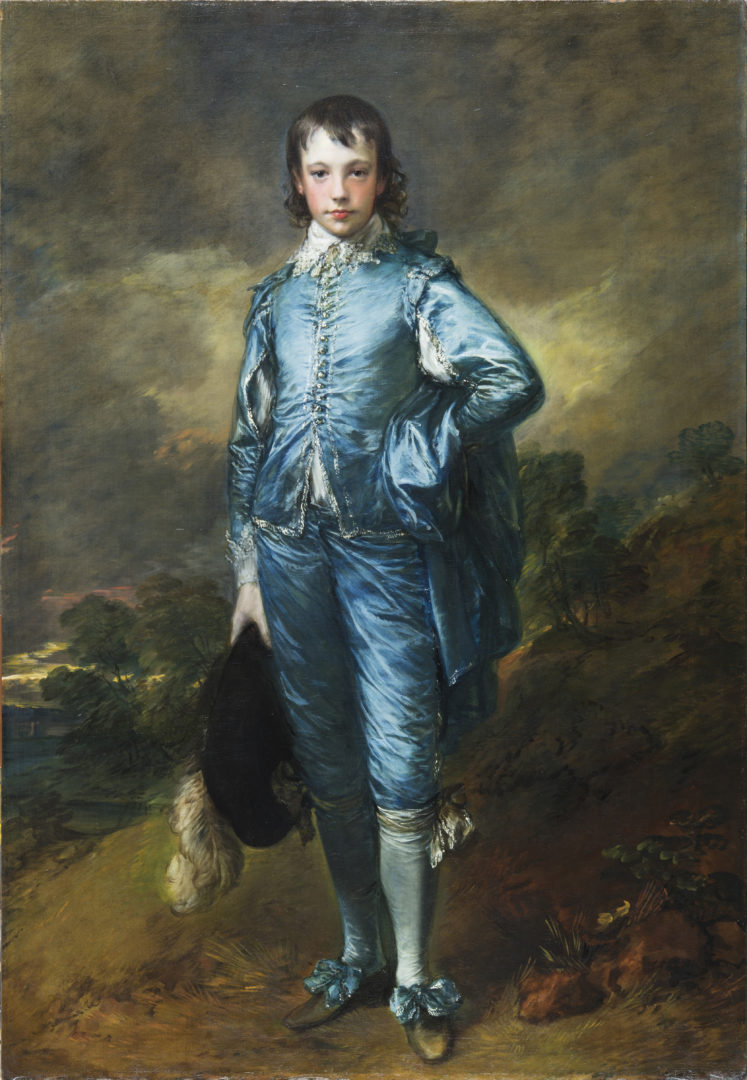
Last month we published an article about the announcement that The Huntington Library, Art Museum, and Botanical Gardens has decided to loan our beloved “Blue Boy” to the National Gallery in London. Gainsborough’s magnificent work, which left England for the United States on Jan. 25, 1922, will be part of an exhibit that is set to open exactly 100 years since that day.

In its announcement, Huntington President Karen R. Lawrence, remarked, “This masterpiece has made an indelible mark on both art history and popular culture, capturing the imaginations of a wide range of audiences. Given ‘The Blue Boy’s’ iconic status at The Huntington, this is an unprecedented loan, one which we considered very carefully. We hope that this partnership with the National Gallery will spark new conversations, appreciation, and research on both sides of the Atlantic.”  

We in the San Gabriel Valley are so fortunate to have world renowned museums and to have been exposed to stunning works by some of the greatest artists who ever lived. Most of us have never known a time when “The Blue Boy” wasn’t at The Huntington. So we asked our readers to tell us how they feel about it traveling to London and share with us their experience with this piece of art.

While we didn’t receive as many responses as we had hoped, we learned that our readers have informed opinions with information to impart. We also feel that what we did get are representative of people’s reactions and we’re printing them below:

“My informal response to your informal survey is that if the experts say it’s not safe for the painting to travel, then it shouldn’t. I’m also concerned that if the painting does go to London, what’s to keep their museum from saying that the painting is too fragile to send back?

“As you can see, I’m reluctant to let it go.”

Meg Gifford
Pasadena   

“Everybody likes to return home, even for a short visit … and I’m sure ‘Blue Boy’ is among them. So I wish him “calm seas and prosperous voyage.”

“The greatest gift master painters have given mankind is that it doesn’t take an advanced degree in art to appreciate their work.

“Even as a rustic with no refinement, I have stood at length in reverence before Gainsborough’s masterpiece. And in so doing, I convinced myself that if I touched that canvas, I wouldn’t feel a flat surface, but instead Blue Boy’s silken garment and his flesh underneath it.”

David Quintero
Monrovia

‘The Blue Boy’ post conservation | Photo by Christina Milton O’Connell / The Huntington Library, Art Museum, and Botanical Gardens.

“I believe it is a wonderful opportunity to return it to the land from whence it came so that a ‘new generation’ can admire its beauty. The concerns cited can be mitigated if those involved will check history regarding other great works of art that traveled outside their respective country. 

“The Mona Lisa was painted in 1503, 276 years BEFORE Blue Boy. Thanks to the efforts of former First Lady Jacqueline Kennedy, France’s national treasure, a very fragile piece of art, was shipped to America. On January 8, 1963, Leonardo da Vinci’s Mona Lisa made its first appearance when it was put on display at the National Gallery of Art in Washington, D. C. It was transported by the S.S. France ocean liner in a temperature-controlled box in its own stateroom, accompanied by armed guards. The temperature, which was alarm-monitored, would not be allowed to fluctuate by more than one degree throughout the entire journey. Eleven years later, in 1974, the Mona Lisa once again left France to travel to Russia and Japan. It can be done without endangering the masterpiece.

“Françoise Nyssen, France’s former Minister of Culture, once said that she didn’t believe works of tremendous cultural significance should be confined to a single institution. I thoroughly agree.  Whenever possible, great works of art should be shared with the world.

“Thank you.”

Charlotte Farmer
Arcadia

“My first memories of seeing the ‘Blue Boy’ was in the 1970s when my parents took me to The Huntington as a young kid. It was my mom who introduced me to it, saying it’s a great piece of art. But my appreciation of it at the time was due to the fact that the painting was of a child, like me. I remember it also being next to “Pinkie,” and I don’t know if they were meant to be deliberately displayed next to each other. While these were paintings from a long time ago, I felt a connection and kinship with them.

“That impression stayed with me to this day so when we have visitors, I take them to The Huntington and show them the ‘Blue Boy.’ When my cousins from Japan came in 2018 for my dad’s 88th birthday celebration, I took them to the mansion along with a niece and nephew who aren’t from this area. I told them about The Huntington’s conservation project and what the x-rays showed beneath the painting. I was able to share a part of my local culture to two generations. There was a language barrier between my Japanese cousins and my American relatives and they had to use Google translate to communicate, but it was a fun family experience tied to the ‘Blue Boy.’              

“It’s a nice gesture to share the artwork and I hope it’s safe for it to travel that far. However, its absence will sadden many of us who have grown up knowing it’s always been there. I imagine ‘Pinkie’ will also be sad not to have him by her side. What’s going in that space while ‘Blue Boy’ is away?

“I’m a member of The Huntington and I take strolls at the gardens. And every time I go to the mansion, I make it a point to see the ‘Blue Boy.’ It’s a magnificent piece of art and embodies what I think The Huntington is about. There are so many rotating exhibits – even at the promenade area – but seeing the ‘Blue Boy’ always makes me happy. It evokes emotions and memories of my childhood. I’ll be looking forward to its safe return.”   

Stephanie Yamasaki
Altadena 

The board of The Huntington will be glad to know that their decision has more proponents than opponents and art experts can be assured that “The Blue Boy” can safely travel, as one reader asserted. And we can be gratified in the thought that art enthusiasts across the Atlantic will have the rare chance to see and experience the treasure we hold precious.

SGV Schools Reopen After More Than a Year of Remote Learning

Originally published on 10 August 2021 on Hey SoCal

Photo by Muneer Ahmed OK on Unsplash

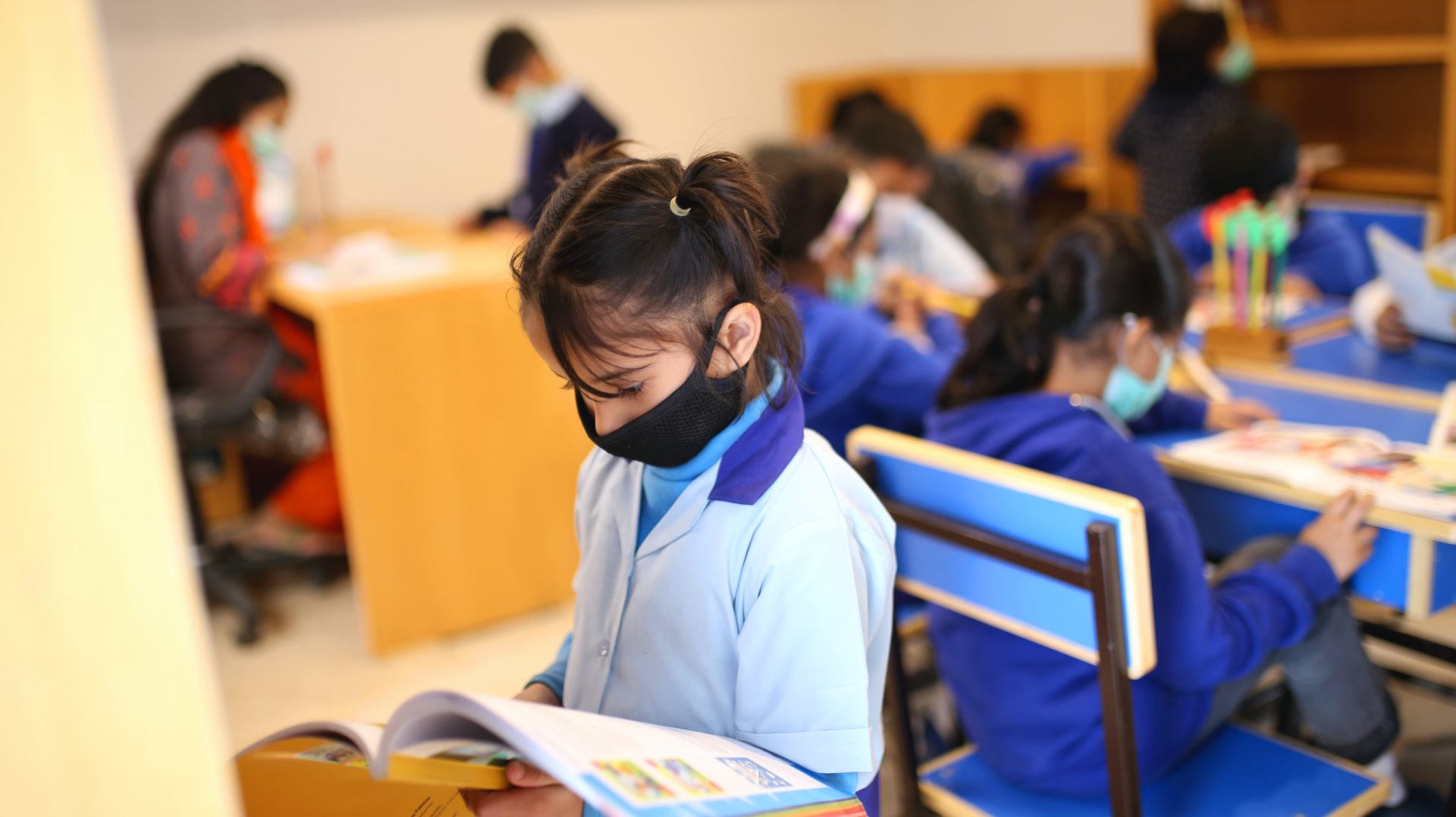
Schools are gearing up for reopening full time after more than a year of remote and hybrid learning. Such happy news should be a source of relief for parents who believe that virtual classes don’t adequately provide the environment and tools conducive to learning. However, the seemingly uncontrollable coronavirus infection rates from the Delta variant are causing trepidation, even fear, among these same parents.

Some people have gone so far as saying that it’s irresponsible for schools to reopen and have students come on campus under these circumstances. While the cost of learning loss should not be taken lightly, the threat to students’ and teachers’ safety and health should not be discounted in any way either. It is essential that we bring students back in the classrooms; it is necessary to keep students and teachers safe. Both are moral imperatives – one need doesn’t outweigh the other.

To find out how school districts and administrators are handling this sensitive issue, we reached out to the Arcadia, Monrovia, and Pasadena school districts and heads of independent schools to share their plans with us and our readers.   

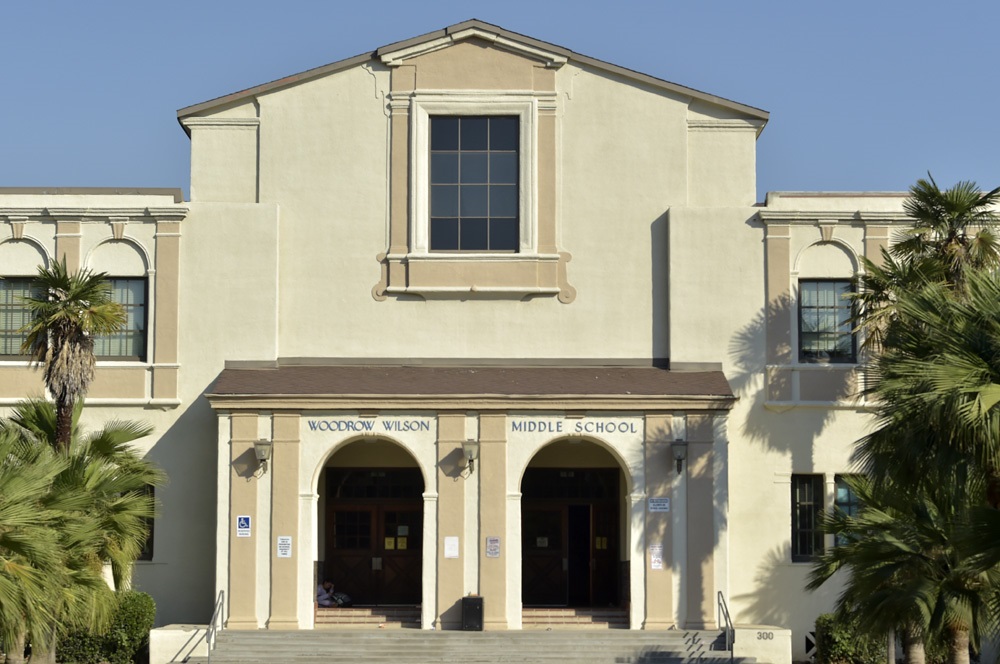
Wilson Middle School | Photo by Terry Miller / Hey SoCal

The Pasadena Unified School District serves approximately 17,000 students from kindergarten through 12th grade who live in Pasadena, Altadena, and Sierra Madre. Operating four high schools, five middle schools, three K-eighth, and 15 K-fifth elementary schools, it is the largest in the western San Gabriel Valley. Through Hilda Ramirez-Horvath, PUSD communications manager, Superintendent Brian McDonald discloses:

“School begins in PUSD on Thursday, Aug. 12. Classes will be full-time and in-person, five days a week. Learning will take place on campus an independent study will be available as an option for parents who are hesitant about sending their children back on campus. According to the California Department of Public Health (CDPH), in-person instruction can occur safely when prevention strategies are implemented. Since the pandemic began, PUSD has implemented multiple layers of robust set of safety measures. We will comply with the State’s public health requirements for schools and continue to work closely with the Pasadena Public Health Department (PPHD).

“We’re following the guidance of Pasadena Public Health and the California Public Health Department. We’re urging everyone who is eligible to get the vaccine, we have a robust COVID testing program, and masks are required for everyone. Ventilation is also in place with commercial-grade air purifiers in classrooms and common areas.

“As to whether PUSD will be requiring students to show proof that they’re fully inoculated, mandatory vaccinations for children are set by the state public health department. We will comply with state guidance.”

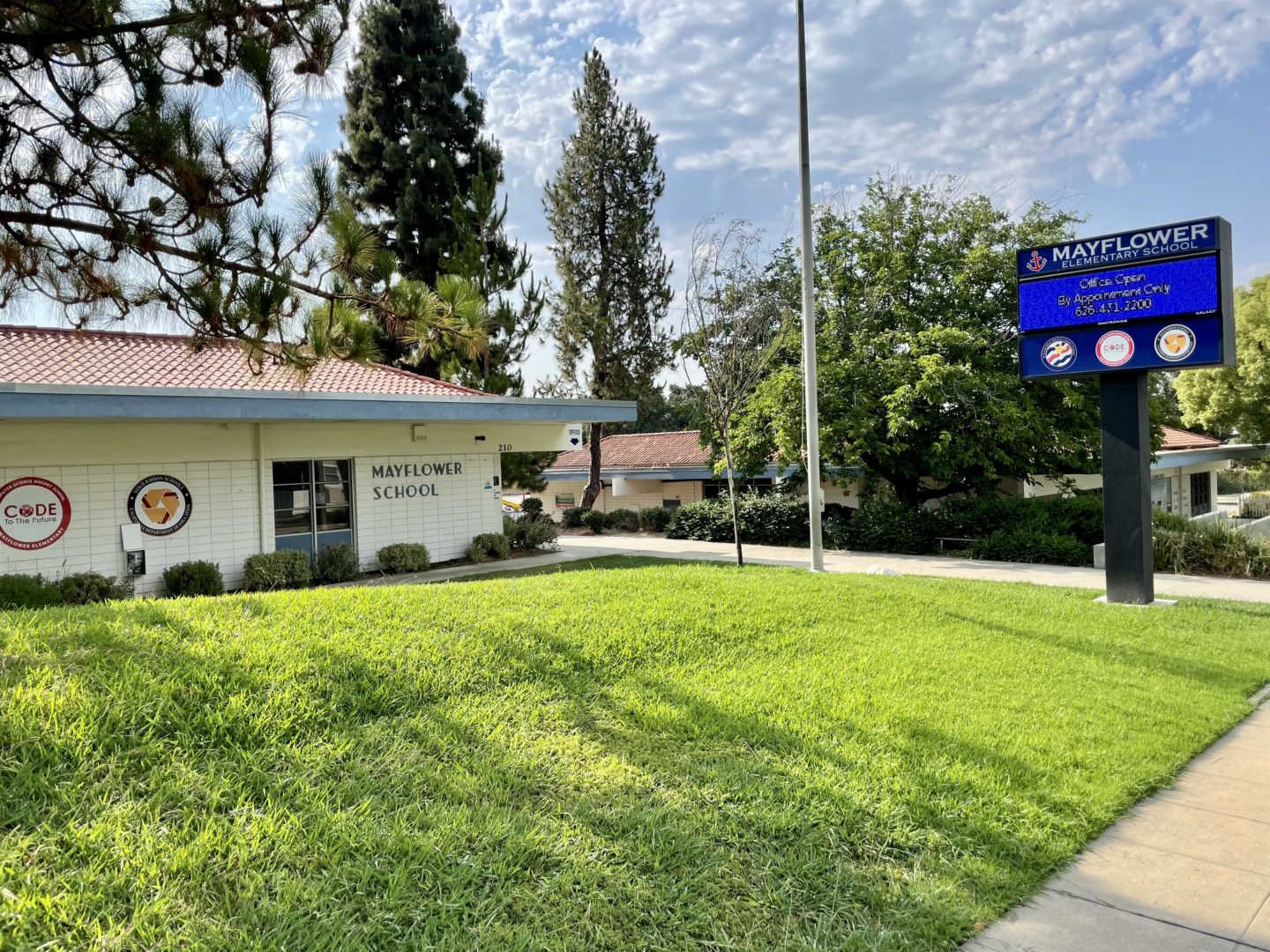
Mayflower Elementary School | Photo courtesy of Monrovia Unified School District

The Monrovia Unified School District encompasses five elementary schools, two middle schools, and one comprehensive high school. Superintendent Ryan Smith says:

“Our school year will begin on Wednesday, Aug. 18. We are very excited to welcome students back to campuses for traditional in-person instruction. We do have an independent study program at Mountain Park School that is a viable alternative for any family that prefers that their student continue to learn online on either a short or long-term basis.

“As always, we will be adhering to all requirements for schools that are laid out in both state and county public health guidelines. This includes the wearing of masks indoors for all students and staff; outdoors, masks are optional. Distancing is no longer a requirement in these guidelines; however, when feasible, we will do what we can to space students as needed or appropriate. We will not be requiring students to show proof of vaccination as that is not a requirement in health guidelines; students younger than 12 cannot be vaccinated anyway at this time. We have protocols in place to routinely clean our classroom, ensure proper ventilation, and access to PPE, again, all in accordance with public health requirements.

“We continue to emphasize that students who are ill or exhibiting symptoms stay home, handwashing, wearing masks, and that people get vaccinated if they are able.

“We are very excited about the start of the school year! Among our immediate priorities as we return are the following: identifying gaps in learning for each individual student and acting to address them; ensuring access to resources and support to address the social-emotional learning needs of all students; and utilizing technology to continue to personalize and accelerate student achievement.”

The Arcadia Unified School District is made up of 11 schools and serves about 9,500 students. It’s consistently named as one of the top school districts in the country by various ranking organizations; Arcadia High School is a U.S. News & World Report Gold Medal School.

We didn’t get a response from the school district’s information office but we learned that Arcadia High School will be opening on Aug. 11. Last Friday, Aug. 6, we observed the campus abuzz with activity – students were registering for classes, the band was practicing at the Performing Arts Center, and sports teams were meeting at the stadium. We saw safety protocols posted everywhere, the masking mandate strictly enforced, and bottles of hand sanitizers perched on tables at the reception lobby and at entrances. There was a definite air of eager anticipation for the school year to begin.

Most independent schools will start their 2021-2022 school year on the last week of August and, understandably, don’t have their plans etched in stone at this time. Among the handful of heads of school we requested information from, two agreed to tell us their procedures while emphasizing that they are in flux.                                            

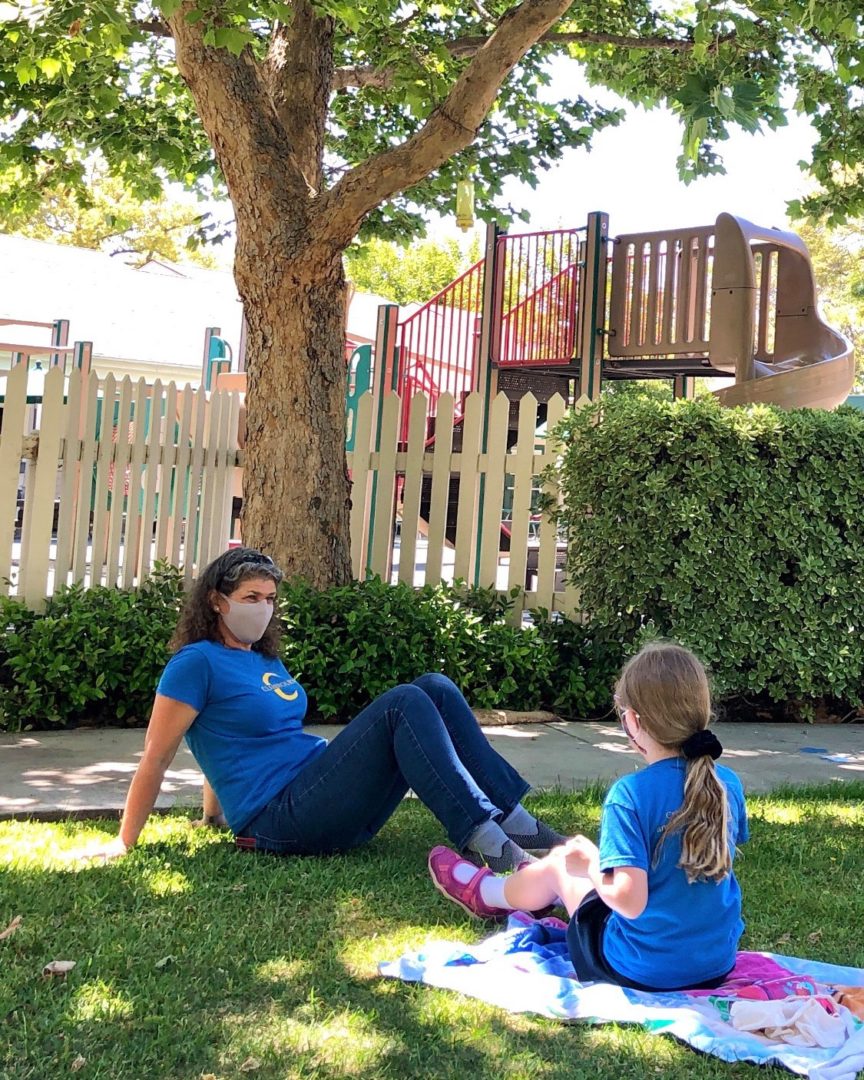
Head of school Amy Patzlaff relaxes with a student | Photo courtesy of Clairbourn School

Clairbourn School in San Gabriel, which has served the Pasadena area continuously since 1926, is a day school with a small enrollment of 200 students from pre-K to eight grade. Head of school Amy Patzlaff, states:

“Our opening day is Aug. 26, and we currently plan to offer only in-person instruction, but there may be situations that we will handle on a case-by-case basis. That said, we are prepared to go fully remote in any class or grade should that become necessary due to health department orders, exposures, or any other reason. 

“Besides cleaning procedures in place, we have hand sanitizers at every building entrance, desks are spaced out in classrooms to a minimum of three feet and more where possible, ventilation has been increased, and we are mandating universal masking on campus. We have visual cues to help with spacing – dots on benches and paw prints on the sidewalks. We do daily health screening for symptoms prior to arrival on campus. We will be doing regular COVID testing as long as it is recommended, including upon return to campus after holidays. In addition, we follow all of the protocols recommended by the health departments of isolating any symptomatic students or adults, sending them home, and requiring testing before return to campus. We will collect vaccination information and store it, according to privacy laws, along with all other health records.

“The spring was a good test of protocols while fewer students were on campus. We found the students compliant and the teachers vigilant. With the layers of protection in place, we are confident that we have mitigated the risk enough to have a successful year. A group of school nurses in our area have been working closely together to share strategies and procedures. This brain trust has helped each school to build on the collective work to launch successfully. I am grateful for the partnerships. In addition we have been working very closely, since March, with Pasadena Public Health, Los Angeles Public Health, cohorts of local schools, and Joffe Emergency Services. All of these agencies and groups have been generous with their time and knowledge. They all have provided expert advice that we can use immediately.” 

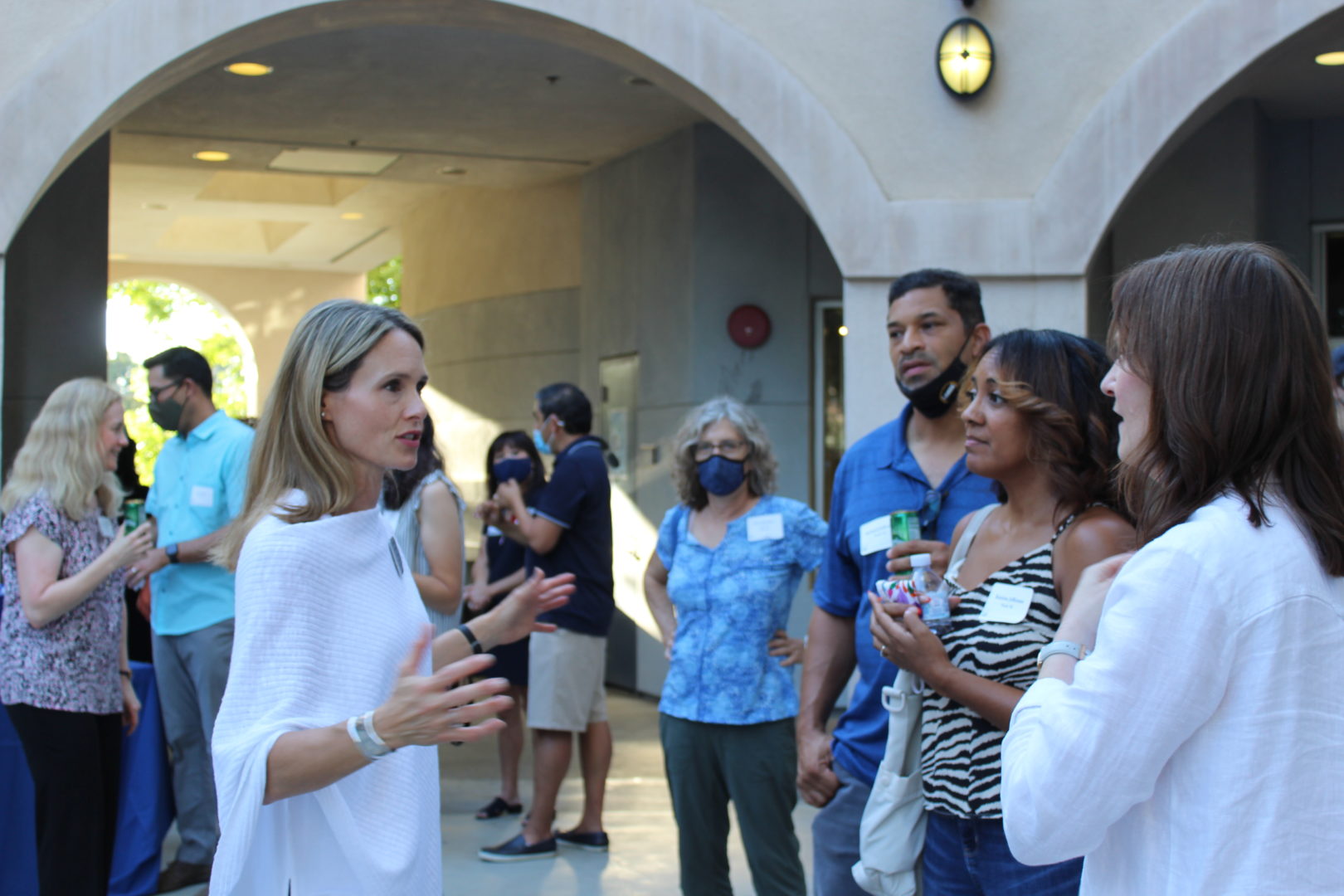
Vanessa Walker-Oaks (in white blouse on the left) chats with parents during a “Meet and Greet” event | Photo courtesy of Flintridge Preparatory School

A nationally recognized coed learning institution, Flintridge Preparatory School in La Cañada Flintridge, educates students from seventh to 12th grade. Through their director of communications, Nicole Haims Trevor, head of School Vanessa Walker-Oakes, shares their opening plans.           

“Our school year will begin on Aug. 26 for in-person classes only. We will follow all guidance from the State of California and Los Angeles County, including (but not limited to) masking indoors and outside as appropriate, enhanced cleaning protocols, improved ventilation, frequent handwashing, and daily symptom assessments. We are prepared to be responsive as conditions and guidance change.

“We expect all eligible community members to be vaccinated and to voluntarily share their students’ vaccination status. However, we anticipate our policy to change when the FDA fully approves the vaccination, removing the emergency use authorization.

“While we are mindful of the Delta variant, we here at Flintridge Prep are enthusiastic and excited to reopen this fall, and we look forward to revitalizing our relationships and reconnecting with our families on campus. Flintridge Prep values our community’s health, safety, and wellness, and we will use a variety of tactics to reduce risk for our students, their families, and our faculty and staff.”

Friends In Deed Named Nonprofit of the Year for Work Helping Homeless

Originally published on 29 June 2021

The plight of the homeless is heartbreaking enough during normal times; their circumstances become devastatingly dire when there’s a pandemic. Not only do the homeless have to worry about where to get food and spend the nights, they have the added anxiety of how to keep safe from a virus they cannot see yet has infected over 34 million and killed more than 603,000 people in the United States.Organizations with a mission to help the homeless face the same challenge as they try to find volunteers willing to brave the risk of infection and keep the financial resources coming in. So it is only fitting that they get recognized for weathering the crisis. Friends in Deed, an interfaith social services agency founded in Pasadena in 1894 to provide supportive services to meet basic human needs for homeless and at-risk community members, has been named 2021 California Nonprofit of the Year for Senate District 25 by Senator Anthony Portantino.

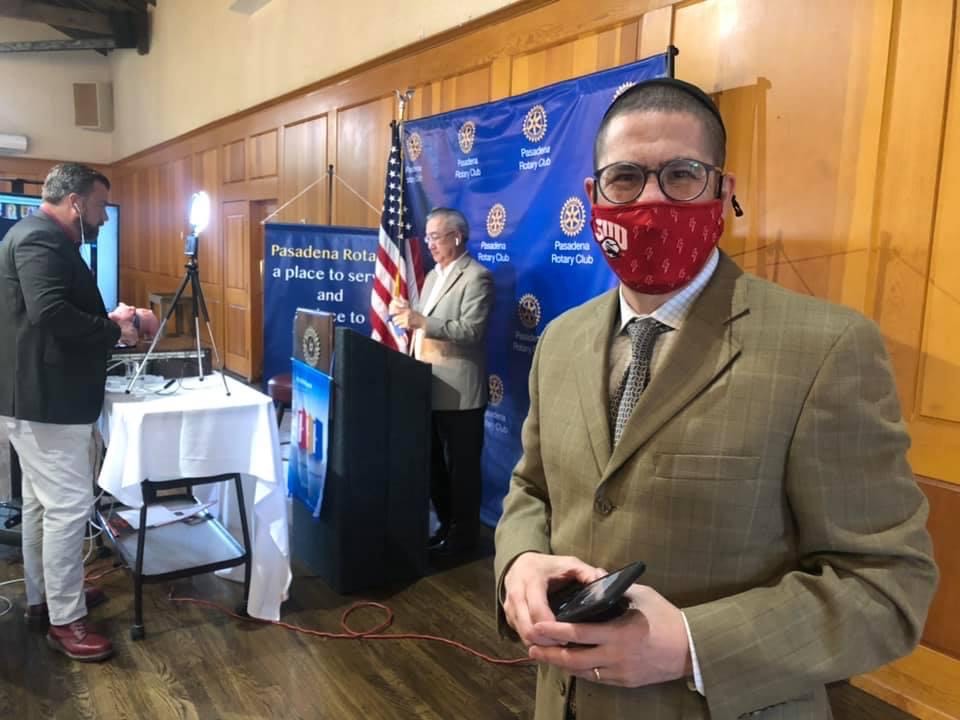
Rabbi Joshua Levine Grater (on foreground) at a Rotary Club meeting | Photo courtesy of Friends In Deed

According to a statement released by the organization to announce the award, Friends In Deed (FID) is one of more than 100 nonprofits throughout California that will be honored by their state senators and assembly members for their tremendous contributions to the communities they serve, particularly in response to the COVID-19 pandemic. Senator Portantino’s 25th District encompasses portions of the San Fernando and San Gabriel valleys.

Friends In Deed has five core programs, including a Food Pantry providing 2,500 households over 635,000 pounds of food yearly; The Women’s Room, a day shelter for homeless and at-risk women, offering free services like over 500 laundry loads and almost 600 showers for guests annually; a weather-activated Bad Weather Shelter providing a warm meal and refuge from the cold, wind, and rain in the winter months; a Street Outreach and Housing team working to end homelessness on the streets of Pasadena with about 20 people successfully housed each year; and an Eviction Prevention and Rental Assistance program offering emergency rent, case management, or rental assistance resources to approximately 280 households each year.

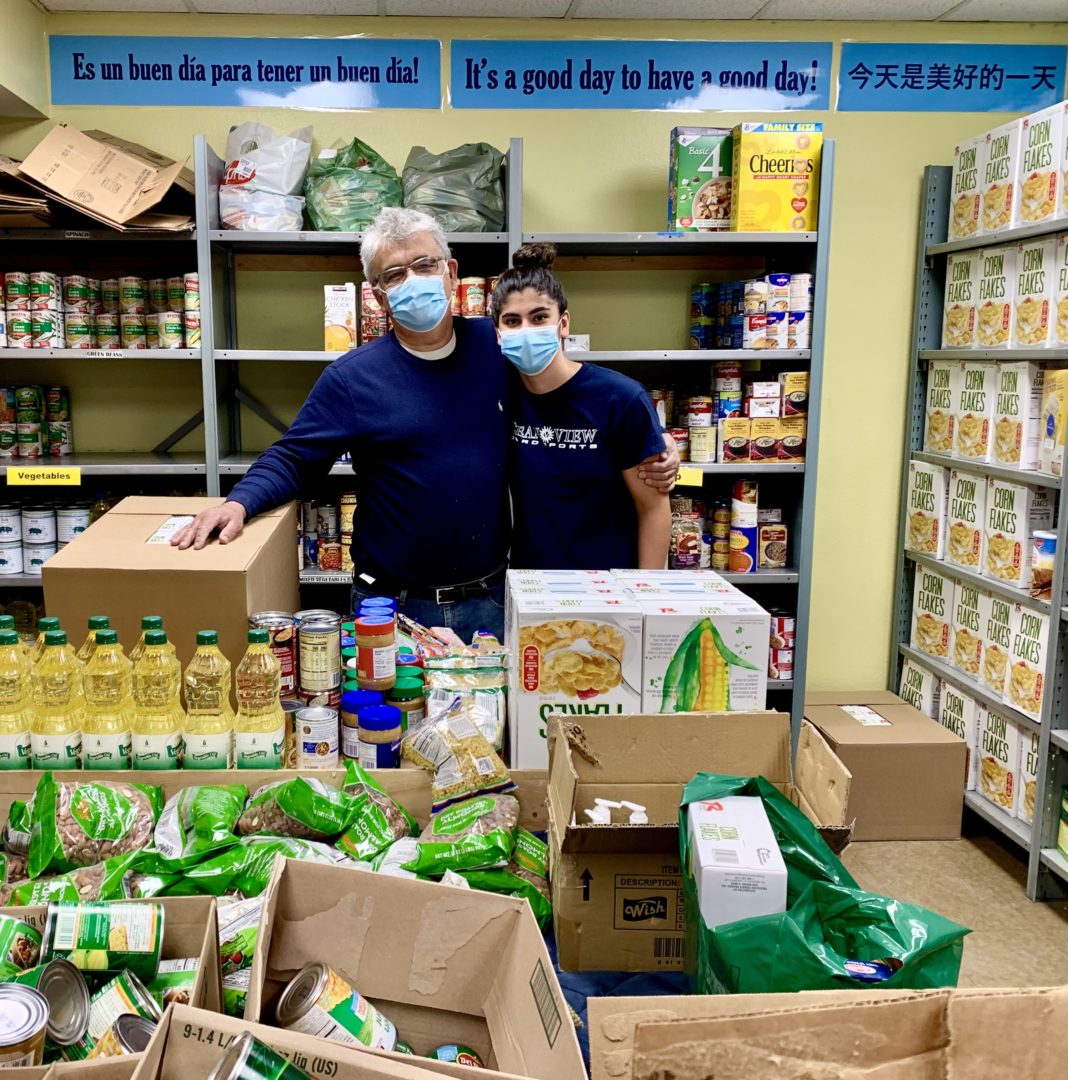
A local farmer-and-daughter team volunteers regularly in the Food Pantry to help sort and stack items | Photo courtesy of Friends In Deed

Rabbi Joshua Levine Grater, who has been Friends in Deed’s executive director since 2017, was tasked to lead the organization through these unprecedented times. Nothing in his training nor previous experience could possibly have prepared him for the daunting and heart-rending undertaking.

Asked by mail how he managed, Rabbi Grater replies, “A few things kept me going — our amazing staff and how dedicated they were to our clients and guests, never giving up and continuously working to adapt, innovate, and stay the course through the challenges; the folks that came to FID who needed our services, and were so happy that we were open and assured they weren’t alone to face such challenging and painful times; and the immense community support and outpouring of love and appreciation for our work. Each day that felt overwhelming or that the new challenge presenting itself was too much, the staff, guests, and community kept me going and gave me the strength to persevere and face each new day with a sense of hope.”

The pandemic notwithstanding, FID didn’t waver on its mission. Rabbi Grater says, “COVID had a huge impact on our programs, but through the hard work of our staff and dedicated volunteers, we are proud to say that our services operated continuously throughout. We adapted our food pantry to outdoors in our parking lot; we implemented social distancing and limits on guests in The Women’s Room; we converted our Bad Weather Shelter, which wasn’t feasible, to a cold weather clothing distribution twice a week; and we used funds, public and private, to put many clients into motel rooms, providing safety, security and a sense of home while we helped to locate bridge or permanent housing.” 

The Food Pantry moved its operations outside during the pandemic to allow for proper social distancing | Photo courtesy of Friends In Deed

There are ongoing necessities according to Rabbi Grater. “Our most important needs are unrestricted funds to support our Eviction Prevention and Rental Assistance program, which is handling all of the people who are at risk of losing their homes and facing thousands of dollars in back rent. We also have an ongoing need for more space, so if anyone has a piece of property or a building they want to donate to us, we would love that!”

To support their activities, FID obtains funds from various sources. Rabbi Grater says, “We are grateful to have individual donors, foundations and grants, community partners, congregations, government agencies, and some corporate sponsors to sustain us. Additionally, we’ve held fund-raising events. Our main fundraiser has been Jazz on the Green, a wonderful evening under the stars at Castle Green, where we gather for food, drink, silent auction, community, and, always celebrating honorees — an individual, a congregation, and a business partner. For the past few years, we’ve also had a very successful golf tournament.”       

Other nonprofits in the area also offer tremendous assistance. “We have a regular food pantry, we offer rental assistance, and we have a day refuge for at-risk women and those experiencing homelessness; these are programs unique to FID. However, Union Station Homeless Services (USHS) is a regular partner for us, and we share many of the same clients at different stages of their journey. USHS has a jobs program and we also connect folks to local job centers,” Rabbi Grater discloses.

FID’s support goes beyond shelter for the night. Rabbi Grater says, “Our Outreach Team and Housing Navigators keep in touch with clients to see how they are faring. In most of the programs that we pass people along to, be it bridge housing or permanent supportive housing, they have their own case management team so we know our clients are in good hands. We do usually continue to check in our folks for at least six months after we have housed them to continue to offer support.”

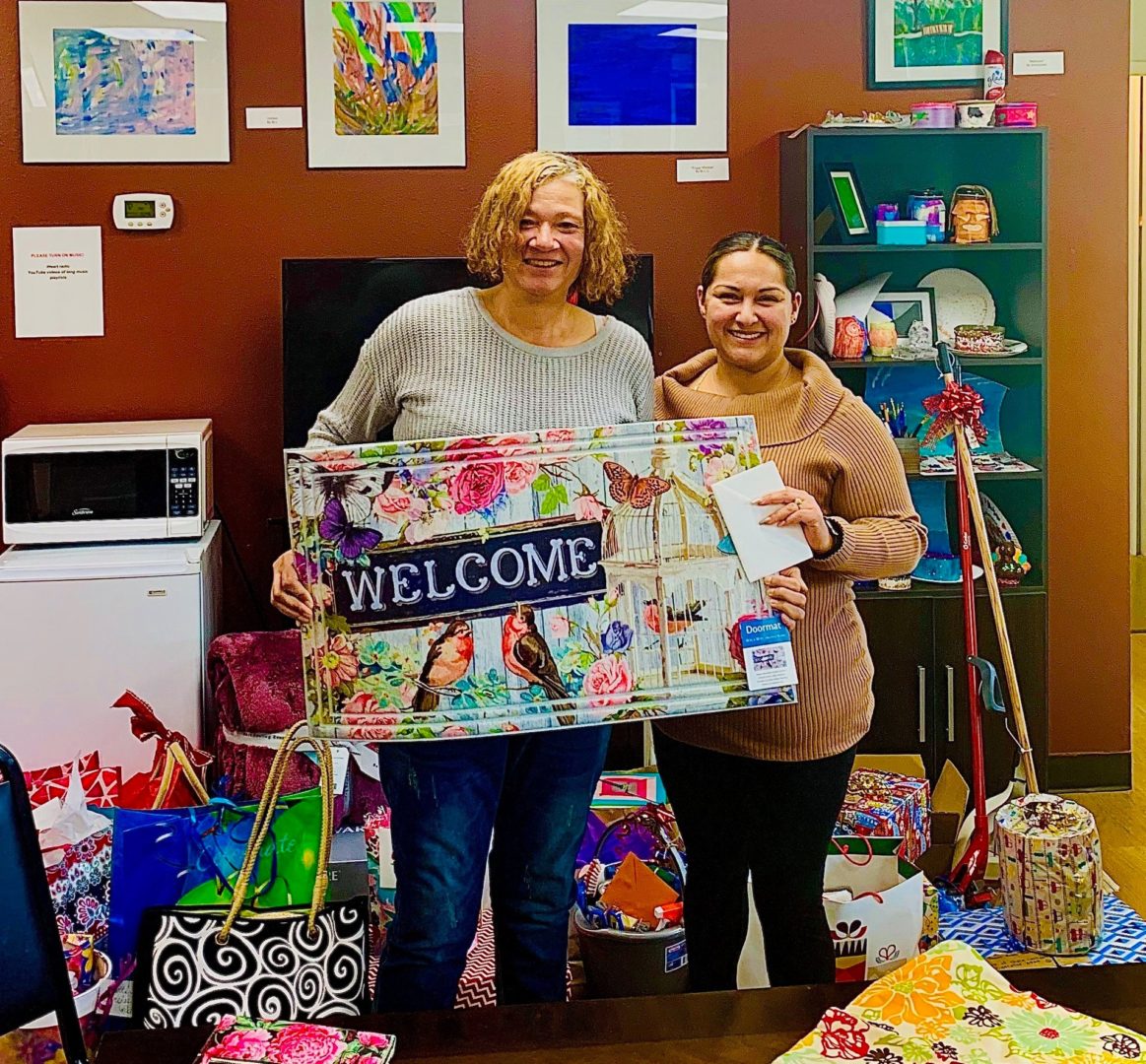
Marlene Martinez (pictured, right) coordinates celebrations for The Women’s Room guests, complete with a ‘Welcome’ doormat, whenever someone gets housed | Courtesy Photo / Friends In Deed

And Rabbi Grater has a couple of success stories to share:

“Linda is a Pasadena native who has been homeless for 17 years, sleeping under bridges or in shelters when she could find one that would take her in. Due to the physical and emotional damage caused by abuse from her family, she is on disability, but she always spent her disability checks on motel rooms for as many nights as she could, and relied on panhandling for food. She lost her previous housing when the building was bought by a new property management company, which evicted all the folks on disability. This is not an uncommon story.

“During the day, Linda spent her time mostly in parks — reading, writing, and doing art. She has worked with several different organizations to try and get housed, but nothing has ever quite worked out for her. Finally, a friend gave her Friends In Deed’s phone number. We were able to get her into an emergency motel program, and then worked with her to get into permanent housing.”

Continues Rabbi Grater, “At the time of writing, our Outreach Specialist and Housing Navigator Najwa Payton Jones is at the permanent housing facility, working with the staff and Linda to get all the paperwork done so that she can get the keys! She will be moving in next Thursday.

“Linda says the thing she is looking forward to most about having her own home is to no longer worry constantly about being attacked. She also hopes to go back to school and finally earn her high school diploma, and we wish her the very best of luck!”

Another story involves a man. Rabbi Grater relates, “Porfirio who worked for 20 years in the same job, and then lost it because of the pandemic. His wife of 30 years told him to get out if he wasn’t bringing home any money. Already suffering from mental illness, he walked away and slept in a Pasadena park for three weeks.

“When he was found, Porfirio was severely ill with malnutrition,” adds Rabbi Grater. “It took multiple coordinated efforts from Pasadena homeless agencies to get him the help he needed. As a start, he was housed in a single-room-occupancy facility which also provided him with social services support.

“However, Porfirio is very independently minded, and he wanted to stand on his own two feet. The FID Housing Location program was able to assist him with getting his own apartment in Pasadena, which has returned his sense of independence to him, and he is now actively looking to get back to work.”

Finally, Rabbi Grater notes. “We were founded in 1894 and have been operating continuously, in one form or another, since then — 127 years! While our revenue, staff, and programs have grown significantly in the last few years, it is the ongoing support and dedication of our hundreds of volunteers that allow us to provide the services with compassion, connection, and dignity to so many guests and clients. We truly live up to our motto: doing together what we cannot do alone!”
Pandemic Amplifies Inequity in Education

Originally published on 20 May 2021 on Hey SoCal

It’s graduation season for seniors – an event that is usually greeted with gleeful anticipation by students and their families. These students, who spent the majority of their last year in high school distance learning, are leaving after what would have arguably been one of the most memorable periods of their life. But it’s memorable in the worst possible sense because a great number of them feel it has been a lost year.                

The college application process, a rite-of-passage for teenagers all over the country, wrought a great deal of anxiety and disappointment this year. Already a nerve-wracking time for students and parents, the pandemic has not only intensified their apprehension but has also exposed a trend in college admissions. According to a New York Times education briefing, selective schools – including California’s UC system and Penn State – saw double-digit surges in applications due to standardized test scores being waived this admissions cycle. Harvard University had a record-setting 42% increase and the entire Ivy League had to extend its notification by a week to give admissions officers time to read and process applications. It marked the lowest college acceptance rates in a decade for these schools.    

On the other hand, many state schools and small private colleges suffered double-digit drops in applications and enrollments. Many institutions outside the top-tier have been struggling for years and the pandemic just made it worse. The N.Y. Times report further said American colleges and universities have endured losses of more than $120 billion and a few have shut down permanently. The institutions still operating often have to make up the difference by cutting services and programs that provide the tools, resources, and support which many low-income and first-generation students need to complete their degrees.

A survey released a few weeks ago by Intelligent.com, a resource for pre, current, and post college students to use when making choices for their education, provides additional evidence of pandemic’s negative effect. It found that one in four students who left college during the pandemic isn’t returning – at a time when getting into a university  was tougher than ever.

Intelligent.com’s key findings are as follows:

  • 21% of students from households that earn less than $25,000 annually left school during the pandemic.
  • 38% of students of color who left school during the pandemic did so because they could not afford tuition.
  • 19% of undergraduate students say they won’t graduate on time because of pandemic-related disruptions.
  • One-third of college students would attend classes exclusively online in exchange for a 10% tuition decrease.

Beata Williams, a college admissions expert and a consultant at Intelligent.com, pronounces, “For many students who have comfortable spaces to study in, privacy, and online connectivity capabilities, the shift to online classes did increase their productivity. However, for students who live in smaller spaces with shared rooms, less privacy, and may have caretaking responsibilities, the shift to online learning during the pandemic decreased their productivity.”

Beata Williams | Courtesy Photo

By email, Williams answers Beacon Media News’ questions: 

When was Intelligent.com established? What is its mission? Where is it headquartered? Who are the people behind the organization?

Intelligent.com was founded in 2017 by a group of digital marketers based in Seattle, Wash. The founding members can be found here: https://www.intelligent.com/about-us/ and the managing editor is Kristen Scatton. Our mission is to help students make smarter choices through our research and the information we publish.

Please describe your background, including number of years in education and capacity.

I have worked with students in an academic setting since my early twenties when I began my career in the Office of the Vice Chancellor for Student Affairs at the University of Illinois at Chicago. I authentically enjoy and have passion for coaching students to achieve their academic and professional goals. I also fell in love with the potential to make an impact within an academic environment. I completed my B.S. in marketing and my M.S. in public administration at UIC.

After completing my graduate studies, I moved to New York City and worked at Columbia University in the Executive MBA and Executive Education Program offices with executive level students as a finance and admissions officer. I later transitioned to New York University Leonard  B. Stern School of Business where I worked in student engagement,  executive education, MBA international programs, global programs and academic affairs. I thoroughly understand the admissions process and have extensive experience working with domestic and international  students. 

For the past nine years, I have been focused on coaching students through the undergraduate and graduate admissions process. A few schools my students have been offered admission to include: Carnegie Mellon, Columbia, Cornell, Hong Kong University of Science and Technology, London School of Economics, MIT, NYU, Oxford, UCLA,  UPENN, USC, and Yale. Ninety-nine percent of my students have been admitted to at least one of their top choices. The feedback I overwhelmingly receive is that not only have I helped students reach their dream programs, I alleviate the stress by breaking down the application process into manageable steps leading them towards consistent progress towards their goals. 

What was the purpose of the survey?

We designed the survey targeting enrolled college students with the purpose of determining how they felt about the current state of their education given that it is forcing them to learn in different settings and formats. We wanted to know how the quality of their education and their outcomes have changed during the pandemic and if that has changed their education plans for the future.

When was the survey done and who conducted it? How many students participated and how did you find them? Of the students you asked, how many declined to answer? What methodology was used?

The survey was administered by online survey platform Pollfish on April 6, 2021. We surveyed 1,250 American college students, including undergraduate, graduate, and doctoral students aged 18 and older about the impact of the pandemic on their education, and their preferences for school attendance once the pandemic is over. Of the 1,250 polled, none of them declined to answer. The data show 8/600 people were from the LA area (Los Angeles & Long Beach).

Does Intelligent.com offer services or products geared for college students?

Intelligent.com offers resources and guides for prospective college students and current college students to help students succeed in the classroom by bringing together the latest research with tips and techniques championed by today’s leading experts.

Please tell me anything else I need to know about you and Intelligent.com that I didn’t ask.

The internet is filled with information (some garbage). Yet where do we go when we need answers? As a group of digital marketers who have a deep understanding of the internet we wanted to do something about it. We deployed our team of experts and research to scour through all the nooks and crannies of the internet to find the buried treasure, analyzing mountains of data, in order to create content that helps students gain a competitive advantage in their pursuit of higher education and future endeavors. And to make this possible, we’re committed to finding a business model that best serves our users and doesn’t corrupt the integrity of our content. So you won’t find programmatic ad blocks on our site, nor will you find affiliate disclosures. Oh, and you definitely won’t see any ‘native ads’.

All is not lost, though. Williams assures, “While the pandemic has exacerbated the divide between advantaged and disadvantaged students, it has created an opportunity to re-envision and shift to a more equitable learning environment through hybrid learning opportunities at lower costs available to everyone. Community colleges serve a large percentage (approximately 50%) of students lacking in college prep skills and those from lower incomes; President Biden’s proposal to make community colleges tuition free, has the potential to significantly change the access to education for many students. And I still see a need for education in the future.”

The Huntington Appoints First Female Director of Botanical Gardens

Originally published on 5 April 2021 in the Pasadena Independent, Arcadia Weekly, and Monrovia Weekly

Nicole Cavender | Photo courtesy of Morton Arboretum

When The Huntington Library, Art Museum, and Botanical Gardens announced last week the appointment of Dr. Nicole Cavender as the Telleen/Jorgensen director of the botanical gardens, she became its first female director — a momentous event in the beloved institution’s remarkable history.

And it is only fitting that Cavender has been chosen to hold that distinction. She has a B.S. in environmental and plant biology from Ohio University and a Ph.D. from Ohio State University in horticulture and crop science. She will officially join the Huntington on May 17, 2021 after serving nine years as vice-president of science and conservation at Morton Arboretum, a 1,700-acre area of plants and trees which also boasts a hiking trail. Previous to that, she was chief programmatic officer at The Wilds, a 10,000-acre safari park and wildlife conservation center in southeastern Ohio which offers adventures like zip lining, horseback riding, and fishing.

The Huntington’s Rose Garden | Photo courtesy of The Huntington Library, Art Museum, and Botanical Gardens.

Her new post at The Huntington, which has a mere 207 acres of gardens, might seem a departure from what Cavender has done before. But at the core, she will be continuing to apply what she knows and carry out what she wishes to accomplish. As The Huntington’s announcement outlines, she “will oversee a staff of 85 and several hundred volunteers in caring for more than a dozen gardens, including the renowned Chinese Garden, Japanese Garden, Desert Garden, and Rose Garden (read about it here). In addition, she will be actively involved in developing and expanding botanical education, outreach, and research programs. Along with the gardens, the botanical division at The Huntington also includes a seed bank, tissue culture lab, and a cryopreservation lab focused on developing protocols for freezing plant tissue at extremely low temperatures and then bringing them back to life at a later date — an arm of research crucial to conservation and sustainability of rare species.”       

The Huntington has taken a lead role in recent years in the cutting-edge field of cryopreservation | Photo courtesy of The Huntington Library, Art Museum, and Botanical Gardens

Cavender states via email interview, “I’ve been fortunate to have the professional experience of working to advance science, conservation, and human connections at wonderful and unique places such as the Wilds and the Morton Arboretum. Looking forward, The Huntington has one of the largest, most diverse collections of plants in the world with over 15,000 different types of plant taxa — absolutely incredible! It offers the opportunity to work among amazing colleagues and with an incredibly vast and diverse collection, where I can bring to bear my love of plants, my devotion to the study of biodiversity, and my desire to continue improving the human connection to and appreciation of nature.”

“My focus will be on working with the amazing Huntington botanical gardens’ staff while collaborating with the library and museum team members,” adds Cavender. “The Huntington provides an exceptionally unique opportunity for synergy to maximize our collective impact and provide a remarkable visitor experience. I want to be able to help promote the important role gardens play in conserving the world’s plant diversity, promoting good stewardship of our planet, while also providing creative spaces for cultural expression and the human spirit connection.”

Cavender’s personal upbringing, academic background, and work experience inform her career path. “My interest in plants is rooted in my childhood as my father was a mycologist (fungi) and botany professor at Ohio University for over 30 years. He inspired my passion for conservation and plant biology at an early age which led to my earning a Ph.D. from The Ohio State University in horticulture and crop science. A common thread throughout my entire life is a love of plants and animals from my formal education throughout my professional career. I’m very motivated to build, encourage and bring together teams of people around common goals that promote the protection and restoration of nature while enlightening the human spirit.”

Liu Fang Yuan, the Garden of Flowing Fragrance, is one of the largest and finest classical-style Chinese gardens outside of China. It’s also the focal point for a variety of programs promoting cross-cultural exchange | Photo by Lisa Blackburn / The Huntington Library, Art Museum, and Botanical Gardens

That The Huntington has one of the largest authentic Chinese Gardens in the country, the realization of a long-held dream of James Folsom (read related article here), is fortuitous. Cavender explains, “Jim left a remarkable legacy. His attention to detail and authenticity when creating the Chinese Garden and the botanical gardens as a whole is amazing. In my role as VP of science & conservation at The Morton Arboretum, I was fortunate to take numerous trips to China for projects that focused on tree conservation and urban forest management. I plan to build upon Jim’s successes and am excited to continue to advance the plant, human and cultural connection within this garden and the many other excellent gardens at The Huntington.”

Cavender will be working within a predominantly Asian American community at a time when there’s national focus on correcting people’s misconceptions about Asian culture and eliminating anti-Asian sentiments. Her appointment as the first female botanical garden director comes at an opportune period as The Huntington tries to rectify its past practices of inequity and as it embraces inclusion, as Carolina A. Miranda wrote on April 1, in an L.A. Times exclusive.    

“My beliefs very much align with The Huntington’s principles on diversity, equity, and inclusion,” comments Cavender. “As a plant lover, I’m obviously thrilled by the diversity of species in the garden. But I’m even more excited by the diversity of the extended Huntington community and its historical role in the region. It’s been an honor to visit China numerous times over the years as I’ve developed a special appreciation of the culture which I treasure. I very much look forward to working with the local and national Asian community to build a better, more accurate understanding of Asian and Asian American history and culture.”

One of the many projects that Cavender will oversee is the addition in the Japanese Garden of a 350-year-old magistrate’s house from Marugame, Japan donated to The Huntington. When the fully dismantled house — currently being reconstructed with the help of a team of Japanese artisans — is completed, visitors can come in and learn about traditional Japanese residence and garden.           

The distinction of being first in a given post isn’t new for Cavender. She discloses, “Each of my last two posts at the Wilds and The Morton Arboretum were newly developed roles so I was the first person to hold those positions. I’m honored to be the first woman director of the Huntington botanical gardens. More women are taking leadership roles in botanical gardens in the U.S. and even throughout the world than ever before, and I’m excited to be one of them.”

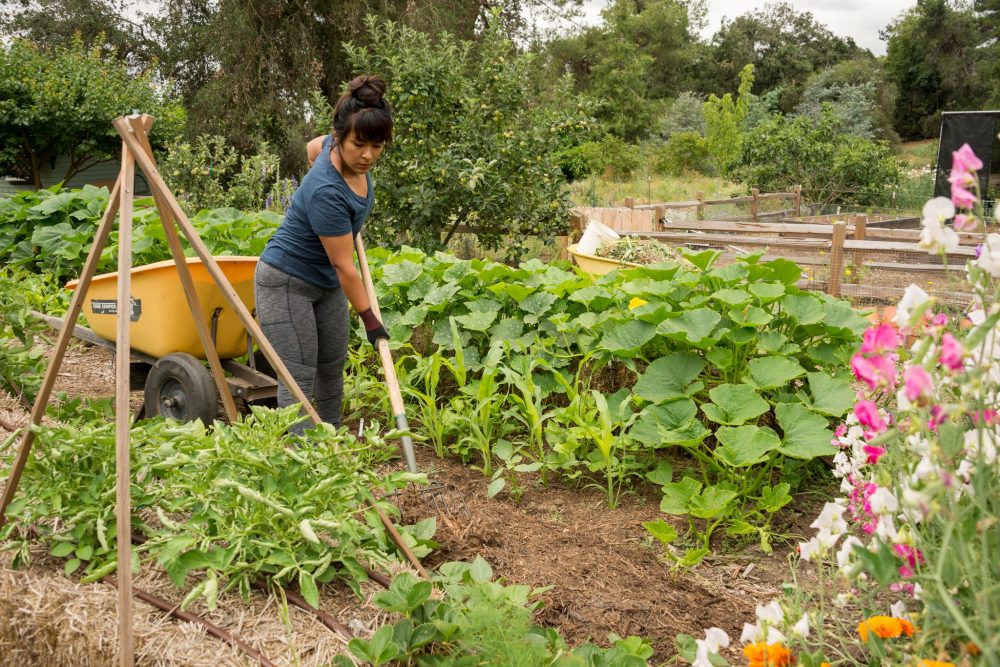
Best practices in sustainable agriculture for our regional climate are explored in The Huntington’s James P. Folsom Ranch Garden. Volunteer Emma Ho’o mulches rows of vegetable crops | Photo by Deborah Miller / The Huntington Library, Art Museum, and Botanical Gardens

Asked if there was something she discovered about The Huntington that was surprising, Cavender replies, “I was delighted to learn about the potager (kitchen garden) and experimental ranch garden created and now dedicated to Jim Folsom. These are opportunities to teach students and people about the very important connection between plants, horticulture, and food sustainability.

“It’s been an absolute joy learning about the Huntington. It’s such a unique, complex place with a rich, diverse history. The plant collection is AMAZING and truly exceptional, and is one of the most diverse in the world, while the library and museum collections are outstanding. The combination of everything in one place is incredible. I look forward to being continually surprised as I learn more over time.

“I’m eager to be working with the team in all three areas — the botanical gardens, library, and art museum. I want to understand our unique strengths and opportunities so we can build upon them synergistically and move the institution forward in the most relevant way possible.”

An earlier photo of the Cavender family | Photo courtesy of Dr. Cavender

This relocation to the West Coast will be a novel experience for the Cavenders as they move halfway across the country and settle in their new home. Cavender reveals about her family “I’ve been married to my husband Gary for 24 years. We have two children — Laurel (a sophomore at Marquette University) and Andrew (a seventh grader). While both are sad to leave their hometown friends, they’re excited about potential adventures in Southern California. We all appreciate that this position with The Huntington is truly a once-in-a-lifetime opportunity.”

In spite of the notorious L.A. traffic, Southern California has much to offer, and Cavender acquiesces, “The weather is certainly a draw as cold Chicago winters can be challenging. As an avid gardener, I can’t wait to have year-round growing opportunities. I will absolutely have my own garden and look forward to growing vegetables, California wildflowers, citrus plants, succulents, cacti, orchids, etc. that simply can’t survive harsh winters in the Midwest. It’ll be a very fun learning experience for a plant geek such as myself. I know I will need to learn more about water conservation, especially knowing that we have a vast collection of plants to care for and plants need water!”

It will come as no surprise for us to discover that the Cavenders like to spend their leisure time in the great outdoors. And since the San Gabriel Valley is about a two-hour drive from either the mountains or the beaches, they’ll find many places to go to.

States Cavender, “We’re a very outdoor-oriented family. The recreation opportunities available in Southern California are incredible. We’ll definitely be hiking in the mountains during the hot weather months and along the beaches during the ‘cold’ months. But there are no ‘cold’ months in L.A. to someone from Chicago!”

We can imagine the Cavenders sitting at the viewing stands along Colorado Boulevard on a brisk New Year’s Day morning watching Pasadena’s famous annual Rose Parade (read related article about The Huntington’s centennial celebration float entry) without winter jackets.

A Special Rose Parade for these Extraordinary Times

Originally published on 29 December 2020 in the Pasadena Independent, Arcadia Weekly, and Monrovia Weekly

The 2020 Rose Parade | Courtesy photo / Tournament of Roses

To say that these are extraordinary times might be an understatement to describe a year beset by an astounding 81 million infections and over 1.7 million deaths from COVID-19 worldwide. In the face of those sobering statistics, a New Year’s Day without a Rose Parade or Rose Bowl Game in Pasadena seems trifling.

However, the Tournament of Roses Association (TofR) is determined to use that day — when we’re usually glued to our television sets marveling at the magnificent floats, watching the spectacular equestrians, and delighting in the marching bands as they travel five miles on Colorado Boulevard — to showcase and honor our New Year’s Day traditions.

This New Year’s Day presentation isn’t all about entertainment though. TofR President Dr. Robert Miller states, “We’re producing ‘Rose Parade New Year’s Celebration Presented by Honda,’ in partnership with Feeding America®, the nation’s largest organization dedicated to fighting domestic hunger through a nationwide network of food banks. Food insecurity has been a focus of our organization’s efforts during the pandemic, so it was only fitting for us to extend that commitment to our TV special. We’re very happy to have this opportunity to work with Feeding America, an organization that’s working to change lives in communities across the country.”  

“When we were envisioning what this was, we asked ‘What do we want this show to feature?'” Miller continues. “Words like ‘new beginnings,’ ‘current issues,’ ‘moving forward,’ ‘honoring first responders,’ ‘optimism,’ ‘football,’ ‘ celebration,’ came to mind. It’s a fully-produced, two-hours of engaging, interactive broadcast about everything Rose Parade — our history; volunteers; parade participants, including bands, equestrians; and all the beautiful flowers. We’ll have celebrity performers in the fields of music, film, and television, as well as culinary and sports personalities.”  

According to a press statement released by TofR, “The re-imagined New Year’s Day celebration will feature stellar musical entertainment and exciting celebrity guest appearances that will  appeal to fans of country music, television, Broadway, and sports. There’s something for everyone in the family to enjoy. Musical performers include: Sheryl Crow, nine-time GRAMMY® Award winner with more than 50 million albums sold; Mickey Guyton, country singer-songwriter and historic GRAMMY® award nominee; Tori Kelly, multi-GRAMMY® Award winner, singer-songwriter; Lady A, multi-platinum, seven-time GRAMMY® Award-winning country trio Rascal Flatts — the most awarded country group of the last decade; The War and Treaty, eclectic, soulful, husband-and-wife duo – one of Nashville’s breakout acts.

Actor and philanthropist Gary Sinise was the 2018 Rose Parade grand marshal | Photo by Terry Miller / Beacon Media News

“There will be celebrity guest appearances by: Daddy Yankee – multi award-winning singer; songwriter, actor and producer Shanola Hampton – star of ‘Shameless’ on Showtime; Laurie Hernandez – Olympic gold and silver medalist, 2016 U.S. Olympic Women’s Gymnastics Team; Emeril Lagasse – chef, restaurateur, TV personality; and author Matt Leinart – 2019 Rose Bowl Hall of Fame inductee, former NFL player and Heisman Trophy winner; Rita Moreno – Emmy®, GRAMMY®, Oscar® and Tony® (EGOT) award winner; Dascha Polanco – star of Netflix hit, ‘Orange is the New Black’; Vin Scully – voice of the Los Angeles Dodgers for more than 65 years; Gary Sinise – actor, philanthropist and 2018 Rose Parade grand marshal. Past Rose Parade grand marshals, Emeril Lagasse and Gary Sinise, will both be featured in the  special. Gary will open the show and Emeril will shake us up with his favorite New Year’s Day cocktail.” 

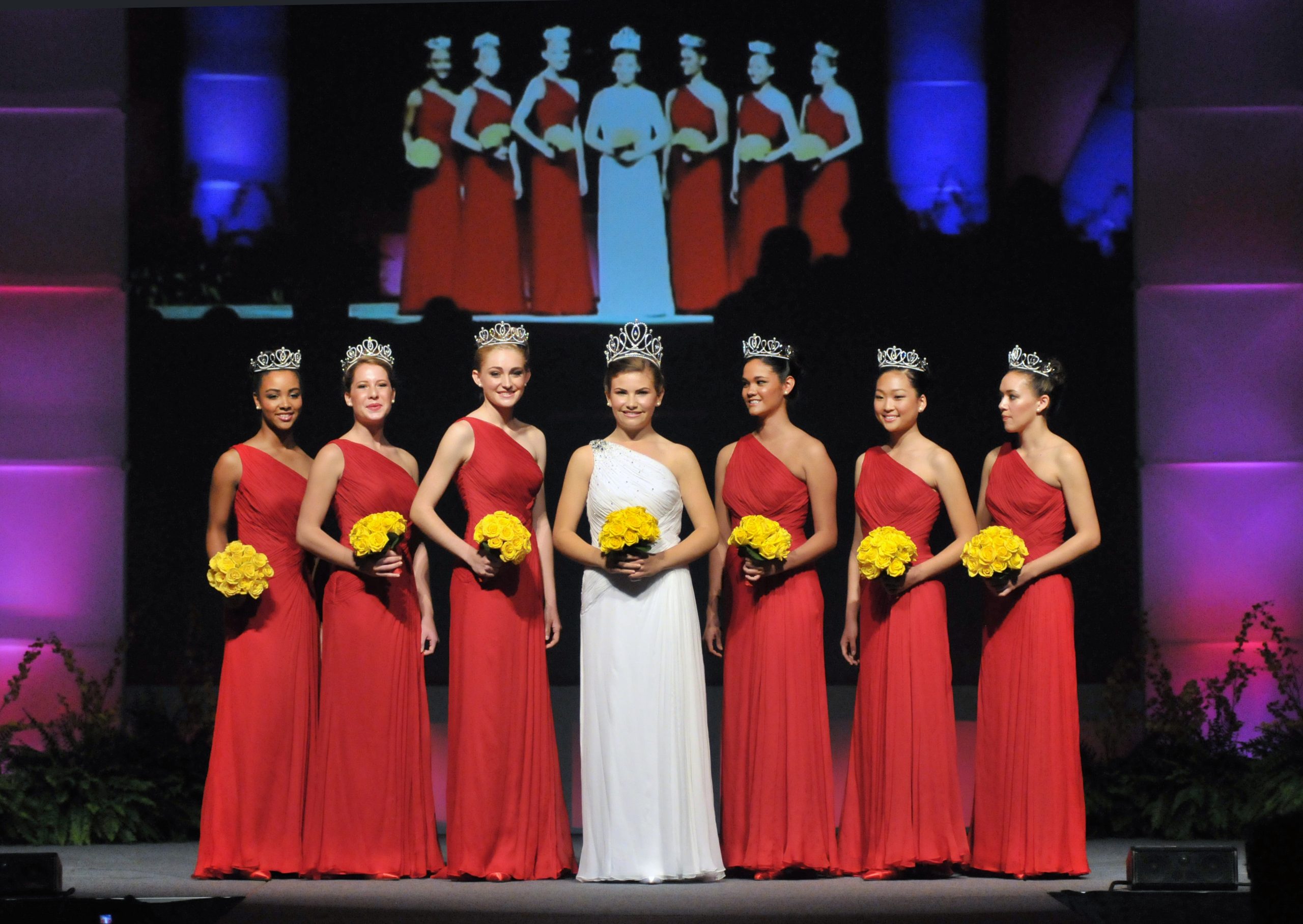
The 2009 Rose Court | Photo by Terry Miller / Beacon Media News

Adds Miller, “The two-hour special will speak to our Royal Court and their traditions; we’ll share some of our unique moments and lots of heartwarming stories about the TofR members and their activities. We’ll show spectacular floats from previous years, a behind-the-scenes look into building a parade float, and New Year’s wishes from fans around the globe. And, of course, it will talk about football — we’ll have Rose Bowl Game® football highlights. The show will air on ABC, Hallmark Channel, KTLA, NBC and RFD-TV at 8 a.m. PST and on Univision at 7 a.m. PST on Jan. 1. We limited travel and ensured the safety of our talent by having the performance segments filmed at iconic locations around the country — including the Grand Ole Opry and the Rose Bowl Stadium — using the strictest COVID-19 safety protocols.”

The TV special will also include a virtual performance of “Everything’s Coming Up Roses” by seniors in high school from bands across the country to be led by a surprise conductor. Explains Miller, “While we have invited all the bands who were scheduled to perform in this year’s parade to instead join us for the 2022 Rose Parade, we realize that there are many seniors who will graduate before that. We didn’t want them to miss out on this opportunity, so we’re giving them their very own, unique performance spotlight.

Courtesy photo | Tournament of Roses

“We’re very excited about this retrospect and a look at America’s New Year celebration — the Rose Parade. All the networks are happy to broadcast the program and we’re grateful to them for airing it. It is our gift to the country and to the world. We want to convey the message that the view of our parade may look very different this year but our mission never changes — to provide the world the best floral parade, to create an enjoyable entertainment event, and to make those accessible to everyone.”

In previous years, the floats were available for public viewing directly after the parade and the following day at Victory Park. When TofR announced in July that they would not be able to host a parade on New Year’s Day, the board sat down to figure out if they could have some floral art displays instead.

Fiesta Parade Floats rendering of Donate Life’s floral sculpture | Courtesy photo / Tournament of Roses

Miller expounds, “We thought about having drive-by floral installations sponsored by companies. But in order for it to be economically feasible, we needed anywhere from 15 to 20 participants. We were able to get seven or eight committed, but we realized that wouldn’t be enough to make it work so we informed them of our decision to scrap the plan. (As a side note, the idea sounds great, so we might do it another year as a spring or summer event.) However, Donate Life, an organization which has been a Rose Parade participant for several years, came back to us because they liked the concept and thought it would be a way for them to continue promoting the importance of organ, eye, and tissue donation — the need for donors doesn’t stop during the pandemic.”

A press release issued by TofR states, “The Donate Life Rose Parade® float has inspired people across the country and around the world to save and heal lives through the powerful message of organ, eye, and tissue donation since its first participation in 2004. On its 18th year, and as a tribute to17 years on the Rose Parade®, the Donate Life community commissioned a beautiful and symbolic floral sculpture that will be featured in the Tournament of Roses’ TV special and then installed at the Tournament House at the end of December.”

Donate Life’s floral sculpture was created by Fiesta Parade Floats (FPF) at its 70,000-square-foot facility in Irwindale. Established in 1988, it is the longest-tenured Rose Parade float builder and has boasting rights to having the most awards in the float building industry. Its float for The UPS Store’s entry “Stories Change the World” won the 2020 Sweepstakes Trophy.

The UPS Store’s Rose Parade entry | Courtesy photo / Fiesta Parade Floats

Relates Mark Havenner, Fiesta Float Parade’s spokesman, “Our company started in January of 1988, with its first Rose Parade being the 1989 Rose Parade. On a normal year we produce anywhere from 12-14 Rose Parade Floats. We have been Donate Life’s float builder for the last few years and we’re honored that they wanted us to create this special display. Working directly with Donate Life, award-winning float designer Charles Meier conceived the floral sculpture called ‘Community of Life.’”

Featuring a vibrant honeycomb built by bees, Donate Life’s floral sculpture illustrates that we are stronger when we work together as a community. In the honeycomb are 21 hexagonal memorial portraits, depicting the life that donors bequeath. Additionally, the names of six health professionals — Donation Healthcare Heroes — who have gone above and beyond the scope of duty to make donation and transplantation possible during the pandemic are inscribed on plaques. Hundreds of individually dedicated roses within two beautiful bushes contain personal messages of gratitude, hope, love, and remembrance from the families of donor recipients. Astromerias of various colors are also used in the floral garden.

“In mid-September Fiesta Parade Floats started work on Donate Life’s floral sculpture, which measures  approximately 30 feet wide and 15 feet high,” says Havenner. “Twelve people worked on building it and an additional 14 were involved with the decoration process. It will be on display from Dec. 30 through Jan. 3.”

Numerous small enterprises have been adversely affected by the pandemic and, in the Pasadena area, float builders count among them. Havenner discloses, “With the cancellation of the Rose Parade and other projects Fiesta normally works on, we have lost approximately 99% of our yearly business. Fiesta Parade Floats is hoping that all moves forward with the Tournament of Roses and its Jan. 1, 2022 Rose Parade.”

The 40-foot canvas at the Tournament House | Courtesy photo / Tournament of Roses

A 40-foot canvas in front of Tournament House reiterates that sentiment. It says “Getting Through the Unexpected, Together. The view of our parade might look very different this year, but our mission never changes.” On it are photos of bands, floats, and equestrians — the Rose Parade’s three major hallmarks. And according to Miller, already people are stopping, looking, and taking pictures. As he articulates it, “It basically says ‘We didn’t go anywhere. This pandemic hasn’t beaten us, we’re going to be back.’”

During pre-pandemic times, the Tournament president spends a whirlwind year traveling across and out of the country to be the face of the organization. In fact, it’s almost a full-time job that at the end of 2019 Miller decided to retire from his post at the Los Angeles Community College District as vice chancellor of financial resources, where he spent the last four years of his 37-year career in academia, so he could give it all his time and complete dedication.

Robert B. Miller | Courtesy photo / Tournament of Roses

Miller describes, “The president is the ambassador-in-chief and our job is to go out into the community — locally and regionally throughout the country, and between three to five internationally — and help with fundraising. That includes meeting with major sponsors, appearing at banquets, kissing babies, and whatever it takes to help them raise the money to be able to come to Pasadena. Getting a band to Pasadena, for example, is typically a $2,000 to $2,500 expense per band participant. So we’re looking at anywhere from $400,000 to $1 million just to get a band to Pasadena — that’s a lot of bake sale and car wash fund raising. I have been a TofR member for 37 years and it’s a true honor and pleasure to get to this point.”

This has been a vastly different year, though, and none of what Miller prepared decades for transpired. However, much like other major festivals, TofR’s board of directors decided that all of 2020-2021 assignments would be the same in 2021-2022. Therefore, he will be president again and will have the opportunity to do what other presidents before him had done. His theme “Dream, Believe, Achieve” will return next year.      

A Rose Parade entry | Photo by Terry Miller / Beacon Media News

Miller’s professional experience as a community college administrator — he spent 22 years at Pasadena City College as associate superintendent and senior vice-president for business and college services, which was essentially like being a chief financial officer; he was interim superintendent president for about 15 months — served him well in this challenging year.

“All that administrative experience and business knowledge and acumen came in handy in working through the myriad issues — cancelling the parade and the impact of that decision on everyone from parade participants, to vendors, major suppliers, sponsors, partners,” expresses Miller. “I was heavily engaged starting the end of March through Aug. 1, figuring out the business aspect. For example, we had to take this year’s operating budget from roughly $16 million to just under $6 million. That was difficult enough, but then we had to look at every one of our relationships and determine the impact on that and work with these entities to limit the damage. We determined we had to make a decision in early July if we wanted to cancel the parade because of the investments and contractual commitments these entities — our float builders, bands, co-sponsors — had to make. That kept me busy 10 to12 hours a day.                                                                                

“The TofR Foundation, which has been in operation, I’m guessing probably in the 1980s, has given almost $4 million to the local community and we’re working to give more. It’s a business and this year it was all about sustaining under these terms. My number one goal was to maintain as strong a balance sheet as we could and keeping as much reserves as we could to make sure this parade and game will be here for another 132 years. There’s no doubt that it has been a very different experience. We all have our journeys in life — I happen to be one who believes everything happens for a reason and, as fate would have it, I was the president during this horrible pandemic.”

Colorado Boulevard during the Rose Parade | Photo by Terry Miller / Beacon Media News

Besides the two-hour television special on New Year’s Day, the CFP semi-finals were originally going to be played at the Rose Bowl that afternoon and then later, at the Sugar Bowl. The winner of the Rose Bowl Game and the winner of the Sugar Bowl will then compete in the 2021 National Championship Game in Miami on Jan. 11 at the Hard Rock Stadium in Miami Gardens, Fla. and will be aired on ESPN.

TofR devised a schedule and set of activities in compliance with COVID-19 protocol. They will create a bubble environment necessary to ensure the health and safety of the players, coaches, and athletic staff, the vendors, and the media — from where they will be staying during their three days’ stay, to where they will be eating (the traditional Lawry’s dinner was cancelled), to where they will practice.

Because L.A. County had a surge of coronavirus outbreak, state health officials did not approve Rose Bowl representatives’ appeal to allow 400 to 500 people in the 90,888-seat stadium. So the plan was for the teams to play at 2 p.m. without spectators. According to a sports article in the Pasadena Star-News, though, Clemson’s coach Dabo Swinney said it made no sense to fly his players all the way to California to play to an empty stadium. Furthermore, “before losing to Clemson, Notre Dame coach Brian Kelly went so far as saying that his team might boycott the game if families were not allowed to attend.”

The Rose Bowl Game | Photo by Terry Miller / Beacon Media News

In the end, it was announced that the playoff between Clemson and Ohio State will be held at the AT&T Stadium in Arlington, Texas. This marks only the second time that the Rose Bowl Game will not be played in Pasadena’s Rose Bowl Stadium — the first was in 1942 when the game was moved because Japanese military forces attacked Pearl Harbor on the 7th of December and there had been fears of another attack on the West Coast.      

It was quite a disappointing outcome. Miller, however, chooses to take a philosophical view of it all, “I just want to say this because it’s so important. When you look at the financial pain and ruin, the illnesses, and the deaths wrought by this pandemic in this country and around the world, our parade and our game are relatively insignificant. We have to put it all in perspective. And we, like everybody else, just have to adapt and manage the situation as best we can. We have to recognize that as big a deal as our parade and game are to ourselves and, we’d like to think, to our country and the world, it’s a tiny piece of this horrible puzzle.”

On the morning of Jan. 1, Pasadenans can take heart that even if the Rose Bowl Game will not be held in our backyard, we have a Rose Parade TV special to wake up to — it will almost be just like a New Year’s Day of the past. And, as insignificant as the Rose Parade and Rose Bowl Game are in the face of the destruction caused by the pandemic, echoing Miller’s words, after the devastating year we’ve been through, it is reassuring to see something familiar and normal. That, indeed, would be a gift to Pasadena and the world.          

An Expanded Chinese Garden Opens at The Huntington

Originally published on 8 October 2020 in the Pasadena Independent, Arcadia Weekly, and Monrovia Weekly

 
The Stargazing Tower, one of the new pavilions in the expanded section of the Chinese Garden. The Stargazing Tower offers sweeping views of the lake and garden below and of the ‘borrowed landscape’ beyond, including the San Gabriel Mountains and Mount Wilson Observatory, which inspired the pavilion’s name. | Photo by Beth Coller / The Huntington Library, Art Museum, and Botanical Gardens.

To say that it took a village and a few decades to create the Huntington Library, Art Museum and Botanical Garden’s Liu Fang Yuan (the Garden of Flowing Fragrance) wouldn’t be an exaggeration. And we’ll have the opportunity to see the completed project and revel in all the pleasures within when the expanded Chinese Garden opens on Oct. 9, 2020. And what a treat it will be!   

Enjoy the arrival of fall meandering along lush landscapes, magnificent pavilions, and new attractions. Spread on 15 acres of land, 12 acres of which comprise a central garden, it features a bamboo grove on its western edge and a conifer forest to the north, making it one of the largest classical-style Chinese gardens in the world.

The Stargazing Tower is the perfect vantage point from which to view the gorgeous landscape below and the beautiful San Gabriel Mountains in the distance. This 527-square-foot pavilion is situated on the highest point in the garden at the southern end of the lake and evokes the Mount Wilson Observatory, which is visible from the tower, and the work of astronomer Edwin Hubble, whose papers are part of the Library’s holdings in the history of science.

Visit The Verdant Microcosm, the 17,900-square-foot area on the western slope of the garden designed for the study, creation, and display of penjing (miniature potted landscapes, similar to Japanese bonsai).

Take a breather at the aptly called Reflections in the Stream and Fragrance of Orchids Pavilion, which is shaded by mature California oaks near a gently flowing stream. The name of this 308-square-foot pavilion brings to mind the legendary gathering of poets at the Orchid Pavilion in Shaoxing in 353, immortalized by the great calligrapher Wang Xizhi, who wrote the preface to the collected poems.

Wander into the Courtyard of Assembled Worthies, a large patio paved with intricate pebble mosaics which links the existing Clear and Transcendent pavilion on the north side of the lake – the frequent site of concerts and performances – with the new exhibition complex.

Mature oaks frame a view of the Courtyard of Assembled Worthies and the Flowery Brush Library, two of the new features in the expanded Chinese Garden. | Photo by Aric Allen / The Huntington Library, Art Museum, and Botanical Gardens

As you would correctly surmise, all these wonders are the culmination of the yearslong work of countless experts and contributions from numerous individuals. In a pretaped interview, Phillip E. Bloom, June and Simon K.C. Li curator of the Chinese Garden and director of the Center for East Asian Studies, expands on what went into the garden’s creation.

Bloom reveals, “The idea for the Chinese Garden came about more than 20 years ago when Jim Folsom, the Telleen/Jorgensen director of the Botanical Gardens, began conceiving of a garden where he would showcase common American garden plants that are actually Chinese in origin. But as he learned about what a Chinese garden is and how it typically incorporates architecture, calligraphy, poetry, sometimes even painting, he began to understand that having plants alone would never be sufficient.

“It was a cross-cultural effort which began with The Huntington collaborating with Chinese American designers in the San Gabriel Valley in the late 1990s. In the early 2000s, we began working with a design firm in China. Since 2004 we also worked with a construction company based in Suzhou, China to build the actual garden which was done in three phases – from 2004-2008; 2012-2014; 2018-2020. The completion of the project took over two decades, involved more than 2,200 donors, probably over 150 artisans from China, innumerable subcontractors and laborers from the U.S., as well as 150 docents, and two or three different curators.

“On the construction aspect, at any one time, there typically were three or more languages being spoken – English, Mexican Spanish, Mandarin, and the Suzhou dialect. The workers had to learn to collaborate with each other despite their linguistic differences so there tended to be a lot of sign language being used on site.”

Bloom discloses further, “The Chinese American community played a major role in its creation. Before there was even a design for the Liu Fang Yuan, Jim initially consulted with the Chinese American community to understand, first of all, what a Chinese garden is and, more importantly, how it can serve the area around it. In the 1980s, the population of San Marino changed quite dramatically; today 70 percent of its population is of Chinese American descent. So it became imperative for The Huntington to create a garden that would be meaningful to the people who live in the area.

“Subsequently, these residents have become supporters either as donors, docents, or members of The Huntington. Many of them come to the garden every single day for their morning walk. It has also become a vital educational space. Students from various school districts in the San Gabriel Valley frequently come to the garden to learn about Chinese culture and how it is being adapted in an American context, to see examples of Chinese art which we feature periodically in the garden.”

World in a Wine Pot, one of the architectural features within the Verdant Microcosm, the garden’s new penjing complex.The Chinese art of penjing is similar to Japanese bonsai. | Photo by Beth Coller / The Huntington Library, Art Museum, and Botanical Gardens

As to what sets the Liu Fang Yuan apart and makes it noteworthy, Bloom explains, “Physically, the garden is unique because of its site. Southern California has a relatively dry climate so they had to plant it quite differently from what is typically done in Suzhou. It has also been adapted to local building and audience requirements. The garden itself, although it looks traditional, was designed to be able respond to its environment – the buildings are earthquake-resistant – and the needs of an American public – they are wheelchair- and stroller-accessible.

“Additionally, we have chosen to include an art gallery and a reproduction of a Ming Dynasty scholar’s studio. Through these spaces, we’ll be able to engage in exciting cultural activities and public educational programs. Eventually, students can come in to the studio and pick up a calligraphy brush and experience pre-modern scholar lifestyle.

“Most importantly, through the Center for East Asian Garden Studies, we’re able to offer a monthly lecture series on East Asian garden history, mount exhibitions periodically that bring art into dialogue with the garden, stawge performances directly from China as well as other places in the United States occasionally to perform traditional music as well as modern adaptions of such. There is no garden – to my knowledge – anywhere in China that is supported with scholarly and public programming.”

Liu Fang Yuan plays a significant role in promoting understanding and appreciation of East Asian garden culture, according to Bloom. He elucidates, “Our programming allows Americans to better understand East Asian garden culture and Chinese Americans to have a different perspective to learn about their own culture from scholars. Every month we have a lecture on East Asian garden history. Periodically we hold concerts, we bring artists, through an artist residency program, we actually create artwork in the gardens.

“Our initial exhibition, called ‘A Garden of Words,’ displays the original works of calligraphy we used to create the name placards on the buildings and scenic features and poetic couplets throughout the garden. Before any of these Chinese inscriptions were written on wood, stone, or tile, they existed as works on paper created by about 35 different contemporary artists from around the world, including China, Taiwan, Hong Kong, the U.S., and the U.K.

“At the same time, the garden itself functions remarkably well as a place of cross-cultural understanding with the scholar’s studio – where people can sit and try to do calligraphy or play the guqin – and art gallery and where we’ll have exhibitions that will provide an artistic perspective on Chinese garden culture. In the western expansion we created a massive, new penjing court where people would be able to compare Chinese penjing and Japanese bonsai.

View of the Lake of Reflected Fragrance, showing some of the original features that opened in 2008 (l–r): the Pavilion of the Three Friends, the Jade Ribbon Bridge, and the Hall of the Jade Camellia. In the foreground is the Bridge of the Joy of Fish. | Photo by Martha Benedict / The Huntington Library, Art Museum, and Botanical Gardens

A press release issued by The Huntington’s Communications Office describes the indoor spaces, which Bloom mentions, to open later: The art gallery, Studio for Lodging the Mind, a 1,720-square-foot climate- and light-controlled building at the northern end of the garden that will showcase changing exhibitions of Chinese artworks, both contemporary and historical. The gallery’s inaugural exhibition will feature ‘A Garden of Words: The Calligraphy of Liu Fang Yuan,’ will open in May 2021.

There’s the Flowery Brush Library adjacent to the gallery, a hall designed in the style of a scholar’s studio –a garden retreat traditionally used to create paintings and calligraphy. Also in this north section is a new casual restaurant with outdoor seating, known as the Pavilion Encircled by Jade. And a large open space overlooking the lake, the Terrace of Shared Delights, will be used for banquets, festivals, and other gatherings.

Cultural programming slated to coincide with the opening will include a virtual screening of the video ‘Fragrant Rhythms: The Seasons of Liu Fan Yuan’ by artist Tang Qingnian, on Sunday, Oct. 11, at 4 p.m. The video was produced during Tang’s residency as the Cheng Family Visiting Artist in 2019. The screening will be followed by a conversation with the artist and soundtrack musicians Wu Man (who composed the score) on the pipa (lute) and Kojiro Umezaki on the shakuhachi (bamboo flute). Presented on the Zoom videoconferencing platform, the screening is free with reservations, available at huntington.org/calendar.

Online lectures related to the opening will include: ‘The Pleasures of Chinese Gardens’ by curator Phillip E. Bloom on Thursday, Oct. 8, at 4 p.m., and ‘The Past and Future of The Huntington’s Asian Gardens’ by James Folsom, on Thursday, Oct. 29, at 4 p.m.

In addition, a special display of orchids throughout the Chinese Garden will celebrate the debut of the expanded features. Many of the flowers will be drawn from The Huntington’s own extensive orchid collections, supplemented by blooms from local orchid societies and commercial exhibitors. The display is tentatively scheduled for Oct. 16–18.

After being confined indoors for seven months remote learning and working from home, we’re longing to finally see what’s out there. An outing to Liu Fang Yuan fits the bill perfectly! 

Alternative Baseball Batting for a Home Run in Pasadena

Originally published on 8 October 2020 in the Pasadena Independent, Arcadia Weekly, and Monrovia Weekly

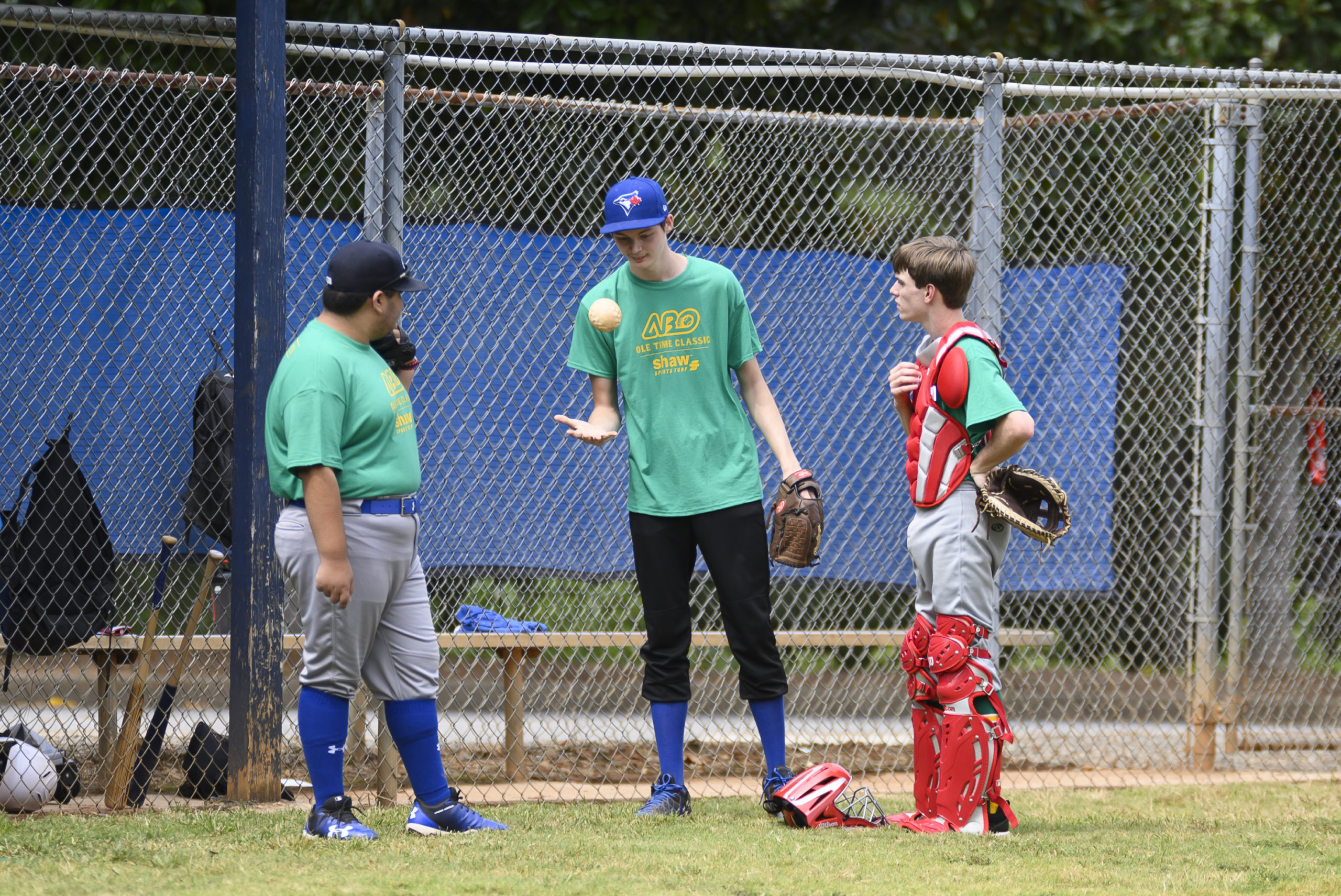
A coach gives pointers before a game | Photo courtesy of Alternative Baseball Organization

Baseball has long been hailed as America’s favorite pastime. According to the National Baseball Hall of Fame and Museum’s website, its history dates back to the 1840s. Years later Civil War soldiers on both sides played it as a diversion from the grimness of their circumstances. And, depending on whom you ask, it’s either the perfect sport or the most boring.

While baseball is as American as apple pie, though, attendance at Major League Baseball games has seen a decline in recent years. Its fan base is greying and young people aren’t as keen on the sport as their parents were. That said, baseball still attracts kids ages 6 to 12; it’s the second most popular sport behind basketball. However, it isn’t the natural sport of choice for children with autism. Until now.

Taylor Duncan, who comes from Dallas, Ga., founded the Alternative Baseball Organization in 2016 to provide an authentic baseball experience for teens and adults (ages 15+) with autism and other disabilities. Its mission is to provide physical and social skills enrichment in life on and off the baseball diamond.

“Baseball, like life itself, is so unpredictable on a per game basis,” explains Duncan. “We can learn how to grow and adapt in life just like we learn to do so in sports. One day you win, another day you lose, some days you hit a home run, other days you have those slippery butter fingers and miss every single ball hit to you in the field! We go through hot streaks and cold streaks in sports just like in everyday life. It’s a great way to continue building those social skills for life after high school. It’s a shame because once the Macho Man Randy Savage music ends (upon graduating high school), so do their services as many providers only cater to those 18 or others still in public school. This means that in a lot of areas across the country, there are no services catered to their individual needs. There needs to be more offered across America to help those like me have the services and encouragement to continue our successful paths toward independence.”

Continues Duncan, “During the pandemic, when no professional sports were going on, I had the chance to appear on news media stations in the search for new coach/managers, volunteers, and players to start new teams across the country. The goal is to provide this authentic experience in as many communities as possible. Every person deserves the chance to be accepted for who they are, encouraged to be the best they can possibly be, and instilled the confidence needed to fulfill dreams in life on and off the baseball diamond. They deserve an opportunity to connect with others just like themselves, whether they’ve played baseball before or not. If they haven’t played before, we’ll teach them the skills. Just bring a glove and your willingness to try. We love it when everyone gives 110% effort!”

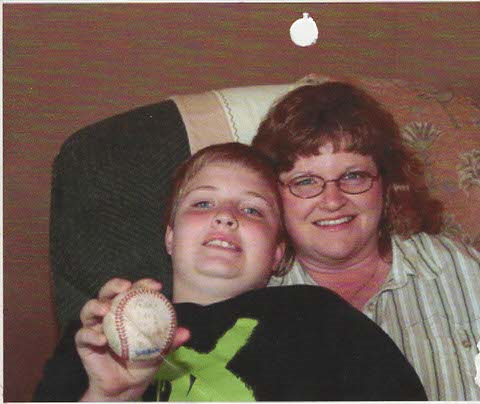
Duncan with his mom | Photo courtesy of Alternative Baseball Organization

It was in 2000, when he was four years old, that Duncan was diagnosed with autism. He experienced sensory anxiety and had speech issues. Relates Duncan, “While my mother helped me through my developmental delays, I still faced a lot of social stigma and negative perceptions growing up and was denied many of the same social opportunities as others my age. To be honest, though, my autism diagnosis and social awkwardness were not a big concern for me. Curiosity and creativity were always encouraged growing up so it didn’t occur to me that I was different. It didn’t really hit me until around the fourth grade after my parents divorced and my step-brother (at age 24, from my mom’s side) had committed suicide and I started to face a lot of bullying from other students and even the teacher I had that year who falsified my IEP records. When the bullying from other students in middle school continued in sixth grade, my mother homeschooled me all the way through the end of high school.”

“My mother helped me through those developmental delays” Duncan adds. “She’d work long hours with me every night on how to react to different social situations and skills needed for successful independent living for when I got older. Despite my being different, everyone encouraged me to be the best I possibly could. One of the most important things my mother had ever done, though, was instead of telling me ‘NO!’ like so many others had or having those same perceived low standards, she gave me the opportunity to try. She had the courage, time and time again, to say ‘if you think you can.’ She’s always been the best supporter possible for me and still is to this day.”

“While I got my high school diploma from Ashworth High School with honors in 2014, the stigma and perception about what people with autism can and can’t accomplish stayed with me. I’d always felt as if I had something to prove,” discloses Duncan.

Duncan loved baseball as a child | Photo courtesy of Alternative Baseball Organization

Because of development delays and negative perceptions, coaches denied Duncan the opportunity to compete in traditional sports. Despite that, he played one successful year of youth baseball.      

Duncan says, “The coach took me under his wing and made it such a fun experience. I learned way more than wins, losses, and statistics. I learned how to work as a team with people of varying personalities; and how to communicate and work together with my teammates to make needed plays in order to move forward throughout the game. To say it was a massive confidence booster is a colossal understatement. Unfortunately, at the start of the next year, a new coach took over and deemed me too much of an injury risk to participate on his team. I was bummed out. Yeah, I believed his win-at-all-costs attitude was completely bogus and only showed he was in it for himself to look good.

“However, I was never one to give up. I’d keep trying for new opportunities through the years. I still had that large passion in me, I didn’t want to give it up and accept ‘no’ for an answer. I attempted to play in a local church league slowpitch team. The head coach used to be a special education teacher himself, yet still held the same low standards and perceptions. Eventually, I realized that if I was going to have the same chance as everyone to enjoy this pastime, I was going to have to get out there myself and build that slowpitch team. And I did. I found several other guys from Craigslist and Facebook groups and we nearly took home the league’s trophy that season. It wasn’t a great season, but I learned a lot about leadership and what it’s truly like to coach an actual team. It was a pretty rad experience, if I say so myself.”

Much like those who follow baseball as a professional sport, Duncan developed an interest in it as a young boy. He recalls, “I was a big fan of baseball growing up. Luckily here in Atlanta in a time before cable, we had access to watch many of the Atlanta Braves’ home games on Ted Turner’s TBS Superstation (Channel 17). The Braves were very fun to watch during that time, but I tell you what was really fun to watch was Randy Johnson and the Arizona Diamondbacks. My interest in the sport was renewed when he pitched a perfect game right here in Atlanta at Turner Field on the opposing team. Those other kids at school the next day were not very happy about that; I seemed to be the only one in the building who was overjoyed over it. Randy Johnson, Hideo Nomo, and Ichiro Suzuki are my favorite all-time players. My favorite player today in MLB though is Shohei Ohtani – by a longshot. I’ve been following his career since he pitched in the Koshien High School tournament in Japan that jump started his professional baseball career. When it comes to following him, I’ve pretty much been a fan of his since almost the very beginning.”

A young Duncan at play. | Photo courtesy of Alternative Baseball Organization

While baseball is a passion, it isn’t Duncan’s exclusive interest. In fact, his interests run the gamut. During the years when he couldn’t play competitively, he pursued other hobbies which he enjoys to this day (and some that didn’t quite work out, he confesses with a laugh).   

Duncan divulges, “On my dad’s side of the family, I listened to a lot of Joy Division, Ramones, Agent Orange, a lot of punk, metal, classic rock, and obscure stuff that’d play on college radio. I was big into skateboarding at one point too, finally visiting KONA at the age of 16 for skate lessons. Well, let’s just say I’m no Tony Alva or Rodney Mullen – I don’t have THAT kind of balance. Hahahaha. Most of the time growing up though, I had an intense interest in trivia and quiz shows. Sick days from school were fun for me… wanna know why? It wasn’t just soup and medication that made me feel better. Every sick day made a perfect day to watch Bob Barker and ‘The Price is Right.’ Just about every evening back then, I’d watch ‘Supermarket Sweep,’ ‘Shop ’til You Drop,’ ‘Jeopardy!’ (Hang in there! We love you, Trebek!), and ‘Wheel of Fortune’ with my grandmother then sometimes ‘Press Your Luck’ and Game Show Network on the weekends (Watch out for that whammy!).

As hectic as his schedule is, Duncan is taking online classes offered by Toccoa Falls College in Georgia to earn a bachelor’s degree in nonprofit business administration with a minor in sports management.

“I chose to wait until this year to attend college because I wanted to take time to see what I was good at and what I would enjoy doing,” says Duncan. “I enjoy helping others and I enjoy the game of baseball. Yet, I didn’t see any type of baseball league that followed the same rules as seen on television. I felt called to start Alternative Baseball. As we continued expanding, we’ve started having interest from those in Canada, Mexico, Japan, South Korea, Deutschland, and Australia who want to start Alternative Baseball in their communities. I wanted to make sure I learn as much as possible in order to one day provide the experience for those globally as well.”

Duncan accepting House Resolution 1420 at the Georgia State House of Representatives in 2018. | Photo courtesy of Alternative Baseball Organization

One of Duncan’s goals is to raise international awareness for autism. I point out that we already mark April as World Autism Awareness month that starts with April 2 as World Autism Awareness Day, and he asserts, “Yes, we have an Autism Awareness Day and month but autism doesn’t stop after April of each year. It isn’t just awareness either. It’s about highly emphasizing the importance of acceptance and inclusion in not only athletics but also employment, personal relationships, and our romantic lives. This is a constant effort which takes every day of the year to promote and we have no plans to stop anytime soon! Remember the saying, ‘Rome wasn’t built in a day.’ It will always be a constant effort. The more help we can bring in to promote the overall mission, the merrier! That’s why I reached out to everyone who might have connections – I networked, networked, networked. And I prayed others would believe in the overall mission. As Babe Ruth quipped, ‘Never let the fear of striking out keep you from playing the game.’”

Prepping the team for a game. | Photo courtesy of Alternative Baseball Organization

When promoting Alternative Baseball, Duncan emphasizes that is isn’t like baseball as we know it. He clarifies, “It’s different (and quite opposite) from similar programs in which we play using the same rule-set as the Los Angeles Dodgers and Anaheim Angels. We don’t have any buddies assisting our players in the field, we play by the traditional rule structure with wood bats. The only adaptation is the type of ball which is slightly larger and much softer than a regulation size baseball. We continue to educate: Yes, we can play traditional rules like everyone else. We may have a disability, yes, but we want the same opportunities as everyone else.”

Duncan’s efforts are slowly getting attention and recognition. Alternative Baseball was recently commemorated as a Community Hero at an Atlanta Braves game and has been featured on ESPN’s ‘Baseball Tonight’ and NBC’s Weekday ‘Today Show.’ He also did a TedXAtlanta talk on providing more opportunities in and outside of sports for those with autism and other special needs.

Alternative Baseball commemorated as a Community Hero. | Photo courtesy of Alternative Baseball Organization

And Alternative Baseball is coming to Pasadena! Duncan appeared on KTLA in early August to announce his launch and has subsequently found a manager for this area. Now, the search for players is on. He’s looking for players of any experience level, aged 15 and over, and anyone with a disability besides autism.         

Duncan says further, “We encourage those even with no experience with disabilities to get involved because it’s a learning and enriching experience for everyone to see what we can do when we’re given the opportunity to get out there, to try, and give it our best. Those interested in volunteering, playing, or umpiring can visit www.alternativebaseball.org to sign up today!

“We’re also looking to roll out the Alternative Baseball All-Star Game in all the metro areas we serve. It’s our reward for our players’ participation and our hard work throughout the year! Our players who attend 70% or more of practices and games would have the opportunity to play alongside/against former professional baseball players in a real nine-inning game, no restrictions added. It’s a straight up experiment of putting the skills we’ve learned through the year to the test against those regarded as some of the very best in the game! We’ve run that game since 2016 for those in Greater Atlanta; 2019 for those across the Chattahoochee Valley.”

Alternative Baseball and the organization’s mission gained traction during the pandemic when there weren’t sports events on television. Between June and September, when Duncan couldn’t imagine it possible to do, he appeared on TV 1,000 times building teams around the country. 

Let’s rejuvenate national enthusiasm and pride in the sport while we give our youth with autism and other developmental disabilities this opportunity to shine in baseball and beyond!          

A Salute to the USPS and its Employees

Originally published on 11 September 2020 in the Pasadena Independent, Arcadia Weekly, and Monrovia Weekly

Benjamin Franklin appointed the first postmaster general in 1775 but it wasn’t until the passage of the Postal Service Act in 1792 that the post office department was created. In 1970, it became what we now know as the United States Postal Service (USPS).

For all the noble purposes its creation was intended, the USPS has seen its share of negative press and not by its own doing. In 1986, a series of incidents involving postal workers killing managers, fellow workers, and police officers originated the derogatory expression ‘going postal.’ Since then, anyone having a meltdown is described as ‘going postal.’

Public officials have consistently decried the USPS’s inefficiency and its deplorable fiscal state; there have been ongoing discussions about privatizing it. It is once again in the headlines because of budget cutbacks that Postmaster General Louis DeJoy implemented and how that could affect the upcoming elections.

President Trump recently threatened to block aid for the agency unless it quadruples its prices for package shipping. That could adversely affect the USPS’s partnership with Amazon to deliver the online giant’s packages at a discounted rate. Yet, its financial woes may have nothing to do with shipping prices but are due to a congressionally-mandated retirement health plan that no other agency is required to observe.

All these, however, are a cause for concern among USPS employees as they wonder if they will have jobs when the dust finally settles. I would like to advocate recognizing the invaluable service that these men and women provide and rescuing them from an uncertain future.                         

Our mail carrier Rudy has been working in our neighborhood since my daughter Brianna was four years old. She thought then that Rudy was a relative because each time he delivered our mail, we would chat and ask about each other’s family members as if we knew them personally.         

Rudy and I swapped accounts of the challenges in finding caregivers for parents with dementia and the travails of the ‘sandwich’ generation – adults who have aged parents and young children to look after. We commiserated with each other when these parents we had been worrying about passed away.

It was Rudy who chased after our hyperactive cocker spaniel Charlie when he bolted out into the street as we were chatting by the front door one day. As fast as Charlie ran, Rudy was faster and got our dog safely back in no time.

I don’t know everything that happens in our neighborhood, but Rudy sees them all and that’s how I find out. He is privy to a lot of joyful occasions as well as the heartbreaking events. He was the one who told me that the well-known interior designer who owned the gorgeous French Regency residence nearby was moving to South Pasadena to open a larger office. Four years ago, he excitedly informed me that the teenager who lived close to us had qualified to compete in swimming at the Summer Olympics – he was as proud of her as her parents were!    

A USPS office | Courtesy photo

When an internationally famous pop star suddenly died about a decade ago, Rudy told me a neighbor of ours was bereft not only because she knew him personally – she was one of his back-up singers – but also because his worldwide tour was going to be her major break.  

A sad occurrence Rudy relates concerns an older resident who lived on her own. He says, “I always made it a point to stop for a few minutes to look in on her and would run errands for her. One day, I found out that some of her relatives were trying to extort money. I took it upon myself to let her exploiting relatives know that I was aware of what was happening, and that I would report them to the proper authorities if they attempted it again. She has since passed away and her estranged daughter is now living in the house. I wish she had been there when her mom needed her.”                                  

Perhaps the most heartrending event Rudy has witnessed unfolded only a few weeks ago. He recalls, “There was an electrical accident at the house that’s being built up on this street. I saw the man who was working inside come running out with his body on fire. People had gathered, telling him to roll around the grass but there really wasn’t much of that left, there was mostly debris from all the construction. The man’s clothes had burned and he was naked, so I asked someone to get me a towel to cover him with. The paramedics arrived rather quickly and rushed him to the hospital but, tragically, he passed away the following day.”              

As to the job itself, Rudy says, “It is generally a pleasant job. The mail processing at the facility where I work is quite organized – the mail being distributed to carriers is balanced out so that there aren’t days when we’re delivering them until dark. That’s not to say that it isn’t stressful, though,” he admits. “There’s always the pressure to work faster and more efficiently.”

It’s usually the mail carrier who is the first to see changes in the area and Rudy has observed a shift in demographics in the last decade. He reports, “There’s a lot of construction going on. Older residents are moving out and are being replaced by younger families. The pandemic caused an increase in online shopping which has meant more packages to deliver, but I already had more packages than other carriers’ even before the lockdown because there are more young people on my route and they tend to shop online.”  

I ask what he likes about being a mail carrier, and Rudy replies, “The people are all very friendly, warm, and caring. There’s one elderly gentleman who keeps an ice chest with cold water and soda waiting for me on his porch. Another older lady calls me on my cell or home phone when she hasn’t see me for days, to make sure I’m okay. Everyone takes the time to chat or say ‘Hello.’ It’s the people that make it a gratifying job.”                   

Rudy has been working for the post office for 31 years. He and his wife will be celebrating their 39th anniversary next month, after having raised four children ranging in age from 38 to 25. He’s eligible for retirement and is looking at all his options. He loves the job and enjoys his daily rounds in the neighborhood but he thinks it might be time to hang up his mail carrier hat. It will be a gloomy day when he decides to – we can’t fathom having someone other than Rudy deliver our mail.         

| Courtesy photo

A mail processing clerk who graciously agrees to answer my questions on condition of anonymity because he is contractually prohibited from speaking with the media on behalf of the post office without their prior approval, has been a USPS employee for six years now.

When I inquire if he feels the agency gets undeserved bad publicity, he says, “I’m not sure that USPS gets all that much bad publicity. At the end of the day it is a service that customers pay for; and when a customer has a bad experience they will want to complain about it (sometimes rightfully so). Maybe some people wrongfully believe their tax dollars are being spent to support the Postal Service and would like to have more say in how it is handled. As a service it is not without its shortcomings, but postal workers fulfill a vital role in society. Everyone notices when the package or letter they’ve been expecting arrives late and a lot of people are working to make sure it won’t.”

I ask how the budget cuts affected employees, his workplace, and the performance of his duties, and he replies, “At my facility only overtime hours were cut; but in a facility with hundreds of employees, that equates to a lot of work time. The only changes I have experienced were cuts to overtime and operational hours, i.e., operations were to be shut down at prescribed times to facilitate a regimented flow of mail; but that meant unprocessed mail was held for the following day.”

“This led to delays in processing for delivery, which meant most days were heavy (for this time of year) and ultimately led to sending large amounts of mail to the carriers every day,” he continues. “That affects how long they are out on the road and, in turn, how quickly they can return with mail to be sent out processed. These policies would not have held up under the volume of the election mailings [opinion based on having worked during previous elections] – the amount of mail that would have been delayed would have been astronomical. During the 2016 election, mail-in-ballot volume increased processing time for outgoing mail by 1-2 hours a day for multiple weeks leading up to the election itself.”

As to accounts in the media about rotting food and dead animals at some postal offices, he clarifies, “The only parcels we work on are 1-day Express and those were unaffected. Live animals, perishables, organs, et. al. are only supposed to be sent 1-day Express. If those items were sent by another method it would be handled by another facility; and those stories do not surprise me with parcel volume as high as it is coupled with the cuts we had experienced.”

“The atmosphere at work is fairly neutral, trending toward concern,” he adds. “There was a lot of confusion and frustration with the policies enacted at the beginning of August. There is some uncertainty with regard to funding and the longevity of the Postal Service, should the recent strains put on it persist.

“It is largely a good place to work, notwithstanding. Like many jobs there are supervisors and managers you like and those you don’t; coworkers you like and those you don’t. There is plenty of opportunity to advance or branch out into different jobs other than what I do currently. More recently, it has been stressful with wearing a mask all day at work and the political climate making our future uncertain. But I have work that keeps me busy enough to not worry too much.”

As he points out, the USPS is a good place to work at. It is also a compassionate agency. According to the USPS website, it has a long history of providing career opportunities to veterans, reservists, and their family members. It employs more than 97,000 veterans across the country. Former military members make up over 18 percent of its personnel, which means it employs veterans at three times their share of the national workforce.

Besides being a good employer, the USPS offers affordable postal and shipping rates and small business owners rely on it to get their products to customers. While the recent delays due to the budget cuts caused havoc on their shipping budget and even resulted in lost income for some, that is not the norm. The USPS has reliably delivered parcels and packages to their destination in a few days.   

Compared with those of other countries, we enjoy the least expensive postal delivery system – a fact most of us don’t fully appreciate. Being an avid traveler with an annoying habit of sending postcards to friends and family from wherever I am, I have first-hand knowledge.    

We spend 55 cents to send by first-class mail a one-ounce letter, and 15 cents for each additional ounce, $1 for a flat/large envelope, and 35 cents for postcards anywhere within the United States – that’s 3,797 million miles of land area. We pay $1.20 to send a letter or card to most countries in Asia and Western Europe.

The Royal Mail, on the other hand, charges 76p for first-class (approximately $1.30) and 65p (approximately 86 cents) for second class mail within the United Kingdom. Tom, my son-in-law, is from England and his entire family lives there. It costs his friends and family from ₤1.55 (about $2.06) to ₤1.66 (about $2.21) to send him a one-ounce card during the holidays. And having been to the U.K. a few times, I know that it costs at least ₤1(about $1.33) to send a postcard here.

My sister, who lives in Switzerland with her husband and daughter, spends CHF 2.00 (about $2.12) to send a letter to me. I have to add that the Swiss postal system hasn’t been as reliable as in the past – the last time I sent my niece a birthday card, it took seven weeks to get to her, when it used to take only five days.

I have relatives in the Philippines who have limited themselves to sending me e-cards during Christmas because the price of international postage stamps is prohibitive. To give you a clear picture of what I mean, the minimum wage there is 537 Philippine pesos (PHP) or $11.05 per day and sending a one- ounce letter (up to 28.35 grams) to L.A. county costs 140 PHP or $2.88. That’s over a quarter of what a Filipino minimum-wage worker makes in one entire day!    

U.S. stamps | Photo by May S. Ruiz / Beacon Media News

Even as we pay affordable rates for postage, we complain each time the price increases. So the USPS created the ‘Forever’ stamp we can use even when the rate goes up. I haven’t heard of any other country’s postal system that has resorted to that.

Speaking of stamps, the United States has some of the prettiest stamps you can find. And I know what I’m talking about – I have quite an impressive stamp collection that spans 74 years and covers 65 countries. Okay, I’m old (because who else but an old person would have a stamp collection, right?) but not quite as old as the oldest stamps in my collection. It just so happens that my long-deceased grandfather worked for the Philippine post office and he bequeathed to me his commemorative first day cover of the July 4, 1946 Philippine Independence Day stamp (Philippine independence from American rule, which is different from when the United States liberated it from Spanish colonization in 1898). In fact, it was how my hobby started. But I digress.

Postal workers perform essential functions which cannot be replaced by a machine. The ZIP code, which was introduced and implemented in 1963, allowed for automated mail sorting. And since I’ve only ever received or sent out letters and cards with ZIP codes on them, I thought a letter would not get to its destination without it. Until I was proved wrong. Two weeks ago, Tom received a card from his childhood friend in England. Instead of putting the ZIP code, his friend inadvertently wrote Tom’s entire 10-digit cell phone number!

While a missing ZIP code isn’t exactly an adversity to overcome, America’s postal workers have battled natural calamities to get our mail delivered. The motto ‘Neither snow nor rain nor heat nor gloom of night stays these couriers from the swift completion of their appointed rounds’ aptly describes what they accomplish.

Our mail carriers are a part of our daily lives – they cheer with us when we celebrate milestones and grieve with us when we mourn our misfortunes. They are a thread in the fabric of our community.

Altadena Arts Magnet School Aspires to Greatness

Originally published on 9 March 2020 in the Pasadena Independent, Arcadia Weekly, and Monrovia Weekly

Dr. Benita Scheckel with student-created art | Photo by May S. Ruiz / Beacon Media News

Nestled at the foot of the San Gabriel Mountains in Altadena is Altadena Elementary School, established in 1903 from what used to be a trolley stop for the Mount Lowe Trail. Known today as Altadena Arts Magnet School, it is the premier dual language and arts school in the San Gabriel Valley.

That renown, however, is fairly new. The school languished for a few years after its principal left and it became the lowest-rated in the district. It took a grant, a curriculum change, and the guidance of Dr. Benita Scheckel to transform the school into a model of excellence in a relatively short period of time.      

A former actress and opera singer, Scheckel came to the Pasadena Unified School District (PUSD) in 2007 and taught English, drama, and music at Blair IB Magnet School. In 2015, she decided she wanted to go into administration; she got placed as assistant principal for Student Support Services at Marshall Fundamental School.

Scheckel picks up the story, “From there, I applied to Altadena Elementary School when it had just applied for the five-year arts magnet grant. We didn’t know then if we were going to get it, but I took a leap of faith that this would become an arts magnet school. At the same time, it became a French dual language immersion school and I had some experience in that area so I felt it was a dream place to work at.”

The school playground has an unimpeded view of the San Gabriel mountains; a new kiln will be installed in the shed with the blue roof on the right | Photo by May S. Ruiz / Beacon Media News

“It was once a wonderful school of 600 students and they had a long-time principal for 20 years,” relates Dr. Scheckel. “As PUSD began to attract more charter and private schools, the principal left and then the school went under construction. There was a period of instability – they had five principals in three years, enrollment declined from 600 to just under 200, there was low staff morale, and they had very low test scores – it was the lowest performing elementary school in the district.

“I looked at that first year as a chance to get to know the culture and climate and to infuse the school with as much positivity, enthusiasm, and vision. I set out to uplift the staff and support the teachers so that they can begin doing the amazing work they used to do that they weren’t able to do through the years of not having solid leadership.”

Continues Dr. Scheckel, “Before the school year started, the first couple of weeks I was here, I sat down for a two-and-a-half-hour meeting with the entire staff. Having just gotten here, I knew they didn’t trust me initially, so I asked teachers who they trusted and respected. I also met each staff member individually for a half hour. From those meetings and being on campus, I was able to figure out who they trusted and those were the people I put in the leadership team.

“Being used to secondary school, where there’s an assistant principal of curriculum and an assistant principal of discipline, I installed an instructional leadership team consisting of an instructional coach, a coach for discipline, and myself. I also created an extended leadership team – this includes our arts teacher, TOSA (teacher on special assignment), and our magnet grant coordinator.

“Then I brought in ‘Capturing Kids’ Hearts,’ a systemic reform program which our grant pays for. It provides many hours of professional development to teachers and staff around building a relational culture – student to student, teacher to teacher, staff to staff. I spent a lot of our money, resources, and energy forming a relational campus, where people don’t just shut their door and not relate to others but instead get together and hang out, appreciate each other and feel safe.”

Students working on an art project | Photo by May S. Ruiz / Beacon Media News

“Now we have a thriving school – our enrollment is increasing daily,” Scheckel says, beaming with pride. “We closed last school year with 228 students and today we’re at 287. When we came back from winter break, in January and February, 20 students enrolled. Along with enrollment, test scores are up. We’ve increased our math and English scores exponentially – we’re no longer the lowest performing school. We have arts infused into everything we do. Our students receive up to 12 hours per week of discrete art and arts integrated instruction – it runs similar to a conservatory, which is very unusual for an elementary school where normally kids stay in the classroom and do an art project.

“Here, students go to dance, art, music, media arts, and theatre arts classes taught by professionals in that specific field. We have designated arts spaces – we have a state-of-the-art Marley dance floor, fully sprung so that it doesn’t hurt their joints, with ballet barres and mirrors; a black box theatre; a music studio; an art studio, and so on. To complement the dedicated spaces, we have a curriculum that’s structured like a conservatory. All students attend every art class so teachers have had to look at the schedule – take out the time students would have their recess and lunch, and when they’re in art class, and figure out how to teach the core curriculum in that time. I was nervous about it at first but they have done a beautiful job. It’s taken out any wasted time, transitions are tightened. Also, the teachers are following the students to all the art classes so that they can learn how to do these things when we switch to our built-in sustainability plan when the grant expires.”

Scheckel then came up with another great idea. She discloses, “With the grant, we decided we were going to build art spaces out of the classrooms. I thought I needed to bring a little bit of community awareness, community buy-in, and a little glitz and glamour to our campus. I reached out to some local celebrities and community leaders and asked them if we could name these spaces for them. Fortunately, they said yes.”

The Lula Washington Dance Studio | Photo by May S. Ruiz / Beacon Media News

And so, on Wednesday, March 11, Altadena Arts Magnet School will hold a special ribbon cutting and studio dedication event where the art spaces will be named for distinguished arts personalities. The star studded festivities, with Supervisor Kathryn Barger in attendance, will be held from 6 to 8 p.m. and will feature a special performance by vocal artist Lynn Fiddmont.        

“We’ll have a red carpet and a photographer,” says Scheckel. “The Muir Jazz Band will play and we’ll walk around and unveil these seven art spaces – the Matthew Lillard Black Box Theatre; Patrice Rushen Music Studio; Lula Washington Dance Studio; Keni Arts Art Studio; Artis Lane Sculpture Play Yard and Kiln; Bettye Holliday Art Gallery; and the MonteCedro and Dr. Eunice Elizabeth Nash Arts Garden.”

“I would like students to be inspired by knowing that each room is connected to someone who’s really working in that profession,” explains Scheckel. “So every time a student walks into the Patrice Rushin Music Studio I want them to be able to look around and think ‘I could be a four-time Grammy-nominated musician; I can be just like Patrice.’ I’m hoping that the celebrity name will maybe add a little pixie dust to the space, a little inspiration for the children.”

A beautiful mural graces the learning space | Photo by May S. Ruiz / Beacon Media New

Three years into Scheckel’s stewardship, Altadena Arts Magnet School is the only elementary school where little children are travelling throughout the day like middle- and high-schoolers. It has earned a distinct reputation in the area, something she revels in, and not without a sense of relief mixed with wonder.      

“It’s incredible!” enthuses Scheckel. “The first year I was very nervous all the time. It was my first principalship and I was worried; I wanted to be certain I do things correctly and make as few mistakes as possible. Now, this third year feels like ‘we’re okay, we’re cooking with gas.’ Everybody knows what the vision is, the team is phenomenal, everybody’s moving in the right direction.

“It’s amazing what you can do with a school if you add love, grit, and a solid vision for greatness. I think if you have those three things, you can really turn a school around. And we have achieved that. We can’t believe it when families try to come to us from Glendale or La Canada. They’re leaving La Canada schools to come and be a part of our school! Our tours have 40 people on them. There are pregnant mothers who are crying because they think there won’t be space when their baby comes. How fascinating!”

Dr. Scheckel is only just beginning and there’s no stopping her. And students at Altadena Arts Magnet School are the lucky beneficiaries of this indefatigable principal’s grand vision.