Pasadena’s Calligraphy Katrina Showcases Distinctive Art

Originally published on 19 September 2019 in the Pasadena Independent, Arcadia Weekly, and Monrovia Weekly
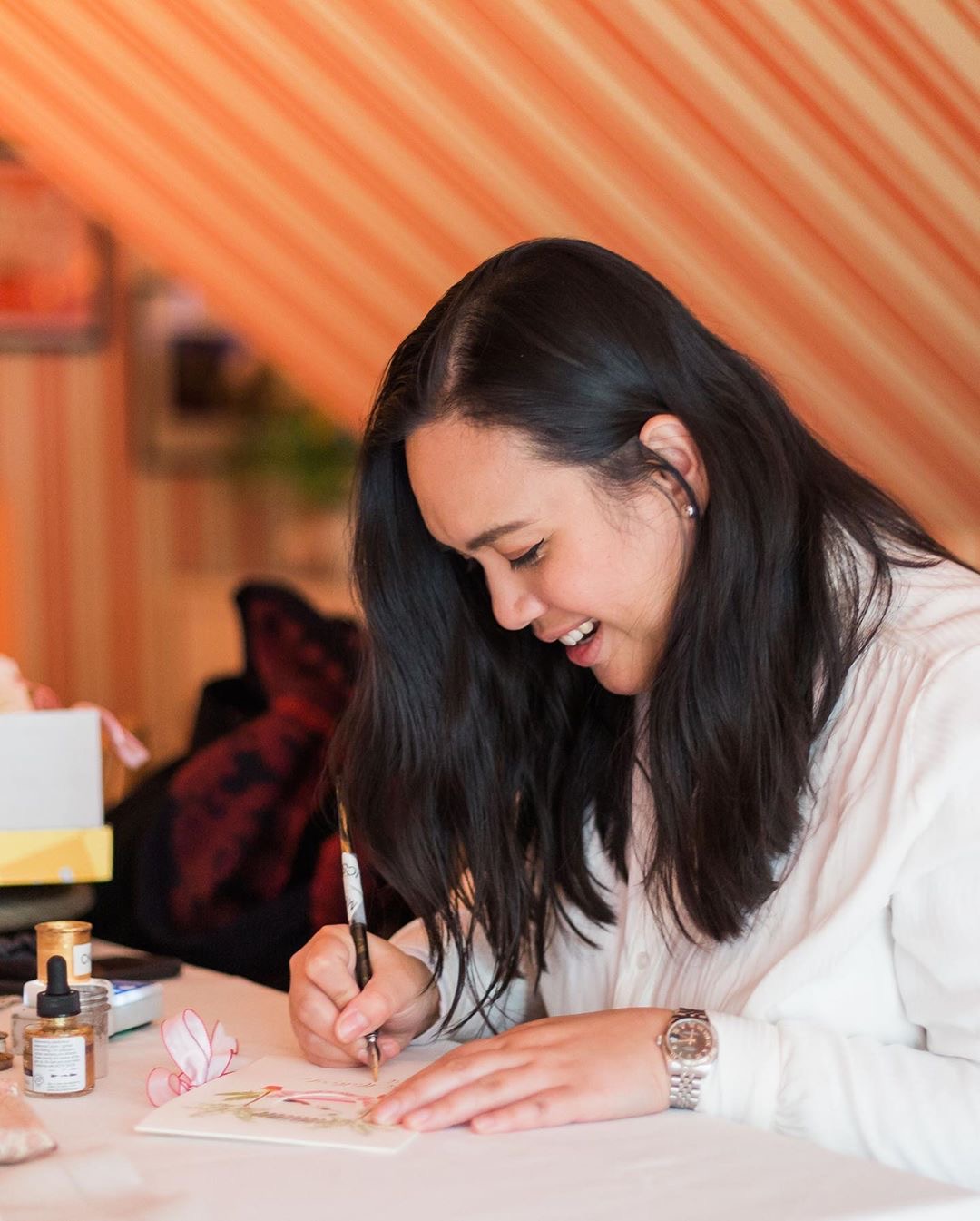
Katrina Centeno-Nguyen does on-site calligraphy | Courtesy photo / Calligraphy Katrina

Her Instagram followers watch her work her magic online in real time. She writes words – names, dates, places – on a blank space and it becomes a piece of art. All in a span of a few minutes. Her calligraphy pieces grace wedding receptions, Hollywood film openings, Grammy events, and the New York fashion scene.

Katrina Centeno-Nguyen was 19 when she opened her eponymous company, Calligraphy Katrina, 12 years ago. She does a brisk business with a pen bought from an art store, and an immigrant’s determination, perseverance, and work ethic. Her journey is a model for everyone who’s arriving in this country to look for opportunities.

Chatting with me one sunny morning from her home in Pasadena, Centeno-Nguyen talks about coming to California as a 13-year-old, being raised by a single mom, and finding her career in the most unexpected way.

“My parents decided to emigrate from the Philippines – my dad arrived in Pasadena in 1997 and my mom followed in 2000. Unfortunately, their marriage didn’t work out and they divorced soon after. So it was up to my mom to find a way to get me and my sister here.

“Immigrating into the U.S. at that time wasn’t as difficult as it is today but it was definitely not an easy process. As comfortably well-off, highly educated, and widely-traveled as we were when we lived in Manila, we were still technically from a third-world country. We were coming here as dependents so that also meant my mom had to show how her children, who were still in the Philippines, were being financially supported. Propitiously, my grandmother (my grandfather had passed away) had income from their family business and rental properties so she made sure we were looked after.

“In time, my mom had obtained gainful employment as an analyst and had enough resources to cover the expenses for the petition process and the means to support us once we got here. I came here in 2001 and my sister arrived in 2005; my brother was born here.”
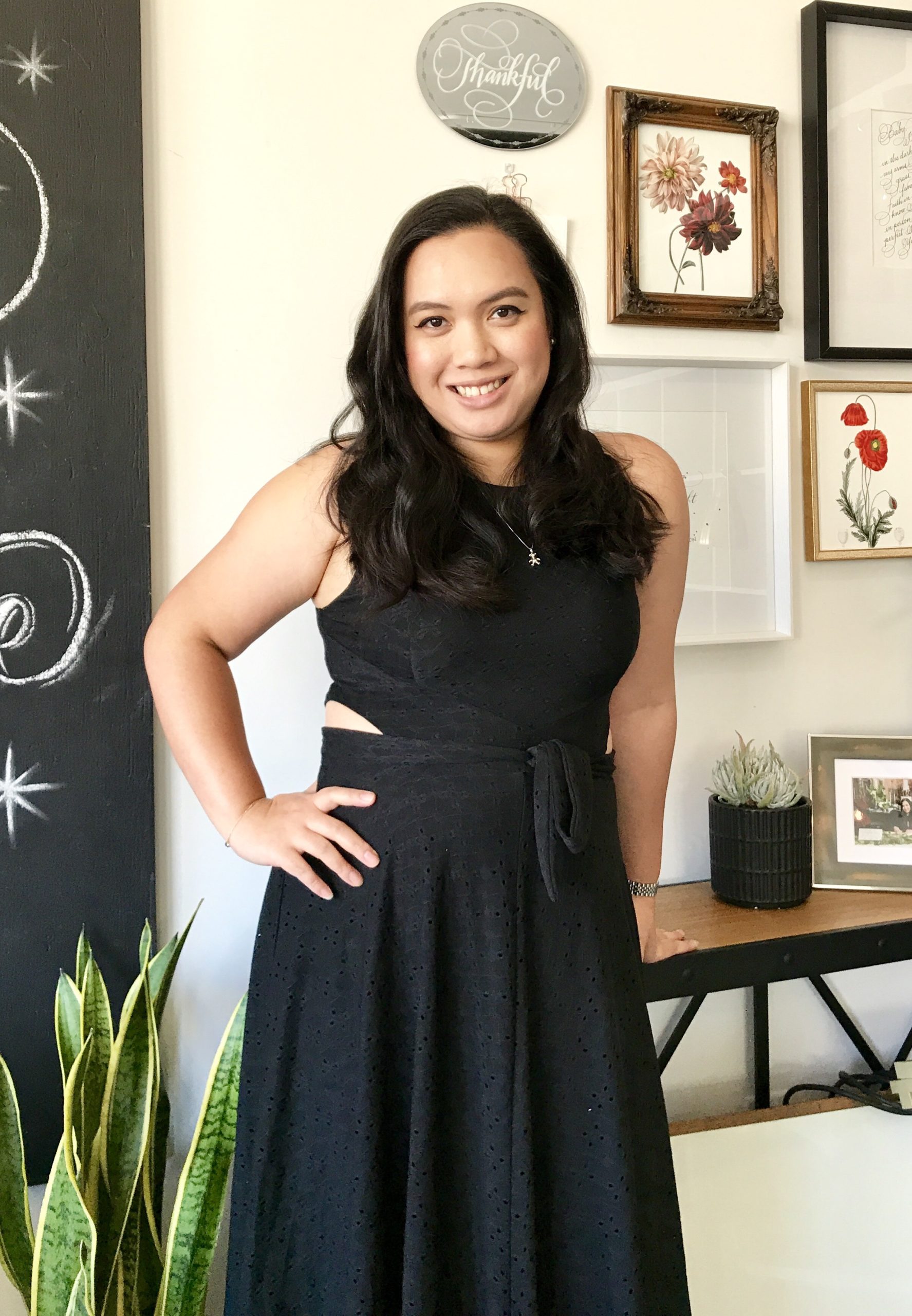
Katrina Centeno-Nguyen | Courtesy photo / Calligraphy Katrina

Continues Centeno-Nguyen, “I had finished 6th grade in Manila; I skipped middle school and went directly to 9th grade at Pasadena High School (PHS). That was quite an interesting cultural transition because I had gone to private schools in the Philippines and suddenly I was in a public school. Not only did it have a large population, students were talking back to their teachers!

“Though I have to say that socially, it wasn’t bad at all. PHS was a diverse school and a lot of students were culturally open because they also came from immigrant families. However, I had friends who weren’t necessarily immigrants. I was quite lucky because the classmates I hung out with were very much like me – we were all in the honors program; we mainly talked about school and homework. We studied and worked on projects in each other’s homes and, at the same time, had good, clean fun.

“Maybe my innocence also shielded me because I didn’t really know if bad things were happening. There might have been students who were doing drugs but I wasn’t aware of it. But the friends I had weren’t doing drugs either so there was no peer pressure. The core of our friendship was academics; it was why we became friends in the first place. We were nerds – we played chess and enjoyed physics class. We were also a good mix – some were in sports or arts; and we were volunteering in the same places. It was all about getting ready for college applications.”

Asked which college she went to, Centeno-Nguyen responds, “I actually didn’t attend college. We were still in the process of getting our residents’ visa; we didn’t become green card holders until 2007. Going to college as a non-immigrant was going to be quite expensive. Besides, I had to try to figure out a way to help my mom. While she had a great post, she had to work two jobs to enable her to support three children – in Pasadena, where it’s not cheap. So I took a full-time job as a nanny while I attended Le Cordon Bleu. It was also at this time that I started ‘Calligraphy Katrina.’”

Being a calligrapher was the furthest thing from Centeno-Nguyen’s mind in terms of a career. She relates that she became one by happenstance, “I’ve always had good penmanship and one day, one of my nanny friends saw me writing my grocery list. She was getting married soon and asked if I could do her envelopes. She informed me that I could make money addressing wedding invitations. So I looked into how pricing worked, invested $10 on a few pens from an art store, and bought a couple of envelope packets from Target. That was how ‘Calligraphy Katrina’ started. I began with two fonts and created new ones as I went. Sometimes I’d make an accidental swish and I’d say  ‘Oh, that looks pretty cool. Let’s try that again.’
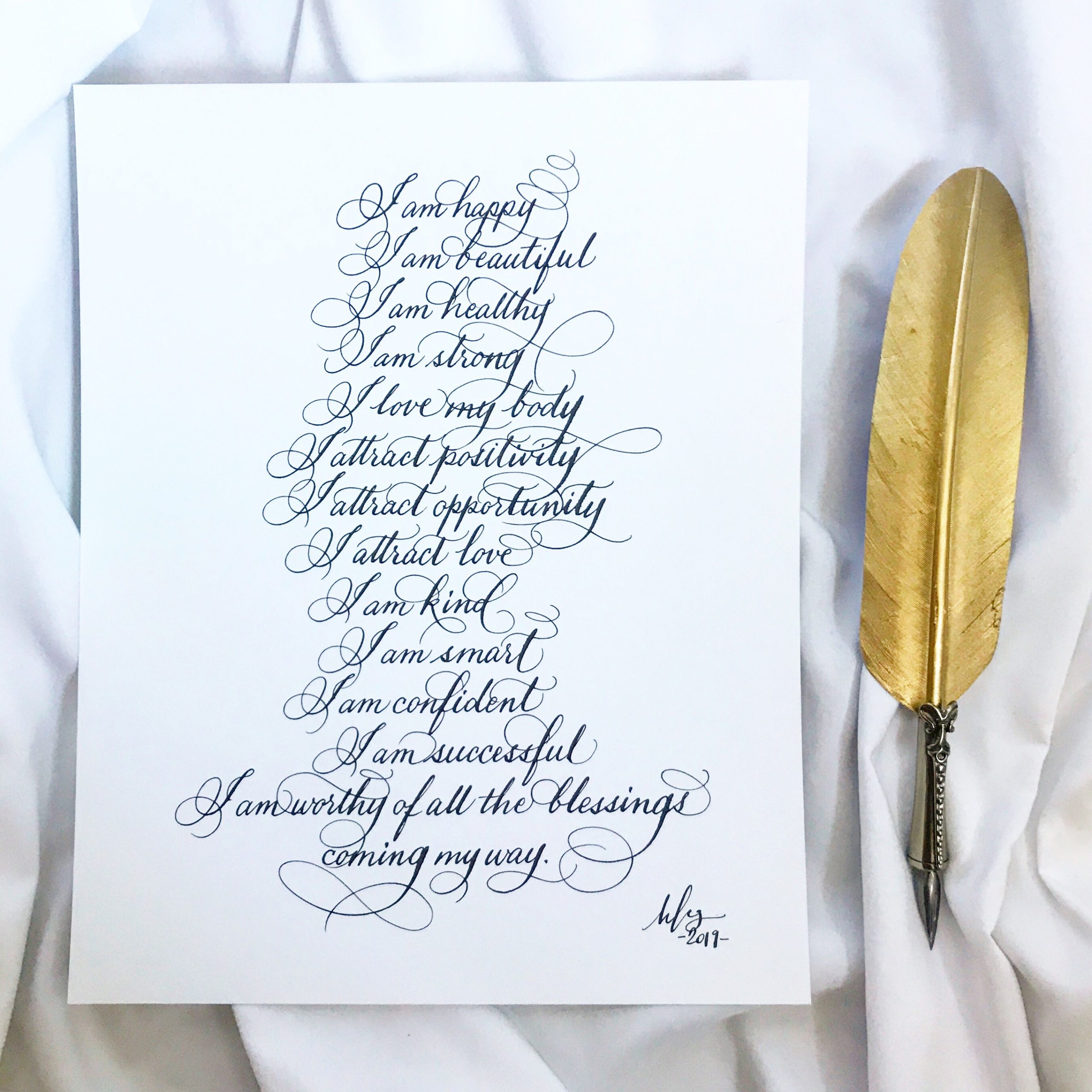
Centeno-Nguyen’s calligraphy | Courtesy photo / Calligraphy Katrina

Centeno-Nguyen was brought up with a discipline and work ethic that made the transition to life in the United States easier. And it proved helpful when she endured a punishing schedule as she was establishing her business.

She recalls, “After I’d been doing wedding invitations for a while, a stationery store called Paper Source in Beverly Hills started taking notice and they asked me to bring my work there. I was still working as a nanny then. I was also in the night class at culinary school and I was doing kitchen work because that was a requirement. My day commenced at 6:30 when I woke up and I was at work by 8:00. Fortunately, the family I worked for lived in Pasadena so it wasn’t a bad commute. I left their house at 5:30 and I was at school at 6:00, where I stayed until 11:00 pm.

“I squeezed the calligraphy project whenever I had the chance. Sometimes I worked on it when the child I was caring for was asleep; I did readings when he was playing. At times I did the calligraphy after school, before going to bed. That was my hustle in those early days. I also did a few hours in the kitchen during weekends because that was important. I had to balance it somehow.

“It was then I decided to give up culinary school. My mom questioned my decision when I had already paid a lot of money for it. But in the restaurant business, it’s either you own an establishment or you’re really brilliant. I was good, but not that good. To get financial backing, you have to know how to run a restaurant already, which I didn’t have any background on. At that time, too, a lot of restaurants were going under. It just so happened that my work was standing on its own and, because Calligraphy Katrina was my baby, I had a deep personal investment in it.”

Centeno-Nguyen recalls, “Facebook wasn’t as widely used as it is now; there was no Instagram. Social media wasn’t a thing yet. There were wedding blogs but the Internet wasn’t that huge so there weren’t as many venues for my work to be seen by a great many people. So I posted photos on Craigslist every week – that was my marketing. Even back then, people were paying $4 to $5 an envelope. I did it in a platform like Craigslist because I was learning how to run it. It didn’t feel ethical for me to charge someone $3 when I didn’t know what I was doing. But I also disclosed to my clients that I was new at this so they knew coming in that it was why I was charging only so much. It was a learning process for me and my clients were hiring me because they just wanted something handwritten. As my artistry and knowledge evolved, I started increasing my prices. But even now, as my experience has broadened, my prices aren’t as high in comparison to what other calligraphers charge.”

“Soon, I quit my job in the kitchen and as a nanny. The calligraphy work was already gaining traction and I was secure enough to focus entirely on it. Still, I was petrified. Obviously, I didn’t really know how it would turn out. My mom and I would go to Beverly Hills every single weekend. She worked a lot so it became our special time together – we’d hang out there and meet the brides that we got from Craigslist at Starbucks.

“At the time, there were only a few people who could be called calligraphers and they were very old school – very traditional. They were master penmen who belonged to a group and they were leery about me. I was 19 and I didn’t get a formal education on the art so I was the outsider. That’s also part of my insecurity as an artist. I once had the privilege of working alongside a full-pledged calligrapher who saw me as a non-calligrapher because my slants weren’t the right size for Spencerian. But I wasn’t doing Spencerian, it was simply my own handwriting. This is why I work at such great speed.”
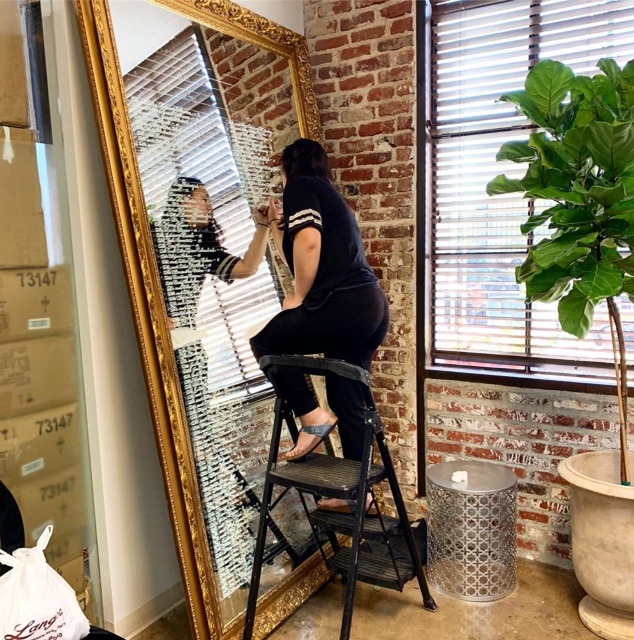
Centeno-Nguyen works on a mirror project | Courtesy photo / Calligraphy Katrina

“Not to diminish what they do, because it’s brilliant,” Centeno-Nguyen quickly says. “I wish I had that kind of knowledge but that sensibility is what differentiates my company from others. I do volume and I need to make that work. A lot of calligraphers say what I do isn’t calligraphy because I’m diminishing art. Every day, as an artist, I also have to account for my own individuality. Since I’m not conforming to the standard, am I a real artist? Do I feel like an actual calligrapher?

“Most calligraphers do this for the artistry of it. That’s not to say that I don’t, because I most certainly do. But it’s also my primary means of livelihood and I have to meet deadlines. My evolution as an artist is tied into the success of my company. I want to establish a stable business and a successful commercial venture. I have to look at it as ‘How can I make enough to support my family?’ And because I didn’t have the resources to do so, ‘Will I be able to ensure that my child goes to a four-year university?’ And ‘How is this  going to increase my income so I can enjoy my family?’ When I become financially comfortable then I can think about my artistry.”

If success were to be measured by one’s popularity on social media then Centeno-Nguyen has definitely attained it. People see her working on huge projects involving pop stars and runway models online. She’s on Reddit and has a loyal following on Instagram, which she finds incredible.
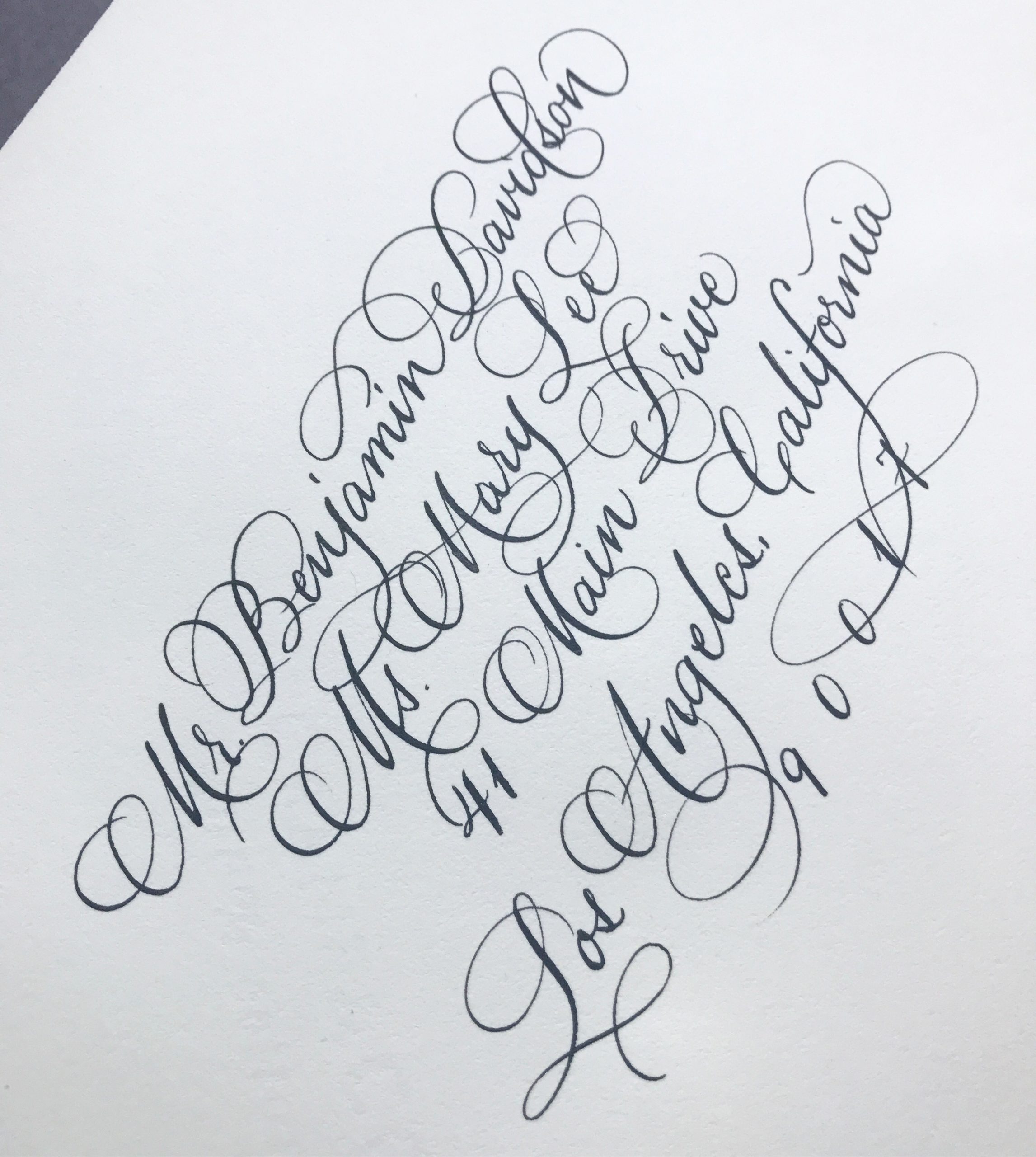
Calligraphy Katrina does a brisk business on envelope addressing for corporate clients | Courtesy Photo / Calligraphy Katrina

Centeno-Nguyen explains that how she got into the Hollywood industry was opportune. “In 2008, a new PR company needed 30 envelopes addressed, not right now but yesterday, and calligraphers in the city gave them a timeline of a week for the project. They called me and I said if they delivered the envelopes that morning, I would have them done by the end of the day. My company officially opened in August 2007 and we did one or two envelope projects a week. By January – February, we were already doing corporate work.

“Because of my pricing, which was like air for a PR company with a large budget, they asked me to do more things like place cards. This was also a young PR company gaining their traction, and it was beneficial to them that I was actually meeting their deadline. That PR company then talked about me to other PR companies. The buzz started from my speed – I could work on the fly. It was my ace and, for a long time, it was what made me stand out. And more corporate work came rolling in.”
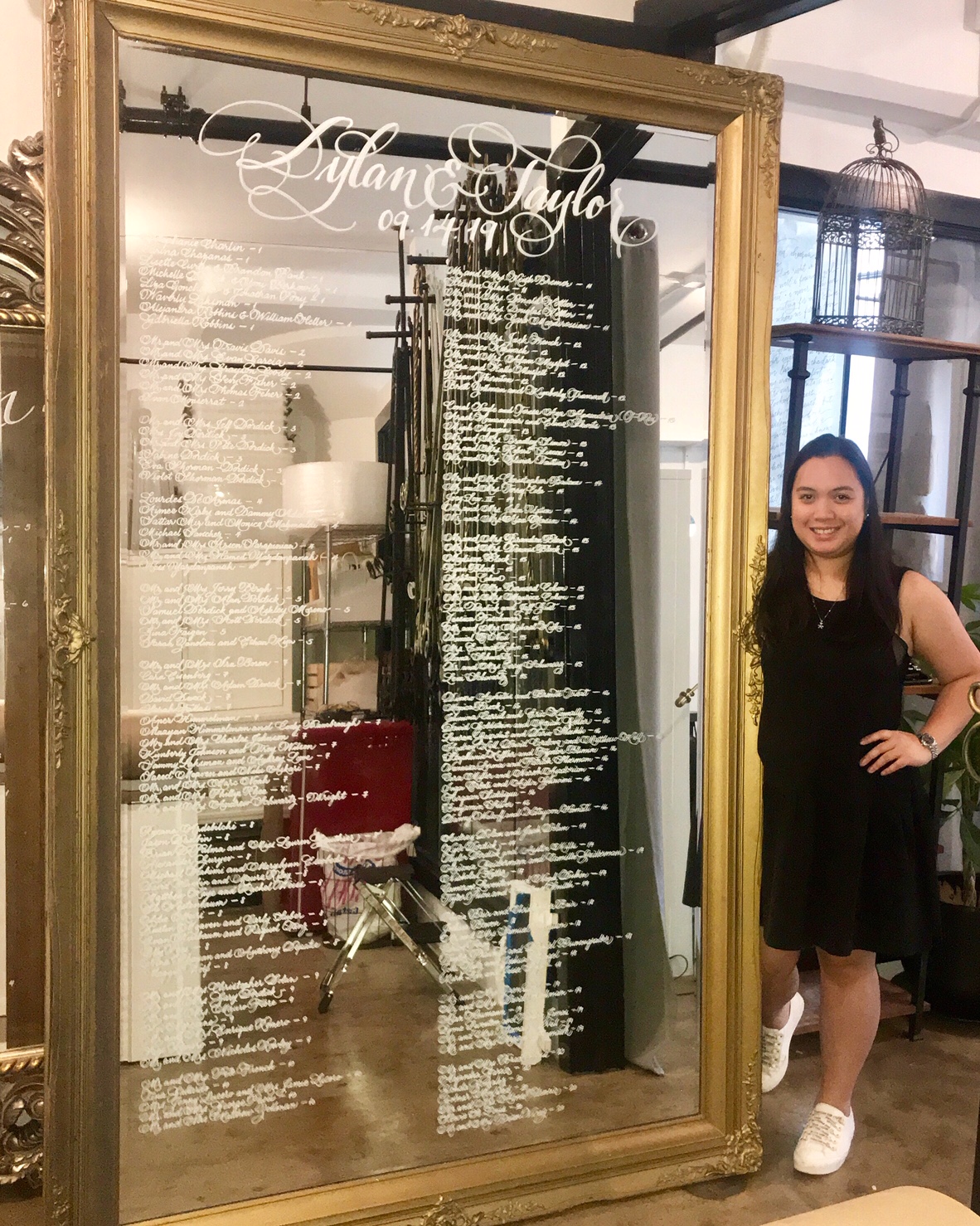
Mirror projects make up 50 percent of Calligraphy Katrina’s business | Courtesy photo / Calligraphy Katrina

Just like doing calligraphy work happened unexpectedly, working on mirrors wasn’t by design either. Centeno-Nguyen recounts, “We had a client who owned a mirror company and they were thinking of having a welcome sign for an event at the California Club. We discussed different things we could do on a mirror and we came up with a seating chart. They asked if I knew how to do one on a mirror and I said no but I’d figure it out. I didn’t know how I was going to grid it but being a nerd, I used math to measure it. I did it on site in four hours while they were setting up. I used a chalk and it looked really cool.

“This was ten years ago when I hadn’t seen anyone doing calligraphy on mirrors. No one cared for it because they said it was too hard to read. When I created calligraphy work on giant mirrors, though, everyone took note because it was different. After I did the videos, everybody wanted the mirror.”

“The mirrors are popular with weddings so 50 percent of our business comes from that and 50 percent is from corporate,” divulges Centeno-Nguyen. “We recently bought out a vintage store that carried antique mirrors from France when the owner decided to close shop last year because space rental was too expensive. We needed to have a place to store them so we opened a downtown studio. The way I see it, I’ve spent so much money buying them, I might as well have people come in to look at them. I got lucky because my space is a corner office so I get nice views on two realms. But it’s also very distracting because there’s constant activity outside and I want to see what’s happening. So I still work from home and the majority of my pens are here; that’s also because sometimes I write at 3:00 in the morning.”
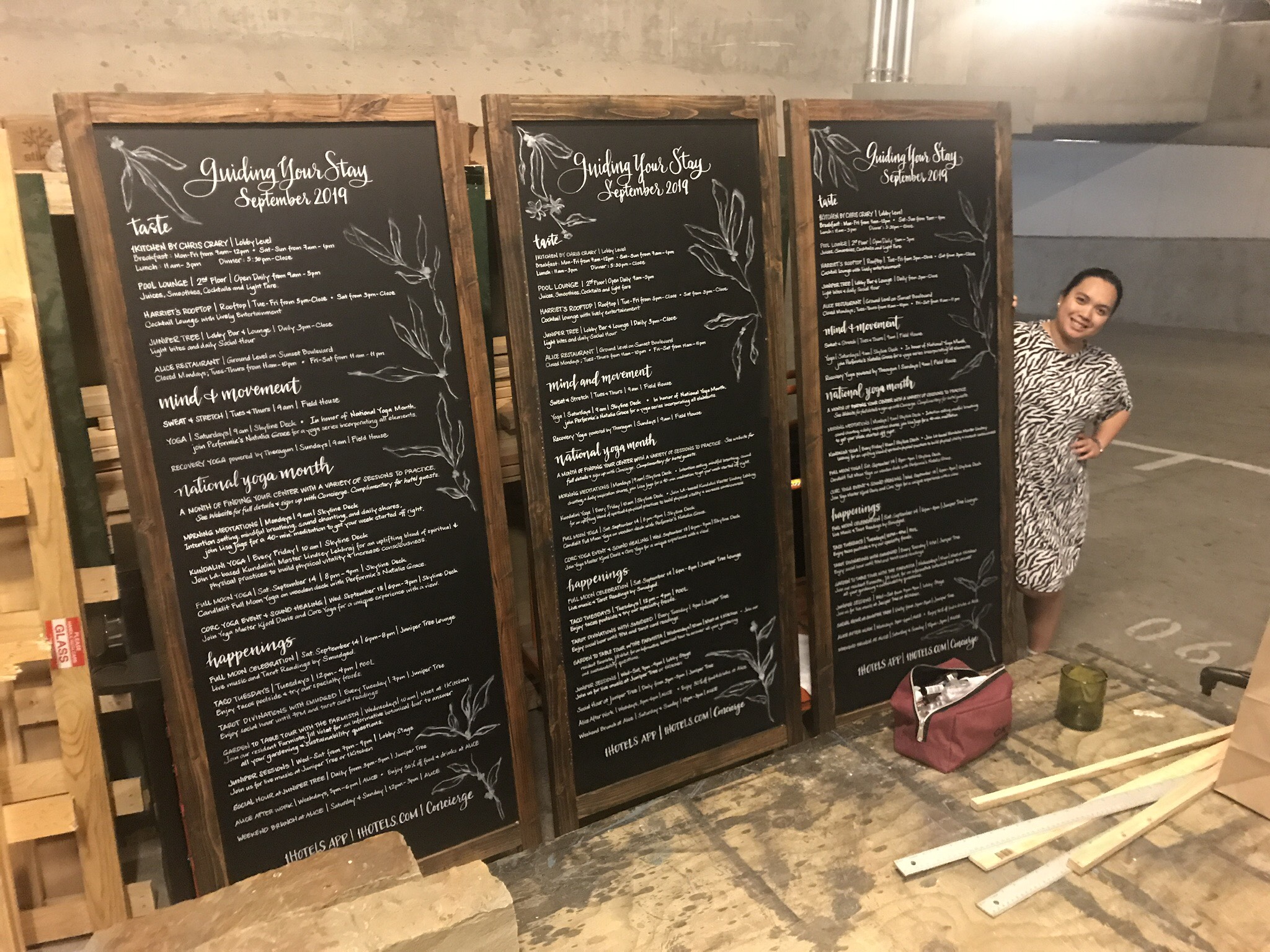
Centeno-Nguyen at a recent corporate event | Courtesy photo / Calligraphy Katrina

Calligraphy Katrina operates smoothly with a lean staff, according to Centeno-Nguyen. “I have a house manager who’s also my daughter’s nanny, an assistant, and a driver who does all our runs in the city. This is my assistant’s first week – my previous production manager who worked with me for two-and-a-half years moved on to her dream job as a social worker. She was the one who helped me build this company to where it is now. She was with me during a difficult time. I had a tough pregnancy and I was on bed rest for nine weeks. My daughter was born at 29 weeks; she was 2 ½ lbs. and was at the Huntington Hospital for two months.

“We were also in the middle of a move to this house. I worked while I was bed-ridden and, because it relaxed me, I didn’t realize I was in labor. My daughter was born by Caesarean section at 12:03 in the morning after 26 hours of labor. New York is open at 6:00 am our time and I was on the phone taking notes because we were doing a show. It was much later they found out I was in the hospital. But I wasn’t going to miss that call. Giving birth isn’t an excuse; as long as I am awake I can write.”

Centeno-Nguyen’s reputation as a reliable artist who can get the work done fast is the reason she has long-standing clients. She’s been working with LACMA for almost ten years now and Chanel for nine years. On the morning we met, a delivery from LACMA arrived; there were several boxes of Chanel envelopes in the dining room for her to work on.

Twelve years after Centeno-Nguyen bravely took the leap to establish Calligraphy Katrina, she is a mainstay not only in the luxury bridal market, she’s also sought after by corporate clients including museums, fashion houses, The Grammys, and movie companies, among others.

When queried about which projects she enjoyed most, Centeno-Nguyen replies, “The Chanel fashion show was a fantastic gig. We’ve done a few fashion shows like YSL and Moschino and they were really fun, but the Chanel was doubly so because we were in New York for a whole week preparing for it. We even saw the rehearsal; it was like seeing a production come to life. But the most memorable one will always be my first mirror.”

It’s a sentiment shared by most immigrants – no matter how successful they become and how far they’ve come, they look back with gratitude at where they started.
The Huntington Launches Yearlong Centennial Celebration

Originally published on 10 September 2019 in the Pasadena Independent, Arcadia Weekly, and Monrovia Weekly

The Huntington President Karen R. Lawrence, announces the name change during the Centennial Celebration launch | Photo by Ryan Miller / The Huntington Library, Art Museum, and Botanical Gardens

The Huntington in San Marino officially launched its yearlong centennial celebration on Thursday, September 5, 2019. During her welcome speech at Rothenberg Hall, Huntington President Karen R. Lawrence expressed how Henry E. Huntington’s vision and legacy will live on in the next century.

“As I look out at you, the leaders of Southern California’s, and particularly L.A.’s, cultural, academic, and civic institutions, Huntington’s presence is demonstrably in evidence,” began Lawrence. “As the Director of our Botanical Gardens Jim Folsom recently reminded me, almost anything can grow in Southern California. He was correct.

“We brought everybody here today to celebrate the extraordinary fertility and vitality of our region – both a U.S. cultural capital and, as Huntington predicted, the leading edge of the Pacific Rim. Had his visionary red car trolley system been equally as durable, many of you, especially the west-siders, would have an easier commute.”

Continued Lawrence, “So 1919 was a very good year for the birth of L.A. institutions – from UCLA to the L.A. Philharmonic, to the iconic Musso & Frank Grill and Fosselman’s Ice Cream. In celebrating our hundredth, it’s not all about us; it’s about all of us. Because neighbors and partners have always been crucial in the life of The Huntington. As we celebrate the trust agreement in which Henry and Arabella Huntington gave their private treasures – at the time the New York Times called the greatest private library in the world, art and art collection, and expansive gardens and grounds – we also recognize that we wouldn’t be here were it not for George Ellery Hale, the renowned astronomer, who helped develop Caltech and who was the founding director of the Mount Wilson Observatory in Pasadena.

“In the Huntington’s archives, we have Hale’s correspondence with Huntington which shows that from 1906 to 1916, Hale politely badgered Huntington to place his private collection in a trust for the use and benefit of the many. As significantly though, he helped convince Huntington, the wealthy industrialist and collector, to see the value of his collection in a different way – more for the research and scholarship it would inspire than for its accumulation. Hale urged Huntington to establish a public institution; he wrote ‘There is now great need of a strong institution of broad scope, uniting all the intellectual interests of this region and the common folks.’ When he was later asked about the worth of his collection, Huntington replied that its value will be determined primarily by what he produces. Although these two men couldn’t possibly foresee what was produced during those hundred years, it’s a testament to their legacy and Arabella’s, that The Huntington attracts 1,700 visiting scholars in addition to over 750,000 visitors from around the world.

“So today we take a moment to acknowledge this Southern California history as well as to think about our future and the ideas that will propel us all for the next hundred years. For a person turning 100, it’s very natural to look back and reflect on the past. For an institution turning a hundred, a centennial is a moment to be like Janus – looking back and forward at the same time. Today we’re celebrating how far we’ve come and reflect on where we want to go. We’re thinking carefully about our mission and what it means to be among the oldest cultural and intellectual centers in this great region, which itself reflects the dynamic demographic evolution of our city, state, and country. We want to broaden our audiences and to focus on The Huntington’s ongoing role in the cultural fabric of Southern California and beyond.”

Lawrence declared, “The name of an institution reflects its relation to its audiences as well as its mission and ethos. In 1919 we began our journey as the Henry E. Huntington Library and Art Gallery. And, over time, we became more commonly known as the Huntington Library, Art Collections, and Botanical Gardens. Today I am pleased to announce a change in what we’re calling ourselves, that reflects both the increased breadth and depth of our art collections and their public purpose. We’re changing our name to The Huntington Library, Art Museum, and Botanical Gardens.”

As Lawrence said this, the name displayed on the screen behind her also changed and was met with enthusiastic applause from the audience.

The change from ‘collections’ to ‘museum’ more accurately describes The Huntington’s mission and programs, explained Lawrence. “Our art collections are more than a group of catalogued objects; they are carefully curated, interpreted, and exhibited for scholarship, education, and the broader public. An added benefit to this change is that we become more discoverable, particularly in online searches. This is important as we work to widen our audiences and accessibility.”

The Hammer Museum’s Director, Anne Philbin, talks about ‘Made in L..A. 2020’ | Photo by Ryan Miller / The Huntington Library, Art Museum, and Botanical Gardens

The Centennial Celebration, a yearlong series of exhibitions, public programs, and new initiatives running from September 2019 to September 2020, kicked off with an announcement of a collaboration between The Huntington and the Hammer Museum on ‘Made in L.A. 2020,’ the upcoming edition of the Hammer’s acclaimed biennial. The statement was made by Hammer Director Ann Philbin alongside Lawrence.

Opening June 7 and running through Aug. 30, ‘Made in L.A. 2020’ will take place at both institutions, providing visitors across the region an opportunity to experience the singular exhibition of contemporary art in Los Angeles. The exhibition, sponsored by Bank of America, will debut new installations, videos, films, sculptures, performances, and paintings from Los Angeles–based artists, many commissioned specifically for the exhibition.

‘Made in L.A. 2020’ is the fifth iteration of the internationally lauded Hammer biennial, and the second to take place at multiple venues. The biennial’s inaugural 2012 edition presented artists at the Hammer, LAXART, the Los Angeles Municipal Art Gallery at Barnsdall Art Park, and the Venice Beach Biennial. The 2020 edition seizes on an opportunity to connect an institution on the west side of Los Angeles with one on the east. It is co-curated by Tunisian-French writer and curator Myriam Ben Salah and Los Angeles–based curator Lauren Mackler. The Hammer’s Ikechukwu Onyewuenyi is assistant curator for performance.

“We are thrilled to be partnering with The Huntington on ‘Made in L.A. 2020’ to bridge the east and west sides of Los Angeles to highlight the works of art created across the region, with an emphasis on emerging and under-recognized artists,” said Hammer Director Ann Philbin. “This expression of our biennial―which spans roughly 25 miles―offers opportunities for discovery and surprise for ‘Made in L.A.’ visitors and gives the curators and artists a new platform for experimentation.”

“Creative collaborations are a hallmark of our Centennial Celebration,” Lawrence disclosed. “We will be engaging with our collections as well as with our audiences in exciting new ways. Joining forces with the Hammer for this remarkable exhibition is a perfect example of what we are setting out to do. ‘Made in L.A.’ celebrates the extraordinary, groundbreaking work of contemporary artists working in Southern California. We are honored to be a part of this year’s exhibition.”

“Los Angeles is the epicenter of the creative economy, with the arts bringing Angelenos together, attracting tourism, generating cultural dialogue, and serving as an economic driver for our region,” declared Raul A. Anaya, Bank of America market president for greater Los Angeles. “It’s why Bank of America invests in the arts and in institutions like the Hammer and The Huntington, and this specific partnership for ‘Made in L.A. 2020’ reflects our mutual commitment to L.A.’s incredibly diverse local artists.”

During the run of ‘Made in L.A. 2020,’ members and visitors to the Hammer will receive passes granting free admission to The Huntington to view ‘Made in L.A. 2020’ in full. There will also be joint programming at both the Hammer and The Huntington during the exhibition.

Looking ahead to the next 100 years, the directors of The Huntington’s three components – Library, Museum, and Botanical Gardens – spoke about the future and how The Huntington’s collections will contribute to their fields.

Sandra Luding Brooke, Avery Director or the Library speaks during The Huntington Library, Art Museum and Botanical Gardens Centennial Celebration Launch Event on Sept. 5, 2019, in San Marino, California | Photo by Ryan Miller / Capture Imaging

As the Avery Director of the Library, Sandra Luding Brooke oversees the 11 million items in the library collection. She said, “In 1925 Henry Huntington endorsed a vision for a repository of books and manuscripts of the greatest rarity and value focused on tracing the progress of our English-speaking people. Since then The Huntington’s collection has grown and persisted in more ways than what could have been imagined a century ago.

“Libraries must anticipate tomorrow and try to imagine what future researchers and viewers might want or need to know,” pronounced Brooke. “We must be judicious and imaginative in choosing what we preserve, and be fearless in seeking diverse and provocative voices. Libraries must batten their hatches to protect collections from the vicissitudes that are sure to come – natural disasters, social and economic upheavals, censorship, ignorance, and willful misapprehension. We also want to seize this moment and help our collections speak to current generations because cultivating a love and respect for documented history is the surest route to its survival and, perhaps, our own. So in the spirit of stepping out with optimism into our second century, the Library has made a small acquisition that won’t get on our shelves until just four years shy of The Huntington’s bicentennial. Until then the library’s purchase will be growing in the Norwegian wood. Artist Katie Patterson’s future library is a hundred-year literary artwork of an active indefatigable optimism. Five years ago, Patterson planted a forest of a thousand spruce trees in Norway. This forest will be held in trust until the year 2114 when the trees will be harvested, turned into paper, and provide the stock for the publication of 100 texts, until then held secret, by 100 writers. This little acquisition is a vote of confidence in the future of the environment, of art, of books and the written word, and of libraries. Yes, we are confident our librarian’s successors will not fail to claim The Huntington’s copy of this long-awaited anthology. But between now and 2114, we are equally confident that millions of other texts, images, and objects undiscovered and, as yet, uncurated will cross The Huntington’s threshold to join this great past, present, and future library.”

Christina Nielsen, Hannah and Russell Kully Director of the Art Museum | Photo by Ryan Miller / The Huntington Library, Art Museum, and Botanical Gardens

Christina Nielsen who, when she took the podium and introduced herself, said that for the past 10 minutes, she has been the director of The Huntington’s Art Museum. She started, “Now that we’re a museum I’d like to spend the next few minute considering what that term means. What it meant to Arabella and Henry, what it means today, and what it will likely mean in the future. Henry Huntington, entrepreneur and futurist, proponent of new technologies; Arabella Huntington, perhaps the greatest gilded-age collector you’ve never heard of – together they stand out among the likes of their peers such as Walters, Morgans, Fricks, and Gardners by bringing together objects from the past to actively shape a future. They founded the first Old Master Collection in Los Angeles which included Asian ceramics, Italian Renaissance pieces, French decorative arts, and British portraits from the 18th century, which allowed for connections across time and place. And they put their historic works in conversation with art from their day by placing sculpture on the grounds from artists of their time, including their daughter-in-law Anna Hyatt Huntington. They also gave us a framework for considering how to move forward, encouraging us to continue making connections across time and place, to invest in new technologies, and to share their collection with the public.

“So now the present moment. And might I suggest that, in many ways, the future is now and the future is here. The definition of ‘museum’ is quickly changing, as is the nature of our work. The International Council of Museums just released a new definition of museum as a ‘democratizing, inclusive, and polyphonic space for critical dialogue about the pasts and the futures.’”

“Our collection is indeed a treasure trove to be mined for thinking about making connections across time and place, how trade and exchange shaped objects, lives, and intellectual pursuits,” noted Nielsen. “But which stories do we choose to tell and who tells them? Recent partnerships here at Huntington, such as one with the Vincent Price Art Museum, allowed Carolina Caycedo, one of the great artists in the L.A. area, to produce a new work of art Apariciones/Apparitions which inserts back into the history of our founding narrative people and labor who’ve been lost over time.

“More specifically, ‘Blue Boy,’ our most iconic work, has continued to inspire over time, artists, much more recent than when he arrived in 1921. A young artist on leave from military duty in San Diego came to the Huntington and had an epiphany from the ‘Blue Boy.’ So did a young teenager who would come on visits to The Huntington on Saturday. And so we’re thinking very deeply about how to unlock more epiphanies from our people, in our galleries, and through expanded online resources. How do we share our collections beyond our walls? How do we reach other aspiring artists from South Los Angeles, San Diego, and from other places really far away – like Kansas City, Kosovo, or Kyoto. So in the context of The Huntington itself, what does our art collection mean? This is a multi-disciplinary institution and as the definition of art keeps changing and evolving, I was reminded recently by Jim Folsom that The Huntington itself is the original conceptual work of art.”

Nielsen said further, “This is the hotbed of the artistic world and we are so pleased to be working with the Hammer on ‘Made in L.A.,’ exemplifying what an extraordinary moment this is for our region. But I might suggest that ‘Made in L.A. 2020’ has a really important antecedent and that could be considered ‘Made in London 1770,’ because going back to Gainsborough and his fabulous ‘Blue Boy’ painting, what we’ve recently learned is that in fact Gainsborough, hundreds of years ago, just like the artists in our midst today, was absolutely pushing the envelope of what it meant to be a painter and what the medium could provide. And so I would say it makes absolute sense for us at The Huntington to be working with The Hammer and offering up our resources for artists, writers, performers, dancers, thinkers, in our midst.

“The past is not dead. In fact, as Socrates said, ‘It isn’t even past.’ It’s alive and waiting to be unlocked in the objects in our collection. I can’t begin to predict now how successors of ours a hundred years from now will do that, any more than Henry and Arabella could have predicted us sending rockets to the moon. But they believed in technology; they believed in sharing their collection to the public; and they believed in connections across time and space. I feel that if we hold true to these principles, we will be just fine over the course of the next hundred years. And, in closing, I offer another definition for our museum – that it should be not just a repository of things, but a collection of ideas and a place for sharing them with others.”

James Folsom, Telleen/Jorgensen Director of the Botanical Gardens speaks during The Huntington Library, Art Museum and Botanical Gardens Centennial Celebration Launch Event on Sept. 5, 2019, in San Marino, California | Photo by Ryan Miller / Capture Imaging

When it was his turn to speak, Director of Botanical Gardens James Folsom, who noted that he’s the old-timer at The Huntington, stated, “Last year we planted several hundred trees and we intend to plant more this year. We plant trees because during a storm in 2011, 700 trees fell in one evening. We plant because new opportunities arise – wonderful new trees become available. We plant trees because they provide structure to the landscape, which takes years to develop. We plant trees because on the 6th of July last year, the gardens experienced a record-high temperature of 118 degrees Fahrenheit leaving vegetation scorched throughout the landscape.

“We plant trees because that’s what gardeners do – observe, think, plant, cultivate, take our losses, make our moves, plan for change, and invest in energy and resources to create something that would be of worth for future generations. So what is that future, how far is that horizon? For trees, it’s 80 to 100 years – easily to the end of the century. But in all of our actions, even short-term plantings, we should build soil and capacity. Every act can be viewed as an investment. Gardens also plant ideas and inspiration – the beauty and power of life unfolding, the importance of cycles, the value in the glorious smell of fresh water and arable soil. The pay-off in planting is seeing the product of pure physical toil and recognizing the importance of plants as the givers of life and the bases of biodiversity.

“To me, the lessons we learn from gardening are crucial. In a perfect future, I imagine these Huntington gardens and the act of gardening will help form a better world. Fortunately, the structure we need for those lessons exists. The Huntington has collections, displays, beautiful facilities, and staff to see us to our second centennial.”

San Gabriel Valley Teens Receive ‘Youth of the Year’ Award

Originally published on 6 August 2019 in the Pasadena Independent, Arcadia Weekly, and Monrovia Weekly

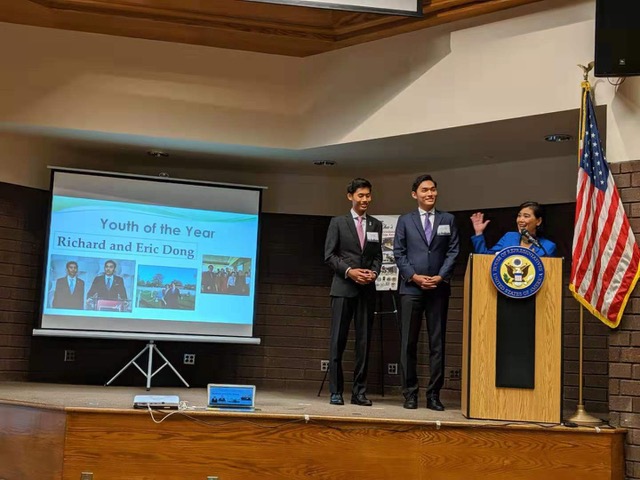
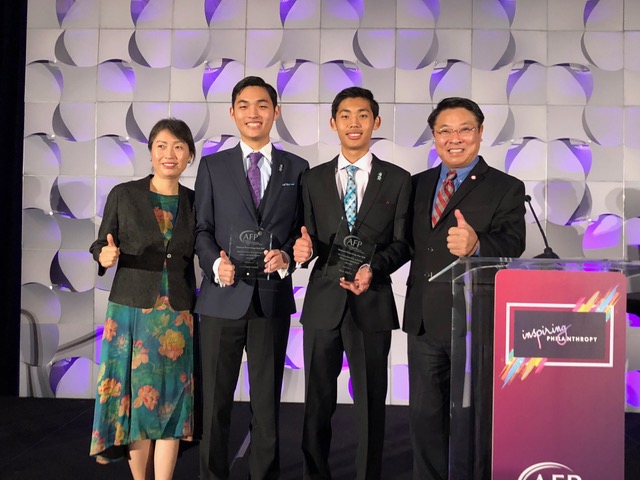
Shown left to right: Eric and Richard Dong with Congresswoman Judy Chu | Courtesy Photo

Arcadia teens Richard and Eric Dong were honored with the ‘Youth of the Year’ distinction during Congresswoman Judy Chu’s 10th Annual Leadership Award ceremonies held last Sunday, July 28, from noon to 3 pm at the Arcadia Community Center. Awards were also given for Businessperson, Educator, and Volunteer of the Year, among others.

Richard graduated this past spring from San Marino High School (SMHS) and will be attending New York University this fall, while Eric is a rising senior at SMHS. The brothers are active volunteers and philanthropists, spending hours doing service at various community organizations and schools while endowing the same places with funds to support their mission.

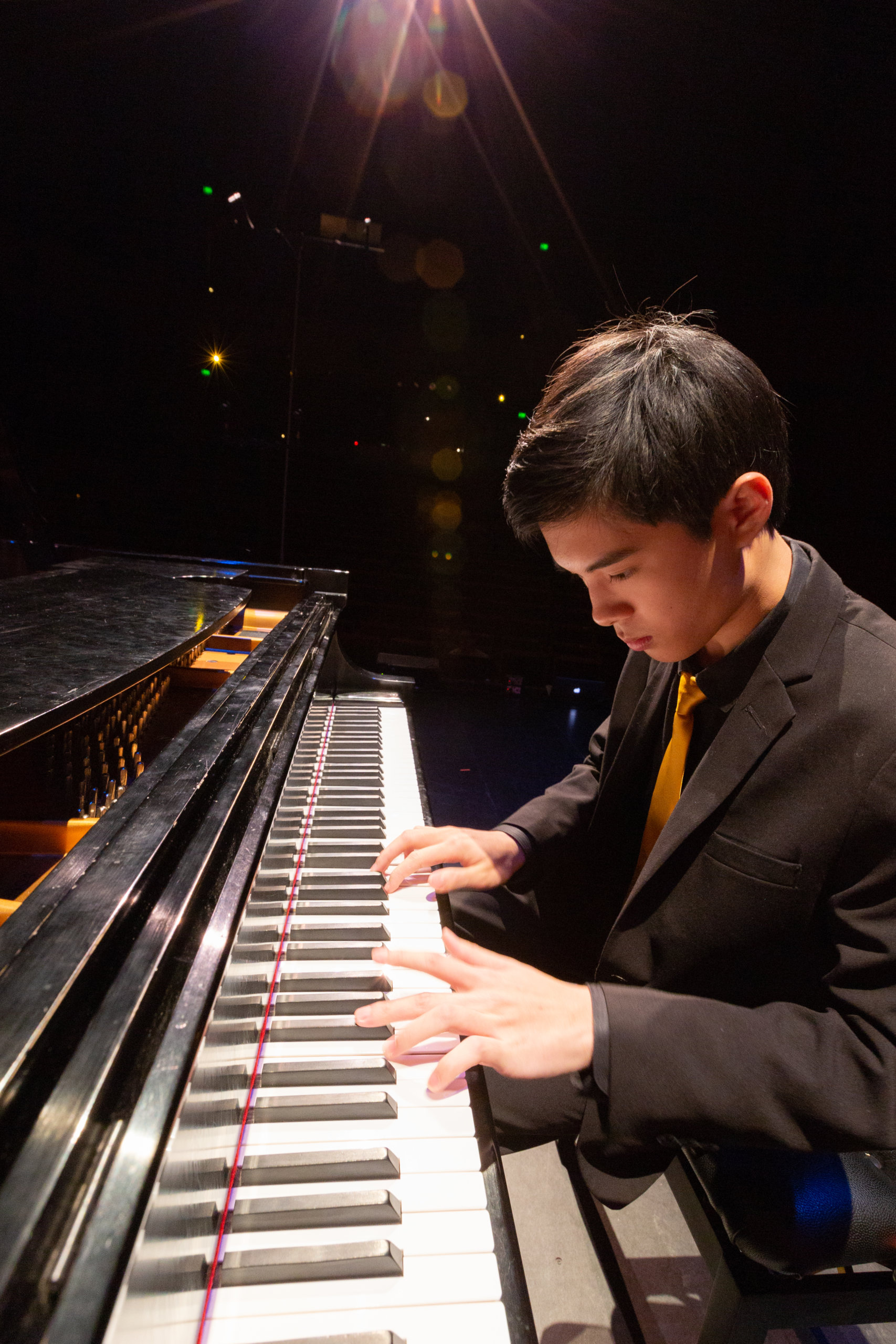
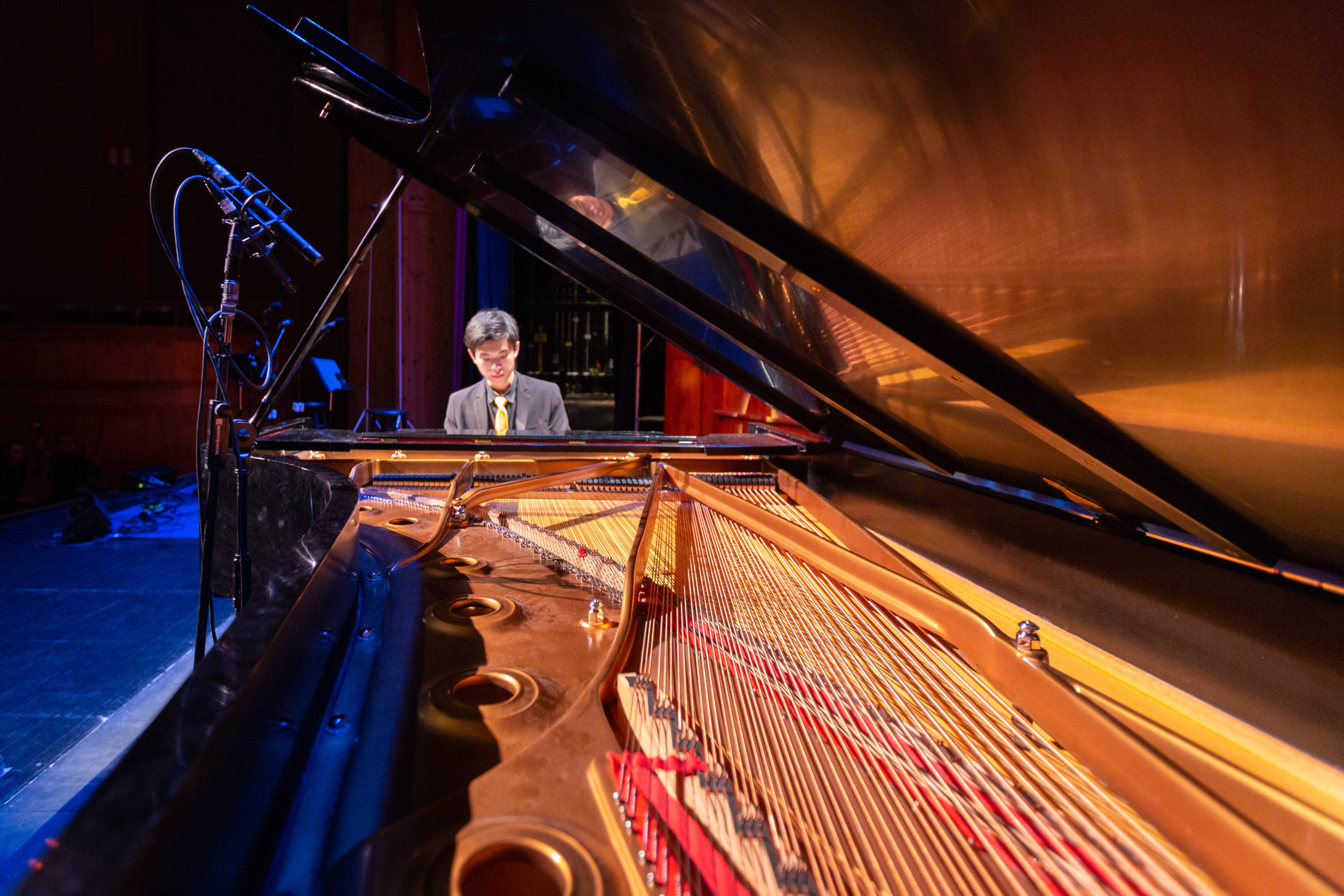
Children of Chinese immigrants, Richard and Eric were instilled with the importance of contributing to society during their earliest years growing up in San Gabriel Valley. Both of them are gifted piano players and they happily share their passion for music. They perform at schools, chapels, central libraries, senior citizen and homeless centers, and for the public at Walt Disney Concert Hall in Los Angeles and Carnegie Hall in New York.

From their father, Richard and Eric learned the intricacies of the stock market that made them savvy investors. Using the financial gains from their investments, they established their first  endowment to their middle school (Clairbourn) in 2014 to provide scholarships for students in music and the arts. Heartened by its positive outcome, they continued to give more – to San Marino High School to fund school supplies and to the International Leadership Foundation (ILF) to support leadership training, US-China relations, human rights, and global democracy and governance initiatives in 2017. And, in 2018, they founded the Richard and Eric Dong Endowment Fund for Union Station to provide scholarships for children.

Additionally, Richard and Eric were recipients of the President’s Volunteer Service Award at Gold level, Congressional Award for Bronze and Silver Medal, and the 2018 Outstanding Young Philanthropist Award given by the Association of Fundraising Professionals.

In their acceptance speech at the awards ceremony, Richard and Eric acknowledged Congresswoman Chu for her continued encouragement and thanked Ivy Sun, honorary chairperson of ILF’s L.A. Chapter and former mayor of San Marino Richard Sun. They also expressed their deep gratitude to Anne Miskey, CEO of Union Station Homeless Services in Pasadena, for nominating them.

As always, the Dong brothers attributed Robert F. Kennedy’s words ‘Our future is not a gift, it is an achievement’ as their inspiration and for empowering them to do good work. Young people  in San Gabriel Valley would do well to emulate Richard’s and Eric’s exemplary undertakings.

Local Milliner Creates Spectacular Bespoke Hats

Originally published on 31 May 2019 in the Pasadena Independent, Arcadia Weekly, and Monrovia Weekly

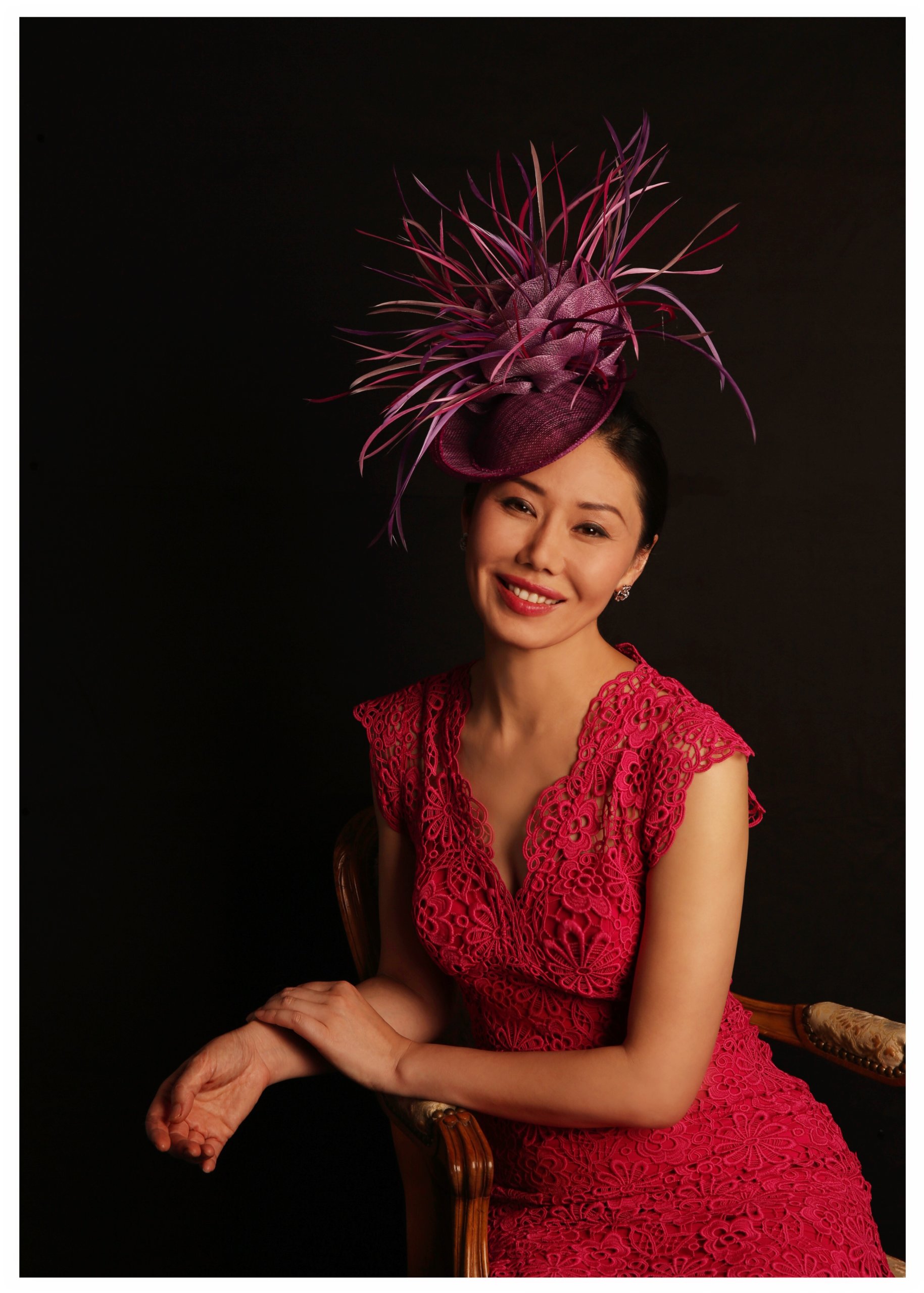
Li wearing one of her bespoke fascinators | Courtesy photo / Handmade by Cissy Li

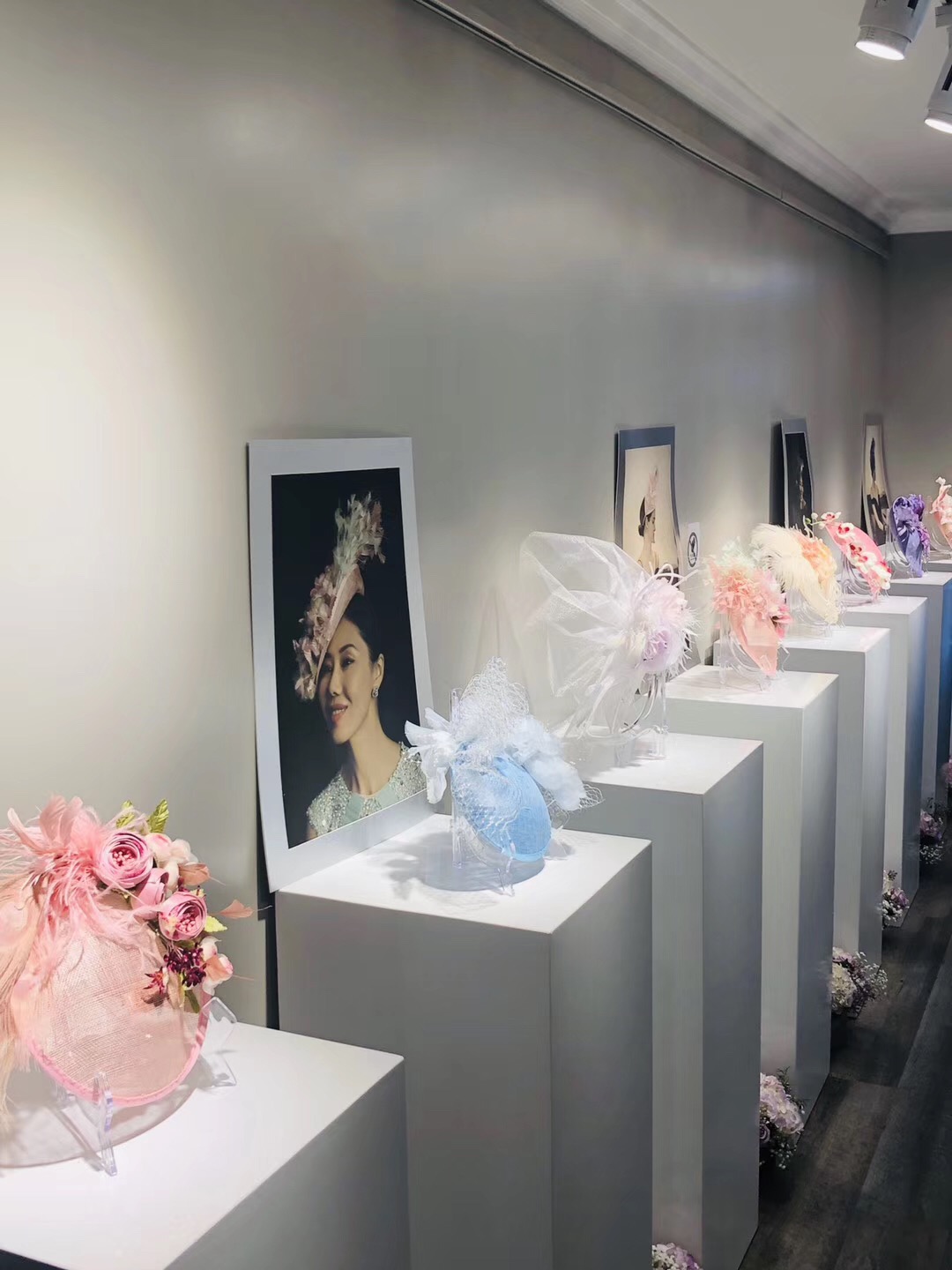
Americans, as a rule, don’t typically wear hats the way they do sunglasses as a fashion accessory. However, if it were up to Cissy Li, all ladies would be wearing hats wherever they go, most especially to weddings and other stylish events. To advance her lifestyle philosophy, she started creating headwear in 2006 from her Pasadena home for close friends. And, recently, she displayed her collection called ‘Handmade by Cissy Li’ at an exhibition held at Joann’s Fine Arts Ai+ Gallery on Mentor Avenue.

The path that led Li from Suzhou as a child growing up, to Milan as an haute couture model and, finally, to Pasadena as an artisanal milliner, is paved with extraordinarily good fortune.

“I’ve always loved design, fashion accessories, and modeling, ” Li proclaims. I double-majored in Fashion Design and Modeling at Suzhou University near Shanghai. After graduation, I moved to Beijing where I worked for two years at the government-owned modeling company in exchange for my free education. Knowing that modeling as a career usually has a short span – because agencies are always looking for 14- to 16-year-olds – in 1997, I went to the Lutzelau School in Switzerland and took a Hotel Management course to have a back-up plan. It’s now called Swiss IM&H (Swiss Institute for Management and Hospitality).”

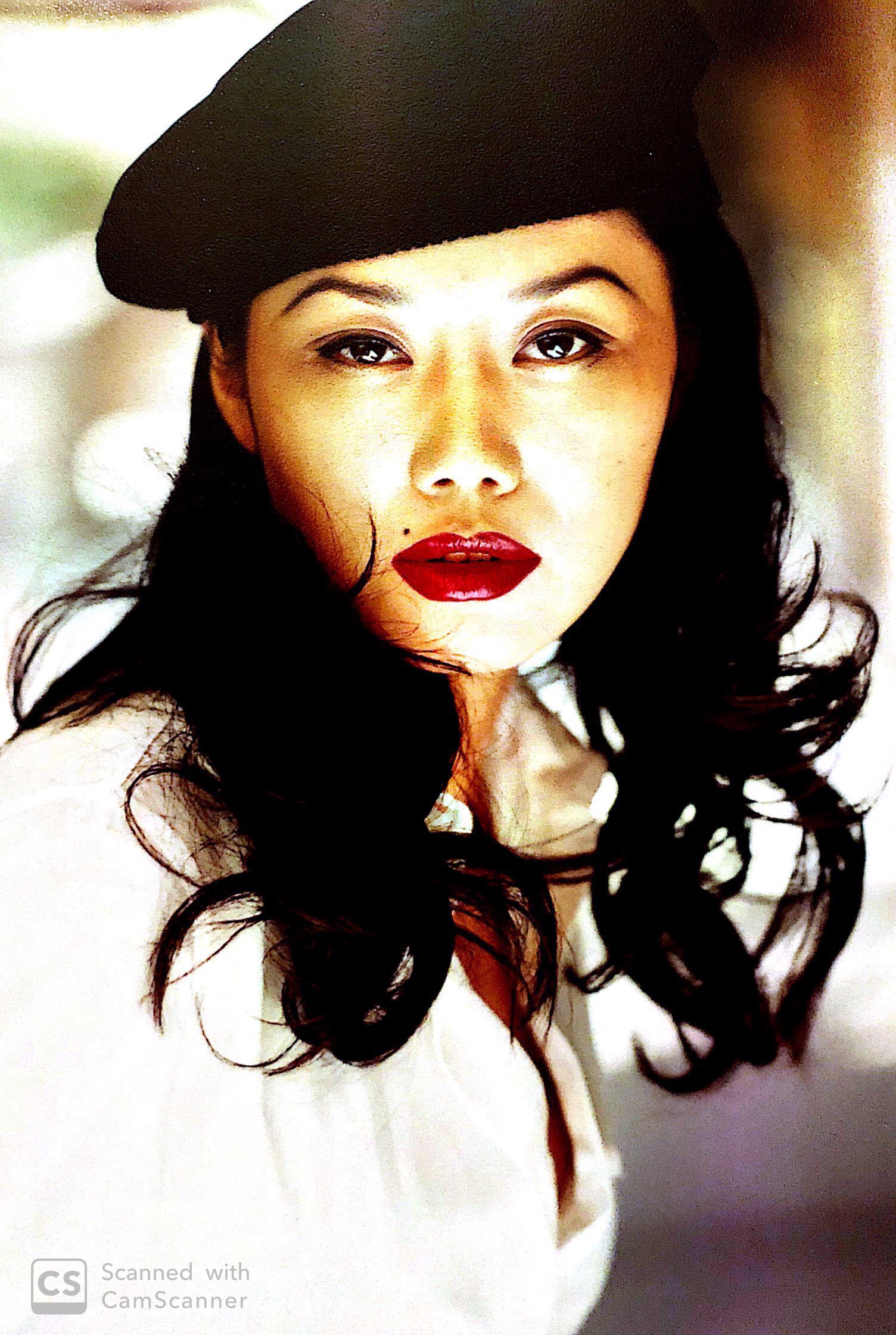
Li as a runway model in Milan | Courtesy photo / Handmade by Cissy Li

“Fortuitously, I went to New York in 2000 for a modeling pageant and earned the top award for Best Runway Model,” discloses Li. “The prize was a contract with an agency in Milan called ‘Zoom.’ In the same year, I won the Universal Asian Supermodel pageant in Las Vegas and was selected one of the Top Five Models. As a professional runway model working in Milan, I was lucky enough to wear the clothes and accessories of French and Italian designers, including Ferre, Nina Ricci, and Valentino. And my love for hats was only reinforced. When you wear one, you can’t lower your head because it’s going to fall. That compels you to stand erect and maintain good posture – so hats make you look very elegant.”

“I considered quitting by 2003 because I thought I was too old for the profession. So I moved to the U.S. and taught at the Barbizon Modeling School in Las Vegas. We entered a competition in New York but one of the students dropped out. Consequently, my boss told me I had to be my student’s replacement because she had already paid the registration fee. I protested saying, ‘I’m 26! I’m too old to compete.’ She retorted with, ‘You’re Asian, they won’t be able to tell your age.’ So I went to New York and won! The prize was another contract to go to Italy. And I thought, I had just left Italy and now I’m being sent back there,” Li recalls with a laugh.

“I did one show to fulfill the contract but I couldn’t continue doing it,” says Li. “In this business you sign one contract with one agent and if they refer you to another you get double charged, so you don’t really make any money. The cost of living in Italy is high – renting an apartment and feeding yourself cost a lot. And then you have to pay the agency on top of that. Besides, I wanted to focus on a different career, so I came back to the U.S. I was working for Bellagio Hotel in Las Vegas as the Assistant Manager for Channel’s Fine Jewelry in 2005, when I met my future husband who’s from Pasadena. So I moved here and it was then I began making hats.”

Li’s interest in various crafts includes decoupage. She walks over to a side table, picks up a tray, and explains, “I created this with marble and gold leaf and it can be used for tea cups or as an Asian cheese board. It took three weeks to finish because the process involves layering the resin which needs to dry between applications. Additionally, there are several factors that affect it, like the weather and temperature. It has to be 70 degrees for the resin to adhere and, as you know, we had a long winter this year. For instance, these coasters took three months to complete. Taking all those into account, the pieces become too costly that I wouldn’t be able to sell them at a reasonable enough price for people to buy them so I give them to close friends as gifts. Handmade pieces are never perfect but these imperfections are what make them valuable. They’re evidence of being one-of-a-kind, and not commercially- or machine-made.”

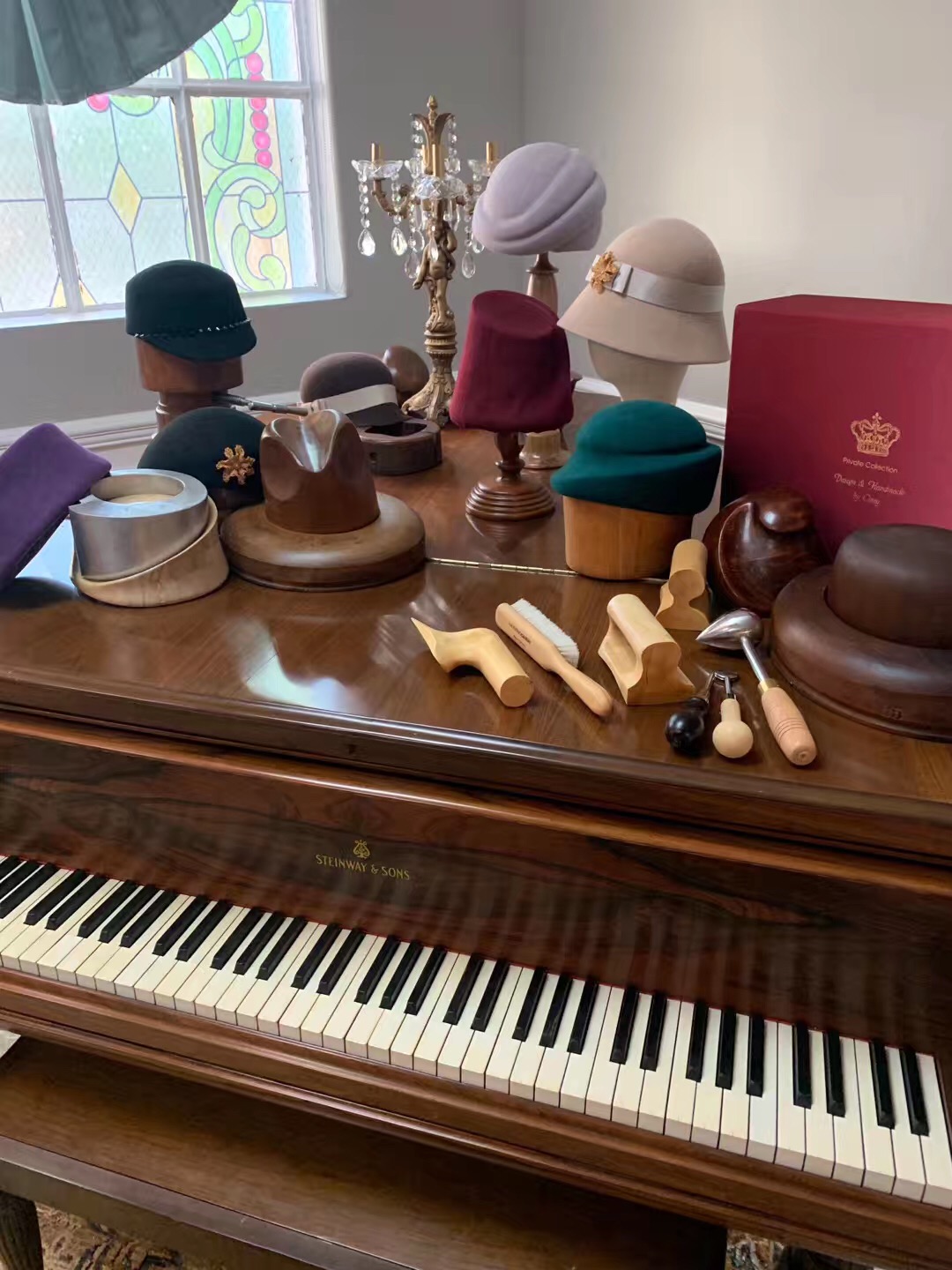
The tools of Li’s trade | Courtesy photo / Handmade by Cissy Li

“I love art. Besides my kids, art is my passion,” Li emphasizes. “I draw, paint, and design. And, of course, I have my hat projects. But you couldn’t do that full time when you have little kids at home. Now that they’re older, I can do a little bit more. I always say you have to choose a job you like so it doesn’t become a chore. I get up at 6:45 or 7:00 to get my children ready for the day, drop them off at school, and then I work in my studio. I pick them up from school, help them with homework, finish dinner, then I go back to my studio. Sometimes I’m here late at night or until the early morning hours. I get only four or five hours of sleep but I don’t feel tired because I love it and I don’t regret putting in that many hours working on my hats. Look at my fingers – they look dirty because the materials I use, like beaver hair, require a lot of steaming, stretching, pressing, and pushing onto the felt. After four hours, I literally cannot lift my arms. I do it because it’s my passion; if it were only for the money, I’d stop after eight hours. But I put in 12 hours at a stretch working on one single hat.”

“Sorting the materials for making the hats is also time-consuming,” adds Li. “I get shipments from England, Ukraine, Russia, and the Czech Republic. Vendors send me pictures of the items but when they get here, the colors are different from what are in the photos. I’m very visual; I  can see the various hues. I’m also good with size and proportions so I have to sort and organize all the materials to make sure I put them together correctly. With items like flowers or feathers, you really need to source reliable vendors – I find them through friends’ introductions while some are very old and well-known houses, so I’m confident about their products. It’s also important to see them for yourself because you can’t tell their quality through photos. I travel to Europe every summer for two months and I visit my vendors between family holidays.”

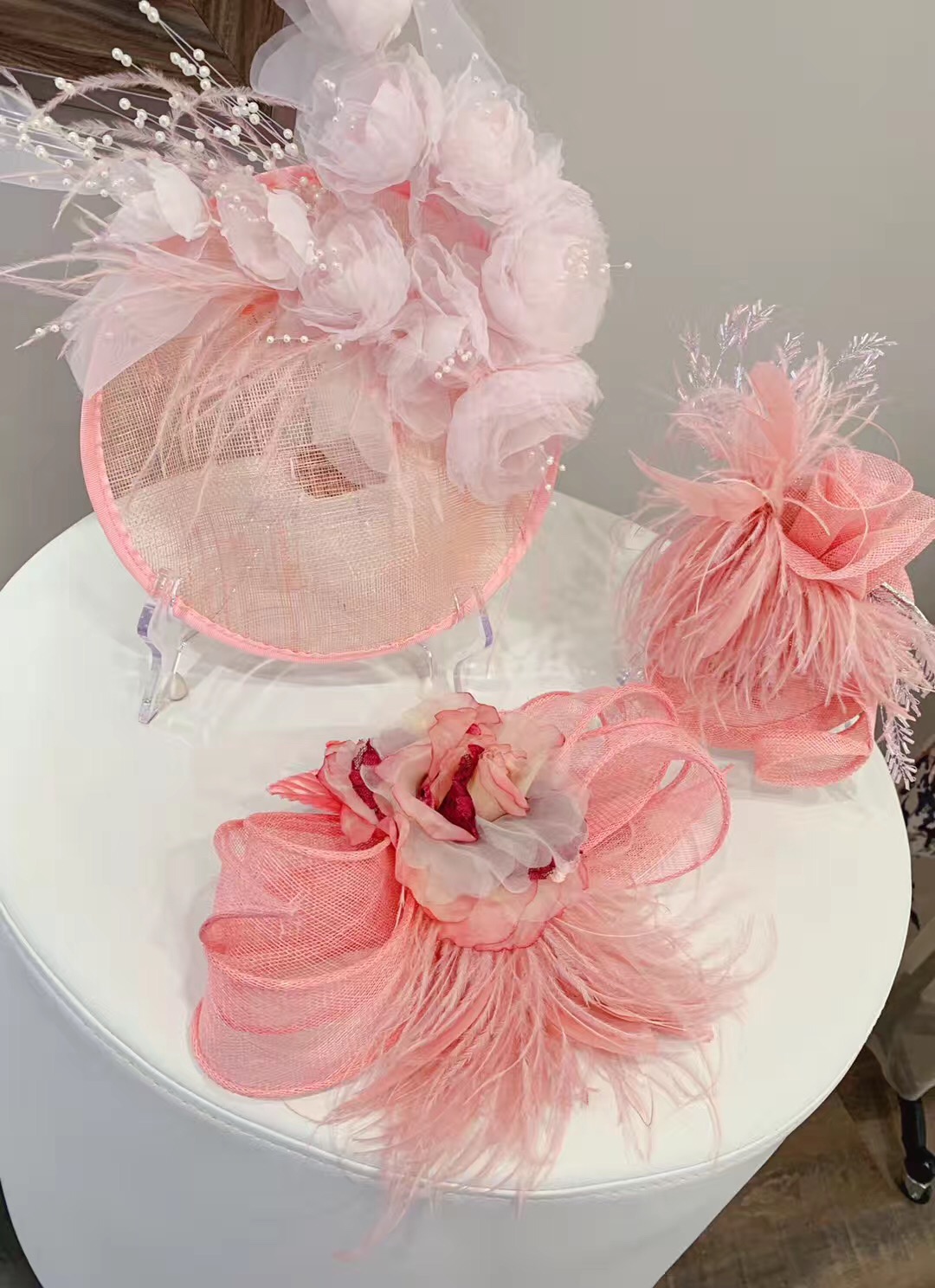
Pretty in Pink | Courtesy photo / Handmade by Cissy Li

Li specializes in fascinators, which aren’t really hats but fashionable headdresses that Prince William’s wife Catherine, otherwise known as the Duchess of Cambridge, made extremely popular.

“Each fascinator takes me anywhere from two to three weeks to complete because I want to find the precise color,” Li expounds. “I’m not very particular with a lot of things in my life, I’m pretty easy-going, but I am exacting in my work. There was one peacock fascinator I worked on which took a month to finish and, in the process, I learned that peacocks have green or blue shoulders. Some of the feathers that arrived had green reflections, some had reddish blue, so when I put them together they looked like Chinese fried rice. I had to order from different vendors to get the specific shades and then match them correctly. One client bought it, but instead of wearing it on her head, she has it hanging on her wall along with other paintings – she treats it like a piece of art. Knowing that clients appreciate the outcome makes this work gratifying.”

Working tirelessly for several months, Li was able to create over 100 handmade hats for an event she fittingly called ‘An Affair to Remember.’

Li’s fascinators on display at ‘An Affair to Remember’ | Courtesy photo / Handmade by Cissy Li

“The show was meant as an exhibition and not as a sales event,” clarifies Li. “I wanted to give all my guests the chance to look at the hats and try them on. If someone were to buy a piece, then no one would be able to see it. However, a couple of  guests really wanted to buy the hats and they waited until after the end of the show to take the items. A friend and loyal customer from Newport Beach had planned on coming to the exhibition but wasn’t able to make it because she twisted her knee a few days before. When I posted pictures of the hats for the event, she called me to tell me which one she wanted to buy.

“My clients are usually people I already know. I haven’t really gone commercial because I have no time. I’m one person and I can’t do the marketing and production all at once. Hats are also a very individual thing so I don’t mass-produce. I do it the traditional way – with custom sizing, fitting, and so forth. I’m leaving in mid-June for my annual trip to Europe but I’m hoping to start a website when I come back, not to sell the products but to showcase the hats so people who want to buy them can contact me. It’s also tough to do an online business; the laws protect customers and not the sellers. Our hats are shipped in beautiful hard boxes but when customers decide to return them, they come back in such bad shape and you feel awful about the merchandise. People looking for a bespoke hat can come to my studio, select all the components, and get instructions on how to wear the hats. It’s really about mutual respect.”

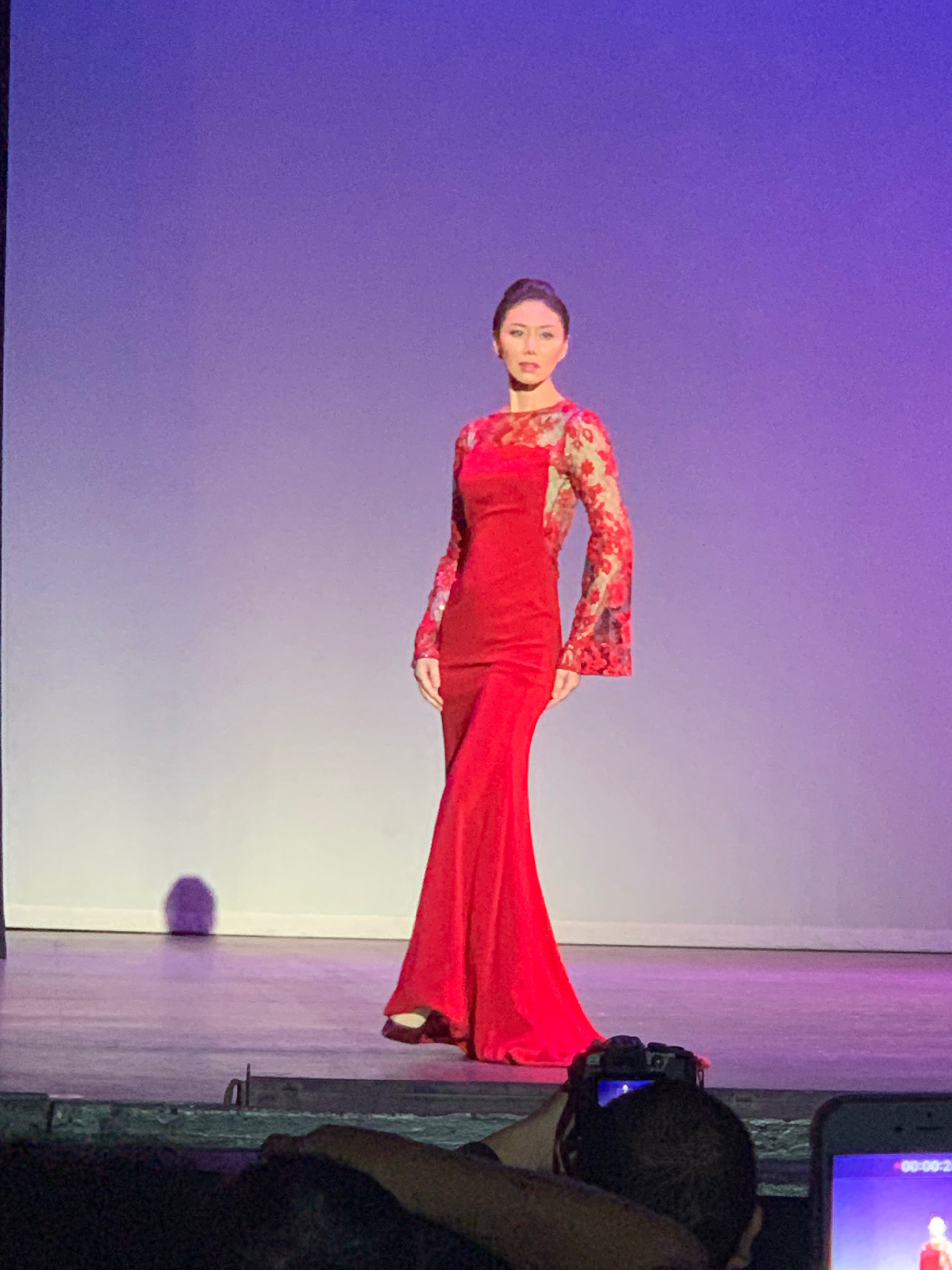
Li modeling a designer gown at the Asian Pacific American Festival held this past weekend | Courtesy photo / Handmade by Cissy Li

As an aficionado, Li is convinced that no one carries off wearing hats with more aplomb than the English. And where does one find an abundance of hats in all their splendor but at The Royal Ascot. It’s also the perfect place to get ideas for her hats, so she makes it a point to go to the opening of the renowned horse races in June. It’s both a work and fun excursion because she takes her children with her and they’re usually there for the Royal Procession when the Queen is in attendance.

On one particular occasion, her daughter, Claire, was so entranced by Queen Elizabeth’s headwear. Having been around her mom as she fashioned spectacular hats for clients, Claire confidently declared that Li would one day be the first Chinese-American milliner to create a bespoke piece for the Queen. Any other mom would brush off that endorsement as merely child’s fancy, but Li took that to heart. For several months now, she’s been in contact with some people connected with The Royal Ascot to figure out how to make it possible. However, she’s also cognizant that there are so many hoops to go through.

“The Queen approves only one brand of hats and clothing for The Royal Ascot,” Li states. “Selling there is also complicated because of taxation laws and import regulations. I have to consider all the things that could possibly go wrong. Can you imagine if we got stopped at the airport as we’re leaving because I didn’t take care of every legality? What would have been such a happy trip would end up something I’d deeply regret.”

Whether Li succeeds in getting her hats worn by the Queen and the smart crowd attending The Royal Ascot or not, nothing can hinder her from creating headwear for ladies here. We don’t have to be royals to wear her spectacular fascinators. But donning her meticulously fashioned hats will certainly make us feel like princesses.

Arcadia’s Maki Hsieh is Honored 22nd District’s ‘Woman of the Year’

Originally published on 12 March 2019 in the Pasadena Independent, Arcadia Weekly, and Monrovia Weekly

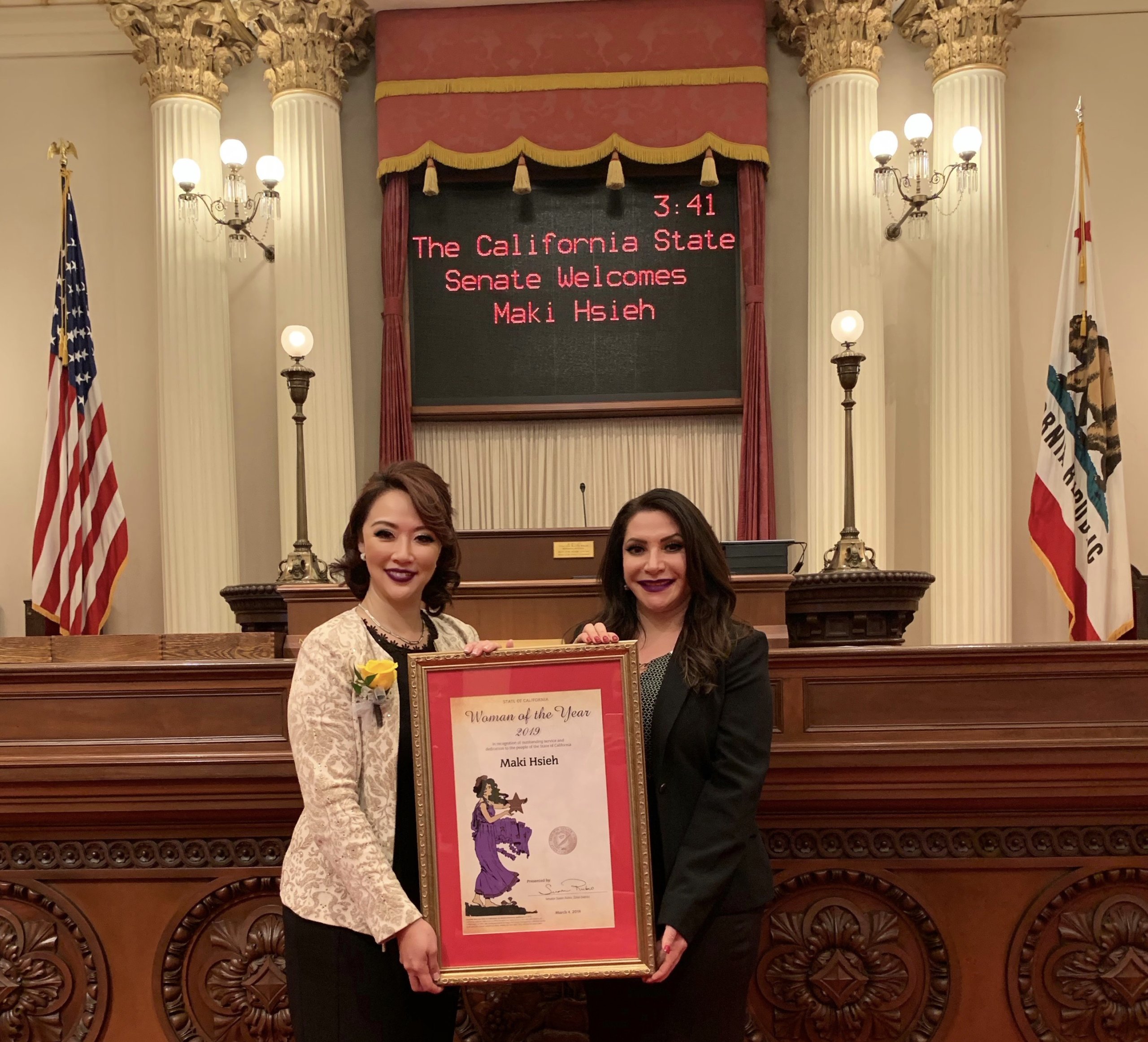
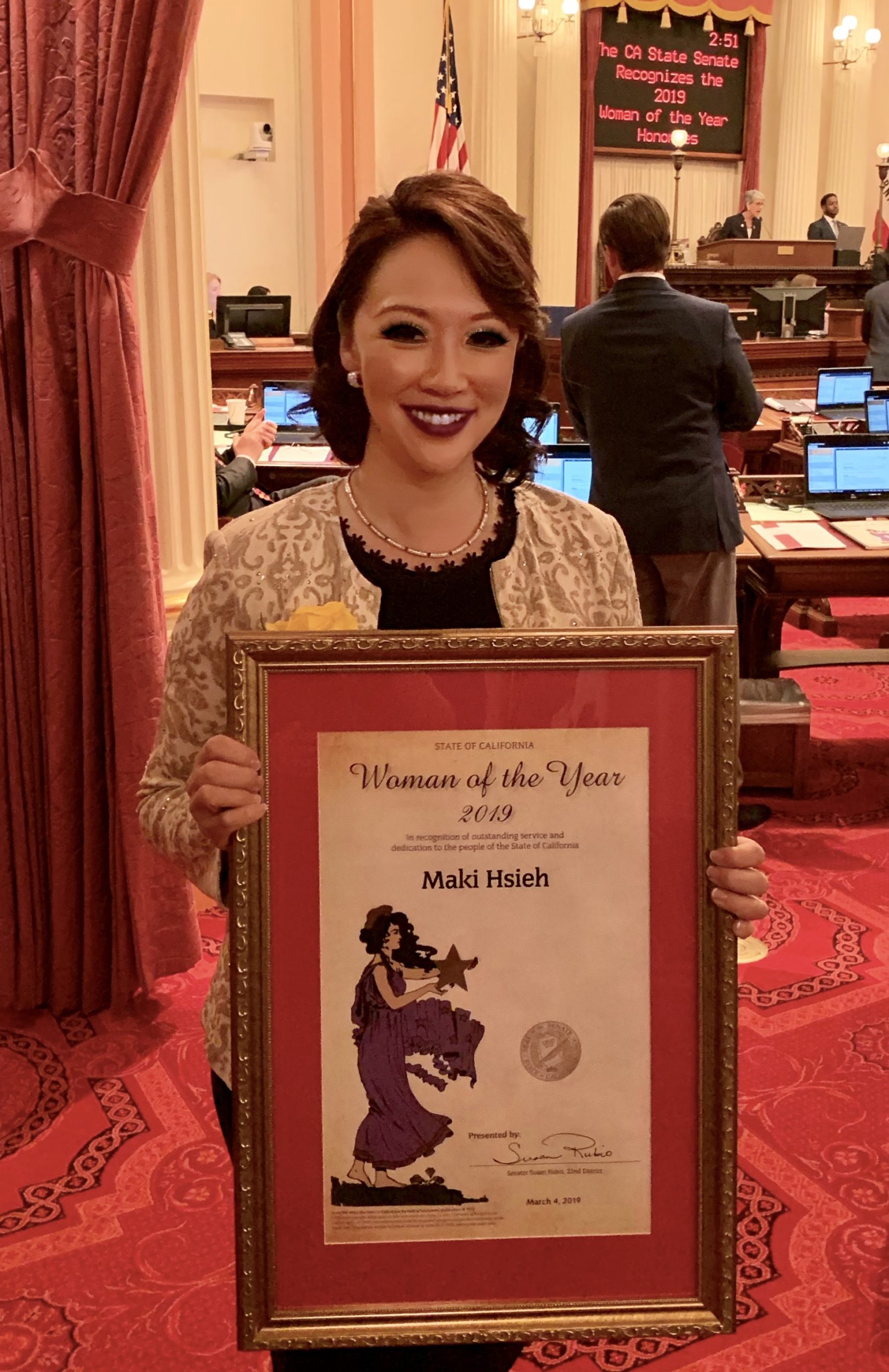
Maki Hsieh (left) being honored by Senator Susan Rubio (right) | Courtesy photo / Arcadia Performing Arts Foundation

On March 4, Maki Hsieh, Arcadia Performing Arts Foundation Executive Director, was honored as the 2019 Woman of the Year by Senator Susan Rubio of the 22nd district. Since 1987, the California Legislative Women’s Caucus has awarded women in each State and Assembly district this recognition at a ceremony held at the California State Senate Chamber at the state capitol.

The day after the event, Hsieh is still in disbelief at the unexpected accolade. I’m sitting at her dining table to chat about the award, how she was chosen, and what it means to her.

“I didn’t know this was coming and I was caught completely by surprise!” Hsieh declares. “I spearheaded Arcadia’s first formal Chinese New Year’s festival in January. This was the first time the city sponsored it, and the foundation organized and helped promote it. Because it was a special event, elected public officials attended it and gave certificates.

“One of the officials was Senator Susan Rubio, who was a teacher at Monrovia for 17 years. She was really impressed by how hard the Foundation works for arts education and arts excellence in school. When it came time for her to honor her first ‘Woman of the Year,’ she and her staff went through a whole vetting process. She has a million people in her district and they looked at a lot of candidates. And my name came up.”

Continues Hsieh, “ Her team contacted me from Sacramento and asked me for my biography but  I really didn’t have one. The last time I wrote something about myself was for a press release that went out in 2017 when I was appointed Executive Director for the Foundation. So I dug up the press release from our website, downloaded the PDF, and sent it to them. When I asked what it was for, they said ‘We’re looking at ways to increase our arts outreach to the community so we wanted to learn more about you.’

“Then in February, her office kept trying to schedule time on my calendar. And every time they requested to reserve an appointment with me, they said ‘The senator would like to speak with you for a few minutes to tell you about the award.’ All along I thought it was about arts outreach. But, again, other things took precedence, like fundraising and dealing with a lot of issues.

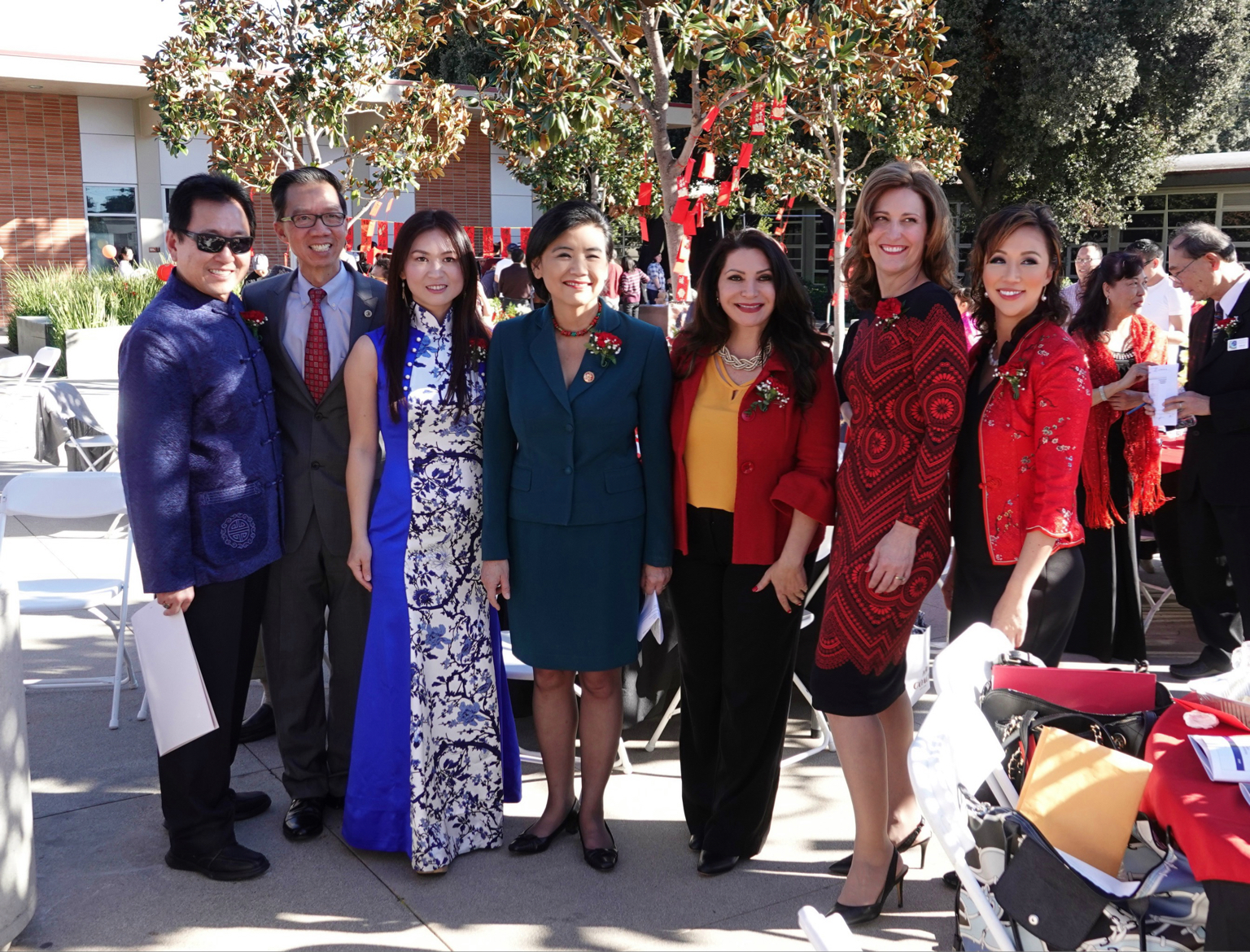
Arcadia’s first official Chinese New Year Festival with Arcadia Mayor Sho Tay (far left), Congresswoman Judy Chu (center), Senator Susan Rubio, Mayor Pro Tem April Verlato, and Maki Hsieh (far right) | Courtesy photo / Arcadia Performing Arts Foundation

“Finally, they called and said, ‘Please, you have to speak with the senator for a few minutes.’ I was in Las Vegas then and this was when the city had three snowfall days for the first time in over a decade. I was stuck at the airport and couldn’t leave. But they insisted that Senator Rubio needed a few minutes to speak with me. So I asked, ‘What is this in regard to? If this relating to the art outreach program, I would be happy to connect with her at a later time.’ They still didn’t tell me what it was about or that the senator needed to speak with me because they had to book my flight.

“When we ultimately connected, I said ‘Thank you very much, Senator, for giving me a call. I look forward to hearing how you would like us to help you.’ And she said, ‘No, it’s not about you helping me. It’s about me honoring you!’ And I said, ‘Honoring me for what?’ Then she said, ‘Every year the California State Senate honors a ‘Woman of the Year’ from their district. This year I would like you to be my very first ‘Woman of the Year’ and we will fly you to Sacramento.’ It was an immense surprise to me, I started tearing up, and all I managed to utter was ‘Really?! Me?!’”

Hsieh adds, “Being bestowed this honor got me thinking about my mother’s journey. She started her new life in this country with nothing but a dream. She first came here in the 1950s to Sacramento, with two suitcases, not knowing any English. She was 19 years old. She toiled her way through Sacramento City College and then Cal State Sacramento – as a busser at Sacramento’s German restaurant; as a live-in maid at former Supreme Court Associate Justice Anthony Kennedy’s home, for free room and board; and as a laborer at the Chinese laundromat, for ten cents an hour – until she eventually got her Masters at USC. And here I am one generation later, getting this award. Going back to Sacramento, recalling my mom’s path, had special meaning to me.”

This recognition isn’t merely an achievement for Hsieh, but for the Foundation as well. She explains, “We have a shoestring budget so getting free publicity is a god-send. I always say ‘A rising tide lifts all boats.’ And if I’m that rising tide in the region, it will lift the foundation in many ways. Fundraising is one thing, but more important than fundraising is awareness that arts excellence is a legacy and it will go away if we don’t support it. Arts excellence is not funded by the state and it is severely lacking in focus and vision. This honor will elevate the region as a cultural mecca and Arcadia as a destination for kids who already are high achievers but can really benefit from something more.”

Photo taken during Maki Hsieh’s Album concert at Arcadia Performing Arts Center (left to right): Camilla Leonard (Maki’s daughter); Maki Hsieh; Mary Hsieh (Maki’s mother); and Aubrey Leonard (Maki’s daughter) | Courtesy photo / Arcadia Performing Arts Foundation

“A crucial mission of mine is getting young people off the screen,” Hsieh explains. We have to give them a lot of things to do – activities that are fun – that have direct impact in their lives. It was, therefore, a fortunate development when the district rolled out and funded mandatory orchestra or general music in 4th and 5th grade, for one period a week, throughout all six elementary schools. In the past, music was a pull-out system where you signed out and you were pulled out of class. But those kids were always the ones who didn’t want to be in class and needed a reason not to be there. Now it’s mandatory, everyone’s on the same page.

“I didn’t think it was a big deal until my 10-year old daughter came home one day and said ‘We have to pick an instrument.’ I said, ‘But you’re already doing drums and piano.’ To which she replied, ‘No, this is mandatory, it’s going to be part of our school day and we’re all really excited. Every day at lunch we’re talking about a different instrument to pick so we could have a quartet, or we can have a band, or we can do this …’ and on and on she went.

“It isn’t just about learning to play an instrument or being on stage. It’s about having a shared experience with their peers, which is something they’re missing. Today kids play ‘Overwatch’ on the TV with a headset that connects through WiFi with other kids in their home doing the game. They’re playing and watching a game but they’re not having a communal shared social experience, it’s all on the screen. Furthermore, seniors aren’t able to participate in children’s lives because they don’t play computer games on TV. And suddenly you have a whole generation of kids who are disengaged from their parents, grandparents, veterans, and those people who can really pass on their wisdom. Children can use their artistic talents to be involved with them. ”

Most of the honorees in the ‘Woman of the Year’ are in the academic, medical, or political fields and the write-ups about them in the event book reflected that. Hsieh’s bio spotlighted her artistic achievements before touching on her professional career, which helps tremendously in providing a model for young people to emulate.

Hsieh expands on the point. “Artistic talent is a gift from your family, from ancestors, from DNA, from the heavens. And what you do with it is your gift to the community and the world. If you do it as a side thing and have fun, that’s fine too in its own merit. But, I think, if you focus on your gifts and work on them, they would evolve into being a means to effect change. It’s an agency to help your community and, in a way, it becomes a public service. My musical ability made me the right fit for my position at the Foundation, which led to my being honored. I didn’t appreciate that until now.”

Maki Hsieh | Courtesy photo / Arcadia Performing Arts Foundation

And Hsieh’s accomplishments at the Foundation are as impressive as her artistic talent. She discloses, “When I first started, our fundraising wasn’t covering operations –we were in the red and we had a debt obligation we couldn’t pay. Diversity programming was almost non-existent and it was focused on a certain demographic. The founder, Mickey Segal, actually walked out on the board because he didn’t feel that the Foundation was doing what it was called on to do. I inherited a lot of things that needed to be fixed pretty quickly. It wasn’t a five-year plan, it had to be done now or we were going under. Fast forward to today, we’ve paid off our debt and we’re going to be in the black for the first time in our operation’s history. We had a 114% net sales growth; we’ve just acquired a match challenge – in seven days we raised $88,000 towards that match. We recently secured our first $1 million planned gift. We’re really starting to see traction in both awareness and funding for arts excellence. Art excellence is such a great legacy in our region and it can’t go away. It’s a battle we have to win.”

Offering her assessment of what this honor means, Hsieh says, “The ‘Woman of the Year’ has been an annual tradition during the Women in History month. But this year, I believe, it has a greater significance to many people because of the growing trend in giving female leaders a place in the national scene. At the awards yesterday, we had the first female lieutenant governor of California.

“Being chosen ‘Woman of the Year’ out of one million people in the 14 cities in Senator Rubio’s district, heralds a wonderful opportunity for Asian females. Until now, we didn’t a voice. When my Mom came here, there were signs that said ‘Japs should not sit here,’ ‘Japs are not allowed,’ ‘Chinks go to the back.’ She wanted to work for the state and she interviewed constantly, but they always picked the Caucasian male. The door was closed. While the door isn’t entirely open, I feel the welcome mat is there. We still have to knock on the door to be admitted, but at least we’re no longer being sent away.”

As a woman, I am proud of Hsieh’s award. And as an Asian, I would like to think that it is as much her singular honor as it is her mother’s and the other Asian women who arrived in America before her. It so eloquently speaks to how far we’ve come as a people in this country. And it is so reflective of our silent crusade to be recognized, not by going out in the streets to rant about the acknowledgement we deserve, but by quietly demonstrating through talent and action what we’re made of and what we’re capable of accomplishing.

‘Digital Nature 2019’ Display Dazzles at The Arboretum

Originally published on 22 February 2019 in the Pasadena Independent, Arcadia Weekly, and Monrovia Weekly

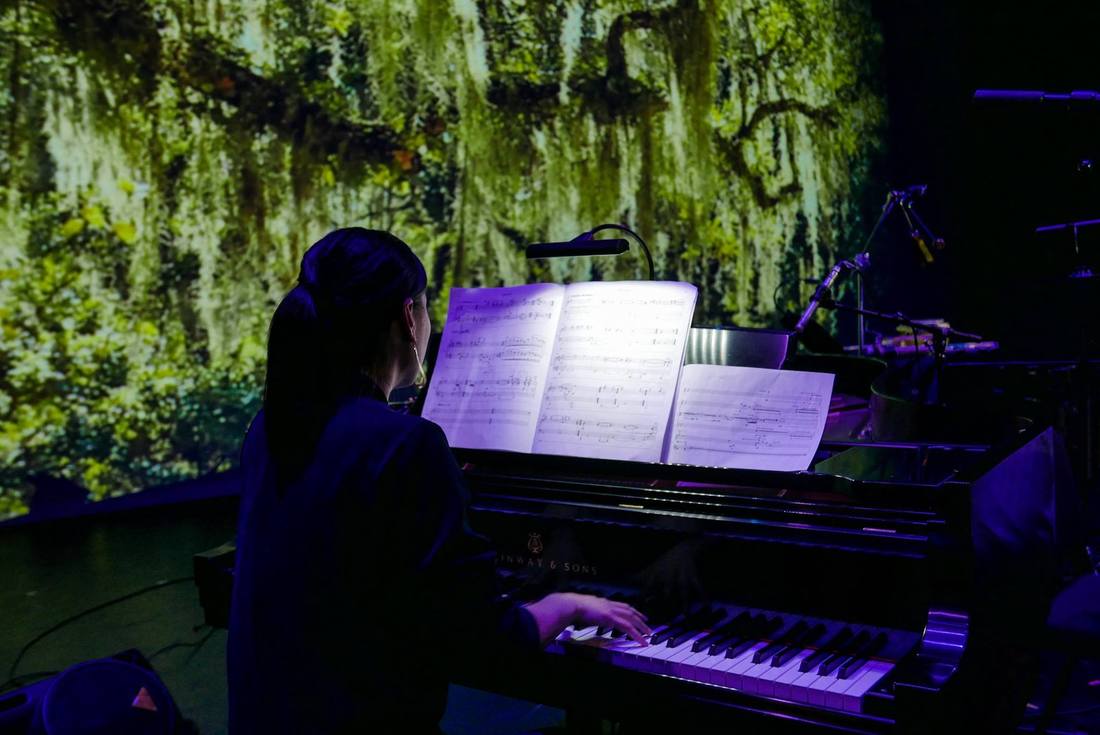
‘Southern Specter,’ Richard Johnson’s and Timothy Roy’s collaboration shows a Southern oak tree shrouded in Spanish moss | Courtesy Photo / The Arboretum

Make The Arboretum in Arcadia your destination for an evening of dazzling contemporary art. From February 27 to March 3, the natural landscape of this beautiful garden will serve as the backdrop for ‘Digital Nature 2019,’ an art exhibit featuring unique, site-specific artworks.

‘Digital Nature’ brings together a collection of contemporary artists who explore diverse themes – butterfly camouflage, bird songs and heavy metal, and interactive digital wildflowers. They will transform The Arboretum into an outdoor gallery of illuminated art, video, and sound installations.

Richard Schulhof, CEO of The Arboretum says, “We first presented ‘Digital Nature’ in 2016;  this one takes it to the next level. The Arboretum, I believe, is a spectacular setting for art. As part of our mission, we have education programs and we connect with people with our landscapes and gardens that explore themes. Art is yet another vehicle to engage people, to inspire thought, and encourage conversation about what’s happening in our world. We want to stimulate new thinking about the natural environment, our relationship with it, and the changes that are presently transforming it.”

As the recently concluded ‘Moonlight Forest Festival’ proved, people enjoy coming to The Arboretum at night. Schulhof would like ‘Digital Nature’ to kindle the same enthusiasm but quickly points out the distinction between them, “This is an art exhibition – statements from artists about a variety of topics. Unlike going to a light show where you come to enjoy the beauty of visual art or presentation, like the lantern festival, this one is a more cerebral experience. These installations will be scattered along the paths so you come upon them as you walk, and in that sense it’s similar to that of the lantern festival. But whereas ‘Moonlight Forest’ was a continuous experience, each encounter in ‘Digital Nature’ is a discrete experience: it’s in its own gallery. But I would love for there to be an overlap; I would be delighted if people who turned up for the lantern festival came and enjoyed this exhibition as well.”

Nami Yamamato’s ‘Radiant Flux’ poetically illustrates the process of photosynthesis | Courtesy Photo / The Arboretum

Schulhof declares, “We’re making a statement that art doesn’t necessarily belong only in an art gallery – it could belong in the landscape, it could be available to everyone, it could be part of our everyday experience. We want to take the art out of the museum and make it available to a much larger populace. We serve a broad community here at the Arboretum; so why not have an art exhibition that allows that community to engage with this art.

“‘Digital Nature’ is a very personal expression of the artists, which concerns an aspect of nature they find intriguing and inspiring, and they’re sharing that with us. It’s a look inside of their world. Nami Yamamoto, for instance, is fascinated by photosynthesis. She cuts intricate leaf patterns from paper she made with abaca and then embeds phosphorescent powder into the paper, so at night you’ll encounter these sheets of leaves that glow in the dark. You can see the connection with our botanical collections. It’s our way of communicating that just about every living thing on this planet thrives on this amazing ability of plants to harness energy from the sun. It’s the basis for life on earth and most people will never think about it; it’s taken for granted, it’s just a given.

“Another example is the work of Richard Johnson and Timothy Roy which explores the relationship between two plants – the Spanish moss that colonizes the branches of live oaks. They’re an artist and a composer working collaboratively who became fascinated by the incredible biological and visual drama of these live oak trees dripping with Spanish moss. They composed a score and combined it with imagery of the relationship between the plants. Each person watching and hearing the music will have his own interpretation. Those of us who are sensitive to plants and other forms of life will have that internal experience that Richard and Timothy find transformative.”

“This has been in development for a year and a half,” relates Schulhof. “Shirley Watts, a Bay Area artist and curator, who has a special interest in botanical landscapes as a context for the public exhibition, is the visionary responsible for ‘Digital Nature.’ She realized there was a rich opportunity in juxtaposing works of art with landscape and botanical collections.”

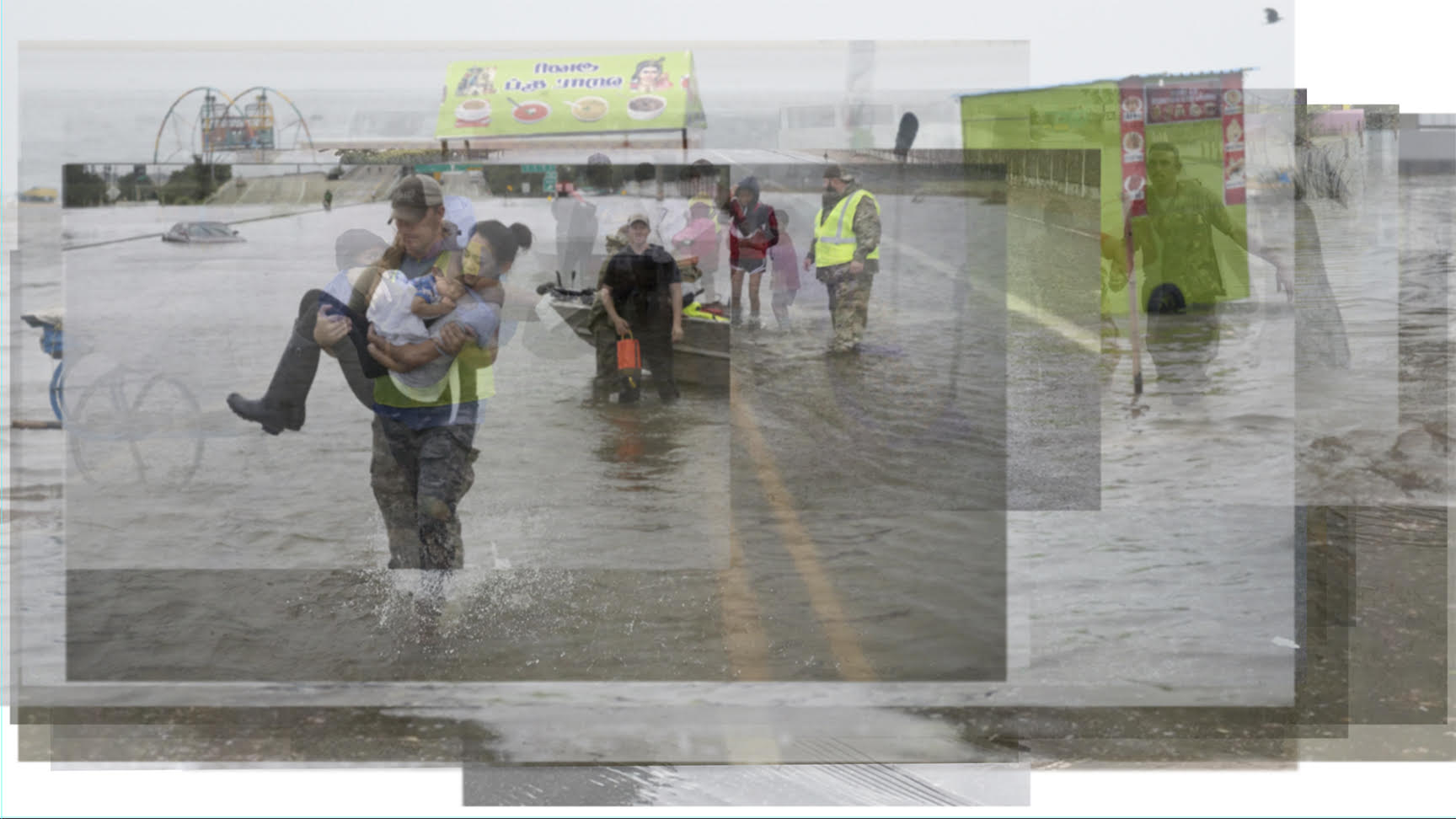
‘Flood,’ by Deborah Oropallo and Andy Rappaport, is composed of hundreds of images layered into a video collage | Courtesy Photo / The Arboretum

To explain how her involvement with The Arboretum came about, Watts says, “I had done a show at U. C. Berkeley in 2013 called ‘Natural Discourse,’ which was totally unlike what we’re doing here. It had physical installations of sculptures and some poets rewrote the plant tags. Since it wasn’t an art gallery, where there was another event coming up behind it, we could do whatever we wanted. So it stayed up in the garden for six months. It was fantastic! So many people saw the exhibition, not necessarily because they were there because of it, they just came upon it. And that’s a big deal with the work that I do – taking the art out of the museum and putting it in places where there’s a large public.

“Coincidentally, after we did the show in Berkeley, I was contacted by Gloria Gerace, who is the Managing Director of Pacific Standard Time, which puts up shows in museums all over Los Angeles. Apparently, Richard had hired her to do some consulting here to explore the possibility of having art events at the garden. Gloria found ‘Natural Discourse’ online and she asked me about the work we did in Berkeley. I had met Richard before, too, and he told me that he was open to having art here at The Arboretum. So I pursued him.”

Continues Watts, “When I started working here at The Arboretum, we were looking at doing the same kind of show we did in Berkeley. But I really started thinking about what this place is – its history and its location – and realized that so many films and TV shows have been made here. So I thought why don’t we have a show of video installations? It seemed appropriate for The Arboretum.

“Once we decided to show videos, it was a no brainer, we had to do it at night. And from a financial support basis, that turned out to be a brilliant idea because The Arboretum closes at 5:00 so people had to come back to get separate tickets for the show. And tickets sales help fund the work we’re doing. It isn’t expensive, though. Tickets are $15; the highest-priced ticket is $18.

“We put on ‘Digital Nature 2016’ exhibit not knowing what to expect. We thought we would sell 500 tickets and we sold 1,500; that helped fund the project. It was an amazing experience for all the artists involved – they helped install the artwork, they were here during the show, they met each other. That kind of collaboration in a garden like this was different, something they’d never had before. That the public also showed up to see the show was just such a positive outcome for everyone.”

Asked why ‘Digital Nature’ will only be up for a week, Watts replies, “It’s funny, the other day I was in San Francisco and I was talking to a gallery owner about this show, and she said ‘All that work for only five nights?’ I really contemplated about it afterwards and thought ‘I’ve had this long career working in gardens, and yeah, it’s only five nights but that’s how things happen in gardens – its ephemeral. Right now, at home, my magnolia is blooming and I’m missing it, and that’s it for this year! Things come and go and change in gardens. For me, it’s appropriate.”

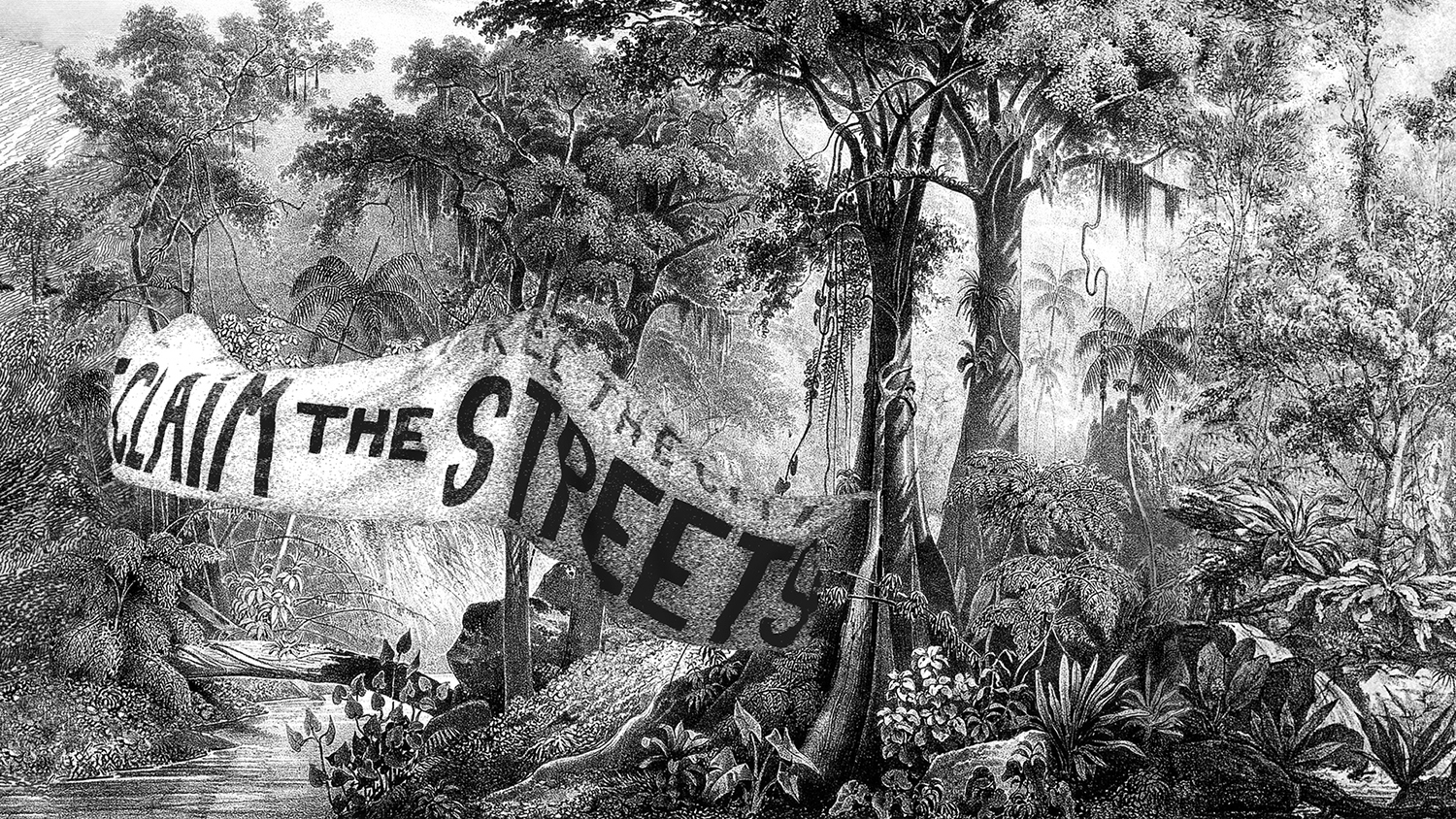
Brigitte Zieger’s ‘Bewildered’ plunges us into the heart of the forest with protest banners the only clue to human presence | Courtesy Photo / The Arboretum

Only one artist from 2016 will be presenting artwork in this year’s ‘Digital Nature’ exhibit. Watts explains, “I’m always looking for new artists. Now I know a lot of artists, and they refer me to their friends’ works and I find people online. I also have connections to an artists’ residency in Connecticut and they have a lot of composers that go to residency. And when they send out their emails I go through everybody’s work. For this year’s show, I found these young composers who wrote a piece about Southern oak trees – one of them wrote the chamber music and the other made a video that goes along with that. Unfortunately we won’t have live chamber music but we’ll show the recording and the video under an oak tree. All the installations have a connection to the place they’re at.”

Watts says she didn’t have specific sites at The Arboretum in mind beforehand, “I mostly found the artists I wanted to work with – sometimes they have existing work, a few of them are still making new work now – and I had conversations with them. We have 18 or 19 artists for this sow, but some of them are collaborating. Most of them are local but some are from out of state;  one is from Chicago, the composers are coming in from Michigan, another is from Philadelphia. Once I had a group of artists together, that’s when I spent some time at The Arboretum to decide where the pieces are going.”

“The show isn’t touring; its site-specific work,” clarifies Watts. “While the pieces can go places, they were brought together to be in this show, in this place. For artists it’s an opportunity to show their work; it’s difficult to find places where you can find an audience. However, some artists we have in ‘Digital Nature’ are pretty well known. Brigitte Zieger, who’s from Paris, is one whose work has been displayed around the world. LACMA owns an art piece of hers. We’re showing one of her works which we’ll be projecting onto two walls by the front fountain. She and the other artists participating in this exhibit get the chance to see their work in a completely different setting.”

Schulhof underlines ‘Digital Nature’s’ more pressing significance, “There’s so much focus right now on changes that are occurring in our natural environment around the world – global warming, the introduction of invasive species, increasing urbanization. I think there is a cascade of environmental shifts because of climate change. While that’s not the sole emphasis of this show, it’s an important focus. To bring art into the landscape where you can have an artist make a statement juxtaposing with the botanical collection here at The Arboretum is an incredibly opportune occasion. ”

That ‘Digital Nature 2019’ transpires and culminates in five nights underscore the fleeting nature of blossoms in our environment, as Watts points out. The installations are a reminder that we need to appreciate the inherent wonders around us and recognize that we have to play an active role in preserving them for future generations.

Local Car Collector’s Model T Makes its Debut at The Playhouse

Originally published on 18 February 2019 in the Pasadena Independent, Arcadia Weekly, and Monrovia Weekly

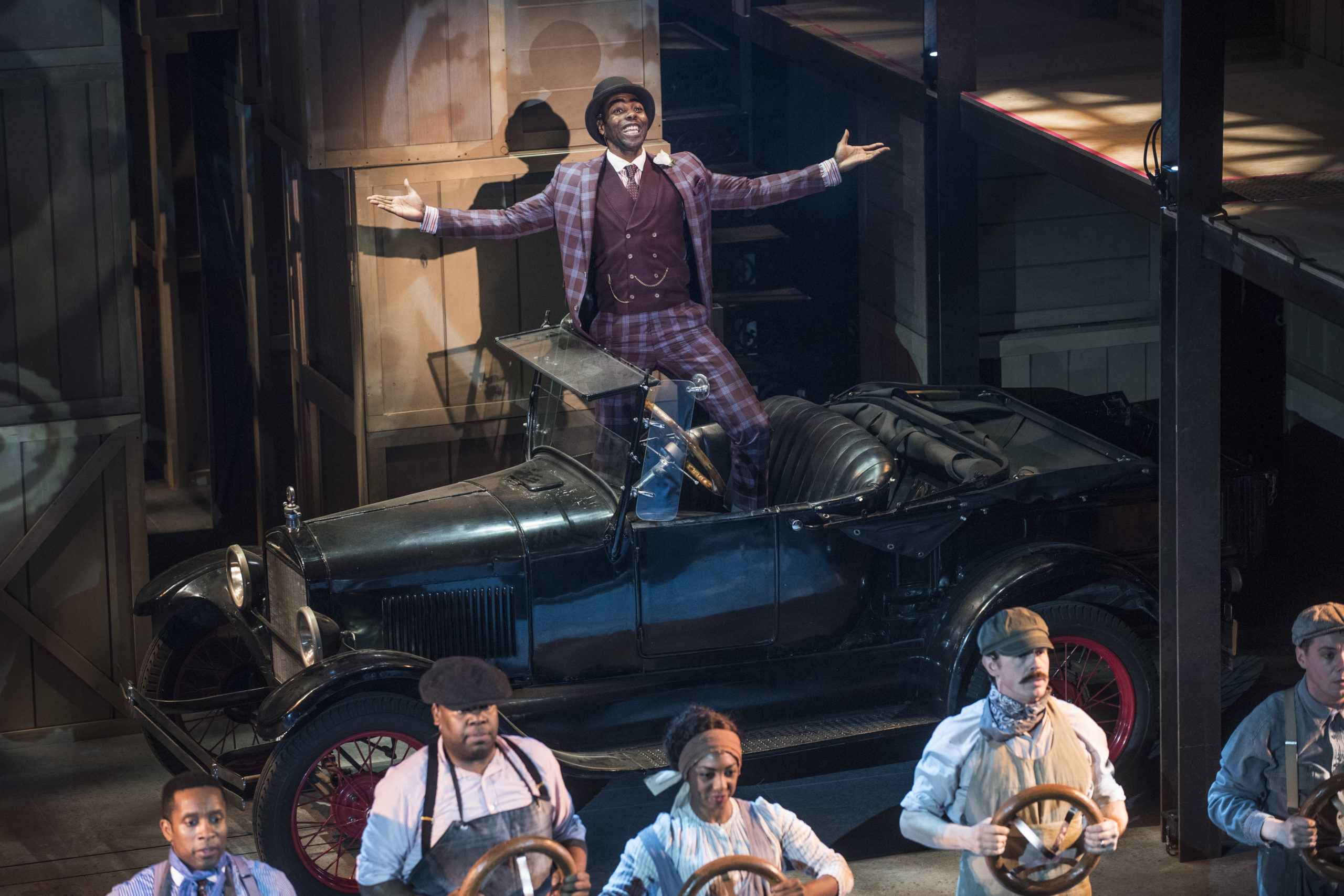
Clifton Duncan with the Model T | Courtesy photo by Nick Agro / Pasadena Playhouse

In ‘Ragtime: The Musical,’ a Ford Model T precipitates all the ensuing action that takes place; so it was important for the car to be on stage. Fortunately, Christopher Cook, Pasadena Playhouse’s Production Manager, didn’t have too far to go to find one. Altadenan Norm Haley, a real estate broker, is an avid collector of Model Ts and he graciously lent one of his cars.

Danny Feldman, Producing Artistic Director, can’t wait to show off the car they were able to borrow for the show. After I interview him at in his office, he walks me down to the stage where the Ford Model T is set on rollers, all ready to make its debut. “Norm drove this car up to The Playhouse and you should have seen us – we were jumping with excitement!,” he relates with the giddiness of a child in a toy store. “Doesn’t it look amazing?! Someone has to write about him and the car.”

And so on a cold and gray morning, a few days into ‘Ragtime’s’ run, Norm Haley and I meet at the theatre’s library to chat about how his Model T became part of The Playhouse’s biggest production, his collection, and his fascination with cars.

“I got a phone call from The Playhouse asking me what Model Ts I had,” Haley begins. “After they described what they needed,  I said yes, I have something that looks like that and it’s garaged somewhere close to The Playhouse. We met, they looked at it, they photographed it, and they decided they wanted to use it.”

Haley’s interest in automobiles came from his dad, who, in the early 1960s, worked on cars. He bought his first car – a Jeep – when he was 14, before he could even drive. He and his dad worked on it for a couple of years until he was old enough to take it on the road.

Collecting Ford Model Ts happened quite by accident, though. Haley recalls, “Back in 1976 or 1977, I had sold a house up in Altadena and I was sitting at the breakfast table with the couple. We were getting ready to sign the sale papers when the wife looked up and said to her husband, ‘I’m not signing these papers until you agree to get rid of some stuff.’ And one of the ‘stuff’ was a 1926 Canadian Model T Touring car. As you probably surmised, I ended up selling their house and owning the car.

“Now I own ten Model Ts, with some of the last serial numbers they made. I have every model they built in 1926-27, which were called The Improved Fords – I have the 2-door, the 4-door, the roadster, and the roadster pick-up.”

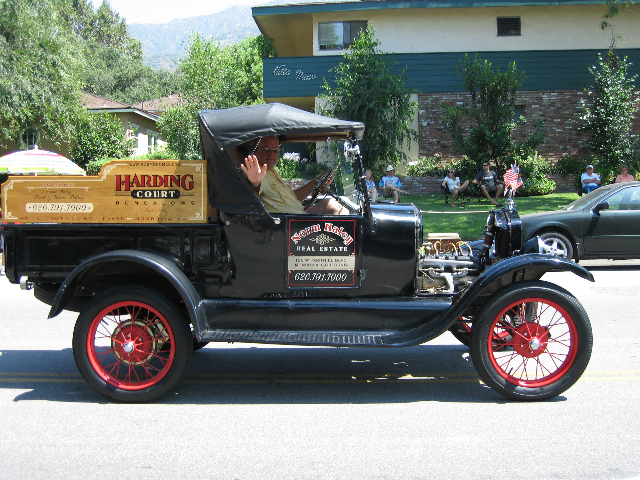
The 1926 Ford Model T Roadster at the Sierra Madre 4th of July Parade | Courtesy photo / Norm Haley

Having owned, driven, and toured the Ford Model Ts, Haley is very knowledgeable about them. He declares, “It was the car that put America on the road – until it came along, most people didn’t venture more than ten miles away from home because that’s how far they could walk or ride a horse. The Model Ts of the early years were very expensive, comparatively speaking, they were around $1,200 to $1,300 and they were all made by hand, there were no assembly lines yet. In 1914 Ford got his assembly lines and it was when he put Americans on wheels.

“The Model T represents a cherished past – everywhere I drive, people gawk, or come up to tell me ‘I learned how to drive in one of these,’ ‘My Grandpa used to drive me to school in one.’ I don’t hear that so much any longer; they aren’t that popular anymore. Those who appreciated them have mostly passed away so the market has flooded out. Young people don’t want them because they don’t have enough power and kids don’t want to learn to drive them. It’s such a shame; to me, the Model T is part of Americana.”

Continues Haley, “That particular truck on the stage has been driven from Baltimore, Maryland to Los Angeles. I didn’t drive it – I met some German people when I was part of the Model T Ford Tour in Italy and Switzerland, and I left them that car. I have another Model T, the 1927 Coupe, which I have driven 60,000 miles. It’s been across the United States and the Rockies twice, and to Lake Superior and Fairbanks, Alaska.

“By 1927, it was no longer popular because you had to shift the car by pedal on the floor – the car had three pedals on the floor, two of which are for shifting – and the gas was by the steering wheel. At the time there were other cars, like the Chevrolet and Dodge, which had standard three-speed transmission, that women liked better. Ford shut down his plant for over a year, stopped manufacturing the Model T, and retooled for the Model A.”

Most of Haley’s cars are what he calls ‘20 footers.’ He explains, “They look really good from 20 feet away; when you get up close you could see all the little flaws. But, to me and my circle of friends, they’re worth a lot more than if they were restored. In fact, the Model T on the stage isn’t up to most car connoisseurs’ standards. The paint job on it isn’t that great and it’s still the original except for the rear fender. I had lent it to a friend and he rear ended someone when he drove it in Nova Scotia, so it had to be repaired and repainted.”

For the record, the car that figures prominently in ‘Ragtime: The Musical’ is a 1917 Model T while the vehicle on the stage of the Pasadena Playhouse is a 1926 Model T Ford Roadster Pick-Up. While true collectors would know the difference, audiences at The Playhouse don’t nitpick – we all cheer when the car makes its appearance. We can recognize and appreciate a priceless treasure when we see one.

Discloses Haley, “Almost all my cars are survivors. That Model T in ‘Ragtime’ is very, very original. Highly, ridiculously, overly restored cars with the $5,000 paint job and the $5,000 motor are a dime a dozen. For each survivor car I have, I probably passed up on 20. In fact, last Wednesday I drove up to Visalia with a trailer to look at a truck, but even as I got out of my car I knew I wasn’t going to buy it. When I buy a vehicle, I want to make sure no one has started to restore it and that it’s still pretty much in its original shape.

“I do have some nicely restored automobiles, but they’re the ones that were on their last legs so I had no choice. The Model T Coupe I was talking about, I’m the third owner of that car. It had been parked in a barn at Plano Texas since the 1960s. I actually drove it for several years but it was so tired that I completely tore it apart and restored it. That was years and years ago, maybe in the 1980s.”

As many cars as he owns, Haley has never taken any of them to a show like the San Marino Motor Classic held in June every year at Lacy Park. He says, “Besides the Pebble Beach Auto Show, the event we have here in San Marino may be one of the best in the Western United States. But I’m not the ‘Show and Tell’ kind of guy; besides, I don’t really have the time to sit around at these events. I have a couple of trucks that I’ve put on display – a restored truck which is in the March page of an Auto Calendar and a Helms Bakery truck.”

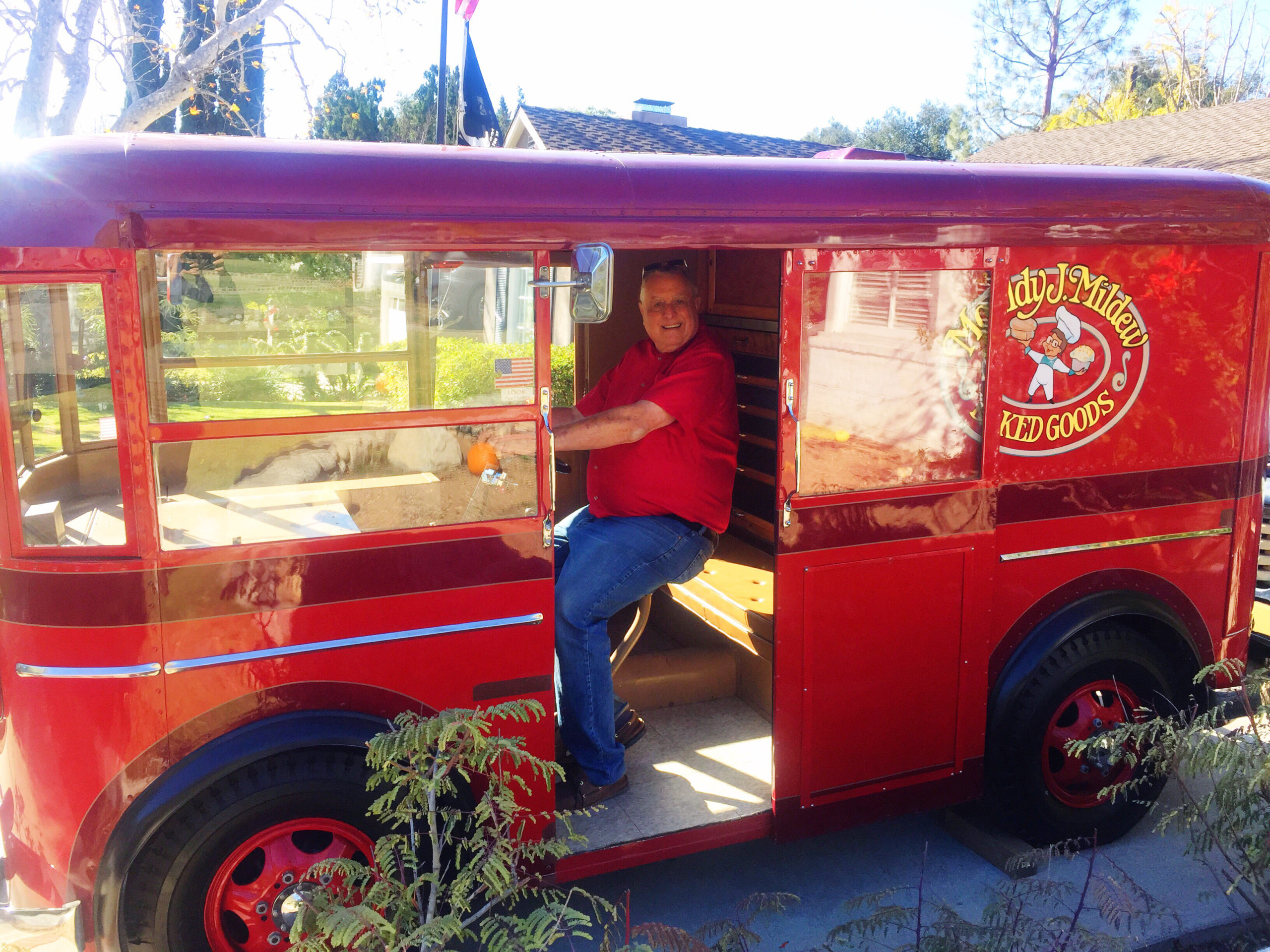
Haley drives a 1947 DIVCO Helms Bakery truck painted the wrong color by a previous owner (it should be yellow and blue) | Courtesy photo / Norm Haley

Seeing the blank look on my face, Haley elucidates, “In 1930, a gentleman from the East Coast named Paul Helms came to California because he had tuberculosis. He was a marketing genius. He opened a bakery and the first contract he got was to deliver all the baked goods to the Olympics in Los Angeles. Later, the Helms baked items became a household staple.

“In those days most families didn’t have enough money to own two cars. Father took the car to work and mother relied on the cleaners which had a truck that came out to pick up the dry cleaning, the grocer who delivered the groceries if she called in, and the Helms man. By 1940, the trucks that made the home delivery were driving 75,000 miles a day transporting bread, donuts, cakes, and cookies all over Southern California. I was lucky enough to get one of those Helms trucks. There may be only ten of them in existence today.”

Asked if he has any favorites among the 50 vehicles in his collection, Haley replies, “My most-prized car is the 1927 Coupe just because I’ve driven it so much. My favorite truck is the Helms. I’m a member of the Monrovia Historical Society’s Board of Directors and once a year I would put one or two trucks in the ‘Friends of Monrovia.’ Recently, we’ve been handing out donuts in the Helms truck, along with information pamphlets about the society.

“I have a 1954 truck called Canopy Express. Only 3,000 of them were made and I don’t know how many are left. It’s used for delivering fruits and vegetables around the neighborhood, and I would load it up with pineapples to give away to people. For the last 35 years, I’ve also put a different car or truck in the Sierra Madre Fourth of July parade.”

We can certainly understand Haley’s nostalgia for the cars of old which people today don’t particularly care for. There are so many different makes and models to choose from – all of them with the latest technological features – to bother with antiquated vehicles.

But, every once in a while, we see a vintage car driving down the Colorado Street Bridge at a leisurely 30 miles per hour and we can’t help but stare and delight at such a rare sight. Thanks to collectors like Haley, we can reminisce and look back to a time when we weren’t in such a  state of frenzied haste.

San Gabriel Valley Teen Pianist to Appear on NPR’s ‘From the Top’

Originally published on 14 February 2019 in the Pasadena Independent, Arcadia Weekly, and Monrovia Weekly

Marc Soong performs Paraphrase on Figaro’s Aria from Rossini’s ‘Barber of Seville’ by Grigory Ginzburg | Courtesy photo / Barry Eckhaus Photography

Marc Soong, a 15-year old teen from Alhambra, is one of five performers  who will appear on an upcoming episode of NPR’s (National Public Radio) ‘From the Top.’ It airs on KUSC 91.5 FM on Sunday, February 24 at 6 pm and by podcast at fromthetop.org starting February 18.

The hit NPR radio program, which averages half a million listeners every week, features America’s best young classical musicians’ performances and interviews. This particular show will be guest-hosted by Bernstein-Award Winning violinist Charles Yang and co-hosted by pianist Peter Dugan.

Being included in this esteemed assembly is quite a thrill for Soong. He says, “I feel very honored! I know some fellow musicians who have participated in the program and I occasionally tune in on KUSC to listen to their ‘From the Top’ broadcast.”

“I filled out a very, very long application to be in one of the five slots,” explains Soong. “There is technically no deadline, but if you want to be a part of a specific program, you have to submit an application four months beforehand. Besides musical ability, candidates are chosen based on other factors including gender, age, instrumentation, repertoire, and diversity of stories in their application.”

“Applicants submit two pieces but can upload up to six video recordings. Out of these, ‘From the Top’ will choose one with a length of five minutes or less to be used on the show. “I submitted three recordings and the piece they wanted me to perform was a transcription of Figaro’s Aria from the Rossini opera ‘The Barbier of Seville.’ I suppose they chose it because it was the right length. The transcription isn’t well known, but the tune is popular. Furthermore, it’s virtuosic and exciting. Well, that’s also my biased opinion,” Soong adds with the confidence of an expert.

‘From the Top’ is a Boston-based independent non-profit organization that supports, develops, and shares the artistic voices and stories of young classically-trained musicians. It provides young musicians with live performance opportunities in the foremost concert halls across the United States. This affords them national exposure to over half a million listeners on its weekly NPR program.

Aside from the performance aspect, ‘From the Top’ offers leadership and community engagement preparation and, since 2005, nearly $3 million in scholarships. All these components intensify the hope, passion, and discipline of today’s extraordinary young musicians.

For his live recording performance, Soong traveled to Beaver Creek, Colorado. He relates, “It was a three-day commitment program – I was at the ski village from January 15 to 17. On the first day, I got to know the other four performers and we had a rehearsal. On the second day, there was more rehearsing and the actual show was held that evening. On the last day, there was an ‘Arts Leadership Community Engagement’ event – we had discussions on how to engage an audience based on their age group and we applied what we learned during an unrecorded final performance in front of an entire elementary school. All the events were held at the Vilar Performing Arts Center.”

Marc Soong | Courtesy photo / Barry Eckhaus Photography

Each musician is interviewed during the broadcast. “For my interview, I talked about math and music – my two favorite subjects – and physics, the third thing I’m obsessed with … primarily because the class is so hard. I know I unconsciously slip into nerdy talk; I hope listeners will think my interview is funny. Though I will attribute most of the humor to the co-hosts,” Soong discloses with a great deal of self-deprecation.

Soong says of his appearance on the program, “Since I heard about ‘From the Top,’ it has been my dream to be on the broadcast. And the whole experience did not disappoint. I got to meet the kindest, most talented group of musicians my age – all of them played different instruments. I had expected tension and competitiveness among us, which is pervasive during piano competitions and festivals, but there was none of that at all.

“Everyone on the show – from the executive director and stage manager to the producer and music director – were exceedingly nice. Whenever guest host Charles Yang and co-host Peter Dugan played the violin and the piano, you can hear the energy vibrating through the room. They’re also very humble and down-to-earth.

“I had never been on a radio program and I didn’t realize just how much time and effort were involved in creating a one-hour show. It took a full eight hours of preparation before the show started. This has been such a memorable experience!”

The gifted teen credits his close-knit family and caring mentors for this wonderful experience, “I would like to thank my two amazing teachers, Professor Daniel Pollack and Dr. Vladimir Khomyakov, for their guidance and encouragement; and my parents and my sister Melodey for their love and support. I know I wouldn’t have had this incredible opportunity without them.”

Soong’s proudest accomplishment, though, was organizing and performing in a benefit concert with Melodey at the First Church of the Nazarene in Pasadena in October 2017. It raised more than $8,000 for the Michael J. Fox Foundation for Parkinson’s Research.

A third-year student in the Stanford University Online High School, Soong attended Barnhart School in Arcadia, where he was so academically advanced that he skipped 6th grade altogether. His sister, who is a freshman at Washington University in St. Louis, went to Barnhart and Mayfield Senior School in Pasadena. Both of them are still actively involved in the community, giving piano performances at the various senior centers in the Pasadena area during their school breaks.

He may be only all of 15 years, but Soong has done more than most people who are far older than he. That he has remained so unaffected and unassuming despite his innumerable  achievements is a breath of fresh air in this age of self-importance and self-promotion.

The Pasadena Heritage Protects the City’s Significant Landmarks

Originally published on 28 December 2018 in the Pasadena Independent, Arcadia Weekly, and Monrovia Weekly

2018 Craftsman Weekend Asian Influence Tour | Courtesy photo / Pasadena Heritage

Old Pasadena is a bustling place that has become a dining, shopping, and entertainment  destination for people of all ages. There was a time, however, when this corner of the city was a rundown area and no one had reason to wander into it. And were it not for the Pasadena Heritage, the city’s original downtown and its historic buildings would have disappeared altogether.

Patty Judy, Pasadena Heritage’s Education Director, describes, “In 1977 concerned citizens from various walks of life were seeing some of the historic structures in the city being demolished or  being threatened for demolition to make room for generic properties and large corporate buildings. The plan to bulldoze Old Pasadena, including structures there like the Parsons headquarters, was of particular interest to them. Additionally, they noticed that neighborhoods were endangered – craftsman houses were being torn down, new development were sprouting, and the climate of the area was changing.

“It should be noted that this was also the time when the National Historic Preservation Association and California Preservation Foundation were being established. So there was a movement already going on throughout the country which sort of filtered its way here.

“Bill Ellinger, who was an architectural historian working oversees and came back and saw what was happening, and Claire Bogaard, whose husband Bill would later become Pasadena’s mayor, were two of those who actively advocated for an organization to preserve the city’s architectural treasures. As I heard it, someone said ‘Anyone who wants to join us can come to Claire’s house and they will be the first board.’ They adjourned to the dining room and that was their first board meeting. Thus, Pasadena Heritage was born.

Historic architect William W. Ellinger III Old House lecture | Courtesy photo / Pasadena Heritage

“They raised money by having tours of neighborhoods like Prospect Park and Old Pasadena – they did a little bit of advertising, set a table on the street, and people just walked up. They didn’t presell tours as we do now. For the Colorado Street Bridge, it started as a bridge party to raise funds; today it’s a celebration party.”

Many of us aren’t aware of Pasadena Heritage’s existence at all, which is regrettable because its impact on our surroundings is sweeping. As Judy elaborates, “People don’t understand why Pasadena looks the way it does and how much that has to do with our influence. I think it might be a shock for people to know how many meetings we go to with the City or how many times we meet with developers and how much sway we have.

“On the other hand, some people think we can do more than we actually can. We hear people ask why we allow developers to construct new condominiums or apartments in a particular location. They don’t understand that zoning laws allow such construction and we can’t legally bar them from building.”

Indeed, the organization’s breadth of involvement in Pasadena’s environs is too staggering for a single article to encompass. But several of its noteworthy accomplishments are highlighted here.

Pasadena Heritage’s first National Register of Historic Places Nomination in 1978 was for the Civic Center; including City Hall, the Central Library, the Civic Auditorium, the former YMCA and YWCA, and other historic buildings in the 1925 Bennett Plan that envisioned Pasadena as ‘The Athens of the West.’

The following year the organization saved its first endangered house – the Parsons House, designed by Alfred and Arthur Heineman – which was moved to Altadena and restored. In 1982 it spearheaded Pasadena’s adoption of the Landmark District Ordinance. Neighborhoods can apply for special status and design guidelines to protect their history and character. This local landmark designation is the best way structures can be ensured of protection from being destroyed.

It lobbied to save the Main Post Office on Colorado Blvd. in 1983 when the Lincoln Avenue postal facility was proposed. In 1984 one of Pasadena’s oldest bungalow courts, Gartz Court, was set to be demolished and Pasadena Heritage stepped in. It partnered with the City and moved the six-unit construction to a new location. The charming Myron Hunt-designed building was restored and updated and sold as affordable housing.

“In 1985 we adopted a Greene & Greene Initiative when an out-of-state buyer stripped the Robert R. Blacker House of its custom light fixtures,” states Judy. “We had to get an emergency ordinance that resulted in strengthening the city’s zoning with added protections for Greene & Greene structures. A higher level of designation – the Historic Treasure (now Historic Monument) – was also created to protect interior features.”

The Huntington Hotel is now the Langham Pasadena | Courtesy photo / Pasadena Heritage

As much as Pasadena Heritage would like to preserve all historic structures, the interest of the building’s owners could prevail. One such occurrence took place in 1986 when the demolition of Huntington Hotel on South Oak Knoll Avenue, which dates back to 1906, was being discussed. Pasadena Heritage nominated it to the National Register of Historic Places. While the hotel was eligible, it was not officially listed because the owners objected. A local referendum narrowly approved a new hotel and the historic tower was demolished in 1988.

However, Pasadena Heritage enjoyed numerous other victories. Judy recounts, “In 1993 the Castle Green Exterior Restoration and Historic Structure Report, funded by a $693,000 grant to Pasadena Heritage from the State Office of Historic Preservation, was completed and won a California Preservation award. The Report is still used to guide restoration of the former hotel, which has been converted as privately owned condominiums, and our easement protects the building.

“In December of that year, the Colorado Street Bridge officially reopened after a three-year project to seismically upgrade, repair, and restore it. In July 1994, Pasadena Heritage’s famous party on the bridge returned after a four-year hiatus, and record crowds turned out to celebrate.”

The organization was the recipient of a plaudit in 1995 when Old Pasadena received one of the first Great American Main Street Awards from the National Trust for Historic Preservation. It also won support from the State Office of Historic Preservation to save the last 12 Vista del Arroyo Bungalows remaining along the east bank of the Arroyo.

In 1996 Pasadena Heritage moved to the 1893 Madison House on South St. John Avenue which was received as a bequest. Two years later it established Heritage Housing Partners (HHP) as a subsidiary affiliate to purchase, rehabilitate, and resell historic homes as affordable housing. This effort was supported by the National Trust for Historic Preservation, which had fostered a similar program in the East and the South.

Heritage Housing Partners began work in 2000 on the 1910 Merrill House designed by Greene & Greene, the fourth single-family home it rehabbed. The house, the former residence of Samuel Merrill, an important early environmentalist, was obtained from the bank at a deep discount and allowed for a larger restoration budget.

In 2001 Pasadena Heritage’s efforts helped save a cluster of 1928 Spanish Colonial Revival commercial buildings on Green Street at Madison Avenue from demolition and subsequently became home to the California School of Culinary Arts.

“We started noticing that some mid-century architecture were also in danger,” Judy adds. “Normally the National Trust doesn’t consider something as historic until it’s 50 years old but in 2001 we asked for a special exception for the 1958 Stuart Pharmaceutical Co. building. We got it listed on the National Register when it was acquired by the MTA and was going to be converted into a parking lot. Happily, it is now a local historic landmark and is occupied by A Noise Within, the renowned classic repertory theater company.”

The expansion of the Pasadena Convention Center was the focus of Pasadena Heritage’s attention in 2003 because its centerpiece is the Civic Auditorium. It participated in the development of a new design concept that complemented the building.

In 2005 the organization strongly opposed plans to attract the NFL to take over the Rose Bowl because the project would destroy the original National Landmark stadium. The City Council rejected the NFL plan in June, but supporters managed to put the issue on the ballot in 2006. Fortunately, a massive community effort led to its ultimate defeat.

The Pasadena City Hall | Courtesy photo

Pasadena City Hall was once again in the spotlight in 2007 when it reopened after extensive seismic upgrade and restoration work. Pasadena Heritage was involved in the planning for the massive undertaking and served on the project oversight committee.

One of the structures Pasadena Heritage has been watching closely was the YWCA. Judy relates, “Since our founding, we’ve urged the restoration of the former YWCA. We felt it was important principally because it was designed by Julia Morgan, who had a prolific career. She designed more than 700 buildings in California, most notably the Hearst Castle in San Simeon. She also did the Fairmont in San Francisco, the Berkeley City Club, the Riverside Art Museum, the Hollywood Studio Club, the Herald-Examiner Building in Downtown L.A., among many others.

“Neglect over the years had kept the building on our Preservation Watch List. In 2010 the city finally took the major step of invoking eminent domain and then moved forward to secure and stabilize it while completing the lengthy acquisition process.

“Then in 2014, the YWCA was under review to become a Kimpton Hotel, a great adaptive use for the historic building. However, the proposal met with controversy because the adjacent green space would be built upon. It remains on our Advocacy Watch list to this day.”

Judy clarifies “Our goal is not to stop new development but to make sure that it is consistent with the look of the neighborhood. For example, there’s a new development in El Molino which is next to a turn of the century Victorian home. We wanted to have a green space between houses so we sat down with the developers and they redesigned the project to fit with the historic structures in the area.”

“HGTV is our biggest enemy,” confesses Judy. “They want to update historic buildings, although in doing so they take out what makes the structure important. They just tear down all the walls in the house, but they’re there for a reason. While we can’t dictate what homeowners should do in the house’s interior, we try to educate the owner of a historic home.

“Recently, there was a house that was purchased by a celebrity who wants to change all the windows so our Preservation Director met with them to tell them which ones they can change and which ones they can’t, and why. We try to get there before they get the permit to make any alterations.”

There is never a dearth of new projects and one that Pasadena Heritage will be keeping an eye on is the Fuller Seminary. According to Judy, since the seminary’s sale, they’ve had meetings with the Women’s Club and the University Club because they will be affected when the development starts. Another upcoming project is the First Congregational Church on Walnut and Los Robles. The organization has had conversations with the new owners about how much of the building will have to be preserved.

The Rose Bowl | Courtesy photo

“It’s not only the old part of the city that we have an interest in as we have proven when we intervened in Stuart Pharmaceutical’s plight,” Judy points out. “We’ve been watching East Pasadena. In fact, we’ve held commercial tours there because there are several mid-century buildings in the area. And we’re thinking of maybe doing a ‘60s Tour’ at some point. The Neptune and Thomas-designed Avon Building on East Foothill Blvd has been sold to Home Depot and we have urged the retention of the 1947 building.

“The Space Bank site, also on East Foothill Blvd., which is eligible as an historic district due to its association with Cold War-era weapons research, has received City approval. The developer, Trammel Crow, has agreed to mitigation measures that include retention of some historic features and interpretive displays.

“The ‘Ability First’ building on Kinneloa was designed by a very prominent mid-century architect and they’re planning on doing new development. My daughter works there and the director knows I’m with Pasadena Heritage. So he asked how involved we were going to be and I said ‘Well, we’re going to have an eye on it and we’d appreciate it if you could include this person and this person in the early stages.’

“We didn’t ignore East Pasadena at all. In fact, sometime in the 1990s we produced a video called ‘East Pasadena.’ We know there are several interesting communities in that locale like Chapman Woods. We’ve also been working in the Hastings Ranch area, developing an Awareness Project but we have yet to figure out what it’s going to be. Some of the homes there look similar to each other and we’re trying to decide if we could do a home tour there. But be assured that we’re there and we’re attempting to get more people interested.”

To make everything happen, Pasadena Heritage has a large support group: six full-time staff members; a board of 17 people; several committees; and hundreds of volunteers. It holds several events in any given year including The Craftsman Weekend, which is the longest and consists of bus and walking tours, workshops, lectures, receptions, and Contemporary and Antique Decorative Arts and Furnishings sale. The Bridge Party is a one-day activity and most of the other events are two- to three-hour tours or presentations. It hosts a Summer Gala during the years when there’s no Bridge Party.

“Since 1977 the Neighborhood Walking Tour have been the bread-and-butter events for us,” Judy discloses. “These tours are limited to the exterior, except during Craftsman Weekend when we try to get at least one homeowner to show us the inside, which is always a treat for our guests. Every once in a while we get a surprise when a homeowner invites us to come in and to see their new fireplace. With the Old Pasadena Walking Tour we have an arrangement with Castle Green to show their lobby and the first floor.”

Judy mentions that The Pasadena Architectural Legacy Walking Tours – Hillcrest Neighborhood  and the Civic Center District that includes City Hall, Pasadena Library, and Civic Auditorium – will take place this Saturday, December 30.

She then remembers, “We recently held a Fountains Tour, which is really fascinating. We found out there are 16 or 17 fountains within walking distance of each other – two Batchelder tile drinking fountains by the YMCA/YWCA; one at the Civic Center; one next to the police station; one outside the Library; a fountain landscape at the Pasadena Mutual Savings and Loan Building at Garfield across Union designed by Ruth Shellhorn who also created the central landscaping at Disneyland; one at the courtyard of Western Assets Plaza; one at Westin Hotel. And then there was that Batchelder tile fountain that Pasadena Heritage saved from a home, which just sat in Claire Bogaard’s garage for a long time, and is now at Plaza Las Fuentes.”

Judy has been Pasadena Heritage’s Education Director  for 10 years and a volunteer for 20. In that time she says the most difficult thing she’s had to do is to convince homeowners that their house is significant enough that other people would want to see it. She says, “A lot of houses in Pasadena have architectural importance and it’s my job to tell them why. Although I’m not an expert, I’m just a fan, I have enough contacts like historians, researchers, and architects who have the knowledge and expertise to show them what makes their home remarkable.”

2018 Pasadena Heritage Colorado Street Bridge party | Courtesy photo / Pasadena Heritage

Throughout its 40-year history, Pasadena Heritage has achieved several milestones. It marked the 20th anniversary of its Craftsman Weekend in 2011. In 2012, it celebrated ‘35 Years of Preservation’ as the theme of the summer’s Colorado Street Bridge Party. Last year, it commemorated the four decades of its founding and co-hosted a very successful California Historic Preservation Conference scheduled with multiple programs throughout the year. A major ‘40 Years Celebration’ was held in October of 2017 in the original Exhibition Hall at the Civic Auditorium.

Its yearly Educational Programs and Architectural Legacy Tours have gained a massive following, drawing visitors from across the country. The newly created Old Pasadena Pub Crawl, which was sold out soon as it was announced, will be offered every month starting next year.

When Claire Bogaard and other caring citizens decided to put their heads together to save Old Pasadena from demolition all those years ago, they did not foresee how that singular resolve would affect the most extraordinary projects that uphold the integrity of structures.

And the work hasn’t ebbed – there are ever more buildings needing to be rescued from the wrecking ball. Today Pasadena Heritage continues its mandate of protecting the city’s rich architectural history and preserving the landmarks that make Pasadena the unique and charming place that we’re proud to call our home.

Arcadia Brothers Receive Outstanding Young Philanthropists Award

Originally published on 12 November 2018 in the Pasadena Independent, Arcadia Weekly, and Monrovia Weekly

The Dong family (left to right) Charity, Richard, Eric, and Edward at the 33rd Annual Celebration of National Philanthropy Day Awards Luncheon | Courtesy photo / AFP/GLAC

Eric and Richard Dong, Arcadia residents and San Marino High School students, were named Outstanding Young Philanthropists by the Association of Fundraising Professionals, Greater Los Angeles Chapter (AFP/GLAC). They received the award at the 33rd Annual Celebration of National Philanthropy Day Awards Luncheon held on Wednesday, November 7, 2018 at the JW Marriott Los Angeles at LA Live.

The award recognizes individuals who exhibit a philanthropic philosophy that includes providing financial and volunteer assistance to meet community needs. Nominated by Dana Bean, Director of Development and Communications for Union Station Homeless Services in Pasadena, the Dong brothers were chosen by an AFP committee from a number of deserving candidates.

In her introduction of the awardees during the ceremony, Anne Miskey, CEO of Union Station, recalled, “We received a phone call from Richard and Eric, who were on their high school spring break. They said they heard about our organization from friends and they wanted to volunteer for us. Because they’re incredible pianists they started offering piano lessons for some of the kids in our family center. They were a big hit.

“But they didn’t stop there. Eric and Richard fund-raised from family and friends to give us a financial donation. Still, their generosity didn’t stop there. Their father, Ed, taught them how to invest in the stock market when they were young children and I asked them to talk to my kids.”

Continued Miskey, “They didn’t stop there either. With the profits they made from their investments, this past summer they established the Richard and Eric Dong Endowment Fund for Union Station. It is designed to provide scholarships for children in sports, music and the arts, leadership, and human rights promotion; to purchase books for the family library; to fund staff appreciation and recognition; and to finance the Robert F. Kennedy Human Rights educational programs.”

When he took to the podium, Richard declared, “This is a great honor! How we’ve dreamed of receiving this prestigious award! And yet, when it came true, it was a surprise. We are sincerely grateful to the AFP and the committee for voting for us, and to Ms. Dana Bean and Union Station Homeless Shelter Services for nominating us. It has been our pleasure to be involved with this wonderful organization and its caring staff.”

Eric added, “National Philanthropy Day is a special day. Richard and I learned from home and the schools we’ve attended, that philanthropy is an American virtue. It is something that he and I have tried to practice since our middle-school years. We believe there is no age limit when it comes to education, leadership, and philanthropy. They’re all essential to a great country like ours.

“The words of Robert F. Kennedy, ‘Our future is not a gift, it is an achievement,’ deeply resonate in us. They empower us to help, to share, and to contribute. We are confident that together, we can make the world a better place.”

As recipients of the Young Philanthropists Award, Eric and Richard join an impressive group of community leaders who have shaped the spirit of giving and service in the Greater Los Angeles area.

Eric’s and Richard’s parents, Charity and Ed, instilled in them the values that make them such extraordinary young men. For that, we are profoundly thankful.