The Huntington Commemorates Founding Year with ‘1919’ Exhibition

Originally published on 15 October 2019 in the Pasadena Independent, Arcadia Weekly, and Monrovia Weekly
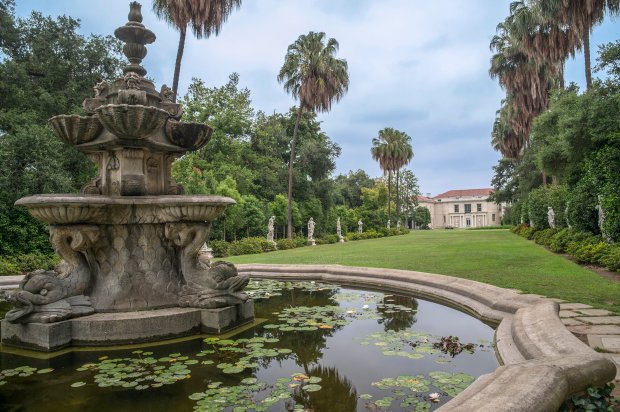
The Huntington Library, Art Museum, and Botanical Gardens | Courtesy photo

The year 1919 was significant for so many reasons but none would affect the art scene and cultural life of the San Gabriel Valley more than the founding of the Huntington Library, Art Museum, and Botanical Gardens. And we have Henry and Arabella Huntington to thank for bestowing on us their incomparable legacy.

An exhibition called ‘Nineteen Nineteen,’ which opened September 21 and will be on view through January 20, 2020, at the MaryLou and George Boone Gallery showcases 275 items from Henry and Arabella Huntington’s vast collections, some of which have never been displayed.

Co-curators James Glisson, interim chief curator of American art, and Jennifer Watts, curator of photography and visual culture, led a team from the three divisions and went through the institutions massive storehouse of 11 million items. The objects in the exhibition range from posters from the German Revolution, abstract art, suffragist magazines, children’s books, aeronautic manuals, self-help guides for soldiers returning home from World War I, and a book hand-printed by Virginia Woolf at her kitchen table. The thread that ties them all together is that they were all acquired in 1919.

During a preview of ‘Nineteen  Nineteen,’ Glisson and Watts walk members of the press around the Boone Gallery to show the items, explain their significance, share their experience, and add their personal insights.

“This project took about two and half years from the very beginning to the end,” begins Glisson. “I went through, probably, 3,000 items, but it could have been more. And a lot of time was spent finding things from 1919 that were interesting, because there were a lot of stuff that weren’t,” he adds with a laugh.

“Or visually compelling,” inserts Watts. “Gathering these things was incredibly labor intensive but fun at the same time. I have to point out, though, that we had research assistants, interns, and grant assistants who did a lot  of work – it was a collective endeavor. It involved every curatorial staff across all divisions – the library, the art museum, and the botanical gardens. We knew some things to look for and others were hunches. We asked our colleagues for assistance and they came to bat. They helped us find things we never would have unearthed on our own.”
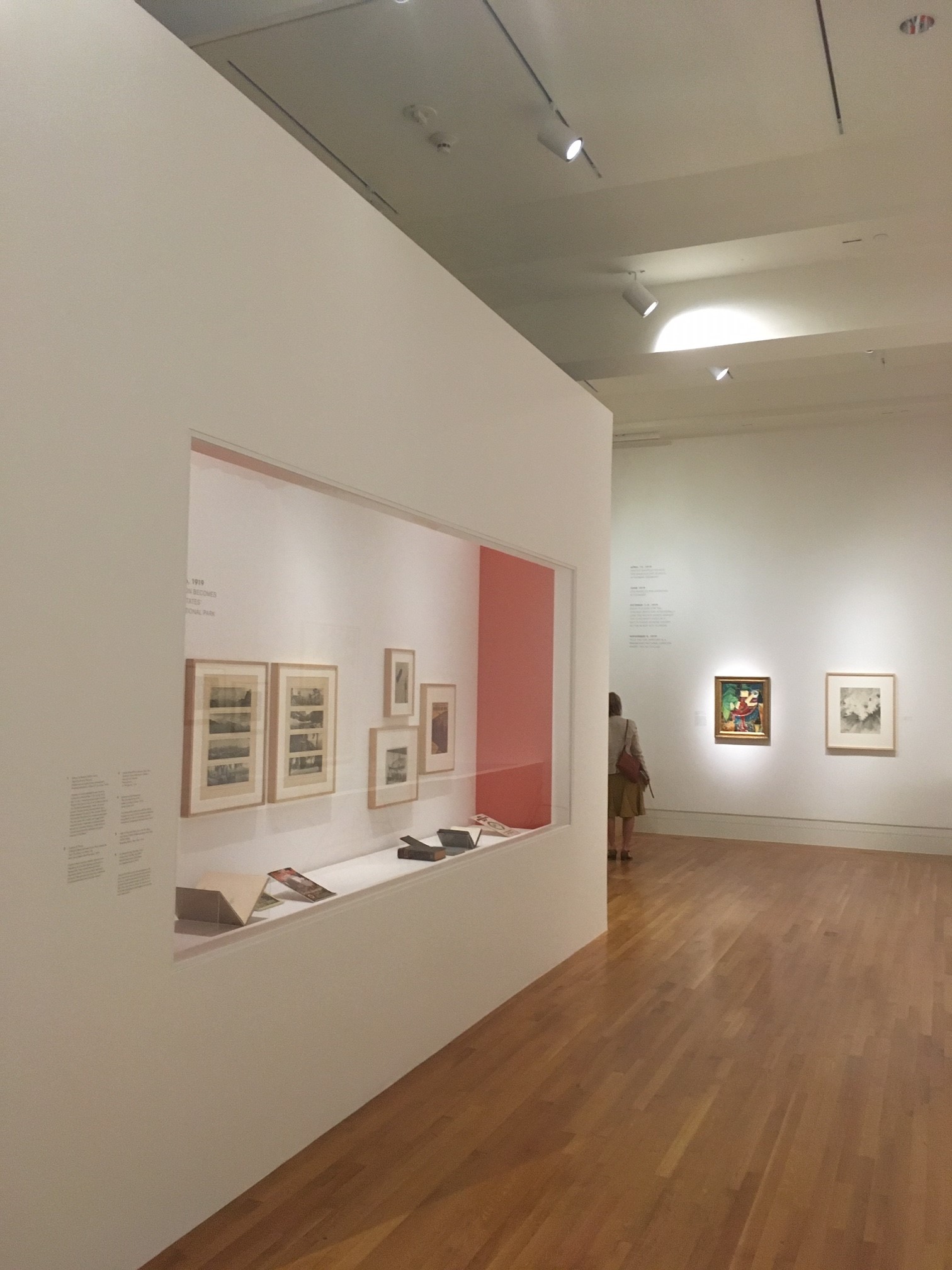
The ‘1919’ Exhibition at The Huntington | Photo by Brianna Chu / Beacon Media News

Glisson expounds, “Often, it was ‘There’s this great thing, I think it’s from 1919;’ ‘Oh yes, it is.’ This is where the process was different. We knew where we wanted to take it but until we gathered the material together, we couldn’t tell a story. We didn’t know what the story was before we had the material. The verbs came when this checklist was two-thirds through – and we knew what the themes would be and gave it some shape. As Jennifer said before, we had to just be incredibly open to where the material was taking us. It’s like, we see a piece and we say ‘What does this mean?’ Or, sometimes, it’s ‘This is interesting, what is it?’”

“I like to take the analogy of when you look at a centennial and think of the founders, and you put them at the top of your pyramid,” explains Watts. “We decided to invert the pyramid, and put the context and the year at the top. Most of the time, when you’re doing an exhibition, people come up with an idea and they look for the material to support it. We flipped it and said ‘Let’s look at the material and figure out what the bigger ideas and themes are.’”

The exhibition that Glisson and Watts created from that starting point, which Glisson describes as ‘From the global to the local’ is organized around five broad themes – Fight, Return, Map, Move, and Build.
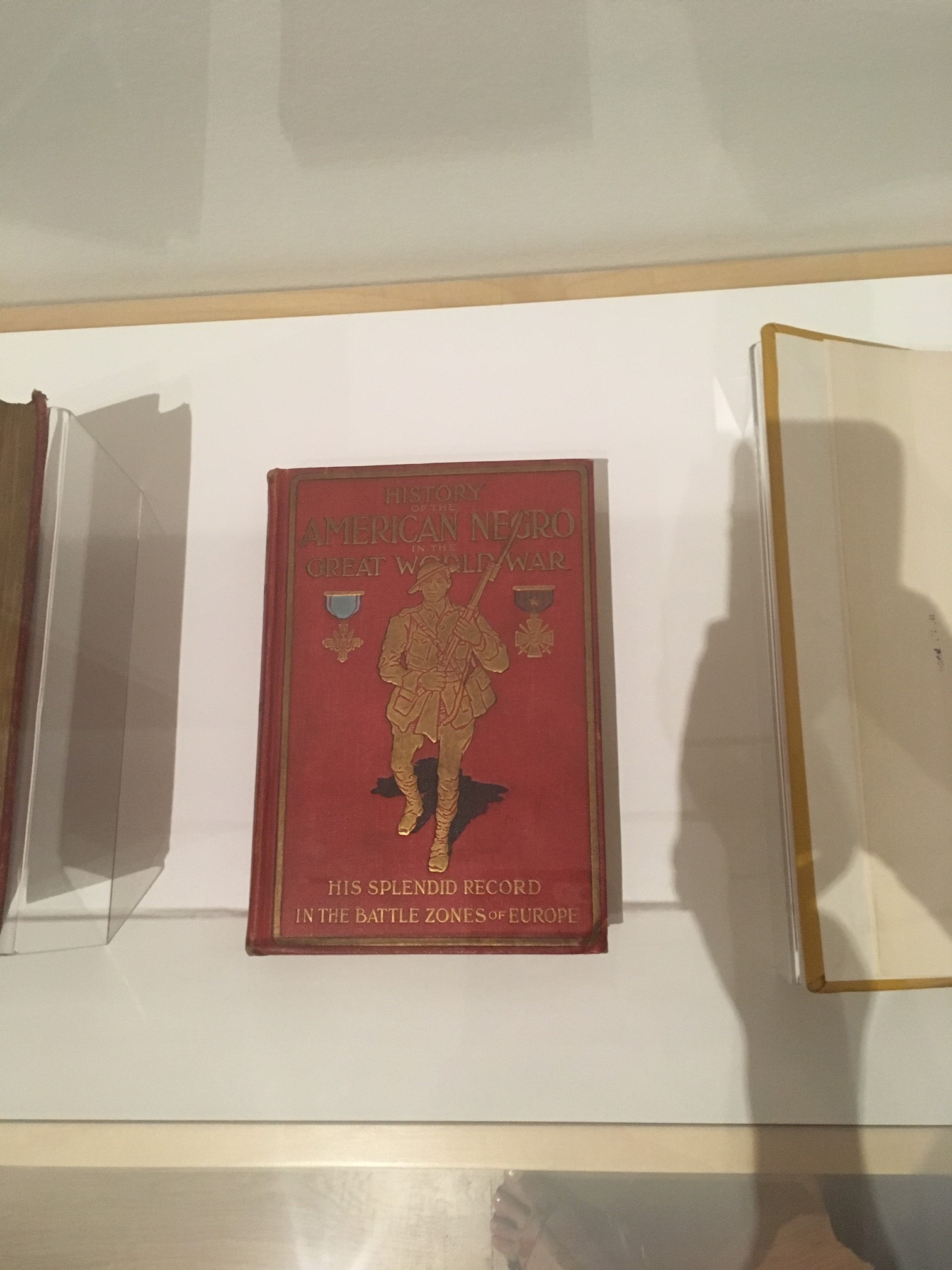
William Allison Sweeney, History of the American Negro in the Great World War, 1919, Cuneo-Henneberry, Chicago | Photo by Brianna Chu / Beacon Media News

Glisson elucidates, “We wanted to harness the large number of 1919-related items here into something provocative, allowing the visitor to interpret the period in a fluid way. Rather than telling a neat, resolved story, we tried to capture the jarring experience of life during a year that everyone understood was an inflection point for world history. Empires had fallen in the Middle East and Eastern Europe. Millions had died fighting and in a flu pandemic. Delegates at the Paris Peace Conference tried to sew a tattered world back together. Like today, people felt that irrevocable change was underway. The issues of 2019 – immigrant detention, women’s rights, and the fight for a living – were equally pressing in 1919.”

As detailed in a news release from The Huntington’s Communications Office, the ‘Fight’ section of the exhibit shows that, while the war might have officially ended in 1918, other battles raged on in Los Angeles, the rest of the nation, and Europe. A global influenza pandemic killed millions of people, claiming three percent of the world’s population. Laborers agitated for better pay and safe conditions. Rumors about a Bolshevik plot to upend the U.S. government led to a Red Scare. Violence erupted in a season described as ‘Red Summer’ for its deadly riots and lynchings of African Americans. In 1919, the bill that would clinch American women’s right to vote passed in the Senate, and temperance advocates won their fight for prohibition. Modern artists and writers responded to the tremors of the age, including the carnage of world war, by breaking with convention and tradition.

Items in this section include: German posters related to social and political upheaval; original photographs and materials documenting the flu pandemic here in Pasadena; national strikes and labor unrest; U.S. Marshal records (including mug shots and probation letters from German citizens jailed in Los Angeles during the war); and objects that tell the story of the fight to ratify the 19th amendment.
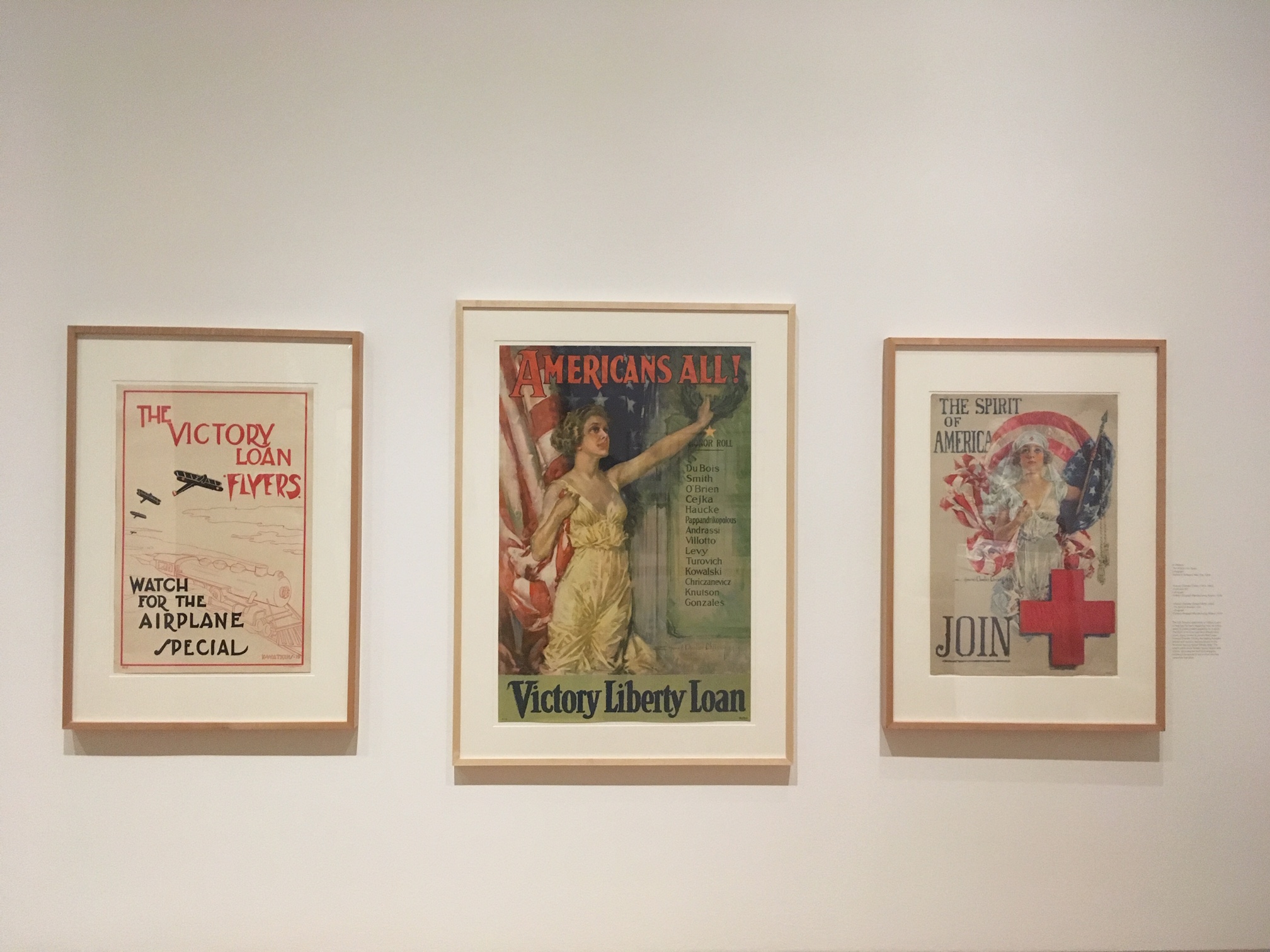
Victory Loan Flyers, ‘The Spirit of America’ Lithograph, and ‘Americans All’ lithograph | Photo by Brianna Chu / Beacon Media News

The ‘Return’ portion focuses on the immediate aftermath of the Great War, when millions of men and women – including 200,000 African America soldiers – headed for home. Survivors sought to understand and memorialize the war’s events through personal reminiscence and published accounts. Artists, some of whom served overseas, interpreted what they had seen, while others found inspiration in canonical tradition and myth. Popular music and illustrated books also offered safe harbor in tumultuous times.

Materials from this segment comprise: Liberty Loan posters; soldiers’ recollections; a rare Edward Weston portrait of dancer Ruth St. Denis; Cyrus Baldridge’s illustration ‘Study of a Soldier;’ and John Singer Sargent’s ‘Sphinx and Chimaera,’ which depicts a mythological scene.
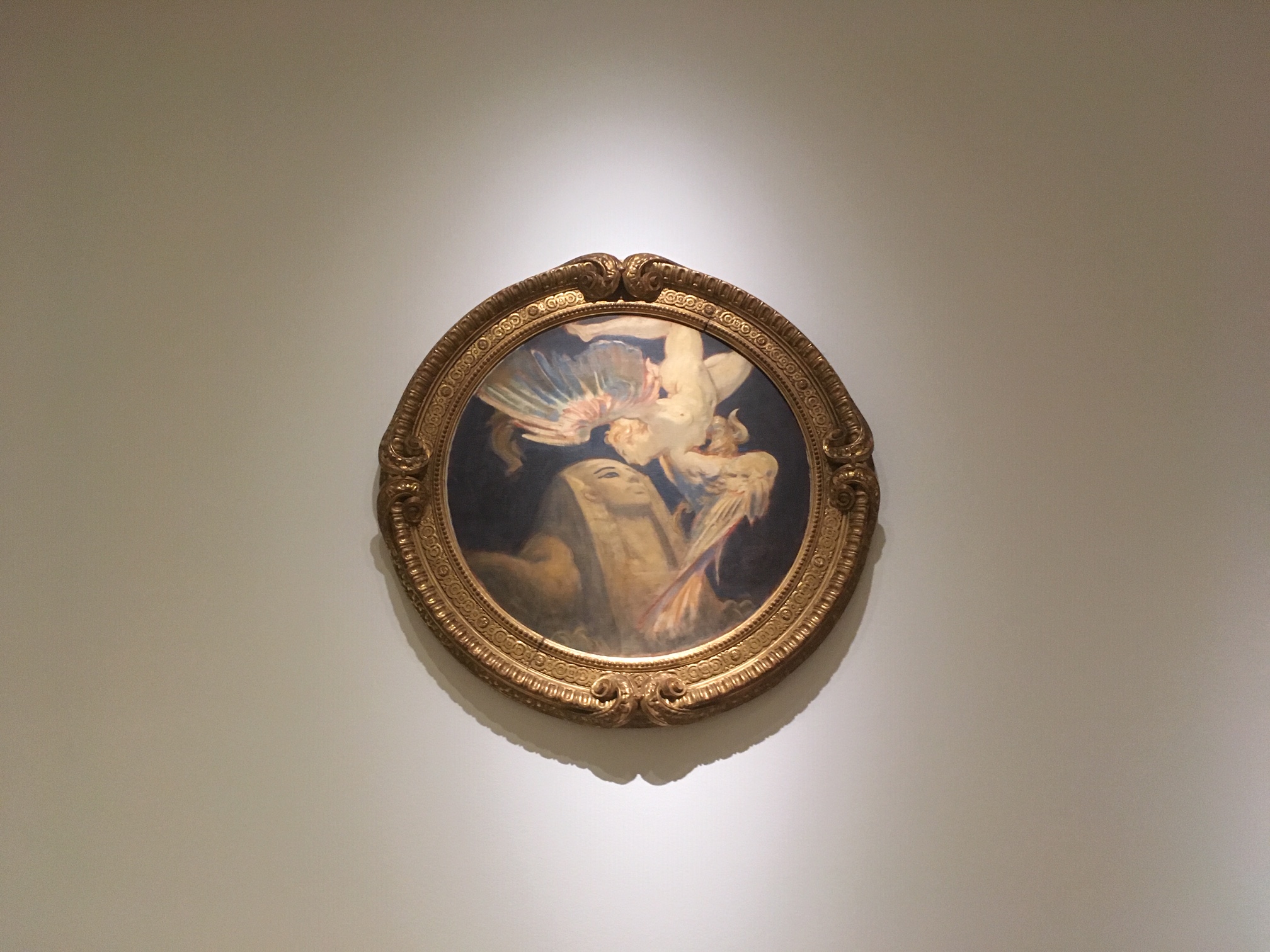
John Singer Sargent’s ‘Sphinx and Chimaera’ oil on canvas | Photo by Brianna Chu / Beacon Media News

In January 1919, President Woodrow Wilson and Allied heads of state gathered at the Paris Peace Conference to make new maps of a changed world. The carving up of ancient empires created new nations in the Middle East, Eastern Europe, and Africa, while regional promoters published maps to highlight Southern California’s capacity for growth. High above Los Angeles – at the Mount Wilson Observatory – the world’s largest telescope was on a nightly quest to chart the universe. In a world turned upside down, maps offered a welcome measure of predictability.

What the charting of territory that occurred that year meant and its resulting significance are explored in the ‘Maps’ section. On view is a first edition of ‘Traite de Paix,’ the Treaty of Peace signed at Versailles on June 29,1919, with a map showing new territorial configurations; an album of autograph signatures gathered at the Paris Peace Conference by T.E. Lawrence, otherwise known as Lawrence of Arabia; rare maps depicting population, transportation, and demographic data in Los Angeles and the nation at the time; and original astronomical photographs of the moon and constellations.
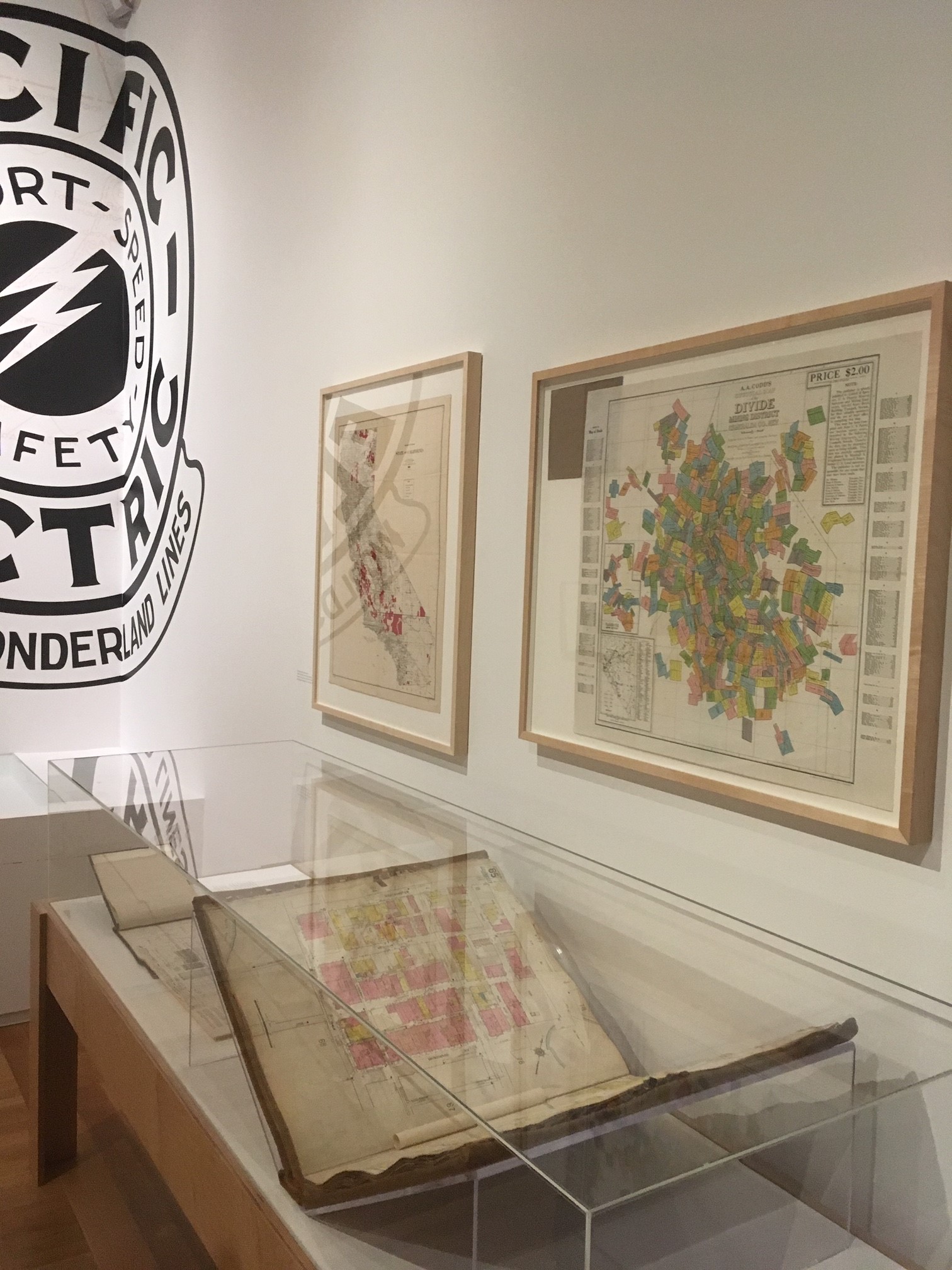
Huntington was obsessed with maps | Photo by Brianna Chu / Beacon Media News

While working on this project, Glisson and Watts found out that Huntington was obsessed with maps. She says, “If you think about it, it’s not that surprising given that he was probably one of the most influential people in setting the course of how our sprawling city came to be. We discovered the spectacular 39-foot long Pacific Electric linen map that shows the real estate holdings contiguous to the line which is part of Huntington’s development scheme. People may not realize that while the Pacific Electric was a component of the world’s largest transportation network at the time, it really was a loss leader for Huntington. He was most interested in getting people to the communities that he’d developed – Huntington Beach, San Marino, Glendale.

“This is a one-of-a-kind map and has never before been exhibited. It is an incredible document – you could see the level of detail on it. Every redaction, every addition is recorded by him. It would have been something that the engineers – and Huntington with them, because he was very detail-oriented – would be poring over. I like to call this the papyri of transportation. It basically shows the Pasadena short line, which was one of the first lines that Huntington put in to the Pacific Electric system and it goes from Old Town Pasadena all the way to the edge of downtown Los Angeles.”

This Pacific Electric map display also falls under the ‘Move’ portion of this exhibition, which examines the ways 20th century technologies – planes, trains, and automobiles – propelled a society on the go. Henry Huntington’s network of streetcar lines brought Angelenos from ‘the mountains to the sea’ and to far-flung deserts and farms. A burgeoning national road system made automobile travel possible and pleasurable as never before.

Also taking the spotlight in this section is the interstate automobile adventure of five friends, including famed aviator Orville Wright, assembled in a rare photographically illustrated volume titled ‘Sage Brush and Sequoia;’ works by T.S. Eliot and Virginia Woolf, published by Virginia and Leonard Woolf’s Hogarth Press.

The last portion of the exhibition, ‘Build,’ focuses on Henry E. Huntington and the institution he created. In 1919, Huntington announced what some, including his New York librarians, had begun to suspect. He planned to load boxcars with the ‘world’s greatest private library’ – some 120,000 volumes – and send it off to the country’s western shores. By then, the property’s palm, desert, rose, and Japanese gardens were planted under the guidance of William Hertrich, Huntington’s landscaper. The mansion, designed by Myron Hunt, was completed in 1910. With the construction of the library building, the keystone fell into place for what would become the beloved tripartite institution we know today.
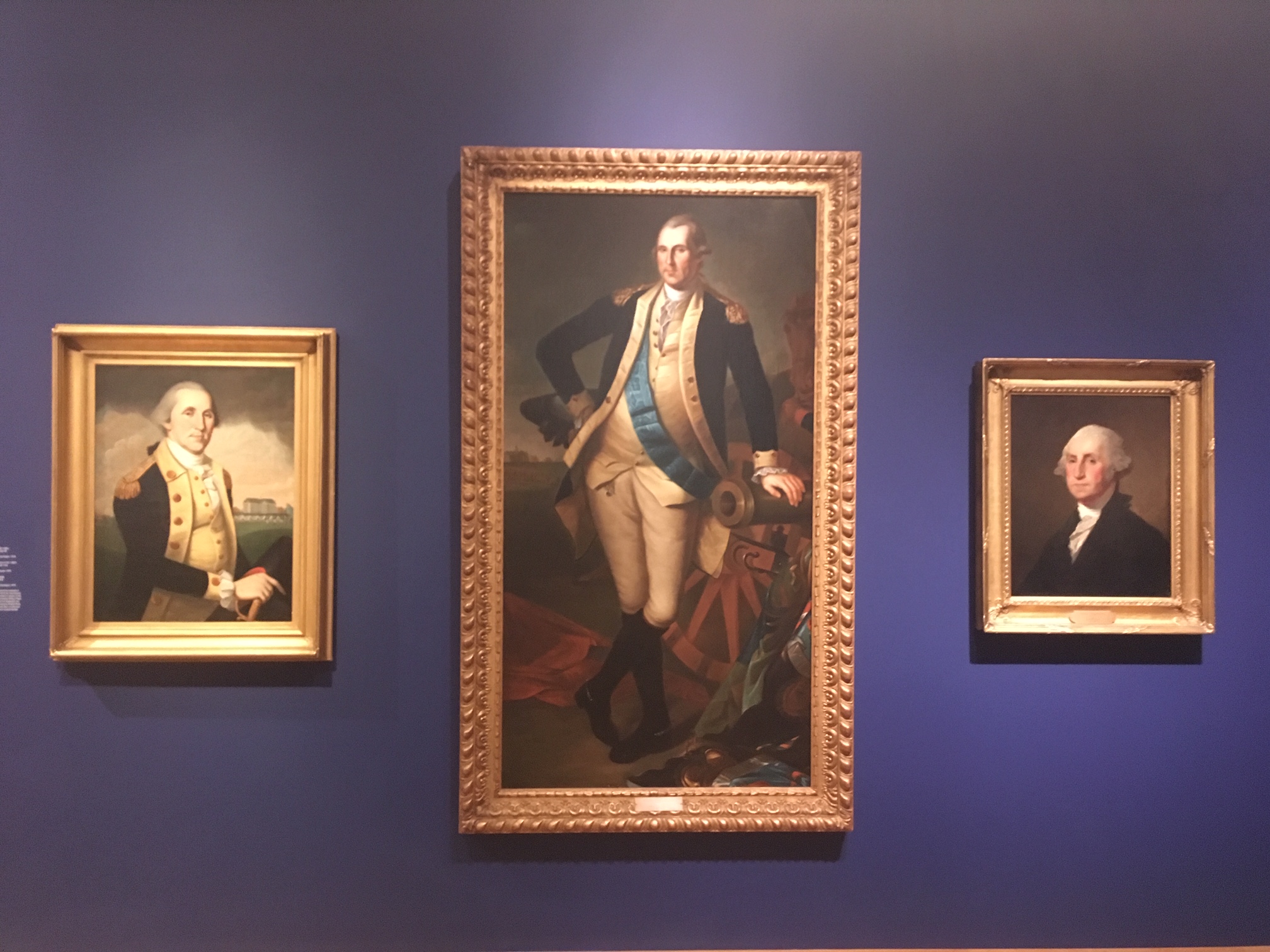
The George Washington Wall installation | Photo by Brianna Chu / Beacon Media News

A George Washington Wall – an installation of paintings – is also part of the exhibition. “This little section is an homage to Huntington’s own collecting and what he was doing in 1919,” Watts elucidates. “In 1919, he purchased four stunning portraits of George Washington, including the most famous one by Gilbert Stuart. Why was be buying portraits of George Washington in 1919? Firstly, it was the trend. There were a lot of things coming on the market then and George Washington was the most iconic figure at that stage of America. And, perhaps, because Huntington did this audacious thing of locating this giant institution and collection on the West Coast, for which he took a lot of criticism that he was taking what was considered the cultural patrimony of America and Europe and exporting it to this cultural wasteland of Los Angeles. I think Huntington wanted to ensure this institution took its rightful place in the cultural landscape and who better to do that than George Washington, the first in the hearts of his countrymen? And, of course, it also demonstrates Huntington’s admiration for first founders.”
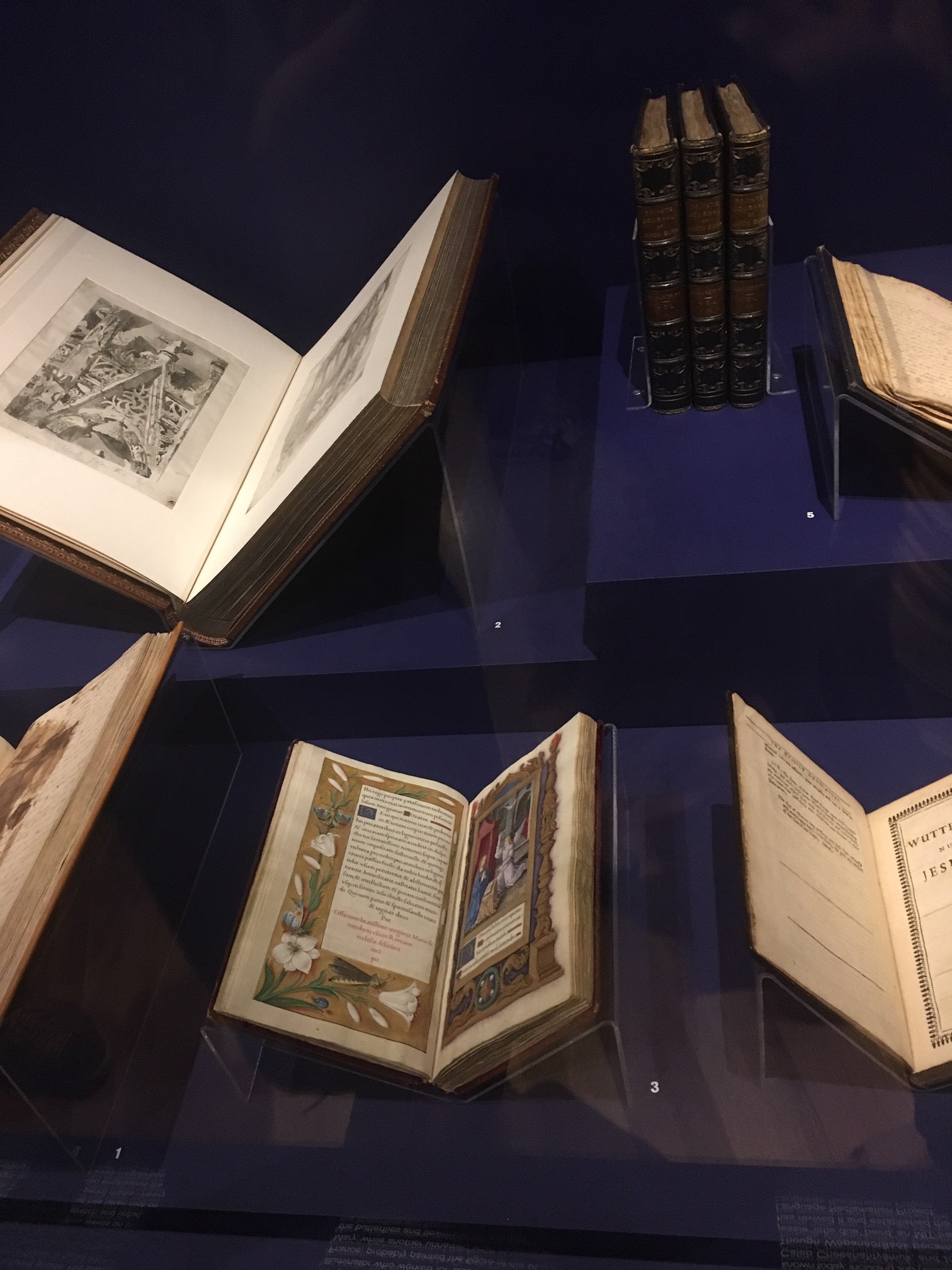
Beautiful Medieval books | Photo by Brianna Chu / Beacon Media News

In December of 1919, Huntington invited members of the prestigious New York Authors Club to his Fifth Avenue home. At that exclusive event, he shared with them 35 treasures in which he took special pride.

Watts declares, “This was significant for a couple of reasons – we had very little understanding of what he liked or favored. We know what his collecting interests were but we don’t know what his personal favorites were because he didn’t write or talk about them. This group of objects gives us a little insight as well as showcases his overarching collecting interest. Out of these 35 items, we chose some things that we thought were really outstanding and not generally on exhibition. They include: Benjamin Franklin’s handwritten autobiography; Maj. John Andre’s Revolutionary War-era maps; the first Bible printed in North America in a native language, which is also called the Eliot Indian Bible after the Englishman who translated it; and Civil War General William Tecumseh Sherman’s four-part memoir never before examined by scholars. The pages open to the redaction pertaining to his mental illness which ran in his family.”

Rounding up the exhibition are displays related to the make-up of this institution. Says Watts, “One of the things I like to tell people is that in 1907, at the beginning of Huntington’s collecting career, there was a big article in the New York Times about the most important collectors in the country and Huntington appeared nowhere. In 1919, when this institution opened, he was called one of the world’s greatest collectors, having one of the world’s best private libraries. How did Huntington do that? He was a consolidator and amalgamator – he bought huge libraries all at once. He had purchased four of the libraries that were mentioned in the 1907 article. We included several book bills to show the range of people he was dealing with and also the kinds of things he was buying. A favorite of mine is the one from Rosenbach, who was one of his major dealers. He delivered $121,000 worth of Shakespeare’s works to the San Marino estate. That gives you a sense that he purchased aggressively.”
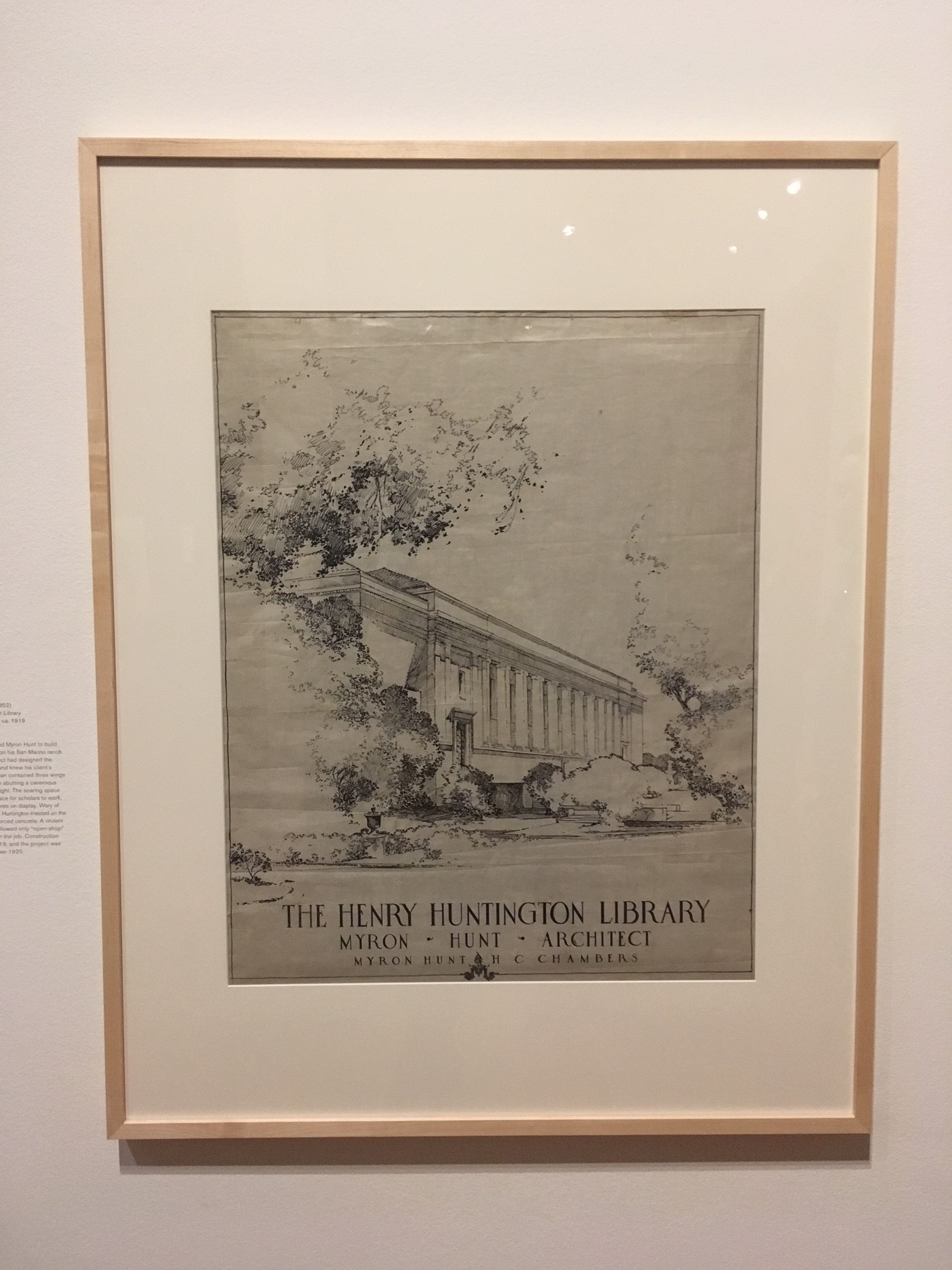
Myron Hunt presentation drawing, ink on linen | Photo by Brianna Chu / Beacon Media News

“Among the many surprising things we learned, we determined that in the early years he was planning on importing all sorts of seeds and plants not as a collector but to landscape his real estate holdings,” Glisson discloses. “He was trying to figure out what would work here and it evolved into a teaching collection, something akin to what Harvard was doing in his botanic garden. The other thing that was really fascinating was that in the beginning he thought he could finance this whole enterprise entirely on citrus. Through all sorts of formulation of various fertilizer and types of trees, Hertrich was able to tell Huntington which are the best varieties and how much they’re making. Unfortunately, citrus isn’t the most reliable revenue source and, on top of that, 1919 was a bad year for citrus. Huntington ultimately had to sell some properties to finance this place. In 1919, Huntington had 600 acres; today his estate has 207 acres.”

Watts leads us to a small section, explaining, “This is a kind of homage to Hertrich. Here we see some of the early photographs of the property that he took and his little notebook with a listing of  birds which Arabella loved – there was an aviary here with 500 birds. Hertrich, in addition to overseeing the citrus and the grounds, also had to keep track of all the birds. A favorite of Arabella’s was the toucan and we have an original citrus crate label with a toucan, the only one we know that exists.

“We also found something interesting – the vast labor force that actually made this place come to be was not well represented. Although they didn’t necessarily go around taking pictures and keeping documents of their workers, we were able to find payroll records. We discovered that a third of the work force during the time were Mexicans from Mexico or Spanish, and they were paid significantly less than the European and American work force. It wasn’t surprising, but we’re starting to have scholars weed through and work with those documents that were heretofore unexamined.”

“And what would a show about Huntington be without talking about how much he was worth in 1919? He was worth $69 million that year and we have these preprinted ledgers and balance sheets, which he kept month by month, that showed his assets.”

“I will finish with a picture of Henry and Arabella – seen here as a young woman, not the woman we have come to think of as Arabella Huntington, the dowager wearing a widow’s veil,” pronounces Watts. “She was very much behind the scenes of this enterprise and was, in many ways, a huge force to be reckoned with. Her interests, as you may know, were in French decorative art and British portraiture, which he went on to collect later in time.

“When you exit the exhibition, you’ll see this great quote by Herman Hesse which we felt is emblematic of this project and of the year 1919: Every man is more than just himself; he also represents the unique, the very special and always significant and remarkable point at which the world’s phenomena intersect, only once in this way, and never again.”

Asked what he learned about Huntington that he didn’t know coming into this project, Glisson replies, “I haven’t been here that long so I didn’t know a great deal beforehand. In reading reminiscences about him and what people said, my takeaway is that he was someone who believed in trusting other people and he was very optimistic. He was always telling his staff to trust people to do the right thing. I thought that was very significant and interesting for a tremendously successful businessman and it suggests he must have found people he trusted and liked and then let them do their job. And that, to a large degree, is how you run a grand institution. In a sense, he clearly wasn’t that interested in being a book collector in 1905 or 1906 and then he got interested and  focused on it. When it came to the grounds, his landscaper Hertrich suggested that they be systematic about it and create a scientific botanical garden like Harvard and he agreed right away. So there’s trust and this openness and a kind of capriciousness that, I think, shaped what we are today – an art museum, a botanical garden, and a library – which is a kind of unlikely combination.”
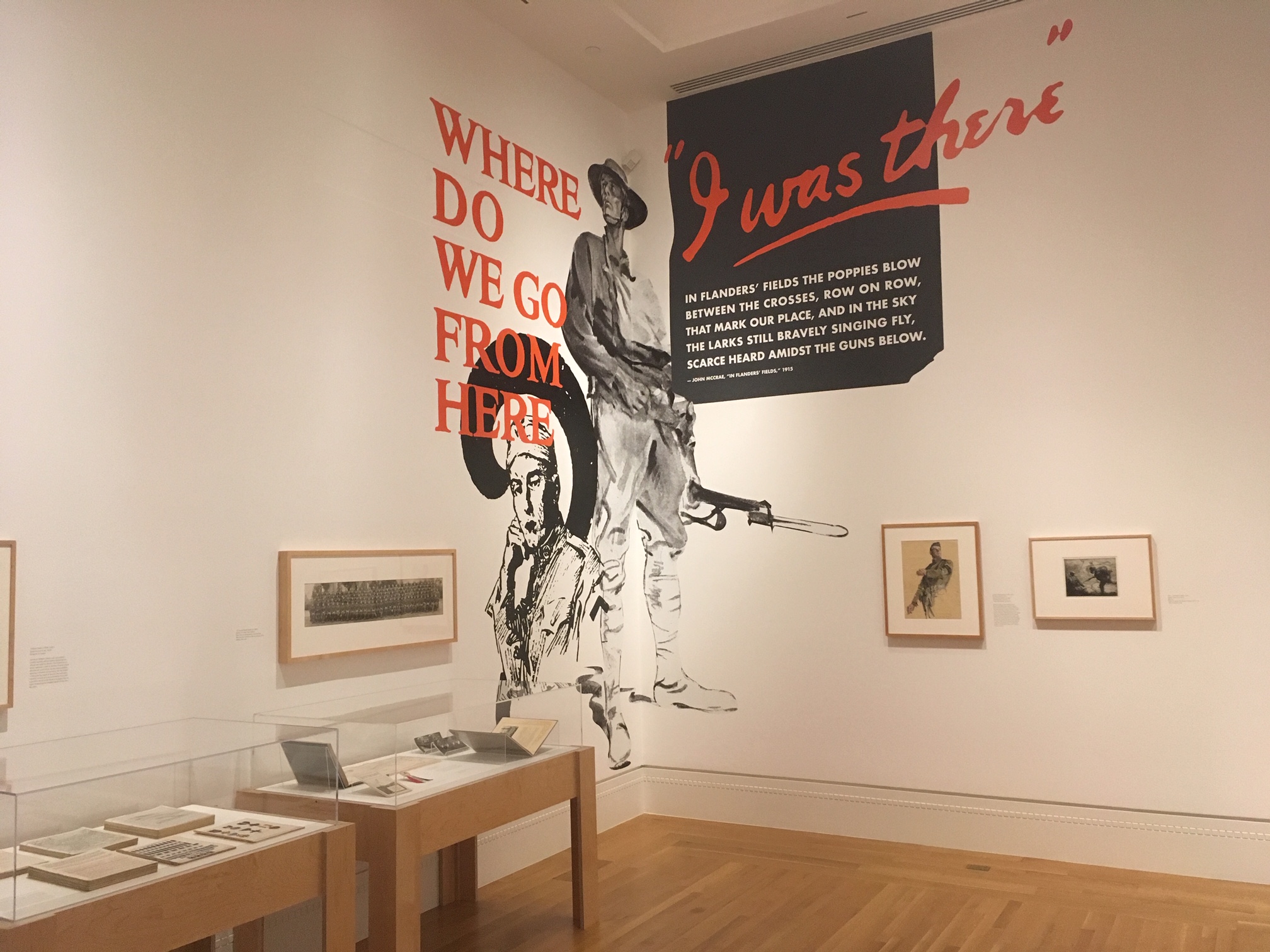
Displays in the ‘Return’ section | Photo by Brianna Chu / Beacon Media News

I inquire what they want people to get from the exhibition. Watt responds, “I always want people to leave with a sense of curiosity and wonder. For me, it was important that people understand the depth and wealth of our collection, that we’re an active research institution where scholars come in every day to study these materials, and that we have an active, vibrant collection which continues to grow.

Glisson says, “One, I hope that people, particularly those from L.A. and Southern California, come to the show and are surprised. Two, I hope they find something that they want to learn more about. And three, I hope they find something in the show that speaks to their own experience which, I think, is pretty likely because there’s all sorts of materials. Those are my hopes, and the biggest one is just for visitors to be very surprised.”
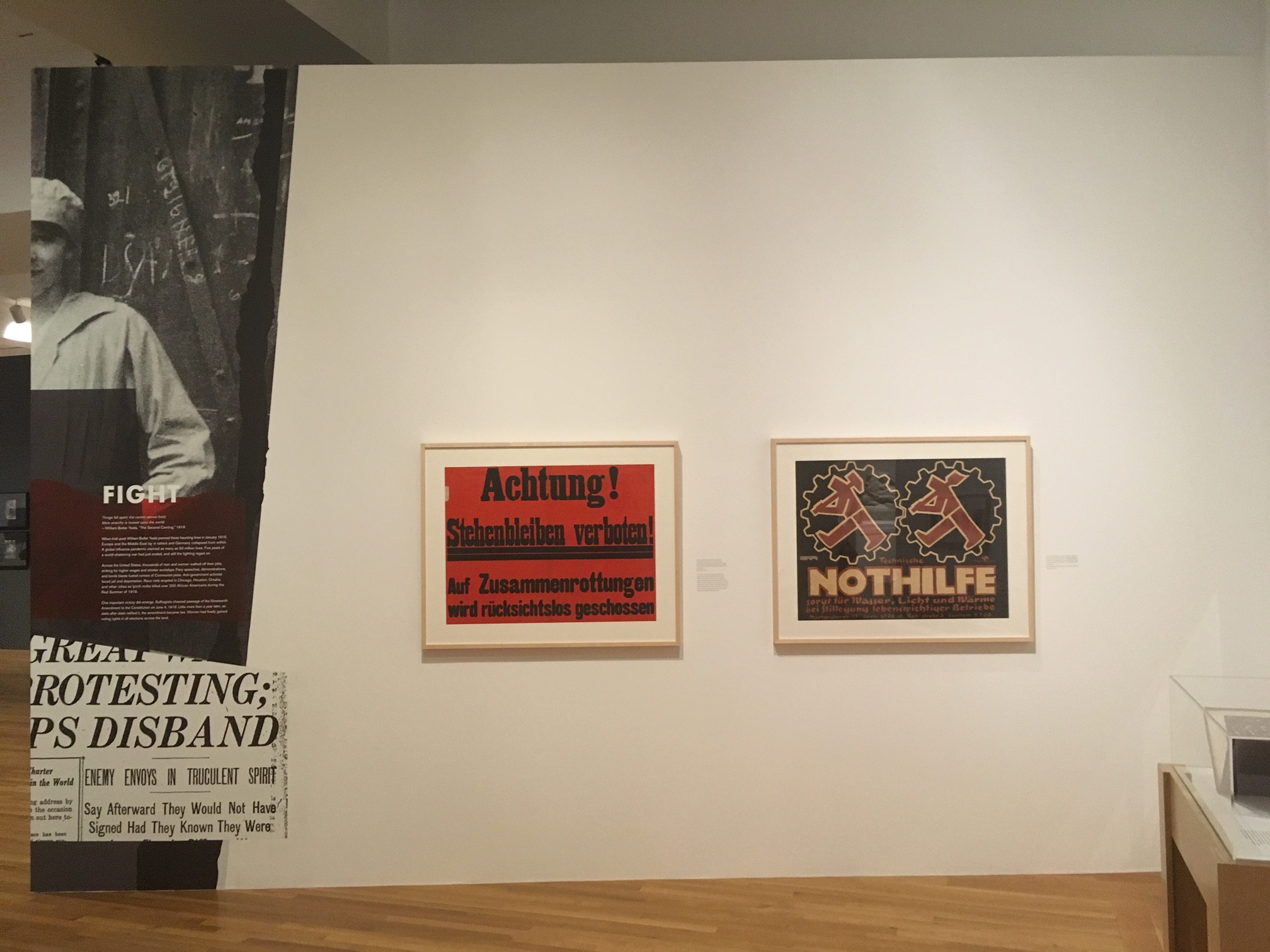
German Revolution Photos | Photo by Brianna Chu / Beacon Media News

As for his favorite display among all the objects, Glisson reveals, “I love this red poster. Visually, this just jumps off the wall. It’s an incredibly powerful thing. And then there’s the text – Achtung! Stehenbleiben verboten! Auf Zusammenrottungen wird rucksichtslos geschossen –  which translates to ‘Warning! Stopping is prohibited! Crowds of rioters will be indiscriminately shot.’ My German isn’t so good and I kept reading it and wondered about it. It turns out that this poster would have been printed during the German Revolution in January 1919, and it was posted on a government building with armed soldiers watching around it. Talk about this poster being a snap shot of history and how improbable that it got all the way from Berlin, maybe from the Reichstag, to Los Angeles.”

That Henry E. Huntington had chosen to establish the institution that would bear his name in the San Gabriel Valley in 1919, when he could have done so anywhere in the United States, was quite improbable as well. It might have been seen by some as a foolhardy decision at the time, but we want to think it proved to be a stroke of genius!


‘Gem of the Ocean’ Gleams at A Noise Within

Originally published on 8 October 2019 in the Pasadena Independent, Arcadia Weekly, and Monrovia Weekly

‘Gem of the Ocean’ ensemble | Photo by Craig Schwartz / A Noise Within

August Wilson, a Pulitzer Prize winning playwright, wrote a cycle of ten plays collectively called the ‘American Century Cycle’ which he set in a different decade of the 20th century. Each of the plays chronicles the complexities of the changing social and historical landscape of the African American experience over the course of a hundred years.

‘Gem of the Ocean,’ set in the Hill District of Pittsburgh, Pennsylvania, where Wilson grew up, is the first play in the cycle. It is the second production in A Noise Within’s 2019-2020 season and is on stage from September 22 to November 16. Directed by Gregg T. Daniel, it stars Veralyn Jones as Aunt Ester Tyler, Evan Lewis Smith as Citizen Barlow, Kevin Jackson as Solly Two Kings, Chuma Gault as Caesar Wilks, and Carolyn Ratteray as Black Mary Wilks.

Ratteray, a resident artist, was previously seen on the ANW stage when she portrayed the role of Beline in ‘The Imaginary Invalid.’ She graciously sits down with me an hour before rehearsal to talk about August Wilson, the play, and her role.

She begins with a revelation, “Gem of the Ocean’ holds a special position because it’s the first play in the ‘American Century Cycle’ even though he wrote it last. I love that he went back to the beginning, to the early 1900s – it takes place in 1904. He wrote in retrospect about how it all started. The date has significance as well. As you’ll read in the program, Aunt Ester is a 285 year-old spiritual advisor for the Hill District Community. If you do the math, the day she was born is 1619 which is the arrival of the first enslaved Africans on the American shores. As she explains in a beautiful monologue, Aunt Ester is a title that was handed down to her and whoever owns that title is the holder of the memories of the African people.

“Aunt Ester’s home address and house of sanctuary – 1839 Wylie Avenue – also has a significance. The year 1839 was the date of the enslaved people’s rebellion on La Amistad, the ship which traveled from West Africa to its final destination, which was supposed to have been Cuba. However, the enslaved people revolted and made the Spanish enslavers go back to Africa. Instead the Spaniards took the ship to the United States where they faced the Supreme Court to decide if they were, in fact, slaves or free people.

“August Wilson left gems of history within his text. By chronicling each play throughout the entire 1900s, he laid down the history of Africans, particularly Africans in the Americas. It was exciting to unpack everything during the first few days of table work. Coincidentally, 2019 marks the 400th anniversary of the first enslaved Africans’ arrival. How meaningful it is to stage this play now! Though I’ve seen some of his work, this is the first play of his that I’ve been part of. It’s amazing to be able to witness his brilliance as a play maker, world creator, and story teller. That’s the great thing about being an actor, each project is a mini history lesson.”

Ratteray explains, “In the play, a man named Citizen Barlow comes to Aunt Ester’s house because he has done a deed for which he feels a guilt and heaviness that he can’t quite shake. And only by getting his soul washed by Aunt Ester can he feel free again. August Wilson has woven a fascinating mythology that the people who didn’t make it across the water created a city of bones underneath the ocean. Aunt Ester has kept the bill of sale, the receipt that proves that she had been bought and sold, which she makes into a paper boat. She gives it to Citizen saying, ‘This is the Gem of the Ocean and you have to get on this boat to go to the City of Bones.’

Shown left to right: Veralyn Jones, Carolyn Ratteray, and Evan Lewis Smith | Photo by Craig Schwartz / A Noise Within

“The Middle Passage is the name given to the route that the ship with enslaved people took from Africa, through the Caribbean, up to the coast of America. Out of every 100 people kidnapped, only 40 lived. Obviously a lot of people jumped overboard when they could and a lot of them died because they were packed like sardines for months. It was a three- or four-month voyage, with no food and no bathrooms. The conditions were horrible. They were allowed a few minutes a day to walk, then they were put back in chains.

“August Wilson positioned this ritual which, I feel, is a call for Africans in the Americas to say ‘We have to honor this Middle Passage, the defining event of our experience here in this country and which has plagued us ever since. We have to lift it up and come to terms with it – we have to grieve, celebrate, and ritualize this Middle Passage. This play is building towards this moment when this man goes to the City of Bones and it’s the big theme of the play – that once you face your past, you can move on to your future.”

Asked to describe her character, Ratteray says, “Black Mary is Aunt Ester’s protégé. She wants to take on this mantle but she is, at the same time, reticent and hesitant, nervous and scared. She wonders what it means to be the holder of all these memories. It’s a daunting task for someone in her 20s. All the characters take a beautiful journey in the play and hers, in particular, starts from a place of being in service to others – Aunt Ester and the men in the household. Her life has been prescribed by the men in her world and by the strong dominating force of Aunt Ester.”

Ratteray, who gives a superb performance, cannot have a more different background from the character she plays. She says, “My dad came from Bermuda and my mother was from Georgia. He was amazing with his family chronology – he has all the papers about our family back to the very first person who bore our last name. They wanted us to know our lineage, to know who we are, and told us to carry that with us. They wanted the best for their kids and they put a huge emphasis on education. I went to a white private school for a good part of my growing up – 4th to  12th grade. My parents knew that it was totally dangerous for me to be in that situation because I could lose my connection to my history and to who I am. But they never let me do that. From a very early age, they told me about our history and gave me the biographies of Malcolm X, Dr. King, and other civil rights activists, to read. They planted seeds and created an environment that later on made me incredibly curious to know what it was like to live in the United States at an earlier time. You have to know your history or you’ll get swallowed by the dominant system. Which is what August wants us to do – to speak our truth and in our language. He wanted to lift the African American vernacular to a place of poetry. It’s amazing, because so often people would say ‘that’s not correct English – you can’t say ain’t’ and if it’s not perfect King’s English you’re somehow less smart or less advanced. It’s seeing your reflection wherever you can see it and having a sense of pride.

Carolyn Ratteray | Courtesy Photo / A Noise Within

I ask Ratteray how she approached her role. She replies, “I always try to find what I have in common with the character. There’s a scene where Citizen tells Black Mary to come to his bedroom that night and she stops him in his tracks, saying ‘What do you have to offer?’ She then goes into this monologue about how men don’t see the fullness of who she is. She’s looking for someone who doesn’t only want what he can take from her but has something to give back to her. She doesn’t want to be used anymore; she wants to be appreciated and valued. She wants to learn how to be seen in this world. She knows she has to be right with herself before she can be right for anybody else. I am awed by the heart with which she says it – she’s been wounded  by these men – but she’s still holding on to the belief that she can demand better for herself. She wanted to wait for the right person and wait for herself to bloom so she can be with someone else. That’s such a deep line. It’s brilliant! I read that and I identified so strongly with that value. In my life I have spent a lot of time in self-reflection and constantly asking how I can make myself right, to come to the table with the fullness of myself. That type of grit and force of soul, I saw right away; this was a woman I can know.”

Continues Ratteray, “Soon after that scene, she stands up to Aunt Ester and says ‘I’m going to do things my way if I’m going to stay here.’ And that’s her being right with herself as well. It can be hard to stand up for oneself in this society and speak truth to power. It can be intimidating. But you can see the relief and growth that develops after she says it. That’s something I can relate to.

Although Black Mary doesn’t say outright that she’s ready to take on the role of Aunt Ester, that’s when she demonstrates she’s ready to take the mantle. And Aunt Ester says to her, ‘What took you so long?’ It was as if Aunt Ester was waiting for Black Mary this whole time to come to that realization.

“The dynamics change after that. She makes a very clear choice – she’s aligning with Aunt Ester. In order for Black Mary to take this mantle, she has to let her worldly family – Caesar – go. And that’s the one thing she hadn’t wanted to do; she had been riding this for as long as she can because he was of her blood and giving up on him meant she had nothing left. She walked that line but as events progress in this play, she sees that she doesn’t want to be associated with what he’s doing. She has to break away from him and find her own voice and footing. In the monologue towards the end of the play she says, ‘Caesar, I don’t knew you. You’re not my brother.’ And with that, the tie is broken and she’s fully realized. She becomes Aunt Ester’s successor.”

Chuma Gault as Caesar Wilks with Ratteray | Photo by Craig Schwartz / A Noise Within

In doing this play, Ratteray discovered something she hadn’t known going in, “I knew August Wilson was a genius – he has a Pulitzer and an amazing body of work. But actually understanding how much of a visionary, art maker, and political activist he was, was an eye-opener. The amount of history that he packed in had surely gone over my head the first time. It’s amazing how he built in those first 40 years after enslavement in this play. His lines are so well crafted with poetry, music, and rhythm as well as plain information. For two and a half hours, he told us a story about what this world was like post-reconstruction. The artistry by which he did that is astonishing to discover. At the same time he has painted a universal portrait of humanity. He tells us to live this life with integrity, whatever our race, gender, or orientation. The messages in this play are beautiful reminders of how to be in this world. It’s exciting to hear that every night and getting a history lesson at the same time.”

Ratteray adds, “August Wilson wrote a really fascinating historical series about the post reconstruction, into the Jim Crow era. At the most basic level, I hope our audiences enjoy the play; August Wilson is an amazing story teller. Ideally, I would love it if they could see themselves in those characters and hear the messages. The values that are imparted in the story are true to all of us regardless of our ethnicity and gender. Who hasn’t felt that tug of integrity? Who hasn’t asked themselves ‘Should I live my truth or should I hide it?’ ‘Should I align myself with the power structure or should I speak up and make a stand?’ Whether we’re immigrants who voluntarily arrived in this country recently or enslaved people who were forced to come here long ago, whatever the plethora of differences we have, the questions that make this universal and enduring over the years are the same. What is freedom in this day and age? Who am I? How do I become? What does it mean to face a part of your past in order to move forward? How do I live with myself if I don’t have a conscience? Do I have to compromise?

“I hope they don’t think of it only as a play written by a black playwright and it’s a black experience. While it’s specifically about the black experience, it isn’t exclusive to a particular community, it applies to all of us. August Wilson is one of the greatest American playwrights and he’s writing all of our stories. I hope people are moved; I hope people feel the story in their heart. I do love history, so part of me hopes that it makes people want to read about this period in our history – for them to look where we came from and where we are now. If we don’t know more about what happened in the past, we can’t cultivate the foundation of compassion for others – for those who are different from ourselves. I’m glad that we’re continuing to tell these stories. Being a part of this cast and crew, and the beautiful tone that Gregg struck from the beginning of what it means to speak these words and tell this history, is such a beautiful gift.”

‘How the Light Gets In’ is World-Premiered at Boston Court Pasadena

Originally published on 3 October 2019 in the Pasadena Independent, Arcadia Weekly, and Monrovia Weekly

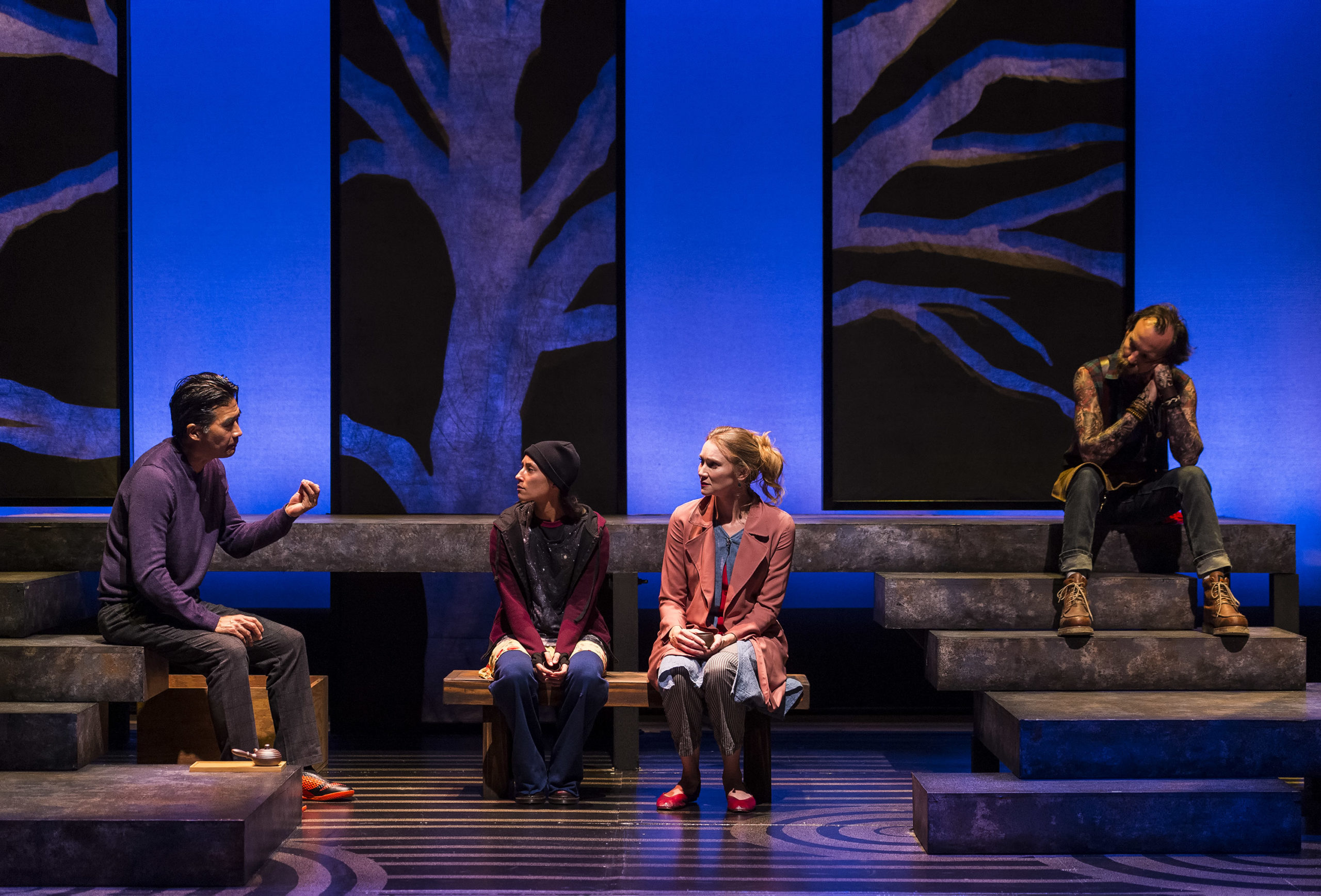
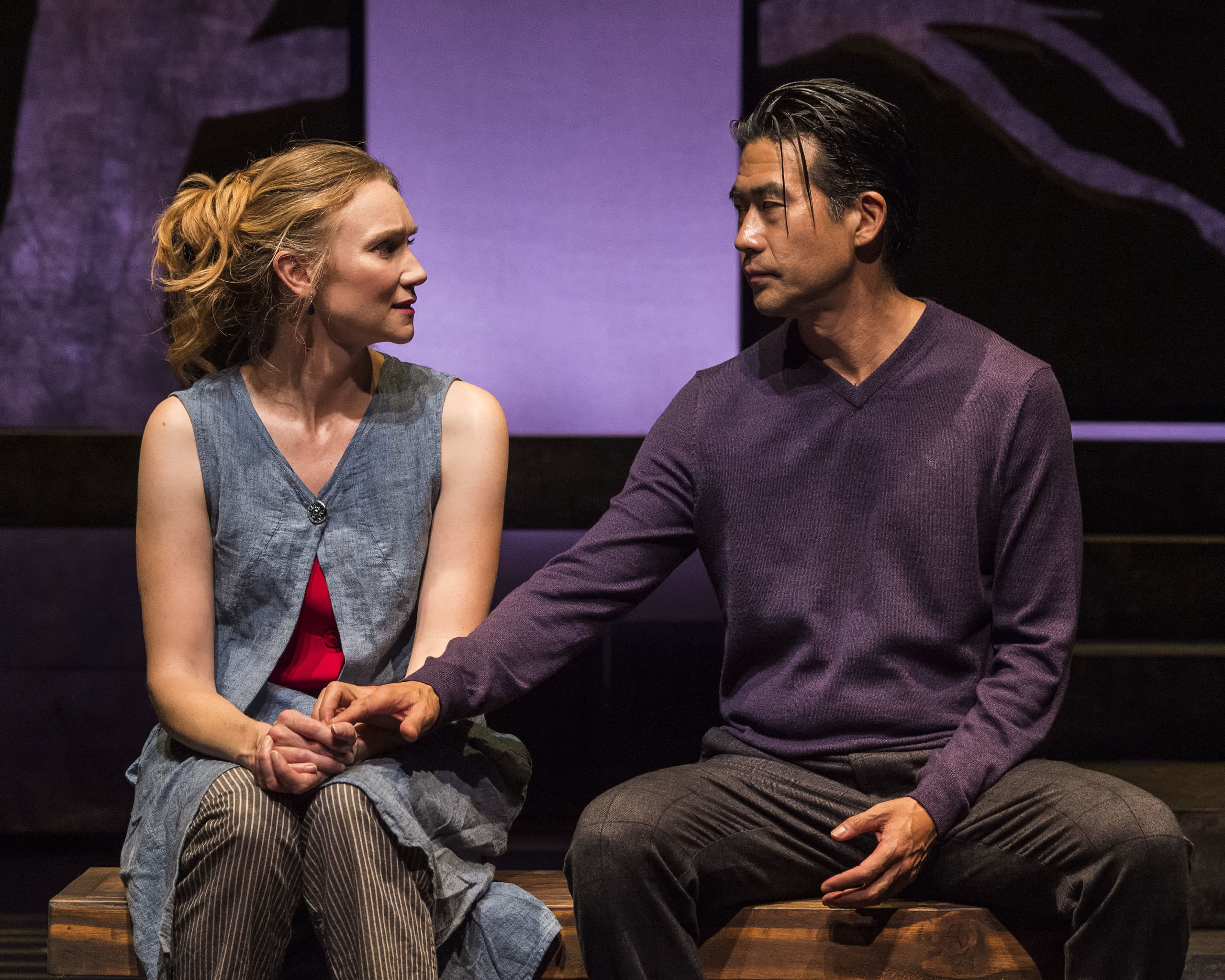
There are two lines in Leonard Cohen’s song ‘Anthem,’ that go ‘There is a crack, a crack in everything; that’s how the light gets in.’ The words inspired an original play by E.M. Lewis ‘How the Light Gets In,’ which is currently having its world premiere at Boston Court Pasadena from September 19 to October 28. Directed by Emilie Pascale Beck, the Literary Manager at Boston Court, it stars Amy Sloan and Ryun Yu in the roles of Grace and Haruki, and features Chelsea Kurtz as Kat and Dieterich Gray as Tommy Z.

‘How the Light Gets In’ is an intimate story about four characters – a travel writer who never travels, a Japanese architect who can’t figure out how to build a simple tea house, a gifted tattoo artist who resists the power of his talents, and a homeless girl who lives under a weeping willow tree in the Japanese garden – who live disparate lives that somehow intersect in the most unexpected way.

That peculiar, yet fascinating mix, is enough to pique anyone’s curiosity. Lewis, during a late morning interview, gladly chats about her start in playwriting, her connection to Boston Court, why she conceived this play, and how the four unlikely characters’ lives in ‘How the Light Gets In’ seamlessly blend into each other’s.

The ‘How the Light Gets In’ ensemble | Photo by Craig Schwartz / Boston Court Pasadena

Lewis begins, “I’m from rural Oregon but I went to graduate school at USC and stayed in Los Angeles for quite a while. This is where I became a playwright and I have a lot of friendships and connections to the theatre community here in Los Angeles. I met Emilie then and we’ve wanted to work on something together since. I was involved with ‘Moving Arts,’ a small theatre company in Silver Lake and they’ve done four of my plays over the years – ‘Song of Extinction,’ ‘Infinite Black Suitcase, ‘The Gun Show’ and the latest one was ‘Apple Season.’

While New York is widely known as where theatre happens, there’s a very active theatre community here. There are amazing actors and people who are passionate about creating stories for the stage who often are making a living on film and television. But they love coming back to the theatre because it’s intimate – there’s a relationship between you and the audience. And I love that, especially when the story is so close to me and I can feel myself breathing what they’re breathing. That’s ideal to me as an audience member and a playwright as, I’m sure, it is what actors and directors want.

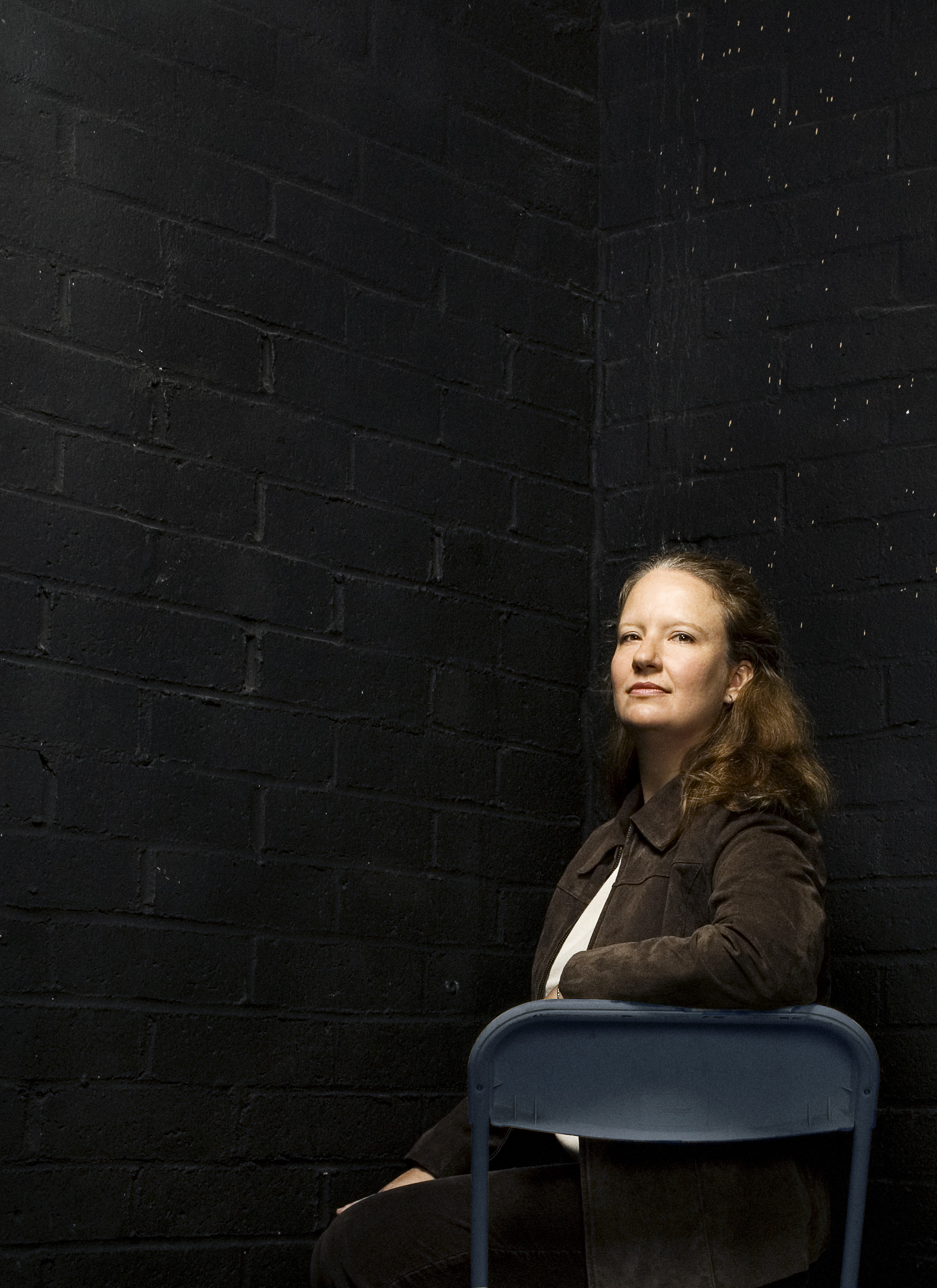
Playwright E. M. Lewis | Photo courtesy of Tom Sanders Photography / Boston Court Pasadena

Talking about the play that involves people who seem to be in the wrong profession, Lewis describes, “Grace, the main protagonist, is a smart and capable travel writer who loves to read and enjoys what she does. She took care of her parents who were getting older and when they passed away she finds herself, in the middle of her 40s, a little bit isolated. While she has a satisfying career, she’s unmarried and has no family so her life has no meaning to her. When something happens to her, she’s shocked to find out she has no one to emotionally help her with what she’s physically going through.

“The male protagonist is the architect Haruki who lives in Japan but works internationally; he’s been widowed for ten years. His wife was the world to him and when she died, he lost his heart. He poured all his energy into his work and became solitary. While he is prospering professionally, the personal side of his life has been neglected.”

“So these two people find each other at a moment when he is finally, perhaps, maybe, open to the possibility of something new – although he’s not sure that he’s ready for love – and she is in the midst of a crisis, which is really the most terrible moment to come across someone who is lovely and wonderful. She doesn’t feel like herself and is not sure what’s going to happen. Yet, things in this life don’t happen on a schedule or when you want them to, they happen when they happen. So we’ll see whether or not they allow themselves to seize this opportunity. It’s a little love story; I haven’t written very many. It’s quite joyful to have these two characters in my head and in my ears as I was writing the play, and now to see them come to life. It’s really delightful; I think I should write more love stories,” Lewis chuckles.

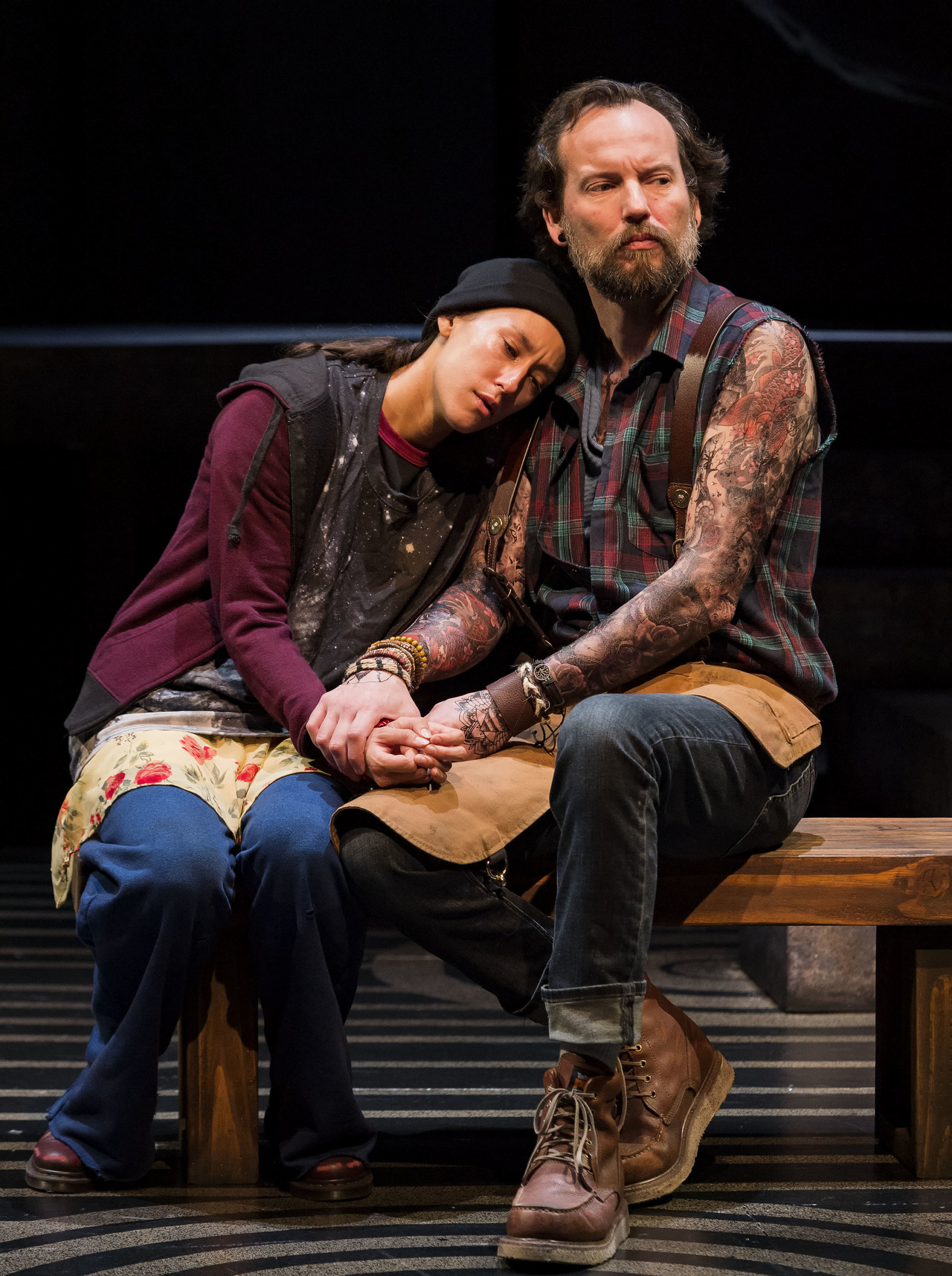
Continues Lewis, “Tommy Z, the tattoo artist, is a tough character. He owns the shop where he works which is, basically, an abandoned half-demolished building that he bought for a good price. There’s one entire wall missing, where someone drove through. And so he built a wall out of discarded window frames and windows he salvaged from various garbage sites, which created a quilt of light.

“We learn that his life converged with Kat’s at a hospital emergency room. She had been having a rough time – she had hurt herself yet decided to get help. So she finds herself in the ER late one night and takes the last seat, which happens to be beside Tommy, whose brother has overdosed, and not for the first time. They strike up a conversation and a friendship, proving that in the midst of crisis people connect and find each other. Their story ends up intersecting with Grace’s and Haruki’s because Kat has been living under the willow tree in the Japanese garden. While Tommy’s only connection to the garden is through Kat, he gets woven into the tale because his gift as a tattoo artist turns out to be important to some of the other characters in unpredictable ways.”

Choosing her words deliberately, Lewis explains, “The core of the story is that in a moment of crisis, when you are overwhelmed by something that has happened, you are also in a moment of possibility of remaking yourself. Grace who, until that time, has been doing what she’s always done – writing a travel column – finds out she has a health crisis which knocks her off her feet. She’s trying to figure out what to do and how to handle it. And with the help of these strangers who become family to her, she finds her way out the other side and somehow in a better way. Sometimes a catastrophe pushes you to look at your life and see what’s missing, to consider what you want to be, show you a clock that’s ticking, and makes you realize how important it is to do what you want to do right now.”

Amy Sloan as Grace and Ryun Yu as Haruki, the main characters | Photo by Craig Schwartz / Boston Court Pasadena

Asked how she conceived the play, Lewis responds, “Plays are made out of playwrights. What other stuff do we have to make our work from? The story and the characters are entirely fictional but there’s a lot of Grace’s story that comes from me. I had a health crisis about two years ago, which was both shocking and scary, so Grace’s journey mirrors mine a little bit. I began writing the play while I was going through medical procedures and, as usual, it’s writing that saves me. My characters – who dropped into my head – helped me figure out about myself what I have trouble doing. Hearing their voices made me less lonely as I was going through it. And it’s exciting to see that they’re going on stage in a unexpectedly quick time from when I started writing it.”

The genesis of the title, which could be interpreted in so many different ways, helped Lewis craft the play. She reveals, “Titles are really important to me, they’re part of my conception of the play as a whole and what it wants to be. I can’t remember specifically if it just came into my head from knowing the song, or if I was listening to Leonard Cohen while I was writing it, and I went ‘Ah, that’s a great title!’ as sometimes happens. There is a lot of poetry in it. And that image of how the light gets in, for this character, who is in the midst of so much darkness, that’s definitely the central question of the play. Although it doesn’t only apply to her, but to all the characters and in different ways – more literal in some and metaphorical in others.

Lewis recalls that she was present for callbacks during the casting process. “Because this is a world premiere, these characters have not been fully embodied before. It’s so much an ensemble piece so we don’t have to merely consider them as themselves for the characters, but also how they work with each other. There’s a real human connection between each of the characters – one is a love story between Grace and Haruki. And with Grace and Kat, there are tendrils of a maternal relationship. Tommy has his own friendship that’s unique to him but they have to connect with each other. So casting was important and we put people together in different combinations during that casting period.

“I came back again a month ago for our first week of rehearsal. That’s such a golden time for a new play. Everybody’s sitting together – you don’t know each other, you’ve never worked together before – embarking on a new creation. That’s when a lot of fantastic questions arise especially from really, really good actors, about the play and their characters because they are having to figure out ‘Who is this person who I’m becoming?’ ‘What is their journey?’ And nobody looks at your character as carefully as the actors who will be playing them. We had fabulous table work that definitely inspired writing and rewriting during that week and in the time since. Emilie and I have been in conversation via email, sending little tweaks, adjustments, and rewrites.”

“The actors also had to be about the same age as the roles they’re playing because different things happen to us at various times in our life. And this is about four people who are in different places in their journey. An actress who’s 19 years old would not have the physical looks or the experience to act like someone who’s 40, which is Grace’s age in the play. They don’t have to be the exact age, they only have to be as close to that stage in their life.”

Chelsea Kurtz plays Kat and Dieterich Gray takes on the role of Tommy Z | Photo by Craig Schwartz

“What is important to you when casting the roles for your play?,” I query. Lewis responds, “I was mostly the silent partner, Emilie was leading the auditions. But what I was looking for were truth, vulnerability, and connection. You can feel it when someone is just putting on a façade versus someone who’s sharing their genuine self with you, especially in a small theatre. Vulnerability is also essential because the characters go through some things, and face some things about themselves. They have big questions about the universe and what they’re going through. So these have to be actors who are willing to open up and let us in. And, lastly, connection. This is a play that reaches out to the audience and, more and more, as I write, I find myself wanting to include the audience in the story- telling. I think of theatre as the old-fashioned medium – that what we do today is so connected and similar to people thousands of years ago sitting around the campfire telling each other stories. That was an intimate and connected experience and I want to make the kind of theatre that makes us feel that way – here we are in the darkness and sharing something that takes us through that whole emotional rainbow of feelings. Stories that help us ward off the darkness.”

A prolific playwright, Lewis has written about 13 or 14 plays. She states, “Most of them have been out in the world. I’ve been very lucky to have plays across the country and also in Edinburgh and a few other places. My play ‘Song of Extinction’ was at the Guthrie in Minneapolis. I’ve had plays staged in New York although not on Broadway; it was in Manhattan, though. I have been happily writing full time for the last nine years, which is fortunate because, as you know, the life of a playwright is such a roller coaster. Likewise, I do a little teaching here and there; and I also work on commissions. It’s a piecemeal sort of life and it’s uneven. But how lucky am I to be able to spend my life doing what I love and see my work come to life! It’s amazing to walk into a space and see the people who are figments of my imagination and here they are. I get to hug them. It’s very powerful as well as a big responsibility, in a good way.”

“Plays are a different art from poetry or novels.” Lewis elucidates. “Poets and novelists create the whole world themselves. Whereas a play is meant to be embodied and discovered through other people’s arts. And so to let them in helps you find the mood of the play. I love the part of my work that’s in my garret – alone, scribbling, listening to the voices of my characters in my head. But I love the other half of my life just as much – which is when I get to come to the theatre and work with the actors and directors.

“I’m so grateful to have my play premiering here at Boston Court. When I lived in Los Angeles, back when I was a baby playwright and finding my way, I would come to watch plays here at Boston Court. I thought they had the most stunningly beautiful stage and space. I loved the intimacy of the extraordinary design and their choice of plays that were smart and interesting. So to be able to have my play here with these lovely and smart people is a great gift. They take risks in doing new work and they love the business of helping a playwright find their play. Likewise, I have felt supported and challenged in all the best ways.”

As for the audience takeaway, Lewis says “There is a quote from Winston Churchill ‘If you’re going through hell, keep going.’ When we’re in the midst of a catastrophe, we tend to hunker down and not get out of it. I would like the audience to leave the theatre with a sense of coming out the other side of something, different than when they came in. Sometimes, even in the darkest time, you can be propelled into light and possibility that could nev

Pasadena’s Calligraphy Katrina Showcases Distinctive Art

Originally published on 19 September 2019 in the Pasadena Independent, Arcadia Weekly, and Monrovia Weekly

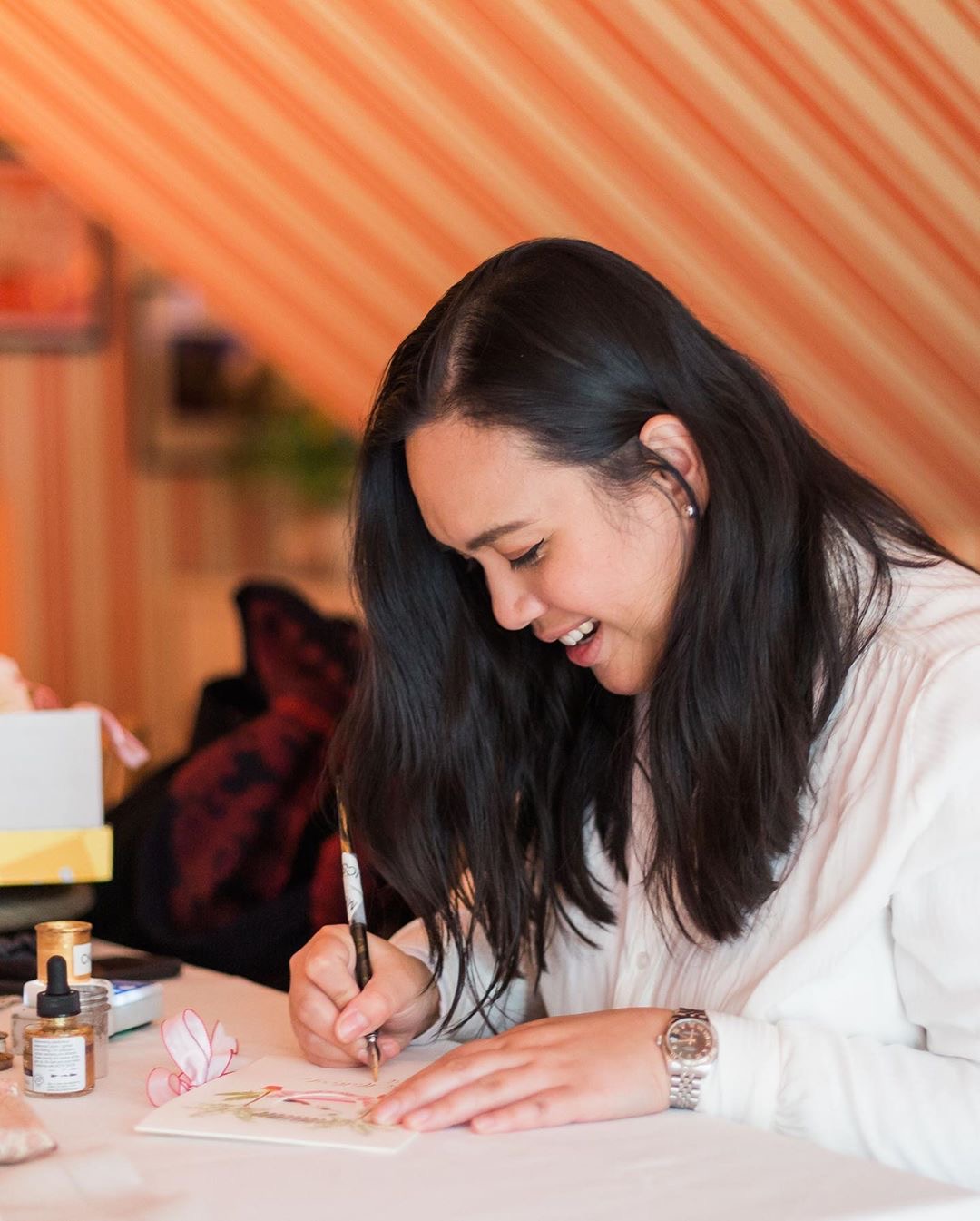
Katrina Centeno-Nguyen does on-site calligraphy | Courtesy photo / Calligraphy Katrina

Her Instagram followers watch her work her magic online in real time. She writes words – names, dates, places – on a blank space and it becomes a piece of art. All in a span of a few minutes. Her calligraphy pieces grace wedding receptions, Hollywood film openings, Grammy events, and the New York fashion scene.

Katrina Centeno-Nguyen was 19 when she opened her eponymous company, Calligraphy Katrina, 12 years ago. She does a brisk business with a pen bought from an art store, and an immigrant’s determination, perseverance, and work ethic. Her journey is a model for everyone who’s arriving in this country to look for opportunities.

Chatting with me one sunny morning from her home in Pasadena, Centeno-Nguyen talks about coming to California as a 13-year-old, being raised by a single mom, and finding her career in the most unexpected way.

“My parents decided to emigrate from the Philippines – my dad arrived in Pasadena in 1997 and my mom followed in 2000. Unfortunately, their marriage didn’t work out and they divorced soon after. So it was up to my mom to find a way to get me and my sister here.

“Immigrating into the U.S. at that time wasn’t as difficult as it is today but it was definitely not an easy process. As comfortably well-off, highly educated, and widely-traveled as we were when we lived in Manila, we were still technically from a third-world country. We were coming here as dependents so that also meant my mom had to show how her children, who were still in the Philippines, were being financially supported. Propitiously, my grandmother (my grandfather had passed away) had income from their family business and rental properties so she made sure we were looked after.

“In time, my mom had obtained gainful employment as an analyst and had enough resources to cover the expenses for the petition process and the means to support us once we got here. I came here in 2001 and my sister arrived in 2005; my brother was born here.”

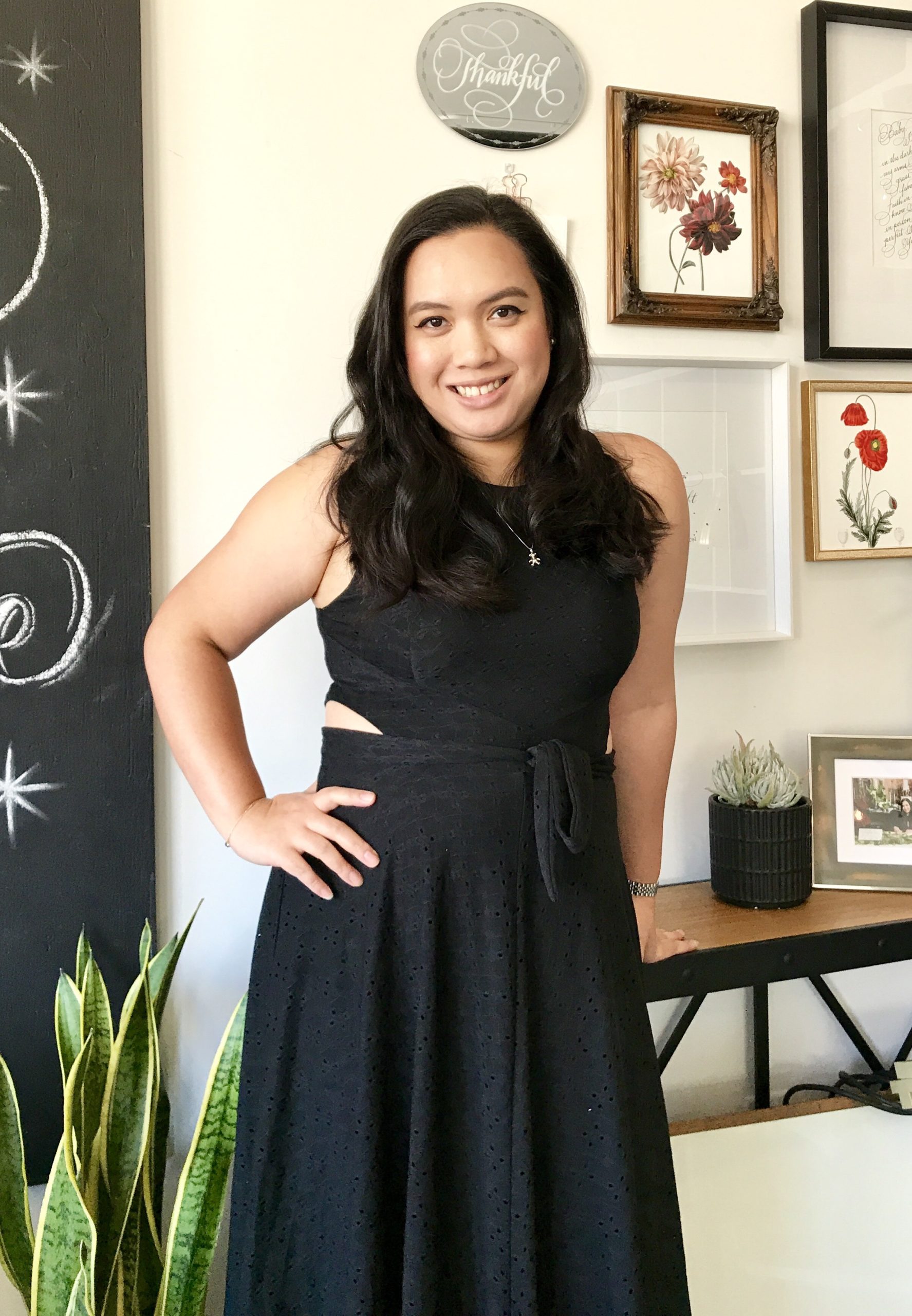
Katrina Centeno-Nguyen | Courtesy photo / Calligraphy Katrina

Continues Centeno-Nguyen, “I had finished 6th grade in Manila; I skipped middle school and went directly to 9th grade at Pasadena High School (PHS). That was quite an interesting cultural transition because I had gone to private schools in the Philippines and suddenly I was in a public school. Not only did it have a large population, students were talking back to their teachers!

“Though I have to say that socially, it wasn’t bad at all. PHS was a diverse school and a lot of students were culturally open because they also came from immigrant families. However, I had friends who weren’t necessarily immigrants. I was quite lucky because the classmates I hung out with were very much like me – we were all in the honors program; we mainly talked about school and homework. We studied and worked on projects in each other’s homes and, at the same time, had good, clean fun.

“Maybe my innocence also shielded me because I didn’t really know if bad things were happening. There might have been students who were doing drugs but I wasn’t aware of it. But the friends I had weren’t doing drugs either so there was no peer pressure. The core of our friendship was academics; it was why we became friends in the first place. We were nerds – we played chess and enjoyed physics class. We were also a good mix – some were in sports or arts; and we were volunteering in the same places. It was all about getting ready for college applications.”

Asked which college she went to, Centeno-Nguyen responds, “I actually didn’t attend college. We were still in the process of getting our residents’ visa; we didn’t become green card holders until 2007. Going to college as a non-immigrant was going to be quite expensive. Besides, I had to try to figure out a way to help my mom. While she had a great post, she had to work two jobs to enable her to support three children – in Pasadena, where it’s not cheap. So I took a full-time job as a nanny while I attended Le Cordon Bleu. It was also at this time that I started ‘Calligraphy Katrina.’”

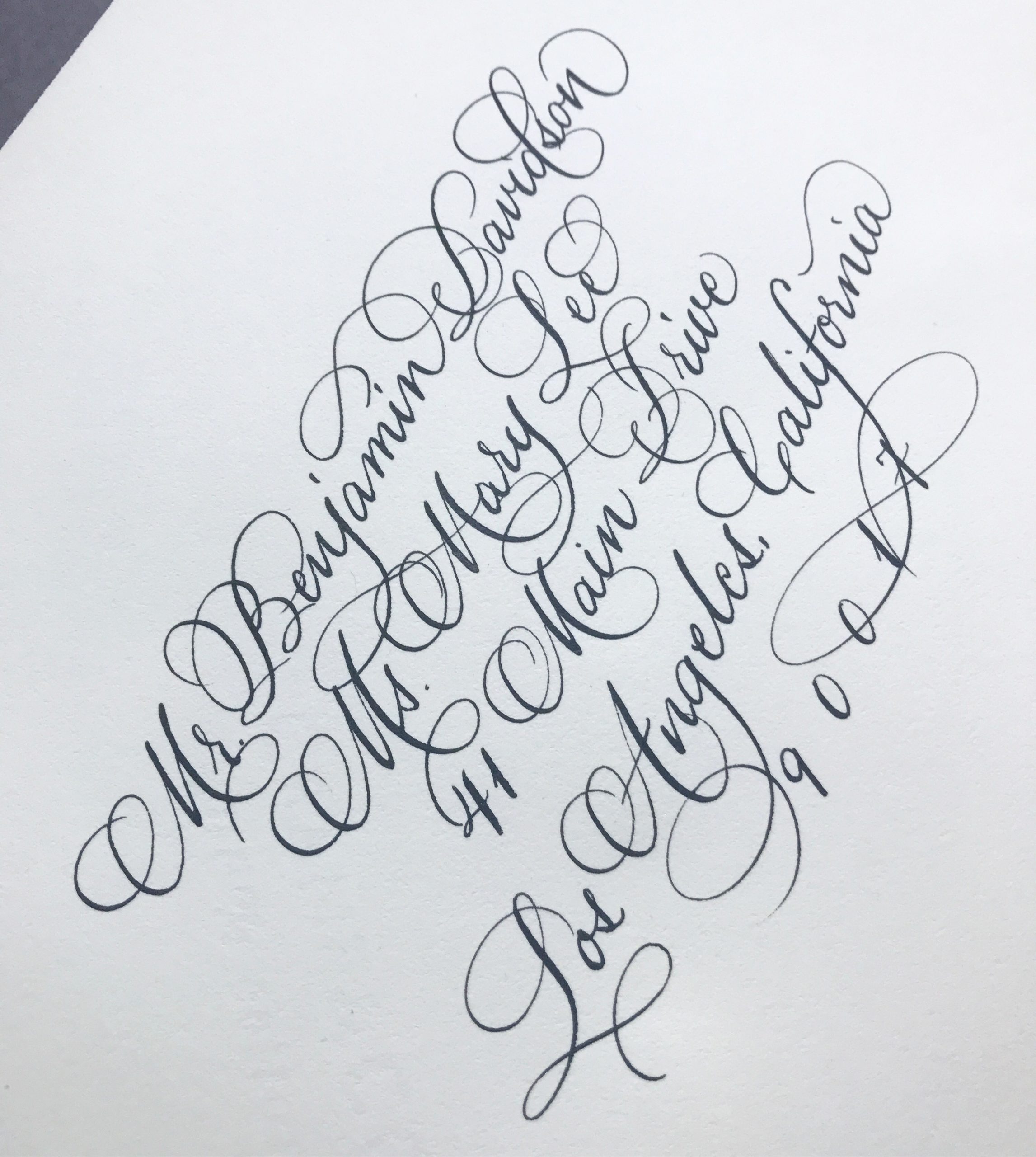
Being a calligrapher was the furthest thing from Centeno-Nguyen’s mind in terms of a career. She relates that she became one by happenstance, “I’ve always had good penmanship and one day, one of my nanny friends saw me writing my grocery list. She was getting married soon and asked if I could do her envelopes. She informed me that I could make money addressing wedding invitations. So I looked into how pricing worked, invested $10 on a few pens from an art store, and bought a couple of envelope packets from Target. That was how ‘Calligraphy Katrina’ started. I began with two fonts and created new ones as I went. Sometimes I’d make an accidental swish and I’d say  ‘Oh, that looks pretty cool. Let’s try that again.’

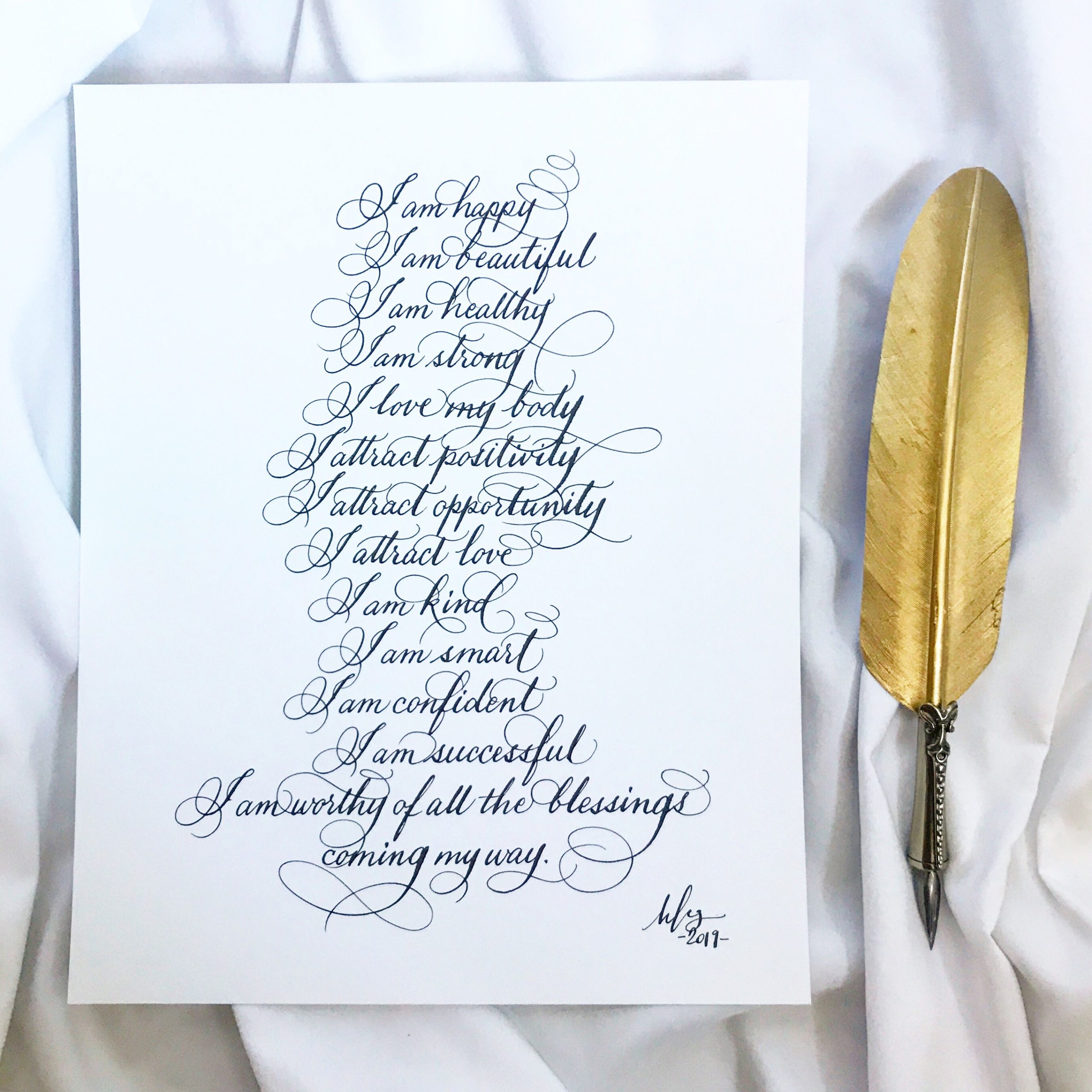
Centeno-Nguyen’s calligraphy | Courtesy photo / Calligraphy Katrina

Centeno-Nguyen was brought up with a discipline and work ethic that made the transition to life in the United States easier. And it proved helpful when she endured a punishing schedule as she was establishing her business.

She recalls, “After I’d been doing wedding invitations for a while, a stationery store called Paper Source in Beverly Hills started taking notice and they asked me to bring my work there. I was still working as a nanny then. I was also in the night class at culinary school and I was doing kitchen work because that was a requirement. My day commenced at 6:30 when I woke up and I was at work by 8:00. Fortunately, the family I worked for lived in Pasadena so it wasn’t a bad commute. I left their house at 5:30 and I was at school at 6:00, where I stayed until 11:00 pm.

“I squeezed the calligraphy project whenever I had the chance. Sometimes I worked on it when the child I was caring for was asleep; I did readings when he was playing. At times I did the calligraphy after school, before going to bed. That was my hustle in those early days. I also did a few hours in the kitchen during weekends because that was important. I had to balance it somehow.

“It was then I decided to give up culinary school. My mom questioned my decision when I had already paid a lot of money for it. But in the restaurant business, it’s either you own an establishment or you’re really brilliant. I was good, but not that good. To get financial backing, you have to know how to run a restaurant already, which I didn’t have any background on. At that time, too, a lot of restaurants were going under. It just so happened that my work was standing on its own and, because Calligraphy Katrina was my baby, I had a deep personal investment in it.”

Centeno-Nguyen recalls, “Facebook wasn’t as widely used as it is now; there was no Instagram. Social media wasn’t a thing yet. There were wedding blogs but the Internet wasn’t that huge so there weren’t as many venues for my work to be seen by a great many people. So I posted photos on Craigslist every week – that was my marketing. Even back then, people were paying $4 to $5 an envelope. I did it in a platform like Craigslist because I was learning how to run it. It didn’t feel ethical for me to charge someone $3 when I didn’t know what I was doing. But I also disclosed to my clients that I was new at this so they knew coming in that it was why I was charging only so much. It was a learning process for me and my clients were hiring me because they just wanted something handwritten. As my artistry and knowledge evolved, I started increasing my prices. But even now, as my experience has broadened, my prices aren’t as high in comparison to what other calligraphers charge.”

“Soon, I quit my job in the kitchen and as a nanny. The calligraphy work was already gaining traction and I was secure enough to focus entirely on it. Still, I was petrified. Obviously, I didn’t really know how it would turn out. My mom and I would go to Beverly Hills every single weekend. She worked a lot so it became our special time together – we’d hang out there and meet the brides that we got from Craigslist at Starbucks.

“At the time, there were only a few people who could be called calligraphers and they were very old school – very traditional. They were master penmen who belonged to a group and they were leery about me. I was 19 and I didn’t get a formal education on the art so I was the outsider. That’s also part of my insecurity as an artist. I once had the privilege of working alongside a full-pledged calligrapher who saw me as a non-calligrapher because my slants weren’t the right size for Spencerian. But I wasn’t doing Spencerian, it was simply my own handwriting. This is why I work at such great speed.”

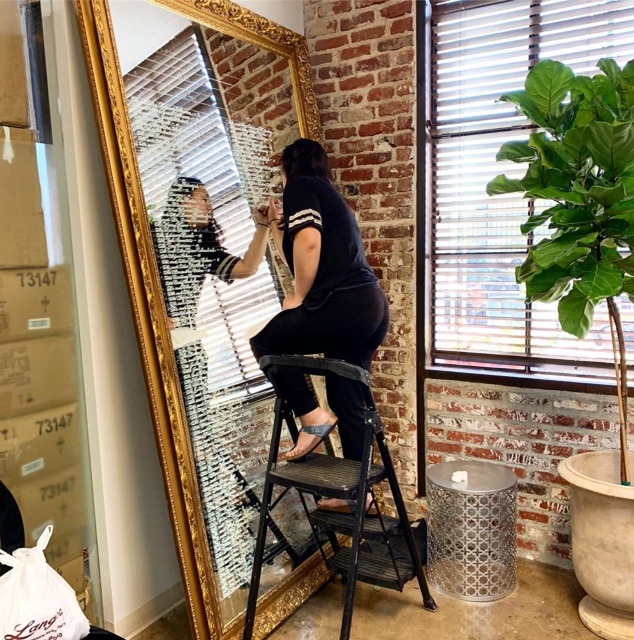
Centeno-Nguyen works on a mirror project | Courtesy photo / Calligraphy Katrina

“Not to diminish what they do, because it’s brilliant,” Centeno-Nguyen quickly says. “I wish I had that kind of knowledge but that sensibility is what differentiates my company from others. I do volume and I need to make that work. A lot of calligraphers say what I do isn’t calligraphy because I’m diminishing art. Every day, as an artist, I also have to account for my own individuality. Since I’m not conforming to the standard, am I a real artist? Do I feel like an actual calligrapher?

“Most calligraphers do this for the artistry of it. That’s not to say that I don’t, because I most certainly do. But it’s also my primary means of livelihood and I have to meet deadlines. My evolution as an artist is tied into the success of my company. I want to establish a stable business and a successful commercial venture. I have to look at it as ‘How can I make enough to support my family?’ And because I didn’t have the resources to do so, ‘Will I be able to ensure that my child goes to a four-year university?’ And ‘How is this  going to increase my income so I can enjoy my family?’ When I become financially comfortable then I can think about my artistry.”

If success were to be measured by one’s popularity on social media then Centeno-Nguyen has definitely attained it. People see her working on huge projects involving pop stars and runway models online. She’s on Reddit and has a loyal following on Instagram, which she finds incredible.

Calligraphy Katrina does a brisk business on envelope addressing for corporate clients | Courtesy Photo / Calligraphy Katrina

Centeno-Nguyen explains that how she got into the Hollywood industry was opportune. “In 2008, a new PR company needed 30 envelopes addressed, not right now but yesterday, and calligraphers in the city gave them a timeline of a week for the project. They called me and I said if they delivered the envelopes that morning, I would have them done by the end of the day. My company officially opened in August 2007 and we did one or two envelope projects a week. By January – February, we were already doing corporate work.

“Because of my pricing, which was like air for a PR company with a large budget, they asked me to do more things like place cards. This was also a young PR company gaining their traction, and it was beneficial to them that I was actually meeting their deadline. That PR company then talked about me to other PR companies. The buzz started from my speed – I could work on the fly. It was my ace and, for a long time, it was what made me stand out. And more corporate work came rolling in.”

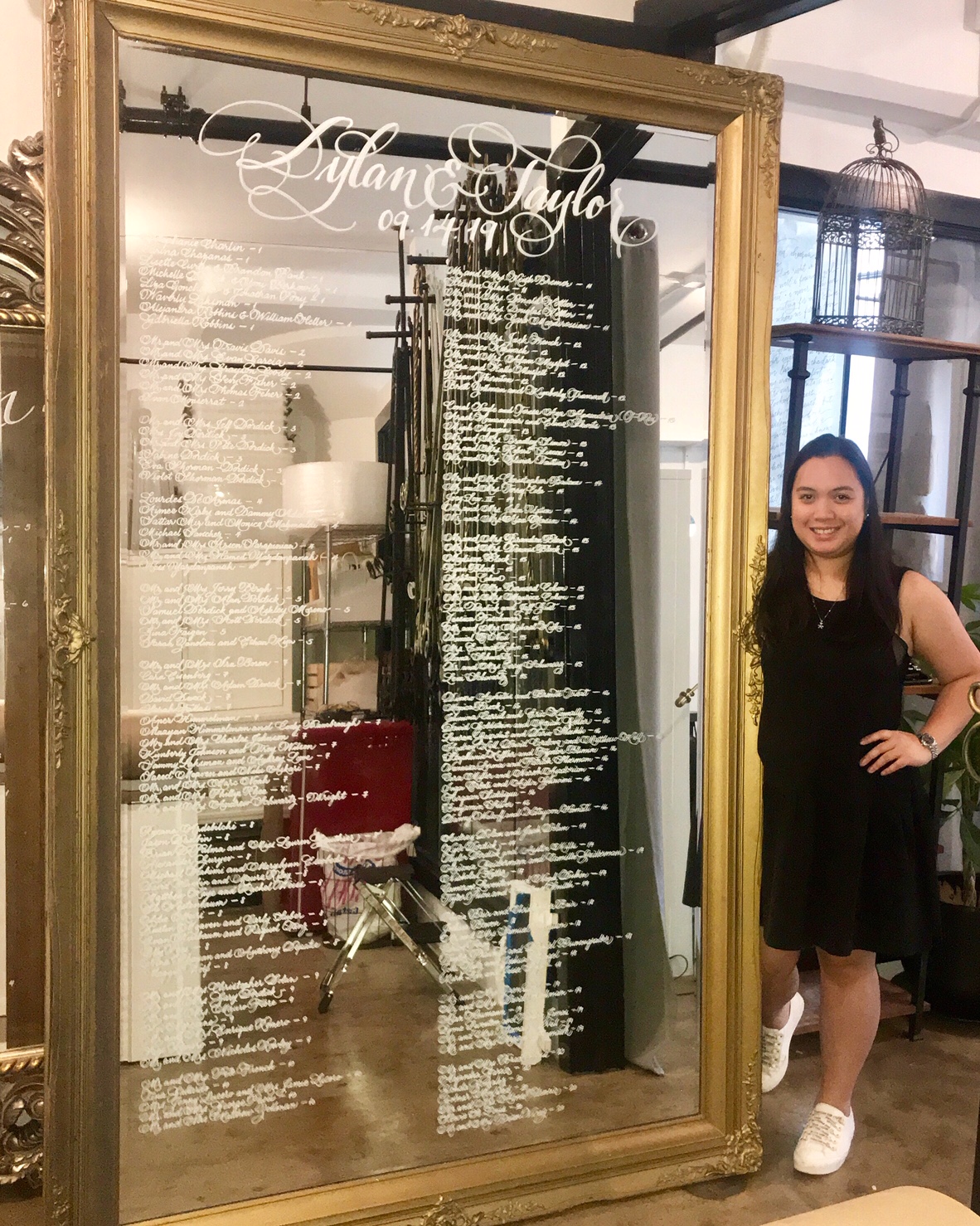
Mirror projects make up 50 percent of Calligraphy Katrina’s business | Courtesy photo / Calligraphy Katrina

Just like doing calligraphy work happened unexpectedly, working on mirrors wasn’t by design either. Centeno-Nguyen recounts, “We had a client who owned a mirror company and they were thinking of having a welcome sign for an event at the California Club. We discussed different things we could do on a mirror and we came up with a seating chart. They asked if I knew how to do one on a mirror and I said no but I’d figure it out. I didn’t know how I was going to grid it but being a nerd, I used math to measure it. I did it on site in four hours while they were setting up. I used a chalk and it looked really cool.

“This was ten years ago when I hadn’t seen anyone doing calligraphy on mirrors. No one cared for it because they said it was too hard to read. When I created calligraphy work on giant mirrors, though, everyone took note because it was different. After I did the videos, everybody wanted the mirror.”

“The mirrors are popular with weddings so 50 percent of our business comes from that and 50 percent is from corporate,” divulges Centeno-Nguyen. “We recently bought out a vintage store that carried antique mirrors from France when the owner decided to close shop last year because space rental was too expensive. We needed to have a place to store them so we opened a downtown studio. The way I see it, I’ve spent so much money buying them, I might as well have people come in to look at them. I got lucky because my space is a corner office so I get nice views on two realms. But it’s also very distracting because there’s constant activity outside and I want to see what’s happening. So I still work from home and the majority of my pens are here; that’s also because sometimes I write at 3:00 in the morning.”

Centeno-Nguyen at a recent corporate event | Courtesy photo / Calligraphy Katrina

Calligraphy Katrina operates smoothly with a lean staff, according to Centeno-Nguyen. “I have a house manager who’s also my daughter’s nanny, an assistant, and a driver who does all our runs in the city. This is my assistant’s first week – my previous production manager who worked with me for two-and-a-half years moved on to her dream job as a social worker. She was the one who helped me build this company to where it is now. She was with me during a difficult time. I had a tough pregnancy and I was on bed rest for nine weeks. My daughter was born at 29 weeks; she was 2 ½ lbs. and was at the Huntington Hospital for two months.

“We were also in the middle of a move to this house. I worked while I was bed-ridden and, because it relaxed me, I didn’t realize I was in labor. My daughter was born by Caesarean section at 12:03 in the morning after 26 hours of labor. New York is open at 6:00 am our time and I was on the phone taking notes because we were doing a show. It was much later they found out I was in the hospital. But I wasn’t going to miss that call. Giving birth isn’t an excuse; as long as I am awake I can write.”

Centeno-Nguyen’s reputation as a reliable artist who can get the work done fast is the reason she has long-standing clients. She’s been working with LACMA for almost ten years now and Chanel for nine years. On the morning we met, a delivery from LACMA arrived; there were several boxes of Chanel envelopes in the dining room for her to work on.

Twelve years after Centeno-Nguyen bravely took the leap to establish Calligraphy Katrina, she is a mainstay not only in the luxury bridal market, she’s also sought after by corporate clients including museums, fashion houses, The Grammys, and movie companies, among others.

When queried about which projects she enjoyed most, Centeno-Nguyen replies, “The Chanel fashion show was a fantastic gig. We’ve done a few fashion shows like YSL and Moschino and they were really fun, but the Chanel was doubly so because we were in New York for a whole week preparing for it. We even saw the rehearsal; it was like seeing a production come to life. But the most memorable one will always be my first mirror.”

It’s a sentiment shared by most immigrants – no matter how successful they become and how far they’ve come, they look back with gratitude at where they started.

The Huntington Launches Yearlong Centennial Celebration

Originally published on 10 September 2019 in the Pasadena Independent, Arcadia Weekly, and Monrovia Weekly

The Huntington President Karen R. Lawrence, announces the name change during the Centennial Celebration launch | Photo by Ryan Miller / The Huntington Library, Art Museum, and Botanical Gardens

The Huntington in San Marino officially launched its yearlong centennial celebration on Thursday, September 5, 2019. During her welcome speech at Rothenberg Hall, Huntington President Karen R. Lawrence expressed how Henry E. Huntington’s vision and legacy will live on in the next century.

“As I look out at you, the leaders of Southern California’s, and particularly L.A.’s, cultural, academic, and civic institutions, Huntington’s presence is demonstrably in evidence,” began Lawrence. “As the Director of our Botanical Gardens Jim Folsom recently reminded me, almost anything can grow in Southern California. He was correct.

“We brought everybody here today to celebrate the extraordinary fertility and vitality of our region – both a U.S. cultural capital and, as Huntington predicted, the leading edge of the Pacific Rim. Had his visionary red car trolley system been equally as durable, many of you, especially the west-siders, would have an easier commute.”

Continued Lawrence, “So 1919 was a very good year for the birth of L.A. institutions – from UCLA to the L.A. Philharmonic, to the iconic Musso & Frank Grill and Fosselman’s Ice Cream. In celebrating our hundredth, it’s not all about us; it’s about all of us. Because neighbors and partners have always been crucial in the life of The Huntington. As we celebrate the trust agreement in which Henry and Arabella Huntington gave their private treasures – at the time the New York Times called the greatest private library in the world, art and art collection, and expansive gardens and grounds – we also recognize that we wouldn’t be here were it not for George Ellery Hale, the renowned astronomer, who helped develop Caltech and who was the founding director of the Mount Wilson Observatory in Pasadena.

“In the Huntington’s archives, we have Hale’s correspondence with Huntington which shows that from 1906 to 1916, Hale politely badgered Huntington to place his private collection in a trust for the use and benefit of the many. As significantly though, he helped convince Huntington, the wealthy industrialist and collector, to see the value of his collection in a different way – more for the research and scholarship it would inspire than for its accumulation. Hale urged Huntington to establish a public institution; he wrote ‘There is now great need of a strong institution of broad scope, uniting all the intellectual interests of this region and the common folks.’ When he was later asked about the worth of his collection, Huntington replied that its value will be determined primarily by what he produces. Although these two men couldn’t possibly foresee what was produced during those hundred years, it’s a testament to their legacy and Arabella’s, that The Huntington attracts 1,700 visiting scholars in addition to over 750,000 visitors from around the world.

“So today we take a moment to acknowledge this Southern California history as well as to think about our future and the ideas that will propel us all for the next hundred years. For a person turning 100, it’s very natural to look back and reflect on the past. For an institution turning a hundred, a centennial is a moment to be like Janus – looking back and forward at the same time. Today we’re celebrating how far we’ve come and reflect on where we want to go. We’re thinking carefully about our mission and what it means to be among the oldest cultural and intellectual centers in this great region, which itself reflects the dynamic demographic evolution of our city, state, and country. We want to broaden our audiences and to focus on The Huntington’s ongoing role in the cultural fabric of Southern California and beyond.”

Lawrence declared, “The name of an institution reflects its relation to its audiences as well as its mission and ethos. In 1919 we began our journey as the Henry E. Huntington Library and Art Gallery. And, over time, we became more commonly known as the Huntington Library, Art Collections, and Botanical Gardens. Today I am pleased to announce a change in what we’re calling ourselves, that reflects both the increased breadth and depth of our art collections and their public purpose. We’re changing our name to The Huntington Library, Art Museum, and Botanical Gardens.”

As Lawrence said this, the name displayed on the screen behind her also changed and was met with enthusiastic applause from the audience.

The change from ‘collections’ to ‘museum’ more accurately describes The Huntington’s mission and programs, explained Lawrence. “Our art collections are more than a group of catalogued objects; they are carefully curated, interpreted, and exhibited for scholarship, education, and the broader public. An added benefit to this change is that we become more discoverable, particularly in online searches. This is important as we work to widen our audiences and accessibility.”

The Hammer Museum’s Director, Anne Philbin, talks about ‘Made in L..A. 2020’ | Photo by Ryan Miller / The Huntington Library, Art Museum, and Botanical Gardens

The Centennial Celebration, a yearlong series of exhibitions, public programs, and new initiatives running from September 2019 to September 2020, kicked off with an announcement of a collaboration between The Huntington and the Hammer Museum on ‘Made in L.A. 2020,’ the upcoming edition of the Hammer’s acclaimed biennial. The statement was made by Hammer Director Ann Philbin alongside Lawrence.

Opening June 7 and running through Aug. 30, ‘Made in L.A. 2020’ will take place at both institutions, providing visitors across the region an opportunity to experience the singular exhibition of contemporary art in Los Angeles. The exhibition, sponsored by Bank of America, will debut new installations, videos, films, sculptures, performances, and paintings from Los Angeles–based artists, many commissioned specifically for the exhibition.

‘Made in L.A. 2020’ is the fifth iteration of the internationally lauded Hammer biennial, and the second to take place at multiple venues. The biennial’s inaugural 2012 edition presented artists at the Hammer, LAXART, the Los Angeles Municipal Art Gallery at Barnsdall Art Park, and the Venice Beach Biennial. The 2020 edition seizes on an opportunity to connect an institution on the west side of Los Angeles with one on the east. It is co-curated by Tunisian-French writer and curator Myriam Ben Salah and Los Angeles–based curator Lauren Mackler. The Hammer’s Ikechukwu Onyewuenyi is assistant curator for performance.

“We are thrilled to be partnering with The Huntington on ‘Made in L.A. 2020’ to bridge the east and west sides of Los Angeles to highlight the works of art created across the region, with an emphasis on emerging and under-recognized artists,” said Hammer Director Ann Philbin. “This expression of our biennial―which spans roughly 25 miles―offers opportunities for discovery and surprise for ‘Made in L.A.’ visitors and gives the curators and artists a new platform for experimentation.”

“Creative collaborations are a hallmark of our Centennial Celebration,” Lawrence disclosed. “We will be engaging with our collections as well as with our audiences in exciting new ways. Joining forces with the Hammer for this remarkable exhibition is a perfect example of what we are setting out to do. ‘Made in L.A.’ celebrates the extraordinary, groundbreaking work of contemporary artists working in Southern California. We are honored to be a part of this year’s exhibition.”

“Los Angeles is the epicenter of the creative economy, with the arts bringing Angelenos together, attracting tourism, generating cultural dialogue, and serving as an economic driver for our region,” declared Raul A. Anaya, Bank of America market president for greater Los Angeles. “It’s why Bank of America invests in the arts and in institutions like the Hammer and The Huntington, and this specific partnership for ‘Made in L.A. 2020’ reflects our mutual commitment to L.A.’s incredibly diverse local artists.”

During the run of ‘Made in L.A. 2020,’ members and visitors to the Hammer will receive passes granting free admission to The Huntington to view ‘Made in L.A. 2020’ in full. There will also be joint programming at both the Hammer and The Huntington during the exhibition.

Looking ahead to the next 100 years, the directors of The Huntington’s three components – Library, Museum, and Botanical Gardens – spoke about the future and how The Huntington’s collections will contribute to their fields.

Sandra Luding Brooke, Avery Director or the Library speaks during The Huntington Library, Art Museum and Botanical Gardens Centennial Celebration Launch Event on Sept. 5, 2019, in San Marino, California | Photo by Ryan Miller / Capture Imaging

As the Avery Director of the Library, Sandra Luding Brooke oversees the 11 million items in the library collection. She said, “In 1925 Henry Huntington endorsed a vision for a repository of books and manuscripts of the greatest rarity and value focused on tracing the progress of our English-speaking people. Since then The Huntington’s collection has grown and persisted in more ways than what could have been imagined a century ago.

“Libraries must anticipate tomorrow and try to imagine what future researchers and viewers might want or need to know,” pronounced Brooke. “We must be judicious and imaginative in choosing what we preserve, and be fearless in seeking diverse and provocative voices. Libraries must batten their hatches to protect collections from the vicissitudes that are sure to come – natural disasters, social and economic upheavals, censorship, ignorance, and willful misapprehension. We also want to seize this moment and help our collections speak to current generations because cultivating a love and respect for documented history is the surest route to its survival and, perhaps, our own. So in the spirit of stepping out with optimism into our second century, the Library has made a small acquisition that won’t get on our shelves until just four years shy of The Huntington’s bicentennial. Until then the library’s purchase will be growing in the Norwegian wood. Artist Katie Patterson’s future library is a hundred-year literary artwork of an active indefatigable optimism. Five years ago, Patterson planted a forest of a thousand spruce trees in Norway. This forest will be held in trust until the year 2114 when the trees will be harvested, turned into paper, and provide the stock for the publication of 100 texts, until then held secret, by 100 writers. This little acquisition is a vote of confidence in the future of the environment, of art, of books and the written word, and of libraries. Yes, we are confident our librarian’s successors will not fail to claim The Huntington’s copy of this long-awaited anthology. But between now and 2114, we are equally confident that millions of other texts, images, and objects undiscovered and, as yet, uncurated will cross The Huntington’s threshold to join this great past, present, and future library.”

Christina Nielsen, Hannah and Russell Kully Director of the Art Museum | Photo by Ryan Miller / The Huntington Library, Art Museum, and Botanical Gardens

Christina Nielsen who, when she took the podium and introduced herself, said that for the past 10 minutes, she has been the director of The Huntington’s Art Museum. She started, “Now that we’re a museum I’d like to spend the next few minute considering what that term means. What it meant to Arabella and Henry, what it means today, and what it will likely mean in the future. Henry Huntington, entrepreneur and futurist, proponent of new technologies; Arabella Huntington, perhaps the greatest gilded-age collector you’ve never heard of – together they stand out among the likes of their peers such as Walters, Morgans, Fricks, and Gardners by bringing together objects from the past to actively shape a future. They founded the first Old Master Collection in Los Angeles which included Asian ceramics, Italian Renaissance pieces, French decorative arts, and British portraits from the 18th century, which allowed for connections across time and place. And they put their historic works in conversation with art from their day by placing sculpture on the grounds from artists of their time, including their daughter-in-law Anna Hyatt Huntington. They also gave us a framework for considering how to move forward, encouraging us to continue making connections across time and place, to invest in new technologies, and to share their collection with the public.

“So now the present moment. And might I suggest that, in many ways, the future is now and the future is here. The definition of ‘museum’ is quickly changing, as is the nature of our work. The International Council of Museums just released a new definition of museum as a ‘democratizing, inclusive, and polyphonic space for critical dialogue about the pasts and the futures.’”

“Our collection is indeed a treasure trove to be mined for thinking about making connections across time and place, how trade and exchange shaped objects, lives, and intellectual pursuits,” noted Nielsen. “But which stories do we choose to tell and who tells them? Recent partnerships here at Huntington, such as one with the Vincent Price Art Museum, allowed Carolina Caycedo, one of the great artists in the L.A. area, to produce a new work of art Apariciones/Apparitions which inserts back into the history of our founding narrative people and labor who’ve been lost over time.

“More specifically, ‘Blue Boy,’ our most iconic work, has continued to inspire over time, artists, much more recent than when he arrived in 1921. A young artist on leave from military duty in San Diego came to the Huntington and had an epiphany from the ‘Blue Boy.’ So did a young teenager who would come on visits to The Huntington on Saturday. And so we’re thinking very deeply about how to unlock more epiphanies from our people, in our galleries, and through expanded online resources. How do we share our collections beyond our walls? How do we reach other aspiring artists from South Los Angeles, San Diego, and from other places really far away – like Kansas City, Kosovo, or Kyoto. So in the context of The Huntington itself, what does our art collection mean? This is a multi-disciplinary institution and as the definition of art keeps changing and evolving, I was reminded recently by Jim Folsom that The Huntington itself is the original conceptual work of art.”

Nielsen said further, “This is the hotbed of the artistic world and we are so pleased to be working with the Hammer on ‘Made in L.A.,’ exemplifying what an extraordinary moment this is for our region. But I might suggest that ‘Made in L.A. 2020’ has a really important antecedent and that could be considered ‘Made in London 1770,’ because going back to Gainsborough and his fabulous ‘Blue Boy’ painting, what we’ve recently learned is that in fact Gainsborough, hundreds of years ago, just like the artists in our midst today, was absolutely pushing the envelope of what it meant to be a painter and what the medium could provide. And so I would say it makes absolute sense for us at The Huntington to be working with The Hammer and offering up our resources for artists, writers, performers, dancers, thinkers, in our midst.

“The past is not dead. In fact, as Socrates said, ‘It isn’t even past.’ It’s alive and waiting to be unlocked in the objects in our collection. I can’t begin to predict now how successors of ours a hundred years from now will do that, any more than Henry and Arabella could have predicted us sending rockets to the moon. But they believed in technology; they believed in sharing their collection to the public; and they believed in connections across time and space. I feel that if we hold true to these principles, we will be just fine over the course of the next hundred years. And, in closing, I offer another definition for our museum – that it should be not just a repository of things, but a collection of ideas and a place for sharing them with others.”

James Folsom, Telleen/Jorgensen Director of the Botanical Gardens speaks during The Huntington Library, Art Museum and Botanical Gardens Centennial Celebration Launch Event on Sept. 5, 2019, in San Marino, California | Photo by Ryan Miller / Capture Imaging

When it was his turn to speak, Director of Botanical Gardens James Folsom, who noted that he’s the old-timer at The Huntington, stated, “Last year we planted several hundred trees and we intend to plant more this year. We plant trees because during a storm in 2011, 700 trees fell in one evening. We plant because new opportunities arise – wonderful new trees become available. We plant trees because they provide structure to the landscape, which takes years to develop. We plant trees because on the 6th of July last year, the gardens experienced a record-high temperature of 118 degrees Fahrenheit leaving vegetation scorched throughout the landscape.

“We plant trees because that’s what gardeners do – observe, think, plant, cultivate, take our losses, make our moves, plan for change, and invest in energy and resources to create something that would be of worth for future generations. So what is that future, how far is that horizon? For trees, it’s 80 to 100 years – easily to the end of the century. But in all of our actions, even short-term plantings, we should build soil and capacity. Every act can be viewed as an investment. Gardens also plant ideas and inspiration – the beauty and power of life unfolding, the importance of cycles, the value in the glorious smell of fresh water and arable soil. The pay-off in planting is seeing the product of pure physical toil and recognizing the importance of plants as the givers of life and the bases of biodiversity.

“To me, the lessons we learn from gardening are crucial. In a perfect future, I imagine these Huntington gardens and the act of gardening will help form a better world. Fortunately, the structure we need for those lessons exists. The Huntington has collections, displays, beautiful facilities, and staff to see us to our second centennial.”

‘Frankenstein’ Makes a Stunning California Premiere at A Noise Within

Originally published on 20 August 2019 in the Pasadena Independent, Arcadia Weekly, and Monrovia Weekly

Couture’s rendering of the creature breaking through the lab | Courtesy photo / Francois-Pierre Couture

A Noise Within (ANW) opens its 2019-2020 season ‘They Played with Fire’ with the California premiere of Nick Dear’s ‘Frankenstein.’ Adapted from the original novel by Mary Shelley and  directed by Michael Michetti, it is a stand-alone production from August 11 to September 8, 2019.

Michael Manuel, who was last seen on the ANW stage as Iago in Shakespeare’s ‘Othello,’ stars as the Creature. Playing Victor Frankenstein is resident artist Kasey Mahaffy and taking the role of Elizabeth/female creature is Erika Soto.

Shelley’s most renowned work, ‘Frankenstein’ tells the story of a creature who comes back to wreak destruction after he is cast away into a hostile world by his creator. Dear’s adaptation of the Gothic tale depicts the themes of social rejection, intellectual hubris, and the emergence of good and evil.

Michetti pronounces, “By telling the story from the point of view of the Creature, this highly theatrical adaptation of Mary Shelley’s beloved novel delivers not only the terror we expect from the story, but a surprisingly thoughtful and moving exploration of society’s role in teaching and perpetuating violence.”

Scenic designer Francois-Pierre Couture has been tasked with providing ‘Frankenstein’ the backdrop and atmosphere that reflects Michetti’s vision. A transplant from Montreal, Canada, Couture is the rare artist with a full plate in both the artistic and academic fields.

I chat with Couture recently to find out how he ended up in Los Angeles, what teaching means to him, and why collaboration is what he does best.

Couture says, “When I was graduating from university in Montreal, I went to URTA (University/Resident Theatre Association), which is where students who are looking to go to graduate school for theatre programs have the opportunity to meet representatives from different universities in the U.S. (think College Fair). After presenting our portfolio, we were interviewed by school representatives.

“There weren’t that many schools from New York; I can’t remember if Yale and NYU were represented that year at URTA. But I was really considering going to either UCLA or CalArts – I thought it would be fun to go to the West Coast and explore that region of the United States. At that point I hadn’t been to Los Angeles; the first time was when I visited the schools. In fact, I  went twice because I looked at both schools on separate trips. UCLA offered me a pretty hefty scholarship to cover my studies, including some living expenses. I waited a year to give me time to think about it and, in the end, I attended UCLA and earned my MFA (Masters in Fine Arts).”

Asked what made him stay, Couture replies, “I suppose when you study for three years in a certain environment, it grows on you. I also got in touch with The Actors’ Gang right away and started designing for them and I became their production manager for three years. One thing led to the next – I started working and then I established a career in L.A. In the process, I met people here and it became my little world.”

Besides doing scenic, lighting, and projection design, Couture teaches at UCLA, Cal State Long Beach, and is a full-time professor at East Los Angeles College (ELAC).

Couture relates how he discovered that teaching was also his calling. “About 10 years ago, when I started my grad studies at UCLA, through the Actors’ Gang I found a part-time teaching job at Culver City High School. One of my colleagues, who was also an ELAC teacher, told me about an opening there. So I started teaching at ELAC on a part-time basis.

“Things were happening all at once then – I was studying for my graduate degree, I was transitioning from a full time production manager job for the Actors’ Gang to part-time teacher, and growing my design career. When I got into the academic world, I got pulled further into it. I started teaching at Pepperdine, Loyola Marymount University, Cal State Long Beach, Cal State Northridge, UC Santa Barbara, and UCLA. At ELAC and UCLA I supervise students in their production work and mentor them.”

Couture showing his designs | Courtesy photo / Francois-Pierre Couture

“It’s extremely rewarding to be able to teach someone what you know and show them your process,” continues Couture. “It’s very healthy in many ways because it forces me to understand what I’m doing on an academic and intellectual level. Just like others who work in theatre, I don’t have time to intellectualize what I do because I do shows back-to-back. Going back to basics helps me secure the foundations again. It’s a symbiotic relationship – teaching young people, seeing them grow, and giving them opportunities, especially here in ELAC.

“A lot of our students come from communities who have no access to theatre, who don’t think of theatre as a source of employment that’s desirable for them. So it’s so gratifying to be able to offer all that to young people from varied backgrounds. One of my lighting students is going to do his graduate studies on the East Coast, some are going to CalArts, another is going UC Irvine, and one will attend Cal State Fullerton next year. Many of our theatre students are also doing great things, someone is right now finishing his Master’s in directing at UCLA. In the ten years that we’ve devoted to this program we’ve been able to help our demographics enter a field that was previously underrepresented. ELAC is also the official education partner of CTG’s (Center Theatre Group, which includes the Ahmanson, Taper, and Kirk Douglas) outreach program. That direct relationship is essential to our success.”

It wouldn’t be a stretch to say that education outreach and artistic work are rarely done by the same person, I opine. Couture says, “It’s hard; there’s a lot of hours involved. But, far from being the only one working on it, I am part of a big team. And we have an entire faculty working with us to create this outreach. With our strengths and connections in the industry, we’re able to advance this program.”

“Which is the day job and which is the side job?” I ask. “That’s a tough question,” responds Couture. “I’ll have to say teaching is my day job and designing is my night job. During the summer and winter months, I choose not to teach classes and that’s when I cram all the prep and design work. During the school year, I’m at school from 9 am to 5 pm four or five days a week, with pockets of down time. But, of course, during production my hours increase – I wake up at 4:00 or 5:00 in the morning to do my day job then go home to work at night. When I’m at the theatre, usually Thursday through Sunday, I work day and night.”

In the last 13 years, Couture has worked as a scenic, lighting, and projection designer. He has received multiple Ovation, LADCC, LA Weekly awards & nominations. Designs include: ‘Invisible Tango,’ ‘A Picasso,’ at the Geffen Playhouse; ‘Everything that Never Happened,’ ‘With Love and Major Organ,’ Boston Court Pasadena; ‘Destiny of Desire,’ Oregon Shakespeare Festival, Arena Stage Theatre, South Coast Repertory& Goodman Theatre; ‘Jackie Unveiled,’ Wallis Theatre; ‘The Mexican Trilogy, an American History,’ Los Angeles Theatre Center; ‘Metamorphoses,’ ‘Everything is Illuminated,’ Ensemble Theatre Company; ‘Médée’ and ‘Teseo,’ Chicago Opera Theatre; ‘L’Elisir d’Amore,’ and ‘Cold Mountain,’ Music Academy of the West.

Couture recalls the very first award he got, “Charles McNulty, the theatre writer for the L.A. Times, featured me in his column as one of ‘Faces to Watch’ in 2007 when I designed ‘Love’s Labor’s Lost’ at The Actors’ Gang Theatre. It took me about six years working a lot of small theatres doing scenic and lighting projects to build my reputation. To this day I still do between 10 and 20 productions a year and I didn’t get the work that I’m getting now until Charles’s endorsement.

“However, the awards and acclaim don’t affect how I work. The process is so tied to my relationship with the director and the other designers. The risks we take are based on what we’re trying to do with the play and how we want to tell the story. I can’t think about awards when I’m designing because then the pressure is put in the wrong place. If I work well with my co-designers and everybody on stage and I try to be innovative, am true to the play, and give what the play needs, then the award will hopefully follow. The goal is to do good work and do something that the audience will perceive, that will communicate the story. And if we get noticed and are given awards, then that’s wonderful. Awards are subjective in many ways and you’re judged against other people’s work. So if, one year, others also did amazing work and you didn’t win an award, it doesn’t mean you didn’t do good work.”

Shown left to right: Kasey Mahaffy, Michael Manuel, and Erika Soto | Photo by Craig Schwartz / A Noise Within

It was Michael Michetti, Artistic Director at Boston Court Pasadena, who approached Couture to do the scenic design for ‘Frankenstein.’

Couture discloses, “I’ve done about ten productions there; the first show I did with him was for ‘Dinosaur Within,’ in 2011. Michael is a very talented and accomplished director. He and I respect each other’s work immensely; we try to work together but there were always scheduling conflicts. It was really fortunate that I was available to do ‘Frankenstein.’ The design process took about two to two-and-a-half months. Michael and I talked about the play at the outset; then in our next meeting, I came in with more concrete idea designs.”

“I think what I’m good at, and what I do a lot, is balancing reality and abstraction. I often work on complicated plays that have multiple locations and that show emotional content. I try to encompass all the elements and synthesize them to create a design on the stage. I want to think I’m a good collaborator; I love to involve everybody else on the team. Lighting designer Jared Sayeg and I had a lot of conversations about ‘Frankenstein’s’ set and lighting design. We knew it was going to be a big project that involves a lot of work and that it was going to be demanding because it’s a challenging play.”

“So what can the audience look forward to?” I query. “The audience can expect a scenic design that is emotionally charged; that which emphasizes the struggle of the creature, visually and viscerally,” expounds Couture. “We utilized chiaroscuro – light and shadow – that echo the layers and dark corners of all the characters. It’s also a design that people will find surprising, maybe thought-provoking in some ways, as we don’t represent the reality of all the spaces because it’s a very cinematic universe. But it all makes sense.”

ANW’s ‘Frankenstein’ is indeed a stunning first production for this season. Michael Manuel’s superb acting, supported by a remarkable cast and an extraordinary design team, and helmed by a visionary director, brilliantly bring to life Mary Shelley’s much-loved novel. If the audience’s reaction during the opening weekend was any indication, ‘Frankenstein’ could expect a monstrously successful run.

Local Interior Designer Makes Gorgeous Living Spaces

Originally published on 13 August 2019 in the Pasadena Independent, Arcadia Weekly, and Monrovia Weekly

Jake Galang did the interior and some exterior design on this magnificent Pasadena house | Courtesy photo / Ilustracion by Jake

Owning a house and making it a home is something most of us aspire to. We take great pains to make our abode a place where we can live comfortably and take pride in; where we can hold get-togethers or dinners with colleagues; where our children can invite their friends for playdates and sleepovers.

Jake Galang has made it her mission to help homeowners achieve that goal. The principal for her eponymous company, Ilustracion by Jake, she designs living spaces that are as efficient as they are magnificent. A transplant from the Philippines, she established her firm in 2006 after working in Singapore and afterwards for interior designers in Pasadena. She has since built an excellent reputation among developers in the San Gabriel Valley, with whom she collaborates on projects from the ground up. You probably have driven around town and seen several of the houses she has worked on.

Catching up with Galang on a recent morning, I inquire how she got her name (Jake!), how she got into the business, and what her favorite projects are.

Galang at a job walk in Hong Kong | Courtesy Photo / Ilustracion by Jake

“My birth name is actually Catherine,” Galang discloses. “At first I thought my Dad nicknamed me, but I later found out it was all my Mom’s doing. She was a big fan of John Wayne, who was in a movie called ‘Big Jake.’ The name stuck with her and it was what she decided to call me.”

When I protest that the moniker conjures an image of a robust man while she is a soft-spoken, petite woman, Galang replies gleefully, “But that’s the best part of it – it’s very deceiving! Contractors remember me because it’s an easy name, there are only four letters.”

Asked what steered her towards this career, Galang responds, “Architecture and interior design are in my genes. My grandfather was one of the pioneering architects in Manila and he did his drawings on linen. He passed away when I was very young, but I distinctly remember unrolling one of his illustrations which featured capiz (the outer shell of the marine mollusk found in the shallow coastal waters of the Philippines) windows and Spanish balustrades.

“However, my mother was my biggest artistic influence. She was very creative and was an interior designer back in Manila. I grew up seeing her work on projects and, once in a while, I would assist her on installations. Additionally, she fabricated the drapery – designing and sewing – she used on her jobs. At that time, window treatments were traditional period drapery, like the swags that are used in the White House, and I would help her hem.”

Lighting selection by Galang | Courtesy Photo / Ilustracion by Jake

Galang continues, “I also found product branding and lay-out designing quite fascinating, so when I attended College of the Holy Spirit, I took Advertising as my major. My mother thought there wasn’t much financial stability in that field, though, and convinced me to pursue interior design instead. So I switched majors and consequently earned a BFA in Interior Design.

“After graduation, I worked for an office systems company in Manila which provided furniture for multinationals like Chase Manhattan, Bank of America, Del Monte, etc. I was lucky enough to be sent to Hong Kong and Singapore for seminars. That was when I started traveling. I did some work for Steelcase and Knoll in Hong Kong; after that I went to Brunei to set up a Scandinavian furniture showroom.

“Several friends, who were then employed in Singapore, told me that Singapore was booming and designers were in demand. I thought that would be a good career opportunity and was blessed to be petitioned by an interior design company. I moved to Singapore and worked for Bosgroup International from 1993 to 1998. I designed furniture for Omnia, the supplier for the famous Raffles Hotel; created high-end residential interior design under I&T Interiors; and worked with designer CKT Thomas on public spaces, including Tan Tock Seng Hospital and numerous children’s libraries. Singapore is a multi-cultural, fast-paced country and I learned a lot there. That experience prepared me for what was to come.

“My work took me to the United States where I saw the business was also flourishing, so I decided to stay. I worked as a draftsman at JF Interiors in Pasadena and our projects were mostly renovation and design of old homes in San Marino. We were involved with the Pasadena Showcase House of Design. I remained for ten years and the owner and principal designer of the firm, Janie Fain, became my mentor.”

In 2006, Galang bravely took the leap to establish her own design firm and has kept busy with projects, 90% of which are residential and 10% are commercial. Besides her work being featured in Luxe magazine, Galang doesn’t do any marketing. Clients hear about her by word of mouth and they go on her website.

Adds Galang, “I work closely with Mur-Sol Construction, one of the premier residential builders in Arcadia – designing cabinetry and lighting, and picking plumbing fixtures, stone, and tile for their various developments. I love to work on the interior structure of the house as well. I sketch or draw in CAD, give it to the builder, and inspect if the finished work is done correctly based on my specs.”

Comfortable seating defines this living room | Courtesy Photo / Ilustracion by Kake

Galang isn’t inclined towards any particular style or period. “I get the inspiration for the interior from the architecture of the house,” she says. “I also talk with the homeowners to find out how they live, what they gravitate to, what they need, and what’s important to them. There will always be clients who buy a contemporary style house then want to have a French look inside. The biggest challenge for an interior designer is when homeowners want to combine two aesthetics that aren’t compatible. In that case, I would persuade them to consider a more streamlined look instead of French moldings and panels in the living room, or fish-shaped faucets in the bathrooms. I think that’s the most difficult part of this job – trying to steer clients from making choices that don’t make design sense and still make them happy.

“One of the things I learned in this business is compromise. You realize that just because you think you have this great creative idea, everybody will agree with your vision. There’s a  Confucian saying, ‘How will you learn when your cup is so full,’ there’s no room so it will overflow. When I was younger I thought I knew everything, especially when designing interiors, because I was educated for it. But now that I’m older, I realize that there’s still much out there I don’t know. I’ve learned to be more receptive to other people’s opinions and perspectives.”

The mural for the Khora lobby was printed on chains from Spain | Courtesy Photo / Ilustracion by Jake

Two recent projects Galang completed were commercial jobs in Hong Kong. She explains, “They asked me to design the flagship office for their skin care company in Hong Kong. We used local workers there, but I drew everything here and specified the look for the place. Another one is a creative building. It is a very modern sleek structure so I designed something that looks industrial. For its main lobby, I found a mural made by an artist from Vancouver which I thought would look great in it. I asked her permission to use it and commissioned her, then I printed it on chains from Spain which I found during one of my travels with my family sourcing for materials for my projects. I also integrated my personality into it. Nowadays, with the Internet, everyone’s on their computer and people use Kindle when they want to read. But I still read books, so I put them in as part of the design to evoke knowledge. In fact, the mural itself suggests creativity. If you look closely at head of the person in the mural, you’ll see there are ideas coming out of her head.

“This is my favorite of all the projects I’ve done in my career, thus far. It was such a fun assignment for us! We’ve been doing the same traditional design over and over, so this one was a deviation. Hopefully, we’ll get more commercial work when people see it on my website.”
Galang designs for the way people live | Courtesy Photo / Ilustracion by Jake

Depending on the scale of the project, each one takes anywhere from three to four years to complete. Galang describes, “We just finished a residence at Bradbury which took three years. It has a game room made for entertainment – there’s a two-lane bowling alley and a golf simulator. Farther down, there’s a pool table and a wet bar, and then a wine cellar. The daughter has a playhouse within her bedroom and the son has custom bunk beds because he likes having sleepovers. That was actually a fun residential job, it had all the bells and whistles, and one could be really creative.”

Galang has a streamlined operation, “We’re a small outfit; besides me, I have three full-time assistants who are all architects – Desiree Panopio, Jila Mendoza, Aireen Dizon, and a part-time employee Jophi Elorta. They all love to travel and explore, like me. We sometimes are working on 15 projects in one year but, on average, we have ten to 12 residential jobs that overlap and range in size from 6,000 to 16,000 square feet.

“We, interior designers, are surrounded by so many grand things because of the clients we work with. I personally have a very casual and simple lifestyle. But I share that same way of life with some of my colleagues in the business. We get to design for the super-rich but, at the end of the day, we go back to our humble homes. And, as I’m sure many of us in this career do, I keep redecorating my house. I just couldn’t help it.”

Galang is an unassuming and tiny woman who creates mostly imposing living spaces. But at the heart of her design philosophy is the ultimate goal – to make the people who live in them feel they’re cocooned in a cozy and familiar place.

‘Good Boys’ at the Pasadena Playhouse Mirrors Social Issues of our Time

Originally published on 24 June 2019 in the Pasadena Independent, Arcadia Weekly, and Monrovia Weekly

Roberto Aguirre-Sacasa | Courtesy photo / Pasadena Playhouse

‘Good Boys,’ the psychological thriller from playwright, Marvel comics author, and screenwriter Roberto Aguirre-Sacasa will have its Los Angeles premiere at the Pasadena Playhouse from June 26 to July 21. Starring renowned television actress Betsy Brandt in the role of Elizabeth Hardy, it is helmed by off-Broadway and regional director Carolyn Cantor.

Set in 1988, the play tells about Brandon Hardy, a high school senior at St. Joseph’s Prep who has the world at his feet. Handsome, athletic, and smart, he is a model student after the mold of his father. But when a pornographic videotape becomes the talk of the locker room, he gets caught up in a media explosion which threatens to shatter the Hardy’s comfortable life. ‘Good Boys’ is a riveting drama that delves into what happens when a family must separate fact from fiction and, ultimately, choose to either preserve a legacy of privilege or risk losing everything in pursuit of the truth.

During a recent phone conversation, Sacasa discloses the genesis and the current iteration of the play. “It was inspired by a real scandal that broke out at my alma mater. It’s a work of fiction, but it has parallels to what had actually happened and that I personally knew about. The title was originally ‘Good Boys and True,’ which comes from the prep school’s motto and is quoted in the play. It premiered in 2008 and was performed  at several regional theatres but has never been on a major stage until now. I hope this West Coast debut at The Playhouse will give it the wider exposure I believe it deserves.

“Danny Feldman (Pasadena Playhouse’s Producing Artistic Director) was looking for material that was relevant to what’s been on the headlines recently – specifically the college admissions scandal and the Bret Kavanaugh nomination process. My husband, who has been involved with the Playhouse, brought my play to his attention. So we sat down to discuss how we could update it and one of Danny’s first suggestions was to rename it ‘Good Boys.’ I resisted it at first, but as I worked on the rewrites, it did start to feel more and more like a new play, so I came around to the title change.”

Aguirre-Sacasa describes, “The dramatic situations in this play are uncannily similar to incidents and issues that we’re still grappling with in this country – viscerally – even more so than when I first wrote it. In revisiting the play, I further explored themes like privilege, masculinity, and personal responsibility, as Brandon and Elizabeth find themselves on trial by their community and each other. ‘Good Boys’ is a sort of moral thriller, a game of cat and mouse between a mother and her son, with twists and turns that will keep you guessing about the truth right up to the end.”

While the actions of Brandon and his gay friend Justin drive the plot, the person who finds herself most affected by the scandal is his mother Elizabeth who, at the start of the play, has spent a lifetime doing the right thing – being a good doctor, thinking of herself a good mother, and questioning how to be a good wife.

Betsy Brandt | Courtesy photo / Pasadena Playhouse

Asked why he chose to make Elizabeth the central character in ‘Good Boys,’ Aguirre-Sacasa responds, “I thought there could be a little more psychological complexity in the mom’s journey through the play. A teenager is still developing, still figuring out their place in the world. An adult, presumably, knows their true self by that point. That said, I feel like both characters are compelling, it’s just that one is answering for sins done in the present, the other for sins done in the past.”

Originally from Washington, D.C., Aguirre-Sacasa attended Georgetown University where he studied playwriting. He received his Master’s degree in English Literature from McGill University, and earned an MFA from Yale School of Drama.

While Aguirre-Sacasa wrote plays early on in his career, he is also an avowed comic book reader. His semi-autobiographical play about a comic book writer and playwright was staged in 2006 at the Manhattan Theatre Club in New York. His theatrical work converged with comic book writing when Marvel hired an editor from a theatrical agency to find new writers and she called him.

Marvel signed him on for the ‘Fantastic Four’ and Aguirre-Sacasa’s first story was published in 2004. That was followed by more ‘Fantastic Four’ stories in ‘Marvel Knights 4’, ‘Nightcrawler’ vol. 3, the ‘Sensational Spider-Man’ vol. 2, and ‘Dead of Night featuring Man Thing.’

In 2013 he created ‘Afterlife with Archie’ which proved to be such a success that he was named Archie Comics’ chief executive officer. The book was also the inspiration for the television series ‘Riverdale,’ which he developed, and is now on its 4th season.

Additionally, Aguirre-Sacasa has written episodes for ‘Glee’ and developed the series ‘Chilling Adventures of Sabrina.’ He has gained a wide following among young people, whom he describes as very passionate and vocal about what they believe in. Twelve years ago he came to Los Angles to work on a television series. He discovered he truly enjoyed being here and decided to stay.

He manages to successfully move from one genre to another but Aguirre-Sacasa confesses that he has the most fun writing suspense thrillers. He expounds, “I enjoy writing in different genres – horror and stories about teenagers, for instance – but I love psychological thrillers because they are, essentially, character pieces. You put a character in a charged, dangerous situation, you turn up the heat, and you watch what they do. Will they crack under pressure? Will they lie or tell the truth? How will their actions define them? That’s true of most genres, of course, but with a good, juicy psychological thriller like ‘Good Boys,’ you get to do a deep dive.

“I don’t judge my characters, I keep them true to themselves,” he adds. “And I don’t impose my own expectations on what my audience should take away from the play. Each one will have a different experience based on where they are in their lives. That said, I’m a big believer in stories having beginnings, middles, and ends, so I think that ‘Good Boys’ does offer some resolution, though the mom and son have started their next journey. Their story with us – their trial with us – is over. Their story with each other is continuing.”

Local Milliner Creates Spectacular Bespoke Hats

Originally published on 31 May 2019 in the Pasadena Independent, Arcadia Weekly, and Monrovia Weekly

Li wearing one of her bespoke fascinators | Courtesy photo / Handmade by Cissy Li

Americans, as a rule, don’t typically wear hats the way they do sunglasses as a fashion accessory. However, if it were up to Cissy Li, all ladies would be wearing hats wherever they go, most especially to weddings and other stylish events. To advance her lifestyle philosophy, she started creating headwear in 2006 from her Pasadena home for close friends. And, recently, she displayed her collection called ‘Handmade by Cissy Li’ at an exhibition held at Joann’s Fine Arts Ai+ Gallery on Mentor Avenue.

The path that led Li from Suzhou as a child growing up, to Milan as an haute couture model and, finally, to Pasadena as an artisanal milliner, is paved with extraordinarily good fortune.

“I’ve always loved design, fashion accessories, and modeling, ” Li proclaims. I double-majored in Fashion Design and Modeling at Suzhou University near Shanghai. After graduation, I moved to Beijing where I worked for two years at the government-owned modeling company in exchange for my free education. Knowing that modeling as a career usually has a short span – because agencies are always looking for 14- to 16-year-olds – in 1997, I went to the Lutzelau School in Switzerland and took a Hotel Management course to have a back-up plan. It’s now called Swiss IM&H (Swiss Institute for Management and Hospitality).”

Li as a runway model in Milan | Courtesy photo / Handmade by Cissy Li

“Fortuitously, I went to New York in 2000 for a modeling pageant and earned the top award for Best Runway Model,” discloses Li. “The prize was a contract with an agency in Milan called ‘Zoom.’ In the same year, I won the Universal Asian Supermodel pageant in Las Vegas and was selected one of the Top Five Models. As a professional runway model working in Milan, I was lucky enough to wear the clothes and accessories of French and Italian designers, including Ferre, Nina Ricci, and Valentino. And my love for hats was only reinforced. When you wear one, you can’t lower your head because it’s going to fall. That compels you to stand erect and maintain good posture – so hats make you look very elegant.”

“I considered quitting by 2003 because I thought I was too old for the profession. So I moved to the U.S. and taught at the Barbizon Modeling School in Las Vegas. We entered a competition in New York but one of the students dropped out. Consequently, my boss told me I had to be my student’s replacement because she had already paid the registration fee. I protested saying, ‘I’m 26! I’m too old to compete.’ She retorted with, ‘You’re Asian, they won’t be able to tell your age.’ So I went to New York and won! The prize was another contract to go to Italy. And I thought, I had just left Italy and now I’m being sent back there,” Li recalls with a laugh.

“I did one show to fulfill the contract but I couldn’t continue doing it,” says Li. “In this business you sign one contract with one agent and if they refer you to another you get double charged, so you don’t really make any money. The cost of living in Italy is high – renting an apartment and feeding yourself cost a lot. And then you have to pay the agency on top of that. Besides, I wanted to focus on a different career, so I came back to the U.S. I was working for Bellagio Hotel in Las Vegas as the Assistant Manager for Channel’s Fine Jewelry in 2005, when I met my future husband who’s from Pasadena. So I moved here and it was then I began making hats.”

Li’s interest in various crafts includes decoupage. She walks over to a side table, picks up a tray, and explains, “I created this with marble and gold leaf and it can be used for tea cups or as an Asian cheese board. It took three weeks to finish because the process involves layering the resin which needs to dry between applications. Additionally, there are several factors that affect it, like the weather and temperature. It has to be 70 degrees for the resin to adhere and, as you know, we had a long winter this year. For instance, these coasters took three months to complete. Taking all those into account, the pieces become too costly that I wouldn’t be able to sell them at a reasonable enough price for people to buy them so I give them to close friends as gifts. Handmade pieces are never perfect but these imperfections are what make them valuable. They’re evidence of being one-of-a-kind, and not commercially- or machine-made.”

The tools of Li’s trade | Courtesy photo / Handmade by Cissy Li

“I love art. Besides my kids, art is my passion,” Li emphasizes. “I draw, paint, and design. And, of course, I have my hat projects. But you couldn’t do that full time when you have little kids at home. Now that they’re older, I can do a little bit more. I always say you have to choose a job you like so it doesn’t become a chore. I get up at 6:45 or 7:00 to get my children ready for the day, drop them off at school, and then I work in my studio. I pick them up from school, help them with homework, finish dinner, then I go back to my studio. Sometimes I’m here late at night or until the early morning hours. I get only four or five hours of sleep but I don’t feel tired because I love it and I don’t regret putting in that many hours working on my hats. Look at my fingers – they look dirty because the materials I use, like beaver hair, require a lot of steaming, stretching, pressing, and pushing onto the felt. After four hours, I literally cannot lift my arms. I do it because it’s my passion; if it were only for the money, I’d stop after eight hours. But I put in 12 hours at a stretch working on one single hat.”

“Sorting the materials for making the hats is also time-consuming,” adds Li. “I get shipments from England, Ukraine, Russia, and the Czech Republic. Vendors send me pictures of the items but when they get here, the colors are different from what are in the photos. I’m very visual; I  can see the various hues. I’m also good with size and proportions so I have to sort and organize all the materials to make sure I put them together correctly. With items like flowers or feathers, you really need to source reliable vendors – I find them through friends’ introductions while some are very old and well-known houses, so I’m confident about their products. It’s also important to see them for yourself because you can’t tell their quality through photos. I travel to Europe every summer for two months and I visit my vendors between family holidays.”

Pretty in Pink | Courtesy photo / Handmade by Cissy Li

Li specializes in fascinators, which aren’t really hats but fashionable headdresses that Prince William’s wife Catherine, otherwise known as the Duchess of Cambridge, made extremely popular.

“Each fascinator takes me anywhere from two to three weeks to complete because I want to find the precise color,” Li expounds. “I’m not very particular with a lot of things in my life, I’m pretty easy-going, but I am exacting in my work. There was one peacock fascinator I worked on which took a month to finish and, in the process, I learned that peacocks have green or blue shoulders. Some of the feathers that arrived had green reflections, some had reddish blue, so when I put them together they looked like Chinese fried rice. I had to order from different vendors to get the specific shades and then match them correctly. One client bought it, but instead of wearing it on her head, she has it hanging on her wall along with other paintings – she treats it like a piece of art. Knowing that clients appreciate the outcome makes this work gratifying.”

Working tirelessly for several months, Li was able to create over 100 handmade hats for an event she fittingly called ‘An Affair to Remember.’

Li’s fascinators on display at ‘An Affair to Remember’ | Courtesy photo / Handmade by Cissy Li

“The show was meant as an exhibition and not as a sales event,” clarifies Li. “I wanted to give all my guests the chance to look at the hats and try them on. If someone were to buy a piece, then no one would be able to see it. However, a couple of  guests really wanted to buy the hats and they waited until after the end of the show to take the items. A friend and loyal customer from Newport Beach had planned on coming to the exhibition but wasn’t able to make it because she twisted her knee a few days before. When I posted pictures of the hats for the event, she called me to tell me which one she wanted to buy.

“My clients are usually people I already know. I haven’t really gone commercial because I have no time. I’m one person and I can’t do the marketing and production all at once. Hats are also a very individual thing so I don’t mass-produce. I do it the traditional way – with custom sizing, fitting, and so forth. I’m leaving in mid-June for my annual trip to Europe but I’m hoping to start a website when I come back, not to sell the products but to showcase the hats so people who want to buy them can contact me. It’s also tough to do an online business; the laws protect customers and not the sellers. Our hats are shipped in beautiful hard boxes but when customers decide to return them, they come back in such bad shape and you feel awful about the merchandise. People looking for a bespoke hat can come to my studio, select all the components, and get instructions on how to wear the hats. It’s really about mutual respect.”

Li modeling a designer gown at the Asian Pacific American Festival held this past weekend | Courtesy photo / Handmade by Cissy Li

As an aficionado, Li is convinced that no one carries off wearing hats with more aplomb than the English. And where does one find an abundance of hats in all their splendor but at The Royal Ascot. It’s also the perfect place to get ideas for her hats, so she makes it a point to go to the opening of the renowned horse races in June. It’s both a work and fun excursion because she takes her children with her and they’re usually there for the Royal Procession when the Queen is in attendance.

On one particular occasion, her daughter, Claire, was so entranced by Queen Elizabeth’s headwear. Having been around her mom as she fashioned spectacular hats for clients, Claire confidently declared that Li would one day be the first Chinese-American milliner to create a bespoke piece for the Queen. Any other mom would brush off that endorsement as merely child’s fancy, but Li took that to heart. For several months now, she’s been in contact with some people connected with The Royal Ascot to figure out how to make it possible. However, she’s also cognizant that there are so many hoops to go through.

“The Queen approves only one brand of hats and clothing for The Royal Ascot,” Li states. “Selling there is also complicated because of taxation laws and import regulations. I have to consider all the things that could possibly go wrong. Can you imagine if we got stopped at the airport as we’re leaving because I didn’t take care of every legality? What would have been such a happy trip would end up something I’d deeply regret.”

Whether Li succeeds in getting her hats worn by the Queen and the smart crowd attending The Royal Ascot or not, nothing can hinder her from creating headwear for ladies here. We don’t have to be royals to wear her spectacular fascinators. But donning her meticulously fashioned hats will certainly make us feel like princesses.

‘Summer with Shakespeare’ Teaches Children Soft Skills

Originally published on 13 May 2019 in the Pasadena Independent, Arcadia Weekly, and Monrovia Weekly

Acting for 15-year-olds | Photo by Brian Feinzimer / A Noise Within

A Noise Within’s (ANW) ‘Summer With Shakespeare’ acting camp will once again be open from June 17 to July 19, 2019 and children don’t have to be aspiring actors to attend it. The most important skills that they will gain, in fact, are those that help them in their day-to-day life.

“Our focus is social learning and the soft skills which are going to help our students succeed as they get older, regardless of whether or not acting is a passion of theirs,” emphasizes Alicia Green, ANW’s Director of Education and Community Outreach. “Those include empathy, self-confidence, team-building, compromise, public speaking skills – the things that are really going to help them stand out in the current climate of technology where most kids are so used to working on their computer instead of interacting with others. These are inherent in a theatre class or theatre camp.”

“And if kids are interested in pursuing theatre, it’s an incredible place to train,” Green adds. “We’re a professional repertory theatre and all our instructors are working artists in their craft who have pedagogical backgrounds as well. However, we also have a lot of kids who are just interested in exploring the texts or because it’s fun for them and they enjoy being here. I don’t even think that they always know the soft skills they are developing. They come for the friendships that they’ve made. Sometimes, too, they come back because this is a place where they feel good about themselves. Truly, there are so many reasons we have such a high return rate with our students. It’s one thing to go to camp and have fun all day with your friends but it’s another to make it so meaningful that kids come back year after year.”

An 8-year-old learns sword-fighting | Photo by Brian Feinzimer / A Noise Within

Parents, whose children have gone to the ‘Summer with Shakespeare’ camp, only have high praise for the program. Green gets several gratifying feedback including, “Thank you so much for providing a wonderful camp experience for my five-year-old daughter. She came home the first day reciting Shakespeare and was excited to go every day. As a parent, I was really impressed by how it wasn’t just a singing and dancing camp; she learned a lot about all aspects of Shakespeare!”

“It’s a really well-run program, with enough structure for those who need it but freedom and flexibility to make it fun,” another parent points out. “The kids really learn about theatre and acting in a fun, productive atmosphere. It’s also great that it happens in a real theatre space.”

One Dad says, “The proof is in the pudding. As I sat in the audience watching the effects that a summer of A Noise Within had had on my 13-year old daughter, I was – in a word – becalmed. It was wonderful that she was appreciated so much and given a hefty amount of responsibility (read trust) onstage. We will be forever grateful for this summer!”

“Your children will be challenged, encouraged, nurtured, and leave with a broad range of skills and a new level of confidence,” is how one parent puts it.

Campers themselves have amazing testimonials to share. One of them claims, “‘Summer with Shakespeare’ was a life-changing experience I will never forget!”

Another camper enthuses, “I love this camp!!! They actually taught me stuff about acting and teamwork! ‘Summer With Shakespeare’ helped me achieve my goals and encouraged me to get out of my comfort zone and also taught me how to do things, such as making a prop or a costume!”

7-year-olds play with hula hoops | Photo by Brian Feinzimer / A Noise Within

The five-week camp is open for children who are as young as 3 all the way to 18 years old – from pre-school to high school. Green describes the different options students have.

“If you’re in high school you’ll perform ‘Julius Caesar.’ And in that five weeks, from beginning to end, their goal is to self-produce every aspect it takes to do a play. They do their own set, costumes, text work, swords. There will be movement, light, and sound elements. They will then perform on our stage with their sets, costumes, and everything they’ve developed in those five weeks.

“We have an identical program for middle school. This year they’ll be doing ‘Romeo and Juliet,’ and it’s the same exact thing – sets, costumes, props, etc. Everything is really on them, we provide the skills, material, and support that they need. But the expectation is that they’re responsible for building the set and making their costume. The finished product looks like kids made it instead of it looking like we have professional technicians come in. And that’s part of the plan. The kids are really proud of what they’ve accomplished – this is theirs and they’re going to present what is theirs at the end of the five weeks.”

Green continues, “We also have weekly camp options and every week has a theme. For each week that has a theme, there will not be a performative element. We’re very much process over product. There’s an open house at the end of every themed week so that parents can come in and observe and see what their kids have been doing for the past week.

“Week 1 is Comedy. They’ll do commedia and focus on the comedic text – they’ll sing,  dance, and have a great time. Week 2 is Tragedy. We incorporate swords, stage combat, ‘Macbeth,’ ‘Hamlet,’ and the tragic text. Kids love this week because, you know, who doesn’t love a good tragedy? Week 3 is Histories and Romances. We keep the swords, but we throw in a little bit more – it’s a combo week. Weeks 4 and 5, for the weekly option, will have the same production. For ages 6 to 9 and 10 to 13 – those two weeks are a more condensed, less intense version of the five weeks. They’ll make their set and costumes, and at the end of those two weeks they’ll perform on our stage.”

Friendships are built at ‘Summer with Shakespeare’ | Photo by Brian Feinzimer / A Noise Within

“We have our pre-school week, which is incredible!,” effuses Green. “I’ve never had such feedback from parents so surprised that their 3-year-old was reciting Shakespeare a year later. Kids are still developing language and that’s something that’s so magical about doing a Shakespeare camp with kids. Adults tend to find Shakespeare intimidating. It’s different for kids because they’re still learning language, books, and texts in school. So if we don’t make it scary, they’re not scared of it. They’ll approach it with a great deal of excitement, they’ll learn the origins of language, and they’ll get to play with characters. Something that’s so great about doing camp here at A Noise Within is we’re a classical repertory company. We’re doing the plays that have permeated history for hundreds of years because they resonate with us as humans. Kids get these texts because they understand what the characters are going through. For instance, they meet characters who get jealous of somebody. They see what that feels like and what the repercussions of that are. These are all things that permeate all of Shakespeare’s texts and it’s really exciting to grasp that natural connection. We’re not only helping kids by learning Shakespeare which is great for them in school, but by building soft skills like empathy, and  becoming better humans in the process.”

“It’s definitely a natural pathway for children who want to be actors, too,” clarifies Green. “Rafael Goldstein, one of our resident artists, was one student from years back, who transitioned from ‘Summer with Shakespeare’ camp to the ANW stage. Sam Christian has been doing ‘Summer with Shakespeare’ now for six years, I believe, and he was in ‘Raisin in the Sun’ last season. This past season, he was in ‘Rosencrantz and Guildenstern Are Dead’ and he just finished ‘Argonautika.’ And a lot of our summer camp students do end up with our ‘Christmas Carol’ for all the young people’s roles.”

So let your kids have a grand time learning how to sword-fight this summer! The skills they acquire are guaranteed to stay with them long after the summer months. And they will look back to that time with both pleasure and gratitude.