Connecting with the Irish Through Their Music

Originally published on 6 March 2020 in the Pasadena Independent, Arcadia Weekly, and Monrovia Weekly. The show, however, was canceled because Gov. Gavin Newsom ordered a statewide lockdown that lasted about 18 months.
This image has an empty alt attribute; its file name is Eileen-Ivers-2.jpg
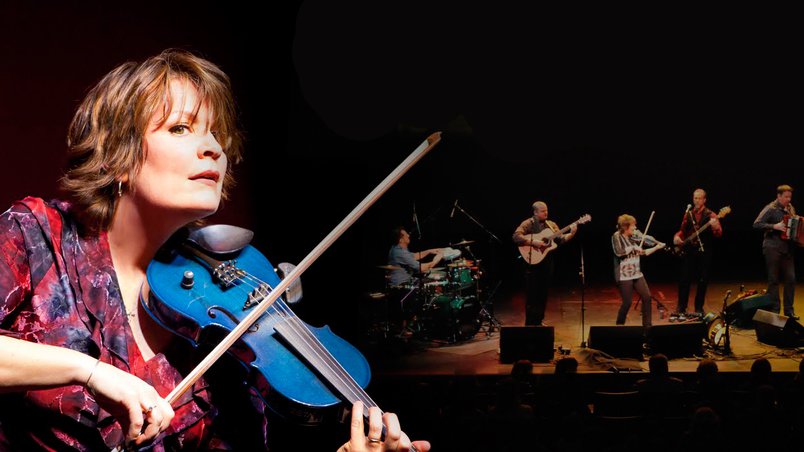
Eileen Ivers is Grammy-winning violinist | Courtesy Photo / Eileen Ivers

Connect with the Irish experience with internationally acclaimed fiddler Eileen Ivers and UnIVERSal Roots at Caltech’s Beckman Auditorium on Sunday, March 15, 2020 at 3:00 pm. As in all their previous shows, expect them to bring the audience to its feet with their electrifying  performance which evokes the Irish journey through the years.

The daughter of Irish immigrants, Ivers grew up in New York’s Bronx neighborhood. She picked up the fiddle at the age of eight and went on to win nine all-Ireland fiddle championships, a 10th on tenor banjo, and over 30 championship medals, making her one of the most awarded persons ever to compete in these prestigious competitions.

Having gone on a short visit to Dublin and written about my delightful trip (Visiting Dublin, Ireland), I was very excited to learn that an Irish musical show will be coming to Pasadena. You can just imagine my thrill when I got the chance to talk with Ivers, hailed by the New York Times as ‘the Jimi Hendrix of the violin.’    
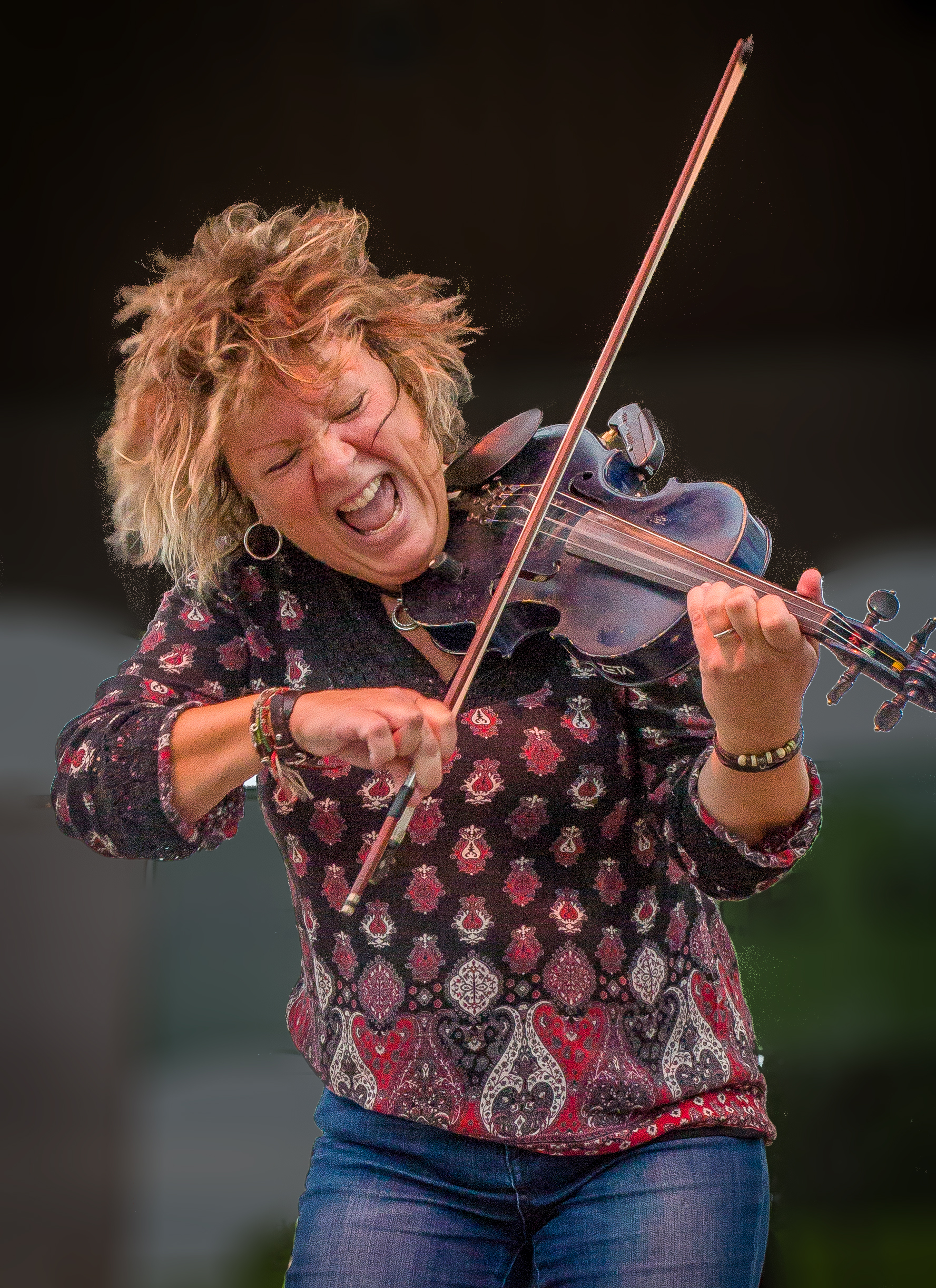
‘The Jimi Hendrix of the Violin’ | Courtesy Photo / Eileen Ivers

Speaking with me by phone from New York, Ivers chats about her childhood interest in the fiddle, having a math degree, traveling all over the world, an upcoming new album, and a surprising new venture as a fiddle-playing tour guide.

I begin by telling her that I Googled her and found out she summered in Ireland and played the violin at the age of nine. I ask if her parents are musical. Ivers replies, “Not really, they grew up in rural Ireland so there was no chance of learning it where they were. But going back in the family history, there was music on both sides. Then again, anybody Irish has some music in them as well.

“Even at the age of three, I was going around our Bronx apartment playing a little plastic guitar and a wooden spoon pretending I was in Ireland. Then I asked my mom if they would rent a violin for me. I started playing and I took to the instrument immediately. I loved the sound and the emotion it conveyed – it could be fast and rhythmic, but even at that early age I understood that there was also something lonesome that could be coming out of the instrument.

“In the show you’ll hear tunes that will evoke heartbreak and loss that happen in any folk culture. The band and I, of course, will pull from the Irish experience and play some tunes in the traditional way. Through our music, we tell the amazing story of immigrants, like my parents and many before them, who had to leave Ireland and came to this part of the world – America and Canada – and elsewhere. They brought their music, songs, dance, stories, and even their language with them. And their art form integrated with other music along the way; it really helped birth a lot of Americana music. We like to show the threads and parallels between Celtic and American roots music in our performance and connect all those styles – bluegrass to country and French-Canadian to Cajun.”

While Ivers has made a fulfilling career in music, she holds degrees in mathematics. She discloses, “I attended Iona College and I studied mathematics. Although I kept playing music throughout my studies and started to find a passion in the musical field, I loved the discipline of math dearly. It’s kind of funny because we’re playing at Caltech and I always had a secret dream of being an aeronautical engineer and one day working for NASA in some capacity. However, music pulled at my heart and away from the sciences in a good way, many marvelous things have come out of that.

“I still have a great relationship with the college. In May of 2019 my alma mater conferred upon me an honorary Doctorate of Art degree for what I’ve done in the field of music – bringing people together through the stories and the music in our live concerts and through my records. I had the privilege of giving the commencement speech at the graduation as well. It was such a full circle moment. In early April, Iona College is giving me an award as a ‘Woman of Achievement 2020.’”

Knowing that many children of immigrants go into the math and science fields at the behest of their parents, I ask Ivers if she took math as a back-up in case the music didn’t take off. She responds, “My Irish parents didn’t have the opportunity to pursue higher education – they had to quit school and worked in the fields in Scotland and England to send money back home to help raise their siblings. They were very young when they came to America, my mom was only 18, and they gently made sure my sister and I had the chance of higher education because it was so important that we had this opportunity to advance ourselves as much as we could in America.

“Iona offered me a full scholarship and I worked very hard. A wonderful professor I had told me, ‘Eileen, get a Master’s degree because you could go anywhere with a math background.’ I think that was one of the best advice I’d been given. People ask me if I pull from my math background and I say ‘Absolutely!’ There are many connections between math and music in writing, arranging, or recording. In my education outreach program, I always tell kids to have a balance of academics, arts, and physical activity in life.”
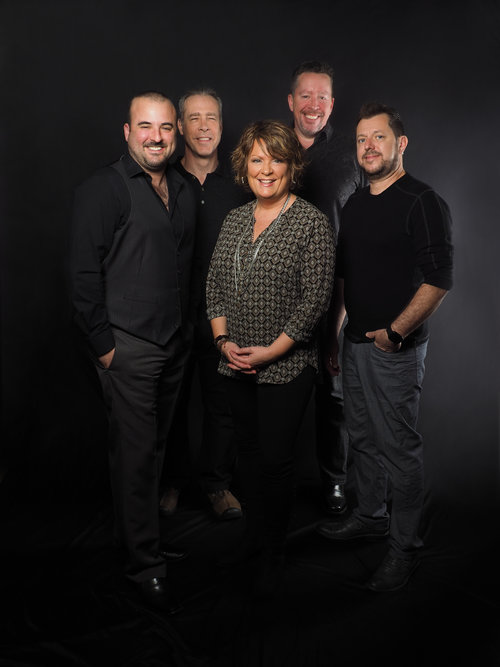
Eileen Ivers and her band | Courtesy Photo / Eileen Ivers

Continues Ivers, “We’ve played at Caltech before and to come back is something we’re really looking forward to. And we’re excited because we’re releasing a brand-new record called ‘Scatter the Light’ which will come out two days before the Caltech show. This is a big deal for us!

“My band and I have been playing all over the world in performing arts centers, symphonies, etc. I formed it at the end of 1999 right after I was in River Dance, the blockbuster dance show which, to this, day is still being performed. The members of the band are: Matt Mancuso, our lead singer, guitarist, fiddler, and trumpeter; Buddy Connolly, who is a three-time champion of the button accordion, a very Irish instrument, plays it and the keyboards and does some background vocals; Lindsey Horner plays electric bass and baritone sax; Dave Barckow, is on percussion and acoustic guitar and also does lead vocals; I play fiddle, mandolin, and an Irish frame drum called bodhran, it’s a Gaelic word and is very much a part of Irish traditional music. There’s quite a range of instruments and songs and we invite participation. We love to break down that fourth wall and get the audience involved in the show.

“People attending our show hear tunes from hundreds of years back – some heartbreaking airs and cathartic laments that are part of the Irish mentality and spirit. We’ll show a little bit of the history – I like to speak between the tunes and really paint the picture of what the life was like during those years. Ultimately, it’s a very celebratory and uplifting show. We certainly demonstrate the resilience of the Irish people who have gone through so much. We talk about the famine and great hunger in Ireland from 1845 to 1849 which devastated the population causing so many to immigrate and that’s why the diaspora is so strong and vibrant throughout the world. Some of the most amazing moments in Irish music happen in places where you would never expect them to, like Australia and Japan, where I’ve traveled to. It’s a great testament to the way the music has gotten around the planet.”

Ivers’s music appeals to all age groups. She expounds, “My fans tend to be a little on the older side but parents and grandparents who come to show say ‘I wish I had brought my children or grandchildren.’ Thankfully, we’re starting to see many young people come to the show now because they are very excited about roots music, acoustic-generated tunes, and unique original songs. The show is truly for all ages, everyone gets something out of it.

“I also like to embrace technology. I run my fiddle through a loop pedal, called a loop station, which enables me to create multiple layers of a song, building on layers that precede each other. For example, I lay down a percussion part (by thumping on the body of the violin) then add a bass line by using an octave divider. A guitar-like rhythm is added through a Wah effects pedal, and a top line melody can then jam on top of the ‘full band’ sound. It displays that the violin is a versatile instrument. The show moves in a lot of directions which is one great thing about it – people jump to their feet at the end of it because they really felt that honest emotion and connection we’ve had throughout the show. It’s something that keeps us going for sure. It’s such a gratifying passion.”
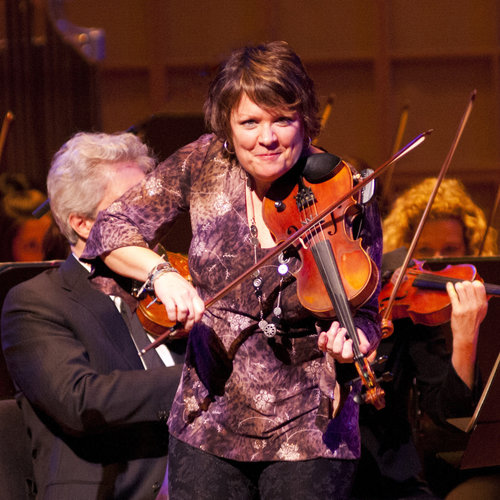
Ivers has built a successful career from her passion | Courtesy Photo / Eileen Ivers

Ivers and her band are touring throughout the year. She reports that January and early February tend to be down times because of the weather and because people are just coming out of big end- of-year holidays. Spring is always a busy time with St. Patrick’s, and March spotlights all things Irish. After the Caltech show, they’ll go back to the East Coast and then they’re off to Alaska for a week-and-a-half.                

Asked if there’s a place she hasn’t toured that she would like to go to, Ivers says, “There always is! There are pockets in Europe that we love performing in – Spain, France, Italy – but we’d love to be able to explore new areas in those countries. We played in Japan a few years ago – it was a very special audience – and we’d love to return there. Maybe one day we’ll perform in China as well. Fortunately, there are a lot of audiences all over the world who are open to hear our music.”

Although she has been to many places, Ivers, not surprisingly, enjoys going back to Ireland most. She reveals, “We have a house we built on my father’s land on the west of Ireland about 19 years ago. I tend to go back there two to three times a year with my family – my husband and young son. We love to recharge there and get inspired. It’s where I do a lot of my writing, more so than  I do here.

“In April this year, I’m actually running a ‘Wild Atlantic Tours.’ A second one, in June, was added because of the enthusiastic response to the April tour. It sold out in one day and we capped it off at one full-load bus of 53 people. I’m looking forward to showing folks the west of Ireland, where my parents were born, which is the ‘Wild Atlantic Way,’ as well as many other cultural and historical sites. There will be daily sessions of music and the tour group will get to see the ‘real’ Ireland and her wonderful people.”

I, for one, am very disappointed that her bus tours are sold out; it’s one adventure I would love to go on. Maybe Ivers can be persuaded to expand her second career as a fiddle-playing tour guide.           

A Fantastic Journey Awaits Us in ‘Alice in Wonderland’

Originally published on 4 March 2020 in the Pasadena Independent, Arcadia Weekly, and Monrovia Weekly

| Courtesy photo

Be transported to a fantastical universe when ‘Alice in Wonderland’ goes on stage from March 1 through April 18 at A Noise Within. Adapted by Eva Le Gallienne and Florida Friebus from the beloved Lewis Carroll books ‘Alice’s Adventures in Wonderland’ and ‘Through the Looking Glass,’ this production is directed by two-time Los Angeles Drama Critics Circle Award winner Stephanie Shroyer. Erika Soto stars as Alice and is joined by Susan Angelo, Bert Emmett, Rafael Goldstein, Julanne Chidi Hill, Kasey Mahaffy, Justin Lawrence Barnes, and Gabriel Leyva.

The story begins in Victorian England then quickly ventures into the topsy-turvy world that makes Wonderland. There we meet the various creatures that Alice encounters along the way. An ensemble cast becomes the white rabbit, the queen of hearts, the Cheshire cat, the duchess, the caterpillar, the mad hatter, the March hare, the dormouse, and all the other characters.

Rafael Goldstein, who is part of the ensemble, sits down with me one late afternoon to talk about the play and his many roles. In an earlier interview, he mentioned that his father was a teacher and he took home books for the children to read every night. I ask if ‘Alice’s Adventures in Wonderland’ was one of those books.

“I don’t think it was, but we did watch a couple of made-for-TV productions of it,” Goldstein recalls. “Although my father introduced me to the ‘Jabberwocky’ when I was very young because he would use it in his classes to teach parts of speech. For those who are unfamiliar with it, the ‘Jabberwocky’ is a nonsense poem using weird words. But by virtue of the way they sound, and their placement in a sentence, you can apply whatever meaning you wish to the poem. That’s sort of Carroll in a nutshell.”

“If this anecdote is to be believed, when Carroll first started writing ‘Alice’s Adventures in Wonderland,’ he set out to write a children’s story without a moral,” continues Goldstein. “All the children’s tales at the time taught lessons – listen to your parents, don’t talk to strangers, stuff like that. This was pure fancy, it was creating this world around this child that she could disappear into. It’s an interesting take because Alice is being confronted with characters – animals and people – and the rules of that world keep changing so she’s having to adapt. You can’t help but feel that it’s a comment on what the world does to children – people who are thrown into a country where they don’t speak that language so they have to figure out from clues and context what the rules of engagement might be. And it really just points out the fact that the rules in any world can be arbitrary and how, often, children bear the brunt of those arbitrary rules.”

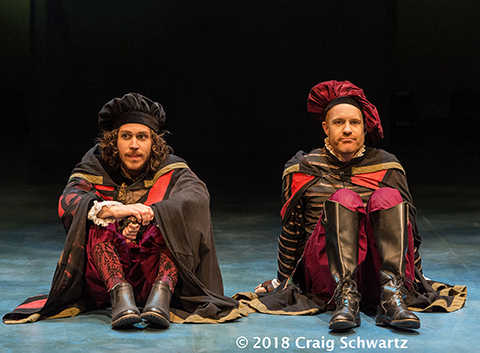
Rafael Goldstein (left) in ‘Rosencrantz and Guildenstern’ Are Dead | Photo by Craig Schwartz / A Noise Within

According to accounts, the original handwritten and illustrated copy is now lost and Carroll made revisions when he gave in to pressure to publish it into a book. Perhaps that was when he added the situations where lessons can be gleaned, I conjecture.

Goldstein explains, “He did mention in subsequent interviews how people were finding meaning and he was cagey about that. There’s a famous riddle in ‘Alice in Wonderland’ – why is a raven like a writing desk? Scholars at Oxford and Cambridge have been speculating whether it’s a math or a literature joke. Carroll was a mathematician so mathematicians claim that it’s clearly a mathematical equation and if you look for the clues you can find out the answer to it. Others were saying that one of the explanations for why a raven was like a writing desk was a reference to Edgar Allan Poe. But Carroll resisted all attempts to explain his work or to assign any meaning. He waffled a lot on it, but, at the end of the day, I think he wanted to maintain this aura of mystery and whimsy. And I think this production succeeds in that – it is a presentation of this world and does a good job of honoring Carroll’s stated intention. But as to the work itself, I think audiences will see what they want to see.”

Asked for his impression, Goldstein confesses, “I’ve read it now a couple of times during this process and I’m guilty of assigning meaning to it. It does feel like he’s preparing Alice for adulthood. And I feel like he’s trying to give her this story that illustrates how difficult it is to navigate the adult world.”

“This play combines both ‘Alice’s Adventures in Wonderland’ and ‘Alice Through the Looking Glass.’” elucidates Goldstein . “The first half is light and whimsical and zany. The second half is much more abstract and a little threatening, a little philosophical. I think that that structure is there on purpose – to put you at ease in the first half so that you’re open and available for the philosophical dissertation that he’s presenting to Alice.

“It’s a cast of eight – Erika Soto is Alice and stays Alice throughout and the other seven of us are taking on the rest of the roles. We’re doubling, tripling, quadrupling and reaching very deep into our bag of character voices and faces. I play the mad hatter, Tweedledee, a crab, which I’m very proud of, a caterpillar, and some Victorian spirits. The characters in this adaptation are straight out of Lewis Carroll’s – they are very colorful and each of them has their own point of view and communicating so they have to be reflected in the performance.”  

“It’s been a wonderful challenge, actually,” Goldstein discloses with a laugh. “It’s been a lot of fun. Because these characters are so iconic and so much a part of the vernacular of the literary world, you’ll find a reference to ‘Alice in Wonderland.’ So people coming to the show will have their own versions of Alice, the mad hatter, the March hare, Tweedles Dee and Dum. Part of what we’ve been exploring and experimenting with is finding a new way of approaching them.

“Yes, this production is recommended for ages six and up but we also have to remember that adults are watching it as well. Tapping into what makes these characters compelling and indelible, and why they’ve lasted for so long has been a joy.”

Rafael Goldstein as ‘Henry V’ | Photo by Craig Schwartz / A Noise Within

How does this production make a fantastic world come to life? I inquire. Rafael says, “We have access to the best designers in town. This play is a director’s and designer’s dream. Actors can only do so much with our physical bodies and everything else will come from the costumes, sets, lighting, music. They are crafting this world around us. In the rehearsal hall, we would be going through a scene and all the actors would be deep in thought about what’s happening in it– she’s going to cry and because she’s a giant, her tears will create an ocean. And all of us are sitting there asking how this is going to happen. Then we get down into the theatre and the designers will say ‘we’ll just throw a light there, we’ll have a sound cue there’ and as we run it, all of a sudden the world becomes clear. And while Carroll might not want us to have a point of view or an attempt at understanding or deconstructing the piece, it is the artist’s job to have a point of view, to have this nonsense make sense. The designer’s work is valuable in communicating that not only to the actors but to the audience as well.”

Goldstein says about the production, “There’s something in the production that will appeal to all ages. For those of us who are older, it’s an opportunity to reclaim a piece of childhood that we think we’ve left behind as we become adults. It’s a chance to live in that fantasy world unapologetically. And I’m reveling in that opportunity right now where play is serious and serious matters are ridiculous. That inversion is fun to experiment with.”

“I think this story is important especially now when the world seems inexplicable. I think this play does a good job of saying ‘It’s okay. No matter how strange, upsetting, unpredictable, or crazy things around you may seem, there’s a very good chance you will prevail because you’re prepared. ‘Readiness is all,’ as Hamlet says,” concludes Goldstein.

Looking at it that way, we can all take life lessons from Alice’s experience and be ready for whatever the world throws at us.      

‘Passion’ at Boston Court Pasadena Defies our Definition of Love

Originally published on 28 February 2020 in the Pasadena Independent, Arcadia Weekly, and Monrovia Weekly. The show, however, was eventually cancelled because of the lockdown.

 
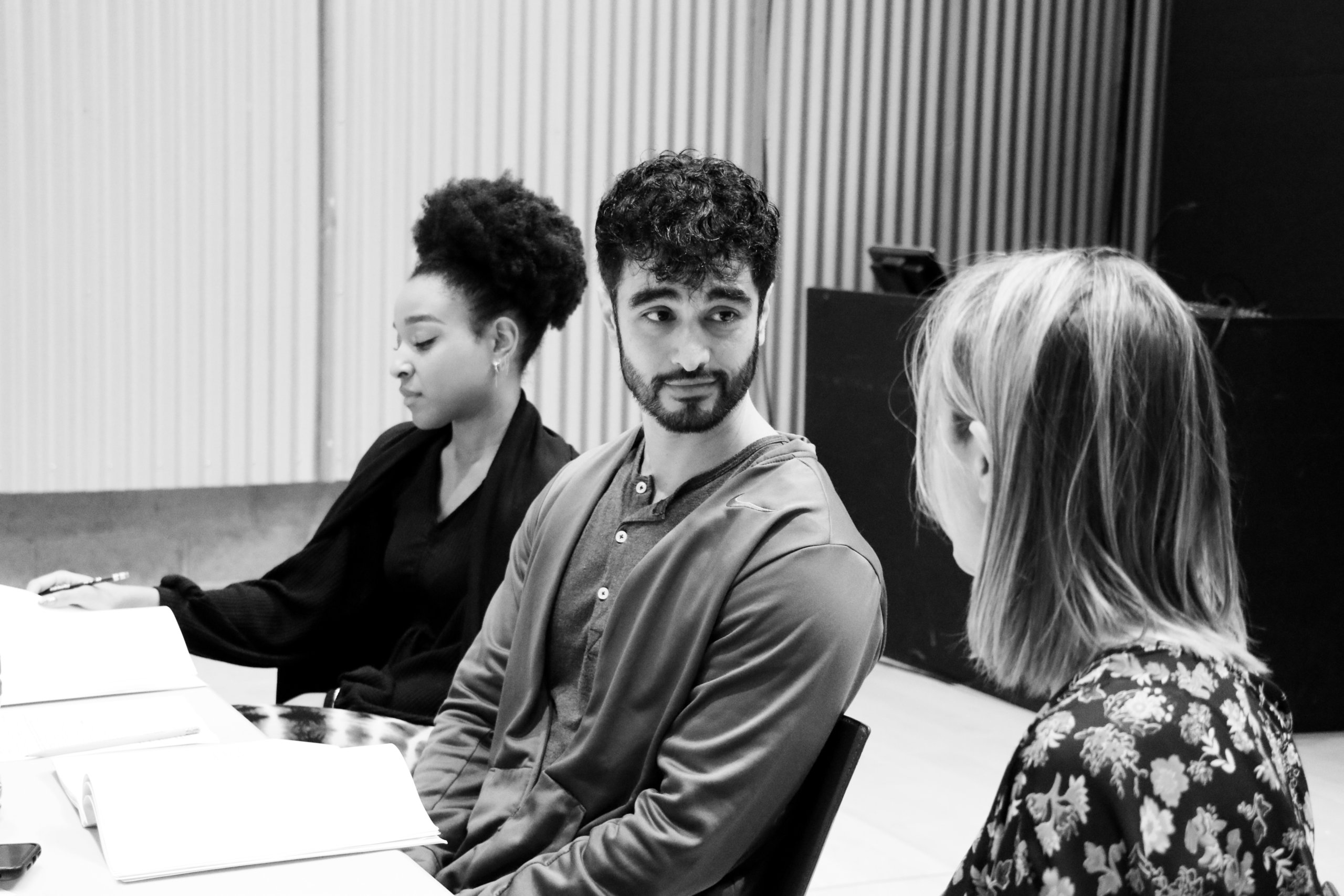
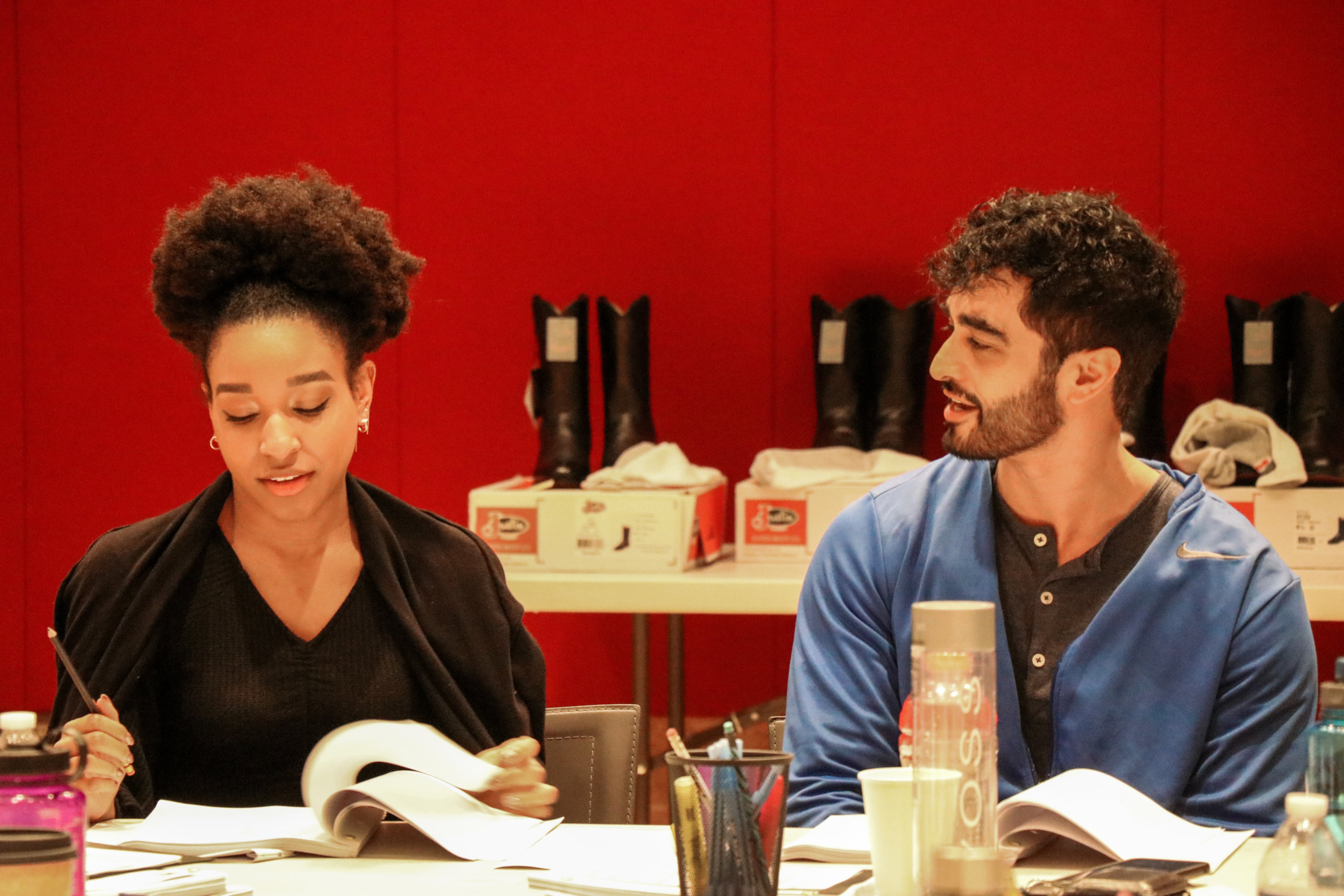
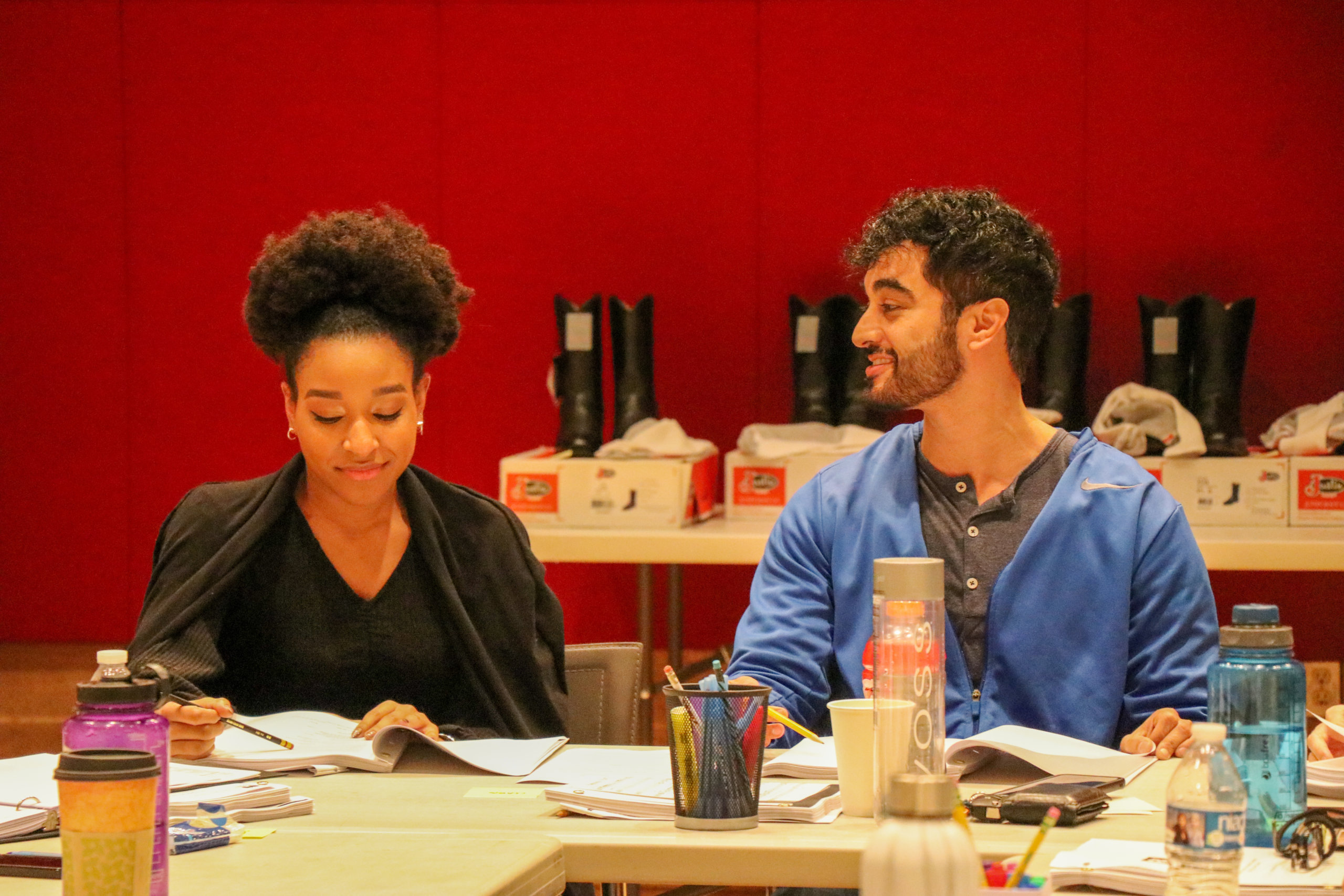
Shown left to right: Bryce Charles, Richard Bermudez, and Meghan Andrews during rehearsals | Photo by Monica Montoya / Boston Court Pasadena

Stephen Sondheim’s ‘Passion’ takes center stage at Boston Court Pasadena from March 5 to April 19, 2020. Based on the film ‘Passione d’Amore’ directed by Ettore Scola, after the novel ‘Fosca’ by I.U. Tarchetti, this production is directed by Artistic Director emeritus Michael Michetti. It stars Richard Bermudez as Giorgio, Bryce Charles as Clara, and Meghan Andrews as Fosca.

‘Passion’ transports us to 1860s Italy and tells the story of Giorgio, a handsome young army captain, who falls in love with the beautiful Clara and the unattractive and sickly Fosca, who challenges his notion of what love is. It explores love with all its perplexities – desire, obsession, lust, and madness.

Director Michael Michetti and lead actor Richard Bermudez graciously sit down with me to talk about the play and share their thoughts about the characters in it.

“I saw the show on Broadway in its original show and I’ve seen other productions since,” begins Michetti. “In 1999, I actually directed a premiere concert version of it in Los Angeles for Musical Theatre Guild, which does a week of rehearsals and puts up semi-staged concert productions of rarely done musicals. We did it for the Pasadena Playhouse for one night and we brought it back for one more night at Reprise at UCLA. This is the first time I’m directing it again, but I’ve been in love with it since I first saw the original.”

Michetti expounds, “Our production will be a departure from the original Broadway show because we’re staging it in a much smaller venue. But we’re utilizing our intimate space as an occasion to focus on the love story while still being textually faithful to the script and score the writers wrote. It feels to me like this is a show that is rich enough in its writing that, like doing Shakespeare, you can keep going back and, if you are true to what the authors have created, come up with many ways to reinterpret it. Having said that, I think people who know the show will see different things than what they’ve seen before.

“We’re doing a full production with a cast of 12 plus five musicians, which is pretty big for Boston Court Pasadena. We’re not expanding the space for the show, but we’ll be using all of it. We’ll have a two-story set and the orchestra will be on stage under the balcony. ‘Passion’ is a love triangle at its heart – it often breaks down to two- and three-person scenes. But it also takes place within the context of a military base where Giorgio, the protagonist, is stationed. It’s a unit set so we have objects to help change the volume of the space – several chairs, a small writing desk, a platform that doubles as a table and a bed, and a series of sheer hanging drapes that the cast moves around to transform the space.”

Bryce Charles and Richard Bermudez | Photo by Monica Montoya / Boston Court Pasadena

This reinterpretation is set during the same time as in the original play. Michetti describes, “It takes place in 1863 in Northern Italy and there are behaviors that would not be commonplace now, but are true to that period, including the climactic moment when the characters are challenging each other to a duel, and so forth. The other thing that’s noteworthy is, as Giorgio is torn between these two women in his life, you feel compassion for the women in the way society has created constrictions on the kinds of roles that they can have in the world. And, interestingly, Clara, the young woman Giorgio is in love with at the beginning of the play, is very bound by the social mores at the time. In the same token, Fosca is viewed through that lens but she doesn’t behave as the world wants her to. While I think there’s something liberating about that, she also pays a price for it because people judge her for not following the rules.”

I ask if Fosca is using her difficult circumstances to manipulate Giorgio. Michetti replies, “The script makes a case for a woman who is not attractive by traditional societal standards, is sickly and, for over a decade, has been parentless and living on a military base without female role models to learn from. At one point, in one of her most vulnerable moments, she says, ‘No one has taught me how to love.’ A lot of her actions is naiveté and impulsive rather than consciously manipulative.”

However, one can also question Giorgio’s behavior – when the story begins, he’s in love with a married woman and then he falls in love with another woman who’s an unlikely choice – I remind Michetti. “Giorgio is written as a man of moral purity but he finds himself in difficult situations,” remarks Michetti. “Fosca sees Giorgio as kind, compassionate, and empathetic – qualities that a lot of the men in this military base don’t have. Giorgio, on the one hand, is repelled by her and, on the other, is sympathetic to her and has feelings for her. A part of his journey is about realizing that there is something to the kind of love that Fosca is able to feel where she is literally able to give everything, including possibly her life for a love that is a different definition of love that he had known before.

“It’s an interesting challenge the writers have set up because in the beginning, he is seemingly in love with the perfect companion for him. But as the play goes on, you start to appreciate that it’s not quite as perfect as it was made out to be and the woman we would never imagine he could have feelings for, has challenged him to think about love in new ways and one he’s come to genuinely love.”

Bryce Charles and Richard Bermudez | Photo by Monica Montoya / Boston Court Pasadena

How believable is that for the audience?, I query. Michetti says, “That’s one of the dividing points in the original production. There were people who found it wholly convincing, very moving, and really beautiful. And there were others who were not able to fully buy into it. That has been a big part of our approach to this production – to make his journey to be apparently impossible at the beginning and inevitable by the time he gets there. There are several opportunities within the script and score to tell that story and we’re doing our best to mine them. It’s absolutely a challenge but one that I’m excited to tackle – if I feel it’s easy and I know exactly how to handle it, it’s never as creatively exciting.

“I’m working with a marvelous team who’s eager to tell the story and take on the challenge. I met Richard for the first time in the audition and he’s terrific. I have worked with Meghan who’s playing Fosca and I have seen a few other cast members. Bryce, who’s playing Clara, was just in the outstanding production of ‘Ragtime’ at the Pasadena Playhouse. Because it’s a musical, it requires amazing singers with amazing instruments but, honestly, it needs people with equally strong acting skills. It’s about finding artists with all the attributes and getting the right balance between them as well. Some people who auditioned sang beautifully but when we asked them to act it, they missed an aspect of the character and vice versa. It’s always the more gratifying when you find the people, as I believe we have here, who hit both sides of it.”

What was he looking for with the different roles, I ask. Michetti responds, “Giorgio is, for much of the play, a reactive rather than active character. He is someone who tends to sublimate his own needs in order to take care of others. Yet he is the protagonist of the play – it’s his journey we’re following – so we needed someone who can be dynamic and compelling. He’s a good leader, organized, and efficient but he is also compassionate and a lover of literature and is a deep, thoughtful thinker. He has both traditional masculine military side and a side who has a more feminine approach to things in terms of his sensitivity which is what Fosca is attracted to. We needed someone who exemplifies all of the contradictory aspects of Giorgio, and Richard embodies all that.

“For the role of Fosca, one of the challenges is that the original Fosca was played by Donna Murphy who did it so beautifully and iconically, and there’s a tendency to use that performance as the benchmark. And while I thought her performance was really brilliant, we’re taking a different approach. Meghan and I are less interested in finding the extremes of her grotesqueness and more interested in exploring a woman who is a misfit, but not necessarily a grotesque person. There isn’t a lot of discussion about her appearance. Nevertheless, I don’t think Fosca needs to be tremendously ugly. And, by the way, the actress who originally played her is a beautiful woman as is Meghan and she is doing an outstanding job.

“In terms of Clara, I wanted someone who is, as the script required, beautiful and charming and who can play the tragedy of a woman who is caught within the social constraints of her time. She is an upper-class woman who comes to discover that if she were to give everything to this relationship, she would lose a lot of things that are important to her. Bryce is fully embracing that and doing just beautiful work.”

Richard Bermudez | Photo by Monica Montoya / Boston Court Pasadena

Bermudez arrives at this juncture and I also ask him if the premise of the show is credible. He notes, “Therein lies the issue and that’s what we explore for an hour and 50 minutes. It’s a very difficult question and that may be why ‘Passion’ is not popularly staged. My character essentially goes through this very emotional and, at times, disorienting and overwhelming journey where his fundamental belief system about how he envisions love, and what relationships look and feel like is challenged by someone.

“Fosca disrupts Giorgio’s mental and physical health. Through all that, he comes to realize that this woman has opened a door to a whole new way of looking at life. What we hope to do is to make that love that he’s developed for her believable and that it’s sincere. He sees in her someone who loves him for no other reason than to love him in the most selfless and genuine way, asking for nothing. It’s not a love that he has ever known. It’s juxtaposed by his relationship with Clara, which is a very conditional love. They enjoy the moment but to really have a life with her, he will have to wait for a number of years, when it’s convenient for her to leave her husband. And Fosca questions if that’s really love. This is in the 1860s, in a patriarchal society, when women aren’t allowed to have much of a voice in anything. And here is this woman who challenges not just men, but the military, and normal conventions. She’s a fully formed person in a society where he’s not used to meeting people like her. He’s initially attracted to her intellect – in the script, she talks about his favorite book and he is surprised that she likes it as well. That fascination with her intellect leads to the unexpected – he realizes that the physical is fleeting whereas real love is grounded in something much, much deeper than just physicality.”

She sounds like someone obsessed, which is rather disturbing, I observe. Bermudez clarifies, “At the outset, it could look like a fatal attraction-type of obsession. But it really isn’t because deep down she doesn’t want to hurt him, she wants to see him happy. But she’s also a woman who’s not used to delving into this kind of feeling. She herself is going on her own journey of how to express that and she recognizes that she doesn’t conform to normal conventions – she’s not supposed to ask a man to kiss her, to ask for a date. Ultimately, there is something very attractive about someone who doesn’t care about appearances or being judged for her love.”

Darryl Archibald and Richard Bermudez | Photo by Monica Montoya / Boston Court Pasadena

Asked how he relates to Giorgio, Bermudez answers, “I relate to his sensitivity. I played a lot of sports growing up; in a lot of ways I was a jock. But I also played an instrument, sang in choir, and did musical theatre, all of which require a degree of sensitivity which your average jock may not necessarily possess. His intellectual curiosity appeals to me as well because I was also an avid reader growing up. As a small child, I was always curious about the big books my dad was reading. I probably read books far above my intellectual capacity at that time. Additionally, I can relate to his empathy. It’s something I value in people and relationships – the ability to put themselves in other people’s shoes. I think it’s fundamentally what we do as actors and performers – we make a living being empathetic. I have to say, though, that I’ve always prided myself in being able to use both hemispheres of my brain equally. In fact, I’m an actuary during the day; I’ve always done well in the math and sciences and scored highly in the creative and writing subjects. And that helps me feel fulfilled because I have diverse interests.”

Bermudez confesses that he has never seen ‘Passion’ performed, “I’m not alone in that. Several of my friends, with whom I’ve done theatre for a long time, haven’t either. Even my closest friend who said ‘Oh, that’s one of my top two favorite shows. I adore it!’ and when I asked, ‘Really, where did you see it?’ answered, “I’ve never seen it.’ But you get that reaction a lot! It’s one of those shows that’s very well regarded and revered among the people who know musicals because they know how difficult the subject matter is. But the difficulty is also what makes it rewarding if you can nail it right.

“I think it’s also one of the most impactful shows that I’ve ever read. We’ve only been rehearsing for a week and a half, and I’ve already been challenged so much – not just in the script but the extent of what I have to do. But I consider Michael savant when it comes to this material – I know he studied it for decades, he knows it intimately, and he’s meditated on it. He’s familiar with every facet of it. And I appreciate the careful attention he puts in it. We have the luxury of having a pretty extended rehearsal period, from my experience at least. At times we’d just sit and analyze a couple of words for a half hour. The first few nights, instead of singing the songs, we spoke them because we wanted to get to the intent of what we’re saying. We’re not just singing songs because they sound pretty, every single word and line mean something and we want that to be reflected in our acting choices. And we don’t want the music to necessarily inform those choices. It’s been very, very exciting!”

Continues Bermudez, “We’re taking a fresh approach, it’s pared down. Our musical director Darryl Archibald is doing a unique arrangement of the music – he’s orchestrating it to fit the space. He has done several original orchestrations … I’ve worked with him on other shows and I have so much faith in him. He’s just brilliant and I’m sure he’s going to do an amazing job with this. Also, since we have an intimate space, we’re thinking of not having body mics. There’s something about the purity of an unamplified voice that we just forget what that even sounds like. That’s exciting too.”

Michetti inserts, “I just want to tack on something to what Richard said. Darryl is such a gifted man and I’m very excited about the orchestration. He’s reducing it to a string trio – cello, viola, violin – one reed which will double clarinet and flute, and a keyboard. It’s sort of the composition of an orchestra that will be able to adjust the dynamics to support the unamplified voice in the space. He’s an amazing musician and has fantastic taste but he’s also interested in how the musical choices support the story-telling. He’s always asking what’s going on dramatically – ‘the music is saying this but is it dramatically playing against that?’ And in some cases that’s true. He challenges us with some really wonderful questions. I worked with Darryl a number of times in the past and it’s a treat to be in the room with him again.”

“This is a musical interspersed with dialogue,” discloses Michetti. “It’s an interesting structure because they’ve written it so that there’s no opportunity at the end of musical numbers for applause. The first time it breaks for applause is at the end of the play. It weaves seamlessly between music and dialogue – the songs are structured so that the music transitions into underscoring and dialogue takes over.”

Left to right: Byrce Charles, Richard Bermudez, and Meghan Andrews | Photo by Jenny Smith Cohn / Boston Court Pasadena

Performing for almost two hours without intermission can be tricky for the artists. According to Bermudez, his character is on stage for the most part of it. He confesses, “I like to hydrate so this presents a conundrum. Literally, as I was reading through the whole show, I was thinking ‘Okay, I think I have about 37 seconds here. I can maybe sneak off very quickly.’ The last thing I want is to have this profound climactic moment and I’m dying because I really need to go to the bathroom.

“There aren’t moments in the show built for applause. Even if we sing these beautiful numbers, it’s like a freight train – it keeps going. Michael brought up a very good point yesterday when we talked about it – ostensibly applause is for the audience to show their appreciation for the performers. At the same time, the audience feels a catharsis when they applaud. So they’re going to have to hold that back throughout the show. And for me, this show builds and builds where I break down physically and emotionally until I come to the moment where I’m near death and I kind of have an epiphany. So the audience will also have all that pent-up emotion and the release at the end. That’s going to be interesting.

“Reading through the play from start to finish with the music last night, I also realized how quickly I have to reset between scenes. They go rapidly and my challenge is – I don’t want to have an emotional hangover from scene to scene. Some scenes are sad and emotionally fraught, but you don’t want to have that lethargy for the next. There are many scenes that happen after a couple of weeks have gone by, but it may only be 20 seconds for me. So yesterday I got a really good sense of how hard it will be. It is a test of stamina and commitment for this company of actors and Michael is confident they’re up to the task.”

As to the audience takeaway, Bermudez pronounces, “I fully accept that we probably will have different reactions – it’s not for everybody. I feel that we will have done our job if people talked about the show afterwards … if they want to analyze our motivations and some of the choices that we made. To me, the most exciting reaction to a material  – whether it’s a movie, or a play, or a musical – is when I can’t stop thinking about it. Sure, I want them to enjoy our singing and acting, and there’s space for that – Michael has put together a phenomenal cast. But I also want the audience to think about their own definition of love, what relationships are, what that looks like, and what we’re willing to do in the name of love, really, when it came down to it. We can all profess all the things that we’ll do for the people we love but what will we actually do?”

To which Michetti says, “I fully agree and I hope that people will come in with their own ideas about what love is or what an ideal love is. I certainly don’t think this play is trying to present the ideal love but I hope that people will go along on the journey and be moved by it. Even the love that Giorgio and Fosca arrive at is not perfect and not without consequences but all of the principal characters are doing their best. Last night, after a week of rehearsal, we did our first singing and reading through the play and I was very moved by the writing of the show and, already in this early stage, the beautiful commitment of the performers to tell the story of complicated people trying to navigate the choppy waters of love.”

Does it have a happy ending? I ask, and Bermudez responds, “It depends on who you are.”

Acquiesces Michetti, “It isn’t a strictly happy ending because there are consequences to the choices they make and there is loss in addition to … I can’t find the opposite of loss.” Gain, I supply, and he says, “Well, I’m not sure that’s exactly what I mean either, but I’ll use it for lack of a better word. I don’t want to give anything away, but there’s something set up earlier in the play that comes to a conclusion that I find tremendously satisfying when Giorgio realizes that Fosca had an understanding of him deeper than he could have understood at that moment. That comes back at the end of the play, which I find moving and satisfying.”

It’s an enigmatic response but, fittingly, ‘Passion’ is about that bewildering emotion we call ‘love.’ And it can mean as many things to as many people as it touches.

‘The Winter’s Tale’ at A Noise Within Brings Us to Tears

Originally published on 20 February 2020 in the Pasadena Independent, Arcadia Weekly, and Monrovia Weekly

 
Left to right: Jayce Evans and Frederick Stuart | Photo by Craig Schwartz / A Noise Within

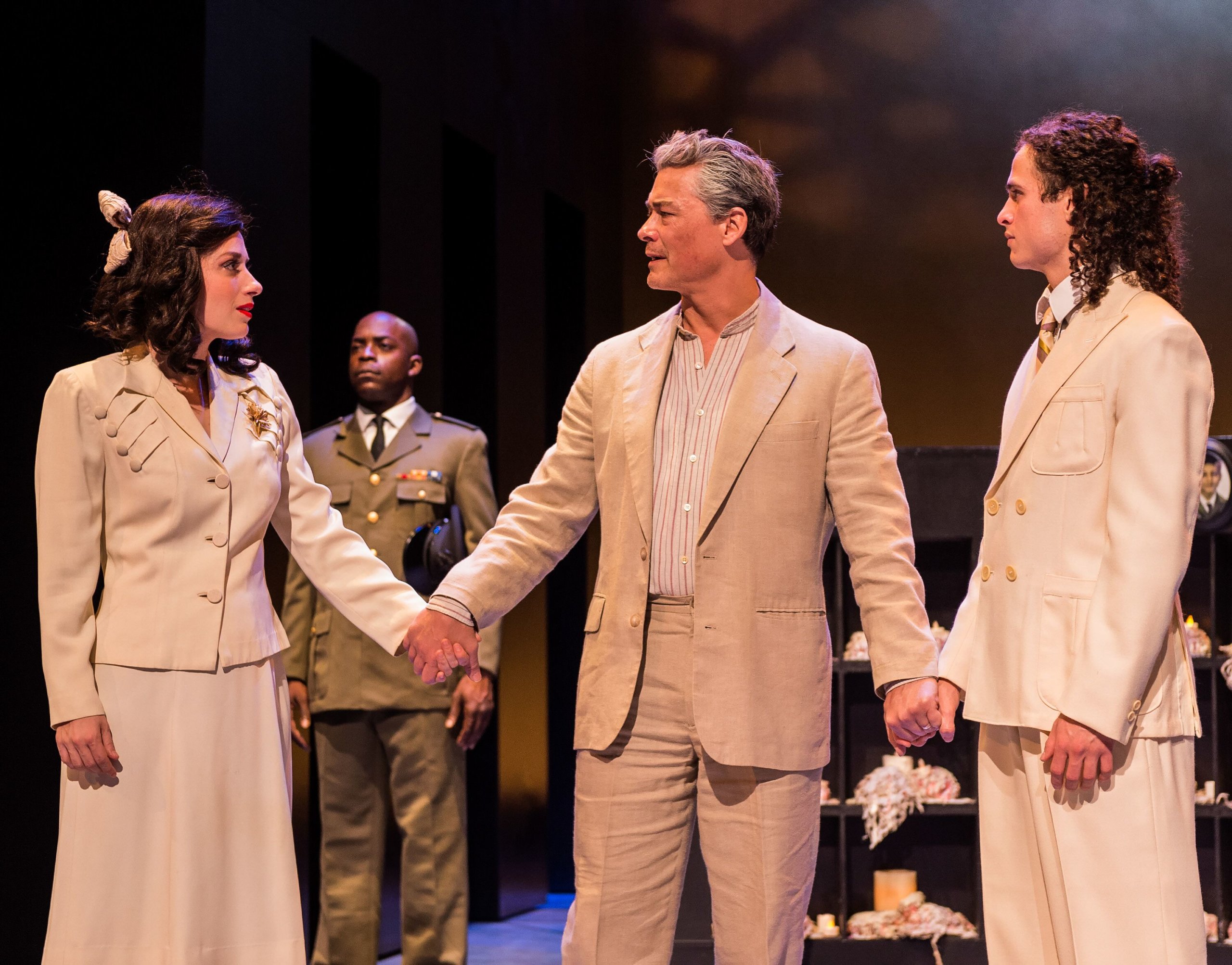
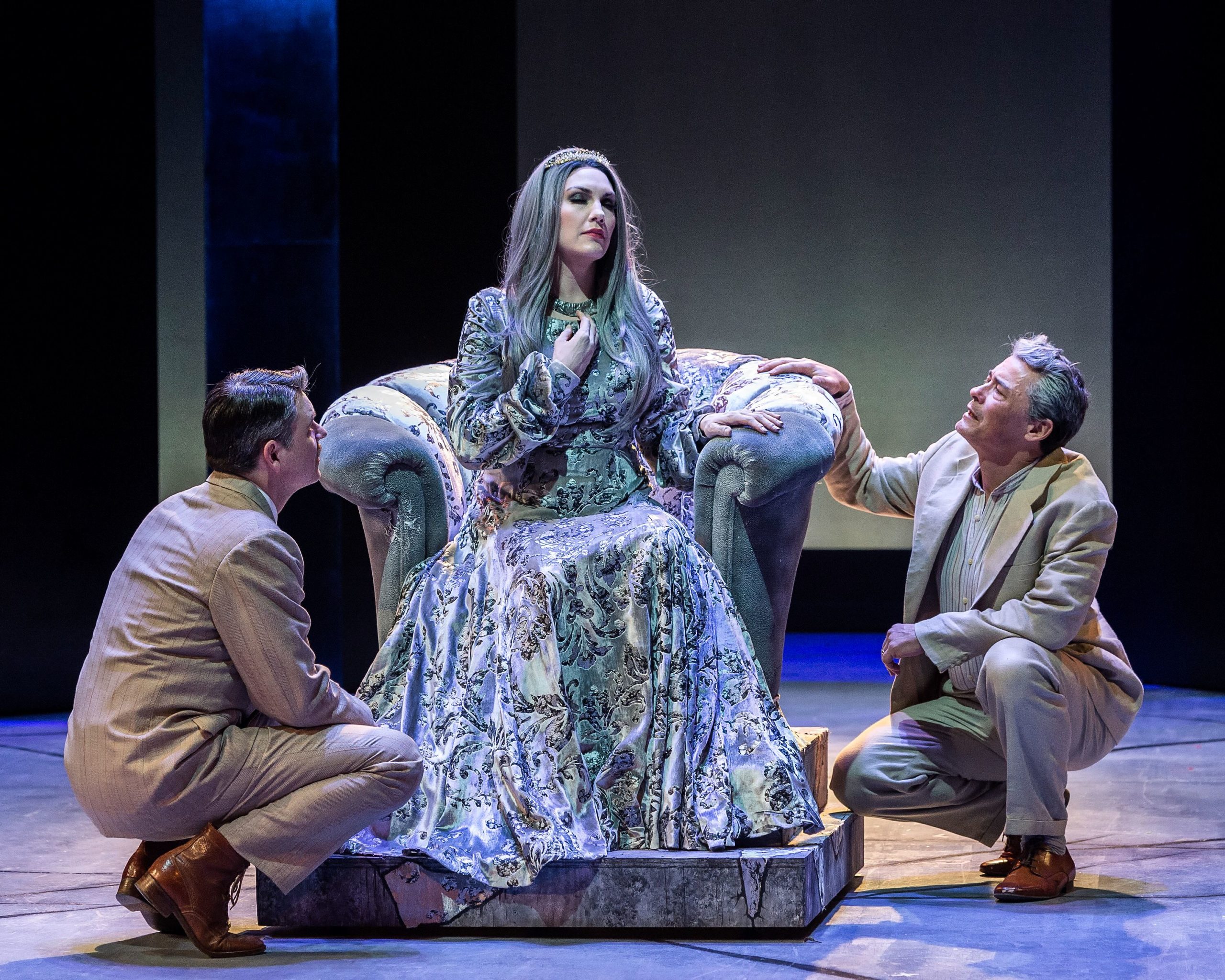
A Noise Within opens its Spring event with William Shakespeare’s ‘The Winter’s Tale,’ going on in repertory from February 9 until April 11. Directed by Geoff Elliott, it features Frederick Stuart as Leontes, Trisha Miller as Hermione, Brian Ibsen as Polixenes, Jeremy Rabb as Camillo, Deborah Strang as Paulina, Angela Gulner as Perdita, and Alan Blumenfeld as Antigonus/shepherd, Alexander de Vasconcelos Matos as Florizel, Jayce Evans as Mamillius, Eric Flores as young shepherd/ensemble, Matthew Faroul as lord/ensemble, Katie Rodriguez as Emilia, Robert Anaya, Christopher Barajas, and Thomas Chavira.

‘The Winter’s Tale’ tells the story of Sicilian King Leontes who, in a fit of jealousy, orders the death of his friend Polixenus and sends his wife Hermione to prison only to find out that he was entirely mistaken. He spends the next 16 years atoning for his sin and is redeemed in the end.

One late afternoon before rehearsal, I meet with Stuart at the theatre lobby to chat about the play, its relevance today, and his favorite roles, among other topics. “It wasn’t a play I particularly knew very well,’ he begins. “Coincidentally, it marked my introduction to A Noise Within. A very good friend of mine brought me to my first ANW play 12 years ago in the old space in Glendale and it was ‘The Winter’s Tale.’”

Jeremy Rabb and Frederick Stuart | Photo by Craig Schwartz / A Noise Within

Stuart summarizes the play for me and describes his character. “We’re staging the play in the 1930s, around the time of Mussolini, when fascism was taking hold. Leontes is essentially a dictator. He seemingly discovers that his wife is cheating on him and might even be nine months pregnant with someone else’s child. He has such certainty that he condemns her to jail and then puts her on trial. He wants to execute the baby but has second thoughts and lets one of his men put her in a place outside ‘so that chance may nurse or end it.’ It so happens that she is rescued by a shepherd and grows up.

“Not only does his wife die, but his son dies as well of, essentially, a broken heart at seeing his mother in such distress. He then finds out he’s mistaken and spends the next 16 years in absolute self-flagellation. He’s so appalled by what he has done and he tries to make amends by going to the grave of both his dead wife and son.

“The daughter later comes back into her father’s life. Unbeknownst to him, Paulina has a gallery with Hermione’s statue in it. And we see her come back to life. As to whether it’s a magical event or whether she stayed on the sidelines for 16 years to teach him a lesson, that’s up to the audience to decide.”

Frederick Stuart, Deborah Strang, Trisha Miller, Frederick Stuart, and Katie Rodriguez | Photo by Craig Schwartz / A Noise Within

Continues Stuart, “It’s a story that I think is so relevant nowadays because people are so certain about things, especially about their political opinions. It’s a kind of psychosis, a kind of madness, when you are absolutely certain about something. Even scientists’ mode of inquiry is to be doubtful or, at least, uncertain and that is a healthy state of mind. But we seemingly live in times when people are too impatient to be uncertain. I think it’s fitting that this play is set in the 1930s when there was this sense of uncertainty and people held on to Fascism as something they feel certain about all of a sudden. It’s a dangerous mentality especially for the masses to hold onto certainties as a movement – people are capable of doing anything when they’re certain and there are enough numbers behind that certainty – as we’ve seen in the last century.

“So this story is relevant for the times we live in but it’s also relevant to us personally as individuals. It’s always beneficial, before jumping to conclusions, to put ourselves in other people’s shoes, and have a little bit more compassion before we act in ways such as Leontes does in this play.”

Actors inhabit their characters despite how different they are from the roles. In this case, however, Stuart, actually connects with Leontes’s temper. He discloses, “I’ve learnt over the years, that I have rage inside me. Society tells us to conform, yet everybody has a certain rage about the machine, so to speak. I think it’s healthy to have rage, it’s just where to put it. I’ve been lucky enough to discover acting and I saw it immediately as a way to explore my psyche and put these apparently unacceptable states of mind – rage, lust, and so on – into some use. We’re living in such a society where it’s impolite or improper to display these feelings – especially in England where I grew up. There’s a lid that is put on into all of our natural instincts and emotions. In this play I am able to come on stage and let rip! It’s quite enjoyable. Oh my God, it’s fantastic! You’ll see some shocking things that I do in this play.”

Asked if he has favorite roles, Stuart responds, “I loved ‘Tartuffe‘ which wasn’t a particularly huge role – it was quite small, in fact. The first hour or so, everybody’s just talking about Tartuffe then he makes his entrance. But it was a wonderful character and I enjoyed doing that. Of course, Hamlet is a part that I will always remember playing – it’s iconic.

Frederick Stuart and Deborah Strang | Photo by Craig Schwartz / A Noise Within

“You know, it’s funny, Deborah Strang, a veteran actress here at A Noise Within, said a great thing – it’s the one you’re in that’s the favorite. And I have to say, I’m learning a lot about myself and my craft. This play came at the right time … I’m ready for this role. The experiences I’ve gained and where I’m at in life have deepened me as a human being. I have different outlooks on life now. Sure, you can play Leontes as a young man in the first act. But when you come back in the second half of the show, it’s 16 years later, and you have to understand what compassion is. And as a young man, I gave lip service to compassion. I think that’s what aging is about – it’s about realizing that we are finite and mortal. And sometimes we’re frail and there’s nothing like the smile of a stranger, or a helping hand, or some kindness. It means so much especially as you get older.

“Not too long ago, I played Sydney Carton in Charles Dickens’s ‘A Tale of Two Cities.’ That is one of those roles that crack you open. As you progress through roles, each time you tackle something, you wonder whether you’re capable of bringing to it what is needed. For that particular role, it became very emotional at the end because he has to walk up these steps as he says this beautiful line – ‘It is a far, far better thing that I do than I have ever done; it is a far, far better rest that I go to than I have ever known.’ It’s heartbreaking. And that is a man who was so cynical all his life and ends up preparing to die to let another man live because he knows this man will make the woman he loves happy.”

“There is a real emotional journey and you just wonder whether you’re up for it,” Stuart expounds. “A similar thing is happening right now with ‘The Winter’s Tale’ because it has an ending that is so emotional and bittersweet. I didn’t know how it was going to affect me. It’s very personal for me in the same way that Hamlet was to me. I am an only child who never knew his father. My parents were living in Hong Kong and he was a journalist. When my mother was eight months pregnant with me, my father died during a hurricane. Perhaps because I was in the womb, I had a connection with that particular moment where death was transcendent. It’s such a magical, universal, and profound moment for an audience to experience because, no matter where we come from, that’s the one thing we all share as human beings – we know there will be one day that will be our last. To see this moment that Shakespeare has created come to life, literally, is overwhelming.

“We’ve all worked together before and we all know each other intimately. So for this moment to happen amongst us, it’s almost as if the audience is privy to a private moment amongst the actors on stage. From the first rehearsal onwards, we felt that this meant something profound to us. Rehearsal after rehearsal, with just us on stage, without an audience, we were in tears all the time.”

Left to right: Angela Gulner, Frederick Stuart, and Alexander De Vasconcelos Matos | Photo by Craig Schwartz / A Noise Within

Stuart can’t predict, though, if the audience will react the same way. He states, “There’s so much out of your control and when you focus on those, you’re disempowered. I’ve honed down my own life only to the things that I can control and within this play I can control what I do as an actor and how I receive other actors. Luckily, I’m surrounded with actors whom I admire and trust and love and the connections are so real and emotional. It feels as if we’re giving birth to something very magical. That said, I hope the audience is walloped.

“My first theatrical experience was Marcel Marceau, the French artist and mime. I saw that as a kid and there was something about the lights coming down and having a communal experience. It’s not the same as cinema. You’re presenting a piece of writing that has lasted for centuries for good reason. That’s why the Greeks invented theatre – because it’s somewhere we could experience something larger than ourselves and be emotionally connected with. This play does that, it’s bigger than the sum of its parts. I want the audience to feel that.”

Brian Ibsen, Trisha Miller, and Frederick Stuart | Photo by Craig Schwartz / A Noise Within

Acting didn’t come early in Stuart’s life. He reveals, “I was at boarding school when I was in England but I was dreadful in academia. When I was 16, I played the Artful Dodger in the school production of ‘Oliver’ and I was a great success. So that got me thinking about it. I left school, and because I didn’t have any qualification for any career, I went into construction for a while – I carried bricks up and down ladders. I was very good-looking as a young man … you’d never guess it. There were commercials at the time who featured someone who looked similar to me. And the bricklayers would say, ‘Pretty boy, didn’t you see yourself in that advert on TV last night?’ I signed up with a modeling agency and I started booking commercials – I had an entire career of it.

“Then I decided I wanted to go into acting and I auditioned for drama schools. I got into The Royal Central School of Speech and Drama, which is one of the better drama schools in England; I was about 24 years old. In 2005, I came to Los Angeles with dreams of becoming a movie star and ended up falling in love with theatre all over again. I studied with the great Larry Moss and then I found A Noise Within. While I have TV and film credits, theatre is where I feel most at home.”

Finally, I ask what would be a dream role for him and why. Stuart replies, “I’d love to do ‘Richard II’ because he’s very conflicted. He’s being appointed, apparently by God, to be the king. But he is the most inept character you could ever have as the king. And he kind of knows that. So he’s dealing with everything from the point of view of someone with no self-esteem. It is very interesting to see someone grapple with a position that has been thrust on him.”

An inept king may be the character that’s most unlike Stuart but there is no doubt that he would be a believable Richard II. As his performance in ‘The Winter’s Tale’ demonstrates, he is magnificent in every role he takes on.

‘Starting Anew’ Exhibition Offers a Compelling Look at Pasadena’s History

Originally published on 11 February 2020 in the Pasadena Independent, Arcadia Weekly, and Monrovia Weekly

This image has an empty alt attribute; its file name is PMH-Signage-1-scaled.jpeg
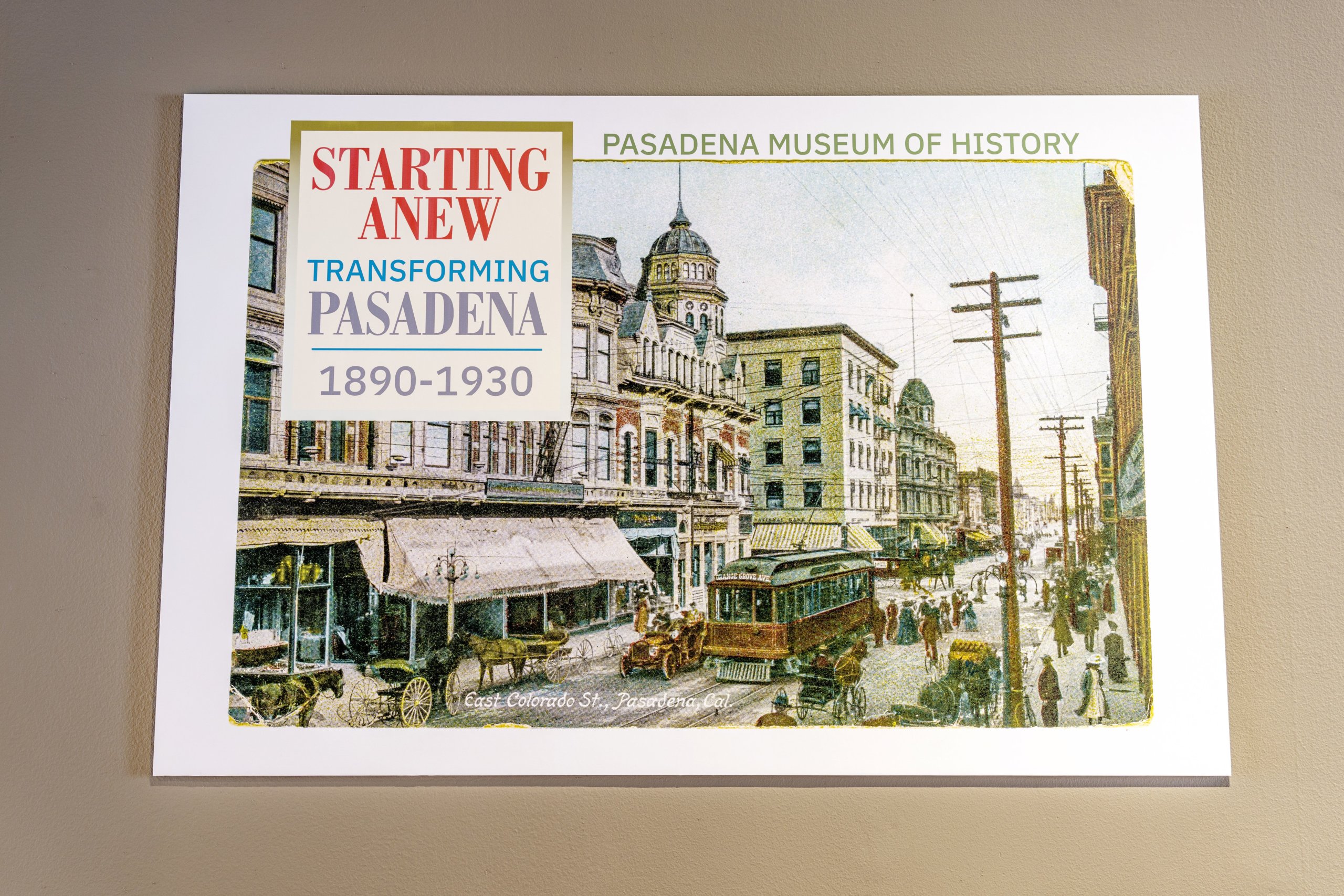
PMH’s ‘Starting Anew: Transforming Pasadena 1890-1930’ Exhibition Signage | Photo by Marlyn Woo/Joanne Wilborn / Pasadena Museum of History

Very few of us realize that the Pasadena we know and live in today was built in the early 20th century by dreamers with grand visions who settled here from the Midwest and the East Coast.  The Pasadena Museum of History (PMH) offers a compelling look at the most flourishing period in Pasadena’s history with an exhibition called ‘Starting Anew: Transforming Pasadena 1890 – 1930,’ on view until July 3, 2020.

I consider Pasadena my hometown and have lived here for 37 years. And while I dearly love my adopted city, I don’t know as much about it as I probably should. PMH’s exhibition provides that stimulating learning experience and Brad Macneil, Education Program Coordinator, who curated this show, happily gives me a tour.

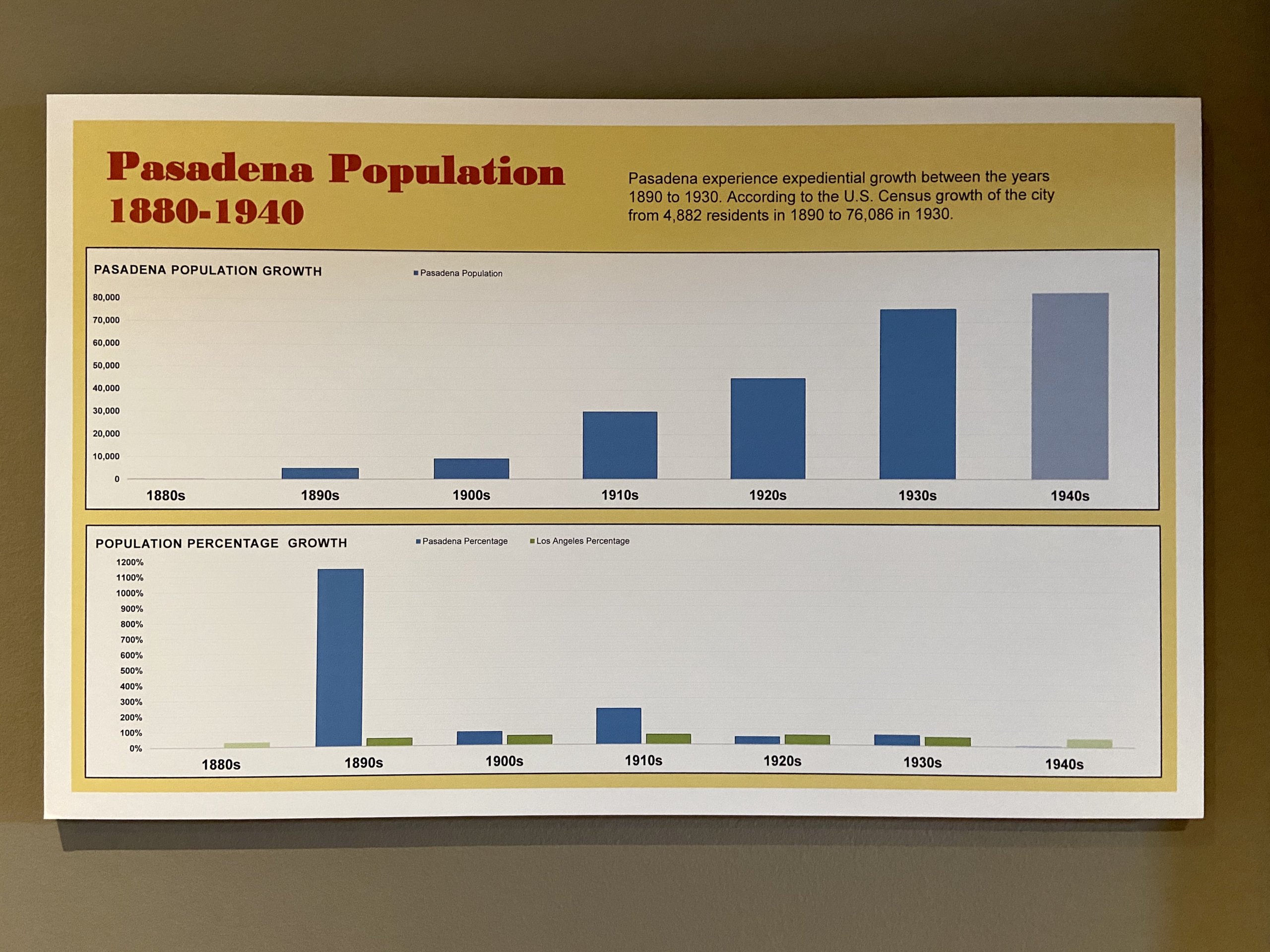
Our first stop is a chart which shows that population growth in Pasadena outpaced that of Los Angeles and then leveled off in 1930 when the depression hit. He discloses, “This was what sparked the idea for this exhibition. It was an amazing time in Pasadena’s history when the population went from below 5,000 to over 76,000 in just four decades. Today there are 150,000 – the population only doubled since. The city was transformed in so many different ways and our exhibit asks and answers a number of questions – why people came here, how they got here, where they lived, what they did, what kept them here.”

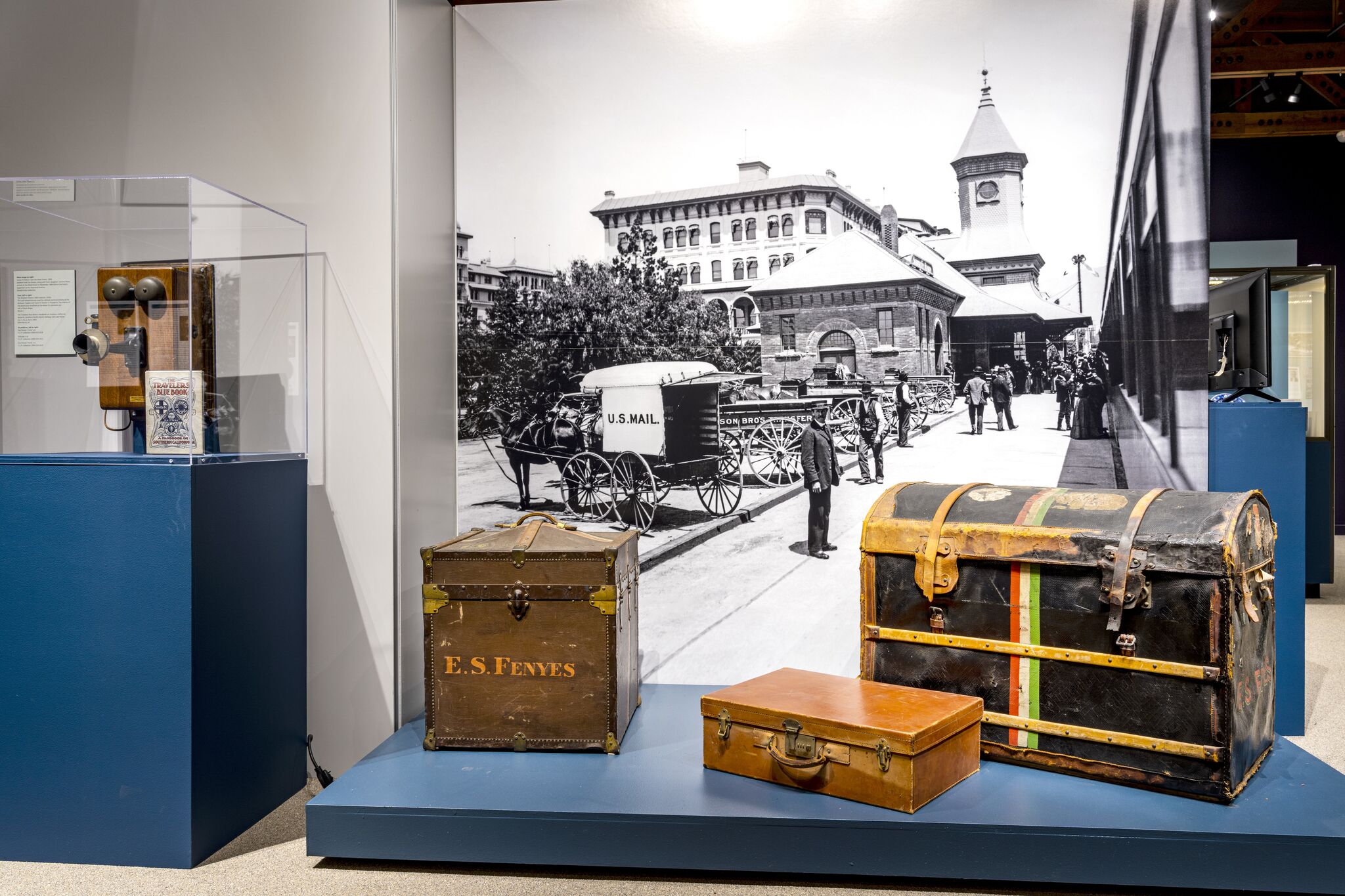
Macneil explains that the railway system started serving Pasadena in the mid-1880s, which caused the population to rise from 500 to 5,000 between 1880 and 1890. A photo of the Santa Fe Railway Depot and the Hotel Green greets us as we enter the first exhibition hall.

This image has an empty alt attribute; its file name is PMH-Population-Chart-scaled.jpg
Population Chart | Photo by Marlyn Woo/Joanne Wilborn / Pasadena Museum of History

“Part of our exhibit tells the story of Dr. Adalbert and Eva Fenyes,” Macneil narrates. “The couple met in Cairo, Egypt and were married in Budapest. It was during their honeymoon around the world that they heard about Pasadena. They arrived at this train station in 1896 as newlyweds, and they had with them Leonora, Eva’s teen-age daughter from her first husband. They stayed at the Hotel Green for about three days and fell in love with Pasadena. They immediately leased a house on the Arroyo, which they later bought. Subsequently, they built two mansions here. One of the wonderful things about this exhibit is that we are able to display the museum’s collection. These are the Fenyeses luggage here and that telephone over there was inside the depot.”

This image has an empty alt attribute; its file name is PMH-Train-station-1.jpeg
Santa Fe train depot, the Fenyeses’ luggage, and depot telephone | Photo by Marlyn Woo/Joanne Wilborn / Pasadena Museum of History

“Besides word-of-mouth, a marketing campaign touting the city’s natural beauty and health benefits lured people to the area,” adds Macneil. “In the late 1880s big, fancy hotels were being constructed, the first of which was the Raymond Hotel. It was built by entrepreneur Walter Raymond, who had been working for a company back East that brought tourists here and thought Pasadena could use a grand hotel. Other hotels then were Hotel Green, the Pintoresca, the Maryland, the Huntington (which was originally the Wentworth and is now The Langham), and the Vista del Arroyo.

“Each year thousands came to Pasadena for the seasons – from November through March. The population would go up and down. The wealthy people came from the Midwest like Indiana and Chicago, and the Northeast – Boston, Philadelphia, and New York. Because of the winter resort business, the whole town grew. Visitors needed service, which opened up employment opportunities. That brought in working class people from other parts of the country to get jobs in the railways, hotels, and in agriculture. Professionals also arrived – doctors, lawyers, newspaper publishers. Pasadena grew into a diverse community – there was already a large Mexican American population, then the Armenians, the Chinese, and the Japanese arrived. They came to either find a job or start a business.”

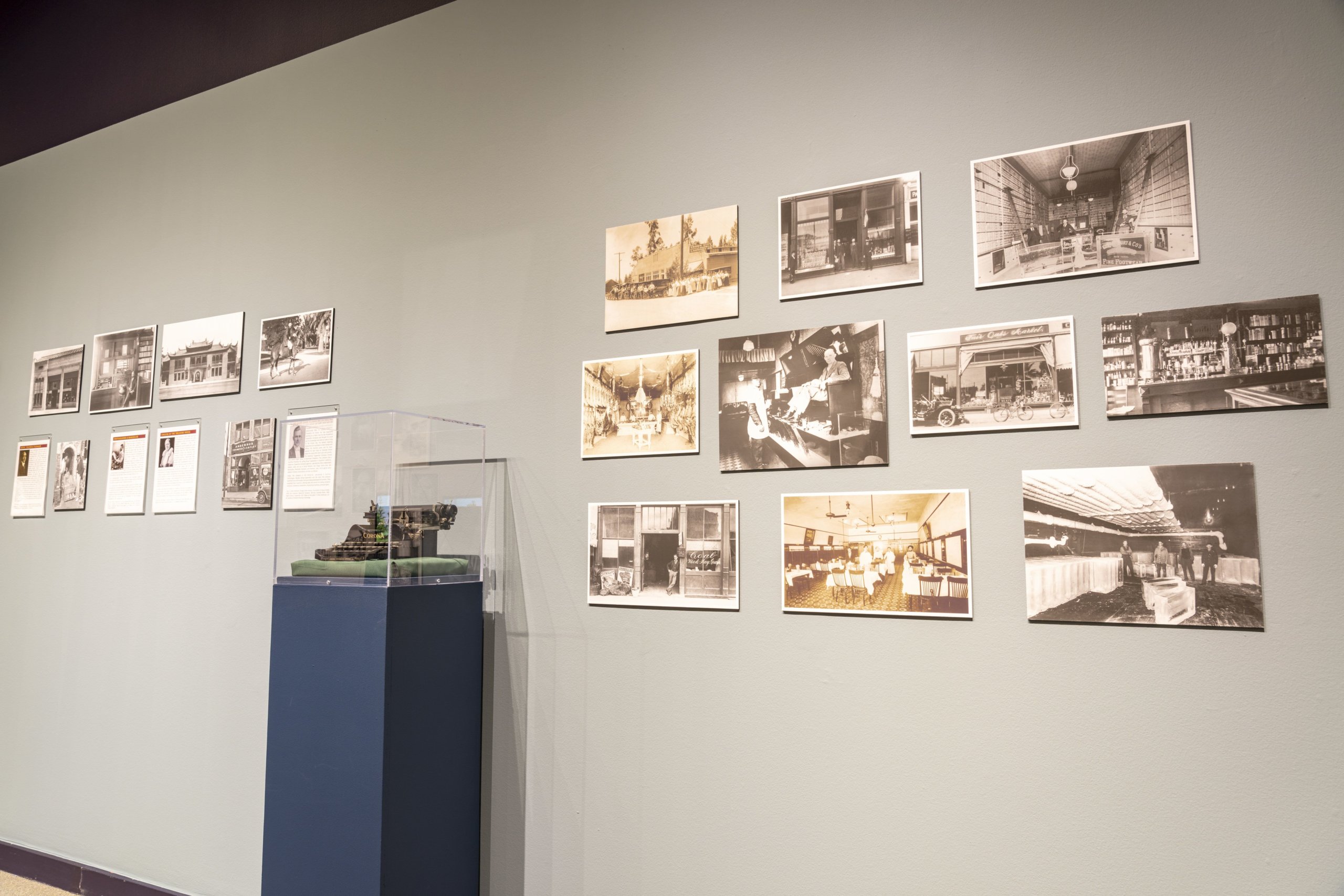
Pasadena was a great place to be an entrepreneur and PMH’s exhibition highlights four enterprising people who came here with very little yet built successful establishments. One of them was Elmer Anderson who arrived with nothing more than a typewriter repair kit and founded Anderson Typewriters. Known today as Anderson Business Technology, it has branches all over Southern California selling business equipment and is still being run by his descendants. The local store on Colorado Boulevard, near Arroyo Parkway, remains to this day.

Many of us will recognize the edifice resembling a Chinese Imperial Palace on Los Robles and Union Street as USC Pacific Asia Museum. Back in the 1920s it was Grace Nicholson’s Treasure House of Oriental Art. She came here with a small inheritance and opened a curio shop selling Native American arts and crafts. She developed great relationships with Native Americans in the Southwest and eventually started selling to the finest museums in the country, including the Smithsonian and Field Museum. She later switched to Asian artifacts and created her treasure house where she lived and worked.

Adam Clark Vroman, an avid book collector and photographer, moved to Pasadena from Illinois hoping the climate would help his wife recover from her illness. Unfortunately, she died two years later. Brokenhearted, he sold his book collection to raise the capital to open Vroman’s Bookstore. As he had no direct heir, he made arrangements for his employees to take over the store when he passed away. It was a remarkable demonstration of how much he cherished and took care of his staff. Some of the descendants of those employees run Vroman’s today and it remains a beloved Pasadena purveyor of books and gift items.

There was Ernest Batchelder who came here to teach art at Throop Institute. He later started his own business – making the eponymous tiles – and became the foremost proponent of the American Arts and Crafts Movement.

This image has an empty alt attribute; its file name is PMHG-Local-businesses2-scaled.jpeg
Local businesses | Photo by Marlyn Woo/Joanne Wilborn / Pasadena Museum of History

Architects and builders prospered at this time because people needed housing. Those who came here for work built bungalows and cottages. Macneil states, “The cost to build a house varied from under $1,000 up to $100,000. Between 1902 and 1918 the median value of local houses was $1,700 (these houses today cost over a million dollars). Those with wealth seasoned in Pasadena and stayed for months at a time. A number of them decided to build winter homes on Orange Grove Boulevard, otherwise known as Millionaires’ Row. Displays of some of these grand houses include Adolphus Busch’s; the Gamble house, which still exists today; the Merritt House, which is now surrounded by million-dollar condos.”

After the depression, the owners of these mansions couldn’t afford the upkeep and sold them. Of the 52 mansions, only six or eight of them remain; the rest have been razed to the ground to make room for apartments and condominiums. Of course, even these divided-up homes are not for the middle- and working-class as they lease for several thousand dollars a month or sell for millions.

One of the mansions that’s still around is the gorgeous Marshall-Eagle Estate built in 1919 for $500,000 (valued at $8 million at the time) and is now Mayfield School. The exhibition has a display  of it that tells its history and shows interiors shots.

Throughout the exhibit, PMH reveals the passage of time through changes in fashion and technology – dresses from the different decades; a high-wheeler bicycle; a carpet sweeper; an Edison machine; a record player; a gas-powered hair curler, one of the first dial telephones ever made, and an early typewriter. Macneil says students love to see and handle the typewriters but can’t figure out how to use the telephone.

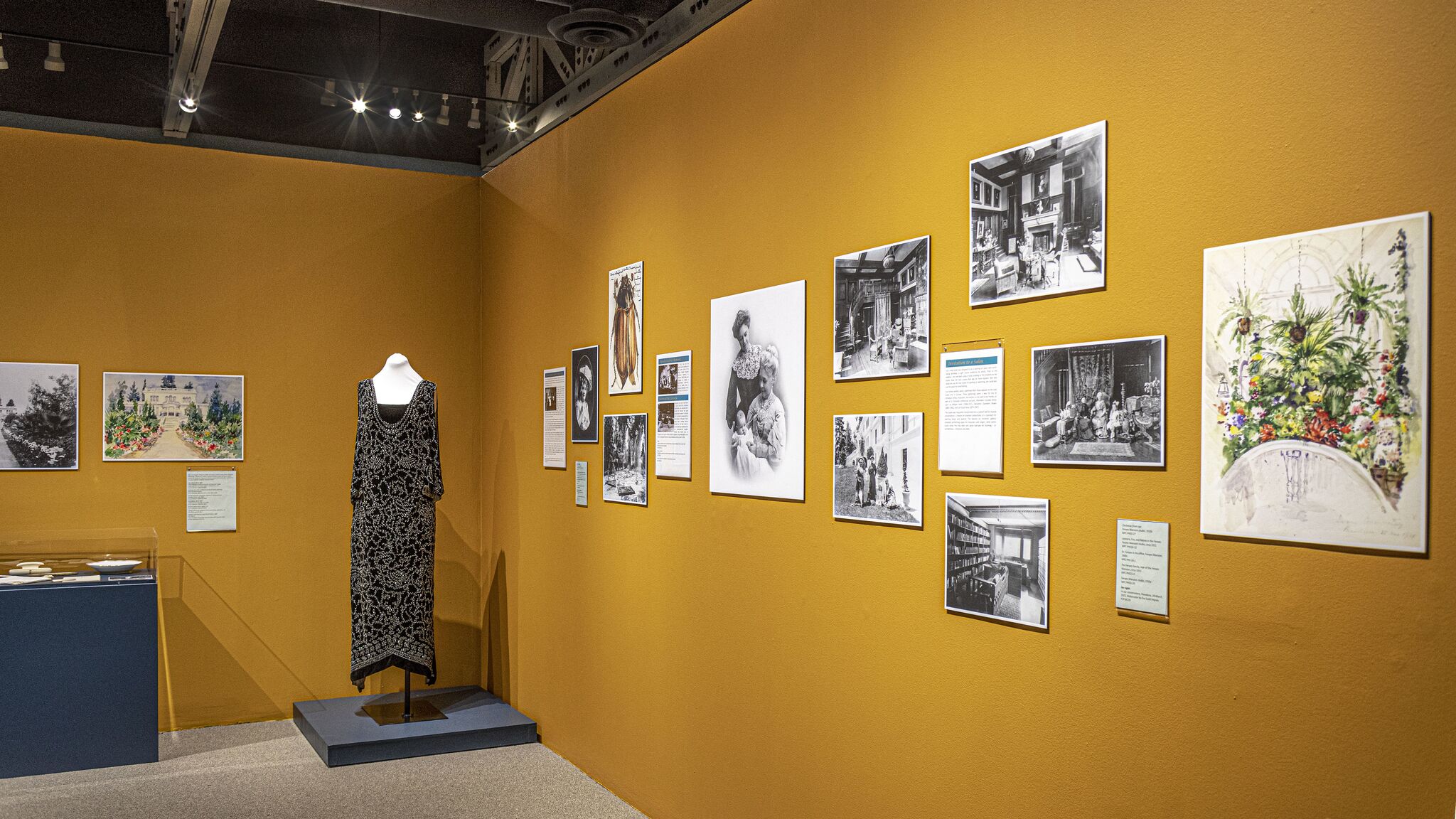
Macneil leads me to the next display, saying, “Our story goes on about the Fenyeses becoming part of the community. Eva designs her first mansion, a Moroccan palace on Orange Grove Boulevard. This is Eva’s sketch of her mansion – there is an area that’s all glass, one of the first commissions of Walter Judson of Judson Stained Glass Studios. Her daughter Leonora grows in age, marries, and moves away. Eva gets immersed in the community business-wise by buying real estate and as a socialite by being involved with the art scene. Dr. Fenyes gets his medical practice going.

This image has an empty alt attribute; its file name is PMH-Artists-works-2.jpeg
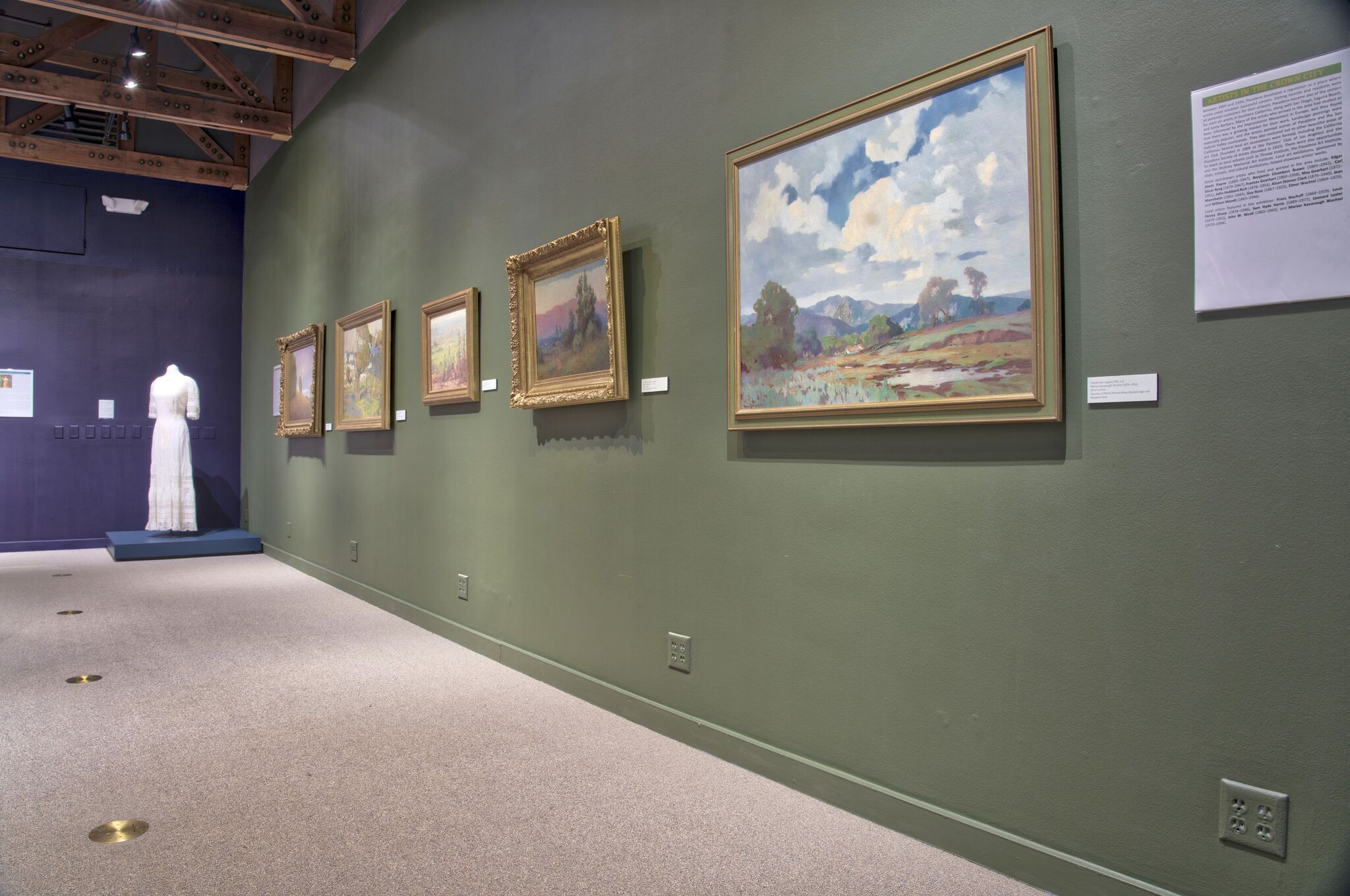
Local artists’ works | Photo by Marlyn Woo/Joanne Wilborn / Pasadena Museum of History

“Pasadena was one of the main art colonies in California during this period, so we have here a wall of art featuring selected works of the artists who lived here then. One of Eva’s biggest legacy was being patron of the arts and helping other artists in the community. She was a prolific painter herself and we have a lot of her art at the mansion, some of which we show here.”

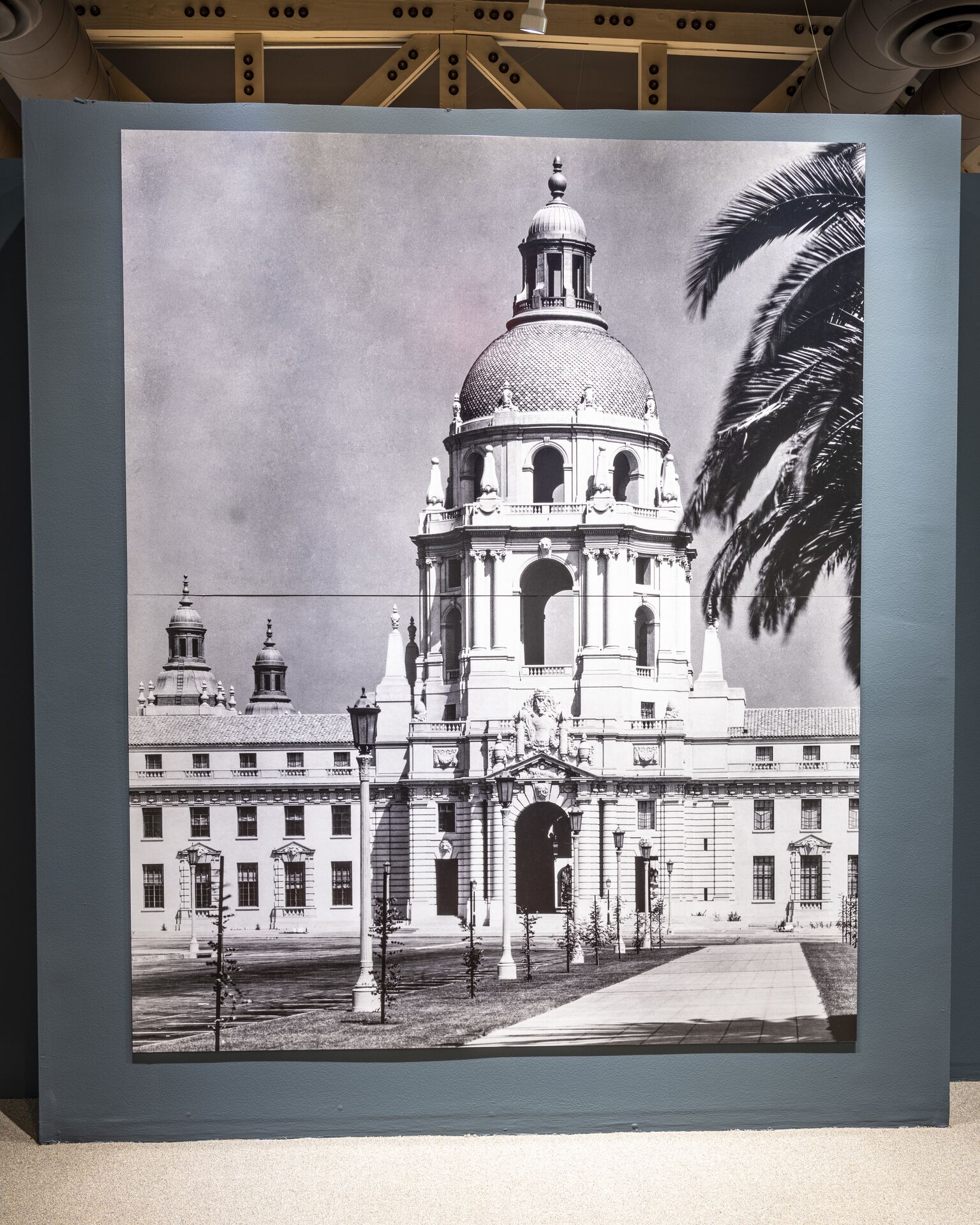
The second part of the exhibition, in the opposite hall, begins with an iconic image of City Hall and explores how the ‘City Beautiful Movement’ ushered the Golden Age of Pasadena. Macneil expounds, “In the Chicago Exposition of 1893, they built the White City. Many famous architects helped construct wonderful buildings, public plazas, and garden areas for the World Fair. The ‘City Beautiful Movement’ came out of that. The idea is that if you beautify the city with these magnificent public structures, it uplifts all the residents spiritually and morally.

This image has an empty alt attribute; its file name is PMH-Pasadena-City-Hall-1.jpeg
An image of the Pasadena City Hall leads us to the second part of the exhibit | Photo by Marlyn Woo/Joanne Wilborn /Pasadena Museum of History

“A lot of people from Pasadena were able to go the Chicago Exposition of 1893 and when they came back, this philosophy took off. They pulled people together, held meetings, and talked about what they could do. And the first thing they did was clean up the city. They got rid of the tacky real estate signs in the main part of town, tidied vacant lots, planted trees and flowers, painted buildings, and regulated architectural styles. It began in the early 1900s with input from various people in the city – movers and shakers as well as the general population. They came up with the plan for the city and things took off in the 1920s when money and the will were there. And so they erected grand public buildings. A main area was the Civic Center – City Hall, the Public Library, the Civic Auditorium. Most of what we identify with Pasadena today – the beautiful architecture, the cultural institutions – were built at this time.”

“There’s a section called ‘Nature versus Man-Made Beauty,’” Macneil goes on to say. “Out-of-towners came here because of the natural beauty of the area – like the Arroyo and the mountains. Then people created man-made parks bringing in trees from other parts of the world, changing  the landscape. We have images of Central Park by Castle Green, Library Park by the Senior Center, and Brookside Park. There’s Eva’s picnic basket because she enjoys going on picnics.”

Macneil points to the next section, “Here we talk about the various means of transportation. During this period of time, people got around town by walking. But there were also buggies and carts, trolley cars, and automobiles. But bicycles were the biggest thing – there were more bicycles per capita in Pasadena than any other city in the United States. This is an early-1900 map of the bike trails and roads in California.

“Because of the power of the bicyclists as a group, they put a lot of pressure to make the streets and signage better, even before they were done for cars. This is California Cycleway, an elevated tollway for bicycle traffic which ran from the Green Hotel to South Pasadena. It was planned to go all the way to Los Angeles but it was never completed because Horace Stubbins encountered legal battles with Henry Huntington over right-of-way. He decided not to pursue it, but the family did keep some of the right-of-way and was able to sell it to the state for the Pasadena freeway. This is still a dream of some people to build – imagine how wonderful it would be to ride your bicycle high above the streets on a road that ran along the Pasadena freeway.

The ‘Kids Corner’ has a display of things kids wore, what types of games they played, where they went to school. There are hands-on items like the stereoscope that kids can look through and see three-dimensional images.

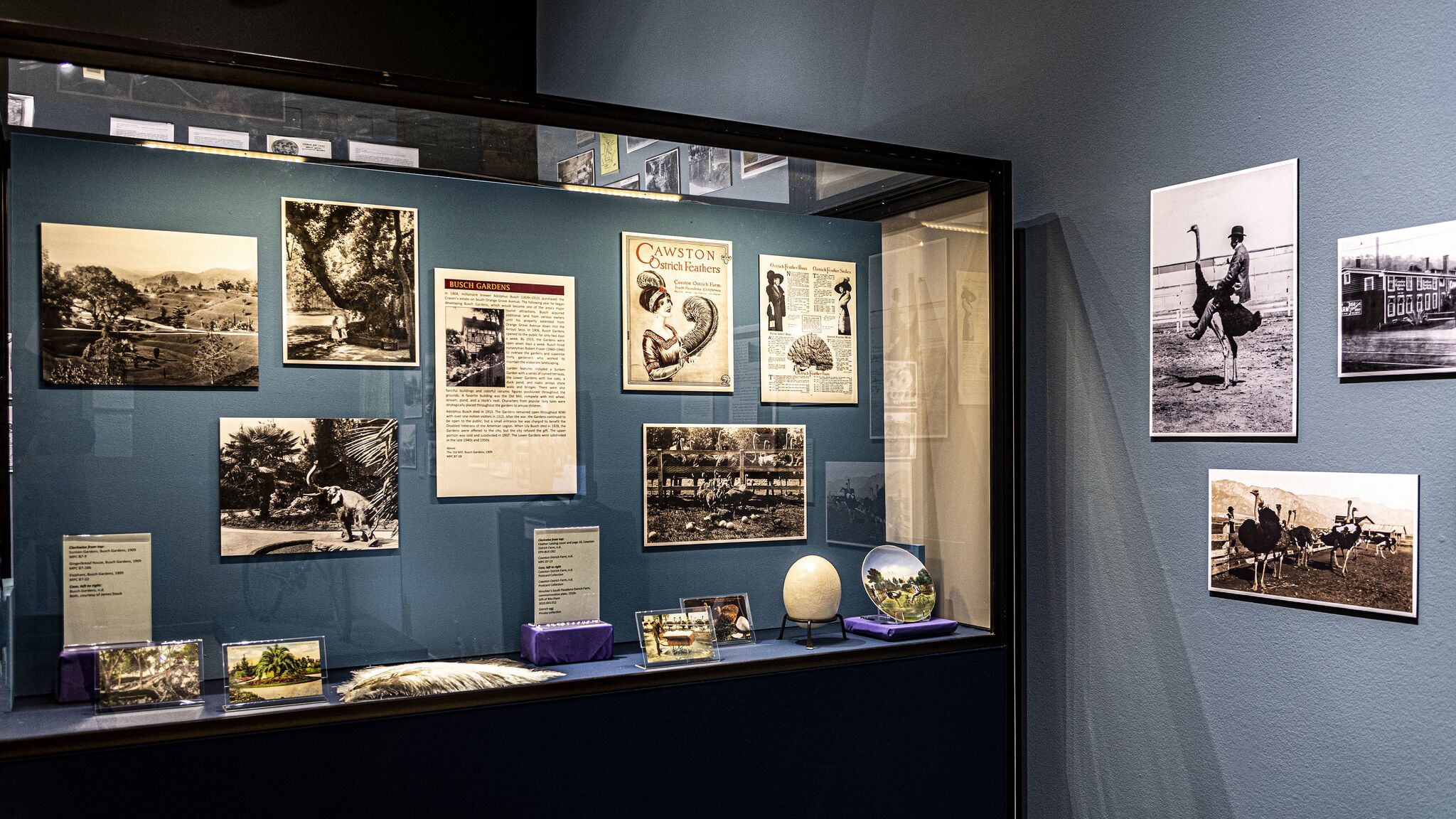
A section that Macneil calls ‘The Extraordinary Excursions’ features three early theme parks, the first of which is Busch Gardens. According to Macneil, Adolphus and Lilly Busch, of the Anheuser Busch and Budweiser fame, had a house on Millionaires’ Row. Adolphus bought approximately 37 acres, covering the area from his house on Orange Grove to the Arroyo, on which he created this magical park and opened it to the public for free. However, the park subsequently met the same fate as that of the grand estates in the area – it closed in the 1930s and 1940s and was subdivided. Lilly tried to make an arrangement for the city to take it over but it was too expensive for the city to maintain.

This image has an empty alt attribute; its file name is PMH-Ostrich-farm-1.jpeg
Cawston Ostrich Farm | Photo by Marlyn Woo/Joanne Wilborn / Pasadena Museum of History

Another was the Cawston Ostrich Farm. Macneil relates that entrepreneur Edwin Cawston, who had learned about ostriches and the ostrich feathers trade in South Africa, came in the late 1880s to open a business here. He had stores in New York, San Francisco, and Los Angeles selling feathers all over the world but it was in South Pasadena that he established one of the first ostrich farms in the country. At the same time, he created a beautiful park-like area where people could come and observe the ostriches’ little chicks, see the big birds being fed, and watch ostrich races. They could even ride on a cart behind the ostrich and, if they were brave, on the ostrich. It became quite a popular destination.

Around the corner you’ll come upon photographs of the Mount Lowe Railway, a series of scenic railroads which went up the mountains above Altadena, created by Thaddeus Lowe. Visitors taking the train up reached a beautiful destination with four hotels, a zoo, an observatory for star-gazing, and a golf course. Macneil says, “People would take the Pacific Railway from all over Southern California, but especially from Los Angeles, come into Pasadena and up to the foothills of Altadena. They’d get off the trolley car and on what they called the ‘white chariots’ that would take them on a steep incline. They would come up to the first hotel and alight there. Then they would get on a trolley car that wound around the mountains until they arrived at the topmost hotel – the Alpine Tavern.”

People got their entertainment during that period from the Pasadena Playhouse and cinemas which started out showing silent movies. “Then there was the Grand Opera House, which was located close to Green Hotel,” recounts Macneil. “It was built by entrepreneurs who brought great opera to town while simultaneously hoping it would help raise real estate values. However, it failed to take off partly because it competed with an opera house in Los Angeles which got the better acts.”

Macneil adds, “When I did my research, I used the city directories going back to the 1880s and found pages upon pages of clubs, associations, and societies where everybody belonged. People came together through their common interests – whether it was just for fun or for a civic purpose.

“We showcase three of these organizations: the Valley Hunt Club for men and women, started out in 1890 as a hunt club, as the name implies. It then became more of a social club and gave us the Tournament of Roses Rose Parade and Rose Bowl game. The Elks Club was a place for men to get together both socially and as a charitable group. The Shakespeare Club began as a women’s literary club to promote reading. All these three organizations were very involved with the community then and still are to this day. All these clubs, at one time or another, had entries in the Rose Parade and on display are trophies they had won. Some items are artifacts from the clubs.”

This image has an empty alt attribute; its file name is PMH-Fenyes-Wall2.jpeg
The Fenyeses display | Photo by Marlyn Woo/Joanne Wilborn / Pasadena Museum of History

Towards the end of the exhibit, the display talks about the Fenyeses selling their big Moroccan palace and downsizing to the mansion in 1906. This section explores the life of Eva and Dr. Fenyes from 1906 to 1930. While they were world travelers, Pasadena was their home base. They were involved in the community in different ways – she was still a socialite; he continued with his medical practice and, being an entomologist, his work with beetles. Leonora, Eva’s daughter, became widowed and came back to live with them. In 1911, Eva, Leonora, and Leonora II all lived here and created a wonderful bond of three generations.

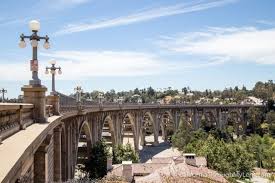
A wall of displays delves into the transformation of Pasadena. Macneil expounds, “Through the 1893 ‘City Beautiful Movement,’ city officials were able to hire architects from Chicago and established the Bennett Plan that created the Civic Center – the City Hall, the Library, and the Civic Auditorium. At the same time, more beautiful buildings were being erected and various infrastructure were being constructed. The Colorado Street Bridge was built in 1913 for people arriving by car to have a grand entrance into Pasadena. They also had plans for a beautiful art museum and school on Carmelita where the Norton Simon  is now, although that never came to fruition.”

The 1920s were the Golden Age of Pasadena when innumerable buildings featuring European architecture were constructed all over the city. Schools and city service structures were being upgraded; the Rose Bowl was built. PMH’s exhibit has a video that shows the changing cityscape.

“And then the depression hit and everything slowed down,” says Macneil. “The Civic Auditorium hadn’t been completely built. Fortunately, city officials were able to do some creative financing to finish it but several things which were on the planning stage stopped. The resort industry collapsed – hotels were torn down and were reused for other functions. The Vista del Arroyo, for instance, became a hospital; today it is the Court of Appeals. Of the hotels built during that period, only the Huntington Hotel still stands today. Population growth halted as well.

This image has an empty alt attribute; its file name is Colorado-Street-Bridge-1.jpg
Colorado Street Bridge | Courtesy Photo

“At the very end of the exhibit, we showcase PMH’s mission – capturing and gathering the history of Pasadena and the surrounding area and sharing it with the public. Our collection encompasses this productive and transformative period so our archives and collection department were quickly able to put together what we felt would represent that time.

On the Curator’s statement, Macneil confesses that while he was born and raised in the area – three generations of his family lived here – he didn’t fully appreciate Pasadena. It wasn’t until he went away for a while and then returned that he developed his deep love for the city. Through this exhibit, he hopes that he can share all that he has rediscovered

Macneil states, “We’re hoping parents come with their children to our exhibition. We’re purposefully keeping it open until July 3rd so students from both public and private schools can learn Pasadena’s history. How fun would it be for these young people to learn what happened a century before their time and then see the structures when they walk around the city.”

As PMH has detailed in the exhibition, some of the dreams of the city’s visionaries worked and some didn’t. But many of the magnificent and architecturally diverse structures from the city’s Golden Age remain and they are what give Pasadena the culture and history for which it is renowned. And through this exhibition, Macneil wants to remind people what we are capable of doing if we pull together as a community. The past can be used as a blueprint for the future.


‘The Father’ Astounds at the Pasadena Playhouse

Originally published on 28 January 2020 in the Pasadena Independent, Arcadia Weekly, and Monrovia Weekly

 
Alfred Molina stars as ‘The Father’ | Photo by Paisley Smith / Pasadena Playhouse

If audiences who are watching ‘The Father’ at the Pasadena Playhouse are dazed and bewildered, then it would have spectacularly accomplished showing us what goes on in the mind of someone afflicted with dementia.

Written by Florian Zeller and translated by Christopher Hampton, ‘The Father’ has been  acclaimed on two continents. It won the 2014 Moliere Award and was nominated for the Evening Standard Theatre Award, the Olivier for Best New Play, and the Tony for Best Play. The much celebrated theatrical production promises to astound when it goes on stage at the Pasadena Playhouse from February 5th through March 1st.

‘The Father’ is directed by Jessica Kubzansky and stars Alfred Molina, in what’s being hailed as a tour-de-force role, Sue Cremin as ‘Anne,’ Michael Manuel as ‘Pierre,’ Pia Shah as ‘Laura,’ Hugo Armstrong as ‘Man,’ and Lisa Renee Pitts as ‘Woman.’

Taking a break from rehearsals, Kubzansky chats with me about how she landed the plum job of directing the play, why she immediately thought of Alfred Molina, and what she wants the audience to take away.

Jessica Kubzansky | Courtesy photo / Pasadena Playhouse

Kubzansky relates, “The brilliant Danny Feldman, the Pasadena Playhouse’s Producing Artistic Director, and I have worked together before. He said, ‘I have a play I want to send you. I don’t want you to do any research, I just want you to read it.’ I read it cold. I actually didn’t know anything about it and, in fact, obviously when I saw the title ‘The Father,’ my first thought was ‘Is he sending me the Strindberg?’ But it soon became very clear that it’s not the Strindberg and as I read it, my heart started beating faster. At the end of the play, I was blown away – gobsmacked! I called him and I said ‘Listen, I hope you’re thinking of Fred Molina for this role’ and he said to me, ‘Fred is already attached.’ And I went, ‘Oh my God! This is incredible!’ Of course, I would be honored to direct it.’”

Curious, I ask why she thought of Alfred Molina straightaway and Kubzansky replies, “Because he’s a brilliant actor.” I protest saying, “Surely, there are other wonderful actors.” And she quickly explains, “One of the things that’s important is that this is a story that can happen to anyone and Fred is so vital and alive. He’s such a powerful man and the idea that this happens to people who are vital, alive, and powerful was really moving to me. Much more so, frankly, than to see it happening to someone who already is, in some ways, on their last legs. First of all, I love Fred and I’ve never had the opportunity to work with him – and I’ve wanted to, for years, because he’s so brilliant. He has such a deep well and so much breadth and depth that he was the one who came to mind for the role when I read the play. He’s an astonishing instrument as an actor.”

When I inquire if she gave Molina specific directions or if he came in with his own ideas about the role, Kubzansky says, “Fred and I had a number of lunches before we went into rehearsals to talk about what’s moving to us about the play and about the approach to take. And we were on the same page. There’s no question that we have shared thoughts and opinions about various aspects of the play. Fred brings so much to the table – actually every single actor in this cast is remarkable. When I have actors that are this amazing, in general, I usually like to work off of their impulses and then help shape from there. Because a smart director takes advantage of all the great brains in the room. It’s a collaboration, of course. He has thoughts and questions, as do I, and we’re bouncing together to discover the play and his character. We’re enhancing each other.”

Alfred Molina | Photo by Paisley Smith / Pasadena Playhouse

I ask what she found compelling about ‘The Father’ and Kubzansky enthuses, “I think it’s a beautiful, brilliantly written  play. And I think it’s like getting lost in a fun house or a labyrinth. One of the things that really attracted me to the play was trying to figure out what is real and whose reality we’re in and why. That’s so exciting to me! It’s a viewpoint on a condition that many people are in the middle of that we don’t get to experience. The play is entirely from Andre’s perspective. And to understand the world through his eyes is very powerful and very moving and really disorienting in the way that I think it would be. I have never seen it and I’m happy I haven’t. When I direct something, unless it’s Shakespeare, I’m really delighted if I get to meet it for the first time.”

The play has been described as a dark comedy. But there’s nothing comedic about dementia, as people with relatives that suffer from dementia know very well, I tell Kubzansky. She acquiesces, then adds, “Dementia is a horrifying disease. It is unbearable because as the realities of people who have dementia diverge, you lose more and more the person you treasured all your life. That is totally undeniable and is absolutely touched on in this play. But there are events that happen around it that are just funny. There are some delicious moments when, for instance, Andre is meeting a new caregiver and he tells her that he was a tap dancer. And his daughter says, ‘Dad, you were an engineer!’ The fact that he’s now claiming he was a tap dancer, from one perspective, is horrifying. But there’s another perspective where that’s just funny. And, for the moment, maybe that’s true.”

Sue Cremin as Anne | Courtesy photo / Pasadena Playhouse

“We talk about both sides of people with dementia as being in a giant improv and (in the same way) most human beings don’t understand how much they’re improv-ing in daily life,” continues Kubzansky. “And what I mean by that is, I think, that a person who has dementia is aware that there are things they don’t know that they should. So they’re constantly acting like they know what’s going on to preserve face until a certain point after which that stops being the case. And the people surrounding them are continually trying to navigate what the person with dementia is thinking and the ways in which they can accommodate that thought while still getting what they need. The whole interaction is like a giant game of improv in which no one knows what’s going to happen next. Sometimes, unintentionally, the results of that are funny.

“For instance, in this play, Andre is very worried about a watch that he has. And the processes that he goes through to ascertain where his watch is, are sometimes really funny. He’s worried that it’s gone missing or someone’s taken it, and the means he uses to figure out what happened to his watch occasionally result in some kind of brilliant character improvs. So those are the reasons this play is funny. No one is making fun of this disease – it’s too terrible.”

Kubzansky has seen first-hand how dementia affects people. She discloses, “To be honest, in my particular case, my grandmother was a very dour, sour woman most of her life. She came from Poland to escape the pogroms. In Poland, her husband was an intellectual and when they immigrated to New York, he became a factory worker in a garment workshop. It was a very typical immigrant story. To get her to smile was like cracking granite. Her life was hard and you experienced that every time you interacted with her. But, as she turned 90, she started to have dementia and, all of a sudden, her personality radically changed. She confused us with people she grew up with – she didn’t recognize me as her granddaughter anymore. She assumed I was her friend in Poland – she was charming and sweet. I didn’t know that woman existed but I got to meet the woman before life beat on her. I could see why my grandfather married her. The dementia made her a nicer human. In a weird way, that one was a gift. Most of the time, I don’t think it is.”

The play might be disorienting for the audience. As Kubzansky describes, “Because the play is from Andre’s perspective, things change in very strange ways. Bizarre things happen and it is as disorienting for us as it is for him. For a minute we actually get to walk in his shoes but, blessedly, we don’t have to stay there like he does.”

Michael Manuel as Pierre | Courtesy photo / Pasadena Playhouse

As for the reaction she’s hoping for, Kubzansky declares, “I want the audience to have a huge amount of compassion for every single human in the play because, I think, this is not only the story of a man who has dementia, but the story of his daughter who’s trying to be his caregiver. It’s the story of her partner, who is living with someone who isn’t his parent who has dementia, and how trying that is. I want everyone to understand how challenging it is for everybody to be a good human being in very difficult circumstances – how wearying it is to be the caregiver, how exhausting it is to be the person who has the disease and doesn’t understand what’s going on most of the time. I want us to think about the people who dedicate their lives to taking care of these people. I think it’s such a challenging road to navigate. One of the things that I think gets really hard when people become exhausted – either because they have the disease or because they’re dealing with someone who has the disease – is how to remain a good human being, how to stay compassionate and not punitive or uncaring.

“I hope that people walk out of the play with the sense that they are seen, that they’re challenged in their journey. Because whether you’re caring for a parent with Alzheimer’s or a parent who is terminally ill with cancer, there’s so much caretaking going on. There is a huge generation of people taking care of older parents and their own children at the same time and it’s exhausting. The idea that the audience could walk out having seen themselves and know that someone else is seeing how challenging their journey is, and how difficult yet how desirable it is to be a good human being through those given circumstances. Most profoundly, with a new understanding from inside the head of the person who’s experiencing dementia – what it must be like. I would be thrilled if that’s what people walked away with.”

The Huntington Continues Centennial Celebration with Float Entry in the 2020 Rose Parade

Originally published on 16 December 2019 in the Pasadena Independent, Arcadia Weekly, and Monrovia Weekly

Artist’s rendering of The Huntington’s 2020 entry in the Rose Parade, designed by Phoenix Decorating Company. The float celebrates The Huntington’s 100th anniversary running from Sept. 2019 through Sept. 2020. – Courtesy photo / The Huntington Library, Art Museum, and Botanical Gardens

The Huntington Library, Art Museum, and Botanical Gardens will mark another historic event as its own float travels down Colorado Blvd. for the Rose Parade, 50 years since it last made an appearance at Pasadena’s famous New Year’s Day floral, equestrian, and marching band pageant.

Themed ‘Cultivating Curiosity,’ the 55-foot long float captures the spirit of The Huntington’s Centennial Celebration and highlights its rare research materials, inspiring art collections, and unparalleled botanical gardens which have made it a beloved destination that welcomes 750,000 visitors each year.

In 1969, the city of San Marino sponsored an entry that featured floral depictions of the institution’s world-renowned paintings ‘The Blue Boy’ and ‘Pinkie,’ an imposing replica of the historic Library building’s façade, and the Ellesmere manuscript of Chaucer’s ‘The Canterbury Tales.’ The float won the Grand Marshal’s Trophy. This year, The Huntington commissioned a float for the first time.

The Huntington’s float in the 1969 Rose Parade, sponsored by the city of San Marino. – Courtesy photo / The Huntington Library, Art Museum, and Botanical Gardens

Chatting with me by phone, Randy Shulman, The Huntington’s VP for Advancement and External Relations says “The last time we were represented at the Rose Parade, it was done by the city so it’s as if we’re doing it for the first time – it’s all Huntington content and people. It’s our centennial and it’s an opportunity to help celebrate and raise awareness of The Huntington and its centennial year.”

I ask why they’d never done it before and Shulman replies, “The Huntington is a non-profit that raises its operating expenses every year. External promotion is never going to be the top priority. Always, the top priorities will be running its education programs and doing its academic mission. The thought of doing a Rose Parade float is an exceptional moment so we need an exceptional moment. That’s why we chose to do it now.

“The decision to sponsor a Rose Parade float came out of a discussion of the Board and some of the people in our board community who said ‘This is a great moment.’ Our president, Karen Lawrence, joined The Huntington a little over a year ago and she was very quickly enthusiastic about it. So, we have a new president, it’s a new time, it’s a hundred years – all the planets aligned. Additionally, we were able to find private donors who would help us make it possible. Every dollar of the cost of the float is through donations, not through our operating budget.

“We had just told our entire donor community that we’re doing this float and if they wanted to volunteer we had 1,000 spots for people to volunteer and if they wanted to help by making a donation, that would be welcomed. And some people have done that. We posted the volunteer sign-up to help decorate our float on our website and spots were filled rapidly.”

The Huntington’s float on the first day of decorating. – Photo by May S. Ruiz / Beacon Media News

Choosing the float builder was a competitive process. Shulman discloses, “We had the major builders provide proposals and we evaluated based on the design and the background of the float builder. The design of the float itself came out of a desire to represent not just the Huntington that people are familiar with, but one that integrates discovery and curiosity. We wanted to have some familiar things that people recognize as well as other things that people may not recognize. The end of the float is the ‘Stinky Flower’ which is a playful way of talking about The Huntington’s very unusual Botanical Garden collection. Some of the materials being used are grown here – seeds, pods, bark, and some leaves. And that’s really great – it talks about us and the place. It’s also fun for many people who have been here and walked the place to see the familiar sights depicted on the float.”

Given the numerous significant things at The Huntington, I inquire how difficult it was to come down to seven elements that would be represented on the float. Shulman responds, “We asked the directors of the Library, the Art Museum, and the Botanical Gardens for their thoughts. But, of course, things decided by a committee never work out because it’s hard for a lot of people to have a consensus. What we did want to do is to keep it simple, recognizable to a point, but we also wanted to have a sense of playfulness. What people won’t see on the float are some of the more recognizable items like ‘Blue Boy’ or Shakespeare’s folio. But that’s because we want the opportunity to show something very beautiful that people might not know about.

The float’s Huntington Centennial Rose. – Photo by May S. Ruiz / Beacon Media News

“That was one of our President’s goals. She wants to have that moment when people say ‘What is it? I have to go see.’ She wants to have people have that joy of discovering more about The Huntington. It’s a complex place. There’s so much happening here with the different collections in the gardens and there’s always something new to discover in the gallery as well. Our float is a manifestation of the joy of The Huntington’s 100 years – both getting to the hundred-year mark but also looking forward to the next centennial.”

The Huntington’s float will have eight riders and will be followed by six walkers as it makes the 5.5-mile journey down Colorado Blvd. The float riders will include four youth participants from The Huntington’s community partner programs with the Heart of Los Angeles (HOLA) and the Pablove Foundation; Huntington President Karen R. Lawrence; two lucky staff members who won a staff-wide raffle; and leadership donor and member of The Huntington’s Board of Governors Mei-Lee Ney. The walkers following the float will include five of The Huntington’s teen volunteers and one adult supervisor.

The elements on the float include the Tempietto, the Moon Bridge in the Japanese Garden, The Ellesmere Chaucer, and Edward Hopper’s ‘The Long Leg.’ – Photo by May S. Ruiz / Beacon Media News

It was the design submitted by prominent float builder Phoenix Decorating Company (PDC) that won The Huntington’s vote. Curious to see what the float looks like, I visit their Irwindale site on the first day that volunteers arrive to help decorate. Chuck Hayes, Sponsor Relations Manager at PDC, is a gregarious man who warmly welcomes me and eagerly explains their association with the San Marino institution.

“The Huntington said they wanted a 55-foot float and detailed the elements they wanted on it. We conferred with them throughout the conceptual process – we held multiple meetings, made many visits to the facility, and took several images from which to come up with a design. Our artist worked directly with their team to arrive at something that included the components and fitted their requirements. We’re the interpreter of their concept and all the materials we’re using on the float help realize that vision. It’s what makes me proud to be a float builder – to be able to honor organizations like The Huntington. Every single float we build is a unique prototype, each is a one-off, and has never been done before. Floats are built by hand from scratch – from the design stage to getting each petal onto the float.

“The Rose Parade is a Southern California tradition and, as a float builder, we always want to give our clients the greatest thrill at that moment when they walk up to see it for the first time. We build everything to scale so people who are watching it along the parade route can really focus on the float. There’s so much for them to take in – while the float is traveling down the five-and-a-half mile-parade route at 2.5 miles per hour, there might be a marching band in front and equestrian riders behind it. We made sure that people who have never been to The Huntington would be compelled to visit it after seeing this float.”

Hayes continues, “Phoenix has been an award-winning Rose Parade float builder for 37 years. We have a team of professionals that works year-round constructing and deconstructing floats. We begin in January when the Tournament of Roses announces the theme for any given year – for 2020 it’s ‘The power of Hope.’ That becomes our emphasis and it’s how we bring everyone into the fold. The client comes into the parade excited – some have never seen a float before, some have never commissioned one so they don’t know what’s involved. We sit with them and we tell them what we do, show them pictures of floats we’ve built and decorated. Sometimes, clients hear about something we’d done through word of mouth, or have seen a project we worked on like ‘Earth, Wind, and Fire’ which the Forum commissioned to celebrate their 50th anniversary. That’s what The Huntington was looking for – something uniquely theirs.

Volunteers work on The Huntington’s float. – Photo by May S. Ruiz / Beacon Media News

“We have anywhere from 25 to 40 people on staff – artists and construction crew – at various times. The number expands as the activity progresses and we hire crew chiefs and assistant crew chiefs who work on specific floats. The decoration can be done by the organization’s volunteers and by anyone who wants to decorate. They can sign up on our website, on the Kiwanis site, or through the ‘Petal Pushers.’ Our crew chiefs and assistant crew chiefs work with the volunteers who show them how to glue the materials onto the float. The Huntington brought so many volunteers to fill the decorating shifts. But if, for some reason, a client didn’t have people show up, their float would still be ready to go down Colorado Blvd. on New Year’s Day.”

On the day I visit Phoenix, a coordinator with Tournament of Roses (TofR) is there and Hayes introduces me to her. That also prompts him to expound, “This is the 131st year of the Rose Parade. If it wasn’t for them we wouldn’t have a parade. They give the opportunity for organizations like The Huntington to get worldwide exposure; I believe they said somewhere in the world, the parade is shown every day of the year – because of tape delays in other countries. There are over 700,000 on the parade route, a regional and national TV audience, and international viewers. And with social media, people can now react and let others know what floats they like in real time. Awareness about the parade just keeps expanding.”

People watching the Rose Parade on Colorado Blvd. and television viewers everywhere will have the delightful experience of seeing a Huntington float that depicts the following iconic elements in The Huntington’s collections:

The Pavilion of the Three Friends. – Courtesy Photo / The Huntington Library, Art Museum, and Botanical Gardens

Pavilion of the Three Friends

Located in Liu Fang Yuan, the Chinese Garden at The Huntington, the Pavilion of the Three Friends is named for the ‘three friends of winter’: bamboo, pine, and plum. They are symbols of fortitude, integrity, and resilience. Carvings of these signature plants adorn the ceiling of the pavilion and also grow nearby.

The pavilion’s roof will be covered with eucalyptus leaves of green/grey. Painted tiles are made of light grey and dark grey lettuce seed. The main body is covered in red fine cut strawflower, white fine ground rice and light grey, light lettuce seed. Window insets are covered in light blue fine cut statice, green fine ground split pea, and shiny grey silverleaf.

The pathway of light is made of grey light lettuce seed; rocks of light grey, light lettuce seed and white fine ground rice; accents of green mood moss.

Maple trees have tops of orange and yellow dendrobs with underneath areas of green ground parsley flakes and branches of dark brown coffee.

Sculpted barrel cacti are covered in ground parsley flakes and light green carnation calyx. Flowers on top are bright yellow whole strawflowers. Juvenile golden barrel cacti are provided by Huntington Gardens. The area around small cacti is grey Spanish moss.

The Rose Garden Tempietto. – Photo by Alexander Vertikoff / The Huntington Library, Art Museum, and Botanical Gardens

Rose Garden Tempietto

The centerpiece of The Huntington’s historic Rose Garden, the 18th-century French stone tempietto houses a sculpture – Love, the Captive of Youth – which depicts Cupid and his captor, a fair maiden. Appropriately, the tempietto is encircled by a bed of ‘Passionate Kisses’ roses. The three-acre Rose Garden contains more than 3,000 individual plants and more than 1,250 different cultivated varieties (cultivars), including Huntington’s 100th, the newly hybridized rose marking The Huntington’s Centennial.

Rose Garden Tempietto is covered in white powdered rice, light grey ground white pepper, and dark grey poppy seed. Floral on top is made of green asparagus plumose, hot pink roses, and white and light pink dendrobs. Sculpted centennial rose petals are light pink and white gladiola petals, yellow and bronze fine cut strawflower, and white powdered rice.

The Japanese Garden features a small lake spanned by a moon bridge, a traditional house, and trellises of wisteria. – Photo by Martha Benedict / The Huntington Library, Art Museum, and Botanical Gardens

Japanese Moon Bridge

Completed circa 1912, the distinctive Moon Bridge is an iconic feature of The Huntington’s celebrated Japanese Garden. Commissioned by Henry Huntington himself, the Moon Bridge was built by Japanese craftsman Toichiro Kawai. The bridge’s high arch and reflection in the still pond below form a circle, reminiscent of the moon.

Japanese Moon Bridge is comprised of tan paper bark with underneath coverage of tan fine walnut and dark brown coffee; finials of black seaweed. Bonsai trees have tops of green mood moss, underneath areas of green ground parsley flakes, with branches of dark brown coffee. The pond has edges of green mood moss and water of purple, light blue, and dark blue iris.

Mary Cassatt’s ‘Breakfast in Bed.’ – Courtesy photo / The Huntington Library, Art Museum, and Botanical Gardens

‘Breakfast in Bed’ by Mary Cassatt

Painted in 1897 by famed American Impressionist Mary Cassatt, ‘Breakfast in Bed’ is one of the most-beloved portraits in The Huntington’s collection. Cassatt’s work often depicts the social and private lives of women; she is well known for capturing the intimate bonds between mothers and children.

Edward Hopper’s ‘The Long Leg.’ – Courtesy photo / The Huntington Library, Art Museum, and Botanical Gardens

‘Long Leg’ by Edward Hopper

The ‘Long Leg’ by Edward Hopper was painted in 1935 and has been a favorite painting among Huntington visitors since its debut in 1984 as one of the artworks that established the American art collection. With a nearly all-blue composition, the painting reflects two of Hopper’s favorite themes: sailing and the sea. In 2011, as part of the U.S. Postal Service’s American Treasures series, the work was issued as a postage stamp.

‘Breakfast in Bed’ by Mary Cassatt and ‘Long Leg’ by Edward Hopper feature frames of dark brown coffee, gold clover seed and light yellow fine cut strawflower. Backs of black onion seed. Floragraphs of various spices and seeds.

The Ellesmere manuscript of Geoffrey Chaucer’s ‘The Canterbury Tales.’ Shown is the introduction to ‘The Knight’s Tale.’ – Courtesy photo / The Huntington Library, Art Museum, and Botanical Gardens.

The Ellesmere Chaucer

The elaborately decorated Ellesmere manuscript of Geoffrey Chaucer’s ‘The Canterbury Tales’ was created sometime between 1400 and 1410. It contains what is believed to be a portrait of Chaucer as well as miniature paintings of 22 other fictional pilgrims who tell stories in order to enliven the journey from London to Canterbury. The medieval manuscript is on parchment.

The Ellesmere Chaucer has pages of white powdered rice, black onion powder and dark grey poppy seed. Binder is of red fine cut strawflower; floral top has green springeri, dark lavender roses, dark lavender carnations, and green leather fern.

A Corpse Flower dubbed ‘Scentennial’ bloomed on July 24, 2019. – Photo by Deborah Miller / The Huntington Library, Art Museum, and Botanical Gardens

Corpse Flower

In August of 1999, a rare corpse flower bloomed at The Huntington—the first known flowering of this exotic species in the state of California. This exciting (and smelly) occurrence provided an opportunity for thousands of visitors to witness one of the wonders of the botanical world. Since that extraordinary event, The Huntington has produced nine additional blooms—most recently on July 24, 2019—and has shared seeds and pollen with botanical gardens across the country.

Palm tree fronds have tops of green komodor fern, underneath of green ground parsley flakes, floral of yellow and orange cymbidiums, and trunks of reddish/brown palm bark with fiber. The bases of palms are sago palms with green cycad leaves provided by Huntington Gardens.

Corpse flowers are crème sesame seed, green fine ground split pea, and dark purple and red fuzzy cut strawflower; pots of red fine cut strawflower.

Deck of green is made of springeri, hot pink and red roses, red anthuriums, light pink, orange and pink roses, peach anthuriums, peach roses, orange and white with green “geisha” anthuriums, green springeri, and white cattleyas. Green leather fern, white dendrobs, white tiger lilies, coco stix with powdered rice and white starburst mums.

In a news release the communications department sent out this summer, Karen Lawrence expressed the institution’s message. “The Huntington’s incomparable collections have had an extensive reach over the past century, and we expect them to continue to inspire visitors, new and old, for the next 100 years in powerful and unpredictable ways. We welcome the national and international exposure that this celebrated parade provides and look forward to this joyful moment during our Centennial as a way of sharing our treasures with audiences the world over.”

The Pasadena Playhouse Ushers the Holidays with Tree Lighting, Puppet Show, Songs, and Snow

Originally published on 9 December 2019 in the Pasadena Independent, Arcadia Weekly, and Monrovia Weekly

The Pasadena Playhouse’s lit Christmas tree | Photo by May S. Ruiz / Beacon Media News

If you were at the Engemann Family Courtyard of the Pasadena Playhouse at 8:00 last Thursday evening, you would have been happily surprised by snow falling on your head. It was a fun final touch to The Playhouse’s tree lighting ceremony which started promptly at 7 pm.

Danny Feldman, Producing Artistic Director, whose brainchild it was to have a Christmas tree at the courtyard during the holidays, opened the ceremony with Playhouse District Association’s Executive Director, Brian Wallace. This year, the Playhouse is participating in the ‘Spark of Love’ Toy Drive with ABC7 and the Southern California Firefighters and Pasadena’s Fire chief was also on hand.

The public was treated to Christmas carols sung by The Marshall Fundamental Choir and by cast members of The Playhouse’s production of ‘Little House of Horrors’ – Brittany Campbell, Tickwanya Jones, and Cheyenne Isabel Wells. A performance by the Bob Baker Marionettes enthralled kids of all ages.

Pasadena Playhouse’s Producing Artistic Director Danny Feldman and Playhouse District’s Brian Wallace | Photo by May S. Ruiz / Beacon Media News

Sometime during the night, Feldman wrapped a scarf around his neck in anticipation of a rare snowfall. And we were not disappointed – we were soon covered in sudsy ‘snow’ after the Christmas tree was lit at 8:00.

Chatting with me directly after the ceremony, Feldman says, “This is my third tree lighting at the Pasadena Playhouse – we actually did one when I was barely starting here but we didn’t do it the following year. Then we got a new tree and this is our second year with the new tree. I’m Jewish but I love Christmastime. I love the idea of giving and of people enjoying the holidays together. Our world is so divisive and crazy so it’s good to have everyone coming into one space that’s nice and cozy like our courtyard to light a big tree and to celebrate.”

“My message year-round, not just at Christmas, is that the reason I love what I do is having the opportunity to bring strangers in our community collectively to sit in a room, then turn off the lights and let them play make-believe together,” Feldman remarks. “It reminds us of our shared humanity with these strangers sitting next to us. You watch a show like ‘The Great Leap’ and it awakens something in you personally but then you look over and the people next to you feel the same way. That, in our world of phones and Twitter, isn’t an experience we have often. And we have to fight to protect those shared experiences. To me, this Playhouse is a temple to that. It’s really the place of community coming together and connecting with one another. And so I spend every day trying to create the space for that to happen. And the holidays, in particular, is an important time to refresh or memory – to remind us of the importance of that.”

The Marshall Fundamental Choir | Photo by May S. Ruiz / Beacon Media News

The Tree Lighting occasion also included a show presented by professionals and students. Feldman explains, “We have partnerships with the public schools in Pasadena – every year we bring the entire PUSD 7th graders to see the play. What we often do is pick a different school each time to participate when we have an event. In the spring, we had a drum corps from one of the schools. We put on world-class plays but we also use our space to showcase local performers because we want to live up to our mission as a community gathering place.

“I grew up in the area and I’ve been to the Bob Baker Marionette Theatre in L.A. during school field trips. Watching a puppet show is a big deal for children. Adults see it from a different perspective but for a kid, just like the ones sitting at the front row today, it’s something entrancing. They focus on the movements of the marionettes and that’s magical.”

The Bob Baker Marionettes | Photo by May S. Ruiz / Beacon Media News

Feldman continues, “This year we wanted to do something that impacted the community in a bigger way. We knew that the Pasadena fire department has this drive so we called them and asked to partner with them – we’re one of their toys drop–off locations. We ask them to bring their fire truck, and speak to our audiences during holiday events.”

Recapping the year and looking forward to 2020, Feldman states, “This is one of our most successful years ever at The Playhouse. We had our big musicals – ‘Ragtime’ and ‘Little Shop of Horrors’ – and they were epic for us. They broke all sorts of records. For our Christmas show, we’re having the Bob Baker’s ‘Nutcracker’ at the Carrie Hamilton Theater from November 30 to December 29. Holding it at the smaller venue means the puppets will be right on eye level with the kids which makes for a really captivating show; we’re expecting it to be a big success.

“We’re starting 2020 with a really powerful play with Alfred Molina, who’s a brilliant actor. It’s called ‘The Father’ and it will run from February 5 to March 1. I don’t want to say too much about it but it’s an extraordinary performance that people will be talking about for many years to come.

‘Snow’ falls on Danny Feldman, cast members of ‘Little Shop of Horrors’ and a gleeful crowd | Photo by May S. Ruiz / Beacon Media News

“Then we’ll have Holland Taylor, an Emmy Award-winning, Tony-nominated actress, who most people know as the Mom from ‘Two and a Half Men.’ I saw her perform this show, ‘Ann,’ on Broadway in 2013 and it was, for me, one of the greatest nights of theatre – I loved it and I’ve been trying to get her to do that show here and she finally said yes. So we’re doing that from May 27 to June 28. It’s a brilliant play about Texas governor Ann Richards who was a powerful politician in a man’s world, who was a democratic governor in a Red State. Again, it’s a very timely piece at this divisive time – it shows how Richards’s work and what she fought for brought people together. Holland Taylor did all the research, wrote it, and performs the character of Ann Richards. The play is inspirational, hysterical, and fun.”

“Next summer we’re doing ‘Annie Get Your Gun,’ one of the greatest musicals of all time, which we’re putting a fresh, new spin on to update it. Musicals are expensive to produce but worth it, so we rely on philanthropic support. I wish we can do them all the tine – I love musicals and our audiences love them too. I think seeing a big musical like ‘Ragtime’ and ‘Little Shop of Horrors’ in a 650-seat theatre with a big orchestra and a big cast is a truly amazing sensory experience; you don’t get that in a big theatre. Our production of ‘Ragtime’ just got ‘Best Production,’ ‘Best Direction,’ ‘Best Choreography,’ Ovation nominations. So we’re building upon those,” Feldman says in closing.

And so, under Feldman’s stewardship, we can expect the Pasadena Playhouse to continue to astound us with fantastic shows, to rouse us with stirring plays and, always, to let us come together as a community in joyous appreciation of the performing art

‘The Great Leap’ at the Pasadena Playhouse is a Profoundly Moving Play

Originally published on 20 November 2019 in the Pasadena Independent, Arcadia Weekly, and Monrovia Weekly

This image has an empty alt attribute; its file name is Ensemble.jpg
Shown left to right: Justin Chien, Christine Lin, Grant Chang, and James Eckhouse | Photo by Jenny Graham / Pasadena Playhouse

‘The Great Leap,’ Lauren Yee’s beautifully woven fictional tale that spans the decades encompassing China’s ‘Great Leap Forward’ and ends during the Tiananmen Square student protests, is making its Los Angeles debut from November 6 to December 1, 2019 at the Pasadena Playhouse.

Yee’s play centers on an American basketball team in Beijing where the coaches find themselves in a conflict that runs deeper than the strain between the countries and where a young player’s actions become the accidental focus of attention. Presented in partnership with East West Players, ‘The Great Leap’ is directed by Tony Award winner BD Wong and stars Justin Chien as Manford, Christine Lin as Connie, Grant Chang as Wen Chang, and James Eckhouse as Saul.

I attended the show’s opening last weekend and, because I hadn’t seen it before, I didn’t expect how spectacular it turned out to be. ‘The Great Leap’ is a drama that doesn’t call attention to itself – it is as quietly powerful as it is profoundly moving. And, I think, Grant Chang’s mesmerizing performance is one that will be remembered for years to come.

Chang, who graciously agrees to speak with me about the play, starts our phone conversation by saying that his throat has been bothering him and apologizes in advance that he might be coughing as we chat. Let me forewarn you, though, that this interview contains a few spoilers.

I begin by asking how he got involved with the play and Chang replies, “BD Wong and I are both from New York and he’s a good friend of mine. I had seen his performance in New York and I know that he did it in San Francisco as well. I was really blown away by it – it was such a great role for any Asian American male individual and I thought if I ever had the opportunity to do something like that, I would jump at it. There are very few plays where you’re the lead character and you have so much to say with such heart.

“Months later, BD mentioned he was doing this play and recommended that I audition for it. At first I thought they were only looking for local hires. Nevertheless, I sent in an audition tape which everyone involved saw and decided to take me. While BD and I knew each other, it wasn’t just handed to me. And I wouldn’t feel I earned the part if I didn’t audition for it.”

This image has an empty alt attribute; its file name is James-Eckhouse-and-Grant-Chang.jpg
James Eckhouse as Saul and Grant Chang as Wen Chang | Photo by Jenny Graham / Pasadena Playhouse

Describing the character he plays, Chang says, “In many ways, the country or society we grow up in and how we grow up dictate how we feel and think. But at the core of every human being, no matter where they’re from and their upbringing, is yearning for love and the freedom to love. My character grew up during a suppressed time period – a very dark period in China. All he knew was living day to day and surviving by not causing waves; by listening to what he was told to do and how he should behave; and not changing the status quo in any way whatsoever. And that’s really hard because as an Asian-American, those aren’t my circumstances. While developing the character wasn’t too difficult, it was really depressing at times to suppress all my feelings and all that emotion to fit in his shoes.”

I ask Chang his biggest challenge and what was fun in playing this role. “When we first started rehearsals, it was hard not to break down,” he reveals. “I thought ‘Oh my God, how can I do this every night, eight times a week?’ That, and also memorizing all the lines in a short amount of time were the hardest thing. I would sit with one of the stage managers and drill the lines over and over in my head for hours on end to get comfortable enough to tell the story.

“However, once I got over that initial hurdle, I was able to get into the storytelling aspect. It’s truly a wonderful project and every night we’re on stage is a different experience depending on the energy of the audience and how we deliver our lines. I have the most fun in the scenes I share with James Eckhouse, who plays Saul. The more genuine and more fun it is for us translates really well to the whole experience. I think we take the audience on that same ride and joy. The feeling is infectious.”

“This cast is really amazing. When I first met them, we bonded quite quickly. Everyone got along and that’s so rare. The Pasadena Playhouse has been so wonderful and BD is a great director. I’m so happy about how it all turned out. Every day I get to perform it and make people cry – that makes me happy, however strange that sounds.”

Chang’s amazing performance is all the more impressive as it doesn’t reflect who he is. He remarks, “Wen Chang is so different from who I am so I had to dig deep to find him. Obviously, my parents and my culture influenced my depiction of my character. I grew up in New York city’s Chinatown so it wasn’t hard for me to connect because I’d met individuals who had that experience. Kids nowadays can’t always communicate well with their parents because of the generation gap. But I also learned from that and that helped me in building this character. However, the stoicism that my character has is intrinsic in Asian culture even to this day – we get too embarrassed to openly show emotion.”

This image has an empty alt attribute; its file name is Grant-Chang-1.jpg
Grant Chang | Photo by Jenny Graham / Pasadena Playhouse

BD has played the character twice but audiences who have watched it will see a different Wen Chang. “BD’s portrayal of the character wasn’t the same as mine,” Chang notes. “He was fantastic and wonderful, so much so that I wanted to do the play. At the core of it, we understand who the character is and where he comes from. Growing up as Chinese-Americans knowing our history, we can totally relate to it. But as individuals, I think our approach is probably quite different – just like everybody else and every person you meet in life. So we have to connect to what makes us unique and bring that out in the character. When he directed me, it wasn’t about him telling me how to do it because he had done it. It was about giving me the opportunity to find the character on my own. And I think that’s also what makes it so special to all of us because we really worked so hard and diligently to do a play that had such great meaning and emotional connection to the audience in many different ways.”

The playwright incorporated in the story a real event which is forever etched in the world’s collective memory. I ask if that affected his portrayal of the character and Chang responds, “At the end of the play Lauren Yee writes, ‘It’s Wen Chang, or it could be anyone else. More than the politics of it, it is more about how an individual can step forward, be brave, and own up to your life, instead of letting all the other factors and noise stop you from living the life you want to live.’ So for Wen Chang, who was just standing his entire life, that moment was about taking his turn instead of being suppressed. He knew it was a decision and moment that meant giving up his freedom, however little he had of it, and his own life. Even though it’s a very sad ending, it’s still such a beautiful ending. It was a moment of bravery and sacrifice.

“I would like the audience to leave with the notion that we all have one life and we have to live that life to the fullest. There’s a lesson to be learned just as the character learned it and made the choice. And it was the right choice; it was a beautiful choice. To me, it’s not how many years you live, it’s what we do with whatever time we have that matters.”

“As an actor, I want people to feel and to think about life. However one is affected by our play, it’s an effect because it makes the wheels turn in their head. And it can go in any direction they want to and that expands their thought process. A lot of people came up to me and said, ‘Wow, I didn’t expect it to end that way’, or ‘I was so moved.’ And it begs the question, ‘Why are you moved?’ ‘Why are you feeling that way?’ And that’s something they would have to answer, not me. I have done my job as an actor because I’ve moved them,” concludes Chang.

You don’t have to be Chinese American to feel Wen Chang’s pain when he, at last, lays bare his soul. In his last monologue, the profound torment which was hidden beneath his stoicism pours out, albeit in restrained anguish. Chang’s heart-rending portrayal of a man who ultimately breaks away from a lifetime of blind obedience to finally claim himself is supremely magnificent.


Dr. Robert W. Winter: ‘Father of Historic Preservation’ Memorialized with a Permanent Tribute

Originally published on 13 November 2019 in the Pasadena Independent, Arcadia Weekly, and Monrovia Weekly

The Dr. Robert W. Winter Tribute at the Exhibition Hall of the Pasadena Convention Center | Photo by May S. Ruiz / Beacon Media News

Dr. Robert Winter, who passed away in February this year, was an inspiration to preservationists and architect buffs for over 50 years. He was hailed as the ‘Father of historic preservation in Pasadena.’ It was his campaign to effect an ordinance to establish a cultural heritage commission that eventually created the Pasadena Heritage. He was an influencer long before the term entered the pop culture lexicon.

To recognize his significant contributions to the Arts & Crafts movement on the West Coast, Pasadena Heritage’s Craftsman Weekend 2019 held on November 1 to 3 incorporated the inaugural Dr. Robert Winter Memorial Lecture and the unveiling of a permanent tribute commissioned by Pasadena Center Operating Company (PCOC) at the exhibition hall of the Pasadena Convention Center.

Directors of the Blinn Foundation, The Gamble House, and the Pasadena Museum of History – the organizations which partnered with the Pasadena Heritage for the event – spoke of Dr. Winter’s connections to their associations.

Author and historian Ann Scheid, who heads the Greene & Greene Archives at The Huntington Library and has co-authored a book about The Gamble House with Dr. Winter, was the first lecturer. She gave a short biography that covered his life and career, his passion for Craftsman homes as well as for martinis. She reminisced about his penchant for performing – whether when taking his Occidental College students on bus tours of architectural landmarks or when giving talks about the history of the Arts & Crafts movement on the West Coast. Her stories brought back happy memories for the audience who had been invited because they had close ties with him. Her lecture ended with a short video of Dr. Winter singing con brio the chorus to a song called ‘In the Land of the Bungalow.’

Patty Judy, Education Director of the Pasadena Heritage, explains, “It’s an old song written in the 1920s. As far as I know, Bob discovered it in his endless research of the Craftsman era and was just delighted with it, learned it, and often performed it just for fun – in classrooms, at lectures, and to close all kinds of presentations when he was asked to speak. As Ann said, he loved being a ‘performer.’ I think the song became tied to him because he sang it so often and so many who heard him speak over the years remember it.”

Participants in the Craftsman Weekend 2019 Show | Photo by May S. Ruiz / Beacon Media News

An open reception followed the lecture at the other side of the hall where people milled about and chatted as they enjoyed the drinks and finger foods. Then Dianne Philibosian, former chair of PCOC, alongside her husband Tom Seifert, asked all the guests to assemble for the unveiling of a special permanent display.

Says Judy, “Tom was a dear, close friend of Bob’s. He and Dianne were nearby neighbors who regularly checked in on him and helped out in recent years. The two of them spearheaded the effort to come up with a proper Pasadena tribute to Bob and we worked with them to create this event combining our lecture and the tribute unveiling.”

Philibosian discloses the reasoning for the choice of venue, “I thought the historic exhibition hall would be a really appropriate place to put up a lasting memorial. And in consultation with others, including PCOC Board members, city council members, Pasadena Heritage, and other friends and colleagues of Dr. Winter, we all agreed it was a most fitting location.”

The Pasadena Convention Center’s Exhibition Hall is indeed the perfect venue to house the tribute. It was here that ‘California Design 1910,’ an important exhibition of Arts & Crafts work, was held from October 15 to December 1, 1974. According to a news article published in the Pasadena Star-News on February 27, 2011, ‘California Design 1910’ was organized by Eudorah Moore and California Design, a spin-off from the Pasadena Art Museum. In the exhibition catalog, Moore wrote an introductory essay on ‘California and the Arts and Crafts Ideal’ and Dr. Winter followed with an extensive essay on ‘The Arroyo Culture.’ The author noted that the exhibition catalog is a veritable textbook on the Arts & Crafts peak period between about 1895 and World War I.

It took a village to create what Philibosian and Seifert envisioned. And during the unveiling, Philibosian acknowledged the Pasadena Heritage, the Gamble House, Pasadena Museum of History, and the Blinn House Foundation. She gave special thanks to Dale Brown of Onyx Architects, and graphic designer Scott Garland.

“When Dale Brown of Onyx Architects was asked to produce a tribute to Dr. Robert Winter he assigned Scott Garland, a local graphic designer who was born and raised in Pasadena and a graduate of Art Center College of Design,” Philibosian expounded. “As fate would have it, for 23 years Scott and his wife Karen lived in the 1911 historic landmark bungalow which would become the first historic district of Monrovia. During that time, their home was featured in the American Bungalow magazine and photographed by Alex Vertikoff. Scott even had his own copy of American Bungalow Style co-authored by Dr. Winter and Alex Vertikoff. Not only did Scott’s familiarity with the Arts and Crafts Movement influence his design decision but this project could not have been completed without the cooperation of many who graciously gave their time to be interviewed for this very piece behind us. Their insights and memories of ‘Bungalow Bob’ all contributed to what we hope will be a lasting and fitting tribute to this remarkable man.”

Mayor Tornek speaks of Dr. Winter’s significant contributions | Photo by May S. Ruiz / Beacon Media News

Pasadena elected officials, led by Mayor Terry Tornek, were on hand to celebrate the occasion. Mayor Tornek, whom Philibosian introduced as someone who greatly appreciates and promotes art and aesthetics of historic preservation in the city of Pasadena, gave his remarks.

“I’m delighted to see so many people turn out for this – this is really a great event for us (I have notes because Bob would expect no less). Dr. Robert Winter, as you heard in Ann’s wonderful speech, was a Pasadenan of national renown. And if we had a tradition of naming people as historic treasures, I think he would have been among the first to be identified. He was an inspiration, a writer, a mentor, a teacher, an instigator, and he was a dedicated proponent of good architecture and its effects on the community. He was both expert and charming which, I think, helps a lot in promoting a cause.

“We were so fortunate that his primary community was indeed Pasadena. An architectural historian, well-known author, professor of ideas (great title that was) at Occidental for many years, Dr. Winter taught generations how to look at and appreciate historic buildings and places throughout Los Angeles and across the country. In terms of his local impact, Bob was among the first to proclaim that the city of Pasadena needed a historic preservation ordinance to confer landmark status on key buildings, identify critical properties and, most of all, to protect them. He, along with his close friend, L.A. Times columnist Miv Schaaf, who lived around the corner, drafted our city’s cultural heritage ordinance and he served on the board of the first cultural heritage commission. Later he rejoined the commission and served again.

“He also called for an uprising of local residents to champion and support that ordinance and the work of the commission as well as the general cause of historic preservation in the city. And that, in fact, gave rise to the formation of Pasadena Heritage and its mission which has been so effective down through the years and, ultimately, led to my arrival as planning director for the city of Pasadena. I’m afraid that ‘Bungalow Bob’ was responsible for me being here as well.

“So I’m so pleased that the PCOC, with the encouragement of Dianne Philibosian, has taken the time to create this wonderful lasting tribute to Dr. Robert Winter and make it a place where lots of people will come and see it for years to come. We treasure our history in Pasadena – it means a lot to us and it’s responsible in many ways for the kind of community we are. People like ‘Bungalow Bob’ really are the key contributors to making that happen. It’s not just about the buildings, which are important, but it’s really about the sense of community that we’ve developed in Pasadena. So I’m grateful to Bob, I’m grateful to those of you who invested in spending time to remember him and to memorialize him, and I hope that going forward we can be worthy of the causes he championed but also be as good-humored about it as he was.”

Karen Winters Fine Art display booth at Craftsman Weekend 2019 | Photo by May S. Ruiz / Beacon Media News

After the tribute was unveiled, everyone raised their champagne glass (not martini, which would have been his preference) to toast Dr. Robert W. Winter, Ph.D.

Seifert declared, “We thank you for your scholarship, your humor, your multiple contributions to so many fields of endeavor. May this wall commemorate your extraordinary legacy to the city of Pasadena.”

Then Philibosian recited Dr. Winter’s trademark song, “And all those who gaze upon it in the land of the bungalow, away from the ice and snow, away from the cold to the land of gold, out where the poppies grow, to the land of the setting sun and the home of the orange blossom, to the land of fruit and honey.” And Seifert ended it with, “In this land of your bungalow to Robert Winter Ph.D.”

Her emceeing duties finished, Philibosian returned to her table to chat with colleagues and other friends of the late Dr. Winter. She capped the evening with a wish, “We’re hoping this will be called the Robert Winter Historic Exhibition Hall – that as things evolve and progress, people will start calling it that.”

Let this mark the start of the fulfillment of that wish.