Originally published on 1 June 2018 in the Pasadena Independent, Arcadia Weekly, and Monrovia Weekly
Courtesy photo | Pasadena Playhouse
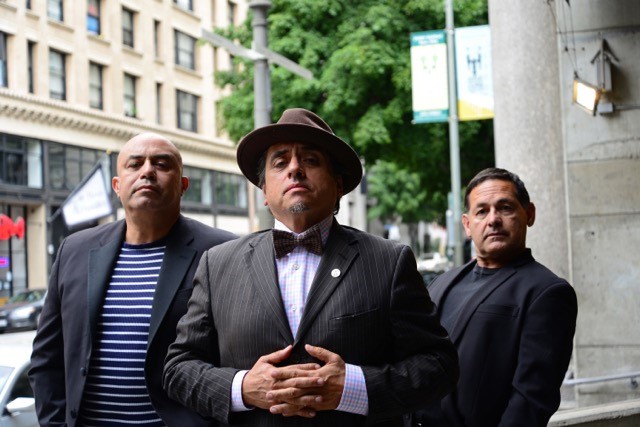
Immigration is a hot-button topic that touches the lives of all Americans. It is a subject politicians exploit on the campaign trail as much as it is a well from which activists draw causes to fight for. And it is the theme that the comedy troupe Culture Clash explores in ‘Bordertown Now’ at The Pasadena Playhouse.
On stage from Wednesday, May 30 to Sunday, June 24, ‘Bordertown Now’ takes an irreverent look at the people at the center of the controversial issues and the walls that divide us. Infused with their trademark satirical approach, the country’s top Chicano/Latino performance trio messes with the boundaries of theatre and comedy to break down the divisions between cultures.
Culture Clash’s Richard Montoya, Ric Salinas, and Herbert Siguenza are joined by Sabina Zuniga Varela. Varela appeared with Culture Clash in ‘Chavez Ravine: An L.A. Revival’ at the Kirk Douglas Theatre on the occasion of the troupe’s 30th anniversary in 2015.
‘Bordertown Now’ is directed by Obie Award-winning artist Diane Rodriguez. She began her career as an ensemble member in the politically conscious, El Teatro Campesino and is now Associate Artistic Director of the Tony Award-winning Center Theatre Group in Los Angeles. In 2016 President Barack Obama appointed her to the National Council on the Arts, a body that advises the Director of the National Endowment for the Arts.
To shine a light on the various issues, there will be post-show conversations after each performance on different topics including immigration, border policy, and more, led by topic experts.
Danny Feldman, Pasadena Playhouse Producing Artistic Director, says, “For more than a year, the immigration debate has been in the news on a daily basis. It is so rare to be able to present a new work that directly responds to our ever-changing world. Who better to examine this issue than the iconic troupe Culture Clash, making their Playhouse debut. Through humor, satire, sentiment, and curiosity, they manage to bring us closer to the humanity at the center of the border issues.”
Richard Montoya explains the group’s roots, “I co-founded Culture Clash on Cinco de Mayo in 1984 in San Francisco’s Mission District at a historic Latin quarter in a small art gallery. Art is very much a part of our vibe.
We first produced ‘Bordertown’ two decades ago and while ‘Bordertown Now’ is billed as a re-imagination of that, about 70 percent of this show is new because political awareness and interest about the border have grown in intensity.
There’s so much going on around the country relative to the concerns we’re exploring so it was easy for us to harvest new material. The issues have become more powerful and polarizing but we’re also going to find the humor in the circumstances that plague immigrants. It’s a comedy that’s balanced with serious topics, a reality show that sometimes plays like satire. There’s nothing more farcical than what’s happening now.”
From left to right, Culture Clash’s Herbert Siguenza, Richard Montoya, and Ric Salinas | Photo by Eric Schwabel courtesy of Culture Clash
“During the last year or so, I’ve been busy on the border interviewing sheriffs, agents, and the people who are caring for those who are crossing the border,” continues Montoya. “I’m doing something similar to journalistic work. And then we recreate the characters for our show. It’s like an anthology production where we’re putting together the pieces, connecting all the things that happen on the border.”
“The landscape and the cast remain the same but besides that, policing around the area has changed rapidly,” Montoya explains. “Armed personnel presence on the border has increased so much that it has become a military situation. At the same time, the danger brought on by the drug cartel has also grown and so has the desperation of those caught in the middle. This scene is so different from that of my youth when there was a trolley service from San Diego to Tijuana.”
“California is such a fertile ground on which to examine this issue,” Montoya remarks. “We have borders within borders – whether it’s between Old Town Pasadena and South Pasadena, or between Los Angeles and San Francisco. I was born and raised in San Francisco and I moved to Los Angeles 25 years ago. And I can’t believe the disparity between Northern and Southern California, it’s mind blowing … which just proves the cultural richness we have in the state. But beyond the geographical borders, ‘Bordertown Now’ examines divisions between genders, cultures, and the imagination.”
Montoya says further, “This time we’re adding other cultures, like Asian, into the mix … anyone who just arrived and eager to become American. This idea of becoming American is still very fresh. You know, when you’re in France, you’re French; and when you’re in Beijing, you’re Chinese. The United States is one of the very few places where you can become an American. And it’s that notion which attracts so many to our country. And one of the questions the play asks is ‘What is the cost of being an American?’”
“While our show is a comedy, we want to show a serious aspect: that we’re all human beings – even those who are hiding in the Mexican desert, trying to cross the border illegally. What our current administration and other countries have done is dehumanize the person on the other side.”
“We’re not saying that borders don’t exist, because they do. Nor are we claiming we’re all equal, because we’re not. But we’re saying we’re all human beings – there are people caught in drug and human trafficking. We’re trying to show the human struggle, and the human-ness outside of the headline. We want to take the measurement of their lives, and not treat them simply as data. And, as artists, we want to keep alive the hope and show that we care about all these,” declares Montoya.
Culture Clash’s ‘Bordertown Now’ examines subjects that are timely and of significance. It puts a human face to the immigration issue. Would that people see it, take it to heart, and seize the opportunity to play a part in chipping away at the borders that divide us from each other.
Originally published on 30 May 2018 in the Pasadena Independent, Arcadia Weekly, and Monrovia Weekly
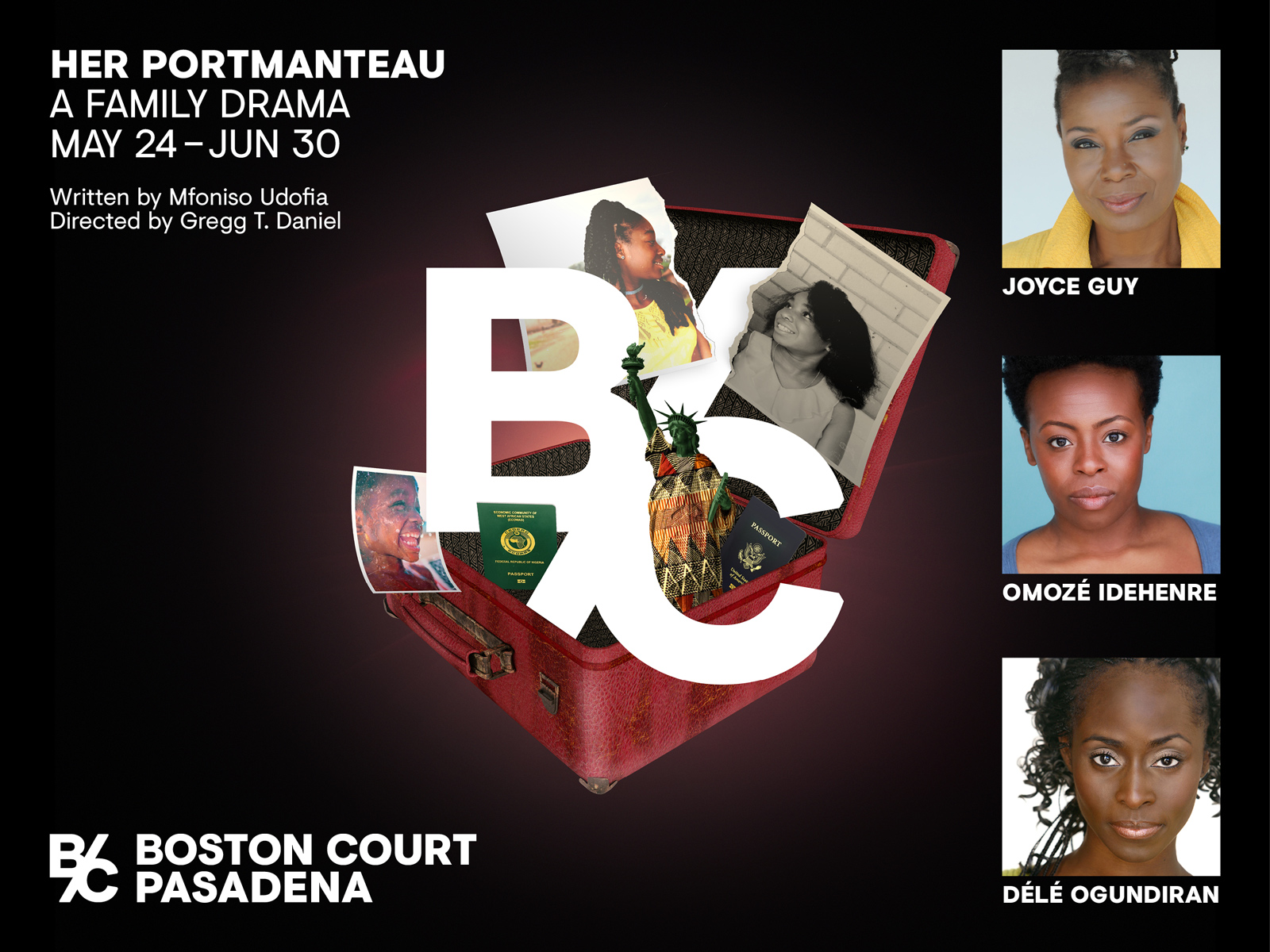
Courtesy photo | Boston Court Pasadena
Families, and the drama that’s inherent in each, is the topic of Mfoniso Udofia’s play ‘Her Portmanteau.’ It will have its West Coast premiere at Boston Court Pasadena from May 24 through June 30, 2018.
Directed by Gregg T. Daniel, who recently directed Lorraine Hansberry’s groundbreaking play ‘A Raisin in the Sun’ at A Noise Within, ‘Her Portmanteau’ stars Joyce Guy who plays the role of Abasiama the family matriarch. Completing the cast are Omoze Idehenre as Adiaha and Dele Ogundiran as Iniabisi.
A theatre graduate of Hampton University in Virginia, Guy was a member of the DC Black Repertory Company. She has performed at the Kennedy Center, Mark Taper Forum, and L.A. Women’s Shakespeare Company. Her screen and television credits include: ‘Moneyball,’ ‘The Santa Clause,’ ‘Animal Kingdom,’ ‘Criminal Minds,’ and ‘How to Get Away With Murder.’ She got an Ovation Award nomination for her choreography for ‘Les Blancs.’
This will be Guy’s debut performance at Boston Court Pasadena and she recalls how her involvement in the project came about. “This is the third time, in the last year and a half, that I’ve worked with Gregg. I choreographed ‘Les Blancs’ at Rogue Machine and ‘Raisin in the Sun,’ both of which he directed.
When I was at the performances of ‘Les Blancs,’ Jessica Kubzansky, Boston Court Pasadena’s Co-Artistic Director, was in the audience. I’ve known her for a while; I took a class with her a long time ago and we became friends. After the play she said to me, ‘Joyce, I have this play that I want you to audition for.’ And then I got a call from the casting director.”
Guy describes the play, “Her Portmanteau is the story of Abasiama, a Nigerian American mother who has two daughters. Her first daughter is Adiaha with her first husband who she met in college. When he was deported she decided that it was best to send Adiaha, who was six years old at the time, back with him to Nigeria. She has another daughter, Iniabisi, with her second husband whom they raised in Massachusetts where her job as a biologist took them. Iniabisi, a 30-year-old aspiring writer, lives in New York.”
“Abasiama has her hands full living with a husband who has mental health issues,” Guy adds. “But her life gets more complicated when Adiaha, who’s now 36, decides to come back to the United States.”
“In Nigeria the first daughter is called ‘adiaga’,” explains Guy. “When Abasiama informed her husband that she wanted to bring Adiaha to Massachusetts, he told her ‘Don’t bring her to my house; she’s not my daughter. My daughter is the ‘adiaga.’ Then he locked himself in the bathroom and started walking backwards. To avoid further conflict, Adiaha picks up Iniabisi from the airport and takes her to New York where she lives.”
Aside from the ‘baggage’ that ‘Her Portmanteau’ explores, it also literally refers to a suitcase. Reveals Guy, “It’s the same luggage that Adiaha took with her when she left for Nigeria with her father three decades ago.”
“It’s a great story, with a character who has several layers,” Guy says. “And as an actress it’s challenging but it’s a wonderful one. What keeps surprising me is that for someone who’s very direct in her everyday interactions with people, to the point of rude bluntness, she wasn’t forthcoming with important information about her family. She makes promises she can’t keep and it seems that she does it to make herself feel better. She’s a woman of many contradictions.
One Sunday morning, she woke up and made a pivotal decision without thinking things through. As I said to Gregg, I imagine that having lived with a second husband who has mental instability she would have developed some psychological problems. She had to build coping mechanisms which were also faulty and she couldn’t really function properly.”
Mfoniso Udofia. – Photo by Frances F. Denny / NY Times
According to Guy she doesn’t have anything in common with the character, “There really isn’t anything about Abasiama that I could relate to because I don’t have children. It’s also a challenge to learn a whole culture you’re not familiar with. The play is very specific in its culture, the people, and the language; and we have to honor that. Ibibio is tonal and learning the phrases used throughout the play proved daunting.”
“I’m African American but I studied West African dance so I’ve been to Senegal, Mali, Guinea, and Gambia,” continues Guy. “I made a film in Senegal; I have a friend who’s Nigerian so I’m familiar with the West African culture. That’s different from being involved in a culture so I have to go deeper to inhabit Abasiama’s character. Gregg lets the actors find their direction in the script, through our research, by observing how Nigerians speak, carry themselves and their bodies, and in relationship with the other actors.”
Living among people of different culture isn’t an entirely novel experience for Guy, though. She discloses, “I was an army brat. My father was in the Air Force and we moved every three years. I’ve lived in Japan, Taiwan, Texas, Kansas, and Delaware.
“When people inquire where I’m from, sometimes I say Delaware because that’s where by father retired after active duty. At other times I say Montgomery because both my parent are from Montgomery, Alabama. I was actually born there and we stayed there until I was three years old when we moved to Texas. After Texas we lived in Taiwan; from there we went to Florida; after that we went to Japan; then to Kansas; and finally to Delaware.”
“Because we moved around a lot I’m often asked which culture I found the most appealing to me. In fact, someone asked me that two days ago, and I said Taiwan. We lived in a compound with other Americans but we had to move to a bigger house because there were five of us. We had free range, we’d walk everywhere, we’d go down to the rice paddies. My best friend was a man who had a food truck that sold bananas and he would give me some. The Taiwanese kids were very curious about us and would touch our skin and our hair. I have wonderful, memorable experiences. But the funny thing is, I couldn’t stand the smell of garlic. I was five, okay?,” Guy says defensively.
Taking on this role in ‘Her Portmanteau’ has given Guy an opportunity to grow as an actor. She says, “I’m learning that I’m more determined and resilient than I thought. I have learned to come to terms with my weaknesses and that I have to put in the work. In order for me to honor Mfoniso’s words, Gregg, and the other actors, I have to go the extra mile. As rehearsals progress, we’ll be able to get to the whole dynamic of this family.”
“There is a universal theme to this play. It’s about family dynamics and dysfunction, things we all can relate to; there’s no perfect family. For me, the biggest takeaway would be that we all have regrets; we’ve all done something that weighs on us. But you can work past that as long as you’re forthcoming and honest with yourself. The thought may not go away but you can go forward from there,” concludes Guy.
While Mfoniso Udofia’s ‘Her Portmanteau’ is semi-autobiographical, this taut and poignant drama about relatives, legacy, and connections will resonate with all of us. Some of us will recognize our particular family’s dysfunction and see ourselves in one of the characters. Because as different as every one of us is, we all share a human-ness that is imperfect.
Originally published on 7 May 2018 in Pasadena Independent, Arcadia Weekly, and Monrovia Weekly
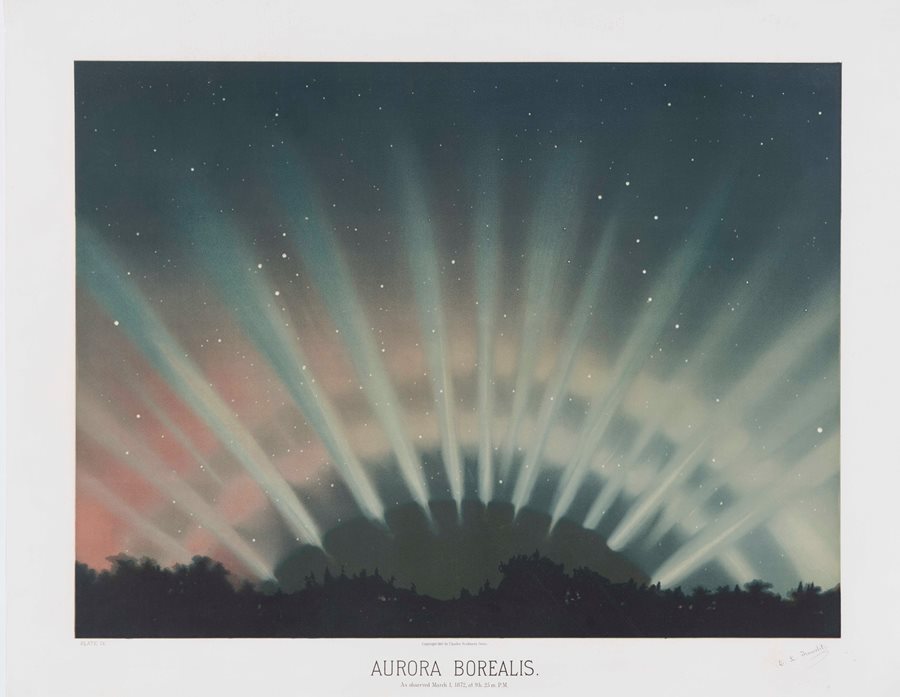
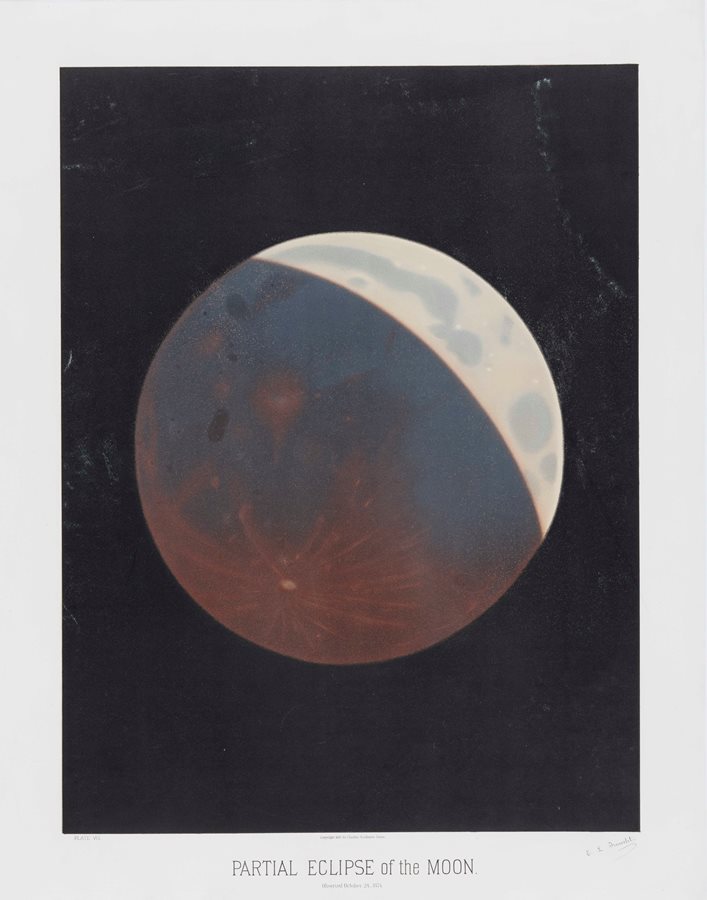
Aurora Borealis, 1881, color lithograph | Photo courtesy of The Huntington Library, Art Collections, and Botanical Gardens
French artist and astronomer Etienne Leopold Trouvelot (1827-1895) is largely unknown to most of us but it would be such a shame if his beautiful drawings didn’t get the acknowledgment and appreciation as the works of magnificence that they truly are.
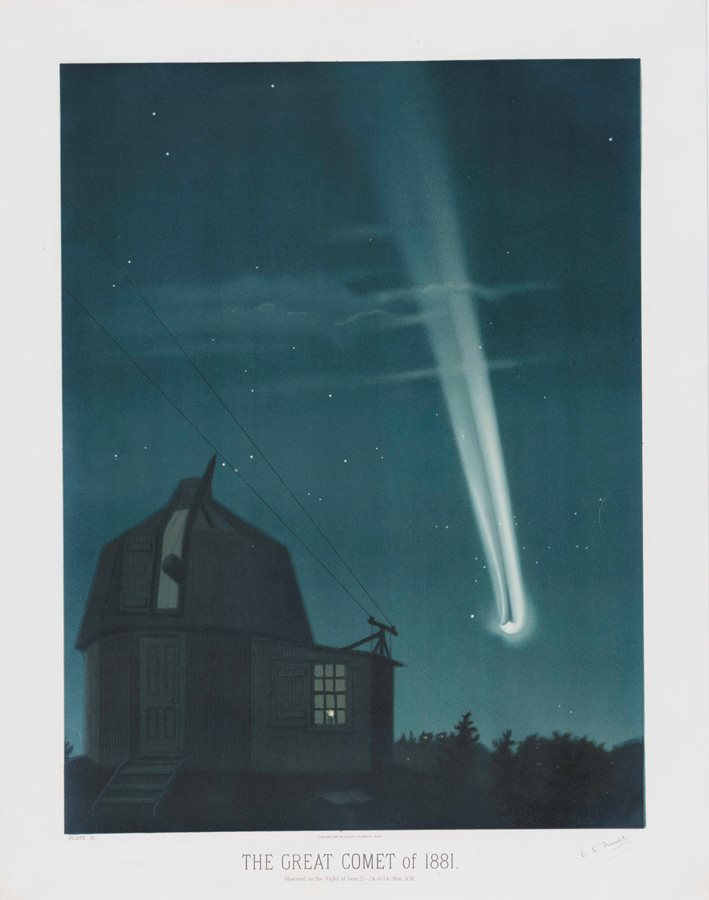
From April 28 through July 30, at the West Hall of The Huntington Library, we have the opportunity to view a rare set of lithographs depicting the pastel drawings of planets, comets, eclipses, and other celestial splendor that he created during his lifetime, in an exhibition aptly titled “Radiant Beauty: E.L. Trouvelot’s Astronomical Drawings.”
“The set of 15 chromolithographs was the crowning achievement of Trouvelot’s career,” declares Krystle Satrum, assistant curator of the Jay T. Last Collection at The Huntington Library, Art Collections, and Botanical Gardens. “He was both an extraordinarily talented artist and a scientist, producing more than 7,000 astronomical illustrations and some 50 scientific articles during his working life. The high quality of the artwork and the scientific observation demonstrate his uncanny ability to combine art and science in such a way as to make substantial contributions to both fields.”
“Given what telescopes are today, can you imagine what he could have done with something that powerful?” Satrum remarks. “But for him to be able to come up with the details he did using what was available at the time makes his creations all the more astounding.”
Satrum emphasizes, “Trouvelot was very meticulous in getting accurate images. If you compare his work to what you can see through the Hubble telescope you’ll see they’re identical. He matched up perfectly the grid on the telescope to the paper he was drawing on; he represented exactly what he was seeing.”
The Great Comet of 1881, 1881, color lithograph | Photo courtesy of The Huntington Library, Art Collections, and Botanical Gardens
Shortly after that, he went public, exhibiting several astronomical pastels at the 1876 Centennial Exposition in Philadelphia. Because the exhibit was a big success, he decided to team up with New York publishers Charles Scribner’s Sons to publish a portfolio of his best drawings. In 1882, 15 of his drawings were made into lithographs.
While an estimated 300 of Trouvelot’s portfolios may have been published, only a handful of complete sets still exist. Initially, the collections were sold to astronomy libraries and observatories as reference tools that astronomers could use to compare with their own observations.
However, as early 20th century advances in photographic technology allowed for more accurate and detailed depictions of the stars, planets, and phenomena, these prints were discarded outright or sold to collectors.
According to Satrum, Trouvelot’s legacy is not without controversy. Born in Aisne, France, he fled to the United States in 1855 with his wife and two children following Napoleon’s coup three years earlier, settling in Medford, Massachusetts. While supporting his wife as an artist, he spent much of his free time studying insects, working to see if better silk-producing caterpillars could thrive in the United States.
During a trip back to France in the late 1860s, he collected live specimens of the gypsy moth, bringing them home to Medford. “Unfortunately, after hatching, some of them escaped his backyard, infesting the nearby woods, then quickly spreading throughout New England and Canada, destroying millions of hardwood trees,” relates Satrum.
Though large scale efforts to eradicate it were underway by 1890, they proved unsuccessful; the gypsy moth continue to be a scourge of U.S. and Canadian forests today, causing millions of dollars’ worth of damage annually. Satrum adds, “This episode also seems to have soured Trouvelot’s passion for entomology and by 1870 he had turned to astronomy.”
The Huntington’s set of Trouvelot lithographs was acquired by Jay T. Last as part of his collection of graphic arts and social history. It is but a small fraction of 200,000 objects that focuses on American lithography and graphics. And that assemblage, in itself, is noteworthy.
Partial Eclipse of the Moon, 1881, color lithography |Photo courtesy of The Huntington Library, Art Collections, and Botanical Gardens.
Satrum explains, “Jay got captivated by vivid images on citrus box labels which he found in rummage and flea market sales. These crate labels weren’t meant for retail sales but were primarily for middlemen and he wondered why these stunning images weren’t used as marketing tools to the general public. That led to his fascination, in the 1970s, with commercial lithography and advertising illustration, and other major reproductions of promotional artwork.”
“Jay donated his collection to The Huntington in 2005 but because he continues to acquire various objects we’re getting them in stages, which also makes it easier for us to process,” continues Satrum. “We have everything from tiny 3 x 5 business cards to master prints three times the size of these pieces.
The Trouvelot collection is a full portfolio set which we estimate to have a print run of 300 at a $125 apiece, which was a lot, considering that at the time they might have sold for between $4 and $6. Actually having a full set is really rare; most collectors have part of a set, or only the manual to accompany the set.”
“Having the manual makes the collection quite interesting because it reveals to us the beliefs at the time,” Satrum adds. “For instance, it shows the Milky Way and explains why you can see it at certain times. Trouvelot talks about Mars which has a bluish shade that he thought were oceans. Today we know that’s incorrect, but it was a reasonable hypothesis then.
I find particularly fascinating that they capture a moment in time. This is what research in Astronomy was in the 1870s and 1880s. That’s exactly what Mars looked like to him and scientists were able to match these drawings to what they observe through the telescope.”
“It also revealed how artists used this medium as an inexpensive method to reproduce their work. It was the best way to show what the original drawing looked like. Trouvelot wasn’t a lithographer, but we knew he supervised the process. We also know that the original of these illustrations were pastel drawings although I don’t know if he used any other medium,” Satrum states.
According to Satrum she has no underlying message or theme, “It’s a very visual exhibition and it’s specific in scope. We’re showing these 15 illustrations, not presenting a broader picture of Trouvelot, the artist. I simply want to share with our public a little bit about astronomy, and that these were originally drawings that were turned into lithographs. I put little comments underneath but I don’t intend to tell them what they should be seeing. I want people to take away from it whatever they want to take away from it.”
After the exhibition the collection will go back in storage and will be available for researchers to use. But until then we can marvel at Trouvelot’s collection of rare 19th century astronomical prints. Indeed entomology’s loss was the arts’ and astronomy’s gain, for his works capture the most breathtaking moments in time.
Originally published on 30 April 2018 in the Pasadena Independent, Arcadia Weekly, and Monrovia Weekly
Susan Egan, musical theatre, television and film star, will delight audiences during a night of Broadway at the California School of the Arts-San Gabriel Valley’s (CSArts-SGV) inaugural fundraising celebration, ‘Unplugged with Susan Egan.’
A cabaret-style show, ‘Unplugged’ will also feature 17 CSArts-SGV’s bright and talented students as they perform songs from popular musicals and films including ‘Little Shop of Horrors,’ ‘Wicked’ and more. It is being held on Saturday, May 12, with two performances at 5:00 pm and 7:30 pm in the gorgeous, state-of-the-art Barrett Hall at the Pasadena Conservatory of Music. A silent auction and cocktail reception for all guests begin at 6:15 pm. To purchase tickets, visit sgv.csarts.net/boxoffice.
Egan has headlined on Broadway in the title role of ‘Thoroughly Modern Millie,’ won critical acclaim as Sally Bowles in ‘Cabaret,’ and received the Tony Award and Drama Desk nomination for Best Actress as the original Belle in Disney’s ‘Beauty and the Beast.’ A seasoned voice actress, she has starred as Megan in ‘Hercules,’ Lin in ‘Spirited Away,’ and recently, Rose Quartz in the hit Disney cartoon ‘Steven Universe.’
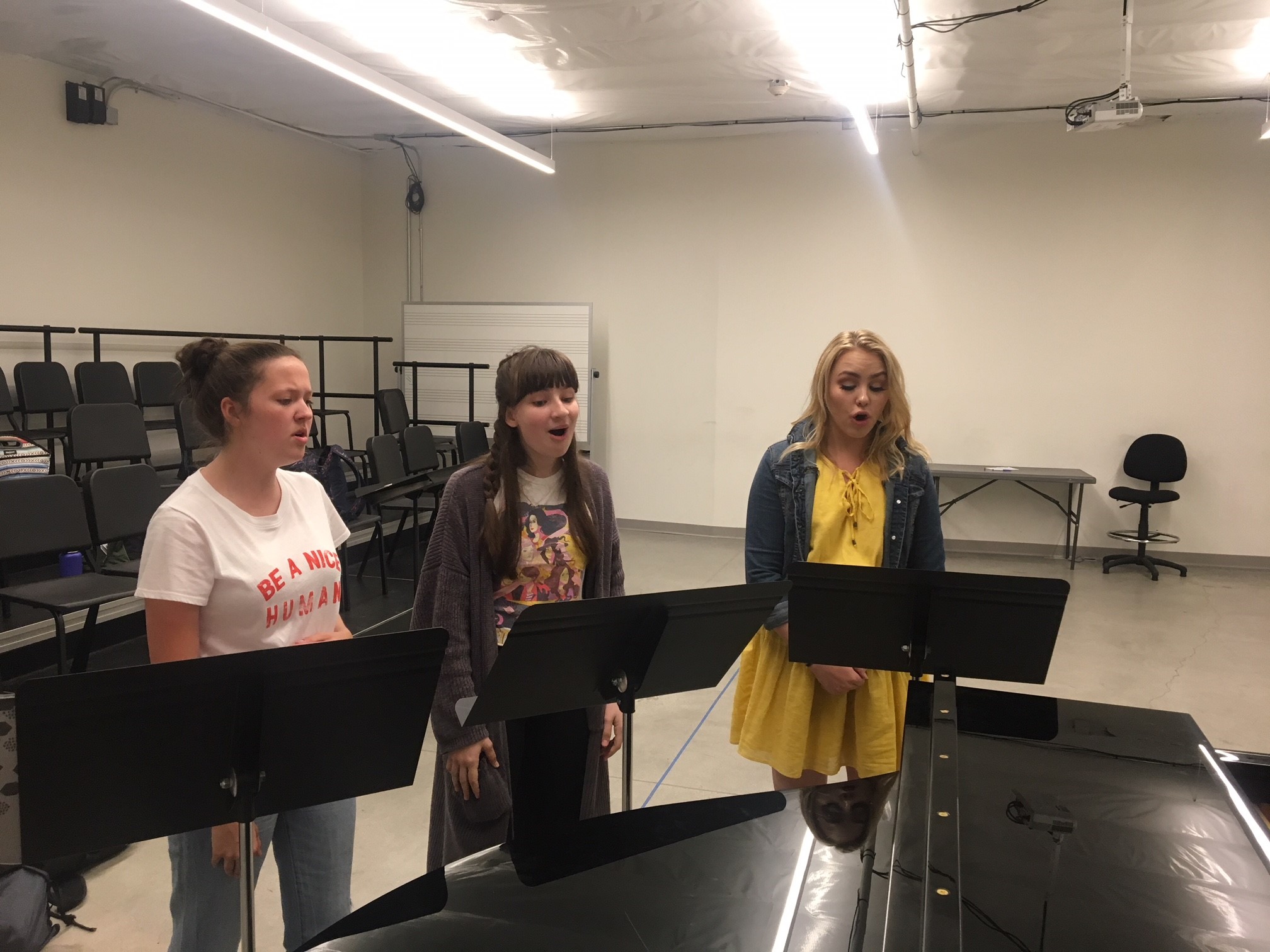
From left to right, Lily Annino, Jessie Ellico Franks, and Nicole Slessor | Courtesy Photo
Nicole Slessor, an 11th grader from Monrovia, will be singing the alto part in ‘Beauty and the Beast’ and ‘Little Shop of Horrors.’ Over the past few weeks, she and other student performers have been going into a practice room during office hours recording their parts. She has also been practicing at home in preparation for the full group rehearsals with Egan.
This isn’t Slessor’s first involvement in a CSArts-SGV production. She says, “I am in FUSION, so I do shows that represent the school around the community. We recently performed at Grand Park L.A. I am also in the Commercial Dance Conservatory, and I have participated in the winter, spring and, most recently, the Student Choreography show, which I directed!”
“At first it was difficult for me to balance academics and art, but then I started to realize that the school gives us a variety of opportunities to focus on our academics,” discloses Slessor. “Teachers keep their doors open at lunch and I go in to study and do homework. I also use office hours as a time to organize as well as finish the to-do checklist I keep in my planner. Having three AP classes is a lot of work, but the school definitely helps us out.”
Being in this show is such a thrill for Slessor. She states, “A few years ago Susan came and did a similar event with the theatre program at Monrovia High School, which I attended, so I know of her. It also doesn’t hurt that my two favorite Disney movies are ‘Hercules’ and ‘Beauty and the Beast.’
“I am very interested in taking arts in college and as a future career,” continues Slessor. “I am trained in theatre jazz dance, so I am looking at programs that have a strong jazz course. My goal after college is to become a Radio City Rockette and perform on Broadway. And when my dance career is over I would like to tour with a dance company as a therapist for dancers.” Spoken like a young woman who has put a great deal of thought about her future.
Ninth grader Jessie Ellico Franks, from Sierra Madre, is in the Acting Conservatory and will be singing The Schuyler Sister with two other girls and other songs as part of the ensemble.
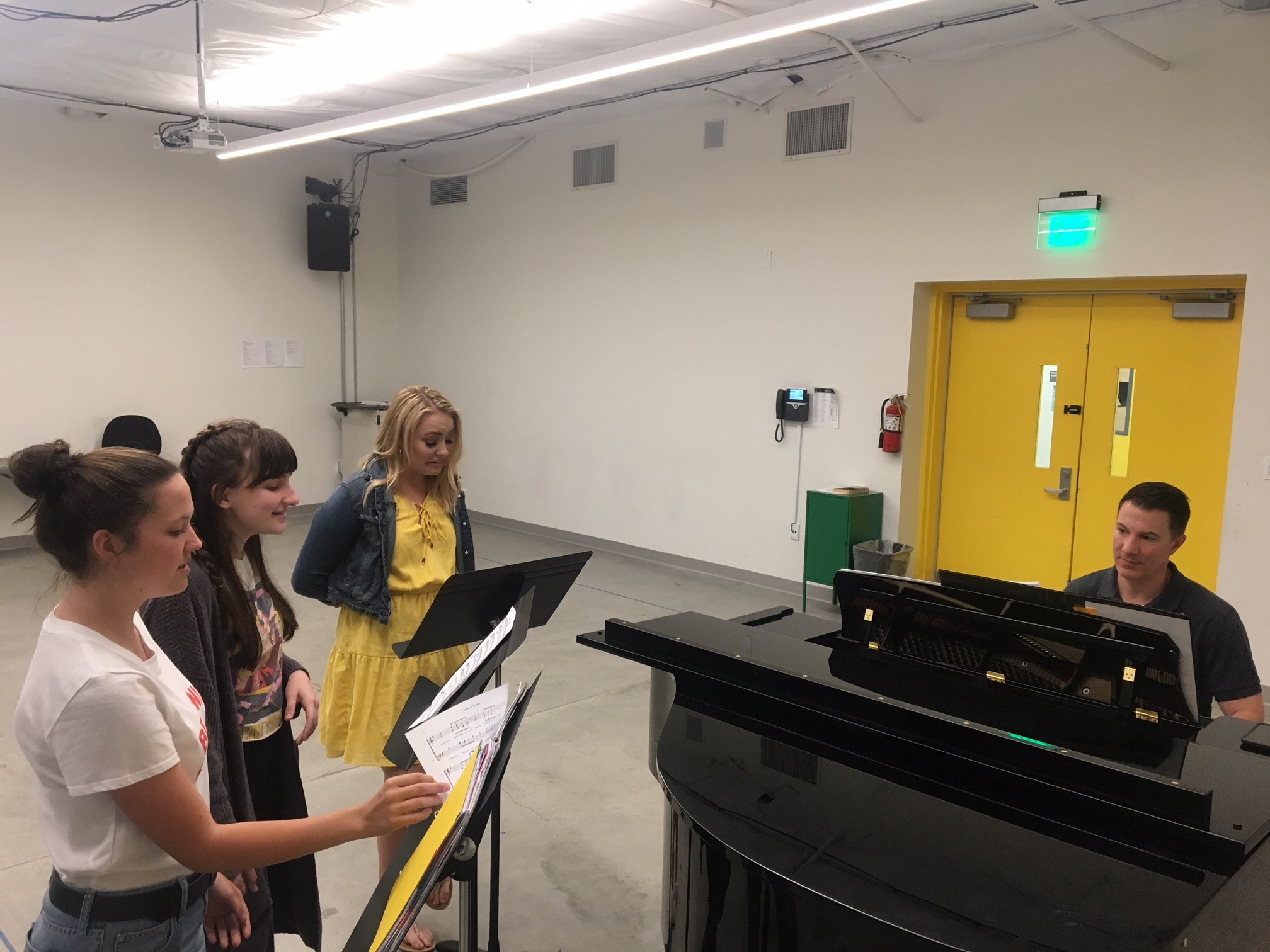
(Left to right) Lily Annino, Jessie Ellico Franks, and Nicole Slessor in rehearsal with director Stephen Cook | Courtesy Photo
Like Slessor, Franks isn’t new to school productions. She enumerates, “I have been in ‘The Yellow Boat,’ a tale about a young boy with an enormous imagination; in the musical ‘Pippin,’ which tells about a man trying to find purpose in life; in ‘The Elephant’s Graveyard,’ a heartfelt and sorrowful story that describes the one-and-only hanging of a circus elephant named Mary; and in ‘Performing with the Pros,’ a musical revue led by and performed alongside Broadway veteran David Burnham.”
While performing is a passion for Franks, studying is a priority, “I value my education and make a real effort to balance art with academics. I make certain all my academic work is done before I start on my conservatory homework. If I know I have performances or long rehearsals coming up, I prepare and plan ahead, making sure to know what will be covered in class.”
Franks adds, “I did some research on Susan Egan when I found out I was going to be in this production. I also watched ‘Hercules,’ which is one of my all-time favorite Disney movies; I loved her in it. And who can forget Meg? Arts performance is something I truly enjoy; I hope to attend an arts college and continue my work in the professional field. I honestly couldn’t see myself doing anything else!”
Arcadian Lily Annino, a junior attending the Musical Theatre Conservatory, will be singing in the ‘Beauty and the Beast’ medley and in the group number ‘I Won’t Say I’m in Love’ from ‘Hercules.’
“I listened to the tracks online to familiarize myself and get comfortable with the songs,” Annino states. “I’ve been involved in other productions so I pretty much have an understanding of how I should prepare for it. Last semester I was in the play ‘The Elephant’s Graveyard,’ an interactive, introspective play where everyone in the cast had a singular seven-minute monologue delivered to a small audience.
Additionally, I was an assistant in the school musical ‘Pippin.’ A few weeks ago, I had the honor of originating the role of Frances in the Mini Musical Show, where musical theatre and integrated arts students had the opportunity to audition for musicals written by creative writing students. That was such an amazing experience!”
Like Slessor and Franks, Annino has mastered balancing academics and performances. She says, “I have been utilizing office hours, by going in every day to get extra help and homework done. I almost never go home with a huge load of homework. At the moment, I am not sure what I would like to major in in college. What I know, for certain, is that musical theatre and performing will remain a part of my life.”
For these three San Gabriel Valley students, being able to pursue their passion while they are still in high school is as much a valuable opportunity as it is a treasured gift. That they are collaborating with some of the biggest names in the world of performing arts is just the icing on the cake.
Originally published on 24 April 2018 in the Pasadena Independent, Arcadia Weekly, and Monrovia Weekly
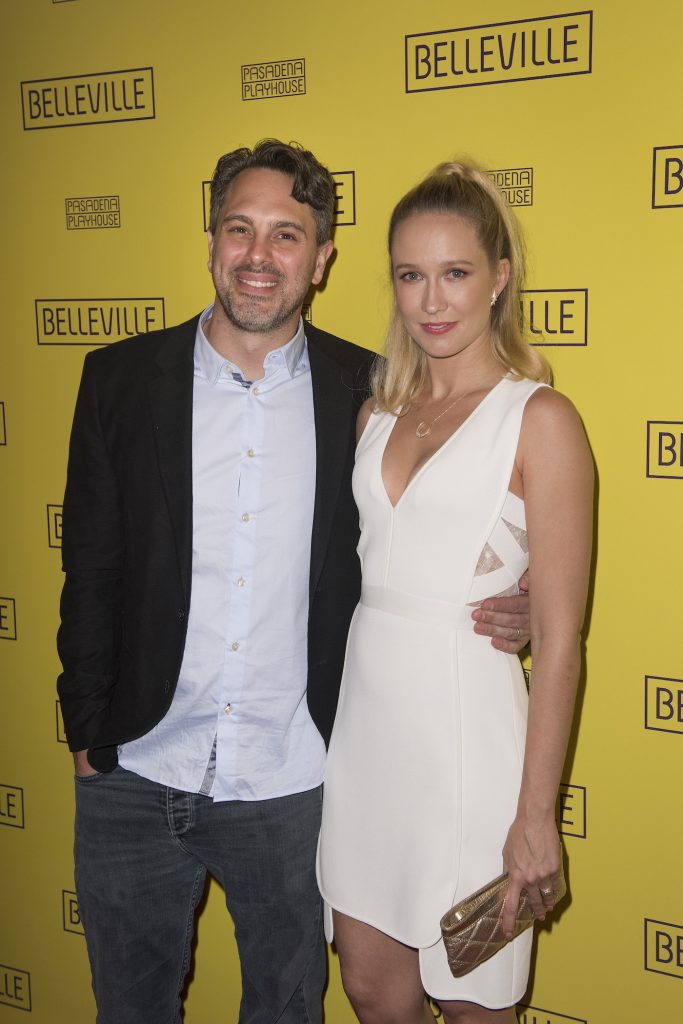
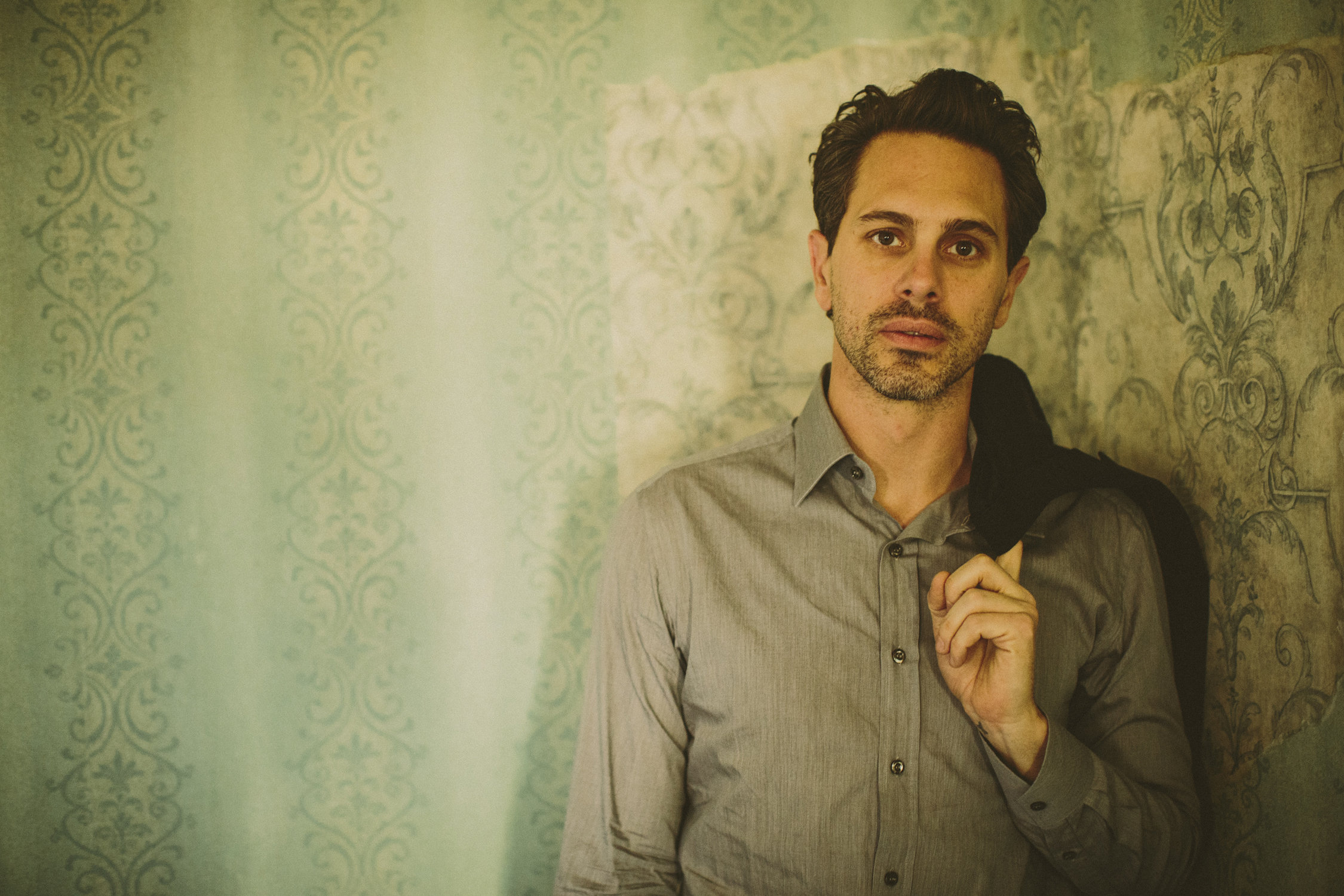
“Belleville” stars Thomas Sadoski and Anna Camp on the red carpet on opening night | Photo by Nick Agro
Anna Camp and Thomas Sadoski performed to an appreciative and intent audience this past Sunday when Amy Herzog’s psychological thriller “Belleville” opened at the Pasadena Playhouse.
Directed by Jenna Worsham, Camp and Sadoski played a young American couple living in a Bohemian neighborhood in Paris called Belleville. It began as Camp’s character, Abby, came home unexpectedly one afternoon and heard her husband Zack, played by Sadoski, watching porn in their bedroom.
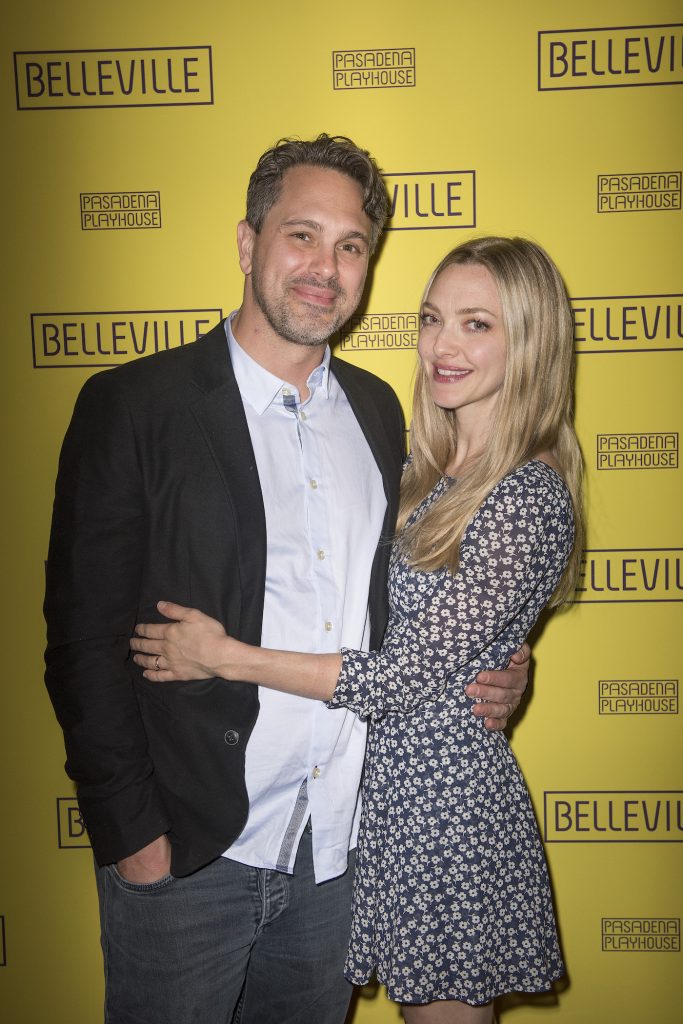
Thomas Sadoski and Amanda Seyfried | Photo by Nick Agro
This seemingly harmless incident quickly turned into a catastrophic event, as one revelation after another of secrets Abby and Zack had hidden from each other were exposed. Slowly their real identities were unmasked and each of them was surprised to learn they didn’t really know the person they married. The audience watched the intense interplay between the two characters with such concentration one could hear a pin drop.
With no intermission to break the intensity, we didn’t have so much as time to catch our breath. When the play finally came to an end, about a hundred minutes later, we were almost as finally relieved as we were utterly devastated.
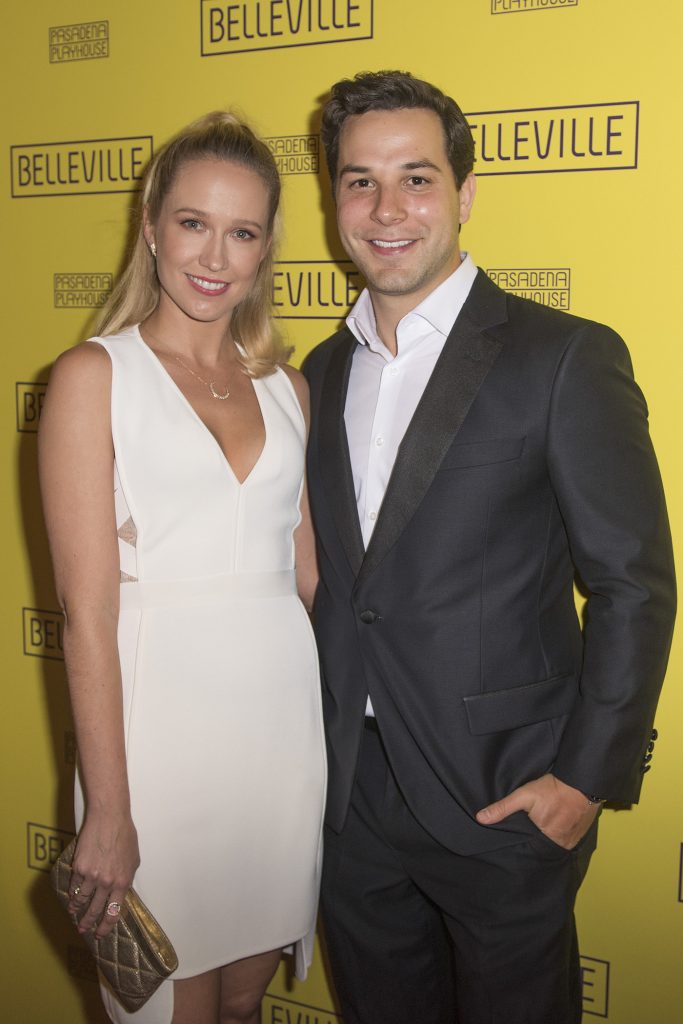
Anna Camp and Skylar Astin | Photo by Nick Agro
“Belleville” was indeed a Hitchockian thriller of a play. Director and actors did not disappoint. Camp and Sadoski kept up the tension right up to its conclusion. And an appreciative audience showed their approval with a rousing standing ovation when the lights turned down.
Both Camp and Sadoski enjoy a loyal following and their fans must have come out to support them. Last Sunday’s performance attracted noticeably young theatergoers. It was a stroke of genius that the Playhouse’s Producing Artistic Director, Danny Feldman, chose to mount a play about millennials. And it certainly didn’t hurt that Anna Camp and Thomas Sadoski starred in it. Well done, all!
Originally published on 23 April 2018 in the Pasadena Independent, Arcadia Weekly, and Monrovia Weekly
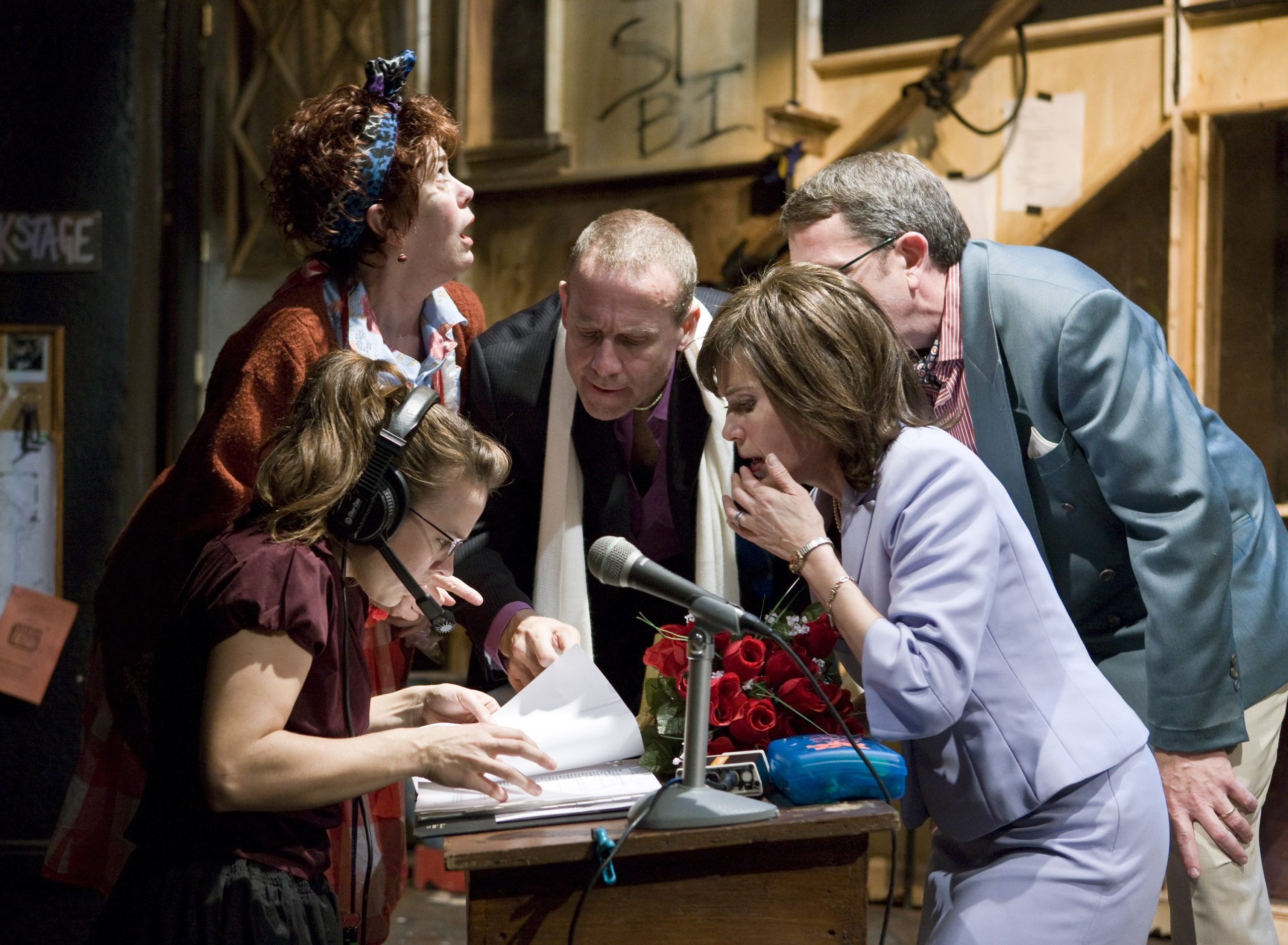
“Noises Off” ensemble | Photo by Craig Schwartz
Imagine a hapless group of actors gamely putting on a production aptly titled ‘Nothing On,’ from an abysmal material as each of their personal drama gets in the way and you have one screwball of a play that is as insanely hilarious as it is eerily true to life.
This is Michel Frayn’s joyfully out-of-control British farce, ‘Noises Off,’ and will be on stage at A Noise Within (ANW) from Saturday, April 21 to Sunday, May 20, 2018. Directed by Julia Rodriguez-Elliott and Geoff Elliott, it features most of the original cast from the play’s previous productions.
“‘Noises Off’ is truly one of our signature productions, with audience members returning to see it two or more times,” says Elliott. Rodriguez-Elliott adds, “Everything about the deft physical and verbal interplay between actors is ideal for our focus on ensemble work.”
First produced by ANW in their Glendale location, it was hugely popular that they brought it back another year. When they moved to Pasadena they presented it during their first season as an add-on production on a limited run.
Continues Rodriguez-Elliott, “It’s been about six or seven years since we last did it. For our 25th year anniversary, just for fun, we asked people what shows we had done that they would like to see again and ‘Noises Off’ got the most votes.
However, ‘Noises Off’ was doing a big production in London then so we couldn’t get the rights to it to mount it in time for our anniversary season. Fortunately, we were able to last year. And since we still have the same cast and they’re playing the same characters they did in the first two productions, we didn’t have to spend as much time to prepare for it.”
Elliott also discloses, “We’ve put off remounting ‘Noises Off,’ because we didn’t have the technical ability to put it on a spinning stage. We really wanted to remount it this year so we decided to redesign the set. In the first act the audience is watching the front of the set, in the second act the action takes place at the back of the set, and the third act is again the front of the set. Because of that, it needed to be presented on its own and not as part of a repertory.”
“It is one of the funniest farce, if not the funniest, ever written,” pronounces Elliott. “It’s a love letter to the theatre because it’s essentially about all of the things that can go wrong when people are trying to put a production together. For actors it’s especially close to the heart because we’ve all gone through some version of it. Michael Frayn is so brilliant in creating comic timing and sidesplitting situations. It’s really a work of genius.”
“It’s a repertory group rehearsing a play that’s about to open the next night and they’re not ready,” explains Rodriguez-Elliott. “In the first act, we are observing the colorful characters who are part of a company – there’s one actor who isn’t terribly bright, one who has a temper, another is an alcoholic who gets lost and they can’t find him. In the second act, the set turns and you’re watching them in a performance of ‘Nothing On’ from the back stage perspective so you see them as they make their entrance.”
“This is happening as they’re in the middle of the tour,” Elliott interjects. “By the second act they’ve been together for about a month and half. Everything that could possibly go awry, as personalities clash, has gone awry. The two leads are having an affair and one of them refuses to go on stage and it gets worse from there. It’s just insane!”
Rodriguez-Elliott continues, “By the third act, when the set is turned once more to the front, it’s hell in a handbasket. They’ve been touring for six months and by then some of them aren’t talking to each other so it becomes another whole new level of disaster.”
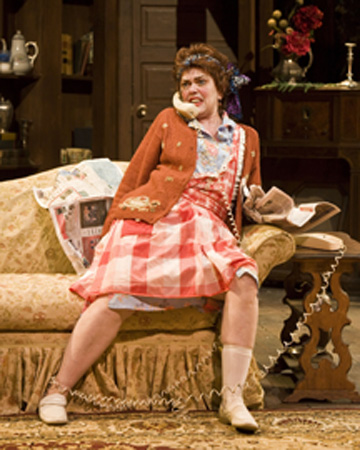
Dotty Otley | Photo by Craig Schwartz
“When we were first rehearsing it, people who had done this production in the past were telling me ‘You’re going to have such a good time; audiences just die watching this play,” recalls Elliott. “There were so many people telling me that, that I began to get spooked that we’ll be jinxed shortly because I thought, ‘Surely our production can’t be as funny as they kept saying. The expectation was too much.’ But once we got out there, the audiences just went wild and it was infectious. You were having such a great time because the audience was as well. And it turned out to be exactly what people had been prognosticating all along. It’s probably the most fun I’d ever had on stage.”
Illustrates Elliott, “I play the role of the director and most of the time the cast doesn’t know if it’s Geoff, the director, or Lloyd, the character I play, who’s talking. Or if it’s Jeremy, the actor, who’s talking to them or the Frederick character he’s playing. Apollo Dukakis, in the role of an older actor Selsdon, calls his lines exactly as Apollo does. It’s spooky.”
“And here’s an interesting bit of trivia,” says Rodriguez-Elliott. “Michael Frayn was watching a play he had written being rehearsed. He sat backstage for a bit and he thought what was happening there was more interesting than what was going on onstage. That was the impulse for him to write ‘Noises Off.’”
“It was a Lynn Redgrave play that was being rehearsed,” Elliott elucidates. “And he thought there was more drama going on backstage. One of the endearing things about this play is that all of these actors are such survivalists they would do almost anything to make their entrance, to keep the show going. They’re taking axes at each other but they’ll drop them when they have to make an entrance. And it’s true, the show must go on. This is that to the hilt, it’s so sweet.”
“The beauty of a rep company is the familiarity you have with the rest of the cast,” Elliott begins to say. “And the play is all about that – people who have been together and have worked together for a long time. That is so relatable. We’ve all been in productions where someone misses an entrance, or something’s gone wrong and people backstage are troubleshooting,” Rodriguez-Elliott finishes for him.
“One of the reasons I think this was a very popular production is that we really concentrated on finding the honesty, the authenticity of the situations theatre people work in,” clarifies Elliott. “We didn’t approach it as a send-up. It’s not only incredibly funny but we have sympathy for all these people. We recognize all these people, all the drama and the group dynamics that we’ve all been a part of.”
“The play they’re in is terrible and they are nobly putting on a show that doesn’t even make sense. But they’re trying hard to make it work and are truly investing in it. There’s this one character who’s not the sharpest tool in the shed and even when the world is exploding she’s still doing what she has rehearsed,” chuckles Rodriguez-Elliott.
Elliott declares, “You can feel the joy in the room because the actors are having fun and the audience is in it with them. The actors themselves are laughing when they get backstage because of the wonderfully infectious audience reaction.”
ANW has just announced the theme of the 2018-2019 season, ‘Let Me in.’ Elliott describes, “It’s about the fundamental human desire to be included, to be accepted. All the plays are about people struggling for that and the things that happen to them and those around them as they strive to have a door open. It’s a very timely issue. We all want to be acknowledged, to not be ignored or be treated as something other than being a part of the human race. Whether it’s Don Quixote of ‘Man of La Mancha’, Dorian Gray, Rosencrantz and Guildenstern, Othello, Wingfield family of ‘Glass Menagerie,’ or Jason of ‘Argonautika.’ That’s the common vein running in all these plays.
‘Man of La Mancha’ will be another play that will run solo, not in repertory. It will play middle of August through early September. That was a big hit for us when we did it this season and this was an opportunity to bring the show back for those who didn’t get to see it or would like to see it again. It’s the same production and will have the same cast.
The show had been a tremendous experience for us. We had a number of people in the cast who had never worked with us before because they were more musical theatre people. So for them to be able to approach it as actors was something novel and extraordinary for them to do. When we reached out to them to tell them we were bringing it back and asked if they wanted to return for it, everyone answered within twelve hours.
That was pretty much how our resident artists responded to our remount of ‘Noises Off.’ Although the themes of the two plays couldn’t be any more different, audiences, nevertheless, will feel a strong reaction to each.”
It is the contagious feeling and exuberant spirit that we will experience that make ‘Noises Off’ as uproariously brilliant as it is unabashedly zany. Prepare to laugh till your sides hurt.
The play centers on Zack and Abby, young Americans who look for all the world like a perfect couple experiencing the ideal expatriate life in Paris so he can fulfill his noble mission at Doctors Without Borders to fight pediatric AIDS. They live in a funky bohemian apartment in Belleville.
This image of perfection is shattered when Abby finds Zack at home one afternoon when he’s supposed to be at work. Their idyllic life turns into a nightmare and we watch in suspense as the real characters beneath the façade are slowly unmasked.
While neither Sadoski nor Camp has seen ‘Belleville’ performed they have both heard of it and its playwright. Sadoski says, “Amy is a Pulitzer Prize nominee and an Obie Award winner and I know of her work. She’s a tremendous writer, one of the most important voices of her generation. I’m so thrilled to be working on this project!”
This marks the first time Sadoski will be on stage at this venue and he recounts how he got the role, “I love this theater and its history. Danny Feldman, the Playhouse’s Producing Artistic Director, and I have been talking for a while about finding some work for me to do in Pasadena. It so happened that he had a window and we threw around some ideas about what plays we wanted to do. When he mentioned ‘Belleville’ I just went ‘Absolutely!’ It’s really a no-brainer.
“We also realized it hadn’t been done on the West Coast so this would be the premiere and that got us all the more excited. Our director, Jenna Worsham, is a huge advocate of Amy’s work and she was thrilled with the idea. So we, as a unit, jumped at the opportunity to put it up.”
Thomas Sadoski | Photo courtesy of Pasadena Playhouse
Sadoski says further, “As rehearsal goes on we’ll continue to unwrap who these people are. The most interesting for me at the moment is delineating between the private Zack and the public Zack – the version that he presents to the world and the Zack that exists inside that only he knows.
“It’s going to be really exciting to prolong that feeling of unease, fear, suspicion, and discomfort throughout the play. The last thing we want is for it to be a caricature of a film noir. I would be interested to see how the audience reacts and that’s the beauty of live theatre.
“I’m always a bit reluctant to form an idea of what I want the audience to leave with. Early on I had a really strong opinion about what I would like the play to bring out and I worked really hard to make that happen. But what I learned in time was that I can have those wants and desires but people will come with their own experience which, in turn, will inform what they walk away with.
I’m at a point in my career when I just want to tell the story as truthfully as I possibly can, give an honest and open performance. I think that’s more generous than determining the conclusion I want the audience to have. That said, it’s also very Hitchcockian – you don’t come out of a Hitchcock movie with a song in your heart and a spring in your feet.”
A famously private person, there isn’t a lot out there about Sadoski and he likes to keep it that way. He discloses, “Firstly, it’s the way I was raised. Secondly, I am happy to share my thoughts and opinions about politics and whatnot but I am not the kind of person who has his personal life on display at all times.
“Additionally, I don’t think it serves me as an actor to give people some sense of ownership. Nor for the audience’s perception, when I go on stage or in front of the camera, be colored by what they think they know about me. I want to be able to make my performance be true to the character I play.”
Sadoski has been on television (‘The Newsroom,’ ‘Life in Pieces’) and on Broadway (‘reasons to be pretty’ and ‘Other Desert Cities,’ with a Tony Award nomination. He has, of late, been doing audiobooks.
“Theatre is my first love so I would like to keep coming back to it,” Sadoski reveals. “I enjoy doing TV and film so I will continue to do them as much as possible. I have also found a lot of joy doing audiobooks. I think the next place for me to go artistically is directing; I look forward to that opportunity.”
“Life couldn’t be better at this point. I have a beautiful daughter and wonderful wife I love hanging out with and I go to work. I’m one of the few fortunate people who can say that I get to do what I love to do for a living. My cup runneth over,” concludes Sadoski.
Anna Camp is adored by everyone who has seen her in the film Pitch Perfect (1, 2 and 3) and has built a following with her appearances on iconic TV hits ‘Mad Men’ and ‘The Good Wife.’ Like Sadoski she will be performing at The Playhouse for the first time and was very excited when she got the script for Belleville.
“I feel in love with it immediately after I read it,” recalls Camp. “I called my agent and said ‘I’m doing this.’ It was very powerful and there was some sense I had about this character. I have not been offered a role like this, certainly not a theatrical piece, and I was very glad they considered me for it.
“I’ve seen Tom on Broadway, off-Broadway, and from ‘The Newsroom.’ While he and I have worked on Broadway at about the same time, I’ve never worked with him before. I’m very happy that this will be the moment we’ll work together because he’s fantastic for the role and it’s a fantastic material to be working with him on for the first time. It was quite amazing how we had an easy relationship from the first day of rehearsal. I can’t ask for a better job.”
Anna Camp | Photo courtesy of Pasadena Playhouse
Asked if she had specific thoughts on how to approach the character, Camp answers, “Obviously when you first read a script you have an idea in your head but nothing really comes into focus until you’re working with the actors and allowing the director to ask more questions of the character to find out about the person. And I’m actually discovering that in some ways she is like other characters I’ve played before, and in other ways she’s different. And every day, as we rehearse, it gets more complex and more layered.
“I’m finding out more who Abby is, she’s becoming a fully realized person and who I want her to be. It helped that I didn’t see the play before; I always like not having an idea of what someone has already done with the role haunting me in a way. I’m curious as to how other actors have played it before but I’m glad I haven’t seen it performed onstage. That’s what makes this incredibly my own and that’s the beauty in doing a play.
“There are certain things that happen as Zack and Abby interact that I found fascinating. In the beginning Abby appeared to be in fear of her own shadow, feeling out of place living in Paris, and afraid in her own apartment. And at the same time there are so many moments when she could be cutting, and harsh, and cruel. It’s a really well drawn out character – there’s a lot of anger underneath her and it’s very biting. This is a really multi-dimensional character that Amy has created.”
“The best part about a Hitchcockian thriller is the buildup,” continues Camp. “And that’s the fun part – shaping the play into something that keeps the audience at the edge of their seat and not know whom to root for; to have them come up with their own conclusion as they watch the play. We want to truly increase the suspense before the final reveal.
“I want the audience to be moved emotionally in a way that they are not expecting, to feel what it’s like to be in love but in a wrong kind of love; to learn something about yourself; to make you a better human being during this time you have on the planet.”
Being in this play has also taught Camp something, “I’m finding out the difference between film and theatre. Last night during rehearsal Jenna said ‘theatre is like live music – you play the same notes every night but you’re playing it in a different way; and film is like a painting, it is done and it is complete and it’s over.’ I will carry her words with me forever.”
Camp discloses future plans, “I am in the middle of producing a film where I will star in and we’re trying to hire a writer. I’m looking for more female-led ventures and projects that would connect with my audience. I’ve loved acting since I was a little girl and as long as I can continue to do that then I’m living my dream. Working in theatre is something that has deepened me as an actor and I hope it leaves me a better actor than when I came in.”
Camp and Sadoski are exciting performers to watch. They have proven themselves in every medium they’ve been in. They are both at the Pasadena Playhouse to show us how live theatre can mesmerize, enthrall, and hypnotize in a play that may very well make us question if we really know the people to whom we are closest. The master of suspense himself, Alfred Hitchcock, would approve.
Originally published on 3 April 2018 in the Pasadena Independent, Arcadia Weekly, and Monrovia Weekly
Arcadia High School students will call attention to social issues, including poverty and homelessness, at the Arcadia Poetry Slam which will be held at 2:00 pm on Sunday, April 29, at the Arcadia Performing Arts Center (APAC).
To benefit Foothill Unity Center, it will also serve as a launching ground for students to get their voices heard. Whitney La Barge, assistant general manager of APAC, coordinates the event with Arcadia High School.
“We want to bring more students into the space,” says La Barge. “Right now we do orchestra, band concerts, dance and theatre shows. Arcadia Poetry Slam gives other students, who wouldn’t otherwise have, the chance to be a part of the center as well as the foundation.”
Anthony Sigman-Lowery, APAC operations manager, says further, “This will be the inaugural Poetry Slam and it’s meant to encourage students to use their voices through poetry. We have a black box with 99 seats: it’s a small intimate environment for students who may have stage fright. What better way to bring students who might not normally be performing here.”
La Barge expounds, “We announced the competition at AHS in mid-March and we’re giving preference to seniors since it’s their last opportunity to do it. We’re also limiting it to 30 students. It’s pretty open in terms of format because we want them to express their creativity. The only restrictions we have are that it is under five minutes long and it has to be school-appropriate so it can’t glorify violence, guns, or drugs. As it is benefiting Foothill Unity Center we’re encouraging students to touch on social issues like homelessness and poverty.”
To get student participation from neighboring schools, La Barge reached out to the English and Drama department teachers and shared the event poster with them.
“It’s an invitational and we’re hoping that each year we’ll have more and more schools involved,” La Barge states. “We definitely want AHS to be well represented because obviously we’re here on campus and we want to serve the school district. As it’s our first time, we’re keeping it small but we eventually want to turn it into an all-day competition.”
“We really wanted to hold this but we don’t know how to judge a poem,” relates Sigman-Lowery. “How do we keep it school appropriate without restricting people’s voices? So we partnered with L.A. Poets Society. They gave us the components by which the poems will be judged – content, stage performance, voice, and diction.”
La Barge adds, “We also asked for a statement from each poet of what they’re trying to accomplish with the piece, what they’re trying to say. The judges will then pick three poets who best accomplished their goal, whose messages came across effectively. For prizes, we’re giving away Beats wireless headphones courtesy of Beats. L.A. Poets Society will award writing journals and feature them in their website under the New Poet Section.”
Arcadia Performing Arts Center | Courtesy photo
APAC and Foothill Unity Center have been community partners for a while according to Sigman-Lowery. He explains, “We started working with Foothill Unity Center with our Sunday with Santa event in December. We collected canned goods and to encourage people to donate, each can served as a raffle ticket to win prizes. We liked working with them and we figured it was a good way of serving the Arcadia community since one of the big goals of the foundation is making art accessible.”
Raina Martinez, Foothill Unity Center’s development and donor relations director, confirms, “APAC’s executive director, Maki Hsieh, wanted to come up with a way to support the center as well as get the community involved, especially the youth. And poetry is popular with young people and is a great way to get their voice out there. We’re making it the thematic concept to incorporate poverty, hunger, and homelessness to bring more awareness about the center and, more importantly, about the issues.
“Our two sites – Pasadena and Monrovia – serve eleven cities in the San Gabriel Valley offering food, temporary shelter, case management, transportation, and vital health services for low income and homeless people. Additionally, we offer job training skills for youth and adults, and an internship program. We have an AmeriCorps program on the site where they can get clerical and warehouse type skills.
“One of the things we do well is developing partnerships. We’re not trying to reinvent the wheel, we work with other agencies. We connect our clients with other organizations who can provide them assistance. Donations come from everyone in the community – individuals, businesses, churches. It’s neighbors helping neighbors. And volunteers are a big component of our organization – we couldn’t do this without them. Last year we had 40,000 volunteer hours.
“We have two major events during the year. In addition to the regular food services we provide, we have thanksgiving boxes and the Christmas holiday distribution food boxes. For all registered children we have the Holiday Angel program that provides toys and gift items, and a popular Back-to-School event which we do at the Santa Anita Race Track in August. Children from kindergarten through college receive backpacks, school supplies, socks, clothing, haircuts, manicure, health screenings – everything they need to get them ready for school.”
Since its founding in 1980, Foothill Unity Center has remained the primary provider of food, case management/crisis help, and access to healthcare resources for people who are at or below the national poverty level. Each day it lives up to its mission ‘Helping People. Changing Lives.’
Through the Arcadia Poetry Slam local students will bring attention to Foothill Unity Center and the most pressing problems affecting the lives of those around us. It is art galvanizing social activism.
Originally published on 26 March 2018 in the Pasadena Independent, Arcadia Weekly, and Monrovia Weekly
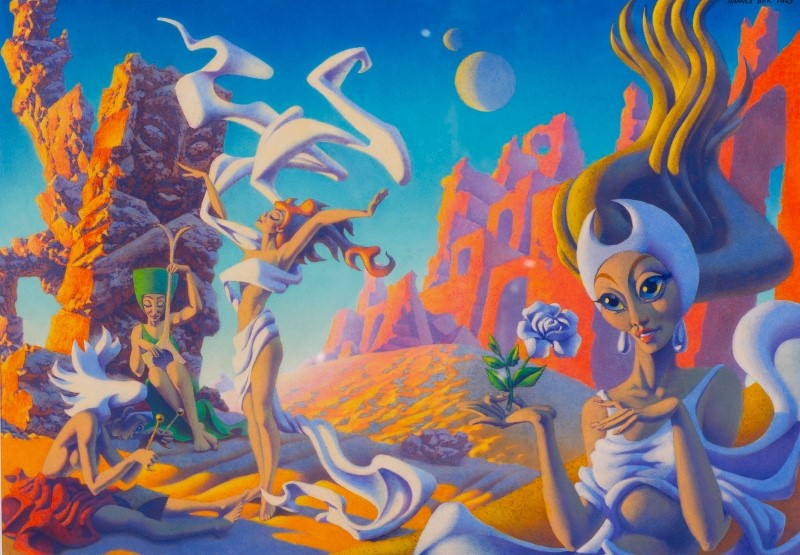
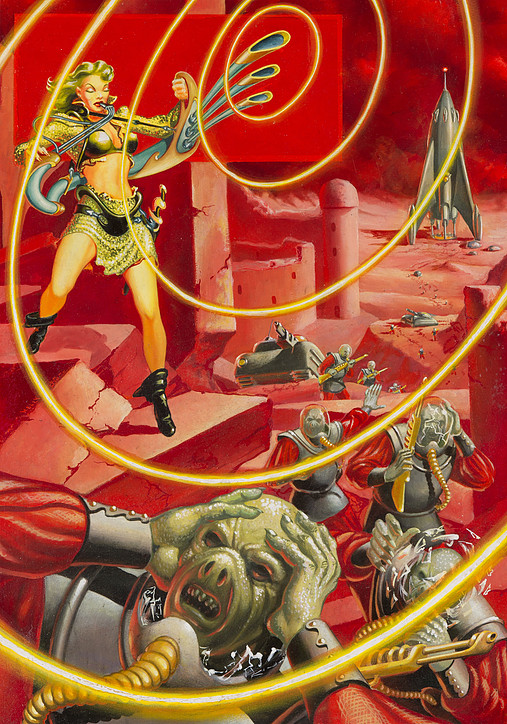
This Hannes Bok (1914-1964) illustration appeared as a wrap-around cover of The Magazine of Fantasy and Science Fiction for ‘A Rose for Ecclesiastes’ | Photo courtesy of the Korshak Collection
Southern California played a pivotal role in our country’s aerospace program when in 1936 the first rocket tests took place in Pasadena’s Arroyo Seco and launched the Rocket Age. Interestingly, the progress in the aeronautics industry in the region paralleled the growth of the science fiction community.
The Pasadena Museum of History (PMH) shows how science, fiction, and Southern California converge in an exhibition called ‘Dreaming the Universe.’ On view from March 3 through September 2, 2018, it explores the history of science fiction from 1930 to 1980, and its significance in the advances of science, the changes in technology, and shifts in American society.
Nick Smith, president of the Los Angeles Science Fantasy Society, curated this show that features historic artifacts, fine and graphic art, books and ephemera, and historic photographs. It will touch on the contributions of Ray Bradbury, Octavia Butler and other luminaries whose names are synonymous with science fiction; it will likewise highlight the fans and followers of the genre. Children and adults alike will find something they will instantly recognize as what initially pulled them into this exciting world.
Smith’s fascination with science fiction began several decades back. He relates, “Ever since I could read I read the ‘Superman’ comics. My barber would let us read whatever books he had, like ‘Incredible Hulk’ and ‘Super Spy,’ whenever we behaved. But the local library provided me the opportunity to read science fiction books written for younger readers. The earliest one I could remember was called ‘Have Space Suit Will Travel,’ about a kid who won a space suit in a contest and got caught up with things like aliens and other weird things.
“Once I had an allowance and had the ability to buy magazines at the newsstand I started purchasing them. That actually influenced some of the artwork we have in this exhibition. I was at a magazine stand and my eye caught this really curious-looking wrap-around cover of The Magazine of Fantasy and Science Fiction. It turned out to be a Hannes Bok illustration called ‘A Rose for Ecclesiastes.’”
“There were a lot of books and magazines about science fiction, fantasy, and speculative adventure written for kids in the 1950s and 1960s,” continues Smith. “They piqued children’s imagination because they were about the things that you didn’t see every day but would be fun if they did happen. They were wish-fulfillment fantasy to a great extent – traveling to Mars, or becoming space cadets to solve crime throughout the galaxy. That led to a lot of radio, television, and comic book science fiction.
“For adults, some science fiction dealt with warnings against abuses of technology which was what the original Frankenstein books were about, if you think about it. That was the first modern science fiction story written and it’s 200 years old now.”
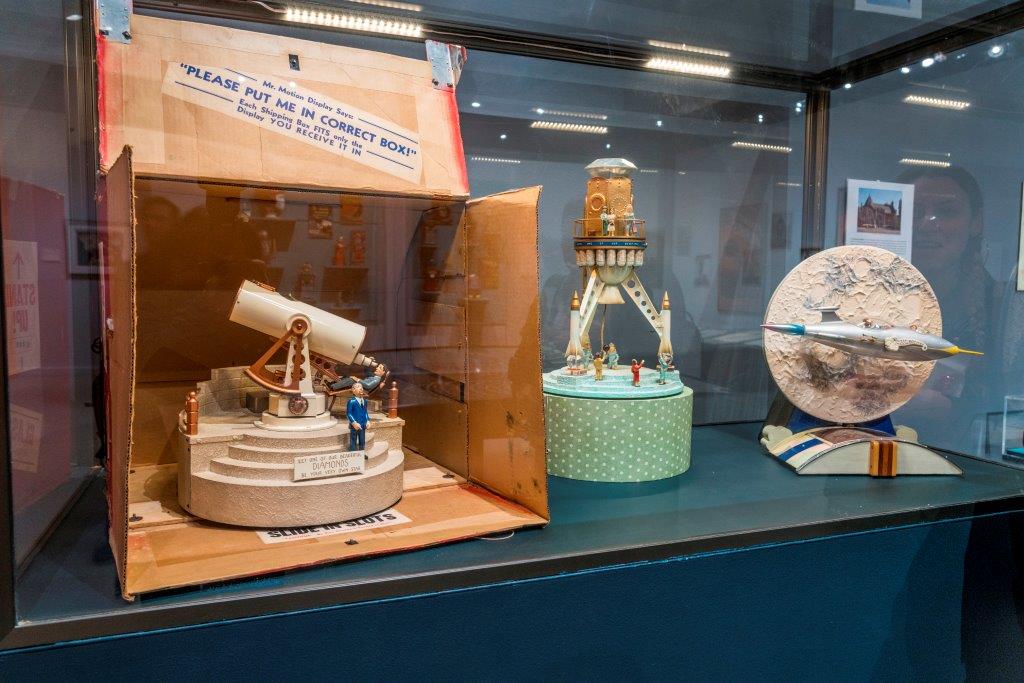
A group of Baranger Motion Displays, 1952-1957, Baranger Studios, South Pasadena, CA. Courtesy of Justin Pinchot (Toyraygun.com,robotcoffeela.com) | Photo by Joanne Wilborn/Marlyn Woo
“Laura Verlaque, PMH’s Director of Collections, and I worked for about a year identifying which things we would like to include in the exhibit that would be representative of the different aspects of science fiction. These items include visuals like flat pieces of artwork ranging from photographs to paintings; costumes – pieces of it or the entire outfit; physical objects from toys to window displays, especially in the 1950s.
“And that’s an interesting bit of the story. In the 1950s when Walt Disney put scientists on TV to talk about the space program, science fiction was all over radio and television. It was very much part of the culture in more ways than people didn’t think of. In fact, there was a company in South Pasadena that made window displays for jewelry stores and many of these had science fiction themes.”
“We don’t think about it nowadays but if we were to look back, science fiction was part of children’s experiences growing up,” points out Smith. “Tom Corbett’s ‘Space Cadet,’ which was very loosely based on science fiction story, was part of my background as a child. I watched that on TV, convinced my parents to buy me the little toys that went with it. A modern musician who, coincidentally, is named Tom Corbett uses a replica of the Tom Corbett lunchboxes at his concerts because he thinks it’s cool that a 1950s show had a character with his name.”
Science fiction’s integration into the mainstream culture took place in stages, says Smith. “There were some anthology science fiction shows on radio and television. ‘Space Patrol’ started here in LA as a radio show before it became a national television show and because they had big sponsors, they were able to get major publicity – they had a national giveaway of a backyard rocket ship clubhouse.
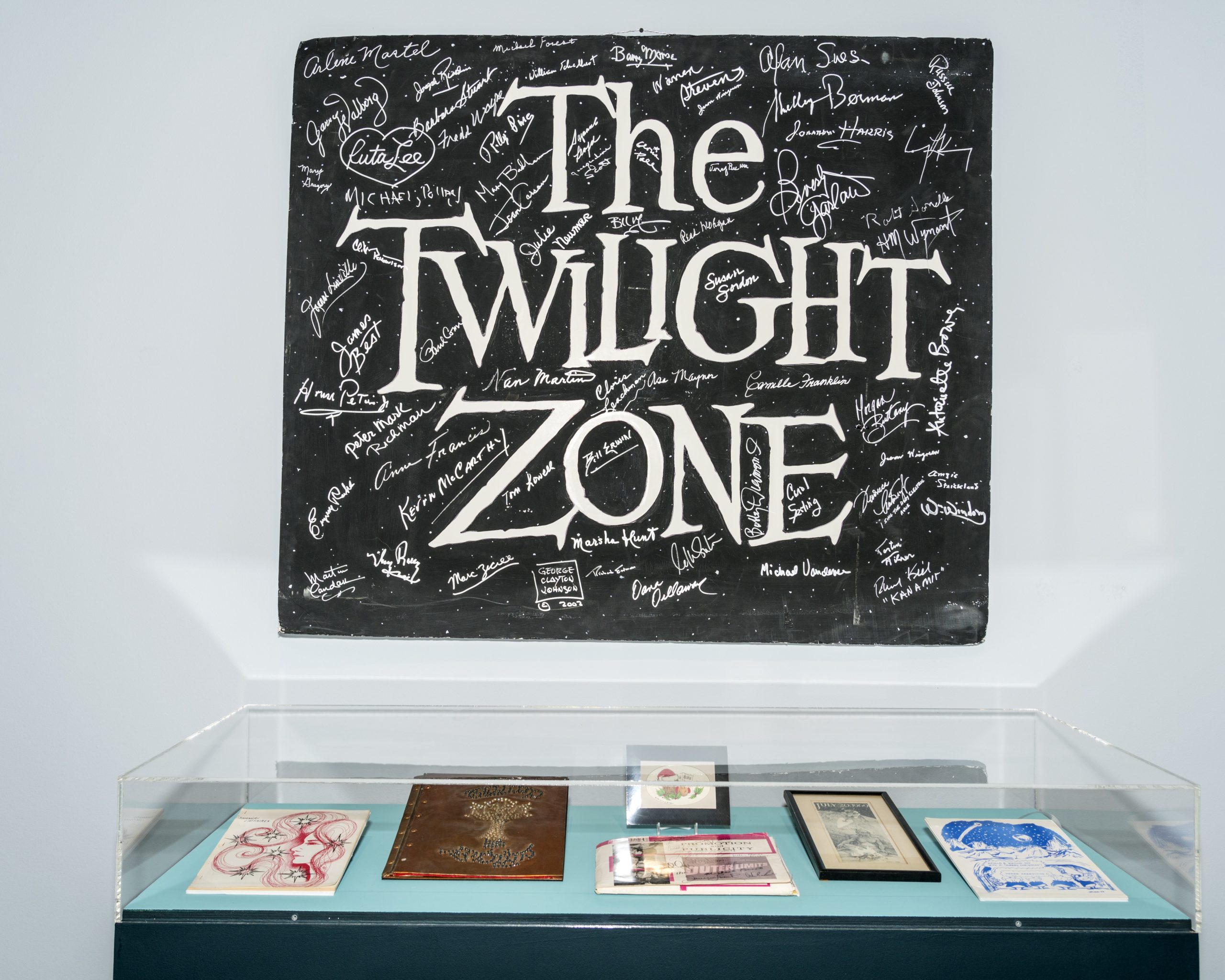
“‘The Twilight Zone’ came out in the 1960s but it was Star Trek that brought in the new wave of fans. It was hugely popular that when NBC cancelled the show Caltech students organized a march to protest it and they were joined by other enthusiasts and students from several universities.
‘The Twilight Zone’ display | Photo by Joanne Wilborn/Marlyn Woo
“Here’s another curious thing – the genre attracted not just males. In this exhibit we have one of the earliest published science fiction female writers. Clare Winger Harris was born in the 1890s and wrote stories for two of the major sci-fi and fantasy magazines back in the 1920s. What makes her particularly noteworthy is that she wrote under her own name, not a pseudonym, at a time when it wasn’t socially acceptable and women didn’t think they could sell a science fiction story. There were no other women in the 1920s in science fiction magazines.
“A more recent famed writer Octavia Butler, who was Pasadenan, was remarkable because she was both a woman and African American. And at that point she was the most successful female African American science fiction writer.”
Adds Smith, “To a great extent science fiction is based in Southern California because the technology and the sources of technology are here, as well as the TV and film industry. Rod Serling didn’t have to travel very far to find writers to work on ‘The Twilight Zone.’ He was able to get some of the best scriptwriters by driving down the street. One such brilliant writer, Charles Beaumont, turned out amazing stories throughout the 50s and 60s. He’s largely forgotten now because he died fairly young but several of his stories became television episodes for ‘The Twilight Zone’ and ‘Night Gallery.’”
“Everything in the field of science fiction is being considered for television right now,” declares Smith. “There have been successful series like ‘Game of Thrones’ which are radically different from previous fantasy science fiction but they attract an audience which has never read the books they’re based on. The field is growing in several ways. However, not every project that’s started is shown because the genre deals with such big ideas that are difficult to realize.”
The books Smith read as a youngster were published by Erle Korshak. The distinctive wrap-around cover of the magazine that stopped him in his tracks at the newsstand is one of six graphic art on display in the exhibit from the Korshak Collection. This is the first time these artwork are being exhibited on the West Coast.
Stephen Korshak, himself, began his interest in science fiction illustrations when he was a child. He recounts, “My father owned a pioneering science fiction book company, Shasta Publishers, which ushered in the transition of important science fiction literature from magazines printed in cheap pulp paper to hardcover, library-quality books. These covers, which I was exposed to growing up, engendered my lifelong love for collecting science fiction art.”
There are currently 90 pieces in his collection, with 29 pioneering American artists representing 80 years of published science fiction and 20 European artists from 15 countries who worked from 1863 to 1984. They can be seen online in ‘Korshak Collection: Illustrations of Imagination Literature.’ In the introduction he names one particular piece that stands out in his memory, “The J. Allen St. John illustration for the 1941 ‘Amazing Stories’ magazine cover of John Carter battling the dead in ‘The City of Mummies’ lured me into a fantastic world that I never knew existed. I read and enjoyed the Edgar Rice Burroughs story behind the illustration but, for me, the illustration itself gave me a sense of wonder I had never previously experienced.”
It is the only science fiction collection that tours, conjectures Korshak. And that touring bit came about quite by accident. He discloses, “I took one of the paintings to a framer and he told me it needed to be restored. When it came back from the restorer, my framer told me it was the talk of the restorer’s workshop. He asked me if I had any more of these illustrations and I said ‘yes.’ He said he wanted to display them here in Orlando, where I live, at one of the museums where he’s a trustee. The attendance was so overwhelming and the reception so amazing that we started to do the tours.”
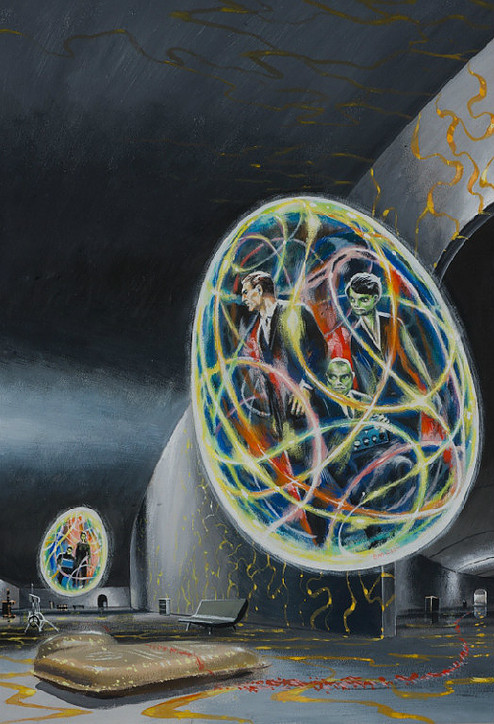
This Kelly Freas (1922-2005) illustration appeared on the cover of Planet Stories magazine | Photo courtesy of the Korshak Collection
Since it began touring nine years ago, the Korshak collection has been shown in some of the most prestigious illustration museums in the United States – the Brandywine River, the Chazen, and the Society of Illustrators’ – and at Museu Valencia in Spain.
“In the beginning, people were just tossing these illustrations away like the comic books because they weren’t worth anything,” says Korshak. “No one considered them to be art because artists were not supposed to be entrepreneurs – they were meant to work for the Medicis and have great rich patrons who would support their art. However, in the United States, it being a capitalist society, artists were businesspersons like everyone else. Illustrators, by and large, were educated, and had a family to support. They did it to make a living, to sell products and market books.
“For a long time there was a prejudice in the art world; the gurus and fine arts critics pronounced illustration wasn’t art. But there has been a reassessment taking place in the last 15 years or so; there is now a better appreciation for this art form. People paid $30M for a Normal Rockwell, who was an illustrator for the Saturday Evening Post. Maxfield Parrish, N. C. Wyeth, or Howard Pyle pieces go for millions of dollars.”
In the process of collecting, Korshak learned that illustration covers a wide field. He explains, “My love has always centered on a sense of wonder, that sense of being in a fantasy world, which I tried to capture with my collection. Except for a rare one or two, they are illustrations of literature spanning 125 years, from 1875 to 2000. There are thousands of illustrators and I can’t possibly display thousands of paintings. So what I tried to do was to pick what I thought, in my humble opinion, were the greatest illustrators or those who weren’t as technically famous but had a great influence. But we are not the definitive criterion of who’s great and who isn’t.”
Like a doting father, Korshak demurs when asked to pick the one he likes most, “It’s hard to say which is my absolute favorite but I’ll tell you three of my favorites. Jose Segrelles, a Spanish illustrator, is technically one of the eminent artists in the whole field but was little known in the United States. He made his name in Spain, although he did appear for a short time in the Illustrated London News. He appeared in books and magazines for 80 years but has been forgotten for the most part.
“I was lucky enough to go to Spain to meet his family. I bought the painting from his nephew and before he died I promised them I would take Segrelles back with me and introduce him to the American market. In fact, I will be collaborating on a book about Segrelles with Guillermo del Toro, the academy-award winning director, who said Segrelles was one of the great influencers in his life.
“Another illustrator who is highly esteemed by the cognoscenti is Arthur Rackham. He is a British illustrator who did magnificent work for children’s gift books, including Lewis Carroll’s ‘Alice’s Adventures in Wonderland.’
“A third one would be Hannes Bok who illustrated for Weird Tales. These three illustrators, I think, are the best in their field,” proclaims Korshak.
‘The Tree of Time,’ Edward Emshwiller’s (1925-1990) illustration appeared on the cover of The Magazine of Fantasy and Science Fiction
Having this collection has afforded Korshak opportunities he cherishes, “There’s a camaraderie when you meet with other collectors. It’s a hobby you can share with other people which is tremendously fun and enriching. I have developed friendships through this.
“At the same time I really want to share and give back to the field that’s given me so much. The illustrators in my collection established the basic genre, the vocabulary of the field. These books haven’t appeared in print in 80 or 100 years, and out of sight out of mind. Many of the themes are reproduced by modern illustrators but in different ways and techniques.
“By exhibiting the artwork, I feel I’m doing something thoughtful by introducing these illustrators to a new generation of people and helping preserve some of these illustrators’ legacy as well. I’m not single-handedly going to do that but, in my own little way, am contributing towards that end.
“We’ve finished our East Coast tour and we’re now starting one on the West Coast. Coincidentally, I have just been contacted by a big gaming company in Japan that’s doing an Alice in Wonderland exhibition and wants to take one of our famous Arthur Rackham illustrations. It’s really exciting now that people are starting to know these illustrators. And I think it’s going to help the modern illustrators. My collection goes through 2000 but there are contemporary artists right now who are doing great work like Michael Whelan and the Brothers Hildebrandt.
“I have also written books on two illustrators – Hannes Bok and Frank R. Paul. I wrote the Hannes Bok book with Ray Bradbury before he passed away. It was Bradbury who introduced Bok to the editor of Weird Tales which helped start up his career.
“A few years ago I convinced my father to help me publish an artbook on the father of science fiction art, Frank R. Paul. We named the company Shasta/Phoenix because his original book publishing company, Shasta, had been inactive for 50 years and we resurrected it, like the phoenix, from the dead.
“In the Frank R. Paul book, I mentioned Sir Arthur C. Clarke, who co-wrote the screenplay for ‘2001: A Space Odyssey.’ Clarke claimed that Paul was one of the great influencers in his life. He said that the NASA space engineers who worked on NASA projects knew we could go to the moon because Frank R. Paul had visualized it,” confides Korshak.
If the people responsible for America’s space program look to science fiction books to determine which galaxies to explore, do we need further evidence that whatever the mind can imagine is humanly possible?
Originally published on 12 March 2018 in the Pasadena Independent, Arcadia Weekly, and Monrovia Weekly
Saundra McClain and Ben Cain | Photo by Craig Schwartz
It is an American dream – to get an education, earn a fair wage, own a home, and live a life of dignity. In this land of opportunity that seems attainable. There are people, however, to whom the realization of that dream is elusive.
This is the theme of Lorraine Hansberry’s seminal play ‘A Raisin in the Sun,’ which debuted on Broadway in 1959. The title is derived from a line in ‘Harlem,’ a poem by Langston Hughes, ‘What happens to a dream deferred? Does it dry up like a raisin in the sun?’
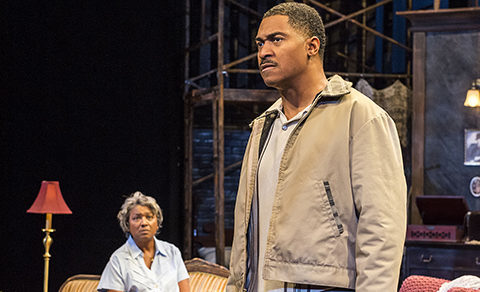
There has been a renewed interest in ‘A Raisin in the Sun’ of late. According to American Theatre magazine, it is one of the ten most produced plays of the current season. And it is on stage at A Noise Within from February 25 to April 8, 2018 in repertory with Henry V. Directed by accomplished actor and director Gregg T. Daniel, its cast includes Saundra McClain as the matriarch of the Younger family; with Ben Cain as Walter Lee, Toya Turner as Ruth, Sarah Hollis as Beneatha, and Sam Christian as Travis.
On a recent afternoon, Daniel and McClain sat down to share their thoughts about the play, what it means to be a person of color in today’s political climate, and what they hope they are able to convey to their audience.
Neither Daniel nor McClain has staged it before but both are familiar with ‘A Raisin in the Sun.’ Says Daniel, “This play came out around the time of the Civil Rights Movement. It was very significant in that it was the first play written by an African American woman staged on Broadway and which was later adapted into a movie.”
Adds McClain, “My generation grew up with this play – in college the first monologue I learned was from it. More recently, I was involved in the stage reading of ‘A Raisin in the Sun’ here. It was an amazing experience; we got a standing ovation after the show.”
“They got such tremendous response when they did the reading two years ago,” continues Daniel, “which compelled Geoff and Julia to mount a full production. They contacted me because I had just finished directing ‘Le Blanc.’
Lorraine wrote ‘Raisin in the Sun’ in 1959, wherein she portrayed an African-American family with seemingly competing dreams that threaten to tear them apart and what they come up against as they try to better themselves. Everyone reacted to it saying ‘I didn’t know that was happening to black families until I saw it on stage.’ The floodgates opened after that; it altered American theatre forever.
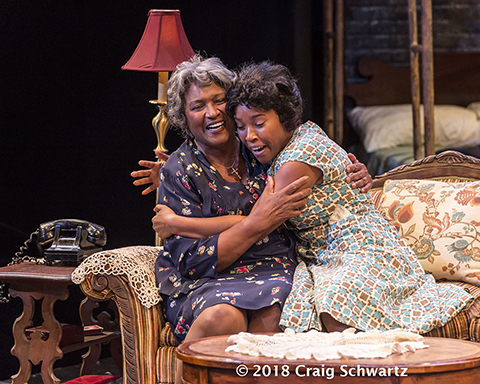
Saundra McClain with Toya Turner. Photo by Craig Schwartz
One thing that’s different about our production is the humor which a lot of people said they didn’t expect to see. The role of Mama has been played as a heavy character – stern, aggressive, and judgmental. That disposition is the very opposite to Saundra’s who has such joie de vivre; she’s so vibrant and alive.
Right at the outset, Saundra was my first choice for the role because as dysfunctional a family as the Younger household is, they love each other. They have moments of cheerfulness and moments of levity, and she could bring all that to this play. Our Mama is very joyful; she has a lot more laughs than has been depicted in previous plays. You could clearly see that she loves Walter; she’s not bullying or bludgeoning.
‘Raisin’ was set in 1959 so it reflected that scary and worrying period in history. But there was no reason for us to do it that way. And we live in interesting times, with #Black Lives Matter and #Oscar So White. We still have racial issues but they’re of our time so we want to be emblematic of our present challenges.
Change is costly – it’s always bloody and violent. It took courageous people like Martin Luther King, Malcom X, and Robert Kennedy to stand up and advocate for change. But lest we forget, we’ve had a black president since then which proves we have evolved in terms of political consciousness.
That said, I feel like we’re reverting to the era of divisiveness with families ripped apart and social support withdrawn. People of conscience should rise up and say, ‘Enough, this isn’t what American is all about!’ There needs to be consequences when you verbalize bigotry and hate.”
McClain opines, “It’s a universal play that speaks not only to African-Americans but to Latinos, Muslims, immigrants, all people of color in our society right now all over the world. There’s a white nationalist sentiment currently going on and it’s a little bit frightening. This small group of people are afraid of the change that’s taking over now, of not being the superior race. But there is no superior race, it’s the human race.
Every day that I’m in this play, I get a better understanding of Mama and her relationship to her children, especially to her son, that I didn’t know before. Mama is uneducated; she is devout about her religion and everything beyond the bible has to be wrong. She is very supportive of her daughter Beneatha who is a little bit like her. But because of all her education, Beneatha turns against God. That is the change I don’t like.
On the other hand, Mama thinks that Walter is irresponsible. He drinks and doesn’t adequately provide for his family. He’s still dependent on Mama so he isn’t his own man. And while he’s so right about so many things he goes about it the wrong way. He doesn’t have the knowledge nor the sophistication to realize his dreams. It’s only at the end of the play that I finally give him respect.
This iteration of ‘Raisin’ gives it a ‘now’ perspective because we’re focusing it on Walter instead of Mama. Young black men today can relate to him – it’s open season for them in our current political climate. During today’s student matinee, some of them didn’t get the references in the first act. But in the second act when I beat up on Walter, you could hear a pin drop. And then there were sniffles in the audience. After the matinee one of the boys came up to me, shook my hand, and said, ‘This reminds me so much of my family. I wish my grandmother had seen this play.’”
Daniel adds, “There are certain cultural themes that they understand. This generation isn’t quite as burdened as we were because, if anything, they have been the outcome of all the civil rights movements. When I was in college there weren’t very many black students. We have come a long way in so many respects.
But, as in times past, it is our country’s youth who will lead the charge for reform. They are vocal about how unfair it is when they’re judged by the way they dress, or how they talk, or for their lack of education. This generation is more aware of social justice and is at the forefront of societal movements. They know what they need to do to achieve quality of life.
This is a very American play. It reflects the dreams of every human being in this nation – Mama wants a house and a garden of her own; Beneatha wishes to become a doctor; Walter aspires to upward mobility. Which one of us wouldn’t understand what they’re reaching for?
We want the audience to see that everyone’s potential deserves to be realized, that if they work on it, they have an equal shot at achieving it without impediment – whether it’s due to racist laws, or their economic stature. We have to appreciate that if we deny one person’s dream because he’s black or he’s gay, that affects us all. That’s a tragedy.”
Ben Cain with Sam Christian | Photo by Craig Schwartz
“I wanted to focus on Walter because he has the biggest journey, he goes the farthest,” Daniel expounds. “At the start of the play Walter is a miserable human being. What he wants drives them apart because he’s simplistic, almost like a child with his grand dreams. He’s looking for an easy way out of their situation, to benefit without putting in the work.
In the end Walter realizes that he needs to be the role model for the next generation, for his son. It’s the catalyst that gets him on the road to transformation. He declines the offer from the Clybourne Park Association because he doesn’t want to teach his son that swindlers win. In this golden moment – like the rainbow after the rain – he decides not to lose is soul. His arc is the most transformed. By the time he decides to reject the money, there isn’t a dry eye in the audience.”
Lorraine Hansberry, a woman of color and a playwright ahead of her time, is a visionary unparalleled. Her jewel of a play, ‘A Raisin in the Sun,’ is an uplifting tale of one family’s struggle that ultimately ends triumphantly. It is a hopeful, positive story which shows that individuals, however imperfect and flawed, will find the wisdom to do the right thing for the people they love. It is a revelation to inspire us all.








 A San Gabriel Valley Inquirer