Arcadia Tenor is a Featured Soloist in the Verdi Chorus 35th Anniversary Concert

Originally published on 5 November 2018 in the Pasadena Independent, Arcadia Weekly, and Monrovia Weekly

A peacock in the L.A. County Arboretum in Arcadia

Tenor Todd Wilander grew up in Arcadia, attended Arcadia High School in the late 1980s, then went to California State University in Los Angeles (Cal State). Little did he know then that he would be traveling the globe, performing the works of venerated opera composers in world-famous concert halls.

Wilander is one of four featured guest soloists in the Verdi Chorus 35th anniversary season which culminates with its Fall 2018 concert ‘Passione! Opera!’ for two performances only at the First United Methodist Church in Santa Monica on November 10 and 11 at 7:30 pm. He has been praised by the New York Times for his ‘brave, vocally assured portrayals,’ and he has returned for eight seasons, thus far, with The Metropolitan Opera.

Tracing his extraordinary path that led to opera, Wilander recalls, “At Arcadia High, I was a member of ‘Chanteurs,’ which was like a ‘Glee’ group; we wore sequined vests and we sang show tunes and rock n’ roll. I also sang in the Arcadia Presbyterian church choir with my mom and grandma – I was a back-up singer with a bunch of adults, not really knowing what I was doing but I had a big voice and a natural talent.

“Dr. Thomas Miyake, who was the choir conductor and head of church music at the Arcadia Presbyterian Church, was also a professor in Music Studies and the Choir Director at Cal State. When I was looking at colleges for my undergrad work, he mentioned that he could get me a scholarship if I was interested in attending Cal State.

“At Cal State I was encouraged by Professor Pollyanne Baxter and the school pianist, Twyla Meyer, who I still see often. Both became my biggest academic supporters.

“I also became active in student politics – I was the president of the student body made up of 20,000 students. Political science had also been an interest and that gave me the opportunity to meet Bill Clinton and Pete Wilson. However, I decided to pursue singing and went to Northwestern University in Chicago to earn my Master’s degree.”

“From Chicago, I moved to Kansas City,” continues Wilander. “It was while I was there that I tried out for The Metropolitan Opera competition which it holds ever year. I made the first round then I went to New York with 25 other competing singers. The next round whittled it down to ten competitors, until five winners were chosen and I was one of them.
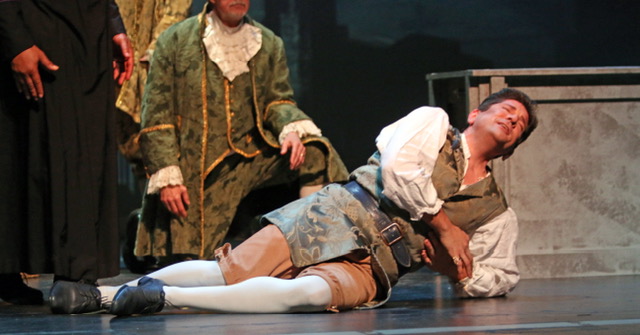
From the opera ‘Lucia di Lammermoor’ by Donizetti, singing the role of Edgardo, with the Boheme Opera of New Jersey | Courtesy photo / Boheme Opera

“Winning a competition by The Metropolitan Opera in 2000 was a big deal as it opened many doors. The next year I won a foundation competition and moved to Berlin where I lived and worked for three years; I was in my 20s. That led to performances in Italy and elsewhere in the world.”

In the years hence, Wilander has performed in 20 countries. And if this year’s engagements were any indication, he could be looking forward to seeing many more places.

“I was in San Francisco in January, San Luis Obispo in February, Alaska in March, Mississippi in April, then in Barbados for a week, and Germany for two months,” Wilander details. “I came back here and did a concert for my stepmom Marilynne held at the First Methodist Church in Pasadena, where she has been a member of for 50 years. I just finished an opera in New Hampshire.”

Wilander’s association with Verdi Chorus began almost two decades ago. He relates, “I knew Anne Marie Ketchum, Verdi Chorus’s conductor and founding artistic director, when I was a Cal State undergrad. She was in charge of the Pasadena City College (PCC) opera theater program at that time. Someone told me they were doing a Bernstein/Gershwin revue and they needed some male tenors so I called her up. To this day, I think fondly of that concert because those two composers are such geniuses.

“Anne Marie and I became friends and we would get in touch from time to time. Around 2013, we met for lunch and she told me about Verdi Chorus. She said they hold two big concerts a year and invited me to be a tenor soloist; I think this will be my fourth time with the group.”
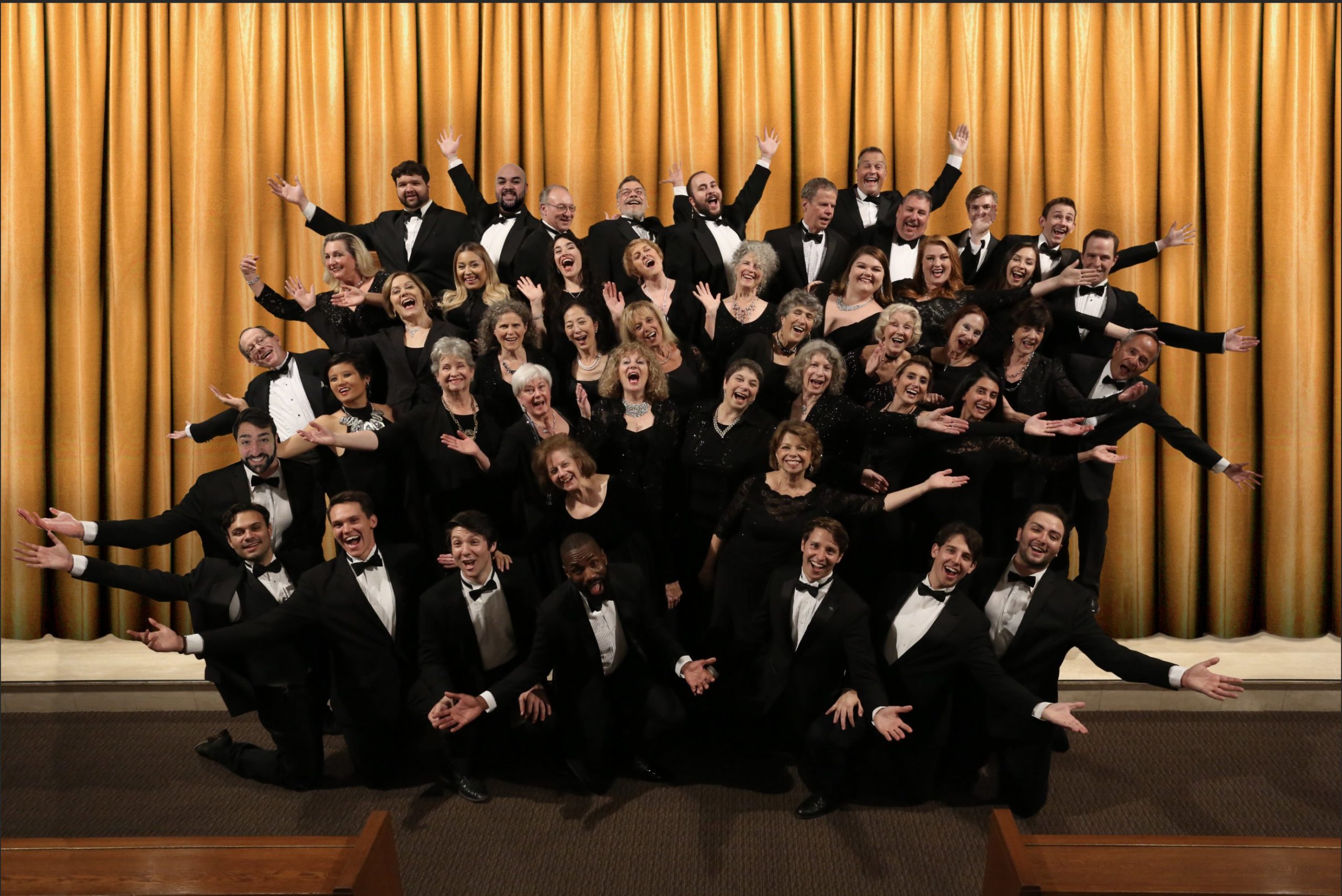
The Verdi Chorus | Courtesy photo / Tim Berreth

The Verdi Chorus was founded in 1983 at the Verdi Restaurant in Santa Monica. When the restaurant closed in 1991, the Verdi Chorus continued. It is the only choral group in Southern California that focuses primarily on the dramatic and diverse music of the opera chorus. Every Monday night, over 50 singers from every walk of life, ranging in age from 18 to 80, gather together to become the Verdi Chorus.

“This concert is a great opportunity for people to hear a wide variety of the Top Ten Opera,” Wilander describes. “It’s not a full stage A to Z production – we’ll do selections from Verdi’s ‘Aida’ and Boito’s ‘Mephistopheles.’ We’ll do a big chunk of ‘The Tales of Hoffman’ by Offenbach and ‘Samson and Delilah’ by Saint-Saens. So it’s French, German, and Italian.”

“There will be no orchestra, only a piano. While it’s not the same thing as an opera in the sense that the performers will be in tuxedos and gowns, I will still be able to do a limited amount of acting a role. So it’s really about making music with the voice and connecting with the pianist and the audience.”

Opera takes Wilander all over the world and he lives full-time in Manhattan, where he’s had an apartment in Washington Heights for the past ten years. But when he isn’t touring, he returns to Arcadia and picks up where he left off.

“I’m an only child and my parents have always been very supportive of me and my career,” Wilander discloses. “My mom was a huge influence in my life as a musician and as a human being. She always encouraged me to follow my passions and to do my best to make the world a better place. A few days before she passed away in 2010, she told me that every time I perform on stage and feel the spotlight following me, ‘Just know that it is me, beaming down on you from the heavens with grandma. Our hearts are full of pride that you’re sharing with everyone your God-given gifts.’ I still think of her words daily and am continually grateful.

“Her service was held at Lake Avenue (Congregational) Church in Pasadena. About 80 choir members sang and it was absolutely beautiful. Every Christmas I come back to sing with the Lake Avenue choir led by Worship Music Director Duane Funderburk.

“To this day, I stay with my dad when I’m in town. And with my mom gone, he makes sure I know that he is behind me emotionally, financially, and spiritually. Having that unconditional support is a blessing in this kind of work with such highs and lows. You could be performing in front of 2,000 people only to go back to a hotel and be by yourself. There are no groupies for opera singers.”
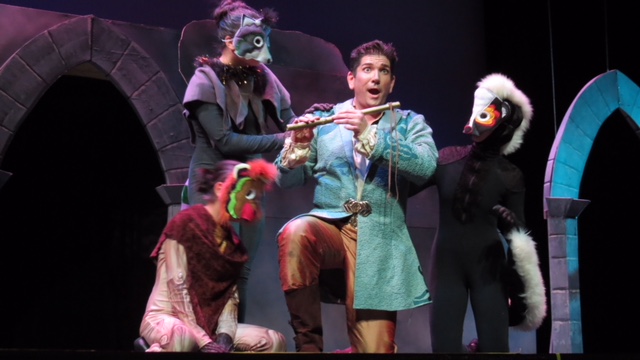
Todd Wilander as Tamino in Mozart’s ‘Magic Flute’ at Opera Fairbanks, Alaska | Courtesy photo / Opera Fairbanks

“There are gratifying moments, however,” Wilander quickly adds. “Like when someone says to me ‘Your passion made me feel something,’ or ‘That song was what my father listened to,’ or ‘Even if you were singing in French, I followed your character so well I understood his heartache.’”

Asked if he has a favorite opera, Wilander quips, “My funny answer is ‘the next job I’ll be doing.’ Clever remarks aside, I’ve had the most success with Italian composers like Donizetti, who wrote ‘L’elisir d’amore’ (The Elixir of Love). He composed operas about English Royals – ‘Elisabetta,’ ‘Anna Bolena’ ‘Maria Stuarda.’ I love historical operas. While he embellished here and there, his operas were pretty accurate.

“Now that I’m older and my voice has settled more, I can sing a lot of Donizetti’s works. In the same way that now I can do Wagner … which is great because his works are harder to cast. Twenty-year olds can’t possibly sing Wagner or they’ll ruin their vocal chords. Singers have to move on to the operas as they gain age and wisdom and emotional connectedness with the character.

“I can execute more Verdi and Puccini and I can project against a 60-piece orchestra, that’s very lush and big. Opera singers don’t wear microphones so shows are usually not held on consecutive evenings to give us time to rest our voice.”
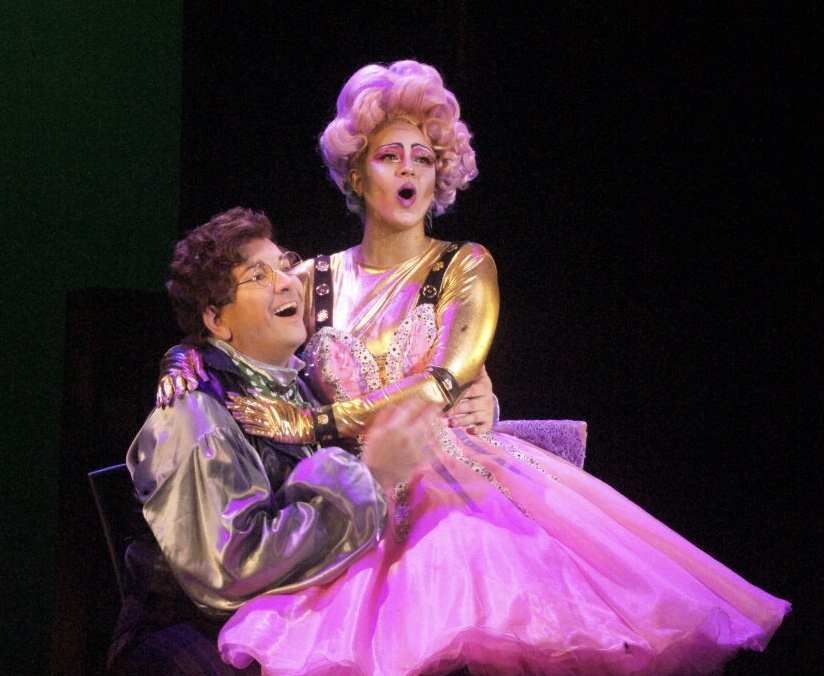
Todd Wilander singing the title role of Hoffman in the opera ‘Tales of Hoffman,’ by Offenbach, at Opera North summer festival | Courtesy photo / Opera North

Wilander has sung in so many operas but every new role still induces the same thrill as when he first started out. He happily divulges, “My next big engagement will be with Opera New Jersey in March when I get to be Radames in Verdi’s ‘Aida.’ Then in April, I will be with the Tampa Bay Opera in Florida to sing in Puccini’s ‘La Boheme’ as Rodolfo. Other opportunities coming up include a concert in Germany and other New York concerts in the Spring. I don’t have a dream role but there are some roles I would like to perform again; and I’d love to do ‘Tosca’ one day.”

What the future holds can sometimes be a complete surprise as in Wilander’s case. “I didn’t grow up with opera; my parents didn’t either. They took me to The Ahmanson in downtown L.A. and we watched musical theater. I’d only sung Latin in Church when I was young. My love for opera started in college, but even then Cal State didn’t have an opera program.

“But opera has been a part of who I am as a person and I can’t imagine life without it. After all these years, I am still amazed at how each live performance is different because anything can happen. There was one concert when I slipped and slid across the entire length of the stage, but I didn’t skip a beat singing. There are nights when someone would be in remarkable form, or a singer would be struggling, or someone had a fight with his girlfriend so his head would be in a bad place. But all those emotions could be transferred to the words you’re singing.

“Opera is such a wonderful art form that imbues all kinds of sensations and experiences. It isn’t just a bunch of people in costume, singing in a foreign language. It transports audiences to places – fighting wars, falling in love, being rejected – to make the characters and stories a part of them.”

“There’s a reason that opera has lasted over 400 years – because it tells a story of love, passion, betrayal, anger, of human emotions every one of us goes through each day. And, in the world we live in today, it’s good to be reminded that there’s more than what we see on CNN and Fox News. There’s more humanity and love to go around.”
Charles W. Eliot Arts Magnet Academy Inaugurates its Own Costume Shop

Originally published on 30 October 2018 in the Pasadena Independent, Arcadia Weekly, and Monrovia Weekly

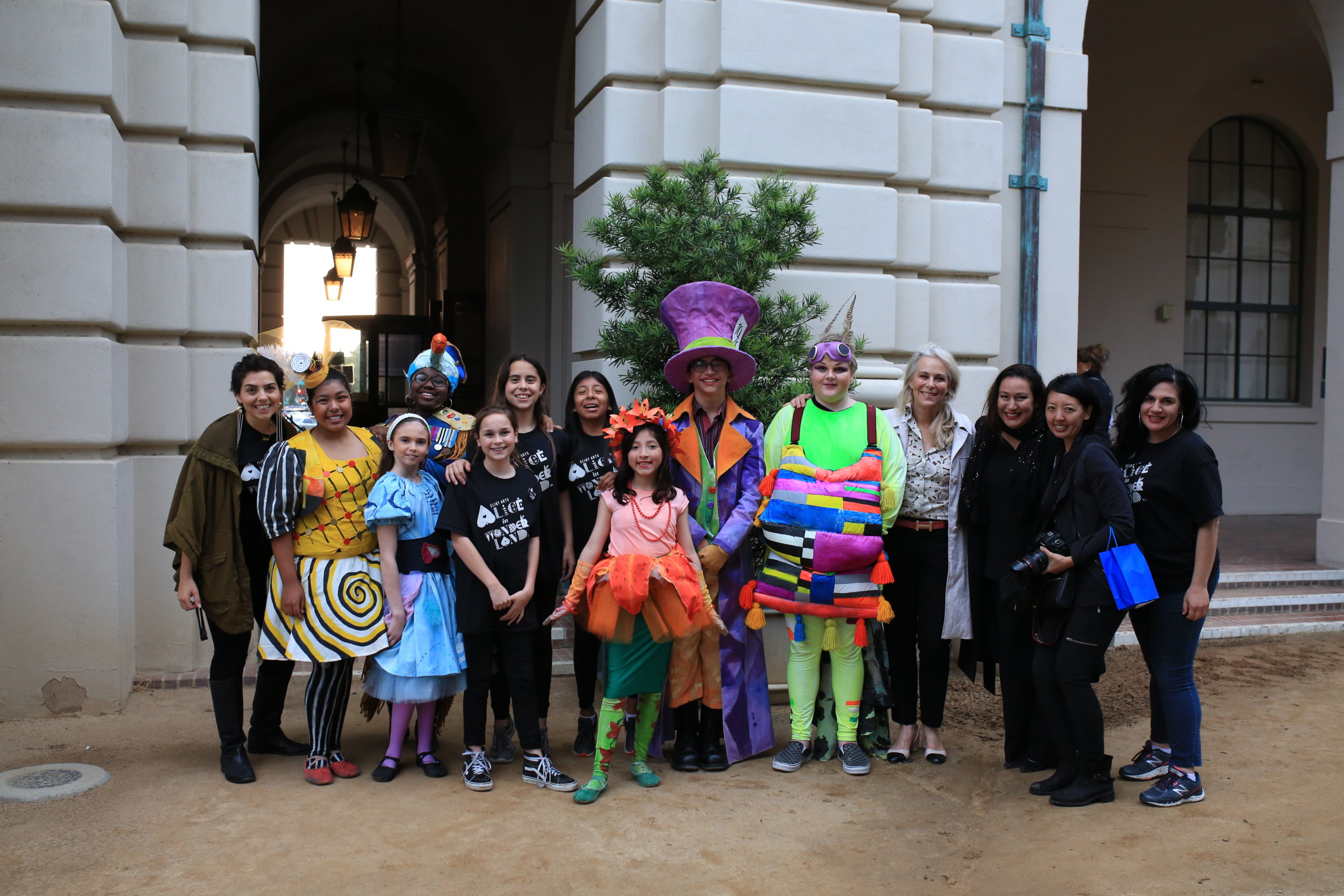
The Eliot Arts team poses with its newest fan, actress Jane Kaczmarek, at Pasadena Educational Foundation’s ‘Breakthrough Student Interactive Showcase’ at their annual ‘Celebrating Our Schools’ event. Left to right, Drama teacher Micol Issa, student actors and costume designers, Kaczmarek, Principal Lori Touloumian, Visual Artist-in-Residence Liane Shih, and Theatre Artist-in-Residence Lory Tatoulian | Courtesy photo / Molly O’Keeffe

The middle school musical was ‘Alice in Wonderland.’ As the students were getting ready for rehearsals, Micol Issa, 6th grade English and Drama teacher at Charles W. Eliot Arts Magnet Academy (Eliot) in Altadena, who was also directing the production, had a sudden inspiration, “Instead of shopping for costumes for the show, why don’t we make them ourselves?”

Never mind that it was January and the production was slated for May. Indeed, many would have found that prospect daunting. Where would they find designers? Who, besides Issa, even knew how to sew?

But Eliot was the top Arts School in the Pasadena area and it had a reputation to uphold. So everyone got behind her idea quickly. Students, parents, teachers, and administrators sprang to action to make Issa’s brainstorm a reality.

Issa’s ambitious concept would not have been do-able had it not been for a grant that transformed the school to what it is today. Lori Touloumian, Eliot principal, informs, “In 2013, this school, then known as Eliot Middle School, was one of four academic institutions awarded the magnet schools assistance program grants of $7.9 million each to have its own integrated theme. Eliot, in particular, was designated as a Visual and Performing Arts (VAPA) school.

“To ensure cohesion of the district’s schools and initiatives, there is one person who has oversight over all the magnet programs. We’re fortunate to have Shannon Mumolo in this capacity. As the Magnet Schools Assistance Program (MSAP) Program Director for the Pasadena Unified School District, she oversees the budget and implementation of magnet programs funded by the U.S. Department of Education. She has been an MSAP Project Director since 2015 and previously served as the MSAP Site Coordinator for Eliot Arts Magnet.”

“Through the grant, our teachers went through specialized training on how to integrate the experiential approach to art into the core classes of English, history, math, and science,” discloses Touloumian. “We have resident artists who work with teachers on site during the school day and after school who work directly with students on various projects. We’ve also partnered with the Huntington Library to offer free after-school programs every Tuesday and Thursday afternoon.

“While adhering to the district’s established curriculum for the scope and sequence of the arts program, the teachers have been empowered to make decisions in terms of what art project they will do in their core class and they are free to set up the time with the resident artists. The school follows the common core standards and the artists in residence come in with expertise in the arts standards to weave the two together.”

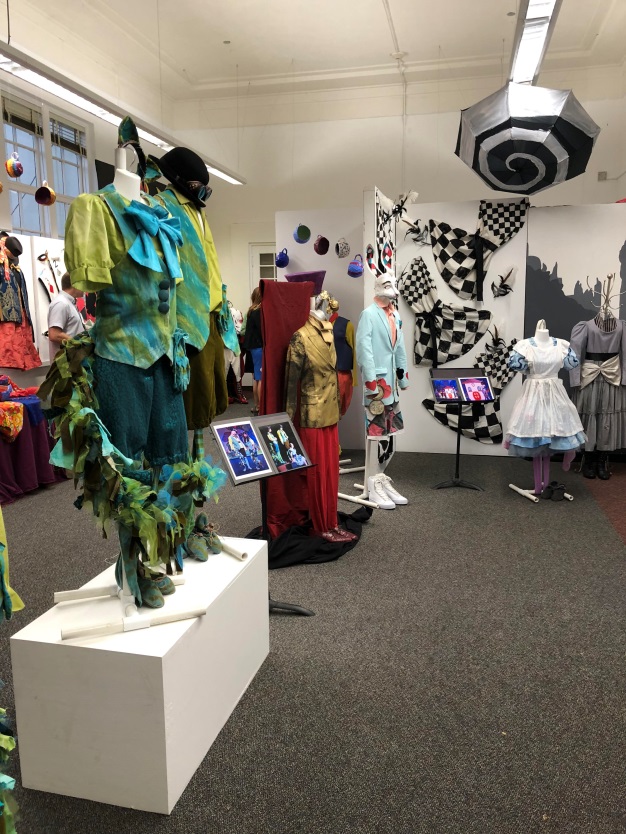
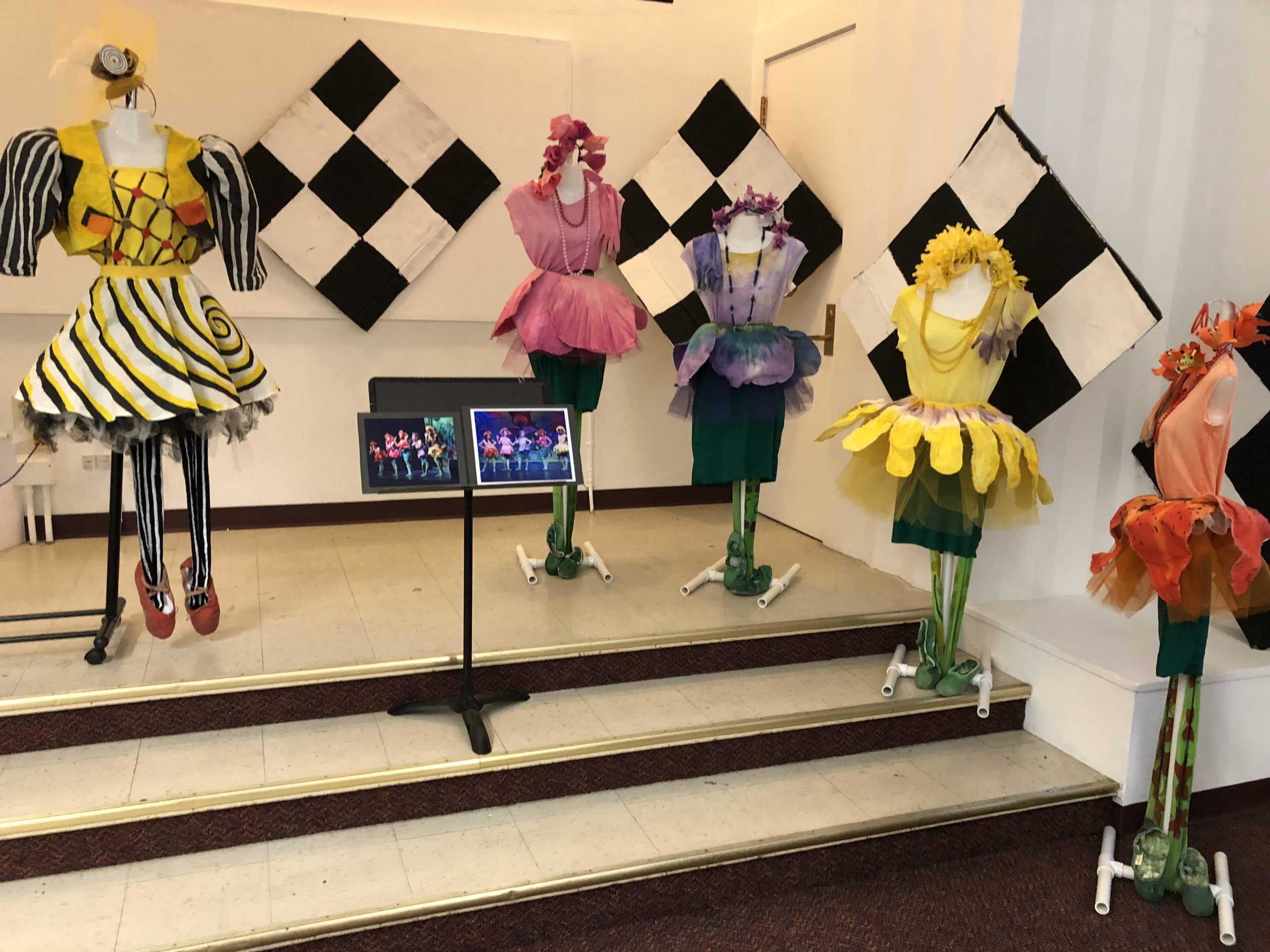
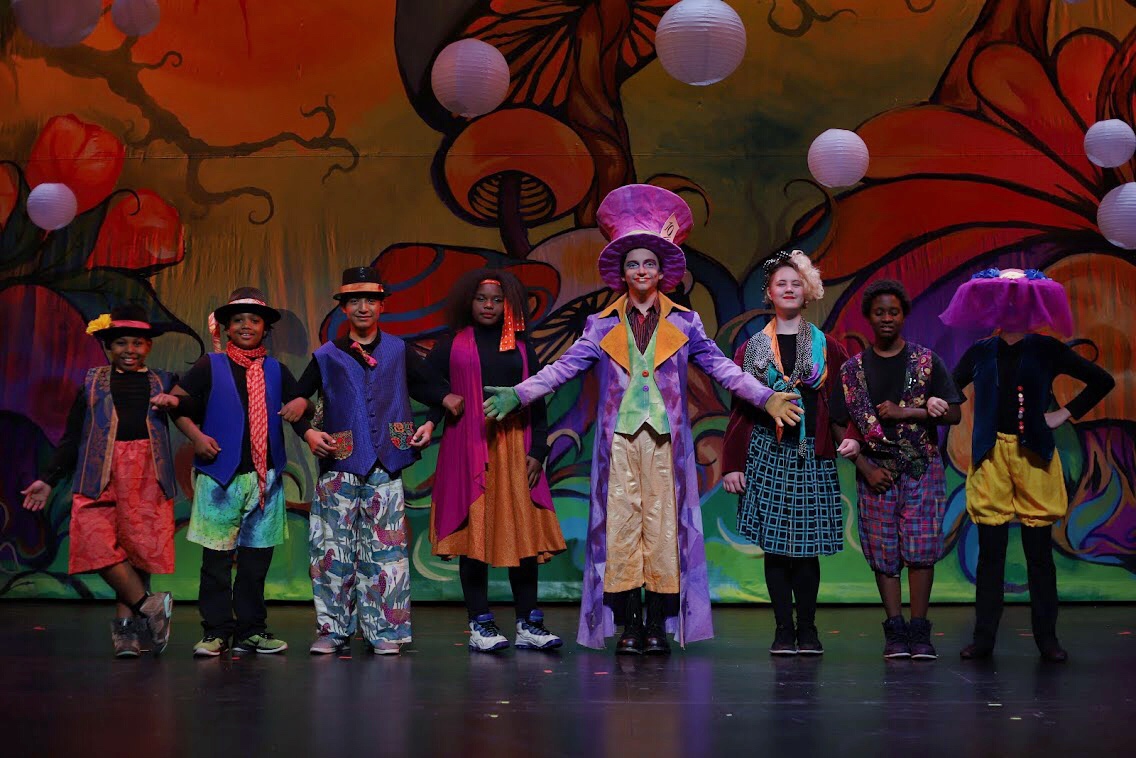
In Eliot’s new costume shop, parents and artists-in-residence taught students how to sew their own costumes such as the shorts and pantaloons worn by guests to the Mad Hatter’s tea party. The Mad Hatter wore a handmade hat and hand-painted jacket designed by students themselves | Courtesy photo / Marc Flores

Touloumian says further, “Additionally, we were to able create art-maker spaces on campus – we  revamped our dance rooms with more equipment, we transformed a former parent room into an art gallery which is now utilized as a community center where our students and community artists can hang their art, and we added a ceramics room and a media lab on campus.

“We are now a fully integrated arts academy. Students can choose what elective classes they want to be in but even if they choose not to attend a specific elective class they may still have the visual arts experience in their English, history, math, or science class, or after school.”

Cheili Lopez, a 7th grade student who participates in the arts classes and after-school program, says “I’ve just started the printing shop on Tuesdays and Thursdays with Mr. Duffy, and on Fridays I go to the costume shop. Through the arts classes, I’ve been able to make things for my family – I sewed an apron for my mom and I made a jug in ceramics class which I gave to my parents for Christmas. They were very happy because the items weren’t store-bought; I made them myself.”

“Everything we do here is connected to the Arts,” Issa explains. “We’re trying to rebuild the school culture and create spaces for kids to have multiple avenues of access to the Arts. Not everyone wants to act, but this is another way for kids to participate in the making of performances, and Cheili is an example of that.

We realized that something we needed, not just for the drama and choir program but also for dance classes, was a costume shop. That was the goal we tried to work towards last year, which launched us into this next level. Now, we have six sewing machines, two sergers, and an embroidery machine. We basically have a sewing club that meets every Friday after school.”

“In the past, we assigned people to find the costumes for specific characters,” details Issa. “But, like I said, we need costumes for all our productions so I took the idea of having a costume shop to Denise, the artist in residence. She, in turn, went to Lori and said ‘If you will okay the costume shop, I’ll write the grant,’ and she did.

“Of course, I had to justify why I thought a costume shop was necessary. I argued that it’s something that would be great for the program as a whole and we had the expertise on how to run a costume shop on campus. Denise and I know how to sew, then we discovered that so many parents also have that skill. So what it really did was brought more people on campus.

“Through Facebook, people shared with everyone our donation list and what I was hoping to accomplish. People donated patterns and dropped off whatever they could contribute. Everyone was happy to give and appreciated that we were teaching kids how to sew.”

A visit to a museum was the inspiration for their musical’s look. Issa recounts, “I went to an exhibition of Marc Chagall costumes at LACMA and I was astonished because it was exactly what I envisioned for ‘Alice in Wonderland.’ So I took the kids on a field trip to see the show and when we came back we started designing.

Students fused the modernist styles of the Bauhaus movement with the loose painting styles of artist Marc Chagall to design each of the show’s whimsical costumes | Courtesy photo / Shannon Mumolo

“We found real pictures of the Chagall costumes. And under the guidance of our artist in residence, we taught the kids how to draw and make patterns, to paint them with colors, and to sew inside out.

“Because of the large number of costumes that needed to be finished, it was a community effort. Students, teachers, and parents spent a lot of late nights and weekends sewing. And, while not each costume was made entirely by kids, they worked on every one.”

Lopez was one of the students who made the costumes and she acquiesces, “Each costume was a group effort. Several students worked with an adult to work on one and when we didn’t finish that day, we went back to it the following afternoon.”

The experience proved to be constructive for Lopez not only because she learned how to sew. She says, “We do a lot of projects in regular school so doing the after-school costume shop helps me collaborate with other students.”

Issa points out, “What they do in the costume shop translates, however indirectly, with their core classes. They go through the same procedure of calculating, of figuring out a problem, much like in math class. They have to assess how thick they need to make the paint to have the effect that they want. So they experiment with a lot of color samples to figure out what consistency to use so it doesn’t just turn into watercolor but, at the same time, doesn’t make the fabric super stiff. That’s a process that applies in science class.”

“The show ran for three days and all the costumes held up,” Issa says with pride. “There were minor repairs which we made between shows. The incredible thing about this, also, is that it gave me additional crew on top of the stage team. From now on, the costume crew is in charge of queue-ing the costumes – making sure they’re in the right place – and noting what needs to be repaired so we can make them the next day.

Eliot’s spring musical proved to be a smashing success. Raves Issa, “Our ticket sales for the show was tremendous. We sold over $1,000, which was more than what our previous shows generated. Then, on October 10, we held our first official gallery opening featuring the costumes from last school year’s spring musical ‘Alice in Wonderland Jr.’ We invited the District and Community Arts Team, and all our Altadena, Pasadena, and Sierra Madre partners – from dance to theater companies – and they all came to see the exhibit.”

The show’s handmade costumes were installed in the school’s art gallery this fall for the opening exhibition: Chagall and the Bauhaus Meet Alice in Wonderland. They will be on display until December 2018 | Courtesy photo / Shannon Mumolo

The display, which goes on until December, highlights a very specific artistic vision. Issa describes, “The costumes in Eliot’s production of Disney’s ‘Alice in Wonderland’ are unlike any other version of the show you have seen because it was inspired by the artist Marc Chagall and the Bauhaus design movement.

“Chagall, well known for his paintings and stained glass windows, also designed costumes for the Metropolitan Opera and New York City Ballet. You will see some of his designs and paintings represented in our own costumes and sketches. As we researched and sketched our vision for Wonderland into life, we decided to add in the modern and otherworldly influence of the Bauhaus design movement. Categorized by basic shapes, lines, and spirals, we fused the modernist style of the Bauhaus movement with the loose painting styles of Chagall.”

“We’ve had previous exhibits but they were open after school mainly for parents and students,” clarifies Issa. “This was our first gallery opening held on a specific night for the entire community, complete with a bake and beverage sale. It demonstrates the amazing work that can be done when students, teachers, parents, and community partners collaborate. We’ll be forever grateful for the generosity of the Pasadena Showcase for the Arts and the Pasadena Educational Foundation for their support in making Eliot a premier arts school in the area.

“It was truly a project that involved a great many students – 140 kids took part in our costume shop, out of our total student population of 545. That’s 23% of the student body. What’s more, this endeavor inspired others so we have doubled our numbers in the costume shop. Even those students who weren’t able to participate in the after-school program worked around their schedule to be in the costume shop.

“We started the Friday costume shop early this school year so we could teach the kids sooner and, in time, they would be able to sew the bulk of the costumes themselves. Our next musical is ‘Hairspray’ and we’re creating the costumes again. But because this show happens in our world, we’ll probably use some of the basic costumes we already have, instead of making them from scratch. That’s the cool thing about having a costume shop – it has given us the ability to use  something that already exists by altering it to fit our needs.”

Issa is now just entering her third year at Eliot but, already, she has been instrumental in giving it the distinction of being the only middle school with a costume shop. But, more importantly, she  has successfully incorporated in its program an invaluable skill that will serve middle school students long after they leave Eliot. Nay, for life.

L.A. County Arboretum’s ‘Moonlight Forest’ Brings People Together in San Gabriel Valley

Originally published on 16 October 2018 in the Pasadena Independent, Arcadia Weekly, and Monrovia Weekly

A ‘Moonlight Forest’ display at The Arboretum | Courtesy photo / Tianyu Arts & Culture, Inc.

Be transported to an enchanted evening wonderland when the Los Angeles County Arboretum and Botanic Garden (The Arboretum) in Arcadia displays hundreds of magnificent lanterns depicting exotic animals, shimmering flowers, whimsical pandas, soaring dragons, and other themes to create a mesmerizing ‘Moonlight Forest.’

The Lantern Art Festival celebrates the time-honored tradition of lantern-making and features Chinese performing arts and crafts. It goes on from October 26, 2018 through January 6, 2019, 5:30 to 10 pm.

Richard Schulhof, CEO of The Arboretum declares, “Our vision for the Lantern Art Festival is to commemorate this wonderful traditional art form from China and set the lanterns amidst the landscape of the L.A. County Arboretum. It’s nature meeting art and culture, and bringing together the different communities in Los Angeles.

“Spanning a mile’s path of travel, the lantern displays will begin from the lawn area, then goes into the forest and around the lake, and by our landmark Queen Anne Cottage. In addition to the lanterns, we’ll have traditional Chinese performing arts – acrobats, face-changing dancers, and jugglers. We’ll have food trucks and various libations.”

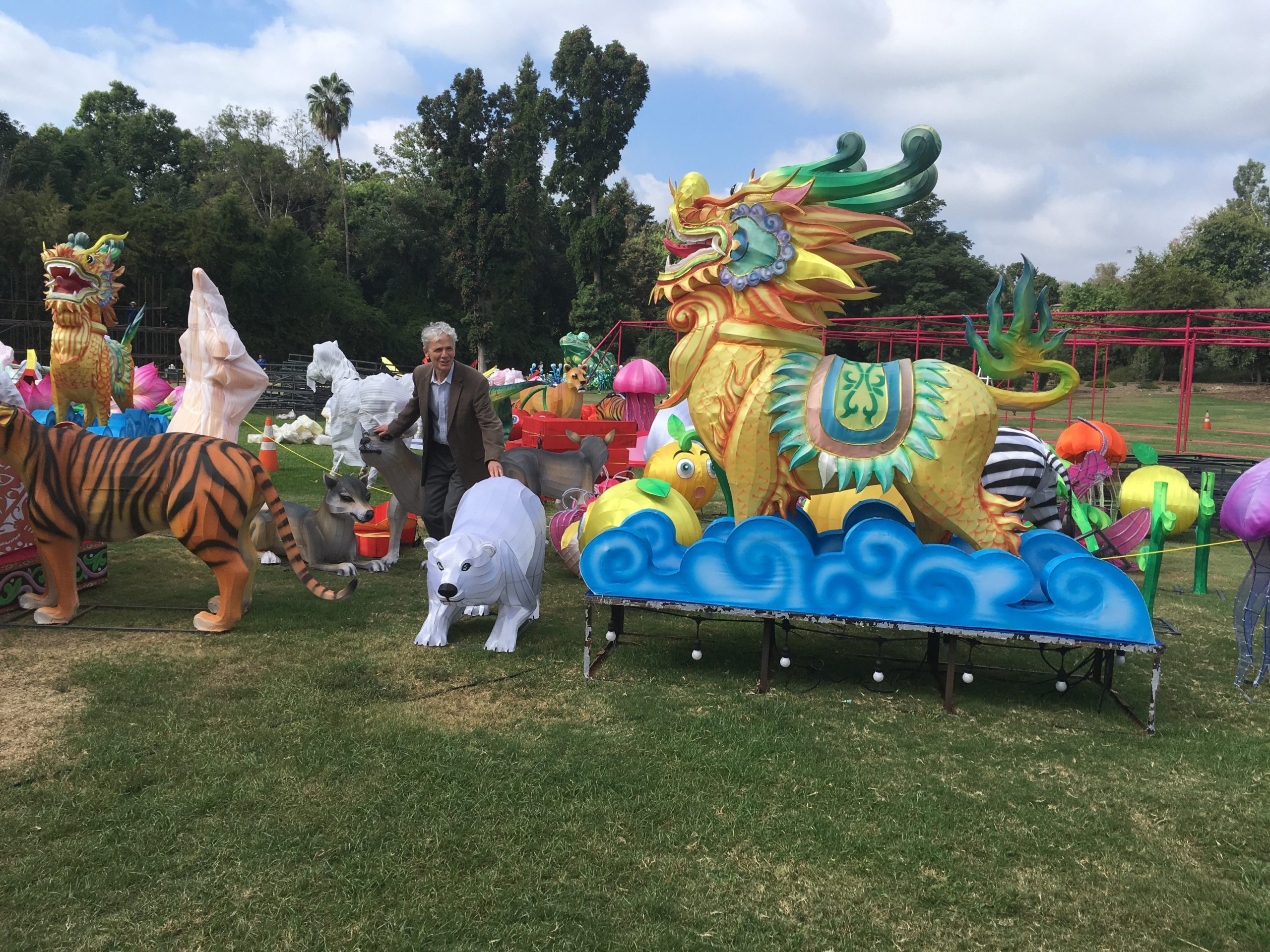
Richard Schulhof looks at the animal lanterns | Photo by May S. Ruiz / Beacon Media News

‘Moonlight Forest’ is the culmination of a year’s planning and preparation. Relates Schulhof, “Last October, Tianyu Arts & Culture Inc., the American subsidiary of the international design and manufacturing company Sichuan Tianyu Culture Communication Co., contacted me to discuss a possible collaboration.

“I familiarized myself with the art form and the company’s work by visiting the different lantern festivals they were holding in Charlotte, Virginia Beach, and Las Vegas. I learned that lantern art utilized traditional materials that were used 500 years ago. The advent of new materials and construction methods allowed for an elaboration of this traditional art form and the lanterns you currently see represent that.

“The center for this craft is a town named Zigong in Sichuan, near the city of Chengdu, where this art form is still practiced today. Tianyu Arts & Culture creates festivals all over the world – Europe, Australia, and North America. It’s quite surprising that there has never been one of this scale in the San Gabriel Valley. And given the confluence of cultures in the region, particularly East Asian, it’s only fitting and natural to bring the lantern art festival here. We’re thrilled that this debut event is happening here at The Arboretum because I see this as a meeting place of cultures.”

The lanterns reflect three themes: Chinese culture – iconic images and traditional themes like the harvest moon feast; nature – animals and plants; and children – fairy tales and fables to delight kids and the child in all of us.

Schulhof’s excitement about this event is abundantly evident when he takes me on a tour of The Arboretum grounds where workers are busy setting up structures on which the lanterns will be installed. He explains that some of the exhibitions are quite complex and points to a large construction underway that he presumes will be that of the Forbidden City, which used to be the imperial palace in the Ming and Qing Dynasties.

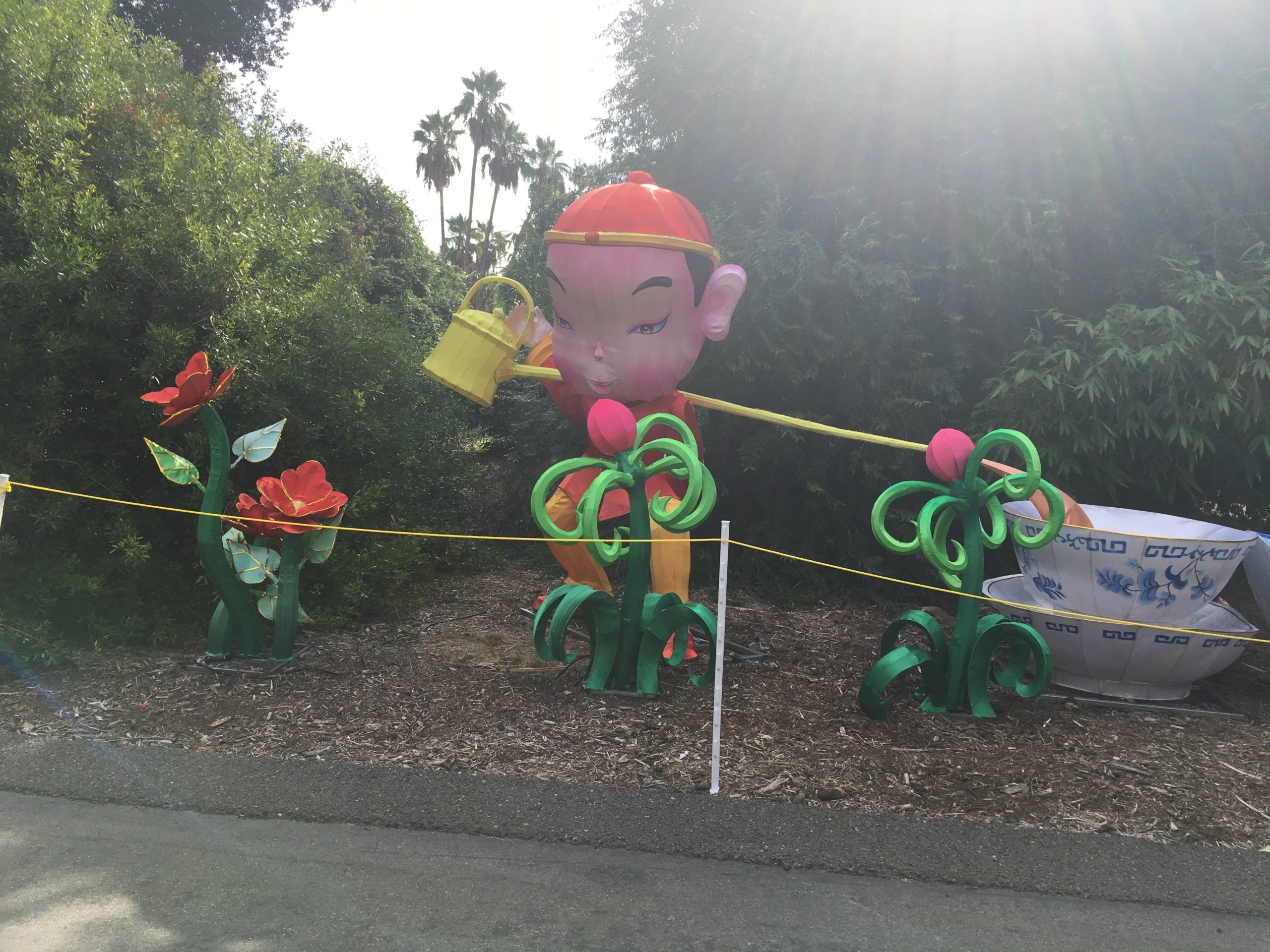
A display of a man serving tea | Photo by May S. Ruiz / Beacon Media News

As we approach a display of a man serving tea, Schulhof stops and gets out of the golf cart he’s driving to enthuse, “When I was in Kunming, in Yunnan province, I was hosted by the Kunming Botanical Garden and the server was dressed just like this. They carried teakettles with these long spouts and they could pour tea into your cup from six feet away. It was absolutely amazing to see that.”

At this point we’re attracting the curiosity of people who are on their morning walk at the garden. Schulhof very animatedly enlightens the little group about the lanterns with the enthusiasm and exuberance of a little boy showing off his prized toy collection.

We reach an area with the animal lanterns and there are lions, tigers, giraffes, pandas, and some animals indigenous to California – bears and coyotes. Schulhof points out little details on them, like the hand-painted eyes of the animals.

“And because this is The Arboretum, there will be a couple of peacock lanterns. They’re the most spectacular peacock lanterns they’ve ever done! People here have very high expectations when it comes to peacocks,” Schulhof tells a couple of ladies who are also inspecting the array before us.

Schulhof stands next to a terracotta soldier | Photo by May S. Ruiz / Beacon Media News

The lanterns of the terracotta warriors from Xi’an province are Schulhof’s particular favorite and he walks over to where the figures are clustered. He informs with confidence, “If you look closely you’ll see that the soldiers have different faces and when illuminated they are glowing, golden beams.”

There’s quite an interesting bit of Chinese history connected to the terracotta army. The first Qin Emperor, Qin Shi Huang, who ruled from 247 to 210 BC, built this army of warriors, chariots, and horses made entirely of clay and were buried with him to guard him in his afterlife. They remained there undiscovered until 1974 when they were excavated by accident by local farmers. Today the Mausoleum of the first Qin Emperor is a UNESCO World Heritage site.

Our tour ends at the lawn and fountain area, and Schulhof directs my attention to a tree, “The Arboretum was founded in 1948 and one of its goals was to bring new plants to Los Angeles to beautify the city. That is the silk floss tree from South America, one of our most successful introductions, and this is its peak blooming period. We have several of them all over the garden; so people will be enjoying the lanterns and our beautiful silk floss plants at the height of blossom all at once.

Photo by May S. Ruiz / Beacon Media News

“Every year, 400,000 people visit The Arboretum. What they see during the day doesn’t even compare to what they’ll see at night during our ‘Moonlight Forest.’ The Lantern Art Festival, with its more than 60 exhibits and over 500 lanterns, gloriously demonstrates the artistry, craft, and skill of Sichuan artisans and will surely add some magic to the visitor experience.”

Schulhof is familiar with Sichuan province, where this craft originated. Back in 1997, when he served as Executive Director of Descanso Gardens, he was in Sichuan collecting camellias. But because he was in the countryside, he didn’t see any lanterns.

Starting next week, and for ten weeks thereafter, the lanterns that eluded Schulhof in Sichuan two decades ago will be the magnificent centerpiece at The Arboretum’s ‘Moonlight Festival.’ And he is hoping that not only do they bring delight and joy to those who behold their splendor, but also bring together the various communities in the San Gabriel Valley in one magical celebration.

The Playhouse Celebrates Halloween with ‘The Woman in Black’

Originally published on 15 October 2018 in the Pasadena Independent, Arcadia Weekly, and Monrovia Weekly

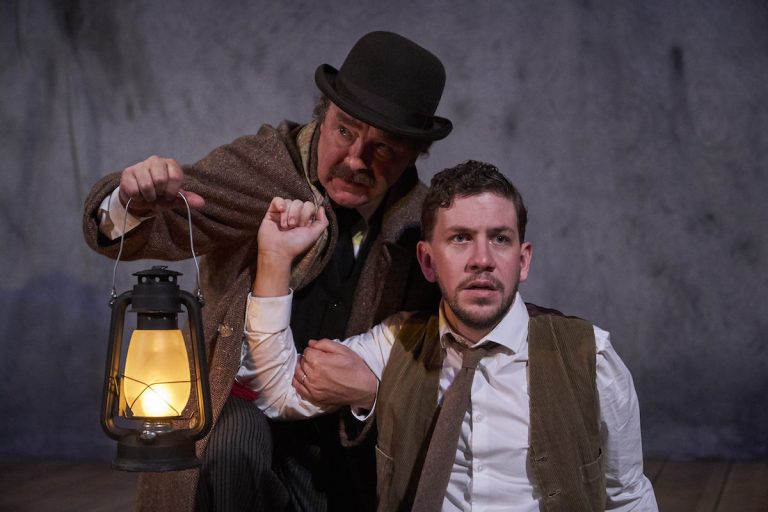
Bradley Armacost and Adam Wesley Brown in Susan Hill’s ‘The Woman in Black’ at the Cleveland Playhouse | Courtesy photo / Roger Mastroianni

London’s second longest-running West End play ‘The Woman in Black’ will premiere on the West Coast at the Pasadena Playhouse from October 17 to November 11, just in time for Halloween. With all the stage wizardry that has led audiences in London to shriek in fear for over 28 years, it promises to live up to its reputation as one of the most terrifying theater events ever mounted.

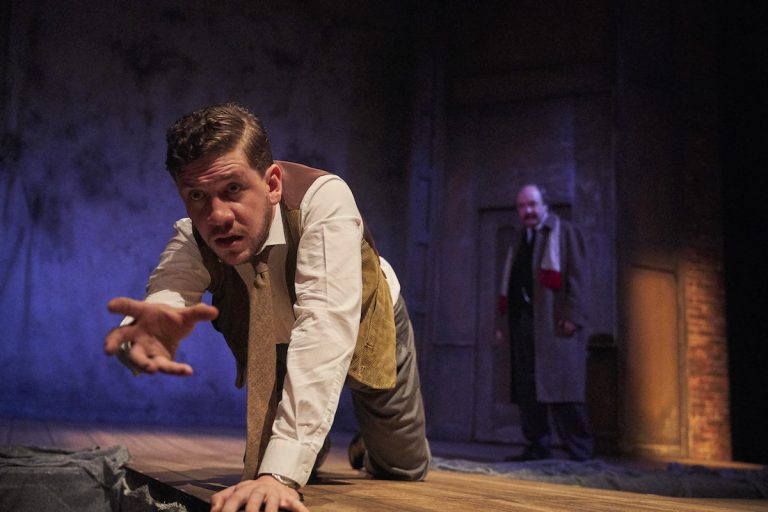
Adapted by Stephen Mallatratt from a novel by Susan Hill, the play is directed by Robin Herford, who has also helmed all its productions in Tokyo, India, Singapore, Hong Kong, Australia, and New Zealand. He is recreating his original staging for the first time in the United States with Bradley Armacost as Arthur Kipps and Adam Wesley Brown as The Actor.

Hill’s Gothic ghost story is set in an isolated windswept mansion which has secrets hidden behind its shuttered windows. There, a young lawyer encounters horrific visions in the house set amidst the eerie marshes and howling winds of England’s forbidding North Coast.

Years later, he tells his frightening tale to exorcise the terror that grips his soul. Mallatratt’s adaptation is a play within a play, with Kipps rehearsing with an actor to perform the story for his family and friends, thereby making him relive the haunting of Eel Marsh House.

It all begins innocently enough, but as he reaches further into his darkest memories, he quickly finds that there is no turning back. With just two actors, ‘The Woman in Black’ gives audiences an evening of unremitting drama and sheer theatricality as they are transported into a chilling and ghostly world.

Speaking by phone, Armacost describes how he almost didn’t get the role of Arthur Kipps, “Robin Herford cast the play in Chicago at the same time I was playing in Washington D.C. so I wasn’t able to come to the audition. When they had finished casting, he asked if there was someone else they were thinking of for the role and my name came up.

“I did a scene on my iPhone and sent it to the casting director, who passed it on. They caught up with me at an airport where we had a casting session of sorts. I had a half-hour Skype conversation on my iPad with Robin, who was in London. We got on quite well and the next thing I knew I had the role; I found it funny because he had no idea if I even had a leg since all he could see was my face.

“Robin came in from London for the two-and-a-half week rehearsal in Chicago and stayed through the opening in Cleveland. He had to fly back to London for opening night of the 12,000th performance of ‘The Woman in Black’ in London.”

While it has been running in London for almost three decades, Armacost hadn’t seen it. “I was unfamiliar with the play but I knew there was a 2012 film with Daniel Radcliffe whom everyone knows as Harry Potter. I’m surprised my son didn’t bring it to my attention.

Adam Wesley Brown and Bradley Armacost in Susan Hill’s ‘The Woman in Black’ at the Cleveland Playhouse | Courtesy photo / Roger Mastroianni

“I was told, though, that while the film has the same subject and is taken from the same novel by Susan Hill, it is completely different. In the film there are other actors performing various parts; in the play there are just two of us and we act out all the characters. I perform at least seven characters and my partner plays three. With only two actors on stage, you quickly realize that if he’s not talking, I am. And if I’m not talking, he is.”

That puts a lot of the burden of having to memorize so much dialogue on both actors. But that didn’t daunt Armacost. He says, “First of all, Susan has a good story and Stephen has written a magnificent script. There’s no fat on it, no unnecessary word. It’s to the point, so it’s quite easy to memorize and perform. There are silences in it but, hopefully, those are the moments when the audiences are most at the edge of their seats.”

Continues Armacost, “I can practically set my watch  and count three, two, one and … there’s a scream. There were times when someone in the audience would call out ‘Don’t go in that door!’ You can practically see them jumping in other people’s laps. The audience reaction is like an electric shock. The play opens and the audience is on an electric wire which keeps us moving. It may be one of the reasons the play is easy to memorize. It’s no wonder it has run for as long as it has. It’s truly a joy to perform in this play; it’s such an audience pleaser.

“It’s truly an honor to be involved in this production. We were very fortunate to be working with Robin who has been touring this play and has directed it for 30 years. While he has shared some short cuts on how to interpret it, he’s given us a free hand in making it our own. Every so often during rehearsal, in his very British way, he would say, ‘You might try ….’”

Asked what he finds compelling about ‘The Woman in Black,’ Armacost replies, “What truly stands out in this production is that everyone in the audience is another character and brings his or her own imagination. One dog on the stage can be as many different breeds as there are people in the audience. Each one envisions his own picture of what the scary mansion looks like. I think when audience members are that invested, they have a greater appreciation of the play.

“This is for someone who enjoys mystery and likes crossword and jigsaw puzzles; it’s a thinking person’s frightening tale. It’s not a life transforming play, it’s just a communal experience where the person next to you jumps and you do the same. Then you share a laugh together. And in times like these, when even the news is sometimes frightening, it’s fun to just be able to say ‘for the next two hours I will listen to this story and be like a kid again.’

“And, for me, it’s a delight to be a part of this clever production. The play, which only has two chairs and one doorway, holds the audience captive. It’s remarkable how something so seemingly uncomplicated has managed to frighten audiences for over a quarter century.”

‘Rosencrantz and Guildenstern are Dead’ Comes to Life at A Noise Within

Originally published on 8 October 2018 in the Pasadena Independent, Arcadia Weekly, and Monrovia Weekly

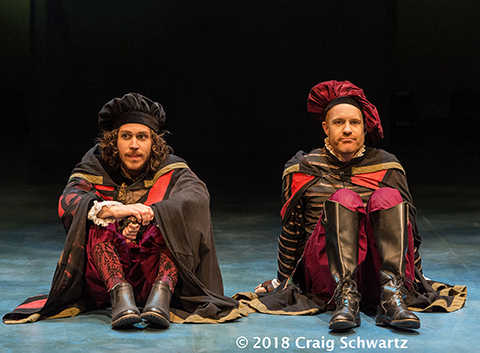
Pictured left to right: Rafael Goldstein and Kasey Mahaffy. – Photo by Craig Schwartz

Tom Stoppard’s ‘Rosencrantz and Guildenstern are Dead’ was first performed at the Edinburgh Festival Fringe (The Fringe) in 1967 to great acclaim. It established him as one of the greatest playwrights in modern times and his work, which puts to the fore two of Shakespeare’s minor characters in ‘Hamlet,’ has been staged throughout the western world.

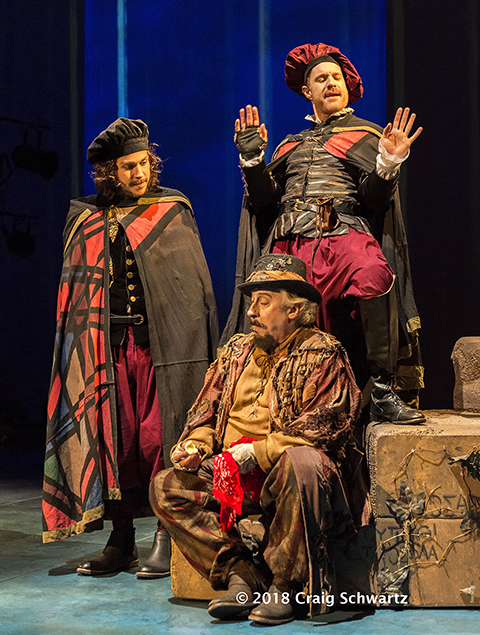
Pasadenans will get to experience Stoppard’s brilliance when ‘Rosencrantz and Guildenstern are Dead’ goes on stage at A Noise Within from October 7 to November 18. Directed by ANW Producing Director, Geoff Elliott, it stars resident artists Kasey Mahaffy as Rosencrantz and Rafael Goldstein as Guildenstern.

A Nosie Within distinguishes itself as one of the few repertory theatre organizations with a resident company. The resident actors’ genuine regard for one another manifests itself on stage and makes for richer, more nuanced performances.

“Rafael and I have known each other for four years,” Mahaffy discloses. “We know each other’s secrets, we’re two halves of the same coin. So we started the foundation from day one, jumping off from a place that some actors could only be familiar with on opening night.”

“I’ve worked with him in about half a dozen plays and I have admired him greatly as an artist. But our joke was that we never shared a word together. Even in ‘Henry V,’ where he played the king and I was the dauphin from France, his mortal enemy, we didn’t share a minute of stage time. We just never got a moment together. Finally, they threw us a bone. Now all we do is hang out and we’re sick of other,” quips Mahaffy.

“But, seriously, I’m grateful every day that Rafael is my screen partner and my safety net,” Mahaffy says hastily. “He’s incredibly prepared and diligent, which I expected coming in. He’s always fun to hang out with and joke with backstage.”

“What I like about Kasey is that he’s a grounding presence for me,” declares Goldstein. “I tend to spin off into the abyss. And Kasey is very practical; he listens and he responds. Every actor needs that and I have it in spades with him. His sense of humor leavens the existential morass that we find ourselves in in this play. He has all the laugh lines, as well. It’s been nice to sort of play the straight man to his comic character.”

“Like in any true functioning relationship, these two individuals, while widely different, need each other,” Mahaffy elucidates. “Guildenstern is a cerebral, logistical, driven character. And Rosencrantz is all fart jokes. But what’s so cool in Stoppard’s writing is that when one character  loses perspective and spins out, and both of us do it multiple times on the show, the other one immediately rises to the challenge and rescues the other. Every single moment in this play is a scale that he and I are leveling.”

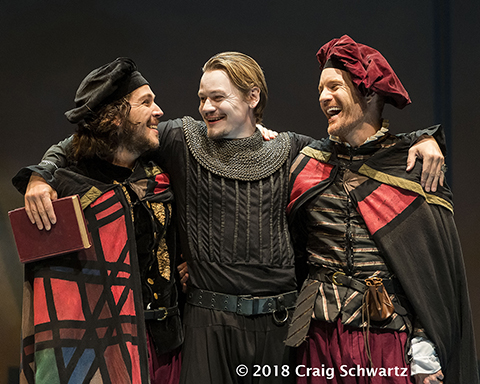
Pictured left to right: Rafael Goldstein, Paul David Story, and Kasey Mahaffy | Photo by Craig Schwartz

‘Rosencrantz and Guildenstern are Dead’ is not new to Mahaffy. “When I was doing my undergraduate thesis back in 2000, I had the role of Guildenstern. It’s amazing to hear those words again 18 years later. The dialogue is just fast, fast, fast, boom, boom, boom, like a tennis match. The problem is, sometimes I say his lines. It’s been 18 years but it sticks in the brain. So one of the great things about playing with him is that he’s shown me how to do that part. And how terribly bad I was when I did it then,” he admits with a laugh.

Goldstein says, “The virtue of him having done it before is that he was able to warn me about the pitfalls of this role too, and how to navigate them. He has something of a map to guide me about the play generally, like how the audience would react. Granted, that would change, but it’s something to have in the back of my head.”

Revisiting the play almost two decades later has given Mahaffy a better, deeper sense of it. “It is the heart of what I want to talk about today. The play, while told through comedy and existential theatrical device, is a treatise on life. More specifically, it is about these two characters who are stuck and are searching for their next move. They’re waiting for signs from the universe, other people, other souls, to tell them what they should do next. Like most of us, they are terrified about mortality and death. When I performed this at 20 years old, I was saying the words but I didn’t have a visceral understanding of their significance.

“This summer, my brother passed away prematurely, at 42 years old, and left a wife and two daughters. My parents were devastated and I’ve been reeling from it since. It made me think about what it means to me as a brother and as a son. As an artist, I have to put my life on stage no matter what’s going on in my life, whether it’s good or bad. There’s the line in the play …”

And Goldstein supplies the line, “There is no applause, there is only silence.”

“Yes. When you die, there is no applause, only silence and second hand clothes,” picks up Mahaffy. “Tom Stoppard is a certifiable genius. You can say those things when you’re in college but it’s not until you’re a 39-year-old man holding your brother’s shoes which were gifted to you … these second-hand shoes … that the gut punch meaning to the lines is actually delivered.”

“The theme of the play is Rosencrantz’s and Guildenstern’s imminent death,” Goldstein addresses further. “They know something is amiss, but they have an inkling, as we all do. We have an understanding that death is coming. And it’s every human’s journey how to reconcile the ultimate irrationality of our own demise. Moving through the world with that knowledge, how does one confront the absurdities of everyday life? How does one control aspects of one’s life to better comprehend the current situation? There is the questioning which activates a lot of philosophical ideas.”

“Tom Stoppard’s characters are people seeking agency in their life,” describes Mahaffy. “He wants to explore the questions ‘Are we subjugated to fate?’ ‘Are we tools at the hand  of God?’ ‘Or do we have our own power?’ ‘Are we the captain of our own ship?’ That’s the crux of what he wrote at 26 years old. He was still a baby! Such genius!”

Pictured left to right: Rafael Goldstein, Wesley Mann, and Kasey Mahaffy | Photo by Craig Schwartz

Goldstein enlarges on that thought, “The question, ‘Are we the captain of our ship, or are we set on a predetermined path?’ is completely outside of our understanding and perception. Are we just being moved along inexorably towards a predetermined end and no matter what we do, no matter what flailing action we might take to avoid certainties, we’re going to meet our end? You know, you can do as many push-ups as you want, you’re still gonna die!

“The play focuses on two minor characters in Hamlet. The title comes from a line in it, ‘Rosencrantz and Guildenstern are dead.’ There is no question. But to them, there has to be a possibility of reprieve, which they’re searching for in the entire play.”

Expounds Mahaffy, “The characters are determined to take a grip of their circumstances. They  wonder if they should turn right instead of left, forward or backward. They ask The Player, ‘What do we do? We don’t know how to act.’ And The Player answers, ‘Relax. Respond. That’s all we can do as humans.’

“This is a play about language and dialogue. Our set, even as it’s beautifully designed, is quite simple. It’s pretty much a stage with lights. I think it’s going to be a major treat for anyone who appreciates language and humor. And I want to make this clear, you don’t have to know Shakespeare. We don’t speak in Shakespeare vernacular. We talk like two people in 2018. It’s wildly funny and terribly heartbreaking all at once. It’s everything you want theater to be.”

“We’ll be wearing clothes that convey an Elizabethan flavor, but the way we speak to one another in the play is thoroughly recognizable,” Goldstein emphasizes. “Geoff Elliott, our director, has stressed for us to understand the words and communicate them as simply as we can. There is very little varnish to the way we interact with each other. It’s unadorned and straightforward. It’s two people just trying to survive and using the other person as a buoy, or a sounding board. That’s invaluable direction given the philosophical themes of the play. This is undeniably one of the greatest plays in the past century and I think people will come way from the production appreciating that.”

Even if not everyone agrees with Goldstein’s assertion, the one indisputable certainty is that Tom Stoppard didn’t let Rosencrantz and Guildenstern go down without a fight.

‘A Picture of Dorian Gray’ Depicts the Outcomes of Disregard for Consequences

Originally published on 24 September 2018 in the Pasadena Independent, Arcadia Weekly, and Monrovia Weekly

Dorian Gray | Courtesy photo / A Noise Within

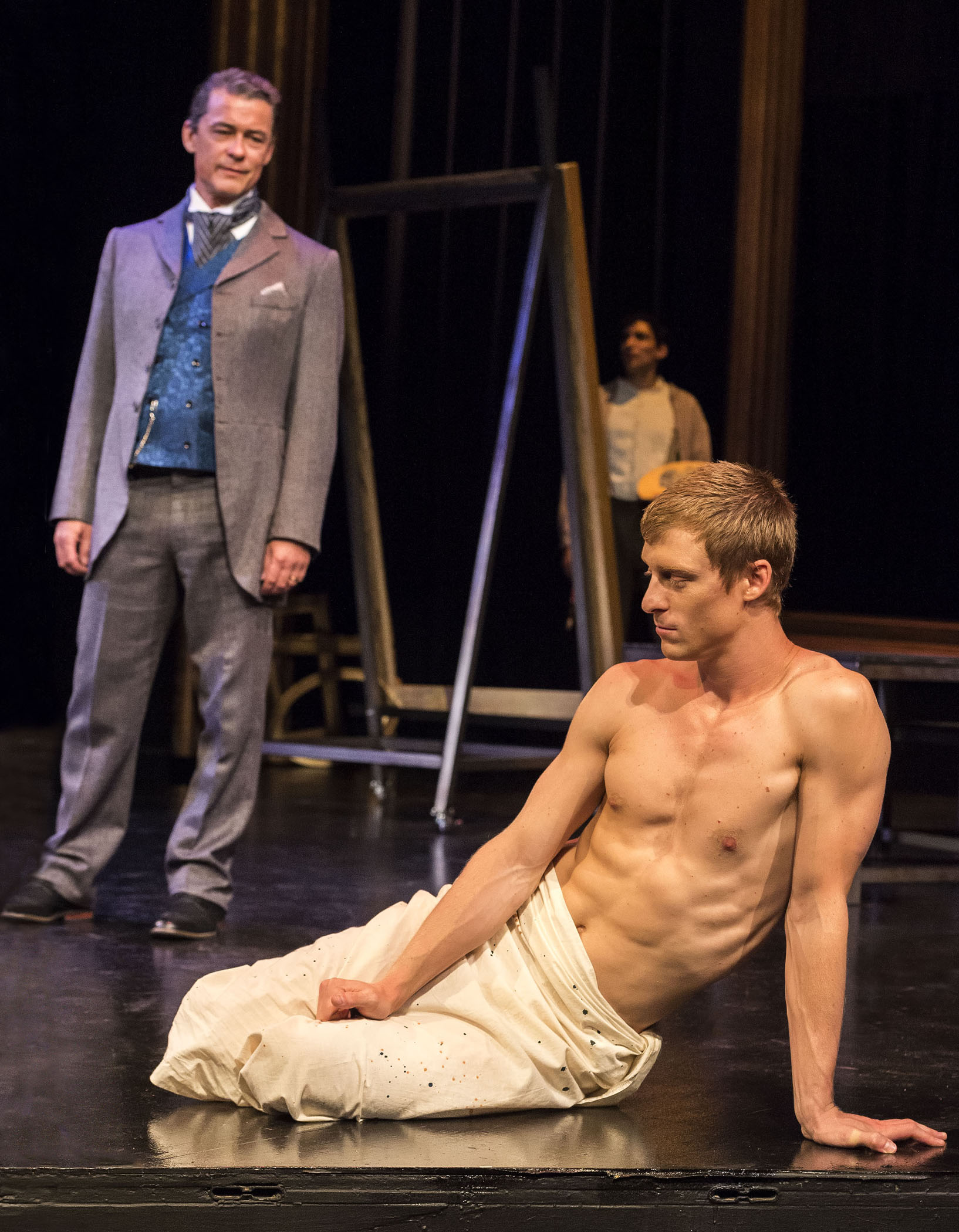
‘A Picture of Dorian Gray,’ a play adapted from Oscar Wilde’s novella ‘The Picture of Dorian Gray,’ goes on stage from September 23 to November 16 at A Noise Within in Pasadena. Adapted and directed by Boston Court Pasadena’s Co-Artistic Director, Michael Michetti, its three main characters are Colin Bates as Dorian Gray, Frederick Stuart as Lord Henry Wotton, and Amin El Gamal as Basil Hallward.

Wilde’s Dorian Gray is so entranced by the beauty of his own portrait that he sells his soul to preserve his youth and pays a price. Michetti’s adaptation, first produced at Boston Court Pasadena in 2006, explores the idolization of beauty and youth in an intimate, psychological journey. Avoiding the Gothic horror approach to the tale altogether, it follows instead the consequences of Dorian’s hedonistic lifestyle.

Explains Michetti of the remount, “When I did ‘A Picture of Dorian Gray’ 12 years ago at Boston Court, it was really successful and I was very proud of it. But I really didn’t think I was done with it and I thought this would be an opportunity to come back to it.

“The theatre space and timing are different. It’s a new collaboration with a whole new set of actors, with specific experiences and talents they bring to the production. However, the political and thematic content we’re dealing with now are the same things I was interested in exploring 12 years ago. That said, several things have transpired since – for one, gays have achieved marriage equality. So this play is thematically timely to me.

“The script has basically the same approach and ideas; I’ve added some things but not significant ones. Part of what this adaptation is embracing in the Oscar Wilde original is Dorian’s sexual orientation, an aspect many adaptations have erased. In fact, there wasn’t any hint of it in the 1945 film version. That was one of the things that was important for me to restore.”

“A lot of the people who read the novella thought of it as a Gothic horror story,” Michetti adds. “However, I think that was the least interesting part of the story. There’s obviously a supernatural and dark element to it but, for me, Wilde wrote a very psychologically truthful tale about what it was like to pursue pleasure without regard to the consequences. Because Dorian has great privilege of wealthy and beauty, it’s easier for him to get the things he wants in life. He spends a great part of his life causing damage to people.

“Following its dramaturgy, this is a cautionary tale. At the end of the novel, Dorian grasps that the toll of leading such hedonistic life was too great and he decides, too late, to make a change. But he definitely is realizing the consequences of his past behavior, is regretting it, and is atoning for it. It’s a reminder that we should stop to consider the people around us and the contributions we’re making to humankind.”

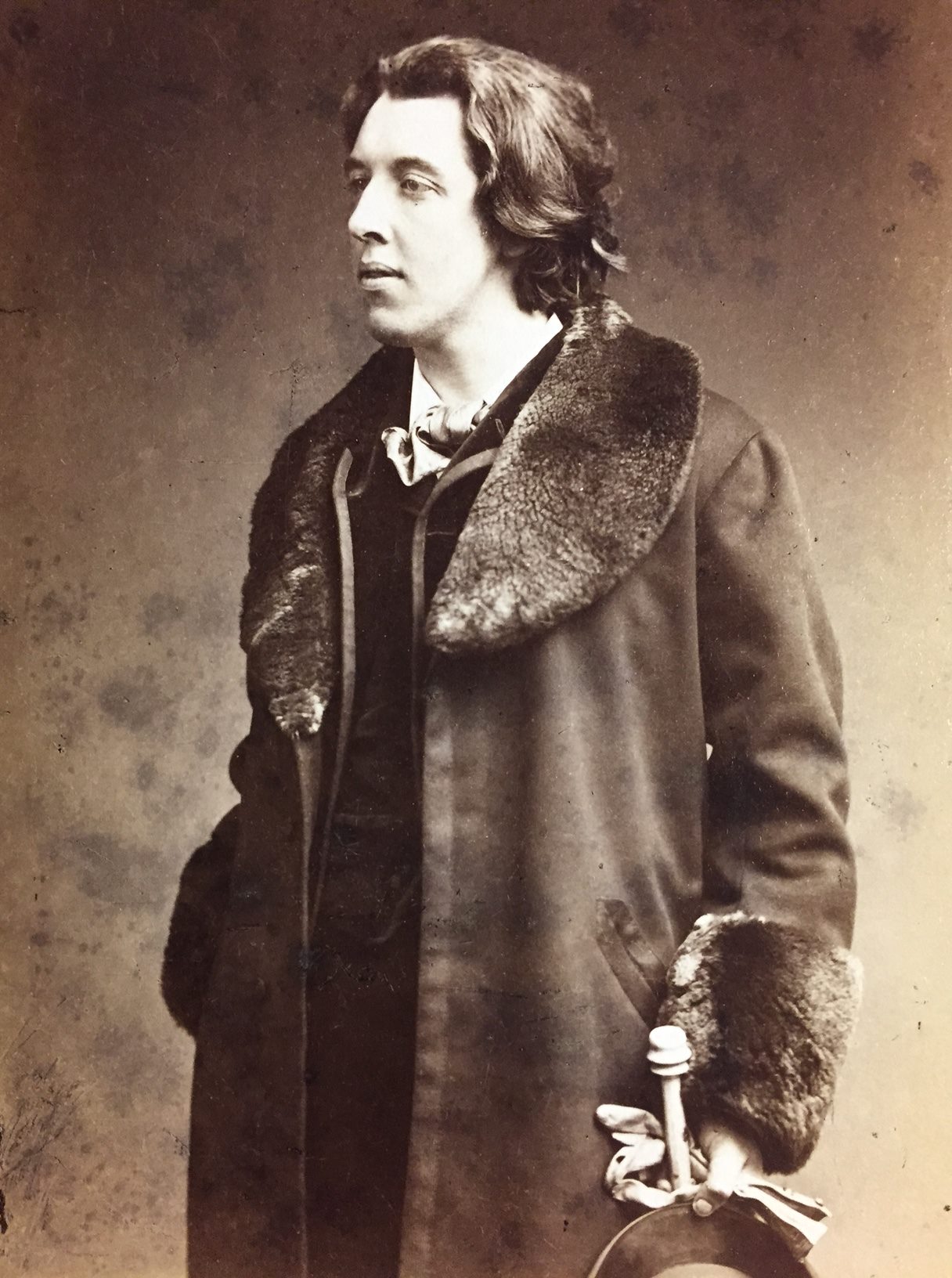
A Portrait of Oscar Wilde | Courtesy photo

“Here’s an  interesting point – pursuit of pleasure, acquisition of beautiful things, appreciation of beauty – those were components of the aestheticism in the late 1870s,” Michetti expounds. “Aestheticism values art more than social and political themes: art for art’s sake. Oscar Wilde was considered one of the most prominent proponents of it. He was, at the time, a big celebrity who embraced it and became the public face for the movement.

“The aesthetic movement is a hedonistic approach to life. So while the novel’s protagonist is pursing these things, Oscar Wilde is saying there’s a price to pay for following these theories to their logical end.”

Oscar Wilde once said  that ‘Dorian Gray’s’ three central characters are all aspects of himself: “Basil Hallward is what I think I am; Lord Henry what the world thinks of me; Dorian is what I would like to be – in other ages, perhaps.”

Michetti finds Wilde’s description fascinating. “There is something thought-provoking about the three characters as a triumvirate. Within that, Harry is the proponent of the movement and he stands by it to the end. He says we can’t change, we are who we are; and he doesn’t want Dorian to change because he believes aestheticism is worth pursing at whatever cost. Meanwhile, Basil is destroyed in the course of the play. And Dorian is the one who develops a conscience and decides to change.

“There are three actors playing the three different characters who are all aspects of Oscar Wilde. There’s that remarkable bond they carry with them during all that time. They are people who care very much for one another.

“When the play begins Harry and Basil have been long-time friends, they were in school together. Basil meets and falls for Dorian and introduces him to Harry – it’s a triangle with connections as well as conflicts. As soon as Harry comes into Dorian’s life, Basil becomes a third wheel. We have talked a lot with the three actors about the fact that there are reflecting and mirroring between them, yet the characteristics of the actors and the characters are very distinctive.

“Basil and Dorian are contrasts in a lot of ways. Dramaturgically and psychologically, Basil is the embodiment of Dorian’s conscience – he’s the one who wants Dorian to behave righteously, to take responsibility for his actions, and to lead an honest and fulfilling life. Dorian reaches a point of being so fearful of the consequences that he avoids Basil and their friendship suffers for it. Ultimately, I think, the reason for Dorian’s big conversion is the recognition that killing Basil is a big loss and he has a lot of guilt over that. He comes to an appreciation for what Basil wants for him to see in the world.”

Michetti continues, “The second metaphor in the story is Dorian’s portrait which is both aging and taking on the physical manifestation of his sins so that he isn’t affected.  I find that symbolism a little too simple because even though his appearance isn’t affected, Dorian has guilt and fear beneath. But there’s something addictive about his continuing pursuit of pleasure, beauty, and experiences. It’s almost that of an addict getting a high for a while, then he crashes, and he begins again. That is very much the cycle that Dorian is deeply in.”

This adaptation of ‘A Picture of Dorian Gray’ does not show the portrait at all, which could be a tough sell to the audience who can’t actually see it.

Michael Michetti | Courtesy photo / A Noise Within

“The reason I decided not to have the picture is that, in most adaptations, when the portrait is shown and the effect it’s had on it, the whole revelation is a little cheesy to me,” rationalizes Michetti. “I never got convinced because it should be terrifying and it always fell short of what I had imagined. And then, too, how grotesque could you make it so we could understand his moral decay and give it the right impact?

“Previous adaptations emphasized the horror aspects instead of the psychological feature. There is undeniably a supernatural element to it; you can’t tell the story without that. However, I didn’t really want to be focusing on that but on the humanity of it. I think the audience will hear the story in a different way because of how we’re framing it. And focusing on the psychological instead of the supernatural is what makes that possible. I hope that our audiences understand that kind of storytelling and find it dynamic and compelling.”

Michetti says further, “The story has universal themes. I think we are all guilty of the things that Dorian does – we all want to stay young, we all feel that sense of loss when we begin to age, we all seek pleasure to try to numb the feelings of fear or failure. While Dorian is an antihero, we can relate to him and we see ourselves reflected in him. We may not go to the extreme that he does, but we comprehend some of the temptations he had. I would like our audience to treat it as an admonition to make different choices because we see how badly Dorian’s life ends.

“At the same time, I hope that, in the adaptation of the play and the depiction of the character, we find him appealing and relatable before we find his behavior repellent. While Dorian doesn’t begin as the shining example of magnanimity, he is a very relatable person before he begins his decline.

“Finally, I would like people, who feel they know the story, to be taken aback – to think they heard it in a new way. I would like to make them recognize other aspects of it they had not previously been conscious of, or didn’t know were there. For me it all comes back to the appreciation of Wilde and how inspired this novel is, how deeply he understands humanity. That we can use his words and tell the story that feels fresh and relevant in the 21st century is surprising for a work that’s 125 years old.”

Basil is played by Amin El Gamal, whom Michetti had not previously worked with. He states, “Amin has auditioned for me before and I’ve seen his work as a fan. He was definitely the first person I thought of.”

Basil (back) paints a portrait of Dorian (foreground) as Harry looks on | Photo by Craig Schwartz

El Gamal confesses, “I never read the book in school and didn’t come across it until after college. I have never been in a production of Dorian Gray before but I know the trope about the picture that ages.

“It was very insightful of Michael to have thought of me in the role of Basil. He’s a character I think I relate to strongly, although I’ve never seen productions where the characteristics brought out in this adaptation were showcased. I was really excited to be approached for a role where I can share my existential qualities, which I was surprised that Michael has perceived.

“When he sent the script to me, I was astonished and, quite frankly, I felt exposed. But it has also been a delight because my goal as a person of color is not to play my ethnicity but to use my resources and my qualities as a person as the basis for my art. I felt that Michael acknowledged that. I was disappointed that I couldn’t do it because the script came too late – I was already committed to another project.”

Interjects Michetti, “I cast another actor but he dropped out. So I approached Amin again and, by that time, his project had fallen apart. So this feels like fate.”

“As excited as I was to play this character, I was also afraid of what that psyche would unearth for me,” El Gamal continues. “Fortunately, the process has been fruitful. I really feel that an actor’s main tool is his life experience, but there are times when I have to use my imagination. This play really required that creativity.

“I’m very sensitive to the fact that people can be like Basil or Harry. I can certainly relate to both Harry’s wanting to pursue his goals with enthusiasm in the same way that I appreciate Basil’s sense of morality. But there has to be a balance to not be overburdened with the morals and live life to the fullest.”

“Michael challenged me to find more complexity in the characters,” discloses El Gamal. “He didn’t want us to depict Basil and Harry as the angel and the devil on Dorian’s shoulder. That the evil and the good are not too far apart, there’s a grey area where a person can be both. Basil certainly isn’t perfect. Both characters had an important role in Dorian’s life – if it wasn’t for Basil, he wouldn’t have met Harry.”

“Basil is very passive in the beginning of the story,” says El Gamal of his character. “When Dorian starts pursuing worldly pleasures, he pulls away – he leaves the country and isn’t a part of Dorian’s life for a while. He goes through a drought in his art after Dorian basically abandoned their relationship. He might have resorted to drug and substance abuse, he’s alone and lonely. Although he still has a deep love for Dorian and when he sees the deterioration of the portrait, he stages an intervention.

“But through it all, he’s not a victim. His character arc is hopeful – he’s planning on opening a studio in Paris where he would create his next masterpiece – despite its sad ending. It was a productive life cut short. I hope I am able to convey everything that is going on with Basil.”

“Oscar Wilde anticipated homosexuality as an identity, the idea of two men being in love,” marvels El Gamal. “Basil embodies that identity at a time when that wasn’t recognized.”

In his depiction of Basil, El Gamal wants the audience to leave the theatre with something to reflect on. “I think in today’s social media and selfie-obsessed culture, people can feel disposable and we can forget to be respectful and communicative. I hope Basil, as a sort of advocate for kindness and basic human decency, reminds audiences to take a little better care of themselves and each other.”

Would that El Gamal’s wish is realized and the moral Michetti advances in ‘A Picture of Dorian Gray’ is heeded to make us a deliberate and thoughtful society.   

‘Native Gardens’ at Pasadena Playhouse Cultivates Discussion on Diverse Issues

Originally published on 7 September 2018 in the Pasadena Independent, Arcadia Weekly, and Monrovia Weekly

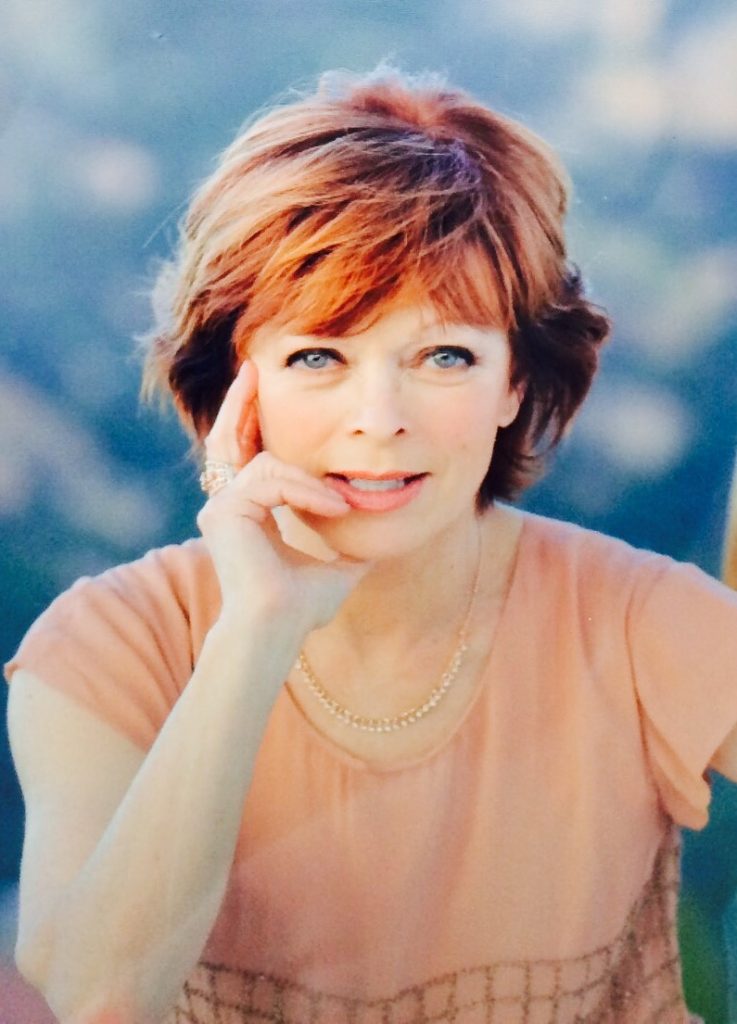
Frances Fisher plays the role of Virginia | Courtesy photo /Pasadena Playhouse

‘Native Gardens,’ a new comedy by Karen Zacarias, comes to the Pasadena Playhouse from September 5th to the 30th and shines a light on serious issues, including racial and social diversity, in humorous fashion.

Directed by Seinfeld’s Jason Alexander, it features Christian Barillas, Bruce Davison, Frances Fisher, and Jessica Meraz, with Julian Amaya, Richard Biglia, and Joshua Duron.

The play follows the story of Pablo (Barillas), a rising attorney, and Tania (Meraz), his very pregnant wife who is also a doctoral candidate. They have just purchased a home next to Frank (Davison) and Virginia (Fisher), a well-established D.C. couple with a prize-worthy English garden. The two couples’ friendly relationship is tested as an impending barbeque for Pablo’s colleagues and disagreement over a long-standing fence line grow into an all-out comedic border dispute.

Fisher, taking a lunch break during rehearsals, talks about what drew her to the play, “I like the fact that ‘Native Gardens’ tackles issues that are important – race and white privilege, misconceptions about nationalities, environmental concerns.”

“It presents two sides of the environmental issue,” continues Fisher. “It asks questions – do you want to do something good for the environment or would you rather have something for show? What is important to you, the health of your children and grandchildren or a beautiful bed of roses?”

The role touches Fisher on a personal level. She reminisces, “When I had a house, I was an avid gardener and grew my own vegetables; I miss that. I live in an apartment right now but I hope to, one day, be able to plant in my own backyard again.”

Activism is an ongoing endeavor for Fisher. She is a supporter of Environment California, Hollywood Food Guild, #FamiliesBelongTogether, PeaceOverViolence.org, and the anti-bullying group StandfortheSilent.org, among many others. She is an executive board member of the Environment Media Association (EMA), making ‘Native Gardens’ a natural choice for her involvement.

On the lighter side, the play gives Fisher the opportunity to work with long-time friends. She discloses, “I’ve known Jason since we were both starting out in New York and I play poker with him. But we’ve never collaborated on a project until now; it’s such a thrill to be directed by him. I’m exhausted but I’m also having a great time. He’s a master of comedy so I feel like we’re getting a master class in finding something funny.

Bruce Davison as Virginia’s husband Frank | Courtesy photo / Pasadena Playhouse

“Bruce is also someone I’ve known personally for decades yet we’ve never performed together. It’s quite wonderful that we play husband and wife.”

‘Native Gardens’ is likewise an exposure to new people and experiences for Fisher. She says, “I’ve never met the two kids – Jessica and Christian – but I’m getting to know them. We’re having terrific fun in rehearsal; it’s a very physical play. This is also my introduction to Karen. I was hooked after I read her play. I later found out it has been performed and produced elsewhere in the country. I’m glad we’re mounting a production in Pasadena and at The Playhouse, too. It’s wonderful to be able to walk the boards here.”

It comes at an opportune time as well. Fisher states, “I hadn’t done a play in a while – the last  one was ‘Barbecue’ at the Geffen Theatre – and I’m ready to get back on stage. This is my first love. I started my acting career as an apprentice at the Barter Theatre in Virginia, learning the ropes by working every task that goes into putting on a show. I assisted the director, built sets, sewed costumes, made props, cued actors. I had a good understanding of the importance of every job in the theatre. But even when I do film or television, I have a great respect for the crew and what they do.”

Acting back and forth between mediums involves flexibility. Explains Fisher, “You have to approach each in a different way. For instance, doing a guest spot on a TV program is like jumping on a moving train. You come in and you have to be up-to-speed with people who have been  doing it for four, five, six, or seven years. You have to get on that rhythm as soon as you show up – you have to know your lines and your actions – because there’s not a lot of time. There never is, on TV.

“In theatre, on the other hand, we have three weeks to explore the character, learn, and make choices. We have a larger bag of tricks to draw upon so doing the same performance every night doesn’t get stale. Theatre is about discovering novel things, surprising your partner, and testing new ideas that have been tried out in rehearsal so they’re not completely unknown. In that sense, there’s a lot more fun that can be had in theatre.

“However, there’s also something that can be said about making a movie. You work on it for a certain period of time, you shoot a scene knowing you’re never going to do it again unless something goes wrong. Everyday there’s a batch of scenes, then you’re all done, and it’s finished.”

Fisher concurs with the common assumption that acting is not a financially stable career. “You never know if you have a job for the next ten years or if you have to look for another. When the director says ‘It’s a wrap’ you’re unemployed again. It’s a very uncertain way to live your life; you have to absolutely love the profession and be really dedicated to want to stay in it.

I know many actors who are waiting tables, driving Ubers, working whatever part-time jobs they can get. I found that I couldn’t have a so-called day job because I spend my days going to auditions, classes, meetings, and keeping myself prepared for the next role.”

That next role for Fisher could be on television. She had just finished a pilot for HBO on a Damon Lindelof work called ‘The Watchman.’

“If that gets picked up, we’re going directly to Atlanta to shoot the episodes,” Fisher reveals. “Lindelof’s work is extraordinary. The characters he originates, the history lessons he brings to the present day, are pretty mind-blowing.

“There’s great writing on television these days,” Fisher asserts. “I also see more women on television and film, which is something to celebrate. It used to be a patriarchy, but the tide is slowly turning, thanks to people like Ava du Varnay with all she’s doing for women. She has created a generous space for women, who’ve never had a chance before, to come forward. But we still have a long way to go; it takes for women in powerful positions to open more doors.”

Fisher is hoping for other opportunities for audiences to discover her range as an actor. She declares, “Every role is different and I don’t want to do the same thing over and over again. ‘Native Gardens’ is a very physical comedy and I don’t think people think of me as being particularly comedic.

Courtesy photo | Pasadena Playhouse

“I would like the audience to have a good time, for them to say ‘I’m glad I came to the theatre to see these actors doing outrageous things. But as hysterically funny as it is, ‘Native Gardens’ explores issues we should be thinking of. Laughter can be a profound and healing experience. And we certainly need more of that.”

Pronounces Fisher, “Theatre is made to mirror society back to itself. When you examine Shakespeare’s work, for instance, you’ll see that he wrote about everyone from kings to peasants. There is no feeling or emotion he didn’t explore through his plays and sonnets. They were very much a reflection of human nature.

“Theatre is a powerful medium for people to come together as strangers in an audience and, hopefully, through their common experience watching truth on stage, they will laugh or cry. Maybe they’ll turn to their neighbor across the aisle, catch their eye, have that shared moment, and walk out as friends.”

Such is the effect of theatre that Fisher was hooked on it at a young age. Ticket prices were so expensive even then, but she found ways to watch theatre. She confesses, “I probably saw the second act of every Broadway show for 14 years. I discovered that once the audience got in, I could kinda’ slip in and find an empty seat.”

Those days of sneaking into a playhouse are long gone. Fisher is now the performer on stage whom people come to watch. And she would genuinely relate to other aspiring actors who might just slip in after the first act.

Pasadena Author Debuts First Book in her ‘Heart of Thorns’ Trilogy

Originally published on 6 August 2018 in the Pasadena Independent, Arcadia Weekly, and Monrovia Weekly

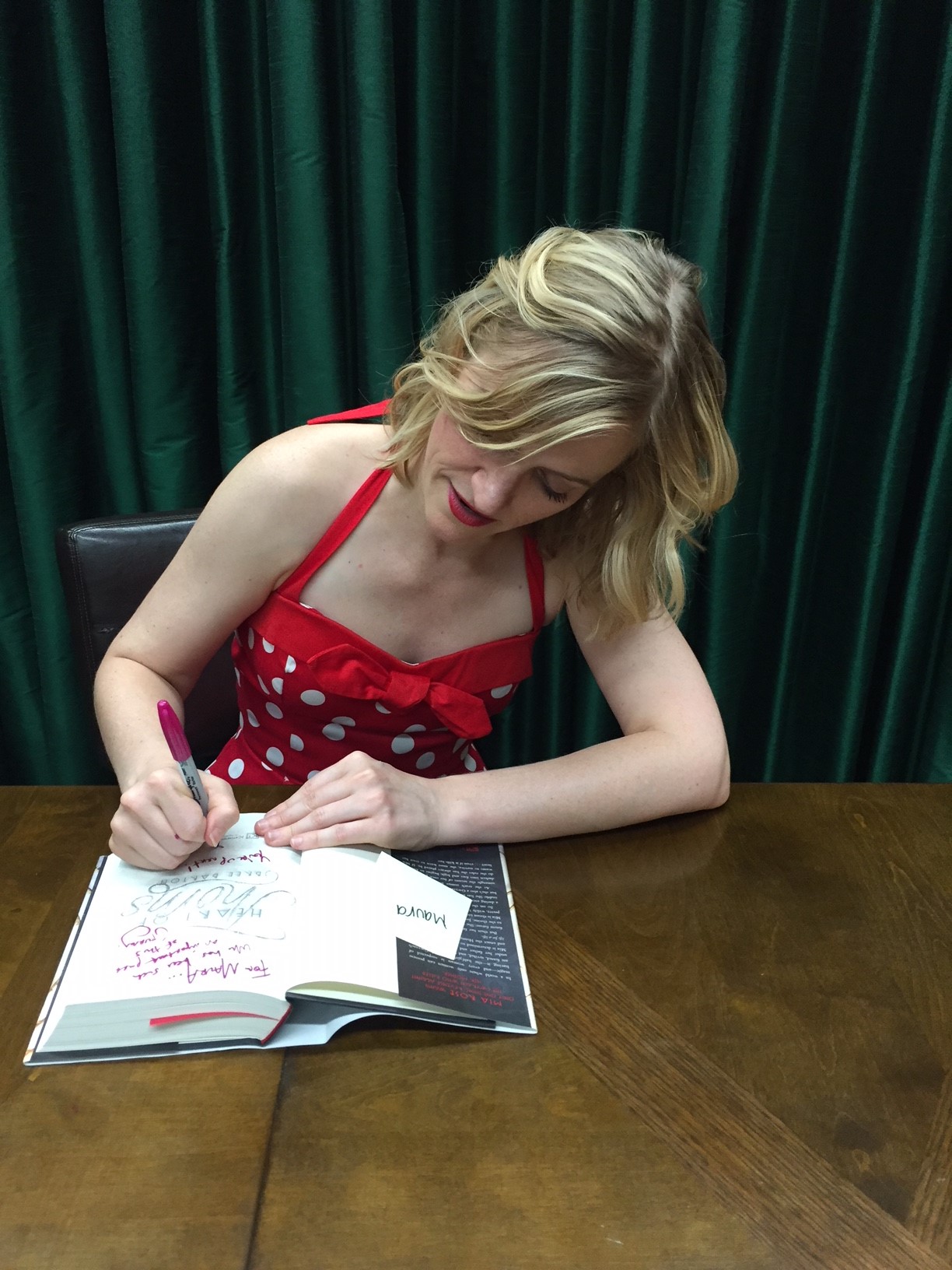
Bree Barton signs books during the ‘Heart of Thorns’ launch at Vroman’s Bookstore | Courtesy photo

It’s been a thrilling few weeks for Pasadena author Bree Barton as she embarks on a tour to unveil ‘Heart of Thorns,’ the first book in the trilogy. Geared for young adult (YA) readers, it’s a feminist fantasy book set in a dark kingdom where only women have magical powers.

‘In the ancient river kingdom, where touch is a battlefield and bodies the instruments of war, Mia Rose has pledged her life to hunting Gwyrach, women who can manipulate flesh, bones, breath and blood. The same women who killed her mother without a single scratch,’ reads the publisher’s blurb.

‘Heart of Thorns’ sounds like a story with a strong female protagonist who is out to wreak vengeance against evil women. The conflict it conjures in my mind is intriguing and I’m determined to find out more about the author who can come up with such challenging, if not entirely self-defeating, plot. I catch up with Barton at Vroman’s Bookstore on Colorado Blvd. the morning of her July 31 launch.

Brimming with excitement, Barton says, “Most girls envision their wedding as their ‘day’ but, for me, this book debut is my ‘day.’ I have  dreamed of this since I was a child and it’s difficult to grasp that it’s actually here!”

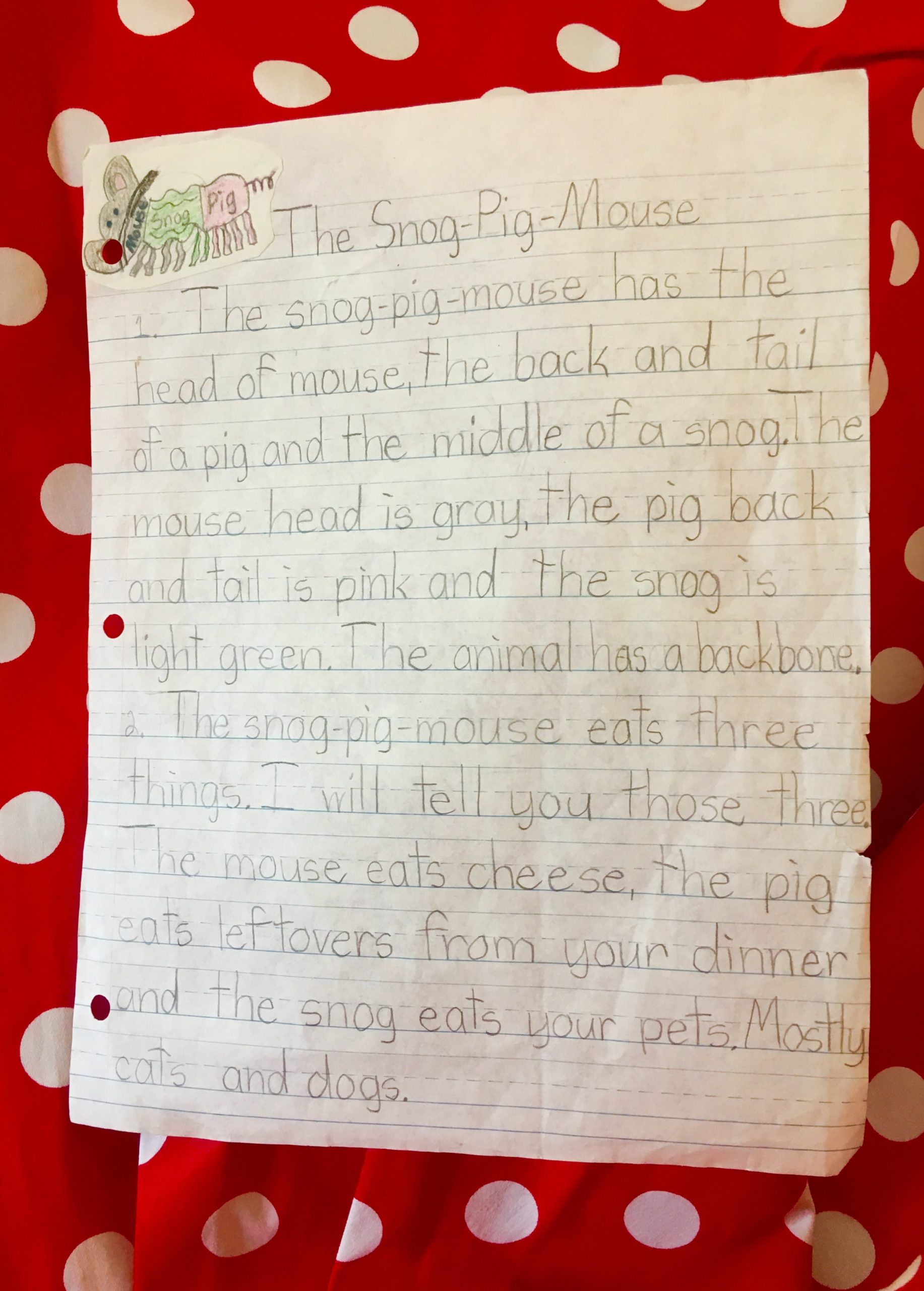
“This is my first published book but it isn’t my first fantasy story; that distinction belongs to ‘The Snog-Pig-Mouse,’ which I wrote when I was eight years old,” Barton points out. “When I was ten I wrote my first novel and was obsessed about writing that I would send letters to editors asking them all kinds of questions about publishing. That interest waned in high school when I was sidetracked and went into dance.

Barton’s first fantasy story | Courtesy photo

“My love of writing returned when I was in college, after an essay I wrote received a lot of plaudits. That led to my ghost writing stint after college. While it was a good experience, it wasn’t fulfilling because the books were in someone else’s name and I wasn’t writing in my own voice.”

Barton hastens to add, “Having said that, though, ghost writing was excellent preparation because I learned about the many layers involved in the process of getting a book published. A writer’s work goes through so many edits and revisions before it’s passed along to publicists, etc.

“It also gave me a resume when I was looking to publish my own book. I was able to claim I wrote a book that was optioned for television; I could give the name of other publishers who have printed books I have ghost-written. That gave me credibility and set me apart from other writers – and there are so many creative writers in the YA genre!”

“Fantasy books for young adults became hugely popular after the ‘Harry Potter’ series came out,” expounds Barton. “Although ‘Harry Potter’ is a genre that is its own universe. The ones that followed were more in the mold of ‘Twilight’ and ‘The Hunger Games.’

“But the YA books out there now aren’t only being read by teenagers, they’re read by people who are in their 20s and 30s. And that’s what I’m hoping for. ‘Heart of Thorns’ is about diversity, acceptance, and empowering women – issues that matter to people of all ages. It’s about women breaking free of years of persecution, misogyny, and a false belief that has been hard-wired in their brains. Furthermore, it’s women being in control.

“This tribe of women, called Gwyrach, has been made to think their powers are evil until Mia found out it can be used to heal. That made her realize that her power can be an instrument for good. It was fun to create a young protagonist because everything’s a new experience, it’s all about ‘firsts.’ That provides for a satisfying character arc.

“My sister’s 18, she graduated from high school, and is at the cusp of adulthood. People always congratulate teenagers when they graduate; and it is a cause for celebration. But it’s really a bittersweet moment because it signifies the loss of their childhood and it’s never coming back. While they have so much to look forward to, they also are leaving so much behind. She’s the reason I write YA.”

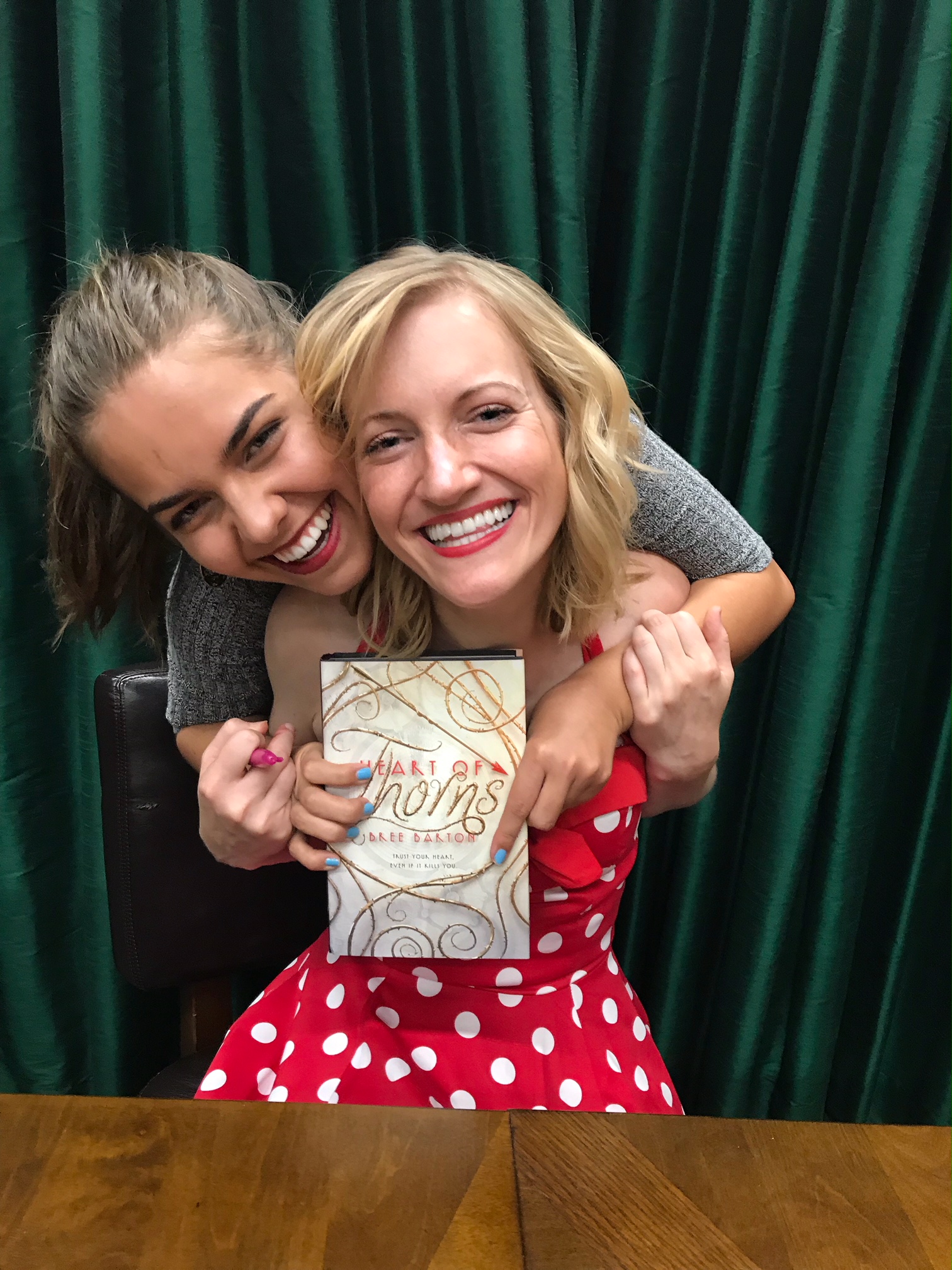
Barton with her sister | Courtesy photo

Women figure prominently in Barton’s world because she was raised by a single mother. She discloses, “My family background and childhood provided considerable inspiration. In my young mind, my Mom was the model of perfection. Then she had a child out of wedlock and we were banished from our Christian Fundamentalist community.

“That event made me recognize my Mom isn’t perfect; but I also know her to be determined and strong-willed. When I was going to school in Massachusetts, she drove straight through from Texas to spend some time with me. For today’s book launch, she came to Pasadena to organize the hospitality for the event. She’s a tiny woman – all of five feet – and she’s out there now laden with cupcakes, drinks, cups, and plates.”

Barton based the Gwyrach tribe, angels descended from the gods, from mythology. She says, “I looked at Irish and Welsh mythology, the origin of the word. However, this is also a mix of Brazilian, Portuguese, and Spanish folklore. I spent some time learning about cultures with a dominant maternal influence, like the pachamama, a fertility goddess who presides over planting and harvesting. She also embodies the mountains and causes earthquakes.”

Continues Barton, “While the idea for ‘Heart of Thorns’ began many years ago, it was really the Trump win in the 2016 elections – when we all thought we were going to have a woman president – that was the impetus for this. I would like for women to realize that we are stronger because of it, not in spite of it.

“And storytelling can be a source of healing. I wanted this book to have a balance so I made it light and funny. There is so much violence and gore in it but, at the same time, there are many humorous moments between Mia and Prince Hal. I wish for readers to find it engaging and interesting.”

The book cover | Courtesy photo

Writing is a solitary endeavor and can be isolating, especially for a novelist who spends months on end working on one book. Six years ago Barton joined a group of writers who formed a community to share the same experience in this journey, to be each other’s support system.

We’re sitting in one corner of the YA section of Vroman’s and we’re surrounded by books whose authors Barton knows. She gets up to pick a few books off the shelf to show me, then not only gushes about how great the stories are but also marvels at the friendships she has with their writers.

Through this group she has met another author who also writes for television and then mentioned ‘Heart of Thorns’ to a producer. So there could be a TV show or series in Barton’s future. But for right now, she’s concentrating on the book launch.

“Social media has helped spread the word about ‘Heart of Thorns.’ Some readers have been sent advance copies and are tweeting about it,” Barton says. “Because of Twitter, someone from the United Kingdom who has a subscription book box business heard of it and ordered 5,000 books to include it in her mailing to subscribers. Maybe she would have heard of me at some point, which would have yielded the same result, just not as immediate. On the other hand, if I was hard to track down, she could have found another author.”

“Twitter has been really great but it’s also an incredible distraction –you’re reading what the other authors in the group are doing, where their publishers are sending them, and so forth, and you’re comparing yourself with them. So it’s challenging to give them love and support when you’re not enjoying all that at the time.

“Then you go on Facebook and all you read is how great everyone is doing. The danger is that you also want to show only ideal situations and make up success stories. But I’m really advocating for being honest so I started a monthly newsletter where I reveal secrets. For instance, it’s ‘I’m depressed,’ or ‘I’m terrified because I’m launching my first book and I don’t know how it will go.’

A full house at the Vroman’s launch | Courtesy photo

“I’m really proud of this newsletter because it will strip social media of some its negative side. It’s an outlet for people to just be themselves and not be thought of as lesser beings because they’re not perfect.”

“You also get so involved in social media that it takes time out of your work,” Barton adds. “The second book in the trilogy was due last month but because I’ve been tweeting instead of writing, I haven’t been able to finish it. So I needed the ‘down time.’ It’s scheduled for launch on July 31st next year and revolves around a minor character in the first one. It’s also darker and funnier. I’m so looking forward to completing it.”

While Barton may have written ‘Heart of Thorns’ with her family in mind, we all are the beneficiaries of her creative work. Mia Rose’s triumph is an inspiration, a call to arms, for womankind.

That Barton accomplishes that with a healthy dose of humor is testament to her ingenuity, maturity, and skill as a writer. She has come a long way since ‘The Snog-Pig-Mouse’ days but, happily for us, her eight-year-old self’s sense of fantasy and vivid imagination never left.

Boston Court Pasadena’s Annual Festival Features New Play about Feminism

Originally published on 24 July 2018 in the Pasadena Independent, Arcadia Weekly, and Monrovia Weekly

‘Ladies’ playwright Kit Steinkellner | Courtesy photo

Long before the word feminism entered our lexicon, women were coming together to indulge in intellectual pursuits that were deemed, at the time, to be the domain of the male species. That’s what a group of women who lived in 1750s London did when they formed The Blue Stocking Society.

‘Ladies,’ a new play by Kit Steinkellner, is a fictional account of a year in the life of The Blue Stocking Society and explores the tangled knot of electric and jagged relationships that comprise this group. These women are pioneers and revolutionaries emboldened by the call to arms to be the first of their kind and burdened by the misfortune of being born far ahead of their time.

It will be featured this Saturday, July 28, at 11:00 am at Boston Court Pasadena’s 14th Annual New Play Reading Festival and will be directed by Co-Artistic Director Michael Michetti.

Steinkellner expounds, “’Ladies’ is a history and time travel play in its theatricality. It was inspired by The Blue Stocking Society, the first organized feminist movement founded by a group of women who lived in England in the mid-18th century. Much has happened since in terms of advancing the role that women play in society, but at the time they were considered radical.”

“The idea came to me about ten years ago when I was in London and I went to the National Portrait Gallery which was holding an exhibit about these women,” discloses Steinkellner. “They intrigued me as being true pilgrims and pioneers in a realm which had absolutely no roadmap. Writing a play about them struck me as being both exciting and scary.

“I wanted to tell their story in an ‘out-of- the-box’ way just as they had done when they began their club. In dealing with something that is set in the past, I realized there’s a risk that the story might come off as dusty, archaic, or irrelevant. As I researched about their lives, read their diaries and their correspondence with each other, it became important for me to make sure I did it exactly right.

“To create something exciting that explains my obsession with these women, and why I was so captivated by them, I used time travel to be part of the play as the historian and narrator. I investigated why I wanted to have a relationship with women who lived over a hundred years ago and how they are relevant in today’s world.”

Adds Steinkellner, “There are four actresses in ‘Ladies’ and each one plays a prominent woman in this group – each enacts my character and some of them perform male roles. While this play was conceived ten years ago, I only started actually writing it five years ago and it became a finalist in the O’Neill National Playwrights’ Conference. However, that version didn’t have the time travel element in it and I wasn’t part of the play.”

“The play has seen several changes and revisions although they didn’t happen all at once. I gave it time to germinate and develop; I would leave it then go back to it after a few years to improve and polish. I’m very excited about this Workshop and I’m grateful that Michael and Jessica picked it for their New Play Festival because it’s a very important process towards bringing it to life. I want the audience to be emotionally engaged with the story and these women’s lives,” Steinkellner enthuses.

Emilie Beck, Boston Court Pasadena’s Literary Manager | Courtesy photo

Emilie Beck, Boston Court Pasadena’s Literary Manager, who has been involved in the New Play Reading Festival for seven years, describes, “Kit’s play is quite fascinating and is, in a way, its own genre. It speaks to an intellectual realm but there’s also a lot gestural work in it; it’s cerebral and visceral at the same time.”

“There is an element in ‘Ladies’ that sets it apart from other plays – this interesting conceit in which each character becomes Kit, the playwright,” Beck points out. “The play is making use of her rather than Kit putting herself as a protagonist, if that makes sense. It involves time travel but not in a science fiction way. I think there’s a very fluid connection between the here and now and these ladies in the 1750s.”

“It’s thrilling to us that this year we received more submissions from women playwrights than from men,” states Beck. “The four new plays we’ve chosen for this year’s Festival are all written by women. While we read without attention to gender, we were drawn to these voices, which speak to a wide array of underrepresented female experiences.

“What’s interesting is that the ‘Me Too Movement’ was happening as we were reading these submissions. So these plays  had not been written out of that and yet we were reading in that context. I imagine that as we move into the future, there will be more plays written because of that.”

Beck asserts, “That said, it wasn’t the only theme touched on by the plays we received. We got submissions with very dark themes – war, apocalypse, suicide, assault. In fact there were a lot of them that involved sexual assault. A good number of plays we read were spoken by a voice that has been disenfranchised. It’s really important to us to represent that. For a long time there’s been this overriding voice of the white male playwright. Not to dis the white male playwright, there are many of them who are wonderful and whom I love working with, we need to make a little room for women and minorities.”

“New work is important to us,” declares Beck. “The whole reason this theatre is here is to get new work on the stage. It’s hard to write a play; playwrights sit on their own, trying to create a multidimensional world with voices in conversations that would, in some way, illuminate a theme.

“Playwrights have to find a way to get from a flat page, to that creative place, to a fully realized production. They have to go through the processes, get together with a bunch of artists in a room to listen to how it sounds, to see how it’s working and not working. That is integral to our work here. It’s exciting for us and we look forward to it every year.”

The New Play Reading Festival is a key component of Boston Court Pasadena’s commitment to nurturing playwrights and new work. It paves the way for unknown artists’ creations to get recognized and produced on stage.

What a thrilling prospect it is if this weekend we could be seeing the future Eugene O’Neills or George Bernard Shaws, whose plays are esteemed, revered, and performed to this day!

‘Jungle Book’ at the Pasadena Playhouse Takes Us on an Exotic Journey

Originally published on 9 July 2018 in the Pasadena Independent, Arcadia Weekly, and Monrovia Weekly

Levin Valayil as Mowgli | Photo by Gary W. Sweetman

Rudyard Kipling’s “Jungle Book” takes us to the exotic, adventurous, and magical world of Mowgli and other wildlife creatures. This play adaptation, written and directed by Rick Miller and Craig Francis, will have its West Coast premiere on Tuesday, July 17 through Sunday, July 29, at the Pasadena Playhouse, after a successful three-week run at Asolo Repertory Theatre in Sarasota, Florida.

Staged by Canadian company Kidoons and WYRD Production, in association with The 20K Collective, “Jungle Book” features familiar characters including Baloo the Bear, Kaa the snake, and introduces other colorful inhabitants of Kipling’s books.

Very much a theatrical adaptation, this play employs a rich soundscape, immersive multimedia, inventive puppetry, and a variety of new and traditional theatrical traditions to transport audiences to the world’s jungles. It features favorite characters as never seen before, bringing out the original themes of the story, while connecting audiences to its Indian locale and the human relationship to the animal kingdom.

“We definitely chose not to re-do the Disney version. They did it well and have done it several times,” Miller emphasizes. “We decided to take people back to Kipling’s book to inspire them to read literature and realize that he actually wrote two Jungle Books. Everyone knows Mowgli but there are other stories in ‘The Jungle Book’ and ‘The Second Jungle Book’ about different animals from around the world. The stories, poems, and songs that Kipling assembled cover a great deal of territory, both thematically and geographically.”

Miller adds, “In the original Kipling story, Mowgli grew up in the jungle with animals and is kicked out of the jungle for being too much of a human. In the book he also goes back to the town as a teenager and is kicked out of the town for being too much of an animal.

“So this is a mirror image of these two worlds. It’s a story that echoes the disconnection we have these days when we wonder who our real family is and where we belong, but also our disconnection with nature. We live in cities and we tend to forget that we have a deep bond with our natural surroundings, a lapse which sometimes proves to be detrimental.”

“While the message is deep, it isn’t heavy,” stresses Miller. “We just want people to consider that before there were cities, there were forest[s] and jungles. And we still have them inside of us – that little bit of the free, wild, and uncontrolled. Mowgli is very much the embodiment of that; he takes us back to his youth to remember the law of the jungle. The play is about how to live with each other and the rest of humankind.”

“The adults coming to the show will definitely get the message and the kids will not get slammed on their heads with a hammer to get it. It’s a fun show with a lot of humor and a big dose of lightheartedness,” Miller says.

“Jungle Book” at Asolo Repertory Theatre | Photo by Gary W. Sweetman

“I’ve been doing theatre for 25 years. I’m known all over Canada and Europe for my solo performances but I joined forces with Kidoons (Kids Cartoons) to create entire experiences,” discloses Miller. “We found that we haven’t been engaging the youth as much, so we are correcting that. And in the process, we’re generating new theatre audiences. This is important because not only are young people the theatre-going audience of the future but they’re also ready to be educated and become leaders of the world and if you present them with inspiring work on stage they really can change lives.

“That said, we produce plays for all ages but it so happens that young people love the work we do because we incorporate the playfulness and creativity that kids inherently have. We’re trying to be more than entertainers because God knows there’s a lot of entertainment available on screen. We utilize what theatre offers which, essentially, is a lot of people gathered together in a room experiencing a story. This is different from just watching something on the screen.”

“We’ll be taking a few months off after our Pasadena production because we’re touring other shows. But we’re booking dates in preparation for our North American tour which starts in 2019. If all goes well, it will go to Asia and to Europe as well. Jungle Book happens in India and I would love for it to play there, but it’s a universal tale. We create shows that people all over the world will fall in love with.”

Miller elaborates, “Our next project is the third part of our ‘Connection Triptych’ and it’s going to be ‘Frankenstein,’ a novel written in 1818 by Mary Shelley. It has had several popular versions but we want to create one that speaks to our own issues today. Bio engineering and prolonging life, issues that are very much on the forefront of technology, are quite beautifully expressed in ‘Frankenstein.’

“The common thread running through these plays are characters who have become disconnected from humanity. In the first play in our trilogy, Jules Verne‘s ‘Twenty Leagues Under the Sea,’ Captain Nemo built a submarine, a utopia, for himself and his crew. He lived as a warrior against oppression, but in his disconnection he becomes a bit of a monster. In ‘Jungle Book,’ Mowgli is so disconnected he doesn’t know who his real family is, or who he is, for that matter. Frankenstein is probably the most disconnected character. In fact, he isn’t even human, he was created using pieces of other people and was called a monster.

“To put this is in our present day, we have Snapchat and Facebook which, on the surface, make us think we’re connected. However, the presence of all the technology in our lives actually isolates us from what’s really happening.”

Having children – an 11-year-old and a 15-year-old child – has helped Miller relate to how young people think and what interests them. He says, “We constantly talk about today’s technology; how we always have our eyes on the screen and how that changes our brain,” Miller expounds. “We have conversations about what it costs to have a disconnection with our environment and surroundings. We can’t recognize trees, or identify one leaf from another, but we can name a hundred different company logos when we walk down the street.”

Miller and Francis re-imagine classic stories through modern eyes, making them relevant to the times we live in. Through “Jungle Book” they hope to make us find ourselves and connect with humanity. If we enjoy the music, are transported to a different world, and have fun along the way, then it would indeed be a journey doubly worth taking.