Entrepreneur Launches Environmentally-Friendly Candle Brand, BeAmbiance, in Middle of Global Pandemic

Originally published on 11 November 2021 on Hey SoCal

BeAmbiance candle | Photo courtesy of BeAmbiance.com

Cooler temperatures and a little bit of rainfall are such a welcome relief after several months of dry and hot weather. We’re eagerly storing our summer attires of shorts, T-shirts, and flip-flops and putting on jeans, sweaters, and booties. We’re cheerfully preparing comfort foods for dinner and baking pies for dessert. And, as we hear heartening news of COVID-19 infections slowing, we can look forward to the holidays.

During cold weather, there’s nothing that warms our hearts and homes more than the soft glow and pleasant scent of burning candles. And if providing a cozy atmosphere isn’t enough, candles also add beauty to any space and make every room feel lived-in. Fortunately, there are several different kinds to choose from and varying price range. In fact, the selections are plentiful so you can have a variety of them in your house.

BeAmbiance, an entrepreneurial candle brand born in the middle of a global pandemic, set themselves apart with their signature inspirational quotes. They are made with 100% beeswax with no additives; their wicks are 100% cotton with no metal hardeners. They also come with a guaranteed 65 hours of burn time so candle lovers with allergies can enjoy a healthy and safe product.    

Melinda Kilchoer, an allergy sufferer herself, established BeAmbiance early this year. She is keenly aware of how the environment affects everyone and how people, in turn, affect the environment. Her choice of materials to create BeAmbiance candles reflects her ethos of a healthy and environmentally responsible lifestyle. She diligently eats plant-based food and vigilantly buys only ethically-sourced products.         

Melinda Kilchoer | Photo courtesy of BeAmbiance

“I like candles and I have several friends who are always burning candles. So candle-making was my instinctive choice when I embarked on an entrepreneurial endeavor,” Kilchoer says. “Because the environment is the major factor in this venture, I decided right away that my candles are definitely not going to be made of paraffin; I looked at only natural products. I opted against using palm wax because forests are being burned to grow palm. Soy has the same problem – the Amazon is being burned to produce organic soy to feed animals whose meat is then sold as organic. Moreover, to produce soy wax, the oil extracted from the beans are processed, refined and bleached, then hydrogenated in order to increase the melting point.

“In comparison, beeswax comes directly from bees. Worker bees secrete the wax which they use to construct their comb. When the honey is harvested, the honeycomb can also be collected for the wax. The only processing needed is to boil the honeycomb and filter the wax through a cheesecloth.

“I also chose beeswax because I wanted to put quotes on pillar candles. Soy wax is too soft, which is why it’s mostly used for container candles. Beeswax is harder, giving it a longer burn time than soy wax. To make pillar candles, soy wax must be blended with paraffin, palm oil, coconut oil, or beeswax. Additionally, soy wax has no natural scent, hence fragrance has to be added. Because I don’t like fragrance, in general, and I would like to help people with allergies, in particular, I want to make candles that emit a natural honey scent.”    

Other benefits of a beeswax candle include: it emits a brighter light; it burns cleanly and doesn’t drip so it’s mess-free; its soft glow creates a relaxing atmosphere; over time, a beeswax candle develops a unique white film called a ‘bloom;’ it has no oil-based ingredient and making it doesn’t involve any chemical process – it’s biodegradable; it’s bee and bee-keeping friendly; it doesn’t contain synthetic substances that can have adverse reactions on people with allergies, asthma, and other sensitivities.

Beeswax has the maximum shelf-life of all other candles made from natural waxes because it contains bee pollen and propolis, the component that gives it its honey scent and natural color. It can also stay for long periods of time without degradation because propolis has a conservation effect – ancient Egyptians used it to mummify the dead bodies of relatives. This longer shelf-life means a candle made with beeswax is a more cost-effective, even cheaper, option over other candles.     

BeAmbiance candle
Photo courtesy of BeAmbiance

“Following the environmental mindset, I decided that the packaging will not have any plastic,” continues Kilchoer. “I searched for the box, the paper wrapper, and shreds. I’m still not happy that the box is not 100% brown kraft paper and I plan to change that when I sell all my current inventory.”

Kilchoer’s quest to get BeAmbiance candles on the market took almost two years to realize. She wanted to make her candles in the U.S. and the saga to find a domestic manufacturer began in mid-February 2020. For two months, as a deadly pandemic took hold and the world’s economy ground to a halt, she contacted over a dozen companies only to be given the run around. When it became clear that no U.S. manufacturer could make beeswax candles with the inscription, she turned to Asian companies.

“By then it was already mid-May and China had reopened for business so I resolved to contact the manufacturers myself,” relates Kilchoer. “I got in touch with some Vietnamese and Indian manufacturers as well. After another couple of months of describing, drawing, explaining, decoding the different languages, and getting samples back and forth, I decided to go with the Chinese manufacturer who came up with the best sample candle and packaging.”

Kilchoer relates further, “I placed an order in August and the candles were done in September. However, the initial candles didn’t pass the third-party inspection required so the manufacturer had to reopen every single box and change each candle that was deemed unacceptable. The second inspection had to wait because there was a week-long Chinese holiday until Oct. 9. Thankfully, the candles passed the second inspection on Oct. 10!

“Then there was a snag with the payment – the supplier refused to accept PayPal, which I had used to pay for the samples, as payment for the complete order – and I had to wire the money instead. Ultimately, the freight forwarder from Tennessee could only pick up at the end of October. The shipment cleared customs in New York early in December and was scheduled to arrive on the 15th of December. However, a winter storm caused a delay and it was after Christmas when the candles eventually reached the warehouse in Alabama. Of course, by then all holiday shopping was done, and I was left with candles during the down season.”

Instead of despairing, Kilchoer used that time to create BeAmbiance.com which she launched this past spring. She learned so much about candles when she did her research that she compiled all the materials to create an e-book to share with visitors to her website.   

BeAmbiance candle
Photo courtesy of BeAmbiance

Twenty-one months and several twists and turns since her journey began, Kilchoer is hoping for a boom in this year’s holiday online shopping. With its signature inspirational quotes on love, romance, friendship, happiness, and blessings, Kilchoer hopes a beautifully wrapped BeAmbiance candle will make an excellent gift for someone on your list this Christmas. Its sweet honey scent will be appreciated by people who are sensitive to artificial fragrances. And because it’s purposefully fragrance-free, the aroma from a burning BeAmbiance candle won’t clash with the scent of your Christmas tree or wreath. Furthermore, purchases help advance the bee-keeping trade!

A room becomes warmer and more welcoming with a candle’s soft glow and sweet fragrance. Candles can also create a cozy atmosphere in any outdoor space. They turn the simplest meal into a fancy dinner by candlelight. After a busy day working and helping the kids with schoolwork, you can relax by lighting a candle as you soak in the tub. Its gentle light and soothing aroma help reduce stress and improve sleep. And after an extraordinarily challenging and difficult year, we all deserve to indulge in life’s simple pleasures.     

‘No Home Left Offline’ Aims to Make Internet Access Affordable for Everyone

Originally published on 4 November 2021 on Hey SoCal

Photo by sofatutor for Unsplash

Almost two years into the pandemic, we are hearing how education has been adversely affected. Some schools shut down because of double-digit decline in enrollment, students dropped out of school because of pandemic-related disruptions, students didn’t show up for virtual classes because they had no internet access. Distance learning underscored inequity in education — students in low-income households suffered the most learning loss.           

EducationSuperHighway, a San Francisco-based national nonprofit organization, which successfully closed the K-12 classroom connectivity gap in seven years, just released a report that highlights that after decades of public and private investment in broadband infrastructure, affordability is now the number one cause of the digital divide, despite the widespread availability of low-cost broadband options from internet service providers.

Over 18 million unconnected households (46.9 million people) have access to internet service but cannot afford to connect to even low-cost broadband plans. In 43 states, the broadband affordability gap is the largest portion of the digital divide, making up 58% of the digital divide in states with rural populations that exceed the national average. Previous efforts to provide the resources households need to connect have fallen short. As few as 17% of Americans eligible for federal broadband affordability programs have enrolled due to awareness, trust, and enrollment barriers.

The report further noted that this broadband affordability gap disproportionately impacts low-income, Black, and Latinx communities. Without high-speed internet access at home, families in California can’t send their children to school, work remotely, or access healthcare, job training, the social safety net, or critical government services.

Thursday, Nov. 4, EducationSuperHighway launched its new mission and campaign ‘No Home Let Offline’ to close the digital divide for the households that have access to the internet but can’t afford to connect.

Evan Marwell | Photo courtesy of EducationSuperHighway

Evan Marwell, founder and CEO of EducationSuperHighway, details via email the organization’s efforts to accomplish their ambitious goal: “We are currently working with Partnership LA and their cohort of 19 schools within the Los Angeles Unified School District. First, we implemented our K-12 Bridge to Broadband program to understand the connectivity status of each of their student households, along with the specific ISPs that can serve them. Now, using the data provided by AT&T and Spectrum, we are supporting Partnership LA staff (admins) and local school staff with building, implementing, and managing a Broadband Adoption Center to support their families through enrollment in connectivity solutions. This includes general awareness marketing (social media, creating flyers, and other awareness materials), as well as deploying a targeted outreach strategy to guide staff through direct calling and texting to families to help sign them up for broadband. Our goal is to expand our partnership throughout the Los Angeles market, including the San Gabriel Valley, once we finish our work with Partnership LA. ”   

“Raising awareness of federal broadband and low-cost broadband programs is critical,” Marwell emphasizes. “Many families eligible for federal broadband subsidies are simply not aware that these programs exist or are confused by the multitude of options presented to them. A recent national survey of low- and lower-middle-income households found that only 25% had heard of the Emergency Broadband Benefit program. Historically, marginalized groups are notoriously hard to reach, struggle with language barriers, and are more likely to have experienced challenges accessing other government programs.

“We think that broad outreach alone often only adds to the confusion and should be accompanied by targeted information from trusted sources such as school districts, community health centers, faith leaders, and other community-based organizations. To provide effective leadership, local governments must start with a clear understanding of the problem by collecting household-level data on who is and is not connected. Armed with data and specific goals, they can then develop a comprehensive strategy to close the broadband affordability gap in their communities.”

Photo by Avel Chuklanov for Unsplash

Funding for EducationSuperHighway’s massive undertaking will come from the federal government as well as philanthropic individuals and organizations.

Marwell discloses, “The federal government is poised to invest $20 billion in the nation’s largest-ever broadband affordability and adoption programs — starting with the Consolidated Appropriations Act of 2021 and continuing with the American Rescue Plan Act and the bipartisan infrastructure bill. Congress will provide over $85 billion in new funding for broadband infrastructure, affordability, and adoption programs. Perhaps most importantly, the Consolidated Appropriations Act of 2021 created the $3.2 billion Emergency Broadband Benefit Program to ensure that all households could afford a home broadband connection. This is ‘the nation’s largest-ever broadband affordability program,’ and the bipartisan infrastructure bill will increase funding for the program by $14.2 billion in order to ensure it can help close the affordability gap for at least the next five years. 

“The Emergency Broadband Benefit, to be renamed the Affordable Connectivity Program as part of the bipartisan infrastructure bill, will provide $30 per month to ISPs for any household with an income below 200% of the poverty line. The Emergency Broadband Benefit provides $50 per month to ISPs for eligible households. This amount will be reduced to $30 per month as part of the bipartisan infrastructure bill. This is significantly more than the price of existing affordable connectivity plans from most ISPs and will likely result in ISPs offering home broadband plans at this price that meet the new broadband standard of 100 Mbps download / 20 Mbps upload being established by Congress as part of the bipartisan infrastructure bill. Together, the Emergency Broadband Benefit and higher capacity affordable broadband plans from ISPs will ensure that most households will have sufficient bandwidth to learn, work, and access healthcare and critical services remotely.”

“In addition, the bipartisan infrastructure bill also makes clear that Congress understands the need for proactive efforts to drive broadband adoption.” Marwell says further. “The $2.75 billion Digital Equity Act provides five years of funding for state and local entities to tackle the barriers to broadband adoption. This would be an unprecedented investment in driving broadband adoption and will enable state and local governments, nonprofits, community-based organizations, and the private sector to provide the outreach, training, and enrollment assistance required to reach and connect unconnected households to home broadband services.

“The Infrastructure Investment and Jobs Act includes $2 billion for the Tribal Broadband Connectivity Program. The bill creates a Digital Equity Competitive Grant Program to support broadband adoption, which includes a 5% set-aside to award grants to, or enter into contracts or cooperative agreements with, Indian Tribes, Alaska Native entities, and Native Hawaiian organizations.

“Finally, Congress is paving the way for innovative approaches to driving broadband adoption by making the installation of free Wi-Fi networks in low-income apartment buildings an allowable use of the $42.5 billion of infrastructure funding in the bipartisan infrastructure bill and the $10 billion Capital Projects Fund already enacted in the American Rescue Plan Act.”

Adds Marwell, “We do not yet have individual donors in the Los Angeles and San Gabriel Valley areas, but several foundations and philanthropic organizations have made a $16 million multi-year investment in our mission including: Emerson Collective; Blue Meridian Partners; Ken Griffin, Citadel, and Citadel Securities; the Chan Zuckerberg Initiative; Walton Family Foundation; and Zoom Cares Fund. EducationSuperHighway is fully funded by philanthropy, so all of our programs, and the tools and support we provide are free of charge.”

Photo by Ahmed Hindawi for Unsplash

Today’s launch also marks another milestone in EducationSuperHighway’s efforts to connect all homes to the internet — a wide-ranging partnership with the City of Oakland.

“It is one of our key demonstration programs to show how it’s possible for cities to close the affordability gap in their most unconnected communities,” explains Marwell. “Together with community-based organizations and other key stakeholders, the partnership will deploy free Wi-Fi in low-income apartment buildings and establish a broadband adoption center to help eligible households enroll in the Affordable Connectivity Program. Our goal is to develop playbooks that enable states, cities, school districts, housing authorities, and other trusted institutions of innovative programs to increase broadband adoption at scale across the country.”

Increasing the availability and speed of affordable broadband plans as well as government funding to make internet connection affordable, however, are not enough to close the gap. EducationSuperHighWay’s findings reveal that as few as 17% of Americans who are eligible for broadband benefit programs have enrolled.

“We must now remove the barriers that keep low-income families from adopting high-speed broadband when it is available in their area and fully subsidized,” declares Marwell. “These barriers fall into three categories — awareness, trust, and enrollment challenges. First, most unconnected households are unaware of federal broadband programs and how they can help them get connected. For example, a recent national survey of low- and lower-middle-income households found that only 25% had heard of the Emergency Broadband Benefit program (which provides eligible households with a $50 discount on their monthly internet bill). Second, many unconnected households are also concerned about sharing personal information as part of the sign-up process and are skeptical federal broadband benefits will actually cover the cost of their home broadband connection. Finally, signing up for federal broadband programs can be time-consuming, confusing and requires households to provide details of their income status or other documentation that many cannot easily access.”

Photo by Nick Morrison for Unsplash

Furthermore, success is hinged on people actually enrolling. Older Americans — those who aren’t digital natives — aren’t versed in technology and are intimidated by the application process.

“We agree that making enrollment as straightforward and painless as possible is vital to ensuring high adoption rates,” Marwell concurs. “Many low-income Americans struggle with the cost of long wait times, complex terms and conditions, language barriers, or navigating eligibility and enrollment information. For older Americans and those who rent their homes, concerns about the installation process can also influence the decision to apply.” 

School districts and community-based organizations (CBOs) play a vital role, according to Marwell. “They are well-positioned to build awareness and trust for affordable broadband programs and should be critical partners in outreach campaigns to enroll eligible households in federal broadband programs and help them sign-up for low-cost broadband plans. Our Broadband Adoption Center program for states, cities, housing authorities, school districts, and other trusted institutions, provides a blueprint for success. Centers recruit and train outreach staff on calling and texting tools, call scripts, and enrollment processes. Outreach staff then streamline enrollment by walking individuals through the entire sign-up process. EducationSuperHighway works with local and national ISPs throughout the process to facilitate sign-ups. Where ISPs allow, families can be pre-qualified for eligibility and directly enrolled into affordable internet plans by outreach staff.”  

Marwell ends by saying, “The pandemic has been the catalyst for unprecedented levels of federal funding, new public-private partnerships, and the emergence of best practices that present an opportunity to close two-thirds of the digital divide. As a result, we now have a historic opportunity to close the broadband affordability gap, which is the largest portion of the digital divide in 43 states and makes up 58% of the digital divide in states with rural populations that exceed the national average. Just like when we closed the K-12 digital divide, we must assemble a broad public-private partnership to seize this historic opportunity.”

The inequities in American society are deep and systemic. And while making internet connection affordable — even free for some households — doesn’t solve the problem, it is a first step in the right direction. In fact, in our digital world, it can be a lifeline.   

November College Search Guide

Originally published on 2 November 2021 on Hey SoCal

| Courtesy Photo

The road to college

Students are back on campus for in-person learning and many parents are finding out that their children are behind on most of their courses. Tutoring companies, which were in high demand during remote learning, continue to see students struggling to keep up with coursework – as if the college admissions process weren’t stressful enough. If you think a tutoring service will help, find one that offers options to fit your student’s specific need and your family’s budget. A company called Mundo Academy provides excellent tutoring services in the Pasadena and San Gabriel Valley area.

If you’re overwhelmed, as most of us are at this time, please reach out for assistance. The CDC has put together a resource kit for parents, divided by age group, to help them ensure their children’s well-being. The site also has links to other resources that cover various concerns. Another CDC page is dedicated to helping parents manage stress during the coronavirus pandemic.

FRESHMAN

I hope your children are settling into high school, focusing on their studies, and using all available resources to accomplish all the work required and succeed in each course. The goal is not just to pass, however, but to make the best grade they are capable of getting.

Ideally, they should be up-to-speed in all their classes, but if there’s anything about the course they can’t grasp, they need to seek assistance. Teachers are usually available after school to meet with students to explain a lesson they can’t understand, so they have to ask right away or they will fall behind all the more as the school year progresses.

Several universities have eliminated standardized test results from their decision-making process. That means your children’s GPA has become the single most important component of the academic picture they present to the universities to which they will apply. It will show how well they did in high school and how prepared they are to go to college. 

If your children are athletic and particularly good at one sport, encourage them to join their school’s division sports. Athletic excellence can be used as a hook to get into college; some universities offer lucrative athletic scholarships. They should ask their coach to help them determine the NCAA requirements.

They should have identified other extra-curricular activities they want to participate in, whether they’re in the arts or school clubs. An important thing for them to bear in mind is to make sure they continue that interest throughout high school – admission officers want to see depth of involvement.             

SOPHOMORE

Most universities look at 10th grade as a fundamental year in high school. Your children should have already made a smooth transition from their middle school life and are enthusiastically exploring their various interests and are applying these towards extra-curricular work. They should be actively participating in sports, or arts, their school newspaper, or their yearbook. 

The class deans should be working with your children in evaluating their class performance and workload to make sure they are on track and are making the grade. Together with their class dean, your children should be preparing for standardized testing and junior year course options. 

Additionally, your children can start looking at various colleges offering the course they might consider taking.

Photo by sofatutor on Unsplash

JUNIOR

This is an important year for your children. They need to be in constant communication with their counselor to ensure they are on track for graduation and college admission. 

Encourage your children to focus on getting good grades – this is the last complete school year marks the college admissions officers will see when your children send in their application. Their GPA is the most reliable and significant predictor of how well they are ready for college work.

Several high schools in the area have held virtual college fairs and you and your children should have met the representatives of the various colleges to which they might consider applying. Your children should be researching these schools’ requirements and keeping track of the universities which offer the courses they are interested in pursuing.

SENIORS

Your children should have already sent out their application early this month if they were trying for Early Action (EA) or Early Decision (ED). They should notify the universities of any honors they received since mailing their application; they have to make sure their school sends out a recent transcript, and all their standardized test results have been forwarded. 

If the university they are applying to is offering an alumni virtual interview, I would advise your children to plan ahead because the report will become part of their admission file. While it will most probably be held via Zoom, they have to comport themselves as if it was an in-person interview. They should dress conservatively and comfortably – no tank tops and no bare midriffs; make eye contact and listen well; be positive – stress their strengths and explain their weaknesses, but don’t dwell on the negative and don’t complain; answer all the questions – if they’re confused, ask for clarification; keep the conversation going; be prepared to ask thoughtful questions of their interviewer; try not to lead the conversation into a ‘trouble’ area – if they don’t know much about current events, don’t direct the conversation there; be honest; send a thank you note.

Most universities will mail out their acceptance letters in mid-December. As your children await word from the college, they might want to keep writing all the supplemental essays required by the universities to which they will apply for the regular decision round. Admission to their EA school isn’t binding so they can still apply to other colleges, thus not limiting their options. However, an acceptance to their ED school is binding and they are required to matriculate if admitted. 

In the meantime, you children should make sure they are doing well academically. Some universities require the first semester grades, or the first quarter grades if they’re applying for EA/ED. In fact, your children shouldn’t let up on academics because a college can still rescind their offer of acceptance if a student’s grades have fallen below acceptable level. 

Likewise, make sure your children are continuing to participate in athletics and extra-curricular activities. These sometimes help them relieve the stress of the college application process.  

This is also the time to research scholarships. Some websites that could prove useful are: CollegeXpress, Fastweb, Free Application for Federal Student Aid, National Merit Scholarship Corporation, Scholarships.com, Scholarships360, Student Aid on the Web. You and your children should talk to their school’s financial aid officer for guidance on filling out financial aid applications.

As hectic as it is with the semester drawing to a close, take the time to celebrate this Thanksgiving. Almost two years since the pandemic upended our lives, about 58% of our population is vaccinated and the infection rate is slowing. We have much to be thankful for.

The Huntington Unveils Kehinde Wiley’s ‘A Portrait of a Young Gentleman’

Originally published on 8 October 2021 on Hey SoCal

Kehinde Wiley’s ‘A Portrait of a Young Gentleman’ | Photo courtesy of The Huntington Library, Art Museum, and Botanical Gardens

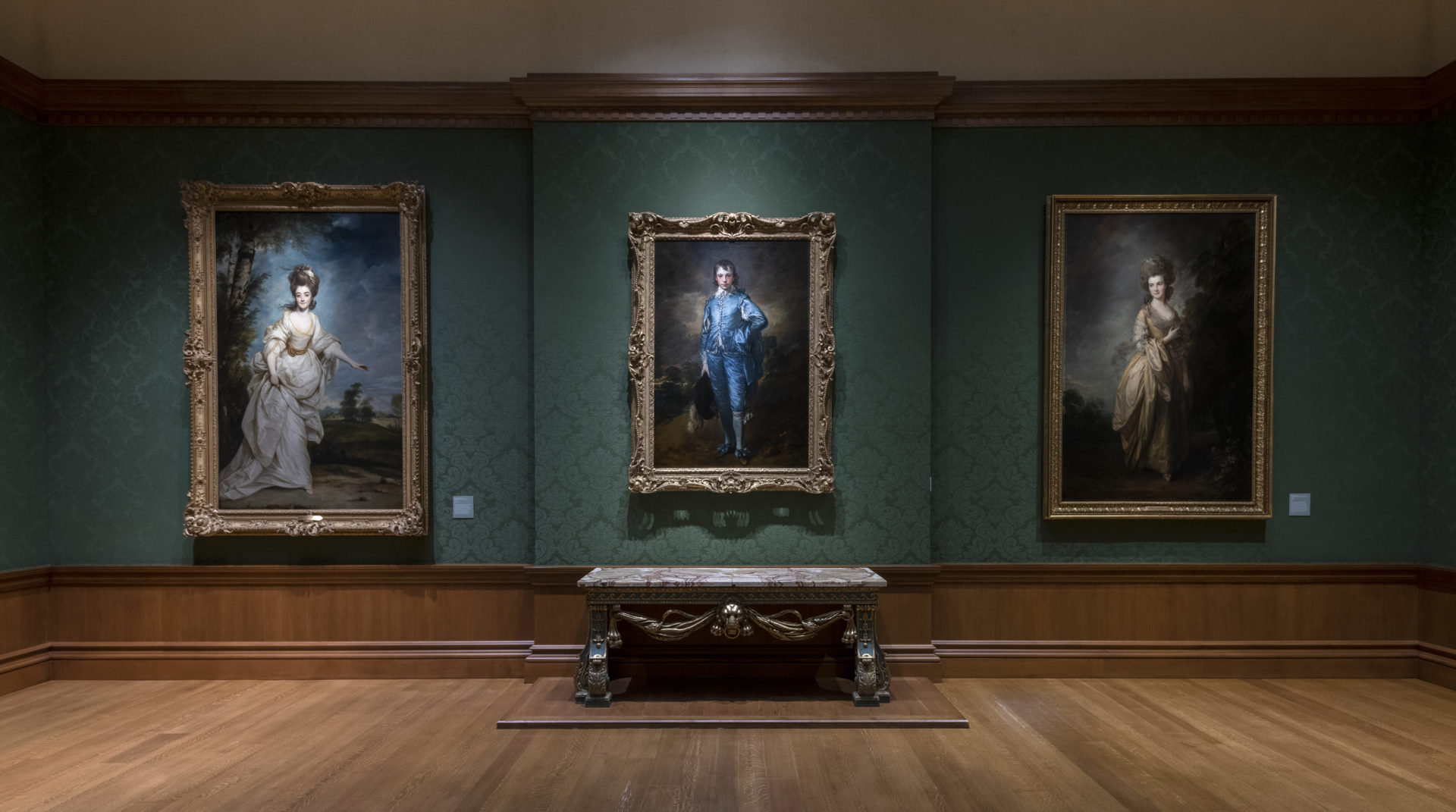
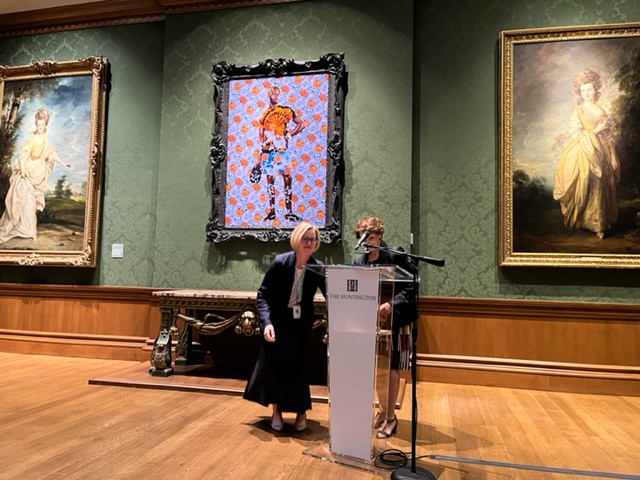
On Saturday, Oct. 2, 2021, The Huntington Library, Art Museum, and Botanical Gardens (The Huntington) unveiled Kehinde Wiley’s “A Portrait of a Gentleman,” a modern-day interpretation of Thomas Gainsborough’s magnificent 18th century masterpiece. It will be on display at the Thornton Portrait Gallery as part of an exhibition which includes other paintings hanging outside in the north passage. (Thomas Lawrence’s “Pinkie,” another renowned treasure, has been moved there but will be back in the portrait gallery next year.)   

Commissioned by The Huntington to celebrate the 100th anniversary of “The Blue Boy’s” acquisition by Henry and Arabella Huntington, “A Portrait of a Young Gentleman” will be in the museum’s permanent collection and visitors can still view it after the show ends on Jan. 3, 2022.  

Wiley has famously talked about The Huntington having a major role in his formative years. “I loved The Huntington’s galleries; the paintings by Joshua Reynolds, Thomas Gainsborough, and John Constable were some of my favorites. I was taken by their imagery, their sheer spectacle, and, of course, their beauty. When I started painting, I started looking at their technical proficiency – the  manipulation of paint, color, and composition. These portraits are hyperreal, with the detail on the face finely crafted, and the brushwork, the clothing, and the landscape fluid and playful. Since I felt somewhat removed from the imagery – personally and culturally – I took a scientific approach and had an aesthetic fascination with these paintings. That distance gave me a removed freedom. Later, I started thinking about issues of desire, objectification, and fantasy in portraiture and, of course, colonialism.”  

Karen Lawrence, president of The Huntington, speaking to the press during a preview one hour before the public viewing remarks, “We’ve long admired Kehinde Wiley’s work and the idea of engaging him with us at The Huntington has been in the works and under development for a few years. It is impossible to communicate how thrilling this moment is for us. We often think about influence as a one-way street: the past affecting the present. But as these two portraits of a ‘young gentleman’ face each other across this gallery and across 250 years of history, we can recognize that the present affects the past – the present powerfully reconfigures the past.”

“Kehinde Wiley’s magnificent portrait does more than engage with Gainsborough’s 18th century  masterpiece ‘The Blue Boy’ and the other works on display in this room,” continues Lawrence. “It really brings Wiley full circle to a place that he himself has said influences his art practice greatly. For it was to The Huntington that he came as a child with his mother and spent much time looking at these oversized portraits and their grand landscapes. He was impressed in two ways – by the sheer beauty of the brushstrokes and the grandeur of the composition – as much as by what was missing – the lack of representation of anyone who looked like himself.

“When we celebrated our centennial at The Huntington in 2019 we committed ourselves to re-examining the past and re-imagining the future. In this sense, our archives and collections are alive. Kehinde Wiley’s painting changes the Grand Manner portraits of the English nobility surrounding us.”

The themes of past and present are further explored when Christina Nielsen, director of The Huntington Art Museum, tells how Gainsborough – who preferred landscapes – became a portrait painter because it was the more lucrative career, how he broke into the London art market, and then gained national prominence.       

Installation view of Gainsborough's 'Blue Boy' | Photo courtesy of The Huntington Library, Art Museum, and Botanical Gardens
Installation view of Gainsborough’s ‘Blue Boy’ | Photo courtesy of The Huntington Library, Art Museum, and Botanical Gardens

“Gainsborough called upon the art of artists before him – van Dyck, in particular – and produced ‘A Portrait of a Young Gentleman,’ as he named it, and displayed it in 1770 at the Royal Academy Exhibition. It was a show stopper. He threw everything at it, including enormously expensive pigments: lapis, azurite, cobalt, indigo. He tweaked artistic conventions and went against reigning art theory of the day, which says blue should not provide a compositional methodology for a painting. It was a sensational success and artists of the time renamed Gainsborough’s painting ‘Blue Boy.’”

Nielsen expands, “The Huntington Art Museum has the enormous responsibility of being the steward of Gainsborough’s ‘Blue Boy.’ We are the keeper of this work for present visitors and future generations. It is one of the most influential and beloved master paintings in an American collection and we feel it very keenly on a daily basis. In the 250 years since its existence, it has influenced people like Whistler, Rauschenberg, now Wiley, among many others. It has absolutely sparked public imagination. It was on Cadbury tins in Great Britain before coming to the United States and it was in 11 exhibitions across the 19th century. It was reproduced and hanging on the walls of most British homes before it was purchased by Henry and Arabella Huntington in 1921.”

“And as we celebrate the 100th anniversary of its coming here, we also know how beloved it has become not only for British audiences,” Nielsen says further. “It is an American icon thanks to popular culture that emanates from California, specifically the movie industry. Stars from Marlena Dietrich to Jamie Foxx have dressed up and appeared in Hollywood movies as the ‘Blue Boy.’ It’s iconic on so many levels it’s hard not to sound hyperbolic. And if you have a painting like that in your collection, how do you respond for 21st century audiences?”

“There are few living artists today who could respond to the call like the one emanating from Gainsborough’s ‘Blue Boy.’ Kehinde Wiley answered the phone and responded magnificently. He is a painter who singlehandedly has changed the conversation about portraiture in the country, the power of representation, and the representation of power,” declares Nielsen.

And because everything today is global, ‘A Portrait of a Young Gentleman’ corresponds in its span. The model looks like someone every Angeleno can relate to – a surfer dude wearing a tie-dyed tee shirt, neon blue shorts, and Vans shoes, standing in a field of bright orange California poppies. Yet, he is anonymous. And there is universality in anonymity, according to Nielsen.   

Christina Nielsen (left) and Karen Lawrence (right) Huntington Library
Christina Nielsen (left) and Karen Lawrence (right) | Photo by May S. Ruiz / Beacon Media News & Hey SoCal

Wiley began working on the portrait during lockdown in Senegal where his Black Rock Senegal multidisciplinary artist-in-residence program is based, so Nielsen thinks his model is a young man from Dakar. The painting moved to his Beijing studio and then to his New York atelier early this summer. It then came to Los Angeles where it was placed in a train with an exact replica of the 18th century frame that The Huntington purchased a decade or so ago for the ‘Blue Boy.’ The frame was hand-carved in Nicaragua.  

Seeing Wiley’s “A Portrait of a Young Gentleman” occupying the space that has been “The Blue Boy’s” pride of place in the last hundred years might come as a surprise to some. It seems like a dissonance from all the paintings of properly-attired personalities in the gallery.

“Some of the Grand Manner sitters are in clothes of the day. Even in the 18th century, fashion was an incredibly important marker,” Nielsen explains. “Kehinde Wiley inserts black bodies into historical stories, and what these people would be wearing today. He’s also very aware of fashion and high fashion; these choices are all incredibly deliberate and conscious. The portraits right now face each other in the characteristic gesture. The details in the Wiley speak to the contemporary.

“All art was once contemporary and Gainsborough’s was revolutionary in his day and was the catalyst for his fellow artists and visitors to that original Royal Academy show. I imagine this will feel catalytic. I know how I felt when I walked into this room and saw it on the wall. I can also say that several days in, I have fully metabolized it and now it feels like it’s always been here. You can’t look at it without thinking of them, you can’t look at them without feeling its presence. It’s incredibly exciting the range of conversations that this will open up for our audiences and I imagine, as always, art will elicit responses across the whole spectrum. It will take time for some people and some will immediately just feel the joy and exuberance.”

Lawrence says, “Kehinde’s portrait of Barack Obama for the National Portrait Gallery transformed everyone’s thought about presidential portraiture – the Grand Manner genre of presidential portrait was stunningly interrupted. And with that of Barack Obama’s added with all the white faces, you could predict how this will enter into the canon. The significance will be great.

“We wanted The Huntington to make invitations to re-interpret cultural practice as well as our historical and literary archives and collections in the library. For contemporary practitioners to activate, motivate, respond to what we have because otherwise, what’s the point? We’ve made that invitation and I think that the audiences for the Huntington will come here and see the continuity of past, present, and future, and embrace that. What is unexpected? What are the different voices? These are opportunities that we want to take. I’m speaking for myself and Christina and we’re absolutely thrilled with what Wiley has chosen to do.”

October College Search Guide

Originally published on 1 October 2021 on Hey SoCal

Harvard University | Courtesy Photo

The road to college

The road to college involves four years of complicated planning and complex scheduling. High school students are extremely busy – homework, extra-curricular activities in art and sports, campus clubs, all compete for their time. As if all that weren’t difficult enough, they have to make sure they get excellent marks in their courses and on the standardized tests. Their GPAs and SAT/ACT scores have to impress college admissions officers to really consider their application. If standardized test scores are no longer required by the schools to which your children are applying, their GPA is all the more crucial – it becomes the single, most important component of their transcript.         

I know several parents who enroll their kids in SAT prep courses as early as ninth grade and some independent counselors recommend that students sit for the SAT in 10th grade. However, I feel that taking the SAT this early isn’t necessarily the best course of action – students still have so much to learn and aren’t really ready for this test. Unless there are extenuating circumstances (if the SAT is a requirement for an advanced math course, for instance) that necessitate them to take it, I would suggest waiting a bit. I would recommend taking the SAT and ACT the summer before senior year. By then your children have accumulated as much knowledge as high school covered.

In the past 18 months tutoring service became a booming enterprise (and I don’t mean those offering test prep, which is a multi-billion dollar industry) for students who had difficulty during remote learning. While your children are now back on campus for in-person classes, they may be behind on some subjects so a tutor might still prove helpful. Find one that offers options to fit your student’s specific need and your family’s budget. A company called Mundo Academy provides excellent tutoring services in the Pasadena and San Gabriel Valley area.

FRESHMAN

Encourage your children to keep their focus on their schoolwork. By this time, they should have figured out what extra-curricular activities they are interested in pursuing and what sports they want to participate in. Give them guidance as they navigate this new phase in their school life, and support the choices they make.

SOPHOMORE

Depending on your children’s course choices and load, there could be standardized testing required of them. Your children should be taking AP exams following completion of the course while the knowledge they gained in class is still fresh in their minds. The best preparation for the exams is for your children to make sure they understand the subject matter and do well in all tests the teachers give in class. If there is something they don’t understand, they should right away speak to the teacher to ask for clarification or, possibly, find a tutor for additional help. The results of these standardized exams are required by some colleges.       

JUNIOR

Your children should be aware that junior year is the last complete year of high school performance that college admissions officers will see. They have to put more effort at doing well and getting good marks.

They should register for and take the PSAT, which is also the qualifying exams for the National Merit Scholarship. It is also a good time for your children to meet with their school counselor to make sure they are taking all the courses they need to graduate and apply to college.

Your children should also be keeping up with their extra-curricular and sports activities. College admissions officers look at several components as they try to assemble an incoming class made up of the best candidates to add to their student body. 

Several high schools in the area hold college fairs on campus. This is an excellent chance for you to see what the different colleges and universities are offering. Students get to meet and speak to admissions officers – usually the same people who would be reviewing your children’s application, reading the essay, and sitting around the table – who would be making their case for your children during the all-important decision-making rounds. Make sure you and your children attend these college fairs.

SENIOR

Your children should now be in the process of completing the common app, and finalizing their essay topic or personal statement. Unless recommendations can be sent to the universities online, your children should have provided the teachers who are writing their letters of recommendation with stamped envelopes.

Depending on what course your children are applying for, they may be required to send supplementary material (auditions or portfolios) with their application and they need to get those ready. Audition tapes for arts performance, for instance, can be uploaded on YouTube for easy access. Your children should check the website of the college or university to which they are applying about supplement material requirements. Your children’s school counselors are also a great resource as they are always in contact with college admissions officers.

Be on top of application deadlines; most schools offering Early Action or early Decision have to receive your children’s application by the 1st of November.  

You and your children should be researching scholarships. Some websites include: CollegeXpress, Fastweb, Free Application for Federal Student Aid, National Merit Scholarship Corporation, Scholarships.com, Scholarships360. You should also attend the financial workshops being offered at your children’s high school. Most high schools offer on-site guidance, with specialists who can answer your questions.

Your responsibilities as parents are limited to offering encouragement, guidance, and moral support as your children go through this stressful time. But while you need to let your children manage this process, you should also express your concerns and expectations. Communicate with your child, the counselors, and the teachers when you have inquiries. 

Be there for your children but learn when to get out of their way. Never try to communicate with the college admission officers as it is the surest way to sabotage your children’s chances for admission. Do not be overzealous about getting your children accepted to their dream university; there is a school out there that’s the right place for them. The counselors at your children’s school and the admissions officers at the colleges, or universities to which your children are applying, are actually the experts at finding the best fits. And while this may sound hollow at this time when you’re in the thick of college admissions, this is actually a wonderful learning opportunity for your children. Give them the chance to succeed on their own.               

A Noise Within is Back on Stage for its 30th Anniversary Season

Originally published on 28 September 2021 on Hey SoCal

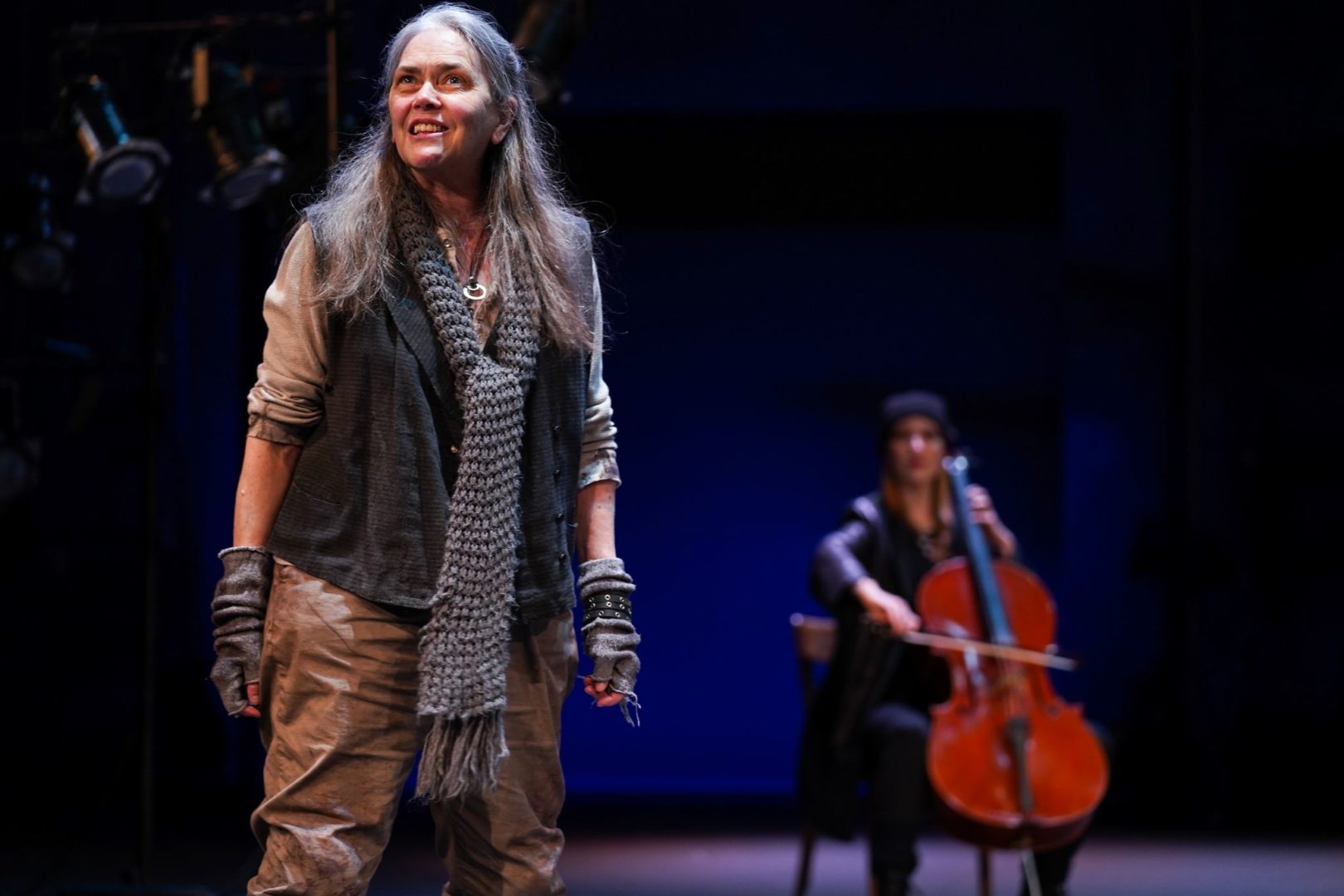
Deborah Strang as ‘the poet’ in “An Iliad” | Photo by Eric Pargac / A Noise Within

After 18 months of shutdown, A Noise Within (ANW) returns to live theatre with a one-person show of Lisa Peterson and Denis O’Hare’s modern-day retelling of Homer’s epic “An Iliad.” Directed by Julia Rodriguez-Elliott, it features two ANW powerhouses Geoff Elliott and Deborah Strang in alternating performances as “the poet” and will be on stage through Oct. 3, 2021.

Speaking with us by phone, co-producing artistic directors Geoff Elliott and Julia Rodriguez-Elliott explain the theme of their 2021-2022 season, which marks their 30th anniversary, and detail ANW’s protocols to assure theatre-goers that their safety is a top priority.

Asked if there are plays they had originally planned for the previous season that will be included, Rodriguez-Elliott replies, “Yes, we brought back ‘An Iliad’ and ‘Metamorphoses.’ We have just experienced so much change in the world we live in, so our season’s theme ‘We Shattered the Chrysalis’ seemed like a very appropriate one to examine. And ‘Metamorphoses’ is at the center of that because it’s a play about transformation and the healing power of love as a change agent. We felt it would fit into the 30th anniversary season.”

Geoff Elliott as ‘the poet’ | Photo by Eric Pargac / A Noise Within

Continues Rodriguez-Elliott, “‘An Iliad’ is a play with one actor and no intermission so it was a means for audiences to get used to theatre again before we get into full productions. We figured we would learn a lot with this first show and any adjustment that we needed to make, we would be implementing in the following show, which has more cast members. More importantly, this play is always relevant; but more so right now, as we see and read about the rage and conflict going on everywhere. And with the Afghanistan withdrawal, it seems like it was written just yesterday. Additionally, it’s a brilliant piece of writing, and Geoff and Deborah are magnificent! It’s just a wonderful way to re-enter the world of live theatre.”

Prior to reopening, ANW developed and refined extensive plans to keep everyone safe which they outlined in a press statement. These procedures include, but are not limited to: staff and crew certifying as COVID compliance officers; initiating a deep clean of its HVAC system for optimal turnover of fresh air; routinely disinfecting high-touch areas; providing PPE; and following LA Department of Health guidelines.

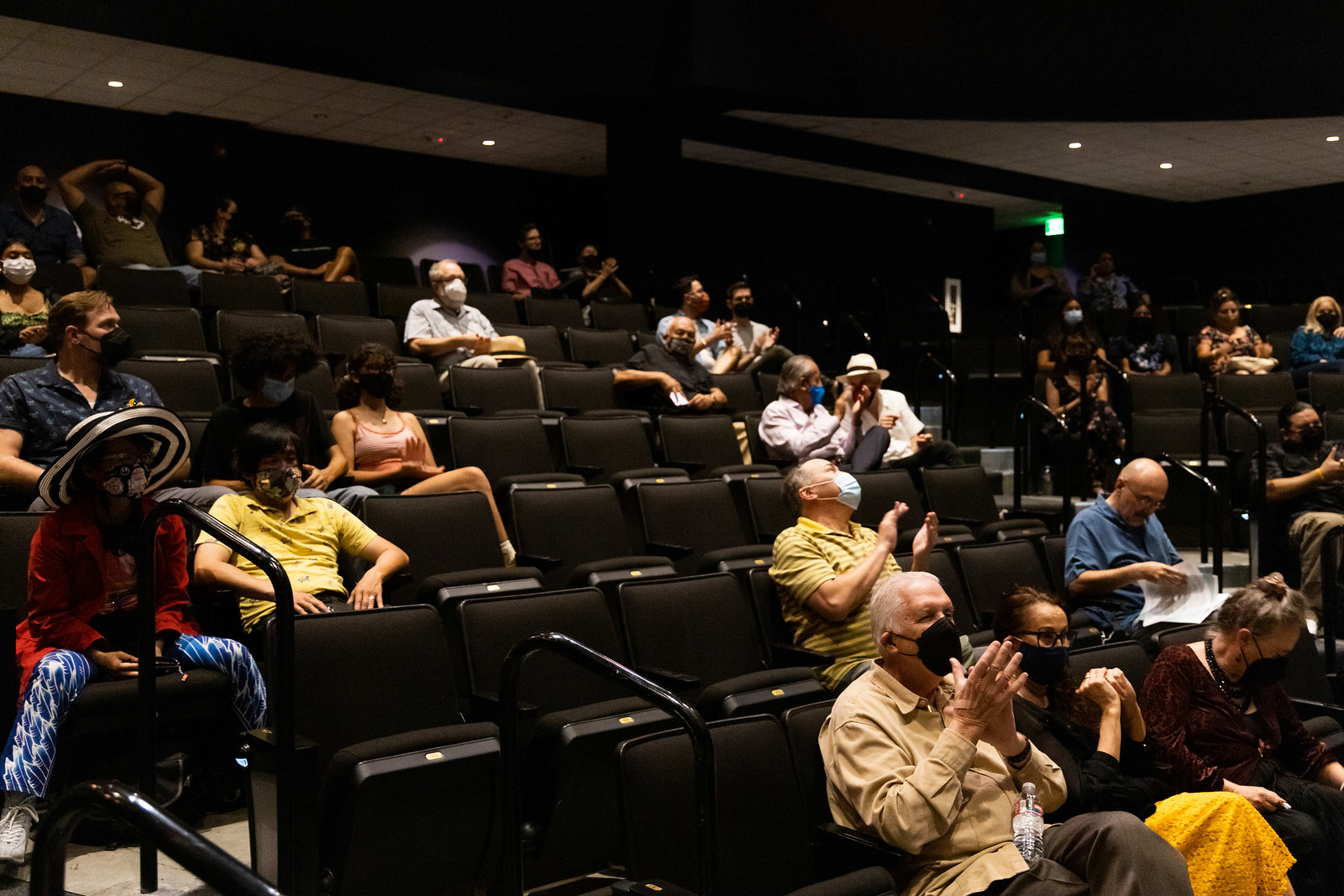
Besides requiring full vaccination for all staff, artists, and volunteers who work onsite, ANW has also put into effect strict guidelines for theatre-goers. Before being admitted into the theatre, all audience members must provide full proof of vaccination. Masks are required regardless of vaccination status and will be available on site until such time that LA County stops requiring masks indoors. At that point, masks will continue to be strongly recommended.

A Noise Within enforces strict safety guidelines | Photo by Brian Feinzimer / A Noise Within

During the months when the theatre was dark, ANW filmed ‘An Iliad’ with Elliott and Strang alternating as “the poet.” Elliott performed it on opening night for a live audience and relates the experience. “It was surreal on a certain level. Like everybody else, other than doing online things here and there, including filming ‘An Iliad’ a while back, we’ve been dormant for a year and when I got out there, I wasn’t prepared for all of the masks. It was a really surreal experience – I had to adjust as I have never done before. It’s beautiful to be back, but also very strange.       

“From an actor’s perspective, it’s a totally different feel. We rehearsed it differently. We knew we had to do it in a certain way because we only had limited time with the resources. It was a three-camera shot. There are seven chapters in ‘An Iliad’ and Deborah and I alternated performing in each chapter. We were very happy with the product but this play was meant to have a live audience for the actor to connect with them. Hearing their response propels you as a performer and you learn something new each time you do it – which doesn’t happen when the show is filmed. There’s something about everyone being in the same room, watching and listening to the story, and everybody relating to what’s happening on stage. You can’t have that anywhere else. It’s a kind of communion; there’s something very healing about it.”

“The show is really a conversation with the audience and when you do it on film, you’re missing that piece because the camera becomes your partner in a sense,” adds Rodriguez-Elliott. “It’s also different from the directing perspective. When you’re filming, the director or director of photography is making choices about what the audience is going to see, whereas in a play you’re on stage and you have a much more open canvas. As an audience member, you get to choose what you want to be looking at at any given time. Essentially, the audience members are much more active participants in a live version then in a film version. And it’s been interesting because a lot of folks who saw it on film have returned to see it live and almost everyone said they like the live version so much more.”

Audiences who have come back to watch the play are reacting positively to ANW’s strict protocols as well. Elliott says, “Overwhelmingly so. The feedback we’re getting is that people are thankful we’re requiring those and that we’re diligent about imposing them. If someone takes their mask off during the performance, our house manager and ushers gently remind them to put them back on, which makes everyone around them feel safe.”

Deborah Strang | Photo by Eric Pargac / A Noise Within

ANW is bringing back their popular holiday show this year and Rodriguez-Elliott addresses it. “We’re making an accommodation for ‘A Christmas Carol’ because it’s all about families coming to watch the show together. We’ll move to requiring children 12 and under to show proof of negative test for COVID. I think by then people are used to that because that’s being done in schools.”

Concurs Elliott, “The joy of the show is having families and their kids there. I have to say that I’ve read reports about Pfizer coming out with a lower dose vaccine for kids which they think will be available by Halloween. I hope – and I have my fingers crossed – that a lot of kids will be able to get vaccinated by then.”

While looking forward to things getting better by the end of this year, they recall the challenges of the past 18 months. Rodriguez-Elliott says, “Like other theatre companies, we tried to find opportunities to stay connected with our audiences on Zoom. We also wanted to keep the artists engaged. It was a challenging time for performers because the lockdown happened very unexpectedly, so they were quickly displaced and essentially out of work. As an artist, what fuels you is working on the art. As an organization, we were ultimately lucky despite all the challenges because we have such a strong support system. Our board did an amazing job of helping us navigate the challenges of the moment. Our supporters and donors responded and supported us in extraordinary ways, as did the foundations. Certainly, the government support was critical to surviving 18 to 19 months and not producing theatre nor having opportunities to generate revenue. It’s unheard of.”

“And, again, from a performer’s point of view, these Zoom readings are such a cheap knock-off,” Elliott expresses in frustration. “The artist is just trying to hang on, trying to connect with partners because the reality is actors feed off of each other. But we’re not in the same room so I’m not really looking at them when I’m speaking to them in a scene. We have to just imagine all that and, man, it’s so synthetic; I don’t think I will miss it.”

Rodriguez-Elliott declares, “It was a place holder but definitely not a substitute for real theatre. That said, in terms of the artistic piece of it, I think we got so adept at the Zoom world that it has been useful in things like being able to provide resources for audiences. Now we’re doing these deep dives where we have directors and artists talk about the play and audiences can participate in advance of attending a production. There are things that can enhance the theatre-going experience but not a substitute for it.”

“Plays like ‘An Iliad’ aren’t really suited for film; and performing on film isn’t what we do as a theatre company,” Elliott states firmly. “At the same time I take my hat off to all the performers and directors who were involved with it because it’s not easy to do. And as Julia said there was a learning curve but I think we actually got very good at it.”

“We also held two virtual annual fundraising dinners, believe it or not,” Rodriguez-Elliott says.  “The first one came up really fast right after everything shut down and the second one was last April. That we got adept at doing – we partnered with a caterer and had dinner delivered to people’s homes. We tried as much as possible to recreate the feeling in the room when we have events.”

Photo by Brian Feinzimer / A Noise Within

While ANW will now stage all plays with live audiences, they will keep some of their virtual programming. Rodriguez-Elliott discloses. “We’ll have the post-show conversations so even if people don’t watch a show on a night with one, they can still participate. We’ll also keep the ‘deep dives’ which our audiences enjoy.”

As much hardship the pandemic and resulting shutdown presented, there were lessons gained, which Rodriguez-Elliott expounds on. “We were still doing a lot of work. We still had to figure out what to do next and how to get through the next three months, but we were able to do it in comfortable clothes. It gave us a chance to consider a work/life balance and I think that’s a positive take-away. The other piece is that we learned to be flexible. It really called on us to change direction a number of times and I think one of the advantages for us was the size of our organization – we’re rather nimble so we were able to make changes as things were coming at us 24/7.

“It has been very moving to see how important the arts are in people’s lives because that’s what we heard over and over again with our community during this period of shutdown – the importance of theatre and community and coming together. On that note, I would like to say that this is a great time for people to support local theatre in the same way that we’re dining out to support restaurants. I think there’s a level of hesitancy. But once they come and they see the protocols that are being followed, and that we’re taking safety seriously and meeting them where they are, I think people will feel more comfortable attending live performances.”

Pasadena Playhouse Returns This Fall with a Party

Originally published on 14 September 2021 on Hey SoCal

The Pasadena Playhouse returns this fall with its 2021-2022 season. Danny Feldman, producing artistic director, couldn’t contain his thrill to be coming back to the theatre with a live audience. And it wouldn’t be just your standard seated audience either. But I’ll let him tell you all about it.

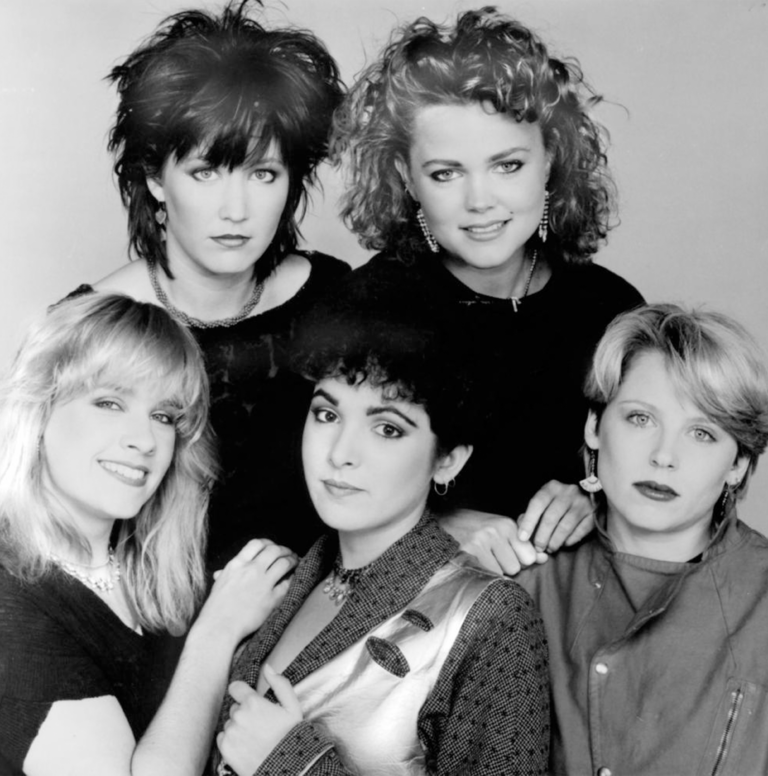
Speaking by phone on a recent afternoon, Feldman enthuses, “We’ll open our season in November with ‘Head Over Heels,’ a musical comedy adaptation of ‘The Arcadia’ by Sir Philip Sidney and is set to the music of the iconic 1980s all-female rock band The Go-Go’s. It’s huge and ambitious. I had been working on this for a long time, but I was planning to do it for a future season – there was no way in my mind we could do it this season. However, a few months ago, I went on an artistic retreat with two extraordinary artists – Jenny Koons and Sam Pinkleton – and afterwards we all thought this show is the only way to come back from a pandemic. It just felt so perfect for the moment even if we only had a short timeline to make it happen. This show is joyful, diverse, and wonderfully inclusive. We want to give people one of their best nights out since the pandemic happened.

The Go-Go's
The Go-Go’s | Photo courtesy of Pasadena Playhouse

“The world has changed. It is pretty unrecognizable to me right now and we want people to have that experience. So we’re completely reconfiguring the theatre – there will be no traditional stage and proscenium. The best way I can describe it is the show happens all around you. The story is about a royal family who goes on a journey to save their kingdom and discovers the joy of each other along the way. It is full of comedy, dancing, and great music, and the audience is coming along with them.”

Amidst anxieties about emerging coronavirus variants and mutations, rehearsals on “Head Over Heels” are well underway. Feldman says, “Like everyone, I’m cautiously optimistic, a little nervous, and really very excited to get things going again. At the same time, we’re being flexible because we realize there’s so much uncertainty. It’s truly a piece of art and theatre being created out of the pandemic. And that’s rare because we’re so close to it. I expect years from now there will be plays about what it was like during a pandemic period and what we have is a piece of art created during one, which takes into account the challenges – audience safety concern and all that. But we still feel we can safely pull this off given the guidelines now and the direction COVID’s going. That said, if things change we will adapt and change with it. This is a new world.”

Except for next spring’s premiere of “Ann,” The Playhouse’s 2021-2022 season isn’t what was originally slated for last year. Feldman discloses, “Everything is going to be new because I took a different approach that is reflective of the world that changed. The Pasadena Playhouse takes great pride in the fact that though we’re a hundred-year-old-plus institution, we’re relevant, we’re responding to the moment.

“’After ‘Head Over Heels,’ we’re staging a play that’s a Pasadena Playhouse co-production with the Woolly Mammoth Theatre Company in Washington, D.C. and the Huntington Theatre Company in Boston. Again, this is a new model of creating work. The play is a teenage retelling of ‘Richard III’ with a rather racy title ‘Teenage Dick’ and it’s a pretty exciting new work by Mike Lew, an amazing young playwright. It sets Richard III in high school where he’s bullied because he has cerebral palsy and he’s running for senior class president. It gets into power and what one does to achieve power and status when they’re a marginalized person. It’s both funny and gut-punching and is really a fun way to approach a classic like ‘Richard III,’ but in a contemporary setting. It’s a wild ride. I think it’s a surprising evening of theatre people will not forget for a long time.”

Holland Taylor
Holland Taylor | Photo courtesy of Pasadena Playhouse

Feldman says further, “‘Ann’ follows in the spring with the extraordinary Holland Taylor, the legend – this is her show. It’s a delightful evening celebrating Ann Richards. It gets into politics in a way that is appropriate for today, that is not trying to separate people or create division but bringing people together. Governor Ann Richards was an older divorced woman, single mother, former alcoholic, Democrat in Texas. And Holland just reincarnates her. She’s coming back alive on stage and you feel like you’re having a visit with Ann Richards. It’s a delightful, soul-soothing celebratory evening. After ‘Ann’ there’s a show I haven’t picked yet. 

“Then we close with a party as well – ‘freestyle love supreme.’ This was created from the minds of Lin Manuel Miranda and his collaborators Anthony Veneziale and Tommy Kail who directed ‘Hamilton’ and another production we did with Nia Vardalos ‘Tiny Beautiful Things.’ This will be the first time that the Pasadena Playhouse has a show coming directly from Broadway. It’s a Special Tony recipient and it will be on Broadway for the second time in October, and then it’s coming here next summer. It’s got several things all at once – hip-hop, freestyle rappers, a band, an audience, and no script. The show will be made up every night using words and ideas solicited directly from the audience and then, like magic, you see it appear right in front of your eyes. It’s a wonderful way to round out a season that to me is exciting and pulsating and celebratory and creating a new path forward – different kinds of shows, different ways for audiences to engage with the work.”

While The Playhouse won’t be opening until November, Feldman stayed busy during the pandemic. He says, “We launched our digital platform PlayhouseLive where we had a full program which included commissioned work that was in response to George Floyd and the racial reckoning in America. We also did the Jerry Hermann show about the Broadway composer, which garnered attention all over the country. We offered a Broadway class with hundreds of people across the United States taking it.

“We expanded our footprint. We really worked on redefining what a theatre can be during that time – what it looks like when you’re not confined to four walls of a historic theatre. That was exciting and we’re certainly planning to continue some of our digital work.”

PlayhouseLive was as much a success as it was a revelation. Feldman explains, “The word community changed for us. One of our shows was favorably reviewed by the New York Times. I don’t think that’s ever happened at the Pasadena Playhouse! Our community wasn’t just Pasadena, San Gabriel Valley, and Los Angeles. People from all over the world were watching our content – it confirmed that the name Pasadena Playhouse actually means something around the world. Of course we know that because it’s been here forever, but it really was a fantastic sign of our power and peoples’ understanding of who we are and desire to engage with us.”

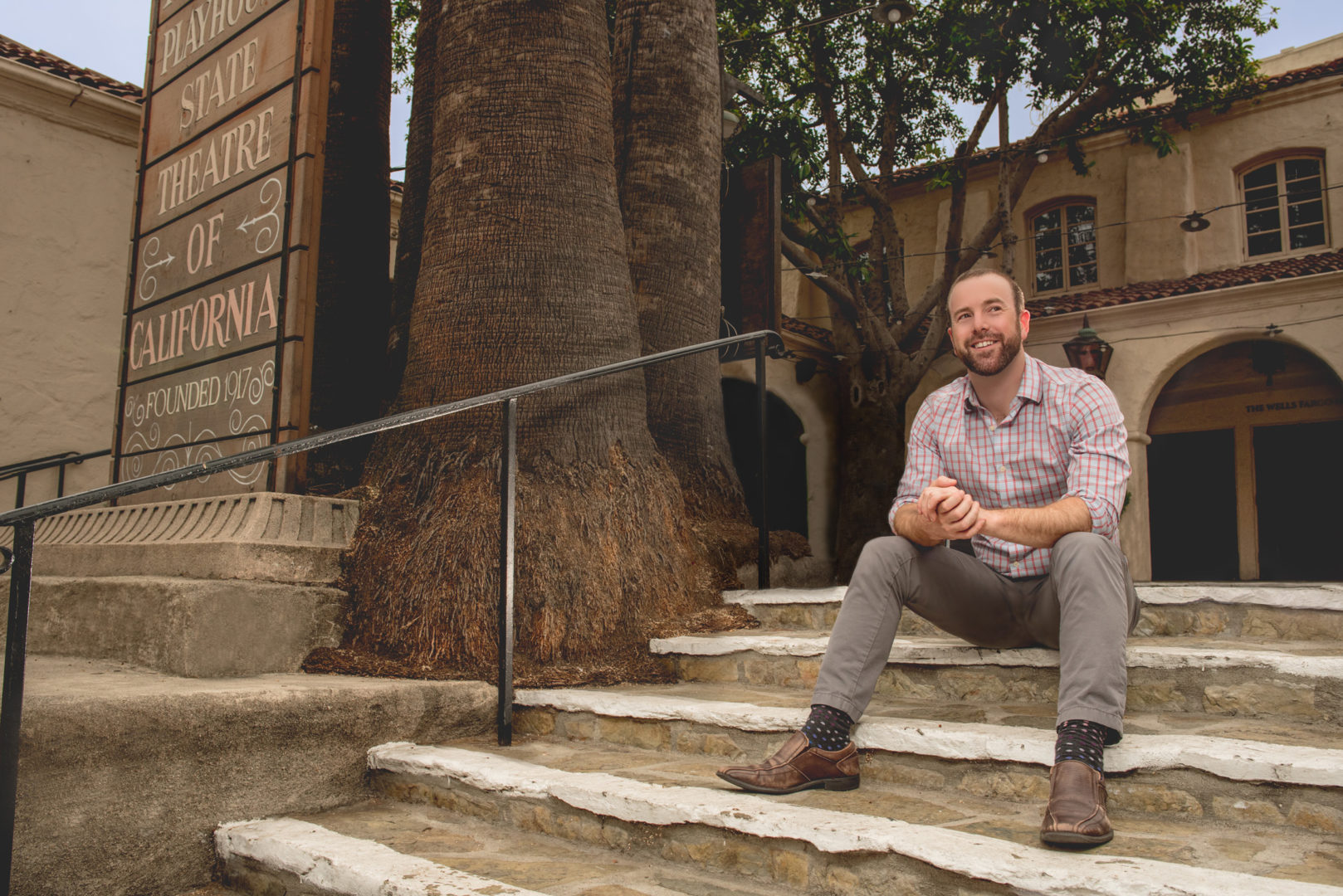
Danny Feldmen at Pasadena Playhouse
Danny Feldman | Photo courtesy of Pasadena Playhouse

Asked what he learned during the pandemic, Feldman replies, “I learned to slow down a little bit. I learned that in the absence of performing art, we realized how much we need it, and how much as humans we’re wired to come together and be together. It’s not just we’re wired to tell stories and hear stories, we could do than on Netflix and HBO. It’s the collective experience of sitting in a room with strangers, having the lights go down, playing make-believe, and having shared experience with the actors on stage but also with the audience – laughing together, crying together, applauding together – all of that. It was an opportunity to understand the value of that in our lives and to make sure that when we came back out of that, that we do it wholeheartedly, we do it with intention, and we do it to create good in the world.

“Our role at the Pasadena Playhouse is to make the lives of our community better – to enrich the community. When I try to pick shows, I ask ‘Is this one going to create good in the community – even the challenging ones?’ ‘What conversations is it going to start?’ This season there’s so much celebration – whether it’s Go-Go’s dancing party at the beginning or free style with The Supremes at the end – and how to get people to laugh and engage and come out of their shells together. Or for those who just want to sit back and experience it their way, ‘How do you create a space for them to do that?’ We take stock in these moments. I’m thrilled to be coming back! I can’t wait!”

Feldman ends with a call to action. “We had a year plus of absence of the performing arts. If any of the readers are like me, that was a part of the pain of the year. Now that we have an opportunity to come back, having community here that is full of rich cultural experiences is so important. It’s why I love living here. And the best way our community can come together to make sure that in this very uncertain period we can have a thriving scene and places to go, is to support cultural institutions. Support us here at the Pasadena Playhouse and other local theatres. You can do that by donating if you’re in a position to do it but, even more importantly, become a member, subscribe. Make a commitment that I’m going there a couple times a year. That’s our lifeblood. We need a robust audience to stand up and say, ‘We want this and we’re ready to come on a journey with you’ in order for us to be here for many years to come.”                                      

Reader Reactions to the ‘Blue Boy’s’ Trip to London Next Year

Originally published on 10 September 2021 on Hey SoCal

Installation view of The Blue Boy | Courtesy Photo / The Huntington Library, Art Museum, and Botanical Gardens

Last month we published an article about the announcement that The Huntington Library, Art Museum, and Botanical Gardens has decided to loan our beloved “Blue Boy” to the National Gallery in London. Gainsborough’s magnificent work, which left England for the United States on Jan. 25, 1922, will be part of an exhibit that is set to open exactly 100 years since that day.

In its announcement, Huntington President Karen R. Lawrence, remarked, “This masterpiece has made an indelible mark on both art history and popular culture, capturing the imaginations of a wide range of audiences. Given ‘The Blue Boy’s’ iconic status at The Huntington, this is an unprecedented loan, one which we considered very carefully. We hope that this partnership with the National Gallery will spark new conversations, appreciation, and research on both sides of the Atlantic.”  

We in the San Gabriel Valley are so fortunate to have world renowned museums and to have been exposed to stunning works by some of the greatest artists who ever lived. Most of us have never known a time when “The Blue Boy” wasn’t at The Huntington. So we asked our readers to tell us how they feel about it traveling to London and share with us their experience with this piece of art.

While we didn’t receive as many responses as we had hoped, we learned that our readers have informed opinions with information to impart. We also feel that what we did get are representative of people’s reactions and we’re printing them below:

“My informal response to your informal survey is that if the experts say it’s not safe for the painting to travel, then it shouldn’t. I’m also concerned that if the painting does go to London, what’s to keep their museum from saying that the painting is too fragile to send back?

“As you can see, I’m reluctant to let it go.”

Meg Gifford
Pasadena   

“Everybody likes to return home, even for a short visit … and I’m sure ‘Blue Boy’ is among them. So I wish him “calm seas and prosperous voyage.”

“The greatest gift master painters have given mankind is that it doesn’t take an advanced degree in art to appreciate their work.

“Even as a rustic with no refinement, I have stood at length in reverence before Gainsborough’s masterpiece. And in so doing, I convinced myself that if I touched that canvas, I wouldn’t feel a flat surface, but instead Blue Boy’s silken garment and his flesh underneath it.”

David Quintero
Monrovia

‘The Blue Boy’ post conservation | Photo by Christina Milton O’Connell / The Huntington Library, Art Museum, and Botanical Gardens.

“I believe it is a wonderful opportunity to return it to the land from whence it came so that a ‘new generation’ can admire its beauty. The concerns cited can be mitigated if those involved will check history regarding other great works of art that traveled outside their respective country. 

“The Mona Lisa was painted in 1503, 276 years BEFORE Blue Boy. Thanks to the efforts of former First Lady Jacqueline Kennedy, France’s national treasure, a very fragile piece of art, was shipped to America. On January 8, 1963, Leonardo da Vinci’s Mona Lisa made its first appearance when it was put on display at the National Gallery of Art in Washington, D. C. It was transported by the S.S. France ocean liner in a temperature-controlled box in its own stateroom, accompanied by armed guards. The temperature, which was alarm-monitored, would not be allowed to fluctuate by more than one degree throughout the entire journey. Eleven years later, in 1974, the Mona Lisa once again left France to travel to Russia and Japan. It can be done without endangering the masterpiece.

“Françoise Nyssen, France’s former Minister of Culture, once said that she didn’t believe works of tremendous cultural significance should be confined to a single institution. I thoroughly agree.  Whenever possible, great works of art should be shared with the world.

“Thank you.”

Charlotte Farmer
Arcadia

“My first memories of seeing the ‘Blue Boy’ was in the 1970s when my parents took me to The Huntington as a young kid. It was my mom who introduced me to it, saying it’s a great piece of art. But my appreciation of it at the time was due to the fact that the painting was of a child, like me. I remember it also being next to “Pinkie,” and I don’t know if they were meant to be deliberately displayed next to each other. While these were paintings from a long time ago, I felt a connection and kinship with them.

“That impression stayed with me to this day so when we have visitors, I take them to The Huntington and show them the ‘Blue Boy.’ When my cousins from Japan came in 2018 for my dad’s 88th birthday celebration, I took them to the mansion along with a niece and nephew who aren’t from this area. I told them about The Huntington’s conservation project and what the x-rays showed beneath the painting. I was able to share a part of my local culture to two generations. There was a language barrier between my Japanese cousins and my American relatives and they had to use Google translate to communicate, but it was a fun family experience tied to the ‘Blue Boy.’              

“It’s a nice gesture to share the artwork and I hope it’s safe for it to travel that far. However, its absence will sadden many of us who have grown up knowing it’s always been there. I imagine ‘Pinkie’ will also be sad not to have him by her side. What’s going in that space while ‘Blue Boy’ is away?

“I’m a member of The Huntington and I take strolls at the gardens. And every time I go to the mansion, I make it a point to see the ‘Blue Boy.’ It’s a magnificent piece of art and embodies what I think The Huntington is about. There are so many rotating exhibits – even at the promenade area – but seeing the ‘Blue Boy’ always makes me happy. It evokes emotions and memories of my childhood. I’ll be looking forward to its safe return.”   

Stephanie Yamasaki
Altadena 

The board of The Huntington will be glad to know that their decision has more proponents than opponents and art experts can be assured that “The Blue Boy” can safely travel, as one reader asserted. And we can be gratified in the thought that art enthusiasts across the Atlantic will have the rare chance to see and experience the treasure we hold precious.

September College Search Guide

Originally published on 1 September 2021 on Hey SoCal

Duke University | Courtesy Photo

The road to college

Amidst the ongoing debate about the constitutionality of requiring every eligible student to be vaccinated or agree to weekly COVID-19 testing (Pasadena Unified School District was one of the first districts whose board approved the mandate), all schools in the San Gabriel Valley are now open for in-person classes.

With the troubling surge in infection cases from the Delta variant, it should be a welcome relief for administrators, teachers, parents, and other vaccinated students. The move could help bring some normalcy to our children’s school life. These students would like to resume the kind of learning that virtual classes could not replicate.    

Before I launch into the college guide, let me first touch on a topic that oftentimes causes family discord. School counselors tell their students to follow their passion when it comes to deciding what to pursue in college. That makes a lot of sense because people generally learn better when they’re studying something they are interested in. However, we also hear about research that finds STEM degrees are the most valuable, with the liberal arts the least valuable, to employers. Parents, anxious about their children’s earning potential, career future, and over-all financial stability, then discourage their children from taking liberal arts in college and push their children into the STEM field.

Employers, on the other hand, emphasize that they’re looking for applicants with excellent communication skills even when the job isn’t STEM-related. The conflicting information is enough to make anyone’s head spin. The one thing researchers and career advisors agree on is that earning a college degree will pay off in the long run. So whether your children are looking to get an engineering degree or are more interested in the humanities, the important thing is for you to support your children’s choice and help them be ready for college.                        

And that brings us to the College Guide. School administrators and counselors preach to their students that the college application process doesn’t start until the spring of their junior year and, therefore, they should just have fun and enjoy high school. While I agree that they won’t be applying until their senior year, the admissions process really begins on the first day of ninth grade. The components of their application is a compilation of their activities and accomplishments during their four years in high school. Hence, I advocate that your children start planning early on. Doing so makes a world of difference in their college search outcome.

FRESHMAN

Instill in your children good time management and organizational skills early on. High school is so much busier than what they’ve been through yet. These skills will help them have a happy, productive, and successful four-year experience.

If your children didn’t develop good study habits in lower and middle school, they need to buckle up and be serious about academics. Encourage them to immerse themselves in the culture of their high school and get involved in various extra-curricular activities that support their interests, and which they can carry on into the next three years.

Your children should find the time to meet with their school’s counselor to map out a four-year curriculum that meets all the requirements for graduating and going into college. Most colleges or universities require: four years of English; four years of mathematics; four years of science with advanced work in at least one of the three disciplines — biology, chemistry, physics; four years of a world language; three years of history, including American and European.   

They should take the most challenging courses they can handle. If their high school offers Advanced Placement (AP) subjects in ninth grade and your children decide to take the course, they have to be ready to take the exams after they complete it. Colleges usually only recognize 4s and 5s to show competency. Highly selective institutions also expect As on AP courses on students’ transcripts. 

I cannot emphasize enough that your children’s GPA is the single, most important component of their transcript. With several universities, like the UC and Cal State systems, dropping the SAT, students’ grades could very well be the determining factor for college-readiness.       

SOPHOMORE

By this time, your children should be fully transitioned into high school. They should be picking up where they left off — taking AP courses, working on extra-curricular activities they identified in their freshman year, etc.  

Practice exams for standardized tests are given in your children’s sophomore year so make sure they are registered for the PSAT (capacity is limited because of COVID-19 concerns so check to ascertain testing dates and that sites are open). Taking these tests will help them identify their weaknesses and study for them. Several companies and organizations offer test preparation courses (ACT: www.act.org; PSAT: www.collegeboard.com; Educational Testing Service: www.ets.org; Kaplan: www.kaplan.com; National Association for College Admission Counseling: www.nacacnet.org; The Princeton Review: www.princetonreview.com).

It may seem too early to do this, but your children can start looking at colleges that offer courses in their fields of interest. Or they can begin considering all possible options, if they haven’t determined what they are thinking of taking in college.

JUNIOR

This is a very hectic, even stressful, time in your children’s high school life. It is also the last complete year that college admissions officers will see your students’ grades and accomplishments. It is a critical year for them; they need to put the effort to show admission officers that they are capable of doing the work and are qualified for admission to the school to which they will be applying. If your children are thinking of applying to universities through early action/decision, their junior year grades and work will be all the more significant.

Aside from the rigors of school and extra-curricular activities, there are standardized tests to take. Your children should be taking the Preliminary SAT/National Merit Scholarship Qualifying Test (PSAT/NMSQT) early next month. I would like to remind parents not to put extra pressure on their children as they get ready for the standardize exams — they are stressed enough as it is, and a higher-than-average SAT score does not guarantee admission to their dream university.        

Normally, colleges and universities would be holding College Fairs on various high school campuses around this time. Your children’s school should update you if either in-person or virtual fairs will be held.        

SENIOR

It is going to be a marathon for your children! If your children are applying for early action/decision, they should have taken all the standardized exams required by the university during their summer after junior year. 

Make it a point to attend your children’s ‘Back to School Night’ – counselors will probably be giving parents information about the college applications that will be starting in earnest.  

The organizational skills that I have been talking about since your children entered ninth grade will be put to the test during their senior year. Encourage your children to create a calendar with standardized testing dates, counselor meeting schedules, and application deadlines. 

Your children should have a binder with separate sections for each college or university and a log of what needs to be accomplished for each, like: required standardized tests (SAT or ACT, SAT II grades; AP test scores, etc.); writing supplement; how many letters of recommendation they require; application fee; application deadlines..      

Ideally, you and your children have visited the colleges (even if you did it virtually) they are thinking of applying to. One of the first things they have to do is finalize the list of colleges and universities to which they will send applications. Eight was the norm when my daughter was applying, but students now are sending in 12 or more applications. This new normal, though, has only added to the competitiveness of the process. I would suggest limiting it to12 because applying to more schools doesn’t make a university with a 4% admission rate a more reachable goal.  

They should be ready to write their personal statement. If teacher recommendations are being sent to the schools instead of emailed, your children should also have provided stamped envelopes to the teachers.   

If you are applying for financial aid, be aware that the Free Application for Federal Student Aid FAFSA submission date starts on October 1st to align with the college admissions schedule. 

Research all scholarships available. Some online sites include: CollegeXpress; Fastweb; and Scholarships.com. Many schools use Naviance, which also provides students information about scholarships and assistance on how to apply.

It goes without saying that as busy as your children are when they go through the college application process, they should also get the best grades they are capable of. The colleges to which they are applying will require their first quarter grades if they’re looking to gain admission through early action or early decision.     

One factor that makes the college admissions process really stressful for parents is the feeling of not knowing what’s happening. School counselors generally only have time to meet exclusively with students, so parents feel shut out. However, there are books you can read to help demystify this process. A book I would recommend is called “Getting In! the Zinch Guide to College Admissions and Financial Aid in the Digital Age” by Steve Cohen, Anne Dwane, Paulo de Oliveira, and Michael Muska.

The professional guidance and insight the authors of this book provide will give you the ability to help your children navigate this complicated process. Use the book constructively; do not make it another source of stress for yourself and your children.

A book by Frank Bruni called “Where You Go Is Not Who You’ll Be” is a great read for both parents and students who are in the middle of college applications. It will help keep your expectations realistic and relieve your children of the pressure to get into the most selective universities.   

Survey: 1 Out of 4 Parents Cheated to Get Their Child into College

Originally published on 26 August 2021 on Hey SoCal

As soon as school opens every fall, 12th graders everywhere in the United States go through a rite-of-passage called college admissions. High school seniors look forward to it with both excitement and dread. It is, after all, the culmination of years of hard work that they hope earn them admission to a university high on their list. For them to find out that some children of the rich and famous undeservedly got into a college, as the bribing scandal revealed three years ago, is infuriating at the very least.  

This deceitful behavior, however, isn’t exclusive to celebrities. An Intelligent.com survey conducted this past spring showed that one out of four parents cheated to get their child into college. The admissions  process is complicated enough without parents’ involvement.

We asked college expert Beata Williams, an independent admissions consultant coaching students through the admissions process who had previous experience as an admissions counselor at Columbia University and at New York University, how counselors can discourage parents from taking matters into their hands.

“In my opinion, a healthy level of parental involvement in the college admissions process is beneficial to students,” Williams states. “However, students benefit the most if they are laying their own groundwork towards their college paths. Reinforcing the importance of the students’ engagement and keeping admissions conversations centered on the student and their profile (which includes student accomplishments) tends to be a successful strategy for keeping the process focused.”

Endowing universities has been a common practice among the elites but it has never gotten negative publicity. As benevolent as it seems, it still points to ways the privileged few could go around the admissions process. However, Williams says it is very unlikely that universities will discontinue accepting donations that benefit their endowments in the near future. Neither is she surprised that average parents like us are cheating to get their child into college. “Human nature does not discriminate amongst socioeconomic classes,” she declares.

The survey found that parents with high incomes ($125,000 or more annually) and those with low incomes ($49,000 or less annually) were the ones who cheated, while those who were considered ‘middle class’ ($50,000 to $124,000) didn’t. Does that mean they had nothing to lose or they had more confidence in their child’s ability? But what did that say about those who chose to cheat?

Williams opines, “I am not a trained psychologist but there is an Attribution Theory of psychology that – if I loosely interpret it – explains that high achievers relate success and failure to their efforts and abilities and they have a strong desire to reach their goals. Low achievers relate their success and failure to luck and the difficulty of the task assigned. I believe the answer to your question could very well be related to this theory.”

Kids are the ones losing when their parents try to manage their college application as Williams explains, “The college application process is a huge growth opportunity for a young adult. As stressful as it is, it provides a platform for them to gain strategy and decision making skills. When parents manage the process for their kids, they actually deprive them of a growth opportunity.

“College admissions is highly competitive and very stressful for students and parents. A book I wish parents and students who are currently in the admissions process would read and take to heart is ‘Where You Go is not Who You’ll Be’ by Frank Bruni. Perhaps it would reduce the admissions madness.”

Beata Williams, left, working with a student | Courtesy photo / Intelligent.com

Nowhere is the admissions process more anxiety-ridden than in Pasadena and surrounding cities. High school students here are so accomplished – they take as many as six advanced placement (AP) subjects in one school year, play varsity sports, vie in the most prestigious dance or music competitions the world over, enter science and engineering contests for scholarships, and establish nonprofits for a cause they want to advance, while excelling on every standardized test, and getting an unweighted GPA of 4.0 – that all of them are qualified to be admitted to the most selective universities. The competition is fierce because every student has to stand out among other overachievers.

At Arcadia High School (AHS), which has consistently ranked in the top 1% of high schools in the United States and has been named a Gold Medal School by U.S. News & World Report, students and parents know how daunting college admissions is, yet have a healthy approach to it.

Angela Dillman, AHS principal, and Amanda Fitts, college counselor, talk to us about the Intelligent.com survey findings.

Asked if it’s shocking that parents would cheat to get their child into college, Fitts replies, “I wish the number was lower but, honestly, I’m not shocked because of the tremendous pressure students and parents feel surrounding this process. This is especially true in communities where the pressure is intense to get into ‘name’ colleges and not just to get into college. I put a lot of blame on publications like the U.S. News & World Report that rank colleges based on data which aren’t that valuable in terms of students finding the right fit. I will say, though, that parents who donate huge sums of money to colleges is, unfortunately, not new. And we can’t really say that it’s cheating because it’s a practice that’s out in the open. But it’s also rare – we’re talking about millions of dollars. But hiring other students or even adults to take the test is quite upsetting.”

Dillman comments, “I couldn’t speak for any single family from Arcadia, but I think our families really value and trust the application process. Our students work very, very hard to make themselves the best candidate they can be on paper. I couldn’t be sure that our families didn’t cheat but my impression of our families is that they want to do things the right way and they support their students to be legitimately competitive. I know that when the college admissions scandal came out, our students were horrified because they’ve been working so hard and their reaction told me everything I needed to know that our community isn’t participating in something like this.”

“It’s a disservice to those students whose parents are cheating because the message the student is getting is that they aren’t capable of doing this on their own and these students carry those values with them throughout their life,” adds Fits. “Furthermore, they will go to school not on their own merit and where they don’t meet the criteria for success just to satisfy their parents. It’s harmful and unfair to deserving students who could have had that spot. Besides, parents who cheat cast a negative reflection on the high school the student is coming from.”

The stress for most students and families comes from unrealistic expectations and focusing on the wrong things when they look for a school. Fitts agrees with that assessment, saying, “I find that to be true every year and this isn’t the first school I’ve worked at. Sometimes it’s not that expectations are too high, it’s not understanding how the college admissions process works. Some students could be a fantastic fit for a highly selective school but because their acceptance rates are a certain number and they are building a class based on their priority as an institution, it’s out of the student’s control who’s selected. There are components they can control but there are some they can’t.”

Angie Dillman (right) and Amanda Fitts (left) | Photo by Shari Rudolph / Arcadia High School

Dillman expands, “We firmly believe that there’s a school for very single student. We want to break the mold of getting into a school with name recognition. We have just met with so many successful professionals who came to speak to our students who didn’t necessarily go to a top-ranked college but went to the school that was the right fit. Their ambition and their ability helped them excel in their careers and their life. And that’s what we want for our students; it’s what our parents and our students want for themselves.”

“We hear about all the pressures in college application but, overall, this should be a rewarding and fun process,” Fitts pronounces. “It is a time of self-discovery – identifying their interests and values – and then matching those to a school that will satisfy the criteria they’re looking for. It’s all about finding schools that are the right fit for a variety of reasons – financially, academically, socially, geographically.

“Students and parents need to just feel confident in knowing that if they do their research, read the college website, and find the schools that will be a good fit, they’re going to have a great experience and apply to the schools where they’re going to be accepted. And they’ll have amazing choices. The hardest thing at the end of the process, will be to decide which school they want to attend. Many students think there’s only one school that’s right for them, but there really are many schools that are the right fit for them.”

Polytechnic School in Pasadena (Poly) is nationally renowned for its rigorous academic, robust athletic, and wide-ranging art programs. With its small class sizes – the senior class usually has only a hundred or fewer students – each one gets personal attention from teachers. While college counselors meet with parents occasionally and when warranted, the department has been known to emphasize to parents of the graduating class that the college application session is between the student and the counselor.

Kyle Torres, who attended Poly from ninth to 12th grade, graduated this year and will be going to Pomona College in the fall. He and his mother, Victoria, graciously agree to share their college admissions experience and to comment on the Intelligent.com survey findings.

According to Victoria, she and her husband weren’t entirely in the dark about college admissions. She says, “We heard about it from friends and families that have gone through the process. We didn’t work with an independent counselor, though. Poly’s counselor discussed the process with us early in Kyle’s junior year and we met with him about four or five times throughout the process.”     

“We were not too involved in the application and writing of the essays; Kyle worked with his college counselor on these things,” continues Victoria. “But he did discuss with us the schools that he wanted to apply to. He mainly wanted to stay pretty local – in California. He wasn’t sure what he wanted to study in college but wanted to be in a small intimate setting where he is able to explore his options. Neither my husband nor I had any sway in his school selection. In the end, it was about choosing a school that would be a good fit for him.”

Victoria expounds, “Overall, the college admissions experience was stressful. However, Kyle’s college counselor helped a lot by making time to work with him. I remember Kyle was working with him the entire summer before senior year on the common app and the personal statement. This made it a little easier. Kyle was always telling us good things about his college counselor and how he always made time for him.”

“It was a very interesting year, especially with the COVID pandemic,” Victoria comments. “Many kids that we thought would get into their top choice schools did not. Whereas others that got into top schools were very surprised that they got in.” 

Asked if she’s upset that some parents cheated to get their child into college, Victoria unequivocally states, “Yes, because it’s really not fair to the kids that work so hard.”

Kyle Torres receiving his high school diploma | Courtesy Photo / Victoria Torres

Echoing his mother’s feelings, Kyle says, “Knowing how unpredictable and stressful the college process already is, it is quite distressful to hear that some people have an unfair advantage; it almost invalidates the hard work of students who don’t have the same privileges.”

Kyle worked hard to earn admission to Pomona College. Throughout high school, he took several demanding courses. Because Poly doesn’t offer AP courses in ninth grade, he took his first AP subject in chemistry in sophomore year, then took the bulk of his AP courses in junior and senior year.

Besides taking challenging academic subjects, Kyle participated in Poly’s vibrant campus life. He says, “I was involved in extra-curriculars ranging from the jazz ensemble to our community engagement program. As an alto saxophone player, I was a part of the jazz ensemble for all four years at Poly and had a uniquely different experience each year. I also represented my school as a student ambassador, giving tours of campus to prospective students and participating in events to promote our school. Lastly, I was a member of our Student Community Engagement Program, which aimed to get students involved in our community as well as incorporate service learning into our curriculum.

“Each summer in high school, I tried to learn something new and do something that might inform my future career interests,” Kyle says further. “For example, in the summer before sophomore year, I was interested in potentially pursuing pharmacy in college, and I was fortunate enough to intern at a local pharmacy. At the pharmacy, I got first-hand experience into how a pharmacy operates and what pharmacists encounter on a daily basis. Although I no longer want to become a pharmacist, this experience taught me much about what goes on behind the scenes at a pharmacy and, if nothing else, allowed me to shift my focus on other interests I may have had.”

Kyle recounts his experience, “I navigated the admissions process with Poly’s college counselors who were extremely helpful and supportive throughout. My college counselor first reached out to me early junior year, and, since that first meeting, I was always able to schedule meetings about whatever questions I had pertaining to college admissions.

“I thought I had an idea of what I wanted to study in college, but that changed nearly every year in high school. Currently, as an incoming freshman in college, I have an idea of potential majors that I would like to explore, but even still, I don’t yet know which of these majors interest me most.”

Adds Kyle, “I applied to 10 schools in total. Because of the unique circumstances due to COVID surrounding the college admissions process, many of the most important ways of researching a college – like visiting campus in person – weren’t available. I had to find other means, such as attending online information sessions, taking virtual tours, and contacting admissions officers for any questions. Although none of these options provide the same glimpse into campus life that in-person tours do, they were the next most helpful option and were extremely useful in my college decision-making process.”

“I did ask for my parents’ input in my choice of colleges. However, although I took into account their opinions, the decision of where to attend college was ultimately mine, and I’m grateful for my parents’ understanding of that,” Kyle points out.

“On the whole, my college application experience was stressful and time consuming, but ultimately gratifying,” concludes Kyle. “When I first started drafting my personal statement and supplemental essays, I couldn’t help but feel overwhelmed. It seemed as if I would never finish all of these essays in time. However, after I started breaking them up into chunks and focusing on them one at a time, I was able to answer each question thoughtfully and even enjoy the process as time went on. Throughout this process, I learned quite a bit about myself, as many of the essay prompts forced me to think deeply about myself and my values, making the process enlightening and rewarding in the end.”

Kyle’s experience demonstrates how formative the college admissions process could be. It is a foretaste of how adults handle circumstances that test their determination and try their spirit. These young adults will confront greater challenges and face bigger disappointments in college and beyond. It is important for them to learn how to be resilient for them to flourish when they go out into the world.            

Editor’s Note: Last month, The Huntington Library, Art Museum, and Botanical Gardens announced that “The Blue Boy” will be returning to England 100 years after it left – a move that shocked art experts who believe travel could damage the 250-year-old canvas. We in the San Gabriel Valley are very protective of it as it’s been at The Huntington since it opened in 1928. You can read more on this move here. We invite you to send us an email and tell us, in 100 words or fewer, your thoughts about it and share your experience looking at this magnificent work of art. Send your email to: MayRChu56@gmail com. Unless you request otherwise, we will include your name when we publish our informal poll.