Originally published on 13 August 2018 in the Pasadena Independent, Arcadia Weekly, and Monrovia Weekly
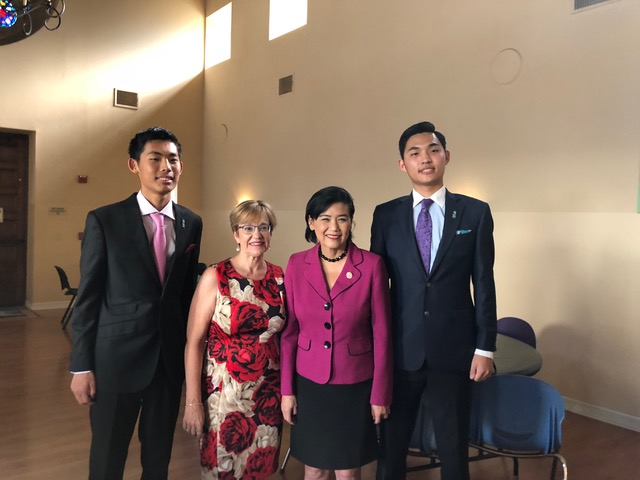
(Left to Right) Eric Dong, Anne Miskey (CEO of Union Station Homeless Services), Congresswoman Judy Chu, and Richard Dong | Courtesy photo
Arcadians Richard and Eric Dong, rising 12th grader and 11th grader at San Marino High School (SMHS), are continuing their philanthropic endeavors which they launched in 2014 with their first endowment fund at Clairbourn School in honor of then headmaster, Dr. Robert W. Nafie.
Last Wednesday, August 8, they established The Richard and Eric Dong Endowment Fund for Union Station Homeless Services. During the endowment ceremony held in Pasadena, Richard said, “The fund is designed to provide scholarships for children in sports, music and the arts, leadership, and human rights promotion; to purchase books for the family library; to fund staff appreciation and recognition; and to finance the Robert F. Kennedy Human Rights educational programs.”
“It is in memory of Robert F. Kennedy on the 50th anniversary of his last campaign and in honor of Mrs. Robert F. Kennedy for their legacy and ideals of justice, equality, and freedom for all,” Richard added.
Additionally, Richard and Eric gave a check for Union Station’s immediate use this year. The ceremony ended with them giving a piano recital for friends, family, and guests.
Richard and Eric started their involvement with Union Station at the beginning of this year after hearing about the organization. They took a tour of the building, the family center, and the library.
“We were especially inspired by the hard-working families, the talented children, and the entire staff at Union Station who are passionate about what they do,” explained Richard. “We decided then that we wanted to contribute, so we donated clothes, books, school supplies, and toys for the kids. We also taught children at the center and gave piano performances for families.”
Congresswoman Judy Chu, who was in attendance at last Wednesday’s event, only had words of admiration and praise for Richard and Eric.
Chu enthused, “I don’t know of any kids who have successfully invested their money in Ford Motors and Bank of America and made so much money, then gave away their profits! This is actually their fourth endowment. They have previously instituted endowment funds for Clairbourn School, San Marino High School, and the International Leadership Foundation.”
“I am proud to say that I personally know Richard and Eric because they both interned in my office,” Chu continued. “They are extraordinary young men and are role models for young people in the San Gabriel Valley.
“Twice Richard has been the recipient of the Congressional Award Medal, the highest award for youth in the country,” proclaimed Chu. “And today it is my honor to present Richard and Eric the Certificate of Congressional Recognition.”
Richard and Eric were raised by their immigrant parents, Ed and Charity, to be thankful for their blessings and to make worthy contributions to society. While getting a certificate was not something they had expected, it is a fitting acknowledgement of their commitment and generosity given by a district representative on behalf of an appreciative community.
Originally published on 6 August 2018 in the Pasadena Independent, Arcadia Weekly, and Monrovia Weekly
Bree Barton signs books during the ‘Heart of Thorns’ launch at Vroman’s Bookstore | Courtesy photo
It’s been a thrilling few weeks for Pasadena author Bree Barton as she embarks on a tour to unveil ‘Heart of Thorns,’ the first book in the trilogy. Geared for young adult (YA) readers, it’s a feminist fantasy book set in a dark kingdom where only women have magical powers.
‘In the ancient river kingdom, where touch is a battlefield and bodies the instruments of war, Mia Rose has pledged her life to hunting Gwyrach, women who can manipulate flesh, bones, breath and blood. The same women who killed her mother without a single scratch,’ reads the publisher’s blurb.
‘Heart of Thorns’ sounds like a story with a strong female protagonist who is out to wreak vengeance against evil women. The conflict it conjures in my mind is intriguing and I’m determined to find out more about the author who can come up with such challenging, if not entirely self-defeating, plot. I catch up with Barton at Vroman’s Bookstore on Colorado Blvd. the morning of her July 31 launch.
Brimming with excitement, Barton says, “Most girls envision their wedding as their ‘day’ but, for me, this book debut is my ‘day.’ I have dreamed of this since I was a child and it’s difficult to grasp that it’s actually here!”
“This is my first published book but it isn’t my first fantasy story; that distinction belongs to ‘The Snog-Pig-Mouse,’ which I wrote when I was eight years old,” Barton points out. “When I was ten I wrote my first novel and was obsessed about writing that I would send letters to editors asking them all kinds of questions about publishing. That interest waned in high school when I was sidetracked and went into dance.
Barton’s first fantasy story | Courtesy photo
“My love of writing returned when I was in college, after an essay I wrote received a lot of plaudits. That led to my ghost writing stint after college. While it was a good experience, it wasn’t fulfilling because the books were in someone else’s name and I wasn’t writing in my own voice.”
Barton hastens to add, “Having said that, though, ghost writing was excellent preparation because I learned about the many layers involved in the process of getting a book published. A writer’s work goes through so many edits and revisions before it’s passed along to publicists, etc.
“It also gave me a resume when I was looking to publish my own book. I was able to claim I wrote a book that was optioned for television; I could give the name of other publishers who have printed books I have ghost-written. That gave me credibility and set me apart from other writers – and there are so many creative writers in the YA genre!”
“Fantasy books for young adults became hugely popular after the ‘Harry Potter’ series came out,” expounds Barton. “Although ‘Harry Potter’ is a genre that is its own universe. The ones that followed were more in the mold of ‘Twilight’ and ‘The Hunger Games.’
“But the YA books out there now aren’t only being read by teenagers, they’re read by people who are in their 20s and 30s. And that’s what I’m hoping for. ‘Heart of Thorns’ is about diversity, acceptance, and empowering women – issues that matter to people of all ages. It’s about women breaking free of years of persecution, misogyny, and a false belief that has been hard-wired in their brains. Furthermore, it’s women being in control.
“This tribe of women, called Gwyrach, has been made to think their powers are evil until Mia found out it can be used to heal. That made her realize that her power can be an instrument for good. It was fun to create a young protagonist because everything’s a new experience, it’s all about ‘firsts.’ That provides for a satisfying character arc.
“My sister’s 18, she graduated from high school, and is at the cusp of adulthood. People always congratulate teenagers when they graduate; and it is a cause for celebration. But it’s really a bittersweet moment because it signifies the loss of their childhood and it’s never coming back. While they have so much to look forward to, they also are leaving so much behind. She’s the reason I write YA.”
Barton with her sister | Courtesy photo
Women figure prominently in Barton’s world because she was raised by a single mother. She discloses, “My family background and childhood provided considerable inspiration. In my young mind, my Mom was the model of perfection. Then she had a child out of wedlock and we were banished from our Christian Fundamentalist community.
“That event made me recognize my Mom isn’t perfect; but I also know her to be determined and strong-willed. When I was going to school in Massachusetts, she drove straight through from Texas to spend some time with me. For today’s book launch, she came to Pasadena to organize the hospitality for the event. She’s a tiny woman – all of five feet – and she’s out there now laden with cupcakes, drinks, cups, and plates.”
Barton based the Gwyrach tribe, angels descended from the gods, from mythology. She says, “I looked at Irish and Welsh mythology, the origin of the word. However, this is also a mix of Brazilian, Portuguese, and Spanish folklore. I spent some time learning about cultures with a dominant maternal influence, like the pachamama, a fertility goddess who presides over planting and harvesting. She also embodies the mountains and causes earthquakes.”
Continues Barton, “While the idea for ‘Heart of Thorns’ began many years ago, it was really the Trump win in the 2016 elections – when we all thought we were going to have a woman president – that was the impetus for this. I would like for women to realize that we are stronger because of it, not in spite of it.
“And storytelling can be a source of healing. I wanted this book to have a balance so I made it light and funny. There is so much violence and gore in it but, at the same time, there are many humorous moments between Mia and Prince Hal. I wish for readers to find it engaging and interesting.”
The book cover | Courtesy photo
Writing is a solitary endeavor and can be isolating, especially for a novelist who spends months on end working on one book. Six years ago Barton joined a group of writers who formed a community to share the same experience in this journey, to be each other’s support system.
We’re sitting in one corner of the YA section of Vroman’s and we’re surrounded by books whose authors Barton knows. She gets up to pick a few books off the shelf to show me, then not only gushes about how great the stories are but also marvels at the friendships she has with their writers.
Through this group she has met another author who also writes for television and then mentioned ‘Heart of Thorns’ to a producer. So there could be a TV show or series in Barton’s future. But for right now, she’s concentrating on the book launch.
“Social media has helped spread the word about ‘Heart of Thorns.’ Some readers have been sent advance copies and are tweeting about it,” Barton says. “Because of Twitter, someone from the United Kingdom who has a subscription book box business heard of it and ordered 5,000 books to include it in her mailing to subscribers. Maybe she would have heard of me at some point, which would have yielded the same result, just not as immediate. On the other hand, if I was hard to track down, she could have found another author.”
“Twitter has been really great but it’s also an incredible distraction –you’re reading what the other authors in the group are doing, where their publishers are sending them, and so forth, and you’re comparing yourself with them. So it’s challenging to give them love and support when you’re not enjoying all that at the time.
“Then you go on Facebook and all you read is how great everyone is doing. The danger is that you also want to show only ideal situations and make up success stories. But I’m really advocating for being honest so I started a monthly newsletter where I reveal secrets. For instance, it’s ‘I’m depressed,’ or ‘I’m terrified because I’m launching my first book and I don’t know how it will go.’
A full house at the Vroman’s launch | Courtesy photo
“I’m really proud of this newsletter because it will strip social media of some its negative side. It’s an outlet for people to just be themselves and not be thought of as lesser beings because they’re not perfect.”
“You also get so involved in social media that it takes time out of your work,” Barton adds. “The second book in the trilogy was due last month but because I’ve been tweeting instead of writing, I haven’t been able to finish it. So I needed the ‘down time.’ It’s scheduled for launch on July 31st next year and revolves around a minor character in the first one. It’s also darker and funnier. I’m so looking forward to completing it.”
While Barton may have written ‘Heart of Thorns’ with her family in mind, we all are the beneficiaries of her creative work. Mia Rose’s triumph is an inspiration, a call to arms, for womankind.
That Barton accomplishes that with a healthy dose of humor is testament to her ingenuity, maturity, and skill as a writer. She has come a long way since ‘The Snog-Pig-Mouse’ days but, happily for us, her eight-year-old self’s sense of fantasy and vivid imagination never left.
Originally published on 31 July 2018 in the Pasadena Independent, Arcadia Weekly, and Monrovia Weekly
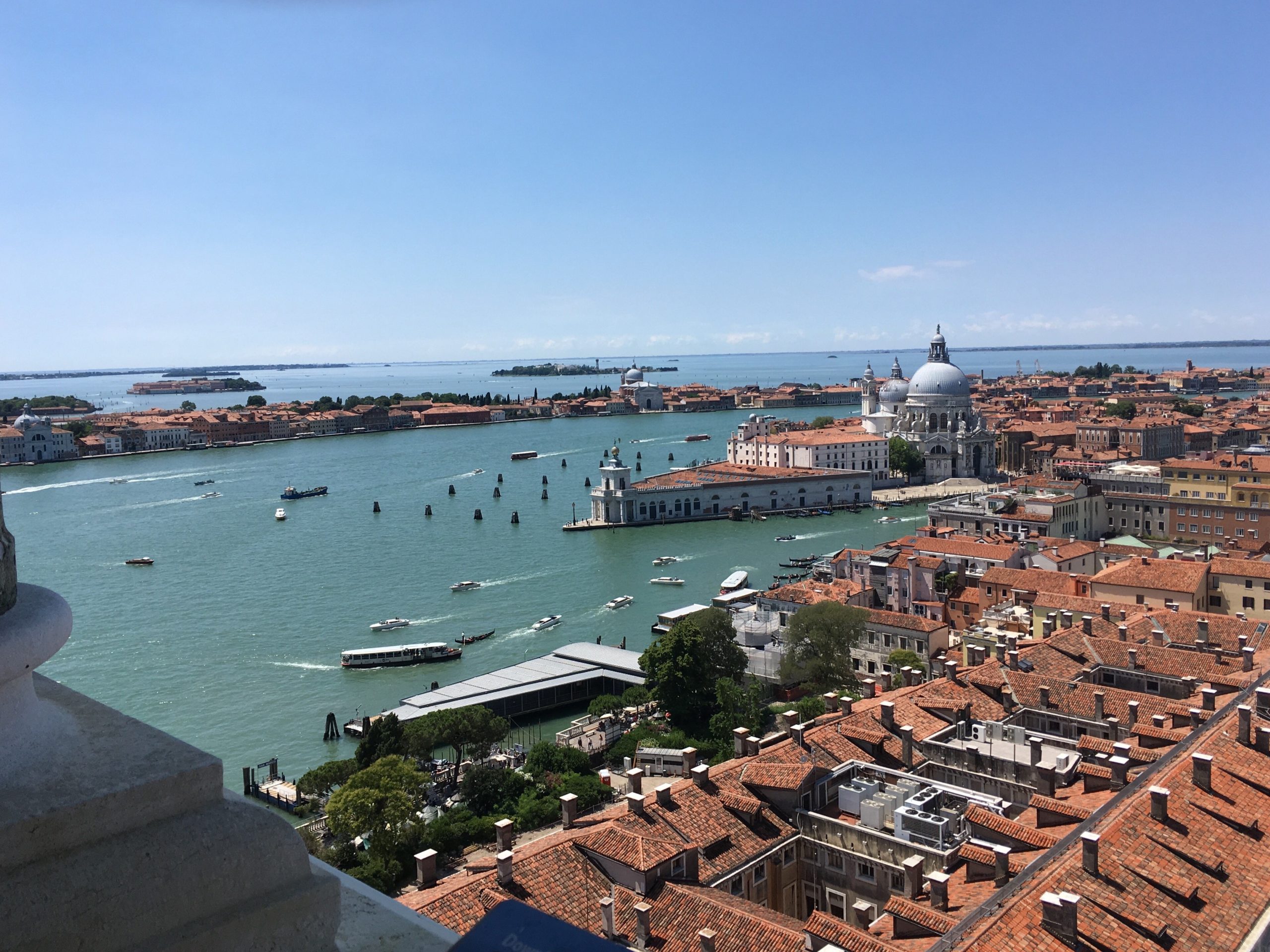
Venice, with the city’s red-tiled rooftops, viewed from the Clocktower | Photo by May S. Ruiz / Beacon Media News
Venice: It’s called ‘City of Bridges,’ ‘City of Canals,’ ‘City of Masks,’ ‘City of Water,’ ‘City of Gondolas,’ and ‘Queen of the Adriatic.’ But however many different ways we want to think of it, there is one thing we can universally agree on – Venice is quite unlike any other city in the world.
Built on more than a hundred islands in a lagoon on the Adriatic Sea, Venice floats on the water. It has no roads to speak of, only canals and bridges, and the mode of transportation is either the water bus or water taxi. Its main thoroughfare, the Grand Canal, is lined with magnificent Renaissance and Gothic palaces. The lagoon and a part of the city are listed as a UNESCO World Heritage site.
According to historians, Venice was ‘born’ on the 25th of March 421, the feast of the Annunciation, when people fleeing from the barbarian invasions built the first settlements. It was merely an unhealthy swamp at the time, whose inhabitants scraped a living by fishing and salt production.
In 697 the Byzantines realized Venice’s potential and built the duchy of Venice. By the year 1000 it established itself as a major maritime power alongside Amalfi, Genoa, and Pisa. These principalities maintained political autonomy, their money was accepted throughout the Mediterranean basin, and they participated in the Crusades with their own fleet.
All this led to Venice’s ascension as an empire which, at the height of its glory, extended from Bergamo in the north to the entire Dalmatian Coast and to the Greek Coast. From the 13th century up to the end of the 17th century it was also an important center of commerce and art. The wealth that Venetians accumulated during their years of prosperity is displayed by the enormous and stunning palaces that they built.
It was in the 18th century that the decline of Venice began. When Napoleon and his army invaded the city on the 12th of May 1797, no one resisted. In fact, many thought he was bringing new ideas of democracy. Venice then alternated being a French and Austrian territory.
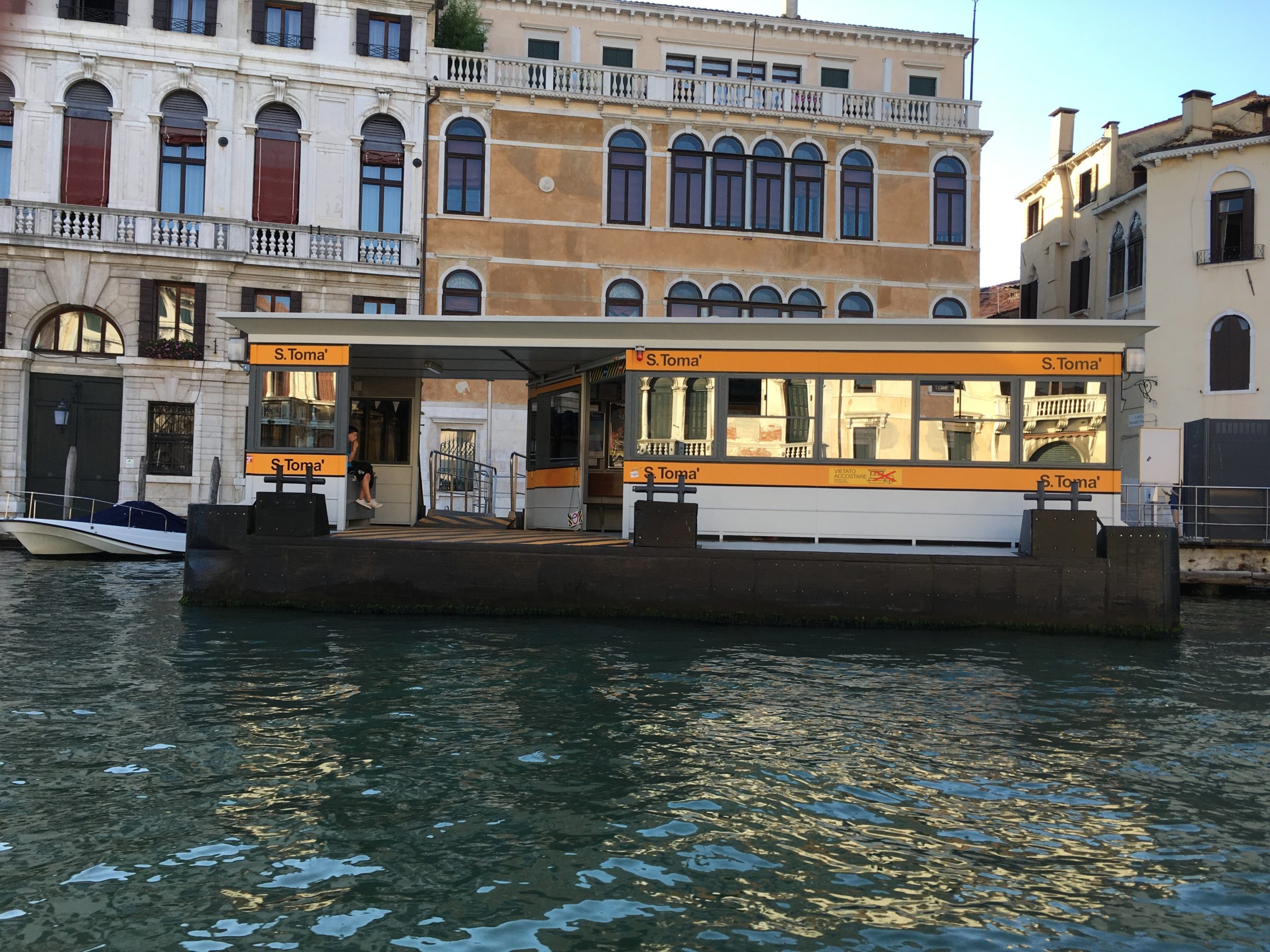
A bus stop on the Grand Canal | Photo by May S. Ruiz / Beacon Media News
Today, Venice is a small city with about 60,000 inhabitants that attracts millions of tourists to make it fill past capacity. That it is singularly different makes it one of the most popular destinations in the world, which has been both a blessing and a curse. Its infrastructure endures much wear and tear from the trampling of feet; its tidal levels are lowering and the city is sinking; many houses are uninhabited during most part of the year, so they don’t get constant maintenance.
The thought that this city may one day be underwater is one reason most of us want to go there. But whatever motive urges us, we will never be disappointed. Venice offers the most breathtaking vista of historic structures and a rich culture uniquely its own.
A tour of Venice starts from the Marco Polo airport, if arriving by air, which is how my two young companions and I traveled. From there we took a water taxi to Hotel Colombina, which is located one bridge over from the Bridge of Sighs and is a five-minute walk to Piazza San Marco.
We were only staying in Venice for four days so we decided to spend most of that time taking in the sights at Piazza San Marco. This tour guide focuses on the structures one can find within this area, which Napoleon legendarily referred to as “the drawing room of Europe.”
Walking around Piazza San Marco | Photo by May S. Ruiz / Beacon Media News
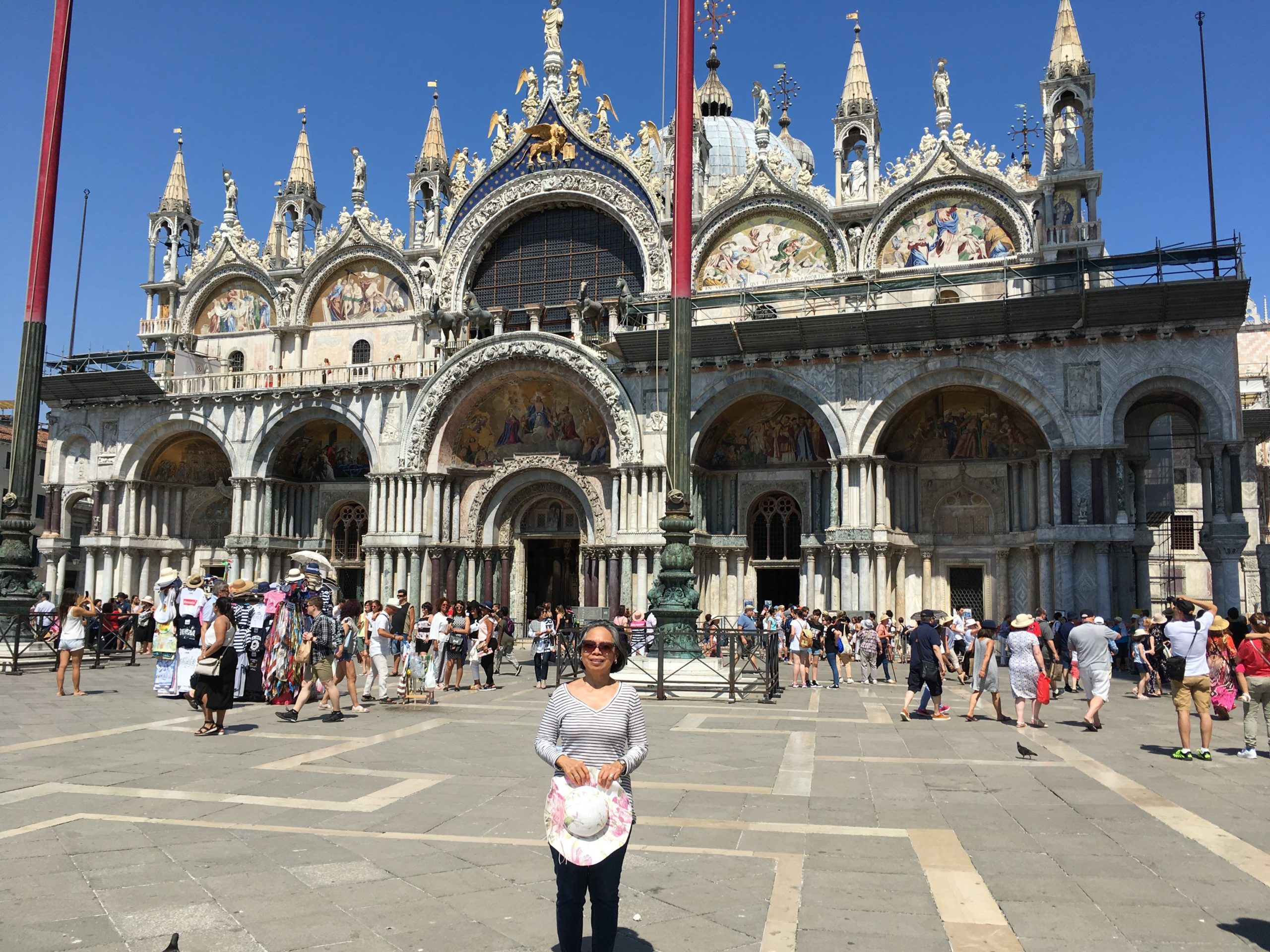
St. Mark’s Square, the piazza’s English name, is the symbol of Venice and is considered one of the most beautiful squares in the world. It is also the only real ‘square’ in the city – all the others are called ‘campi.’
Venice’s political and religious center, St. Mark’s Square is trapezoid in shape and is framed by St. Mark’s Basilica, the Doges Palace, the Clocktower, the Bell Tower (Campanile), the Procuratie, the Library, and the Correr Museum (Museo Correr). Numerous kiosks selling anything from souvenir items, to postcards, to hats and parasols, dot the Square. Along its perimeters are countless trattorias, gelaterias, and name-brand retail stores. It is also where the internationally renowned annual Carnival (Carnevale) takes place.
When I first visited Venice 20 years ago, St. Mark’s Square was also inhabited by a teeming mass of pigeons attracted to the area because tourists fed them. Ten years ago, city officials banned the feeding of these birds so there are now far fewer pigeons mingling with people. The Basilica’s exterior has also since been repainted and looks much more impressive, as befits its lofty image.
The writer in front of St. Mark’s Basilica | Photo by Brianna Chu
St. Mark’s Basilica, located at the eastern end of the Square, has seen several reconstructions over the centuries. In 832, a first basilica was built to house the remains of Mark the Evangelist from Alexandria. It was burned down in 976 and rebuilt in 978 by Doge Pietro Orseolo I.
Further reconstruction in 1063 by Domenico Contarini, with influences from Byzantine, Gothic, and Romanesque designs, led to today’s St. Mark Basilica. Connected to the Doge’s Palace, it was originally the chapel of the Doge. In 1807 it became the cathedral church of the Roman Catholic Archdiocese of Venice. Its opulence, marked by gold ground mosaics, made it a status symbol of Venetian wealth and power in the 11th century. A low tower houses St. Mark’s Treasure and has a high altar of gold.
A rigid dress code prohibits people in shorts or outfits exposing legs above the knees, those baring their arms, and women showing cleavage, from coming in. Paper ponchos and skirts are available at the entrance for people to wear before entering the Basilica. Taking photos, whether using a camera or a cell phone, is not allowed at all.
Above the portal of the basilica are perched the four gilded bronze horses of St. Mark, installed on the balcony in 1254. Also known as the ‘Triumphal Quadriga,’ they were part of the loot sacked by the Venetians from Constantinople during the Fourth Crusade. They were replaced in 1977 by replicas, with the originals kept inside the basilica, to save them from further damage caused by air pollution.
To the right of St. Mark’s Basilica is the Procuratie Vecchie, with a double loggia in the Venetian-Byzantine style. It was built in the 12th century under Doge Sebastiano Ziani during the Republic to house the apartments of the Procurators of San Marco. It has an expanse of almost 500 feet and a portico of 50 arches.
The original Procuratie was partly damaged by fire at the beginning of the 16th century. It was demolished and rebuilt and was completed in 1538. Connected to the Procuratie are the Museo Correr, the Museo del Risorgimento, and Museo Archeologico, the administrative department of the Musei Civici and part of the Biblioteca Nazionale Marciana (Marciana National Library). These buildings were originally utilized by Napoleon for receptions and later were reserved for the use of the kings of Italy.
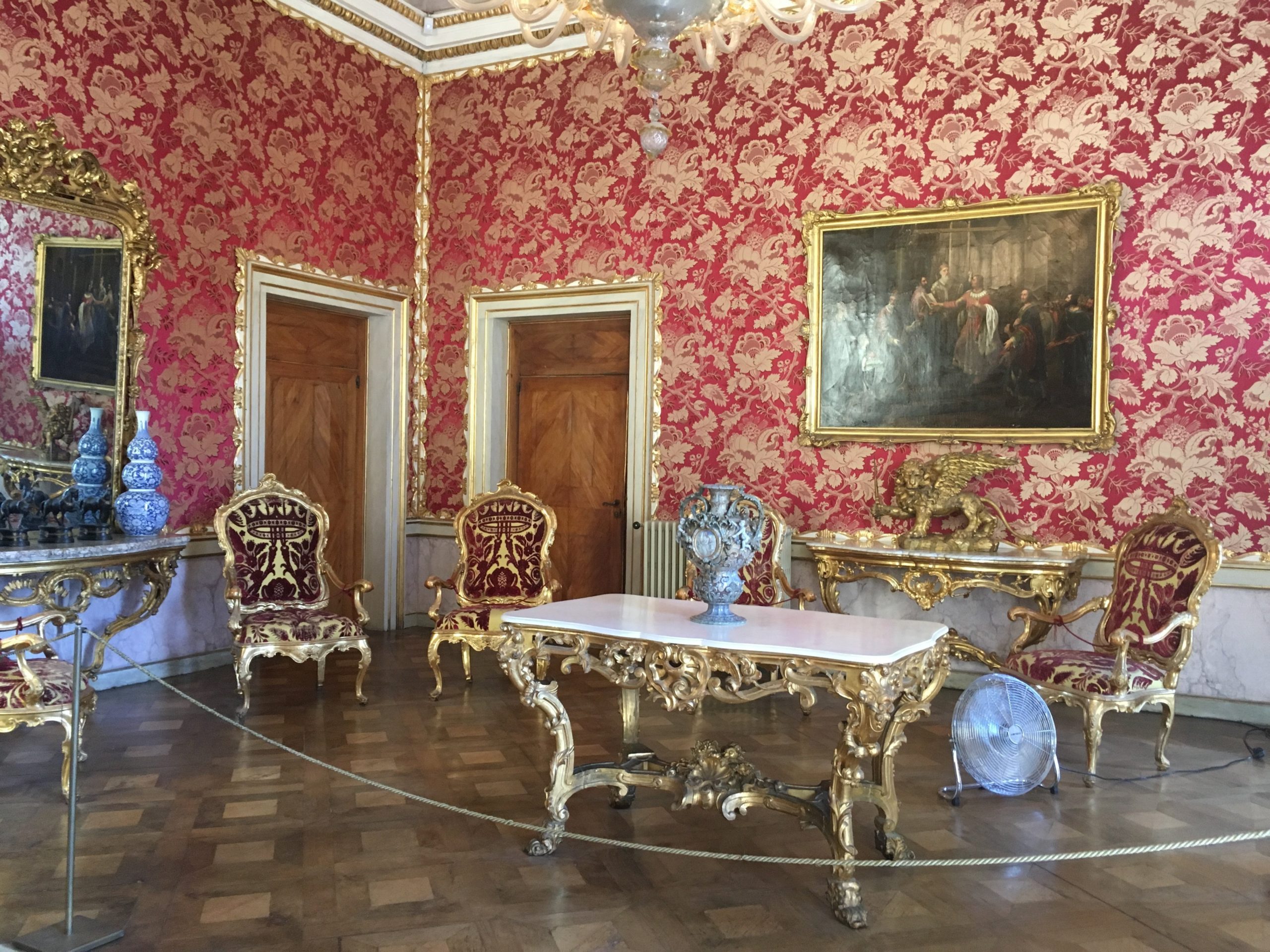
One of the Imperial Rooms at Museo Correr | Photo by May S. Ruiz / Beacon Media News
Museo Correr houses the Imperial Rooms, decorated in the style popularized during the Hapsburg period and some elements from the Napoleonic age. Next to the Imperial Rooms is the dining room for non-official occasions such as ‘work’ meetings of the Government cabinet, and as an antechamber to the Lombardy-Venetia Throne Room. The Throne Room functioned alternately as a waiting room for those seeking an audience with the Emperor or Empress.
The next rooms, none less ornate or embellished, are for the Empress’s private use – the Bathroom, the Study, The Boudoir, and The Bed Chamber. There is an antechamber of the apartments, which was a passageway from the rooms of Empress Elisabeth and Emperor Franz Joseph. It has a balcony which gives a breathtaking view of the Royal Gardens, looking towards the Basin of St. Mark’s, and the island of San Giorgio.
An oval-shaped Neoclassical room is the junction between the palace’s public rooms and the royal apartments. When Franz Joseph and Elisabeth were staying there, it served as the Royals’ casual dining room where they ate breakfast, lunch, and dinner.
The Neoclassical Rooms were part of the 2015 Restoration Project to recondition the Antonio Canova Collection at Museo Correr. Italian sculptor Canova, who was famous for his marble sculptures, is regarded as the greatest of Neoclassical artists. Born in Venice on the 13th of October 1822, his works were inspired by the Baroque and the Classical Revival. The Ballroom at Museo Correr houses the most striking of Canova’s sculptures – Orpheus and Eurydice, Daedalus and Icarus, and Paride (or Paris. In Greek mythology, his elopement with Helen, Queen of Sparta, precipitated the Trojan War).
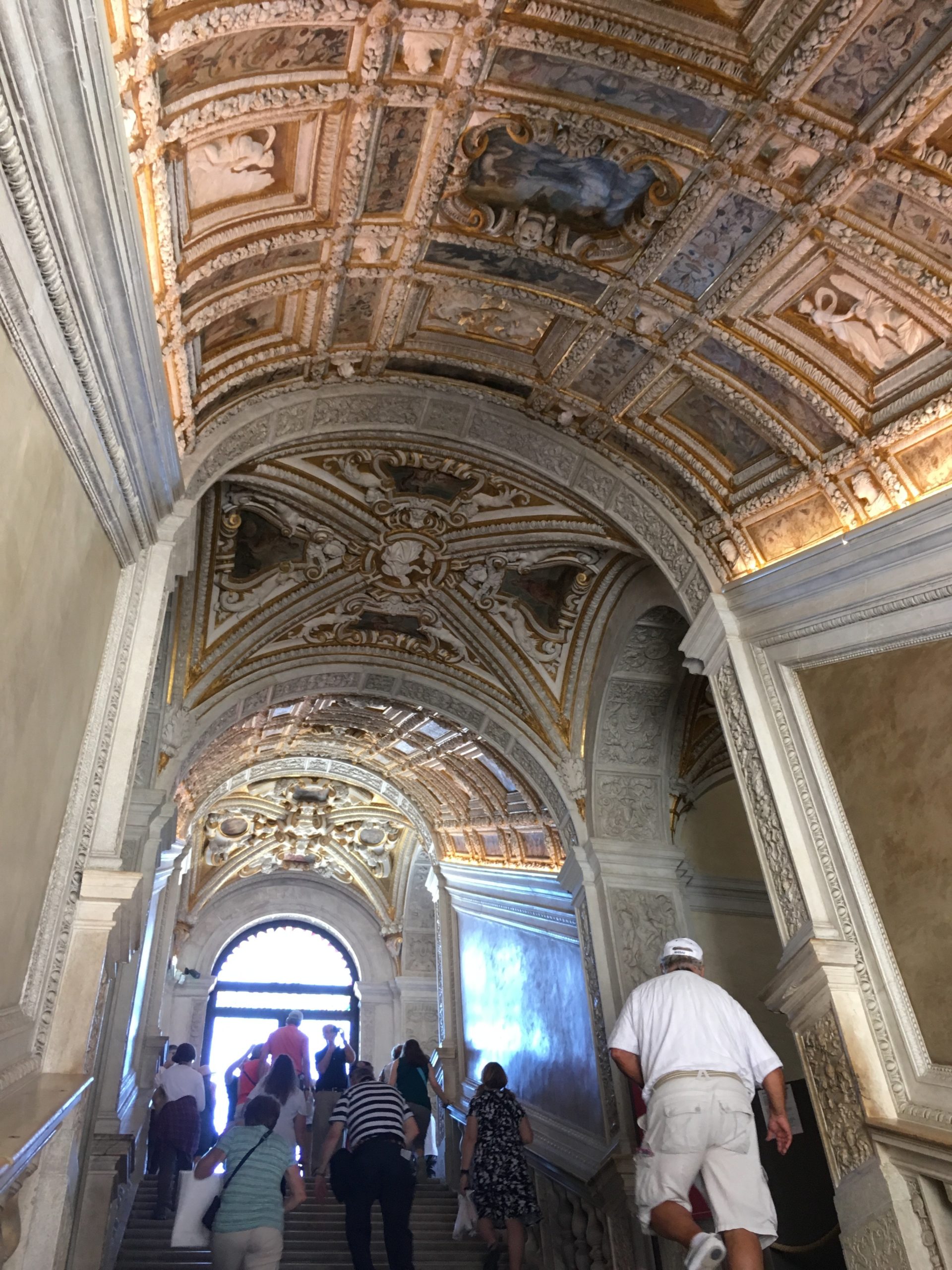
The Golden Staircase at Doge’s Palace | Photo by May S. Ruiz / Beacon Media News
The Doge’s Palace, the residence of the doges, stands where the Grand Canal flows into the lagoon. It was the heart of Venice, the symbol of its might and supremacy. Like the other structures on the Square, it is the product of complex reconstructions – which commenced in the 14th century, coinciding with the reorganization of the entire area. It opened as a museum in 1923, one of the eleven cultural and artistic buildings managed by the Fondazione Musei Civici di Venezia.
Imposing in its aspect, the façade of the Doges Palace is a grand example of floral Gothic decorated with white and rose-colored geometric shapes. It has a double row of arcades in the lower levels, typical of the Venetian fondaco palaces. Large lancet windows sit above, capped by a lace-like parapet of Oriental cresting.
A big interior courtyard and a spectacular Giant’s Staircase were our first clues of the lavishness within. Once inside, we went up the Golden Staircase, the breathtaking golden stucco-decorated vault which was formerly used only by Magistrates and important people. No ceiling or wall in the Doge’s Palace has been spared from artistic depictions of notable historic or biblical event. The extravagance and opulence are overwhelming!
The Armory Rooms have a collection of historical weapons and armaments used by the Palace’s guards. Some of them are 15th and 16th century suits of armor, swords, halberds, quivers, and crossbows. Room IV contains examples of 16th and 17th century firearms and instruments of torture.
Our visit to the Doge’s Palace ended at the prisons. We crossed the infamous Bridge of Sighs, the covered walkway that connects the palace to the walled-in chambers used to lock up criminals. The bridge was named for the sighs the prisoners breathed as they took their last look at freedom through the small windows.
Sunset in Venice | Photo by May S. Ruiz / Beacon Media News
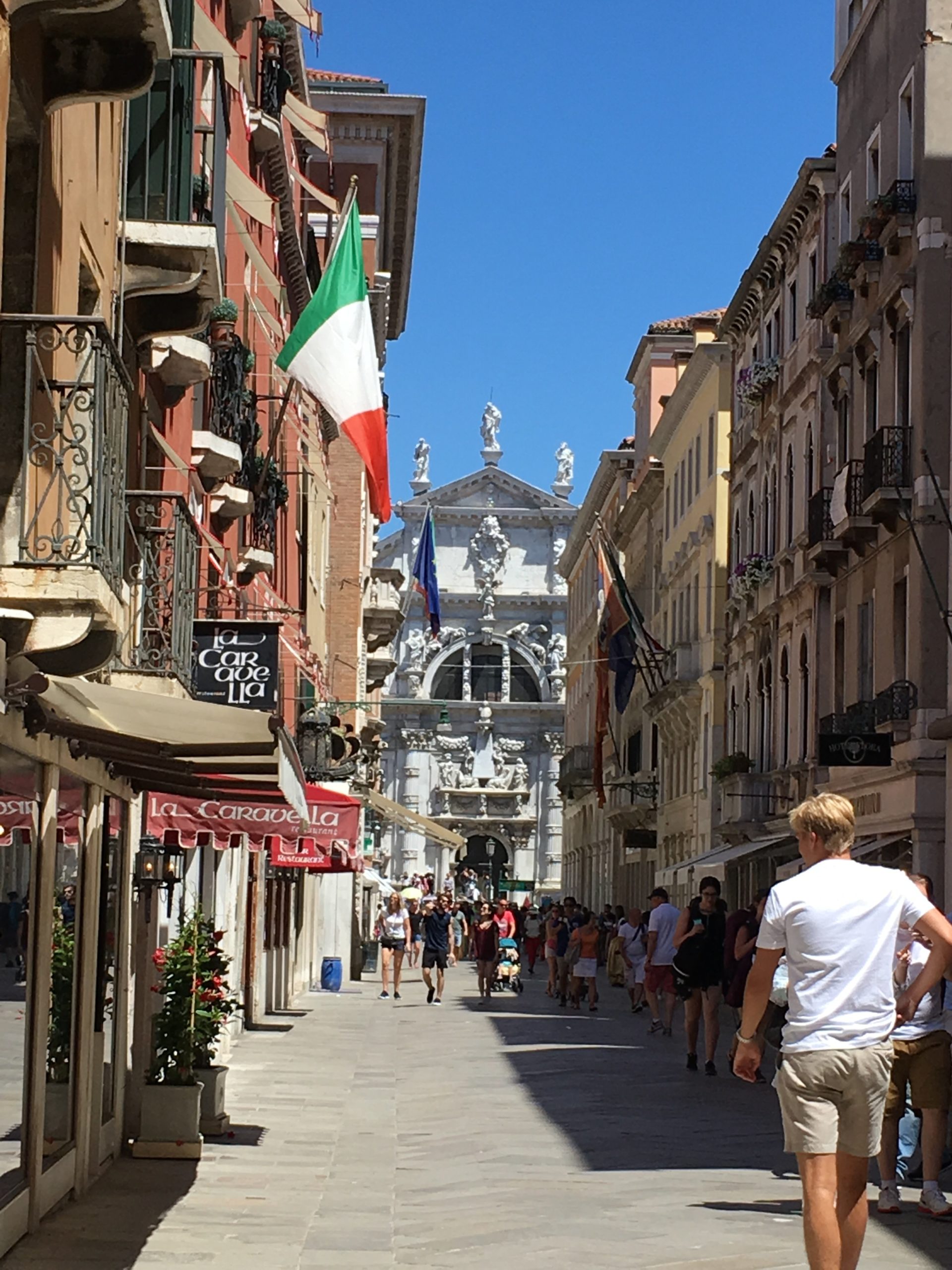
On the north side of St. Mark’s Square is the Clocktower, built at the end of the 15th century as the doorway to the Mercerie, one of the city’s main streets. It also served as a landmark visible from the lagoon to demonstrate the wealth and glory of Venice. Above the arch is a large enameled clockface showing the hours, the moon phases, a sundial, and signs of the zodiac. On top of it is a small balcony with the three Magi; and above are the Moors, the two bronze figures which, to this day, strike the hours by hammering on the bell.
The Campanile, or Bell Tower, is the most recognizable representation of Venice. Standing at 323 feet tall, it is the tallest structure and was used as a lighthouse or a look-out tower. Its five bells marked the important moments in the republic’s history, including the start and the end of the workday, the meetings of the Great Council, and the assemblies of the senate.
Our short tour of Venice gave us a glimpse of the city’s long history and glorious past. It was a lovely reminder that the city isn’t stagnant but is at once timeless and ageless. And although it no longer has the power and sovereignty it once boasted of, its grace and beauty will forever hold us captive.
This resplendent city on the water – with its fascinating bridges and canals, magnificent palaces and structures – continues to charm, to enchant, and to entice people the world over into its warm embrace.
Long before the word feminism entered our lexicon, women were coming together to indulge in intellectual pursuits that were deemed, at the time, to be the domain of the male species. That’s what a group of women who lived in 1750s London did when they formed The Blue Stocking Society.
‘Ladies,’ a new play by Kit Steinkellner, is a fictional account of a year in the life of The Blue Stocking Society and explores the tangled knot of electric and jagged relationships that comprise this group. These women are pioneers and revolutionaries emboldened by the call to arms to be the first of their kind and burdened by the misfortune of being born far ahead of their time.
It will be featured this Saturday, July 28, at 11:00 am at Boston Court Pasadena’s 14th Annual New Play Reading Festival and will be directed by Co-Artistic Director Michael Michetti.
Steinkellner expounds, “’Ladies’ is a history and time travel play in its theatricality. It was inspired by The Blue Stocking Society, the first organized feminist movement founded by a group of women who lived in England in the mid-18th century. Much has happened since in terms of advancing the role that women play in society, but at the time they were considered radical.”
“The idea came to me about ten years ago when I was in London and I went to the National Portrait Gallery which was holding an exhibit about these women,” discloses Steinkellner. “They intrigued me as being true pilgrims and pioneers in a realm which had absolutely no roadmap. Writing a play about them struck me as being both exciting and scary.
“I wanted to tell their story in an ‘out-of- the-box’ way just as they had done when they began their club. In dealing with something that is set in the past, I realized there’s a risk that the story might come off as dusty, archaic, or irrelevant. As I researched about their lives, read their diaries and their correspondence with each other, it became important for me to make sure I did it exactly right.
“To create something exciting that explains my obsession with these women, and why I was so captivated by them, I used time travel to be part of the play as the historian and narrator. I investigated why I wanted to have a relationship with women who lived over a hundred years ago and how they are relevant in today’s world.”
Adds Steinkellner, “There are four actresses in ‘Ladies’ and each one plays a prominent woman in this group – each enacts my character and some of them perform male roles. While this play was conceived ten years ago, I only started actually writing it five years ago and it became a finalist in the O’Neill National Playwrights’ Conference. However, that version didn’t have the time travel element in it and I wasn’t part of the play.”
“The play has seen several changes and revisions although they didn’t happen all at once. I gave it time to germinate and develop; I would leave it then go back to it after a few years to improve and polish. I’m very excited about this Workshop and I’m grateful that Michael and Jessica picked it for their New Play Festival because it’s a very important process towards bringing it to life. I want the audience to be emotionally engaged with the story and these women’s lives,” Steinkellner enthuses.
Emilie Beck, Boston Court Pasadena’s Literary Manager | Courtesy photo
Emilie Beck, Boston Court Pasadena’s Literary Manager, who has been involved in the New Play Reading Festival for seven years, describes, “Kit’s play is quite fascinating and is, in a way, its own genre. It speaks to an intellectual realm but there’s also a lot gestural work in it; it’s cerebral and visceral at the same time.”
“There is an element in ‘Ladies’ that sets it apart from other plays – this interesting conceit in which each character becomes Kit, the playwright,” Beck points out. “The play is making use of her rather than Kit putting herself as a protagonist, if that makes sense. It involves time travel but not in a science fiction way. I think there’s a very fluid connection between the here and now and these ladies in the 1750s.”
“It’s thrilling to us that this year we received more submissions from women playwrights than from men,” states Beck. “The four new plays we’ve chosen for this year’s Festival are all written by women. While we read without attention to gender, we were drawn to these voices, which speak to a wide array of underrepresented female experiences.
“What’s interesting is that the ‘Me Too Movement’ was happening as we were reading these submissions. So these plays had not been written out of that and yet we were reading in that context. I imagine that as we move into the future, there will be more plays written because of that.”
Beck asserts, “That said, it wasn’t the only theme touched on by the plays we received. We got submissions with very dark themes – war, apocalypse, suicide, assault. In fact there were a lot of them that involved sexual assault. A good number of plays we read were spoken by a voice that has been disenfranchised. It’s really important to us to represent that. For a long time there’s been this overriding voice of the white male playwright. Not to dis the white male playwright, there are many of them who are wonderful and whom I love working with, we need to make a little room for women and minorities.”
“New work is important to us,” declares Beck. “The whole reason this theatre is here is to get new work on the stage. It’s hard to write a play; playwrights sit on their own, trying to create a multidimensional world with voices in conversations that would, in some way, illuminate a theme.
“Playwrights have to find a way to get from a flat page, to that creative place, to a fully realized production. They have to go through the processes, get together with a bunch of artists in a room to listen to how it sounds, to see how it’s working and not working. That is integral to our work here. It’s exciting for us and we look forward to it every year.”
The New Play Reading Festival is a key component of Boston Court Pasadena’s commitment to nurturing playwrights and new work. It paves the way for unknown artists’ creations to get recognized and produced on stage.
What a thrilling prospect it is if this weekend we could be seeing the future Eugene O’Neills or George Bernard Shaws, whose plays are esteemed, revered, and performed to this day!
Originally published on 19 July 2018 in the Pasadena Independent, Arcadia Weekly, and Monrovia Weekly
St Andrews from St Rule’s Tower | Courtesy photo
Mention St Andrews, Scotland, and most people would automatically think of golf. It is, after all, popularly known as the birthplace of this sport where it was first played in the 15th century. To this day the British Open is held on The Old Course every five years.
Golfer Bobby Jones once proclaimed, “I could take out of my life everything except my experiences at St Andrews and I would still have a rich, full life.” That may be a bit of an exaggeration, though. Celebrated golfer Jack Nicklaus put it in better perspective when he said, “If you’re going to be a player people will remember, you have to win The Open at St Andrews.”
After his first Open victory at St Andrews in 2000, Tiger Woods famously declared, “It may be years before I fully appreciate it, but I am inclined to believe that winning The Open at the Home of Golf is the ultimate achievement in the sport.”
Countless superlatives that can be uttered relating to the golf experience on this picturesque coastal town 30 miles northeast of Edinburgh and they would all be true. Golf enthusiasts have consistently included St Andrews on their bucket list.
Aside from the iconic Old Course, players can enjoy the New Course, Balgove Course, Castle Course, Eden Course, Jubilee Course, Kingsbarns Golf Links, Strathtyrum Course, and the Fairmont St Andrews. With so many venues to choose from, they could practically play a round on a different course each day for two weeks without having to travel more than 30 minutes to reach one.
Professional golf is a lucrative business that gets support from major sponsors and draws an elite following. St Andrews Links run five annual tournaments throughout the year, including the St Andrews Links Trophy, and host the St Rule Trophy, the Alfred Dunhill Links Championship, and The Open Championship.
During the summer months, non-professional players from all over the world flock into town. Golf is a big part of the daily lives of St Andrews residents; each one of them is touched by the sport in one way or another.
The world-famous and iconic Old Course | Courtesy photo
Limo chauffeurs, as well as cab and shuttle drivers, have numerous memorable stories about how many golfers and golf clubs they have transported from the Edinburgh airport to St Andrews. Every pub and tavern owner has served tankards of ale or glasses of Scotch whisky to the most famous golf luminaries, whether in celebration of a championship win or in commiseration for an upsetting loss. All hoteliers and B&B proprietors have warmly hosted these perennial visitors to their charming enclave.
But golf isn’t everything that St Andrews has to offer. It is also home to the University of St Andrews, the first and most ancient university in Scotland and the third oldest in the English-speaking world after Oxford and Cambridge. And while I don’t have first-hand knowledge as regards the importance of golf to life in St Andrews, I have a bit more perspective about what the school means to locals.
Founded in 1413, the University of St Andrews has consistently ranked third in academic excellence, behind Cambridge and Oxford, and first in student happiness in the United Kingdom. Presiding over this year’s graduation ceremony, Principal and Vice Chancellor Sally Mapstone also pronounced St Andrews as among the most modern and forward-looking universities.
While some might refute that claim, what’s indisputable is that St Andrews is the most international of all the universities in the U.K., which may partly explain why it is contemporary and in-step with the times. When my daughter and I visited it in 2013 during her college search, our student tour guide said 135 nationalities are represented – one-third of the student body come from Scotland, another third hail from England, and the last third are from around the globe.
Americans make up the largest group of international students, and each state is represented by two students. This last bit of information was demonstrated to us over a year later when my daughter was at the University Store to buy school supplies right before freshers’ (as incoming students are called; or freshmen as they’re referred to in the United States) week. Upon hearing my daughter’s American accent, the cashier inquired where she’s from and when she said “California,” he immediately said, “So you’re the second one; the first Californian was here the other day.”
The ruins of St Andrews Castle | Courtesy photo
During term time students make up approximately one third of the total population and because the university doesn’t really have a school campus, its buildings are scattered across town. The school and its students are such an integral part of the community. One out of every five residents has some connection to the school, whether as faculty or staff or as a worker in restaurants, grocery stores, retailers, and clothes shops catering to students and university personnel.
If you’re a tourist while school is in session, you will most definitely bump into students as they hurry off to their lectures or tutorials when you make your way to the ruins of St Andrews Castle or Cathedral. They are most probably sitting only a few feet away from you as you take in the majesty and splendor of sunset on the West Sands.
It’s a small town and everyone knows everyone else. Locals have as their neighbors students who are leasing the flat next door. The owner of the local cab company told us that there are only a hundred taxis in St Andrews and all cab drivers recognize the students by face. He assured us that they all treat these young people like their own children, “If ever students are too drunk to walk home we’ll drive them to their flat even if they have no money on them. They can just pay us the fare the next time they see us.” The legal drinking age in Scotland is 18 years old so intoxicated students are not an uncommon sight.
Students get the special treatment at The Botanic Garden, which is open all year and offers free admission to those with a valid student ID. University students mingle with locals as school traditions are celebrated all over town – whether it’s the Raisin Weekend during freshers’ week, the Gaudie Walk to East Sands, or the May Dip on the North Sea – and they’re all part of the daily affairs at St Andrews.
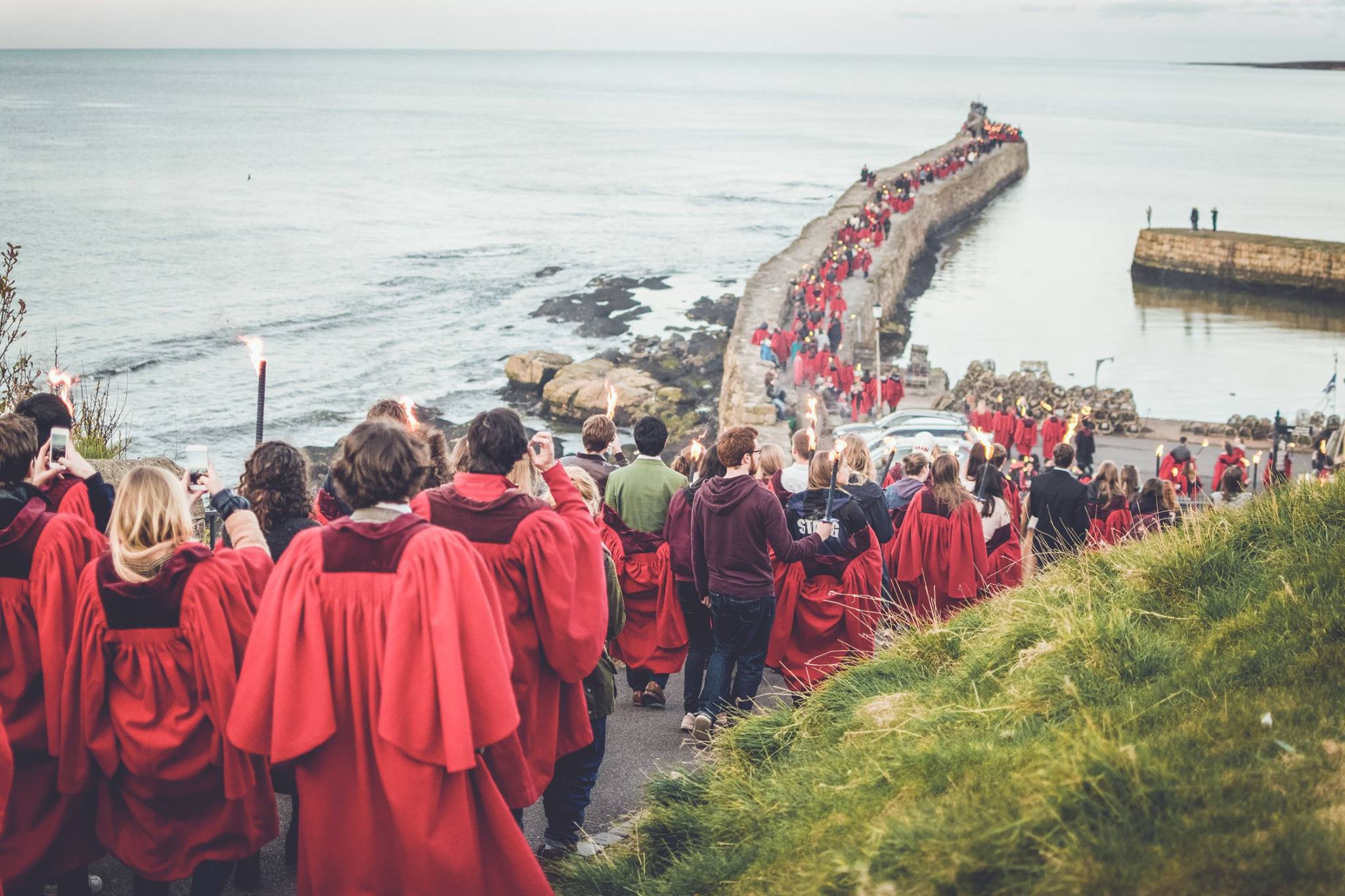
The Gaudie Walk is a University of St Andrews tradition | Courtesy photo
Academic dress, which is both distinctive and ubiquitous, is central to university life. In earlier days, students wore the red gown so tavern owners could identify them when they came round for a pint. Nowadays, it is worn to chapel services, formal dinners in the residential halls, meetings of the Union Debating Society, by student ambassadors who give guided tours and, most noticeably, for the traditional pier walk.
At no other time have students been lavished as much attention and affection than during graduation week which, this year, was from the 26th to the 29th of June. The entire town takes part in the excitement of the students and their families. A portion of North Street is closed for 15 minutes twice a day for the academic procession after the morning and afternoon ceremonies. The bells of St Salvator’s chapel are likewise on full peal and can be heard a mile out for an hour after each ceremony. Several restaurants offer prix fixe menus during graduation week. There is a palpable euphoric feel in the air at this joyous period.
This is also one of the busiest seasons at St Andrews when every single hotel room is booked and all bed and breakfast establishments are at full occupancy. Pam Izatt, a past president of the St Andrews B&B Association, says, “If your child is attending the University of St Andrews, reserve your accommodations two years in advance of graduation because they go fast. You’ll end up staying in Dundee or even Edinburgh otherwise.”
And graduation is the one occasion no University of St Andrews parent should ever miss. Unlike most American university commencement ceremonies which are conducted in large venues to accommodate thousands, it is an intimate affair at this ancient school where graduation is held at Younger Hall which has a capacity of 969 people.
It is a tradition that began in 1696 but the current form of graduation followed today is from the 1860s. In the past, the ceremony took place in the University Library but as the university grew it needed a larger venue and Younger Hall was built.
Two ceremonies are held for four days during graduation week, at 10:30 a.m. and at 2 p.m. Not everyone can be accommodated at Younger Hall but family and friends can watch the graduation from two screening rooms where the ceremony is streamed live.
Graduates at St Salvator’s Quad | Photo by May S. Ruiz
Graduands occupy the first several rows at the front of Younger Hall, with parents and families filling the remaining seats and those upstairs in the balcony. The university chaplain opens the ceremony and the academic procession enters the hall led by six men carrying maces that symbolize the university’s colleges. They are followed by various faculty heads, with the Principal and Vice Chancellor, Sally Mapstone, and the Chancellor Lord Campbell of Pittenween bringing up the rear.
The graduation ceremony I attended was presided by Mapstone who told us about the history of Younger Hall and explained the ritual, “It is the major celebratory occasion in our academic year at St Andrews and is a part of a tradition that allows for transformation. It is when scholars become masters and masters become doctors. It marks a particular rite of passage for our students when they become something they were not before. Graduations give us permission to change while recording what we stand for and establishing connections between generations.”
The conferment of a degree transpires when Mapstone says in Latin, “I raise you to the rank of Master of Arts and to symbolize this I place upon you this hat” to the first graduand. She then uses the shortened Latin phrase “et super te,” which means “and upon you, too” to the rest of the graduands.
According to Mapstone, the cap which touches the head of the graduate was long thought to have come from the trousers originally worn by St Andrews’ most famous 16th century student John Knox, the major proponent of Reformation in Scotland. He also, among other things, blew the first trumpet blast against the monstrous regiment of women. Happily, she notes, researchers found that this particular cap was purchased for the doctoral graduation of Sir John Arbuthnot, the Scottish physician and satirist who graduated in 1696, and this cap has been used since.
After the ceremony, new graduates join the academic procession which emerges from Younger Hall into North Street and then to St Salvator’s quad accompanied by the ringing of St Salvator’s chapel bells. Graduates take several turns around the quad while family and friends cheer their accomplishment.
A University of St Andrews graduation is the perfect capstone to students’ four years of diligent academic studies coupled with dynamic involvement in campus activities. It is a ceremony that is as solemn as it is stirring, and as moving as it is impressive. It is indeed a rite-of-passage worthy of the pomp and ceremony it is accorded.
In equal measure, golfers and students support the economy of this town as well as contribute to the local color. St Andrews is certainly abuzz and alive with their presence. And anyone who has been fortunate enough to visit this stunningly beautiful spot in Scotland fully appreciates how they have enriched the St Andrews experience.
Originally published on 9 July 2018 in the Pasadena Independent, Arcadia Weekly, and Monrovia Weekly
Levin Valayil as Mowgli | Photo by Gary W. Sweetman
Rudyard Kipling’s “Jungle Book” takes us to the exotic, adventurous, and magical world of Mowgli and other wildlife creatures. This play adaptation, written and directed by Rick Miller and Craig Francis, will have its West Coast premiere on Tuesday, July 17 through Sunday, July 29, at the Pasadena Playhouse, after a successful three-week run at Asolo Repertory Theatre in Sarasota, Florida.
Staged by Canadian company Kidoons and WYRD Production, in association with The 20K Collective, “Jungle Book” features familiar characters including Baloo the Bear, Kaa the snake, and introduces other colorful inhabitants of Kipling’s books.
Very much a theatrical adaptation, this play employs a rich soundscape, immersive multimedia, inventive puppetry, and a variety of new and traditional theatrical traditions to transport audiences to the world’s jungles. It features favorite characters as never seen before, bringing out the original themes of the story, while connecting audiences to its Indian locale and the human relationship to the animal kingdom.
“We definitely chose not to re-do the Disney version. They did it well and have done it several times,” Miller emphasizes. “We decided to take people back to Kipling’s book to inspire them to read literature and realize that he actually wrote two Jungle Books. Everyone knows Mowgli but there are other stories in ‘The Jungle Book’ and ‘The Second Jungle Book’ about different animals from around the world. The stories, poems, and songs that Kipling assembled cover a great deal of territory, both thematically and geographically.”
Miller adds, “In the original Kipling story, Mowgli grew up in the jungle with animals and is kicked out of the jungle for being too much of a human. In the book he also goes back to the town as a teenager and is kicked out of the town for being too much of an animal.
“So this is a mirror image of these two worlds. It’s a story that echoes the disconnection we have these days when we wonder who our real family is and where we belong, but also our disconnection with nature. We live in cities and we tend to forget that we have a deep bond with our natural surroundings, a lapse which sometimes proves to be detrimental.”
“While the message is deep, it isn’t heavy,” stresses Miller. “We just want people to consider that before there were cities, there were forest[s] and jungles. And we still have them inside of us – that little bit of the free, wild, and uncontrolled. Mowgli is very much the embodiment of that; he takes us back to his youth to remember the law of the jungle. The play is about how to live with each other and the rest of humankind.”
“The adults coming to the show will definitely get the message and the kids will not get slammed on their heads with a hammer to get it. It’s a fun show with a lot of humor and a big dose of lightheartedness,” Miller says.
“Jungle Book” at Asolo Repertory Theatre | Photo by Gary W. Sweetman
“I’ve been doing theatre for 25 years. I’m known all over Canada and Europe for my solo performances but I joined forces with Kidoons (Kids Cartoons) to create entire experiences,” discloses Miller. “We found that we haven’t been engaging the youth as much, so we are correcting that. And in the process, we’re generating new theatre audiences. This is important because not only are young people the theatre-going audience of the future but they’re also ready to be educated and become leaders of the world and if you present them with inspiring work on stage they really can change lives.
“That said, we produce plays for all ages but it so happens that young people love the work we do because we incorporate the playfulness and creativity that kids inherently have. We’re trying to be more than entertainers because God knows there’s a lot of entertainment available on screen. We utilize what theatre offers which, essentially, is a lot of people gathered together in a room experiencing a story. This is different from just watching something on the screen.”
“We’ll be taking a few months off after our Pasadena production because we’re touring other shows. But we’re booking dates in preparation for our North American tour which starts in 2019. If all goes well, it will go to Asia and to Europe as well. Jungle Book happens in India and I would love for it to play there, but it’s a universal tale. We create shows that people all over the world will fall in love with.”
Miller elaborates, “Our next project is the third part of our ‘Connection Triptych’ and it’s going to be ‘Frankenstein,’ a novel written in 1818 by Mary Shelley. It has had several popular versions but we want to create one that speaks to our own issues today. Bio engineering and prolonging life, issues that are very much on the forefront of technology, are quite beautifully expressed in ‘Frankenstein.’
“The common thread running through these plays are characters who have become disconnected from humanity. In the first play in our trilogy, Jules Verne‘s ‘Twenty Leagues Under the Sea,’ Captain Nemo built a submarine, a utopia, for himself and his crew. He lived as a warrior against oppression, but in his disconnection he becomes a bit of a monster. In ‘Jungle Book,’ Mowgli is so disconnected he doesn’t know who his real family is, or who he is, for that matter. Frankenstein is probably the most disconnected character. In fact, he isn’t even human, he was created using pieces of other people and was called a monster.
“To put this is in our present day, we have Snapchat and Facebook which, on the surface, make us think we’re connected. However, the presence of all the technology in our lives actually isolates us from what’s really happening.”
Having children – an 11-year-old and a 15-year-old child – has helped Miller relate to how young people think and what interests them. He says, “We constantly talk about today’s technology; how we always have our eyes on the screen and how that changes our brain,” Miller expounds. “We have conversations about what it costs to have a disconnection with our environment and surroundings. We can’t recognize trees, or identify one leaf from another, but we can name a hundred different company logos when we walk down the street.”
Miller and Francis re-imagine classic stories through modern eyes, making them relevant to the times we live in. Through “Jungle Book” they hope to make us find ourselves and connect with humanity. If we enjoy the music, are transported to a different world, and have fun along the way, then it would indeed be a journey doubly worth taking.
Originally published on 5 June 2018 in the Pasadena Independent, Arcadia Weekly, and Monrovia Weekly
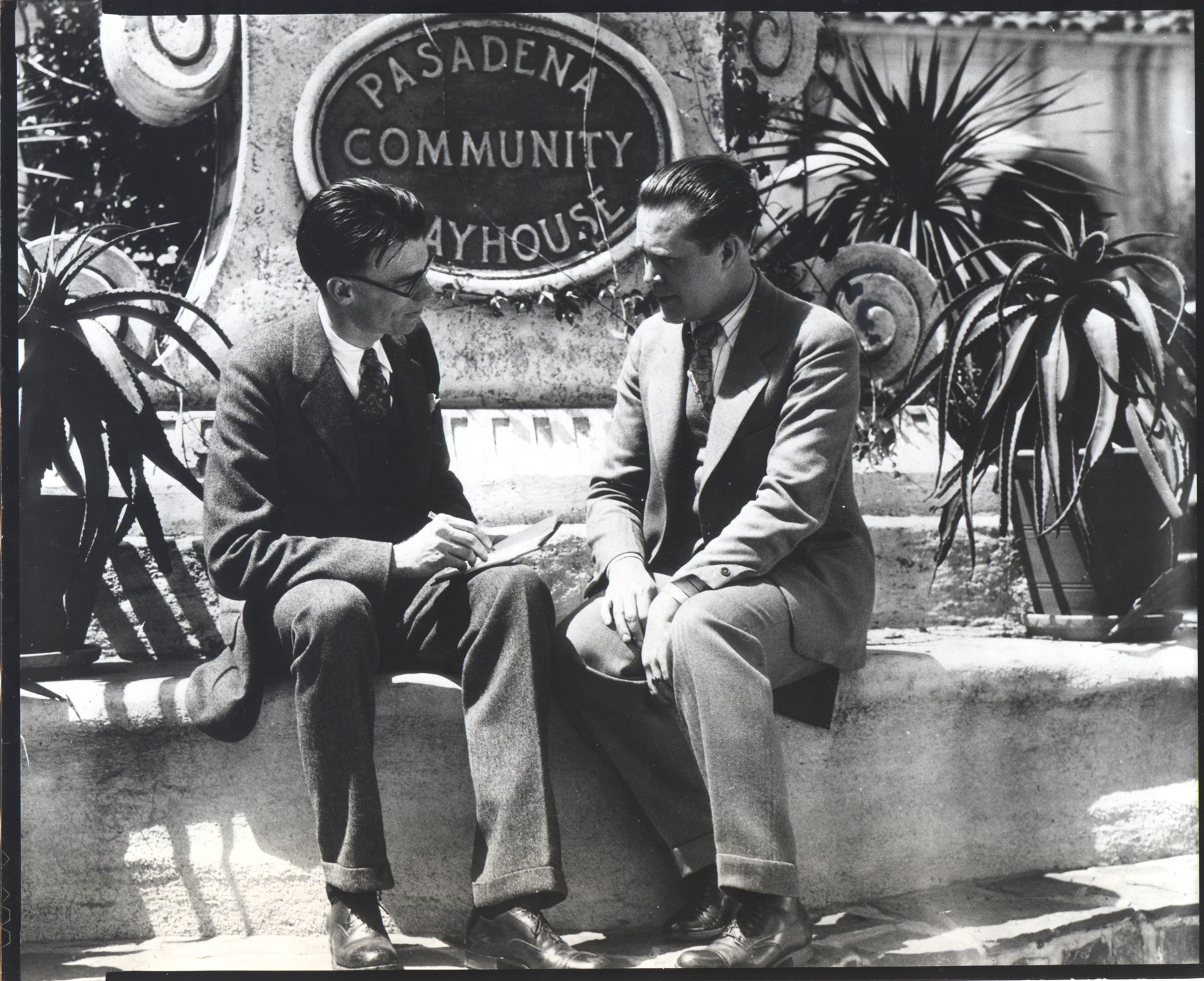
Gilmore Brown and Charles Prickett (Early Playhouse) | Courtesy photo / Pasadena Playhouse Archives
The venerable Pasadena Playhouse, the State Theatre of California, is observing its centennial. It is a milestone only a handful of theatre institutions in the country have reached, which is why Producing Artistic Director Danny Feldman can’t help but speak in awe of its past as well as its place in history.
“We’re celebrating three significant events – the centennial, the 90th anniversary of the founding of the Playhouse College of Theatre Arts, and the 80th year of the Playhouse’s designation as the State Theatre of California – and that’s extraordinary when you compare it to the Center Theatre Group, for instance, which is turning 50 this year,” states Feldman. “They’re babies compared to the Playhouse! Very few, if any, professional theatres in this country can claim similar distinction of history, impact, and longevity.”
“The Playhouse has survived world wars and has weathered financial challenges to continue to bring productions that enrich the community. It has been a leading center for theatre arts in America for a century but very few people realize its importance. It’s my job to tell people about it; it’s incumbent upon us to tell our story and history. And I’m excited to be taking us back to that journey.”
Feldman continues, “Any time there’s a new artistic director, which is a very healthy and natural evolution, you get someone who’s coming in with a new lens as to what they interpret their mission to be. I stand on the very broad shoulders of Gilmore Brown and Sheldon Epps who dedicated big chunks of their career into making this place thrive.
“Gilmore Brown founded the Pasadena Playhouse in 1917 when he was only in his 30s and basically operated the theatre until his death in 1960. He defined the greatness and international acclaim of the Playhouse. It was here that world premieres of the works of Tennessee Williams and Eugene O’Neill were presented. It was the venue for women playwrights to stage their creations in those early years when it wasn’t the norm.
“He was the entrepreneurial man who galvanized this community into buying the land where the Playhouse sits now and build this theater. It belongs in the hierarchy of monumental buildings. At the time its cornerstone was laid, it was the only structure of its kind among orange groves. Variety called it a world-class facility, a true original.
“An energetic and fascinating man, Gilmore put the entire community to work in the Playhouse. They made costumes and they were part of the chorus in the shows. There was a blurring of the lines between professional and non-professional theatre artists. What resulted was a community that fell in love with this enterprise and gave themselves for many, many years in establishing it and taking great pride in making it one of the foremost theaters in the country.”
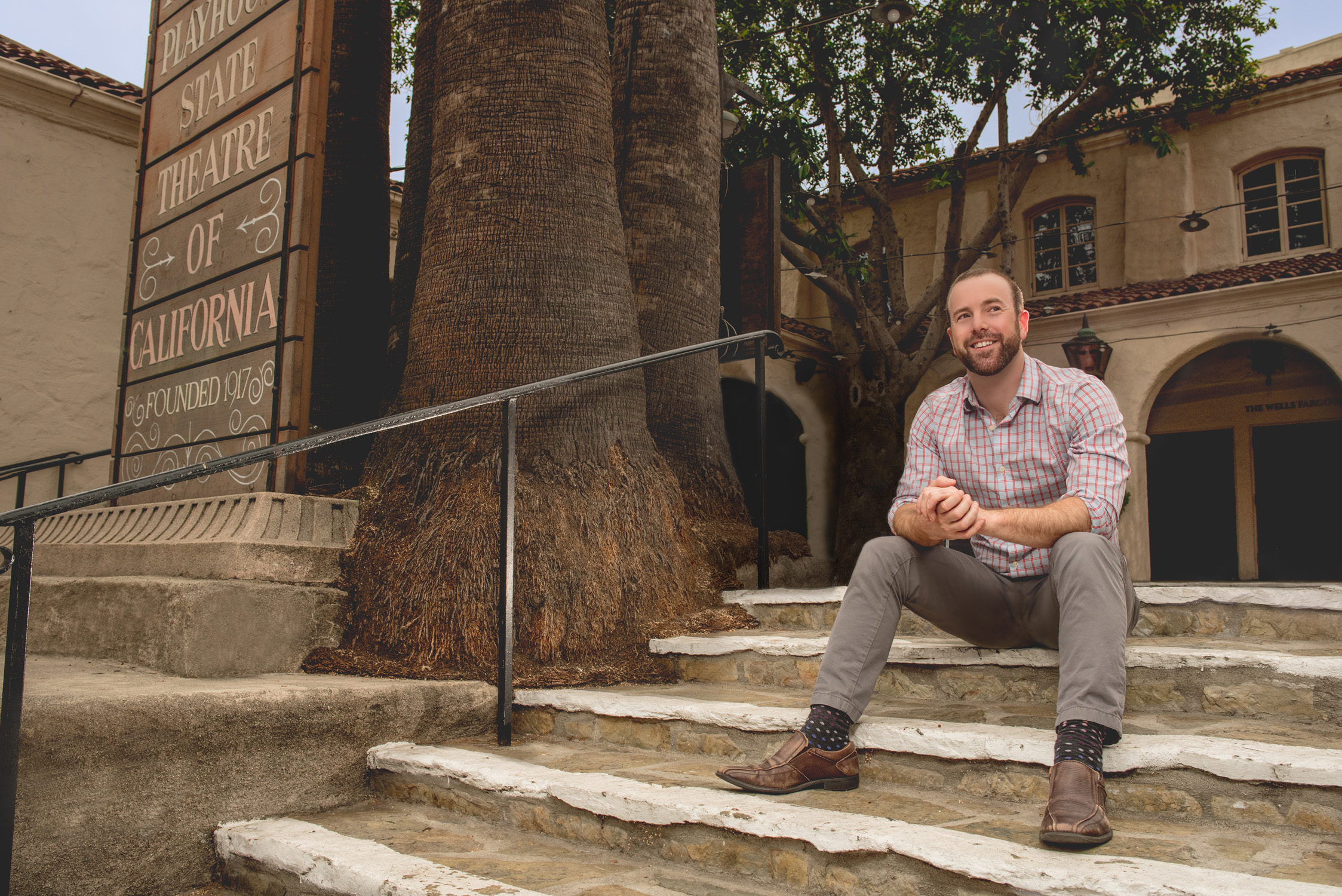
Producing Artistic Director Danny Feldman | Courtesy photo / Ben Gibbs
“The Playhouse had a lot of ups and downs after this death when the theater was dark for a period of time,” relates Feldman. “The next great chapter in its history was when Sheldon Epps came on board. He was really ahead of his time in reinterpreting the Playhouse’s role. The community wasn’t what it looked like back in 1917 and it was him who burst open the doors of who the stage is for and what kinds of stories are being told. I think he made a permanent change to the Playhouse in saying ‘we are an inclusive place.’ It’s not a place about one segment but several segments of our community. I’m so inspired by that and am building on it.
“When I took over, not only did the artistic director change after 20 years, but it was a change right at the cusp of its new century. On top of the financial challenges, we have a new artistic focus through my lens, my love and passion. And at the same time we are defining what a theater is going to be in the age of Netflix and Hulu. We can’t function as we did back in 1917, the world is different now. So the question is how are we going to make theater flourish? What are the core values and ideas that worked back then that were important to the community and how do they translate today?”
“We want to have relevance which isn’t a new idea because it’s how it has always been,” Feldman says further. “Even when doing a classic like ‘Romeo and Juliet,’ if it doesn’t connect to your audience and it doesn’t make them see themselves, it isn’t alive. Great theatre or art is about making an audience of strangers a community. It’s sitting next to someone you’ve never met before and having that great moment when you realize everyone around you is engaged in the same personal experience. Theatre is the ultimate master class in empathy.
“That is profound and it’s why theaters have always thrived, and will continue to, even with the inventions of radio, television, movies, and the Internet. Theater unites people in a way you don’t get with any other medium. No one can contrive something that can replace that. It’s worked with the ancient Greeks and it will do so now for a reason. The desire to be around other people is innate in human beings and we crave it in a way that’s hard to articulate in words but it’s important for humanity.”
Feldman remarks, “When the Playhouse was first established there was a great level of investment particularly in Pasadena and the San Gabriel Valley that went on for a long time. People went door-to-door to raise money to build this structure because they were deeply attached to the work the theatre was doing. They were an active part of it and felt ownership of this. But over time, some of that connectivity was lost.
“Our challenge is to do a much better job of broadening the definition of what our community is and we started some initiatives to address that. We’re sending out a message loud and clear that it isn’t just those who belong to an economic class that can afford to buy tickets. So one of the things we did right away was to lower our ticket prices. You can come to any show at the Playhouse for $25 and get good seats. We have a substantial portion of our tickets for that and they sell out first.
“We also launched a program called ‘Community at play,’ which is a free ticket initiative. We identified that there are groups in the community that have barriers to coming to see a play because of cost, or transportation, and so on. To get this population to be with the rest of our audience and be a part of our community, we gave away thousands of tickets to social service groups and after-school programs.”
“Studies show that young people who had an art experience in school have a greater likelihood of them coming back as adults, which bodes well for us,” Feldman adds. “A generous donor has enabled us to bring the entire 7th grade of the Pasadena Unified School District come to watch ‘Pirates of Penzance’ and I’m excited to say they’re all coming back next season for ‘Woman in Black.’ Our goal is for everyone who attends public schools in Pasadena to be able to see a show at their theater.
“Last night, for our ‘Community at Play’ program, a group of predominantly Latino students who did a workshop beforehand, came with their teachers to watch ‘Bordertown Now.’ Their experience was so moving that it brought tears to my eyes. They heard their voices on our stage which elevated them. The State Theater of California should rightfully be the place where Latino voices are amplified in the same way that Tennessee Williams’s or William Shakespeare’s voices were. It’s one of the ways we’re enriching our community and showing our relevance to it.”
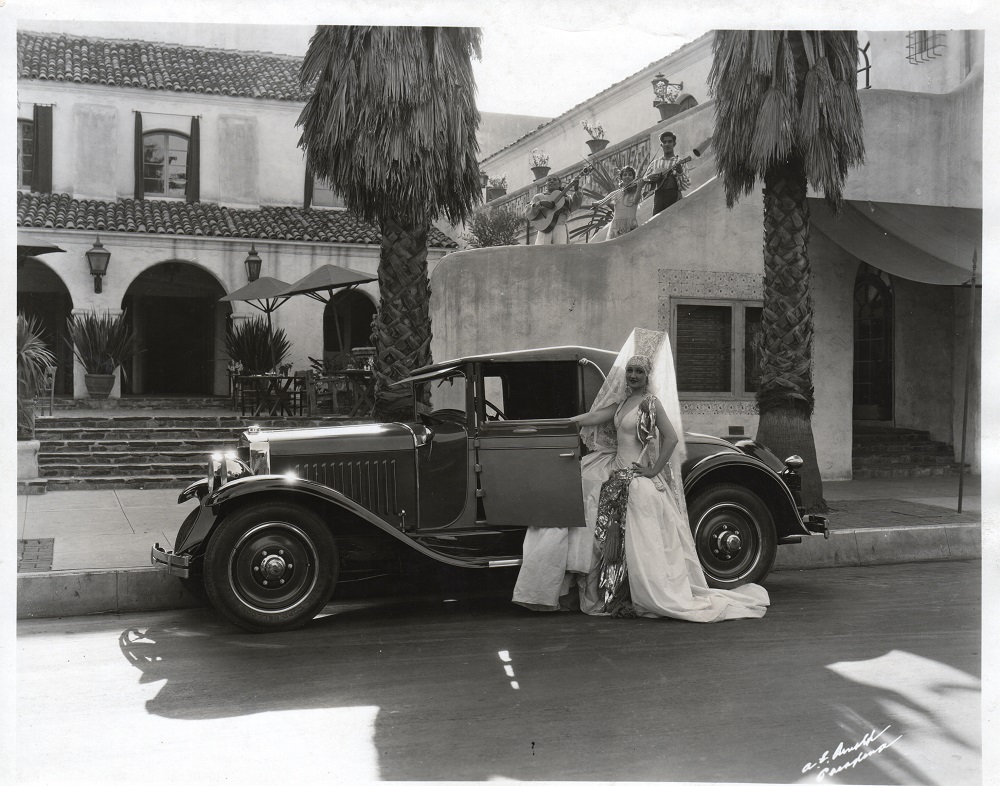
Senorita with Car (1936) | Courtesy photo / Pasadena Playhouse Archives
Feldman pronounces, “I want to think of the Playhouse’s next chapter as a transformation and I want to be careful when I talk about it. We’re firmly rooted in the past and we’ve had some real challenges that we’ve addressed head-on. I’m not someone who turns a corner and says ‘let’s forget the past’ because I want to remember it – there’s value to it. We’re a historical theater and we have to honor our past but look at it with the lens of the future.
“I think of myself as bridging those worlds and our programming demonstrates that. The first show we put on for our centennial season was ‘Our Town,’ which is a play about community. But what does that community look like today? So we reinterpreted it to reflect our changing world.”
“In the 1920s Gilmore Brown produced new plays here and in the 1940s he put on Tennessee Williams plays,” Feldman expounds. “He championed contemporary playwrights and I’m continuing that. We have ‘Bordertown Now,’ a play refreshed and rewritten by modern-day artists from their work 20 years ago, to show the world we live in today. In a way it’s a transformation in taking core values deeply rooted in the past but aware of where we’re going in the future. We want to find the spirit that prevailed in the 1940s to the 1970s, which was the period the Playhouse had the most growth, and put our own distinctive stamp on it.
“My previous post in New York was with an artist-driven theater, established by Philip Seymour Hoffman and other exciting artists, that created space and opportunities for those who are being marginalized and being left out of the conversation. I was very much inspired by that and I’ve brought that here, particularly as we expand the scope of our work. It deeply resonates with me because my father wasn’t born here. I realize that America is a tapestry of different cultures and people.”
“California is one of the most diverse places on the planet and the Playhouse is its State Theater. I’m responsible for ensuring that our values and programs demonstrate the core values of inclusion, diversity, and providing a space for more than just one thing. That’s inherent in who are as an institution and I want to carry on that legacy,” declares Feldman.
So how does an institution that is one of the most prolific drama-producing organizations in the history of American theatre – having commissioned over 550 new works, produced upwards of 1,200 shows, spearheaded over 500 world premieres, developed several shows that went on to Broadway, and welcomed more than one million audience members – commemorate a milestone?
Pasadena Playhouse will celebrate its centennial with a block party | Courtesy photo / Chris Molina
“There was a great deal of discussion about it and a great many ideas were thrown around, including having a black-tie dinner,” discloses Feldman. “And, quite frankly, I wrestled with it for a long time because I want to make sure that whatever we do, it has to be something that’s engaging our community the way it has in the past and building on that heritage.
“One day, when I was in a heated debate on it, someone asked ‘If money weren’t an issue, what would you want to do?’ And I said ‘We’d close all the streets around the Playhouse and invite everyone to come so we can say ‘thank you.’ And my Marketing Director said, ‘Okay, let’s do it.’
“It’s a huge undertaking to close El Molino Street, the parking lot, and the Playhouse Alley. But we decided that instead of having a self-congratulatory event, having a block party was the best way to honor everyone who has supported us. It would be an opportunity to reintroduce the Playhouse to the community, to say that this isn’t our space but your space. It has served as a gathering place for a community for a hundred years and we want to be a part of their lives for the next century.”
Brown established Pasadena Playhouse in 1917 and named it Pasadena Community Playhouse, safeguarding the entire neighborhood’s investment in it. And while it has achieved an international renown in the years hence, Danny Feldman is making it his mission to ensure that the community spirit on which it was founded lives on into its next century. Gilmore Brown would have been pleased.
Originally published on 1 June 2018 in the Pasadena Independent, Arcadia Weekly, and Monrovia Weekly
Courtesy photo | Pasadena Playhouse
Immigration is a hot-button topic that touches the lives of all Americans. It is a subject politicians exploit on the campaign trail as much as it is a well from which activists draw causes to fight for. And it is the theme that the comedy troupe Culture Clash explores in ‘Bordertown Now’ at The Pasadena Playhouse.
On stage from Wednesday, May 30 to Sunday, June 24, ‘Bordertown Now’ takes an irreverent look at the people at the center of the controversial issues and the walls that divide us. Infused with their trademark satirical approach, the country’s top Chicano/Latino performance trio messes with the boundaries of theatre and comedy to break down the divisions between cultures.
Culture Clash’s Richard Montoya, Ric Salinas, and Herbert Siguenza are joined by Sabina Zuniga Varela. Varela appeared with Culture Clash in ‘Chavez Ravine: An L.A. Revival’ at the Kirk Douglas Theatre on the occasion of the troupe’s 30th anniversary in 2015.
‘Bordertown Now’ is directed by Obie Award-winning artist Diane Rodriguez. She began her career as an ensemble member in the politically conscious, El Teatro Campesino and is now Associate Artistic Director of the Tony Award-winning Center Theatre Group in Los Angeles. In 2016 President Barack Obama appointed her to the National Council on the Arts, a body that advises the Director of the National Endowment for the Arts.
To shine a light on the various issues, there will be post-show conversations after each performance on different topics including immigration, border policy, and more, led by topic experts.
Danny Feldman, Pasadena Playhouse Producing Artistic Director, says, “For more than a year, the immigration debate has been in the news on a daily basis. It is so rare to be able to present a new work that directly responds to our ever-changing world. Who better to examine this issue than the iconic troupe Culture Clash, making their Playhouse debut. Through humor, satire, sentiment, and curiosity, they manage to bring us closer to the humanity at the center of the border issues.”
Richard Montoya explains the group’s roots, “I co-founded Culture Clash on Cinco de Mayo in 1984 in San Francisco’s Mission District at a historic Latin quarter in a small art gallery. Art is very much a part of our vibe.
We first produced ‘Bordertown’ two decades ago and while ‘Bordertown Now’ is billed as a re-imagination of that, about 70 percent of this show is new because political awareness and interest about the border have grown in intensity.
There’s so much going on around the country relative to the concerns we’re exploring so it was easy for us to harvest new material. The issues have become more powerful and polarizing but we’re also going to find the humor in the circumstances that plague immigrants. It’s a comedy that’s balanced with serious topics, a reality show that sometimes plays like satire. There’s nothing more farcical than what’s happening now.”
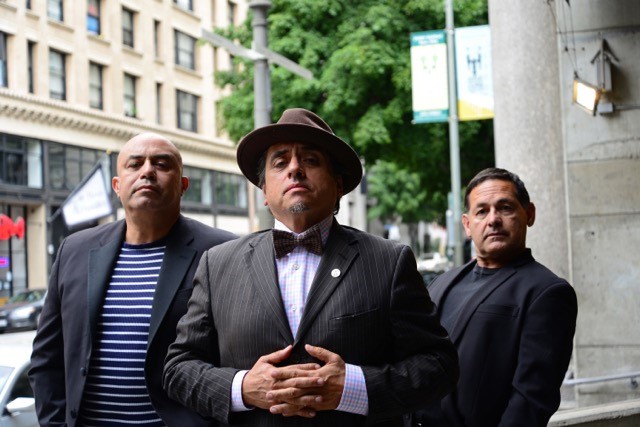
From left to right, Culture Clash’s Herbert Siguenza, Richard Montoya, and Ric Salinas | Photo by Eric Schwabel courtesy of Culture Clash
“During the last year or so, I’ve been busy on the border interviewing sheriffs, agents, and the people who are caring for those who are crossing the border,” continues Montoya. “I’m doing something similar to journalistic work. And then we recreate the characters for our show. It’s like an anthology production where we’re putting together the pieces, connecting all the things that happen on the border.”
“The landscape and the cast remain the same but besides that, policing around the area has changed rapidly,” Montoya explains. “Armed personnel presence on the border has increased so much that it has become a military situation. At the same time, the danger brought on by the drug cartel has also grown and so has the desperation of those caught in the middle. This scene is so different from that of my youth when there was a trolley service from San Diego to Tijuana.”
“California is such a fertile ground on which to examine this issue,” Montoya remarks. “We have borders within borders – whether it’s between Old Town Pasadena and South Pasadena, or between Los Angeles and San Francisco. I was born and raised in San Francisco and I moved to Los Angeles 25 years ago. And I can’t believe the disparity between Northern and Southern California, it’s mind blowing … which just proves the cultural richness we have in the state. But beyond the geographical borders, ‘Bordertown Now’ examines divisions between genders, cultures, and the imagination.”
Montoya says further, “This time we’re adding other cultures, like Asian, into the mix … anyone who just arrived and eager to become American. This idea of becoming American is still very fresh. You know, when you’re in France, you’re French; and when you’re in Beijing, you’re Chinese. The United States is one of the very few places where you can become an American. And it’s that notion which attracts so many to our country. And one of the questions the play asks is ‘What is the cost of being an American?’”
“While our show is a comedy, we want to show a serious aspect: that we’re all human beings – even those who are hiding in the Mexican desert, trying to cross the border illegally. What our current administration and other countries have done is dehumanize the person on the other side.”
“We’re not saying that borders don’t exist, because they do. Nor are we claiming we’re all equal, because we’re not. But we’re saying we’re all human beings – there are people caught in drug and human trafficking. We’re trying to show the human struggle, and the human-ness outside of the headline. We want to take the measurement of their lives, and not treat them simply as data. And, as artists, we want to keep alive the hope and show that we care about all these,” declares Montoya.
Culture Clash’s ‘Bordertown Now’ examines subjects that are timely and of significance. It puts a human face to the immigration issue. Would that people see it, take it to heart, and seize the opportunity to play a part in chipping away at the borders that divide us from each other.
Originally published on 30 May 2018 in the Pasadena Independent, Arcadia Weekly, and Monrovia Weekly
Courtesy photo | Boston Court Pasadena
Families, and the drama that’s inherent in each, is the topic of Mfoniso Udofia’s play ‘Her Portmanteau.’ It will have its West Coast premiere at Boston Court Pasadena from May 24 through June 30, 2018.
Directed by Gregg T. Daniel, who recently directed Lorraine Hansberry’s groundbreaking play ‘A Raisin in the Sun’ at A Noise Within, ‘Her Portmanteau’ stars Joyce Guy who plays the role of Abasiama the family matriarch. Completing the cast are Omoze Idehenre as Adiaha and Dele Ogundiran as Iniabisi.
A theatre graduate of Hampton University in Virginia, Guy was a member of the DC Black Repertory Company. She has performed at the Kennedy Center, Mark Taper Forum, and L.A. Women’s Shakespeare Company. Her screen and television credits include: ‘Moneyball,’ ‘The Santa Clause,’ ‘Animal Kingdom,’ ‘Criminal Minds,’ and ‘How to Get Away With Murder.’ She got an Ovation Award nomination for her choreography for ‘Les Blancs.’
This will be Guy’s debut performance at Boston Court Pasadena and she recalls how her involvement in the project came about. “This is the third time, in the last year and a half, that I’ve worked with Gregg. I choreographed ‘Les Blancs’ at Rogue Machine and ‘Raisin in the Sun,’ both of which he directed.
When I was at the performances of ‘Les Blancs,’ Jessica Kubzansky, Boston Court Pasadena’s Co-Artistic Director, was in the audience. I’ve known her for a while; I took a class with her a long time ago and we became friends. After the play she said to me, ‘Joyce, I have this play that I want you to audition for.’ And then I got a call from the casting director.”
Guy describes the play, “Her Portmanteau is the story of Abasiama, a Nigerian American mother who has two daughters. Her first daughter is Adiaha with her first husband who she met in college. When he was deported she decided that it was best to send Adiaha, who was six years old at the time, back with him to Nigeria. She has another daughter, Iniabisi, with her second husband whom they raised in Massachusetts where her job as a biologist took them. Iniabisi, a 30-year-old aspiring writer, lives in New York.”
“Abasiama has her hands full living with a husband who has mental health issues,” Guy adds. “But her life gets more complicated when Adiaha, who’s now 36, decides to come back to the United States.”
“In Nigeria the first daughter is called ‘adiaga’,” explains Guy. “When Abasiama informed her husband that she wanted to bring Adiaha to Massachusetts, he told her ‘Don’t bring her to my house; she’s not my daughter. My daughter is the ‘adiaga.’ Then he locked himself in the bathroom and started walking backwards. To avoid further conflict, Adiaha picks up Iniabisi from the airport and takes her to New York where she lives.”
Aside from the ‘baggage’ that ‘Her Portmanteau’ explores, it also literally refers to a suitcase. Reveals Guy, “It’s the same luggage that Adiaha took with her when she left for Nigeria with her father three decades ago.”
“It’s a great story, with a character who has several layers,” Guy says. “And as an actress it’s challenging but it’s a wonderful one. What keeps surprising me is that for someone who’s very direct in her everyday interactions with people, to the point of rude bluntness, she wasn’t forthcoming with important information about her family. She makes promises she can’t keep and it seems that she does it to make herself feel better. She’s a woman of many contradictions.
One Sunday morning, she woke up and made a pivotal decision without thinking things through. As I said to Gregg, I imagine that having lived with a second husband who has mental instability she would have developed some psychological problems. She had to build coping mechanisms which were also faulty and she couldn’t really function properly.”
Mfoniso Udofia. – Photo by Frances F. Denny / NY Times
According to Guy she doesn’t have anything in common with the character, “There really isn’t anything about Abasiama that I could relate to because I don’t have children. It’s also a challenge to learn a whole culture you’re not familiar with. The play is very specific in its culture, the people, and the language; and we have to honor that. Ibibio is tonal and learning the phrases used throughout the play proved daunting.”
“I’m African American but I studied West African dance so I’ve been to Senegal, Mali, Guinea, and Gambia,” continues Guy. “I made a film in Senegal; I have a friend who’s Nigerian so I’m familiar with the West African culture. That’s different from being involved in a culture so I have to go deeper to inhabit Abasiama’s character. Gregg lets the actors find their direction in the script, through our research, by observing how Nigerians speak, carry themselves and their bodies, and in relationship with the other actors.”
Living among people of different culture isn’t an entirely novel experience for Guy, though. She discloses, “I was an army brat. My father was in the Air Force and we moved every three years. I’ve lived in Japan, Taiwan, Texas, Kansas, and Delaware.
“When people inquire where I’m from, sometimes I say Delaware because that’s where by father retired after active duty. At other times I say Montgomery because both my parent are from Montgomery, Alabama. I was actually born there and we stayed there until I was three years old when we moved to Texas. After Texas we lived in Taiwan; from there we went to Florida; after that we went to Japan; then to Kansas; and finally to Delaware.”
“Because we moved around a lot I’m often asked which culture I found the most appealing to me. In fact, someone asked me that two days ago, and I said Taiwan. We lived in a compound with other Americans but we had to move to a bigger house because there were five of us. We had free range, we’d walk everywhere, we’d go down to the rice paddies. My best friend was a man who had a food truck that sold bananas and he would give me some. The Taiwanese kids were very curious about us and would touch our skin and our hair. I have wonderful, memorable experiences. But the funny thing is, I couldn’t stand the smell of garlic. I was five, okay?,” Guy says defensively.
Taking on this role in ‘Her Portmanteau’ has given Guy an opportunity to grow as an actor. She says, “I’m learning that I’m more determined and resilient than I thought. I have learned to come to terms with my weaknesses and that I have to put in the work. In order for me to honor Mfoniso’s words, Gregg, and the other actors, I have to go the extra mile. As rehearsals progress, we’ll be able to get to the whole dynamic of this family.”
“There is a universal theme to this play. It’s about family dynamics and dysfunction, things we all can relate to; there’s no perfect family. For me, the biggest takeaway would be that we all have regrets; we’ve all done something that weighs on us. But you can work past that as long as you’re forthcoming and honest with yourself. The thought may not go away but you can go forward from there,” concludes Guy.
While Mfoniso Udofia’s ‘Her Portmanteau’ is semi-autobiographical, this taut and poignant drama about relatives, legacy, and connections will resonate with all of us. Some of us will recognize our particular family’s dysfunction and see ourselves in one of the characters. Because as different as every one of us is, we all share a human-ness that is imperfect.
Originally published on 22 May 2018 in the Pasadena Independent, Arcadia Weekly, and Monrovia Weekly
Dr. Robert Nafie dedicated 39 years of his life to Clairbourn School | Courtesy photo
He’s at transportation every single day, rain or shine, opening car doors for students arriving in the morning and leaving in the afternoon. He’s the one constant for the thousands of children who have attended Clairbourn School through the decades – Dr. Robert W. Nafie, headmaster.
It was therefore with much melancholy that students and parents received his announcement that he was leaving at the end of the 2017-2018 school year. He’s such a permanent figure that it’s almost impossible to envision the school without his daily presence nor to imagine what Clairbourn was before he ever stepped foot on its campus.
The second of Edith and Marvin Nafie’s four boys, Robert William Nafie was born on September 7, 1948 in Detroit, Michigan, where he spent his earliest years. When he was nine years old, they moved to Farmington, a northwest suburb of Detroit. He remembers having a Huckleberry Finn childhood – running through the woods, building forts, swinging on ropes, and doing all manner of imaginative play.
A portrait of five-year-old Robert William Nafie | Courtesy photo / Nafie family.
When he was 12 years old his father, who worked at a firm that made parts used in different makes of cars, was offered the position of plant manager for a factory that was opening in Duluth, Minnesota.
He graduated from high school in Duluth and went to the local college affiliated with the University of Minnesota where he earned a four-year degree in History and Economics with a teaching certificate.
Directly after college he took a temporary post teaching U.S. history at the local junior high school which he once attended. After one-and-a-half years he found permanent employment at a special education school.
“Funding for special education became available in 1970 to establish community-based programs for young people who would otherwise have gone to state hospitals,” says Nafie. “It wasn’t what I had intended to do but I’ve always been humble and was taught to take advantage of opportunities that came my way.
“Within a year, the people I worked with and came in contact with felt there were much higher things in store for me and when a community-based facility needed a head, I was recommended and promptly hired.”
And so, at the age of 24, Nafie became the head of a community-based special education facility. Now he was running a school with 16 teachers all older than he in Eveleth, Minnesota, 60 miles north of Duluth.
It was there that he first demonstrated the nobility of purpose that would be the hallmark of his entire career. He states, “The facility was one that was no longer being used because the population had decreased. It was in such bad shape and looked like it was down on its luck; I didn’t want to put people who were already in dire straits in that building.”
He elaborates, “I had the audacity to write a grant for a program asking the state legislature for $500K to renovate the school. I was able to hire an architect who worked with me, from designing buildings to completion. This experience later proved useful during the construction years at Clairbourn. I earned a commendation from the governor of Minnesota for my efforts and the refurbished building opened to much fanfare attended by the governor.”
In 1974, he enrolled in a graduate program for educational administration at the University of Wisconsin at Superior, across from Duluth. Because of the distance of the drive, coupled with high gasoline prices, he rode a motorcycle 75 miles each way even in the bitter cold. He became the stuff of legend riding his little 250 Suzuki back and forth. He earned his Master’s degree in 1975; he was 27 years old.
Having gained state recognition, he came to the attention of the Developmental Learning Centers in Eveleth and became its executive director. He ultimately became the president of a statewide association of learning centers with headquarters on the eastern side of St. Paul, Minnesota. It had five locations, so he spent his time driving up and down the county overseeing building leases as well as supervising the instruction.
After being on the job for two years, Nafie decided he wanted to go back to general education and sent his resume to seven or eight schools. One of them was Clairbourn and, in August of 1979, he was invited to come to California to interview. “Who wouldn’t accept a plane ticket to California? Little did I know that it was over 100 degrees and they told me it wasn’t always like this,” he deadpans.
The 29-year-old headmaster | Courtesy photo
The school needed a Development Director but it wasn’t what he wanted so he turned them down. However, the post of headmaster became vacant after the school year had begun and he was hired to fill it. And so in 1979, at the age of 29, he became headmaster of Clairbourn School. To make himself appear older he started wearing a suit to work every day, which became his trademark.
Jim Halferty, a Clairbourn alumnus and currently a real estate developer in Pasadena, was on the board back in 1979. He pronounces, “It was my best hire as a Clairbourn trustee. We interviewed several candidates, many of whom were much older and with more years of experience. But we decided we wanted someone young who would make his mark on the school. And Bob did just that; Clairbourn is what it is today because of him.”
When Nafie arrived at Clairbourn, the school was a disjointed grouping of structures on two different parcels of land, the grounds were uneven and unpaved, and the campus had no central area. His first course of action was to make the school a beautiful learning place for children.
“When I met with the board I told them my vision for educating children and how their environment affects learning. They all thought I rode in on a white horse and they were happy to give me every bit of the school along with all the problems that needed fixing. They threw it all at me, wished me well, and said they would call me in a few weeks. At least that’s how I saw it; but I was used to multi-tasking,” he smiles in recollection.
“I wanted it to be a school I could be proud to lead,” he declares. “I made the first ten years of my headship be about creating a master plan for restructuring the buildings and reconfiguring the campus. We hired an architect who worked with us on designing the classrooms and the grounds to look like a country day school. The architecture of the Manor House became the model for a unified appearance – all the structures would have the same Georgian Colonial style, with off-white walls and grey eaves. I also spearheaded a capital campaign to raise funds for the projects.”
During his first decade, he oversaw the creation of the new library, art studio, music room; new infrastructure – sidewalks, central lighting system, irrigation system, electrical and gas lines. He linked the two parcels by creating a campus center from which the students could get to either side of the school grounds upon arrival. Where there was once broken asphalt, a grassy central quad emerged, with walkways for children to use as they went to their classrooms. “The quad overlooked my office and I guarded it like a hawk; everyone knew not to step on the grass,” he quips.
The first of many constructions that would span several years | Courtesy photo
While all this was going on he attended the Claremont Graduate School and led the charge to demonstrate a strong model for teachers to follow. In 1983 he established what was called the Education Reimbursement Program which he himself took advantage of, from 1983 to 1985, when he earned his doctorate degree and henceforth became Dr. Nafie. When the program was first put in place, Clairbourn paid half the cost of a formal education for any teacher who desired to get a degree; today it covers 100% of tuition and books.
Towards the end of Nafie’s first decade, in 1987, he began thinking about a space where children could assemble for Chapel and meetings. The funds for this came from an unexpected source – a painting hanging in the Manor House which turned out to be ‘Pandora,’ an important work by Thomas Wilmer Dewing, which was sold at auction for $525K. And so the multi-purpose building (MPB) came about. For everyone who attends Clairbourn it is the hub of all activities, the heart of the campus.
The aesthetic and physical components of Clairbourn thus established, he concentrated on building the team to implement his vision for education. A restructuring of the administration was put into place for him to hire an Assistant Head of School, a Director of Business and Finance, a Director of Development, and an Admissions Director.
The vibrant parent community is what makes Clairbourn the beloved institution to which alumni and their parents keep coming back. The Clairbourn Families Association (CFA), which Nafie initiated, has a hand in every fund-raising activity the school undertakes. He expounds, “I wanted the parents to be involved in ways that didn’t touch on instruction, and the best way to accomplish that was to have them help out in the library. We developed a very strong link between the CFA and the library which persists today, and the Book Fair is a manifestation of this.”
Nafie adds, “Around that time we had an activity that was solely run by parents – the Cougar Corner. It was literally a small room in one corner that sold spirit items like pennants and sweatshirts. When we did all the construction, we moved it to a larger space across from the MPB and now it carries everything from soda and popcorn to neckties and gym bags.
The biggest and most extravagant CFA event, though, is the Spring Benefit and auction, an idea originated by parents. All these events gave parents the opportunity to be on campus, provide service, and add to student experience. The campus was more alive than ever before.”
“In 1989 the discussion was, ‘We had all these fine buildings but what are we going to do with them?’” Nafie remarks. “We wanted to ensure that our emphasis didn’t stop on structural concerns but would expand to our enrichment programs. So we launched a five-year Campaign for Excellence from 1990 to 1994 and called it ‘Building on a Promise.’ It also marked the second decade of my headship.”
Nafie’s office overlooks the grassy quad | Courtesy photo
As his third decade approached, Nafie focused once more on infrastructure, “We came up with a Master Plan to replace the Gardner building and reconfigure the entire area with a north/west orientation.” Randall Hall opened in 2001 with state-of-the-art synthetic surface play yard.
“In 2002, Master Plan Phase 2 construction began on Andrew Hall which included the Transportation Pavilion. Completed in January of 2003, this formed a covered space for children and an orderly place for them to wait for their rides.
This was closely followed by the razing of the existing nursery building, and in its place the Seiter Center was erected and opened in 2008.”
It was also in this decade that he inaugurated a program distinct to the Clairbourn experience. Beginning in 2000, Clairbourn exchanged students with host families from the Huntingtower School in Melbourne, Australia. A highlight of the middle school experience, this not only established bonds among students but adults as well. To this day those relationships continue as former parents visit Melbourne and are hosted by Huntingtower teachers in their homes, and vice-versa.
The 2008 recession and its aftermath marked Nafie’s fourth decade. This necessitated a restructuring of jobs and consolidation of roles among the administration and staff. At the same time, the population of the area changed with the influx of Asian families and they came to Clairbourn with different education needs and expectations.
Clairbourn focused on STEM and designed a curriculum to reflect this. It was also at this time that Clairbourn’s business systems and functions moved online and the school’s print publications adopted a digital platform.
Dr. Nafie’s tenure wasn’t all about construction and structural face-lifts but also about upholding the essence that would define his 39-year stewardship – a dynamic engagement with his students and parents.
An annual tradition that he started in 1981 is singing a song for moms during Mothers’ Visiting Day’s morning assembly. He recalls, “I wanted to make myself more approachable to the students; to be more human for them to get to know me personally and, hopefully, for them to know that I care about them. So I speak with them every day at Chapel and I play the guitar and sing for them annually.”
For years, at the Spring Carnival, Nafie would gamely sit in the dunk tank and students all fought for the honor of throwing a baseball to trigger the button that would collapse the plank he was perched on, dunking him in a tank of water. This always got everyone laughing and he would join in the hilarity as he came out, dripping wet in his suit.
Nafie in the dunk tank during the Spring Carnival | Courtesy photo
“The carnival was already in place when I arrived but I wasn’t in the dunk tank yet. That was another parent idea, now that I think about it. They quickly identified me as someone who would do almost anything,” he chuckles in reminiscence.
Throughout his four decades at Clairbourn, Nafie exhibited the many dimensions that make him a uniquely fascinating man. He is as wise as he is witty, with as much affinity for badinage as for waxing philosophical. He is as charming in his self-deprecation as he is stubborn in his opinions. He is at once a student acquiring a vast wealth of information and a teacher imparting his knowledge and homespun wisdom. He is well-read and well-traveled, with a wide range of hobbies and interests. An avid ornithologist, he spouts all kinds of bird trivia. An aviator, he relates in awe the sublime feeling of soaring over the horizon and marveling at the splendor that is God’s making.
When he starts his day drinking a cup of coffee, Nafie reads the L.A. Times, The (London) Times, and the Wall Street Journal. Some bits of information he gleaned would often find their way to morning Chapel to inform students and parents of what’s happening here or abroad and how these relate to them or to that day’s teaching.
Or, he would recount that when he went to get a cheeseburger, fries, and a coke at In-N-Out the previous evening, he reached the pick-up window only to realize that he hadn’t ordered. There’s a lesson in there somewhere, but they forget. What they do remember is that they recognize themselves in his moments of humanity.
Nafie will continue to be involved with Clairbourn School as a trustee | Courtesy photo / Anne Boughton (Nafie’s daughter)
By allowing the Clairbourn community into his personal life, he inadvertently let them have some ownership of it. That’s why when he was diagnosed with cancer last year and underwent chemotherapy and stem cell transplant, they rallied as one to support him. They were there through his illness and treatment. They fought it with him and would have fought it for him, if it came down to that. Happily, he is now in full recovery for they would have rejected any other outcome.
When asked what he considers his biggest accomplishment and what he sees in the school’s future, he replies, “I’m most proud of developing the Clairbourn campus into one of the most elite school campuses in the area – with its many facilities up-to-date and all paid for. Ten years hence, it will have a consistently superior faculty with complementary facilities in a multi-culturally diverse community that loves its school and cherishes its legacy.”
Nafie transformed the Clairbourn campus into one that inspires reflective erudition and meaningful discourse. He has made it his life’s work to create a school that provides both a challenging and nurturing environment. For 39 years he led his students, parents, faculty, and staff to become educated, well-informed, caring members of society.
Clairbourn stands today as a magnificent realization of his vision – the embodiment of an excellent education based on a code of ethics of honesty, respect, responsibility, spirituality, and citizenship. It’s a school that Nafie can not only be truly honored to have led but that which its community is proud of. He leaves a beautiful legacy, which he will continue to cultivate as a trustee, to ensure that it does more than endure but flourish for decades yet to come.