Originally published on 14 February 2019 in the Pasadena Independent, Arcadia Weekly, and Monrovia Weekly
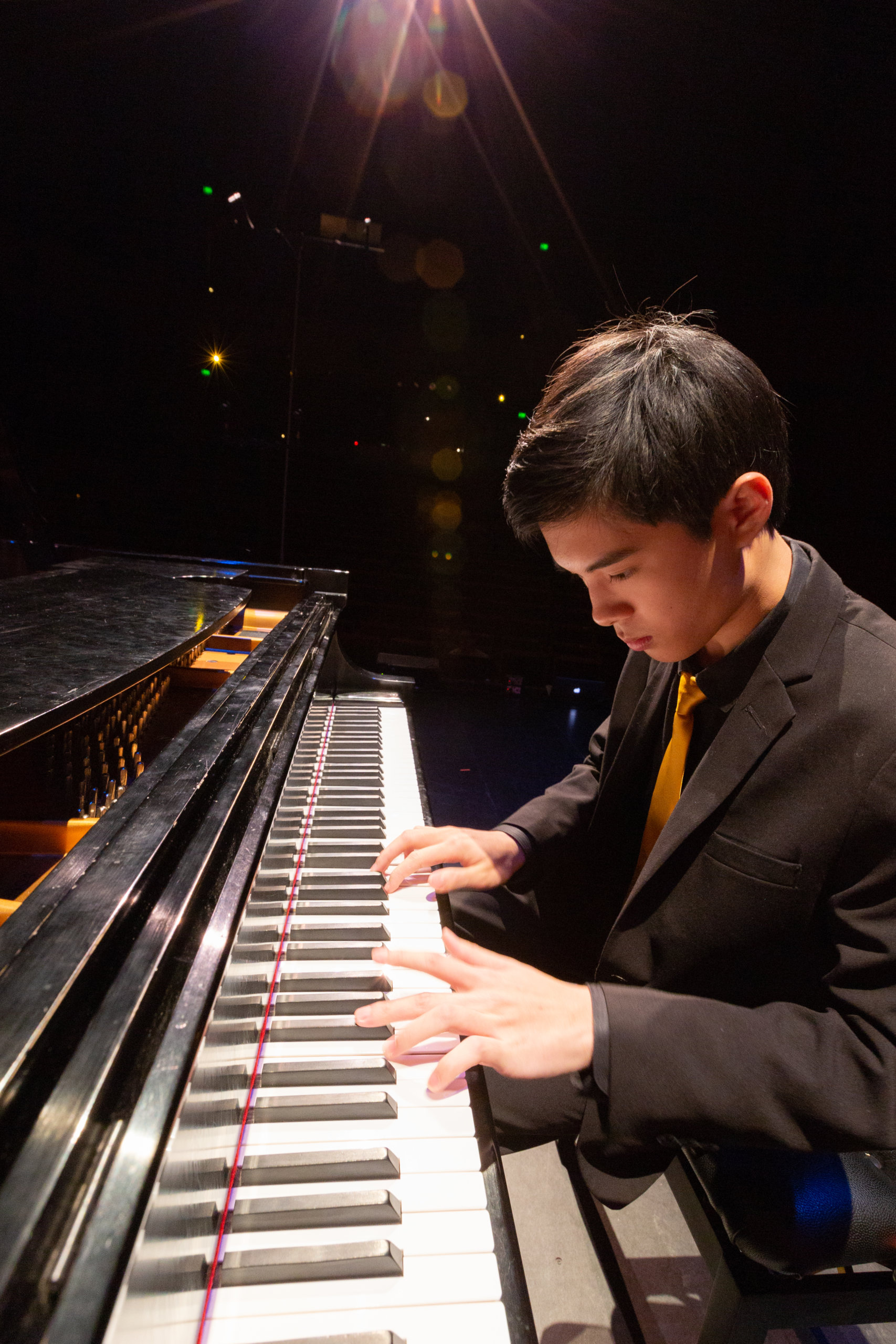
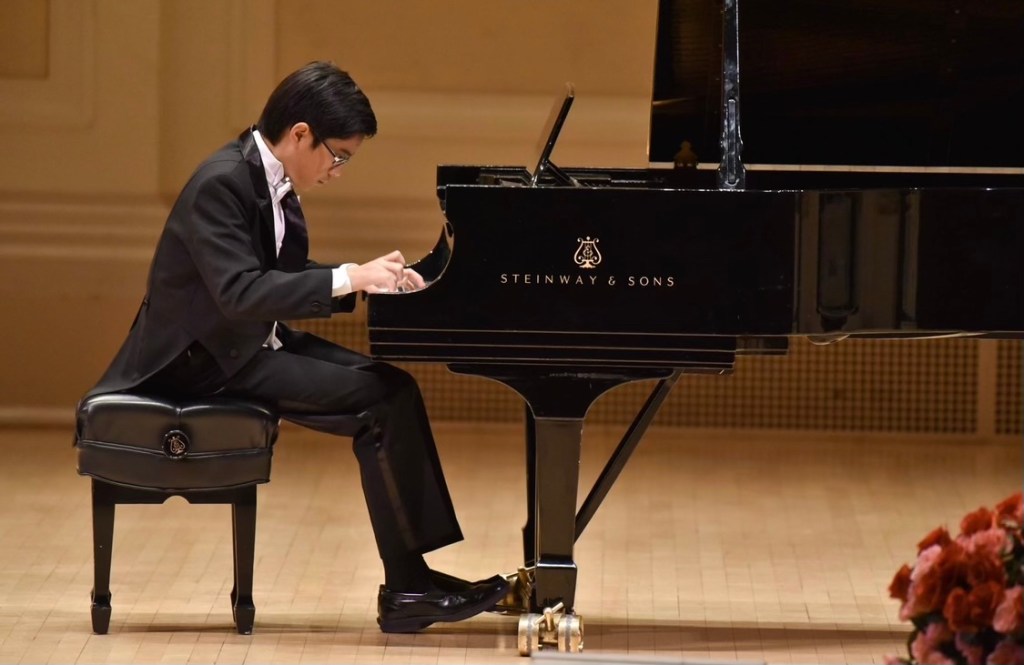
Marc Soong performs Paraphrase on Figaro’s Aria from Rossini’s ‘Barber of Seville’ by Grigory Ginzburg | Courtesy photo / Barry Eckhaus Photography
Marc Soong, a 15-year old teen from Alhambra, is one of five performers who will appear on an upcoming episode of NPR’s (National Public Radio) ‘From the Top.’ It airs on KUSC 91.5 FM on Sunday, February 24 at 6 pm and by podcast at fromthetop.org starting February 18.
The hit NPR radio program, which averages half a million listeners every week, features America’s best young classical musicians’ performances and interviews. This particular show will be guest-hosted by Bernstein-Award Winning violinist Charles Yang and co-hosted by pianist Peter Dugan.
Being included in this esteemed assembly is quite a thrill for Soong. He says, “I feel very honored! I know some fellow musicians who have participated in the program and I occasionally tune in on KUSC to listen to their ‘From the Top’ broadcast.”
“I filled out a very, very long application to be in one of the five slots,” explains Soong. “There is technically no deadline, but if you want to be a part of a specific program, you have to submit an application four months beforehand. Besides musical ability, candidates are chosen based on other factors including gender, age, instrumentation, repertoire, and diversity of stories in their application.”
“Applicants submit two pieces but can upload up to six video recordings. Out of these, ‘From the Top’ will choose one with a length of five minutes or less to be used on the show. “I submitted three recordings and the piece they wanted me to perform was a transcription of Figaro’s Aria from the Rossini opera ‘The Barbier of Seville.’ I suppose they chose it because it was the right length. The transcription isn’t well known, but the tune is popular. Furthermore, it’s virtuosic and exciting. Well, that’s also my biased opinion,” Soong adds with the confidence of an expert.
‘From the Top’ is a Boston-based independent non-profit organization that supports, develops, and shares the artistic voices and stories of young classically-trained musicians. It provides young musicians with live performance opportunities in the foremost concert halls across the United States. This affords them national exposure to over half a million listeners on its weekly NPR program.
Aside from the performance aspect, ‘From the Top’ offers leadership and community engagement preparation and, since 2005, nearly $3 million in scholarships. All these components intensify the hope, passion, and discipline of today’s extraordinary young musicians.
For his live recording performance, Soong traveled to Beaver Creek, Colorado. He relates, “It was a three-day commitment program – I was at the ski village from January 15 to 17. On the first day, I got to know the other four performers and we had a rehearsal. On the second day, there was more rehearsing and the actual show was held that evening. On the last day, there was an ‘Arts Leadership Community Engagement’ event – we had discussions on how to engage an audience based on their age group and we applied what we learned during an unrecorded final performance in front of an entire elementary school. All the events were held at the Vilar Performing Arts Center.”
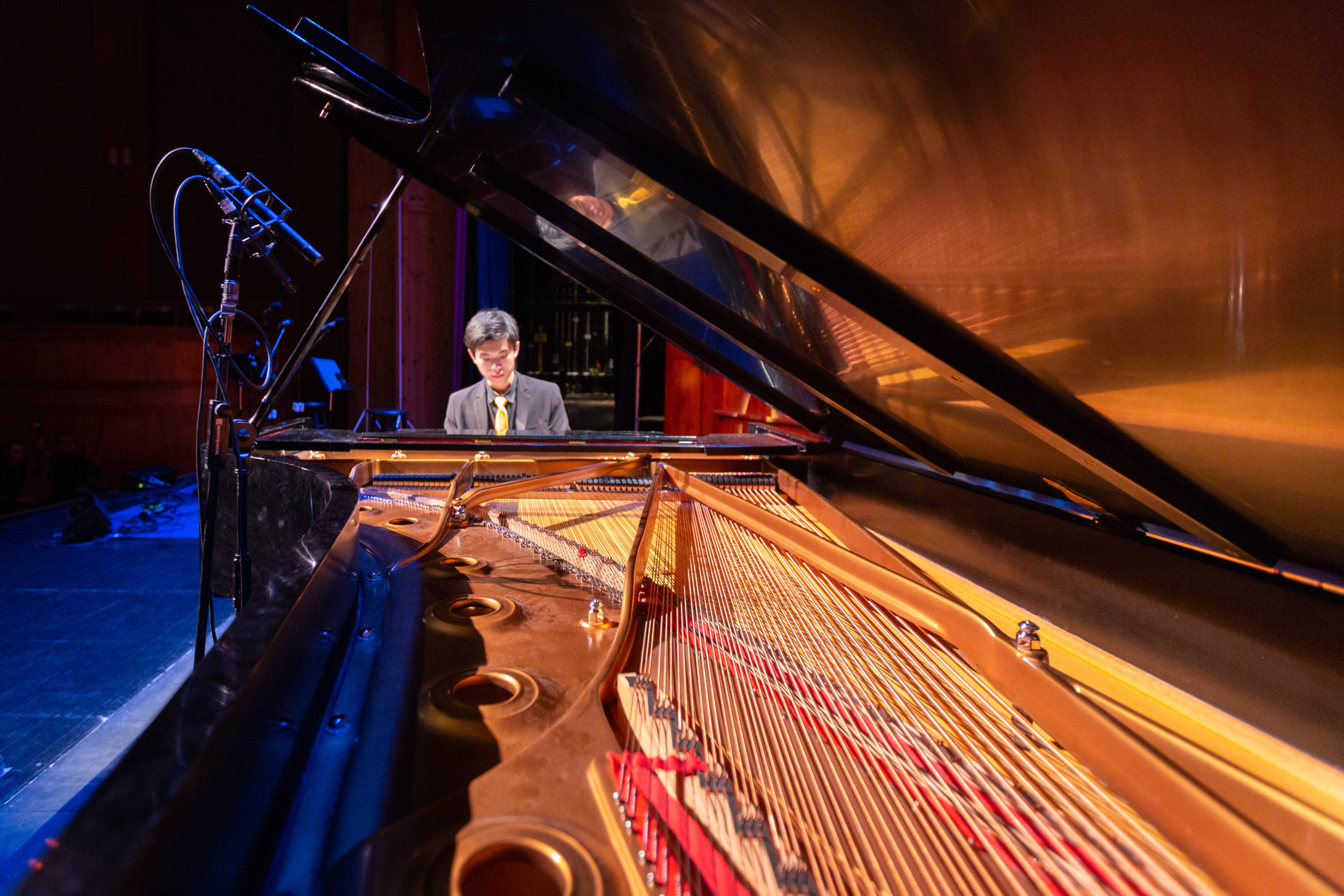
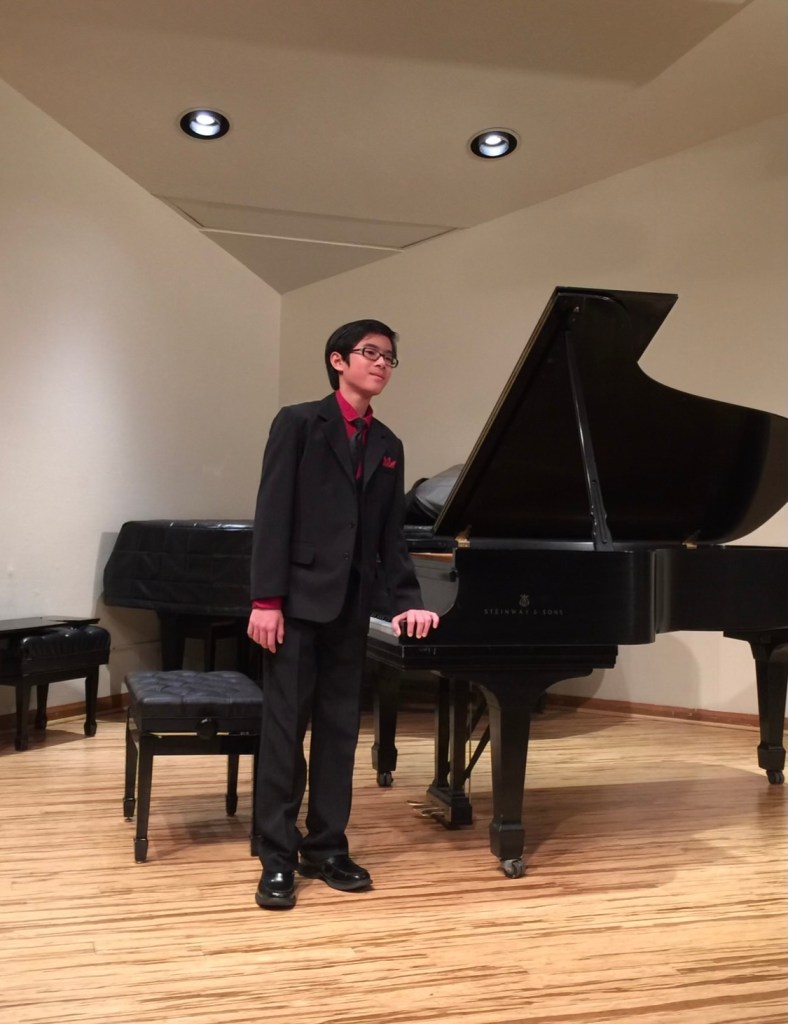
Marc Soong | Courtesy photo / Barry Eckhaus Photography
Each musician is interviewed during the broadcast. “For my interview, I talked about math and music – my two favorite subjects – and physics, the third thing I’m obsessed with … primarily because the class is so hard. I know I unconsciously slip into nerdy talk; I hope listeners will think my interview is funny. Though I will attribute most of the humor to the co-hosts,” Soong discloses with a great deal of self-deprecation.
Soong says of his appearance on the program, “Since I heard about ‘From the Top,’ it has been my dream to be on the broadcast. And the whole experience did not disappoint. I got to meet the kindest, most talented group of musicians my age – all of them played different instruments. I had expected tension and competitiveness among us, which is pervasive during piano competitions and festivals, but there was none of that at all.
“Everyone on the show – from the executive director and stage manager to the producer and music director – were exceedingly nice. Whenever guest host Charles Yang and co-host Peter Dugan played the violin and the piano, you can hear the energy vibrating through the room. They’re also very humble and down-to-earth.
“I had never been on a radio program and I didn’t realize just how much time and effort were involved in creating a one-hour show. It took a full eight hours of preparation before the show started. This has been such a memorable experience!”
The gifted teen credits his close-knit family and caring mentors for this wonderful experience, “I would like to thank my two amazing teachers, Professor Daniel Pollack and Dr. Vladimir Khomyakov, for their guidance and encouragement; and my parents and my sister Melodey for their love and support. I know I wouldn’t have had this incredible opportunity without them.”
A third-year student in the Stanford University Online High School, Soong attended Barnhart School in Arcadia, where he was so academically advanced that he skipped 6th grade altogether. His sister, who is a freshman at Washington University in St. Louis, went to Barnhart and Mayfield Senior School in Pasadena. Both of them are still actively involved in the community, giving piano performances at the various senior centers in the Pasadena area during their school breaks.
He may be only all of 15 years, but Soong has done more than most people who are far older than he. That he has remained so unaffected and unassuming despite his innumerable achievements is a breath of fresh air in this age of self-importance and self-promotion.
Originally published on 22 June 2017 in the Pasadena Independent, Arcadia Weekly, and Monrovia Weekly
The last concert in the 2016-2017 season of the Pasadena Master Chorale is a momentous event for its Executive Director, Jeffrey Bernstein – their rendition of original compositions in a show called ‘Looking to the Future’ brings to a close another successful year.
Proclaims Bernstein, “Since we started we have always been involved with young people singing with us. It’s at the heart of what we’re trying to do – to create opportunities for young people who love choir music to learn about it and perform it.”
“The most exciting student program, by far, is ‘Listening to the Future’, the mentoring initiative we began last year,” explains Bernstein. “Through an application process, we select composers from local private and public schools. We team them up with a composer mentor who meets with them every week from November through June. They write music for us and we perform their work. PMC’s final concert of the year is entirely composed by high school students and it’s quite stirring.”
Bernstein adds, “It’s a very interesting process for these young students to experience. They spend months alone in a room in front of their computer or with a piece of staff paper writing their composition. Their faces light up when they hear a roomful of 60 people transform that music off the page. It’s utterly thrilling when that happens!”
This year’s young composers Katherine Beggs, Elise Logan, Sean Segal, Tiffany Shi, and Olivia Shue will prove their musical talent when PMC presents their original work on June 25 at the Neighborhood Unitarian Universalist Church in Pasadena. These young composers were mentored by Nilo Alcala, who came on board last November.
Although only a rising senior at Westridge School, Katherine Beggs is already looking forward to college to pursue music and meet new people from different places to expand her worldview. But she thinks her high school life is something she will always cherish for the friends she made and the amazing people she has met. She is particularly glad to be part of PMC’s ‘Looking to the Future’ concert.
Beggs chose to arrange ‘O Waly Waly’. She states, “It is a traditional English folk song which I first heard as an arrangement by Benjamin Britten. It had a beautiful melodic structure and made me want to write my own. The visual imagery and figurative language in this song is very vivid which I tried to enhance with the music I wrote. It took me about three months, working one to two hour-sessions a few times a week. Nilo and I exchanged many drafts before I finally felt like the piece was complete.”
“My original composition is called ‘Yo No Tengo Soledad’ (I Do Not Have Loneliness), a Spanish poem by Gabriela Mistral,” continues Beggs. “The poem’s message is that one is not alone when they are with the people they love. It reminded me of a lullaby that a mother would sing to a child and that is what I wanted to convey with my song. For the greater part of the piece, I have the basses and tenors sing a repetitive melody to emphasize an element of constancy and comfort.”
“This was surprisingly much easier to write because with the folk song I had to add on to a pre-existing melody and structure and I didn’t want my piece to sound similar,” discloses Beggs. “With my original composition I was able to create something completely new without fear of copying someone else’s. Without that restriction I had a lot more artistic freedom to write as I pleased.”
Beggs declares, “Hearing something that was just in my head being performed by real musicians for the first time was completely surreal and extremely gratifying at once. It is really wonderful to hear a choir singing what I wrote because I can definitely feel the emotion – it’s vastly better than listening to a computer automated playback.”
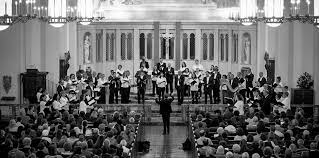
Image taken from Pasadena Master Chorale website
Recent Pasadena High School grad, Elise Logan, plans to engage in music throughout her life. She reveals, “My AP Music Theory class was so much fun and introduced me to the world of composition. I enjoyed being around smart, young, driven, and talented musicians. I had a lot of collaborative and individual musical experiences through that class and grew a great deal as a musician and as a student.”
In the fall, Logan is heading to Barnard College, in the heart of New York City, to take further studies in this field. She says, “The newfound independence that comes along with being an out-of-state college student excites me.”
For her folk song arrangement, Logan did ‘Wade in the Water.’ She elaborates, “It is an African-American Spiritual which is very familiar and common in my family and my culture. This piece manifests themes such as faith, patience, resilience, and trust in the face of hardship – all of which are relatable and relevant. The idea solidified in three weeks but it took the entire duration of the program (November 2016 to June 2017) for me to completely revise the piece and get it ready to be performed.”
Logan’s original composition is titled, ‘The One that Could Repeat the Summer Day’. “I wanted to create a piece that contrasted the gloomy ‘Wade in the Water’. Reading Emily Dickinson’s poem about the beauty and celebration of sunrises, sunsets, and summer days inspired me to musically illustrate simple joys,” she explains.
Contrary to Beggs’s experience, Logan thinks this was more difficult to write, “The folk song already came with a melody; I only had the text upon starting my original composition so that meant I had to write the melody, rhythm, and harmony myself.”
“This was my first time writing music to be performed by other people; having the opportunity to have a professional choir sing my original work was a blessing,” Logan expounds. “This experience has been extremely educational and artistically rewarding. It’s an incredible feeling to hear professional musicians bring my compositions to life within minutes.”
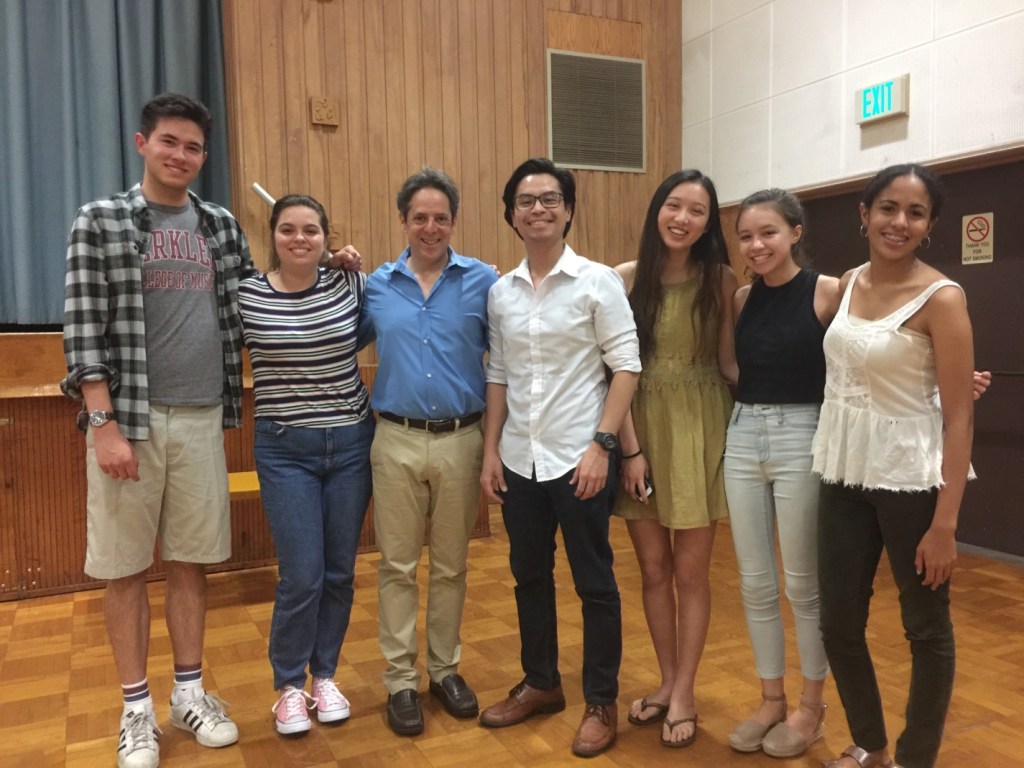
Pictured left to right: Sean Segal, Olivia Shue, Jeffrey Bernstein, Nilo Alcala, Tiffany Shi, Katherine Beggs, and Elise Logan | Courtesy Photo
Sean Segal, who graduated this month from La Canada HS, says his favorite high school experience was his choir tour to Seattle, Hawaii, Spain, and Italy. He will be attending the University of Michigan in the Fall, where he will be pursuing a double major in jazz and multidisciplinary studies in music. His long-term goal is to score a film.
“For my folk song, I chose to do an arrangement for ‘Mary Had a Little Lamb’”, says Segal. “I thought it would only be an exercise so I did something I could have fun with. It was the first thing that came to mind when I heard ‘folk song’ – it was meant to be fun and light. It only took me several hours to write; not too long, but it went through a few changes.”
Continues Segal, “My original composition is called ‘At That Hour When All Things Have Repose’, a poem by James Joyce. I knew I wanted to do it when I read it – it had the right length and had powerful images, which would be perfect with great music. It proved to be harder for me since I had to start from scratch; I had no existing melody to base it off of. It took me weeks to write – making sure each part worked and made sense.”
“People really bring your work to life when they sing it,” Segal says. “When you hear it for the first time it jumps off the page. Some moments are gratifying and some make you recognize when an idea doesn’t work so well. Sometimes you can tell something was good just from the choir’s reaction. It was the ultimate learning experience.”
A recent graduate of La Canada HS, Olivia Shue, will be attending California Institute of the Arts (CalArts) in Valencia to pursue a Bachelor’s Degree in Music Composition. It’s a small arts college that offers courses in music, theatre, art, film & video, dance, and critical studies. Students can take classes in classes besides their chosen major. She’s excited to be a part of a community of artists.
Shue’s folk song arrangement is called ‘Ondokusan’. She explains, “It’s a song I sing at my Buddhist temple and the Japanese text is a few words by Shinran Shonin. I chose to arrange it because it is my late grandfather’s favorite piece out of all the other songs we sing at Buddhist services. I procrastinate a lot so it’s hard to say how long it took me to compose it, but I would say probably just a week. When I finally got down to it, I was very motivated to arrange it.”
“I actually wrote two original compositions,” Shue says. “The first original song was called ‘Fire & Ice’ and it was based off a Robert Frost poem of the same name, which was about the beauty and horror of the destruction of the world. But I ended up submitting ‘Song of the Open Road’, a poem by Walt Whitman. It’s actually kind of funny because last year I composed an original Walt Whitman piece in the same key. What’s strange, too, is that writing ‘Fire & Ice’ had been a struggle but ‘Song of the Open Road’ practically wrote itself. I finished it in two days sans review or correction.”
This year marks the second time Shue is writing for PMC’s ‘Listening to the Future’ program. She discloses, “Now it feels natural to have them sing my work. I recently had my first string composition premiered on June 2nd, so I’m getting used to having my piece performed. The first time, however, was surreal.”
Rising senior at San Marino HS, Tiffany Shi, is a young woman whose interests lie in both music and math. She participates in her high school’s local division of Girls Who Code and loves the idea behind the club and its inclusive atmosphere. Mentors from JPL and Caltech work with them every Friday.
“I decided to arrange a folk song titled ‘Lavender’s Blue’ after my friend introduced it to me. I just loved the simple melody,” Shi relates. “My original composition is titled ‘Live Not in Vain’, which is set to the words of Emily Dickinson’s poem, ‘If I Can Stop One Heart From Breaking’. I love Dickinson’s writing, and after a few weeks of searching through different poetry archives, this poem’s uplifting tone and words really resonated with me and inspired me to write this piece.”
Shi shares a little of Beggs’s, Logan’s and Segal’s experience when she says, “Writing the original composition was a bit harder than arranging a folk song if only because we had to start from scratch and interpret our own poems. At the same time, however, it was really nice to have the freedom to create without the constraint of a given melody. It was a lot of fun.”
“It’s such an amazing feeling to have your piece read for the first time – it’s the culmination of all your effort and it’s a revelation when you see your work as something real. There’s so much going on – from recognizing what you need to change, to finding your favorite part of your own composition – but underneath it all is just a sincerely deep gratitude to the amazing choir, director, and mentor(s) who made it happen,” Shi concludes.
Image taken from Pasadena Neighborhood Unitarian Church website
An important figure for all these young composers is Nilo Alcala, who shepherded them this year to the project’s successful finish. He describes his part, “My role as mentor is to equip them with the compositional tools they need to bring out from within them their own compositional voice. I guide them through the creative process and help them craft and polish their works into its optimal form. It is also my job to constantly inspire them to be an ever improving version of their composer selves. When they get stuck at a certain point in their writing, it’s up to me to nudge them forward or steer them in the right direction.”
Alcala continues, “For those who will pursue composing as a career, it is also the mentor’s responsibility to prepare them for a possible career as a choral composer – not stopping at the skills and technical aspects but going into character. It is sometimes said that talent is overrated but work ethic is timeless. I would like to think that I’ve somehow imparted in them the necessary work ethic for success – being well prepared, punctual, positive, humble, teachable, courteous. And, above all, I want them to be passionate about their art.”
All these qualities are present in Alcala himself. An immigrant from the Philippines, he arrived in the United States armed only with his innate ability and his passion for music. And that relocation happened in a roundabout way.
Alcala had earned a degree in Communications and was working for a non-profit in Manila when he decided to go back to school to earn a degree in music composition at the University of the Philippines. That proved to be a pivotal move for Alcala as he got the opportunity to showcase his music internationally when he won several music competitions. He also joined the Philippine Madrigal Singers and sang in concert tours in several countries.
In 2007 Alcala received the Billy Joel Fellowship that enabled him to get a master’s degree at Syracuse University in New York. In 2009 he earned the Young Composer Award from Seattle-based ‘The Esoterics’ and an ‘Ani ng Dangal’ (Reap of Honor) Award from the Philippine president.
After being granted an EB-1(Extraordinary Ability) status, Alcala moved to Los Angeles. On December 15, 2015, his project commissioned by the Los Angeles Master Chorale premiered at the Walt Disney Concert Hall.
Alcala creates orchestral music for the Metro Manila Concert Orchestra and is currently writing a piece commissioned by the Manila Symphony Orchestra to be premiered this August. He composes for visual media and has scored a number of Filipino feature films. He recently scored ‘Candlestick Park: The Beatles’ Last Concert’ – a promotional short for Ron Howard’s Grammy-award winning film ‘The Beatles: Eight Days a Week’. He is music director/in-house-composer of Club Six Studios, a Silicon Valley-based mobile video game company.
The young composers PMC has chosen for this year’s student program have much going for them. The inspiration they draw from Alcala’s personal journey, fueled by Bernstein’s mission to give students the opportunity to hone their skills and follow their dreams, will most undoubtedly culminate in a triumphant concert.
‘Listening to the Future’ is likewise a fulfillment of sorts for Bernstein, champion of young people and music-making. Through this concert, he is assured that the art form continues to flourish.
Originally published on 7 July 2016 in the Pasadena Independent, Arcadia Weekly, Monrovia Weekly, and Sierra Madre Weekly
The word ‘gifted’ usually refers to someone who has innate intellectual or artistic abilities that surpass his or her age, while ‘talented’ is often used to describe one who works hard and accomplishes feats exceptionally well. Based on those delineations, a gifted child doesn’t put in any work while a talented kid makes some effort to achieve something spectacular.
Marc Soong, a recently graduated eighth grader from Barnhart, a K-8th grade independent school in Arcadia, is both gifted and talented. Listening to his spirited and rousing rendition of Grand Etude Paganini No. 3 ‘La Campanella’ by Franz Liszt on the piano transports you into another world and time. His amazing fingering also reveals a mastery of technique honed by hours of painstaking practice and a devotion to his craft.
This past June 28, Marc electrified as he performed the finale number at The 65thAnnual Redlands Bowl ‘Young Artist Competition Winners’ where he interpreted Chopin, Rossini and Ginzburg.
Valerie Peister, program director for the Redlands Community Music Association pronounces, “As a winner of the 2016 Redlands Bowl Young Artist Competition, Marc Soong thrilled Tuesday evening’s Redlands Bowl Summer Music Festival audience with a virtuosic recital performance. His technical mastery was matched by a sensitivity and depth of expression well beyond his years, and showcased his remarkable ability to tell a musical story.”
And again on June 30, Marc impressed at the Isaac Stern Auditorium/Perelman Stage at Carnegie Hall in New York, where he played Paraphrase of Figaro’s aria from the Barber of Seville by Ginzburg/Rossini.
Marc’s outstanding musical abilities have earned him awards from the Los Angeles Young Musician International Competition, San Jose International Piano Competition, American Protégé Piano and String Competition, among other others.
Music, specifically, piano, is an important family activity for the Soongs. Marc’s mom, Alice, says “My husband and I attend all of our kids’ concerts, competitions and performances. Both Marc and Melodey, Marc’s older sister, perform at senior homes, and volunteer as ushers for concerts held at the Pasadena Symphony and Pops”.
Love of music came to Marc early on when he was three years old and heard Melodey playing the piano. He remembers that in first grade, he tagged along when his sister visited USC Thornton School of Music to meet with Daniel Pollack, a renowned professor there. When he was in third grade, he became one of Prof. Pollack’s students.
Vladimir Khomyakov, who at age 32 is an accomplished concert pianist himself, is Pollack’s assistant and has been Marc’s piano teacher since he was eight years old. From Khomyakov Marc learns technique as well as general music knowledge – history, the background of each piece, composer, style, and theory.
“Marc is a brilliant student to teach because once he starts, he’s hungry for more. He learns a piece on his own, asks a lot of questions, and has great initiative. While he chooses his pieces based on his personal journey, I help him build a balanced repertoire to include various genres, styles, periods, and composers, and develop a solid program as an artist,” Khomyakov states.
“As a musician, Marc is very passionate about his music. He plays from the heart – a rare trait for someone at his age, most kids do it mechanically. He has excellent ears: when he hears a noise he knows what pitch it is; when he hears a computer tone, he can play it. He absorbs all sounds like a sponge. He has what it takes to be a successful concert pianist … although I wouldn’t recommend it. It is a challenging life, with countless hours spent practicing which may turn out to be time wasted on something that might not work. It is usually filled with disappointments and stress, especially at the age of 20 to 25 when one gets into serious competitions,” Khomyakov says.
And Kyomyakov knows whereof he speaks. Like Pollack, he himself has concertized internationally as a pianist, conductor, chamber musician, and a soloist with leading orchestras including Dresden Philharmonic and Houston Symphony. He says he holds 40 to 50 concerts a year and has been all over the world except Africa. In 2009 he was chosen to be the assistant to Prof. Pollack; he teaches weekly master classes to all degree-level students.
Music is not the only thing that Marc is superior at. According to Tonya Beilstein, associate head of school and director of curriculum and instruction at Barnhart, Marc exhibited talent and creativity for a normal fourth grader. She relates, “I began working with Marc in fourth grade, supporting his social and emotional growth. At the end of his fifth grade here we realized he was also ready for more academic challenges. I thought a solution was for him to go from fifth grade in June to seventh grade that Fall, skipping sixth grade entirely.
“That decision didn’t come about haphazardly. We first asked his parents to get outside psychological evaluations (because we don’t have the resources on campus to do it). One of the things we do now, that we weren’t doing before, is use a tool called Iowa Acceleration Scale. It provides the rubric to help schools make effectual decisions relating to grade-skips. Besides psychological evaluation, we look at IQ, academic assessment – capacity and performance.
“We conferred with the whole team in Marc’s life – his parents; past, current, and future teachers; school administrators. The last step we took was talk to Marc himself. He was very excited about the idea – he very much wanted to move ahead,” Beilstein discloses further.
Marc says, “I was a little nervous about being in seventh grade and being with older students but I also wanted a more challenging curriculum. My classmates were very kind to me and I developed deeper and more meaningful friendships in seventh and eighth grade. I found it easy as well as enjoyable.”
As if all these weren’t enough, Marc has been accepted to attend Stanford Online High School (SOHS) in the fall. At 13 years old, he might be the youngest person to gain admission to this highly selective institution. Offering a distinctly innovative program, SOHS requires students to take core courses in Science, Math, English, and History. For academically advanced students, SOHS has numerous post-AP subjects, including university-level courses that typify most undergraduate programs.
“Stanford Online High School is the perfect fit for Marc,” declares Beilstein. “It’s a good choice for so many reasons – the challenge of the curriculum, the interaction he will have with like-minded students. I think, for the first time, he’s really going to be surrounded by his academic peers which he will find engaging and exciting.
“For students like Marc, who have participated in the summer program at Johns Hopkins Center for Talented Youth, a rigorous curriculum will give them peace and confidence. This model of learning is ideal because he can study at the pace that’s right for him and gives him the time to focus on his piano – it accommodates all his needs. He’s going to be in control of his destiny now,” Beilstein concludes.
Marc is surrounded by people who support him – from his parents who encourage him to follow his dreams and provide the means for him to do so, to school administrators who find the perfect environment to engage his mind, to his music teachers who dare him to play demanding piano pieces, to friends who supply him with equilibrium as he navigates life. Through it all, Marc has remained sanguine and has retained his inner ‘kid-ness’. He thinks the coolest thing about going to an online high school is that he doesn’t have to eat cafeteria food.



 A San Gabriel Valley Inquirer