‘All’s Well That Ends Well’ Goes on Stage at A Noise Within Theatre

Originally published on 11 February 2022 on Hey SoCal
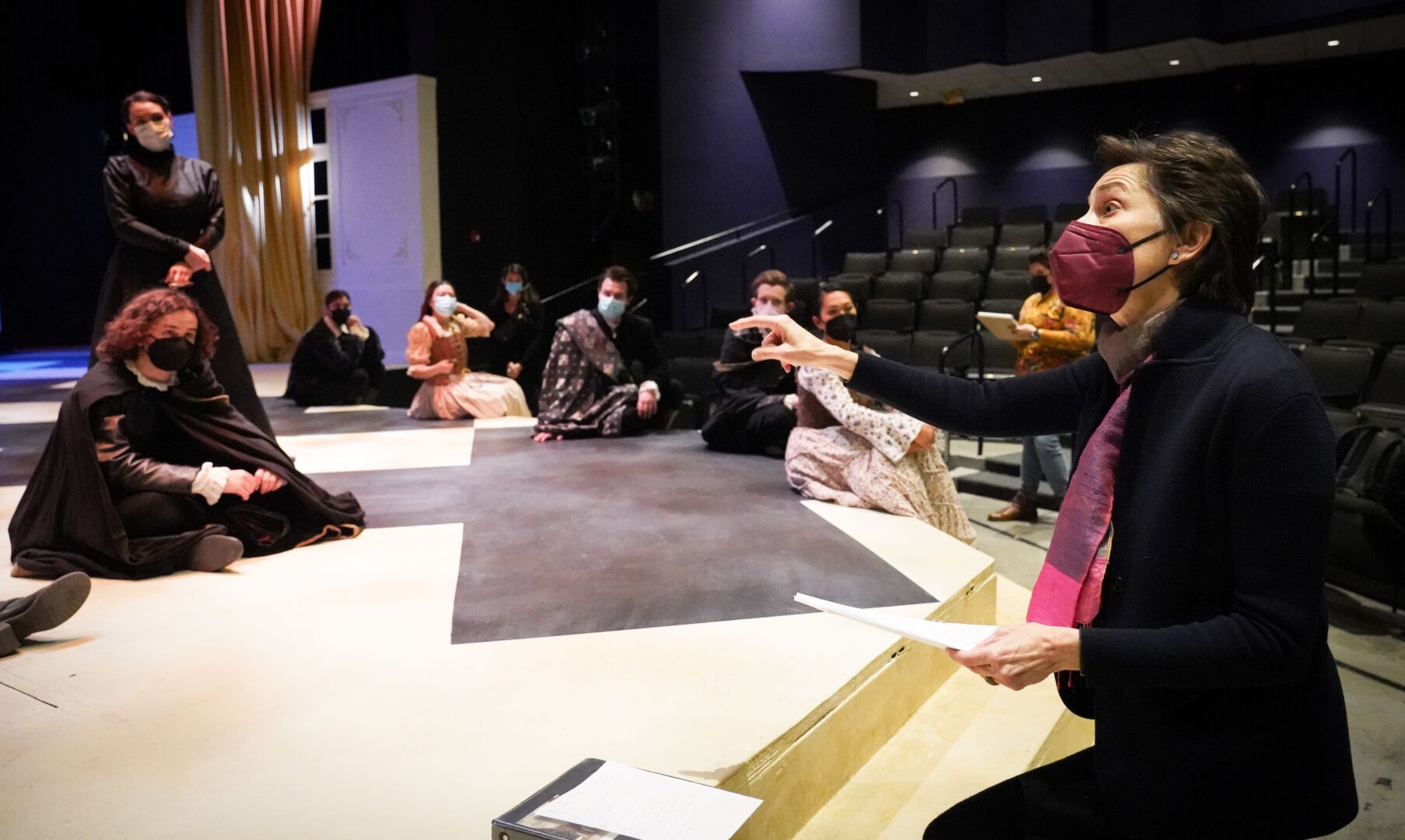
Nike Doukas (far right) directing the cast of ‘All’s Well that Ends Well’ | Photo by Eric Pargac / A Noise Within

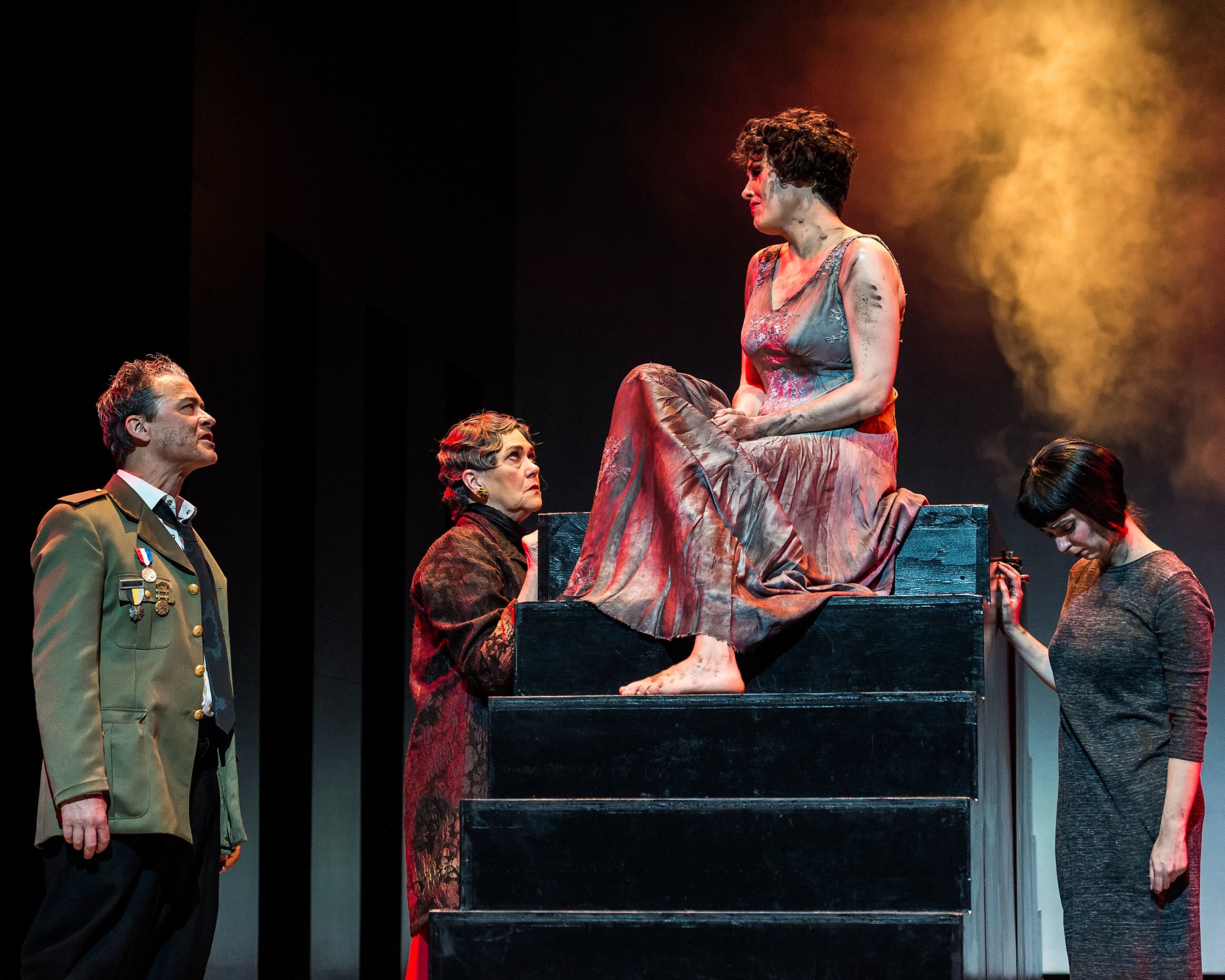
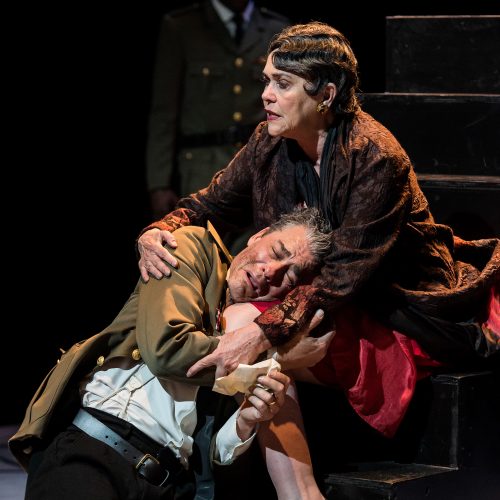
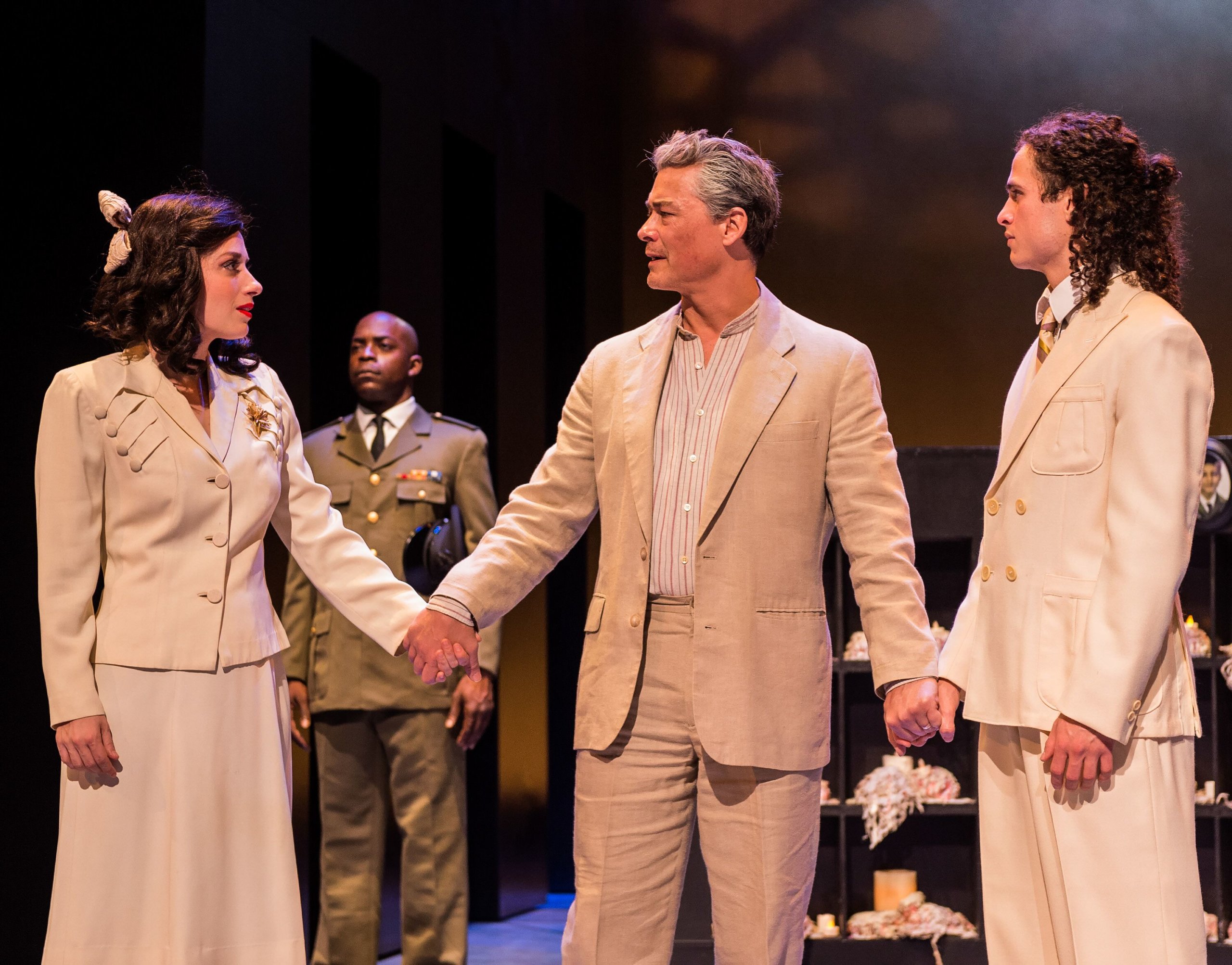
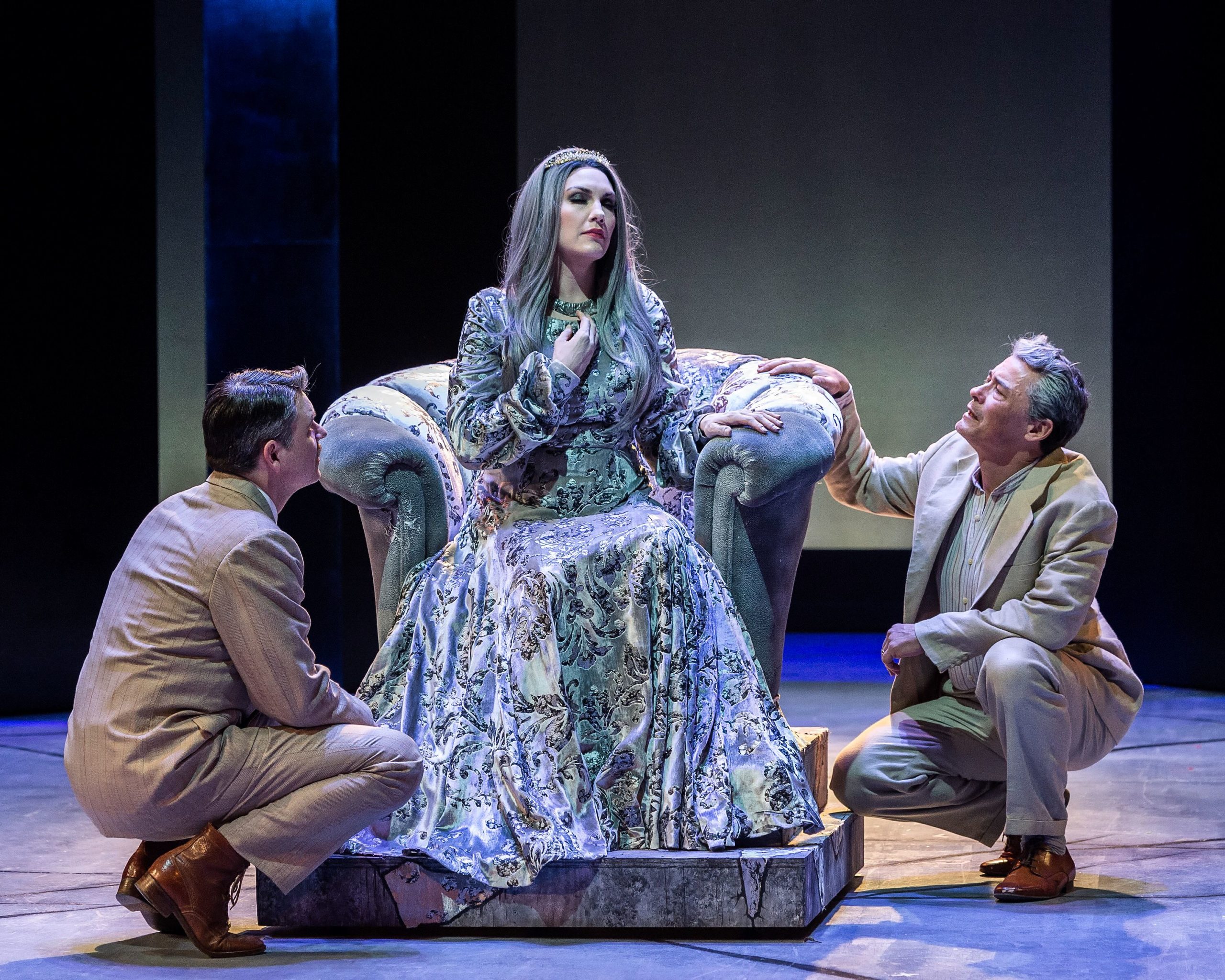
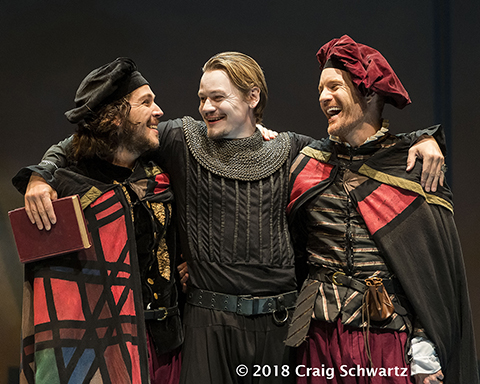
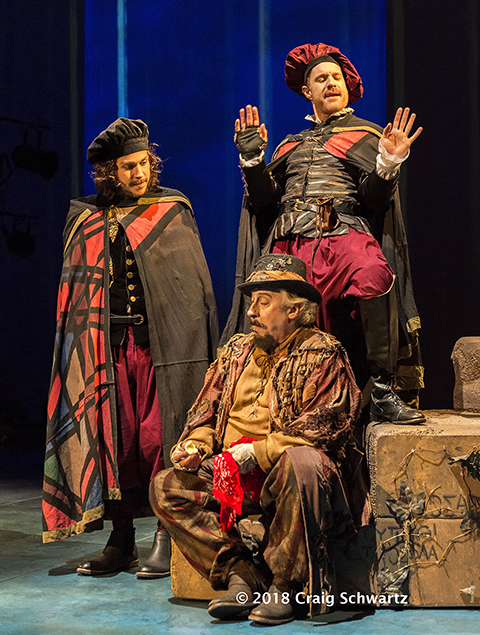
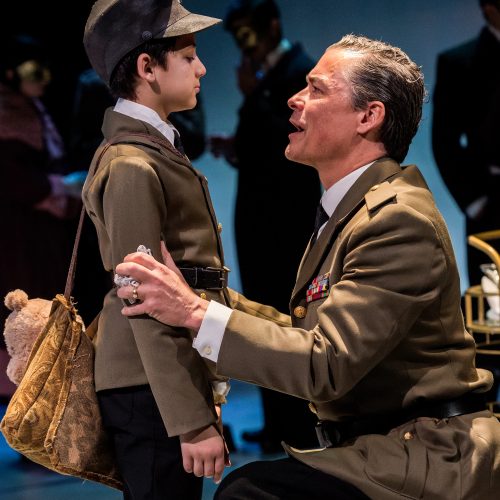
A Noise Within (ANW) starts the new year with Shakespeare’s “All’s Well that Ends Well,” the fourth production during its 30th anniversary season. On stage from Feb. 6 to March 6, it stars resident artist Erika Soto as Helen and Mark Jude Sullivan as Bertram. Nike Doukas directs this comedy that follows Helen and Bertram as they try to realize their individual dreams before they are eventually united in a fairy tale ending.

“All’s Well That Ends Well” focuses on Helen, a young healer, who convincingly persuades a cast of fools, romantics, and cynics to pursue Bertram, her runaway groom. In a play of wit and deception, these two characters take us with them as they go on a journey of forgiveness, hope, and love where we least expect it.

The play isn’t one of Shakespeare’s popular works, hasn’t been staged as often as his other comedies, and is even referred to as a problem play. Doukas has made it her goal to change that last reference and she might very well have the credentials to do so. She earned her MFA from the American Conservatory Theater (ACT) in San Francisco and is primarily a theatre, film, and television actress. She is also a well-known accent coach and has been directing for five years now.

Twelve years ago, she joined the faculty of the Art of Acting Studio in L.A., the sister school of the Stella Adler Studio of Acting in New York City (formerly the Stella Adler Conservatory) where she’s the head of acting; a main responsibility is teaching Shakespeare. Her students go on to work professionally and, in fact, one of them – Niek Versteeg – is in this production of ‘All’s Well…’ as the Second Lord Dumaine.       

While this marks Doukas’s directorial debut at ANW, her association with the repertory company and co-artistic and producing directors Geoff Elliott and Julia Rodriguez-Elliott dates a while back. She recalls, “We worked together on many Shakespeare productions as actors early on. ANW puts on one Shakespeare production every season, and sometimes they’d call me to help make the text clear for the actors to understand.”

“And my career as accent coach actually started in the very, very early days of A Noise Within when they were still at the Masonic Temple in Glendale,” adds Doukas. “Geoff and Julia knew I was good with accents and they asked me to do the accent coaching for ‘Our Town.’ It turned out to be a lot of fun so I still do that whenever I’m available.” She was the accent coach for ANW’s previous productions of “The Glass Menagerie,” “Othello,” “A Christmas Carol,” “Tale of Two Cities,” “Mrs. Warren’s Profession,” and “Noises Off.”

Asked how she became good with accents, Doukas replies, “It happened organically – I grew up in a family that spoke Greek; my two older sisters are conversational in Greek but I speak it poorly. It’s much like growing up in a musical home, you can’t help but be a little musical. And, being an actor, I was able to use and develop it. When I was at ACT, that was one of the things we had to learn. I did several plays where I had an English accent so people began asking me to help out. It wasn’t something I went after; it was merely happenstance.”

Doukas had pitched a couple of plays to Elliott and Rodriguez-Elliott but this was the first time their schedules meshed. She explains, “It was just timing. They plan seasons and I think they felt this was the right time. They wanted me to direct a Shakespeare play and they liked the idea for ‘All’s Well…’ that I suggested to them. They also felt it fits in with what’s going on in the world right now.”

“Besides, they do so much Shakespeare they wanted to find a play they hadn’t done in a while,” continues Doukas. “And this is one I truly love. Like all Shakespeare plays, it isn’t about one thing – it’s layered. I definitely see that there are two parallel stories: one is that of Helen who is desperately trying to make the world right by joining her life with Bertram’s and the other is that of Bertram who feels stifled at home and is urgently trying to make adventures, go to war, and meet other people.
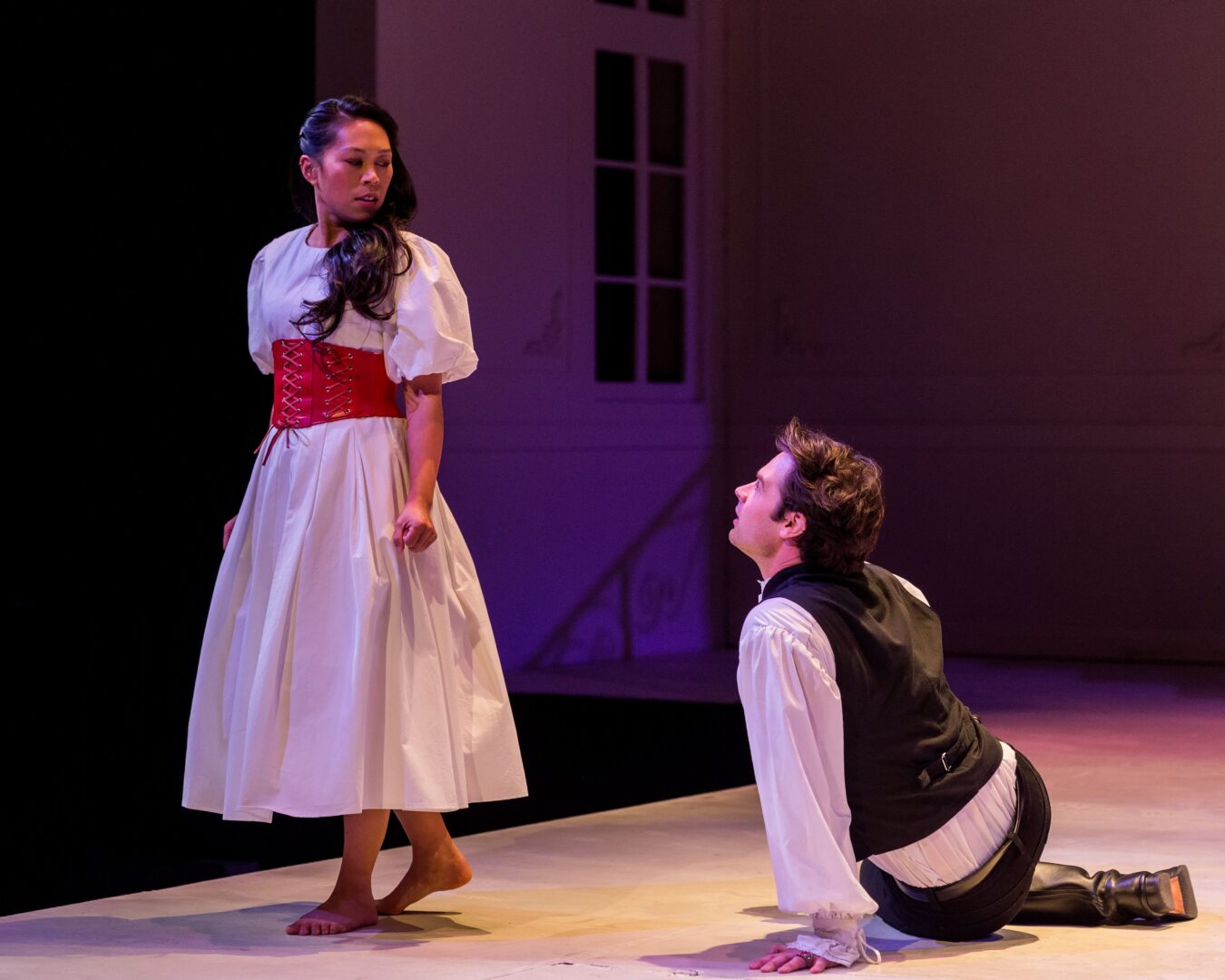
Nicole Javier and Mark Jude Sullivan | Photo by Craig Schwartz / A Noise Within

“In the play, Bertram finds himself being pushed into marrying Helen whom he thinks of as a little sister. However, he wants agency; he intends to discover himself and what he wants to do in life. So he resists what everyone else recognizes – that Helen is the right person for him. It takes them both a long time, as they go on a physical journey until they’re ready to find each other again.”

Because ANW is a repertory company, Doukas was able to work with actors she already knows. She states, “Knowing them beforehand made my job easier. They have such a wonderful complement of actors there. When it came to casting the play, I knew who would be right for what roles; at least half of the roles are filled with company members. I believe there’s strength in an ensemble where you work with people over and over again; there’s a vocabulary that you share. At the same time, I think audiences really enjoy seeing actors play different roles.”

Doukas says of the experience, “It has been exciting and challenging. Because of Covid, we spent the first week rehearsing on Zoom. Then we got into the theatre while adhering to all the safety protocols. On our third dress rehearsal, we didn’t wear our masks for the first time. That threw them off and they kept forgetting their lines. They sort of memorized each other’s face with their masks on and they felt strange to be without the masks. But everyone has been a real trooper; we were being extremely careful because we’re all aware that shows have been delayed, or have ended, and we want to make sure we get the show up.”

That “All’s Well…” features strong female characters isn’t surprising, according to Doukas. “I think Shakespeare loved women … and he liked them. He thought they were smart, funny, strong, and brave. In this play there are two phenomenal female roles: Helen, who’s the central character, and there’s the Countess of Rosillion (played by resident artist Deborah Strang) who’s like her adopted mother. Helen is the engine for the play – she’s the mover and shaker. Directly or indirectly, she drives almost everything that happens. The countess is sort of her biggest cheerleader and helps her when she could.
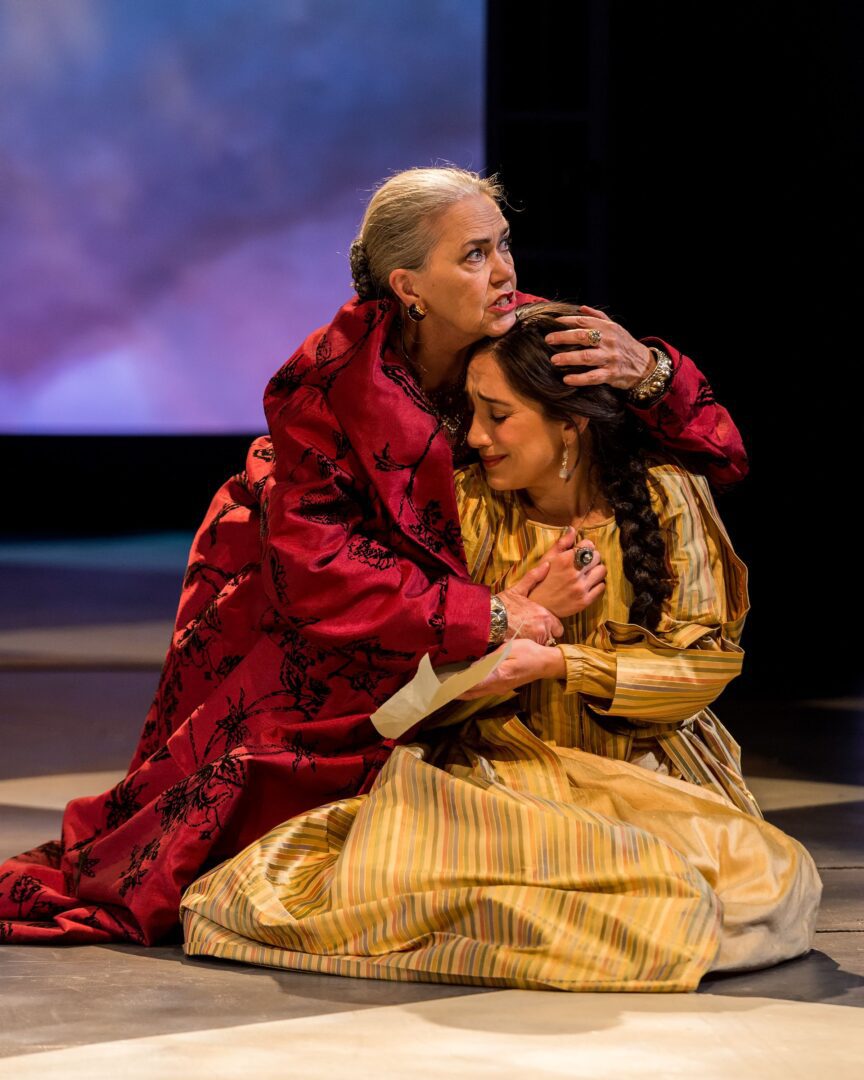
Deborah Strang (left) and Erika Soto (right) | Photo by Craig Schwartz / A Noise Within

“But it’s true of all the characters. What I love most about this play is how kind everyone is to each other. It’s almost like ‘it takes a village.’ Everybody recognizes that Helen and Bertram are these wonderful human beings who need help. It’s a beautiful thing to see these strong, kind friendships being forged. Everyone is rooting for the main characters and helping them make the right decisions in their life.”

Doukas is heartened that women are now taking on bigger roles and responsibilities in theatre. She reminisces, “I’m old enough to remember that as a young actress, if you were in a Shakespeare festival, there might be three women in it and the rest were men. You looked around and thought ‘Boy, am I lucky to be here!’ Every once in a while you’d have a woman directing. But that’s just not true anymore. It has been very easy to cast women in men’s roles in Shakespeare productions. In fact, in ‘All’s Well…,’ half the company is made up of women; we have three men roles being played by women and it works very seamlessly. 

“Historically, there were often great roles for young women and older women but there was this big middle age where women just disappeared. Women also didn’t typically run the play – unless it was a Shakespeare play which has great heroines like Rosalind, Viola, and Helen. There are great playwrights from the past – Ibsen and Chekhov – who wrote strong female protagonists but we went through a long period like the 60s when fantastic roles for women were few and far between. And I’m very happy to say that’s over.”

Nike Doukas | Photo by Eric Pargac / A Noise Within

“Women playwrights are getting more opportunity – they’re writing about themselves and what interests them,” Doukas expounds. “When that happens, we get plays that are centered around women. I think women directors are also getting more opportunity so there’s more female perspective. It’s more equitable when everybody gets a chance. And, maybe more importantly, you start seeing what the world really looks like. I find that really exciting. In my experience in theatre, I find that men have been open and receptive to it. Because it’s not going to work unless we all agree that we want playwriting and directing and acting to be equal opportunity. When we stop competing or fighting each other, that’s when we can really make great art. What’s been really gratifying to me is that I feel women are stepping up, in part because men are giving them the opportunity. It can only happen when everybody’s allowing it to.”

As to “All’s Well…” being viewed as one of Shakespeare’s problem plays, she pronounces, “That’s getting to be an outdated perception. I think what people find problematic is that Bertram changes his mind about Helen very quickly. And there’s a bed trick that people get confused by. There are bed tricks in other Shakespeare plays but are not considered problem plays and people change their minds quickly in Shakespeare plays as well.

“The way to make that work is by laying the groundwork for the change of mind so the audience doesn’t wonder where that came from. It’s about developing the character, being scrupulous about the storytelling, and making sure that everything makes sense and that we can track the emotional journeys of the characters. I don’t think it’s a problem play at all and my goal is to change that perception. When people see it, I want them to leave the theatre saying ‘Why do people think it’s a problem play?’”

It would be too farfetched for “All’s Well…” to be regarded in the same category as other Shakespeare comedies overnight. Much like with Bertram, it would take “a village” – one production at a time, one director with a fresh vision at a time. Doukas is so accomplished and adept at wearing so many different hats that this challenge isn’t at all daunting. She relishes the opportunity to show the play in a new light.

And who knows? Perhaps in the not-too-distant future, even Shakespeare experts will come to appreciate “All’s Well that Ends Well’ as a great Shakespeare comedy. It could yet earn a place in the canon.

‘The Winter’s Tale’ at A Noise Within Brings Us to Tears

Originally published on 20 February 2020 in the Pasadena Independent, Arcadia Weekly, and Monrovia Weekly

 
Left to right: Jayce Evans and Frederick Stuart | Photo by Craig Schwartz / A Noise Within

A Noise Within opens its Spring event with William Shakespeare’s ‘The Winter’s Tale,’ going on in repertory from February 9 until April 11. Directed by Geoff Elliott, it features Frederick Stuart as Leontes, Trisha Miller as Hermione, Brian Ibsen as Polixenes, Jeremy Rabb as Camillo, Deborah Strang as Paulina, Angela Gulner as Perdita, and Alan Blumenfeld as Antigonus/shepherd, Alexander de Vasconcelos Matos as Florizel, Jayce Evans as Mamillius, Eric Flores as young shepherd/ensemble, Matthew Faroul as lord/ensemble, Katie Rodriguez as Emilia, Robert Anaya, Christopher Barajas, and Thomas Chavira.

‘The Winter’s Tale’ tells the story of Sicilian King Leontes who, in a fit of jealousy, orders the death of his friend Polixenus and sends his wife Hermione to prison only to find out that he was entirely mistaken. He spends the next 16 years atoning for his sin and is redeemed in the end.

One late afternoon before rehearsal, I meet with Stuart at the theatre lobby to chat about the play, its relevance today, and his favorite roles, among other topics. “It wasn’t a play I particularly knew very well,’ he begins. “Coincidentally, it marked my introduction to A Noise Within. A very good friend of mine brought me to my first ANW play 12 years ago in the old space in Glendale and it was ‘The Winter’s Tale.’”

Jeremy Rabb and Frederick Stuart | Photo by Craig Schwartz / A Noise Within

Stuart summarizes the play for me and describes his character. “We’re staging the play in the 1930s, around the time of Mussolini, when fascism was taking hold. Leontes is essentially a dictator. He seemingly discovers that his wife is cheating on him and might even be nine months pregnant with someone else’s child. He has such certainty that he condemns her to jail and then puts her on trial. He wants to execute the baby but has second thoughts and lets one of his men put her in a place outside ‘so that chance may nurse or end it.’ It so happens that she is rescued by a shepherd and grows up.

“Not only does his wife die, but his son dies as well of, essentially, a broken heart at seeing his mother in such distress. He then finds out he’s mistaken and spends the next 16 years in absolute self-flagellation. He’s so appalled by what he has done and he tries to make amends by going to the grave of both his dead wife and son.

“The daughter later comes back into her father’s life. Unbeknownst to him, Paulina has a gallery with Hermione’s statue in it. And we see her come back to life. As to whether it’s a magical event or whether she stayed on the sidelines for 16 years to teach him a lesson, that’s up to the audience to decide.”

Frederick Stuart, Deborah Strang, Trisha Miller, Frederick Stuart, and Katie Rodriguez | Photo by Craig Schwartz / A Noise Within

Continues Stuart, “It’s a story that I think is so relevant nowadays because people are so certain about things, especially about their political opinions. It’s a kind of psychosis, a kind of madness, when you are absolutely certain about something. Even scientists’ mode of inquiry is to be doubtful or, at least, uncertain and that is a healthy state of mind. But we seemingly live in times when people are too impatient to be uncertain. I think it’s fitting that this play is set in the 1930s when there was this sense of uncertainty and people held on to Fascism as something they feel certain about all of a sudden. It’s a dangerous mentality especially for the masses to hold onto certainties as a movement – people are capable of doing anything when they’re certain and there are enough numbers behind that certainty – as we’ve seen in the last century.

“So this story is relevant for the times we live in but it’s also relevant to us personally as individuals. It’s always beneficial, before jumping to conclusions, to put ourselves in other people’s shoes, and have a little bit more compassion before we act in ways such as Leontes does in this play.”

Actors inhabit their characters despite how different they are from the roles. In this case, however, Stuart, actually connects with Leontes’s temper. He discloses, “I’ve learnt over the years, that I have rage inside me. Society tells us to conform, yet everybody has a certain rage about the machine, so to speak. I think it’s healthy to have rage, it’s just where to put it. I’ve been lucky enough to discover acting and I saw it immediately as a way to explore my psyche and put these apparently unacceptable states of mind – rage, lust, and so on – into some use. We’re living in such a society where it’s impolite or improper to display these feelings – especially in England where I grew up. There’s a lid that is put on into all of our natural instincts and emotions. In this play I am able to come on stage and let rip! It’s quite enjoyable. Oh my God, it’s fantastic! You’ll see some shocking things that I do in this play.”

Asked if he has favorite roles, Stuart responds, “I loved ‘Tartuffe‘ which wasn’t a particularly huge role – it was quite small, in fact. The first hour or so, everybody’s just talking about Tartuffe then he makes his entrance. But it was a wonderful character and I enjoyed doing that. Of course, Hamlet is a part that I will always remember playing – it’s iconic.

Frederick Stuart and Deborah Strang | Photo by Craig Schwartz / A Noise Within

“You know, it’s funny, Deborah Strang, a veteran actress here at A Noise Within, said a great thing – it’s the one you’re in that’s the favorite. And I have to say, I’m learning a lot about myself and my craft. This play came at the right time … I’m ready for this role. The experiences I’ve gained and where I’m at in life have deepened me as a human being. I have different outlooks on life now. Sure, you can play Leontes as a young man in the first act. But when you come back in the second half of the show, it’s 16 years later, and you have to understand what compassion is. And as a young man, I gave lip service to compassion. I think that’s what aging is about – it’s about realizing that we are finite and mortal. And sometimes we’re frail and there’s nothing like the smile of a stranger, or a helping hand, or some kindness. It means so much especially as you get older.

“Not too long ago, I played Sydney Carton in Charles Dickens’s ‘A Tale of Two Cities.’ That is one of those roles that crack you open. As you progress through roles, each time you tackle something, you wonder whether you’re capable of bringing to it what is needed. For that particular role, it became very emotional at the end because he has to walk up these steps as he says this beautiful line – ‘It is a far, far better thing that I do than I have ever done; it is a far, far better rest that I go to than I have ever known.’ It’s heartbreaking. And that is a man who was so cynical all his life and ends up preparing to die to let another man live because he knows this man will make the woman he loves happy.”

“There is a real emotional journey and you just wonder whether you’re up for it,” Stuart expounds. “A similar thing is happening right now with ‘The Winter’s Tale’ because it has an ending that is so emotional and bittersweet. I didn’t know how it was going to affect me. It’s very personal for me in the same way that Hamlet was to me. I am an only child who never knew his father. My parents were living in Hong Kong and he was a journalist. When my mother was eight months pregnant with me, my father died during a hurricane. Perhaps because I was in the womb, I had a connection with that particular moment where death was transcendent. It’s such a magical, universal, and profound moment for an audience to experience because, no matter where we come from, that’s the one thing we all share as human beings – we know there will be one day that will be our last. To see this moment that Shakespeare has created come to life, literally, is overwhelming.

“We’ve all worked together before and we all know each other intimately. So for this moment to happen amongst us, it’s almost as if the audience is privy to a private moment amongst the actors on stage. From the first rehearsal onwards, we felt that this meant something profound to us. Rehearsal after rehearsal, with just us on stage, without an audience, we were in tears all the time.”

Left to right: Angela Gulner, Frederick Stuart, and Alexander De Vasconcelos Matos | Photo by Craig Schwartz / A Noise Within

Stuart can’t predict, though, if the audience will react the same way. He states, “There’s so much out of your control and when you focus on those, you’re disempowered. I’ve honed down my own life only to the things that I can control and within this play I can control what I do as an actor and how I receive other actors. Luckily, I’m surrounded with actors whom I admire and trust and love and the connections are so real and emotional. It feels as if we’re giving birth to something very magical. That said, I hope the audience is walloped.

“My first theatrical experience was Marcel Marceau, the French artist and mime. I saw that as a kid and there was something about the lights coming down and having a communal experience. It’s not the same as cinema. You’re presenting a piece of writing that has lasted for centuries for good reason. That’s why the Greeks invented theatre – because it’s somewhere we could experience something larger than ourselves and be emotionally connected with. This play does that, it’s bigger than the sum of its parts. I want the audience to feel that.”

Brian Ibsen, Trisha Miller, and Frederick Stuart | Photo by Craig Schwartz / A Noise Within

Acting didn’t come early in Stuart’s life. He reveals, “I was at boarding school when I was in England but I was dreadful in academia. When I was 16, I played the Artful Dodger in the school production of ‘Oliver’ and I was a great success. So that got me thinking about it. I left school, and because I didn’t have any qualification for any career, I went into construction for a while – I carried bricks up and down ladders. I was very good-looking as a young man … you’d never guess it. There were commercials at the time who featured someone who looked similar to me. And the bricklayers would say, ‘Pretty boy, didn’t you see yourself in that advert on TV last night?’ I signed up with a modeling agency and I started booking commercials – I had an entire career of it.

“Then I decided I wanted to go into acting and I auditioned for drama schools. I got into The Royal Central School of Speech and Drama, which is one of the better drama schools in England; I was about 24 years old. In 2005, I came to Los Angeles with dreams of becoming a movie star and ended up falling in love with theatre all over again. I studied with the great Larry Moss and then I found A Noise Within. While I have TV and film credits, theatre is where I feel most at home.”

Finally, I ask what would be a dream role for him and why. Stuart replies, “I’d love to do ‘Richard II’ because he’s very conflicted. He’s being appointed, apparently by God, to be the king. But he is the most inept character you could ever have as the king. And he kind of knows that. So he’s dealing with everything from the point of view of someone with no self-esteem. It is very interesting to see someone grapple with a position that has been thrust on him.”

An inept king may be the character that’s most unlike Stuart but there is no doubt that he would be a believable Richard II. As his performance in ‘The Winter’s Tale’ demonstrates, he is magnificent in every role he takes on.

‘Othello’ Takes the Stage at A Noise Within

Originally published on 5 February 2019 in the Pasadena Independent, Arcadia Weekly, and Monrovia Weekly

(Left to right): Michael Manuel, Wayne T. Carr, and Angela Gulner | Photo by Daniel Reichert

William Shakespeare’s ‘Othello,’ A Noise Within’s fifth production in its 2018-2019 season, will be on stage from February 10 through April 28. Directed by Jessica Kubzansky, it stars Wayne T. Carr in the title role, Angela Gulner as Desdemona, Tania Verafield as Emilia, and Michael Manuel as Iago.

Manuel graciously agrees to share with us his thoughts about this classic play and the character he is about to inhabit. He recalls, “I did Othello 20 years ago and I played Cassio; this time I’m Iago. Any time you play a bad guy you can’t think of the character as bad. Even the most evil people believe they’re doing the best they could under the circumstances.

“I just finished doing Toby Belch, in ‘Twelfth Night,’ at the Alley Theatre in Houston. He’s a character who’s like Cassio – the big, drunk, funny guy. And I knew I was going to be doing this so I got to thinking ‘what triggers people into different behaviors?’ What, for instance, drives some to drink?

“For Iago, there are events that push him into that place where he’s just coping with everything that’s happening to him. There’s an inherent frustration, feeling ‘less than’ and being slighted, in some way, that he hasn’t gotten what he deserves. But, on some level, he tells himself  ‘Of course, I can’t get it – I don’t look as Cassio does, I don’t speak as well as Cassio does, I don’t have the same upbringing that Cassio has.’”

This is a role Manuel is sympathetic to. He says, “I have a love for characters who might be described as having a grievance of sorts … a chip on their shoulder might not be accurate, but someone who’s trying to prove he’s worthy of being. I gravitate towards characters who weren’t born into privilege and make something of their lives.

“I recently did Lopakhin in ‘The Cherry Orchard’ and he’s someone who resonates with me. He used to be the grounds man of the land which he now owns. When he was a lowly worker, everyone had nicknames for him; so now his attitude is ‘you should have treated me nicely because now you all work for me.”

Michael Manuel with Wayne T. Carr | Photo by Daniel Reichert

Continues Manuel, “The other day, among the cast, we were talking about class and perception. We were discussing how Cassio is someone who’s got everything. I went to Yale and there’s a perception that I’m somehow smart or rich. Truth is, I came from a blue-collar background and the neighborhood I grew up in wasn’t the best.

“Just like Lopakhin, my classmates’ parents were teachers, attorneys, and professionals. Growing up, I was embarrassed to tell people that my Dad worked as a garbage collector. But there came a point when I realized that everyone has value and what was shameful was that I hadn’t recognized it until then. Now I’m very proud to let people know what he did for a living!”

Because he played Cassio before and is now taking on the role of Iago, Manuel has a chance to look at both characters on opposite perspectives. He says, “Looking back, I don’t really remember much about that first time I did ‘Othello.’ I did Cassio when I was fresh out of college when I felt I knew everything there was to know, that I’ve figured it all out. Then, I finally grasped that I hardly knew anything; there are so many other layers in both characters that I learned from just living 20 more years since.”

The passage of time has helped Manuel give a more layered interpretation of Iago. “First of all, I’m older and I’ve accepted the fact that I don’t know everything; I no longer harbor that resentment in being told what to do. So now I have a vulnerability because I don’t have to pretend to know more than I do.

“Of course, the trap is that when you’re older you also think you know everything because you’ve gained more experience. So you’re always in the same boat – there’s always someone older or wiser no matter what their age is. I would say my Iago then would have been different from my Iago now,” Manuel expounds.

“It’s funny, this is only my second time doing ‘Othello,’” discloses Manuel. “While ‘Hamlet’ I’ve done five times, ‘Lear’ thrice, ‘Midsummer Night’s Dream’ I’ve done probably six or seven times, on occasion playing the same character. But there’s so much to mine in this. Since I have never fully figured it out, there’s always something new.

“Jessica’s vision for Iago is that he’s honestly sharing his feelings. I would like to be able to convince everyone on that stage that I’m being truthful and that I believe in everything I’m saying. People can tell when someone isn’t sincere. I think Iago understands people – he might not be book smart but he is clever. I’m sure if people saw his resume, they would say, ‘Of course, he shouldn’t get that high in the military, he isn’t someone who could be elevated to an upper rank.’”

(Left to right): Angela Gulner, Wayne T. Carr, Tania Verafield, and Michael Manuel | Photo by Daniel Reichert

Asked if he wants audiences to hate or empathize with Iago, Manuel replies, “I want people to see that they’re no different than I. I want them to understand there was no other way for me to behave. The challenge is that when a character does something bad he has to check in with the audience – that’s why there’s a lot of soliloquies. He tells the audience what he’s going through and then asks ‘What would you do if you were in my place?’ And follow that up with, ‘You know you’d do exactly as I’m doing’ or, at the very least, ‘You’re thinking of doing the same thing I’m doing right now.’

“In the soliloquies, I’m basically saying ‘There’s nothing wrong with that I’m doing; I’m telling people exactly the truth.’ How they hear it and how they deal with it is up to them. Part of what I would like for the audience to say is, ‘I wanted to hate him but I like him’ or ‘I can’t believe I like someone who’s so awful.’

“I wouldn’t go so far as justifying my actions, so much as showing our commonality. That we share all the same feelings – they’re what make us humans. We plan the way our lives would go and then something happens so we have to adjust. And one of the things Iago does better than most is that he’s a great improviser. He’s in constant firefights and each one requires a different tactic. As we all do, Iago reacts in the moment. I think that’s what makes these characters so fascinating.

Manuel adds, “I break down what Iago is saying and what people are saying about him. I think his choice of words reveal a lot. There are some people he addresses as ‘thee’ or ‘thou’ versus ‘you’ or ‘your’ he uses with others. Shakespeare is a master of language and he uses a combination of word sounds to signify emotions and motives. I could spend my whole life trying to figure out how to play a part and still discover something I haven’t seen the first time.”

However many Shakespeare productions Manuel has been in, each performance of the same play is different. He explains, “It’s really the conceit of the play – it depends on the actors and the message the director wants to impart. This ‘Othello’ is set in 2019 so that has given me a different perspective; it also informs the character’s actions. Wayne’s ‘Othello’ is very different from Chuck’s, the actor who played that part in the first ‘Othello’ I was involved in. As Iago, my relationship to this ‘Othello’ changed too.

“Yet, it doesn’t matter what period this ‘Othello’ is set in. Shakespeare’s plays have endured through the years because they’re timeless. Everything that was relevant at that time is still relevant today. The feelings that we have – jealousy, anger, revenge, pettiness – all these are innate in everyone, then and now. That’s the reason for classical theater – the message resonates with everyone.”

We can all agree with Manuel. Shakespeare’s genius is that he perfectly captures the essence and the complexity of human behavior. When we watch his plays, we recognize ourselves and empathize with the characters on stage – we are all capable of heroic actions as much as we succumb to deplorable deeds. And that, ultimately, our doing or undoing comes down to how we choose to act at any given moment.

CSArts-SGV and Media V Premiere ‘The Merry Wives of Windsor High’

Originally published on 26 November 2018 in the Pasadena Independent, Arcadia Weekly, and Monrovia Weekly

Jay Wallace (left) and Jer Adrianne Lelliott (right) flank Melissa Bautista and Mateo Alfonso | Photo By May S. Ruiz / Beacon Media News

This weekend, California School of the Arts-San Gabriel Valley (CSArts-SGV) and mediaV, a Santa Monica-based production company, will jointly premiere a retelling of William Shakespeare’s ‘The Merry Wives of Windsor.’ Renamed ‘The Merry Lives of Windsor High,’ it will be held on Friday and Saturday, November 30 and December 1, at the Duarte Performing Arts Center.

This production is the first ‘Incubator Project’ developed by the partners, an incredible one-of-a-kind collaboration that gives students of CSArts-SGV’s Musical Theatre Conservatory the opportunity to be the first to originate and produce a series of brand-new rock musicals.

MediaV founders and philanthropists Russell Meyer and Marcy Shaffer have pledged a gift of $50,000 to CSArts-SGV over the next two years to support the creation of two world premieres, with the intention to continue collaborating over the next several years. Using the works of William Shakespeare as source material, the Incubator Project will create modern and relevant musicals that would subsequently be offered for public license and performance.

“We are thrilled to be given the opportunity to create and contribute original works to the catalog of musicals available today,” pronounces CSArts-SGV Chair of Theatre Jay Wallace. “We hope the material will gain momentum and be performed by high school, college, and community programs across the country.”

Jer Adrianne Lelliott, who directed last year’s CSArts-SGV’s production of Oscar Wilde’s ‘The Importance of Being Earnest’ will be directing ‘The Merry Lives of Windsor High.’ A theater actor since early childhood, she played Chip in the original Los Angeles cast of Disney’s ‘Beauty and the Beast’ at age 12. She attended film school at Loyola Marymount University and upon completion returned to theatre. She earned her MFA in Acting at Cal State Fullerton, after which she started working professionally in regional theatres all over the United States.

The founding artistic director of Coeurage Theatre Company, Lelliott’s theatrical directing highlights include Carla Ching’s Blackbird, as well as Vieux Carré, The Woodsman, and Andronicus for Coeurage.

As an actor, Lelliott has appeared at Kirk Douglas Theatre, Pasadena Playhouse, La Jolla Playhouse, Chance Theatre, Laguna Playouse, La Mirada Theatre for the Performing Arts, MainStreet Theatre Company, and Disney on Broadway.

Lelliott’s television credits include Sweet Justice, Picket Fences, Journey of the Heart, Melrose Place, Walker Texas Ranger, Life with Louie, The Practice, Ambushed, Safe Harbor, Providence, 7th Heaven, Disappearance, Smallville, The Handler, NCIS: Los Angeles, and Ctrl Alt Delete, among many others. Film credits include Jack, Ambushed, Diplomatic Siege, Betrayal, Race You to the Bottom, Driftwood, and more.

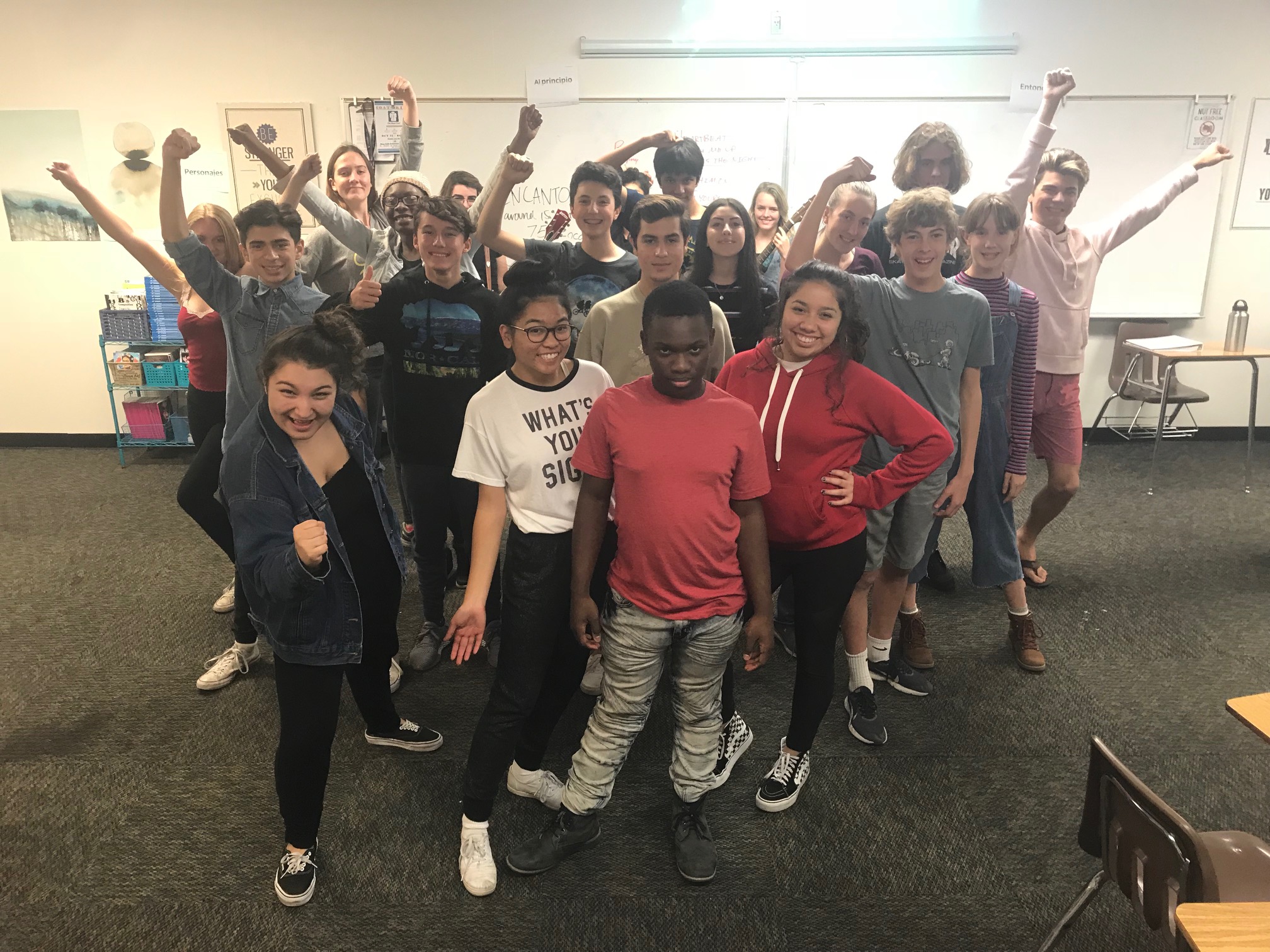
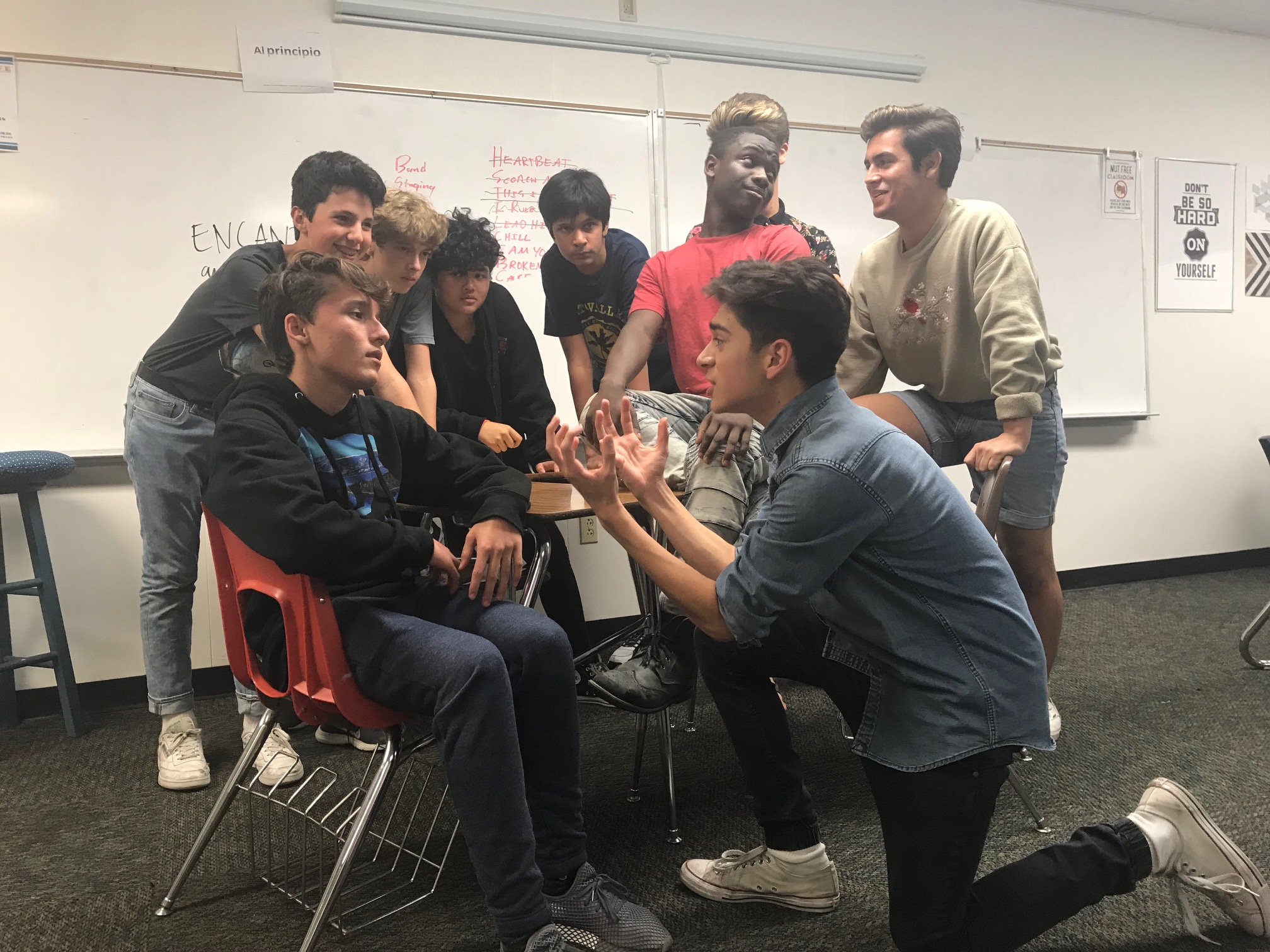
Students in rehearsal | Courtesy photo / CSArts-SGV

Distinguishing between the two productions she helmed at CSArts-SGV, Lelliott states, “Last year’s was straight-on Oscar Wilde, a dead playwright, so the script was set in stone. While this year, the script is continually developing and revising as we go.

“Jay and I have been talking since spring, planning with the creators and writers. There have been numerous phone calls and face-to-face meetings. They were here two days ago to see our progress and making script changes as they watched students in rehearsals.”

That so much is riding on this Incubator Project is not lost on the students. Pasadenan Melissa Bautista, who’s in 11th grade and attends the Musical Theatre Conservatory, says, “My parents understand that being a junior and participating in a production is a big responsibility so they could be knocking on my door at 3 am to check if everything’s fine.

“I constantly juggle between doing homework and going to rehearsals. We have a buffer from 4:45 to 5:30 so that’s usually the time I do homework. I also eat snacks and drink water to replenish my energy. We’re not always on during rehearsals so I use the in-between times, too.”

“It’s very much about time management,” inserts Wallace.

Concurs Mateo Alfonso, a 9th grade student from Monrovia who’s also in the Musical Theatre Conservatory, “My parents know that if I get into a show I’ll be in rehearsals until 8:30 pm and that’s just a commitment you have to make when you dedicate yourself to the Arts and you’re doing what you love.”

“In this musical, I play Tess, the coffee girl who works at the brewery,” describes Bautista. “She’s a senior and she’s trying to raise money to go to college; she’s also the friend that everyone goes to for advice. She just happens to be caught in the middle of all the drama.”

“Tess loves her friends with all her heart, a trait that’s close to me as a person,” Bautista continues. “But as kind-hearted as she is, she’s sassy and sarcastic at the same time. She stands up for herself, which is something I aspire to.

“In previous roles I was someone flighty. But this time, my character is very down to earth, a great advice-giver, and a very supportive friend. This gives me the opportunity to be seen as someone who’s not just an airhead, or that high-pitch voiced, quirky girl, but someone with more substance.”

Alfonso couldn’t say much about his character beyond, “I play the role of Oliver who’s a senior and a soccer fan; he’s the twin brother of Olivia. I would like the audience to see what a high schooler is really like. Playing the character of someone who’s shy, I relate to him. However, unlike the role I portrayed last year who holds a lot inside, in this musical my character shows that you don’t have to pretend, you just have to be yourself.”

Getting in character | Courtesy photo / CSArts-SGV

Asked if she gave Bautista and Alfonso direction on how to act like senior students on the show, Lelliott  remarks, “First of all, I’d like to commend Mateo for doing a great job of talking around a major spoiler. But to answer your question, they’re giving me pointers! Actually, what’s important to us and the creators is that it reflects our campus and students. They chose our school because they wanted our population so when they present the work to other colleges and universities they can show the crème de la crème. Most of the characters in the play are high school seniors with the exception of one; we have one 8th grader who cracked that age criterion and managed to get in the play.”

“I directed it just like I would professional theatre,” asserts Lelliott. “These young people are as professional as some of the adults I work with; their training is excellent. It’s collaborative as to who they are. I also cast all 26 of them for specific reasons – they were as close as possible to the characters they play and we want their personalities to shine through.

“But beyond that, I gave them notes as to how they could make clear their objectives, staging – making sure the audience can see their faces and hear their voices, and technique. The good thing about teaching and then directing them is that we have a shared vocabulary, so when I say ‘You have to raise the stakes here,’ they know what that means.”

“I would say that this is a broader philosophy of how we approach all our productions here. There should be a collaborative effort, we should show respect, we have a mutual language. We certainly value having a polished professional product and the shows we have mounted, thus far, have demonstrated that. However, process is probably the most vital component to everything that we do. Our philosophical goal throughout the conservatory and theatre acting is our growth, whether as artists or as individuals. It’s up to us as the leaders at CSArts-SGV to inspire them to achieve their potential through the process.”

Speaking of the process, Lelliott discloses, “Tonight, we’re just working on songs. There are 20 songs, bookended with big company musical numbers. In between there are quartets, trios, duets, solos, and reprises. My musical director and choreographer are there; I’ll put the students up, we have a running order. They’ll get notes specifically for vocal and choreo.

“Tomorrow, there won’t be any music, we’ll just be concentrating on staging scenes. Sometimes it will be like a three-ring circus, where I’ll be working on acting with students, while the musical director will be doing songs with them, and the choreographer will be working with other students on the dancing.”

“The reason ‘Hamilton’ is so much better than everything else that came out on Broadway is that the producers gave it extra time, which doesn’t usually happen with union contracts,” expounds Lelliott. “They didn’t just go in with a script and put on the show, it was an evolving process.

“That’s the same thing here. While we didn’t make major revisions, the writers came in and we all watched it and we were thrilled with it. Then we decided we could streamline the opening number to make it even faster. We’ll turn in a show in 90 minutes, with no intermission. People can see the show then grab lunch afterwards.”

“I think one of the things that we considered is what’s happening in the world right now,” Wallace says further. “Some of the revisions that were made were to make it more relevant to the audience.”

Lelliot clarifies, “The show doesn’t really touch on social issues. I’m going to riff off what Mateo said earlier – it touches on them by not touching on them. What people will see up there is a really diverse, inclusive cast. It will honor, even as we shatter, a lot of archetypes and stereotypes in a school setting – the jocks, the cheerleaders, and the brains. We’ll see more three-dimensional characters and, in so doing, I suppose there will be an undercurrent of social justice, if you will. But the real justice of it, really, is that we’ll be presenting a more idyllic world which is what CSArts-SGV embodies – a beautiful culture – and how well that works when we don’t label people.”

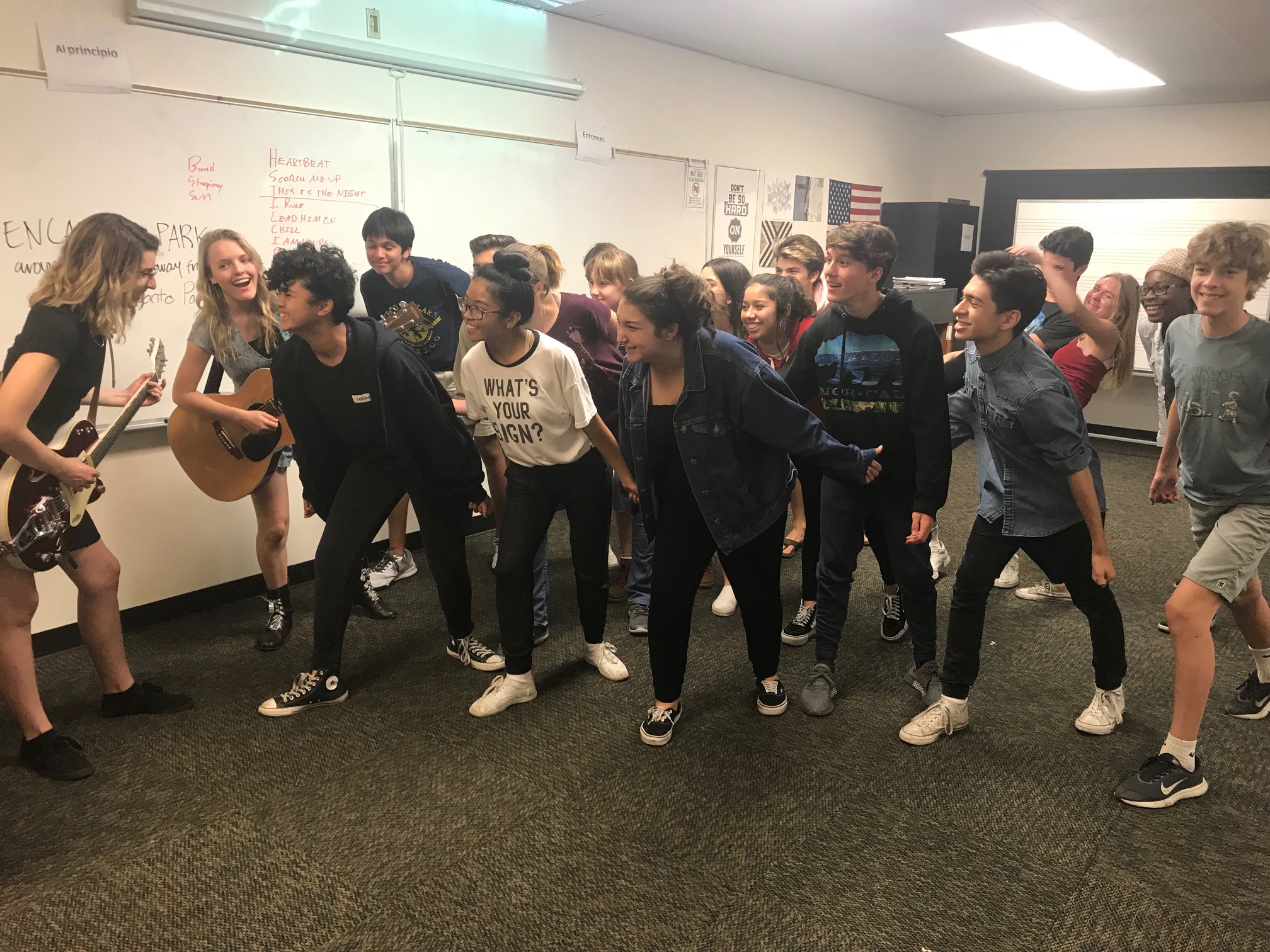
Rehearsing the songs with the choreography | Courtesy photo / CSArts-SGV

This first incubator project has another outcome, explains Wallace, “Something interesting I want to touch on is that this is also linked to a course that we’ll offer in the spring which will be led by the person who will direct next year’s incubator project. Students will develop the actual product as well as get exposure to what it’s like to put on a brand-new musical, to promote it, to learn how to be marketing savvy. An important part of that course will be workshopping next spring’s incubator so by the time we get into the Fall we’re ready to rock and roll, literally.

“We’re exploring how we can tap into the youth who may not be trained in those, but who are so innovative. We’d like to utilize that to build a framework together that will become the foundation of future incubator projects, so when these students graduate our school they’ll have a major head start on collaborating and originating new material.”

When queried how he found a teacher to teach the course, Wallace replies, “I started from the creative side – who would be the most ideal person to lead the incubator project. It’s important that it’s always somebody who has experience in generating their own product, in promoting their own image and product; someone who has an understanding of the means to engage on a collaborative effort. And, first and foremost, someone who can connect with students.

“This opportunity for us to originate a musical and to collaborate with professional talent, is almost unheard of even at the collegiate level, and certainly not at the high school level. I’d be very surprised if there were anything like this anywhere in the country. The shakers at media V deserve a lot of credit for that vision and for coming to us to partner with them. It’s a real sign of reinvesting in youth and theatre arts, specifically musical theatre, and allowing these students to develop through that process. It’s extremely unique and, quite honestly, a blessing. And to do this in the second year of our school is just insane.”

As the chair of the theatre department, Wallace is aware that the onus to make a success of the project falls squarely on him, “My philosophy is ‘This is my challenge and my opportunity. Embrace it.’”

It is that spirit of ownership that Wallace displays that has made such a tremendous success of all CSArts-SGV’s theatre productions. Bravo!

‘Rosencrantz and Guildenstern are Dead’ Comes to Life at A Noise Within

Originally published on 8 October 2018 in the Pasadena Independent, Arcadia Weekly, and Monrovia Weekly

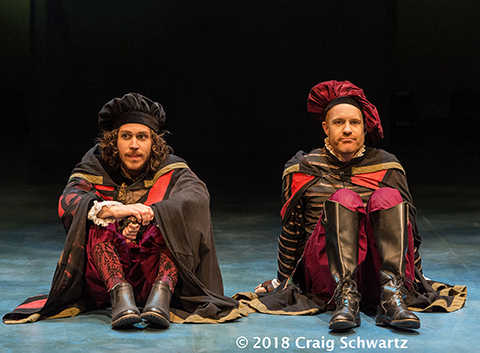
Pictured left to right: Rafael Goldstein and Kasey Mahaffy. – Photo by Craig Schwartz

Tom Stoppard’s ‘Rosencrantz and Guildenstern are Dead’ was first performed at the Edinburgh Festival Fringe (The Fringe) in 1967 to great acclaim. It established him as one of the greatest playwrights in modern times and his work, which puts to the fore two of Shakespeare’s minor characters in ‘Hamlet,’ has been staged throughout the western world.

Pasadenans will get to experience Stoppard’s brilliance when ‘Rosencrantz and Guildenstern are Dead’ goes on stage at A Noise Within from October 7 to November 18. Directed by ANW Producing Director, Geoff Elliott, it stars resident artists Kasey Mahaffy as Rosencrantz and Rafael Goldstein as Guildenstern.

A Nosie Within distinguishes itself as one of the few repertory theatre organizations with a resident company. The resident actors’ genuine regard for one another manifests itself on stage and makes for richer, more nuanced performances.

“Rafael and I have known each other for four years,” Mahaffy discloses. “We know each other’s secrets, we’re two halves of the same coin. So we started the foundation from day one, jumping off from a place that some actors could only be familiar with on opening night.”

“I’ve worked with him in about half a dozen plays and I have admired him greatly as an artist. But our joke was that we never shared a word together. Even in ‘Henry V,’ where he played the king and I was the dauphin from France, his mortal enemy, we didn’t share a minute of stage time. We just never got a moment together. Finally, they threw us a bone. Now all we do is hang out and we’re sick of other,” quips Mahaffy.

“But, seriously, I’m grateful every day that Rafael is my screen partner and my safety net,” Mahaffy says hastily. “He’s incredibly prepared and diligent, which I expected coming in. He’s always fun to hang out with and joke with backstage.”

“What I like about Kasey is that he’s a grounding presence for me,” declares Goldstein. “I tend to spin off into the abyss. And Kasey is very practical; he listens and he responds. Every actor needs that and I have it in spades with him. His sense of humor leavens the existential morass that we find ourselves in in this play. He has all the laugh lines, as well. It’s been nice to sort of play the straight man to his comic character.”

“Like in any true functioning relationship, these two individuals, while widely different, need each other,” Mahaffy elucidates. “Guildenstern is a cerebral, logistical, driven character. And Rosencrantz is all fart jokes. But what’s so cool in Stoppard’s writing is that when one character  loses perspective and spins out, and both of us do it multiple times on the show, the other one immediately rises to the challenge and rescues the other. Every single moment in this play is a scale that he and I are leveling.”

Pictured left to right: Rafael Goldstein, Paul David Story, and Kasey Mahaffy | Photo by Craig Schwartz

‘Rosencrantz and Guildenstern are Dead’ is not new to Mahaffy. “When I was doing my undergraduate thesis back in 2000, I had the role of Guildenstern. It’s amazing to hear those words again 18 years later. The dialogue is just fast, fast, fast, boom, boom, boom, like a tennis match. The problem is, sometimes I say his lines. It’s been 18 years but it sticks in the brain. So one of the great things about playing with him is that he’s shown me how to do that part. And how terribly bad I was when I did it then,” he admits with a laugh.

Goldstein says, “The virtue of him having done it before is that he was able to warn me about the pitfalls of this role too, and how to navigate them. He has something of a map to guide me about the play generally, like how the audience would react. Granted, that would change, but it’s something to have in the back of my head.”

Revisiting the play almost two decades later has given Mahaffy a better, deeper sense of it. “It is the heart of what I want to talk about today. The play, while told through comedy and existential theatrical device, is a treatise on life. More specifically, it is about these two characters who are stuck and are searching for their next move. They’re waiting for signs from the universe, other people, other souls, to tell them what they should do next. Like most of us, they are terrified about mortality and death. When I performed this at 20 years old, I was saying the words but I didn’t have a visceral understanding of their significance.

“This summer, my brother passed away prematurely, at 42 years old, and left a wife and two daughters. My parents were devastated and I’ve been reeling from it since. It made me think about what it means to me as a brother and as a son. As an artist, I have to put my life on stage no matter what’s going on in my life, whether it’s good or bad. There’s the line in the play …”

And Goldstein supplies the line, “There is no applause, there is only silence.”

“Yes. When you die, there is no applause, only silence and second hand clothes,” picks up Mahaffy. “Tom Stoppard is a certifiable genius. You can say those things when you’re in college but it’s not until you’re a 39-year-old man holding your brother’s shoes which were gifted to you … these second-hand shoes … that the gut punch meaning to the lines is actually delivered.”

“The theme of the play is Rosencrantz’s and Guildenstern’s imminent death,” Goldstein addresses further. “They know something is amiss, but they have an inkling, as we all do. We have an understanding that death is coming. And it’s every human’s journey how to reconcile the ultimate irrationality of our own demise. Moving through the world with that knowledge, how does one confront the absurdities of everyday life? How does one control aspects of one’s life to better comprehend the current situation? There is the questioning which activates a lot of philosophical ideas.”

“Tom Stoppard’s characters are people seeking agency in their life,” describes Mahaffy. “He wants to explore the questions ‘Are we subjugated to fate?’ ‘Are we tools at the hand  of God?’ ‘Or do we have our own power?’ ‘Are we the captain of our own ship?’ That’s the crux of what he wrote at 26 years old. He was still a baby! Such genius!”

Pictured left to right: Rafael Goldstein, Wesley Mann, and Kasey Mahaffy | Photo by Craig Schwartz

Goldstein enlarges on that thought, “The question, ‘Are we the captain of our ship, or are we set on a predetermined path?’ is completely outside of our understanding and perception. Are we just being moved along inexorably towards a predetermined end and no matter what we do, no matter what flailing action we might take to avoid certainties, we’re going to meet our end? You know, you can do as many push-ups as you want, you’re still gonna die!

“The play focuses on two minor characters in Hamlet. The title comes from a line in it, ‘Rosencrantz and Guildenstern are dead.’ There is no question. But to them, there has to be a possibility of reprieve, which they’re searching for in the entire play.”

Expounds Mahaffy, “The characters are determined to take a grip of their circumstances. They  wonder if they should turn right instead of left, forward or backward. They ask The Player, ‘What do we do? We don’t know how to act.’ And The Player answers, ‘Relax. Respond. That’s all we can do as humans.’

“This is a play about language and dialogue. Our set, even as it’s beautifully designed, is quite simple. It’s pretty much a stage with lights. I think it’s going to be a major treat for anyone who appreciates language and humor. And I want to make this clear, you don’t have to know Shakespeare. We don’t speak in Shakespeare vernacular. We talk like two people in 2018. It’s wildly funny and terribly heartbreaking all at once. It’s everything you want theater to be.”

“We’ll be wearing clothes that convey an Elizabethan flavor, but the way we speak to one another in the play is thoroughly recognizable,” Goldstein emphasizes. “Geoff Elliott, our director, has stressed for us to understand the words and communicate them as simply as we can. There is very little varnish to the way we interact with each other. It’s unadorned and straightforward. It’s two people just trying to survive and using the other person as a buoy, or a sounding board. That’s invaluable direction given the philosophical themes of the play. This is undeniably one of the greatest plays in the past century and I think people will come way from the production appreciating that.”

Even if not everyone agrees with Goldstein’s assertion, the one indisputable certainty is that Tom Stoppard didn’t let Rosencrantz and Guildenstern go down without a fight.

‘Henry V’ at a Noise Within Stars Pasadena-area Native

Originally published on 6 February 2018 in the Pasadena Independent, Arcadia Weekly, and Monrovia Weekly

Rafael Goldstein as Henry V. | Photo by Craig Schwartz

William Shakespeare’s ‘Henry V’ goes on stage at A Noise Within (ANW), the acclaimed repertory theatre company, from February 4 to April 6, 2018. Co-directed by Geoff Elliott and Julia Rodriguez-Elliott, it focuses on the Battles of Harfleur and Agincourt and has been streamlined into a dynamic thrill ride infused with modern relevance.

“‘Henry V’ is a play about going to war, and the propulsive energy that leads to conflict,” declares Elliott. “We’ve zeroed in on the conflict between Henry and France, and captured the unifying, almost euphoric energy that comes with having a shared enemy. While the play is not explicitly for or against war, it does provide an in-depth look at the politics of war and our thirst for conflict. Ours is a very physical, visceral production: we have three fight choreographers and a live percussionist. Expect a fast, furious, and ferocious evening.”

At the center of the intense action is ANW resident artist, Rafael Goldstein, who assumes the title role. He states, “When I found out I was going to be playing Henry I started training – running four or five miles a day – and eating better to get in shape. We spent hours staging the battles. Our fight choreographer, Ken Merckx, and a couple of his assistants  have done a fantastic job of putting this together. It’s edge-of-your seat excitement and really bloody action. It’s a spectacle not to be missed.”

Shakespeare’s history play tells the story of King Henry V of England and takes place during the Hundred Years War. ANW’s iteration of it, however, does not specify an era. States Goldstein,  “It’s a timeless tale set in a timeless way. Men’s need for conflict and war never goes out of style. When you’re working with a story this malleable and universal you could pretty much do whatever you want with it and the strength of the story would stand up.

This particular production happens in a ritualistic arena where this group of people comes together to tell a story about humanity’s need for conflict. They use Shakespeare’s words and plot to tell this very human story but it isn’t set in 1415 on a battlefield with knights in armor. It’s a modern version of what warfare looks like and what it does to people. While we’ll be sporting contemporary clothes, we’ll still be wielding swords. And we’ll be wearing crowns so the audience can tell who’s the king, the prince, the princess, and so on.”

Henry V ensemble | Photo by Craig Schwartz / A Noise Within

Ever the professional, Goldstein prepares for his performances seriously. He declares, “No matter what show it is and what role I play, I go over the script two or three times a day. And during the lead-up to rehearsals when we get ‘off-book’ I try to have all my lines memorized before the first run-through so when I get into the room with all the other actors, I can communicate with them and not have to look down at the script.

Memorizing, especially Shakespeare, is a joy. The language is so rich and the characterizations are so clear. He gives you so many clues as to how to read and understand it that it becomes a familiar song, a part of who you are.”

This talented and prolific actor hails from the Pasadena area and his involvement with ANW goes way back. Goldstein discloses, “I was born and raised at the base of these mountains, in Altadena. I went to St. Andrew Catholic School on Raymond Avenue in Pasadena. And then I went to the Los Angeles County High School for the Arts (LACHSA).

Actually, the summer before I went to LACHSA, I took the Summer with Shakespeare program at A Noise Within when it was still in Glendale to give me a leg up and little bit more training under my belt before I head into this conservatory-style setting. That fall, ANW contacted me and asked if I wanted to be in their production of Macbeth. So I worked on high school stage productions and professionally with ANW all through high school.

I attended New York University’s (NYU) Tisch School of the Arts and stayed in New York for a while. When I moved back here in 2011, I rekindled my association with ANW. So not only did I come back to my birth home but to what has become my stage home as well. They cast me in Antony and Cleopatra as Eros, a wonderful little role as Antony’s servant on the battlefield. When Antony realizes that all is lost he asks Eros to kill him. Rather than kill Antony, Eros kills himself instead.

In my many years at ANW, I have played key characters. I had a principal role last season in Tom Stoppard’s ‘Arcadia,’ which was an ensemble piece. I’ve also played title roles before but never in a venue like this; it’s challenging in a nice way. One of the obstacles is thinking of Henry as a lead role because even though the world of the play hinges on his experience, that world is still very much alive and independent of him. There are so many things that he can’t control in this world. He causes a lot to happen but things happen to him as well.

Being in a titular role, I do feel a certain amount of responsibility for ensuring our play is well received and resonates with our audience. That’s why I have been preparing for as long as I have and as assiduously as I possibly can. But, like Henry, I can’t take all the credit because there are so many moving parts and aspects to this play. It really does take a village to raise a mountain of a play and incredibly long hours of hard work that goes into the production that the audience will eventually see.”

Henry V cast (left to right): Erika Soto as Boy; Jeremy Rabb as Bardolph (supine); Deborah Strang as Mistress Quickly; Frederick Stuart as Pistol; and Kasey Mahaffy as Nym | Photo by Craig Schwartz

I have worked in other theatre companies like Theatre Forty and Sacred Fools, and a part-time job at Pasadena Playhouse, but ANW is my home base. ANW and doing theatre are vital to my life; they’re essential to who I am. My poor wife sees me maybe one day a week but that’s the life of an actor – it’s hard and grueling. It’s not always rewarding in the way you would like it to be, you hear the word ‘no’ more than ‘yes.’ But when you do have a job and you’re doing a play that feeds your soul, you couldn’t ask for anything more – it’s the fulfillment of a passion. You give something of yourself to your audience as they watch you on stage. There is a symbiotic relationship between the actor and the audience, a true communion.

Other professional pursuits keep Goldstein busier still. He says, “I do voicing for video games, standing in a dark room screaming into the microphone. I’m also involved in film-making with a friend who has started a small company. Right now he’s doing mostly music videos and we shot one wild little film recently at Joshua Tree. We have plans to put together some shorts and features, going through the fund-raising phase, pitching the idea for possible funding. I’ve been in a number of short films as well and one TV spot on Investigation Discovery Chanel.”

“Theatre is my first love though,” Goldstein hastens to add. “It has been since I first went on stage at the age of three and played one of the sons of Adam and Eve in a little play at a Unitarian Church about the creation of the world. I remember I had one line and the audience laughed. I was hooked.

If that weren’t enough motivation for me, my father is an English professor who would bring home plays for us to read aloud. My mother, my sisters, and I would divide the parts and we’d talk about it after. We’d read Eugene O’Neill, Shakespeare, Neil Simon, any author he was doing a unit on at the time.

My mother is a psychologist who would talk to me about people and human behavior and thought. I never had a chance: I was always going to be an actor. So for as long as I still have all my hair and teeth, I’ll be on stage somewhere many years from now telling stories and, hopefully telling them well.”

While Goldstein’s little three-year-old self couldn’t have foretold that he would be playing incredibly memorable roles in numerous acting projects at age 30, empirical evidence suggests he has been honing his skills for ever more significant performances.

‘Henry V’ may be Rafael Goldstein’s star vehicle but it’s only the beginning of his journey. His career’s ascent may not be akin to a fast, furious, and ferocious evening of ‘Henry V’ on stage but it will be steady, strong, and superlative. And that would be a far more thrilling ride.

‘King Lear’ and ‘Man of La Mancha’ Share Similar Worlds at A Noise Within

Originally published on 14 February 2017 in the Pasadena Independent, Arcadia Weekly, and Monrovia Weekly

Resuming its 25th Anniversary celebration, ‘Beyond our Wildest Dreams’, A Noise Within puts on a production of William Shakespeare’s King Lear which will run in repertory with Man of La Mancha later in the spring. Geoff Elliott and Julia Rodriguez-Elliott, co-producing and artistic directors of ANW, have conceived these two shows to be seen on the same day, allowing them to fully speak to each other. 

Both shows share the same leading man (Geoff Elliott), the same director (Julia Rodriguez-Elliott) and the same scenic elements, enabling a quick turnover between matinee and an evening performance so the two productions can play on the same stage.  

Of the opportunity to perform both Lear and Cervantes/Don Quixote, Elliott pronounces, “I feel I know Lear. He is stripped of everything, and must face his worst demons to find tenderness and uncompromising love in a very violent world. Lear spends so much of the play terrified of losing his mind. Anyone who goes through a similar self-investigation can’t help questioning his sanity as so much of the world that we live in seems insane.”

Continues Elliott, “In his way, Cervantes/Don Quixote is Lear’s doppelganger. As he assumes Quixote’s persona, Cervantes gains the courage and the strength needed to face the uncertain future of the Inquisition. He, along with his fellow prisoners and, ultimately, the audience are transformed.”  


King Lear | Image taken from A Noise Within’s website

Says Rodriguez-Elliott, “In Lear, this personal journey of a family dealing with an ailing patriarch has global implications. The breakdown of a nation runs concurrent with Lear’s mental decline. At the beginning of the play, we see a man at the zenith of his power, a modern day dictator who is feared and has never heard the word NO. The world we enter is a violent, callous one. At the end, we see a man transformed.”

The world of La Mancha is as violent and callous as it is ripe and crying out for transformation. “Though many often associate Man of La Mancha with elaborate set pieces and fanciful costumes, its earliest stagings were sparse, encompassing the spirit of a rag-tag band of prisoners putting on a play with found objects,” explains Rodriguez-Elliott. “I wanted to return to those roots. Based on real-world prisoners, the conditions we’ve created for Cervantes and his fellow inmates are recognizable and terrifying.”

Audiences will likewise be transported to these worlds, in large part, because of the actors’ excellent portrayal of the characters they will inhabit for the next two hours. However, stage plays are a collaboration among many – actors and directors; as well as designers, which include costume, lighting, and set – and their success depends on how seamlessly these collaborators work together to create one magnificent piece.  

That Lear and La Mancha also share artistic team members – Fred Kinney (scenic), Angela Balogh Calin (costume), and Ken Booth (lighting) – makes for an exciting experience for the audience and for everyone involved in both productions as well.

Booth, ANW’s resident lighting designer, who has worked on over 40 productions for ANW since 1998 says, “I’m thrilled to be a part of it; this kind of challenge doesn’t happen a lot in small theatres. For Lear I am using a palette of warm and cold lighting, often in combination.  You don’t really see the source of light but it’s there being filtered through some unknown artificial source. Shifting the temperature of the lighting within a scene helps to punctuate or accent a moment. Highlighting one particular character helps create dramatic conflict within that character.”

“Lighting defines and redefines the performance space; it can influence the mood for the play and the audience. It enhances the atmosphere for the actors who are on stage to share their art and emotions with their audience,” Booth adds.

Man of La Mancha | Image taken from A Noise Within’s website

“Both Lear and La Mancha deal with a man with delusions of grandeur. The conflicts in both come not from without but from within the characters – their inner dilemmas of importance and immortality that affect them. To connect both stories, I will create lighting that seems omnipotent in certain scenes and confining for others. Beyond the giant set wall the plays share, you only see shafts of light that emanate from behind a window or door whenever it is opened. The wall is the horizon – there doesn’t seem to be an outside world – and for the most part the lighting of the wall is the same: a cool or bluish wash, beams of warm light seeping down; and a filtered break-up catching parts of it.”

Angela Balogh Calin, resident costume designer for ANW, has worked with Booth since 1998. She says she hasn’t done many shows when Booth didn’t light. “We go back a long time,” she declares. 

“Both Lear and La Mancha are going to have modern setting so costume-wise, I will give them a modern approach,” Calin discloses. “The clothes will be something the audience will be able to identify with; they will be easily recognizable. Lear will be eclectic, with 1950s flair.”

Lear and La Mancha will only be Fred Kinney’s second and third shows with ANW. An independent scenic designer, he was contracted for both shows last spring and immediately did his research. 

“I think Shakespeare’s work is better heard not read; so I watched a couple of film versions of Lear before I started conceptualizing the scenery,” Kinney reveals. “For La Mancha, I listened to the music and then watched the film. Then I came up with a concept that could work for both but different enough. They are unified in theme but the design will have enough variety to service the individual parts of the shows – the things that are unique to each production. I will have a base layer to which I can add elements to make the scenery distinctive to each.”

ANW provides a unique environment in which artists work together across decades. They are comfortable experimenting, trying new things; impressing as much as supporting each other show after show. These artistic relationships inform each of this repertory theatre company’s many exceptional productions for 25 years.

Booth expresses says it best when he says, “I want our audiences to remember what an otherworldly universe we created within our theatre for our interpretation of King Lear and, hopefully, they get a satisfying feeling of bittersweet closure. This is what I find exciting – the collaboration in putting on a production – to take a blank stage and create a beautiful picture that is like a painting come to life using the limited tools at our disposal.”

Shakespeare’s Romeo and Juliet as a Street Performance at A Noise Within

Originally published on 18 February 2016 in the Pasadena Independent, Arcadia Weekly, Monrovia Weekly, and Sierra Madre Weekly

Beginning this Valentine’s Day through the 8th of May, A Noise Within (ANW) will be staging the greatest love story of all time – William Shakespeare’s  Romeo and Juliet. 

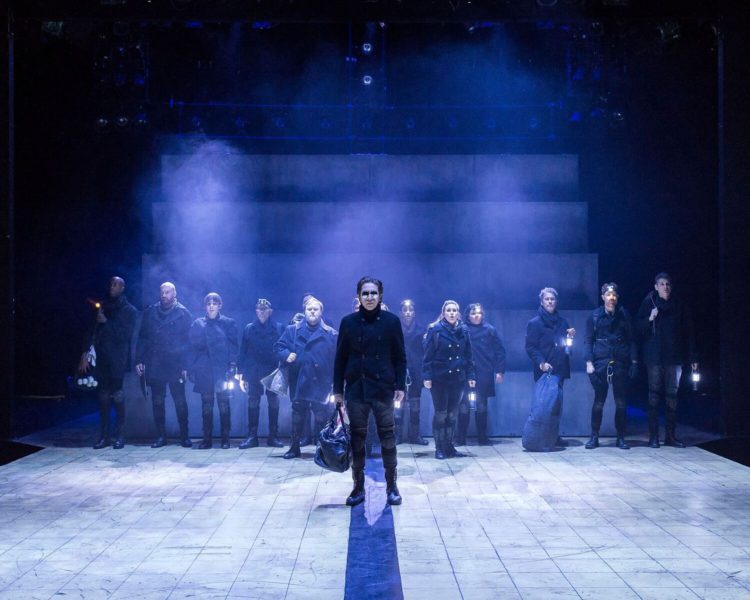
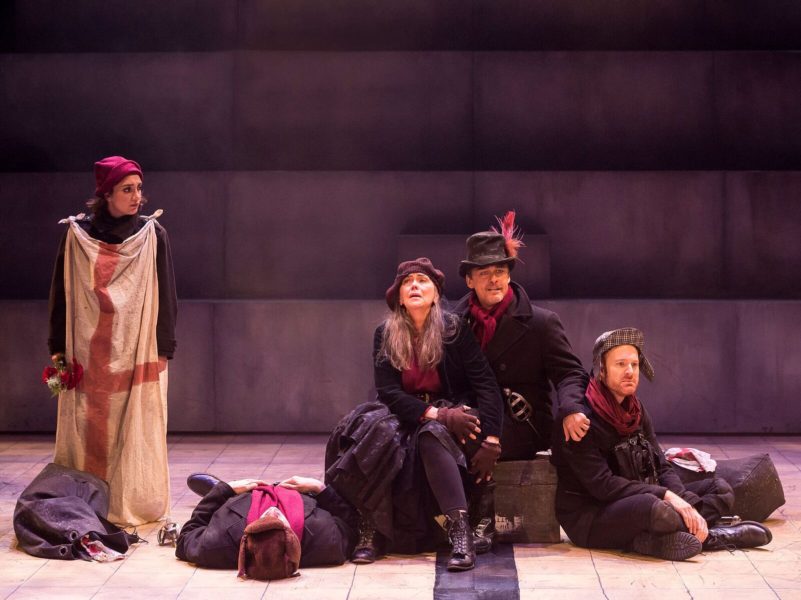
Directed by Damaso Rodriguez, Artistic Director of Artists Repertory Theatre, Portland’s longest-running professional theatre company, this Romeo and Juliet will be a far departure from how Shakespeare’s work is traditionally presented: as a period piece, with lavish costumes and grand sets. Instead the play will be presented as a street performance, in a graffitied and littered alley with garbage bins scattered about.

The vision for this well-known play came about when Rodriguez visited Havana, Cuba and  met with artists who staged bare-bone productions for a few attendees in humble homes. He relates one memorable evening, “We walked through a courtyard overlooking balconies – it is a beautiful environment but all around you could see peeling plaster from 50 years of decay.  We entered a small house, with light bulbs in tomato cans for stage lighting, the actors wearing their own clothes. The audience was made up of 20 people who came that night. And they proceeded to tell their story. It was a Cuban play which, I think, was about their daily struggles for survival. While there was a language barrier, what united the performers with the audience was the art form. It was a truly transformative moment for me.”

“Theatre companies without much in the way of money put on plays using found objects for props and scenery, and in very low-tech, low-resource performance spaces. The plays with just the actors themselves having to rely on their skills were powerful and inspirational.  In this place where there are few resources, actors and audience link as a community with the compelling need to tell and hear stories joining them as one.”

“I wanted to bring this experience to Romeo and Juliet – costumes will be clothes that actors own, props are whatever they find in the street, and the setting urban. The play will exist in the telling rather than the trappings.” 

“It will be an unexpected environment that in no way resembles the characters’ wealth and class.   I hope that by stripping the play down to its most basic, it will focus on the language and clarify the intention of the characters,” Rodriguez discloses further.

ANW’s artistic director, Geoff Elliott reveals, “When we approached Damaso about directing for us this season, he responded by saying that he has wanted to do Romeo and Juliet because it deals with the most basic of human emotions – love, rashness, hate, fate – and tribalism, which drives just about anything we call news. Humans have passion, conduct war, and kill each other over a tribal conflict the origin of which no one can even remember. And I think that Damaso has found a direct and compelling way to tell this story.”

Rodriguez says, “I hope people who come to watch the play, after a few minutes just try to conceptualize these characters and see them as humans. I hope they see a clearer version of the story and realize the universal essence of Romeo and Juliet.”

“It is a raw and harsh environment, yet we have an optimistic view that their death has brought the conflict between these two families to an end. People will realize this tragedy happened because of two opposing rigid world views – that it took the death of these young characters to end hatred. Romeo and Juliet taught them to look at life differently,” Rodriguez adds.

“It’s arguably daunting to present such a classical material in an unexpected fashion because you could be working with actors who’ve done it before. People who love Shakespeare have certain expectations; also there are scholars who think Shakespeare has to be done a certain way. But in the end all I can do is forget about that. I have to believe that a director has to find an emotional connection and impulsive reaction to it, and share that with his collaborators,” Rodriguez states further.

“It’s quite liberating, actually, to not be restricted by expectations and standards. While A Noise Within has staged Romeo and Juliet twice, I didn’t necessarily set out to find a way to make it very different from what they did before. I didn’t burden myself with that concern; I am merely satisfying an urgent impulse. It’s hard enough to just unpack the language of Shakespeare. I simply want to make the storytelling as clear as he would have wanted for his audience,” concludes Rodriguez.              

During Shakespeare’s time some plays were presented outdoors. Theatregoers had to use their imagination – there were no backdrops, lighting, or props to speak of. Furthermore, his plays were not intended to be read but spoken aloud; the lack of background meant there was nothing to distract the audience from the actors’ words and movements.     

That ANW’s Romeo and Juliet would be staged as they were originally performed four hundred years ago is the perfect tribute to the Bard’s timeless work.  

Shakespeare’s Globe Theatre on Tour at The Huntington

Shakespeare Globe Theatre, England (UK)

Originally published on 29 October 2015 in the Pasadena Independent, Arcadia Weekly, Monrovia Weekly, and Sierra Madre Weekly

Residents of the San Gabriel Valley will be in for a rare treat next week when London’s acclaimed Shakespeare’s Globe Theatre on Tour wends its way to Southern California to stage Much Ado About Nothing. For two nights in November, the 9th and the 10th, The Huntington will be the venue for this much-anticipated production.

Dominic Dromgoole, Artistic Director of Shakespeare’s Globe, has this to say, “I am delighted that Shakespeare’s Globe continues to extend its reach across the world through our epic touring programme. Our beautiful and fast-paced production of Much Ado About Nothing, having toured theatres and gardens in the UK over the summer, will be making its way to South America before touring to The Huntington in November. We have had a long-standing relationship with the Folger Shakespeare Library (in Washington, D.C.) where we have successfully toured our plays in the past, and consequently thought The Huntington would be a similarly natural fit.”

According to Lisa Blackburn, Communications Coordinator/Calendar Editor at The Huntington (Library, Art Collections, and Botanical Gardens), the Library’s depth of collection makes this San Marino, California institution one of the leading centers of Shakespeare scholarship. It rivals what is available at the British Library in London, The Folger Shakespeare Library in Washington, D.C., and the Newbury Library in Chicago.

The Huntington’s vast holdings include a rare 1623 “First Folio” edition of Shakespeare’s collected plays. Published seven years after the Bard’s death, it contains 36 plays, 18 of them printed for the first time. The Huntington also has numerous early quarto of individual plays, including one of only two surviving copies of the first edition of Hamlet (1603); rare 16th– and 17th-century works documenting life in Shakespeare’s world; materials relating to early theatre – including playbills promoting performances at London’s Drury Lane Theatre, engravings of famous Shakespearean actors of the day such as David Garrick and Sarah Siddons, and prints depicting dramatic scenes from many Shakespeare plays.

Educational and cultural programming – from lectures and conferences, to teacher training workshops, to professional theatrical performances – are frequently on offer at The Huntington.  It also works with schools on Shakespeare-related programs, as it did this past spring when The Huntington collaborated with Esteban E. Flores High School in East Los Angeles on a students’ production of A Midsummer Night’s Dream, which they performed for family and friends.

Other recent Shakespeare programs held at The Huntington include a production by the Independent Shakespeare Company, on the 6th of June 2015, of a rarely performed romance Pericles, Prince of Tyre.

Blackburn also says The Huntington has just successfully concluded a college-level seminar  in anticipation of the 400th anniversary of The Bard’s death. Heidi Brayman Hackel, associate professor of English at UC Riverside who specializes in the literature and culture of early modern England (1500-1700), conducted this course. It paid particular attention to Shakespeare’s late plays – The Winter’s tale, The Tempest, and Henry VIII – examining them as meditations on and farewells to the public stage and public life as well.  

At an April 2015 scholarly conference on “Rethinking Shakespeare in the Social Depth of Politics”, social historians and literary critics repositioned his works in the culture wars of the period to reassess his presentation of power and authority in his works.

In May, actors from the Independent Shakespeare Company and artists from LA Opera presented “Shakespeare Scenes and Sonnets: An Evening of Words and Music”. With 18th century Grand Manner Portraits in the art gallery serving as backdrop, they performed scenes, sonnets, and songs that explore connections between the works of Shakespeare and The Huntington’s art collections.

And this summer, as in summers past, The Huntington once more hosted its Shakespeare at The Huntington teacher training institute. A unique two-week workshop designed for secondary school teachers of English and Drama, it focuses on teaching Shakespeare through performance.  The course features an international faculty of scholars, educators, and theatre professionals.

Shakespeare’s Globe is a faithful reconstruction of the open-air playhouse for which he wrote his plays.  Globe Theatre on Tour has brought productions – Henry V, Ann Boleyn, As You Like It, King Lear, and The Taming of the Shrew – to castles, festivals, parks and town squares in the past five years. This London’s Bankside charity organization operates without government funding and has since become a popular tourist destination in the United Kingdom.  

Theatre season plays in repertory held annually from April through October, under Dromgoole’s helm, have attracted an international following and reputation for performance excellence, says Blackburn. Globe Education runs one of the largest arts education program in the country under the direction of Patrick Spottiswoode, with over 100,000 students a year. Shakespeare’s Globe Tour and Exhibition is open year-round and is the world’s only permanent exhibition dedicated to The Bard’s theatrical career.

Much Ado About Nothing, set in Governor Leonato’s house in the Sicilian town of Messina, follows the stories of two sets of lovers – Benedick and Beatrice and Claudio and Hero.  Leonato is hosting Prince Don Pedro of Arragon, Don John, Claudio (a young Florentine lord) and Benedick (a Paduan lord and confirmed bachelor engaged in a ‘merry war’ with Leonato’s niece, Beatrice, a confirmed spinster).

Don Pedro helps Claudio win the hand of Leonato’s daughter, Hero, in marriage; the wedding of Claudio and Hero is planned after a masked wedding. Don John is determined to break up this union and, knowing that the Prince and Claudio are listening, schemes to exchange vows with Hero’s gentlewoman , dressed in her mistress’s clothes, at Hero’s bedroom window.

At the same time, Pedro, Claudio, and Leonato conspire to make the feuding Benedick and Beatrice fall in love with each other.

Before Hero’s and Claudio’s wedding, Don John offers to give the prince and Claudio proof of Hero’s unfaithfulness. Claudio denounces Hero in the middle of the ceremony even as she proclaims her innocence. Friar Francis, not believing the charge, proposes that Hero should be reported dead and hidden until the truth is revealed.

The confusion is resolved in the final act, and a penitent Claudio ends up marrying Hero after all.  Beatrice and Benedick resolve their “merry war”; news comes that Don John has been captured and brought to justice.

Much Ado About Nothing, written between 1598 and early 1599, was made into a film in 1993 with Kenneth Branagh playing Benedick, and Emma Thompson as Beatrice; and was directed by Branagh.  Known as one of Shakespeare’s liveliest comedies, it was exceedingly popular in early years – it was one of the plays acted at Court during the May 1613 festivities for the betrothal and marriage of Princess Elizabeth and the Elector Palatine.

It will once more engage Southern Californians as Shakespeare’s Globe Theatre’s Much Ado About Nothing makes its two-night run at The Huntington. Almost four hundred years after his death, Shakespeare continues to delight audiences with his plays that still ring true today as they did when they were first performed.