“Another Beautiful Country” Exhibition at USC Pacific Asia Museum Show Moving Images

Also published on 22 January 2024 on Hey SoCal
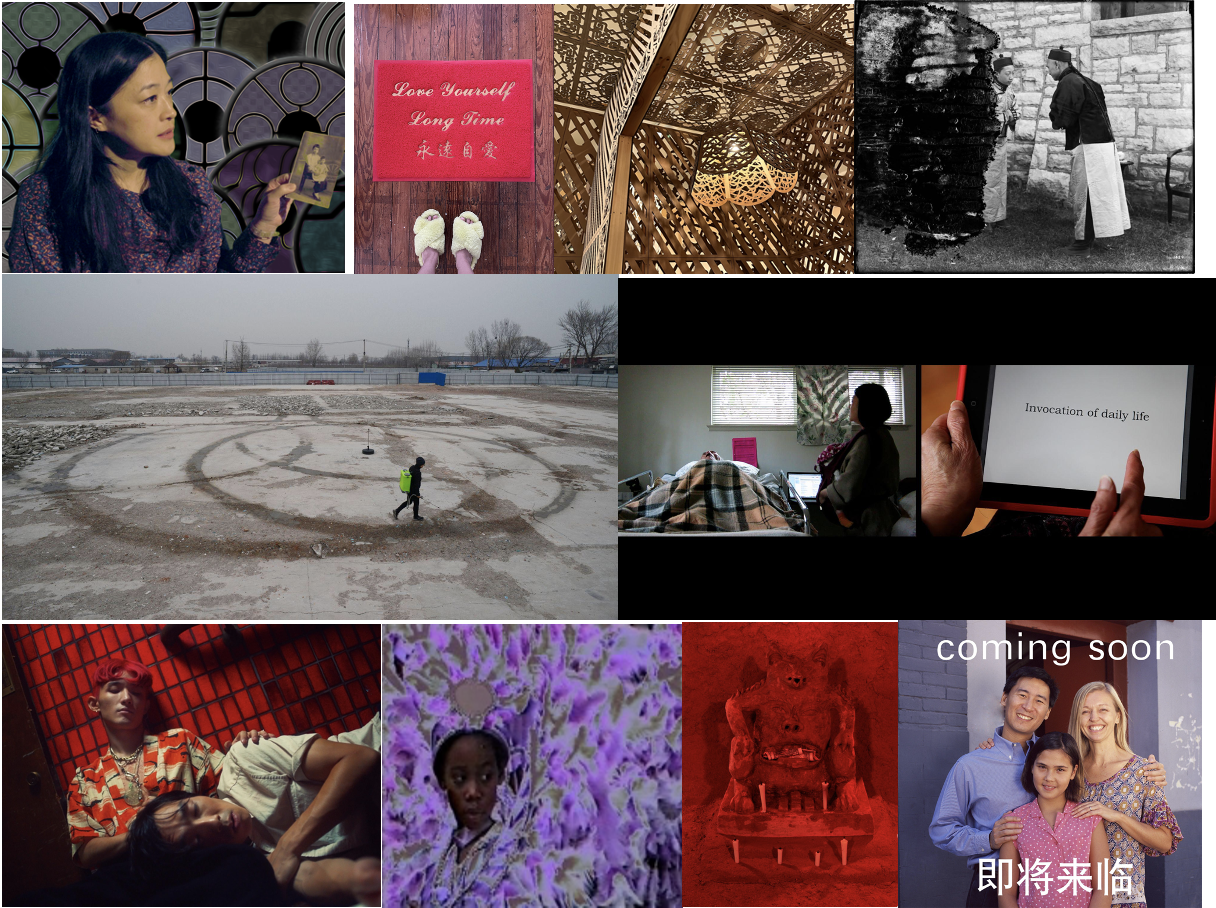
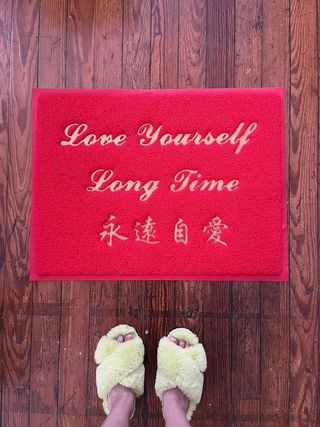
Clockwise from top left: Vivian Wenli Lin, The Joy Luck Mom Club, 2023; Jennifer Ling Datchuk, Love Yourself Longtime, 2019; Charlene Liu, China Palace, 2023; Rania Ho, Roundabout, 2023; Patty Chang, Invocations and Que Sera Sera, 2013, Andrew Thomas Huang, Kiss of the Rabbit God, 2019; Richard Fung, My Mother’s Place, 1990; Candice Lin, Lithium Sex Demons in the Factory, 2023; Ken Lum, Coming Soon, 2009 / Courtesy of USC Pacific Asia Museum

A touching experience awaits visitors to USC Pacific Asia Museum who come to see Another Beautiful Country: Moving Images By Chinese American Artists. On view from January 26 to April 21, 2024, the exhibition showcases ten artists whose work explores diverse ways immigrants and their families embody, imagine, and reciprocate intercultural experiences.

Curated by Jenny Lin, Ph.D., an Associate Professor of Critical Studies in Art and Design and Graduate Director of Curatorial Practices at the University of Southern California, the exhibition   features the works of award-winning, distinguished, and renowned artists in their specialized fields: Patty Chang, Jennifer Ling Datchuk, Richard Fung, Rania Ho, Andrew Thomas Huang, Simon Leung, Candice Lin, Vivian Wenli Lin, Charlene Liu, and Ken Lum.

Drawing its title from the Chinese translation of America, 美國/měiguó, literally beautiful country, and the popular abbreviation for American-born Chinese (A.B.C.), this exhibition presents artworks as scenes of cross-cultural sharing. Another Beautiful Country foregrounds fluctuating ideas of nationhood and belonging as portrayed by artists who identify as Chinese American. These artists confront subject positions of being both, while neither singularly, Chinese and (nor) American, revealing the nuance and multivalence of national categorizations.
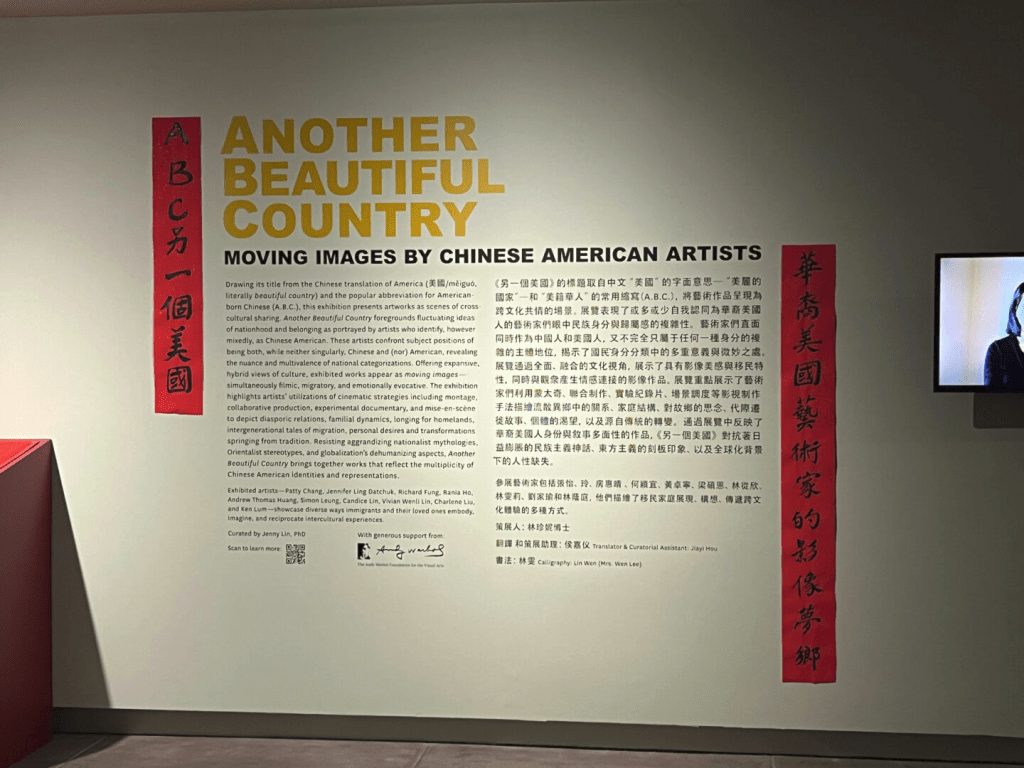
Another Beautiful Country installation | Photo by May S. Ruiz / Hey SoCal

Another Beautiful Country is the first full exhibition that Lin curated at PAM but she’s certainly not a stranger to the museum. She explains via email. “I have had the pleasure of working with PAM on multiple programs. In 2020, I collaborated with USC students and colleagues to create an online exhibition, ‘In a Bronze Mirror: Eileen Chang’s Life and Literature,’ which showcases qipao/cheongsam from PAM’s collection. In October 2022, I organized the USC Visions & Voices event at PAM, ‘Taipei Night,’ which featured Taiwanese pop music, snacks and boba tea, as well as talks, a special print giveaway, and film screening and workshop by two of the exhibition’s included artists: University of Oregon Art and Printmaking Professor Charlene Liu and Occidental Media Arts and Culture Professor Vivian Wenli Lin.”  

Putting on an exhibition typically takes time and Another Beautiful Country was several years in the making. Lin states, “I’ve been conceptualizing this project since I started my new position as Associate Professor of Critical Studies in USC’s Roski School of Art and Design in 2019. The preparation, including working with the wonderful PAM staff, fundraising (we received a major Exhibition Support Grant from The Andy Warhol Foundation for the Arts), crafting didactics, promotional materials, and a beautiful publication, organizing related programming, and my favorite part – talking with the artists – has been ongoing since 2021.”    

Lin is also very familiar with the artists whose artworks are being showcased. She discloses, “I had been following, teaching, curating, and/or writing about the marvelous works of most of these included artists for years. I’ve had the good fortune of getting to know many of them as colleagues and collaborators, and our discussions and further research introduced me to more artists whose works align with the exhibition’s themes. All the selected artists inhabit and contemplate subject positions of being both, while neither purely Chinese and (nor) American. Each artist creates works that I see as moving images – considered both literally as videos, projections, and costume and set-oriented installations in transnational circulation, and figuratively as emotionally evocative and addressing migration and Chinese American diasporic relations.”   
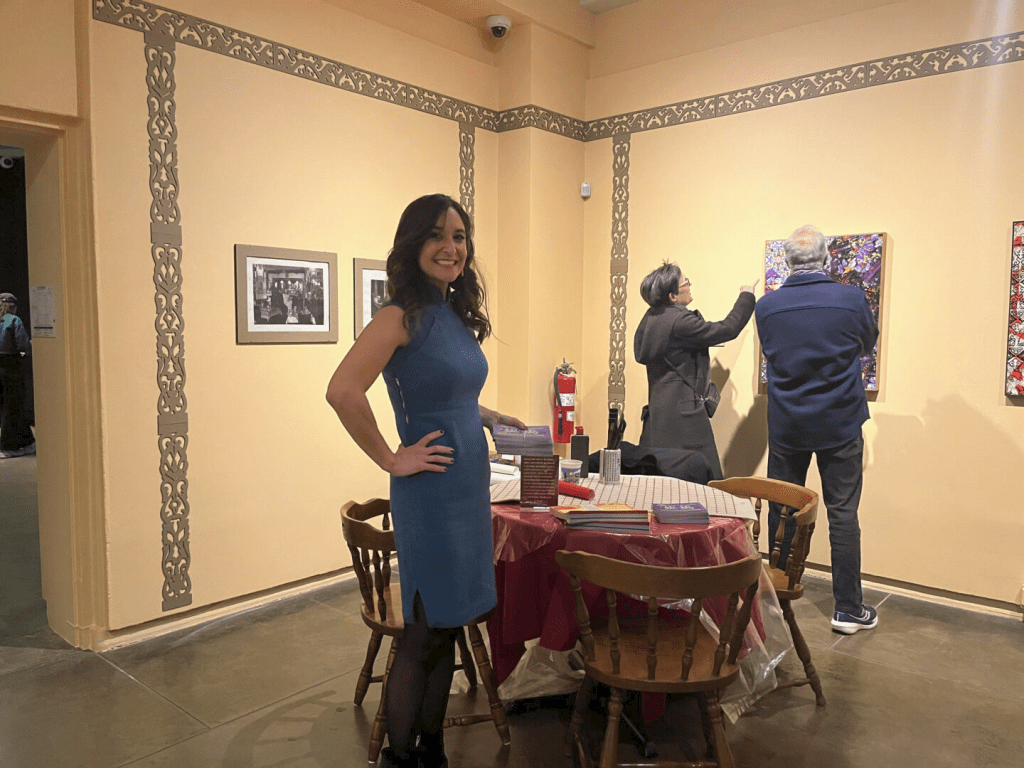
Jenny Lin during exhibition opening and reception | Photo by May S. Ruiz / Hey SoCal

Both curator and artist were active partners in choosing pieces that provoke discussion. Lin says, “Each artist is exhibiting one to three pieces/series but we made the selections together in extensive conversations. Featured artworks vary wildly in style, content, medium, and scale, with the exhibition encompassing a doormat, neon sign, prints, experimental videos, participatory documentary, large-scale projection, hybridized sculptures, and immersive installations. While vibrantly diverse, all these artworks closely relate to one another, and we’ve designed the exhibition to highlight those relations.”  

Below is a sampling of artists’ works.   

Patty Chang  / 張怡

Invocations and Que Sera Sera, 2013

Two channel video installation, 3 Minutes, 45 seconds
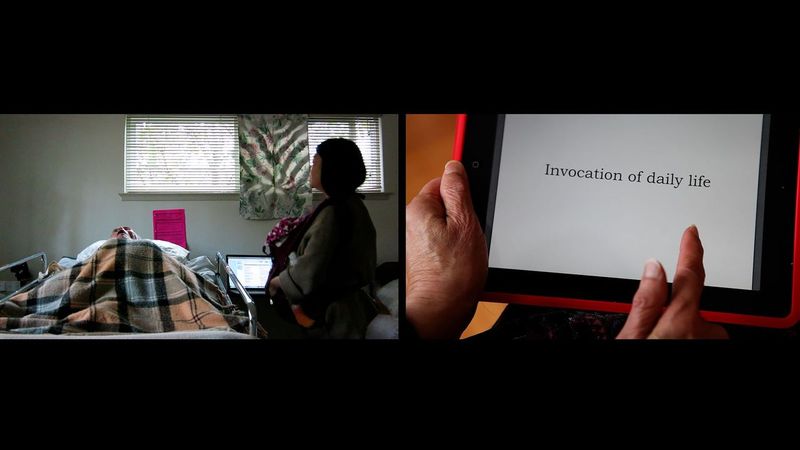
Patty Chang’s “Que Sera Sera” | Photo courtesy of USC Pacific Asia Museum

Que Sera Sera features the artist singing her newborn baby to sleep. Chang gently rocks to and fro, her baby strapped to her body in a carrier – baby whimpers at first, and a tiny foot protruding from the carrier rests on the artist’s hip. Beside them lies Chang’s father in a bed with side rails; he is dying, breathing, but nearly motionless. She sings to him too: “Que Sera Sera, What Will Be Will Be.”

As in Chang’s video, wherein we encounter three generations of family members at distinct life stages, Que Sera Sera covers childhood, growing up and falling in love, and having a child of one’s own. Throughout the song, the narrator – the singer’s parent or singer-as-parent – tenderly responds to questions of what will be: “Will we have rainbows day after day? The Future’s Not Ours To See.” Both artwork and song urge us to be patient and present. With sorrow and joy, Chang inhabits a moment of intimacy with her baby and father, one drifting to sleep, the other drifting toward death.

Written by US composers Jay Livingston and Ray Evans, who often co-wrote songs for movies, “Que Sera Sera” became popularized by Doris Day, who belted the song as a secret signal to her kidnapped son, in Alfred Hitchcok’s 1955 film, The Man Who Knew Too Much. The song’s title, “Que Sera Sera,” which has since become a popular US phrase to express “what will be will  is grammatically incorrect in the languages it assimilates (in Spanish it would be “lo que será, será,” in Italian “quel che sarà sarà”), a reminder of the imperfections of translation and language acquisition. Yet even if imperfectly, we learn new languages – studying in schools, speaking the words of a place we have migrated to, learning the native tongues of our parents, or grandparents; Chang’s son now speaks with her mother, his grandmother, in pǔtōng huà.

In Invocations, we catch a glimpse of Chang’s baby being rolled up, in stroller, to his grandmother. She embraces her grandson, she in paisley trousers, he in striped onesie and green leggings. Baby cries; grandmother exclaims, “Jīntiān nǐ zěnme chǎo!” (Today you are so noisy!). In the rest of Invocations, we see Chang’s mother’s hands, holding and swiping through a list of invocations that appear on a tablet. Her voice, soothing and steady, reads in accented English: “Invocation of loss of balance / Invocation of falling / Invocation of motor control / Invocation of envy / Invocation of incontinence / Invocation of caregiving / Invocation of catheter / Invocation of daily life / Invocation of isolation / Invocation of shame / Invocation of guilt / Invocation of longing…” The list of invocations related to growing older, disease, medical treatments, desire, everyday life, and ideas, at once quotidian and dreamy, reads like a poem.

List of Invocations, 2017 Letterpress print

Echoed in a print, List of Invocations hangs nearby the video installation. Light grey text in a clinical font appears on white paper; the lightness of the words, as well as their structural repetition, mimics life’s fleeting nature. Chang’s invocations are practical, magical, ethical, and perhaps, ultimately futile, albeit still worthwhile, as all states, emotions, and things shall pass; “what will be will be.” Chang’s Invocations and Que Sera Sera stand as offerings of familial intimacies and vulnerabilities, tenderly reminding us of life’s cruel and beautiful cycles.

Jennifer Ling Datchuk  /

Love Yourself Long Time, 2019

Doormat

Jennifer Ling Datchuk’s ‘Love Yourself Longtime’ / Photo courtesy of USC Pacific Asia Museum

and

Love Yourself Long Time, 2021

Mirrored acrylic and neon

Love Yourself Long Time (2019) takes form in two artworks: a glowing custom-made neon, mirrored sign and a red doormat, nearly identical to those meant to be stepped on, elevated in the exhibition via the museological standard of placing art objects upon pedestals. The phrase, Love Yourself Long Time, illuminated in neon on the sign (with yourself lighting up letter by letter) and embossed in golden English letters and Chinese characters on the doormat, references a scene in director Stanley Kubrick’s 1987 film Full Metal Jacket, in which two US soldiers stationed in Vietnam negotiate with a Vietnamese sex worker, who advertises: “Me love you long time.”  Datchuk twists the line, which has circulated widely throughout American popular culture. Asserting agency, she turns the grammatically incorrect offer of the subjugated, exoticized sex worker into a positive affirmation encouraging self-love.

Two Week Wait, 2021

Porcelain, gold mirrored glass tiles, mirrored acrylic, candles

Two Week Wait (2021) is a sculpture reflecting on female health and safety, as well as the common Covid-19 quarantine period. Constructed like a shimmering alter with Chinoiserie, famille rose porcelain candlesticks stacked upon its steps, Two Week Wait acknowledges ways in which people in North America and Western Europe often look to Eastern symbols and rituals for spiritual fulfilment. Simultaneously, the artwork sparks varied emotions that may accompany pregnancy, shared across the globe: exuberance, joy, fear, terror, sorrow, trepidation, regret, excitement, anticipation.

The title, Two Week Wait, refers to the typical time of waiting between ovulation and menstruation, in other words the time it takes to confirm pregnancy. Women internationally, including in the United States and People’s Republic of China, have long struggled and continue struggling for bodily autonomy and reproductive rights.

(Jennifer Ling Datchuk will be giving an artist talk in the galleries with Ken Lum at PAM on Saturday, January 27 at 1pm)

Rania Ho / 颖宜

Roundabout, 2023

Single channel video, 14 Minutes, 29 seconds
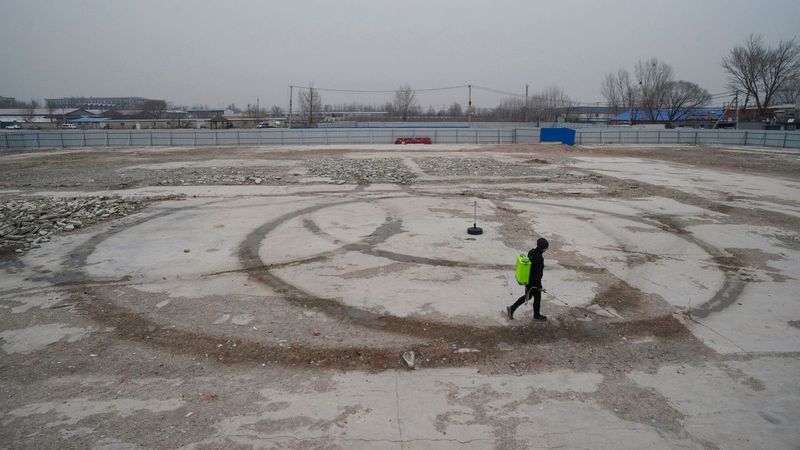
Rania Ho’s ‘Roundabout’ / Photo courtesy of USC Pacific Asia Museum

Roundabout features US-born, China and US-based artist Rania Ho walking in circles in a demolition site in her video projection. A fade-in technique makes the artist appear and disappear as she walks in large concentric circles, her body attached to string, stanchion, and ball bearing, creating a fulcrum point. As Ho steadily walks each circumference, she sprays the ground from a hose attached to a fluorescent green water pack she wears on her back. The spray emits a hum and leaves a ghostly residue that slowly begins evaporating over the course of the video. The gesture, along with Ho’s uniform-like black clothing and industrial hose, recalls decontamination processes used in China following the initial outbreak of Covid-19.

Those who live or have spent time in China may also be reminded of the poetic practice of people, usually elderly, writing calligraphy in water on the stone pathways of parks. For others, Ho’s overlapping circles resemble the logo of the Olympics, held in summer 2008 and winter 2022 in Beijing, where Ho made the video. As the artist describes in her writing about the piece, the demolition site, Luoge Zhuang Village of Shunyi District, used to be filled with artists’ studios (she herself had a studio on the outskirts of the village), which were hastily demolished in 2021, supposedly to make way for Olympics-related construction that never came to be.

The fixed camera surveys the demolition site, with its cracked surface and rubble, below a smoggy sky and deciduous trees, sans leaves. Ho’s body, dwarfed by the site and her circumambulation – at once like a Buddhist ritual and Sisyphean task – persist on infinite loop, a quiet mourning for the fallen studios on the outskirts of Beijing.

You Kinda Had to Be There (Motel Cali), 2005/2023

Single channel video, 6 minutes, 30 seconds, edited from 24 hours

Visitors encounter a very different, comical, high-spirited representation of Beijing’s art scene in the mid-aughts in Ho’s You Kinda Had To Be There (2023). This project, tucked behind a curtain, consists of a karaoke-inspired video installation with a shimmering tinsel backdrop, headphones, and microphones for museum goers who fancy singing along. The video features artists singing or performing in various ways The Eagle’s “Hotel California,” a common karaoke song that most all of us love to hate. Ho created this 6 minute, 30 second video (the duration of the actual song) by editing footage of a 24-hour participatory event she organized in 2005. For the original event, part of Complete Art Experience Project (CAEP/联合现场地计划), a city-wide art initiative in Beijing, Ho invited artists and other community members to sing “Hotel California.”

The creative, offkey renditions by many of Beijing’s most active artists of the day collectively compose a kind of time capsule of a free reeling art world, set amidst the frenetic pace of intense urban development. Ho’s moving images of artist friends, goofing off and singing “Hotel California,” especially when juxtaposed against the solitude of her post-Covid-19 Roundabout, wherein the only other creature to appear is a dog we later hear barking, stresses the vitality of friendship, chosen family, and playful communal gatherings.

(Rania Ho will be giving an artist talk with Simon Leung at PAM on Wednesday, April 3 at 6pm)

Andrew Thomas Huang /黃卓寧

Kiss of the Rabbit God, 2019

Single channel video, 14 minutes, 29 seconds

and

Rabbit God Statue, 2019

Mixed media with adornments by Tanya Melendez
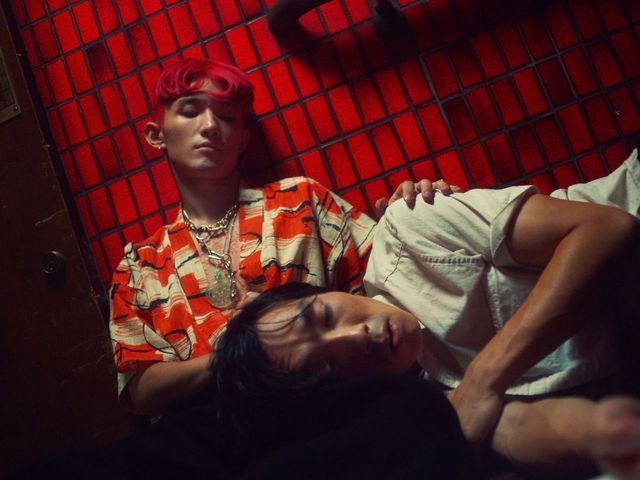
Andrew Thomas Huang’s ‘Kiss of the Rabbit God’ / Photo courtesy of USC Pacific Asia Museum

Kiss of the Rabbit God is a fairy tale of queer love. The protagonist, a young Chinese American man named Matt, played by actor Teddy Lee, feels trapped working in his parents’ Chinese restaurant (filmed on location in LA’s Chinatown), until he meets the deity, Tu’er Shen (Rabbit God), in human form, played by actor Jeff Chen.

The two young men embark on a loving, celestial sequence that allows Matt to embrace his gay identity through self-discovery and by entering into a mystical Chinese legend. Accompanying Huang’s short film stands Huang’s Rabbit God Statue, which the artist recently showed in another exhibition of Kiss of the Rabbit God in Hong Kong. Kiss of the Rabbit God’s setting nods to Huang’s own family’s 40-year history running a Cantonese restaurant in southern California.

Vivian Wenli Lin / 林雯莉

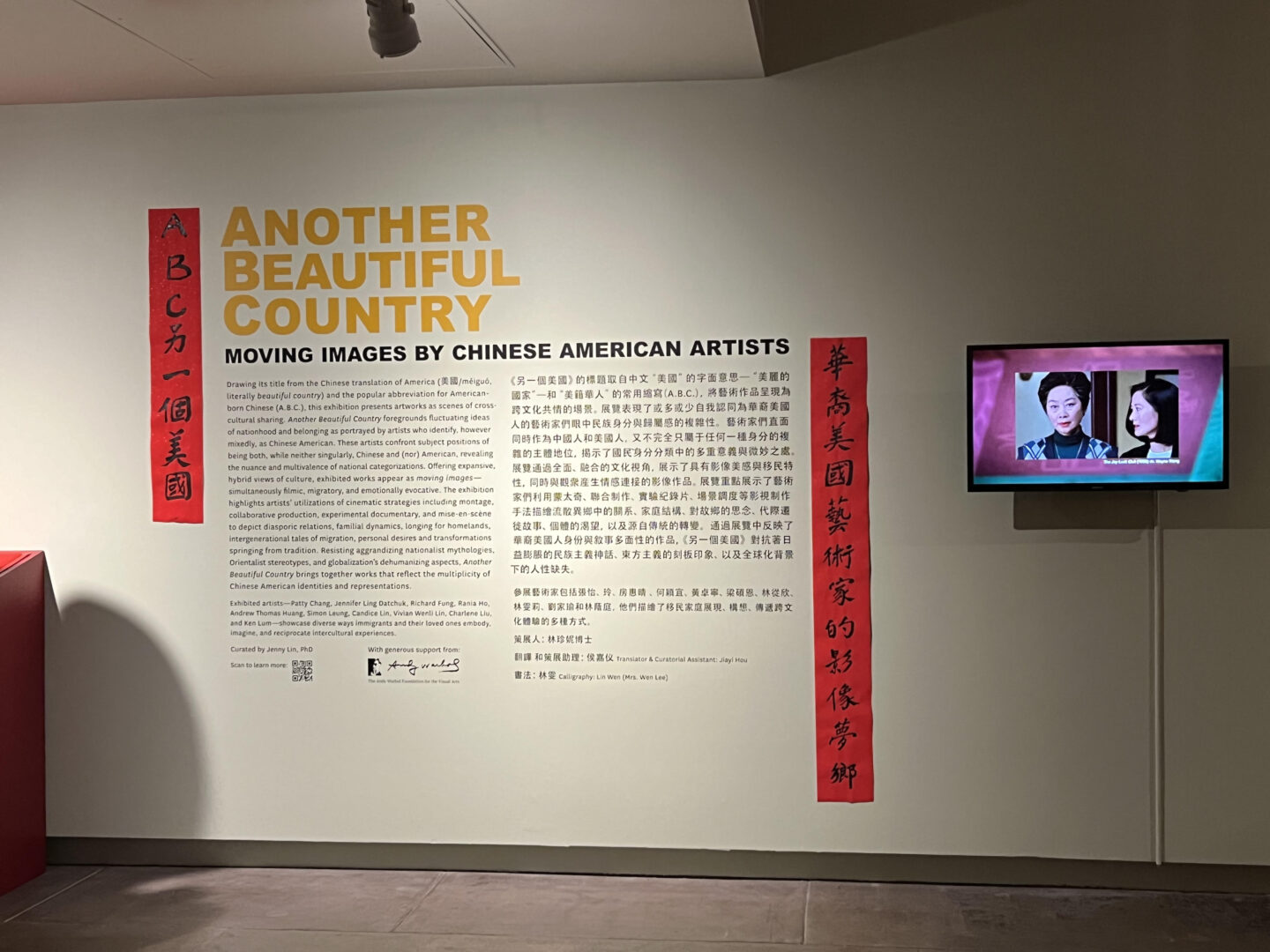
The Joy Luck Mom Club: Untold Narratives of Migration, 2023

Single channel video, 10 minutes
This image has an empty alt attribute; its file name is ABC-at-PAM-installation-with-Joy-Luck-Club-1440x1080.jpg

Vivian Wenli Lin’s “The Joy Luck Club: Untold Narratives of Migration | Photo by May S. Ruiz / Hey SoCal

The Joy Luck Mom Club: Untold Narratives of Migration is a mixed-methods participatory, interview and observation-based video project. In turning to lost and untold narratives of migration that have been kept silent or hidden away, Lin centers the diasporic identities that were excluded in mainstream representations of the immigrant narrative.

Inspired by the film The Joy Luck Club (1994) based on the novel by Amy Tan and directed by Wayne Wang – a film considered to be a dominant representation of the Asian American immigration narrative, the project attempts to contribute to the untold/unheard/silenced and forgotten narratives of women’s migration. Immigrant stories are often centered on generational trauma as a result of the self-sacrificing Asian mother.

The narratives shared via The Joy Luck Mom Club: Untold Narratives of Migration attempt to decenter the “Asian American” immigration story, through the use of participatory media making methods, to gather transnational stories between Asia/America, blurring the lines between how these histories of migration can be remembered as fact or fiction, memory or truth. Lin offers an opportunity for museum visitors to share their own “joy luck mom club” moments; a flier with QR code and instructions is available near the video.

(Vivian Wenli Lin will be holding a related workshop, “The Joy Luck Mom Club – Participatory Video,” on Saturday, March 23 from 11:30am-2pm)

Ken Lum  /林蔭庭

Coming Soon, 2009/2023

C-print reproduced on vinyl

Ken Lum’s ‘Coming Soon’ / Photo courtesy of USC Pacific Asia Museum

The print, facing outward from a museum window, resembles a family photograph of a mixed-race European-Asian couple and their biracial daughter. This picture of a seemingly benign nuclear family, paired with the text Coming Soon in both English and Chinese characters, resembles an advertisement for a Hollywood movie or global fashion brand, though without slick styling or airbrushed perfection. The image counters historical anti-miscegenation laws and parodies superficial corporate diversity campaigns. Simultaneously, for those in the know,

Coming Soon reminds us of the ability of images to deceive and the importance of questioning our assumptions; Lum divulged to me that the people in the photograph are not in fact a family, but three strangers the artist met in Beijing.

 (Ken Lum will be giving an artist talk in the galleries with Jennifer Ling Datchuk at PAM on Saturday, January 27 at 1pm)

Lin has consciously and mindfully put together an extraordinary show. Another Beautiful Country is an impressive collection of thought-provoking artwork that invites a response and reaction from its audience.

She expresses magnificently what she wishes the exhibition engenders. “I hope people will spend time with each artwork, absorbing the multivalent presentations of Chinese American experiences and identities, which collectively unravel grand historical narratives, nationalist myths, and essentializing stereotypes. I hope people visiting the exhibition will come away with admiration for these artists’ fantastic works and the unique, nuanced ways they portray Chinese American relations. Ultimately, I hope the exhibition will inspire visitors to reflect on their own familial stories of migration and imagine belonging in another beautiful country, a place where generous, cross-cultural relations flourish.”  
Chinese Printmaking Exhibition at USC PAM Shines Light on Undervalued Art Form

Also published on 8 August 2023 on Hey SoCal

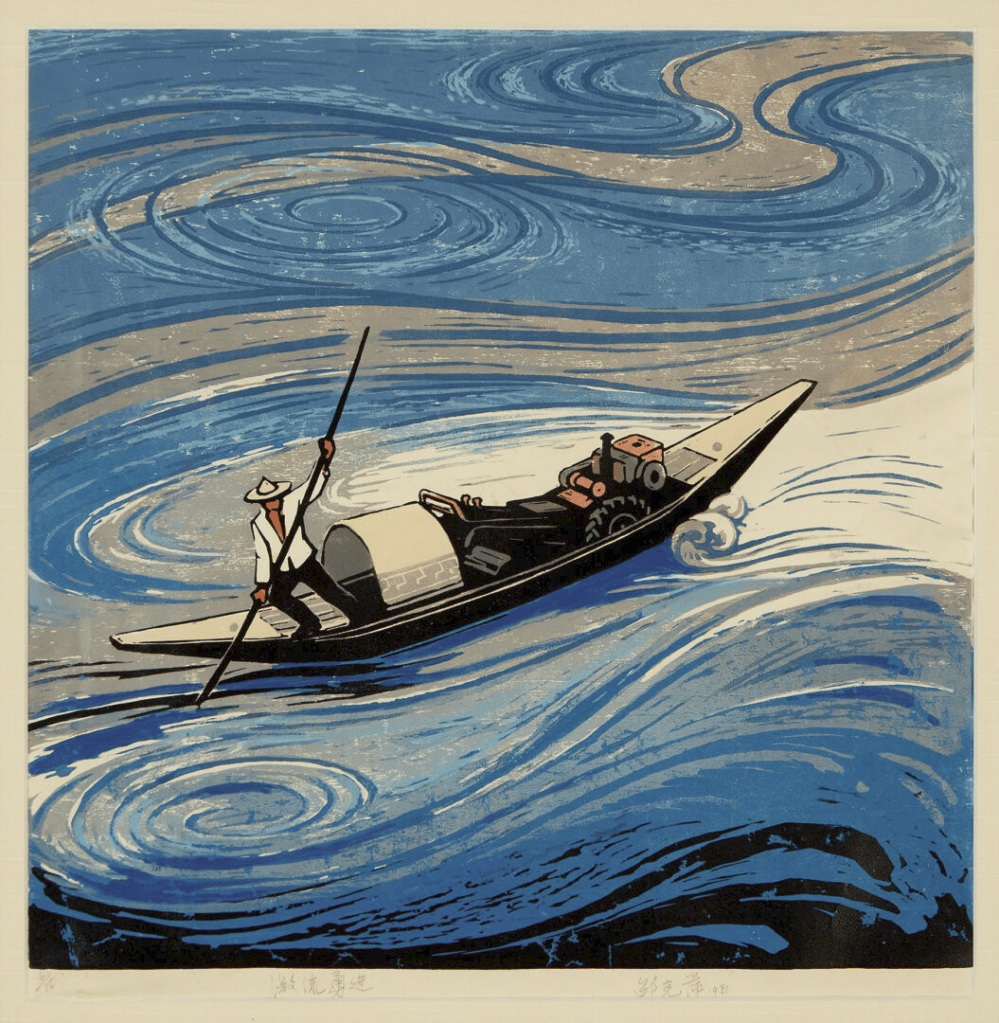
Shao Keping’s “Floating to the Future” 1981 Woodcut print | Photo courtesy of USC Pacific Asia Museum

USC Pacific Asia Museum (USC PAM) continues its mission and vision to further intercultural understanding through the arts of Asia and the Pacific Islands with Imprinting in Time: Chinese Printmaking at the Beginning of a New Era. On view from August 11 through November 12, 2023, the exhibition looks at printmaking by Chinese artists from the 1980s to the present and analyzes the unique narrative of the medium within the contexts of cultural, academic, sociopolitical, and economic changes in recent Chinese history.

Imprinting in Time is curated by Danielle Shang, a Los Angeles based art historian and exhibition organizer. Her research focuses on the impact of globalization, urban renewal, social change, and class restructuring on art-making and the narrative of art history.

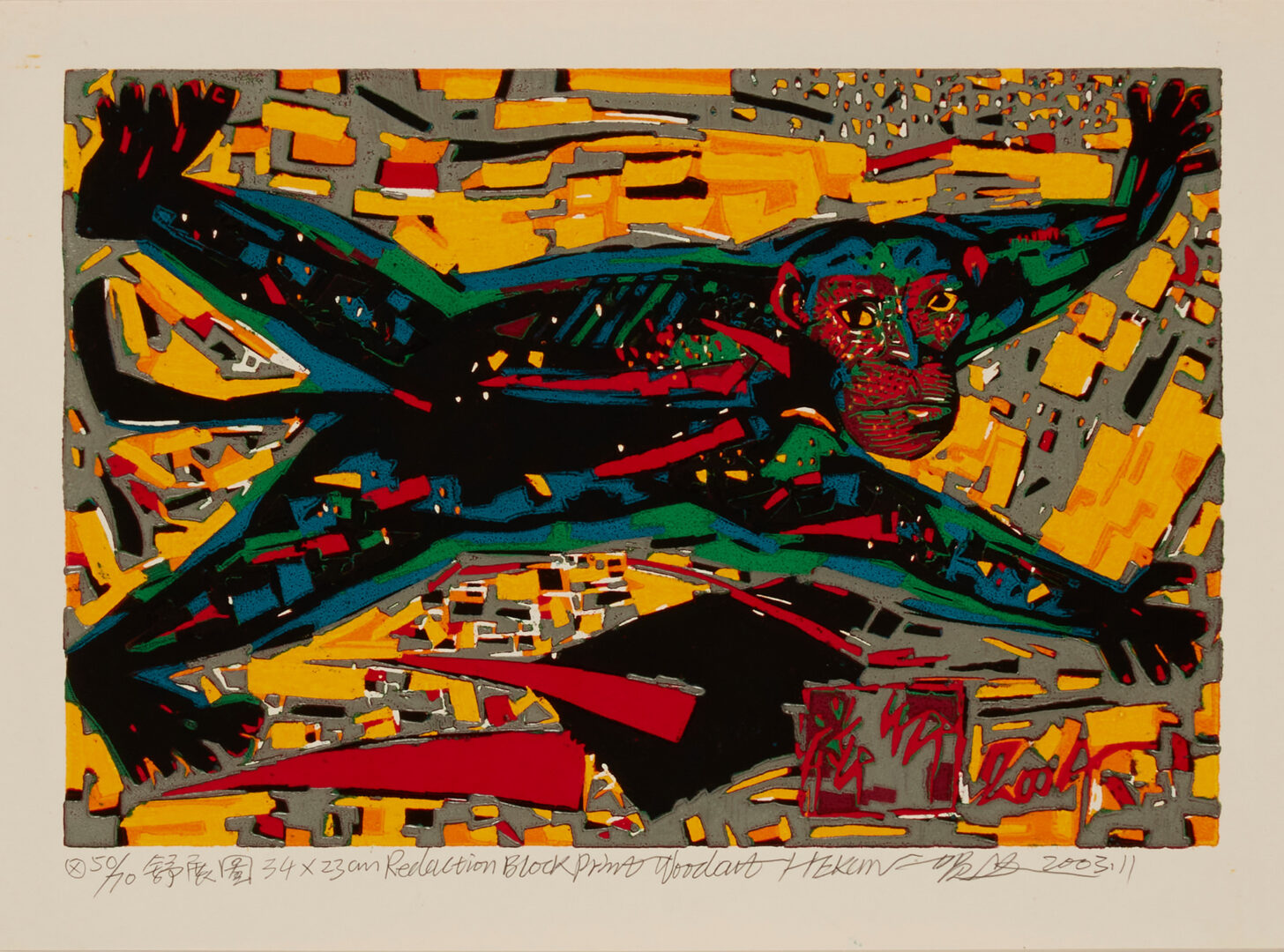
He Kun’s “Stretch” 2003 Reduction woodcut print | Courtesy Photo / USC Pacific Asia Museum

Woodcut originated in China, dating as far back as the Han Dynasty (206 B.C. to 220 A.D). The first woodblock fragments were of silk printed with flowers in three colors. Much later – in the early 20th century – it became a popular art form used by Chinese progressives to advocate for social change. The New Woodcut Movement hit its stride in China from 1912 through 1949.

In an article about the history of the movement (From New Woodcut to the No Name Group: Resistance, Medium and Message in 20th Century China) New York-based artist Chang Yuchen wrote that Lu Xun was probably the most significant among these activists. He established the Morning Flower Society in 1929, which published journals that introduced foreign literature and art to Chinese audiences. Two of the volumes were dedicated to modern woodcuts – considered by Lu Xun as the most accessible and efficient means for disseminating revolutionary ideas among the masses.

The Communist Party became a powerful force during the Sino-Japanese War and Mao Zedong exerted his authority. He delivered a famous speech at the Yan’an Conference on Literature and Arts in May 1942, where he declared “Literature and art are subordinate to politics, but in their turn exert a great influence on politics” and quoted a poem by Lu Xun to support that view. Following his speech, progressive artists and writers moved to Yan’an to produce art that responded to Mao’s call. What began as a pursuit of communication, however, was reduced to serving as the Communist Party’s marketing tool.               

In 1979, the Ministry of Culture restored the party memberships of artists who had been sent to labor camps and persecuted during the Cultural Revolution. One of these was Jiang Feng, who played a crucial role in the New Woodcut Movement. He was appointed director of the Central Academy of Fine Arts, and later as chairman of the reconstituted Chinese Artists Association.

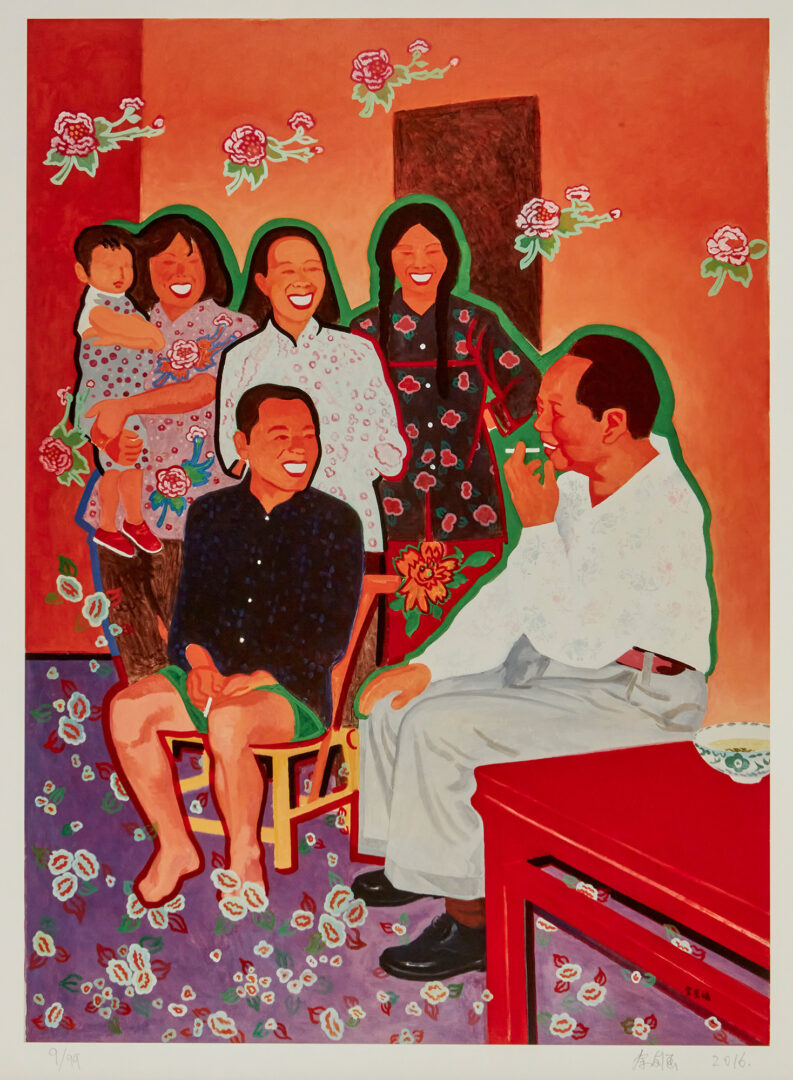
Yu Youhan’s “Chairman Mao in Discussion with the Peasants of Shaoshan” 2006 lithograph | Courtesy Photo / USC Pacific Asia Museum

Another suspected ‘rightist’ – Liu Xun – was released from incarceration and named head of the Beijing Municipal Artists Association. When he learned about the group of plein air painters – who later became known as the No Name Group – who managed to work under such impossible conditions, Liu Xun organized an official exhibition of their work. More than 2,700 people came to the show on the first day.

However, without the hostile conditions that kept them united in their art, the No Name Group slowly drifted apart. Some of them immigrated to other countries and some stopped painting altogether. Those who continued painting – and remained nameless – were resistant to the booming market for Chinese contemporary art just as they refused to go along with politics. 

The emergence of etching, lithograph, silkscreen, and digital devices in the 1980s added new energy to the medium. Most artists included in USC PAM’s exhibition were academically trained printmakers; however, a few have established their reputations in other media and explored printmaking as an additional aesthetic in their practices.

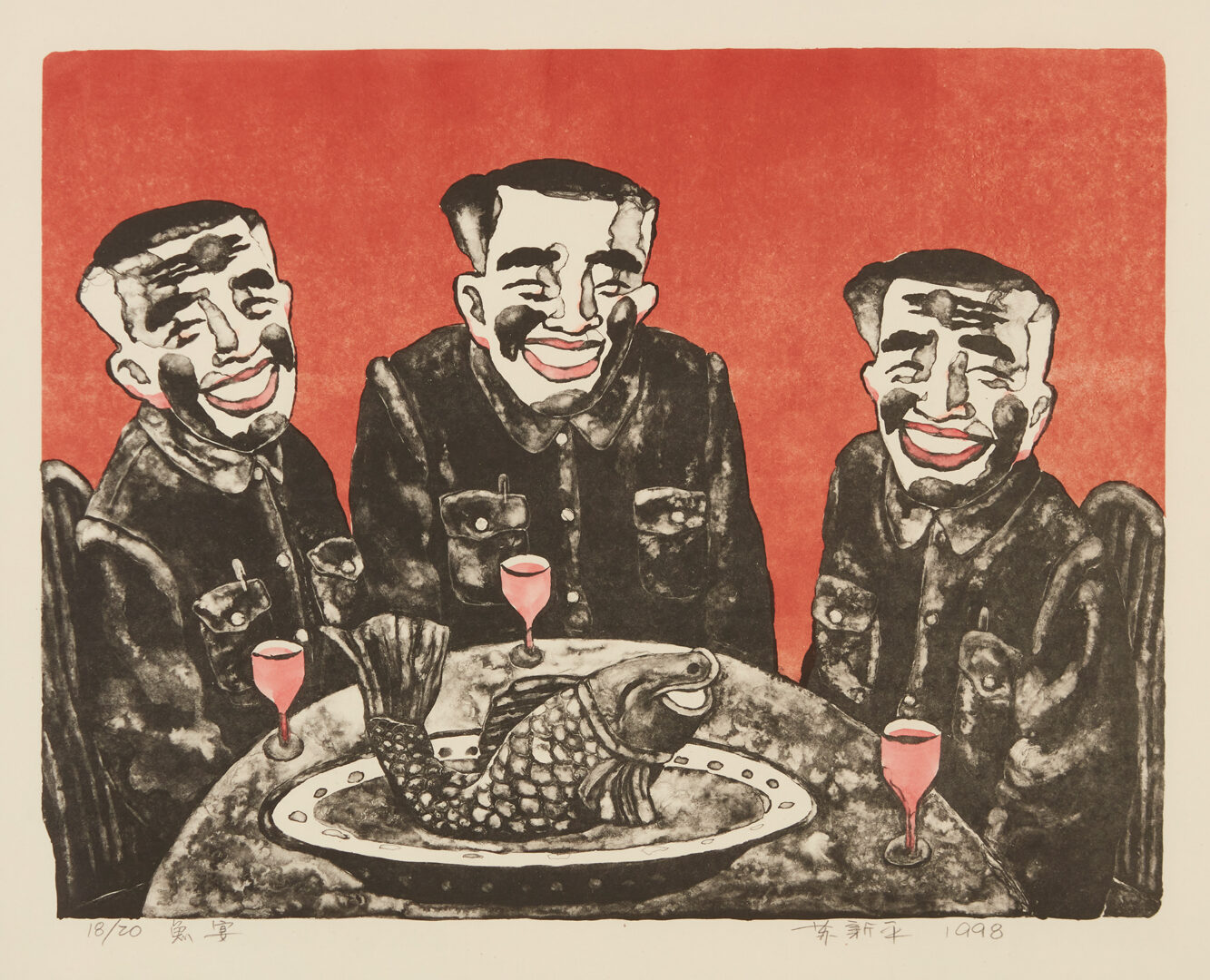
Su Xinping’s “Fish Feast” 1998 Lithograph | Courtesy Photo / USC Pacific Asia Museum

Museum curator Rebecca Hall states, “Imprinting in Time is an exciting exhibition for USC Pacific Asia Museum to share with the public because all but a few of the artworks in the exhibition come from the museum’s permanent collection. Formed around the recently donated Charles T. Townley collection of contemporary Chinese art, Danielle Shang did an outstanding job of teasing out the strengths of the Townley collection and finding further artworks to supplement her thesis in PAM’s permanent collection, some of which have not been exhibited in many years.”
“Printmaking, particularly woodcut, is uniquely important in modern Chinese history because it was instrumental for disseminating ideologies of the nation-state to the masses from the 1930s to the 1980s,” says Shang. “It is a perfect example of hybridizing a traditional Chinese medium that has been around for centuries with modernist techniques from the West.”
The exhibition will show 60 works organized into three sections: the Modern Woodcut Movement; the Post Mao Era; and Crisis and Hope Since the 1990s.

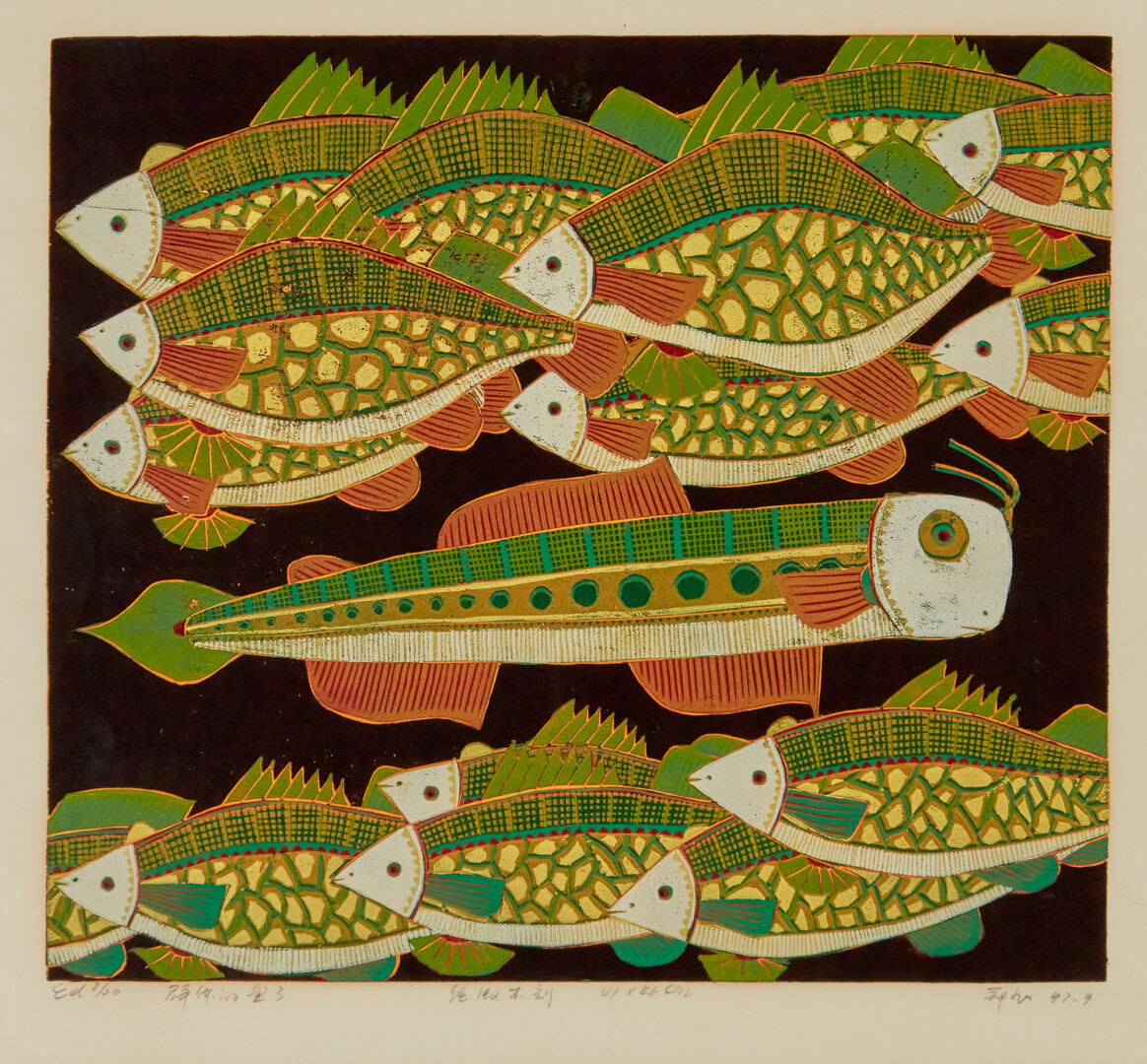
Zhen Xu’s “School of Fish 3” 1997 Woodcut print | Courtesy Photo / USC Pacific Asia Museum

Modern Woodcut Movement

Among all the printmaking techniques, the woodblock is most significant in modern Chinese history for articulating social commentary and nationalistic sentiments. The monumental figure who initiated the movement was not a visual artist but the writer, collector, and activist Lu Xun (1881-1936). In the early 1930s, Lu introduced Käthe Kollwitz’s woodcut to Chinese artists, who immediately embraced the medium for its effectiveness in engaging a broad public. These artists began to produce prints with simplified but highly suggestive forms and figures to depict the violence, injustice, and angst that plagued Chinese society.

After Mao Zedong’s speech at the Yan’an Forum on Literature and Art (1942), woodcut was given singular priority, and its subjects shifted from social critiques to celebrating the bright new life under Communist control. Subsequently, the woodcut printmaking that hybridized German Expressionism, Soviet Social Realism, Chinese traditional water-based printing techniques, and folk arts’ vernacular styles was established as a major discipline in all art schools and employed largely for propaganda purposes to serve the state after the creation of the People’s Republic of China in 1949.

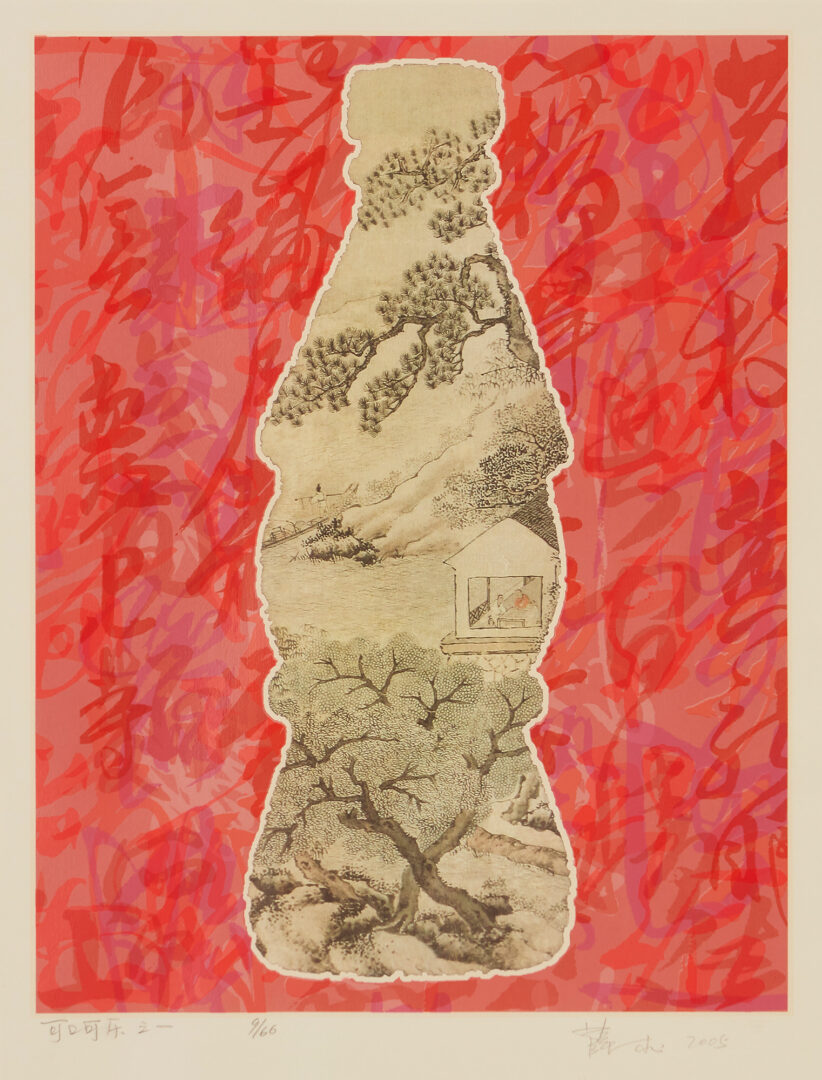
Xue Song’s “Coca Cola” (9/66) 2005 Serigraph | Courtesy Photo / USC Pacific Asia Museum

Post Mao Era

After 1976, while many artists continued to produce works that celebrated the socialist vision of modernity, others began to explore the notion of individuality and new graphic effects. The rise of etching, lithograph, silkscreen, and digital devices added new energy to the medium. Meanwhile, distinct regional schools emerged, notably the Great Northern Wilderness and the Yunnan School.

Contrary to earlier times when human figures and narrative themes dominated printed pictures, landscapes, and abstract compositions became popular. Some artists intentionally evoked the traditional Chinese ideal of integrating calligraphy, painting, and poetry when combining images with texts.

Shang expounds on the regional schools, the art style, and the artists who emerged during this period.

“Since the late 1970s, artists in Yunnan Province, including Zheng Xu and He Kun, turned their attention to local ethnic groups, neighboring Southeast Asian cultures and the ancient Chinese technique known as heavy color painting 工笔重彩画 that emphasizes line drawing and bold colors. Figures depicted by the Yunnan School artists are flat, geometric, semi-abstracted, and energized with bright colors, reminiscent of cubism and fauvism. Motifs incorporated into their works are derived not only from ancient Buddhist cave paintings but also from local traditional garments and decorations.”

“In the 1980s, Zheng and He among other printmakers in Yunnan began to create reduction woodcuts to produce heavy color prints,” Shang adds. “A color reduction woodcut is simply a relief print that is carved, inked, and printed multiple times using only one piece of woodblock. The entire edition must be printed at once since carving destroys the wood incrementally.

“The artists also established several workshops in the region to invite people from rural communities to make art, positioning printmaking at the intersections of arts practice, social engagement, and cultural restoration.”

Men were the dominant figures in this art form. Shang reveals, “Very few female artists were active in the history of Chinese printmaking. One extraordinary exception is Chen Haiyan (b. 1955, China), who, in her cycle of DREAM, developed a distinct style charged with raw, idiosyncratic, and expressive energy. The series narrates 20 of the artist’s dreams in monochrome woodcuts, integrating texts into images. The technique she employs to make the prints is known as touyin 透印 or ‘penetrating print.’ First, ink is rolled onto the wood block where a sheet of paper is smoothed on top. The next step is to burnish the paper with a spoon, rubbing until the ink soaks all the way through. Unlike other printing techniques, which create mirror images, touyin can be viewed from the front and the back – eliminating the need for the artist to make a preliminary, reversed design for carving. Thus, the artist’s ideas and emotions are conveyed directly to the woodblock without an intermediary step, affording her the spontaneity that attracts the viewer’s attention. She currently teaches at the China Academy of Fine Arts in Hangzhou.”

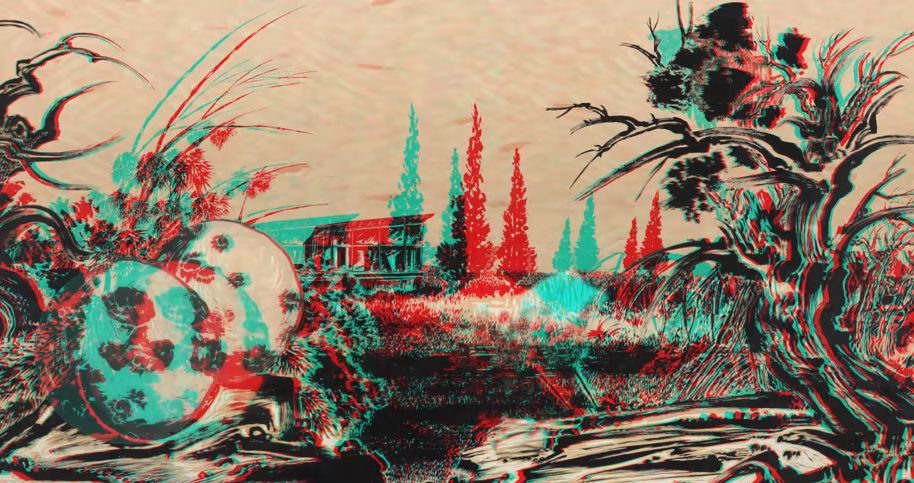
Sun Xun’s “Time Spy” 2016 3D Animation | Courtesy Photo / USC Pacific Asia Museum

Crisis and Hope Since the 1990s

The 1990s saw China’s rapid transformation into a hyper-consumer society. As works of art entered the market as commodities, prints failed to gain recognition as valuable cultural products. To survive, printmakers had to switch to other media, teach, or hold positions at state-sponsored cultural organizations, whose programs continued instructing conservative subjects and styles. In response to the new conditions, a few artists have moved beyond technical concerns to search for ways to advance the medium and participate in global conversations. Their practices shine a new light on printmaking.

It’s unfortunate that despite its fascinating ancestry and storied past, printmaking in China did not continue to flourish. This exhibition at USC Pacific Asia Museum may yet demonstrate that prints – which have since been relegated to being disposable merchandise – and printmaking can be rejuvenated through a fresh audience. At th

‘Off Kilter: Power and Pathos’ Exhibit on View at USC Pacific Asia Museum

Originally published on 28 July 2022 on Hey SoCal

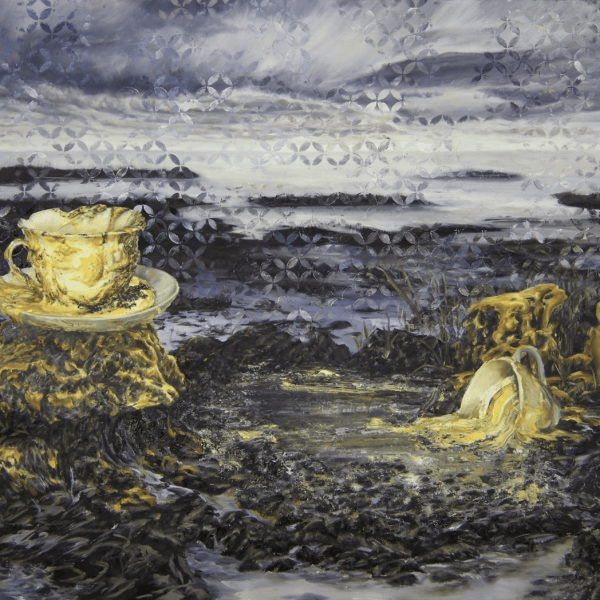
Sandra Low, A Very Civil Cheese, oil on canvas | Photo courtesy of the artist / USC Pacific Asia Museum

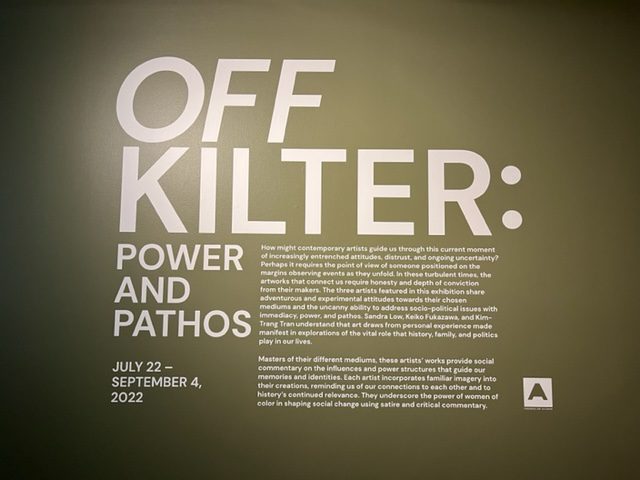
“Off Kilter: Power and Pathos,” on view from July 22 to Sept. 4 at the USC Pacific Asia Museum (USC PAM), features the works of Sandra Low, Keiko Fukazawa, and Kim-Trang Tran. The exhibition is the latest installation in the museum’s effort to provide a place where, through their work, diasporic Asian American artists can examine and address present-day concerns that affect our community.          

In her introduction to the exhibition, USC PAM Curator Rebecca Hall states, “How might contemporary artists guide us through this current moment of increasingly entrenched attitudes, distrust, and ongoing uncertainty? Perhaps it requires the point of view of someone positioned on the margins observing events as they unfold. In these turbulent times, the artworks that connect us require honesty and depth of conviction from their makers.

“The three artists featured in this exhibition share adventurous and experimental attitudes towards their chosen mediums and the uncanny ability to address socio-political issues with immediacy, power, and pathos. Sandra Low, Keiko Fukazawa, and T. Kim-Trang Tran understand that art draws from personal experience made manifest in explorations of the vital role that history, family, and politics play in our lives. 

‘Off Kilter: Power and Pathos’ installation entrance | Photo by May S. Ruiz / Hey SoCal

“Masters of their different mediums, these artists’ work provides social commentary on the influences and power structures that guide our memories and identities. Each artist incorporates familiar imagery into their creations, reminding viewers of our connections to each other and to history’s continued relevance. Using satire and critical commentary, they underscore the power of women of color in shaping social change.”

Hall explains during a press preview of the exhibition, “Those of you who are familiar with what I’ve been doing here as curator know that my ongoing work with contemporary Asian diasporic artists stems from my desire to focus on a very specific part in Asia, to bring it into L.A. and in the current moment – which has changed in the last couple of years – and to engage with the community (read about two previous exhibitions ‘We Are Here: Contemporary Art and Asian Voices in Los Angeles’ and ‘Intervention: Fresh Perspectives After 50 Years’). This started with an exhibition called ‘We Are Here’ which opened to great fanfare on March 13, 2020 only to be shut down because of the pandemic. We reopened it last year, aptly, during AAPI Heritage month.

“That exhibition highlighted seven Asian American female artists who lived and worked in Los Angeles. It was at that time that I met both Sandra and Kim-Trang but I wasn’t able to include their work on that show because of our limited space. I was so impressed with both that I wanted to make sure I brought them into the galleries. In fact, Kim-Trang was supposed to exhibit in 2020 the piece that we now have in our galleries, so I’m thrilled to find a way to make that happen. It was a bit later that I met Keiko after she displayed a piece in our sister museum The Fisher Museum of Art.”

“As a curator working with contemporary artists, my interest is ‘How are we moving in this worldview now and how are they capturing this moment that we’re in,” Hall continues. “And I think these three artists are doing it differently – using assorted media and with various perspectives – and you’ll see that as you walk through their work.”

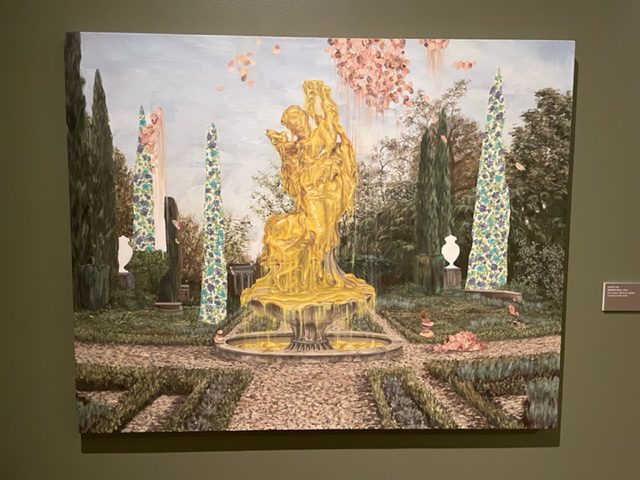
For the exhibition, Hall created wall labels that give background information on the artists and their works on display. The large canvases from Sandra Low’s ‘Cheesy Paintings’ series focus on the representation of kitschy subjects set within romantic landscapes. The central objects nearly disappear in a layer of oozing, dripping American cheese. With great attention to detail and a painterly eye, Low creates these paintings to call attention to the contrasting components of American life. On each canvas, viewers can relate to the seduction and illusion of prosperity; the desire to consume and the dangers of gluttony; and the way something familiar can seem completely novel when presented in an unexpected way.

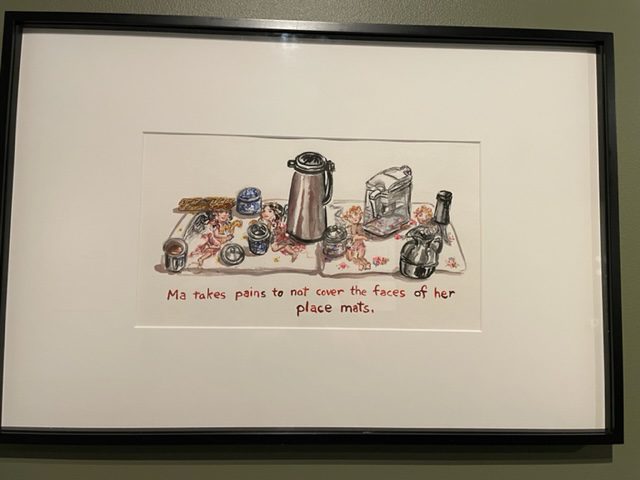
Low’s unique ability to merge the familiar with the unfamiliar while finding profound humor and warmth shines throughout her work. Her ‘Ma Stories’ chronicle cultural and generational differences through the illustration of her mother’s unique perspective of her daily world. Her ‘Pandemic Prints’ draw from a similarly uncanny ability to balance the personal with the poignant. Through all of these artworks, she reminds us that we can find humor and the absurd in even the darkest of moments, cutting through the drama of life and finding a sense of balance.

Sandra Low, Ma Stories | Photo by Brianna Chu / Hey SoCal

Hall reveals as we approach the artist’s displays, “I find Sandra’s work very compelling, but I also find it the most difficult to talk about because it’s so much about being a diasporic Chinese American woman. And I get it, but it’s not my place to talk about that and it’s not my voice that I should be using. But I can take on the role of sharing her work with everyone – and PAM has the space for that.  

“In my mind, Sandra is a stand-up comedian in a parallel world because of her way of using humor to talk about things. Two of her series have been ongoing for several years – ‘Ma Stories’ and ‘Cheesy Paintings’ – while ‘Pandemic Prints’ center on a specific period. Her ‘Ma Stories’ came from the disconnect she felt as an Asian American growing up in the San Gabriel Valley. She still lives with her mother, who has dementia, and that’s how she copes with it; she processes things through drawing, painting, and humor. This series records her day-to-day interaction with her mom. In fact, these pieces aren’t so much about art than they are about her relationship with her mother.”    

Indeed, when you look at the drawings and read the verbiage, you can imagine the artist reacting to what her mother did or said. The series – however absurd and comical the illustrations and captions are – is a child’s homage to a beloved mother. With the additional layer of her mother’s dementia, you sense that Low wants to preserve all the memories which her parent has lost. Each display is at once hilarious and heartbreaking.  

Sandra Low, Cheesy Paintings | Photo by Brianna Chu / Hey SoCal

About the next set of Low’s works, Hall says, “‘Cheesy Paintings’ pulls from the same experience  we see in her ‘Ma Stories.’ Cheese takes on different meanings to Sandra and she plays with the contrast of cheese dripping on the landscape.”

Anyone who has emigrated from Southeast Asia will tell you that several decades ago, dairy products like milk, butter, and cheese – daily staples in the U.S. and easily obtainable here – were rare commodities except for a privileged few. What a treat it must have been for Low’s mother who, until then perhaps, had only eaten Cheez Whiz and Velveeta – processed food which passed for cheese – to see so many varieties in the grocery store. Her mother’s reaction to the abundance of cheese made a huge impression and she memorialized that in a fantastically funny way.                                             

Sandra Low, Pandemic Prints | Photo by Brianna Chu / Hey SoCal

In ‘Pandemic Prints,’ Low uses household items. Hall relates, “We were all housebound during the pandemic so she used whatever objects were available, like doilies, to create these images and process what was going on; each print takes you to that moment. This one stands out for me – September 21, 2020: over 200,000 deaths from Covid-19 in the U.S., over 950,000 worldwide. She recorded what happened that day; they are universal and personal at the same time.”

The wall label for Keiko Fukazawa’s displays reads: Keiko Fukazawa believes that art “should define its era, reflect what we are living through, and challenge us to think and act with more awareness as we each shape the current and future world we live in.” Born and raised in Japan, Fukazawa has lived in the U.S. for nearly forty years. Her love of clay is evident in all of the work she creates. Fukazawa sees clay as a forceful medium that allows for boundary-breaking detail and artistry. She completed a multi-year artist residency in Jingdezhen, China from 2013 until 2015, an experience that further contextualized her longstanding interest in porcelain as a medium tied to Chinese culture and history. Her time in China also provided further insight into the unique connections between consumerism and control as they manifest in contemporary Chinese society, a theme seen in several of the works exhibited here.

As an artist raised in Japan now living in Southern California, Fukazawa has honed her perspective to question the role of perception and power in the world around us. By creating familiar objects in the exquisite and historically significant medium of porcelain, Fukazawa asks viewers to question the very systems in which we participate, pulling us into the detailed surfaces of her work and encouraging dialogue about our need to find common ground.

Keiko Fukazawa, Peacemaker Series | Photo by Brianna Chu / Hey SoCal

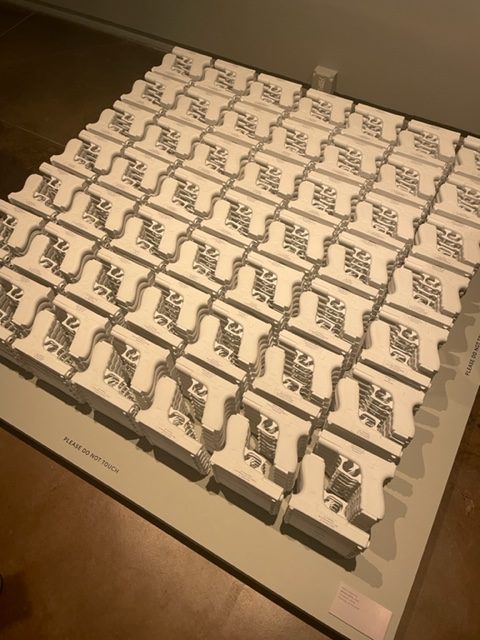
Hall describes as we reach the artist’s gallery, “This is Keiko’s ‘Peacemaker’ series. In ‘Seven Days,’ she selected seven days that had gun deaths – which includes suicide – and stacked guns which have the name and age of the person who died and where it occurred. Because I’m a curator, I think context is everything. And I think this is an important series in the way she visualizes gun violence so that there’s no way we can remain neutral on this issue. It’s new work for her and I’m excited that we could show it.”

The other part of Fukazawa’s ‘Peacemaker’ series shows the guns used in mass shootings with the state flower wrapped around the gun. The flower is a symbol of beauty, hope, and life while the gun represents violence, death, and sorrow.

Keiko Fukazawa, Circle of Friends | Photo by Brianna Chu / Hey SoCal

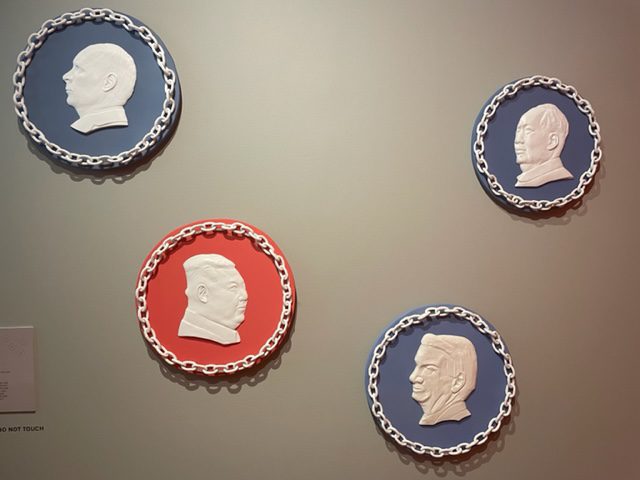
One display area is devoted to Fukazawa’s work with clay and ceramics, and her time in China. When one thinks of China, the image of Mao Zedong inevitably comes to mind and so she produced a piece called ‘Hello, Mao.’ She also made ‘Perception Plates’ and five of these pieces are in the exhibition. Another set of artworks is called ‘Circle of Friends’ – porcelain underglaze with profile images of reviled world leaders past and present – that Hall says was shown at Fisher Museum last fall, to which Fukazawa has since added The Philippines’s Rodrigo Duterte and Brazil’s Jair Bolsonaro.

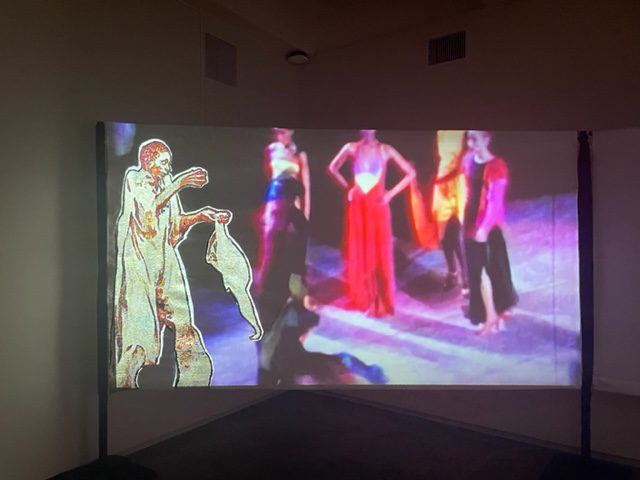
According to the display label for the third artist in this exhibition, Kim-Trang Tran creates multimedia artworks that question the way we perceive the world through our unique experiences and the ongoing influence of history and conflict on our lives. Tran’s experiences as a Vietnamese War refugee who immigrated to the United States at age 9 have been central to her body of work. ‘Movements: Battles and Solidarity’ is a large-scale three-channel video installation projected on handmade screens bearing images that explore the connections between women of color and their shared socio-political and physical “movements.” This installation links fashion, race, and class through intersecting images highlighting women as they challenge power structures and create autonomy.

The fashion industry’s roots in hegemony and both capitalist and cultural exploitation are like tendrils reaching through history and across the globe. Tran’s research into the subject of the global trade of cotton and its connections to colonization and war led her to focus on significant events between 1972–74 when the Civil Rights movement collided with high fashion, labor unrest in the garment industry, and the Vietnam War. The work explores shared political and physical “movements” made manifest in the catwalk, the run, and the march. Tran’s installation ‘Movements: Battles and Solidarity’ lays bare the interrelationship between women, diversity, production, and power and the continuing urgency of these subjects today.

Kim-Trang Tran, Movements: Battles and Solidarity | Photo by Brianna Chu / Hey SoCal

Hall informs that Tran’s inspiration for this was a book she read about a fashion show in Versailles in 1972 when the American prêt-à-porter competed against the French haute couture collection, “The Americans ran away with it because they had multi-ethnic models, disco music, and they were having great fun. This multi-media display captures that period from 1972 to 1974 – what was going on at that time and what fashion meant – but she makes it very relevant. And so she thought about the protest movement in textile factories in three different locations in the U.S. and all involved women.

“I feel it’s so empowering and so poignant in the way she portrayed labor, women, representation, and power. There are several layers to this artwork: the image on the left on the screen is embroidered and was made in Vietnam; then there’s a visual on how people treat women’s bodies. I also studied textiles and when I saw this for the first time, I had goosebumps on my arms and tears streaming down my face. I knew we had to have this.”

How fortuitous it is that Hall has made it her creed to advance the accomplishments of diasporic Asian Americans – ensuring that they are seen and heard. At a time when the population in Pasadena and Los Angeles is becoming ever more diverse, USC Pacific Asia Museum is leading the charge to connect us all.         

Bali exhibition at USC Pacific Asia Museum Showcases Island’s Culture

Originally published on 21 April 2022 on Hey SoCal

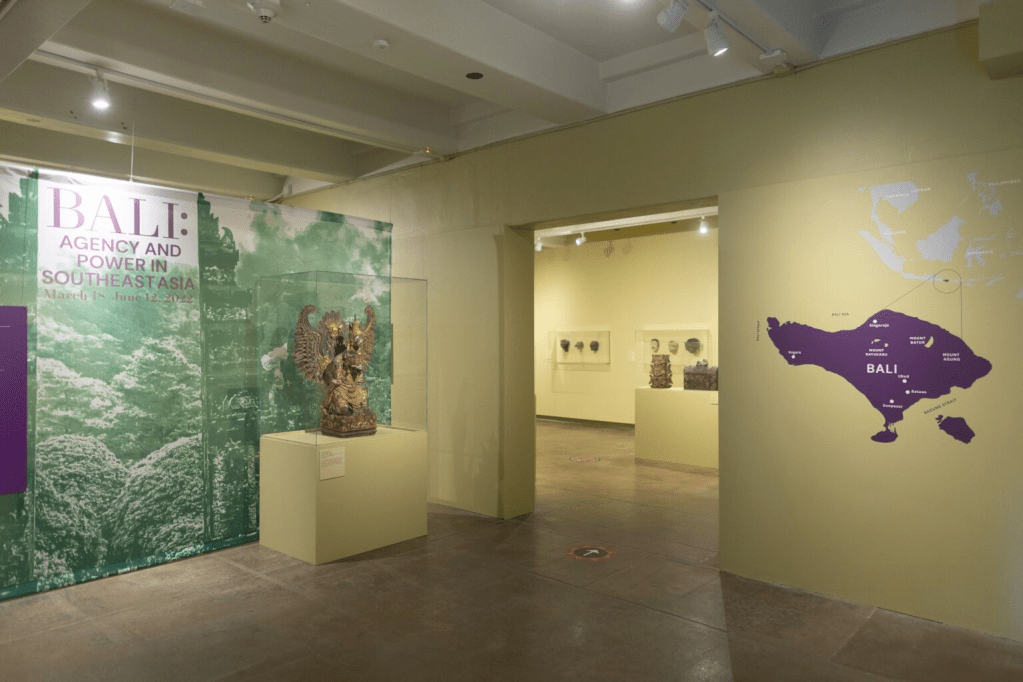
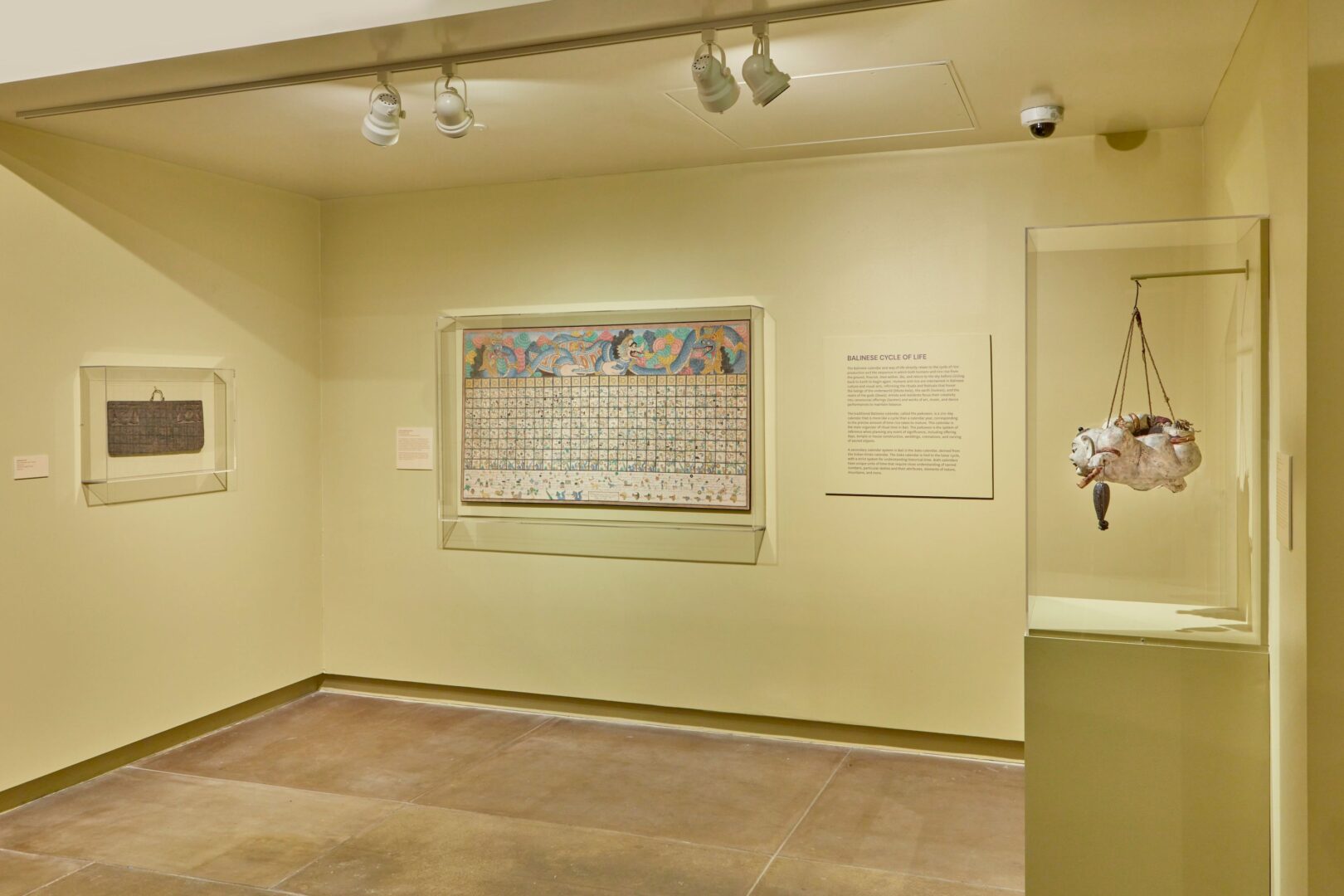
Bali Exhibition Installation View | Photo courtesy of USC Pacific Asia Museum

Even those who can’t name the countries that comprise Southeast Asia know Bali – one of the islands in the Indonesian archipelago. Tourists flock there lured by the island’s pristine beaches, beautiful sights, and tropical weather. They bring back a few souvenirs from their holiday and, perhaps, a painting created by a local artist. These paintings became popularly called ‘tourist art,’ named so because they appeal to western visitors.

The emergence of this new style which veered away from Balinese traditional pigment on cloth is the focus of an exhibition at USC Pacific Asia Museum (USC PAM). Titled ‘Bali: Agency and Power in Southeast Asia,’ currently on view through June 12, 2022, the show features paintings collected by Bali cultural anthropologists Gregory Bateson and Margaret Mead during their fieldwork on the island from 1936 to 1939.    

During a walkthrough of the exhibition, Rebecca Hall, USC PAM’s Senior Curator, talks about how the exhibition came about. “I learned that Dr. Robert Lemelson, an anthropologist, collector, and documentary filmmaker who lives in Los Angeles, has the collection of the Bateson and Mead paintings and he was interested in making these accessible to scholars and museums. We met in late 2019 and I had planned on having the exhibition a year later, but the pandemic started so we had to postpone the show. As disappointing as it was, that helped me think through how to present these materials because they’re unusual. It’s not just an exhibition about Bali but about this specific moment in time and the paintings that were created then.”

“There are 845 paintings and we’re showing 54 of them in this exhibition,” Hall reveals. “It’s exciting to be able to exhibit them for the first time in conjunction with the Balinese artwork and objects in USC PAM’s collection. There are two components that anchor the exhibition – classical Balinese objects that were made for use in Bali for Balinese audiences and the paintings  from this moment in time when artists were starting to create artworks for outsiders. They’re two very different collections which have never before been shown to the public.”

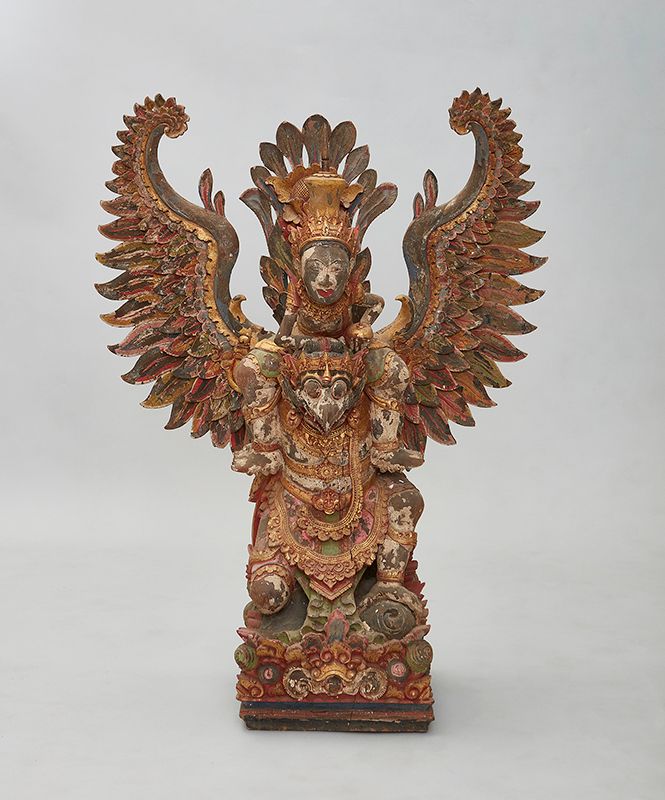
Vishnu riding Garuda / Photo courtesy of USC Pacific Asia Museum

Explains Hall, “Bali is one of the most famous places in Southeast Asia; the tourism industry has been a prominent part of Bali for a hundred years. And these paintings play an important role in understanding how the Balinese have adapted the artmaking that they do for outsiders to understand.”

To help orient people, the exhibition starts with a map showing the different cities in Bali. Visitors will very shortly come upon a wooden sculpture of Vishnu riding on his eagle Garuda, which was donated to the museum in 2020. Carved out of wood and brightly painted in pigment with gold leaf, Hall says it would have been in a temple or palace compound. It is a grand and dynamic Hindu image that people expect to see and makes for a very apt way to welcome us into the exhibition.

We then enter the first main gallery. Hall explains, “I designed this space with the idea of illustrating Balinese art and culture in an in-depth way to people who have no knowledge of and not necessarily familiar with the aesthetics of Bali and visual Balinese culture. Except for two items, everything on display here is from the USC PAM collection. One of the first objects we found was this umbilical cord holder. I’ve never seen one before – it’s really strange and unusual. In many cultures people are very protective of it because it’s this moment of life and it has power; they wrap it carefully and they wear it like an amulet around their neck. So I did some research and found out there’s one island in Bali where they put umbilical cords in containers and hang them from trees. I thought it was a good place to start because it’s the beginning of life.”

This part of the exhibition, according to Hall, is about how the Balinese understand the beginning of life, time, and the cycle of life – which is very different from the Chinese and Indian understanding. To them rice and life are synonymous. Hence, their calendar and way of life are directly tied to the cycle of rice production and the sequence in which both humans and rice rise from the ground, flourish, then wither, die, and return to the sky before circling back to Earth to begin again. Humans and rice are intertwined in Balinese culture and visual arts, informing the rituals and festivals that honor the beings of the underworld (bhuta kala), the earth (human), and the realm of the gods (Dewa). Artists and residents focus their creativity into ceremonial offerings (banten) and works of art, music, and dance performances to maintain balance.

The Balinese calendars and umbilical cord holder / Photo courtesy of USC Pacific Asia Museum

The traditional Balinese calendar, called the pakuwon, is a 210-day calendar that is more like a cycle than a calendar year, corresponding to the precise amount of time rice takes to mature. The pakuwon is the main organizer of ritual time in Bali; it is the system of reference when planning any event of significance, including offering days, temple or house construction, weddings, cremations, and carving of sacred objects.

A secondary calendar system in Bali is the saka, derived from the Indian Hindu calendar. It is tied to the lunar cycle, with a strict system for understanding historical time. Both calendars have unique units of time that require close understanding of sacred numbers, particular deities and their attributes, elements of nature, mountains, and more.

There are several different objects in this gallery and Hall connects them by explaining how they’re used. We see a storage box for jewelry and important items and on the same display table is an architectural column. The objects are very different but they have a shared aesthetic – the elaborate carving on wood.                                                                                                   

In another area, there are masks and items Balinese use for their performances. Hall explains that Bali is a Hindu island with a complex cosmology that manifests in a diverse cast of beings depicted in visual and performing arts. Some are characters from popular Hindu narratives that originated in India, including the Mahabharata and the Ramayana. Others are drawn from local Balinese stories and beliefs about nature and ancestors.

Hall further expounds that the importance of narratives in Balinese art and worldview cannot be overstated and can be seen throughout the art and architecture of the island. Numerous characters of opposing forces, such as the human and the mystical, the devilish and the benign, the noble and the peasant, the serious and the lighthearted, are all portrayed. The different faces of the characters – be they gruesome, threatening, peaceful, or elegant – serve to reinforce the Balinese understanding that the universe is constructed from opposing forces. They believe that to survive, a balance must be met between these conflicting dynamics.

In this gallery, we see two classic style paintings that show how the Balinese painted before the western influence and before they started to paint for outsiders. Hall elucidates, “A common misunderstanding about Balinese art, especially those made before the 1930s, is that non-elite people and their daily lives were rarely depicted. This is untrue. Some of the most lively and compelling works include ordinary Balinese people. This painting, for instance, is about a poor family – the woman has so many children to take care of so the man has to do all the housework.”

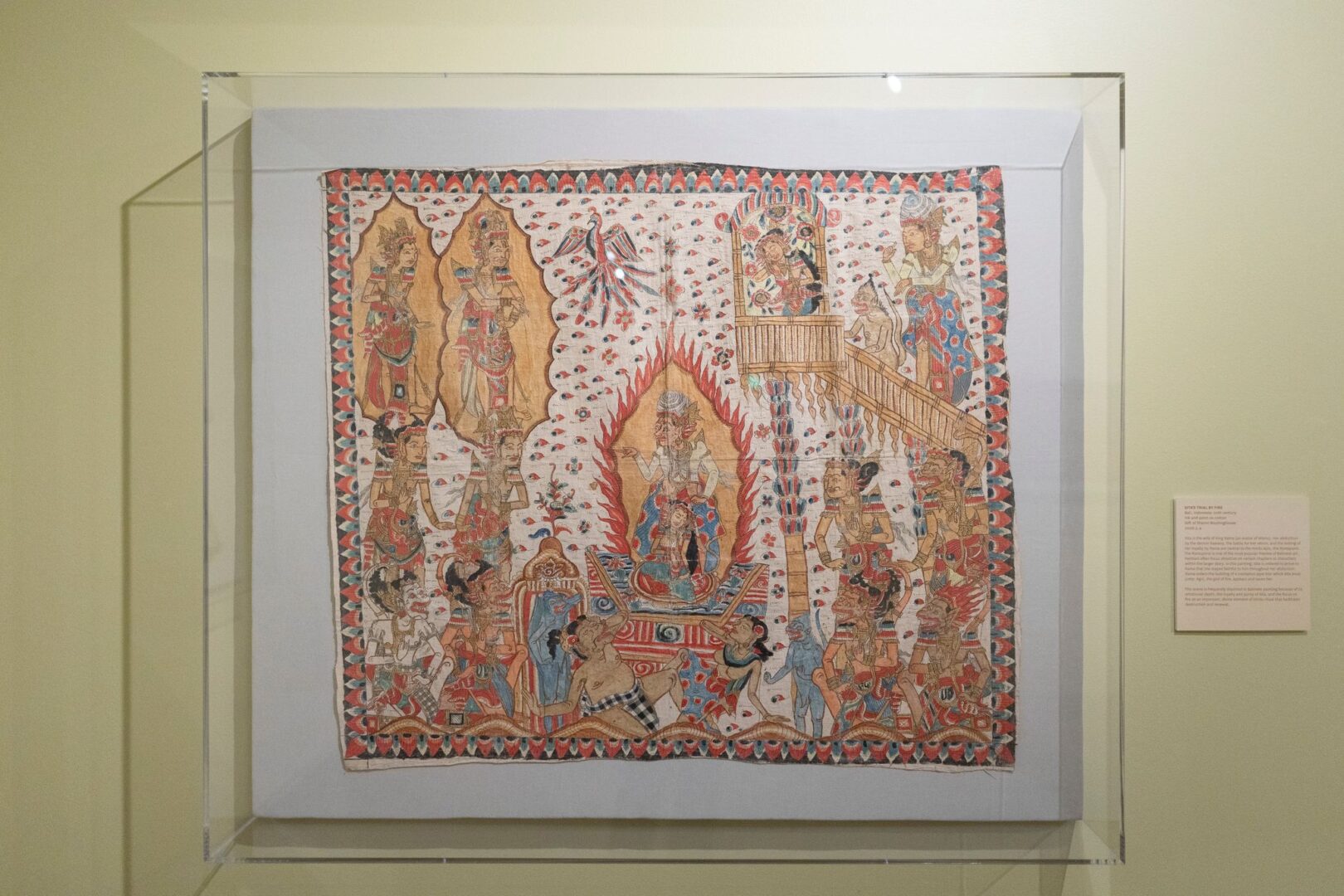
Sita in the Fire, pigment on cloth / Photo courtesy of USC Pacific Asia Museum

Another is a very popular painting that has been illustrated many times and that’s often thought of a classical artwork on cloth. It’s from the last days of the Ramayana where Rama’s wife Sita has to prove she’s been loyal to him by jumping into a cremation fire. In the scene she’s being saved by the goddess of fire.

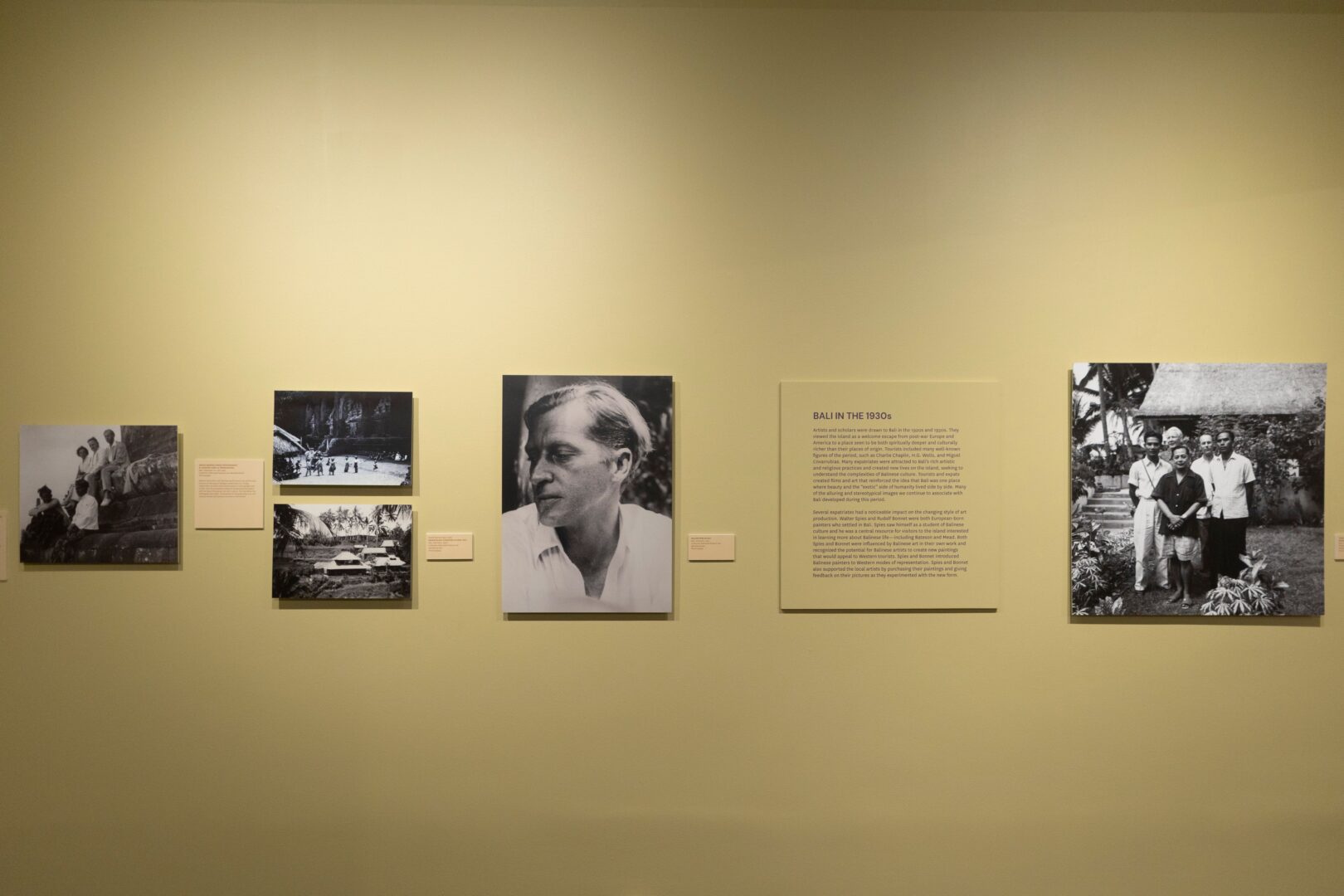
The next gallery gives us a view of how western influence – when Bali began attracting artists, scholars, and tourists in the 1920s and 1930s – changed Balinese art. Hall explains that Walter Spies and Rudolf Bonnet were both European-born painters who settled in Bali. Spies saw himself as a student of Balinese culture and he was a central resource for visitors to the island interested in learning more about Balinese life, including Bateson and Mead. Both Spies and Bonnet were influenced by Balinese art in their own work and recognized the potential for Balinese artists to create new paintings that would appeal to western tourists. They established an association of local artists called Pita Maha (The Great Light) where they could learn this new style.

Photos of Walter Spies and the local artists in Batuan / Photo courtesy of USC Pacific Asia Museum

While Spies and Bonnet introduced Balinese painters to Western modes of representation, they wanted the artists to find their own stories and ways of telling their lives in this new genre. Bateson and Mead, when they commissioned the artists, insisted that each artwork be an original idea and not a copy. Spies and Bonnet also supported the local artists by purchasing their paintings and giving feedback on their pictures as they experimented with the new form.

Hall points out, “The fact that Bateson and Mead had intended to just go to one village to do their research on development and childhood and schizophrenia, but that they were so fascinated by the paintings they did an entire second study was amazing. They were on the forefront of visual anthropology, study of images and incorporation of visual culture into anthropology. One of the things that was created on film was a 20-minute show of Balinese performances about what people see on the paintings.”

The third gallery shows the artists and the village of Batuan where all the paintings came from. This village was where they had shadow puppet-makers and performances and wasn’t necessarily known for paintings until the 1930s because of the locals’ work with Spies and Bonnet. And when Bateson and Mead paid for some 840 paintings to be made, there became a great interest in Batuan resulting in an influx of money. Batuan, to this day, is known for their paintings; the descendants of these painters continue to create artwork that collectors seek out.

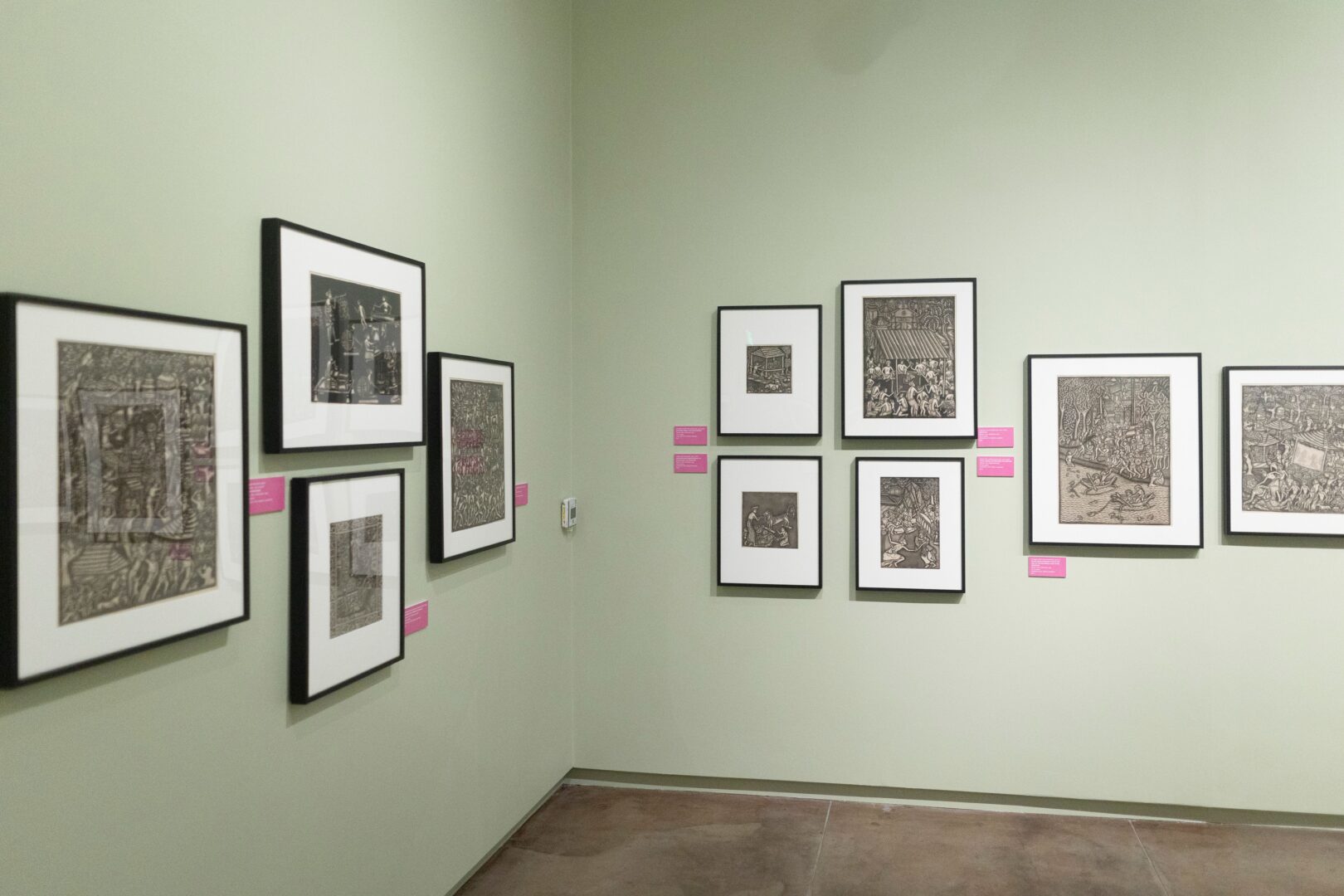
Bateson and Mead collection of paintings / Photo courtesy of USC Pacific Asia Museum

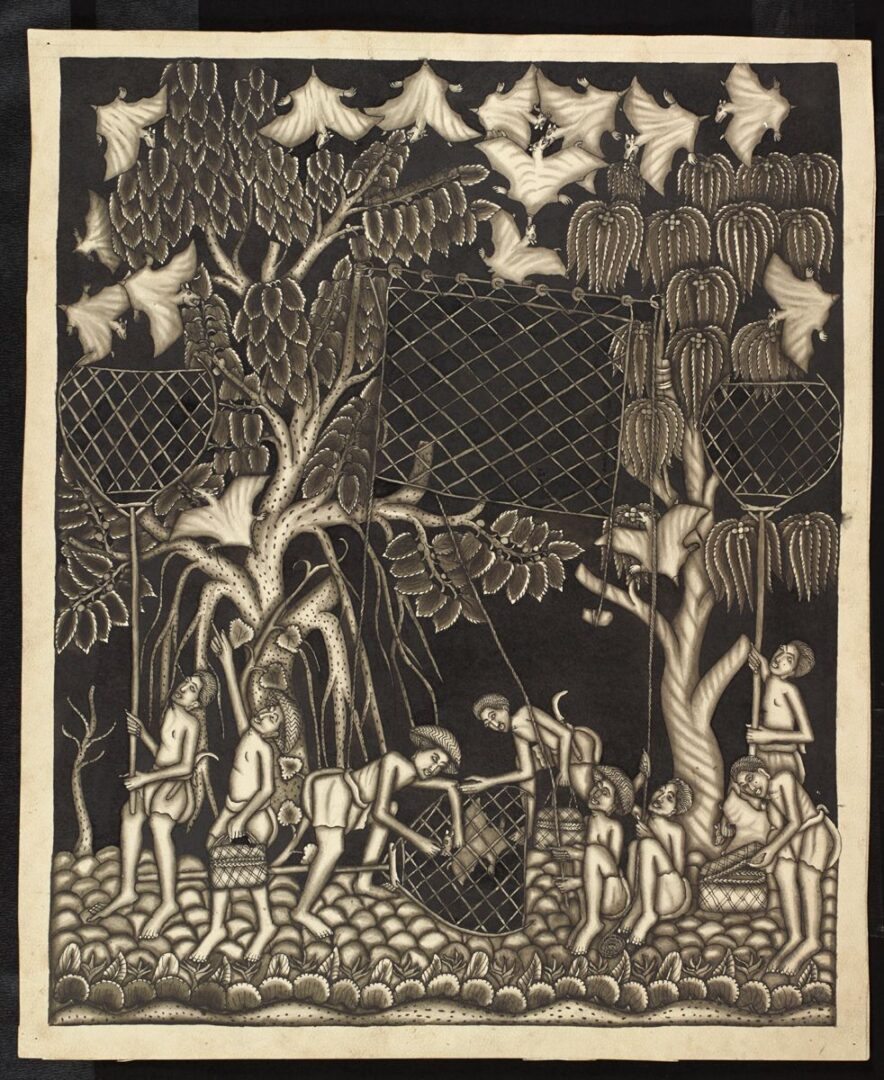
We then enter the gallery where 40 paintings from the Bateson and Mead collection are displayed. Hall states, “The paintings are all very different, they’re all very dense. I organized them into four categories. Village life paintings (in pink labels) show ceremonial procession, hunting for flying foxes, weaving, rituals for new rice, cremation ceremonies, dances – where you see a slice of village life at that time. ‘Popular tales and long-ago events, legends, and mythology’ (in yellow labels) are stories about what happened and why they happened the way they did. They exist outside the European mode of understanding history. How we describe it influences how people see it. The paintings show events the way people believed they did. ‘Stories of power and conflict’ (in purple labels) depict how power comes in many forms – political power, power of animals, power of sorcerers. The last one is ‘belief and the supernatural world’ (in orange labels).”

‘Catching flying foxes’ painting by Ida Bagus Wayan Gede / Photo courtesy of USC Pacific Asia Museum

There’s an iPad in the middle gallery which was created by Lemelson that visitors can watch if they want to learn about the cultural aspects of each painting. USC PAM also commissioned a video documentary for this exhibition. Hall says, “Rob Lemelson sent one of his documentary film makers to the village of Batuan to speak with some of the artists who were descended from and taught by artists whose works are in the exhibition – I Made Tubuh whose teacher/uncle was I Made Jata, Wayan Sundra whose teacher/grandfather was I Ketut Keteg, and Ida Bagus Ketut Panda whose teacher/father was Ida Bagus Made Togog. Additionally, he has some footage from 1997 when he went and interviewed the painters. Rob and his company, Elemental Productions, made this amazing documentary to fill out that narrative.”

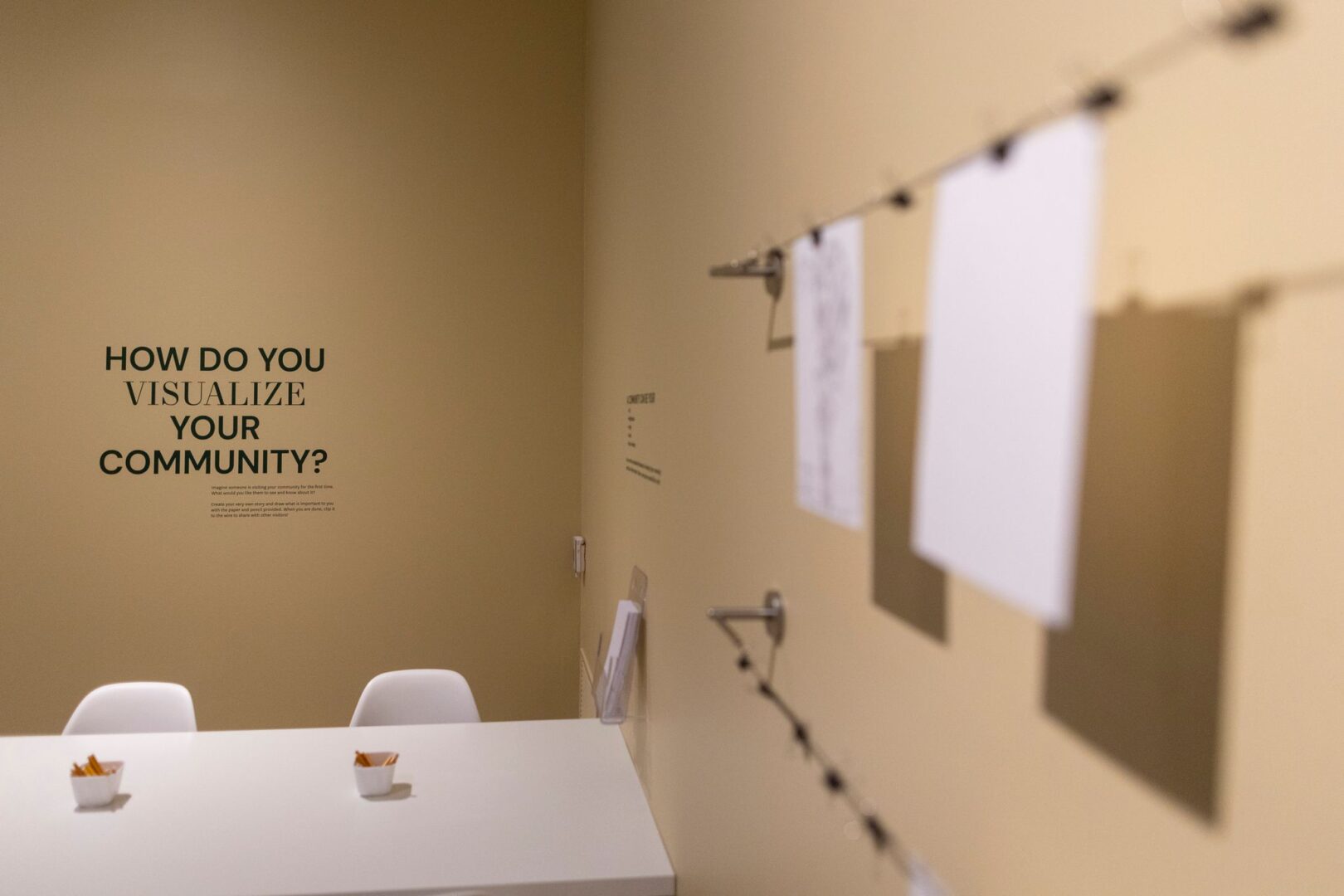
Visitors to the museum are asked to visualize their community in an interactive room / Photo courtesy USC Pacific Asia Museum

The Balinese painters whose works are showcased were asked to visualize their community. At the end of the exhibition, visitors to the museum are asked to do the same in an interactive section. One visitor sketch illustrates ‘Angkor Wat in Cambodia where my mom used to live.’ Another drawing shows a table laden with various Chinese food.

Asked what she wants people to take way, Hall replies, “I think there’s a cultural perspective that a very one-directional interchange occurs when Europeans or westerners go into a non-western area – that these white people would have all the power. And, in the case of the Balinese, that they would paint only what would make westerners happy. But that’s not how it worked at all. That’s part of what the title is about – agency in the Balinese. They didn’t have to do any of these but they clearly loved creating these works. That people from different backgrounds with different interests can come together and develop a whole new genre of art gives everyone involved agency.”

“I want visitors to realize how complex Bali paintings are and I want to pique their interest enough for them to gain a better understanding,” Hall adds. “I want for people to see how rich these narrative modes of storytelling are and how they manifest in these pictures. This is every art historian’s dream!”  

Hall herself gained much insight from the experience. She divulges, “I feel I barely scratched the surface… just enough to put together this exhibition. But I would love to learn more about the paintings and the descendants of the painters, and how they connect to what’s happening now. There is a disregard of Balinese paintings because they are perceived as tourist art. But I’ve learned the complexity of it and I really love it. I want to look at more to better understand it, especially Balinese paintings from the 1930s on, and see how they developed.”

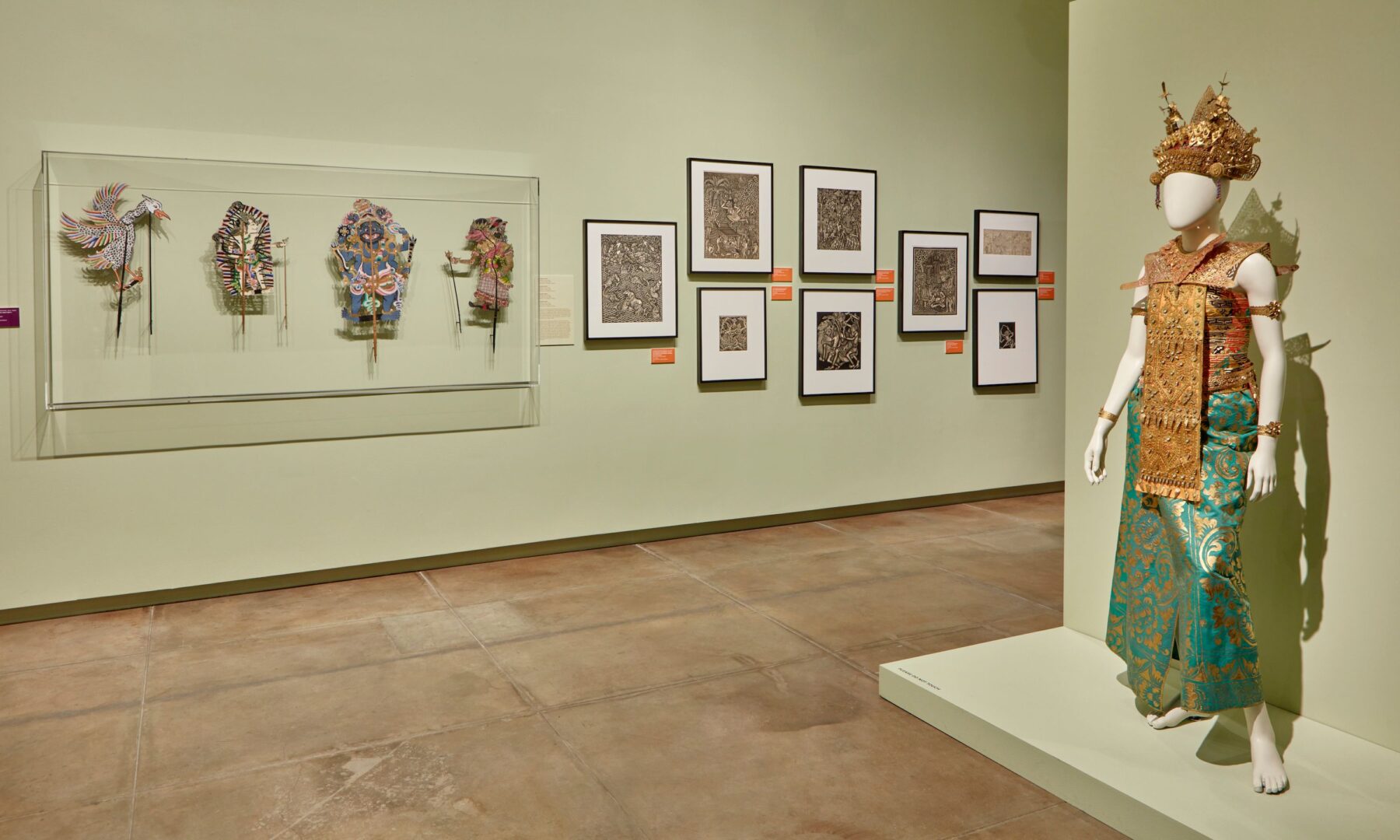
Shadow puppets, Balinese paintings, and Legong dancing costume / Photo courtesy of USC Pacific Asia Museum

“Today they have much larger paintings and they’re very colorful, but if you look at contemporary Batuan paintings you can see how they’re descendants of these painters. They still do scenes of village life but because they’re documenting life in Bali now – you’ll see paintings of cremation ceremonies and there will be tourists and people with phones and cameras. They’ve also incorporated some of the traumatic events like the nightclub bombing in 2002. They reflect what Bali is today and they also create this idealized version of Bali, but you definitely see similar themes. Everything is changing in the new century and I would like to keep my eye out for more things like these to fill out those narratives for people that we often don’t have narratives for,” Hall concludes.

‘Agency’ and ‘power’ may seem the least likely words to associate with Southeast Asians who are, by nature, so agreeable that they are perceived to be submissive. Local inhabitants of islands, like Bali, whose economy relies on tourism, have to be especially warm and hospitable. It’s heartening that the Balinese have found a way to assert themselves – through their art they are reminding temporary residents that the smiling faces that cater to their comforts and needs are human beings with families and lives outside the bubble of a resort.

USC Pacific Asia Museum Marks 50 Years with Exhibition

Originally published on 16 November 2021 on Hey SoCal

USC Pacific Asia Museum’s ‘Intervention: Fresh Perspectives After 50 Years’ exhibition entrance | Photo courtesy of USC Pacific Asia Museum

USC Pacific Asia Museum (USC PAM), the only museum in Southern California with the mission and vision to further intercultural understanding through the arts of Asia and the Pacific Islands, is marking its 50th anniversary with an exhibition called “Intervention: Fresh Perspectives after 50 Years.” It runs from Nov. 12, 2021 through Feb. 6, 2022.

In its press release announcing the event, USC PAM’s director, Bethany Montagano, states, “As we celebrate USC PAM’s 50th anniversary, we look to the future by asking questions and reflecting on our past as it is embodied in the museum’s collection. ‘Intervention’ offers an opportunity for institutional critique while acknowledging all that the museum has achieved over its 50-year history. The exhibition expands on USC PAM’s groundbreaking legacy, which includes being the first museum in North America to mount an exhibition on contemporary Chinese art with its 1987 show ‘Beyond the Open Door: Contemporary Paintings from the People’s Republic of China.’ As well as the first museum to assemble an exhibition of Aboriginal art in the United States with ‘The Past and Present Art of the Australian Aborigine in 1980.’ We look forward to continuing to present boundary-breaking exhibitions for the next 50 years.”

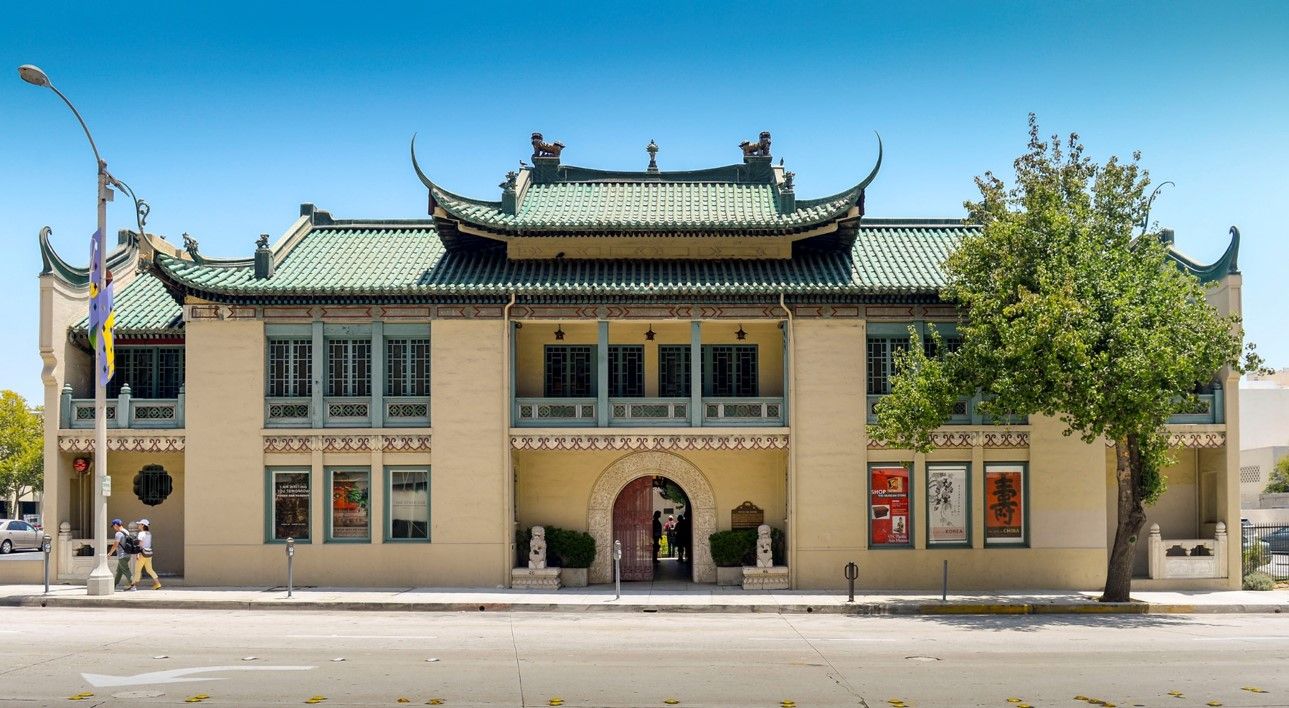
As with any institution’s milestones, we travel back to its origins and recall the past. To say that USC PAM’s history is intertwined with Grace Nicholson’s is not an entirely factual statement because she didn’t found the museum. However, it is her treasure house of oriental arts where the museum’s treasures are housed. And it just so happens that it’s patterned after the Imperial Palace Courtyard style used in the construction of major buildings in Beijing (Peking). It is such a significant and extraordinary example of Chinese architecture, that it is one of the great treasures of the museum. So it is only fitting that we look at her life’s story as well.                                 

Exterior shot of Grace Nicholson’s Treasure House of Oriental Arts now known as USC Pacific Asia Museum. | Photo courtesy of USC Pacific Asia Museum

When Nicholson, a transplant from Philadelphia who moved to California in 1901, decided to open a business using her modest inheritance, she set up shop on Raymond Avenue. She marketed Southwestern Indian handiwork which she learned about through two of her early customers who had been involved in archeological excavations in Arizona. With the rest of her funds, she invested on basket collections. She got increasingly interested in Native American art and culture and frequently traveled the western United States to buy directly from basket makers and weavers. She established herself as an authority in the field of archeology and was elected to the American Anthropological Association in 1904.            

By 1907, her curio shop needed a bigger location so she moved her business to the corner of North Los Robles Avenue and Union Street. Nicholson hired the architectural firm of Marston, Van Pelt and Maybury in 1924 to build a grand residence to her exact specifications. In fact, every detail, material, and construction — roof tiles, stone and marble carvings, and bronze and copper work — were either imported directly from China, or masterfully copied and made by Pasadena-area craftsmen based on the Chinese originals.

The arched entrance is a replica of the Buddhist library in Beijing. The upturned roofline is designed to prevent evil spirits from landing on it; antique ceramic dogs on the roof keep an eye out for enemies. Cloud patterns and lotus finials on the balustrades of the four courtyard stairways symbolize the ascent to enlightenment and mimicked the marble bridges of Nai-chin-shin-chiao. The structure, when it was completed, was so magnificent it received an award from the American Institute of Architects and became a noted landmark.        

While the building was known as Grace Nicholson’s Treasure House of Oriental Arts, she referred to it as ‘Chia,’ a word with distinct meaning in two cultures particularly associated with her. In American Indian legends, the word refers to a nutritious seed that could sustain someone for long periods of time. And for the Chinese, chia means ‘sacred vessel.’

The first floor of the house served as a gallery where she displayed and sold American Indian and Oriental art objects. On the second floor were more galleries, an exhibition auditorium, and her private quarters. It hosted several cultural organizations and became the center for the arts in Pasadena.            

Nicholson bequeathed the building to the City of Pasadena in 1943 for art and cultural purposes, with the stipulation that she would retain her private rooms until her death. She shared the building with the Pasadena Art Institute until she passed away in 1948. In 1954, the Pasadena Art Institute changed its name to the Pasadena Art Museum and occupied the building until 1970, when it moved to its new location at Orange Grove and Colorado Boulevards and became the Norton Simon Museum.

In 1971, the Pacificulture Foundation moved into the Grace Nicholson Treasure House of Oriental Art. The foundation eventually bought it in 1987 and renamed it Pacific Asia Museum. Then in 2013, the University of Southern California partnered with the institution. Renamed USC Pacific Asia Museum (USC PAM), it is a vital resource for education and cultural heritage. For Asians like me, this was a monumental development because having USC’s collaboration and support meant our art and culture would get recognition and gain wider reach.        

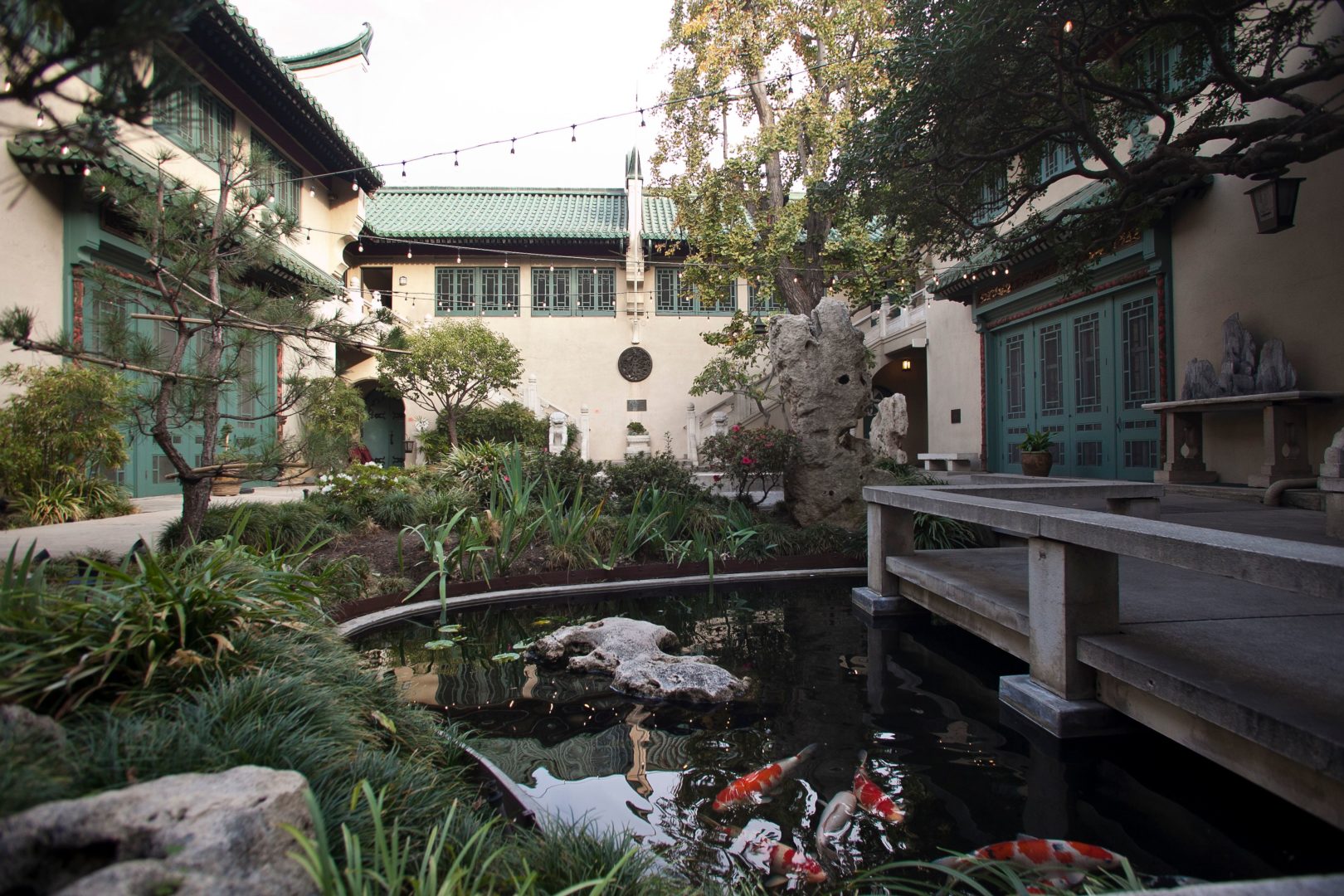
The courtyard | Photo courtesy of USC Pacific Asia Museum

The 50th anniversary exhibition features seven Asian American artists and scholars who created new artworks that demonstrate new ways to view and engage with the museum’s history and collection of Asian and Pacific Island art. The participating Asian diasporic artists are Antonius Bui, Audrey Chan, Jennifer Ling Datchuk, Amir Fallah, Akiko Jackson, Alan Nakagawa, and kate-hers RHEE.

Rebecca Hall, USC PAM’s curator declares, “The artworks commissioned for this exhibition create new ways to view the museum’s collection and serve to remind visitors that USC PAM’s history is complex. Our public has many ways to consider this story beyond how it is presented in our galleries. The artists and their fresh perspectives are asking viewers to ponder for who was this collection created and how does its meaning change when seen through the eyes of our diverse communities?”

About her selection of artists for the exhibition, Hall states, “I had a few artists in mind when I began work on ‘Intervention.’ I specifically sought out artists whose work focused on (at least in part) the questioning of history and representation or whose work engaged with objects and the past in some way. I wanted to work with artists who already had a deeper understanding of the questions we were asking as the impetus for the exhibition, mainly: what do collections and displays of Asian art mean to Asian diasporic communities.”

For this article, I chose to feature Jennifer Ling Datchuk, whose talk at the gallery Art Salon Chinatown Hall had attended and whose work she had seen.

Born and raised in Warren, Ohio, Datchuk is a child of a Chinese immigrant and grandchild of Russian and Irish immigrants. She states on her website that the family histories of conflict she has inherited — which she captures by exploring the emotive power of domestic objects and rituals that fix, organize, soothe and beautify our lives — provide constant inspiration for her work.  

Datchuk earned her BFA in crafts from Kent State University and MFA in artisanry from the University of Massachusetts. While she was trained in ceramics, she often works with other materials including porcelain, fabric, and embroidery. She has received grants from the Artist Foundation of San Antonio and Artspace for her research project about the birthplace of porcelain in Jingdezchen, China.

In 2016, Datchuk was granted a residency at the Künstlerhaus Bethanien in Berlin, Germany through the Blue Star Contemporary Art Museum; she was also a Black Cube Nomadic Museum Art Fellow. In 2017, she completed a residency at the European Ceramic Work Center in the Netherlands and received the Emerging Voices Award from the American Craft Council. She was named a United States Artist Fellow in Craft in 2020. She currently lives in San Antonio, Texas and is an assistant professor of studio art at Texas State University in San Marcos, Texas.    

According to the introduction to the various artists in the exhibition, Datchuk’s body of work reflects cultural identity as an Asian American woman. She uses her artwork to question the cultural, political, and economic systems that maintain a status quo of sexism, racism, stereotyping, and oppression. For ‘Intervention,’ she will be examining and expanding upon representations of women in Asian art.

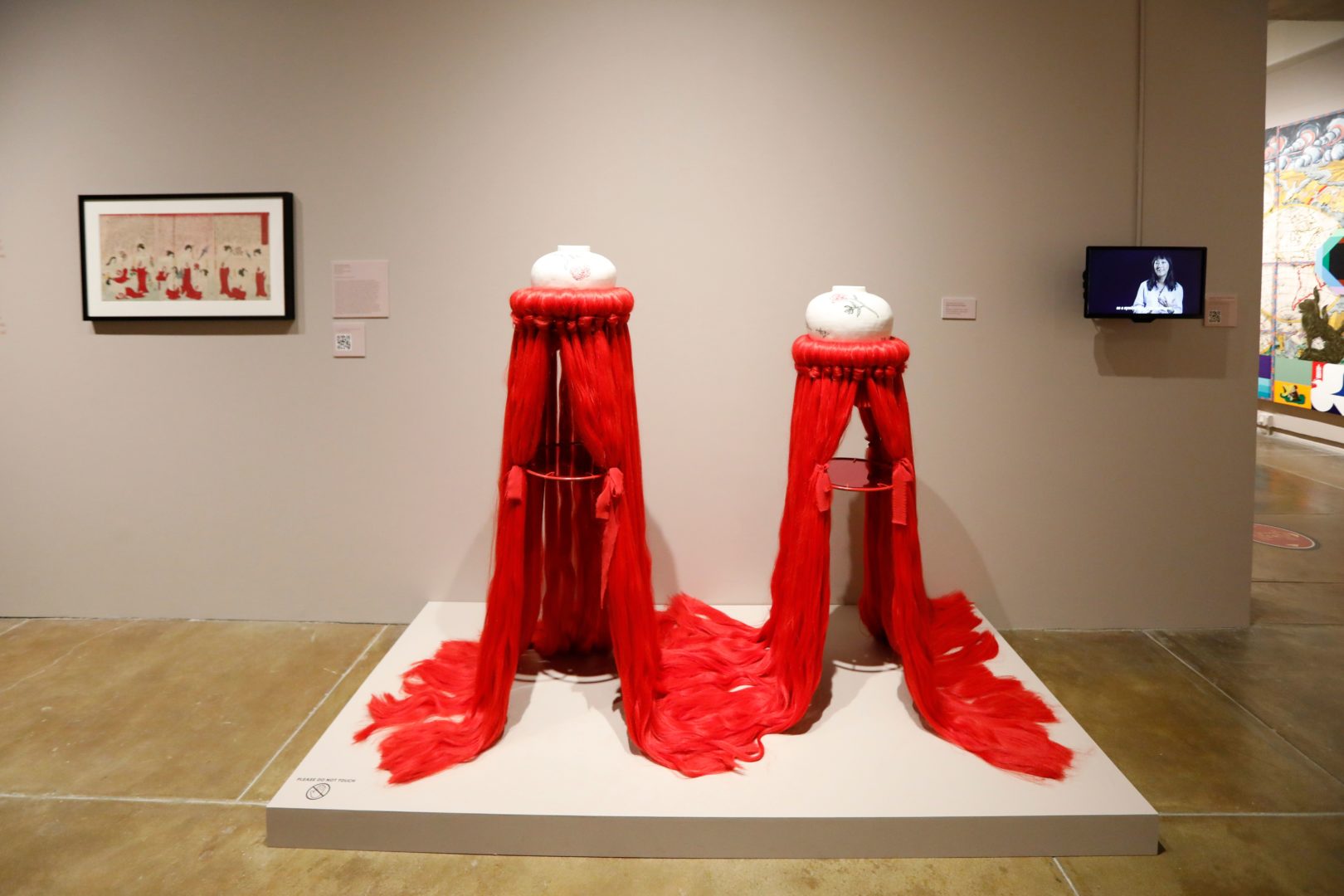
Datchuk’s ‘Gaze at All Sorts of Flowers’ | Photo courtesy of USC Pacific Asia Museum

Interviewed by email, Datchuk describes her display, “I created a pair of porcelain vessels that rest on metal stands draped in red synthetic hair. The title ‘Gaze at All Sorts of Flowers’ comes from a translation of the text found on the woodblock print that describes the purpose of procreation for familial lineage and honor. I was first attracted to the voluminous pregnant female figures draped in red and how they seemed relaxed in their  time of waiting. I was fascinated to see geishas depicted this way instead of constantly being sexualized or fetishized in their talents for the consumption of men.

“The translation depicted a more rigid expectation of pregnancy, the lack of pleasure from procreation for honor in one’s family. It also detailed the 10 months of pregnancy in the Japanese calendar and how gazing at flowers would make for a happier and easier incubation of a baby. I wanted to reinsert the female narrative to this translation and reclaim pleasure, pain, beauty, and all sorts of flowers to gaze upon.” 

Speaking as an Asian, I know how we are either invisible or dismissed in American society. And as a Filipino immigrant, I feel even less significant because I’m not stereotyped as a ‘model minority’ but a member of an underclass. I ask her if she feels that there is racial disparity even among Asians, and Datchuk replies, “Yes! There is a wide range of racial disparity and it doesn’t help that we get lumped into a big collective of Asians. So much of the histories of Asians in America and the diasporas that exist all over the word are because of war and colonization and this is not taught in schools. We are invisible because our histories don’t exist.” 

Chinese cuisine is one of the most popular ‘ethnic’ food for Americans — actors in American movies are usually shown eating Chinese takeout with chopsticks. One of the displays on Datchuk’s website shows chicken feet, a Chinese delicacy, so I ask if she plans to depict food in any future work. “I use the chicken foot in some of my work as a cultural connector that can elicit feelings of comfort or home and the uncomfortable and disgusting,” she answers. “In some ways I’m always making work about being half and both and the third space this creates for these dual experiences. I’m not sure I will make work about food but I do make work about acts of love through food and culture because they are part of how we visualize care.” 

Datchuk expounds, “My work always comes from living with the constant question ‘what are you?’ In these moments I am seen as an object and different from the question ‘where are you from?’ where you are seen as a perpetual foreigner. I make work about my layered identity of being a woman, a Chinese woman, and how I exist within this third space, of having one foot in each world but never feeling fully whole or accepted. I always start my work from a personal story, a family reference, a current event, and research. I start every form from the history of porcelain and how I can take something from the past and make it present, make the private public, and that the personal is political.” 

In her introduction statement, Montagano references USC PAM’s legacy of showcasing cultures and countries which are not usually at the forefront because they don’t have enough representation. Throughout its 50-year history, it has provided Asian and South Pacific artists with the venue and platform to mount their creations. Because of that — as the exhibition demonstrates — artists are flourishing and, through their artwork, are telling their stories that transcend limits and expectations.  

‘We Are Here’ Contemporary Asian Art at USC Pacific Asia Museum

Originally published on 4 May 2021 on Hey SoCal

‘We Are Here’ Exhibition Gallery entrance | Photo by Brianna Chu / Hey SoCal

“We Are Here: Contemporary Art and Asian Voices in Los Angeles” was slated to open at USC Pacific Asia Museum (USC PAM) in March of last year but the coronavirus pandemic caused temporary closure of art galleries. While it was an enormous disappointment, it was a necessary mandate given the severity of the situation. We didn’t know it then, but all art venues would remain shuttered for what felt like an interminably long time.   

The museum’s announcement that it will reopen to the public on May 29 was welcome news for all art enthusiasts. “We Are Here,” which has only been accessible online, will have its final week on view with in-person visits. The news also couldn’t have come on a more fitting occasion – AAPI Heritage Month. These artists and the experiences mirrored in their work reflect Asian American and Pacific Islanders’ many contributions to our country’s history, culture, and achievements. 

“We Are Here” is curated Dr. Rebecca Hall, who has a PhD in Southeast Asian Art History from UCLA with a specialty in Buddhist art and textiles in Thailand, Laos, and Cambodia. After receiving her doctoral degree, she lived in Southeast Asia for a while doing research and teaching. She then moved back to the United States and taught in L.A. and Richmond, Va. She also had a curatorial postdoctoral fellowship at The Walters Art Museum in Baltimore, Maryland. More recently, she taught at Santa Monica College and Pasadena City College.

Because of her expertise, Hall was hired as a guest curator at USC PAM for an exhibition called “Ceremonies and Celebrations: Textile Treasures from the USC Pacific Asia Museum Collection”. It was up in the special exhibition galleries from September 2018 until January 2019, following her designation as a full-time curator in July 2018.

Prior to the pandemic, Hall graciously agreed to give a private guided tour while she discussed her vision for the exhibition and talked extensively about each artist’s background.

“I have been putting this together for a little over a year now,” Hall commenced. “It was grounded in my conviction that we have this incredible collection of art from the Asia Pacific world. And that world extends beyond the geography of Asia and the Pacific which we typically think of, but really encompasses the diversity of Los Angeles itself. As a person who’s not from L.A., but has lived here off and on since 2002, I wanted the opportunity to celebrate the diversity of our Asian and Pacific population.” 

Recounted Hall, “I didn’t have any connections to contemporary artists in L.A. but I know we have one of the most wonderfully diverse and densely populated areas of people of Asian heritage living in one of the most creative cities on earth. I knew my task would not be that difficult and I just began to explore. Once I decided to develop an exhibition featuring the work of L.A.-based Asian artists, I started googling and looking at galleries, exhibitions, and artists’ websites. I made a long list of artists, and chose the seven I was most interested in and whose work I was most drawn to. It was a slow process at the outset but it was interesting and I learned a lot about artists in Los Angeles.

“As part of the exhibition, we also have these videos of three- to five-minute conversations with the artists that add layers of understanding. One of the joys, for me, in putting together this exhibition, is how brilliantly and clearly each of these artists articulate their vision in their work as well as when they talk about it. Furthermore, they’re very dynamic artists – each one works in different media and from a different perspective.”

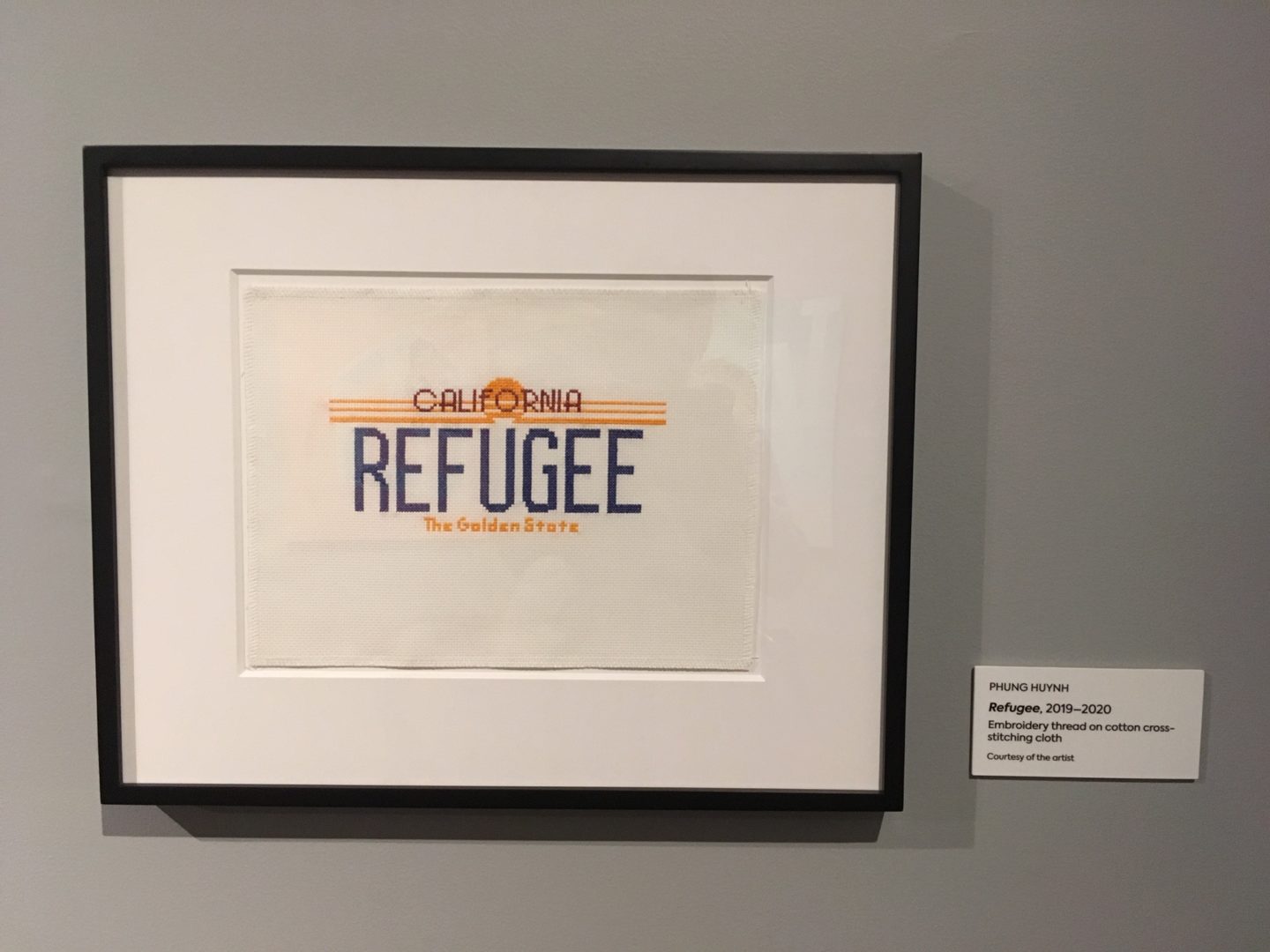
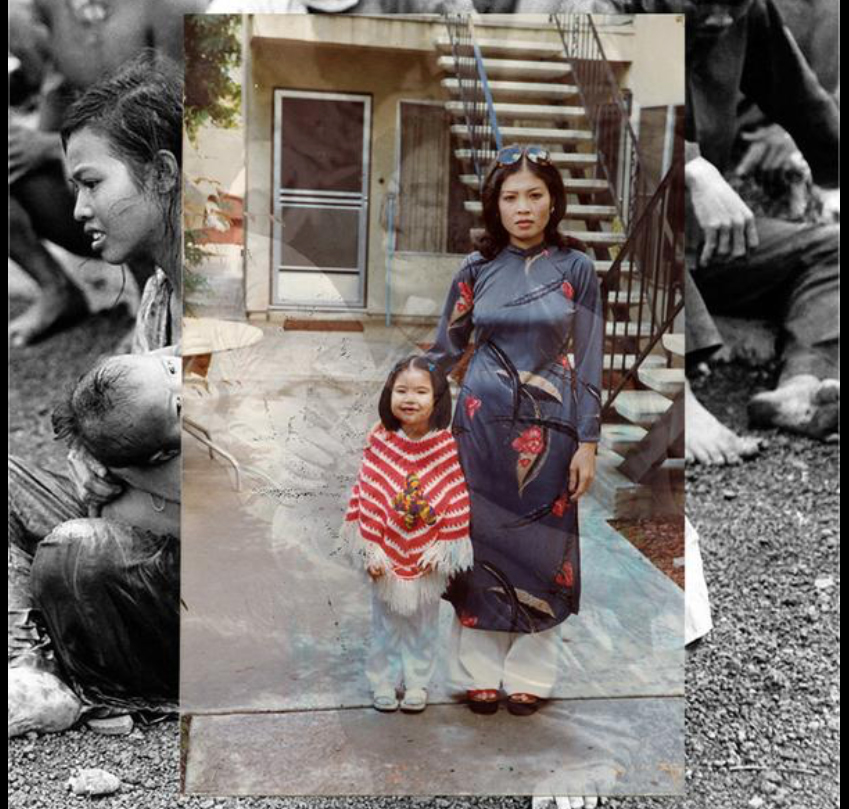
The exhibition is organized by artist – there is a small display with a short introduction about each, with an accompanying detail about their work. As you walk in you’ll enter the space of Phung Huynh. Hall described, “Phung is a refugee from the Vietnam War but her history isn’t as straightforward as just that. Her mother is Vietnamese; her father is Cambodian who fled Cambodia into Vietnam where he met her mom. Her mother’s side of the family is actually ethnic Chinese who moved to Vietnam as refugees from China. She moved to the United States when she was a toddler and, living in Chinatown, was pushed to learn Chinese; it became a part of who she was. So her initial works of art and what she had shown up to this point were about how we perceive Chinese people and culture and how Asian American woman are pressured to modify their appearance to acceptable American standards. When I met with her, she had actually just been embarking on artwork that looks at her experiences as a Vietnamese and Cambodian refugee.

Huynh’s display of cross-stitched license plate | Photo by Brianna Chu / Hey SoCal

“When you come into the gallery you’ll see right away something iconic – a dozen pink donut boxes that she’s using as a canvas for portraits. Each portrait is that of a refugee from Southeast Asia who exemplifies power and perseverance: herself as a toddler; her parents; an artist; a chef; and some local personalities she interviewed, including someone who survived the Khmer Rouge through his art; and a documentary filmmaker who now lives in France.

“She created a baker’s dozen and on one wall is a portrait of a 13th person who isn’t a refugee – Mister Rogers. He was the one who made her and her family feel welcome in the United States and helped them to learn English. I think a lot of people can identify with that compassion he showed everybody and his lack of judgement in the way that he helped people see that they’re all Americans. He has a warmth that we should all aspire to.”

Pink donut boxes reference the donut shops that Cambodian refugees opened to build a new life in Southern California after they fled the genocide. Huynh’s display of cross-stitched license plates, meanwhile, are souvenir key chains that kids going to theme parks can buy that signifies inclusivity and an opportunity for all Americans to find their names on these mementos.   

The next artist is Ann Le and she has twelve pieces in the show.

Ann Le’s ‘World War Apartment’ photo collage | Photo courtesy of USC Pacific Asia Museum

Hall expounded, “Ann was born in the United States to Vietnamese refugees. Growing up in a Vietnamese refugee community with her family left a lot of questions for her about who she was and why she was in this country. But her conversations with her family never directly touched on the war, its effects on them, and the reason they were refugees. I think she realized it was most important for her to articulate that point of view. She wanted to give voice to that experience and found a way to do it visually.

“Ann’s father was a photographer in Vietnam and he continued that interest in America. She has an archive of family photographs and her vision really came together when she looked at her family album. She took the photographs, collaged them on the computer, and layered them to create this juxtaposition that talks about war and loss, family and memory, in an incredibly compelling way. These are all members of her family in Vietnam and she put those photographs in front of typical Southern California middle class households to think about the disconnect, or connection, depending on your perspective, of who they are. She bridged that gap of what they would have if they were in California, or what they would have if they were in Vietnam. 

“She has done a lot of research about the Vietnam War and wrapped that research into her work as well. She shows photos of her family placed together with imagery of the war – it’s a very strong statement. There are some subtleties but everyone sees and understands what she’s trying to get at. She’s very aware of the need for that conversation to take place.”

Hall introduced the next artist Ahree Lee and her work, “It was actually this video that drew her to me; I find this to be a very emotionally beautiful experience. It’s called ‘Bojagi’ (Memories to Light) which she created when she was resident artist at Asian Art Museum in San Francisco. She collected home videos and films from members of the Asian community in San Francisco doing just regular, mundane activities like visiting Frontier Town or going to the beach for a picnic, that aren’t important enough to be represented in mainstream media. She looked at human memories, emotions, and experience and then determined what was missing – in this case, the Asian-American experience – and put that into her work. What she came up with is a video that she called Bojagi, which is a Korean hand-quilted cloth that mothers would make for their daughters when they were going away to be married and got passed down over generations.

Ahree Lee’s weaving and computer coding artwork | Photo by May S. Ruiz / Hey SoCal

We then approached the next two displays which Hall explained are a totally different body of work that’s very new for Lee. She learned to weave when she became fascinated with the connection between weaving and computer technology. Her resulting artwork reveals a history that somehow got buried – that computer coding was based on loom technology and the pioneers of early programming were women. But when computer technology turned into a hugely profitable enterprise, it became a men’s field and women were shut out of the scene. She created a piece called ‘Ada,’ after Ada Lovelace, who was the first computer programmer in the 19th century, which physically and visually connects to that past and brings women’s labor into the discussion.

The other piece is composed of seven different weavings demonstrating her own labor. It’s one week of time in 2018, wherein she showed which portion of her day was spent on each activity – personal care, food, housework, childcare, non-household work, art, and leisure. 

Kaoru Mansour’s ‘Succulent’ mixed media display | Photo by Brianna Chu / Hey SoCal

Walking to the space of Kaoru Mansour, Hall declared, “I love Kaoru’s work. You look at it and you just want to take it home with you. Growing up in Japan, Kaoru was discouraged from becoming an artist. When she moved to America, she started taking art classes and found her voice as an artist. The fact that she’s able to work every day on something that expresses who she is makes her happy. And that joy shines through in her work; she’s playful.  

“Kaoru crafts her own visual language and doesn’t restrict herself – she moves through what’s interesting to her. She comes up with an idea, like heavy things hanging from a string, and she places the strings on the canvas. She falls in love with doilies and pompoms and creates art from those. She is active outdoors and in nature, and she integrates that in her work. If she’s thinking about family and her relationship to people, her work pivots in that direction.

“Her artist’s statement ‘If I can represent my character in the artwork, then I feel that I have successfully created an honest piece,’ is spot on. It perfectly describes her joy, her love of life, and her love of making art … and it spreads. People walk in this gallery and they love it – they feel excited.” 

Reanne Estrada’s ‘Privacy Prophylactics’ | Photo by Brianna Chu / Hey SoCal

Reanne Estrada‘s art is a little bit more difficult to explain,” Hall confessed as we reach the next display. “But I could not be more thrilled that she’s in this exhibition. She works very eclectically; she has both a collaborative and an individual art-making process. All of her work that we show here are part of a single idea – surveillance and security systems and how we function within something we aren’t actively a part of – we’re being watched all the time by cameras.

“She did a performance piece on Hollywood Boulevard in September 2019 in which she used prophylactics to obscure people’s gaits from being recorded by security monitors to identify who they are. She underscores the fact that surveillance is something that we have become so passive about. She is the only artist whose work carries over into our permanent collection – she created an audio tour of the Pacific Asia Museum that talks about surveillance and how it’s everywhere, but it is necessary because we’re protecting priceless works of art. But maybe when you leave, you’ll think about how surveillance cameras invade our privacy. 

“Related to that is this website called ‘People Who Don’t Exist’ which shows how computers can harvest images of people who aren’t real but look real. She talks about how we lose control because of all the technology around us and finding ways to reassert ourselves.”

In the final gallery, visitors will see the works of two artists – Mei Xian Qiu and Sichong Xie.

Hall said about Qiu, “Mei is an ethnic Chinese woman born in Java. Her family has been in Indonesia for several generations since the 19th century where there’s a divided relationship between the Chinese and the Indonesian population. When she was born, she was given three different names by her family – a Chinese name, which was illegal according to the Indonesian government; an Indonesian name, which was required by the Indonesian government; and an American name, in anticipation of any possible future – in an embrace of her heritage. Her family fled to the United States to escape the anti-Chinese riots in Java. Her grandparents still live there, hence, Mei has been going back and forth between Indonesia and the United States with her family since her childhood. Her perspectives emanate from her as a Chinese, Indonesian, and American woman trying to figure out how she fits into all of this.”                      

Mei Xian Qiu’s series ‘Let a Thousand Flowers Bloom’ | Photo by Brianna Chu / Hey SoCal

“We’re showing different series of Mei’s work,” continued Hall. “The first one is an ongoing series she’s been doing for several years now called ‘Let a Thousand Flowers Bloom.’ It is a play on a 1965 Mao speech ‘Let a Hundred Flowers Blossom’ that saw arts flourish but subsequently got artists persecuted. She’s exploring how we think we have freedom of expression, but maybe we do not.

“It is a playful, yet serious look at the possible Chinese invasion of the United States. She’s toying with perception and the relationship between the Chinese and the United States. For instance, in this piece ‘Hollywood Land’ from 2012, the models she used in her work are actually people who would have been persecuted under Mao’s regime – intellectuals, writers, and artists. The apparel that they’re wearing, like military outfits, were from the photo studios in Beijing that people would go to mimic the Red Army or Red Guard.

“Mei’s second series is about the homeland. This one is called ‘Homecoming: Once we were the Other,’ about a Chinese woman going home who felt a disconnect between herself and her environment. She is questioning who this woman is with multiple identities in connection with the trash in the street. So she began collecting it and making art from that which asks ‘Who am I as a Chinese woman and how do I connect with this material?’ ‘How do I excavate Chinese culture and that Chinese side of myself?

“There’s always apprehension when she goes back to Indonesia because of the ongoing tension between the Chinese and the Indonesian people. It ebbs and flows – there’s violence and then everything seems fine. Using her Indonesian name Cindy Suriyani, she created a piece ‘Dewi Cantik’ (Pretty Darling) that shows a child’s and a woman’s bedroom, all nice and pretty but underneath, the threat of violence is always there. The cutout pieces are actually batik pattern because their family had a batik factory. This woman’s work changes depending on what she’s doing but they’re all around the idea of figuring out who she is with all these identities stemming from her having three different names.”

The seventh artist featured in the exhibition is Sichong Xie. Hall noted, “One aspect we’re touching on is that many people who live in L.A. are transplants and Sichong is an example. She was born in Mainland China, came to the United States initially as an undergraduate student, and found her voice as an artist. She eventually moved to L.A. for graduate school and decided to stay here. 

“Sichong’s work is quite personal as well. She was very close to her grandparents; when her grandfather passed away, she found out he had drawn an illustration that had been published in the Beijing paper in the 1960s that had a political element to it. Because of it, he was thrown into a labor camp for two years and it had an adverse effect on her family. They had to relocate to Xian where she was born. The political cartoon was destroyed and nobody talked about it again so when she found out about it, she wanted to recreate it.

Sichong Xie’s ‘Do Donkeys Know Politics’ video still | Courtesy of USC Pacific Asia Museum

“What you see here came about from the chain of conversations she had with her grandmother in trying to redraw the cartoon. She would talk on the phone with her grandmother in Xian, and draw out how her grandmother would describe the cartoon and then would send it to her grandmother. Her grandmother would say, ‘That’s not right at all; the donkey wasn’t just holding the money bag, the donkey had the family riding on it, or there was a car, etc.’ And so, she has five different versions. It brings up questions about memory and about protection – ‘Is her grandmother misremembering it?’ and ‘Is she still afraid of what the cartoon would do for her granddaughter?’ 

“Sichong is a performance and an installation artist and we’re trying to show both. In this installation, she asks ‘Do donkeys know politics?’ and she’s done versions of it over the years and I really wanted it in the show because she came up with this way of presenting it. It’s totally new from everything she’s done before.”

Of the experience, Hall remarked, “I really enjoyed the process of working with the artists. It was definitely a conversation between me and each of them. We talked together to choose which pieces would be in the show and I tried to give them creative freedom and flexibility. Some artists were in the process of creating new works of art that are in the exhibition. A lot of that was just really good timing and for that reason I could not be happier. For example, Phung Huynh had explored aspects of being Asian in the US and the specific pressures placed on Asian women, but had only just started on her work examining the refugee experience when I first met with her. Reanne Estrada was just beginning her work on surveillance and created the site specific audio tour for USC PAM. And Mei Xian Qiu totally branched out from the photography series that people are more familiar with of hers, into the scrolls and the artworks exploring her experiences in Indonesia.”

The exhibition highlights women artists and Hall said it wasn’t by design. When she set out to find the artists, she discovered that they made what she found most compelling. Coincidentally, the show was scheduled to open in 2020 when there were many planned celebrations about women. Unfortunately, what would have been a commemoration of ‘The Year of the Woman’ was eclipsed by a year marked by untold worldwide devastation brought about by a pandemic. But it’s never too late to salute women and their accomplishments.        

Hall clarified, “Personally, I’m not promoting it as an exhibition of women’s work, but this is at the point it should be because these artists do incredible work. But as a curator, I feel that the more important thing is I look forward to the day when having seven women of Asian heritage together in one show is not something out of the ordinary.

“Setting gender aside, however, the work of these artists engages with who they are as people and, often, who they are as immigrants or refugees. What I also love about their work is that they’re impeccably made. So even if you’re not interested in their narratives, I think that you can look at them and appreciate them for what they are. Furthermore, while their pieces are very specific, they express sentiments we can relate to and understand.”   

Besides being a celebration of Asian artists’ achievements, and Asian women’s work in particular, it is being shown at a very opportune moment when anti-Asian crimes have reached immense proportion and publicity. For far too long, Asians have endured such hate crimes in obscurity and silence. Recently, they have been speaking up – urgently – and it’s time they were seen and heard.

Speaking as an Asian American, we should stop being invisible and voiceless. We’re no less important than others and our truths are no less significant than that of the next person’s. ‘We Are Here’ demonstrates that Asians are part of the human race but the Asian experience isn’t exclusive to Asian immigrants and refugees. The stories these seven women are telling are as profoundly personal as they are fundamentally universal.

‘Starting Anew’ Exhibition Offers a Compelling Look at Pasadena’s History

Originally published on 11 February 2020 in the Pasadena Independent, Arcadia Weekly, and Monrovia Weekly

This image has an empty alt attribute; its file name is PMH-Signage-1-scaled.jpeg
PMH’s ‘Starting Anew: Transforming Pasadena 1890-1930’ Exhibition Signage | Photo by Marlyn Woo/Joanne Wilborn / Pasadena Museum of History

Very few of us realize that the Pasadena we know and live in today was built in the early 20th century by dreamers with grand visions who settled here from the Midwest and the East Coast.  The Pasadena Museum of History (PMH) offers a compelling look at the most flourishing period in Pasadena’s history with an exhibition called ‘Starting Anew: Transforming Pasadena 1890 – 1930,’ on view until July 3, 2020.

I consider Pasadena my hometown and have lived here for 37 years. And while I dearly love my adopted city, I don’t know as much about it as I probably should. PMH’s exhibition provides that stimulating learning experience and Brad Macneil, Education Program Coordinator, who curated this show, happily gives me a tour.

Our first stop is a chart which shows that population growth in Pasadena outpaced that of Los Angeles and then leveled off in 1930 when the depression hit. He discloses, “This was what sparked the idea for this exhibition. It was an amazing time in Pasadena’s history when the population went from below 5,000 to over 76,000 in just four decades. Today there are 150,000 – the population only doubled since. The city was transformed in so many different ways and our exhibit asks and answers a number of questions – why people came here, how they got here, where they lived, what they did, what kept them here.”

Macneil explains that the railway system started serving Pasadena in the mid-1880s, which caused the population to rise from 500 to 5,000 between 1880 and 1890. A photo of the Santa Fe Railway Depot and the Hotel Green greets us as we enter the first exhibition hall.

This image has an empty alt attribute; its file name is PMH-Population-Chart-scaled.jpg
Population Chart | Photo by Marlyn Woo/Joanne Wilborn / Pasadena Museum of History

“Part of our exhibit tells the story of Dr. Adalbert and Eva Fenyes,” Macneil narrates. “The couple met in Cairo, Egypt and were married in Budapest. It was during their honeymoon around the world that they heard about Pasadena. They arrived at this train station in 1896 as newlyweds, and they had with them Leonora, Eva’s teen-age daughter from her first husband. They stayed at the Hotel Green for about three days and fell in love with Pasadena. They immediately leased a house on the Arroyo, which they later bought. Subsequently, they built two mansions here. One of the wonderful things about this exhibit is that we are able to display the museum’s collection. These are the Fenyeses luggage here and that telephone over there was inside the depot.”

This image has an empty alt attribute; its file name is PMH-Train-station-1.jpeg
Santa Fe train depot, the Fenyeses’ luggage, and depot telephone | Photo by Marlyn Woo/Joanne Wilborn / Pasadena Museum of History

“Besides word-of-mouth, a marketing campaign touting the city’s natural beauty and health benefits lured people to the area,” adds Macneil. “In the late 1880s big, fancy hotels were being constructed, the first of which was the Raymond Hotel. It was built by entrepreneur Walter Raymond, who had been working for a company back East that brought tourists here and thought Pasadena could use a grand hotel. Other hotels then were Hotel Green, the Pintoresca, the Maryland, the Huntington (which was originally the Wentworth and is now The Langham), and the Vista del Arroyo.

“Each year thousands came to Pasadena for the seasons – from November through March. The population would go up and down. The wealthy people came from the Midwest like Indiana and Chicago, and the Northeast – Boston, Philadelphia, and New York. Because of the winter resort business, the whole town grew. Visitors needed service, which opened up employment opportunities. That brought in working class people from other parts of the country to get jobs in the railways, hotels, and in agriculture. Professionals also arrived – doctors, lawyers, newspaper publishers. Pasadena grew into a diverse community – there was already a large Mexican American population, then the Armenians, the Chinese, and the Japanese arrived. They came to either find a job or start a business.”

Pasadena was a great place to be an entrepreneur and PMH’s exhibition highlights four enterprising people who came here with very little yet built successful establishments. One of them was Elmer Anderson who arrived with nothing more than a typewriter repair kit and founded Anderson Typewriters. Known today as Anderson Business Technology, it has branches all over Southern California selling business equipment and is still being run by his descendants. The local store on Colorado Boulevard, near Arroyo Parkway, remains to this day.

Many of us will recognize the edifice resembling a Chinese Imperial Palace on Los Robles and Union Street as USC Pacific Asia Museum. Back in the 1920s it was Grace Nicholson’s Treasure House of Oriental Art. She came here with a small inheritance and opened a curio shop selling Native American arts and crafts. She developed great relationships with Native Americans in the Southwest and eventually started selling to the finest museums in the country, including the Smithsonian and Field Museum. She later switched to Asian artifacts and created her treasure house where she lived and worked.

Adam Clark Vroman, an avid book collector and photographer, moved to Pasadena from Illinois hoping the climate would help his wife recover from her illness. Unfortunately, she died two years later. Brokenhearted, he sold his book collection to raise the capital to open Vroman’s Bookstore. As he had no direct heir, he made arrangements for his employees to take over the store when he passed away. It was a remarkable demonstration of how much he cherished and took care of his staff. Some of the descendants of those employees run Vroman’s today and it remains a beloved Pasadena purveyor of books and gift items.

There was Ernest Batchelder who came here to teach art at Throop Institute. He later started his own business – making the eponymous tiles – and became the foremost proponent of the American Arts and Crafts Movement.

This image has an empty alt attribute; its file name is PMHG-Local-businesses2-scaled.jpeg
Local businesses | Photo by Marlyn Woo/Joanne Wilborn / Pasadena Museum of History

Architects and builders prospered at this time because people needed housing. Those who came here for work built bungalows and cottages. Macneil states, “The cost to build a house varied from under $1,000 up to $100,000. Between 1902 and 1918 the median value of local houses was $1,700 (these houses today cost over a million dollars). Those with wealth seasoned in Pasadena and stayed for months at a time. A number of them decided to build winter homes on Orange Grove Boulevard, otherwise known as Millionaires’ Row. Displays of some of these grand houses include Adolphus Busch’s; the Gamble house, which still exists today; the Merritt House, which is now surrounded by million-dollar condos.”

After the depression, the owners of these mansions couldn’t afford the upkeep and sold them. Of the 52 mansions, only six or eight of them remain; the rest have been razed to the ground to make room for apartments and condominiums. Of course, even these divided-up homes are not for the middle- and working-class as they lease for several thousand dollars a month or sell for millions.

One of the mansions that’s still around is the gorgeous Marshall-Eagle Estate built in 1919 for $500,000 (valued at $8 million at the time) and is now Mayfield School. The exhibition has a display  of it that tells its history and shows interiors shots.

Throughout the exhibit, PMH reveals the passage of time through changes in fashion and technology – dresses from the different decades; a high-wheeler bicycle; a carpet sweeper; an Edison machine; a record player; a gas-powered hair curler, one of the first dial telephones ever made, and an early typewriter. Macneil says students love to see and handle the typewriters but can’t figure out how to use the telephone.

Macneil leads me to the next display, saying, “Our story goes on about the Fenyeses becoming part of the community. Eva designs her first mansion, a Moroccan palace on Orange Grove Boulevard. This is Eva’s sketch of her mansion – there is an area that’s all glass, one of the first commissions of Walter Judson of Judson Stained Glass Studios. Her daughter Leonora grows in age, marries, and moves away. Eva gets immersed in the community business-wise by buying real estate and as a socialite by being involved with the art scene. Dr. Fenyes gets his medical practice going.

This image has an empty alt attribute; its file name is PMH-Artists-works-2.jpeg
Local artists’ works | Photo by Marlyn Woo/Joanne Wilborn / Pasadena Museum of History

“Pasadena was one of the main art colonies in California during this period, so we have here a wall of art featuring selected works of the artists who lived here then. One of Eva’s biggest legacy was being patron of the arts and helping other artists in the community. She was a prolific painter herself and we have a lot of her art at the mansion, some of which we show here.”

The second part of the exhibition, in the opposite hall, begins with an iconic image of City Hall and explores how the ‘City Beautiful Movement’ ushered the Golden Age of Pasadena. Macneil expounds, “In the Chicago Exposition of 1893, they built the White City. Many famous architects helped construct wonderful buildings, public plazas, and garden areas for the World Fair. The ‘City Beautiful Movement’ came out of that. The idea is that if you beautify the city with these magnificent public structures, it uplifts all the residents spiritually and morally.

This image has an empty alt attribute; its file name is PMH-Pasadena-City-Hall-1.jpeg
An image of the Pasadena City Hall leads us to the second part of the exhibit | Photo by Marlyn Woo/Joanne Wilborn /Pasadena Museum of History

“A lot of people from Pasadena were able to go the Chicago Exposition of 1893 and when they came back, this philosophy took off. They pulled people together, held meetings, and talked about what they could do. And the first thing they did was clean up the city. They got rid of the tacky real estate signs in the main part of town, tidied vacant lots, planted trees and flowers, painted buildings, and regulated architectural styles. It began in the early 1900s with input from various people in the city – movers and shakers as well as the general population. They came up with the plan for the city and things took off in the 1920s when money and the will were there. And so they erected grand public buildings. A main area was the Civic Center – City Hall, the Public Library, the Civic Auditorium. Most of what we identify with Pasadena today – the beautiful architecture, the cultural institutions – were built at this time.”

“There’s a section called ‘Nature versus Man-Made Beauty,’” Macneil goes on to say. “Out-of-towners came here because of the natural beauty of the area – like the Arroyo and the mountains. Then people created man-made parks bringing in trees from other parts of the world, changing  the landscape. We have images of Central Park by Castle Green, Library Park by the Senior Center, and Brookside Park. There’s Eva’s picnic basket because she enjoys going on picnics.”

Macneil points to the next section, “Here we talk about the various means of transportation. During this period of time, people got around town by walking. But there were also buggies and carts, trolley cars, and automobiles. But bicycles were the biggest thing – there were more bicycles per capita in Pasadena than any other city in the United States. This is an early-1900 map of the bike trails and roads in California.

“Because of the power of the bicyclists as a group, they put a lot of pressure to make the streets and signage better, even before they were done for cars. This is California Cycleway, an elevated tollway for bicycle traffic which ran from the Green Hotel to South Pasadena. It was planned to go all the way to Los Angeles but it was never completed because Horace Stubbins encountered legal battles with Henry Huntington over right-of-way. He decided not to pursue it, but the family did keep some of the right-of-way and was able to sell it to the state for the Pasadena freeway. This is still a dream of some people to build – imagine how wonderful it would be to ride your bicycle high above the streets on a road that ran along the Pasadena freeway.

The ‘Kids Corner’ has a display of things kids wore, what types of games they played, where they went to school. There are hands-on items like the stereoscope that kids can look through and see three-dimensional images.

A section that Macneil calls ‘The Extraordinary Excursions’ features three early theme parks, the first of which is Busch Gardens. According to Macneil, Adolphus and Lilly Busch, of the Anheuser Busch and Budweiser fame, had a house on Millionaires’ Row. Adolphus bought approximately 37 acres, covering the area from his house on Orange Grove to the Arroyo, on which he created this magical park and opened it to the public for free. However, the park subsequently met the same fate as that of the grand estates in the area – it closed in the 1930s and 1940s and was subdivided. Lilly tried to make an arrangement for the city to take it over but it was too expensive for the city to maintain.

This image has an empty alt attribute; its file name is PMH-Ostrich-farm-1.jpeg
Cawston Ostrich Farm | Photo by Marlyn Woo/Joanne Wilborn / Pasadena Museum of History

Another was the Cawston Ostrich Farm. Macneil relates that entrepreneur Edwin Cawston, who had learned about ostriches and the ostrich feathers trade in South Africa, came in the late 1880s to open a business here. He had stores in New York, San Francisco, and Los Angeles selling feathers all over the world but it was in South Pasadena that he established one of the first ostrich farms in the country. At the same time, he created a beautiful park-like area where people could come and observe the ostriches’ little chicks, see the big birds being fed, and watch ostrich races. They could even ride on a cart behind the ostrich and, if they were brave, on the ostrich. It became quite a popular destination.

Around the corner you’ll come upon photographs of the Mount Lowe Railway, a series of scenic railroads which went up the mountains above Altadena, created by Thaddeus Lowe. Visitors taking the train up reached a beautiful destination with four hotels, a zoo, an observatory for star-gazing, and a golf course. Macneil says, “People would take the Pacific Railway from all over Southern California, but especially from Los Angeles, come into Pasadena and up to the foothills of Altadena. They’d get off the trolley car and on what they called the ‘white chariots’ that would take them on a steep incline. They would come up to the first hotel and alight there. Then they would get on a trolley car that wound around the mountains until they arrived at the topmost hotel – the Alpine Tavern.”

People got their entertainment during that period from the Pasadena Playhouse and cinemas which started out showing silent movies. “Then there was the Grand Opera House, which was located close to Green Hotel,” recounts Macneil. “It was built by entrepreneurs who brought great opera to town while simultaneously hoping it would help raise real estate values. However, it failed to take off partly because it competed with an opera house in Los Angeles which got the better acts.”

Macneil adds, “When I did my research, I used the city directories going back to the 1880s and found pages upon pages of clubs, associations, and societies where everybody belonged. People came together through their common interests – whether it was just for fun or for a civic purpose.

“We showcase three of these organizations: the Valley Hunt Club for men and women, started out in 1890 as a hunt club, as the name implies. It then became more of a social club and gave us the Tournament of Roses Rose Parade and Rose Bowl game. The Elks Club was a place for men to get together both socially and as a charitable group. The Shakespeare Club began as a women’s literary club to promote reading. All these three organizations were very involved with the community then and still are to this day. All these clubs, at one time or another, had entries in the Rose Parade and on display are trophies they had won. Some items are artifacts from the clubs.”

This image has an empty alt attribute; its file name is PMH-Fenyes-Wall2.jpeg
The Fenyeses display | Photo by Marlyn Woo/Joanne Wilborn / Pasadena Museum of History

Towards the end of the exhibit, the display talks about the Fenyeses selling their big Moroccan palace and downsizing to the mansion in 1906. This section explores the life of Eva and Dr. Fenyes from 1906 to 1930. While they were world travelers, Pasadena was their home base. They were involved in the community in different ways – she was still a socialite; he continued with his medical practice and, being an entomologist, his work with beetles. Leonora, Eva’s daughter, became widowed and came back to live with them. In 1911, Eva, Leonora, and Leonora II all lived here and created a wonderful bond of three generations.

A wall of displays delves into the transformation of Pasadena. Macneil expounds, “Through the 1893 ‘City Beautiful Movement,’ city officials were able to hire architects from Chicago and established the Bennett Plan that created the Civic Center – the City Hall, the Library, and the Civic Auditorium. At the same time, more beautiful buildings were being erected and various infrastructure were being constructed. The Colorado Street Bridge was built in 1913 for people arriving by car to have a grand entrance into Pasadena. They also had plans for a beautiful art museum and school on Carmelita where the Norton Simon  is now, although that never came to fruition.”

The 1920s were the Golden Age of Pasadena when innumerable buildings featuring European architecture were constructed all over the city. Schools and city service structures were being upgraded; the Rose Bowl was built. PMH’s exhibit has a video that shows the changing cityscape.

“And then the depression hit and everything slowed down,” says Macneil. “The Civic Auditorium hadn’t been completely built. Fortunately, city officials were able to do some creative financing to finish it but several things which were on the planning stage stopped. The resort industry collapsed – hotels were torn down and were reused for other functions. The Vista del Arroyo, for instance, became a hospital; today it is the Court of Appeals. Of the hotels built during that period, only the Huntington Hotel still stands today. Population growth halted as well.

This image has an empty alt attribute; its file name is Colorado-Street-Bridge-1.jpg
Colorado Street Bridge | Courtesy Photo

“At the very end of the exhibit, we showcase PMH’s mission – capturing and gathering the history of Pasadena and the surrounding area and sharing it with the public. Our collection encompasses this productive and transformative period so our archives and collection department were quickly able to put together what we felt would represent that time.

On the Curator’s statement, Macneil confesses that while he was born and raised in the area – three generations of his family lived here – he didn’t fully appreciate Pasadena. It wasn’t until he went away for a while and then returned that he developed his deep love for the city. Through this exhibit, he hopes that he can share all that he has rediscovered

Macneil states, “We’re hoping parents come with their children to our exhibition. We’re purposefully keeping it open until July 3rd so students from both public and private schools can learn Pasadena’s history. How fun would it be for these young people to learn what happened a century before their time and then see the structures when they walk around the city.”

As PMH has detailed in the exhibition, some of the dreams of the city’s visionaries worked and some didn’t. But many of the magnificent and architecturally diverse structures from the city’s Golden Age remain and they are what give Pasadena the culture and history for which it is renowned. And through this exhibition, Macneil wants to remind people what we are capable of doing if we pull together as a community. The past can be used as a blueprint for the future.


My Masterpieces Series: USC Pacific Asia Museum

The koi pond and garden at USC Pacific Asia Museum | Photo by May S. Ruiz

Originally published on 22 October 2015 in the Pasadena Independent, Arcadia Weekly, Monrovia Weekly, and Sierra Madre Weekly

Ensconced in a nondescript corner on North Los Robles Avenue and Union Street in Pasadena is a foundation that holds some of the most valuable treasures in Asian artifacts. It’s the USC Pacific Asia Museum, which used to house the Pasadena Art Museum, and then became Pacific Asia Museum in 1971. In 2013, University of Southern California (USC) partnered with the institution to become a vital resource for education and cultural heritage.

Enter its handsome arched entrance, however, and you will be transported to another place and time. The transformation is so unexpected it’s breathtaking. The charming courtyard garden with a koi pond, rock sculpture, and natural plantings reflecting the changing seasons, take center stage while a Chinese Qing dynasty-inspired mansion wraps around it. The Pasadena architectural firm of Marston Van Pelt and Maybury built it as a grand residence in 1924 to exact specifications from California transplant, Grace Nicholson, a pioneering art collector and entrepreneur from Philadelphia.

This historic home also became the center for the arts in Pasadena and was host to several cultural organizations. The first floor served as a gallery where Ms. Nicholson displayed and sold American Indian and Oriental art objects. On the second floor were more galleries, an exhibition auditorium, and Ms. Nicholson’s private quarters. 

Today it is the foremost exhibitor of Asian art collections in Southern California. It is also the destination for Pasadena 6th graders’ My Masterpieces field trip where specially-trained docents conduct tours and hold workshops. 

Michael Fritzen, Head of Education and Public Program for USC Pacific Asia Museum, who took over this post five months ago, is ably assisted by Program Specialist, Becky Sun, in planning an interactive and hands-on two-hour visit. He says, “Our My Masterpieces Program for the Pasadena Unified School District (PUSD)/Pasadena Educational Foundation (PEF) is focused on the inquiry method. Students are asked questions about the pieces they see; they aren’t just dragged through the museum and told massive amounts of facts. They stop, look and reflect about a particular artifact. Aligned with the state Common Core standards, this visit is aimed at enhancing students’ classroom discussions in their World History course. We ensure that what they see and experience add depth to their understanding of the world, and of Asia, in particular.”

This tour is designed to lead 6th graders along the Silk Road. It moves through the collection, spotlights certain artifacts, and ultimately fashions a coherent historical fabric woven from threads that connect all the different countries in Asia – Japan, China, Korea, Vietnam – as students travel on the Silk Road. 

Grace Nicholson’s previous residence now houses USC Pacific Asia Museum

According to Sun the tour is divided into two parts. While one docent tours a group of students, another docent involves the students in a hands-on workshop. She says, “Our workshops are taught by Asian experts in different fields including calligraphy, brush painting, origami.”

Fritzen adds, “We provide authentic materials for students to employ during the workshop. If they’re working on calligraphy, for instance, they are using brushes, ink blocks, and rice paper made specifically for that art form. The work they produce will match what they see in the museum – it will have the look, smell, and texture of the original art. The art activity makes what they see in the gallery come to life and gives them a better understanding of what the artist went through to make the product. We try to create an experience that cannot be replicated in the classroom so that they leave with lasting memories of their visit.”

“My Masterpieces introduces Asian art and culture to kids from all over Pasadena who have never had occasion to visit the museum; it helps them understand why a particular tapestry or sculpture is unique and preservable,” continues Fritzen. “We hope that the visit inspires enthusiasm and passion in young people so that they later become visitors, members, donors, and collectors of art. The field trip includes a family pass for six people. That students actually redeem those passes proves that it makes a deep impression to them.”

Through their programs and events, USC Pacific Asia Museum follows its mission and vision unique to the museum – to further intercultural understanding through the arts of Asia and the Pacific Islands.

According to Fritzen, the museum recently featured a Harvest Moon Festival which showed how this is celebrated not only in China, but also in Japan, Korea, and Vietnam. The institution endeavors to showcase countries which are not usually at the forefront because they don’t have enough representation. 

With that in mind, USC Pacific Asia Museum will host in December a show featuring the art and culture of the Philippines. It may be the first time others will learn about this group of islands in the Pacific beyond the nightly news report of the country being in dire need of assistance, after being hit by devastating typhoons . Maybe it will help engender public interest in the countless natural wonders unique to the Philippines – beautiful coastlines, white sandy beaches, majestic mountains, lush countryside, exotic foods, and warm people.

If USC Pacific Asia Museum were to enlighten even just one mind about the abundant treasures to be found across the vast Pacific Ocean, it would have served the purpose it has set out for itself.