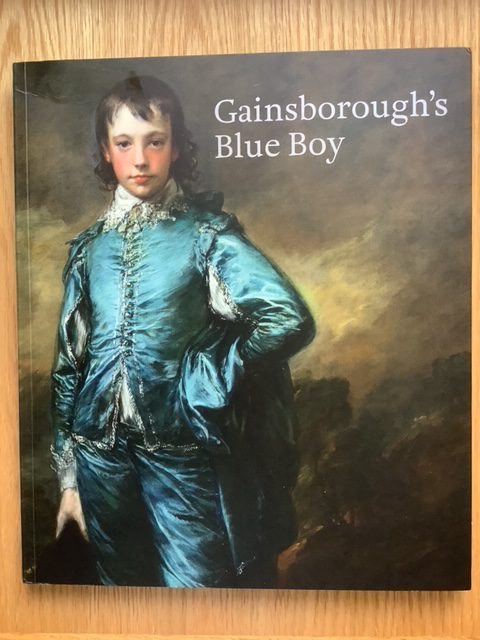
It has been nine weeks since The Blue Boy left The Huntington Art Museum’s Thornton Portrait Gallery for a journey back to its birth home. On January 25, 2022, one hundred years to the day the painting left England forever, The National Gallery in London opened an exhibition of the works of celebrated English painter Thomas Gainsborough called ‘Gainsborough’s Blue Boy: The Return of a British Icon.’
For the gallery, it was a much-anticipated event that was years in the making. In the catalog of the exhibition, The National Gallery Director Gabriele Finaldi, writes that initial negotiations about the possible loan of the painting held between Lord Rothschild and representatives of The Huntington began in 2015 – three years before either Karen Lawrence (The Huntington Library, Art Museum, and Botanical Gardens president) and Christina Nielson (The Huntington’s Hannah and Russel Kully Director of the Art Museum) assumed their current posts.
‘Gainsborough’s Blue Boy’ exhibition catalogue | Photo by May S. Ruiz / Hey SoCal
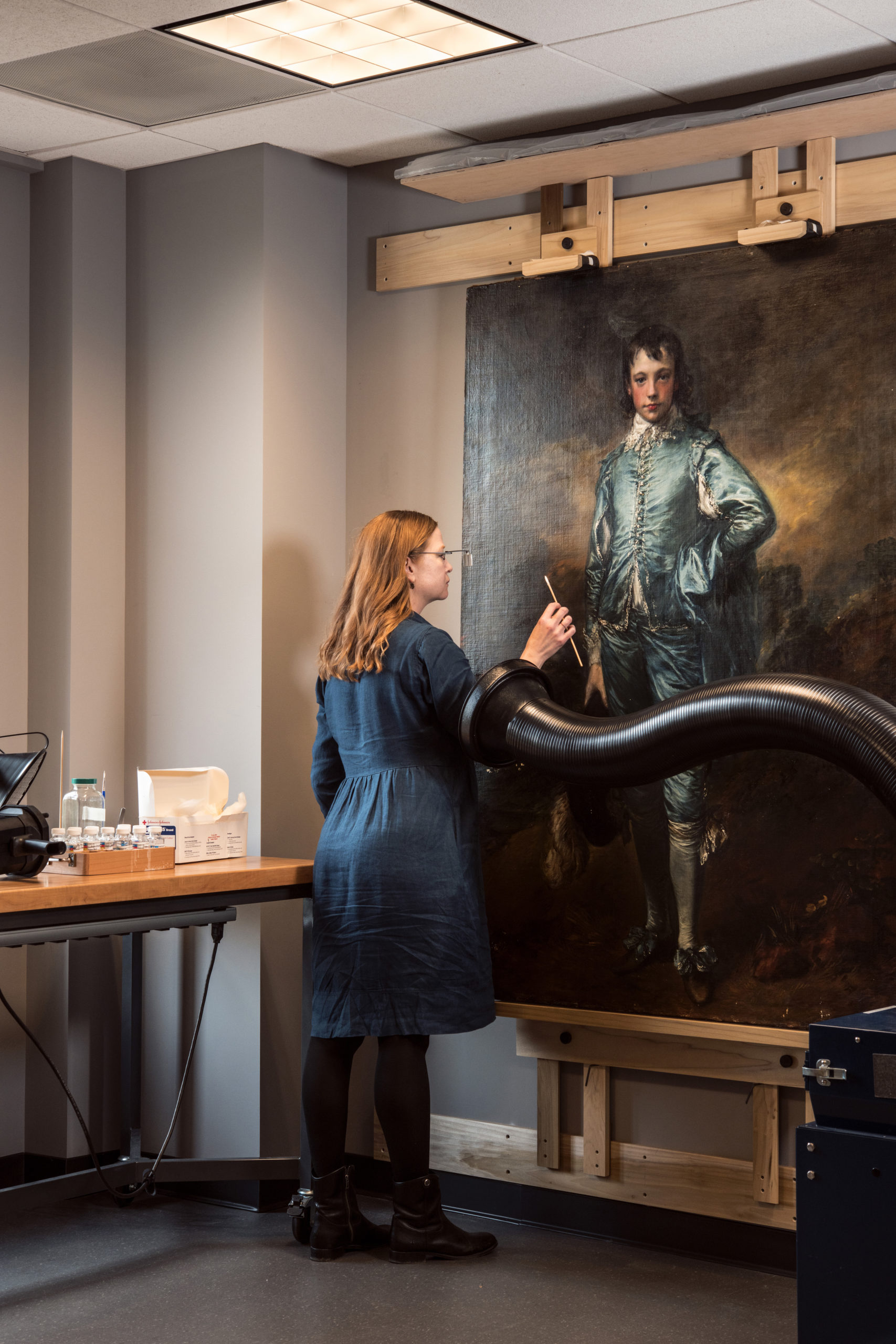
The Huntington hired its first conservator, Christina O’Connell, in 2013 and one of her initial projects was a survey of the art collections. In 2017 she planned and undertook ‘Project Blue Boy,’ the first technical examination and conservation work that was done in public view. A special satellite conservation studio was set up in the west end of the Thornton Portrait Gallery for the year-long exhibition, from September 22, 2018 to September 30, 2019. More than 217,000 people – many of whom traveled several miles – came to see it. Several habitués to The Huntington speculated that the possible loan was the impetus for the conservation work.
That The Blue Boy has reached an iconic stature is demonstrated by how much attention and scrutiny it invites … and how people react to any news about it. In 1921, when British citizens learned that the second Duke of Westminster sold The Blue Boy to an American industrialist, protests broke out in the streets. When it was on view at the National Gallery for three weeks in January 1922, approximately 90,000 people – some of whom wept – queued to see it for the last time.
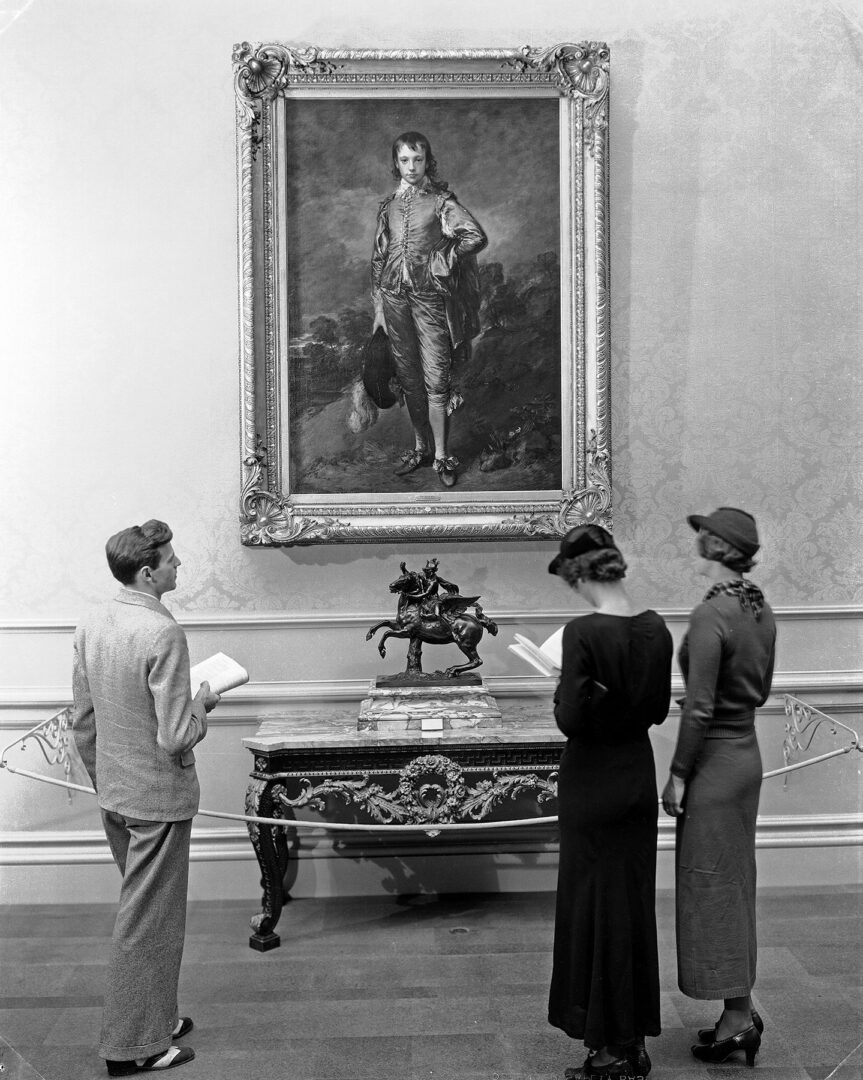
Visitors view Thomas Gainsborough’s The Blue Boy at The Huntington in the 1930s | Photo courtesy of The Huntington Library, Art Museum, and Botanical Gardens
The National Gallery’s then director, Sir Charles Holmes, nostalgically inscribed ‘Au Revoi, C.H.’ at the back of the painting. O’Connell, when she worked on ‘Project Blue Boy,’ very thoughtfully made sure it was also preserved. While that wish was granted a century later, Nielsen assures that it didn’t influence The Huntington’s magnanimous loan. “Strictly speaking, we agreed to lend only after lengthy consideration of a number of factors. But it makes part of a great story!”
In a reversal of events, when The Huntington announced in July last year that The Blue Boy was traveling to England for an exhibition, a wave of comments and views erupted. Art enthusiasts and museum-goers – some of whom didn’t have professional art experience – had as strong an opinion on the matter as art critics and experts. L.A. Times art critic Christopher Knight expressed incredulity that The Huntington went against the advice of the very experts the institution consulted. He said conservation experts believed the painting was too fragile to make that arduous journey. The Huntington, just as quickly, issued a response that refuted Knight’s claims. In the letter, Lawrence and Gregory A. Pieschala, The Huntington’s Chair of Board Trustees, mentioned that the institution convened a second panel of conservators and curators in 2019 when most of the conservation work was complete and it advised that the painting could be lent safely.
On both sides of the Atlantic, news that The Blue Boy will be back in its home country for a 16- week exhibition – from January 25 through May 15, 2022 – garnered extensive publicity. Articles were written about The Blue Boy’s storied history and how its image has been used and appropriated.
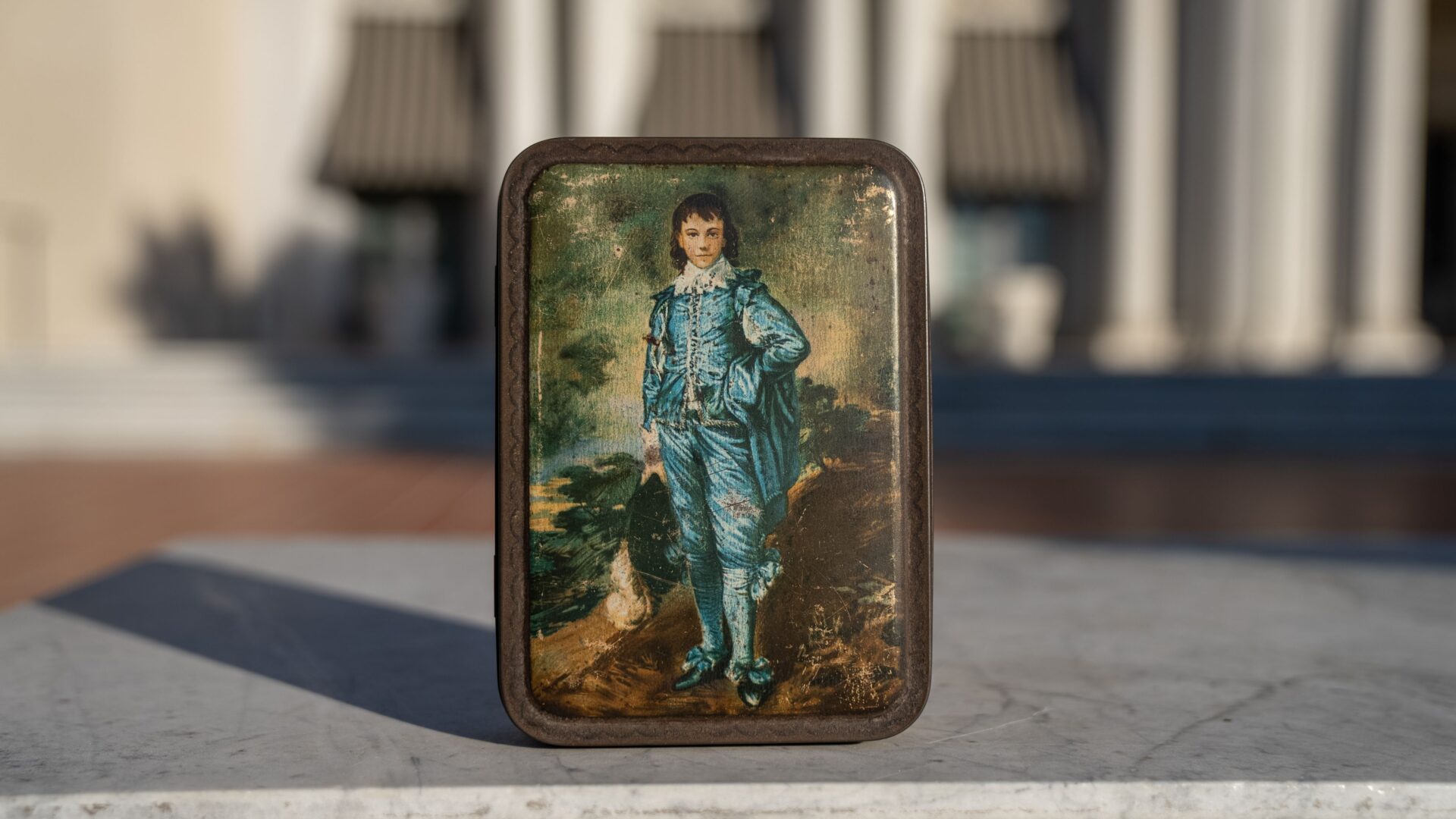
A Cadbury Company chocolate tin depicting Blue Boy, ca. 1920 | Photo by Aric Allen / The Huntington Library, Art Museum, and Botanical Gardens
The exhibition is expected to draw large crowds as well. While the National Gallery will not release visitation data until the exhibition has closed, Christine Riding, curator of the ‘Gainsborough’s Blue Boy,’ provided an anecdotal report. “The Blue Boy is proving incredibly popular with National Gallery visitors. From the very first day the exhibition opened, with a long queue of people keen to be the very first to say hello to him on his return, we’ve experienced large amounts of people each day eagerly making their way through the Gallery to see this exceptional loan.”
However, much like many renowned works of art, The Blue Boy’s popularity came long after the painter’s death. Riding writes in the exhibition’s catalogue, “One of the ironies of art history is that Thomas Gainsborough’s Blue Boy attracted little public attention (as far as contemporary sources relay) when it was first shown at the Royal Academy in 1770. Yet 150 years later, when it was sold to the American tycoon Henry E. Huntington, it was one of the most famous paintings in the world.”
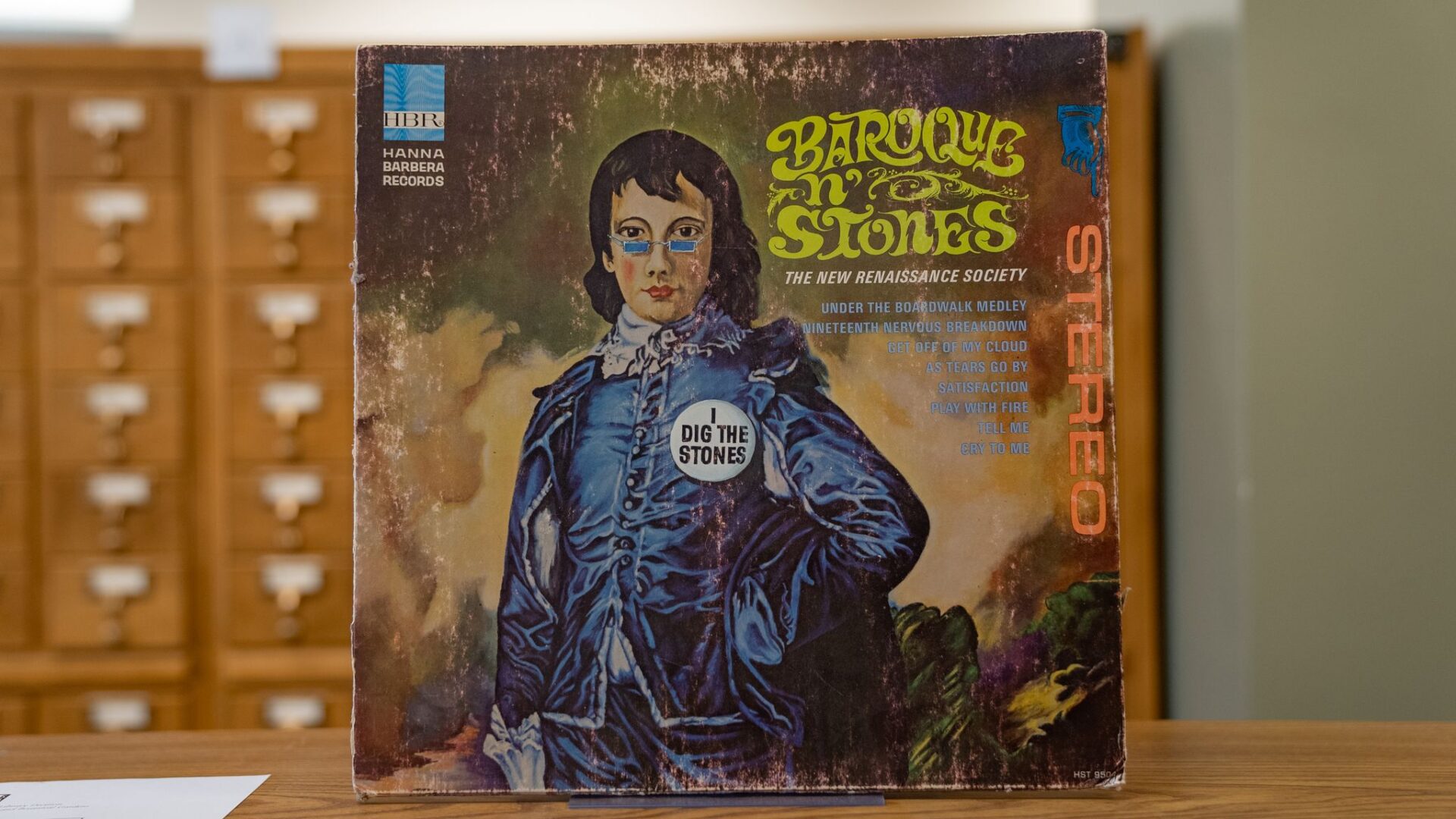
Indeed, images of the Blue Boy has appeared on everything from chocolate tins to folding screens, as fashion historian and curator Kimberly Chrisman-Campbell chronicles in a blog titled ‘Blue Boy Mania: How Gainsborough’s Masterpiece Colored Pop Culture.’ In it, she records the painting’s history and its appeal to advertisers, entertainers, and interior decorators.
The New Renaissance Society, ‘Baroque n’ Stones’, Hanna Barbera Records, 1966. Blue Boy, wearing shades, graces the cover of this album of Baroque-style musical treatments of such Rolling Stones classics as ‘Get Off of My Cloud’ and ‘(I Can’t Get No) Satisfaction’ | Photo by Aric Allen / The Huntington Library, Art Museum, and Botanical Gardens
Anyone who has seen The Blue Boy identifies with it in some ways. And just like beauty being in the eye of the beholder, the painting stirs a different feeling or emotion in each of us. Leading up to the exhibition opening at The National Gallery, articles published in the U.K. demonstrated this. Matthew Wilson wrote in BBC Culture about its appropriation (or misappropriation) as a symbol for gay pride. Meanwhile, art historian Dan Ho paid a tribute to it in February for LGBTQ+ History Month. Jonathan Jones shared his jaded view in The Guardian that ‘it’s as a hokey vision of English art as a Disney cartoon of a fox hunt.’
Asked by email if the disparate sentiments expressed in the articles make people curious to see The Blue Boy, or if they take away from its mystique, Nielsen replies, “The painting has captivated audiences since it first went on display in 1770. It means something different to everyone who sees it, and that is part of its magic.”
Stories about The Blue Boy will be written in the decades and centuries yet to come. This gorgeous boy, who has inspired countless interpretations and conjured just as many images, could very well signify something else altogether to the generations after us. Some of the ways people relate to him and the painting may not be what Gainsborough originally intended. In Wilson’s BBC Culture article, he cites an art history professor saying “artists cede control of their creations once they are absorbed into the public arena.”
And, in essence, that’s the greatest gift artists could leave behind – for people to make of their artwork what they will. At the same time, it’s an assurance that their artwork will continue to be relevant.
Originally published on 10 September 2021 on Hey SoCal
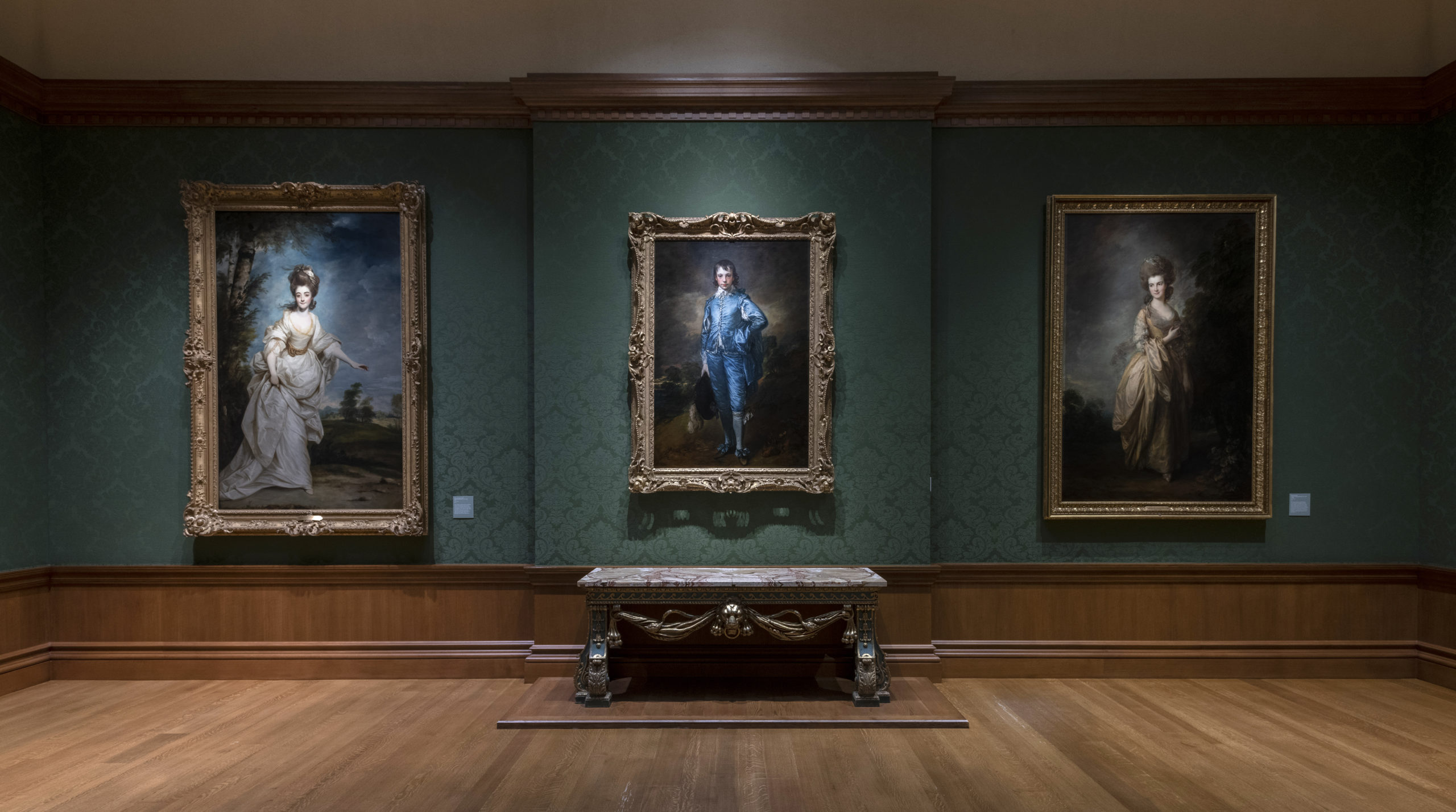
Installation view of The Blue Boy | Courtesy Photo / The Huntington Library, Art Museum, and Botanical Gardens
Last month we published an article about the announcement that The Huntington Library, Art Museum, and Botanical Gardens has decided to loan our beloved “Blue Boy” to the National Gallery in London. Gainsborough’s magnificent work, which left England for the United States on Jan. 25, 1922, will be part of an exhibit that is set to open exactly 100 years since that day.
In its announcement, Huntington President Karen R. Lawrence, remarked, “This masterpiece has made an indelible mark on both art history and popular culture, capturing the imaginations of a wide range of audiences. Given ‘The Blue Boy’s’ iconic status at The Huntington, this is an unprecedented loan, one which we considered very carefully. We hope that this partnership with the National Gallery will spark new conversations, appreciation, and research on both sides of the Atlantic.”
We in the San Gabriel Valley are so fortunate to have world renowned museums and to have been exposed to stunning works by some of the greatest artists who ever lived. Most of us have never known a time when “The Blue Boy” wasn’t at The Huntington. So we asked our readers to tell us how they feel about it traveling to London and share with us their experience with this piece of art.
While we didn’t receive as many responses as we had hoped, we learned that our readers have informed opinions with information to impart. We also feel that what we did get are representative of people’s reactions and we’re printing them below:
“My informal response to your informal survey is that if the experts say it’s not safe for the painting to travel, then it shouldn’t. I’m also concerned that if the painting does go to London, what’s to keep their museum from saying that the painting is too fragile to send back?
“As you can see, I’m reluctant to let it go.”
Meg Gifford Pasadena
“Everybody likes to return home, even for a short visit … and I’m sure ‘Blue Boy’ is among them. So I wish him “calm seas and prosperous voyage.”
“The greatest gift master painters have given mankind is that it doesn’t take an advanced degree in art to appreciate their work.
“Even as a rustic with no refinement, I have stood at length in reverence before Gainsborough’s masterpiece. And in so doing, I convinced myself that if I touched that canvas, I wouldn’t feel a flat surface, but instead Blue Boy’s silken garment and his flesh underneath it.”
David Quintero Monrovia
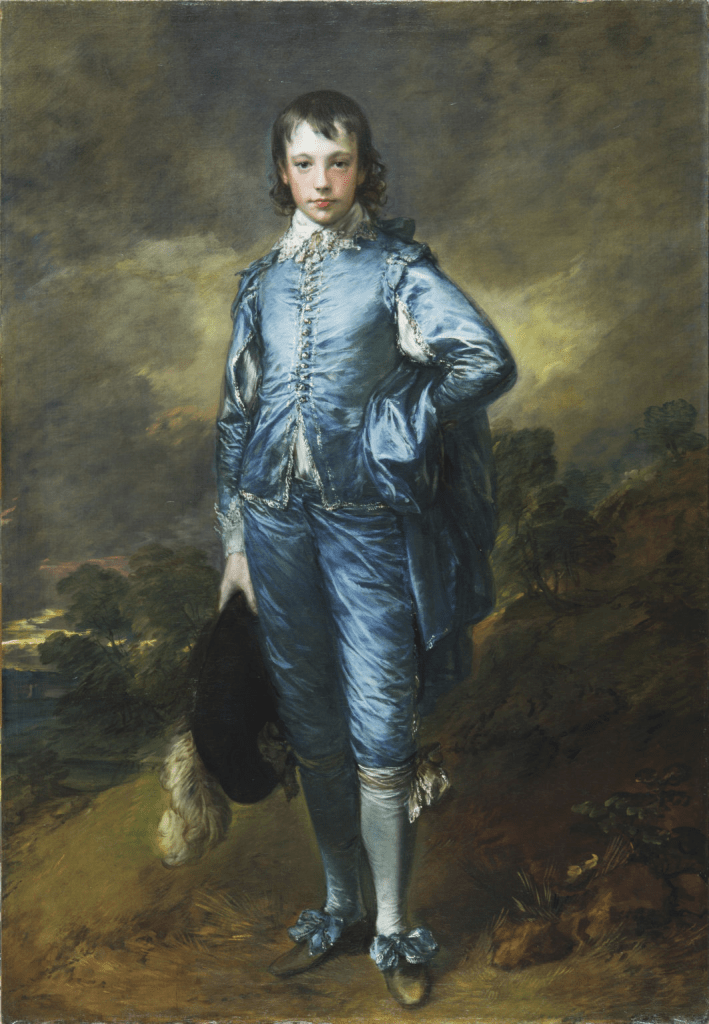
‘The Blue Boy’ post conservation | Photo by Christina Milton O’Connell / The Huntington Library, Art Museum, and Botanical Gardens.
“I believe it is a wonderful opportunity to return it to the land from whence it came so that a ‘new generation’ can admire its beauty. The concerns cited can be mitigated if those involved will check history regarding other great works of art that traveled outside their respective country.
“The Mona Lisa was painted in 1503, 276 years BEFORE Blue Boy. Thanks to the efforts of former First Lady Jacqueline Kennedy, France’s national treasure, a very fragile piece of art, was shipped to America. On January 8, 1963, Leonardo da Vinci’s Mona Lisa made its first appearance when it was put on display at the National Gallery of Art in Washington, D. C. It was transported by the S.S. France ocean liner in a temperature-controlled box in its own stateroom, accompanied by armed guards. The temperature, which was alarm-monitored, would not be allowed to fluctuate by more than one degree throughout the entire journey. Eleven years later, in 1974, the Mona Lisa once again left France to travel to Russia and Japan. It can be done without endangering the masterpiece.
“Françoise Nyssen, France’s former Minister of Culture, once said that she didn’t believe works of tremendous cultural significance should be confined to a single institution. I thoroughly agree. Whenever possible, great works of art should be shared with the world.
“Thank you.”
Charlotte Farmer Arcadia
“My first memories of seeing the ‘Blue Boy’ was in the 1970s when my parents took me to The Huntington as a young kid. It was my mom who introduced me to it, saying it’s a great piece of art. But my appreciation of it at the time was due to the fact that the painting was of a child, like me. I remember it also being next to “Pinkie,” and I don’t know if they were meant to be deliberately displayed next to each other. While these were paintings from a long time ago, I felt a connection and kinship with them.
“That impression stayed with me to this day so when we have visitors, I take them to The Huntington and show them the ‘Blue Boy.’ When my cousins from Japan came in 2018 for my dad’s 88th birthday celebration, I took them to the mansion along with a niece and nephew who aren’t from this area. I told them about The Huntington’s conservation project and what the x-rays showed beneath the painting. I was able to share a part of my local culture to two generations. There was a language barrier between my Japanese cousins and my American relatives and they had to use Google translate to communicate, but it was a fun family experience tied to the ‘Blue Boy.’
“It’s a nice gesture to share the artwork and I hope it’s safe for it to travel that far. However, its absence will sadden many of us who have grown up knowing it’s always been there. I imagine ‘Pinkie’ will also be sad not to have him by her side. What’s going in that space while ‘Blue Boy’ is away?
“I’m a member of The Huntington and I take strolls at the gardens. And every time I go to the mansion, I make it a point to see the ‘Blue Boy.’ It’s a magnificent piece of art and embodies what I think The Huntington is about. There are so many rotating exhibits – even at the promenade area – but seeing the ‘Blue Boy’ always makes me happy. It evokes emotions and memories of my childhood. I’ll be looking forward to its safe return.”
Stephanie Yamasaki Altadena
The board of The Huntington will be glad to know that their decision has more proponents than opponents and art experts can be assured that “The Blue Boy” can safely travel, as one reader asserted. And we can be gratified in the thought that art enthusiasts across the Atlantic will have the rare chance to see and experience the treasure we hold precious.
Originally published on 19 August 2021 on Hey SoCal
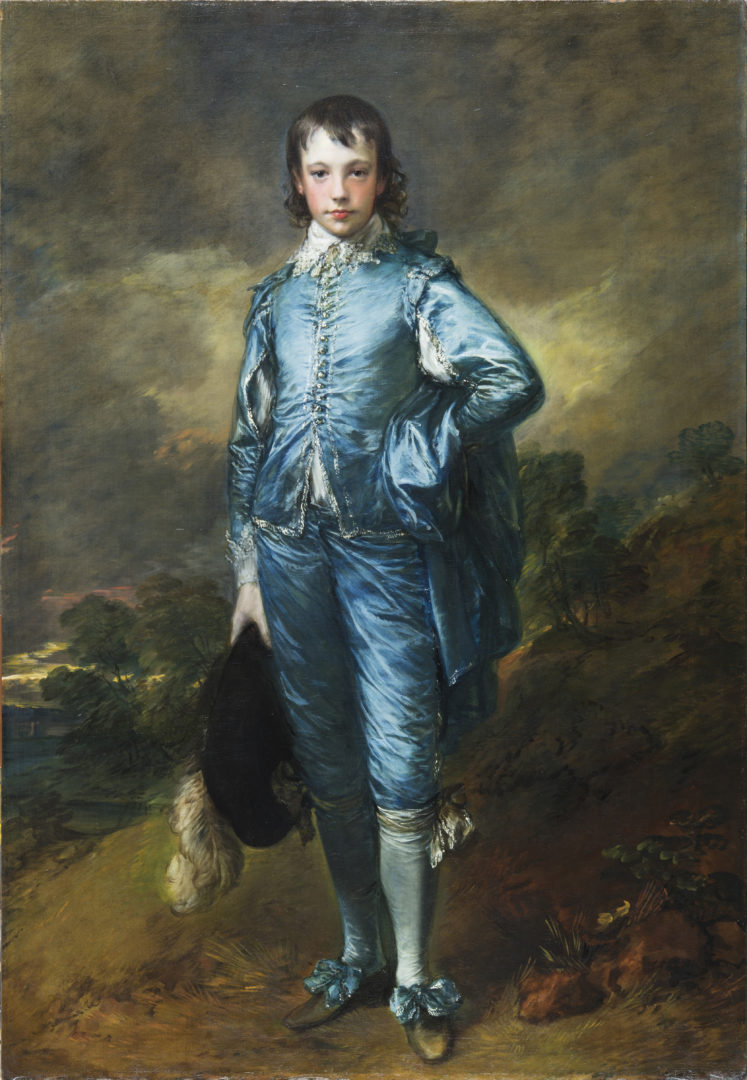
‘The Blue Boy’ | Photo by Christina O’Connell / Huntington Library, Art Museum and Botanical Gardens
Among the many treasures housed in The Huntington’s art galleries, none has a more storied history than Thomas Gainsborough’s “The Blue Boy.” It had been a beloved artwork in its homeland – images of the boy in the striking blue attire appeared on various souvenir items. Its purchase in 1921 by an American collector caused quite a stir among the British people and they took to the streets when they found out that it was leaving for America.
“The Blue Boy” has occupied an important place at the Huntington Library, Art Museum, and Botanical Gardens since it opened in 1928. Along with the breathtaking and expansive gardens, the many valuable collections in the library – William Shakespeare’s quarto and folio editions, a rare Gutenberg bible on vellum, the Ellesmere manuscript of Chaucer’s “Canterbury Tales,” and Benjamin Franklin’s handwritten autobiography, among them, – the impressive works of art in the various galleries, the “Blue Boy” attracts more than 800,000 visitors every year.
In 2018, The Huntington embarked on “Project Blue Boy,” a nearly three-year conservation project to analyze, stabilize, clean, and restore the painting. To provide visitors a peek into the art and science of the process in real time, much of the conservation work was performed in public. Senior paintings conservator Christina O’Connell, who led the project, gave approximately 170 gallery talks and answered questions posed by the more than 200,000 visitors who came to watch the progress between 2018 and 2019.
The restored “Blue Boy” was scheduled to be back at the Thornton Portrait Gallery on March 26, 2020 but the coronavirus pandemic delayed that much anticipated unveiling (read related article here). While it was back at its usual spot in September last year, it was only on April 17 this year – when The Huntington’s art galleries were again open to the public – that visitors got to see Gainsborough’s masterpiece.
And then last month, The Huntington announced that “The Blue Boy” will be returning to England 100 years after it left. From Jan. 25 through May 3, 2022, it will be on display at the National Gallery in London – a reversal of events when it was last viewed by 90,000 people during its last three weeks there before it departed for its new home in California.
This time, the news stunned art experts. In a Los Angeles Times article published on July 6, art critic Christopher Knight wrote that he asked Mark Leonard, a retired conservator of paintings at the J. Paul Getty Museum, for a comment. Leonard replied that the panel of nine American and European art conservators – experts the museum convened in December 2018 to evaluate the “Blue Boy’s” condition – expressed shock about the decision made by The Huntington’s board of trustees.
Knight further wrote that “sending the picture was unanimously opposed by the expert team, who believed travel puts the prized work at grave risk. They warned of potential structural damage to the 250-year-old canvas from the arduous trip.”
While it’s magnanimous of The Huntington board to lend “The Blue Boy” to the National Gallery so that others across the Atlantic are afforded the opportunity to once more see it, we in the San Gabriel Valley are also very protective of it. We have wonderful memories of going to the Thornton Gallery to gaze in awe at Gainsborough’s genius, and we want to make sure the painting celebrates its next centennial.
How do you feel about “The Blue Boy” traveling 5,429 miles and being gone for four months? We invite you to send us an email and tell us, in 100 words or fewer, your thoughts about it and share your experience looking at this magnificent work of art. Send your email to: MayRChu56@gmail com. Unless you request otherwise, we will include your name when we publish our informal poll.
Originally published on 18 September 2020 in the Pasadena Independent, Arcadia Weekly, and Monrovia Weekly
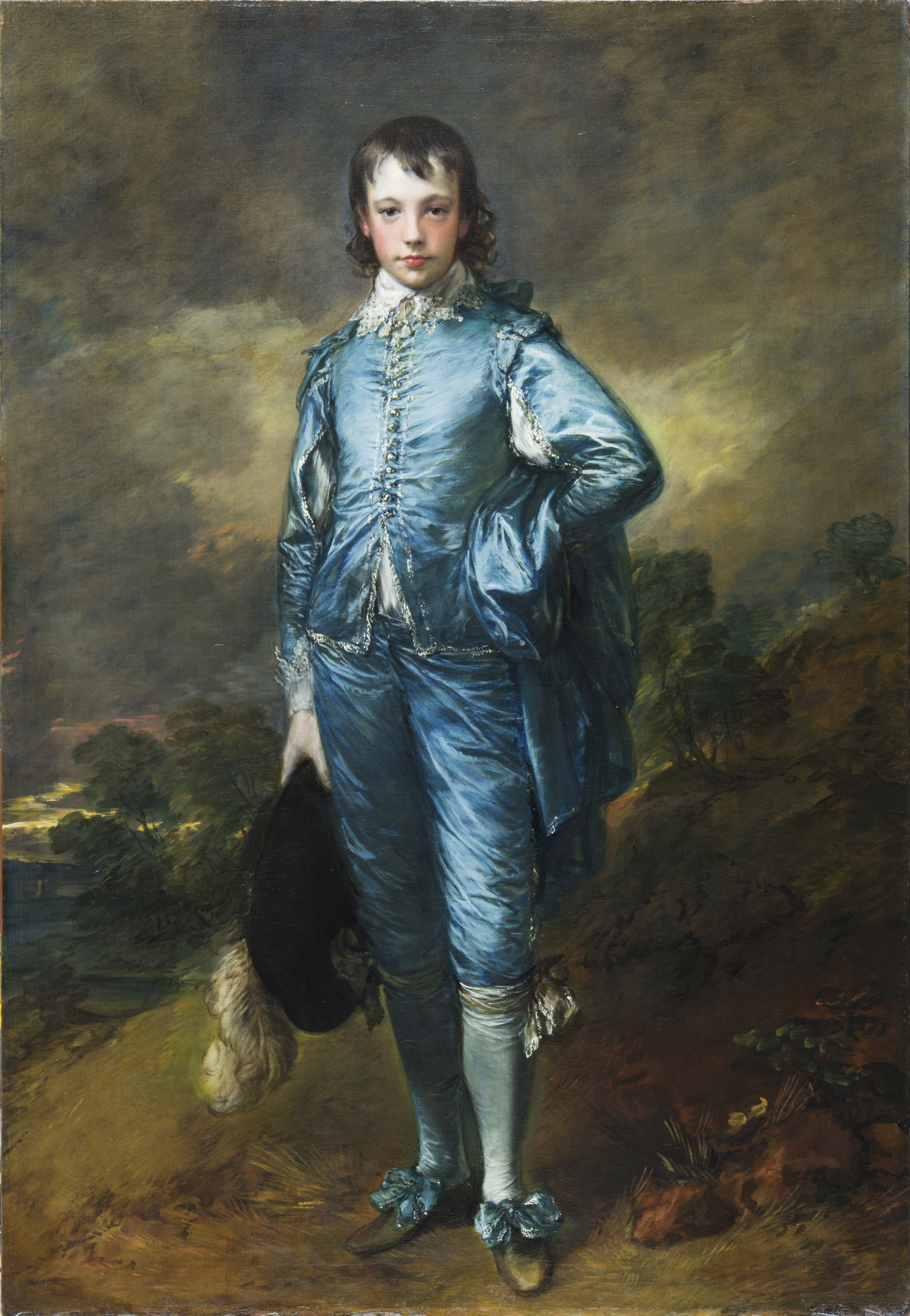
‘The Blue Boy’ by Thomas Gainsborough post conservation photo | Photo by Christina Milton O’Connell / The Huntington Library, Art Museum, and Botanical Gardens
Created by English landscape and portrait painter Thomas Gainsborough around 1770, ‘The Blue Boy’ occupies a place of honor at The Huntington Library, Art Museum, and Botanical Garden’s Thornton Portrait Gallery and is seen by about 800,000 people annually. After an 18-month restoration project, it has been rehung and will be available for viewing when it’s safe for the museum to reopen. And when we do get the chance to visit again, we’ll fully appreciate why the painting gained the moniker.
‘Project Blue Boy’ began in 2017 when conservators carried out a preliminary analysis of the painting. It was examined and documented using a range of imaging techniques that allowed Christina O’Connell, senior paintings conservator, and Dr. Melinda McCurdy, associate curator of British art, to see beyond the surface with wavelengths the human eye can’t see. Infrared reflectography rendered some paints transparent, making it possible to see preparatory lines or changes the artist made. Through ultraviolet illumination, they were able to examine and document the previous layers of varnish and old overpaints.
Their findings determined what needed to be done and how it was going to be accomplished – ‘The Blue Boy’ required conservation to address both structural and visual concerns. “Earlier conservation treatments mainly have involved adding new layers of varnish as temporary solutions to keep it on view as much as possible,” O’Connell declared at the start of the project. “The original colors now appear hazy and dull, and many of the details are obscured.”
According to O’Connell, there were also several areas where the paint was beginning to lift and flake, making the work vulnerable to paint loss and permanent damage; and the adhesion between the painting and its lining was separating, meaning it did not have adequate support for long-term display.
New images of the back of the painting were taken to document what appeared to be an original stretcher (the wooden support to which the canvas is fastened) as well as old labels and inscriptions that told more of the painting’s story. Furthermore, minute samples from the technical study and from previous analysis by experts were studied at high magnification (200-400x) with techniques including scanning electron microscopy with which conservators could scrutinize specific layers and pigments within the paint.
The undertaking uncovered new information of interest to art historians as well. During preliminary analysis, conservators found an L-shaped tear more than 11 inches in length which, data suggest, was made early in the painting’s history. The damage may have occurred during the 19th century when the painting was in the collection of the Duke of Westminster and exhibited frequently.
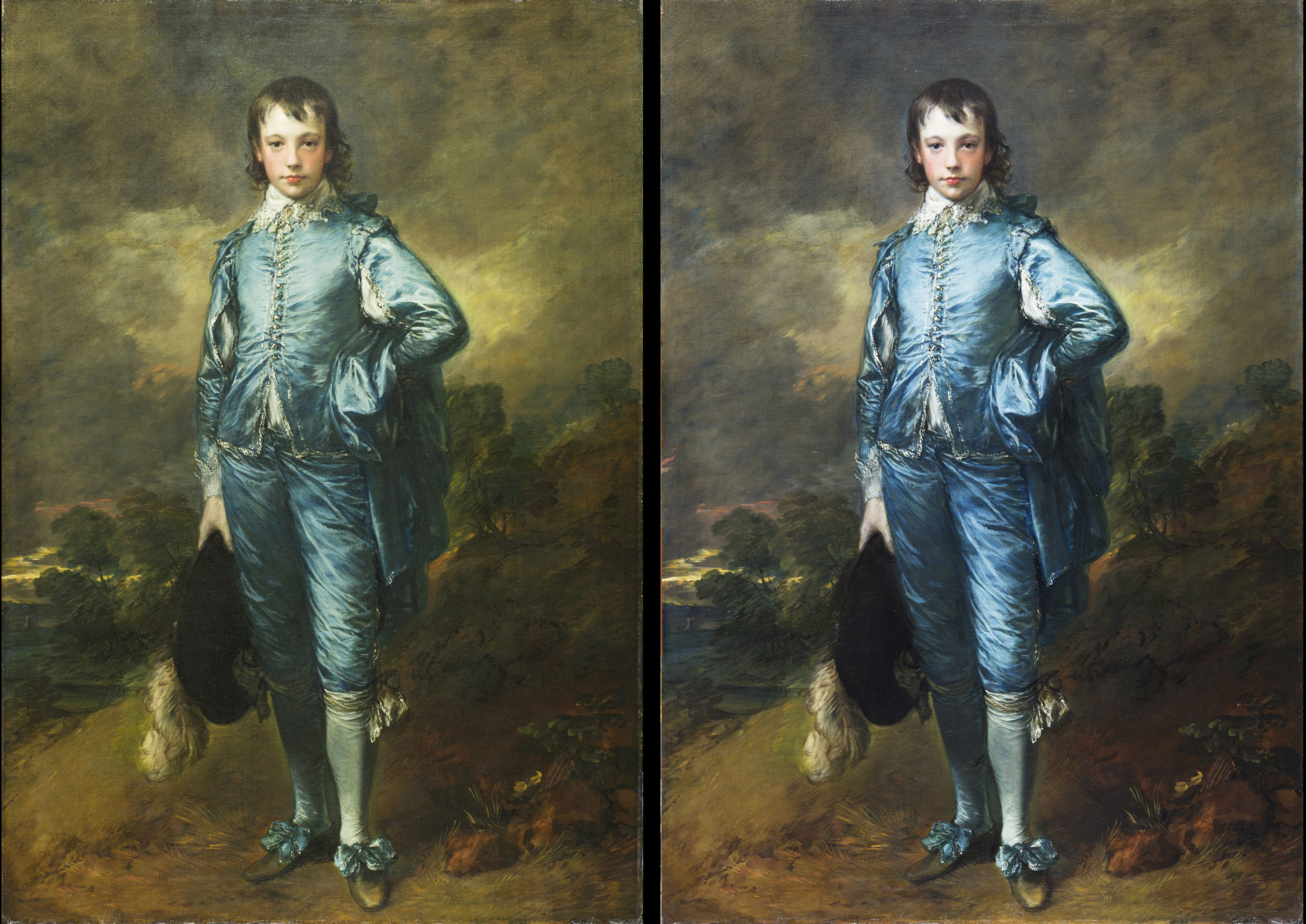
Side-by-side comparison of Thomas Gainsborough’s ‘The Blue Boy,’ Pre-conservation (left), post conservation (right) | Photo by Christina Milton O’Connell / The Huntington Library, Art Museum, and Botanical Gardens
It was decided early on that this conservation project was going to be different from what they had undertaken before – it would have an educational component and involve the community. The Huntington partnered with Bank of America’s Art Conservation Program to finance the massive undertaking.
For the first time in its history, The Huntington held a year-long exhibition from September 2018 to September 2019 showcasing the project in progress – the capstone of its centennial celebration. During the first three months, ‘The Blue Boy’ was on public view in a special satellite conservation studio set up in the west end of the Thornton Portrait Gallery, where O’Connell worked on the painting to continue examination and analysis, and began paint stabilization, surface cleaning, and removal of non-original varnish and overpaint.
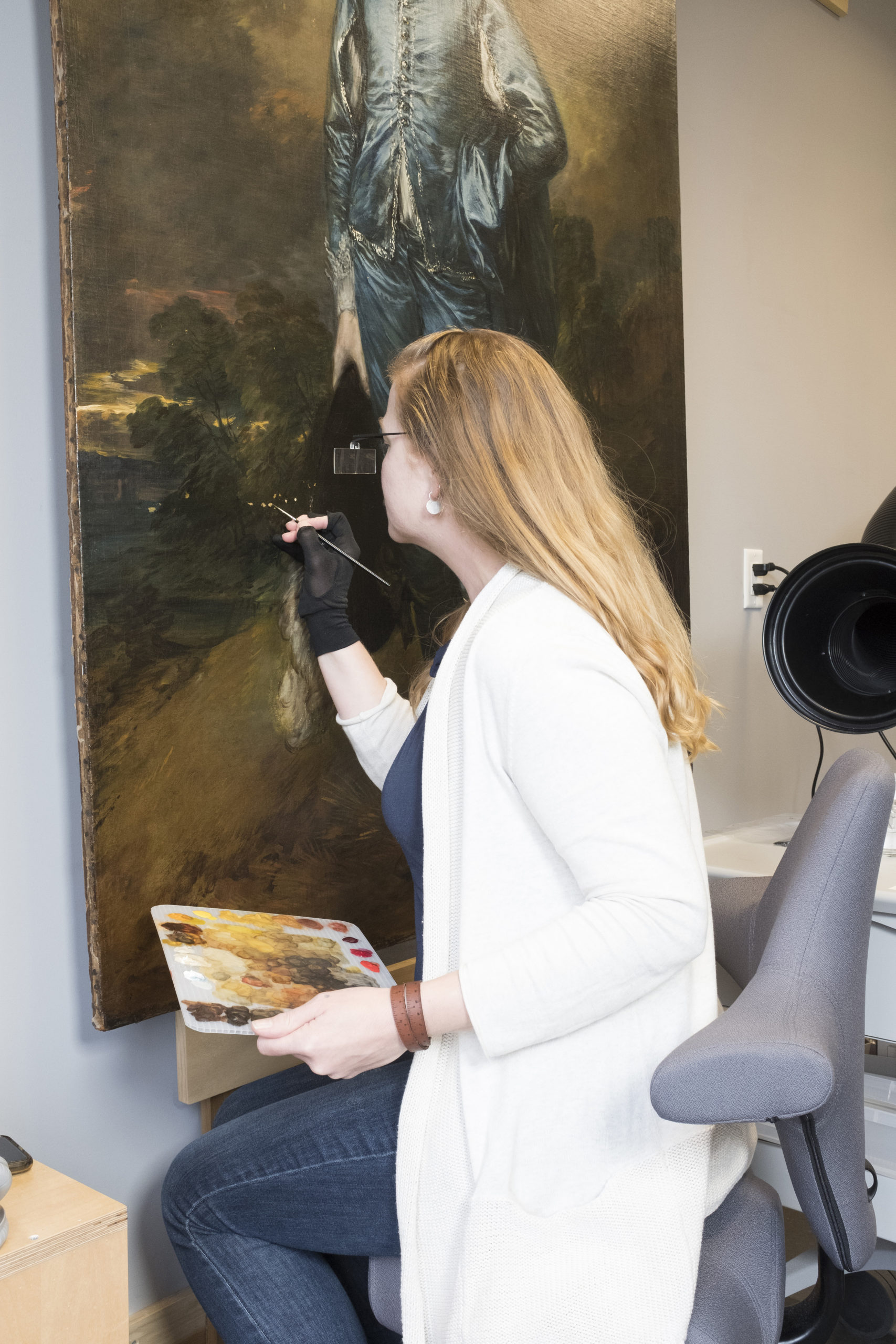
It went off view from February through June when O’Connell performed structural work on the canvas and applied varnish with equipment that couldn’t be moved to the gallery space. ‘The Blue Boy’ then returned to the gallery where visitors witnessed the in-painting process until the close of the exhibition.
The final phase – held off view from October 2019 to March 2020 – involved in-painting, varnishing, supportive backing, and adjusting the framing.
A stabilized and restored painting was scheduled to be back at the Thornton Portrait Gallery in the spring, but the pandemic delayed the public unveiling until Thursday, Sept. 10. To help get the word out, The Huntington held a virtual press briefing. In conjunction with the event, Dr. McCurdy and O’Connell agree to be interviewed by email.
Christina Milton O’Connell, Mary Ann and John Sturgeon Senior Paintings Conservator, removed discolored varnish with small swabs | Courtesy Photo / The Huntington Library, Art Museum, and Botanical Gardens
I ask if they were able to find the answers to questions they had when they embarked on the project: What technical means did Gainsborough use to achieve his spectacular visual effects? Did he develop special pigments, create new materials, pioneer new techniques?
O’Connell replies, “We’re still waiting on some data from our samples and we hope to have more information soon. What we do know is that Gainsborough used a complex mixture of many different pigments together to make his colors. He also used many layers of opaque and transparent paint to create different visual effects. Now that the painting has been cleaned, we can see nuances of his brushstrokes that were obscured under the discolored/cloudy varnish. We can appreciate his technique from the fluid and fast strokes he applied to the sky and landscape to the more complex network of paint strokes that comprise the figure of the boy.
What might new technologies tell us about this earlier abandoned portrait? Where does this lost painting fit into his career? How does it compare with other earlier portraits by Gainsborough? Will there be other evidence that may become visible beneath the surface paint, and what it might indicate about Gainsborough’s painting practice?
“The digital x-ray gave us a clearer picture of the abandoned painting than we had previously,” answers Dr. McCurdy. “We were able to capture more of figure’s face, including his eyes, which we had never seen before. That was an exciting discovery. Unfortunately, there just wasn’t enough information for us to identify the sitter or to suggest a specific date range for the portrait.”
Adds O’Connell, “As Melinda indicated, we learned a lot from the x-rays. We also used infrared reflectography (IRR) to see through some of the layers of paint (X-rays go through all the layers). With IRR, we could confirm that Gainsborough didn’t take that previous portrait very far – he only captured the likeness of the sitter and painted very preliminary outlines for the figure’s shoulders. I’d like to point out that there isn’t one analytical technique that provides all the answers, we have to study the painting with many different forms of technology to get different pieces of information.
Did you discover other evidence beneath the surface paint and what did it indicate about the artist’s painting process?
“We used some techniques of analysis that hadn’t previously been used to study the painting,” says O’Connell. “One of those techniques is infrared reflectography (IRR). With this analysis, we can see what is beneath some of the paint layers and it’s a useful technique for examining the preparatory layers or sketches an artist applied under the paint. For Blue Boy, we can see preparatory lines that establish the bold pose of the figure from the very beginning stages.
Christina Milton O’Connell uses tiny brushes to reconnect Gainsborough’s brushstrokes across the voids of past damages | Courtesy Photo / The Huntington Library, Art Museum, and Botanical Gardens
I ask if there were other revelations they hadn’t expected to unearth and Dr. McCurdy responds, “We hadn’t expected to find that the painting had suffered a major damage in the past. The canvas had been torn, but it had been repaired so well that it hadn’t shown up in previous x-rays.”
Continues O’Connell, “Discovering the tear helped us understand the reason why the painting was lined. There was a large damage that needed repair.”
“How does this restoration project compare with others you have done before?” I inquire.
“The condition issues for Blue Boy were not surprising for a painting from the 18th century,” O’Connell discloses. “Each treatment is slightly unique and a conservator has to take into account the original materials and how they’ve aged over time, but also the past treatments and restorations. Each project is a unique case study and that’s one of the things I love about the field.”
Painting restoration doesn’t sound like a thrilling project for the average person who isn’t knowledgeable about art, so I ask what we should find exciting to know. I tell them I was shocked to learn that Gainsborough had painted over something – it seems sacrilegious – but I imagine it was a common practice among artists.
Dr. McCurdy explains, “It is not that uncommon to find another painting beneath the surface composition. There are many reasons an artist might decide to paint over something else – maybe the composition didn’t work out the way s/he wanted? Maybe a client did not pay? Materials are expensive, so it could also happen for cost-saving reasons. In this case, we know that Gainsborough didn’t paint Blue Boy as a commissioned work, so he wasn’t being paid for it. It made financial sense to re-use a canvas he already had.”
“Sharing the treatment process with our visitors created another avenue for them to learn about and see Blue Boy in a new way,” O’Connell expounds. “Visitors were extremely fascinated to learn about all the layers that comprise the painting (there are 8-9 and you wouldn’t know that just from looking at the surface). Some visitors are drawn to learning more about Gainsborough’s technique and others were drawn to the process of conservation. Some were interested to see the forensic side of the technical investigation. The focus on research and education (part of The Huntington’s mission) really meant that this project had something for everyone.
Christina Milton O’Connell in-painting in the conservation lab | Courtesy Photo / The Huntington Library, Art Museum, and Botanical Gardens
“I have many memories from visitors coming to the gallery, but one that stands out was a day when I had a detailed discussion with an artist and a polymer chemist from JPL about varnishes. They both had a different reason for asking their questions and a different experience and understanding of varnish, but everyone was engaged.”
Please share your thoughts about what you, personally, learned as you did this project, I ask.
Dr. McCurdy states, “In watching Christina uncover Gainsborough’s original palette from beneath layers of dirt and discolored varnish and overpaint, it was remarkable to see this painting that everyone knows through cheap reproductions be revealed as a truly compelling work of art. Now, we get a better sense of the relationship between the figure and the landscape, we are better able to see the complexity of Gainsborough’s brushwork, and the true colors of the figure’s blue costume. Due to the discoloration, it had appeared slightly green-ish. That effect is now gone, and it is brilliant blue again. It must have been striking to audiences who first saw it in 1770.”
“Conservation is very much a process of discovery,” concurs O’Connell. “I spent a lot of time looking at the surface of Blue Boy while setting tiny flakes of paint back into place and during the cleaning process where, inch by inch, I saw the original surface emerge from underneath many layers of degraded and cloudy varnish. Each treatment has unique problems to solve and decision-making as part of the process, so there’s an opportunity for learning with each treatment.”
Lastly, I inquire if there’s something that they would like to add. And Dr. McCurdy divulges, “For me, the fact that The Huntington decided to do this conservation work on public view was important. Of course, this is a beloved painting to many of our visitors, and we knew we needed to keep it on display as much as possible, but the most exciting thing was the way the project engaged visitors with the role museums play in preserving cultural heritage. There were times when the crowd of visitors around the satellite conservation lab in the Thornton Portrait Gallery was several deep. People were excited to learn more about this painting and to see the conservation work unfold in front of them.”
Installation view of ‘The Blue Boy’ in the Huntington Art Gallery | Photo by John Sullivan / The Huntington Library, Art Museum, and Botanical Gardens
‘The Blue Boy’ has a storied provenance. Thomas Gainsborough was among the most prominent artists of his day. Though he preferred to paint landscapes, he built a flourishing career as portraitist to the British aristocracy whom he depicted at their leisure. However, ‘The Blue Boy’ wasn’t a commissioned work but was done to show off his skill at the Royal Academy. Later circulated accounts that Gainsborough did it to disprove another painter’s belief about the use of the color blue were dispelled by The Huntington’s curators as apocryphal and were made after his death. The model was believed to be Jonathan Buttall (1752–1805), the son of a wealthy merchant and who was also the first owner of the painting, but his identity remains unconfirmed.
Anthony van Dyck, the 17th century Flemish painter, was a major influence in British art and Gainsborough’s Blue Boy’ appears to be an homage to him. Instead of dressing the figure in the elegant finery worn by most sitters at the time, Gainsborough chose knee breeches and a slashed doublet with a lace collar – inspired by van Dyck’s ‘Portrait of Charles, Lord Strange.’ It made its debut at the Royal Academy exhibition of 1770 as ‘A Portrait of a Young Gentleman,’ where it received high acclaim. By 1798 it was being called ‘The Blue Boy.’
When Henry and Arabella Huntington purchased ‘The Blue Boy’ in 1921, it was already being hailed as Gainsborough’s greatest work and a national treasure. His image was on print reproductions, even on chocolate tin containers. It was no surprise then that the sale of the painting to an American caused an enormous protest in its homeland. The National Gallery displayed it one last time before it left for California and reportedly drew 90,000 people.
But they needn’t have lamented – ‘The Blue Boy’ is as beloved and treasured at his home of 99 years. As Christina Nielsen, The Huntington’s Hannah and Russell Kully Director of the Art Collections, pronounced during the press briefing, “We hold him in trust not only for this generation but for future generations.”
The boy wearing a dazzling blue outfit and defiant demeanor once more stands confident at The Huntington’s Thornton Portrait Gallery where he will continue to beguile hundreds of thousands of admirers into the next century.


 A San Gabriel Valley Inquirer