‘Jungle Book’ at the Pasadena Playhouse Takes Us on an Exotic Journey

Originally published on 9 July 2018 in the Pasadena Independent, Arcadia Weekly, and Monrovia Weekly
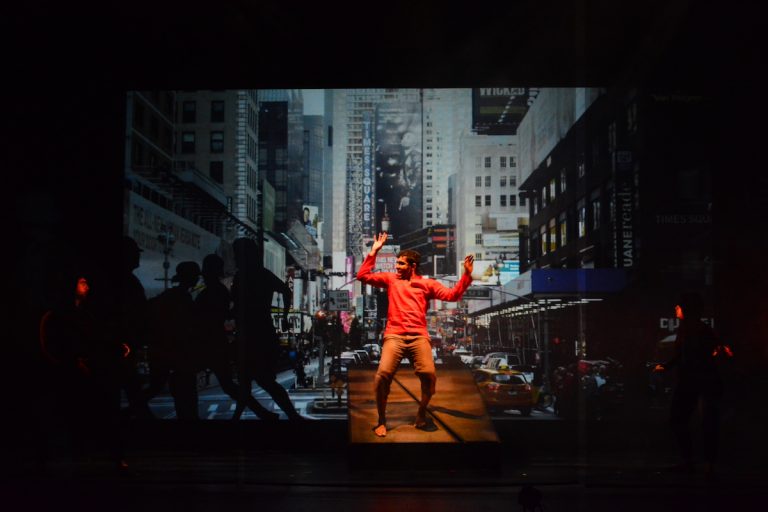
Levin Valayil as Mowgli | Photo by Gary W. Sweetman

Rudyard Kipling’s “Jungle Book” takes us to the exotic, adventurous, and magical world of Mowgli and other wildlife creatures. This play adaptation, written and directed by Rick Miller and Craig Francis, will have its West Coast premiere on Tuesday, July 17 through Sunday, July 29, at the Pasadena Playhouse, after a successful three-week run at Asolo Repertory Theatre in Sarasota, Florida.

Staged by Canadian company Kidoons and WYRD Production, in association with The 20K Collective, “Jungle Book” features familiar characters including Baloo the Bear, Kaa the snake, and introduces other colorful inhabitants of Kipling’s books.

Very much a theatrical adaptation, this play employs a rich soundscape, immersive multimedia, inventive puppetry, and a variety of new and traditional theatrical traditions to transport audiences to the world’s jungles. It features favorite characters as never seen before, bringing out the original themes of the story, while connecting audiences to its Indian locale and the human relationship to the animal kingdom.

“We definitely chose not to re-do the Disney version. They did it well and have done it several times,” Miller emphasizes. “We decided to take people back to Kipling’s book to inspire them to read literature and realize that he actually wrote two Jungle Books. Everyone knows Mowgli but there are other stories in ‘The Jungle Book’ and ‘The Second Jungle Book’ about different animals from around the world. The stories, poems, and songs that Kipling assembled cover a great deal of territory, both thematically and geographically.”

Miller adds, “In the original Kipling story, Mowgli grew up in the jungle with animals and is kicked out of the jungle for being too much of a human. In the book he also goes back to the town as a teenager and is kicked out of the town for being too much of an animal.

“So this is a mirror image of these two worlds. It’s a story that echoes the disconnection we have these days when we wonder who our real family is and where we belong, but also our disconnection with nature. We live in cities and we tend to forget that we have a deep bond with our natural surroundings, a lapse which sometimes proves to be detrimental.”

“While the message is deep, it isn’t heavy,” stresses Miller. “We just want people to consider that before there were cities, there were forest[s] and jungles. And we still have them inside of us – that little bit of the free, wild, and uncontrolled. Mowgli is very much the embodiment of that; he takes us back to his youth to remember the law of the jungle. The play is about how to live with each other and the rest of humankind.”

“The adults coming to the show will definitely get the message and the kids will not get slammed on their heads with a hammer to get it. It’s a fun show with a lot of humor and a big dose of lightheartedness,” Miller says.
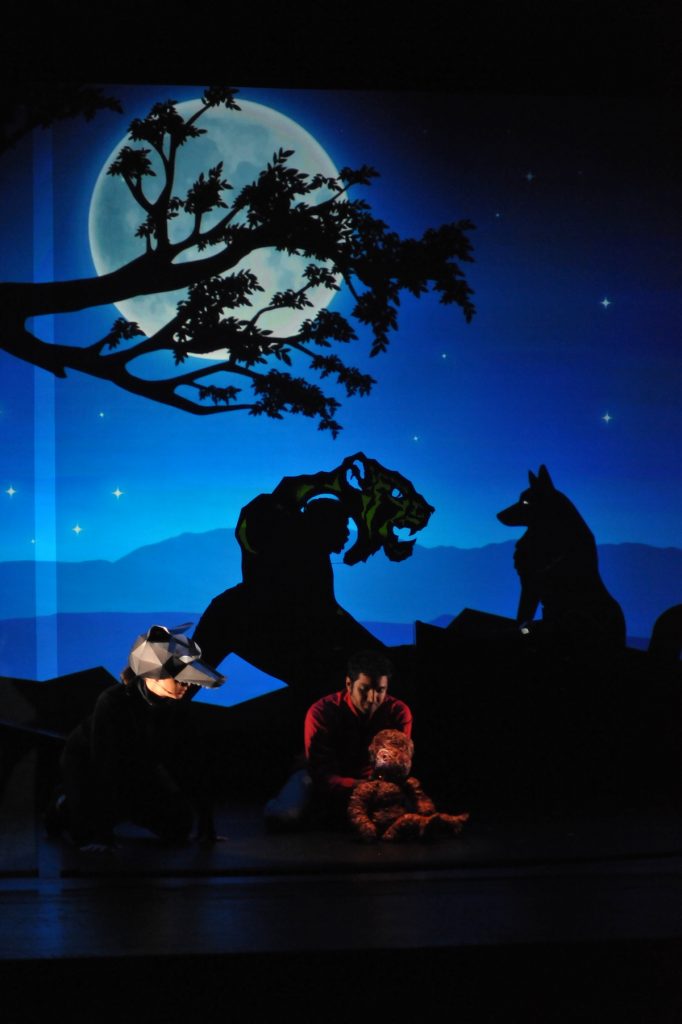
“Jungle Book” at Asolo Repertory Theatre | Photo by Gary W. Sweetman

“I’ve been doing theatre for 25 years. I’m known all over Canada and Europe for my solo performances but I joined forces with Kidoons (Kids Cartoons) to create entire experiences,” discloses Miller. “We found that we haven’t been engaging the youth as much, so we are correcting that. And in the process, we’re generating new theatre audiences. This is important because not only are young people the theatre-going audience of the future but they’re also ready to be educated and become leaders of the world and if you present them with inspiring work on stage they really can change lives.

“That said, we produce plays for all ages but it so happens that young people love the work we do because we incorporate the playfulness and creativity that kids inherently have. We’re trying to be more than entertainers because God knows there’s a lot of entertainment available on screen. We utilize what theatre offers which, essentially, is a lot of people gathered together in a room experiencing a story. This is different from just watching something on the screen.”

“We’ll be taking a few months off after our Pasadena production because we’re touring other shows. But we’re booking dates in preparation for our North American tour which starts in 2019. If all goes well, it will go to Asia and to Europe as well. Jungle Book happens in India and I would love for it to play there, but it’s a universal tale. We create shows that people all over the world will fall in love with.”

Miller elaborates, “Our next project is the third part of our ‘Connection Triptych’ and it’s going to be ‘Frankenstein,’ a novel written in 1818 by Mary Shelley. It has had several popular versions but we want to create one that speaks to our own issues today. Bio engineering and prolonging life, issues that are very much on the forefront of technology, are quite beautifully expressed in ‘Frankenstein.’

“The common thread running through these plays are characters who have become disconnected from humanity. In the first play in our trilogy, Jules Verne‘s ‘Twenty Leagues Under the Sea,’ Captain Nemo built a submarine, a utopia, for himself and his crew. He lived as a warrior against oppression, but in his disconnection he becomes a bit of a monster. In ‘Jungle Book,’ Mowgli is so disconnected he doesn’t know who his real family is, or who he is, for that matter. Frankenstein is probably the most disconnected character. In fact, he isn’t even human, he was created using pieces of other people and was called a monster.

“To put this is in our present day, we have Snapchat and Facebook which, on the surface, make us think we’re connected. However, the presence of all the technology in our lives actually isolates us from what’s really happening.”

Having children – an 11-year-old and a 15-year-old child – has helped Miller relate to how young people think and what interests them. He says, “We constantly talk about today’s technology; how we always have our eyes on the screen and how that changes our brain,” Miller expounds. “We have conversations about what it costs to have a disconnection with our environment and surroundings. We can’t recognize trees, or identify one leaf from another, but we can name a hundred different company logos when we walk down the street.”

Miller and Francis re-imagine classic stories through modern eyes, making them relevant to the times we live in. Through “Jungle Book” they hope to make us find ourselves and connect with humanity. If we enjoy the music, are transported to a different world, and have fun along the way, then it would indeed be a journey doubly worth taking.


Unpacking ‘Her Portmanteau’ at Boston Court Pasadena

Originally published on 30 May 2018 in the Pasadena Independent, Arcadia Weekly, and Monrovia Weekly

Courtesy photo | Boston Court Pasadena

Families, and the drama that’s inherent in each, is the topic of Mfoniso Udofia’s play ‘Her Portmanteau.’ It will have its West Coast premiere at Boston Court Pasadena from May 24 through June 30, 2018.

Directed by Gregg T. Daniel, who recently directed Lorraine Hansberry’s groundbreaking play ‘A Raisin in the Sun’ at A Noise Within, ‘Her Portmanteau’ stars Joyce Guy who plays the role of Abasiama the family matriarch. Completing the cast are Omoze Idehenre as Adiaha and Dele Ogundiran as Iniabisi.

A theatre graduate of Hampton University in Virginia, Guy was a member of the DC Black Repertory Company. She has performed at the Kennedy Center, Mark Taper Forum, and L.A. Women’s Shakespeare Company. Her screen and television credits include: ‘Moneyball,’ ‘The Santa Clause,’ ‘Animal Kingdom,’ ‘Criminal Minds,’ and ‘How to Get Away With Murder.’ She got an Ovation Award nomination for her choreography for ‘Les Blancs.’

This will be Guy’s debut performance at Boston Court Pasadena and she recalls how her involvement in the project came about. “This is the third time, in the last year and a half, that I’ve worked with Gregg. I choreographed ‘Les Blancs’ at Rogue Machine and ‘Raisin in the Sun,’ both of which he directed.

When I was at the performances of ‘Les Blancs,’ Jessica Kubzansky, Boston Court Pasadena’s Co-Artistic Director, was in the audience. I’ve known her for a while; I took a class with her a long time ago and we became friends. After the play she said to me, ‘Joyce, I have this play that I want you to audition for.’ And then I got a call from the casting director.”

Guy describes the play, “Her Portmanteau is the story of Abasiama, a Nigerian American mother who has two daughters. Her first daughter is Adiaha with her first husband who she met in college. When he was deported she decided that it was best to send Adiaha, who was six years old at the time, back with him to Nigeria. She has another daughter, Iniabisi, with her second husband whom they raised in Massachusetts where her job as a biologist took them. Iniabisi, a 30-year-old aspiring writer, lives in New York.”

“Abasiama has her hands full living with a husband who has mental health issues,” Guy adds. “But her life gets more complicated when Adiaha, who’s now 36, decides to come back to the United States.”

“In Nigeria the first daughter is called ‘adiaga’,” explains Guy. “When Abasiama informed her husband that she wanted to bring Adiaha to Massachusetts, he told her ‘Don’t bring her to my house; she’s not my daughter. My daughter is the ‘adiaga.’ Then he locked himself in the bathroom and started walking backwards. To avoid further conflict, Adiaha picks up Iniabisi from the airport and takes her to New York where she lives.”

Aside from the ‘baggage’ that ‘Her Portmanteau’ explores, it also literally refers to a suitcase. Reveals Guy, “It’s the same luggage that Adiaha took with her when she left for Nigeria with her father three decades ago.”

“It’s a great story, with a character who has several layers,” Guy says.  “And as an actress it’s challenging but it’s a wonderful one. What keeps surprising me is that for someone who’s very direct in her everyday interactions with people, to the point of rude bluntness, she wasn’t forthcoming with important information about her family. She makes promises she can’t keep and it seems that she does it to make herself feel better. She’s a woman of many contradictions.

One Sunday morning, she woke up and made a pivotal decision without thinking things through. As I said to Gregg, I imagine that having lived with a second husband who has mental instability she would have developed some psychological problems. She had to build coping mechanisms which were also faulty and she couldn’t really function properly.”

Mfoniso Udofia. – Photo by Frances F. Denny / NY Times

According to Guy she doesn’t have anything in common with the character, “There really isn’t anything about Abasiama that I could relate to because I don’t have children. It’s also a challenge to learn a whole culture you’re not familiar with. The play is very specific in its culture, the people, and the language; and we have to honor that. Ibibio is tonal and learning the phrases used throughout the play proved daunting.”

“I’m African American but I studied West African dance so I’ve been to Senegal, Mali, Guinea, and Gambia,” continues Guy. “I made a film in Senegal; I have a friend who’s Nigerian so I’m familiar with the West African culture. That’s different from being involved in a culture so I have to go deeper to inhabit Abasiama’s character. Gregg lets the actors find their direction in the script, through our research, by observing how Nigerians speak, carry themselves and their bodies, and in relationship with the other actors.”

Living among people of different culture isn’t an entirely novel experience for Guy, though. She discloses, “I was an army brat. My father was in the Air Force and we moved every three years. I’ve lived in Japan, Taiwan, Texas, Kansas, and Delaware.

“When people inquire where I’m from, sometimes I say Delaware because that’s where by father retired after active duty. At other times I say Montgomery because both my parent are from Montgomery, Alabama. I was actually  born there and we stayed there until I was three years old when we moved to Texas. After Texas we lived in Taiwan; from there we went to Florida; after that we went to Japan; then to Kansas; and finally to Delaware.”

“Because we moved around a lot I’m often asked which culture I found the most appealing to me. In fact, someone asked me that two days ago, and I said Taiwan. We lived in a compound with other Americans but we had to move to a bigger house because there were five of us. We had free range, we’d walk everywhere, we’d go down to the rice paddies. My best friend was a man who had a food truck that sold bananas and he would give me some. The Taiwanese kids were very curious about us and would touch our skin and our hair. I have wonderful, memorable experiences. But the funny thing is, I couldn’t stand the smell of garlic. I was five, okay?,” Guy says defensively.

Taking on this role in ‘Her Portmanteau’ has given Guy an opportunity to grow as an actor. She says, “I’m learning that I’m more determined and resilient than I thought. I have learned to come to terms with my weaknesses and that I have to put in the work. In order for me to honor Mfoniso’s words, Gregg, and the other actors, I have to go the extra mile. As rehearsals progress, we’ll be able to get to the whole dynamic of this family.”

“There is a universal theme to this play. It’s about family dynamics and dysfunction, things we all can relate to; there’s no perfect family. For me, the biggest takeaway would be that we all have regrets; we’ve all done something that weighs on us. But you can work past that as long as you’re forthcoming and honest with yourself. The thought may not go away but you can go forward from there,” concludes Guy.

While Mfoniso Udofia’s ‘Her Portmanteau’ is semi-autobiographical, this taut and poignant drama about relatives, legacy, and connections will resonate with all of us. Some of us will recognize our particular family’s dysfunction and see ourselves in one of the characters. Because as different as every one of us is, we all share a human-ness that is imperfect.

The Playhouse’s ‘Belleville’ a Hit with Theatre Enthusiasts

Originally published on 24 April 2018 in the Pasadena Independent, Arcadia Weekly, and Monrovia Weekly

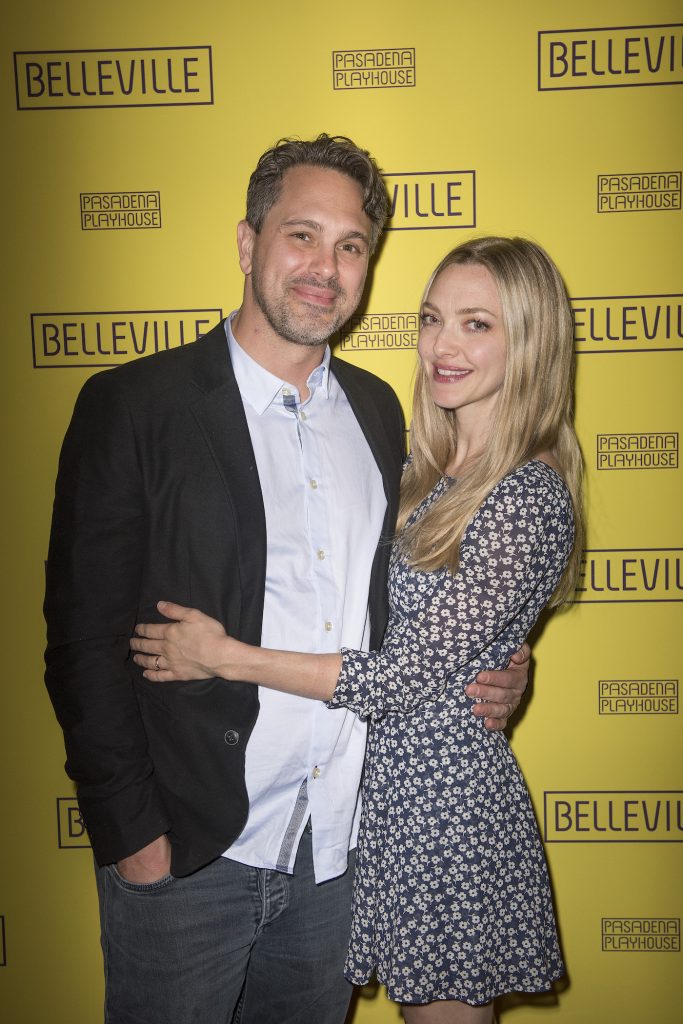
“Belleville” stars Thomas Sadoski and Anna Camp on the red carpet on opening night | Photo by Nick Agro

Anna Camp and Thomas Sadoski performed to an appreciative and intent audience this past Sunday when Amy Herzog’s psychological thriller “Belleville” opened at the Pasadena Playhouse.

Directed by Jenna Worsham, Camp and Sadoski played a young American couple living in a Bohemian neighborhood in Paris called Belleville. It began as Camp’s character, Abby, came home unexpectedly one afternoon and heard her husband Zack, played by Sadoski, watching porn in their bedroom.

Thomas Sadoski and Amanda Seyfried | Photo by Nick Agro

This seemingly harmless incident quickly turned into a catastrophic event, as one revelation after another of secrets Abby and Zack had hidden from each other were exposed. Slowly their real identities were unmasked and each of them was surprised to learn they didn’t really know the person they married. The audience watched the intense interplay between the two characters with such concentration one could hear a pin drop.

With no intermission to break the intensity, we didn’t have so much as time to catch our breath. When the play finally came to an end, about a hundred minutes later, we were almost as finally relieved as we were utterly devastated.

Anna Camp and Skylar Astin | Photo by Nick Agro

“Belleville” was indeed a Hitchockian thriller of a play. Director and actors did not disappoint. Camp and Sadoski kept up the tension right up to its conclusion. And an appreciative audience showed their approval with a rousing standing ovation when the lights turned down.

Both Camp and Sadoski enjoy a loyal following and their fans must have come out to support them. Last Sunday’s performance attracted noticeably young theatergoers. It was a stroke of genius that the Playhouse’s Producing Artistic Director, Danny Feldman, chose to mount a play about millennials. And it certainly didn’t hurt that Anna Camp and Thomas Sadoski starred in it. Well done, all!

A Noise Within’s ‘Noises Off’ has Audiences in Stitches

Originally published on 23 April 2018 in the Pasadena Independent, Arcadia Weekly, and Monrovia Weekly

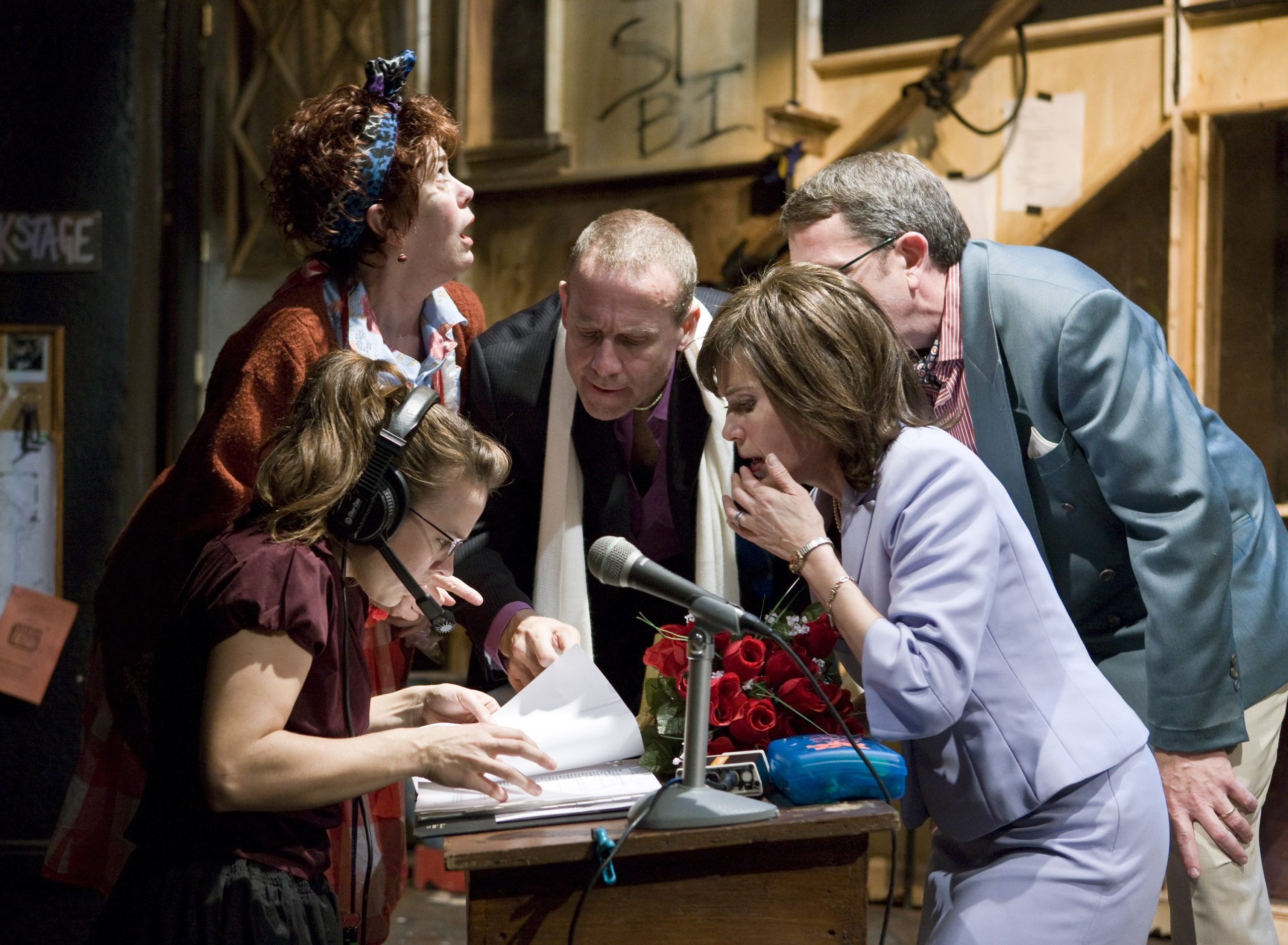
“Noises Off” ensemble | Photo by Craig Schwartz

Imagine a hapless group of actors gamely putting on a production aptly titled ‘Nothing On,’ from an abysmal material as each of their personal drama gets in the way and you have one screwball of a play that is as insanely hilarious as it is eerily true to life.

This is Michel Frayn’s joyfully out-of-control British farce, ‘Noises Off,’ and will be on stage at A Noise Within (ANW) from Saturday, April 21 to Sunday, May 20, 2018. Directed by Julia Rodriguez-Elliott and Geoff Elliott, it features most of the original cast from the play’s previous productions.

“‘Noises Off’ is truly one of our signature productions, with audience members returning to see it two or more times,” says Elliott. Rodriguez-Elliott adds, “Everything about the deft physical and verbal interplay between actors is ideal for our focus on ensemble work.”

First produced by ANW in their Glendale location, it was hugely popular that they brought it back another year. When they moved to Pasadena they presented it during their first season as an add-on production on a limited run.

Continues Rodriguez-Elliott, “It’s been about six or seven years since we last did it. For our 25th year anniversary, just for fun, we asked people what shows we had done that they would like to see again and ‘Noises Off’ got the most votes.

However, ‘Noises Off’ was doing a big production in London then so we couldn’t get the rights to it to mount it in time for our anniversary season. Fortunately, we were able to last year. And since we still have the same cast and they’re playing the same characters they did in the first two productions, we didn’t have to spend as much time to prepare for it.”

Elliott also discloses, “We’ve put off remounting ‘Noises Off,’ because we didn’t have the technical ability to put it on a spinning stage. We really wanted to remount it this year so we decided to redesign the set. In the first act the audience is watching the front of the set, in the second act the action takes place at the back of the set, and the third act is again the front of the set. Because of that, it needed to be presented on its own and not as part of a repertory.”

“It is one of the funniest farce, if not the funniest, ever written,” pronounces Elliott. “It’s a love letter to the theatre because it’s essentially about all of the things that can go wrong when people are trying to put a production together. For actors it’s especially close to the heart because we’ve all gone through some version of it. Michael Frayn is so brilliant in creating comic timing and sidesplitting situations. It’s really a work of genius.”

“It’s a repertory group rehearsing a play that’s about to open the next night and they’re not ready,” explains Rodriguez-Elliott. “In the first act, we are observing the colorful characters who are part of a company – there’s one actor who isn’t terribly bright, one who has a temper, another is an alcoholic who gets lost and they can’t find him. In the second act, the set turns and you’re watching them in a performance of ‘Nothing On’ from the back stage perspective so you see them as they make their entrance.”

“This is happening as they’re in the middle of the tour,” Elliott interjects. “By the second act they’ve been together for about a month and half. Everything that could possibly go awry, as personalities clash, has gone awry. The two leads are having an affair and one of them refuses to go on stage and it gets worse from there. It’s just insane!”

Rodriguez-Elliott continues, “By the third act, when the set is turned once more to the front, it’s hell in a handbasket. They’ve been touring for six months and by then some of them aren’t talking to each other so it becomes another whole new level of disaster.”

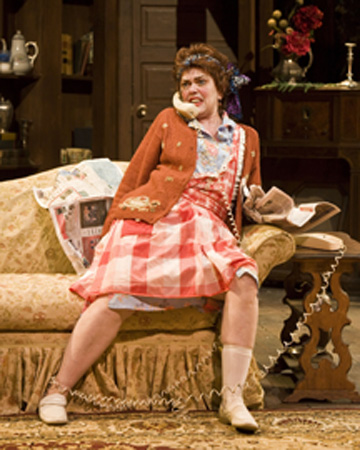
Dotty Otley | Photo by Craig Schwartz

“When we were first rehearsing it, people who had done this production in the past were telling me ‘You’re going to have such a good time; audiences just die watching this play,” recalls Elliott. “There were so many people telling me that, that I began to get spooked that we’ll be jinxed shortly because I thought, ‘Surely our production can’t be as funny as they kept saying. The expectation was too much.’ But once we got out there, the audiences just went wild and it was infectious. You were having such a great time because the audience was as well. And it turned out to be exactly what people had been prognosticating all along. It’s probably the most fun I’d ever had on stage.”

Illustrates Elliott, “I play the role of the director and most of the time the cast doesn’t know if it’s Geoff, the director, or Lloyd, the character I play, who’s talking. Or if it’s Jeremy, the actor, who’s talking to them or the Frederick character he’s playing. Apollo Dukakis, in the role of an older actor Selsdon, calls his lines exactly as Apollo does. It’s spooky.”

“And here’s an interesting bit of trivia,” says Rodriguez-Elliott. “Michael Frayn was watching a play he had written being rehearsed. He sat backstage for a bit and he thought what was happening there was more interesting than what was going on onstage. That was the impulse for him to write ‘Noises Off.’”

“It was a Lynn Redgrave play that was being rehearsed,” Elliott elucidates. “And he thought there was more drama going on backstage. One of the endearing things about this play is that all of these actors are such survivalists they would do almost anything to make their entrance, to keep the show going. They’re taking axes at each other but they’ll drop them when they have to make an entrance. And it’s true, the show must go on. This is that to the hilt, it’s so sweet.”

“The beauty of a rep company is the familiarity you have with the rest of the cast,” Elliott begins to say. “And the play is all about that – people who have been together and have worked together for a long time. That is so relatable. We’ve all been in productions where someone misses an entrance, or something’s gone wrong and people backstage are troubleshooting,” Rodriguez-Elliott finishes for him.

“One of the reasons I think this was a very popular production is that we really concentrated on finding the honesty, the authenticity of the situations theatre people work in,” clarifies Elliott. “We didn’t approach it as a send-up. It’s not only incredibly funny but we have sympathy for all these people. We recognize all these people, all the drama and the group dynamics that we’ve all been a part of.”

“The play they’re in is terrible and they are nobly putting on a show that doesn’t even make sense. But they’re trying hard to make it work and are truly investing in it. There’s this one character who’s not the sharpest tool in the shed and even when the world is exploding she’s still doing what she has rehearsed,” chuckles Rodriguez-Elliott.

Elliott declares, “You can feel the joy in the room because the actors are having fun and the audience is in it with them. The actors themselves are laughing when they get backstage because of the wonderfully infectious audience reaction.”

ANW has just announced the theme of the 2018-2019 season, ‘Let Me in.’ Elliott describes, “It’s about the fundamental human desire to be included, to be accepted. All the plays are about people struggling for that and the things that happen to them and those around them as they strive to have a door open. It’s a very timely issue. We all want to be acknowledged, to not be ignored or be treated as something other than being a part of the human race. Whether it’s Don Quixote of ‘Man of La Mancha’, Dorian Gray, Rosencrantz and Guildenstern, Othello, Wingfield family of ‘Glass Menagerie,’ or Jason of ‘Argonautika.’ That’s the common vein running in all these plays.

‘Man of La Mancha’ will be another play that will run solo, not in repertory. It will play middle of August through early September. That was a big hit for us when we did it this season and this was an opportunity to bring the show back for those who didn’t get to see it or would like to see it again. It’s the same production and will have the same cast.

The show had been a tremendous experience for us. We had a number of people in the cast who had never worked with us before because they were more musical theatre people. So for them to be able to approach it as actors was something novel and extraordinary for them to do. When we reached out to them to tell them we were bringing it back and asked if they wanted to return for it, everyone answered within twelve hours.

That was pretty much how our resident artists responded to our remount of ‘Noises Off.’ Although the themes of the two plays couldn’t be any more different, audiences, nevertheless, will feel a strong reaction to each.”

It is the contagious feeling and exuberant spirit that we will experience that make ‘Noises Off’ as uproariously brilliant as it is unabashedly zany. Prepare to laugh till your sides hurt.

Boston Court’s ‘A Streetcar Named Desire’ Speaks to Significant Issue of our Time

Originally published on 13 February 2018 in the Pasadena Independent, Arcadia Weekly, and Monrovia Weekly

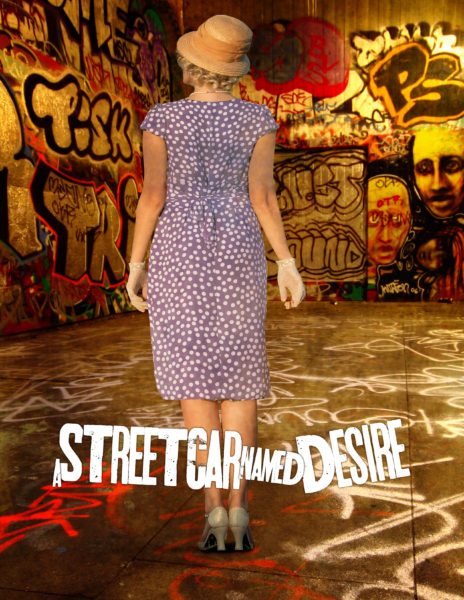
‘A Streetcar Named Desire’ is arguably Tennessee Williams’s most celebrated and momentous  work. Originally a play which opened on Broadway in 1947, it has been made into a film, adapted as an opera, ballet, and for television.

And now Boston Court Performing Arts Center in Pasadena presents a reimagined modern version of ‘A Streetcar Named Desire,’ featuring a multicultural cast and contemporary setting.  Onstage from February 15 to March 25, 2018, it is directed by Co-Artistic Director of Boston Court, Michael Michetti, and stars Jaimi Page as Blanche, Desean Kevin Terry as Stanley, and Maya Lynne Robinson as Stella.

Michetti had a very successful run directing two other plays in Pasadena – ‘Mrs. Warren’s Profession’ at A Noise Within and ‘King Charles III’ at the Pasadena Playhouse – and is aiming for a trifecta with ‘A Streetcar Named Desire’ at his home theatre company.

“I’ve never done any Tennessee Williams before now but I’m a big fan of ‘A Streetcar Named Desire,’” discloses Michetti. “I’m not exaggerating when I say I love it so much that I must have seen a dozen or more productions of it. I’m glad to have a ‘home’ where I can do passion projects.

Interestingly, I’ve been thinking about this play for a couple of years as a response to what I was sensing was happening to our world, before even a Trump presidency was possible. But the current political climate has only made it more timely; all the issues which were bubbling underground a little bit have now come to the surface.

‘A Streetcar Named Desire’ is so thematically rich – different threads stand out depending on how you focus it. Great works like it can be revisited in different eras and political circumstances and reflect current society.”

Michetti’s vision is a wide departure from its classic production as he sets it in the modern day  with diverse actors. Pronounces Juilliard-trained Desean Terry, “It’s going to be a very different take and that’s why I’m really interested in it – Michael’s setting it in contemporary America. Blanche is a remnant of American history, dressed in the costume of the 1940s; she’s the only traditionally cast character and only Caucasian actor amidst an ethnically diverse group in modern clothes. She’s incongruent to the setting. As in the original play, Blanche is a fish out of water and Michael brings more attention to that fact. It’s a very intriguing concept, really.”

Desean Kevin Terry as Stanley. Courtesy Photo

On assuming the role memorably portrayed  by Marlon Brando in the 1947 play and the 1951 movie, Terry declares, “Fortunately I never saw the original play and I don’t remember much about the film version, which I think I saw when I was quite young. I don’t know what Marlon Brando did and I think that works to my advantage. I can try to recreate the character as I see the circumstances in the play and in response to our particular production. I will definitely honor the text in the way that it described Stanley.”

“To be honest, I’m a bit freaked out to be playing the role that Marlon Brando immortalized,” confesses Terry. “Well, actually I didn’t think about it until after I got the part when I told myself ‘What are you doing, Desean? Now you’re pitting yourself against an icon.’ However, Michael didn’t have a set idea of what Stanley should be like so it’s been a discovery process for both of us; we’re continually working on each role as part of the whole play.”

“We’re illuminating the love between Stella and Stanley which I think got shortchanged,” expounds Terry. “In this play we’re developing that relationship more, creating a healthy dynamic between them as much as we can with the play which has incidents of domestic violence. It’s pretty challenging what we’re trying to accomplish. I hope our interpretation of the play gives our audience a fresh appreciation for it.

“For me, personally, I hope they see a more human version of Stanley. If people respond to that I would feel pretty good. I’ve been in plays that speak to race relations and I enjoy the opportunity to effect change,” Terry concludes.

Michetti adds, “The primary impetus for this production was the discovery of the important themes of class, gender, and race that Williams touched on when he wrote it. Among them is how Blanche comes from a world with social privileges that even then, when the play was first produced, were no longer pertinent. Belle Reve, where Blanche grew up, was a big old house that came with a great deal of history but it was not a working plantation even in the 1940s. She was trying to hold onto an expectation about a way of the past that’s slipping away.

Even then Williams was exploring the changing demographics – there were more immigrants, people of different backgrounds. Many people were having trouble accepting that shift. It was something inherent in Blanche’s relationship with others.

By setting this production in contemporary urban environment populated with people of color and dropping in a Blanche, a white woman from the 1940s in that period’s clothes, hairstyle, and behavior, we emphasize to an even greater degree how much she is a relic of the past, unable to accept the world and move on. It was a contrast that Williams had intended and which I am visually amplifying.”

Director Michael Michetti. Courtesy Photo

“It’s tricky because the play is so complex, it cannot be boiled down to single issues,” continues Michetti. “Within this treatment Blanche represents, in many ways, the loss of equilibrium that many white people are feeling. I want to deeply explore the flaw in her inability or trouble in accepting that the demographics of the world are changing. That said, any imbalance is uncomfortable. This was true then as it is today and is something we need to recognize. We’ll heal better by embracing and acknowledging it instead of avoiding or ignoring it.

White people should not keep trying to hold onto our privilege. The truth is, there is a cluelessness among us whites and we all need to be awakened. At the same time there is a real sense of loss that we should also be empathetic to.”

“However, I will not impose my morals on my audience – I want this play to reflect humanity and let people make up their mind about it,” says Michetti . “I think everyone is going to experience it through a different lens and see different things in it. There’s certainly an idea of investigating this divisiveness we have in our country right now and what that means. The beauty of this play is that all the characters are flawed people but also people we could be empathetic to. While I don’t think we will ever heal the divisions in our country we can show compassion to one another.

There are systemic problems we haven’t quite tackled but the beauty of theatre is that if you can do it well it’s an opportunity to explore these things through living, breathing humans, which touch not only our minds but our hearts. I think our minds are more successfully changed when our hearts are also changed.”

Michetti pronounces, “I’m very grateful to be doing for a living something that I love and am excited about. But more importantly, I’m always trying to discover what’s meaningful to me, to continue growing and reinventing myself. I’m in a period in my life when one of the most powerful things I can do is to help address vital issues in our time with an authentic sense of social justice focus. I think we have a great potential as a nation and a culture to be much better than we are. I want to genuinely fulfill the promise that our forefather said that all men are created equal.”

Through ‘A Streetcar Named Desire’ Michetti proves that his projects are not merely works of art but agencies of change as well. That is the true transformative power of theatre.

‘Henry V’ at a Noise Within Stars Pasadena-area Native

Originally published on 6 February 2018 in the Pasadena Independent, Arcadia Weekly, and Monrovia Weekly

Rafael Goldstein as Henry V. | Photo by Craig Schwartz

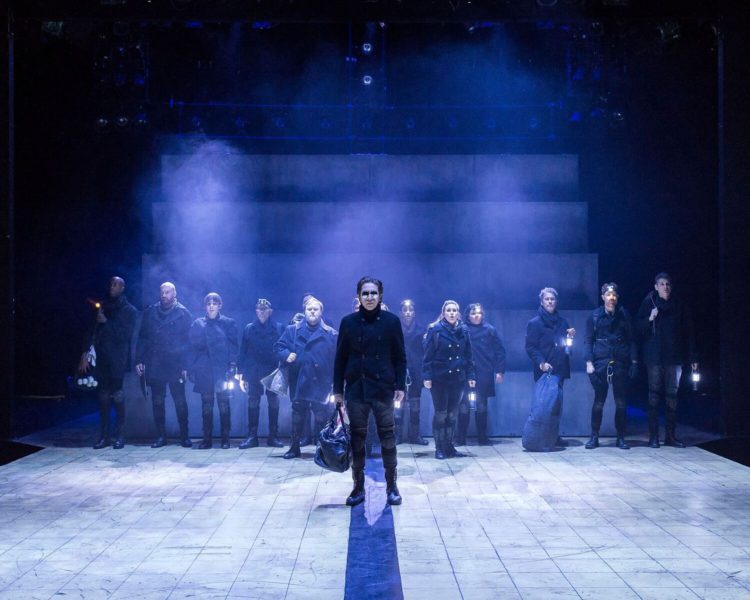
William Shakespeare’s ‘Henry V’ goes on stage at A Noise Within (ANW), the acclaimed repertory theatre company, from February 4 to April 6, 2018. Co-directed by Geoff Elliott and Julia Rodriguez-Elliott, it focuses on the Battles of Harfleur and Agincourt and has been streamlined into a dynamic thrill ride infused with modern relevance.

“‘Henry V’ is a play about going to war, and the propulsive energy that leads to conflict,” declares Elliott. “We’ve zeroed in on the conflict between Henry and France, and captured the unifying, almost euphoric energy that comes with having a shared enemy. While the play is not explicitly for or against war, it does provide an in-depth look at the politics of war and our thirst for conflict. Ours is a very physical, visceral production: we have three fight choreographers and a live percussionist. Expect a fast, furious, and ferocious evening.”

At the center of the intense action is ANW resident artist, Rafael Goldstein, who assumes the title role. He states, “When I found out I was going to be playing Henry I started training – running four or five miles a day – and eating better to get in shape. We spent hours staging the battles. Our fight choreographer, Ken Merckx, and a couple of his assistants  have done a fantastic job of putting this together. It’s edge-of-your seat excitement and really bloody action. It’s a spectacle not to be missed.”

Shakespeare’s history play tells the story of King Henry V of England and takes place during the Hundred Years War. ANW’s iteration of it, however, does not specify an era. States Goldstein,  “It’s a timeless tale set in a timeless way. Men’s need for conflict and war never goes out of style. When you’re working with a story this malleable and universal you could pretty much do whatever you want with it and the strength of the story would stand up.

This particular production happens in a ritualistic arena where this group of people comes together to tell a story about humanity’s need for conflict. They use Shakespeare’s words and plot to tell this very human story but it isn’t set in 1415 on a battlefield with knights in armor. It’s a modern version of what warfare looks like and what it does to people. While we’ll be sporting contemporary clothes, we’ll still be wielding swords. And we’ll be wearing crowns so the audience can tell who’s the king, the prince, the princess, and so on.”

Henry V ensemble | Photo by Craig Schwartz / A Noise Within

Ever the professional, Goldstein prepares for his performances seriously. He declares, “No matter what show it is and what role I play, I go over the script two or three times a day. And during the lead-up to rehearsals when we get ‘off-book’ I try to have all my lines memorized before the first run-through so when I get into the room with all the other actors, I can communicate with them and not have to look down at the script.

Memorizing, especially Shakespeare, is a joy. The language is so rich and the characterizations are so clear. He gives you so many clues as to how to read and understand it that it becomes a familiar song, a part of who you are.”

This talented and prolific actor hails from the Pasadena area and his involvement with ANW goes way back. Goldstein discloses, “I was born and raised at the base of these mountains, in Altadena. I went to St. Andrew Catholic School on Raymond Avenue in Pasadena. And then I went to the Los Angeles County High School for the Arts (LACHSA).

Actually, the summer before I went to LACHSA, I took the Summer with Shakespeare program at A Noise Within when it was still in Glendale to give me a leg up and little bit more training under my belt before I head into this conservatory-style setting. That fall, ANW contacted me and asked if I wanted to be in their production of Macbeth. So I worked on high school stage productions and professionally with ANW all through high school.

I attended New York University’s (NYU) Tisch School of the Arts and stayed in New York for a while. When I moved back here in 2011, I rekindled my association with ANW. So not only did I come back to my birth home but to what has become my stage home as well. They cast me in Antony and Cleopatra as Eros, a wonderful little role as Antony’s servant on the battlefield. When Antony realizes that all is lost he asks Eros to kill him. Rather than kill Antony, Eros kills himself instead.

In my many years at ANW, I have played key characters. I had a principal role last season in Tom Stoppard’s ‘Arcadia,’ which was an ensemble piece. I’ve also played title roles before but never in a venue like this; it’s challenging in a nice way. One of the obstacles is thinking of Henry as a lead role because even though the world of the play hinges on his experience, that world is still very much alive and independent of him. There are so many things that he can’t control in this world. He causes a lot to happen but things happen to him as well.

Being in a titular role, I do feel a certain amount of responsibility for ensuring our play is well received and resonates with our audience. That’s why I have been preparing for as long as I have and as assiduously as I possibly can. But, like Henry, I can’t take all the credit because there are so many moving parts and aspects to this play. It really does take a village to raise a mountain of a play and incredibly long hours of hard work that goes into the production that the audience will eventually see.”

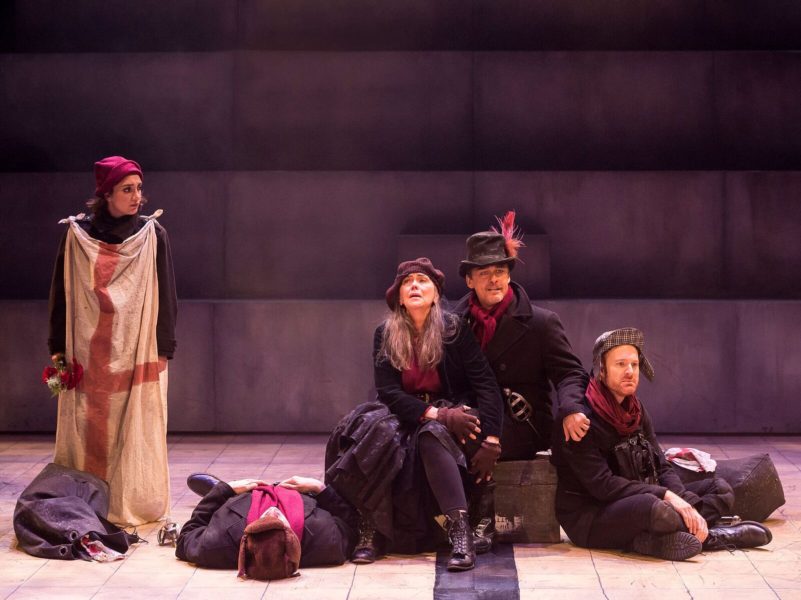
Henry V cast (left to right): Erika Soto as Boy; Jeremy Rabb as Bardolph (supine); Deborah Strang as Mistress Quickly; Frederick Stuart as Pistol; and Kasey Mahaffy as Nym | Photo by Craig Schwartz

I have worked in other theatre companies like Theatre Forty and Sacred Fools, and a part-time job at Pasadena Playhouse, but ANW is my home base. ANW and doing theatre are vital to my life; they’re essential to who I am. My poor wife sees me maybe one day a week but that’s the life of an actor – it’s hard and grueling. It’s not always rewarding in the way you would like it to be, you hear the word ‘no’ more than ‘yes.’ But when you do have a job and you’re doing a play that feeds your soul, you couldn’t ask for anything more – it’s the fulfillment of a passion. You give something of yourself to your audience as they watch you on stage. There is a symbiotic relationship between the actor and the audience, a true communion.

Other professional pursuits keep Goldstein busier still. He says, “I do voicing for video games, standing in a dark room screaming into the microphone. I’m also involved in film-making with a friend who has started a small company. Right now he’s doing mostly music videos and we shot one wild little film recently at Joshua Tree. We have plans to put together some shorts and features, going through the fund-raising phase, pitching the idea for possible funding. I’ve been in a number of short films as well and one TV spot on Investigation Discovery Chanel.”

“Theatre is my first love though,” Goldstein hastens to add. “It has been since I first went on stage at the age of three and played one of the sons of Adam and Eve in a little play at a Unitarian Church about the creation of the world. I remember I had one line and the audience laughed. I was hooked.

If that weren’t enough motivation for me, my father is an English professor who would bring home plays for us to read aloud. My mother, my sisters, and I would divide the parts and we’d talk about it after. We’d read Eugene O’Neill, Shakespeare, Neil Simon, any author he was doing a unit on at the time.

My mother is a psychologist who would talk to me about people and human behavior and thought. I never had a chance: I was always going to be an actor. So for as long as I still have all my hair and teeth, I’ll be on stage somewhere many years from now telling stories and, hopefully telling them well.”

While Goldstein’s little three-year-old self couldn’t have foretold that he would be playing incredibly memorable roles in numerous acting projects at age 30, empirical evidence suggests he has been honing his skills for ever more significant performances.

‘Henry V’ may be Rafael Goldstein’s star vehicle but it’s only the beginning of his journey. His career’s ascent may not be akin to a fast, furious, and ferocious evening of ‘Henry V’ on stage but it will be steady, strong, and superlative. And that would be a far more thrilling ride.

‘Miracle on 34th Street’ at The Pasadena Playhouse

Originally published on 13 December 2017 in the Pasadena Independent, Arcadia Weekly, and Monrovia Weekly

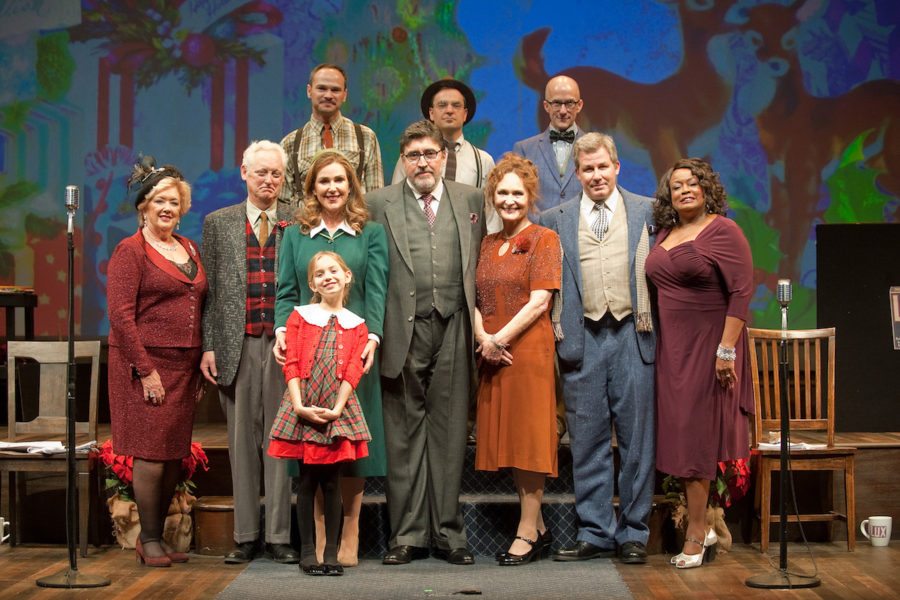
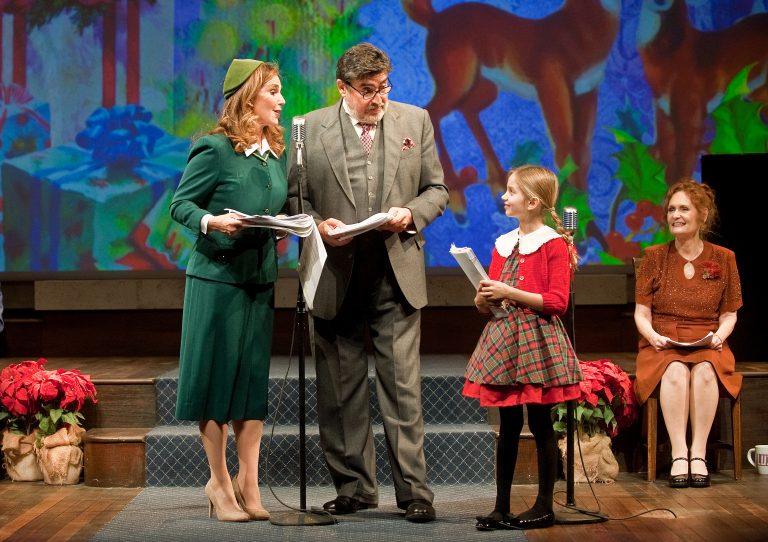
Cast of “Miracle on 34th Street” | Photo by Nick Agro / Pasadena Playhouse

The Pasadena Playhouse, the State Theatre of California, presents a limited engagement of 14 performances of ‘Miracle on 34th Street’ from December 14 to 23, 2017. Originally a radio play, it is celebrating its 70th anniversary on stage, fittingly, at the Playhouse which is marking its centennial year.           

Directed by Cameron Watson, who helmed the recent revival of Tennessee Williams’s ‘Cat on a Hot Tin Roof’, it stars Peri Gilpin (Roz Doyle on NBC’s ‘Frasier’), Beth Grant (Beverly Janoszewski on Hulu’s ‘The Mindy Project’), and award-winning film, television, and stage actor Alfred Molina (‘Raiders of the Lost Ark’) as Kris Kringle.

‘Miracle on 34th Street’ is a staple on TV during the holidays. Most of us know the story of Kris Kringle, who substitutes as a department store Santa Claus and claims to be the real thing. He goes all the way to the Supreme Court to prove his sanity and his assertion.

“What is much less known is that this story was very popular as a radio play, when all of America used their ears and their imaginations to completely realize the story,” discloses Danny Feldman, Pasadena Playhouse’s Producing Artistic Director. “And now in 2017, seventy years later, the eyes of our audience get to watch what went into producing the performance live, which its original listeners never got to see.”

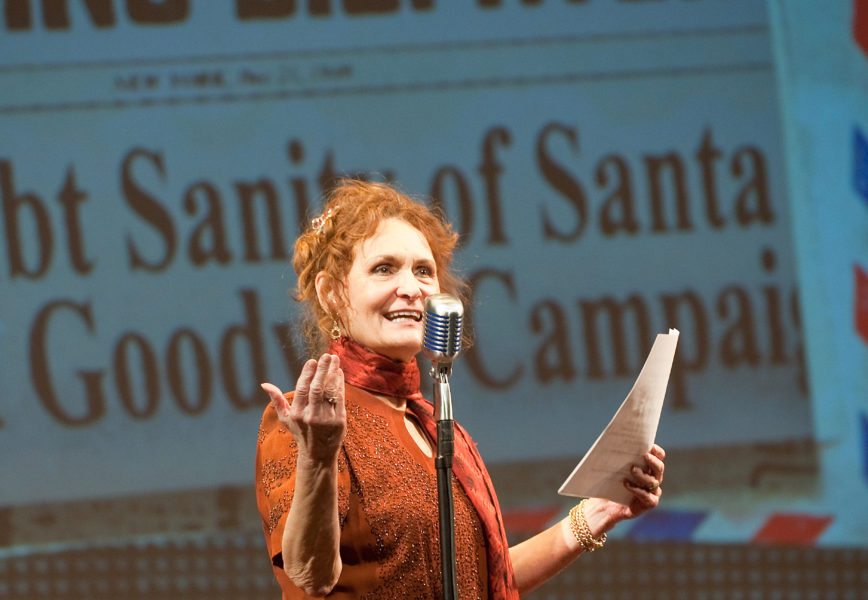
“I’m happy to report that the story in the radio play and movie are very similar,” informs Grant. “What’s going to be fun for us is that we will be presenting it as though we are actually doing a radio play with sponsors, commercials, a foley artist, and a narrator. I can’t wait!  I’ve always thought it must have been such an imaginative process for people who were only listening to it.”

Grant plays the role of the mother of the little boy whom Santa sends to Gimbel’s to get the fire engine which Macy’s doesn’t have. She enthuses, “I’m very thrilled and honored to play the role that Thelma Ritter made famous in what was her first feature film. That has always been my favorite sequence and Thelma Ritter is one of my heroes.”

Besides that part, Grant will be playing others.  She pronounces, “When Cameron told me I would be playing several different roles I got so excited! I love doing character work and disappear in my character, and to do so many in one night would be a fun challenge.”

Beth Grant | Photo by Nick Agro / Pasadena Playhouse

“This isn’t the first time that Watson is directing Grant and she is quite ecstatic to be reunited with the director. “I said ‘yes’ as soon as Cameron asked – I will always work for him anytime, as long as I’m available. He is the most collaborative director I know. He is gentle, kind, and loving but at the same time he’s tough. He’ll keep after you if he sees something that needs to come out,” Grant states.

“Cameron is crafting a ‘framing’ for the radio play, adding his artistic genius to create the reality of being in a live performance,” adds Grant. “He is also using unexpected casting in the various roles – we have some great surprises!”

On learning who her costars were going to be, Grant declares, “I am so thrilled to be working with Peri; she and I have been friends for years, through Cameron. I saw them act together at The Pasadena Playhouse in ‘As Bees in Honey Drown’ by Douglas Carter Beane. She is such a lovely person, with a terrific sense of humor. All that, and beautiful too! And Alfred Molina as Santa? Say no more!”

It’s refreshing to hear that admiration for fellow performers coming from an actor as seasoned as Grant.  She has been in several celebrated and honored films in the last few years that you’d think she has a knack for picking the right project to attach herself to.

Known as Hollywood’s lucky charm, Grant has co-starred in three Academy Award-winning Best Pictures: ‘The Artist’, ‘No Country for Old Men’, and ‘Rain Man’. She has twice received the Screen Actors Guild Ensemble Award for ‘Little Miss Sunshine’ and ‘No Country for Old Men’. She also voiced the Academy Award-winning Best Animated Feature, ‘Rango’.

Grant says of her previous successes, “I have been very lucky to have been in so many great films but I have not picked them so much as they have picked me. I try to say ‘yes’ to any great role, no matter the size or even the character, as long as I understand the character’s role in the story and I believe that the story needs to be told. I love to be challenged, to find the goodness in a ‘bad guy’. I love a story with a heart, to make a statement as long as it’s entertaining in the process.”

“From reading the scripts and knowing the filmmakers, I can tell which ones would do well with audiences and academy members. I did believe that Barry Levinson’s ‘Rain Man’ and the Coen Brothers’ ‘No Country for Old Men’ would go all the way,” continues Grant.

“I was pleasantly surprised that ‘The Artist’ was so commercially well-received. I loved it so much but because it was a black-and-white, silent film with subtitles, French stars, and French director, I thought it would just play the art houses. I was so proud and thrilled that it was appreciated on such a grand scale.

Peri Gilpin, Alfred Molina, Cecilia Witt, and Beth Grant | Photo by Nick Agro / Pasadena Playhouse

I’ve been right a few times, wrong a few times; liked movies that didn’t do well. But, always, I go back to the work and have that optimistic anticipation for what’s next,” Grant says further.

This seasonal production is a first for Grant, “I have never done a Christmas show and I’m thrilled because I love Christmas more than any other time of the year. I’ve always felt renewed during the holidays and I promise you that every single year something magical happens in my life! I am still a child at heart, especially during the holidays. I love everything about the season!”

‘Miracle on 34th Street’ is showing at the Pasadena Playhouse, another first for Grant. She declares, “I’ve been to see quite a few shows at the beautiful Playhouse but have never worked here before and I’m very honored! And did you know it’s also their 100th anniversary!

I love TV and movies, but there is nothing like this experience. When you are on the stage, creating a character, telling a story to a live audience, something truly spiritual happens. We are all one on this journey together. I feel so close to the audience; and each one has his own personality!”

Grant concludes, “I hope everyone who sees ‘Miracle on 34th Street’ has a swell time, feel happy, and encouraged about life after they get back home.”

‘Miracle on 34th Street’ makes even the most skeptical among us believe that wishes can come true. That is the true magic of Christmas. One can only imagine Grant contentedly sipping hot cocoa, joyful with the knowledge that she somehow helped bring the spirit and warmth of the season to one and all.

A Noise Within Presents ‘A Christmas Carol’ for the Sixth Year

Originally published on 6 December 2017 in the Pasadena Independent, Arcadia Weekly, and Monrovia Weekly

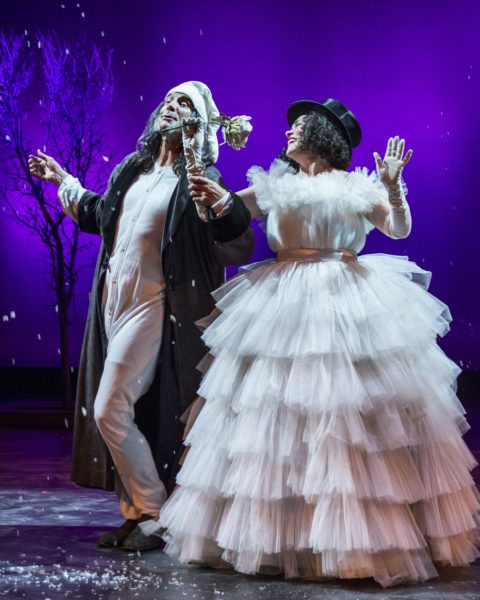
Geoff Elliott is Ebenezer Scrooge and Deborah Strang plays the Ghost of Christmas Past | Photo by Craig Schwartz/
A Noise Within

A Noise Within (ANW), the acclaimed repertory theatre company in Pasadena, presents Charles Dickens’s ‘A Christmas Carol’ for the sixth year. Onstage from December 1st to the 23rd, it remains, to this day, the embodiment of the true spirit of this season.

Adapted directly from the original novella by Geoff Elliott, ‘A Christmas Carol’ is directed by ANW’s Co-Producing Artistic Directors, Geoff Elliott and Julia Rodriguez-Elliott.

‘A Christmas Carol’ features mostly the same cast members as in previous years, including: Geoff Elliott as Scrooge; Rafael Goldstein as his nephew, Fred; Deborah Strang as the Ghost of Christmas Past; and Frederick Stuart as the narrator. Seven-year-old newcomer, Ryan Dizon plays the youngest of the Cratchit children, Tiny Tim.

“I’ve watched the movie and I saw ‘A Christmas Carol’ here two years ago and I enjoyed it a lot. I can’t remember much about Tiny Tim but I’m really excited to be playing him,” Dizon says with a big smile.

Dizon is not a stranger to acting. According to his mom, Corinne Chooey, he started modeling for commercials as a baby and expanded to print work. Lately, he appeared in the film ‘Dr. Strange’ and just finished work on the television show ‘Jane, the Virgin’.

This artistic interest runs in the Dizon-Chooey family. Both his parents and two older brothers, Ethan and Zachary, are in the entertainment business. He and his siblings all attended ANW’s ‘Summer with Shakespeare Workshop’ as well as the Saturday acting class.

“In the Summer with Shakespeare workshop I learned four different types of plays – comedy, romance, history, and tragedy,” Dizon informs proudly. “Comedy always has a good ending. In tragedy everybody gets a bad ending. Romance play is where the good guys have a good ending and bad guys get a bad ending. And history play is about England.”

Ryan Dizon is this year’s Tiny Tim | Courtesy Photo

“This is my first stage play,” continues Dizon. “Rehearsals began on November 14 and the show opened on December 1st. I didn’t really have a lot of lines to memorize so it’s easy.  Everyone is nice – they all treat me like a child. Because Tiny Tim can’t walk, I am being carried a lot on the show. The entire experience is so much fun that I would like to be on other ANW productions.”

“Besides acting, there’s some singing on this show – I start the first lines of the Tiny Tim song, and I sing in another number; I’m also part of the ensemble,” Dizon states, grinning.  “My favorite portion is the end where Scrooge turns into a kind man and where we all sing ‘Glorious’.”

“Christmas is my favorite holiday because it is when we spend time with our family. Last year all my cousins came over to my house and we had a grand time,” Dizon volunteers without prodding, which touches his mom immensely.

“We have a large family on both sides; Ryan has a lot of cousins. It’s a big occasion in our house – we have a Christmas tree, we gather as a clan, we open presents. Since we have two different cultures, Filipino and Chinese, we blend the two together. It’s an especially big holiday for my husband because he’s Filipino; I think Filipinos start celebrating it in September. On Christmas eve our table is filled with food – mostly desserts,” Chooey laughingly discloses.

Acting is embedded in Dizon’s genes. Chooey reveals, “My grandparents were movie stars from Hong Kong and my aunts are dancers. My cousins are also actors, dancers, musicians, and producers. So, for me, getting my children involved in it was simply a natural consequence.

However, my husband and I don’t make them do it; we let them pursue it only if they want to. Ryan’s older brother, Ethan, who is 15 years old, revels being on screen. He was in the summer movie ‘Spiderman: Homecoming’ and also appears on some TV shows. Zachary is nine years old and was in the TV series ‘Henry Danger’ in 2014. He chose to quit acting and we were fine with his decision. But after a year he asked, ‘When’s my next audition’. And Ryan, here, seems to like it enormously.”

For his audition as Tiny Tim, Dizon met with Elliott. He recounts, “I walked into the rehearsal room and he asked me to pretend there was a window and there were a lot of toys to play with. Then he asked me to walk with a limp. And the last thing was for me to sing; I sang ‘Happy Birthday’ because that’s the only one I know the words to.”

Dizon adds, “To prepare for this role my mom downloaded some vocal warm-ups and the songs in ‘A Christmas Carol’ on my Kindle. That helped me memorize the songs and prepare me to become Tiny Tim.  I can’t wait for my whole family to come and watch the show.”

“Christmas is a big, happy occasion for the Chooey and Dizon clan. We’re very excited that Ryan is part of this cherished family play. I hope everyone who comes to see it leaves the theatre with the spirit of kindness and bigheartedness the show inspires,” Chooey says.

That sentiment is echoed by Rodriguez-Elliott, “Ebenezer Scrooge’s rebirth from miserly curmudgeon to the essence of love and generosity affirms our faith in the potent goodness of humanity during this beloved time of year.”

Elliott adds, “‘A Christmas Carol’ is the epitome of Christmas entertainment which encompasses warm moments, beautiful score, memorable scenes, and great performances. Half a generation of children have grown up on it and families continue to make it our most popular production of the year. Students studying Dickens come to see his story leap off the page onto our stage.”

For all these reasons, being Tiny Tim in ‘A Christmas Carol’ this year is of deep significance to this second-grader. Indeed, it is one Christmas carol Ryan Dizon shall remember the words to and sing in years to come.

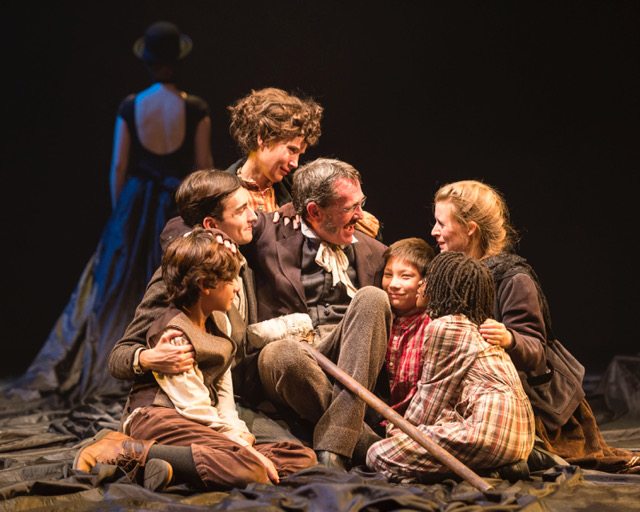
Scrooge with the Cratchits | Photo by Craig Schwartz/ A Noise Within

Parson’s Nose Theater Finds its Home in Pasadena

Originally published on 27 November 2017 in the Pasadena Independent, Arcadia Weekly, and Monrovia Weekly

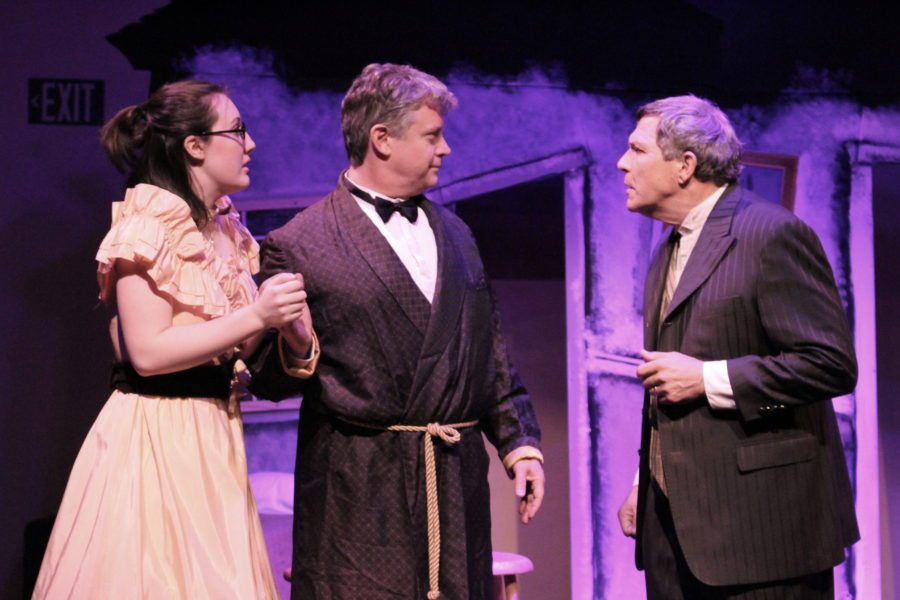
A scene from 2017’s “Government Inspector” with cast members (left to right) Aiden Rees, James Calvert, and Paul Perri | Photo by Lance Davis / Parson’s Nose Theater

Mary Chalon Davis and Lance Davis, who founded Parson’s Nose Theater (PNT) in 2000, are feeling quite content these days. After 17 years as a gypsy theater company they have finally found a permanent home in Pasadena.

Their 2017-2018 season debuted last month at the beautiful ivy-covered Parson’s Nose Abbey on 95 North Marengo Avenue with Lance’s adaptation of Nikolai Gogol’s ‘The Government Inspector’.

For two weekends in December – 9 and 10; 16 and 17 – PNT will present a Readers’ Theater Series of Charles Dickens’s ‘A Christmas Carol’. Actors, dressed in the attire of the era  will read this beloved annual production as it was meant to be staged.

Lance explains their rationale for establishing PNT, “People say live theater is dead. Why would they want to see a play when they have television at home? But the idea of returning to the live art form where the actors and audience are both present and no one is looking at screens is what theater is about. You’re interacting with the literary art form for the most part so you have to listen to the words and the ideas.

During World War II, in London, in spite of all the bombings going on, theaters were full because people wanted to go out and be with others. That sense of socialization and community is what we’re trying to bring back. While our plays are only 90 minutes long we take a break so people can get up to talk with each other, have a cup of coffee or a glass of wine, and chat.”

PNT’s productions are designed to be introductions to the classics. Students are a big audience so they deliberately addressed the most common complaint students voiced.

“We eliminated all the things that students said they don’t like about theater, one of which is that Shakespeare plays are too long,” Lance says. “So I distilled them to 90 minutes. The idea is to keep them short but complete – the language, the characters, the plot, and the spirit of the play are intact.

One of the students who watched our production of ‘Twelfth Night’ told us she went to see it at a theater Festival. About an hour and 30 minutes into it, she just said, ‘Excuse me, I saw this before and I know it can be done more quickly’”.

“But there was a reason why these classics are too long,” Mary interjects. “At the time they were written people didn’t have much to do for entertainment. We re-introduced these for the modern audience so they can enjoy the very same plays that adults, before our time, knew.”

That students actually enjoy these classic plays was revealed recently. Lance recounts, “We had a group of eighth graders from Pasadena High School and during the intermission they were all conversing with each other while their parents were checking their cell phones.”

Lance Davis starred in “A Middle Class Nobleman”, a PNT 2013 production | Photo by Peter Zuehlke / Parson’s Nose Theater

PNT’s productions are comedy classics because Lance is particularly gifted in the art form. Expounds Mary, “Lance came from the Guthrie Theater Minneapolis which informed his choices; it’s his orientation.  But also because comedy makes people laugh; it lifts their spirits in a way.”

Lance adds, “Besides that, we want to recognize that these classics, like the plays Moliere wrote in the 1660s, were the basis for some of modern plays. For instance, Moliere wrote about this miser who thought of nothing else but money. This character engendered Scrooge. Then came Jack Benny and his obsession with money; and then much later on there was Burnseneezer Scrooge in the animated show ‘The Simpsons’. All these modern day comic characters came from the works of early playwrights.

Our most recent play ‘The Government Inspector’ is about a clerk who comes into town whom people thought  is the expected inspector who’s to expose all the evil deeds that the mayor is doing. o all these local officials are going around bribing him and he eagerly accepts them so he’s just as corrupt as they are. All this time the town officials thought they’re safe because they’ve bought off the inspector, until one day the real inspector arrives.”

“My Character in the play is the mayor’s wife and she see meets this man whom she thinks is the government inspector,” Mary relates.  “She plays matchmaker between him and her daughter, and he proposes marriage. So Mary thinks this is going to change their life – they’ll leave this crummy place and move to St. Petersburg; all their dreams have come true. She snubs the townspeople then she finds out he’s not the real inspector so all her hopes come crashing down.”

“This is something we still see today,” expounds Mary. “So people who watch this show realize we have a link with these characters. Classics have universal themes and audiences connect with them. And because they’re funny they become more accessible and disarming.”

Lance interjects, “We laugh at them and then we realize, ‘Oh, that’s me!’ Through these plays, we see human nature. There are ideas that seem so foreign to us like, in one of Moliere’s plays, how the dowry is very important. We think it’s funny and say no one does it anymore but we still do, only in a different way. Today when one’s daughter is dating someone, parents think ‘who is he?’; ‘what are his parents like?’; ‘what are his prospects?’”

How they came up with their theater company’s name is a story in itself as Lance laughingly relates. “First of all Parson’s Nose was the only name my wife and I agreed on. It’s a quote from ‘Romeo and Juliet’ where Mercutio talks about Queen Mab’s speech that dreams reflect one’s passion and desires – she tickles a sleeping parson’s nose with a tithe-pigs tail and he dreams of a large donation. And we’re always dreaming about grants. It’s very far-fetched.

On the other hand, when I was growing up, in Philadelphia, a parson’s nose was the tail-end of the chicken. So if you look at our logo it’s either a sleeping parson or the tail-end of a chicken. In that sense that’s a metaphor for us – while we do the classics, we don’t take ourselves seriously.”

“This company has been around for 30 years,” Mary stresses. The individuals we work with – the actors, the designers, including us – are trained people who went to Julliard, Yale, and other drama schools with 30 years of experience and have worked all over the country. Many of us are from New York and ended up moving to California in our mid-adulthood and raised families.

We bring a lot of skills to the work; we’re not amateurs. People who come to our show are watching something that’s well done. We don’t spend a lot of money on our sets but we focus on the art of acting and storytelling. That’s key for us. It’s like ‘theatre unplugged’. These actors, several of whom are from Pasadena, are here because they love acting.”

We started PNT 17 years ago and our first production was ‘Twelfth Night’ then ‘The Miser’ which we did at Interact. The Geffen Playhouse came over and loved what we did and asked us to do their Saturday shows which toured for schools. While we didn’t envision ourselves doing that, we thought it was a nice opportunity. We produced all the hour-long shows and we were able to hire a company of actors to do the tours for six years.

From there we came up to the Pasadena Playhouse where we produced family-oriented performances that brought families to the Playhouse. All these shows that we were producing for the Geffen and the Playhouse were all under their name but we were thankful because they gave us a foundation. This went on for about nine years until the Playhouse scrapped this component of their programming when they downsized.

PNT’s 2016 show, “The School for Wives”, featured (left to right) James Calvert, Marisa Chandler, John Harnagel, Lance Davis, Aiden Rees, and Matt Franta | Courtesy Photo

In 2008 we realized we had been working all these years but no one knew who we were. So we decided that this was the time to reinvent ourselves – we had to get the name Parson’s Nose out there.

The first production we did under our own name was at Pacific Asia Museum. We were then at Lineage Center for the Performing Arts where we stayed for seven years. It’s a dance company on Fair Oaks, south of Green Street, and they rented out their space. We were their tenant for five years. We were briefly in South Pasadena where we did the ‘Under the Tent’ series. Then the recession hit big time. So we stopped making full productions and we did readings instead.

We were in New York for a while and readings of new plays are common there. It’s not as common here where readings are usually table readings for movie scripts. We started to do readings and people were fascinated – actors make the characters on the page come to life. So we began doing that; of course it’s also a less costly production.

When the economy improved over time, we started putting full productions back in.  We were doing this at Lineage but as we were renting only the performance space, we had to find other places for our requirements – costumes were stored in one location; props were at a different space; rehearsing was done at yet a different site.  We became experts at being a gypsy theatre company – arriving in a van, setting up props, and stuff.”

Lance adds, “We began to look for a space in earnest which took longer than we thought. We looked at all kinds of spaces.  We now know Pasadena inside out – if you say Discount Tires, we know where that is.  When, after three years of searching, our realtor discovered this place, he declared, ‘this is Parson’s Nose’.

And, to us, finding the Abbey is such a gift.  It’s a place where we can hang lights and have a set that can stay up all the time.  For the first time we can argue with each other and just storm out the door.  We don’t have to pick up and fold our chairs before leaving.

The city was very happy to have us occupy this space; they’ve been very supportive.  And we are ecstatic to be here.  Now our challenge is to tell people where we are, how to get here, and how to make it a destination for people.

This year we were part of ArtNight Pasadena and a lot of people came in to see us.  We did 20-minute readings of radio plays people grew up with, like Flash Gordon.”

Following the 2017 fall full production of ‘The Government Inspector’ and Charles Dicken’s ‘A Christmas Carol’, PNT will present a full production of Moliere’s ‘Too Learned Ladies’, then a Readers’ Theater Series of ‘An Irish Celebration’ with select Irish poems, stories, and songs in the winter.  The 2017-2018 season will close in May with a full production of William Shakespeare’s ‘Clearly Classic: Twelfth Night’.

Plans for more productions for schools and an outreach for seniors are underway, as well as plays multi-generational families can enjoy.

Parsons Nose Theater is a hidden gem in Pasadena, as one of its board directors noted.  However, with its founders’ achievements in staging timeless classics for students and families and plans to extend its reach to an even wider audience, it is on track towards getting recognized.  This hidden gem will be found at last.

Shaw’s ‘Mrs. Warren’s Profession’: A Timely Production at A Noise Within

Originally published on 31 October 2017 in the Pasadena Independent, Arcadia Weekly, and Monrovia Weekly

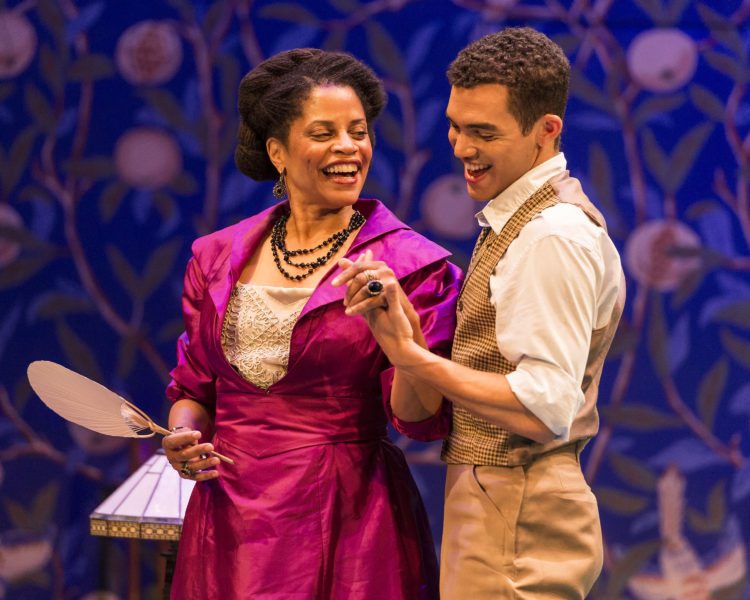
Judith Scott as Kitty Warren and Adam Faison as Frank Gardner. Photo by Craig Schwartz

George Bernard Shaw’s seminal play ‘Mrs. Warren’s Profession’ is currently playing at A Noise Within (ANW) until November 17, 2017. Directed by Michael Michetti, Co-Artistic Director of The Theatre @ Boston Court, it stars Judith Scott, known for her role as Claudia Crane on the current FX series ‘Snowfall’, in the titular role of Kitty Warren.

Written in 1893, ‘Mrs. Warren’s Profession’ was one of Shaw’s earliest plays which was published in a series called ‘Plays Pleasant and Unpleasant’ in 1898. It was widely branded as being immoral not so much because it dealt with prostitution but because the woman in the center of the scandal did not show remorse for her choice of career.

Michetti says of ‘Mrs. Warren’s Profession’, “It is shockingly modern. It’s a play that examines Kitty Warren’s choices from different perspectives and without judgment. Shaw was brazen to put the plight of women front and center in his art; it’s a choice none of his contemporaries made. It’s a protofeminist play before the terminology was even commonplace.”

“When Shaw wrote ‘Mrs. Warren’s Profession’ in 1893 he exposed women’s dilemma at that time and the double standard that society imposed,” Scott pronounces. “Prostitution was highly regulated and prostitutes were punished while the men who availed of their services got away with it.

This is a woman who has prostituted herself unabashedly and has remained unashamed for having done that. It is a powerful portrayal of women and the tremendous sacrifices they make to raise their children and give them opportunities in life.”

Scott got her acting training at Webster University, alma mater of acclaimed actress Marsha Mason, in Webster Groves, Missouri. She says, “It was at one time an all-girls school but it was coed by the time I attended it. I was there for three years; I left after the third year and moved to Paris. My friends used to call me the Wandering Jude.”

“A month after I got back in the States, in 1983, I went walking with my mother in downtown Chicago. I went into The Second City Theater to use the bathroom and after I came out I heard some people laughing. I entered the room and saw people improvising. When I rejoined my mother outside I told her, ‘that’s what I want to do’. That sealed my fate, I went to the bathroom and decided I want to be an improviser,” relates Scott.

“Actually, I grew up improvising; that’s how I made my mother laugh,” Scott hastens to confess. “So I have always been an improviser but when I saw what they were doing I knew I wanted to do that. I was there in the fall and by the spring I was one of 300 touring performers with The Second City Theater Company. I did that for six years.

My mother was an amateur actress, my grandmother watched soap operas and was kind of a drama queen. The path was already laid out for me all my life and I just took up the calling. But I didn’t really make it a serious career until I was in my 40s.”

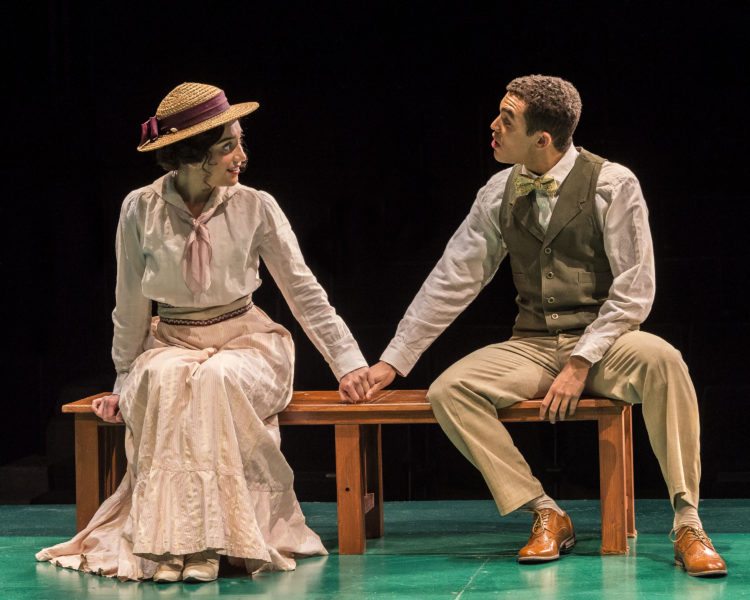
ANW Resident Artist Erika Soto as Vivien Warren and Adam Faison as Frank Gardner. Photo by Craig Schwartz / A Noise Within

“Having studied all the classics in college, I’m familiar with Shaw’s work,” explains Scott. “’Mrs. Warren’s Profession’ is a very intellectual play; Shaw is a very word-heavy writer but there’s a tremendous amount of emotion and feeling in his work. That was what struck me – how much feeling was in his writing; it is replete with polemic discussion, there’s so much passion in it.

It is a powerful piece and playing the role of this strong and willful character was life-changing for me.  I related to Kitty Warren on a deeply personal level. The play has resonated with me because of what I know and where I come from; my ancestral history has certain parallels with her experience.

This role is not traditionally played by a woman of color and it has made a difference for me. It was a vehicle that changed my life – not only in my understanding of me as Judith, my mother’s child, but as a woman of color who comes from a long line of women of color before me who sacrificed a great deal to have the privileges that I now enjoy but take for granted.”

Adds Scott, “This is the first Shaw I performed ever and is also my first at ANW. It has been both challenging and illuminating. It helped me understand that I come with a certain history and perspective that I have learned to respect and honor more than I ever did before; Shaw gave me my identity.

By relating to the character it simply means that I have taken her seriously and deeply; I see Kitty through her eyes.  I don’t live in my skin color but I use it when it’s necessary to make a statement – in this role I have to fight diligently and ferociously. In Shaw’s work that revelation is more so.”

While Shaw wrote ‘Mrs. Warren’s Profession’ towards the end of the 19th century to expose the prevailing culture, women in the early 21st century are still fighting against double standards of behavior and inequality in the workplace.

Would that Shaw’s depiction of a woman being decidedly unapologetic for making her own fortune and shedding the inhibitions that society unfairly imposed serve as an exhortation for all women of this generation to fearlessly pursue their dream and resolutely determine their own destiny. May equity and parity be achieved long before the end of this century.