Prepare to be Moved by ‘Tiny Beautiful Things’ at the Pasadena Playhouse

Originally published on 8 April 2019 in the Pasadena Independent, Arcadia Weekly, and Monrovia Weekly
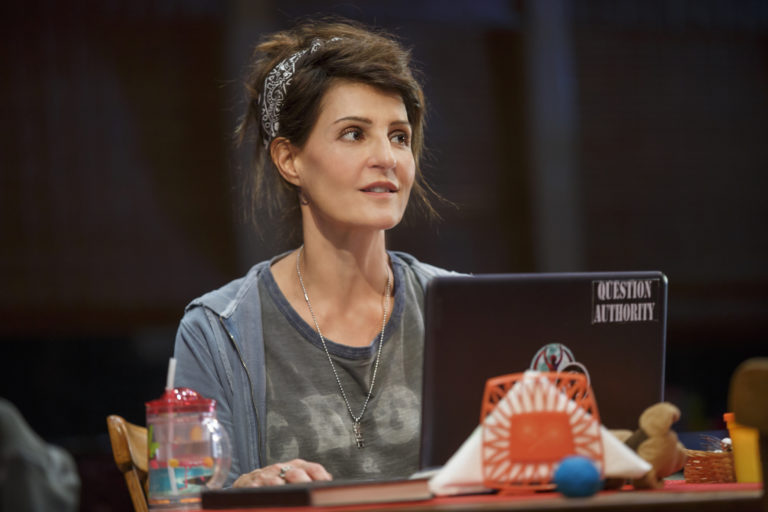
Nia Vardalos as Sugar | Photo by Joan Marcus / Courtesy of the Public Theater

Tiny Beautiful Things,’ which was a New York Times Critics’ Pick when it debuted at the Public Theater, is coming to the Pasadena Playhouse on April 10 until May 5, 2019. It stars Nia Vardalos as Sugar and features Sameerah Luqmaan-Harris, who will play the role of Sugar at select performances, Teddy Cañez, Natalie Woolams-Torres, Giovanni Adams, Adam J. Smith, and Sarah Hollis. Sherri Eden Barber will restage this production based on the original direction by Thomas Kail (of the ‘Hamilton’ fame).

Vardalos, who originated the role of Sugar at the Public Theater under the direction of Thomas Kail, also created the stage adaptation of ‘Tiny Beautiful Things’ based on the New York Times Bestseller of the same name by Cheryl Strayed. The project was conceived by Vardalos in conjunction with Thomas Kail and Marshall Hayman.

Speaking with us on the first day of rehearsals, Vardalos recalls what drew her to Strayed’s book. “Tommy Kail gave me the book and said ‘I think there might be a play in this.’ I read the book on a plane and was overwhelmed by the letters – I cried so hard that I think people must have thought something was wrong. It wasn’t that they’re sad, but it was that I was unleashed, unzipped, opened. It was catharsis.

“The letter writers – their naked emotions and the lack of conceal in any way – were what struck me. The letters were so well-written and Cheryl’s responses were not advice. I didn’t know how I could write it. It terrified me. It was so outside of my comfort zone and, yet, that was what drew me to it. I had finished the script for ‘My Big Fat Greek Wedding 2,’ and I knew at the time that we were about to start filming it. So I felt it was the perfect moment to just jump in on something different.”

“Ironically, it was through social media that we found Cheryl,” Vardalos continues. “We contacted her on Twitter and asked for the rights to the book. It’s a daunting experience to adapt someone else’s writing. And to do it, I had to really get to know Cheryl, which was not a hardship in any way. She’s the most wonderful person and we bonded. It was an incredible partnership from beginning to end.”

“What I found absolutely transformative was the moment I realized that Cheryl wrote the unpaid column particularly because she, too, was grieving and thus was able to relate to the letter writer,” discloses Vardalos. “I was faithful to her words but then I started to get really brave and pulled from one piece and put it in another. Right within her words, I arced the play, and added a narrative. To create conflict, I had the letter writers question me, when the ones in her book  didn’t because they loved her right away.”

Teddy Canez, Nia Vardalos, and Natalie Woolams-Torres | Photo by Joan Marcus / Courtesy of the Public Theatre

From the time she started to adapt the book to getting it staged, took three years. Vardalos says, “It was a process that didn’t have boundaries because, luckily, with theatre you have a long time to do it. So I did the workshops for ‘Tiny Beautiful Things’ in between filming, editing, and world-touring for ‘My Big Fat Greek Wedding 2,’ then I came back and did the play. After the first run I changed it again to add some humor for the second run. I realized that even though there was a funny bit in the latter part of the play, the audience didn’t know they had permission to laugh – I put humor in the beginning so they would know.”

It’s surprising to learn that when ‘Tiny Beautiful Things’ played in New York, more than 50 percent of the audience was male. Vardalos conjectures, “I think that anyone can sit there in the audience and feel. These pieces are open to everyone’s interpretation. For example, even though I cannot personally relate to some of the pieces, what gets me every time is the advice because it’s illuminating rather than instructional, nobody wants to be told what to do. And it seems that Cheryl intuitively knows that, and that’s why I love her advice columns – they’re not authoritative, they’re transparent, and storytelling. It was heartening to look out there and see at least half the audience be men and that they would come back. It was amazing.”

When Vardalos started adapting the book, she hadn’t thought about who would play the role of Sugar. She says, “Cheryl has a way of knowing the truth. After sitting down with her, she asked me, ‘Do you want to play Sugar?’ and in that moment I realized I did. And I was as honest as I always am, and I said ‘Yes, please.’”

However, knowing the characters intimately doesn’t inevitably mean the writer could do a better job of playing the part. Vardalos explains, “In my entire career, I have seen actors take my words and give them life. I don’t think the person who puts fingertips to keyboard is necessarily the best person to play a role. Tommy and I set out to create a role and many roles that were not bound by ethnicity, age, or gender because we want it to be as open as Cheryl is.

“I’ve now seen Sugar played by an African American woman named Opal Alladin who knocked it out of the park in San Diego. Cheryl has seen a woman play Sugar in Portland who is white. It’s going on stage in New Haven, Connecticut and in Seattle, Washington. So it’s really cool! It’s gender-less and race-less and it’s all the things we want it to be. I want to learn and see what other people do with it. In fact, I wrote in the notes ‘I look forward to upcoming productions in which you will interpret this play with your love, creativity, and ingenuity. Above all, I hope you will always remember that the letters are real.’”
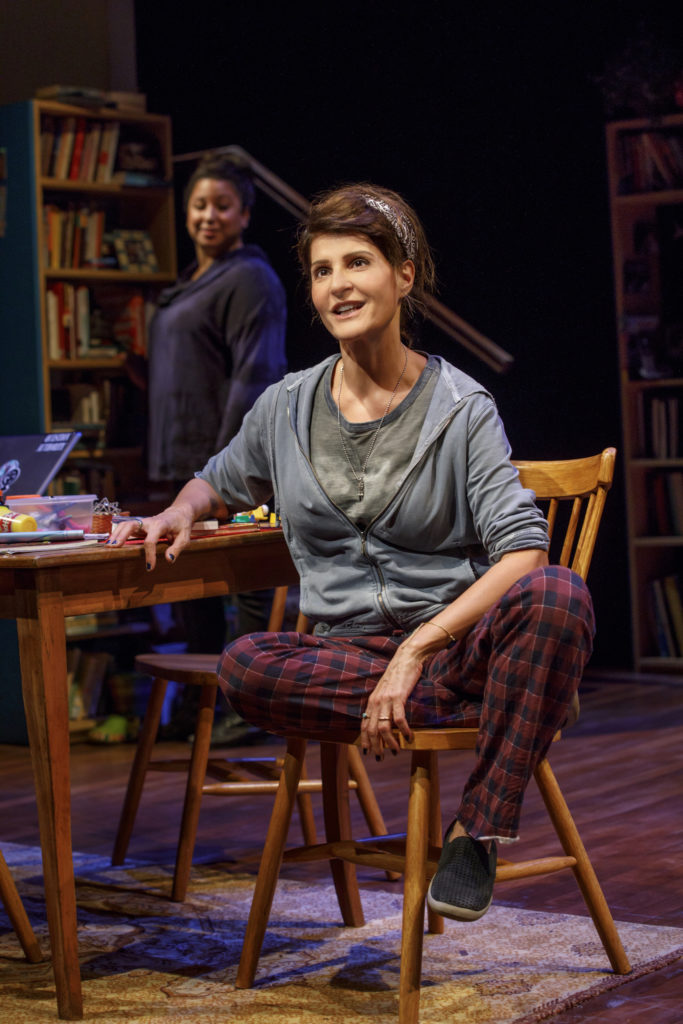
Nia Vardalos | Photo by Joan Marcus / Courtesy of the Public Theater

“Can we talk about the cast now?” Vardalos requests excitedly, “We had to cast people who were incredibly diverse. Tommy had envisioned them to embody the characters without changing costumes, voices, or accents; it was all about attitude, character, emotions, and personality. We tried a lot of different ways of accomplishing this when we were workshopping. And Tommy obviously knows what he’s doing; he knows when something feels right and he doesn’t waver. I also love that he would ask me ‘Okay? Feel good to you?’ And there was never a moment when I didn’t go ‘Yeah! Okay!’”

“So we have these wonderfully multi-talented actors. For example, one actor plays a man who’s confused about whether to tell his girlfriend how he feels. Then 20 minutes into the play, the same actor plays a transgender person. We have a man who’s my online troll and is incessantly vulgar, needling Sugar with online abuse. And by the end of the play, is a grieving father. Natalie has the role of someone who doubts me the most in the play, then becomes my mother who showers love on Sugar.”

About her experience playing the role of Sugar, Vardalos describes, “We did eight shows a week for three months during the first round, then we did eight shows a week for four months during the second round. Whenever I’m asked how many times I’ve played Sugar I say ‘not enough,’ and it’s not meant to be a glib answer. Every time I think I’m finished with the run, I can’t wait to do it again. There’s something about the play that always affects us– we’ll sit in the wings and hear the audience coming in and we get really excited because they haven’t heard it yet. And the stories are so uplifting and cathartic. The audience walks out happy and high because they felt something. Isn’t that where we’re all at right now? Just to feel something that will let us get away from all the craziness. We’ve got political fatigue; the news cycles just weigh on us.”

The audience reaction is as varied as the number of times the play is staged. Clarifies Vardalos, “Each audience is different, which is what’s great about live theatre. But, more often than not, the story that I tell about my mother is the one that affects people. It’s where Natalie plays the part of a young girl who was raped. There’s a part when I’m heading downstage and Natalie goes upstage, then goes over to the side and becomes Sugar’s mother. That’s my favorite moment in the play because to see this young actress who’s 28 years old transform like that … it gives me the shivers every time. She literally goes from being vulnerable to commanding and I love it! In just a turn, she transforms! And I love the reaction of the audience.”

Much has transpired since ‘Tiny Beautiful Things’ opened in New York, Vardalos enthuses, “We published the play and it has been licensed by approximately 25 theatres across the U.S. It’s been translated to Spanish and it’s going to be in Mexico and Uruguay. I hope to bring it to Greece and it’s going to be a touring production. This Pasadena production is the first time the New York cast is being brought back from the Public Theatre. It’s so exciting! This is so unique because I didn’t just pull one or two people –  it’s all the actors, the production designer, the costumer, the sound designer, Tommy’s associate Sherry Barber – it’s everybody. We’re all still so close, which is rare. We played it one year and two months ago in New York. We closed December 18, 2017 and we’re opening here on April 10, 2019.”

“When Pasadenans see ‘Tiny Beautiful Things’ I just want them to say ‘That’s me!’ Because as Chery Strayed says ‘We’re all Sugar,’” Vardalos pronounces.
‘The Glass Menagerie’ Stirs at A Noise Within

Originally published on 4 March 2019 in the Pasadena Independent, Arcadia Weekly, and Monrovia Weekly

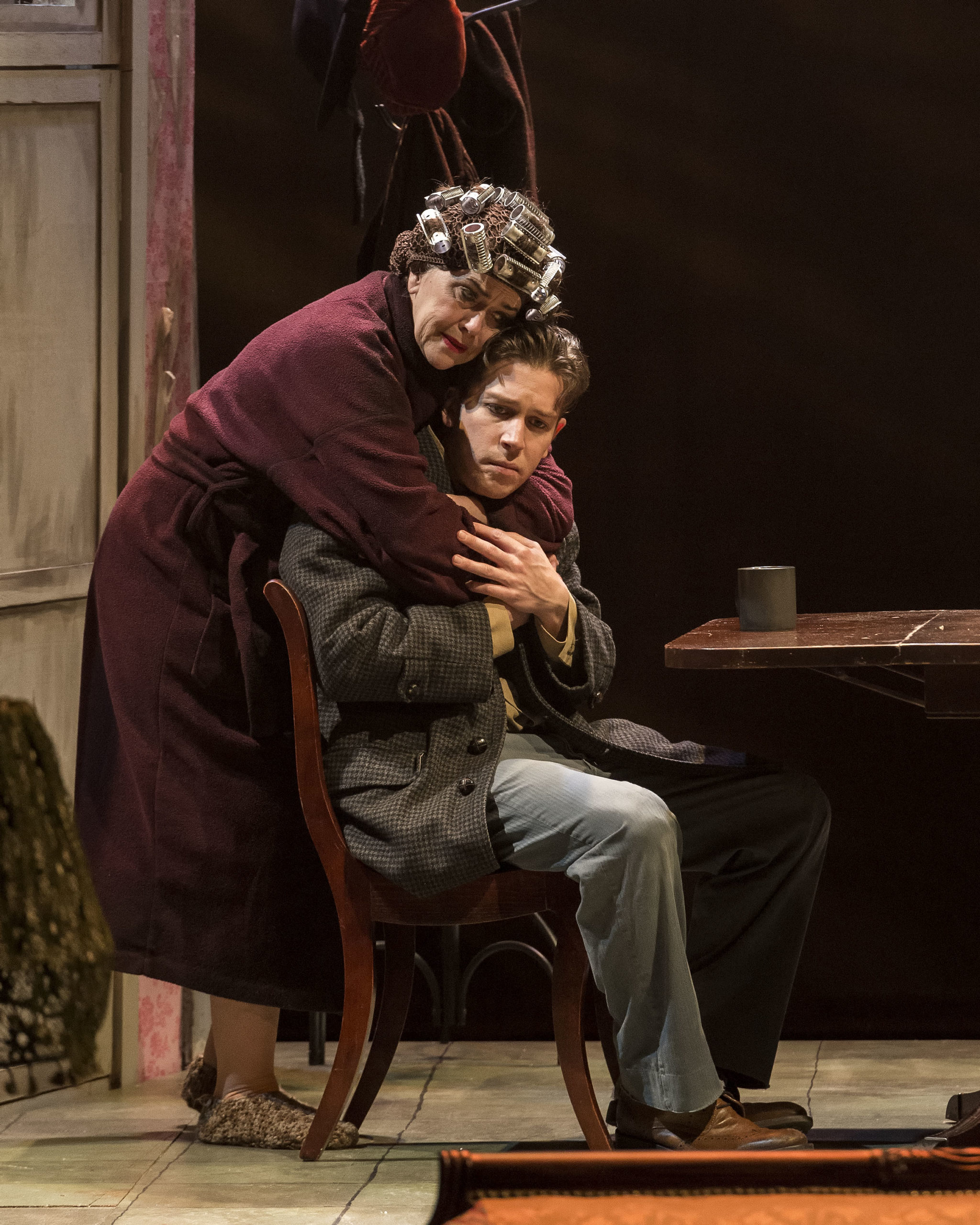
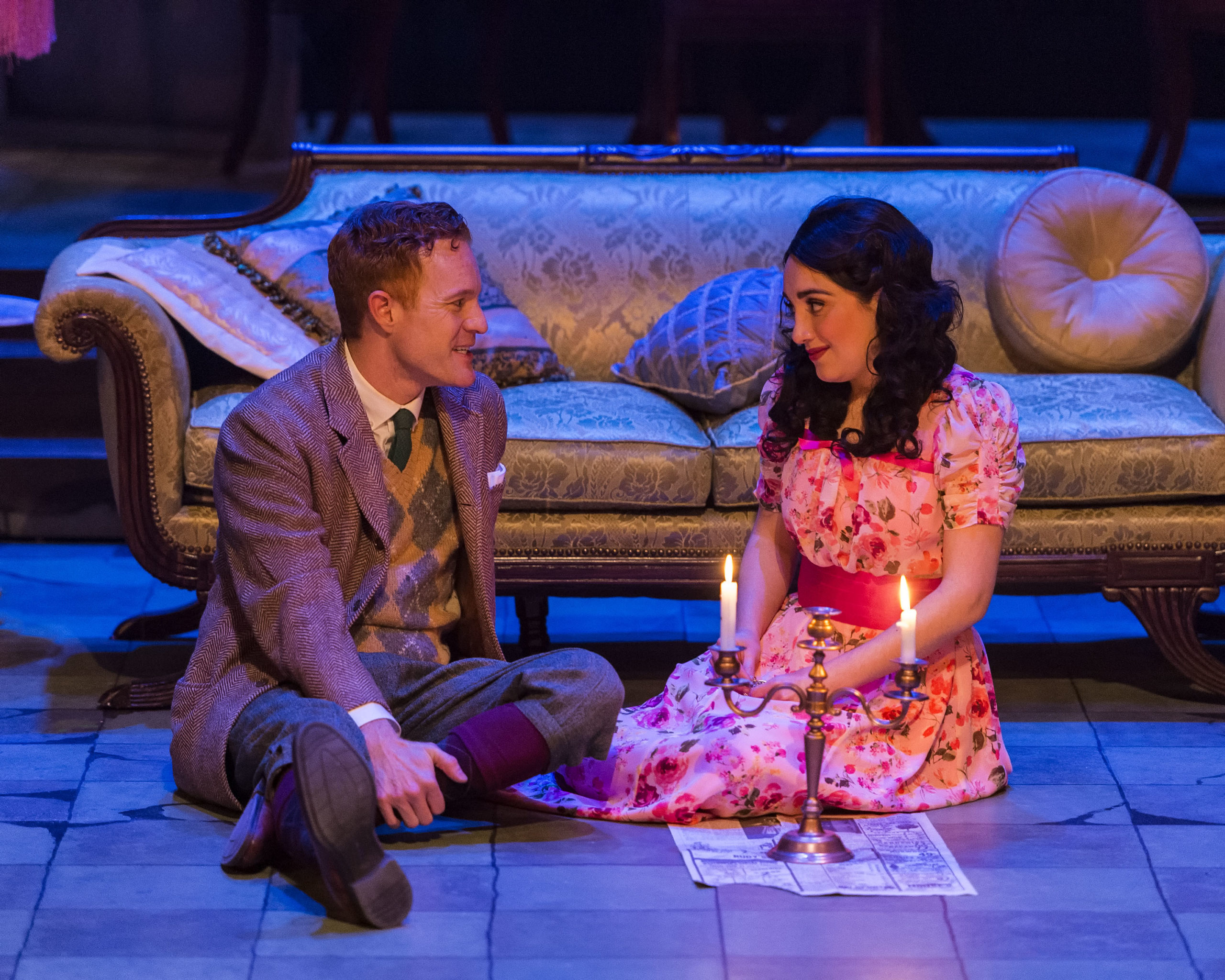
Kasey Mahaffy and Erika Soto in a pivotal scene | Photo by Craig Schwartz / A Noise Within

‘The Glass Menagerie,’ the autobiographical play that launched Tennessee Williams to great renown, takes off at A Noise Within (ANW) from February 24 through April 26. It made its debut in 1944 in Chicago, moved to Broadway a year later, and earned Williams the New York Drama Critics’ Circle Award.

In the play, an innocuous visit from a potential suitor unsettles the sheltered Wingfield family. At the center of this drama is matriarch Amanda who fiercely protects her adult children from the harshness of others, oblivious to the likelihood that her eccentricities are the biggest threat to their well-being.

First produced by ANW during its 1997-1998 season, it was directed by Julia Rodriguez-Elliott and starred Geoff Elliott narrating as Tom Wingfield, with Deborah Strang as the imposing matriarch Amanda Wingfield.

This re-staging of ‘The Glass Menagerie’ is helmed by Producing Artistic Director Geoff Elliott and features four resident artists – Deborah Strang returns as Amanda, Rafael Goldstein as Tom Wingfield and the narrator from whose memory the story is told, Erika Soto as Laura Wingfield, and Kasey Mahaffy as the gentleman caller, Jim O’Connor.

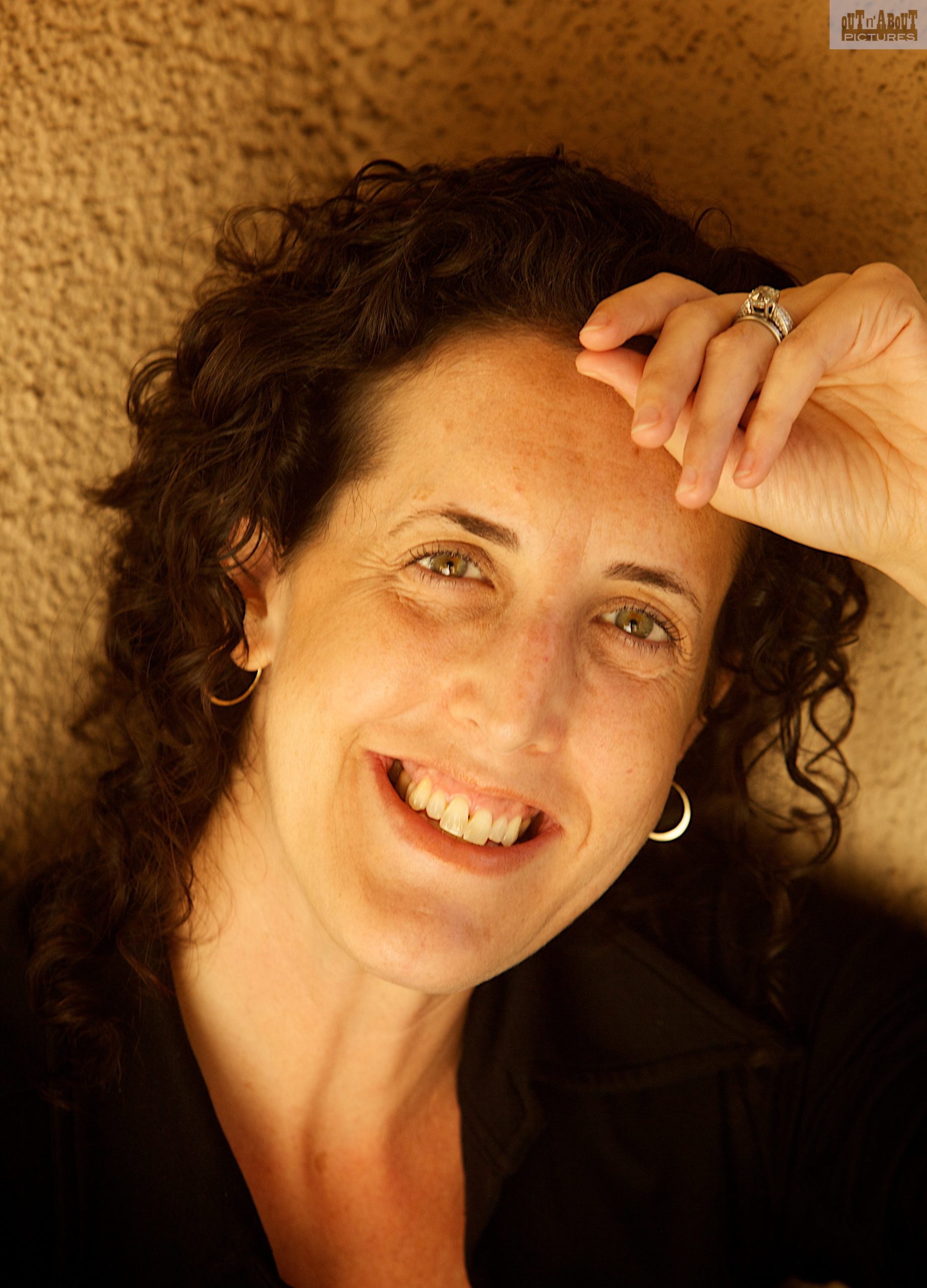
Soto, one of ANW’s two newly installed resident artists (the other is Kasey Mahaffy, who shares the stage with her in the play), talks about the play, her role, and the challenges in inhabiting the character of Laura.

“I found ‘Glass Menagerie’ moving in its mundane complexity; it’s so revelatory of American psyche,” Soto says. “Even as the play has a resonant theme, it was inspired by Tennessee Williams’s specific experience – as a writer, as a gay man, and as a reluctant patriarch and caretaker of his family.”

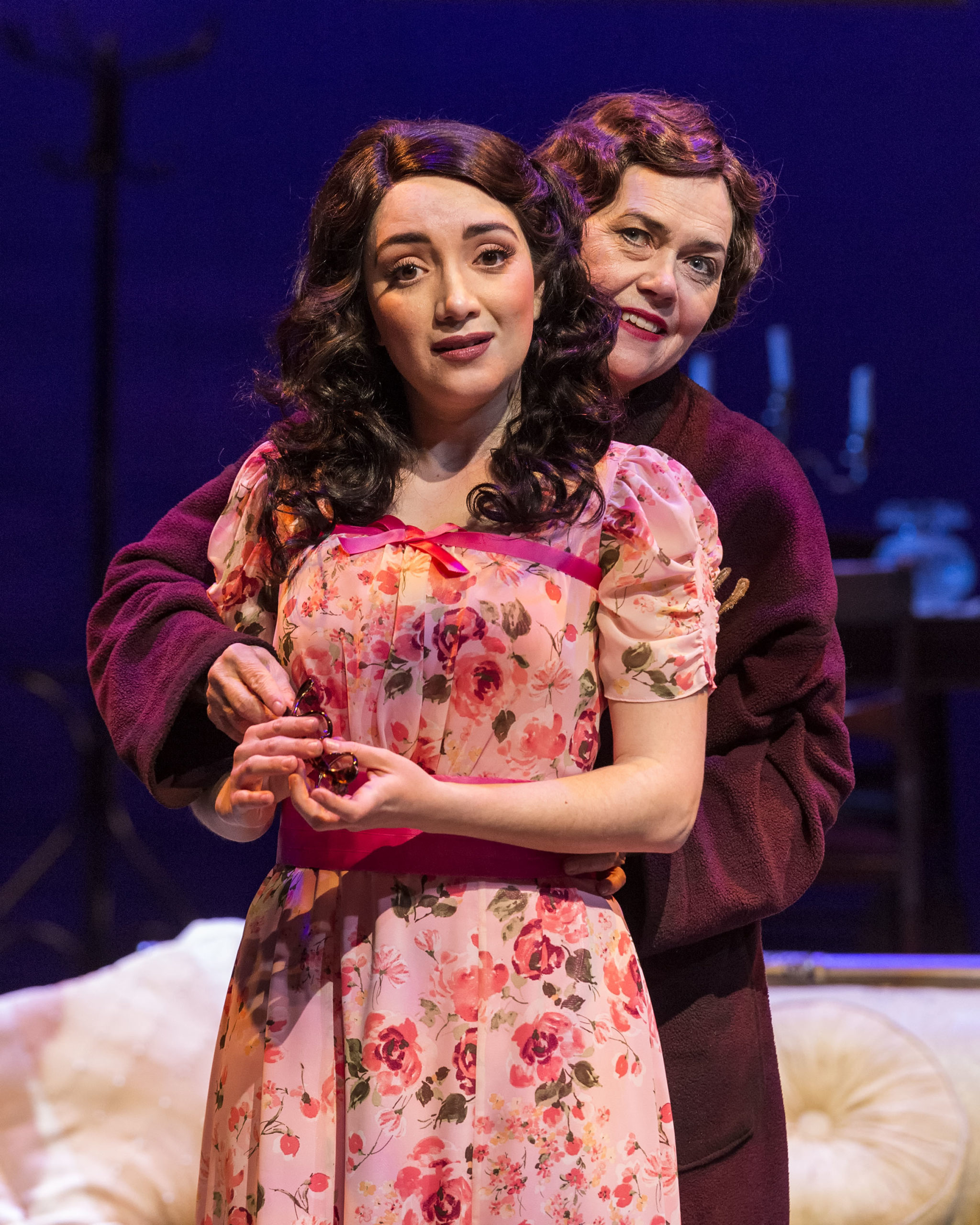
Erika Soto (left) and Deborah Strang (right) | Photo by Craig Schwartz/ A Noise Within

“Laura is the foil to Amanda’s energy,” Soto describes. “If Amanda is this almost ridiculous force – this hurricane – Laura is the eye of the storm. Tom, as the narrator, is navigating in and out of this experience. And you see that as he moves in and out of the house; he’s the one with the mobility even if that comes with consequences. He’s the one yearning to escape from this place. Tom breaks free externally while Laura does it internally; she navigates the storm by going within. She lives in her own little world, which is an oasis, with the music she listens to and her glass menagerie, which she has such a devotion for. That has given her an inner strength, whether that’s for better or for worse. It’s her coping mechanism and what makes her function in society. It’s her survival instinct – to cocoon, and that’s her safe space.”

“In the beginning, I struggled connecting with Laura because she was written as someone who is so shy, so afraid, so apologetic,” reveals Soto. “She wanted to disappear, to placate, and to do whatever is necessary to keep the calm. And I am so not like that. At all. That was more challenging than I ever thought. If this role had come years ago, when I was in my early 20s, I would have said ‘Easy-peasy! I know what that feels like.’ But those years are now in the rearview mirror. The 30-year old me is vivacious and alive, an activist and a feminist. But, then again, it wouldn’t be called acting if I were to play someone exactly like me. And, having had my share of playing the ingénue, I have that well to draw from.”

Adds Soto, “Laura’s physical limitation, which we have decided was the result of her bout of polio, helps put me in a vulnerable place and rationalizes my need to feel safe. She lives in a world where the boxes are very different and are a lot smaller – there are only so many places she could go and there’s only so much power she has. I made those the parameters around which to work.

“Thankfully, Tennessee Williams didn’t write static characters with linear lives. Laura has an immense arc in the course of a night. In fact, in this story, I see her journey as being a full circle. She starts in a place and experiences something she never expected to. Through circumstance, and tragedy in a way, she comes back. And there’s a kind of peace to that … it’s sort of a melancholy peace. And I think that is what’s so heartbreaking. You meet this person, and you imagine she’s going to reach that crescendo, and burst off the page.”

Deborah Strang and Rafael Goldstein | Photo by Craig Schwartz / A Noise Within

“That said, I choose not to think of Laura as a victim because I don’t find that interesting,” Soto discloses. “To see any woman as a victim is very lame to me in terms of actionable character. I see her as a response to her environment – a product of her time and space. She is just like any of us, responding to people in our lives and the hand we’re dealt, with our own personal insecurities and resistance.”

“I feel you should have a big ‘spoiler alert’ disclaimer at the beginning of your article,” Soto cautions before continuing. “I think Laura does have a moment where she takes a chance and tries to embody someone she hadn’t even imagined she could be. To me, someone who takes authority over her own experience can never be a victim.”

As she inhabited the role, Soto discovered something about Laura that she didn’t know going in. She divulges, “It wasn’t until I started to think about her inner life, and the kind of strength it takes to survive a mother like Amanda, that made me appreciate her. That’s quite interesting and complex. Then I thought, here’s a man writing about these ridiculous women. Maybe if a woman had written Amanda and Laura, they wouldn’t be such polar opposites and so extreme. It wasn’t genuine femininity but stereotypical ideas of femininity – the aggressive, bite-your-head-off, hysterical mother and the trembling, terrified, apologetic, little doe of a daughter. Women are none of these things!”

“I had never read the play before now, nor have I seen it performed, and I like it that way,” Soto confesses. “As embarrassing as it is to admit ignorance about something so iconic, I prefer having a blank slate – to discover it and it being fresh for me so that my performance also translates that way to the audience – rather than having to live up to decades of expectation, or to deliver lines with a precious quality, which is not real to the character. The characters in this play don’t know they’re iconic, they’re just people.

“But I have to honor who Tennessee Williams perceived in telling the story about his sister because it was his reality. It’s his story and that’s what we’re telling. Even if, ideally, I want to apply the things I try to practice in my daily life to the stories I’m telling. And it’s only a piece of a puzzle as well, it’s her piece, along with Amanda’s, and Tom’s, and the gentleman caller’s – all these parts tell a bigger story.”

Rafael Goldstein and Deborah Strang | Photo by Craig Schwartz / A Noise Within

Asked what the audience would find relevant, Soto pauses to consider the question before responding, “I personally relate a lot to Tom in his churning, boiling, and brimming fire where he feels something’s got to give. I think that’s fascinating to watch. Tom says ‘I’m boiling inside; I’m ready for adventure. I’m tired of watching other people having it.’ He talks a lot about the impending war and that war is when the common man can have his adventure. He also mentions movies, he’s constantly wanting to go to the movies. This would resonate in Los Angeles, especially in our media-driven world, where we’re watching people from our TV screens, our phones, and laptops. We could relate that to our idolization of celebrity, stars, and the fantastical world we see in films. I love his idea that we sit there and watch other people have adventures and live fantastical lives. That, to me, is such a call to action.”

Soto confesses she hasn’t really thought about the audience takeaway in great depth, but concedes, “It isn’t necessarily a feel-good play but I hope they’re moved. I want for them to react the same way I do after watching a movie or a play … to say ‘I know! Me too!’ Whatever that is – it could be ‘I know, me too, I also feel extremely depressed’ or ‘I know, me too, I have that kind of mom or that kind of relationship with my mom.’ I feel that’s why we tell stories. And however you want theatre to be, it’s all therapeutic, it’s catharsis. I  hope the play strikes a chord and, in doing so, is vibrational enough that it shifts something, or validates them in some way.”

“And I think that’s why we go to the theatre and why stories are valuable to us as human beings. It’s such a ritualistic thing we do – gathering in groups in a particular space. How different is that from, I don’t know, church? It’s a community of people enjoying a common experience.  There’s something strange and magical about,” Soto concludes.

While ‘The Glass Menagerie’ was specific to Tennessee Williams’s upbringing, the feeling of being constrained by societal expectations or being stuck in a rut is something most of us can relate to. Lest the play engender resignation and hopelessness may it, instead, impel us to take the reins and change course. That sense of personal agency is key to owning our life.

‘The Judas Kiss’ Premieres at Boston Court Pasadena

Originally published on 21 February 2019 in the Pasadena Independent, Arcadia Weekly, and Monrovia Weekly

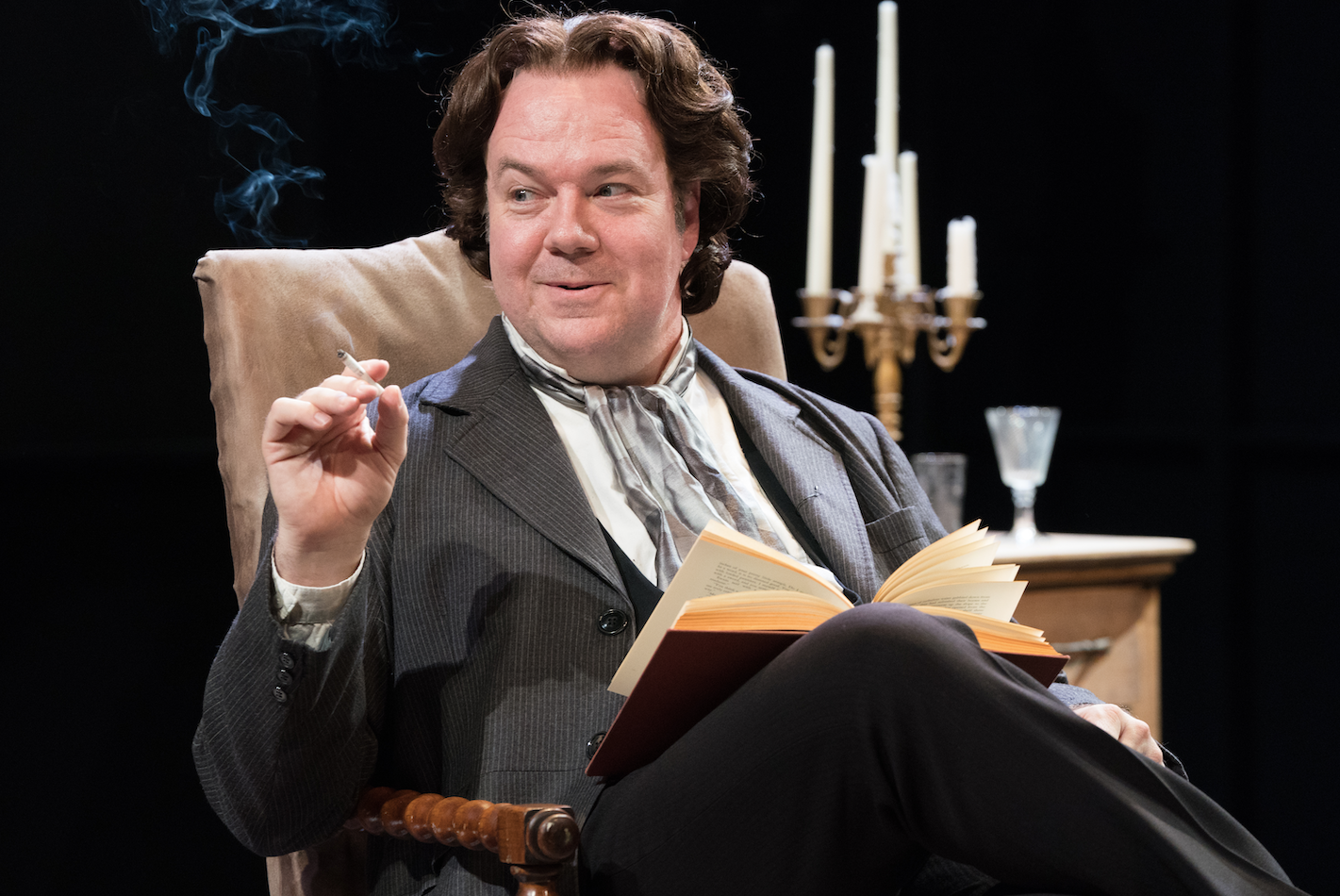
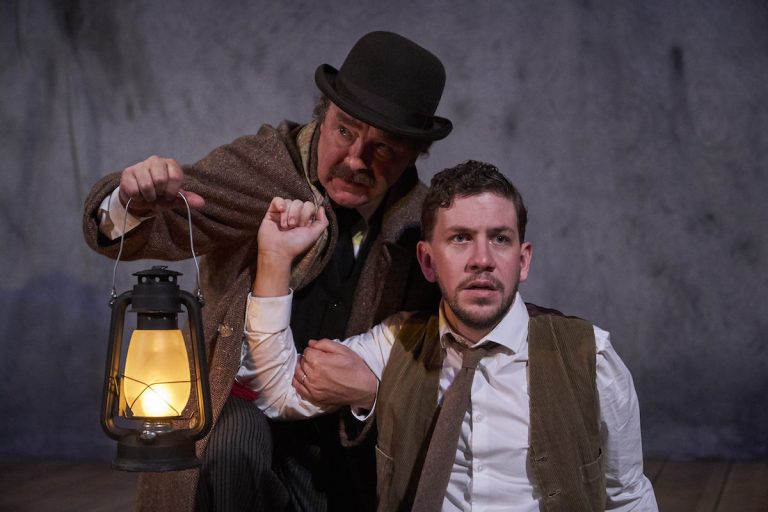
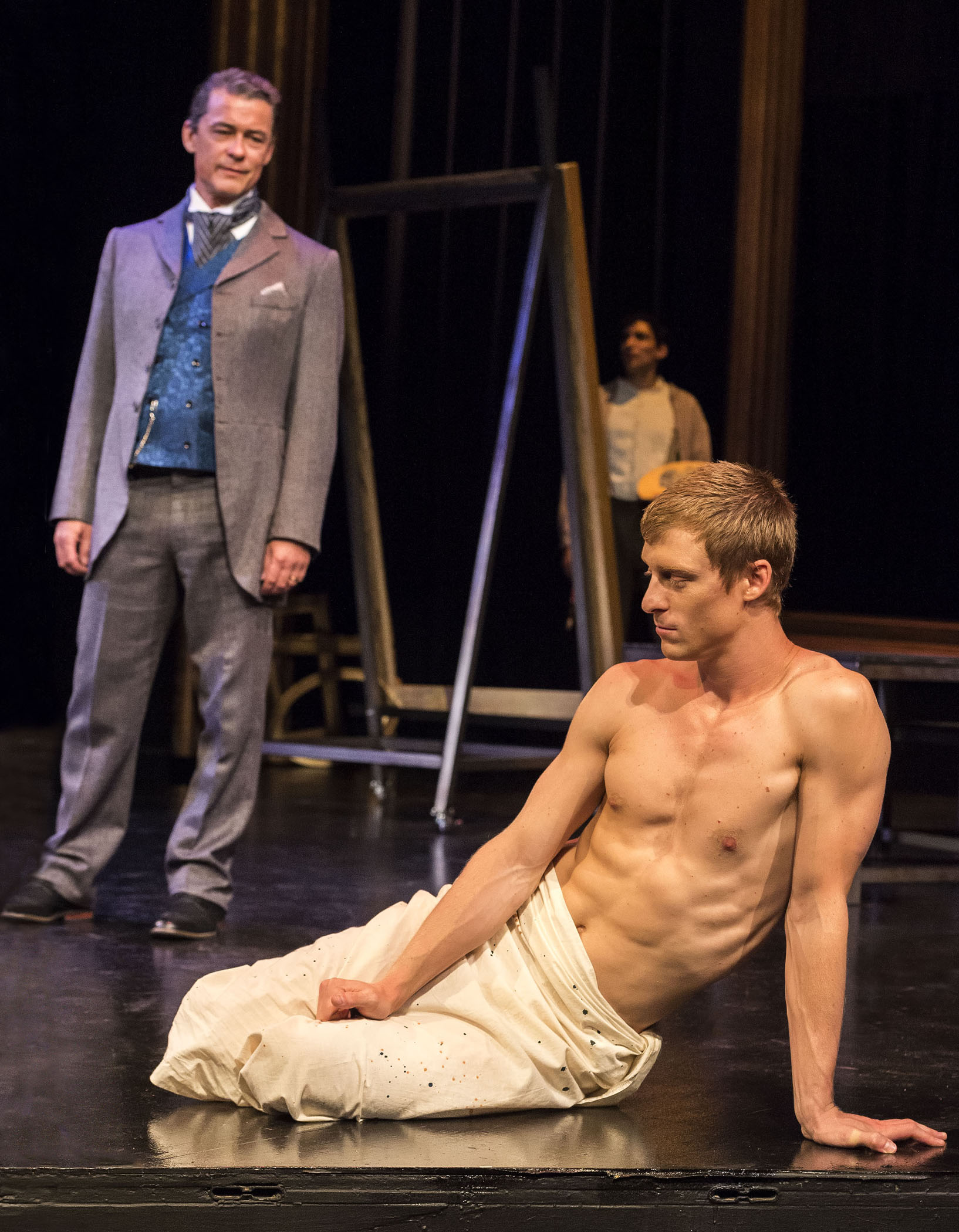
Rob Nagle (left) as Oscar Wilde and Colin Bates (right) as Lord Alfred ‘Bosie’ Douglas| Photo by Jenny Graham / Boston Court Pasadena

Boston Court Pasadena launches its 2019 season with a rarely staged production of David Hare’s ‘The Judas Kiss’ from February 15 through March 24. This S. Mark Taper Foundation-sponsored play tells the story of Oscar Wilde’s love for Lord Alfred ‘Bosie’ Douglas and follows his downfall through a brutal trial and life in exile.

‘The Judas Kiss’ stars Rob Nagle (Oscar Wilde), Colin Bates (Lord Alfred ‘Bosie’ Douglas), Darius de la Cruz (Robert Ross), Will Dixon (Sandy Moffatt), Matthew Campbell Dowling (Arthur Wellesley), Mara Klein (Phoebe Cane), and Kurt Kanazawa (Galileo Masconi).

Artistic Director Michael Michetti, at the heels of his recent success directing his adaptation of Wilde’s ‘The Picture of Dorian Gray’ at A Noise Within, helms this play that examines a literary icon who continues to hold onto his passionate ideals of love and beauty even as his life falls apart.

Michetti, chatting with us about his fascination with the Irish playwright on a recent afternoon, clarifies how he found himself directing an Oscar Wilde play and a play about Oscar Wilde in succession.

“It’s not strictly by design, yet it’s not accidental either,” Michetti begins. “While preparing for ‘A Picture of Dorian Gray,’ I was re-reading a lot of Oscar Wilde and a lot of things about him. This David Hare play is one I’ve loved for years, so out of curiosity I pulled it off the shelf and re-read it. And I fell in love with it again. This was around the time that we were trying to refine our season here at Boston Court. We were talking about balancing our offerings and I kept thinking maybe this is the right play, so I suggested it.”

Asked what draws him to Oscar Wilde plays, Michetti responds “A lot of things really. I’ve always been captivated by his plays. Then I became enthralled with his short stories, children’s stories, and poems. And, of course, as a historical figure I found him interesting so I read several biographies about him, and his letters which reveal so much about him.

“But one thing I always felt was that, in most of his writing, including his letters, which were probably the most personal, he was always wearing different masks .. . that he was somewhat obscured by his wit, his cleverness, and his brilliant use of language. The sense of who the man was has always been a mystery to me. That’s what I love about this play – I think David Hare has crafted a very complex portrait of this man. He did a lot of research and, however conjectural it was, I think the play is pretty accurate to he was and the struggles he was going through.”

Rob Nagle | Photo by Jenny Graham / Boston Court Pasadena

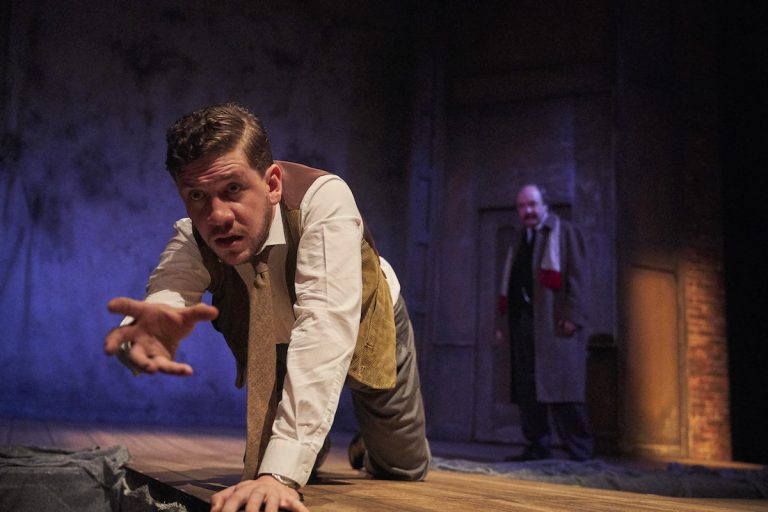
“It’s very biographical,” continues Michetti. “The play takes place during two key moments in his life. The first act happens on the day he dropped his ill-advised libel suit against the Marquess of Queensberry who had accused him of sodomy. A warrant has been issued for his arrest, the police have delayed arresting him, and he’s trying to decide whether he should flee. Robbie wants him to run but Bosie wants him to stay and stand trial.

“The second act occurs two years later, after his release from prison. He’s exiled and penniless; he and Bosie are renting a villa in Naples and they’re out of money. Each of their families has offered them an allowance of income but, in both cases, it comes with conditions. And, again, Oscar has to make a decision.”

“While ‘The Judas Kiss’ was first produced in 1998, it hasn’t been performed often,” Michetti explains. “The original production starred a miscast Liam Neeson. The arguments for him playing the lead role were that he’s a brilliant Irishman and he’s tall, as Oscar Wilde was. But it didn’t get a good reception.

“Because it wasn’t successful, a lot of people dismissed the play itself. It languished for a long time and only a couple of productions were done in the United States. It was revived in London a few years years ago with Rupert Everett and it went on stage Off-Broadway in New York. There hasn’t been a lot of high-profile productions since and, to the best of our knowledge, this is the first time it’s being done in Los Angeles.

“It has always saddened me that this play’s reputation is not greater than it is. And so I hope we will be able to crack that in this production. There’s one element which makes us poised to be able to do it. While the stakes in both acts are very high, the drama isn’t; there are no big dramatic car chases and action events. It’s all underneath – it’s in the little conflicts and resolutions, choices and decisions, and the resistance to make choices. The fact that we’re in such an intimate theatre allows us to play those with subtlety and honesty. It allows our audience  to see in those delicate nuances the drama of this play.”

(Left to right): Darius de la Cruz, Rob Nagle, and Colin Bates | Photo by Jenny Graham / Boston Court Pasadena

Michetti adds, “The challenge is that dramaturgically, Oscar is obviously the protagonist in the play and Bosie is the antagonist – the one who has caused a lot of hurt in Oscar’s life. But I think it’s critical that we understand what it is about Bosie that Oscar loves so he doesn’t look like a fool for being so devoted to him for so long.”

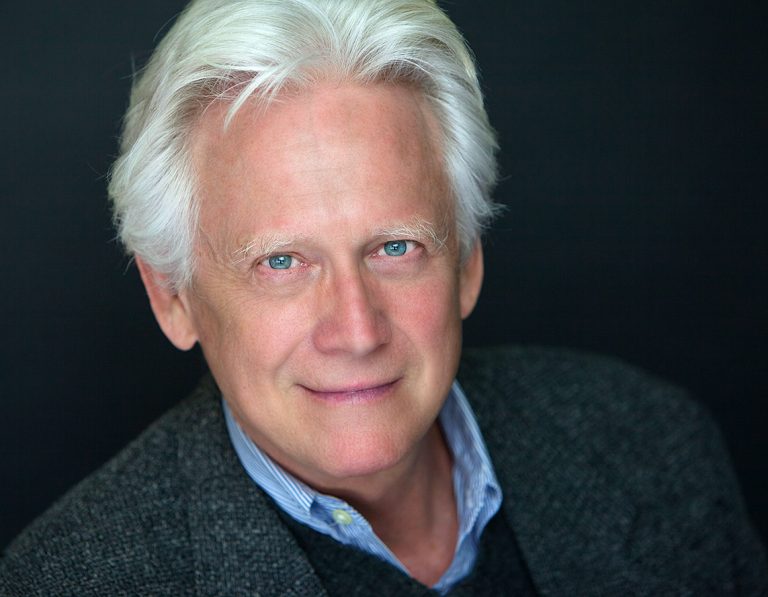
Because this play is close to his heart, Michetti had a hand in casting the characters for it. He discloses, “The role of Oscar Wilde is a challenging one and I knew going into it that I would need someone remarkable. There’s an L.A. artist whom I’ve known and loved for years, he’s been a friend and a colleague, but I’ve never done a full production with him, only readings previously and his name is Rob Nagle.

“When we were talking about this, Rob was one of the first people who came to mind. And rather than going through an audition process, I began teasing Rob the idea of this role. It turned out he knew the play. Rob is a big, dynamic man and because of that, he’s always playing a villainous character. But he’s the most generous, kind-hearted human being you could possibly meet. And this play is tapping a lot of things I don’t think he often gets the opportunity to play. I’m thrilled to say that my faith in him was well placed because he can be so brilliant in this role.

“It’s quite interesting that Colin Bates, who was just my Dorian Gray, is Bosie. There’s this fascinating parallel because in ‘Picture of Dorian Gray,’ which he wrote in 1890, Wilde wrote about this beautiful younger man who destroys the life of an older artist and the next year he met Bosie. It just seems preordained! Colin and I talked about ‘Was it that he had a type?’ ‘Was it a self-fulfilling prophecy?’ or ‘Was it some sense of fulfilling a martyrdom complex?’ I don’t know exactly what it was, it may have been a little of all those, but it was intriguing to see Colin in the role that is the real life counterpoint to the fictitious character he just played.”

Rob Nagle (left) and Darius de la Cruz (right) as Robbie Ross | Photo by Jenny Graham / Boston Court Pasadena

Michetti adds, “There’s a third character in the play, Robbie Ross, who was Oscar’s first male lover. He was Oscar’s lifelong friend who remained devoted to him throughout his life. Robbie was the one who wrote to him and visited him in prison, the one who met him when he was released from prison and found a home for him to live in afterwards, and the one who was there at his deathbed. Oscar made him his literary executor and he spent the rest of his life making sure the works of Oscar Wilde were published and continued on.

“But there’s a captivating triangulation that happens between the three of them, as often happens. Robbie is very judgmental of Bosie and his influence on Oscar, and he’s trying to get at Oscar for what he thinks are the right choices for him. And to do that he’s trying to get Oscar to face that fact that he has fallen in love with someone who wasn’t worthy of his love. That’s always a tricky thing.

“Any time in real life we try to intercede in that way, it rarely goes well. There’s something about that that feels relatable and human. I relate a lot to Robbie in many ways. I’ve had dear friends who have been in relationships that I think aren’t the best for them and I’ve made impassioned arguments as to why they’d be better off making another choice, as Robbie makes to Oscar. But I’ve also heard impassioned arguments back, as Oscar makes to Robbie, as to why this is none of his business.”

One could argue that Oscar Wilde’s genius comes from all the events in his life. Concurs Michetti, “I think this play will give people a new lens as to who he was. For somebody whom we know for his witty aphorisms, Oscar was a very complex man, and sometimes in conflict with himself. There are things that he writes where he states a matter of fact one thing and then, almost in the next sentence, contradicts himself.  He was a complicated man and love is complicated, and particularly love in relationships that have conflict in them.”

“All of these circumstances in ‘The Judas Kiss’ were similar to what is in ‘The Picture of Dorian Gray.’ Oscar Wilde wrote about what he knew and while he wrote it in a dramatic, sensational form, he actually did live it. I think this play humanizes him and gives us a window to understanding who the man was. Audiences will recognize the darker notes underneath his works.”

It’s been said that art imitates life; Oscar Wilde personified the adage. It must be why we find his works utterly mesmerizing.

‘Ragtime: The Musical’ Goes on Stage at the Pasadena Playhouse

Originally published on 11 February 2019 in the Pasadena Independent, Arcadia Weekly, and Monrovia Weekly

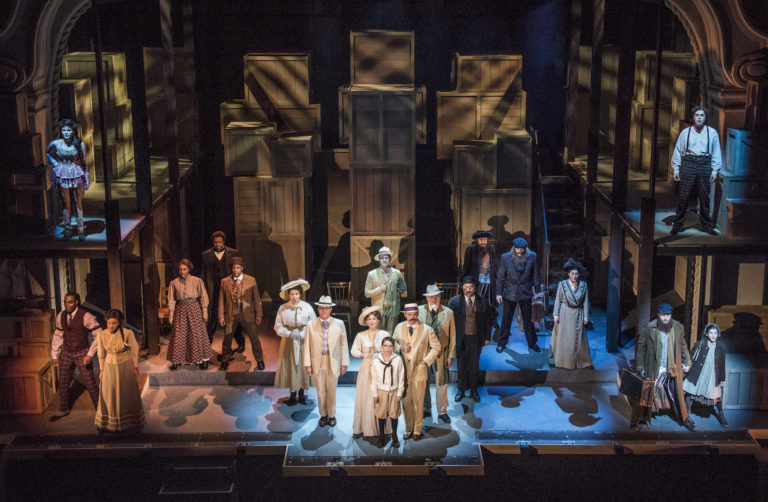
‘Ragtime’ ensemble | Photo by Nick Agro / Pasadena Playhouse

The Pasadena Playhouse is presenting one of its most lavish productions yet – ‘Ragtime: The Musical.’ Directed by David Lee, with choreography by Mark Esposito and musical direction by Darryl Archibald, it is on stage from Tuesday, February 5 through Sunday, March 3, 2019.

Danny Feldman, The Playhouse’s indefatigable Producing Artistic Director, chats with us during the busiest day of rehearsal week, and tells us why he chose ‘Ragtime.’

“This 1997 musical was based on an E.L. Doctorow book written in the mid-1970s. It premiered at the Shubert Theatre in Century City before it was on Broadway. I saw ‘Ragtime’ 21 years ago and it was one of the most incredible shows I’d ever seen. It was a new production but it felt like this old-fashioned epic – with a lot of people, so much dancing, and a large orchestra. I fell in love with it!”

“About a year and a half ago, when I was planning this slot, I knew I wanted to do a big, splashy show for my second season,” continues Feldman. “We hadn’t done something like that in a while and I kept coming back to it. While the book was published in 1975 and the musical was first produced two decades later, ‘Ragtime’ felt tremendously relevant – like it was written today.

“The show deals with America at a decisive moment in our history, right after the turn of the century up until World War I. It was a time when America was going through radical change – when we were trying to figure out who we were, striving to get along with one another, and considering what kind of country we wanted to be.

“Then I realized we were in another one of these moments. We’re again asking ourselves ‘What is America about?,’ ‘How are we moving forward?’ There’s a great deal of clash and conflict right now. ‘Ragtime: The Musical’ explores that conflict – not today’s, but that at the turn of the century, yet there are so many parallels to it. I suspect that people who are watching the show, who’ve seen it before or even those who’ve never seen it before now, will think we altered it to make it about today. But we didn’t change a word!”

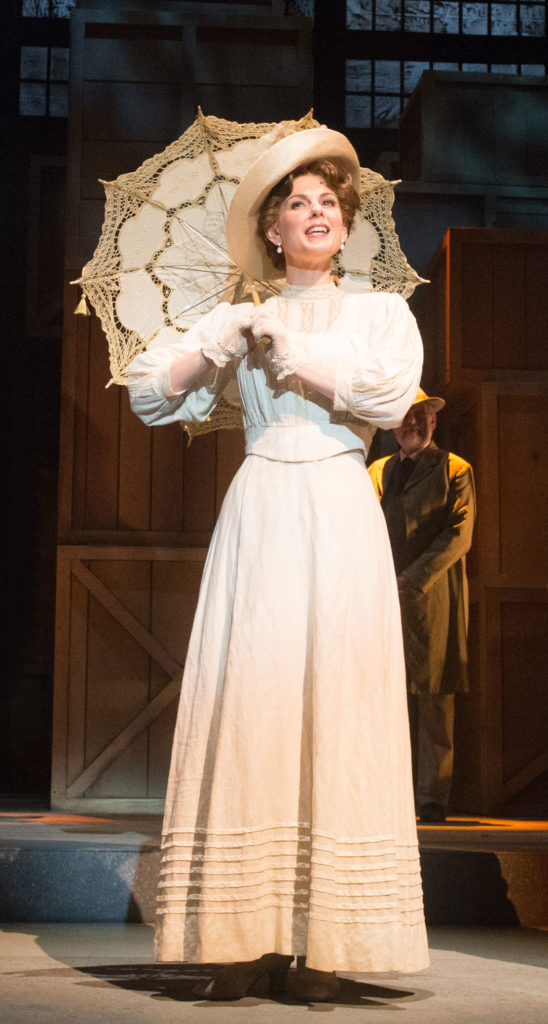
Shannon Warne as Mother | Photo by Jenny Graham / Pasadena Playhouse

Explains Feldman, “One of the through lines in the show was about women standing up for themselves, redefining their relationship in the household, and finding value. Then there was the African-American family who suffered a hate crime perpetrated against them, representing the theme of justice and fighting for what’s right. The third family we’re following personifies Jewish immigrants coming through Ellis Island, what they faced as outsiders, and how Americans treated them.

“These same issues are in the news every day! It’s not a play about 2019 but in many ways it is a play about 2019. And, like any masterpiece or great piece of art, when looked at over time through a new lens, we see different things in it. And with ‘Ragtime’ we’ll find distinct aspects in it today, given where we’re at. As serious as I make it sound, though, it’s also wildly entertaining. It’s a brilliantly constructed show full of sentiment and laughs; it hits you in the heart and the gut all at once. It is, ultimately, an American story that’s uplifting and hopeful. I think it has the power to move people deeply.

“It’s these things all rolled into one great night of theatre. And it’s not done a lot because it’s a pretty big undertaking. It has a 16-piece orchestra and a 21-person cast. We’re jumping all over New York in terms of locations in the story.”

The sheer enormity of the show makes for a truly amazing experience for the audience. Says Feldman, “Our stage is as big as that of a Broadway’s but our seating area isn’t; the Shubert Theatre, I think, had over 2,000 seats. But that’s great because watching that size musical in a 650-seat venue gives you a more intimate experience – you’re really connecting with what’s happening on stage.

“Watching rehearsals, I’m reminded that the combined resonance created by 21 actors with big voices and an orchestra is so powerful, particularly when they’re singing this beautiful score; it knocks you over. It’s pretty exciting! The experience you’ll have sitting in this theatre hearing 40 musicians and actors singing at you, I don’t know where else you get that.”

Asked if he’s making a statement with this show, Feldman replies with a thunderous “Yes! I’m glad you’re listening! The Pasadena Playhouse creates audacious shows. Sometimes it’s in the form of ‘Bordertown Now’ which is the culture of what’s going on today. Sometimes it’s a big celebrity doing a play here. But sometimes it’s a big, bold, ambitious musical. I think everything I try to program and create here has a sense of adventure and boldness in it. I want our audiences, whenever they come here, to be surprised by something we’re doing and to really feel something they’re not used to feeling. This show is in line with all our other ambitious projects.”

“The next play we have coming up, ‘Tiny, Beautiful Things,’ is just as bold in a very different way. I think the impact of a show as grand as ‘Ragtime’ and the intimacy of a little production like ‘Tiny, Beautiful Things’ will demonstrate what we’ve already done since I’ve been here, and what we’re constantly trying to accomplish – that to be a whole theatre experience you need the big and the bold as much as the small and the quiet. And they’re equally powerful.”

Coalhouse and Crew (from left: Candace J. Washington, Clifton Duncan, Cornelius Jones, Jr., and Bryce Charles) | Photo by Jenny Graham / Pasadena Playhouse

Throughout its hundred-year history, the Pasadena Playhouse has retained its core mission. Reiterates Feldman, “A lot of the theatre people go to see are national tours – ‘Hello Dolly’ or ‘Jersey Boys,’ for instance. They’re great! I see all of them and I love them all. I’m a huge fan of bringing in all these big Broadway musicals for people to enjoy. But we’re different here, we don’t see the show in New York and decide we’d rent the sets and the costumes and bring the show here as part of a tour stop.

“However, I don’t want to come off as being negative about national tours and theatres that do. To have a healthy theatre ecosystem, you need those who are building it by themselves and others who are bringing it in; those are necessary components for an interesting cultural landscape.

“My goal is to have as many people as possible see our work. If, in the future, someone sees our show and says ‘Let’s take it to other places’ that would be delightful, but that’s not why we exist. We exist to serve this community. That’s been our mission for a hundred years and we’re continuing to do that. It’s what the Pasadena Playhouse is all about.

“We’re proud that ‘Ragtime’ is made here; it’s pretty much like growing organic grapes. We start with a blank page where people come together and say, ‘For four weeks, we’re going to tell this story on this stage in a big, bold way.’ It is created of, by, and for this community. And that’s what makes it extra special.”

The stories of the three families we’re following in ‘Ragtime’ unfold in New York, yet they could very well happen here. Feldman asserts, “While we have a unique history in Pasadena, we also have conversations about race and instances of segregation. I think Americans, as a culture, don’t want to talk about the troubled parts of our past. We have a way of thinking ‘We know this happened in our past and it’s shameful. But that was the past, it’s not now.’ That’s something we explored in ‘Hold These Truths,’ a play we did about the Japanese internment camps during the anniversary of the imprisonment.

“To me, the reason theatre looks back at history isn’t to shame anyone, but to learn from things we’ve done in the past. Because, whether we like it or not, that’s part of who we are as a people. A production like ‘Ragtime’ speaks to our past as if to say ‘Let’s unpack this.’ There are moments that are uncomfortable. But the goal, particularly with ‘Ragtime,’ is not to dwell in it for the sake of dwelling in it. It’s to show, in many ways, how far we have come and how far we have yet to go. Our job as a theatre, and mine as an Artistic Director, isn’t to prescribe that for people but to put the work out there and let people take from it what they will.”

If audiences, after watching ‘Ragtime’ at the Pasadena Playhouse, examine their own failings and resolve to be better human beings, then theatre will have served a higher purpose than merely entertained. And that would, indeed, be a noble feat.

‘Othello’ Takes the Stage at A Noise Within

Originally published on 5 February 2019 in the Pasadena Independent, Arcadia Weekly, and Monrovia Weekly

(Left to right): Michael Manuel, Wayne T. Carr, and Angela Gulner | Photo by Daniel Reichert

William Shakespeare’s ‘Othello,’ A Noise Within’s fifth production in its 2018-2019 season, will be on stage from February 10 through April 28. Directed by Jessica Kubzansky, it stars Wayne T. Carr in the title role, Angela Gulner as Desdemona, Tania Verafield as Emilia, and Michael Manuel as Iago.

Manuel graciously agrees to share with us his thoughts about this classic play and the character he is about to inhabit. He recalls, “I did Othello 20 years ago and I played Cassio; this time I’m Iago. Any time you play a bad guy you can’t think of the character as bad. Even the most evil people believe they’re doing the best they could under the circumstances.

“I just finished doing Toby Belch, in ‘Twelfth Night,’ at the Alley Theatre in Houston. He’s a character who’s like Cassio – the big, drunk, funny guy. And I knew I was going to be doing this so I got to thinking ‘what triggers people into different behaviors?’ What, for instance, drives some to drink?

“For Iago, there are events that push him into that place where he’s just coping with everything that’s happening to him. There’s an inherent frustration, feeling ‘less than’ and being slighted, in some way, that he hasn’t gotten what he deserves. But, on some level, he tells himself  ‘Of course, I can’t get it – I don’t look as Cassio does, I don’t speak as well as Cassio does, I don’t have the same upbringing that Cassio has.’”

This is a role Manuel is sympathetic to. He says, “I have a love for characters who might be described as having a grievance of sorts … a chip on their shoulder might not be accurate, but someone who’s trying to prove he’s worthy of being. I gravitate towards characters who weren’t born into privilege and make something of their lives.

“I recently did Lopakhin in ‘The Cherry Orchard’ and he’s someone who resonates with me. He used to be the grounds man of the land which he now owns. When he was a lowly worker, everyone had nicknames for him; so now his attitude is ‘you should have treated me nicely because now you all work for me.”

Michael Manuel with Wayne T. Carr | Photo by Daniel Reichert

Continues Manuel, “The other day, among the cast, we were talking about class and perception. We were discussing how Cassio is someone who’s got everything. I went to Yale and there’s a perception that I’m somehow smart or rich. Truth is, I came from a blue-collar background and the neighborhood I grew up in wasn’t the best.

“Just like Lopakhin, my classmates’ parents were teachers, attorneys, and professionals. Growing up, I was embarrassed to tell people that my Dad worked as a garbage collector. But there came a point when I realized that everyone has value and what was shameful was that I hadn’t recognized it until then. Now I’m very proud to let people know what he did for a living!”

Because he played Cassio before and is now taking on the role of Iago, Manuel has a chance to look at both characters on opposite perspectives. He says, “Looking back, I don’t really remember much about that first time I did ‘Othello.’ I did Cassio when I was fresh out of college when I felt I knew everything there was to know, that I’ve figured it all out. Then, I finally grasped that I hardly knew anything; there are so many other layers in both characters that I learned from just living 20 more years since.”

The passage of time has helped Manuel give a more layered interpretation of Iago. “First of all, I’m older and I’ve accepted the fact that I don’t know everything; I no longer harbor that resentment in being told what to do. So now I have a vulnerability because I don’t have to pretend to know more than I do.

“Of course, the trap is that when you’re older you also think you know everything because you’ve gained more experience. So you’re always in the same boat – there’s always someone older or wiser no matter what their age is. I would say my Iago then would have been different from my Iago now,” Manuel expounds.

“It’s funny, this is only my second time doing ‘Othello,’” discloses Manuel. “While ‘Hamlet’ I’ve done five times, ‘Lear’ thrice, ‘Midsummer Night’s Dream’ I’ve done probably six or seven times, on occasion playing the same character. But there’s so much to mine in this. Since I have never fully figured it out, there’s always something new.

“Jessica’s vision for Iago is that he’s honestly sharing his feelings. I would like to be able to convince everyone on that stage that I’m being truthful and that I believe in everything I’m saying. People can tell when someone isn’t sincere. I think Iago understands people – he might not be book smart but he is clever. I’m sure if people saw his resume, they would say, ‘Of course, he shouldn’t get that high in the military, he isn’t someone who could be elevated to an upper rank.’”

(Left to right): Angela Gulner, Wayne T. Carr, Tania Verafield, and Michael Manuel | Photo by Daniel Reichert

Asked if he wants audiences to hate or empathize with Iago, Manuel replies, “I want people to see that they’re no different than I. I want them to understand there was no other way for me to behave. The challenge is that when a character does something bad he has to check in with the audience – that’s why there’s a lot of soliloquies. He tells the audience what he’s going through and then asks ‘What would you do if you were in my place?’ And follow that up with, ‘You know you’d do exactly as I’m doing’ or, at the very least, ‘You’re thinking of doing the same thing I’m doing right now.’

“In the soliloquies, I’m basically saying ‘There’s nothing wrong with that I’m doing; I’m telling people exactly the truth.’ How they hear it and how they deal with it is up to them. Part of what I would like for the audience to say is, ‘I wanted to hate him but I like him’ or ‘I can’t believe I like someone who’s so awful.’

“I wouldn’t go so far as justifying my actions, so much as showing our commonality. That we share all the same feelings – they’re what make us humans. We plan the way our lives would go and then something happens so we have to adjust. And one of the things Iago does better than most is that he’s a great improviser. He’s in constant firefights and each one requires a different tactic. As we all do, Iago reacts in the moment. I think that’s what makes these characters so fascinating.

Manuel adds, “I break down what Iago is saying and what people are saying about him. I think his choice of words reveal a lot. There are some people he addresses as ‘thee’ or ‘thou’ versus ‘you’ or ‘your’ he uses with others. Shakespeare is a master of language and he uses a combination of word sounds to signify emotions and motives. I could spend my whole life trying to figure out how to play a part and still discover something I haven’t seen the first time.”

However many Shakespeare productions Manuel has been in, each performance of the same play is different. He explains, “It’s really the conceit of the play – it depends on the actors and the message the director wants to impart. This ‘Othello’ is set in 2019 so that has given me a different perspective; it also informs the character’s actions. Wayne’s ‘Othello’ is very different from Chuck’s, the actor who played that part in the first ‘Othello’ I was involved in. As Iago, my relationship to this ‘Othello’ changed too.

“Yet, it doesn’t matter what period this ‘Othello’ is set in. Shakespeare’s plays have endured through the years because they’re timeless. Everything that was relevant at that time is still relevant today. The feelings that we have – jealousy, anger, revenge, pettiness – all these are innate in everyone, then and now. That’s the reason for classical theater – the message resonates with everyone.”

We can all agree with Manuel. Shakespeare’s genius is that he perfectly captures the essence and the complexity of human behavior. When we watch his plays, we recognize ourselves and empathize with the characters on stage – we are all capable of heroic actions as much as we succumb to deplorable deeds. And that, ultimately, our doing or undoing comes down to how we choose to act at any given moment.

Pasadena Playhouse Presents ‘It’s a Wonderful Life’ Radio Play

Originally published on 11 December 2018 in the Pasadena Independent, Arcadia Weekly, and Monrovia Weekly

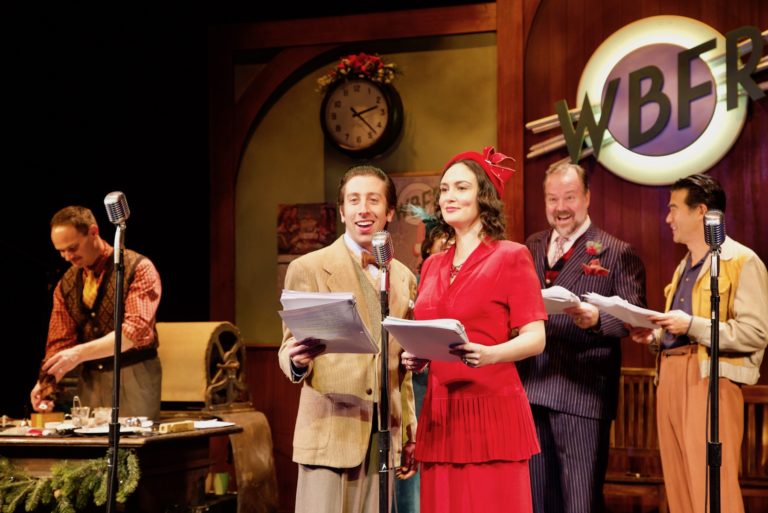
Shown left to right: Jeff Gardner, Simon Helberg, Rebecca Mozo, Rob Nagle, and Ryun Yu in ‘It’s a Wonderful Life: A Live Radio Play’. – Photo by Brick Patrick

There are some movies that so embody the spirit of Christmas that we want to watch them every year. One of those films is Frank Capra’s ‘It’s a Wonderful Life,’ which is now considered one of the best motion pictures ever made.

‘It’s a Wonderful Life: A Live Radio Play,’ will be part of the largest holiday celebration in the history of the Pasadena Playhouse. On stage from December 12 through December 23, it was adapted by Joe Landry from the celebrated 1946 film.

Simon Helberg, whom most of us know as Howard Wolowitz in the CBS award-winning smash hit ‘Big Bang Theory,’ stars as the despondent George Bailey who’s contemplating suicide. His guardian angel intervenes and shows him what his town would have been like had he never been born.

Actor, director, and producer Cameron Watson, who directed last year’s Pasadena Playhouse radio play ‘Miracle on 34th Street’ will once again be at the helm. He distinguishes each production, “Last year’s show, which is an iconic holiday story, is a lighter piece viewed from a child’s perspective and we used some animated backdrops, like the Christmas cards, to underscore that.

“On the other hand, ‘It’s a Wonderful Life’ is a pretty dark tale which starts with George Bailey ready to jump off the bridge. The roles are meatier and the characters are more complex in this piece. While we’re treating it as a traditional play, we’re doing something unexpected but will be supported by the story.”

“Joe Landry took all the materials from the script and put them into this radio play format,” Watson explains. “It’s faithful to the movie in a very clever way. One really fun thing about doing a radio play is seeing actors’ versatility. There are only five performers in this play that has about 45 parts. Two actors will be playing the roles of George Bailey and Mary, George’s wife. The three others portray close to 20 characters each, from the cab driver to the various children. And they’re going to do that with merely their voice, there’s no costume change.

“It’s such a treat for audiences to see what went on behind the scenes of a radio play in the old days. They can visually paint the story for themselves; they get to imagine what this cab, for instance, looks like; they can envision the bridge that George Bailey is standing on. I love that it makes for a very open canvas.

“We did ‘Miracle on 34th Street’ last year as the original radio play, which was a Lux Radio Theatre, and it was remarkable. It had the same commercial breaks that were in the radio play from the 1940s. This one will have some built-in commercial breaks as well except that Joe  crafted it so that there’s a little more structure to it.”

“The other good thing about a radio play format is that it’s a short production,” continues Watson. “It’s not a lengthy commitment for actors because it doesn’t require extensive preparation – they don’t have to memorize lines, they’re reading the script. We’ll rehearse it in one week and then the show starts. That short commitment gives us more opportunities to find the best talents. It’s such a privilege for a director to be working with the finest people in the industry.”

Cameron Watson. – Courtesy photo / Pasadena Playhouse

Asked whether this scheme makes his job easier or harder, Watson replies, “I can’t say if it’s easier or harder to direct; I think there’s a purity to the process because it’s all about the text and the words. Our mission is to make the words come alive. In a sense my task as a director is more important than if I were directing a traditional play.

“My focus is to make sure the actors really mine all the emotion in the role so that when they play the 15 or so characters, the audience knows exactly who it is. Each actor has to use a voice specific to a character so the audience isn’t confused, and that requires a different skill set. So I think I have a technical job that I wouldn’t have to do if it were a full production.”

As a Christmas offering, ‘It’s a Wonderful Life’ doesn’t appear to be geared for children. Watson recalls, “I remember watching the movie as a young boy and being scared when George was ready to jump off the bridge. That was scary for children to see because the sense of mortality isn’t something they are aware of yet.”

However, Watson quickly assures, “While it might look dark at first glance, when we get to the part of the story that’s somber, there will be a surprise that I think children will be enchanted by.”

Watson adds, “I was reading it again last night as I prepared for rehearsals and, not unlike last year’s radio play, it’s all about believing in Santa, or in hope, or in whatever we hang our beliefs on. Furthermore, it has a message of self-worth, of how much we matter – to our family, to our friends, to each other. That, in a small way, we are connected to people and we are important … that kindness is important. And I think that’s why the story has withstood the test of time. I get very moved by it; the play is very emotional to me.

“I emphasized to the actors that we have to tell this story from our hearts. Even if it’s a radio play, there will be plenty of sounds that will help the audience envisage what’s going on, for them to have a good time, and to enjoy the play. The actors have to treat it as the most important thing in the world, like it’s the first time the story is being told and that it’s truthful. Because it’s a radio play, there’s a tendency for it to be taken lightly, and actors have to really work hard to impart the message at its core.”

“Oftentimes, we go through life without being aware that a small, kind gesture – a warm hug, a friendly touch, a ‘hello’ to someone we see on the street – is important. ‘It’s a Wonderful Life’ is a story that reminds us that all of us, not matter how insignificant we think we are, have a contribution to make to society,” Watson wisely pronounces.

In our increasingly rancorous and deeply divided society, the lesson of George Bailey’s life takes on a greater significance. It makes us recognize that while, individually, our existence might not seem important enough to make a difference in the world, just as it takes millions of stars to light a dark sky, the good things we do in our little sphere of influence could very well make a world of difference.

The Playhouse Celebrates Halloween with ‘The Woman in Black’

Originally published on 15 October 2018 in the Pasadena Independent, Arcadia Weekly, and Monrovia Weekly

Bradley Armacost and Adam Wesley Brown in Susan Hill’s ‘The Woman in Black’ at the Cleveland Playhouse | Courtesy photo / Roger Mastroianni

London’s second longest-running West End play ‘The Woman in Black’ will premiere on the West Coast at the Pasadena Playhouse from October 17 to November 11, just in time for Halloween. With all the stage wizardry that has led audiences in London to shriek in fear for over 28 years, it promises to live up to its reputation as one of the most terrifying theater events ever mounted.

Adapted by Stephen Mallatratt from a novel by Susan Hill, the play is directed by Robin Herford, who has also helmed all its productions in Tokyo, India, Singapore, Hong Kong, Australia, and New Zealand. He is recreating his original staging for the first time in the United States with Bradley Armacost as Arthur Kipps and Adam Wesley Brown as The Actor.

Hill’s Gothic ghost story is set in an isolated windswept mansion which has secrets hidden behind its shuttered windows. There, a young lawyer encounters horrific visions in the house set amidst the eerie marshes and howling winds of England’s forbidding North Coast.

Years later, he tells his frightening tale to exorcise the terror that grips his soul. Mallatratt’s adaptation is a play within a play, with Kipps rehearsing with an actor to perform the story for his family and friends, thereby making him relive the haunting of Eel Marsh House.

It all begins innocently enough, but as he reaches further into his darkest memories, he quickly finds that there is no turning back. With just two actors, ‘The Woman in Black’ gives audiences an evening of unremitting drama and sheer theatricality as they are transported into a chilling and ghostly world.

Speaking by phone, Armacost describes how he almost didn’t get the role of Arthur Kipps, “Robin Herford cast the play in Chicago at the same time I was playing in Washington D.C. so I wasn’t able to come to the audition. When they had finished casting, he asked if there was someone else they were thinking of for the role and my name came up.

“I did a scene on my iPhone and sent it to the casting director, who passed it on. They caught up with me at an airport where we had a casting session of sorts. I had a half-hour Skype conversation on my iPad with Robin, who was in London. We got on quite well and the next thing I knew I had the role; I found it funny because he had no idea if I even had a leg since all he could see was my face.

“Robin came in from London for the two-and-a-half week rehearsal in Chicago and stayed through the opening in Cleveland. He had to fly back to London for opening night of the 12,000th performance of ‘The Woman in Black’ in London.”

While it has been running in London for almost three decades, Armacost hadn’t seen it. “I was unfamiliar with the play but I knew there was a 2012 film with Daniel Radcliffe whom everyone knows as Harry Potter. I’m surprised my son didn’t bring it to my attention.

Adam Wesley Brown and Bradley Armacost in Susan Hill’s ‘The Woman in Black’ at the Cleveland Playhouse | Courtesy photo / Roger Mastroianni

“I was told, though, that while the film has the same subject and is taken from the same novel by Susan Hill, it is completely different. In the film there are other actors performing various parts; in the play there are just two of us and we act out all the characters. I perform at least seven characters and my partner plays three. With only two actors on stage, you quickly realize that if he’s not talking, I am. And if I’m not talking, he is.”

That puts a lot of the burden of having to memorize so much dialogue on both actors. But that didn’t daunt Armacost. He says, “First of all, Susan has a good story and Stephen has written a magnificent script. There’s no fat on it, no unnecessary word. It’s to the point, so it’s quite easy to memorize and perform. There are silences in it but, hopefully, those are the moments when the audiences are most at the edge of their seats.”

Continues Armacost, “I can practically set my watch  and count three, two, one and … there’s a scream. There were times when someone in the audience would call out ‘Don’t go in that door!’ You can practically see them jumping in other people’s laps. The audience reaction is like an electric shock. The play opens and the audience is on an electric wire which keeps us moving. It may be one of the reasons the play is easy to memorize. It’s no wonder it has run for as long as it has. It’s truly a joy to perform in this play; it’s such an audience pleaser.

“It’s truly an honor to be involved in this production. We were very fortunate to be working with Robin who has been touring this play and has directed it for 30 years. While he has shared some short cuts on how to interpret it, he’s given us a free hand in making it our own. Every so often during rehearsal, in his very British way, he would say, ‘You might try ….’”

Asked what he finds compelling about ‘The Woman in Black,’ Armacost replies, “What truly stands out in this production is that everyone in the audience is another character and brings his or her own imagination. One dog on the stage can be as many different breeds as there are people in the audience. Each one envisions his own picture of what the scary mansion looks like. I think when audience members are that invested, they have a greater appreciation of the play.

“This is for someone who enjoys mystery and likes crossword and jigsaw puzzles; it’s a thinking person’s frightening tale. It’s not a life transforming play, it’s just a communal experience where the person next to you jumps and you do the same. Then you share a laugh together. And in times like these, when even the news is sometimes frightening, it’s fun to just be able to say ‘for the next two hours I will listen to this story and be like a kid again.’

“And, for me, it’s a delight to be a part of this clever production. The play, which only has two chairs and one doorway, holds the audience captive. It’s remarkable how something so seemingly uncomplicated has managed to frighten audiences for over a quarter century.”

‘A Picture of Dorian Gray’ Depicts the Outcomes of Disregard for Consequences

Originally published on 24 September 2018 in the Pasadena Independent, Arcadia Weekly, and Monrovia Weekly

Dorian Gray | Courtesy photo / A Noise Within

‘A Picture of Dorian Gray,’ a play adapted from Oscar Wilde’s novella ‘The Picture of Dorian Gray,’ goes on stage from September 23 to November 16 at A Noise Within in Pasadena. Adapted and directed by Boston Court Pasadena’s Co-Artistic Director, Michael Michetti, its three main characters are Colin Bates as Dorian Gray, Frederick Stuart as Lord Henry Wotton, and Amin El Gamal as Basil Hallward.

Wilde’s Dorian Gray is so entranced by the beauty of his own portrait that he sells his soul to preserve his youth and pays a price. Michetti’s adaptation, first produced at Boston Court Pasadena in 2006, explores the idolization of beauty and youth in an intimate, psychological journey. Avoiding the Gothic horror approach to the tale altogether, it follows instead the consequences of Dorian’s hedonistic lifestyle.

Explains Michetti of the remount, “When I did ‘A Picture of Dorian Gray’ 12 years ago at Boston Court, it was really successful and I was very proud of it. But I really didn’t think I was done with it and I thought this would be an opportunity to come back to it.

“The theatre space and timing are different. It’s a new collaboration with a whole new set of actors, with specific experiences and talents they bring to the production. However, the political and thematic content we’re dealing with now are the same things I was interested in exploring 12 years ago. That said, several things have transpired since – for one, gays have achieved marriage equality. So this play is thematically timely to me.

“The script has basically the same approach and ideas; I’ve added some things but not significant ones. Part of what this adaptation is embracing in the Oscar Wilde original is Dorian’s sexual orientation, an aspect many adaptations have erased. In fact, there wasn’t any hint of it in the 1945 film version. That was one of the things that was important for me to restore.”

“A lot of the people who read the novella thought of it as a Gothic horror story,” Michetti adds. “However, I think that was the least interesting part of the story. There’s obviously a supernatural and dark element to it but, for me, Wilde wrote a very psychologically truthful tale about what it was like to pursue pleasure without regard to the consequences. Because Dorian has great privilege of wealthy and beauty, it’s easier for him to get the things he wants in life. He spends a great part of his life causing damage to people.

“Following its dramaturgy, this is a cautionary tale. At the end of the novel, Dorian grasps that the toll of leading such hedonistic life was too great and he decides, too late, to make a change. But he definitely is realizing the consequences of his past behavior, is regretting it, and is atoning for it. It’s a reminder that we should stop to consider the people around us and the contributions we’re making to humankind.”

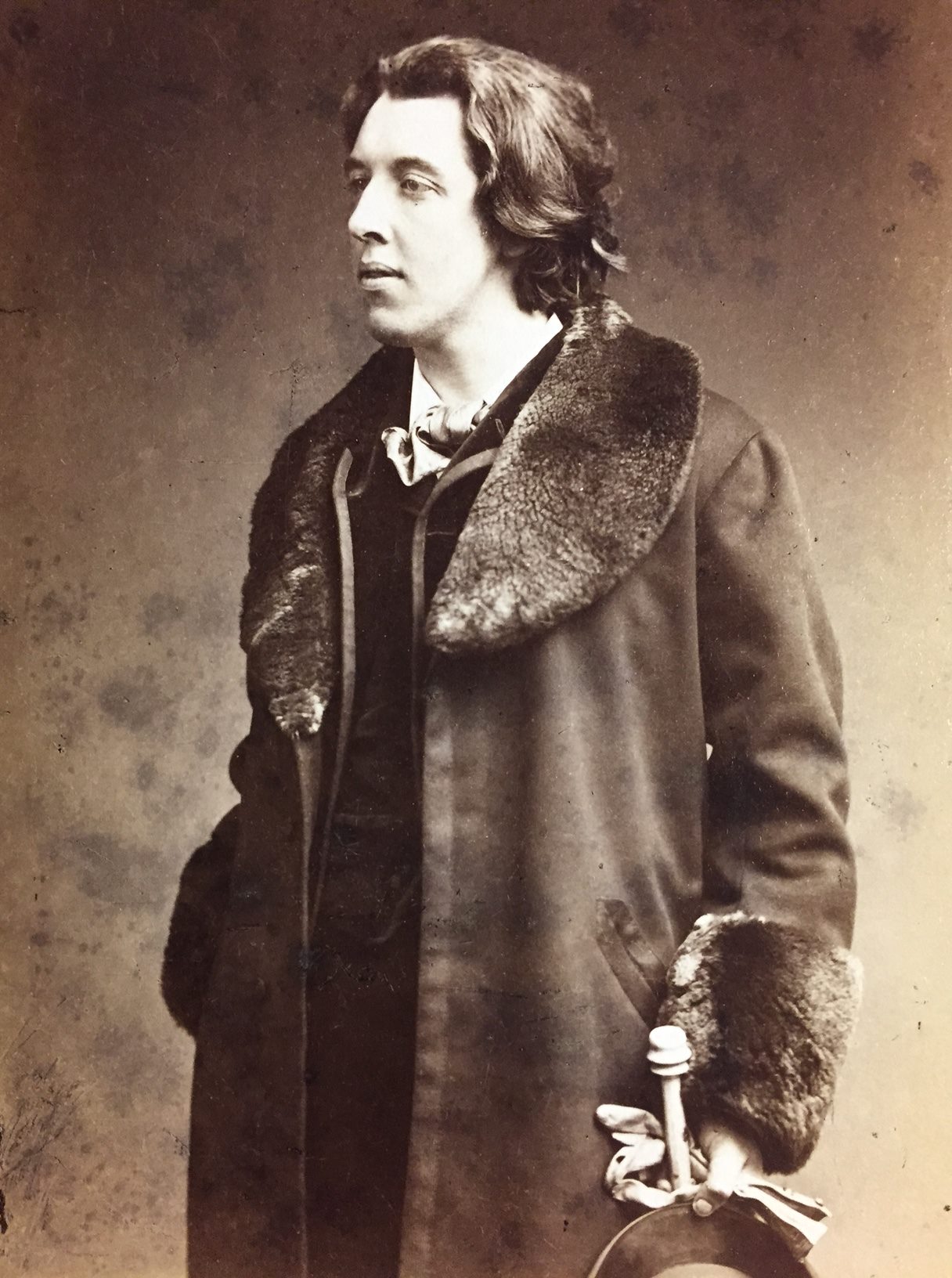
A Portrait of Oscar Wilde | Courtesy photo

“Here’s an  interesting point – pursuit of pleasure, acquisition of beautiful things, appreciation of beauty – those were components of the aestheticism in the late 1870s,” Michetti expounds. “Aestheticism values art more than social and political themes: art for art’s sake. Oscar Wilde was considered one of the most prominent proponents of it. He was, at the time, a big celebrity who embraced it and became the public face for the movement.

“The aesthetic movement is a hedonistic approach to life. So while the novel’s protagonist is pursing these things, Oscar Wilde is saying there’s a price to pay for following these theories to their logical end.”

Oscar Wilde once said  that ‘Dorian Gray’s’ three central characters are all aspects of himself: “Basil Hallward is what I think I am; Lord Henry what the world thinks of me; Dorian is what I would like to be – in other ages, perhaps.”

Michetti finds Wilde’s description fascinating. “There is something thought-provoking about the three characters as a triumvirate. Within that, Harry is the proponent of the movement and he stands by it to the end. He says we can’t change, we are who we are; and he doesn’t want Dorian to change because he believes aestheticism is worth pursing at whatever cost. Meanwhile, Basil is destroyed in the course of the play. And Dorian is the one who develops a conscience and decides to change.

“There are three actors playing the three different characters who are all aspects of Oscar Wilde. There’s that remarkable bond they carry with them during all that time. They are people who care very much for one another.

“When the play begins Harry and Basil have been long-time friends, they were in school together. Basil meets and falls for Dorian and introduces him to Harry – it’s a triangle with connections as well as conflicts. As soon as Harry comes into Dorian’s life, Basil becomes a third wheel. We have talked a lot with the three actors about the fact that there are reflecting and mirroring between them, yet the characteristics of the actors and the characters are very distinctive.

“Basil and Dorian are contrasts in a lot of ways. Dramaturgically and psychologically, Basil is the embodiment of Dorian’s conscience – he’s the one who wants Dorian to behave righteously, to take responsibility for his actions, and to lead an honest and fulfilling life. Dorian reaches a point of being so fearful of the consequences that he avoids Basil and their friendship suffers for it. Ultimately, I think, the reason for Dorian’s big conversion is the recognition that killing Basil is a big loss and he has a lot of guilt over that. He comes to an appreciation for what Basil wants for him to see in the world.”

Michetti continues, “The second metaphor in the story is Dorian’s portrait which is both aging and taking on the physical manifestation of his sins so that he isn’t affected.  I find that symbolism a little too simple because even though his appearance isn’t affected, Dorian has guilt and fear beneath. But there’s something addictive about his continuing pursuit of pleasure, beauty, and experiences. It’s almost that of an addict getting a high for a while, then he crashes, and he begins again. That is very much the cycle that Dorian is deeply in.”

This adaptation of ‘A Picture of Dorian Gray’ does not show the portrait at all, which could be a tough sell to the audience who can’t actually see it.

Michael Michetti | Courtesy photo / A Noise Within

“The reason I decided not to have the picture is that, in most adaptations, when the portrait is shown and the effect it’s had on it, the whole revelation is a little cheesy to me,” rationalizes Michetti. “I never got convinced because it should be terrifying and it always fell short of what I had imagined. And then, too, how grotesque could you make it so we could understand his moral decay and give it the right impact?

“Previous adaptations emphasized the horror aspects instead of the psychological feature. There is undeniably a supernatural element to it; you can’t tell the story without that. However, I didn’t really want to be focusing on that but on the humanity of it. I think the audience will hear the story in a different way because of how we’re framing it. And focusing on the psychological instead of the supernatural is what makes that possible. I hope that our audiences understand that kind of storytelling and find it dynamic and compelling.”

Michetti says further, “The story has universal themes. I think we are all guilty of the things that Dorian does – we all want to stay young, we all feel that sense of loss when we begin to age, we all seek pleasure to try to numb the feelings of fear or failure. While Dorian is an antihero, we can relate to him and we see ourselves reflected in him. We may not go to the extreme that he does, but we comprehend some of the temptations he had. I would like our audience to treat it as an admonition to make different choices because we see how badly Dorian’s life ends.

“At the same time, I hope that, in the adaptation of the play and the depiction of the character, we find him appealing and relatable before we find his behavior repellent. While Dorian doesn’t begin as the shining example of magnanimity, he is a very relatable person before he begins his decline.

“Finally, I would like people, who feel they know the story, to be taken aback – to think they heard it in a new way. I would like to make them recognize other aspects of it they had not previously been conscious of, or didn’t know were there. For me it all comes back to the appreciation of Wilde and how inspired this novel is, how deeply he understands humanity. That we can use his words and tell the story that feels fresh and relevant in the 21st century is surprising for a work that’s 125 years old.”

Basil is played by Amin El Gamal, whom Michetti had not previously worked with. He states, “Amin has auditioned for me before and I’ve seen his work as a fan. He was definitely the first person I thought of.”

Basil (back) paints a portrait of Dorian (foreground) as Harry looks on | Photo by Craig Schwartz

El Gamal confesses, “I never read the book in school and didn’t come across it until after college. I have never been in a production of Dorian Gray before but I know the trope about the picture that ages.

“It was very insightful of Michael to have thought of me in the role of Basil. He’s a character I think I relate to strongly, although I’ve never seen productions where the characteristics brought out in this adaptation were showcased. I was really excited to be approached for a role where I can share my existential qualities, which I was surprised that Michael has perceived.

“When he sent the script to me, I was astonished and, quite frankly, I felt exposed. But it has also been a delight because my goal as a person of color is not to play my ethnicity but to use my resources and my qualities as a person as the basis for my art. I felt that Michael acknowledged that. I was disappointed that I couldn’t do it because the script came too late – I was already committed to another project.”

Interjects Michetti, “I cast another actor but he dropped out. So I approached Amin again and, by that time, his project had fallen apart. So this feels like fate.”

“As excited as I was to play this character, I was also afraid of what that psyche would unearth for me,” El Gamal continues. “Fortunately, the process has been fruitful. I really feel that an actor’s main tool is his life experience, but there are times when I have to use my imagination. This play really required that creativity.

“I’m very sensitive to the fact that people can be like Basil or Harry. I can certainly relate to both Harry’s wanting to pursue his goals with enthusiasm in the same way that I appreciate Basil’s sense of morality. But there has to be a balance to not be overburdened with the morals and live life to the fullest.”

“Michael challenged me to find more complexity in the characters,” discloses El Gamal. “He didn’t want us to depict Basil and Harry as the angel and the devil on Dorian’s shoulder. That the evil and the good are not too far apart, there’s a grey area where a person can be both. Basil certainly isn’t perfect. Both characters had an important role in Dorian’s life – if it wasn’t for Basil, he wouldn’t have met Harry.”

“Basil is very passive in the beginning of the story,” says El Gamal of his character. “When Dorian starts pursuing worldly pleasures, he pulls away – he leaves the country and isn’t a part of Dorian’s life for a while. He goes through a drought in his art after Dorian basically abandoned their relationship. He might have resorted to drug and substance abuse, he’s alone and lonely. Although he still has a deep love for Dorian and when he sees the deterioration of the portrait, he stages an intervention.

“But through it all, he’s not a victim. His character arc is hopeful – he’s planning on opening a studio in Paris where he would create his next masterpiece – despite its sad ending. It was a productive life cut short. I hope I am able to convey everything that is going on with Basil.”

“Oscar Wilde anticipated homosexuality as an identity, the idea of two men being in love,” marvels El Gamal. “Basil embodies that identity at a time when that wasn’t recognized.”

In his depiction of Basil, El Gamal wants the audience to leave the theatre with something to reflect on. “I think in today’s social media and selfie-obsessed culture, people can feel disposable and we can forget to be respectful and communicative. I hope Basil, as a sort of advocate for kindness and basic human decency, reminds audiences to take a little better care of themselves and each other.”

Would that El Gamal’s wish is realized and the moral Michetti advances in ‘A Picture of Dorian Gray’ is heeded to make us a deliberate and thoughtful society.   

‘Native Gardens’ at Pasadena Playhouse Cultivates Discussion on Diverse Issues

Originally published on 7 September 2018 in the Pasadena Independent, Arcadia Weekly, and Monrovia Weekly

Frances Fisher plays the role of Virginia | Courtesy photo /Pasadena Playhouse

‘Native Gardens,’ a new comedy by Karen Zacarias, comes to the Pasadena Playhouse from September 5th to the 30th and shines a light on serious issues, including racial and social diversity, in humorous fashion.

Directed by Seinfeld’s Jason Alexander, it features Christian Barillas, Bruce Davison, Frances Fisher, and Jessica Meraz, with Julian Amaya, Richard Biglia, and Joshua Duron.

The play follows the story of Pablo (Barillas), a rising attorney, and Tania (Meraz), his very pregnant wife who is also a doctoral candidate. They have just purchased a home next to Frank (Davison) and Virginia (Fisher), a well-established D.C. couple with a prize-worthy English garden. The two couples’ friendly relationship is tested as an impending barbeque for Pablo’s colleagues and disagreement over a long-standing fence line grow into an all-out comedic border dispute.

Fisher, taking a lunch break during rehearsals, talks about what drew her to the play, “I like the fact that ‘Native Gardens’ tackles issues that are important – race and white privilege, misconceptions about nationalities, environmental concerns.”

“It presents two sides of the environmental issue,” continues Fisher. “It asks questions – do you want to do something good for the environment or would you rather have something for show? What is important to you, the health of your children and grandchildren or a beautiful bed of roses?”

The role touches Fisher on a personal level. She reminisces, “When I had a house, I was an avid gardener and grew my own vegetables; I miss that. I live in an apartment right now but I hope to, one day, be able to plant in my own backyard again.”

Activism is an ongoing endeavor for Fisher. She is a supporter of Environment California, Hollywood Food Guild, #FamiliesBelongTogether, PeaceOverViolence.org, and the anti-bullying group StandfortheSilent.org, among many others. She is an executive board member of the Environment Media Association (EMA), making ‘Native Gardens’ a natural choice for her involvement.

On the lighter side, the play gives Fisher the opportunity to work with long-time friends. She discloses, “I’ve known Jason since we were both starting out in New York and I play poker with him. But we’ve never collaborated on a project until now; it’s such a thrill to be directed by him. I’m exhausted but I’m also having a great time. He’s a master of comedy so I feel like we’re getting a master class in finding something funny.

Bruce Davison as Virginia’s husband Frank | Courtesy photo / Pasadena Playhouse

“Bruce is also someone I’ve known personally for decades yet we’ve never performed together. It’s quite wonderful that we play husband and wife.”

‘Native Gardens’ is likewise an exposure to new people and experiences for Fisher. She says, “I’ve never met the two kids – Jessica and Christian – but I’m getting to know them. We’re having terrific fun in rehearsal; it’s a very physical play. This is also my introduction to Karen. I was hooked after I read her play. I later found out it has been performed and produced elsewhere in the country. I’m glad we’re mounting a production in Pasadena and at The Playhouse, too. It’s wonderful to be able to walk the boards here.”

It comes at an opportune time as well. Fisher states, “I hadn’t done a play in a while – the last  one was ‘Barbecue’ at the Geffen Theatre – and I’m ready to get back on stage. This is my first love. I started my acting career as an apprentice at the Barter Theatre in Virginia, learning the ropes by working every task that goes into putting on a show. I assisted the director, built sets, sewed costumes, made props, cued actors. I had a good understanding of the importance of every job in the theatre. But even when I do film or television, I have a great respect for the crew and what they do.”

Acting back and forth between mediums involves flexibility. Explains Fisher, “You have to approach each in a different way. For instance, doing a guest spot on a TV program is like jumping on a moving train. You come in and you have to be up-to-speed with people who have been  doing it for four, five, six, or seven years. You have to get on that rhythm as soon as you show up – you have to know your lines and your actions – because there’s not a lot of time. There never is, on TV.

“In theatre, on the other hand, we have three weeks to explore the character, learn, and make choices. We have a larger bag of tricks to draw upon so doing the same performance every night doesn’t get stale. Theatre is about discovering novel things, surprising your partner, and testing new ideas that have been tried out in rehearsal so they’re not completely unknown. In that sense, there’s a lot more fun that can be had in theatre.

“However, there’s also something that can be said about making a movie. You work on it for a certain period of time, you shoot a scene knowing you’re never going to do it again unless something goes wrong. Everyday there’s a batch of scenes, then you’re all done, and it’s finished.”

Fisher concurs with the common assumption that acting is not a financially stable career. “You never know if you have a job for the next ten years or if you have to look for another. When the director says ‘It’s a wrap’ you’re unemployed again. It’s a very uncertain way to live your life; you have to absolutely love the profession and be really dedicated to want to stay in it.

I know many actors who are waiting tables, driving Ubers, working whatever part-time jobs they can get. I found that I couldn’t have a so-called day job because I spend my days going to auditions, classes, meetings, and keeping myself prepared for the next role.”

That next role for Fisher could be on television. She had just finished a pilot for HBO on a Damon Lindelof work called ‘The Watchman.’

“If that gets picked up, we’re going directly to Atlanta to shoot the episodes,” Fisher reveals. “Lindelof’s work is extraordinary. The characters he originates, the history lessons he brings to the present day, are pretty mind-blowing.

“There’s great writing on television these days,” Fisher asserts. “I also see more women on television and film, which is something to celebrate. It used to be a patriarchy, but the tide is slowly turning, thanks to people like Ava du Varnay with all she’s doing for women. She has created a generous space for women, who’ve never had a chance before, to come forward. But we still have a long way to go; it takes for women in powerful positions to open more doors.”

Fisher is hoping for other opportunities for audiences to discover her range as an actor. She declares, “Every role is different and I don’t want to do the same thing over and over again. ‘Native Gardens’ is a very physical comedy and I don’t think people think of me as being particularly comedic.

Courtesy photo | Pasadena Playhouse

“I would like the audience to have a good time, for them to say ‘I’m glad I came to the theatre to see these actors doing outrageous things. But as hysterically funny as it is, ‘Native Gardens’ explores issues we should be thinking of. Laughter can be a profound and healing experience. And we certainly need more of that.”

Pronounces Fisher, “Theatre is made to mirror society back to itself. When you examine Shakespeare’s work, for instance, you’ll see that he wrote about everyone from kings to peasants. There is no feeling or emotion he didn’t explore through his plays and sonnets. They were very much a reflection of human nature.

“Theatre is a powerful medium for people to come together as strangers in an audience and, hopefully, through their common experience watching truth on stage, they will laugh or cry. Maybe they’ll turn to their neighbor across the aisle, catch their eye, have that shared moment, and walk out as friends.”

Such is the effect of theatre that Fisher was hooked on it at a young age. Ticket prices were so expensive even then, but she found ways to watch theatre. She confesses, “I probably saw the second act of every Broadway show for 14 years. I discovered that once the audience got in, I could kinda’ slip in and find an empty seat.”

Those days of sneaking into a playhouse are long gone. Fisher is now the performer on stage whom people come to watch. And she would genuinely relate to other aspiring actors who might just slip in after the first act.

Boston Court Pasadena’s Annual Festival Features New Play about Feminism

Originally published on 24 July 2018 in the Pasadena Independent, Arcadia Weekly, and Monrovia Weekly

‘Ladies’ playwright Kit Steinkellner | Courtesy photo

Long before the word feminism entered our lexicon, women were coming together to indulge in intellectual pursuits that were deemed, at the time, to be the domain of the male species. That’s what a group of women who lived in 1750s London did when they formed The Blue Stocking Society.

‘Ladies,’ a new play by Kit Steinkellner, is a fictional account of a year in the life of The Blue Stocking Society and explores the tangled knot of electric and jagged relationships that comprise this group. These women are pioneers and revolutionaries emboldened by the call to arms to be the first of their kind and burdened by the misfortune of being born far ahead of their time.

It will be featured this Saturday, July 28, at 11:00 am at Boston Court Pasadena’s 14th Annual New Play Reading Festival and will be directed by Co-Artistic Director Michael Michetti.

Steinkellner expounds, “’Ladies’ is a history and time travel play in its theatricality. It was inspired by The Blue Stocking Society, the first organized feminist movement founded by a group of women who lived in England in the mid-18th century. Much has happened since in terms of advancing the role that women play in society, but at the time they were considered radical.”

“The idea came to me about ten years ago when I was in London and I went to the National Portrait Gallery which was holding an exhibit about these women,” discloses Steinkellner. “They intrigued me as being true pilgrims and pioneers in a realm which had absolutely no roadmap. Writing a play about them struck me as being both exciting and scary.

“I wanted to tell their story in an ‘out-of- the-box’ way just as they had done when they began their club. In dealing with something that is set in the past, I realized there’s a risk that the story might come off as dusty, archaic, or irrelevant. As I researched about their lives, read their diaries and their correspondence with each other, it became important for me to make sure I did it exactly right.

“To create something exciting that explains my obsession with these women, and why I was so captivated by them, I used time travel to be part of the play as the historian and narrator. I investigated why I wanted to have a relationship with women who lived over a hundred years ago and how they are relevant in today’s world.”

Adds Steinkellner, “There are four actresses in ‘Ladies’ and each one plays a prominent woman in this group – each enacts my character and some of them perform male roles. While this play was conceived ten years ago, I only started actually writing it five years ago and it became a finalist in the O’Neill National Playwrights’ Conference. However, that version didn’t have the time travel element in it and I wasn’t part of the play.”

“The play has seen several changes and revisions although they didn’t happen all at once. I gave it time to germinate and develop; I would leave it then go back to it after a few years to improve and polish. I’m very excited about this Workshop and I’m grateful that Michael and Jessica picked it for their New Play Festival because it’s a very important process towards bringing it to life. I want the audience to be emotionally engaged with the story and these women’s lives,” Steinkellner enthuses.

Emilie Beck, Boston Court Pasadena’s Literary Manager | Courtesy photo

Emilie Beck, Boston Court Pasadena’s Literary Manager, who has been involved in the New Play Reading Festival for seven years, describes, “Kit’s play is quite fascinating and is, in a way, its own genre. It speaks to an intellectual realm but there’s also a lot gestural work in it; it’s cerebral and visceral at the same time.”

“There is an element in ‘Ladies’ that sets it apart from other plays – this interesting conceit in which each character becomes Kit, the playwright,” Beck points out. “The play is making use of her rather than Kit putting herself as a protagonist, if that makes sense. It involves time travel but not in a science fiction way. I think there’s a very fluid connection between the here and now and these ladies in the 1750s.”

“It’s thrilling to us that this year we received more submissions from women playwrights than from men,” states Beck. “The four new plays we’ve chosen for this year’s Festival are all written by women. While we read without attention to gender, we were drawn to these voices, which speak to a wide array of underrepresented female experiences.

“What’s interesting is that the ‘Me Too Movement’ was happening as we were reading these submissions. So these plays  had not been written out of that and yet we were reading in that context. I imagine that as we move into the future, there will be more plays written because of that.”

Beck asserts, “That said, it wasn’t the only theme touched on by the plays we received. We got submissions with very dark themes – war, apocalypse, suicide, assault. In fact there were a lot of them that involved sexual assault. A good number of plays we read were spoken by a voice that has been disenfranchised. It’s really important to us to represent that. For a long time there’s been this overriding voice of the white male playwright. Not to dis the white male playwright, there are many of them who are wonderful and whom I love working with, we need to make a little room for women and minorities.”

“New work is important to us,” declares Beck. “The whole reason this theatre is here is to get new work on the stage. It’s hard to write a play; playwrights sit on their own, trying to create a multidimensional world with voices in conversations that would, in some way, illuminate a theme.

“Playwrights have to find a way to get from a flat page, to that creative place, to a fully realized production. They have to go through the processes, get together with a bunch of artists in a room to listen to how it sounds, to see how it’s working and not working. That is integral to our work here. It’s exciting for us and we look forward to it every year.”

The New Play Reading Festival is a key component of Boston Court Pasadena’s commitment to nurturing playwrights and new work. It paves the way for unknown artists’ creations to get recognized and produced on stage.

What a thrilling prospect it is if this weekend we could be seeing the future Eugene O’Neills or George Bernard Shaws, whose plays are esteemed, revered, and performed to this day!