The Huntington Launches Yearlong Centennial Celebration

Originally published on 10 September 2019 in the Pasadena Independent, Arcadia Weekly, and Monrovia Weekly
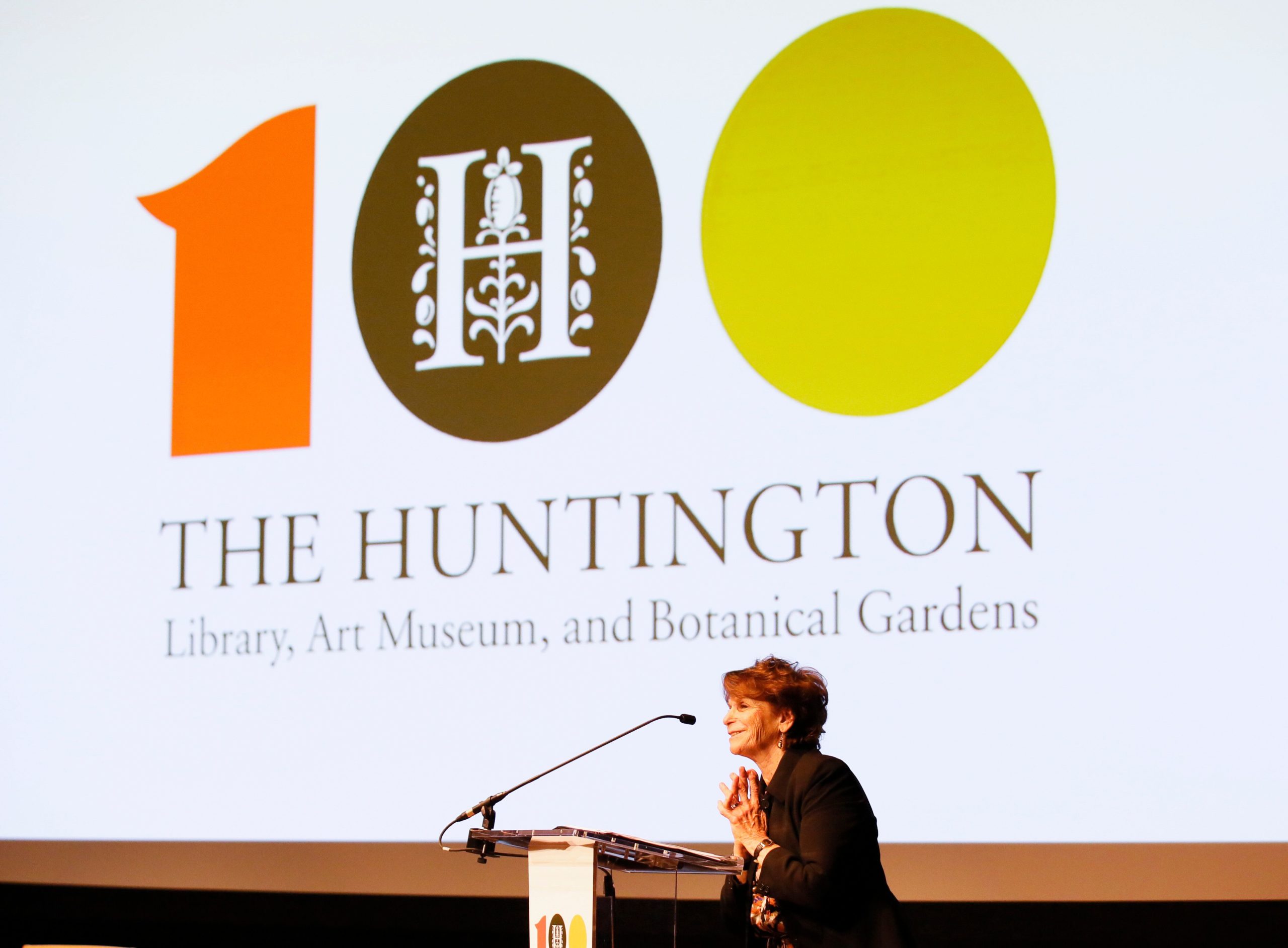
The Huntington President Karen R. Lawrence, announces the name change during the Centennial Celebration launch | Photo by Ryan Miller / The Huntington Library, Art Museum, and Botanical Gardens

The Huntington in San Marino officially launched its yearlong centennial celebration on Thursday, September 5, 2019. During her welcome speech at Rothenberg Hall, Huntington President Karen R. Lawrence expressed how Henry E. Huntington’s vision and legacy will live on in the next century.

“As I look out at you, the leaders of Southern California’s, and particularly L.A.’s, cultural, academic, and civic institutions, Huntington’s presence is demonstrably in evidence,” began Lawrence. “As the Director of our Botanical Gardens Jim Folsom recently reminded me, almost anything can grow in Southern California. He was correct.

“We brought everybody here today to celebrate the extraordinary fertility and vitality of our region – both a U.S. cultural capital and, as Huntington predicted, the leading edge of the Pacific Rim. Had his visionary red car trolley system been equally as durable, many of you, especially the west-siders, would have an easier commute.”

Continued Lawrence, “So 1919 was a very good year for the birth of L.A. institutions – from UCLA to the L.A. Philharmonic, to the iconic Musso & Frank Grill and Fosselman’s Ice Cream. In celebrating our hundredth, it’s not all about us; it’s about all of us. Because neighbors and partners have always been crucial in the life of The Huntington. As we celebrate the trust agreement in which Henry and Arabella Huntington gave their private treasures – at the time the New York Times called the greatest private library in the world, art and art collection, and expansive gardens and grounds – we also recognize that we wouldn’t be here were it not for George Ellery Hale, the renowned astronomer, who helped develop Caltech and who was the founding director of the Mount Wilson Observatory in Pasadena.

“In the Huntington’s archives, we have Hale’s correspondence with Huntington which shows that from 1906 to 1916, Hale politely badgered Huntington to place his private collection in a trust for the use and benefit of the many. As significantly though, he helped convince Huntington, the wealthy industrialist and collector, to see the value of his collection in a different way – more for the research and scholarship it would inspire than for its accumulation. Hale urged Huntington to establish a public institution; he wrote ‘There is now great need of a strong institution of broad scope, uniting all the intellectual interests of this region and the common folks.’ When he was later asked about the worth of his collection, Huntington replied that its value will be determined primarily by what he produces. Although these two men couldn’t possibly foresee what was produced during those hundred years, it’s a testament to their legacy and Arabella’s, that The Huntington attracts 1,700 visiting scholars in addition to over 750,000 visitors from around the world.

“So today we take a moment to acknowledge this Southern California history as well as to think about our future and the ideas that will propel us all for the next hundred years. For a person turning 100, it’s very natural to look back and reflect on the past. For an institution turning a hundred, a centennial is a moment to be like Janus – looking back and forward at the same time. Today we’re celebrating how far we’ve come and reflect on where we want to go. We’re thinking carefully about our mission and what it means to be among the oldest cultural and intellectual centers in this great region, which itself reflects the dynamic demographic evolution of our city, state, and country. We want to broaden our audiences and to focus on The Huntington’s ongoing role in the cultural fabric of Southern California and beyond.”

Lawrence declared, “The name of an institution reflects its relation to its audiences as well as its mission and ethos. In 1919 we began our journey as the Henry E. Huntington Library and Art Gallery. And, over time, we became more commonly known as the Huntington Library, Art Collections, and Botanical Gardens. Today I am pleased to announce a change in what we’re calling ourselves, that reflects both the increased breadth and depth of our art collections and their public purpose. We’re changing our name to The Huntington Library, Art Museum, and Botanical Gardens.”

As Lawrence said this, the name displayed on the screen behind her also changed and was met with enthusiastic applause from the audience.

The change from ‘collections’ to ‘museum’ more accurately describes The Huntington’s mission and programs, explained Lawrence. “Our art collections are more than a group of catalogued objects; they are carefully curated, interpreted, and exhibited for scholarship, education, and the broader public. An added benefit to this change is that we become more discoverable, particularly in online searches. This is important as we work to widen our audiences and accessibility.”
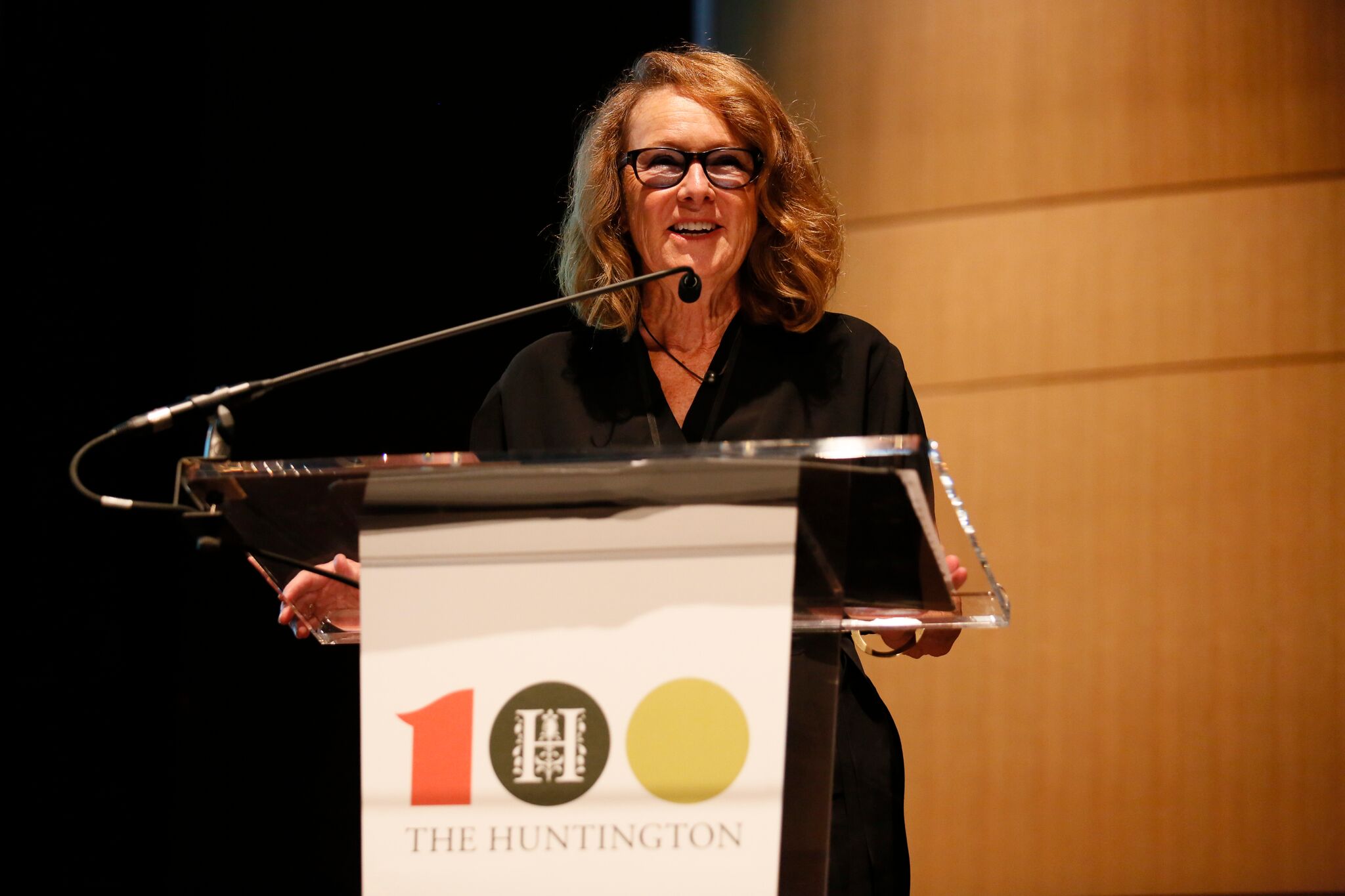
The Hammer Museum’s Director, Anne Philbin, talks about ‘Made in L..A. 2020’ | Photo by Ryan Miller / The Huntington Library, Art Museum, and Botanical Gardens

The Centennial Celebration, a yearlong series of exhibitions, public programs, and new initiatives running from September 2019 to September 2020, kicked off with an announcement of a collaboration between The Huntington and the Hammer Museum on ‘Made in L.A. 2020,’ the upcoming edition of the Hammer’s acclaimed biennial. The statement was made by Hammer Director Ann Philbin alongside Lawrence.

Opening June 7 and running through Aug. 30, ‘Made in L.A. 2020’ will take place at both institutions, providing visitors across the region an opportunity to experience the singular exhibition of contemporary art in Los Angeles. The exhibition, sponsored by Bank of America, will debut new installations, videos, films, sculptures, performances, and paintings from Los Angeles–based artists, many commissioned specifically for the exhibition.

‘Made in L.A. 2020’ is the fifth iteration of the internationally lauded Hammer biennial, and the second to take place at multiple venues. The biennial’s inaugural 2012 edition presented artists at the Hammer, LAXART, the Los Angeles Municipal Art Gallery at Barnsdall Art Park, and the Venice Beach Biennial. The 2020 edition seizes on an opportunity to connect an institution on the west side of Los Angeles with one on the east. It is co-curated by Tunisian-French writer and curator Myriam Ben Salah and Los Angeles–based curator Lauren Mackler. The Hammer’s Ikechukwu Onyewuenyi is assistant curator for performance.

“We are thrilled to be partnering with The Huntington on ‘Made in L.A. 2020’ to bridge the east and west sides of Los Angeles to highlight the works of art created across the region, with an emphasis on emerging and under-recognized artists,” said Hammer Director Ann Philbin. “This expression of our biennial―which spans roughly 25 miles―offers opportunities for discovery and surprise for ‘Made in L.A.’ visitors and gives the curators and artists a new platform for experimentation.”

“Creative collaborations are a hallmark of our Centennial Celebration,” Lawrence disclosed. “We will be engaging with our collections as well as with our audiences in exciting new ways. Joining forces with the Hammer for this remarkable exhibition is a perfect example of what we are setting out to do. ‘Made in L.A.’ celebrates the extraordinary, groundbreaking work of contemporary artists working in Southern California. We are honored to be a part of this year’s exhibition.”

“Los Angeles is the epicenter of the creative economy, with the arts bringing Angelenos together, attracting tourism, generating cultural dialogue, and serving as an economic driver for our region,” declared Raul A. Anaya, Bank of America market president for greater Los Angeles. “It’s why Bank of America invests in the arts and in institutions like the Hammer and The Huntington, and this specific partnership for ‘Made in L.A. 2020’ reflects our mutual commitment to L.A.’s incredibly diverse local artists.”

During the run of ‘Made in L.A. 2020,’ members and visitors to the Hammer will receive passes granting free admission to The Huntington to view ‘Made in L.A. 2020’ in full. There will also be joint programming at both the Hammer and The Huntington during the exhibition.

Looking ahead to the next 100 years, the directors of The Huntington’s three components – Library, Museum, and Botanical Gardens – spoke about the future and how The Huntington’s collections will contribute to their fields.
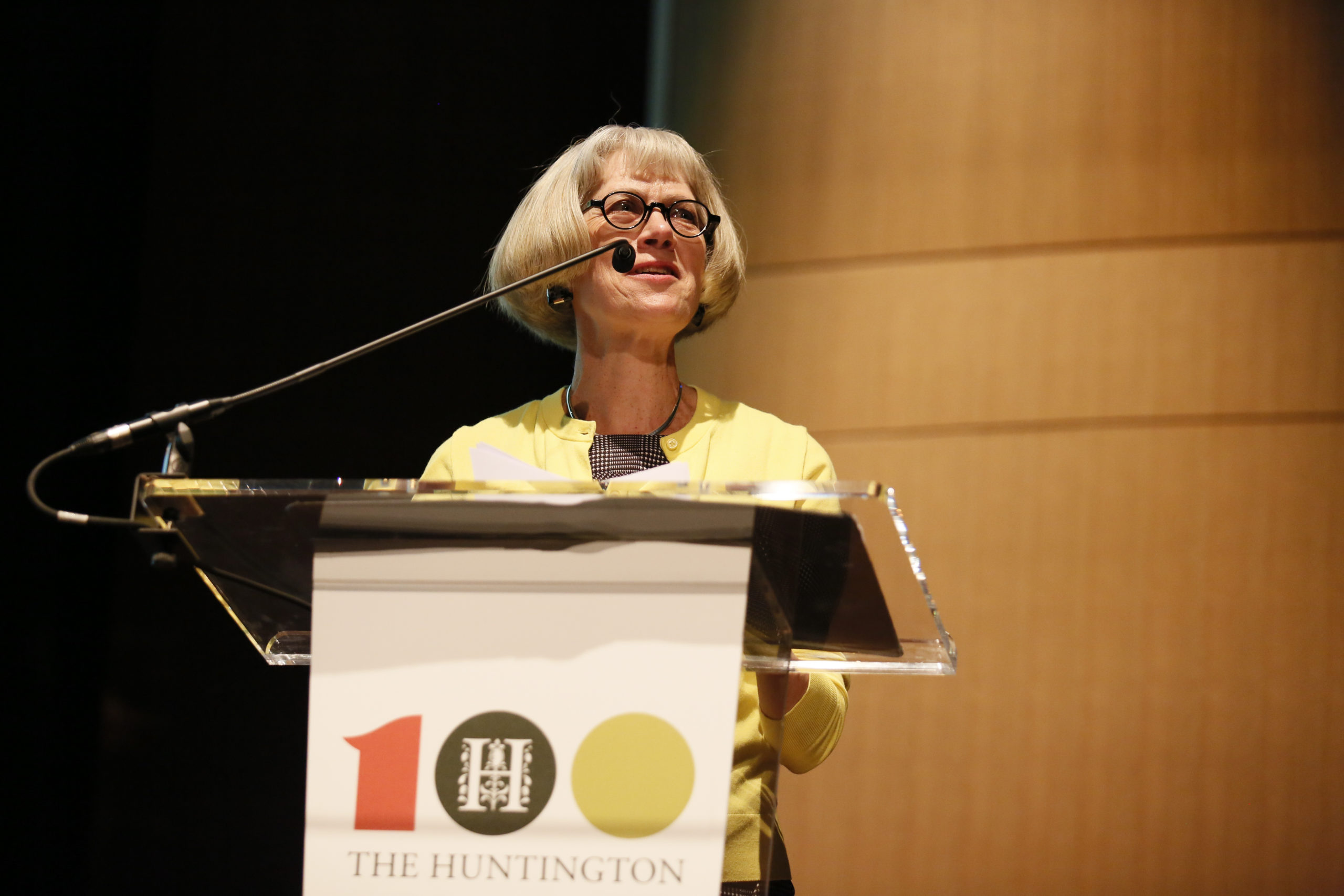
Sandra Luding Brooke, Avery Director or the Library speaks during The Huntington Library, Art Museum and Botanical Gardens Centennial Celebration Launch Event on Sept. 5, 2019, in San Marino, California | Photo by Ryan Miller / Capture Imaging

As the Avery Director of the Library, Sandra Luding Brooke oversees the 11 million items in the library collection. She said, “In 1925 Henry Huntington endorsed a vision for a repository of books and manuscripts of the greatest rarity and value focused on tracing the progress of our English-speaking people. Since then The Huntington’s collection has grown and persisted in more ways than what could have been imagined a century ago.

“Libraries must anticipate tomorrow and try to imagine what future researchers and viewers might want or need to know,” pronounced Brooke. “We must be judicious and imaginative in choosing what we preserve, and be fearless in seeking diverse and provocative voices. Libraries must batten their hatches to protect collections from the vicissitudes that are sure to come – natural disasters, social and economic upheavals, censorship, ignorance, and willful misapprehension. We also want to seize this moment and help our collections speak to current generations because cultivating a love and respect for documented history is the surest route to its survival and, perhaps, our own. So in the spirit of stepping out with optimism into our second century, the Library has made a small acquisition that won’t get on our shelves until just four years shy of The Huntington’s bicentennial. Until then the library’s purchase will be growing in the Norwegian wood. Artist Katie Patterson’s future library is a hundred-year literary artwork of an active indefatigable optimism. Five years ago, Patterson planted a forest of a thousand spruce trees in Norway. This forest will be held in trust until the year 2114 when the trees will be harvested, turned into paper, and provide the stock for the publication of 100 texts, until then held secret, by 100 writers. This little acquisition is a vote of confidence in the future of the environment, of art, of books and the written word, and of libraries. Yes, we are confident our librarian’s successors will not fail to claim The Huntington’s copy of this long-awaited anthology. But between now and 2114, we are equally confident that millions of other texts, images, and objects undiscovered and, as yet, uncurated will cross The Huntington’s threshold to join this great past, present, and future library.”
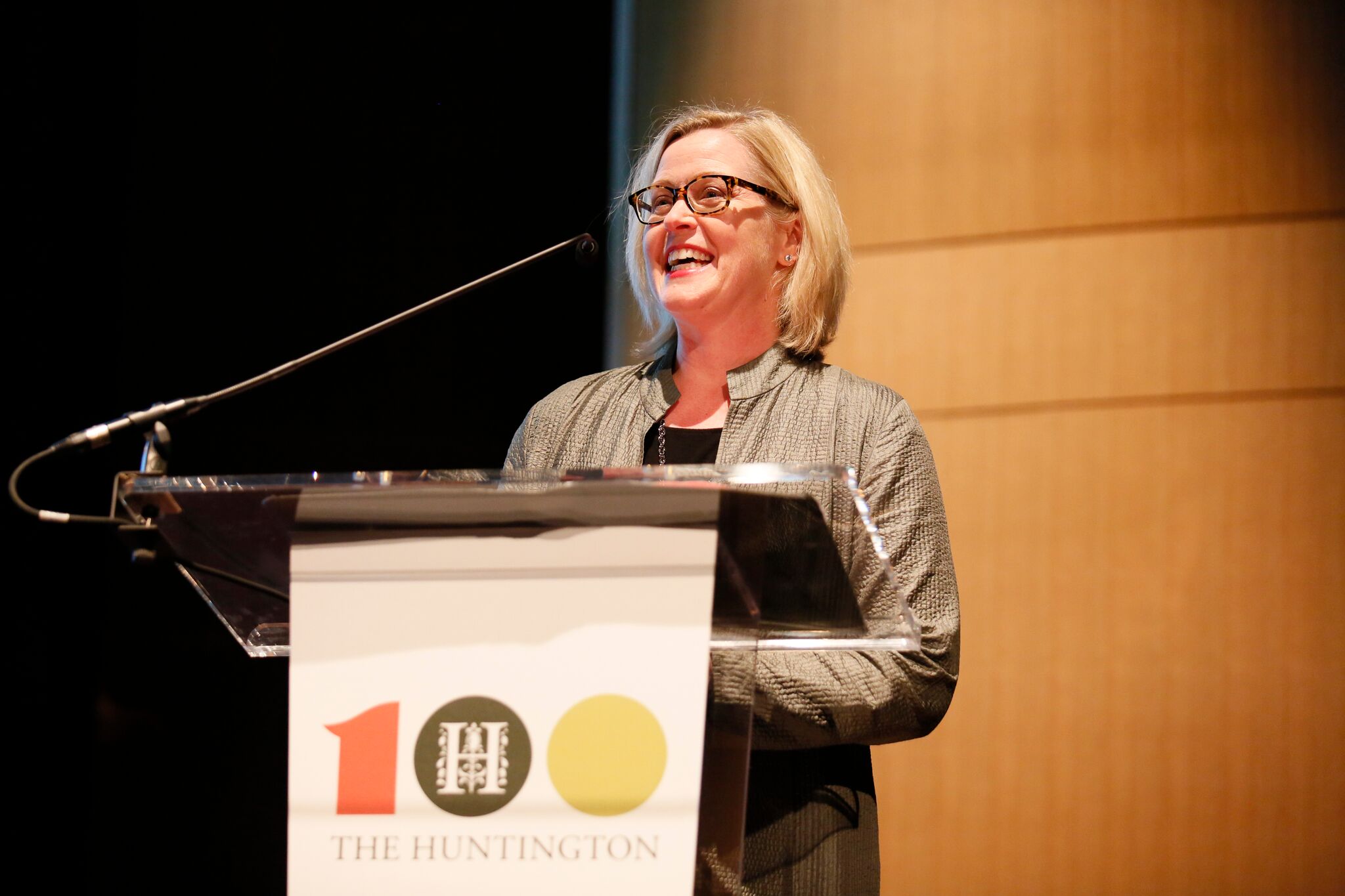
Christina Nielsen, Hannah and Russell Kully Director of the Art Museum | Photo by Ryan Miller / The Huntington Library, Art Museum, and Botanical Gardens

Christina Nielsen who, when she took the podium and introduced herself, said that for the past 10 minutes, she has been the director of The Huntington’s Art Museum. She started, “Now that we’re a museum I’d like to spend the next few minute considering what that term means. What it meant to Arabella and Henry, what it means today, and what it will likely mean in the future. Henry Huntington, entrepreneur and futurist, proponent of new technologies; Arabella Huntington, perhaps the greatest gilded-age collector you’ve never heard of – together they stand out among the likes of their peers such as Walters, Morgans, Fricks, and Gardners by bringing together objects from the past to actively shape a future. They founded the first Old Master Collection in Los Angeles which included Asian ceramics, Italian Renaissance pieces, French decorative arts, and British portraits from the 18th century, which allowed for connections across time and place. And they put their historic works in conversation with art from their day by placing sculpture on the grounds from artists of their time, including their daughter-in-law Anna Hyatt Huntington. They also gave us a framework for considering how to move forward, encouraging us to continue making connections across time and place, to invest in new technologies, and to share their collection with the public.

“So now the present moment. And might I suggest that, in many ways, the future is now and the future is here. The definition of ‘museum’ is quickly changing, as is the nature of our work. The International Council of Museums just released a new definition of museum as a ‘democratizing, inclusive, and polyphonic space for critical dialogue about the pasts and the futures.’”

“Our collection is indeed a treasure trove to be mined for thinking about making connections across time and place, how trade and exchange shaped objects, lives, and intellectual pursuits,” noted Nielsen. “But which stories do we choose to tell and who tells them? Recent partnerships here at Huntington, such as one with the Vincent Price Art Museum, allowed Carolina Caycedo, one of the great artists in the L.A. area, to produce a new work of art Apariciones/Apparitions which inserts back into the history of our founding narrative people and labor who’ve been lost over time.

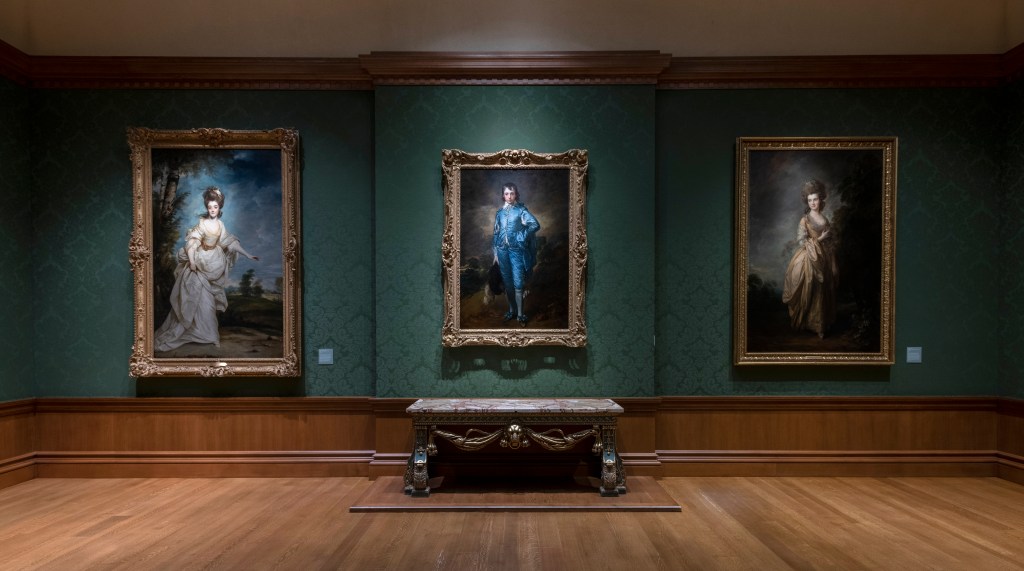
“More specifically, ‘Blue Boy,’ our most iconic work, has continued to inspire over time, artists, much more recent than when he arrived in 1921. A young artist on leave from military duty in San Diego came to the Huntington and had an epiphany from the ‘Blue Boy.’ So did a young teenager who would come on visits to The Huntington on Saturday. And so we’re thinking very deeply about how to unlock more epiphanies from our people, in our galleries, and through expanded online resources. How do we share our collections beyond our walls? How do we reach other aspiring artists from South Los Angeles, San Diego, and from other places really far away – like Kansas City, Kosovo, or Kyoto. So in the context of The Huntington itself, what does our art collection mean? This is a multi-disciplinary institution and as the definition of art keeps changing and evolving, I was reminded recently by Jim Folsom that The Huntington itself is the original conceptual work of art.”

Nielsen said further, “This is the hotbed of the artistic world and we are so pleased to be working with the Hammer on ‘Made in L.A.,’ exemplifying what an extraordinary moment this is for our region. But I might suggest that ‘Made in L.A. 2020’ has a really important antecedent and that could be considered ‘Made in London 1770,’ because going back to Gainsborough and his fabulous ‘Blue Boy’ painting, what we’ve recently learned is that in fact Gainsborough, hundreds of years ago, just like the artists in our midst today, was absolutely pushing the envelope of what it meant to be a painter and what the medium could provide. And so I would say it makes absolute sense for us at The Huntington to be working with The Hammer and offering up our resources for artists, writers, performers, dancers, thinkers, in our midst.

“The past is not dead. In fact, as Socrates said, ‘It isn’t even past.’ It’s alive and waiting to be unlocked in the objects in our collection. I can’t begin to predict now how successors of ours a hundred years from now will do that, any more than Henry and Arabella could have predicted us sending rockets to the moon. But they believed in technology; they believed in sharing their collection to the public; and they believed in connections across time and space. I feel that if we hold true to these principles, we will be just fine over the course of the next hundred years. And, in closing, I offer another definition for our museum – that it should be not just a repository of things, but a collection of ideas and a place for sharing them with others.”
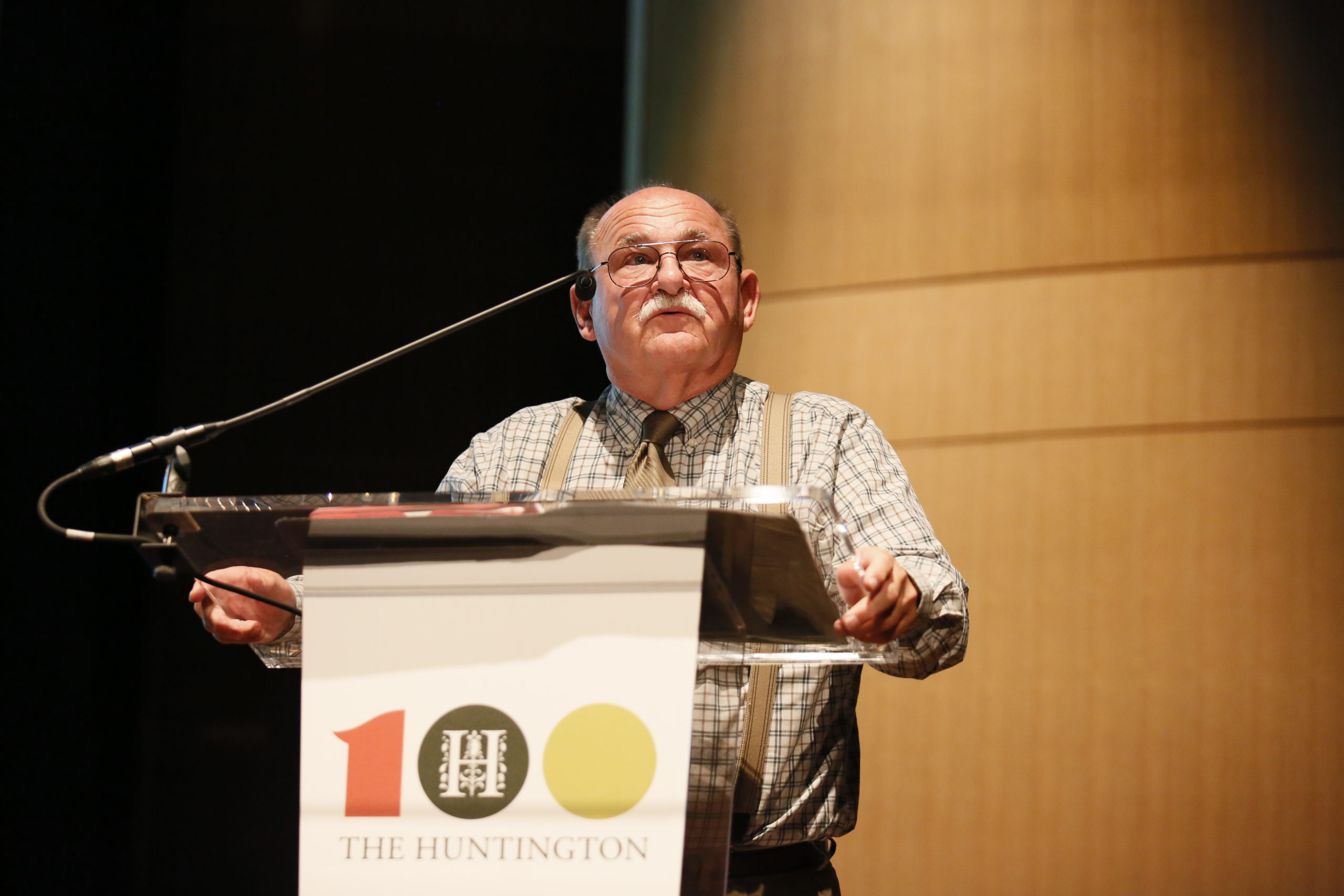
James Folsom, Telleen/Jorgensen Director of the Botanical Gardens speaks during The Huntington Library, Art Museum and Botanical Gardens Centennial Celebration Launch Event on Sept. 5, 2019, in San Marino, California | Photo by Ryan Miller / Capture Imaging

When it was his turn to speak, Director of Botanical Gardens James Folsom, who noted that he’s the old-timer at The Huntington, stated, “Last year we planted several hundred trees and we intend to plant more this year. We plant trees because during a storm in 2011, 700 trees fell in one evening. We plant because new opportunities arise – wonderful new trees become available. We plant trees because they provide structure to the landscape, which takes years to develop. We plant trees because on the 6th of July last year, the gardens experienced a record-high temperature of 118 degrees Fahrenheit leaving vegetation scorched throughout the landscape.

“We plant trees because that’s what gardeners do – observe, think, plant, cultivate, take our losses, make our moves, plan for change, and invest in energy and resources to create something that would be of worth for future generations. So what is that future, how far is that horizon? For trees, it’s 80 to 100 years – easily to the end of the century. But in all of our actions, even short-term plantings, we should build soil and capacity. Every act can be viewed as an investment. Gardens also plant ideas and inspiration – the beauty and power of life unfolding, the importance of cycles, the value in the glorious smell of fresh water and arable soil. The pay-off in planting is seeing the product of pure physical toil and recognizing the importance of plants as the givers of life and the bases of biodiversity.

“To me, the lessons we learn from gardening are crucial. In a perfect future, I imagine these Huntington gardens and the act of gardening will help form a better world. Fortunately, the structure we need for those lessons exists. The Huntington has collections, displays, beautiful facilities, and staff to see us to our second centennial.”
Radiantly Beautiful and Rare Prints on Exhibit at The Huntington Library

Originally published on 7 May 2018 in Pasadena Independent, Arcadia Weekly, and Monrovia Weekly

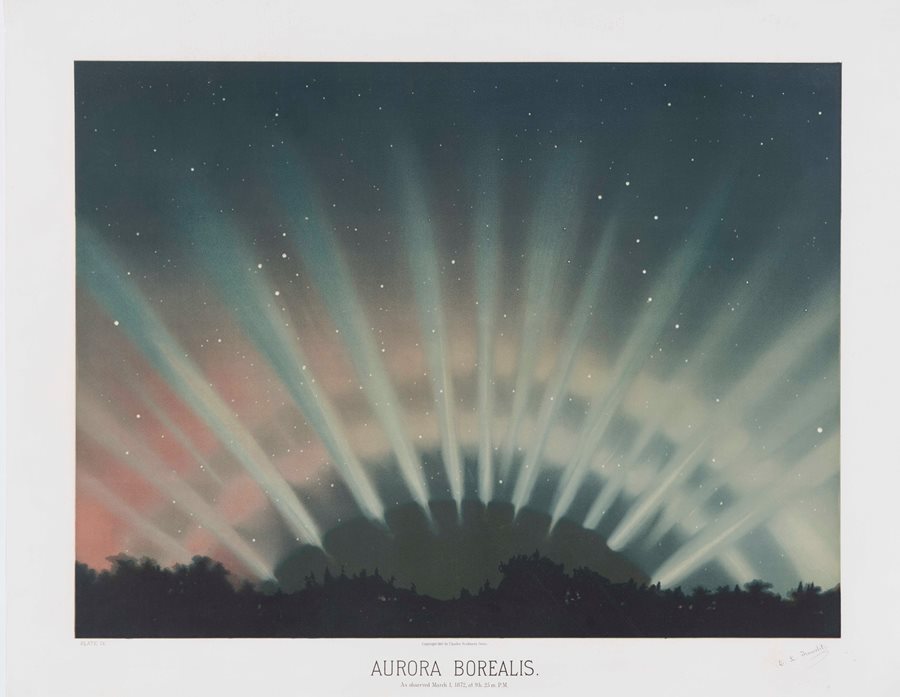
Aurora Borealis, 1881, color lithograph | Photo courtesy of The Huntington Library, Art Collections, and Botanical Gardens

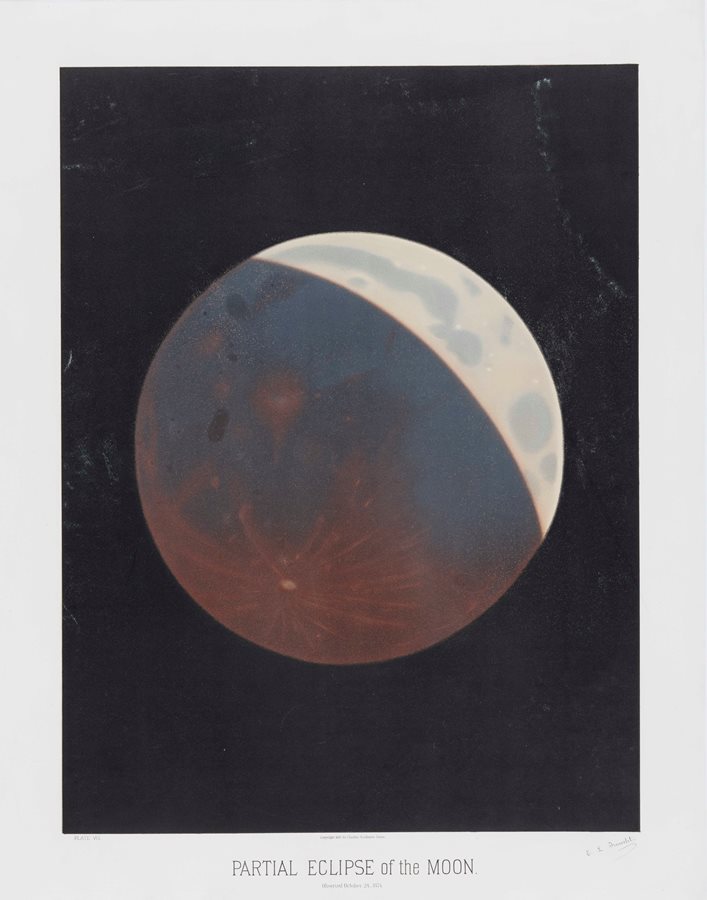
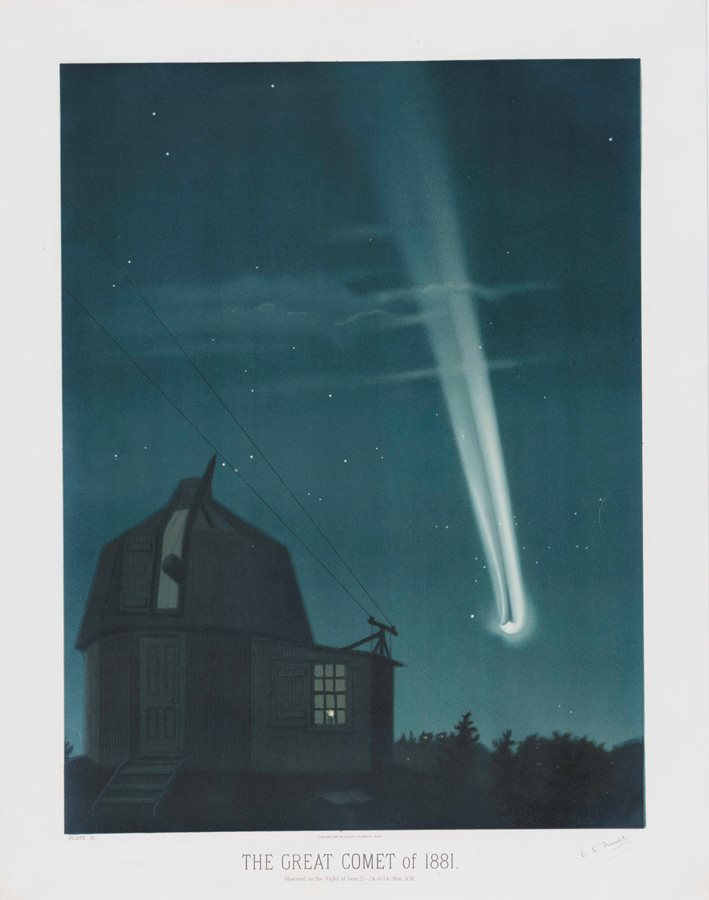
French artist and astronomer Etienne Leopold Trouvelot (1827-1895) is largely unknown to most of us but it would be such a shame if his beautiful drawings didn’t get the acknowledgment and appreciation as the works of magnificence that they truly are.

From April 28 through July 30, at the West Hall of The Huntington Library, we have the opportunity to view a rare set of lithographs depicting the pastel drawings of planets, comets, eclipses, and other celestial splendor that he created during his lifetime, in an exhibition aptly titled “Radiant Beauty: E.L. Trouvelot’s Astronomical Drawings.”

“The set of 15 chromolithographs was the crowning achievement of Trouvelot’s career,” declares Krystle Satrum, assistant curator of the Jay T. Last Collection at The Huntington Library, Art Collections, and Botanical Gardens. “He was both an extraordinarily talented artist and a scientist, producing more than 7,000 astronomical illustrations and some 50 scientific articles during his working life. The high quality of the artwork and the scientific observation demonstrate his uncanny ability to combine art and science in such a way as to make substantial contributions to both fields.”

Trouvelot worked at the Harvard College Observatory where he made highly detailed drawings of his observations, many of which were published in the Annals of the Astronomical Observatory of Harvard College. In 1875 he was invited to the U. S. Naval Observatory to use their 26-inch refracting telescope, the world’s largest at the time.

“Given what telescopes are today, can you imagine what he could have done with something that powerful?” Satrum remarks. “But for him to be able to come up with the details he did using what was available at the time makes his creations all the more astounding.”

Satrum emphasizes, “Trouvelot was very meticulous in getting accurate images. If you compare his work to what you can see through the Hubble telescope you’ll see they’re identical. He matched up perfectly the grid on the telescope to the paper he was drawing on; he represented exactly what he was seeing.”

The Great Comet of 1881, 1881, color lithograph | Photo courtesy of The Huntington Library, Art Collections, and Botanical Gardens

Shortly after that, he went public, exhibiting several astronomical pastels at the 1876 Centennial Exposition in Philadelphia. Because the exhibit was a big success, he decided to team up with New York publishers Charles Scribner’s Sons to publish a portfolio of his best drawings. In 1882, 15 of his drawings were made into lithographs.

While an estimated 300 of Trouvelot’s portfolios may have been published, only a handful of complete sets still exist. Initially, the collections were sold to astronomy libraries and observatories as reference tools that astronomers could use to compare with their own observations.

However, as early 20th century advances in photographic technology allowed for more accurate and detailed depictions of the stars, planets, and phenomena, these prints were discarded outright or sold to collectors.

According to Satrum, Trouvelot’s legacy is not without controversy. Born in Aisne, France, he fled to the United States in 1855 with his wife and two children following Napoleon’s coup three years earlier, settling in Medford, Massachusetts. While supporting his wife as an artist, he spent much of his free time studying insects, working to see if better silk-producing caterpillars could thrive in the United States.

During a trip back to France in the late 1860s, he collected live specimens of the gypsy moth, bringing them home to Medford. “Unfortunately, after hatching, some of them escaped his backyard, infesting the nearby woods, then quickly spreading throughout New England and Canada, destroying millions of hardwood trees,” relates Satrum.

Though large scale efforts to eradicate it were underway by 1890, they proved unsuccessful; the gypsy moth continue to be a scourge of U.S. and Canadian forests today, causing millions of dollars’ worth of damage annually. Satrum adds, “This episode also seems to have soured Trouvelot’s passion for entomology and by 1870 he had turned to astronomy.”

The Huntington’s set of Trouvelot lithographs was acquired by Jay T. Last as part of his collection of graphic arts and social history. It is but a small fraction of 200,000 objects that focuses on American lithography and graphics. And that assemblage, in itself, is noteworthy.

Partial Eclipse of the Moon, 1881, color lithography |Photo courtesy of The Huntington Library, Art Collections, and Botanical Gardens.

Satrum explains, “Jay got captivated by vivid images on citrus box labels which he found in rummage and flea market sales. These crate labels weren’t meant for retail sales but were primarily for middlemen and he wondered why these stunning images weren’t used as marketing tools to the general public. That led to his fascination, in the 1970s, with commercial lithography and advertising illustration, and other major reproductions of promotional artwork.”

“Jay donated his collection to The Huntington in 2005 but because he continues to acquire various objects we’re getting them in stages, which also makes it easier for us to process,” continues Satrum. “We have everything from tiny 3 x 5 business cards to master prints three times the size of these pieces.

The Trouvelot collection is a full portfolio set which we estimate to have a print run of 300 at a $125 apiece, which was a lot, considering that at the time they might have sold for between $4 and $6. Actually having a full set is really rare; most collectors have part of a set, or only the manual to accompany the set.”

“Having the manual makes the collection quite interesting because it reveals to us the beliefs at the time,” Satrum adds. “For instance, it shows the Milky Way and explains why you can see it at certain times. Trouvelot talks about Mars which has a bluish shade that he thought were oceans. Today we know that’s incorrect, but it was a reasonable hypothesis then.

I find particularly fascinating that they capture a moment in time. This is what research in Astronomy was in the 1870s and 1880s. That’s exactly what Mars looked like to him and scientists were able to match these drawings to what they observe through the telescope.”

“It also revealed how artists used this medium as an inexpensive method to reproduce their work. It was the best way to show what the original drawing looked like. Trouvelot wasn’t a lithographer, but we knew he supervised the process. We also know that the original of these illustrations were pastel drawings although I don’t know if he used any other medium,” Satrum states.

According to Satrum she has no underlying message or theme, “It’s a very visual exhibition and it’s specific in scope. We’re showing these 15 illustrations, not presenting a broader picture of Trouvelot, the artist. I simply want to share with our public a little bit about astronomy, and that these were originally drawings that were turned into lithographs. I put little comments underneath but I don’t intend to tell them what they should be seeing. I want people to take away from it whatever they want to take away from it.”

After the exhibition the collection will go back in storage and will be available for researchers to use. But until then we can marvel at Trouvelot’s collection of rare 19th century astronomical prints. Indeed entomology’s loss was the arts’ and astronomy’s gain, for his works capture the most breathtaking moments in time.

Introducing Ancient Chinese Culture to a Wider Audience

Originally published on 26 February 2018 in the Pasadena Independent, Arcadia Weekly, and Monrovia Weekly

Wu Man (left) playing the pipa with the Huayin Shadow Puppet Band | Courtesy Photo

The Chinese civilization is one of the oldest known to humankind. Its vibrant cultural heritage dates back thousands of years, and the country’s rich and diverse musical tradition forms a vital part of that heritage. Traditional music – with its essential instruments including the pipa, guqin, ruan, xiao and zheng – is deeply ingrained in people’s daily lives and intersects with other art forms and traditions like drama, storytelling, and shadow puppetry.

The New World certainly has much to learn from this ancient civilization. This is why Wu Man, a pipa virtuoso who is regarded as the foremost ambassador of Chinese music and culture, has made it her calling to ensure that the early Chinese traditions are not merely preserved but kept alive and relevant. She has spent most of her life travelling the globe acquainting modern audiences with the pipa whose history goes back over two millennia.

We in the San Gabriel Valley will have the opportunity to hear and see Wu Man and the Huayin Shadow Puppet Band on March 5 at 7:30 pm when they perform at The Huntington Library, Art Collections, and Botanical Gardens in San Marino. This is one of three California stops (UC Santa Barbara on March 8 and Hertz Hall in Berkeley on March 11) as part of their North American tour encompassing a dozen appearances in Utah, Idaho, Arizona, Nebraska, Washington DC, New York, Ohio, and Massachusetts.

For many of us who aren’t familiar with the pipa and the shadow puppet, this show will give us a glimpse of and an appreciation of these musical and performance art forms. Wu Man is eager to share her vast knowledge and experience about them.

Wu Man explains, “Pipa is a pear-shaped, lute-like, string-plucked instrument which was introduced to China 2,000 years ago from Central Asia or the Persian area. It is related to the middle eastern instrument called ‘ud,’ and is in the same string family as the European lute, the American banjo, and the Indian sitar.”

“The pipa has a long history with the Chinese people. Music for the pipa was developed during the Tang Dynasty. In many paintings and statues you will always see the beautiful goddess holding the instrument,” continues Wu Man. “While it is an ancient instrument, it has survived to the modern days. The instrument I’m using today is one from the 19th century, which is bigger than the 16th century pipa which is on display at the Metropolitan Museum of Art in New York.”

To introduce the pipa to the public and gain a wider audience for it, Wu Man has been teaming up with internationally recognized artists and performers. One of her early collaborations was with the Kronos Quartet in the early 1990s. They premiered their first project called ‘Tan Dun’s Ghost Opera’ at the Brooklyn Academy of Music in 1997. Their partnership endures to this day and she participated in the Quartet’s 40th anniversary celebration concerts at Cal Performances in Berkeley, CA and at Carnegie Hall, and was Artist-in-Residence with the Quartet in February 2016.

Wu Man with the Silk Road Ensemble |Courtesy photo / Max Whittaker

Wu Man was also a founding artist of Yo-Yo Ma’s Silk Road Project and has performed throughout the United States, Europe, and Asia with the Silk Road Ensemble (SRE). She is a featured artist in the documentary ‘The Music of Strangers: Yo-Yo Ma and the Silk Road Ensemble,’ as well as on the film’s 2017 Grammy Award-winning companion recording, ‘Sing Me home,’ which includes her original composition ‘Green’ (Vincent’s Tune) performed with the vocal ensemble Roomful of Teeth. She has recorded six albums with the group. Her recent performances with SRE include a 2016 tour to summer festivals such as Tanglewood, Wolf Trap, Blossom, Ravinia, and Hollywood Bowl; as well as with Mark Morris Dance in Berkeley and Seattle, and a tour of Asia.

Locally, Wu Man was the Inaugural Artist-in-Residence at The Huntington in 2014 for which she composed a piece called ‘Three Sharing.’ She recalls, “It was meant as a celebration of the relationships among Asian countries. I played the pipa with two of my friends, one playing the Japanese flute shakuhachi and the other the Korean drum janggo. It was such a fun collaboration, we each contributed something to the music.”

Depending on whom you ask, there is the assertion that China has attained world dominance. Even if this weren’t entirely true, we can definitely say that it has a presence on the world stage and people are paying more attention to China.

Wu Man reflects on this, “I have noticed changes since I came to this country 20-some years ago when it seemed that no one knew anything about Asia and Chinese culture. In the past, my audience has been mostly older Chinese who knew about the pipa growing up. Today we are attracting people of different cultures who are open-minded and are willing to know more about China and its ancient musical instruments.

After a performance people usually come up to tell me the pipa sounds like a guitar or a banjo. Every once in a while I hear remarks like ‘it’s like listening to a harp or a ukulele.’ They’ll bring up the various plucked instruments. I observe a greater appreciation for it now.”

It’s also important for Wu Man to educate young Chinese people about their ancient roots. She says, “The younger generation is exposed daily to western culture and music through the Internet and social media. While it’s great that they are embracing others’ way of life, there is the likelihood of them forgetting their ancestry. That’s why tied in with my concert performances, I visit classrooms – all the way from elementary to college level – to talk about Chinese history, music and specifically, the pipa.

Even my performances for adults are usually concerts/informational talks because not everyone knows Chinese ancient musical instruments. So my goal is to make this as familiar as the guitar. It’s such a beautiful instrument and it would be a shame if people didn’t know about it. It has a very rich history and it’s really pretty cool. It’s gratifying for me that recently people have been seeing the pipa in a much better light – they see its many potentials.”

Wu Man tours extensively and has practically visited every continent. She says, “I see different audiences and I get different reactions. Californians are more familiar with Asian culture and they are more receptive to my music. I get a vastly atypical reaction in Japan – the  audience is so quiet I can hear myself breathe. Normally there would be the little noises during a concert like someone moving his chair. But over there the silence is almost reverential. It’s only after the performance I would get a wild applause and hear them exclaim, ‘Wow, that was truly amazing.’ That’s always a wonderful feeling for a performer.”

Wu Man with her pipa | Courtesy photo / Kuan Di Studio

A few years ago Wu Man traveled to China’s remote regions to unearth the country’s ancient musical traditions that are in danger of being lost, and explored the customs of the Huayin Shadow Puppet Band, which was then known as the Zhang Family Band. It comprises farmers from Shaanxi Province’s Huayin County in a rural village at the foot of Mount Hua in northwest China.

For more than 300 years the Huayin Puppet Band has toured the countryside bringing its rugged shadow puppet plays that recall the mythical heroes and gods of the oral folk culture of Shaanxi, often evoking famous battles of the Tang dynasty (618-907), to temples, fairs and rituals.

These shadow puppet plays are accompanied  by ‘old tune’ (laoqiang) traditional music with guttural and high-pitched singing with a rough, mad spirit; percussion, including clappers, cymbals, and gongs; stringed instruments including the yueqin (moon lute) and fiddle; the shawm, a double-reed instrument similar to the oboe; and a natural trumpet.

The shadow puppetry tradition that exists in the village first appeared during the Qing Dynasty under Emperor Qianlong (1736-1796) and has been passed down from generation to generation. For many years the shadow puppetry was part of the Zhang family household only, and not until recently has it had been passed down to performers outside the family.

Wu Man is excited to bring the Huayin Shadow Puppet to The Huntington. This is only the second time she has performed with them in the United States since their first visit in 2009 as the Zhang Family Band.

“The Huayin Shadow Puppet music is very dramatic and earthy, it’s almost like Chinese gypsy music,” declares Wu Man. “Our audience will see that Chinese traditional music isn’t limited to the pipa, ruan, and zheng. I’ve been wanting to share this for a long time.”

In our digital era we tend to move past one new thing speedily to go to the next, lest we get left behind. It would be refreshing to stop hurrying for once and appreciate Wu Man’s effort to bridge the past and present.

For even as we enjoy a world of technological advances, we could still learn a thing or two about the simple pleasures in life from those who occupied this earth thousands of years before our time.

It’s Blooming Roses at The Huntington

Originally published on 18 May 2017 in the Pasadena Independent, Arcadia Weekly, and Monrovia Weekly

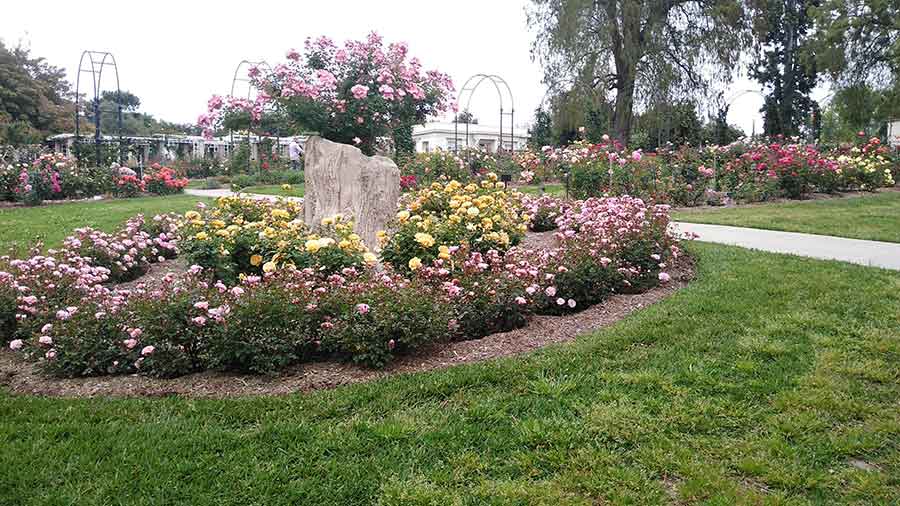
No single flower has moved more bards – from Robert Burns to William Butler Yeats – to  wax poetic than the magnificent rose.  And nowhere are the roses more cared for and celebrated than at The Huntington Library, Art Collections, and Botanical Gardens in San Marino where they are displayed in stunning splendor.                          

Tom Carruth, who became the E.L. and Ruth B. Shannon Curator of the Rose Collection in 2012, presides over The Huntington’s vast assortment of 2,500 plants and 1,250 varieties. 

Prior to his arrival here, he spent 25 years as a hybridizer for Weeks Roses, the country’s leading wholesale grower, where he led the company’s hybridizing efforts.  In his long career he has won more awards from the All-America Rose Selections (AARS) organization than any other living hybridizer.   

“My hybridizing career ended when I took this position,” reveals Carruth.  “As curator of the rose collection I’m responsible for ensuring the plants are vibrant and alive, and for bringing in new parts to the collection.”

In the five years he’s been at The Huntington, Carruth has organized all the labels and  systematized the collection records.  He has expanded some of the beds, added arbors, rebuilt trellises, repaved pathways, re-landscaped, modified irrigation, tested the soil, and even established a dramatic new entrance to the rose garden.  He has also taken on a mission to identify older cultivars that were ‘collectible’ quality and custom propagating them to replace the weaker shrubs in the garden.  


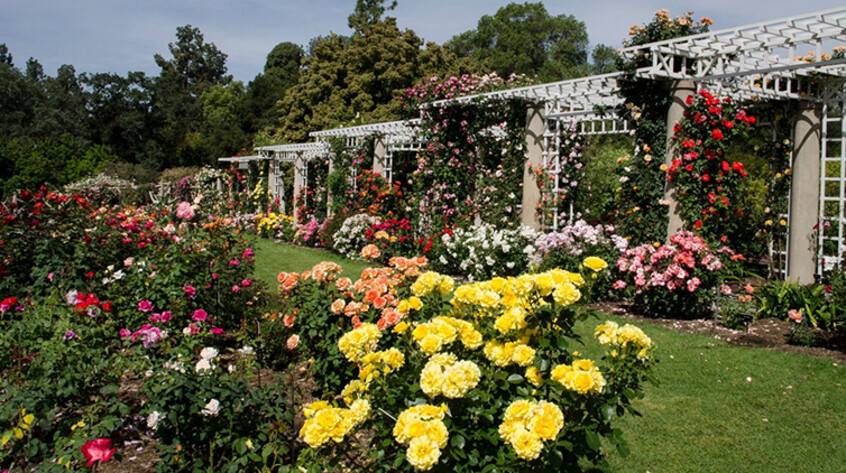
The Rose Garden at The Huntington | Photo courtesy of The Huntington

But Carruth gets the most fun studying the plants, “As a horticulturist I just observe – plants talk to you and you listen.  This is an old garden so the soil is impacted and we started amending with gypsum.  I noticed the roses were getting too much shade so we pruned out some trees.  Some of the old plants which were struggling to live responded to the care and started to turn around.  We had agapanthus going down on both sides of the trellis which were so overgrown they were in the rose roots and were strangling the roses.  We divided up the agapanthus and for two years we just let the roots get some air.”

Originally a cutting garden for Mrs. Huntington, the flowers were grown for production with 50 shrubs of each variety – she was fairly nearsighted and she loved having big bouquets in the mansion.  According to Carruth records from that time showed that one year 9,000 roses were cut to bring to her house.  Today it is a vast collection with just one or two of each kind to show the history of the rose.

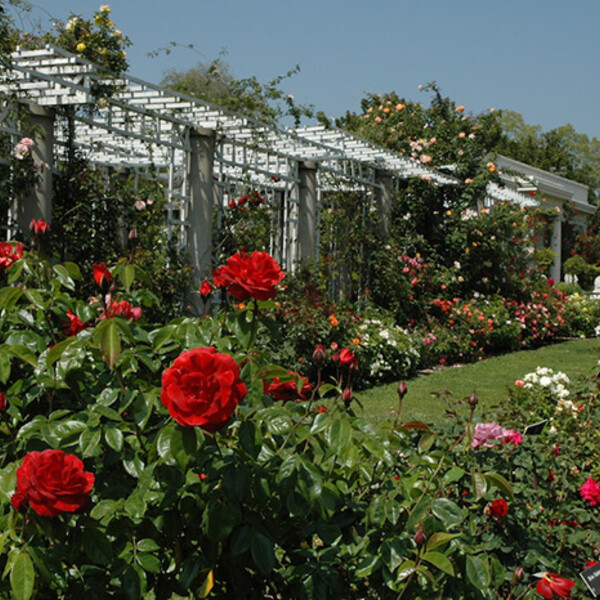
The Huntington’s Rose Garden is a veritable history lesson that traces the story of the rose from ancient times to the present day.  Growing on the south side of the pergola leading from the Shakespeare Garden to the Tea Room are roses that represent the early history of the flower dating back to the pre-Christian era. 

On the north side of the pergola are Tea and China roses, introduced into Europe from Asia around 1800.  Says Carruth, “The Chinese were known to have been working with this flower for over 2,000 years.  The whole collection behind the trellis were roses that came here in the tea ships and were the ones that gave us repeat flowering; up to that point roses bloomed only once a year.”

The central part of the garden is dedicated to roses of the modern period when the first hybrid tea rose, called ‘La France’ was introduced.  The hybrid tea went on to become the most popular class of rose of the 20th century, with thousands of known varieties.   According to Carruth, ‘Ophelia’ dating to that period was crossbred in the garden and is in The Huntington’s collection.         

Carruth explains, “The roses are classed by color but not planted by color.  We want to keep the integrity of each variety – the China Teas are all in one location, the older hybrid has its devoted area, and the fragrant roses are in two beds closest to the Rose Garden Tea Room.  That makes it easy for us to direct the public when they ask.”

“Roses have several natural fragrances like fresh cut apples, spice, lemon blossom, myrrh, damask, honey, violets, and all sorts of combinations of those,” adds Carruth.  “It’s fun to watch people get a whiff of the fragrant flowers while they wait for their table in the Tea Room (for information and reservations, call 626/405-2236 or huntington.org/dining).  We have a variety out there that smells like Lemon Pledge and over here we’ve got one that reminds you of Ponds Cold Cream.  Down there we have something that’s white licorice and smells strongly like licorice candy.”

Photo courtesy of The Huntington

“Everyone loves walking around, reading names, and looking at the dates,” observes Carruth. “Many visitors, who don’t’ necessarily know much about growing roses look for classics like ‘Mr. Lincoln’, ‘Peace’, or ‘Sterling Silver’ – bed number 17 in the collection – which is a silvery lavender and is a repeat bloomer.  ‘Sterling Silver’ is interesting because that was the first hybrid from a female hybridizer, in a male-dominated field. We also have the everyday version, ‘Stainless Steel’, which is a much easier plant to grow and has bigger flowers, that’s similar in color and fragrance.”  What he failed to mention, however, is the fact that ‘Stainless Steel’ is a rose he developed in the 1990s as a more robust version of the fussier ‘Sterling Silver’.

The roses at The Huntington bloom from mid-April to November.  Explains Carruth, “This year, because of the rain, we had an elongated pruning season resulting in an extended spring bloom. We’ll have color throughout because we manipulate the plant in the beginning so they don’t blossom all at once. People will see roses every time; we even have a smattering of them in time for the Rose Parade.”

It would surprise people to know that The Huntington does not have a large staff tending to the garden. Carruth discloses, “I have two gardeners who work three acres of roses so we depend heavily on our volunteers.  Right now I have 52 rose garden volunteers deadheading, weeding, watering, and anything they’re willing to do. Some people love to deadhead and prune so I see them in winter and I may not see them during the summer. We’ll take whatever level of interest they have. They get prime time – they come in early in the morning before visitors arrive – when it’s beautiful and calm, and not hot.”

You’ll know that Carruth, and his staff and volunteers, take painstaking care of The Huntington’s roses when you see the glorious flowers in bloom. The next time you visit, go for a stroll on the grounds to take in the breathtaking beauty and heady fragrance laid out before you. When you do, you undoubtedly wouldn’t be able to help stopping to smell the roses.               

Octavia Butler Exhibition at The Huntington Library

Originally published on 20 April 2017 in the Pasadena Independent, Arccdia Weekly, and Monrovia Weekly

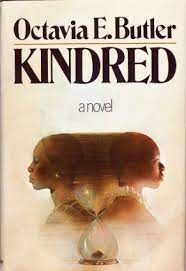
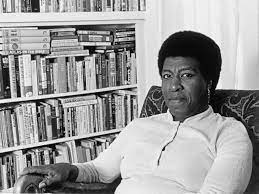
Octavia E. Butler was the first science fiction writer to receive the prestigious MacArthur Foundation ‘genius’ grant and the first African American woman to win recognition writing in a genre dominated by male authors. For all her literary fame and awards, however, hers is not a household name.      

But this is about to change if Natalie Russell, were to have her way. As curator of ‘Octavia E. Butler: Telling My Stories’ which opened on April 8 and goes on until August 7, 2017 at The Huntington Library, Art Collections, and Botanical Gardens, Russell was charged with organizing this exhibition. On view in the West Hall of the Library in chronological order, the retrospective includes approximately 100 items that reveal the author’s early years and influences, highlighting specific themes that repeatedly commanded her attention.    

States Russell, “I hope it introduces Butler to people who may not know her, who may not be familiar with her works; for those who have not read science fiction before but were intrigued about what she has to offer which are a little different from what they thought they were going to be reading. I hope that people who are fans of hers get to know the writer behind these works a  little deeper – that through the process they get to know the inner person.”

Butler was born in Pasadena on June 22, 1947 to a maid and a shoeshine man. Her father died when she was very young and she was raised primarily by her mother. A painfully shy, introverted child, she spent her time reading at the Pasadena Public Library where she discovered science fiction.   

At age twelve Butler saw a film called ‘Devil Girl from Mars’ and was convinced she could write something better. She later enrolled in every creative writing course at Pasadena City College to her mother’s disappointment, who wanted her to have a more reliable job as a secretary. 

In the early 1970s, at a workshop for minority writers, Butler met science fiction author Harlan Ellison, who introduced her to the Clarion Science Fiction Workshop.  There, among other like-minded writers, she learned to hone her craft and even sold her first story.

Butler’s conviction that she was going to be a successful writer grew stronger after the Clarion workshop. She did not want to find work that would distract from her ultimate goal so she took odd jobs to support herself. 

Success proved elusive for a while, until 1975 when Butler sold her first novel, ‘Patternmaster’ to Doubleday, which quickly followed with ‘Mind of My Mind’ and ‘Survivors’. This trio came to be known as her ‘Patternist’ series, which depicts the evolution of humanity into three distinct genetic groups. There is a review in the exhibition that lauds ‘Patternmaster’ for its especially well-constructed plot and progressive heroine, who is ‘a refreshing change of pace from the old days’.       

On display in the exhibition are motivational notes Butler would write to pick herself up during bouts of self-doubt – ‘I am a Bestselling Writer. I write Bestselling Books ….  Every day in every way I am researching and writing my Award winning Bestselling Books and short stories …. Every one of my books reaches and remains for two or more months at the top of the bestseller lists …. So Be it! See To It!’

Butler’s readership continued to grow and with the publication of ‘Kindred’ in 1979 she was able to make a living on her writing alone. In 1984 she won her first Hugo Award for the short story ‘Speech Sounds’. Her novelette ‘Bloodchild’ won a Hugo, a Nebula, the Locus, as well as an award for best novelette from Science Fiction Chronicle, in 1985.                  

That Butler was a female writer of color informs many of her works. Russell concurs, “I think being a woman and African American gave her this unique voice. Butler said she never saw herself in any of the stories she read. So she decided to write herself into these books so she could see a woman character in a setting that reflected the diverse world she lived in”.  

Beyond race, Butler explored themes between genders and worked to develop strong female characters who resolved problems differently. Russell adds, “Her audience varied – young, old, people of color – anyone who’s interested in science fiction; her themes also covered a diverse range – disease; pharmaceuticals; fears about the environment, drought, and alien contact – the differences that divide us and how we overcome these to become better people and get together as human beings.”

 “In 2008 Butler’s papers arrived at The Huntington in two four-drawer file cabinets and 35 large cartons,” states Russell. “She kept nearly everything – from her very first short stories, written at age 12, to book contracts and programs from speaking engagements. The body of materials includes 8,000 individual items and more than 80 boxes of additional items: extensive drafts, notes, and research materials for more than a dozen novels, numerous short stories and essays, as well as correspondence.”

Photo courtesy of The Huntington

According to Russell more than 40 scholars were asking to get access to the Butler collection by the time she was done processing and cataloguing all the items. In the past two years, it has been used nearly 1,300 times – or roughly 15 times each week, making it one of the most actively researched archives at The Huntington.

“I was not familiar with her beforehand; it’s a shame because she’s so amazing,” confesses Russell. “But I hope that everybody can have the same experience I had while I sorted through all the materials she left behind – that it’s okay to start fresh. Be prepared to be amazed and entertained, to experience something new, and thought-provoking. She was a very shy, private person, but she has a big presence on the page; she has so much to say. Some of those inner thoughts and the struggles she underwent to become the person that she was is a story we can all be inspired by.”      

“When I look back at the things I sifted through in the collection, I think of the highlights, themes, and things that were important to Butler and how to share her with the world. That’s what I hope I have done with this exhibit,” concludes Russell.

After having lived in Seattle for several years, Butler had planned on returning to Pasadena. She died suddenly in 2006 before she realized that wish, but her literary archive has come home to reside permanently in The Huntington. Here scholars can come to examine the life and work of this extraordinary woman.        

She lived but 58 years but her legacy will endure far longer than her existence on earth.  Generations of future writers, and people from all walks of life, will find inspiration from Octavia E. Butler – a woman ahead of her time.        

The Huntington Offers Outstanding Dining to Match its World-Class Reputation

Originally published on 17 November 2016 in the Pasadena Independent, Arcadia Weekly, Monrovia Weekly, and Sierra Madre Weekly

Laura Skandera-Trombley took over as president of The Huntington Library, Art Collections, and Botanical Gardens, in San Marino, in July of last year and put into motion several initiatives almost as soon as she walked in her office. One of her first undertakings was to ensure that visitors’ dining experience at The Huntington matches its reputation as a world-class institution.

Eight months ago, Skandera-Trombley led a committee composed of Huntington staff, overseers and trustees on what she describes as a “food quest”. They reviewed proposals and interviewed 14 prospective catering operators who will work with them to usher in a new era in destination dining at The Huntington.  

On October 5, The Huntington announced that it has contracted with Bon Appetit Management Company based in Palo Alto. As part of this partnership, The Huntington and Bon Appetit have invited Border Grill cofounders, Mary Sue Milliken and Sue Feniger, and Blue Window co-owner, Kajsa Alger, to launch several new dining concepts on its historic grounds.               

It is a perfect partnership according to Skandera-Trombley, “The introduction of world-class dining at The Huntington is a natural extension of who and what we are. We are home to a 6,5000-volume historic cookbook collection, including the first known printed cookbook – dating to 1475. Specially prepared good food beautifully matches our commitment to authenticity, quality and culture. And, for that reason, we couldn’t be more excited to have Susan, Mary Sue, and Kajsa joining us at this time.”

Says Skandera-Trombly on their choice of Bon Appetit, “Standout features of the Bon Appetit proposal included their commitment to quality, taste, and sustainability. We consider sustainability to be of key importance at The Huntington – whether we are considering how to lower our water use, narrow our carbon footprint, or determine what types of seafood we serve.” 

Bon Appetit CEO and co-founder Fedele Bauccio, who has been recognized for his work in sustainability before it became a household word, says, “I am thrilled to bring our focus on sustainability and fresh, seasonally driven food to The Huntington.”       

Feniger, who also cofounded Blue Window with Alger, enthuses, “In the heart of the San Gabriel Valley, surrounded by breathtaking botanical gardens, art collections, and renowned library holdings, and serving flavorful foods that reflect Southern California’s growing multi-cultural population, we hope to transform The Huntington into a place that inspires all the senses!”

The Celebration Garden | Image taken from The Huntington’s website

The celebrated chefs are offering their signature fares befitting the various destinations at The Huntington. The main café, newly renamed 1919 for the year The Huntington was founded, features different dining concepts to please visitors. The Border Grill taqueria, a smaller version of Feniger’s and Milliken’s Border Grill restaurants, serves the chefs’ signature modern Mexican cuisine like tacos on handmade corn tortillas with organic rice and beans, quesadillas, ceviche, and seasonal aguas frescas. At The Bar, Alger creates freshly made sushi – rolls, nigiri, and bowls; or small plates of global fare for pairing with beer, wine, and sake – or whimsical craft cocktails inspired by the setting.    

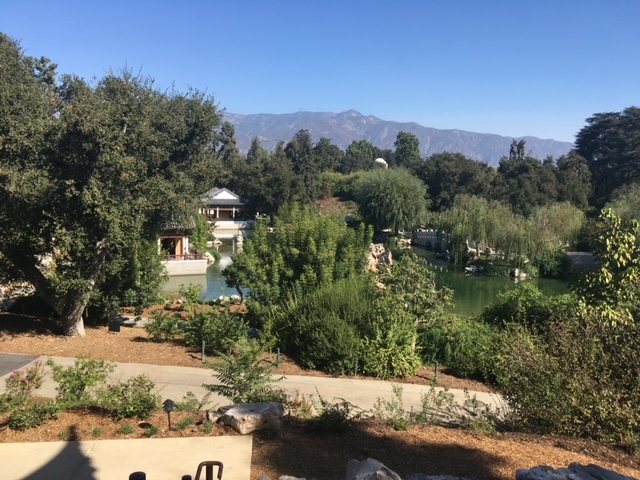
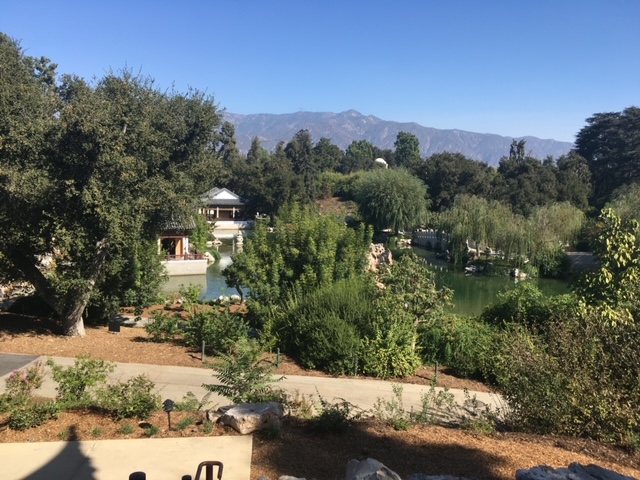
Alger and Feniger are offering at the Chinese Garden’s Freshwater Dumpling and Noodle House authentic dumplings, noodles, and rice dishes drawn from China, Nepal and Mongolia. The chefs will take their food inspiration as the surrounding garden changes with the season.

“The Huntington has always been this little oasis within the city, a place where you can come and feel tranquil among the chaos,” proclaims Alger. “We’re thrilled to be at the center of the Chinese Garden and to offer the simple dishes and flavors that I grew up with, spanning the regions of China.”

At the casual Patio Grill, adjacent to The Huntington’s Shakespeare Garden and American art galleries, weekend visitors can savor Feniger’s and Milliken’s global-meets-local flavors. The rotating seasonal menus will highlight the rich culinary heritage from the various communities in Los Angeles like griddled Cubano sandwiches; grilled corn with smoky aioli and cheese; a roasted yam, quinoa, and kale salad; and seasonal aguas frescas.

A tour of The Huntington wouldn’t be complete without stopping at the Rose Garden Tea Room.  Currently under renovation, it will reopen on November 16 to once again be the venue for an elegant and memorable experience, inspired by the English tradition of afternoon tea with a distinctive California twist. Visitors can indulge on crumpets and scones, delicate finger sandwiches, caviar-topped blinis, and decadent desserts with their choice of herbal and Fair Trade teas or sparkling wine.       

“At a time when cuisine has become key to every type of cultural experience – from museum-going to concert-watching – we believe it’s critically important to have dining here reflect the high quality that is The Huntington standard,” declares Skandera-Trombley. “Food is no longer incidental – it is part of our culture. And, according to some, it is everything. We want wonderful, memorable food to be part of the greater Huntington experience. 

With the most respected names in food creation and catering all working together, Skandera-Trombley’s wish to make people think of The Huntington as a food destination in an incomparable setting is now a triumphant reality.               

Beatrix Potter Inspires Pre-School Workshop at The Huntington

Originally published on 22 September 2016 in the Pasadena Independent, Arcadia Weekly, Monrovia Weekly, and Sierra Madre Weekly

Who, as a young child growing up, hadn’t enjoyed reading the adventures of the mischievous Peter Rabbit and his sisters, Flopsy, Mopsy, and Cottontail? Kids everywhere recognize this long-eared mammal, in the blue jacket with brass buttons, being chased by the ornery Mr. McGregor. He is one of the many delightful animal characters created by Beatrix Potter.

To commemorate the sesquicentennial birth anniversary of Beatrix Potter, The Huntington held a series of preschool workshops this month through the institution’s Youth and Family Programs.

Through four two-hour morning sessions, artist and educator, Paisley Callow, led a group of three- to five-year-olds around The Huntington gardens and immersed them in the make-believe world of Peter Rabbit, Jemima Puddle-Duck, and friends.

Callow, herself an avid collector of Beatrix Potter memorabilia, says she pitched a few workshop ideas for preschoolers. She relates, “Every year growing up, my grandparents gave me a Beatrix Potter figurine for my birthdays and at Christmas. So when The Huntington asked me to do this theme class, I was excited to be able to integrate my collection in the lessons.

“We did scavenger hunts in the gardens, where children and their parents weaved around the various plants at The Huntington. We read ‘The Pie and the Patty Pan’, and created our own mixed media pies. Because three-year-olds are learning their letter sounds, we crowned a pre-school ‘Prince or Princess of P’, who would hold up the letter P every time we said a P word, like ‘pie’, in our Potter’s Porcelain Animal Art class.

The Chinese Garden at The Huntington | Photo by Brianna Chu

“In one session we checked out the porcelain tea cups in The Huntington’s European Gallery; fashioned our own cups; and had a tea party for Beatrix Potter’s 150th birthday in the Rose Garden. Our potter class took us to story time in the lily pond where we read Jeremy Fischer, a frog who fishes on a lily pad. Using simple mold making, we crafted our own Lilies and Fish,” Callow expounds.

A graduate of UCLA’s School of Arts and Architecture, Callow also held one Saturday class on a temporary Huntington exhibition, Ishimoto Architects. Seven- to 12-year-olds and their parents viewed the works of California architects, Charles and Henry Greene, who were inspired by Japanese structures. Photographer, Yasuhiro Ishimoto, took a series of black and white photos of Greene & Greene houses, which are on display through October 3, 2016 at the Susan and Stephen Chandler Wing of the Virginia Steele Scott Galleries of American Art. The kids then designed their own architecture during the three-hour hands-on workshop.

Having lived in Asia, North America, and the Middle East with her diplomat parents during her childhood years, Callow shares her knowledge about world culture and arts with the children she teaches. In November, she will offer a Mini International Architects class for preschoolers and their parents. She explains, “In this class, the kids will look at exhibits and gardens as they relate to architecture around the globe. They will build Saudi Arabian castles, Iceland ice hotels using popsicle paint, and western skyscraper with recyclables. They will learn the letters I and C when they study two Greek columns – Ionian and Corinthian.  I incorporate literacy, math and science in my preschool art classes.”                       

“As a certified Montessori educator, I know that children learn best by creating something they make themselves, especially at preschool age. They’ll never forget their cool colors when they’re painting snow with their cold blue popsicle paint,” Callow concludes.

The European Gallery | Photo taken from The Huntington’s website

The preschool classes are an ongoing program at The Huntington. According to Julianne Johnston, senior coordinator, Youth and Family Programs and Community Engagement, “Over the past ten years, we have offered at least one in the spring and another in the fall. The Preschool Series offers an introduction to museum education programs through The Huntington’s collections.”

Johnston states further, “ Because it is usually children’s first experiences at The Huntington, each series is designed to include stories, a visit to a garden or gallery, and a hands-on activity to reinforce the theme or lesson. Each day in the series is centered on early education and discovery-based learning to develop both their motor skills and a love and appreciation for learning in a museum setting.”

“The public program is planned and designed anywhere from three months to a year in advance,” Johnston adds. “We try to take advantage of our many temporary exhibitions (such as Van Gogh and Friends, or The National Parks), as well as highlight our permanent collections – whether they are Library, Art, or Gardens. We collaborate with content specialists within our division and curators throughout our institution to ensure accurate interpretation of the different areas of discipline. We also work with contracted experts and professional informal instructors to lead these workshops and programs.”                     

Popular themes and literary favorites, like Beatrix Potter, are occasionally repeated as workshop classes. And this year, in celebration of the beloved author’s 150th birth anniversary, Dale Schafer from the Beatrix Potter Society attended the workshop’s last session for the fun activities and stories. Peter Rabbit and his friends would have enjoyed that too.  

Laura Skandera Trombley Marks First Year at The Huntington

Originally published on 23 June 2016 in the Pasadena Independent, Arcadia Weekly, Monrovia Weekly, and Sierra Madre Weekly

The Huntington Library, Art Collections and Botanical Gardens in San Marino is a venerable institution beloved by residents in the San Gabriel Valley, recognized by scholars all over the world, and visited by tourists of every color and stripe.

At the heart of this landmark foundation is Dr. Laura Skandera Trombley, who took over as its eighth president (and the first woman to hold the title) in July of last year. She oversees an organization with so many moving parts that perfectly coalesce to make The Huntington run as smoothly and seamlessly as it is beautiful and breathtaking.

Prior to her current post, Trombley served for 13 years as president of Pitzer, one of the Claremont Colleges in Southern California. Under her tenure the college raised its U.S. News & World Report ranking, and improved its acceptance rate. In 2012 The Chronicle of Higher Education named Pitzer College the top producer of Fullbright Fellows among U.S. colleges.          

Two weeks before commemorating her first full year at The Huntington, Trombley remarks on the past eleven and a half months, “It’s like discovering the wonderful contents of a treasure box – from the people, to the objects, to the gardens. The Huntington has the most amazing way of revealing itself like the petals of a flower. You see that the totality of it is stunning but the real beauty comes in the particulars. I’ve spent the year just looking at it a little more deeply than I have ever had before … and that has been really incredible for me.”

Like most people living in the area, Trombley is no stranger to the place. She remembers that as a child, she walked through the rose garden with her mother and went to tea. Years later she came back to The Huntington as a young scholar researching for her doctoral thesis. 

Image taken from the Los Angeles Times

“I felt this strong connection to it and I thought my experience was atypical. But I soon learned that it’s not. In fact I’ve met families who’ve volunteered at The Huntington for three generations; we have someone who has been actively volunteering for 54 years. That a quarter of a million people have the same robust ties to The Huntington – that this is so widely shared – was something that I could not have anticipated,” Trombley observes.

Trombley has fully immersed herself in the operations of The Huntington. She has worked alongside volunteers to prune and deadhead the roses in the garden, meet school buses as they arrive for tours, and wrap gifts during the holidays. She says, “I don’t want to just sit in my office; part of the fun is engaging with people here.”

The work for Trombley going forward is several-fold. She wants to focus on what goes on inside the buildings – continue to expand The Huntington’s collections, increase funding for art exhibitions. Additionally, she’s thinking of putting on more outdoor art displays, making sure all  staff are well-taken care of, and imagining how to enhance the visitor experience.

As president of Pitzer, Trombley grew its annual endowment from $42 million in 2003 to $133 million in 2014, and raised its national profile. As she is quick to point out, The Huntington is already a world-class organization as well as a global cultural institution and is in an incredibly robust financial position. Her charge is to continue to grow the institution and consider carefully its physical footprint. 

The Blue Boy Installation after the conservation project | Photo courtesy of The Huntington

And as Trombley did in her previous post, she intends to make The Huntington a model of environmental responsibility. She states, “We are moving strategically towards sustainability – analyzing how much water and power we consume and looking at how we can use less of both. 

“In fact, we will be a beta site for cutting-edge drip irrigation systems that are astoundingly sophisticated – they are all computer-controlled and can actually sense when it’s time to water. We’re considering installing low-flow toilets across the board, and maybe generating our own power. 

“These things are options that are important not just because we are a very challenged area when it comes to water and power but also because more and more the state is requiring that people take measures. Beyond that, we are always a teaching institution and we want to exhibit best practice. We want to show a path for how people can become increasingly sustainable in their homes at an affordable way,” Trombley expounds.

Ten months ago, Trombley embarked on a mission to make The Huntington a food destination. She explains, “The thing that’s interesting, and at the same time is complex, is that we have so many constituents when it comes to food. We have children who want grilled cheese sandwiches, tater tots, and mac n’ cheese; adults who want an authentic fine-dining experience with chefs designing their meals; our staff who want organic food and pre-prepared meals they can take home so they won’t have to go to the market and cook dinner from scratch.

The Huntington’s Chinese Garden | Photo by Brianna Chu

“We plan to launch it in September and we hope it will be part of the attraction among the locals and particularly for our members. We want them to come for a nice walk and then enjoy an incredible meal with the best parking in Los Angeles. It would be so satisfying for me if people think of The Huntington when they want to have a world-class meal in an incomparable setting,” Trombley enthuses.

Dovetailing with this project is an expansion of their dining venues to accommodate the sheer number of people who visit. Trombley reveals they are building a second restaurant in the Chinese Garden – the Garden of Flowing Fragrance. The one that currently exists will very likely return to being a dim sum place, or become a real teahouse serving sweets and desserts, while the second restaurant would offer heartier fare. 

Trombley says further, “We have received an enormous number of requests for a place to accommodate large parties for weddings, first birthdays, even dances. Right now we only have our grass area and not everyone wants to be on grass; we also have to build a stage, which adds to the expense. To meet that space requirement, we are on the final phase of fund-raising for a 600-seat venue on the hillside of the Chinese Garden to be used for events. It will be able to support a tent so we can have events at any time of the year. It would have a spectacular view of the Chinese Garden and the two restaurants there can cater the affair.”   

There are several memorable events during Trombley’s first year that stands out in her mind. She describes her favorites, “The Huntington Ball is always lovely … I’d never been to a ball before … that was a lot of fun. It’s a fundraiser we hold every September for our members, guests and corporate sponsors. 

The Huntington’s Rose Garden – Courtesy Photo

One event they had for the first time is the San Marino Day which Trombley initiated. In April The Huntington opened its gates and invited everyone to come free of charge – about 20 percent of San Marino’s population came in that day, reports Trombley. Another favorite is An Evening Among the Roses, held for the LGBT community. She is also looking forward to the completion of the Garden of Flowing Fragrance, a grand celebration slated for 2018.

“There are so many events here … and I’m not even mentioning the fantastic speakers who have all been extraordinary,” Trombley hastens to add. “Except for the San Marino Day which we held with my coming in, these other amazing events have been going on for a long time. But it’s a place that’s very open to new ideas … to creative ideas. I find that to be one of the best parts of The Huntington.”

When asked what vision she wants people to have at the mention of The Huntington, Trombley laughs and protests, “I think it would be almost impossible for me to name just one. We have The Huntington rose, The Blue Boy, Mark Twain’s manuscript of ‘The Prince and the Pauper.’ What I’ve learned is that everyone has a different mental image of it.

But one thing that comes to mind above everything is that it’s a kind and gentle place where people are treated very, very well. And it’s a place where you could just have a sense of spontaneous exhaling and, at the same time, an inhaling of creativity. I think that’s the most special aspect of The Huntington,” Trombley opines. 

The Huntington is an institution that evokes as many different feelings and emotions as the tourists and visitors who come to experience it. And just as Trombley discovered when she came on board a year ago, every single person who steps into this wondrous oasis retains a deep connection to it.                    

While locals happily share The Huntington’s vast treasures with the thousands who come to visit annually, they are fiercely protective as they are intensely proud of this national treasure in their midst. They are also absolutely certain that in Trombley’s accomplished stewardship The Huntington will thrive and flourish for centuries to come.  

American Impressionism Exhibit Educates at The Huntington Gallery

Originally published on 17 March 2016 in the Pasadena Independent, Arcadia Weekly, Monrovia Weekly, and Sierra Madre Weekly

“I feel, as a curator, I am more of an educator,” muses Dr. James Glisson, Assistant Curator of American Art (Bradford and Christine Mishler) at The Huntington Library, Art Collections, and Botanical Gardens. And what a beautiful art education The Huntington visitors will be treated to!

Currently going on through the 9th of May at the MaryLou and George Boone Gallery, “The Artists Garden: American Impressionism and the Garden Movement, 1887-1902” features 17 paintings on loan from The Pennsylvania Academy of Fine Arts’ (PAFA) permanent collection. The show gives visitors and scholars a glimpse of painting as it relates to garden design. Glisson, who organized the exhibition and contributed an essay to the catalog states, “This exhibition gets behind the undeniable beauty of impressionistic pictures of gardens and asks questions about the social activity of gardening, the scientific hybridization of plants, and even early environmental conservation.”

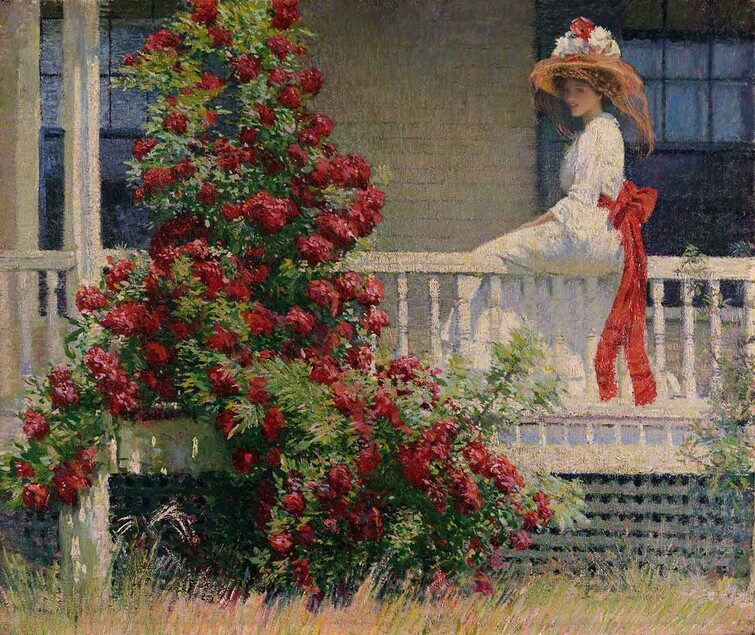
According to Glisson, the two paintings he selected to bookend the exhibition – The Crimson Rambler and The Hovel and the Skyscraper – sum up what the show is all about on a conceptual level. He explains, “Philip Leslie Hale’s painting shows a red rose bush, the Crimson Rambler, a common and hardy backyard plant paired with a woman wearing a wide-brimmed hat and dressed a la mode. I think Hale intends them to read as analogous to each other – she is on display like a beautiful flower; it may be a cliché metaphor but it’s still pretty effective. Both the woman and the newly hybridized rose are modern and contemporary for their time. Similarly, the painting technique used a modern application of colors.”

“When I talk to people about the exhibit I like to say that these are painters who are reflecting on modern American life in the late 19th and early 20th century, post industrialization and during urbanization. They painted landscapes that offer respite from the grunge of the city, an escape. The Crimson Rambler is a subtle rendering of this sentiment,” Glisson says further.   

Philip Leslie Hale’s ‘The Crimson Rambler | Photo courtesy of The Huntington

Glisson then points out, “Childe Hassam’s painting, on the other hand, is an explicit depiction of the time’s attitude. The Hovel and the Skyscraper looks out of the artist’s studio into Central Park. He delivers the message in his paint application – very precise with a lot of rectilinears; and the subject matter – a tall building. In 1904 New York’s skyscrapers were the epitome of an advanced, modern American city.  It resonated among its viewers in the same way we see the skyscrapers of Dubai or Shanghai. Yet, he painted the park as soft, gentle and beautiful, with no straight lines – a space of quiet, refuge and nature.”

“I see this painting as something that speaks to Angelenos and the real estate market; his views are about to be blocked by brand new buildings. It alludes to today’s teardown phenomenon where existing structures are being replaced by bigger, taller ones to  make a lot more money,” Glisson adds.

In the late 19th century, the railroad made it possible for Americans to conveniently travel from their suburban home into the city to work. In the same vein, painters commuted whenever they had to and their artwork reflected that lifestyle. Describes Glisson, “Painters at the time depicted what was near and familiar to them, which also happened to be really modern at the time.”

One piece of art in the show is by John Henry Twachtman, a member of the new suburban class who lived in southern Connecticut close to the railroad. His piece, called Snow, depicts his backyard covered in snow. Though not a farmer, he lavished great care on his yard.    

The exhibition also includes some of The Huntington’s collection of 150,000 chromo lithographs gifted by Jay T. Last. Chromolithography was a process used by artists of this period to produce illustrations for newspapers and magazines to make money. It was also widely used to advertise the new colors of hybridized roses, like the Crimson Rambler, and to create the seed packets for flowers being grown by Americans who have discovered backyard planting as a middle class leisure pursuit. 

The San Marino institution is the show’s only West Coast stop on a five-venue tour organized by Anna Marley, Curator of Historical Art at PAFA. She explains the rationale, “The Huntington, with its spectacular gardens and wonderful American art collection is the perfect venue for a show that traces the interconnections between the American garden movement and Impressionist painting. Also, the development of the Pasadena bungalow culture at the turn of the 20th century corresponds perfectly to the material in the exhibition, which was related to the broader national garden cities and British Arts and Crafts movement.”

“I hope visitors to The Huntington make the connections between their own homes and gardens and the lives of American artists living and working over 100 years ago. I hope they love the art but also take away a new-found knowledge of the history of the Progressive era in the United States, and particularly its relationship to the burgeoning movements of environmentalism and women’s suffrage, issues with great resonance today,” Marley concludes.

The historic gardens at The Huntington, an estate which once belonged to collectors and philanthropists Henry E. Huntington and his wife, Arabella, is planted with 1,400 varieties of roses artfully perched on arbors and trellises. It is easy to imagine how Arabella took delight in the magnificent blooms in her rose garden, and how 21st century women are experiencing the same to this day.        

Alex Israel’s Contemporary Ouvre at The Huntington Art Gallery

Originally published on 16 January 2016 in the Pasadena Independent, Arcadia Weekly, Monrovia Weekly, and Sierra Madre Weekly

The Blue Boy by Thomas Gainsborough is so representative of The Huntington (Library, Art Collections and Botanical Garden) in San Marino that it is usually the first piece of art people seek out when they tour the gallery.   

Visitors to the venerable San Marino landmark will either find it delightfully amusing or downright shocking when they see this iconic painting juxtaposed to a decidedly modern selfie of contemporary artist, Alex Israel, wearing a Dodger’s blue jacket. A year in the planning, this art intervention of works by Alex Israel opened to the public on December 12, 2015 and will be on view until July 11, 2016. 

Kevin Salatino, Director of the Art Collections at The Huntington, says, “Not everyone would associate us with contemporary art, but we live in the 21st century so we should engage with all that’s 21st century. People think this mansion must have been exactly what it looked like when the Huntingtons were here, which is so far from the truth; it is not a static house. But there is a certain consistency to the kind of Gilded Age material that we continue to collect that complement what the Huntingtons had.”

It may surprise many to know that The Huntington has done the occasional contemporary intervention before now. Catherine Hess, Chief Curator of European Art, relates, “Our first intervention was a Ricky Swallow sculptures and Lesley Vance paintings exhibition in a small upstairs gallery.  It was the beginning of the earthquake and we got our constituents through that.” 

The decision to approach Alex Israel this time around was Salatino’s idea. He explains, “I have known Alex and have watched his career flourish. He loves L.A. and its iconography, the Hollywood dream machine, and fantasy. And so much about The Huntington is really about fantasy. About a year ago, Alex looked at the house and thought about his pre-existing work to decide which objects are right for The Huntington.

Our goal is to create a dialogue between the old and the new; we want people to see the old through the lens of the new, and vice-versa. Some people might react positively but some might respond negatively, but that would be better than for them not to think at all,” Salatino concludes.

Hess interjects, “One of the biggest surprises, at least in my perspective, after the installation was complete, was how some traditional Masters pieces were remarkably informed by the juxtaposition of Alex’s art, and the reverse. His work, in a vacuum, can read a certain way, but placed in this context, makes it compelling. I’m hoping people will also see it that way.”

Continues Salatino, “This contemporary installation is meant to be engaging, provocative, interesting. Then it goes away and we’ll do another one in a few years. A really good reason for having Alex’s work here is that he has a love affair with this area. It was much the same for Henry Huntington who fell in love with it after he visited. He initially thought he would buy the land and divide it up, but eventually decided to keep it. It was one of the first Beaux Arts residences and was the largest house for miles around until it was supplanted by Aaron Spelling’s mansion in West Hollywood. Alex grew up in the Holmby Park circle, looking up at Spelling’s house.”

The culture of Hollywood and celebrity is very much the central theme in Alex Israel’s oeuvre. Sprinkled throughout The Huntington are paintings, murals and sculptures that reference famous movies or icons from memorable films. It is a veritable scavenger hunt for visitors to the Art Gallery as they find contemporary pieces that have been placed alongside traditional art objects. 

There is the crystal egg on a mantelpiece that was an iconic piece from the 1983 coming-of-age Tom Cruise film Risky Business, for instance. In another gallery, a cleverly concealed bronze prop will undoubtedly cause visitors to do a double-take at one of the most recognizable 1941 Maltese Falcon prop. In the ceramics study room, Alex displayed a mold of an Oscar statuette – the very quintessence of Hollywood and celebrity.

The most dramatic of Alex’s installation is the transformation of the staircase where a fragmented sky backdrop mural bursts. Enthuses Salatino, “It is an Aha! moment – with drama and theatricality in a way that is not intrusive but complementary.  It’s stunningly beautiful and it looks like it’s been there forever. It’s deliberately titled backdrop because it is a backdrop for films. It serves as one for every visitor as if each were an actor in a film.”

During the holiday season The Huntington’s Christmas tree stood in this area, which Alex decorated with his self-portrait in miniature. It isn’t an ego-trip but a celebration of celebrity.   

Alex likens today’s selfies to the Grand Manor portraits of the early 19th century. His Dodger blue-jacketed selfie isn’t meant to be tongue-in-cheek – rather, it is his homage to The Blue Boy. Hopefully, art enthusiasts appreciate it as such.