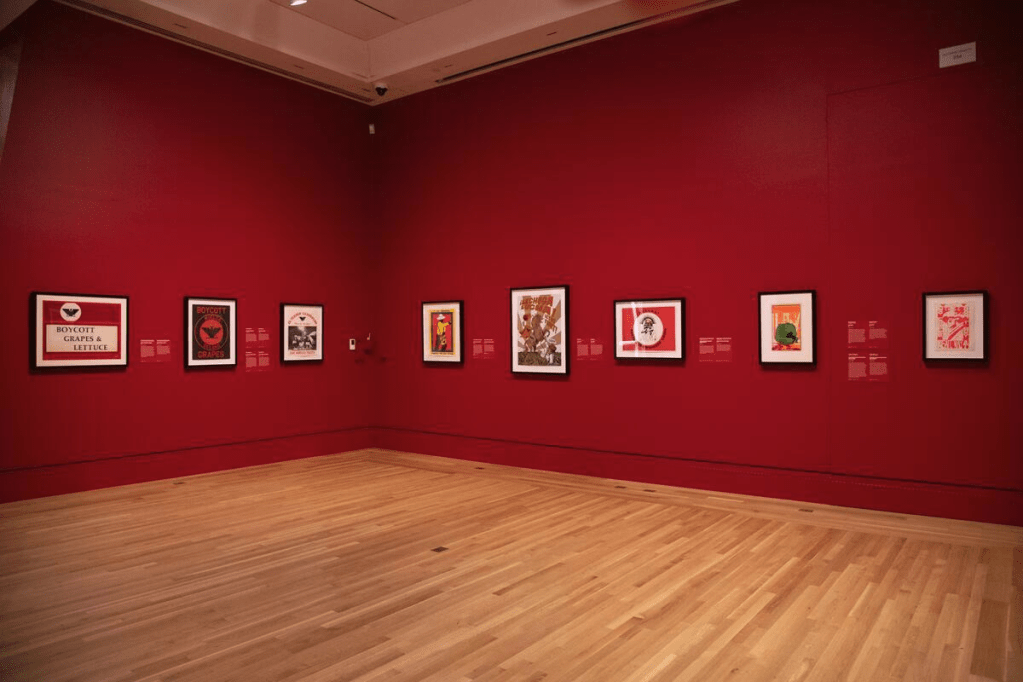
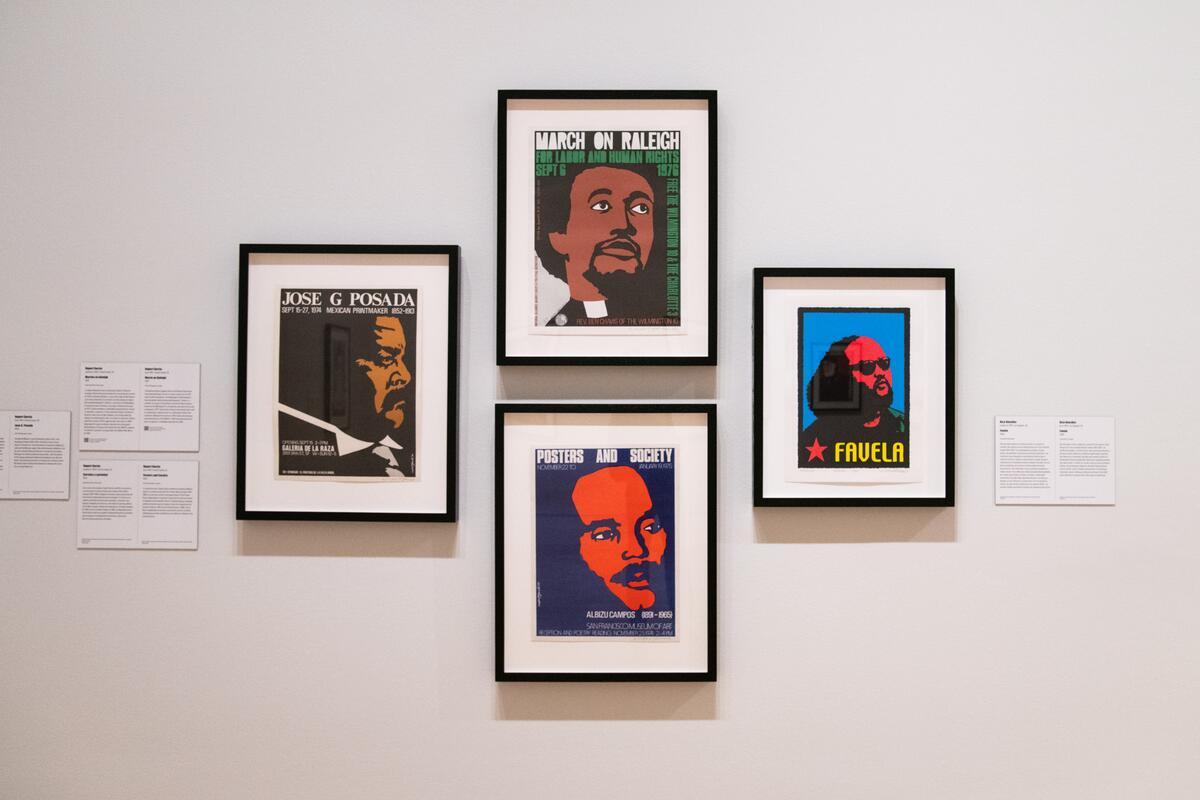
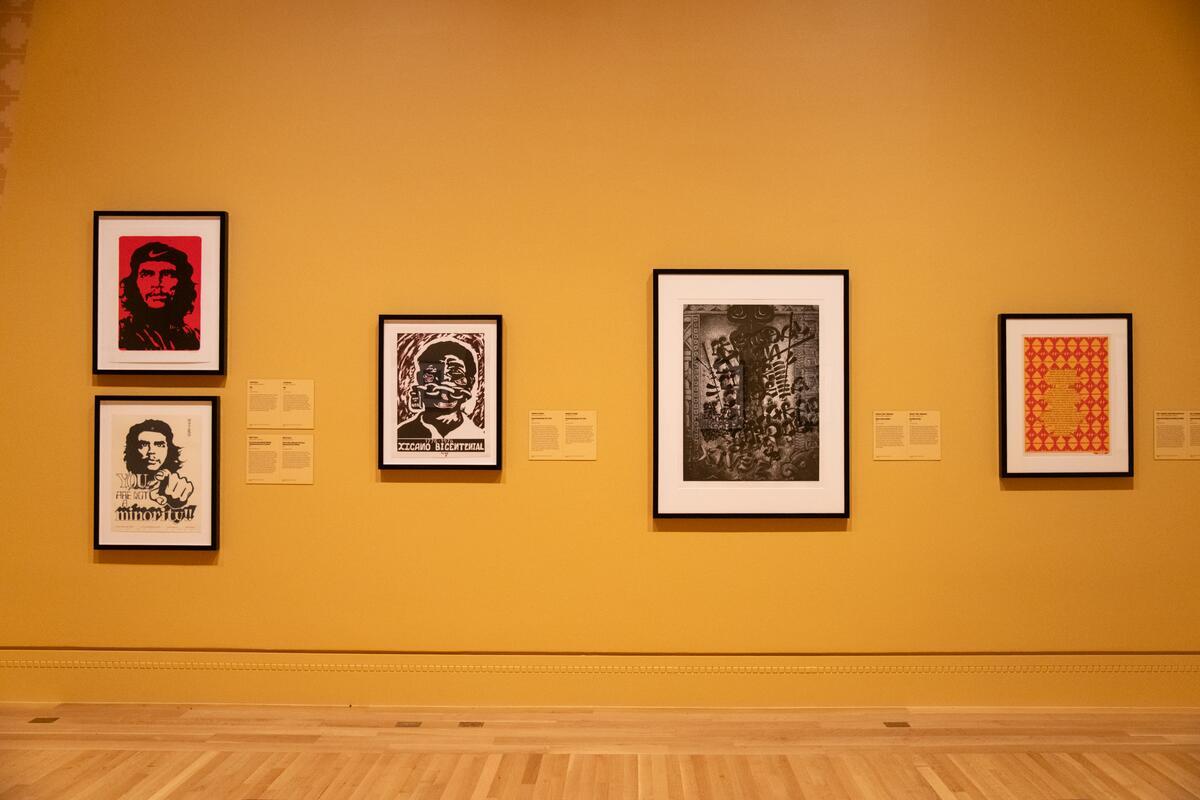
“Radical Histories: Chicano Prints from the Smithsonian American Art Museum,” makes its West Coast debut at The Huntington’s Marylou and George Boone Gallery from Nov. 16 to March 2. Curated by E. Carmen Ramos, forming acting chief curator and curator of Latinx art at the Smithsonian American Art Museum, the exhibition features 60 dynamic works by nearly 40 artists and collectives that trace more than six decades of Chicano printing as a form of resistance, community building and cultural reclamation.
Commencing with the late 1960s Delano Grape Strike, the precursor to the United Farm Workers (UFW) labor union, the prints in “Radical Histories” depict momentous events in the history of community activism and the formation of collective identity. Chicano artists used silkscreens, posters, and offset prints to mobilize communities – often with barbed wit, lively colors, and evident urgency.
The exhibition is arranged in five thematic sections: “Together We Fight,” “¡Guerra No!” (No War!), “Violent Divisions,” “Rethinking América,” and “Changemakers.” Each section highlights how Chicano artists have used the accessible and reproducible medium of printmaking to confront injustice, affirm cultural identity, and engage in transformative storytelling.
Installation photo courtesy of The Huntington
Section 1: Together We Fight
The opening section explores how the UFW, cofounded by César Chávez and Dolores Huerta, collaborated with visual and performance artists to support the fight for farmworkers’ rights. Key labor actions inspired a wave of Chicano art that functioned as both political expression and tangible solidarity. Artists adopted the UFW’s iconic black eagle, embedding it in posters, prints, and murals that raised awareness and helped fund the movement. The union’s visual language extended beyond its own campaigns, appearing in advocacy materials for the Texas Farm Workers Union and the Cannery Workers Committee in Sacramento.
Section 2: ¡Guerra No! (No War!)
Since the 1960s, Chicano graphic art has played a vital role in advancing antiwar resistance. These works serve as rallying cries, counternarratives to mainstream media, and spaces of reflection. Chicano artists have used print and poster art to critically examine U.S. military interventions in Vietnam, El Salvador, Chile, Iraq, and elsewhere.
Section 3: Violent Divisions
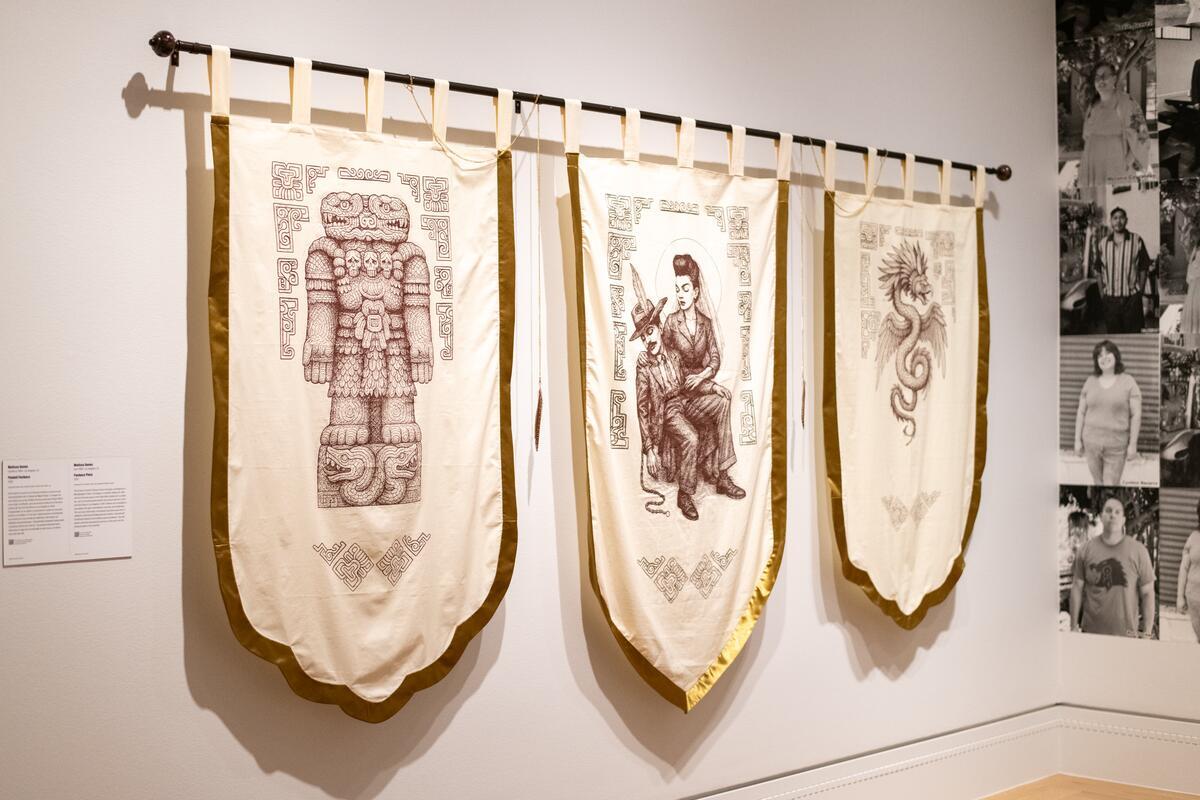
The U.S.-Mexico border has been a central theme in Chicano art. Printmaking has enabled Chicano artists to raise awareness about the experiences of immigrant communities because it is affordable and prints are easily distributed. Recurring iconography – such as the monarch butterfly, a symbol of natural migration – challenges the notion of geopolitical boundaries. Figures like the Virgin of Guadalupe and ancient Mesoamerican goddesses appear as powerful cultural symbols.
Section 4: Rethinking América
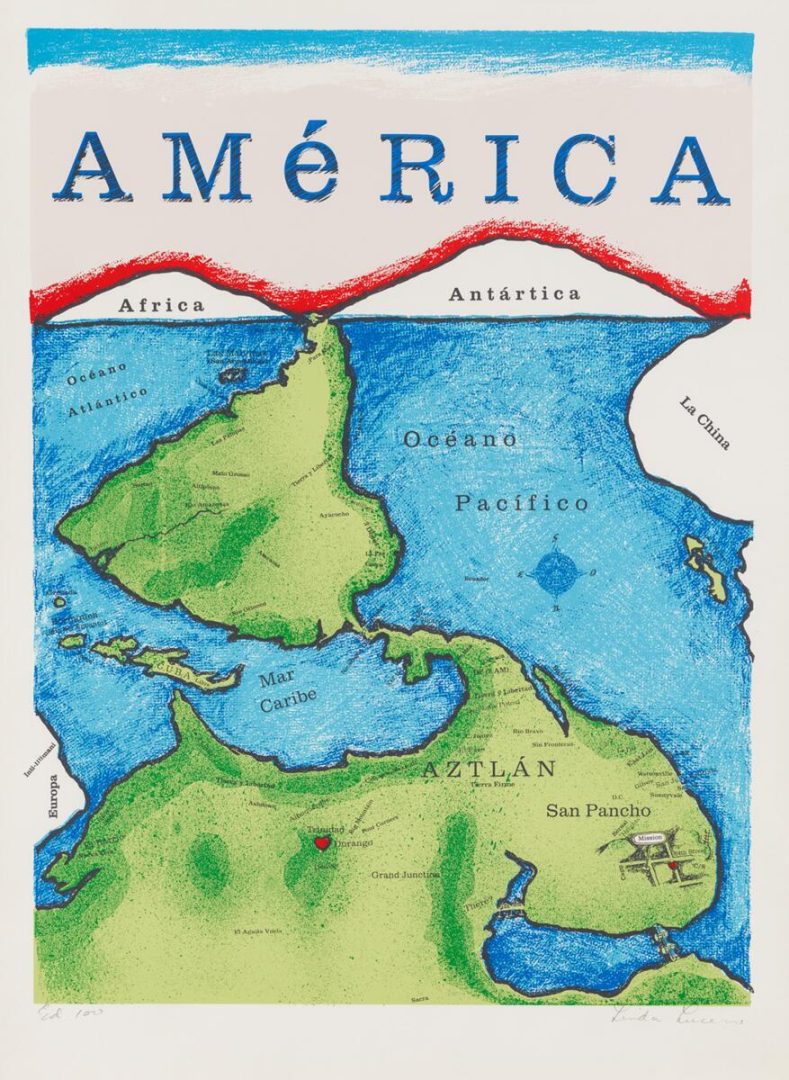
This section presents works that broaden historical narratives by including perspectives rooted in resistance and cultural reclamation. The artists drew inspiration from revolutionary figures and movements to create narratives that center Mexican American and Indigenous perspectives. Using mapmaking and record forms like the ancient Mesoamerican codex, Chicano artists also created speculative past and present narratives to reimagine social landscapes.
Linda Zamora Lucero, América, 1986, screenprint on paper, Smithsonian American Art Museum, Gift of Gilberto Cardenas and Dolores Garcia. | Photo courtesy of The Huntington
Section 5: Changemakers
Portraiture is a cornerstone of Chicano art, used to educate audiences and celebrate both cultural icons and overlooked figures. Artists often base their portraits on documentary photographs, transforming black-and-white images into vivid prints that honor the subject’s life and legacy. Featured changemakers include political prisoners, activist leaders, attorneys, actors, and artists—individuals who challenged the status quo and shaped history.
By email, Dennis Carr, Virginia Steele Scott Chief Curator of American art, and Angélica Becerra, Bradford and Christine Mishler Associate Curator of American Art – also the venue curators – discuss the exhibition’s origins, its relevance, and viewer takeaways.
“Radical Histories was organized by the Smithsonian American Art Museum to highlight the central role Chicano artists have played in shaping American visual culture,” begins Carr. “The exhibition began touring nationally in 2022 following its debut at the Smithsonian American Art Museum, and The Huntington is presenting its first West Coast exhibition.”
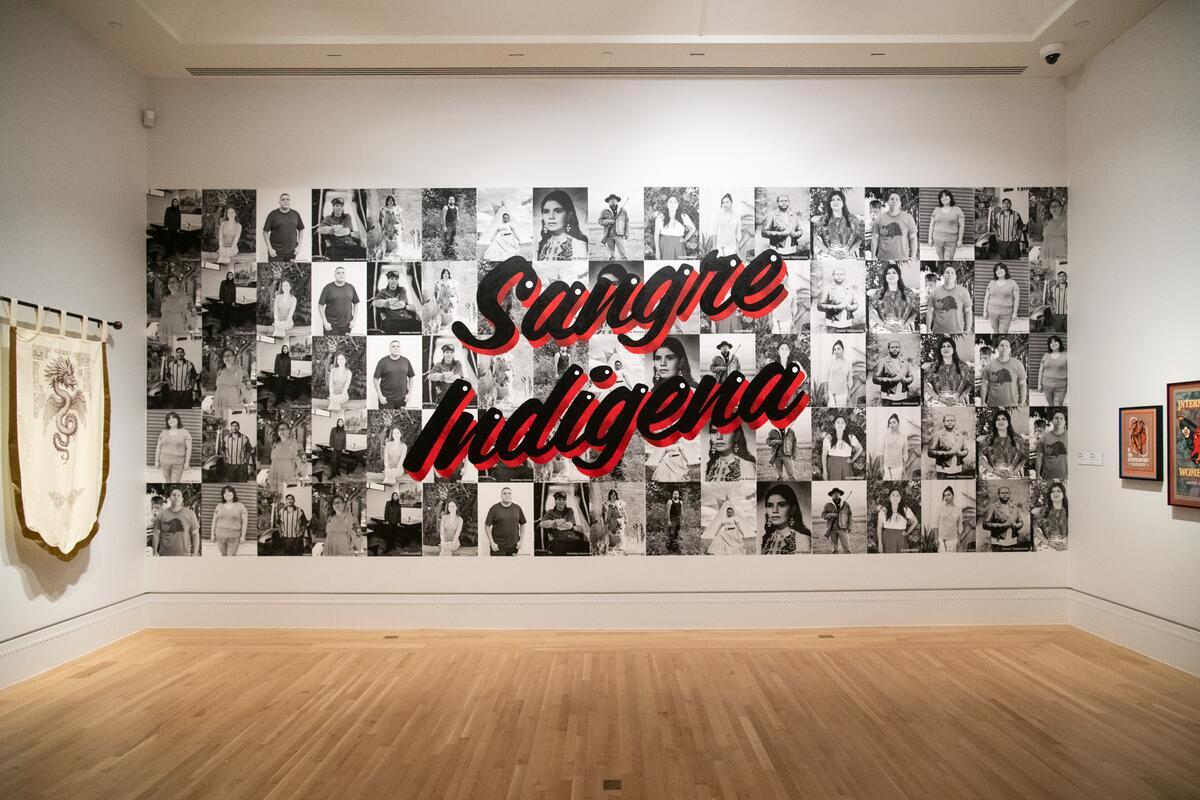
“While the core exhibition is drawn from SAAM’s collection, our presentation places particular emphasis on Los Angeles as a vital center of Chicano printmaking,” Carr clarifies. “To honor that history, The Huntington commissioned a new mural by Los Angeles–based artist Melissa Govea, created in collaboration with Self Help Graphics & Art, a community print studio that has supported Chicanx and Latinx artists since 1973.”
Melissa Govea’s mural. | Photo courtesy of The Huntington
“Through this partnership, we commissioned Melissa Govea, a Los Angeles–based artist who is Chicana and Purépecha,” explains Carr. “Govea began her career as a muralist and is known for work that honors community, ancestry, and cultural memory. Rather than giving her a specific direction, we invited her to respond to the themes of the exhibition. The result is a dedicated gallery featuring a new mural, a sculptural installation, and print-based works that together reflect multiple dimensions of her practice. This marks the first time her work has been presented in a museum context.
“Her mural, titled ‘Sangre Indígena’ (Indigenous Blood), draws on portraits of friends, collaborators, and cultural leaders who have shaped her life. The work recognizes the generations of artists, organizers, and knowledge-keepers who came before her, while affirming the presence, agency, and creativity of those shaping Los Angeles today.”
Installation Photo courtesy of The Huntington
It would be an oversimplification to say how many works in the exhibition are from L.A. artists, as Becerra explains.
“Many artists in ‘Radical Histories’ have deep ties to Los Angeles, whether they lived, studied, printed, organized, or collaborated here. The most meaningful connection is through Self Help Graphics & Art, which offered open studio access, mentorship, and a collaborative printmaking environment to generations of Chicano and Latinx artists.
“Artists such as Barbara Carrasco and Ernesto Yerena Montejano continue to live and work in L.A., and their practices remain rooted in local community networks. So rather than thinking in terms of birthplace alone, it’s more accurate to say that Los Angeles is one of the central homes of Chicano printmaking, and the exhibition reflects that history.”
Installation photo courtesy of The Huntington
Asked if the exhibition has taken greater meaning now with ICE raids targeting Hispanic communities and looking Hispanic or Latino is enough to get one handcuffed and thrown into a detention camp, Becerra replies, “The themes in ‘Radical Histories’ are both longstanding and timely. Chicano printmakers have historically used posters and prints to address labor injustice, state violence, displacement, and the struggle for belonging – issues that continue to resonate today.”
Becerra says further, “What museums like The Huntington can offer is space: a place to look closely, process, reflect, and connect personal experience to shared history. These works remind us that art has always been a tool of community care and resistance.”
As for the viewer takeway, Carr states, “We hope visitors come away with a deeper understanding of how Chicano artists have used printmaking to organize, to tell stories, to build community, and to assert cultural identity. And we hope they see that art is not separate from daily life – it is a tool for resilience and collective meaning-making.”
“In addition to the exhibition itself, The Huntington will host public programs, bilingual gallery talks, and hands-on workshops in collaboration with local artists and partners,” adds Carr. “A major highlight will be Historias Radicales: Latinx Identity and History in Southern California, a two-day conference on December 5–6, connecting the exhibition to The Huntington’s co
A work in The Huntington’s new exhibition is by Janet Harvey Kelman, “Stories from Chaucer Told to the Children” with pictures by W. Heath Robinson, London: T.C. and E.C. Jack, 1906, gift from Donald Green. | Image courtesy of The Huntington
The Huntington Library is renowned for several iconic pieces — the Gutenberg Bible, the Ellesmere Chaucer manuscript, and Shakespeare’s Folio, to name just a few. Visitors expect to see them individually at their usual spot.
Soon these exceptional items will be displayed at The Huntington Mansion alongside other important objects that reveal surprising connections and untold stories in a series called “Stories from the Library.” The inaugural show, on view from June 21 through Dec. 1, will feature Geoffrey Chaucer’s “Canterbury Tales” and later iterations of the work, and the visionary figures who shaped Los Angeles.
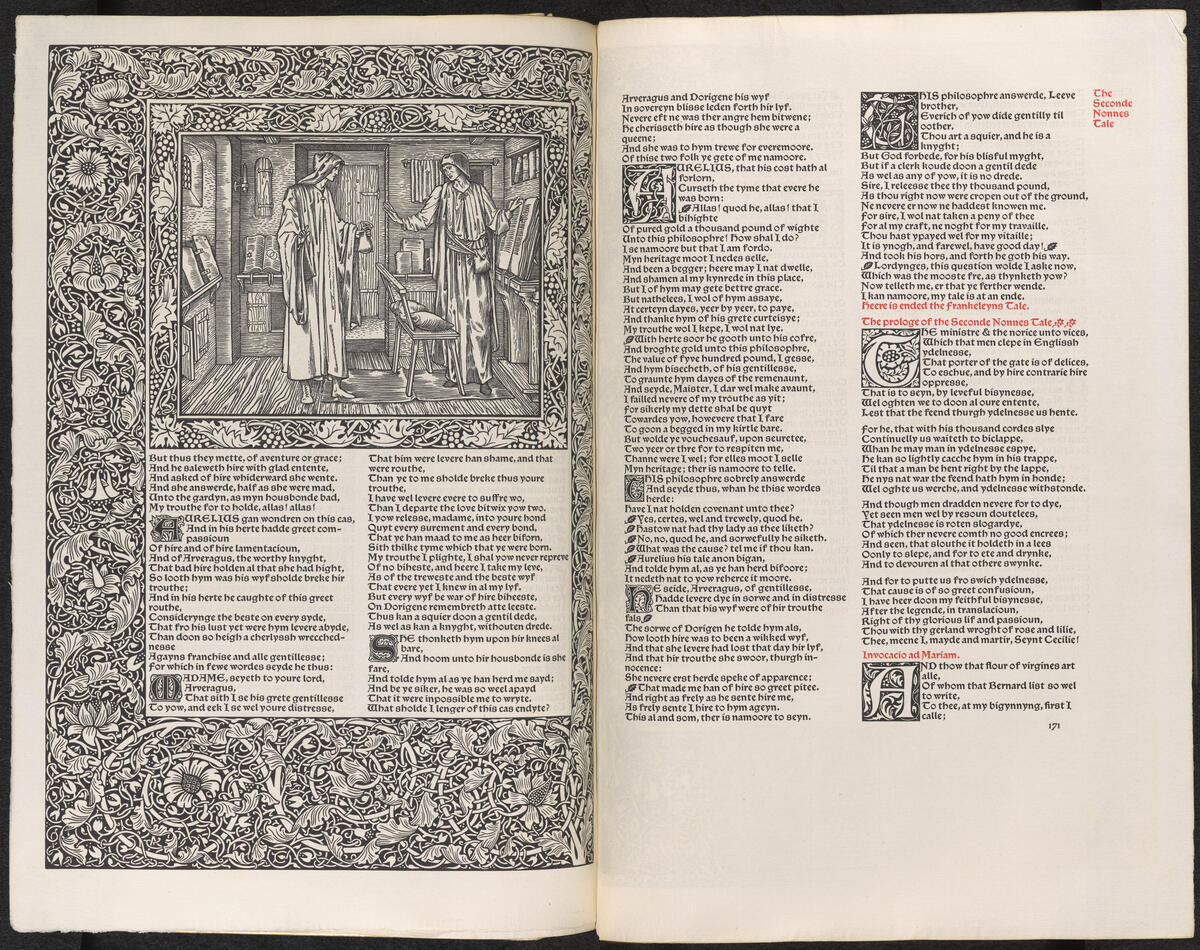
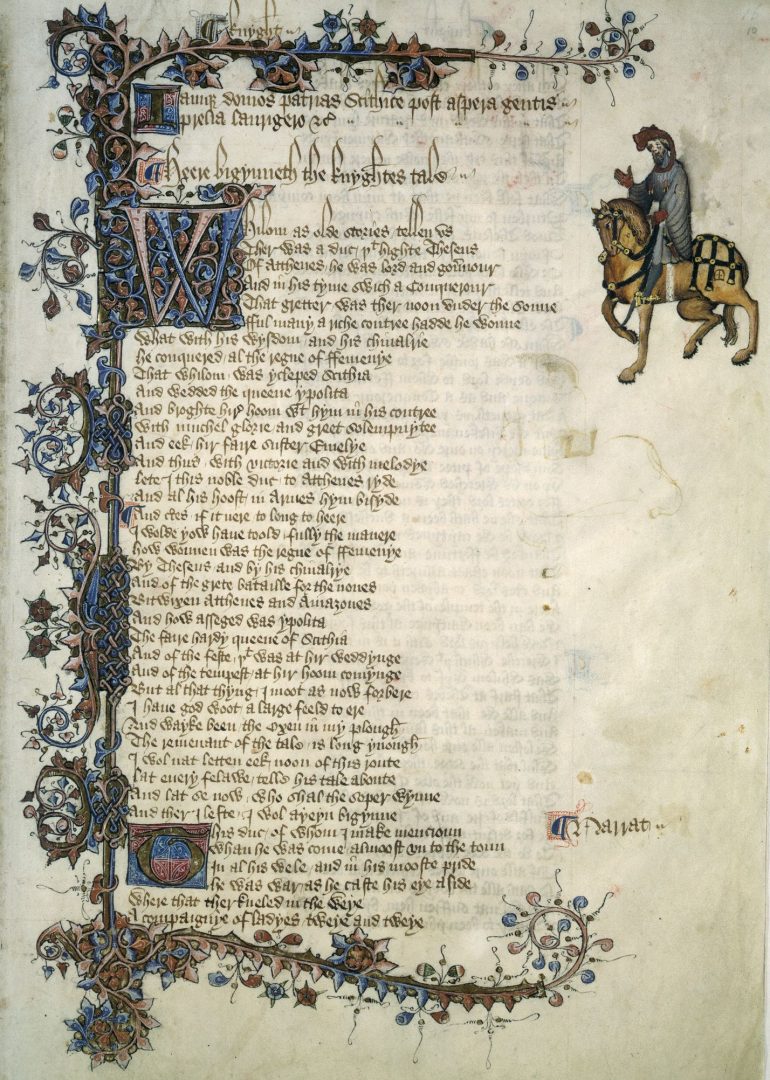
“The Tales Through Time” commences with The Huntington’s Ellesmere Chaucer manuscript, an elaborately decorated work created between 1400 and 1405. The most complete and authoritative version, it is presented together with later iterations of the work to illustrate how creators like writers, artists and printers — collectively and individually — changed the tales textually and visually over five centuries of retellings.
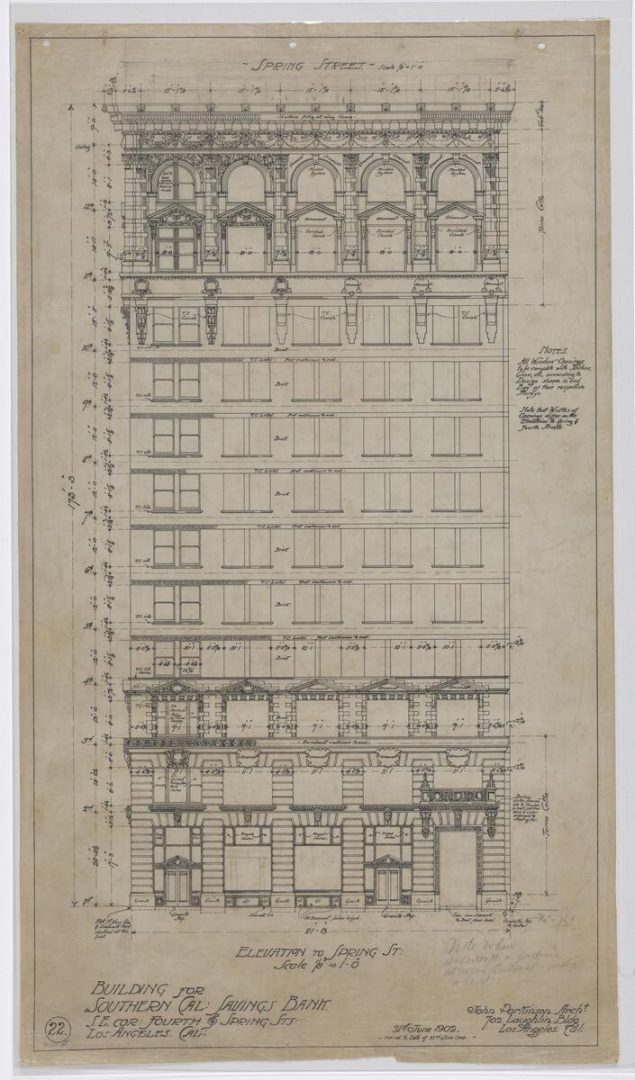
“Los Angeles, Revisited” explores ways in which architects, planners, business owners, and activists have contended with a constantly evolving city like Los Angeles. The show is anchored by the 1902 design plans for L.A.’s first skyscraper Braly Block, conceived by architect John Parkinson.
Sandra Brooke Gordon, the director of the library, states, “Drawn from across the library’s vast holdings, each rotation in this series centers on a single item making a star turn — a destination object — placed in conversation with other selections. These exhibitions highlight the interrelatedness, beauty, and power of the library’s collection of approximately 12 million items, while encouraging visitors to make new and inspired connections.”
Vanessa Wilkie, senior curator of medieval manuscripts and British history and head of library curatorial, and Steve Tabor, curator of rare books, co-curated “The Tales through Time.” By email, Wilkie talks about how the series originated, how they prepared the exhibition, and what she hopes visitors take away from it.
“While the mansion was built first, Henry Huntington had the Library constructed beginning around 1919, relatively early in his collecting,” Wilkie says. “So in a sense, he always envisioned that his library collections would be displayed independently of his other collections. I’ve always appreciated this idea — that books, archival documents, photographs, prints, and manuscripts deserved their own celebrated space.”
Just as necessity is the mother of invention, complications engender improvisations, as Wilkie discloses. “When the institution decided it was time to end the long run of the library’s Main Hall exhibition, ‘Remarkable Works-Remarkable Times,’ we were all committed to keeping library collections on view with the understanding that we logistically couldn’t take down an exhibit and have an exhibit in the same space. We saw this logistical challenge as an opportunity!
“The Art Museum generously offered to open two gallery spaces to the library. It was an obvious choice to put library collections in the historic ‘Large Library’ but our collections contain over millions of flat works — like photographs, architectural drawings, maps, and drawings. The Large Library doesn’t allow for anything to be hung on the wall, so the Focus Gallery was offered as a second location to showcase more of our collections … to tell more stories from the library.
“The Works of Geoffrey Chaucer,” Hammersmith: Kelmscott Press, 1896, from the Sanford and Helen Berger Collection. | Image courtesy of The Huntington
“Curators immediately saw this as an opportunity for unexpected pairings of exhibits, which made us all the more eager to think in unexpected ways,” continues Wilkie. “We are mindful that visitors always love to see some favorite pieces, like the Gutenberg Bible and the writings of Octavia Butler, and we envisioned this exhibition series as an occasion to bring in some of those beloved hits while also giving visitors a chance to get to know other parts of our magnificent collections. Our hope is that people come to see what they already love but leave thinking about a favorite piece in a new way or, better yet, having seen something they never expected!”
Asked what motivated their decision to center the exhibit around Geoffrey Chaucer’s The Canterbury Tales, Wilkie replies, “The Ellesmere Chaucer is one of The Huntington’s most famous manuscripts; it is gorgeous, but it is also perhaps the most influential work in the English-speaking world. ‘Stories From the Library’ is a rotating exhibition series that does something new for our collections, so we liked the idea of starting with a book people already know quite well and framing it in a completely different way than how visitors have seen it over the past twelve years. We actively chose not to think about ‘The Canterbury Tales’ in a singular historical context but rather wanted to think about how the Ellesmere Chaucer brought individual tales together and then what the visual and textual trajectories for those tales were.”
While the sheer number of items in the library’s collection could have posed a challenge when deciding which piece to showcase in the inaugural exhibition, the curators knew exactly what to launch with.
“Beginning with ‘The Canterbury Tales’ gave us a fairly focused starting point, and then we just followed the pilgrims through our collections!” declares Wilkie. “We have some 15th century manuscripts with copies of individual tales, so we plotted those through time and then narrowed back down when we realized our collections could easily fill multiple galleries.”
“The Chaucer display is paired with ‘Los Angeles, Revisited,’ an exhibition about the shifting real and imagined landscapes in L.A.,” Wilkie explains. “No other place in the world could offer that pairing with these stellar pieces; it is the past and present colliding in spectacular ways! When curators are thinking about exhibitions in this series, we’re also thinking about how they’ll be paired and recognize that their sum is greater than their individual parts — although their individual parts are also pretty special.”
The Ellesmere Chaucer manuscript. | Image courtesy of The Huntington
Visitors to The Huntington can expect to see “Stories from the Library” for a while.
“We anticipate the series running for three or four years and have paired-exhibitions planned that can take us far beyond that,” discloses Wilkie. “Each exhibition will run for six months, but we’ll turn pages or swap out entire pieces at the three-month mark. Library materials are extremely sensitive to light, so while we want to keep exhibits up to give visitors a chance to see them, we also need to be mindful of the physical needs and constraints of fragile collections.”
“Most people are introduced to ‘The Canterbury Tales’ as a singular canonical text, but this exhibition is a chance for people to break it down and see how it has changed, or not changed, over the centuries,” Wilkie says. “That also demonstrates how unstable the concept of a canonical work really is. Throughout the series, we hope people will be invigorated by seeing beloved favorites alongside never-before-exhibited items, in spaces they don’t typically see library collections. Change isn’t easy, but it can also give us a fresh perspective.”
“Los Angeles, Revisited” is curated by Erin Chase, the library’s associate curator of architecture and photography. She discusses the anchor piece of the exhibition, what other materials will accompany it, how she planned the show, and the visitor takeaway.
John Parkinson, architect, Building for Southern California Savings Bank (Braly Block), elevation to Spring Street, 1902, ink on tracing cloth. | Image courtesy of The Huntington
“The 1902 design plans for L.A.’s first skyscraper is part of a larger recent acquisition made by the Huntington which is the archive of the architecture firm of John and Donald Parkinson,” Chase begins. “It has never been shown in a museum or library before so it’s very exciting to be able to show it to the public.
“Also included in the exhibition is a variety of materials from across the Huntington’s library collections,” adds Chase. “Everything from an 1888 early birds-eye-view map of East Los Angeles to architectural drawings of iconic L.A. buildings like the Braly Block and Googies coffee shop, to historical and contemporary photographs and manuscripts by literary figures such as Eve Babitz and Christopher Isherwood.”
Explains Chase, “This is a small jewel-box exhibition with a hefty theme so striking the right balance was important. Los Angeles lacks the centrality and layout of most traditional American cities and it’s what makes us unique. I wanted to celebrate the city and the visionaries who believed in its promise, but it was also important to address some darker parts of our past including redevelopment and the displacement of families as a result. Additionally, L.A. has always served as an unwitting muse for artists. So it was important to include people like Ed Ruscha and Gusmano Cesaretti who have helped us make sense of our urban landscape from a visual perspective.
“I hope visitors get a deeper understanding of some of the issues architects, planners, business owners, residents, and activists contended with in the 20th century,” Chase says. “L.A. grew rapidly between 1900 and 1950 and this exhibition just begins to touch on major issues that have impacted the urban landscape such as architecture, transportation, and redevelopment. Most of all, I hope they enjoy seeing some of the extraordinary drawings and photographs from the Huntington’s archives up close. Many of these have never been on view before, so this is a great opportunity to catch them.”
“Stories from the Library” will be an eye-opener for many of us who have not fully appreciated the expanse and significance of The Huntington Library’s holdings. Until now the drawing of the groundbreaking Braly Block has never been displayed in an exhibition. It’s going to be so much fun to discover what surprise each show brings.
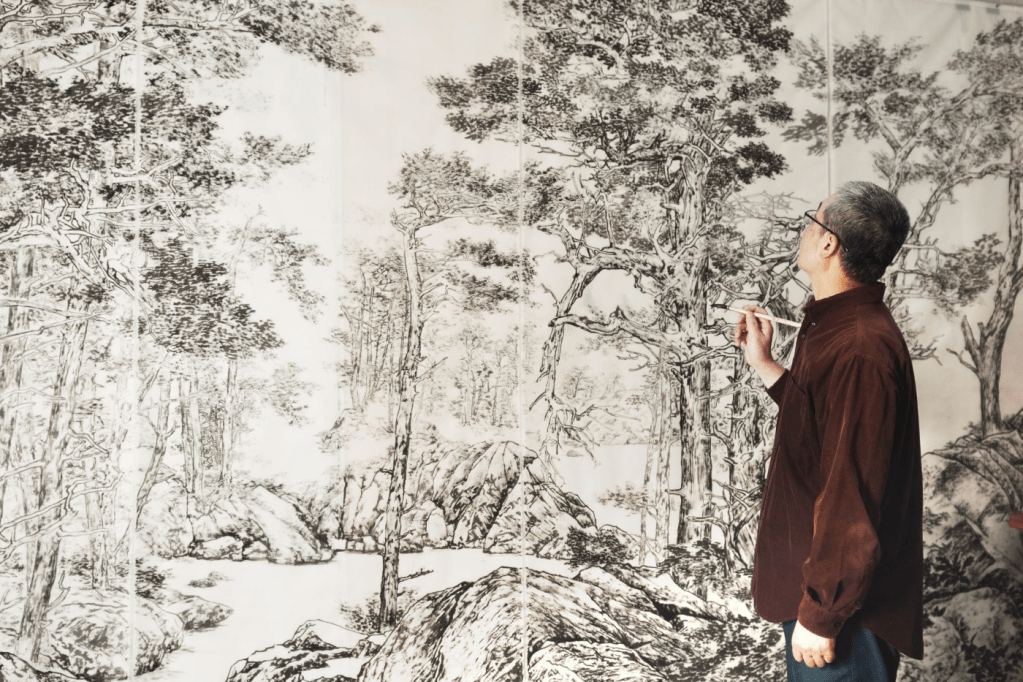
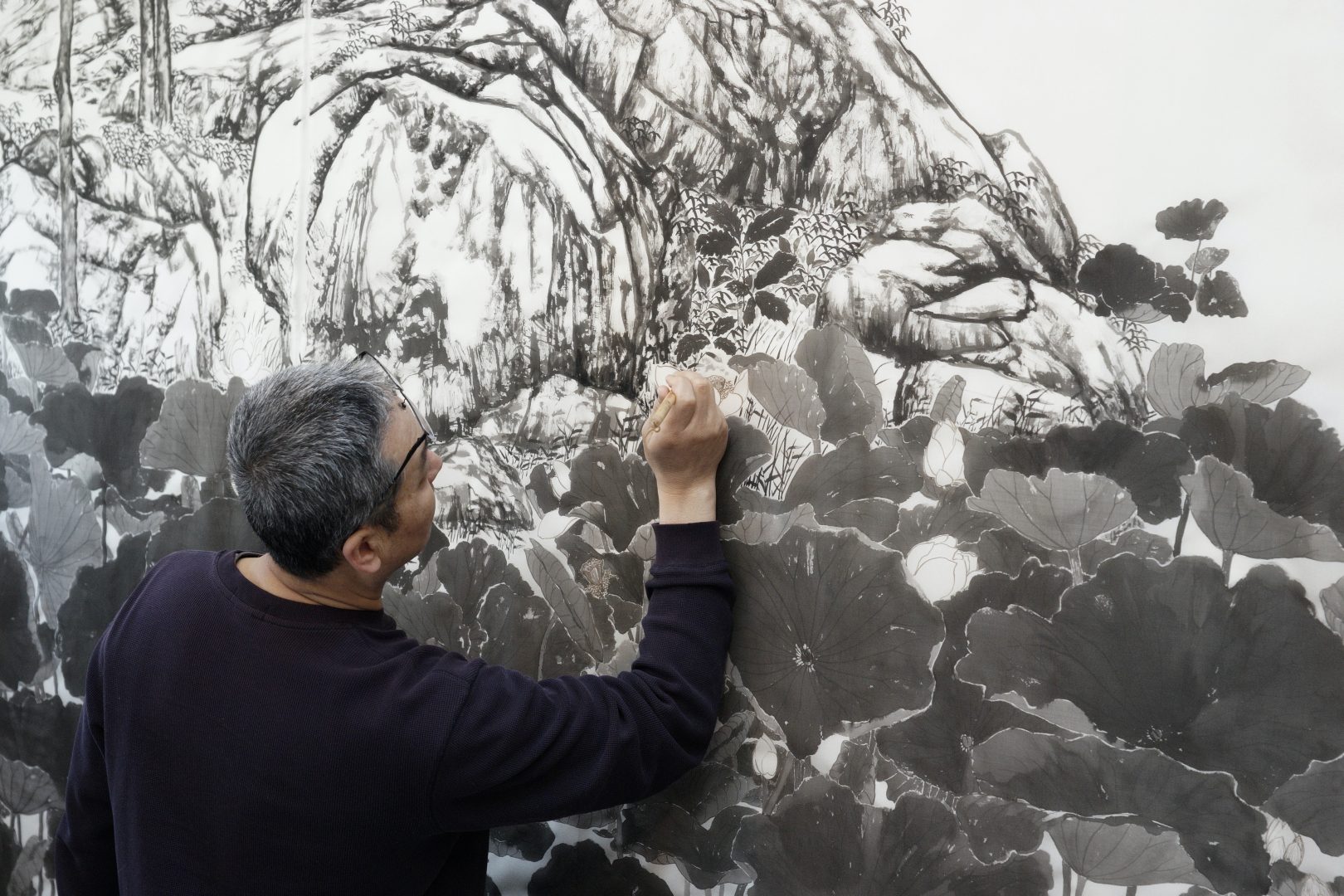
Mansheng Wang works on “Without Us.” | Photo courtesy of Mansheng Wang/The Huntington
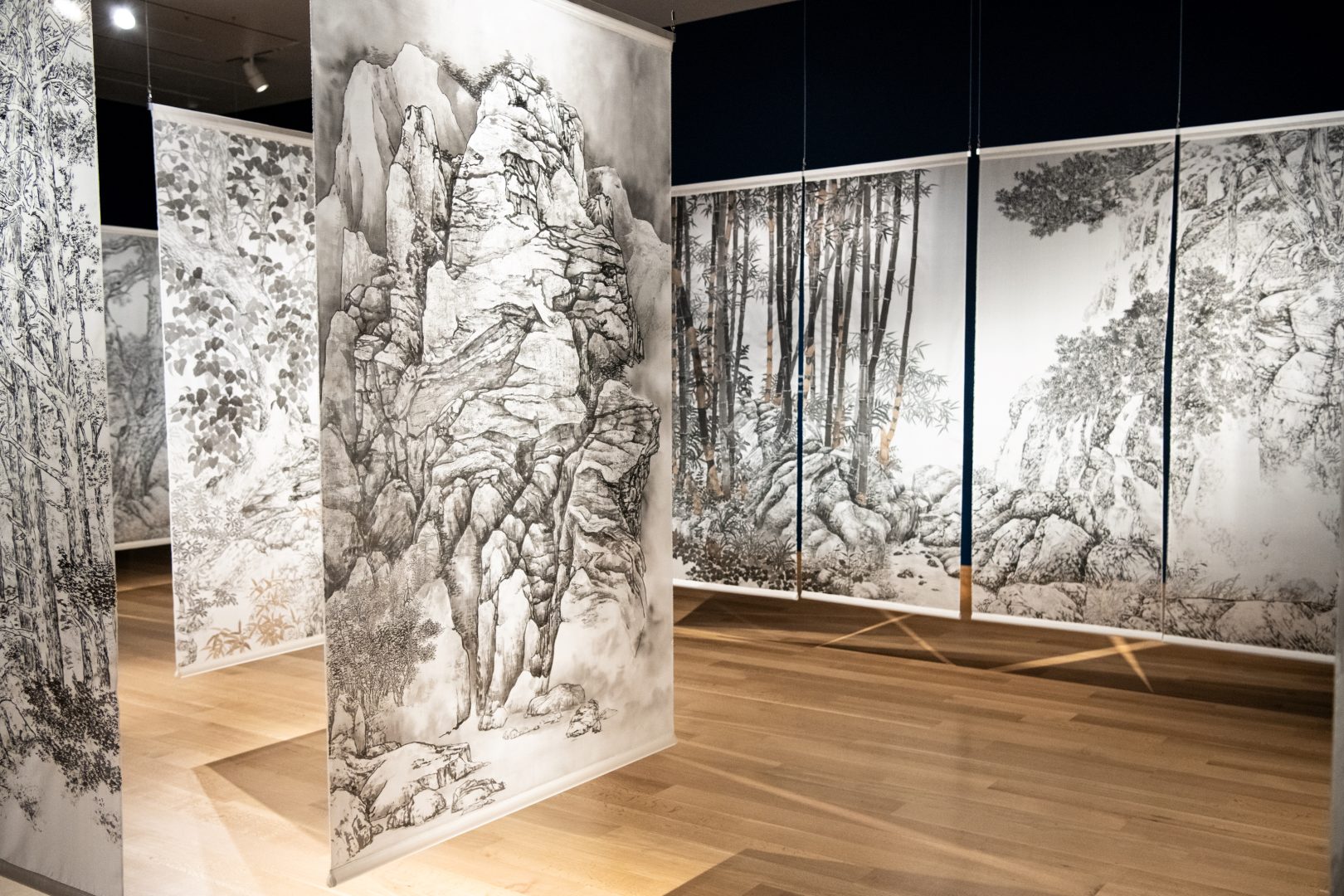
“Wang Mansheng: Without Us,” an immersive installation that explores the interconnections between humans, flora, and fauna through contemporary art and classical concepts of nature, unveiled at The Huntington on May 17. On view through Aug. 4, 2025 in the Studio for Lodging the Mind 寓意齋 – a gallery within The Huntington’s renowned Chinese Garden – the exhibition features 22 hand-painted delicate silk panels that invite visitors to enter a luminous, meditative landscape.
Created by Mansheng Wang, the 2025 Cheng Family Foundation Visiting Artist in the Chinese Garden, the paintings in traditional and black walnut ink depict intricate scenes of trees, rocks, water, and other natural elements – some inspired by The Huntington’s Chinese Garden, Liu Fang Yuan 流芳園, the Garden of Flowing Fragrance.
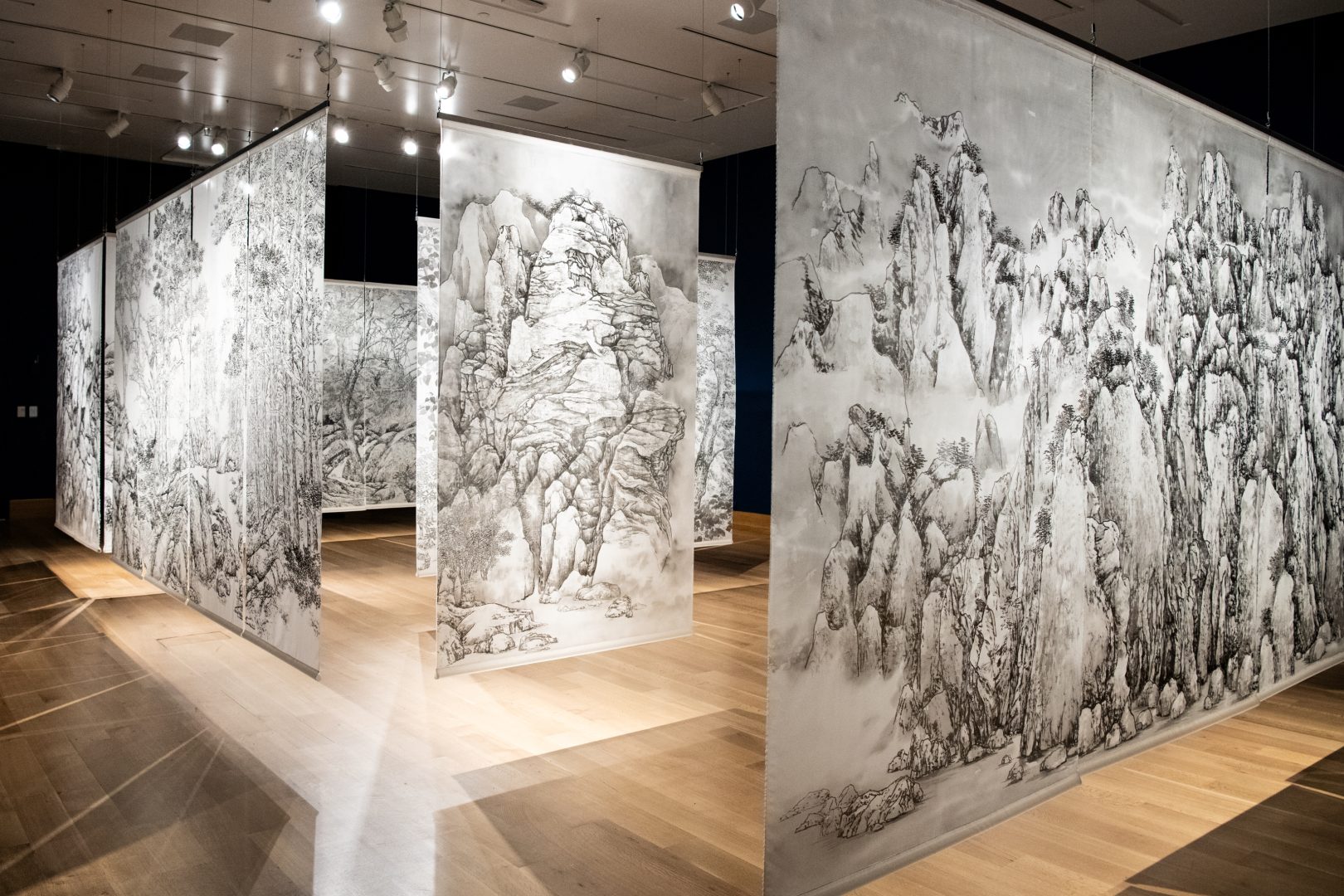
The panels – arranged in singles, diptychs, triptychs, and a quadtych – are Wang’s vision of the natural world. Suspended from the gallery’s ceiling, they invite visitors to animate the installation as they walk around and become part of the landscape.
Installation view of “Wang Mansheng: Without Us.” | Photo by Linnea Stephan / The Huntington
Wang isn’t a stranger to the Chinese Garden at The Huntington; he has participated in several calligraphy shows, but this is his first solo exhibition at the gallery. During a walkthrough of the installation, he recounts his initial conversation with Phillip E. Bloom – curator of the exhibition, the June and Simon K.C. Li Curator of the Chinese Garden, and the director of the Center for East Asian Garden Studies – his vision for the installation, and his work process.
“In 2020, Phillip invited me to be The Huntington’s Visiting Artist at the Chinese Garden and I was thrilled!” began Wang. “I like to put my hands in the soil and I’ve been gardening almost 30 years. Coming to The Huntington for the first time about 10 years ago felt like being in heaven; I was so jealous of all the gardeners who work in this beautiful place.”
“Phillip was already familiar with my work, which is primarily about nature,” continues Wang. “Doing a larger-scale project was something we had discussed for some time, but everything was delayed by the pandemic. That extra time actually allowed me space to think and prepare. In early 2024, Phillip confirmed that an exhibition would be possible, so I wrote a proposal for an installation with silk panels. He liked the idea, and we introduced it to the Huntington exhibition team.”
The exhibition’s title comes from a unique perspective. Wang explains, “’Without Us’ imagines a world without humans. Of course, gardens are man-made. I’d visited the Huntington several times over the years to study its rich variety of trees and plants. ‘Without Us’ includes inspiration from these wonderful collections but the work’s scope is broader in that it incorporates my experiences in traveling and hiking in many different places.”
Installation view of “Wang Mansheng: Without Us.” | Photo by Linnea Stephan / The Huntington
“Right before working on this exhibition, I did a show at the Philadelphia Museum of Art,” relates Wang. “Because of the pandemic I couldn’t bring the paintings back to China to mount them so the works were displayed on unmounted silk. And that sparked the idea to use transparent silk and hang the paintings in the middle of the gallery to make it more interesting.”
“To prepare for this installation, I created a small model of the works,” Wang says further. “I chose very thin silk so visitors can view the paintings from both sides – it created an extra angle to view nature. I used narrow, tall panels for mountain peaks and broader sets for a lotus pond or an expanse of woods and hills. You walk in and view an almost three-dimensional landscape and see details – tress, plants, animals, insects, birds. Some are from a distance, like the lake and a far-away mountain. Because of the light there’s slight movement, making the installation magical and dreamlike. ”
He transformed his Hudson Valley studio to prepare and work on the paintings. Describes Wang, “I built a large wall with moving wood panels so I could change the size of the board. Then I installed metal sheets on the wood and covered them with silk canvas. I used magnet to keep the silk in place because its thin and slippery. I hadn’t used much silk in my work until recently so I took notes and wrote my experience – like how the brush felt on it. Most of the time I worked on the wall, but I used too much ink and it would drip and stain the wall. So I would sometimes move the canvas on a large table.”
“The work also required me to step back at least ten feet away after a few brushstrokes – even after adding just two leaves to it. I used three ladders with various height to reach different areas; I had to keep going up and down the ladder and stepping back to view the whole picture. I put in a lot of steps, it was like working out in the gym,” Wang says with a chuckle.
Mansheng Wang working on “Without Us.” | Image courtesy of the artist / The Huntington
Originally, Wang planned to paint 28 panels, but he had to scale it down to 22 to fit the gallery space and allow visitors sufficient distance to view the artworks. He started thinking about what he wanted to paint and began practice work in 2020. But the actual painting only commenced in 2024 and ended early this year.
The first two panels in the exhibition are his tribute to the silkworm. Enlightens Wang, “This is the first painting I worked on in 2022. It’s called ‘The Silkworm and the Mulberry Tree’ and is my homage to the silkworm. The silk industry is a major component of China’s economy. Chinese people have been writing on silk for 6,000 years and this material is very valuable to them – it’s their source of livelihood.”
Visitors to the gallery will walk around the silk panels as they would on a trail leading up to the peak of the mountain. Wang says, “After you hike through the landscape and walk up this mountain, you think you’ve reached the summit. But there are more peaks beyond and you see a cascading waterfall, creating a large body of water and running through all the 22 panels in different forms – a smaller waterfall, stream, creek, lake, and even the mist on the mountain.”
‘Without Us’ is Wang’s exhortation for us to consider the consequences of our actions – the harm they inflict on our planet. “When I was little we were taught that we are superior beings because we can make tools,” expounds Wang. “As I got older, I realized how the growth of technology gives humans greater power to cause damage to nature. While we used shovels and saws before, we can now utilize machines to cut down a 200-year-old tree in minutes. Even more worrying is that we’re able to create nuclear weapons which could ultimately destroy ourselves and this earth.”
Installation view of “Wang Mansheng: Without Us.” | Photo by Linnea Stephan / The Huntington
Through his exhibition Wang also wants to remind us of the importance of water and conserving this precious resource. He declares, “These plants and animals are what makes earth special – and it’s all because of water. It’s what nourishes us and keeps all these beautiful things in nature alive. But people are the ones using it the most – we drink it, we cook our food, we take showers, we flush our toilets, we wash our cars, and so on. And we all know that California has constant water shortage and is prone to drought. On top of that, we pollute the water.”
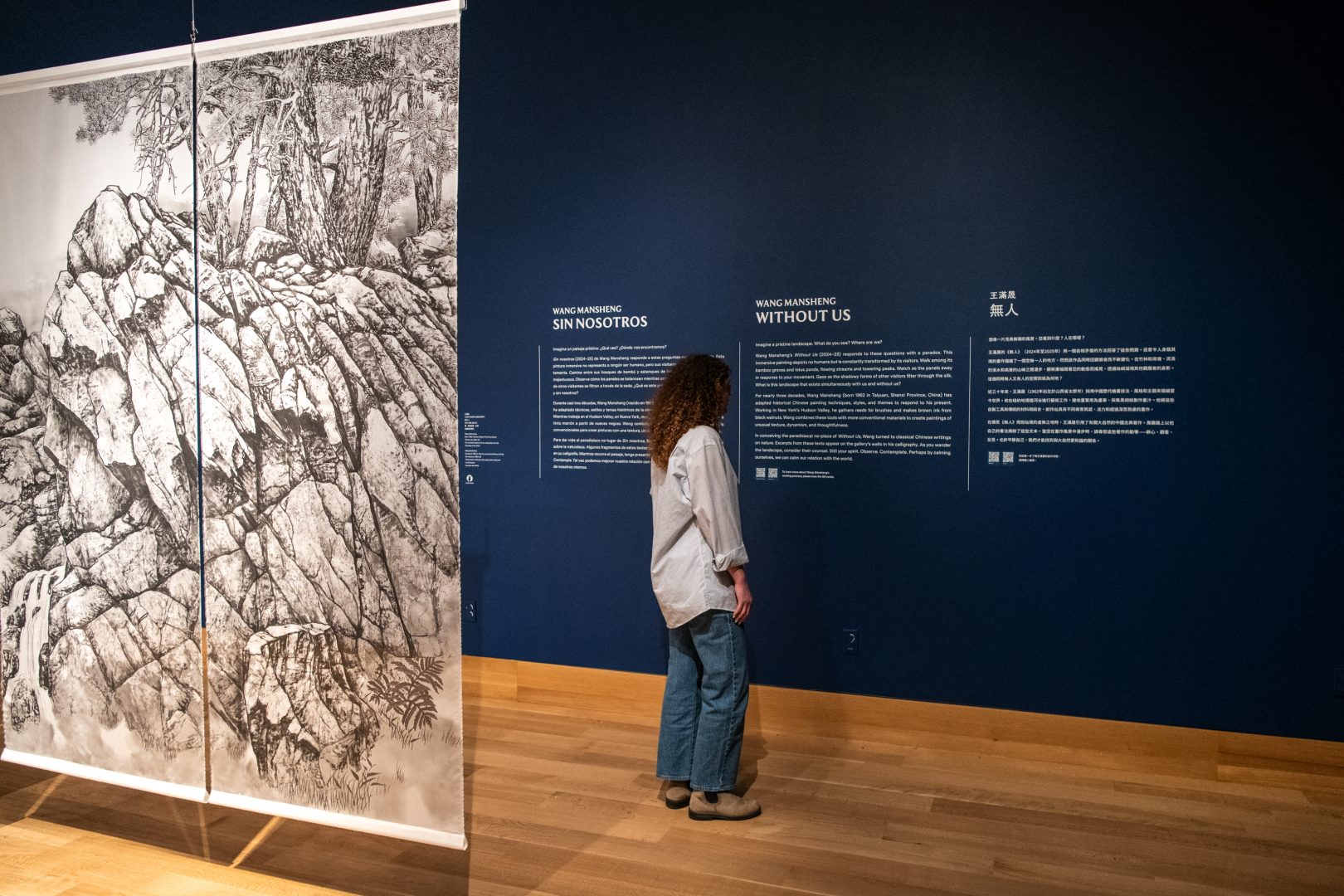
On the walls of the gallery, visitors will find excerpts copied from Wang’s calligraphy taken from classical Chinese literature, featuring the writings of scholars, poets, and philosophers, including Confucius 孔子 (551–479 BCE), Zhuangzi 莊子 (4th century BCE), and Laozi 老子 (6th century BCE). Many of the passages refer to the ancient Chinese concept of guan 觀 – to observe and appreciate nature by emptying the mind and allowing the natural world to enter.
“As you walk through the space, you get a different angle to look in and view the area,” explains Wang. “I hope people who come to see the paintings also read the texts to enjoy and be inspired by. Moreover, the texts provide viewpoints from which to observe the paintings.”
Lastly, Wang clarifies, “Although the title of this piece is ‘Without Us,’ many people were involved. They encouraged me along the way and helped with the details needed to realize this project, from the curatorial team to the preparators and installation team to the registrars, security staff, and many more. I am grateful for their enthusiasm, support, and guidance.”
Installation view of “Wang Mansheng: Without Us.” | Photo by Linnea Stephan / The Huntington
Mansheng Wang joins a remarkable company of visiting artists in The Huntington’s program, as Bloom reveals when he speaks about the initiative. “In 2012 we received a gift from the Cheng Family Foundation to endow a program to bring in artists to the Chinese Garden every year or two to create a new work in response to the site. We have hosted musicians, playwrights, performance artists, and now painters. The most recent before Mansheng was someone named Zheng Bo, who is a performance artist. He created a series of exercises and led visitors in doing them in the garden.”
Suspending artworks from the ceiling isn’t something totally new, discloses Bloom. “It’s the first time we’re hanging artworks from the ceiling but in our last exhibition called ‘Growing and Knowing in the Gardens of China,’ we had a reproduction of an artwork hang from the ceiling but it served more as a spatial divider. That was the first time we used this hanging system, which was practice for this installation. Our experts knew what to do.”
Asked if an artist is given a mandate on what to create, Bloom replies, “Each time is different. Of course, we have some sense of the artist’s work beforehand. Through a series of conversations, we come up with a project. The one major exception was when we commissioned an artist specifically to make a video that’s permanently on display in the restaurant in the garden, but which we’ve also shown in some exhibitions. In this case, Mansheng and I came up with a project that would fit the gallery.”
Installation view of “Wang Mansheng: Without Us.” | Photo by Linnea Stephan / The Huntington
“Mansheng has a very scholarly approach to painting, which I admire,” pronounces Bloom. “He knows the history of painting so well, and he responds to art history in very thoughtful ways in his works. Visually, I love the sense of dynamism in his paintings of rocks and trees, which he creates in part by using brushes that he himself makes from reeds. But most importantly, perhaps, he and his wife Helena Kolenda are wonderful people. It is very pleasant to work with them, and to talk with them about art, nature, and society.”
“We have been discussing this project for about five years, so I had some sense of what the project would involve,” Bloom states. “He sent me updates regularly on his progress, including photos and videos. I was amazed by the detail of the works as well as by how completely they immerse a viewer. But it was not until we installed them in the gallery that I really could feel how successful and compelling ‘Without Us’ actually is.”
Bloom expresses what he thinks people will find engaging about the silk panels. “I think visitors will be struck by how beautiful the installation is. When you enter the gallery, it almost feels as though you have entered a lantern. The silk is so perfectly illuminated, and the light interacts with the ink and silk in such striking ways.”
“But more importantly, as visitors actually take time to look at the panels, they really will feel as though they are walking through a pristine, natural paradise – a world that humans have not disturbed. However, by walking through the panels, visitors themselves will disturb that world: the panels sway in response to visitors’ movement,” concludes Bloom. “I think it is impossible not to interact with this artwork without reflecting simultaneously on how spectacular nature is and how deeply we humans are intertwined with it.”
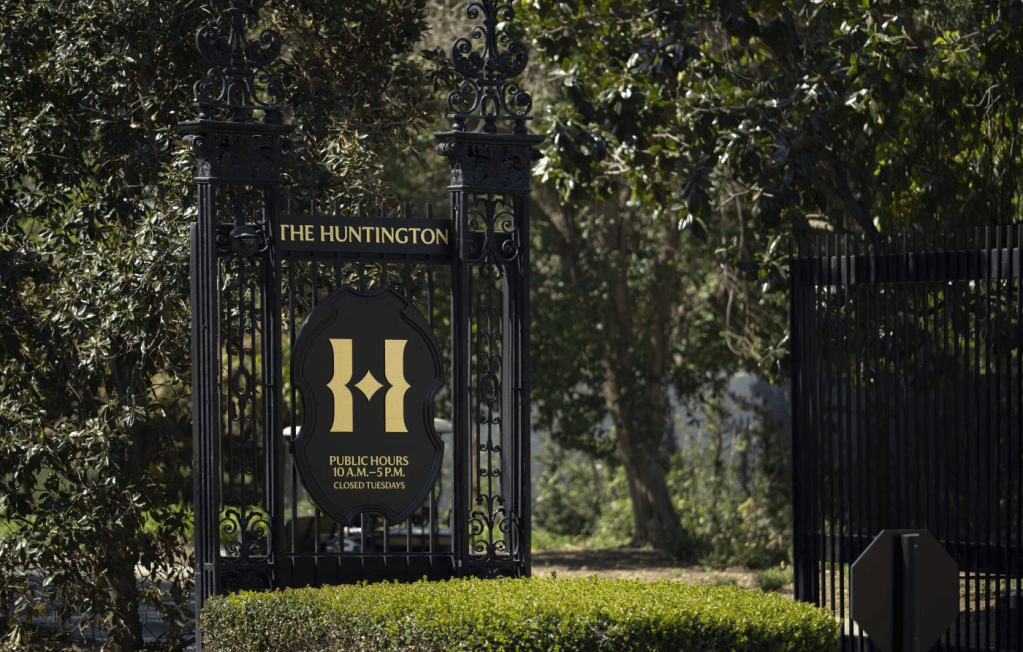
New Signage at The Huntington gate. | Photo courtesy of David Esquivel / The Huntington
Frequent visitors to The Huntington will be surprised to see starkly different signage as they enter the gates. The familiar name The Huntington Library, Art Museum, and Botanical Gardens with all its flourishes has been replaced with only the letter “H.” The bold visual identity and simplified name “The Huntington” are just the introduction to the institution’s first sweeping branding initiative in its 106-year history.
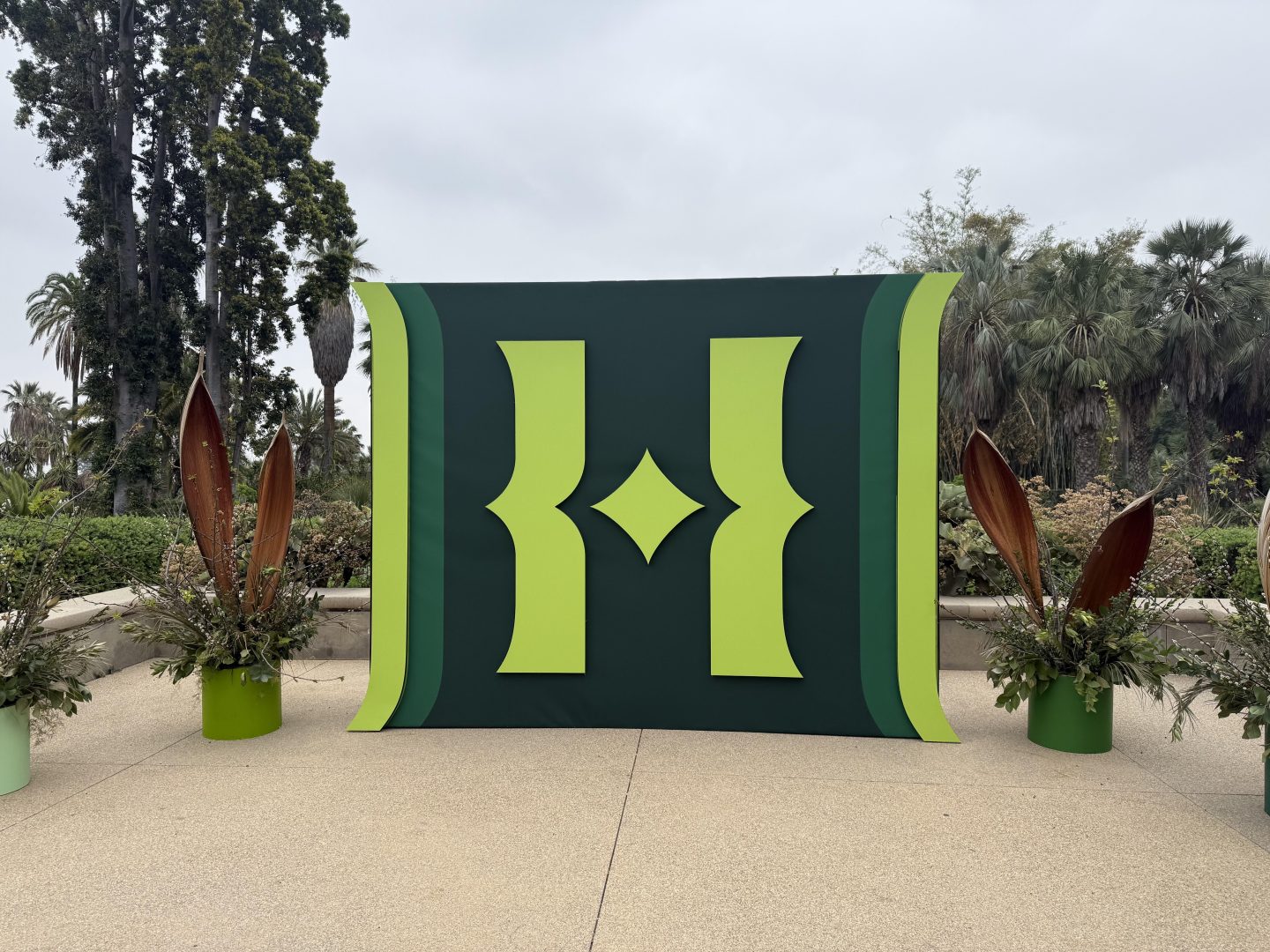
The H monogram signifies a foundation grounded in tradition but focused on modernization. Incorporating a jewel-like center, it serves as a reminder that The Huntington is a treasured cultural institution. The gem is flanked by two stylized pillars – one pointing left toward the past and one pointing right toward the future.
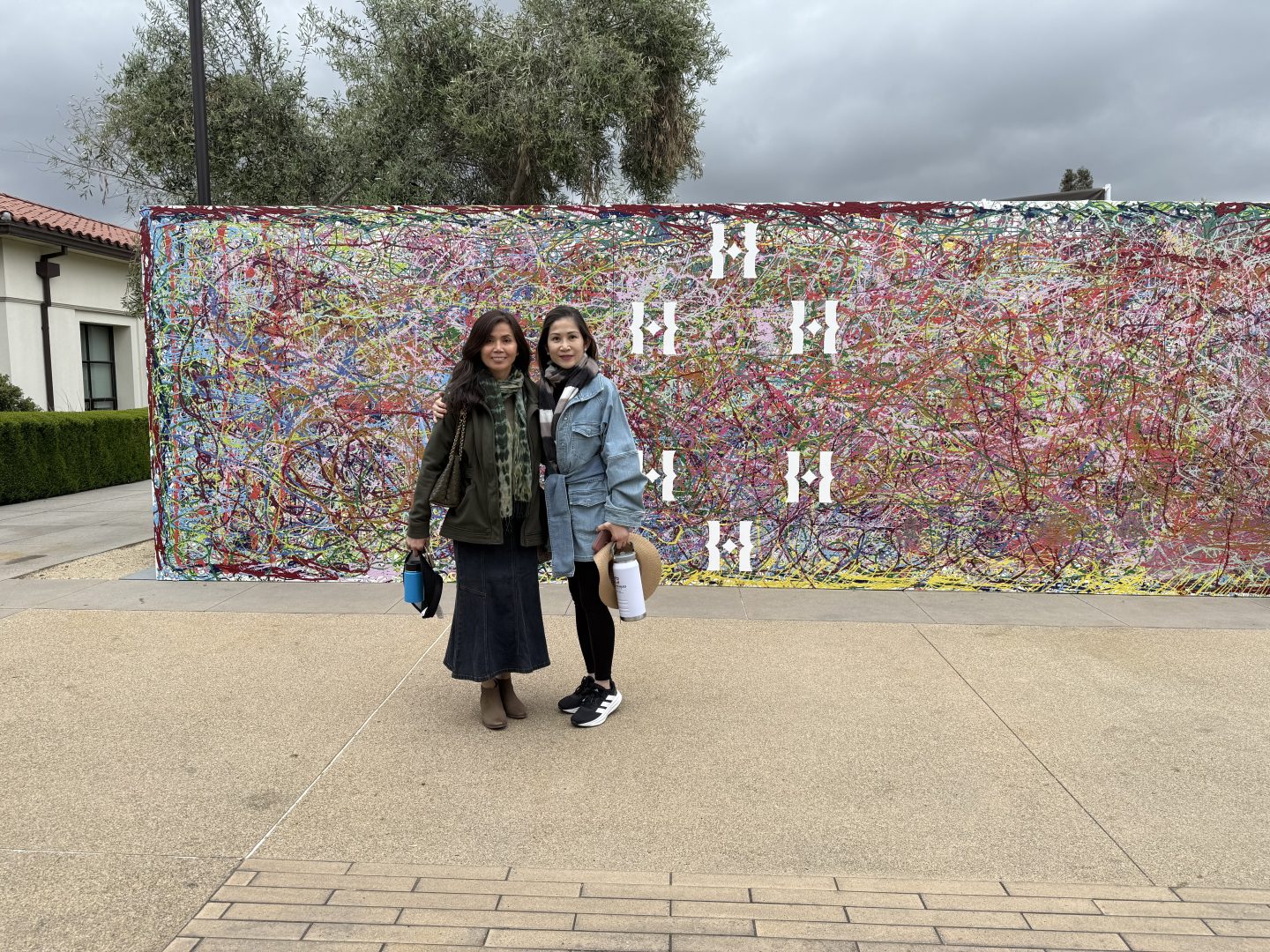
A large canvas with the new logo near the Celebration Garden. | Photo by May S. Ruiz / Hey SoCal
Launched on April 8, 2025, the brand rollout includes new signage, a refreshed website, a marketing campaign inviting visitors to “Rediscover The Huntington,” educational content for all ages, new branded merchandise, celebratory giveaways, and special Second Sunday events with activities for all ages. The rebrand is propelled by the visionary One Huntington strategic plan led by President Karen R. Lawrence – a transformation that marks the next chapter in the institution’s evolution.
Interviewed by email, Lawrence spoke about the concept behind the rebrand.
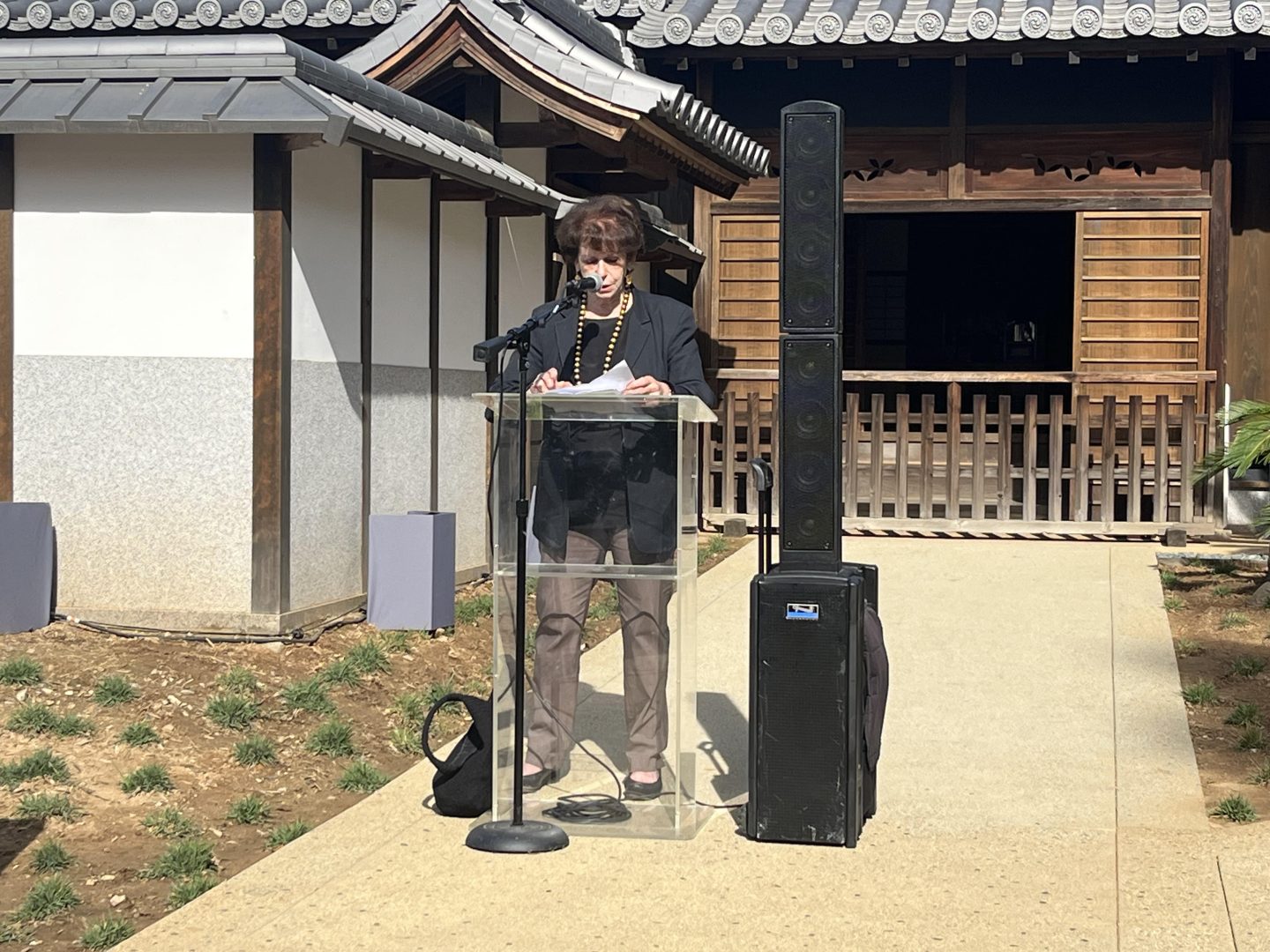
Karen R. Lawrence during the opening of Shōya House. | Photo by Brianna Chu / Hey SoCal
“The rebrand emerged from our strategic planning process,” she said. “It supports our institutional priorities and commitments directly; in particular, demonstrating the connections among our three core collections – library, art, and botanical – and expanding access, engagement, and education for a broader public, both digitally and in person.
Expounded Lawrence, “What is most important to note about our new brand is that it helps The Huntington achieve several objectives:
“Connecting our collections: First, we simplified our name from The Huntington Library, Art Museum, and Botanical Gardens to just The Huntington. It better represents the powerful cross-fertilization among our three core collections and conveys that the whole is more than the sum of its excellent parts! We use the term ‘One Huntington’ to describe these unique connections.
“Our monogram, too, reflects this unity: While our previous monogram borrowed heavily from the botanical, our new H – with a jewel-like center flanked by two pillars – captures the essence of what we do as an institution. One pillar honors our history, the other looks to the future, and the gem in the middle is what makes The Huntington unique: our people, our collections, and our mission.
“Increased accessibility and digital agility. Our previous ornate H was beautiful but didn’t scale well – imagine trying to decipher that intricate design on a smartphone screen – it simply didn’t work. The new monogram is clean, modern, and legible across all formats.”
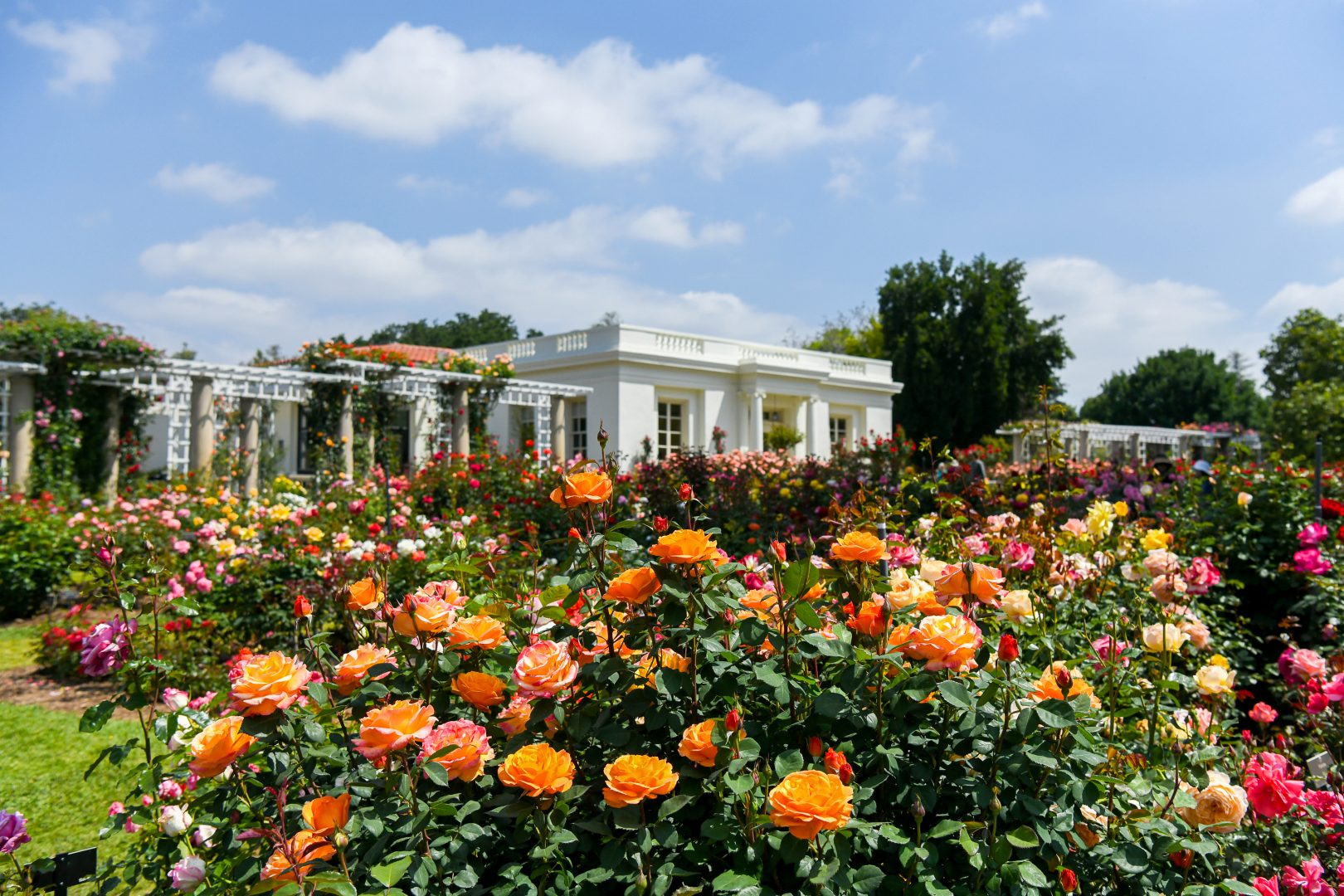
Exterior view of the Rose Garden Tea Room. | Photo by Joshua White / JWPictures.com / The Huntington
The extensive branding initiative entailed getting input from all quarters. Lawrence stated, “Members of our Trustees and Board of governors were thoughtful partners throughout the process. They wanted to make sure that we preserved what has always been special about The Huntington but endorsed our desire to reflect recent initiatives as well. We issued an open request for proposals from firms that specialize in branding and communications and ultimately selected Base Design, an international creative agency, to help guide us. The process was collaborative, with feedback loops at every stage – from early concepts to final design.”
“We formed a Steering Committee and a larger stakeholder group,” added Lawrence. “We intentionally involved staff from across the institution, because a brand isn’t just a logo – it’s how we see ourselves, how the public sees us, and how we want to be seen.
“We invited a wide range of stakeholders to weigh in on the design concepts, suggesting a number of modifications, including the logo. Their feedback helped shape not only how the brand looks but also the spirit it conveys.”
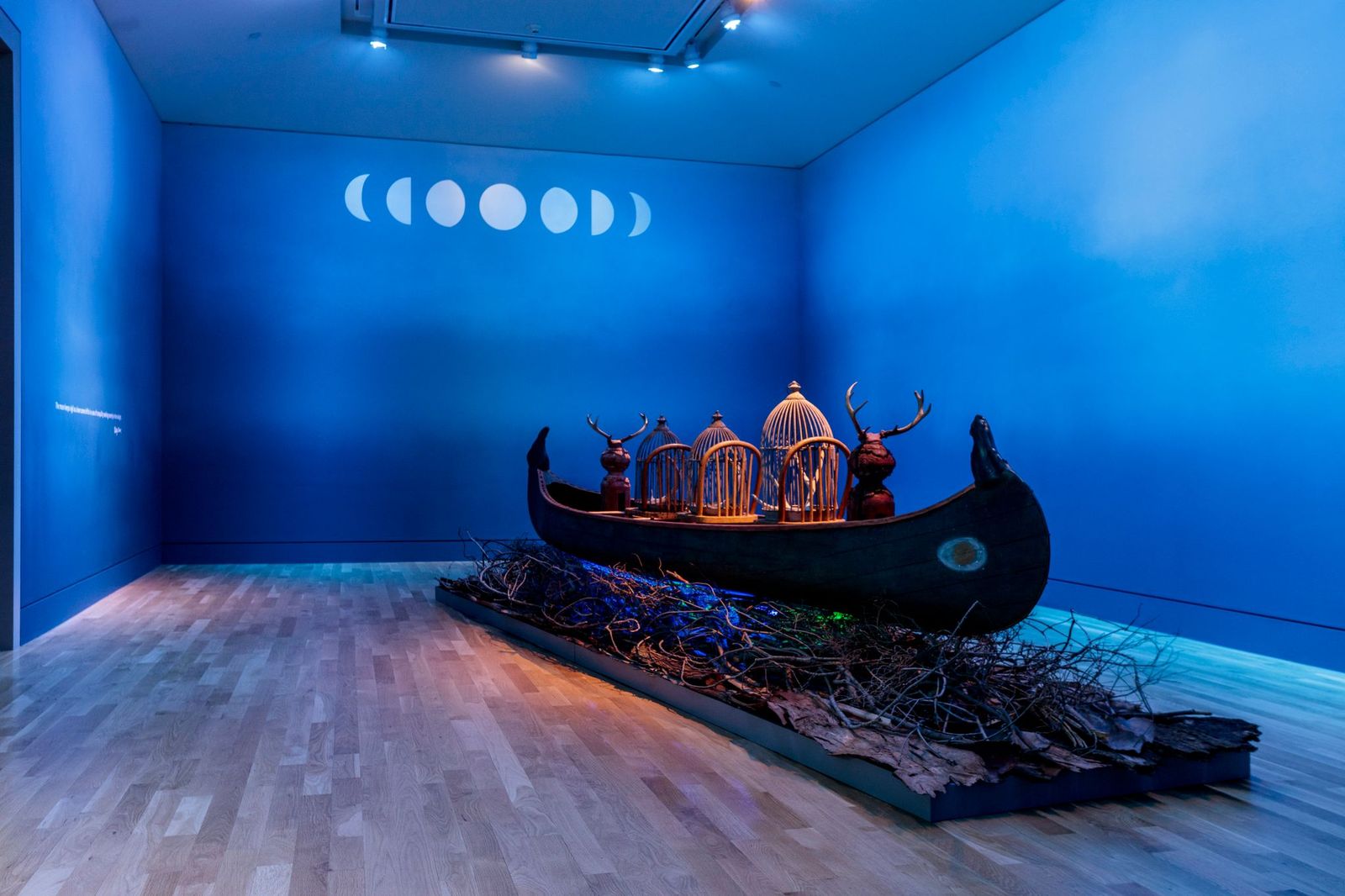
Betye Saar, ‘Drifting Toward Twilight,’ 2023 installation. | Photo by Joshua White / JWPictures.com / The Huntington
The final decision about the new brand was not arrived at single-handedly by Lawrence. She clarified, “It was a consensus-driven process. We took an iterative approach that allowed many voices to be heard and incorporated along the way. Together, we made some course corrections, which I believe made the final product better. It honestly reflects a shared vision.”
Lastly, Lawrence encouraged people to see for themselves what The Huntington offers.
“We are inviting everyone to Rediscover The Huntington. We are known as a superb research library to scholars around the world. Members of the public know us for our Rose Garden, or for The Blue Boy and our Ellesmere Chaucer, and we’re rightly proud of these masterpieces, but we’re also home to more contemporary and recently-acquired works and collections – by Thomas Pynchon, Betye Saar, Octavia Butler.”
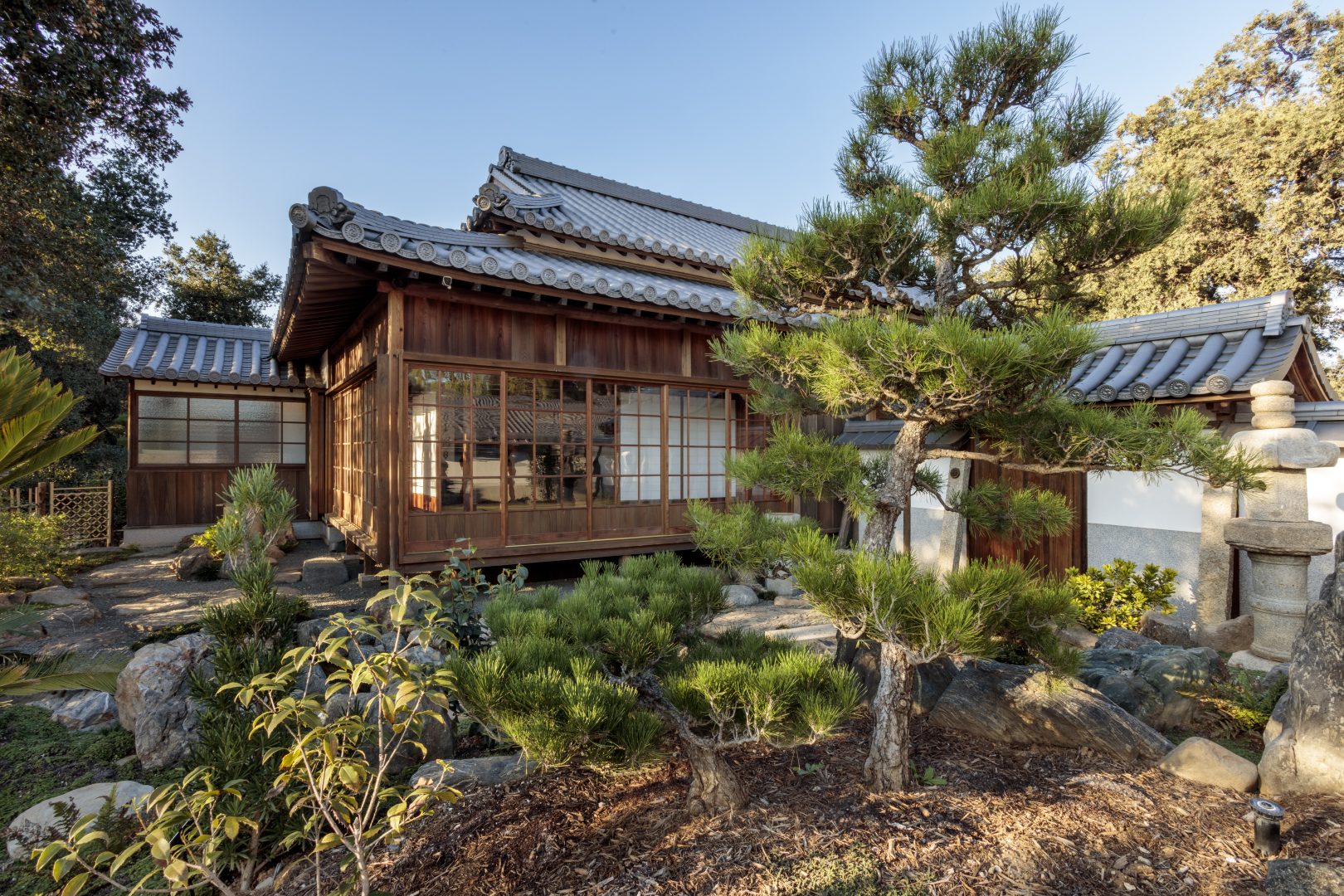
The private garden at Shōya House. | Photo by Brianna Chu / Hey SoCal
“Other ‘new’ acquisitions include a 320-year-old Shōya House in the Japanese Garden, which was moved piece by piece from Japan to its new home. The house, with its surrounding ecosystem, is a historic example of a contemporary priority – sustainability. We hope our longstanding visitors as well as new ones will find new and surprising things to discover here.
“With our new visual identity and streamlined name, we’ve also launched a series of digital initiatives that expand our reach, bringing The Huntington to global audiences – students, researchers, and our ‘community of the curious.’
The execution of The Huntington’s rebrand fell to Annabel Adams, who came on board in August 2024 as Vice President for Communications and Marketing. While she took me on a tour of the site one week after the rollout, she talked about stepping into this new role only six months before the launch, the new logo, and the programs that lean into The Huntington’s values.
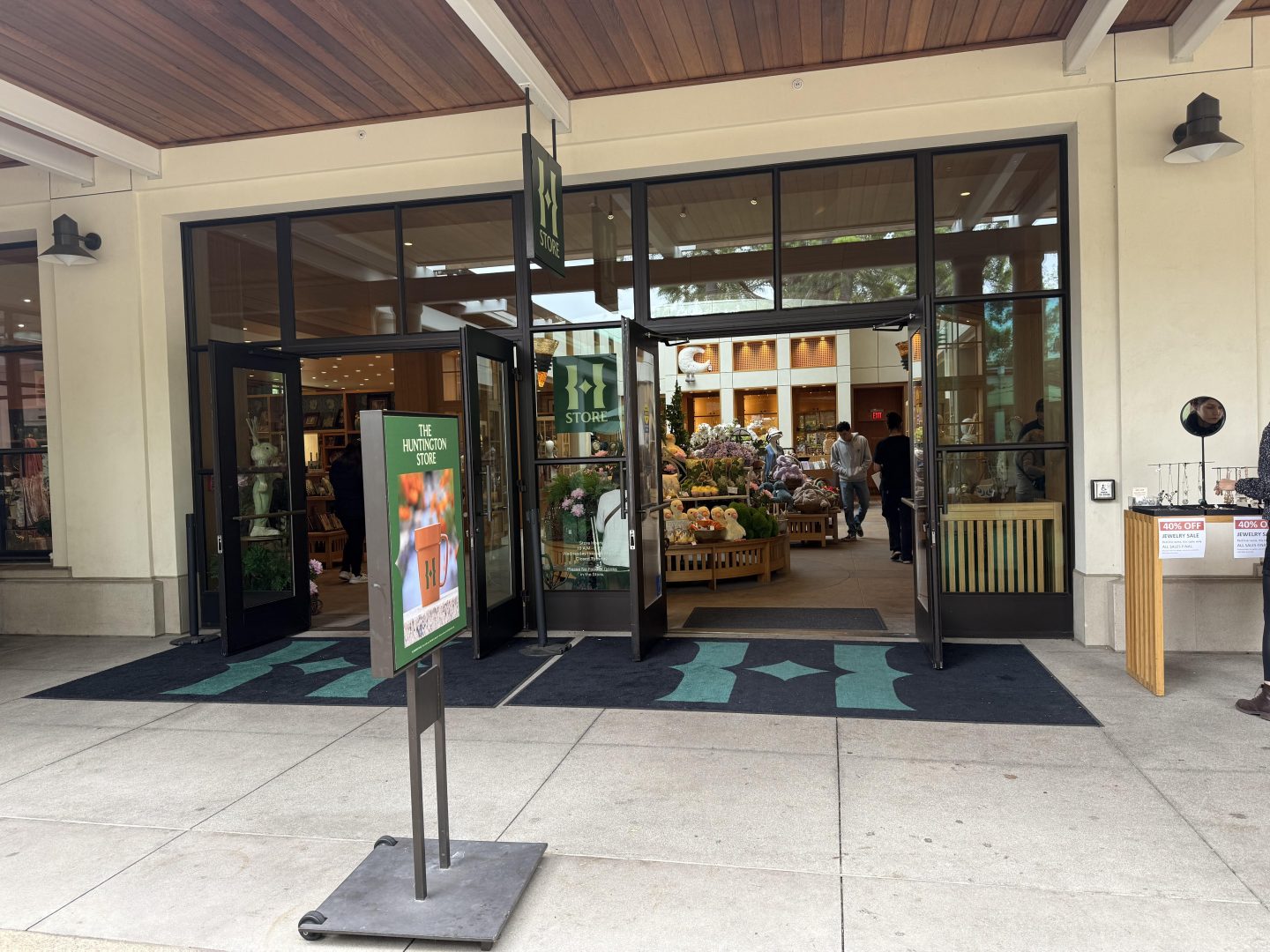
The Huntington Store. | Photo by May S. Ruiz / Hey SoCal
“I knew coming in that I was going to lead the rebrand, but I didn’t get to see the brand because we had to keep it confidential,” Adams began. “This was actually years in the making. My predecessor Susan Turner-Lowe conducted a stakeholder and focus groups. They did studies to assess how a brand can lean into our values and serve our communities better. That’s what led to this rich color palette, the agile and adaptable H that can scale both for print and digital media. It is in service to all the research they did for years coming up with this brand.”
Continued Adams, “I had the privilege of coming on board when the brand had already taken shape and my job was to deploy it – to bring it to life across the institution. I worked with my incredible communications team to adapt the signage, the website; anywhere there was an existing logo or monogram, we touched it with the new brand. And there were hundreds of them!”
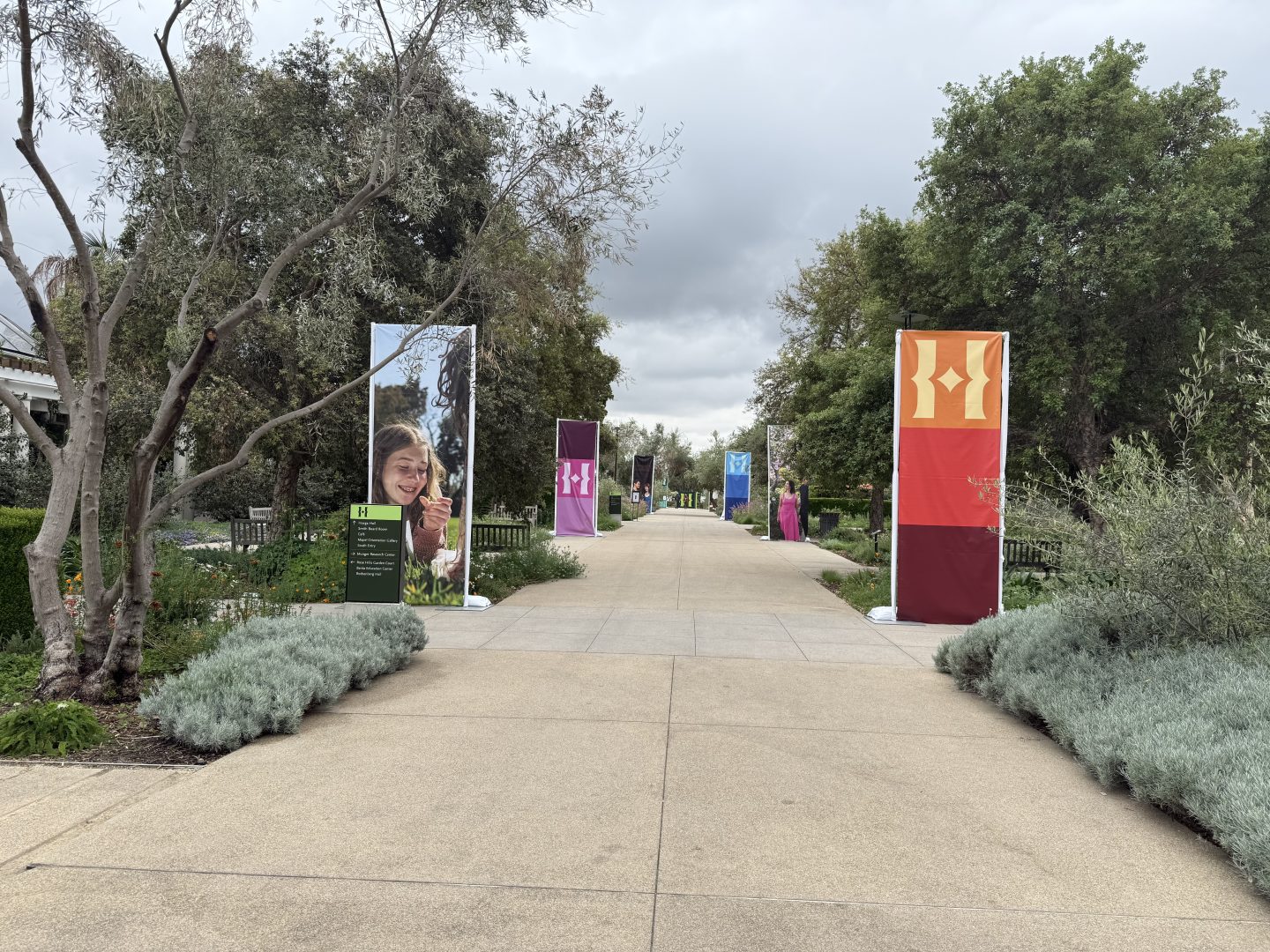
Banners show people engaging with the collections. | Photo by May S. Ruiz / Hey SoCal
As we approached an allėe of banners on the Brody California Garden, Adams said, “Our creative director Lori Ann Achzet was the talent behind the scenes bringing this striking brand to life. She created these banners – which show how people engage with the collections at The Huntington – and did the front gate revamp. She’s an incredible designer and asset to us.”
“Part of the rebrand is to remind people that there are three components to The Huntington – the library, art museum, and botanical gardens,” Adams reiterated. “People love the ornate H with the filigree and leaves – it’s so beautiful. However, it really is representative just of the botanical gardens. We’re proud of our 130 acres of botanical gardens, but we also have an art museum and a library. The rebrand is meant to unify and showcase that we are the synergy of these three collections. The arrows in the monogram also have significance: the arrow pointing left means traditions which we are honoring and the one pointing right is for innovations.”
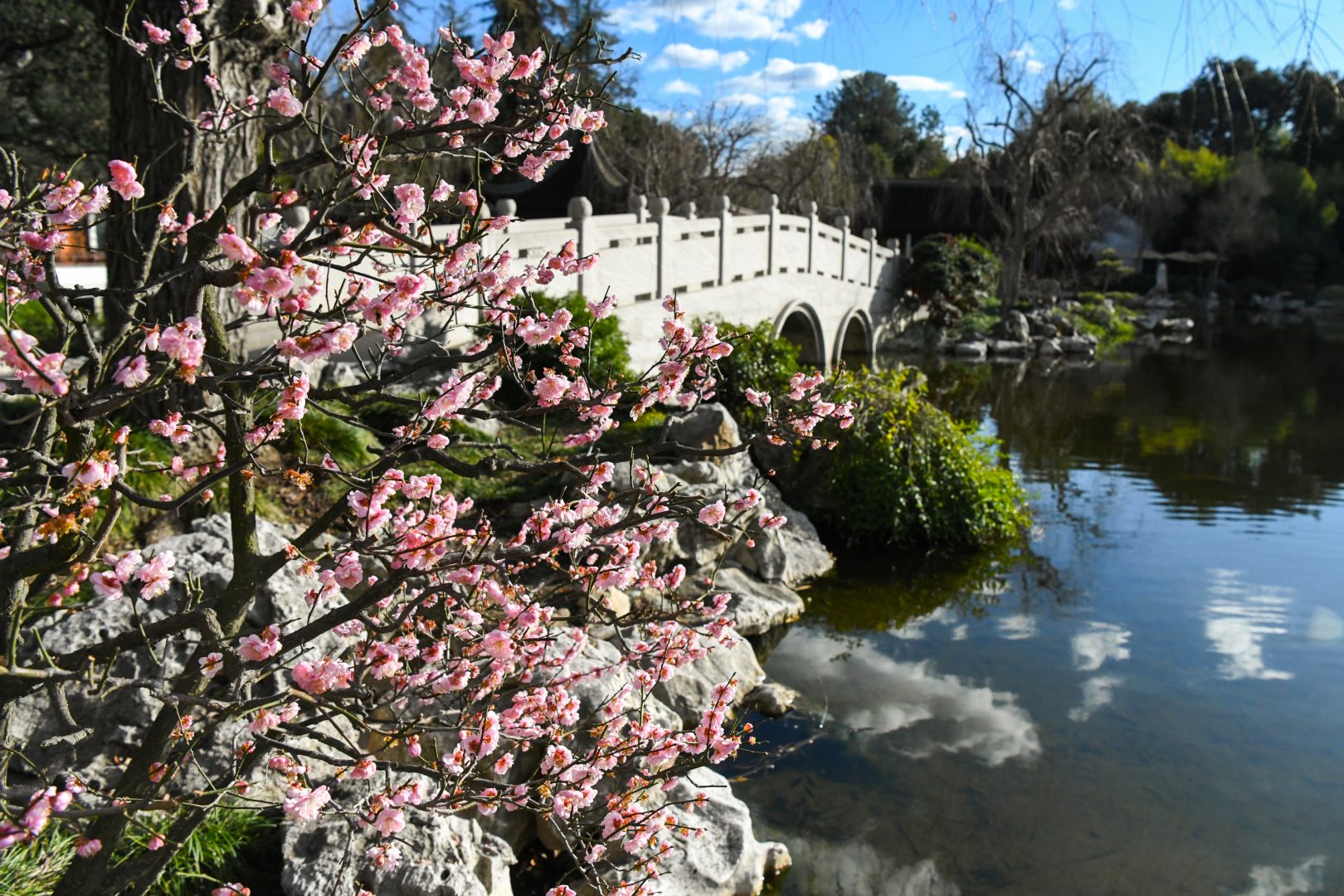
The Chinese Garden. | Photo by David Esquivel / The Huntington
“You do realize this redesign will be met with resistance from people like me who have been coming here for decades and are very familiar with the old monogram,” I pointed out. Without hesitation, Adams countered, “I’m aware of that. But it’s important to note that all the things that everyone loves at The Huntington have not changed. I take it as a compliment that people feel so passionately about The Huntington they know and love. And that resistance to change speaks to how powerful people’s affinity to the institution is.”
Adams again echoed Lawrence’s explanation for the rebrand, “Our old monogram – as ornate and beautiful as it was – could not scale down in an iPhone icon. This new H is accessible for a digital world; we want the experiences of our brand to be accessible to everyone and the ornate H wasn’t.”
“Our values are what guided the brand and my job is to find ways to further lean into them,” Adams asserted. “Those include being more accessible, adapting to a digital world, ensuring our audience can engage and benefit from The Huntington. Then that meant we also have to develop programs that could help us see the brand in action.”
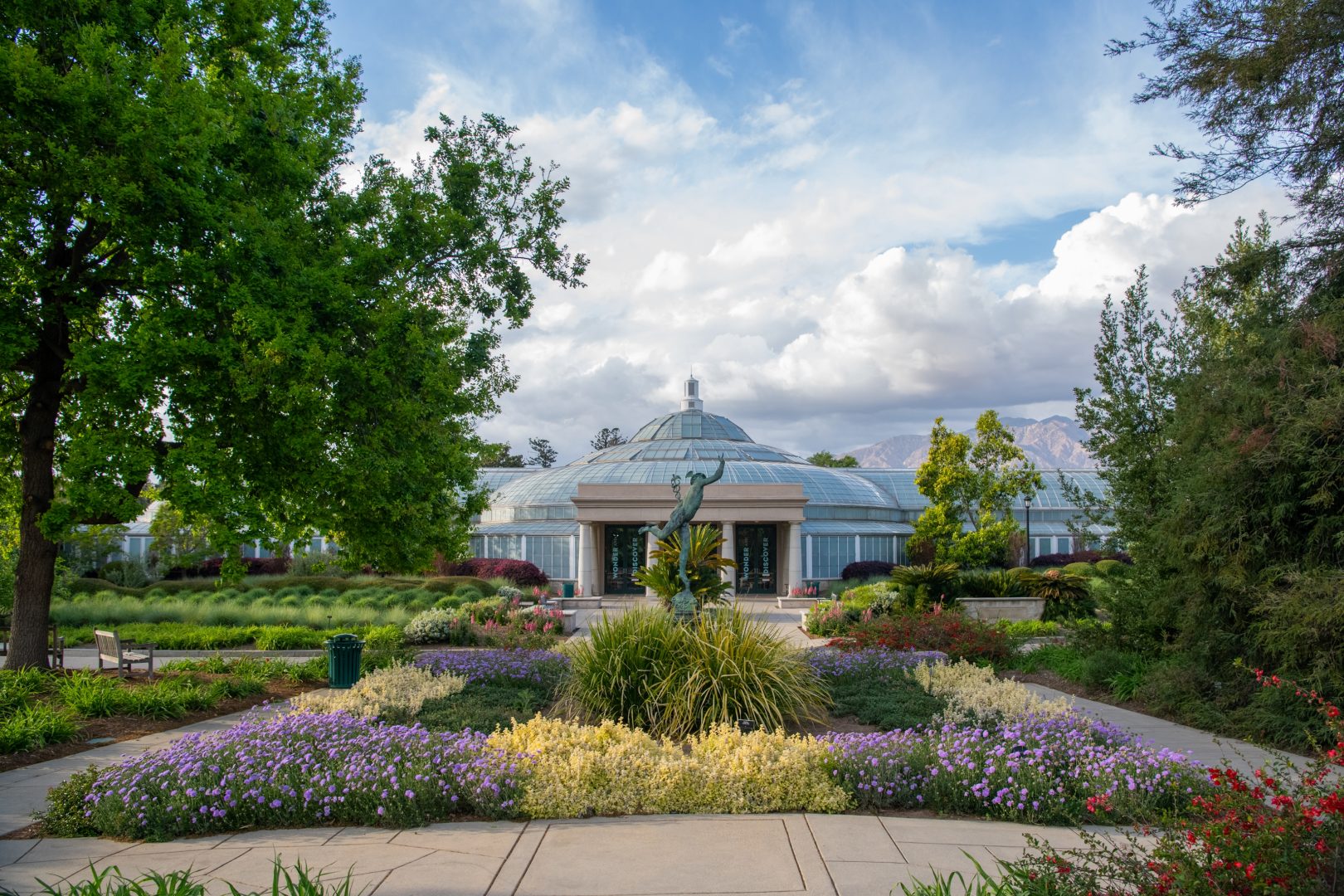
The Rose Hills Foundation Conservatory for Botanical Science. | Photo courtesy of The Huntington
The Huntington’s evolution reflects its increasingly important role as a world-renowned institution – welcoming over one million visitors, hosting more than 500 school groups, engaging about 2,000 scholars and 1,000 volunteers, and reaching approximately seven million website and digital library users and 110 million social media users annually.
As part of the brand launch, The Huntington is expanding its reach with new digital products that connect students, lifelong learners, and global audiences to its renowned collections – anytime, anywhere. These offerings include:
“Huntington How To”: This four-episode YouTube series brings The Huntington’s collections to life through practical guidance from its in-house experts. The first episode, featuring Stephen Reid, assistant curator and head gardener of the Rose Garden, demonstrates how to grow and care for roses, even in Southern California’s unique climate. Future monthly episodes will explore such topics as deciphering historical handwriting, interpreting decorative arts, and repairing books.
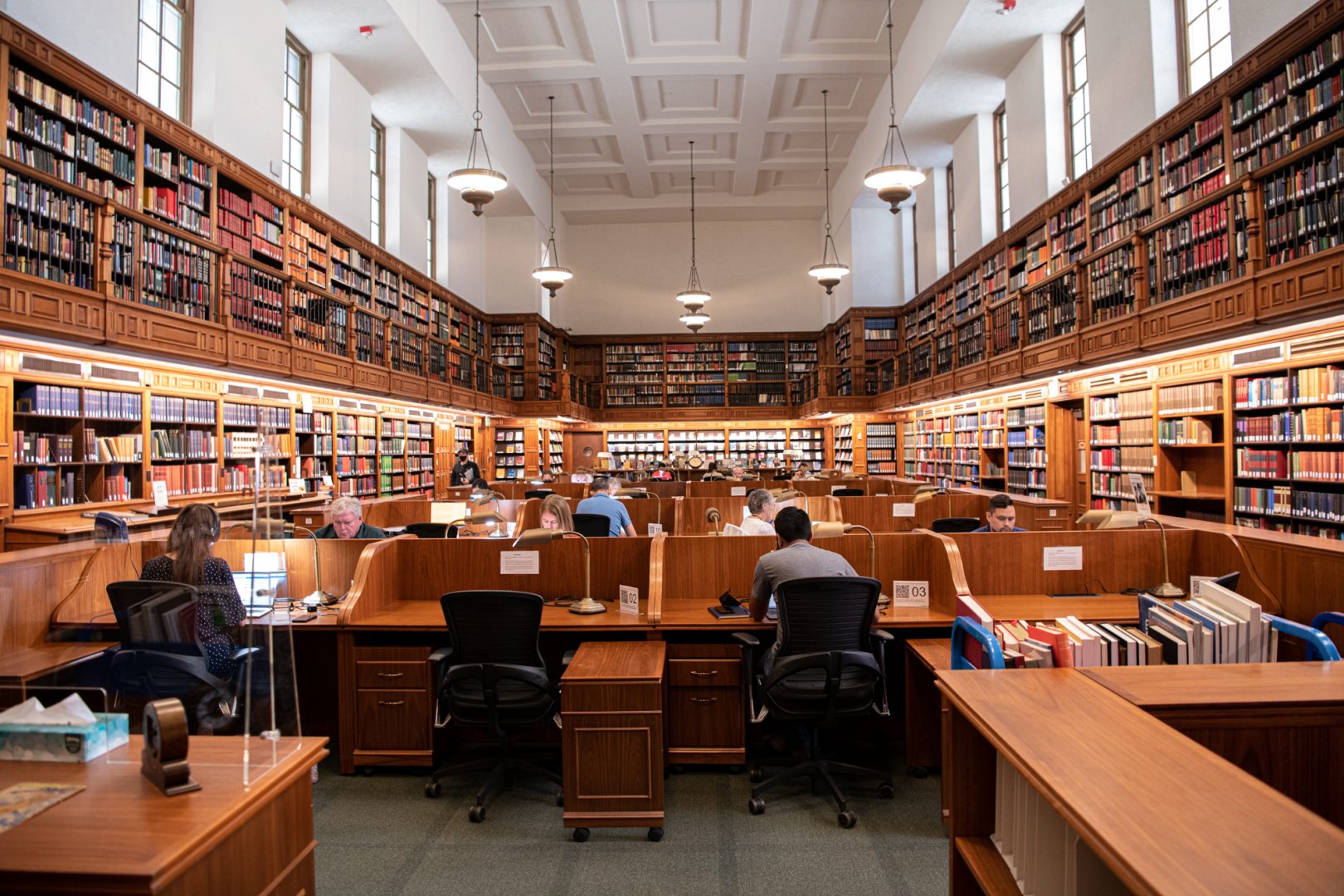
Rothenberg Reading Room. | Photo courtesy of The Huntington
“Collections for the Curious”: Designed for the intellectually curious, this new digital discovery tool will allow online visitors to explore The Huntington’s holdings by using keywords and filters, generating results from the library, art, and botanical collections. The public tool will launch in June with a series of curated highlights that will spotlight unexpected connections among The Huntington’s three collections, including items from recent exhibitions, as well as Latino art and artists, tea services, and women artists.
“Everyday Extraordinary”: Developed in collaboration with award-winning educational content producer Makematic, this playful animated series introduces primary school students to fascinating scientific concepts in a fun and accessible way. Episodes will explore such botanical topics as photosynthesis, mushrooms, and carnivorous plants. The series will launch in May.
According to Adams, The Huntington partnered with Museums for All to make the institution affordable for everyone. Individuals who receive SNAP (Supplemental Nutrition Assistance Program) benefits are eligible for a reduced admission of $3. Since the partnership’s launch in January, The Huntington has welcomed nearly 8,500 visitors through the program.
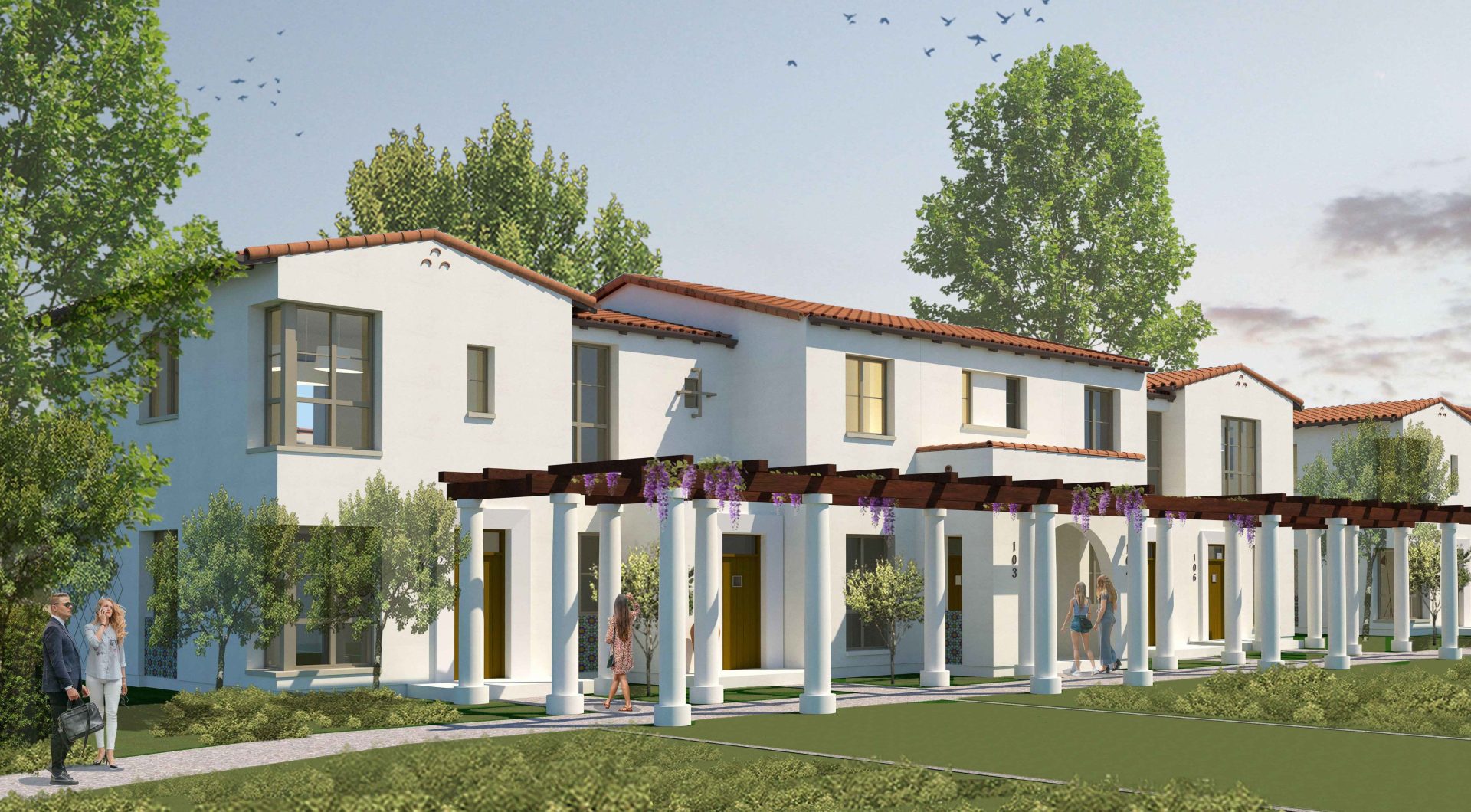
Architectural rendering of Scholars Grove. | Image by VTBS Architects / The Huntington
An important project is the development of Scholars Grove, a residential community designed to support visiting fellows conducting research in the institution’s renowned collections. Scheduled for summer construction to last 14 to 16 months, it will address long-standing housing challenges for The Huntington’s visiting research fellows – providing 33 residential units arranged in seven one- and two-story buildings, along with a commons building designed to foster interdisciplinary collaboration.
The project design incorporates and preserves 150 trees, including a Magnolia pacifica tarahumara (the only known mature specimen in North America), several historic oaks, and a research grove of avocado trees – one of which dates to founder Henry E. Huntington’s time.
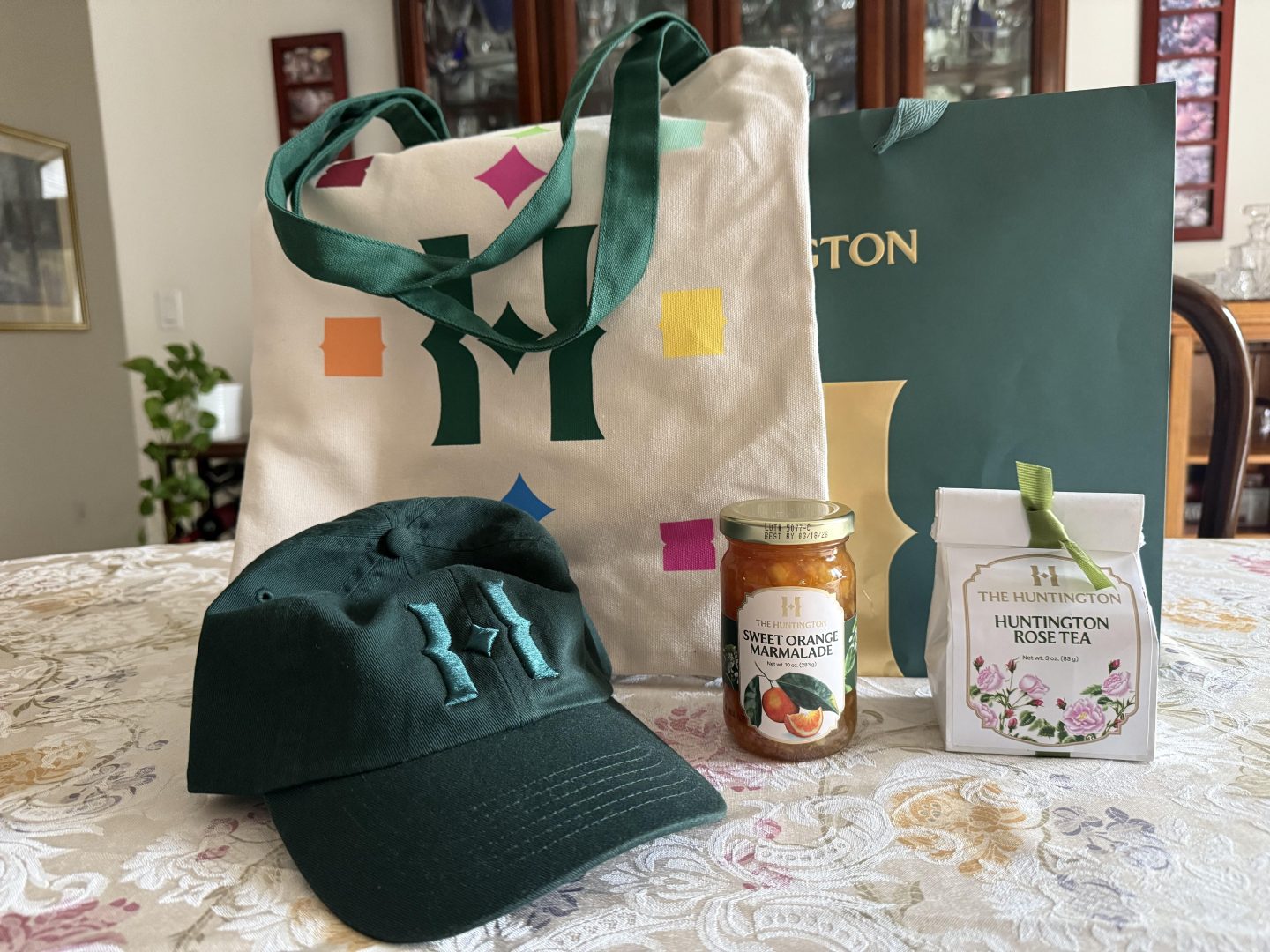
New logo on merchandise; an artist painted an orange from The Huntington’s orange grove for the label on the marmalade jar. | Photo by May S. Ruiz / Hey SoCal
Asked what the biggest challenge was for her, Adams responded, “Doing all this in six months! But there is an undercurrent of enthusiasm and possibility at The Huntington that I find really refreshing and energizing. So I think it was never a question to me of whether this was possible, it was just how do we think of this as a continual deployment? In six months we have this major launch but we are going to continue to lean into the brand now. The launch was a catalyst and how we maintain that momentum is the next phase.”
“We have this beautiful ad that’s coming out in the Museum section of the New York Times – the first time that we’re going to have an advertisement that shows an object from each collection represented as this one foundation and what it offers to the world as a cultural institution. One of items we’re spotlighting in the ad is Octavia Butler’s archive. It’s also the first time we’re spotlighting in an ad this incredible collection that’s so meaningful for us to have at The Huntington. Octavia Butler is a Pasadena native and her work always had impact and meaning, but I think it specially has meaning at a time like now. It’s going to be exciting to see how we can continue to bring that message of what The Huntington has to offer across its collections to everyone through how we communicate with our audience,” expounded Adams.
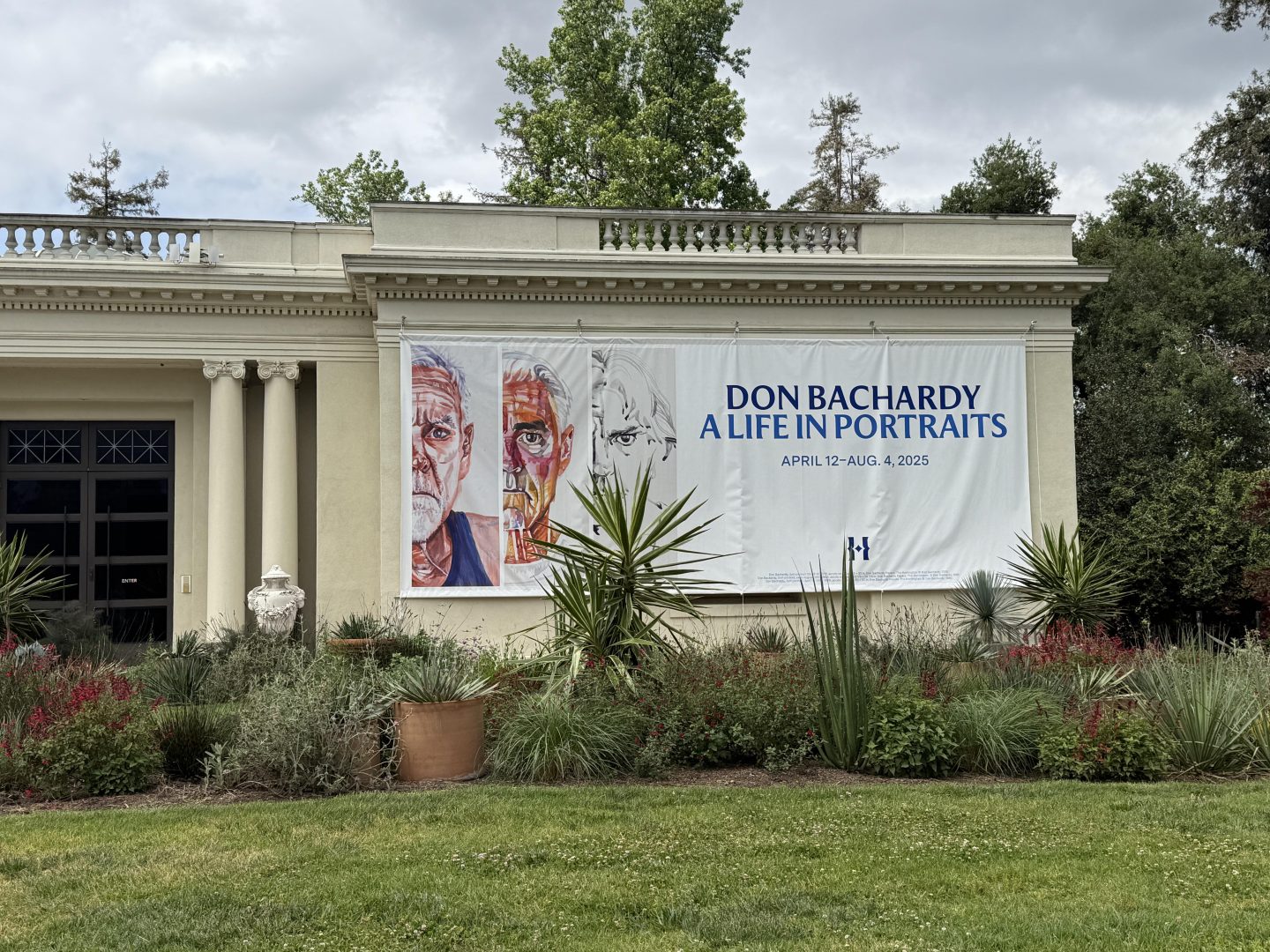
Don Bachardy Exhibition in the Boone Gallery. | Photo by May S. Ruiz / Hey SoCal
Added Adams, “We have a number of great exhibitions planned this year. Don Bachardy in the Boone Gallery is the first exhibition in the new brand. You see on the title wall how the colors and the font work. It’s really legible and accessible.”
“The power of this brand is the accessibility,” Adams emphasized. “A brand is more than just the visual identity, it’s the execution in action. Things like the YouTube ‘how to’ series, Museums for All, the Scholars Grove – those are initiatives that spotlight the accessibility that we’re leaning into with this new brand, the legibility, even our color palette. The colors weren’t chosen willy-nilly, they were from items in our collections in the library, the museum, and the botanical gardens. These are colors that represent The Huntington and that’s why they’re meaningful. These images of people in action are meant to signify that when Henry Huntington created this institution, his goal was to put these collections to use.”
“It’s our invitation to people – to rediscover The Huntington,” declared Adams. “We haven’t changed. You know us for Blue Boy and Pinkie. But do you also know us for Borderlands? Do you know us for the Kehinde Wiley portrait? Do you know us for Shōya House? Come and see everything that The Huntington offers.”
The Huntington means different things to different people. I first visited The Huntington 43 years ago because of the Ellesmere manuscript of Chaucer’s Canterbury Tales and Shakespeare’s Folio in the Library and The Blue Boy and Pinkie in the Art Museum.
(L to R) Abby Mirhan and Emily Wong pose for pictures in front of the artwork created by The Huntington staff to celebrate the launch of the rebrand. | Photo by May S. Ruiz / Hey SoCal
For Abby Mirhan of South Pasadena, The Huntington means the gardens. She was there one Friday to rediscover what she loved about it and find new things she hadn’t seen.
Mirhan said, “My first visit to The Huntington Gardens was 40 years ago when my mom took me. I hadn’t heard of it before and didn’t know what to expect. When I saw the beautiful Chinese and Japanese Gardens, the first thing that came to mind was ‘Why didn’t I come here before now? It’s so close to my house, I should really visit more often.’”
That didn’t happen though. The last time Mirhan was at The Huntington was about ten years ago when she volunteered to chaperone her youngest daughter’s class for a field trip. So she decided to re-experience it with her friend, Emily Wong.
Wong, who’s from Montebello, is excited to join her friend. For her, The Huntington means the museum. She disclosed, “I came here several years ago with my husband and my daughter to see the artwork in the museum. But today, I’m going to explore the gardens as well.”
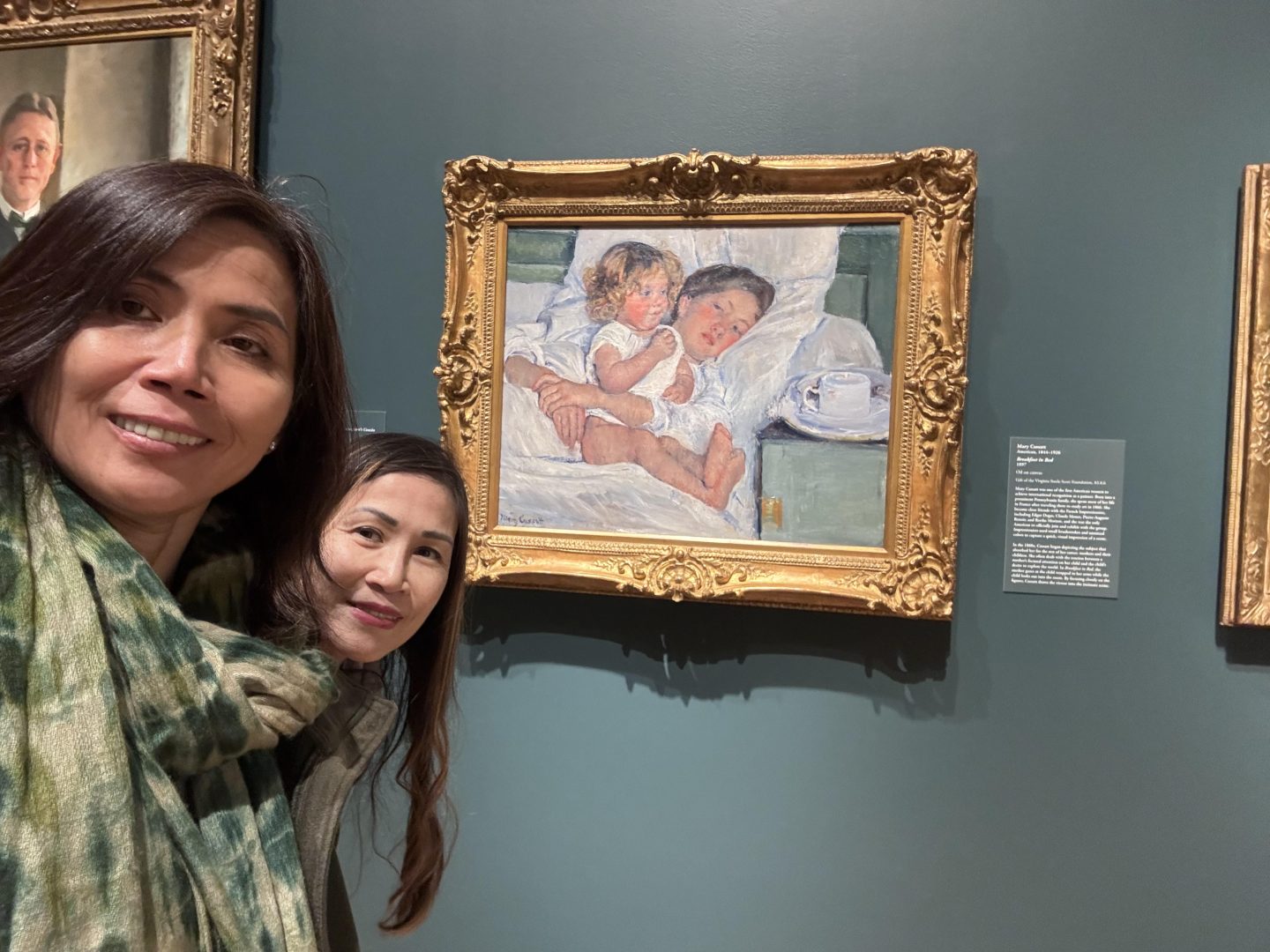
A selfie of Mirhan and Wong with Mary Cassatt’s painting ‘Breakfast in Bed’. | Photo courtesy of Abby Mirhan
While some of us might hope for a glorious sunny day on our visit to The Huntington gardens, Mirhan and Wong were delighted that they unexpectedly came on a grey and gloomy day.
“I have a medical condition that makes me sensitive to sun exposure,” enlightened Mirhan. “I usually bring a hat whenever I go outdoors. We got lucky with today’s overcast weather.”
Mirhan and Wong arrived at 10:00 to take in the full Huntington experience. They explored the many beautiful gardens and marveled at the roses and wisteria in full bloom; looked at the artwork in the galleries and gazed in awe at the stunning paintings and artwork.
“We had a really great time – we took soooo many selfies to show our families and as a reminder of this fun day,” Mirhan said laughing.
Asked what they liked best on this visit, Wong replied, “I loved the pretty flowers in the gardens and the gorgeous landscapes. I also enjoyed reading the backstory of the art pieces.”
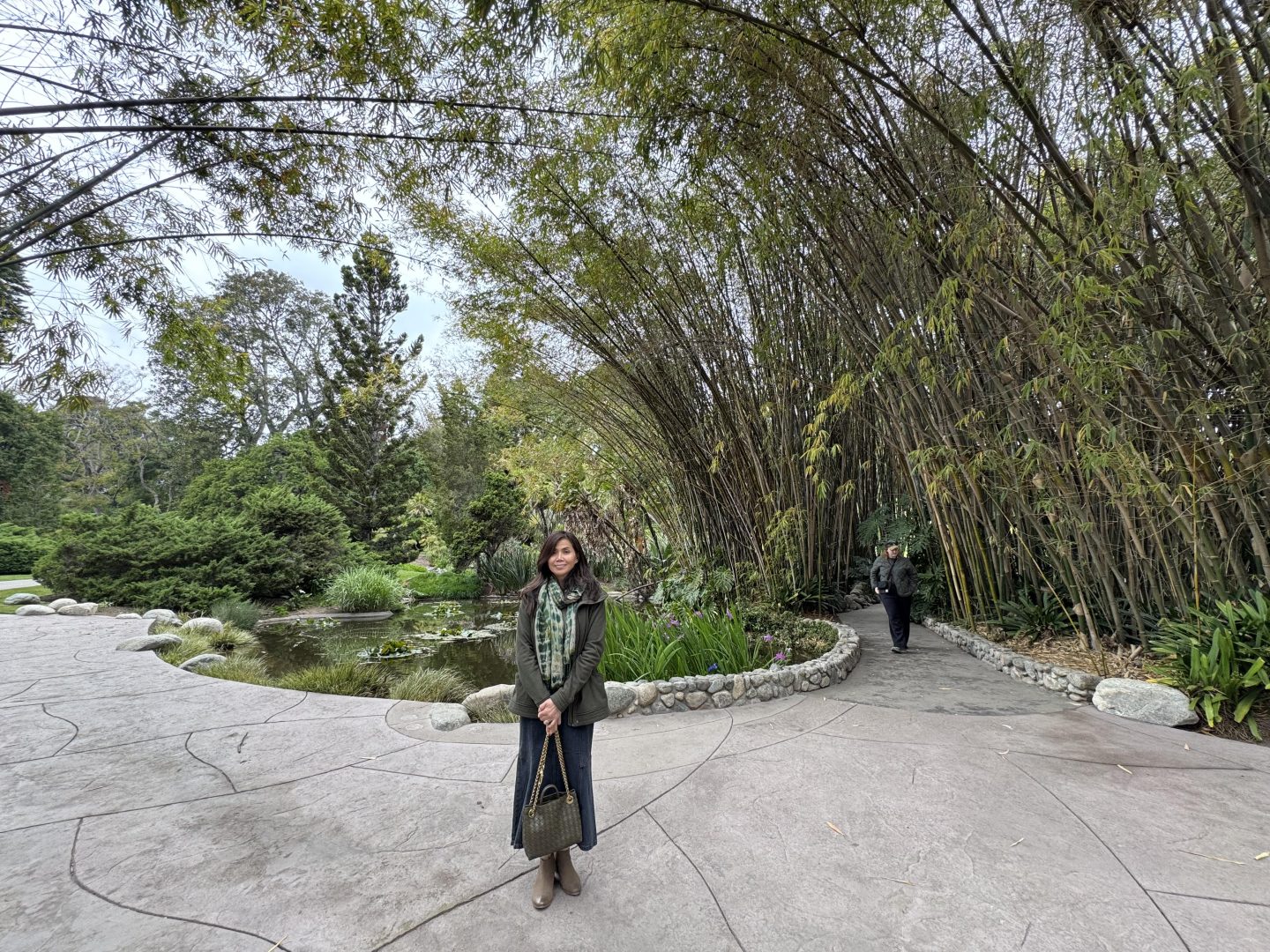
Abby Mirhan by a lily pond. | Photo courtesy of Emily Wong
Ever the garden enthusiast Mirhan quickly said, “I really enjoyed the lily ponds, especially where the bamboos reach across – I never knew bamboo trees could bend! I also liked the jungle garden; it felt like being in a different world instead of San Marino!”
There is something for everyone at The Huntington any day of the year, in any weather, as Adams told me during our tour. The plants are beautiful year-round and there will always be blooming flowers no matter when you visit.
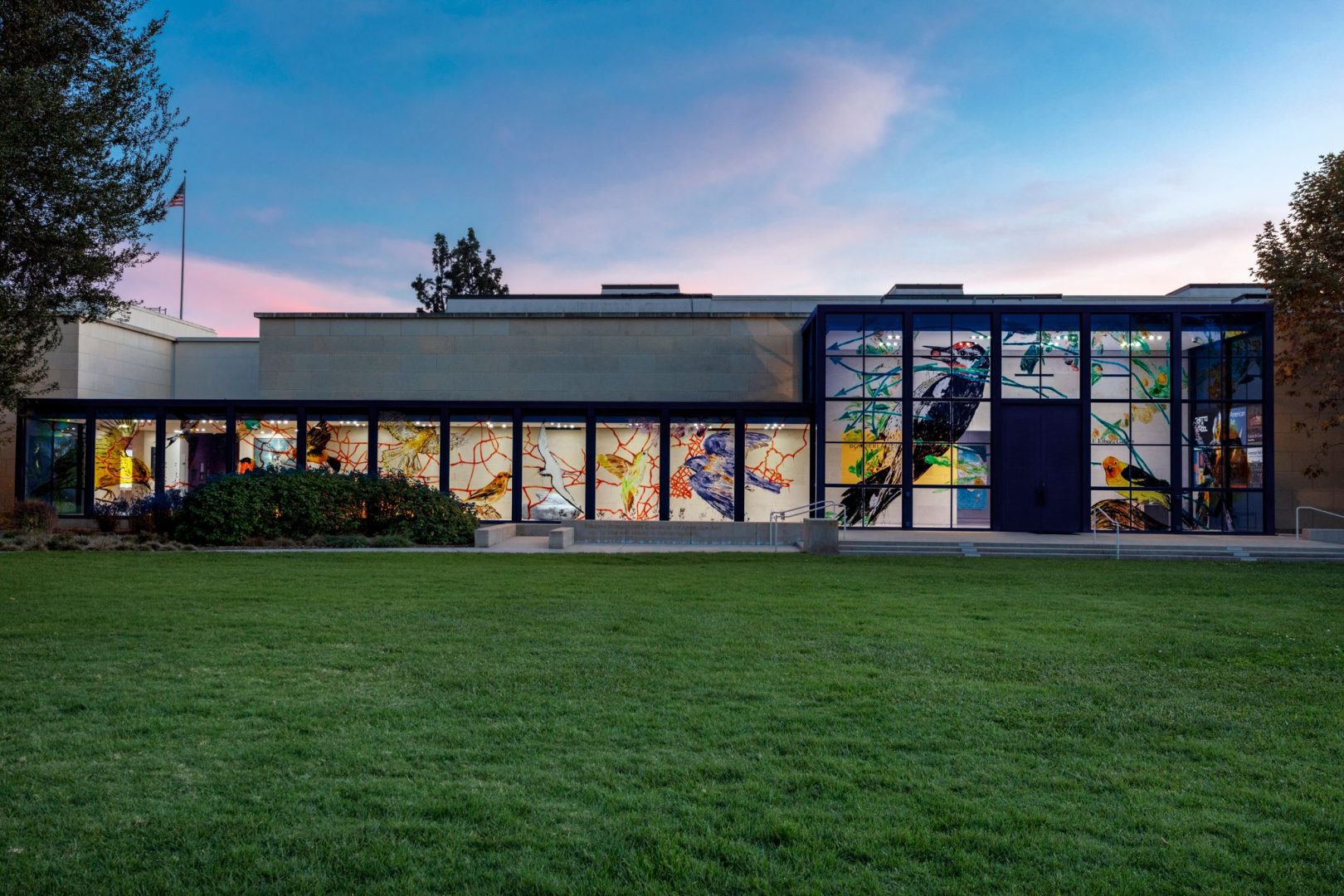
Installation view of Borderlands with Three-Bound by Enrique Martinez Celaya at Scott Galleries of American Art. | Photo by Joshua White / JWPictures / The Huntington
Many visitors that Friday couldn’t remember what The Huntington’s old monogram looked like and didn’t particularly care – they just wanted to engage with the collections. Adams may be justified in not being overly concerned about long-time habitués who aren’t thrilled to see the new logo of our cherished institution. She’s convinced we’ll eventually come around and learn to like this new H.
Henry E. Huntington would have been very pleased to know that the institution he founded in 1919 is being determinedly and purposefully equipped to stay relevant and ensure his legacy continues to be useful to everyone in The Huntington’s next century.



 A San Gabriel Valley Inquirer