“Flashes of Light,” a new musical by Billy Larkin and Ron Boustead, makes its world premiere at the Sierra Madre Playhouse from May 25 through June 9, 2025. Directed by Jon Lawrence Rivera, founding artistic director of Playwright’s Arena, the production is about visionary inventor Nicola Tesla and his muse Electra, the formidable goddess of storm clouds.
Set against the backdrop of the industrial revolution in New York City in the late 1800s, the story follows inventor Nikola Tesla, guided by Electra, who sends him visions of groundbreaking inventions during lightning storms. Their connection amps up when Tesla’s rivalry with Thomas Edison intensifies during the “War of the Currents,” a battle that shaped the world’s electrical future. As Tesla and Electra become obsessed with pushing the envelope of scientific discovery, a star-crossed love story fraught with peril unfolds as the line between science and mythology begins to blur.
Bringing together mythology and science, romance and historical fiction, “Flashes of Light” is a brilliant idea in musical theatre. The music’s heartfelt lyrics, soaring vocals, and haunting melodies blending jazz, pop, and rock, bring this fantastical story both tragic and divine to life.
Co-creators Larkin and Boustead discuss by email the origins of this collaborative work, the choice of venue, and the audience takeaway.
“Billy became fascinated with Nikola Tesla – this mysterious figure – so critical in the development of our modern technology, yet so underappreciated in the mainstream of American history,” begins Boustead. “Tesla was known to experience flashes of light and blinding headaches throughout his life, which were most likely migraines, but we attributed his malady to the overwhelming influence of Electra, Goddess of the storm clouds. Naturally, her power would be a lot for a mortal to endure.”
Thomas Winter as Nikola Tesla. | Photo courtesy of M. Palma Photography
“Also, the obsessive Tesla never married or was known to have a partner, so the idea of including Electra as his muse gave us a romantic storyline to add to the narrative,” Larkin adds.
While integrating myth or folklore with a factual figure and moment in science might seem conflicting, mythology is very much intrinsic to theatre, as Larkin and Boustead explain. “Mythology has been a staple of theater since its beginning, and crafting this tale became a catalyst to do a deep dive into some of the more compelling figures of Greek and Roman myth. Electra answers to a council of gods, more senior than herself.”
“Naturally, Athena – known for her wisdom, power, and morality – leads the council,” Larkin and Boustead clarify. “Prometheus, who had given mortals the gift of fire, is on hand to guide Electra in her mission to assist humans in the development of electricity. And Dionysus is an amusing addition to the council, with his drunkenness, his humor, and the sibling rivalry he shares with his sister, Athena.”
Teasing out the story, Larkin and Boustead relate. “Nikola Tesla leaves his homeland in Serbia with a head full of ideas about how to best distribute electricity for homes and factories at the dawn of the industrial revolution. He lands in New York where he becomes a rival to the great Thomas Edison in the ‘war of the currents,’ a contest between Edison’s direct current method, and Tesla’s alternating current.
“Along the way, Tesla interacts with prominent figures in 19th century finance and industry, like J.P. Morgan and George Westinghouse, and befriends the first American celebrity – the one and only Mark Twain. Through every challenge, Tesla is being assisted in his groundbreaking inventions by Electra, heard and felt only by him, during lightning storms. Like all interactions with the gods, theirs is a star-crossed relationship, with profound and tragic consequences.”
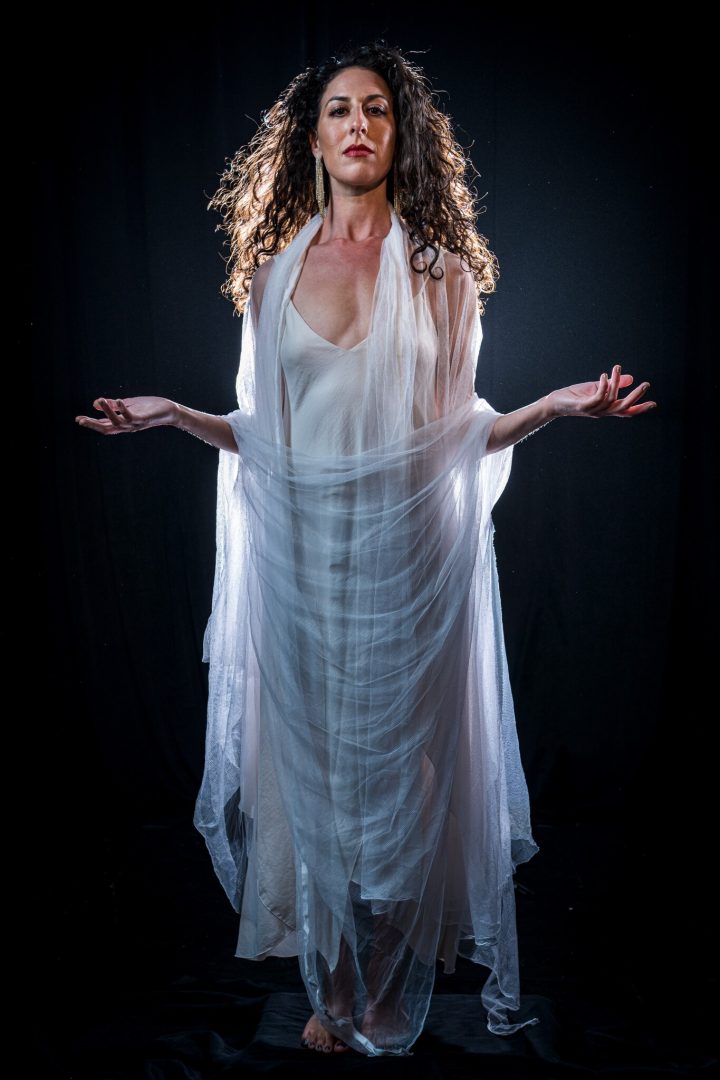
Devyn Rush as Electra and Thomas Winter as Nikola Tesla. | Photo courtesy of M. Palma Photography
Asked why they chose to debut their production in an intimate setting, Larkin and Boustead reply, “In April of 2024, we performed a concert of songs from our show at the El Portal Theatre in Noho, which we filmed. A friend of mine, who attended the concert, happens to be on the board of Sierra Madre Playhouse, and brought our project to the attention of Matt Cook, the artistic director. Matt thought ‘Flashes of Light’ would be an exciting addition to their 2025 calendar and approached us about staging our first run in their 99 seat theater setting. We love the historic and intimate vibe of SMP, and find it a welcoming atmosphere to get our production on its feet.”
Musicals normally require an orchestra – which the Sierra Madre Playhouse couldn’t accommodate – so they had to improvise. “Our score is built around a full jazz-rock band,” describe Boustead, “Because of the size limitations of the stage at SMP, we determined that the best approach for the music was to use the hybrid combination of Billy at the piano, assisted by tracks covering the rest of the orchestration.”
All 26 songs in the show are original and co-written by Larkin and Boustead in the course of eight years. However, many other beloved songs ended up on the cutting room floor, otherwise their show would be three hours long.
Devyn Rush as Electra. | Photo courtesy of M. Palma Photography
The co-creators dream that their show will one day be staged at larger venues but, for right now, they are happy to debut it in the San Gabriel Valley.
Larkin and Boustead emphasize, “Like any other musical theater creators, we imagine a trajectory that takes our project to larger venues next, with the ultimate goal of becoming a smash Broadway hit show, and eventually a touring company. But for now, we are singularly focused on making this version the very best it can be, given the time, budget, and space considerations available.”
“We hope audience members will gain a clearer appreciation for the tremendous contributions that Nikola Tesla made to our modern world,” pronounce Larkin and Boustead. “ We have been faithful to much of the history and science as it really happened, but we believe that the way we’ve told Tesla’s story will move audiences – sometimes to laughter, sometimes tears – but in the end to appreciate the value of one man’s life.”
“Tesla’s story is one that explores themes of science, mythology, genius, madness, immigration, friendship, romance, and ultimately legacy,” Larkin and Boustead declare as a final note. “It’s one that resonates with anyone who strives to leave the world a better place than they found it.”
These topics are as realistic as they are fantastic, as relatable as they are aspirational. “Flashes of Light” promises to be a little show with huge potential to reach great heights. And we in the San Gabriel Valley are so fortunate to be the very first ones to see it launch.
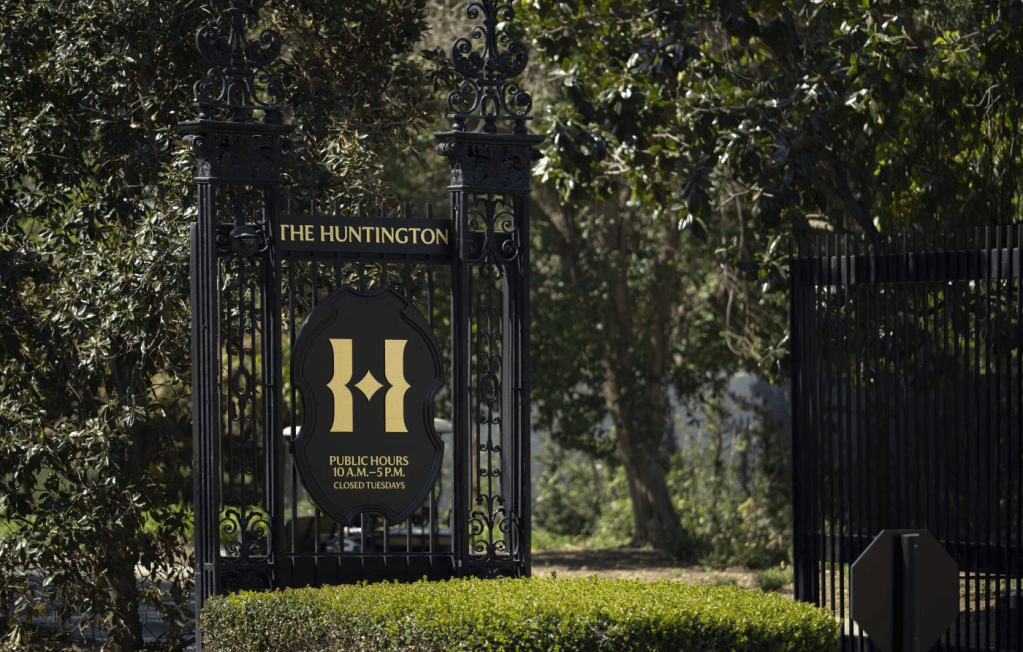
New Signage at The Huntington gate. | Photo courtesy of David Esquivel / The Huntington
Frequent visitors to The Huntington will be surprised to see starkly different signage as they enter the gates. The familiar name The Huntington Library, Art Museum, and Botanical Gardens with all its flourishes has been replaced with only the letter “H.” The bold visual identity and simplified name “The Huntington” are just the introduction to the institution’s first sweeping branding initiative in its 106-year history.
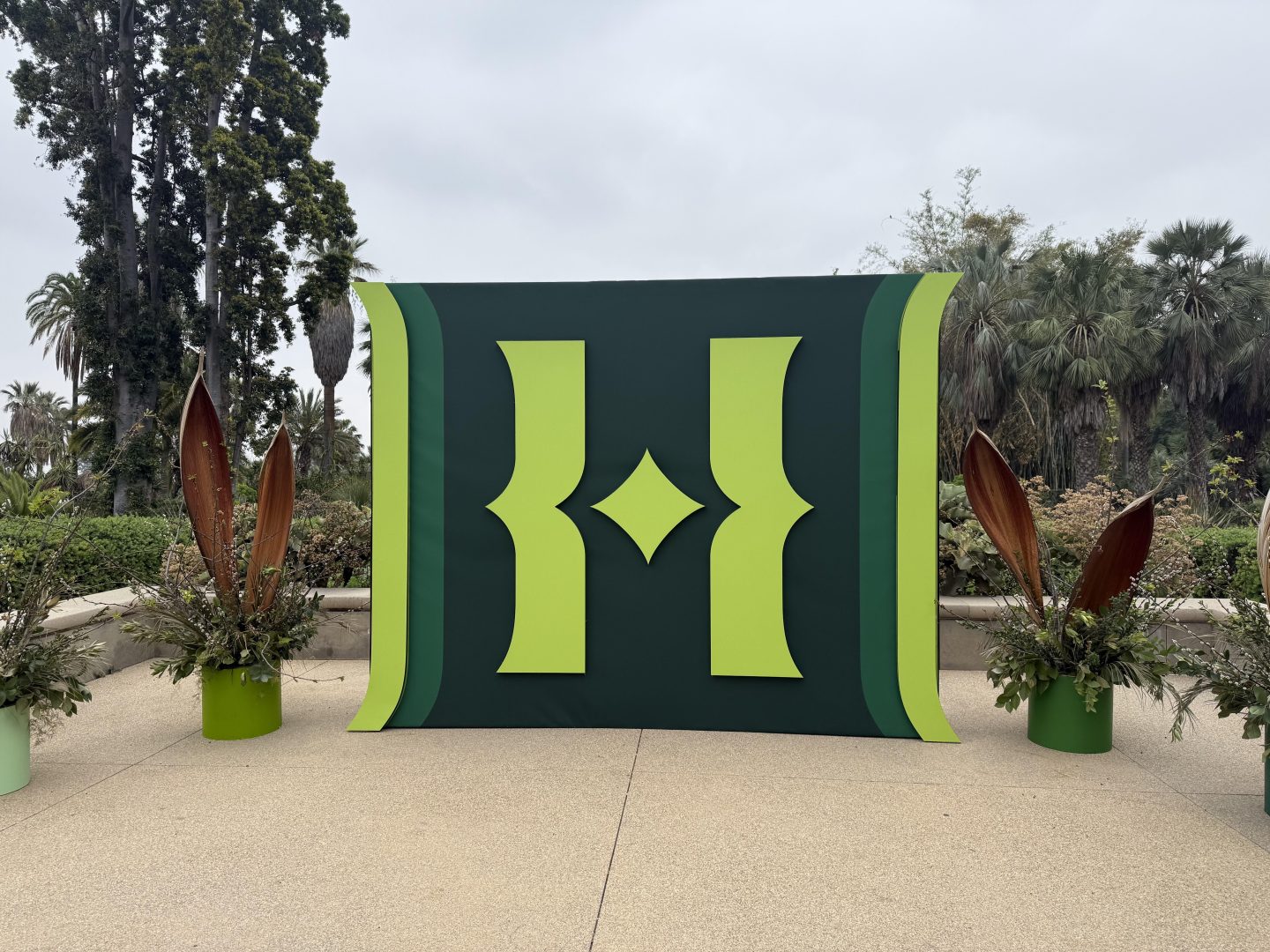
The H monogram signifies a foundation grounded in tradition but focused on modernization. Incorporating a jewel-like center, it serves as a reminder that The Huntington is a treasured cultural institution. The gem is flanked by two stylized pillars – one pointing left toward the past and one pointing right toward the future.
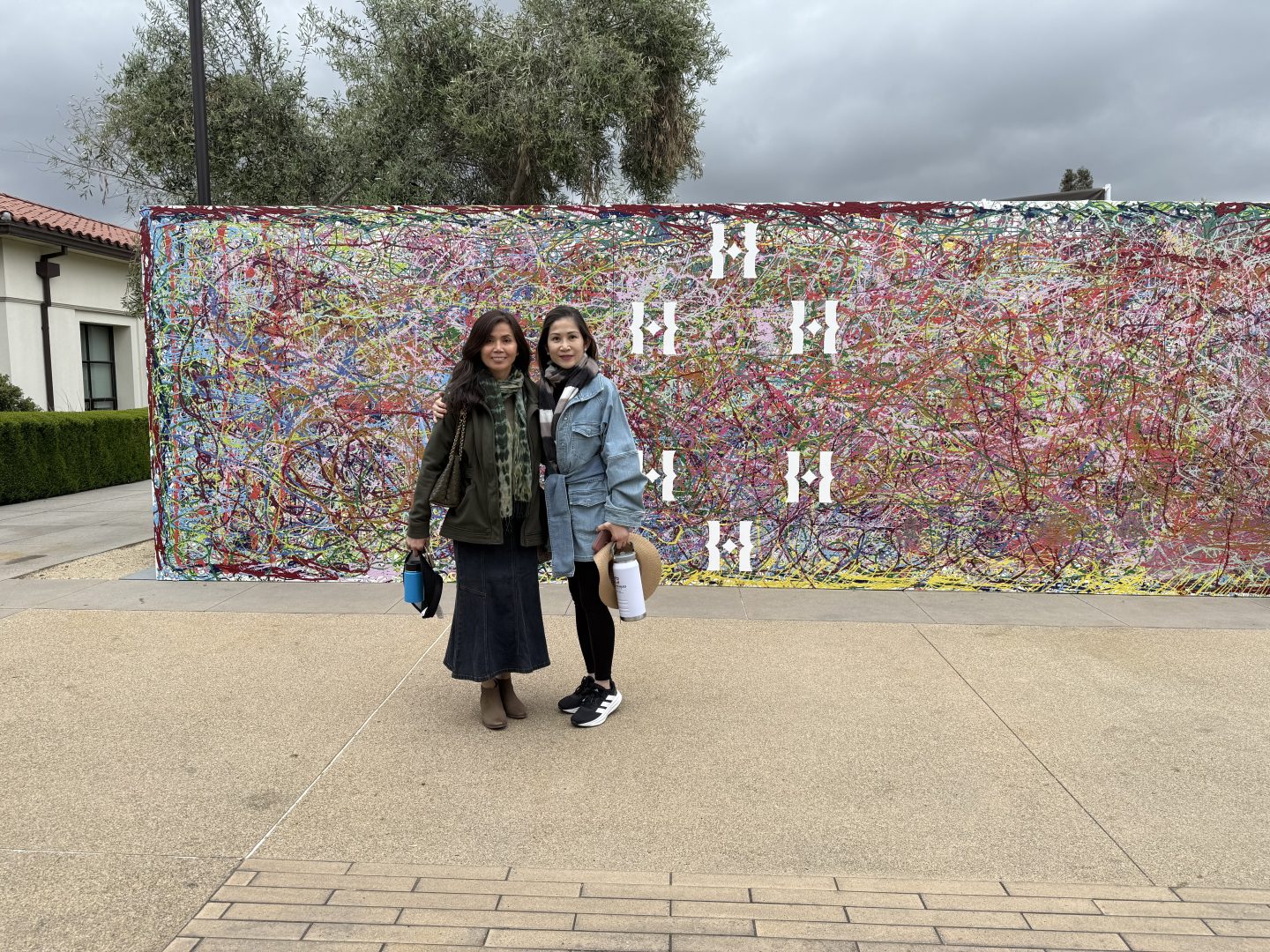
A large canvas with the new logo near the Celebration Garden. | Photo by May S. Ruiz / Hey SoCal
Launched on April 8, 2025, the brand rollout includes new signage, a refreshed website, a marketing campaign inviting visitors to “Rediscover The Huntington,” educational content for all ages, new branded merchandise, celebratory giveaways, and special Second Sunday events with activities for all ages. The rebrand is propelled by the visionary One Huntington strategic plan led by President Karen R. Lawrence – a transformation that marks the next chapter in the institution’s evolution.
Interviewed by email, Lawrence spoke about the concept behind the rebrand.
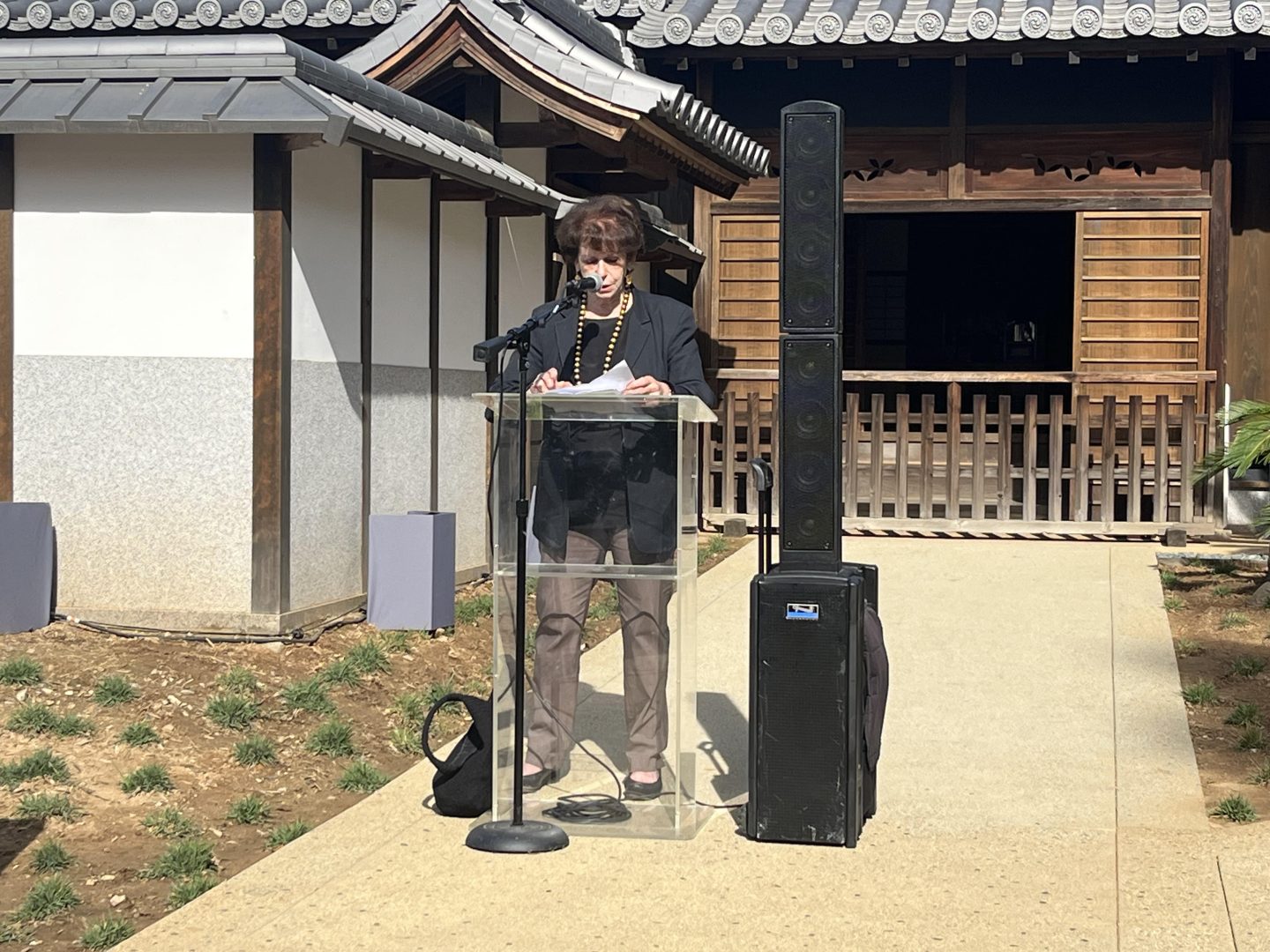
Karen R. Lawrence during the opening of Shōya House. | Photo by Brianna Chu / Hey SoCal
“The rebrand emerged from our strategic planning process,” she said. “It supports our institutional priorities and commitments directly; in particular, demonstrating the connections among our three core collections – library, art, and botanical – and expanding access, engagement, and education for a broader public, both digitally and in person.
Expounded Lawrence, “What is most important to note about our new brand is that it helps The Huntington achieve several objectives:
“Connecting our collections: First, we simplified our name from The Huntington Library, Art Museum, and Botanical Gardens to just The Huntington. It better represents the powerful cross-fertilization among our three core collections and conveys that the whole is more than the sum of its excellent parts! We use the term ‘One Huntington’ to describe these unique connections.
“Our monogram, too, reflects this unity: While our previous monogram borrowed heavily from the botanical, our new H – with a jewel-like center flanked by two pillars – captures the essence of what we do as an institution. One pillar honors our history, the other looks to the future, and the gem in the middle is what makes The Huntington unique: our people, our collections, and our mission.
“Increased accessibility and digital agility. Our previous ornate H was beautiful but didn’t scale well – imagine trying to decipher that intricate design on a smartphone screen – it simply didn’t work. The new monogram is clean, modern, and legible across all formats.”
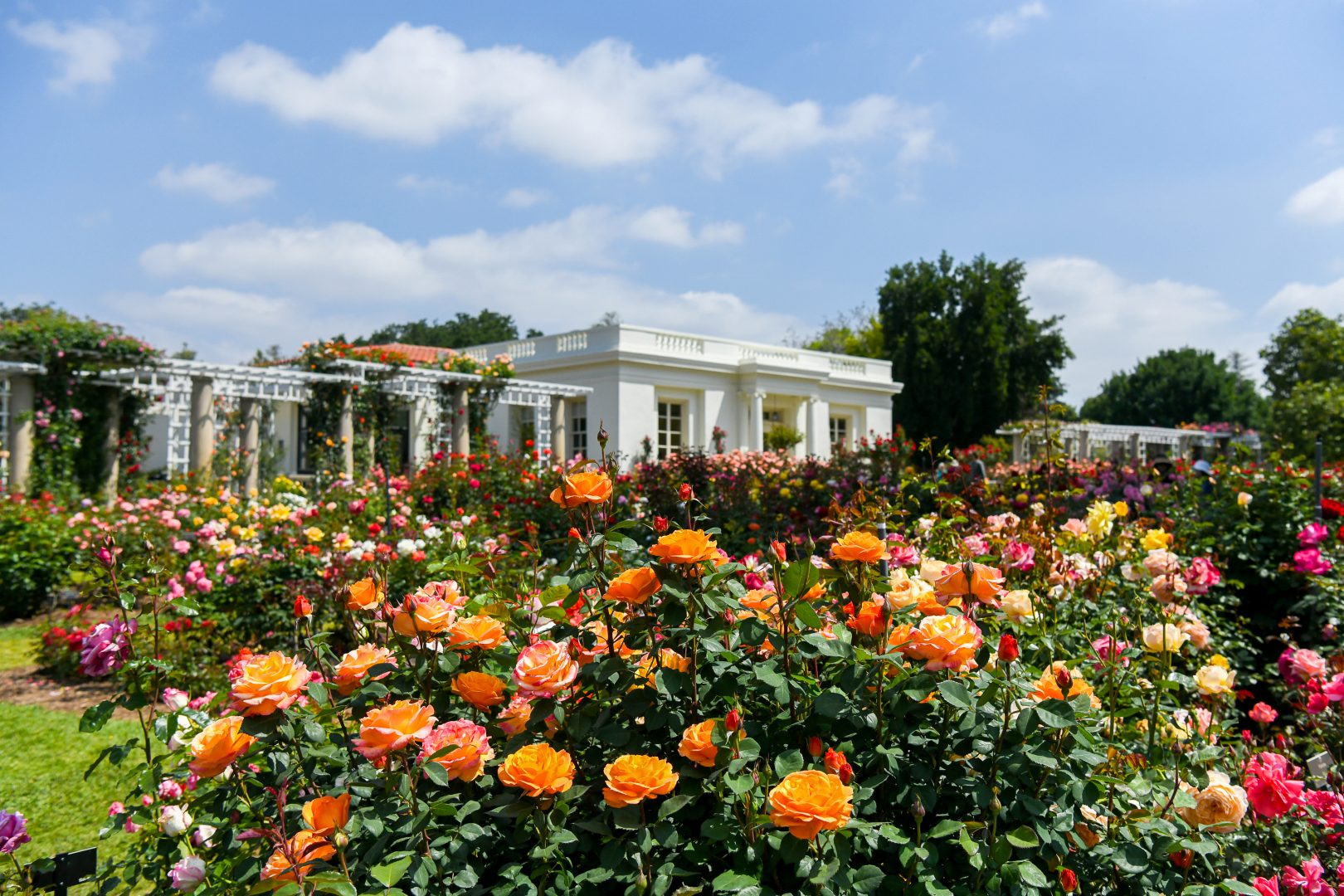
Exterior view of the Rose Garden Tea Room. | Photo by Joshua White / JWPictures.com / The Huntington
The extensive branding initiative entailed getting input from all quarters. Lawrence stated, “Members of our Trustees and Board of governors were thoughtful partners throughout the process. They wanted to make sure that we preserved what has always been special about The Huntington but endorsed our desire to reflect recent initiatives as well. We issued an open request for proposals from firms that specialize in branding and communications and ultimately selected Base Design, an international creative agency, to help guide us. The process was collaborative, with feedback loops at every stage – from early concepts to final design.”
“We formed a Steering Committee and a larger stakeholder group,” added Lawrence. “We intentionally involved staff from across the institution, because a brand isn’t just a logo – it’s how we see ourselves, how the public sees us, and how we want to be seen.
“We invited a wide range of stakeholders to weigh in on the design concepts, suggesting a number of modifications, including the logo. Their feedback helped shape not only how the brand looks but also the spirit it conveys.”
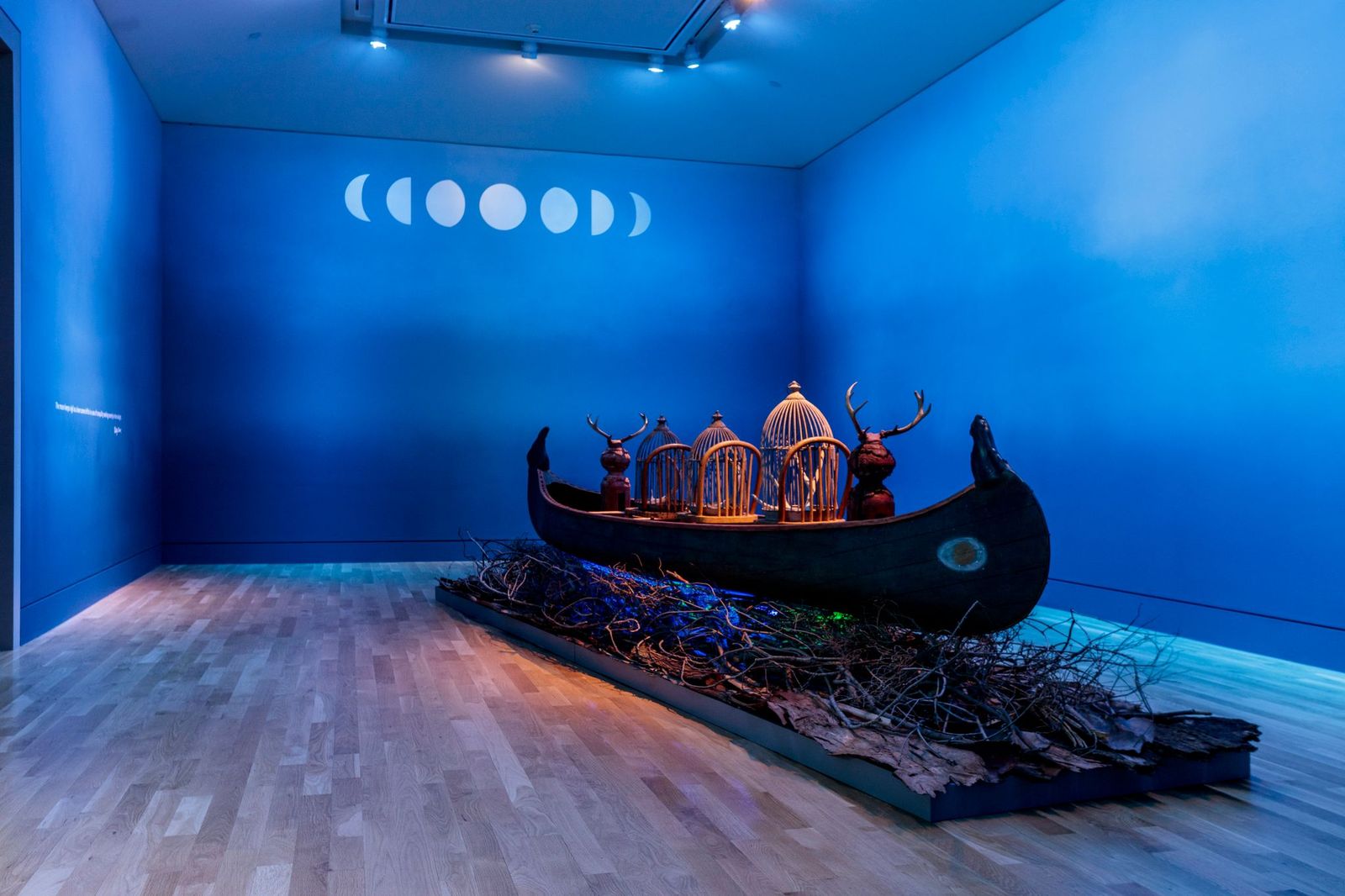
Betye Saar, ‘Drifting Toward Twilight,’ 2023 installation. | Photo by Joshua White / JWPictures.com / The Huntington
The final decision about the new brand was not arrived at single-handedly by Lawrence. She clarified, “It was a consensus-driven process. We took an iterative approach that allowed many voices to be heard and incorporated along the way. Together, we made some course corrections, which I believe made the final product better. It honestly reflects a shared vision.”
Lastly, Lawrence encouraged people to see for themselves what The Huntington offers.
“We are inviting everyone to Rediscover The Huntington. We are known as a superb research library to scholars around the world. Members of the public know us for our Rose Garden, or for The Blue Boy and our Ellesmere Chaucer, and we’re rightly proud of these masterpieces, but we’re also home to more contemporary and recently-acquired works and collections – by Thomas Pynchon, Betye Saar, Octavia Butler.”
The private garden at Shōya House. | Photo by Brianna Chu / Hey SoCal
“Other ‘new’ acquisitions include a 320-year-old Shōya House in the Japanese Garden, which was moved piece by piece from Japan to its new home. The house, with its surrounding ecosystem, is a historic example of a contemporary priority – sustainability. We hope our longstanding visitors as well as new ones will find new and surprising things to discover here.
“With our new visual identity and streamlined name, we’ve also launched a series of digital initiatives that expand our reach, bringing The Huntington to global audiences – students, researchers, and our ‘community of the curious.’
The execution of The Huntington’s rebrand fell to Annabel Adams, who came on board in August 2024 as Vice President for Communications and Marketing. While she took me on a tour of the site one week after the rollout, she talked about stepping into this new role only six months before the launch, the new logo, and the programs that lean into The Huntington’s values.
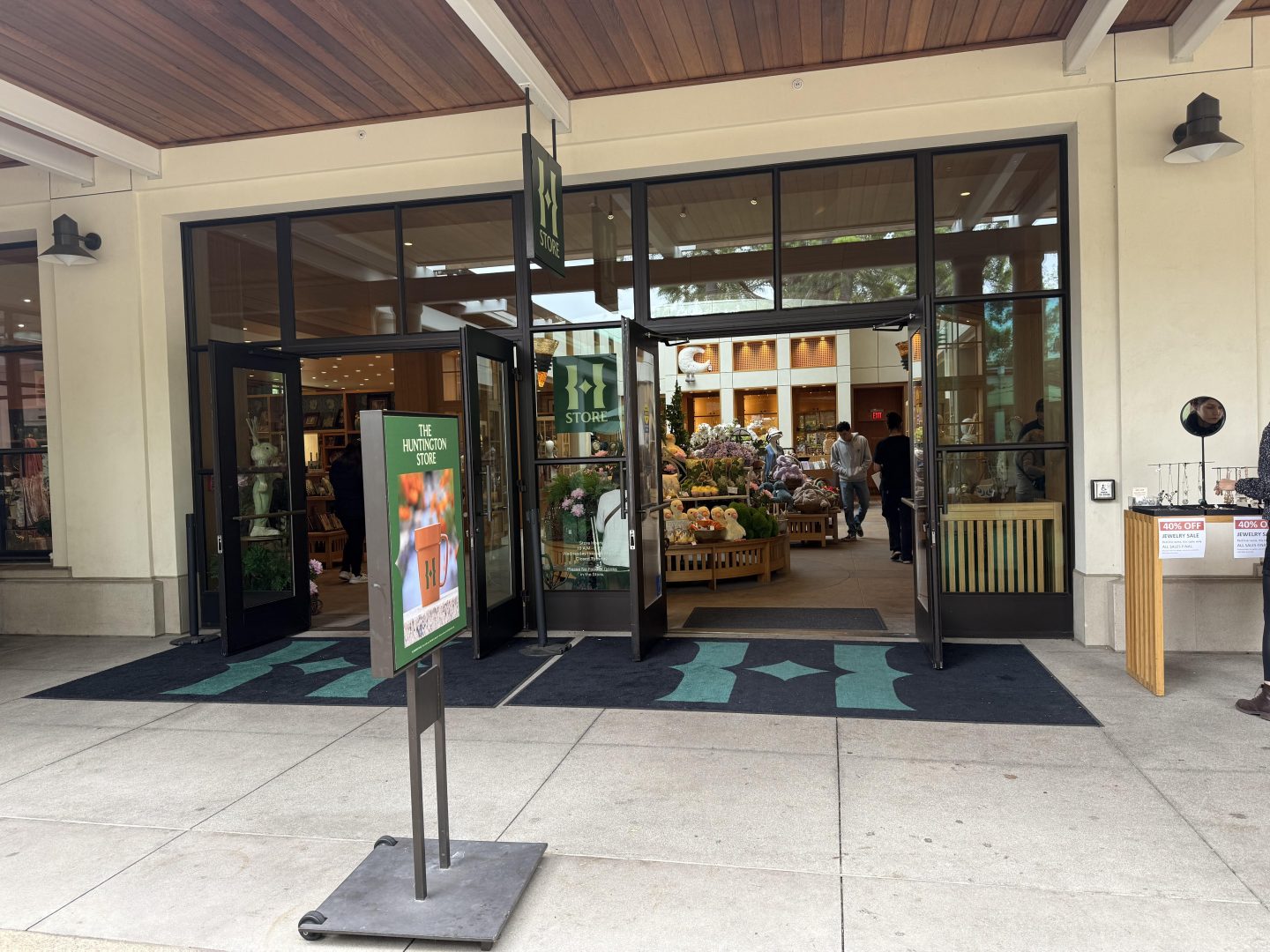
The Huntington Store. | Photo by May S. Ruiz / Hey SoCal
“I knew coming in that I was going to lead the rebrand, but I didn’t get to see the brand because we had to keep it confidential,” Adams began. “This was actually years in the making. My predecessor Susan Turner-Lowe conducted a stakeholder and focus groups. They did studies to assess how a brand can lean into our values and serve our communities better. That’s what led to this rich color palette, the agile and adaptable H that can scale both for print and digital media. It is in service to all the research they did for years coming up with this brand.”
Continued Adams, “I had the privilege of coming on board when the brand had already taken shape and my job was to deploy it – to bring it to life across the institution. I worked with my incredible communications team to adapt the signage, the website; anywhere there was an existing logo or monogram, we touched it with the new brand. And there were hundreds of them!”
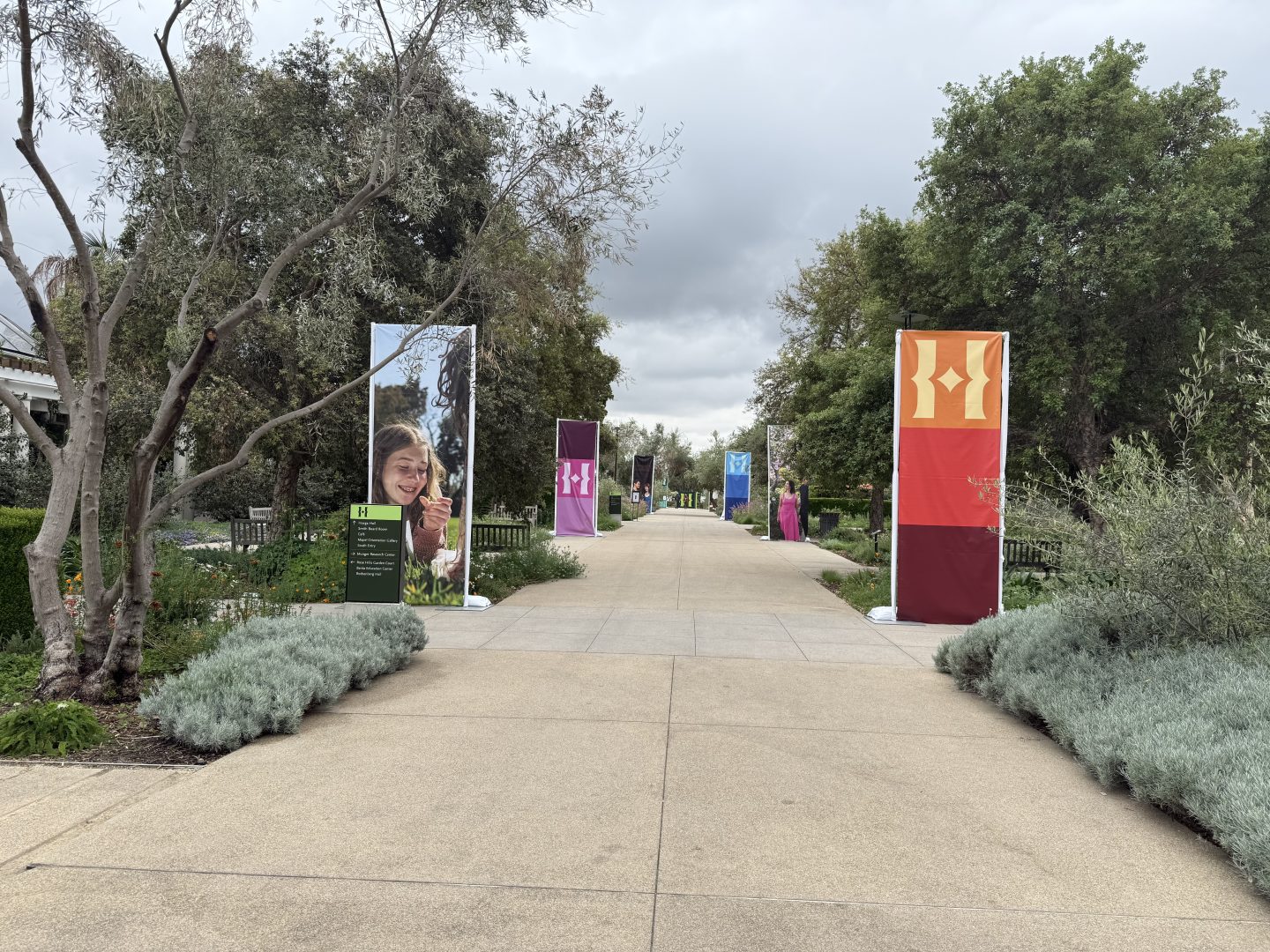
Banners show people engaging with the collections. | Photo by May S. Ruiz / Hey SoCal
As we approached an allėe of banners on the Brody California Garden, Adams said, “Our creative director Lori Ann Achzet was the talent behind the scenes bringing this striking brand to life. She created these banners – which show how people engage with the collections at The Huntington – and did the front gate revamp. She’s an incredible designer and asset to us.”
“Part of the rebrand is to remind people that there are three components to The Huntington – the library, art museum, and botanical gardens,” Adams reiterated. “People love the ornate H with the filigree and leaves – it’s so beautiful. However, it really is representative just of the botanical gardens. We’re proud of our 130 acres of botanical gardens, but we also have an art museum and a library. The rebrand is meant to unify and showcase that we are the synergy of these three collections. The arrows in the monogram also have significance: the arrow pointing left means traditions which we are honoring and the one pointing right is for innovations.”
The Chinese Garden. | Photo by David Esquivel / The Huntington
“You do realize this redesign will be met with resistance from people like me who have been coming here for decades and are very familiar with the old monogram,” I pointed out. Without hesitation, Adams countered, “I’m aware of that. But it’s important to note that all the things that everyone loves at The Huntington have not changed. I take it as a compliment that people feel so passionately about The Huntington they know and love. And that resistance to change speaks to how powerful people’s affinity to the institution is.”
Adams again echoed Lawrence’s explanation for the rebrand, “Our old monogram – as ornate and beautiful as it was – could not scale down in an iPhone icon. This new H is accessible for a digital world; we want the experiences of our brand to be accessible to everyone and the ornate H wasn’t.”
“Our values are what guided the brand and my job is to find ways to further lean into them,” Adams asserted. “Those include being more accessible, adapting to a digital world, ensuring our audience can engage and benefit from The Huntington. Then that meant we also have to develop programs that could help us see the brand in action.”
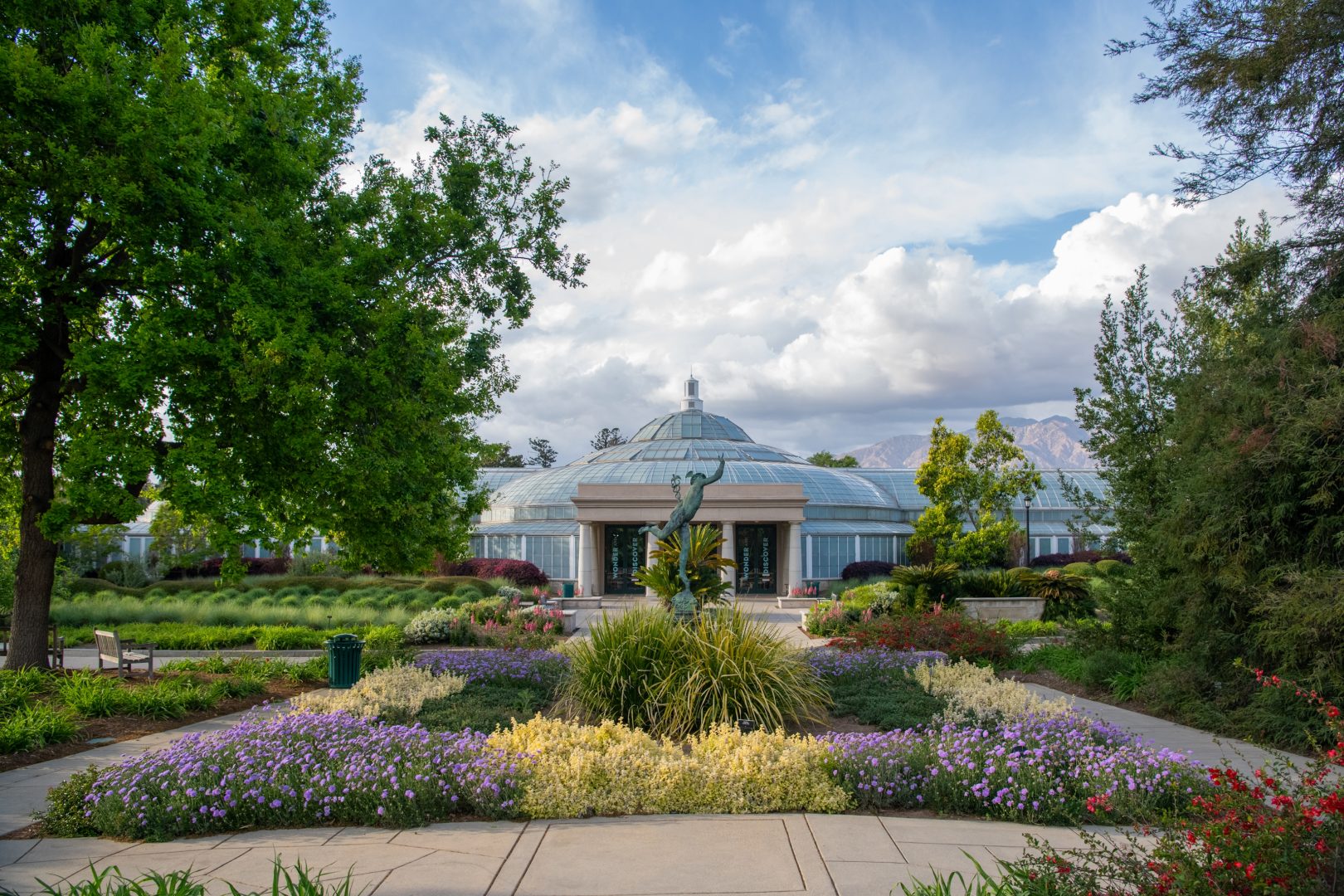
The Rose Hills Foundation Conservatory for Botanical Science. | Photo courtesy of The Huntington
The Huntington’s evolution reflects its increasingly important role as a world-renowned institution – welcoming over one million visitors, hosting more than 500 school groups, engaging about 2,000 scholars and 1,000 volunteers, and reaching approximately seven million website and digital library users and 110 million social media users annually.
As part of the brand launch, The Huntington is expanding its reach with new digital products that connect students, lifelong learners, and global audiences to its renowned collections – anytime, anywhere. These offerings include:
“Huntington How To”: This four-episode YouTube series brings The Huntington’s collections to life through practical guidance from its in-house experts. The first episode, featuring Stephen Reid, assistant curator and head gardener of the Rose Garden, demonstrates how to grow and care for roses, even in Southern California’s unique climate. Future monthly episodes will explore such topics as deciphering historical handwriting, interpreting decorative arts, and repairing books.
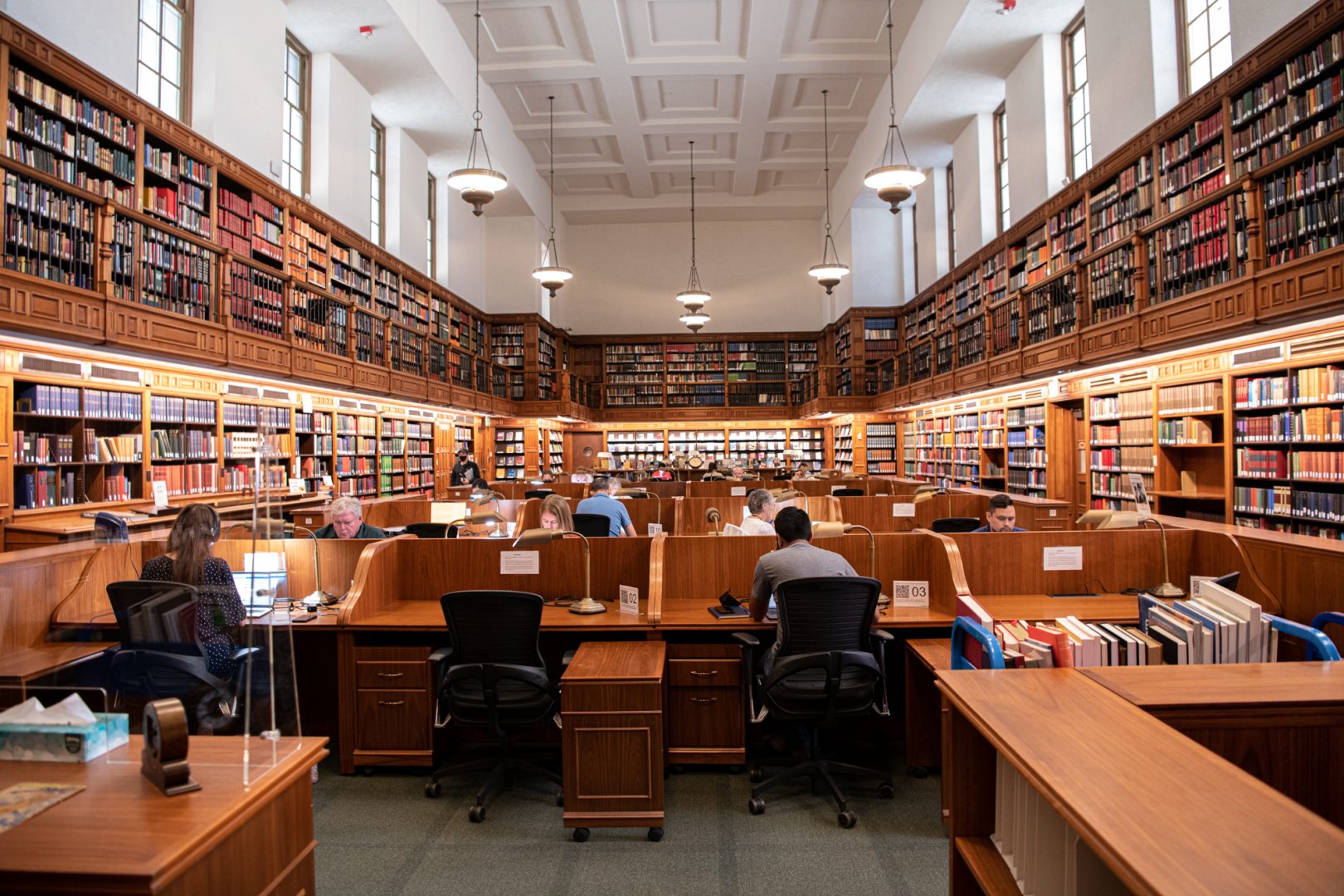
Rothenberg Reading Room. | Photo courtesy of The Huntington
“Collections for the Curious”: Designed for the intellectually curious, this new digital discovery tool will allow online visitors to explore The Huntington’s holdings by using keywords and filters, generating results from the library, art, and botanical collections. The public tool will launch in June with a series of curated highlights that will spotlight unexpected connections among The Huntington’s three collections, including items from recent exhibitions, as well as Latino art and artists, tea services, and women artists.
“Everyday Extraordinary”: Developed in collaboration with award-winning educational content producer Makematic, this playful animated series introduces primary school students to fascinating scientific concepts in a fun and accessible way. Episodes will explore such botanical topics as photosynthesis, mushrooms, and carnivorous plants. The series will launch in May.
According to Adams, The Huntington partnered with Museums for All to make the institution affordable for everyone. Individuals who receive SNAP (Supplemental Nutrition Assistance Program) benefits are eligible for a reduced admission of $3. Since the partnership’s launch in January, The Huntington has welcomed nearly 8,500 visitors through the program.
Architectural rendering of Scholars Grove. | Image by VTBS Architects / The Huntington
An important project is the development of Scholars Grove, a residential community designed to support visiting fellows conducting research in the institution’s renowned collections. Scheduled for summer construction to last 14 to 16 months, it will address long-standing housing challenges for The Huntington’s visiting research fellows – providing 33 residential units arranged in seven one- and two-story buildings, along with a commons building designed to foster interdisciplinary collaboration.
The project design incorporates and preserves 150 trees, including a Magnolia pacifica tarahumara (the only known mature specimen in North America), several historic oaks, and a research grove of avocado trees – one of which dates to founder Henry E. Huntington’s time.
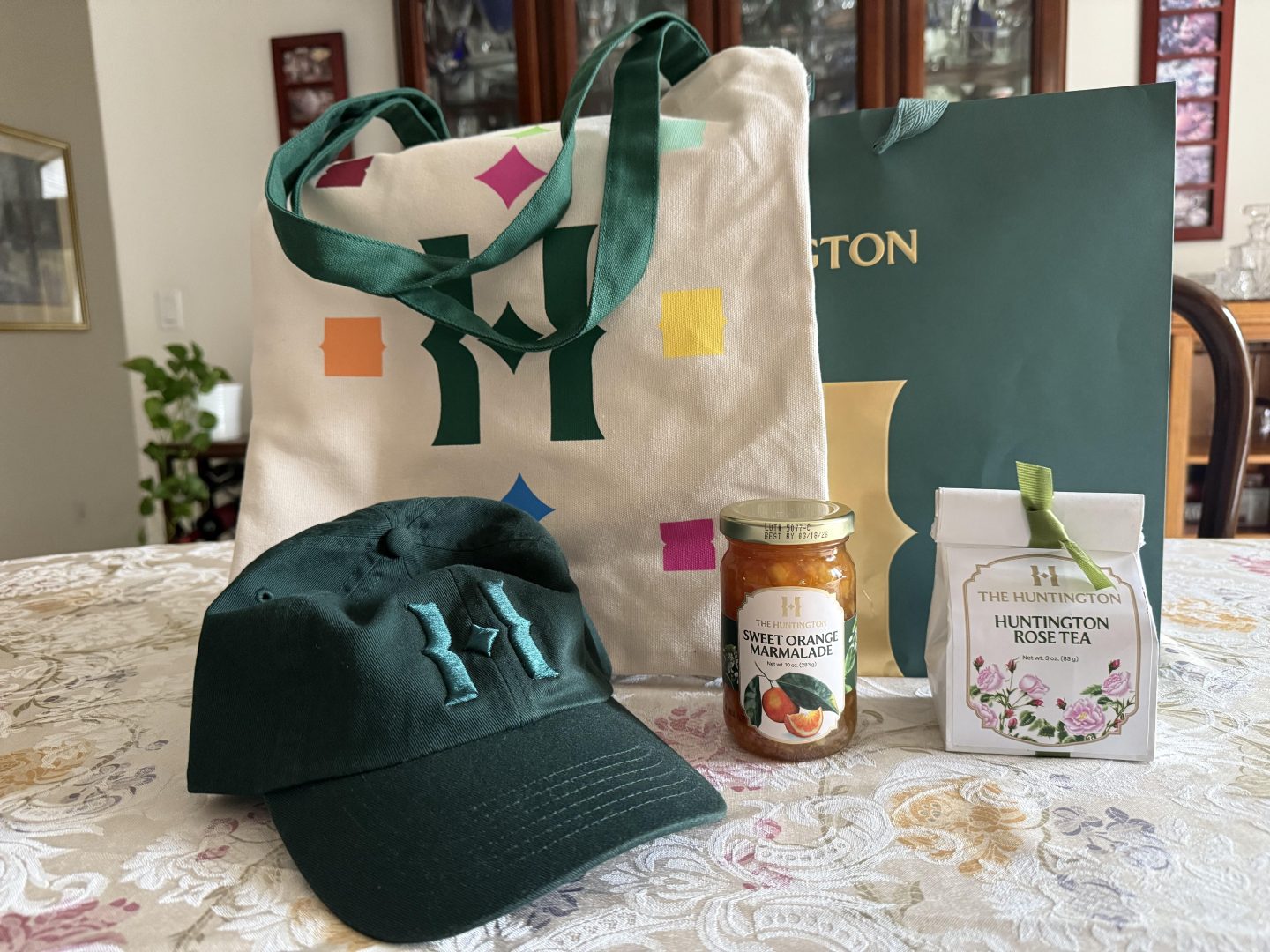
New logo on merchandise; an artist painted an orange from The Huntington’s orange grove for the label on the marmalade jar. | Photo by May S. Ruiz / Hey SoCal
Asked what the biggest challenge was for her, Adams responded, “Doing all this in six months! But there is an undercurrent of enthusiasm and possibility at The Huntington that I find really refreshing and energizing. So I think it was never a question to me of whether this was possible, it was just how do we think of this as a continual deployment? In six months we have this major launch but we are going to continue to lean into the brand now. The launch was a catalyst and how we maintain that momentum is the next phase.”
“We have this beautiful ad that’s coming out in the Museum section of the New York Times – the first time that we’re going to have an advertisement that shows an object from each collection represented as this one foundation and what it offers to the world as a cultural institution. One of items we’re spotlighting in the ad is Octavia Butler’s archive. It’s also the first time we’re spotlighting in an ad this incredible collection that’s so meaningful for us to have at The Huntington. Octavia Butler is a Pasadena native and her work always had impact and meaning, but I think it specially has meaning at a time like now. It’s going to be exciting to see how we can continue to bring that message of what The Huntington has to offer across its collections to everyone through how we communicate with our audience,” expounded Adams.
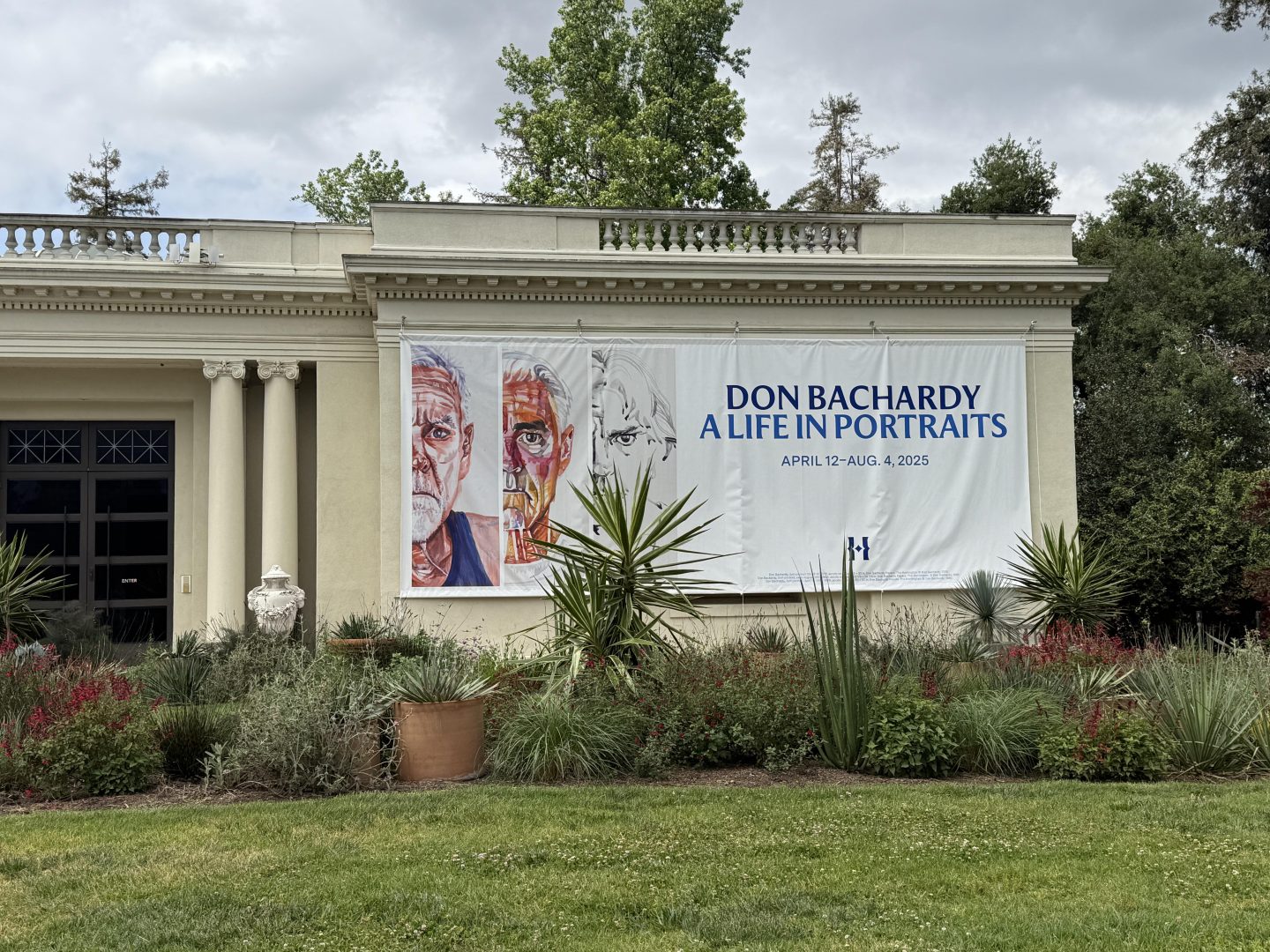
Don Bachardy Exhibition in the Boone Gallery. | Photo by May S. Ruiz / Hey SoCal
Added Adams, “We have a number of great exhibitions planned this year. Don Bachardy in the Boone Gallery is the first exhibition in the new brand. You see on the title wall how the colors and the font work. It’s really legible and accessible.”
“The power of this brand is the accessibility,” Adams emphasized. “A brand is more than just the visual identity, it’s the execution in action. Things like the YouTube ‘how to’ series, Museums for All, the Scholars Grove – those are initiatives that spotlight the accessibility that we’re leaning into with this new brand, the legibility, even our color palette. The colors weren’t chosen willy-nilly, they were from items in our collections in the library, the museum, and the botanical gardens. These are colors that represent The Huntington and that’s why they’re meaningful. These images of people in action are meant to signify that when Henry Huntington created this institution, his goal was to put these collections to use.”
“It’s our invitation to people – to rediscover The Huntington,” declared Adams. “We haven’t changed. You know us for Blue Boy and Pinkie. But do you also know us for Borderlands? Do you know us for the Kehinde Wiley portrait? Do you know us for Shōya House? Come and see everything that The Huntington offers.”
The Huntington means different things to different people. I first visited The Huntington 43 years ago because of the Ellesmere manuscript of Chaucer’s Canterbury Tales and Shakespeare’s Folio in the Library and The Blue Boy and Pinkie in the Art Museum.
(L to R) Abby Mirhan and Emily Wong pose for pictures in front of the artwork created by The Huntington staff to celebrate the launch of the rebrand. | Photo by May S. Ruiz / Hey SoCal
For Abby Mirhan of South Pasadena, The Huntington means the gardens. She was there one Friday to rediscover what she loved about it and find new things she hadn’t seen.
Mirhan said, “My first visit to The Huntington Gardens was 40 years ago when my mom took me. I hadn’t heard of it before and didn’t know what to expect. When I saw the beautiful Chinese and Japanese Gardens, the first thing that came to mind was ‘Why didn’t I come here before now? It’s so close to my house, I should really visit more often.’”
That didn’t happen though. The last time Mirhan was at The Huntington was about ten years ago when she volunteered to chaperone her youngest daughter’s class for a field trip. So she decided to re-experience it with her friend, Emily Wong.
Wong, who’s from Montebello, is excited to join her friend. For her, The Huntington means the museum. She disclosed, “I came here several years ago with my husband and my daughter to see the artwork in the museum. But today, I’m going to explore the gardens as well.”
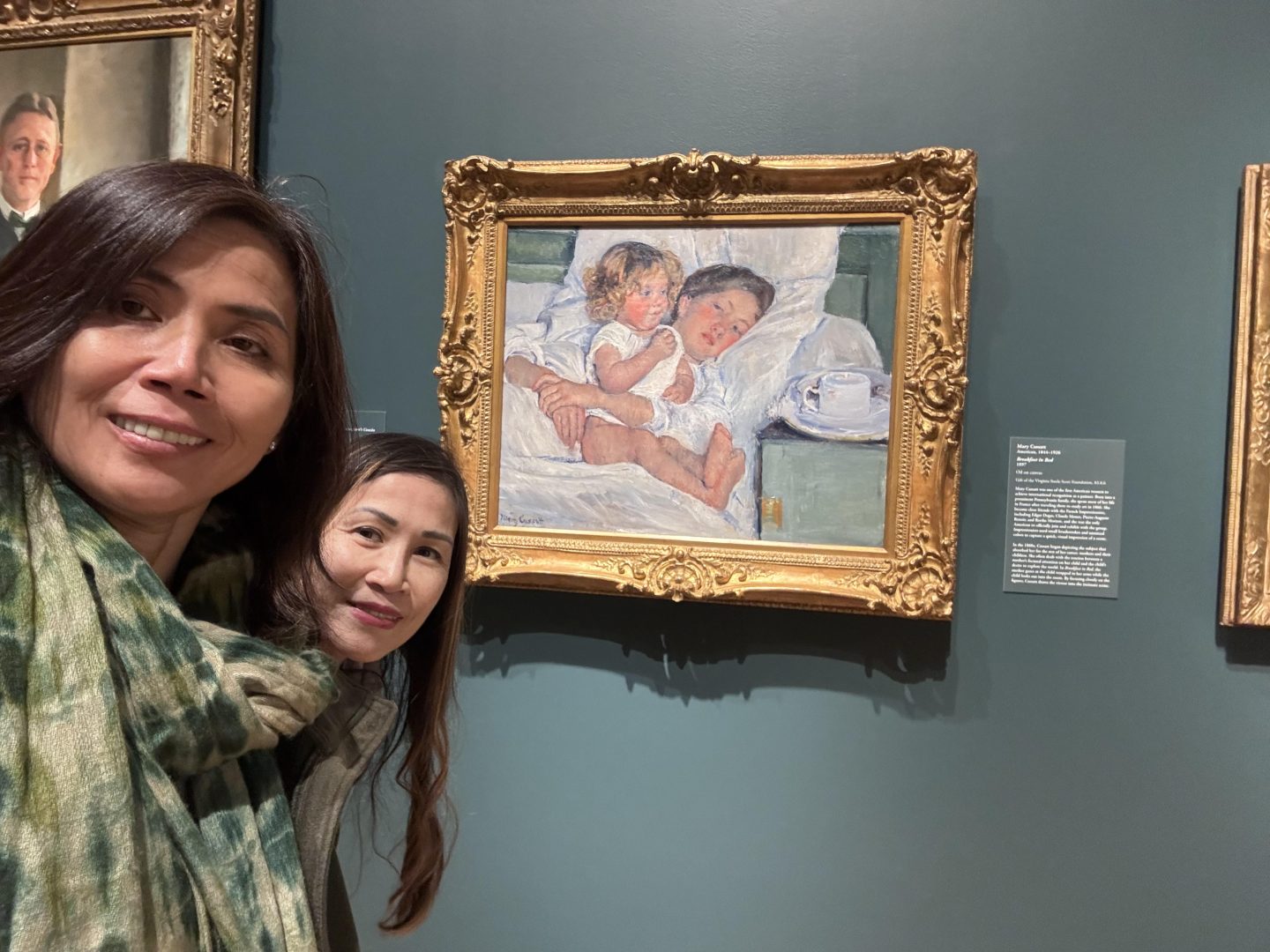
A selfie of Mirhan and Wong with Mary Cassatt’s painting ‘Breakfast in Bed’. | Photo courtesy of Abby Mirhan
While some of us might hope for a glorious sunny day on our visit to The Huntington gardens, Mirhan and Wong were delighted that they unexpectedly came on a grey and gloomy day.
“I have a medical condition that makes me sensitive to sun exposure,” enlightened Mirhan. “I usually bring a hat whenever I go outdoors. We got lucky with today’s overcast weather.”
Mirhan and Wong arrived at 10:00 to take in the full Huntington experience. They explored the many beautiful gardens and marveled at the roses and wisteria in full bloom; looked at the artwork in the galleries and gazed in awe at the stunning paintings and artwork.
“We had a really great time – we took soooo many selfies to show our families and as a reminder of this fun day,” Mirhan said laughing.
Asked what they liked best on this visit, Wong replied, “I loved the pretty flowers in the gardens and the gorgeous landscapes. I also enjoyed reading the backstory of the art pieces.”
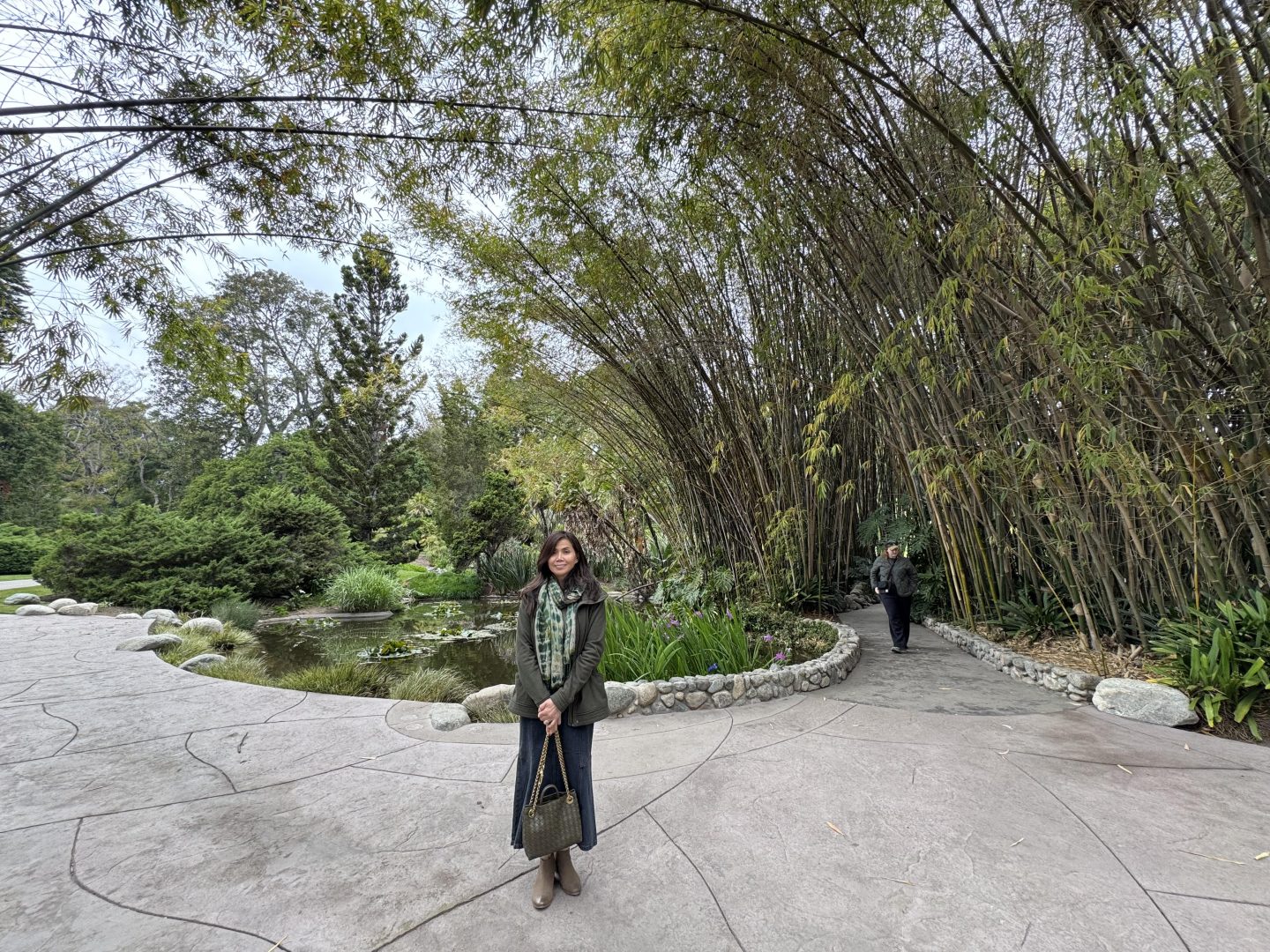
Abby Mirhan by a lily pond. | Photo courtesy of Emily Wong
Ever the garden enthusiast Mirhan quickly said, “I really enjoyed the lily ponds, especially where the bamboos reach across – I never knew bamboo trees could bend! I also liked the jungle garden; it felt like being in a different world instead of San Marino!”
There is something for everyone at The Huntington any day of the year, in any weather, as Adams told me during our tour. The plants are beautiful year-round and there will always be blooming flowers no matter when you visit.
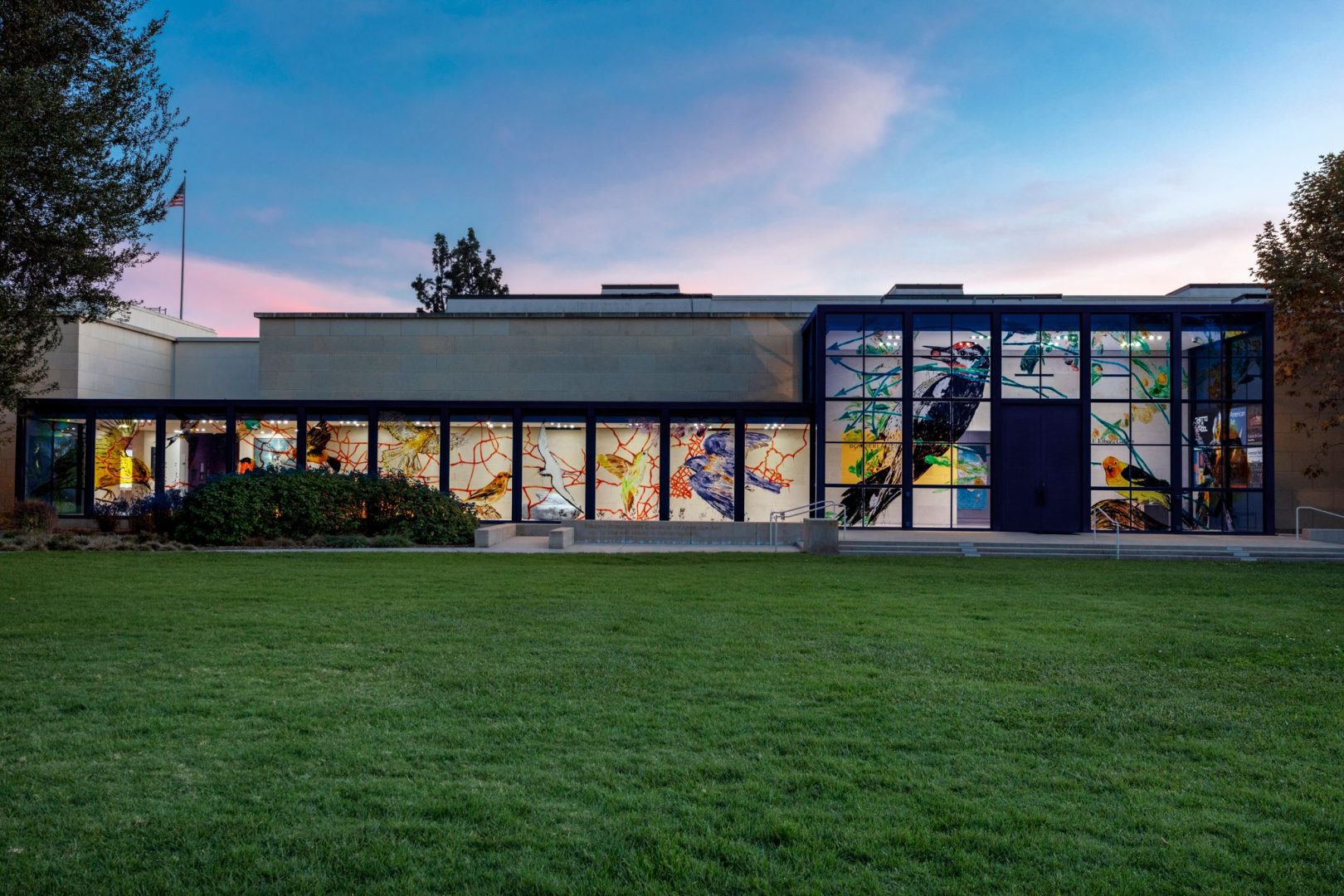
Installation view of Borderlands with Three-Bound by Enrique Martinez Celaya at Scott Galleries of American Art. | Photo by Joshua White / JWPictures / The Huntington
Many visitors that Friday couldn’t remember what The Huntington’s old monogram looked like and didn’t particularly care – they just wanted to engage with the collections. Adams may be justified in not being overly concerned about long-time habitués who aren’t thrilled to see the new logo of our cherished institution. She’s convinced we’ll eventually come around and learn to like this new H.
Henry E. Huntington would have been very pleased to know that the institution he founded in 1919 is being determinedly and purposefully equipped to stay relevant and ensure his legacy continues to be useful to everyone in The Huntington’s next century.
Originally published on 4 November 2021 on Hey SoCal
Photo by sofatutor for Unsplash
Almost two years into the pandemic, we are hearing how education has been adversely affected. Some schools shut down because of double-digit decline in enrollment, students dropped out of school because of pandemic-related disruptions, students didn’t show up for virtual classes because they had no internet access. Distance learning underscored inequity in education — students in low-income households suffered the most learning loss.
EducationSuperHighway, a San Francisco-based national nonprofit organization, which successfully closed the K-12 classroom connectivity gap in seven years, just released a report that highlights that after decades of public and private investment in broadband infrastructure, affordability is now the number one cause of the digital divide, despite the widespread availability of low-cost broadband options from internet service providers.
Over 18 million unconnected households (46.9 million people) have access to internet service but cannot afford to connect to even low-cost broadband plans. In 43 states, the broadband affordability gap is the largest portion of the digital divide, making up 58% of the digital divide in states with rural populations that exceed the national average. Previous efforts to provide the resources households need to connect have fallen short. As few as 17% of Americans eligible for federal broadband affordability programs have enrolled due to awareness, trust, and enrollment barriers.
The report further noted that this broadband affordability gap disproportionately impacts low-income, Black, and Latinx communities. Without high-speed internet access at home, families in California can’t send their children to school, work remotely, or access healthcare, job training, the social safety net, or critical government services.
Thursday, Nov. 4, EducationSuperHighway launched its new mission and campaign ‘No Home Let Offline’ to close the digital divide for the households that have access to the internet but can’t afford to connect.
Evan Marwell | Photo courtesy of EducationSuperHighway
Evan Marwell, founder and CEO of EducationSuperHighway, details via email the organization’s efforts to accomplish their ambitious goal: “We are currently working with Partnership LA and their cohort of 19 schools within the Los Angeles Unified School District. First, we implemented our K-12 Bridge to Broadband program to understand the connectivity status of each of their student households, along with the specific ISPs that can serve them. Now, using the data provided by AT&T and Spectrum, we are supporting Partnership LA staff (admins) and local school staff with building, implementing, and managing a Broadband Adoption Center to support their families through enrollment in connectivity solutions. This includes general awareness marketing (social media, creating flyers, and other awareness materials), as well as deploying a targeted outreach strategy to guide staff through direct calling and texting to families to help sign them up for broadband. Our goal is to expand our partnership throughout the Los Angeles market, including the San Gabriel Valley, once we finish our work with Partnership LA. ”
“Raising awareness of federal broadband and low-cost broadband programs is critical,” Marwell emphasizes. “Many families eligible for federal broadband subsidies are simply not aware that these programs exist or are confused by the multitude of options presented to them. A recent national survey of low- and lower-middle-income households found that only 25% had heard of the Emergency Broadband Benefit program. Historically, marginalized groups are notoriously hard to reach, struggle with language barriers, and are more likely to have experienced challenges accessing other government programs.
“We think that broad outreach alone often only adds to the confusion and should be accompanied by targeted information from trusted sources such as school districts, community health centers, faith leaders, and other community-based organizations. To provide effective leadership, local governments must start with a clear understanding of the problem by collecting household-level data on who is and is not connected. Armed with data and specific goals, they can then develop a comprehensive strategy to close the broadband affordability gap in their communities.”
Photo by Avel Chuklanov for Unsplash
Funding for EducationSuperHighway’s massive undertaking will come from the federal government as well as philanthropic individuals and organizations.
Marwell discloses, “The federal government is poised to invest $20 billion in the nation’s largest-ever broadband affordability and adoption programs — starting with the Consolidated Appropriations Act of 2021 and continuing with the American Rescue Plan Act and the bipartisan infrastructure bill. Congress will provide over $85 billion in new funding for broadband infrastructure, affordability, and adoption programs. Perhaps most importantly, the Consolidated Appropriations Act of 2021 created the $3.2 billion Emergency Broadband Benefit Program to ensure that all households could afford a home broadband connection. This is ‘the nation’s largest-ever broadband affordability program,’ and the bipartisan infrastructure bill will increase funding for the program by $14.2 billion in order to ensure it can help close the affordability gap for at least the next five years.
“The Emergency Broadband Benefit, to be renamed the Affordable Connectivity Program as part of the bipartisan infrastructure bill, will provide $30 per month to ISPs for any household with an income below 200% of the poverty line. The Emergency Broadband Benefit provides $50 per month to ISPs for eligible households. This amount will be reduced to $30 per month as part of the bipartisan infrastructure bill. This is significantly more than the price of existing affordable connectivity plans from most ISPs and will likely result in ISPs offering home broadband plans at this price that meet the new broadband standard of 100 Mbps download / 20 Mbps upload being established by Congress as part of the bipartisan infrastructure bill. Together, the Emergency Broadband Benefit and higher capacity affordable broadband plans from ISPs will ensure that most households will have sufficient bandwidth to learn, work, and access healthcare and critical services remotely.”
“In addition, the bipartisan infrastructure bill also makes clear that Congress understands the need for proactive efforts to drive broadband adoption.” Marwell says further. “The $2.75 billion Digital Equity Act provides five years of funding for state and local entities to tackle the barriers to broadband adoption. This would be an unprecedented investment in driving broadband adoption and will enable state and local governments, nonprofits, community-based organizations, and the private sector to provide the outreach, training, and enrollment assistance required to reach and connect unconnected households to home broadband services.
“The Infrastructure Investment and Jobs Act includes $2 billion for the Tribal Broadband Connectivity Program. The bill creates a Digital Equity Competitive Grant Program to support broadband adoption, which includes a 5% set-aside to award grants to, or enter into contracts or cooperative agreements with, Indian Tribes, Alaska Native entities, and Native Hawaiian organizations.
“Finally, Congress is paving the way for innovative approaches to driving broadband adoption by making the installation of free Wi-Fi networks in low-income apartment buildings an allowable use of the $42.5 billion of infrastructure funding in the bipartisan infrastructure bill and the $10 billion Capital Projects Fund already enacted in the American Rescue Plan Act.”
Adds Marwell, “We do not yet have individual donors in the Los Angeles and San Gabriel Valley areas, but several foundations and philanthropic organizations have made a $16 million multi-year investment in our mission including: Emerson Collective; Blue Meridian Partners; Ken Griffin, Citadel, and Citadel Securities; the Chan Zuckerberg Initiative; Walton Family Foundation; and Zoom Cares Fund. EducationSuperHighway is fully funded by philanthropy, so all of our programs, and the tools and support we provide are free of charge.”
Photo by Ahmed Hindawi for Unsplash
Today’s launch also marks another milestone in EducationSuperHighway’s efforts to connect all homes to the internet — a wide-ranging partnership with the City of Oakland.
“It is one of our key demonstration programs to show how it’s possible for cities to close the affordability gap in their most unconnected communities,” explains Marwell. “Together with community-based organizations and other key stakeholders, the partnership will deploy free Wi-Fi in low-income apartment buildings and establish a broadband adoption center to help eligible households enroll in the Affordable Connectivity Program. Our goal is to develop playbooks that enable states, cities, school districts, housing authorities, and other trusted institutions of innovative programs to increase broadband adoption at scale across the country.”
Increasing the availability and speed of affordable broadband plans as well as government funding to make internet connection affordable, however, are not enough to close the gap. EducationSuperHighWay’s findings reveal that as few as 17% of Americans who are eligible for broadband benefit programs have enrolled.
“We must now remove the barriers that keep low-income families from adopting high-speed broadband when it is available in their area and fully subsidized,” declares Marwell. “These barriers fall into three categories — awareness, trust, and enrollment challenges. First, most unconnected households are unaware of federal broadband programs and how they can help them get connected. For example, a recent national survey of low- and lower-middle-income households found that only 25% had heard of the Emergency Broadband Benefit program (which provides eligible households with a $50 discount on their monthly internet bill). Second, many unconnected households are also concerned about sharing personal information as part of the sign-up process and are skeptical federal broadband benefits will actually cover the cost of their home broadband connection. Finally, signing up for federal broadband programs can be time-consuming, confusing and requires households to provide details of their income status or other documentation that many cannot easily access.”
Photo by Nick Morrison for Unsplash
Furthermore, success is hinged on people actually enrolling. Older Americans — those who aren’t digital natives — aren’t versed in technology and are intimidated by the application process.
“We agree that making enrollment as straightforward and painless as possible is vital to ensuring high adoption rates,” Marwell concurs. “Many low-income Americans struggle with the cost of long wait times, complex terms and conditions, language barriers, or navigating eligibility and enrollment information. For older Americans and those who rent their homes, concerns about the installation process can also influence the decision to apply.”
School districts and community-based organizations (CBOs) play a vital role, according to Marwell. “They are well-positioned to build awareness and trust for affordable broadband programs and should be critical partners in outreach campaigns to enroll eligible households in federal broadband programs and help them sign-up for low-cost broadband plans. Our Broadband Adoption Center program for states, cities, housing authorities, school districts, and other trusted institutions, provides a blueprint for success. Centers recruit and train outreach staff on calling and texting tools, call scripts, and enrollment processes. Outreach staff then streamline enrollment by walking individuals through the entire sign-up process. EducationSuperHighway works with local and national ISPs throughout the process to facilitate sign-ups. Where ISPs allow, families can be pre-qualified for eligibility and directly enrolled into affordable internet plans by outreach staff.”
Marwell ends by saying, “The pandemic has been the catalyst for unprecedented levels of federal funding, new public-private partnerships, and the emergence of best practices that present an opportunity to close two-thirds of the digital divide. As a result, we now have a historic opportunity to close the broadband affordability gap, which is the largest portion of the digital divide in 43 states and makes up 58% of the digital divide in states with rural populations that exceed the national average. Just like when we closed the K-12 digital divide, we must assemble a broad public-private partnership to seize this historic opportunity.”
The inequities in American society are deep and systemic. And while making internet connection affordable — even free for some households — doesn’t solve the problem, it is a first step in the right direction. In fact, in our digital world, it can be a lifeline.
Originally published on 26 May 2016 in the Pasadena Independent, Arcadia Weekly, Monrovia Weekly, and Sierra Madre Weekly
At Clairbourn School, a pre-K to 8th grade school in San Gabriel, technology is as ubiquitous as students and teachers themselves. There are Smartboards in every classroom and iPads on every desk; electronic resources and tools are utilized to enhance the everyday learning experience.
It isn’t surprising, therefore, that besides large screen monitors and desktop computers, robots can also be found in the computer science lab. A relatively new addition to the tools used in the classroom is a 58-centimeter tall, blue and white humanoid robot whom the students endearingly call Megabyte.
Paul Barker, computer science teacher, tells how he was able to get a robot to be part of their class, “I found out about this a year-and-a-half ago and did some research on him. Originally named NAO by its manufacturer, Megabyte was created by the French company Aldebaran, which worked with kindergartners through post-graduates to develop a robot that can help students learn Robotics.”
“I knew I wanted one for the school, and pushed for it all year. I started my own fund-raising campaign by teaching after-school classes in Robotics. When the kids went home they told their parents how they wanted to have the class as part of regular school. Eventually our parent association allocated funds to go towards purchasing the $9,000 robot,” Barker adds.
“We’re all learning together with Megabyte. We’re training him to recognize people so when you walk up to him he’ll be able to say ‘Hello, Henry (or the name of the student)’. My goal is to have students do both input/output then using all the programs; students can create something on their own. I would like them to use the program, dive as deeply as they can, and learn how the robot operates with the end-goal of experiencing and exploring him,” Barker explains.
Here, kids as young as kindergarten learn Robotics; in 2nd grade they start programming using a Lego robot; and they move up through the curriculum until they get to 5th grade when they start using Python to program Megabyte.
This morning, Henry, a 6th grader, bounds in, eager to demonstrate how Megabyte gets them excited for their class lesson. He asks Megabyte to dance and the robot obliges with his tai-chi moves. Midway through his routine, he teeters and reacts to it “Oh, I’m falling on the floor!” But even falling is methodical as he slowly spreads his arms out to lessen the impact to the ground. And just as efficiently, he gets himself up from the floor, and announces, “Hey, back in the game!” The kids absolutely love that.
For Clairbourn’s 5th graders, interactive robots create a wondrous experience. As Alicia Wong says, “Working on robots is better than watching TV. It isn’t hard to make and it’s a lot of fun. It makes me proud to finish constructing a robot by myself.”
In agreement with Alicia is Isabella Hernandez who relates, “Robots are fun to work with and they challenge your mind. I learned that building robots and programming them are easier than I thought.”
Christopher Fung, on the other hand, takes a different stance, “I learned that robotics is not for everyone, but if you put your mind to it, you can do almost anything. It takes listening, respect and skill.”
Another 5th grader, Henry Xu, has a similar opinion, “I personally think that working with robots means patience and creativity. If you aren’t creative you won’t know what to do – instructions or no instructions. I learned that you should always double check what you’re doing before saying you’re finished.”
Branden Orellana believes robots are transformative, “It means a lot to me when I work on robots; it changes my life. I love building and programming now. I always wanted to be an engineer or a graphic designer.”
Perhaps it’s Julian Harrison who summarizes the role robots play, “Robots are the way of the future; seeing all the technology available now, they will likely replace humans someday. I am inspired because it makes me feel like I am part of that future.”
“Robotics is going to be huge in the next ten to 15 years, and getting a jumpstart on it would be a major accomplishment for our students as they go on to the next level in their schooling,” Barker concludes.
That Megabyte interacts well with young kids, who treat him almost like a friend and who talk to him like they would someone their own age, is what gives this Robotics class the element of a deeper, more meaningful experience. Students program questions the answers to which they’re really interested to know.
Megabyte can provide much information about himself including: his height and weight; his birthday and age; if he can eat, hear, see, or understand people; who made him and what he’s made of; if he has family or friends.
Presently, Megabyte asks, “Do you like chocolates?” If someone responds with a Yes, he rejoins, “Yes? That’s nice.” When he hears a No, he says, “No? I’m sorry to hear that.”
Henry then invites Megabyte, “Let’s go for a walk. Follow me.” Megabyte agrees, “Sure, take my hand.” Together they stroll, and when Henry stops after a short distance, Megabyte asks, “Are we done walking?” Henry looks into Megabyte’s eyes and replies, “Yes, thank you for walking with me.” Child and robot regard each other, seemingly in complete understanding of a shared knowledge.
The possibility of robots taking over the world one day, as one 5th grader surmises, sounds like a death knell for mankind. Happily, robots are not advanced enough to achieve the level of intellect that young students today are capable of reaching. For as long as human beings utilize that wisdom, it’s safe to say that robots still need breathing, living, and thinking people to program them to accomplish tasks.
Originally published on 23 July 2015 in the Pasadena Independent, Arcadia Weekly, Monrovia Weekly, and Sierra Madre Weekly
Just what can a 13-year-old kid possibly accomplish in five days? Something pretty awesome, it turns out.
Rana Lulla, who is 13 years old, produced an RPG (Role Playing Game) during the five days that he attended iD tech Summer Camps using Java coding. A rising 8th grade student at the American School of Bombay in India, Rana is the quintessential brainiac – exceptionally articulate about computer programming and given to well-thought out responses to questions about what he envisions for himself in the future.
This is Rana’s second time at a tech summer camp; he attended a similar one a couple of years ago in Bombay. He enjoys coding and conversations with him turn high-tech quickly – with him saying he learned GUI (Graphic User Interfaces) and spouting terms like IF functions. He likes playing sandbox games Minecraft and Terraria and is super excited about creating a game he can play with his like-minded friends. Rana sees himself pursuing a degree and career as a coder – writing programs for and designing video games.
Then there’s Amala Russo, an 11-year old rising 6th grader at South Pasadena Middle School. A recent transplant from northern California, she is here to familiarize herself with computers and is taking Introduction to Scratch and Java Script. While she is non-techie, Amala nevertheless feels that it is important to learn computers because technology is all around us and isn’t going away any time soon. This is her fourth day at iD Tech summer camp and she has learned Photoshop-ing, programming, and creating games. She says her teacher taught them how to make games using the cat Sprite.
Amala admits that sitting in front of computers can be tiring at times, so she is glad for the breaks when all the kids go outside to play some sports. She also confesses that she is a really active person and is more of a performing artist – she likes acting and dancing. The early part of Amala’s summer was spent in Acting Camp at La Canada High School; it culminated with a multi-themed production where she sang in a group rendition of a song from Tarzan.
Tyson Mak is another 11-year-old who goes to High Point Academy in Pasadena, where he will be in 6th grade come Fall. He is taking an Introduction to Java Programming and Minecraft. He likes Minecraft Mods and after looking at what others have done, he decided to make one himself. And he did. But he couldn’t get it to work, so his mom sent him to iD Tech camp to learn Java programming. On his fourth day at camp he learned to add custom items like block and texture.
For his final project, Tyson made a Commerce Mod as a more organized way to buy and sell things on Minecraft. He intends to put it on the Minecraft server, where players connect to play together remotely. Lest you think Tyson is all work and no play, he quickly points out that he actually is a sports enthusiast who enjoys playing basketball at school. He spent two weeks in Newport Beach for some fun time with his family and is going to surfing camp in two weeks. It’s his summer vacation after all.
Photo by Annie Spratt for Unsplash
At iD Tech Summer Camp, kids like Rana, Amala and Tyson learn everything from Coding and App Development, Robotics, Game Design, 3D modeling, Digital Photography and Web Design, and Filmmaking. Classes are made up of seven weeklong sessions where students can enroll to develop their skill, or further explore subjects by taking multiple sessions of the same course.
The company’s extraordinary start is in itself worthy of a book. Alexa Ingram-Cauchi, having earned her business degree from the University of Washington, entered a Business Plan Competition. With guidance from a professor at UW, she submitted a pilot program for a tech camp held in a small class setting where kids use products professional utilize in the real world. Her project won first place and she received several thousand dollars in prize money.
And so in 1999, at a time when the iPhone did not exist, Google was a year old, AOL was the only search engine, and there were few women entrepreneurs or practitioners in the technology field, Alexa, using her competition award as seed money, founded iD Tech Camps in a room above their house’s garage in Los Gatos. It was a small family affair – her brother came on board to run the fledgling company; her dad worked as camp director and trainer; and her mom was human resources director.
According to Karen Thurm Safran, VP of Marketing and Business Development, iD Tech camps started out with four locations in Santa Clara University, UC Irvine, St. Mary’s College of CA-Moraga, and CSU Monterey Bay. Today there are a total of 123 locations, with 88 iD Tech Camps, nine Alexa Café (all-girls program), eight iD Tech Mini (half-day options for ages 6-9), eleven iD Programming Academies, and seven iD Game Design & Development Academies. These camps are scattered all over the country and held in the most illustrious campuses like MIT, Harvard, Columbia University, Princeton, University of Pennsylvania, University of Virginia, UNC-Chapel Hill, Southern Methodist University, UC Berkeley, Stanford, Cal Poly Pomona, and UCLA.
Each summer camp is made up of seven week-long sessions and classes are broken into clusters of eight students to one instructor, making for a personalized experience. The eight-hour classes are interspersed with breaks for outdoor activities to keep the kids from getting restless with so many hours of sitting in front of computers. All summer programs provide students with custom iD T-shirt, a USB drive and bottled water. Camp attendees take home their portfolio or course activity file after presenting their final project at the end of their session. They also earn a diploma with their instructor’s insights.
Instructors for the camps are chosen from the most prestigious universities. Prospective candidates go through an extensive selection process, background checks and rigorous training. Not surprisingly, many of their instructors were themselves former iD Tech campers.
The technology boom has shown itself in the exponential growth of attendees to iD Tech camps. From 329 students in 1999, it increased to over 1,600 learners in 2000. By 2005, attendance was at 11,000; in 2011 it had nearly 20,000 enrollees; in 2014 there were over 36,000 students and this summer, they came in with close to 50,000!
Safran says that in addition to preparing its students for the future, iD Tech is preparing the future for them. It has partnered with the Arbor Day Foundation to plant one tree for each student who attends its summer program, with a goal of planting over one million trees. Additionally, this year, Alexa Café collaborated with Code.org to provide 100 girls iD Tech Camps scholarships to help right the current imbalance in the number of girls who are taking computer science courses (only 14% of computer science undergraduates are female).
According to its company brochures, there will be one million STEM (Science, Technology, Engineering, and Math) jobs that are expected to be unfilled by 2020. iD Tech is helping close that gap with programs that teach students the skills they need to thrive in a tech-driven world. It’s reassuring to know that kids like Rana, Amala, and Tyson are taking the first steps to gain the abilities and competence necessary to fill those jobs.













 A San Gabriel Valley Inquirer