Clairbourn School’s STEM Regatta Introduces Concepts to Youngest Students

Originally published on 28 November 2017 in the Pasadena Independent, Arcadia Weekly, and Monrovia Weekly
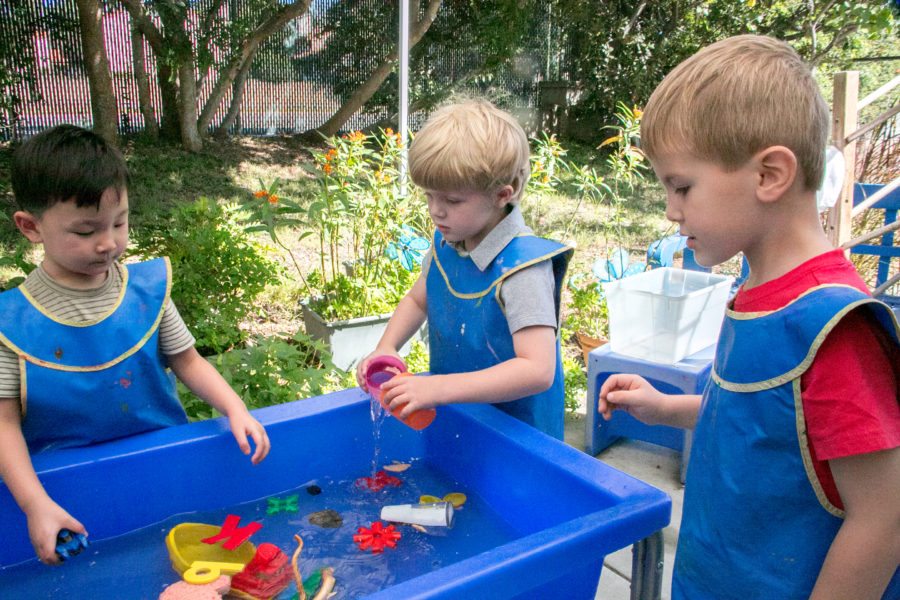
Pre-K students (left to right) explore buoyancy to prepare for their STEM Regatta project | Courtesy Photo

One evening this past October, little students were all gathered impatiently around a rain gutter filled with water, eager to sail their “boats” down the river. This was going to be so much fun!

That they’re three-, four-, and five-year-old pre-school and kindergarten students at Clairbourn School, an independent junior pre-K to eighth grade school in San Gabriel, learning STEM was why this regatta was such a big deal.

What was totally out of character, though, was how even the parents couldn’t take their hands off the boats. They were just as enthusiastic to test the product they built with their children.

This was the culmination of a ten-day, three-part STEM Regatta project that began with the teacher reading ‘The Raft’, by Jim La Marche, a story about a little boy who spends the summer with his grandma in her cabin. The classes also read ‘The Three Billy Goats Gruff’, about a family of goats that wants to avoid the troll and cross a river.

After listening to the stories, students were challenged to design and build a miniature boat, or raft, capable of carrying three billy goats (represented by three small, but heavy metal washers) to avoid a dangerous troll. Their boat/raft should not exceed five inches wide, and had to be able to float.

The first part – raft/boat component – took five days to complete. Day one was reading the story. The second day was spent researching with Nearpod presentation and time for questions. On day three students tested their materials and charted their findings. Using their selected materials, they planned and designed their raft on the fourth day. Day five was spent building their designs. On day six they tested their designs, made improvements and retested.

The second part – the sail component – was done in three days. The class read books about the wind on the seventh day. They spent the eighth day listening to a Nearpod presentation to learn about sails. On day nine students investigated sail materials, sizes, and shapes with demonstrations and charted their results.

The third part – the finale event – was the STEM regatta. On Thursday, October 5, 2017,  all three grades, made up of two pre-kindergarten classes and one kindergarten class, and their parents came to Clairbourn for the crucial finish.

The evening’s activity consisted of extensive display boards and a Nearpod presentation from kindergarten teacher, Kris Shoemake, to show parents their children’s learning process over the previous nine days.

And then it was time for families to build the sails, followed immediately by wind-powered boat/raft races by grade level.

Karen Paciorek, Lower School Director, says the STEM regatta was the collaborative brainchild of the pre-school, kindergarten teachers and herself. She relates, “We’ve been wanting to do a cross-grade activity that highlights the things they do all the time in their classrooms with ‘Project Work’. They brainstormed, agreed on an idea and decided on a title. It was a collaborative effort for the teachers, which is a model for what we want students to emulate.

The idea for the regatta came organically. Kris Shoemake came across an article about students testing boats. Since we know that kids love playing with water, we thought that would be a fun way for kids to learn the concepts of floating and sinking. Instead of us showing pictures, we’d  take it a step further by having a hands-on activity integrating what they do in the upper grade engineering design challenge.

We wanted for them to show their learning by picking what materials would work for them. We also wanted this project to demonstrate to parents the progression of ability through the grades – expectations at JPK (junior pre-kindergarten), PK (pre-kindergarten), and at K (kindergarten) – so they have a true picture of what we look at as developmentally appropriate.

Teachers use the academic language with the kids so even the youngest students know this is a science project. We’re not expecting  them to master the concepts or terms, but to be familiar with them. They will be hearing the words as they go through the grades.”
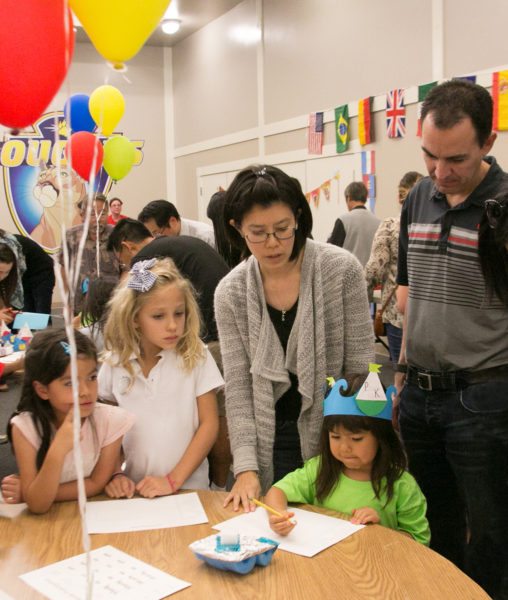
Parents helped their children during the STEM Regatta finale. Pictured (left to right) are Kaitlyn Nava, Mackenzie Bates,, Stephanie Furukawa, Zoe Nava, and Jason Nava |Courtesy Photo

Adds Dr. Amy Patzlaff, Assistant head of School, “It wasn’t merely a reinforcement of  the concept of buoyancy. Teachers talked about the scientific methods: collecting, charting, and interpreting data. As the students worked and tested a variety of materials, they had a chart that showed which boat sank and which floated so they could refer to the data later. And it was simple – it was pre-school level – but they could see on the chart which material worked and didn’t.

They then repeated it when they were talking about sails – which materials held against the wind? Did the shape matter? The students tested the sails using a zip line and a fan; they sat and watched as they tried different things. They had access to that data as well when they had to replicate the activity on the night of the regatta. They built their sails with their parents and tested their final product. They employed scientific methods – how to use the data; how to problem-solve; how to use previous history to scaffold what’s going to happen next; how to use the product for the next round.

Each grade level had a different take on building the boat, which was all done in the classroom, with the teacher assisting. During the night of the regatta, the parents helped in the culmination of the activity which was building the sail and testing it.

To make it age appropriate, it wasn’t a win-lose situation; they just wanted to see if it worked or if it didn’t, and why. We used water-filled rain gutter rivers with a fan at the end. They set their boat in the rain gutter and if the boat got stuck, they righted it. Watching the parents test their product was highly entertaining!  But it was all a friendly event, everyone cheered for one another, happy to see each other succeed.”

According to Paciorek, even during the ten-day period that the kids were working on it, they would practice what they learned at school. Her granddaughter, who is four-years-old and is in the pre-K class, tested some toys for buoyancy in their bathtub.

“This is fairly representative,” explains Dr. Patzlaff. “When I was having breakfast with some of the parents later that week many parents commented on their kids wanting a fan to test the zip line of some of the sail types, in addition to the ones provided in class. Another child wanted to get more materials to test in their bathtub at home; one was going to do a race in their pool. So they wanted to continue the exploration and testing on their own. It continued to engage them which is a great testament to the fun embedded in the project.”

Paciorek says the regatta was a major collaborative event and they plan to do one every year. In the meantime, each grade has its own classroom STEM projects. In kindergarten they have about four or five smaller STEM-related work. One is an apple-picking activity where kids help a farmer get his apples from the trees to the barn. Students have to design the transportation to get this accomplished using the same scientific methods.

In first grade they do a pumpkin drop and students have to brainstorm ideas in groups and design a container that protects the pumpkin. They test which materials kept the pumpkin from breaking. They also have one activity where they build a nest to hold the eggs.

“We started a heavy emphasis on STEM once the NGSS (Next Generation Science Standards), the nationally adopted science standards, came into play around 2012,” states Dr. Patzlaff. “There has been so much conversation about 21st century skills and about not knowing what jobs are going to look like. And because we don’t know what jobs are going to look like the most important pieces we can give students are how to problem-solve, how to think, how to communicate clearly, how to have resilience and grit, how to persevere when something doesn’t go right, collaborating – all the soft skills – in addition to being able to write.

One thing that STEM projects give is real-world possibilities for how to apply those skills in a  nice, tight package. When they design the sail for the boat, for instance, they have to problem solve, they have to work together, they have to communicate with their partner, they have to be able to document their results. For little kids documentation is different – we take a picture of it and we put them on the wall. For older kids, they would be written documentation of some sort, depending on the age. It gives them opportunities to apply the skills in ways that are highly engaging and meaningful to them so they’ll want to persist in it.

Having STEM in our curriculum not only improved math skills and scores among our students, it has also helped primarily in the understanding of concepts. We want kids to not rely on memorization of formula because if they memorize it incorrectly they will never get the right answer. If all they know is the formula, they’re only plugging in numbers; they aren’t checking it to see if that makes sense because they don’t have a way to do that.”

Paciorek adds, “Through this program they’re learning to explain what they’re doing and why they’re doing it. That gives them that foundational understanding to gain higher performance in math, even at the kindergarten level.”

“I think parents now are looking for things that are measurable,” Dr. Patzlaff posits. “It’s hard to test for creativity and that’s one of  my biggest challenges. Frankly, the things that are easily measured like the Kumon math worksheets – my kids could do 100 additional problems in 45 seconds – don’t really mean much. What are you going to do with that? Being able to blend the measurable outcomes with the applicable results is an interesting thing for me. The things that I value are the problem-solving, the communication, the ability to work together with others, the ethics – most of those things are hard to measure.

The components that are within STEM – the problem-solving, the engineering, the applicability of all the new skills – they’re all important competencies to add on but how do you apply them? I like the elements of STEM that help give context to student learning. It gives more meaning to the concept so it sticks and makes them want to explore further.”
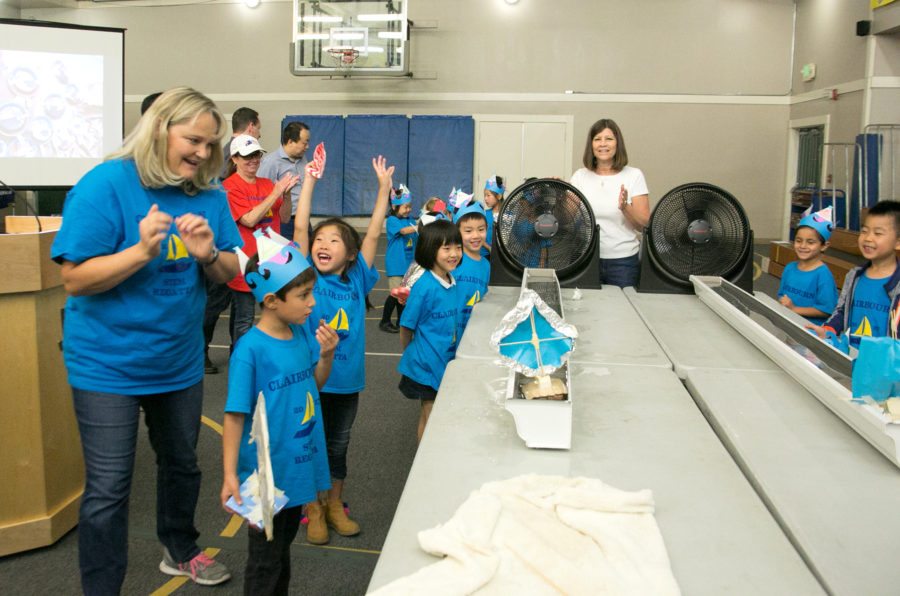
Kindergarten teacher, Kris Shoemake, and Lower School Director, Karen Paciorek, help students race their sailboats during the STEM Regatta finale | Courtesy Photo

Concurs Paciorek, “They don’t really see it as learning, it’s just something fun and interesting for them.  Another thing that’s vital that we discuss with parents is that high schools and colleges are looking for balanced students. When we have standardized testing appointments with individual parents we’re educating them, one family at a time, on the importance of being well-rounded. We explain that these tests only measure Language arts and math; they don’t measure sense of humor, leadership skills, musical ability – all those things that are key in making well-rounded people.

The high schools love our students, they add so much to the schools they go to and this is where they get that foundation. We want families to understand that. It’s not just about math or science; it’s learning how to apply the academics, how to think, how to be creative.”

According to headmaster, Dr. Robert Nafie, Clairbourn’s overall teaching philosophy mirrored that of other English-based schools, which focused on a classical liberal arts education. However, as times changed the school shifted its emphasis to keep up with prevailing conditions.

“The world has gotten smaller and the population is much more diverse,” begins Dr. Nafie. “Our students are global citizens, they come from different backgrounds and culture. As such, the language becomes a little less precise, less critical even. Today’s universal language is mathematics and the hard sciences are the currency to become successful.

The big question for schools now is ‘Do we prepare our students for their future or for our past?’ We’re more comfortable preparing them for our past because we were educated that way, we know it. But the truth is we have to look into that murky, cloudy, and foggy future.

That said, from Clairbourn’s standpoint, we have always done a good deal of STEM. We’ve had a lower school science lab for at least 25 years where teachers have all workbook activities, and experiment materials, and tools organized for them in the cupboards.”

“We are in an educational and biotech corridor,” Dr. Nafie points out. “This particular area of Los Angeles is very rich in science and technology. Starting on the west side, with UCLA, USC, Pepperdine; in Pasadena we have Caltech and JPL. We have all these hospitals – Huntington Memorial, Arcadia Methodist, City of Hope. These institutions are, really, right along the mountains going all the way east to the Claremont Colleges.

Our feeling is that there should be an ongoing conversation between Clairbourn and the community.  Several years ago we started something called Project STAR (Science, Technology Activities, and Research) and invited our Caltech dads for input on how we can focus on engineering and science. As a result of that, we held science fairs with Caltech and JPL engineers as judges, and we had a guest speaker. In recent years, we have embraced STEM as a philosophy. We established an Entrepreneurial Fair where there are Makers’ Spaces for students to create something creative using STEM.

For Clairbourn, the reality is that we are in the midst of a very large Asian population. Our families are from Arcadia, Pasadena, San Gabriel, San Marino, and Temple City. And what they’re looking for is a school that has a strong emphasis on STEM. At the end of the day we are a corporation masquerading as a school. If we don’t provide what people want, we’ll be out of business.

We have to ensure that children in the youngest grades have this kind of educational experiences. We teach STEM early and we use the spiral curriculum – we introduce a subject and come around to it again.  For instance, we teach fractions in second grade, hit it hard in fourth, reinforce it in sixth, etc. For STEM we introduce it through activities like the regatta but that won’t be the last they will hear about it.”

Ultimately, what matters is what children make of their education. As Dr. Patzlaff says, “More than anything, I want to send out into the world students who could think and problem-solve. That’s what’s needed right now because there are so many vexing problems and the solutions aren’t that obvious.  Because if they were, we would’ve already solved them.”

These three-year-olds are our best hope for a brighter future. That’s why Clairbourn is teaching and training its youngest students to identify challenges and resolve them using the lessons they learned in class. And if they have to get their hands in the water in order to do that, then it would be worth the trouble. Or the fun.

Kevel Education Uses Different Approach to Math Tutoring

Photo by Annie Spratt for Unsplash

Originally published on 30 March 2017 in the Pasadena Independent, Arcadia Weekly, and Monrovia Weekly

For students of all ages, one of the most challenging subjects to learn is math. And with most schools’ increased focus on STEM (Science, Technology, Engineering, Math), it’s crucial to provide these kids with the tools to help them understand and learn math. 

In the San Gabriel Valley, there are several companies offering STEM tutoring. A recent addition is Kevel Education which was founded by Gao Jun, Kevin Yu, and Lydia Zu quite by happenstance. Says Yu, “It all started with California Table Tennis Club, which Gao and I established four years ago offering weekend and after-school sports program for young kids in the area. Students would bring their homework to the club, and from time to time we saw them struggling. So we began helping them.”

“Then Gao and I met Lydia two years ago and we found out she graduated from UC Berkeley with a math degree,” Yu continues. “Seven months ago, the three of us thought that since we were already teaching table tennis and we had this base of students taking it who also want to excel in academics, we might as well extend our offering to include math instruction. These kids can learn both table tennis and math in one place, making it convenient for parents. So four months ago, we launched Kevel Education.”  

The three founders’ own experience with math involved memorization of formulas, which isn’t exactly fun so they took a different tutoring method. Yu explains, “Most Asians learn by rote;  it’s fast but there’s no long-term retention. When forced to memorize so many formulas, kids, even adults, will hate math. But we believe learning math can be fun. Instead of just teaching children the formula to solve problems we show them the reasoning behind the principle. I noticed that this is how Lydia tutors my daughter, Kinslee, who’s in 6th  grade.”

“Kinslee knows the formula and she can memorize it; but 10 or 15 years from now she wouldn’t remember it,” Zu elucidates. “I use logical reasoning to explain the formula and show her why some math problems are solved in a certain fashion. That way, she makes sense of the problem first then can figure out how to go about deciphering it.”

“We offer much-needed support to what their teachers provide in a 45-minute class,” Zu expounds. “Learning math is a step-by-step process. When students are weak in certain steps they will fall behind. Our tutoring service has developed an assessment test for students so we can see their weakness and work on it. Our tutoring format inspires interest, develops problem solving abilities, and uses creative ways to approach a challenge – life skills that will help them succeed later.”

Zu adds, “I used to teach elementary-school kids while I was still at Berkeley and I found that there’s a gender stereotype in early childhood – people generally think girls aren’t very good in math. Yet my professor in upper division math told us that every student can succeed in it. Now I know how you teach it makes all the difference in the world.”    

Kevel Education has three credentialed teachers – one Caltech graduate, another who holds a Master’s degree from the University of Arizona, and Zu. They concentrate on helping students  in sixth through twelfth grade because they’ve observed it’s when kids get into more advanced math, like geometry, that they struggle. A fledgling company, they currently use their office at the Rosemead location of the California Table Tennis Club to tutor students. They also offer on–demand, private tutoring in coffee shops, libraries or public parks in Pasadena, Arcadia, and nearby cities.

Yu says, “Kevel Education is still a start-up so we’re taking it slow. We’re not trying to get more students than we can realistically help at the moment. We’re building a strong reputation and getting more exposure through social media. We also have an ongoing partnership with a local karate club owner who distributes our flyers, and we have an email campaign with local schools in the San Gabriel Valley.”

However, they have plans to open a second location and hire more tutors sometime this year in the Diamond Bar/Walnut area to service the eastern San Gabriel Valley. In that new place, they will have a few table tennis tables and a much larger space for tutoring. 

According to research there will be more than one million unfilled  STEM jobs in 2020. Now, more than ever, teachers have to find ways to make these courses stimulating and exciting to successfully graduate students to fill those vacancies.    

So confident are these three entrepreneurs their method will attract more students that future plans include opening five more tutoring locations in five years. To them, it simply adds up.

Azusa Science Educator Selected for New Teachers Academy

Originally published on 11 February 2016 in the Pasadena Independent, Arcadia Weekly, Monrovia Weekly, and Sierra Madre Weekly

Young students are predictably impressionable creatures who emulate the teachers they admire.  And if that were true for middle schoolers at Slauson Middle School in Azusa, they would have the perfect teacher after whom to model themselves in Donna Hawkins.

Hawkins, who has been teaching science for 16 years, has recently been selected as one of 25 educators across the country to be the first participants in Northrop Grumman Foundation’s STEM Professional Development Program. This Teachers Academy is a joint collaboration between the National Science Teachers Association and Northrop Grumman Foundation which aims to elevate STEM education in middle schools in the districts located in Northrop Grumman communities.

This is Hawkins’ third year teaching STEM and has found the experience both stimulating and daunting. Project Lead the Way, an organization that offers training and collaboration for STEM teachers, has helped her immensely. Last summer, she took two classes at Cal Poly Pomona – Flight in Space and Designer Modelling.   

“Frankly, I’m slightly terrified. While this is an exciting opportunity, it also is a big commitment. But my children are grown so I have the time to dedicate to STEM training and teaching. STEM education is such an important part of students’ learning and future.”

The 25 science educators taking part in this Teacher Academy will be attending the 2016 National Conference on Science in Education in Tennessee. During the summer they will participate in a five-day workshop at a Northrop Grumman facility to discuss strategies on how to effectively integrate engineering design work in their classroom.  They will go through a two-week immersive externship at a Northrop Grumman facility where they will be partnered with an engineer or technologist to observe and experience STEM skills in action. What they take away from these activities will serve as their guide when they develop classroom projects with real-world applications.

Hawkins teaches Physical Science and STEM in 8th grade. This year she started a 6th grade STEM class where, she says, there are more girls than boys. She would like to see girls develop a passion for science.

“That’s what I like about teaching – being able to encourage students to take a real interest in science, technology, engineering and math. I try to make the subject as engaging and real-world as possible. I’ve recently started teaching knitting to make them work with their hands.  And there’s some physics involved in that activity even if they’re not thinking it,” Mrs. Hawkins relates.

Throughout her years teaching science, Hawkins has observed, “They either love it or they hate it. STEM is not a required subject and I make them apply for a place in my class. I want to see the students, who really love it, attend my class. With the Common Core in place, I no longer teach to the test. I can slow down a little bit to show my students how science applies to everyday things. We recently learned about mixtures and we broke them down to their basic components. It is such a joy when students’ eyes light up as they absorb what I’m telling them.”

Hawkins has always been interested in science. She relates the winded path that led her to  where she is. “I started out at Cal Poly as a pre-med student and took Biology and Chemistry  but I switched to Food Science and Nutrition. I thought of becoming a dietitian but it required more schooling, which I really didn’t want to do.

“After graduation, I took a job in quality control at a soup manufacturing firm. Then I worked for ten years at Miller Brewing Company. I loved working there but I didn’t want to do it my entire life – I just couldn’t see myself doing that forever.

“So I quit; my kids were small and I decided to spend some time as a stay-at-home mom. One day I was volunteering in my daughter’s kindergarten class and I helped a little boy write a story.  That was my Aha! moment – I want to do this; I want to be a teacher,” Mrs. Hawkins concludes.

Hawkins says she didn’t intend to teach science at first. She went back to school to earn a multi-subject credential and taught 2nd grade. After a year she found she didn’t like it and struggled with the realization that teaching may not be right for her. Nevertheless, she took some science supplemental classes at Mt. San Antonio College at night and then started subbing at Azusa Unified School District. She taught 8th grade science and enjoyed it.

Watching Hawkins today, one would be left with absolutely no doubt that she loves what she does. Recently, she taught her students how to use computer-aided design (CAD) using Autodesk Inventor, a program used by drafters, engineers and architects. By the end of the course, her students will know how to digitally create their own playground equipment.

If science could be this much fun, Azusa students will be breaking the door down to get into  Hawkins’ class!    

School District Highlight: Azusa

Originally published on 14 May 2015 in the Pasadena Independent, Arcadia Weekly, Monrovia Weekly, and Sierra Madre Weekly

The distinct letter “A” etched on the side of the San Gabriel mountains can be seen for several miles as one drives along the 210 freeway. It stands for Azusa, a city about ten square miles in area, and is home to 12 elementary schools, three middle schools and three high schools, as well as to Azusa Pacific University.

For Dr. Linda Kaminski, district superintendent, that letter “A” might as well stand for the grade she would give the excellent students the area schools graduate every year. This past June, over 650 AUSD seniors received their high school diplomas and earned more than $1.6 million in scholarships. Approximately 75 percent of graduates will be attending two- or four-year institutions, some of them going to highly selective schools like the University of Notre Dame, New York University, Occidental College, Harvey Mudd, Whittier College, as well as 18 Cal State universities and eight UC campuses.

“The district has made it a priority to ensure that we provide our students the training and programs that lead them into courses and careers that will be in demand when they finish their education,” states Kaminski. “This means that the state budget increase we received is used to give the best opportunities to kids in school.”

Some of these opportunities include the incorporation of challenging and rigorous courses in their curriculum. According to Kaminski AUSD high schools offer 19 AP classes with very high enrollment. Azusa High, an International Baccalaureate Candidate School, is one of a few schools in the San Gabriel Valley offering Human Geology beginning in 9th grade with students taking the AP exams for it.       

Furthermore, beginning as early as kindergarten and all the way to 12th grade, students in the district have access to programs geared towards certain specialties. At Azusa High School it is Engineering, where a dedicated pathway was introduced, and with it a lab and 3D printer. A partnership with Northrop Grumman provides STEM students hand-on training alongside professionals. 

Northrop established the High School Involvement Partnership (HIP) program to attract students

to science, technology, engineering and mathematics (STEM) fields as college courses. Each year STEM students build, program, and trouble-shoot their robots as they prepare for a robotics competition. 

On May 19, junior and senior AUSD students competed in Northrop Grumman’s robotics competition . They displayed their newly acquired engineering skills as they maneuvered their remote-controlled robots through pegs and cubes. Four seniors from Gladstone High and another four seniors from Azusa High who have committed to careers in physics, math, computer science and engineering were awarded $20,000 in scholarships from Northrop Grumman.  

Image taken from the San Gabriel Valley Tribune

Azusa High principal, Dr. Ramiro Rubalcaba, sees this program as the students’ preparation for college and beyond. He says “Learning the skills to collaborate, to communicate and to think critically – these skills transfer to any walk of life. Not only are the students acquiring great knowledge, they have the confidence to work together to solve problems.” 

Meanwhile, Gladstone High recently launched a new academic program that will allow students to graduate from 12th grade with a full year of college credits under their belt, while meeting high school graduation requirements and the standard A-G coursework needed for admission to a UC or CSU school. The Early College Program, administered by the Azusa Unified School District and taught by Citrus College instructors on the GHS campus, begins when students enter their junior year.  Over the course of the next two years, they will earn 41 general education college credits, which can then be transferred to a community, Cal State or UC school. The program launched with its first class of 33 students this summer.

Gladstone High School also introduced the medical academy this past school year. The four-year program gives students the opportunity to learn about different medical careers and procedures, and at the same time integrating relevant curriculum into their regular courses like biology, anatomy and English. Successful completion of the four-year course earns students medical certificates they can apply to future professions.

The district has partnered with Mt. San Antonio College and the University of Health Science to implement the medical pathway. Through it, Gladstone High School learners can earn college credits, attend expositions, and observe college students in cancer research and anatomy labs. They even have the opportunity to watch human cadaver dissections.

This year, Slauson and Center Middle Schools are incorporating STEM electives to prepare students to continue in medical/engineering pathways at the high schools. Foothill Middle School has implemented a Pre-IB program.

Sierra High, meanwhile, once again earned recognition as a state Model Continuation School, a distinction it has held from 2005 to 2015. The school’s graduates received over $7,000 in scholarships from donors, including the Extended Slauson Family and the United Mexican American Youth Association. In its graduating class of 59 students, a third were recognized for Honors, High Honors, or academic achievements.   

Susan Brosche, Director of College and Career Pathways at AUSD, has every reason to be jubilant with what they have achieved. As one of the districts that has the Advancement Via Individual Determination (AVID) program, which prepares learners who are traditionally under-represented in college education, their students are more than ready for college, they are ready for life. As teachers and counselors hold college application workshops for seniors and Cash for College workshops for students and parents to help them apply for financial aid and scholarships, Azusa Pacific University holds a College and Career Day for the district’s three high schools. 

In fact, according to Arturo Ortega, AUSD Assistant Superintendent for Educational Services, they hold the best College Night in the San Gabriel Valley. He says, “During College Night, the long lines of students waiting for their chance to meet admissions officers rival those at Disneyland. Students and parents from all over the Los Angeles area, not just Azusa, come to meet representatives from 60 colleges and universities.”

Ortega reports that graduates from AUSD high schools have received unprecedented scholarships, including one full ride to the University of Notre Dame through Quest Bridge. Another notable scholarship, the Horatio Alger National Scholarship was awarded to one senior, and was matched by Carleton College in Minnesota, where she will be studying math and physics in the fall. Their students are also beginning to look outside the country as they pursue higher education. One student announced that he would be going to a university in Puerto Rico.

All these accomplishments are music to Kaminski’s ears. While she is justifiably proud that AUSD students are high achievers, that prestigious universities around the country also recognize them as such, is empirical evidence that it is an established fact.

“Azusa Unified holds high expectations for all students and promotes a college-going culture at every level,” Kaminski says. “The importance of higher education – whether it is career technical training or a four-year-degree – is emphasized not only to students, but to our entire community.”

The district collaborates with staff, parents and community to help students reach their college and career goals, while constantly incorporating new programs and expanding existing ones that have proven successful in enhancing the rigorous instruction and support available for every student.

In addition, AUSD provides ongoing training and resources for parents so that they are aware of the college application process, how they can help their children access scholarships and grants and what is required at every step of the process.

Kaminski leads a district with admirable school administrators, outstanding teachers, engaged parents, generous area businesses, and caring government agencies – educational partners all – who ensure that all their students successfully accomplish their goals and achieve their dreams. Every single one of them richly deserves an “A”.