Originally published on 20 October 2017 in the Pasadena Independent, Arcadia Weekly, and Monrovia Weekly
Marc Alongi, Director of Sequoyah High School in Pasadena, couldn’t be more excited to usher in the new school year. After completing a highly successful first year of establishment, he is ready for the challenge of surpassing what they have achieved.
Enthuses Alongi, “We had a really great year! We didn’t know how it was going to go because we hadn’t done it before. It was all new to us – creating an entire curriculum, hiring faculty for it, adding more grade levels. The question for us was ‘how do we maintain the culture’.
Proof of how successful we were became clear on the last day of the school year. The students were all thrilled to be coming back. We held an afternoon meeting and showed a slide presentation of the past year’s activities. They were all proud of what they have accomplished.
Our students built a fun, curious, and inquisitive culture. It’s hard to do when you’re a teenager and forming really powerful relationships – cliques can develop very easily, it could become exclusive. But they have done a very good job of acknowledging and including each other. It’s a place where everybody is seen and welcomed.
They said they got a lot out of the classes; they loved the student/teacher relationship – being able to have inside jokes and share the things that were funny in class. It’s a sign of a pleasant class experience when teachers and students have a good rapport.
I told them to take a moment to realize that they’re part of Sequoyah’s history as the founding students of the high school. While the new students coming in will still be founding students, they have this particular experience – the very first day, the very first year, and many other major firsts.”
A concern Alongi remembers one student expressing was that it wouldn’t be the same with newcomers arriving this school year. He says, “They were worried that the special composition as they know it will change. There was a real sentimentality there and we discussed that. Even though we’re growing – we’re doubling in size with new students coming in ninth, tenth, and eleventh grade – we can preserve the culture.”
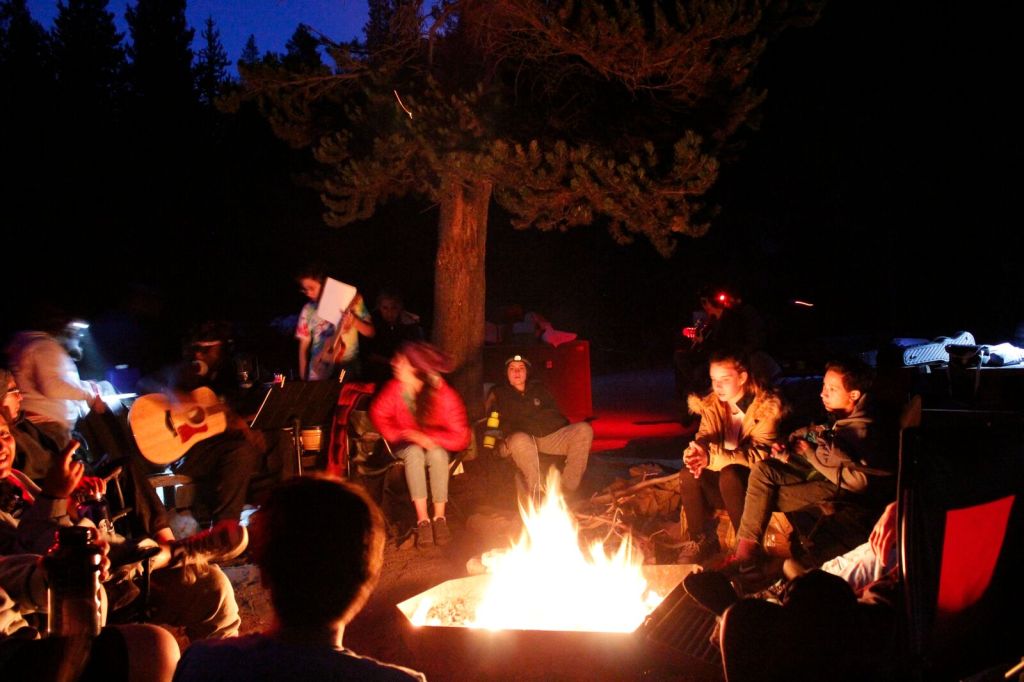
Starting the year off with an all-school camping trip at Pumice Flat campground in the Inyo National Forest | Courtesy Photo
Sequoyah HS joins an elite collection of secondary schools in Pasadena. It offers a rigorous curriculum as all the other high schools but what’s different is the pedagogy. Elucidates Alongi, “We take it to another level beyond lectures in class. We emphasize application of concepts; we want students to articulate and demonstrate what and why it matters; why it’s relevant.
They demonstrate mastery of a subject through exhibitions, which we have twice a year – in January and June. While there are still tests and quizzes, the grand assessment is a project that requires them to creatively use the factual knowledge and skills they gained in the classroom. They have to be able to coherently communicate this with an audience of their parents and other students who didn’t take the class. It’s hard to do and we want to make sure that was presented and valued and celebrated. They came up with excellent exhibits and they also completed an innovation program in their first year.”
Alongi is referring to an integral component in Sequoyah High School’s curriculum – the four-year Social Innovation Program (SIP) designed to develop students’ empathy and desire to be thoughtful, effective collaborators and change-makers.
“The idea behind that is for students to be familiar with social or environmental issues,” says Alongi. “And rather than having a discrete class in tenth or eleventh grade about civics, or economics, or specifically about local policy issues, we want students of our four-year program to become familiar with how communities work – whether that’s the school, Pasadena, L.A., or whatever concentric circle they have.”
“This past year for our ninth and tenth graders we decided to look at the L.A. River because it has a number of issues that are related to it,” continues Alongi. “It has been a very important focus for L.A. and Mayor Eric Garcetti has put together a long-term plan to make the city more sustainable and more just socially and environmentally.”
According to Alongi, the L.A. River presented students with three big areas which they discussed in their group topics.
The first big area was the water quality’s impact on the environment. Students did experiments on different metrics of water, PH level, and turbidity; they tested for traces of metals on murky water. This was exciting for this group because they were able to use what they learned in chemistry class and they were able to relate this to what happened in Flint, Michigan.
A second topic was biodiversity in the watershed. This team examined Devil’s Gate Dam at the Hahamongna watershed near JPL. The dam was created to prevent flooding in the Arroyo which covers the Rose Bowl, the Aquatic Center, and several houses.
“The dam has filled up with sediment, volume has been displaced so it’s less effective and it can be breached,” explains Alongi. “While the easiest solution might be to remove the sediment, other factors have to be taken into account. Over the decades it has become a habitat for wild animals, including an endangered bird. Removing millions of cubic feet of sediment rocks and sand means that there will potentially be 400 truck trips per day for five years once they start the sediment removal.
Our students made a documentary film about it to engage people in the issue so they could be more involved in the decisions being made. They also created a board game using a two-scale model of the dam simulating what would happen if more water goes into the dam. The game gives players courses of action and shows that the choices they make have consequences. They took this board game to several senior centers and a handful of schools. They videotaped the experience of playing the game with older people and students. They even composed original music to go with it. I was very impressed with them,” Alongi beams.
A third topic was housing. The students found out that there was a lot of development going on around the L.A. River. They decided to apply it to the local level and they discovered that Pasadena, in particular, has a shortage of affordable housing. They realized the role of economics behind it – more inventory means less expensive housing.
Students explored the dynamics between tenants and landlords, and examined tenants’ rights. A lot of conflicts can arise from lack of information, so they went door-to-door, talked with a lot of people to find out what they know and don’t know. They ended up producing an 18-page report outlining how to build better tenant-landlord relationships.
Alongi states, “Working on this issue complements the curriculum very well. Questions from humanities come to life when you’re talking to people about being a renter. Economic, political, and social concepts are raised in tenancy issues.
Students aren’t necessarily coming up with a solution, they are learning from complexity and they’re learning how to be creative. The other thing that we emphasize is what’s called design thinking – using design to solve a problem – which has become very trendy in schools.
The simple idea behind it is to do a lot of research, use ethnological scales, talk to people, observe people’s behavior. After collecting all this information, start the brainstorming process. Come up with not one, or two, or five ideas; come up with 50 ideas for what could be strategies to improve some of the issues you identify.
Once you narrow it down to what you feel is the best idea, start to prototype. Create a model or a simulation that you think could be interesting to people, then take it back and get feedback from them. The responses you get are the basis for helping you innovate; you’ll probably get a lot of critical feedback, but maybe something you came up with sticks with people.”
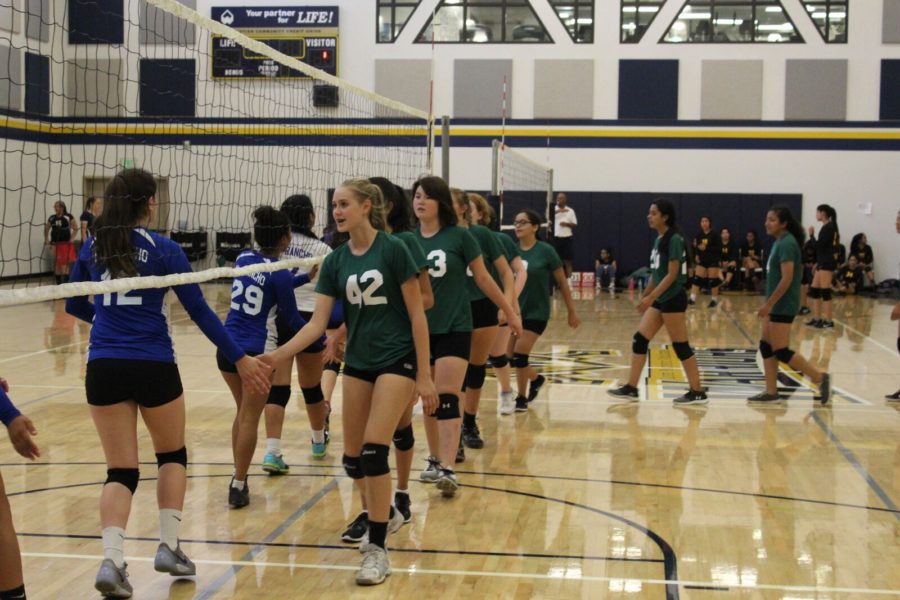
Girls’ volleyball wrapping up a game in the fall | Courtesy Photo
According to RJ Sakai, Director of Social Innovation, this year instead of using the L.A. River as starting point, students will be focusing on a diversity of Backyard Issues beginning in November.
Sakai states, “As they did last year, ninth and tenth graders will work in groups of ten with one faculty facilitator. In the upcoming weeks, faculty members will choose umbrella topics and, with the students who self-elect into their groups, will narrow it down to a specific issue through their research and ideation. They haven’t yet decided on topics but I imagine they might include homelessness, incarceration, transportation, arts & culture, access to green space among other things.
Ninth and tenth graders are spending the first two months of school in a SIP orientation in their Stewardship Committees, which center on topics that help build the Sequoyah community: morning meeting committee; diversity committee; sustainable campus committee, etc. As part of their research and inspiration phases, these committees have spoken with people at KPCC, Grand Performances, and Mia Lehrer + Associates (landscape architects), respectively.”
Eleventh graders are working on an Independent Impact Project. Sakai reports that they have written essential questions to guide their research inquiry for the rest of the fall semester.
Some of the questions they are looking to answer include: How might alternative produce distribution procedures increase exposure and access to healthy food options in underserved L.A. communities?; What could be done to change the disposal methods of medications to make it safe for our environment?; and What physiological effects do microplastics have on living organisms and how do they damage ecosystems?
“In the spring students will begin to prototype ways to intervene in these issues and make a difference. All of our students follow a process of ethnographic research (interviews, field work), synthesis (concept mapping, note taking), ideating (blue sky imaging, sketching), and prototyping (making things),” explains Sakai.
Alongi adds, “Through all their SIP projects what our students learned is that making policy decisions is a balancing act. There are stakeholders who are impacted differently by these issues and there are controversies embedded in them. So that’s part of the learning process – recognizing there aren’t easy solutions. Innovation is simply creative problem-solving, helping bring a constellation of people together around a potential outcome that could be a win, win, win. Maybe we arrive at a solution that isn’t perfect, but is better.

A student team tours the Bowtie Parcel at Glassell Park as part of their work with SIP | Courtesy Photo
The kids are really enjoying this process of problem-solving – that it takes time, constant iteration, and a lot of good research. And it’s also a cycle: sometimes you end up going back to do more research because you realize you’re on the wrong path. It combines hands-on action with thoughtful research and interviewing people, and doing the science or the math.
It’s quite satisfying to see students learn in the real world. Unlike doing a unit in class, the real world is messy. They have to learn how to ask really good questions, figure out who they’re going to talk to, find out what websites to use for their research. The teacher’s role becomes more of a coach to help students wade through all the information.”
Each group is mentored by a faculty member with proficiency on the topic being investigated. Math teacher, Ronnie Bryan, worked with the students who looked into the Hahamongna watershed issue. He helped them calculate volume and scale to complete their project. He has a bachelor’s degree in Brain and Cognitive Science from MIT and a PhD in Computation and Neural Systems from Caltech.
Humanities/English teacher, Ian Chang, who mentored the housing team, was a language arts teacher at Sequoyah before transitioning to the high school where he developed the Humanities curriculum. He has an MFA in Fiction Writing from the Iowa Writers’ Workshop and a BA in English Literature from Swarthmore College.
Laura Haney, science teacher, coached the water quality group. She received her bachelor’s degree in Astrophysics and Math from Barnard College of Columbia University, and her PhD in Astronomy and Astrophysics at UCLA.
Director of Social Innovation, RJ Sakai, graduated with a Cultural Anthropology and Graphic Design degree. He has an MFA in Media Design Practice from Art Center College of Design. His work has led to immersions in Uganda, Cuba, small town Massachusetts, East Harlem, and Los Angeles.
Alongi states with pride, “We have very accomplished and impressive teachers with content expertise who really care about learning. They know how to get inside the minds of different students, and understand what motivates them, how they think, and how to help them become really curious, to do the math deeply, to perform good quality work, and to go above and beyond.”
Nigh its 60 years of founding, Sequoyah School stands by its dictum to impart active citizenship, advocacy for social justice, and environmental stewardship to its youngest students. Today, with the establishment of the high school, it carries on that promise to prepare a mindful, young generation to navigate ambiguity, embrace change, and positively impact global society. That resolve came through clearly during its very first year.
With Alongi leading the way, Sequoyah High School will undoubtedly graduate students who magnificently epitomize the legacy that sets the school apart from all others.
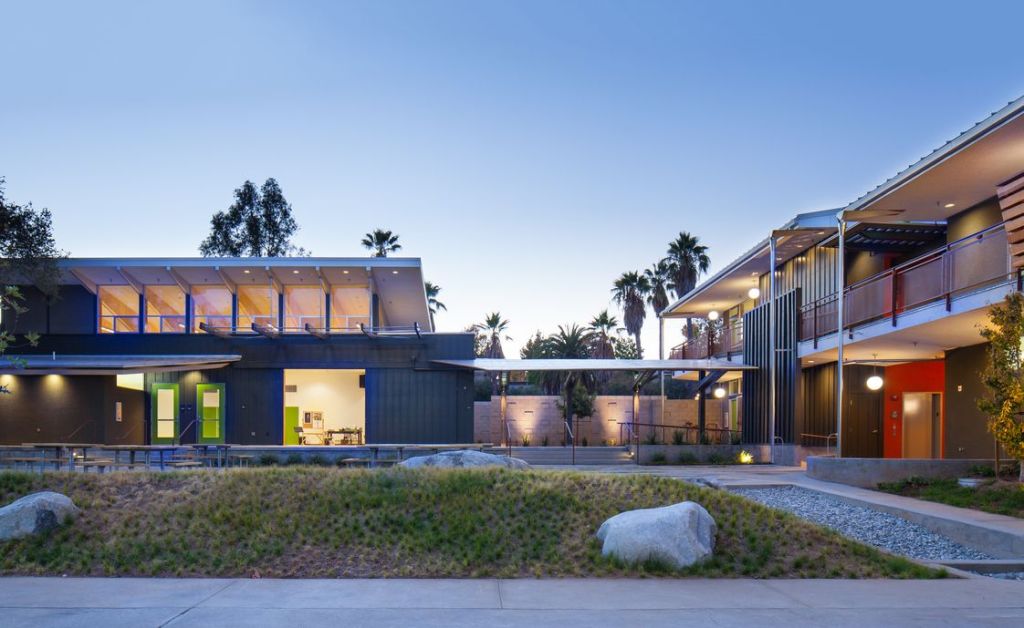
 A San Gabriel Valley Inquirer