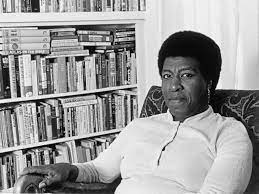
Arcadia Artist Vies for the Grand Prize in the ‘Illustrators of the Future’ Competition

Originally published on 15 January 2019 in the Pasadena Independent, Arcadia Weekly, and Monrovia Weekly
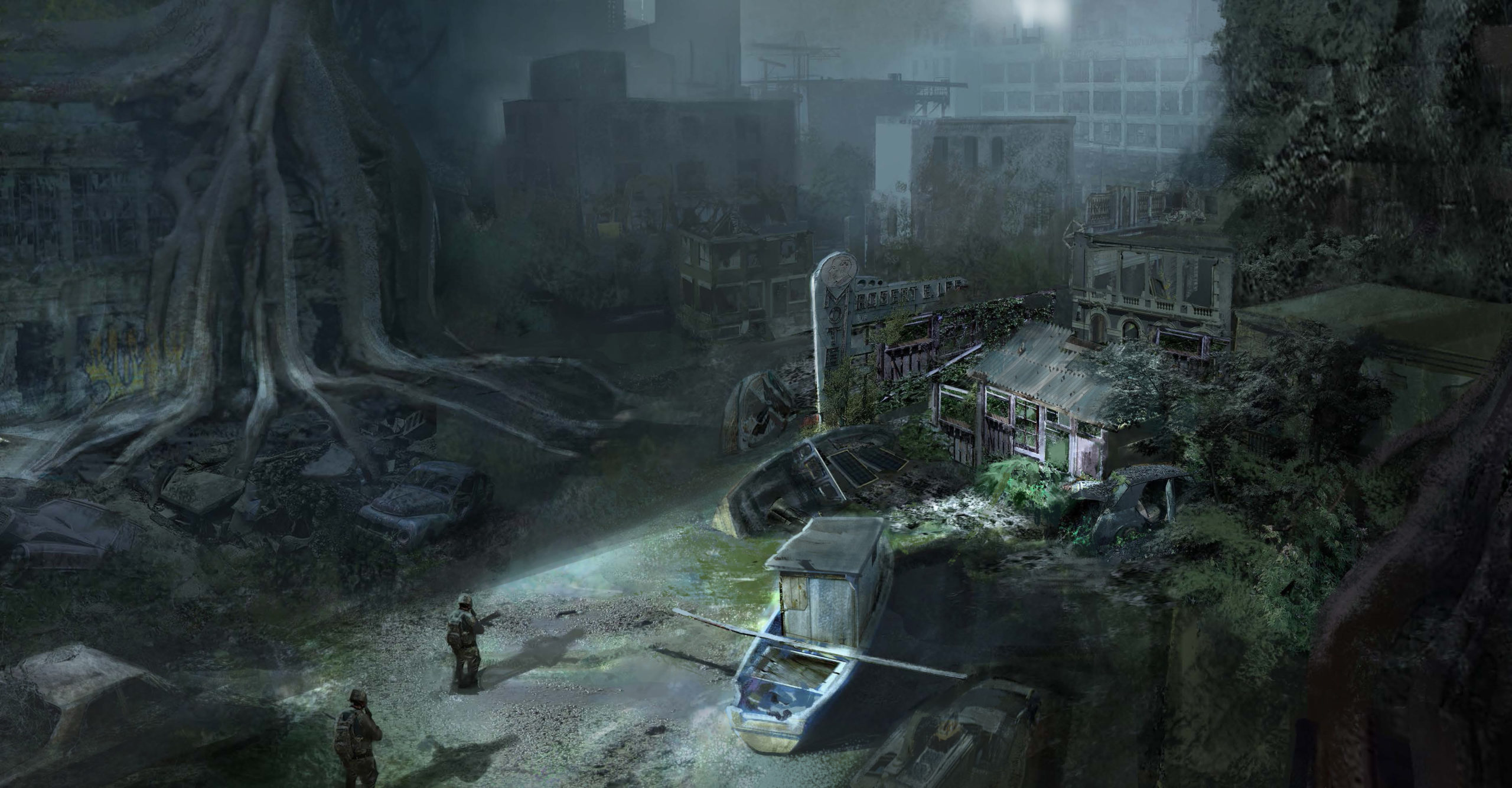
Ma’s entry called ‘Ruins’ | Courtesy photo / Galaxy Press

Qianjiao Ma, known to her friends as ‘Q,’ is a long way from her birthplace in Northern China but is very much at home in her adopted city of Arcadia. She is one of twelve ‘Illustrators of the Future’ winners to be honored during the 35th Annual L. Ron Hubbard Achievement Awards at the Taglyan Complex on Friday, April 5, 2019.

The highlight of the ceremony will be the announcement of the year’s two Grand Prize winners –  a writer and an illustrator – who will each receive $5,000. Quarterly winners, like Ma, also receive cash prizes from $1,000 to $500. Their winning stories and illustrations will appear in the annual anthology ‘L. Ron Hubbard Presents Writers and Illustrators of the Future’ Volume 35.

An international competition, ‘Illustrators of the Future’ is considered the most enduring and influential contest in the field of science fiction and fantasy. Artists worldwide participate in this competition and they are judged by professional artists, some of whom are masters in the genre.

To get to the heart of how Ma arrived at this momentous stage in her chosen profession, it helps to know what drives this determined young woman.

“I was born in Shenyang in Northern China,” begins Ma. “In my senior year in high school I went to Beijing to investigate what school I could go to and get training. I have always been interested in art so I could have gone to a well-known arts academy in China. But my mom also asked me if I wanted to study abroad. It was an exciting prospect as I discovered that Beijing was vastly different from the city where I came from and it made me realize that I really wanted to see the world.”

Continues Ma, “I arrived in Los Angeles in 2008 and I attended Santa Monica College. One year later, my mom, who lives in Seattle, asked me to move there and I did. I went to Bellevue Community College for a year but I found their arts offerings quite limited.

“A friend mentioned ArtCenter College of Design in Pasadena, so I decided to visit the school. When I got there, I saw students were sleeping on the sofas in the hallway; they had worked all night on projects and didn’t have the time to go back to their dorm. The artwork displayed at the gallery were amazing, a far cry from anything I’d seen in Bellevue!

“I was convinced I had to go to that school; I applied but was rejected the first time around. While there are other entertainment design schools in California because the movie studios are here, ArtCenter is the Number One school for that discipline, so it was where I wanted to be. I prepared my portfolio again, resubmitted it, and was accepted on my second try.”
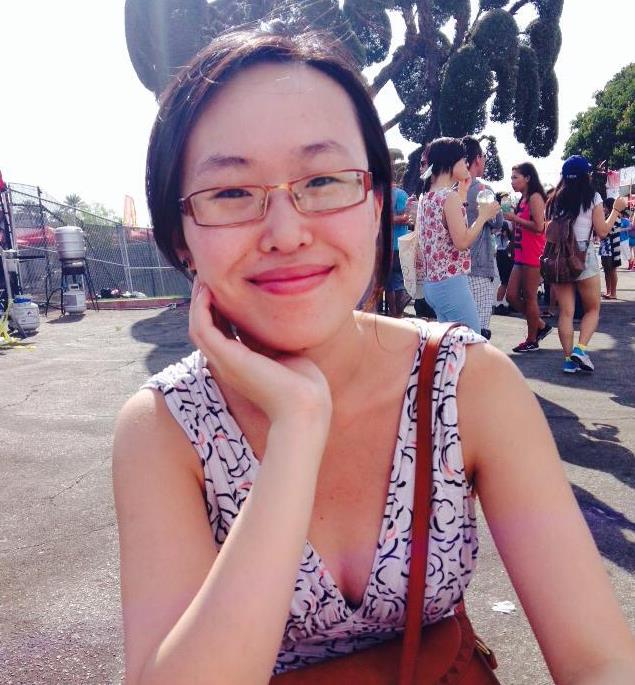
Qianjiao Ma is known to her friends as ‘Q’ | Courtesy photo / Galaxy Press

While attending ArtCenter College of Design from 2012 to 2016, Ma held freelance posts and various internships. She describes, “I interned for BRC Imagination and was one of the artists involved in the 2015 redesign of the Rock & Roll Hall of Fame Museum in Cleveland. It was at BRC that I gained training in experience design, which became my forte.

“After college I wanted to pursue experience design work but couldn’t find any opening. Not wishing to be unemployed, I worked as a comic book illustrator at Stela Unlimited, which is an app for smart phones. I was the background concept artist for a graphic novel called Lumi White, a remake of Snow White.

“I still really wanted to go into experience design, though, and that opportunity came six months into my stint at Stela. A spot opened up in a small company called Steadman Design Studio which creates immersive entertainment experiences for theme parks, attractions, exhibits and shows.

“From Steadman, I moved on to Thinkwell Group, which is a larger outfit. I had the chance to work on museum, restaurant, casino, and theme park design including Warner Brothers Abu Dhabi, the largest indoor amusement park in the world. It was a lot of fun – I was able to try out different aspects of experience design; I conceptualized the entrance ticketing area, the art deco-style Bugs Bunny, and various murals inside. It was an absolute thrill to see my designs get built!

“A year later, an acquaintance of mine at a company called ShadowMachine approached me to do animation design. I started working at ShadowMachine in February of last year and I’m enjoying doing animation.”

Throughout her career, Ma has been driven by that same passion students demonstrated which made such a profound impression on her when she visited ArtCenter years ago. She continues to look for ways to learn and expand her knowledge. She was a designer and painter for the Netflix Original ‘Disenchantment’ and TBS’s ‘Final Space.’ She was one of the featured artists to share their views on theme park design in ImagineFX magazine, and was included in Graphite magazine on traveling sketches.

An accomplished plein air painter, Ma has exhibited her work in various Los Angeles galleries. She recently did illustrations for the magazine ‘Compound Butter Issue One: Junk Food.’ She is being included in the upcoming sci-fi design tutorial ‘Beginners’ Guide to Sketching: Robots, Vehicles & Sci-Fi Concepts.’
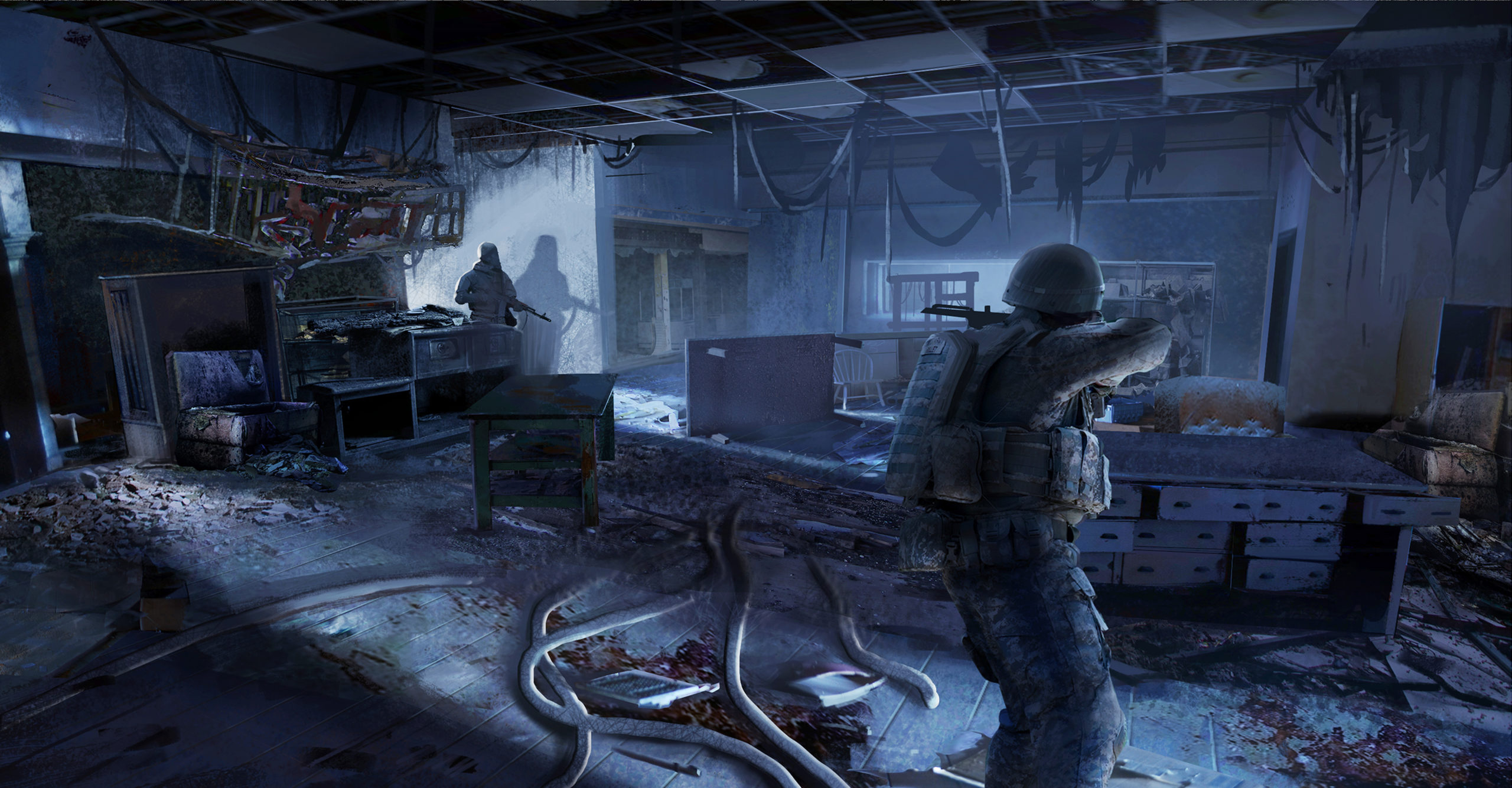
Ma’s second entry, called ‘Apocalyptic World’ | Courtesy photo / Galaxy Press

Last year, Ma found out about the ‘Illustrators of the Future’ worldwide contest and right away she sent three entries – Ruins, Apocalyptic World, and Space Ship Inter(ior Design). After winning the quarterly competition, she was paired up with a writer.

“I can’t disclose details about the novel other than it happens in the post-apocalyptic world,” states Ma. “I depicted the harsh environment to which people are exposed, where chips are embedded in their brains as a means of controlling them.”

“This is my first time illustrating a novel and even if my work doesn’t earn the grand prize, I feel that I’ve learned so much already. I met people whose perspectives are different from mine,” adds Ma. “Should I win, I would be quite ecstatic! It would prove that I made the right decision on how to illustrate the writer’s idea and that I’m ready for more book designing.”

Winning the Grand Prize would indeed take Ma’s career into another realm. John Goodwin, president and publisher of Galaxy Press which is the exclusive publisher of the winning books and illustrations, confidently says, “After 35 years, we’ve had close to 800 winners. Several of today’s best known fantasy and science fiction writers and illustrators got their start from winning the ‘Writers and Illustrators of the Future’ competitions.

“Many past winners are now recognized names – Patrick Ruthfuss, one of the top-selling fantasy authors in the world today; Brandon Sanderson; Sean Williams; Eric Flint, the biggest fantasy author in Australia; Nnedi Okorafor, of Nigerian descent, now one of the main writers in the Black Panther Universe; among many others. Canadian writer Robert Sawyer is one author who didn’t actually win, but it was the judges who gave him critique that helped advance his writing; he has gone on to become Canada’s most successful science fiction writer.

Goodwin continues, “Part of their success in becoming known to the general public is that we arrange publicity for the winners of the writing and illustration competitions. They get written about in various news outlets, appear on TV shows, do book signings in bookstores, and attend  conventions like Comic-Con International and Dragon Con to promote their books. We continue to support them in their career. If they publish new books, we let them bring those as well. That’s why these two contests have enjoyed such longevity.

“And because it’s free to enter, we attract a large number of competitors from all over the world. We received entries from over 175 countries in Africa, South America, Central America, and throughout Europe. For the illustration contest, they don’t have to speak English since they’re only drawing pictures. This year we have several winners with Chinese, Japanese, and Korean names but we don’t have the information on whether they were born there or if they’re children of immigrants. An unprecedented five writers and illustrators from the United Kingdom won this year.”
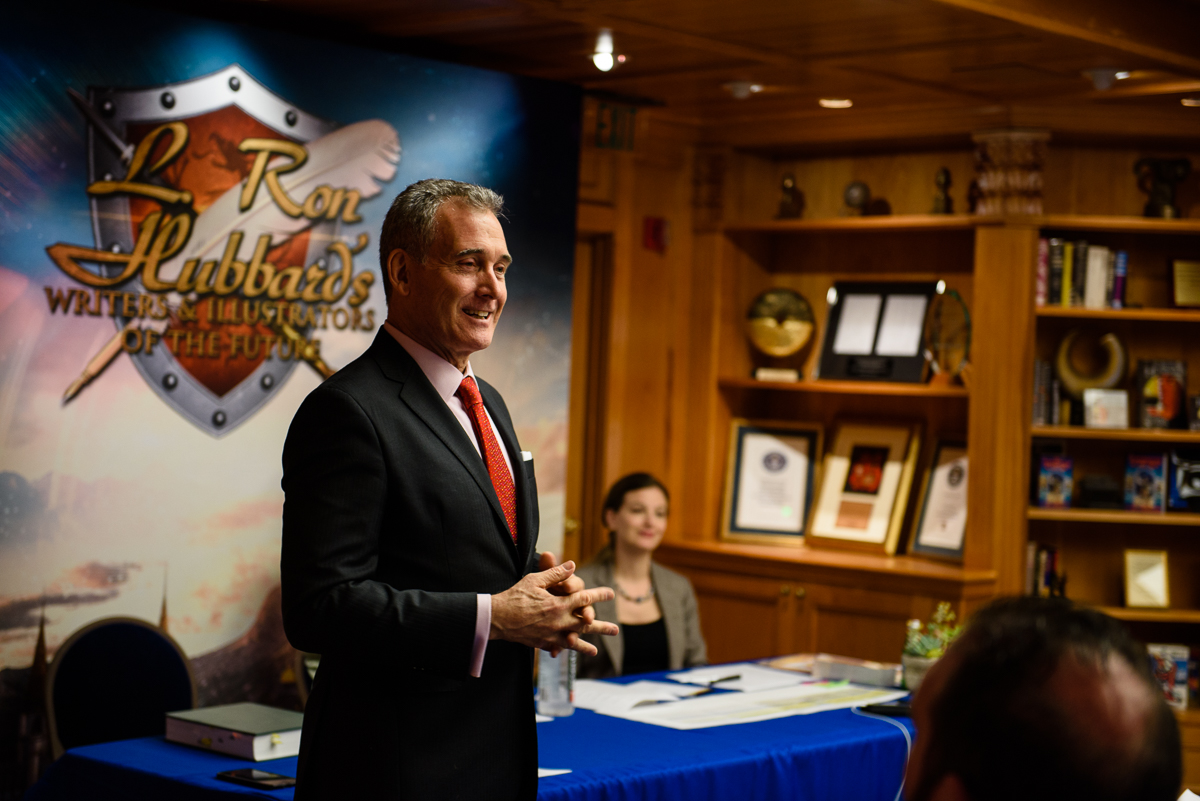
John Goodwin at a ‘Writers and Illustrators of the Future’ seminar | Courtesy photo / Galaxy Press

Pairing the writer with the illustrator is done by the editor, according to Goodwin. “There is no standard for what illustration an artist can send us. Some of them do oil, others do pencil, many do computer-generated images. Sometimes we look at their choice of medium to figure out which book would work with it best. But we also try to make complementary matching – we pair up a fantasy writer with an illustrator who reads fantasy books, for instance.

“Judges are established professionals in the industry including: Larry Elmore, known for his illustrations for ‘Dungeons & Dragons,’ ‘Dragonlance,’ and his own comic series ‘Snarfquest;’ Gary Myer who is an illustration professor at ArtCenter College of Design in Pasadena; Stephan Martiniere, who did the design work for Disney’s ‘Frozen,’ ‘Suicide Squad,’‘Aquaman,’”

Goodwin explains the history of the contest, “While L. Ron Hubbard was widely known for his work in Dianetics and Scientology, he was also one of the most prolific writers in America in the 1930s and 1940s, having written over 200 western, mystery, adventure, science fiction, fantasy, and romance books using his own and 15 different pen names.

“As a young man, he had traveled to Guam and as far as China back in the 1920s, and wrote about his experiences. In fact, he took the first photo of the Great Wall of China, well before it was a tourist attraction, and sold it to the National Geographic. That was the first picture Americans had ever seen of it.

“Towards the end of Mr. Hubbard’s writing career he turned to fantasy and science fiction. When he was in Alaska in 1978, he initiated the ‘Golden Pen Award’ to celebrate his 50th year as a writer. It was the precursor to the ‘Writers of the Future’ Award which he launched in 1983 as a means to discover and nurture new talent in science fiction. Five years later, ‘Illustrators of the Future’ was created to provide artwork for the books.”

“He set up an endowment from his personal earnings and royalties from his books,” Goodwin goes on to say. “When he passed away in 1986, he directed in his will that the writers and illustrators contests continue. Galaxy Press was established as the exclusive publisher of the ‘Writers of the Future’ contest winners and all the fictional works of L. Ron Hubbard.”

Arcadia’s Qianjiao Ma is one of the many beneficiaries of L. Ron Hubbard’s bequest. On April 5, she’ll find out if her already burgeoning career will also be catapulted into another world.
PMH’s ‘Dreaming the Universe’ Goes Where no Exhibition Has Gone Before

Originally published on 26 March 2018 in the Pasadena Independent, Arcadia Weekly, and Monrovia Weekly

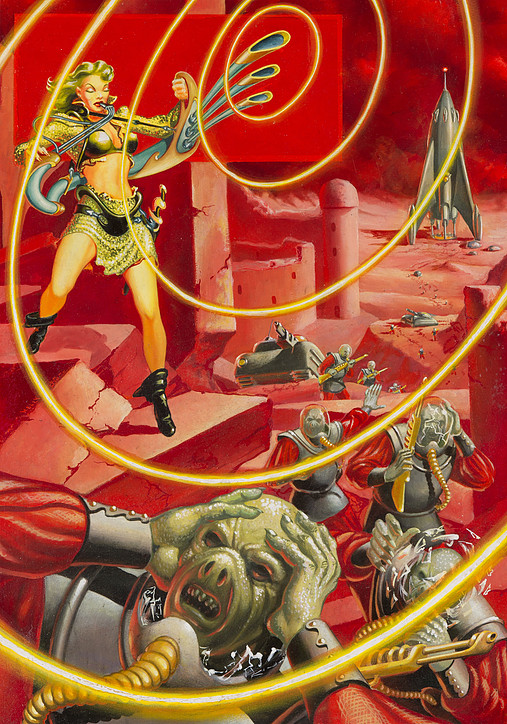
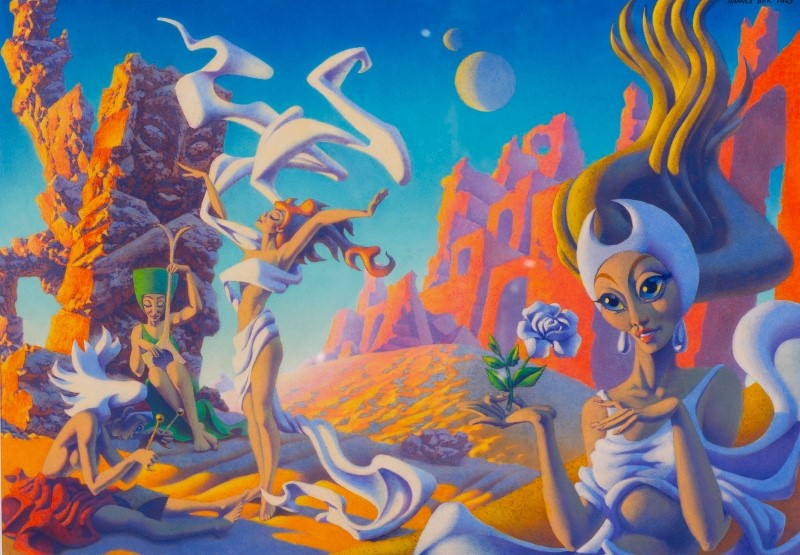
This Hannes Bok (1914-1964) illustration appeared as a wrap-around cover of The Magazine of Fantasy and Science Fiction for ‘A Rose for Ecclesiastes’ | Photo courtesy of the Korshak Collection

Southern California played a pivotal role in our country’s aerospace program when in 1936 the first rocket tests took place in Pasadena’s Arroyo Seco and launched the Rocket Age. Interestingly, the progress in the aeronautics industry in the region paralleled the growth of the science fiction community.

The Pasadena Museum of History (PMH) shows how science, fiction, and Southern California converge in an exhibition called ‘Dreaming the Universe.’ On view from March 3 through September 2, 2018, it explores the history of science fiction from 1930 to 1980, and its significance in the advances of science, the changes in technology, and shifts in American society.

Nick Smith, president of the Los Angeles Science Fantasy Society, curated this show that features historic artifacts, fine and graphic art, books and ephemera, and historic photographs. It will touch on the contributions of Ray Bradbury, Octavia Butler and other luminaries whose names are synonymous with science fiction; it will likewise highlight the fans and followers of the genre. Children and adults alike will find something they will instantly recognize as what initially pulled them into this exciting world.

Smith’s fascination with science fiction began several decades back. He relates, “Ever since I could read I read the ‘Superman’ comics. My barber would let us read whatever books he had, like ‘Incredible Hulk’ and ‘Super Spy,’ whenever we behaved. But the local library provided me the opportunity to read science fiction books written for younger readers. The earliest one I could remember was called ‘Have Space Suit Will Travel,’ about a kid who won a space suit in a contest and got caught up with things like aliens and other weird things.

“Once I had an allowance and had the ability to buy magazines at the newsstand I started purchasing them. That actually influenced some of the artwork we have in this exhibition. I was at a magazine stand and my eye caught this really curious-looking wrap-around cover of The Magazine of Fantasy and Science Fiction. It turned out to be a Hannes Bok illustration called ‘A Rose for Ecclesiastes.’”

“There were a lot of books and magazines about science fiction, fantasy, and speculative adventure written for kids in the 1950s and 1960s,” continues Smith. “They piqued children’s imagination because they were about the things that you didn’t see every day but would be fun if they did happen. They were wish-fulfillment fantasy to a great extent – traveling to Mars, or becoming space cadets to solve crime throughout the galaxy. That led to a lot of radio, television, and comic book science fiction.

“For adults, some science fiction dealt with warnings against abuses of technology which was what the original Frankenstein books were about, if you think about it. That was the first modern science fiction story written and it’s 200 years old now.”

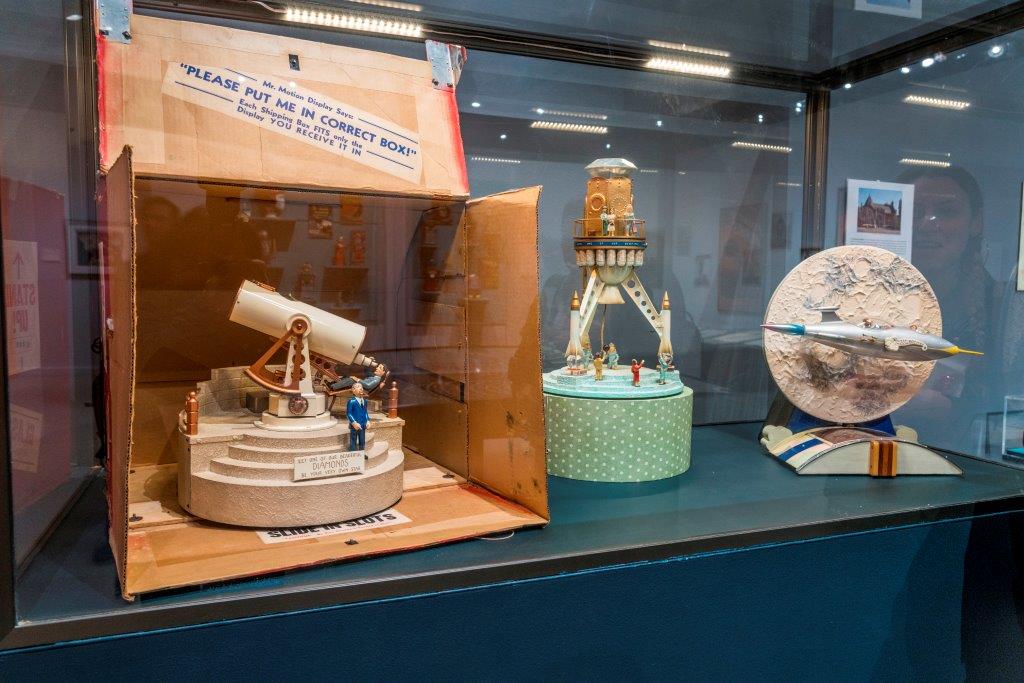
A group of Baranger Motion Displays, 1952-1957, Baranger Studios, South Pasadena, CA. Courtesy of Justin Pinchot (Toyraygun.com,robotcoffeela.com) | Photo by Joanne Wilborn/Marlyn Woo

“Laura Verlaque, PMH’s Director of Collections, and I worked for about a year identifying which things we would like to include in the exhibit that would be representative of the different aspects of science fiction. These items include visuals like flat pieces of artwork ranging from photographs to paintings; costumes – pieces of it or the entire outfit; physical objects from toys to window displays, especially in the 1950s.

“And that’s an interesting bit of the story. In the 1950s when Walt Disney put scientists on TV to talk about the space program, science fiction was all over radio and television. It was very much part of the culture in more ways than people didn’t think of. In fact, there was a company in South Pasadena that made window displays for jewelry stores and many of these had science fiction themes.”

“We don’t think about it nowadays but if we were to look back, science fiction was part of children’s experiences growing up,” points out Smith. “Tom Corbett’s ‘Space Cadet,’ which was very loosely based on science fiction story, was part of my background as a child. I watched that on TV, convinced my parents to buy me the little toys that went with it. A modern musician who, coincidentally, is named Tom Corbett uses a replica of the Tom Corbett lunchboxes at his concerts because he thinks it’s cool that a 1950s show had a character with his name.”

Science fiction’s integration into the mainstream culture took place in stages, says Smith. “There were some anthology science fiction shows on radio and television. ‘Space Patrol’ started here in LA as a radio show before it became a national television show and because they had big sponsors, they were able to get major publicity – they had a national giveaway of a backyard rocket ship clubhouse.

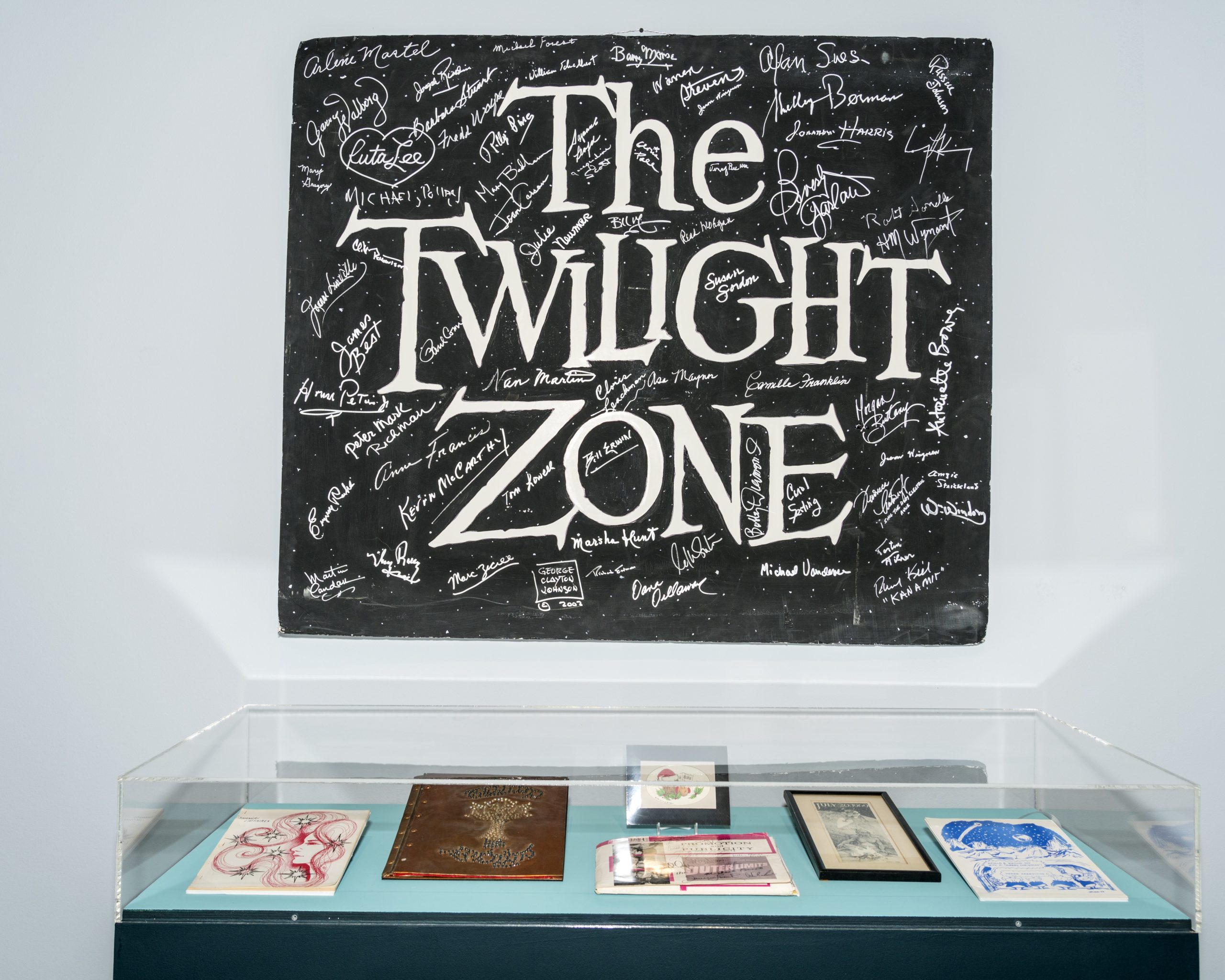
“‘The Twilight Zone’ came out in the 1960s but it was Star Trek that brought in the new wave of fans. It was hugely popular that when NBC cancelled the show Caltech students organized a march to protest it and they were joined by other enthusiasts and students from several universities.

‘The Twilight Zone’ display | Photo by Joanne Wilborn/Marlyn Woo

“Here’s another curious thing – the genre attracted not just males. In this exhibit we have one of the earliest published science fiction female writers. Clare Winger Harris was born in the 1890s and wrote stories for two of the major sci-fi and fantasy magazines back in the 1920s. What makes her particularly noteworthy is that she wrote under her own name, not a pseudonym, at a time when it wasn’t socially acceptable and women didn’t think they could sell a science fiction story. There were no other women in the 1920s in science fiction magazines.

“A more recent famed writer Octavia Butler, who was Pasadenan, was remarkable because she was both a woman and African American. And at that point she was the most successful female African American science fiction writer.”

Adds Smith, “To a great extent science fiction is based in Southern California because the technology and the sources of technology are here, as well as the TV and film industry. Rod Serling didn’t have to travel very far to find writers to work on ‘The Twilight Zone.’ He was able to get some of the best scriptwriters by driving down the street. One such brilliant writer, Charles Beaumont, turned out amazing stories throughout the 50s and 60s. He’s largely forgotten now because he died fairly young but several of his stories became television episodes for ‘The Twilight Zone’ and ‘Night Gallery.’”

“Everything in the field of science fiction is being considered for television right now,” declares  Smith. “There have been successful series like ‘Game of Thrones’ which are radically different from previous fantasy science fiction but they attract an audience which has never read the books they’re based on. The field is growing in several ways. However, not every project that’s started  is shown because the genre deals with such big ideas that are difficult to realize.”

The books Smith read as a youngster were published by Erle Korshak. The distinctive wrap-around cover of the magazine that stopped him in his tracks at the newsstand is one of six graphic art on display in the exhibit from the Korshak Collection. This is the first time these artwork are being exhibited on the West Coast.

Stephen Korshak, himself, began his interest in science fiction illustrations when he was a child. He recounts, “My father owned a pioneering science fiction book company, Shasta Publishers, which ushered in the transition of important science fiction literature from magazines printed in cheap pulp paper to hardcover, library-quality books. These covers, which I was exposed to growing up, engendered my lifelong love for collecting science fiction art.”

There are currently 90 pieces in his collection, with 29 pioneering American artists representing 80 years of published science fiction and 20 European artists from 15 countries who worked from 1863 to 1984. They can be seen online in ‘Korshak Collection: Illustrations of Imagination Literature.’ In the introduction he names one particular piece that stands out in his memory, “The J. Allen St. John illustration for the 1941 ‘Amazing Stories’ magazine cover of John Carter battling the dead in ‘The City of Mummies’ lured me into a fantastic world that I never knew existed. I read and enjoyed the Edgar Rice Burroughs story behind the illustration but, for me, the illustration itself gave me a sense of wonder I had never previously experienced.”

It is the only science fiction collection that tours, conjectures Korshak. And that touring bit came about quite by accident. He discloses, “I took one of the paintings to a framer and he told me it needed to be restored. When it came back from the restorer, my framer told me it was the talk of the restorer’s workshop. He asked me if I had any more of these illustrations and I said ‘yes.’ He said he wanted to display them here in Orlando, where I live, at one of the museums where he’s a trustee. The attendance was so overwhelming and the reception so amazing that we started to do the tours.”

This Kelly Freas (1922-2005) illustration appeared on the cover of Planet Stories magazine | Photo courtesy of the Korshak Collection

Since it began touring  nine years ago, the Korshak collection has been shown in some of the most prestigious illustration museums in the United States – the Brandywine River, the Chazen, and the Society of Illustrators’ – and at Museu Valencia in Spain.

“In the beginning, people were just tossing these illustrations away like the comic books because they weren’t worth anything,” says Korshak. “No one considered them to be art because artists were not supposed to be entrepreneurs – they were meant to work for the Medicis and have great rich patrons who would support their art. However, in the United States, it being a capitalist society, artists were businesspersons like everyone else. Illustrators, by and large, were educated, and had a family to support. They did it to make a living, to sell products and market books.

“For a long time there was a prejudice in the art world; the gurus and fine arts critics pronounced illustration wasn’t art. But there has been a reassessment taking place in the last 15 years or so; there is now a better appreciation for this art form. People paid $30M for a Normal Rockwell, who was an illustrator for the Saturday Evening Post. Maxfield Parrish, N. C. Wyeth, or Howard Pyle pieces go for millions of dollars.”

In the process of collecting, Korshak learned that illustration covers a wide field.  He explains, “My love has always centered on a sense of wonder, that sense of being in a fantasy world, which I tried to capture with my collection. Except for a rare one or two, they are illustrations of literature spanning 125 years, from 1875 to 2000. There are thousands of illustrators and I can’t possibly display thousands of paintings. So what I tried to do was to pick what I thought, in my humble opinion, were the greatest illustrators or those who weren’t as technically famous but had a great influence. But we are not the definitive criterion of who’s great and who isn’t.”

Like a doting father, Korshak demurs when asked to pick the one he likes most, “It’s hard to say which is my absolute favorite but I’ll tell you three of my favorites. Jose Segrelles, a Spanish illustrator, is technically one of the eminent artists in the whole field but was little known in the United States. He made his name in Spain, although he did appear for a short time in the Illustrated London News. He appeared in books and magazines for 80 years but has been forgotten for the most part.

“I was lucky enough to go to Spain to meet his family. I bought the painting from his nephew and before he died I promised them I would take Segrelles back with me and introduce him to the American market. In fact, I will be collaborating on a book about Segrelles with Guillermo del Toro, the academy-award winning director, who said Segrelles was one of the great influencers in his life.

“Another illustrator who is highly esteemed by the cognoscenti is Arthur Rackham. He is a British illustrator who did magnificent work for children’s gift books, including Lewis Carroll’s ‘Alice’s Adventures in Wonderland.’

“A third one would be Hannes Bok who illustrated for Weird Tales. These three illustrators, I think, are the best in their field,” proclaims Korshak.

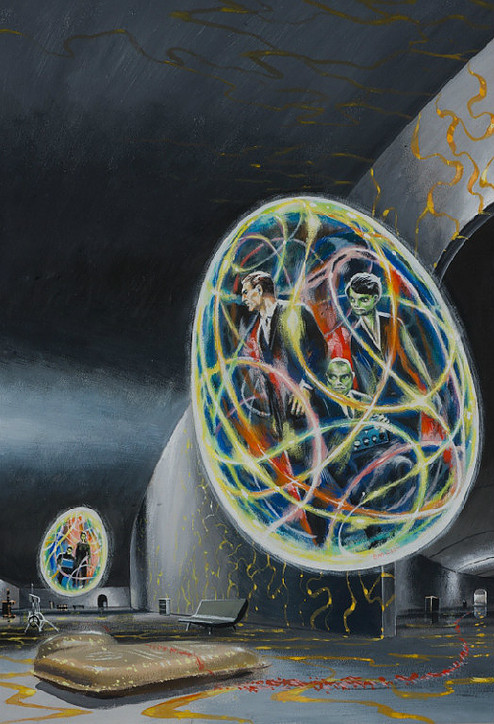
‘The Tree of Time,’ Edward Emshwiller’s (1925-1990) illustration appeared on the cover of The Magazine of Fantasy and Science Fiction

Having this collection has afforded Korshak opportunities he cherishes, “There’s a camaraderie when you meet with other collectors. It’s a hobby you can share with other people which is tremendously fun and enriching. I have developed friendships through this.

“At the same time I really want to share and give back to the field that’s given me so much. The illustrators in my collection established the basic genre, the vocabulary of the field. These books haven’t appeared in print in 80 or 100 years, and out of sight out of mind. Many of the themes are reproduced by modern illustrators but in different ways and techniques.

“By exhibiting the artwork, I feel I’m doing something thoughtful by introducing these illustrators to a new generation of people and helping preserve some of these illustrators’ legacy as well. I’m not single-handedly going to do that but, in my own little way, am contributing  towards that end.

“We’ve finished our East Coast tour and we’re now starting one on the West Coast. Coincidentally, I have just been contacted by a big gaming company in Japan that’s doing an Alice in Wonderland exhibition and wants to take one of our famous Arthur Rackham illustrations. It’s really exciting now that people are starting to know these illustrators. And I think it’s going to help the modern illustrators. My collection goes through 2000 but there are contemporary artists right now who are doing great work like Michael Whelan and the Brothers Hildebrandt.

“I have also written books on two illustrators – Hannes Bok and Frank R. Paul. I wrote the Hannes Bok book with Ray Bradbury before he passed away. It was Bradbury who introduced Bok to the editor of Weird Tales which helped start up his career.

“A few years ago I convinced my father to help me publish an artbook on the father of science fiction art, Frank R. Paul. We named the company Shasta/Phoenix because his original book publishing company, Shasta, had been inactive for 50 years and we resurrected it, like the phoenix, from the dead.

“In the Frank R. Paul book, I mentioned Sir Arthur C. Clarke, who co-wrote the screenplay for  ‘2001: A Space Odyssey.’ Clarke claimed that Paul was one of the great influencers in his life. He said that the NASA space engineers who worked on NASA projects knew we could go to the moon because Frank R. Paul had visualized it,” confides Korshak.

If the people responsible for America’s space program look to science fiction books to determine which galaxies to explore, do we need further evidence that whatever the mind can imagine is humanly possible?

Octavia Butler Exhibition at The Huntington Library

Originally published on 20 April 2017 in the Pasadena Independent, Arccdia Weekly, and Monrovia Weekly

Octavia E. Butler was the first science fiction writer to receive the prestigious MacArthur Foundation ‘genius’ grant and the first African American woman to win recognition writing in a genre dominated by male authors. For all her literary fame and awards, however, hers is not a household name.      

But this is about to change if Natalie Russell, were to have her way. As curator of ‘Octavia E. Butler: Telling My Stories’ which opened on April 8 and goes on until August 7, 2017 at The Huntington Library, Art Collections, and Botanical Gardens, Russell was charged with organizing this exhibition. On view in the West Hall of the Library in chronological order, the retrospective includes approximately 100 items that reveal the author’s early years and influences, highlighting specific themes that repeatedly commanded her attention.    

States Russell, “I hope it introduces Butler to people who may not know her, who may not be familiar with her works; for those who have not read science fiction before but were intrigued about what she has to offer which are a little different from what they thought they were going to be reading. I hope that people who are fans of hers get to know the writer behind these works a  little deeper – that through the process they get to know the inner person.”

Butler was born in Pasadena on June 22, 1947 to a maid and a shoeshine man. Her father died when she was very young and she was raised primarily by her mother. A painfully shy, introverted child, she spent her time reading at the Pasadena Public Library where she discovered science fiction.   

At age twelve Butler saw a film called ‘Devil Girl from Mars’ and was convinced she could write something better. She later enrolled in every creative writing course at Pasadena City College to her mother’s disappointment, who wanted her to have a more reliable job as a secretary. 

In the early 1970s, at a workshop for minority writers, Butler met science fiction author Harlan Ellison, who introduced her to the Clarion Science Fiction Workshop.  There, among other like-minded writers, she learned to hone her craft and even sold her first story.

Butler’s conviction that she was going to be a successful writer grew stronger after the Clarion workshop. She did not want to find work that would distract from her ultimate goal so she took odd jobs to support herself. 

Success proved elusive for a while, until 1975 when Butler sold her first novel, ‘Patternmaster’ to Doubleday, which quickly followed with ‘Mind of My Mind’ and ‘Survivors’. This trio came to be known as her ‘Patternist’ series, which depicts the evolution of humanity into three distinct genetic groups. There is a review in the exhibition that lauds ‘Patternmaster’ for its especially well-constructed plot and progressive heroine, who is ‘a refreshing change of pace from the old days’.       

On display in the exhibition are motivational notes Butler would write to pick herself up during bouts of self-doubt – ‘I am a Bestselling Writer. I write Bestselling Books ….  Every day in every way I am researching and writing my Award winning Bestselling Books and short stories …. Every one of my books reaches and remains for two or more months at the top of the bestseller lists …. So Be it! See To It!’

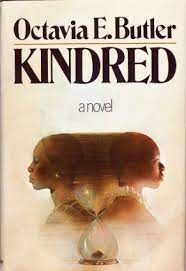
Butler’s readership continued to grow and with the publication of ‘Kindred’ in 1979 she was able to make a living on her writing alone. In 1984 she won her first Hugo Award for the short story ‘Speech Sounds’. Her novelette ‘Bloodchild’ won a Hugo, a Nebula, the Locus, as well as an award for best novelette from Science Fiction Chronicle, in 1985.                  

That Butler was a female writer of color informs many of her works. Russell concurs, “I think being a woman and African American gave her this unique voice. Butler said she never saw herself in any of the stories she read. So she decided to write herself into these books so she could see a woman character in a setting that reflected the diverse world she lived in”.  

Beyond race, Butler explored themes between genders and worked to develop strong female characters who resolved problems differently. Russell adds, “Her audience varied – young, old, people of color – anyone who’s interested in science fiction; her themes also covered a diverse range – disease; pharmaceuticals; fears about the environment, drought, and alien contact – the differences that divide us and how we overcome these to become better people and get together as human beings.”

 “In 2008 Butler’s papers arrived at The Huntington in two four-drawer file cabinets and 35 large cartons,” states Russell. “She kept nearly everything – from her very first short stories, written at age 12, to book contracts and programs from speaking engagements. The body of materials includes 8,000 individual items and more than 80 boxes of additional items: extensive drafts, notes, and research materials for more than a dozen novels, numerous short stories and essays, as well as correspondence.”

Photo courtesy of The Huntington

According to Russell more than 40 scholars were asking to get access to the Butler collection by the time she was done processing and cataloguing all the items. In the past two years, it has been used nearly 1,300 times – or roughly 15 times each week, making it one of the most actively researched archives at The Huntington.

“I was not familiar with her beforehand; it’s a shame because she’s so amazing,” confesses Russell. “But I hope that everybody can have the same experience I had while I sorted through all the materials she left behind – that it’s okay to start fresh. Be prepared to be amazed and entertained, to experience something new, and thought-provoking. She was a very shy, private person, but she has a big presence on the page; she has so much to say. Some of those inner thoughts and the struggles she underwent to become the person that she was is a story we can all be inspired by.”      

“When I look back at the things I sifted through in the collection, I think of the highlights, themes, and things that were important to Butler and how to share her with the world. That’s what I hope I have done with this exhibit,” concludes Russell.

After having lived in Seattle for several years, Butler had planned on returning to Pasadena. She died suddenly in 2006 before she realized that wish, but her literary archive has come home to reside permanently in The Huntington. Here scholars can come to examine the life and work of this extraordinary woman.        

She lived but 58 years but her legacy will endure far longer than her existence on earth.  Generations of future writers, and people from all walks of life, will find inspiration from Octavia E. Butler – a woman ahead of her time.