Originally published on 18 May 2017 in the Pasadena Independent, Arcadia Weekly, and Monrovia Weekly
No single flower has moved more bards – from Robert Burns to William Butler Yeats – to wax poetic than the magnificent rose. And nowhere are the roses more cared for and celebrated than at The Huntington Library, Art Collections, and Botanical Gardens in San Marino where they are displayed in stunning splendor.
Tom Carruth, who became the E.L. and Ruth B. Shannon Curator of the Rose Collection in 2012, presides over The Huntington’s vast assortment of 2,500 plants and 1,250 varieties.
Prior to his arrival here, he spent 25 years as a hybridizer for Weeks Roses, the country’s leading wholesale grower, where he led the company’s hybridizing efforts. In his long career he has won more awards from the All-America Rose Selections (AARS) organization than any other living hybridizer.
“My hybridizing career ended when I took this position,” reveals Carruth. “As curator of the rose collection I’m responsible for ensuring the plants are vibrant and alive, and for bringing in new parts to the collection.”
In the five years he’s been at The Huntington, Carruth has organized all the labels and systematized the collection records. He has expanded some of the beds, added arbors, rebuilt trellises, repaved pathways, re-landscaped, modified irrigation, tested the soil, and even established a dramatic new entrance to the rose garden. He has also taken on a mission to identify older cultivars that were ‘collectible’ quality and custom propagating them to replace the weaker shrubs in the garden.
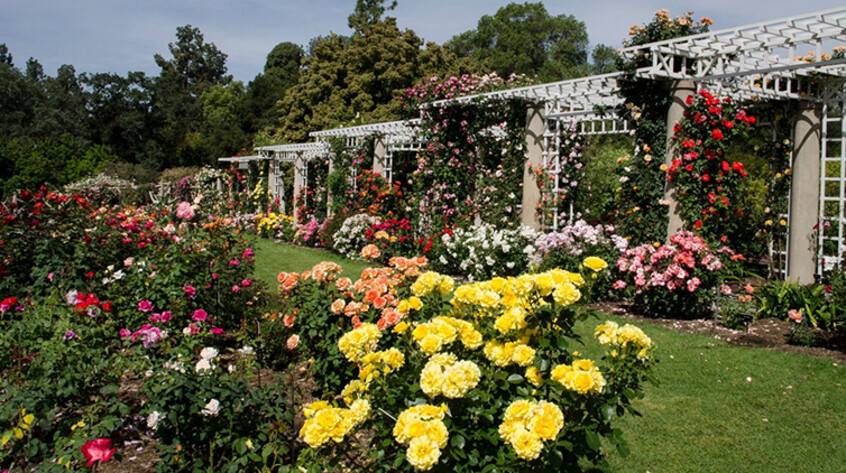
The Rose Garden at The Huntington | Photo courtesy of The Huntington
But Carruth gets the most fun studying the plants, “As a horticulturist I just observe – plants talk to you and you listen. This is an old garden so the soil is impacted and we started amending with gypsum. I noticed the roses were getting too much shade so we pruned out some trees. Some of the old plants which were struggling to live responded to the care and started to turn around. We had agapanthus going down on both sides of the trellis which were so overgrown they were in the rose roots and were strangling the roses. We divided up the agapanthus and for two years we just let the roots get some air.”
Originally a cutting garden for Mrs. Huntington, the flowers were grown for production with 50 shrubs of each variety – she was fairly nearsighted and she loved having big bouquets in the mansion. According to Carruth records from that time showed that one year 9,000 roses were cut to bring to her house. Today it is a vast collection with just one or two of each kind to show the history of the rose.
The Huntington’s Rose Garden is a veritable history lesson that traces the story of the rose from ancient times to the present day. Growing on the south side of the pergola leading from the Shakespeare Garden to the Tea Room are roses that represent the early history of the flower dating back to the pre-Christian era.
On the north side of the pergola are Tea and China roses, introduced into Europe from Asia around 1800. Says Carruth, “The Chinese were known to have been working with this flower for over 2,000 years. The whole collection behind the trellis were roses that came here in the tea ships and were the ones that gave us repeat flowering; up to that point roses bloomed only once a year.”
The central part of the garden is dedicated to roses of the modern period when the first hybrid tea rose, called ‘La France’ was introduced. The hybrid tea went on to become the most popular class of rose of the 20th century, with thousands of known varieties. According to Carruth, ‘Ophelia’ dating to that period was crossbred in the garden and is in The Huntington’s collection.
Carruth explains, “The roses are classed by color but not planted by color. We want to keep the integrity of each variety – the China Teas are all in one location, the older hybrid has its devoted area, and the fragrant roses are in two beds closest to the Rose Garden Tea Room. That makes it easy for us to direct the public when they ask.”
“Roses have several natural fragrances like fresh cut apples, spice, lemon blossom, myrrh, damask, honey, violets, and all sorts of combinations of those,” adds Carruth. “It’s fun to watch people get a whiff of the fragrant flowers while they wait for their table in the Tea Room (for information and reservations, call 626/405-2236 or huntington.org/dining). We have a variety out there that smells like Lemon Pledge and over here we’ve got one that reminds you of Ponds Cold Cream. Down there we have something that’s white licorice and smells strongly like licorice candy.”
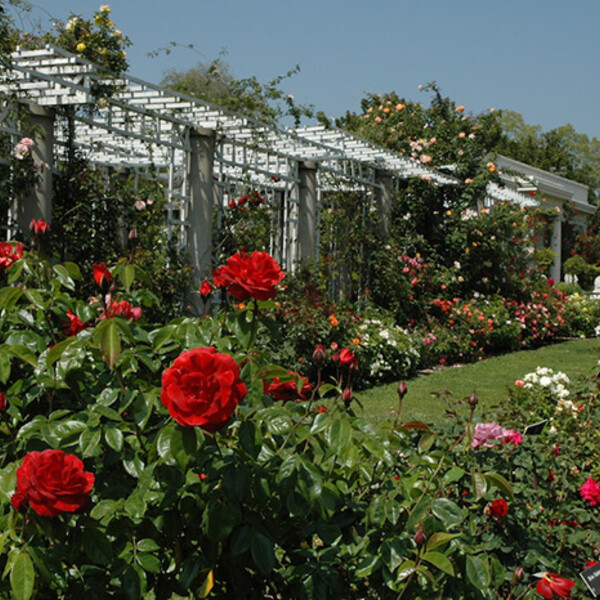
Photo courtesy of The Huntington
“Everyone loves walking around, reading names, and looking at the dates,” observes Carruth. “Many visitors, who don’t’ necessarily know much about growing roses look for classics like ‘Mr. Lincoln’, ‘Peace’, or ‘Sterling Silver’ – bed number 17 in the collection – which is a silvery lavender and is a repeat bloomer. ‘Sterling Silver’ is interesting because that was the first hybrid from a female hybridizer, in a male-dominated field. We also have the everyday version, ‘Stainless Steel’, which is a much easier plant to grow and has bigger flowers, that’s similar in color and fragrance.” What he failed to mention, however, is the fact that ‘Stainless Steel’ is a rose he developed in the 1990s as a more robust version of the fussier ‘Sterling Silver’.
The roses at The Huntington bloom from mid-April to November. Explains Carruth, “This year, because of the rain, we had an elongated pruning season resulting in an extended spring bloom. We’ll have color throughout because we manipulate the plant in the beginning so they don’t blossom all at once. People will see roses every time; we even have a smattering of them in time for the Rose Parade.”
It would surprise people to know that The Huntington does not have a large staff tending to the garden. Carruth discloses, “I have two gardeners who work three acres of roses so we depend heavily on our volunteers. Right now I have 52 rose garden volunteers deadheading, weeding, watering, and anything they’re willing to do. Some people love to deadhead and prune so I see them in winter and I may not see them during the summer. We’ll take whatever level of interest they have. They get prime time – they come in early in the morning before visitors arrive – when it’s beautiful and calm, and not hot.”
You’ll know that Carruth, and his staff and volunteers, take painstaking care of The Huntington’s roses when you see the glorious flowers in bloom. The next time you visit, go for a stroll on the grounds to take in the breathtaking beauty and heady fragrance laid out before you. When you do, you undoubtedly wouldn’t be able to help stopping to smell the roses.
 A San Gabriel Valley Inquirer