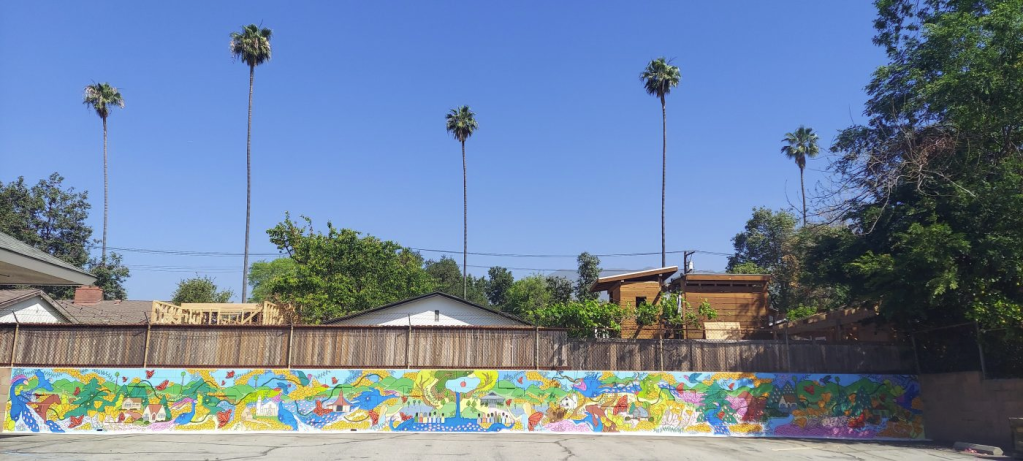
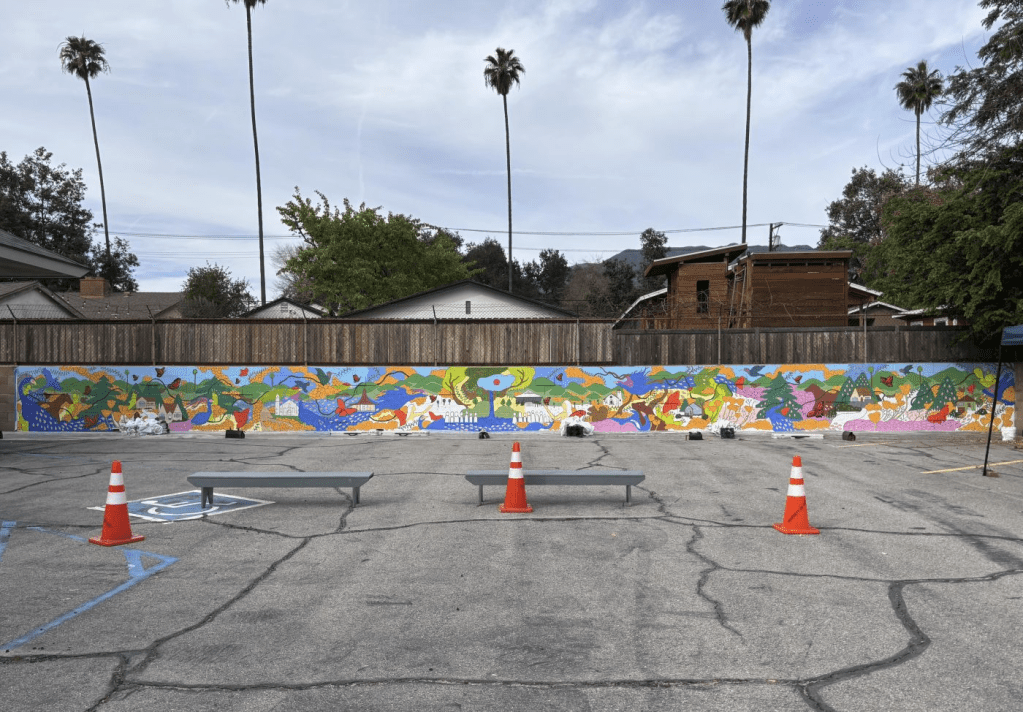
The completed “Healing and Hope” mural unveiled. | Photo courtesy of the Pasadena Buddhist Temple
The Pasadena Buddhist Temple celebrated the completion of the “Healing and Hope” mural at 3 pm on Sunday, March 22. The brainchild of Kyoko Gibbs, wife of the temple’s spiritual leader Rev. Gregory Gibbs, who collaborated with Miki Yokoyama, an artist and Eaton Fire survivor – it was a way of restoring the community after their life-shattering experience.
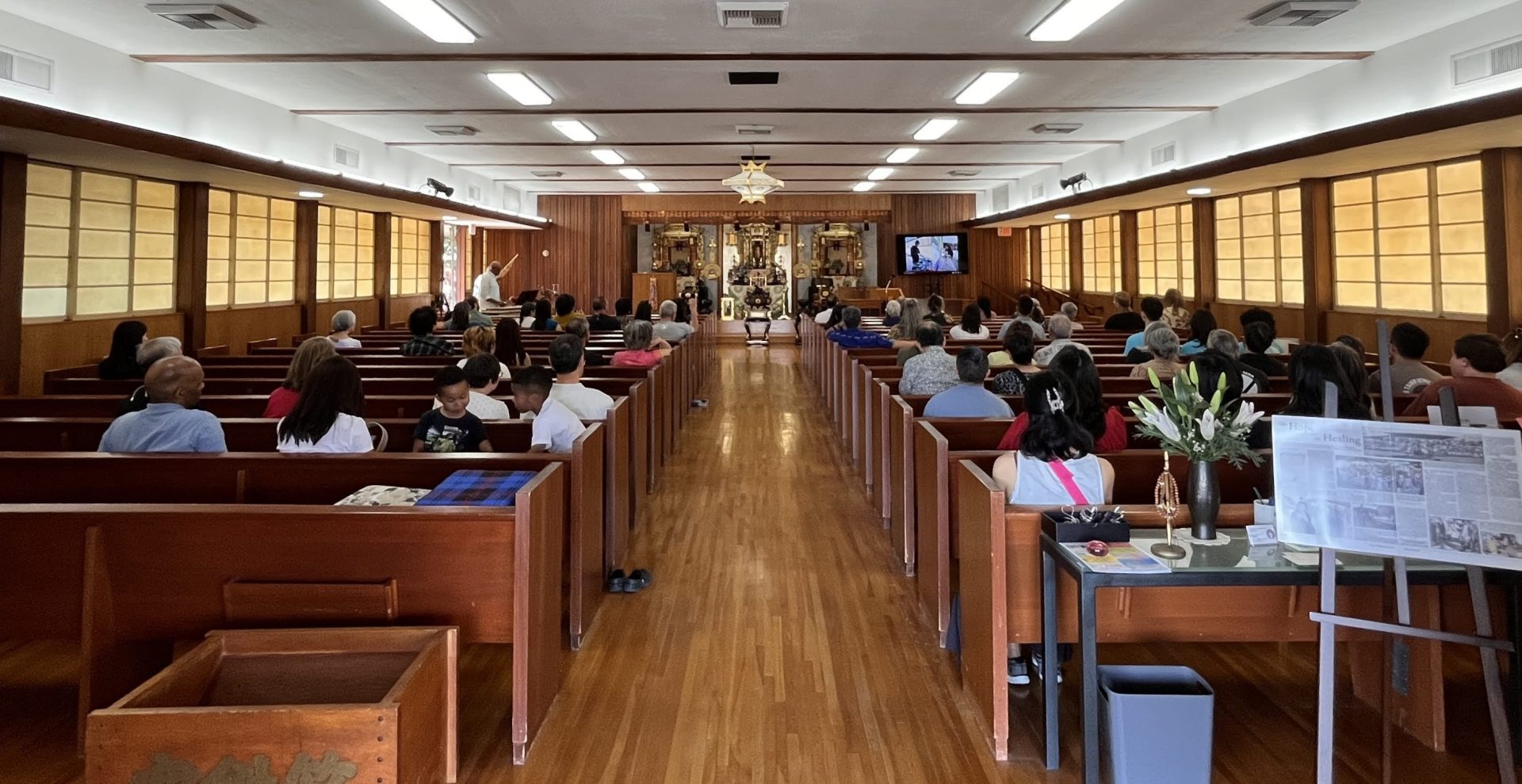
It was a festive occasion with about 70 people in attendance. A video about the progress of the mural was shown, after which attendees were invited to gather outside for the unveiling of the completed mural.
About 70 people attended the celebration at the Pasadena Buddhist Temple. | Photo courtesy of the Pasadena Buddhist Temple
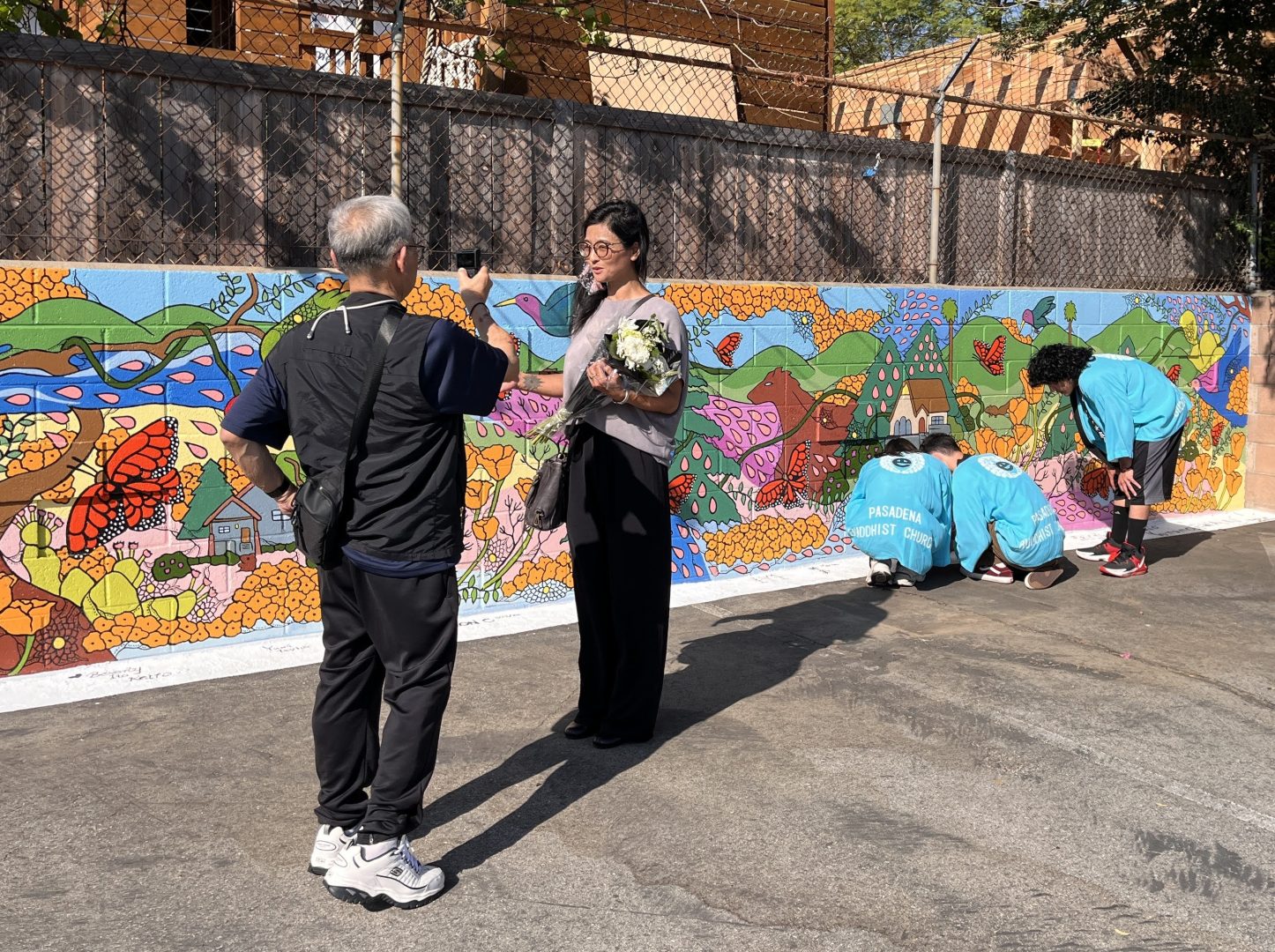
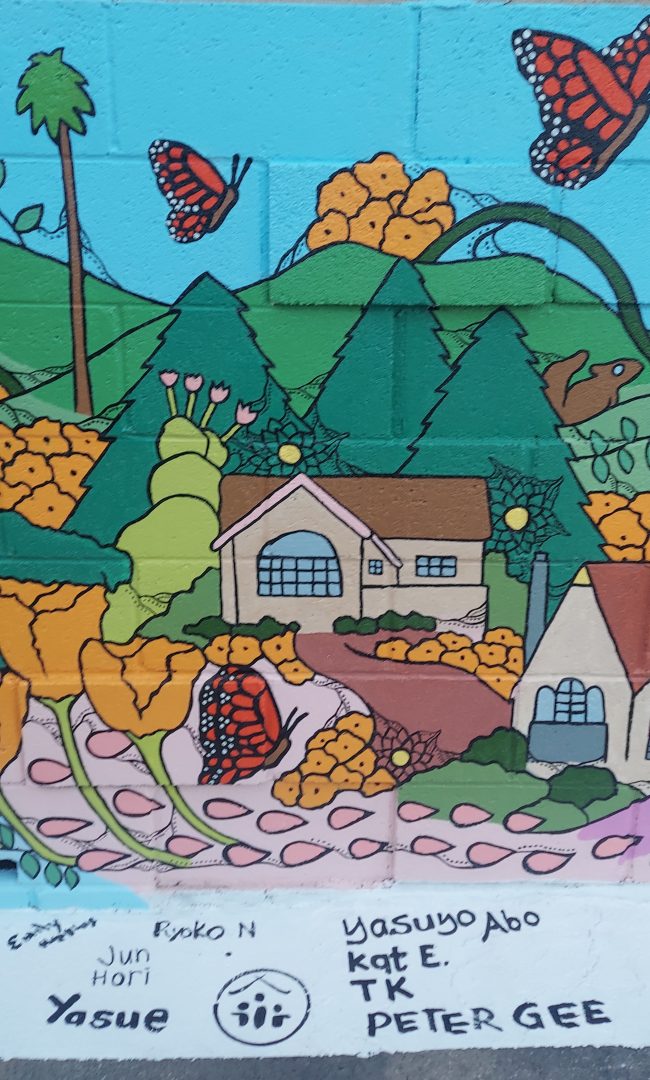
Gibbs’s younger son Ren and his friends Winston and Felix – fittingly attired for the occasion in happi (a tube-sleeved Japanese coat) – walked rapidly as they uncovered the mural. Their fast-walking provided a light-heartened moment for the mothers present who found it entertaining. Keiro and Little Tokyo Service Center were recognized for their compassionate support. Yokoyama shared her story in creating the mural with the community and invited everyone to sign their names on the painted primer area, the ground part.
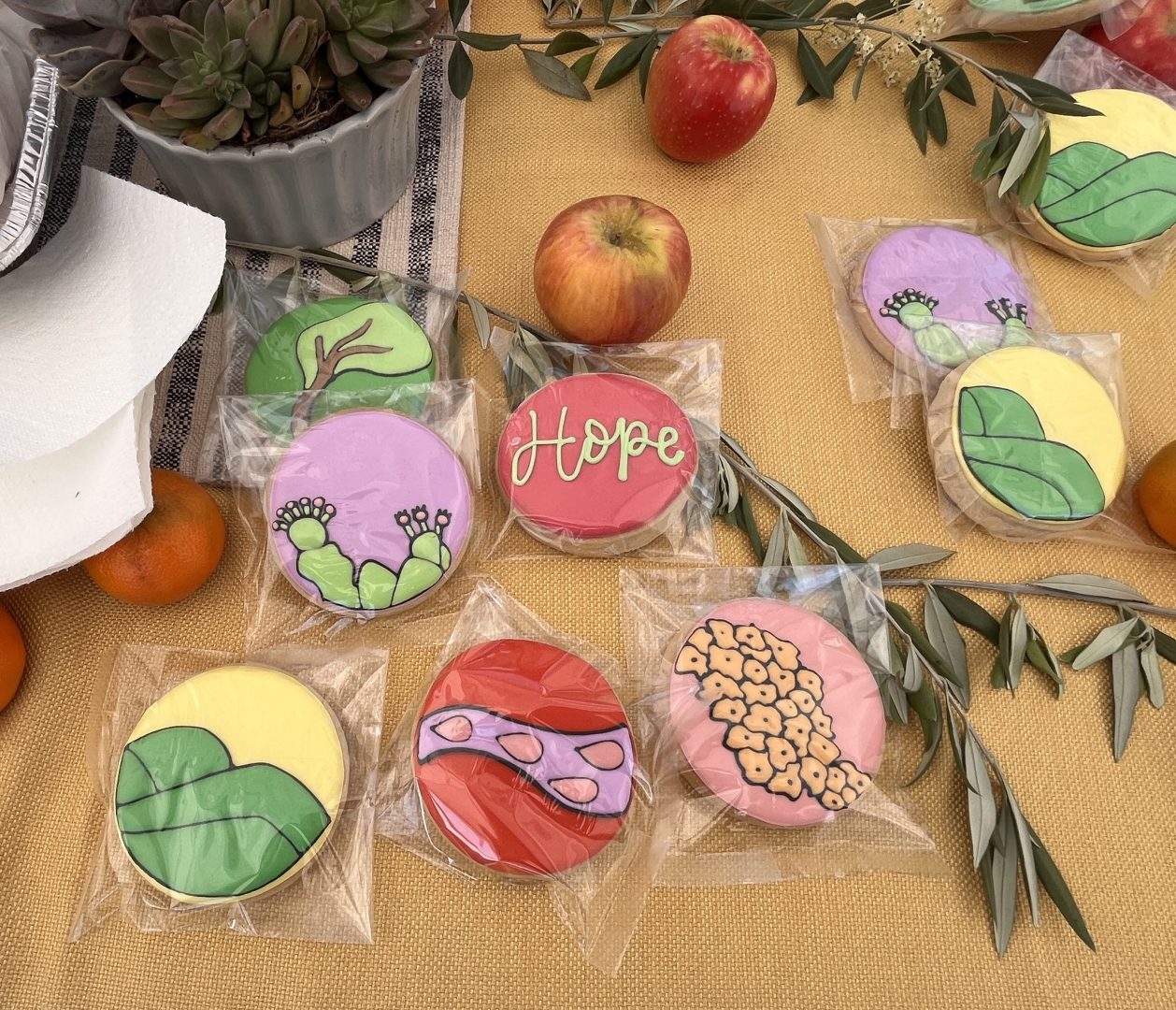
“Judicanti Responsura,” the music duo formed in 1984 by tubaist William Roper and percussionist Joseph Mitchell – who were fire survivors as well – set the stage beautifully to welcome people in the Hondo, the main building. The Altadena Cookie Company provided custom cookies for the event.
Miki Yokoyama, at right. | Photo courtesy of the Pasadena Buddhist Temple
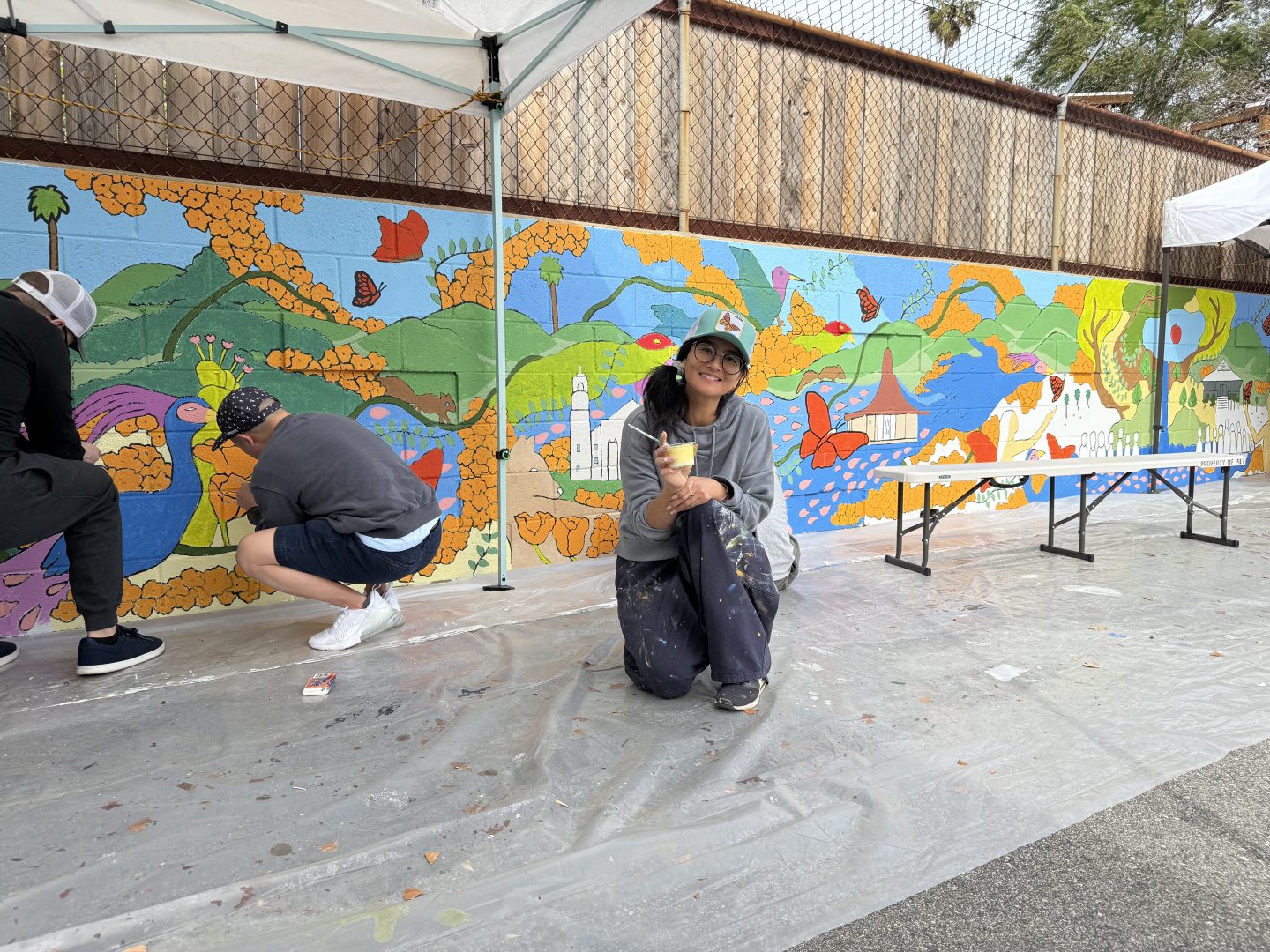
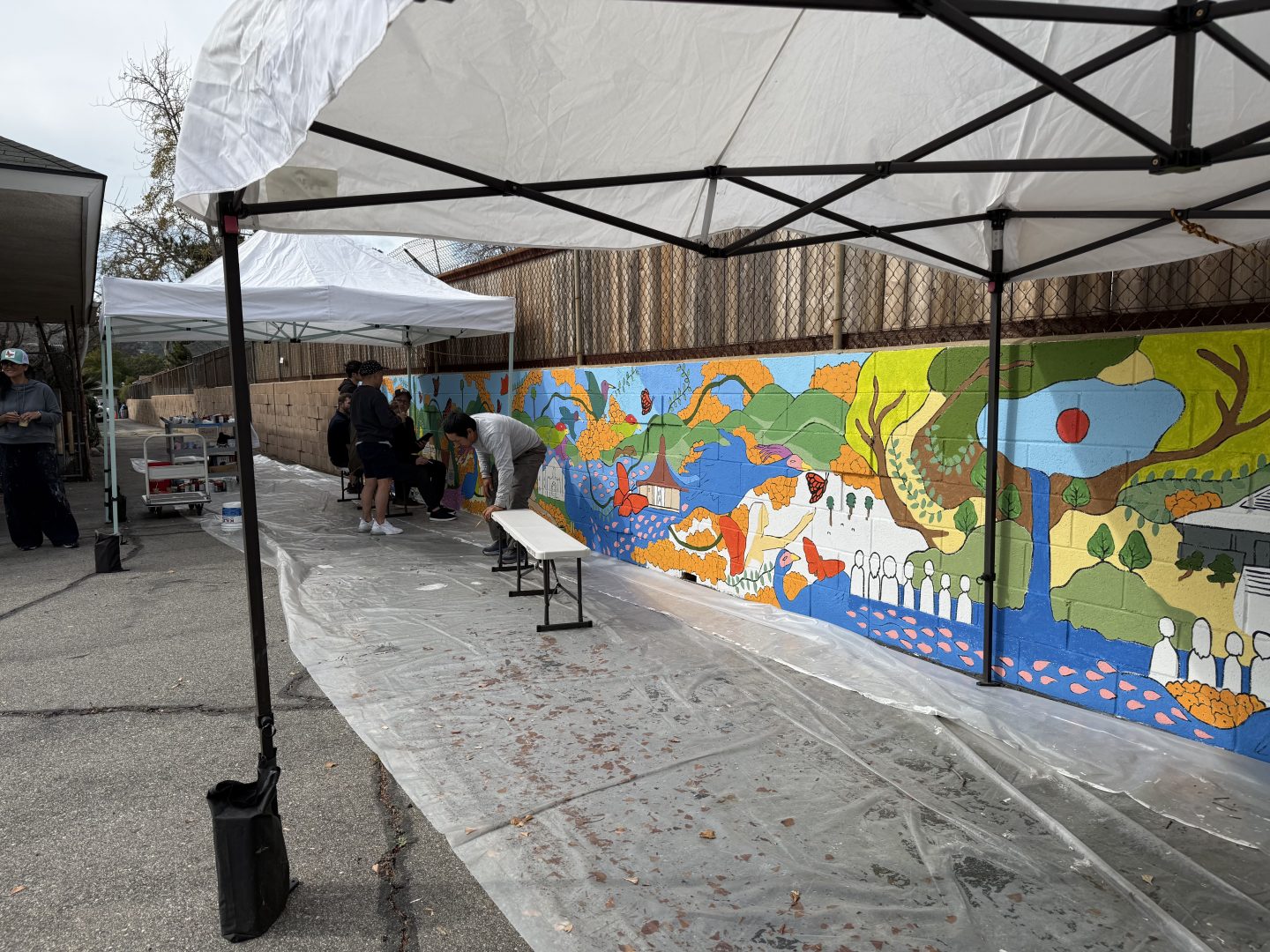
The “Healing and Hope” mural took a few months to paint, with Eaton Fire survivors participating in the project. In mid-March, the mural was almost done.
Yokoyama recounts, “I completed the final touches on the mural last Sunday, the 15th. This week, I have been applying a top coat over the finished painting, painting the ground directly below the wall white, and preparing a space where everyone who participated in the mural can add their signatures.”
People’s signatures on the mural. | Photo courtesy of the Pasadena Buddhist Temple
For Yokoyama, the completion of the project is as joyful as it is bittersweet. “This experience has been incredibly meaningful to me,” states Yokoyama. “Working together with everyone on a single mural was something that truly helped and supported me. I had been struggling mentally over the past year since the fire, so I am very grateful to Kyoko for proposing this project. The time spent painting with everyone allowed me to focus on both the creative process and connecting with others. Each day, I felt that these moments were healing my heart. Seeing everyone working so hard on their parts of the mural gave me strength and courage.”
“My feelings right now are quite complex,” Yokoyama discloses. “I am very happy that we were able to complete the mural. At the same time, I feel a deep sense of sadness knowing that this time of creating together has come to an end. Since Kyoko and I first began discussing the location of the mural, I have been coming to the site five days a week for about two months, so it has been a very special part of my life.”
Custom cookies from the Altadena Cookie Company
Those sentiments are echoed by Gibbs, “I already miss the sense of togetherness from working together. It brought me happiness and strength. The bond we formed through the mural project, and of course during last year’s gatherings and activities, will stay in my heart and help me move forward! I will cherish all the encounters.”
“Feeling the results of the community’s teamwork is truly empowering,” adds Gibbs. “We are stronger together, and I am deeply thankful to be part of this caring and supportive community! This mural gives me a deep sense of hope, seeing how something beautiful and empowering has emerged from such a devastating event.”
Indeed the Eaton Fire, as tragic as it has been, provided the impetus for Altadenans to unite – whether to fight for accountability from county officials or to work on an artistic endeavor that commemorates their shared experience. And that is a wonderful outcome to celebrate.
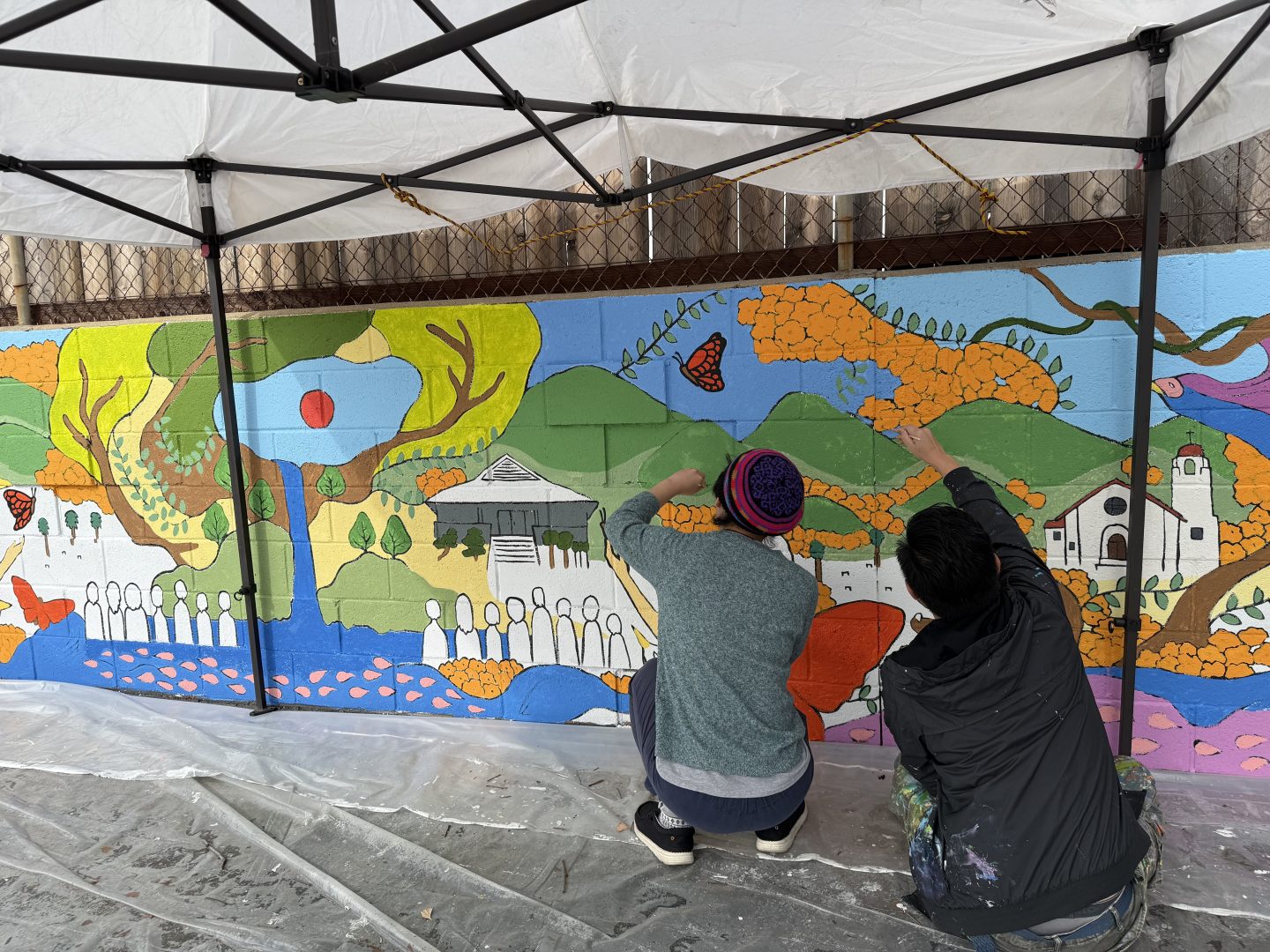
The Healing and Hope Mural painting in progress. | Photo courtesy of Miki Yokoyama / Pasadena Buddhist Temple
The Eaton Fire killed 19 people, destroyed over 9,000 structures, and brought untold grief to the community. More than a year later, displaced Altadena and Pasadena residents are still reeling from the trauma. There are constant reminders of what they lost and memories of that fateful day are still fresh in their mind.
As much anguish as the Eaton Fire wrought, there have also been many instances of a community coming together in their shared experience. The most recent of such moments is a group painting initiated by Miki Yokoyama who created a mural at the Pasadena Buddhist Temple. The brainchild of Kyoko Gibbs, wife of the temple’s spiritual leader Reverend Gregory Gibbs, the mural symbolizes what she thinks everyone needs – healing and hope.
The temple almost became a casualty of the fire had it not been for the bravery of neighbors who put out the flames. Gibbs recalls, “Greg and I, along with our younger son, live in the temple residence, so we followed the evacuation order in the very early morning of Jan. 7 and drove to a hotel. Watching the news at the hotel, we recognized the temple’s neighbors getting burned down despite the efforts of firefighters. Feeling urged to return to the temple, we drove back there to find our ‘heroes’ and some other temple members trying to extinguish the flames that had landed between the tea garden and the edge of the main building, Hondo.”
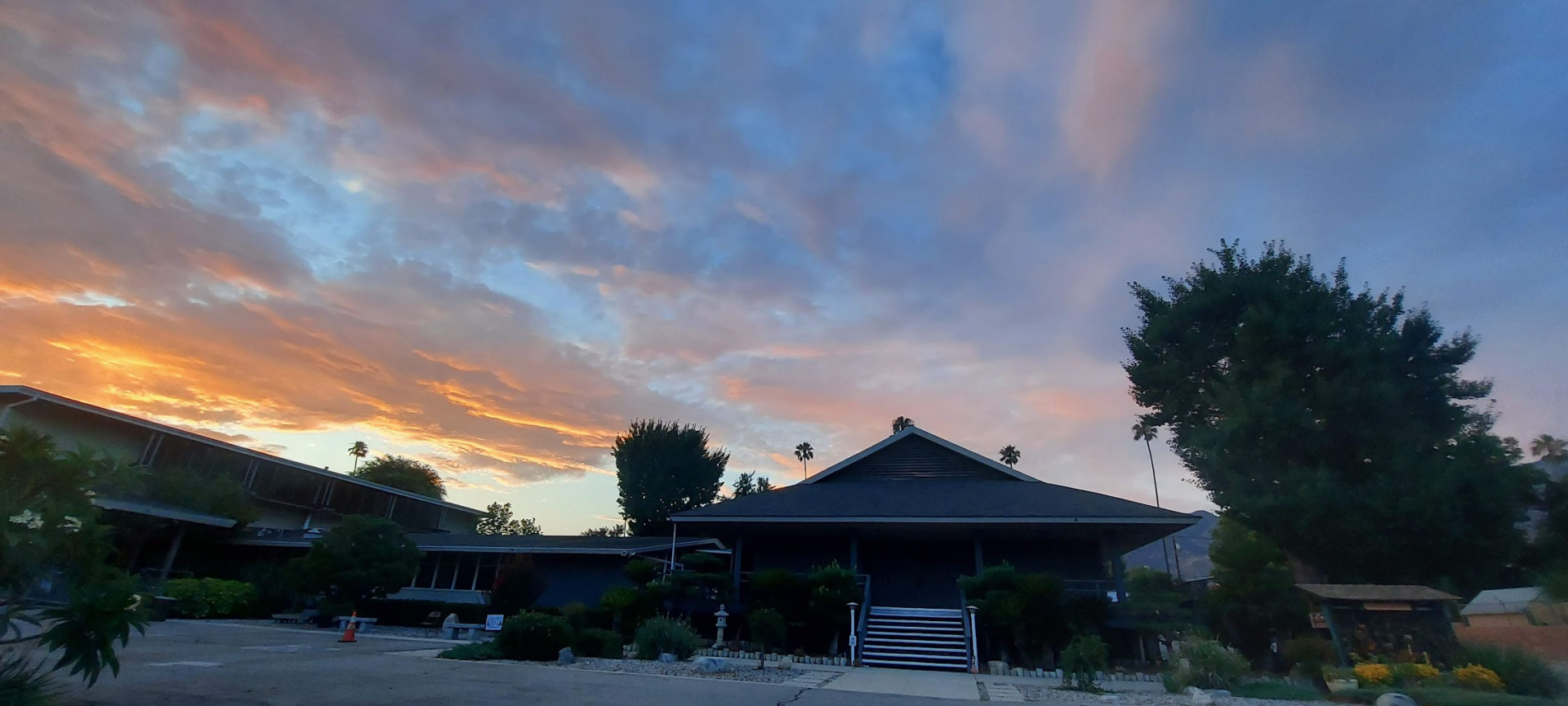
The Pasadena Buddhist Temple at night. | Photo courtesy of the Pasadena Buddhist Temple
“As we heard and learned about the temple members, associated friends, and neighbors’ loss and damage due to the fire, we were deeply hurt – not just physically but also emotionally,” continues Gibbs. “No words were spoken; we cried while holding and hugging them.”
Immediately, the temple community collaborated on events and efforts to help fire survivors. “Since two days after the fire, the restaurants in Little Tokyo (Azay and Far Bar) and San Gabriel (Yama Sushi), Little Tokyo Service Center, Keiro, Pasadena Japanese Cultural Institute, and the churches and temple in the affected Altadena and Pasadena areas, along with many others such as Buddhist Churches of America, Tanaka Farms, King’s Bakery, Go For Broke, and many more, have stepped up to the plate. Each individual person and organization gave them a hand in a selfless and compassionate way. As we continue to move forward, I am truly grateful for everyone’s kindness.”
The Gibbses themselves have been the recipient of people’s generosity. “During the remediation process for all the temple facilities, we needed to relocate to the temple’s friends’ house for about two months,” Gibbs says. “We were so fortunate to receive their kind offer. The temple is now fully restored and I am very thankful for those two temple board members who tirelessly worked with the insurance and intensive cleaning companies.”
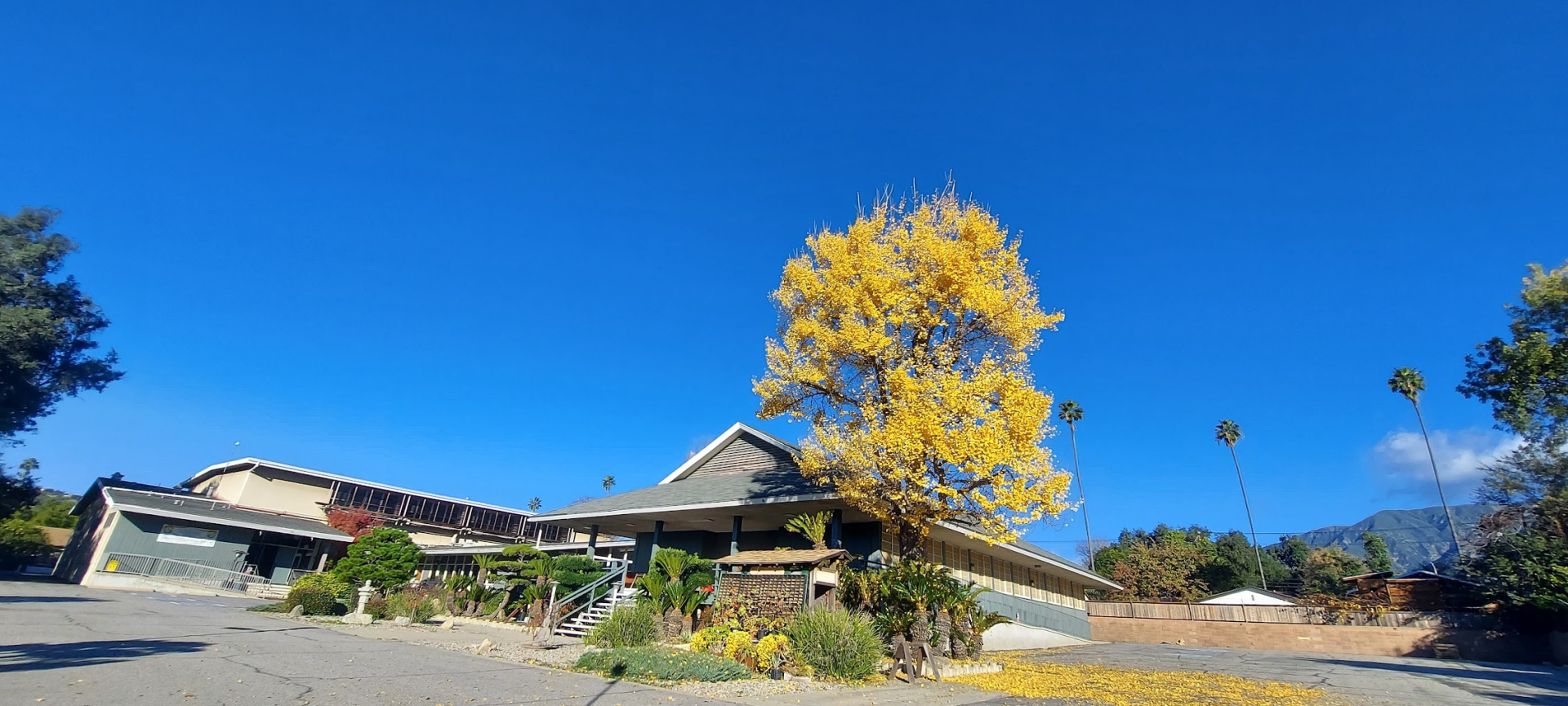
The temple is now fully restored. | Photo courtesy of the Pasadena Buddhist Temple
For its part, the temple raised and distributed close to $90,000 to fire victims and actively continues to raise funds for them. “On the first anniversary of the fire, we presented them with a card and a small monetary gift. We wanted them to know that we are thinking of them. Additionally, we will be holding a White Elephant Sale, which opens to them first for free before the general public. We will also have a Girls’ Day Celebration with the tea ceremony, which they will be invited to join. More financial support will be distributed soon from the social welfare committee of Buddhist Churches of America (Pasadena Buddhist Temple is a part of BCA).”
Another activity that took place one year after the Eaton Fire was the creation of a mural. Recalls Gibbs, “As the first anniversary of the fire approached, I was thinking about what we – as the whole affected community – could do to help heal and inspire hope. Then, SOGs (Sons of Gardeners), who volunteer twice a week to maintain the temple grounds, were discussing painting a concrete section of the ramp outside. And it hit me with the idea of creating a mural instead of just painting. I brought up this concept with them and shared it with the temple board, and they all rallied behind it right away!”
“Fortunately, Keiro, which has been a financial supporter of activities and events for fire survivors, also agreed to continue its support,” Gibbs says further. “I knew who I needed to ask to lead the mural designs – Miki. She isn’t a member of the temple but I met her through the meal program for fire survivors.”
In mid-November, Gibbs reached out to Yokoyama and proposed crafting a mural and inviting the participation of those who had lost their homes in the fire as a way to help restore the town. They discussed what kind of wall painting they wanted to create and developed the concept together. To signify what it represents, they called it Healing and Hope Mural.
Miki Yokoyama. | Photo by May S. Ruiz / Hey SoCal
The Eaton Fire decimated Yokoyama’s home and all her artwork, and wreaked havoc on her mental health. She discloses, “The emotional shock was immense; I struggled with symptoms of PTSD for a long time. During the first year after the disaster, I believe that painting truly saved me. Now, through this project, I find healing in creating together with the temple community and others who were also affected by the disaster. Realizing that I am not alone and receiving strength from everyone involved fills me with deep gratitude.”
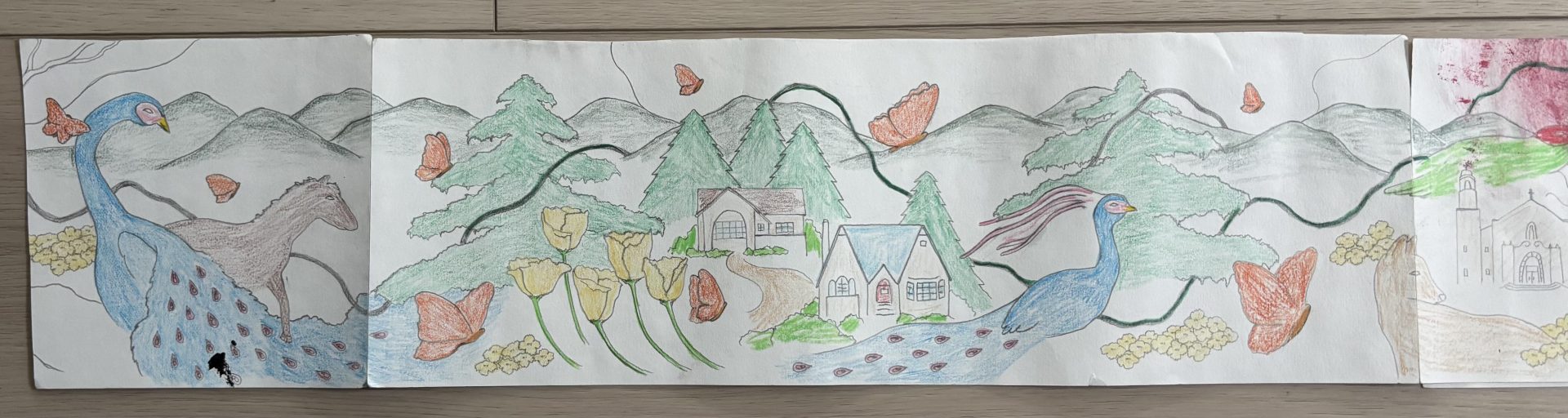
Yokoyama describes how she transferred the painting – measuring approximately 70 feet long by 56 inches tall – on the wall. “I first created a rough sketch on paper and then projected it onto the wall. However, many of the finer details will be added freehand while looking at the actual wall. From here, I plan to add more delicate lines and dots to develop the piece further.”
Yokohama’s drawings of the mural. | Photo courtesy of Miki Yokoyama
“This project is open to everyone, regardless of artistic experience,” explains Yokoyama. “Before we began painting together, I prepared the mural by drawing the outlines in black ink. Although I predetermined the colors, my hope is simply that everyone enjoys the process. I tell participants that it is perfectly fine if they paint outside the lines or even cover the black outlines. I will make any necessary corrections afterward, so everyone is free to add color as they wish.”
“At present, the mural is about halfway complete,” Yokoyama adds. “Much of the white space has been filled, and the next steps are to apply a second layer to the lighter areas of ink, retrace the black outlines, and then add finer lines and dots. By layering these delicate details, I hope to bring greater depth and subtlety to the work. Even if it takes time, I am committed to leaving behind the best possible piece.”
“As we continue working together with the community – shaping it according to our shared intentions – I am also excited to see how the mural will ultimately come together,” Yokoyama says further. “I am very much looking forward to its completion.”
One of the Eaton Fire survivors who went to the temple to paint heard about it through her mom who is a member of the temple. She asks that her name not be mentioned but graciously agrees to talk about her participation.
“Miki was there and she showed me where to paint, provided paint and brush, and instructions,” she begins. “I painted the windows on the house light blue as she instructed. She explained that it was okay to paint over lines as these will be repainted after the color is applied; the community painters are adding color and the artists are adding detail. While I was there one of the artists was refining with details. She used a Q-tip to add white spots to a red butterfly. The mural is a representation of the local community and the hope that exists in the Eaton Fire area to rebuild the physical and emotional aspects of the community.”
Photo by May S. Ruiz / Hey SoCal
Painting the mural offered a brief respite from her daily stresses in the aftermath of the fire. She says, “The consequences of the fire a year later are still part of a continuing domino effect in various ways that will remain for many years. Growth and hope are also results of this effect. Projects and institutions such as the Pasadena Buddhist Temple bring the community together for positive focus and forward momentum.”
It is exactly what compelled Gibbs to come up with a community endeavor. She declares, “Through this experience – coloring in the mural while chatting with others or working quietly – I would like all to feel connected and empowered. You are not alone. We are stronger together.”
Originally published on 3 April 2018 in the Pasadena Independent, Arcadia Weekly, and Monrovia Weekly
Arcadia High School students will call attention to social issues, including poverty and homelessness, at the Arcadia Poetry Slam which will be held at 2:00 pm on Sunday, April 29, at the Arcadia Performing Arts Center (APAC).
To benefit Foothill Unity Center, it will also serve as a launching ground for students to get their voices heard. Whitney La Barge, assistant general manager of APAC, coordinates the event with Arcadia High School.
“We want to bring more students into the space,” says La Barge. “Right now we do orchestra, band concerts, dance and theatre shows. Arcadia Poetry Slam gives other students, who wouldn’t otherwise have, the chance to be a part of the center as well as the foundation.”
Anthony Sigman-Lowery, APAC operations manager, says further, “This will be the inaugural Poetry Slam and it’s meant to encourage students to use their voices through poetry. We have a black box with 99 seats: it’s a small intimate environment for students who may have stage fright. What better way to bring students who might not normally be performing here.”
La Barge expounds, “We announced the competition at AHS in mid-March and we’re giving preference to seniors since it’s their last opportunity to do it. We’re also limiting it to 30 students. It’s pretty open in terms of format because we want them to express their creativity. The only restrictions we have are that it is under five minutes long and it has to be school-appropriate so it can’t glorify violence, guns, or drugs. As it is benefiting Foothill Unity Center we’re encouraging students to touch on social issues like homelessness and poverty.”
To get student participation from neighboring schools, La Barge reached out to the English and Drama department teachers and shared the event poster with them.
“It’s an invitational and we’re hoping that each year we’ll have more and more schools involved,” La Barge states. “We definitely want AHS to be well represented because obviously we’re here on campus and we want to serve the school district. As it’s our first time, we’re keeping it small but we eventually want to turn it into an all-day competition.”
“We really wanted to hold this but we don’t know how to judge a poem,” relates Sigman-Lowery. “How do we keep it school appropriate without restricting people’s voices? So we partnered with L.A. Poets Society. They gave us the components by which the poems will be judged – content, stage performance, voice, and diction.”
La Barge adds, “We also asked for a statement from each poet of what they’re trying to accomplish with the piece, what they’re trying to say. The judges will then pick three poets who best accomplished their goal, whose messages came across effectively. For prizes, we’re giving away Beats wireless headphones courtesy of Beats. L.A. Poets Society will award writing journals and feature them in their website under the New Poet Section.”
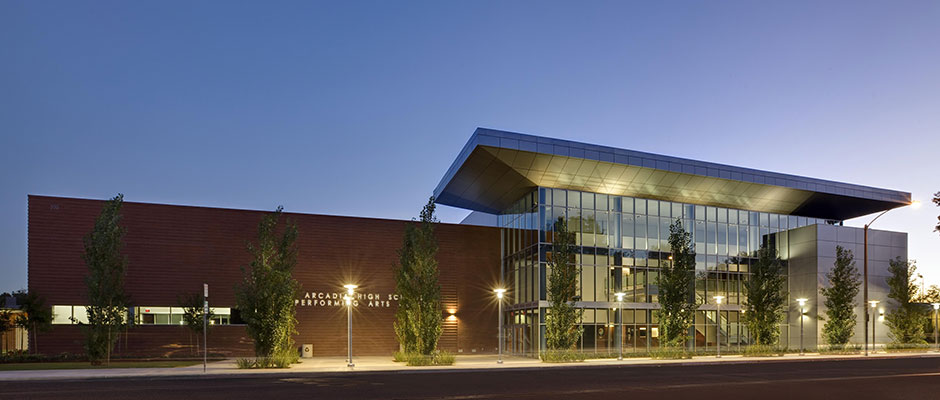
Arcadia Performing Arts Center | Courtesy photo
APAC and Foothill Unity Center have been community partners for a while according to Sigman-Lowery. He explains, “We started working with Foothill Unity Center with our Sunday with Santa event in December. We collected canned goods and to encourage people to donate, each can served as a raffle ticket to win prizes. We liked working with them and we figured it was a good way of serving the Arcadia community since one of the big goals of the foundation is making art accessible.”
Raina Martinez, Foothill Unity Center’s development and donor relations director, confirms, “APAC’s executive director, Maki Hsieh, wanted to come up with a way to support the center as well as get the community involved, especially the youth. And poetry is popular with young people and is a great way to get their voice out there. We’re making it the thematic concept to incorporate poverty, hunger, and homelessness to bring more awareness about the center and, more importantly, about the issues.
“Our two sites – Pasadena and Monrovia – serve eleven cities in the San Gabriel Valley offering food, temporary shelter, case management, transportation, and vital health services for low income and homeless people. Additionally, we offer job training skills for youth and adults, and an internship program. We have an AmeriCorps program on the site where they can get clerical and warehouse type skills.
“One of the things we do well is developing partnerships. We’re not trying to reinvent the wheel, we work with other agencies. We connect our clients with other organizations who can provide them assistance. Donations come from everyone in the community – individuals, businesses, churches. It’s neighbors helping neighbors. And volunteers are a big component of our organization – we couldn’t do this without them. Last year we had 40,000 volunteer hours.
“We have two major events during the year. In addition to the regular food services we provide, we have thanksgiving boxes and the Christmas holiday distribution food boxes. For all registered children we have the Holiday Angel program that provides toys and gift items, and a popular Back-to-School event which we do at the Santa Anita Race Track in August. Children from kindergarten through college receive backpacks, school supplies, socks, clothing, haircuts, manicure, health screenings – everything they need to get them ready for school.”
Since its founding in 1980, Foothill Unity Center has remained the primary provider of food, case management/crisis help, and access to healthcare resources for people who are at or below the national poverty level. Each day it lives up to its mission ‘Helping People. Changing Lives.’
Through the Arcadia Poetry Slam local students will bring attention to Foothill Unity Center and the most pressing problems affecting the lives of those around us. It is art galvanizing social activism.
 A San Gabriel Valley Inquirer