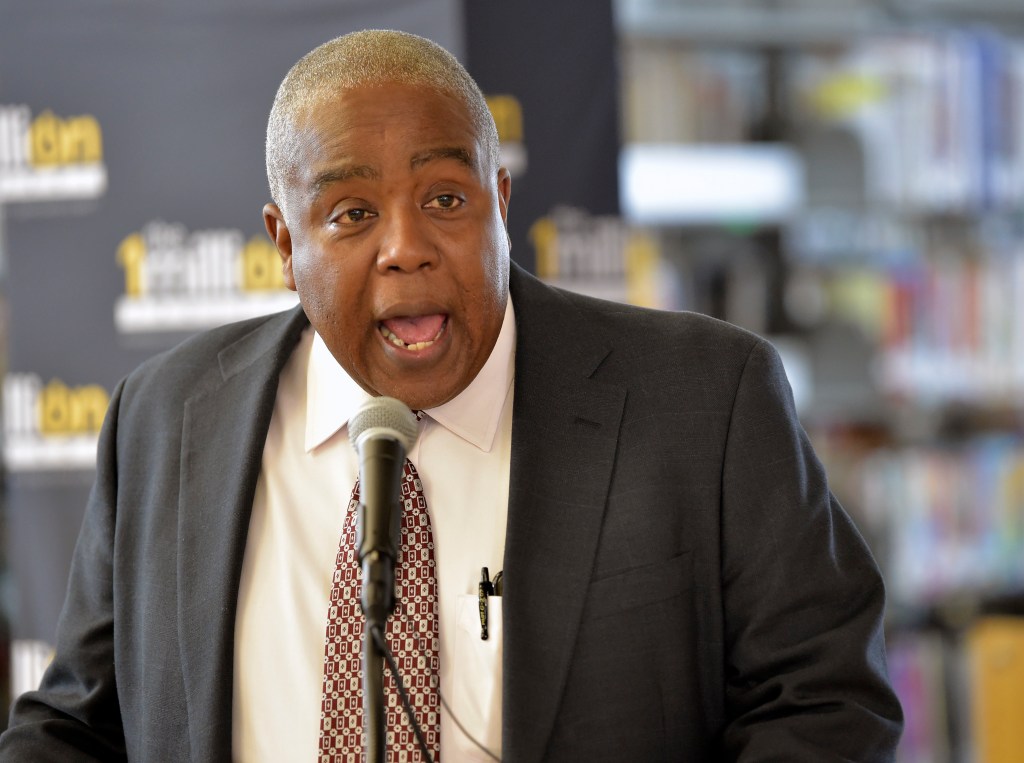
Chaaste Family Market in Pasadena Keeps Filipino Culture Alive

Also published on 18 May 2026 on Hey SoCal
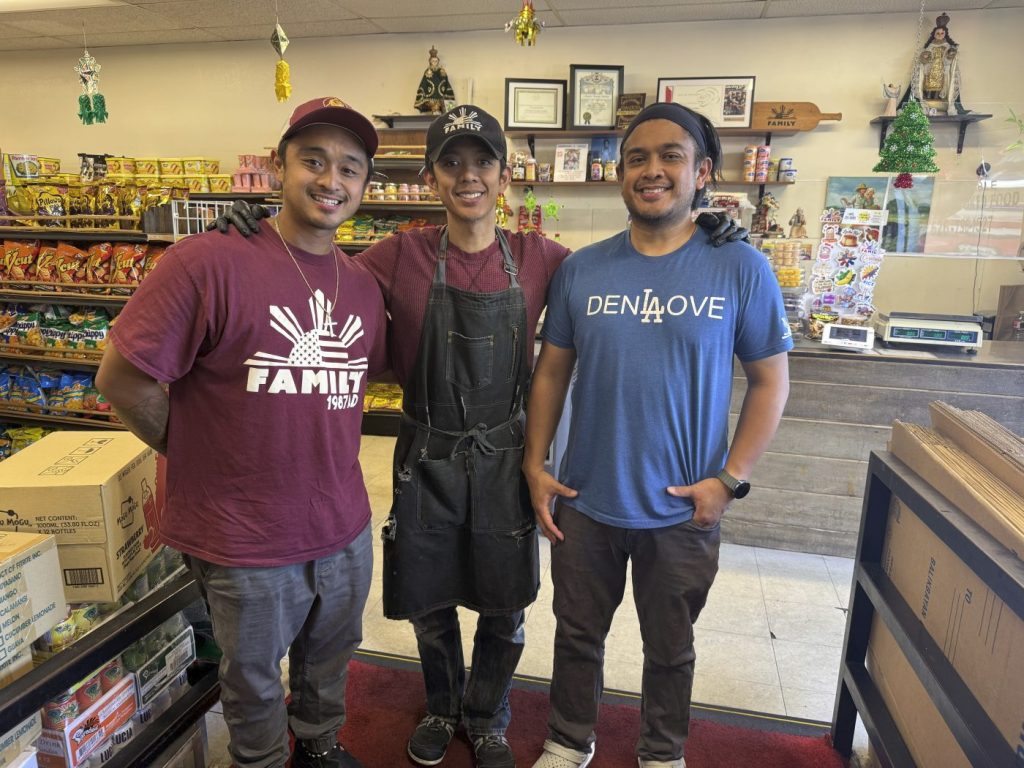
The Esteban brothers, also known as the Chaaste Brothers (from left): Gabriel, Christian, and Abraham. | Photo by May S. Ruiz / Hey SoCal

On October 5,1978, President Jimmy Carter signed a joint resolution for a week-long celebration of Asian American and Pacific Islanders’ contributions to the United States. The month of May was chosen for two historic events – on May 7, 1843, the first Japanese immigrant, Nakahama Manjirō, arrived in the United States. More than two decades later, on May 10, 1869, the golden spike was driven into the first transcontinental railroad, which was completed using Chinese labor.

In 1990, George H. W. Bush signed a bill passed by Congress to extend Asian-American Heritage Week to a month; May was officially designated as Asian/Pacific American Heritage Month two years later.

President Barack Obama signed a proclamation on May 1, 2009, recognizing the month of May as Asian American and Pacific Islander Heritage Month. Under President Joe Biden it became Asian American, Native Hawaiian, and Pacific Islander Heritage Month.

According to the U.S. Census Bureau, the AANHPI population in the U.S. is the fastest-growing racial group, with over 25 million people (nearly 8% of the total population) as of 2023. This diverse group includes around 25.8 million Asian Americans (alone or in combination) and roughly 1.6 million Native Hawaiian and Other Pacific Islander (NHPI) individuals.

There are 7 million to 7.2 million Asian Americans living in California as of 2023-2025, according to Pew Research Center. They make up approximately 18%-18.4% of the state’s total population, representing the largest Asian population in the continental United States.
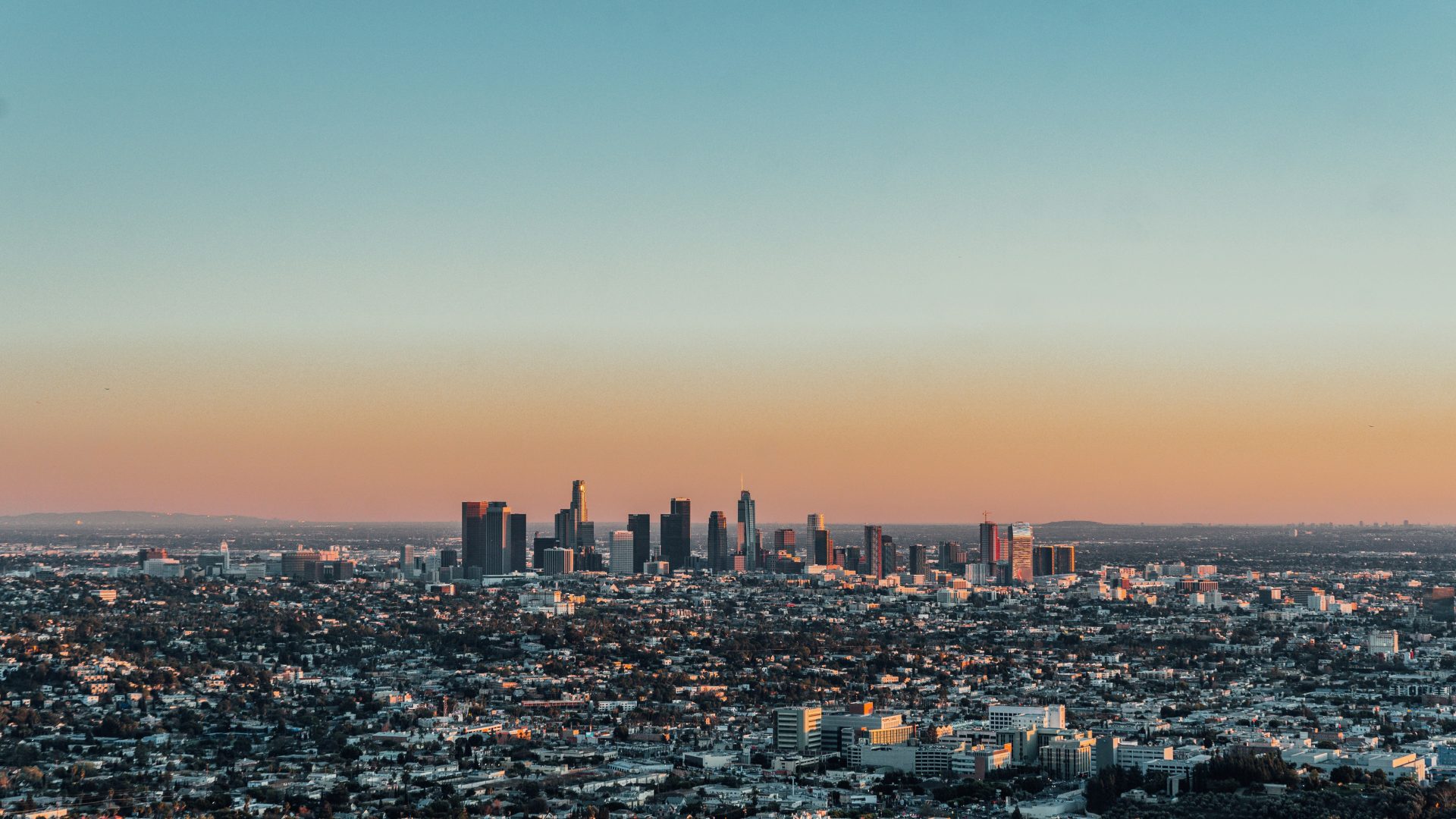
L..A. Skyline. | Photo by Josh Miller on Unsplash

Los Angeles County has the highest concentration of Filipinos in any U.S. county, often cited as the largest population outside of the Philippines. Filipinos were the earliest recorded Asian immigrants to the United States who landed on October 18, 1587 on what is now Morro Bay – a significant event that is commemorated as Filipino American History Month (FAHM). Based on Neilsberg Census estimates, L.A. county is home to approximately 416,221 Filipino residents, representing about 4.23% of county’s population as of 2025.

There is no official statistic on the Filipino population in the San Gabriel Valley and Pasadena, in particular. However, Asian Americans make up approximately 15.5% to 17.4% of the total city population according to the U.S. Census Bureau. While representing a smaller percentage of the overall city population than neighboring L.A., the Filipino community in the San Gabriel Valley is a visible and significant presence, with heavy representation in healthcare, nursing, and service industries.    
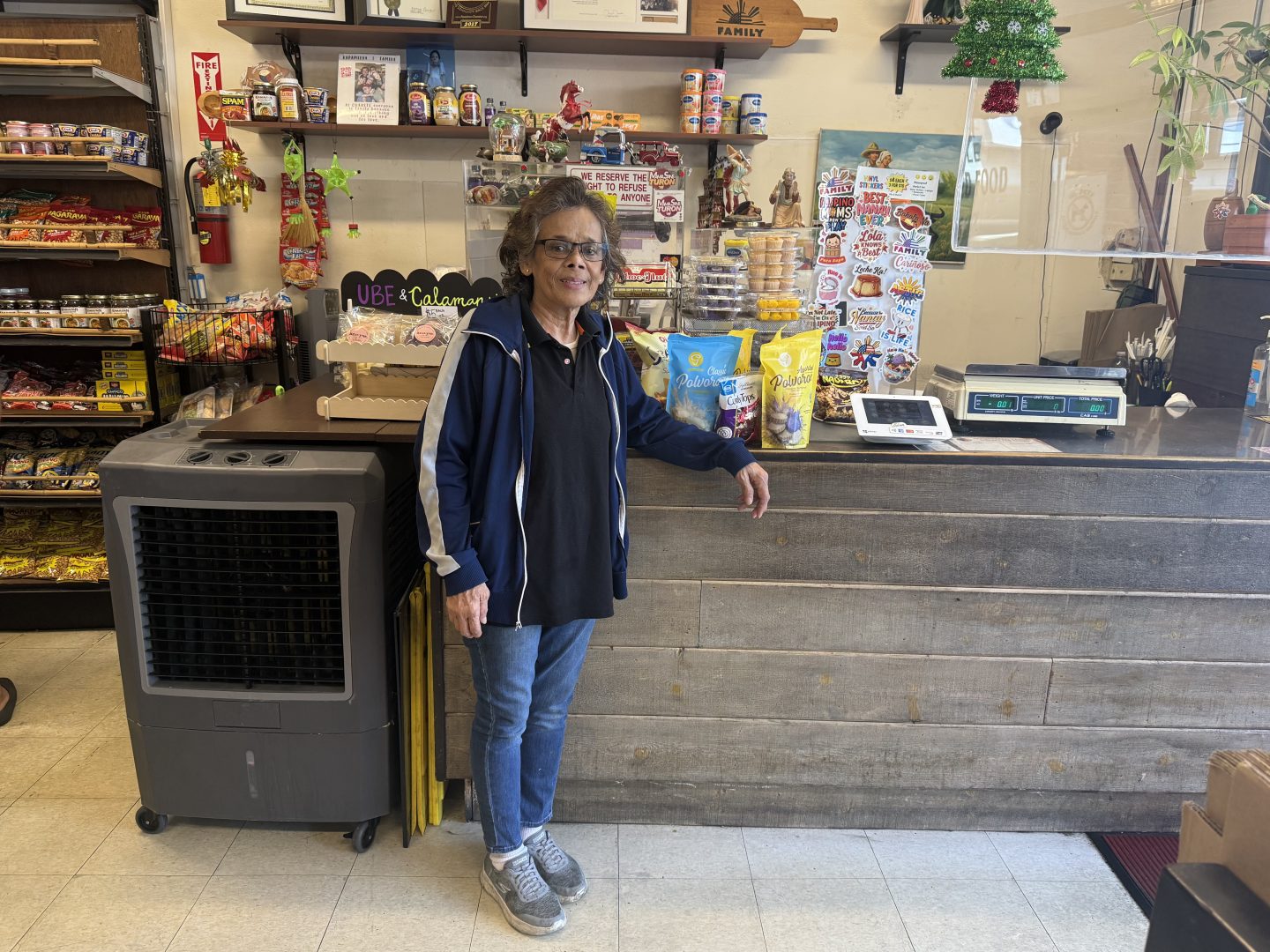
Susan Esteban, founder of Chaaste Family Market. | Photo by May S. Ruiz / Hey SoCal

Chaaste Family Market in Pasadena has been serving the Filipino community since 1987 when it was founded by Susan Esteban. Beginning in 2015, her three children – Christian, Abraham, and Gabriel – have been carrying on her legacy.

The Esteban family has deep roots in Pasadena, as Christian relates. “My grandfather was a POW in WWII when he arrived in Pasadena in 1949. He was one of the manongs (a term of respect for older brother or older male relative in the Philippine province of Ilocos) in Pasadena and was the first Asian to own a house in Loma Vista.”  

“Several of our relatives were workers in Delano but they weren’t just farm pickers,” continues Christian. “They knew agriculture and planting seasons, were educated and conversant in both English and Spanish. They moved to Pasadena in the 1950s and formed one of the earliest Filipino working class communities here. They were able to acclimatize to the new place and do other jobs – they were jacks-of-all-trades and reliable employees. My uncle ‘Apo’ Ordinario, who was one of the first Filipinos born at The Huntington Hospital, worked for the Ballard family.”
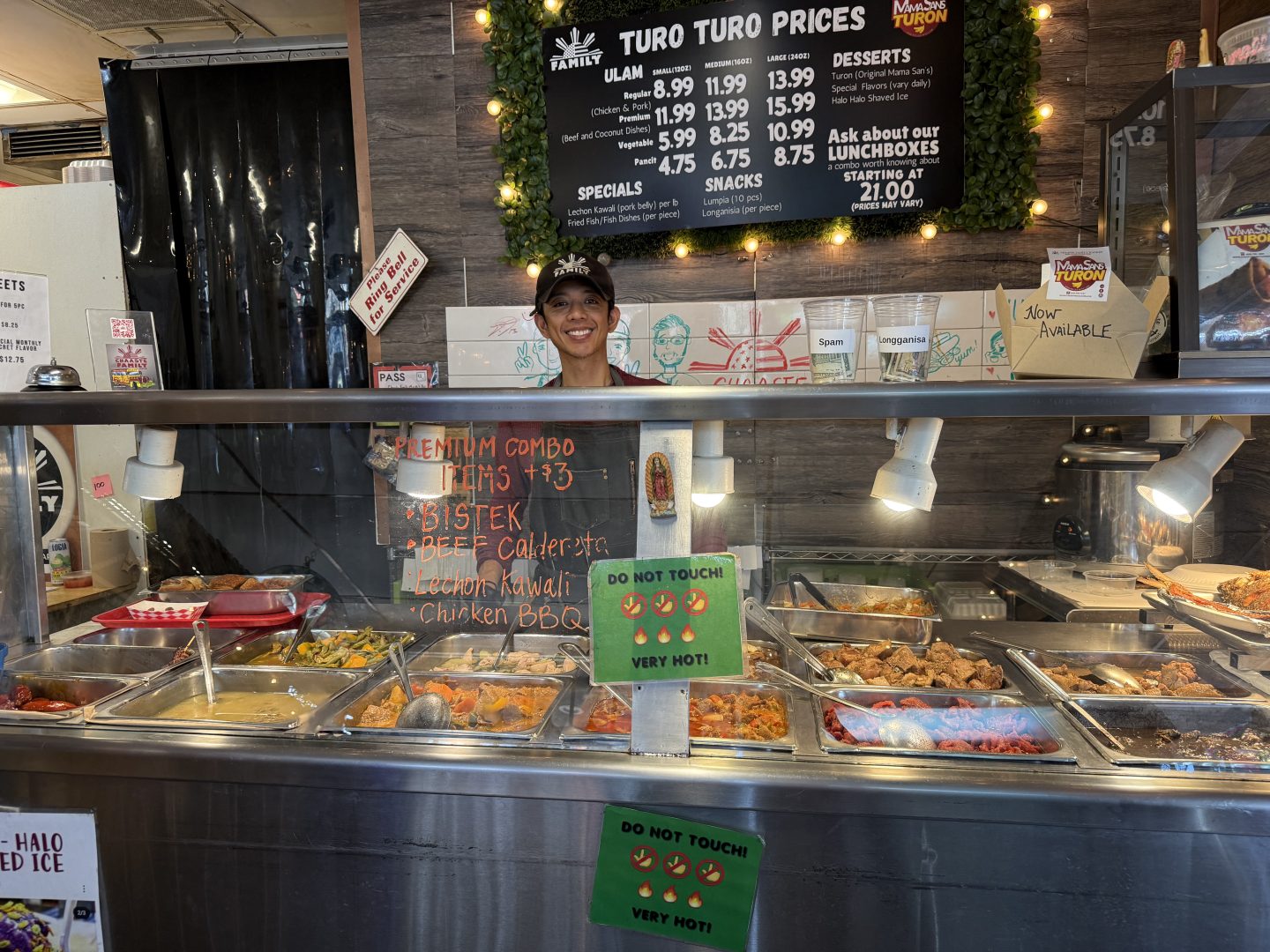
Christian Esteban and Chaaste Market’s hot food counter. | Photo by May S. Ruiz / Hey SoCal

“While my grandfather was given American citizenship by the U.S. government, his family was not,” Christian goes on to say. “He had to petition them separately and my dad, Arturo, arrived here when he was nine years old. My dad served in the Air Force and fought in Vietnam; he graduated from Cal State LA. He worked as an auditor at mostly aerospace companies – first at Lockheed, which moved to Phoenix, but he didn’t want to relocate; so he went to work for Northrop; then he was recruited by JPL, where he worked for about 25 years as senior auditor until he retired.” 

Susan Torres (later Esteban) was able to immigrate to the U.S. through her uncle, who was an engineer. He was one of the Filipinos who took advantage of the 1965 Immigration and Nationality Act. She and Arturo met through mutual friends.  

“My mom was a pioneering woman,” Christian claims proudly. “She was one of the first three Asians to work at Warner Brother Records. She was still employed there when she had me and when my brother was born three years later. After ten years, it became hard for her to raise two difficult boys – we were a handful. She had been entrepreneurial even at a young age, so she decided to open a store. Because Pasadena didn’t have a large Filipino population, she thought Eagle Rock would have been the ideal spot for it. But my dad insisted that it be located in Pasadena, and he prevailed.”

Chaaste Family Market opened its doors in 1987 in a nondescript corner on Allen Avenue and Corson Street, right next to the 210 freeway. The name is derived from their names – C for Christian, A for Abraham, the other A for Arturo, S for Susan, T for Torres (her maiden name) E for Esteban – and is pronounced “chaste.” Susan could have simply named it Esteban Family Market but Filipinos have a penchant for combining their first and second names like Marivic for Maria Victoria, for instance. She is also a devout Catholic so it was vital for her to practice Christian virtues and integrate them into all her endeavors.
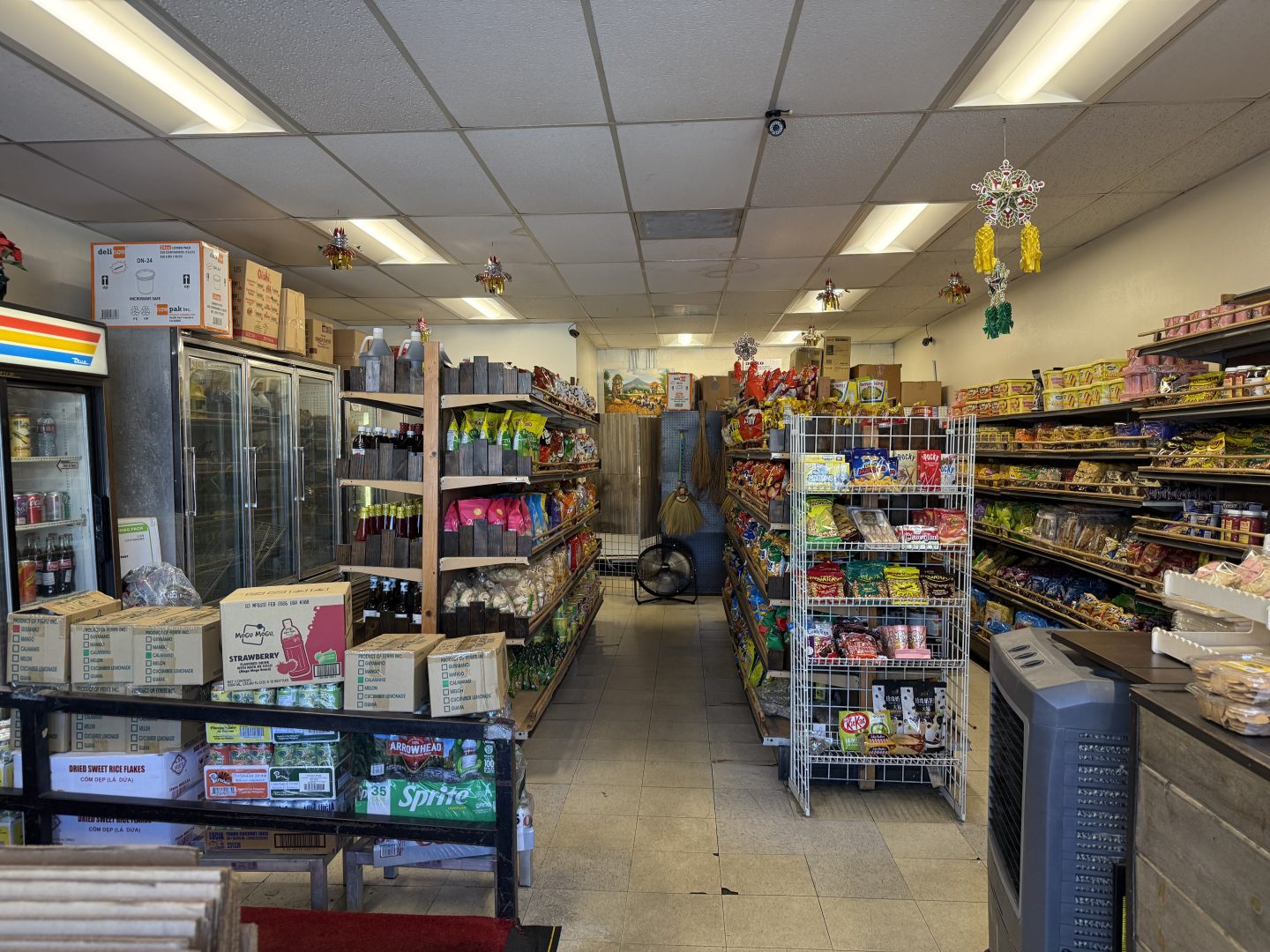
Chaaste Market’s displays and shelves of food and household items from the Philippines. | Photo by May S. Ruiz / Hey SoCal

Always someone to take things into her own hands, Susan did the marketing herself in the early days. Christian recalls, “Filipinos and Hispanics are mostly Catholic so my mom would go to the churches with flyers promoting the store. The Hispanic community kept us afloat; they came for our fresh produce – we didn’t have the hot food till 1995. This strip mall was a mini business hub for the Filipino community. My cousin owned the first video store two doors away; my uncle George had the small restaurant next door. The tax preparing business, the doctor’s office, and insurance company were Filipino-owned.”                     

Christian explains how Chaaste Market started offering hot food, known as turo-turo (literally point-point because customers point to the food). “People who were employed at the hospitals and in the healthcare field, the post office, and other private companies would get out from work too tired to cook after a long day. They would stop at my Uncle George’s restaurant to pick up food on their way home. But he closed early and those who had to leave work a bit later had no place to get hot food, so they asked my mom to offer turo-turo in the store. While she could cook, she wasn’t a professional chef and didn’t know how to prepare food for a hundred people. But she learned through hard work and trial and error.”

The youngest Esteban, Gabriel, was born a few years after the market opened. Being a close-knit family, the entire family was involved in the business. Their relatives – uncles, aunt, cousins – helped out and Chaaste Market flourished. In the intervening years, the Filipino restaurant and video store closed. There are now only two remaining Filipino-owned businesses but Chaaste still acts as the glue the binds the Filipino American community in the western San Gabriel Valley.              
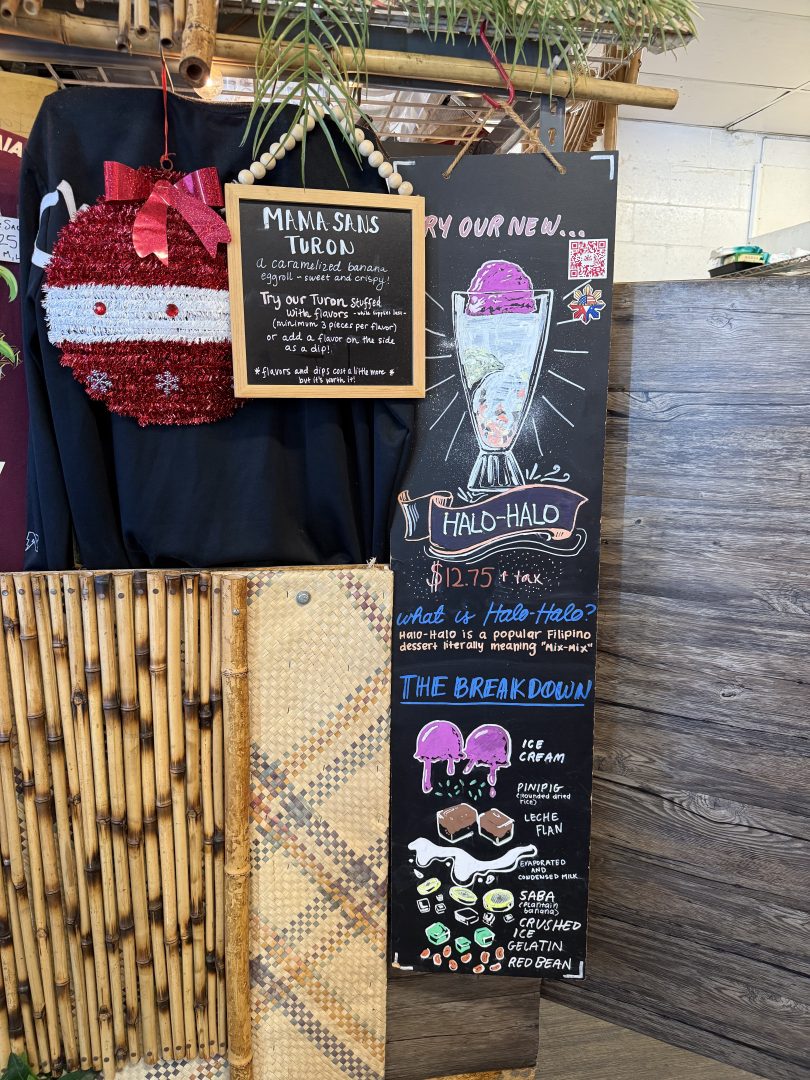
Drawing and explanation of halo-halo, a Filipino shaved ice dessert. | Photo by May S. Ruiz / Hey SoCal

Christian says about his upbringing, “My brothers and I have always been proud of being Filipino. But we were raised in Pasadena where the majority of the population is White, with some Blacks, Hispanics, and Asians. We went to private Catholic schools and grew up around non-Filipinos and we wanted to be like them, to fit in, to belong. So we had to adapt to our surroundings and to the way the kids we spent most of the day with ate, moved, and talked.”

Susan felt the only way for her children to really know what it meant to be Filipino was for them to live in the Philippines. “My mom sent us back to the Philippines in 2007 to attend university there and to learn about our culture,” Christian discloses. “I studied Film in Baguio where it’s cool and then worked in News and Public Affairs for GMA-7, traveling all over the country. The experience opened my eyes to a whole different world, the beauty of the Philippines, and the talent of Filipinos.”

“Being Filipino American and being Filipino are two distinct things,” clarifies Christian. “I thought I knew what it was to be Filipino, but it was only when I lived there that I recognized that it was a very different culture. I’m conversational in Tagalog and then I heard what the real Tagalog language is. I saw first-hand that Filipinos value education and have exceptional work ethic. Looking back now, it was that realization that gave me the passion to carry on my mom’s legacy through her store. I’m very proud of my heritage.”          
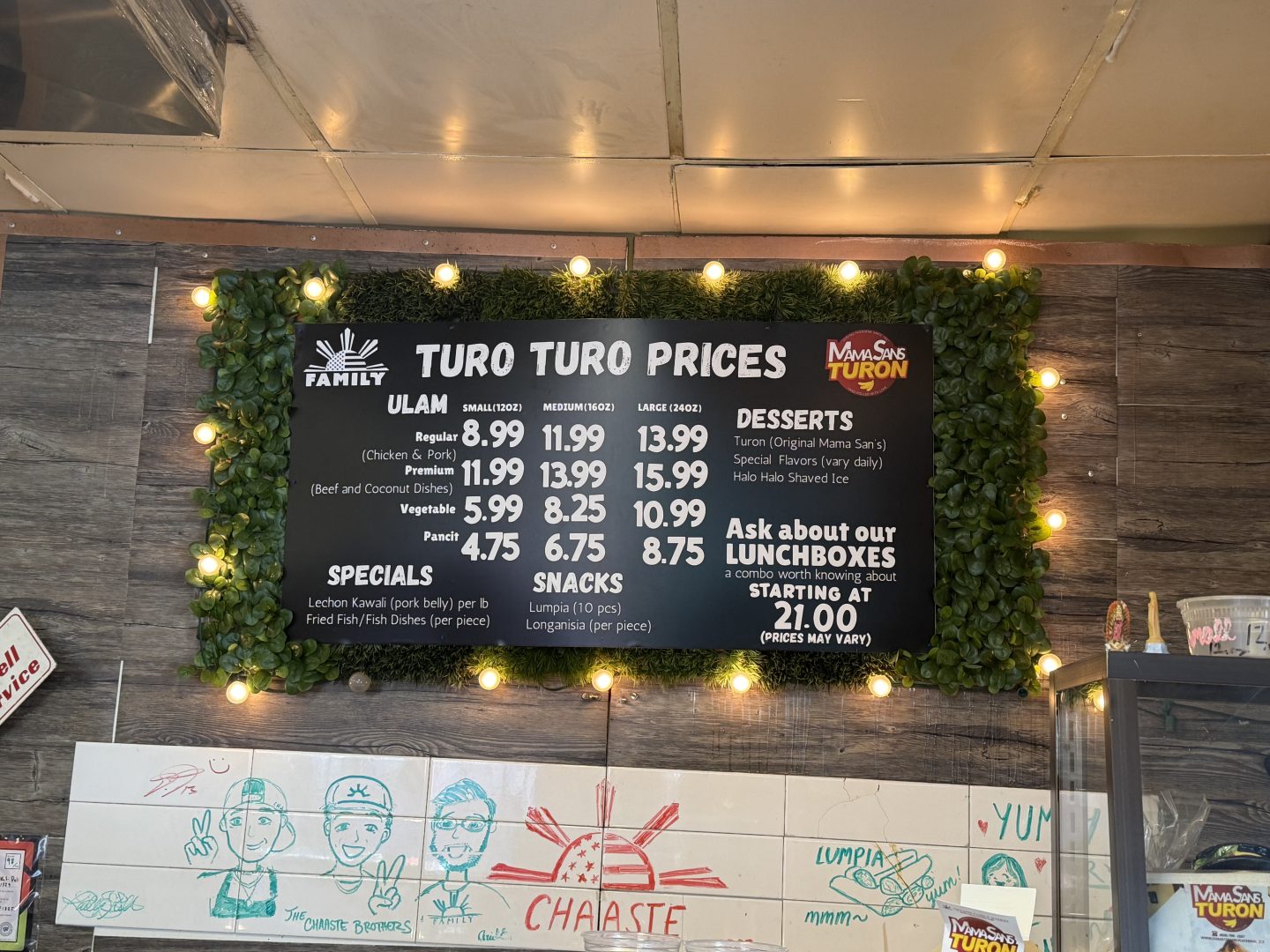
Hot food and dessert prices. | Photo by May S. Ruiz / Hey SoCal

When Arturo showed early signs of dementia (he has since passed away), Susan asked her children to come back to California. The store had been struggling to stay financially viable and she planned to close it. However, her children insisted they would take over and she could focus on their dad’s care.

“I really just wanted them to be here for emotional support,” Susan says. “With their excellent education, they were able to get wonderful jobs in the Philippines. They had enough work experience so it would have been easy for them to find professional employment here and earn good salaries.”

“It took a bit of convincing for my brothers, especially Abe, to go back to California,” admits Christian. “He attended Ateneo de Manila, and after graduation he was employed as systems operations manager at Hewlett Packard in the Philippines working with international companies.”

“But in the end, we love the store my mom built and we grew up thinking of it as our second home,” Christian emphasizes. “As kids my mom brought us back here from school and the parking lot was where we skateboarded. We’re connected to the store emotionally and spiritually; we grew up here with our cousins.”
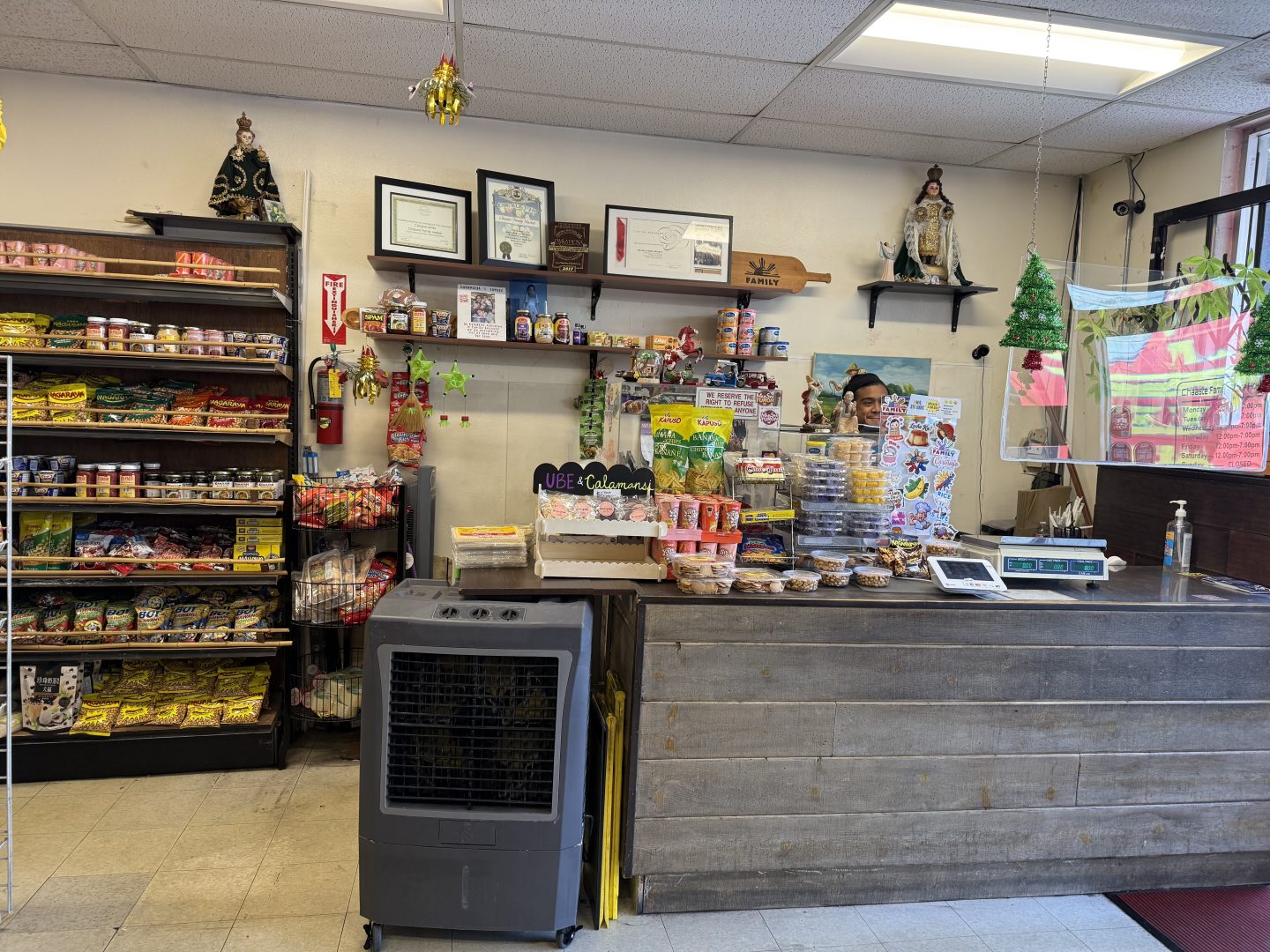
Abraham behind the cashier by the store entrance, | Photo by May S. Ruiz / Hey SoCal

Abraham echoes Christian’s words. “HP offered to have me work remotely so I could stay on the job, which was very kind. But I declined because I also wanted to continue what Mom started 39 years ago. We’ve had a couple of proposals from people to buy the store and that would have been an opportunity for me and my brothers to find regular jobs, have weekends off, take a two-week vacation annually. However, the buyers weren’t Filipinos and they were going to convert it into something else altogether. And that outcome wasn’t something we wanted to see. It’s important for us to ensure that Filipino Americans in Pasadena and beyond have a place to come together as a community.”                    

That coming together as a community was on display last year after the Eaton Fire broke out. Chaaste Market organized a donation drive and filled half of the store with clothes and toiletries from Filipino Americans who wanted to help. The brothers posted it on Instagram and very quickly fire survivors came to avail themselves of the much-needed items.

Filipinos are, by nature, big-hearted and generous to a fault. But they are also very low-key; they don’t want to call attention to themselves and they avoid public accolades. They want to give quietly, even anonymously.
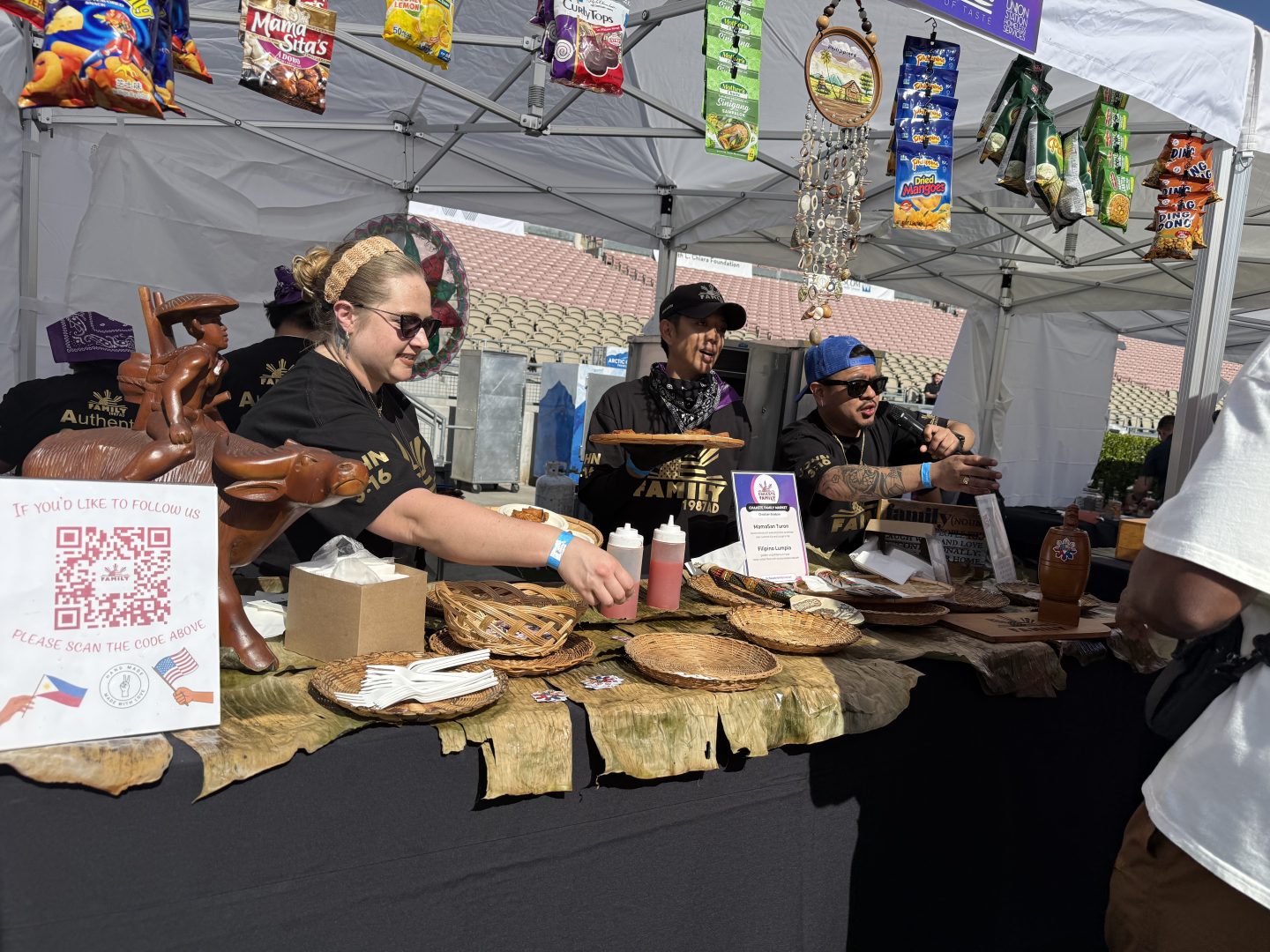
Chaaste Market table at Masters of Taste 2026 at the Rose Bowl. | Photo by May S. Ruiz / Hey SoCal

But the Esteban brothers broke the mold this past spring when Chaaste Market participated in Masters of Taste 2026, an annual event that attracts thousands of foodies from all over Southern California and gets much media coverage. They brought their own sound system to play Filipino music and Abraham talked about their store, to the delight of those who were in the long queue to sample their lumpiá and signature Mama San’s turón.       

The pride in their heritage is the philosophy behind the store. Christian describes, “Chaaste Market is all about the Filipinos’ way of life, our attitudes, generosity, and openness. We always invite people to eat with us – kain na (let’s eat) is an everyday phrase we use. And my mom wanted to share that with our customers.”     

Chaaste Market is open from Monday to Saturday. During the pandemic, they stopped carrying produce, removed the lunch/dinner tables, and shortened the hours to 12 pm to 7 pm (from the previous 11 am to 8 pm). Customers come primarily for the hot food and the store sells between 70 to 100 “to-go” boxes daily.     
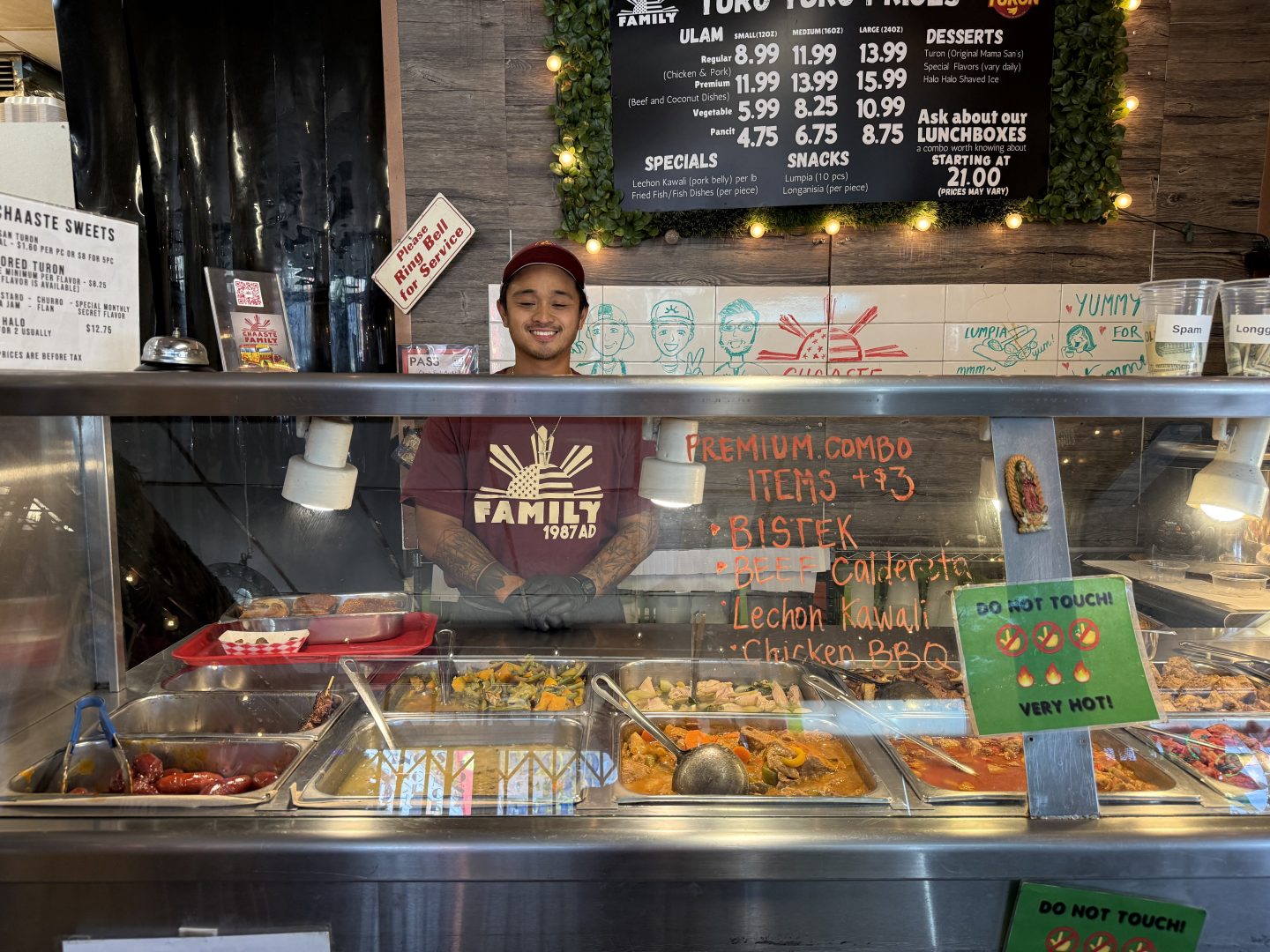
Gabriel behind the hot food counter. | Photo by May S. Ruiz / Hey SoCal

Susan is still actively involved and, to this day, Chaaste Market uses her recipes. Gabriel explains, “Initially, I wanted to do fusion so I could incorporate what I learned in culinary school but my mom was adamant about keeping it traditional. My mom didn’t teach me how to cook Filipino food; I picked it up from observing and watching her. But my two brothers and I spent several years in the Philippines so I was able to try all kinds of Filipino food. Now that I’ve been cooking over ten years, I’m inclined to keep it as it is, but working the kitchen more efficiently.”

“While some Filipino chefs put their own spin on Filipino food, I focus on different techniques in keeping the food hot,” Gabriel says further. “It took me about two to three years to learn that some dishes have to be prepared a certain way so they don’t spoil. Pasadena has very strict health inspection requirements. Health inspectors want food to be at a specific temperature and they don’t understand that a lot of our food are cooked with vinegar. For example, chicken adobo keeps cooking after it leaves the fire so there’s a potential for the chicken to get too dry and tough. That’s one of the reasons we stopped making pork barbecue, which was a very popular item.”

According to Gabriel beef steak is a favorite among customers and is one of Chaaste Market’s mainstays. He thinks the dish is popular because beef is expensive so it isn’t something being offered in most turo-turo places; it’s usually available only for catering. Other mainstay dishes are pork adobo and chicken adobo.     
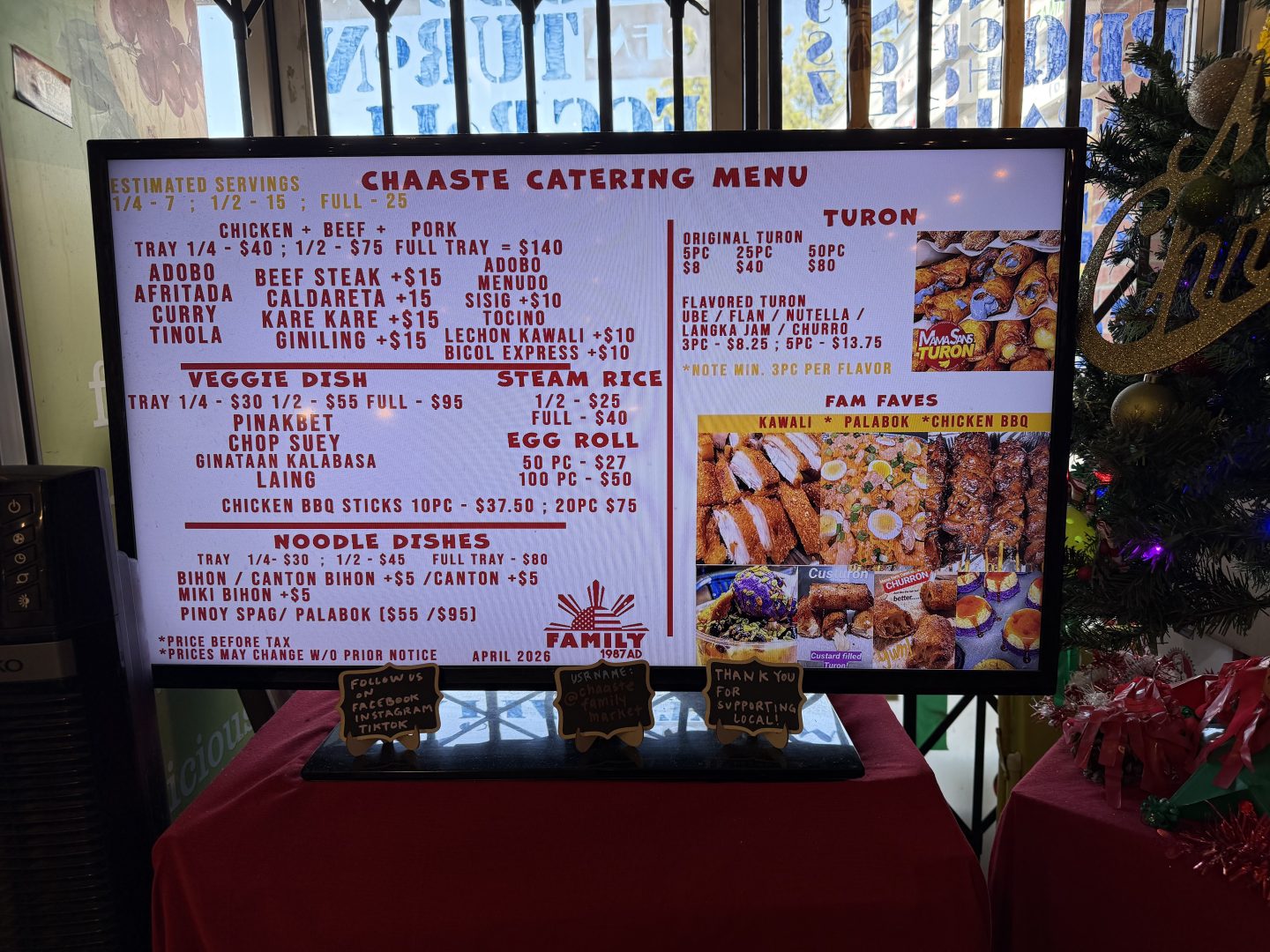
Chaaste Market’s catering menu board. | Photo by May S. Ruiz / Hey SoCal

“We have many vegetarian customers now so we have adjusted our menu to offer what the community wants,” adds Gabriel. “Most Filipino vegetable dishes are cooked with meat to give them more flavor. It took us a while to transition and offer a variety of dishes that vegetarians can eat. They’ve been surprisingly popular and we’re getting more customers in.”

The store has been getting media attention in recent years which has really boosted business. Gabriel recounts, “About ten years ago, a Filipino actress living here had a show in Echo Park and she asked us to cater turón. That’s how people first heard about us and customers started coming to Chaaste Market from the exposure. It’s such a blessing and a grace of God – we don’t advertise or promote the store. We don’t really know how to use social media and we’re busy working in the store that we have no time to post regularly.”

“It’s quite miraculous when bloggers and influencers come over,” says Gabriel in amazement. “A few months ago, Richard Antablian, who has a blog called ‘1 Hour Lunch Break’ on Instagram, Tik Tok, and YouTube showed up and just got food – which he ate in his car – and posted videos. About three days after he posted his blog, we got an influx of customers and we sold out in a couple of hours. A food blog called ‘The Infatuation’ has also been one of our supporters – we’re consisently on the top 10 on the list of food places in Pasadena. The LA Times has run a few articles about our food, and some local publications have featured us.” 

“Fridays and Saturdays are our busiest days because we have both the catering and the turo-turo business,” Gabriel states further. “The media coverage has been bringing us catering customers from almost everywhere, who initially request our chicken barbecue, lumpiá, and turón. And when they come to pick up their order, they decide to get other dishes from our turo-turo.”
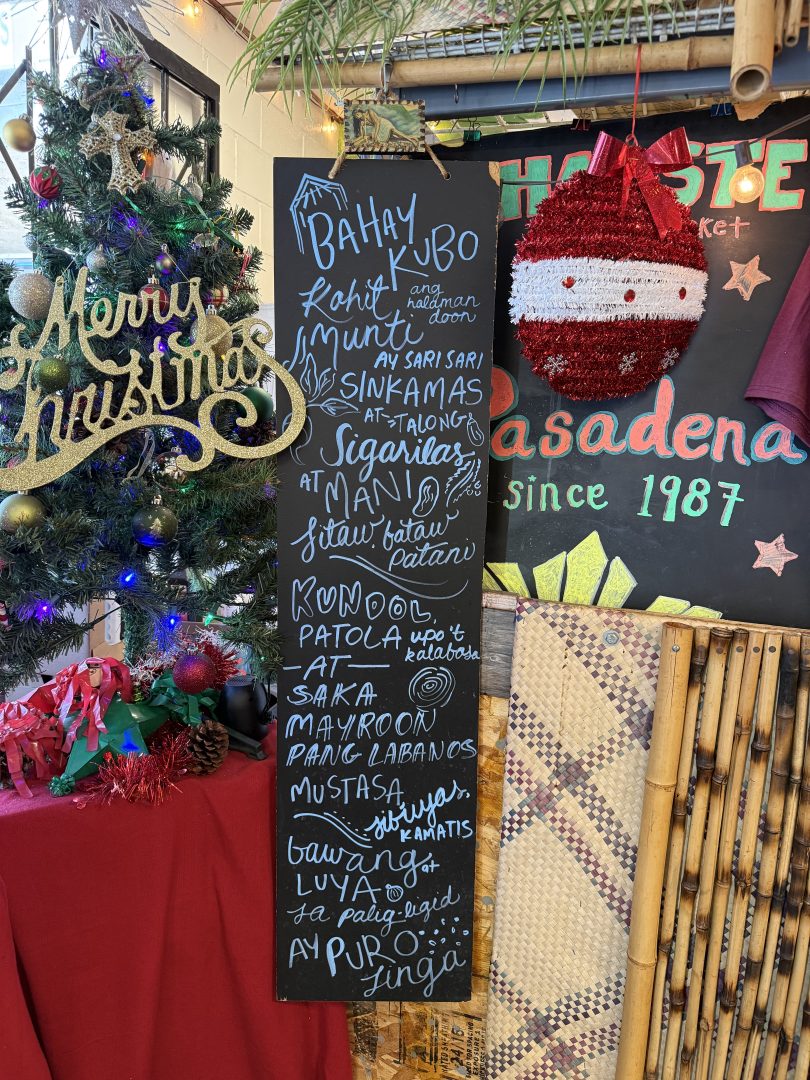
Blackboard with lyrics to Bahay Kubo (Nipa Hut), a Filipino folk song. | Photo by May S. Ruiz / Hey So Cal

For all the popularity Chaaste Market has gained and the success their business has reaped, the Esteban brothers never take anything or anyone for granted – they are humble and grateful, always. They greet all their patrons with a warm welcome. They happily chat with shoppers, many of whom they know by name. And they thank people for coming when they pay for their purchase.

The store is never empty of customers – Filipinos and non-Filipinos. There’s a constant stream of people from Pasadena and neighboring cities and from as far away as Santa Clarita, coming for the turo-turo and other Filipino items. For the majority of its customers, Chaaste Market is a regular stop from work on their drive home to buy hot food for their family.

But for some Filipinos, Chaaste Market is the place that brings back fond memories of their homeland – with the familiar objects and aromas. The lyrics of the long-forgotten first song they learned as toddlers, written on a blackboard in one corner, bring a smile. On the walls, drawings and references to-all-things-Filipino are nostalgic reminders of their youth all those years ago. Chaaste Family Market keeps the Filipino culture and traditions alive.
‘Starting Anew’ Exhibition Offers a Compelling Look at Pasadena’s History

Originally published on 11 February 2020 in the Pasadena Independent, Arcadia Weekly, and Monrovia Weekly

This image has an empty alt attribute; its file name is PMH-Signage-1-scaled.jpeg
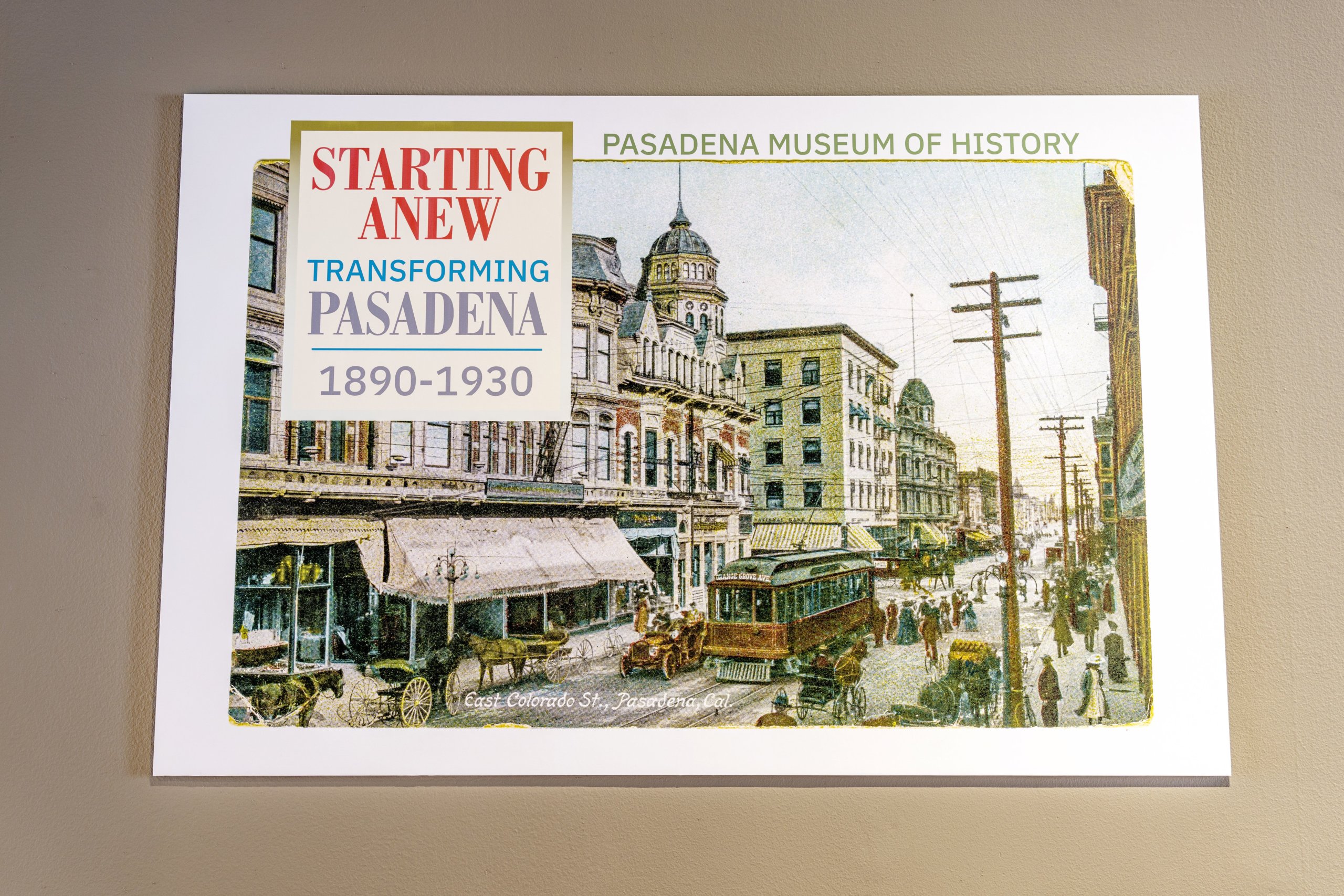
PMH’s ‘Starting Anew: Transforming Pasadena 1890-1930’ Exhibition Signage | Photo by Marlyn Woo/Joanne Wilborn / Pasadena Museum of History

Very few of us realize that the Pasadena we know and live in today was built in the early 20th century by dreamers with grand visions who settled here from the Midwest and the East Coast.  The Pasadena Museum of History (PMH) offers a compelling look at the most flourishing period in Pasadena’s history with an exhibition called ‘Starting Anew: Transforming Pasadena 1890 – 1930,’ on view until July 3, 2020.

I consider Pasadena my hometown and have lived here for 37 years. And while I dearly love my adopted city, I don’t know as much about it as I probably should. PMH’s exhibition provides that stimulating learning experience and Brad Macneil, Education Program Coordinator, who curated this show, happily gives me a tour.

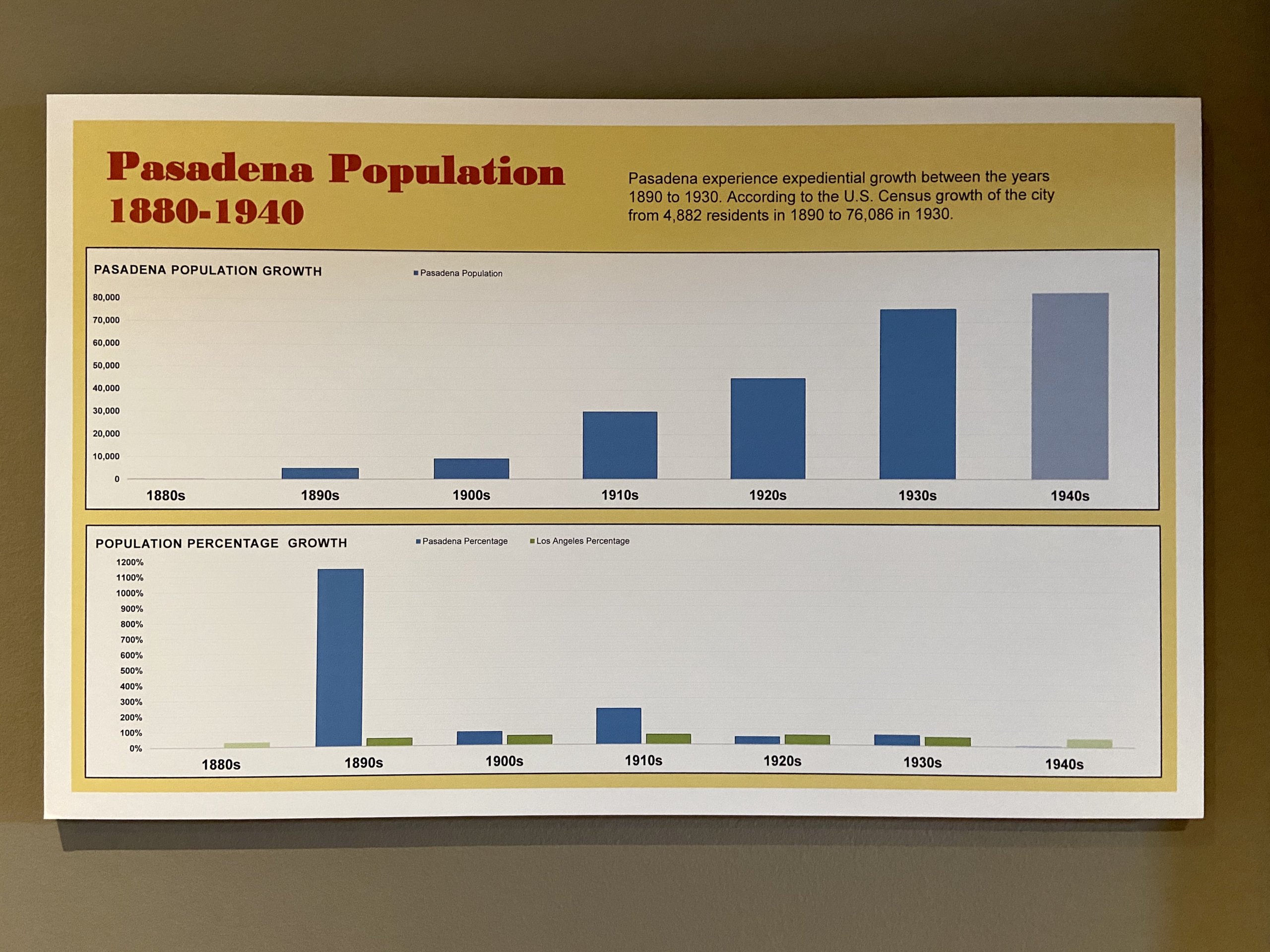
Our first stop is a chart which shows that population growth in Pasadena outpaced that of Los Angeles and then leveled off in 1930 when the depression hit. He discloses, “This was what sparked the idea for this exhibition. It was an amazing time in Pasadena’s history when the population went from below 5,000 to over 76,000 in just four decades. Today there are 150,000 – the population only doubled since. The city was transformed in so many different ways and our exhibit asks and answers a number of questions – why people came here, how they got here, where they lived, what they did, what kept them here.”

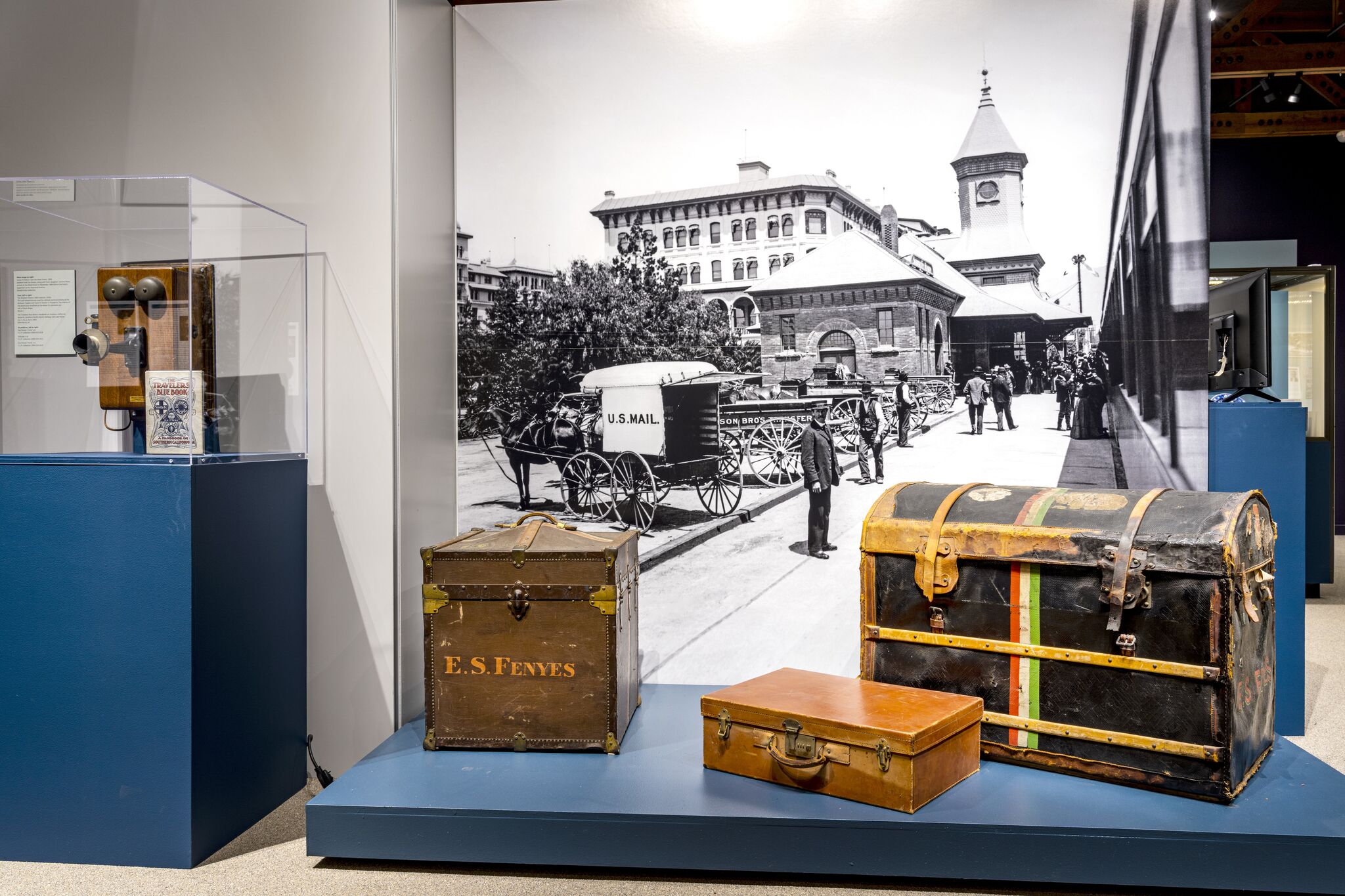
Macneil explains that the railway system started serving Pasadena in the mid-1880s, which caused the population to rise from 500 to 5,000 between 1880 and 1890. A photo of the Santa Fe Railway Depot and the Hotel Green greets us as we enter the first exhibition hall.

This image has an empty alt attribute; its file name is PMH-Population-Chart-scaled.jpg
Population Chart | Photo by Marlyn Woo/Joanne Wilborn / Pasadena Museum of History

“Part of our exhibit tells the story of Dr. Adalbert and Eva Fenyes,” Macneil narrates. “The couple met in Cairo, Egypt and were married in Budapest. It was during their honeymoon around the world that they heard about Pasadena. They arrived at this train station in 1896 as newlyweds, and they had with them Leonora, Eva’s teen-age daughter from her first husband. They stayed at the Hotel Green for about three days and fell in love with Pasadena. They immediately leased a house on the Arroyo, which they later bought. Subsequently, they built two mansions here. One of the wonderful things about this exhibit is that we are able to display the museum’s collection. These are the Fenyeses luggage here and that telephone over there was inside the depot.”

This image has an empty alt attribute; its file name is PMH-Train-station-1.jpeg
Santa Fe train depot, the Fenyeses’ luggage, and depot telephone | Photo by Marlyn Woo/Joanne Wilborn / Pasadena Museum of History

“Besides word-of-mouth, a marketing campaign touting the city’s natural beauty and health benefits lured people to the area,” adds Macneil. “In the late 1880s big, fancy hotels were being constructed, the first of which was the Raymond Hotel. It was built by entrepreneur Walter Raymond, who had been working for a company back East that brought tourists here and thought Pasadena could use a grand hotel. Other hotels then were Hotel Green, the Pintoresca, the Maryland, the Huntington (which was originally the Wentworth and is now The Langham), and the Vista del Arroyo.

“Each year thousands came to Pasadena for the seasons – from November through March. The population would go up and down. The wealthy people came from the Midwest like Indiana and Chicago, and the Northeast – Boston, Philadelphia, and New York. Because of the winter resort business, the whole town grew. Visitors needed service, which opened up employment opportunities. That brought in working class people from other parts of the country to get jobs in the railways, hotels, and in agriculture. Professionals also arrived – doctors, lawyers, newspaper publishers. Pasadena grew into a diverse community – there was already a large Mexican American population, then the Armenians, the Chinese, and the Japanese arrived. They came to either find a job or start a business.”

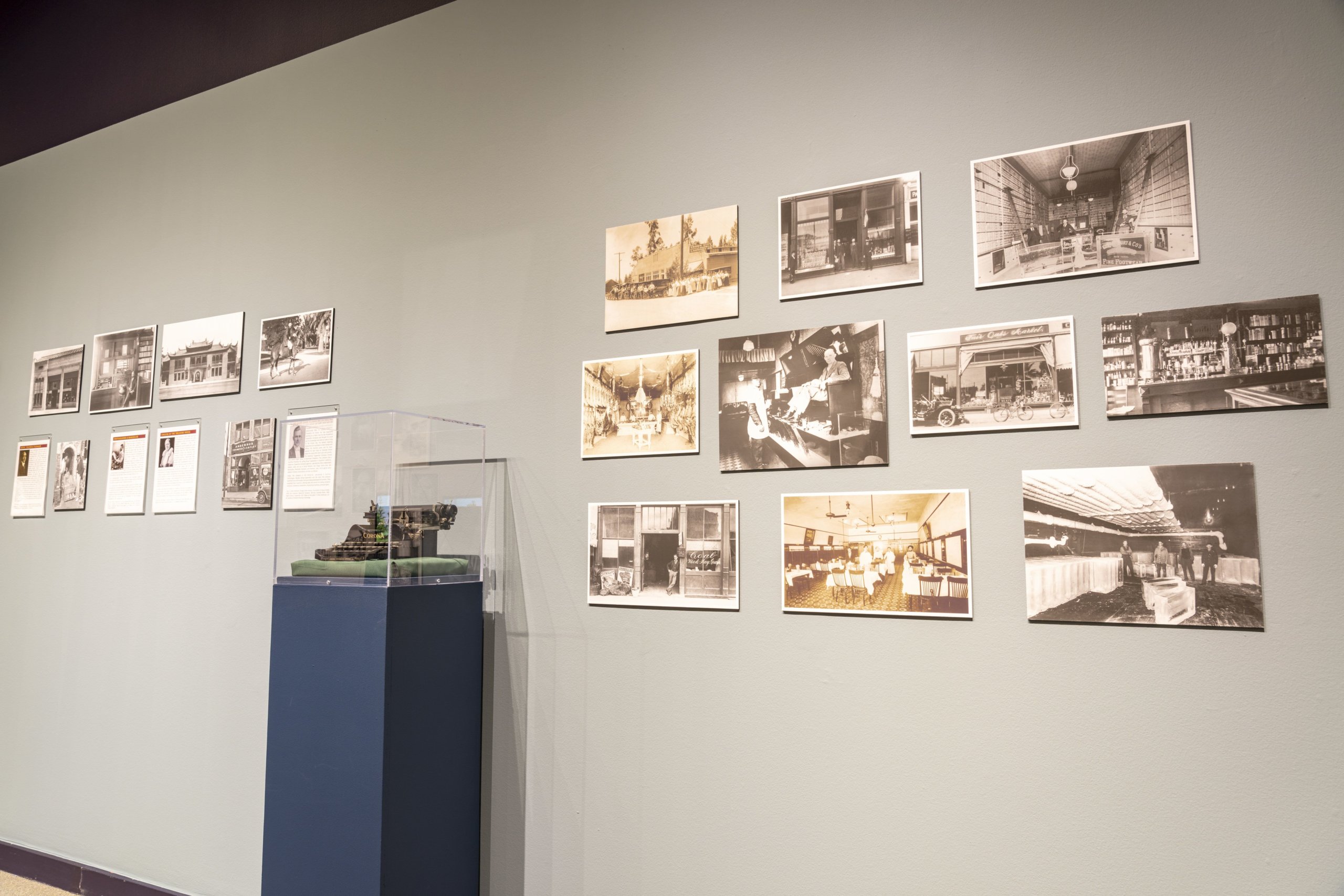
Pasadena was a great place to be an entrepreneur and PMH’s exhibition highlights four enterprising people who came here with very little yet built successful establishments. One of them was Elmer Anderson who arrived with nothing more than a typewriter repair kit and founded Anderson Typewriters. Known today as Anderson Business Technology, it has branches all over Southern California selling business equipment and is still being run by his descendants. The local store on Colorado Boulevard, near Arroyo Parkway, remains to this day.

Many of us will recognize the edifice resembling a Chinese Imperial Palace on Los Robles and Union Street as USC Pacific Asia Museum. Back in the 1920s it was Grace Nicholson’s Treasure House of Oriental Art. She came here with a small inheritance and opened a curio shop selling Native American arts and crafts. She developed great relationships with Native Americans in the Southwest and eventually started selling to the finest museums in the country, including the Smithsonian and Field Museum. She later switched to Asian artifacts and created her treasure house where she lived and worked.

Adam Clark Vroman, an avid book collector and photographer, moved to Pasadena from Illinois hoping the climate would help his wife recover from her illness. Unfortunately, she died two years later. Brokenhearted, he sold his book collection to raise the capital to open Vroman’s Bookstore. As he had no direct heir, he made arrangements for his employees to take over the store when he passed away. It was a remarkable demonstration of how much he cherished and took care of his staff. Some of the descendants of those employees run Vroman’s today and it remains a beloved Pasadena purveyor of books and gift items.

There was Ernest Batchelder who came here to teach art at Throop Institute. He later started his own business – making the eponymous tiles – and became the foremost proponent of the American Arts and Crafts Movement.

This image has an empty alt attribute; its file name is PMHG-Local-businesses2-scaled.jpeg
Local businesses | Photo by Marlyn Woo/Joanne Wilborn / Pasadena Museum of History

Architects and builders prospered at this time because people needed housing. Those who came here for work built bungalows and cottages. Macneil states, “The cost to build a house varied from under $1,000 up to $100,000. Between 1902 and 1918 the median value of local houses was $1,700 (these houses today cost over a million dollars). Those with wealth seasoned in Pasadena and stayed for months at a time. A number of them decided to build winter homes on Orange Grove Boulevard, otherwise known as Millionaires’ Row. Displays of some of these grand houses include Adolphus Busch’s; the Gamble house, which still exists today; the Merritt House, which is now surrounded by million-dollar condos.”

After the depression, the owners of these mansions couldn’t afford the upkeep and sold them. Of the 52 mansions, only six or eight of them remain; the rest have been razed to the ground to make room for apartments and condominiums. Of course, even these divided-up homes are not for the middle- and working-class as they lease for several thousand dollars a month or sell for millions.

One of the mansions that’s still around is the gorgeous Marshall-Eagle Estate built in 1919 for $500,000 (valued at $8 million at the time) and is now Mayfield School. The exhibition has a display  of it that tells its history and shows interiors shots.

Throughout the exhibit, PMH reveals the passage of time through changes in fashion and technology – dresses from the different decades; a high-wheeler bicycle; a carpet sweeper; an Edison machine; a record player; a gas-powered hair curler, one of the first dial telephones ever made, and an early typewriter. Macneil says students love to see and handle the typewriters but can’t figure out how to use the telephone.

Macneil leads me to the next display, saying, “Our story goes on about the Fenyeses becoming part of the community. Eva designs her first mansion, a Moroccan palace on Orange Grove Boulevard. This is Eva’s sketch of her mansion – there is an area that’s all glass, one of the first commissions of Walter Judson of Judson Stained Glass Studios. Her daughter Leonora grows in age, marries, and moves away. Eva gets immersed in the community business-wise by buying real estate and as a socialite by being involved with the art scene. Dr. Fenyes gets his medical practice going.

This image has an empty alt attribute; its file name is PMH-Artists-works-2.jpeg
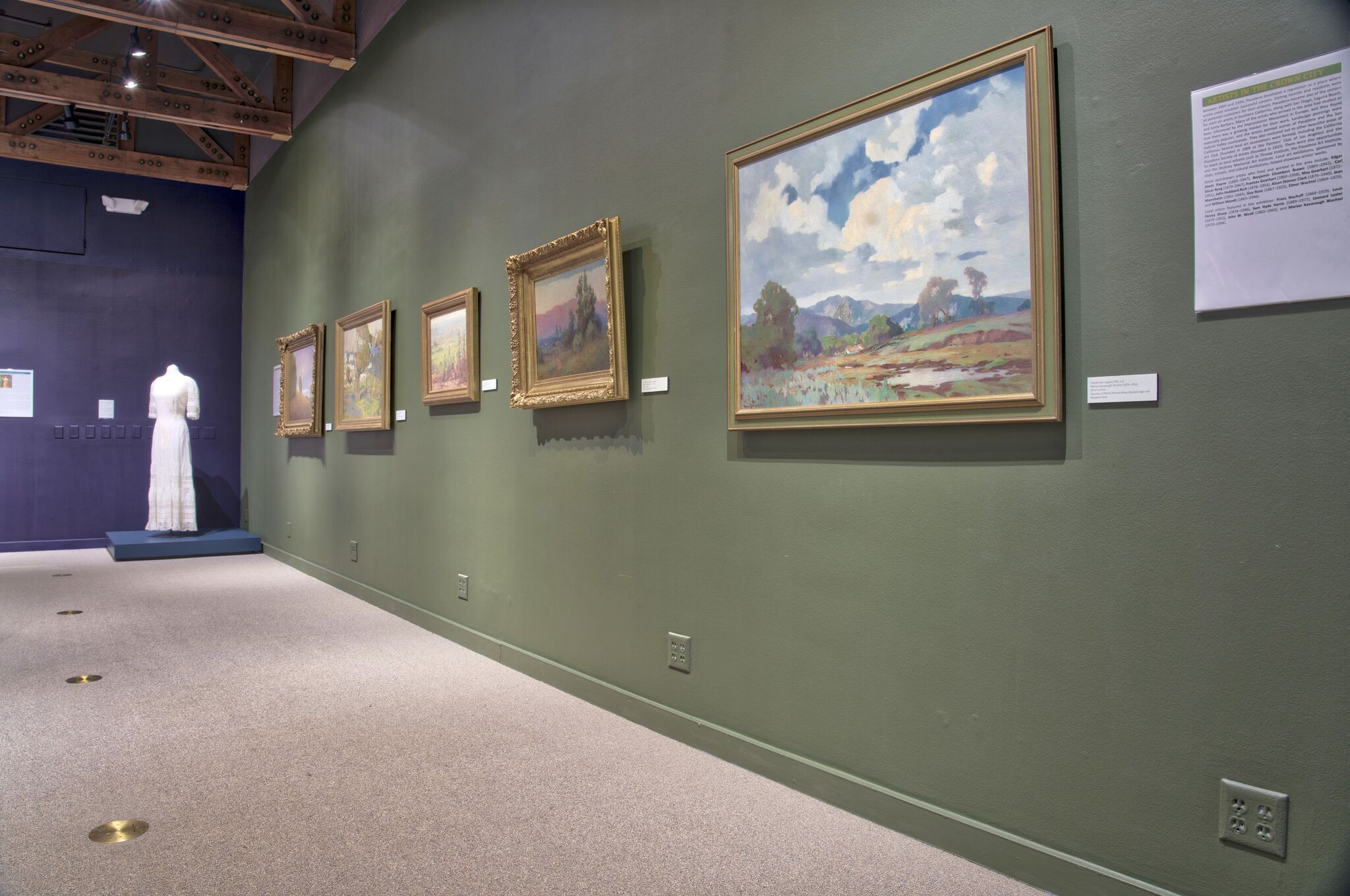
Local artists’ works | Photo by Marlyn Woo/Joanne Wilborn / Pasadena Museum of History

“Pasadena was one of the main art colonies in California during this period, so we have here a wall of art featuring selected works of the artists who lived here then. One of Eva’s biggest legacy was being patron of the arts and helping other artists in the community. She was a prolific painter herself and we have a lot of her art at the mansion, some of which we show here.”

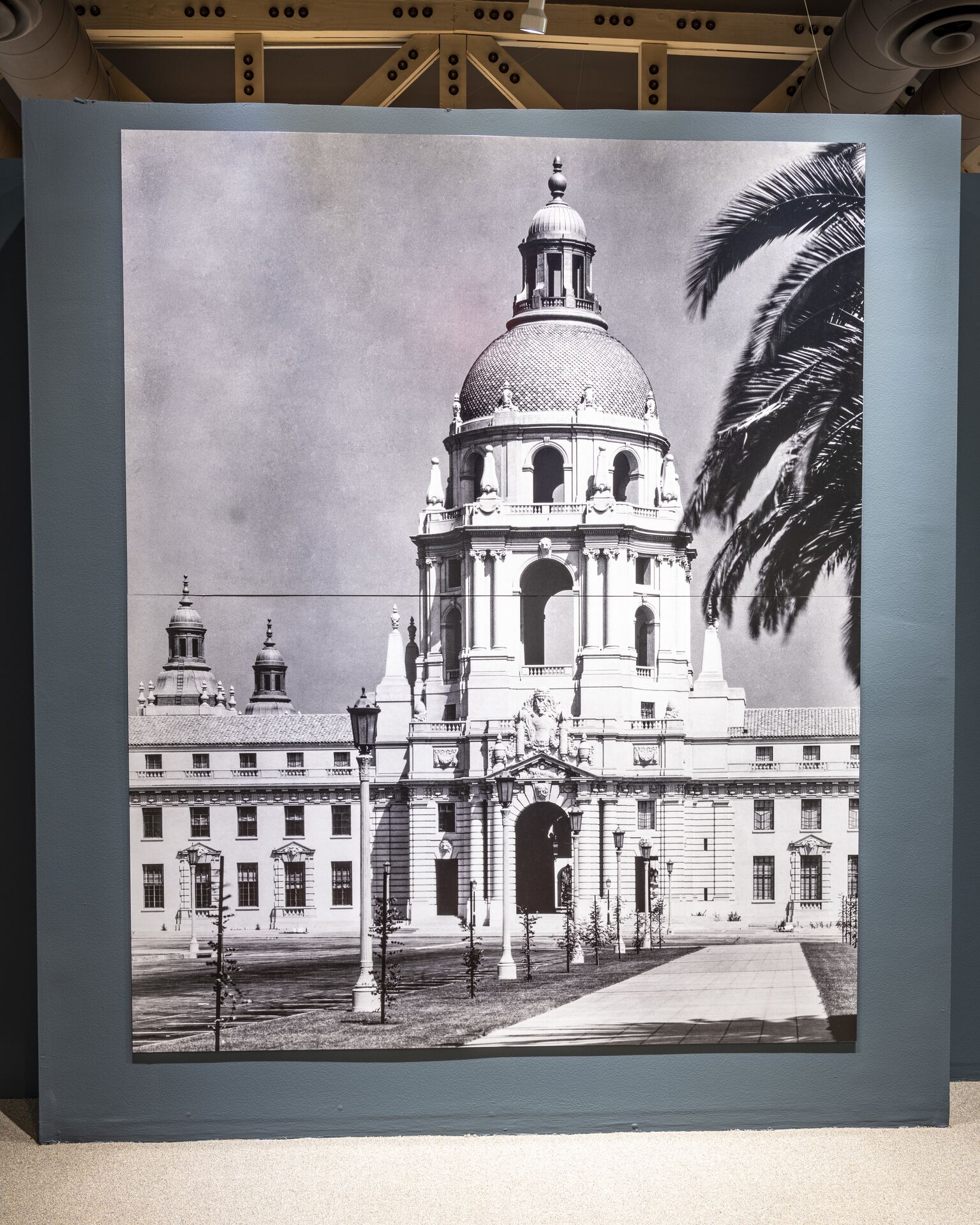
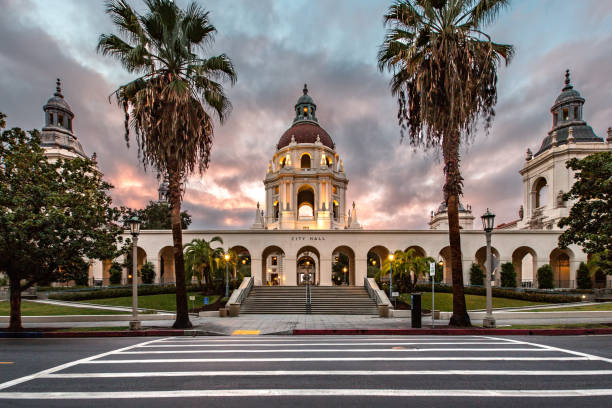
The second part of the exhibition, in the opposite hall, begins with an iconic image of City Hall and explores how the ‘City Beautiful Movement’ ushered the Golden Age of Pasadena. Macneil expounds, “In the Chicago Exposition of 1893, they built the White City. Many famous architects helped construct wonderful buildings, public plazas, and garden areas for the World Fair. The ‘City Beautiful Movement’ came out of that. The idea is that if you beautify the city with these magnificent public structures, it uplifts all the residents spiritually and morally.

This image has an empty alt attribute; its file name is PMH-Pasadena-City-Hall-1.jpeg
An image of the Pasadena City Hall leads us to the second part of the exhibit | Photo by Marlyn Woo/Joanne Wilborn /Pasadena Museum of History

“A lot of people from Pasadena were able to go the Chicago Exposition of 1893 and when they came back, this philosophy took off. They pulled people together, held meetings, and talked about what they could do. And the first thing they did was clean up the city. They got rid of the tacky real estate signs in the main part of town, tidied vacant lots, planted trees and flowers, painted buildings, and regulated architectural styles. It began in the early 1900s with input from various people in the city – movers and shakers as well as the general population. They came up with the plan for the city and things took off in the 1920s when money and the will were there. And so they erected grand public buildings. A main area was the Civic Center – City Hall, the Public Library, the Civic Auditorium. Most of what we identify with Pasadena today – the beautiful architecture, the cultural institutions – were built at this time.”

“There’s a section called ‘Nature versus Man-Made Beauty,’” Macneil goes on to say. “Out-of-towners came here because of the natural beauty of the area – like the Arroyo and the mountains. Then people created man-made parks bringing in trees from other parts of the world, changing  the landscape. We have images of Central Park by Castle Green, Library Park by the Senior Center, and Brookside Park. There’s Eva’s picnic basket because she enjoys going on picnics.”

Macneil points to the next section, “Here we talk about the various means of transportation. During this period of time, people got around town by walking. But there were also buggies and carts, trolley cars, and automobiles. But bicycles were the biggest thing – there were more bicycles per capita in Pasadena than any other city in the United States. This is an early-1900 map of the bike trails and roads in California.

“Because of the power of the bicyclists as a group, they put a lot of pressure to make the streets and signage better, even before they were done for cars. This is California Cycleway, an elevated tollway for bicycle traffic which ran from the Green Hotel to South Pasadena. It was planned to go all the way to Los Angeles but it was never completed because Horace Stubbins encountered legal battles with Henry Huntington over right-of-way. He decided not to pursue it, but the family did keep some of the right-of-way and was able to sell it to the state for the Pasadena freeway. This is still a dream of some people to build – imagine how wonderful it would be to ride your bicycle high above the streets on a road that ran along the Pasadena freeway.

The ‘Kids Corner’ has a display of things kids wore, what types of games they played, where they went to school. There are hands-on items like the stereoscope that kids can look through and see three-dimensional images.

A section that Macneil calls ‘The Extraordinary Excursions’ features three early theme parks, the first of which is Busch Gardens. According to Macneil, Adolphus and Lilly Busch, of the Anheuser Busch and Budweiser fame, had a house on Millionaires’ Row. Adolphus bought approximately 37 acres, covering the area from his house on Orange Grove to the Arroyo, on which he created this magical park and opened it to the public for free. However, the park subsequently met the same fate as that of the grand estates in the area – it closed in the 1930s and 1940s and was subdivided. Lilly tried to make an arrangement for the city to take it over but it was too expensive for the city to maintain.

This image has an empty alt attribute; its file name is PMH-Ostrich-farm-1.jpeg
Cawston Ostrich Farm | Photo by Marlyn Woo/Joanne Wilborn / Pasadena Museum of History

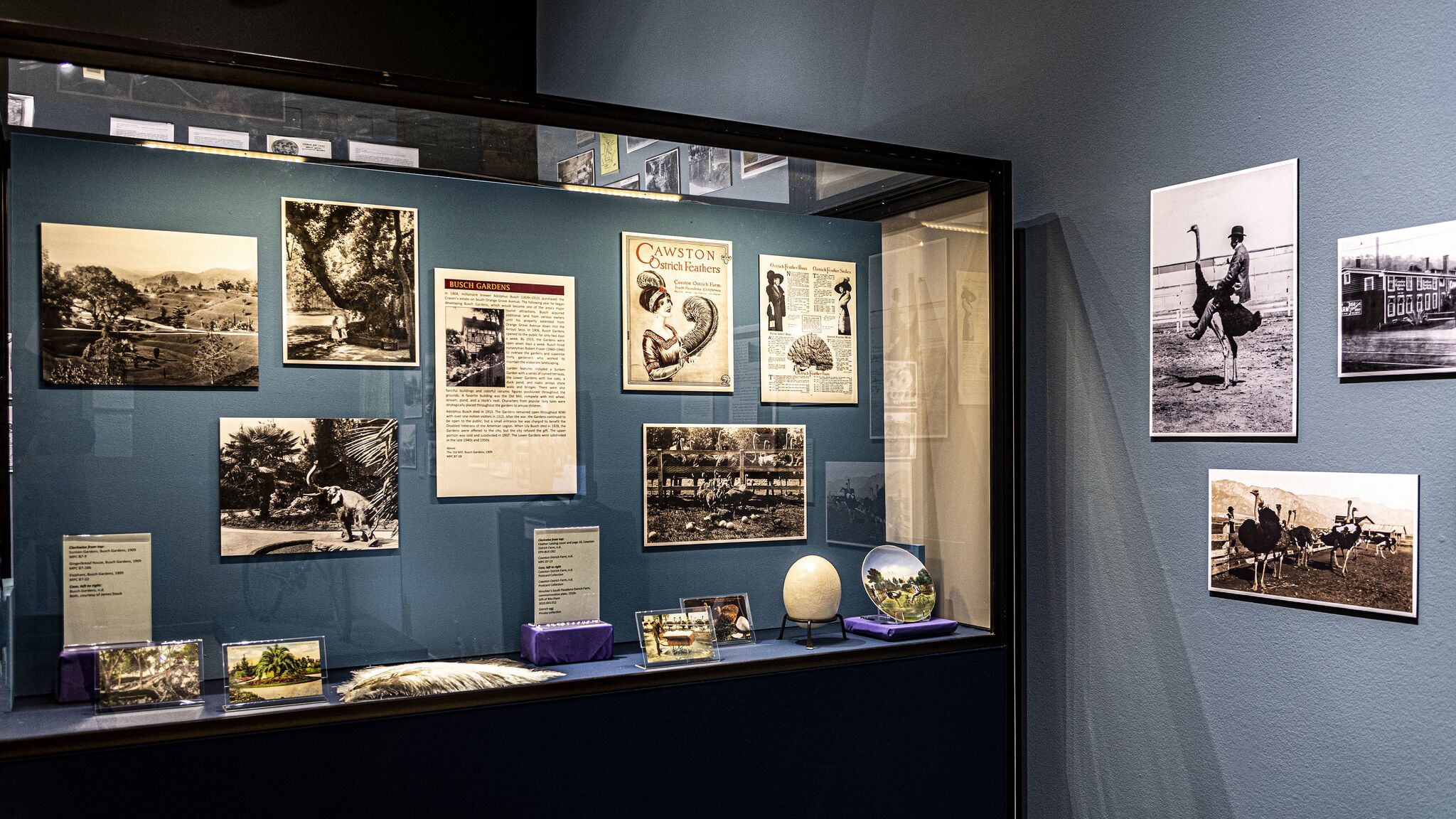
Another was the Cawston Ostrich Farm. Macneil relates that entrepreneur Edwin Cawston, who had learned about ostriches and the ostrich feathers trade in South Africa, came in the late 1880s to open a business here. He had stores in New York, San Francisco, and Los Angeles selling feathers all over the world but it was in South Pasadena that he established one of the first ostrich farms in the country. At the same time, he created a beautiful park-like area where people could come and observe the ostriches’ little chicks, see the big birds being fed, and watch ostrich races. They could even ride on a cart behind the ostrich and, if they were brave, on the ostrich. It became quite a popular destination.

Around the corner you’ll come upon photographs of the Mount Lowe Railway, a series of scenic railroads which went up the mountains above Altadena, created by Thaddeus Lowe. Visitors taking the train up reached a beautiful destination with four hotels, a zoo, an observatory for star-gazing, and a golf course. Macneil says, “People would take the Pacific Railway from all over Southern California, but especially from Los Angeles, come into Pasadena and up to the foothills of Altadena. They’d get off the trolley car and on what they called the ‘white chariots’ that would take them on a steep incline. They would come up to the first hotel and alight there. Then they would get on a trolley car that wound around the mountains until they arrived at the topmost hotel – the Alpine Tavern.”

People got their entertainment during that period from the Pasadena Playhouse and cinemas which started out showing silent movies. “Then there was the Grand Opera House, which was located close to Green Hotel,” recounts Macneil. “It was built by entrepreneurs who brought great opera to town while simultaneously hoping it would help raise real estate values. However, it failed to take off partly because it competed with an opera house in Los Angeles which got the better acts.”

Macneil adds, “When I did my research, I used the city directories going back to the 1880s and found pages upon pages of clubs, associations, and societies where everybody belonged. People came together through their common interests – whether it was just for fun or for a civic purpose.

“We showcase three of these organizations: the Valley Hunt Club for men and women, started out in 1890 as a hunt club, as the name implies. It then became more of a social club and gave us the Tournament of Roses Rose Parade and Rose Bowl game. The Elks Club was a place for men to get together both socially and as a charitable group. The Shakespeare Club began as a women’s literary club to promote reading. All these three organizations were very involved with the community then and still are to this day. All these clubs, at one time or another, had entries in the Rose Parade and on display are trophies they had won. Some items are artifacts from the clubs.”

This image has an empty alt attribute; its file name is PMH-Fenyes-Wall2.jpeg
The Fenyeses display | Photo by Marlyn Woo/Joanne Wilborn / Pasadena Museum of History

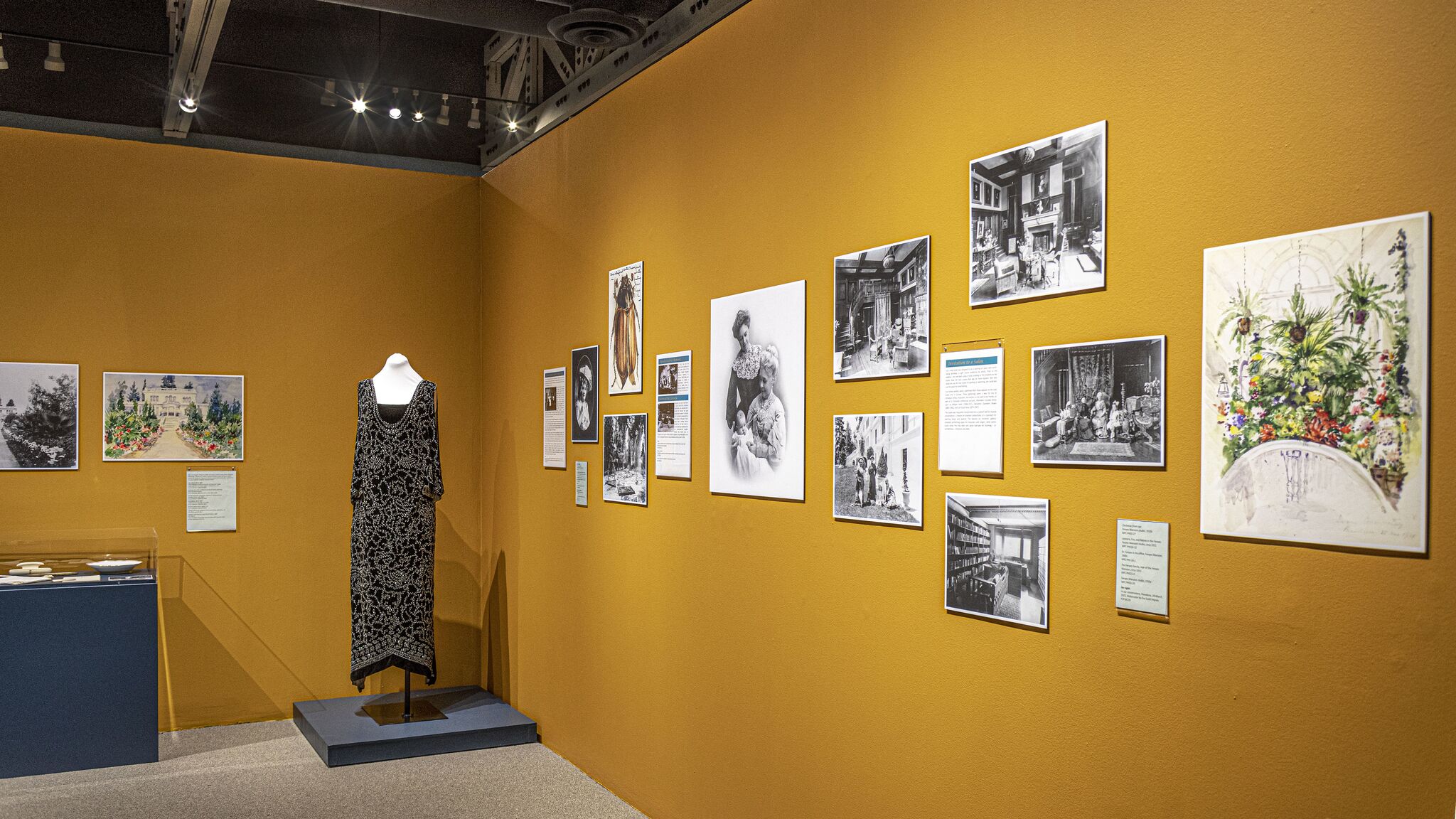
Towards the end of the exhibit, the display talks about the Fenyeses selling their big Moroccan palace and downsizing to the mansion in 1906. This section explores the life of Eva and Dr. Fenyes from 1906 to 1930. While they were world travelers, Pasadena was their home base. They were involved in the community in different ways – she was still a socialite; he continued with his medical practice and, being an entomologist, his work with beetles. Leonora, Eva’s daughter, became widowed and came back to live with them. In 1911, Eva, Leonora, and Leonora II all lived here and created a wonderful bond of three generations.

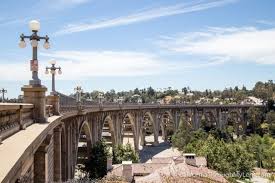
A wall of displays delves into the transformation of Pasadena. Macneil expounds, “Through the 1893 ‘City Beautiful Movement,’ city officials were able to hire architects from Chicago and established the Bennett Plan that created the Civic Center – the City Hall, the Library, and the Civic Auditorium. At the same time, more beautiful buildings were being erected and various infrastructure were being constructed. The Colorado Street Bridge was built in 1913 for people arriving by car to have a grand entrance into Pasadena. They also had plans for a beautiful art museum and school on Carmelita where the Norton Simon  is now, although that never came to fruition.”

The 1920s were the Golden Age of Pasadena when innumerable buildings featuring European architecture were constructed all over the city. Schools and city service structures were being upgraded; the Rose Bowl was built. PMH’s exhibit has a video that shows the changing cityscape.

“And then the depression hit and everything slowed down,” says Macneil. “The Civic Auditorium hadn’t been completely built. Fortunately, city officials were able to do some creative financing to finish it but several things which were on the planning stage stopped. The resort industry collapsed – hotels were torn down and were reused for other functions. The Vista del Arroyo, for instance, became a hospital; today it is the Court of Appeals. Of the hotels built during that period, only the Huntington Hotel still stands today. Population growth halted as well.

This image has an empty alt attribute; its file name is Colorado-Street-Bridge-1.jpg
Colorado Street Bridge | Courtesy Photo

“At the very end of the exhibit, we showcase PMH’s mission – capturing and gathering the history of Pasadena and the surrounding area and sharing it with the public. Our collection encompasses this productive and transformative period so our archives and collection department were quickly able to put together what we felt would represent that time.

On the Curator’s statement, Macneil confesses that while he was born and raised in the area – three generations of his family lived here – he didn’t fully appreciate Pasadena. It wasn’t until he went away for a while and then returned that he developed his deep love for the city. Through this exhibit, he hopes that he can share all that he has rediscovered

Macneil states, “We’re hoping parents come with their children to our exhibition. We’re purposefully keeping it open until July 3rd so students from both public and private schools can learn Pasadena’s history. How fun would it be for these young people to learn what happened a century before their time and then see the structures when they walk around the city.”

As PMH has detailed in the exhibition, some of the dreams of the city’s visionaries worked and some didn’t. But many of the magnificent and architecturally diverse structures from the city’s Golden Age remain and they are what give Pasadena the culture and history for which it is renowned. And through this exhibition, Macneil wants to remind people what we are capable of doing if we pull together as a community. The past can be used as a blueprint for the future.


School District Highlight: Pasadena

Pasadena City Hall

Originally published on 16 April 2015 in the Pasadena Independent, Arcadia Weekly, Monrovia Weekly, and Sierra Madre Weekly

In September 2014, Los Angeles Magazine ranked Marshall Fundamental Secondary School  eighth in the county.

This proclamation couldn’t have come at a better time for the Pasadena Unified School District which has been dogged by a not-too stellar image for decades. It was especially gratifying for Dr. Brian McDonald who, in 2011, was hired by then superintendent, John Gundry, as Chief Academic Officer. In that post McDonald led the district’s STEM (Science, Technology, Engineering, Math) initiative, a critical component for student success.

One of four high schools in the district, Marshall Fundamental has consistently maintained a commitment to the highest academic standards. It has the most number of AP classes (English Language and Literature; Human Geography, World History, US History, American Government & Politics; Economics; Calculus AB, Calculus BC, Statistics; Biology, Chemistry, Physics, Environmental Science; Spanish Language and Literature; Music Theory; and Studio Art) on offer and the highest API score of all the public high schools in Pasadena. 

The Marshall Eagles play in girls’ and boys’ basketball, girls’ and boys’ soccer, girls’ and boys’ tennis, girls’ volleyball, baseball, cross-country, football, golf, softball, swimming, and track & field.

Some clubs on campus include the National Honors Society, Unidos, Key Club, Yearbook, Journalism, and Art Club.

Marshall Fundamental’s college counseling department partners with Naviance, a college and career readiness software provider to help their students with college planning and career assessment tools. Its software aids students with college research, course planning and personality test tools. It also helps teachers and counselors track individual student progress, and communicate with students and their families. It is integrated with the Common Application, which facilitates submitting college applications, transcripts, school forms, and teacher recommendations.

According to Catherine Charles, one of four college counselors at the school, the counseling department meets with students and their parents in 9th grade where they confer on their four-year plan. During the 9th Grade Orientation Night they discuss AP courses and testing. An AP in Human Geography, a very rigorous course, is on offer to qualified students and they need to take the AP exam upon completion.

In 10th grade, counselors assess each student based on their 9th grade transcript and go through the A – G, the requirements for acceptance to the UC system. They also talk about the PSAT, which the district pays for each 10th grader to take. Workshops are available after school to prepare them for the PSAT and CAHSEE exams one week before the tests.

The 11th grade is a busy year. School counselors meet with parents and students to review the four-year plan. They ensure students are on track to take all the AP exams required in English, US History, Science (Biology, Chemistry, Physics or Environmental Science), and Art Elective.  They discuss the college application process, the PSAT and Merit Scholarship, and the Early Entrance Exams for College – which the UCs use to invite eligible students for guaranteed acceptance and for the different scholarships available. In the spring of junior year, workshops on the college application, the personal statement and FAFSA are held after school and on Saturdays through EAOP (for UCLA) and Upward Bound (for CalState LA and PCC).

When students reach 12th grade, they have already been to college campus visits with the school counselors. Several representatives from various colleges come on campus to invite students to apply to their schools. English teachers integrate essay writing to their curriculum using prompts on the college application to help students compose and polish their prose.

Marshall’s counselors make available to students various scholarships to which they can apply.  Last year, Nubia Johnson received a four-year, full-ride scholarship to Yale through Questbridge. The class of 2014 accepted approximately $2.6M in scholarship monies, and an undisclosed amount in scholarship dollars was offered but turned down. Throughout the years, Marshall graduates have earned the Morehead-Cain (the most prestigious scholarship in the United States), POSSE, and National Merit Scholarship.

There were 234 Marshall seniors who graduated in 2014, nine of whom were valedictorians, 14  AP Scholars with Distinction, four AP Scholars with Honor, and seven National AP scholars. They later attended such elite universities as Yale, Columbia, Dartmouth, UPenn, University of Chicago, Boston University, UC Berkeley, UCLA, Northwestern, Pomona College, and Tulane.

For Dr. Mark Anderson, Marshall Fundamental’s principal, the accolades, awards and distinctions, validate the school’s commitment to providing excellent education and opportunities. As he heads towards his fifth year as head of school, he has expanded the equitable AP program that made every student who is willing to devote time and effort eligible to take an AP course.

Everyday finds Anderson visiting classrooms to see for himself how teachers engage their students in class discussions. He remembers students and addresses them by name as they spill out of their classrooms to go to the next class.

Anderson and Charles are just two of the many caring, dedicated administrators and scholars who are invested in PUSD’s future and success. And Brian McDonald is looking to them to make the district an academic powerhouse. He has an ambitious plan to rehabilitate the district’s reputation and is confident that his strategies will benefit not just Marshall Fundamental but the other three high schools as well. He proudly mentions that Pasadena High School has two National Merit Scholarship semifinalists last year. 

Dr. Brian McDonald, PUSD superintendent | Photo by Terry Miller / Beacon Media News

According to McDonald, PUSD is moving away from guidance counselors to college  coaches – professional staff who provide counseling services – to give students a more rounded approach to college and career preparation. He believes the coaching method gives students a far better support system in getting them ready for college and beyond.

Expanding the dual language program in the district has been a focus of McDonald’s action plans. He expanded the program from one Spanish (San Rafael Elementary) and one Mandarin Chinese (Field Elementary), to a unique pairing of STEM and Spanish Dual Language at Jackson Elementary. The first cohort of Spanish and Mandarin students are now 6th graders at Blair IB Middle School and Sierra Madre Middle School, respectively. Pasadena’s dual language schools are so highly regarded that students from as far as Rancho Cucamonga come to PUSD schools to take advantage of this program. That out-of-district parents would willingly fight the snarled traffic on the 210 freeway to drive all this way is testament to the program’s success.

A second initiative that McDonald envisions for the district is offering more innovative schemes.  For one, he looks to strengthening the IB (International Baccalaureate) program that Blair High School has in place. He thinks Blair is a diamond in the rough, with much potential still to be harnessed. He also intends to provide a sufficient level of funding to help sustain the IB program at Willard Elementary, which is highly sought-after.

Proper positioning of the district in the public’s mind is the third priority. McDonald wants to launch marketing campaigns that would showcase all the accomplishments of the schools in the district. He believes that there is a great disconnect between people’s perception and reality. The district needs to trumpet awards and distinctions the various schools receive, like the Los Angeles Magazine’s selection of Marshall Fundamental as eighth in L.A. County. 

Pasadenans are largely uninformed about the local schools’ many programs. He points to the implementation of the linked-learning pathways program, a career-themed system that links rigorous core courses with strong Career Technical Education (CTE) course offerings and work-based learning opportunities. Pasadena high schools have specialty subject offerings to fit varied interests  – PHS offers Law and Public Service, Creative Arts, Media and Design, and the App Academy; Muir HS has Engineering and Environmental Science, Arts and Entertainment, and Business and Entrepreneurship; Blair HS has Culinary Arts and Hospitality, and Health Careers;  and Marshall Fundamental offers the Academy of Creative Industries. 


The ‘Principal for a Day’ program is an effective way people can experience a high school and walk away with a different perspective. McDonald also mentions PEF’s (Pasadena Educational Foundation) Realtor Tours that began in 2011 as a positive move in the right direction.   

The fourth plan of action, according to McDonald, is reforming how central office operates in support of school sites. It aims to bring together all departments into one seamless process.  Using the Baldridge Educational Criteria as a guide, he intends to transform the district into an organization that is effective, efficient and high-performing. In order to help employees focus on the mission of the district, a new tagline was adopted – ‘Learning Today, Leading Tomorrow’. This strategy trains teachers to be effective points of contact for students as well as parents. It will also call for parental engagement in all aspects of their children’s school life.

Establishing accountability in the school system is the fifth item on McDonald’s to do list for the district. There should be consequences and rewards for teachers, administrators, and everyone involved.

The sixth concern for McDonald is labor relations. He believes the hallmark of a good district is collaborative relationship between bargaining units and the district’s administration. PUSD needs to be more transparent in what it is able to offer teachers and administrators in terms of salary and raises.

Lastly, McDonald would like to see stability at the superintendent level. Everyone needs the assurance that the official that the board of education has put in place will uphold the duties and responsibilities that come with the office, and stay long enough to accomplish everything he has set out to do. 

McDonald has five school-age children, ranging from elementary to secondary level, who currently attend Pasadena public schools. He is in this for the long haul; he is staying to make sure the district gets the recognition it rightfully deserves. And that’s not a threat, it’s a promise.