Pasadena Schools Embrace Remote Learning

Originally published on 16 April 2020 in the Pasadena Independent, Arcadia Weekly, and Monrovia Weekly
This image has an empty alt attribute; its file name is PUSD-1.jpg
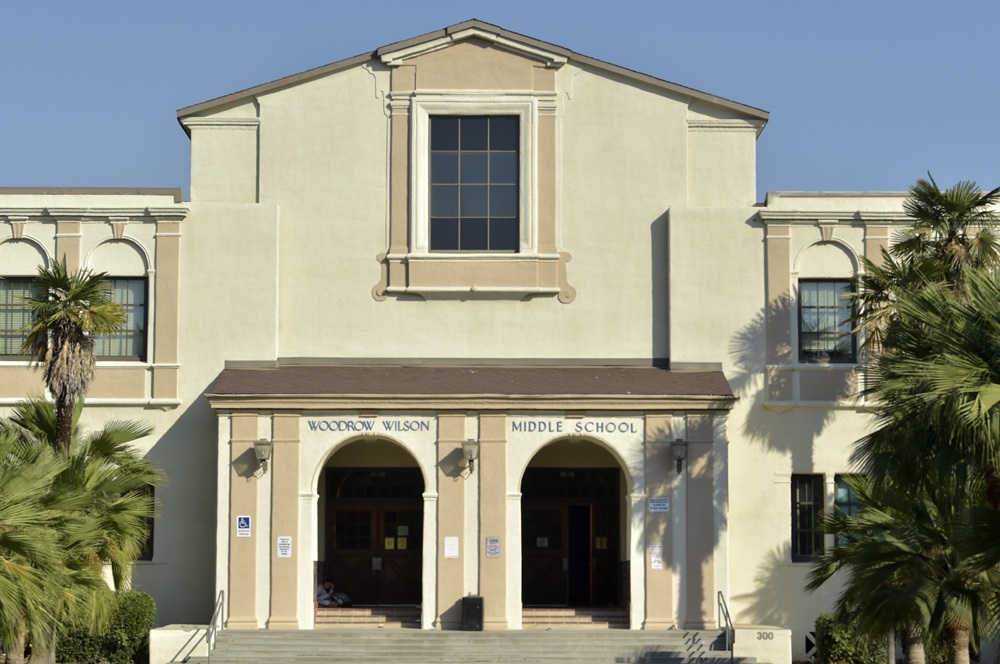
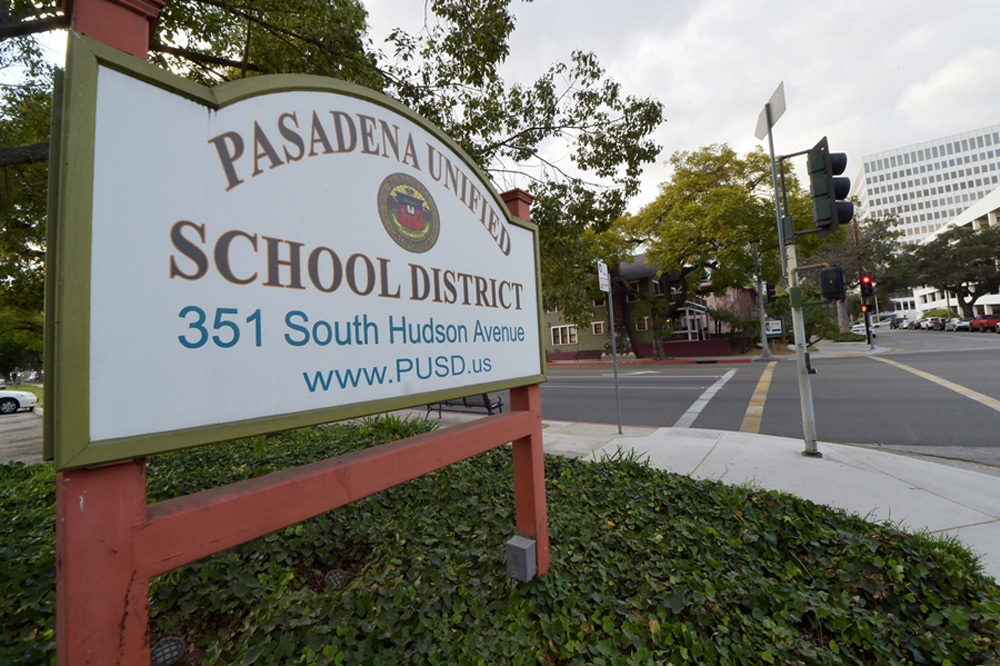
Pasadena Unified School District Office | Photo by Terry Miller / Beacon Media News

In the midst of health concerns caused by the coronavirus outbreak, safe distancing has been implemented. Schools closed to ensure the safety of students and to help curb the spread of the disease. I set out to determine if there is a system in place to handle this sudden change and how equipped administrators, teachers, and students in Pasadena are to switch to remote learning.

Pasadena Unified School District’s (PUSD) Director of Curriculum, Instruction, and Professional Development, Helen Chan Hill, informs me by email that PUSD initiated its remote learning plan in earnest very shortly prior to the school closures on March 13.

Hill expounds, “We laid out a three-stage plan: Stage 1 would be general, standards-based content that would be made available online and in print, with enough material that students could engage in reinforcement of learning for 2-3 weeks – we were able to get these up and running by March 16. Stage 1 work was completed by a central team of Curriculum & EdTech specialists, with the intent to buy a few weeks of time for teachers to build out their own online classrooms in PowerSchool Learning.

“Stage 2 began officially on April 6, following PUSD’s Spring Break. At this stage, all online classrooms are active and students should be able to take in content and lessons that are custom created for them by their teachers.

“Stage 3 is our transition to interactive learning, with the use of meeting apps and tools that allow for livestreams and more bi-directional communication between the teacher/student/ content.”

“PUSD, fortunately, had three key systems in place for several years that has helped with our readiness,” Hill continues. “The first of these is a network of Instructional Coaches in every school. They are the crux of our professional development design and have been instrumental in providing clarity and training to teachers. While teachers were planning prior to April 6, our Instructional Coaches and Principals/APs have been attending custom tutorials on remote learning that they can use with their staff.

“We have a network of TechLeaders that are early adopters of technology integration in the classroom. These are teachers who are in the classroom, but receive monthly training on apps, tools and best practices for instruction with technology. They too have been key in supporting teachers in this time!”
This image has an empty alt attribute; its file name is school-417612_1920-1.jpg
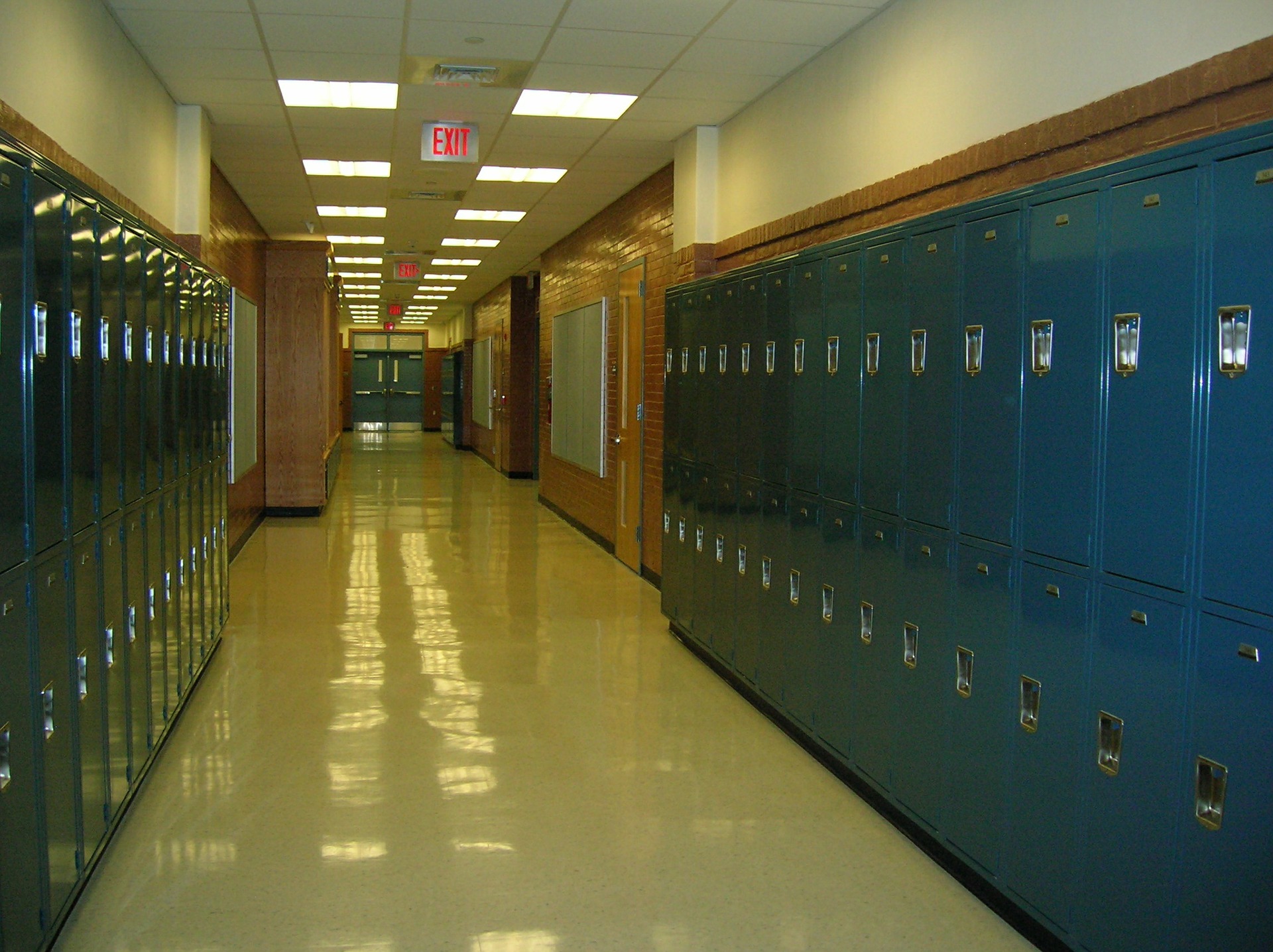
The school hallway, once a beehive of activity, is eerily quiet | Courtesy Photo

Asked if there are any assessments in place to determine if students are learning, Hill replies, “We have analytics on each online classroom in PowerSchool Learning with respect to usage, but as for assessment, that has not yet been fully determined. In alignment with CDE’s updates, we will be suspending nearly all of our local assessments. However, we want to help teachers to check on student progress and understanding through other means still to be determined.

“Furthermore, we have created a resource page to support our teachers and parents. We also want to emphasize that the well-being of our students and families is the utmost priority – while we are dedicating much work to ensure students’ academic opportunities, we are likewise encouraging grace, patience, and understanding around all of it. We know that families’ (as well as teachers’) lives have been uprooted and we need to take care of each other before we make demands for schoolwork.”

I’ve read articles that highlighted the plight of some students who don’t have computers at home or laptops and, even when they do have them, don’t have WiFi and I ask Hill if this is a problem at PUSD.

“Because of our techequity initiative that began in 2018, our students are already one to one with chromebooks,” Hill responds. “Sixth to 12th grade have already been taking them home, and K – 5 use them in the classroom. Therefore on March 13 when we dismissed, we asked elementary schools to dispatch the chrome books from the classroom for students to take home. We are still working on students with no Internet access – we have deployed all of our hotspots to the majority of those families in need, and are working with others on a solution.”

Speaking with me by email, Dr. Benita Scheckel, principal of Altadena Arts Magnet School, says, “Teachers had two weeks to finish creating their virtual classrooms; students began remote learning four weeks ago with general academic content loaded by our district onto PowerSchool Learning. Our school’s instructional coach, Ms. Hanh Le has really been doing the heavy lifting of training teachers to use all the available online apps to support student learning. The district is working closely with each campus’s administrative team and instructional coach to collect data on how teachers are managing their virtual classroom set up.

“I am trying to keep everything as normal as possible – I am continuing to send them my Sunday updates for staff. I am checking in on them every day formally via email and virtual staff meetings and then informally via text and phone calls.” 

Dr. Scheckel adds, “I’m just so impressed by PUSD’s ability to move from in-person to virtual learning so quickly and seamlessly.  I am also incredibly inspired by our teachers’ aptitude and willingness to jump right in and learn so many new things in such a short amount of time. My teachers and so many across the district are commenting on how sad they are to not be able to see their students in person every day.”  

Ashley Butler teaches World History and AP World History to around 120 mostly sophomore students at John Muir High School Early College Magnet.

She says, “I have been communicating with students through email; surveys and all work is being posted and submitted by students on a Learning Management System called PowerSchool. Next week, after our spring break, I will conduct digital lessons and hold virtual office hours via Google Hangout Meet.

“I am working to create (and modify in real time, due to the situation) lessons and activities to best support student learning and support student needs in this uncertain time. I don’t have a model or a template that I follow, per se, but I am trying to provide instruction that supports my students in the most effective way possible.”

Adds Butler, “I can’t speak for all high school teachers in this case, but speaking for myself, I am learning to communicate with my students in different ways. I am used to in-class conferencing to support student learning. However, with remote learning, this one-on-one time has changed. Now, instead of supporting students individually during class hours, students are being supported at all times during the day.

“Student engagement really depends on the class. Virtual discussions can still take place on various learning management systems and other digital resources like flip grid or padlet. Student engagement can be achieved with different types of assessments, projects, research activities about which students are passionate, or assignments/activities that relate to their lives.

“It is hard to say if high school students are better able to adapt to remote learning, I think time will tell. However, many students have explained that they miss the in-person support their peers and their teachers provide. I think that all students, no matter their age, are able to adapt to remote learning when they have teachers who have integrated technology into their classroom regularly. I think one of the greatest challenges high school students are facing is that many have familial responsibilities outside of school work.”

Asked what has been the biggest hurdle for her, Butler remarks, “Not sure I have had to overcome anything yet; I feel like every day I am faced with a new challenge, but the challenges and new learning experiences are what make education such an enjoyable profession.

Students are adapting to learning from home | Courtesy Photo

Armenui Manasarian, who is one of PUSD’s TechLeaders, teaches at Sierra Madre Middle School. She describes how she conducts her virtual classes. “For about ten years now, I have been using the LMS (Learning Management System) called Powerschool Learning. I post my assignments and content on my class pages; I record myself giving the lessons on screencastify and post them on my page for my students to listen to it and view it. To establish as much connection as possible, I check in with them by conducting polls and using discussion boards on Powerschool. I have embed Nearpod lessons, Listewise lessons, videos, etc. Eventually, I will be using Google Meets to connect to the class for live instruction.”

Continues Manasarian, “I teach five periods – two classes of English, two classes of History, and one elective that is a tech class/Hawk News with a total of 167 students. My elective does the school news broadcast and we are trying to do this remotely and sending them out to the school as a means for all of us to connect.” 

“Every Monday, I post an agenda for the week so students are clear about expectations and are able to manage their time; I film tutorial videos which I send to parents and students to help them along and as to what my expectations are. I create a Dropbox so that students know where to turn in the assignments. My students use various tools such as Kami (lets them type on PDF) so that they can do the work and turn it in. I am also emailing my students/parents. I am available on Google Hangouts whenever students and parents have questions or are confused about lessons.”

“I look for interesting topics to cover. Some discussions are lecture types with only me; some are interactive where they can respond to each other in the class; and there are times when they record their voice response or, using animation, they record a face response. 

“Not being able to explain things in person is a struggle at times, especially since this happened so suddenly that we didn’t really have adequate time to prepare the kids. They all have various types of households with different schedules. Their parents might not be able to help as much or they might not have the best access to internet. I try to make things very clear and set norms, guidelines, and routines so that everyone can follow along. I give them a suggested schedule, but it is up to the family to enforce them.”

While this pandemic brought to light the limitations of remote learning, it also brought out the best in the PUSD. Manasarian notes, “I am proud of my district for the pace, teamwork, and efficiency with which they dealt with the situation. They set up learning materials for two weeks for teachers who needed time to learn, and to transition and plan all of this. They made sure all students had Chromebooks so that they can all access the content and curriculum. Everyone worked together to ensure this to be a success for both teachers and students. We really came together as district leaders and teachers in this time of crisis.”

If teachers are sometimes challenged engaging middle-schoolers, those who teach the youngest learners have their work cut out for them. Five-year-olds need hand-holding and getting solid educational foundation is crucial.

This image has an empty alt attribute; its file name is classroom-2093744_1920-1.jpg
A classroom devoid of students | Courtesy photo

Chelsea Eshnaur is a kindergarten teacher at Madison Elementary and has 19 students in her class. She expounds on how she delivers remote learning, “Using the PowerSchool, my students are able to log on to my page and see the assignments for the week; I am hoping in the upcoming weeks to try out a Google Hangout Meet. I don’t think I can use this to actually teach content because not everyone would be available at the same time to log on. In the past two weeks of online learning, I’ve only had about six students actually log on. But I’m hoping to just do a daily read aloud and just say ‘Hi’ to those who are available.

“As we have switched to this online platform for teaching, I have mostly just been creating my own method for pushing out content. Being in kindergarten has made it harder to adapt my content to a digital platform, but there are so many resources out there from other educators that have made it pretty seamless.

“I have created additional resources on my page that include ‘Enrichment’ and ‘Intervention Practice.’ The goal of the ‘Enrichment’ page is to provide resources that would engage the students outside of the core academics. For example: art, science, social studies, P.E., etc…. In the ‘Intervention Practice’ page, I have a plethora of resources for the students to work on in areas that they might be struggling in, outside of weekly content.”

“Because my students are so young, I cannot expect them to engage the content independently,” Eshnauer says further. “They need the help of someone at home to log on and work through everything with them (reading directions, etc…). I know that this model of school work has been an adjustment, not just for me and my students but for their families as well, many of whom are still working during the day.

“I’ve had a handful of parents reach out for clarification. I’ve sent out emails, phone blasts, and messages on Remind (messaging system), with very few responses. This is the most frustrating part because, like I said earlier, for the younger students, they need someone to help them access all of this. And when I have 4 out of 19 parents respond to any updates, it makes me think that the other 15 students aren’t getting anything.

How do you know if the children are actually taking in the lessons you’re posting online? I query. Eshnaur replies, “That’s a good question! Because I don’t have every student logging on daily, I cannot guarantee that all students are accessing the content. I include an online ‘quiz’ at the end of the week for each main content area (phonics, reading and math).”

While it’s still early days and there isn’t much data available, I nevertheless ask Eshnauer what has worked well and what hasn’t since remote learning has been put in place. She says, “So far I have found that I just need to be as available as possible. For parents that are accessing the content during the ‘school day,’ I’m trying to check emails and messages as often as possible in case of any questions. Also, be willing to troubleshoot everything! Online learning is new for all of us. So I’m constantly checking links and asking parents to let me know if they’re not working on their end, etc…

“What makes me nervous since going to online learning is just the lack of data that I will have. I know people might think, ‘it’s just kindergarten,’ but this part of the year is critical. I still have about half my class that are struggling to master the alphabet (ID and sound). This part of the year would have been more intensive as I worked with them to get them where they need to be. But so far, most of those students are not even logging on. And now they’re going to go to first grade at a disadvantage and the gap will just get wider and wider the more they progress through the grades.”

These are unprecedented times we live in. The world as we know it has been upended and most normal activities have practically ground to a halt. As disconcerting as our conditions are at the moment, however, life has to go on and so we persevere.

And as we have seen on television and read in the papers, during these extraordinarily dire times when our resources are diminished and our spirits are tested, we manage to make the best of our circumstances. Our collective will to fight the odds prevails and makes us soar above adversities.         
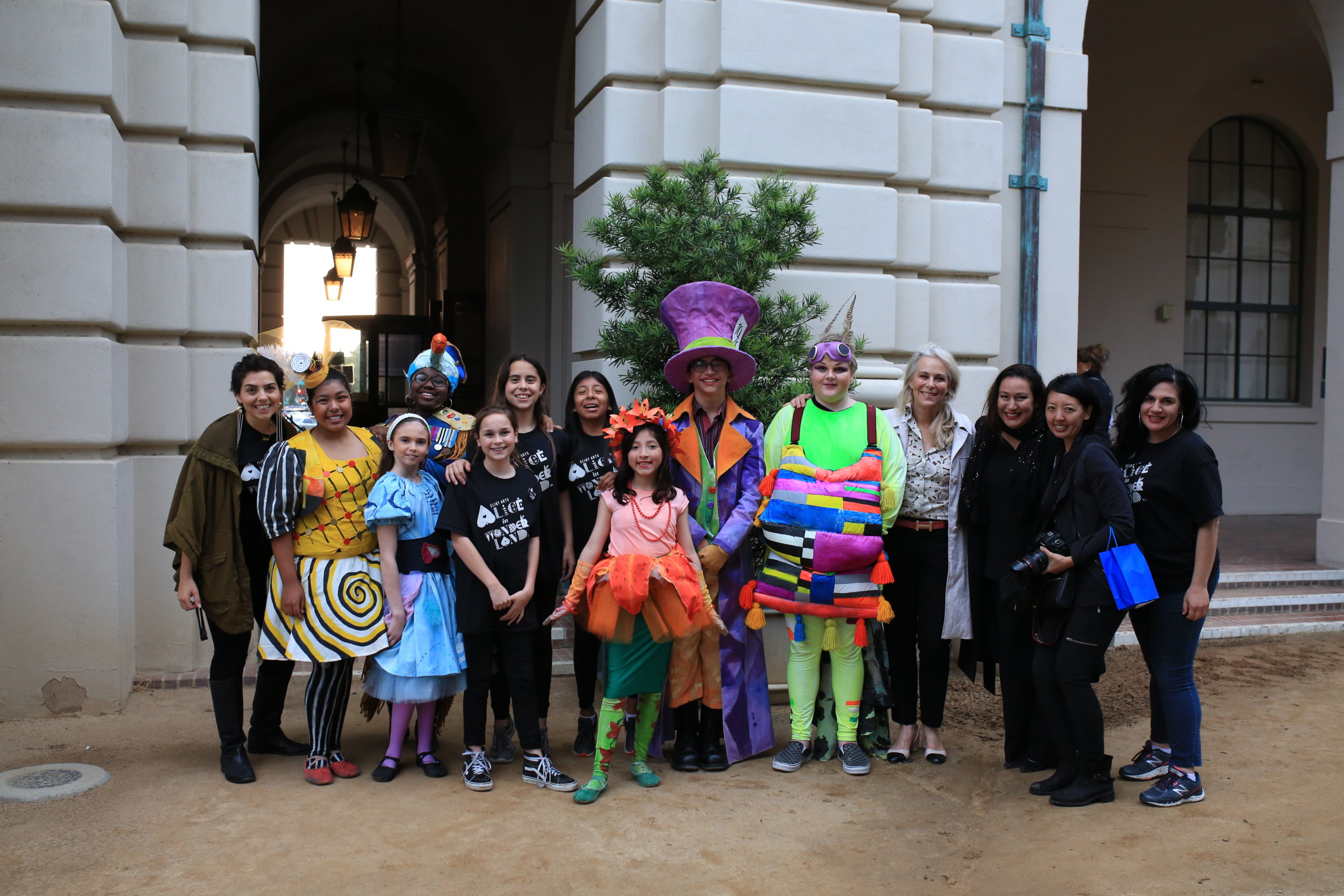


Charles W. Eliot Arts Magnet Academy Inaugurates its Own Costume Shop

Originally published on 30 October 2018 in the Pasadena Independent, Arcadia Weekly, and Monrovia Weekly

The Eliot Arts team poses with its newest fan, actress Jane Kaczmarek, at Pasadena Educational Foundation’s ‘Breakthrough Student Interactive Showcase’ at their annual ‘Celebrating Our Schools’ event. Left to right, Drama teacher Micol Issa, student actors and costume designers, Kaczmarek, Principal Lori Touloumian, Visual Artist-in-Residence Liane Shih, and Theatre Artist-in-Residence Lory Tatoulian | Courtesy photo / Molly O’Keeffe

The middle school musical was ‘Alice in Wonderland.’ As the students were getting ready for rehearsals, Micol Issa, 6th grade English and Drama teacher at Charles W. Eliot Arts Magnet Academy (Eliot) in Altadena, who was also directing the production, had a sudden inspiration, “Instead of shopping for costumes for the show, why don’t we make them ourselves?”

Never mind that it was January and the production was slated for May. Indeed, many would have found that prospect daunting. Where would they find designers? Who, besides Issa, even knew how to sew?

But Eliot was the top Arts School in the Pasadena area and it had a reputation to uphold. So everyone got behind her idea quickly. Students, parents, teachers, and administrators sprang to action to make Issa’s brainstorm a reality.

Issa’s ambitious concept would not have been do-able had it not been for a grant that transformed the school to what it is today. Lori Touloumian, Eliot principal, informs, “In 2013, this school, then known as Eliot Middle School, was one of four academic institutions awarded the magnet schools assistance program grants of $7.9 million each to have its own integrated theme. Eliot, in particular, was designated as a Visual and Performing Arts (VAPA) school.

“To ensure cohesion of the district’s schools and initiatives, there is one person who has oversight over all the magnet programs. We’re fortunate to have Shannon Mumolo in this capacity. As the Magnet Schools Assistance Program (MSAP) Program Director for the Pasadena Unified School District, she oversees the budget and implementation of magnet programs funded by the U.S. Department of Education. She has been an MSAP Project Director since 2015 and previously served as the MSAP Site Coordinator for Eliot Arts Magnet.”

“Through the grant, our teachers went through specialized training on how to integrate the experiential approach to art into the core classes of English, history, math, and science,” discloses Touloumian. “We have resident artists who work with teachers on site during the school day and after school who work directly with students on various projects. We’ve also partnered with the Huntington Library to offer free after-school programs every Tuesday and Thursday afternoon.

“While adhering to the district’s established curriculum for the scope and sequence of the arts program, the teachers have been empowered to make decisions in terms of what art project they will do in their core class and they are free to set up the time with the resident artists. The school follows the common core standards and the artists in residence come in with expertise in the arts standards to weave the two together.”

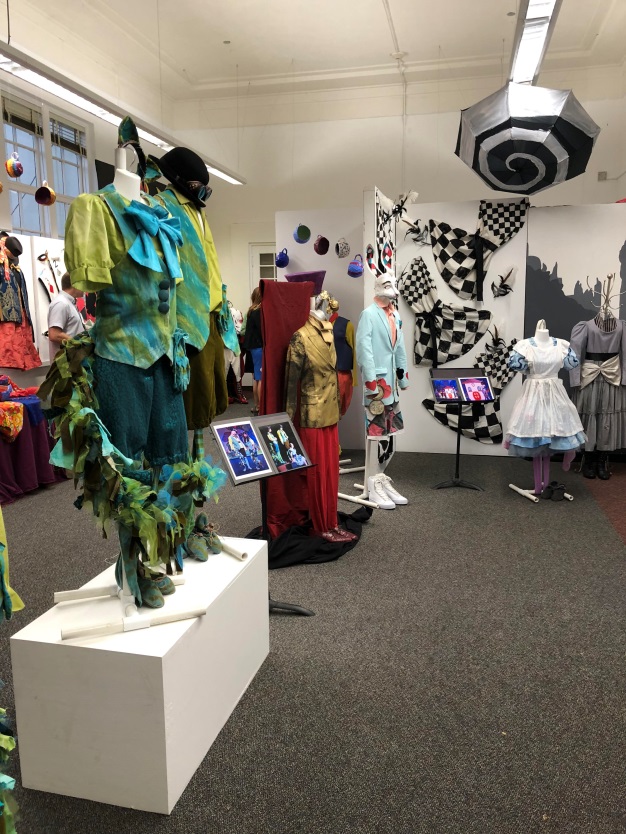
In Eliot’s new costume shop, parents and artists-in-residence taught students how to sew their own costumes such as the shorts and pantaloons worn by guests to the Mad Hatter’s tea party. The Mad Hatter wore a handmade hat and hand-painted jacket designed by students themselves | Courtesy photo / Marc Flores

Touloumian says further, “Additionally, we were to able create art-maker spaces on campus – we  revamped our dance rooms with more equipment, we transformed a former parent room into an art gallery which is now utilized as a community center where our students and community artists can hang their art, and we added a ceramics room and a media lab on campus.

“We are now a fully integrated arts academy. Students can choose what elective classes they want to be in but even if they choose not to attend a specific elective class they may still have the visual arts experience in their English, history, math, or science class, or after school.”

Cheili Lopez, a 7th grade student who participates in the arts classes and after-school program, says “I’ve just started the printing shop on Tuesdays and Thursdays with Mr. Duffy, and on Fridays I go to the costume shop. Through the arts classes, I’ve been able to make things for my family – I sewed an apron for my mom and I made a jug in ceramics class which I gave to my parents for Christmas. They were very happy because the items weren’t store-bought; I made them myself.”

“Everything we do here is connected to the Arts,” Issa explains. “We’re trying to rebuild the school culture and create spaces for kids to have multiple avenues of access to the Arts. Not everyone wants to act, but this is another way for kids to participate in the making of performances, and Cheili is an example of that.

We realized that something we needed, not just for the drama and choir program but also for dance classes, was a costume shop. That was the goal we tried to work towards last year, which launched us into this next level. Now, we have six sewing machines, two sergers, and an embroidery machine. We basically have a sewing club that meets every Friday after school.”

“In the past, we assigned people to find the costumes for specific characters,” details Issa. “But, like I said, we need costumes for all our productions so I took the idea of having a costume shop to Denise, the artist in residence. She, in turn, went to Lori and said ‘If you will okay the costume shop, I’ll write the grant,’ and she did.

“Of course, I had to justify why I thought a costume shop was necessary. I argued that it’s something that would be great for the program as a whole and we had the expertise on how to run a costume shop on campus. Denise and I know how to sew, then we discovered that so many parents also have that skill. So what it really did was brought more people on campus.

“Through Facebook, people shared with everyone our donation list and what I was hoping to accomplish. People donated patterns and dropped off whatever they could contribute. Everyone was happy to give and appreciated that we were teaching kids how to sew.”

A visit to a museum was the inspiration for their musical’s look. Issa recounts, “I went to an exhibition of Marc Chagall costumes at LACMA and I was astonished because it was exactly what I envisioned for ‘Alice in Wonderland.’ So I took the kids on a field trip to see the show and when we came back we started designing.

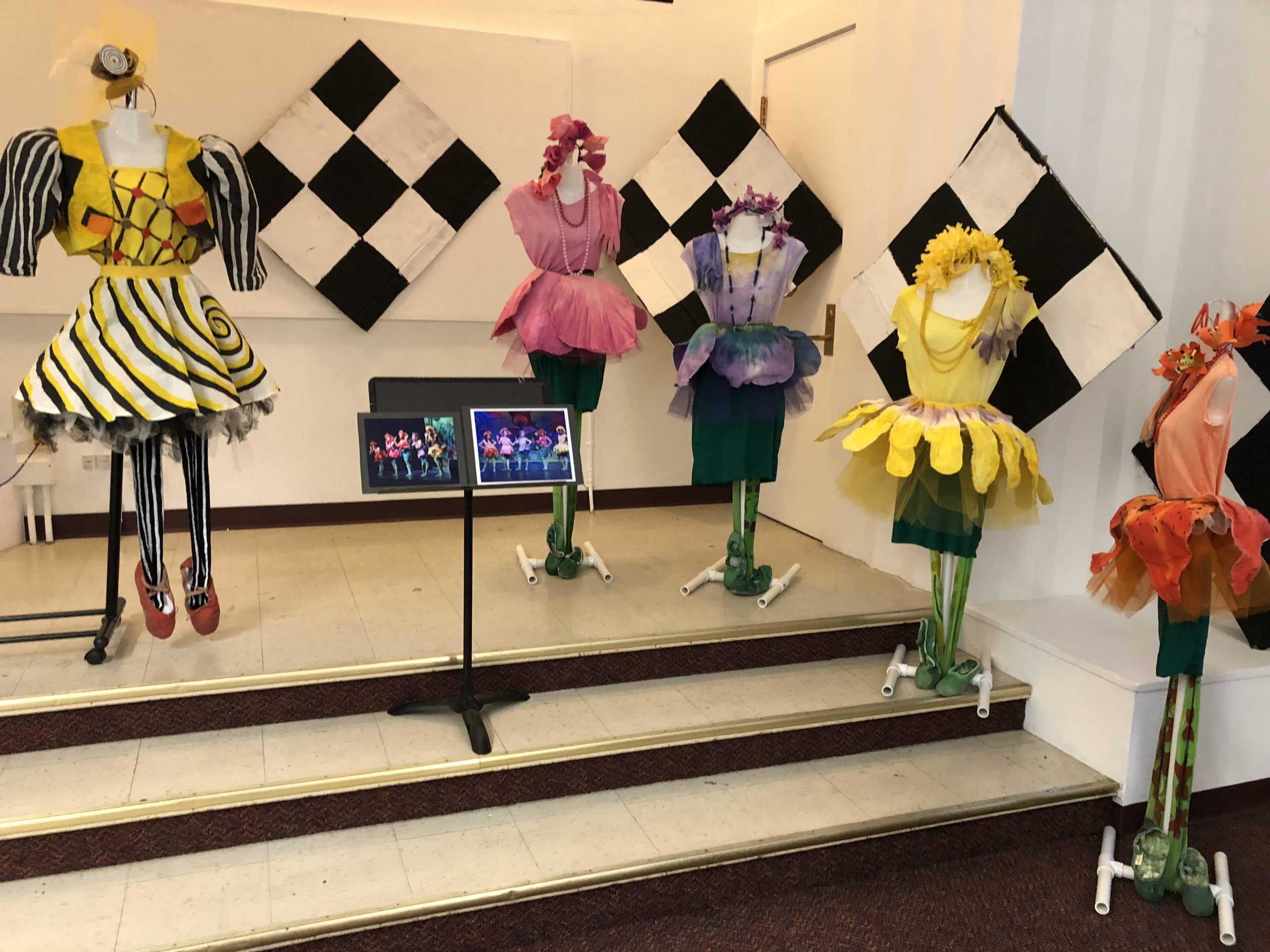
Students fused the modernist styles of the Bauhaus movement with the loose painting styles of artist Marc Chagall to design each of the show’s whimsical costumes | Courtesy photo / Shannon Mumolo

“We found real pictures of the Chagall costumes. And under the guidance of our artist in residence, we taught the kids how to draw and make patterns, to paint them with colors, and to sew inside out.

“Because of the large number of costumes that needed to be finished, it was a community effort. Students, teachers, and parents spent a lot of late nights and weekends sewing. And, while not each costume was made entirely by kids, they worked on every one.”

Lopez was one of the students who made the costumes and she acquiesces, “Each costume was a group effort. Several students worked with an adult to work on one and when we didn’t finish that day, we went back to it the following afternoon.”

The experience proved to be constructive for Lopez not only because she learned how to sew. She says, “We do a lot of projects in regular school so doing the after-school costume shop helps me collaborate with other students.”

Issa points out, “What they do in the costume shop translates, however indirectly, with their core classes. They go through the same procedure of calculating, of figuring out a problem, much like in math class. They have to assess how thick they need to make the paint to have the effect that they want. So they experiment with a lot of color samples to figure out what consistency to use so it doesn’t just turn into watercolor but, at the same time, doesn’t make the fabric super stiff. That’s a process that applies in science class.”

“The show ran for three days and all the costumes held up,” Issa says with pride. “There were minor repairs which we made between shows. The incredible thing about this, also, is that it gave me additional crew on top of the stage team. From now on, the costume crew is in charge of queue-ing the costumes – making sure they’re in the right place – and noting what needs to be repaired so we can make them the next day.

Eliot’s spring musical proved to be a smashing success. Raves Issa, “Our ticket sales for the show was tremendous. We sold over $1,000, which was more than what our previous shows generated. Then, on October 10, we held our first official gallery opening featuring the costumes from last school year’s spring musical ‘Alice in Wonderland Jr.’ We invited the District and Community Arts Team, and all our Altadena, Pasadena, and Sierra Madre partners – from dance to theater companies – and they all came to see the exhibit.”

The show’s handmade costumes were installed in the school’s art gallery this fall for the opening exhibition: Chagall and the Bauhaus Meet Alice in Wonderland. They will be on display until December 2018 | Courtesy photo / Shannon Mumolo

The display, which goes on until December, highlights a very specific artistic vision. Issa describes, “The costumes in Eliot’s production of Disney’s ‘Alice in Wonderland’ are unlike any other version of the show you have seen because it was inspired by the artist Marc Chagall and the Bauhaus design movement.

“Chagall, well known for his paintings and stained glass windows, also designed costumes for the Metropolitan Opera and New York City Ballet. You will see some of his designs and paintings represented in our own costumes and sketches. As we researched and sketched our vision for Wonderland into life, we decided to add in the modern and otherworldly influence of the Bauhaus design movement. Categorized by basic shapes, lines, and spirals, we fused the modernist style of the Bauhaus movement with the loose painting styles of Chagall.”

“We’ve had previous exhibits but they were open after school mainly for parents and students,” clarifies Issa. “This was our first gallery opening held on a specific night for the entire community, complete with a bake and beverage sale. It demonstrates the amazing work that can be done when students, teachers, parents, and community partners collaborate. We’ll be forever grateful for the generosity of the Pasadena Showcase for the Arts and the Pasadena Educational Foundation for their support in making Eliot a premier arts school in the area.

“It was truly a project that involved a great many students – 140 kids took part in our costume shop, out of our total student population of 545. That’s 23% of the student body. What’s more, this endeavor inspired others so we have doubled our numbers in the costume shop. Even those students who weren’t able to participate in the after-school program worked around their schedule to be in the costume shop.

“We started the Friday costume shop early this school year so we could teach the kids sooner and, in time, they would be able to sew the bulk of the costumes themselves. Our next musical is ‘Hairspray’ and we’re creating the costumes again. But because this show happens in our world, we’ll probably use some of the basic costumes we already have, instead of making them from scratch. That’s the cool thing about having a costume shop – it has given us the ability to use  something that already exists by altering it to fit our needs.”

Issa is now just entering her third year at Eliot but, already, she has been instrumental in giving it the distinction of being the only middle school with a costume shop. But, more importantly, she  has successfully incorporated in its program an invaluable skill that will serve middle school students long after they leave Eliot. Nay, for life.

French Language Immersion Program at the Pasadena Unified School District

Photo by Terry Miller | Beacon Media News

Originally published on 23 March 2017 in the Pasadena Independent, Arcadia Weekly, and Monrovia Weekly

Beginning this Fall, some kindergarteners and first graders in the Pasadena Unified School District (PUSD) parleront francais when the district adds a third dialect in its Dual Language Immersion Program (DLIP).    

According to Hilda Ramirez Horvath, PUSD’s Coordinator for Communications and Community Engagement, “A group of parents approached the district asking about the possibility of starting a French language immersion program based on the success of the Mandarin and Spanish programs the district created about eight years ago.”

“The district superintendent met with them, a series of meetings between staff and parents followed, and an online survey was created to gauge interest,” continues Horvath. “The Board of Education approved opening a DLIP in French a few weeks ago and plans are ongoing to welcome its first Kindergarten and first grade classes for the 2017-2018 school year.”

States Dr. Brian McDonald, PUSD superintendent, “The ability to speak more than one language can enhance brain function, academic performance, and business acumen. As a school system committed to responding to the needs and interests of Pasadena area families, we are expanding opportunities for multilingual education that prepare our students to compete on a global scale.”          

Director of Language Assessment & Development Dept. for Pasadena, Hassan Doryani, is one of the people coordinating this effort of assessment, budgeting and hiring. He says, “After presenting to the board for final approval, and meetings with the community outlining the first steps, we are now moving forward to get ready to unveil this program. We have identified the need to hire three teachers  – one French speaker to teach Kindergarten, another French teacher for first grade, and the third instructor to teach the English component. We’re currently accepting applications for these positions and will start the screening process shortly. ”

“We launched our DLIP with Spanish and Mandarin starting with kindergarten in 2008. This class is now in eighth grade and students will be continuing through high school,” Doryani adds.  “It’s one of the programs with an actual secondary component and we’re using this same model for French.We’ve had a lot of success and the community likes the program so we’d like to replicate the same structure with French.”

PUSD is looking to have a total of 40 students – 20 in kindergarten and 20 in first grade – enrolled this Fall in the French DLIP at the Altadena Elementary School. Doryani says further, “As in our Mandarin and Spanish program, we would like the same class population with half of them dominant in English and the other half in the partner language. We do this by testing the incoming students in their French capabilities to have a better idea of students that have native abilities and those that don’t.”   


Helen Chan Hill, Director of Curriculum, is responsible for developing the curriculum for the program. She explains, “When deciding what set of courses we use in a language immersion program we consider: 1) fit for the learning outcomes of the subject; and 2) language of instruction/instructional percentage in each language. For example, balanced literacy is a priority districtwide, so we are currently in search of leveled books and assessment system for informal reading inventory in French since the models call for 90 percent instruction at K, and 80 percent in first grade. This is in exact alignment with our English mainstream priorities, but modified for the language of instruction.  We use this template for all programs.” 

The school provides all instructional materials to ensure that all students have equitable access to core supplies.

“Since we are still in the research and selection phase, we do not know the specifics of what will be available for students and parents in terms of resources,” reveals Hill. “However, the majority of our programs have digital components that families can access outside of school, and we also look for resources that are beyond the selected curriculum. We attempt to publish resources on our website so they can be easily found – we reference resources from ACTFL (American Council on Teaching Foreign Languages) whose domains of language acquisition we use for benchmark progress. We also share guiding principles for Dual Language and other such resources that can help a family understand the instructional program and expectations.”

Hill expands, “We expect students, as in all our programs districtwide, to attend fully and engage with the learning. While we are still establishing learning outcomes, we would anticipate students to function at low to mid-novice levels (based on ACTFL’s proficiency levels) by the end of kindergarten year, and mid- to high novice levels by the end of first grade. From parents we would expect streams of communication with their student at home. Whether parents speak or write French or not is not a consideration in our expectations – we simply want them to encourage their student to be involved via communication with the teacher or school.”

“We feel that PUSD offers a robust model of instruction for all its DLIPs, and are placing similar expectations on French,” says Hill. “We have a keen understanding of the teacher skill set required, and have worked hard to establish consistent templates in our current programs that help launch a new one. Additionally, with our emphasis on 21st century learning, the PUSD embraces not only the innovation that comes along with this, but the cultural competency and global citizenship that is much needed in this increasingly connected world of ours.”

America is raising a generation of future job seekers who will not be limited by geographical boundaries. Polyglots will have a definite advantage – PUSD students will be better equipped to occupy their place in a highly competitive global economy.                                           


No Boundaries in Art and Talent at PUSD

Originally published on 9 March 2017 in the Pasadena Independent, Arcadia Weekly, and Monrovia Weekly

There is no shortage of artistic talent among Pasadena students as the upcoming 12th annual ‘No Boundaries’ will once again prove.

Scheduled to open on Friday, March 10, which coincides with ArtNight Pasadena, and running through March19, at The Shops on Lake Avenue, this art exhibition provides a platform for young artists in the Pasadena Unified School District (PUSD) to showcase their two- and three-dimensional art. Presented free to the public, gallery hours are Monday to Friday, from 3 to 6 pm; Saturday and Sunday from 1 to 4 pm. 

The exhibition is also a host site during ArtNight Pasadena on Friday, March 10. ‘No Boundaries 12’ is housed in a commercial space on 345 S. Lake Avenue lent for the occasion by Merlone Geier Partners as a giveback to the community. It will be a shuttle stop during the citywide free evening of art, music, and entertainment when Pasadena’s most prominent arts and cultural institutions open their doors.

ArtNight Pasadena, sponsored by the City of Pasadena Arts & Culture Commission and the Division of Cultural Affairs, is an ongoing partnership between the city and local cultural institutions. Twice each year, many of the city’s non-profit arts and cultural establishments open on a Friday night to provide a variety of art, culture, and music to the public free of charge.           

According to Jennifer Olson, District Arts Education Coordinator for PUSD, the first ‘No Boundaries’ was started by a former Pasadena high school teacher, Alex Schultz, and the former PUSD District Arts Coordinator, Marshall Ayers. It has always been a group effort involving Arts teachers, community arts partners, parents, and volunteers.

Olson relates, “The first year it was just middle and high school student work and it was all put up in one night in the wind tunnel at Art Center. The next year the District Arts Office decided to include every school, and the structure was set that informs how we still do it today. There is an arts representative designated at each school who selects between 12 and 32 artwork per school, depending on the size of the school and whether it is an elementary, middle or high school.”

All 26 PUSD schools submit their highest quality work which are organized visually (2D, 3D, video), rather than thematically. The exhibit is a monumental undertaking given the number of students and schools involved. 

“It is a gargantuan effort!,” Olson agrees wholeheartedly. “We started accepting delivery of artwork February 2, and the exhibition doesn’t open until March 10. So there are several weeks of registrar work – entering all the student information and statements – mounting all the artworks, and then of course building out the space, curating the art pieces, hanging the show, marketing, and event planning.” 

Continues Olson, “For many years we have had a district arts team/community arts team, and this is a major endeavour undertaken by that group. We also work with the Pasadena Educational Foundation to help us find volunteers to help with all aspects.”

“‘No Boundaries’ is a true community effort,” proclaims Olson.“We work side-by-side with our community arts partners, teachers, and parents to make this exhibition happen. By that, I mean if you walk in on any given day during installation, these folks are the people painting the pedestals, nailing up the student statements, and installing the promotional posters.”

Rochelle Branch, manager of the Cultural Affairs Division of the Pasadena Planning and Development, created ‘Bridging Boundaries’ in 2007 as an offshoot of ‘No Boundaries’ to expand access and highlight the collaboration between the City of Pasadena, and PUSD’s Arts Education. She says, “‘Bridging Boundaries’ references the connection between the city and PUSD, but also the geographic location of what we call the Student Art Wall which is near City Hall bridge.”

“Arts Commissioners and a member of the community attend the installation of the PUSD’s ‘No Boundaries’ exhibition and select artworks based on high artistic quality and merit,” Branch explains. “They provide a small tag that says ‘Arts & Culture Commission selection awardee for Bridging Boundaries Exhibition’. Everyone who goes to ‘No Boundaries’ will see the selected art.”

“When ‘No Boundaries’ ends on March 19, the selected pieces are taken to a professional framer and mounted in two installments at ‘Bridging Boundaries’ exhibition hall outside City Hall Council Chambers,” adds Branch. “The city contracts with Pasadena-based artist, Denise Seider, to curate ‘No Boundaries’ and ‘Bridging Boundaries’. For about five months, each student group will have its artwork up for public viewing.”

“Students get back their artwork professionally framed and get city-wide acknowledgement of the quality of their piece. They get to come with their families and friends and see their creation outside of City Hall,” Branch concludes.
          

Olson shares that sentiment when she declares, “The greatest joy of this project is seeing students come in with their family members, bursting with pride when they find their artwork and they see that it is professionally displayed like a ‘real artist’”.

This joint collaboration – among the City, PUSD, and Pasadena’s arts and cultural organizations – celebrates, showcases, and shares students’ artistic talents with the entire community. But more than public recognition, these young talented students’ self-satisfaction in their accomplishments may be the greatest reward of all.             

Interstellar Travel is the Goal of this Gates Millennial Scholar

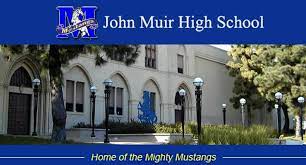
Image taken from John Muir High School website

Originally published on 19 May 2016 in the Pasadena Independent, Arcadia Weekly, Monrovia Weekly, and Sierra Madre Weekly

For many people Albert Einstein’s theories are topics that just go way over their heads. For Prakash Dass, a senior at John Muir High School and who has been awarded a Gates Millennium Scholarship, they are matters to wrap his head around.    

As Prakash states, “Einstein proved to us that we cannot travel faster than the speed of light. He started the conversation which became a jumping off point for many scientists in much the same way that Isaac Newton inspired his work. My life’s ambition is to accomplish the counter argument to Einstein’s theory – that we indeed can. 

“We would need an infinite amount of energy to reach the speed of light, but what if we found a way to bend space instead? We wouldn’t be bending the laws of Physics; we aren’t using energy to propel us but we’re still getting to a different location because the space around us is moving.” 

For Prakash that concept didn’t just come about from too many hours watching Star Trek, “I think there’s a group of people at NASA researching it but there isn’t enough science to back it up yet. I would like to be one of those scientists who can come to a definite conclusion.”

Interest in things that are out in the galaxy was something born from Prakash’s early passion for stargazing. He says, “I love to look up the night sky and stare at these twinkling, bright lights; they’re so fascinating to me. As a child, I dreamed of being an astronomer. Then I started to be more specific – I wanted to learn the physics behind stars and other things in the universe; which led to my absorption with particle and nuclear physics. Then that led me to aerospace engineering because I want to build interstellar spaceships.”

A student at John Muir’s Engineering and Environmental Science Academy, Prakash has participated in the Johns Hopkins Engineering Innovation summer program at Pasadena City College. He has also been actively involved with the school’s Solar Cup (a seven-month educational program, sponsored by The Metropolitan Water District of Southern California) Team. Of this year’s competition, held at Lake Skinner in Riverside County on May 13-15, he enthuses, “We made a much different boat from last year’s – we overhauled it and went completely the opposite direction. We had a rudder made of wood last year, this time we drew it out on Auto Desk Inventor and 3-D printed it in pieces then attached them. We applied more engineering aspects to it, and built new parts for the boat.

“While our team did not win the grand prize at the competition, we earned first place in the region for the technical report we wrote. John Muir also received an award for greatest teamwork in helping other teams at the Solar Cup, and communicating with them the best,” Prakash relates.

“I learned a lot of hands-on skills and gained valuable experience working with my team. It’s exhilarating to be with a group of people who share a common scientific and engineering endeavor – these are friends who, like me, have big dreams,” Prakash explains further. 

It helps that Prakash has all his plans laid out to make his wishes come true. He reveals, “I’m going to attend Cal Poly Pomona because I believe it’s a strong engineering school. It offers more practical applications as well as teaches other methods of engineering, including astronomy. It will better prepare me for Masters and Doctorate degrees. I have already figured out what I need to do in order to be accepted to Cal Tech for graduate education. 

“I intend to earn three doctorate degrees – particle and nuclear physics, and aerospace engineering. They’re all intertwined in pursuit of interstellar travel – comprehending stars and particles on a smaller scale, and understanding how to build ships to get us out there. Those three subjects are essential for me to succeed.

“There isn’t very much support for the things I want to do because right now there isn’t a lot of evidence it’s even possible for that to happen. While there is a great deal of research going on, it isn’t compelling enough for everyone get on board, so to speak. It’s something you see only on TV; but I want to be a pioneer in this field,” Prakash asserts.

Funded by a grant from the Bill and Melinda Gates Foundation, the Gates Millennium Scholarship was established in 1999 with the goal of developing leaders and removing financial barriers to education for high-performing, low-income students. Prakash is John Muir High School’s seventh winner of this academic scholarship since 2005. He joins the ranks of a prestigious group of talented students from across the country awarded the scholarship that can be used to pursue a degree in any undergraduate major and selected graduate programs at accredited colleges or universities. Last year’s Muir HS winner, Kimberly Mejia, is currently at UC Berkeley studying engineering.     

Most scientists do not believe in a Higher Being who watches over us, mere mortals. But Prakash is certain that God has a hand in his good fortune. “I believe God gave me all the wonderful things I have. Winning the Gates Millennium Scholarship is something that doesn’t often happen in Pasadena, and yet I did. I feel really blessed because I know how much my education is going to cost. This scholarship will help immensely and it truly is a gift from God,” Prakash says with conviction.

Dr. Ben Aroyan, Prakash’s counselor, must have had tremendous confidence in him because he nominated Prakash for the Gates scholarship. Judges for the prestigious foundation, likewise, must have believed in his potential. And whether it was an Act of God, or his persuasive essays, or that the stars had all aligned for him to receive the much-coveted scholarship, he is most assuredly on a path to his intended destination.   

My Masterpieces Series: USC Pacific Asia Museum

The koi pond and garden at USC Pacific Asia Museum | Photo by May S. Ruiz

Originally published on 22 October 2015 in the Pasadena Independent, Arcadia Weekly, Monrovia Weekly, and Sierra Madre Weekly

Ensconced in a nondescript corner on North Los Robles Avenue and Union Street in Pasadena is a foundation that holds some of the most valuable treasures in Asian artifacts. It’s the USC Pacific Asia Museum, which used to house the Pasadena Art Museum, and then became Pacific Asia Museum in 1971. In 2013, University of Southern California (USC) partnered with the institution to become a vital resource for education and cultural heritage.

Enter its handsome arched entrance, however, and you will be transported to another place and time. The transformation is so unexpected it’s breathtaking. The charming courtyard garden with a koi pond, rock sculpture, and natural plantings reflecting the changing seasons, take center stage while a Chinese Qing dynasty-inspired mansion wraps around it. The Pasadena architectural firm of Marston Van Pelt and Maybury built it as a grand residence in 1924 to exact specifications from California transplant, Grace Nicholson, a pioneering art collector and entrepreneur from Philadelphia.

This historic home also became the center for the arts in Pasadena and was host to several cultural organizations. The first floor served as a gallery where Ms. Nicholson displayed and sold American Indian and Oriental art objects. On the second floor were more galleries, an exhibition auditorium, and Ms. Nicholson’s private quarters. 

Today it is the foremost exhibitor of Asian art collections in Southern California. It is also the destination for Pasadena 6th graders’ My Masterpieces field trip where specially-trained docents conduct tours and hold workshops. 

Michael Fritzen, Head of Education and Public Program for USC Pacific Asia Museum, who took over this post five months ago, is ably assisted by Program Specialist, Becky Sun, in planning an interactive and hands-on two-hour visit. He says, “Our My Masterpieces Program for the Pasadena Unified School District (PUSD)/Pasadena Educational Foundation (PEF) is focused on the inquiry method. Students are asked questions about the pieces they see; they aren’t just dragged through the museum and told massive amounts of facts. They stop, look and reflect about a particular artifact. Aligned with the state Common Core standards, this visit is aimed at enhancing students’ classroom discussions in their World History course. We ensure that what they see and experience add depth to their understanding of the world, and of Asia, in particular.”

This tour is designed to lead 6th graders along the Silk Road. It moves through the collection, spotlights certain artifacts, and ultimately fashions a coherent historical fabric woven from threads that connect all the different countries in Asia – Japan, China, Korea, Vietnam – as students travel on the Silk Road. 

Grace Nicholson’s previous residence now houses USC Pacific Asia Museum

According to Sun the tour is divided into two parts. While one docent tours a group of students, another docent involves the students in a hands-on workshop. She says, “Our workshops are taught by Asian experts in different fields including calligraphy, brush painting, origami.”

Fritzen adds, “We provide authentic materials for students to employ during the workshop. If they’re working on calligraphy, for instance, they are using brushes, ink blocks, and rice paper made specifically for that art form. The work they produce will match what they see in the museum – it will have the look, smell, and texture of the original art. The art activity makes what they see in the gallery come to life and gives them a better understanding of what the artist went through to make the product. We try to create an experience that cannot be replicated in the classroom so that they leave with lasting memories of their visit.”

“My Masterpieces introduces Asian art and culture to kids from all over Pasadena who have never had occasion to visit the museum; it helps them understand why a particular tapestry or sculpture is unique and preservable,” continues Fritzen. “We hope that the visit inspires enthusiasm and passion in young people so that they later become visitors, members, donors, and collectors of art. The field trip includes a family pass for six people. That students actually redeem those passes proves that it makes a deep impression to them.”

Through their programs and events, USC Pacific Asia Museum follows its mission and vision unique to the museum – to further intercultural understanding through the arts of Asia and the Pacific Islands.

According to Fritzen, the museum recently featured a Harvest Moon Festival which showed how this is celebrated not only in China, but also in Japan, Korea, and Vietnam. The institution endeavors to showcase countries which are not usually at the forefront because they don’t have enough representation. 

With that in mind, USC Pacific Asia Museum will host in December a show featuring the art and culture of the Philippines. It may be the first time others will learn about this group of islands in the Pacific beyond the nightly news report of the country being in dire need of assistance, after being hit by devastating typhoons . Maybe it will help engender public interest in the countless natural wonders unique to the Philippines – beautiful coastlines, white sandy beaches, majestic mountains, lush countryside, exotic foods, and warm people.

If USC Pacific Asia Museum were to enlighten even just one mind about the abundant treasures to be found across the vast Pacific Ocean, it would have served the purpose it has set out for itself. 

My Masterpieces Series: Pasadena Museum of History

Originally published on 15 October 2015 in the Pasadena Independent, Arcadia Weekly, Monrovia Weekly, and Sierra Madre Weekly

Brad Macneil, Education Program Coordinator at the Pasadena Museum of History (PMH), is readying once more for this year’s My Masterpieces Program. Every Tuesday and Thursday, beginning this month until the end of the school year, he and his team of volunteers will be welcoming 4th graders from all the public schools in Pasadena for a two-hour art class and activity at the Fenyes Mansion. 

According to Mr. Macneil, this program originated from a pilot test collaboration among the Pasadena Unified School District (PUSD), Pasadena Educational Foundation (PEF) and different cultural institutions, with input from teachers. He says, “It was important that we involved the teachers. We made sure they felt it was their program too so we asked them to write the curriculum for it.”

For My Masterpieces, PMH provides students and teachers with the Museum publication Painting the Beautiful as background material for their visit.Students also complete a lesson in class to prepare them for the field trip and learn some basics in art education. During their visit, they learn about the mansion and other members of the family, and explore what life was like in the early 1900s.      

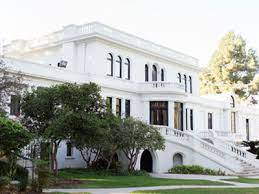
The Fenyes Mansion, which is also home to PMH, is a Beaux Arts residence built in the early 1900s as a winter home for Eva and Dr. Adalbert Fenyes. Macneil adds, “At the time Pasadena was a winter resort that attracted artists to the area because of its landscape which they painted.  They later sold these paintings to the wealthy visitors. A leader of that art community was Benjamin Brown, a famous landscape painter. He was a friend of Eva and he created some of the portraits and landscape paintings that still hang today in the mansion. Eva became a patron of Pasadena’s flourishing art colony and invited various artists to her studio or to go out into the foothills for creative material.”          

“The inspiration for the mansion field trip is Eva’s life and her love for the arts,” explains  Macneil. “Each visiting class is divided into three groups – art critics, artists, film makers – that   rotate to do different 30-minute activities led by a PMH volunteer. The art critics take a tour of the mansion and look at Eva’s art collection which they have seen in the book Painting the Beautiful. Using art terms and vocabulary, students discuss what they like or don’t like about a painting. They talk about the techniques the artist used to get certain effects.”

Macneil continues, “The artists head outside to the fountain, which has been depicted in painting by a well-known artist named Richard Miller. Volunteers give students a brief instruction: their task is to capture the spirit of the fountain as best they could using the pencil and pad they are provided. It’s very surprising how 4th graders can quietly concentrate on their sketches during the entire 30 minutes.  And more amazing is what they come up with!”

The Fenyes Mansion

The film makers go out in the garden. Macneil says, “Eva was not only interested in the arts, she was also fascinated by the technology involved in moving pictures. So for our film makers, we pick the actors, camera person, and director who will take part in creating a silent movie called A Thief in the Park. They learn not only techniques in movie-making, but more importantly, the value of collaboration. Teachers have great fun taking photos of the finished students’ work on their Smart Phones to show later in class. It’s probably the most popular thing we do – it’s exhausting and it needs several volunteers.”

PMH serves 3,000 4th grade students a year in the My Masterpieces program, using funds raised by the Paloheimo Foundation. But the organization could use more volunteers to help keep it running. Volunteers can be college-age or older and will lead tours Tuesday through Friday.  Anyone who has patience, enthusiasm, a sense of humor, and is interested in volunteering can call PMH at (626) 577-1660.

According to Jennifer Olson, District Arts Education Coordinator for PUSD, My Masterpieces started during the 2008-2009 school year. It began serving only four schools, then expanded by four to five schools annually until eventually all of Pasadena’s 18 schools became part of it. It aims not only to provide arts education and a cultural experience for all children, but also to help them feel at home at any of the arts organizations in their community. They found that so many students in the Pasadena Unified don’t usually go to museums with their families because there are too many barriers including cost and transportation. This program removes those impediments and invites all Pasadena families to experience the arts in their community.

A class visit to the Fenyes Mansion leaves a truly lasting impression in the minds of young students. According to Macneil, several of PMH’s Junior Docents (7th and 8th graders in Pasadena public and private schools giving tours to 3rd graders in the PUSD) first saw the mansion during their My Masterpieces Program visit in 4th grade. And it was what encouraged them to later become Junior Docents.

The Pasadena Museum of History’s motto is ‘History Matters.  Help us Pass it On’. The My Masterpieces program breathes life into that adage.

My Masterpieces Series: The Huntington Library, Art Museum, and Botanical Gardens

Virginia Steele Scott Galleries of American Art | Courtesy Photo

Originally published on 8 October 2015 in the Pasadena Independent, Arcadia Weekly, Monrovia Weekly, and Sierra Madre Weekly

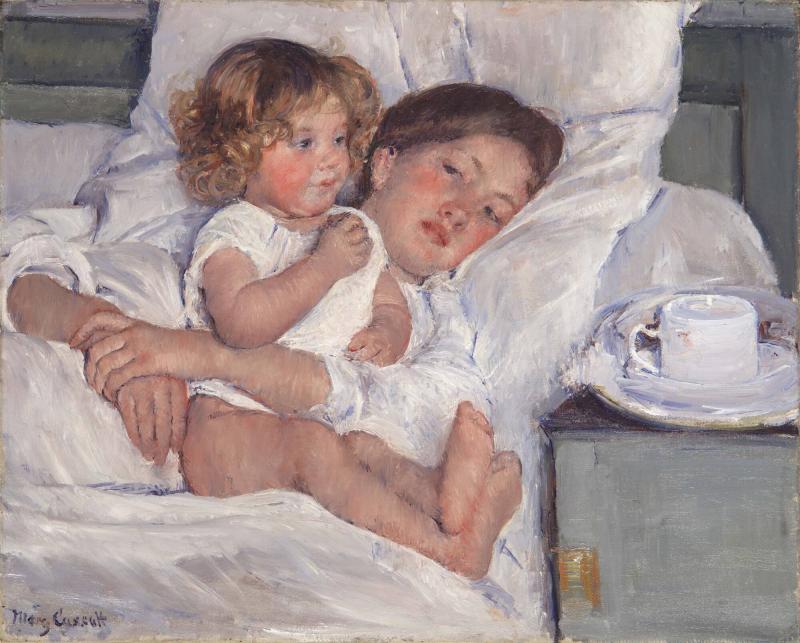
A group of lively 1st graders enters the double doors of The Huntington’s Virginia Steele Scott Galleries of American Art. As they are ushered into the foyer, all eyes alight upon Mary Cassatt’s 1897 painting, Breakfast in Bed. There is an audible gasp and a collective exclamation – “It’s Mary Cassatt!”

That this sense of awe, mixed with recognition, comes from 1st graders is why Guy Fish, Senior Manager for Art Education at The Huntington Library, Art Collections and Botanical Gardens, thinks Pasadena Unified School District’s (PUSD) and Pasadena Educational Foundation’s (PEF) My Masterpieces Program is in itself a treasure. He says, “That’s exactly what we’re trying to do! The program inspires passion and a love for art.”

Fish explains The Huntington’s collaboration further, “We were one of the co-developers of this pilot program; it is unique in its goal of stirring emotion, fostering knowledge and advancing understanding of the arts among schoolchildren. We are scaffolding and building these kinds of relationship with artwork. And we take seriously our charge of laying the Humanities foundation for young kids. We have a very important role to play; imagine if we didn’t do this and these kids go on to the 2nd grade program without this starting point.”

According to Fish, The Huntington’s focus for the one-hour field trip is to teach children the value of a museum experience. Each class is divided into small groups and a docent introduces the children to Henry and Arabella Huntington’s life as they tour the mansion.  Docents for the My Masterpieces Program are specially trained on how to make the visit fun and interesting.

To prepare the kids for their tour, teachers discuss in class the three paintings that they will see at The Huntington. They talk about these pieces of art and by the time the children come here, they’re already seeded with curiosity to see the actual painting – their visit adds another layer of meaning to the lesson.

“As our students are 1st graders, we focus on the theme of caring, while showing them the principles of line, shape, color and texture. Every artwork we choose to analyze portrays how this message is exemplified. One of the paintings they study is called The Clavering Children, a work of 18th century English painter George Romney. It encapsulates the basic concepts of art – warm and cool colors, line, texture and shape. It also shows a boy and a girl caring for each other and their animals … something most kids would relate to,” Fish further elaborates.

Another piece of artwork children look at during their field trip is called The Last Gleanings, an 1895 oil on canvas masterpiece created by French painter Jules-Adolphe Breton. It depicts a harvest scene, one of several paintings Breton produced that illustrates his love for the countryside.  To PUSD’s 1st graders, the painting shows caring for the land. 

Courtesy Photo

But it is American painter Mary Cassatt’s 1897 Breakfast in Bed that makes the biggest impression in these young children’s minds. An oil on canvas work showing a mother with her young child, painted in light colors, it is one of a recurring theme in Cassatt’s body of work. 

Early this year, The Huntington inaugurated the new Visitors Center that features four multi-room classrooms, among other things. According to Fish, they are thinking of adding a new component to their My Masterpieces program in January making use of those classrooms. He’s currently working on a plan to expand their program beyond kids analyzing artwork, but maybe creating their own. They now have the facilities to make that happen.      

An award-winning program, My Masterpieces received the prestigious CAMMY Award from the California Association of Museums in 2012. In 2010, it was also recognized by the California School Board with the Golden Bell Award. It was established during the 2008-2009 school year as a collaboration between teachers and various cultural organizations to bring about a high level of engagement among students.

It is this spirit of collaboration that proves My Masterpieces to be a worthwhile endeavor for The Huntington. As Fish explains, “It reinforces our commitment to our long-term partnerships; our work has matured into a deep relationship with PUSD. It also allowed us to systematize our school engagement. It was the springboard for The Huntington’s Teacher and School Programs, which developed the curriculum that supports the Common Core standards. The art course  offered by the My Masterpieces program isn’t far from the project-based learning promoted by the Common Core. Using the resources available at The Huntington, teachers from K-12th grade choose from 12 programs to provide students appreciation, engagement, and understanding of various subjects.”

The Huntington’s My Masterpieces field trip occurs during regular public viewing days. Visitors from far-flung countries as well as local tourists, together with PUSD’s 1st grade students, spend their day admiring the wealth of treasures this beloved institution has to offer. Arabella Huntington would have been delighted to know that Mary Cassatt’s Breakfast in Bed elicits as much appreciation from the youngest guests as from learned art aficionados.       

Pasadena Educational Foundation’s Summer Enrichment Program

Pasadena Educational Foundation at PUSD | Photo by Terry Miller / Beacon Media News

Originally published on 12 March 2015 in the Pasadena Independent, Arcadia Weekly, Monrovia Weekly, and Sierra Madre Weekly

The Pasadena Educational Foundation, a community-based non-profit organization, was established in 1971 to support, enhance, and supplement the programs, initiatives, and priorities of the Pasadena Unified School District. Twelve years ago began offering a summer enrichment program for students in Pasadena and neighboring cities. Its slate of classes combines academic, athletic and art subjects designed to engage children in a fun and stress-free environment. The half-day schedule leaves students ample time to enjoy their summer break while keeping their minds ready for the school year ahead.

For PEF’s new Program Manager, Jamie Powell, and Marketing Director, Monica Bosserman Lopez, the summer program actually began in the fall, just as students were settling into the new school year. Teachers were lined up and they submitted proposals for what subjects they are planning to teach, last October. In December, Powell had the roster of classes; in February, brochures were printed and the first outreach effort launched.  

The success of PEF’s programs ensures its return every year and with it, now locations may be added.  The program runs from June 15 through July 16, Monday through Thursday. For incoming kindergarten and 1st grade students, there is a self-contained class that runs all three blocks. For 2nd through 8th graders, they have a choice of three blocks. High schoolers have one block to choose a prep course. The K-8 programs are from 8 am – 12pm; 9-12 programs are from 9 am – 12 pm.

This year’s participating schools are: Don Benito Fundamental (K-6); Franklin Elementary (K-6); McKinley (K-8); San Rafael Elementary (K-6); and PUSD headquarters (9-12). Online enrollment registration (www.pased.org/summer) is going on now until May 29 and you can view available classes in real time. As classes fill quickly, you need to register right away. If you’re applying for scholarships, you can also apply online with proof of eligibility and it’s at first-come, first-serve basis.

Tuition for the summer programs are:  PUSD students (K-8) $420 for the first student; non-PUSD student (K-8) $500 for the first student; PUSD student (9-12) $250 for the first student; non-PUSD student (9-12) $300 for the first student. Each additional sibling student gets a $25 discount; there may be an additional materials fee for some classes. Tuition balances must be paid in full by May 29.

According to Powell and Lopez, two exciting classes available this year are 3-D Printing and Robotics (Beginner, Intermediate and Advanced), both offered at McKinley. Robotics and 3-D Printing are also offered at Don Benito. Language Immersion Program in Spanish is available at Franklin and San Rafael; and Mandarin is offered at Don Benito.

For teachers taking part in the summer program, it is an opportunity for them to indulge in a favorite hobby, like doll-making, and to share that interest with a roomful of young learners. Still for some teachers, it is a chance to expand on lessons and subjects that don’t fit in the regular school year.  

PEF’s summer curriculum fills and addresses the needs of all students, ranging in age from four years to 18 years old. With a wide range of courses on offer, children are sure to find an activity that piques their interest and passion. 

Introduction to kindergarten classes prepare young children for school with language arts, math, art and music. Introduction to first grade eases the transition from kindergarten to first grade through thematic activities in reading, writing, and math. 

A quick glance at PEF’s brochure reveals a potpourri of useful classes for elementary and middle-schoolers. For those struggling with writing, a tool like Thinking Maps helps students  get organized in a fun way. In the language arts, students can learn writing in several genres including fiction, non-fiction, and poetry. Meanwhile, book lovers and reluctant readers alike can take a Book Club class. Round table discussions explore characters, plot, theme, conflict, and resolution.

In the field of Visual Art, an art studio class exposes students to drawing, painting, collage, printmaking, and sculpture to help them create their own original artwork. Dual emphasis on technique and creative expression is taken in this class. In Performing Art, there is creative dance — from ballet, to jazz, to modern; theatre class touches on acting exercise, improv and pantomime. Music classes in violin, recorder and ukulele are offered.

Craft classes in jewelry-making, knitting, embroidery, and folk-art dolls have students working with a variety of threads, yarns and needles.

On the STEM (Science, Technology, Engineering and Math) program, students can take marine biology, botany, physical science, space engineering, algebra or computers. In Math City, future urban planners learn, apply, and combine geometry with money skills to design, purchase, build and measure a neighborhood of a model city. They then make money by renting the spaces in their finished construction.

To keep students active and healthy, athletic activities like golf, soccer, and tennis, are offered. For the culinary inclined, cooking is taught along with nutrition, using math and science. They learn to prepare food using basic recipes from various cultures and get to taste their creation.

For high-schoolers, the summer program offers test prep classes in SAT and ACT, provided through another non-profit organization, College Access Plan (CAP). Students get instruction on all three SAT areas (Critical Thinking, Math, and Writing) using video, online, and in-person content delivery. The program will also help prepare kids for the college application process with workshops on choosing colleges, scholarships and personal statement. 

A Graphic Design class is also available for high-schoolers, which incorporates design and 3-D printing. Using software programs like Adobe Photoshop, Adobe Illustrator, Adobe InDesign and 3-D modeling software, students explore the world of graphic design in a creative environment.

With all these courses on offer for Pasadena’s youth, they can spend their summer productively, while enjoying their various pursuits. What a great time to be a student in Pasadena! 

Pasadena Museum of History’s Junior Docent Program

Originally published on 12 February 2015 in the Pasadena Independent, Arcadia Weekly, and Monrovia Weekly

They’re artists, entertainers, scientists and world-travelers. These words describe the former occupants of this glorious mansion on the southwest corner of Walnut Street and Orange Grove Blvd., Pasadena’s famed Millionaires’ Row. Now the Pasadena Museum of History, this Beaux Arts mansion was designed by architect Robert Farquhar, and built in 1906 when Eva Scott and her husband, Dr. Adalbert Fenyes, downsized. Their first Pasadena home was a 33-room Moorish mansion complete with stuffed peacock, a far grander residence than this mere 18-room house. It was home to four generations of the Fenyes clan until 1973.

I learned about the remarkable Fenyes family one Friday morning when I joined a group of 3rd graders from Roosevelt Elementary as our junior docent, KC Young, from Marshall Fundamental School, told us the story of Eva and the doctor. KC led us to a child’s bedroom on the second floor where she showed us an elaborate doll’s house and then to the master bedroom where a vanity held Eva’s grooming items like her brush etched with the distinctive Fenyes crest.

We went downstairs to the studio where an ancient Victrola shares pride of place with a grand piano. Eva played four instruments – guitar, piano, mandolin, and violin – and entertained extensively. They staged elaborate shows here and at one end of the room, a staircase leads to a platform where an orchestra played the musical accompaniment for performances and parties. It was also where Eva painted her portraits and landscapes. Eva’s wide circle of friends included many artists and her home became the salon and meeting place for the flourishing art colony in Pasadena.

Fenyes Mansion | Courtesy Photo

Our group’s last stop was the kitchen where we inspected the stove, icebox, bread toaster, irons, even an old Bissell rug cleaner, the precursor to a household staple, the vacuum cleaner .We were all intrigued by the ‘call box,’ which had the names and rooms of the various occupants of the mansion. The Fenyeses summoned their servants using this contraption, a more ‘modern’ version of the one American audiences see when they watch Downton Abbey on television.

KC Young is one of 31 junior docents for the Pasadena Museum of History. The Junior Docent Program began in 1988 as a collaborative project between PMH and Pasadena public and private schools. Through its peer-teaching method, exceptional students in 7th and 8th grade develop skills in leadership, time management, and public speaking. It fulfills the social studies standards mandated by the state and offers students an early introduction to community service.

According to Brad Macneil, PMH’s Education Program Coordinator, his challenge is getting young kids excited about life and culture in Pasadena at the turn of the 20th century, and how these contrast with the present day.  He has been spearheading this program for 14 years and is proud with what it offers – a rare opportunity for students to teach other students in a way that is quite different from how other tours are conducted.

In the fall, a select group of 7th and 8th graders undergo seven two-hour sessions on Wednesday afternoons. They learn everything there is to know about the mansion, its former occupants, and all the prized collections housed in this grand residence. Upon completing their course, these young docents give their first tour to their families. They are then tasked with leading tours for 3rd and 4th graders of PUSD in late winter and spring; junior docents give several tours in the duration of their term. Senior docents accompany them during their interactive tours to evaluate and coach them to perfect their touring skills. However, they don’t have memorized scripts to follow; they conduct tours the way that is comfortable for them.  

The day I was there, my first guide, KC Young, was the storyteller who engaged me and the 3rd graders with her inimitable enthusiasm and verve. I took a second tour and my guide, Preston Kealing, was the learned professor who taught me and 4th graders from Jefferson Elementary School how the Fenyeses’ remarkable personalities permeated Pasadena society and influenced the world of politics. KC and Preston had very different styles of imparting knowledge, yet they both conveyed the Fenyeses’ significant contribution to Pasadena’s culture and history.

At the end of the morning’s tours, all students and their docents gathered at the foyer where we all shared what we thought was the most interesting part of the experience. Asked what some students would like to take with them from 1906 to 2015, some said they would take the doll house, or the monkey cage, or the Victrola. While they each had a different idea of what was most memorable about this mansion, they all agreed that it had been a fun way to learn. 

I was amazed at how much I learned from 12 and 13-year-old students; I left the Fenyes mansion more aware and enlightened than when I first arrived. I am convinced the Junior Docent Program is as much a valuable Pasadena treasure as any mansion on Millionaires’ Row.