‘Miracle on 34th Street’ at The Pasadena Playhouse

Originally published on 13 December 2017 in the Pasadena Independent, Arcadia Weekly, and Monrovia Weekly
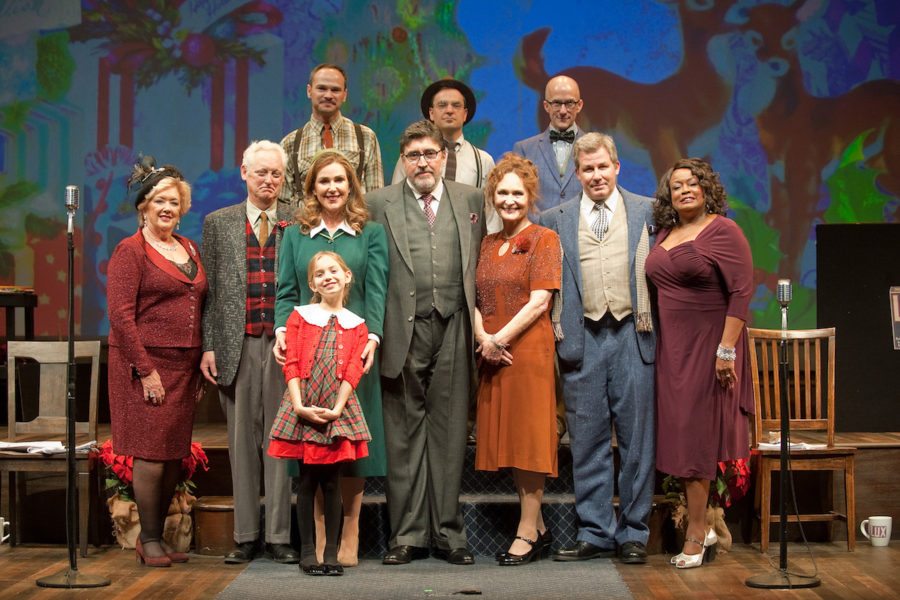
Cast of “Miracle on 34th Street” | Photo by Nick Agro / Pasadena Playhouse

The Pasadena Playhouse, the State Theatre of California, presents a limited engagement of 14 performances of ‘Miracle on 34th Street’ from December 14 to 23, 2017. Originally a radio play, it is celebrating its 70th anniversary on stage, fittingly, at the Playhouse which is marking its centennial year.           

Directed by Cameron Watson, who helmed the recent revival of Tennessee Williams’s ‘Cat on a Hot Tin Roof’, it stars Peri Gilpin (Roz Doyle on NBC’s ‘Frasier’), Beth Grant (Beverly Janoszewski on Hulu’s ‘The Mindy Project’), and award-winning film, television, and stage actor Alfred Molina (‘Raiders of the Lost Ark’) as Kris Kringle.

‘Miracle on 34th Street’ is a staple on TV during the holidays. Most of us know the story of Kris Kringle, who substitutes as a department store Santa Claus and claims to be the real thing. He goes all the way to the Supreme Court to prove his sanity and his assertion.

“What is much less known is that this story was very popular as a radio play, when all of America used their ears and their imaginations to completely realize the story,” discloses Danny Feldman, Pasadena Playhouse’s Producing Artistic Director. “And now in 2017, seventy years later, the eyes of our audience get to watch what went into producing the performance live, which its original listeners never got to see.”

“I’m happy to report that the story in the radio play and movie are very similar,” informs Grant. “What’s going to be fun for us is that we will be presenting it as though we are actually doing a radio play with sponsors, commercials, a foley artist, and a narrator. I can’t wait!  I’ve always thought it must have been such an imaginative process for people who were only listening to it.”

Grant plays the role of the mother of the little boy whom Santa sends to Gimbel’s to get the fire engine which Macy’s doesn’t have. She enthuses, “I’m very thrilled and honored to play the role that Thelma Ritter made famous in what was her first feature film. That has always been my favorite sequence and Thelma Ritter is one of my heroes.”

Besides that part, Grant will be playing others.  She pronounces, “When Cameron told me I would be playing several different roles I got so excited! I love doing character work and disappear in my character, and to do so many in one night would be a fun challenge.”
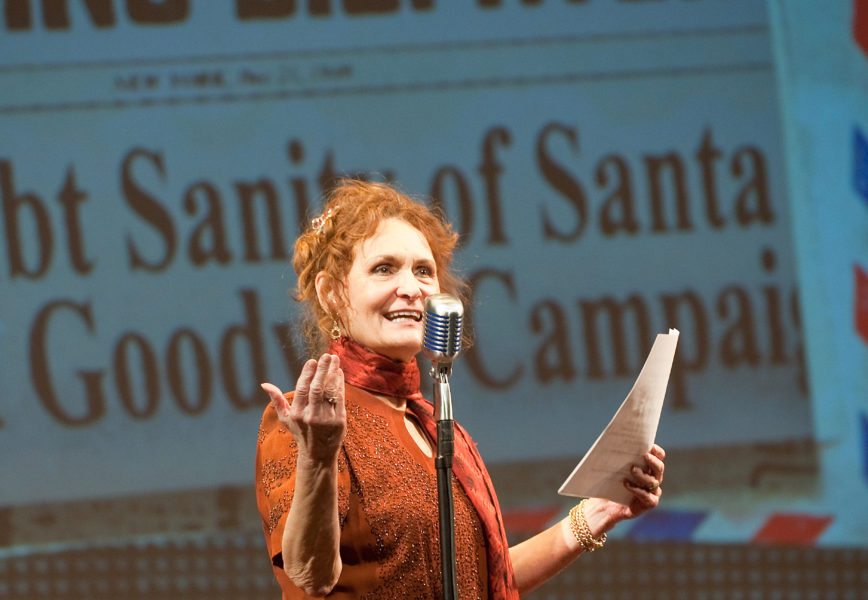
Beth Grant | Photo by Nick Agro / Pasadena Playhouse

“This isn’t the first time that Watson is directing Grant and she is quite ecstatic to be reunited with the director. “I said ‘yes’ as soon as Cameron asked – I will always work for him anytime, as long as I’m available. He is the most collaborative director I know. He is gentle, kind, and loving but at the same time he’s tough. He’ll keep after you if he sees something that needs to come out,” Grant states.

“Cameron is crafting a ‘framing’ for the radio play, adding his artistic genius to create the reality of being in a live performance,” adds Grant. “He is also using unexpected casting in the various roles – we have some great surprises!”

On learning who her costars were going to be, Grant declares, “I am so thrilled to be working with Peri; she and I have been friends for years, through Cameron. I saw them act together at The Pasadena Playhouse in ‘As Bees in Honey Drown’ by Douglas Carter Beane. She is such a lovely person, with a terrific sense of humor. All that, and beautiful too! And Alfred Molina as Santa? Say no more!”

It’s refreshing to hear that admiration for fellow performers coming from an actor as seasoned as Grant.  She has been in several celebrated and honored films in the last few years that you’d think she has a knack for picking the right project to attach herself to.

Known as Hollywood’s lucky charm, Grant has co-starred in three Academy Award-winning Best Pictures: ‘The Artist’, ‘No Country for Old Men’, and ‘Rain Man’. She has twice received the Screen Actors Guild Ensemble Award for ‘Little Miss Sunshine’ and ‘No Country for Old Men’. She also voiced the Academy Award-winning Best Animated Feature, ‘Rango’.

Grant says of her previous successes, “I have been very lucky to have been in so many great films but I have not picked them so much as they have picked me. I try to say ‘yes’ to any great role, no matter the size or even the character, as long as I understand the character’s role in the story and I believe that the story needs to be told. I love to be challenged, to find the goodness in a ‘bad guy’. I love a story with a heart, to make a statement as long as it’s entertaining in the process.”

“From reading the scripts and knowing the filmmakers, I can tell which ones would do well with audiences and academy members. I did believe that Barry Levinson’s ‘Rain Man’ and the Coen Brothers’ ‘No Country for Old Men’ would go all the way,” continues Grant.

“I was pleasantly surprised that ‘The Artist’ was so commercially well-received. I loved it so much but because it was a black-and-white, silent film with subtitles, French stars, and French director, I thought it would just play the art houses. I was so proud and thrilled that it was appreciated on such a grand scale.
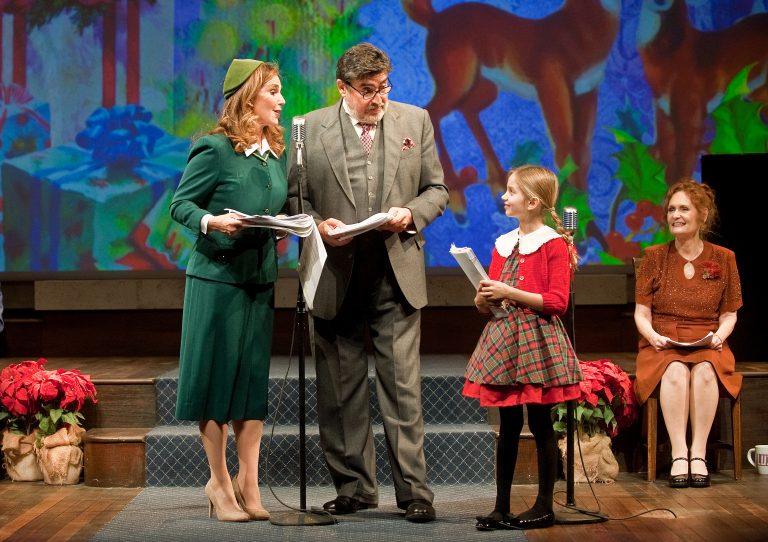
Peri Gilpin, Alfred Molina, Cecilia Witt, and Beth Grant | Photo by Nick Agro / Pasadena Playhouse

I’ve been right a few times, wrong a few times; liked movies that didn’t do well. But, always, I go back to the work and have that optimistic anticipation for what’s next,” Grant says further.

This seasonal production is a first for Grant, “I have never done a Christmas show and I’m thrilled because I love Christmas more than any other time of the year. I’ve always felt renewed during the holidays and I promise you that every single year something magical happens in my life! I am still a child at heart, especially during the holidays. I love everything about the season!”

‘Miracle on 34th Street’ is showing at the Pasadena Playhouse, another first for Grant. She declares, “I’ve been to see quite a few shows at the beautiful Playhouse but have never worked here before and I’m very honored! And did you know it’s also their 100th anniversary!

I love TV and movies, but there is nothing like this experience. When you are on the stage, creating a character, telling a story to a live audience, something truly spiritual happens. We are all one on this journey together. I feel so close to the audience; and each one has his own personality!”

Grant concludes, “I hope everyone who sees ‘Miracle on 34th Street’ has a swell time, feel happy, and encouraged about life after they get back home.”

‘Miracle on 34th Street’ makes even the most skeptical among us believe that wishes can come true. That is the true magic of Christmas. One can only imagine Grant contentedly sipping hot cocoa, joyful with the knowledge that she somehow helped bring the spirit and warmth of the season to one and all.
‘King Charles III’: A Contemporary Future Play on Stage at the Pasadena Playhouse

Originally published on 13 November 2017 in the Pasadena Independent, Arcadia Weekly, and Monrovia Weekly

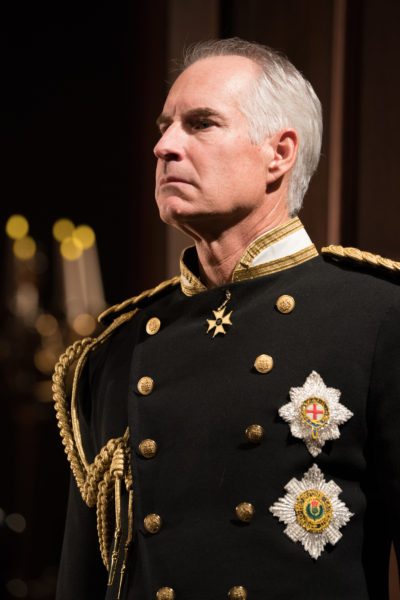
Jim Abele as King Charles III | Photo by Jenny Graham / Pasadena Playhouse

If we were to determine how we feel about our neighbors across The Pond by the popularity of shows on PBS and the BBC, we could confidently conclude that Americans are enamored with all things British.

Their class structure for one, which is vastly different from ours, is a source of endless curiosity. Our fascination with the English aristocracy made a phenomenal success of ‘Downton Abbey’ set at the turn of the 20th century depicting the intersecting lives of the Crawleys and those who served them. Never mind that breaching the class system at that time wasn’t slightly plausible; we wanted to believe the Crawleys had an innate goodness.

More recently, the lives of English monarchs, past and present, are being serialized in ‘Victoria’ and ‘The Crown’. These programs will chronicle two widely admired queens’ reign through the decades, for our extended viewing pleasure. We just couldn’t get enough of the Royals.

And now the British monarchy or, more accurately, ascension to the throne is the focus of a future history play that’s on stage at the Pasadena Playhouse from November 8 to December 3, 2017. Written by Mike Bartlett, ‘King Charles III’ was the winner of the 2015 Olivier Award for Best New play and is the second production in the Playhouse’s 2017-2018 season. It also marks the play’s Southern California premiere.

‘King Charles III’ is directed by Michael Michetti, who is also helming two other Pasadena productions – ‘Mrs. Warren’s Profession’ at A Noise Within, and ‘A Streetcar Named Desire’ in February at The Theatre @ Boston Court, where he is Co-Artistic Director.

According to Michetti he saw the Broadway performance, which was essentially a remount of the British production with the original cast, two years ago and absolutely loved it. When the Pasadena Playhouse’s Producing Artistic  Director, Danny Feldman, selected the play and asked Michetti to direct, he jumped at the chance.

Says Michetti, “While this staging is not going to be the same as what was done in London’s West End nor the one I saw on Broadway in New York, we are not intentionally trying to change it. I thought it was a wonderful production and it was beautifully done. But any time you mount a show you take into consideration all the conditions, including where it’s being produced, what the space is like, who the actors are, and what adjustments need to be made.

Because this is being produced in Southern California, at the Pasadena Playhouse, there were some concerns to address in pre-production. Among them is that the needs of the Playhouse space are very different from that of the Broadway’s.

The Pasadena Playhouse is such a beautiful and historic theater but the challenge was that the stage was too high. Very early on, we brought in a scenic designer to work on the creative space. He fashioned an area that steps down from the stage level to bring the action closer to the audience. This means members of the audience are in the midst of the action, giving the production a real immediacy that’s supported by the style of the play.”

“It’s written in the style of Shakespeare,” Michetti expounds. “And like in a Shakespearean play, there are times when actors break the fourth wall in a soliloquy and speak to the audience. We made sure this connection was maintained. This takes advantage of the stage we have created, allowing for an intimate relationship with the audience. What adds to its intimacy is that the play involves the Royal family whom we know so well.

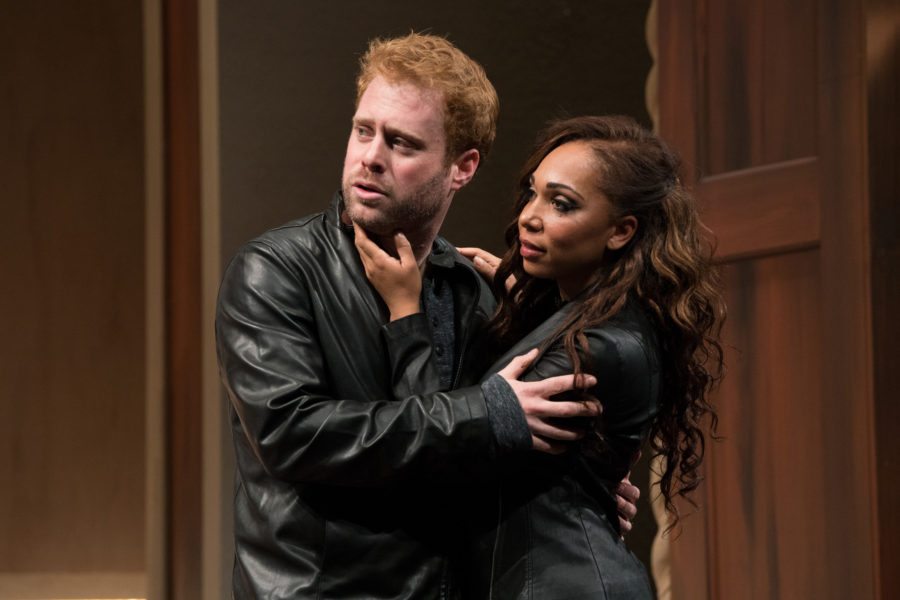
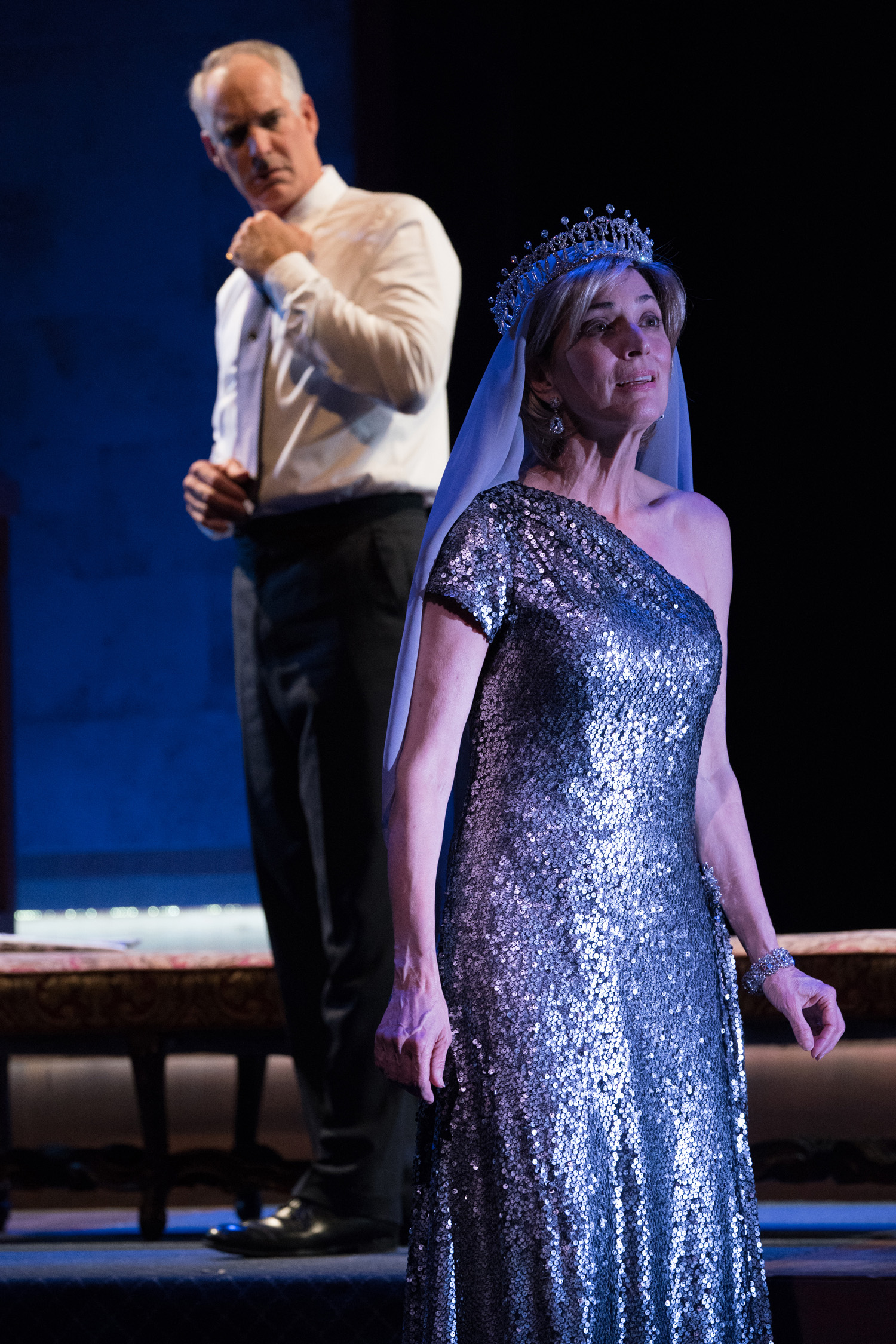
Jim Abele and Nike Doukas, as the family ghost | Photo by Jenny Graham / Pasadena Playhouse

The English royals are people we only see and hear on television interviews. They’re very protective of their image; they don’t let us into their thoughts so we’re not privy to what they’re thinking. Bartlett very cleverly allows us behind closed doors to listen in on conversations that might be happening. That’s extremely powerful.”

According to Michetti contemporary plays in the fashion of Shakespeare are pretty novel. While Bartlett uses a number of Shakespearean styles and inventions like blank verse, ‘King Charles III’ is told with modern characters and in present-day English as well. This makes it easier for the audience to understand.

As befits a play about the royal family, ‘King Charles III’ revolves around people American audiences are very familiar with – Camilla, William, Catherine, Harry – and a few fictional characters Bartlett conjured, including a new love interest for Harry, and a family ghost.

Over the past few years, with the marriage of William to Catherine, who is a commoner, there has been a resurgence in our enthrallment with the Windsors. This young couple has certainly made the royals feel more accessible. That ‘King Charles III’ is arriving on the Southern California stage on the 20th anniversary of Diana’s death has only increased our excitement.

“Our most common recollection of Prince Charles was during the Diana years, when he didn’t quite cut a sympathetic figure,” posits Michetti. “There was a great deal of negative backlash after Charles’s and Diana’s fairy tale marriage crumbled. But Charles and Camilla have since successfully built a healthy relationship with the British public. Many Americans may not be aware of it, but he has regained a good image. While Diana is still beloved in England, the prince, of late, has become more respected.

These days we see a great deal of the Duke and Duchess of Cambridge, William and Catherine, who are very popular with the media and they know how to use the press to better advantage. It is a power they have over the monarchy and the play touches on that.

Because ‘King Charles III’ is about real people my mandate is for actors in the role of Charles, Camilla, William, Catherine, and Harry to avoid playing them as they have been represented in the media. We made a very deliberate effort to make sure they are not delivering impersonations but emulating qualities of them.”

Dylan Saunders as Harry and Sarah Hollis as Harry’s love interest| Photo by Jenny Graham / Pasadena Playhouse

“The play is structured like a political thriller and it gives nothing away,” Michetti discloses. “It begins at the funeral of Queen Elizabeth II.  Charles has become king and he faces challenges which have personal and political impacts as he deals with the transition to the monarchy. The play is surprisingly funny in its portrayal of the characters and the wit with which they tackle their problems. It’s exceptionally smartly written.

When I saw it on Broadway two years ago I was dazzled at how well-crafted it was but it didn’t feel relevant to American audiences. But a lot has happened since. Concerns including the dangers of limiting freedom of the press, the difficulty of political transitions, conflicts between branches of government, and the potential for constitutional crisis are all issues on our headline news every day. I hope that while the circumstances and characters are different audiences will be able to see ourselves, and the current situations in America, reflected in this play.”

‘King Charles III’ has all the elements of ‘must-see TV’ except it’s performed live in front of us. It is replete with captivating personalities we merely glimpse in magazines at the supermarket checkout – a king facing a political emergency as soon as he begins his reign, a prince dating a young woman who has an embarrassing past, a lady coming back as a ghost to haunt the palace.

This production is one that Anglophiles will most assuredly relish. Eager as we are to see how the royals resolve this predicament in the end so are we reluctant to end our enjoyment in watching them keep their wry humor through it all. That they speak in iambic pentameter with their posh accent only adds to our delectation. ‘King Charles III’ is decadently brilliant!

Community Organizer Intern at Pasadena Playhouse

Originally published on 27 August 2015 in the Pasadena Independent, Arcadia Weekly, Monrovia Weekly, and Sierra Madre Weekly

Giselle Boustani-Fontenele had an amazing summer. No, she didn’t do anything daring at some exotic locale like swim with sharks at Ambergris Caye in Belize, or climb the peaks of Mt. Kilimanjaro in Tanzania. Giselle spent ten weeks as The Pasadena Playhouse’s Community Organizer (CO) summer intern.  She did, however, brave the daily commute from her home in Tarzana to Pasadena.

For the first time, the internship program at The Playhouse was financed through a grant from the Los Angeles County Arts Commission (LACAC). Gisele reported to Seema Sueko, Associate Artistic Director, who joined The Playhouse in January 2014 from the Mo’olelo Performing Arts Company in San Diego. Sueko originated  Consensus Organizing for Theatre as a means to build partnerships with the community which, in turn, translates into higher ticket sales.  

During her internship, Giselle learned about Consensus Organizing by asking questions and by watching Sueko, and Victor Vazquez, The Playhouse’s Real Women Have Curves (RWHC) Community Organizer. She attended meetings with potential RWHC, the first show slated for the 2015 season,CO partnerships. According to Sueko, “…our summer intern had an up-close opportunity to experience CO and support these efforts.”

Giselle created the Master Colleges and Universities CO Contact Spreadsheet, a document which consolidates contact information for all the schools The Playhouse has collaborated with in the past or which have shown interest in becoming CO partners.  This document lists institutions, including Stanford, USC, The Claremont Colleges, Azusa Pacific University, Cal State L.A. and Pasadena City College, and others.   

Another interesting job Giselle worked on was preparing the Dramaturgy Starter Kits (DSK) for Real Women Have Curves and Breaking Through. A DSK is an internal document created by the Artistic Department for The Playhouse staff which helps them frame and promote the stage play or musical they are putting on.  This includes information such as the themes of the play and the inspiration for it. Giselle interviewed the artists of two shows – Sueko, who is directing RWHC; Sheldon Epps, Artistic Director of The Playhouse and director of Breaking Through, Kirsten Guenther, playwright  and Katie Kahanovitz, who is working on music and lyrics along with Cliff Downs.  

Additionally, Giselle produced two Learning Community gatherings involving  10-15 trainees who, like her, received their internships from the LACAC. She produced one of these gatherings herself, and the other, she assembled with a fellow-intern in the Pasadena area, Jessie Fontana-Maisel, who apprenticed at California Alliance for Arts Education.  In the first Learning Community, Giselle led a tour of The Playhouse, facilitated the Q&A Session with Epps and Sueko, and handled logistics. 

Giselle also worked on Walk and Learn Notes, an internal document with information for staff members on how they can ensure the safety and security of The Playhouse. This document includes emergency contact information, among other things. She was also involved in managing the reservations list of over 240 guests for the reading of Fabric at The Playhouse;  assisting in preparations for CO receptions during Waterfall and CO rally meetings for RWHC; and assisting with RWHC auditions. She also took on stage managerial duties for the reading of Fabric on the night the Stage Manager could not be present.

A theatre enthusiast herself, Giselle conducted interviews with Director of Finance, Meredith Min, and Producing Associate and Company Manager, Kirsten Hammack, to learn about their positions and their work – invaluable information for someone who might want to start a theatre company in the future. From Min, she learned how to keep track of accounts and ticket sales; the importance of creating balance sheets and P&L (Profit and Loss) statements. With Hammack, she learned about the  requirements and details concerning various unions like the AEA (Actors’ Equity Association), the SDC (Stage Directors and Choreographers Society), and the USA (United Scenic Artists); writing contracts for artists; and maintaining a clear head in times of stress.      

Meet and Greet for Real Women Have Curves fell on the last day of Giselle’s internship. She was there to welcome the artists and the community who came to listen to the table read. 

This month, Giselle will head back to Boston University as a Junior where she is pursuing a joint degree in Anthropology and Religion, and a minor in Theatre. She can’t wait to talk about her transformational ten weeks at The Playhouse with her Acting and Performance professor and mentor, Johnathan Solari. He had encouraged her to intern at a theatre company during the summer.

As a high school student at Sherman Oaks Center for Enriched Studies, Giselle was deeply involved in its theatre department.  She was president of its International Thespian Society and performed in many productions – Shakespeare and contemporary plays, and musicals – under the direction and guidance of John Beckman, Jill Cunningham and Frank Dion.

Giselle hopes to continue learning about and pursuing her interest in theatre while at Boston University. She aspires to take a Stage Directing MFA program in the future. So Giselle didn’t scale the mountains or swim in the deep this past summer, but she certainly got fully immersed in a rare and exciting theatre adventure.     

Pasadena Playhouse Launches Community Organizer Summer Internship Program

Originally published on 28 April 2015 in the Pasadena Independent, Arcadia Weekly, Monrovia Weekly, and Sierra Madre Weekly

As summer internships come, the one offered by the Pasadena Playhouse is, by far, one of the most challenging and exciting!  This year’s program was made possible through a grant from the Los Angeles National Arts Council, a first for the Playhouse.

The posted job description for this intern is that he or she will report to Seema Sueko, Associate Artistic Director, to activate the Playhouse’s Consensus Organizing for Theatre Methodology and represent the Playhouse through interactions with community leaders and members of the public. If that doesn’t sound daunting enough, the list of duties should give anyone pause.

Some of the intern’s duties include: conducting a dramaturgical examination of the plays in the 2015-2016 season; supporting the CO work by consolidating information, data and spreadsheets from the 2014-2015 season of CO work; brainstorming and activating Consensus Organizing partnership; and participating in the rehearsal prep work for the first show of the 2015-2016 season, among others things.

That the responsibilities are major and varied require this individual to be a self-starter with a tremendous drive and creativity. He or she needs to have a passion for theatre and its community-building possibilities. The successful candidate would be chosen based on his or her application letter that includes a one-page Community Organizer’s Statement telling Sueko his or her core values as an Organizer and/or personal mission.  

A consistent theme in this entire internship program is that of the Consensus Organizer – a concept originated by Sueko when she founded the Mo’olelo Performing Arts Company in San Diego. She based this methodology from Mike Eichler’s principles of consensus organizing for civic environment. When applied in theatre, this means building stakes in several pockets of the community and inspiring them to get involved back. If successful, this Consensus Organizing method should result in ticket sales and funding opportunities, and a more meaningful connection between the theatre and the community.

It is so apt that Sueko is advocating this concept in an environment that is open to such notion. The Playhouse’s history is steeped in community participation and involvement. When its founding director, Gilmore Brown, died in 1969 and the theatre closed its doors, The Pasadena Playhouse Alumni & Associates continued working. 

In 1985, it reopened as a result of a partnership between the local government, businesses, patrons and various philanthropists. The Playhouse went on to inaugurate new works and significant reproduction of American Theatre. Tony Award and Pulitzer-Prize winning plays and musicals of cultural and theatrical diversity have been featured on the Playhouse stage.

Sheldon Epps, who became Artistic Director in 1997, organized the Theatrical Diversity Program in 2005 that gave youths from disadvantaged backgrounds the opportunity to experience theatre through free student performances and arts education events. In 2013, it supported exploratory outreach initiatives to further engage the Hispanic and Asian/Pacific communities.

Under Epps’s helm, the Playhouse launched the national tour of Purlieincoordination with the Goodman Theatre; Sister Act: The Musical, which played at the London Palladium in the West End and at the Broadway Theatre on Broadway, and Baby, It’s You, which was presented at Broadhurst Theatre on Broadway.  He also oversaw the production of A Night with Janis Joplin; Stormy Weather: The Lena Horne Story, Can Can: The Musical, and Ray Charles Live. Other performances staged at the Playhouse include: Fences, starring Laurence Fishburne and Angela Bassett, with Epps directing; The Heiress, featuring Richard Chamberlain; Citizen Kane, with Val Kilmer; Above the Fold, starring Taraji P. Henson; Stoneface, with French Stewart; and KissMe, Kate, starring Wayne Brady, and once more directed by Epps.

Sueko’s addition to the Playhouse staff in January underlines Epps’s conviction that diversity and engagement with the community are founding principles of this venerable institution. In a January feature story in American Theatre, she explains consensus organizing for theatre. “A mutual stake is built by surfacing mutual self-interests. The theatre knows what its self-interests are, and it initiates mindful conversations with community members and businesses to bring their self-interests to the fore. Where things align, that’s where the organizing happens – we organize around that.”

The Playhouse has come full circle from its early beginnings as the Pasadena Community Playhouse, when the tremendous local support moved George Bernard Shaw into giving it the sobriquet “the Athens of the West.” 

It is in this scene where the Playhouse’s summer intern will enter to further act on the methodology Sueko pioneered called “consensus organizing for theatre.” For Epps, its success would be a defining moment for The Pasadena Playhouse and solidify its place in history as the State Theatre of California.