‘Ragtime: The Musical’ Goes on Stage at the Pasadena Playhouse

Originally published on 11 February 2019 in the Pasadena Independent, Arcadia Weekly, and Monrovia Weekly
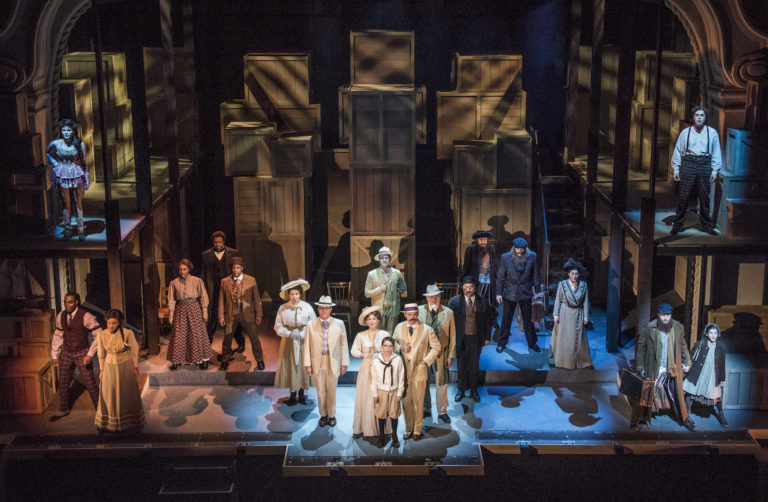
‘Ragtime’ ensemble | Photo by Nick Agro / Pasadena Playhouse

The Pasadena Playhouse is presenting one of its most lavish productions yet – ‘Ragtime: The Musical.’ Directed by David Lee, with choreography by Mark Esposito and musical direction by Darryl Archibald, it is on stage from Tuesday, February 5 through Sunday, March 3, 2019.

Danny Feldman, The Playhouse’s indefatigable Producing Artistic Director, chats with us during the busiest day of rehearsal week, and tells us why he chose ‘Ragtime.’

“This 1997 musical was based on an E.L. Doctorow book written in the mid-1970s. It premiered at the Shubert Theatre in Century City before it was on Broadway. I saw ‘Ragtime’ 21 years ago and it was one of the most incredible shows I’d ever seen. It was a new production but it felt like this old-fashioned epic – with a lot of people, so much dancing, and a large orchestra. I fell in love with it!”

“About a year and a half ago, when I was planning this slot, I knew I wanted to do a big, splashy show for my second season,” continues Feldman. “We hadn’t done something like that in a while and I kept coming back to it. While the book was published in 1975 and the musical was first produced two decades later, ‘Ragtime’ felt tremendously relevant – like it was written today.

“The show deals with America at a decisive moment in our history, right after the turn of the century up until World War I. It was a time when America was going through radical change – when we were trying to figure out who we were, striving to get along with one another, and considering what kind of country we wanted to be.

“Then I realized we were in another one of these moments. We’re again asking ourselves ‘What is America about?,’ ‘How are we moving forward?’ There’s a great deal of clash and conflict right now. ‘Ragtime: The Musical’ explores that conflict – not today’s, but that at the turn of the century, yet there are so many parallels to it. I suspect that people who are watching the show, who’ve seen it before or even those who’ve never seen it before now, will think we altered it to make it about today. But we didn’t change a word!”
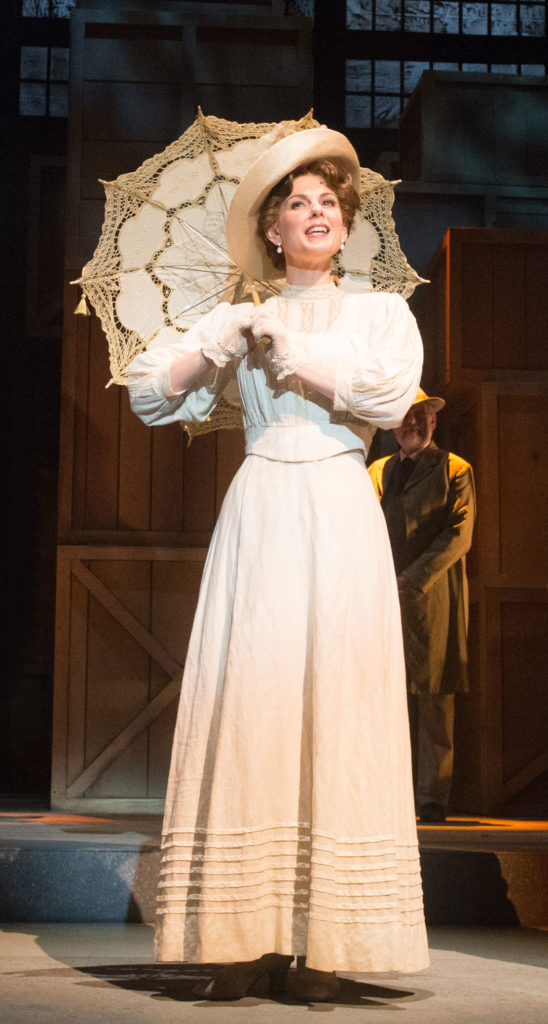
Shannon Warne as Mother | Photo by Jenny Graham / Pasadena Playhouse

Explains Feldman, “One of the through lines in the show was about women standing up for themselves, redefining their relationship in the household, and finding value. Then there was the African-American family who suffered a hate crime perpetrated against them, representing the theme of justice and fighting for what’s right. The third family we’re following personifies Jewish immigrants coming through Ellis Island, what they faced as outsiders, and how Americans treated them.

“These same issues are in the news every day! It’s not a play about 2019 but in many ways it is a play about 2019. And, like any masterpiece or great piece of art, when looked at over time through a new lens, we see different things in it. And with ‘Ragtime’ we’ll find distinct aspects in it today, given where we’re at. As serious as I make it sound, though, it’s also wildly entertaining. It’s a brilliantly constructed show full of sentiment and laughs; it hits you in the heart and the gut all at once. It is, ultimately, an American story that’s uplifting and hopeful. I think it has the power to move people deeply.

“It’s these things all rolled into one great night of theatre. And it’s not done a lot because it’s a pretty big undertaking. It has a 16-piece orchestra and a 21-person cast. We’re jumping all over New York in terms of locations in the story.”

The sheer enormity of the show makes for a truly amazing experience for the audience. Says Feldman, “Our stage is as big as that of a Broadway’s but our seating area isn’t; the Shubert Theatre, I think, had over 2,000 seats. But that’s great because watching that size musical in a 650-seat venue gives you a more intimate experience – you’re really connecting with what’s happening on stage.

“Watching rehearsals, I’m reminded that the combined resonance created by 21 actors with big voices and an orchestra is so powerful, particularly when they’re singing this beautiful score; it knocks you over. It’s pretty exciting! The experience you’ll have sitting in this theatre hearing 40 musicians and actors singing at you, I don’t know where else you get that.”

Asked if he’s making a statement with this show, Feldman replies with a thunderous “Yes! I’m glad you’re listening! The Pasadena Playhouse creates audacious shows. Sometimes it’s in the form of ‘Bordertown Now’ which is the culture of what’s going on today. Sometimes it’s a big celebrity doing a play here. But sometimes it’s a big, bold, ambitious musical. I think everything I try to program and create here has a sense of adventure and boldness in it. I want our audiences, whenever they come here, to be surprised by something we’re doing and to really feel something they’re not used to feeling. This show is in line with all our other ambitious projects.”

“The next play we have coming up, ‘Tiny, Beautiful Things,’ is just as bold in a very different way. I think the impact of a show as grand as ‘Ragtime’ and the intimacy of a little production like ‘Tiny, Beautiful Things’ will demonstrate what we’ve already done since I’ve been here, and what we’re constantly trying to accomplish – that to be a whole theatre experience you need the big and the bold as much as the small and the quiet. And they’re equally powerful.”

Coalhouse and Crew (from left: Candace J. Washington, Clifton Duncan, Cornelius Jones, Jr., and Bryce Charles) | Photo by Jenny Graham / Pasadena Playhouse

Throughout its hundred-year history, the Pasadena Playhouse has retained its core mission. Reiterates Feldman, “A lot of the theatre people go to see are national tours – ‘Hello Dolly’ or ‘Jersey Boys,’ for instance. They’re great! I see all of them and I love them all. I’m a huge fan of bringing in all these big Broadway musicals for people to enjoy. But we’re different here, we don’t see the show in New York and decide we’d rent the sets and the costumes and bring the show here as part of a tour stop.

“However, I don’t want to come off as being negative about national tours and theatres that do. To have a healthy theatre ecosystem, you need those who are building it by themselves and others who are bringing it in; those are necessary components for an interesting cultural landscape.

“My goal is to have as many people as possible see our work. If, in the future, someone sees our show and says ‘Let’s take it to other places’ that would be delightful, but that’s not why we exist. We exist to serve this community. That’s been our mission for a hundred years and we’re continuing to do that. It’s what the Pasadena Playhouse is all about.

“We’re proud that ‘Ragtime’ is made here; it’s pretty much like growing organic grapes. We start with a blank page where people come together and say, ‘For four weeks, we’re going to tell this story on this stage in a big, bold way.’ It is created of, by, and for this community. And that’s what makes it extra special.”

The stories of the three families we’re following in ‘Ragtime’ unfold in New York, yet they could very well happen here. Feldman asserts, “While we have a unique history in Pasadena, we also have conversations about race and instances of segregation. I think Americans, as a culture, don’t want to talk about the troubled parts of our past. We have a way of thinking ‘We know this happened in our past and it’s shameful. But that was the past, it’s not now.’ That’s something we explored in ‘Hold These Truths,’ a play we did about the Japanese internment camps during the anniversary of the imprisonment.

“To me, the reason theatre looks back at history isn’t to shame anyone, but to learn from things we’ve done in the past. Because, whether we like it or not, that’s part of who we are as a people. A production like ‘Ragtime’ speaks to our past as if to say ‘Let’s unpack this.’ There are moments that are uncomfortable. But the goal, particularly with ‘Ragtime,’ is not to dwell in it for the sake of dwelling in it. It’s to show, in many ways, how far we have come and how far we have yet to go. Our job as a theatre, and mine as an Artistic Director, isn’t to prescribe that for people but to put the work out there and let people take from it what they will.”

If audiences, after watching ‘Ragtime’ at the Pasadena Playhouse, examine their own failings and resolve to be better human beings, then theatre will have served a higher purpose than merely entertained. And that would, indeed, be a noble feat.
Pasadena Playhouse Presents ‘It’s a Wonderful Life’ Radio Play

Originally published on 11 December 2018 in the Pasadena Independent, Arcadia Weekly, and Monrovia Weekly

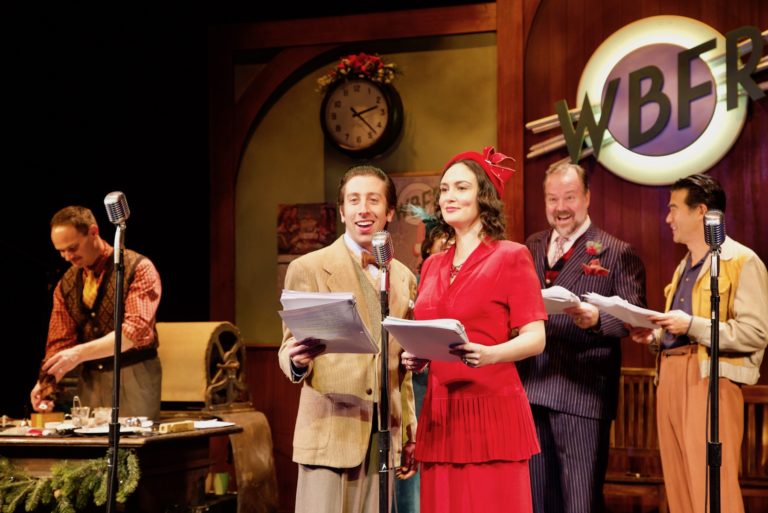
Shown left to right: Jeff Gardner, Simon Helberg, Rebecca Mozo, Rob Nagle, and Ryun Yu in ‘It’s a Wonderful Life: A Live Radio Play’. – Photo by Brick Patrick

There are some movies that so embody the spirit of Christmas that we want to watch them every year. One of those films is Frank Capra’s ‘It’s a Wonderful Life,’ which is now considered one of the best motion pictures ever made.

‘It’s a Wonderful Life: A Live Radio Play,’ will be part of the largest holiday celebration in the history of the Pasadena Playhouse. On stage from December 12 through December 23, it was adapted by Joe Landry from the celebrated 1946 film.

Simon Helberg, whom most of us know as Howard Wolowitz in the CBS award-winning smash hit ‘Big Bang Theory,’ stars as the despondent George Bailey who’s contemplating suicide. His guardian angel intervenes and shows him what his town would have been like had he never been born.

Actor, director, and producer Cameron Watson, who directed last year’s Pasadena Playhouse radio play ‘Miracle on 34th Street’ will once again be at the helm. He distinguishes each production, “Last year’s show, which is an iconic holiday story, is a lighter piece viewed from a child’s perspective and we used some animated backdrops, like the Christmas cards, to underscore that.

“On the other hand, ‘It’s a Wonderful Life’ is a pretty dark tale which starts with George Bailey ready to jump off the bridge. The roles are meatier and the characters are more complex in this piece. While we’re treating it as a traditional play, we’re doing something unexpected but will be supported by the story.”

“Joe Landry took all the materials from the script and put them into this radio play format,” Watson explains. “It’s faithful to the movie in a very clever way. One really fun thing about doing a radio play is seeing actors’ versatility. There are only five performers in this play that has about 45 parts. Two actors will be playing the roles of George Bailey and Mary, George’s wife. The three others portray close to 20 characters each, from the cab driver to the various children. And they’re going to do that with merely their voice, there’s no costume change.

“It’s such a treat for audiences to see what went on behind the scenes of a radio play in the old days. They can visually paint the story for themselves; they get to imagine what this cab, for instance, looks like; they can envision the bridge that George Bailey is standing on. I love that it makes for a very open canvas.

“We did ‘Miracle on 34th Street’ last year as the original radio play, which was a Lux Radio Theatre, and it was remarkable. It had the same commercial breaks that were in the radio play from the 1940s. This one will have some built-in commercial breaks as well except that Joe  crafted it so that there’s a little more structure to it.”

“The other good thing about a radio play format is that it’s a short production,” continues Watson. “It’s not a lengthy commitment for actors because it doesn’t require extensive preparation – they don’t have to memorize lines, they’re reading the script. We’ll rehearse it in one week and then the show starts. That short commitment gives us more opportunities to find the best talents. It’s such a privilege for a director to be working with the finest people in the industry.”

Cameron Watson. – Courtesy photo / Pasadena Playhouse

Asked whether this scheme makes his job easier or harder, Watson replies, “I can’t say if it’s easier or harder to direct; I think there’s a purity to the process because it’s all about the text and the words. Our mission is to make the words come alive. In a sense my task as a director is more important than if I were directing a traditional play.

“My focus is to make sure the actors really mine all the emotion in the role so that when they play the 15 or so characters, the audience knows exactly who it is. Each actor has to use a voice specific to a character so the audience isn’t confused, and that requires a different skill set. So I think I have a technical job that I wouldn’t have to do if it were a full production.”

As a Christmas offering, ‘It’s a Wonderful Life’ doesn’t appear to be geared for children. Watson recalls, “I remember watching the movie as a young boy and being scared when George was ready to jump off the bridge. That was scary for children to see because the sense of mortality isn’t something they are aware of yet.”

However, Watson quickly assures, “While it might look dark at first glance, when we get to the part of the story that’s somber, there will be a surprise that I think children will be enchanted by.”

Watson adds, “I was reading it again last night as I prepared for rehearsals and, not unlike last year’s radio play, it’s all about believing in Santa, or in hope, or in whatever we hang our beliefs on. Furthermore, it has a message of self-worth, of how much we matter – to our family, to our friends, to each other. That, in a small way, we are connected to people and we are important … that kindness is important. And I think that’s why the story has withstood the test of time. I get very moved by it; the play is very emotional to me.

“I emphasized to the actors that we have to tell this story from our hearts. Even if it’s a radio play, there will be plenty of sounds that will help the audience envisage what’s going on, for them to have a good time, and to enjoy the play. The actors have to treat it as the most important thing in the world, like it’s the first time the story is being told and that it’s truthful. Because it’s a radio play, there’s a tendency for it to be taken lightly, and actors have to really work hard to impart the message at its core.”

“Oftentimes, we go through life without being aware that a small, kind gesture – a warm hug, a friendly touch, a ‘hello’ to someone we see on the street – is important. ‘It’s a Wonderful Life’ is a story that reminds us that all of us, not matter how insignificant we think we are, have a contribution to make to society,” Watson wisely pronounces.

In our increasingly rancorous and deeply divided society, the lesson of George Bailey’s life takes on a greater significance. It makes us recognize that while, individually, our existence might not seem important enough to make a difference in the world, just as it takes millions of stars to light a dark sky, the good things we do in our little sphere of influence could very well make a world of difference.

The Playhouse Celebrates Halloween with ‘The Woman in Black’

Originally published on 15 October 2018 in the Pasadena Independent, Arcadia Weekly, and Monrovia Weekly

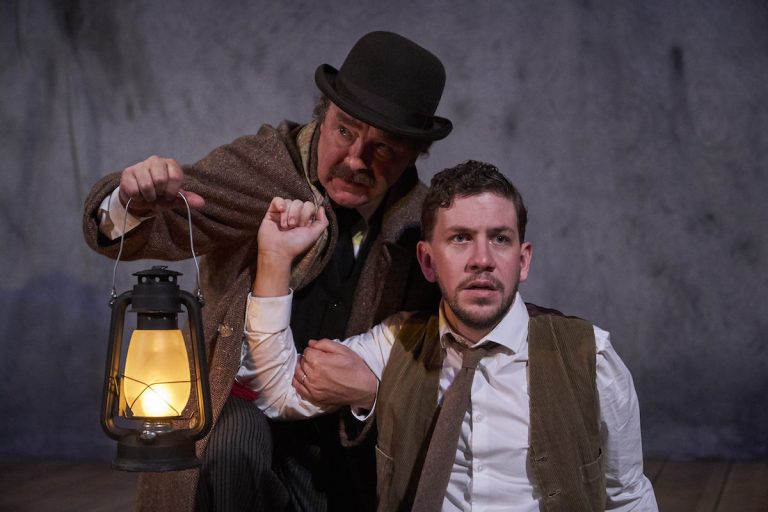
Bradley Armacost and Adam Wesley Brown in Susan Hill’s ‘The Woman in Black’ at the Cleveland Playhouse | Courtesy photo / Roger Mastroianni

London’s second longest-running West End play ‘The Woman in Black’ will premiere on the West Coast at the Pasadena Playhouse from October 17 to November 11, just in time for Halloween. With all the stage wizardry that has led audiences in London to shriek in fear for over 28 years, it promises to live up to its reputation as one of the most terrifying theater events ever mounted.

Adapted by Stephen Mallatratt from a novel by Susan Hill, the play is directed by Robin Herford, who has also helmed all its productions in Tokyo, India, Singapore, Hong Kong, Australia, and New Zealand. He is recreating his original staging for the first time in the United States with Bradley Armacost as Arthur Kipps and Adam Wesley Brown as The Actor.

Hill’s Gothic ghost story is set in an isolated windswept mansion which has secrets hidden behind its shuttered windows. There, a young lawyer encounters horrific visions in the house set amidst the eerie marshes and howling winds of England’s forbidding North Coast.

Years later, he tells his frightening tale to exorcise the terror that grips his soul. Mallatratt’s adaptation is a play within a play, with Kipps rehearsing with an actor to perform the story for his family and friends, thereby making him relive the haunting of Eel Marsh House.

It all begins innocently enough, but as he reaches further into his darkest memories, he quickly finds that there is no turning back. With just two actors, ‘The Woman in Black’ gives audiences an evening of unremitting drama and sheer theatricality as they are transported into a chilling and ghostly world.

Speaking by phone, Armacost describes how he almost didn’t get the role of Arthur Kipps, “Robin Herford cast the play in Chicago at the same time I was playing in Washington D.C. so I wasn’t able to come to the audition. When they had finished casting, he asked if there was someone else they were thinking of for the role and my name came up.

“I did a scene on my iPhone and sent it to the casting director, who passed it on. They caught up with me at an airport where we had a casting session of sorts. I had a half-hour Skype conversation on my iPad with Robin, who was in London. We got on quite well and the next thing I knew I had the role; I found it funny because he had no idea if I even had a leg since all he could see was my face.

“Robin came in from London for the two-and-a-half week rehearsal in Chicago and stayed through the opening in Cleveland. He had to fly back to London for opening night of the 12,000th performance of ‘The Woman in Black’ in London.”

While it has been running in London for almost three decades, Armacost hadn’t seen it. “I was unfamiliar with the play but I knew there was a 2012 film with Daniel Radcliffe whom everyone knows as Harry Potter. I’m surprised my son didn’t bring it to my attention.

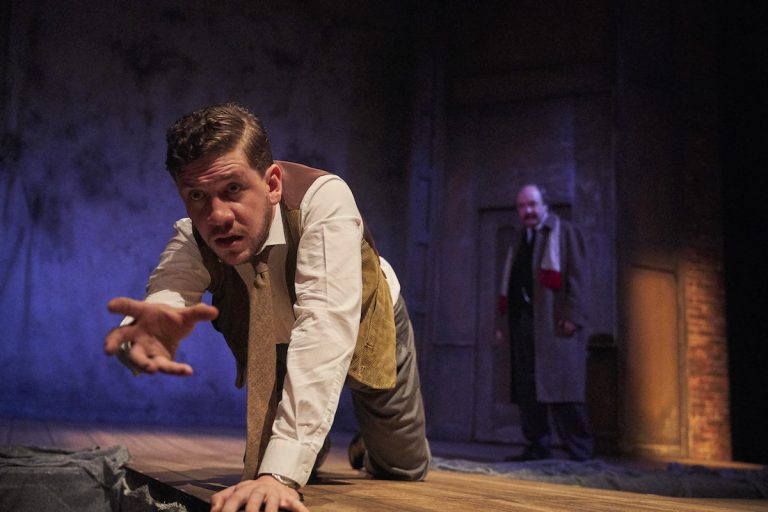
Adam Wesley Brown and Bradley Armacost in Susan Hill’s ‘The Woman in Black’ at the Cleveland Playhouse | Courtesy photo / Roger Mastroianni

“I was told, though, that while the film has the same subject and is taken from the same novel by Susan Hill, it is completely different. In the film there are other actors performing various parts; in the play there are just two of us and we act out all the characters. I perform at least seven characters and my partner plays three. With only two actors on stage, you quickly realize that if he’s not talking, I am. And if I’m not talking, he is.”

That puts a lot of the burden of having to memorize so much dialogue on both actors. But that didn’t daunt Armacost. He says, “First of all, Susan has a good story and Stephen has written a magnificent script. There’s no fat on it, no unnecessary word. It’s to the point, so it’s quite easy to memorize and perform. There are silences in it but, hopefully, those are the moments when the audiences are most at the edge of their seats.”

Continues Armacost, “I can practically set my watch  and count three, two, one and … there’s a scream. There were times when someone in the audience would call out ‘Don’t go in that door!’ You can practically see them jumping in other people’s laps. The audience reaction is like an electric shock. The play opens and the audience is on an electric wire which keeps us moving. It may be one of the reasons the play is easy to memorize. It’s no wonder it has run for as long as it has. It’s truly a joy to perform in this play; it’s such an audience pleaser.

“It’s truly an honor to be involved in this production. We were very fortunate to be working with Robin who has been touring this play and has directed it for 30 years. While he has shared some short cuts on how to interpret it, he’s given us a free hand in making it our own. Every so often during rehearsal, in his very British way, he would say, ‘You might try ….’”

Asked what he finds compelling about ‘The Woman in Black,’ Armacost replies, “What truly stands out in this production is that everyone in the audience is another character and brings his or her own imagination. One dog on the stage can be as many different breeds as there are people in the audience. Each one envisions his own picture of what the scary mansion looks like. I think when audience members are that invested, they have a greater appreciation of the play.

“This is for someone who enjoys mystery and likes crossword and jigsaw puzzles; it’s a thinking person’s frightening tale. It’s not a life transforming play, it’s just a communal experience where the person next to you jumps and you do the same. Then you share a laugh together. And in times like these, when even the news is sometimes frightening, it’s fun to just be able to say ‘for the next two hours I will listen to this story and be like a kid again.’

“And, for me, it’s a delight to be a part of this clever production. The play, which only has two chairs and one doorway, holds the audience captive. It’s remarkable how something so seemingly uncomplicated has managed to frighten audiences for over a quarter century.”

‘Native Gardens’ at Pasadena Playhouse Cultivates Discussion on Diverse Issues

Originally published on 7 September 2018 in the Pasadena Independent, Arcadia Weekly, and Monrovia Weekly

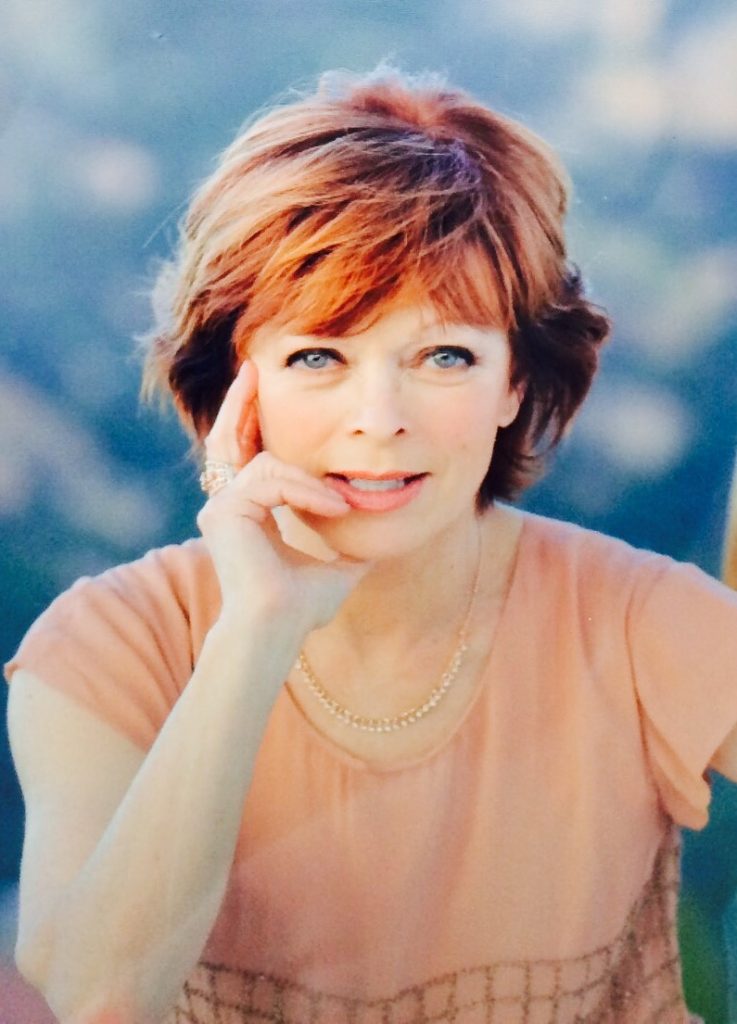
Frances Fisher plays the role of Virginia | Courtesy photo /Pasadena Playhouse

‘Native Gardens,’ a new comedy by Karen Zacarias, comes to the Pasadena Playhouse from September 5th to the 30th and shines a light on serious issues, including racial and social diversity, in humorous fashion.

Directed by Seinfeld’s Jason Alexander, it features Christian Barillas, Bruce Davison, Frances Fisher, and Jessica Meraz, with Julian Amaya, Richard Biglia, and Joshua Duron.

The play follows the story of Pablo (Barillas), a rising attorney, and Tania (Meraz), his very pregnant wife who is also a doctoral candidate. They have just purchased a home next to Frank (Davison) and Virginia (Fisher), a well-established D.C. couple with a prize-worthy English garden. The two couples’ friendly relationship is tested as an impending barbeque for Pablo’s colleagues and disagreement over a long-standing fence line grow into an all-out comedic border dispute.

Fisher, taking a lunch break during rehearsals, talks about what drew her to the play, “I like the fact that ‘Native Gardens’ tackles issues that are important – race and white privilege, misconceptions about nationalities, environmental concerns.”

“It presents two sides of the environmental issue,” continues Fisher. “It asks questions – do you want to do something good for the environment or would you rather have something for show? What is important to you, the health of your children and grandchildren or a beautiful bed of roses?”

The role touches Fisher on a personal level. She reminisces, “When I had a house, I was an avid gardener and grew my own vegetables; I miss that. I live in an apartment right now but I hope to, one day, be able to plant in my own backyard again.”

Activism is an ongoing endeavor for Fisher. She is a supporter of Environment California, Hollywood Food Guild, #FamiliesBelongTogether, PeaceOverViolence.org, and the anti-bullying group StandfortheSilent.org, among many others. She is an executive board member of the Environment Media Association (EMA), making ‘Native Gardens’ a natural choice for her involvement.

On the lighter side, the play gives Fisher the opportunity to work with long-time friends. She discloses, “I’ve known Jason since we were both starting out in New York and I play poker with him. But we’ve never collaborated on a project until now; it’s such a thrill to be directed by him. I’m exhausted but I’m also having a great time. He’s a master of comedy so I feel like we’re getting a master class in finding something funny.

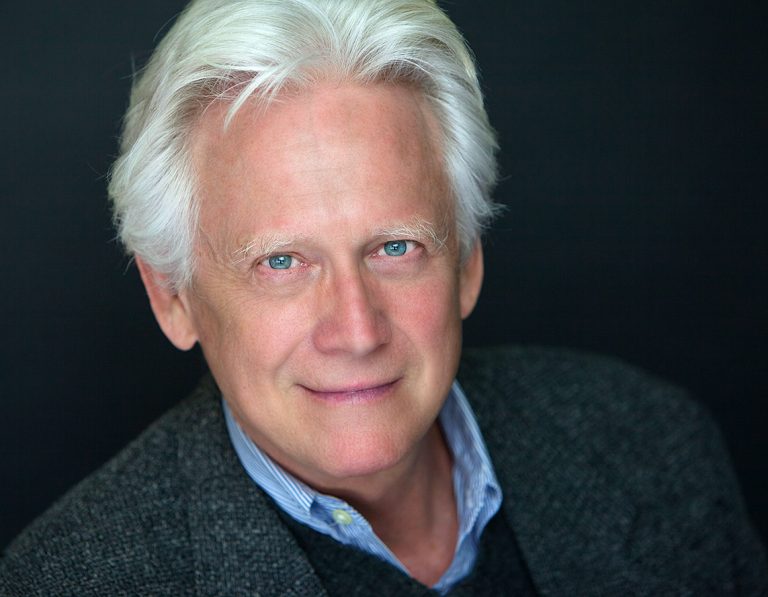
Bruce Davison as Virginia’s husband Frank | Courtesy photo / Pasadena Playhouse

“Bruce is also someone I’ve known personally for decades yet we’ve never performed together. It’s quite wonderful that we play husband and wife.”

‘Native Gardens’ is likewise an exposure to new people and experiences for Fisher. She says, “I’ve never met the two kids – Jessica and Christian – but I’m getting to know them. We’re having terrific fun in rehearsal; it’s a very physical play. This is also my introduction to Karen. I was hooked after I read her play. I later found out it has been performed and produced elsewhere in the country. I’m glad we’re mounting a production in Pasadena and at The Playhouse, too. It’s wonderful to be able to walk the boards here.”

It comes at an opportune time as well. Fisher states, “I hadn’t done a play in a while – the last  one was ‘Barbecue’ at the Geffen Theatre – and I’m ready to get back on stage. This is my first love. I started my acting career as an apprentice at the Barter Theatre in Virginia, learning the ropes by working every task that goes into putting on a show. I assisted the director, built sets, sewed costumes, made props, cued actors. I had a good understanding of the importance of every job in the theatre. But even when I do film or television, I have a great respect for the crew and what they do.”

Acting back and forth between mediums involves flexibility. Explains Fisher, “You have to approach each in a different way. For instance, doing a guest spot on a TV program is like jumping on a moving train. You come in and you have to be up-to-speed with people who have been  doing it for four, five, six, or seven years. You have to get on that rhythm as soon as you show up – you have to know your lines and your actions – because there’s not a lot of time. There never is, on TV.

“In theatre, on the other hand, we have three weeks to explore the character, learn, and make choices. We have a larger bag of tricks to draw upon so doing the same performance every night doesn’t get stale. Theatre is about discovering novel things, surprising your partner, and testing new ideas that have been tried out in rehearsal so they’re not completely unknown. In that sense, there’s a lot more fun that can be had in theatre.

“However, there’s also something that can be said about making a movie. You work on it for a certain period of time, you shoot a scene knowing you’re never going to do it again unless something goes wrong. Everyday there’s a batch of scenes, then you’re all done, and it’s finished.”

Fisher concurs with the common assumption that acting is not a financially stable career. “You never know if you have a job for the next ten years or if you have to look for another. When the director says ‘It’s a wrap’ you’re unemployed again. It’s a very uncertain way to live your life; you have to absolutely love the profession and be really dedicated to want to stay in it.

I know many actors who are waiting tables, driving Ubers, working whatever part-time jobs they can get. I found that I couldn’t have a so-called day job because I spend my days going to auditions, classes, meetings, and keeping myself prepared for the next role.”

That next role for Fisher could be on television. She had just finished a pilot for HBO on a Damon Lindelof work called ‘The Watchman.’

“If that gets picked up, we’re going directly to Atlanta to shoot the episodes,” Fisher reveals. “Lindelof’s work is extraordinary. The characters he originates, the history lessons he brings to the present day, are pretty mind-blowing.

“There’s great writing on television these days,” Fisher asserts. “I also see more women on television and film, which is something to celebrate. It used to be a patriarchy, but the tide is slowly turning, thanks to people like Ava du Varnay with all she’s doing for women. She has created a generous space for women, who’ve never had a chance before, to come forward. But we still have a long way to go; it takes for women in powerful positions to open more doors.”

Fisher is hoping for other opportunities for audiences to discover her range as an actor. She declares, “Every role is different and I don’t want to do the same thing over and over again. ‘Native Gardens’ is a very physical comedy and I don’t think people think of me as being particularly comedic.

Courtesy photo | Pasadena Playhouse

“I would like the audience to have a good time, for them to say ‘I’m glad I came to the theatre to see these actors doing outrageous things. But as hysterically funny as it is, ‘Native Gardens’ explores issues we should be thinking of. Laughter can be a profound and healing experience. And we certainly need more of that.”

Pronounces Fisher, “Theatre is made to mirror society back to itself. When you examine Shakespeare’s work, for instance, you’ll see that he wrote about everyone from kings to peasants. There is no feeling or emotion he didn’t explore through his plays and sonnets. They were very much a reflection of human nature.

“Theatre is a powerful medium for people to come together as strangers in an audience and, hopefully, through their common experience watching truth on stage, they will laugh or cry. Maybe they’ll turn to their neighbor across the aisle, catch their eye, have that shared moment, and walk out as friends.”

Such is the effect of theatre that Fisher was hooked on it at a young age. Ticket prices were so expensive even then, but she found ways to watch theatre. She confesses, “I probably saw the second act of every Broadway show for 14 years. I discovered that once the audience got in, I could kinda’ slip in and find an empty seat.”

Those days of sneaking into a playhouse are long gone. Fisher is now the performer on stage whom people come to watch. And she would genuinely relate to other aspiring actors who might just slip in after the first act.

‘Jungle Book’ at the Pasadena Playhouse Takes Us on an Exotic Journey

Originally published on 9 July 2018 in the Pasadena Independent, Arcadia Weekly, and Monrovia Weekly

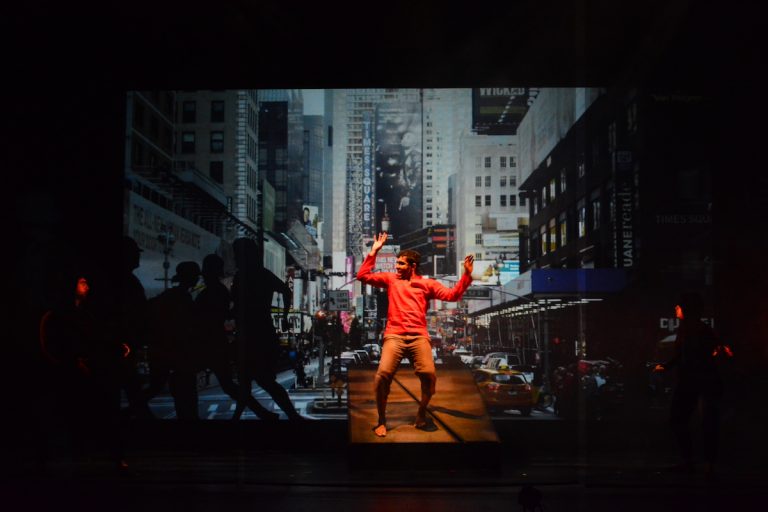
Levin Valayil as Mowgli | Photo by Gary W. Sweetman

Rudyard Kipling’s “Jungle Book” takes us to the exotic, adventurous, and magical world of Mowgli and other wildlife creatures. This play adaptation, written and directed by Rick Miller and Craig Francis, will have its West Coast premiere on Tuesday, July 17 through Sunday, July 29, at the Pasadena Playhouse, after a successful three-week run at Asolo Repertory Theatre in Sarasota, Florida.

Staged by Canadian company Kidoons and WYRD Production, in association with The 20K Collective, “Jungle Book” features familiar characters including Baloo the Bear, Kaa the snake, and introduces other colorful inhabitants of Kipling’s books.

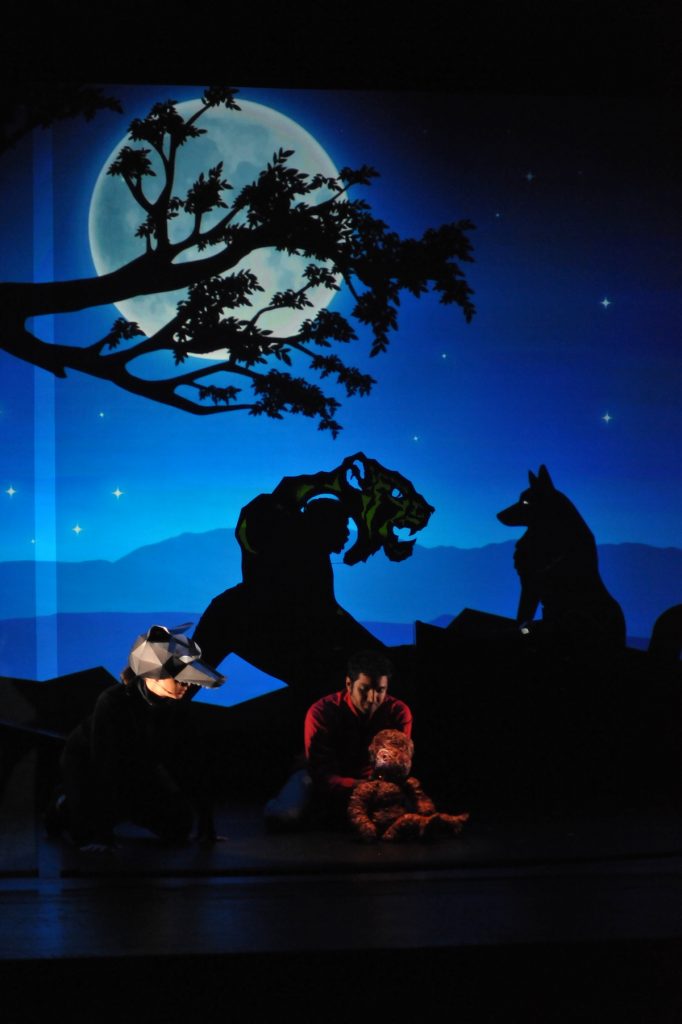
Very much a theatrical adaptation, this play employs a rich soundscape, immersive multimedia, inventive puppetry, and a variety of new and traditional theatrical traditions to transport audiences to the world’s jungles. It features favorite characters as never seen before, bringing out the original themes of the story, while connecting audiences to its Indian locale and the human relationship to the animal kingdom.

“We definitely chose not to re-do the Disney version. They did it well and have done it several times,” Miller emphasizes. “We decided to take people back to Kipling’s book to inspire them to read literature and realize that he actually wrote two Jungle Books. Everyone knows Mowgli but there are other stories in ‘The Jungle Book’ and ‘The Second Jungle Book’ about different animals from around the world. The stories, poems, and songs that Kipling assembled cover a great deal of territory, both thematically and geographically.”

Miller adds, “In the original Kipling story, Mowgli grew up in the jungle with animals and is kicked out of the jungle for being too much of a human. In the book he also goes back to the town as a teenager and is kicked out of the town for being too much of an animal.

“So this is a mirror image of these two worlds. It’s a story that echoes the disconnection we have these days when we wonder who our real family is and where we belong, but also our disconnection with nature. We live in cities and we tend to forget that we have a deep bond with our natural surroundings, a lapse which sometimes proves to be detrimental.”

“While the message is deep, it isn’t heavy,” stresses Miller. “We just want people to consider that before there were cities, there were forest[s] and jungles. And we still have them inside of us – that little bit of the free, wild, and uncontrolled. Mowgli is very much the embodiment of that; he takes us back to his youth to remember the law of the jungle. The play is about how to live with each other and the rest of humankind.”

“The adults coming to the show will definitely get the message and the kids will not get slammed on their heads with a hammer to get it. It’s a fun show with a lot of humor and a big dose of lightheartedness,” Miller says.

“Jungle Book” at Asolo Repertory Theatre | Photo by Gary W. Sweetman

“I’ve been doing theatre for 25 years. I’m known all over Canada and Europe for my solo performances but I joined forces with Kidoons (Kids Cartoons) to create entire experiences,” discloses Miller. “We found that we haven’t been engaging the youth as much, so we are correcting that. And in the process, we’re generating new theatre audiences. This is important because not only are young people the theatre-going audience of the future but they’re also ready to be educated and become leaders of the world and if you present them with inspiring work on stage they really can change lives.

“That said, we produce plays for all ages but it so happens that young people love the work we do because we incorporate the playfulness and creativity that kids inherently have. We’re trying to be more than entertainers because God knows there’s a lot of entertainment available on screen. We utilize what theatre offers which, essentially, is a lot of people gathered together in a room experiencing a story. This is different from just watching something on the screen.”

“We’ll be taking a few months off after our Pasadena production because we’re touring other shows. But we’re booking dates in preparation for our North American tour which starts in 2019. If all goes well, it will go to Asia and to Europe as well. Jungle Book happens in India and I would love for it to play there, but it’s a universal tale. We create shows that people all over the world will fall in love with.”

Miller elaborates, “Our next project is the third part of our ‘Connection Triptych’ and it’s going to be ‘Frankenstein,’ a novel written in 1818 by Mary Shelley. It has had several popular versions but we want to create one that speaks to our own issues today. Bio engineering and prolonging life, issues that are very much on the forefront of technology, are quite beautifully expressed in ‘Frankenstein.’

“The common thread running through these plays are characters who have become disconnected from humanity. In the first play in our trilogy, Jules Verne‘s ‘Twenty Leagues Under the Sea,’ Captain Nemo built a submarine, a utopia, for himself and his crew. He lived as a warrior against oppression, but in his disconnection he becomes a bit of a monster. In ‘Jungle Book,’ Mowgli is so disconnected he doesn’t know who his real family is, or who he is, for that matter. Frankenstein is probably the most disconnected character. In fact, he isn’t even human, he was created using pieces of other people and was called a monster.

“To put this is in our present day, we have Snapchat and Facebook which, on the surface, make us think we’re connected. However, the presence of all the technology in our lives actually isolates us from what’s really happening.”

Having children – an 11-year-old and a 15-year-old child – has helped Miller relate to how young people think and what interests them. He says, “We constantly talk about today’s technology; how we always have our eyes on the screen and how that changes our brain,” Miller expounds. “We have conversations about what it costs to have a disconnection with our environment and surroundings. We can’t recognize trees, or identify one leaf from another, but we can name a hundred different company logos when we walk down the street.”

Miller and Francis re-imagine classic stories through modern eyes, making them relevant to the times we live in. Through “Jungle Book” they hope to make us find ourselves and connect with humanity. If we enjoy the music, are transported to a different world, and have fun along the way, then it would indeed be a journey doubly worth taking.

Danny Feldman Leads the Pasadena Playhouse into its Next Hundred Years

Originally published on 5 June 2018 in the Pasadena Independent, Arcadia Weekly, and Monrovia Weekly

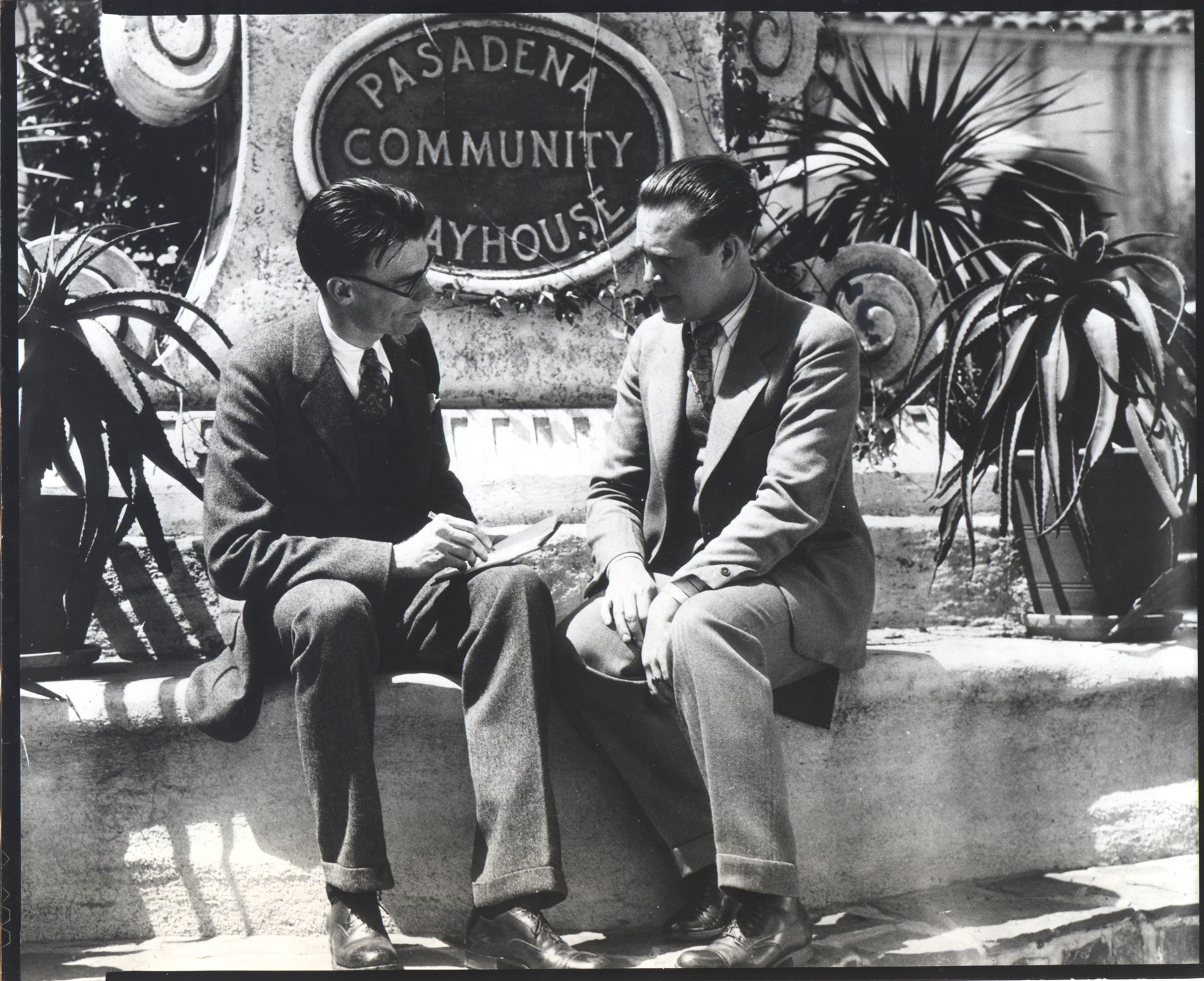
Gilmore Brown and Charles Prickett (Early Playhouse) | Courtesy photo / Pasadena Playhouse Archives

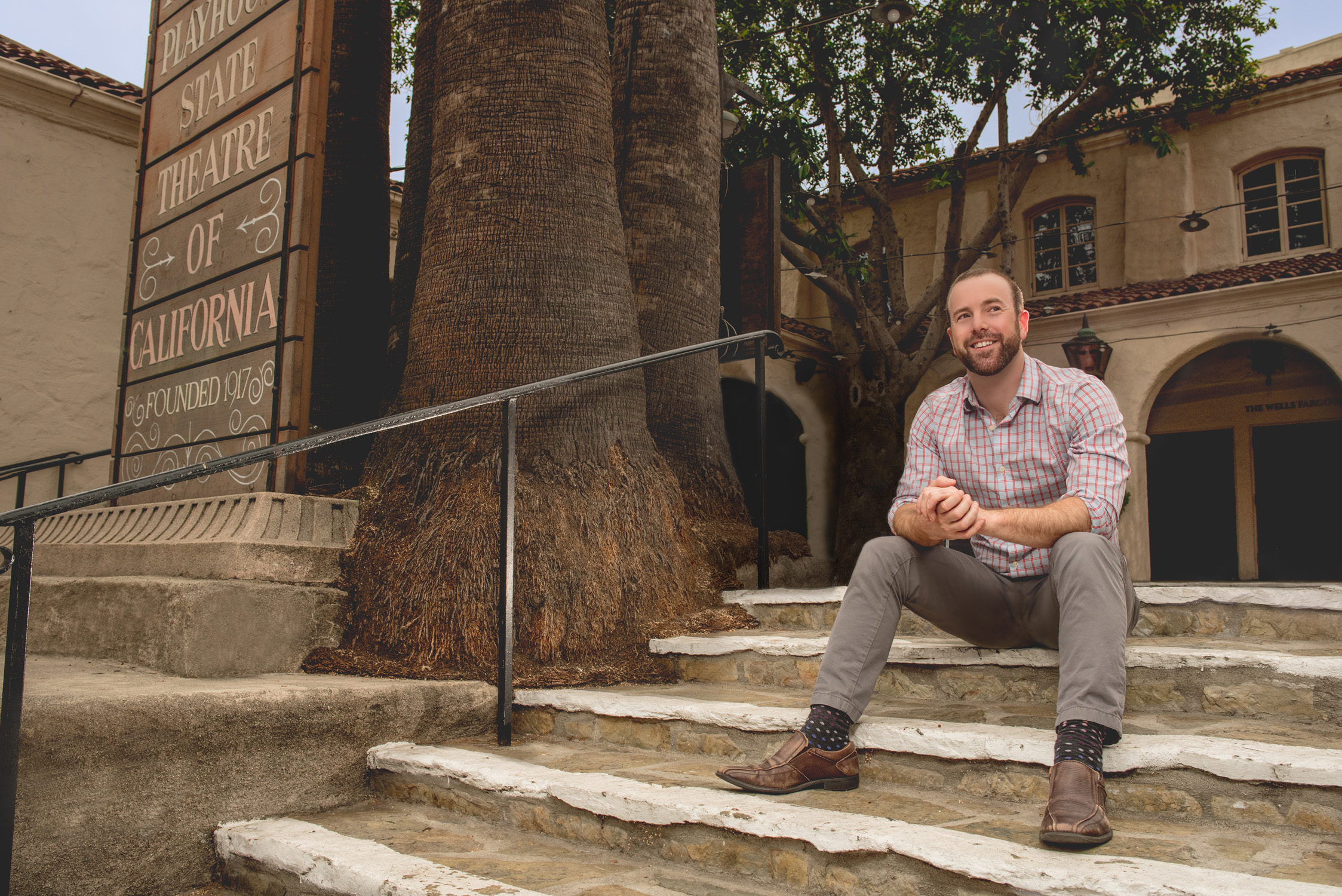
The venerable Pasadena Playhouse, the State Theatre of California, is observing its centennial. It is a milestone only a handful of theatre institutions in the country have reached, which is why Producing Artistic Director Danny Feldman can’t help but speak in awe of its past as well as its place in history.

“We’re celebrating three significant events – the centennial, the 90th anniversary of the founding of the Playhouse College of Theatre Arts, and the 80th year of the Playhouse’s designation as the State Theatre of California – and that’s extraordinary when you compare it to the Center Theatre Group, for instance, which is turning 50 this year,” states Feldman. “They’re babies compared to the Playhouse! Very few, if any, professional theatres in this country can claim similar distinction of history, impact, and longevity.”

“The Playhouse has survived world wars and has weathered financial challenges to continue to bring productions that enrich the community. It has been a leading center for theatre arts in America for a century but very few people realize its importance. It’s my job to tell people about it; it’s incumbent upon us to tell our story and history. And I’m excited to be taking us back to that journey.”

Feldman continues, “Any time there’s a new artistic director, which is a very healthy and natural evolution, you get someone who’s coming in with a new lens as to what they interpret their mission to be. I stand on the very broad shoulders of Gilmore Brown and Sheldon Epps who dedicated big chunks of their career into making this place thrive.

“Gilmore Brown founded the Pasadena Playhouse in 1917 when he was only in his 30s and basically operated the theatre until his death in 1960. He defined the greatness and international acclaim of the Playhouse. It was here that world premieres of the works of Tennessee Williams and Eugene O’Neill were presented. It was the venue for women playwrights to stage their creations in those early years when it wasn’t the norm.

“He was the entrepreneurial man who galvanized this community into buying the land where the Playhouse sits now and build this theater. It belongs in the hierarchy of monumental buildings. At the time its cornerstone was laid, it was the only structure of its kind among orange groves. Variety called it a world-class facility, a true original.

“An energetic and fascinating man, Gilmore put the entire community to work in the Playhouse. They made costumes and they were part of the chorus in the shows. There was a blurring of the lines between professional and non-professional theatre artists. What resulted was a community that fell in love with this enterprise and gave themselves for many, many years in establishing it and taking great pride in making it one of the foremost theaters in the country.”

Producing Artistic Director Danny Feldman | Courtesy photo / Ben Gibbs

“The Playhouse had a lot of ups and downs after this death when the theater was dark for a period of time,” relates Feldman. “The next great chapter in its history was when Sheldon Epps came on board. He was really ahead of his time in reinterpreting the Playhouse’s role. The community wasn’t what it looked like back in 1917 and it was him who burst open the doors of who the stage is for and what kinds of stories are being told. I think he made a permanent change to the Playhouse in saying ‘we are an inclusive place.’ It’s not a place about one segment but several segments of our community. I’m so inspired by that and am building on it.

“When I took over, not only did the artistic director change after 20 years, but it was a change right at the cusp of its new century. On top of the financial challenges, we have a new artistic focus through my lens, my love and passion. And at the same time we are defining what a theater is going to be in the age of Netflix and Hulu. We can’t function as we did back in 1917, the world is different now. So the question is how are we going to make theater flourish? What are the core values and ideas that worked back then that were important to the community and how do they translate today?”

“We want to have relevance which isn’t a new idea because it’s how it has always been,” Feldman says further.  “Even when doing a classic like ‘Romeo and Juliet,’ if it doesn’t connect to your audience and it doesn’t make them see themselves, it isn’t alive. Great theatre or art is about making an audience of strangers a community. It’s sitting next to someone you’ve never met before and having that great moment when you realize everyone around you is engaged in the same personal experience. Theatre is the ultimate master class in empathy.

“That is profound and it’s why theaters have always thrived, and will continue to, even with the inventions of radio, television, movies, and the Internet. Theater unites people in a way you don’t get with any other medium. No one can contrive something that can replace that. It’s worked with the ancient Greeks and it will do so now for a reason. The desire to be around other people is innate in human beings and we crave it in a way that’s hard to articulate in words but it’s important for humanity.”

Feldman remarks, “When the Playhouse was first established there was a great level of investment particularly in Pasadena and the San Gabriel Valley that went on for a long time. People went door-to-door to raise money to build this structure because they were deeply attached to the work the theatre was doing. They were an active part of it and felt ownership of this. But over time, some of that connectivity was lost.

“Our challenge is to do a much better job of broadening the definition of what our community is and we started some initiatives to address that. We’re sending out a message loud and clear that it isn’t just those who belong to an economic class that can afford to buy tickets. So one of the things we did right away was to lower our ticket prices. You can come to any show at the Playhouse for $25 and get good seats. We have a substantial portion of our tickets for that and they sell out first.

“We also launched a program called ‘Community at play,’ which is a free ticket initiative. We identified that there are groups in the community that have barriers to coming to see a play because of cost, or transportation, and so on. To get this population to be with the rest of our audience and be a part of our community, we gave away thousands of tickets to social service groups and after-school programs.”

“Studies show that young people who had an art experience in school have a greater likelihood of them coming back as adults, which bodes well for us,” Feldman adds. “A generous donor has enabled us to bring the entire 7th grade of the Pasadena Unified School District come to watch ‘Pirates of Penzance’ and I’m excited to say they’re all coming back next season for ‘Woman in Black.’ Our goal is for everyone who attends public schools in Pasadena to be able to see a show at their theater.

“Last night, for our ‘Community at Play’ program, a group of predominantly Latino students who did a workshop beforehand, came with their teachers to watch ‘Bordertown Now.’ Their experience was so moving that it brought tears to my eyes. They heard their voices on our stage which elevated them. The State Theater of California should rightfully be the place where Latino voices are amplified in the same way that Tennessee Williams’s or William Shakespeare’s voices were. It’s one of the ways we’re enriching our community and showing our relevance to it.”

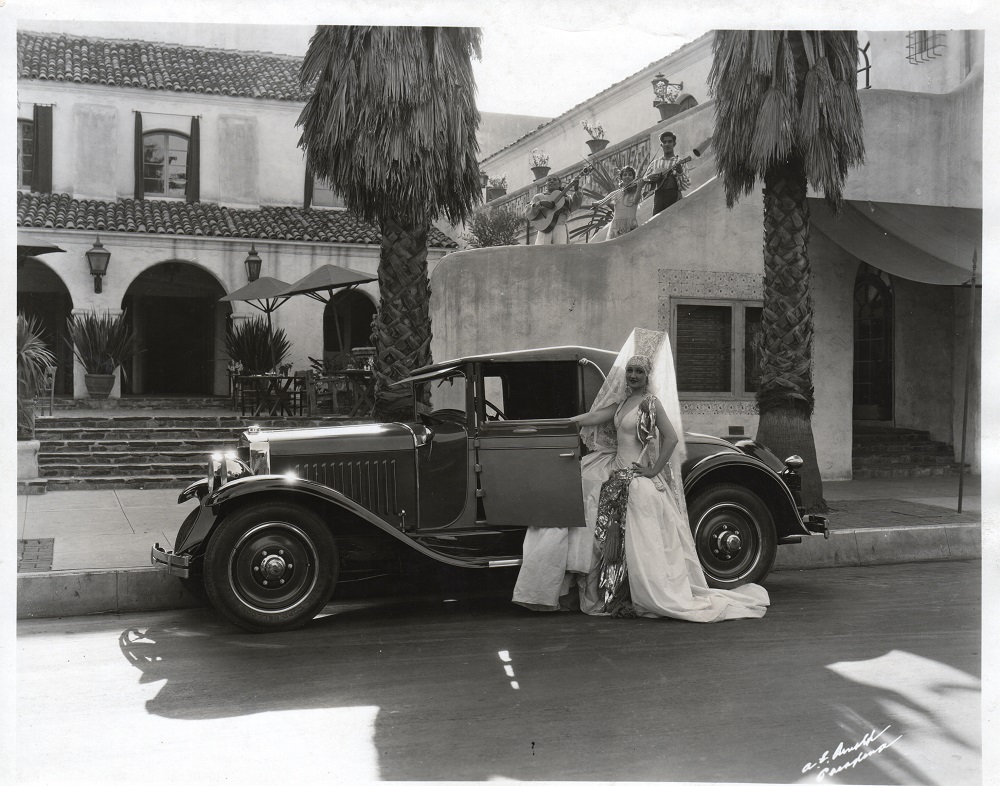
Senorita with Car (1936) | Courtesy photo / Pasadena Playhouse Archives

Feldman pronounces, “I want to think of the Playhouse’s next chapter as a transformation and I want to be careful when I talk about it. We’re firmly rooted in the past and we’ve had some real challenges that we’ve addressed head-on. I’m not someone who turns a corner and says ‘let’s forget the past’ because I want to remember it – there’s value to it. We’re a historical theater and we have to honor our past but look at it with the lens of the future.

“I think of myself as bridging those worlds and our programming demonstrates that. The first  show we put on for our centennial season was ‘Our Town,’ which is a play about community. But what does that community look like today? So we reinterpreted it to reflect our changing world.”

“In the 1920s Gilmore Brown produced new plays here and in the 1940s he put on Tennessee Williams plays,” Feldman expounds. He championed contemporary playwrights and I’m continuing that. We have ‘Bordertown Now,’ a play refreshed and rewritten by modern-day artists from their work 20 years ago, to show the world we live in today. In a way it’s a transformation in taking core values deeply rooted in the past but aware of where we’re going in the future. We want to find the spirit that prevailed in the 1940s to the 1970s, which was the period the Playhouse had the most growth, and put our own distinctive stamp on it.

“My previous post in New York was with an artist-driven theater, established by Philip Seymour Hoffman and other exciting artists, that created space and opportunities for those who are being marginalized and being left out of the conversation. I was very much inspired by that and I’ve brought that here, particularly as we expand the scope of our work. It deeply resonates with me because my father wasn’t born here. I realize that America is a tapestry of different cultures and people.”

“California is one of the most diverse places on the planet and the Playhouse is its State Theater.  I’m responsible for ensuring that our values and programs demonstrate the core values of inclusion, diversity, and providing a space for more than just one thing. That’s inherent in who are as an institution and I want to carry on that legacy,” declares Feldman.

So how does an institution that is one of the most prolific drama-producing organizations in the history of American theatre – having commissioned over 550 new works, produced upwards of 1,200 shows, spearheaded over 500 world premieres, developed several shows that went on to Broadway, and welcomed more than one million audience members – commemorate a milestone?

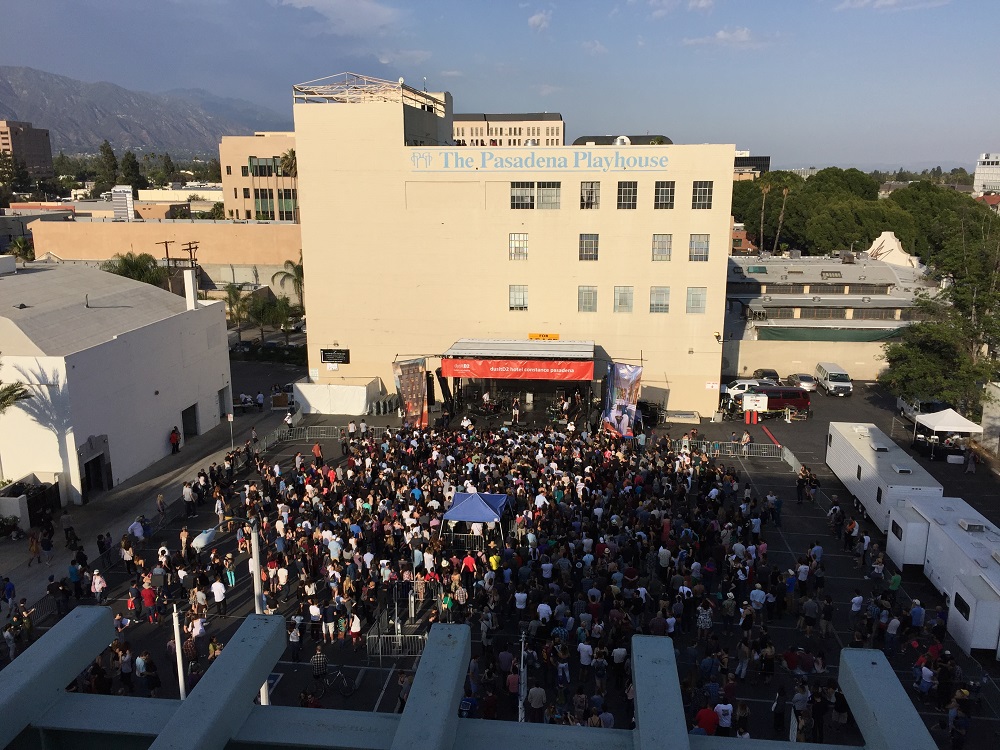
Pasadena Playhouse will celebrate its centennial with a block party | Courtesy photo / Chris Molina

“There was a great deal of discussion about it and a great many ideas were thrown around, including having a black-tie dinner,” discloses Feldman. And, quite frankly, I wrestled with it for a long time because I want to make sure that whatever we do, it has to be something that’s engaging our community the way it has in the past and building on that heritage.

“One day, when I was in a heated debate on it, someone asked ‘If money weren’t an issue, what would you want to do?’ And I said ‘We’d close all the streets around the Playhouse and invite everyone to come so we can say ‘thank you.’ And my Marketing Director said, ‘Okay, let’s do it.’

“It’s a huge undertaking to close El Molino Street, the parking lot, and the Playhouse Alley. But we decided that instead of having a self-congratulatory event, having a block party was the best way to honor everyone who has supported us. It would be an opportunity to reintroduce the Playhouse to the community, to say that this isn’t our space but your space. It has served as a gathering place for a community for a hundred years and we want to be a part of their lives for the next century.”

Brown established Pasadena Playhouse in 1917 and named it Pasadena Community Playhouse, safeguarding the entire neighborhood’s investment in it. And while it has achieved an international renown in the years hence, Danny Feldman is making it his mission to ensure that the community spirit on which it was founded lives on into its next century. Gilmore Brown would have been pleased.

Pasadena Playhouse Explores Immigration Issues in Culture Clash’s ‘Bordertown Now’

Originally published on 1 June 2018 in the Pasadena Independent, Arcadia Weekly, and Monrovia Weekly

Courtesy photo | Pasadena Playhouse

Immigration is a hot-button topic that touches the lives of all Americans. It is a subject politicians exploit on the campaign trail as much as it is a well from which activists draw causes to fight for. And it is the theme that the comedy troupe Culture Clash explores in ‘Bordertown Now’ at The Pasadena Playhouse.

On stage from Wednesday, May 30 to Sunday, June 24,  ‘Bordertown Now’ takes an irreverent look at the people at the center of the controversial issues and the walls that divide us. Infused with their trademark satirical approach, the country’s top Chicano/Latino performance trio messes with the boundaries of theatre and comedy to break down the divisions between cultures.

Culture Clash’s Richard Montoya, Ric Salinas, and Herbert Siguenza are joined by Sabina Zuniga Varela. Varela appeared with Culture Clash in ‘Chavez Ravine: An L.A. Revival’ at the Kirk Douglas Theatre on the occasion of the troupe’s 30th anniversary in 2015.

‘Bordertown Now’ is directed by Obie Award-winning artist Diane Rodriguez. She began her career as an ensemble member in the politically conscious, El Teatro Campesino and is now Associate Artistic Director of the Tony Award-winning Center Theatre Group in Los Angeles. In 2016 President Barack Obama appointed her to the National Council on the Arts, a body that advises the Director of the National Endowment for the Arts.   

To shine a light on the various issues, there will be post-show conversations after each performance on different topics including immigration, border policy, and more, led by topic experts.

Danny Feldman, Pasadena Playhouse Producing Artistic Director, says, “For more than a year, the immigration debate has been in the news on a daily basis. It is so rare to be able to present a new work that directly responds to our ever-changing world. Who better to examine this issue than the iconic troupe Culture Clash, making their Playhouse debut. Through humor, satire, sentiment, and curiosity, they manage to bring us closer to the humanity at the center of the border issues.”

Richard Montoya explains the group’s roots, “I co-founded Culture Clash on Cinco de Mayo in 1984 in San Francisco’s Mission District at a historic Latin quarter in a small art gallery. Art is very much a part of our vibe.

We first produced ‘Bordertown’ two decades ago and while ‘Bordertown Now’ is billed as a re-imagination of that, about 70 percent of this show is new because political awareness and interest about the border have grown in intensity.

There’s so much going on around the country relative to the concerns we’re exploring so it was easy for us to harvest new material. The issues have become more powerful and polarizing but we’re also going to find the humor in the circumstances that plague immigrants. It’s a comedy that’s balanced with serious topics, a reality show that sometimes plays like satire. There’s nothing more farcical than what’s happening now.”

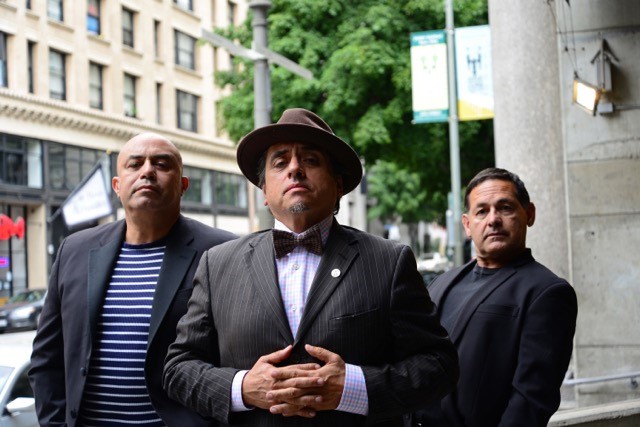
From left to right, Culture Clash’s Herbert Siguenza, Richard Montoya, and Ric Salinas | Photo by Eric Schwabel courtesy of Culture Clash

“During the last year or so, I’ve been busy on the border interviewing sheriffs, agents, and the people who are caring for those who are crossing the border,” continues Montoya. “I’m doing something similar to journalistic work. And then we recreate the characters for our show. It’s like an anthology production where we’re putting together the pieces, connecting all the things that happen on the border.”

“The landscape and the cast remain the same but besides that, policing around the area has changed rapidly,” Montoya explains. “Armed personnel presence on the border has increased so much that it has become a military situation. At the same time, the danger brought on by the drug cartel has also grown and so has the desperation of those caught in the middle. This scene is so different from that of my youth when there was a trolley service from San Diego to Tijuana.”

“California is such a fertile ground on which to examine this issue,” Montoya remarks. “We have borders within borders – whether it’s between Old Town Pasadena and South Pasadena, or between Los Angeles and San Francisco. I was born and raised in San Francisco and I moved to Los Angeles 25 years ago. And I can’t believe the disparity between Northern and Southern California, it’s mind blowing … which just proves the cultural richness we have in the state. But beyond the geographical borders, ‘Bordertown Now’ examines divisions between genders, cultures, and the imagination.”

Montoya says further, “This time we’re adding other cultures, like Asian, into the mix … anyone who just arrived and eager to become American. This idea of becoming American is still very fresh. You know, when you’re in France, you’re French; and when you’re in Beijing, you’re Chinese. The United States is one of the very few places where you can become an American. And it’s that notion which attracts so many to our country. And one of the questions the play asks is ‘What is the cost of being an American?’”

“While our show is a comedy, we want to show a serious aspect: that we’re all human beings – even those who are hiding in the Mexican desert, trying to cross the border illegally. What our current administration and other countries have done is dehumanize the person on the other side.”

“We’re not saying that borders don’t exist, because they do. Nor are we claiming we’re all equal, because we’re not. But we’re saying we’re all human beings – there are people caught in drug and human trafficking. We’re trying to show the human struggle, and the human-ness outside of the headline. We want to take the measurement of their lives, and not treat them simply as data. And, as artists, we want to keep alive the hope and show that we care about all these,” declares Montoya.

Culture Clash’s ‘Bordertown Now’ examines subjects that are timely and of significance. It puts a human face to the immigration issue. Would that people see it, take it to heart, and seize the opportunity to play a part in chipping away at the borders that divide us from each other.

The Playhouse’s ‘Belleville’ a Hit with Theatre Enthusiasts

Originally published on 24 April 2018 in the Pasadena Independent, Arcadia Weekly, and Monrovia Weekly

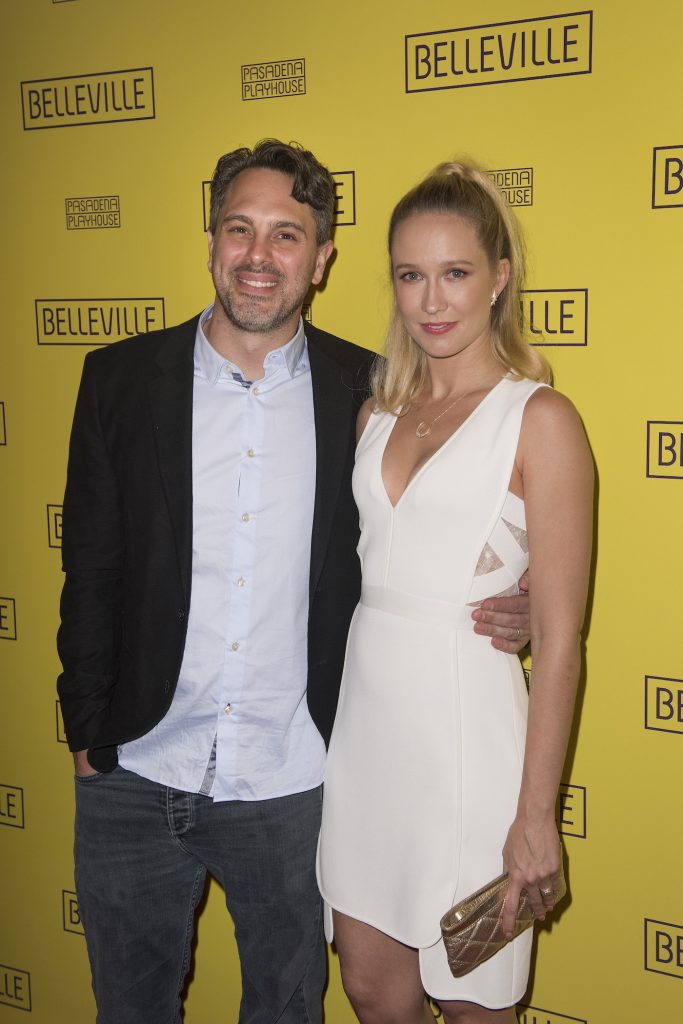
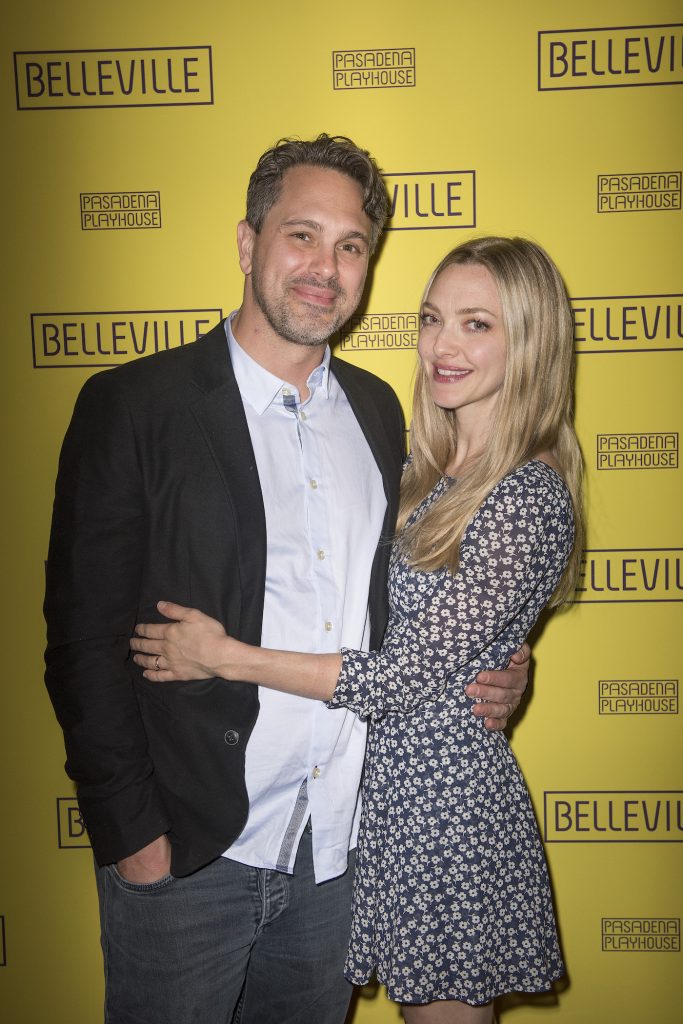
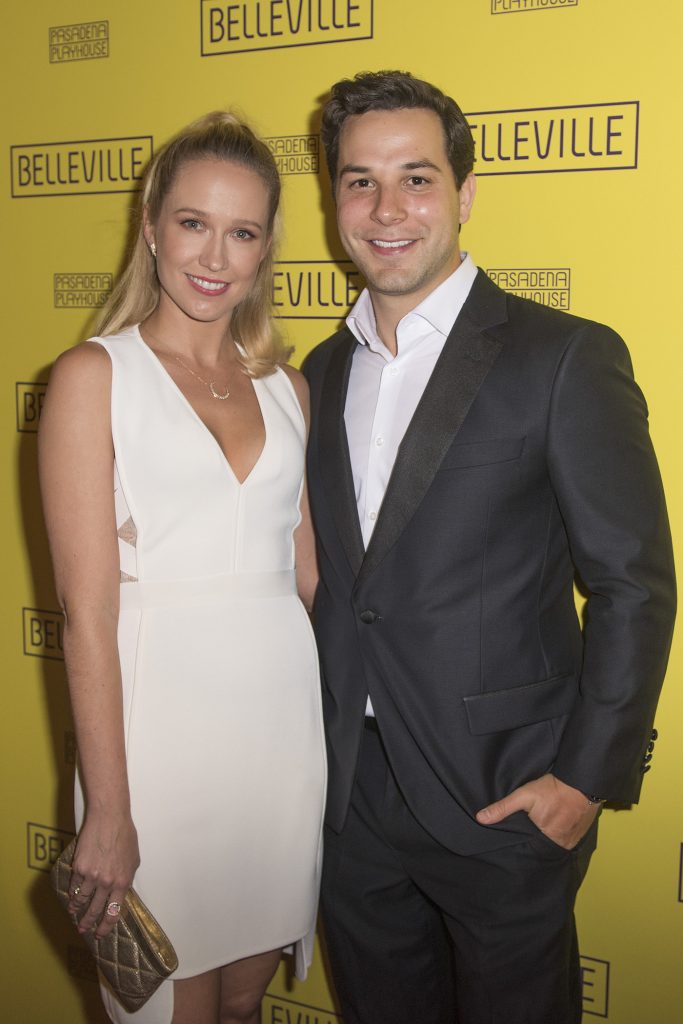
“Belleville” stars Thomas Sadoski and Anna Camp on the red carpet on opening night | Photo by Nick Agro

Anna Camp and Thomas Sadoski performed to an appreciative and intent audience this past Sunday when Amy Herzog’s psychological thriller “Belleville” opened at the Pasadena Playhouse.

Directed by Jenna Worsham, Camp and Sadoski played a young American couple living in a Bohemian neighborhood in Paris called Belleville. It began as Camp’s character, Abby, came home unexpectedly one afternoon and heard her husband Zack, played by Sadoski, watching porn in their bedroom.

Thomas Sadoski and Amanda Seyfried | Photo by Nick Agro

This seemingly harmless incident quickly turned into a catastrophic event, as one revelation after another of secrets Abby and Zack had hidden from each other were exposed. Slowly their real identities were unmasked and each of them was surprised to learn they didn’t really know the person they married. The audience watched the intense interplay between the two characters with such concentration one could hear a pin drop.

With no intermission to break the intensity, we didn’t have so much as time to catch our breath. When the play finally came to an end, about a hundred minutes later, we were almost as finally relieved as we were utterly devastated.

Anna Camp and Skylar Astin | Photo by Nick Agro

“Belleville” was indeed a Hitchockian thriller of a play. Director and actors did not disappoint. Camp and Sadoski kept up the tension right up to its conclusion. And an appreciative audience showed their approval with a rousing standing ovation when the lights turned down.

Both Camp and Sadoski enjoy a loyal following and their fans must have come out to support them. Last Sunday’s performance attracted noticeably young theatergoers. It was a stroke of genius that the Playhouse’s Producing Artistic Director, Danny Feldman, chose to mount a play about millennials. And it certainly didn’t hurt that Anna Camp and Thomas Sadoski starred in it. Well done, all!

Psychological Thriller ‘Belleville’ Intrigues at Pasadena Playhouse

Originally published on 16 April 2018 in the Pasadena Independent, Arcadia Weekly, and Monrovia Weekly

Thomas Sadoski and Anna Camp | Photo courtesy of Pasadena Playhouse

Amy Herzog’s exciting new thriller ‘Belleville’ debuts on the West Coast at the Pasadena Playhouse from Wednesday, April 18 to Sunday, May 13. Directed by Jenna Worsham, this Hitchcock-style drama stars Anna Camp as Abby and Thomas Sadoski as Zack.

The play centers on Zack and Abby, young Americans who look for all the world like a perfect couple experiencing the ideal expatriate life in Paris so he can fulfill his noble mission at Doctors Without Borders to fight pediatric AIDS. They live in a funky bohemian apartment in Belleville.

This image of perfection is shattered when Abby finds Zack at home one afternoon when he’s supposed to be at work. Their idyllic life turns into a nightmare and we watch in suspense as the real characters beneath the façade are slowly unmasked.

While neither Sadoski nor Camp has seen ‘Belleville’ performed they have both heard of it and its playwright.  Sadoski says, “Amy is a Pulitzer Prize nominee and an Obie Award winner and I know of her work. She’s a tremendous writer, one of the most important voices of her generation. I’m so thrilled to be working on this project!”

This marks the first time Sadoski will be on stage at this venue and he recounts how he got the role, “I love this theater and its history. Danny Feldman, the Playhouse’s Producing Artistic Director, and I have been talking for a while about finding some work for me to do in Pasadena. It so happened that he had a window and we threw around some ideas about what plays we wanted to do. When he mentioned ‘Belleville’ I just went ‘Absolutely!’ It’s really a no-brainer.

“We also realized it hadn’t been done on the West Coast so this would be the premiere and that got us all the more excited. Our director, Jenna Worsham, is a huge advocate of Amy’s work and she was thrilled with the idea. So we, as a unit, jumped at the opportunity to put it up.”

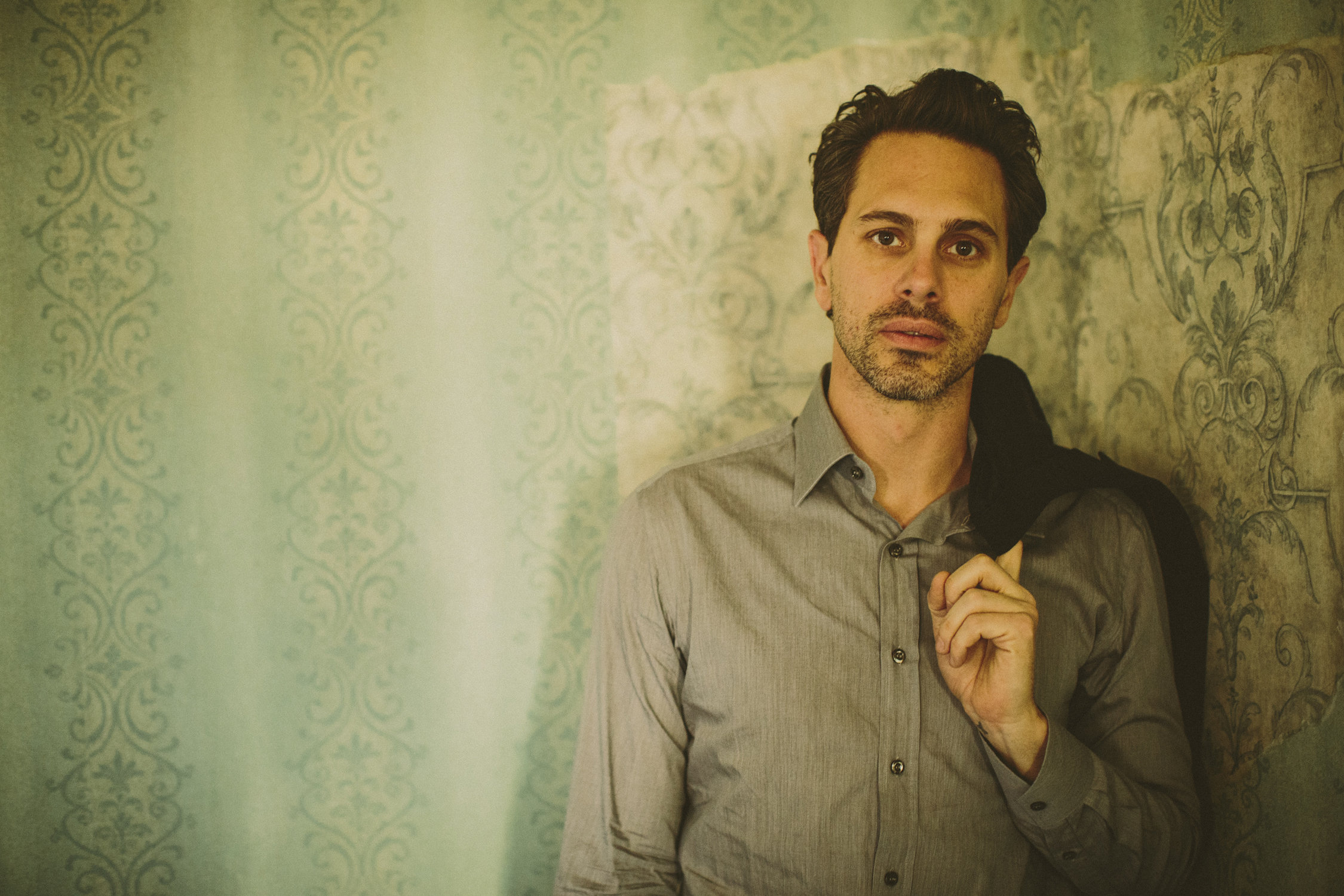
Thomas Sadoski | Photo courtesy of Pasadena Playhouse

Sadoski says further, “As rehearsal goes on we’ll continue to unwrap who these people are. The most interesting for me at the moment is delineating between the private Zack and the public Zack – the version that he presents to the world and the Zack that exists inside that only he knows.

“It’s going to be really exciting to prolong that feeling of unease, fear, suspicion, and discomfort throughout the play. The last thing we want is for it to be a caricature of a film noir. I would be interested to see how the audience reacts and that’s the beauty of live theatre.

“I’m always a bit reluctant to form an idea of what I want the audience to leave with. Early on I had a really strong opinion about what I would like the play to bring out and I worked really hard to make that happen. But what I learned in time was that I can have those wants and desires but people will come with their own experience which, in turn, will inform what they walk away with.

I’m at a point in my career when I just want to tell the story as truthfully as I possibly can, give an honest and open performance. I think that’s more generous than determining the conclusion I want the audience to have. That said, it’s also very Hitchcockian – you don’t come out of a Hitchcock movie with a song in your heart and a spring in your feet.”

A famously private person, there isn’t a lot out there about Sadoski and he likes to keep it that way. He discloses, “Firstly, it’s the way I was raised. Secondly, I am happy to share my thoughts and opinions about politics and whatnot but I am not the kind of person who has his personal life on display at all times.

“Additionally, I don’t think it serves me as an actor to give people some sense of ownership. Nor for the audience’s perception, when I go on stage or in front of the camera, be colored by what they think they know about me. I want to be able to make my performance be true to the character I play.”

Sadoski has been on television (‘The Newsroom,’ ‘Life in Pieces’) and on Broadway (‘reasons to be pretty’ and ‘Other Desert Cities,’ with a Tony Award nomination. He has, of late, been doing audiobooks.

“Theatre is my first love so I would like to keep coming back to it,” Sadoski reveals. “I enjoy doing TV and film so I will continue to do them as much as possible. I have also found a lot of joy doing audiobooks. I think the next place for me to go artistically is directing; I look forward to that opportunity.”

“Life couldn’t be better at this point. I have a beautiful daughter and wonderful wife I love hanging out with and I go to work. I’m one of the few fortunate people who can say that I get to do what I love to do for a living. My cup runneth over,” concludes Sadoski.

Anna Camp is adored by everyone who has seen her in the film Pitch Perfect (1, 2 and 3) and has built a following with her appearances on iconic TV hits ‘Mad Men’ and ‘The Good Wife.’ Like Sadoski she will be performing at The Playhouse for the first time and was very excited when she got the script for Belleville.

“I feel in love with it immediately after I read it,” recalls Camp. “I called my agent and said ‘I’m doing this.’ It was very powerful and there was some sense I had about this character. I have not been offered a role like this, certainly not a theatrical piece, and I was very glad they considered me for it.

“I’ve seen Tom on Broadway, off-Broadway, and from ‘The Newsroom.’ While he and I have worked on Broadway at about the same time, I’ve never worked with him before. I’m very happy that this will be the moment we’ll work together because he’s fantastic for the role and it’s a fantastic material to be working with him on for the first time. It was quite amazing how we had an easy relationship from the first day of rehearsal. I can’t ask for a better job.”

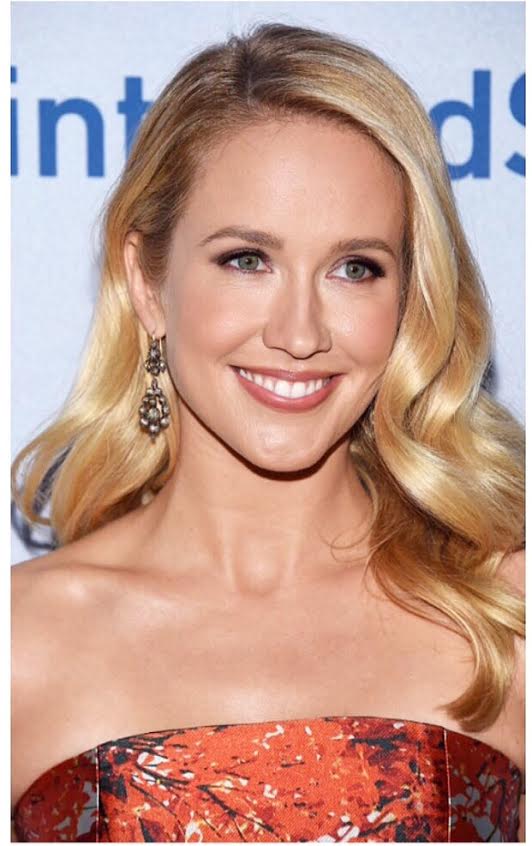
Anna Camp | Photo courtesy of Pasadena Playhouse

Asked if she had specific thoughts on how to approach the character, Camp answers, “Obviously when you first read a script you have an idea in your head but nothing really comes into focus until you’re working with the actors and allowing the director to ask more questions of the character to find out about the person. And I’m actually discovering that in some ways she is like other characters I’ve played before, and in other ways she’s different. And every day, as we rehearse, it gets more complex and more layered.

“I’m finding out more who Abby is, she’s becoming a fully realized person and who I want her to be. It helped that I didn’t see the play before; I always like not having an idea of what someone has already done with the role haunting me in a way. I’m curious as to how other actors have played it before but I’m glad I haven’t seen it performed onstage. That’s what makes this incredibly my own and that’s the beauty in doing a play.

“There are certain things that happen as Zack and Abby interact that I found fascinating. In the beginning Abby appeared to be in fear of her own shadow, feeling out of place living in Paris, and afraid in her own apartment. And at the same time there are so many moments when she could be cutting, and harsh, and cruel. It’s a really well drawn out character – there’s a lot of anger underneath her and it’s very biting. This is a really multi-dimensional character that Amy has created.”

“The best part about a Hitchcockian thriller is the buildup,” continues Camp. “And that’s the fun part – shaping the play into something that keeps the audience at the edge of their seat and not know whom to root for; to have them come up with their own conclusion as they watch the play. We want to truly increase the suspense before the final reveal.

“I want the audience to be moved emotionally in a way that they are not expecting, to feel what it’s like to be in love but in a wrong kind of love; to learn something about yourself; to make you a better human being during this time you have on the planet.”

Being in this play has also taught Camp something, “I’m finding out the difference between film and theatre. Last night during rehearsal Jenna said ‘theatre is like live music – you play the same notes every night but you’re playing it in a different way; and film is like a painting, it is done and it is complete and it’s over.’ I will carry her words with me forever.”

Camp discloses future plans, “I am in the middle of producing a film where I will star in and we’re trying to hire a writer. I’m looking for more female-led ventures and projects that would connect with my audience. I’ve loved acting since I was a little girl and as long as I can continue to do that then I’m living my dream. Working in theatre is something that has deepened me as an actor and I hope it leaves me a better actor than when I came in.”

Camp and Sadoski are exciting performers to watch. They have proven themselves in every medium they’ve been in. They are both at the Pasadena Playhouse to show us how live theatre can mesmerize, enthrall, and hypnotize in a play that may very well make us question if we really know the people to whom we are closest. The master of suspense himself, Alfred Hitchcock, would approve.

Frolic with the ‘Pirates of Penzance’ at The Pasadena Playhouse

Originally published on 16 January 2018 at the Pasadena Independent, Arcadia Weekly, and Monrovia Weekly

The Hypocrites’ “Pirates of Penzance” at Arizona Repertory Theatre | Courtesy photo / The Hypocrites

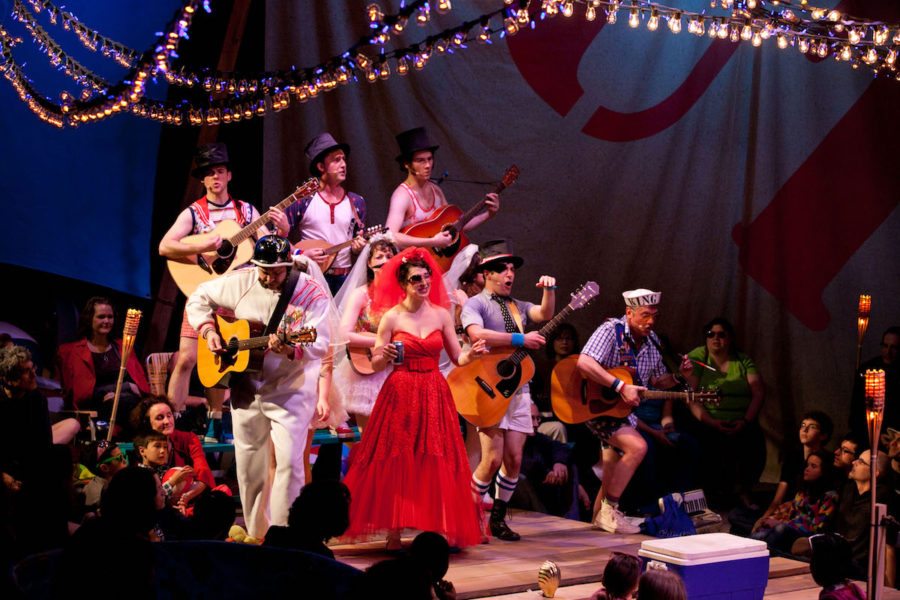
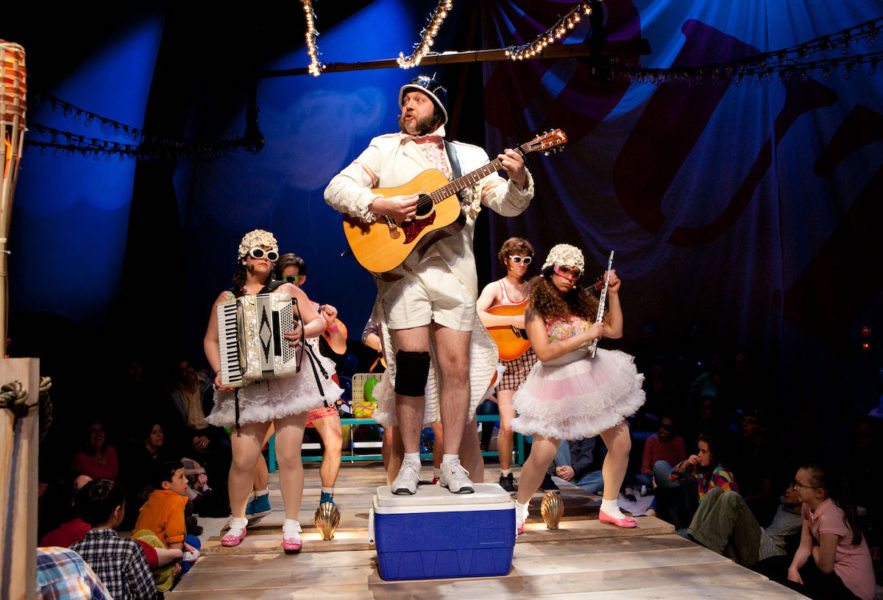
When have you ever been to the Pasadena Playhouse to enjoy a romp on the beach? In the venerable theatre’s 100 years of existence its stage has never been converted into a seashore … until now.

From January 23 to February 18, ‘Pirates of Penzance’ by The Hypocrites, fresh from its successful New York run, will be playing at the Playhouse. The production is adapted and directed by Hypocrites Artistic Director Sean Graney; co-adapted by Kevin O’Donnell and with music direction by Andra Velis Simon.

Ten actors will perform the Gilbert and Sullivan classic with a zany twist while staying true to its original spirit. The Playhouse will be venue for the wackiest beach party imaginable, complete with flying beach balls, rubber duckies, ukuleles, banjos, plastic swimming pools, and a tiki bar.

In a re-envisioned Playhouse, all the orchestra seats will be removed and in its place a deck will be built. The entire theatre will turn into a playing area with actors and audience sharing the space to create a fun, magical evening of theatre.

Graney says , “I remember listening to ‘Pirates of Penzance’ the first time and thinking how brilliant it was. It is joyful, playful and welcoming, which was a perfect place to start to remove the walls between actors and audience and get rid of the pretense of theatre. It has proven very successful for us. We first performed it in 2010 and we’re still doing it eight years later.”

Founded 20 years ago by Graney, The Hypocrites is currently run by Graney and Executive Director Kelli Strickland. One of Chicago’s premier off-Loop theater companies, it specializes in bold productions that challenge preconceptions and redefining the role of the audience. Its reputation in Chicago is that of a company that creates exciting, surprising, and deeply engaging theatre as it re-interprets classics and tackles ambitious new works.

“I went to college in Boston, Massachusetts to study acting,” Graney relates. “I was fortunate enough to have a professor who told me I was a bad actor so I searched for other venues within theatre and I ended up writing and directing. After graduation I moved to Chicago with two college friends and together we decided to form a theatre company. There are so many of them in Chicago and if you have a name that stood out, it would give you a certain advantage. Everyone had an adjective or noun theatre company so I thought we should just come up with a band’s name.

‘Hypocrites’ is a theatrical word derived from the Greek ‘hupokrites’ which means ‘actor’ or ‘pretender.’ But also, our events are an amalgamation of a lot of different aesthetic styles which cannot necessarily be pinned down because they’re contradictory at times – like mixing tragedy and comedy in the same show. It’s the general feeling that there are opposing aspects in human nature and, in essence, we’re all hypocrites.

And so in 1997 we put on our first show from a whopping $250 funding we were able to raise. The gentlemen I started The Hypocrites with left and moved on to other things after a while. I stayed on and found other like-minded artists and friends to continue what I had started.”

In the period since, the company has seen several changes. Says Graney, “We started small in the beginning with two shows and as we grew we added more productions to our season. There were years when we were able to do as many as 11 shows and then at times we did only two. This season we’ll have five shows from September to July.

The Hypocrites’ “Pirates of Penzance” at Arizona Repertory Theatre. – Courtesy photo / The Hypocrites

When we began mounting Gilbert and Sullivan productions we were touring as well as maintaining in-town programming and the institution grew fairly large. Then last year we hit a financial roadblock and so we re-evaluated the financial side of the organization and how we would go about producing. Demand is also a factor in the number of shows we do per season.”

Graney reveals the rationale behind their shows, “We wanted to find musicals which were in the public domain so we could develop a relationship with them instead of being held to copyright laws. ‘Pirates’ came about for a specific need – we could adapt it to fit our group and audiences.”

The adaptation process doesn’t take too long according to Graney, “I do a version of the libretto in a couple of days and then I give it to my musical director who will break the orchestration down to mostly chord charts for the guitars. We keep the melodies and vocals the same but we’ll figure out how to support the vocals with stringed instruments. We’ll pick which part would have the flute and where we could put the clarinet. Once we have that together, we get it to performers’ hands. We do a couple of workshops and make adjustments from there. Even now we tweak it each time we rehearse – we make changes to the script to make the jokes more clear, or make the sound better. We’re still improving on it.

We have produced other Gilbert and Sullivan shows, including ‘Mikado’ and ‘HMS Pinafore’ but it was ‘Pirates of Penzance’ we’ve done the most because it aptly suits The Hypocrites make-up. A group of 20 actors plays the various roles in ‘Pirates’ and each time we go on tour we figure out which is the best combination of performers. It’s an hour and 20 minutes, written to be done by ten actors who can play their own instruments so there’s no orchestra.

‘Pirates’ was adapted to be mostly string instruments like the guitar, banjo, violin, mandolin, ukulele, accordion. The audience gets to roam around the stage with the actors and there’s an open bar. It’s a fun event where performers and audience occupy the same space in a joyous occasion.

We premiered ‘Pirates of Penzance’ in Chicago in 2010 in the middle of winter in a basement theatre. It was exciting for the audience to be able to leave the blizzard and snow to have a good time for an hour or two. Several theatres have shown interest in it since and we’ve toured it in Boston, Louisville, New York, and now Pasadena.

From here, ‘Pirates’ will tour Berkeley and then in the summer we’ll be in Maryland, between DC and Baltimore, in The Olney Theatre. No matter what city we played in, we’ve been lucky to have audiences enjoy the show and I hope Pasadenans will react to it with the same enjoyment and pleasure.”

The Hypocrites’s ‘Pirates of Penzance’ is nothing like what we have ever seen at the Playhouse. But there is no better venue where Graney and his band of ‘pretenders’ can infuse their brand of theatre nor will they find a more appreciative audience than in Pasadena. We will happily mingle with pirates, sip mai tais, and frolic on the beach any day.