PMH’s ‘Dreaming the Universe’ Goes Where no Exhibition Has Gone Before

Originally published on 26 March 2018 in the Pasadena Independent, Arcadia Weekly, and Monrovia Weekly
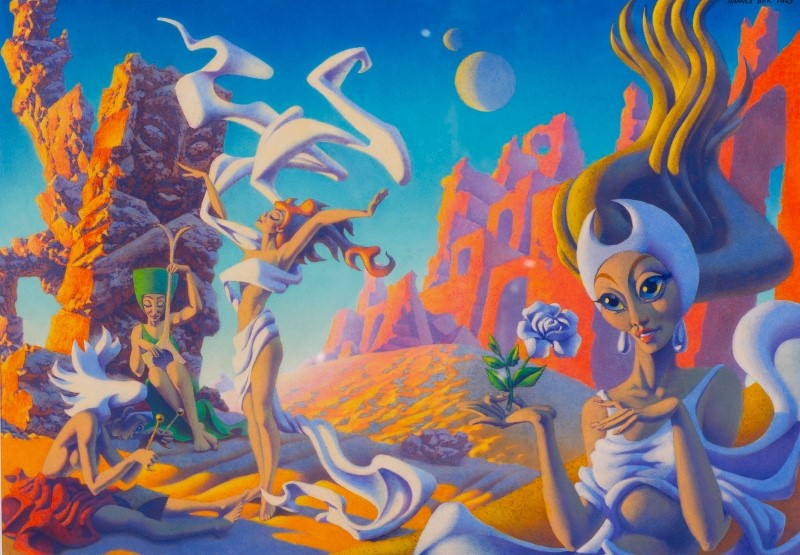
This Hannes Bok (1914-1964) illustration appeared as a wrap-around cover of The Magazine of Fantasy and Science Fiction for ‘A Rose for Ecclesiastes’ | Photo courtesy of the Korshak Collection

Southern California played a pivotal role in our country’s aerospace program when in 1936 the first rocket tests took place in Pasadena’s Arroyo Seco and launched the Rocket Age. Interestingly, the progress in the aeronautics industry in the region paralleled the growth of the science fiction community.

The Pasadena Museum of History (PMH) shows how science, fiction, and Southern California converge in an exhibition called ‘Dreaming the Universe.’ On view from March 3 through September 2, 2018, it explores the history of science fiction from 1930 to 1980, and its significance in the advances of science, the changes in technology, and shifts in American society.

Nick Smith, president of the Los Angeles Science Fantasy Society, curated this show that features historic artifacts, fine and graphic art, books and ephemera, and historic photographs. It will touch on the contributions of Ray Bradbury, Octavia Butler and other luminaries whose names are synonymous with science fiction; it will likewise highlight the fans and followers of the genre. Children and adults alike will find something they will instantly recognize as what initially pulled them into this exciting world.

Smith’s fascination with science fiction began several decades back. He relates, “Ever since I could read I read the ‘Superman’ comics. My barber would let us read whatever books he had, like ‘Incredible Hulk’ and ‘Super Spy,’ whenever we behaved. But the local library provided me the opportunity to read science fiction books written for younger readers. The earliest one I could remember was called ‘Have Space Suit Will Travel,’ about a kid who won a space suit in a contest and got caught up with things like aliens and other weird things.

“Once I had an allowance and had the ability to buy magazines at the newsstand I started purchasing them. That actually influenced some of the artwork we have in this exhibition. I was at a magazine stand and my eye caught this really curious-looking wrap-around cover of The Magazine of Fantasy and Science Fiction. It turned out to be a Hannes Bok illustration called ‘A Rose for Ecclesiastes.’”

“There were a lot of books and magazines about science fiction, fantasy, and speculative adventure written for kids in the 1950s and 1960s,” continues Smith. “They piqued children’s imagination because they were about the things that you didn’t see every day but would be fun if they did happen. They were wish-fulfillment fantasy to a great extent – traveling to Mars, or becoming space cadets to solve crime throughout the galaxy. That led to a lot of radio, television, and comic book science fiction.

“For adults, some science fiction dealt with warnings against abuses of technology which was what the original Frankenstein books were about, if you think about it. That was the first modern science fiction story written and it’s 200 years old now.”
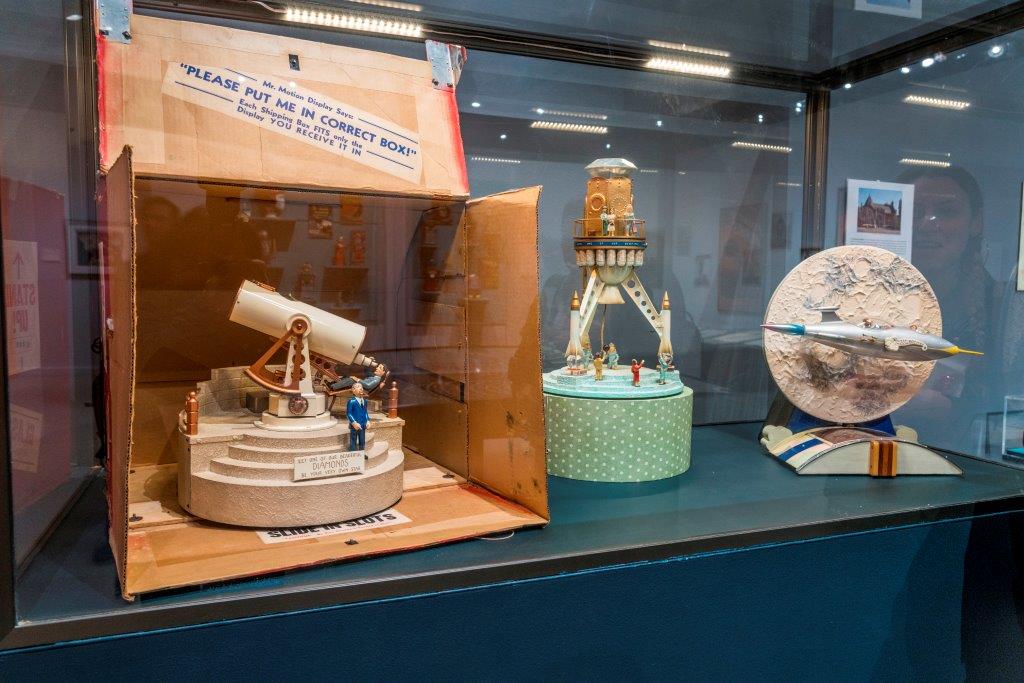
A group of Baranger Motion Displays, 1952-1957, Baranger Studios, South Pasadena, CA. Courtesy of Justin Pinchot (Toyraygun.com,robotcoffeela.com) | Photo by Joanne Wilborn/Marlyn Woo

“Laura Verlaque, PMH’s Director of Collections, and I worked for about a year identifying which things we would like to include in the exhibit that would be representative of the different aspects of science fiction. These items include visuals like flat pieces of artwork ranging from photographs to paintings; costumes – pieces of it or the entire outfit; physical objects from toys to window displays, especially in the 1950s.

“And that’s an interesting bit of the story. In the 1950s when Walt Disney put scientists on TV to talk about the space program, science fiction was all over radio and television. It was very much part of the culture in more ways than people didn’t think of. In fact, there was a company in South Pasadena that made window displays for jewelry stores and many of these had science fiction themes.”

“We don’t think about it nowadays but if we were to look back, science fiction was part of children’s experiences growing up,” points out Smith. “Tom Corbett’s ‘Space Cadet,’ which was very loosely based on science fiction story, was part of my background as a child. I watched that on TV, convinced my parents to buy me the little toys that went with it. A modern musician who, coincidentally, is named Tom Corbett uses a replica of the Tom Corbett lunchboxes at his concerts because he thinks it’s cool that a 1950s show had a character with his name.”

Science fiction’s integration into the mainstream culture took place in stages, says Smith. “There were some anthology science fiction shows on radio and television. ‘Space Patrol’ started here in LA as a radio show before it became a national television show and because they had big sponsors, they were able to get major publicity – they had a national giveaway of a backyard rocket ship clubhouse.

“‘The Twilight Zone’ came out in the 1960s but it was Star Trek that brought in the new wave of fans. It was hugely popular that when NBC cancelled the show Caltech students organized a march to protest it and they were joined by other enthusiasts and students from several universities.
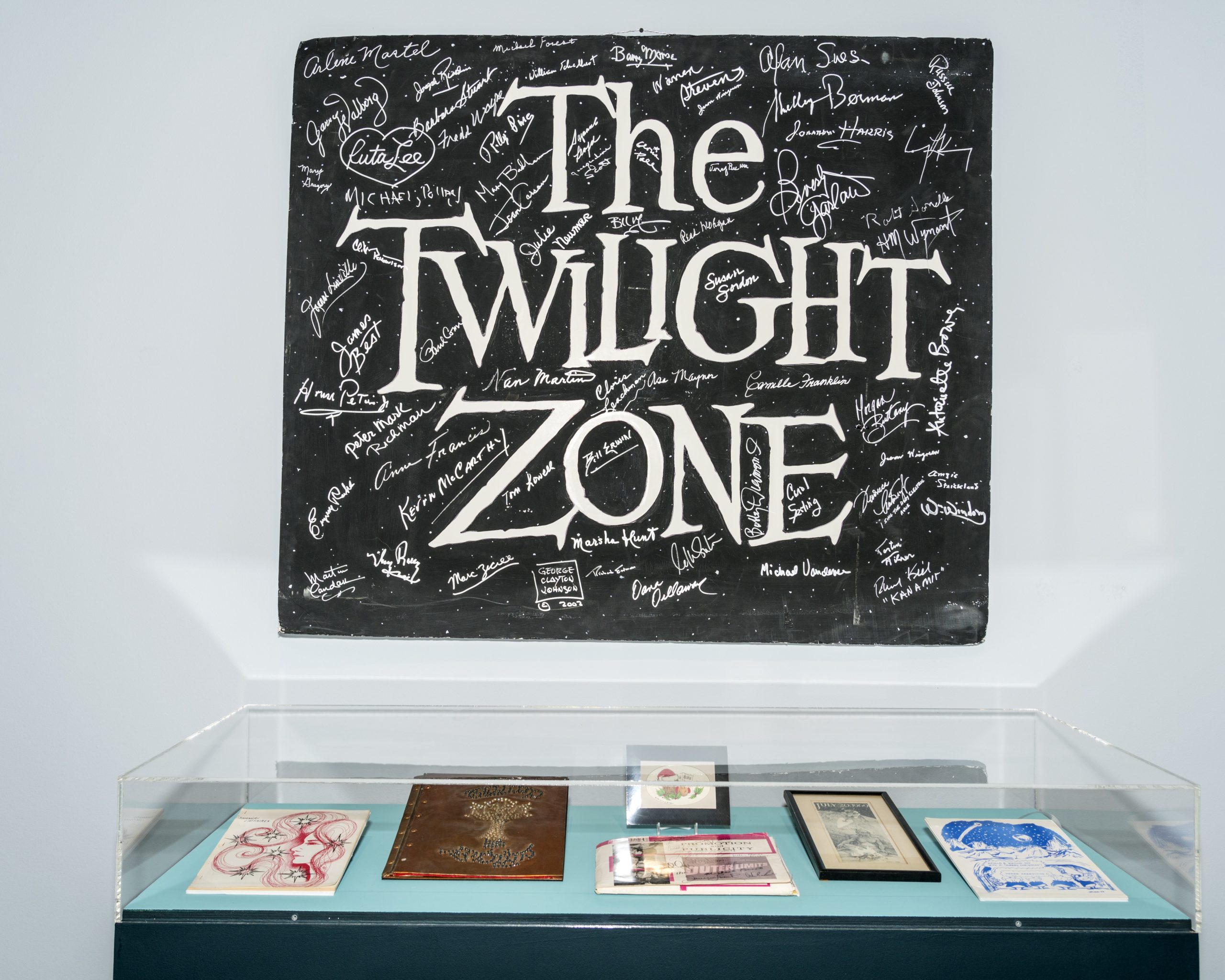
‘The Twilight Zone’ display | Photo by Joanne Wilborn/Marlyn Woo

“Here’s another curious thing – the genre attracted not just males. In this exhibit we have one of the earliest published science fiction female writers. Clare Winger Harris was born in the 1890s and wrote stories for two of the major sci-fi and fantasy magazines back in the 1920s. What makes her particularly noteworthy is that she wrote under her own name, not a pseudonym, at a time when it wasn’t socially acceptable and women didn’t think they could sell a science fiction story. There were no other women in the 1920s in science fiction magazines.

“A more recent famed writer Octavia Butler, who was Pasadenan, was remarkable because she was both a woman and African American. And at that point she was the most successful female African American science fiction writer.”

Adds Smith, “To a great extent science fiction is based in Southern California because the technology and the sources of technology are here, as well as the TV and film industry. Rod Serling didn’t have to travel very far to find writers to work on ‘The Twilight Zone.’ He was able to get some of the best scriptwriters by driving down the street. One such brilliant writer, Charles Beaumont, turned out amazing stories throughout the 50s and 60s. He’s largely forgotten now because he died fairly young but several of his stories became television episodes for ‘The Twilight Zone’ and ‘Night Gallery.’”

“Everything in the field of science fiction is being considered for television right now,” declares  Smith. “There have been successful series like ‘Game of Thrones’ which are radically different from previous fantasy science fiction but they attract an audience which has never read the books they’re based on. The field is growing in several ways. However, not every project that’s started  is shown because the genre deals with such big ideas that are difficult to realize.”

The books Smith read as a youngster were published by Erle Korshak. The distinctive wrap-around cover of the magazine that stopped him in his tracks at the newsstand is one of six graphic art on display in the exhibit from the Korshak Collection. This is the first time these artwork are being exhibited on the West Coast.

Stephen Korshak, himself, began his interest in science fiction illustrations when he was a child. He recounts, “My father owned a pioneering science fiction book company, Shasta Publishers, which ushered in the transition of important science fiction literature from magazines printed in cheap pulp paper to hardcover, library-quality books. These covers, which I was exposed to growing up, engendered my lifelong love for collecting science fiction art.”

There are currently 90 pieces in his collection, with 29 pioneering American artists representing 80 years of published science fiction and 20 European artists from 15 countries who worked from 1863 to 1984. They can be seen online in ‘Korshak Collection: Illustrations of Imagination Literature.’ In the introduction he names one particular piece that stands out in his memory, “The J. Allen St. John illustration for the 1941 ‘Amazing Stories’ magazine cover of John Carter battling the dead in ‘The City of Mummies’ lured me into a fantastic world that I never knew existed. I read and enjoyed the Edgar Rice Burroughs story behind the illustration but, for me, the illustration itself gave me a sense of wonder I had never previously experienced.”

It is the only science fiction collection that tours, conjectures Korshak. And that touring bit came about quite by accident. He discloses, “I took one of the paintings to a framer and he told me it needed to be restored. When it came back from the restorer, my framer told me it was the talk of the restorer’s workshop. He asked me if I had any more of these illustrations and I said ‘yes.’ He said he wanted to display them here in Orlando, where I live, at one of the museums where he’s a trustee. The attendance was so overwhelming and the reception so amazing that we started to do the tours.”
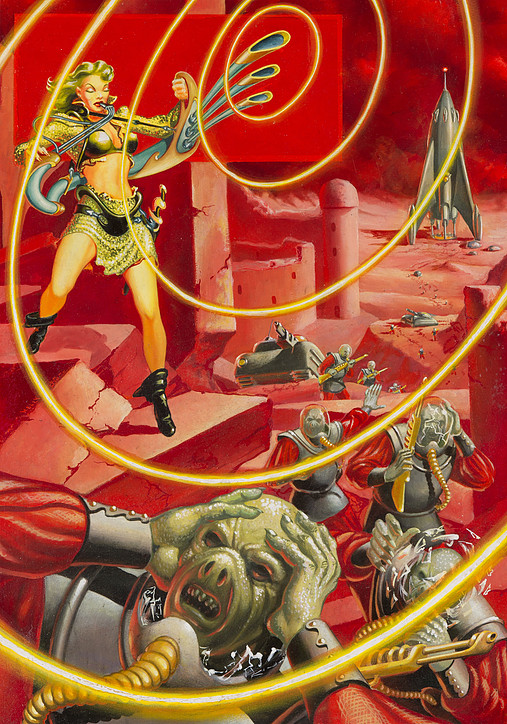
This Kelly Freas (1922-2005) illustration appeared on the cover of Planet Stories magazine | Photo courtesy of the Korshak Collection

Since it began touring  nine years ago, the Korshak collection has been shown in some of the most prestigious illustration museums in the United States – the Brandywine River, the Chazen, and the Society of Illustrators’ – and at Museu Valencia in Spain.

“In the beginning, people were just tossing these illustrations away like the comic books because they weren’t worth anything,” says Korshak. “No one considered them to be art because artists were not supposed to be entrepreneurs – they were meant to work for the Medicis and have great rich patrons who would support their art. However, in the United States, it being a capitalist society, artists were businesspersons like everyone else. Illustrators, by and large, were educated, and had a family to support. They did it to make a living, to sell products and market books.

“For a long time there was a prejudice in the art world; the gurus and fine arts critics pronounced illustration wasn’t art. But there has been a reassessment taking place in the last 15 years or so; there is now a better appreciation for this art form. People paid $30M for a Normal Rockwell, who was an illustrator for the Saturday Evening Post. Maxfield Parrish, N. C. Wyeth, or Howard Pyle pieces go for millions of dollars.”

In the process of collecting, Korshak learned that illustration covers a wide field.  He explains, “My love has always centered on a sense of wonder, that sense of being in a fantasy world, which I tried to capture with my collection. Except for a rare one or two, they are illustrations of literature spanning 125 years, from 1875 to 2000. There are thousands of illustrators and I can’t possibly display thousands of paintings. So what I tried to do was to pick what I thought, in my humble opinion, were the greatest illustrators or those who weren’t as technically famous but had a great influence. But we are not the definitive criterion of who’s great and who isn’t.”

Like a doting father, Korshak demurs when asked to pick the one he likes most, “It’s hard to say which is my absolute favorite but I’ll tell you three of my favorites. Jose Segrelles, a Spanish illustrator, is technically one of the eminent artists in the whole field but was little known in the United States. He made his name in Spain, although he did appear for a short time in the Illustrated London News. He appeared in books and magazines for 80 years but has been forgotten for the most part.

“I was lucky enough to go to Spain to meet his family. I bought the painting from his nephew and before he died I promised them I would take Segrelles back with me and introduce him to the American market. In fact, I will be collaborating on a book about Segrelles with Guillermo del Toro, the academy-award winning director, who said Segrelles was one of the great influencers in his life.

“Another illustrator who is highly esteemed by the cognoscenti is Arthur Rackham. He is a British illustrator who did magnificent work for children’s gift books, including Lewis Carroll’s ‘Alice’s Adventures in Wonderland.’

“A third one would be Hannes Bok who illustrated for Weird Tales. These three illustrators, I think, are the best in their field,” proclaims Korshak.
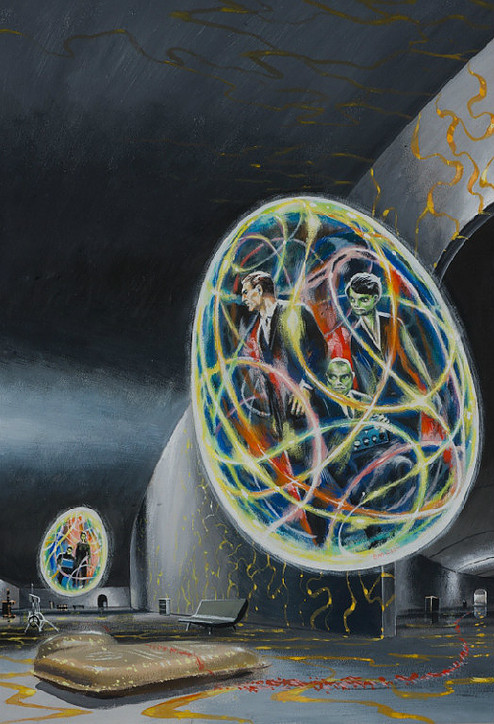
‘The Tree of Time,’ Edward Emshwiller’s (1925-1990) illustration appeared on the cover of The Magazine of Fantasy and Science Fiction

Having this collection has afforded Korshak opportunities he cherishes, “There’s a camaraderie when you meet with other collectors. It’s a hobby you can share with other people which is tremendously fun and enriching. I have developed friendships through this.

“At the same time I really want to share and give back to the field that’s given me so much. The illustrators in my collection established the basic genre, the vocabulary of the field. These books haven’t appeared in print in 80 or 100 years, and out of sight out of mind. Many of the themes are reproduced by modern illustrators but in different ways and techniques.

“By exhibiting the artwork, I feel I’m doing something thoughtful by introducing these illustrators to a new generation of people and helping preserve some of these illustrators’ legacy as well. I’m not single-handedly going to do that but, in my own little way, am contributing  towards that end.

“We’ve finished our East Coast tour and we’re now starting one on the West Coast. Coincidentally, I have just been contacted by a big gaming company in Japan that’s doing an Alice in Wonderland exhibition and wants to take one of our famous Arthur Rackham illustrations. It’s really exciting now that people are starting to know these illustrators. And I think it’s going to help the modern illustrators. My collection goes through 2000 but there are contemporary artists right now who are doing great work like Michael Whelan and the Brothers Hildebrandt.

“I have also written books on two illustrators – Hannes Bok and Frank R. Paul. I wrote the Hannes Bok book with Ray Bradbury before he passed away. It was Bradbury who introduced Bok to the editor of Weird Tales which helped start up his career.

“A few years ago I convinced my father to help me publish an artbook on the father of science fiction art, Frank R. Paul. We named the company Shasta/Phoenix because his original book publishing company, Shasta, had been inactive for 50 years and we resurrected it, like the phoenix, from the dead.

“In the Frank R. Paul book, I mentioned Sir Arthur C. Clarke, who co-wrote the screenplay for  ‘2001: A Space Odyssey.’ Clarke claimed that Paul was one of the great influencers in his life. He said that the NASA space engineers who worked on NASA projects knew we could go to the moon because Frank R. Paul had visualized it,” confides Korshak.

If the people responsible for America’s space program look to science fiction books to determine which galaxies to explore, do we need further evidence that whatever the mind can imagine is humanly possible?

‘The Royals of Pasadena’ Exhibit at the Pasadena Museum of History

Originally published on 17 August 2017 in the Pasadena Independent, Arcadia Weekly, and Monrovia Weekly

Not many cities in the United States have what they call their royalty but Pasadena is one of the few that could rightfully claim to have its own crowned heads. On January 1st every year,  millions along the parade route and watching on TV around the world marvel as the Tournament of Roses Queen and her Royal Court smile and wave to their well-wishers.

The history of the Rose Parade began on January 1, 1890 when members of the Valley Hunt Club reimagined the American version of the festival of roses in Nice, France. They staged a procession of flower-decked horse and buggies and an afternoon of public games on the town lot east of Los Robles between Colorado Blvd. and what was then Santa Fe Street. The story of the Rose Queen and Royal Court, however, did not begin until 15 years since the parade first traveled the streets of Pasadena.

By 1895 the parade had become a massive undertaking for the Valley Hunt Club to fund and manage on its own. The Tournament of Roses (TofR) was formed during a public hearing and a community subscription campaign raised $595.00 to underwrite the expenses of the 1896 Rose Parade.

Tournament of Roses 2020 Rose Parade | Photo by Terry Miller / Beacon Media News

The first Rose Queen was Hallie Woods who, in 1905, was chosen by her classmates at Pasadena High School. She sewed her own gown and helped decorate the float on which she rode. But those days of class voting and self-made garments are long gone. Today, selection of the Queen to preside over the parade takes on an immense process involving thousands of young women and hundreds of volunteers.

This annual Pasadena tradition and rite-of-passage-of-sorts among high school seniors (mostly, but not exclusively, females) who are enrolled in Pasadena-area schools is a spectacular event that begins as soon as that New Year’s Rose Bowl Game is in the history books. The TofR staff rolls out the next year’s schedule of events without breaking stride.

The 100th Rose Queen in 2018 will be crowned in October. In honor of this milestone, the Pasadena Museum of History (PMH) will present an exhibition celebrating TofR’s Royal Court from September 2, 2017 through February 11, 2018. This colorful and historical display will feature previous Rose Queens’ and Princesses’ gowns, daywear, accessories, and jewelry lent for the exhibit by former members of the Royal Court. It will also highlight Queen’s crowns from the last hundred years, on loan from TofR.

Laura Verlaque, PMH’s Director of Collections, reveals, “We’ve had a long partnership with TofR – we’ve collaborated with them in the past and we carry TofR souvenirs in our gift shop.   In 2013 we put on an exhibit about Pasadena anniversaries which included the Tournament of Roses because it was commemorating an important landmark.” 

“I worked with TofR’s marketing department and their wonderful marketing associate, Heather Sharpe, who gave me access to their collection,” Verlaque continues. “PMH borrowed several things for that exhibition including the crowns, and a silver saddle. She remarked to me then, ‘You know in 2018 we will be crowning the 100th Rose Queen. Would you like to do an exhibit about the Royal Court?’ to which I gave a resounding ‘Of course!’. So you can say that we’ve been thinking of and planning this since.”

Because TofR didn’t have in its collection the garments the Queens and Princesses wore PMH reached out to the alumni list. 

“It was nerve-wracking for us because we usually know going in what we have for the exhibit, but for this one we were dependent largely on loans,” reveals Verlaque. “However, it turned out we didn’t have cause for worry; we received so many responses from our initial request before we had a chance to send out a mailing to the entire alumni registry. We were offered more than we can show – there was an outpouring from the royal court who were interested in participating.”

“We got this plaid pantsuit from the 1970s; and yesterday someone came in to lend us an ensemble that has a Diana Rigg look from ‘The Avengers’. They’re such marvelous period clothing that I simply had to make room for them in the exhibit. It’s an absolutely delightful problem to have!,” Verlaque enthuses.

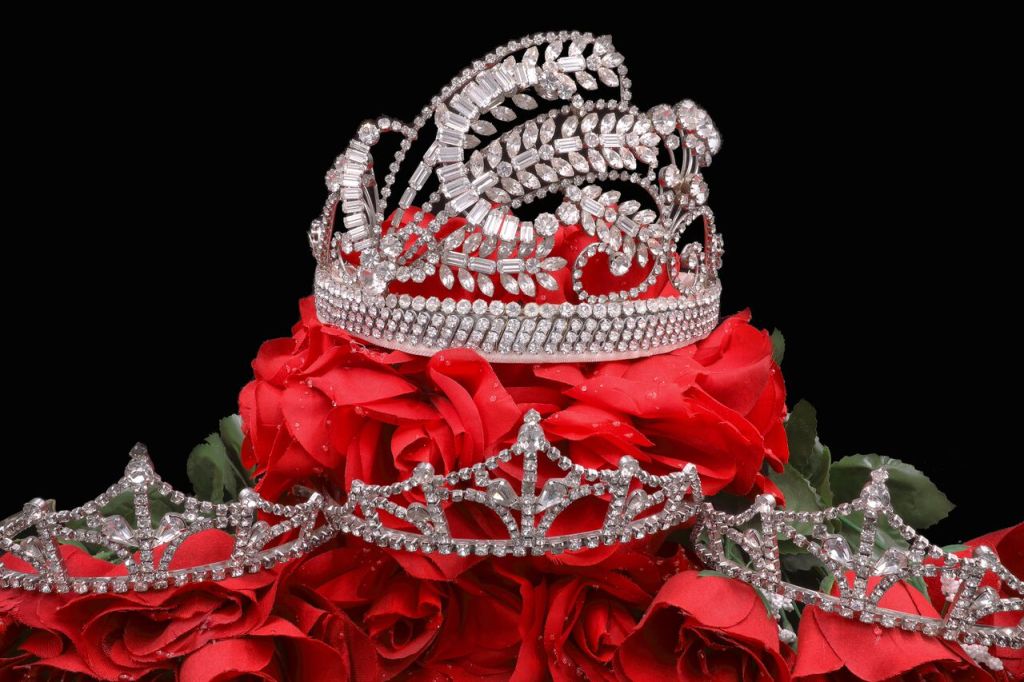
1968 Rose Queen Crown and Royal Court tiaras | Courtesy Photo

The show features about 30 queens and princesses coronation gowns from every decade starting with 1940, along with outfits from the Royal Court wardrobe, accessories and ephemera.

An exhibition highlight is the spectacular 1940 gown, made of ecru velvet with gold lace trim, designed and sewn by Pasadena dressmaker Margie Mudgett. Known as the ‘Camelot’ gown, it belongs to Margaret Huntley Main, the oldest living Rose Queen.

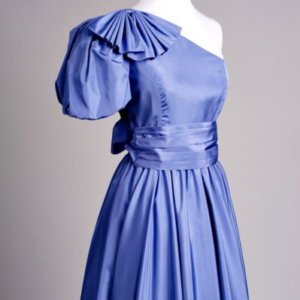
From the 1967 Rose Court wardrobe is an orange suit, duster and hat loaned by Princess Barbara Beckley. An I. Magnin & Company label 1976 Rose Princess gown made of sky blue chiffon over taffeta, a sequined bodice, and a chiffon capelet is on loan from Christina Nurches Pfleider.  A 2004 Rose Queen white gown with diagonal pleating designed by Tadashi Shoji was lent by Megan Chinen Oakes. The Pasadena TofR loaned three Rose Queen crowns for display.

“As part of the exhibit, we’ll have a pull-out section on how the Royal Court selection has changed over the years,” Verlaque states. “In the early days, the queen and princesses were friends of the people responsible for putting on the Rose Parade. Then there was a time when prominent society ladies were chosen for the court. There was a period when every female student at Pasadena City College (PCC) was required to try out; today it is voluntary.” 

Verlaque continues, “The notification system has likewise kept pace with prevailing practice and technology. Previous princesses have told me they used to sit by the mailbox waiting for the letters telling them if they’ve made it to the final 25. Later it was a phone call, and now it’s by email. It has such a fun history.”

Photo by Aaron Gil | Pasadena Museum of History

“The exhibition reveals shifting fashion styles,” explains Verlaque. “The very first gown evoked the medieval epoch – a lot of these early courts had that theme. The entire show makes for a fabulous historical display, really. Then we arrive at the Tadashi Shoji era (the official provider of the Rose Queen gowns since 2006, according to Heidi Hoff, Senior Director for Marketing and Communications. It’s so fascinating to see how his designs have evolved; in that sense this is also a retrospective of his work.”

It is a show that is beautiful, vibrant, and very visual according to Verlaque. “I hope that the ‘Royals of Pasadena’ manifests the pageantry and lavishness associated with the Royal Court. But the Rose Parade is so much more than a beauty pageant. In the course of my research and conversations with the rose queens and princesses, I have learned that the experience they had on the royal court changed their life. And this is the only city in the country that offers that kind of life-altering event for young women. I think it’s a wonderful tradition to be celebrated … examined, even – to see how it has adapted to reflect current affairs and sensitivities.”   

The Rose Parade is a renowned annual Pasadena tradition that has endured world wars and all manner of political strife. The Queen and her Court continue to gracefully perform their numerous community service functions through them all.        

For young women in the area, being part of the Royal Court is a transformative opportunity they hope to experience. A hundred years since the first Rose Queen was crowned, it is still an institution that remains relevant to the times we live in.                                     

Interactive Children’s Tour Offered at Famed Fenyes Mansion

Originally published on 14 July 2016 in the Pasadena Independent, Arcadia Weekly, Monrovia Weekly, and Sierra Madre Weekly

The magnificent mansions on Orange Grove Blvd., in Pasadena, set along wide avenues and well-tended manicured lawns, are the stuff of fairy tales. The Fenyes Mansion is one such residence where kids would have so much fun playing pretend. At the same time, it is an excellent setting for today’s children to learn how people lived a hundred years ago.

From 10:30 am to noon, on Wednesday, July 20 and Saturday, July 23, the Fenyes Mansion is offering senior and junior docent-conducted and supervised immersive tours for kids aged six to twelve. Called ‘Growing up on Millionaires’ Row’, the visits offer a glimpse of what is was like to live in a grand house through the eyes of children.

Brad Macneil, Education Program Coordinator at the Pasadena Museum of History, designed the tour in hopes that this would be an occasion for grandparents to take their grandchildren on an enjoyable visit. He says, “It will be an intimate group of no more than 30 people for each session to allow for individualized attention. We will divide them into three groupings touring  different sections of the mansion. The first one will look at the public places – foyer, dining room and kitchen; the second will go into the studio and the conservatory; and the third will go to the upstairs private areas – the sitting room and the bedrooms.”

“There will be fun things to explore in each space. Obviously the kitchen is a wonderful place to see because while it looks somewhat like today’s kitchen, it is full of delightful appliances – old   fashioned toasters, ice box (refrigerator), stove – that children don’t see in their homes. We’ll show them how ancient phones functioned and how irons worked,” Macneil explains. 

“In the studio we have a Victor Victrola which we rarely use but it will be cranked up and will play music,” reveals Macneil. “It would be great to see the look on kids’ faces when they hear tunes coming out of that instead of from an iPod”.

Macneil further enthuses, “The conservatory is such an amazing place – how many people have their own private garden inside their house? How fun would it be for a child to come and play in this room devoted entirely to plants!”

“The group that will be looking at the foyer would become acquainted with how people arrived to visit – they had calling cards, for one, and they dressed far more formally than we do today. Children will get to pretend to come for a special lunch. They will see how the table is set and learn table manners. Just knowing which fork to use for certain foods require basic training; we have a book devoted solely to dining etiquette. I’m sure we’ll hear a lot of entertaining stories about that,” Macneil says with in amusement.

“Upstairs in the sitting room, children can dress up. Back then, girls and boys were taught how to be proper ladies and gentlemen.  We will have replica clothing they can put on to see what it was like – people wore different attires for various activities, including going out to tea or the theatre.  Women’s dresses had so many layers and weighed as much as 35 pounds! They carried accessories and the way they held their fans symbolized specific meanings, like if they wished to encourage conversation with a gentleman across the room. Even the flowers they received or offered to someone conveyed a particular sentiment. During the Victorian era, people  had to know the language of flowers. Who, these days, would even realize that when a gentleman gave a lady a white camellia it meant he found her adorable? And that getting back a bouquet of withered flowers was a dreaded rejection from a lady he so admired?”, Macneil adds.

“There’s so much the older generations can teach to children today, and that’s why we’re so excited about this.” Macneil continues. “We’re grateful that the Tournament of Roses gave us the funding to make this possible. Using these two sessions this year as a kick-off, we’ll evaluate how much interest it generates and if it’s successful we might make it a regular summer offering.  It is a wonderful addition to our mission of reaching out and sharing history with the community.”                      

Macneil states, “What I love about it is the sharing of information among multiple generations.  There’s nothing like observing a grandfather or a grandmother watching a child learn.  I can already hear the start of a conversation ‘When I was your age, I used to do ….’  It initiates a wonderful dialogue.”

The Pasadena Museum of History will be open to the public immediately after the tours so attendees will have the opportunity to explore the ongoing carousel exhibit, walk the grounds of the mansion, and stop in to purchase souvenirs at the gift shop. This interactive visit to the Fenyes Mansion can be a truly pleasurable beginning of a young child’s greater appreciation for history, the community, and the generations before them.                               

Fabulous Fashion Exhibit at the Pasadena Museum of History

Originally published on 12 November 2015 in the Pasadena Independent, Arcadia Weekly, Monrovia Weekly, and Sierra Madre Weekly

A Beach Boys song famously claims “… the little old lady from Pasadena drives real fast and real hard … and is the terror of Colorado Blvd.” But as the Fabulous Fashion Exhibit, currently going at the Pasadena Museum of History (PMH), beautifully depicts, she is also a woman of impeccable sartorial taste.

The Fabulous Fashion Exhibit features clothes and accessories worn by Pasadena’s well-dressed women from the 1890s, the 1920s and the 1950s. As the show organizers describe them, these three decades were known (respectively) as times of wealth and luxury, flamboyance and decadence, and prosperity and consumerism.

As Dr. Elizabeth Smalley, PMH trustee and Collections Committee Chair, explains, “The three decades being represented in our Fabulous Fashion Exhibit were chosen because they each had distinct characteristics which showed the arc of women’s fashion choices as their roles in life have evolved. In the 1890s women had to have 24 outfits to get through their day because each activity required a change of clothes – they had to dress to make a call, to receive a caller, to go to tea or the theatre or the opera, or to go to dinner.”

The Gay Nineties couture mirrored the extravagance of the Gilded Age when the affluent society enjoyed lavish lifestyles. Women changed their outfits as they went about their various pursuits – from a morning gown for breakfast, to a tailored walking costume during the day, to an elaborate ball gown for evening. Several yards of fabric were required to make these apparels that oftentimes weighed a hefty 37 pounds.   

Clothes in the 1890s were accessorized with delicate, intricately constructed objects. Women carried parasols to protect their complexions from the sun. They waved their ostrich-feathered fans as much to revive them from the vapors as to communicate their interest in a gentleman. They always wore gloves, hats, and stockings on public occasions; large, bejeweled hair combs or tiaras complemented their ball gowns; small bags held money, opera glasses and a fan.

“Then the 1920s ushered in the age of independence for women when they earned the right to vote,” Smalley says. “They eschewed the social constraints of the past, some of them joined the workplace, and their clothes reflected that looseness and freedom.”

The Roaring Twenties was a time of exuberance when women dressed comfortably, bobbed their hair and wore make up. They were celebrating their emancipation from the chores that shackled them to their homes – they took on jobs alongside the men. Coco Chanel defined the look that characterized this era – sporty, boyish and youthful.  Side swags, floating panels and drapes, asymmetrical hemlines, intricate hand-beading, and Art Deco designs were all the rage.   

Accessories in the 1920s featured exotic materials and rich pattern. Daytime wear included a leather clutch with matching shoes; evening attires came with a small velvet purse or beaded bag that held lipstick, a few coins, a handkerchief and a house key. Women wore long strands of beads and pearls to break up the bodice line and accentuate the dropped waistline. They ornamented their hair with a cloche hat, or a glittering hair clip at night.  Rhinestone-embellished shoes became the focal point of women’s dressing as hemlines rose higher.

When the 1950s came around, men returned from the war and women reverted to their previous role as homemakers. According to Smalley, “women became conformists once again and their clothes looked more structured. It’s quite fascinating to see the changes in their roles and how their apparel reflected those.”

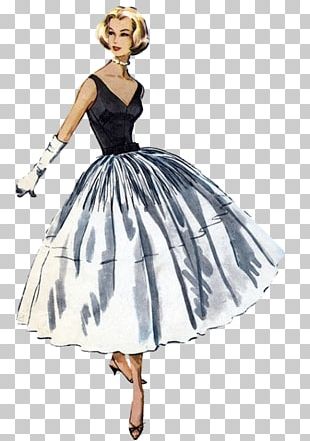
The Rockin’ Fifties, as the exhibit refers to the Eisenhower years, were ruled by conformity and conservatism once more. The ultra-feminine style became fashionable again as women revived their duty as the perfect wife. Christian Dior reimagined the hourglass silhouette with a well-fitted bodice, a wasp waist, and a capacious skirt. As in the 1890s, confining undergarments were essential to this ‘New Look’. The slimmer, looser sheath dress became the trend later in the decade but still relied on hidden reinforcements of corsetry, girdles, and garters. At the same time, women had to be pencil-thin, corseted, coiffured and perfectly accessorized.   

During the 1950s, outfits were flawlessly matched and synchronized: gloves, stockings, coordinating hat, shoes and handbag were de rigueur. Women wore jewelry – costume or real – to complete their look. Stylish women wore rhinestone brooches pinned to their suit collar or dress and they carried large purses made of crocodile, snake, lucite, or bamboo.    

Each show presented by PMH goes through a complicated and lengthy process. Jeannette Bovard, PMH media consultant, asserts “We brainstorm about what’s interesting, what’s relevant, and what’s coming up. Pasadena isn’t a bubble – world events affect us and we sort of affect world events. It is a small town with national significance as evidenced by all our exhibits.”

“For example, our past display was about the Civil War,” Bovard elucidates further. “PMH, as well as several other cultural institutions, mounted events celebrating its sesquicentennial anniversary. Along this vein, our Fabulous Fashion Exhibit showcases fashion trends in Pasadena that followed the rest of the country.”  

Many women in Pasadena held important roles as wives of prominent industrialists, businessmen, and politicians during the periods covered by the exhibit. These ladies, alongside  their husbands, put on important events as befitted their standing in the community.

Smalley illustrates, “One of the clothes being featured is a cocktail dress that belonged to Leonora Paloheimo, granddaughter of Eva Fenyes (who, with her husband, Adalbert, built the Fenyes Mansion that houses the Pasadena Museum of History). Leonora was the wife of the Finnish Consul, Yrjo Paloheimo, so she would have worn this to parties and benefits, or to events she hosted.”

Besides showing the public its wonderful collection of clothing and objects is a far broader reason for holding this exhibit. As Bovard pronounces, “Everything that happens in the nation has somehow come through and been processed through Pasadena. And when we display what women wore during the three decades we are focusing on, we want to show that while these were worn by the ladies in Pasadena, these clothes did not originate here – they may have come from New York or Paris. We were fashionable … we still are.”

Except for a 1950s shirt dress, which organizers had to purchase expressly for this event, all  clothes and accessories in the Fabulous Fashion Exhibit are the property of PMH. They have been donated through the years by various benefactors and the Collection Committee ensures that each piece of clothing has a Pasadena provenance. One of the items being highlighted in the show is a breathtaking purple evening dress created by notable French designer and perfumer, Jean Patou. It is on loan from long-time local resident Susan McManigal, whose family owns the French Hand Laundry and Dry Cleaning on South Lake. 

Pasadena is a small town rich in charm and tradition, with old values that are deeply embedded in its people. Yet it is a city with diverse institutions typically found in large urban areas.  Indeed, Pasadena is home to Caltech, Art Center College of Design, Fuller Theological Seminary, Rose Bowl, Tournament of Roses, Gamble House, Norton Simon Museum, USC Pacific Asia Museum, The Pasadena Playhouse, and a host of other nationally recognized foundations. 

PMH joins a select group of cultural centers – it is a multifaceted entity that catalogs, documents and preserves vast holdings of different artifacts and objects. It then shares them with the public to educate, entertain, and connect to important events of universal significance.  The Fabulous Fashion Exhibit is one way to showcase the treasures the city has to offer while informing people about Pasadena Museum of History’s function. As to the little lady from Pasadena …. As to the little lady from Pasadena …. Well, surely everyone knows by now what she really is – tres chic!

My Masterpieces Series: Pasadena Museum of History

Originally published on 15 October 2015 in the Pasadena Independent, Arcadia Weekly, Monrovia Weekly, and Sierra Madre Weekly

Brad Macneil, Education Program Coordinator at the Pasadena Museum of History (PMH), is readying once more for this year’s My Masterpieces Program. Every Tuesday and Thursday, beginning this month until the end of the school year, he and his team of volunteers will be welcoming 4th graders from all the public schools in Pasadena for a two-hour art class and activity at the Fenyes Mansion. 

According to Mr. Macneil, this program originated from a pilot test collaboration among the Pasadena Unified School District (PUSD), Pasadena Educational Foundation (PEF) and different cultural institutions, with input from teachers. He says, “It was important that we involved the teachers. We made sure they felt it was their program too so we asked them to write the curriculum for it.”

For My Masterpieces, PMH provides students and teachers with the Museum publication Painting the Beautiful as background material for their visit.Students also complete a lesson in class to prepare them for the field trip and learn some basics in art education. During their visit, they learn about the mansion and other members of the family, and explore what life was like in the early 1900s.      

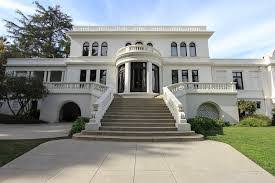
The Fenyes Mansion, which is also home to PMH, is a Beaux Arts residence built in the early 1900s as a winter home for Eva and Dr. Adalbert Fenyes. Macneil adds, “At the time Pasadena was a winter resort that attracted artists to the area because of its landscape which they painted.  They later sold these paintings to the wealthy visitors. A leader of that art community was Benjamin Brown, a famous landscape painter. He was a friend of Eva and he created some of the portraits and landscape paintings that still hang today in the mansion. Eva became a patron of Pasadena’s flourishing art colony and invited various artists to her studio or to go out into the foothills for creative material.”          

“The inspiration for the mansion field trip is Eva’s life and her love for the arts,” explains  Macneil. “Each visiting class is divided into three groups – art critics, artists, film makers – that   rotate to do different 30-minute activities led by a PMH volunteer. The art critics take a tour of the mansion and look at Eva’s art collection which they have seen in the book Painting the Beautiful. Using art terms and vocabulary, students discuss what they like or don’t like about a painting. They talk about the techniques the artist used to get certain effects.”

Macneil continues, “The artists head outside to the fountain, which has been depicted in painting by a well-known artist named Richard Miller. Volunteers give students a brief instruction: their task is to capture the spirit of the fountain as best they could using the pencil and pad they are provided. It’s very surprising how 4th graders can quietly concentrate on their sketches during the entire 30 minutes.  And more amazing is what they come up with!”

The Fenyes Mansion

The film makers go out in the garden. Macneil says, “Eva was not only interested in the arts, she was also fascinated by the technology involved in moving pictures. So for our film makers, we pick the actors, camera person, and director who will take part in creating a silent movie called A Thief in the Park. They learn not only techniques in movie-making, but more importantly, the value of collaboration. Teachers have great fun taking photos of the finished students’ work on their Smart Phones to show later in class. It’s probably the most popular thing we do – it’s exhausting and it needs several volunteers.”

PMH serves 3,000 4th grade students a year in the My Masterpieces program, using funds raised by the Paloheimo Foundation. But the organization could use more volunteers to help keep it running. Volunteers can be college-age or older and will lead tours Tuesday through Friday.  Anyone who has patience, enthusiasm, a sense of humor, and is interested in volunteering can call PMH at (626) 577-1660.

According to Jennifer Olson, District Arts Education Coordinator for PUSD, My Masterpieces started during the 2008-2009 school year. It began serving only four schools, then expanded by four to five schools annually until eventually all of Pasadena’s 18 schools became part of it. It aims not only to provide arts education and a cultural experience for all children, but also to help them feel at home at any of the arts organizations in their community. They found that so many students in the Pasadena Unified don’t usually go to museums with their families because there are too many barriers including cost and transportation. This program removes those impediments and invites all Pasadena families to experience the arts in their community.

A class visit to the Fenyes Mansion leaves a truly lasting impression in the minds of young students. According to Macneil, several of PMH’s Junior Docents (7th and 8th graders in Pasadena public and private schools giving tours to 3rd graders in the PUSD) first saw the mansion during their My Masterpieces Program visit in 4th grade. And it was what encouraged them to later become Junior Docents.

The Pasadena Museum of History’s motto is ‘History Matters.  Help us Pass it On’. The My Masterpieces program breathes life into that adage.

Pasadena Museum of History’s Junior Docent Program

Originally published on 12 February 2015 in the Pasadena Independent, Arcadia Weekly, and Monrovia Weekly

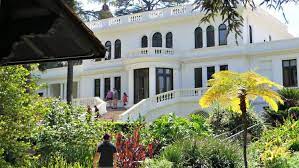
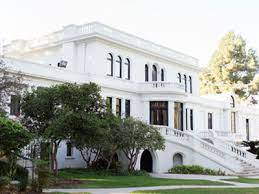
They’re artists, entertainers, scientists and world-travelers. These words describe the former occupants of this glorious mansion on the southwest corner of Walnut Street and Orange Grove Blvd., Pasadena’s famed Millionaires’ Row. Now the Pasadena Museum of History, this Beaux Arts mansion was designed by architect Robert Farquhar, and built in 1906 when Eva Scott and her husband, Dr. Adalbert Fenyes, downsized. Their first Pasadena home was a 33-room Moorish mansion complete with stuffed peacock, a far grander residence than this mere 18-room house. It was home to four generations of the Fenyes clan until 1973.

I learned about the remarkable Fenyes family one Friday morning when I joined a group of 3rd graders from Roosevelt Elementary as our junior docent, KC Young, from Marshall Fundamental School, told us the story of Eva and the doctor. KC led us to a child’s bedroom on the second floor where she showed us an elaborate doll’s house and then to the master bedroom where a vanity held Eva’s grooming items like her brush etched with the distinctive Fenyes crest.

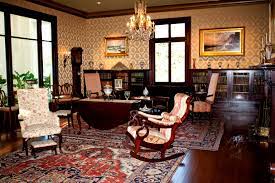
We went downstairs to the studio where an ancient Victrola shares pride of place with a grand piano. Eva played four instruments – guitar, piano, mandolin, and violin – and entertained extensively. They staged elaborate shows here and at one end of the room, a staircase leads to a platform where an orchestra played the musical accompaniment for performances and parties. It was also where Eva painted her portraits and landscapes. Eva’s wide circle of friends included many artists and her home became the salon and meeting place for the flourishing art colony in Pasadena.

Fenyes Mansion | Courtesy Photo

Our group’s last stop was the kitchen where we inspected the stove, icebox, bread toaster, irons, even an old Bissell rug cleaner, the precursor to a household staple, the vacuum cleaner .We were all intrigued by the ‘call box,’ which had the names and rooms of the various occupants of the mansion. The Fenyeses summoned their servants using this contraption, a more ‘modern’ version of the one American audiences see when they watch Downton Abbey on television.

KC Young is one of 31 junior docents for the Pasadena Museum of History. The Junior Docent Program began in 1988 as a collaborative project between PMH and Pasadena public and private schools. Through its peer-teaching method, exceptional students in 7th and 8th grade develop skills in leadership, time management, and public speaking. It fulfills the social studies standards mandated by the state and offers students an early introduction to community service.

According to Brad Macneil, PMH’s Education Program Coordinator, his challenge is getting young kids excited about life and culture in Pasadena at the turn of the 20th century, and how these contrast with the present day.  He has been spearheading this program for 14 years and is proud with what it offers – a rare opportunity for students to teach other students in a way that is quite different from how other tours are conducted.

In the fall, a select group of 7th and 8th graders undergo seven two-hour sessions on Wednesday afternoons. They learn everything there is to know about the mansion, its former occupants, and all the prized collections housed in this grand residence. Upon completing their course, these young docents give their first tour to their families. They are then tasked with leading tours for 3rd and 4th graders of PUSD in late winter and spring; junior docents give several tours in the duration of their term. Senior docents accompany them during their interactive tours to evaluate and coach them to perfect their touring skills. However, they don’t have memorized scripts to follow; they conduct tours the way that is comfortable for them.  

The day I was there, my first guide, KC Young, was the storyteller who engaged me and the 3rd graders with her inimitable enthusiasm and verve. I took a second tour and my guide, Preston Kealing, was the learned professor who taught me and 4th graders from Jefferson Elementary School how the Fenyeses’ remarkable personalities permeated Pasadena society and influenced the world of politics. KC and Preston had very different styles of imparting knowledge, yet they both conveyed the Fenyeses’ significant contribution to Pasadena’s culture and history.

At the end of the morning’s tours, all students and their docents gathered at the foyer where we all shared what we thought was the most interesting part of the experience. Asked what some students would like to take with them from 1906 to 2015, some said they would take the doll house, or the monkey cage, or the Victrola. While they each had a different idea of what was most memorable about this mansion, they all agreed that it had been a fun way to learn. 

I was amazed at how much I learned from 12 and 13-year-old students; I left the Fenyes mansion more aware and enlightened than when I first arrived. I am convinced the Junior Docent Program is as much a valuable Pasadena treasure as any mansion on Millionaires’ Row.