A Special Rose Parade for these Extraordinary Times

Originally published on 29 December 2020 in the Pasadena Independent, Arcadia Weekly, and Monrovia Weekly
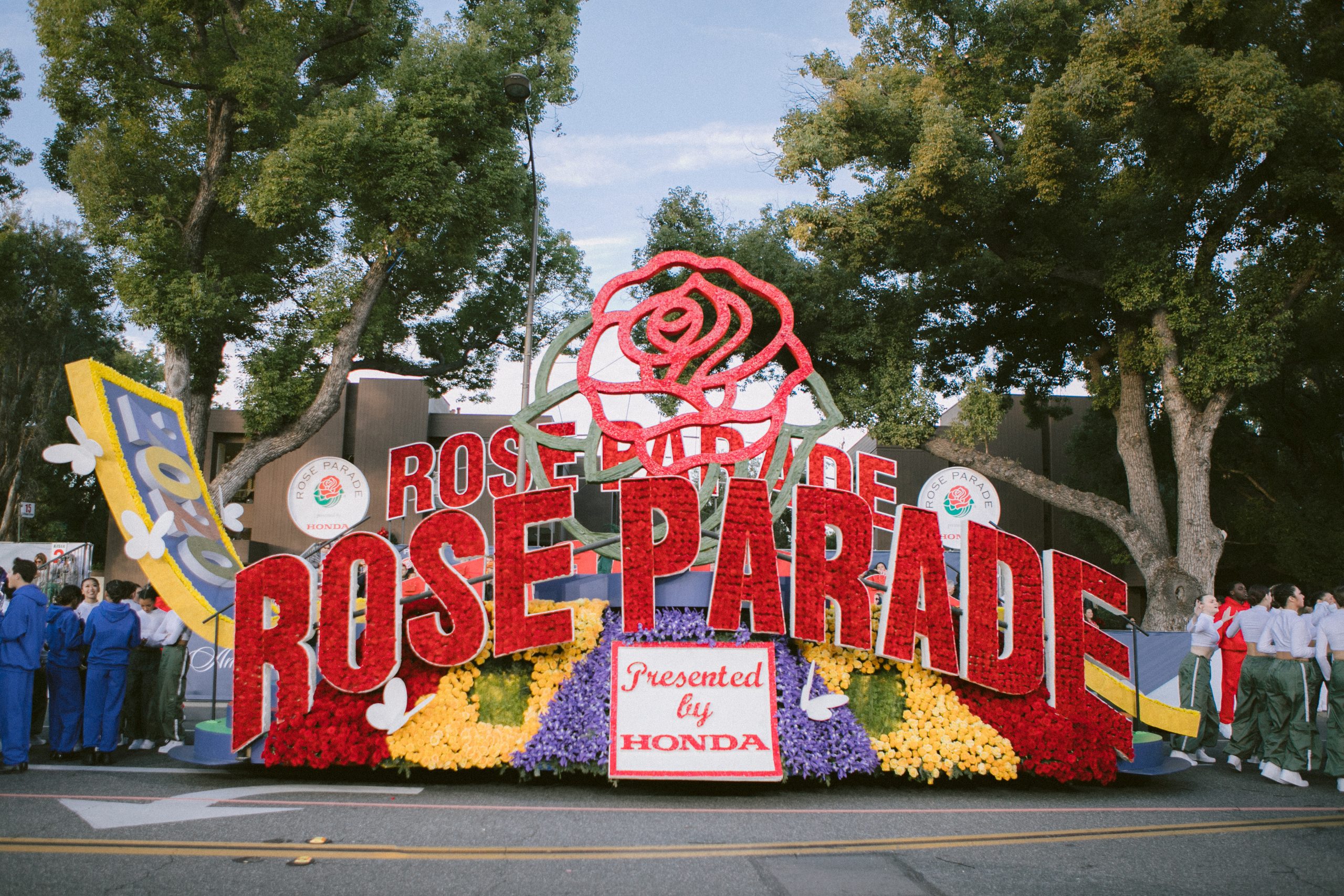
The 2020 Rose Parade | Courtesy photo / Tournament of Roses

To say that these are extraordinary times might be an understatement to describe a year beset by an astounding 81 million infections and over 1.7 million deaths from COVID-19 worldwide. In the face of those sobering statistics, a New Year’s Day without a Rose Parade or Rose Bowl Game in Pasadena seems trifling.

However, the Tournament of Roses Association (TofR) is determined to use that day — when we’re usually glued to our television sets marveling at the magnificent floats, watching the spectacular equestrians, and delighting in the marching bands as they travel five miles on Colorado Boulevard — to showcase and honor our New Year’s Day traditions.

This New Year’s Day presentation isn’t all about entertainment though. TofR President Dr. Robert Miller states, “We’re producing ‘Rose Parade New Year’s Celebration Presented by Honda,’ in partnership with Feeding America®, the nation’s largest organization dedicated to fighting domestic hunger through a nationwide network of food banks. Food insecurity has been a focus of our organization’s efforts during the pandemic, so it was only fitting for us to extend that commitment to our TV special. We’re very happy to have this opportunity to work with Feeding America, an organization that’s working to change lives in communities across the country.”  

“When we were envisioning what this was, we asked ‘What do we want this show to feature?'” Miller continues. “Words like ‘new beginnings,’ ‘current issues,’ ‘moving forward,’ ‘honoring first responders,’ ‘optimism,’ ‘football,’ ‘ celebration,’ came to mind. It’s a fully-produced, two-hours of engaging, interactive broadcast about everything Rose Parade — our history; volunteers; parade participants, including bands, equestrians; and all the beautiful flowers. We’ll have celebrity performers in the fields of music, film, and television, as well as culinary and sports personalities.”  

According to a press statement released by TofR, “The re-imagined New Year’s Day celebration will feature stellar musical entertainment and exciting celebrity guest appearances that will  appeal to fans of country music, television, Broadway, and sports. There’s something for everyone in the family to enjoy. Musical performers include: Sheryl Crow, nine-time GRAMMY® Award winner with more than 50 million albums sold; Mickey Guyton, country singer-songwriter and historic GRAMMY® award nominee; Tori Kelly, multi-GRAMMY® Award winner, singer-songwriter; Lady A, multi-platinum, seven-time GRAMMY® Award-winning country trio Rascal Flatts — the most awarded country group of the last decade; The War and Treaty, eclectic, soulful, husband-and-wife duo – one of Nashville’s breakout acts.
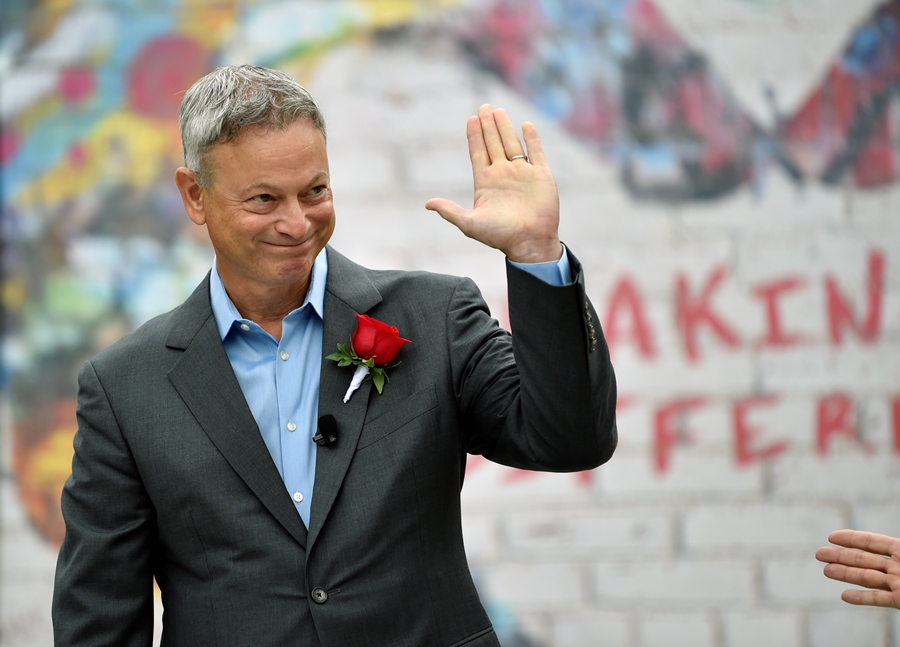
Actor and philanthropist Gary Sinise was the 2018 Rose Parade grand marshal | Photo by Terry Miller / Beacon Media News

“There will be celebrity guest appearances by: Daddy Yankee – multi award-winning singer; songwriter, actor and producer Shanola Hampton – star of ‘Shameless’ on Showtime; Laurie Hernandez – Olympic gold and silver medalist, 2016 U.S. Olympic Women’s Gymnastics Team; Emeril Lagasse – chef, restaurateur, TV personality; and author Matt Leinart – 2019 Rose Bowl Hall of Fame inductee, former NFL player and Heisman Trophy winner; Rita Moreno – Emmy®, GRAMMY®, Oscar® and Tony® (EGOT) award winner; Dascha Polanco – star of Netflix hit, ‘Orange is the New Black’; Vin Scully – voice of the Los Angeles Dodgers for more than 65 years; Gary Sinise – actor, philanthropist and 2018 Rose Parade grand marshal. Past Rose Parade grand marshals, Emeril Lagasse and Gary Sinise, will both be featured in the  special. Gary will open the show and Emeril will shake us up with his favorite New Year’s Day cocktail.” 
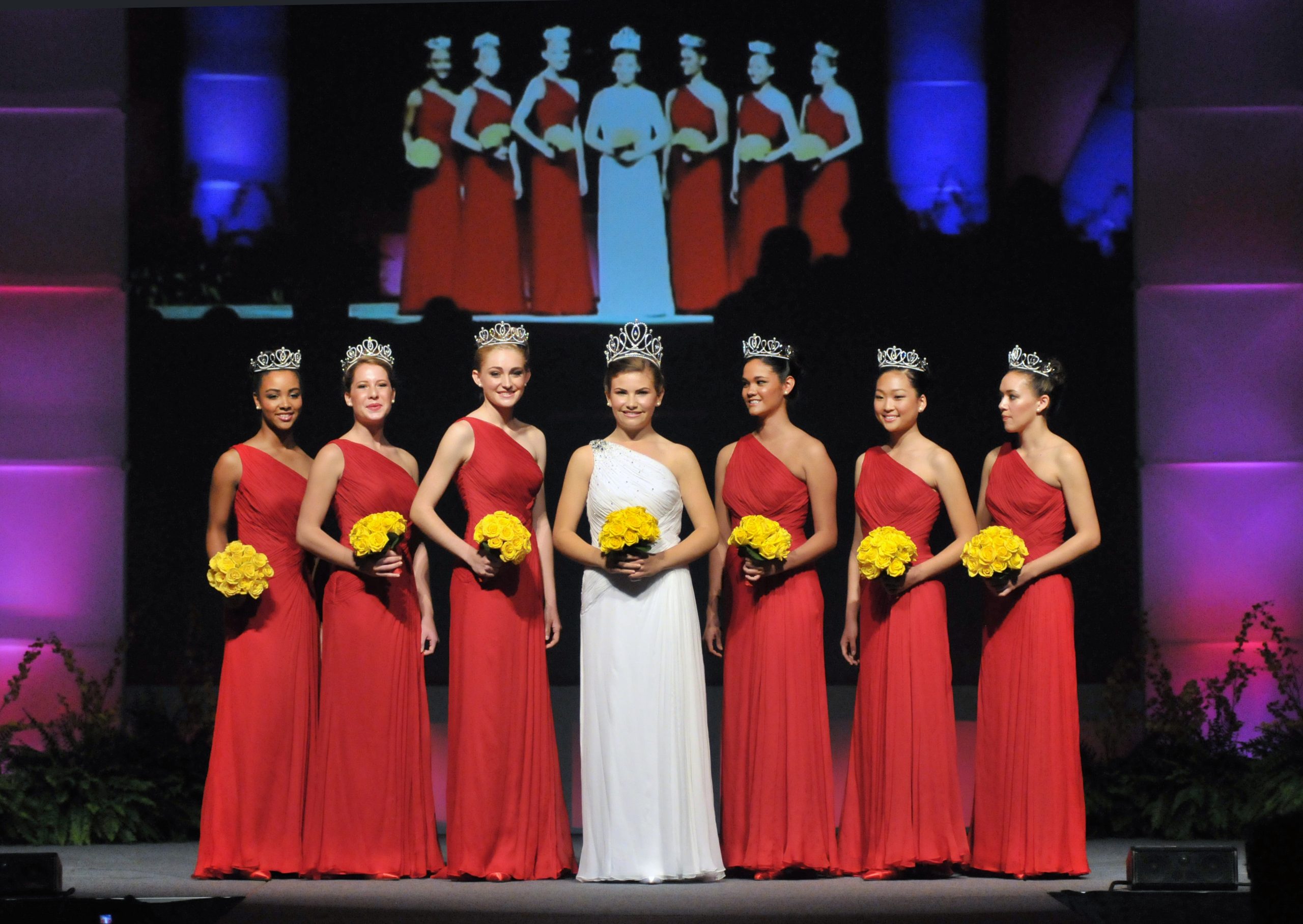
The 2009 Rose Court | Photo by Terry Miller / Beacon Media News

Adds Miller, “The two-hour special will speak to our Royal Court and their traditions; we’ll share some of our unique moments and lots of heartwarming stories about the TofR members and their activities. We’ll show spectacular floats from previous years, a behind-the-scenes look into building a parade float, and New Year’s wishes from fans around the globe. And, of course, it will talk about football — we’ll have Rose Bowl Game® football highlights. The show will air on ABC, Hallmark Channel, KTLA, NBC and RFD-TV at 8 a.m. PST and on Univision at 7 a.m. PST on Jan. 1. We limited travel and ensured the safety of our talent by having the performance segments filmed at iconic locations around the country — including the Grand Ole Opry and the Rose Bowl Stadium — using the strictest COVID-19 safety protocols.”

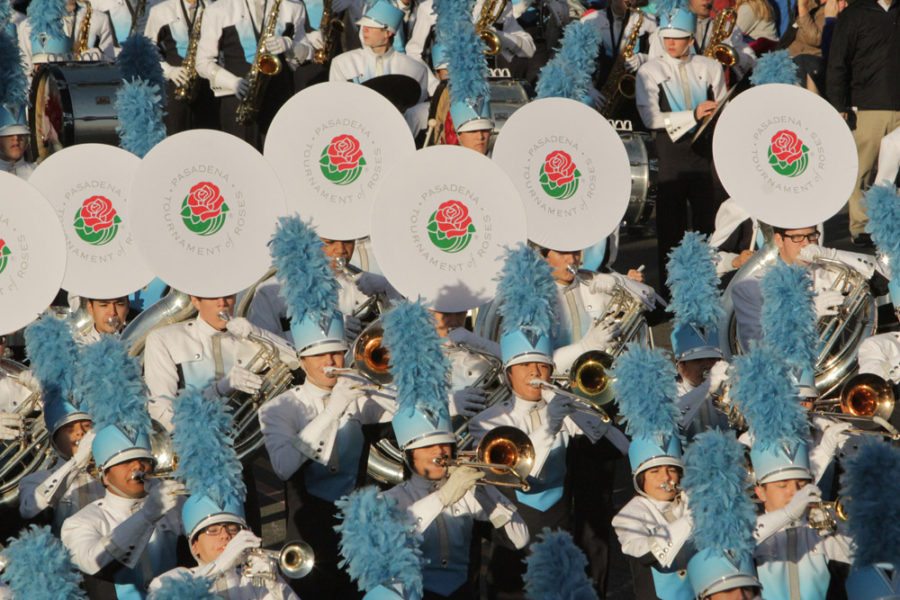
The TV special will also include a virtual performance of “Everything’s Coming Up Roses” by seniors in high school from bands across the country to be led by a surprise conductor. Explains Miller, “While we have invited all the bands who were scheduled to perform in this year’s parade to instead join us for the 2022 Rose Parade, we realize that there are many seniors who will graduate before that. We didn’t want them to miss out on this opportunity, so we’re giving them their very own, unique performance spotlight.
Courtesy photo | Tournament of Roses

“We’re very excited about this retrospect and a look at America’s New Year celebration — the Rose Parade. All the networks are happy to broadcast the program and we’re grateful to them for airing it. It is our gift to the country and to the world. We want to convey the message that the view of our parade may look very different this year but our mission never changes — to provide the world the best floral parade, to create an enjoyable entertainment event, and to make those accessible to everyone.”

In previous years, the floats were available for public viewing directly after the parade and the following day at Victory Park. When TofR announced in July that they would not be able to host a parade on New Year’s Day, the board sat down to figure out if they could have some floral art displays instead.
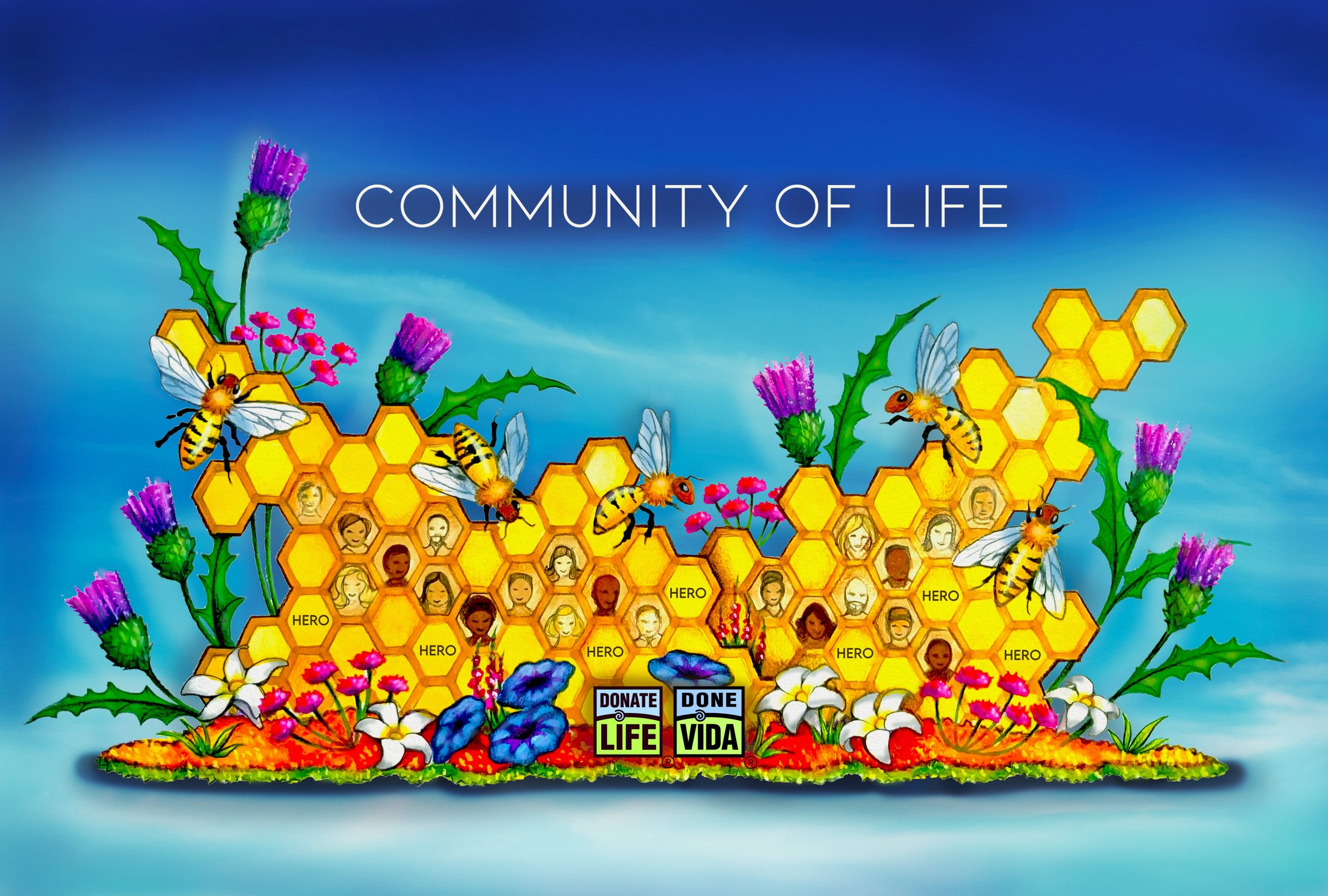
Fiesta Parade Floats rendering of Donate Life’s floral sculpture | Courtesy photo / Tournament of Roses

Miller expounds, “We thought about having drive-by floral installations sponsored by companies. But in order for it to be economically feasible, we needed anywhere from 15 to 20 participants. We were able to get seven or eight committed, but we realized that wouldn’t be enough to make it work so we informed them of our decision to scrap the plan. (As a side note, the idea sounds great, so we might do it another year as a spring or summer event.) However, Donate Life, an organization which has been a Rose Parade participant for several years, came back to us because they liked the concept and thought it would be a way for them to continue promoting the importance of organ, eye, and tissue donation — the need for donors doesn’t stop during the pandemic.”

A press release issued by TofR states, “The Donate Life Rose Parade® float has inspired people across the country and around the world to save and heal lives through the powerful message of organ, eye, and tissue donation since its first participation in 2004. On its 18th year, and as a tribute to17 years on the Rose Parade®, the Donate Life community commissioned a beautiful and symbolic floral sculpture that will be featured in the Tournament of Roses’ TV special and then installed at the Tournament House at the end of December.”

Donate Life’s floral sculpture was created by Fiesta Parade Floats (FPF) at its 70,000-square-foot facility in Irwindale. Established in 1988, it is the longest-tenured Rose Parade float builder and has boasting rights to having the most awards in the float building industry. Its float for The UPS Store’s entry “Stories Change the World” won the 2020 Sweepstakes Trophy.
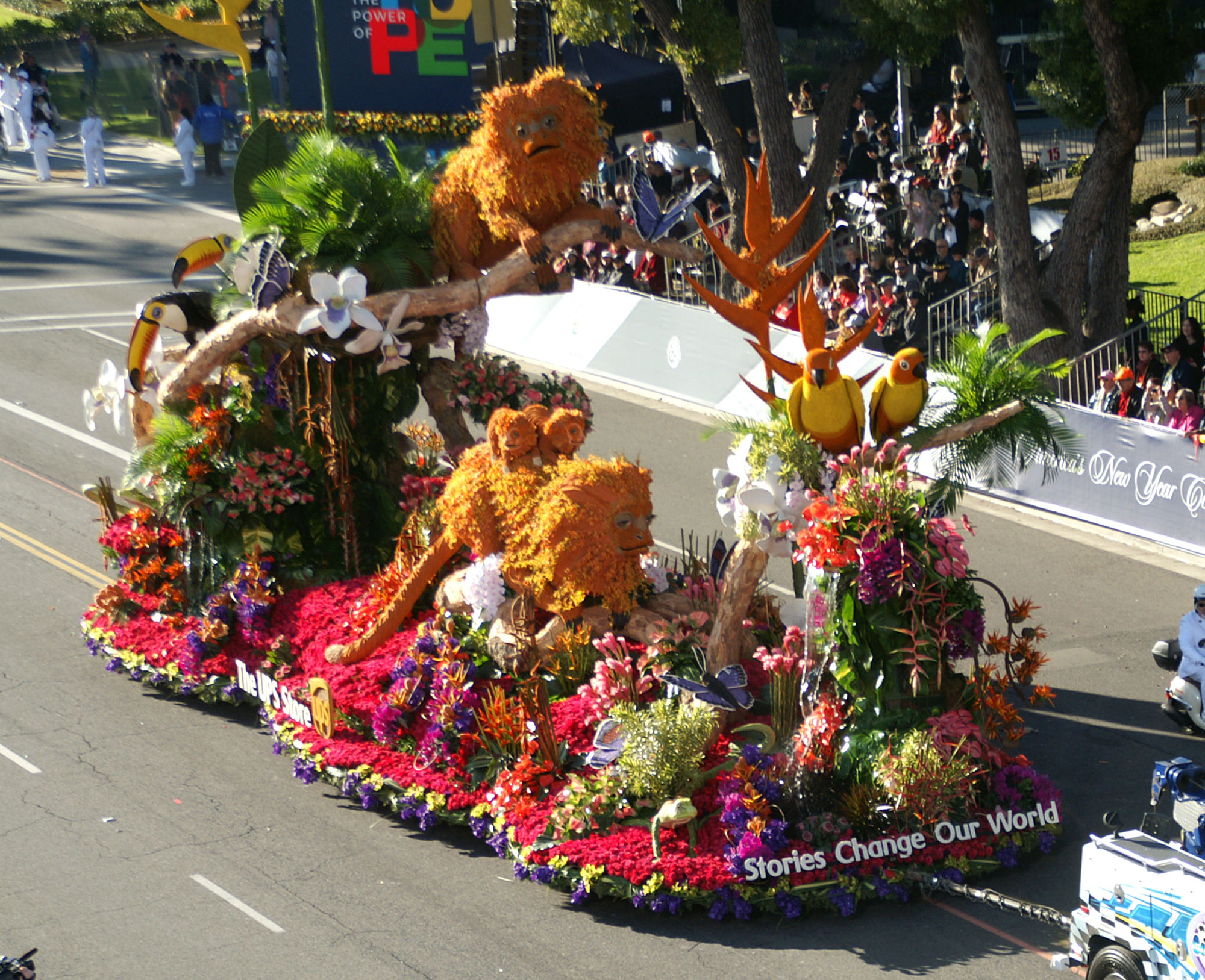
The UPS Store’s Rose Parade entry | Courtesy photo / Fiesta Parade Floats

Relates Mark Havenner, Fiesta Float Parade’s spokesman, “Our company started in January of 1988, with its first Rose Parade being the 1989 Rose Parade. On a normal year we produce anywhere from 12-14 Rose Parade Floats. We have been Donate Life’s float builder for the last few years and we’re honored that they wanted us to create this special display. Working directly with Donate Life, award-winning float designer Charles Meier conceived the floral sculpture called ‘Community of Life.’”

Featuring a vibrant honeycomb built by bees, Donate Life’s floral sculpture illustrates that we are stronger when we work together as a community. In the honeycomb are 21 hexagonal memorial portraits, depicting the life that donors bequeath. Additionally, the names of six health professionals — Donation Healthcare Heroes — who have gone above and beyond the scope of duty to make donation and transplantation possible during the pandemic are inscribed on plaques. Hundreds of individually dedicated roses within two beautiful bushes contain personal messages of gratitude, hope, love, and remembrance from the families of donor recipients. Astromerias of various colors are also used in the floral garden.

“In mid-September Fiesta Parade Floats started work on Donate Life’s floral sculpture, which measures  approximately 30 feet wide and 15 feet high,” says Havenner. “Twelve people worked on building it and an additional 14 were involved with the decoration process. It will be on display from Dec. 30 through Jan. 3.”

Numerous small enterprises have been adversely affected by the pandemic and, in the Pasadena area, float builders count among them. Havenner discloses, “With the cancellation of the Rose Parade and other projects Fiesta normally works on, we have lost approximately 99% of our yearly business. Fiesta Parade Floats is hoping that all moves forward with the Tournament of Roses and its Jan. 1, 2022 Rose Parade.”
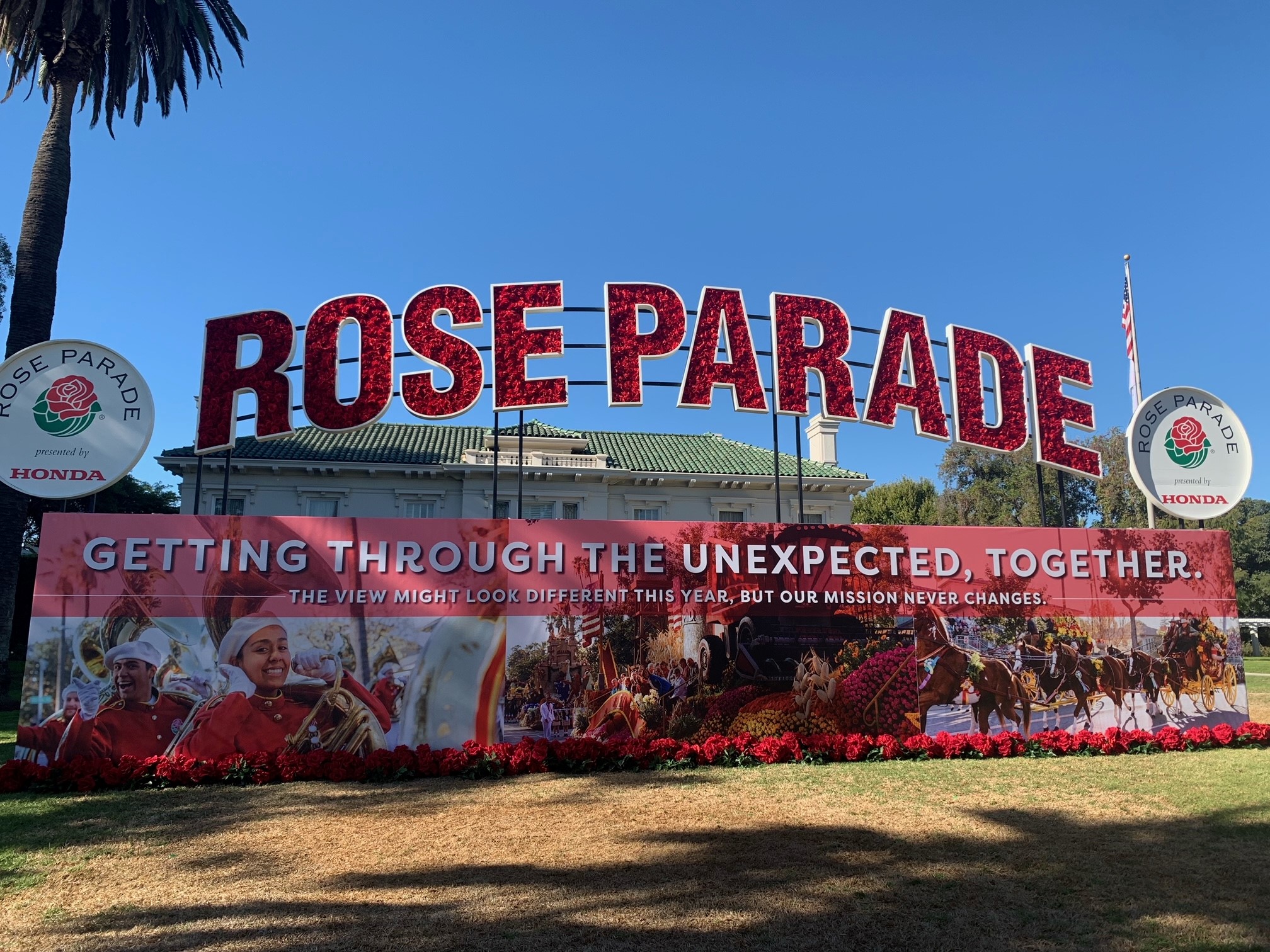
The 40-foot canvas at the Tournament House | Courtesy photo / Tournament of Roses

A 40-foot canvas in front of Tournament House reiterates that sentiment. It says “Getting Through the Unexpected, Together. The view of our parade might look very different this year, but our mission never changes.” On it are photos of bands, floats, and equestrians — the Rose Parade’s three major hallmarks. And according to Miller, already people are stopping, looking, and taking pictures. As he articulates it, “It basically says ‘We didn’t go anywhere. This pandemic hasn’t beaten us, we’re going to be back.’”

During pre-pandemic times, the Tournament president spends a whirlwind year traveling across and out of the country to be the face of the organization. In fact, it’s almost a full-time job that at the end of 2019 Miller decided to retire from his post at the Los Angeles Community College District as vice chancellor of financial resources, where he spent the last four years of his 37-year career in academia, so he could give it all his time and complete dedication.
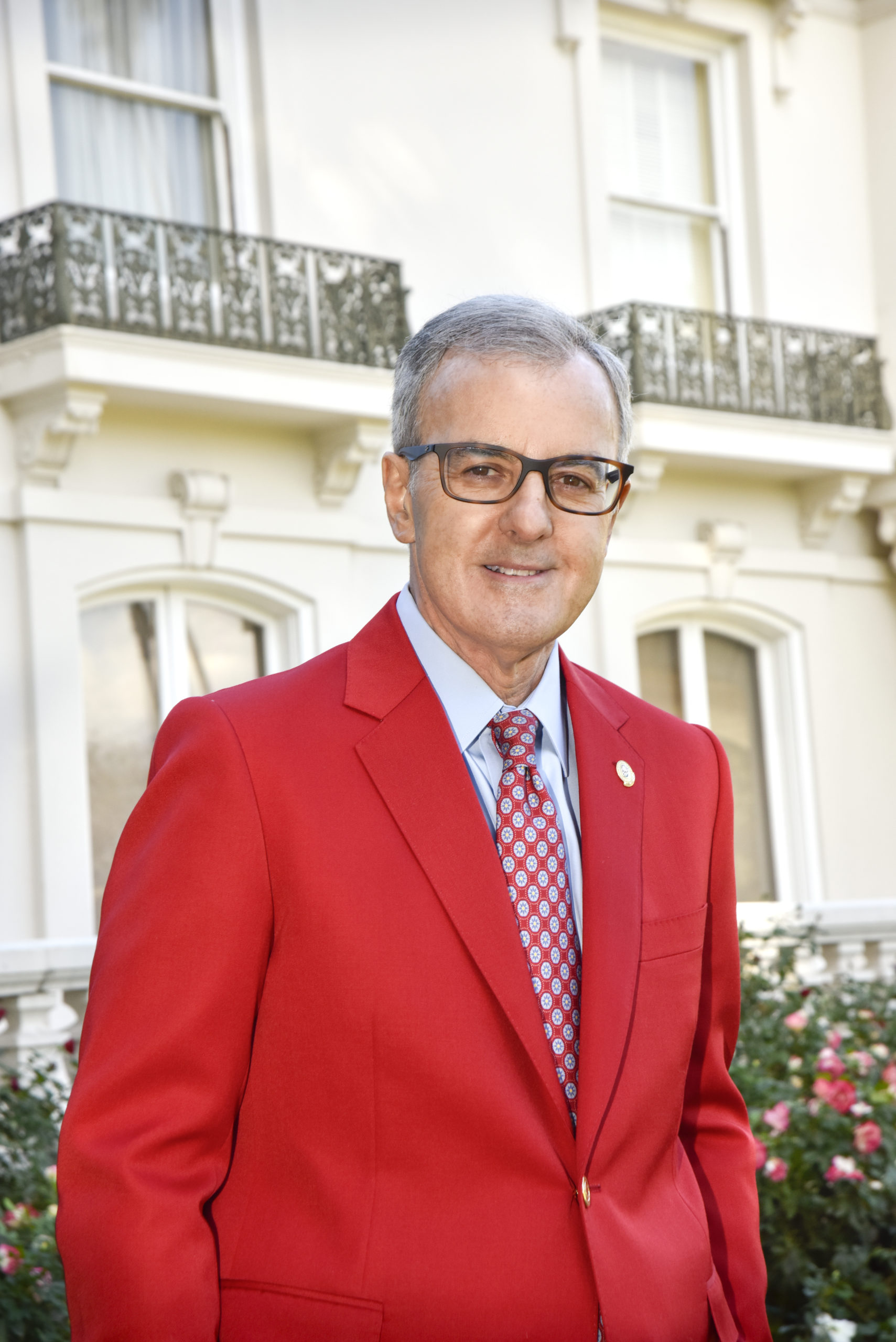
Robert B. Miller | Courtesy photo / Tournament of Roses

Miller describes, “The president is the ambassador-in-chief and our job is to go out into the community — locally and regionally throughout the country, and between three to five internationally — and help with fundraising. That includes meeting with major sponsors, appearing at banquets, kissing babies, and whatever it takes to help them raise the money to be able to come to Pasadena. Getting a band to Pasadena, for example, is typically a $2,000 to $2,500 expense per band participant. So we’re looking at anywhere from $400,000 to $1 million just to get a band to Pasadena — that’s a lot of bake sale and car wash fund raising. I have been a TofR member for 37 years and it’s a true honor and pleasure to get to this point.”

This has been a vastly different year, though, and none of what Miller prepared decades for transpired. However, much like other major festivals, TofR’s board of directors decided that all of 2020-2021 assignments would be the same in 2021-2022. Therefore, he will be president again and will have the opportunity to do what other presidents before him had done. His theme “Dream, Believe, Achieve” will return next year.      
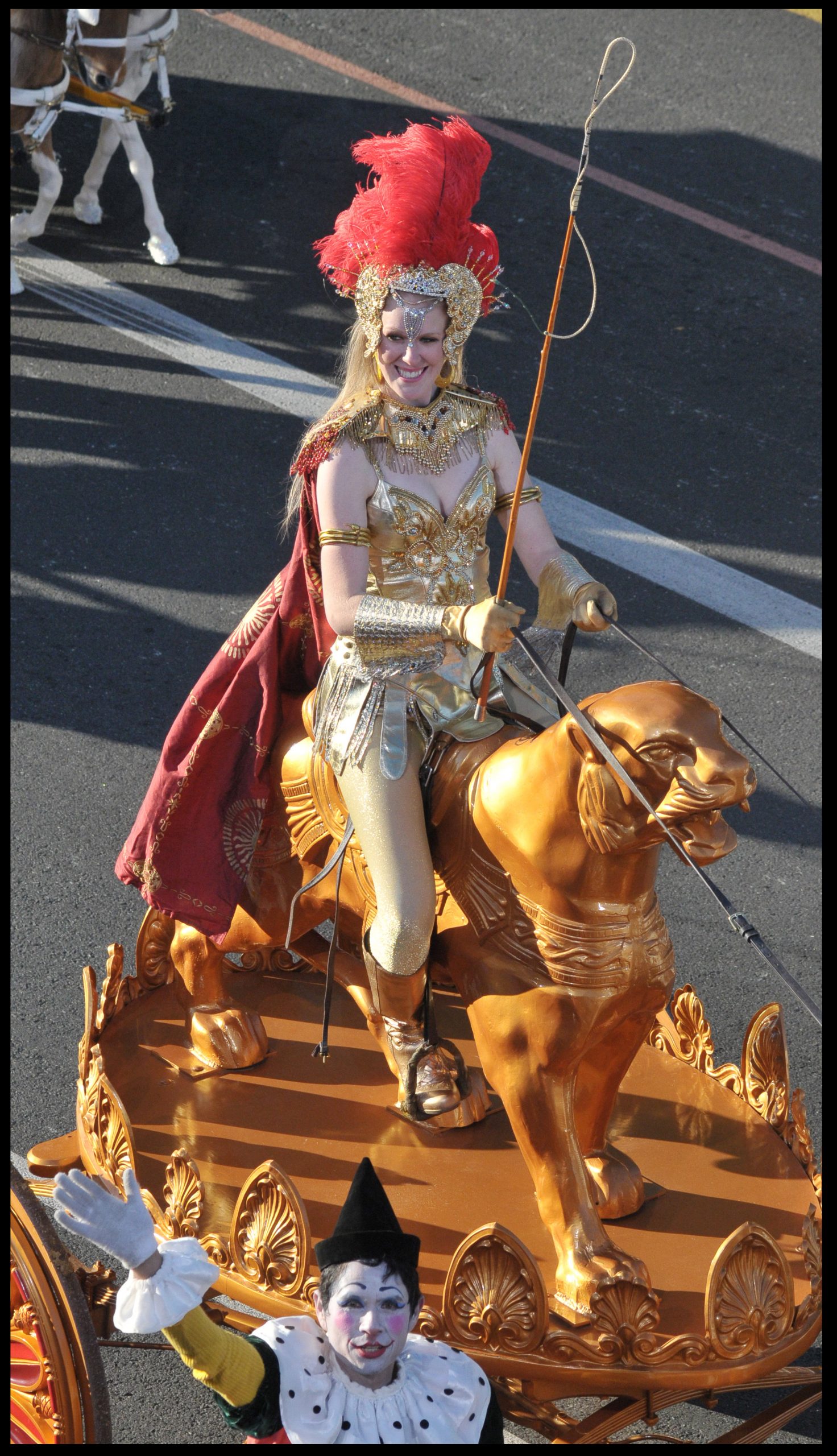
A Rose Parade entry | Photo by Terry Miller / Beacon Media News

Miller’s professional experience as a community college administrator — he spent 22 years at Pasadena City College as associate superintendent and senior vice-president for business and college services, which was essentially like being a chief financial officer; he was interim superintendent president for about 15 months — served him well in this challenging year.

“All that administrative experience and business knowledge and acumen came in handy in working through the myriad issues — cancelling the parade and the impact of that decision on everyone from parade participants, to vendors, major suppliers, sponsors, partners,” expresses Miller. “I was heavily engaged starting the end of March through Aug. 1, figuring out the business aspect. For example, we had to take this year’s operating budget from roughly $16 million to just under $6 million. That was difficult enough, but then we had to look at every one of our relationships and determine the impact on that and work with these entities to limit the damage. We determined we had to make a decision in early July if we wanted to cancel the parade because of the investments and contractual commitments these entities — our float builders, bands, co-sponsors — had to make. That kept me busy 10 to12 hours a day.                                                                                

“The TofR Foundation, which has been in operation, I’m guessing probably in the 1980s, has given almost $4 million to the local community and we’re working to give more. It’s a business and this year it was all about sustaining under these terms. My number one goal was to maintain as strong a balance sheet as we could and keeping as much reserves as we could to make sure this parade and game will be here for another 132 years. There’s no doubt that it has been a very different experience. We all have our journeys in life — I happen to be one who believes everything happens for a reason and, as fate would have it, I was the president during this horrible pandemic.”
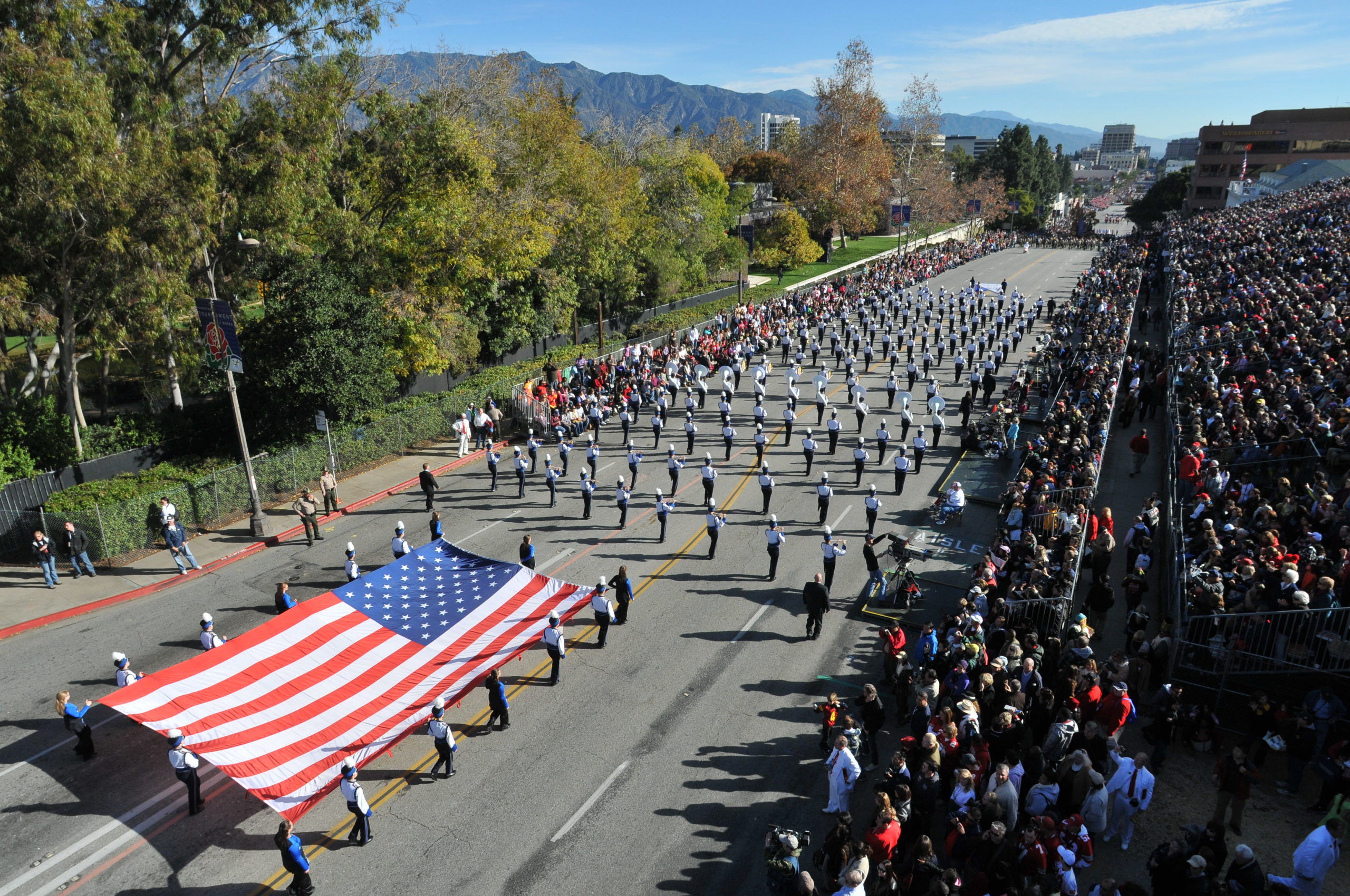
Colorado Boulevard during the Rose Parade | Photo by Terry Miller / Beacon Media News

Besides the two-hour television special on New Year’s Day, the CFP semi-finals were originally going to be played at the Rose Bowl that afternoon and then later, at the Sugar Bowl. The winner of the Rose Bowl Game and the winner of the Sugar Bowl will then compete in the 2021 National Championship Game in Miami on Jan. 11 at the Hard Rock Stadium in Miami Gardens, Fla. and will be aired on ESPN.

TofR devised a schedule and set of activities in compliance with COVID-19 protocol. They will create a bubble environment necessary to ensure the health and safety of the players, coaches, and athletic staff, the vendors, and the media — from where they will be staying during their three days’ stay, to where they will be eating (the traditional Lawry’s dinner was cancelled), to where they will practice.

Because L.A. County had a surge of coronavirus outbreak, state health officials did not approve Rose Bowl representatives’ appeal to allow 400 to 500 people in the 90,888-seat stadium. So the plan was for the teams to play at 2 p.m. without spectators. According to a sports article in the Pasadena Star-News, though, Clemson’s coach Dabo Swinney said it made no sense to fly his players all the way to California to play to an empty stadium. Furthermore, “before losing to Clemson, Notre Dame coach Brian Kelly went so far as saying that his team might boycott the game if families were not allowed to attend.”

The Rose Bowl Game | Photo by Terry Miller / Beacon Media News

In the end, it was announced that the playoff between Clemson and Ohio State will be held at the AT&T Stadium in Arlington, Texas. This marks only the second time that the Rose Bowl Game will not be played in Pasadena’s Rose Bowl Stadium — the first was in 1942 when the game was moved because Japanese military forces attacked Pearl Harbor on the 7th of December and there had been fears of another attack on the West Coast.      

It was quite a disappointing outcome. Miller, however, chooses to take a philosophical view of it all, “I just want to say this because it’s so important. When you look at the financial pain and ruin, the illnesses, and the deaths wrought by this pandemic in this country and around the world, our parade and our game are relatively insignificant. We have to put it all in perspective. And we, like everybody else, just have to adapt and manage the situation as best we can. We have to recognize that as big a deal as our parade and game are to ourselves and, we’d like to think, to our country and the world, it’s a tiny piece of this horrible puzzle.”

On the morning of Jan. 1, Pasadenans can take heart that even if the Rose Bowl Game will not be held in our backyard, we have a Rose Parade TV special to wake up to — it will almost be just like a New Year’s Day of the past. And, as insignificant as the Rose Parade and Rose Bowl Game are in the face of the destruction caused by the pandemic, echoing Miller’s words, after the devastating year we’ve been through, it is reassuring to see something familiar and normal. That, indeed, would be a gift to Pasadena and the world.          

Local Opera Virtuoso Leads the Verdi Chorus

Originally published on 2 April 2019 in the Pasadena Independent, Arcadia Weekly, and Monrovia Weekly

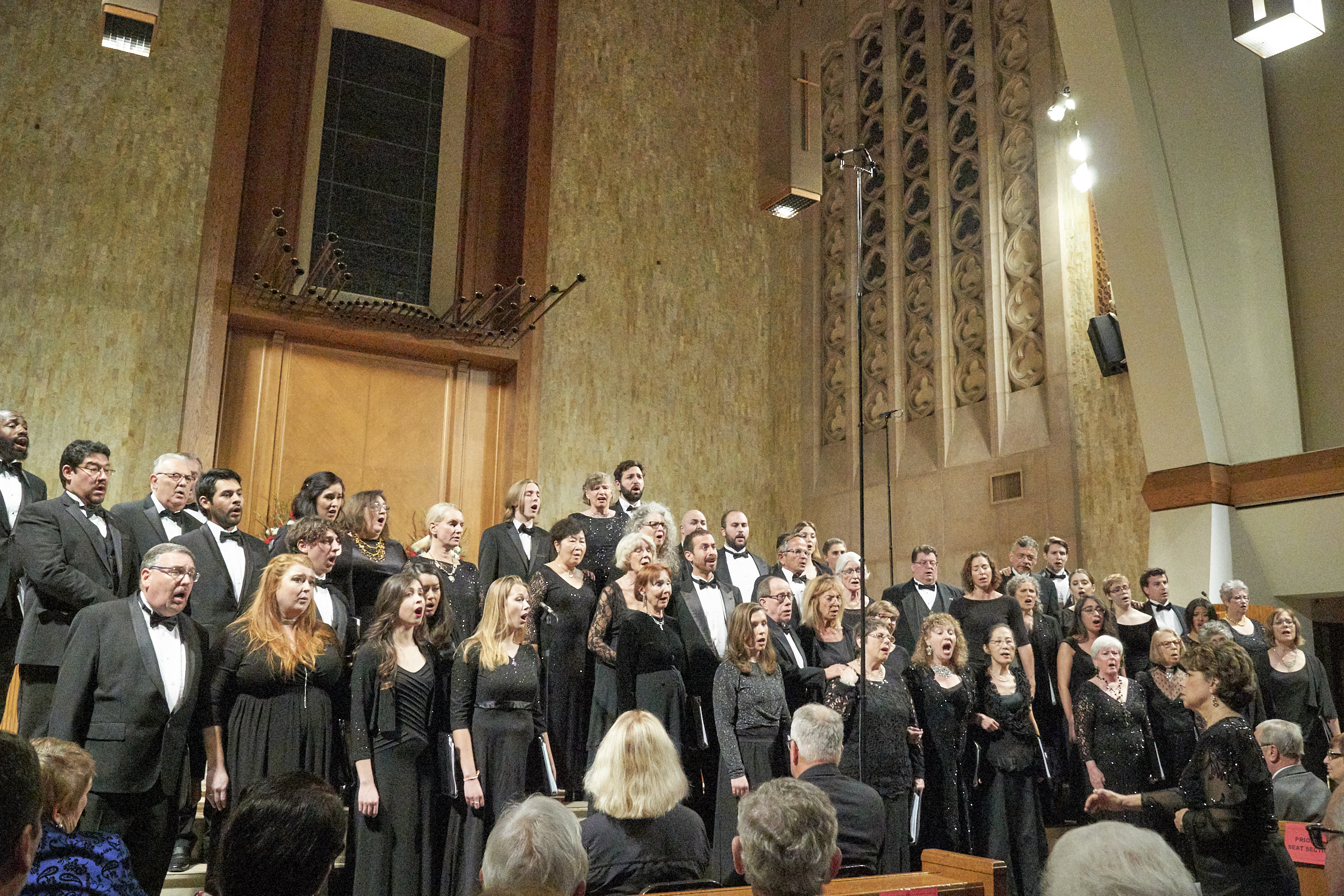
Anne Marie Ketchum during rehearsal | Courtesy photo / Verdi Chorus

It might surprise some people to know that the Pasadena City College (PCC) has an opera music program. In fact, PCC’s administrators themselves didn’t think to offer the course until Anne Marie Ketchum, a full-time faculty teacher, established it.

Ketchum, a South Pasadena resident, is also the master behind the Santa Monica-based Verdi Chorus, which is celebrating its 36th season with a Spring Concert ‘L’Amore e la Vita’ (Love and Life). It will hold two performances at First United Methodist Church in Santa Monica on April 6 and 7, 2019.

A few weeks before Verdi Chorus’s spring concert, Ketchum sat down with us to talk about her two major endeavors.

“I started teaching at PCC in 1981 where we had a song and dance group that performed with the big band, which became the musical theatre workshop. But my love was classical music and I found there was an awful lot of interest among the students. The administrators had no clue, they thought the kids wouldn’t be interested. So I set them straight and started the opera music program, which became an immediate success. It grew to the point that we were doing major productions once a year. We did a workshop program in the fall and a full opera production in the spring – sometimes it was a series of one-acts and at other times it was a full opera. We did ‘The Magic Flute,’ ‘The Marriage of Figaro,’ ‘Merry Widow,’ and many other well-known operas. The last one we did was ‘Tales of Hoffman.’”

Continues Ketchum, “I taught at PCC for 34 years and, in fact, just recently retired. I enjoyed teaching, but it was time to change my focus and do other things. And I was lucky enough to be able to retire at an age when I could still do that. I wanted to make sure that the opera program continued, so, along with some of my colleagues, we made a push to engage someone to replace me as opera director. They hired Maria Fortuna Dean and she’s doing a wonderful job keeping that program robust.”

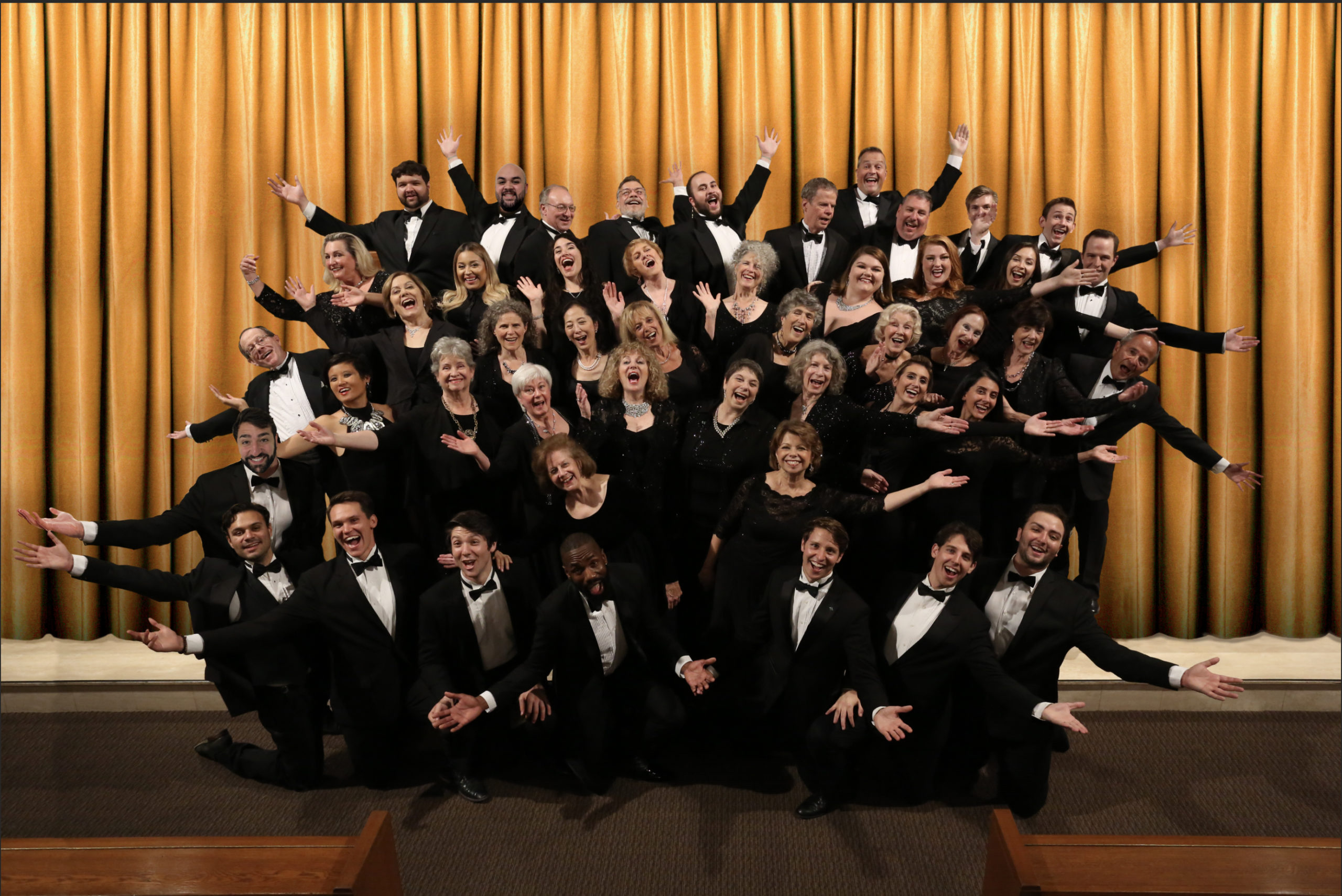
The Verdi Chorus | Courtesy photo

At the time Ketchum was teaching at PCC, she was also an opera singer at a dining place in Santa Monica called The Verdi Restaurant. She recalls, “The Verdi Restaurant was a beautiful place with elegant décor, served delicious Italian food, and had dinner shows. I was one of about 25 opera singers who would sing three or four songs. On any given night, we would do a show of opera arias, duets, etc., and then a late night performance of Broadway hits.

“The owners of the restaurant decided it would be a good idea to form a chorus made up of patrons. They asked me to lead it because I had some conducting experience – having done my undergraduate degree in choral conducting. The professional singers from the restaurant, like me, did solos with the patrons who were part of the chorus. Every time the chorus sang the restaurant had a full house because all their friends and relatives came. They loved it so much that when the restaurant closed, the chorus didn’t want to quit. Consequently, several of them got together and raised some money to keep it going. They asked me if I wanted to head the group and I said yes, with the stipulation that we auditioned everybody. It wasn’t something we did then because the owners of the restaurant didn’t want to turn anyone away. But when I took over, I thought it was important to elevate the quality of our show. My other condition was that they take care of all the business and leave all of the artistic decisions to me. It’s highly unusual for an arts organization to give its artistic director complete control, but they agreed. Thus, in 1983, Verdi Chorus was born.

“We found various places to perform until we finally ended up at the First Methodist Church in Santa Monica. We grew into a huge company of strong singers and good musicians of all ages from every walk of life and every place on earth. I have 15 section leaders – which is also very unusual in a group like this – of young, paid opera singers to sing with the group and to do some of the small solos.”

The section leaders, named the Walter Fox Singers after the family who donated the funds to maintain it, became an offshoot of the Verdi Chorus. These are young, serious-minded talents who are pursuing a career in opera. Describes Ketchum, “Most of them are either opera students in the universities, or grad students, or those who have just graduated and starting careers. This gives them an opportunity to learn music that they might not have learned, probably because as a young singer they don’t do all the big heavy singing. We’re doing Verdi, Puccini, and some of the big opera; this also gives them the chance to sing solos, which they may not have gotten to do in school. It’s like a launching pad for them.”

Asked if she has helped start someone’s career in opera this way, Ketchum responds, “Yes, as a matter of fact, there’s one that comes to mind – Babatunde Akinboboye who’s from Nigeria. We call him Bobby and he was a Walter Fox singer for several sessions. He’s done marvelous work and has flourished. Another one is David Childs, who was with us for several sessions a year ago, and is now going to Rabbinical School. He’s going to become cantor and I think he’s just absolutely perfect for that. There are several who have gone in various directions in music.”

(Left to right): Returning soloists Nathan Granner and Jamie Chamberlin with Anne Marie Ketchum and her husband Aurelio de la Vega | Courtesy photo / Verdi Chorus

Verdi Chorus’s ‘L’Amore e la Vita’ features two returning soloists, Nathan Granner and Jamie Chamberlin, for whom this year’s performance marks a particularly happy occasion. Ketchum elucidates, “When they sang with us last season, the Sunday matinee culminated with Nathan proposing marriage to Jamie onstage, to the delight and surprise of the audience and Jamie. She not only accepted, but did so with several high Cs! To have them back as husband and wife, and heralded by Verdi Chorus with ‘Si celebri alfine’ from Verdi’s ‘I Vespri Siciliani,’ seems wonderfully right! I’m also thrilled to have the wonderful Danielle Marcelle Bond, who I am a huge fan of, joining us. Additionally, I’m delighted to welcome back Roberto Perlas Gomez, one of our favorite baritones and part of the Verdi Chorus family. The fact that these four incredible soloists are also connected as dear friends makes having all of them together for this concert even more special.”

The longevity and success of Verdi Chorus seems incredible given the general belief that opera isn’t mainstream and is a niche. Making it accessible and appealing to a larger population could prove to be challenge. While Ketchum agrees with that assumption, she contends, “Sure, there is a wide swath of the populace that’s clueless about opera. But I have to say that people who love opera are often fanatical about it. They champion it wholeheartedly and go to great lengths to support it. Furthermore, our chorus members and Walter Fox Singers are involved in many things in their daily lives and meet other people. Through simple word of mouth, people are finding out about us. But we are also very consciously doing a lot to actively promote the work that we do – we now have a PR company that publicizes us, we’re on social media like Facebook and Twitter.

“One other thing I want to point out is that our ticket prices are much lower than other opera events. In many instances, someone will come to the concert and get turned on to opera because of that. It’s not as expensive, it’s a one-night thing, and it’s a couple of hours. We don’t have sets and we’re not in costumes, yet there’s something powerful and lyrical in the acting and the soloists’ performance. It’s different from your normal choral music because there’s so much going on, it’s exciting and magnificent. Opera might be one of the most complex of the performing arts. Opera is theatre – there’s passion and intrigue, comedy and tragedy, and everything in between – and that’s why the art has survived over a long period of time.”

This weekend, let the Verdi Chorus transport you into another world for a celebration of love and life. For opera allows us to escape the monotony of our mundane life even as it mirrors its confounding complexities.

International Student Program at Pasadena City College

Originally published on 30 July 2015 in the Pasadena Independent, Arcadia Weekly, Monrovia Weekly, and Sierra Madre Weekly

College freshmen heading to school next month may be feeling somewhat nervous about this different environment they are about to enter. Most of them are leaving the security of their home in the town or city where they grew up. To the approximately 500 students joining the freshman class at Pasadena City College, this novel experience is more nerve-racking than usual. They are arriving for the first time in a new school, city and country. For these arriving international students, PCC’s First Pathways Program is a lifeline. 

Pasadena City College’s First Pathways Program was created in 2011to help incoming students  transition smoothly to college and achieve success in school. And while there are only 1,200 international students attending PCC at any given year (compared to its total enrollment of 22,671) administrators have felt it crucial to dedicate one Pathway program to this group to address their vastly different need.

The IS (International Student) First Pathways program has three major components. The first of these is the International Student Center whose staff help arriving students with visa, housing,  health, and safety issues. It also includes a study center for homework, workshops and meetings with classmates. The second component is the Success Team made up of counselors, coaches and tutors who guide them in choosing their classes and making sure they are registered for the full load of 12 units. The third component is Priority Registration for the classes they need to be able to transfer quickly to a four-year college or university. This is particularly important for foreign students who are on an F1visa as they cannot overstay in the U.S.

International students on the First Pathways Program begin their college life at PCC with an iJam orientation, a one-week event where they prepare their classes, learn about life in Pasadena and Los Angeles, and have the opportunity to make friends with other students. They meet others like them from 85 countries and regions, including China, South Korea, Indonesia, Malaysia, Japan, Hong Kong, Vietnam, Canada, Germany, Russia, and Saudi Arabia. 

The most popular majors for these international students are: Business/Accounting/Economics (45%); Science/Math/Engineering (15%); Art/Architecture/Design (11%); Health Professions (8%); others (22%).

Through the years, PCC has proven itself as a leader among California’s 112 community colleges in 72 districts. It offers foreign students a diverse learning environment with numerous Honors programs, over 70 student clubs and many opportunities for student involvement, a safe location in a “walking friendly” community and convenient access to public transportation. The city offers students a vibrant restaurant scene and shopping areas. And they aren’t too far away from local beaches and recreational destinations. Pasadena is home to cultural attractions including The Huntington (Botanical Garden, Library and Art Museum), Norton Simon, Pacific Asia Museum.    

Another essential feature of a PCC education is its small class size and accessibility to instructors and support staff. More important of all, it affords students ease and support in transferring to a four-year university.   

According to Dr. Russell Frank, Interim Associate Dean for International Education, in 2012-2013, 2327 students transferred from PCC to public and private four-year universities like the University of California – in Los Angeles, San Diego, Irvine, Berkeley, Davis, and Riverside, California State University – Cal Poly Pomona, CSU Northridge and Los Angeles), Art Center College of Design, and the University of Southern California.

Frank is deeply invested in the success of every student in his charge. He set targets for himself to make the IS First Year Pathways program remains vital and relevant. Together with the team of counselors and coaches, he helps them identify their specific transfer objective and personal goals. He wants students to be engaged in the college community so PCC has created campus-wide events like the lunar new year celebration and the international education week. He wants to increase global and international awareness for the school and the IS program for health courses like Nursing, which is a popular field of study. He envisions a rise in student enrollment to 1,500 by putting in place more classes where he sees growth like nursing, environmental engineering, design and art.

In anticipation of the increase in their international student population, Frank would like to add more peer mentors who speak the same language as the students they advise and put in place additional services to cater to their specific needs. Frank is optimistic that his goals are doable in the immediate future; he says the infrastructure is there to support his plans.   

All of Frank’s plans for the International Student Program are aimed at enriching their students’ learning experience so they are better prepared to get into their choice of four-year university.  The Learning Center, of which the IS First Pathways Program is a part, has a slogan “Get In, Get Out, Get Going”. What an apt aphorism it is!

Pasadena City College’s First Year Pathways

Originally published on 11 June 2015 in the Pasadena Independent, Arcadia Weekly, Monrovia Weekly, and Sierra Madre Weekly

Most 18-year-olds in America reach an important milestone in their lives – graduating from high school and entering college. This significant event usually involves moving away from home for the first time, making them independent people, whether they are ready for it or not even close.

That so many of teen-agers going to college are unsure about how to navigate this new phase on their own was not lost on administrators and teachers at Pasadena City College. Dr. Brock Klein, PCC’s Associate Dean of Pathways and Professional Learning, describes what they observed: “Like other community colleges, PCC has struggled to help students identify their academic goals in a timely manner. A powerful and transformative moment for me was when we convened a large group of campus leaders and they presented their research data that showed that a vast majority of students were not completing their basic skills sequence; over 65% didn’t have discernible outcome or milestone after six years, and almost 20% dropped out before the end of their first year of college.”

These findings led them to create First Year Pathways — a road for leading incoming students to transition to college smoothly and achieve success in school. This program was made possible through resources from the U.S. Department of Education’s Title V grant, Student Access and Success Initiative (SASI) funds. Incoming freshmen enrolled in Pathways get guaranteed priority registration; acquire vital assistance in and out of the classroom from counselors, mentors and tutors; gain access to a study center; and obtain access to the Second Year Pathway. 

First Year Pathways is made up of three components, the first of which is Summer Bridges. They currently host ESL, Design and Math Jams, which is the biggest. This is a one-week, no-cost event which combines creative math instruction with student support services and engaging orientation activities. It is designed to make it a fun way to learn math by making the subject less intimidating for students who are below the required college-level skill. Incoming freshmen attend workshops; they meet faculty, tutors, advisors and counselors to familiarize them with campus life; and get acquainted with their classmates. Students participating in the summer Math Jam found that it really wasn’t about learning Math but about making connections and being comfortable on campus.   

New students then get to meet the Student Success Team of counselors, coaches and tutors, which makes up the second component of FYP. This group of experts is trained to: handle their special needs; assist them academically and personally in getting and understanding their regular course status reports; teach them time management strategies, goal-setting and study skills. Tutors are the most interesting components of the FYP team as they are PCC students who serve as role models or peer guides for the newcomers. They meet with FYP participants throughout the first year of college on a one-on-one basis or in small groups. A tutor also serves as the  Assistant Director for the Math Jam.

The third component, the first seminar, College 1 is a three-unit UC/CSU-transferable course requirement for each FYP student. It includes the “One Book, One College” initiative, which is designed to get everyone to read and discuss one book, and share their perspectives. The First Year Pathways students’ work is celebrated at the end of the program at an all-day Student Success Conference, where they present their research inspired by the book.

There are five different First Year Pathways: The largest is XL Pathway, which is open to everyone; the Athletes Pathway, a program that addresses this specific group; the International Students Pathway (ISP), which is a variation of the XL, but focuses on compliance and visa issues, acculturation, reading, language and an introduction to college; Career Pathways in Design Technology and Media Arts; and the Ujima Pathway which deals with African American culture and history.

First Year Pathways is open to any incoming student within Pasadena City College’s district, which encompasses a wide swath of the western San Gabriel Valley – La Canada –Flintridge, Pasadena, South Pasadena, San Marino, Temple City, San Gabriel, Arcadia and parts of El Monte. Javier Carbajal-Ramos, Program Outreach Assistant, goes out to all the high schools in those cities to familiarize seniors with the opportunities available to them. He outlines the steps for anyone interested – complete the online admissions application; take the online student orientation; take the Math and English placement tests; apply to one of the First Year Pathways; and attend a New Student Counseling Session.    

As Director of the hugely successful FYP, Klein proudly says that at the end of their first year, their evaluation findings showed that students’ success rate was higher than their comparison group. They piloted this program with 300 students in 2011. This year the FYP served almost 1,900 students and it expects to grow to 2,500 students next year.

The San Gabriel Valley is home to a number of very desirable, highly selective colleges and universities that enhance the lives of students lucky enough to gain admission to them. But Pasadena City College stands out as the one institution of learning that actually transforms lives.