Norton Simon Museum Celebrates 50th Anniversary

Also published on 20 October 2025 on Hey SoCal
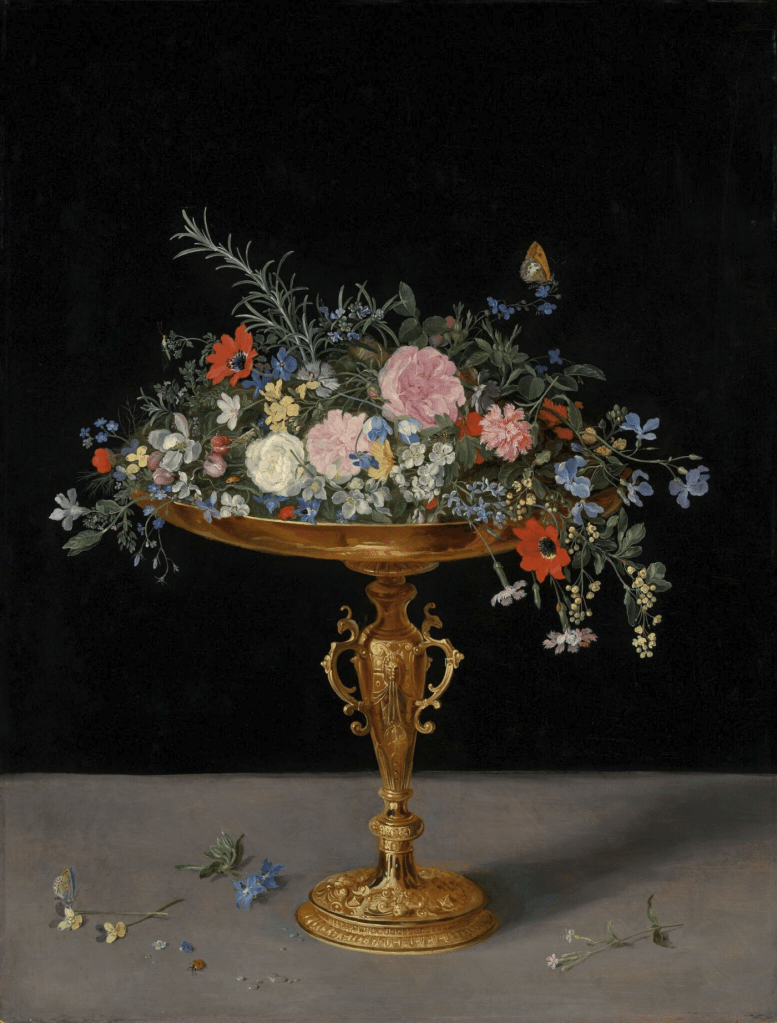
Jan Brueghel the Younger. Flowers in a Gilt Tazza, c. 1620. | Photo courtesy of The Norton Simon Foundation

October 24, 2025 marks the 50th anniversary when the Pasadena Art Museum was renamed Norton Simon Museum. It is only fitting then that 50 years to the day, the museum will debut the exhibition called “Gold: Enduring Power, Sacred Craft.” On view in the lower level exhibition wing through February 16, 2026, it explores the artistic and cultural function of gold in 57 objects drawn from the museum’s American and European and South and Southeast Asian collections.

The objects in this exhibition were crafted from metal excavated from mines across three continents and transported over vast regions, often in the form of currency. In the hands of trained craftspeople, this processed gold was transformed into jewelry that adorned Roman patrician women or spun into thread that was then woven into textiles for elite patrons in Europe and Asia.

Co-curated by Maggie Bell, Norton Simon Museum’s associate curator, and Lakshika Senarath Gamage, assistant curator, “Gold: Enduring Power, Sacred Craft” being the exhibition during the 50th anniversary celebration came about serendipitously. They had been contemplating to collaborate on an exhibition that would bring the Asian collection and the American and European collection together. When they began this project two years ago, they realized there was a common element in the artwork they were looking at.
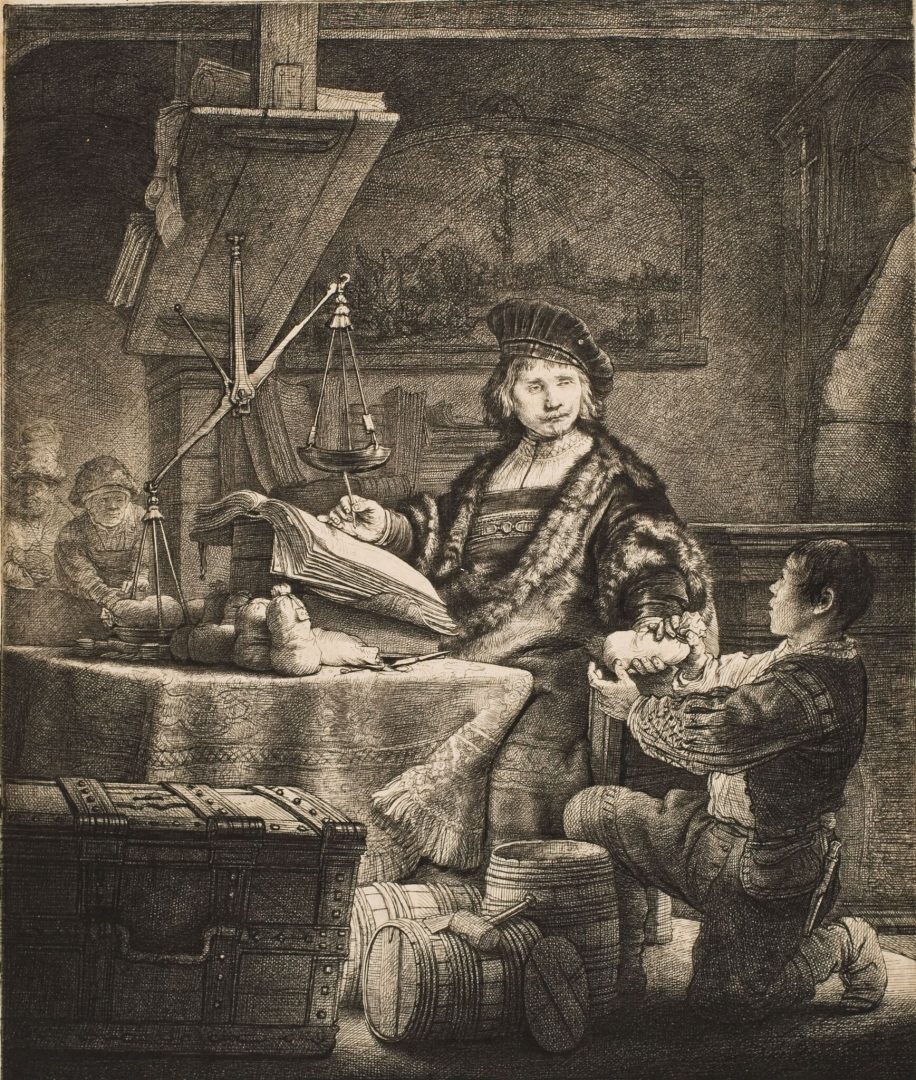
Rembrandt van Rijn, The Goldweigher, 1639. | Photo courtesy of The Norton Simon Foundation

“As we were looking at the objects in our collections, a theme emerged and we realized we talk about gold across mediums – tapestries, sculptures, painting, works on paper – as an opportunity to get to know and celebrate the collection,” Bell begins. “We systematically went through all the objects that had gold as a medium. At the same time we started thinking about the way gold as a metal interacted with other medium and also what gold means symbolically, even to representations of gold in thread or in paint. There are so many ways to approach this subject. There are things in the exhibition which don’t actually have gold in them but evoke ideas and associations with gold.”

Later in the process they realized the exhibition they had been planning was going to be completed around the same time as the museum’s 50th anniversary celebration. And it was a happy coincidence because the milestone is traditionally symbolized by gold.     

“With the story we wanted to tell together, we started with about 200 possible objects,” continues Bell. “We got to know these objects and started doing research. And one of the best things that happened in the process is that I learned so much from Lakshika about her collection and the stories and themes that we can tell together. In conversation with each other and through research we narrowed them down. There were only a certain number of objects that would tell that story clearly and we consolidated them to the 57 that visitors will see in the exhibition.”

“We want to explore gold as a medium but also as an idea,” Bell states. “We want to show the ways in which gold as a material physically does endure for millennia, hence the title. Also, it has a grasp on our imagination globally; visitors will see in the geographical range of these objects that gold really has so much power as a medium.”                                                             
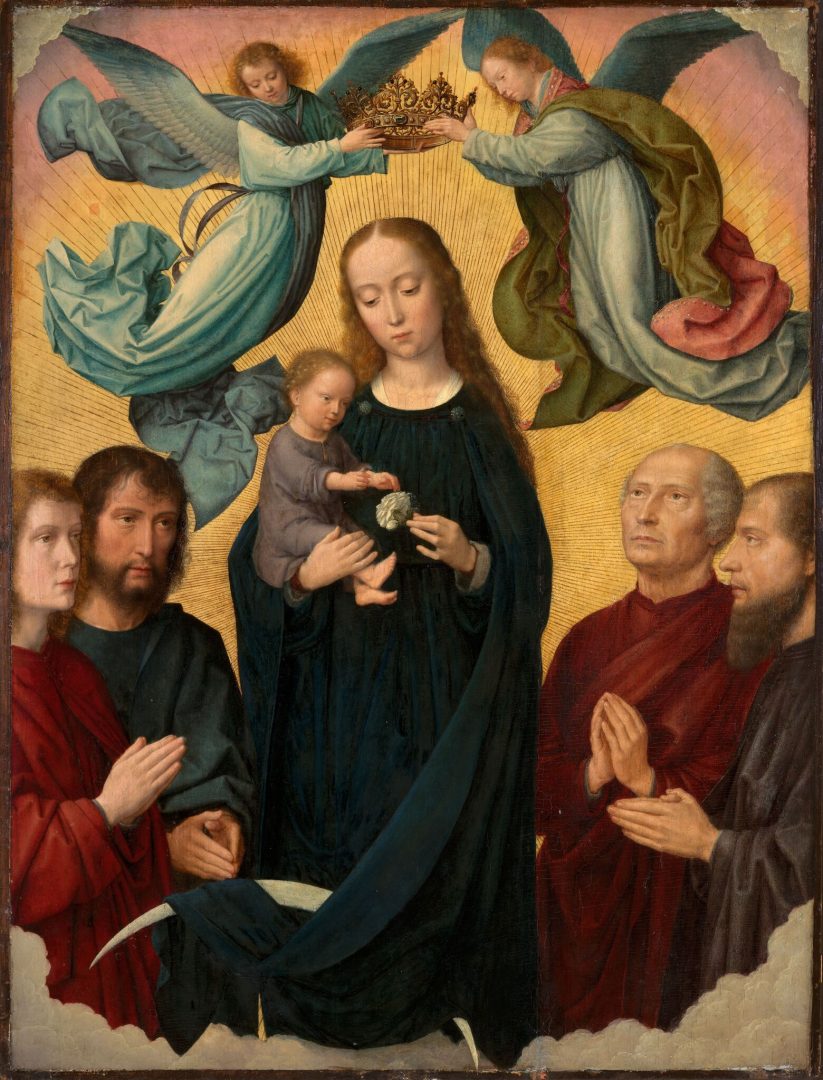
Gerard David, The Coronation of the Virgin, Maria in Sole, c. 1515. | Photo courtesy of The Norton Simon Foundation

The exhibition is divided into three themes: power, devotion, and adornment. The 57 objects represent about 17 countries across four continents, spanning from 1000 BCE to the 20th century.

“Through these works we explore how gold traveled across land and sea, how it was crafted, and how it has been imbued with special meaning, particularly with devotion,” explains Gamage. “This is possibly the first time South and Southeast Asian art are displayed together with American and European collection in the special exhibitions galleries. I do want to emphasize that this is not a comprehensive picture of gold because we are drawing solely from the Norton Simon Museum collection and these objects were mostly sourced by Norton Simon himself.”

Museumgoers will find a clean, front-facing plan and objects displayed on tables in the center instead of against the wall. The first gallery focuses on power, the second on devotion, and the third contains jewelry and the smallest objects. Interior walls and display stands are painted red, inspired by a lot of the images in the space. The lighting will be different in each gallery.
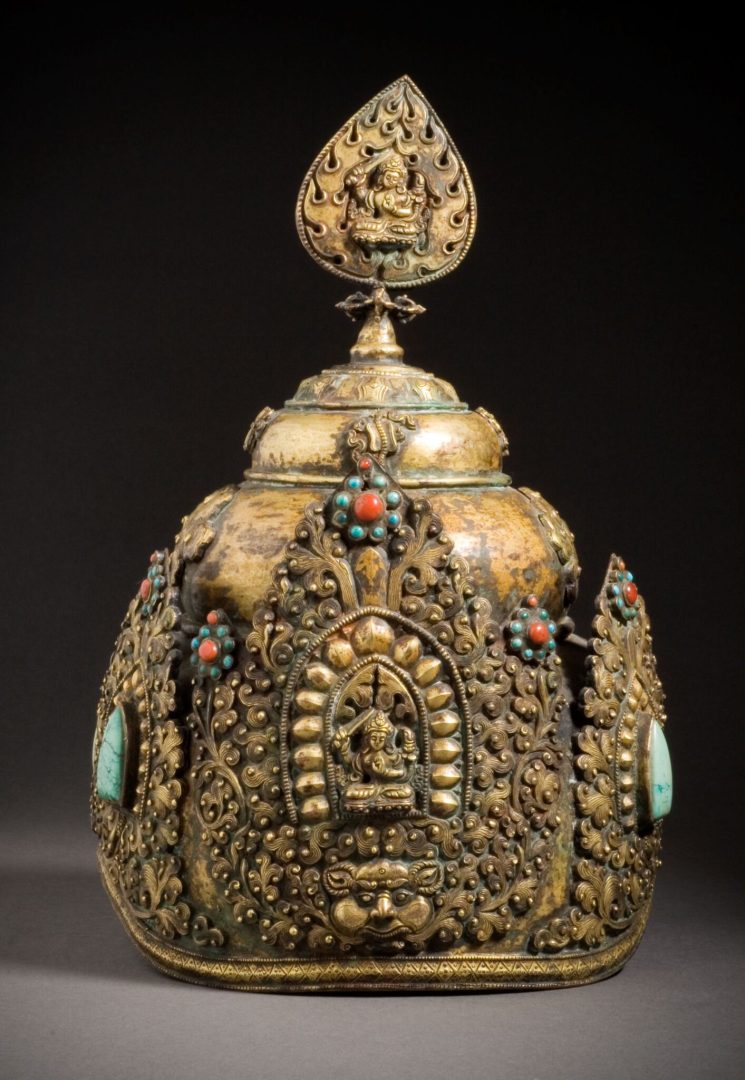
Asia: China, Tibet, Headdress, 20th century. Gold Metal with semiprecious stones. | Photo courtesy of The Norton Simon Foundation

Gamage elaborates, “Visitors won’t see any artwork on the peripheral walls and it’s a deliberate design choice to give prominence to the objects. Maggie and I worked very closely with the designers to create an exhibition that felt meaningful to visitors. The layout allows them to create their own pathways and gives them the freedom as they walk around to see these connections with their own eyes. And rather than separating them into just Asian and European, we wanted the objects to have interesting sightlines so visitors can see Asian objects visually interacting with American and European objects. That highlights function and meaning, whereas a division by geography and time loses those meaningful trajectories.”

A map at the entrance indicates where the objects originated and where the gold came from. In the first gallery, the very first object visitors will see is a bovine sculpture from 18th century China.
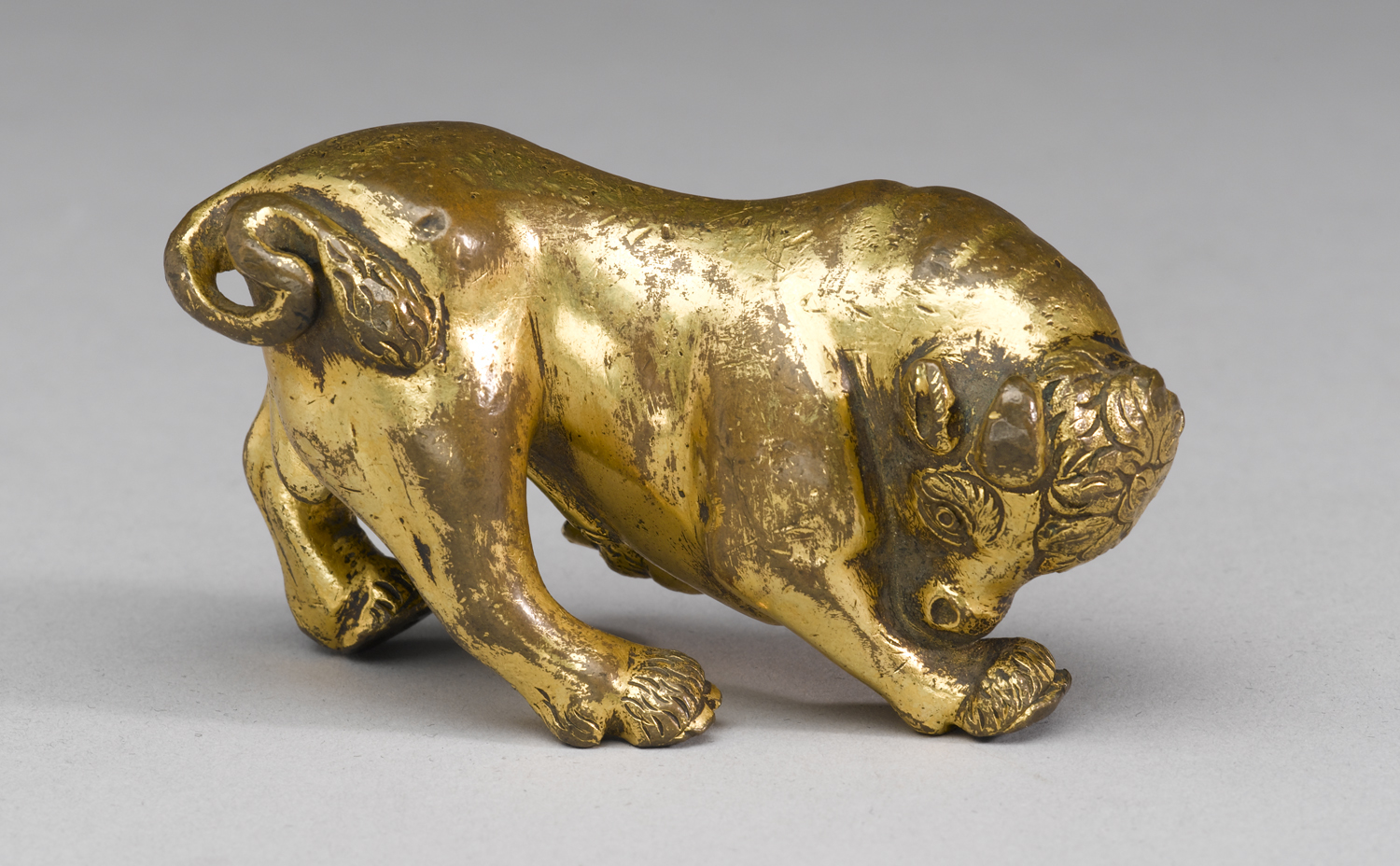
Asia: China, Tibet; Asia, Nepal, Bovine, 18th-19th century. Gilt-copper alloy. | Photo courtesy of The Norton Simon Foundation

“We chose this because it is associated with strength, power, and resilience, and possibly tied to ancient Chinese feng shui tradition,” explains Gamage. “The function is not exactly known because not much research has been done about this object. The practice itself remains unclear but the charging bull has long been viewed as an auspicious symbol of prosperity and abundance.”         

One of the foremost European objects in the first gallery that addresses the power of gold – both as an economic material as well as a symbolic medium – is a portrait of Sir Bryan Tuke, who was appointed treasurer and secretary of Henry VIII’s royal household in 1528.

“This is a copy after a painting by Hans Holbein the Younger, a German artist primarily for the court of Henry VIII,” Bell describes. “Holbein was both a painter and a jeweler and was renowned for designing jewelry for Henry VIII and his wives, and incorporating those designs into the portraits he did of the people in Henry VIII’s court. Because Holbein was a 16th century artist and this was done in the 17th century, it’s possible that Tuke’s descendants commissioned the new portrait to hang in their home as a reminder of their own connections to the Court of Henry VIII in the previous century.”
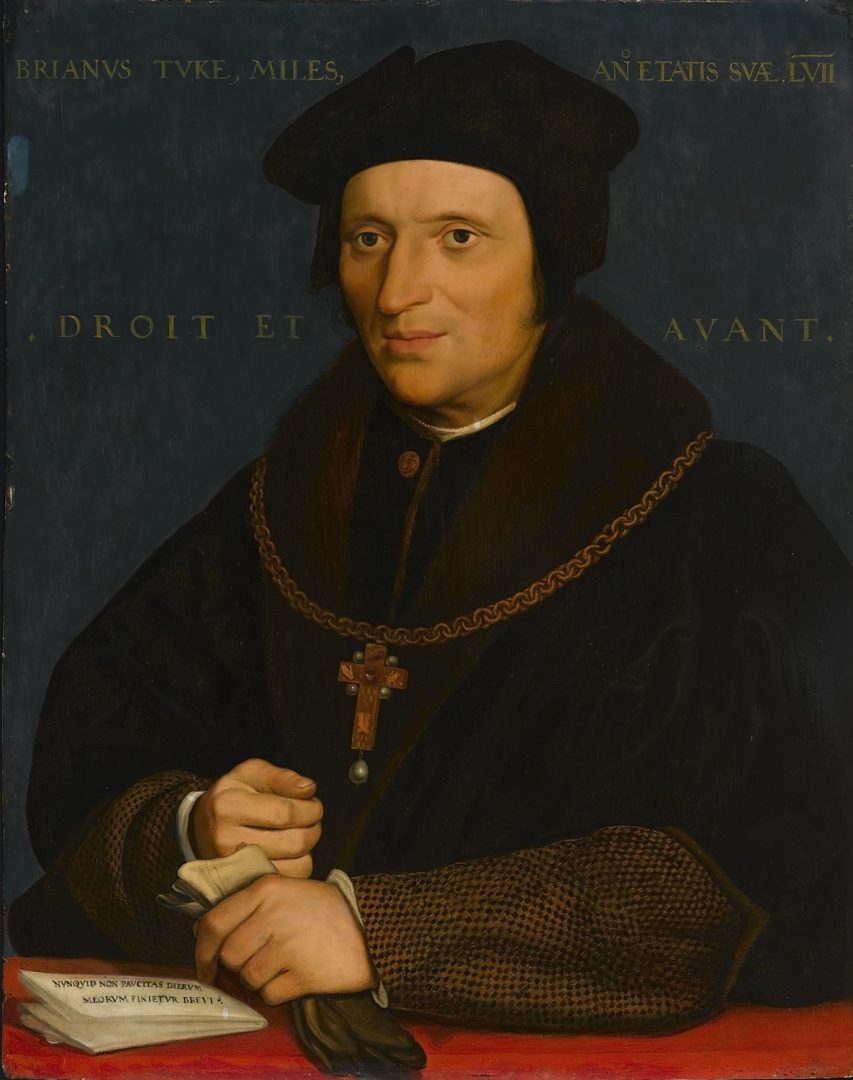
Hans Holbein the Younger, Portrait of Sir Bryan Tuke, c. 1527. | Photo courtesy of The Norton Simon Foundation

“It’s very true to the original Holbein portrait especially in the way that the cross jewelry is hanging around Bryan Tuke’s shoulders,” explains Bell. “It’s very conceivable that Tuke designed this hefty gold cross himself. I really like this image because a treasurer gets the economic power of gold; it also has an interesting symbolism around the use of gold in this portrait. When this was painted Tuke had just recovered from a really serious illness. It has additional meaning because gold was associated with longevity and good health since it never tarnished.”

In the second gallery, objects on devotion and the sacred role of gold in making art are displayed.

“It was a really fascinating theme to think through with Lakshika because gold has different meanings in Christianity, Buddhism, and Hinduism that is very complex,” Bell declares. “For example, in the Christian tradition, gold is incorporated into images of religious figures as a way to honor them. But it also becomes a bit tricky because poverty is such an ideal in Christianity, so integrating gold undermines the value of poverty as a Christian virtue.

“But in Buddhism, there is the tradition of genuine sacrifice that comes from giving gold as a gift. It was really interesting to think through those ideas with Lakshika in terms of using gold to craft religious images and the different symbolic and devotional implications that they have.”
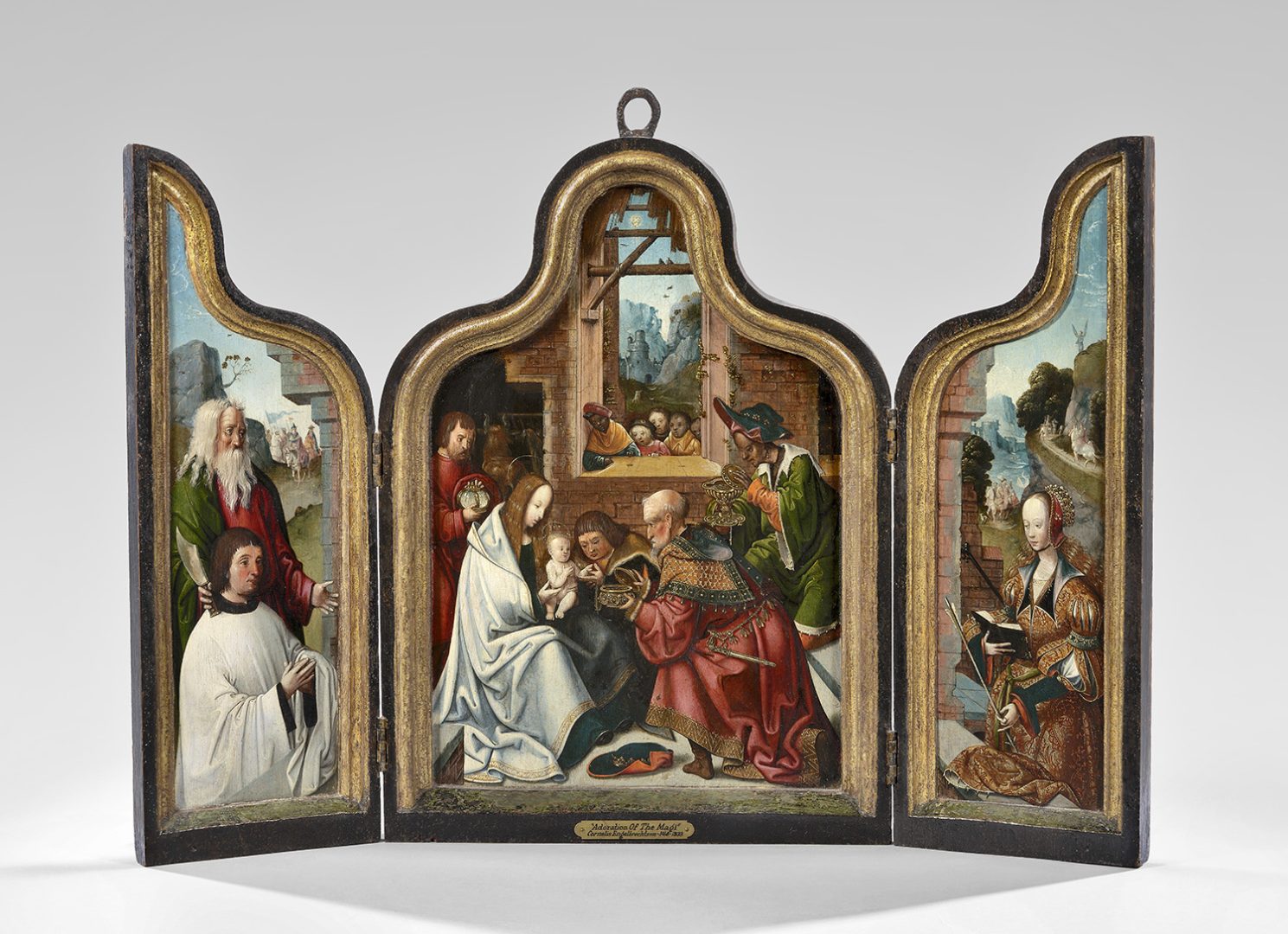
Workshop of Cornelis Engebrechtsz, The Adoration of the Magi, c. 1520. | Photo courtesy of The Norton Simon Foundation

One of the first European displays in the second gallery is a painting called “The Adoration of the Magi.” It is a scene showing the three kings who traveled from the four known corners of the world – Asia, Europe, and Africa – to honor the Son of God with extravagant gifts of frankincense, myrrh, and gold..  

“What I found interesting that I didn’t realize, is that in a lot of these images from the 16th and 17th century, Christ is shown interacting with this pot of gold,” says Bell. “I find that thought-provoking because, at the same time. the Holy Family was also honored for their poverty. Christ was born in a manger, surrounded by farm animals but he was being honored with gold and he’s reaching out for the gold, and in some paintings even holding the gold coin.”

A South Asian object in the second gallery is the sculpture of Indra – the Hindu god of storms, thunder, and lightning, and was historically the king of gods.   
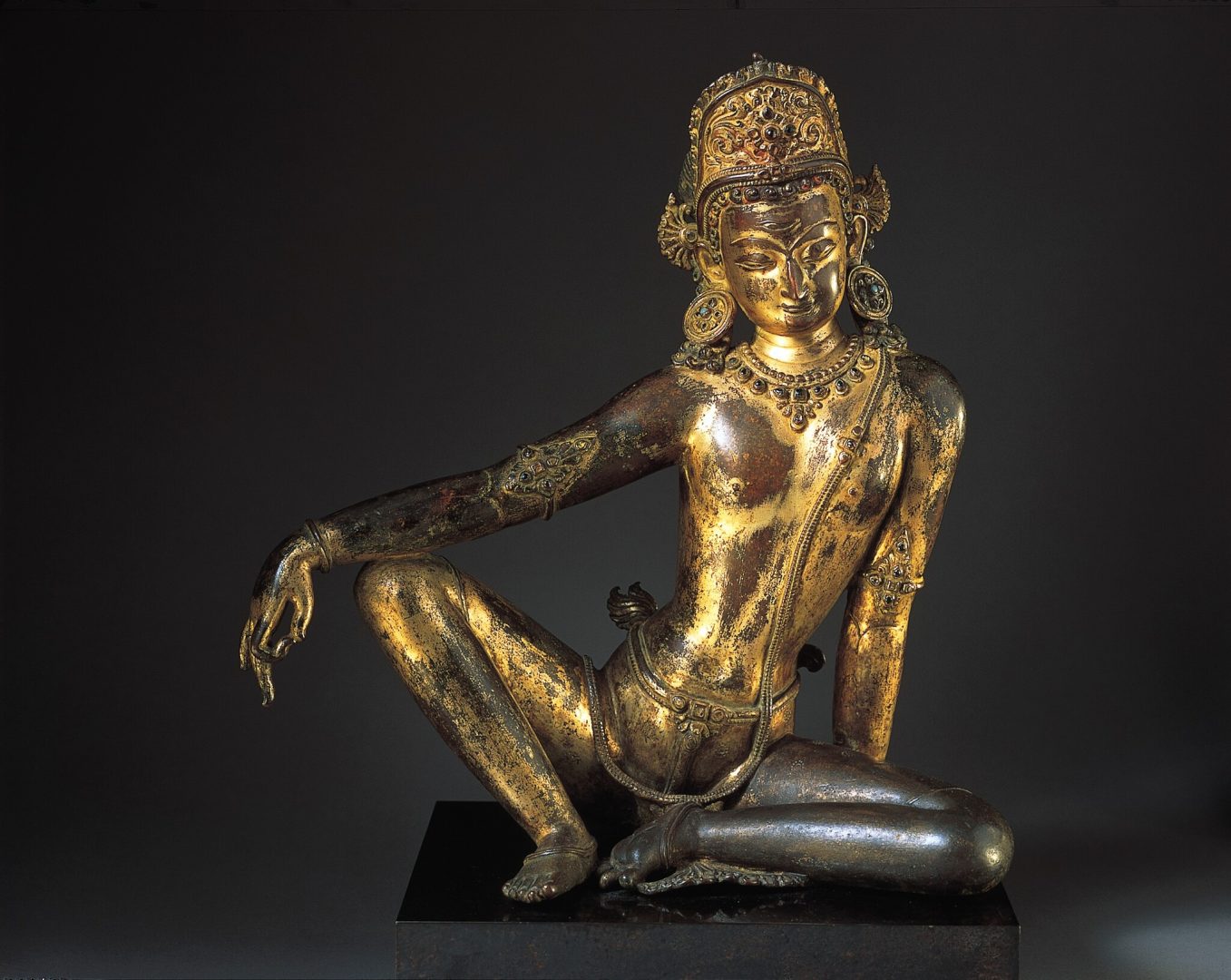
Asia: Nepal, Indra, 13th century. Gilt bronze. | Photo courtesy of The Norton Simon Foundation

Gamage states, “Indra is in this particular posture called the ‘Royal Ease.’ He wears a very distinctive Nepalese crown and he also has a horizontal third eye that clearly tells us that this is the god Indra. There are various ceremonies that are very specific to the veneration of Indra, particularly in the Kathmandu Valley in Nepal.”

In the third gallery, called adornment, objects are mostly jewelry. The one object from the Asian collection is a bracelet made of pure gold dated 1000 BCE – the oldest object in the exhibition.  It is from the Uragu Kingdom, which is modern Turkey, Armenia, and part of Iraq. 
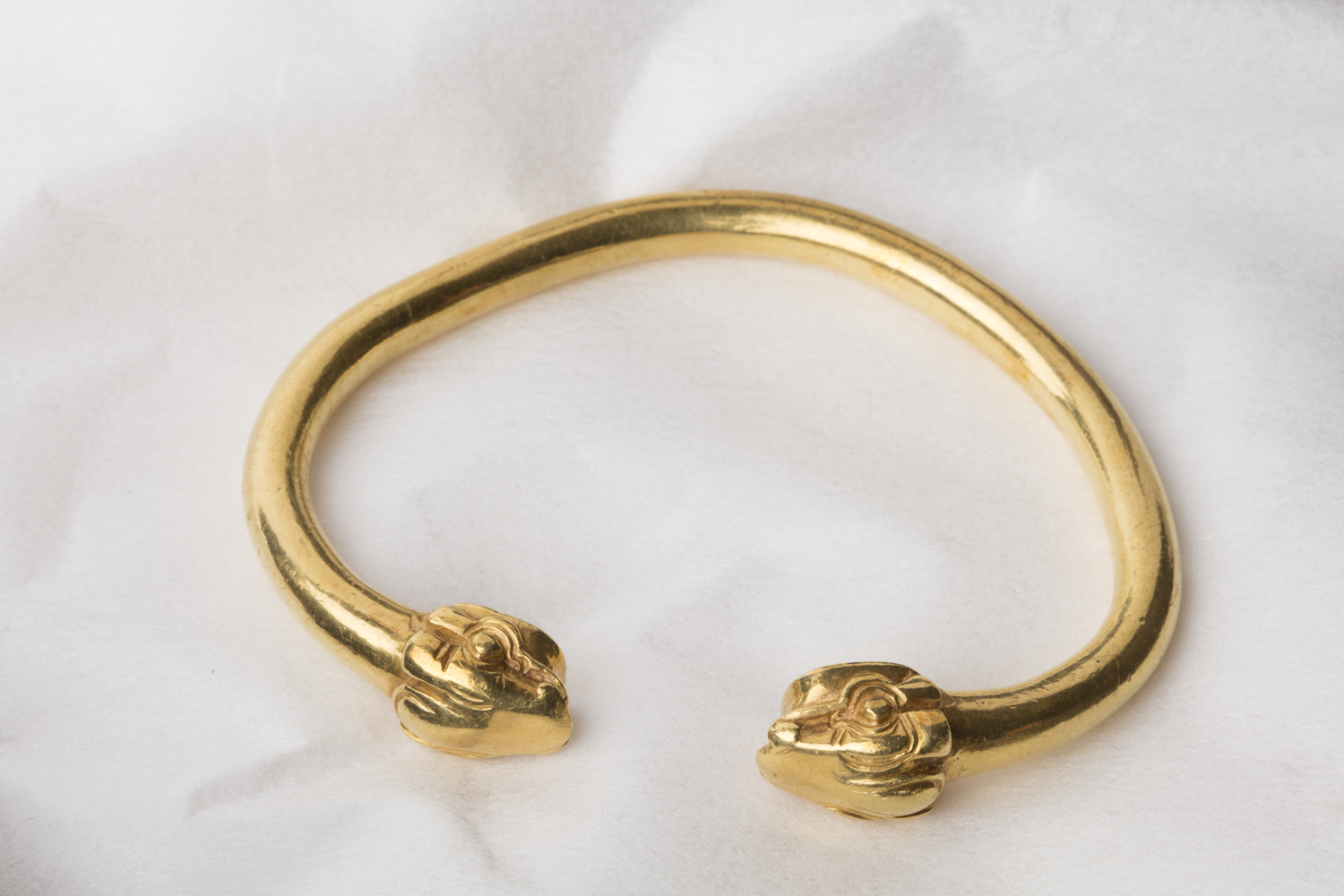
Asia: Urartu, Bracelet with Animal Head Terminals, c. 1000 BC. Gold. | Photo courtesy of The Norton Simon Foundation

“We have an eclectic group of ancient European objects,” enthuses Bell. “There are two Egyptian cats that we’re really excited about. These were on trend for collectors in the 1960s. We have figurines of various goddesses decorated in gold in someone’s home as talismans. We have this fantastic pair of earrings which are hollow inside but made of pure gold. They’re beautiful! It’s a testament to the power of gold – it doesn’t tarnish even after millennia. We were desperately trying to find photos of Jennifer Jones, Norton Simon’s second wife, wearing these to some events. But we have not been able to verify this.”
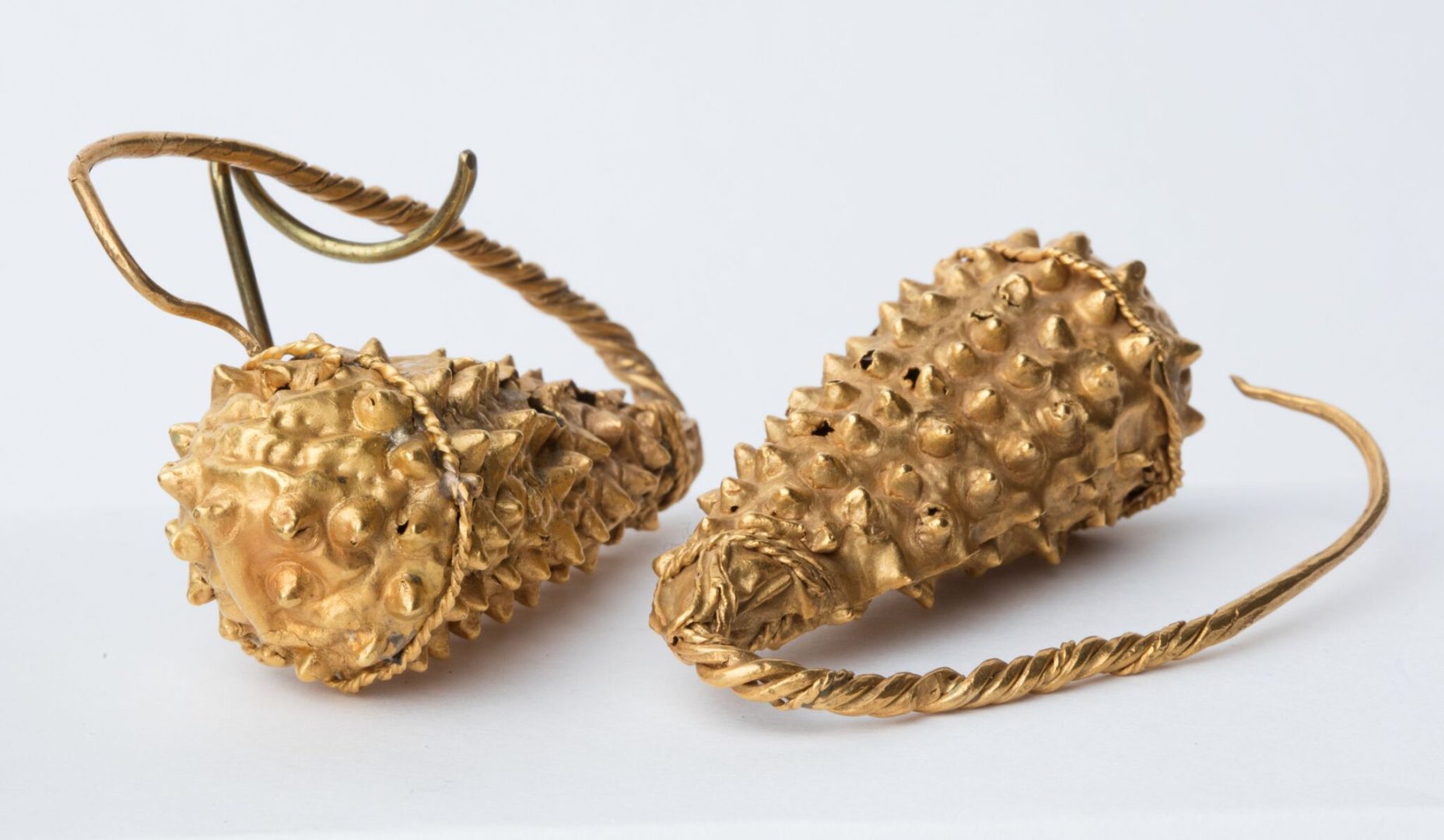
Europe: Roman, Pair of Earrings, 3rd century CE. Gold. | Photo courtesy of The Norton Simon Foundation

The Gold exhibition will feature four technical stations, created by the museum’s conservator, behind the two large tapestries. Bell expounds on the reason for this.

“We’re thinking about gold as a material and we had no idea about the many ways gold can be manipulated to become ink, paint, thread, leaf, or something you can melt. There are so many things you can do with gold. It’s alchemical in a real sense. We kind of condensed them into these four major techniques that you see throughout the show: gold leaf on painted wood panel, gold threads, gold paint, and gilded cast metal – which is the majority of the work that Lakshika is displaying from the South and Southeast Asian collection. So we’re very grateful to our conservator and we hope they will enhance the exhibition experience for our visitors.”
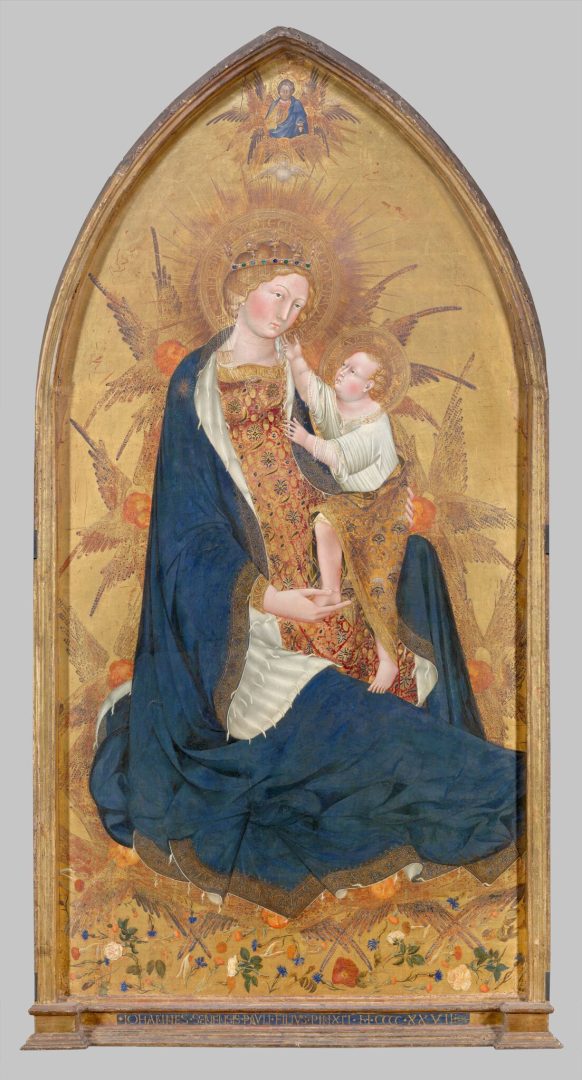
Giovanni di Paolo, Branchini Madonna, 1427. Tempera and gold leaf on panel. | Photo courtesy of The Norton Simon Foundation

Asked if they learned something when they worked on the exhibition they didn’t know before, Bell replies, “Training our eyes to recognize the different techniques was a skill I didn’t have before. That was something we acquired through looking at objects to get a sense of ways that gold paint or gold leaf could be applied. And also, just understanding the complexity of gold as the material resource in the world. What’s it meant to get from a mine or a river into the hands of the artist is extraordinarily difficult to understand, and I was very humbled by that research.”

Gamage echoes Bell’s sentiment  “One of the most interesting things I learned is a very deep appreciation for those artists who used gold in magical ways we would never even have imagined. For example, to see how gold was coiled and wrapped around another thread and how it was used in a tapestry, cut silk embroidery; or in painting as gold leaf. Today, we have this state-of-the-art technology and are capable of so many modern and technological marvels. But to know that humans were capable of such intricate and extraordinary artistry was deeply humbling, to mimic Maggie’s words. That level of technical expertise and finesse they had – and that they did by hand – is something that still amazes me.”
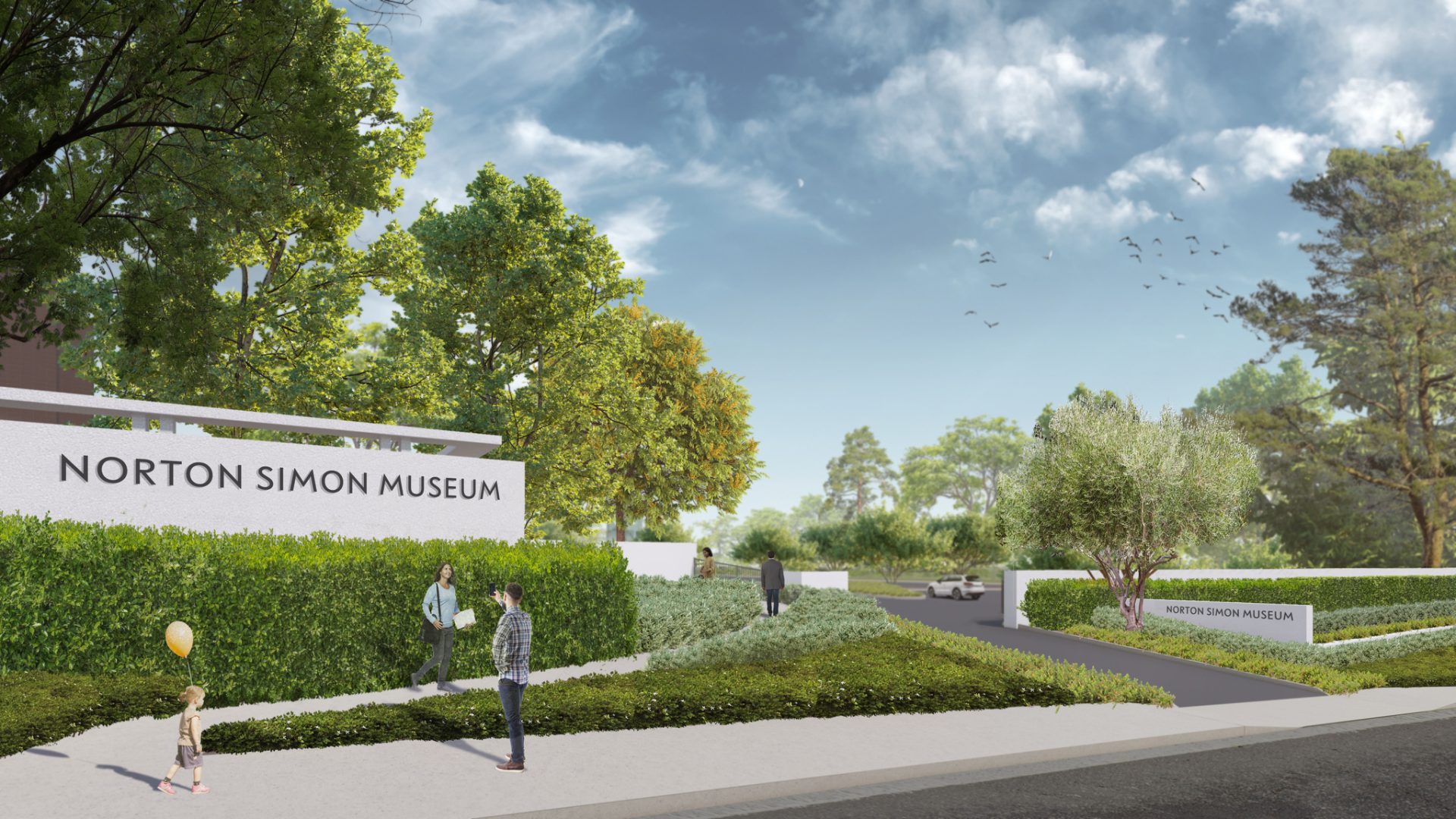
Rendering of the Norton Simon Museum’s main entrance and pedestrian walkway. | Image courtesy of ARG and SWA

The Norton Simon Museum’s 50th anniversary celebration will include a community weekend, which is free to the public, to be held on November 7, 8, and 9. There will be exhibitions, various activities, live music, and the unveiling of the improvement project.

A book called “Recollections: Stories from the Norton Simon Museum” is also available for purchase. A fascinating read, it contains essays penned by former and current staff about some of the paintings, sculptures, and artworks in the museum’s holdings. 

In the book’s introduction, Emily Talbot, Vice President of Collections and Chief Curator, recalls the museum’s history. Maggie Bell traces Tiepolo’s “Allegory of Virtue and Nobility’s” acquisition and journey to Pasadena. Talbot lets us in on the little-known friendship between Norton Simon and abstract expressionist artist Helen Frankenthaler. Dana Reeb’s essay informs us Simon amassed one of the largest and most important Goya print collections in the world. Likewise, Lakshika Senarath Gamage reveals how Simon assembled the largest body of Chola period bronzes that allowed him to wield the most influence in this area of the art market.
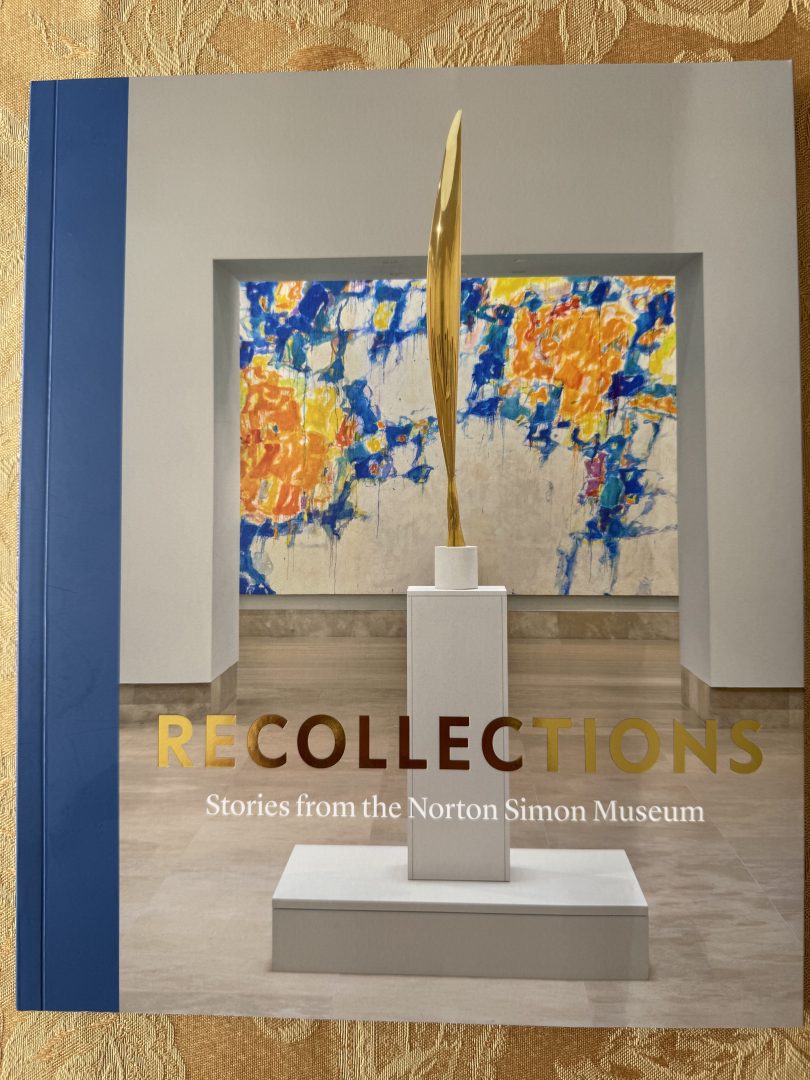
Recollections. | Photo by May S. Ruiz / Hey SoCal

Rachel Daphne Weiss explores the collaborative purchase of Poussin’s “The Holy Family with the Infant St. John the Baptist and St. Elizabeth” between Simon and the Getty. Leslie Denk writes about Cary Grant’s gift to the museum of Diego Rivera’s painting “The Flower Vendor.” Gloria Williams Sander gives us an insider look at how the right frames present paintings to their best effect. Bell’s second essay sheds light on how the West Coast exhibition “Radical P.A.S.T.: Contemporary Art and Music in Pasadena, 1960-1974” explored Pasadena’s role as a generative hotbed of contemporary art. John Griswold, Head of Conservation and Installation, discusses the museum’s collaborative approach to conservation.

Gloria Williams Sander reflects on the moment Photography became accepted in the art world as a medium worthy of collecting and exhibiting. Alexandra Kaczenski uncovers the legacy of Printmaking in Los Angeles. Gamage’s second essay examines Architect Frank Gehry and Los Angeles County Museum of Art Curator Pratapaditya Pal’s vision for the Asian galleries and the arrangement of the objects displayed within. The last essay by Griswold and Talbot talks about the Norton Simon Museum’s loan exchange program, which gives museumgoers the opportunity to view significant artworks from the National Gallery of Art in Washington, DC, the Art Institute of Chicago, and the Musée d’Orsay.   

Norton Simon’s extraordinary art collection has been a Pasadena treasure since its founding. It has magnificently lived up to the purpose Simon envisioned when he assembled one of the finest European and South and Southeast Asian masterpieces in the world. In the capable hands of the museum’s stewards and curators, Simon’s legacy will continue to enrich our lives and flourish well into the next 50 years.  
The Huntington Commemorates Founding Year with ‘1919’ Exhibition

Originally published on 15 October 2019 in the Pasadena Independent, Arcadia Weekly, and Monrovia Weekly

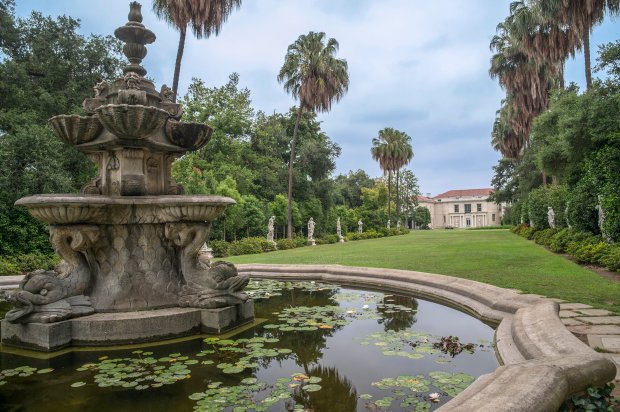
The Huntington Library, Art Museum, and Botanical Gardens | Courtesy photo

The year 1919 was significant for so many reasons but none would affect the art scene and cultural life of the San Gabriel Valley more than the founding of the Huntington Library, Art Museum, and Botanical Gardens. And we have Henry and Arabella Huntington to thank for bestowing on us their incomparable legacy.

An exhibition called ‘Nineteen Nineteen,’ which opened September 21 and will be on view through January 20, 2020, at the MaryLou and George Boone Gallery showcases 275 items from Henry and Arabella Huntington’s vast collections, some of which have never been displayed.

Co-curators James Glisson, interim chief curator of American art, and Jennifer Watts, curator of photography and visual culture, led a team from the three divisions and went through the institutions massive storehouse of 11 million items. The objects in the exhibition range from posters from the German Revolution, abstract art, suffragist magazines, children’s books, aeronautic manuals, self-help guides for soldiers returning home from World War I, and a book hand-printed by Virginia Woolf at her kitchen table. The thread that ties them all together is that they were all acquired in 1919.

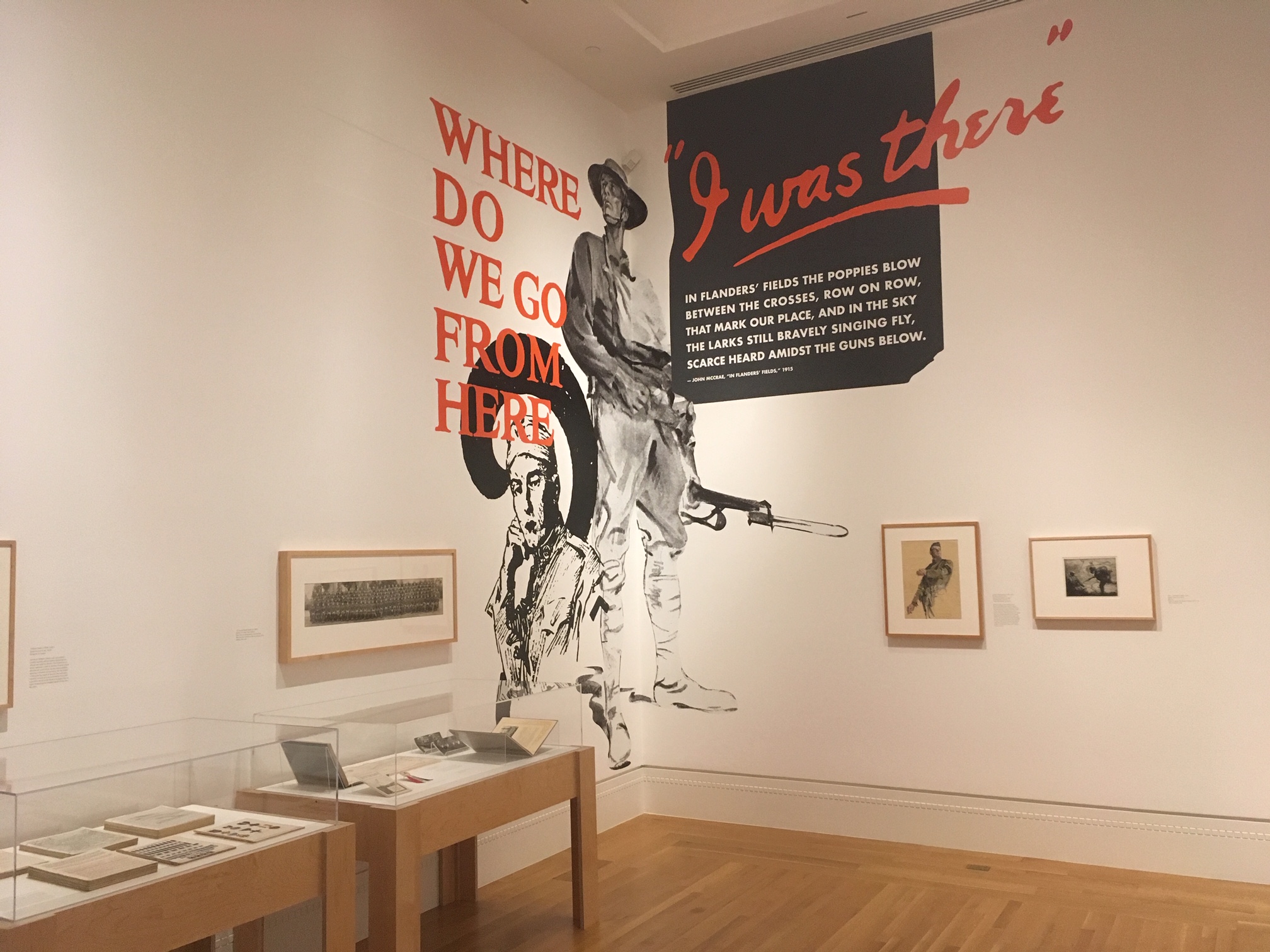
During a preview of ‘Nineteen  Nineteen,’ Glisson and Watts walk members of the press around the Boone Gallery to show the items, explain their significance, share their experience, and add their personal insights.

“This project took about two and half years from the very beginning to the end,” begins Glisson. “I went through, probably, 3,000 items, but it could have been more. And a lot of time was spent finding things from 1919 that were interesting, because there were a lot of stuff that weren’t,” he adds with a laugh.

“Or visually compelling,” inserts Watts. “Gathering these things was incredibly labor intensive but fun at the same time. I have to point out, though, that we had research assistants, interns, and grant assistants who did a lot  of work – it was a collective endeavor. It involved every curatorial staff across all divisions – the library, the art museum, and the botanical gardens. We knew some things to look for and others were hunches. We asked our colleagues for assistance and they came to bat. They helped us find things we never would have unearthed on our own.”

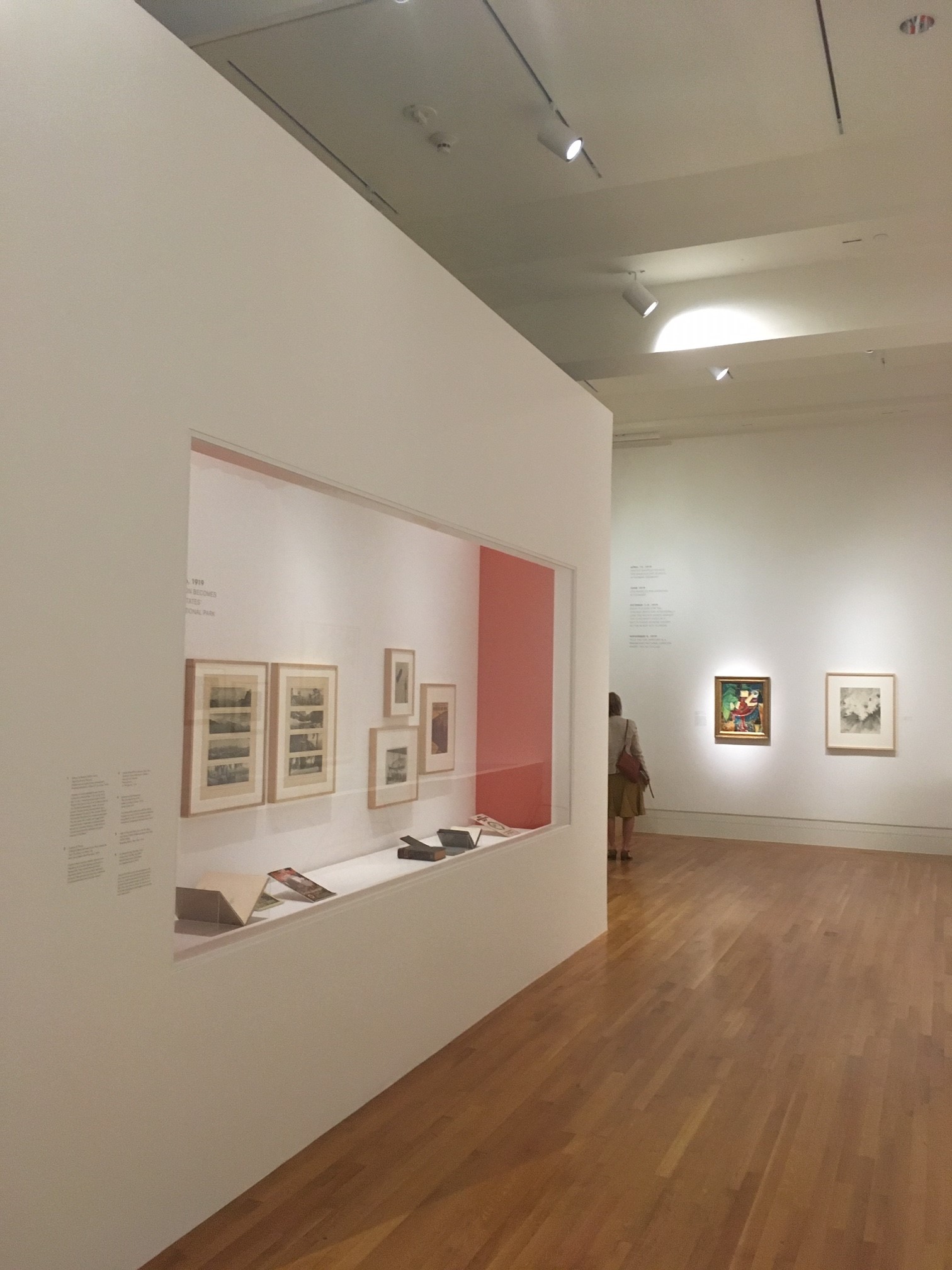
The ‘1919’ Exhibition at The Huntington | Photo by Brianna Chu / Beacon Media News

Glisson expounds, “Often, it was ‘There’s this great thing, I think it’s from 1919;’ ‘Oh yes, it is.’ This is where the process was different. We knew where we wanted to take it but until we gathered the material together, we couldn’t tell a story. We didn’t know what the story was before we had the material. The verbs came when this checklist was two-thirds through – and we knew what the themes would be and gave it some shape. As Jennifer said before, we had to just be incredibly open to where the material was taking us. It’s like, we see a piece and we say ‘What does this mean?’ Or, sometimes, it’s ‘This is interesting, what is it?’”

“I like to take the analogy of when you look at a centennial and think of the founders, and you put them at the top of your pyramid,” explains Watts. “We decided to invert the pyramid, and put the context and the year at the top. Most of the time, when you’re doing an exhibition, people come up with an idea and they look for the material to support it. We flipped it and said ‘Let’s look at the material and figure out what the bigger ideas and themes are.’”

The exhibition that Glisson and Watts created from that starting point, which Glisson describes as ‘From the global to the local’ is organized around five broad themes – Fight, Return, Map, Move, and Build.

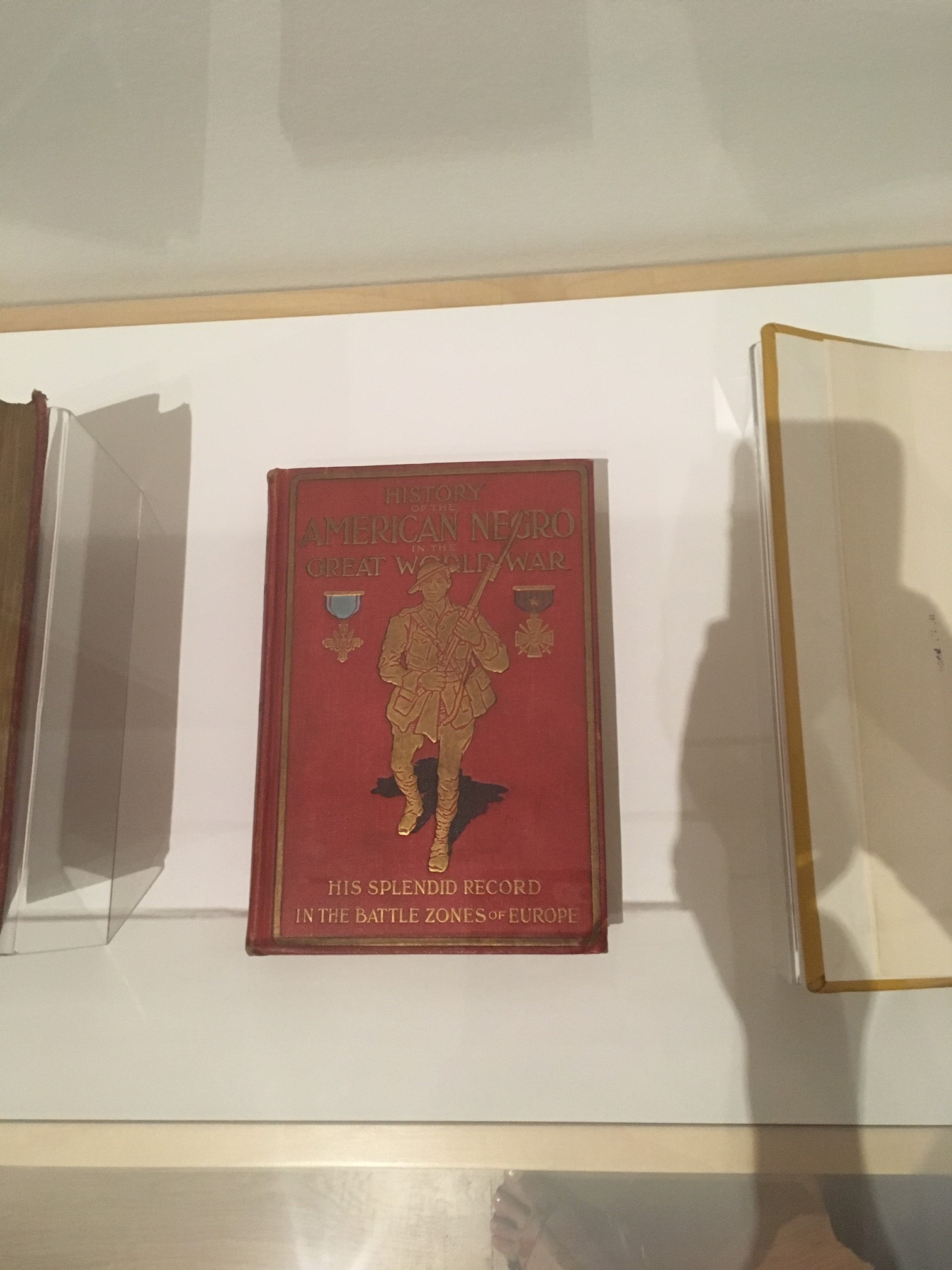
William Allison Sweeney, History of the American Negro in the Great World War, 1919, Cuneo-Henneberry, Chicago | Photo by Brianna Chu / Beacon Media News

Glisson elucidates, “We wanted to harness the large number of 1919-related items here into something provocative, allowing the visitor to interpret the period in a fluid way. Rather than telling a neat, resolved story, we tried to capture the jarring experience of life during a year that everyone understood was an inflection point for world history. Empires had fallen in the Middle East and Eastern Europe. Millions had died fighting and in a flu pandemic. Delegates at the Paris Peace Conference tried to sew a tattered world back together. Like today, people felt that irrevocable change was underway. The issues of 2019 – immigrant detention, women’s rights, and the fight for a living – were equally pressing in 1919.”

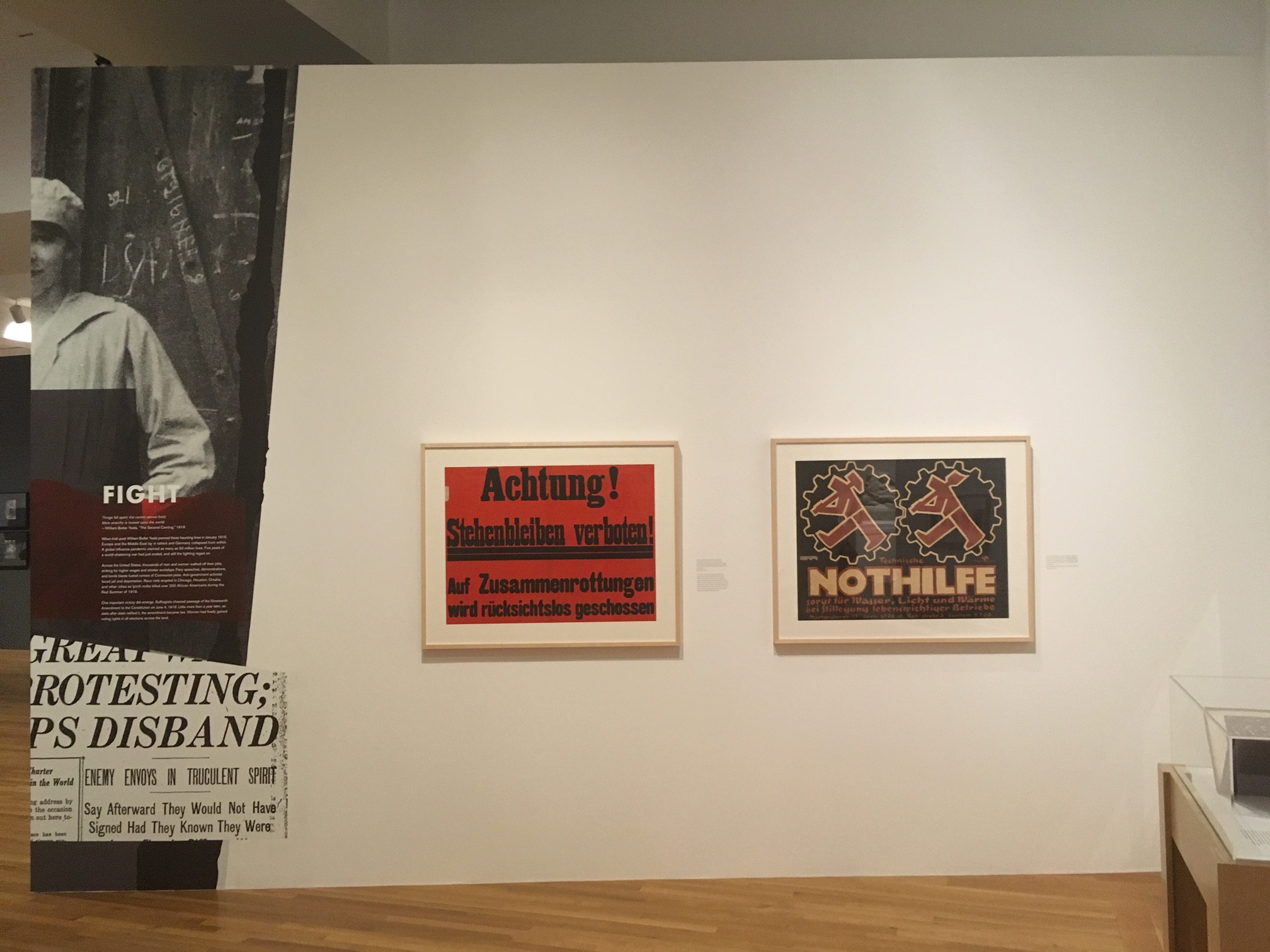
As detailed in a news release from The Huntington’s Communications Office, the ‘Fight’ section of the exhibit shows that, while the war might have officially ended in 1918, other battles raged on in Los Angeles, the rest of the nation, and Europe. A global influenza pandemic killed millions of people, claiming three percent of the world’s population. Laborers agitated for better pay and safe conditions. Rumors about a Bolshevik plot to upend the U.S. government led to a Red Scare. Violence erupted in a season described as ‘Red Summer’ for its deadly riots and lynchings of African Americans. In 1919, the bill that would clinch American women’s right to vote passed in the Senate, and temperance advocates won their fight for prohibition. Modern artists and writers responded to the tremors of the age, including the carnage of world war, by breaking with convention and tradition.

Items in this section include: German posters related to social and political upheaval; original photographs and materials documenting the flu pandemic here in Pasadena; national strikes and labor unrest; U.S. Marshal records (including mug shots and probation letters from German citizens jailed in Los Angeles during the war); and objects that tell the story of the fight to ratify the 19th amendment.

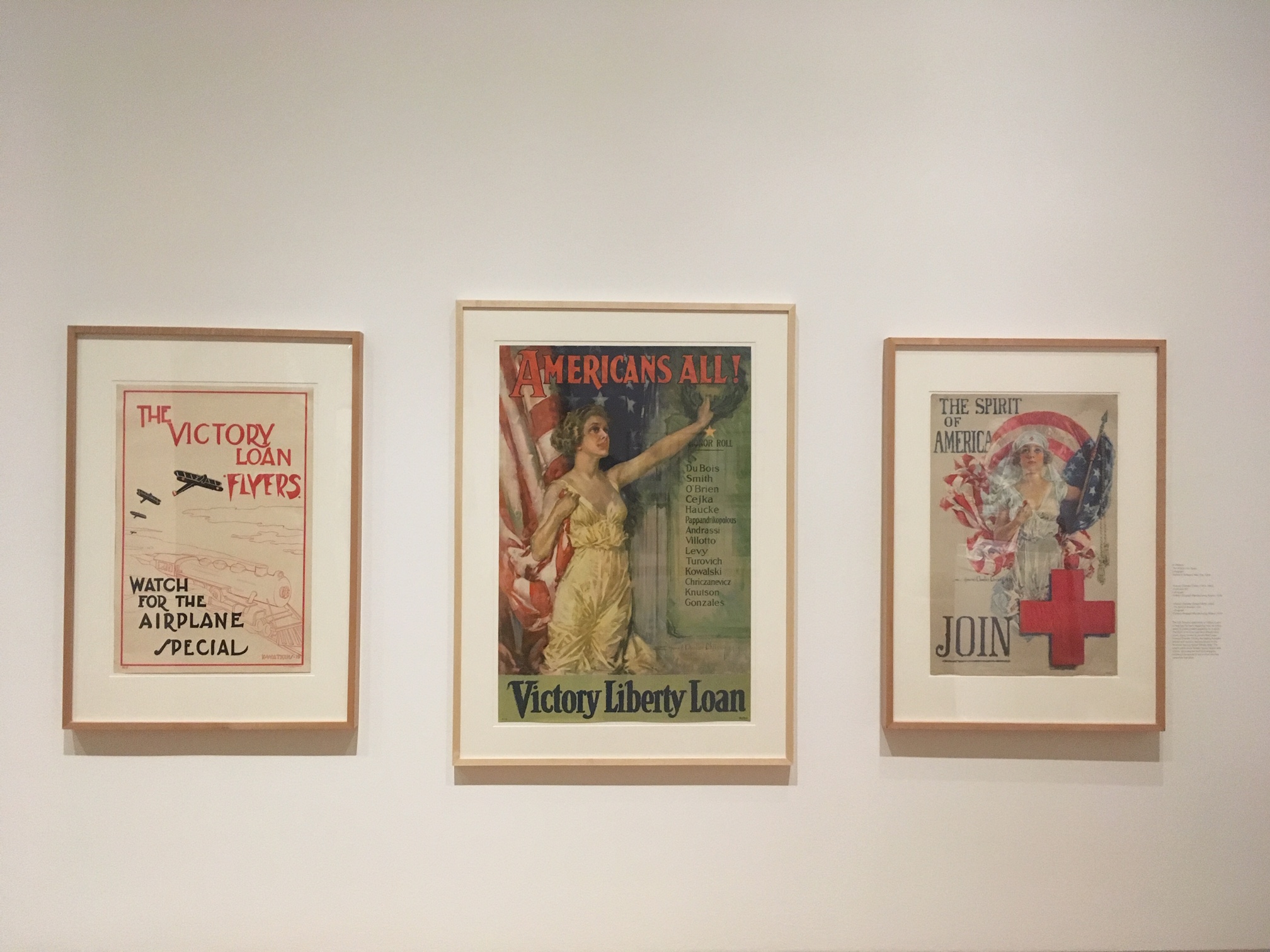
Victory Loan Flyers, ‘The Spirit of America’ Lithograph, and ‘Americans All’ lithograph | Photo by Brianna Chu / Beacon Media News

The ‘Return’ portion focuses on the immediate aftermath of the Great War, when millions of men and women – including 200,000 African America soldiers – headed for home. Survivors sought to understand and memorialize the war’s events through personal reminiscence and published accounts. Artists, some of whom served overseas, interpreted what they had seen, while others found inspiration in canonical tradition and myth. Popular music and illustrated books also offered safe harbor in tumultuous times.

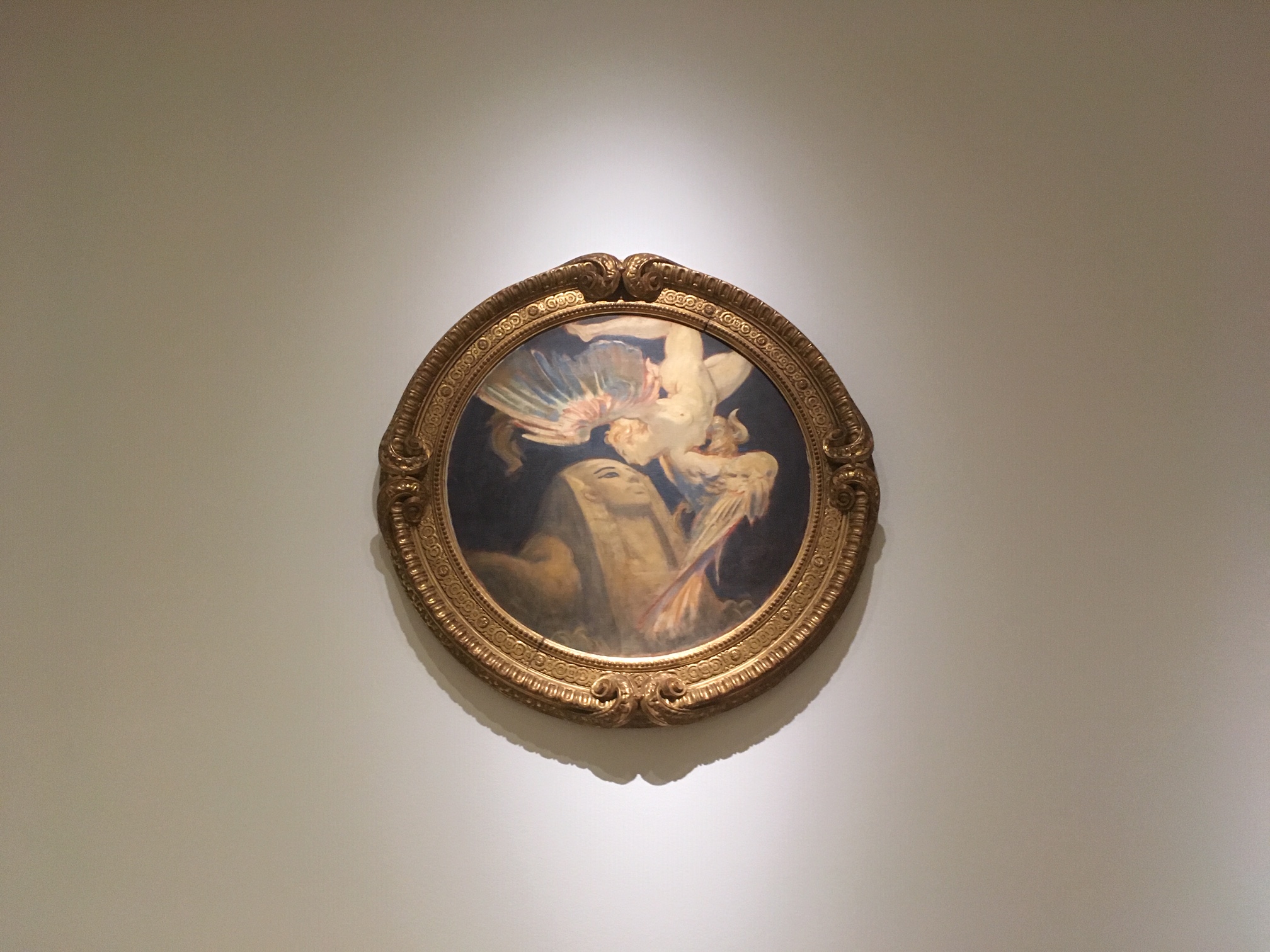
Materials from this segment comprise: Liberty Loan posters; soldiers’ recollections; a rare Edward Weston portrait of dancer Ruth St. Denis; Cyrus Baldridge’s illustration ‘Study of a Soldier;’ and John Singer Sargent’s ‘Sphinx and Chimaera,’ which depicts a mythological scene.

John Singer Sargent’s ‘Sphinx and Chimaera’ oil on canvas | Photo by Brianna Chu / Beacon Media News

In January 1919, President Woodrow Wilson and Allied heads of state gathered at the Paris Peace Conference to make new maps of a changed world. The carving up of ancient empires created new nations in the Middle East, Eastern Europe, and Africa, while regional promoters published maps to highlight Southern California’s capacity for growth. High above Los Angeles – at the Mount Wilson Observatory – the world’s largest telescope was on a nightly quest to chart the universe. In a world turned upside down, maps offered a welcome measure of predictability.

What the charting of territory that occurred that year meant and its resulting significance are explored in the ‘Maps’ section. On view is a first edition of ‘Traite de Paix,’ the Treaty of Peace signed at Versailles on June 29,1919, with a map showing new territorial configurations; an album of autograph signatures gathered at the Paris Peace Conference by T.E. Lawrence, otherwise known as Lawrence of Arabia; rare maps depicting population, transportation, and demographic data in Los Angeles and the nation at the time; and original astronomical photographs of the moon and constellations.

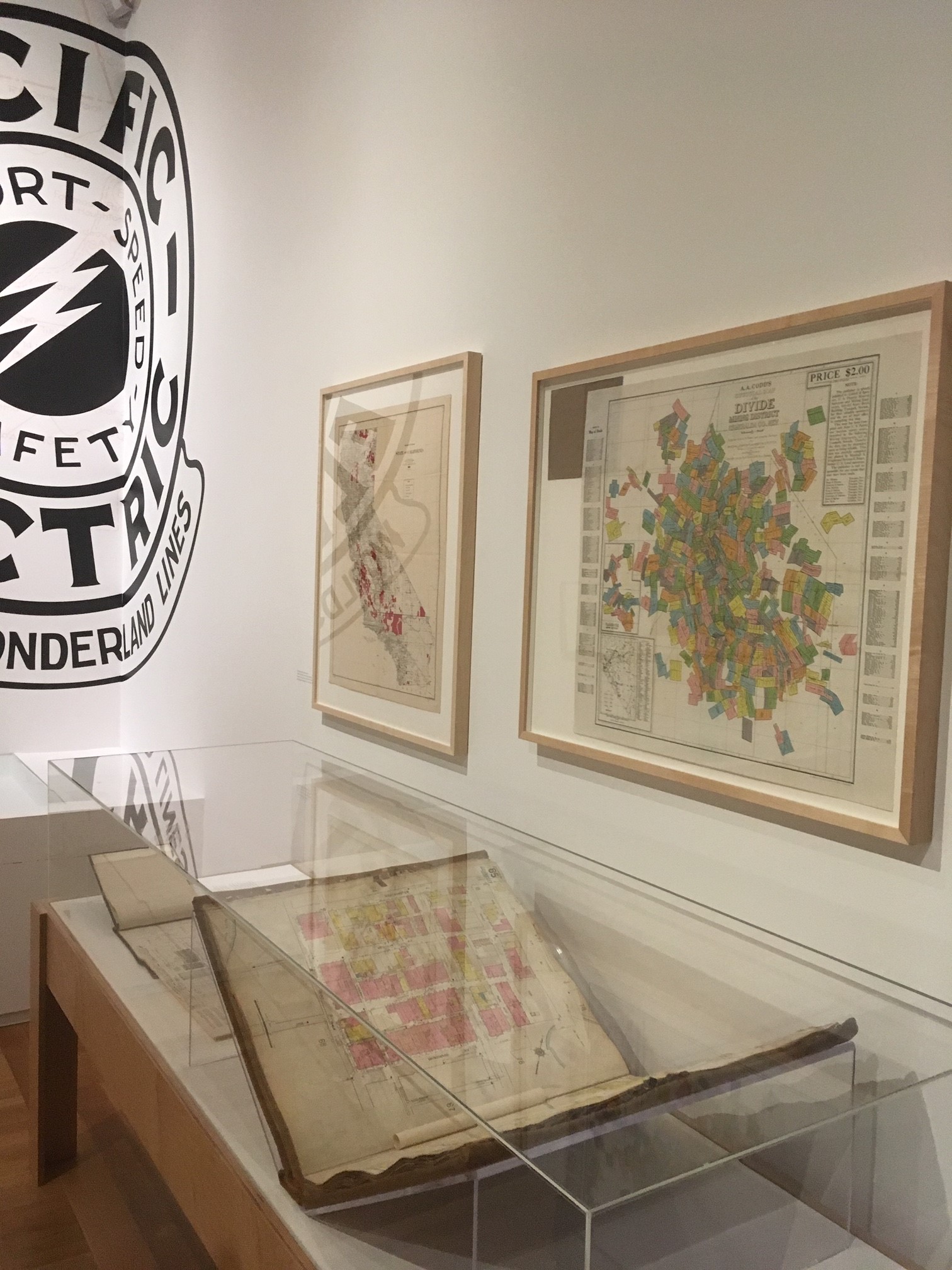
Huntington was obsessed with maps | Photo by Brianna Chu / Beacon Media News

While working on this project, Glisson and Watts found out that Huntington was obsessed with maps. She says, “If you think about it, it’s not that surprising given that he was probably one of the most influential people in setting the course of how our sprawling city came to be. We discovered the spectacular 39-foot long Pacific Electric linen map that shows the real estate holdings contiguous to the line which is part of Huntington’s development scheme. People may not realize that while the Pacific Electric was a component of the world’s largest transportation network at the time, it really was a loss leader for Huntington. He was most interested in getting people to the communities that he’d developed – Huntington Beach, San Marino, Glendale.

“This is a one-of-a-kind map and has never before been exhibited. It is an incredible document – you could see the level of detail on it. Every redaction, every addition is recorded by him. It would have been something that the engineers – and Huntington with them, because he was very detail-oriented – would be poring over. I like to call this the papyri of transportation. It basically shows the Pasadena short line, which was one of the first lines that Huntington put in to the Pacific Electric system and it goes from Old Town Pasadena all the way to the edge of downtown Los Angeles.”

This Pacific Electric map display also falls under the ‘Move’ portion of this exhibition, which examines the ways 20th century technologies – planes, trains, and automobiles – propelled a society on the go. Henry Huntington’s network of streetcar lines brought Angelenos from ‘the mountains to the sea’ and to far-flung deserts and farms. A burgeoning national road system made automobile travel possible and pleasurable as never before.

Also taking the spotlight in this section is the interstate automobile adventure of five friends, including famed aviator Orville Wright, assembled in a rare photographically illustrated volume titled ‘Sage Brush and Sequoia;’ works by T.S. Eliot and Virginia Woolf, published by Virginia and Leonard Woolf’s Hogarth Press.

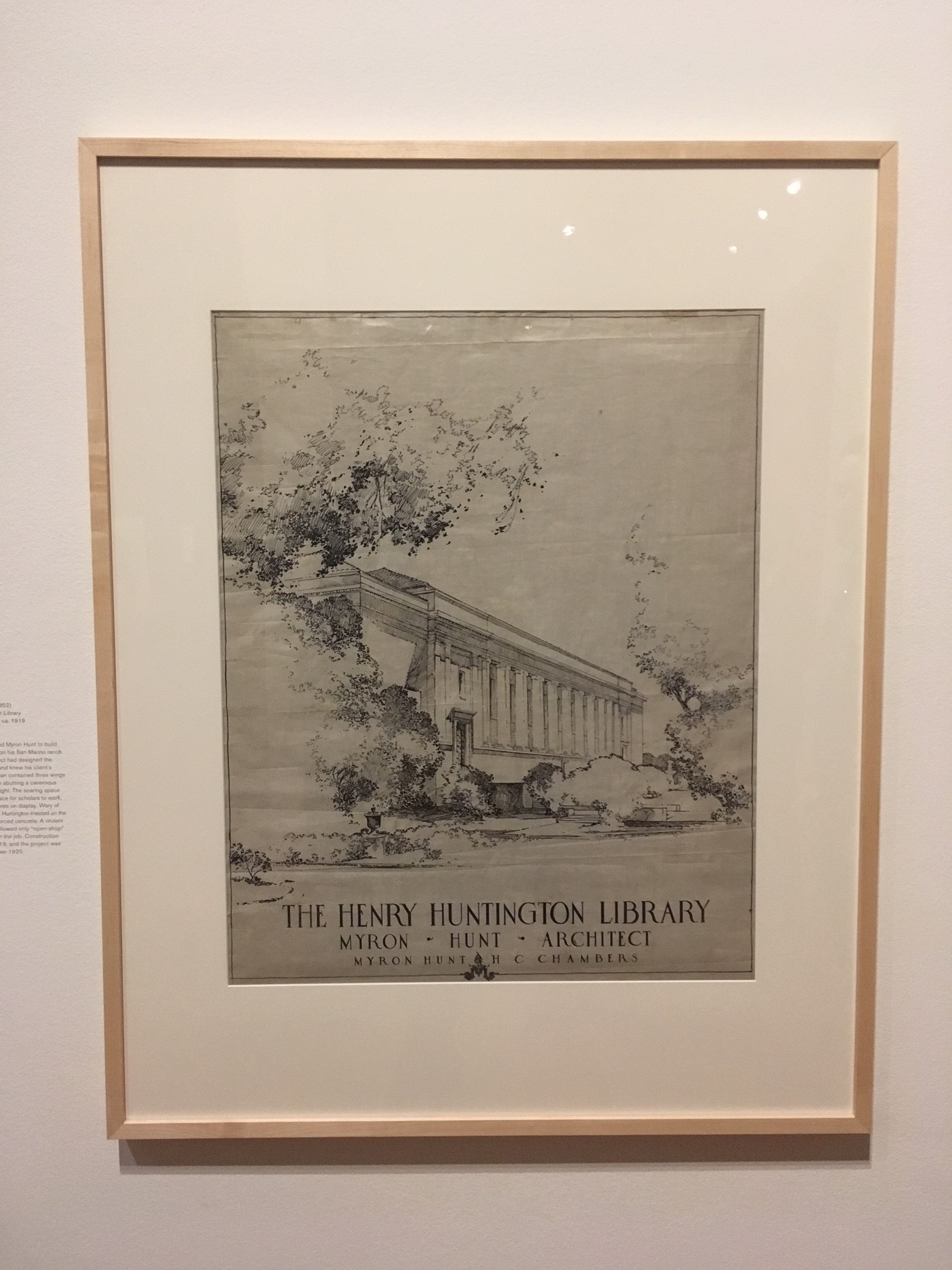
The last portion of the exhibition, ‘Build,’ focuses on Henry E. Huntington and the institution he created. In 1919, Huntington announced what some, including his New York librarians, had begun to suspect. He planned to load boxcars with the ‘world’s greatest private library’ – some 120,000 volumes – and send it off to the country’s western shores. By then, the property’s palm, desert, rose, and Japanese gardens were planted under the guidance of William Hertrich, Huntington’s landscaper. The mansion, designed by Myron Hunt, was completed in 1910. With the construction of the library building, the keystone fell into place for what would become the beloved tripartite institution we know today.

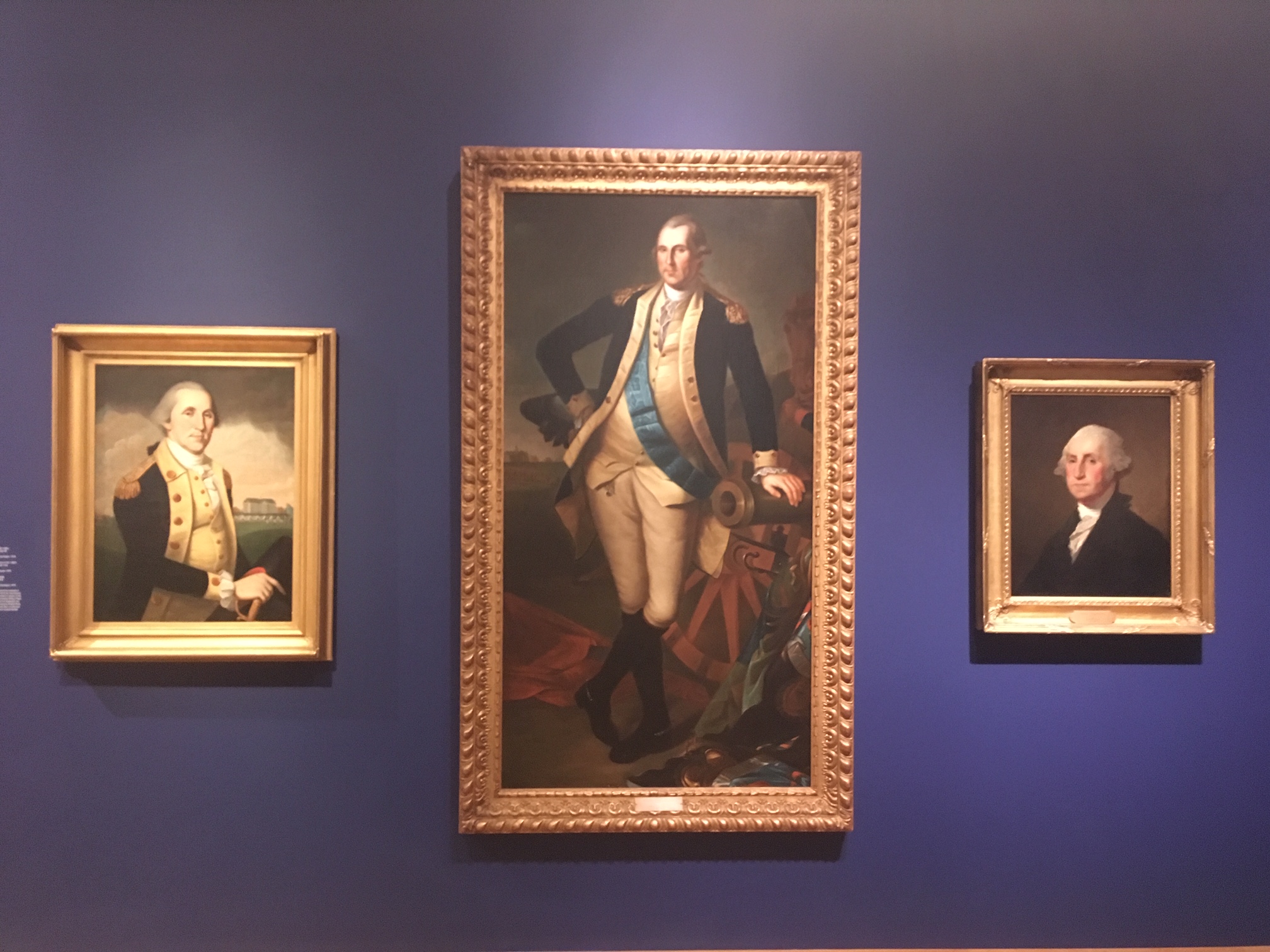
The George Washington Wall installation | Photo by Brianna Chu / Beacon Media News

A George Washington Wall – an installation of paintings – is also part of the exhibition. “This little section is an homage to Huntington’s own collecting and what he was doing in 1919,” Watts elucidates. “In 1919, he purchased four stunning portraits of George Washington, including the most famous one by Gilbert Stuart. Why was be buying portraits of George Washington in 1919? Firstly, it was the trend. There were a lot of things coming on the market then and George Washington was the most iconic figure at that stage of America. And, perhaps, because Huntington did this audacious thing of locating this giant institution and collection on the West Coast, for which he took a lot of criticism that he was taking what was considered the cultural patrimony of America and Europe and exporting it to this cultural wasteland of Los Angeles. I think Huntington wanted to ensure this institution took its rightful place in the cultural landscape and who better to do that than George Washington, the first in the hearts of his countrymen? And, of course, it also demonstrates Huntington’s admiration for first founders.”

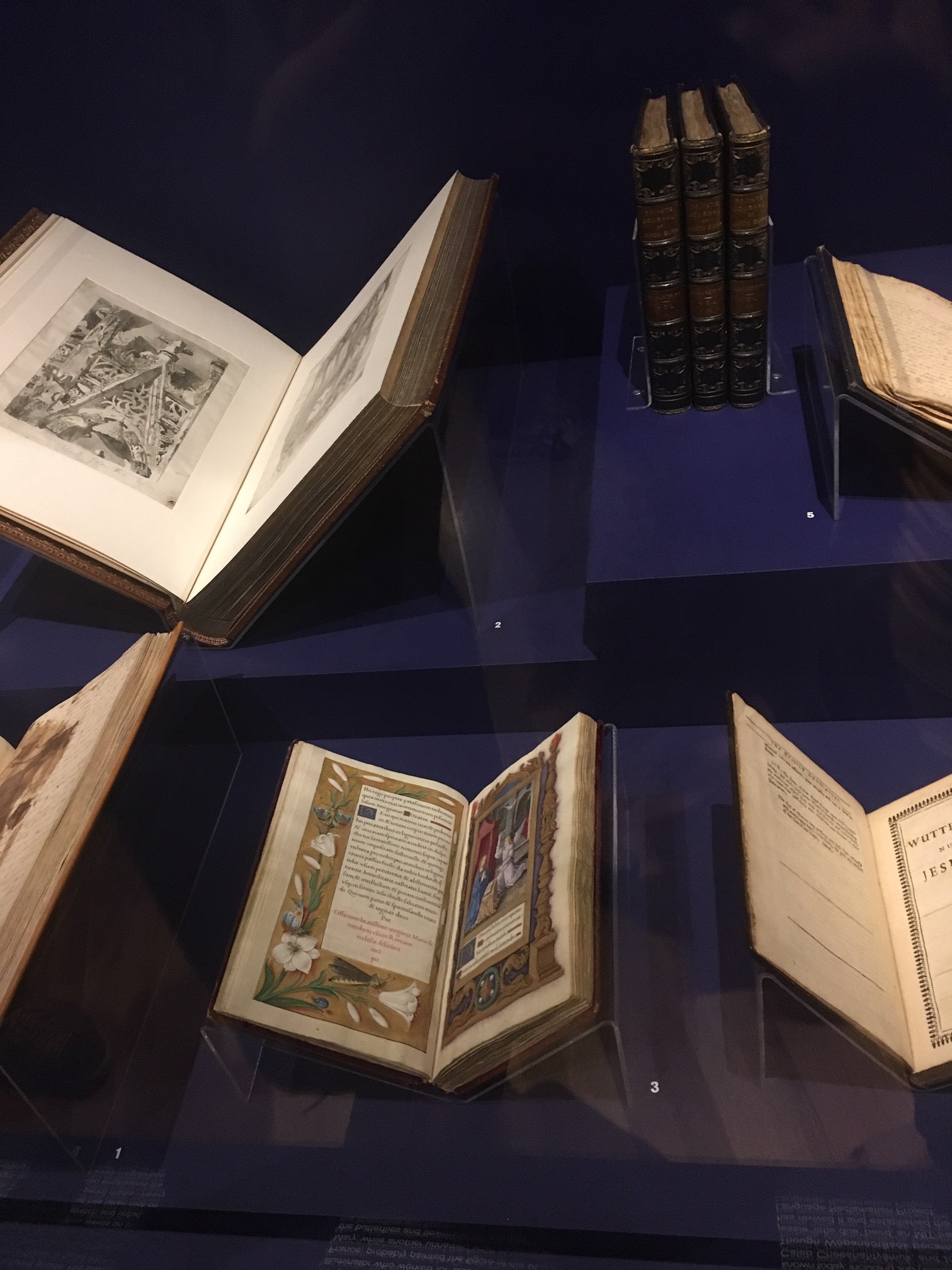
Beautiful Medieval books | Photo by Brianna Chu / Beacon Media News

In December of 1919, Huntington invited members of the prestigious New York Authors Club to his Fifth Avenue home. At that exclusive event, he shared with them 35 treasures in which he took special pride.

Watts declares, “This was significant for a couple of reasons – we had very little understanding of what he liked or favored. We know what his collecting interests were but we don’t know what his personal favorites were because he didn’t write or talk about them. This group of objects gives us a little insight as well as showcases his overarching collecting interest. Out of these 35 items, we chose some things that we thought were really outstanding and not generally on exhibition. They include: Benjamin Franklin’s handwritten autobiography; Maj. John Andre’s Revolutionary War-era maps; the first Bible printed in North America in a native language, which is also called the Eliot Indian Bible after the Englishman who translated it; and Civil War General William Tecumseh Sherman’s four-part memoir never before examined by scholars. The pages open to the redaction pertaining to his mental illness which ran in his family.”

Rounding up the exhibition are displays related to the make-up of this institution. Says Watts, “One of the things I like to tell people is that in 1907, at the beginning of Huntington’s collecting career, there was a big article in the New York Times about the most important collectors in the country and Huntington appeared nowhere. In 1919, when this institution opened, he was called one of the world’s greatest collectors, having one of the world’s best private libraries. How did Huntington do that? He was a consolidator and amalgamator – he bought huge libraries all at once. He had purchased four of the libraries that were mentioned in the 1907 article. We included several book bills to show the range of people he was dealing with and also the kinds of things he was buying. A favorite of mine is the one from Rosenbach, who was one of his major dealers. He delivered $121,000 worth of Shakespeare’s works to the San Marino estate. That gives you a sense that he purchased aggressively.”

Myron Hunt presentation drawing, ink on linen | Photo by Brianna Chu / Beacon Media News

“Among the many surprising things we learned, we determined that in the early years he was planning on importing all sorts of seeds and plants not as a collector but to landscape his real estate holdings,” Glisson discloses. “He was trying to figure out what would work here and it evolved into a teaching collection, something akin to what Harvard was doing in his botanic garden. The other thing that was really fascinating was that in the beginning he thought he could finance this whole enterprise entirely on citrus. Through all sorts of formulation of various fertilizer and types of trees, Hertrich was able to tell Huntington which are the best varieties and how much they’re making. Unfortunately, citrus isn’t the most reliable revenue source and, on top of that, 1919 was a bad year for citrus. Huntington ultimately had to sell some properties to finance this place. In 1919, Huntington had 600 acres; today his estate has 207 acres.”

Watts leads us to a small section, explaining, “This is a kind of homage to Hertrich. Here we see some of the early photographs of the property that he took and his little notebook with a listing of  birds which Arabella loved – there was an aviary here with 500 birds. Hertrich, in addition to overseeing the citrus and the grounds, also had to keep track of all the birds. A favorite of Arabella’s was the toucan and we have an original citrus crate label with a toucan, the only one we know that exists.

“We also found something interesting – the vast labor force that actually made this place come to be was not well represented. Although they didn’t necessarily go around taking pictures and keeping documents of their workers, we were able to find payroll records. We discovered that a third of the work force during the time were Mexicans from Mexico or Spanish, and they were paid significantly less than the European and American work force. It wasn’t surprising, but we’re starting to have scholars weed through and work with those documents that were heretofore unexamined.”

“And what would a show about Huntington be without talking about how much he was worth in 1919? He was worth $69 million that year and we have these preprinted ledgers and balance sheets, which he kept month by month, that showed his assets.”

“I will finish with a picture of Henry and Arabella – seen here as a young woman, not the woman we have come to think of as Arabella Huntington, the dowager wearing a widow’s veil,” pronounces Watts. “She was very much behind the scenes of this enterprise and was, in many ways, a huge force to be reckoned with. Her interests, as you may know, were in French decorative art and British portraiture, which he went on to collect later in time.

“When you exit the exhibition, you’ll see this great quote by Herman Hesse which we felt is emblematic of this project and of the year 1919: Every man is more than just himself; he also represents the unique, the very special and always significant and remarkable point at which the world’s phenomena intersect, only once in this way, and never again.”

Asked what he learned about Huntington that he didn’t know coming into this project, Glisson replies, “I haven’t been here that long so I didn’t know a great deal beforehand. In reading reminiscences about him and what people said, my takeaway is that he was someone who believed in trusting other people and he was very optimistic. He was always telling his staff to trust people to do the right thing. I thought that was very significant and interesting for a tremendously successful businessman and it suggests he must have found people he trusted and liked and then let them do their job. And that, to a large degree, is how you run a grand institution. In a sense, he clearly wasn’t that interested in being a book collector in 1905 or 1906 and then he got interested and  focused on it. When it came to the grounds, his landscaper Hertrich suggested that they be systematic about it and create a scientific botanical garden like Harvard and he agreed right away. So there’s trust and this openness and a kind of capriciousness that, I think, shaped what we are today – an art museum, a botanical garden, and a library – which is a kind of unlikely combination.”

Displays in the ‘Return’ section | Photo by Brianna Chu / Beacon Media News

I inquire what they want people to get from the exhibition. Watt responds, “I always want people to leave with a sense of curiosity and wonder. For me, it was important that people understand the depth and wealth of our collection, that we’re an active research institution where scholars come in every day to study these materials, and that we have an active, vibrant collection which continues to grow.

Glisson says, “One, I hope that people, particularly those from L.A. and Southern California, come to the show and are surprised. Two, I hope they find something that they want to learn more about. And three, I hope they find something in the show that speaks to their own experience which, I think, is pretty likely because there’s all sorts of materials. Those are my hopes, and the biggest one is just for visitors to be very surprised.”

German Revolution Photos | Photo by Brianna Chu / Beacon Media News

As for his favorite display among all the objects, Glisson reveals, “I love this red poster. Visually, this just jumps off the wall. It’s an incredibly powerful thing. And then there’s the text – Achtung! Stehenbleiben verboten! Auf Zusammenrottungen wird rucksichtslos geschossen –  which translates to ‘Warning! Stopping is prohibited! Crowds of rioters will be indiscriminately shot.’ My German isn’t so good and I kept reading it and wondered about it. It turns out that this poster would have been printed during the German Revolution in January 1919, and it was posted on a government building with armed soldiers watching around it. Talk about this poster being a snap shot of history and how improbable that it got all the way from Berlin, maybe from the Reichstag, to Los Angeles.”

That Henry E. Huntington had chosen to establish the institution that would bear his name in the San Gabriel Valley in 1919, when he could have done so anywhere in the United States, was quite improbable as well. It might have been seen by some as a foolhardy decision at the time, but we want to think it proved to be a stroke of genius!

The Huntington Launches Yearlong Centennial Celebration

Originally published on 10 September 2019 in the Pasadena Independent, Arcadia Weekly, and Monrovia Weekly

The Huntington President Karen R. Lawrence, announces the name change during the Centennial Celebration launch | Photo by Ryan Miller / The Huntington Library, Art Museum, and Botanical Gardens

The Huntington in San Marino officially launched its yearlong centennial celebration on Thursday, September 5, 2019. During her welcome speech at Rothenberg Hall, Huntington President Karen R. Lawrence expressed how Henry E. Huntington’s vision and legacy will live on in the next century.

“As I look out at you, the leaders of Southern California’s, and particularly L.A.’s, cultural, academic, and civic institutions, Huntington’s presence is demonstrably in evidence,” began Lawrence. “As the Director of our Botanical Gardens Jim Folsom recently reminded me, almost anything can grow in Southern California. He was correct.

“We brought everybody here today to celebrate the extraordinary fertility and vitality of our region – both a U.S. cultural capital and, as Huntington predicted, the leading edge of the Pacific Rim. Had his visionary red car trolley system been equally as durable, many of you, especially the west-siders, would have an easier commute.”

Continued Lawrence, “So 1919 was a very good year for the birth of L.A. institutions – from UCLA to the L.A. Philharmonic, to the iconic Musso & Frank Grill and Fosselman’s Ice Cream. In celebrating our hundredth, it’s not all about us; it’s about all of us. Because neighbors and partners have always been crucial in the life of The Huntington. As we celebrate the trust agreement in which Henry and Arabella Huntington gave their private treasures – at the time the New York Times called the greatest private library in the world, art and art collection, and expansive gardens and grounds – we also recognize that we wouldn’t be here were it not for George Ellery Hale, the renowned astronomer, who helped develop Caltech and who was the founding director of the Mount Wilson Observatory in Pasadena.

“In the Huntington’s archives, we have Hale’s correspondence with Huntington which shows that from 1906 to 1916, Hale politely badgered Huntington to place his private collection in a trust for the use and benefit of the many. As significantly though, he helped convince Huntington, the wealthy industrialist and collector, to see the value of his collection in a different way – more for the research and scholarship it would inspire than for its accumulation. Hale urged Huntington to establish a public institution; he wrote ‘There is now great need of a strong institution of broad scope, uniting all the intellectual interests of this region and the common folks.’ When he was later asked about the worth of his collection, Huntington replied that its value will be determined primarily by what he produces. Although these two men couldn’t possibly foresee what was produced during those hundred years, it’s a testament to their legacy and Arabella’s, that The Huntington attracts 1,700 visiting scholars in addition to over 750,000 visitors from around the world.

“So today we take a moment to acknowledge this Southern California history as well as to think about our future and the ideas that will propel us all for the next hundred years. For a person turning 100, it’s very natural to look back and reflect on the past. For an institution turning a hundred, a centennial is a moment to be like Janus – looking back and forward at the same time. Today we’re celebrating how far we’ve come and reflect on where we want to go. We’re thinking carefully about our mission and what it means to be among the oldest cultural and intellectual centers in this great region, which itself reflects the dynamic demographic evolution of our city, state, and country. We want to broaden our audiences and to focus on The Huntington’s ongoing role in the cultural fabric of Southern California and beyond.”

Lawrence declared, “The name of an institution reflects its relation to its audiences as well as its mission and ethos. In 1919 we began our journey as the Henry E. Huntington Library and Art Gallery. And, over time, we became more commonly known as the Huntington Library, Art Collections, and Botanical Gardens. Today I am pleased to announce a change in what we’re calling ourselves, that reflects both the increased breadth and depth of our art collections and their public purpose. We’re changing our name to The Huntington Library, Art Museum, and Botanical Gardens.”

As Lawrence said this, the name displayed on the screen behind her also changed and was met with enthusiastic applause from the audience.

The change from ‘collections’ to ‘museum’ more accurately describes The Huntington’s mission and programs, explained Lawrence. “Our art collections are more than a group of catalogued objects; they are carefully curated, interpreted, and exhibited for scholarship, education, and the broader public. An added benefit to this change is that we become more discoverable, particularly in online searches. This is important as we work to widen our audiences and accessibility.”

The Hammer Museum’s Director, Anne Philbin, talks about ‘Made in L..A. 2020’ | Photo by Ryan Miller / The Huntington Library, Art Museum, and Botanical Gardens

The Centennial Celebration, a yearlong series of exhibitions, public programs, and new initiatives running from September 2019 to September 2020, kicked off with an announcement of a collaboration between The Huntington and the Hammer Museum on ‘Made in L.A. 2020,’ the upcoming edition of the Hammer’s acclaimed biennial. The statement was made by Hammer Director Ann Philbin alongside Lawrence.

Opening June 7 and running through Aug. 30, ‘Made in L.A. 2020’ will take place at both institutions, providing visitors across the region an opportunity to experience the singular exhibition of contemporary art in Los Angeles. The exhibition, sponsored by Bank of America, will debut new installations, videos, films, sculptures, performances, and paintings from Los Angeles–based artists, many commissioned specifically for the exhibition.

‘Made in L.A. 2020’ is the fifth iteration of the internationally lauded Hammer biennial, and the second to take place at multiple venues. The biennial’s inaugural 2012 edition presented artists at the Hammer, LAXART, the Los Angeles Municipal Art Gallery at Barnsdall Art Park, and the Venice Beach Biennial. The 2020 edition seizes on an opportunity to connect an institution on the west side of Los Angeles with one on the east. It is co-curated by Tunisian-French writer and curator Myriam Ben Salah and Los Angeles–based curator Lauren Mackler. The Hammer’s Ikechukwu Onyewuenyi is assistant curator for performance.

“We are thrilled to be partnering with The Huntington on ‘Made in L.A. 2020’ to bridge the east and west sides of Los Angeles to highlight the works of art created across the region, with an emphasis on emerging and under-recognized artists,” said Hammer Director Ann Philbin. “This expression of our biennial―which spans roughly 25 miles―offers opportunities for discovery and surprise for ‘Made in L.A.’ visitors and gives the curators and artists a new platform for experimentation.”

“Creative collaborations are a hallmark of our Centennial Celebration,” Lawrence disclosed. “We will be engaging with our collections as well as with our audiences in exciting new ways. Joining forces with the Hammer for this remarkable exhibition is a perfect example of what we are setting out to do. ‘Made in L.A.’ celebrates the extraordinary, groundbreaking work of contemporary artists working in Southern California. We are honored to be a part of this year’s exhibition.”

“Los Angeles is the epicenter of the creative economy, with the arts bringing Angelenos together, attracting tourism, generating cultural dialogue, and serving as an economic driver for our region,” declared Raul A. Anaya, Bank of America market president for greater Los Angeles. “It’s why Bank of America invests in the arts and in institutions like the Hammer and The Huntington, and this specific partnership for ‘Made in L.A. 2020’ reflects our mutual commitment to L.A.’s incredibly diverse local artists.”

During the run of ‘Made in L.A. 2020,’ members and visitors to the Hammer will receive passes granting free admission to The Huntington to view ‘Made in L.A. 2020’ in full. There will also be joint programming at both the Hammer and The Huntington during the exhibition.

Looking ahead to the next 100 years, the directors of The Huntington’s three components – Library, Museum, and Botanical Gardens – spoke about the future and how The Huntington’s collections will contribute to their fields.

Sandra Luding Brooke, Avery Director or the Library speaks during The Huntington Library, Art Museum and Botanical Gardens Centennial Celebration Launch Event on Sept. 5, 2019, in San Marino, California | Photo by Ryan Miller / Capture Imaging

As the Avery Director of the Library, Sandra Luding Brooke oversees the 11 million items in the library collection. She said, “In 1925 Henry Huntington endorsed a vision for a repository of books and manuscripts of the greatest rarity and value focused on tracing the progress of our English-speaking people. Since then The Huntington’s collection has grown and persisted in more ways than what could have been imagined a century ago.

“Libraries must anticipate tomorrow and try to imagine what future researchers and viewers might want or need to know,” pronounced Brooke. “We must be judicious and imaginative in choosing what we preserve, and be fearless in seeking diverse and provocative voices. Libraries must batten their hatches to protect collections from the vicissitudes that are sure to come – natural disasters, social and economic upheavals, censorship, ignorance, and willful misapprehension. We also want to seize this moment and help our collections speak to current generations because cultivating a love and respect for documented history is the surest route to its survival and, perhaps, our own. So in the spirit of stepping out with optimism into our second century, the Library has made a small acquisition that won’t get on our shelves until just four years shy of The Huntington’s bicentennial. Until then the library’s purchase will be growing in the Norwegian wood. Artist Katie Patterson’s future library is a hundred-year literary artwork of an active indefatigable optimism. Five years ago, Patterson planted a forest of a thousand spruce trees in Norway. This forest will be held in trust until the year 2114 when the trees will be harvested, turned into paper, and provide the stock for the publication of 100 texts, until then held secret, by 100 writers. This little acquisition is a vote of confidence in the future of the environment, of art, of books and the written word, and of libraries. Yes, we are confident our librarian’s successors will not fail to claim The Huntington’s copy of this long-awaited anthology. But between now and 2114, we are equally confident that millions of other texts, images, and objects undiscovered and, as yet, uncurated will cross The Huntington’s threshold to join this great past, present, and future library.”

Christina Nielsen, Hannah and Russell Kully Director of the Art Museum | Photo by Ryan Miller / The Huntington Library, Art Museum, and Botanical Gardens

Christina Nielsen who, when she took the podium and introduced herself, said that for the past 10 minutes, she has been the director of The Huntington’s Art Museum. She started, “Now that we’re a museum I’d like to spend the next few minute considering what that term means. What it meant to Arabella and Henry, what it means today, and what it will likely mean in the future. Henry Huntington, entrepreneur and futurist, proponent of new technologies; Arabella Huntington, perhaps the greatest gilded-age collector you’ve never heard of – together they stand out among the likes of their peers such as Walters, Morgans, Fricks, and Gardners by bringing together objects from the past to actively shape a future. They founded the first Old Master Collection in Los Angeles which included Asian ceramics, Italian Renaissance pieces, French decorative arts, and British portraits from the 18th century, which allowed for connections across time and place. And they put their historic works in conversation with art from their day by placing sculpture on the grounds from artists of their time, including their daughter-in-law Anna Hyatt Huntington. They also gave us a framework for considering how to move forward, encouraging us to continue making connections across time and place, to invest in new technologies, and to share their collection with the public.

“So now the present moment. And might I suggest that, in many ways, the future is now and the future is here. The definition of ‘museum’ is quickly changing, as is the nature of our work. The International Council of Museums just released a new definition of museum as a ‘democratizing, inclusive, and polyphonic space for critical dialogue about the pasts and the futures.’”

“Our collection is indeed a treasure trove to be mined for thinking about making connections across time and place, how trade and exchange shaped objects, lives, and intellectual pursuits,” noted Nielsen. “But which stories do we choose to tell and who tells them? Recent partnerships here at Huntington, such as one with the Vincent Price Art Museum, allowed Carolina Caycedo, one of the great artists in the L.A. area, to produce a new work of art Apariciones/Apparitions which inserts back into the history of our founding narrative people and labor who’ve been lost over time.

“More specifically, ‘Blue Boy,’ our most iconic work, has continued to inspire over time, artists, much more recent than when he arrived in 1921. A young artist on leave from military duty in San Diego came to the Huntington and had an epiphany from the ‘Blue Boy.’ So did a young teenager who would come on visits to The Huntington on Saturday. And so we’re thinking very deeply about how to unlock more epiphanies from our people, in our galleries, and through expanded online resources. How do we share our collections beyond our walls? How do we reach other aspiring artists from South Los Angeles, San Diego, and from other places really far away – like Kansas City, Kosovo, or Kyoto. So in the context of The Huntington itself, what does our art collection mean? This is a multi-disciplinary institution and as the definition of art keeps changing and evolving, I was reminded recently by Jim Folsom that The Huntington itself is the original conceptual work of art.”

Nielsen said further, “This is the hotbed of the artistic world and we are so pleased to be working with the Hammer on ‘Made in L.A.,’ exemplifying what an extraordinary moment this is for our region. But I might suggest that ‘Made in L.A. 2020’ has a really important antecedent and that could be considered ‘Made in London 1770,’ because going back to Gainsborough and his fabulous ‘Blue Boy’ painting, what we’ve recently learned is that in fact Gainsborough, hundreds of years ago, just like the artists in our midst today, was absolutely pushing the envelope of what it meant to be a painter and what the medium could provide. And so I would say it makes absolute sense for us at The Huntington to be working with The Hammer and offering up our resources for artists, writers, performers, dancers, thinkers, in our midst.

“The past is not dead. In fact, as Socrates said, ‘It isn’t even past.’ It’s alive and waiting to be unlocked in the objects in our collection. I can’t begin to predict now how successors of ours a hundred years from now will do that, any more than Henry and Arabella could have predicted us sending rockets to the moon. But they believed in technology; they believed in sharing their collection to the public; and they believed in connections across time and space. I feel that if we hold true to these principles, we will be just fine over the course of the next hundred years. And, in closing, I offer another definition for our museum – that it should be not just a repository of things, but a collection of ideas and a place for sharing them with others.”

James Folsom, Telleen/Jorgensen Director of the Botanical Gardens speaks during The Huntington Library, Art Museum and Botanical Gardens Centennial Celebration Launch Event on Sept. 5, 2019, in San Marino, California | Photo by Ryan Miller / Capture Imaging

When it was his turn to speak, Director of Botanical Gardens James Folsom, who noted that he’s the old-timer at The Huntington, stated, “Last year we planted several hundred trees and we intend to plant more this year. We plant trees because during a storm in 2011, 700 trees fell in one evening. We plant because new opportunities arise – wonderful new trees become available. We plant trees because they provide structure to the landscape, which takes years to develop. We plant trees because on the 6th of July last year, the gardens experienced a record-high temperature of 118 degrees Fahrenheit leaving vegetation scorched throughout the landscape.

“We plant trees because that’s what gardeners do – observe, think, plant, cultivate, take our losses, make our moves, plan for change, and invest in energy and resources to create something that would be of worth for future generations. So what is that future, how far is that horizon? For trees, it’s 80 to 100 years – easily to the end of the century. But in all of our actions, even short-term plantings, we should build soil and capacity. Every act can be viewed as an investment. Gardens also plant ideas and inspiration – the beauty and power of life unfolding, the importance of cycles, the value in the glorious smell of fresh water and arable soil. The pay-off in planting is seeing the product of pure physical toil and recognizing the importance of plants as the givers of life and the bases of biodiversity.

“To me, the lessons we learn from gardening are crucial. In a perfect future, I imagine these Huntington gardens and the act of gardening will help form a better world. Fortunately, the structure we need for those lessons exists. The Huntington has collections, displays, beautiful facilities, and staff to see us to our second centennial.”