Art Space in San Gabriel, The Scholart Selection, Opens with Pasadena Artist Cissy Li Show

Originally published on 6 December 2022 on Hey SoCal

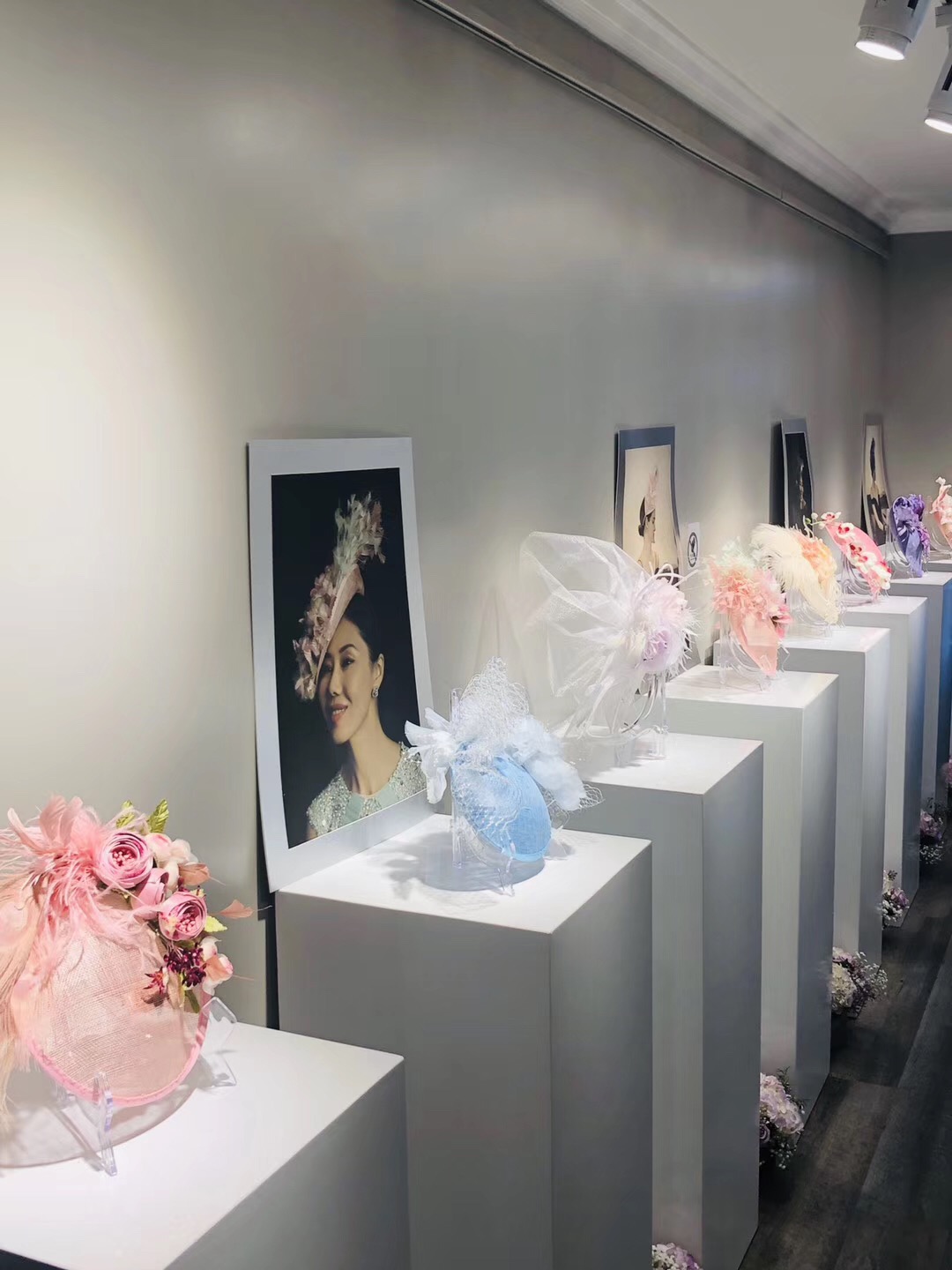
The Scholart Selection, an art space located at the San Gabriel Mission District, held its inaugural show from Nov. 18 to 20 – in time for the holiday shopping season – with an exhibition and sale of hats, glassware, and ceramic items made by Pasadena artist Cissy Li. Also featured were vintage costume jewelry from the showroom owner’s private collection.

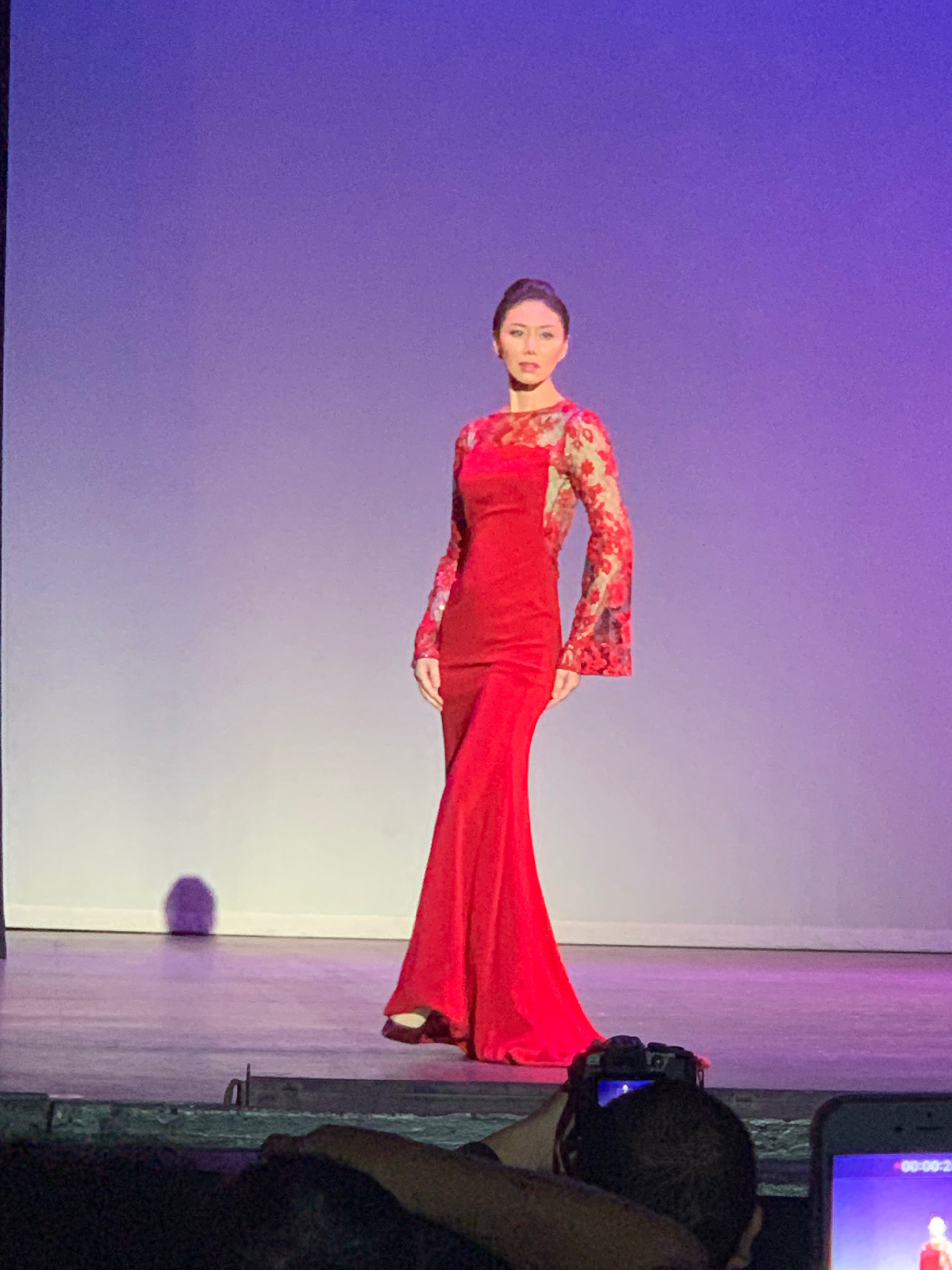
A former haute couture runway model, Li graced the catwalk for Europe’s renowned fashion houses. She followed that illustrious career with yet another artistic endeavor – artisanal milliner (read related article here) – creating bespoke headwear for friends. Then she expanded into making glass and ceramic art ware, which she displayed at her spring show this year (read my article here).
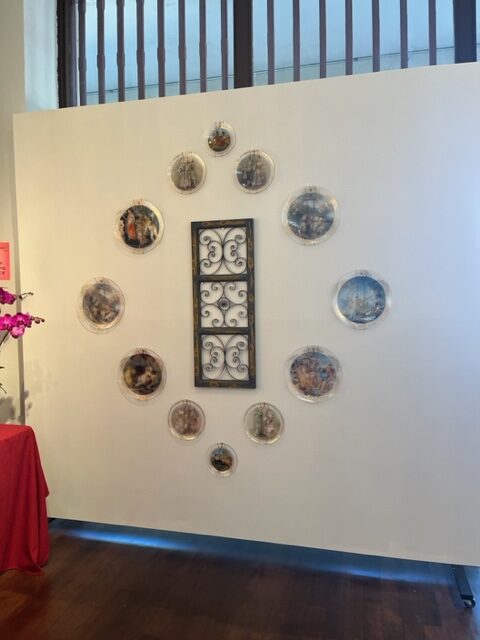
Plates with an over glaze of famous oil paintings and 22K gold band | Photo by May S. Ruiz / Hey SoCal

According to Li, she wasn’t asked to make anything special for Scholart Selection’s maiden event. She says, “Cindy [the art space’s founder] trusted me to come up with something and told me not to work too hard; she reassured me that we had enough items to show. So I made 16 plates for the gallery opening – they are one layer of clear glass with an over glaze of famous oil paintings and 22K gold band.”

That confidence in Li’s ability is high praise from someone she hasn’t known very long. She discloses that they met through a friend they both know. “I then invited Cindy to my friend Yenfu Guo’s exhibition called GAME at Seasons LA. After some lengthy and wonderful conversations, we became friends. I invited her to my workshop to show her how to make glass art work. She was very interested and, maybe impressed, so she asked me to be her new art space’s first guest artist. I was so thrilled!”
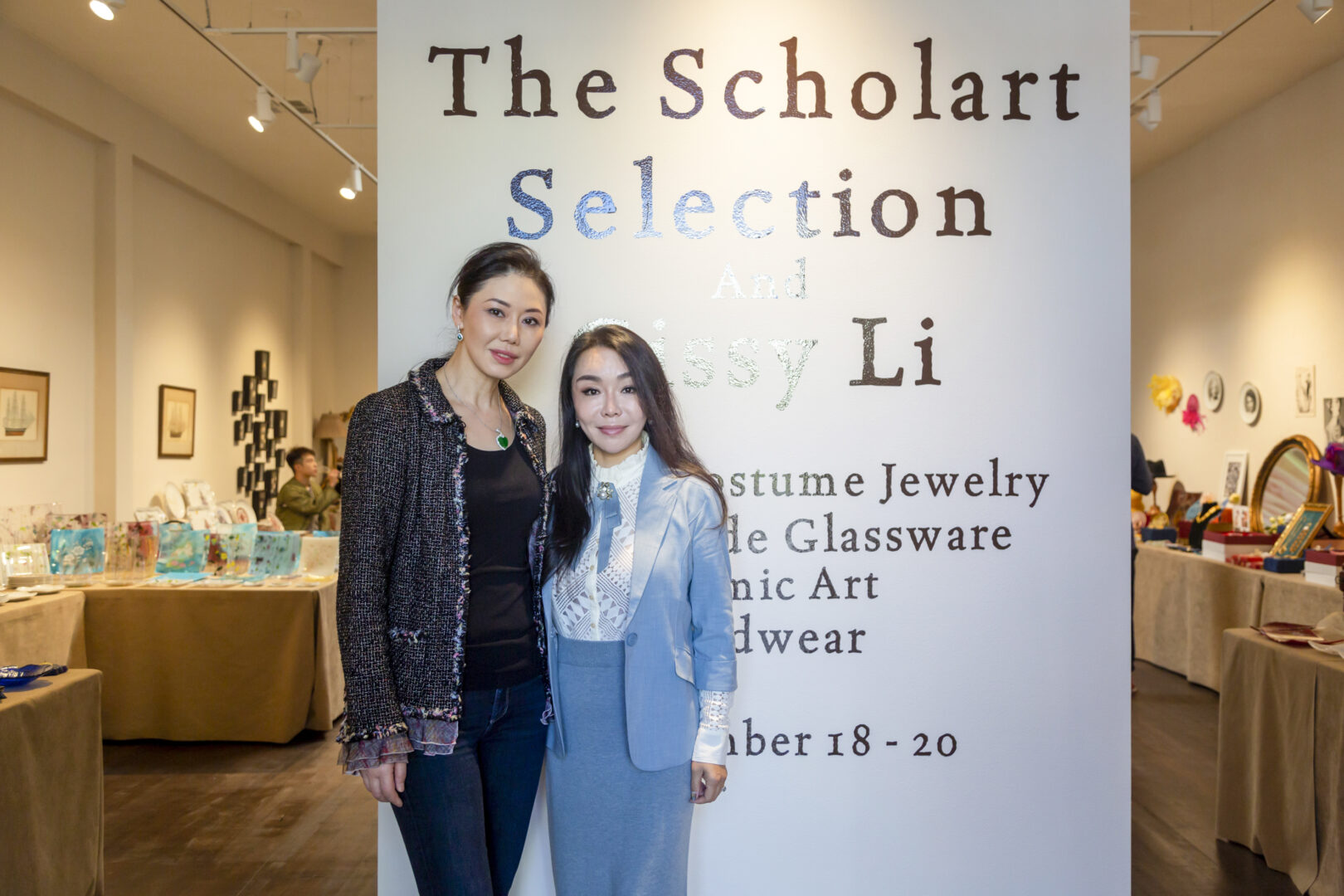
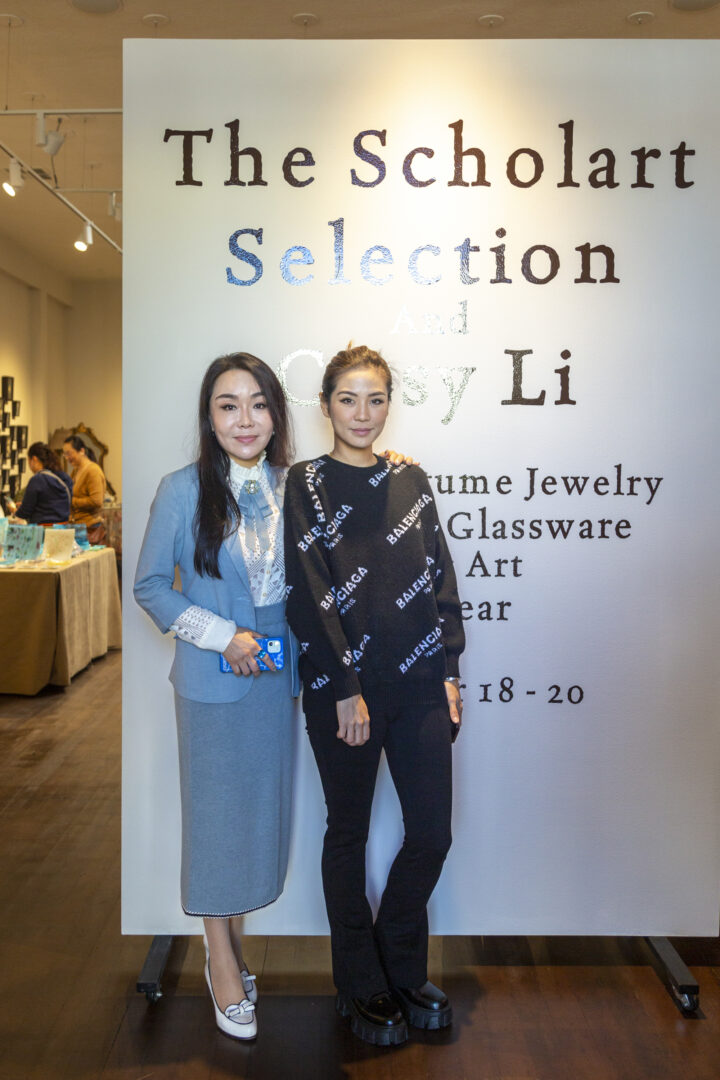
Cissy Li (at left) and Cindy Wang (right) | Photo by Lingxue Hao / The Scholart Selection

It isn’t the first time that Li has partnered with a gallery and she absolutely enjoys the experience. She enthuses, “This is a wonderful way to show people your ability! And I had a great time working with Cindy. I learned so much from her – she is so smart and hands-on – and I would love to collaborate with her again!

Li’s recollection about how they became acquainted is echoed by Cindy Wang, Scholart Selection’s founder, who graciously speaks with us during the showroom’s opening. Scholart’s Space Manager Dodonna Jen acts as interpreter to facilitate the interview.

Wang relates, “We met at a friend’s party about six months ago and we hit it off. I’ve met a lot of artists in my life and I felt I connected with Cissy as one artist to another. I saw her work and how passionate she is about her art. I also admire how meticulous she is in keeping her workshop neat and organized.”

The decision to ask Li to be her first guest artist wasn’t an impulse but a deliberate choice. Wang explains, “Cissy is a dear friend of mine and I have a great understanding of her creative process. Since our opening exhibition is a three-day event amidst the holidays, the hand-crafted hats, ceramics, and glassware with their beautiful colors are very fitting to share with everyone during the Christmas season. I truly commend Cissy for her dedication and hard work and all the hours she puts in to perfect each and every piece of her art.”
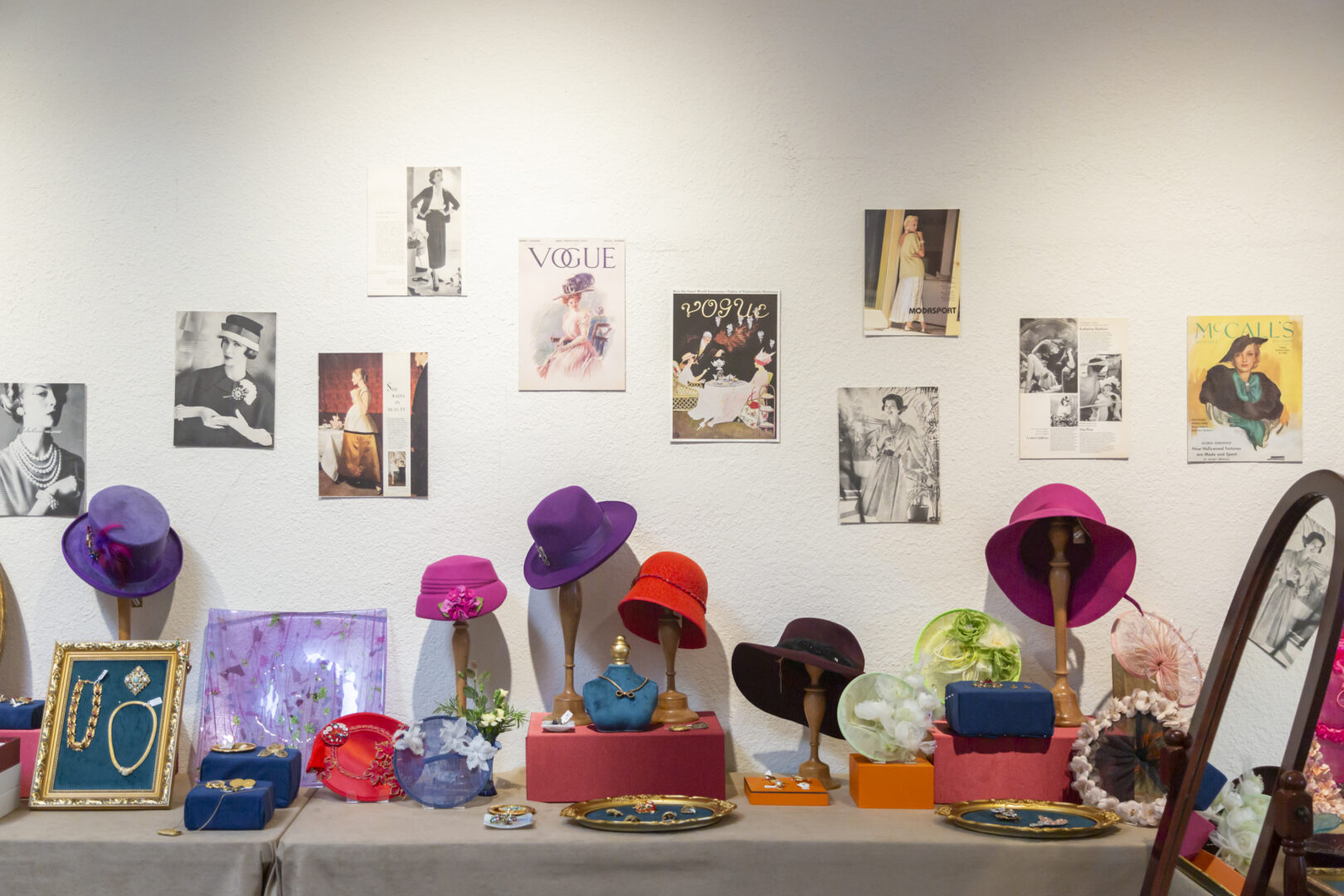
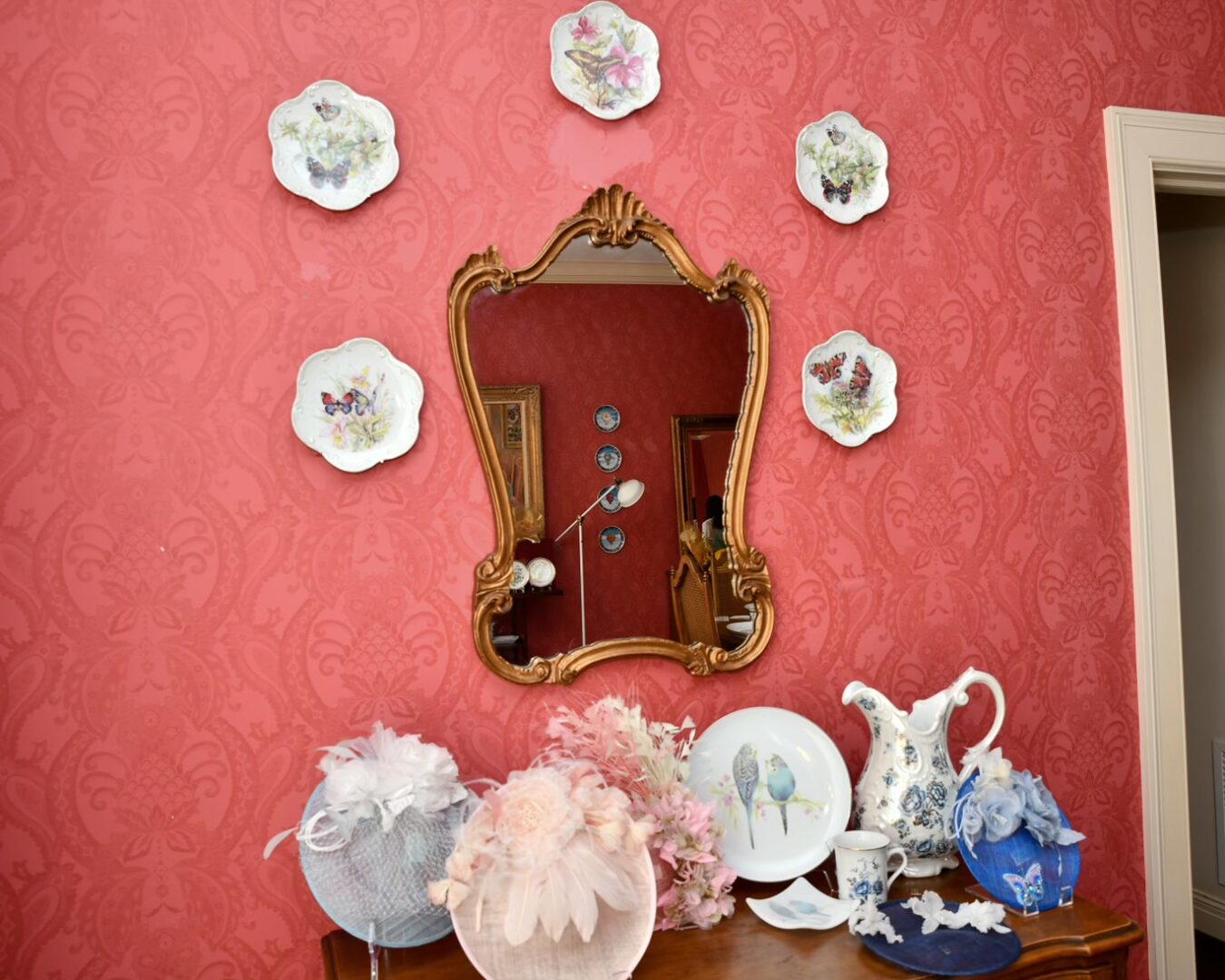
Vintage costume jewelry and hats | Photo by Lingxue Hao / The Scholart Selection

Vintage costume jewelry pieces accompanied the magnificent Cissy Li creations. They were from Wang’s private collection gathered from her travels in Europe and were available for purchase. However, the cameos were only on display because she’s loathed to part with them. She states, “There’s so much history and stories behind the cameos and I’m not ready to give them up just yet.” Perhaps one day.

While at first glance, the vintage jewelry is reminiscent of Old Hollywood glamour, Wang didn’t necessarily pick from that particular era, fashion, or style. She sees the value of the costume jewelry based on their beauty, quality, and workmanship.
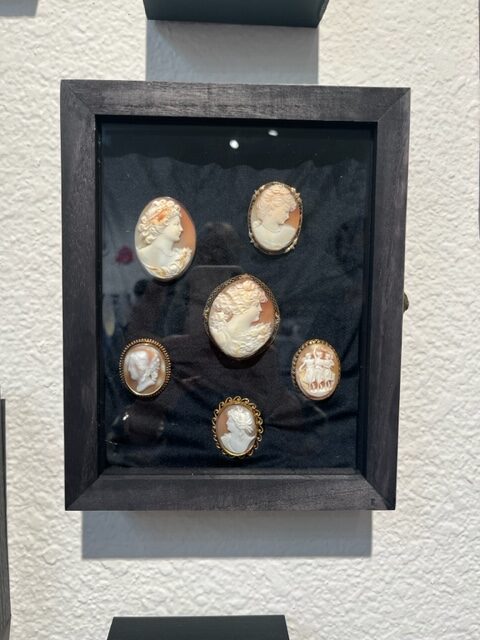
Cameos in Cindy Wang’s collection | Photo by May S. Ruiz / Hey SoCal

Wang reiterates, “That’s why I call the space Scholart Selection – the art pieces we exhibit, from jewelry to ceramics, have been selected to reflect the best of artists’ work. What I’m sharing with people are what I personally picked, not random items.”

Because she was born and raised in Beijing – which has a long and storied art and culture history – Wang was drawn to the arts early on. She reveals, “I majored in interior design and also studied advertising at university. After graduating, I started a media company. My husband and I have an extensive range of art collections, including traditional Chinese ceramics, calligraphy and paintings; Japanese wood-block art; and numerous antique and vintage cameos. The Scholart Selection is not my first art space. I’ve owned an antique shop for several years in Beijing that showcases all kinds of art.”

“When I’m not working on an exhibition, I enjoy creating content for my art channel, as well as traveling to various countries to visit local galleries and artists’ studios or even antique shops,” adds Wang. “I always believe that the best way to learn is to see and experience.”

Wang had been living in the United States for three years when she founded the company in 2012 as a channel for art. She originally called it The Scholar but eventually renamed it Scholart (a portmanteau for scholar and art) Selection. It then became obvious that she needed a space for her to realize her desire to share the knowledge she gained and learned through the years.

While she is an Arcadia resident, she chose to open her showroom in San Gabriel. She says, “The San Gabriel Mission area is a historical landmark and when I saw it, I knew it was the perfect place for an art space!”
Cindy Wang (at left) and Dodonna Jen (right) | Photo by Lingxue Hao / The Scholart Selection

Discovering the perfect space to open its doors to the public took some time and doing, though. Dodonna Jen explains, “Cindy found this space in September last year and there had been a lot of back and forth with the landlord and property manager. We leased the spot in February then went through extensive planning and renovations. All the renovations were completed in August so we literally just moved in.”

And Wang and her team hit the ground running. After Li’s show, Scholart Selection will welcome in December the next artist – A Japanese American artist who will share his experience growing up in Los Angeles through his artwork.  

“Our current plan is to hold eight to ten exhibitions for 2023,” Wang divulges. “We are now lining up both local and international artists. Our regular exhibitions run about a month long while smaller shows and pop-up events go on for about a few days.

“Whatever the scale of the exhibition, The Scholart Selection always encourages everyone to walk into the art space and feel the spectacular visual gratification that makes you want to keep coming back to experience art in person, as well as relax, muse, and have a good time,” asserts Wang.

Determining whom to invite to exhibit their artwork at Scholart Selection involves analyzing the artist’s oeuvre. Wang declares, “First of all, when we look into an artist, it’s not only my personal understanding of them but also our entire team’s evaluation. We see their artwork, the style and the story that they wish to tell. Of course, the initiative for us to work with an artist is the artist’s perception, with sensitivity to the current culture and society. The process of collaborating with artists and selecting the artworks is always the most fun part. Working with artists always brings me into contact with a wealth of outlook on the world.”

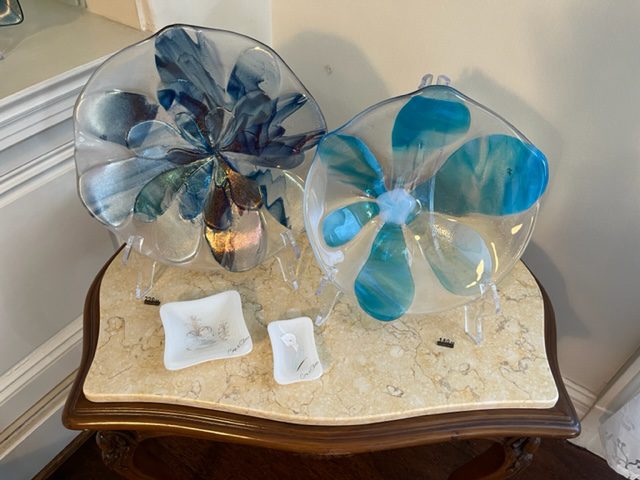
Beautiful glassware in striking colors | Photo by Lingxue Hao / The Scholart Selection

“We are not limited to a certain art form, because art has no boundaries,” Wang clarifies. “This is also the reason why The Scholart Selection does not categorize itself as a gallery but, instead, as an art space. We welcome various art forms, such as movies, music, photography, and different ways of artistic expression. We would love to devote ourselves to creating opportunities for talented artists.”

That Wang asked Cissy Li as their inaugural artist demonstrates her and Scholart Selection’s commitment to that mission, along with showcasing only the best in their field. And the reception from guests did not disappoint.

“We put in a lot of time and effort for this event – from decorating to designing and from invitations to coordination.” Wang concludes, “We wanted to give our guests a welcoming and warm experience. It was definitely successful; we were overwhelmed!”

It shouldn’t have come as a surprise. Wang and Li created an event people enjoyed going to because they curated pieces to mirror their kindred spirit and passion for art. The exhibition set the benchmark for Scholart Selection’s upcoming shows. It’s a tough act to follow, but Wang is sure to invite only consummate professionals like her who can top that feat time and time again.   
Pasadena Artist Holds First Show after the Pandemic Began

Originally published on 31 March 2022 on Hey SoCal

Two years after the pandemic started and turned the world upside down, Pasadena milliner Cissy Li puts on her spring collection show. (read my previous story about Li and how she became a milliner here) And this time around, her creations of glassware and ceramic art join the spectacular hats on shelves and tables. Attendees to the show’s opening are treated to a dazzling array of multi-colored eye candy. There’s so much to look and marvel at!

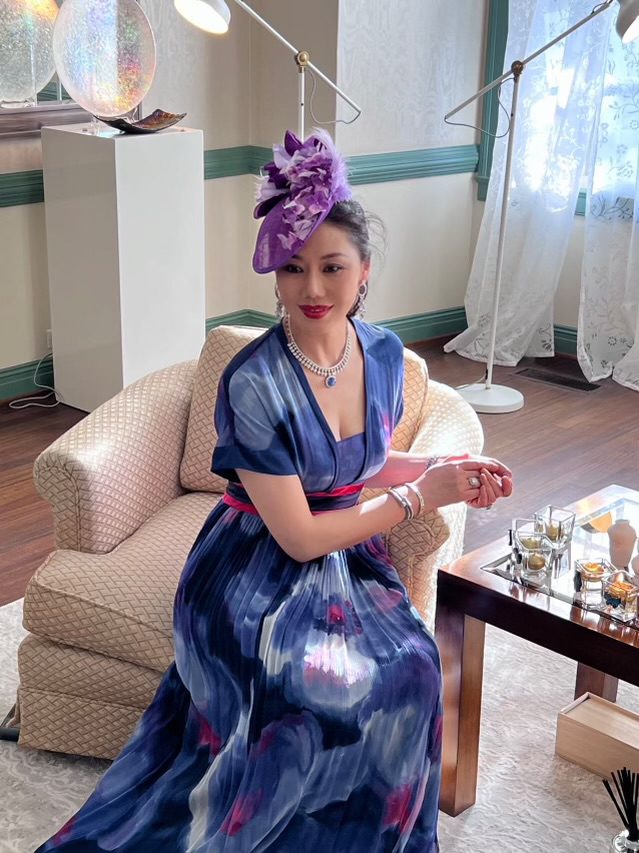
Li, ever so glamorous in her cobalt blue and neon pink floor-length dress, wears a sparkling diamond necklace with a cabochon pendant and a ring to match. Perched on her head is a purple fascinator with silk lilac flowers. And she works the room with the ease and panache honed during her years as a runway model.

Cissy Li | Photo by Angela Lee / Courtesy of Cissy Li

Sitting elegantly on an armchair, Li talks about her expansion into this new endeavor, “Hats are worn during social occasions. And during the pandemic, not many people were ordering them because there were very limited social events or parties. That gave me the opportunity to branch out into something else – glassware and ceramics.

“Having my kids at home helped because I didn’t have to go to school and drive them around to their various after-school activities; it meant I could be home cooking and working on my glassware. They were pretty much on their own during remote learning. Of course, when I wasn’t physically near them, they tended to sneak in playing some video games. But all in all, they were well behaved. I think the school did a good job giving them a schedule and telling them what they needed to do.”

“I post my work on WeChat and Instagram and people who like what I make call me to commission some pieces,” Li continues. “I’m very lucky that the people who place orders give me carte blanche so I can be very creative. But I also appreciate it when someone comes with a pattern or a picture and tells me ‘I want something exactly like this.’”

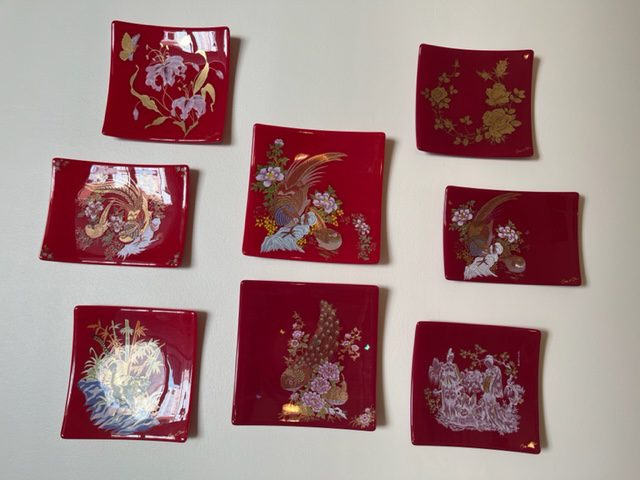
These red glass plates took 80 hours of firing time in the kiln and about two hours of overglaze design and 24K gold luster touch up | Photo by May S. Ruiz / Hey SoCal

“During the pandemic, I did a lot of commissioned orders and that kept me very busy. Millinery used to be my primary source of income, but ceramic and glassware work has since become a second career. I’m pretty fast with glassware and hats but not with housework, especially with cooking – I can fire the kiln with self-assurance but I’m more careful that I don’t burn the food,” she confesses with a laugh.

It wasn’t the first time that Li experimented with glassware. When she lived in Italy, a friend – who was also a runway model – had an uncle who owned a glass blowing factory on Murano, an island off Venice. “I went there to study but I only lasted for three days. It was very hard work and I just couldn’t do it, so I quit. However, I learned the basic technical skills that I am able to use now,” Li reminisces.         

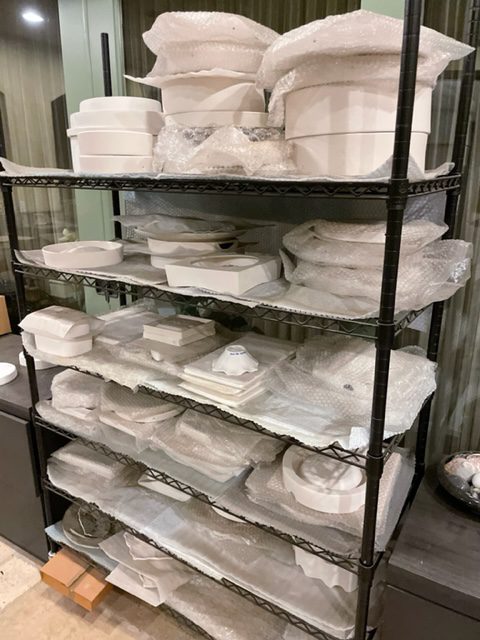
Glassware molds in Li’s workshop | Photo courtesy of Cissy Li

When she began working on her glassware, Li had only a small, used kiln. As she grew more confident in what she was doing, she invested in a much larger one. She also moved her work space out of the billiards room next to the swimming pool on the lower level, up to the main level of her family’s property where the garage is located.

“The kiln looks like a bathtub and I can fire one big piece and several small items,” she describes. “I fire at 1,300 to 1,500 degrees F – it’s really hot. In the winter it’s freezing and in the summer it’s sweltering. Working with glass and ceramics involves a lot of dust too, so the garage is really the best place to do this.”  

“How many hours do you work?” I ask. Li replies, “Once I get started, I keep going for about five or six hours. I do need that stretch of time to think and plan. Working with glass isn’t only about art, it also needs math and chemistry, and hard work – there’s a lot of cutting, grinding, and scoring – but I really enjoy it. It’s like a mystery; the result is different each time depending on the temperature. ”

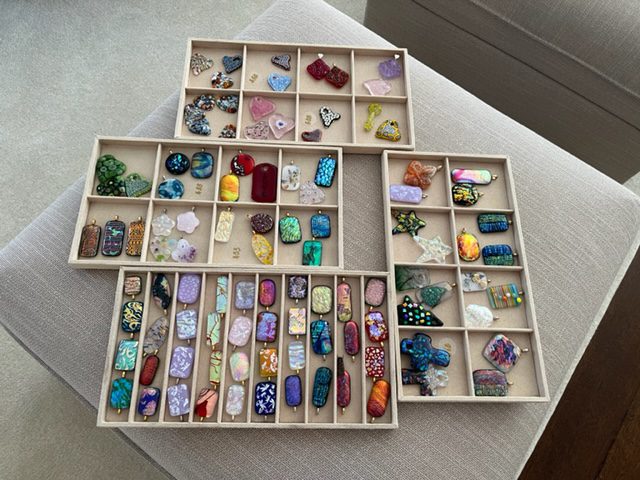
Glass pendants in various colors and and shapes | Photo by May S. Ruiz / Hey SoCal

Li patiently explains how each piece of glassware is made, “You do one procedure at a time – you fire from a higher temperature then to a lower temperature. A piece of glass comes three millimeters thick but the product you want to make is six millimeters. You first cut the shape and put two pieces together, front and back. Then you place these in a kiln to melt together, which takes anywhere from 24 to 30 hours depending on the color – it takes longer to make pink and purple colored glassware. This process is called fusing.

“When it comes out, you choose what kind of finish you want. This, for instance, is dichroic glass and reflects two or more colors from different directions. It comes out flat, so the next process is called slumping, which uses gravity and heat from the kiln to shape sheet glass using a mold. Different shapes go into different ‘slumpers.’ You have to wipe it each time it comes out of the kiln – every fingerprint will stay on it so cleaning is an important step.”

“Each piece is unique and one-of-a-kind,” Li explains further. “When you fire glass, there’s always a champagne or catch bubble that makes the end-product interesting. In between firing, you put powder to either eliminate or create a bubble. It’s like an ID, there will be no two identical glassware.”

“The color comes from metals, including silver and copper. This glass, for example, is petrified wood – copper and sulfur reaction. On the front, there’s a brownish color which has sulfur inside; on the back, it’s robin’s egg and it has copper inside. When you melt these two pieces of glass in high heat, you see the reaction. And in this instance, it’s red.”

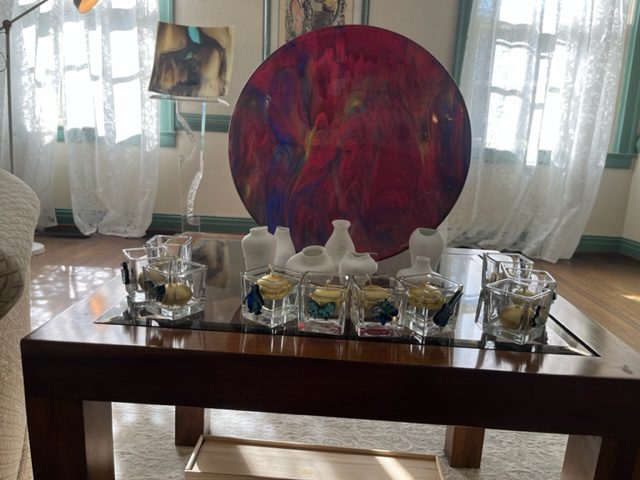
This red platter took Li 72 hours to make |Photo by May S. Ruiz / Beacon Media News

When I ask if she has a favorite piece from the hundreds of glassware and ceramic items in the collection, Li responds, “It’s hard to pick just one because I spent so much time working on every single item.”

I then inquire how she decides what piece to make, and she says, “It’s like with my hat – it’s a passion. Sometimes an idea comes from something that catches your eye. I buy several different feathers for making my hats and they’re all beautiful so I mimicked some of the feathers and they are part of this spring show.”

Half of the items in the collection is glassware and half is ceramic. All the glassware were created by Li from scratch, but not the ceramic pieces. She purchases the ceramic bases from four porcelain companies – Kristoff, Karolina (Poland), Cesky Porcelain, and Elizabeth (the Czech Republic).  

Li applied gold luster on these vintage Japanese ceramic platters | Photo by May S. Ruiz / Beacon Media News

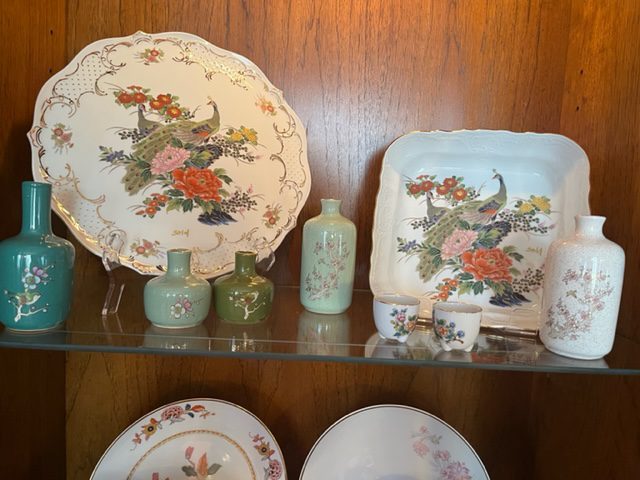
“They supply high quality and high consistency china bases so I like to order from them,” Li explains. “I do overglaze enameling and decoupage on them. Sometimes, I also apply mother of pearl or 24k gold luster with the design. These platters with flowers and peacocks, though, are vintage pieces from Japan with a discontinued pattern called Oriental Glamour. I bought small quantities of the last lot and then hand-painted all the gold luster. For the water pitcher, I used decoupage to design the overglaze and fired it in the kiln over 1400 degrees F. It took me about four to five hours to do the decoupage – I had to stand in front of a big mirror to make sure both sides are identical.”  

Decoupaged ceramic water pitcher | Photo courtesy of Cissy Li

There are a few pieces in her spring collection signed “Cissy and Claire” which means that her 11-year-old daughter helped make them. Li says proudly, “She studied painting and clay pottery for years. Sometimes when I’m working, she’ll come up to me and ask if I need assistance. She’ll happily put colored objects together, organize beads and flowers, and give suggestions. She has beautiful hand-writing so she helps me use gold luster to write on glass and ceramic for custom orders.”            

Some objects are signed ‘Cissy and Claire’ | Photo by May S. Ruiz / Hey SoCal

Much like the glassware, the headwear in the show were all designed and handmade by Li. She makes dress hats or afternoon tea hats and fur felt hats which are either rabbit or beaver fur felt.      

Li says, “It takes a minimum of two weeks to make a felt hat because it has to be on wood block steam several times. It takes a shorter time to make a dress hat if I have all the materials, but most of the time I have to search around for the colors to match. Fifty percent of the feathers I use are ordered from England, France, and Spain.”

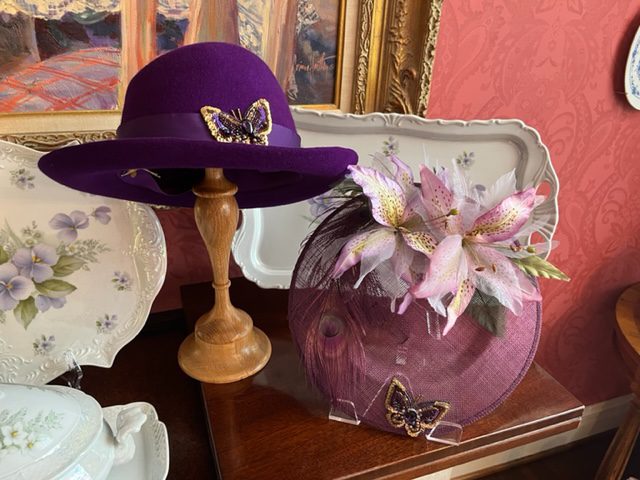
Two hats in the same color scheme but different materials | Photo by May S. Ruiz / Hey SoCal

I choose two hats that use different materials – a felt hat in aubergine with a butterfly embellishment and a purple fascinator decorated with pink lilies, reddish brown feathers, and a smaller butterfly – and Li tells me, “The one on the left is rabbit fur felt. The butterfly beadwork is by a Ukrainian artist which she handmade with Swarovski crystal. The one on the right is an afternoon tea hat or dress hat. The silk flowers are hand-painted by a Spanish artist; the peacock feathers are from the United States and color-dyed.”

All of Li’s spectacular creations involve hundreds of painstaking hours to complete and as many professional tools to accomplish. It’s surprising, therefore, that the items are affordable and might even be underpriced. Her glassware pieces cost anywhere from $35 pendants to $650 platters; the hats run about $475 to $700, depending on materials; and ceramic items are priced from $65 a plate to $3,000 for a set of 12.        

The spring show opening, held on Sunday, March 20, 2022, was attended by fewer people than her previous exhibitions because we’re still emerging from a pandemic. However, there’s still time to catch it.   

“The show will be open until April 15th and we want to make it as safe as possible for everyone,” Li assures. “So we’re offering private tours and viewing and people can call me at (626)808-1599 or send me an email at cissyxili@gmail.com to schedule an appointment.”

It’s spring in Southern California! And what better time to enjoy the outdoors when the weather is mild, than with a midday or afternoon tea with friends? A fabulous fascinator completes your attire. But why stop there? Spring clean your house and add a beautiful glassware on the living room table.

After sheltering in place, covering our faces with masks, and social distancing for two years, we’re finally feeling alive again! Here’s to a Happy Spring!      

Local Milliner Creates Spectacular Bespoke Hats

Originally published on 31 May 2019 in the Pasadena Independent, Arcadia Weekly, and Monrovia Weekly

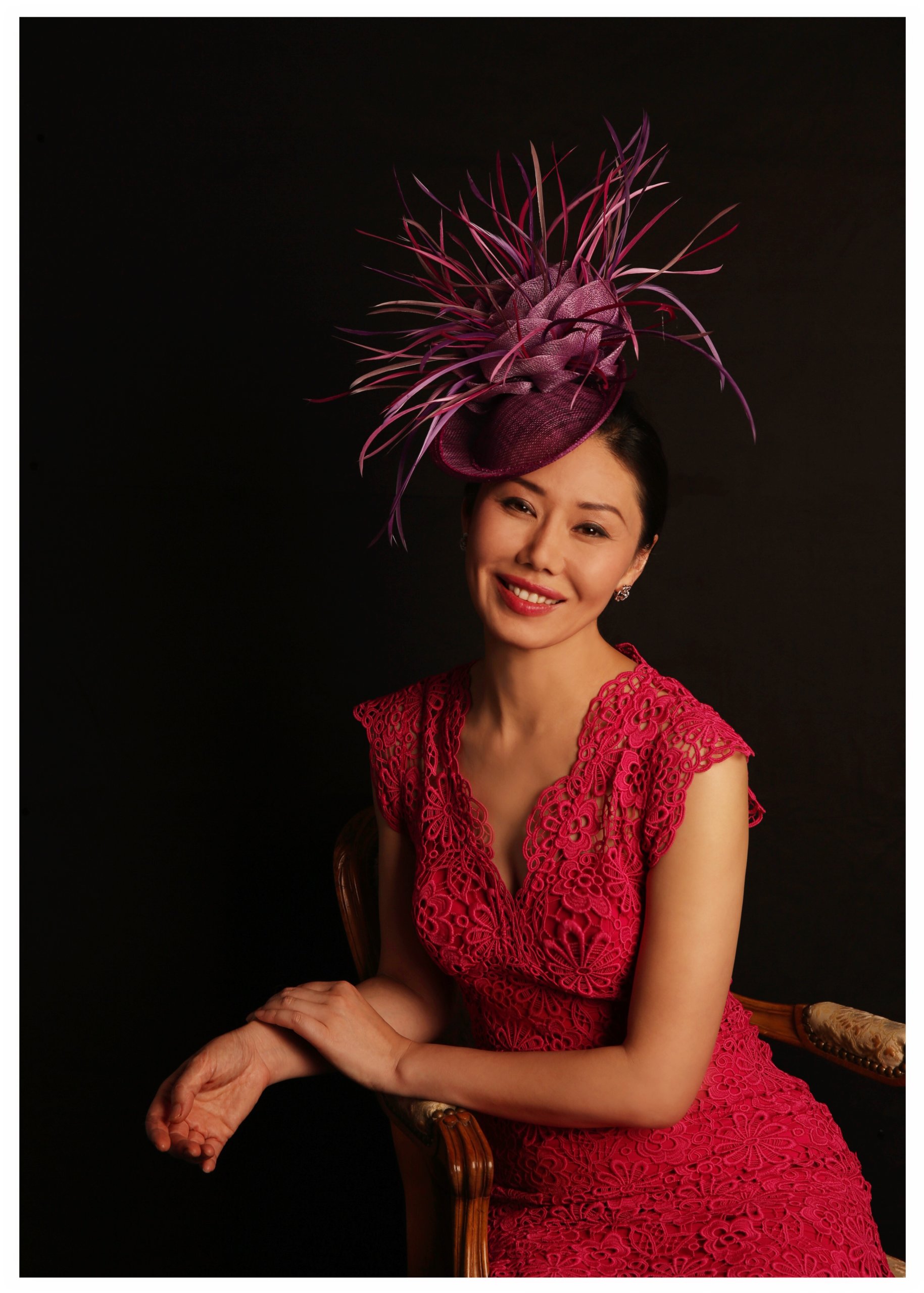
Li wearing one of her bespoke fascinators | Courtesy photo / Handmade by Cissy Li

Americans, as a rule, don’t typically wear hats the way they do sunglasses as a fashion accessory. However, if it were up to Cissy Li, all ladies would be wearing hats wherever they go, most especially to weddings and other stylish events. To advance her lifestyle philosophy, she started creating headwear in 2006 from her Pasadena home for close friends. And, recently, she displayed her collection called ‘Handmade by Cissy Li’ at an exhibition held at Joann’s Fine Arts Ai+ Gallery on Mentor Avenue.

The path that led Li from Suzhou as a child growing up, to Milan as an haute couture model and, finally, to Pasadena as an artisanal milliner, is paved with extraordinarily good fortune.

“I’ve always loved design, fashion accessories, and modeling, ” Li proclaims. I double-majored in Fashion Design and Modeling at Suzhou University near Shanghai. After graduation, I moved to Beijing where I worked for two years at the government-owned modeling company in exchange for my free education. Knowing that modeling as a career usually has a short span – because agencies are always looking for 14- to 16-year-olds – in 1997, I went to the Lutzelau School in Switzerland and took a Hotel Management course to have a back-up plan. It’s now called Swiss IM&H (Swiss Institute for Management and Hospitality).”

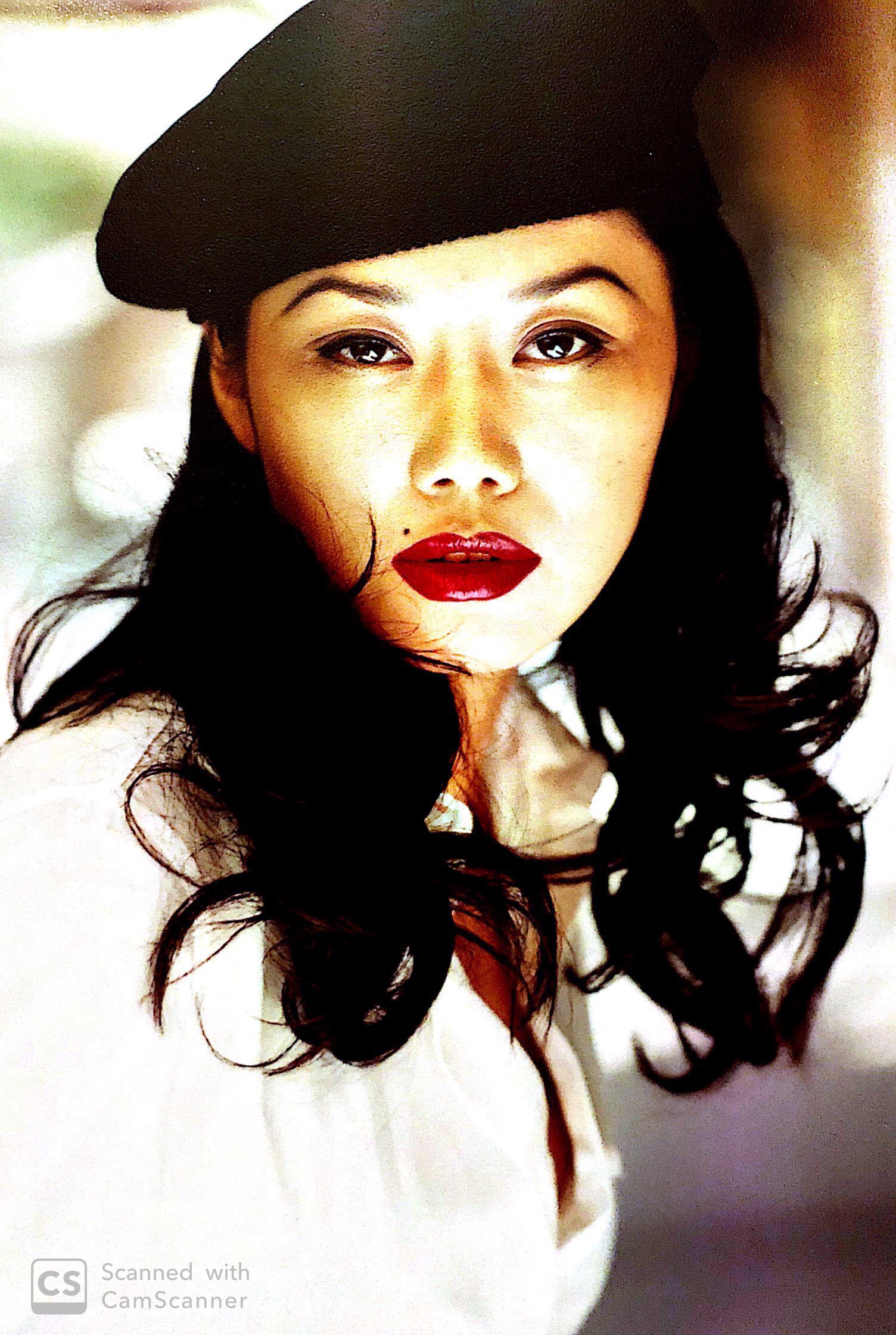
Li as a runway model in Milan | Courtesy photo / Handmade by Cissy Li

“Fortuitously, I went to New York in 2000 for a modeling pageant and earned the top award for Best Runway Model,” discloses Li. “The prize was a contract with an agency in Milan called ‘Zoom.’ In the same year, I won the Universal Asian Supermodel pageant in Las Vegas and was selected one of the Top Five Models. As a professional runway model working in Milan, I was lucky enough to wear the clothes and accessories of French and Italian designers, including Ferre, Nina Ricci, and Valentino. And my love for hats was only reinforced. When you wear one, you can’t lower your head because it’s going to fall. That compels you to stand erect and maintain good posture – so hats make you look very elegant.”

“I considered quitting by 2003 because I thought I was too old for the profession. So I moved to the U.S. and taught at the Barbizon Modeling School in Las Vegas. We entered a competition in New York but one of the students dropped out. Consequently, my boss told me I had to be my student’s replacement because she had already paid the registration fee. I protested saying, ‘I’m 26! I’m too old to compete.’ She retorted with, ‘You’re Asian, they won’t be able to tell your age.’ So I went to New York and won! The prize was another contract to go to Italy. And I thought, I had just left Italy and now I’m being sent back there,” Li recalls with a laugh.

“I did one show to fulfill the contract but I couldn’t continue doing it,” says Li. “In this business you sign one contract with one agent and if they refer you to another you get double charged, so you don’t really make any money. The cost of living in Italy is high – renting an apartment and feeding yourself cost a lot. And then you have to pay the agency on top of that. Besides, I wanted to focus on a different career, so I came back to the U.S. I was working for Bellagio Hotel in Las Vegas as the Assistant Manager for Channel’s Fine Jewelry in 2005, when I met my future husband who’s from Pasadena. So I moved here and it was then I began making hats.”

Li’s interest in various crafts includes decoupage. She walks over to a side table, picks up a tray, and explains, “I created this with marble and gold leaf and it can be used for tea cups or as an Asian cheese board. It took three weeks to finish because the process involves layering the resin which needs to dry between applications. Additionally, there are several factors that affect it, like the weather and temperature. It has to be 70 degrees for the resin to adhere and, as you know, we had a long winter this year. For instance, these coasters took three months to complete. Taking all those into account, the pieces become too costly that I wouldn’t be able to sell them at a reasonable enough price for people to buy them so I give them to close friends as gifts. Handmade pieces are never perfect but these imperfections are what make them valuable. They’re evidence of being one-of-a-kind, and not commercially- or machine-made.”

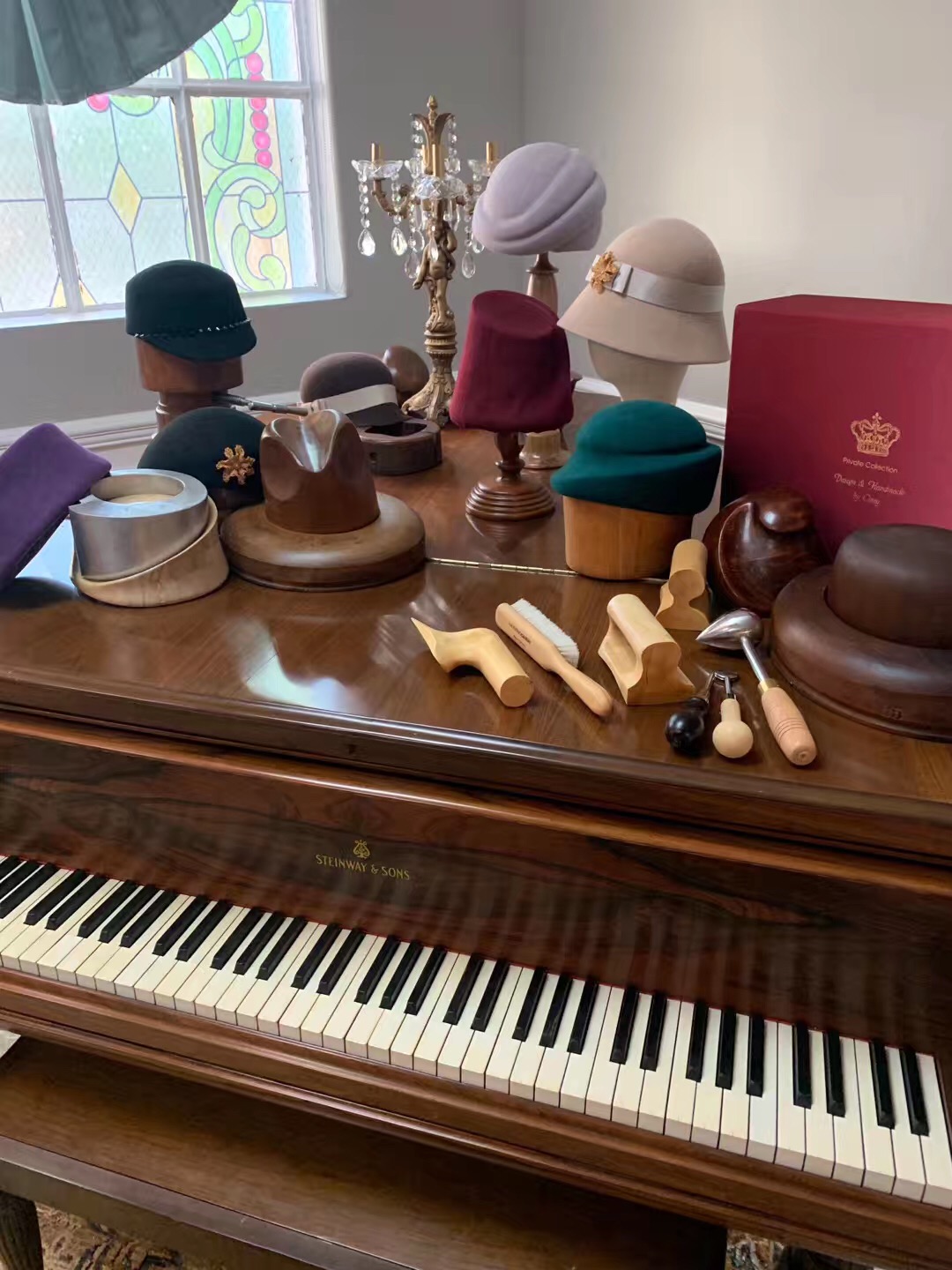
The tools of Li’s trade | Courtesy photo / Handmade by Cissy Li

“I love art. Besides my kids, art is my passion,” Li emphasizes. “I draw, paint, and design. And, of course, I have my hat projects. But you couldn’t do that full time when you have little kids at home. Now that they’re older, I can do a little bit more. I always say you have to choose a job you like so it doesn’t become a chore. I get up at 6:45 or 7:00 to get my children ready for the day, drop them off at school, and then I work in my studio. I pick them up from school, help them with homework, finish dinner, then I go back to my studio. Sometimes I’m here late at night or until the early morning hours. I get only four or five hours of sleep but I don’t feel tired because I love it and I don’t regret putting in that many hours working on my hats. Look at my fingers – they look dirty because the materials I use, like beaver hair, require a lot of steaming, stretching, pressing, and pushing onto the felt. After four hours, I literally cannot lift my arms. I do it because it’s my passion; if it were only for the money, I’d stop after eight hours. But I put in 12 hours at a stretch working on one single hat.”

“Sorting the materials for making the hats is also time-consuming,” adds Li. “I get shipments from England, Ukraine, Russia, and the Czech Republic. Vendors send me pictures of the items but when they get here, the colors are different from what are in the photos. I’m very visual; I  can see the various hues. I’m also good with size and proportions so I have to sort and organize all the materials to make sure I put them together correctly. With items like flowers or feathers, you really need to source reliable vendors – I find them through friends’ introductions while some are very old and well-known houses, so I’m confident about their products. It’s also important to see them for yourself because you can’t tell their quality through photos. I travel to Europe every summer for two months and I visit my vendors between family holidays.”

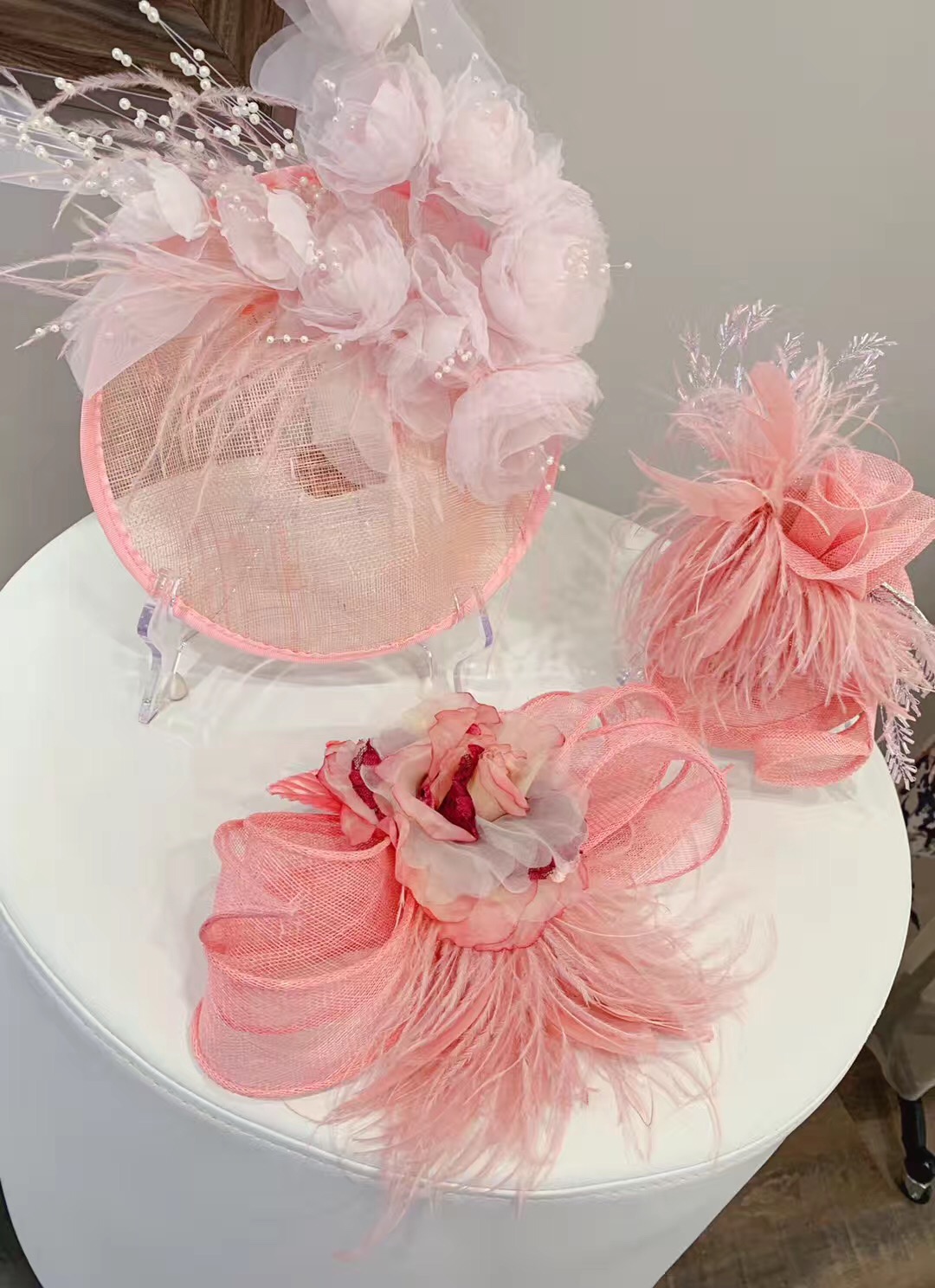
Pretty in Pink | Courtesy photo / Handmade by Cissy Li

Li specializes in fascinators, which aren’t really hats but fashionable headdresses that Prince William’s wife Catherine, otherwise known as the Duchess of Cambridge, made extremely popular.

“Each fascinator takes me anywhere from two to three weeks to complete because I want to find the precise color,” Li expounds. “I’m not very particular with a lot of things in my life, I’m pretty easy-going, but I am exacting in my work. There was one peacock fascinator I worked on which took a month to finish and, in the process, I learned that peacocks have green or blue shoulders. Some of the feathers that arrived had green reflections, some had reddish blue, so when I put them together they looked like Chinese fried rice. I had to order from different vendors to get the specific shades and then match them correctly. One client bought it, but instead of wearing it on her head, she has it hanging on her wall along with other paintings – she treats it like a piece of art. Knowing that clients appreciate the outcome makes this work gratifying.”

Working tirelessly for several months, Li was able to create over 100 handmade hats for an event she fittingly called ‘An Affair to Remember.’

Li’s fascinators on display at ‘An Affair to Remember’ | Courtesy photo / Handmade by Cissy Li

“The show was meant as an exhibition and not as a sales event,” clarifies Li. “I wanted to give all my guests the chance to look at the hats and try them on. If someone were to buy a piece, then no one would be able to see it. However, a couple of  guests really wanted to buy the hats and they waited until after the end of the show to take the items. A friend and loyal customer from Newport Beach had planned on coming to the exhibition but wasn’t able to make it because she twisted her knee a few days before. When I posted pictures of the hats for the event, she called me to tell me which one she wanted to buy.

“My clients are usually people I already know. I haven’t really gone commercial because I have no time. I’m one person and I can’t do the marketing and production all at once. Hats are also a very individual thing so I don’t mass-produce. I do it the traditional way – with custom sizing, fitting, and so forth. I’m leaving in mid-June for my annual trip to Europe but I’m hoping to start a website when I come back, not to sell the products but to showcase the hats so people who want to buy them can contact me. It’s also tough to do an online business; the laws protect customers and not the sellers. Our hats are shipped in beautiful hard boxes but when customers decide to return them, they come back in such bad shape and you feel awful about the merchandise. People looking for a bespoke hat can come to my studio, select all the components, and get instructions on how to wear the hats. It’s really about mutual respect.”

Li modeling a designer gown at the Asian Pacific American Festival held this past weekend | Courtesy photo / Handmade by Cissy Li

As an aficionado, Li is convinced that no one carries off wearing hats with more aplomb than the English. And where does one find an abundance of hats in all their splendor but at The Royal Ascot. It’s also the perfect place to get ideas for her hats, so she makes it a point to go to the opening of the renowned horse races in June. It’s both a work and fun excursion because she takes her children with her and they’re usually there for the Royal Procession when the Queen is in attendance.

On one particular occasion, her daughter, Claire, was so entranced by Queen Elizabeth’s headwear. Having been around her mom as she fashioned spectacular hats for clients, Claire confidently declared that Li would one day be the first Chinese-American milliner to create a bespoke piece for the Queen. Any other mom would brush off that endorsement as merely child’s fancy, but Li took that to heart. For several months now, she’s been in contact with some people connected with The Royal Ascot to figure out how to make it possible. However, she’s also cognizant that there are so many hoops to go through.

“The Queen approves only one brand of hats and clothing for The Royal Ascot,” Li states. “Selling there is also complicated because of taxation laws and import regulations. I have to consider all the things that could possibly go wrong. Can you imagine if we got stopped at the airport as we’re leaving because I didn’t take care of every legality? What would have been such a happy trip would end up something I’d deeply regret.”

Whether Li succeeds in getting her hats worn by the Queen and the smart crowd attending The Royal Ascot or not, nothing can hinder her from creating headwear for ladies here. We don’t have to be royals to wear her spectacular fascinators. But donning her meticulously fashioned hats will certainly make us feel like princesses.