Originally published on 26 August 2021 on Hey SoCal
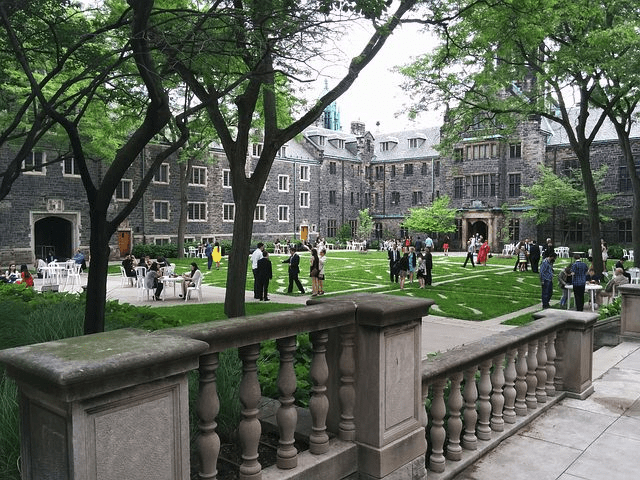
As soon as school opens every fall, 12th graders everywhere in the United States go through a rite-of-passage called college admissions. High school seniors look forward to it with both excitement and dread. It is, after all, the culmination of years of hard work that they hope earn them admission to a university high on their list. For them to find out that some children of the rich and famous undeservedly got into a college, as the bribing scandal revealed three years ago, is infuriating at the very least.
This deceitful behavior, however, isn’t exclusive to celebrities. An Intelligent.com survey conducted this past spring showed that one out of four parents cheated to get their child into college. The admissions process is complicated enough without parents’ involvement.
We asked college expert Beata Williams, an independent admissions consultant coaching students through the admissions process who had previous experience as an admissions counselor at Columbia University and at New York University, how counselors can discourage parents from taking matters into their hands.
“In my opinion, a healthy level of parental involvement in the college admissions process is beneficial to students,” Williams states. “However, students benefit the most if they are laying their own groundwork towards their college paths. Reinforcing the importance of the students’ engagement and keeping admissions conversations centered on the student and their profile (which includes student accomplishments) tends to be a successful strategy for keeping the process focused.”
Endowing universities has been a common practice among the elites but it has never gotten negative publicity. As benevolent as it seems, it still points to ways the privileged few could go around the admissions process. However, Williams says it is very unlikely that universities will discontinue accepting donations that benefit their endowments in the near future. Neither is she surprised that average parents like us are cheating to get their child into college. “Human nature does not discriminate amongst socioeconomic classes,” she declares.
The survey found that parents with high incomes ($125,000 or more annually) and those with low incomes ($49,000 or less annually) were the ones who cheated, while those who were considered ‘middle class’ ($50,000 to $124,000) didn’t. Does that mean they had nothing to lose or they had more confidence in their child’s ability? But what did that say about those who chose to cheat?
Williams opines, “I am not a trained psychologist but there is an Attribution Theory of psychology that – if I loosely interpret it – explains that high achievers relate success and failure to their efforts and abilities and they have a strong desire to reach their goals. Low achievers relate their success and failure to luck and the difficulty of the task assigned. I believe the answer to your question could very well be related to this theory.”
Kids are the ones losing when their parents try to manage their college application as Williams explains, “The college application process is a huge growth opportunity for a young adult. As stressful as it is, it provides a platform for them to gain strategy and decision making skills. When parents manage the process for their kids, they actually deprive them of a growth opportunity.
“College admissions is highly competitive and very stressful for students and parents. A book I wish parents and students who are currently in the admissions process would read and take to heart is ‘Where You Go is not Who You’ll Be’ by Frank Bruni. Perhaps it would reduce the admissions madness.”

Nowhere is the admissions process more anxiety-ridden than in Pasadena and surrounding cities. High school students here are so accomplished – they take as many as six advanced placement (AP) subjects in one school year, play varsity sports, vie in the most prestigious dance or music competitions the world over, enter science and engineering contests for scholarships, and establish nonprofits for a cause they want to advance, while excelling on every standardized test, and getting an unweighted GPA of 4.0 – that all of them are qualified to be admitted to the most selective universities. The competition is fierce because every student has to stand out among other overachievers.
At Arcadia High School (AHS), which has consistently ranked in the top 1% of high schools in the United States and has been named a Gold Medal School by U.S. News & World Report, students and parents know how daunting college admissions is, yet have a healthy approach to it.
Angela Dillman, AHS principal, and Amanda Fitts, college counselor, talk to us about the Intelligent.com survey findings.
Asked if it’s shocking that parents would cheat to get their child into college, Fitts replies, “I wish the number was lower but, honestly, I’m not shocked because of the tremendous pressure students and parents feel surrounding this process. This is especially true in communities where the pressure is intense to get into ‘name’ colleges and not just to get into college. I put a lot of blame on publications like the U.S. News & World Report that rank colleges based on data which aren’t that valuable in terms of students finding the right fit. I will say, though, that parents who donate huge sums of money to colleges is, unfortunately, not new. And we can’t really say that it’s cheating because it’s a practice that’s out in the open. But it’s also rare – we’re talking about millions of dollars. But hiring other students or even adults to take the test is quite upsetting.”
Dillman comments, “I couldn’t speak for any single family from Arcadia, but I think our families really value and trust the application process. Our students work very, very hard to make themselves the best candidate they can be on paper. I couldn’t be sure that our families didn’t cheat but my impression of our families is that they want to do things the right way and they support their students to be legitimately competitive. I know that when the college admissions scandal came out, our students were horrified because they’ve been working so hard and their reaction told me everything I needed to know that our community isn’t participating in something like this.”
“It’s a disservice to those students whose parents are cheating because the message the student is getting is that they aren’t capable of doing this on their own and these students carry those values with them throughout their life,” adds Fits. “Furthermore, they will go to school not on their own merit and where they don’t meet the criteria for success just to satisfy their parents. It’s harmful and unfair to deserving students who could have had that spot. Besides, parents who cheat cast a negative reflection on the high school the student is coming from.”
The stress for most students and families comes from unrealistic expectations and focusing on the wrong things when they look for a school. Fitts agrees with that assessment, saying, “I find that to be true every year and this isn’t the first school I’ve worked at. Sometimes it’s not that expectations are too high, it’s not understanding how the college admissions process works. Some students could be a fantastic fit for a highly selective school but because their acceptance rates are a certain number and they are building a class based on their priority as an institution, it’s out of the student’s control who’s selected. There are components they can control but there are some they can’t.”
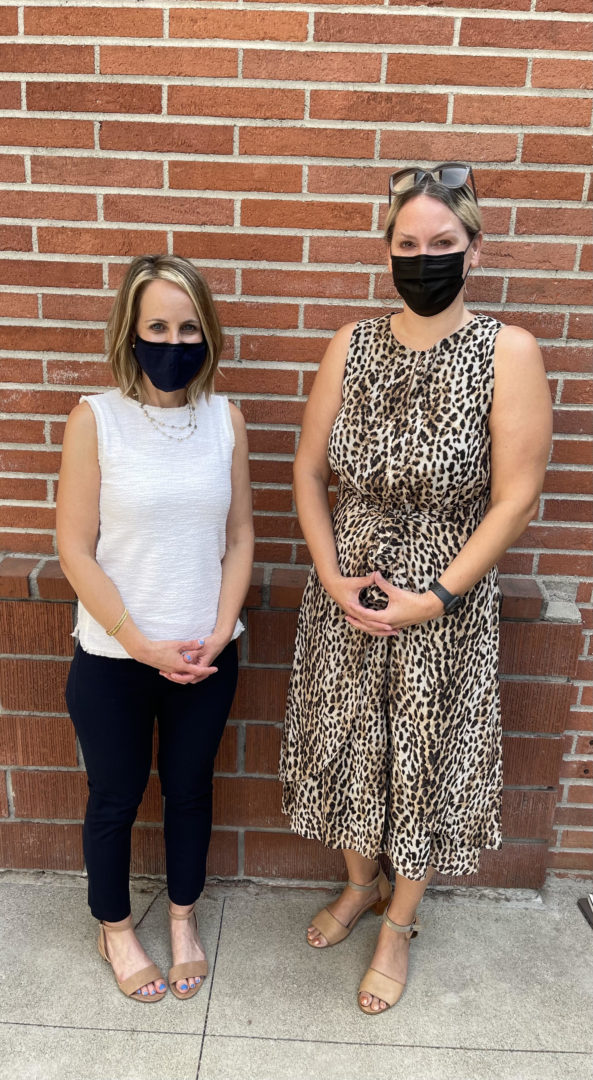
Dillman expands, “We firmly believe that there’s a school for very single student. We want to break the mold of getting into a school with name recognition. We have just met with so many successful professionals who came to speak to our students who didn’t necessarily go to a top-ranked college but went to the school that was the right fit. Their ambition and their ability helped them excel in their careers and their life. And that’s what we want for our students; it’s what our parents and our students want for themselves.”
“We hear about all the pressures in college application but, overall, this should be a rewarding and fun process,” Fitts pronounces. “It is a time of self-discovery – identifying their interests and values – and then matching those to a school that will satisfy the criteria they’re looking for. It’s all about finding schools that are the right fit for a variety of reasons – financially, academically, socially, geographically.
“Students and parents need to just feel confident in knowing that if they do their research, read the college website, and find the schools that will be a good fit, they’re going to have a great experience and apply to the schools where they’re going to be accepted. And they’ll have amazing choices. The hardest thing at the end of the process, will be to decide which school they want to attend. Many students think there’s only one school that’s right for them, but there really are many schools that are the right fit for them.”
Polytechnic School in Pasadena (Poly) is nationally renowned for its rigorous academic, robust athletic, and wide-ranging art programs. With its small class sizes – the senior class usually has only a hundred or fewer students – each one gets personal attention from teachers. While college counselors meet with parents occasionally and when warranted, the department has been known to emphasize to parents of the graduating class that the college application session is between the student and the counselor.
Kyle Torres, who attended Poly from ninth to 12th grade, graduated this year and will be going to Pomona College in the fall. He and his mother, Victoria, graciously agree to share their college admissions experience and to comment on the Intelligent.com survey findings.
According to Victoria, she and her husband weren’t entirely in the dark about college admissions. She says, “We heard about it from friends and families that have gone through the process. We didn’t work with an independent counselor, though. Poly’s counselor discussed the process with us early in Kyle’s junior year and we met with him about four or five times throughout the process.”
“We were not too involved in the application and writing of the essays; Kyle worked with his college counselor on these things,” continues Victoria. “But he did discuss with us the schools that he wanted to apply to. He mainly wanted to stay pretty local – in California. He wasn’t sure what he wanted to study in college but wanted to be in a small intimate setting where he is able to explore his options. Neither my husband nor I had any sway in his school selection. In the end, it was about choosing a school that would be a good fit for him.”
Victoria expounds, “Overall, the college admissions experience was stressful. However, Kyle’s college counselor helped a lot by making time to work with him. I remember Kyle was working with him the entire summer before senior year on the common app and the personal statement. This made it a little easier. Kyle was always telling us good things about his college counselor and how he always made time for him.”
“It was a very interesting year, especially with the COVID pandemic,” Victoria comments. “Many kids that we thought would get into their top choice schools did not. Whereas others that got into top schools were very surprised that they got in.”
Asked if she’s upset that some parents cheated to get their child into college, Victoria unequivocally states, “Yes, because it’s really not fair to the kids that work so hard.”
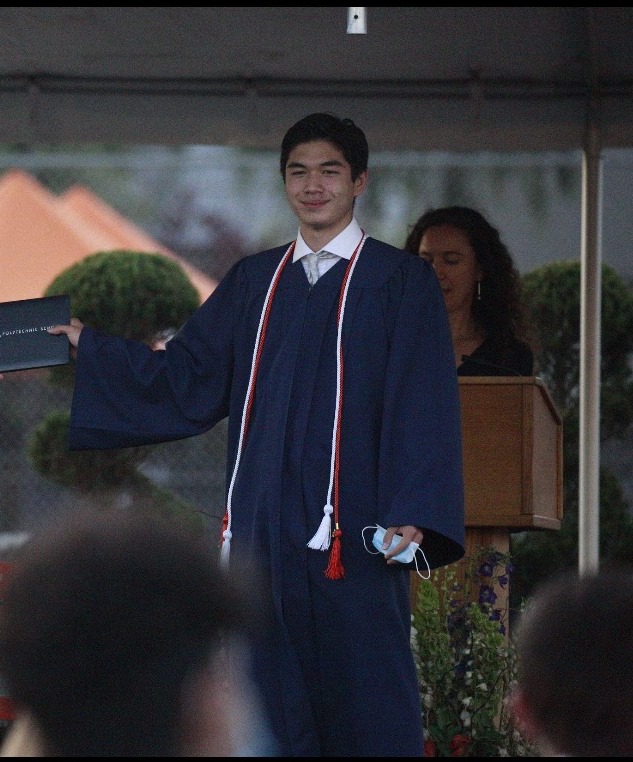
Echoing his mother’s feelings, Kyle says, “Knowing how unpredictable and stressful the college process already is, it is quite distressful to hear that some people have an unfair advantage; it almost invalidates the hard work of students who don’t have the same privileges.”
Kyle worked hard to earn admission to Pomona College. Throughout high school, he took several demanding courses. Because Poly doesn’t offer AP courses in ninth grade, he took his first AP subject in chemistry in sophomore year, then took the bulk of his AP courses in junior and senior year.
Besides taking challenging academic subjects, Kyle participated in Poly’s vibrant campus life. He says, “I was involved in extra-curriculars ranging from the jazz ensemble to our community engagement program. As an alto saxophone player, I was a part of the jazz ensemble for all four years at Poly and had a uniquely different experience each year. I also represented my school as a student ambassador, giving tours of campus to prospective students and participating in events to promote our school. Lastly, I was a member of our Student Community Engagement Program, which aimed to get students involved in our community as well as incorporate service learning into our curriculum.
“Each summer in high school, I tried to learn something new and do something that might inform my future career interests,” Kyle says further. “For example, in the summer before sophomore year, I was interested in potentially pursuing pharmacy in college, and I was fortunate enough to intern at a local pharmacy. At the pharmacy, I got first-hand experience into how a pharmacy operates and what pharmacists encounter on a daily basis. Although I no longer want to become a pharmacist, this experience taught me much about what goes on behind the scenes at a pharmacy and, if nothing else, allowed me to shift my focus on other interests I may have had.”
Kyle recounts his experience, “I navigated the admissions process with Poly’s college counselors who were extremely helpful and supportive throughout. My college counselor first reached out to me early junior year, and, since that first meeting, I was always able to schedule meetings about whatever questions I had pertaining to college admissions.
“I thought I had an idea of what I wanted to study in college, but that changed nearly every year in high school. Currently, as an incoming freshman in college, I have an idea of potential majors that I would like to explore, but even still, I don’t yet know which of these majors interest me most.”
Adds Kyle, “I applied to 10 schools in total. Because of the unique circumstances due to COVID surrounding the college admissions process, many of the most important ways of researching a college – like visiting campus in person – weren’t available. I had to find other means, such as attending online information sessions, taking virtual tours, and contacting admissions officers for any questions. Although none of these options provide the same glimpse into campus life that in-person tours do, they were the next most helpful option and were extremely useful in my college decision-making process.”
“I did ask for my parents’ input in my choice of colleges. However, although I took into account their opinions, the decision of where to attend college was ultimately mine, and I’m grateful for my parents’ understanding of that,” Kyle points out.
“On the whole, my college application experience was stressful and time consuming, but ultimately gratifying,” concludes Kyle. “When I first started drafting my personal statement and supplemental essays, I couldn’t help but feel overwhelmed. It seemed as if I would never finish all of these essays in time. However, after I started breaking them up into chunks and focusing on them one at a time, I was able to answer each question thoughtfully and even enjoy the process as time went on. Throughout this process, I learned quite a bit about myself, as many of the essay prompts forced me to think deeply about myself and my values, making the process enlightening and rewarding in the end.”
Kyle’s experience demonstrates how formative the college admissions process could be. It is a foretaste of how adults handle circumstances that test their determination and try their spirit. These young adults will confront greater challenges and face bigger disappointments in college and beyond. It is important for them to learn how to be resilient for them to flourish when they go out into the world.
Editor’s Note: Last month, The Huntington Library, Art Museum, and Botanical Gardens announced that “The Blue Boy” will be returning to England 100 years after it left – a move that shocked art experts who believe travel could damage the 250-year-old canvas. We in the San Gabriel Valley are very protective of it as it’s been at The Huntington since it opened in 1928. You can read more on this move here. We invite you to send us an email and tell us, in 100 words or fewer, your thoughts about it and share your experience looking at this magnificent work of art. Send your email to: MayRChu56@gmail com. Unless you request otherwise, we will include your name when we publish our informal poll.


 A San Gabriel Valley Inquirer