Showcasing the perennial relationship between humans and plants at the Huntington’s Chinese Medicinal Garden

By Brianna Chu

Also published on 3 June 2024 on Hey SoCal
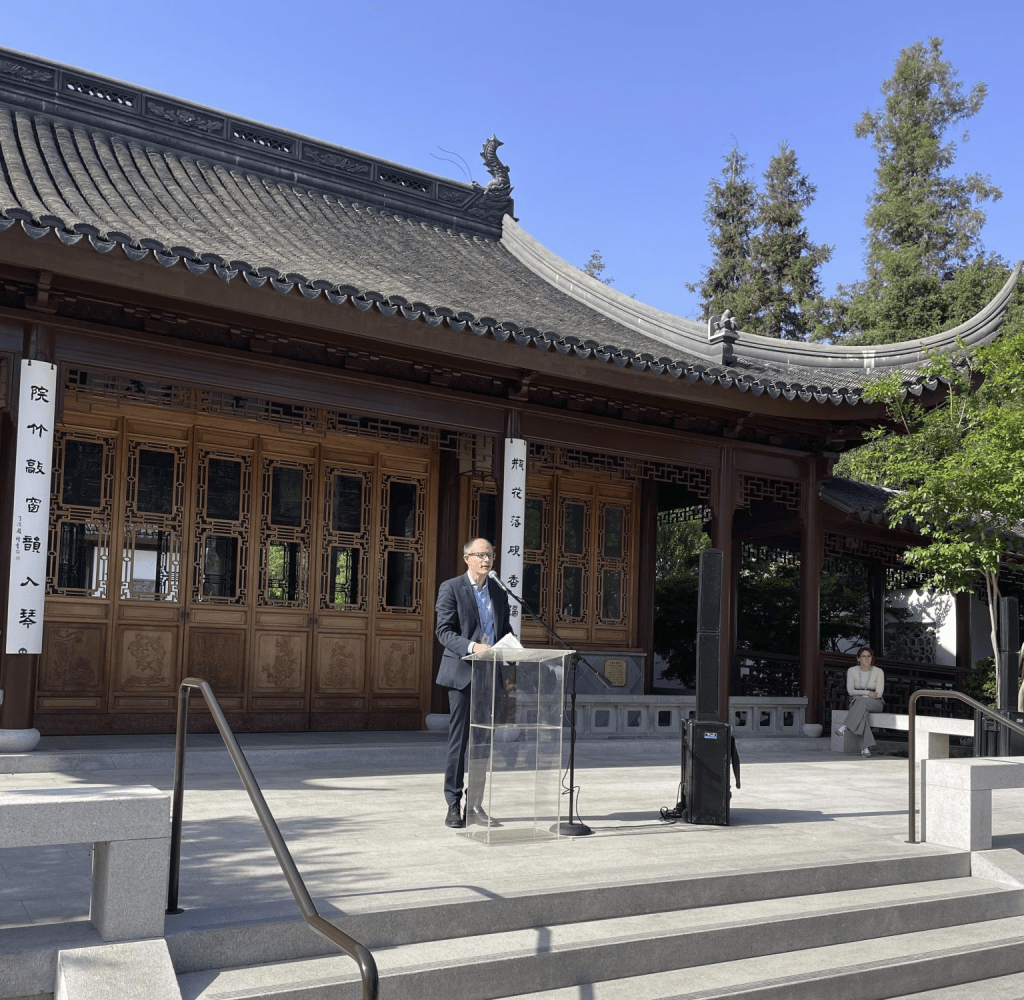
Philip Bloom speaks during the press opening of The Huntington’s Chinese Medicinal Garden opening

The final piece of the Huntington’s popular Chinese Garden — the culmination of years of work, interrupted by the pandemic — the Chinese Medicinal Garden (採藥圃 Cǎi Yào Pǔ) is, as the Chinese Garden’s curator Philip Bloom says, truly a milestone worth celebrating.

The team has been working on many types of interpretive programming for the Chinese Garden, including an art gallery scholar studio and the celebration court for performance space.

“But it is, I think, the Chinese Medicinal Garden that most powerfully connects the Chinese Garden to the rest of the Huntington as a whole,” Bloom reflected in his remarks to the press the day before the garden’s official May 22 opening.

“The Cǎi Yào Pǔ is a place for learning about the relationships between plants and people,” Bloom said. “Indeed, in historical China, medicinal gardens were always a primary site where people went to learn about and think with plants.”

Michelle Bailey, the garden’s assistant curator, concurred: “The deepest purpose for us at The Huntington is to show the long relationship between humans and plants.”
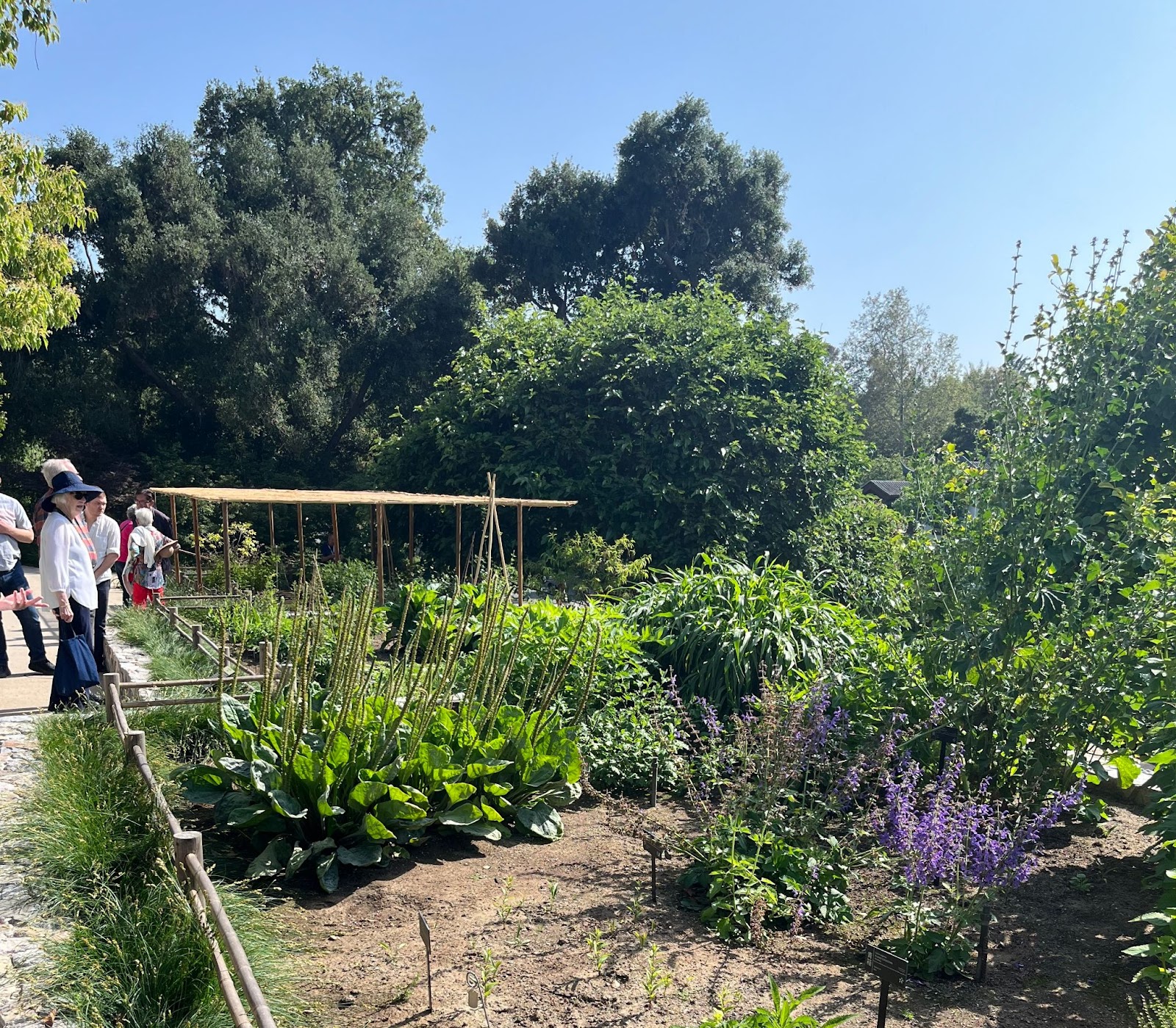
Some of the Medicinal Garden’s first admirers studying its plots. | Photo by Brianna Chu/HeySoCal.com

The plants featured in the garden were chosen partially based on those included in seminal medical texts of Chinese traditional medicine, such as “Shennong’s Classic of Medicine” (神農本草經 Shénnóng Běncǎo Jīng) — one of the world’s oldest pharmaceutical texts, written in the first or second century C.E. The garden’s collection includes selections shared by the Chinese Medicinal Herb Farm in Petaluma, California. Additionally, some included specimens were hand-collected from China in the 1990s by Robert Newman, dean emeritus of Emperor’s College, which further impresses botanical and historical significance. 

In total, around 100-120 of these plants have been selected and included in the medicinal garden. As both Bailey and Bloom are historians by background, the two chose to structure the garden’s six main beds based on the stories they saw within the plants’ characteristics and uses, rather than following the more typical approach of simply grouping plants based on how well they grow together.

The six main beds are broken down into the following categories: fundamental herbs, prescriptions/plant classifications, ornamentals, comestibles, imported medicines and useful plants.
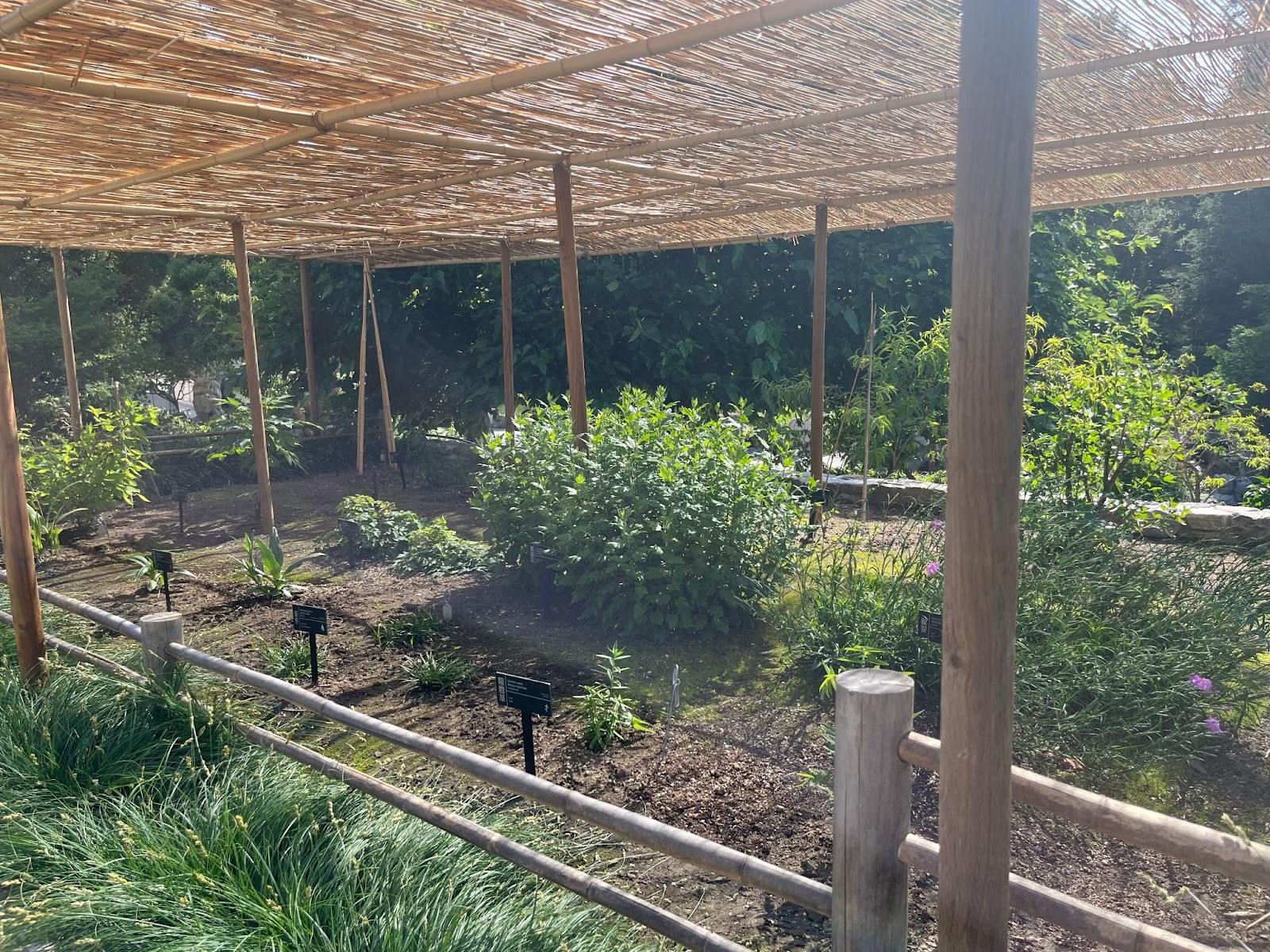
One of the Fundamental Herbs beds. | Photo by Brianna Chu/Hey SoCal.com

The Fundamental Herbs bed showcases many plants and herbs from “Shennong’s Classic,” many of which are still used today in traditional Chinese medicine. Due to the sheer quantity of plants covered across in the text, plants’ inclusion were dictated by availability. 

To delve into the story of trade, the Imported Herbs bed features plants non-native to China but would have reached them through the Silk Road or by maritime trade. Some plants nested in this bed may be familiar, like turmeric, ashwagandha and St. Paul’s Wort, among others. These tell the story of communication, travel and exchange — making their way from their native lands of India, Southeast Asia, Europe and even the Americas to be used, studied and cataloged in another seminal medical text, “Compendium of Materia Medica” (本草綱目 Běn Cǎo Gāng Mù)also known as“Great Pharmacopeia,” which was originally published in Nanjing, China, in 1596.

True indigo boasts not only medicinal properties but also wide use as a beautiful dye. | Photo by Brianna Chu/Hey SoCal.com

The “Useful Plants” are multipurpose ones: those that can be used not only as medicine or treatment, but also as dyes, textiles, incense, timber and other purposes. “Comestibles” are foods that also have beneficial medicinal properties, like sacred basil and aloe.
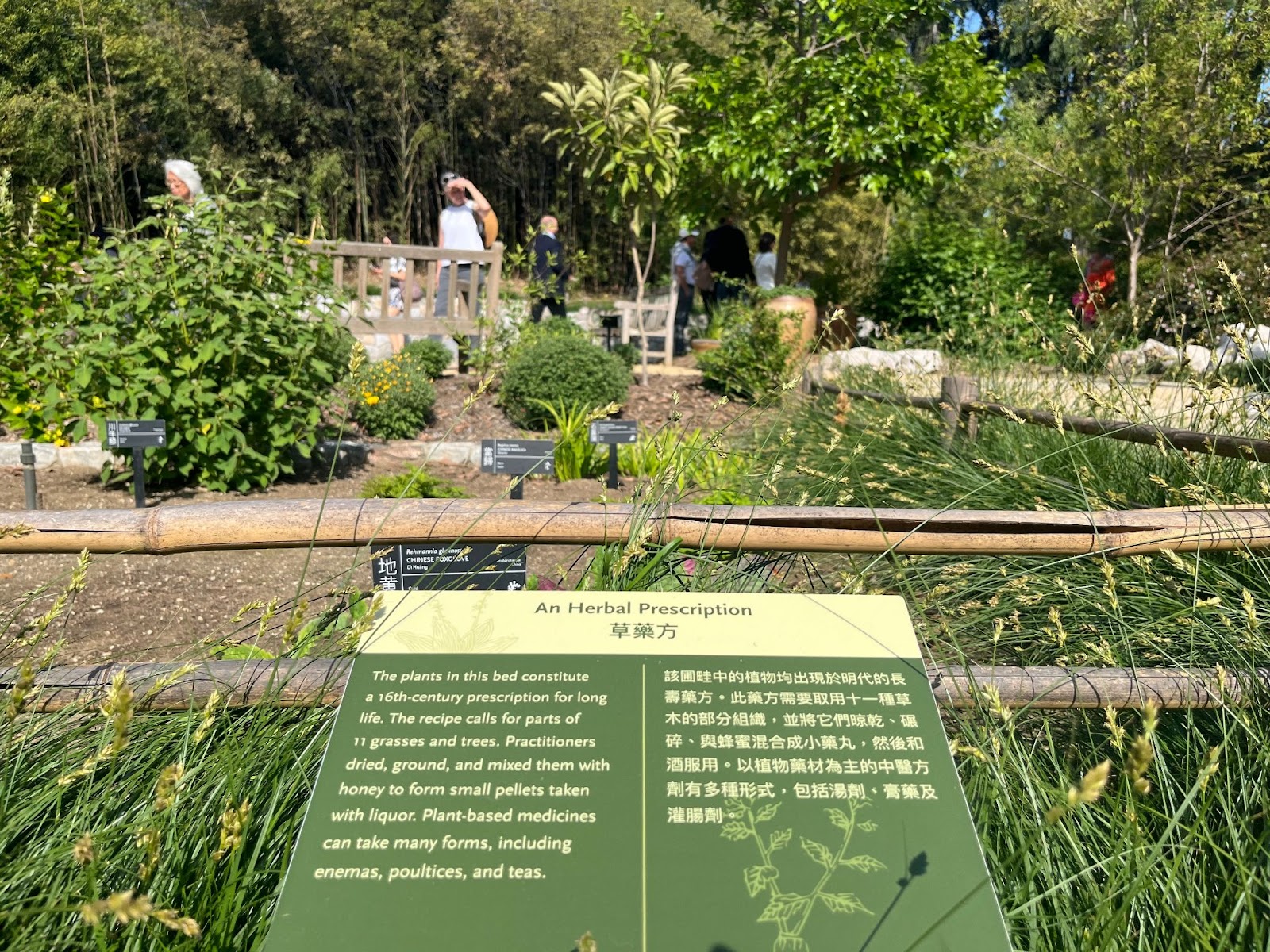
Half of this split bed features the 11 components for a prescription. | Photo by Brianna Chu/Hey SoCal.com

One bed is split in half: on one side, all 11 herbs and grasses needed for a prescription for long life are grouped together, while the other half of the bed is dedicated to herbs classified by their taste — bitter, sweet, salty, sour and acrid.

The “Ornamentals” may strike visitors as familiar flowers and trees for a Chinese garden, such as plum and peach trees, chrysanthemums, peonies and roses — evidence that cultivating a garden can be healthful and beneficial in more ways than one.

Beyond the verdure currently exhibited in the garden, there are still more rare specimens being tended in the Huntington’s nursery. While nothing is planned yet, there is the potential to further explore the knowledge and history of medicinal herbs in an extension of the Cǎi Yào Pǔ.
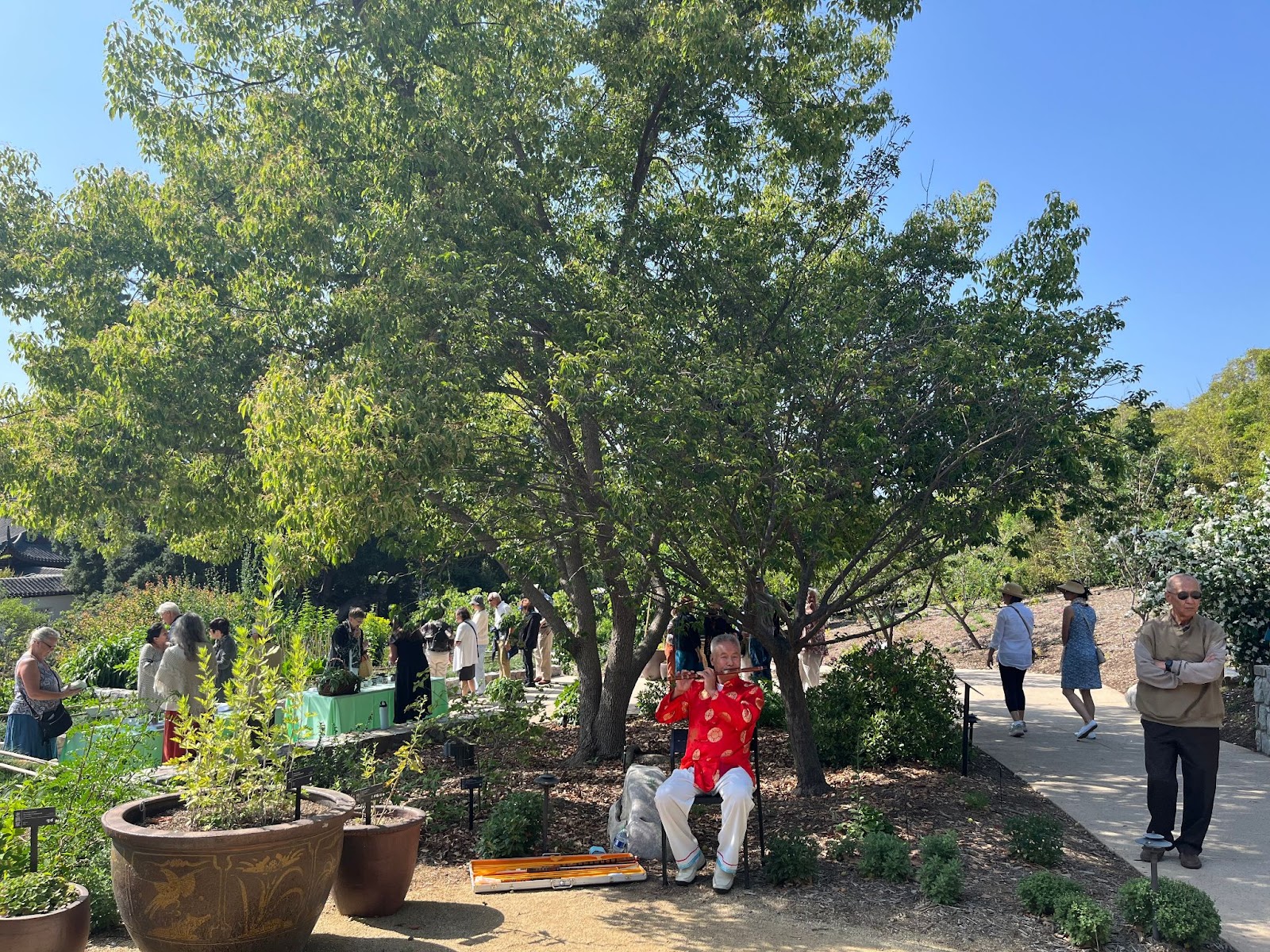
The Cǎi Yào Pǔ buzzes with interest at its press opening. | Photo by Brianna Chu/Hey SoCal.com

Aside from independent strolls through the Chinese Medicinal Garden, members of the public can also attend monthly open houses, at which Bailey’s dedicated and knowledgeable team of about 10 volunteers will be available to answer questions regarding the plants, their history and their uses. Prospective attendees can check the dates and times for these open houses at the garden’s webpage to plan visits here: https://huntington.org/event/chinese-medicinal-garden-open-house

May S. Ruiz contributed to this story.
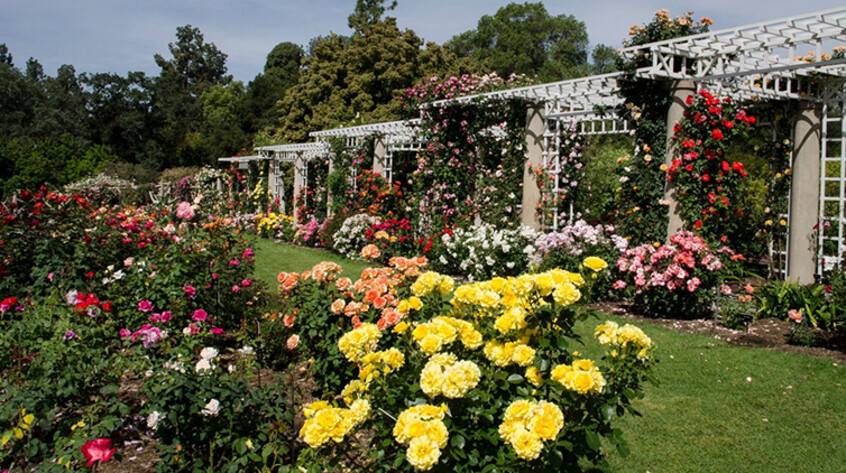
It’s Blooming Roses at The Huntington

Originally published on 18 May 2017 in the Pasadena Independent, Arcadia Weekly, and Monrovia Weekly

No single flower has moved more bards – from Robert Burns to William Butler Yeats – to  wax poetic than the magnificent rose.  And nowhere are the roses more cared for and celebrated than at The Huntington Library, Art Collections, and Botanical Gardens in San Marino where they are displayed in stunning splendor.                          

Tom Carruth, who became the E.L. and Ruth B. Shannon Curator of the Rose Collection in 2012, presides over The Huntington’s vast assortment of 2,500 plants and 1,250 varieties. 

Prior to his arrival here, he spent 25 years as a hybridizer for Weeks Roses, the country’s leading wholesale grower, where he led the company’s hybridizing efforts.  In his long career he has won more awards from the All-America Rose Selections (AARS) organization than any other living hybridizer.   

“My hybridizing career ended when I took this position,” reveals Carruth.  “As curator of the rose collection I’m responsible for ensuring the plants are vibrant and alive, and for bringing in new parts to the collection.”

In the five years he’s been at The Huntington, Carruth has organized all the labels and  systematized the collection records.  He has expanded some of the beds, added arbors, rebuilt trellises, repaved pathways, re-landscaped, modified irrigation, tested the soil, and even established a dramatic new entrance to the rose garden.  He has also taken on a mission to identify older cultivars that were ‘collectible’ quality and custom propagating them to replace the weaker shrubs in the garden.  


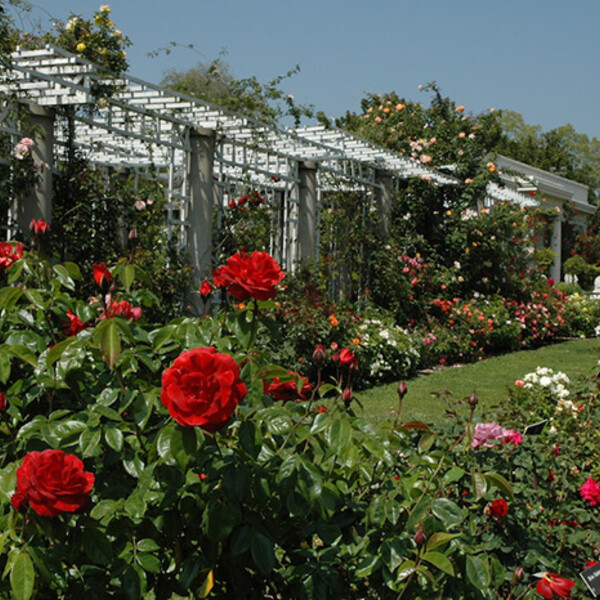
The Rose Garden at The Huntington | Photo courtesy of The Huntington

But Carruth gets the most fun studying the plants, “As a horticulturist I just observe – plants talk to you and you listen.  This is an old garden so the soil is impacted and we started amending with gypsum.  I noticed the roses were getting too much shade so we pruned out some trees.  Some of the old plants which were struggling to live responded to the care and started to turn around.  We had agapanthus going down on both sides of the trellis which were so overgrown they were in the rose roots and were strangling the roses.  We divided up the agapanthus and for two years we just let the roots get some air.”

Originally a cutting garden for Mrs. Huntington, the flowers were grown for production with 50 shrubs of each variety – she was fairly nearsighted and she loved having big bouquets in the mansion.  According to Carruth records from that time showed that one year 9,000 roses were cut to bring to her house.  Today it is a vast collection with just one or two of each kind to show the history of the rose.

The Huntington’s Rose Garden is a veritable history lesson that traces the story of the rose from ancient times to the present day.  Growing on the south side of the pergola leading from the Shakespeare Garden to the Tea Room are roses that represent the early history of the flower dating back to the pre-Christian era. 

On the north side of the pergola are Tea and China roses, introduced into Europe from Asia around 1800.  Says Carruth, “The Chinese were known to have been working with this flower for over 2,000 years.  The whole collection behind the trellis were roses that came here in the tea ships and were the ones that gave us repeat flowering; up to that point roses bloomed only once a year.”

The central part of the garden is dedicated to roses of the modern period when the first hybrid tea rose, called ‘La France’ was introduced.  The hybrid tea went on to become the most popular class of rose of the 20th century, with thousands of known varieties.   According to Carruth, ‘Ophelia’ dating to that period was crossbred in the garden and is in The Huntington’s collection.         

Carruth explains, “The roses are classed by color but not planted by color.  We want to keep the integrity of each variety – the China Teas are all in one location, the older hybrid has its devoted area, and the fragrant roses are in two beds closest to the Rose Garden Tea Room.  That makes it easy for us to direct the public when they ask.”

“Roses have several natural fragrances like fresh cut apples, spice, lemon blossom, myrrh, damask, honey, violets, and all sorts of combinations of those,” adds Carruth.  “It’s fun to watch people get a whiff of the fragrant flowers while they wait for their table in the Tea Room (for information and reservations, call 626/405-2236 or huntington.org/dining).  We have a variety out there that smells like Lemon Pledge and over here we’ve got one that reminds you of Ponds Cold Cream.  Down there we have something that’s white licorice and smells strongly like licorice candy.”

Photo courtesy of The Huntington

“Everyone loves walking around, reading names, and looking at the dates,” observes Carruth. “Many visitors, who don’t’ necessarily know much about growing roses look for classics like ‘Mr. Lincoln’, ‘Peace’, or ‘Sterling Silver’ – bed number 17 in the collection – which is a silvery lavender and is a repeat bloomer.  ‘Sterling Silver’ is interesting because that was the first hybrid from a female hybridizer, in a male-dominated field. We also have the everyday version, ‘Stainless Steel’, which is a much easier plant to grow and has bigger flowers, that’s similar in color and fragrance.”  What he failed to mention, however, is the fact that ‘Stainless Steel’ is a rose he developed in the 1990s as a more robust version of the fussier ‘Sterling Silver’.

The roses at The Huntington bloom from mid-April to November.  Explains Carruth, “This year, because of the rain, we had an elongated pruning season resulting in an extended spring bloom. We’ll have color throughout because we manipulate the plant in the beginning so they don’t blossom all at once. People will see roses every time; we even have a smattering of them in time for the Rose Parade.”

It would surprise people to know that The Huntington does not have a large staff tending to the garden. Carruth discloses, “I have two gardeners who work three acres of roses so we depend heavily on our volunteers.  Right now I have 52 rose garden volunteers deadheading, weeding, watering, and anything they’re willing to do. Some people love to deadhead and prune so I see them in winter and I may not see them during the summer. We’ll take whatever level of interest they have. They get prime time – they come in early in the morning before visitors arrive – when it’s beautiful and calm, and not hot.”

You’ll know that Carruth, and his staff and volunteers, take painstaking care of The Huntington’s roses when you see the glorious flowers in bloom. The next time you visit, go for a stroll on the grounds to take in the breathtaking beauty and heady fragrance laid out before you. When you do, you undoubtedly wouldn’t be able to help stopping to smell the roses.               

Clairbourn School Incorporates Appreciation for Nature in Teaching

Originally published on 15 September 2016 in the Pasadena Independent, Arcadia Weekly, Monrovia Weekly, and Sierra Madre Weekly

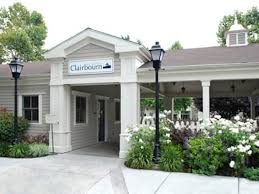
In an area like the Pasadena market which is replete with outstanding schools, setting itself apart from all the rest is a remarkable feat. However, Clairbourn School, a junior pre-K to 8th grade independent learning institution in San Gabriel, succeeds in standing out.

Headmaster, Dr. Robert Nafie, leads dedicated administrators and teachers who work tirelessly to build a strong instructional program balanced with meaningful elective courses, extra-curricular activities and after-school classes. He ensures that each student gets the best education, using all the tools available, in a caring and nurturing atmosphere.     

That children need to be children was uppermost in the mind of former head of school, Gloria Stahmer, when in 2009 she asked then 5th grade teacher, Jonathan Barner, “Don’t you think our kids need to be out in the dirt, gardening … or something?”  

“As an avid backyard gardener, I thought it was a fabulous idea,” Barner relates. “Thus began our vegetable propagation – we bought three pre-made plant beds which our maintenance crew installed and integrated with an irrigation system in the 4th and 5th grade area. They also made beds along the fence in the parking lot.

“The project was a collaboration with the other 5th grade teacher, Laurie Corwin, who taught social studies. I suggested we recreate the American Colonial period and grow corn, pumpkin and cotton – all the crops that were important to the survival of early colonists and the native Americans. Through this colonial garden students learned how early settlers struggled in the new world. 

“We planted in the spring and let it grew through the summer while the students were on their break. When they came back in the Fall, the 5th graders were learning about the Colonial period, which was so timely as we had an abundance of harvest from our spring plantings. We did some pretty cool things – we took the corn off the husk, we dried, and then ground it. A couple of times we made corn and pumpkin bread. By eating what they might have survived on, we bridged a connection with the colonists. 

“With the cotton plants, we made students separate seeds from the bolls. When they used their fingers to pull out the seed, which were actually the size of pencil erasers, they discovered it wasn’t easy. It was a perfect teaching opportunity to discuss Eli Whitney’s invention of the cotton engine (gin) in 1793, that mechanized separating the seeds from the fiber.

“While students weren’t studying the physiology of plants in science, gardening became a component of our daily class. It was simply more meaningful for kids to have the hands-on experience planting seedling, watching plants grow, learning about soil quality, and fertilizing.  A couple of times we tried composting but we realized it was just too much for us to take on, on top of the gardening, much less the actual school curriculum.

“The greenhouse, which was originally put in in November 2001 by a previous science teacher, had not been used much after he left. It was upgraded in 2013 to make it usable for a class – we put in a flat area made of decomposed granite, we brought in three round picnic tables as work areas, we installed a sink with water, and we fenced it in for security. Teachers used it as a learning center.

“In 2012, a generous lady by the name of Betty Barker heard about our gardens and offered to fund the project. We used the grant to purchase two steel benches, and a couple of round picnic benches where kids could sit and write notes while other students were planting. She also gave money for the greenhouse upgrade in 2013, and made a follow-up donation in 2015,” Barner adds.

When Barner retired in 2015, Nancy Ward, Director of Communications, took on the mantle.  An enthusiastic gardener like him, she knew that an important component for success is finding partners who share her vision and help realize it.                                                      

In the spring of 2016 Ward resurrected Clairbourn School’s gardens with assistance from Farmscape, a local company that maintains vegetable gardens and home orchards. She pronounces, “I’m a big supporter of gardens because it teaches us important lessons in growing up and having successful lives. Every planting season is an expectation of good things to come – from the seed that’s buried in the ground, vegetables emanate. Then we have to devise a way to cook them, and how to put up the surplus – from dehydrating, to canning or preserving – to feed us through the winter months. We also need to learn long-term planning because if we want pumpkins for Halloween, we need to plant seeds in the summer. 

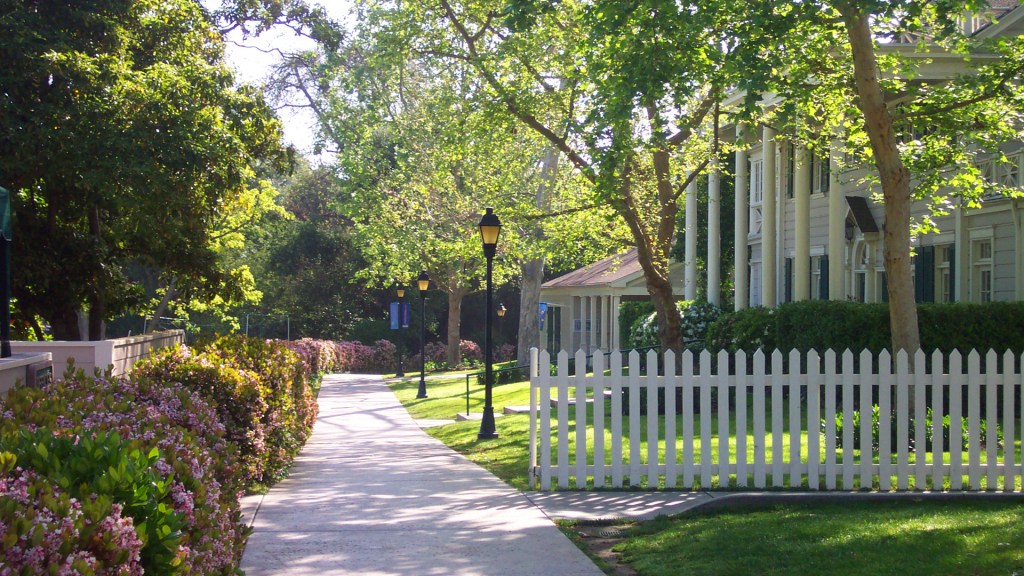
East Hall walkway at Clairbourn School | Photo courtesy of Clairbourn School

“I want gardening to be personal for the kids. When they study American history, I want them to see the crops Native Americans grew – corn, bean, and squash – three sisters planting, they’re called. There’s a symbiotic relationship where these three crops thrive at one time; the beans are supported by corn stalks and squash grow underneath, to shade its roots and keep moisture in. When students learn about Eli Whitney and the cotton gin, they can see first-hand what that plant looks like and how difficult it is to handle it.

“There are multiple areas on campus where students can go to at designated times of the school day to enjoy the flower and vegetable gardens. There is a raised bed for vegetables and a butterfly garden near the kindergarten classrooms for small students. Behind the 4th and 5th grade classrooms, there are three raised vegetable beds; plantings of cotton, corn and wheat along the walkway; and a passion fruit vine snaking up the trellis at the entrance to the garden. A greenhouse is in the middle school ‘jungle,’” Ward explains.         

Farmscape’s horticulturist, Melissa Rodriguez, teaches the after-school gardening program twice a week. Tuesday’s entry level class is composed of pre-K, kindergarten, and first grade students. They learn about the life cycle of plants and insects; plant organic vegetable seeds and seedlings;           

harvest and sample fresh produce from the garden. On Wednesday, she teaches 2nd to 5th graders in the greenhouse. Lessons include: learning about soil health and nutrition; cultivating vegetables, herbs, tropical plants, and orchids; propagating plants from seedlings and cuttings.  Students keep a journal to record plant growth patterns.

What Rodriguez usually encounters when she teaches is that students don’t know where food comes from. She illustrates, “Many kids don’t know what cucumbers, squash and tomatoes look like before they reach the supermarket. I want to build the connection between the plant on the ground to the food they have on their dining table or are served in the restaurant.”

“I introduce them to plants and vegetables that are not what they’re used to – purple and yellow carrots, red yard-long beans. I encourage them to taste the things we’re growing. I noticed that Clairbourn kids aren’t willing to try produce as readily as the other children I teach, which is a bit of a challenge. So now I grow plants with interesting taste like basil and mint, even strawberry,” Rodriguez discloses.                        

The gardens serve as outdoor ‘classrooms’ where students spend a portion of their day. Mary-Kaye Halferty, 4th grade teacher, declares, “The lessons are quite fascinating. In one class my students and I went to, the teacher pulled out all the insects and butterflies in the garden to discuss their role in either helping or hindering the growth of a plant.” 

Whether they’re learning al fresco, or merely enjoying the beautiful scenery, students get some relief from academic stress. Teachers, too, feel the gardens offer a welcome breather during the day. Those who originated the planting program and made horticulture an important component of education have their own personal views of its purpose.               

To Barner, it means valuing quality food over processed fare; an appreciation for farmers and their hard toil to produce vegetables; an opportunity for children to have a new learning environment; and taking on the responsibility to preserve this earth for future generations.     

For Ward, whose stewardship and constant presence in the gardens have inspired the kids to get their hands in the dirt, it denotes planting a seed to spark the inner gardener of every student and to serve as a regular enrichment activity that teaches great life lessons.

In his 2016-2017 mission statement, Nafie states, “The abundant nature with which Clairbourn is blessed is clear evidence of annual renewal. That success in academics, as in life, is not just a momentary event. When students get discouraged or stressed by new concepts, we can help them put down the kind of roots that will feed and sustain their success now and in the future. From the same sturdy plant, many flowers and crops will bloom in cycles of regeneration. So too, with our students, each year has its seeds, its watering, its below the surface, and its above the ground work to do. With teamwork and patient tending, the renewal of success will be assured.”

These gardens assume a significance as varied as the individuals whose lives they touch. But there is one constant  – all the students reap the fruit they have to offer.That is a Clairbourn promise.