Hawaiian Author Shay Kauwe Debuts YA Fantasy Mystery Book “The Killing Spell”

Also published on 13 July 2026 on Hey SoCal
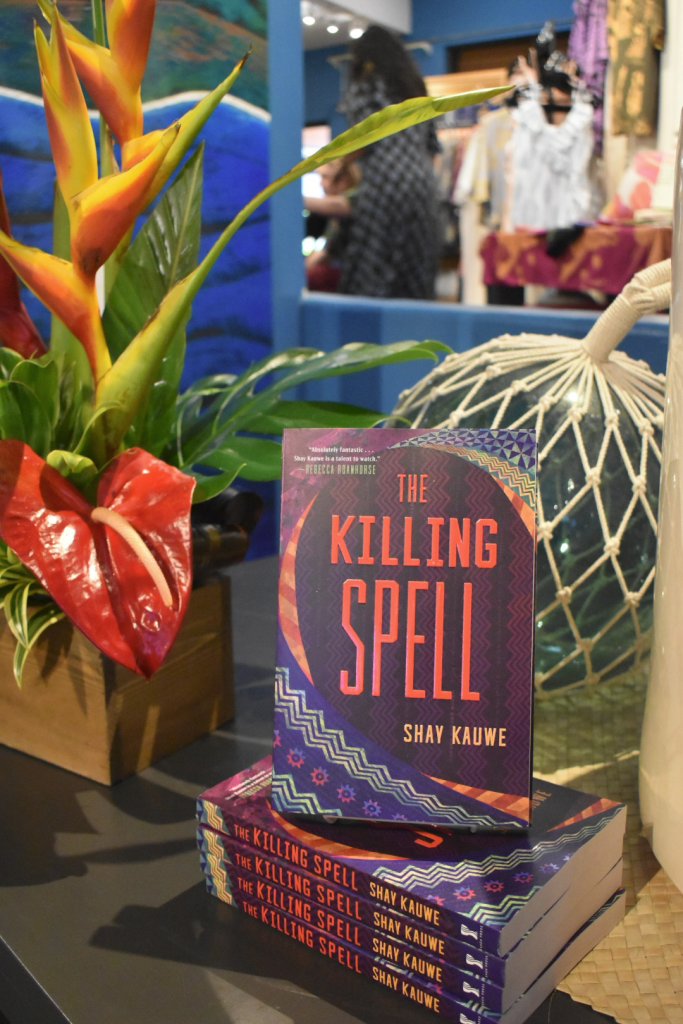
The Killing Spell, a young adult fantasy mystery set in L.A. – where the majority of Hawai‘i’s population fled to after a cataclysmic flood sank their islands – about 200 years into the future was released in the U.S. by Saga Press, an imprint of Simon & Schuster, on April 14. It is also available in Canada and the United Kingdom.
 

A debut book from Native Hawaiian Shay Kauwe, it follows the story of Kea Petrova – the youngest clan leader at the homestead – who ekes out a living by selling handcrafted magic spells. Her quiet life is upended by the murder by death spell of Angelo Reyes, a prominent Filipino activist, and she becomes the prime suspect. She has to act fast to find the killer and clear her name.
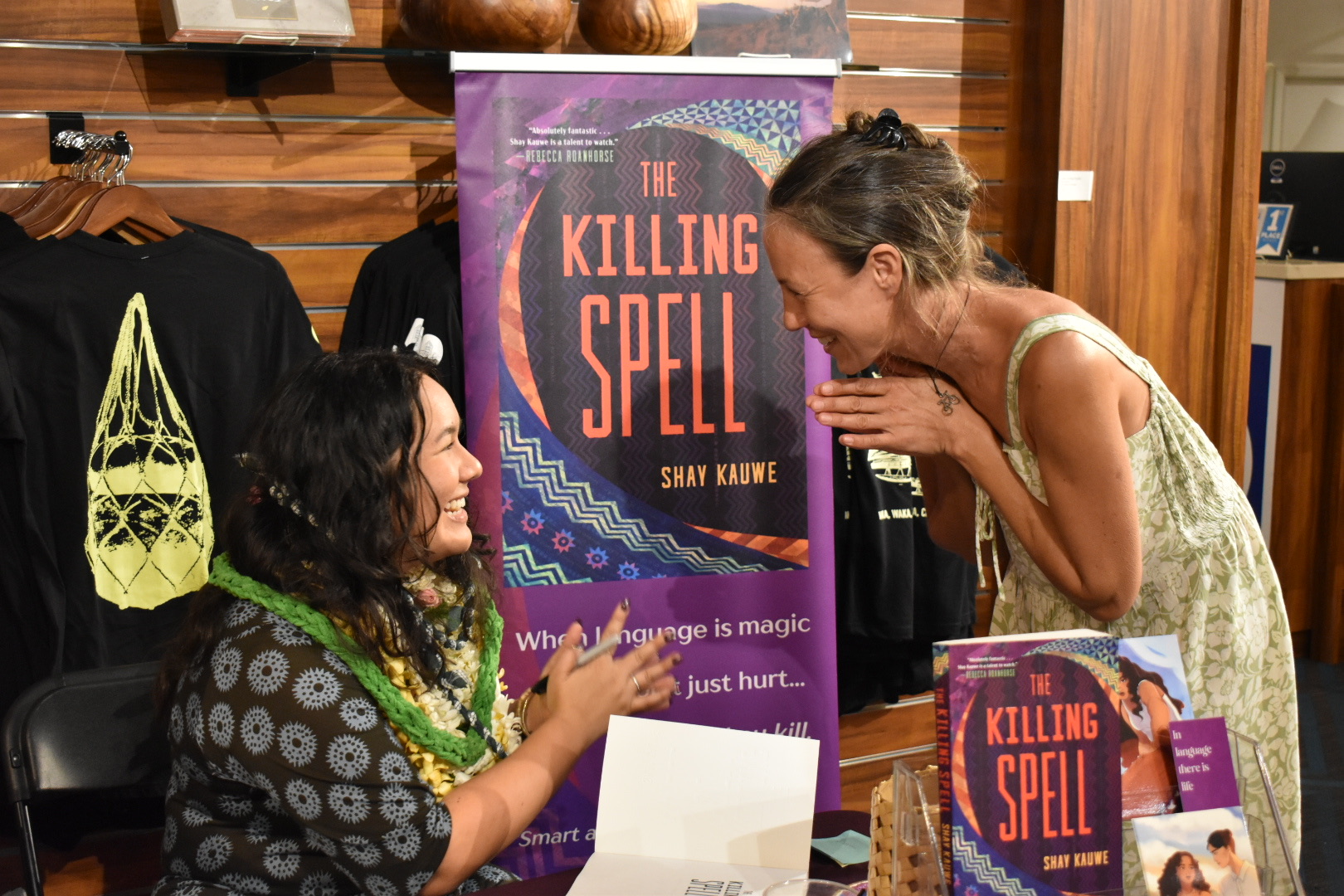
Shay Kauwe, at left, during the book launch. | Photo courtesy of Shay Kauwe / The Killing Spell

Language is at the heart of the tale. Throughout the book, Kauwe sprinkles Hawaiian phrases and one-word spells that will certainly delight logophiles. In her foreword, she explains that she included the diacritical marks to indicate how the words are pronounced to help readers. Linguaphiles will most assuredly agree with her when she says, “Languages are wonderful, beautiful, strange things that change and shift as they please.”

Kauwe’s love for language began in her childhood and she has always been partial to reading fantasy books. Some of those she enjoyed as a child – which have stood the test of time – are The Hero and the Crown by Robin McKinley and The Old Kingdom series by Garth Nix. But she never dreamed that she would one day join the ranks of fantasy authors. That happy outcome happened in a roundabout way.  
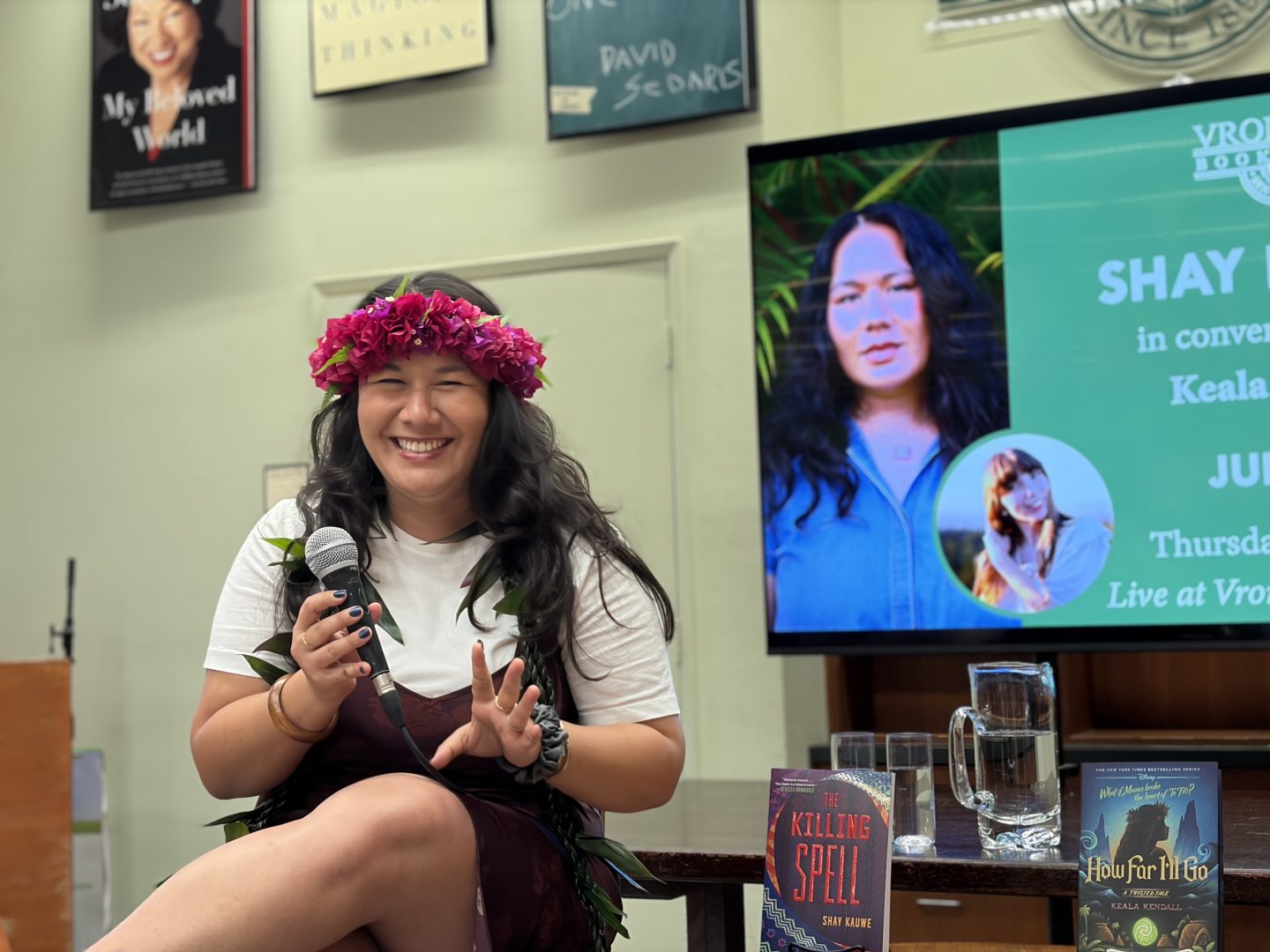
Shay Kauwe at the Vroman’s Bookstore event. | Photo courtesy of Shay Kauwe / The Killing Spell

“When I was 21, I moved to Russia – for a man. You can imagine how thrilled my parents were with that!” recounts Kauwe with irony. “But I was in love, and I knew that he was the one. (He was, too! We’ve been happily married now for ten years!) That said, I made this huge leap and began living in St. Petersburg, Russia, learning Russian by necessity without thinking too much about it.”

“There was this moment, maybe three years in, where I was sitting in our cold apartment in the middle of winter, watching Moana, and just sobbing,” Kauwe continues. “The language there, while not Hawaiian, was similar enough that I could make out words, and it struck me that here I was, half-way across the world, and I knew my partner’s mother tongue better than my own.”

“It was a lightbulb moment, and I knew then that I wanted to go home and learn Hawaiian,” adds Kauwe. “I foolishly thought it would be easy. I spoke Russian now! How hard could it be? So, I was incredibly frustrated when I couldn’t get things as quickly. Immersion was a huge part of my language learning process, and the hard truth is that as an adult, that isn’t a feasible option for many learners of Hawaiian. It is a consequence of colonization that we still have to deal with to this day. All of that frustration and shame, I took and funneled into this book, which is why it was so important for me to have a main character who struggled with relearning her indigenous tongue.        “
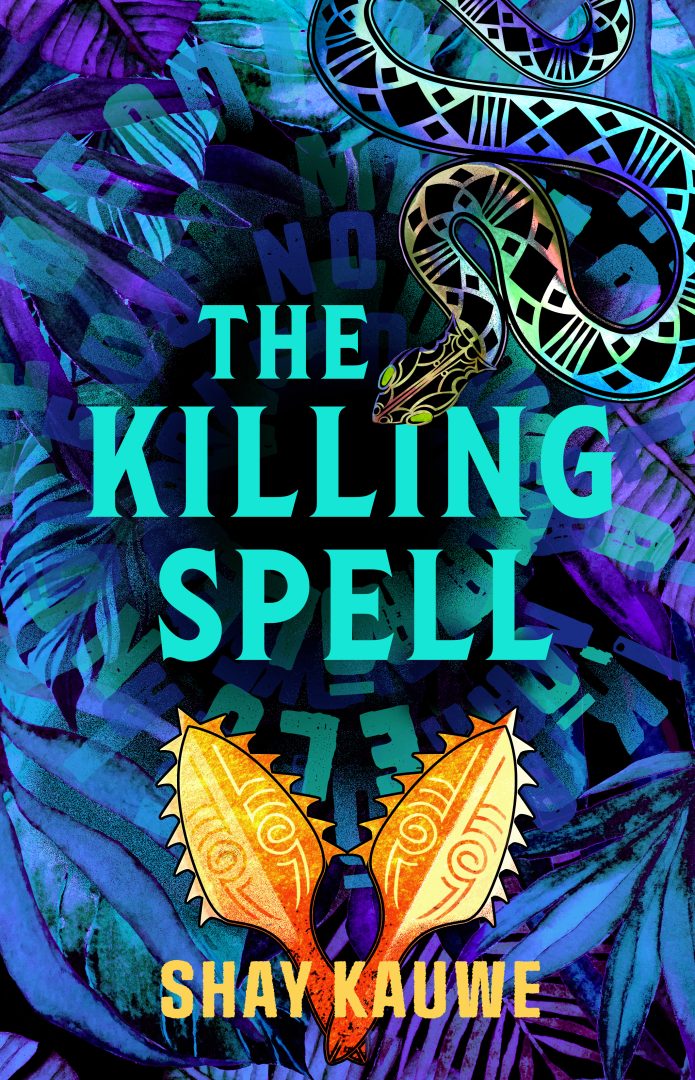
The Killing Spell’s U.K. book cover. | Photo courtesy of Shay Kauwe / The Killing Spell

Kauwe began writing The Killing Spell when she was still teaching. She was inspired by urban fantasy books which include the Kate Daniels series by Illona Andrews and the Mercy Thompson series by Patricia Briggs. She’s no longer in education, though she still has a full-time job and she admits that balancing working and writing is not easy. However, she has a rigid routine that helps her keep on track. She takes long walks in the mornings and listens to audiobooks to learn from writers she admires. When she gets home from work in the evenings, she writes between four to five hours, and tries to write at least 1,000 words a day.

Some authors get the inspiration for their characters from people they know or have met. But those in The Killing Spell are completely fictional and products of Kauwe’s imagination.  

“I don’t base characters that I write off of real people, but I do use the names of family and friends quite often!,” Kauwe clarifies. “Hawaiian names aren’t super common to see in literature, and especially not in fantasy, so I love to include the names of loved ones in my books; they get a kick out of it. Granted, I always make sure that the character with their name is nothing like them.”
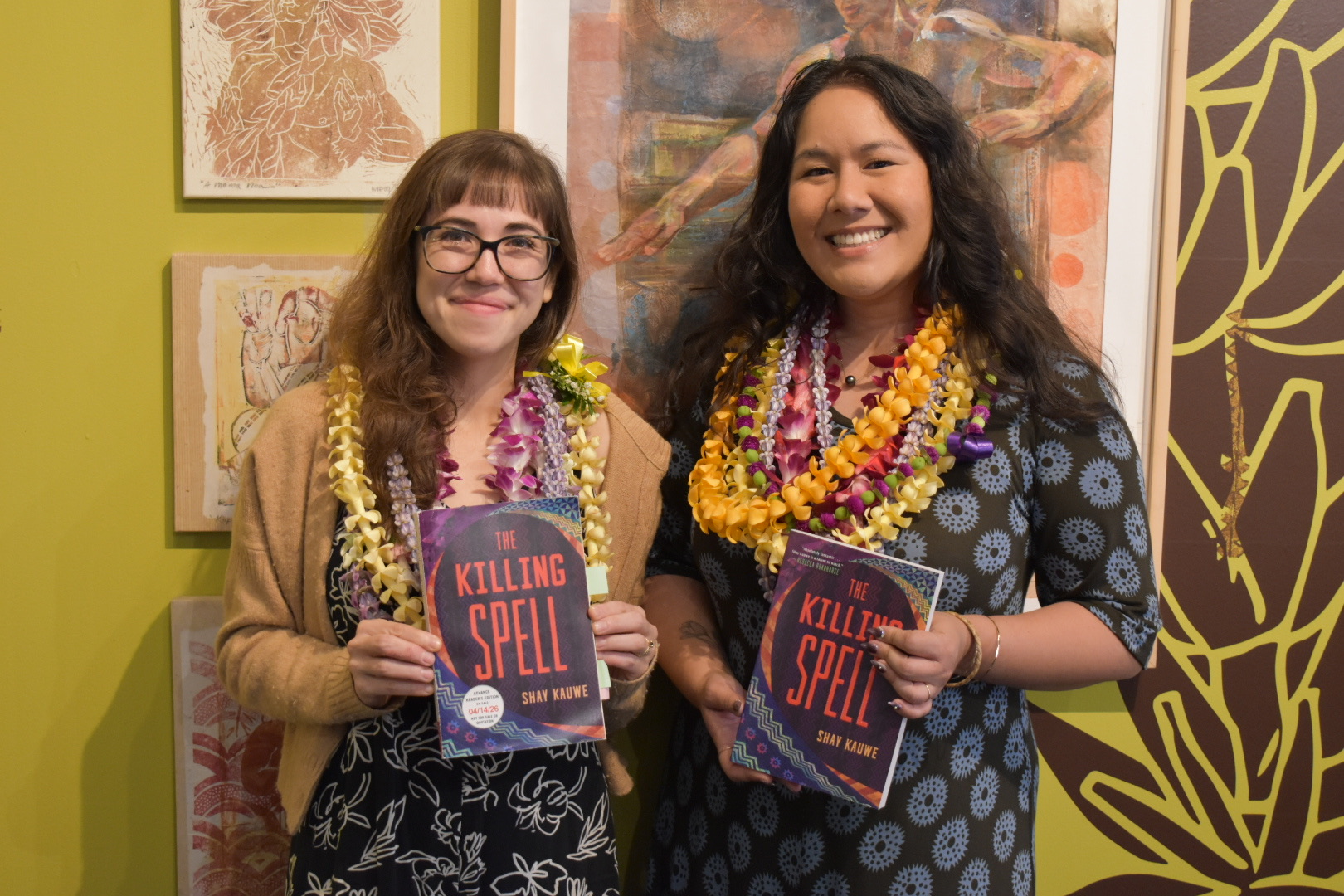
Shay Kauwe (on the right) at the book launch with conversation partner Megan Kamalei Kakimoto. | Photo courtesy of Shay Kauwe / The Killing Spell

However, Kauwe confesses that the book’s protagonist bears some resemblance to her. “Like many debut authors, I’m definitely guilty of inserting pieces of myself into Kea! We’re both stubborn, eldest daughters with a big sense of responsibility for our families. And also like Kea, I struggle with learning new languages. However, in writing The Killing Spell, I found a sense of catharsis, a way to have more patience with myself in learning Hawaiian.”

Kauwe also admits to having a favorite secondary character in her book. “Basilio was incredibly fun to write as he had a huge personality! I tend to like characters that are funny, charismatic, and enjoy teasing the people around them so Basilio fit the bill in every single way. I’d love to continue to write his story if possible.”

Additionally, Kauwe knew how her story would end at the outset. “Funny enough, I needed to rewrite my book about eight times throughout this process! However, the beginning and the ending never changed. I had a clear idea of what the emotional core and character arc for Kea would be, and that remained consistent during every revision. What changed was the progression of my plot and the clues that led Kea to her conclusion. The magic system also became a lot narrower in scope as I rewrote the book, so that greater emphasis was placed on language.”
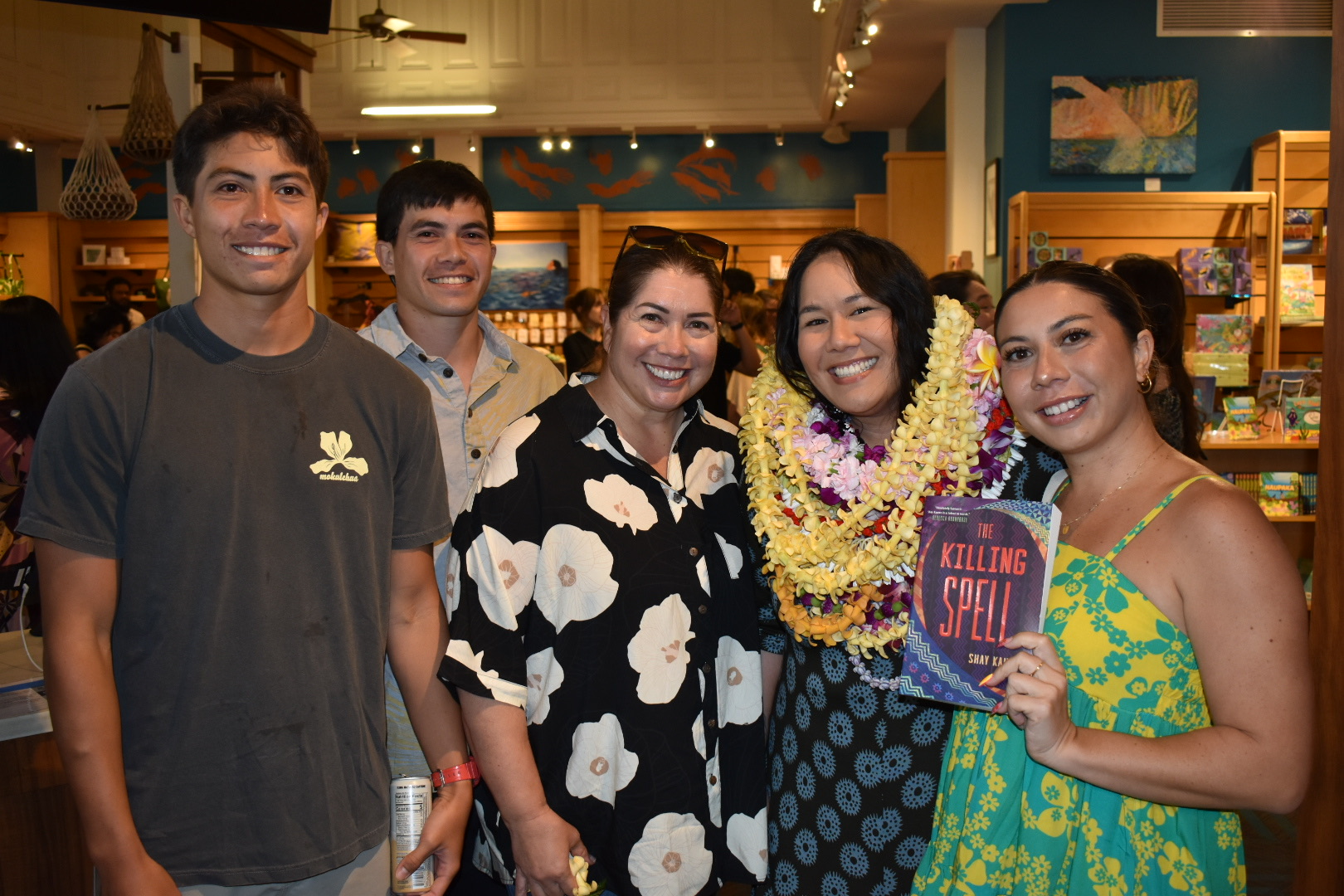
The author (second from right) with book launch event attendees. | Photo courtesy of Shay Kauwe / The Killing Spell

Instead of setting The Killing Spell in her native Hawai‘i, her book takes place in L.A. and the reason is twofold. “One, it was a nod at the reality of diaspora Hawaiians, who have in my lifetime become the majority which has been a wild shift to witness,” explains Kauwe. “Secondly, Hawaiʻi can often feel really isolated from the larger politics of the U.S. This book is a conversation about indigenous rights to land, water, language, and culture, and I wanted those conflicts rubbing right up against the policies of the U.S. rather than separated by an ocean.”

Promoting a book could be exhausting, but it most often proves to be a gratifying endeavor for authors. The Killing Spell’s publicity tour, which was split into two sections, was certainly more of the latter. It commenced with a book launch at the Bishop Museum’s book shop – Shop Pacifica run by the Hawaiian Council – in Honolulu. Kauwe’s conversation partner at the event was Megan Kamalei Kakimoto, the USA Today bestselling Hawaiian author of Every Drop a Man’s Nightmare and a 2026 National Book Foundation 5 Under 35 Honoree. She then embarked on a tour through the Hawaiian islands: Kahului, Maui; Līhuʻe, Kauaʻi; and Hilo, on the Big Island.
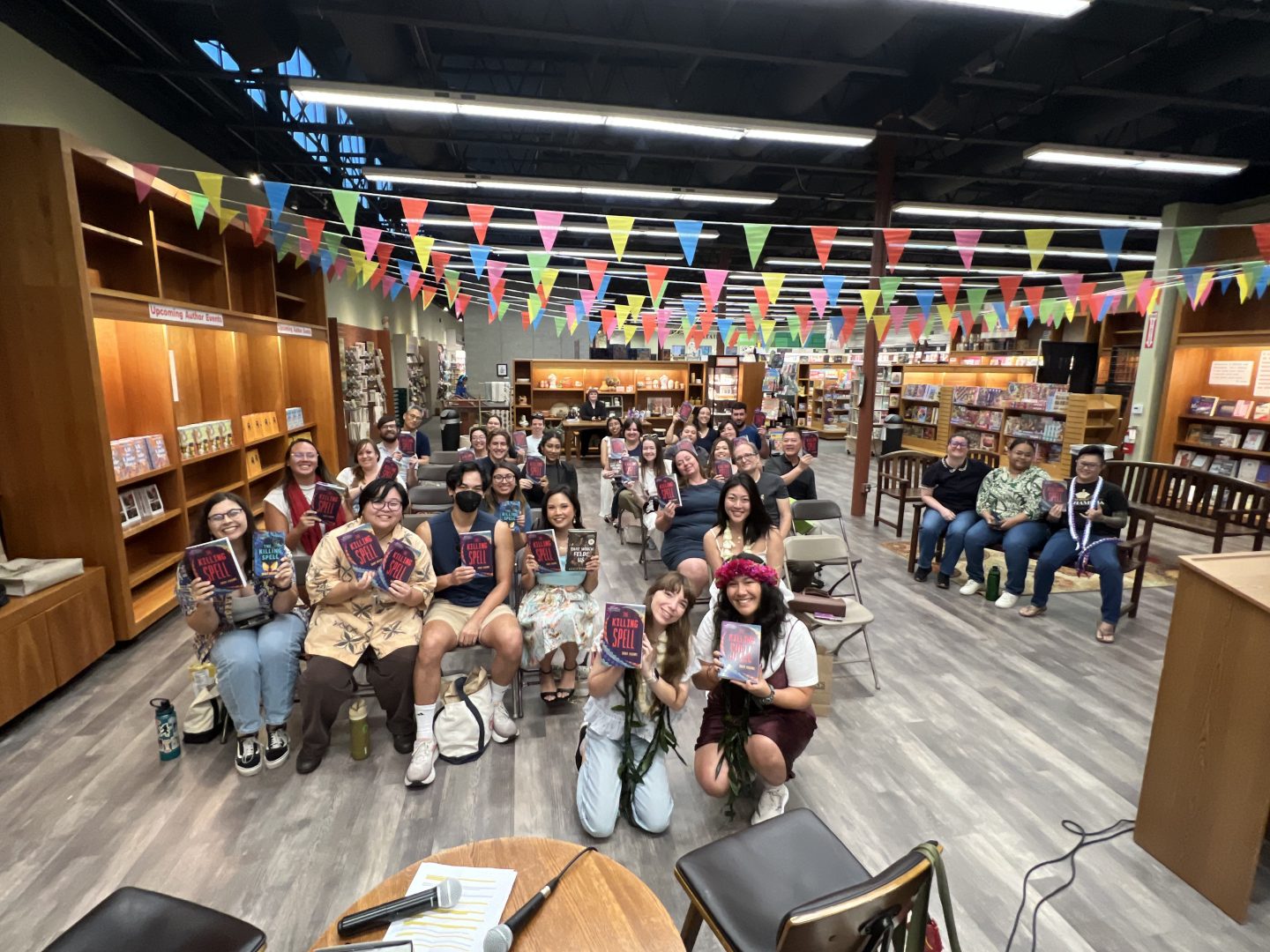
The Killing Spell’s book singing event at Vroman’s Bookstore in Pasadena. | Photo courtesy of Shay Kauwe / The Killing Spell

The second leg of the tour took Kauwe through prominent West Coast cities. The first stop was Los Angeles, California, and a book signing was held at Vroman’s Bookstore in Pasadena. Her conversation partner was NYT Bestselling Hawaiian author Keala Kendall of How Far I’ll Go: A Twisted Tale, and of the YA horror, That Which Feeds Us. From here she went to Seattle, Washington; and Portland, Oregon.        

“My audience has been a lot of diaspora Hawaiians and Pacific Islanders, which is amazing since that’s exactly my target demographic,” Kauwe marvels. “It’s hard to pick which city has been the most enthusiastic audience because each stop has exceeded my wildest expectations in terms of turnout! I don’t know that many people personally from each city, so it’s been so cool to meet so many folks excited to read The Killing Spell. My most memorable event, though, has got to be heading out to Los Angeles! L.A. is the city that The Killing Spell takes place in, so there’s something super special about getting to do an event here.”
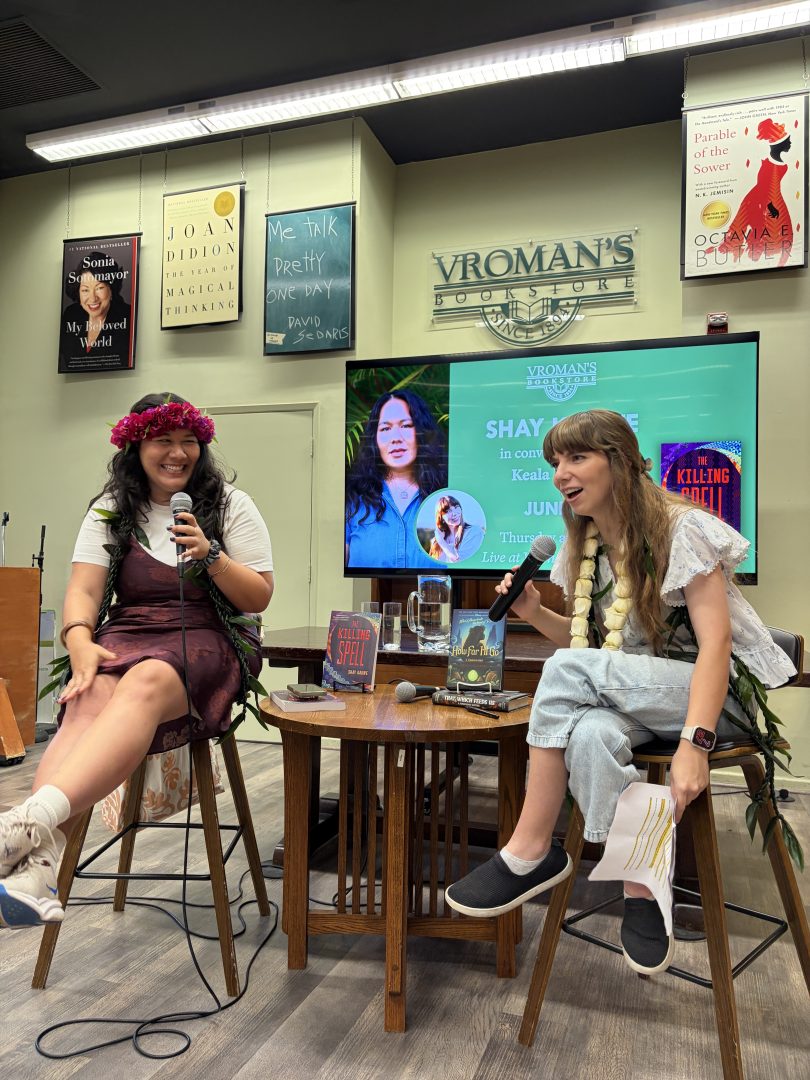
The author at the Vroman’s Bookstore event with conversation partner Keala Kendall. | Photo courtesy of Shea Kauwe / The Killing Spell

An important part of the book tour is the Q & A session, which was a revealing experience. “The most unexpected question that I got during book signings was what magical properties Hawaiian Pidgin would have as language!” discloses Kauwe. “And the truth is that I never really settled on a great answer to that. I’d love to know what features speakers of Pidgin think it should have.”

Kauwe was asked several interesting questions but one particular query was never brought up. “I wish people would ask more questions about Kea’s love interest, Sora,” she discloses. “I love my little red-eyed, grouchy man and think he’s such a fun character to have in the story.”

Asked if seeing the story end after ‘living’ with these characters for five years was a happy or  bittersweet moment for her, Kauwe replies. “It’s definitely bittersweet to have this story end! I’d love to continue Kea’s story and dive deeper in the world of The Killing Spell and explore different languages like Russian and Japanese in more depth, as well as Sora’s family.”
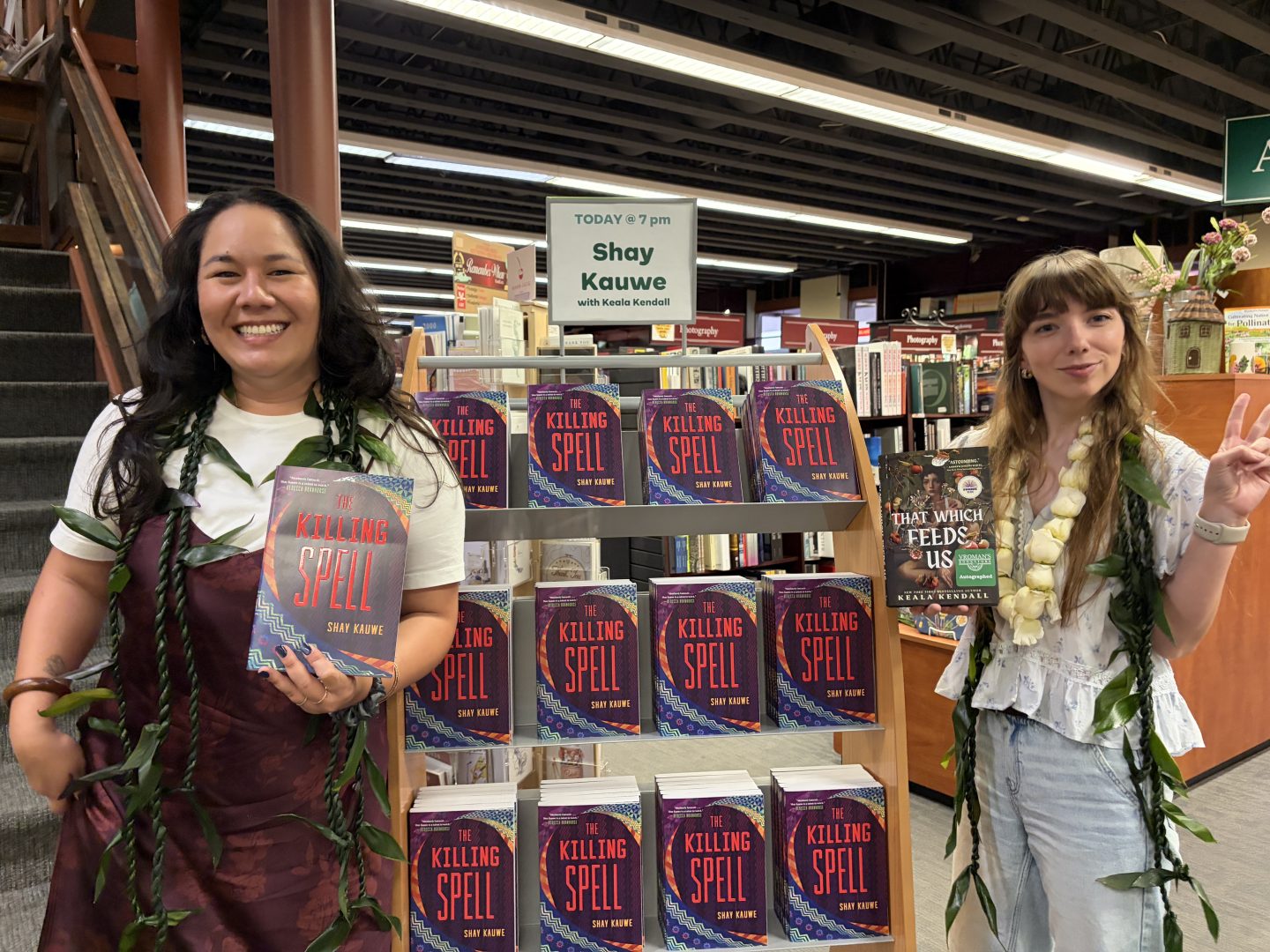
The Killing Spell book display at Vroman’s Bookstore. | Photo courtesy of Shay Kauwe / The Killing Spell

As to The Killing Spell’s message or reader takeaway, Kauwe says, “It’s so important to learn our mother tongues, but we have to be kind to ourselves in the process. No one is perfect from the get-go, and quitting is the only way to truly fail at it.”

Readers who really liked The Killing Spell will be glad to know that Kauwe has something in  store for them. “I have a book coming out next year which is totally separate from The Killing Spell. House of Salt will be my first foray into the horror genre. It’s a modern gothic set in Hawai’i, about a young Hawaiian woman who scams tourists out of their money by pretending to be a kahuna and ‘cleansing’ them of evil, but when she’s invited to the estate of a wealthy hotel heiress she discovers that the ghost lurking there may actually be real – and the only thing that might save them all is a real kahuna. I’m really excited for this book and can’t wait to have it out in the world!”

If The Killing Spell is any indication, Kauwe’s next book promises to be another page-turner. It’s hard to imagine now that this is the same practical kid who never thought writing and publishing a book would be something she’d accomplish in her lifetime.    
Arcadia Artist Vies for the Grand Prize in the ‘Illustrators of the Future’ Competition

Originally published on 15 January 2019 in the Pasadena Independent, Arcadia Weekly, and Monrovia Weekly

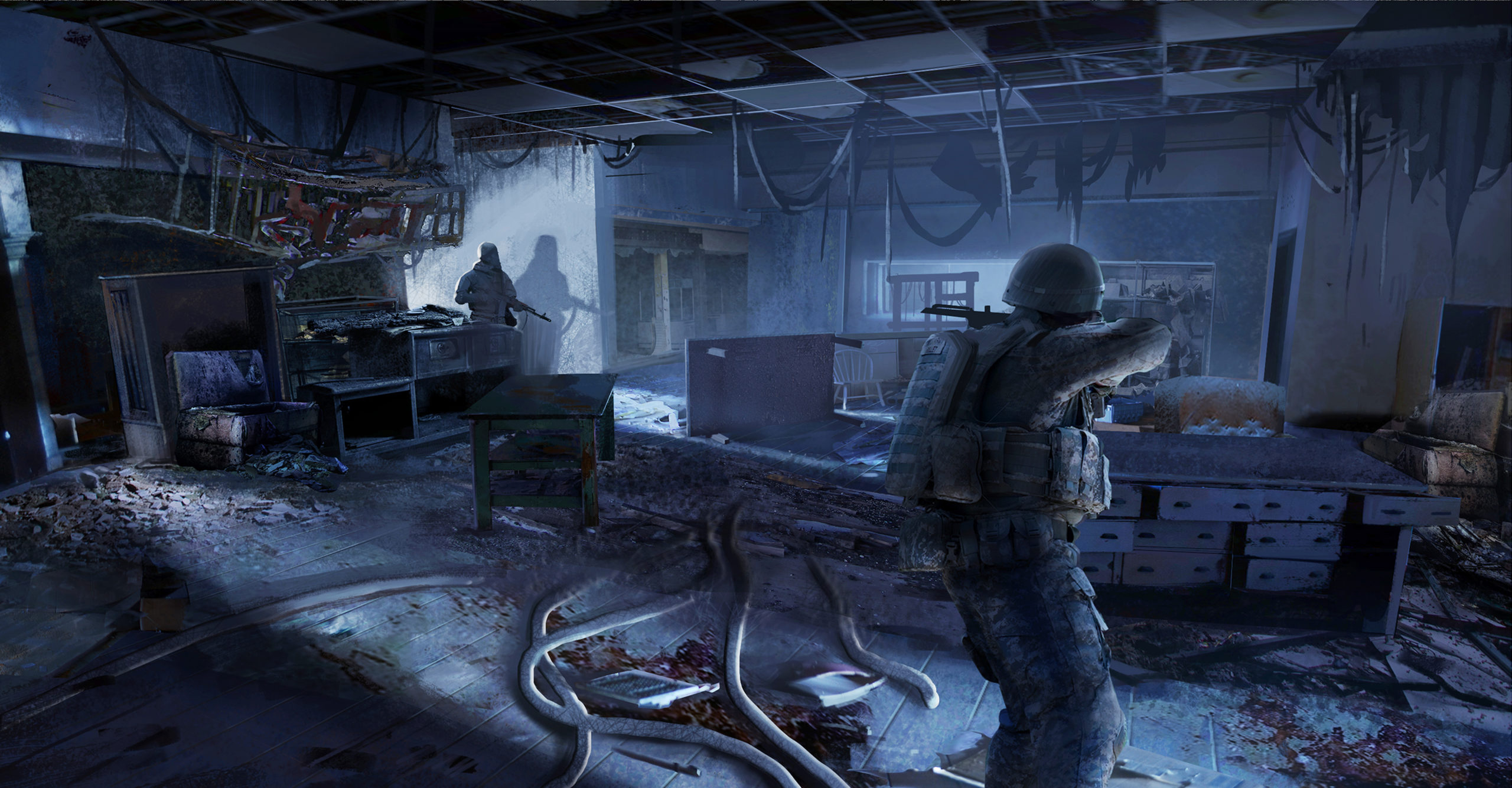
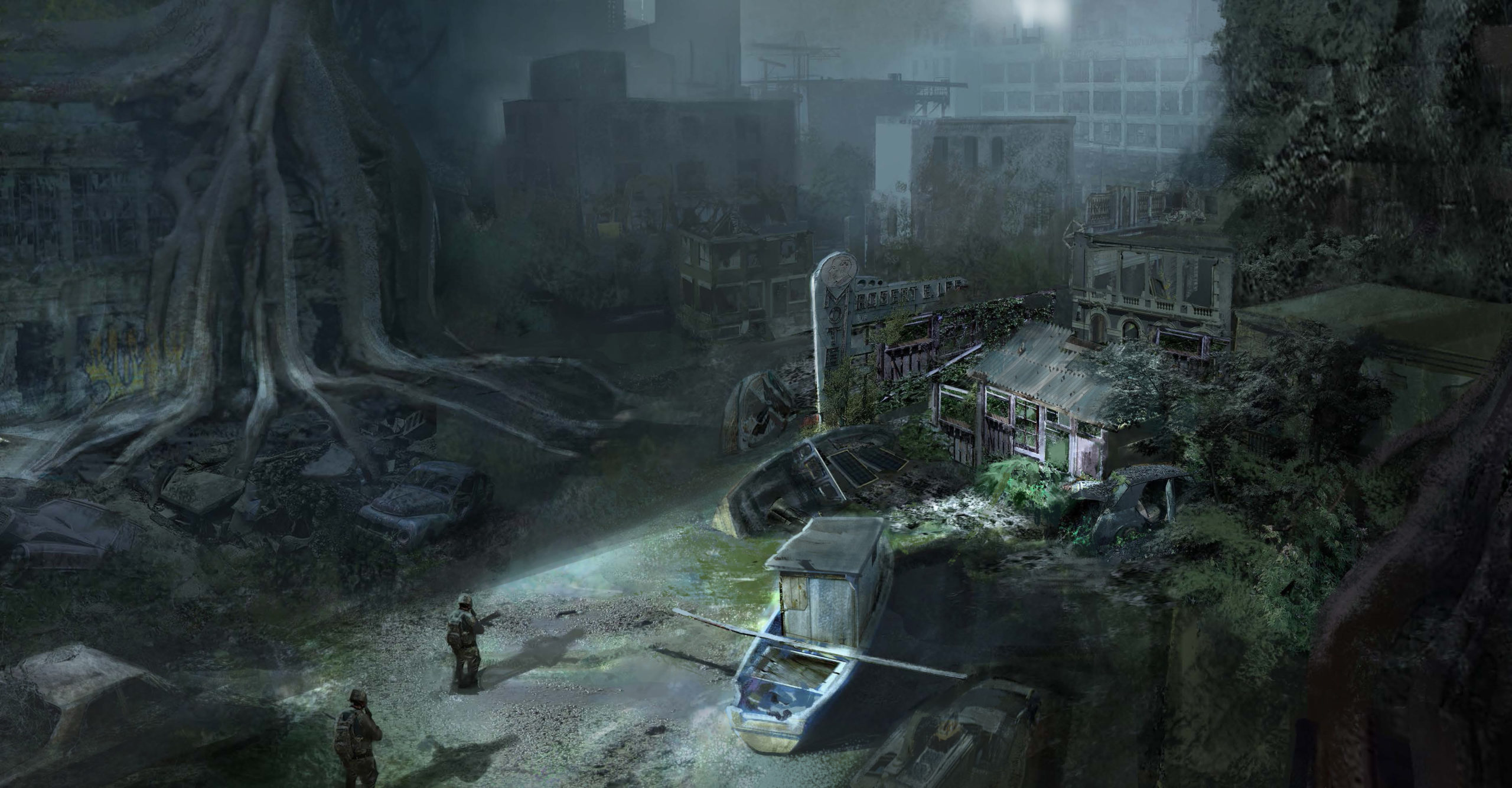
Ma’s entry called ‘Ruins’ | Courtesy photo / Galaxy Press

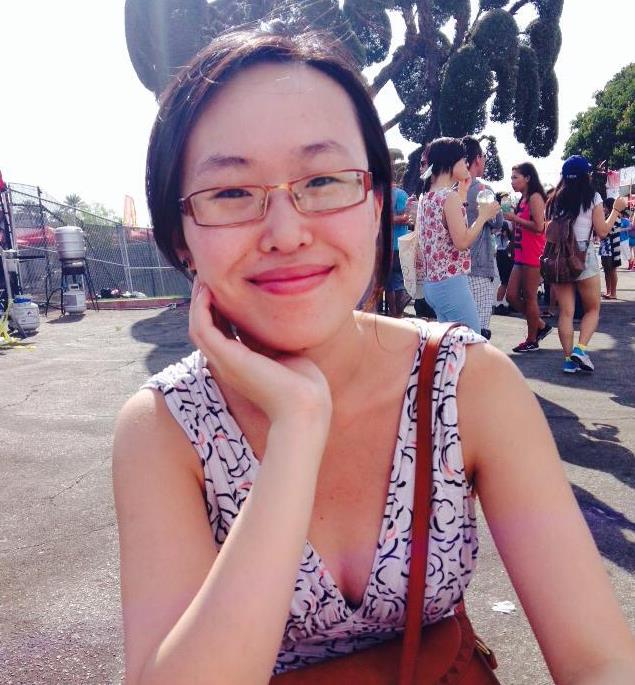
Qianjiao Ma, known to her friends as ‘Q,’ is a long way from her birthplace in Northern China but is very much at home in her adopted city of Arcadia. She is one of twelve ‘Illustrators of the Future’ winners to be honored during the 35th Annual L. Ron Hubbard Achievement Awards at the Taglyan Complex on Friday, April 5, 2019.

The highlight of the ceremony will be the announcement of the year’s two Grand Prize winners –  a writer and an illustrator – who will each receive $5,000. Quarterly winners, like Ma, also receive cash prizes from $1,000 to $500. Their winning stories and illustrations will appear in the annual anthology ‘L. Ron Hubbard Presents Writers and Illustrators of the Future’ Volume 35.

An international competition, ‘Illustrators of the Future’ is considered the most enduring and influential contest in the field of science fiction and fantasy. Artists worldwide participate in this competition and they are judged by professional artists, some of whom are masters in the genre.

To get to the heart of how Ma arrived at this momentous stage in her chosen profession, it helps to know what drives this determined young woman.

“I was born in Shenyang in Northern China,” begins Ma. “In my senior year in high school I went to Beijing to investigate what school I could go to and get training. I have always been interested in art so I could have gone to a well-known arts academy in China. But my mom also asked me if I wanted to study abroad. It was an exciting prospect as I discovered that Beijing was vastly different from the city where I came from and it made me realize that I really wanted to see the world.”

Continues Ma, “I arrived in Los Angeles in 2008 and I attended Santa Monica College. One year later, my mom, who lives in Seattle, asked me to move there and I did. I went to Bellevue Community College for a year but I found their arts offerings quite limited.

“A friend mentioned ArtCenter College of Design in Pasadena, so I decided to visit the school. When I got there, I saw students were sleeping on the sofas in the hallway; they had worked all night on projects and didn’t have the time to go back to their dorm. The artwork displayed at the gallery were amazing, a far cry from anything I’d seen in Bellevue!

“I was convinced I had to go to that school; I applied but was rejected the first time around. While there are other entertainment design schools in California because the movie studios are here, ArtCenter is the Number One school for that discipline, so it was where I wanted to be. I prepared my portfolio again, resubmitted it, and was accepted on my second try.”

Qianjiao Ma is known to her friends as ‘Q’ | Courtesy photo / Galaxy Press

While attending ArtCenter College of Design from 2012 to 2016, Ma held freelance posts and various internships. She describes, “I interned for BRC Imagination and was one of the artists involved in the 2015 redesign of the Rock & Roll Hall of Fame Museum in Cleveland. It was at BRC that I gained training in experience design, which became my forte.

“After college I wanted to pursue experience design work but couldn’t find any opening. Not wishing to be unemployed, I worked as a comic book illustrator at Stela Unlimited, which is an app for smart phones. I was the background concept artist for a graphic novel called Lumi White, a remake of Snow White.

“I still really wanted to go into experience design, though, and that opportunity came six months into my stint at Stela. A spot opened up in a small company called Steadman Design Studio which creates immersive entertainment experiences for theme parks, attractions, exhibits and shows.

“From Steadman, I moved on to Thinkwell Group, which is a larger outfit. I had the chance to work on museum, restaurant, casino, and theme park design including Warner Brothers Abu Dhabi, the largest indoor amusement park in the world. It was a lot of fun – I was able to try out different aspects of experience design; I conceptualized the entrance ticketing area, the art deco-style Bugs Bunny, and various murals inside. It was an absolute thrill to see my designs get built!

“A year later, an acquaintance of mine at a company called ShadowMachine approached me to do animation design. I started working at ShadowMachine in February of last year and I’m enjoying doing animation.”

Throughout her career, Ma has been driven by that same passion students demonstrated which made such a profound impression on her when she visited ArtCenter years ago. She continues to look for ways to learn and expand her knowledge. She was a designer and painter for the Netflix Original ‘Disenchantment’ and TBS’s ‘Final Space.’ She was one of the featured artists to share their views on theme park design in ImagineFX magazine, and was included in Graphite magazine on traveling sketches.

An accomplished plein air painter, Ma has exhibited her work in various Los Angeles galleries. She recently did illustrations for the magazine ‘Compound Butter Issue One: Junk Food.’ She is being included in the upcoming sci-fi design tutorial ‘Beginners’ Guide to Sketching: Robots, Vehicles & Sci-Fi Concepts.’

Ma’s second entry, called ‘Apocalyptic World’ | Courtesy photo / Galaxy Press

Last year, Ma found out about the ‘Illustrators of the Future’ worldwide contest and right away she sent three entries – Ruins, Apocalyptic World, and Space Ship Inter(ior Design). After winning the quarterly competition, she was paired up with a writer.

“I can’t disclose details about the novel other than it happens in the post-apocalyptic world,” states Ma. “I depicted the harsh environment to which people are exposed, where chips are embedded in their brains as a means of controlling them.”

“This is my first time illustrating a novel and even if my work doesn’t earn the grand prize, I feel that I’ve learned so much already. I met people whose perspectives are different from mine,” adds Ma. “Should I win, I would be quite ecstatic! It would prove that I made the right decision on how to illustrate the writer’s idea and that I’m ready for more book designing.”

Winning the Grand Prize would indeed take Ma’s career into another realm. John Goodwin, president and publisher of Galaxy Press which is the exclusive publisher of the winning books and illustrations, confidently says, “After 35 years, we’ve had close to 800 winners. Several of today’s best known fantasy and science fiction writers and illustrators got their start from winning the ‘Writers and Illustrators of the Future’ competitions.

“Many past winners are now recognized names – Patrick Ruthfuss, one of the top-selling fantasy authors in the world today; Brandon Sanderson; Sean Williams; Eric Flint, the biggest fantasy author in Australia; Nnedi Okorafor, of Nigerian descent, now one of the main writers in the Black Panther Universe; among many others. Canadian writer Robert Sawyer is one author who didn’t actually win, but it was the judges who gave him critique that helped advance his writing; he has gone on to become Canada’s most successful science fiction writer.

Goodwin continues, “Part of their success in becoming known to the general public is that we arrange publicity for the winners of the writing and illustration competitions. They get written about in various news outlets, appear on TV shows, do book signings in bookstores, and attend  conventions like Comic-Con International and Dragon Con to promote their books. We continue to support them in their career. If they publish new books, we let them bring those as well. That’s why these two contests have enjoyed such longevity.

“And because it’s free to enter, we attract a large number of competitors from all over the world. We received entries from over 175 countries in Africa, South America, Central America, and throughout Europe. For the illustration contest, they don’t have to speak English since they’re only drawing pictures. This year we have several winners with Chinese, Japanese, and Korean names but we don’t have the information on whether they were born there or if they’re children of immigrants. An unprecedented five writers and illustrators from the United Kingdom won this year.”

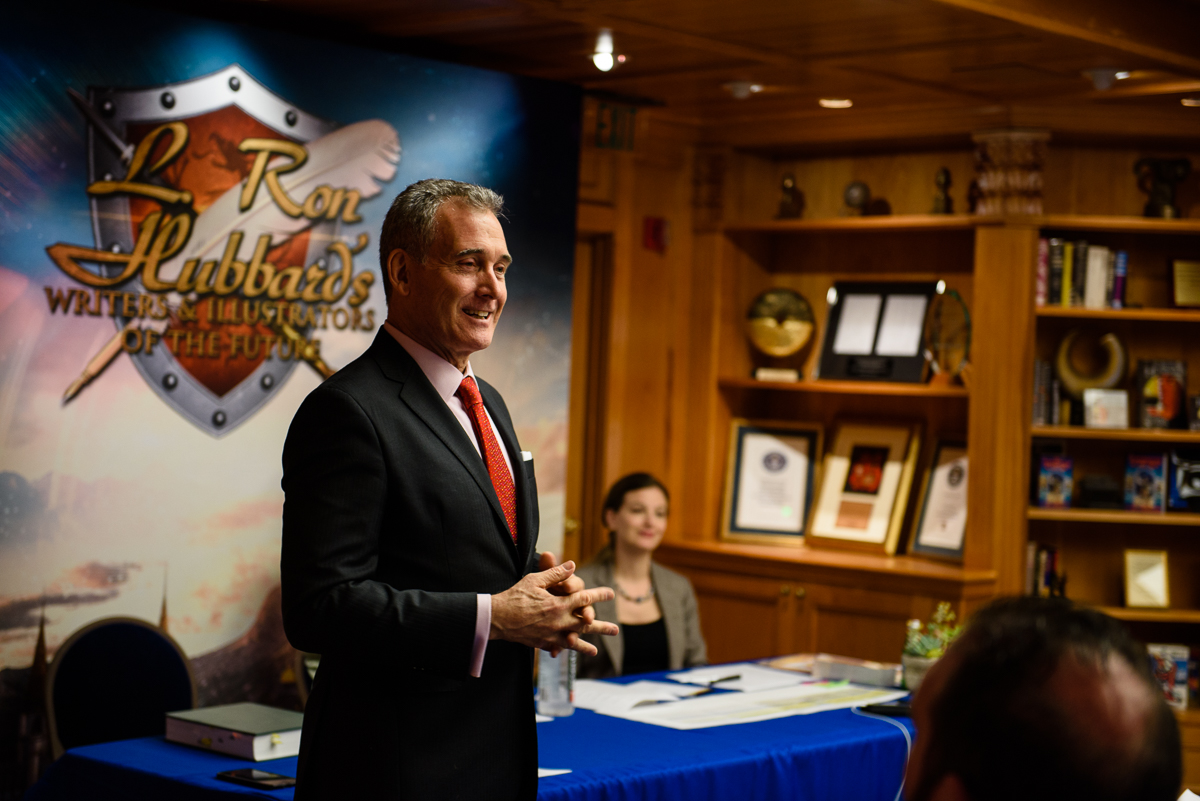
John Goodwin at a ‘Writers and Illustrators of the Future’ seminar | Courtesy photo / Galaxy Press

Pairing the writer with the illustrator is done by the editor, according to Goodwin. “There is no standard for what illustration an artist can send us. Some of them do oil, others do pencil, many do computer-generated images. Sometimes we look at their choice of medium to figure out which book would work with it best. But we also try to make complementary matching – we pair up a fantasy writer with an illustrator who reads fantasy books, for instance.

“Judges are established professionals in the industry including: Larry Elmore, known for his illustrations for ‘Dungeons & Dragons,’ ‘Dragonlance,’ and his own comic series ‘Snarfquest;’ Gary Myer who is an illustration professor at ArtCenter College of Design in Pasadena; Stephan Martiniere, who did the design work for Disney’s ‘Frozen,’ ‘Suicide Squad,’‘Aquaman,’”

Goodwin explains the history of the contest, “While L. Ron Hubbard was widely known for his work in Dianetics and Scientology, he was also one of the most prolific writers in America in the 1930s and 1940s, having written over 200 western, mystery, adventure, science fiction, fantasy, and romance books using his own and 15 different pen names.

“As a young man, he had traveled to Guam and as far as China back in the 1920s, and wrote about his experiences. In fact, he took the first photo of the Great Wall of China, well before it was a tourist attraction, and sold it to the National Geographic. That was the first picture Americans had ever seen of it.

“Towards the end of Mr. Hubbard’s writing career he turned to fantasy and science fiction. When he was in Alaska in 1978, he initiated the ‘Golden Pen Award’ to celebrate his 50th year as a writer. It was the precursor to the ‘Writers of the Future’ Award which he launched in 1983 as a means to discover and nurture new talent in science fiction. Five years later, ‘Illustrators of the Future’ was created to provide artwork for the books.”

“He set up an endowment from his personal earnings and royalties from his books,” Goodwin goes on to say. “When he passed away in 1986, he directed in his will that the writers and illustrators contests continue. Galaxy Press was established as the exclusive publisher of the ‘Writers of the Future’ contest winners and all the fictional works of L. Ron Hubbard.”

Arcadia’s Qianjiao Ma is one of the many beneficiaries of L. Ron Hubbard’s bequest. On April 5, she’ll find out if her already burgeoning career will also be catapulted into another world.