CSArts-SGV Premieres ‘Blend: Music and Motion’

Originally published on 16 April 2019 in the Pasadena Independent, Arcadia Weekly, and Monrovia Weekly
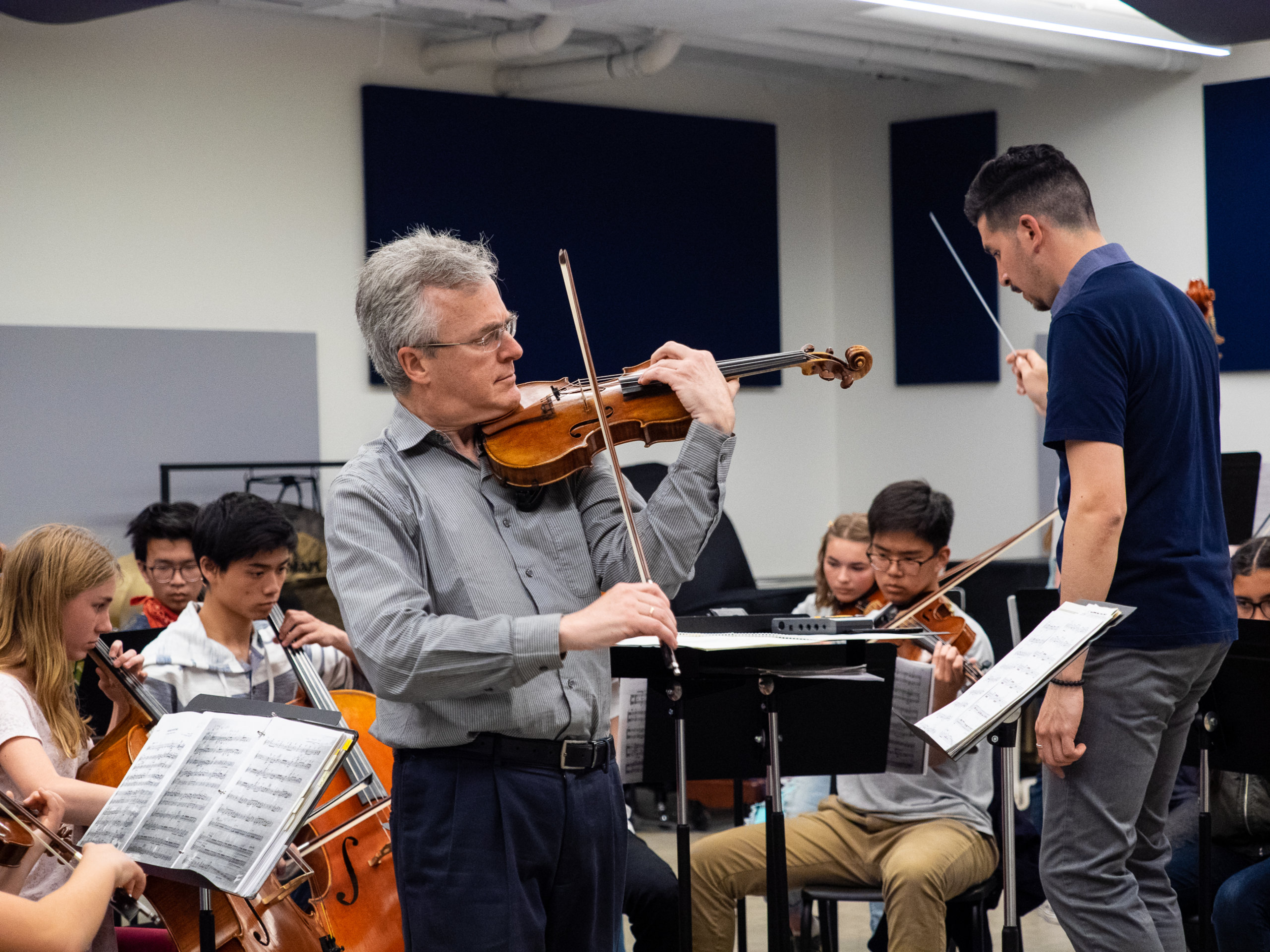
Martin Chalifour during CSArts-SGV’s Master Class | Courtesy photo

California School of the Arts – San Gabriel Valley (CSArts-SGV) premieres ‘Blend: Music and Motion’ featuring Los Angeles Philharmonic Concertmaster Martin Chalifour on Friday, April 19 at 7:00 pm at the Duarte Performing Arts Center. Chalifour will be the soloist with CSArts-SGV’s Philharmonic Strings and Classical & Contemporary Dance Conservatory students. The concert will highlight Edvard Grieg’s “Holberg” Suite, “Portraits” by Joel McNeely, “Navarra” by Pablo de Sarasate, and “Verano Porteño” from “The Four Seasons from Buenos Aires” by Astor Piazzolla.

Chalifour has been the principal concertmaster of the Los Angeles Philharmonic since 1995. A violinist with a career in orchestral, solo, and chamber music, he actively performs a diverse repertoire of more than 60 concertos, appearing as soloist with many prominent conductors and orchestras worldwide. Chalifour received a Certificate of Honor at Moscow’s International Tchaikovsky Competition, and is also a laureate of the Montreal International Musical Competition. He teaches at the USC Thornton School of Music and Caltech.

Prior to the concert, CSArts-SGV, in partnership with founding campus Orange County School of the Arts (OCSA), hosted a master class with Chalifour on March 1st as part of the Master Artist Series. Students from each school’s Instrumental Music Conservatory performed for Chalifour and received expert coaching and instruction. An additional 150 students from both schools observed to learn from the renowned concertmaster and their peers.

The Master Artist Series at CSArts-SGV and OCSA gives students the opportunity to gain valuable arts training and career advice from guest artists, teachers and industry professionals. Renowned specialists from the fields of dance, fine and media arts, music, and theater provide workshops, lessons, and performances to motivate students and provide once-in-a-lifetime learning experiences within their arts discipline.

Jeffrey de Seriere, Director of the Instrumental Music Conservatory, along with students Reece Fong, a high school sophomore, and Erin Braden, a 12th grader, happily talk about the Master Class and upcoming concert.

“This is the first time that Martin will be performing with our school,” de Seriere says. “We got in contact with him through Dr. Sakura Tsai, one of our string faculty members who teaches violin and viola. She had performed with Martin in the past and she thought it would be a great idea for him to work with our students. It’s a unique concert because we are also collaborating  with our classical and contemporary dance conservatory. We integrate all the grade levels – 7th grade through senior – in the ensemble. There are 33 students from the philharmonic strings and 15 students from the dance conservatory on stage for this. It’s a full concert production with a total of seven pieces, two of which include some choreography.”

Fong describes the master class, “There were four participants who played the solo pieces they’ve been working on. Martin listened to them, then gave feedback, and offered  suggestions on what they should improve on. It was a cool experience because we got to see Martin’s take on any music – he didn’t know beforehand what they were going to play.”
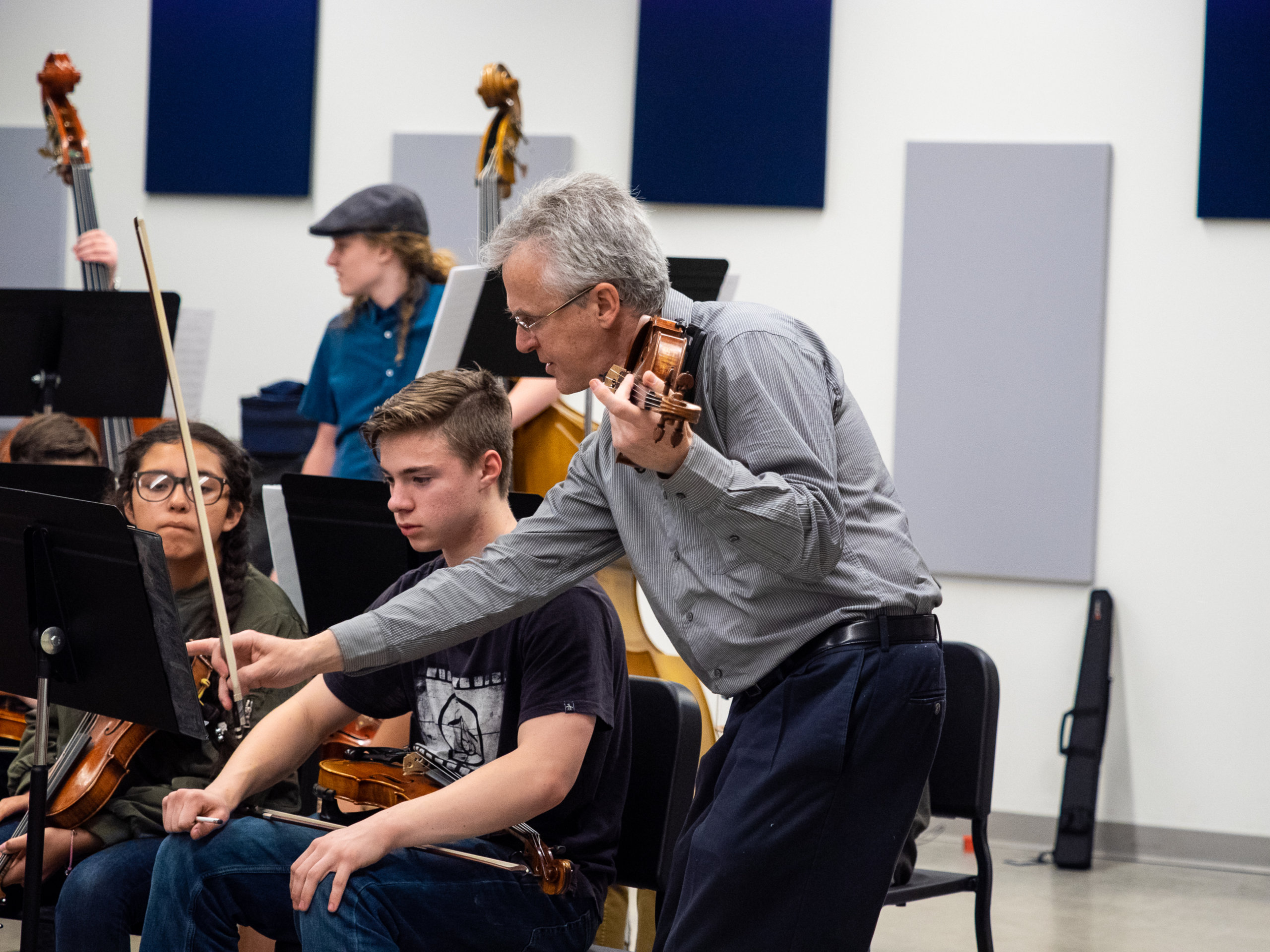
Chalifour gives suggestions | Courtesy photo

“Both Reece and Erin are on all the pieces in the concert. Erin is our second chair violinist in the orchestra and Reece is our second chair violist,” explains de Seriere. “We started rehearsing at the beginning of this semester after we came back from our winter break. Some of the music they’ve already played before but the bulk of it we only started rehearsing in January. This group rehearses regularly twice a week for one hour and ten minutes, but our soloists had two rehearsals with Martin for two hours. So we’ve only had a total of four hours rehearsing with him, with one more rehearsal with him before our performance.

“The thing that’s different for us at CSArts than other public schools is that public schools usually rehearse every single day during the week because they have a band block every single day. We only have two hours and 20 minutes of rehearsal every week combined for this group. There’s not a lot of rehearsal time which means that students have to do a lot more preparation on their own. When they come into rehearsal it’s expected of them to understand their part so we focus on putting it together as an ensemble rather than working on individual parts. Practicing is doing everything they can on their own and rehearsing is doing everything they can with everyone else and how their parts lock in together. It’s something I constantly reiterate.”

Braden pipes in, “That’s what I noticed with orchestra rehearsals – they’re short and we don’t have a lot of time within the week. It’s like a master class in that you play your piece to the best of your ability up to that point. Then coming to rehearsal pushes you further so you can learn more from the piece, get the little details you couldn’t do on your own, and polish the music. Then our conductor can help us integrate as a group and create something better.”

“One of the things Martin brought up when I first started talking with him was that he was really interested in working with dancers,” de Seriere adds. “I thought it was fantastic, as we happen to have a Classical and Contemporary Dance Conservatory. So I spoke with the dance conservatory director, Alison Dambach, and she was also excited with the idea. She got involved in the process of picking the music as well. The two pieces that Martin is soloing in with us were music that we all decided would be great to have choreography to. One of them is a piece by Argentinian composer named Astor Piazzolla, something that’s essentially a tango but is also modeled after Vivaldi’s Four Seasons, which a lot of people are familiar with. So there’s a little bit of Vivaldi in there too.”

Continues de Seriere, “So it’s not a typical orchestra concert because we have a soloist on the multiple pieces and choreography going on. We normally do our rehearsals twice a week but since we’ve had this added layer to it, we’re holding more rehearsals. Last night for example, we had the dancers in our rehearsal room over here and we were running through it to make sure the tempo was right for the dancers.”

Fong agrees, “It was a good rehearsal – it was the first time that we got to hear Dr. Tsai play the solo with Martin. They were both really prepared and played very well; I think the audience will be super impressed.”

“It’s different,” Braden supplements. “I don’t think we’ve had a concert where we’ve been on stage with two soloists and choreography dance. It gives a different vibe. We don’t do this very often and I think it’s a pretty good experience for us and the audience. I’m excited and I think it’s really cool that we’re doing the dance. It’s fun watching them dance. Usually you’re focused on the piece but now we’re connecting with another group of students.”
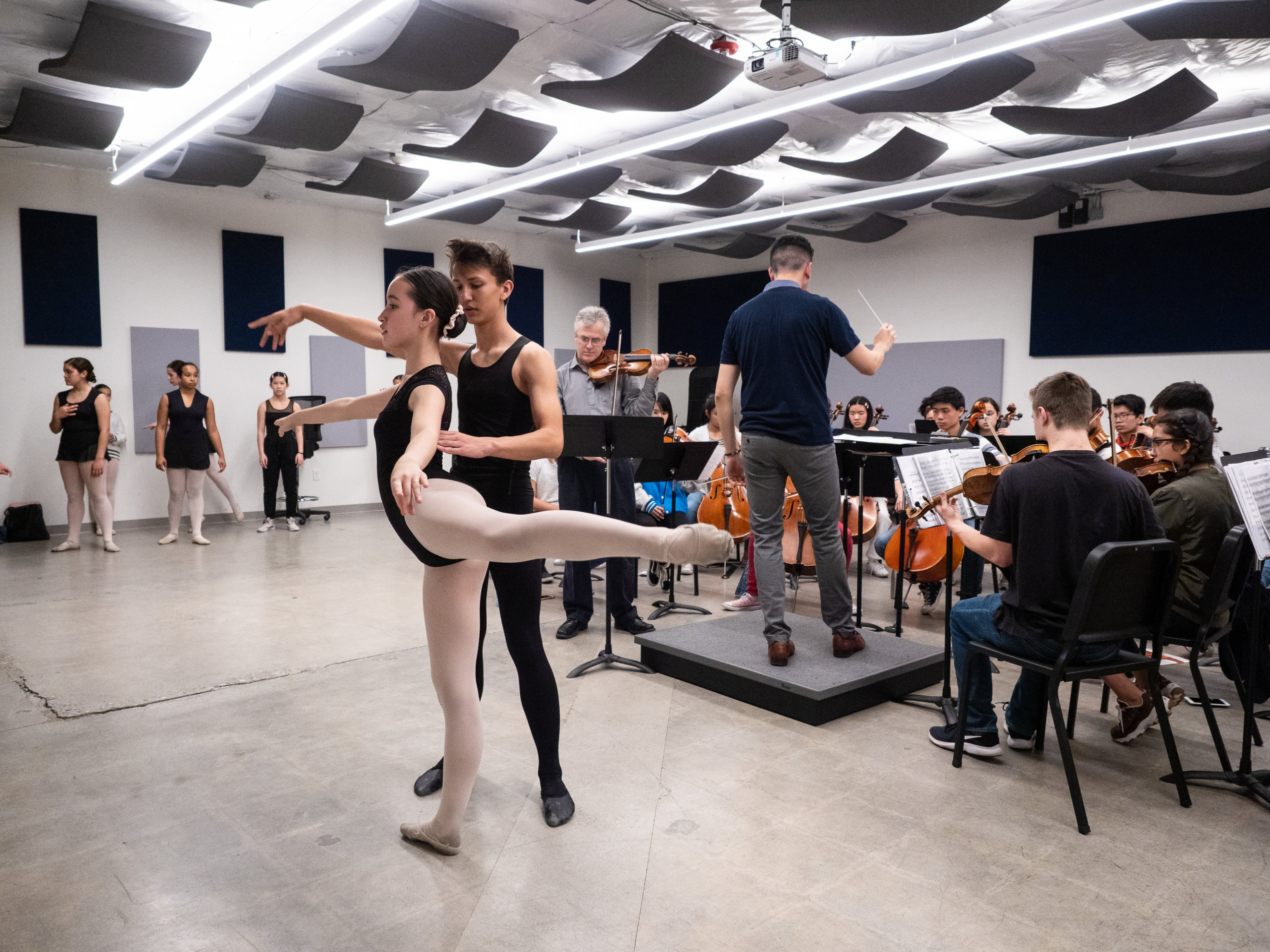
Ballet dancers join the rehearsal | Courtesy photo

Elaborates de Seriere, “They’ve both mentioned that they’re excited about doing this performance with dancers because one of the things I want to do here is ensure that students are involved in collaborations which may not be available at a normal public school. Musicians and dancers collaborate all the time in the entertainment world. But students in high school don’t usually get to interact at this high art level. Ballet is something that is very popular and there’s plenty of music that’s been written for ballet – both Stravinsky and Tchaikovsky have written for ballet – but it’s not as popular today. I don’t think it’s because it’s not a viable thing, it’s just not happening enough. This is their first time accompanying dancers who are trained in ballet.”

“Yesterday we worked on the speed and tempo, which musicians know well,” de Seriere continues. “As the conductor, I have to follow the dancers and figure out what works best for them. We’re all collaborating and seeing what’s going to be most beneficial to the overall product. That’s something they wouldn’t normally get at a public high school, but it was something that Alison and I thought would be a good experience for them. And it’s great for the dancers too because they’re hearing a lot of the lingo we’re throwing around – like dynamic and tempo – that crosses over to dance, but some will be completely new to them. We call it co-lab because it really is a lab where students are seeing and interacting with the other artists who are outside of their subject area.”

Asked what CSArts-SGV offers, Fong responds, “I’ve been playing the viola since 6th grade. Before I went to CSArts I didn’t have an environment where I constantly knew what I had to do to improve and have fun with it as well. At my old school it was just orchestra and we had one performance at the end of the semester. Here, you’re focused on your craft and you have more time to work on it. Mr. D and Dr. Tsai both know what you have to do and they push you and that really helps.”

“I think it’s a really good place because it’s a nurturing environment; we all learn together,” Braden answers. “Of course there are other schools like LACHSA and Colburn which concentrate on music and arts but I like this school because it also has great academics. At the same time, we each have so much focus on our instruments or our talents. Dr. Tsai helps us with the details on our pieces that other schools won’t provide. There’s orchestra but that’s about it in normal school. We also have the chance to perform for other students. If you want to be a performance major, that’s something you can focus on here and teachers can help you. Each teacher knows each kid pretty well here – we’re not a huge school yet – and ensures they get where they want to be. It’s good for goals. I’m hoping to pursue a degree in Music to be a music teacher or music therapist and attend either Southern Utah University or BYU (Brigham Young University) and CSArts-SGV has provided me with excellent preparation.”

De Seriere expounds, “This is the second year that the school has existed and this year we’ve had three performances with this orchestra. We played for the City of Hope Tree Lighting, we had our own Fall Concert, and we played at Festival. We have the performance with Martin, then there’s another Festival that we’re performing at, then we have our end-of-the-year production. By the time the year is done, we would have had eight performances.”

This weekend, Braden and Fong will perform and demonstrate how far they’ve come since. And with Chalifour to imbue the concert with gravitas, it should be a magnificent treat for us!

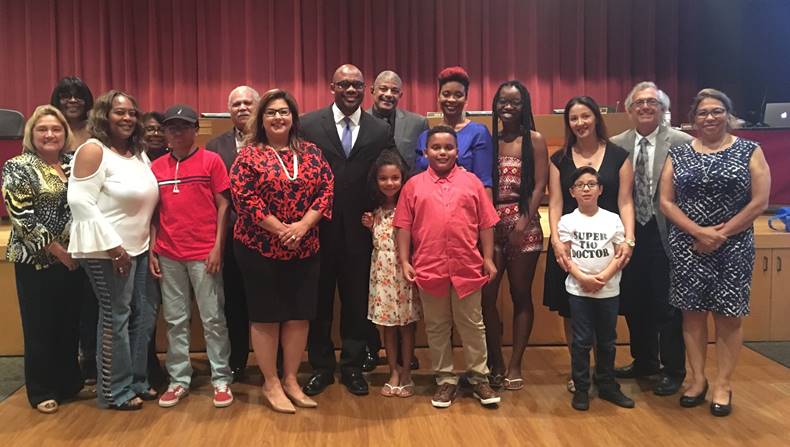
Dr. Gordon Amerson Brings His Vision to San Gabriel Valley Schools

Originally published on 10 September 2018 in the Pasadena Independent, Arcadia Weekly, and Monrovia Weekly

Superintendent Amerson with students of the Duarte Unified School District | Courtesy photo / DUSD

Dr. Gordon Amerson is a big believer in creating a culture of achievement and opportunity using the innate skills and talents of the community. It is the vision he brings to San Gabriel Valley schools as he leads the Duarte Unified School District (DUSD).

After officially taking over the superintendent position on July 23, 2018, Amerson spent a month visiting each of the district’s seven schools, preschool programs, and public charter, the California School of the Arts-San Gabriel Valley (CSArts-SGV), to meet teachers, listen to parents, and learn about the community.

“Until now, my knowledge of Duarte has been rather limited. My father-in-law lives in Baldwin Park and my wife grew up in the area. But I didn’t really know much about it,” confesses Amerson.

The revelation is understandable given that Amerson had previously worked in Orange County, and prior to that spent the majority of his career in San Bernardino. It was only by happenstance that he found out about DUSD.

“I was the Associate Superintendent of Human Resource Services at Capistrano Unified School District and I was very fortunate to have a superintendent who was very encouraging of her team’s development and advancement,” relates Amerson. “Early in the 2017-2018 school year, she supported me when I told her of my interest in joining the ACSA (Association of California School Administrators) Superintendents’ Academy.

“Through ACSA, I went through an intense eight-month superintendent preparation program while holding a full-time job. During that process I was trained on all the components that go into district leadership. Additionally it gave me exposure to state-wide search firms who had interaction with attendees of the program.”

“It was then I started to discover Duarte and DUSD,” continues Amerson. “I looked at the website and found out about all the transformational work going on. That was very exciting for me and I wanted to know more; that truly sparked my interest.

“I didn’t know Dr. Mucerino at all prior to my applying either, but before leaving his position as superintendent of DUSD, he offered me a 30,000-foot view of the district from his perspective. I appreciated his transparency. I thought it was an exceedingly kind gesture for an outgoing superintendent to do.

“The search firm cast a net nationwide. From what I was told, there were 33 candidates who applied and eight were invited to interview. It was a competitive process and one that I’m glad to rise on top of. I finished the academy in April and secured the job in June, but I don’t take it lightly that I was able to navigate it successfully.”

Gordon Amerson with his family and members of the Board of Education at the Regular Meeting held on June 28, 2018 when he was unanimously appointed as the new Superintendent of the Duarte Unified School District | Courtesy photo / DUSD

Amerson is fully prepared to head a school district, and has a resume to prove it. He describes, “Before taking on this level of responsibility, I was an educator for a long time. I was a classroom teacher, an athletic coach in baseball and football, and a high school principal. I’ve seen a lot of places and spaces along the educational management spectrum which, I believe, helps inform my leadership.

“I have a multi-faceted understanding of what teachers and principals are going through on a daily basis as they try to create a community of learners and to keep students engaged. Seeing that work from different angles and experiences has given me a wide-range perspective and will help me be supportive as well as decisive.”

There is much going on in DUSD. According to Jenny Owen, public information officer, this year they have completed the process of converting four of the district’s elementary schools to K-8 academies. Now each has its own distinctive theme: Andres Duarte Arts Academy; Beardslee Dual Language Academy; Maxwell Academy & International Baccalaureate World School, and Royal Oaks STEAM Academy. Valley View, the remaining elementary school, will begin the transition to become a K-8 this school year, and already has been renamed Valley View Academy of Technology & Creative Learning to reflect its signature programs.

“One of the things I would remember for the rest of my life was being a high school principal at a school with a high-performing dance company led by a talented choreographer,” discloses Amerson. “They performed in the gym and I was moved by what kids are able to do with music and dance. From then on, I was hooked. We created a piano program. Kids in 9th grade who had never touched the piano were composing music by the time they graduated high school. It is uplifting to see the kinds of opportunities we can offer students.”

Amerson says further, “My daughter has been in dance formally since she was three years old. My son has been playing the piano, the drums, and the trumpet since he was four. It’s a focal point in our home. When I saw the impact and influence of the arts, and DUSD building a foundation of the arts to all of our schools, that’s what made a huge impression – that got me, hook, line and sinker.”

Much transpired in DUSD under the leadership of Mucerino, who facilitated the creation and implementation of the district’s strategic plan known as the Competitive Advantage Plan (CAP).  Amerson adds, “With all due respect to Dr. Mucerino, if he were here today, he would say the strategic plan wasn’t his but the community’s. It was the stakeholder engagement, their input and feedback, that helped develop it.

“We have a seven-goal CAP which is the right plan because it was developed by the community; it was what our Board of Education has approved; it was reauthorized, redesigned, and updated recently, right before I arrived. And it is the plan we will be moving forward with. If, at some point, we need to alter something, I will listen, observe, learn, collaborate, and build a coalition before making adjustments.”

The most important issues Amerson will be tackling are the scholars and the staff. He states, “We have a really great framework around the CAP. But like the saying goes, how do we build a house into a home? I want to make sure scholars are connected to the school they attend; I want our staff to be empowered to do great work. The focus for me would be establishing trust and collaboration, being transparent, being visible so people know I’m accessible, letting them know I’m here to coach, support and mentor. I really want to try my best to coordinate our facilities as an organization to provide the services so people can do their job and kids can learn.”

It’s such an auspicious time for Amerson to be heading the district and he is well aware of his good fortune. He says, “A long and painful enrollment decline has affected countless school districts. But through transformational objectives within the CAP, DUSD has been able to turn the district around. And I am the lucky beneficiary of it.

“The board, administrators, staff, families, students, and the whole community implemented a community-based strategy. There is a cohesion, a partnership, and a collaboration that exist between the district and the city. That synergy is what helps transform an entire neighborhood and produces positive outcomes for students. I’m happy and excited to be here; I’m ready to roll up my sleeves and do the work.”

Amerson shares his very heartening first month on the job, “It has been amazing because people were so welcoming and responsive, optimistic and positive, helpful and supportive. That’s something you don’t always see or experience. And I want to capitalize on that and the opportunity. I am now on 70-plus hours of one-on-one meetings with folks, which is embedded in this plan of listening and learning.

Gordon Amerson meeting and greeting students during his first month as superintendent of DUSD | Courtesy photo / DUSD

“I gain various perspectives from the community on what I should be thinking about, what are the challenges they or their children are facing that the community or I need to be aware of. During these meetings I ask people, ‘Let’s reverse roles. If you were the superintendent what would you focus on first and why?’

“That always gets me interesting responses and tells me what’s important to them. Some are like low-hanging fruit that can be done right away, and some are big rocks that require more prolonged thinking and planning which could only be addressed over time.”

To the question ‘what is he most looking forward to working on?’ Amerson responds, “I am looking forward to continuing to build the four pillars because they’re spot on – a focus on results, service-centered, 21st century schools, and strong partnerships. What I think are the most important things are the teaching and learning; understanding deeply our partnerships and their value; how we will continue to nurture, cultivate, and expand them.

“Those partnerships are wide-ranging, from the work we do on our early college program, in our culinary arts program, all the things we do at our theme-based academies, the international baccalaureate program, our STEAM initiative with ‘Project Lead the Way,’ the alliance we have with City of Hope and CSArts, just to name a few.”

CSArts-SGV provides an extraordinary opportunity for students in the entire San Gabriel Valley – it gives them access to a quality fine arts program. While other schools may offer arts courses, or after-school activities, CSArts-SGV integrates arts academies within the curriculum. Before it opened last year, students who are really interested in pursuing arts courses had to travel to either Orange County School of the Arts (OCSA) or Los Angeles County High School for the Arts (LACHSA). CSArts-SGV’s enrollment covers cities beyond Duarte. There is, in fact, an arts program in all DUSD schools.

DUSD is a hopping place. Student learning is balanced and engaging – it offers everything from theatre acting, graphic arts, and music performance to engineering, math, science, and technology. It is an enriching environment for young people to immerse in scholarship as much as it is a satisfying place for teachers to mold responsive minds.

With Amerson’s leadership, DUSD could very well be the exemplar of erudition. And that would be his singular contribution to a community that continuously strives to afford the best education and a promising future for its youth.

San Gabriel Valley Schools Adopt Anti-Bullying Program

Originally published on 6 November 2017 in the Pasadena Independent, Arcadia Weekly, and Monrovia Weekly

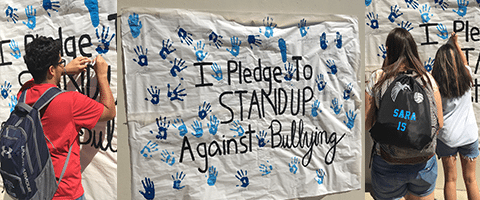
Duarte High School students took the pledge to stand up against bullying. Courtesy Photo

Bullying is a common occurrence in schools and the numbers prove it; one study revealed that as many as 49 percent of children in grades 4-12 have been bullied at least once during the past month.

School administrators and teachers have been looking for ways to solve this prevalent problem. For years several different methods to stop bullying have been utilized, including zero tolerance and expulsion which have since been deemed ineffective.

Several schools in the San Gabriel Valley are grabbing this bull by the horns, so to speak, through active and ongoing conversations with students and parents about bullying. One independent school in Arcadia went a step further by including a social curriculum to create acceptable standards of behavior on campus.

This challenge is front and center in the Duarte Unified School District (DUSD) where  Superintendent, Allan Mucerino, is taking a PBIS (Positive Behavioral Interventions and Supports) approach to teasing and bullying in the classroom.

States Mucerino, “PBIS has been quite popular in Orange County where I came from before it made its way to Los Angeles in the last five to six years. I brought it to my last district when I came to Los Angeles prior to landing in Duarte, and it has grown by leaps and bounds. It’s a school-wide behavior management system with social emotional learning embedded into the program. The key is to teach behavior expectations and balance corrective actions with positive supports and interventions designed to restore a positive relationship.

However, because we utilize restorative practice doesn’t mean we tolerate bad behavior. In fact, it’s the opposite. Students are held more accountable; they are made to realize that bad behavior changes the relationships with teachers and fellow students. The old punishment of suspending them seems almost like a reward because they’re getting a day off.  In PBIS we address that destructive behavior – we call in the students involved and the teachers then we discuss ways to restore the fractured relationship. When necessary we resolve the issue by using more sophisticated exercises including bringing in facilitators and families to rebuild relationships.”

“This is consistent with our transformation to K-8 because students stay here for the duration of their studies before transitioning to high school,” Mucerino discloses. “In the research literature, K-8s have a lower incidence of bullying. And the reason is obvious – kids coming into a middle school from a variety of elementary schools at adolescence are more vulnerable. It’s in middle school that kids act out; they feel liberated from all the restrictions in the elementary school.

Our transition to K-8 is an educational design model to create a safer learning environment, to build in conditions for kids to become successful based on student-adult relationships. This is where PBIS comes in; it is a program that the entire school owns – from kindergarten all the way to high school.”

Students at Northview 8th Grade Village implemented creative ways to build a school culture founded on inclusion, acceptance, and kindness. Courtesy Photo

PBIS is ubiquitous on all DUSD campuses: all classrooms have some motto or sign that emphasizes good behavior. Teachers are now a presence during passing period when most bullying – from slight comments to bumping into someone – occurs. There’s active supervision; an adult is present every 20 feet to give students fewer opportunities for bullying.

As Mucerino says, “The point is prevention; we don’t want to catch kids. To balance corrective measures with positive action, DUSD uses a token economy to acknowledge good conduct. Each time a student demonstrates good behavior – like a random act of kindness – he or she gets rewarded with a token.  They accumulate these tokens until they have enough to purchase something at the student store, which is very popular; even high-schoolers love this idea.”

Every school at DUSD has a PBIS coordinator who reports to the principal and they work together with the Director of Student Services to address discipline issues as they arise. Schools have to come up with creative ways to address chronically bad behavior, according to Mucerino. While suspension and expulsion are still used for the most egregious behaviors, they are last-resort options, when mediation and less drastic solutions have been exhausted.

Mucerino expounds that there is a direct relation between behavior and academics. “Students who are not successful tend to be the ones who are also having behavior issues because school isn’t a happy place for them. My expectation is that because of improving behavior and deepening relationships, the academics will follow. Student-teacher relationships have the highest effect on student growth.”

“What I expect is the culture of our school district to shift from a zero-tolerance punitive approach to one that considers the whole child and recognizes the responsibility for social and emotional learning,” pronounces Mucerino. “Bad behavior is disruptive to learning and we don’t want to put everything on parents; we accept our role in teaching proper behavior and helping children succeed. I see DUSD on the forefront of providing a nurturing culture and a model for all schools. We want our schools to provide a safe haven for kids, like family.”

At DUSD an entire community of administrators, teachers, parents, and students come together to help each child succeed. It is a culture and environment where everyone is seen and heard – where bullying can never take hold. It is where students can only flourish and thrive.

CSArts-SGV Welcomes its First Group of Incoming Students

Originally published on 19 August 2017 in the Pasadena Independent, Arcadia Weekly, and Monrovia Weekly

August 14, 2017 marks a milestone for the Duarte Unified School District (DUSD) when CSArts-SGV officially opens its doors to admit the first group of incoming students to the Art School. A welcome festival on August18 will celebrate this much anticipated event.  

An off-shoot of the Orange County School of the Arts (OCSA), CSArts-SGV offers high caliber academic and arts education for students in grade seven through eleven for the 2017-2018 school year, and will expand to twelfth grade the following school year. It was established in 2016 by the California School of the Arts Foundation, a non-profit organization modeled after the nationally recognized OCSA.

CSArts-SGV students have ten arts conservatories to choose from including acting, classical & contemporary dance, classical voice, commercial dance, creative writing, instrumental music, integrated arts, musical theatre, production & design, and visual arts.  

“For years I’ve dreamed of serving more students who have a passion for the arts,” declares     Dr. Ralph Opacic, founder and executive director of the OCSA and chief executive officer of California School of the Arts. “Our partnership with DUSD has created an opportunity to provide the San Gabriel Valley and surrounding communities with the same quality academic and arts instruction, unique school culture, and unparalleled value that we have established at OCSA over the past 30 years. We not only train talented students in their respective art forms, we also produce highly engaged, creative students who succeed in top-ranking colleges and in careers of their choice. Our students go on to become Broadway stars, musicians and artists, as well as engineers, doctors, and entrepreneurs.”           

Image taken from CSArts-SGV website

According to Janelle Kruly, director of public relations and communications, approximately 695 students have enrolled but they are still accepting applications on a rolling basis. An estimated 66 percent of incoming students are from San Gabriel Valley, with the rest from Los Angeles, Orange, San Bernardino, Riverside, and Fresno counties.  

There is much in store for the upcoming school year including: the all-school musical – the Tony award-winning ‘Pippin’ to be held at Azusa Pacific University in November; a cross-disciplinary Master Artist Series which brings nationally renowned guest artists and master teachers to provide extraordinary learning opportunities for students; through a partnership with Descanso Gardens, students will have performance opportunities at the lauded ‘Enchanted: Forest of Light.’     

Three students – Asia Aragon, Victoria Camacho, and Braden Maniago – share their thoughts about their desire to be attending the new arts school.  

Fifteen-year-old Aragon, who will be attending the commercial dance conservatory, is transferring from La Salle High School in Pasadena where she was a sophomore. She had been involved in La Salle’s Arts program. At the same time, she was a junior varsity golfer and swimmer.

Aragon heard about CSArts-SGV from a friend, went to the open house, and decided to apply.  She relates, “I liked seeing the different types of arts and how all the students were excited to be having a school dedicated to the various art fields. I’ve been dancing since I was six years old – I go to the Pasadena Civic Ballet. I’ve been in many performances for them.”

Image of Asia Aragon as ‘Binibining Pilipinas’ taken from Facebook

In fact, Aragon’s resume reads like a professional’s. She has appeared in national commercials, music videos, short films and theatre productions, and has recorded voiceovers. She played the lead role of Kim in ‘Stealth’, an award-winning short play from the American Film Institute.  Her film credits include: ‘Willy Wonka: The Musical (as Violet Beauregarde); ‘Aladdin Jr’ (as Princess Jasmine); ‘Annie’ (once as Annie and twice as Pepper); ‘White Christmas’ (as Susan Waverly); ‘South Pacific’ (as Ngana); ‘The Big Bad Musical’ (as Sidney Grimm); and ‘The Doll’ (as Monica). 

An alumna of the Broadway Artists Alliance in New York City, Aragon was nominated for the 2015-2016 National Youth Arts (Junior Division) Lead Actress Award for her portrayal of Jasmine in ‘Aladdin Jr’.

Aragon has modeled as the American Girl doll Ivy Ling for the American Girl/Flintridge Guild Fashion Shows for five years. She also holds the title of Miss Century City Teen USA 2017 and will compete in the Miss California Teen USA Pageant.

Says Aragon, “I hope CSArts-SGV helps me thrive and challenge me in my dance career and journey as well as prepare me for college. I plan on pursuing a degree in the Arts and am looking forward to possibly attending Juilliard, NYU, UCLA or USC.”

Victoria Camacho is a twelve-year-old and rising eighth grader. Coming from Northview Intermediate in Duarte, she was aware that her former school was going to be replaced by CSArts-SGV. 

“I have always been interested in visual art but I don’t currently get any formal training – I just teach myself by constantly drawing on my sketchbook,” Camacho discloses. “I would really love to be doing this as a future career so I went online to learn more about the OCSA and CSArts-SGV and decided to audition.”

Braden Maniago and Victoria Camacho | Courtesy Photo

The audition for the visual art involved drawing three different things. Camacho relates, “There were about 20 girls who auditioned with me; we were seated at two large tables with several objects on them.  Our first task was to draw our hand. The second was to pick one of the articles on the table to draw; I chose a seashell. The third took the longest because we were asked to select three items, place them together, and draw them. The first two tasks took about 20 minutes each while the last one took between 30 to 40 minutes.”

“I found out at the end of February/early March that I had been accepted and I was so excited!,” Camacho enthuses. “This is a huge opportunity. For the next five years I get to attend a regular school during the day and go to the visual arts conservatory in the afternoon. After high school I am thinking of going to college to get a Bachelor of Arts degree.”

Camacho adds, “I enjoy sketching because I get to express my feelings through art. I would really like to be an animator in the future.”  

An avid reader, Camacho prefers mysteries and thrillers. She frequents bookstores where she picks up New York Times bestsellers. One of her favorite reads was Marieke Nijkamp’s YA fiction, ‘This is Where it Ends’.                   

Braden Maniago is a home-schooled 14-year-old from Arcadia, a rising ninth-grader. He states, “I have been acting for several years so I’m home-schooled through K-12 to give me more time for acting and dancing classes. However, it could also be boring studying alone at home so I’m happy to be going to CSArts-SGV. I can practice reading scripts and interact with another actor.  This gives me the structure that I don’t have right now.”

“I’m passionate about acting and I’ve always thought I’m meant for it, which is why I want to go to CSArts-SGV ” adds Maniago. “My parents are very supportive of what I do. My mom was actually the one who told me about the new school. Both my mom and dad went with me to the Open House.”

It was meeting Robin Williams while working as a background actor on a show that inspired Maniago to pursue acting and studying for it. He relates, “I didn’t know who he was at the time but I remember him telling me that it’s hard for aspiring actors to break into Hollywood. I also realize that the challenge increases exponentially for Asians. I want to be the first Asian to be cast in a role that’s not particularly for an Asian; I really want to change the industry.”

For Aragon, Camacho, and Maniago, being recognized for their talent without qualifying their specific ethnicity – to be acknowledged despite being of a different race, not because of it –  would be a giant leap in the right direction for the Arts. For them, CSArts-SGV will pave the way for that future.                           

Orange County School of the Arts Expands to the San Gabriel Valley

Originally published on 13 October 2016 in the Pasadena Independent, Arcadia Weekly, Monrovia Weekly, and Sierra Madre Weekly

Duarte Unified School District’s (DUSD) commitment to arts programs will have its most tangible proof yet when the California School of the Arts-San Gabriel Valley (CSArts-SGV) opens its doors next year as a public charter school of the DUSD, operating from the current Northview Intermediate School campus. The first sister school to the Orange County School of the Arts (OCSA) in Santa Ana, CSArts-SGV is a partnership that is expected to benefit children in Duarte and the surrounding region.

“The choice of housing CSArts-SGV at Northview was based on the interest of our community to support the concept of neighborhood schools,” declares DUSD superintendent, Dr. Allan Mucerino. “In addition, we identified grades 7-8 as the point in time when 70% of our students of residence who transferred out of our district exited DUSD. As a result, we chose to reconfigure from K-6 to K-8 schools. That provided us the opportunity to repurpose Northview by entering into a license agreement with OCSA to create CSArts-SGV.”

This grade level reconfiguration will also necessitate a bit of relocation for current students.  Mucerino explains, “Starting in the 2017-2018 school year current sixth graders will remain on their present campus for seventh grade. Current 7th grade students will be housed in a satellite 8th grade facility between the existing Northview campus and Duarte High School for one year. In 2018-2019, the conversion to K-8 will be complete.”            

Dr. Ralph Opacic, who founded OCSA in 1987, explains the decision to expand to the San Gabriel Valley. “The OCSA is celebrating its 30th anniversary and we are now at capacity at 2,200 students. We attract 3,000 applicants each year for 400 spots from cities not only in Orange County, but also from adjacent Los Angeles, Riverside and San Diego counties. And so we began looking at areas where our program will have an appeal. The San Gabriel Valley quickly came to our attention as we know it will draw from the entire region. We’re likewise having conversations with school districts in the South Bay, at El Segundo, and the San Fernando Valley.”

“This is the first sister school of OCSA and is modeled after it,” continues Opacic. “Our goal is in ten years to be able to provide 10,000 kids who are passionate for the arts with a transformational experience. We want to offer a culture where they are surrounded by like-minded students; to afford them an academic preparation combined with an arts curriculum so they can continue on a path. But it isn’t a program to educate talented students to become future artists. Rather, it’s an innovative school environment that graduates highly engaged, creative young leaders who are well-equipped for meaningful, successful lives at the college of their choice and in any career they select. ”

Opacic describes, “Students will have the academic portion of their day from 8 am to 2 pm consisting of three 90-minute classes and a 30-minute tutorial block. CSArts-SGV will offer college preparatory, honors and advanced placement courses taught by fully credentialed faculty members, with the majority of them holding advanced degrees.

Image taken from CSArts-SGV website

Then high school arts students will be attending their choice of art course from 2:30 to 5 pm.  Conservatory for students in the 7th and 8th grade is scheduled prior to the high school conservatory. We’ll be offering ten arts classes – acting, classical and contemporary dance, classical voice, commercial dance, creative writing, instrumental music, integrated arts, musical theatre, production and design, and visual arts.”     

The opening of CSArts-SGV will bring in more jobs into the city. Opacic reveals, “We currently have job postings for the eight full-time arts teachers and will be interviewing within the next four to six weeks. We will be hiring academic and arts instructors after March 1st next year when we have an idea of what our enrollment will be. We hope to open grades seven to ten at 200 students per grade level. We staff our academic programs at 30:1 so we’ll probably have 20 – 27 academic educators and we staff the arts programs at 20:1 and we’ll probably have 40 arts teachers in the afternoon conservatory.”

According to Mucerino, the presence of CSArts-SGV in Duarte will infuse additional funding.  He says of the amount of Average Daily Attendance (ADA) revenue generated by 1,200 students in grades 9-12, three percent will go towards DUSD.       

Opacic will serve as the executive director of the California School of the Arts, which is the umbrella company for all schools they open going forward. As a charter school, CSArts-SGV will have its own board of directors, independent of Duarte Unified School District (DUSD), which is its sponsoring agency.

CSArts-SGV’s first principal will be Dr. William Wallace, who was Dean of Facilities and Supervision at OCSA, where he oversaw the expansion of the school from 1,800 students to its current size of nearly 2,200. He also assisted in supervising the construction of OCSA’s premier dance, music and science building, which was inaugurated in August of 2015; he also served as OCSA’s Assistant Principal of Student Services.

Image taken from CSArts-SGV website

Abbe Levine will come on board as the Dean of Arts Conservatories, having served as Director of Arts Environment and Program Expansion at OCSA. She has been teaching at OCSA since 2004 until she became Co-Director of the Creative Writing Conservatory. In that post she implemented innovative community programming and collaborative arts projects.

Mucerino has been an ardent supporter of arts programs and this partnership is the culmination of his months-long search for a genuine alliance. He says, “OCSA has created the blueprint for an innovative school that has proven that arts and creative educational experiences transform schools and communities. The evidence is powerful: children of all social and economic levels who experience high levels of art engagement have more positive outcomes in virtually every achievement indicator, compared to students who are not as lucky. Creative thinking and innovation are at the core of advancement in today’s globalized world. This unique public school/charter school partnership is an example of how historically polarized forces can work together to challenge the status quo and create exceptional and flourishing learning environments.

Over 1,000 people have already signed up for the first preview day on October 22. Judging from that level of interest, it’s going to be as popular as the original Orange County School of the Arts.  But what’s truly unique about this partnership is that it includes an opportunity for students in grades seven and eight to attend DUSD K-8 schools to prepare for CSArts-SGV by participating in the same conservatory program currently delivered to 7th and 8th graders in OCSA. The conservatory for 7th to 8th grade students will be on the CSArts-SGV campus in the same facility used for the 9-12 conservatory program and taught by the same instructors.”         

Students in Duarte and in the entire San Gabriel Valley are the fortunate recipients of education leaders’ out-of-the-box approach to teaching. Mucerino says it best when he quips, “There’s never been a better time to be a kid in Duarte.”

Duarte High School Gears Up for the San Gabriel Valley Special Olympics

Image taken from the L.A. Times

Originally published on 12 May 2016 in the Pasadena Independent, Arcadia Weekly, Monrovia Weekly and Sierra Madre Weekly

Some 300 special education students – from elementary,  middle and high school – will convene and race on Duarte High School’s new football field at this year’s 2016 San Gabriel Valley Duarte Spring Games (Special Olympics Southern California)  which starts at 10:00 on the morning of Friday, May 20. Greg Saris, Duarte Unified School District (DUSD) adapted Physical Education teacher, heads a group of volunteer students, faculty, and parents who will be on hand to assist as well as cheer them on.

“The School Games were established in the San Gabriel Valley region well over ten years ago and in that span we have hosted over 20 school districts in this area,” says Teresa Borunda, Senior Manager of Sports & Programs for Special Olympics Southern California-Los Angeles and San Gabriel Valley Regions. “However, this is the first year for the 2016 Spring School Games hosted by Duarte High School.”

Saris, who is responsible for coordinating this year’s event along with Tracy Hall, another DUSD special education teacher, explains the district’s involvement, “Duarte has been participating in Special Olympics’ School Games for about six or seven years. In the Fall we go to a soccer tournament in Walnut where we compete against several West San Gabriel Valley school districts for elementary, middle and high school levels. Then in the Spring we compete in track & field. Last year we got left out because there is a cap of 300 participants and by the time we registered for the event they had reached that limit. Tracy and I decided to organize our own event and invited other districts who, like us, were not able to get in.

We had to do everything – from creating Excel spreadsheets for all the races, to finding T-shirts. When it proved to be quite a success we applied to the Special Olympics to put on the event for them in the area. It turned out that they were also looking for another school to host the games, and so here we are,” Saris happily states.

Adds Borunda, “The games were added to our calendar this year because of the popularity of the previous School Games. DUSD will be hosting ten schools from other districts – Alhambra, El Monte, Montebello, Rowland Heights, and Westmoreland Academy (in Pasadena).”

“I think it’s going to be a really fun event,” says Saris. “Jersey Mike’s will cater the food for all the volunteers and student participants. Special Olympics will be providing T-shirts and all the equipment. Duarte special education students will participate in seven races and one relay, but there will be as many as 25 different variations to give them more opportunities to win awards. There will be one volunteer who will run with each participant from the starting point of the races until they get to the awards area.   

“Assistant Superintendent, Miriam Fox, will officially open the games; we’re hoping Superintendent Allan Mucerino will be in attendance as well. Christine Wheeler, a general education senior, will sing the National Anthem. One of our special education students – Eric Little – will lead the Pledge of Allegiance. We’ll have our photographers take pictures and our videographers will create a promo video to send to Special Olympics to show other districts. We’re very excited – we’ve been planning this since last November. And we will soon see the culmination of all our efforts and hard work,” Saris says with unrestrained enthusiasm.

The Special Olympics was created in 1968 by Eunice Kennedy Shriver to provide year-round sports training and athletic competitions in a variety of Olympic-type sports for children and adults with intellectual disabilities, giving them continuing opportunities to develop physical fitness, demonstrate courage, experience joy and participate in a sharing of gifts, skills and friendship with their families, other Special Olympics athletes and the community.      

In 1969, Olympic decathlon gold medalist Rafer Johnson founded the Western/California Regional Chapter and the first annual Western Regional Olympics were held at the Los Angeles Memorial Coliseum. Athletes from seven western states competed in track and field and swimming.

The International Special Olympics was held in 1972 for the first time in Southern California at UCLA and Santa Monica College, with more than 2,500 athletes from eight countries attending. Law enforcement officers from the LAPD joined with California Special Olympics in the first Law Enforcement Torch Run in 1986.

To expand its outreach efforts, the California Special Olympics branched out into two chapters – Northern and Southern California – in 1995. Today Special Olympics’ global extent counts 4.4 million athletes participating in over 8,000 events and competitions held annually. Southern California accounts for more than 24,000 athletes.

This Friday, 319 young students from the San Gabriel Valley will participate in a Special Olympics event. They will join an outstanding and remarkable band of athletes, who will discover abilities they didn’t know they possess, to inspire others to achieve greatness.

Seeing the unbridled joy on the faces of the students he has known and taught would be the most significant reward of all for Saris.  

Film-making Starts in Fourth Grade at Beardslee Elementary School

Originally published on 24 March 2016 in the Pasadena Independent, Arcadia Weekly, Monrovia Weekly, and Sierra Madre Weekly

It’s 2:45 on a Monday afternoon and students are getting picked up by their parents from Duarte Unified School District’s (DUSD) Beardslee Elementary School.  For a group of 4th graders, however, it isn’t the end of their school day; they have another 90 minutes of class time.  Yet these young kids don’t need any coaxing to get started all over again. That’s because they’re learning something different and exciting so they eagerly await the arrival of Polo and Jessica, Hollywood professionals, who will be teaching the lesson – film-making.

“We were told that cinematography isn’t a course that can be effectively taught beginning in high school,” begins Micah Green, 4th grade teacher at Beardslee and facilitator for the program. “It has to start in elementary grades, and build through the years. It was decided to add the course as an after-school program this year because we’re still trying it out. The idea is to have professionals teach the class while I watch. Next year it will be integrated into the curriculum as part of English class. I can work with students and give them story ideas.  I could be more involved in the scriptwriting process; Polo and Jessica can  just come in for the film-making portion.”

The cinematography class is the product of a partnership with the Latino Film Institute’s (LFI)Youth Cinema Project. LFI is the brainchild of actor Edward James Olmos who developed his commitment to education when he portrayed the role of Garfield High teacher Jaime Escalante. Through his foundation, he actively engages with a number of school districts in ensuring that Latino and African-American students are not forgotten in the schools.

Olmos began this program with two academicians who created the curriculum and planned a course of study for students. While new in DUSD, the film-making course has been in place in the elementary, middle and high schools in Santa Ana, Montebello, Bassett, Lynwood, and Pasadena districts.   

Green adds, “Mr. Olmos is the face of this film-making project.  I believe it was he who approached previous DUSD superintendent, Dr. Terry Nichols, about the cinematography class. Nichols liked the idea and okayed the project which was picked up by the current superintendent Dr. Allan Mucerino. To ensure that the program is continued, the district purchased a Canon handheld camera necessary for the course. While they’re not what would be used in a Hollywood movie, they’re more cost effective. Everyone is fully committed to go it all the way to high school.”

For right now, Green’s group of about 23 students from his 4th and 5th grade classes and from another teacher’s 4th graders at Beardslee, meet after school every Monday and Wednesday.

Even without the added benefit of learning film-making, the class itself is a boost for teaching in general. Explains Green, “Even struggling writers get motivated because they don’t think they have to write; they feel they’re telling their story, which is a different mindset – it’s purposeful writing.”

“It’s a messy process; these kids started out with no real skills – knowing nothing about writing scripts. We began with just basic writing about any topic they want to explore. They’re young kids so they write about things that are familiar to them – like a baseball game. They learn to write visually – what the camera will see – that’s what’s important. Then they learn that for every scene they need a description of the environment and positioning so they add the direction. Lastly, they put in the dialogue between their characters. That was a huge part of the class and took about five months – from October through February. They now have a script and they’re in the filming process. All the movies will be made on campus so the topic has to be limited to what’s available to them, although I think we have some green screen so maybe they can add CGI later,” Green elaborates.

The three-to-five-minute film Green’s students create will be shown in the spring at a presentation with their families and members of the community as audience. According to him even Creative Artists Agency (CAA), a major Hollywood talent agency, will have a representative watching the kids’ films.

“It’s an opportunity to rise to the top; students can later find jobs in the movie industry. But even those who aren’t cut out for film-making will have an appreciation for story-telling,” Green concludes.   

Mucerino shares his thoughts, “I was struck recently by a CEO poll taken by IBM that identified creativity as the most important leadership quality. It made me think how lucky our children are here in Duarte because their ‘creativity quotient’ (CQ) will be higher than their peers as a result of our efforts to promote creativity in our schools. After all, if creativity disappears, our music, art, and literature – our culture, will disappear with it. Creative children are the next generation of innovators, authors, entrepreneurs, software developers, diplomats, and hopefully, superintendents.”

Kenneth Bell Mentors Duarte’s Youth

Originally published on 31 December 2015 in the Pasadena Independent, Arcadia Weekly, Monrovia Weekly, and Sierra Madre Weekly

As Ken Bell puts it, he might not be here today if it weren’t for a vice-principal’s timely and thoughtful involvement when he was a very young student living in Los Angeles.  

After Bell beat a gang member one Friday morning in school, word went around that there was going to be a showdown between him and the same gang member when school let out. The wise vice-principal sent him home 15 minutes before school ended and when the kids came back to class the following week, they had forgotten the incident. Thus, trouble was successfully averted.

That lesson he learned early in life taught him the value of intervention to avoid a possible combustible situation. It stayed with him during his years at the “Hard Core Gang Unit” in the District Attorney’s office.  And it was what prevented riots from breaking out after the Rodney King beating trial in 1992. 

Anticipating problems after the Rodney King proceedings verdict, Bell invited 19 inner city gang leaders to his church on 52nd and Hoover Street in L.A. to meet with the various police chiefs in LA County. Bell smiles as he recounts that momentous event, “No one has ever managed to get law enforcement officers and gang leaders together. It was tough getting them there, but it was tougher getting them to leave – the communication was so good that a certain respect was reached among them.”        

As a member of the Duarte School Board, Bell created the “Yes, We Can!” (As in: Yes, we can have a safe campus and get along as fellow students) program in the city’s middle schools. The program wasn’t anti-gang, it was anti-violence. According to Bell, he selected 25 student leaders on campus to serve as role models for kids in elementary school. With them, he talked about how they could be agents for the positive, how they could help identify brewing problems, and how they could stave these off before they escalate. 

With the sponsorship of The Gas Company, Bell held an all-day summer camp at Monrovia Canyon Park for these “Yes, We Can!” student leaders. He invited several prominent city officials, including district attorney, Jackie Lacey, to be guest speakers. During the camp, they also discussed possible situations they might come across, and how to handle these.

Dressed in T-shirts emblazoned with the “Yes, We Can!” logo, this multi-cultural group leaders visited all six elementary schools in Duarte. There they spoke to 6th graders and discussed transitioning to 7th grade. Alums of the elementary schools spoke of their middle school experience; this helped calm the minds of kids about what awaited them in 7th grade.

According to Bell, they also invited all 6th graders to spend a day at Duarte High School to vie in sport competitions. Students from the six elementary schools were mixed to play in the various competitions, in a fun environment. Boundaries were broken that day – students played together and they all had fun. Everyone realized that each one was the same after all and it made for a seamless transition into middle school where they will all meet again.           

The “Yes, We Can!” campaign was eventually handed over to the school counselors and Bell went on to start yet another initiative – STAR or Students Taking Action Responsibly. Some “graduates” of “Yes, We Can!” are now in STAR. It is a two-year program aimed at holding various campus activities promoting campus safety. 

Now Duarte Unified School District (DUSD) is known as the place Where Everybody Belongs (WEB). Transitioning from elementary to middle school or middle school to high school can be a daunting prospect. To help Duarte’s youth ease into new grade levels confidently and smoothly, DUSD implements national programs called WEB and Link Crew. WEB is a middle school orientation and transition program that partners 8th grade mentors with 7th graders. Every transitioning student is assigned a mentor and all student mentors go through an application and interview process; those selected then receive two days of extensive leadership and mentoring training.  

Throughout the year, WEB and Link Crew mentors put on various social and academic activities for the 7th and 9th graders, ranging from holiday parties to team competitions, to classroom lessons on bullying prevention and school success. More importantly, WEB and Link Crew mentors are a source of encouragement and support for 7th and 9th graders on campus, and the programs ensure that all students feel they are in a place where everyone belongs.

Schools, parents, and society, in general, are all responsible for providing a positive and safe environment for all young people Duarte students. He knows that young people need to be able to talk to someone they can trust. Timely intervention can save one young man from a gangster life. Bell can attest to that with utmost certainty.    

Bell’s efforts on behalf of the youth have not gone unnoticed. For his dedicated service to the affairs of the community and numerous contributions to the residents of L.A. County, the  NAACP Pasadena branch honored him with the Community Award. He was feted during the 30th Annual Ruby Knight Williams Awards Dinner held on October 8, 2015. 

For Ken Bell, it is a journey from a possible life on the edge of violence to one of model citizenship. 

Allan Mucerino Positions Duarte as Model for 21st Century Learning

Originally published on 17 September 2015 in the Pasadena Independent, Arcadia Weekly, Monrovia Weekly, and Sierra Madre Weekly

“Duarte is poised to be a model for work-based learning that transcends socio-economics,  race and culture. We have 21st century learning going on, connecting students with college and career opportunities,” states Dr. Allan Mucerino, newly installed Superintendent of Duarte Unified School District (DUSD). 

Barely three months into his term of office, Mucerino has held numerous talks, attended several symposia, and established additional partnerships with organizations to expand on the many programs already in place. He came to Duarte on the first of July to occupy the post vacated by Dr. Terry Nichols, who retired at the end of June. And while Mucerino is cognizant of the great responsibility he has undertaken, he is confident that his expertise and past experience, coupled with all the district resources, will serve him well.   

“We have several wonderful projects in place – a collaboration with City of Hope that has created SEPA (Science Education Partnership Award); an Early College Program established with Citrus College; the Pathways in Technology with City of Hope and Citrus College; a mentoring program called STEP (Shoulder-Tapped Empowered Proteges); and LIFI (Latino International Film Institute) – all of which give our students opportunities to not only acquire classroom education but also practical training,” Mucerino explains.

In addition to those excellent programs, Maxwell Elementary recently received its International Baccalaureate designation – a distinction that makes it a much sought-after school. A  $19,000 Advancement Grant from Los Angeles County “Arts for All” was awarded to the district, augmenting their arts funding through Mr. Holland’s Opus Foundation.      

As he hit the ground running, Mucerino immersed himself into enlarging the building blocks already begun by his predecessor. He says, “Using Linked Learning as a framework, I am looking to get in on the stackable certification movement.” He wants to expand on the Early College Program by collaborating with community colleges to create stackable certifications, giving secondary school students the option to take courses on their campus to earn a certificate for a particular career while in high school. 

As Mucerino further expounds, “Someone can take a nursing course beginning in high school and earn a certification as a CNA (nursing assistant). He or she can take further studies to stack additional certifications from LVN (licensed vocational nurse), to RN (registered nurse), to a BA in Nursing with our higher education partners. Earning certifications in high school provides students with employable education and skills. We aim to prepare all of our students for college, but this approach readies graduates for the work force if higher learning is not an immediate option, for one reason or another.”    

Mucerino is also looking to collaborate further with the community colleges to offer capstone classes in high school. He says, “as part of our College and Career readiness in STEM fields, I would like to see classes that focus on one specific industry woven throughout. So as students satisfy the A-G requirements, they can study a particular course of interest progressing each year.  An internship with our business partners in the community, will cap their senior year.”

Of notable interest to Mucerino is the Healthcare Workforce Initiative. He is involved in a healthcare minority consortium to help develop youth for healthcare professions. As the recipient in 2012 of the Science Education Partnership Award supported by the National Institutes of Health, DUSD is in an unparalleled position to take full advantage of the partnership between City of Hope (COH) and the San Gabriel Valley, and the SEPA Collaborative. This grant established a two-stage research education program for rising high school juniors and seniors. It gives students solid background in the theory and practice of science as they conduct real discovery research. 

SEPA also led to a professional development agenda for K-12 teachers. Workshops for elementary, middle and high school teachers educate them on skills and techniques for critical reading of science texts. There are also workshops focusing on implementation strategies for the K-8 Genetics curriculum, which are aligned Next Generation Science Standards (NGSS) and Common Core State Standards (CCSS). The grant also provides for a K-12 education program.  This involves visits to classrooms by COH scientists and field trips top COH by 2nd, 5th and 8th grade students designed to get them interested in research and applying for summer research program during their high school years.

According to Mucerino the healthcare sector is paramount in DUSD. The district’s STEM Academies have made it possible for more students to pursue health careers. While Duarte previously only had a handful of students doing summer work, there are now hundreds of them working in the various hospitals in the region. He points out that Jeff Radsick, Biotech teacher at Duarte High School, who oversees the summer program, is constantly looking for internship opportunities. Ann Miller, Senior Director for Talent Acquisition and Workforce Development at City of Hope, works closely with the district in encouraging students to consider a career in the healthcare and biomedical fields.    

There are countless programs offered in Duarte schools and partnerships the district has formed through the years. Not only do these opportunities put DUSD on the leading edge of work-based learning, they also prepare students to fill the one million STEM jobs that will become available in 2025. What better incentive could there be for children to attend school?     

School District Highlight: Duarte

Originally published on 14 May 2015 in the Pasadena Independent, Arcadia Weekly, Monrovia Weekly, and Sierra Madre Weekly

It isn’t a common occurrence for high schoolers to conduct real-life experiments at a nationally recognized research center. For rising 11th and 12th graders at Duarte High School, ‘Home of the Shoulder-Tapped Graduates,’ however, this is just part of their high school experience.

Located at the foothills of the San Gabriel Valley, Duarte High School is one of two secondary schools in the Duarte Unified School District. It has a total enrollment of 1200 students, 90% of whom are minorities; 48% male and 52% female; with a total of 41 teachers. It was recognized as a California Distinguished school in 2007 for its high test scores and academic achievement. Newsweek magazine thrice named it one of the top public high schools in the United States.

According to Mark Sims, principal of Duarte High School, the school provides both college and career pathways. There are three college counselors and one Regional Occupation Program (ROP) Specialist for the 250 seniors. They offer 12 AP courses and have a graduation rate of 98-99%. Over 80% of Duarte High seniors attend college after graduation, one of the highest levels in the San Gabriel Valley. It is also the only institution in the area offering an Early College program. Graduates of the 2011-2012 school year were the pioneers in completing a high school diploma and 30 college credits simultaneously from Citrus College.    

Under the leadership of Terry Nichols, DUSD Superintendent, the district continuously looks for opportunities to collaborate with various organizations in an effort to provide the most enriching academic and learning environment for all their students. Duarte Unified School District was selected as a finalist for the National Health Initiative Grant and has since collaborated with City of Hope to create the Science Education Partnership Award (SEPA). Through SEPA, Duarte High School aims to engage more students in science and help create a path to STEM (Science, Technology, Engineering, and Mathematics) jobs in the future. Beginning as early as kindergarten, students at Duarte Unified schools learn and work alongside world-class scientists and instructors in City of Hope’s Community Teaching Laboratory.

SEPA’s summer research program allows accepted students to: collaborate on actual cancer research activities; interact with scientists and learn from college and graduate-level instructors who act as mentors; experience an interactive learning environment focusing on teamwork and emphasizing leadership development; learn to read real scientific paper relating the research topic; take part in an end-of-summer celebration where they are honored for completing the program and present their research work to family, friends, and the community; and have the opportunity to continue doing research with City of Hope scientists during the academic school year.

The district also created the first customized version of the Pathways in Technology Early College High School (PTECH) model in California through a partnership with City of Hope and Citrus College, which launched during the 2014-2015 school year. Calling it the T.E.A.C.H. Project (Train, Educate, and Accelerate Careers in Healthcare), this academy gives the opportunity for 9th thru 12th grade students to graduate with both a high school diploma and a low (or no) cost Associate in Information in Technology degree. It equips students with marketable skills to gain employment in the very competitive health industry.

Students enrolled in the T.E.A.C.H. Project receive mentoring, job shadowing and internships offered by City of Hope. Through it, they interact with scientists, healthcare professionals and educators who are experts in their field, and gain the knowledge and experience necessary to build careers in health information technology. Because of the district’s large percentage of students within underrepresented groups in the science fields, the T.E.A.C.H. program has been customized to meet their needs and engage their interests.    

Photo take from Duarte High School College Acceptances

At Duarte High, College Fairs as well as Career Days are held throughout the year. Presenters at these events represent college and career pathways in the Arts, Media and Entertainment; Business/Support Services; Health and Human Resources; and Technology and Engineering fields. Some of the companies and organizations that participated in this year’s event include:  City of Hope, California Highway Patrol, The Art Institute, Computer Scientists, Ready Pac Foods, and Civil Engineers, to name a few.

The district also has a unique mentoring program called Shoulder-Tapped Empowered Protégés or S.T.E.P. that matches students with local mentors resulting in long-lasting relationships. Forty-five mentors who are community leaders and business owners provide guidance, support and encouragement to students who have been identified as needing additional support to seek college and career choices. These mentors meet with their mentees at the Mt. Olive or DHS  campuses, and through text, email and video conference. Community partners include Caltech, JPL, USC, APU, L.A. Sheriff’s Dept., Youth Activities League, Foothill Federal Credit Union, and others.  

In 2010, the district passed Measure E, a multi-million dollar bond that led to the construction of facilities designed for a 21st century learning environment. The bond provided for modernization projects at all schools including a brand-new, state-of-the art stadium, cafeteria complex at the middle school, a high school culinary arts classroom and bio-tech laboratory. This measure enabled Maxwell Elementary School to build a digital media library and collaborative classroom outfitted with multiple computer stations. It also expanded the original cafeteria to include an outdoor lunch shelter area and newly constructed central office building. The school is now pursuing authorization to be an International Baccalaureate institution. 

According to Jenny Owen, DUSD Chief Communications Officer, every classroom throughout the district also has a SMART Board and each student from 2nd thru 12th grade is provided with a laptop computer to use in class; 7th to 12th graders even take them home each day. They also provide parents, who are not tech-savvy, with training on computers. The district partnered with the non-profit organization One Million NIU (New Internet Users) to implement the Technology Redeployment Program (TRP), Parent Engagement through Technology Program (PE+T) and Affordable Broadband Internet Service Program for families without access.

Not only are Duarte Unified School students fit for 21st century learning, they are also physically fit for the rigors of daily activities. Last year, Northview Intermediate School opened its new Live Positively Fitness Center as one of three schools to receive a grant provided by the National Champion Schools Campaign run by the national Foundation for Governors’ Fitness Councils. There were over 200 other schools in California who vied for this competitive grant. The fitness center is open to all Northview students daily during their Physical Education class.

Recently, Duarte High School students competed in SkillsUSA in the Broadcast News competition at the state level and won a Gold Medal. This qualified them to represent California at the Nationals, which will be held in Louisville, Kentucky. This marked the second time in three years that the school’s team earned a gold medal to go on to nationals. The school also had another team which competed in the Business Entrepreneurship competition at regionals and state level and won a Silver Medal at the Regionals to compete in state.  

At a time when schools are cutting back on arts and music classes because of budget cuts, Duarte Unified has made them a priority for the district! Duarte High School and Northview Intermediate School were awarded 67 instruments, worth $97,693, through the Mr. Holland’s Opus Foundation, with support from the Green Foundation (a non-profit organization dedicated to supporting institutions that focus on arts outreach and education). DUSD also formed a long-term partnership with other organizations, including Arts for All, to support the ongoing development of their music education initiative. At Duarte High, band and choir continue to earn awards and championships in their divisions.

The athletic programs at Duarte High continue to excel as do the arts. The girls volleyball team won the Montview League Championship title and went on to play in the final CIF Championship game. The girls basketball, boys tennis and wrestling teams went undefeated this season earning them all Montview League Championship titles. This is the third consecutive year the boys varsity tennis team has earned this honor, and the wrestling team set the record for most members earning a position into CIF with ten. Duarte High School’s girls soccer and volleyball coaches were selected as the San Gabriel Valley’s 2015 Coaches of the Year.

Duarte High School students interested in performance arts joined The Latino International Film Institute (LIFI) “Cinema Project” now on its second year of production. This venture has attracted the interest of actor and director, Edward James Olmos, who runs this endeavor. He is being supported by actress, Jessica Just, and supervising producer of “LA Business Today”, Polo Munoz.  The students participated in a film-making workshop which featured actors and directors, including Miriam Kruishoop, Carlito Rodriguez, Junior Gonzales, Arthur Fishel, Kainoa Kilcher, and Q’orianka Kilcher. 

The Duarte High School video production class assisted in the creation of four episodes of “LA Business Today” and the Culinary Arts class provided the food services for the production team and crew during the shoot. “LA Business Today” is a local 30-minute television interview program broadcast on Channel 35, providing information about business in Los Angeles. It features interviews with economic forecasters, economic policy planners, business educators, and founders, CEOs, CFOs, and managers of important businesses in Los Angeles. 

Students also interned at the Southeast European Film Festival (SEEFest) with Culinary Arts catering; Video Productions filming and interviewing actors, directors, and producers. This collaboration with LIFI gives Duarte High School students the opportunity to work with professionals in the field and exposes them to the craft they are passionate about.   

There is so much going on at Duarte Unified School District! With all the opportunities available for the student population, it’s surprising there isn’t a mass migration into the area!