Originally published on 28 October 2019 in the Pasadena Independent, Arcadia Weekly, and Monrovia Weekly
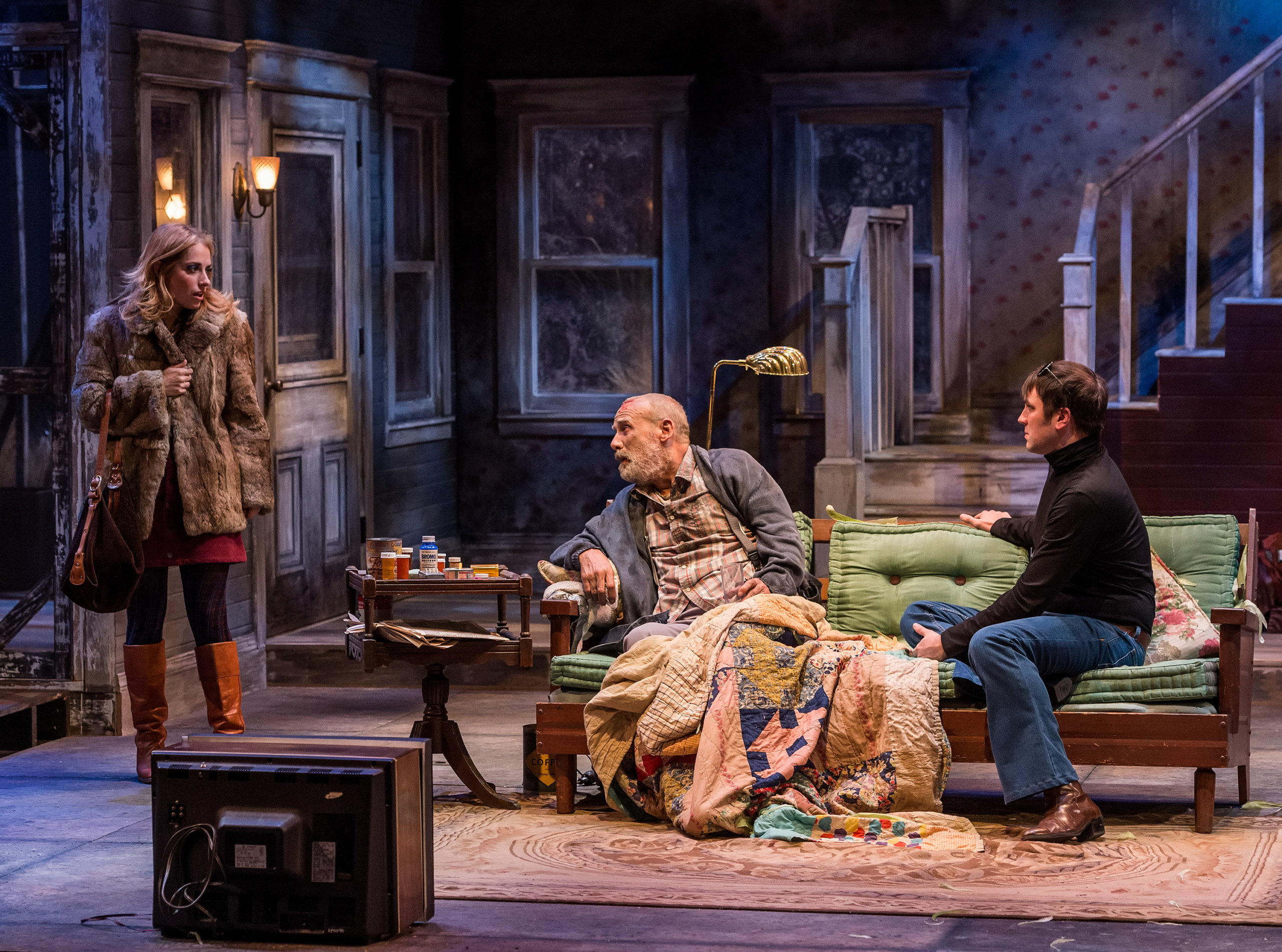
Shown left to right: Angela Gulner, Geoff Elliott, and Zach Kenney | Photo by Craig Schwartz / A Noise Within
Renowned American playwright, actor, and director Sam Shepard was born on November 5, 1943 at Fort Sheridan, a military base just outside of Chicago, Illinois. His father served in the United States Army Air Corps during World War II and continued to serve in the U. S. Air Force after the war. Shepard’s family moved all over the United States and to Guam before eventually settling in Duarte.
While Shepard was attending Duarte High School, he got interested in theatre and writing. And it was in Duarte where his Pulitzer Prize-winning play ‘Buried Child’ began to take shape. This hauntingly absurd play, which A Noise Within (ANW) first produced during their 1997-1998 season is back home once more.
On stage from October 13 through November 23, ‘Buried Child’ is directed by ANW’s Producing Artistic Director Julia Rodriguez-Elliott. It stars ANW’s Co-Producing Artistic Director Geoff Elliott as Dodge, Deborah Strang as Halie, Michael Manuel as Tilden, Frederick Stuart as Bradley, Zach Kenney as Vince, Angela Gulner as Shelly, and Apollo Dukakis as Father Dewis.
Shepard’s powerful masterpiece, set in America’s heartland, details with wry humor the disintegration of the American Dream. When 22-year old Vince unexpectedly shows up at the family farm with his girlfriend Shelly, no one recognizes him. The unraveling of family secrets that follows is a funny, albeit unsettling, look at disillusionment and morality, and how people address and cope with their family’s dysfunction.
Zach Kenney, who’s performing at ANW for the first time, sits down with me at the theatre’s lobby before rehearsal one afternoon. I start our conversation by asking if he’s familiar with Shepard’s play.
“I am very familiar with the play,” Kenney answers. “In fact, it premiered in 1978 in San Francisco – my home town – at the Magic Theatre where I took my first acting class. It’s over by fort Mason which is a beautiful part of the city. In my teenage years, I worked on several productions at the Magic, in association with my training at American Conservatory Theater and in the Young Conservatory. That Shepard debuted ‘Buried Child’ there was memorable for me.
“It’s a story about a family in the Midwest. Shepard himself grew up in Fort Sheridan in Illinois so he knows that feel. All great American playwrights, I think, are essentially asking, in one way or another, ‘What does it mean to be American?’ I think Shepard takes that a step further, he puts a finer point in it, in asking ‘What does it mean to be a part of the American family dynamic?’ So a lot of his plays are about family. This play is definitely so. He’s spoken to the fact that it’s semi-autobiographical in some sense. While it incorporates elements of absurdity and surrealism, it also integrates his relationship with his father and his place in the family. I play a character named Vince who, with his new girlfriend Shelly, is ostensibly from New York and is traveling all this way to try to pick up where he left off after leaving several years ago.”
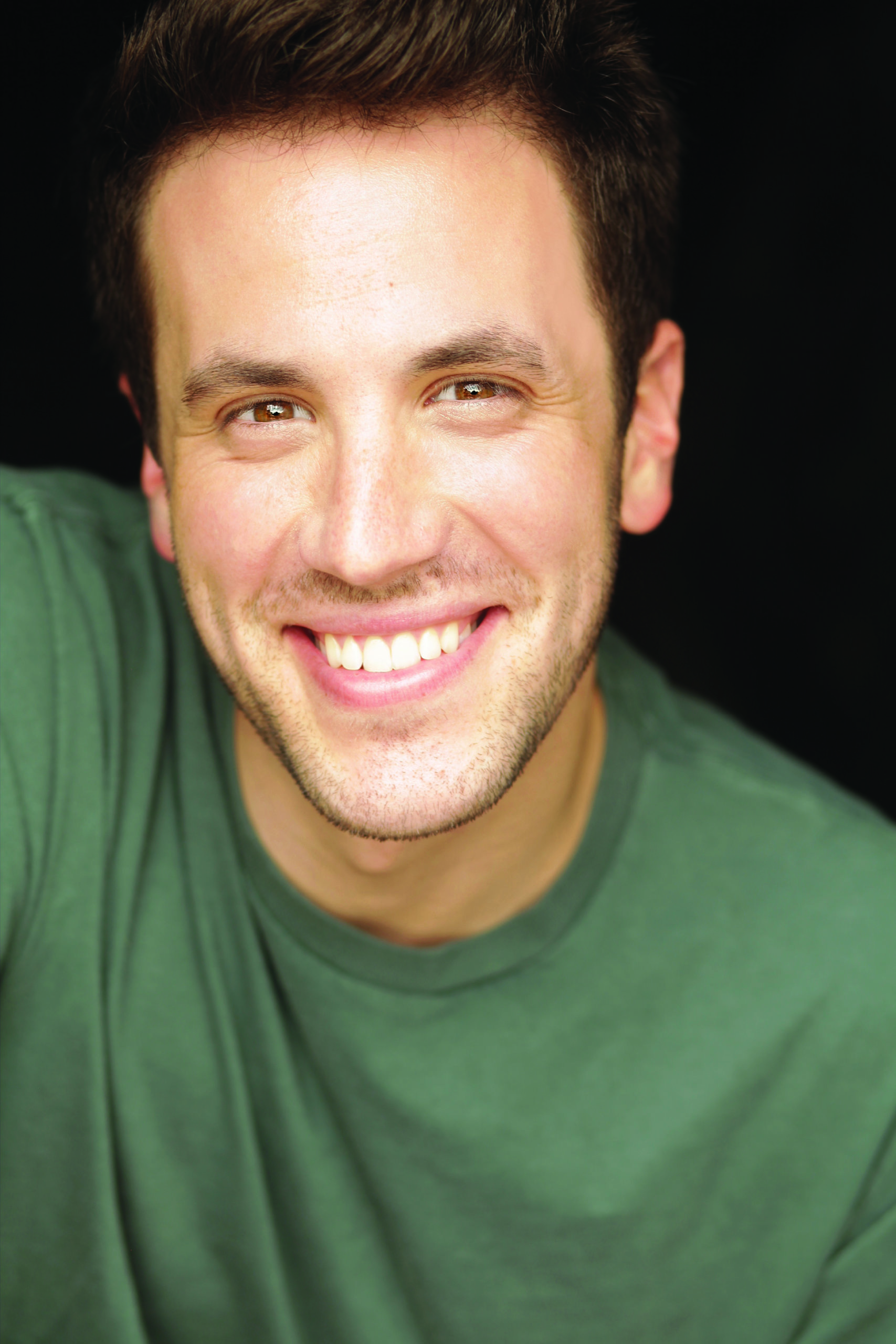
Kenney continues, “Shepard himself had gone away to New York – he was involved in the jazz music scene in New York in the 1970s. Then later in life, he tried to reconcile with his father, with whom he had a very complicated relationship. A lot of what he brought in writing this play was very personal. So I’ve tried to consider some of those elements in my own take on the piece. This is my first Shepard play and this undoubtedly is the play that I’ve always wanted to do. I think it’s one of the great roles for a young American actor to tackle. This role is funny – Shepard once said that the role of Vince has always been problematic for him. All the other characters are fragments – figments of the real thing. But the character of Vince is more true to who he was, it’s the real McCoy. And, like our acting teachers used to say, it’s hardest to play yourself. I think, in that way he had – I don’t want to put too fine a point on it – maybe a shyness about the character of Vince.
“But I don’t have that reticence of revealing myself. For me it’s exciting not only because of what the script has me say but also of what the script has me doing. Vince can’t figure out why no one recognizes him. It’s confusing and haunting but there are moments that are written in where, perhaps, there’s a glimmer of recognition between Vince and his father. That isn’t something that Shepard wrote a big speech about. It’s simply between two actors on stage mostly in silence. And that’s one of his real genius – he created these moments that are alive between actors. He knew it from different angles; having been a playwright, actor, and director himself, he was able to switch those lenses.”
Shepard didn’t really make clear Vince’s circumstances. Kenney describes, “He’s been away for about six years – we don’t really know why he went away and why he decided to make the trip back at this moment. He’s got a young beautiful girlfriend, so perhaps the ambitions of this relationship has brought him back. Those were all the juicy, fun things to figure out together in the room. But it’s not explicit in the play. Not to be hokey about it, but I think Vince, in a lot of ways, embodies the future of America. I think three years after the end of Vietnam and 40 years after the Dust Bowl era, Shepard was looking back on America – the ground we just tread. And he wanted to ask what’s the next generation gonna have? That rings true today, obviously, for the challenges, the changes, and the prospects of the American heartland. It’s self-seeing what’s around the bend in this modern era.”
Did Rodriguez-Elliott give specific directions to him in playing Vince? I query. Kenney replies, “I wouldn’t say she gave me any directions at the outset, in terms of her framework. She has a very generous way with actors – she knows a lot of these folks. Hearing her in the room, getting a feel for her style, wasn’t hard to do. She has a really great way of leading without constricting. ‘Buried Child’ has elements of surrealism, absurdity, metaphor, heightened imagery, and you have to explore those moments, and figure out what’s inside of them and what they’re all about. And that’s how I want to work as well – by playing the extremes; it’s always easier to reel it back in. She’s allowed me to really explore some of the bold moments in this play and take risks because, I think, in the end, that’s what Shepard’s works demand of the artists who tackle them. He said his favorite actors are adventurous, outrageous, willing to jump off the cliff. That’s the kind of attitude and approach you have to bring to this piece.
“Shepard also talked a lot about the rhythm of this play – about how it’s musical, almost like jazz where things are going at a very nice clip and then there’s a long pause, even silence. Reading his plays is fascinating – it’s a really well conducted orchestra and you can hear the rhythm very well in your head, in the text, as you’re reading the play. So having fidelity to that serves us well, because it earns some of those changes in pitch and timbre and melody.”
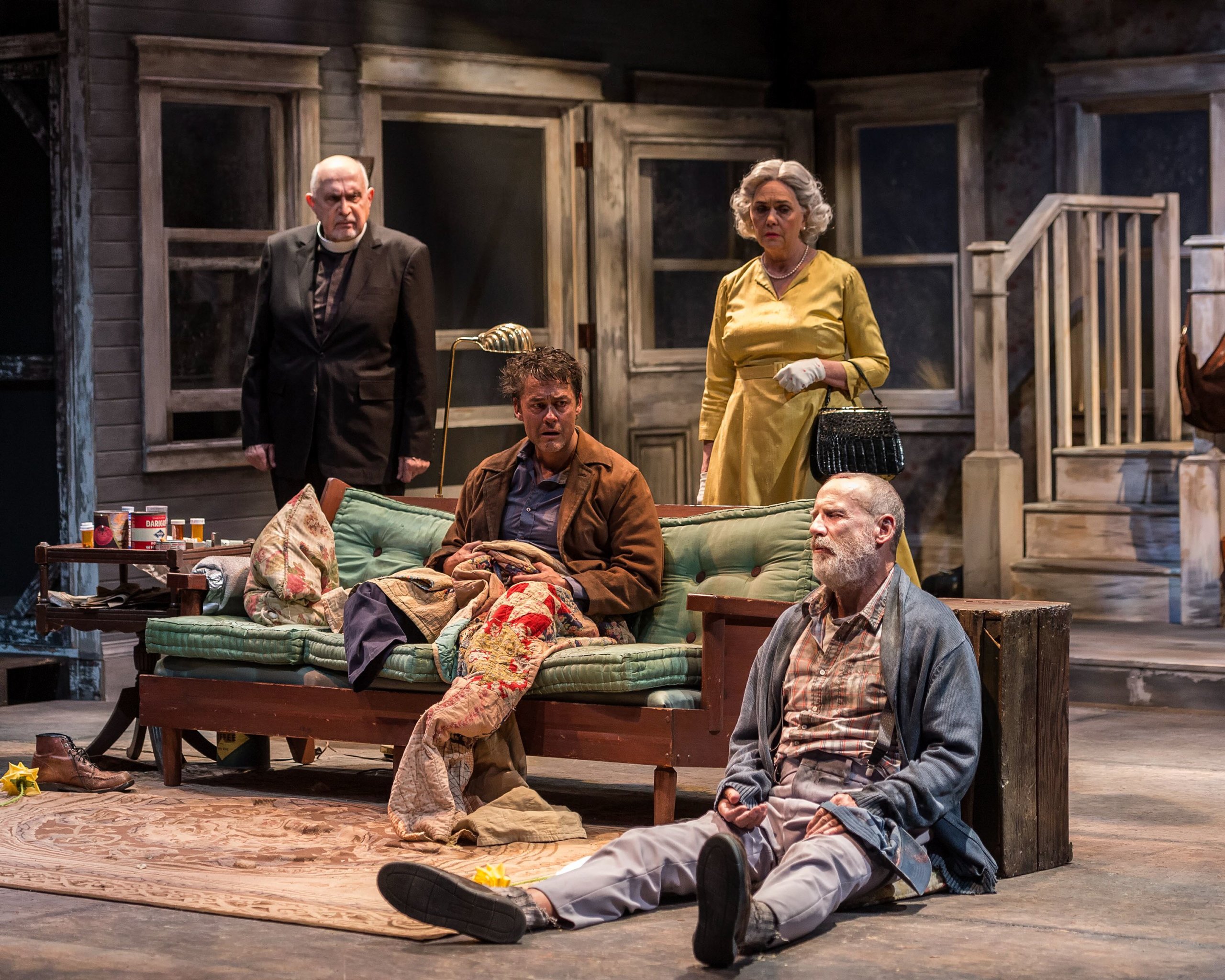
Kenney goes on to describe his process, “I like to do a lot of research on the playwright, the time period, all the dramaturgical elements. I wouldn’t normally do such an extensive research into the playwrights and their arc as much as I did with Shepard – he’s such an icon in the American theatre. With his recent passing, and knowing they had wanted to take up this play again for quite a long time, I really wanted to get inside his head and get to know him a bit more.
“Then I work up the script, break down scenes. I think about the words that are being used and why – I study the text and the language a lot. With this play there are lots of repetition of words and ideas by various characters at different parts of the play. And none in the sense that in your first seeing that might hit you, but after working on the play that can be really useful. Shepard’s so great at getting at the heart of the matter between characters’ relationships so studying the text, becoming an expert on the script can really feed into the rhythm and the power of where he’s trying to get you to go as an actor.”
I ask whether him having seen the play before helped or restricted. Kenney replies, “I wouldn’t go see it now if there was a neighboring production. I saw it when I was 16 – it was a long time ago. What I remember about it are some of the images, the stage pictures. But I don’t recall the line readings, how they said something. So my performance is all fresh and it’s my own take. More than anything, it just grew in me a deep admiration for the play. It was with me through my development as an actor – watching it as a teenager and going through college, then rereading this play and finding it again at this time in my life. I’m really excited to do this because I’ve held it in my heart for a while.”
Then I inquire if there were things he discovered as he delved into the play, which he didn’t know coming in. Kenney says, “There were several revelations that happened. Just in my general experience, a lot of actors don’t like to have too firm of a take on their first reading. And I’m in that school of thought – I want to be open to what the other actors bring into the experience before I set something. In the first couple of weeks, after I have some of that in my ear, I like to go back and spend a lot of time with the script to get a better understanding of what’s going on. I take a particular speech or dialogue exchange between the characters and, almost like a mantra, repeat that and ruminate – let that simmer for a while. Sometimes there’s a stream of consciousness that can give some revelations about what’s going on immediately prior to and subsequent to that exchange. It’s sort of seeing it at 35,000 feet and then doing a swan dive and just sort of really doing a big zoom on everything. Occasionally that helps you detach from little habits that can begin to develop that aren’t necessarily fruitful.
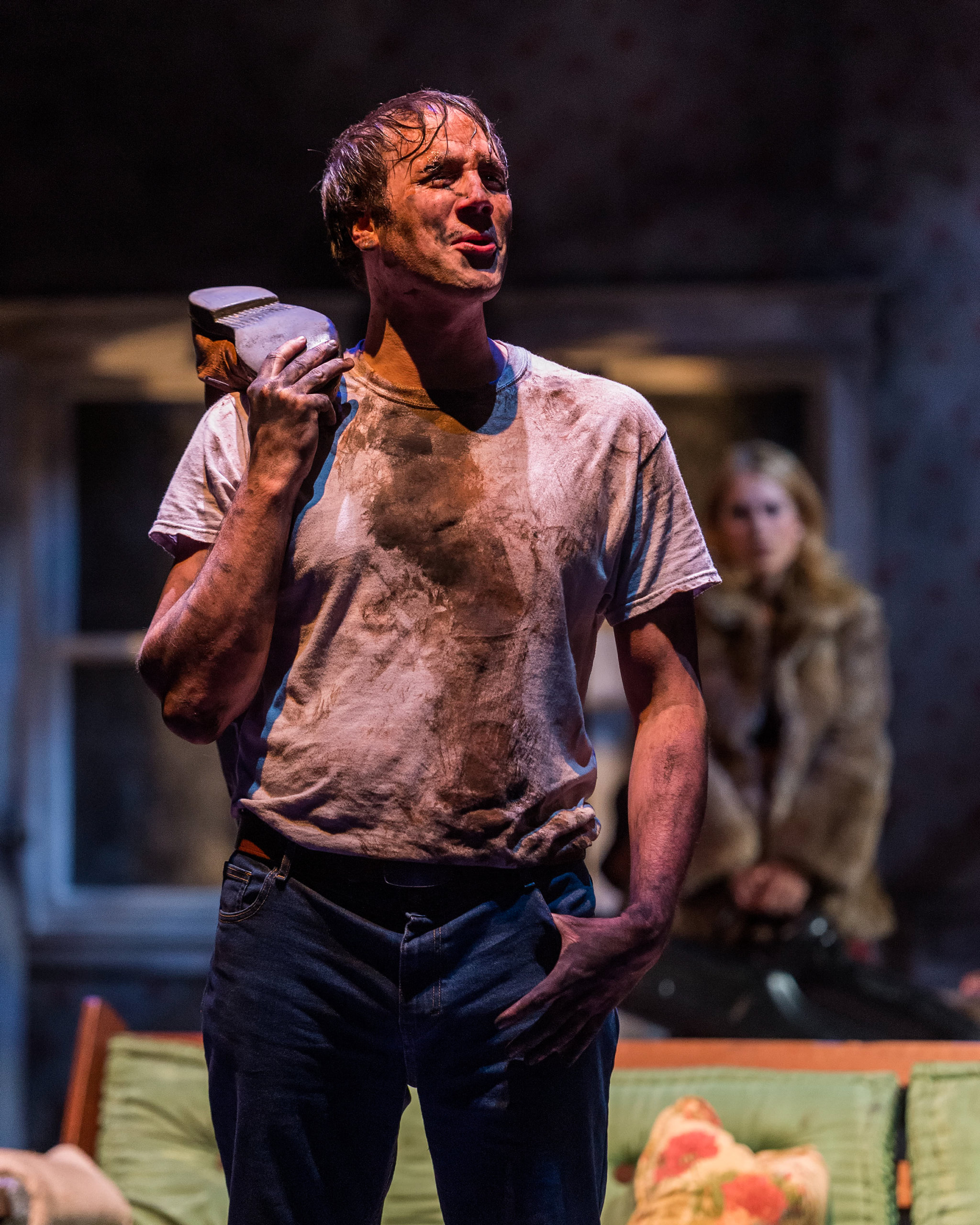
“Another thing that I would like to mention is, there’s this speech towards the end of the play that Vince delivers. Shelly, his girlfriend, asked ‘You disappeared. What happened last night?’ Vince went for a long drive, rain was coming down, and he saw himself in the windshield. As he was studying his face in the windshield, that image begins to change into what looks like his father’s face, and continues to change into his grandfather’s face. And it has a profound effect on Vince. I think it’s a beautiful image and the words are really impactful. And I asked myself, ‘What is Shepard saying about what Vince is going through at this moment? And I had a sort of epiphany – this is Vince’s vision quest. I have a deep admiration and affinity for Native American cultures. The idea of a vision quest – a young man going off to either a sacred ground or a place he was unfamiliar with at a point when he was maturing in the family line, having some sort of vision, and often returning and seeking the advice of people back home about what it meant. It has an effect on bringing that person into the family fold. That idea had a big impression on me in terms of inspiring what that journey – that moment – was all about for Vince.
“Shepard liked to discuss the idea of ancestors, heritage, and family line. At one time, he wrote about looking at pictures of some of his relatives from the 1800s – the bone structure and elements of the face were all the same. Even though he presumably never knew these people, he’s inextricably connected to them. That line is inescapable, for better or worse. Again, going back to what I said before about a lot of his work being about the American family unit, that epiphany served me in the rehearsal period.”
Kenney adds, “One other thing I didn’t know when I started this, is that this play was written in neighboring Duarte – which is just a stone’s throw away. He said he wrote it in a trailer at the old ranch house that his family had – it was like an avocado farm or ranch. That was a really cool thing for me. When our audiences come out to see it here, and the lights come up on stage, they’re doing so under the very same sky and landscape as those which Shepard wrote it. That connection of place and history and time, there’s a bond there that will make our audiences, in some way, family. Personally, that’s been the thrill for me about making the drive to Pasadena – seeing this beautiful landscape and thinking of Shepard up in the hills, writing this play.”
Some plays have lessons that the audience can take way. Asked if there’s any in this play, Kenney answers, “There’s much to consider on the drive home from this play as there is during it. This is a play that comes at you in this vivid surge and, not to presuppose, I think on first seeing it when you walk away certainly Shepard would want you to still be considering what questions they were asking of themselves and of each other. This isn’t a play that wraps everything up neatly with a bow, which you digest during the viewing and you take away a couple of little savory nuggets. I think this is a play that works on you over time and that’s one of the masterful things about what he’s created. Again, I think it’s one of the reasons why it won a Pulitzer and why it gets produced as often as it does. One of the impacts it’s had on me is listening from all sides. Every character in this play has strong needs and comes from a very disparate place in their personal journey. And, somehow, they come together and those things get worked out in an interesting way.
“Let me also point out that Shepard claimed he never wanted to leave things nice and neat. He said, ‘As soon as people see my work and feel that they get it or know exactly what it’s all about, that sort of kills it. That weakens it in a way.’ I think one of the many great things he’s crafted is an ending full of possibility but not devoid of everything we just saw. I think there’s hope, but there’s also change and revelation from the characters. Shepard has put together this group of people and starts them at one place, something happens in the middle, and by the end they’re changed. It could only be that way. It’s inevitable. The way in which he gets us there, that’s the awesome thing about this piece. This play doesn’t end as much as it lands in a different place than where it began.”


 A San Gabriel Valley Inquirer