‘Homecare by Tonality’ Concert at Caltech Looks at the Climate Crisis

Also published on 8 November 2024 on Hey SoCal
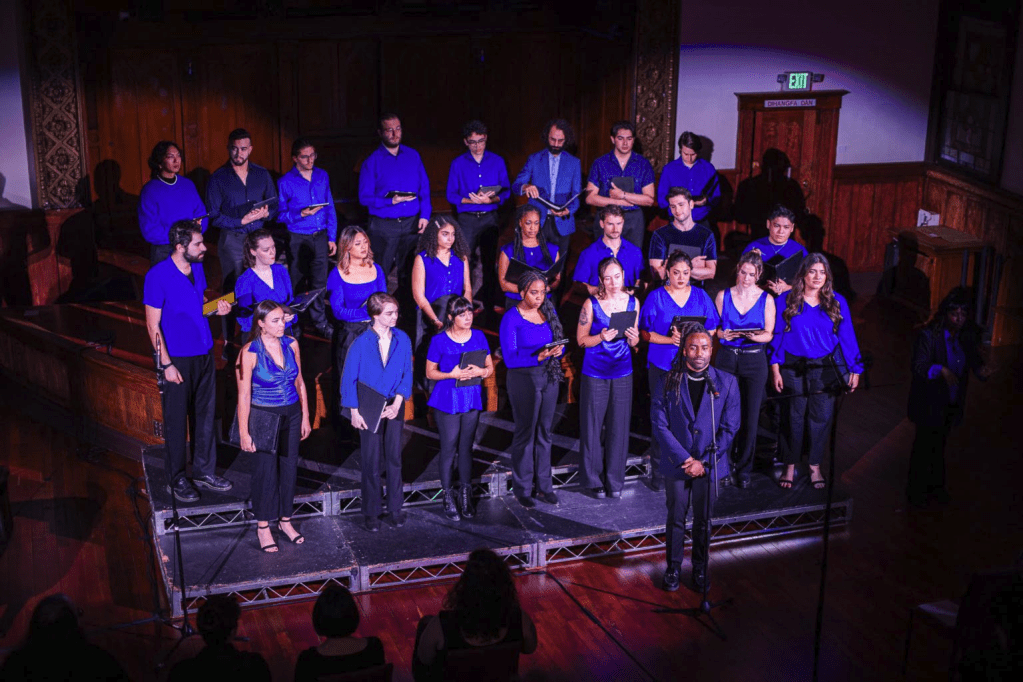
Caltech presents the Grammy Award-winning vocal ensemble Tonality with a program called HomeCare on Saturday, November 16, 2024, at 8:00 pm at Beckman Auditorium. Part of Getty’s PST ART: Art & Science Collide, the performance is one of Caltech’s PST ART Opening Doors series.

Known for creating choral concerts that shine a light on issues rarely presented in choral music, Tonality strives to deliver authentic stories through voice and body to incite change, understanding, and dialogue. Under the direction of Tonality founder Alexander Blake, HomeCare will focus on the climate crisis through the words of young leaders who have spoken about the urgency of taking care of our home planet and conserving the resources available on earth.          

Blake discloses that he conceived Tonality because he didn’t see himself represented in the field of classical music. He says, “Growing up in North Carolina, I sang in gospel choirs and started taking classes in classical music. I realized that I was oftentimes the only person of color in those endeavors so I set out to change that. In 2016 we put out a very intentional call for musicians of color who are trained in classical music, saying we wanted to create a choir that reflected our community here in Los Angeles and globally.”
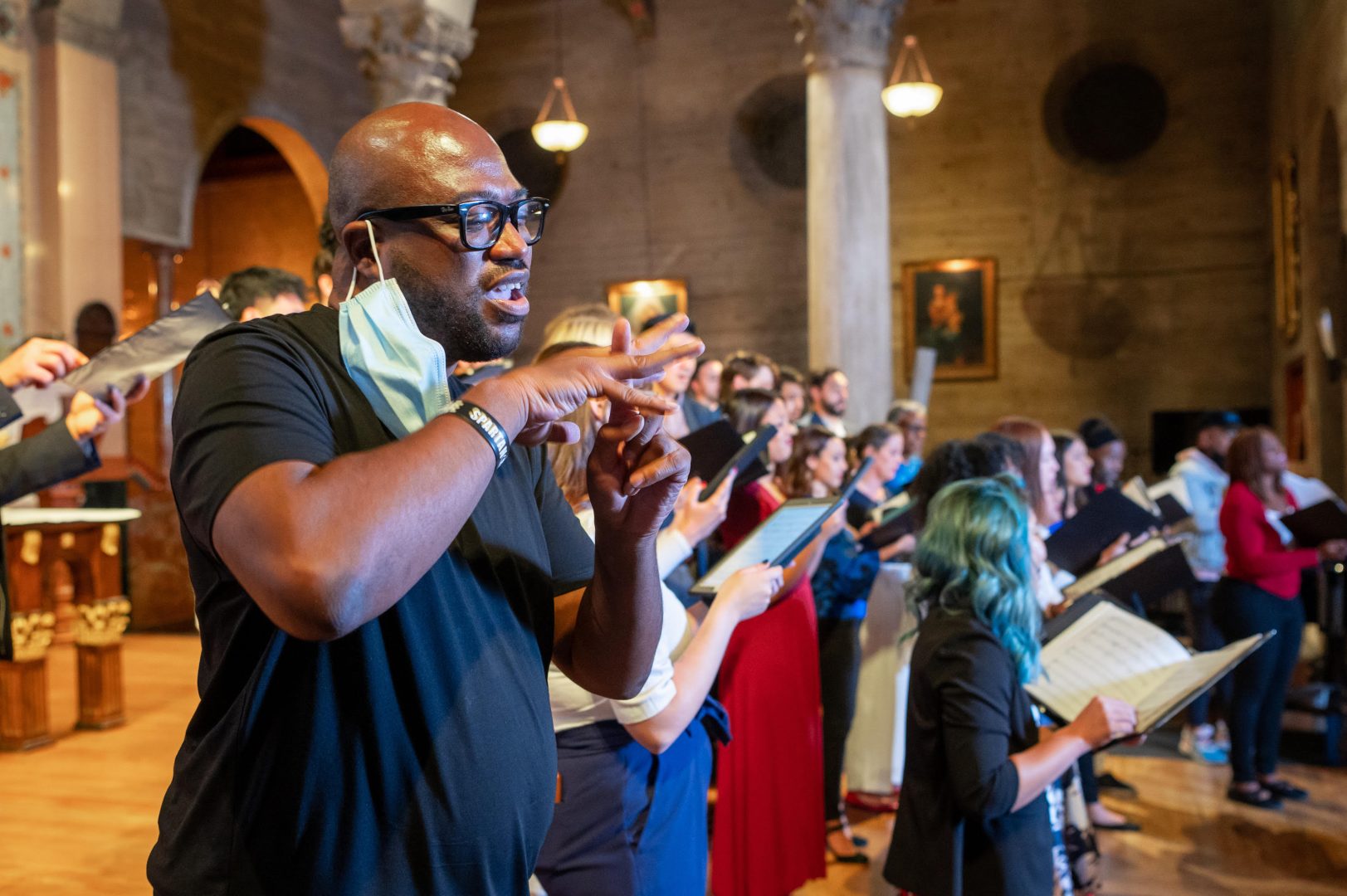
Tonality rehearses at St. John’s Episcopal Cathedral, Oct. 8, 2021 | Photo/Michael Owen Baker / Courtesy of Tonality

Tonality’s ensemble is comprised of 24 singers for its L.A. concerts and 16 on tour. But because availability changes, the ensemble has a wide roster of over 70 singers to provide opportunities for as many musicians as possible. They represent various cultures and ethnicities, including African American, Chinese/Korean, Filipino/Mix, Indian, Egyptian/Puerto Rican, Indigenous American, Mexican, Dutch/German, French/Armenian, Syrian/Native American/White, Japanese/Hispanic/White, etc. A majority of the singers are professional vocalists who sing in multiple ensembles with various artistic duties. Most of them are full-time musicians and a small number have full-time jobs outside of music

Under Blake’s leadership as conductor and artistic and executive director, Tonality had its first rehearsal in June of 2016. “We did one concert in 2016 and they asked us to do it again,” he states. “Then we started to produce our own concert – we found the rehearsal space and venue – until eventually we started getting calls.”

Within a year of its founding, Tonality’s mission evolved to use their collective voices to present concerts on themes of social justice with the hope of catalyzing empathy and community activism. Tonality received the 2020 Chorus America/ASCAP Award for Adventurous Programming, a prize given for commitment to singing and commissioning new works.
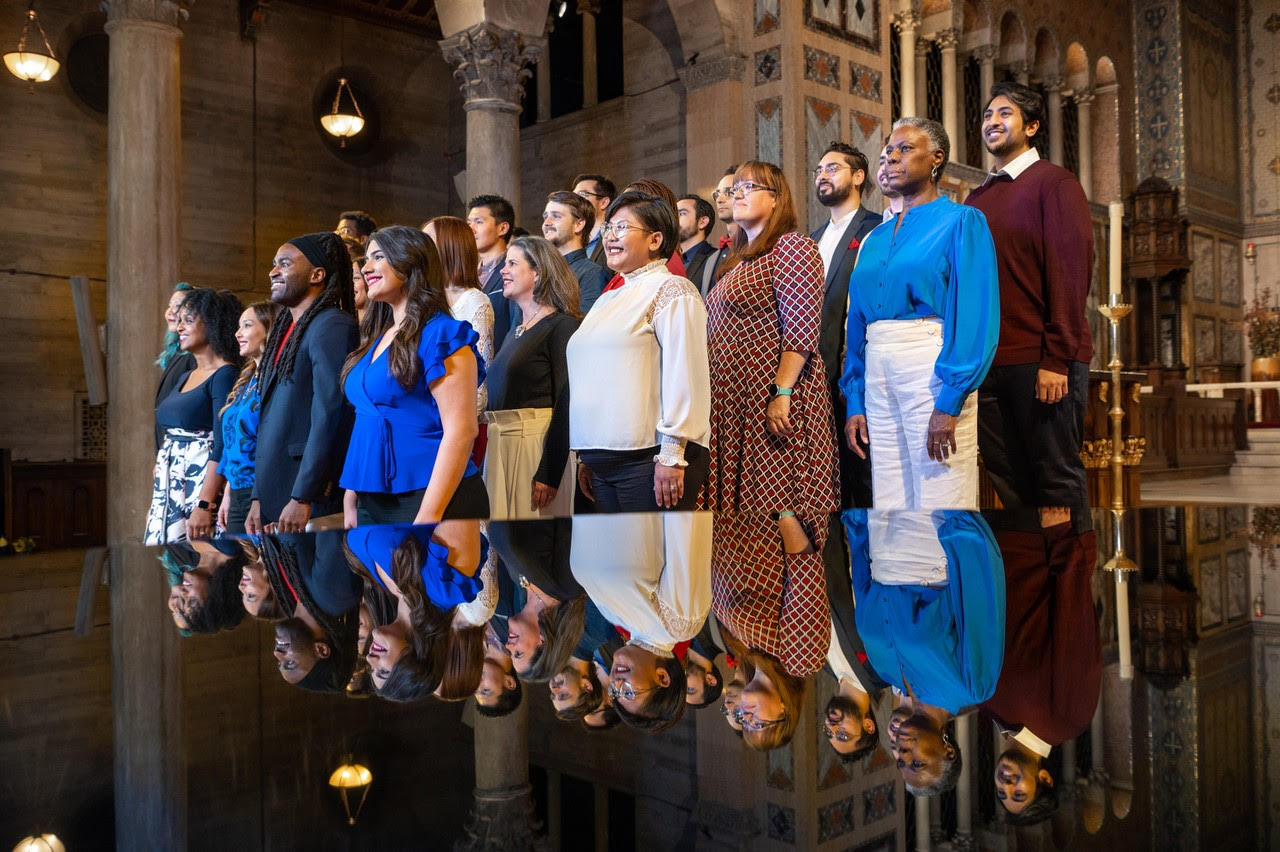
Photo courtesy of Tonality

“It was an acknowledgment of the kind of music which is rarely performed at the level and consistency we’re doing it in a classical genre,” explains Blake. “Choirs sometimes do shows that have a focus on an issue but to continually create, support, and promote music about social justice issues and working with diverse composers with diverse styles to present these topics was what was recognized by the ASCAP award.”

“The award came with cash, half of which we donated to the Black Lives Matter movement,” Blake adds. “But to me what it symbolized was the opportunity for more choirs to lean in, to use art to speak about topics that matter. It really opened up conversations about how musicians can produce concerts around justice issues and also how the choral culture can be more diverse and equitable. I think for us the biggest change is being able to perform these pieces and creating more opportunities for composers to talk about issues through their art.”

Tonality has been touring since its inception, but the first big tour opportunity came about in 2022. Recalls Blake, “We received an email from Bjork, who was looking for choirs in L.A. who were involved in social issues. She got recommendations from people who’d seen our show. Our work aligned with what she was doing and she asked us to perform with her. So we did two concerts with her in Los Angeles and three in San Francisco.”

Photo courtesy of Tonality

For the Caltech concert, Tonality will be performing a repeat of what they did in 2018.

“Most of the pieces that we did in the 2018 concert were premiered at that event,” declares Blake. “Joseph Trapanese’s ‘New Collective Consciousness’ was a piece that we premiered. ‘Earth Song,’ which was arranged by Nathan Heldman with words and music by Michael Jackson, premiered at our concert. There are a number of pieces that we were able to bring about.”

“While a lot of our music is a capella, for HomeCare we’ll have a piano for a couple of songs then we have a guitar and percussion,” Blake clarifies. “There will also be solo as well as ensemble pieces – the music genres include classical, pop, R&B, Hindustani, and various other styles.”

Describes Blake, “The format of our concerts is storytelling and the music is there to help people connect emotionally to the issue. We also work with experts and organizations to make sure people know how to get involved. We’ll be joined by a number of guests, including Dr. Lucy Jones who focused her research on how climate change will be more disastrous for earthquakes.”

HomeCare will open with Woody Guthrie “This Land is Your Land” and close with Michael Jackson’s “Earth Song.” The concert also includes music by Gaayatri Kaundinya, Luke Wallace, Christopher O’Brien, Francisco F. Feliciano, Joseph Trapanese and Carlos Fernando Lopez composing to a text of Gabriel Garcia Marquez. Tickets are available at pst.caltech.edu/events/opening-d
Join Pasadena Artist Jim Barry on ‘An Art Walk on the Silk Road’

Originally published on 17 March 2023 on Hey SoCal

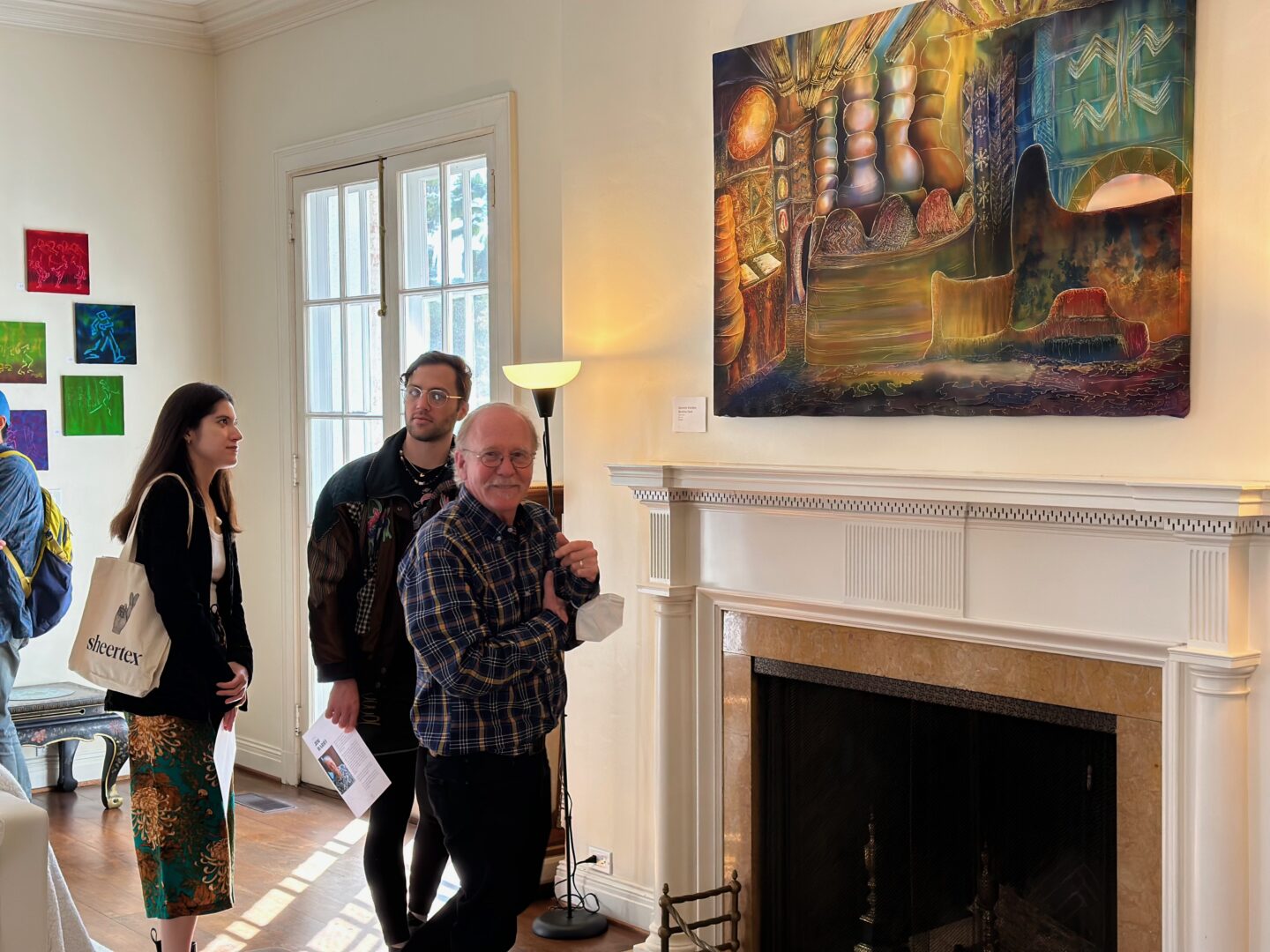
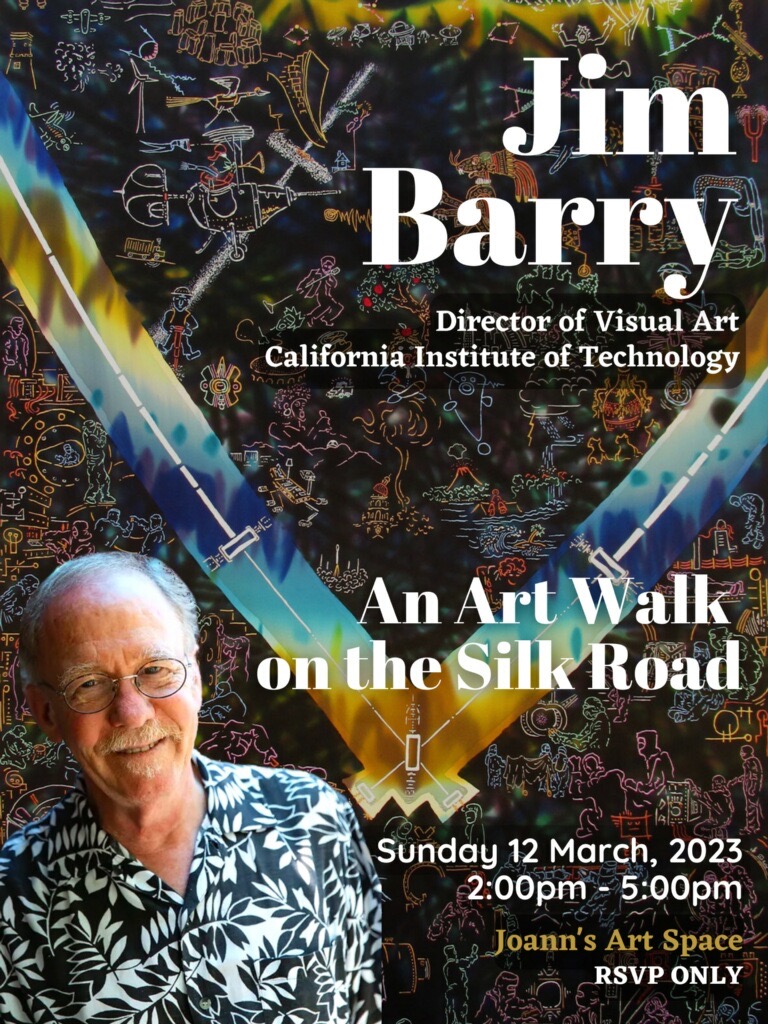
On March 12, Joann’s Art Space at 1745 Orlando Rd. in San Marino opened a solo exhibition featuring the artwork of Jim Barry, the Visual Art Director at California Institute of Technology (Caltech). His pieces are available for purchase and can be viewed by appointment only until April 11, 2023, by calling (626) 999-1777.

The invitation to Barry’s solo exhibition | Photo courtesy of Joann’s Art Space

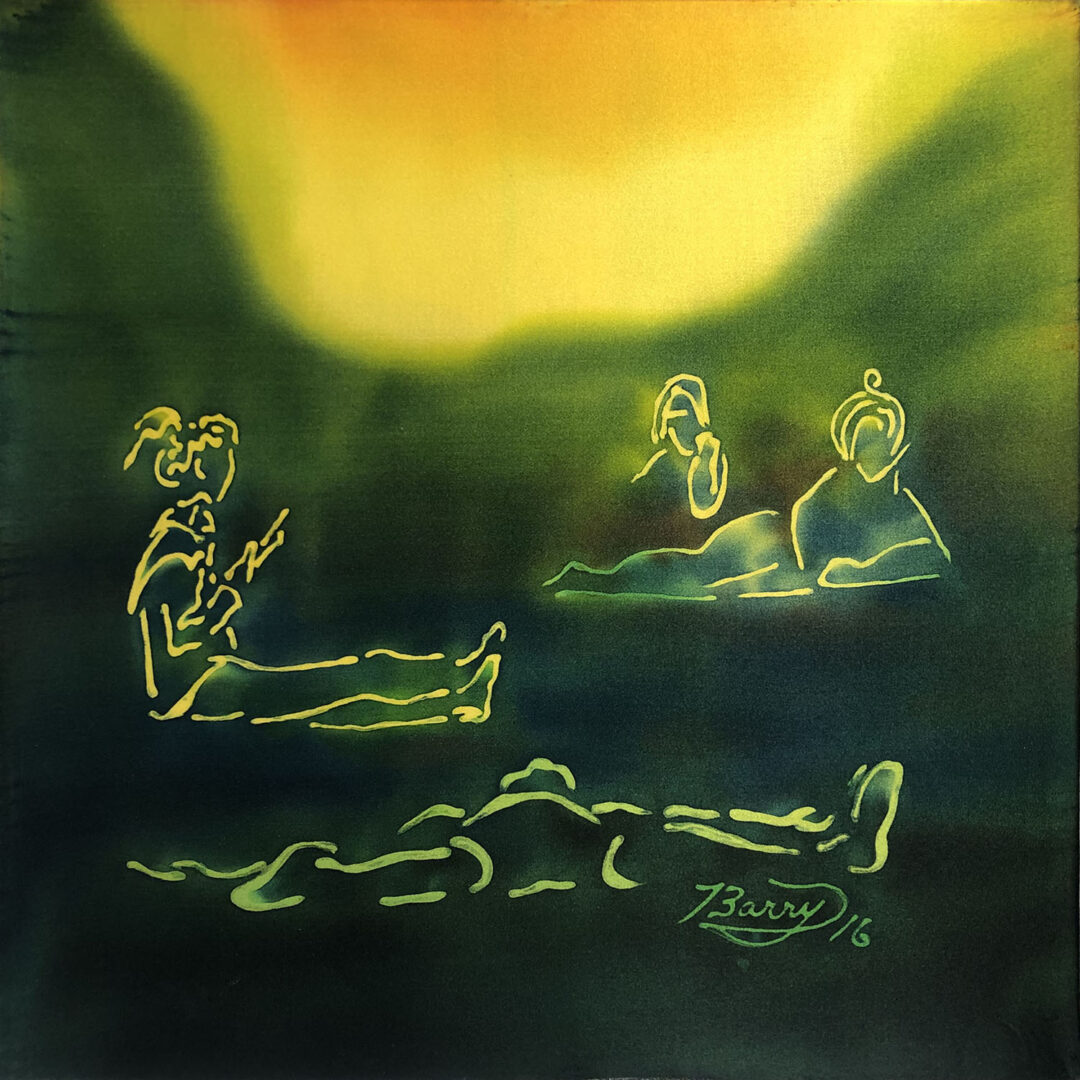
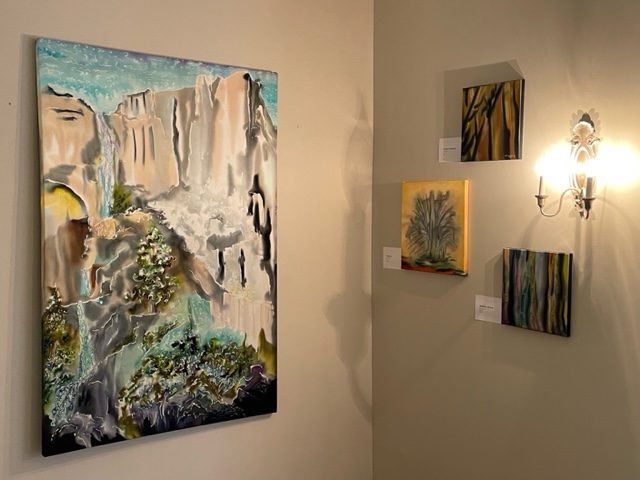
Called “An Art Walk on the Silk Road,” the exhibition features 79 silk paintings divided by themes: Science, Dance, Landscape, and Africa. In the landscapes are a number of pieces of Chinese scholar, viewing stones, and bonsai or pénjǐng.

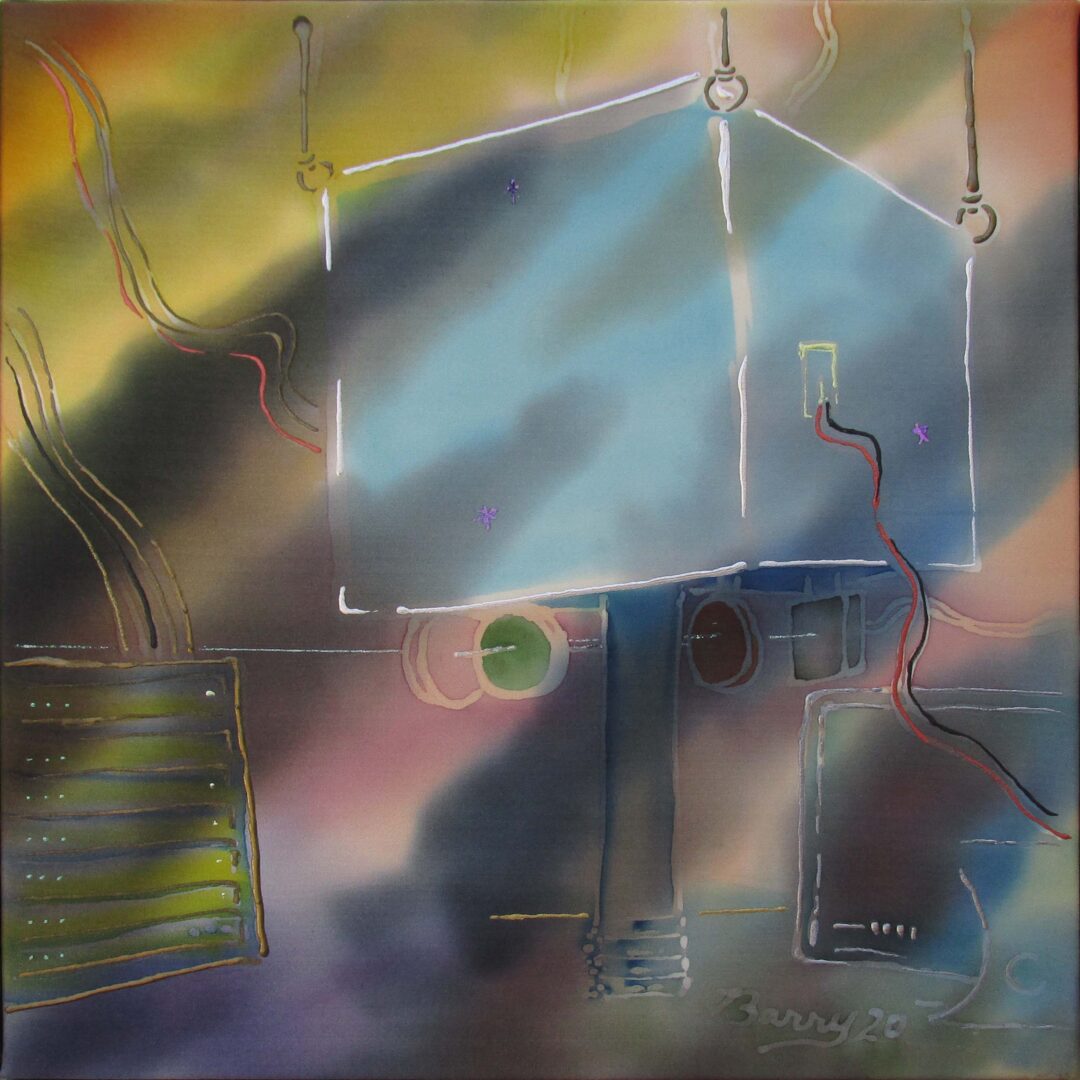
In Science, he shows “Scientist’s Dream” a desktop room temperature detector for dark matter. It uses an interferometer for calibration and gas inside a chamber. Detection of dark matter is evident by the purple sparks in the chamber. This dream is just that, though — far beyond today’s technology.

‘Scientist’s Dream’ | Photo by Sean Yang / Joann’s Art Space

The poster features the LIGO project for detecting black hole collisions, a depiction of project teams, noise the machine needs to filter, and the global human history of observatories with examples from China, Korea, England, Egypt, Peru, etc.

The dance pictures feature hip-hop dancers Barry sketched while they developed their routines.

A long time Caltech academic, Barry has been teaching classes at Caltech since 1987 – the year students changed the Hollywood sign to read ‘Caltech’ for a day. His courses include Silk Painting, some Silkscreen, and Drawing and Painting with Figure Drawing. He has also been instrumental in creating new virtual reality tools and interactive spaces with Santiago Lombeyda at the Center for Data-Driven Discovery (CDDD).

Because his grandmother was a painter, visual art had been his passion at an early age. He didn’t think of it seriously as a future career, however, and instead, he pursued a Bachelor’s degree that related to his interest in African life and culture. He received BA degrees in Cultural Anthropology, focusing on Africa and Black Studies with an emphasis on Race Relations, from the University of California Santa Barbara.

‘Resting Dancers’ | Photo by Sean Yang / Joann’s Art Space

Graciously agreeing to be interviewed by email and phone, Barry answers questions about how painting and teaching became his twin vocations. He relates, “I decided to go to West Africa after college. I was already interested in African life and culture; being able to explore many areas deepened my knowledge and led to more specific destinations such as Oualata, Mauritania, and the Dogon Country in Mali. I applied to graduate school to study Sociology at the University of Ibadan and I was accepted two years later, but had problems getting a visa.”

Barry continues, “So I went to Senegal. I arrived during an important ‘flowering’ of modern Senegalese painting driven in part by the President, Leopold Senghor, who was a well-known writer and poet. I met Senegalese artists and found my chosen medium, batik on cotton, was sought after but not well established. I shared a studio with the artist/painter, Aissa Dione — who’s now a textile artist — on the island of Goréé. My art started to sell and I traveled out to other countries putting up exhibits, leaving them to travel to small villages and interesting historic cultural centers often in remote areas.”

“That was what I’ve always wanted to do and I abandoned my plan to attend graduate school,” Barry discloses. “I remained in Senegal for four months, then spent two months in Gambia working in a batik cooperative, Gena Bess. I returned to Dakar for the larger Senegalese art community and market. After some time I began further travels to Mauritania and Mali and did shows with the cooperation of French and American cultural centers. The work I showed included Batik, Etchings, Watercolors, and pencil sketches.”

“Due to my interest in Anthropology, I learned greetings in the different languages I encountered. It was easy to make friends while I was traveling alone on public transportation. People far into the countryside respected the occupation of an artist and it was not unusual to get good advice from people who might have never entered a museum,” says Barry.

Jim Barry explains ‘Gurunsi Kitchen’ | Photo by Sean Yang / Joann’s Art Space

In 1981 Barry returned to the United States, and while visiting the Armory Center for the Arts he was invited to teach there. “It went really well; I was apparently good at teaching!” he marvels. “That eventually led to a job at Polytechnic School (Caltech’s sister school) a few years later, teaching a Perspective course for sixth graders. Then Caltech conducted a search for a teacher when the institution was seeking to reintroduce its Visual Art program after a long hiatus and I got the part-time job while still working as a teacher at Poly.”

While he held two teaching posts, though, he continued to paint. He held several exhibitions during return trips to West Africa.

Barry started silk painting after three decades of doing batik. “I refined and invented so many techniques that everything became highly complex. I felt I had painted myself into a corner,” he jokes.

“At an international Batik Conference in Boston, I was introduced to silk painting from Japan at a level I could appreciate and learn from,” Barry explains. “By transitioning I left behind the more toxic chemicals I had been working with on cotton since Africa. My silk painting has little in common with traditional Chinese artwork in that dye thickeners are not used. In many cases, it is closer to wet-on-wet watercolor but can be scaled larger.”

Large and small paintings at the exhibition | Photo by Sean Yang / Joann’s Art Space

Asked to describe his process, Barry replies, “Some pictures start with sketches from my daily sketchbook, transition to more drawings, then quick watercolors in preparation for a final large piece. Others begin with a color abstract that gets drawn into with the gutta resist (like wax), then more color, more gutta, etc., until I have achieved my goal or occasionally give up. There is no erasure in silk painting.”

“I like to paint and design both in the studio and in plein air,” explains Barry. “Taking photographs is rarely helpful to me. I will take them for information, but they are seldom used.” As to his painting style, he says, “I prefer to get my lines ‘right’ but enjoy playing with color. I rarely paint a blue sky in that it conveys no emotion.”

Gurunsi Backyard | Photo by Sean Yang / Joann’s Art Space

All of Barry’s paintings are done for the purpose of selling them and he doesn’t have a favorite painting that he never plans to sell.

Barry divulges, “While in Dakar, I had a complex painting of a flying turtle over Africa inspired by a mask statue. I made hand-colored etchings of it and tried to keep the original. Someone bought one of the etchings, and when I mentioned that I had the batik, he wanted that. I insisted it was not for sale; if it were, the price would be a certain multiple of the etching. Though he still wanted it at that, I would not sell. Later in the day, he returned saying he would make it ‘hard on me’ and offered me double. I sold it immediately! Then I asked what he did. It turns out he helps install airports in Africa.”

For someone who has neither a degree in painting nor teaching, Barry has definitely succeeded in both endeavors. And no matter how having a full-time job keeps him busy most days, he always finds the opportunity and time for his passion. As he pronounces, “Perhaps it’s an obsession. Painting is like a sport; one learns mostly by practicing and thinking about it on the field.” Spoken like a philosopher too.

Connecting with the Irish Through Their Music

Originally published on 6 March 2020 in the Pasadena Independent, Arcadia Weekly, and Monrovia Weekly. The show, however, was canceled because Gov. Gavin Newsom ordered a statewide lockdown that lasted about 18 months.

This image has an empty alt attribute; its file name is Eileen-Ivers-2.jpg
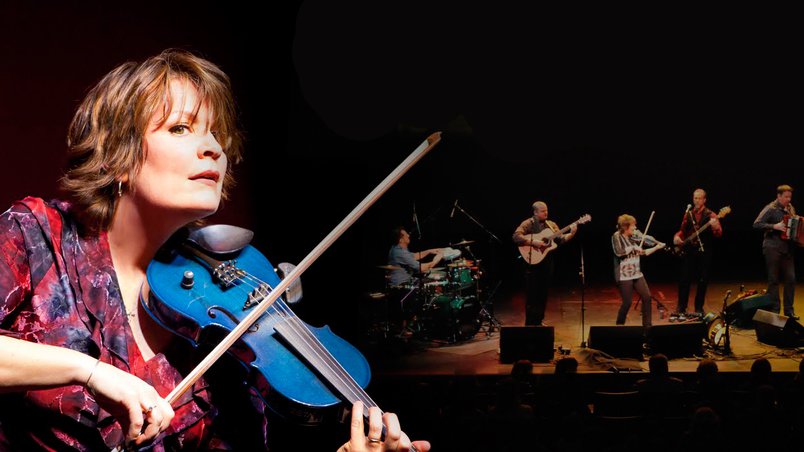
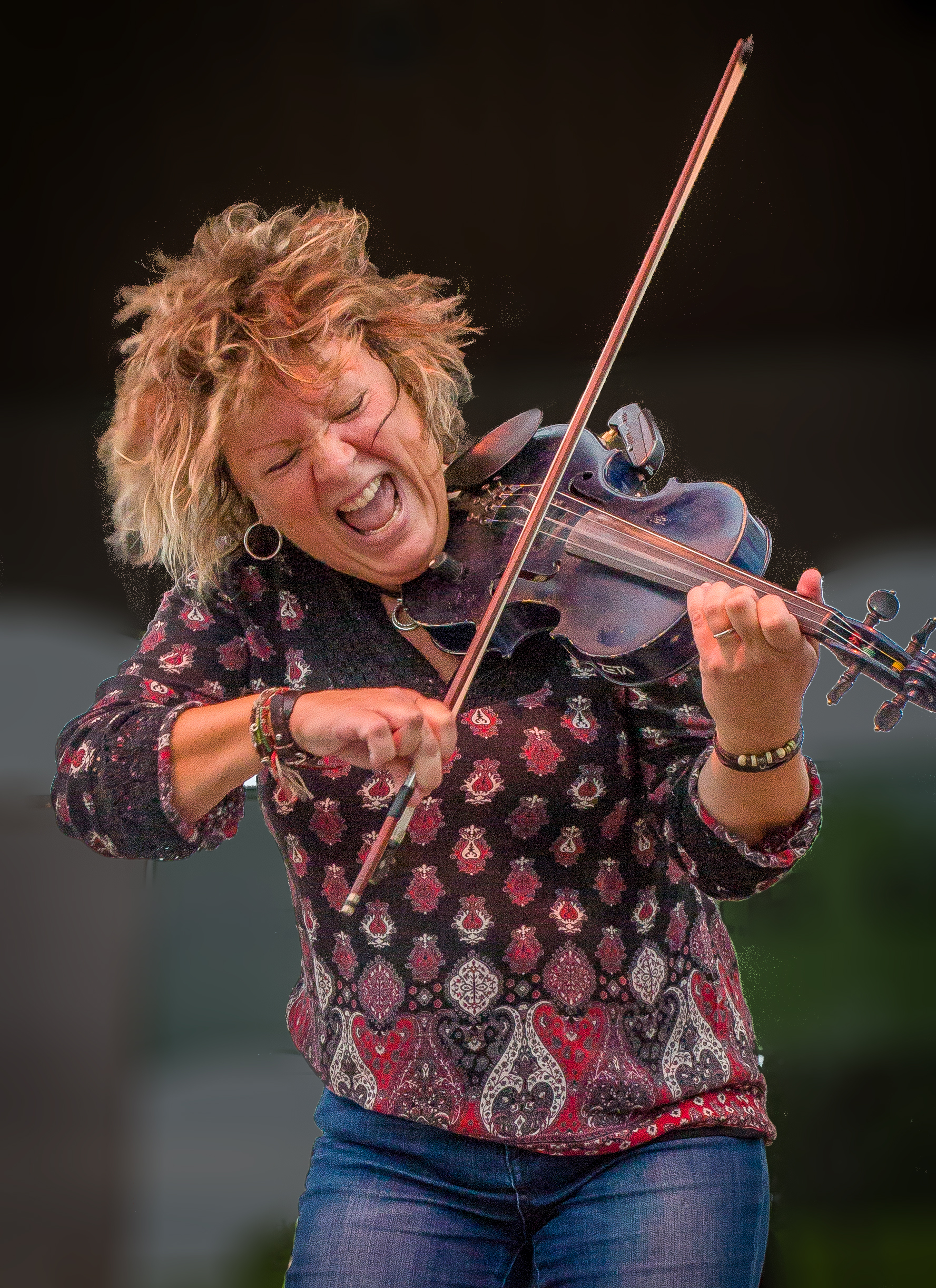
Eileen Ivers is Grammy-winning violinist | Courtesy Photo / Eileen Ivers

Connect with the Irish experience with internationally acclaimed fiddler Eileen Ivers and UnIVERSal Roots at Caltech’s Beckman Auditorium on Sunday, March 15, 2020 at 3:00 pm. As in all their previous shows, expect them to bring the audience to its feet with their electrifying  performance which evokes the Irish journey through the years.

The daughter of Irish immigrants, Ivers grew up in New York’s Bronx neighborhood. She picked up the fiddle at the age of eight and went on to win nine all-Ireland fiddle championships, a 10th on tenor banjo, and over 30 championship medals, making her one of the most awarded persons ever to compete in these prestigious competitions.

Having gone on a short visit to Dublin and written about my delightful trip (Visiting Dublin, Ireland), I was very excited to learn that an Irish musical show will be coming to Pasadena. You can just imagine my thrill when I got the chance to talk with Ivers, hailed by the New York Times as ‘the Jimi Hendrix of the violin.’    

‘The Jimi Hendrix of the Violin’ | Courtesy Photo / Eileen Ivers

Speaking with me by phone from New York, Ivers chats about her childhood interest in the fiddle, having a math degree, traveling all over the world, an upcoming new album, and a surprising new venture as a fiddle-playing tour guide.

I begin by telling her that I Googled her and found out she summered in Ireland and played the violin at the age of nine. I ask if her parents are musical. Ivers replies, “Not really, they grew up in rural Ireland so there was no chance of learning it where they were. But going back in the family history, there was music on both sides. Then again, anybody Irish has some music in them as well.

“Even at the age of three, I was going around our Bronx apartment playing a little plastic guitar and a wooden spoon pretending I was in Ireland. Then I asked my mom if they would rent a violin for me. I started playing and I took to the instrument immediately. I loved the sound and the emotion it conveyed – it could be fast and rhythmic, but even at that early age I understood that there was also something lonesome that could be coming out of the instrument.

“In the show you’ll hear tunes that will evoke heartbreak and loss that happen in any folk culture. The band and I, of course, will pull from the Irish experience and play some tunes in the traditional way. Through our music, we tell the amazing story of immigrants, like my parents and many before them, who had to leave Ireland and came to this part of the world – America and Canada – and elsewhere. They brought their music, songs, dance, stories, and even their language with them. And their art form integrated with other music along the way; it really helped birth a lot of Americana music. We like to show the threads and parallels between Celtic and American roots music in our performance and connect all those styles – bluegrass to country and French-Canadian to Cajun.”

While Ivers has made a fulfilling career in music, she holds degrees in mathematics. She discloses, “I attended Iona College and I studied mathematics. Although I kept playing music throughout my studies and started to find a passion in the musical field, I loved the discipline of math dearly. It’s kind of funny because we’re playing at Caltech and I always had a secret dream of being an aeronautical engineer and one day working for NASA in some capacity. However, music pulled at my heart and away from the sciences in a good way, many marvelous things have come out of that.

“I still have a great relationship with the college. In May of 2019 my alma mater conferred upon me an honorary Doctorate of Art degree for what I’ve done in the field of music – bringing people together through the stories and the music in our live concerts and through my records. I had the privilege of giving the commencement speech at the graduation as well. It was such a full circle moment. In early April, Iona College is giving me an award as a ‘Woman of Achievement 2020.’”

Knowing that many children of immigrants go into the math and science fields at the behest of their parents, I ask Ivers if she took math as a back-up in case the music didn’t take off. She responds, “My Irish parents didn’t have the opportunity to pursue higher education – they had to quit school and worked in the fields in Scotland and England to send money back home to help raise their siblings. They were very young when they came to America, my mom was only 18, and they gently made sure my sister and I had the chance of higher education because it was so important that we had this opportunity to advance ourselves as much as we could in America.

“Iona offered me a full scholarship and I worked very hard. A wonderful professor I had told me, ‘Eileen, get a Master’s degree because you could go anywhere with a math background.’ I think that was one of the best advice I’d been given. People ask me if I pull from my math background and I say ‘Absolutely!’ There are many connections between math and music in writing, arranging, or recording. In my education outreach program, I always tell kids to have a balance of academics, arts, and physical activity in life.”

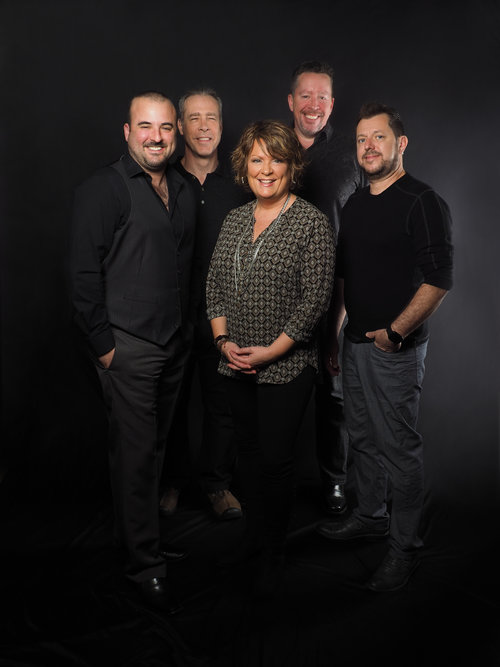
Eileen Ivers and her band | Courtesy Photo / Eileen Ivers

Continues Ivers, “We’ve played at Caltech before and to come back is something we’re really looking forward to. And we’re excited because we’re releasing a brand-new record called ‘Scatter the Light’ which will come out two days before the Caltech show. This is a big deal for us!

“My band and I have been playing all over the world in performing arts centers, symphonies, etc. I formed it at the end of 1999 right after I was in River Dance, the blockbuster dance show which, to this, day is still being performed. The members of the band are: Matt Mancuso, our lead singer, guitarist, fiddler, and trumpeter; Buddy Connolly, who is a three-time champion of the button accordion, a very Irish instrument, plays it and the keyboards and does some background vocals; Lindsey Horner plays electric bass and baritone sax; Dave Barckow, is on percussion and acoustic guitar and also does lead vocals; I play fiddle, mandolin, and an Irish frame drum called bodhran, it’s a Gaelic word and is very much a part of Irish traditional music. There’s quite a range of instruments and songs and we invite participation. We love to break down that fourth wall and get the audience involved in the show.

“People attending our show hear tunes from hundreds of years back – some heartbreaking airs and cathartic laments that are part of the Irish mentality and spirit. We’ll show a little bit of the history – I like to speak between the tunes and really paint the picture of what the life was like during those years. Ultimately, it’s a very celebratory and uplifting show. We certainly demonstrate the resilience of the Irish people who have gone through so much. We talk about the famine and great hunger in Ireland from 1845 to 1849 which devastated the population causing so many to immigrate and that’s why the diaspora is so strong and vibrant throughout the world. Some of the most amazing moments in Irish music happen in places where you would never expect them to, like Australia and Japan, where I’ve traveled to. It’s a great testament to the way the music has gotten around the planet.”

Ivers’s music appeals to all age groups. She expounds, “My fans tend to be a little on the older side but parents and grandparents who come to show say ‘I wish I had brought my children or grandchildren.’ Thankfully, we’re starting to see many young people come to the show now because they are very excited about roots music, acoustic-generated tunes, and unique original songs. The show is truly for all ages, everyone gets something out of it.

“I also like to embrace technology. I run my fiddle through a loop pedal, called a loop station, which enables me to create multiple layers of a song, building on layers that precede each other. For example, I lay down a percussion part (by thumping on the body of the violin) then add a bass line by using an octave divider. A guitar-like rhythm is added through a Wah effects pedal, and a top line melody can then jam on top of the ‘full band’ sound. It displays that the violin is a versatile instrument. The show moves in a lot of directions which is one great thing about it – people jump to their feet at the end of it because they really felt that honest emotion and connection we’ve had throughout the show. It’s something that keeps us going for sure. It’s such a gratifying passion.”

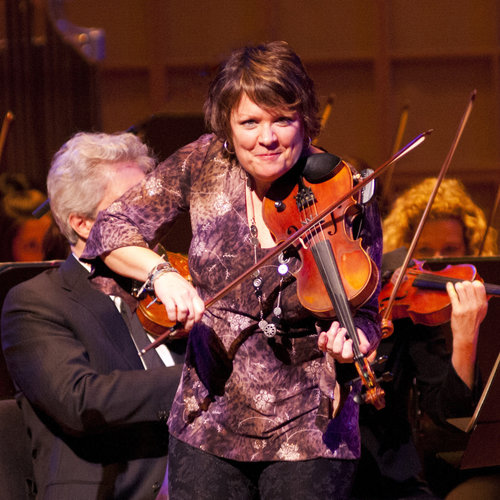
Ivers has built a successful career from her passion | Courtesy Photo / Eileen Ivers

Ivers and her band are touring throughout the year. She reports that January and early February tend to be down times because of the weather and because people are just coming out of big end- of-year holidays. Spring is always a busy time with St. Patrick’s, and March spotlights all things Irish. After the Caltech show, they’ll go back to the East Coast and then they’re off to Alaska for a week-and-a-half.                

Asked if there’s a place she hasn’t toured that she would like to go to, Ivers says, “There always is! There are pockets in Europe that we love performing in – Spain, France, Italy – but we’d love to be able to explore new areas in those countries. We played in Japan a few years ago – it was a very special audience – and we’d love to return there. Maybe one day we’ll perform in China as well. Fortunately, there are a lot of audiences all over the world who are open to hear our music.”

Although she has been to many places, Ivers, not surprisingly, enjoys going back to Ireland most. She reveals, “We have a house we built on my father’s land on the west of Ireland about 19 years ago. I tend to go back there two to three times a year with my family – my husband and young son. We love to recharge there and get inspired. It’s where I do a lot of my writing, more so than  I do here.

“In April this year, I’m actually running a ‘Wild Atlantic Tours.’ A second one, in June, was added because of the enthusiastic response to the April tour. It sold out in one day and we capped it off at one full-load bus of 53 people. I’m looking forward to showing folks the west of Ireland, where my parents were born, which is the ‘Wild Atlantic Way,’ as well as many other cultural and historical sites. There will be daily sessions of music and the tour group will get to see the ‘real’ Ireland and her wonderful people.”

I, for one, am very disappointed that her bus tours are sold out; it’s one adventure I would love to go on. Maybe Ivers can be persuaded to expand her second career as a fiddle-playing tour guide.           

‘The Man Who Mistook his Wife for a Hat’ Fascinates at Caltech

Originally published on 5 March 2018 in the Pasadena Independent, Arcadia Weekly, and Monrovia Weekly

The human brain works in such complex ways and each one’s thought process is different based on their environment that there’s no predicting what a person would do or how an individual would react to a stimulus at any given moment. However inaccurate that statement might sound to an expert, what’s indisputable is how fascinating it must be to study how our minds operate and what happens when they don’t function as they should.

Dr. Oliver Sacks, a British neurologist, spent his life studying the human brain and shared his knowledge and findings with the world. He authored and published best-selling case histories about his experiences involving his patients’ disorders. His book ‘Awakenings’ was the subject of a documentary made for British television series Discovery. It was later adapted for the screen and became a film which starred Robin Williams and Robert de Niro.

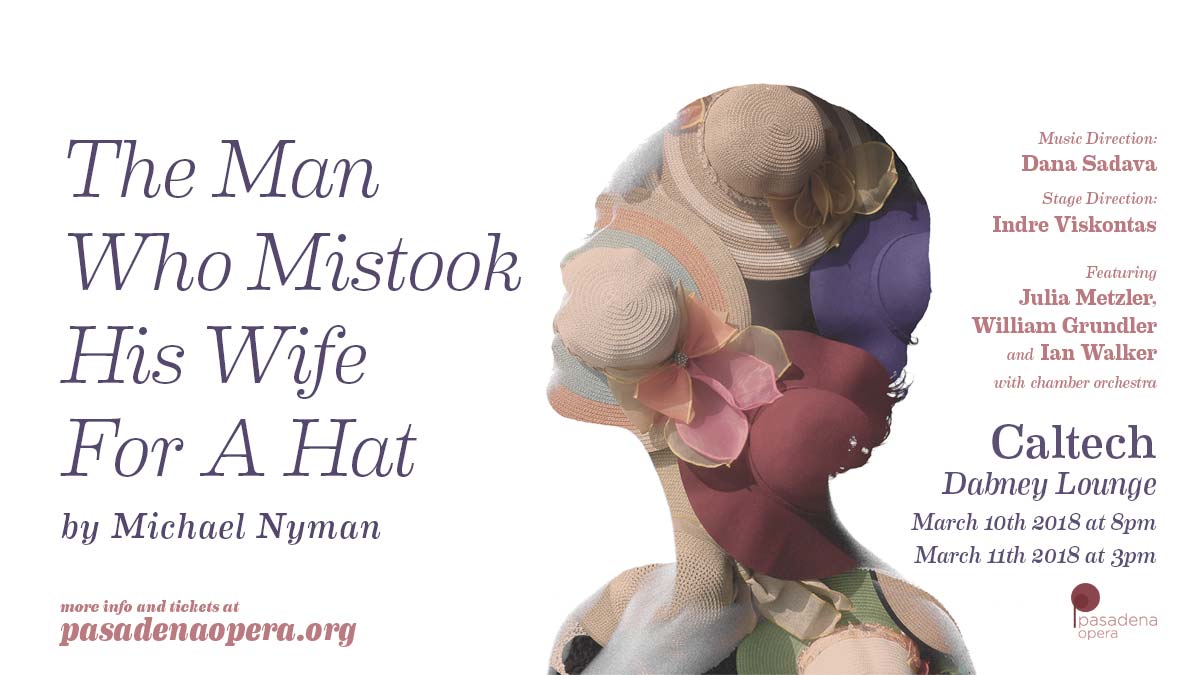
‘The Man Who Mistook his Wife for a Hat,’ Dr. Sacks’s case study about a man who couldn’t decipher what his eyes were seeing (medically known as visual agnosia), was the subject of a 1986 opera by Michael Nyman. It will enthrall Pasadena audiences when it debuts at the Dabney Lounge and Gardens at Caltech on Saturday, March 10 at 8:00 pm and on Sunday, March 11 at 3:00 pm.

Presented by the Pasadena Opera, ‘The Man Who Mistook his Wife for a Hat’ will be stage directed by Dr. Indre Viskontas with music conducted by Dana Sadava. Soprano Julia Metzler,  plays the role of Mrs. P; baritone Ian Walker plays Mr. P; and tenor William Grundler is Dr. Sacks. Pasadena Opera was established in 2014 by Dana Sadava (Artistic Director) and Indre Viskontas, (Creative Director) to revolutionize the presentation and perception of opera. Together they have a mission to provide contemporary theatre experiences the resonate with the community while maintaining the highest standards of artistic excellence.

Chelsea Basler and James Callon in Pasadena Opera’s 2016 production of Susannah | Courtesy photo / Brian Biery

Viskontas says, “We like to tell stories with a social conscience that are compelling and touch on issues relevant to the times we live in. While we don’t have a mandate to perpetuate feminism, our last two shows featured female characters. ‘Susannah,’ a story about a beautiful woman who attracted a lot of men predated the #MeToo movement. It was a commentary on how women are sometimes misjudged because of their physical looks. Last year we presented ‘Cosi fan tutte’ which, loosely translated, means ‘Women are fickle’ and denigrates women.”

Their process for choosing which shows to put on commences during a lunch when they list all the operas they find interesting. Viskontas elaborates, “We come up with a ‘wish’ list then narrow it down to what we want to do next year and why. We try to be inspired by what’s going on in the country at the moment.”

Sadava relates her own method, “I walk around the city. I visit the San Francisco Music Library thumbing through scores, discovering new pieces, listening to recordings. Then I make my long list and short list. I find this process of choosing our next show very exciting.”

“There isn’t one particular opera that I am dreaming to put on,” explains Sadava. “My favorite thing to do is working with composers on new pieces. For our first production, we chose ‘Candide’ because it’s exuberant and involves a lot of people. It’s also in English and it’s by Bernstein, who’s one of my favorite composers. So I thought it made a statement in a lot of ways. For our next production we commissioned a new opera based on the story by Angela Carter called ‘The Bloody Chamber’ by Daniel Felsenfeld with a libretto by Elizabeth Isadora Gold. We’re planning it as a Halloween show.”

For ‘The Man Who Mistook his Wife for a Hat’ Sadava and Viskontas chose three performers who have an affinity to the area. The singers who make up the only three characters are all Los Angeles residents.

Julia Metzler and Jonathan Beyer in Pasadena Opera’s 2017 production of Cosi fan tutte | Courtesy photo / Carin Yates

Soprano Julia Metzler grew up in Glendale, a city about six miles west of Pasadena. She was the  winner of the Metropolitan Opera Competition’s western region finals. She graduated from the San Francisco Conservatory of Music with a bachelor’s degree in music and gained her master’s degree in voice from UCLA.

Having professionally performed in her late teens, Metzler has built an impressive resume. Recent roles include Fiordiligi in ‘Cosi fan tutte’ (Pasadena Opera), Micaela in Bizet’s ‘La Tragedie de Carmen’ (UCLA Opera), the title role in Gustav Holst’s ‘Savitri’ (Pasadena Pro Musica),and Lady Billows in ‘Albert Herring’ (Repertory Opera Company).

Additionally Metzler has performed and been interviewed on NPR’s ‘From the Top.’ She was also featured in the HBO miniseries ‘Masterclass,’ in which she had the opportunity to coach with Placido Domingo.

Metzler says, “Everyone in my family is a musician so I grew up with music. We had a violin store in Glendale and I played the instrument as a child. Sometimes I worked in the store helping kids try out violins.

When I was about 18 or 19, I started singing professionally but my interest in it started earlier than that. Music is ingrained in me; there wasn’t any one defining moment when I realized singing was my calling.”

“I have been a singing waitress in Italian restaurants,” recounts Metzler. “I try to work with as many different companies as I possibly can; I recently did small parts with L.A. Opera. I have just come back from China where I sang nationalistic songs for a televised performance. I will be traveling to New York to compete in the National Metropolitan Opera Awards and I’m very excited about that.”

Metzler pronounces, “I’m very lucky to be employed in a profession I am passionate about and travel wherever my art takes me. I have been involved in amazing productions and hope to one day get my dream role, Tosca.”

Sadava used to call Pasadena home. She reminisces, “I grew up in Pasadena so it has been a huge playground for me. I went to high school and college here. It’s a very sophisticated but open place so I’ve always had an eye on it as somewhere I’d love to come back to one day. We started this company as a tribute to the city of my youth.

Dana Sadava | Courtesy Photo

It was when I was attending Caltech that I had a carpe diem moment and decided to switch from engineering to music. I thought I could always go back to rocket science but I have to try doing music professionally and that’s what I did. I was thrilled to meet Indre and in her I found a kindred spirit. She and I both have parts of our brains firing out all at once; we just work well together. We have a kind of sixth sense about what we need to do and how it’s going to go.”

While Sadava has an engineering degree, music has always been a part of her life. She originally trained as a pianist and studied with Dorothy Hwang at Colburn School, Sanford Margolis at Oberlin Conservatory of Music, and Gabriel Chodos at the Aspen Music Festival. She was with the Disney Young Musician’s Symphony Orchestra and was seen on the Disney Channel when she was eleven years old.

As a Caltech student Sadava pursued her love for the arts, appearing as a piano soloist with the Caltech-Occidental Symphony and playing chamber music. She went to the University of Michigan for a master’s degree in orchestra conducting and studied with Kenneth Kiesler on a merit scholarship.

Sadava has been a professional conductor for the past eight years and has toured all over the United States, Canada, and Ireland. She is currently also the Artistic Director of the Community Women’s Orchestra in Oakland. She has recently been hired by the San Francisco Conservatory of Music to work on a project with their opera department.

A Toronto native, Viskontas earned her PhD from UCLA in neuroscience with particular emphasis on how the brain  changes when one learns new things. She received her master’s degree from the San Francisco Conservatory of Music where she met Sadava.

“It would have been more convenient for us to establish our company somewhere else,” Viskontas declares. “But because of Pasadena’s unique profile it became the most logical place for us. It is a beautiful city where there is a big support for the arts. With its world-class university, it is the center of education and technology. Opera, the way we present is, uses ground-breaking technology and new ideas. Besides, it didn’t have an opera company so we wanted to fill that gap.”

Indre Viskontas | Courtesy Photo

Viskontas happily mixes music with neuroscience. She says. “I teach Psychology courses at the University of San Francisco but I spend a lot of my time bringing science to the public. I like doing one or two projects a year. I did a couple of lecture series with The Great Courses (12 Essential Scientific Concepts and Brain Myths Exploded); a TV show on the Oprah Winfrey Network called Miracle Detective as well as a few web series. I write and host two podcasts, Cadence: What Music Tells us About the Mind and Inquiring Minds about science and society. I just finished writing a book on music and the brain which will be published by Chronicle in 2019.

I have sung in several companies and have done a whole bunch of bizarre projects. While I still sing on occasion with other companies, now I mainly work on projects involving Pasadena Opera or chamber music. I work often with a string quartet on vocal chamber music (Vocallective.com). I’m also working on a project to investigate what aspects of musical performance can elicit empathy in audiences (www.TheEnsembleProject.com).

‘The Man Who Mistook is Wife for a Hat’ is an amazing story about the power of music and the ways we should approach neurological problems. Dr. Sacks shows us that there’s a lot doctors could learn from their patients about the brain. To have this idea and to be able to present them in my favorite art form is something I had wanted to do for a long time. It is also a very personal project for me; he and I worked together on a venture called Musicophilia. He was my mentor and I wanted to honor his passing in a significant way.”

“He might have had trouble connecting with the larger world, but he always managed to reach even the most elusive patients with his unassuming manner and keen ability to get to the heart of their experience,” continues Viskontas. “I’m thrilled to have the opportunity to share his genius with our audience.”

For Sadava, ‘The Man Who Mistook His Wife for a Hat’ is a fulfillment of a long-dreamed of production. She reveals, “I have been looking forward to presenting Nyman’s beautifully minimalist score weaved with the accessible melodies of Robert Schumann, whose music is a remedy for the patient’s ailing mind. The sparseness of the score gives the audience time to digest the profound insights the Oliver Sacks poetically presents.”

Viskontas expresses it succinctly when she pronounces, “We boastfully and arrogantly think that opera is the height of theatre. Storytelling is what we do – in the grand form of opera.”

At the turn of the 20th century, Pasadena saw the flourishing of the arts and the blossoming of technology which inspired solar astronomer and visionary George Ellery Hale to develop the city as a scientific and cultural destination. It’s only fitting that ‘The Man Who Mistook his Wife for a Hat’ is set here where, more than a century later, arts and culture still mesh seamlessly with innovation and technology.