Marc Soong Epitomizes Gifted and Talented Youth

Originally published on 7 July 2016 in the Pasadena Independent, Arcadia Weekly, Monrovia Weekly, and
Sierra Madre Weekly

The word ‘gifted’ usually refers to someone who has innate intellectual or artistic abilities that surpass his or her age, while ‘talented’ is often used to describe one who works hard and accomplishes feats exceptionally well. Based on those delineations, a gifted child doesn’t put in any work while a talented kid makes some effort to achieve something spectacular.

Marc Soong, a recently graduated eighth grader from Barnhart, a K-8th grade independent school in Arcadia, is both gifted and talented. Listening to his spirited and rousing rendition of Grand Etude Paganini No. 3 ‘La Campanella’ by Franz Liszt on the piano transports you into another world and time. His amazing fingering also reveals a mastery of technique honed by hours of painstaking practice and a devotion to his craft.

This past June 28, Marc electrified as he performed the finale number at The 65th Annual Redlands Bowl ‘Young Artist Competition Winners’ where he interpreted Chopin, Rossini and Ginzburg. 

Valerie Peister, program director for the Redlands Community Music Association pronounces, “As a winner of the 2016 Redlands Bowl Young Artist Competition, Marc Soong thrilled Tuesday evening’s Redlands Bowl Summer Music Festival audience with a virtuosic recital performance. His technical mastery was matched by a sensitivity and depth of expression well beyond his years, and showcased his remarkable ability to tell a musical story.”    

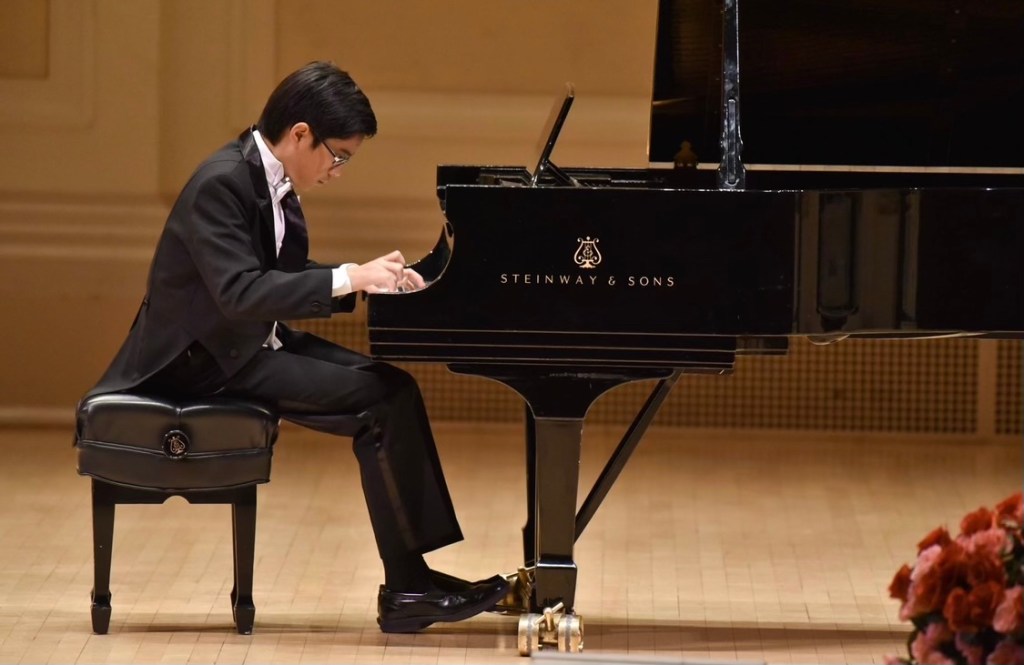
And again on June 30, Marc impressed at the Isaac Stern Auditorium/Perelman Stage at Carnegie Hall in New York, where he played Paraphrase of Figaro’s aria from the Barber of Seville by Ginzburg/Rossini. 

Marc’s outstanding musical abilities have earned him awards from the Los Angeles Young Musician International Competition, San Jose International Piano Competition, American Protégé Piano and String Competition, among other others.

Music, specifically, piano, is an important family activity for the Soongs. Marc’s mom, Alice, says “My husband and I attend all of our kids’ concerts, competitions and performances. Both Marc and Melodey, Marc’s older sister, perform at senior homes, and volunteer as ushers for concerts held at the Pasadena Symphony and Pops”.

Love of music came to Marc early on when he was three years old and heard Melodey playing the piano. He remembers that in first grade, he tagged along when his sister visited USC Thornton School of Music to meet with Daniel Pollack, a renowned professor there. When he was in third grade, he became one of Prof. Pollack’s students.
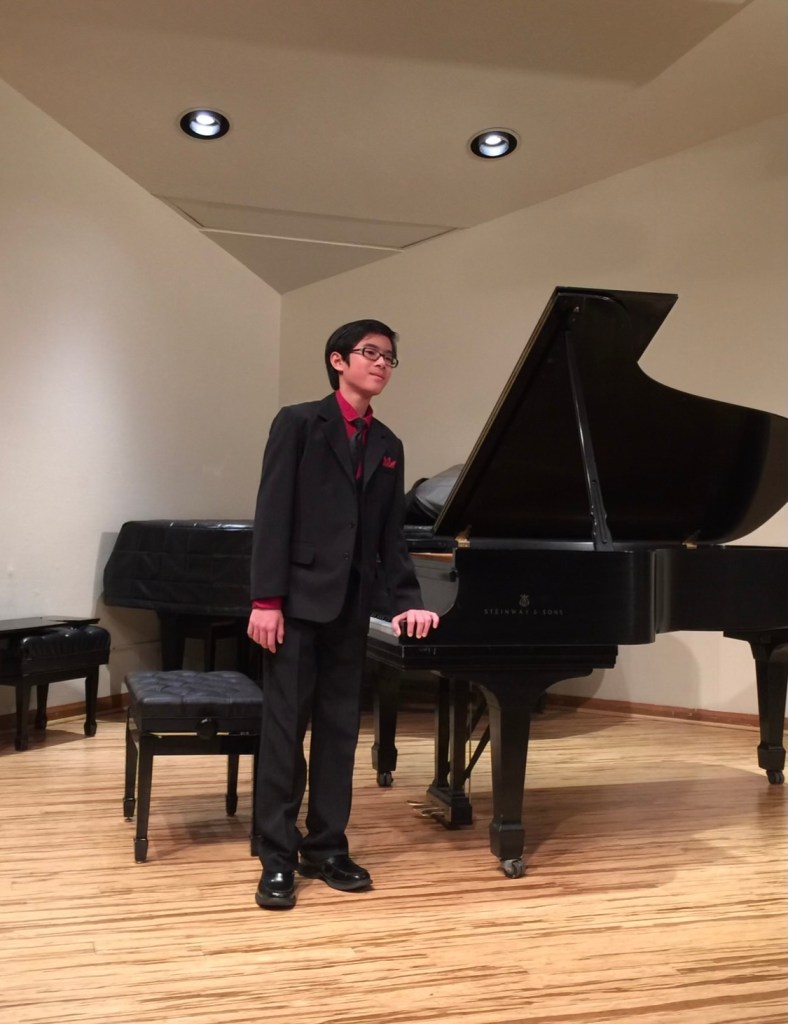
Vladimir Khomyakov, who at age 32 is an accomplished concert pianist himself, is Pollack’s assistant and has been Marc’s piano teacher since he was eight years old. From Khomyakov Marc learns technique as well as general music knowledge – history, the background of each piece, composer, style, and theory. 

“Marc is a brilliant student to teach because once he starts, he’s hungry for more.  He learns a piece on his own, asks a lot of questions, and has great initiative. While he chooses his pieces based on his personal journey, I help him build a balanced repertoire to include various genres, styles, periods, and composers, and develop a solid program as an artist,” Khomyakov states.

“As a musician, Marc is very passionate about his music. He plays from the heart – a rare trait for someone at his age, most kids do it mechanically. He has excellent ears: when he hears a noise he knows what pitch it is; when he hears a computer tone, he can play it. He absorbs all sounds like a sponge. He has what it takes to be a successful concert pianist … although I wouldn’t recommend it. It is a challenging life, with countless hours spent practicing which may turn out to be time wasted on something that might not work. It is usually filled with disappointments and stress, especially at the age of 20 to 25 when one gets into serious competitions,” Khomyakov says.

And Kyomyakov knows whereof he speaks. Like Pollack, he himself has concertized internationally as a pianist, conductor, chamber musician, and a soloist with leading orchestras including Dresden Philharmonic and Houston Symphony. He says he holds 40 to 50 concerts a year and has been all over the world except Africa. In 2009 he was chosen to be the assistant to Prof. Pollack; he teaches weekly master classes to all degree-level students.   

Music is not the only thing that Marc is superior at. According to Tonya Beilstein, associate head of school and director of curriculum and instruction at Barnhart, Marc exhibited talent and creativity for a normal fourth grader. She relates, “I began working with Marc in fourth grade, supporting his social and emotional growth. At the end of his fifth grade here we realized he was also ready for more academic challenges. I thought a solution was for him to go from fifth grade in June to seventh grade that Fall, skipping sixth grade entirely.   

“That decision didn’t come about haphazardly. We first asked his parents to get outside psychological evaluations (because we don’t have the resources on campus to do it). One of the things we do now, that we weren’t doing before, is use a tool called Iowa Acceleration Scale. It provides the rubric to help schools make effectual decisions relating to grade-skips.  Besides psychological evaluation, we look at IQ, academic assessment – capacity and performance.

“We conferred with the whole team in Marc’s life – his parents; past, current, and future teachers; school administrators. The last step we took was talk to Marc himself. He was very excited about the idea – he very much wanted to move ahead,” Beilstein discloses further.

Marc says, “I was a little nervous about being in seventh grade and being with older students but I also wanted a more challenging curriculum. My classmates were very kind to me and I developed deeper and more meaningful friendships in seventh and eighth grade. I found it easy as well as enjoyable.”
As if all these weren’t enough, Marc has been accepted to attend Stanford Online High School (SOHS) in the fall. At 13 years old, he might be the youngest person to gain admission to this highly selective institution.  Offering a distinctly innovative program, SOHS requires students to take core courses in Science, Math, English, and History. For academically advanced students, SOHS has numerous post-AP subjects, including university-level courses that typify most undergraduate programs.

“Stanford Online High School is the perfect fit for Marc,” declares Beilstein. “It’s a good choice for so many reasons – the challenge of the curriculum, the interaction he will have with like-minded students. I think, for the first time, he’s really going to be surrounded by his academic peers which he will find engaging and exciting.

“For students like Marc, who have participated in the summer program at Johns Hopkins Center for Talented Youth, a rigorous curriculum will give them peace and confidence. This model of learning is ideal because he can study at the pace that’s right for him and gives him the time to focus on his piano – it accommodates all his needs. He’s going to be in control of his destiny now,” Beilstein concludes. 

Marc is surrounded by people who support him – from his parents who encourage him to follow his dreams and provide the means for him to do so, to school administrators who find the perfect environment to engage his mind, to his music teachers who dare him to play demanding piano pieces, to friends who supply him with equilibrium as he navigates life. Through it all, Marc has remained sanguine and has retained his inner ‘kid-ness’. He thinks the coolest thing about going to an online high school is that he doesn’t have to eat cafeteria food.                                      
Barnhart School Aims to be the Best

Originally published on 9 June 2016 in the Pasadena Independent, Arcadia Weekly, Monrovia Weekly, and Sierra Madre Weekly

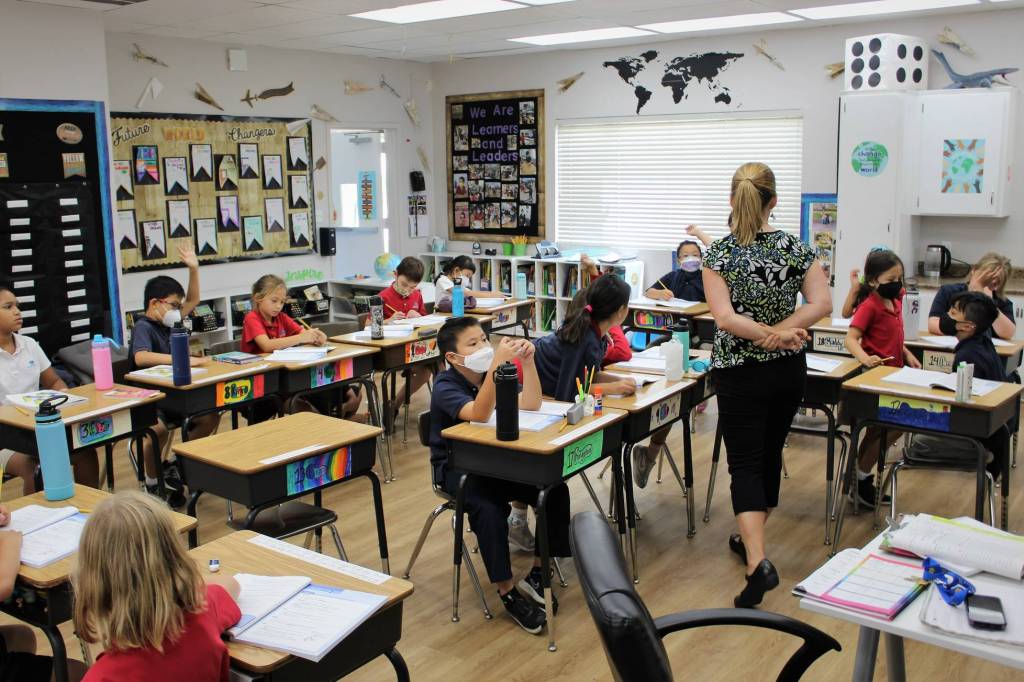
Barnhart School was founded in 1959 by Dr. Ethel Barnhart and is affiliated with the non-denominational Santa Anita Church. Students from kindergarten to 8th grade acquire a stellar education based on an ethos of respect and love that encourages independence and self-responsibility.      

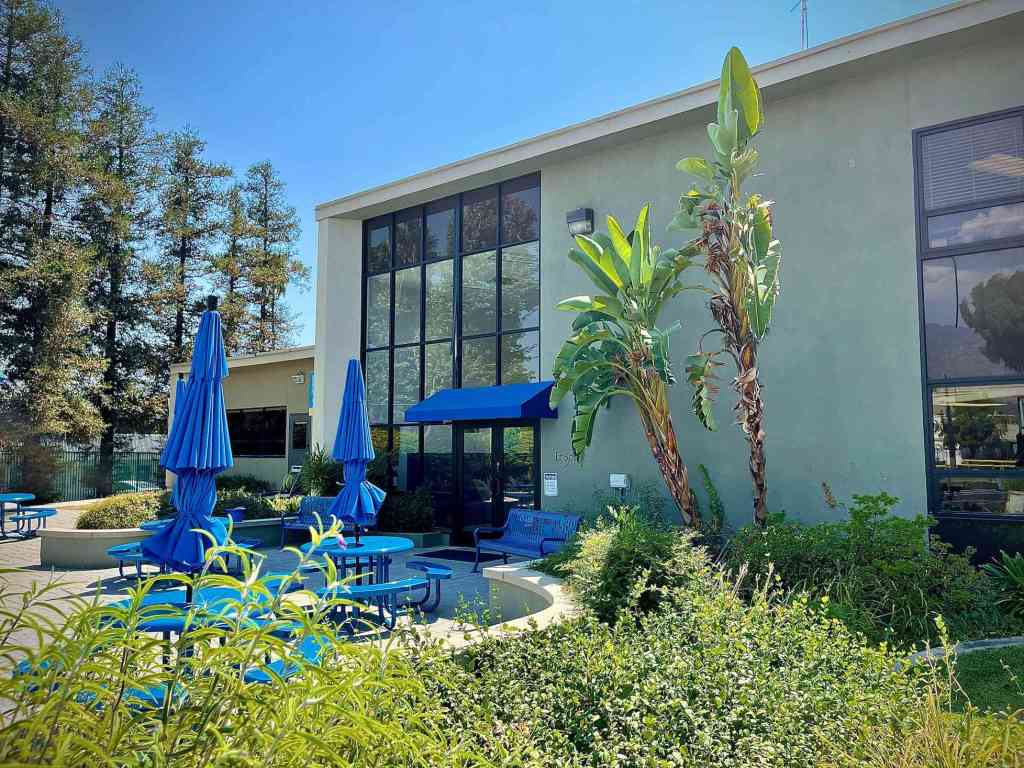
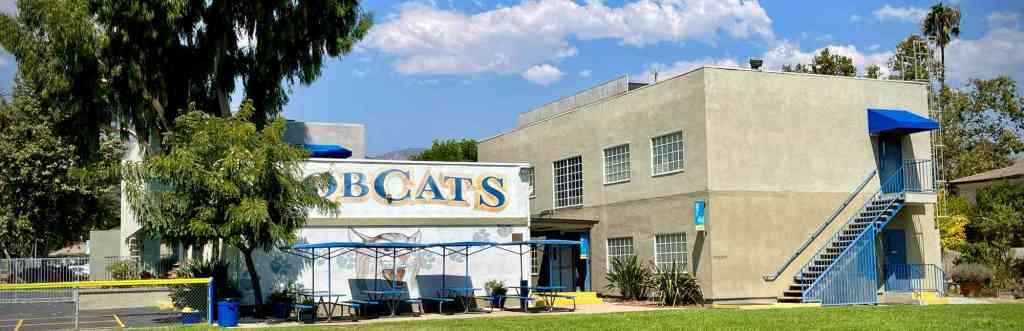
Tucked away in eight acres of real estate between Colorado Place and Colorado Blvd. in Arcadia, close to the race tracks, Barnhart can easily by missed by someone driving by.  But if Ethan Williamson, headmaster of five years, were to have his way, it wouldn’t be too long when everyone will know exactly where it is.

“My ultimate goal is for Barnhart to be the premier independent school in the greater Pasadena marketplace – Altadena, Arcadia, Monrovia, Sierra Madre – the surrounding communities where we draw from,” Williamson pronounces. “I think we have an excellent product. We do exceedingly well placing our students into highly selective independent schools. 

“We don’t track them to one particular school. And that’s also what I think is unique about Barnhart. We try to understand the child and make sure a Barnhart education is about stretch, not stress,” Williamson says further.

The 32 8th graders graduating this year were accepted to 23 high schools, including Marlborough, Campbell Hall, Flintridge Prep, Los Angeles County High School for the Arts (LACHSA), Mayfield Senior, Sequoyah, St. Francis, Westridge, and Stanford Online High School. Seven of them have been awarded merit scholarships. This wide range of institutions to which they applied and were admitted is proof that Barnhart ensures it finds the best fit for them.  

“Academics are essential at Barnhart. The rigor of our program shows in our ERB scores which have been improving over time. But we don’t focus a whole lot on test scores, we focus on education. We recognize that excellent test scores follow excellent education.

“We have been tracking their GPAs and our graduates do better than the average incoming freshman into high schools. We have a really high cohort of students who test as gifted; about 40 percent of our students qualify for the Johns Hopkins Center for Talented Youth (CTY) and participate in its summer program, and it’s still increasing,” Williamson proudly states.
 

Barnhart is also distinctive for its racially diverse student body – 40 percent of its enrollment is Caucasian, 30 percent Asian (Chinese, Japanese or Korean), 20 percent Hispanic, ten percent African-American.  And while students attend 15 minutes of chapel every morning (Monday-Wednesday-Friday for elementary students and Tuesday-Thursday for middle schoolers), a third of them are Catholics, another third are Agnostics or Atheists, and the rest belong to other world religions including Buddhism, Hinduism and Islam.

Williamson says, “Cultural diversity and cultural competency are very important to our students because their peers are from all over the world. It mirrors what they will be experiencing in the future as society and jobs become ever more global.”

With a total enrollment at 225, a faculty and staff of 50, the average class has about eight students to one teacher; with a maximum of 15. According to Melissa Gersh, Director of Marketing, Barnhart has 25 teachers, representing 336 years of total experience in the classroom.

Gersh adds, “On average, our teachers have a little over six years of experience directly at our school.  Half of our teachers have a master’s degree or higher; the school also requires all teachers to be credentialed.”  

Barnhart’s elementary program schedule incorporates the core content areas into the homeroom classes. A focus on literacy (reading/writing) includes 90-minute teaching blocks each day.  Math instruction occurs daily with a minimum of 60-minute lessons. Social studies and science classes are also built into the daily lessons. Balancing out the academic program is a variety of enrichment classes including: 45 minutes of art and library weekly; 30 minutes of music and Spanish, twice weekly; and 30 minutes of physical education daily.

The middle school program is designed to prepare students for the requirements of Pasadena-area high schools. Students have eight classes each day which include five core academic classes – Algebra/Geometry; English; History; Science; and Spanish – and three opportunities to experience the Barnhart Balance. 

Four exploratory classes rotate each quarter. In 6th grade: art appreciation; music appreciation; public speaking; technology. In 7th grade: human health; life skills; theatre appreciation; woodshop. In 8th grade: art appreciation; music appreciation; woodshop.

Students take one elective class per year: advanced band; studio art club; drama club; outdoor education; science club; screenwriting; and yearbook.

Physical education is a required daily 45 minute class.  


Barnhart has made incredible strides in technology. Says Williamson, “Four years ago not every student had individual access to an iPad or a laptop or any sort of tech device; they had to go to the computer lab. But our vision is to make technology as ubiquitous and available to students as pencils. This year we have iPads for every student in K to 2nd as they’re easy for children to use with their small fingers. Third to 5th graders use Chrome Books; we recognize that students enter the world of Google so we have Google Apps for Education and Google Classroom. In middle school it’s ‘bring your own device’ because we know this is the generation that will be device-agnostic. Many students already have both Apple and IBM at home so we intentionally gave them the flexibility to choose the right tool for the job they need to accomplish.

“We thought a lot about making sure our students are ready for the world they will encounter outside of college. We’re not just getting them into their high school or into college; we’re thinking about what their workplace will look like. And that’s especially true around technology where collaboration is key. In grades 3 to 5 our students use Google Doc so if they have a group project, which they might want to work on during the weekend, they can edit simultaneously without being in the same room. 

“Investing in a seamless wireless infrastructure became a priority for me when I first came on board. By spending $7K on a wireless network, we were able to integrate our entire system. Another enhancement we’ve created is a comprehensive student information system database – the instant students apply to Barnhart, we are able to track their progress in the admissions process. Once they’re accepted, we are able to interact with the family, keep all of them updated. Grades, test scores are all available in real time – there’s no hiding as a student,” Williamson laughs.

There’s much yet to be accomplished in the future, as Williamson says. “We’ve made major improvements in our school facilities. While it isn’t exciting to talk about, last summer we pulverized 75,000 sq. ft. of asphalt. But what’s cool about it is that we were able to recycle what we dug up and used it as a foundation for the new asphalt … and we were able to complete the project in 30 days, between summer school and the start of the school year! In the process, we also took down outdated poles, put in brand new basketball hoops, put in a nice white fence.

“Our future goals include updating our facilities to make them inspiring and competitive with our peer schools. We are currently on the planning stage of figuring out our priorities for improvement, how to go about that, what fundraising that entails.

“In terms of our curriculum and staffing, we want to optimize what we’re already doing by making changes every year as warranted. We have something solid, it’s simply a matter of continuing training. On the technology side, we will keep up with students’ needs to get their work done.

“We have a big rollout on a social curriculum this coming schoolyear. We’ll be using a system from a book developed by the Northeast Foundation for Children called ‘Teaching Children to Care – Management in the Responsive Classroom.’ It’s a proactive approach using a social curriculum that involves creating community standards or rules in the classroom. We will have teachers model the expected behaviors. This consistency in conduct means students don’t have to adjust to teachers’ expectations and styles; while personalities differ, the language we use does not. 

“More broadly, it’s a management system for the classroom. Research talks about ‘affect’ – how you feel in a classroom or work environment, for that matter, tremendously affects your performance. If one is scared, that uses up a lot of brain energy and leaves less available for learning. As students feel comfortable, their brains become fully engaged on their activity. So I think an investment in the social curriculum is critical to everything else we do.

 We have adapted the system into our middle school what the Northeast Foundation for Children designed for K-6th grade. But they have now come out with a middle school-specific book for which we have the honor of hosting the training. This summer, from August 8 to 11, an international group of 90 educators will be on our campus to learn it. It’s pretty exciting!” Williamson enthuses. 

Williamson’s infectious passion for learning and social responsibility is pervasive in the entire Barnhart community. Conceivably in the not-too-distant future, this spirit will spread far afield.