‘Asian American Experiences in California’ Symposium at The Huntington Invites Introspection

Originally published on 10 April 2023 on Hey SoCal
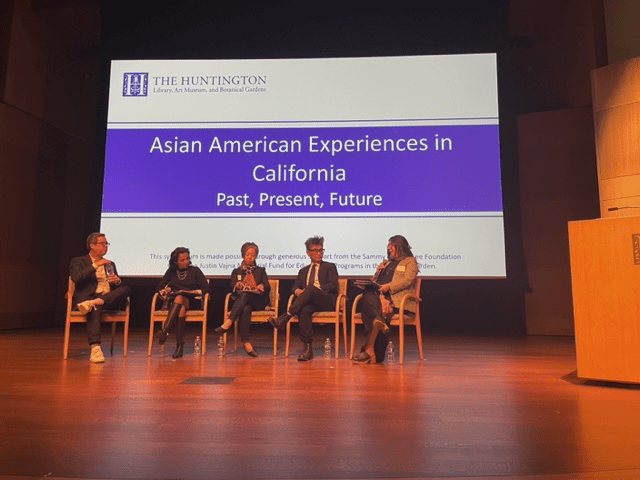
The third panel speakers and The Huntington’s Yinshi Lerman-Tan (far right) | Photo by Brianna Chu / Hey SoCal

For Asian Americans, who have been largely ignored by society, the events of the past three years that threw them headlong into the spotlight were too overwhelming to contemplate. Surely invisibility would have been preferable to being widely hated and reviled. While racial slurs and violence directed against Asians and Asian Americans didn’t happen only recently, the anti-Asian rhetoric and crimes that erupted during the pandemic were so alarming that they became the catalyst for movements, including Stop AAPI Hate.

The Huntington Library, Art Museum, and Botanical Gardens in San Marino is at the very center of the Asian American community in the San Gabriel Valley. Its collections have grown and its programming has expanded to reflect the demographic change and the needs of the community it serves. On Saturday, March 4, 2023, it held a day-long symposium titled “Asian American Experiences in California: Past, Present and Future.”

Alice Tsay, Director of Special Projects and Institutional Planning, declared that this series of lectures was two years in the making. Indeed in the two years since The Huntington embarked on this series until it actually transpired, stories related to Asians have dominated headlines.
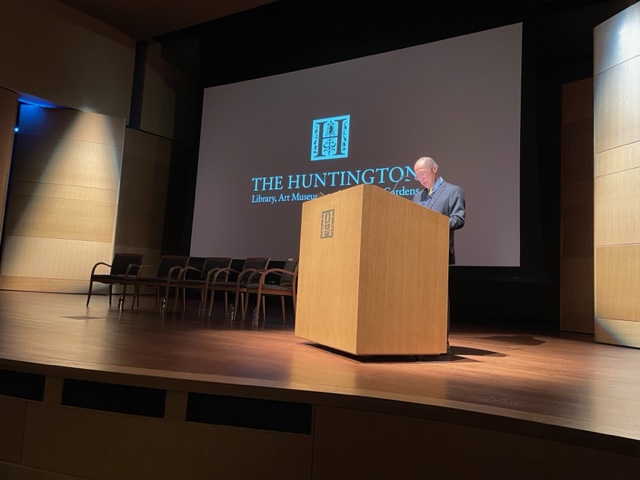
Simon Li | Photo by Brianna Chu / Hey SoCal

In his introduction and opening remarks, Simon K. C. Li, Huntington trustee, talked about the Monterey Park massacre on the eve of the Lunar New Year, and said, “Reaction among Asians who have witnessed racism is disbelief that we are capable of such violence. Another mass shooting perpetrated by the same man in Alhambra reinforced the thought. Still, it’s a reality — Asians in America live with a sense of vulnerability.”

Li then brought up two issues. The first involves the name Asian American — does it do a disservice in obscuring the wide diversity of the many Asians to reduce the knowledge and complexity that will otherwise lead to great understanding? He said in 1992 the terms Chinese American and Japanese American were much more commonly used. But it didn’t save Vincent Chin, the Chinese American beaten to death in Detroit by two bat-wielding white auto workers angry about the popularity of Japanese cars.  

The other issue is about the role of representation in helping minority communities. Li said it’s a common complaint that we don’t see enough faces like ours in movies, on TV, or in government and politics in the news. But he contended that he’s seen plenty of representation for both Asian Americans and non-American Asians making their name in U.S. politics, in movies, and on television. And he wondered, “Do such talents, such contributions, such celebrity really redound to the ‘normalization’ of Asian communities in America?”

At the end of his remarks, Li asked the panelists to answer two questions and suggest new answers going forward for Asian Americans: “What does it mean to be American? Who has the right to wear that title and to share fully in the promise it implies?” (read Brianna Chu’s response article here)
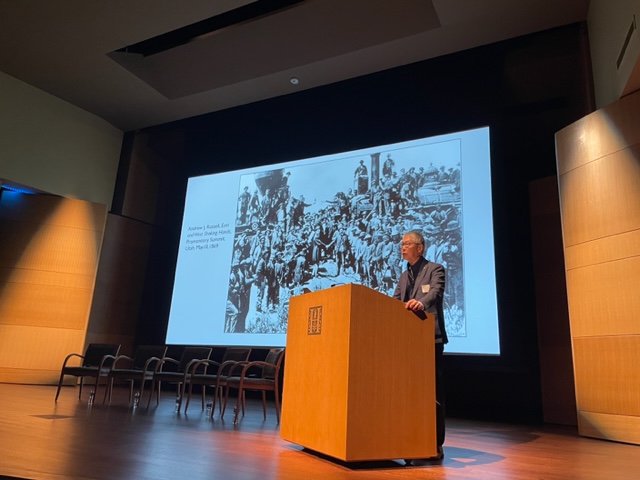
Gordon Chang | Photo by Brianna Chu / Hey SoCal

The first panel — Historical Roots (pre-1965) — focused on the origins of Asian experience, and anti-Asian racism, in California, with presenters drawing extensively on The Huntington’s Pacific Rim collections.

Gordon Chang, whose talk ‘Beyond Promontory: Chinese Railroad Workers and the Rise of California,’ continues the story of the Chinaman as railroad builders and what happened to them after they finished the transcontinental railways. He touched on the construction of the Tehachapi Loop in 1874.    

An interesting revelation was when Chang debunked the myth that the railroad workers were docile. “In March 1875, the entire workforce tunneling in the Tehachapis went on strike for higher wages just as they did in 1867. They took advantage of the monopoly they had on railroad labor and demanded for improved working conditions.”
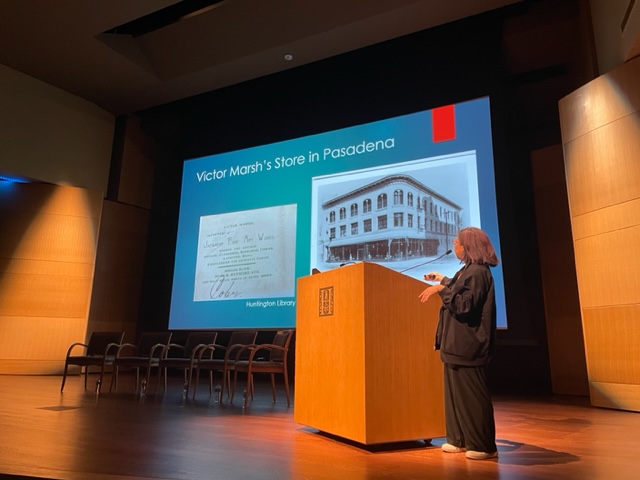
Naomi Hirahara | Photo by Brianna Chu / Hey SoCal

Naomi Hirahara’s presentation was “Torri Gate Welcoming Empire: Japanese Immigrant and Nisei Cultural Workers and Pasadena Landscape and Life.” She spoke about her lived experience as a Japanese American in Pasadena. Her father, Sam Hirahara, was a gardener. She said, “Many Japanese American men after World War II were gardeners. A lot of men who were released from the detention camps found it was easy to come over — all they had to do was push a lawn mower and they were in business.”

She also talked about George Turner Marsh, a businessman from Australia who had spent several years in Japan and learned the language. “He went to San Francisco and opened an Asian arts business in the late 1800s. He installed a Japanese house in the 1893 Chicago World Fair in the area that the Japanese government funded, which one of the architectural partners of the firm Greene & Greene saw. Frank Lloyd Wright also saw it as a little boy. This was the introduction to a Japanese aesthetic that perhaps made a lasting impact among American architects.”

Jean Chen Ho talked about the Los Angeles Chinatown Massacre of 1871, the culmination of anti-Chinese sentiment leading to racially motivated violence and for which a memorial is being built.

“According to stories, in the late afternoon of October 24, 1871 a gunfire broke out between two Chinese men from rival tongs on Calle de los Negros, now Los Angeles Street, feuding over a young woman,” Ho began. A white rancher was caught in the crossfire that caused his death. A vigilante mob then gathered to exact revenge for the slain Anglo man and went on to murder 17 Chinese men and one 15-year old boy. The mob also raided a number Chinese businesses of goods and cash, and destroyed property by fire. Newspaper accounts by L.A.’s elite often demonized ‘ruffian and disreputable class’ for the massacre. But what combined these two social sets on that night was white vigilantism that enabled the massacre. This incident put the blame back on the Chinese for the violence they suffered.”

An account of this massacre that night was written 50 years later in his memoir by Robert Maclay Widney who witnessed what happened and was later the presiding judge during the trial of the rioters.  But Ho questioned the credibility of his story where he painted himself a hero, “Where do we place someone like Robert Maclay Widney who had the power to narrate his own story and have its social and material integrity preserved? What about the distorted, destroyed, or otherwise absent narratives from the victims of the massacre as well as those who survived that night of violence? The work that I’m taking up now is to reckon with the speculative possibility that Asian American lives have been previously only seen visible at the very moment they were suddenly extinguished by violence. My next project — a  novel — now requires the intellectual and emotional capaciousness to imagine all that cannot be verified by the archive in order to tell a story about lives that exceed the archive in their sublime and impossible beauty.”                   
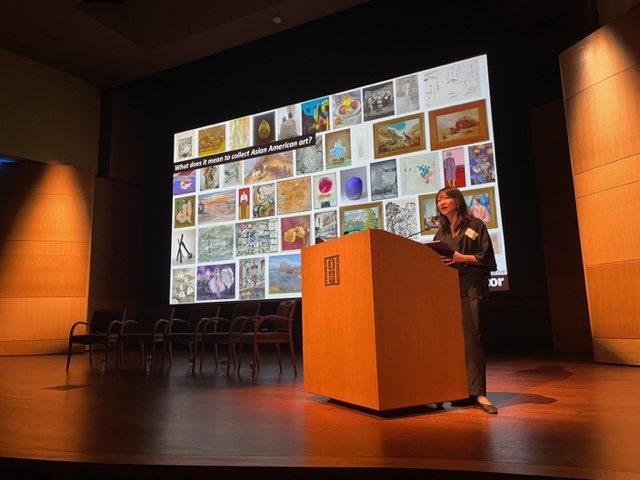
Marci Kwon | Photo by Brianna Chu / Hey SoCal

Marci Kwon’s presentation centered on the Asian American Art Initiative at Stanford University, an effort to collect and preserve histories and works of Asian American artists which reflect some of the subjects discussed by the other panelists. It’s a joint effort between the Canter Art Center and Stanford Library’s Special Collections which started in 2016. It came about because when she was trying to put together a syllabus for an Asian American Art history, she couldn’t find one. Thus her challenge was to collect 1,000 pieces of artwork by AAPI artists by 2026.

The second session – Shaping the Present – covered the period from 1965 to the present.

Wendy Cheng, called her talk “Assimilating into Difference: Multiethnic and Multiracial Histories of the San Gabriel Valley.” As Li did, she began her presentation with the Monterey Park mass shooting, “In the days after the shooting, Monterey Park was listed as an Asian American hub. It was a place of possibility for Asian immigrants to make lives and build community. Indeed in 1990, it became the first majority Asian city in the Continental United States; its population is 65% Asian today. But what this characterization can sometimes gloss over, is the incredible multi-ethnic and multi-racial richness of Monterey Park’s history and present — which came about through multiple generations of shared history of struggle and place-making.”
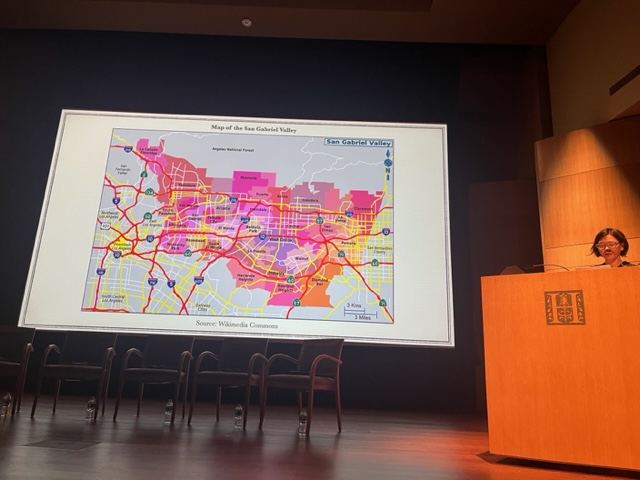
Cheng’s map of the San Gabriel Valley | Photo by May S. Ruiz / Hey SoCal

“In the near 70 interviews I conducted for my book ‘The Changs Next Door to the Diazes’ between 2006 to 2012, I found that those who grew up in Monterey Park and the western San Gabriel Valley developed a distinct regional consciousness about race,” disclosed Cheng. “They usually understood the particulars of each other’s identity. This region’s distinction as an Asian American place is one of its legacies — a home for immigrants and for those who are historically excluded or vilified elsewhere by those who don’t look exactly like them.”

Jane Hong spoke about “Asian American Evangelicals and Southern California Histories” and how they became an important voting bloc for the Republican Party. She attributed this to a couple of developments: the first was the diversification in U.S. population that resulted from the Immigration and Nationality Act of 1965. Japanese Americans made up the majority of Asian Americans for much of the 20th century; Chinese Americans became the most populous by the 1980s; Filipino Americans became the second largest Asian American group in 1990; and, very recently, Indian Americans surpassed the Filipino Americans as the second largest Asian American population.
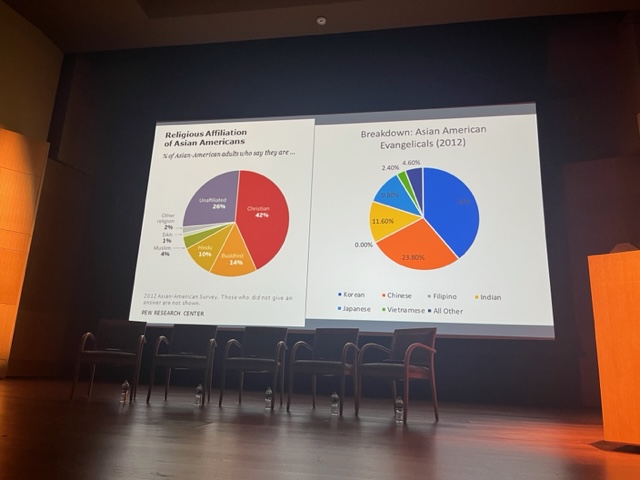
Hong’s Asian American Evangelicals pie chart | Photo by May S. Ruiz / Hey SoCal

The second development was the marriage between white Evangelicals and the Republican Party. This can be traced to the Moral Majority, a political lobbying group formed in 1979 between Jerry Falwell Senior, the founder and president of Liberty University, and Ronald Reagan. They joined forces around a shared set of issues — opposing abortion, traditional family and marriage defined as between a man and woman, etc. And their influence grew within the Republican Party in the 1980s.

“Late 1960s and 1970s phenomenon Jesus (Free) Movement were largely young, white Americans,” Hong explained. “At the same time, Movement Activist was inspired by Asian American movement whose major tenet is ‘there’s strength in solidarity.’ So instead of calling themselves Japanese, Chinese, Filipino, it was a political act to call yourself Asian American to denote your belief, community, and shared interest. So this is what it means to be Asian American and Christian — integrating racial and individual identity.”    

Oliver Wang’s topic was “The Nisei Week Cruise: Japanese American Car Culture in the 1970s and 80s.”

“So much of our car history has been written by white men so the Nikkei community has been largely forgotten or overlooked,” stated Wang. “A major goal of the exhibit is to write the Nikkei Community back into the stories and histories about how cars have transformed the cultural, economic, and social landscape of the Southland.”
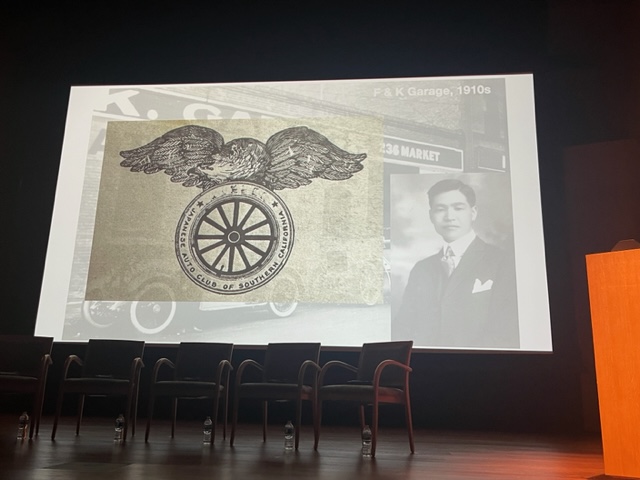
Fred Jiro Fujioka featured prominently in Little Tokyo | Photo by May S. Ruiz / Hey SoCal

Nisei Week began in Little Tokyo in 1934 as a way to encourage cultural pride in community economic development by an emergent second generation of Japanese Americans — the Nisei — who wanted to stake out a space for themselves within a community that up to that point had been largely dominated by their Nikkei parents and their generation,” continued Wang. “It quickly grew to become an annual celebration of the Japanese American community and further anchored Little Tokyo as the center of the Nikkei community in Southern California.”

Wang reported that Nisei Week cruise began to form in the early 1970s. “By the 1980s Nisei Week Cruise became the ‘king of cruises’ and continued to grow in popularity for the next 15 years until the summer of 1988 when it was shut down. But it left a lasting impression — for the people who grew up at that time, cruise was fundamentally a social experience that connected young people with one another. To attend the cruise was to participate in a cultural experience that helped define what it meant to be young and Japanese American for an entire generation.”

Linda Trinh Vo talked about the Vietnamese population in Orange County. She stated, “I titled my talk ‘Crafting Community’ because ‘crafting’ is purposeful – it needed a skill not just ad hoc. There’s an assumption that America rescued the Vietnamese refugees and other Southeast Asians. There’s a whole other discussion we can have about America and their intervention in the war in Vietnam that led to our displacement and then led to our migration or forced migration as asylum seekers and refugees. But our argument is that we saved ourselves. We had social agency — we had to figure out a way to survive, to get out of Vietnam and get resettled in the U.S. At times, we’re looked at as passive victims rather than seen as social agents helping ourselves.
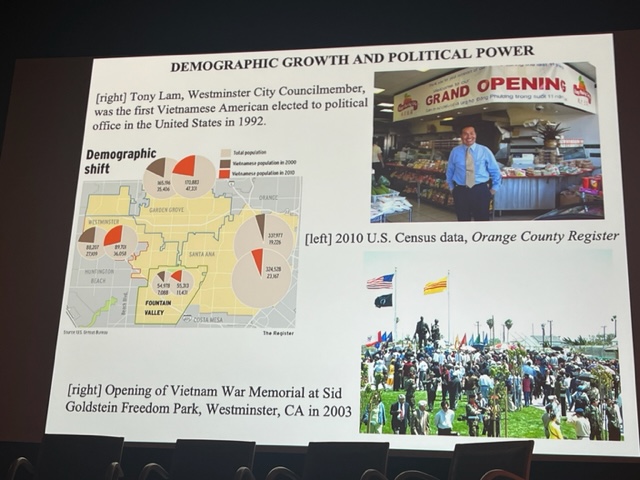
Vo’s slide of Little Saigon | Photo by May S. Ruiz / Hey SoCal

“Today, the Vietnamese population is the largest of Asians in Orange County and also the largest population outside of Vietnam,” declared Vo. “Pre-1975 the only ones here were war or military brides, international students, and military personnel training during the Vietnam War. When the Vietnam War ended, about 120 of them were settled in Camp Pendleton, one of four U.S. camps where refugees settled. But they needed some place to live permanently so they had to find sponsors. Individuals, charities, religious organizations helped to sponsor and settle them in the city of Westminster (and later expanded to Garden Grove) which is today’s Little Saigon.”

The third session – Future Provocations – envisaged the future of Asian Americans from the perspective of the panelists’ field of expertise.

Manjusha P. Kulkarni‘s presentation was “Resistance and Resilience: Asian Americans’ Response to Hate.” She disclosed that since the beginning of the pandemic, Stop AAPI Hate received over 11,467 reports of discrimination. She said, “Policies drive much of the hate — mass deportation of Southeast Asians, programs like the China initiative, the 911 surveillance and profiling of South Asians. What that has led to is the blame game — one in five reported incidents include this kind of scapegoating, like public health which we saw during the bubonic plague where Chinese Americans were blamed for the disease. National security was blamed for the Japanese incarceration and 911 profiling. And economic insecurity and anxiety was the cause of the horrible beating of Vincent Chin.”          
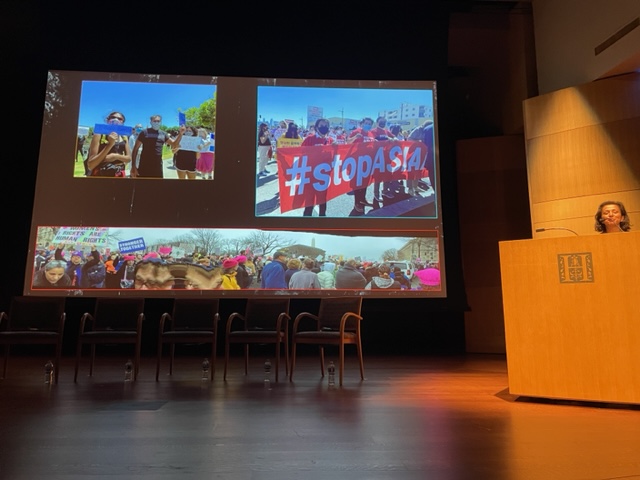
AAPI protest gatherings | Photo by Brianna Chu / Hey SoCal

“As populations are growing, we begin to see ourselves as racialized,” continued Kulkarni. “Civil Rights leader and scholar Lani Guinier wrote about the social ladder when whiteness is at the top and blackness at the bottom. So where does that put Asian Americans in terms of the outsider framing, idea of perpetual foreigner.’ So where are you really from?’ are the questions we get even when we’re third, fourth, and fifth generation. And that leads to questions of loyalty — are we actually Americans?”

Kulkarni then discussed civic engagement, “Since 2020, we are more enthusiastic about voting than we ever had; we see that we play a role in the margin of victory. So it’s absolutely critical that we vote; and engage civically — write to your congressperson, go to meetings at city hall, and run for office. We need more representation across our land if we are to have a powerful voice. I want to leave you with this quote from Grace Lee Boggs, ‘You cannot change any society unless you take responsibility for it, unless you see yourself as belonging to it and responsible for changing it.’”
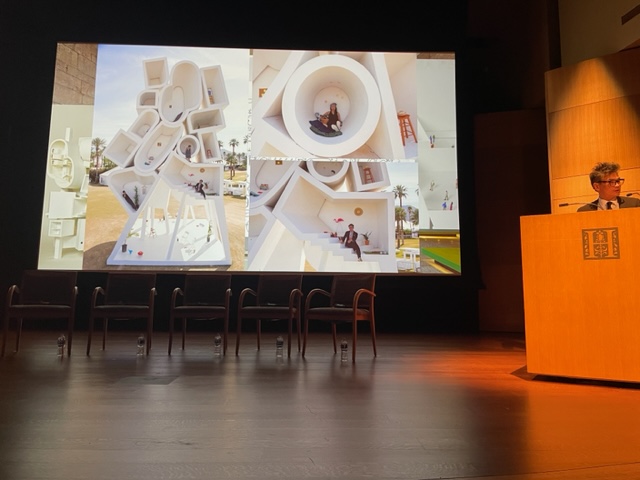
Jimenez’s installation at Coachella | Photo by Brianna Chu / Hey SoCal

Artist Jimenez Lai showed some photos of the work he’s done over the years. He represented Taiwan at the Venice Biennalle; his works have been displayed at museums and public events, including Coachella. One of his installations in front of City Hall, at Grand Park, is a collaboration with a musician and they conceived a structure like an oversized instrument. They embedded an amplifier so people could whisper their sorrows into it which then get distorted into nonsense — a confession booth of sorts.

Karin Wang spoke about “Asian Americans: Racialization & Privilege.” She began with a slide on Anti-Asian Hate which mirrored Kulkarni’s visual on the number of hate incidents. “What’s interesting is that at the same time that we were being racialized and targeted for violence and hate, Asian Americans are also occupying important spaces of privilege in two professions — Law and Medicine,” she declared. “We need to recognize where we have power and privilege. Lawyers are among the most powerful members of our society — not just lawyer lawyers, but judges, elected officials, people running government agencies.”
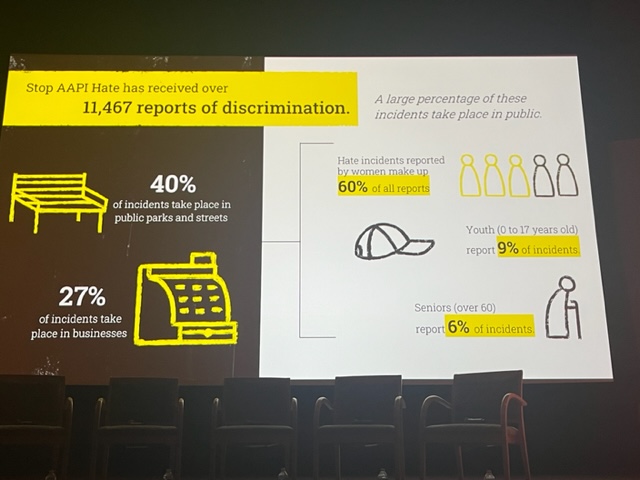
AAPI’s reports of discrimination against Asian Americans | Photo by Brianna Chu / Hey SoCal

Wang added, “There are a lot of stereotypes about Asians, one of them being that they are mostly in Medicine. And it is another sector that’s economically and socially advantaged in our society. There are improvements in the number of people of color in medicine on the national level but the majority of doctors are white; the next largest group is Asian and Pacific Islanders; Latinos and blacks are two populations that are underrepresented. It is becoming more racially diverse over time, although it is actually Asian Americans who are taking up a lot of that space.”

“Asian Americans are obviously not white and have never been viewed as white. Yet, we do have some privilege here as a community. So what is the provocation for the future as we move forward as Asian Americans? How are we going to think of ourselves in terms of where we fit in the American racial landscape? What are we going to do to use our positions of privilege in these places where we have it, and advance racial justice and equity not just for Asian Americans but for other communities of color as well,” Wang asked in conclusion.

The last speaker was Jeff Chang, who started his presentation by saying, “I was provoked by what Simon Li asked us to examine. The first: what is the desirability of being called Asian American especially given the anti-Asian violence we’re living through?  And, second, the role of representation. We know that there is representation, but we also recognize that we are nowhere near what the culture industry calls for, which is to create narrative plenitude – the diversity of stories out there.”

“Can we create a narrative of Asian American that can take us to the next 50 years? Chang asked. “Narrative plenitude doesn’t just seem like a call to the white-dominated culture industries and social institutions. But it seems also for us to make better sense of the full diversity of our stories. But at the same time, violence is bringing us all back together. But it’s not that the violence makes us all Chinese, the violence makes us all Asian American. So when we say ‘Stop Asian hate, stop anti-Asian violence!’ we can call this a negative narrative. We’re saying ‘Stop, no more of this!’ But this narrative also has its limits. There’s a danger that we actually lose people to the fears. Is there a positive narrative of Asian American that can bring us together?”

Chang ended his presentation by yet posing these questions: “How do we form this new narrative that’s not just saying ‘No,’ but what can we all say ‘Yes’ to? How do we recognize the harms being perpetrated against us and not re-harm others because of that? But how does that help us think about what we might move to that can lift us all up together?”
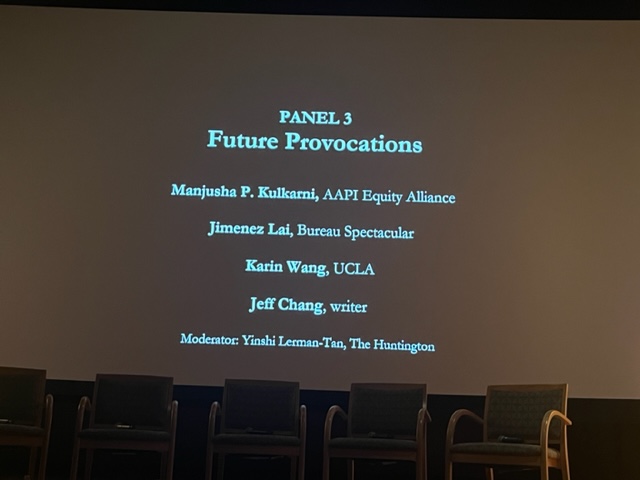
Photo by May S. Ruiz / Hey SoCal

This symposium resonated deeply with me. As an Asian American, I related with the experiences some of the panelists described. I’ve lived here for 41 years and, every once in a while, I’m still asked where I’m from. I usually respond “I’m from Pasadena but originally from the Philippines.” Sometimes, though, I turn what might otherwise be an awkward exchange into a subtle teachable moment about the Philippines and Filipinos, and our historical ties to the United States.    

As to Simon Li’s parting questions, there are as many answers as there are perspectives. And here’s mine: those of us who aren’t Americans by birthright but who legally immigrated to this country to build better futures also have the right to be called Americans. Most of us rose above our circumstances not in spite of being ‘foreigners’ but because of it. Most of us were born and raised in places of poverty and hardship and we were taught that education and industry were the means to success.

Because we didn’t come from places of wealth and abundance, we didn’t take for granted the opportunities that were available to us, as most immigrant accounts attest to. The possibilities became seemingly limitless and within reach because we were willing to work hard for them. Failure wasn’t an option — we wanted to ensure that our children didn’t go through the struggles we had to endure.  

But being American comes with responsibility. We have to give back to the country we now call home by engaging with our community and actively seeking out how we can contribute to society. In areas where we have influence, we have to advocate for all people of color and use our voices to speak for those who can’t. At the very least, sharing our stories might help others understand that while we don’t look like them, we have similar hopes and dreams, and are striving for the same happy outcomes.
‘Off Kilter: Power and Pathos’ Exhibit on View at USC Pacific Asia Museum

Originally published on 28 July 2022 on Hey SoCal

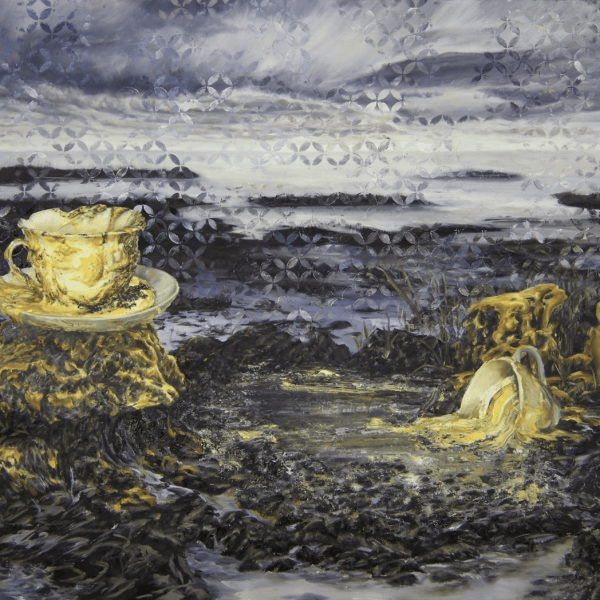
Sandra Low, A Very Civil Cheese, oil on canvas | Photo courtesy of the artist / USC Pacific Asia Museum

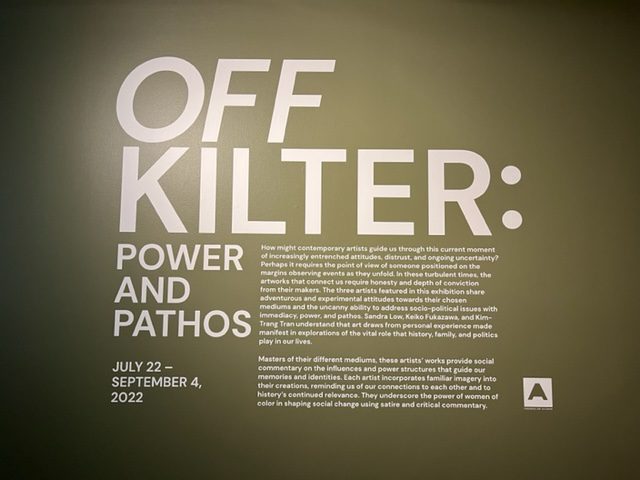
“Off Kilter: Power and Pathos,” on view from July 22 to Sept. 4 at the USC Pacific Asia Museum (USC PAM), features the works of Sandra Low, Keiko Fukazawa, and Kim-Trang Tran. The exhibition is the latest installation in the museum’s effort to provide a place where, through their work, diasporic Asian American artists can examine and address present-day concerns that affect our community.          

In her introduction to the exhibition, USC PAM Curator Rebecca Hall states, “How might contemporary artists guide us through this current moment of increasingly entrenched attitudes, distrust, and ongoing uncertainty? Perhaps it requires the point of view of someone positioned on the margins observing events as they unfold. In these turbulent times, the artworks that connect us require honesty and depth of conviction from their makers.

“The three artists featured in this exhibition share adventurous and experimental attitudes towards their chosen mediums and the uncanny ability to address socio-political issues with immediacy, power, and pathos. Sandra Low, Keiko Fukazawa, and T. Kim-Trang Tran understand that art draws from personal experience made manifest in explorations of the vital role that history, family, and politics play in our lives. 

‘Off Kilter: Power and Pathos’ installation entrance | Photo by May S. Ruiz / Hey SoCal

“Masters of their different mediums, these artists’ work provides social commentary on the influences and power structures that guide our memories and identities. Each artist incorporates familiar imagery into their creations, reminding viewers of our connections to each other and to history’s continued relevance. Using satire and critical commentary, they underscore the power of women of color in shaping social change.”

Hall explains during a press preview of the exhibition, “Those of you who are familiar with what I’ve been doing here as curator know that my ongoing work with contemporary Asian diasporic artists stems from my desire to focus on a very specific part in Asia, to bring it into L.A. and in the current moment – which has changed in the last couple of years – and to engage with the community (read about two previous exhibitions ‘We Are Here: Contemporary Art and Asian Voices in Los Angeles’ and ‘Intervention: Fresh Perspectives After 50 Years’). This started with an exhibition called ‘We Are Here’ which opened to great fanfare on March 13, 2020 only to be shut down because of the pandemic. We reopened it last year, aptly, during AAPI Heritage month.

“That exhibition highlighted seven Asian American female artists who lived and worked in Los Angeles. It was at that time that I met both Sandra and Kim-Trang but I wasn’t able to include their work on that show because of our limited space. I was so impressed with both that I wanted to make sure I brought them into the galleries. In fact, Kim-Trang was supposed to exhibit in 2020 the piece that we now have in our galleries, so I’m thrilled to find a way to make that happen. It was a bit later that I met Keiko after she displayed a piece in our sister museum The Fisher Museum of Art.”

“As a curator working with contemporary artists, my interest is ‘How are we moving in this worldview now and how are they capturing this moment that we’re in,” Hall continues. “And I think these three artists are doing it differently – using assorted media and with various perspectives – and you’ll see that as you walk through their work.”

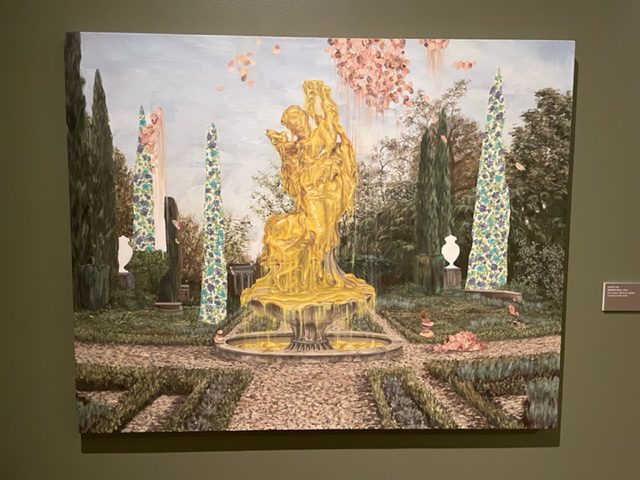
For the exhibition, Hall created wall labels that give background information on the artists and their works on display. The large canvases from Sandra Low’s ‘Cheesy Paintings’ series focus on the representation of kitschy subjects set within romantic landscapes. The central objects nearly disappear in a layer of oozing, dripping American cheese. With great attention to detail and a painterly eye, Low creates these paintings to call attention to the contrasting components of American life. On each canvas, viewers can relate to the seduction and illusion of prosperity; the desire to consume and the dangers of gluttony; and the way something familiar can seem completely novel when presented in an unexpected way.

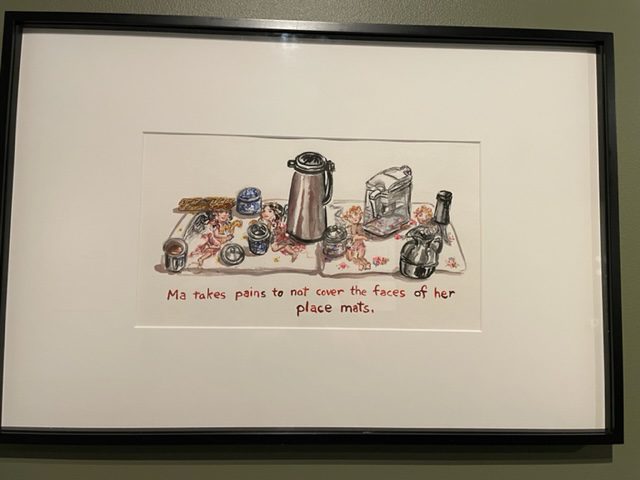
Low’s unique ability to merge the familiar with the unfamiliar while finding profound humor and warmth shines throughout her work. Her ‘Ma Stories’ chronicle cultural and generational differences through the illustration of her mother’s unique perspective of her daily world. Her ‘Pandemic Prints’ draw from a similarly uncanny ability to balance the personal with the poignant. Through all of these artworks, she reminds us that we can find humor and the absurd in even the darkest of moments, cutting through the drama of life and finding a sense of balance.

Sandra Low, Ma Stories | Photo by Brianna Chu / Hey SoCal

Hall reveals as we approach the artist’s displays, “I find Sandra’s work very compelling, but I also find it the most difficult to talk about because it’s so much about being a diasporic Chinese American woman. And I get it, but it’s not my place to talk about that and it’s not my voice that I should be using. But I can take on the role of sharing her work with everyone – and PAM has the space for that.  

“In my mind, Sandra is a stand-up comedian in a parallel world because of her way of using humor to talk about things. Two of her series have been ongoing for several years – ‘Ma Stories’ and ‘Cheesy Paintings’ – while ‘Pandemic Prints’ center on a specific period. Her ‘Ma Stories’ came from the disconnect she felt as an Asian American growing up in the San Gabriel Valley. She still lives with her mother, who has dementia, and that’s how she copes with it; she processes things through drawing, painting, and humor. This series records her day-to-day interaction with her mom. In fact, these pieces aren’t so much about art than they are about her relationship with her mother.”    

Indeed, when you look at the drawings and read the verbiage, you can imagine the artist reacting to what her mother did or said. The series – however absurd and comical the illustrations and captions are – is a child’s homage to a beloved mother. With the additional layer of her mother’s dementia, you sense that Low wants to preserve all the memories which her parent has lost. Each display is at once hilarious and heartbreaking.  

Sandra Low, Cheesy Paintings | Photo by Brianna Chu / Hey SoCal

About the next set of Low’s works, Hall says, “‘Cheesy Paintings’ pulls from the same experience  we see in her ‘Ma Stories.’ Cheese takes on different meanings to Sandra and she plays with the contrast of cheese dripping on the landscape.”

Anyone who has emigrated from Southeast Asia will tell you that several decades ago, dairy products like milk, butter, and cheese – daily staples in the U.S. and easily obtainable here – were rare commodities except for a privileged few. What a treat it must have been for Low’s mother who, until then perhaps, had only eaten Cheez Whiz and Velveeta – processed food which passed for cheese – to see so many varieties in the grocery store. Her mother’s reaction to the abundance of cheese made a huge impression and she memorialized that in a fantastically funny way.                                             

Sandra Low, Pandemic Prints | Photo by Brianna Chu / Hey SoCal

In ‘Pandemic Prints,’ Low uses household items. Hall relates, “We were all housebound during the pandemic so she used whatever objects were available, like doilies, to create these images and process what was going on; each print takes you to that moment. This one stands out for me – September 21, 2020: over 200,000 deaths from Covid-19 in the U.S., over 950,000 worldwide. She recorded what happened that day; they are universal and personal at the same time.”

The wall label for Keiko Fukazawa’s displays reads: Keiko Fukazawa believes that art “should define its era, reflect what we are living through, and challenge us to think and act with more awareness as we each shape the current and future world we live in.” Born and raised in Japan, Fukazawa has lived in the U.S. for nearly forty years. Her love of clay is evident in all of the work she creates. Fukazawa sees clay as a forceful medium that allows for boundary-breaking detail and artistry. She completed a multi-year artist residency in Jingdezhen, China from 2013 until 2015, an experience that further contextualized her longstanding interest in porcelain as a medium tied to Chinese culture and history. Her time in China also provided further insight into the unique connections between consumerism and control as they manifest in contemporary Chinese society, a theme seen in several of the works exhibited here.

As an artist raised in Japan now living in Southern California, Fukazawa has honed her perspective to question the role of perception and power in the world around us. By creating familiar objects in the exquisite and historically significant medium of porcelain, Fukazawa asks viewers to question the very systems in which we participate, pulling us into the detailed surfaces of her work and encouraging dialogue about our need to find common ground.

Keiko Fukazawa, Peacemaker Series | Photo by Brianna Chu / Hey SoCal

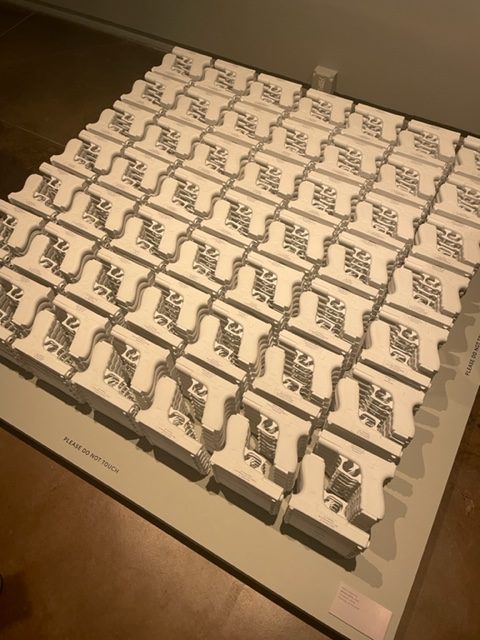
Hall describes as we reach the artist’s gallery, “This is Keiko’s ‘Peacemaker’ series. In ‘Seven Days,’ she selected seven days that had gun deaths – which includes suicide – and stacked guns which have the name and age of the person who died and where it occurred. Because I’m a curator, I think context is everything. And I think this is an important series in the way she visualizes gun violence so that there’s no way we can remain neutral on this issue. It’s new work for her and I’m excited that we could show it.”

The other part of Fukazawa’s ‘Peacemaker’ series shows the guns used in mass shootings with the state flower wrapped around the gun. The flower is a symbol of beauty, hope, and life while the gun represents violence, death, and sorrow.

Keiko Fukazawa, Circle of Friends | Photo by Brianna Chu / Hey SoCal

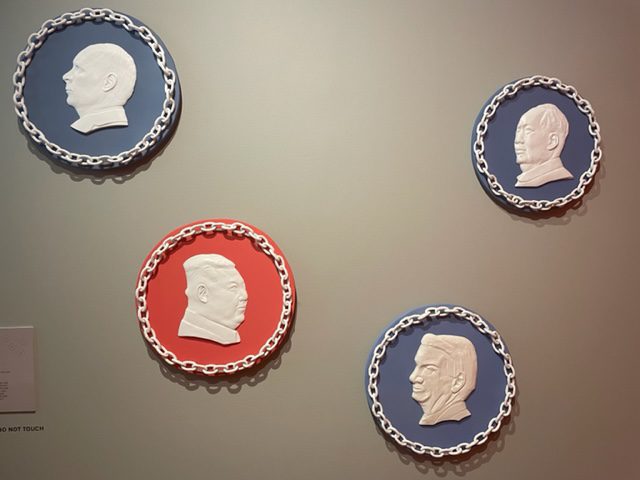
One display area is devoted to Fukazawa’s work with clay and ceramics, and her time in China. When one thinks of China, the image of Mao Zedong inevitably comes to mind and so she produced a piece called ‘Hello, Mao.’ She also made ‘Perception Plates’ and five of these pieces are in the exhibition. Another set of artworks is called ‘Circle of Friends’ – porcelain underglaze with profile images of reviled world leaders past and present – that Hall says was shown at Fisher Museum last fall, to which Fukazawa has since added The Philippines’s Rodrigo Duterte and Brazil’s Jair Bolsonaro.

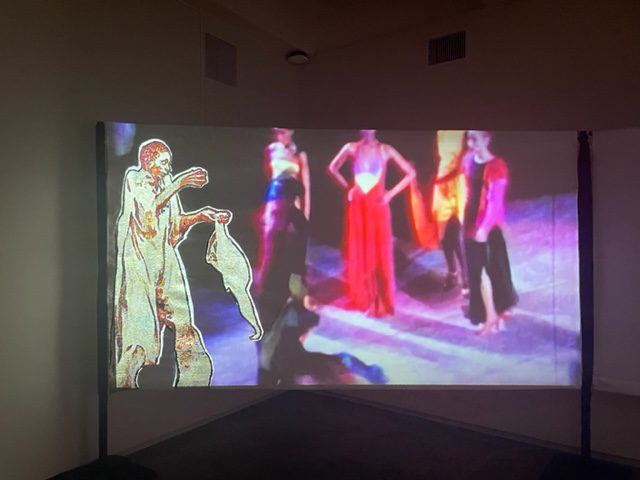
According to the display label for the third artist in this exhibition, Kim-Trang Tran creates multimedia artworks that question the way we perceive the world through our unique experiences and the ongoing influence of history and conflict on our lives. Tran’s experiences as a Vietnamese War refugee who immigrated to the United States at age 9 have been central to her body of work. ‘Movements: Battles and Solidarity’ is a large-scale three-channel video installation projected on handmade screens bearing images that explore the connections between women of color and their shared socio-political and physical “movements.” This installation links fashion, race, and class through intersecting images highlighting women as they challenge power structures and create autonomy.

The fashion industry’s roots in hegemony and both capitalist and cultural exploitation are like tendrils reaching through history and across the globe. Tran’s research into the subject of the global trade of cotton and its connections to colonization and war led her to focus on significant events between 1972–74 when the Civil Rights movement collided with high fashion, labor unrest in the garment industry, and the Vietnam War. The work explores shared political and physical “movements” made manifest in the catwalk, the run, and the march. Tran’s installation ‘Movements: Battles and Solidarity’ lays bare the interrelationship between women, diversity, production, and power and the continuing urgency of these subjects today.

Kim-Trang Tran, Movements: Battles and Solidarity | Photo by Brianna Chu / Hey SoCal

Hall informs that Tran’s inspiration for this was a book she read about a fashion show in Versailles in 1972 when the American prêt-à-porter competed against the French haute couture collection, “The Americans ran away with it because they had multi-ethnic models, disco music, and they were having great fun. This multi-media display captures that period from 1972 to 1974 – what was going on at that time and what fashion meant – but she makes it very relevant. And so she thought about the protest movement in textile factories in three different locations in the U.S. and all involved women.

“I feel it’s so empowering and so poignant in the way she portrayed labor, women, representation, and power. There are several layers to this artwork: the image on the left on the screen is embroidered and was made in Vietnam; then there’s a visual on how people treat women’s bodies. I also studied textiles and when I saw this for the first time, I had goosebumps on my arms and tears streaming down my face. I knew we had to have this.”

How fortuitous it is that Hall has made it her creed to advance the accomplishments of diasporic Asian Americans – ensuring that they are seen and heard. At a time when the population in Pasadena and Los Angeles is becoming ever more diverse, USC Pacific Asia Museum is leading the charge to connect us all.         

Belinda Lei’s ‘Not THAT Rich’ Exposes Competition Among Asians

Originally published on 14 December 2021 on Hey SoCal

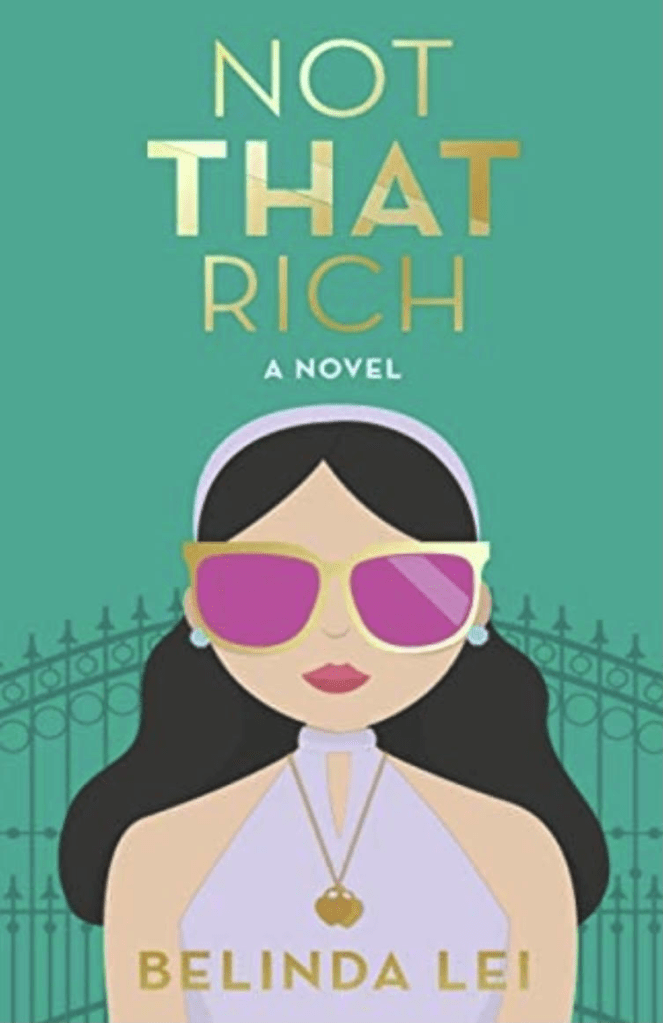
“Not THAT Rich” book cover | Photo courtesy of Belinda Lei

Asians are often stereotyped as the ‘model minority’ – overachieving, law-abiding, non-complaining people who soar above whatever challenges and obstacles are thrown at them to attain financial and personal success. That their accomplishments sometimes come at great cost to their mental well-being isn’t openly discussed.

This is what Belinda Lei explores in her young adult book called “Not THAT Rich,” which follows the lives of senior high schoolers as they navigate the stressful, highly competitive college admissions period.

The daughter of immigrants from Mainland China, Lei was born and raised in Walnut and Hacienda Heights in the eastern San Gabriel Valley. And while she says she’s grateful that her parents brought her up in predominantly Asian American communities where she wasn’t made fun of and bullied for what she ate and how she looked, it also meant being in a pressure cooker environment.    

From her typical Asian upbringing – multi-generation family members in one household – she knows how Asian kids have to strictly adhere to the path their elders set out for them. “I also grew up with my grandparents, from whom I learned traditional Chinese values and an immigrant work ethic from a young age,” relates Lei. “My family promoted what they deemed best for me based upon what they thought would secure me a happy future – financial success, a reputable profession, and a devotion to family. As a teenager, I admittedly resented the expectations that seemed so unachievable and felt like I was simply following a mold – that of the model minority.

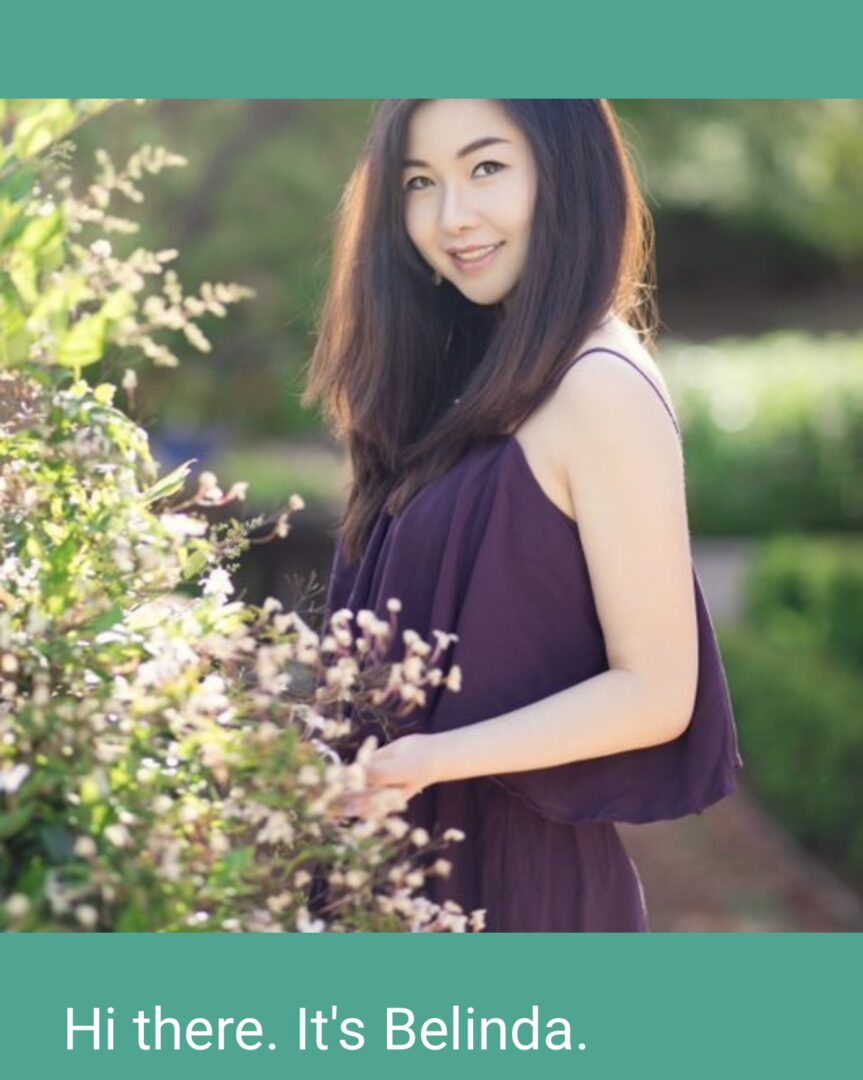
Belinda Lei’s publicity photo | Photo courtesy of notthatrich.com

“However, having recently turned 26 and now looking back, I empathize with why my family pushed me so hard when I was younger. Though I do believe there is a balance to everything (something I explore a lot in the book). With generational and cultural gaps, a lot of communication and understanding can be lost. And with mental health issues on the rise amongst adolescents and young adults too, it’s now more important than ever to try to bridge these gaps and develop common ground on this definition of ‘success’ and ‘happiness.’”                     

Asked if the title of her book is a reference to Kevin Kwan’s “Crazy Rich Asians” book series, Lei replies, “Yes and no. Originally, ‘Not THAT Rich’ was going to be called ‘SGV’ as a nod to the San Gabriel Valley, where the fictional Winchester High is located in. But over time, as I tailored the book to a young adult audience, I began to think about the books I loved as a teenager, like ‘Gossip Girl’ and ‘Crazy Rich Asians.’ For ‘Crazy Rich Asians,’ I was incredibly excited for not only the book series but also its fully Asian and Asian American cast in the movie adaptation.

“At the same, I also understood the stereotype that might be reinforced with it – that Asians are crazy and rich. Coming up with ‘Not THAT Rich,’ was a sarcastic response in some ways to ‘Crazy Rich Asians.’ What does being rich really mean? What are the sacrifices and struggles that it entails to achieve what we stereotypically deem as rich? Why do we pursue wealth in the first place? These are all questions I was hoping to address in the book although admittedly, I’m still trying to figure out all the answers myself!”

“I wrote ‘Not THAT Rich’ through the lens of being the book that I wish I had as a high schooler,” Lei describes. “Growing up, there wasn’t much Asian American representation in pop culture, and even when there was an Asian American actor on TV or in a book, I felt like it didn’t reflect my own experience of being a second-generation daughter of Chinese immigrants. I wanted to write a book that encompassed the glitz and glam I sought out in books growing up (like ‘Gossip Girl’ and ‘The Clique’) but also gave readers a glimpse into the diversity of perspectives and experiences that can be found in the world of being Asian American (like ‘Crazy Rich Asians’ to a certain extent, despite it being set in Singapore).

“Most importantly, I wanted the book to be fun. Young adults already have so much on their minds these days from juggling family, friends, education, and just being a teenager. The heaviness cast in 2020 by the pandemic and political turmoil made it even more important for me to write a lighthearted and juicy book that helped readers escape into a satirical world and, at the same time, draw out reflections about identity, motivations, and consequences.”

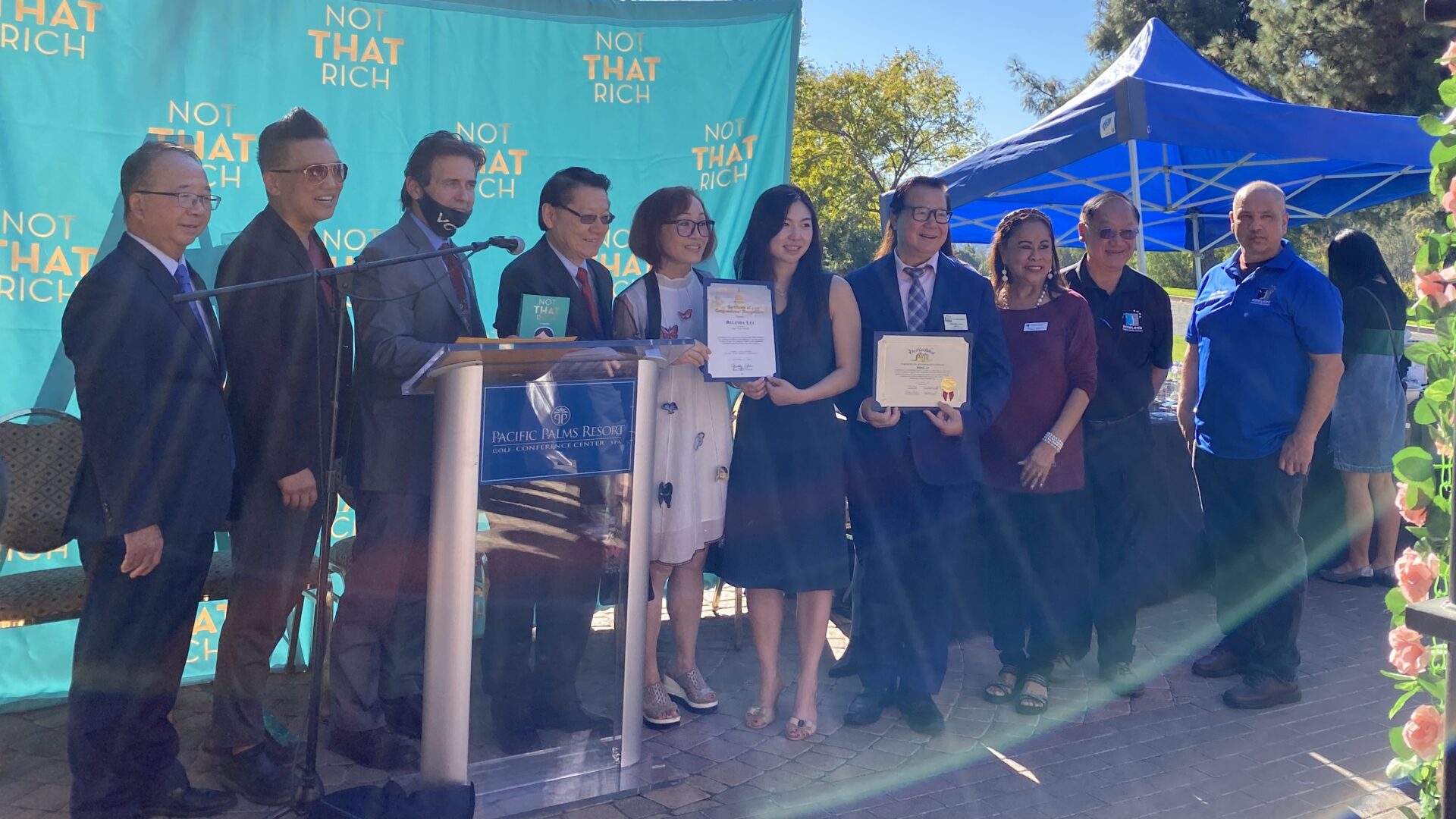
At the book launch of the Chinese version of ‘Not THAT Rich.’ From left, Monterey Park mayor/councilman Peter Chen; Duarte mayor Sam Kang; South Pasadena Mayor Michael Cacciotti; former assemblyman Mike representing congresswoman Judy Chu; former mayor of Walnut Mary Su; Belinda Lei; San Gabriel mayor Chin Ho Liao; Rowland Heights USD board president Cary Chen; RHUSD board member Agen Gonzalez; and board member Erik Venegas | Photo courtesy of notthatrich.com

But while Lei writes about high schoolers and their experience, her book is centered on her truths and others may not relate to them at all. She clarifies, “’Not THAT Rich’ only represents a tiny sliver of the extremely diverse and dynamic racial, socioeconomic, and cultural diversity of the L.A. region. It’s merely based on the world that I grew up in. I highlight a variety of backgrounds, thoughts, and experiences in the novel, but it doesn’t represent the 20 million Asian Americans who can trace their roots to more than 20 countries.”

“Asian Americans are an extremely heterogeneous group,” continues Lei. “Unfortunately, many people see us as a homogenous one. I was starkly aware of this ‘othering’ while writing it in 2020 and consuming reports about the increase of anti-Asian hate crimes due to COVID-19. How is it that my racial identity can brand me as someone who should ‘go back to my own country’ when the country that I’ve been born and raised in is the U.S.? I hope the stories that I weave can help subvert these misplaced prejudices by highlighting how being culturally American and culturally connected to another country should not be mutually exclusive.

“Lastly, think about who is not represented in the novel. Yes, ‘Not THAT Rich’ is fictional, but it does reflect the demographics of the area that I grew up in and the access and opportunities that I was surrounded by. It is very much a book about privilege. While it does not tackle issues of racism and classism head-on, this ‘fun, juicy, and dramatic’ world, unfortunately, does show how socioeconomic status, race, ethnicity, and educational opportunities are intimately intertwined in America.”

Spoiler alert – to say that “Not THAT Rich” depicts Asian parents in unflattering light would be a kindness. While they realize in the end how they have created a toxic environment for their children and redeem themselves by righting the wrongs, it could have happened sooner. And Lei is preaching the moral of her story by launching the Chinese version of her book so non-English-speaking parents can read it and, through it, develop self-awareness.                 

“I would like for the book to reach a worldwide audience, but my goal from the very beginning has always been that if I can reach only one youth out there and make them feel heard, then it has been worth it,” adds Lei. “In that sense, I’m already proud of how far it has come, and seeing it continue to rise in popularity is the icing on the cake. Target recently began carrying the English edition of my book online and as businesses are opening up more, I’m hoping to get it into more brick and mortar bookshops.”

‘Not THAT Rich’ book in Mandarin | Photo courtesy of notthatrich.com

In January, Lei will be returning to Yale to finish the final year of her MBA degree and will graduate next December. Since her first year there, though, she has been a strategy consultant, software engineer, and is currently a product manager at Citibank. She is also the managing director of an anti-bullying non-profit called Act to Change, which focuses on Asian American and Pacific Islander communities.

“The organization first started out in October 2015 as a national public awareness campaign on bullying prevention among youth under President Obama’s White House Initiative on Asian Americans and Pacific Islanders (WHIAAPI),” Lei explains. “I had been a senior intern at the White House Initiative to help spearhead the launch of the AAPI Bullying Prevention Task Force – a coordinated cross-agency effort to address bullying amongst youth. The report released by the task force resulted in the creation of Act To Change and when it officially became a non-profit in 2018, I joined as a founding board member and now I’m the Managing Director.

“I wear a lot of different hats in my role – I’m responsible for various initiatives like our Homeroom with Tan France series where Tan France conducts virtual school visits to talk about bullying and our most recent bullying survey in collaboration with Next Shark and Admerasia. I can also be hopping on calls about fundraising or making TikTok videos. This doesn’t include being our in-house developer where I help manage the website, acttochange.org, or our digital campaigns. It is like my second job.”

With Lei’s multitasking abilities and various pursuits, it’s difficult to foresee where she’ll be a decade from now. In fact, when queried about that, she confesses, “It’s a tough question that I never know how to answer for interviews! Being in my twenties, I feel like my life is constantly changing and with all my different interests I can see myself in multiple different situations in ten years. If I had to choose a dream state for me in my thirties though, it would be being in the entrepreneurship space and continuing to create products or experiences that make a positive impact on communities.”

We can predict, though, that we might see a sequel to “Not THAT Rich” in the not-too-distant future; Lei’s already brainstorming on it. Hopefully, in it the kids will have gone on to university and beyond, and are on the road to living fully realized versions of their younger selves.

But that ideal isn’t limited to Asians – it is something we all aspire to.     

The Life and Times of Y.C. Hong Focus of Exhibit at The Huntington

Originally published on 18 December 2015 in the Pasadena Independent, Arcadia Weekly, Monrovia Weekly, and Sierra Madre Weekly

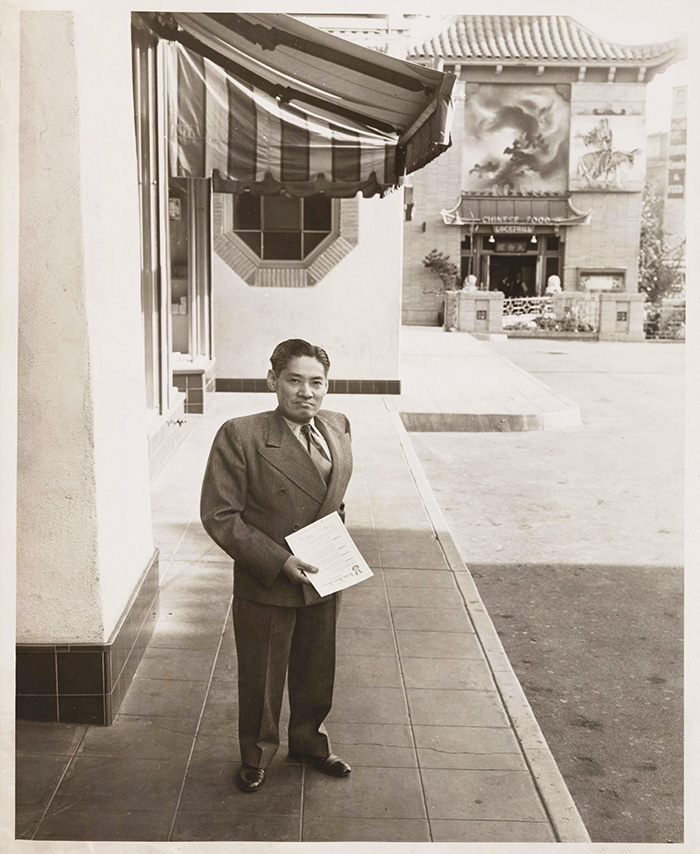
You Chung (Y.C.) Hong | Photo courtesy of The Huntington

The United States is one big melting pot – a land of immigrants who come from far-flung corners of the world. It’s almost inconceivable, therefore, that there was a time when Americans were openly hostile to certain foreign nationals who wanted to come into this country. And yet, this was the reality that You Chung (Y.C.) Hong, foremost Chinese-American immigration lawyer, encountered during the early years of the 20th century. 

A practicing immigration lawyer from 1927 to 1977, Y.C. worked relentlessly on behalf of Chinese settlers and, in the span of his career, helped over 7,000 enter the country legally. He was one of the Asian experts invited to take part in President Harry Truman’s commission to study and reform the U.S. Immigration system.

Y.C.’s history and life’s work is the subject of a show currently going on the Huntington Library, Art Collections and Botanical Gardens. Li Wei Yang, Curator of Western American History, says, “We were compelled to mount an exhibition because it was the first time the Huntington has received a collection about the life of a major Chinese-American figure in L.A. We felt it was important to let the community know, especially in San Marino and the San Gabriel Valley, that we are serious about the preservation of Chinese-American history. We want to show that we care about this community and that we encourage future collections of this kind.”   

To make the exhibition more accessible to a greater number of visitors, the Huntington presented it in bilingual form – translation panels are available to Chinese speakers. Six topical sections divide the 77 items on display – from a broad overview of why and how the Chinese came into the country to the last section showing the establishment of a family-friendly Chinatown in L.A.  

As the exhibit reveals, Y.C. was born in San Francisco in 1898 to Chinese-American parents who originated from Southern China. His early childhood was marked by two significant events – his father died at an early age leaving his mom to raise two boys on her own. And he was accidentally dropped by a relative who was taking care of him. The resulting spinal damage limited his full height to reach only four feet and five inches tall.    

In spite of his early misfortunes, Y.C. had a normal childhood. He graduated from Berkeley High School in 1915, then traveled around the country for a while, and worked as a bookkeeper at a Chinese restaurant in Boston. 

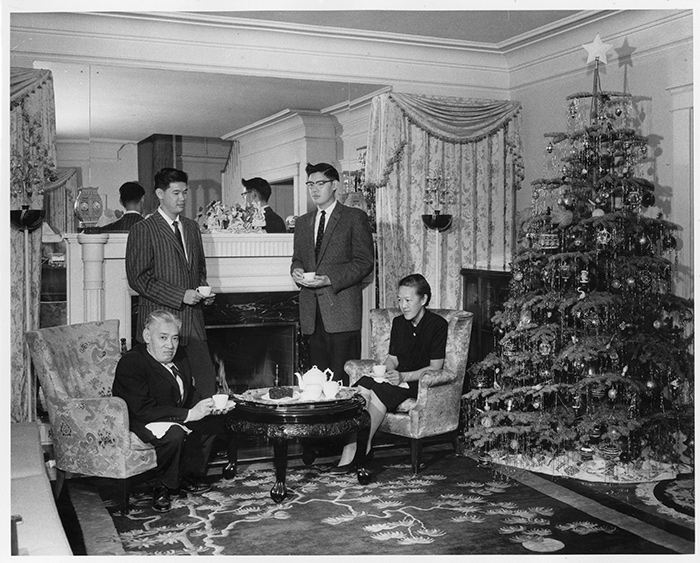
Y. C. Hong with his wife and sons | Photo courtesy of The Huntington

In 1918, Y.C. came to L.A. and was employed as Chinese translator for the Bureau of Immigration while attending night school. He passed the California Bar Exams in 1923, a remarkable feat as he was still a year away from receiving his Bachelor’s degree from USC. He was one of the first Chinese-Americans to be licensed to practice law; he graduated in 1924 and earned his Master’s degree in 1925 at USC. His 74-page Master’s thesis analyzed how the extension and administration of the Chinese Exclusion Act deviated from the original decree, making Chinese-Americans second-class citizens in their own country. In 1927, Y.C. became an immigration lawyer.

Y.C. grew up during the period when Chinese laborers were considered persona non grata. The Chinese Exclusion Act, which was in effect from 1882 to 1943, prohibited Chinese laborers from entering the country. Chinese miners who were in California during the Gold Rush were singled out, and had to pay $4 each month for the right to engage in mining. This tax practically legalized discrimination.

The Chinese Exclusion Act made it essential for every Chinese traveler to carry a passport when they came into the U.S. China’s Qing government issued passports to all merchants, missionaries, students, and all returning residents.

Beginning in 1909, all Chinese with legal status in the U.S. were issued Photo Certificates of Identity – a requirement which only applied to the Chinese, until 1928. This residence certificate became their proof of their legal right to be here – if stopped by the police, they had to produce such ID or they could be arrested or deported. It was eventually replaced by the Alien Registration Receipt Card, informally known as the “green card.”

As rules became ever more stringent, making it extremely difficult for Chinese immigrants to file the necessary paperwork, much less navigate the complex process, lawyers became requisite. Successful entry into the U.S. depended on their ability to recall precise details of family history during long hours of interrogation. While immigration officers used this deterrent, it didn’t stop the Chinese from coming as they adapted to the technique. Y.C. provided his clients with a list of commonly asked questions (which numbered in the hundreds), to which they constructed all the answers. They then used this “cheat sheet” to pass the test – they had found a way to outsmart the authorities. 

On March 28, 1931,Y.C. married Mabel Chin Qong, another Chinese-American whom he met during a Student Exchange in San Francisco in 1928. Mabel was one of the first Chinese-Americans to graduate from the University of Oregon. Their marriage produced two boys – Nowland and Roger.

In L.A. there was an old Chinatown which was a haven for gambling and prostitution. When it was razed in the 1930s to make way for Union Station, a group of Chinese entrepreneurs purchased land to build a new Chinatown on Broadway. It was designed and erected to appeal to families, and a place not just for the Chinese, but for everyone who wanted to learn about this Asian culture. It was the first planned Chinatown in the United States. Y.C. commissioned three buildings where he moved his law offices.

During World War II the Chinese became American allies as they joined the fight against a common enemy – Japan. Mabel helped the American Women’s Volunteer Services raise funds for and run the Chinese canteen, located in Chinatown, providing meal services and entertainment to servicemen in L.A. Approximately 1,500 military personnel patronized the canteen every month. Y.C.’s and Mabel’s war relief efforts in Chinatown were a huge success that a military ambulance airplane was named “Los Angeles Chinese” in recognition of their contributions.

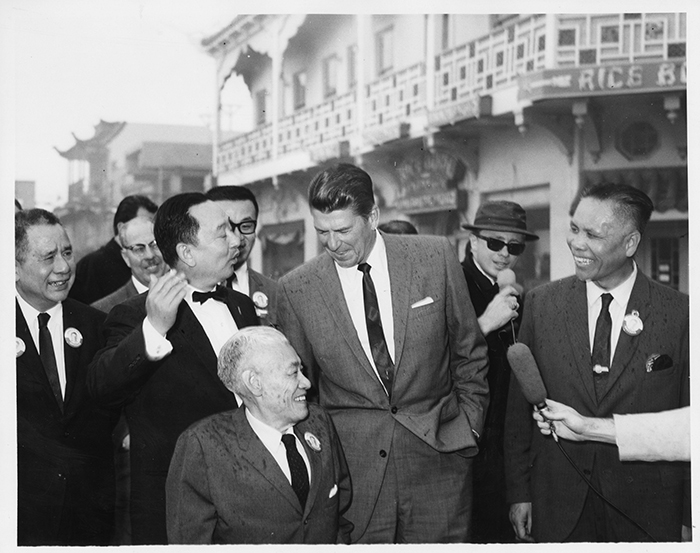
A very astute man, Y.C. recognized the value of political connections sympathetic to the Chinese. He befriended politicians and contributed to their campaigns; he worked the system. 

Y.C. Hong with Ronald Reagan, then governor of California | Photo courtesy of The Huntington

The Hong family papers document that in 1947 Senator Philip Hart introduced S747, which was merged with a bill proposed by Representative Emanuel Celler to form the basis of the Immigration and Nationality Act of 1965. This Act served as the foundation for the current immigration system, which abolished the National Origins Formula and emphasized job skills and family reunification.

Executive Order 10392, issued by President Truman on September 4, 1952 established the President’s Commission on Immigration and Naturalization. Y.C. was one of the experts invited to give their opinions. The Commission’s report “Whom Shall We Welcome” urged reform of the then-current immigration system. 

Y.C.’s and Mabel’s two sons went on to lead distinguished lives. Their older son, Nowland C. Hong, graduated from Pomona College in 1956 with a Bachelor of Arts degree. And, like his father before him, he matriculated at USC’s School of Law, earning his juris doctor degree in 1960. In 1961, he passed the California Bar Examinations and was appointed deputy city attorney of Los Angeles by City Attorney Roger Arnebergh. He served as chief general counsel for the L.A. Board of Harbor Commissions. He was also a founding member and two-term president of the Southern California Chinese Lawyers Association. He served as grand president of the Chinese American Citizens Alliance (of which his late father was an active member). He lives in Pasadena.

Roger S. Hong, their younger son, graduated with a Bachelor’s degree in Architecture from USC in 1965, and a Master’s degree in City and Regional Planning in 1968. He was certified as a licensed architect in many states, including California. Some of his notable projects include the expansion of the California Exposition and State Fair (Sacramento), Thomas and Mack Center (Las Vegas), Kunlun Hotel (Beijing) and Chieh Shou Sports Park (Taipei). He cofounded Arechaederra Hong Treiman Architects in the late 1970s. After his retirement in the early 1960s, he devoted himself to preserving his family’s history. Between 2000 and 2006, he donated the Hong family papers to the Huntington; he died of cancer in 2006.

Y.C. practiced immigration law from 1927 until his death on November 8, 1977. For 50 years the Chinese came to him for help and he responded with grace. He advocated for his people to gain acceptance into society and achieve economic stability. Any one of his countrymen who had lived through the exclusion era knew his name.

Circumstances beyond Y.C.’s control made him physically small and seemingly insignificant. But his unforgettable life and many accomplishments prove him to be extraordinary writ large.