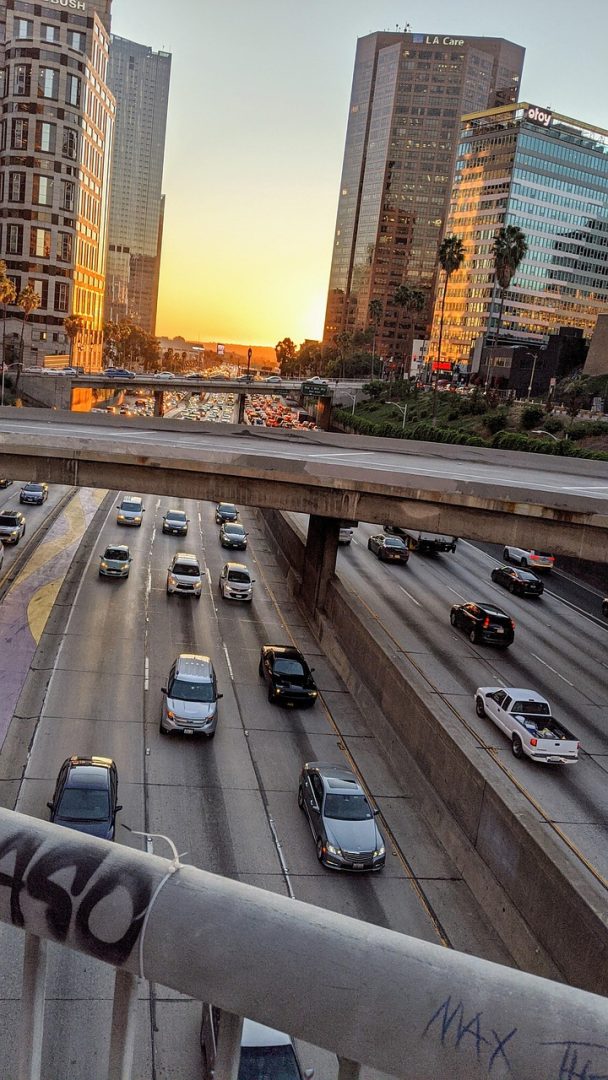
In L.A. County, freeways are a ubiquitous part of our surroundings. It’s hard to imagine a time when we traveled the expanse of the region on city streets. As population increased and more cars traversed the roads, freeways were constructed to make driving safer for people and areas more accessible.
The 110 Freeway, more popularly known as the Pasadena Freeway, is one of the oldest (if not the first) freeways in the United States. The first section – the Arroyo Seco Parkway – opened to traffic in 1938 and the rest of the throughway opened in 1940. Today, there are several freeway interchanges that connect Los Angeles to various parts of California and to other states.
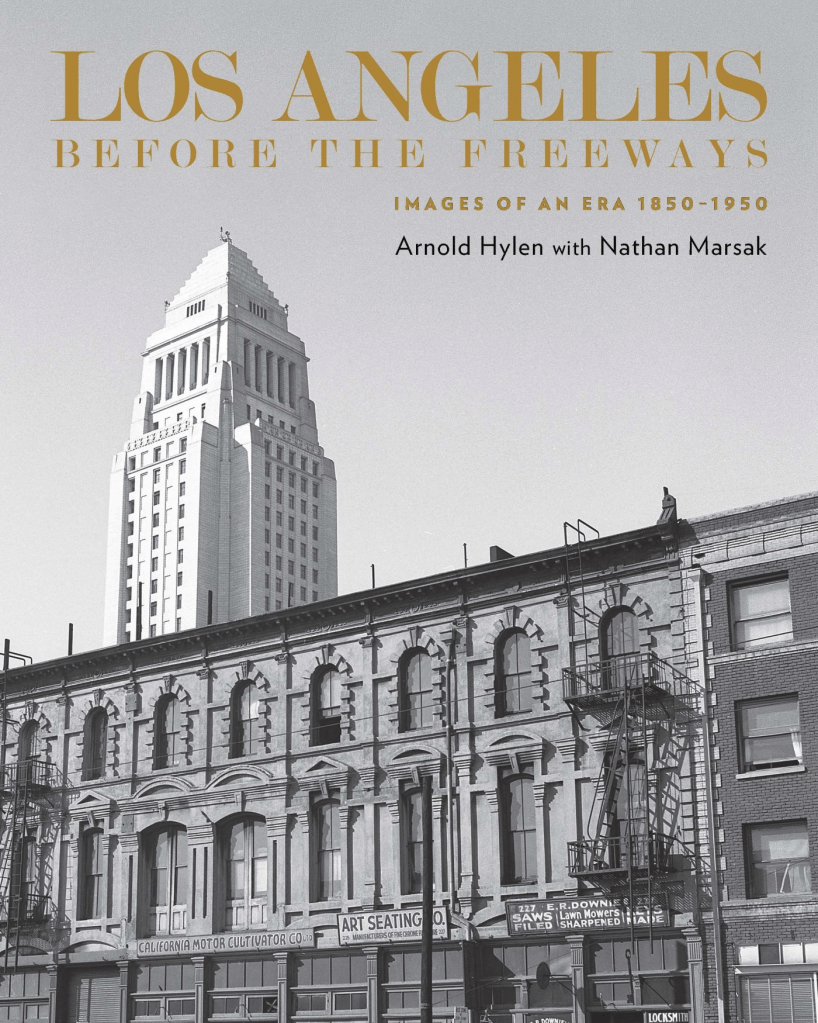
Countless buildings were demolished to make way for the construction of these freeways. The book “Los Angeles Before the Freeways: Images of An Era 1850-1950” gives a lush, visual tour of a Los Angeles that no longer exists – one of elegant office buildings and stately mansions that were razed in the name of “progress.” Originally published by Dawson’s Book Shop in 1981, it has become a cult classic among L.A.’s architectural historians.
Photo courtesy of Pixabay
Gorgeous black-and-white photos from Arnold Hylen that capture a forgotten era are showcased in the book. It has an original essay by the photographer that provides historical background and context for the time period. This new edition from Angel City Press, to be released on March 25, contains additional, never-before-seen photographs from Hylen and newly unearthed information from historian Nathan Marsak on these lost architectural treasures.
The stunning photography recalls an era when downtown Los Angeles was unspoiled by wide-scale redevelopment and retained much of its original character. Each page offers a glimpse of what the city used to be, before some of its architectural jewels were destroyed for the newer, more modern city that would soon follow.
Marsak graciously agreed to be interviewed by email about how he became an L.A. historian – despite not being a native Angeleno – and the upcoming book “Los Angeles Before the Freeways” and why it’s important to get it republished.
“I was born and raised in Santa Barbara, and Los Angeles was like a weird, distant backyard,” he began. “Our television stations were all out of L.A. so I became obsessed with, for example, commercials for Zachary All and Cal Worthington. Then we’d go to LA and it was so different from the picture-perfect neighborhoods of Santa Barbara; in the 1970s Los Angeles was pretty treeless, covered in billboards, blanketed in smog. Like a dying civilization, but with so many insane neon signs, so much bizarre architecture. The whole of the city was fantastical like Disneyland, albeit a giant, grimy, dystopic version of Disneyland.”
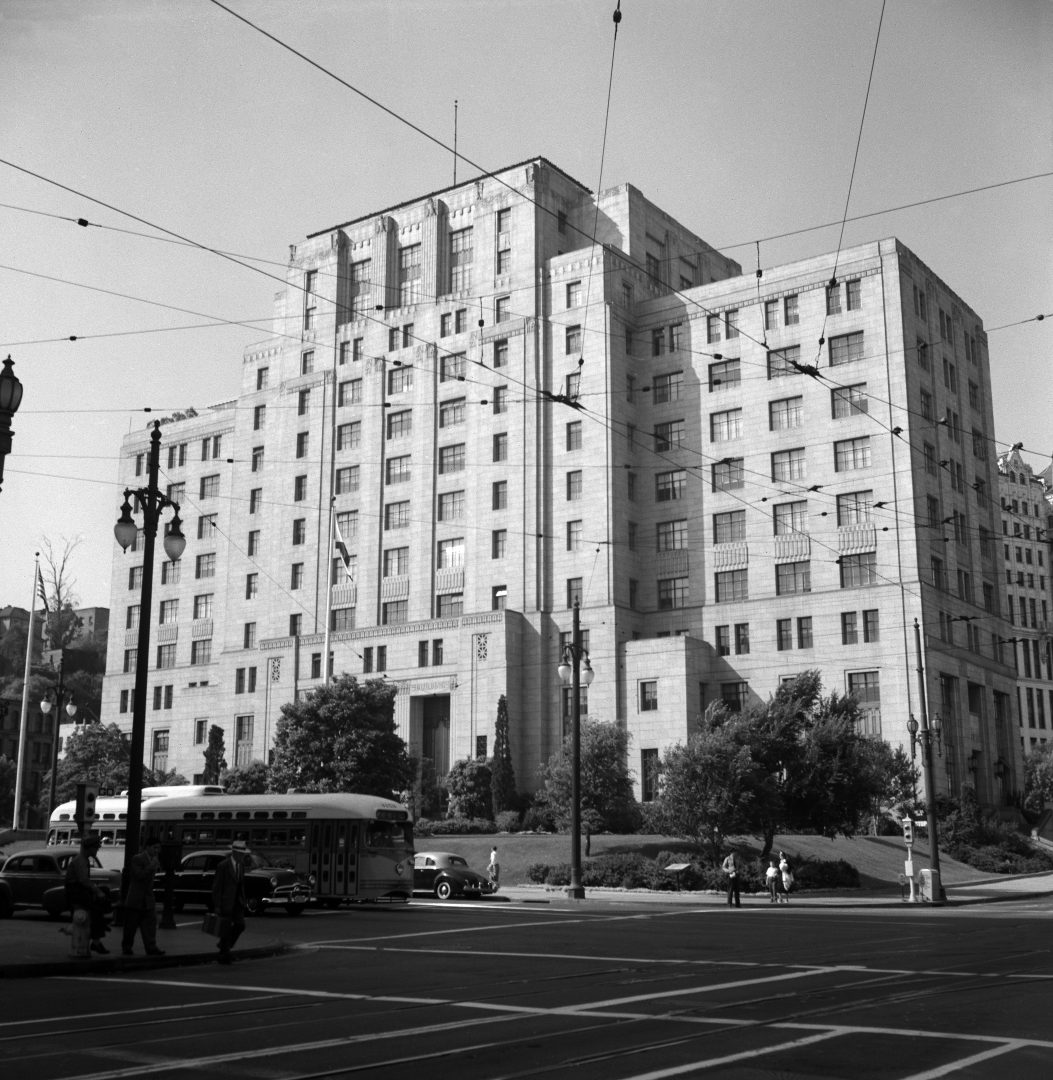
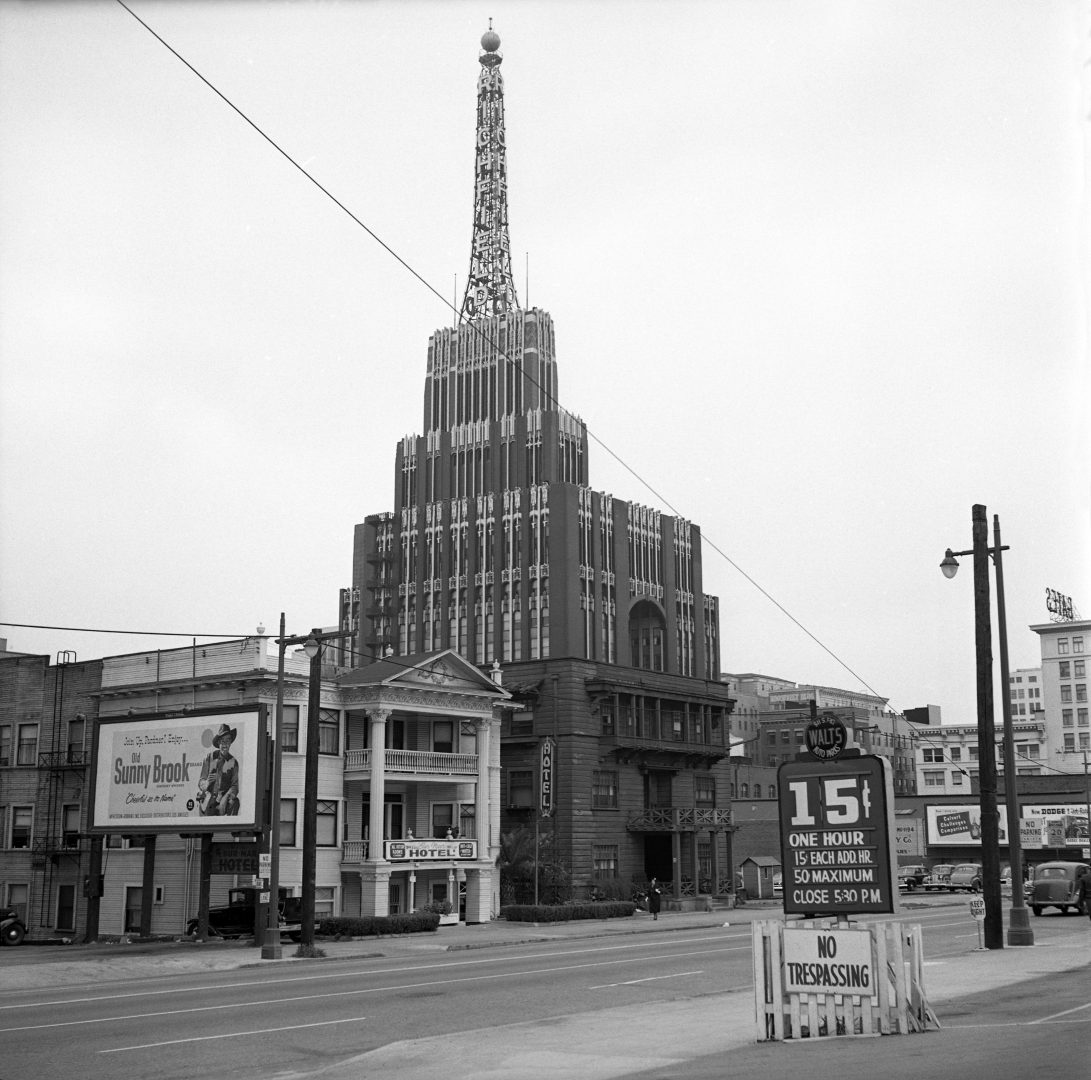
California State Building on First Street. | Photo by Arnold Hylen / Courtesy of Angel City Press
The career choice, however, was preordained. Marsak explained, “My father was a historian and I follow in his footsteps. While other parents took their kids to baseball games, I was being led through Florentine museums or the cathedrals of France. I would have been destined to become a historian no matter where I landed, but I’m very glad my home became Los Angeles.”
Taking up roots in L.A., though, wasn’t always part of Marsak’s plans. He disclosed, “In the early 1990s, I was out in Wisconsin, going to graduate school and doing architectural history. But the lure of Southern California pulled me back, especially after I saw the ’92 riots on TV. I packed my things, and read Raymond Chandler and James Ellroy to acquaint myself with my new home, and moved to East Hollywood and began looking for ‘Old L.A.’
“Sometime in the mid-90s, I was in a downtown bar talking up the old timers about lost Los Angeles and one of them said ‘you know there was a guy who took photos all around here back in the fifties, and he published a coupla books of them’ — referring of course to Arnold Hylen – and I immediately began combing the bookstores until I found Hylen’s 1976 Bunker Hill book, and his 1981 Los Angeles Before the Freeways.”
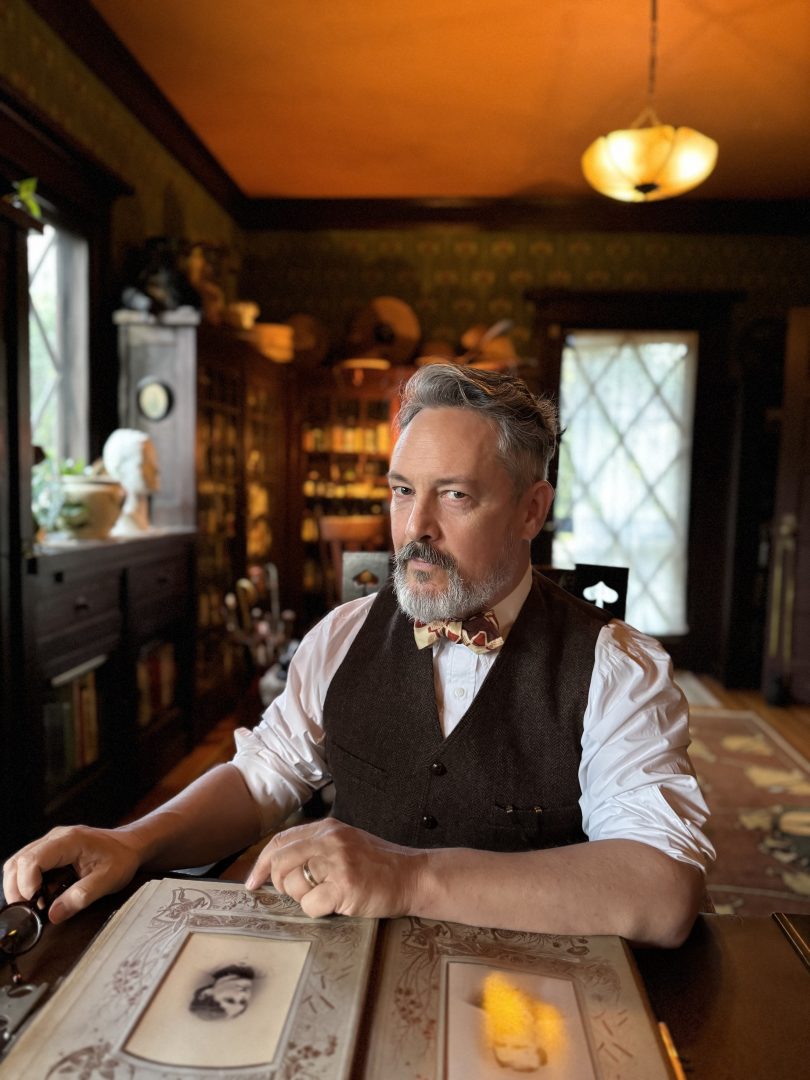
L.A. historian Nathan Marsak / Photo courtesy of Angel City Press
And reading those books became the impetus to discover the architectural history of his adopted home.
“I loved Hylen’s Freeways book, and used to drive around with it on my lap like a Thomas Guide of phantom Los Angeles,” said Marsak. “And because so few copies existed – Dawson’s Book Shop only printed 600 of them in 1981 – I made it my mission to reprint it.”
“But for all of Hylen’s groundbreaking research, as included in his indispensable essay, there were unanswered questions,” continued Marsak. “I wanted to flesh out the buildings with the addition of their architects and construction dates. Naturally, as well, I wanted the images to be larger, and clearer, and that would require being in possession of the original negatives, which I finally managed to purchase in 2016. Each negative strip had three images, so sometimes there were alternate angles or shots of something not in the book. I was thrilled to be able to include some of those never-before-seen captures.”
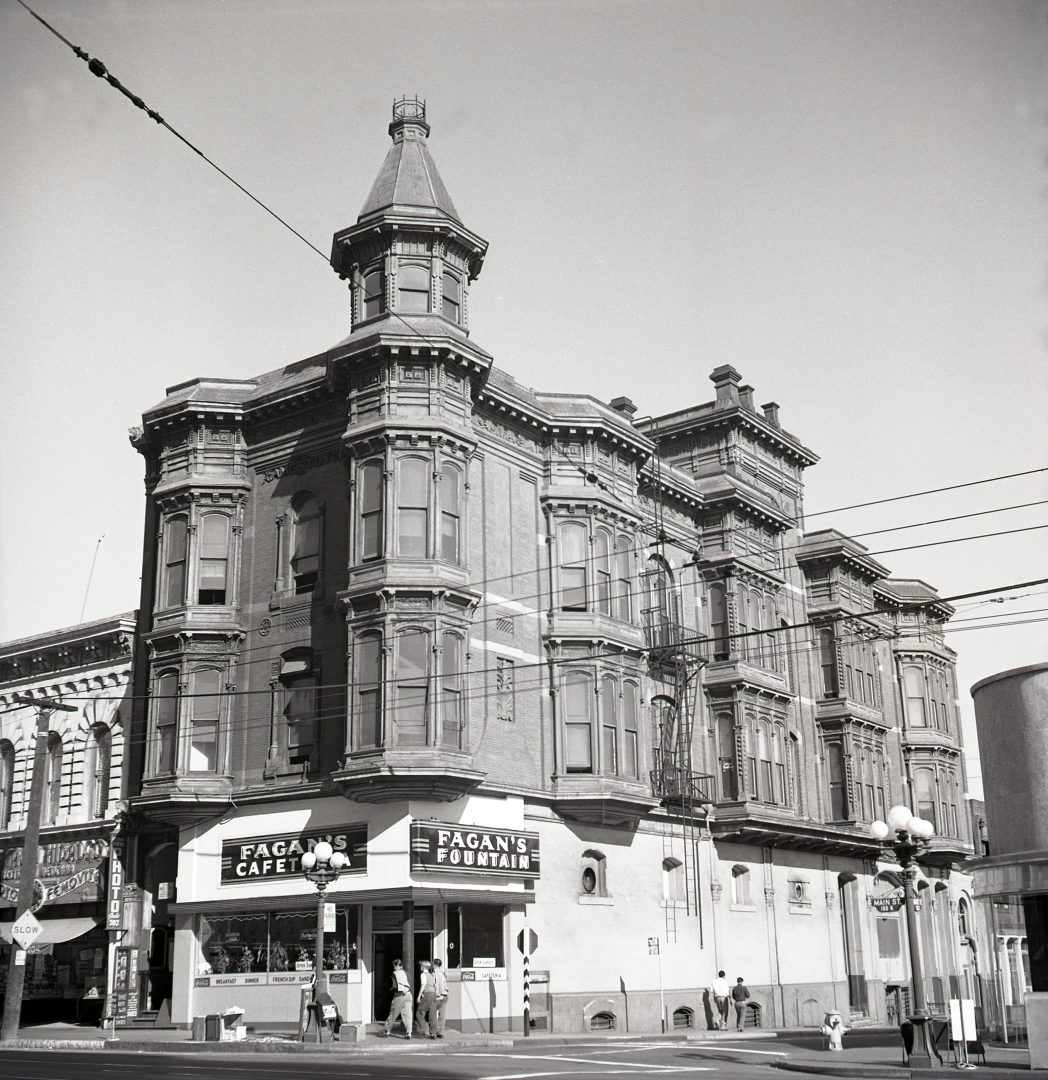
Amestoy Block on Main and Market | Photo by Arnold Hylen / Courtesy of Angel City Press
The original version of Hylen’s book contained 116 photos and the expanded new edition of “Los Angeles Before the Freeways” has 143 images. Hylen began taking photographs downtown about 1950. The majority of his output occurred between 1955-1960, but there are images in the new book that date to as late as 1979, according to Marsak.
“This is not a book about buildings that were only lost to freeways,” Marsak clarified. “It also includes some structures that were demolished when the Hollywood Freeway made its easterly path through Fort Moore hill, and of course there are some images of the Harbor Freeway as it was constructed west of Bunker Hill. But most of the structures contained herein were lost to parking lots, or the expansion of the Civic Center. An accurate number for how many structures were razed because of freeway construction would be difficult to gauge, but a safe bet is about 1,000.”
The road to getting the book republished was long. Marsak related, “I established contact with Hylen’s family about 2006, and by the time I acquired rights and negatives, in 2016, I was already working on my Bunker Hill book for Angel City Press, so ‘Freeways’ took a back burner. I began writing the captions and scanning the ‘Freeways’ negatives in early 2022, which was about two years of work before I handed Angel City Press a completed manuscript in 2024.”
Marsak added, “I hope readers take away that there were first-rate domestic and commercial structures by top-flight architects in the 19th century. Naturally, the fact that the majority of the structures featured have been wiped away, I also hope causes readers to become active with preservation in their communities.”
Through this book, Marsak would also like us to have a better appreciation for the city.
“There’s more to Victorian L.A. than just the Queen Anne houses on Carroll Avenue or at Heritage Square – which are great, don’t get me wrong! – but we once had an incredible collection of Romanesque Revival, Italianate, and other styles blanketing the city in general, downtown in particular,” emphasized Marsak.
Unfortunately, these magnificent edifices didn’t survive the wrecking ball and – but for the images in the book – no trace of their past existence remains.
“Very few people in postwar America were interested in architectural salvage from Victorian buildings,” Marsak lamented. “The Magic Castle, though, utilized parts of structures for its fanciful interior. And of course, most famously, two houses from Bunker Hill were moved to Montecito Heights as the first structures in the Heritage Square project. But they were sadly burned to the ground not long after their relocation.”
It’s a disgrace that the inspired works of eminent architects had to be sacrificed in the service of building something as pedestrian as a parking lot. Fortunately, we’re now repurposing the ruins of significant structures. Many interior decorators and designers are sourcing demolished materials to integrate into new construction to imbue character and a distinctive look. It’s one way to ensure that torn down buildings are given a second life
About 10 years ago, Lauren Yee watched an LA Band called Dengue Fever at an outdoor music festival. That singular event inspired her to write a play called “Cambodian Rock Band” and it debuted in 2018 at South Coast Repertory in Orange County.
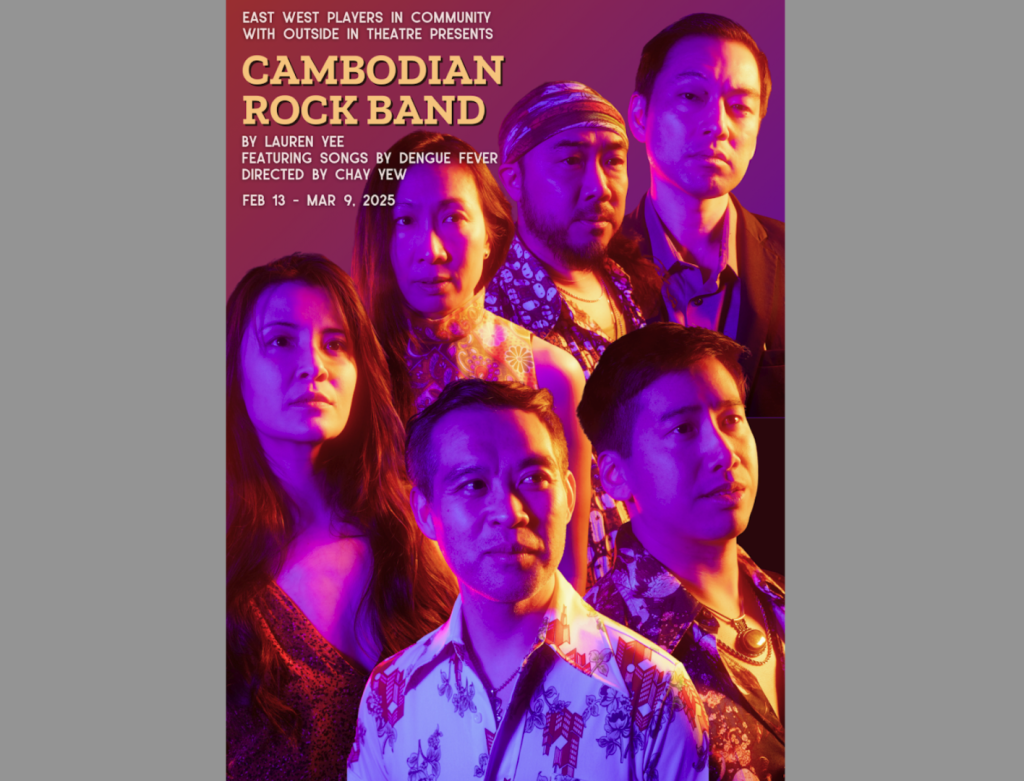
“Cambodian Rock Band” has since been staged in various iterations at different venues. The show makes its return to Southern California from Feb. 13 to March 9 in the David Henry Hwang Theatre at East West Players in Los Angeles — not too far from Long Beach, which is home to the largest Cambodian population outside of Cambodia.
This part-play, part-rock concert tells the powerful story of a Khmer Rouge survivor returning to Cambodia after three decades. As his daughter prepares to prosecute one of the regime’s most notorious war criminals, they must confront their shared history through the healing power of music.
East West Player’s production marks director Chay Yew’s 13th collaboration with the theater, bringing his signature vision to an extraordinary ensemble. He directed the world premiere of “Cambodian Rock Band” at South Coast Repertory and the off-Broadway run at Signature Theatre.
The cast, many of whom were part of the original world-premiere production, includes Kelsey Angel Baehrens as Neary/Sothea, Abraham Kim as Rom/Journalist, Tim Liu as Ted/Leng, Jane Lui as Pou/Guard, Joe Ngo as Chum and Daisuke Tsuji as Duch.
Speaking by phone, New York-based playwright Lauren Yee talks about the genesis of “Cambodian Rock Band,” what compels her to write, and her work process.
“I fell in love with Dengue Fever’s music — it was infectious, and fun and joyful,” begins Yee. “They play their own take on music inspired by the Cambodian rock scene of the ’60s and ’70s. So I went on a deep dive into their musical influences and learned about those musicians, a lot of whom were killed or died during the Khmer Rouge’s takeover of Cambodia in the early ’70s. It was shocking to me that not only the people, but this whole branch of musical history had been under attack. I thought, ‘there’s a play somewhere in here and I want to write it.’”
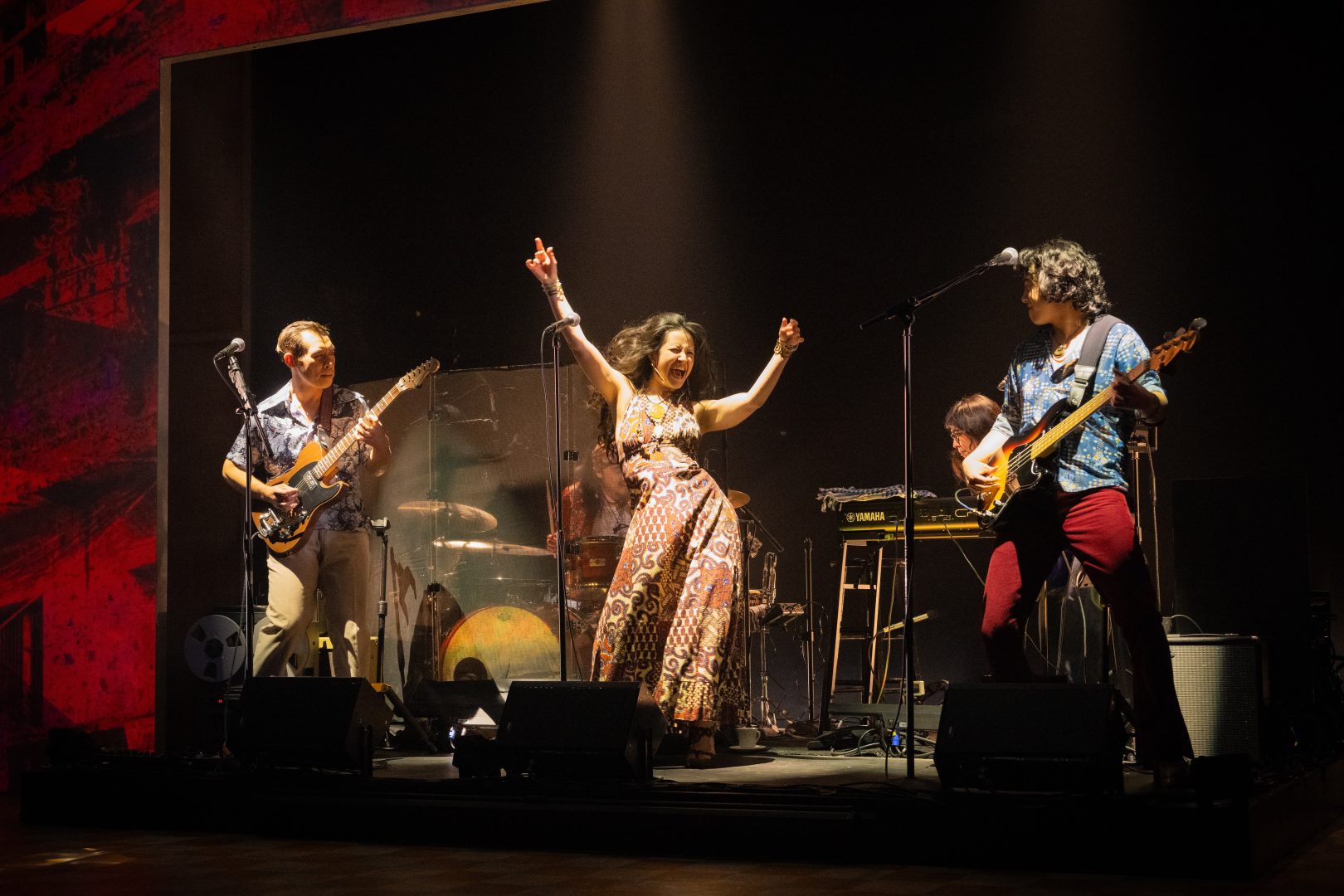
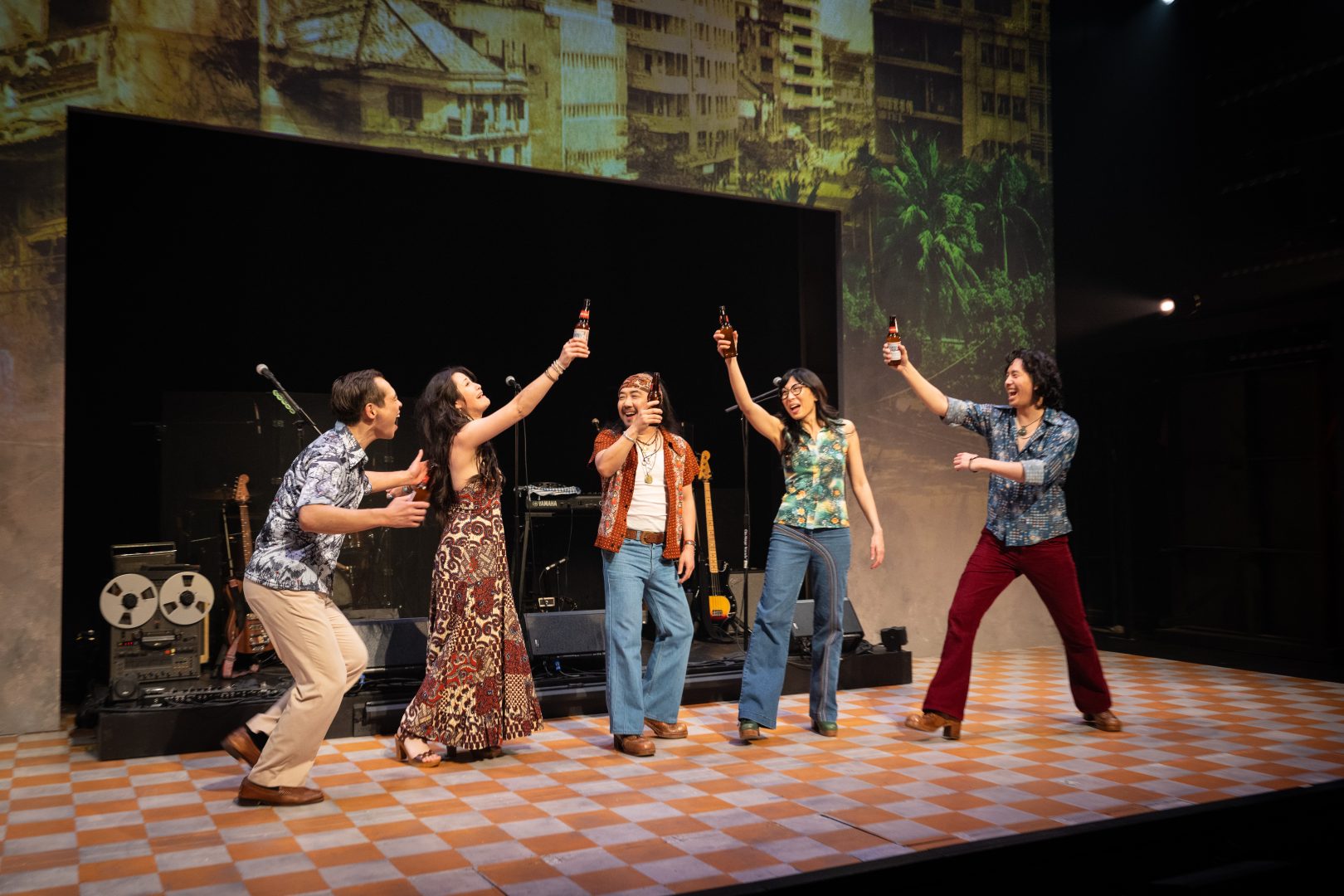
Shown from left to right: Joe Ngo as Chum, Tim Liu as Leng, Kelsey Angel Baehrens as Sothea, Jane Lui as Pou, and Abraham Kim as Rom perform “One Thousand Tears of a Tarantula” by Dengue Fever. | Photo Teolindo / East West Players
For a long time, Yee just contemplated about what that play might be. Then in 2015 she was commissioned by South Coast Repertory to write a play for them and she started working on what was to become “Cambodian Rock Band.”
Yee relates, “In the development process I brought on an actor named Joe Ngo, who I knew from Seattle, and it just so happened that his parents were survivors of the Khmer Rouge. And he played the electric guitar! It went from being a play about music to a play where the actors should play their instrument. He has just been the heart and soul of the show. He premiered the play at South Coast in 2018 and he’s basically been performing the role on and off for the past seven years. His involvement with the play is turning ten this year and he’s coming back to his home base of Southern California to perform the play at East West Players.”
“For a playwright, it’s a dream to have actors who have such a long relationship with a single work,” enthuses Yee. “Usually theaters bring in the actors for a month of rehearsals and a month of performances, and the actor may never touch the play again. But to be able to have these actors come back, like Daisuke Tsuji, Jane Lui, Abraham Kim, who were in the original cast at South Coast and two other actors — Kelsey Angel Baehrens and Tim Liu — join the show having done previous iterations of it, is a beautiful homecoming and something very rare in theatre.”
A Chinese American, Yee has written several Asian-centric comedies and dramas. One of her earlier plays was a comedy called “Ching Chong Chinaman” that featured the Wongs, a Chinese American family, in which she skewered every cliché about Asian American identity. More recently, she wrote a drama titled “The Great Leap,” about an American basketball team that traveled to Beijing in 1989 that explored the intersection of identity and politics and the cultural and political risks of speaking out.
I ask if she writes Asian plays because she’s Asian or because she wants to see more Asian representation in theatre, Yee responds, “I think it’s both. First and foremost, I’m a human who loves theatre so I think my plays represent a wide range of topics, ideas, and characters. But one thing I can offer the theatre world that I’m very proud of, is that I write great roles for Asian American performers where they get to play basketball or shred on an electric guitar and do really cool things and play the villain.”
“Sometimes parts of the plays I write reflect my own lived experience and family history,” continues Yee. “And also, over the years, I find I’ve been really interested in unpacking Communism in Asia in the 20th century and its collision with Western culture. It sounds very dry, but to me it’s about ‘What is it like when something seemingly Western as basketball collides with China?’ ‘What is it like when you’re living in a world that has outlawed Western music and then you hear electric guitar?’ as in ‘Cambodian Rock Band.’ I find those clashes incredibly interesting.”
And Yee doesn’t shirk from sensitive topics as she did with “Ching Chong Chinaman.”
She explains, “’Ching Chong Chinaman,’ which I wrote almost 20 years ago, is very close to my own family experience. It shines a light on how others thought of Chinese Americans and Asian Americans at a time when it wasn’t on people’s radar. Stop AAPI Hate was not a thing yet. We were just coming off seeing Asian Americans as this model minority and no one was talking about how we’re viewed and what language is being used against us.”
“For me, that was the right title for the play because I think it’s important that we don’t ignore the things that are traumatic — like charged language,” Yee adds. “We shouldn’t pretend that everything’s okay; we have to confront them.”
Shown from left to right: Joe Ngo as Chum, Kelsey Angel Baehrens as Sothea, Tim Liu as Leng, Jane Lui as Pou, and Abraham Kim as Rom. | Photo by Teolindo / East West Players
According to Yee, she doesn’t have a fixed idea if a play she’s writing is going to be a comedy or a drama.
“Each play is like a kid: the child is born and you don’t know their personality, what they’re going to be like,” enlightens Yee. “But as you begin to spend time with them you see how they speak and communicate. In all of my plays there’s the vein of humor that runs throughout; there’s something deeply, painfully funny in them. I think drama and comedy exist in that same human experience. I really can’t separate the two.”
While most of Yee’s plays have been universally praised by critics, she’s a little shy when it comes to reviews.
“I can write a play and two different people can have totally different opinions about what they think of it or how the play should have gone,” Yee says. “I’m most invested in listening to the voices that are closest to the creative process.”
As for the audience takeaway, Yee observes, “I’m really excited for whatever the audience takes away. I think it’s going to vary based on who you are and your experiences with the music and its history. For those new to this history, I want to incite you to dig deeper and learn more; to think about the power of art, and the threat of oppressive regime, and what can happen when things change.
“And for people who are closer to the material, who know the music or maybe are familiar in a personal way with the event, I hope you’re able to celebrate that music, and reflect on your own history, and share some of your own experiences with people you love. What I found with this play that has been so moving is to hear people — especially from the Cambodian community — say ‘I went through that, or I didn’t experience exactly that, but I’m going to tell my kids about what happened to me.’”
In parting, Yee declares, “I’m so excited to be part of East West Players’ 60th anniversary. Throughout the 20th and 21st century, they have been a leader in championing AAPI voices and it’s really an honor to be part of Lily Tung Crystal’s inaugural season. I think ‘Cambodian Rock Band’ is a joyride — the music is electric, the performers are amazing. It’s a show that lifts you up on your feet despite it all.”
Those who have been fortunate enough to see Yee’s plays will tell you that she creates intensely heartbreaking plays that bring the audience to tears and hysterically funny ones that have people laughing their heads off. “Cambodian Rock Band” is another one of her works that’s certain to elicit a strong emotional reaction.
Originally published on 6 December 2022 on Hey SoCal
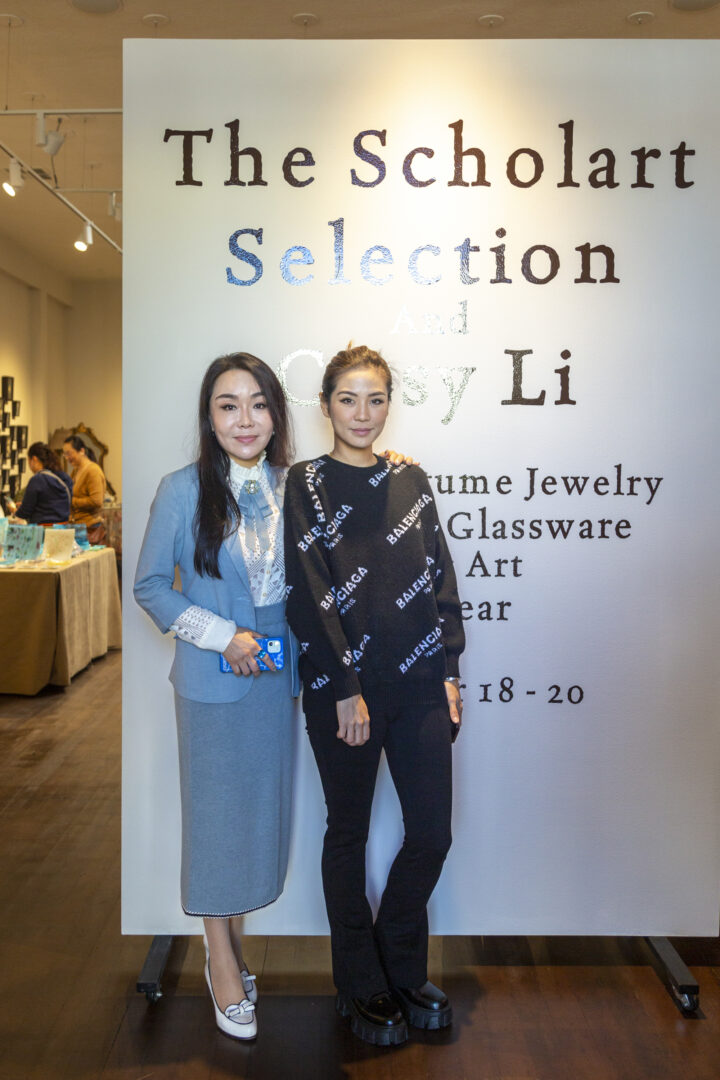
The Scholart Selection, an art space located at the San Gabriel Mission District, held its inaugural show from Nov. 18 to 20 – in time for the holiday shopping season – with an exhibition and sale of hats, glassware, and ceramic items made by Pasadena artist Cissy Li. Also featured were vintage costume jewelry from the showroom owner’s private collection.
A former haute couture runway model, Li graced the catwalk for Europe’s renowned fashion houses. She followed that illustrious career with yet another artistic endeavor – artisanal milliner (read related article here) – creating bespoke headwear for friends. Then she expanded into making glass and ceramic art ware, which she displayed at her spring show this year (read my article here).
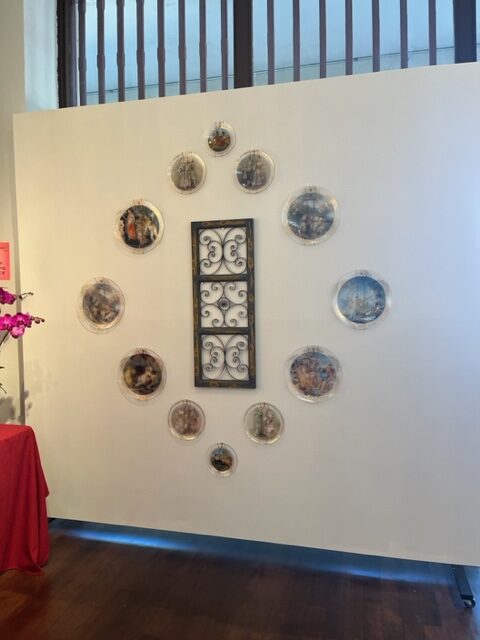
Plates with an over glaze of famous oil paintings and 22K gold band | Photo by May S. Ruiz / Hey SoCal
According to Li, she wasn’t asked to make anything special for Scholart Selection’s maiden event. She says, “Cindy [the art space’s founder] trusted me to come up with something and told me not to work too hard; she reassured me that we had enough items to show. So I made 16 plates for the gallery opening – they are one layer of clear glass with an over glaze of famous oil paintings and 22K gold band.”
That confidence in Li’s ability is high praise from someone she hasn’t known very long. She discloses that they met through a friend they both know. “I then invited Cindy to my friend Yenfu Guo’s exhibition called GAME at Seasons LA. After some lengthy and wonderful conversations, we became friends. I invited her to my workshop to show her how to make glass art work. She was very interested and, maybe impressed, so she asked me to be her new art space’s first guest artist. I was so thrilled!”
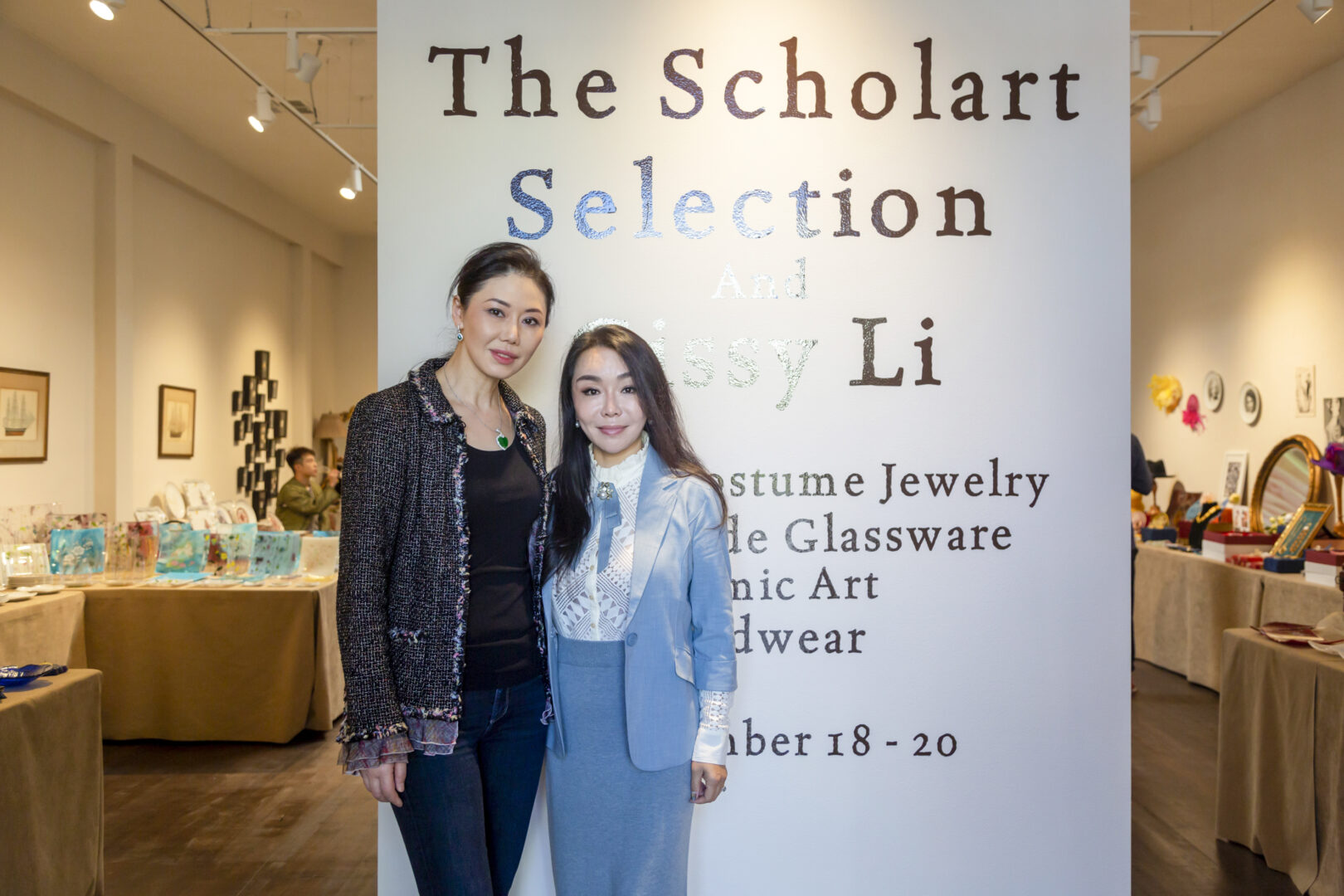
Cissy Li (at left) and Cindy Wang (right) | Photo by Lingxue Hao / The Scholart Selection
It isn’t the first time that Li has partnered with a gallery and she absolutely enjoys the experience. She enthuses, “This is a wonderful way to show people your ability! And I had a great time working with Cindy. I learned so much from her – she is so smart and hands-on – and I would love to collaborate with her again!
Li’s recollection about how they became acquainted is echoed by Cindy Wang, Scholart Selection’s founder, who graciously speaks with us during the showroom’s opening. Scholart’s Space Manager Dodonna Jen acts as interpreter to facilitate the interview.
Wang relates, “We met at a friend’s party about six months ago and we hit it off. I’ve met a lot of artists in my life and I felt I connected with Cissy as one artist to another. I saw her work and how passionate she is about her art. I also admire how meticulous she is in keeping her workshop neat and organized.”
The decision to ask Li to be her first guest artist wasn’t an impulse but a deliberate choice. Wang explains, “Cissy is a dear friend of mine and I have a great understanding of her creative process. Since our opening exhibition is a three-day event amidst the holidays, the hand-crafted hats, ceramics, and glassware with their beautiful colors are very fitting to share with everyone during the Christmas season. I truly commend Cissy for her dedication and hard work and all the hours she puts in to perfect each and every piece of her art.”
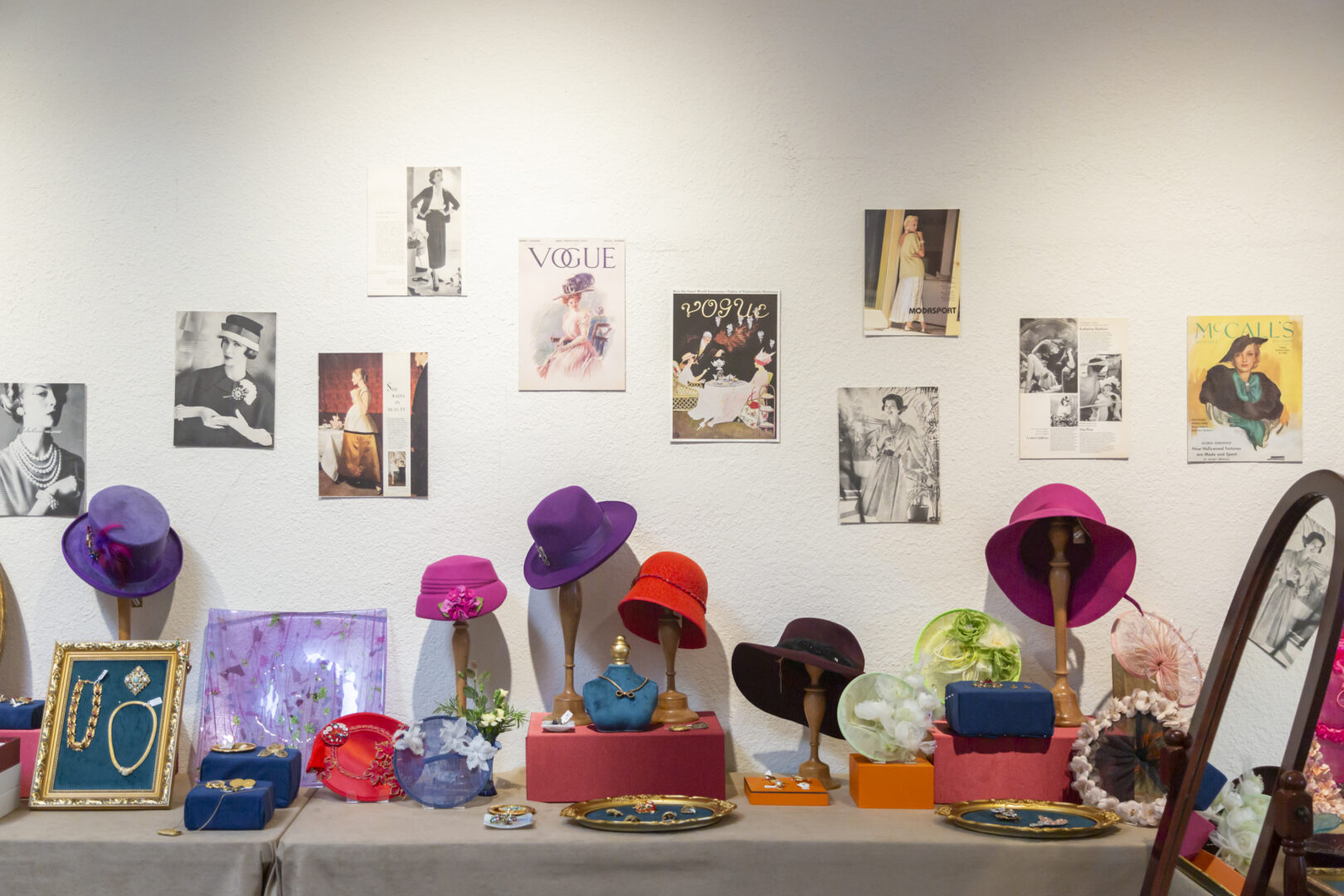
Vintage costume jewelry and hats | Photo by Lingxue Hao / The Scholart Selection
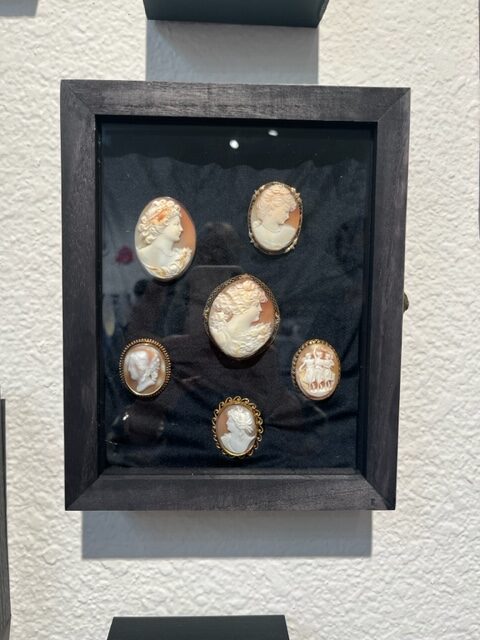
Vintage costume jewelry pieces accompanied the magnificent Cissy Li creations. They were from Wang’s private collection gathered from her travels in Europe and were available for purchase. However, the cameos were only on display because she’s loathed to part with them. She states, “There’s so much history and stories behind the cameos and I’m not ready to give them up just yet.” Perhaps one day.
While at first glance, the vintage jewelry is reminiscent of Old Hollywood glamour, Wang didn’t necessarily pick from that particular era, fashion, or style. She sees the value of the costume jewelry based on their beauty, quality, and workmanship.
Cameos in Cindy Wang’s collection | Photo by May S. Ruiz / Hey SoCal
Wang reiterates, “That’s why I call the space Scholart Selection – the art pieces we exhibit, from jewelry to ceramics, have been selected to reflect the best of artists’ work. What I’m sharing with people are what I personally picked, not random items.”
Because she was born and raised in Beijing – which has a long and storied art and culture history – Wang was drawn to the arts early on. She reveals, “I majored in interior design and also studied advertising at university. After graduating, I started a media company. My husband and I have an extensive range of art collections, including traditional Chinese ceramics, calligraphy and paintings; Japanese wood-block art; and numerous antique and vintage cameos. The Scholart Selection is not my first art space. I’ve owned an antique shop for several years in Beijing that showcases all kinds of art.”
“When I’m not working on an exhibition, I enjoy creating content for my art channel, as well as traveling to various countries to visit local galleries and artists’ studios or even antique shops,” adds Wang. “I always believe that the best way to learn is to see and experience.”
Wang had been living in the United States for three years when she founded the company in 2012 as a channel for art. She originally called it The Scholar but eventually renamed it Scholart (a portmanteau for scholar and art) Selection. It then became obvious that she needed a space for her to realize her desire to share the knowledge she gained and learned through the years.
While she is an Arcadia resident, she chose to open her showroom in San Gabriel. She says, “The San Gabriel Mission area is a historical landmark and when I saw it, I knew it was the perfect place for an art space!”
Cindy Wang (at left) and Dodonna Jen (right) | Photo by Lingxue Hao / The Scholart Selection
Discovering the perfect space to open its doors to the public took some time and doing, though. Dodonna Jen explains, “Cindy found this space in September last year and there had been a lot of back and forth with the landlord and property manager. We leased the spot in February then went through extensive planning and renovations. All the renovations were completed in August so we literally just moved in.”
And Wang and her team hit the ground running. After Li’s show, Scholart Selection will welcome in December the next artist – A Japanese American artist who will share his experience growing up in Los Angeles through his artwork.
“Our current plan is to hold eight to ten exhibitions for 2023,” Wang divulges. “We are now lining up both local and international artists. Our regular exhibitions run about a month long while smaller shows and pop-up events go on for about a few days.
“Whatever the scale of the exhibition, The Scholart Selection always encourages everyone to walk into the art space and feel the spectacular visual gratification that makes you want to keep coming back to experience art in person, as well as relax, muse, and have a good time,” asserts Wang.
Determining whom to invite to exhibit their artwork at Scholart Selection involves analyzing the artist’s oeuvre. Wang declares, “First of all, when we look into an artist, it’s not only my personal understanding of them but also our entire team’s evaluation. We see their artwork, the style and the story that they wish to tell. Of course, the initiative for us to work with an artist is the artist’s perception, with sensitivity to the current culture and society. The process of collaborating with artists and selecting the artworks is always the most fun part. Working with artists always brings me into contact with a wealth of outlook on the world.”
Beautiful glassware in striking colors | Photo by Lingxue Hao / The Scholart Selection
“We are not limited to a certain art form, because art has no boundaries,” Wang clarifies. “This is also the reason why The Scholart Selection does not categorize itself as a gallery but, instead, as an art space. We welcome various art forms, such as movies, music, photography, and different ways of artistic expression. We would love to devote ourselves to creating opportunities for talented artists.”
That Wang asked Cissy Li as their inaugural artist demonstrates her and Scholart Selection’s commitment to that mission, along with showcasing only the best in their field. And the reception from guests did not disappoint.
“We put in a lot of time and effort for this event – from decorating to designing and from invitations to coordination.” Wang concludes, “We wanted to give our guests a welcoming and warm experience. It was definitely successful; we were overwhelmed!”
It shouldn’t have come as a surprise. Wang and Li created an event people enjoyed going to because they curated pieces to mirror their kindred spirit and passion for art. The exhibition set the benchmark for Scholart Selection’s upcoming shows. It’s a tough act to follow, but Wang is sure to invite only consummate professionals like her who can top that feat time and time again.
Originally published on 15 October 2019 in the Pasadena Independent, Arcadia Weekly, and Monrovia Weekly
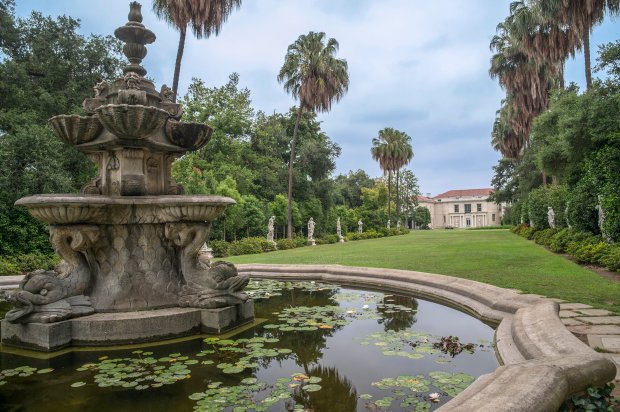
The Huntington Library, Art Museum, and Botanical Gardens | Courtesy photo
The year 1919 was significant for so many reasons but none would affect the art scene and cultural life of the San Gabriel Valley more than the founding of the Huntington Library, Art Museum, and Botanical Gardens. And we have Henry and Arabella Huntington to thank for bestowing on us their incomparable legacy.
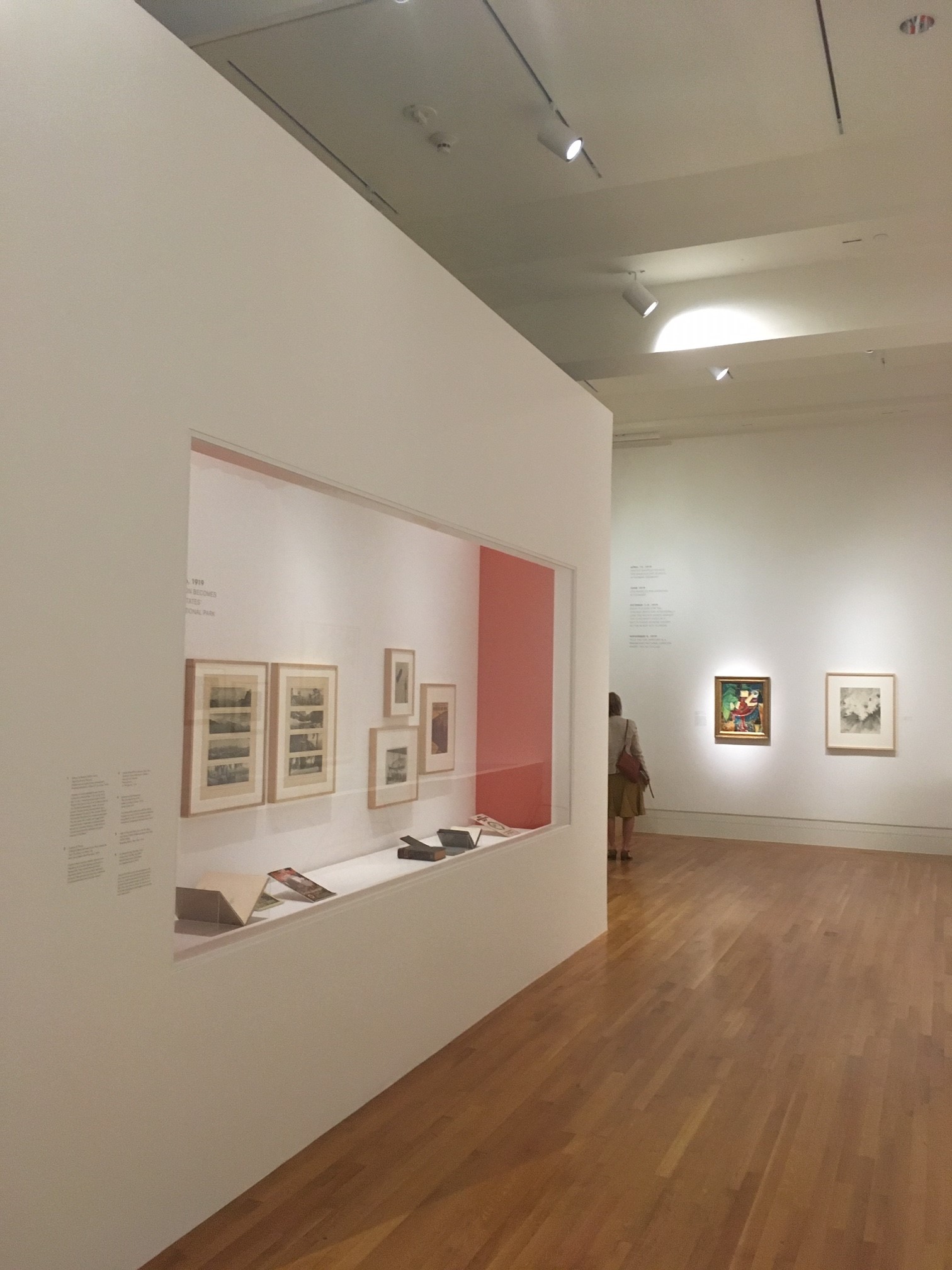
An exhibition called ‘Nineteen Nineteen,’ which opened September 21 and will be on view through January 20, 2020, at the MaryLou and George Boone Gallery showcases 275 items from Henry and Arabella Huntington’s vast collections, some of which have never been displayed.
Co-curators James Glisson, interim chief curator of American art, and Jennifer Watts, curator of photography and visual culture, led a team from the three divisions and went through the institutions massive storehouse of 11 million items. The objects in the exhibition range from posters from the German Revolution, abstract art, suffragist magazines, children’s books, aeronautic manuals, self-help guides for soldiers returning home from World War I, and a book hand-printed by Virginia Woolf at her kitchen table. The thread that ties them all together is that they were all acquired in 1919.
During a preview of ‘Nineteen Nineteen,’ Glisson and Watts walk members of the press around the Boone Gallery to show the items, explain their significance, share their experience, and add their personal insights.
“This project took about two and half years from the very beginning to the end,” begins Glisson. “I went through, probably, 3,000 items, but it could have been more. And a lot of time was spent finding things from 1919 that were interesting, because there were a lot of stuff that weren’t,” he adds with a laugh.
“Or visually compelling,” inserts Watts. “Gathering these things was incredibly labor intensive but fun at the same time. I have to point out, though, that we had research assistants, interns, and grant assistants who did a lot of work – it was a collective endeavor. It involved every curatorial staff across all divisions – the library, the art museum, and the botanical gardens. We knew some things to look for and others were hunches. We asked our colleagues for assistance and they came to bat. They helped us find things we never would have unearthed on our own.”
The ‘1919’ Exhibition at The Huntington | Photo by Brianna Chu / Beacon Media News
Glisson expounds, “Often, it was ‘There’s this great thing, I think it’s from 1919;’ ‘Oh yes, it is.’ This is where the process was different. We knew where we wanted to take it but until we gathered the material together, we couldn’t tell a story. We didn’t know what the story was before we had the material. The verbs came when this checklist was two-thirds through – and we knew what the themes would be and gave it some shape. As Jennifer said before, we had to just be incredibly open to where the material was taking us. It’s like, we see a piece and we say ‘What does this mean?’ Or, sometimes, it’s ‘This is interesting, what is it?’”
“I like to take the analogy of when you look at a centennial and think of the founders, and you put them at the top of your pyramid,” explains Watts. “We decided to invert the pyramid, and put the context and the year at the top. Most of the time, when you’re doing an exhibition, people come up with an idea and they look for the material to support it. We flipped it and said ‘Let’s look at the material and figure out what the bigger ideas and themes are.’”
The exhibition that Glisson and Watts created from that starting point, which Glisson describes as ‘From the global to the local’ is organized around five broad themes – Fight, Return, Map, Move, and Build.
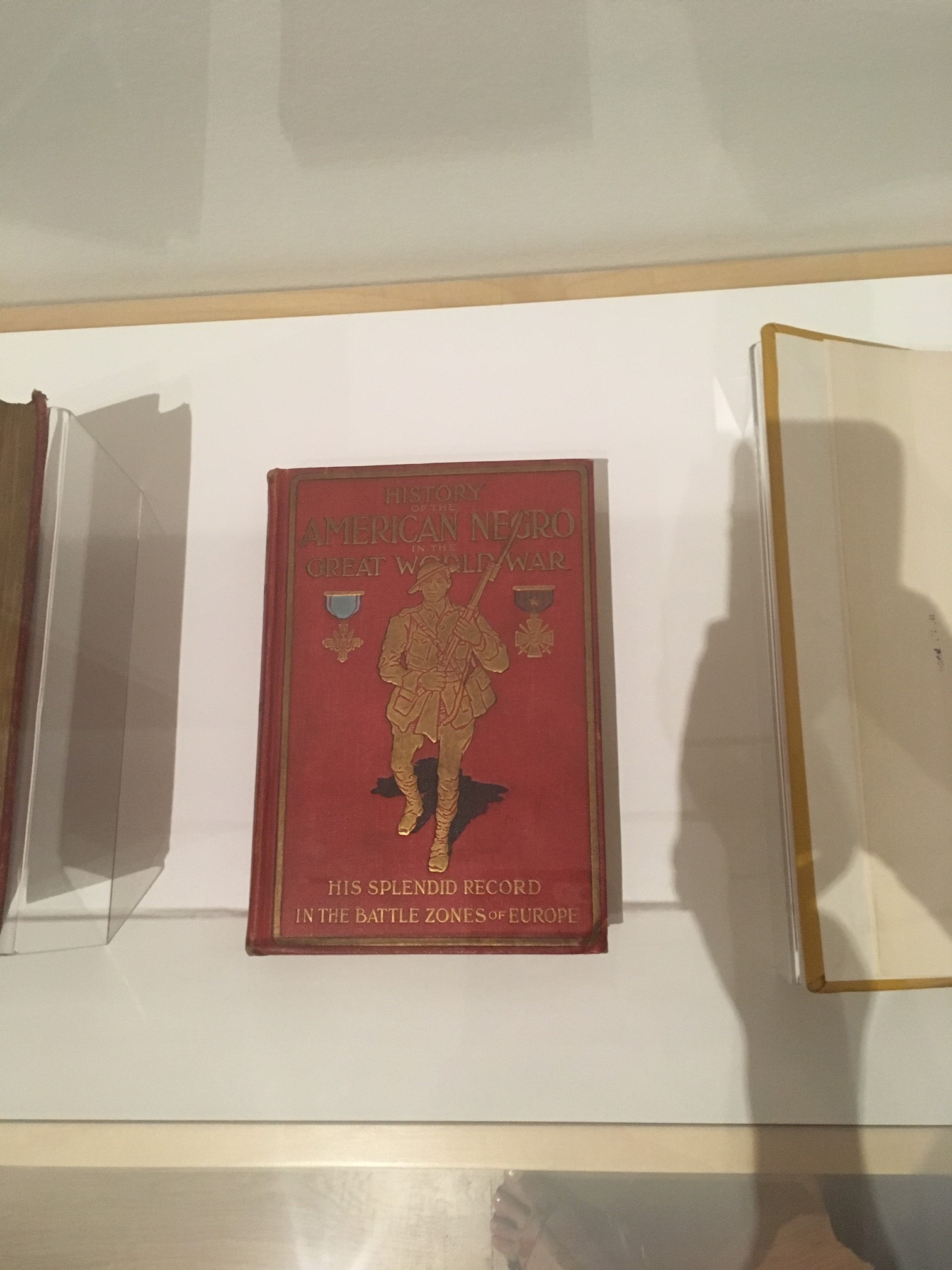
William Allison Sweeney, History of the American Negro in the Great World War, 1919, Cuneo-Henneberry, Chicago | Photo by Brianna Chu / Beacon Media News
Glisson elucidates, “We wanted to harness the large number of 1919-related items here into something provocative, allowing the visitor to interpret the period in a fluid way. Rather than telling a neat, resolved story, we tried to capture the jarring experience of life during a year that everyone understood was an inflection point for world history. Empires had fallen in the Middle East and Eastern Europe. Millions had died fighting and in a flu pandemic. Delegates at the Paris Peace Conference tried to sew a tattered world back together. Like today, people felt that irrevocable change was underway. The issues of 2019 – immigrant detention, women’s rights, and the fight for a living – were equally pressing in 1919.”
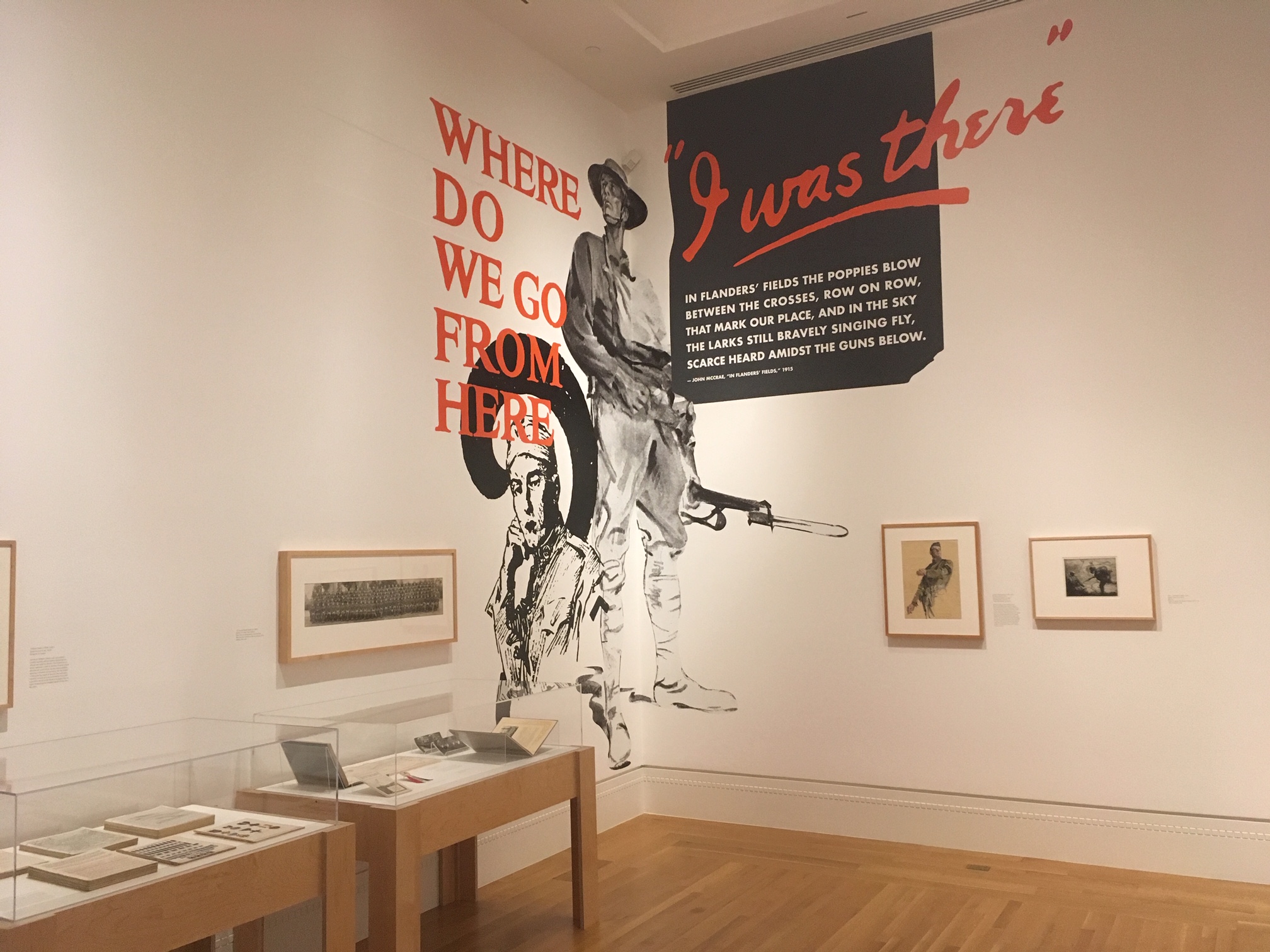
As detailed in a news release from The Huntington’s Communications Office, the ‘Fight’ section of the exhibit shows that, while the war might have officially ended in 1918, other battles raged on in Los Angeles, the rest of the nation, and Europe. A global influenza pandemic killed millions of people, claiming three percent of the world’s population. Laborers agitated for better pay and safe conditions. Rumors about a Bolshevik plot to upend the U.S. government led to a Red Scare. Violence erupted in a season described as ‘Red Summer’ for its deadly riots and lynchings of African Americans. In 1919, the bill that would clinch American women’s right to vote passed in the Senate, and temperance advocates won their fight for prohibition. Modern artists and writers responded to the tremors of the age, including the carnage of world war, by breaking with convention and tradition.
Items in this section include: German posters related to social and political upheaval; original photographs and materials documenting the flu pandemic here in Pasadena; national strikes and labor unrest; U.S. Marshal records (including mug shots and probation letters from German citizens jailed in Los Angeles during the war); and objects that tell the story of the fight to ratify the 19th amendment.
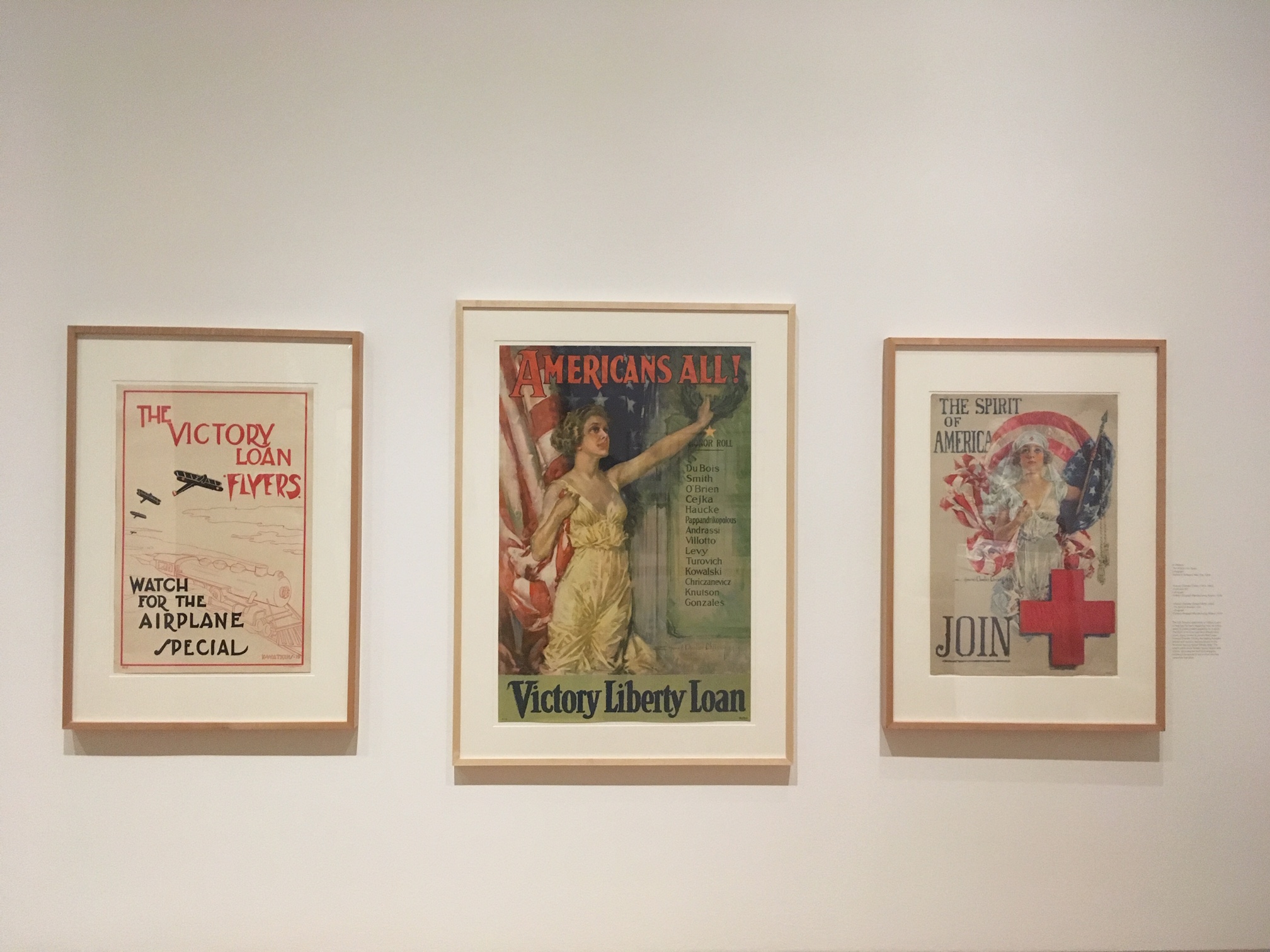
Victory Loan Flyers, ‘The Spirit of America’ Lithograph, and ‘Americans All’ lithograph | Photo by Brianna Chu / Beacon Media News
The ‘Return’ portion focuses on the immediate aftermath of the Great War, when millions of men and women – including 200,000 African America soldiers – headed for home. Survivors sought to understand and memorialize the war’s events through personal reminiscence and published accounts. Artists, some of whom served overseas, interpreted what they had seen, while others found inspiration in canonical tradition and myth. Popular music and illustrated books also offered safe harbor in tumultuous times.
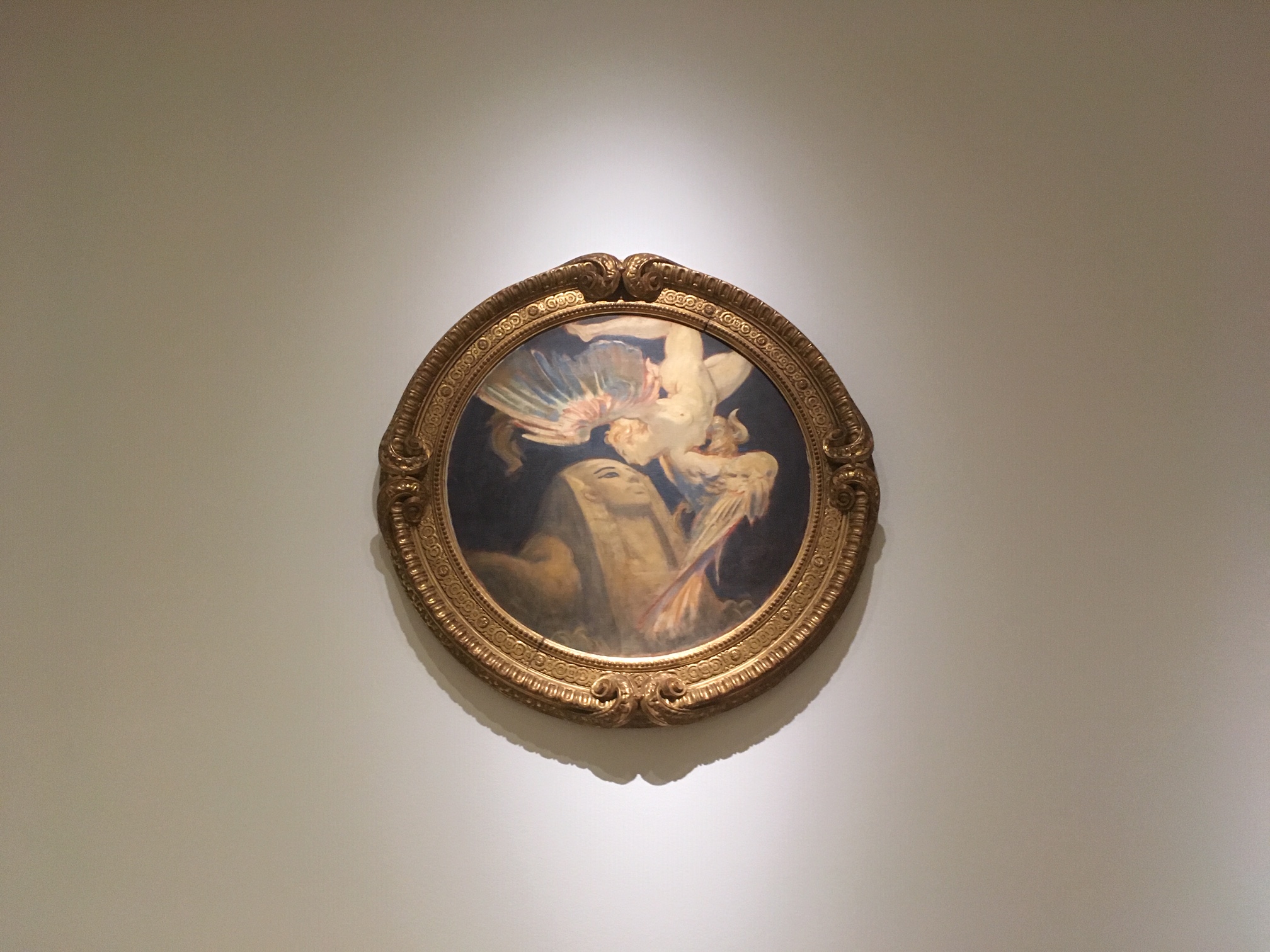
Materials from this segment comprise: Liberty Loan posters; soldiers’ recollections; a rare Edward Weston portrait of dancer Ruth St. Denis; Cyrus Baldridge’s illustration ‘Study of a Soldier;’ and John Singer Sargent’s ‘Sphinx and Chimaera,’ which depicts a mythological scene.
John Singer Sargent’s ‘Sphinx and Chimaera’ oil on canvas | Photo by Brianna Chu / Beacon Media News
In January 1919, President Woodrow Wilson and Allied heads of state gathered at the Paris Peace Conference to make new maps of a changed world. The carving up of ancient empires created new nations in the Middle East, Eastern Europe, and Africa, while regional promoters published maps to highlight Southern California’s capacity for growth. High above Los Angeles – at the Mount Wilson Observatory – the world’s largest telescope was on a nightly quest to chart the universe. In a world turned upside down, maps offered a welcome measure of predictability.
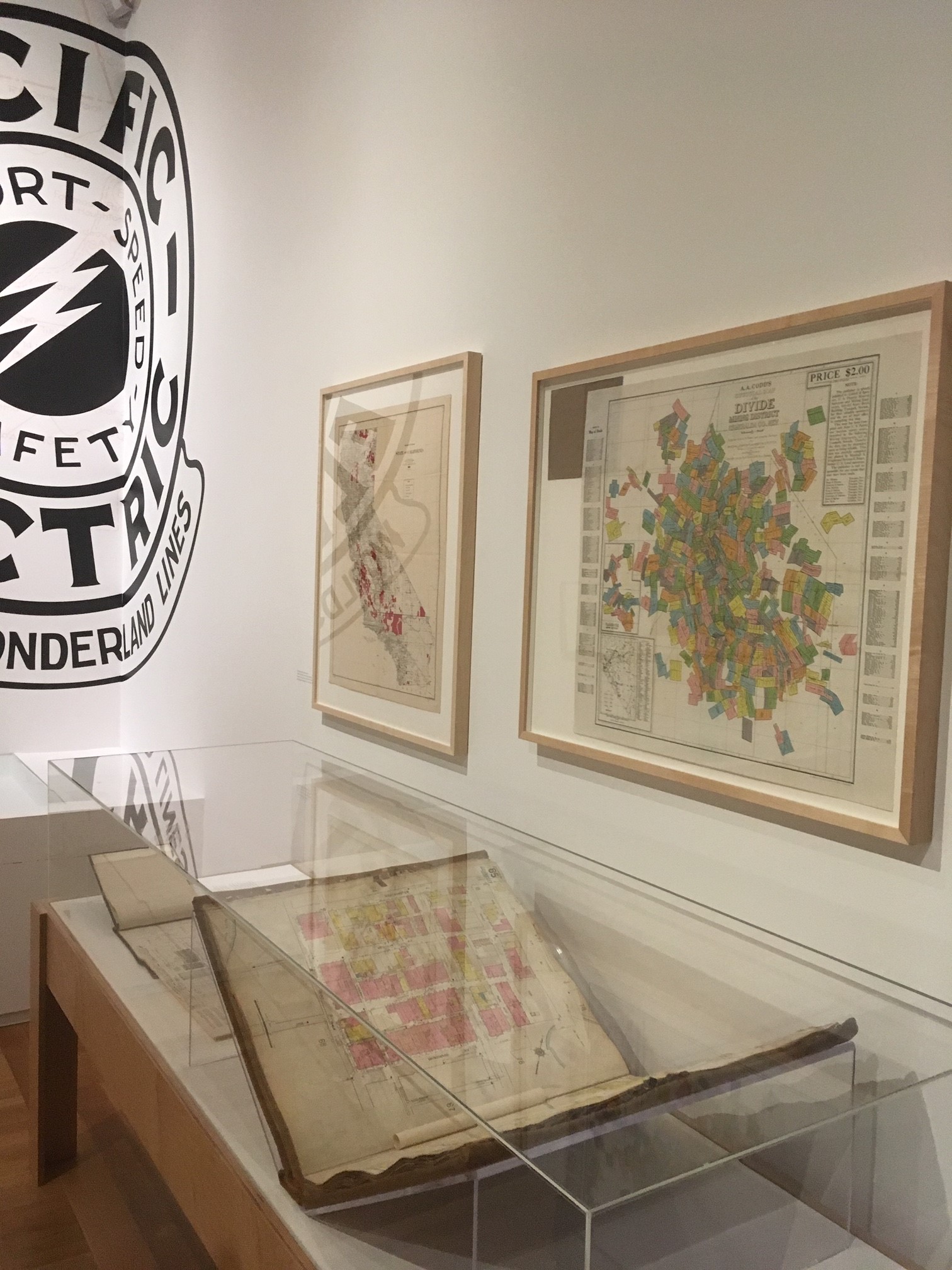
What the charting of territory that occurred that year meant and its resulting significance are explored in the ‘Maps’ section. On view is a first edition of ‘Traite de Paix,’ the Treaty of Peace signed at Versailles on June 29,1919, with a map showing new territorial configurations; an album of autograph signatures gathered at the Paris Peace Conference by T.E. Lawrence, otherwise known as Lawrence of Arabia; rare maps depicting population, transportation, and demographic data in Los Angeles and the nation at the time; and original astronomical photographs of the moon and constellations.
Huntington was obsessed with maps | Photo by Brianna Chu / Beacon Media News
While working on this project, Glisson and Watts found out that Huntington was obsessed with maps. She says, “If you think about it, it’s not that surprising given that he was probably one of the most influential people in setting the course of how our sprawling city came to be. We discovered the spectacular 39-foot long Pacific Electric linen map that shows the real estate holdings contiguous to the line which is part of Huntington’s development scheme. People may not realize that while the Pacific Electric was a component of the world’s largest transportation network at the time, it really was a loss leader for Huntington. He was most interested in getting people to the communities that he’d developed – Huntington Beach, San Marino, Glendale.
“This is a one-of-a-kind map and has never before been exhibited. It is an incredible document – you could see the level of detail on it. Every redaction, every addition is recorded by him. It would have been something that the engineers – and Huntington with them, because he was very detail-oriented – would be poring over. I like to call this the papyri of transportation. It basically shows the Pasadena short line, which was one of the first lines that Huntington put in to the Pacific Electric system and it goes from Old Town Pasadena all the way to the edge of downtown Los Angeles.”
This Pacific Electric map display also falls under the ‘Move’ portion of this exhibition, which examines the ways 20th century technologies – planes, trains, and automobiles – propelled a society on the go. Henry Huntington’s network of streetcar lines brought Angelenos from ‘the mountains to the sea’ and to far-flung deserts and farms. A burgeoning national road system made automobile travel possible and pleasurable as never before.
Also taking the spotlight in this section is the interstate automobile adventure of five friends, including famed aviator Orville Wright, assembled in a rare photographically illustrated volume titled ‘Sage Brush and Sequoia;’ works by T.S. Eliot and Virginia Woolf, published by Virginia and Leonard Woolf’s Hogarth Press.
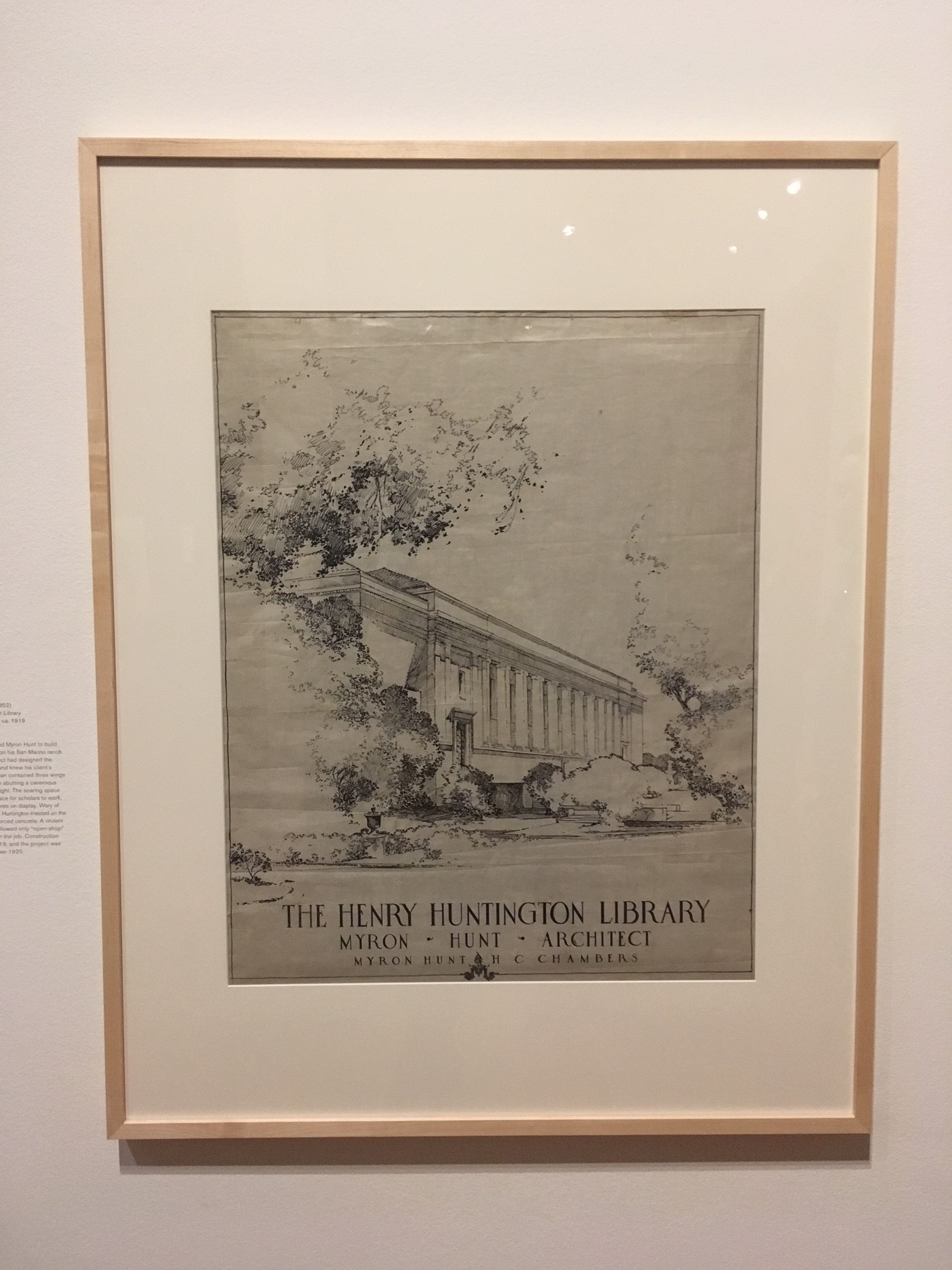
The last portion of the exhibition, ‘Build,’ focuses on Henry E. Huntington and the institution he created. In 1919, Huntington announced what some, including his New York librarians, had begun to suspect. He planned to load boxcars with the ‘world’s greatest private library’ – some 120,000 volumes – and send it off to the country’s western shores. By then, the property’s palm, desert, rose, and Japanese gardens were planted under the guidance of William Hertrich, Huntington’s landscaper. The mansion, designed by Myron Hunt, was completed in 1910. With the construction of the library building, the keystone fell into place for what would become the beloved tripartite institution we know today.
The George Washington Wall installation | Photo by Brianna Chu / Beacon Media News
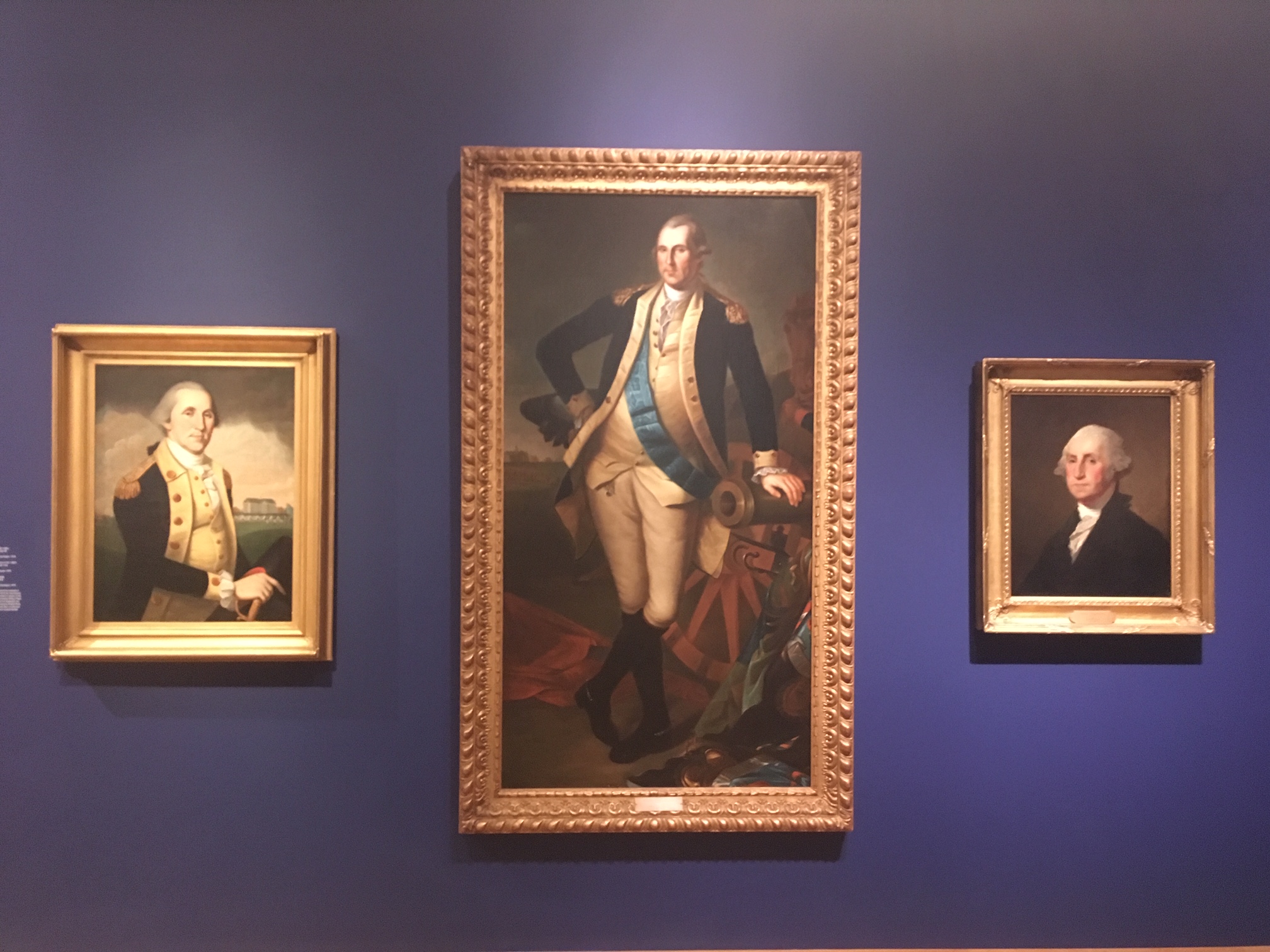
A George Washington Wall – an installation of paintings – is also part of the exhibition. “This little section is an homage to Huntington’s own collecting and what he was doing in 1919,” Watts elucidates. “In 1919, he purchased four stunning portraits of George Washington, including the most famous one by Gilbert Stuart. Why was be buying portraits of George Washington in 1919? Firstly, it was the trend. There were a lot of things coming on the market then and George Washington was the most iconic figure at that stage of America. And, perhaps, because Huntington did this audacious thing of locating this giant institution and collection on the West Coast, for which he took a lot of criticism that he was taking what was considered the cultural patrimony of America and Europe and exporting it to this cultural wasteland of Los Angeles. I think Huntington wanted to ensure this institution took its rightful place in the cultural landscape and who better to do that than George Washington, the first in the hearts of his countrymen? And, of course, it also demonstrates Huntington’s admiration for first founders.”
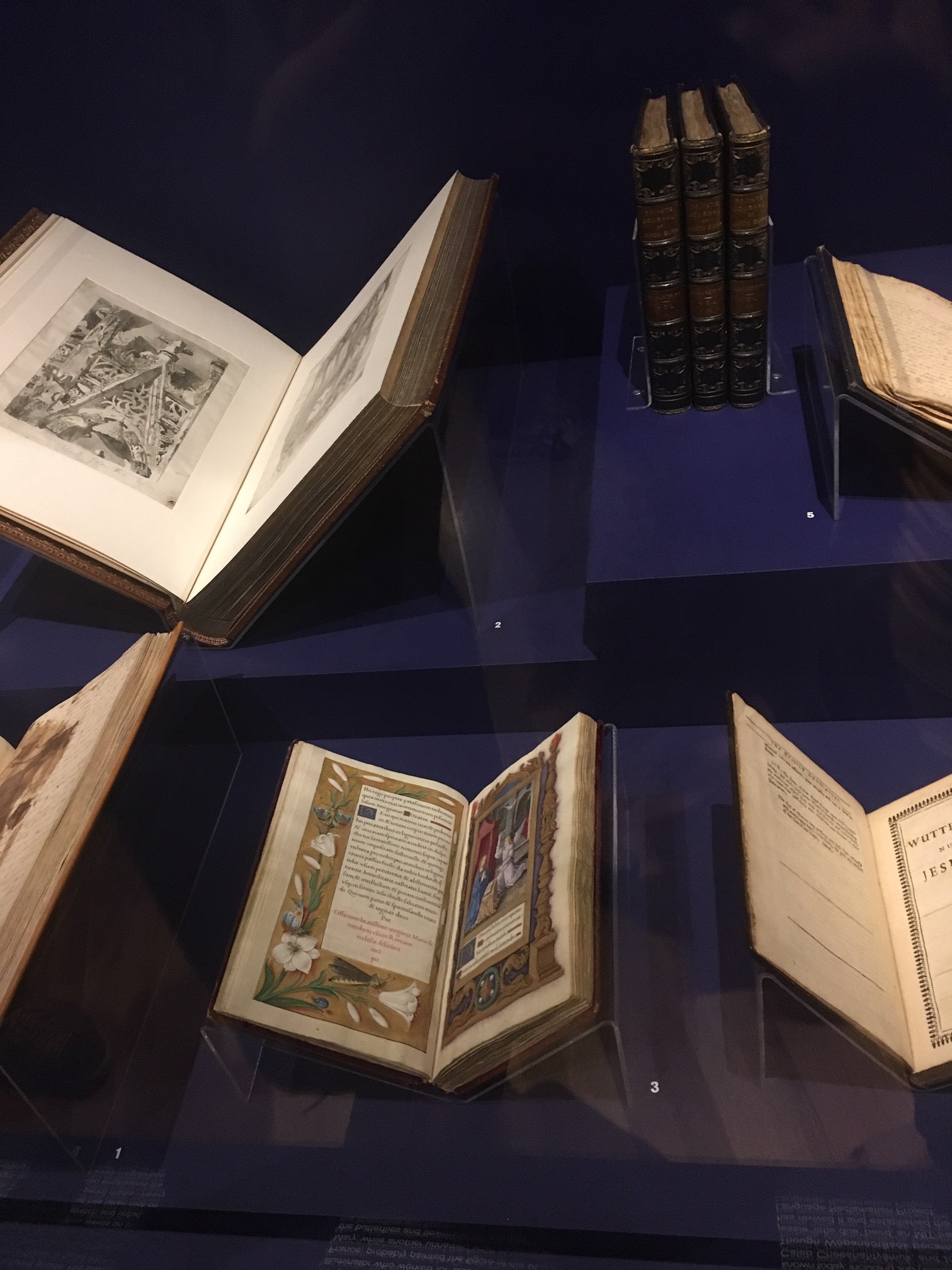
Beautiful Medieval books | Photo by Brianna Chu / Beacon Media News
In December of 1919, Huntington invited members of the prestigious New York Authors Club to his Fifth Avenue home. At that exclusive event, he shared with them 35 treasures in which he took special pride.
Watts declares, “This was significant for a couple of reasons – we had very little understanding of what he liked or favored. We know what his collecting interests were but we don’t know what his personal favorites were because he didn’t write or talk about them. This group of objects gives us a little insight as well as showcases his overarching collecting interest. Out of these 35 items, we chose some things that we thought were really outstanding and not generally on exhibition. They include: Benjamin Franklin’s handwritten autobiography; Maj. John Andre’s Revolutionary War-era maps; the first Bible printed in North America in a native language, which is also called the Eliot Indian Bible after the Englishman who translated it; and Civil War General William Tecumseh Sherman’s four-part memoir never before examined by scholars. The pages open to the redaction pertaining to his mental illness which ran in his family.”
Rounding up the exhibition are displays related to the make-up of this institution. Says Watts, “One of the things I like to tell people is that in 1907, at the beginning of Huntington’s collecting career, there was a big article in the New York Times about the most important collectors in the country and Huntington appeared nowhere. In 1919, when this institution opened, he was called one of the world’s greatest collectors, having one of the world’s best private libraries. How did Huntington do that? He was a consolidator and amalgamator – he bought huge libraries all at once. He had purchased four of the libraries that were mentioned in the 1907 article. We included several book bills to show the range of people he was dealing with and also the kinds of things he was buying. A favorite of mine is the one from Rosenbach, who was one of his major dealers. He delivered $121,000 worth of Shakespeare’s works to the San Marino estate. That gives you a sense that he purchased aggressively.”
Myron Hunt presentation drawing, ink on linen | Photo by Brianna Chu / Beacon Media News
“Among the many surprising things we learned, we determined that in the early years he was planning on importing all sorts of seeds and plants not as a collector but to landscape his real estate holdings,” Glisson discloses. “He was trying to figure out what would work here and it evolved into a teaching collection, something akin to what Harvard was doing in his botanic garden. The other thing that was really fascinating was that in the beginning he thought he could finance this whole enterprise entirely on citrus. Through all sorts of formulation of various fertilizer and types of trees, Hertrich was able to tell Huntington which are the best varieties and how much they’re making. Unfortunately, citrus isn’t the most reliable revenue source and, on top of that, 1919 was a bad year for citrus. Huntington ultimately had to sell some properties to finance this place. In 1919, Huntington had 600 acres; today his estate has 207 acres.”
Watts leads us to a small section, explaining, “This is a kind of homage to Hertrich. Here we see some of the early photographs of the property that he took and his little notebook with a listing of birds which Arabella loved – there was an aviary here with 500 birds. Hertrich, in addition to overseeing the citrus and the grounds, also had to keep track of all the birds. A favorite of Arabella’s was the toucan and we have an original citrus crate label with a toucan, the only one we know that exists.
“We also found something interesting – the vast labor force that actually made this place come to be was not well represented. Although they didn’t necessarily go around taking pictures and keeping documents of their workers, we were able to find payroll records. We discovered that a third of the work force during the time were Mexicans from Mexico or Spanish, and they were paid significantly less than the European and American work force. It wasn’t surprising, but we’re starting to have scholars weed through and work with those documents that were heretofore unexamined.”
“And what would a show about Huntington be without talking about how much he was worth in 1919? He was worth $69 million that year and we have these preprinted ledgers and balance sheets, which he kept month by month, that showed his assets.”
“I will finish with a picture of Henry and Arabella – seen here as a young woman, not the woman we have come to think of as Arabella Huntington, the dowager wearing a widow’s veil,” pronounces Watts. “She was very much behind the scenes of this enterprise and was, in many ways, a huge force to be reckoned with. Her interests, as you may know, were in French decorative art and British portraiture, which he went on to collect later in time.
“When you exit the exhibition, you’ll see this great quote by Herman Hesse which we felt is emblematic of this project and of the year 1919: Every man is more than just himself; he also represents the unique, the very special and always significant and remarkable point at which the world’s phenomena intersect, only once in this way, and never again.”
Asked what he learned about Huntington that he didn’t know coming into this project, Glisson replies, “I haven’t been here that long so I didn’t know a great deal beforehand. In reading reminiscences about him and what people said, my takeaway is that he was someone who believed in trusting other people and he was very optimistic. He was always telling his staff to trust people to do the right thing. I thought that was very significant and interesting for a tremendously successful businessman and it suggests he must have found people he trusted and liked and then let them do their job. And that, to a large degree, is how you run a grand institution. In a sense, he clearly wasn’t that interested in being a book collector in 1905 or 1906 and then he got interested and focused on it. When it came to the grounds, his landscaper Hertrich suggested that they be systematic about it and create a scientific botanical garden like Harvard and he agreed right away. So there’s trust and this openness and a kind of capriciousness that, I think, shaped what we are today – an art museum, a botanical garden, and a library – which is a kind of unlikely combination.”
Displays in the ‘Return’ section | Photo by Brianna Chu / Beacon Media News
I inquire what they want people to get from the exhibition. Watt responds, “I always want people to leave with a sense of curiosity and wonder. For me, it was important that people understand the depth and wealth of our collection, that we’re an active research institution where scholars come in every day to study these materials, and that we have an active, vibrant collection which continues to grow.
Glisson says, “One, I hope that people, particularly those from L.A. and Southern California, come to the show and are surprised. Two, I hope they find something that they want to learn more about. And three, I hope they find something in the show that speaks to their own experience which, I think, is pretty likely because there’s all sorts of materials. Those are my hopes, and the biggest one is just for visitors to be very surprised.”
German Revolution Photos | Photo by Brianna Chu / Beacon Media News
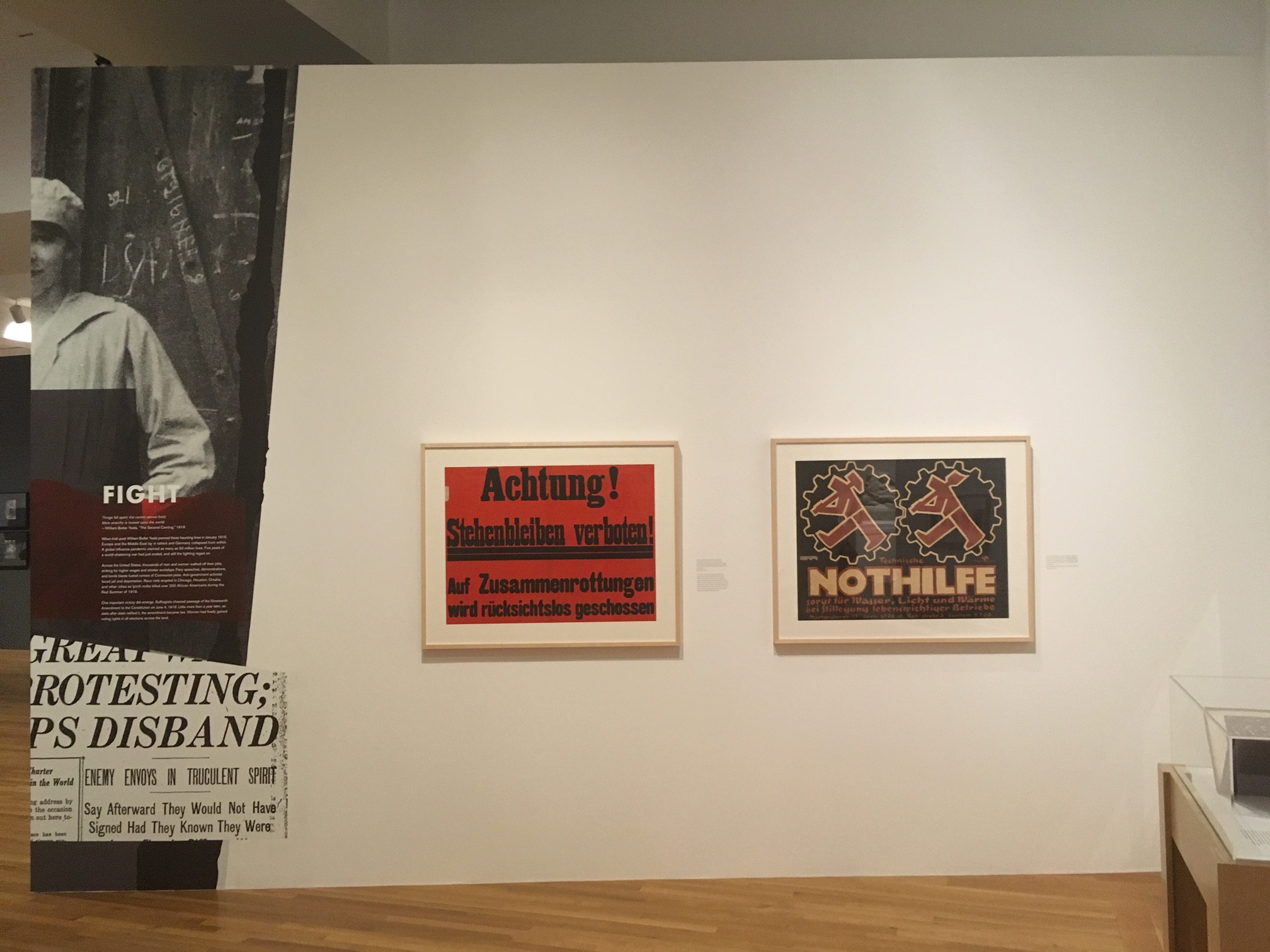
As for his favorite display among all the objects, Glisson reveals, “I love this red poster. Visually, this just jumps off the wall. It’s an incredibly powerful thing. And then there’s the text – Achtung! Stehenbleiben verboten! Auf Zusammenrottungen wird rucksichtslos geschossen – which translates to ‘Warning! Stopping is prohibited! Crowds of rioters will be indiscriminately shot.’ My German isn’t so good and I kept reading it and wondered about it. It turns out that this poster would have been printed during the German Revolution in January 1919, and it was posted on a government building with armed soldiers watching around it. Talk about this poster being a snap shot of history and how improbable that it got all the way from Berlin, maybe from the Reichstag, to Los Angeles.”
That Henry E. Huntington had chosen to establish the institution that would bear his name in the San Gabriel Valley in 1919, when he could have done so anywhere in the United States, was quite improbable as well. It might have been seen by some as a foolhardy decision at the time, but we want to think it proved to be a stroke of genius!
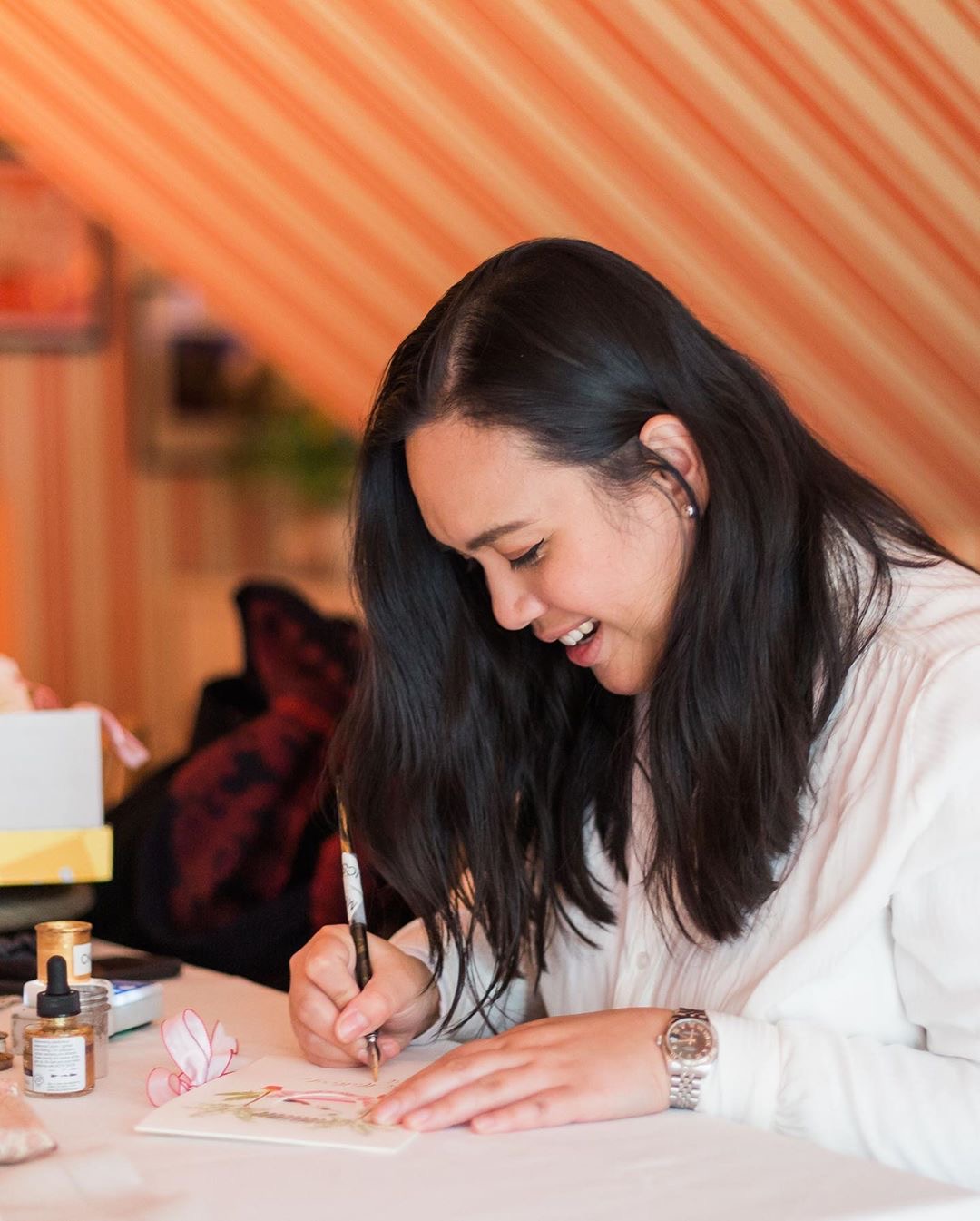
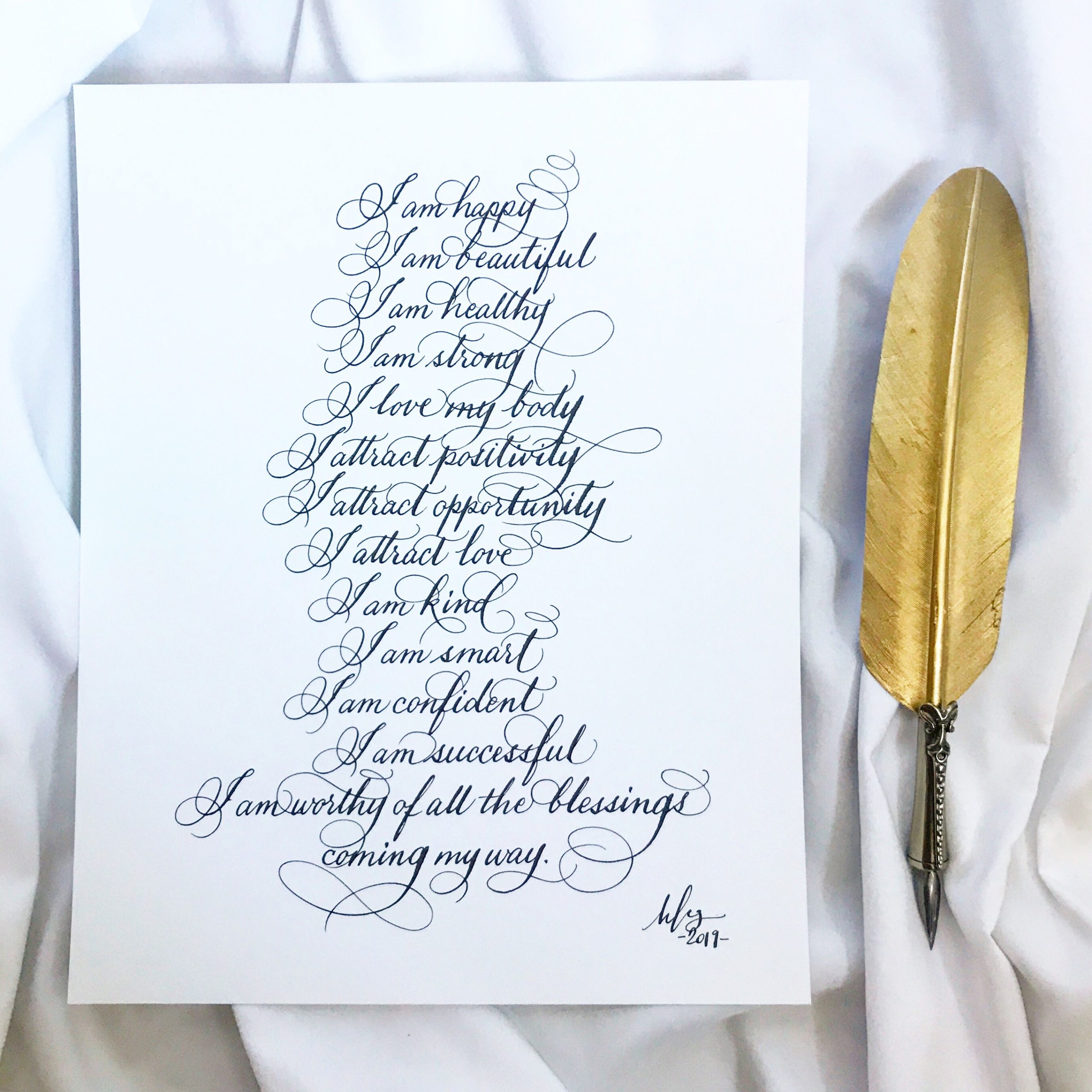
Her Instagram followers watch her work her magic online in real time. She writes words – names, dates, places – on a blank space and it becomes a piece of art. All in a span of a few minutes. Her calligraphy pieces grace wedding receptions, Hollywood film openings, Grammy events, and the New York fashion scene.
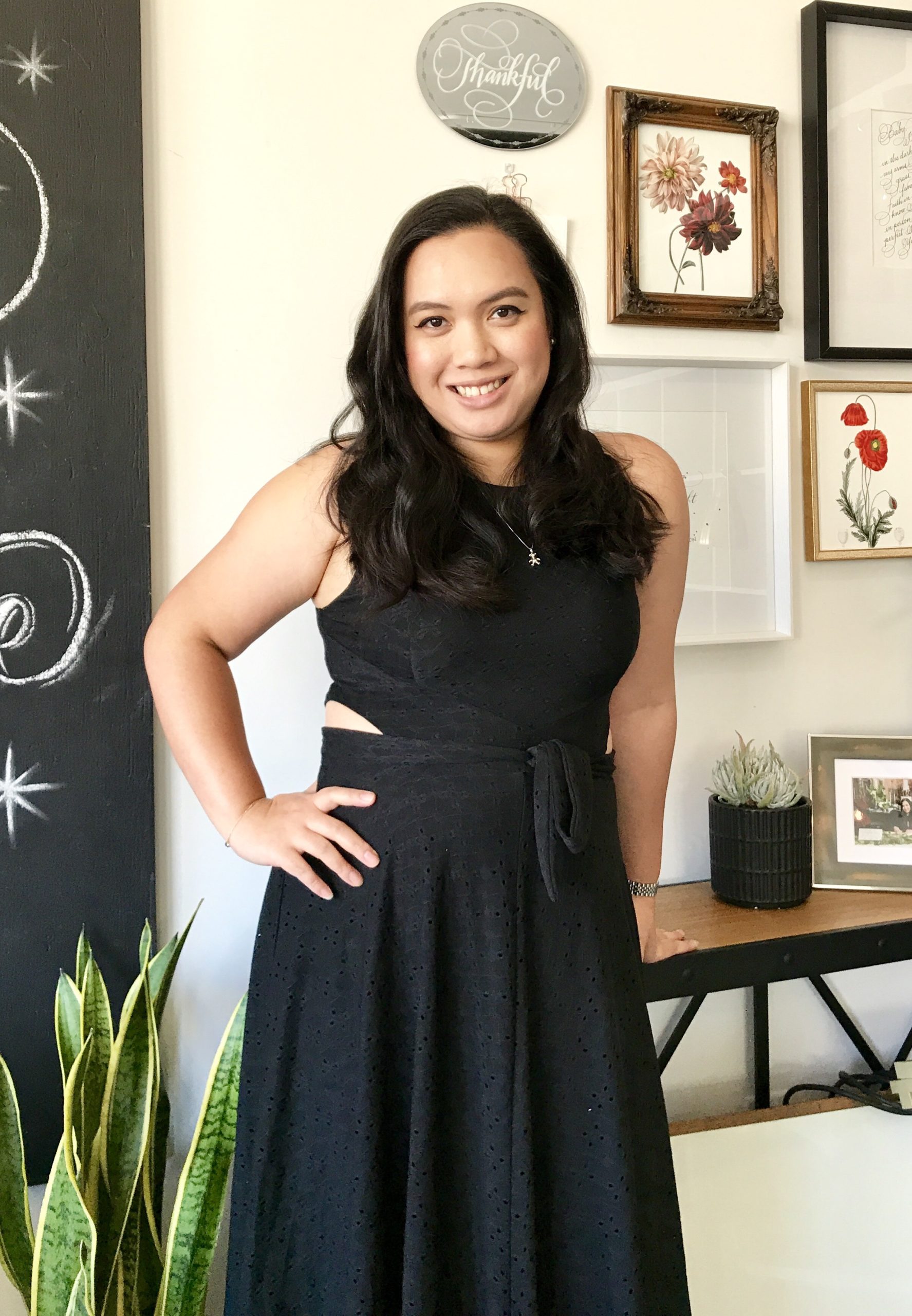
Katrina Centeno-Nguyen was 19 when she opened her eponymous company, Calligraphy Katrina, 12 years ago. She does a brisk business with a pen bought from an art store, and an immigrant’s determination, perseverance, and work ethic. Her journey is a model for everyone who’s arriving in this country to look for opportunities.
Chatting with me one sunny morning from her home in Pasadena, Centeno-Nguyen talks about coming to California as a 13-year-old, being raised by a single mom, and finding her career in the most unexpected way.
“My parents decided to emigrate from the Philippines – my dad arrived in Pasadena in 1997 and my mom followed in 2000. Unfortunately, their marriage didn’t work out and they divorced soon after. So it was up to my mom to find a way to get me and my sister here.
“Immigrating into the U.S. at that time wasn’t as difficult as it is today but it was definitely not an easy process. As comfortably well-off, highly educated, and widely-traveled as we were when we lived in Manila, we were still technically from a third-world country. We were coming here as dependents so that also meant my mom had to show how her children, who were still in the Philippines, were being financially supported. Propitiously, my grandmother (my grandfather had passed away) had income from their family business and rental properties so she made sure we were looked after.
“In time, my mom had obtained gainful employment as an analyst and had enough resources to cover the expenses for the petition process and the means to support us once we got here. I came here in 2001 and my sister arrived in 2005; my brother was born here.”
Continues Centeno-Nguyen, “I had finished 6th grade in Manila; I skipped middle school and went directly to 9th grade at Pasadena High School (PHS). That was quite an interesting cultural transition because I had gone to private schools in the Philippines and suddenly I was in a public school. Not only did it have a large population, students were talking back to their teachers!
“Though I have to say that socially, it wasn’t bad at all. PHS was a diverse school and a lot of students were culturally open because they also came from immigrant families. However, I had friends who weren’t necessarily immigrants. I was quite lucky because the classmates I hung out with were very much like me – we were all in the honors program; we mainly talked about school and homework. We studied and worked on projects in each other’s homes and, at the same time, had good, clean fun.
“Maybe my innocence also shielded me because I didn’t really know if bad things were happening. There might have been students who were doing drugs but I wasn’t aware of it. But the friends I had weren’t doing drugs either so there was no peer pressure. The core of our friendship was academics; it was why we became friends in the first place. We were nerds – we played chess and enjoyed physics class. We were also a good mix – some were in sports or arts; and we were volunteering in the same places. It was all about getting ready for college applications.”
Asked which college she went to, Centeno-Nguyen responds, “I actually didn’t attend college. We were still in the process of getting our residents’ visa; we didn’t become green card holders until 2007. Going to college as a non-immigrant was going to be quite expensive. Besides, I had to try to figure out a way to help my mom. While she had a great post, she had to work two jobs to enable her to support three children – in Pasadena, where it’s not cheap. So I took a full-time job as a nanny while I attended Le Cordon Bleu. It was also at this time that I started ‘Calligraphy Katrina.’”
Being a calligrapher was the furthest thing from Centeno-Nguyen’s mind in terms of a career. She relates that she became one by happenstance, “I’ve always had good penmanship and one day, one of my nanny friends saw me writing my grocery list. She was getting married soon and asked if I could do her envelopes. She informed me that I could make money addressing wedding invitations. So I looked into how pricing worked, invested $10 on a few pens from an art store, and bought a couple of envelope packets from Target. That was how ‘Calligraphy Katrina’ started. I began with two fonts and created new ones as I went. Sometimes I’d make an accidental swish and I’d say ‘Oh, that looks pretty cool. Let’s try that again.’
Centeno-Nguyen was brought up with a discipline and work ethic that made the transition to life in the United States easier. And it proved helpful when she endured a punishing schedule as she was establishing her business.
She recalls, “After I’d been doing wedding invitations for a while, a stationery store called Paper Source in Beverly Hills started taking notice and they asked me to bring my work there. I was still working as a nanny then. I was also in the night class at culinary school and I was doing kitchen work because that was a requirement. My day commenced at 6:30 when I woke up and I was at work by 8:00. Fortunately, the family I worked for lived in Pasadena so it wasn’t a bad commute. I left their house at 5:30 and I was at school at 6:00, where I stayed until 11:00 pm.
“I squeezed the calligraphy project whenever I had the chance. Sometimes I worked on it when the child I was caring for was asleep; I did readings when he was playing. At times I did the calligraphy after school, before going to bed. That was my hustle in those early days. I also did a few hours in the kitchen during weekends because that was important. I had to balance it somehow.
“It was then I decided to give up culinary school. My mom questioned my decision when I had already paid a lot of money for it. But in the restaurant business, it’s either you own an establishment or you’re really brilliant. I was good, but not that good. To get financial backing, you have to know how to run a restaurant already, which I didn’t have any background on. At that time, too, a lot of restaurants were going under. It just so happened that my work was standing on its own and, because Calligraphy Katrina was my baby, I had a deep personal investment in it.”
Centeno-Nguyen recalls, “Facebook wasn’t as widely used as it is now; there was no Instagram. Social media wasn’t a thing yet. There were wedding blogs but the Internet wasn’t that huge so there weren’t as many venues for my work to be seen by a great many people. So I posted photos on Craigslist every week – that was my marketing. Even back then, people were paying $4 to $5 an envelope. I did it in a platform like Craigslist because I was learning how to run it. It didn’t feel ethical for me to charge someone $3 when I didn’t know what I was doing. But I also disclosed to my clients that I was new at this so they knew coming in that it was why I was charging only so much. It was a learning process for me and my clients were hiring me because they just wanted something handwritten. As my artistry and knowledge evolved, I started increasing my prices. But even now, as my experience has broadened, my prices aren’t as high in comparison to what other calligraphers charge.”
“Soon, I quit my job in the kitchen and as a nanny. The calligraphy work was already gaining traction and I was secure enough to focus entirely on it. Still, I was petrified. Obviously, I didn’t really know how it would turn out. My mom and I would go to Beverly Hills every single weekend. She worked a lot so it became our special time together – we’d hang out there and meet the brides that we got from Craigslist at Starbucks.
“At the time, there were only a few people who could be called calligraphers and they were very old school – very traditional. They were master penmen who belonged to a group and they were leery about me. I was 19 and I didn’t get a formal education on the art so I was the outsider. That’s also part of my insecurity as an artist. I once had the privilege of working alongside a full-pledged calligrapher who saw me as a non-calligrapher because my slants weren’t the right size for Spencerian. But I wasn’t doing Spencerian, it was simply my own handwriting. This is why I work at such great speed.”
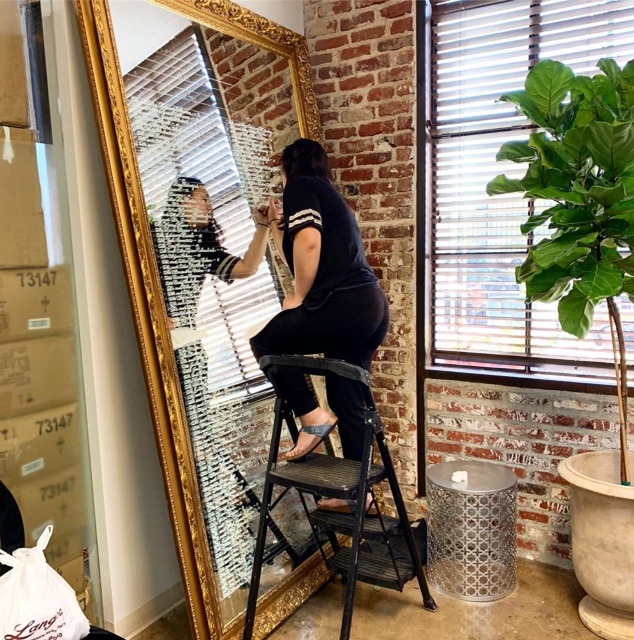
Centeno-Nguyen works on a mirror project | Courtesy photo / Calligraphy Katrina
“Not to diminish what they do, because it’s brilliant,” Centeno-Nguyen quickly says. “I wish I had that kind of knowledge but that sensibility is what differentiates my company from others. I do volume and I need to make that work. A lot of calligraphers say what I do isn’t calligraphy because I’m diminishing art. Every day, as an artist, I also have to account for my own individuality. Since I’m not conforming to the standard, am I a real artist? Do I feel like an actual calligrapher?
“Most calligraphers do this for the artistry of it. That’s not to say that I don’t, because I most certainly do. But it’s also my primary means of livelihood and I have to meet deadlines. My evolution as an artist is tied into the success of my company. I want to establish a stable business and a successful commercial venture. I have to look at it as ‘How can I make enough to support my family?’ And because I didn’t have the resources to do so, ‘Will I be able to ensure that my child goes to a four-year university?’ And ‘How is this going to increase my income so I can enjoy my family?’ When I become financially comfortable then I can think about my artistry.”
If success were to be measured by one’s popularity on social media then Centeno-Nguyen has definitely attained it. People see her working on huge projects involving pop stars and runway models online. She’s on Reddit and has a loyal following on Instagram, which she finds incredible.
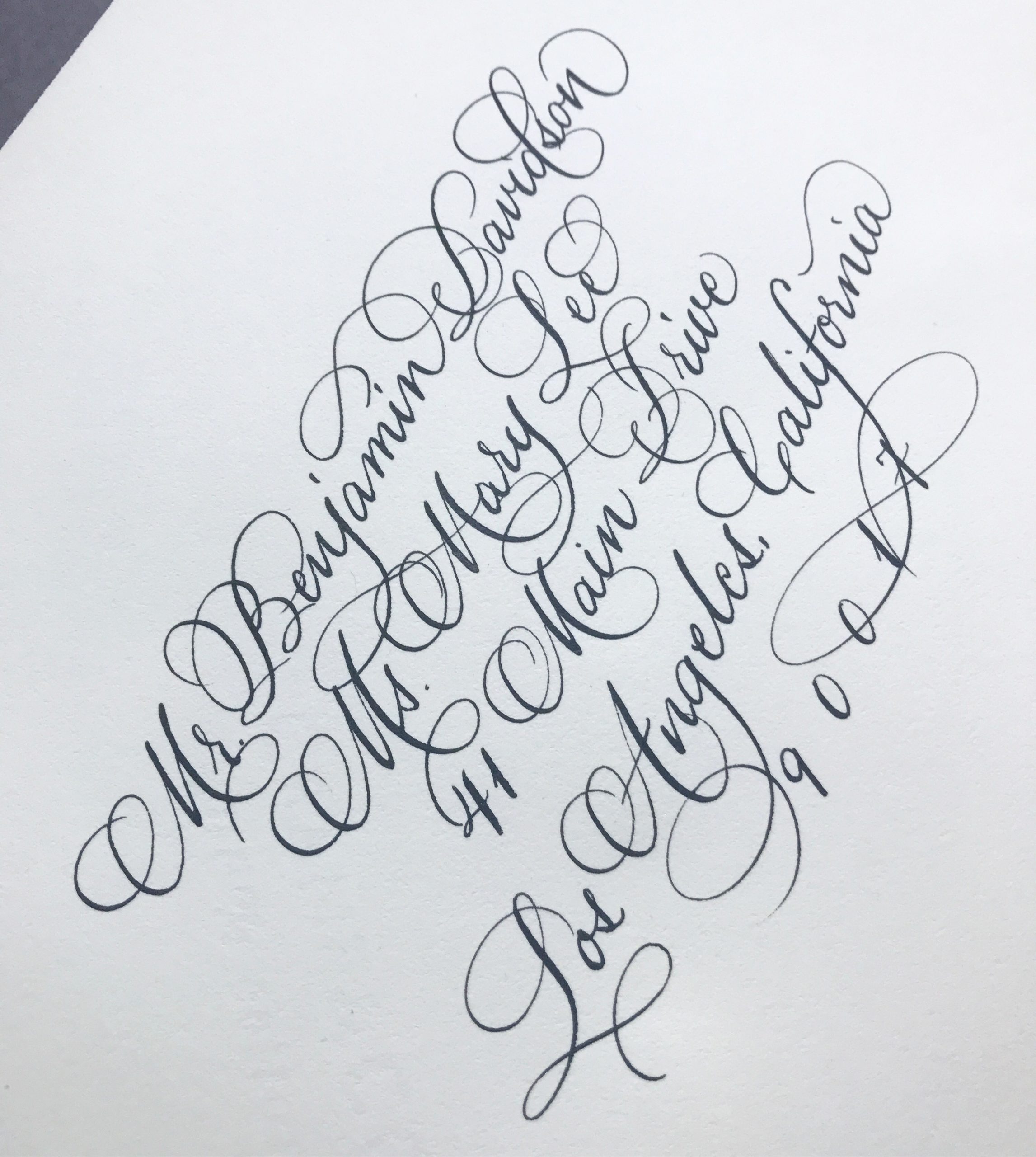
Calligraphy Katrina does a brisk business on envelope addressing for corporate clients | Courtesy Photo / Calligraphy Katrina
Centeno-Nguyen explains that how she got into the Hollywood industry was opportune. “In 2008, a new PR company needed 30 envelopes addressed, not right now but yesterday, and calligraphers in the city gave them a timeline of a week for the project. They called me and I said if they delivered the envelopes that morning, I would have them done by the end of the day. My company officially opened in August 2007 and we did one or two envelope projects a week. By January – February, we were already doing corporate work.
“Because of my pricing, which was like air for a PR company with a large budget, they asked me to do more things like place cards. This was also a young PR company gaining their traction, and it was beneficial to them that I was actually meeting their deadline. That PR company then talked about me to other PR companies. The buzz started from my speed – I could work on the fly. It was my ace and, for a long time, it was what made me stand out. And more corporate work came rolling in.”
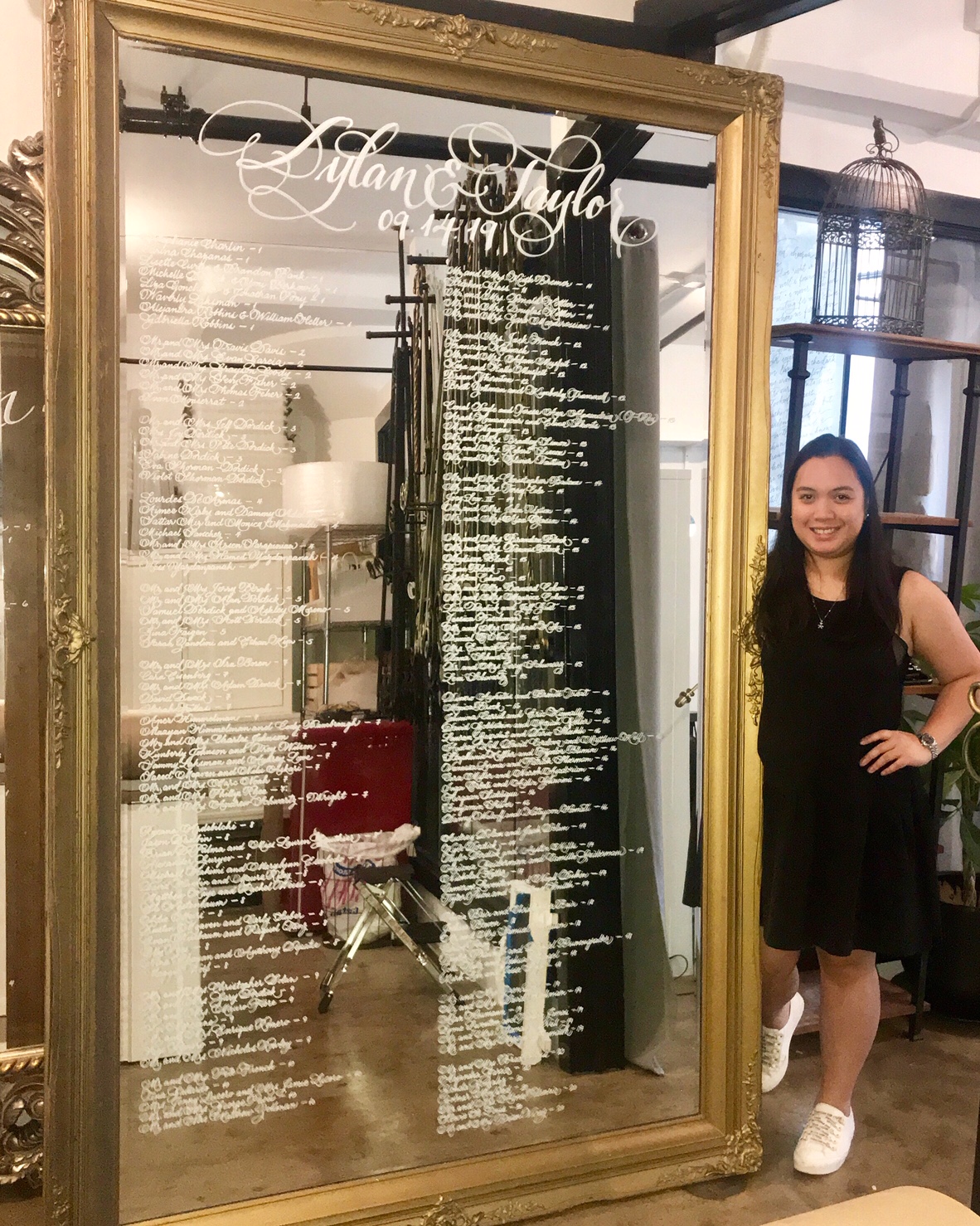
Mirror projects make up 50 percent of Calligraphy Katrina’s business | Courtesy photo / Calligraphy Katrina
Just like doing calligraphy work happened unexpectedly, working on mirrors wasn’t by design either. Centeno-Nguyen recounts, “We had a client who owned a mirror company and they were thinking of having a welcome sign for an event at the California Club. We discussed different things we could do on a mirror and we came up with a seating chart. They asked if I knew how to do one on a mirror and I said no but I’d figure it out. I didn’t know how I was going to grid it but being a nerd, I used math to measure it. I did it on site in four hours while they were setting up. I used a chalk and it looked really cool.
“This was ten years ago when I hadn’t seen anyone doing calligraphy on mirrors. No one cared for it because they said it was too hard to read. When I created calligraphy work on giant mirrors, though, everyone took note because it was different. After I did the videos, everybody wanted the mirror.”
“The mirrors are popular with weddings so 50 percent of our business comes from that and 50 percent is from corporate,” divulges Centeno-Nguyen. “We recently bought out a vintage store that carried antique mirrors from France when the owner decided to close shop last year because space rental was too expensive. We needed to have a place to store them so we opened a downtown studio. The way I see it, I’ve spent so much money buying them, I might as well have people come in to look at them. I got lucky because my space is a corner office so I get nice views on two realms. But it’s also very distracting because there’s constant activity outside and I want to see what’s happening. So I still work from home and the majority of my pens are here; that’s also because sometimes I write at 3:00 in the morning.”
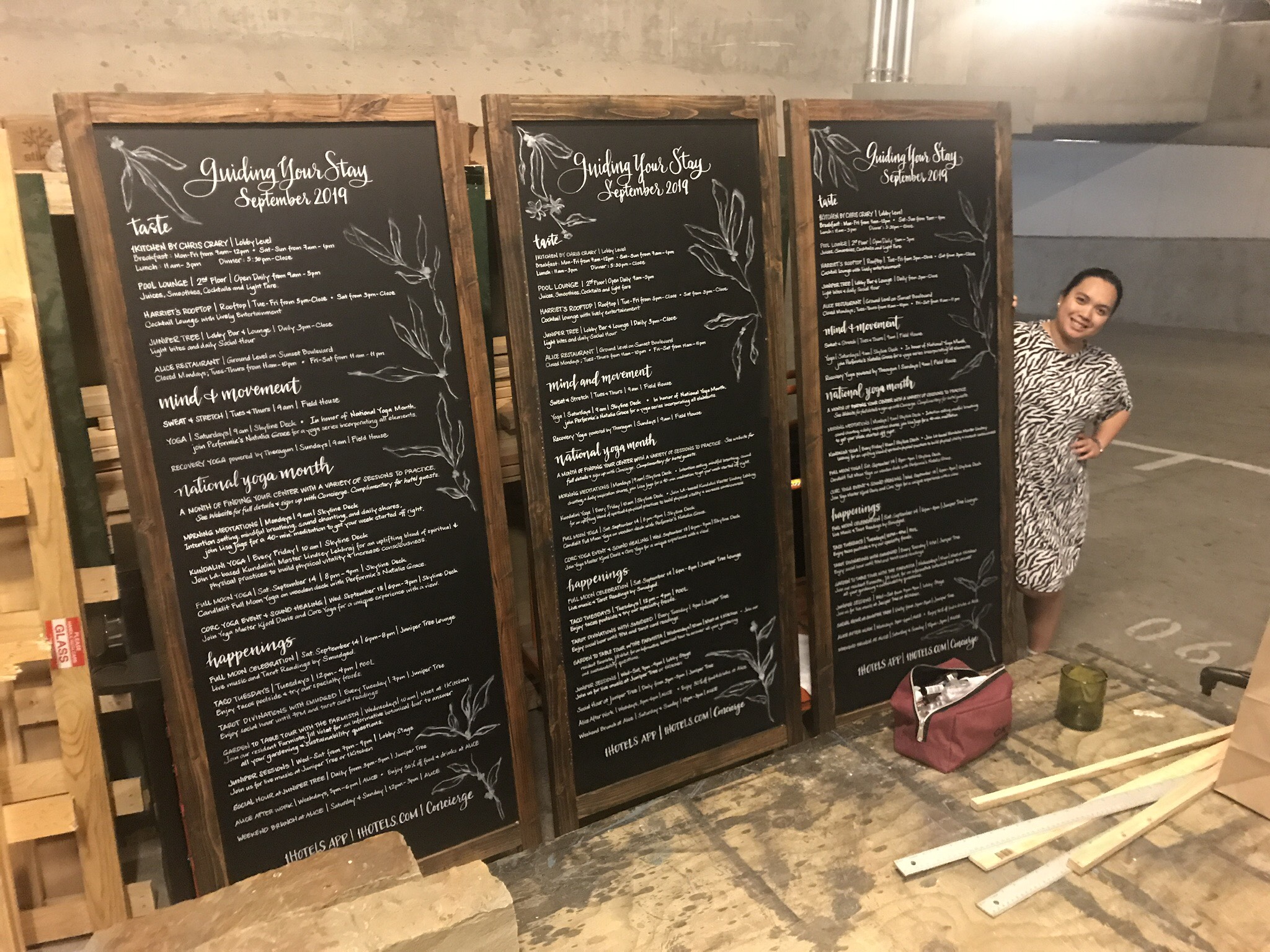
Centeno-Nguyen at a recent corporate event | Courtesy photo / Calligraphy Katrina
Calligraphy Katrina operates smoothly with a lean staff, according to Centeno-Nguyen. “I have a house manager who’s also my daughter’s nanny, an assistant, and a driver who does all our runs in the city. This is my assistant’s first week – my previous production manager who worked with me for two-and-a-half years moved on to her dream job as a social worker. She was the one who helped me build this company to where it is now. She was with me during a difficult time. I had a tough pregnancy and I was on bed rest for nine weeks. My daughter was born at 29 weeks; she was 2 ½ lbs. and was at the Huntington Hospital for two months.
“We were also in the middle of a move to this house. I worked while I was bed-ridden and, because it relaxed me, I didn’t realize I was in labor. My daughter was born by Caesarean section at 12:03 in the morning after 26 hours of labor. New York is open at 6:00 am our time and I was on the phone taking notes because we were doing a show. It was much later they found out I was in the hospital. But I wasn’t going to miss that call. Giving birth isn’t an excuse; as long as I am awake I can write.”
Centeno-Nguyen’s reputation as a reliable artist who can get the work done fast is the reason she has long-standing clients. She’s been working with LACMA for almost ten years now and Chanel for nine years. On the morning we met, a delivery from LACMA arrived; there were several boxes of Chanel envelopes in the dining room for her to work on.
Twelve years after Centeno-Nguyen bravely took the leap to establish Calligraphy Katrina, she is a mainstay not only in the luxury bridal market, she’s also sought after by corporate clients including museums, fashion houses, The Grammys, and movie companies, among others.
When queried about which projects she enjoyed most, Centeno-Nguyen replies, “The Chanel fashion show was a fantastic gig. We’ve done a few fashion shows like YSL and Moschino and they were really fun, but the Chanel was doubly so because we were in New York for a whole week preparing for it. We even saw the rehearsal; it was like seeing a production come to life. But the most memorable one will always be my first mirror.”
It’s a sentiment shared by most immigrants – no matter how successful they become and how far they’ve come, they look back with gratitude at where they started.

 A San Gabriel Valley Inquirer