Arcadia Resident And LAUSD Educator Writes Book Encouraging Girls To Enter STEM Fields

Originally published on 23 March 2021 in the Pasadena Independent, Arcadia Weekly, and Monrovia Weekly

Jenny Lu was born and raised in Sacramento by first-generation Chinese immigrants who started a sewing business where she and her four siblings worked while growing up. Her parents encouraged their children to pursue their own interests; her siblings are small business owners and restaurateurs. She moved to Southern California where she went to college and earned an education degree, and then landed her first teaching job at Walnut Park Elementary School in Huntington Park.     

Currently a teacher and literacy coordinator at Delevan Drive Elementary School in Los Angeles, Lu has lived in Arcadia for the last 15 years with her husband, a compliance professional at a large insurance company in Orange County, and their two sons. Now she’s also a writer and has launched a Kickstarter campaign to realize her dream of becoming a children’s book author.

“My upcoming book, titled ‘Emma Ren: Robot Engineer,’ has diverse characters and takes place in the classroom setting where all children can relate to,” describes Lu. “It’s about a young girl named Emma who had always loved building things. When she was assigned a project to build a battle robot, she couldn’t be happier. However, her partner Jeremy assumed she couldn’t build robots because she’s a girl. But she doesn’t get discouraged and continues to persevere.

“It chronicles the school week of robot-building and highlights a STEM (science, technology, engineer, and math) approach. This is a fun book that promotes key skills, which include problem-solving, creativity, critical thinking, and collaboration. This book is important to me because I have dreamed of becoming a children’s book author since elementary school. I wanted to show children that dreams can come true and it’s never too late. I also want to provide books that celebrate diversity and encourage children to learn key concepts of STEM through picture books.”     
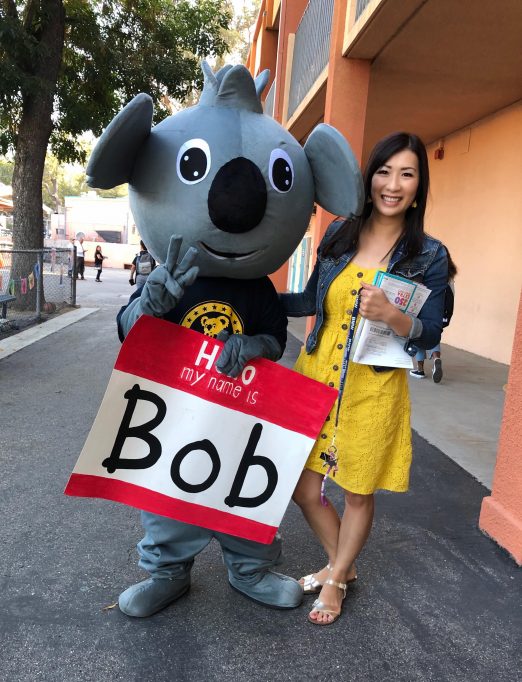
Jenny Lu with Delevan Drive Elementary School mascot, Bob the Koala | Photo courtesy of Jenny Lu

Lu is well aware of expectations and perceived limitations of women. She says, “I’ve always had a love for STEM subjects but my passion was to work with children. Growing up, I felt engineering was more suited for boys as I didn’t know of many females in that field. I can recall experiencing many gender stereotypes as a young child. Now that I am a mother and educator, I have different perspectives on gender roles, gender bias, and gender stereotypes in today’s society.

“As a parent, I have encouraged my boys to work hard, love learning, and pursue their passions. My eldest son chose to go to Rancho Lab School instead of the traditional school because it offers students the ability to work on projects in areas they are passionate about (Passion Projects), participate in STEAM projects (Makerspace), and engage in project-based learning. He is 12 years old and is currently a seventh grader. After attending Rancho Lab School he has developed a passion for math and programming. My youngest son is 10 years old and goes to Hugo Reid Elementary School. He says he also wants to write a book.”  

“I believe that I have the same perspectives as a parent and as a teacher,” adds Lu. “My message to my boys and my students is that they should always work hard, develop a passion for something, never give up, and break the glass ceiling.”

Lu started writing her book in May last year during lockdown as a means to connect with young children and in a way that would encourage them to cultivate an interest in STEM, especially among minorities and young girls.

Asked what her inspiration was, Lu replies, “I was inspired to write this book after noticing that the characters in most children’s books do not reflect the diversity at the schools that I’ve taught at. As a result, I was motivated to write a children’s book promoting STEM and include diverse characters from different backgrounds. Having been an educator for almost 20 years, I strongly believe STEM education will lead children to be future scientists, programmers, engineers, mathematicians, etc. According to the 2021 United States Bureau of Labor Statistics (BLS), the BLS expects an uptick in STEM jobs over the next decade and forecasts over 8 million STEM-related workers by 2029.”

Illustration by George Sweetland | Photo courtesy of Jenny Lu

Many educators and psychologists say that boys and girls have the same abilities and interests as they start school. It is only later, around middle school, that each gender shows a particular inclination towards STEM or the arts and humanities. 

“From my experience as an educator, I see more boys getting interested in STEM than girls around the age of 10,” confirms Lu. “I believe at that age, children start to see the social expectations, gender stereotypes, and gender roles that society has presented. Children feel that they have to conform to these standards and expectations. This is why it’s important for parents and educators to teach children that they can follow their dreams and choose their career based on their interests and not what others believe they should do.”

Continues Lu, “In my opinion, when girls do well in STEM subjects but choose not to pursue careers in the field, it’s because of peer pressure in a male dominant field, lack of female role models and support from parents as well as teachers, and general misperception of what STEM careers look like in the real world.”

Long before STEM-based learning became a watchword in education, Asian parents have been guiding their children towards that path. Lu opines, “I feel that many Asian parents encourage their children to pursue STEM courses since it will lead them to pursue advanced degrees and ultimately careers that will protect them from discrimination and help them achieve financial stability. Furthermore, I believe that the majority of Asian parents believe STEM careers usually involve less subjective assessment from employers and customers and have passed on that belief for many generations.”

Given that job growth will occur in STEM fields and girls have the ability to excel in them as much as boys, it becomes imperative for educators to sustain that until students reach high school when they prepare for college application.    

“I believe it involves the collaboration of the entire community including the administrators, teachers, parents, and the larger community,” states Lu. “Administrators have to support and fund STEM programs in order for teachers to have the appropriate resources and integrate that into their lesson plans. Teachers have to believe in the value of STEM education and teach these skills in their classrooms. In addition, parents have to continue to support teachers and their children as they pursue STEM interests. Lastly, the community also needs to continue providing support for STEM education and success.”

What children are exposed to during their developmental years stimulate their thought processes. And ‘Emma Ren: Robot Engineer’ is a delightful way to introduce STEM to preschoolers. Aimed at children ages 4 to 8 years old, Lu’s unfussy words and George Sweetland’s kid-friendly illustrations are guaranteed to be an endless source of intellectual curiosity and fascination. 

APAC Integrates Students in all its Professional Productions

Originally published on 21 February 2018 in the Pasadena Independent, Arcadia Weekly, and Monrovia Weekly

Lunar New Year Production at APAC | Courtesy Photo

At the northwest end of the Arcadia High School (AHS) campus stands the Arcadia Performing Arts Center (APAC), a 40,000 square-foot venue that was funded by Bond Measure 1 which passed in 2006. The $20 million structure opened in 2012 and the non-profit Arcadia Performing Arts Foundation (APAF) was created to maintain and manage it.

It is the hub for Arcadia High School students who are taking courses in the various art offerings. Any time during the day kids can be seen practicing with their band in the parking lot while another group hangs out at the lobby waiting for their rehearsal to begin.

In the evenings APAC is transformed to host performances by renowned American and international artists. The 2017-2018 season, with its slate of 16 productions, draws an audience that comes to Arcadia from different cities in the San Gabriel Valley.

With its state-of-the-art facilities, APAC is an important cultural destination and is the venue for touring artist concerts, recitals, distinguished speakers, special events, and commercial filming. Booked for 257 days of the year, it is the busiest performing arts center in the area, surpassing even that of the Pasadena Playhouse and the Pasadena Civic Auditorium.

It is also a youth talent incubator that makes great art accessible, a descriptor that Maki Hsieh, APAF’s Executive Director, would like the APAC to live up to in every sense.

Hsieh, who was installed in January 2017, spent her first hundred days in office doing an assessment analysis.  She explains, “I worked from the inside out, meeting with key stakeholders including Arcadia philanthropist Micky Segal, Mayor Peter Amundson, former Mayor Tom Beck, AUSD superintendent David Vannasdall, the PTA president, and every single board member to get their private perspective on how things were going.

Then I met with other community leaders, community partners, guests, and patrons before venturing outward to other people in the industry, like the Association of Performing Art Centers, to see how we compare with them. I spoke with some of our competitors to gauge how we can do better and obtain dominant market share that would, in turn, help us attract donors, funders, and grant makers.

After that 100-day assessment period I decided on what I want APAC to look like as a foundation and determined our place in the region – from the component of the board all the way down to our staff, including their specific titles and compensation structure – by our 10th, 20th, and even 50th anniversary. I presented to the board our vision going forward together with plans for making changes.”

Arcadia Performing Arts Center | Courtesy Photo

When Hsieh speaks with her team she emphasizes the four pillars of a successful organization – people, product, process, and profit. She asserts, “These are not something I made up but came from a quote by Steve Forbes I read a long time ago in the Wall Street Journal. He said there are only three things important in business and those are product, profit, and people. While he made an excellent point, I think he’s got it backwards. I would put people first because they make the product; you have to customize your product around your people. I mean ‘people’ in its broadest sense – your guests, team, board, city, community, and the industry. Then the process has to be solid to have that fulfillment and delivery. The end is the profit and that’s the whole P&L aspect including expenses, operational issues, etc. You can track and calibrate these four components in a very dynamic way in order to succeed. That formula works for any organization from a coffee shop to a major corporation.”

Hsieh’s first year as Executive Director can be defined by the word ‘quality.’ She expounds, “This past year we increased the quality of our product, the front of house, the production understanding, our VIP events. Our VIP hospitality went up 50 percent and ticket sales increased 120 percent within one year. Ticket sales now cover 53 percent of our expenses while the industry average is 38 percent. That says a lot about the team for finding creative ways to cut costs.

We improved the quality of our marketing in the sense that we’re really starting to have a brand. Before we had four shows here and there, almost at random; there was no plan, no story, no infrastructure. Productions cost money to put on so how do you make money when there’s no fundraising or grant program in place? There were so many missing pieces and the quality piece was one of those.

Now we’re showing the community we have a passion for furthering the next generation and the future of the valley. We want to be known as an impact-driven social organization, not just a performance group. We do life-changing work; we’re here to touch every person who comes through our doors.

We’re determined to increase the quality of life of families and children in need. We donate tickets to underserved children so they can come to our shows; we give them raffle tickets to participate so they don’t feel like outsiders.

We’re enhancing the quality of life for seniors. For example there’s a senior center whose residents want to come to our show but they don’t have a driver to take them here every other month. We coordinated with them and offered assistance by providing a driver to drive their vans.

We’re extremely serious about our outreach. Working with Foothill Unity Center, we’re very actively raising awareness on poverty, hunger, and homelessness. We are donating a show to them called Arcadia Poetry Slam on April 8. High school students will compete for prizes.”

Continues Hsieh, “Going into my second year, in addition to quality I want all of us to focus on loyalty. By that I mean high affinity and returning guests. We want our guests to go beyond buying a $10 ticket; we want them to come back and not necessarily for a show. It could be in the form of a donation or support, sponsoring a show for a school.

I spent 80 percent of my time last year on marketing and operations and this year I will devote that time on fundraising, which is tied into loyalty. There’s a large corporation in our town that gives $1,000 for an ad to which they can easily add a couple of zeroes. They were able to do that for an Olympic sponsorship so surely they can invest in our community.

Their donation goes directly to our children. APAC has a $400,000 venue capital need for new microphones, speakers, and lighting which are now falling apart and are put together by duct tape. We also have an Arcadia Children’s Choir which we are ready to launch that gives children an opportunity to perform with a professional orchestra twice a year. And, finally, the school district needs to hire arts teachers from K to 5.

Tied into fundraising is looking for grants which are not easy to get. This year we will be collaborating with Rachel Repko to write grants. With her assistance we will create a grant program that involves getting one gift at a time. We won’t be seeing results right away but we will be increasing perception about the organization until people see that we’re building long-term sustainability.”

Another one of Hsieh’s initiatives is to attract bigger productions. She says, “Our General Manager for Programing and National Sponsors, John Nicholas, headed EMI Sales and Marketing before it was bought out by Universal. He has toured and worked with major artists in the industry including Katy Perry, Pink Floyd, Tears for Fears, and Rolling Stones. He will pitch the idea that APAC is a campus theater, a showcase for students, and serves all the children in the community. He will try to get performers at 50 percent off their price so we can, in turn, offer discounted ticket prices to children. Because he knows the artists, their agents, and managers they will be willing to negotiate with him.”

Hsieh (far left) with (L to R) Christine Lee, APAF board member; Connie Liao; Tim Lee; and Jennifer Yang, APAF board member during the Chinese New Year banquet | Courtesy Photo

All of Hsieh’s efforts are focused on offering children and young people a way to express themselves and gain confidence in their talent. She pronounces, “We were recently nominated for the ‘Make Change Award’ because the core of our work is dedicated to children. Helping children develop their artistic talent and perform at world-class level has always been the heartbeat of the foundation. We encourage the inclusion of arts in children’s daily school activities.

Students in the Arcadia Unified School District are integrated in all our shows. They’re an essential part of the production either as interns or volunteers; they work at the front of the house or as crew. Some of our interns are involved in our marketing process helping with concessions, handing out flyers, putting up posters.

We also provide them with a venue where they can showcase their talent. For the Chris Mann Gala Concert, which officially opened our 2017-2018 season, we integrated 165 students including Orchesis, which is the Arcadia High School (AHS) dance group, the AHS marching band, the AHS advanced orchestra, Arcadia Stage. All the resident youth companies of the center came together and performed at the event. For the Beatles Tribute Concert, held last Saturday, February 17, the Longley Way Elementary School Glee Club was featured alongside a professional tribute band.”

This greater involvement of students in the productions held at APAC is Hsieh’s deliberate effort to prove that the arts are fundamental components of a happy and successful school experience. She relates, “Since I came on board I have learned so much about the community. Arcadia has a 60 percent Asian population and parents want their children to focus on math and science. They send kids to ‘cram school’ to prepare for ACTs, SATs, APs and SAT IIs. Counselors at these schools tell their students they should drop their arts classes to make time for studying to get higher GPAs. They make it sound like arts courses are a waste of time which is simply erroneous.

Now all our shows will be opened by students from one particular school. Parents, grandparents, siblings, and friends can enjoy watching students’ accomplishments. Being on a professional production is something students can put on their resume as they build their portfolio for inclusion in their high school transcript. I want for families to recognize that participation in these events advances their children’s prospects for college and beyond.

But more than simply an entry in a college application, the arts occupy a far greater role. I am a firm believer in the positive impact of the arts in children’s development so much so that I have campaigned for the integration of visual and performance art courses in all the elementary schools in our district.

While the ancient Asian perception still carries on today, I am slowly hoping to change people’s minds about the importance and relevance of the arts in children’s lives. And my agenda is to make parents continue their investment in arts courses for their kids. That while they don’t see it now, their investment will yield positive results and change the perspective in our community.

APAC’s slogan is ‘Coming Together’ to highlight how the arts can be the bond that unites families in our community as it is the glue which connects us with other communities. We have strengthened our relationships with other school districts in the San Gabriel Valley.”

There’s so much going on at APAC it’s a hopping place. What’s surprising about that is Hsieh took the helm at APAF not that long ago. But what a change she’s made in that short time.

Maki Hsieh will debut her ‘New Moon’ album at APAC on March 24 | Courtesy Photo

To say that Hsieh is an overachiever is a colossal understatement. At the age of 15 she debuted at the National Recital Hall for Taiwan’s First Lady. She has also performed for Queen Paolo of Belgium. She was classically-trained at Peabody as violinist, concert pianist, and opera singer who performs in 12 languages.

Hsieh attended the Taipei American School where she earned awards in orchestra, choir, theatre, poetry, and the Veterans of Foreign Wars Voice of Democracy Speechwriting Prize. She went on to Phillips Academy Andover and served as concertmaster of two orchestras and received the Andover Music Prize.

From there Hsieh went to Johns Hopkins University and graduated with a degree in pre-med majoring in Sociology. She won the Hopkins Provost Prize for her research on inner-city youth academic achievement and worked for Al Gore as part of her Hopkins fellowship.

Extending her record of stunning achievements to her professional life, Hsieh was responsible for closing over 6.6 billion in sponsorships, investment banking, and new business development during her 20 years in media, entertainment, and finance industries.

Prior to her leadership of APAF, Hsieh was Executive Director for the private equity company JTN Group. She also had extensive experience in executive communications for the Chairman of the Walt Disney Company, institutional advancement as Director of Development at the Gallo Center for the Arts, and asset management for Fortune 500 corporations including Visa and Deutsche Bank.

A consummate performer, Hsieh made a 2013 Skrillex remix which made number one for five weeks on Los Angles, U.S., and global electronic music charts. She has appeared in a Cannes Film Festival film and in over 300 red carpet events, performing arts centers, festivals, and arenas including the Special Olympics World Games, and singing the National Anthem at a Major League Baseball Division Series televised on FOX Sports Network. Fittingly, she will unveil her album ‘New Moon’ on March 24 at APAC.

Hsieh is propelled with a determination to succeed in her role as overseer of this outstanding organization that is equaled only be her desire to prove that the arts are essential to life. Her mission is to make APAC the home of arts and culture in the San Gabriel Valley. And given her fiery spirit, she will undoubtedly make that happen.

Apache News at Arcadia High School Sets Journalistic Standards

Originally published on 16 March 2017 in the Pasadena Independent, Arcadia Weekly, and Monrovia Weekly

Monday through Friday, from 11:03 am to 12:02 pm, finds 20 of Arcadia High School’s (AHS) brightest broadcast journalists and technicians producing the week’s 15-minute Apache News (APN) show. 

This Advanced Video Production class runs its weekly meetings pretty much how television stations conduct theirs. Ryan Foran, Public Information Officer for the Arcadia Unified School District, who was a broadcast news reporter in the past, has high praises for this class.  

Foran says, “If you walk into KABC anytime today during their production meeting, it would look exactly like this – the news team will be talking about ideas, reporters will be pitching stories to the news director. When these kids go to college this is what they’ll see.”

“It’s a popular course and is difficult to get into,” according to Frank Nunez, who teaches the class. “Once the posting goes up, students have to attend an informational meeting to learn about the course prerequisites. There’s an application process, which includes an interview, and two teacher letters of recommendation are required. They have to have finished beginning and intermediate courses to be eligible for this capstone course, which they can take in junior and senior year. It is UC-credited and is one of the few Pathways in AHS.”        

It takes at least ten hours to create Apache News, which AHS airs every Friday during fourth period. Everyone in Nunez’s class contributes in some capacity and each is graded based on attendance, participation, and content. It’s a very time-consuming and intense course as seniors Andre Salcido, Simone Chu, and Will Atkinson can attest to.

Salcido, who writes documentaries and edits political news for APN, says, “There’s a required   daily class attendance – fourth period – and we also have to be enrolled in the after-school class that meets twice a week. We cover Saturday sports events on top of that, so we’re putting in a minimum of ten hours per week.” 

“But everyone likes this class because of the resources available to us; we know it prepares us for college,” Salcido adds. “The experiences I’ve gained have put me further along than the average student going into this field. While I had initially thought of taking film studies, I developed an interest in documentaries and last year I completed a multi-part project about the California drought. It was something which had never been done before – my documentary group used HD cameras and travelled to the Central Valley for weeks interviewing people, gathering case studies from area residents. It became a finalist in the Arcadia Film Festival and we were even invited to the Water Symposium ‘Save the Water’ where we showed our film and spoke about our experience.”

“This year I’m working solo on a documentary about mental health and have been talking with students with mental illness. At one point we got an invitation to interview the Director of Health Services for California. So there we were on a plane and I thought ‘I couldn’t believe the school is paying for us to fly to Sacramento for this class – we are in one of the best courses in the country!,” enthuses Salcido.        

Meanwhile, Chu, APN’s Breaking News and Political News expert charged with studio scriptwriting and editing, is an accomplished journalist herself.  She is currently editor of AHS’s newspaper and is a student columnist for the L.A. Times’s ‘High School Insider’. 

One of Chu’s recent segments for APN took her all the way to Oroville to cover the dam and ensuing spillway damage during the heavy rains in the state. She says, “I called up people in the area and I dialed into a press conference with the town”.

As political specialist, Chu was busy during the 2016 presidential elections. She discloses, “Before the elections I was running around the campus getting student opinions. We also held a mock election and compared our results with the rest of the nation. More recently, when Sean Spicer (White House press secretary and communications director for President Trump) banned certain media outlets from attending a press briefing, I was able to get a comment from New York Times Washington bureau reporter, Eric Lichtblau, for a story I was writing.”               

Handling two of the most exciting news assignments will keep Chu on her toes and in the thick of things. “Journalism has been my aspiration since elementary school,” she claims. “That’s why I pursued newspaper writing and when I had the chance to try out for APN, I took it. It’s intense but it’s a fun kind of intense. And the best part is that everyone is passionate about what they do; it’s quite refreshing to be working alongside people who give their best to put on a show very week.”

Atkinson is APN’s sports producer, tech manager and gag creator. While he is mostly behind the camera, he has reported for a few stories, is APN’s sports announcer and soccer commentator.  He creates the intro gags for the show and even acts in them.    


“I was recruited for this class and couldn’t be happier for agreeing to do it; this program taught me to work well with others,” Atkinson pronounces.  “We put in countless hours not because we’re getting paid but because we love doing it. And it has its flattering moments as I discovered when we were shooting the middle school play ‘A Monster Ate my Homework’. I was setting up the systems when a bunch of 8th graders asked, ‘Are you Will from APN?’ My tech director, Justin, told me they had been talking about my great hair for a while.” So much for preferring to being anonymous and a behind-the-scenes guy.    

According to Nunez, Atkinson is responsible for creating a relationship between APN and AHS’s sports teams and coaches. One of the reasons APN has been more visible lately is its expanded sports coverage and live streaming that started this year. It is a point of pride for Dr. Brent Forsee, AHS principal.

“I was with a bunch of friends one day watching an AHS game on my phone when they said ‘Hey, let’s watch that; how do you get that on TV?’. So we hooked it up and we all watched the livestream on TV. They were very impressed with the camera work and the play-by-play. It was all done very professionally,” tells Forsee.  

Ryan credits this degree of professionalism to Nunez, who has an extensive background in film technology and TV production. Before teaching Advanced Video Production at AHS full time this year, he had been travelling for ESPN’s sports broadcasts, flying the SkyCam for football games on cable television. He has won three Emmy Awards for his work. 

“It’s Mr. Nunez’s real-world experiences in livestreaming you see now on Fox Sports that’s allowing our students to get the high level of training in putting on a live sports event – using multi-camera sets on shoots,” Ryan declares.

While Nunez taught in college, he didn’t really set out to teach full time. He reveals, “I come from a live sports background; it’s something that I really enjoy. I was on the fence about taking this job because I didn’t know if this was quite the right time – I expected a much longer career in film and video. Bill Citrin, the previous teacher, roped me into teaching part time and it evolved into a full-time job. But it’s nice to get the chance to bring in that element of sports production, which I really miss, into this environment. I love the high energy games we go to.”      

“There’s quite an old history to this program. I was at an alumni event and had a conversation with the previous instructor, who told me that this began in 1986 as a sort of industrial tech class,” Nunez relates. “They built the very first camera they used for it – a toilet paper roll was utilized for the lens. Then it took off in 1997-1998 with Bill Citrin, who expanded the course to what it is today.”

An AHS alumnus himself, Nunez attended from 1998 to 2002 and was in Citrin’s class. He states, “I can say first-hand that I took this course and then when I went to UC Santa Cruz I didn’t touch a camera for two years until I started a news broadcast in college. I pretty much created that show based on this program and it’s still running there today. I got so much more experience here than in film school. I was so prepared; I had a leg up once I got to project management – shooting a film, pre-production work, etc. – all of which I had done here on a weekly basis.”

Nunez has big plans for the course, including creating a new weekly show, adding more sports themes, increasing content. He says, “We don’t call it a class; we’re professionals. I have very high expectations and I keep raising the bar lest we become complacent. We won’t rest on our laurels.” They have, in fact, begun work on a late-night comedy-style bonus show, the first episode of which they hope to air in early April.

When Forsee pronounces, “I’ve been extremely impressed with these students’ commitment to journalism. I could put us against professionals in the industry as far as what they’re practicing and learning,” it is a testament to the school’s confidence in the integrity of Apache News and the team that produces it.                                 

First Avenue Middle School Welcomes New Principal

Originally published on 11 August 2016 in the Pasadena Independent, Arcadia Weekly, Monrovia Weekly, and Sierra Madre Weekly

When the class of 2019 enters the gates of First Avenue Middle School in Arcadia next week, the students will be met by a familiar face – Semeen Issa. However, Issa, who has been assistant principal at the school for the past six years, will be greeting them as their new principal.

That Issa thoroughly enjoys being at First Avenue is evident given this will be her 17th year there. Recalls Issa, “I used to work in the Los Angeles Unified School District but I decided to make a change because I wanted to spend more time with my young children. Being an Arcadia resident, I was spending much of the day commuting to work so I got a job here as a teacher. I taught 6th grade English and History; 6th, 7th and 8th grade intermediate ELD (English Language Development). I did this for ten years until six years ago when I was named assistant principal.”

“Moving up the ranks to the top position doesn’t usually happen,” Issa reveals. “There was only one other principal who started in the Arcadia Unified School District (AUSD) as a teacher.”

Hiring a principal from the outside to bring fresh ideas to the table may have its pluses but as  Issa is quick to point out, “Familiarity with the school culture and how it runs is vitally important. Having a headmaster who is aware of what the faculty wants to see in their principal is a big advantage. I know both sides of the coin, having worked as a teacher and administrator.  Additionally, my daughter went to middle school here so I was also a past parent. Having worn several hats at First Avenue gives me a multi-dimensional knowledge and perspective.”

Issa will ensure a seamless transition from her predecessor’s term to hers as she steers the course for First Avenue’s approximately 800 students. She, together with her faculty and staff, are charged with making sure that every child succeeds. She says, “The federal government mandates that we educate everyone who walks in our doors. But we at AUSD take it a step further by finding out exactly what they need and personalizing their education while they’re here.”

“This is a constant discussion we have here because unlike elementary schools which have six years to get students ready for us, we have only three before we send them off to high school,” continues Issa. “And the time they’re with us are critical years because they go through major developmental changes – they enter our gates as little kids and leave as teenagers. We not only prepare them academically, we also make sure they have transformative experiences and become leaders.”

One leadership training at First Avenue is called WEB (Where Everyone Belongs) program. Issa explains, “Eighth grade students guide 6th graders as they transition from elementary to middle school. They are chosen from 120 seventh graders who apply in May to become mentors during their last year. Based on their applications, interviews and teacher recommendations, 40 of them are selected and are charged to look after a group of 10 to 12 6th graders.”

Art electives are a major component of middle school life. Issa expounds, “When AUSD transitioned from the junior high to the middle school format back in the 1990s, the faculty and staff had been vocal about the need to focus on the whole child. That meant keeping all extra-curriculars. Athletics were reinstalled into their daily schedule to get students ready for high school sports and CIF competitions.

The many opportunities available for First Avenue middle schoolers keep students with their hands full. A rotating seven-period schedule means they have to come in during zero period in the morning for art class. And if all that weren’t enough, teachers continue to collaborate with fellow educators in the different departments to come up with ever more enrichment activities.

During her first year as principal, Issa plans to coordinate with the Parent Teacher Student Association (PTSA) to expand something that functions well. She says, “I don’t want to fix what isn’t broken for the sake of making changes. Instead, I will work closely with the PTSA to develop more student-centered events. I want our middle schoolers to adjust comfortably to this new phase and to become responsible young people.”

Issa relates, “Often parents hover over their kids and worry, and rightly so. But during middle school, it’s helpful for adults to give children the space to mature. And, likewise, it’s a time for parents to adapt to their kids’ growing independence. This is a very exciting time for parents as well as for children. I want to provide a happy, positive, and memorable experience for everyone while they’re here.” With Issa at the helm, First Avenue middle schoolers are sure to emerge confidently prepared for high school, college, and beyond.                 

Arcadia Unified School District Revives Middle School Athletics

Originally published on 25 February 2016 in the Pasadena Independent, Arcadia Weekly, Monrovia Weekly, and Sierra Madre Weekly

Students in the Arcadia Unified School District (AUSD) enjoy a certain cachet when conversations turn to school reputations and student performance. Few in the San Gabriel Valley wouldn’t have heard of the district’s prowess. Its high school is a renowned powerhouse –  in academics, music, and performing arts. The district’s sports teams, however, while competitive in the California Interscholastic Federation (CIF), haven’t won as many titles as its marching band. But that is about to change.

Jeffrey Wilson, Assistant Superintendent for Educational Services, declares “We are committed to having our athletic department mirror the success of our schools’ academics and performing arts. We are determined to develop the whole the child, and that includes strengthening our athletic program.”

AUSD’s middle school sports program was dismantled in1995 when the district transitioned  junior high to the middle school model, made up of 6th, 7th and 8th grades. When this happened, the focus veered heavily towards academics. What were formerly competitive teams effectively became more recreational squads that played in intramurals.

As Laurie McQuaid, Student Services Coordinator, puts it, “There was also a shift in education philosophy at the time that by reducing competition students would have an opportunity to grow in other ways. The belief was that it’s in middle school where kids could identify their passion. But when we did this we essentially disregarded students who had an enthusiasm for athletics and their chance to develop that. We encouraged our youth to excel in academics, performing arts and marching band and provided all the programs towards that pursuit. Why shouldn’t we do the same for sports-minded students?”      

According to Ryan Foran, AUSD Public Information Officer, two years ago the district formed a Sports Enhancement Committee made up of all three middle school principals (Dr. Daniel Hacking of Dana; Dr. Tom Bruce of First Avenue, and Benjamin Acker of Foothills), Scott Bramley, coach and Director of Technology and Information Services, Wilson, several high school coaches and Parent Boosters, and himself. They met regularly to discuss ways to make their athletics as excellent as their academics. And one of the results was the expansion of the middle school sports offerings.   

“Parents couldn’t be more thrilled,” Foran says. “As much as they love the district, they had to find other places for their kids to play basketball or football.  Now we’re offering competitive sports on campus and feedback has been 100 percent positive. We started with basketball because it was too late for football. We organized it in November 2015, and on the 3rd of  December, First Avenue faced off with Dana Middle School for the first time in two decades. The gym was packed; students were so excited to be playing their buddies three blocks away. Now they play each other and their parents get to hang out. It’s school spirit and it’s community spirit.”

McQuaid relates the excitement on that momentous occasion, “There was a traffic jam in the parking lot and on the street. Parents couldn’t get to the sidewalk to pick up their kids after the game. There was so much excitement.”  

This energy was apparent when all the middle school principals, coaches, and other school administrators sat down recently to describe how AUSD will roll out their athletic program. They are holding tryouts for boys’ and girls’ soccer, girls’ softball, and boys’ volleyball to compete this year. Next year, they will be fielding teams in football and girls’ volleyball. And they will be participating in the 210 League, made up of teams from Monrovia, Duarte, Temple City, South Pasadena, and La Canada.

Wilson sums up AUSD’s objective, “We have since discovered that some competition is  healthy and eliminating it didn’t serve our students well. The vision of the district is to address the developmental and cognitive needs of the whole child and athletics play a crucial role. We want to hone our students’ physical skills in middle school so they are prepared for high school competitive teams. A strong sports offering is the logical complement to our existing outstanding high school programs in academics, drama, music, and marching band. All these put together will help in the transition to high school which will prepare them for college and beyond.”

“We have a very active high school booster group that supports our athletics program. Now we are hoping to develop one in middle school to raise money and help with transportation. We have allocated a certain amount of money from our LCAP (Local Control Accountability Plan) to fund sports and we’re using some of that to pay for school or charter buses. A booster group can help in defraying the expense. And the more parents are involved, the better the programs are.  It’s parents who make our programs so excellent,” Wilson explains.

Bramley summarizes it succinctly, “We work and live in a community that supports and appreciates all our school accomplishments. And while we have a good high school athletic program, we want it to be excellent.” And who can argue with that?      

Arcadia High School Senior Makes Intel Science Talent Search Finals

Originally published on 28 January 2016 in the Pasadena Independent, Arcadia Weekly, Monrovia Weekly, and Sierra Madre Weekly

Seventeen-year old Arcadia High School senior, George Hou, has a lot of things on his mind right now. This is the time when 12th graders are waiting to hear back from the schools to which they applied. But college decisions aren’t what he’s currently preoccupied with – he’s busy continuing the research project that earned him a spot in the 75th Annual Intel Science Talent Search.

George’s research titled Separating Mixed Signals in Noise-Polluted Environments Using Global Optimization was prompted by his desire to find a better hearing aid for his grandfather. He says “I was very close to my grandpa growing up and enjoyed talking to him. He’s in his 80s and has always been hard of hearing so we had to raise our voices. But in December 2013 he completely lost his hearing and started to wear a hearing aid. Then he stopped using it because it only amplified the background noise.  All of a sudden we couldn’t talk to him and that came as a shock to me.” 

To help his grandpa, George investigated various hearing aids on the market to see if more expensive brands were better at filtering out background noise. But none of them could. Through his Internet search, he came across a book called The Mathematical Modelling and Signal Processing in Speech and Hearing Sciences by a UC Irvine professor, Dr. Jack Xin. He found it very interesting but realized his 10th grade math wasn’t enough to make him understand much of it. 

“I took a leap of faith and emailed the author and, to my surprise, he responded after a few weeks and even offered to mentor me,” George relates. “We developed a good relationship and he sent me various materials to read. That led us to pursue this further – using applied math we were able to use mathematical theory and analysis to develop an algorithm than can successfully separate sounds. We were able to prove that this can be done under specific circumstances. So all background noise can be separated individually – like birds chirping or people talking.”

For the next one and a half years, George worked on his research with Xin’s guidance. During the school year, he spent anywhere from seven to ten hours per week on it. In the summer months, he devoted nine hours a day and twice a week drove to UC Irvine, to confer and to show his progress to Xin. 

While George worked on this project on his own, outside of school, his teachers encouraged him to enter the Intel Science competition. He confesses that the application process for the competition was … “insanely long – like working on five college applications. I almost didn’t want to do it but my teachers spurred me on – they really were the driving force behind me. They all said I had nothing to lose.”

And that prognostication proved omniscient. On January 6, Arcadia High School’s principal received a letter from Intel Science Talent Search informing him that George has been selected one of 300 semifinalists. Arcadia High is one of 191 schools  across the country from which one or more Intel STS semifinalists were named this year.

Arcadia High School

On January 20, George was named one of 40 students to make it to the final round who will attend the Intel Science Talent Institute in Washington, D.C. from March 10 – 16 to compete for top awards. Three $150,000 awards will be handed out; each Intel STS semifinalist and the school he or she attends will receive $1,000.

George is monumentally thrilled to be coming face-to-face with the judges. “I am mentally preparing myself to stay composed when I meet all these Nobel Laureates. I don’t want to embarrass myself by totally geeking out on them when they ask me about my work,” he confides.

I am also very eager to use this as a platform to share my research with other people and spread awareness. There are 360 million people worldwide with disabling hearing problems; maybe my idea will allow other researchers, inventors, and scientists to build off it. With our combined effort we could tackle the problem and create something to help older people hear better,” George concludes.     

Shortly after George returns from Washington, D.C. he will find out if he has been accepted to the schools he applied to. He wants to attend a large research university to pursue Applied Math and Signal Processing, and where he can continue to work on his project. He would like to come up with a robust algorithm and method to implement with current hearing aids.  In the future he would like to be able to design a new generation of hearing aids.   

At the very least, hearing problems could be a source of much annoyance for millions of senior citizens. If George is successful in his endeavor, there could one day be a hearing aid that older people would actually want to wear. And that would significantly improve the lives of seniors during their waning years.   

School District District Highlight: Arcadia

Free run peacock in park.

Originally published on 15 January 2015 in the Pasadena Independent, Arcadia Weekly, Monrovia Weekly, and Sierra Madre Weekly

A college education used to be something only a privileged few could attain. But that was in my parents’ time. There are now more college applicants than ever before and parents want their children to attend the best high schools to ensure acceptance to the university of their dreams. This monthly feature will focus on one school district at a time to cover as much information necessary to help parents with school-age children in their quest for schools.

In the San Gabriel Valley, Arcadia is well-known for its excellent school district. According to the website education.com, the Arcadia Unified School District (AUSD) comprises 11 schools serving 9,807 students from kindergarten through 12th grade.  AUSD’s elementary and middle schools are highly-ranked, preparing them well for high school. Its two high schools are Arcadia High School (AHS) and Rancho Learning Center.

The U.S. News & World Report Best High Schools evaluated 19,000 high schools in the country and gave AUSD a Gold Medal three years in a row (2012, 2013 and 2014), a feat attained by fewer than three percent of schools evaluated. It ranked AHS 432nd nationally and 89th statewide.  Arcadia High School’s college readiness is at 49.7, which is above the California average; its academic performance index is at 897, well above the California level of 789. It has a total enrollment of 3,665 students (51% male and 49% female), 84% of whom are minorities.  It has 145 full-time teachers (student/teacher ratio 25:1). 

AUSD’s website lists the following high school curriculum standards: Language Arts from 9th to 12th grade; Math courses in Algebra, Geometry, Math Analysis, Calculus, and Statistics; Science courses in Biology, Chemistry, Physics, BioPhysics, Environmental Science, and Human Physiology; Social Science courses in U.S. History, Modern World History, Government & Politics, and Economics.  World Languages being offered are: French, Japanese, Mandarin, and Spanish.

Arcadia High School has a wide range of Performing and Visual Arts course offerings including: Dimensional Studio Art, Drawing & Painting, Theatre, Film, Animation, Art History, Music Theory, Chorus, Percussion Ensemble, Treble Choir, Ceramics, among others.  There are 35 AP and Honors Programs altogether.

It is in high school that most great athletes get their start and shine. Arcadia High School offers a vast array of sports activities to fit most teen-agers’ interests.  Their sports teams include:  baseball, basketball, cross country, football, golf, pep squad, soccer, softball, swimming, tennis, track & field, volleyball and water polo.

Arcadia High School | Courtesy Photo

If your children are thinking of playing sports in college, make sure they look into the NCAA requirements (www.ncaa.org) and let their coach and counselor know.  Several universities offer athletic scholarships and college coaches scout the country in search of the next rising star.

Life at AHS is abuzz with an amazing choice of academic teams and clubs. There is never a boring day on campus when you have activities like Academic Decathlon, History Bowl, Math Team, Speech and Debate, to name just a few.  

One of the most important hallmarks of Arcadia High School’s curriculum is its attention not only to its students’ academic life, but to their total development. At the same time that it had 22 seniors named National Merit Scholarship finalists and one of its seniors achieving a perfect  score on the AP Calculus BC exam, the school boasts award-winning and nationally-recognized performing arts and athletic programs. To provide an enhanced experience for their students, AHS inaugurated a world-class Performing Arts Center on campus two years ago. They are opening a brand new state-of-the art library and cafeteria; they just got a new turf sports field; and a new pool and aquatics center are on track for completion this summer.   

A news article written by Scott Hettrick last June lauded Arcadia High School’s 2014 graduates.  Nine hundred seniors, or 99% of the total graduating class, attended their graduation ceremony held at Santa Anita Park. He reported that this year’s graduating class had an average GPA of 3.34, average SAT score of 1846, average ACT score of 29. Ninety-four percent of these graduates planned to attend college (five were heading to Harvard, one to MIT, four were going to Stanford). There were three students who were accepted to Princeton, one to Yale, four to Brown, ten to Carnegie-Mellon, 47 to USC, and 56 were accepted to UCLA. These are formidable numbers indeed. It’s no wonder AUSD is the envy of other school districts. 

The fact that Arcadia High School is such an academic powerhouse is not lost on most parents.   They know that a B student from AHS is looked at more positively than an A student from a less scholarly institution, making their children’s acceptance to a highly selective university more likely. This has sent real estate prices soaring, much to the chagrin of would-be house-buyers. 

Let me be the one to give hope to parents whose children aren’t attending AHS, though. High school college counselors provide college admission directors a profile of their school, which includes their course and extra-curricular offerings, a history of their seniors’ grades and what schools they were accepted to. It also contains a grade distribution for individual subject classes offered by the high school. The distribution helps a college determine where each applicant stands so they can compare students in the same class who are applying to the same college. If your children are attending a school that doesn’t historically send academically-gifted and accomplished graduates, your children will have a greater chance of setting themselves apart from their classmates. The competition would not be as insurmountable.   

The lesson is that whatever school your children are currently attending, they have to concentrate on taking the most rigorous courses available, getting stellar grades, tackling extra-curricular activities, taking enrichment programs and putting in a good number of community service hours. Make sure your children are making the most of their high school career and are setting their sights on getting into the college that is the right fit for them.