Introducing Ancient Chinese Culture to a Wider Audience

Originally published on 26 February 2018 in the Pasadena Independent, Arcadia Weekly, and Monrovia Weekly
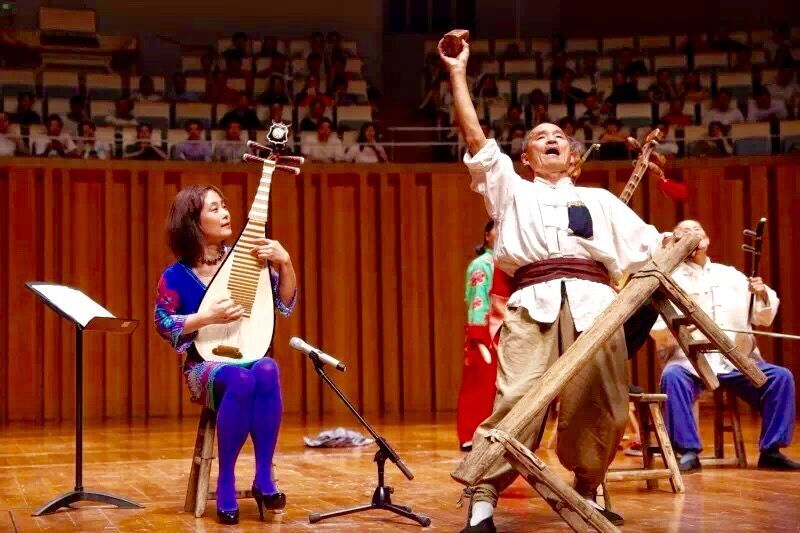
Wu Man (left) playing the pipa with the Huayin Shadow Puppet Band | Courtesy Photo

The Chinese civilization is one of the oldest known to humankind. Its vibrant cultural heritage dates back thousands of years, and the country’s rich and diverse musical tradition forms a vital part of that heritage. Traditional music – with its essential instruments including the pipa, guqin, ruan, xiao and zheng – is deeply ingrained in people’s daily lives and intersects with other art forms and traditions like drama, storytelling, and shadow puppetry.

The New World certainly has much to learn from this ancient civilization. This is why Wu Man, a pipa virtuoso who is regarded as the foremost ambassador of Chinese music and culture, has made it her calling to ensure that the early Chinese traditions are not merely preserved but kept alive and relevant. She has spent most of her life travelling the globe acquainting modern audiences with the pipa whose history goes back over two millennia.

We in the San Gabriel Valley will have the opportunity to hear and see Wu Man and the Huayin Shadow Puppet Band on March 5 at 7:30 pm when they perform at The Huntington Library, Art Collections, and Botanical Gardens in San Marino. This is one of three California stops (UC Santa Barbara on March 8 and Hertz Hall in Berkeley on March 11) as part of their North American tour encompassing a dozen appearances in Utah, Idaho, Arizona, Nebraska, Washington DC, New York, Ohio, and Massachusetts.

For many of us who aren’t familiar with the pipa and the shadow puppet, this show will give us a glimpse of and an appreciation of these musical and performance art forms. Wu Man is eager to share her vast knowledge and experience about them.

Wu Man explains, “Pipa is a pear-shaped, lute-like, string-plucked instrument which was introduced to China 2,000 years ago from Central Asia or the Persian area. It is related to the middle eastern instrument called ‘ud,’ and is in the same string family as the European lute, the American banjo, and the Indian sitar.”

“The pipa has a long history with the Chinese people. Music for the pipa was developed during the Tang Dynasty. In many paintings and statues you will always see the beautiful goddess holding the instrument,” continues Wu Man. “While it is an ancient instrument, it has survived to the modern days. The instrument I’m using today is one from the 19th century, which is bigger than the 16th century pipa which is on display at the Metropolitan Museum of Art in New York.”

To introduce the pipa to the public and gain a wider audience for it, Wu Man has been teaming up with internationally recognized artists and performers. One of her early collaborations was with the Kronos Quartet in the early 1990s. They premiered their first project called ‘Tan Dun’s Ghost Opera’ at the Brooklyn Academy of Music in 1997. Their partnership endures to this day and she participated in the Quartet’s 40th anniversary celebration concerts at Cal Performances in Berkeley, CA and at Carnegie Hall, and was Artist-in-Residence with the Quartet in February 2016.
Wu Man with the Silk Road Ensemble |Courtesy photo / Max Whittaker

Wu Man was also a founding artist of Yo-Yo Ma’s Silk Road Project and has performed throughout the United States, Europe, and Asia with the Silk Road Ensemble (SRE). She is a featured artist in the documentary ‘The Music of Strangers: Yo-Yo Ma and the Silk Road Ensemble,’ as well as on the film’s 2017 Grammy Award-winning companion recording, ‘Sing Me home,’ which includes her original composition ‘Green’ (Vincent’s Tune) performed with the vocal ensemble Roomful of Teeth. She has recorded six albums with the group. Her recent performances with SRE include a 2016 tour to summer festivals such as Tanglewood, Wolf Trap, Blossom, Ravinia, and Hollywood Bowl; as well as with Mark Morris Dance in Berkeley and Seattle, and a tour of Asia.

Locally, Wu Man was the Inaugural Artist-in-Residence at The Huntington in 2014 for which she composed a piece called ‘Three Sharing.’ She recalls, “It was meant as a celebration of the relationships among Asian countries. I played the pipa with two of my friends, one playing the Japanese flute shakuhachi and the other the Korean drum janggo. It was such a fun collaboration, we each contributed something to the music.”

Depending on whom you ask, there is the assertion that China has attained world dominance. Even if this weren’t entirely true, we can definitely say that it has a presence on the world stage and people are paying more attention to China.

Wu Man reflects on this, “I have noticed changes since I came to this country 20-some years ago when it seemed that no one knew anything about Asia and Chinese culture. In the past, my audience has been mostly older Chinese who knew about the pipa growing up. Today we are attracting people of different cultures who are open-minded and are willing to know more about China and its ancient musical instruments.

After a performance people usually come up to tell me the pipa sounds like a guitar or a banjo. Every once in a while I hear remarks like ‘it’s like listening to a harp or a ukulele.’ They’ll bring up the various plucked instruments. I observe a greater appreciation for it now.”

It’s also important for Wu Man to educate young Chinese people about their ancient roots. She says, “The younger generation is exposed daily to western culture and music through the Internet and social media. While it’s great that they are embracing others’ way of life, there is the likelihood of them forgetting their ancestry. That’s why tied in with my concert performances, I visit classrooms – all the way from elementary to college level – to talk about Chinese history, music and specifically, the pipa.

Even my performances for adults are usually concerts/informational talks because not everyone knows Chinese ancient musical instruments. So my goal is to make this as familiar as the guitar. It’s such a beautiful instrument and it would be a shame if people didn’t know about it. It has a very rich history and it’s really pretty cool. It’s gratifying for me that recently people have been seeing the pipa in a much better light – they see its many potentials.”

Wu Man tours extensively and has practically visited every continent. She says, “I see different audiences and I get different reactions. Californians are more familiar with Asian culture and they are more receptive to my music. I get a vastly atypical reaction in Japan – the  audience is so quiet I can hear myself breathe. Normally there would be the little noises during a concert like someone moving his chair. But over there the silence is almost reverential. It’s only after the performance I would get a wild applause and hear them exclaim, ‘Wow, that was truly amazing.’ That’s always a wonderful feeling for a performer.”

Wu Man with her pipa | Courtesy photo / Kuan Di Studio

A few years ago Wu Man traveled to China’s remote regions to unearth the country’s ancient musical traditions that are in danger of being lost, and explored the customs of the Huayin Shadow Puppet Band, which was then known as the Zhang Family Band. It comprises farmers from Shaanxi Province’s Huayin County in a rural village at the foot of Mount Hua in northwest China.

For more than 300 years the Huayin Puppet Band has toured the countryside bringing its rugged shadow puppet plays that recall the mythical heroes and gods of the oral folk culture of Shaanxi, often evoking famous battles of the Tang dynasty (618-907), to temples, fairs and rituals.

These shadow puppet plays are accompanied  by ‘old tune’ (laoqiang) traditional music with guttural and high-pitched singing with a rough, mad spirit; percussion, including clappers, cymbals, and gongs; stringed instruments including the yueqin (moon lute) and fiddle; the shawm, a double-reed instrument similar to the oboe; and a natural trumpet.

The shadow puppetry tradition that exists in the village first appeared during the Qing Dynasty under Emperor Qianlong (1736-1796) and has been passed down from generation to generation. For many years the shadow puppetry was part of the Zhang family household only, and not until recently has it had been passed down to performers outside the family.

Wu Man is excited to bring the Huayin Shadow Puppet to The Huntington. This is only the second time she has performed with them in the United States since their first visit in 2009 as the Zhang Family Band.

“The Huayin Shadow Puppet music is very dramatic and earthy, it’s almost like Chinese gypsy music,” declares Wu Man. “Our audience will see that Chinese traditional music isn’t limited to the pipa, ruan, and zheng. I’ve been wanting to share this for a long time.”

In our digital era we tend to move past one new thing speedily to go to the next, lest we get left behind. It would be refreshing to stop hurrying for once and appreciate Wu Man’s effort to bridge the past and present.

For even as we enjoy a world of technological advances, we could still learn a thing or two about the simple pleasures in life from those who occupied this earth thousands of years before our time.
‘Memory 5D+’ Captures Essence of Chinese Culture in Spectacular Fashion

Originally published on 11 May 2017 in the Pasadena Independent, Arcadia Weekly, and Monrovia Weekly

Vivian (Ulan) Xuerong, a film and television producer based in Beijing with a local office in Los Angeles, grew up in Ordos in Inner Mongolia. She was raised in a culturally rich and diverse environment. This vibrant childhood had given her a wealth of ideas which she nurtured throughout her life.                

Three years ago, Xuerong decided to transform these imaginations from dream to reality in a spectacular show called ‘Memory 5D+’. She is sharing this once in a lifetime event for the first time outside of China on Friday, May 26, and Saturday, May 27, at 8 pm on both days at the Pasadena Civic Auditorium.  

Billed as an immersive musical odyssey to a distant past, ‘Memory 5D+’ is an innovative show of epic proportions, featuring 17 of China’s most revered musical performers – national treasures in their native country – playing rare traditional instruments largely unknown in the western world. 

The $4 million production puts together a cast of 43 musicians, singers and dancers who will perform against a backdrop of real, virtual and projected images and action that evokes China’s unique cultural heritage.  

Collaborating with Xuerong on this massive event are two of Hollywood’s respected visionaries. Creative designer Tom E. Marzullo – who has created, designed and directed international tours for Justin Bieber, Chris Brown, Prince, KISS, Luther Van Dross, among others – will create new imagery to provide the setting for the artists performing classical works of Chinese music.

Marzullo and his team are designing a multi-dimensional immersive journey for ‘Memory 5D+’ using state-of-the art concert production techniques, including high definition digital video and lighting, 7.1 surround sound, lasers, and aromatic sensory technology.        

The scenario for ‘Memory 5D+’ was written by filmmaker John Hughes, who is known for visual effects he generated in feature films such as ‘Frozen’, ‘Kung Fu Panda 2’, ‘Shrek Forever After’, ‘Spider-Man 3’, ‘Harry Potter and the Prisoner of Azkaban’, among others.   

“In ‘Memory 5D+’, the elusive nature of Chinese spirit becomes tangible and poignant,” declares Hughes. “Philosophies, characterized in the music, are those most Westerners know from Taoist thought including concepts of Yin and Yang, the Five Elements, Chinese Medicine, Astronomy, and Tai Chi. These have long guided millions of people and through performance, music can bring about a communication of the soul in a joyful and harmonious way.”

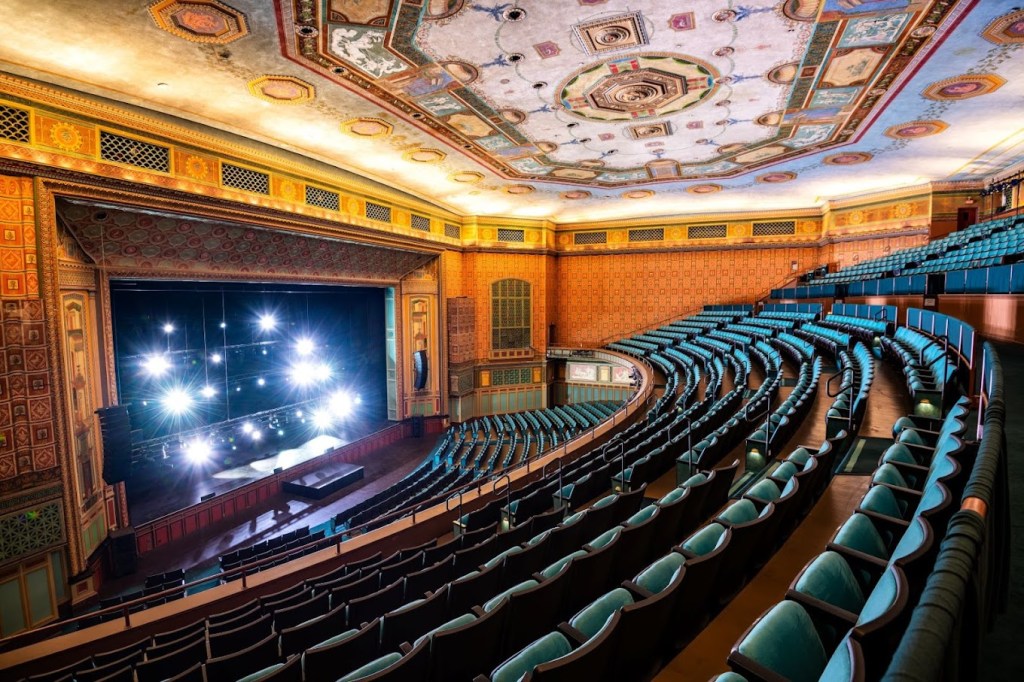
Image of Pasadena Civic Auditorium taken from Pasadena Civic Auditorium website

Against the background of the creation of the universe, ‘Memory 5D+’ frames a story of how the forces of darkness and light became one. Yin (darkness) and Yang (light) have travelled through time and space, flying across mountains and rivers to arrive at an ancient and mysterious Orient. They abound in the forest, and later encounter a variety of magical birds. Symbolic bamboo leaves and birds’ feathers dance in the wind and fall to the ground. Everything strikes the world as new and beautiful, and they are innocent of what is ahead of them.

Hughes dramatized a dance scenario backed by celebrated traditional Chinese music. The story captures the vital essence of Taoist thought: Tao is a oneness that contains two component forces known as Yin and Yang which have starkly contrasting qualities. Taoism describes the perfect symmetry of light and dark as so powerful it causes everything we know to come into existence and that they eventually intertwine seamlessly to establish a balance.

This equilibrium is depicted in ‘Memory 5D+’ through music and dance. Hughes describes, “A drama of contrasting responses leads to an imbalance, and the conflict carries the power for the universe to become unstable. Eventually the differences are resolved, and they once more fuse with each other in harmony. They again reach a state of interdependence and counterbalance. At the end, everything is peaceful and glorious.”

“Most importantly, ‘Memory 5D+’ reflects the significance of love, faith, and spirit, as well as people’s yearning for – and tireless pursuit of – love and all things of beauty,” expounds Hughes. “For when all matters cease to exist in the universe, the only things that are truly immortal are spirit and love. I hope that, one day, mankind will really understand that love is the universe’s biggest mystery and that finding energies in others that most perfectly complement oneself are the foundation for amicable coexistence.”   

‘Memory 5D+’ features many of China’s most important musical instruments with defining influence on its culture. These include: the cowboy flute, gijak, guqin (Chinese zither), guzheng (zither), konghou (Chinese harp), morin khuur (horsehead fiddle), pipa (Chinese flute), shamanic drum (tuva drum), topshur, and yekele.    

Chinese theatrical productions are replete with a rich tradition of stage techniques. ‘Memory 5D+’ employs Chinese acrobatics, one of the oldest traditional performing arts that emerged during the Warring States Period; dolan muqam, a comprehensive classical performance art developed by the Uygur ethnic group that features free and unrestrained style, coupled with simple yet powerful dance rhythms; khoomei (throat singing), a magical singing art created by the Mongolian people; urtin duu (Mongolian long tune), which represents the highest achievement of Mongolian singing art and reputed as the ‘living fossil of prairie music’; shadow play, which integrates shadow, art, paper cutting, sculpture, dance, music, talking, and singing; Suzhou Pingtan (storytelling and ballad singing in Suzhou dialect); and Tibetan folk songs. 

‘Memory 5D+’ showcases the diversity of Chinese culture which many Westerners aren’t aware of.  As Hughes says, “America is strong because it’s made of up of different groups and cultures, thus is called a ‘melting pot’. China, with its 56 ethnic groups, is just that – a ‘melting pot’. The show will acquaint its audience with some of these groups that have their own distinctive art forms and characteristics.”   

Xuerong adds, “This 90-minute production will introduce ten instruments which are almost obsolete that not many people know how to play them. They are also not known in the western world. Through the musical interpretations in ‘Memory 5D+’, I want to show that China is so advanced – these instruments existed over a thousand years ago, long before other nations’  history began.”

“The show itself is based on an ancient philosophy that the Chinese have been imbued with since birth and which they handed down through the ages,” Xuerong continues. “Through ‘Memory 5D+’ I would also like to pass along China’s ancient beliefs and culture to the next generation, many of whom are not familiar with it.”

After finding the artists, performers, and various technical personnel to help her realize her ambitious undertaking, Xuerong traveled with them to Ordos where they rehearsed the show. She discloses, “Audiences from several towns away previewed ‘Memory 5D+’. It was an unprecedented immersive experience for them – together with the performers, the audience travelled through space and time in their search for the key to a happy life. The show gained a brilliant reputation and met with much success.”       

Of all the cities in the U.S. in which to inaugurate ‘Memory 5D+’, Xuerong chose Pasadena. “Culture and heritage are deeply important to me, and I think Pasadena has much of both,” she reasons. “It is the perfect venue from which to debut its worldwide tour. The Pasadena Civic Auditorium has hosted many awards shows, musical performances, and theatrical events. It has so many happy memories; it will bring good luck to us.”

From its American premiere, ‘Memory 5D+’ will travel to several Chinese cities, with a performance in Guangdong scheduled in June, according to Xuerong. She also says discussions with promoters from French and Italian professional institutions are underway.

Following its international tour ‘Memory 5D+’ will go back to Ordos. Reveals Xuerong, “After the rehearsal and preview, the local government decided to invite ‘Memory 5D+’ to be a resident show. And although it has won much praise, we are still making improvements to the program. We are chasing perfection and even greater breakthroughs in stage technology; we are endeavoring to give our audience the very best in technological magic.”

Xuerong has come far from her humble youth in Ordos. She has successfully established the China Film HuaTeng Movie & TV Culture Co., Ltd. in Beijing and L.A., and has produced several shows. But her most spectacular creation yet – ‘Memory 5D+’ – which originated from her early childhood musings may be the one to bring her the greatest acclaim.

Ordos, which Xuerong asserts is the final resting place of the immortal Genghis Khan, is a land rich in cashmere as well as rare natural resources. It is referred to as the ‘Ocean of folk songs and hometown of dance’ to honor the natural artistic talent of the Mongolian people who inhabit it. It will be here that ‘Memory 5D+’ will ultimately reside – a fitting tribute to Xuerong’s beloved homeland and Chinese heritage.