Originally published on 17 March 2016 in the Pasadena Independent, Arcadia Weekly, Monrovia Weekly, and Sierra Madre Weekly
“I feel, as a curator, I am more of an educator,” muses Dr. James Glisson, Assistant Curator of American Art (Bradford and Christine Mishler) at The Huntington Library, Art Collections, and Botanical Gardens. And what a beautiful art education The Huntington visitors will be treated to!
Currently going on through the 9th of May at the MaryLou and George Boone Gallery, “The Artists Garden: American Impressionism and the Garden Movement, 1887-1902” features 17 paintings on loan from The Pennsylvania Academy of Fine Arts’ (PAFA) permanent collection. The show gives visitors and scholars a glimpse of painting as it relates to garden design. Glisson, who organized the exhibition and contributed an essay to the catalog states, “This exhibition gets behind the undeniable beauty of impressionistic pictures of gardens and asks questions about the social activity of gardening, the scientific hybridization of plants, and even early environmental conservation.”
According to Glisson, the two paintings he selected to bookend the exhibition – The Crimson Rambler and The Hovel and the Skyscraper – sum up what the show is all about on a conceptual level. He explains, “Philip Leslie Hale’s painting shows a red rose bush, the Crimson Rambler, a common and hardy backyard plant paired with a woman wearing a wide-brimmed hat and dressed a la mode. I think Hale intends them to read as analogous to each other – she is on display like a beautiful flower; it may be a cliché metaphor but it’s still pretty effective. Both the woman and the newly hybridized rose are modern and contemporary for their time. Similarly, the painting technique used a modern application of colors.”
“When I talk to people about the exhibit I like to say that these are painters who are reflecting on modern American life in the late 19th and early 20th century, post industrialization and during urbanization. They painted landscapes that offer respite from the grunge of the city, an escape. The Crimson Rambler is a subtle rendering of this sentiment,” Glisson says further.
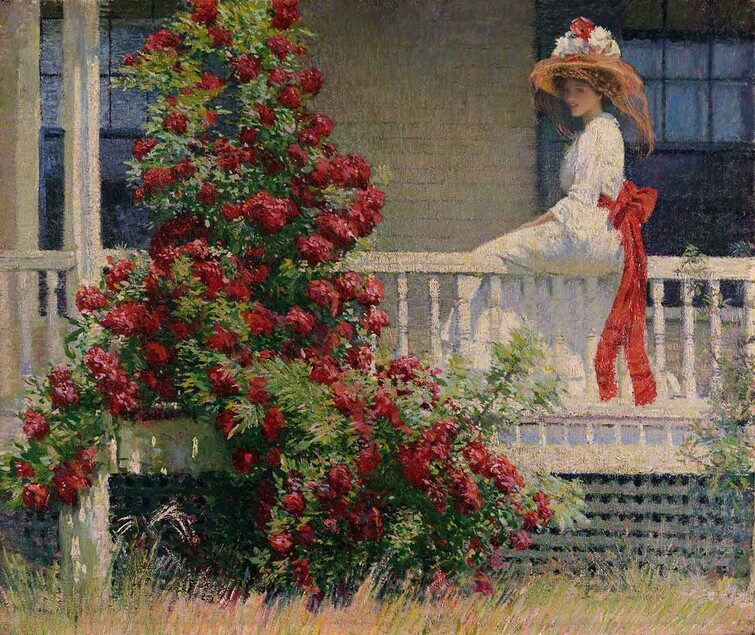
Philip Leslie Hale’s ‘The Crimson Rambler | Photo courtesy of The Huntington
Glisson then points out, “Childe Hassam’s painting, on the other hand, is an explicit depiction of the time’s attitude. The Hovel and the Skyscraper looks out of the artist’s studio into Central Park. He delivers the message in his paint application – very precise with a lot of rectilinears; and the subject matter – a tall building. In 1904 New York’s skyscrapers were the epitome of an advanced, modern American city. It resonated among its viewers in the same way we see the skyscrapers of Dubai or Shanghai. Yet, he painted the park as soft, gentle and beautiful, with no straight lines – a space of quiet, refuge and nature.”
“I see this painting as something that speaks to Angelenos and the real estate market; his views are about to be blocked by brand new buildings. It alludes to today’s teardown phenomenon where existing structures are being replaced by bigger, taller ones to make a lot more money,” Glisson adds.
In the late 19th century, the railroad made it possible for Americans to conveniently travel from their suburban home into the city to work. In the same vein, painters commuted whenever they had to and their artwork reflected that lifestyle. Describes Glisson, “Painters at the time depicted what was near and familiar to them, which also happened to be really modern at the time.”
One piece of art in the show is by John Henry Twachtman, a member of the new suburban class who lived in southern Connecticut close to the railroad. His piece, called Snow, depicts his backyard covered in snow. Though not a farmer, he lavished great care on his yard.
The exhibition also includes some of The Huntington’s collection of 150,000 chromo lithographs gifted by Jay T. Last. Chromolithography was a process used by artists of this period to produce illustrations for newspapers and magazines to make money. It was also widely used to advertise the new colors of hybridized roses, like the Crimson Rambler, and to create the seed packets for flowers being grown by Americans who have discovered backyard planting as a middle class leisure pursuit.
The San Marino institution is the show’s only West Coast stop on a five-venue tour organized by Anna Marley, Curator of Historical Art at PAFA. She explains the rationale, “The Huntington, with its spectacular gardens and wonderful American art collection is the perfect venue for a show that traces the interconnections between the American garden movement and Impressionist painting. Also, the development of the Pasadena bungalow culture at the turn of the 20th century corresponds perfectly to the material in the exhibition, which was related to the broader national garden cities and British Arts and Crafts movement.”
“I hope visitors to The Huntington make the connections between their own homes and gardens and the lives of American artists living and working over 100 years ago. I hope they love the art but also take away a new-found knowledge of the history of the Progressive era in the United States, and particularly its relationship to the burgeoning movements of environmentalism and women’s suffrage, issues with great resonance today,” Marley concludes.
The historic gardens at The Huntington, an estate which once belonged to collectors and philanthropists Henry E. Huntington and his wife, Arabella, is planted with 1,400 varieties of roses artfully perched on arbors and trellises. It is easy to imagine how Arabella took delight in the magnificent blooms in her rose garden, and how 21st century women are experiencing the same to this day.
 A San Gabriel Valley Inquirer