‘Frankenstein’ Makes a Stunning California Premiere at A Noise Within

Originally published on 20 August 2019 in the Pasadena Independent, Arcadia Weekly, and Monrovia Weekly
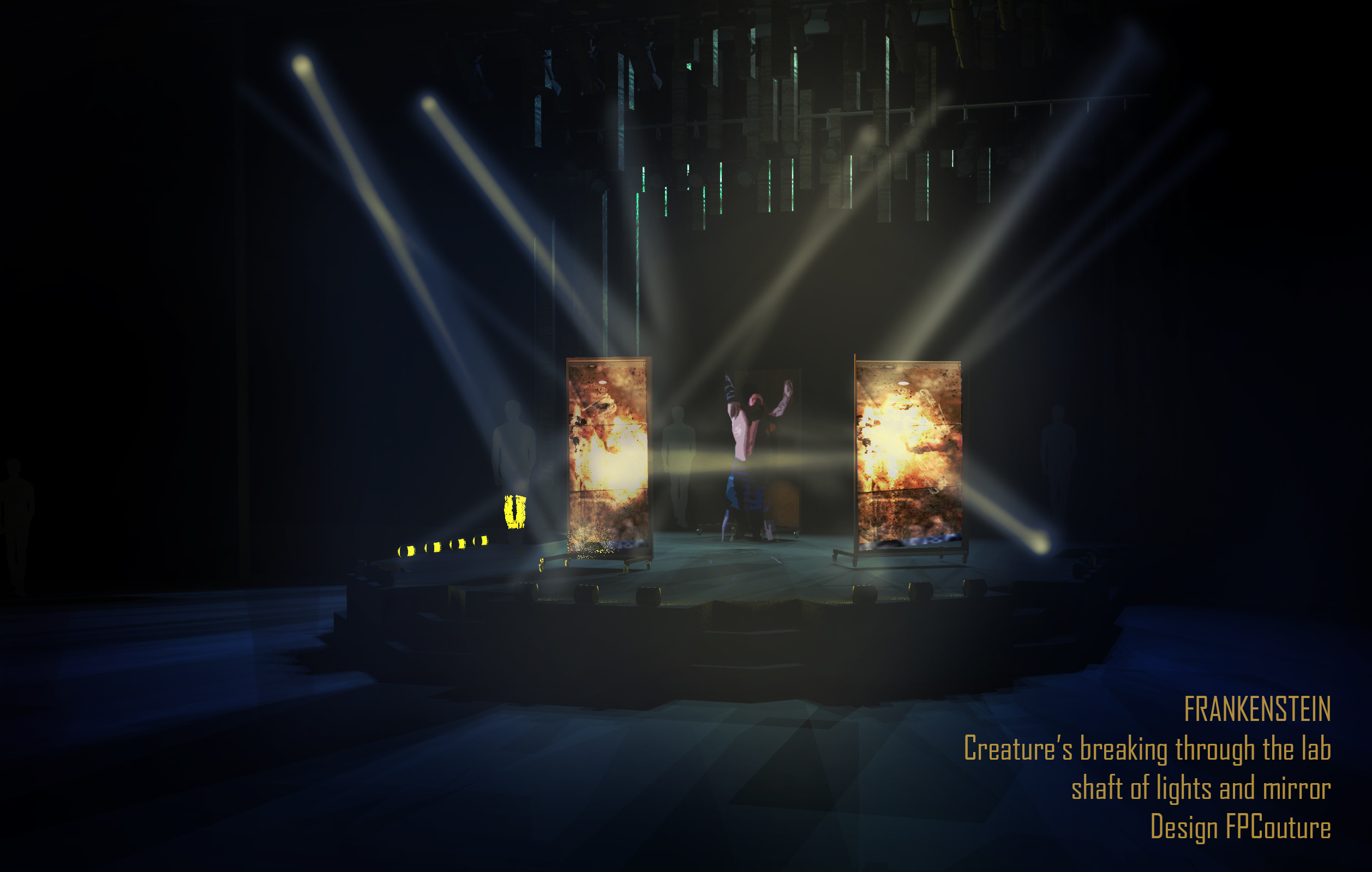
Couture’s rendering of the creature breaking through the lab | Courtesy photo / Francois-Pierre Couture

A Noise Within (ANW) opens its 2019-2020 season ‘They Played with Fire’ with the California premiere of Nick Dear’s ‘Frankenstein.’ Adapted from the original novel by Mary Shelley and  directed by Michael Michetti, it is a stand-alone production from August 11 to September 8, 2019.

Michael Manuel, who was last seen on the ANW stage as Iago in Shakespeare’s ‘Othello,’ stars as the Creature. Playing Victor Frankenstein is resident artist Kasey Mahaffy and taking the role of Elizabeth/female creature is Erika Soto.

Shelley’s most renowned work, ‘Frankenstein’ tells the story of a creature who comes back to wreak destruction after he is cast away into a hostile world by his creator. Dear’s adaptation of the Gothic tale depicts the themes of social rejection, intellectual hubris, and the emergence of good and evil.

Michetti pronounces, “By telling the story from the point of view of the Creature, this highly theatrical adaptation of Mary Shelley’s beloved novel delivers not only the terror we expect from the story, but a surprisingly thoughtful and moving exploration of society’s role in teaching and perpetuating violence.”

Scenic designer Francois-Pierre Couture has been tasked with providing ‘Frankenstein’ the backdrop and atmosphere that reflects Michetti’s vision. A transplant from Montreal, Canada, Couture is the rare artist with a full plate in both the artistic and academic fields.

I chat with Couture recently to find out how he ended up in Los Angeles, what teaching means to him, and why collaboration is what he does best.

Couture says, “When I was graduating from university in Montreal, I went to URTA (University/Resident Theatre Association), which is where students who are looking to go to graduate school for theatre programs have the opportunity to meet representatives from different universities in the U.S. (think College Fair). After presenting our portfolio, we were interviewed by school representatives.

“There weren’t that many schools from New York; I can’t remember if Yale and NYU were represented that year at URTA. But I was really considering going to either UCLA or CalArts – I thought it would be fun to go to the West Coast and explore that region of the United States. At that point I hadn’t been to Los Angeles; the first time was when I visited the schools. In fact, I  went twice because I looked at both schools on separate trips. UCLA offered me a pretty hefty scholarship to cover my studies, including some living expenses. I waited a year to give me time to think about it and, in the end, I attended UCLA and earned my MFA (Masters in Fine Arts).”

Asked what made him stay, Couture replies, “I suppose when you study for three years in a certain environment, it grows on you. I also got in touch with The Actors’ Gang right away and started designing for them and I became their production manager for three years. One thing led to the next – I started working and then I established a career in L.A. In the process, I met people here and it became my little world.”

Besides doing scenic, lighting, and projection design, Couture teaches at UCLA, Cal State Long Beach, and is a full-time professor at East Los Angeles College (ELAC).

Couture relates how he discovered that teaching was also his calling. “About 10 years ago, when I started my grad studies at UCLA, through the Actors’ Gang I found a part-time teaching job at Culver City High School. One of my colleagues, who was also an ELAC teacher, told me about an opening there. So I started teaching at ELAC on a part-time basis.

“Things were happening all at once then – I was studying for my graduate degree, I was transitioning from a full time production manager job for the Actors’ Gang to part-time teacher, and growing my design career. When I got into the academic world, I got pulled further into it. I started teaching at Pepperdine, Loyola Marymount University, Cal State Long Beach, Cal State Northridge, UC Santa Barbara, and UCLA. At ELAC and UCLA I supervise students in their production work and mentor them.”

Couture showing his designs | Courtesy photo / Francois-Pierre Couture

“It’s extremely rewarding to be able to teach someone what you know and show them your process,” continues Couture. “It’s very healthy in many ways because it forces me to understand what I’m doing on an academic and intellectual level. Just like others who work in theatre, I don’t have time to intellectualize what I do because I do shows back-to-back. Going back to basics helps me secure the foundations again. It’s a symbiotic relationship – teaching young people, seeing them grow, and giving them opportunities, especially here in ELAC.

“A lot of our students come from communities who have no access to theatre, who don’t think of theatre as a source of employment that’s desirable for them. So it’s so gratifying to be able to offer all that to young people from varied backgrounds. One of my lighting students is going to do his graduate studies on the East Coast, some are going to CalArts, another is going UC Irvine, and one will attend Cal State Fullerton next year. Many of our theatre students are also doing great things, someone is right now finishing his Master’s in directing at UCLA. In the ten years that we’ve devoted to this program we’ve been able to help our demographics enter a field that was previously underrepresented. ELAC is also the official education partner of CTG’s (Center Theatre Group, which includes the Ahmanson, Taper, and Kirk Douglas) outreach program. That direct relationship is essential to our success.”

It wouldn’t be a stretch to say that education outreach and artistic work are rarely done by the same person, I opine. Couture says, “It’s hard; there’s a lot of hours involved. But, far from being the only one working on it, I am part of a big team. And we have an entire faculty working with us to create this outreach. With our strengths and connections in the industry, we’re able to advance this program.”

“Which is the day job and which is the side job?” I ask. “That’s a tough question,” responds Couture. “I’ll have to say teaching is my day job and designing is my night job. During the summer and winter months, I choose not to teach classes and that’s when I cram all the prep and design work. During the school year, I’m at school from 9 am to 5 pm four or five days a week, with pockets of down time. But, of course, during production my hours increase – I wake up at 4:00 or 5:00 in the morning to do my day job then go home to work at night. When I’m at the theatre, usually Thursday through Sunday, I work day and night.”

In the last 13 years, Couture has worked as a scenic, lighting, and projection designer. He has received multiple Ovation, LADCC, LA Weekly awards & nominations. Designs include: ‘Invisible Tango,’ ‘A Picasso,’ at the Geffen Playhouse; ‘Everything that Never Happened,’ ‘With Love and Major Organ,’ Boston Court Pasadena; ‘Destiny of Desire,’ Oregon Shakespeare Festival, Arena Stage Theatre, South Coast Repertory& Goodman Theatre; ‘Jackie Unveiled,’ Wallis Theatre; ‘The Mexican Trilogy, an American History,’ Los Angeles Theatre Center; ‘Metamorphoses,’ ‘Everything is Illuminated,’ Ensemble Theatre Company; ‘Médée’ and ‘Teseo,’ Chicago Opera Theatre; ‘L’Elisir d’Amore,’ and ‘Cold Mountain,’ Music Academy of the West.

Couture recalls the very first award he got, “Charles McNulty, the theatre writer for the L.A. Times, featured me in his column as one of ‘Faces to Watch’ in 2007 when I designed ‘Love’s Labor’s Lost’ at The Actors’ Gang Theatre. It took me about six years working a lot of small theatres doing scenic and lighting projects to build my reputation. To this day I still do between 10 and 20 productions a year and I didn’t get the work that I’m getting now until Charles’s endorsement.

“However, the awards and acclaim don’t affect how I work. The process is so tied to my relationship with the director and the other designers. The risks we take are based on what we’re trying to do with the play and how we want to tell the story. I can’t think about awards when I’m designing because then the pressure is put in the wrong place. If I work well with my co-designers and everybody on stage and I try to be innovative, am true to the play, and give what the play needs, then the award will hopefully follow. The goal is to do good work and do something that the audience will perceive, that will communicate the story. And if we get noticed and are given awards, then that’s wonderful. Awards are subjective in many ways and you’re judged against other people’s work. So if, one year, others also did amazing work and you didn’t win an award, it doesn’t mean you didn’t do good work.”

Shown left to right: Kasey Mahaffy, Michael Manuel, and Erika Soto | Photo by Craig Schwartz / A Noise Within

It was Michael Michetti, Artistic Director at Boston Court Pasadena, who approached Couture to do the scenic design for ‘Frankenstein.’

Couture discloses, “I’ve done about ten productions there; the first show I did with him was for ‘Dinosaur Within,’ in 2011. Michael is a very talented and accomplished director. He and I respect each other’s work immensely; we try to work together but there were always scheduling conflicts. It was really fortunate that I was available to do ‘Frankenstein.’ The design process took about two to two-and-a-half months. Michael and I talked about the play at the outset; then in our next meeting, I came in with more concrete idea designs.”

“I think what I’m good at, and what I do a lot, is balancing reality and abstraction. I often work on complicated plays that have multiple locations and that show emotional content. I try to encompass all the elements and synthesize them to create a design on the stage. I want to think I’m a good collaborator; I love to involve everybody else on the team. Lighting designer Jared Sayeg and I had a lot of conversations about ‘Frankenstein’s’ set and lighting design. We knew it was going to be a big project that involves a lot of work and that it was going to be demanding because it’s a challenging play.”

“So what can the audience look forward to?” I query. “The audience can expect a scenic design that is emotionally charged; that which emphasizes the struggle of the creature, visually and viscerally,” expounds Couture. “We utilized chiaroscuro – light and shadow – that echo the layers and dark corners of all the characters. It’s also a design that people will find surprising, maybe thought-provoking in some ways, as we don’t represent the reality of all the spaces because it’s a very cinematic universe. But it all makes sense.”

ANW’s ‘Frankenstein’ is indeed a stunning first production for this season. Michael Manuel’s superb acting, supported by a remarkable cast and an extraordinary design team, and helmed by a visionary director, brilliantly bring to life Mary Shelley’s much-loved novel. If the audience’s reaction during the opening weekend was any indication, ‘Frankenstein’ could expect a monstrously successful run.


‘Summer with Shakespeare’ Teaches Children Soft Skills

Originally published on 13 May 2019 in the Pasadena Independent, Arcadia Weekly, and Monrovia Weekly

Acting for 15-year-olds | Photo by Brian Feinzimer / A Noise Within

A Noise Within’s (ANW) ‘Summer With Shakespeare’ acting camp will once again be open from June 17 to July 19, 2019 and children don’t have to be aspiring actors to attend it. The most important skills that they will gain, in fact, are those that help them in their day-to-day life.

“Our focus is social learning and the soft skills which are going to help our students succeed as they get older, regardless of whether or not acting is a passion of theirs,” emphasizes Alicia Green, ANW’s Director of Education and Community Outreach. “Those include empathy, self-confidence, team-building, compromise, public speaking skills – the things that are really going to help them stand out in the current climate of technology where most kids are so used to working on their computer instead of interacting with others. These are inherent in a theatre class or theatre camp.”

“And if kids are interested in pursuing theatre, it’s an incredible place to train,” Green adds. “We’re a professional repertory theatre and all our instructors are working artists in their craft who have pedagogical backgrounds as well. However, we also have a lot of kids who are just interested in exploring the texts or because it’s fun for them and they enjoy being here. I don’t even think that they always know the soft skills they are developing. They come for the friendships that they’ve made. Sometimes, too, they come back because this is a place where they feel good about themselves. Truly, there are so many reasons we have such a high return rate with our students. It’s one thing to go to camp and have fun all day with your friends but it’s another to make it so meaningful that kids come back year after year.”

An 8-year-old learns sword-fighting | Photo by Brian Feinzimer / A Noise Within

Parents, whose children have gone to the ‘Summer with Shakespeare’ camp, only have high praise for the program. Green gets several gratifying feedback including, “Thank you so much for providing a wonderful camp experience for my five-year-old daughter. She came home the first day reciting Shakespeare and was excited to go every day. As a parent, I was really impressed by how it wasn’t just a singing and dancing camp; she learned a lot about all aspects of Shakespeare!”

“It’s a really well-run program, with enough structure for those who need it but freedom and flexibility to make it fun,” another parent points out. “The kids really learn about theatre and acting in a fun, productive atmosphere. It’s also great that it happens in a real theatre space.”

One Dad says, “The proof is in the pudding. As I sat in the audience watching the effects that a summer of A Noise Within had had on my 13-year old daughter, I was – in a word – becalmed. It was wonderful that she was appreciated so much and given a hefty amount of responsibility (read trust) onstage. We will be forever grateful for this summer!”

“Your children will be challenged, encouraged, nurtured, and leave with a broad range of skills and a new level of confidence,” is how one parent puts it.

Campers themselves have amazing testimonials to share. One of them claims, “‘Summer with Shakespeare’ was a life-changing experience I will never forget!”

Another camper enthuses, “I love this camp!!! They actually taught me stuff about acting and teamwork! ‘Summer With Shakespeare’ helped me achieve my goals and encouraged me to get out of my comfort zone and also taught me how to do things, such as making a prop or a costume!”

7-year-olds play with hula hoops | Photo by Brian Feinzimer / A Noise Within

The five-week camp is open for children who are as young as 3 all the way to 18 years old – from pre-school to high school. Green describes the different options students have.

“If you’re in high school you’ll perform ‘Julius Caesar.’ And in that five weeks, from beginning to end, their goal is to self-produce every aspect it takes to do a play. They do their own set, costumes, text work, swords. There will be movement, light, and sound elements. They will then perform on our stage with their sets, costumes, and everything they’ve developed in those five weeks.

“We have an identical program for middle school. This year they’ll be doing ‘Romeo and Juliet,’ and it’s the same exact thing – sets, costumes, props, etc. Everything is really on them, we provide the skills, material, and support that they need. But the expectation is that they’re responsible for building the set and making their costume. The finished product looks like kids made it instead of it looking like we have professional technicians come in. And that’s part of the plan. The kids are really proud of what they’ve accomplished – this is theirs and they’re going to present what is theirs at the end of the five weeks.”

Green continues, “We also have weekly camp options and every week has a theme. For each week that has a theme, there will not be a performative element. We’re very much process over product. There’s an open house at the end of every themed week so that parents can come in and observe and see what their kids have been doing for the past week.

“Week 1 is Comedy. They’ll do commedia and focus on the comedic text – they’ll sing,  dance, and have a great time. Week 2 is Tragedy. We incorporate swords, stage combat, ‘Macbeth,’ ‘Hamlet,’ and the tragic text. Kids love this week because, you know, who doesn’t love a good tragedy? Week 3 is Histories and Romances. We keep the swords, but we throw in a little bit more – it’s a combo week. Weeks 4 and 5, for the weekly option, will have the same production. For ages 6 to 9 and 10 to 13 – those two weeks are a more condensed, less intense version of the five weeks. They’ll make their set and costumes, and at the end of those two weeks they’ll perform on our stage.”

Friendships are built at ‘Summer with Shakespeare’ | Photo by Brian Feinzimer / A Noise Within

“We have our pre-school week, which is incredible!,” effuses Green. “I’ve never had such feedback from parents so surprised that their 3-year-old was reciting Shakespeare a year later. Kids are still developing language and that’s something that’s so magical about doing a Shakespeare camp with kids. Adults tend to find Shakespeare intimidating. It’s different for kids because they’re still learning language, books, and texts in school. So if we don’t make it scary, they’re not scared of it. They’ll approach it with a great deal of excitement, they’ll learn the origins of language, and they’ll get to play with characters. Something that’s so great about doing camp here at A Noise Within is we’re a classical repertory company. We’re doing the plays that have permeated history for hundreds of years because they resonate with us as humans. Kids get these texts because they understand what the characters are going through. For instance, they meet characters who get jealous of somebody. They see what that feels like and what the repercussions of that are. These are all things that permeate all of Shakespeare’s texts and it’s really exciting to grasp that natural connection. We’re not only helping kids by learning Shakespeare which is great for them in school, but by building soft skills like empathy, and  becoming better humans in the process.”

“It’s definitely a natural pathway for children who want to be actors, too,” clarifies Green. “Rafael Goldstein, one of our resident artists, was one student from years back, who transitioned from ‘Summer with Shakespeare’ camp to the ANW stage. Sam Christian has been doing ‘Summer with Shakespeare’ now for six years, I believe, and he was in ‘Raisin in the Sun’ last season. This past season, he was in ‘Rosencrantz and Guildenstern Are Dead’ and he just finished ‘Argonautika.’ And a lot of our summer camp students do end up with our ‘Christmas Carol’ for all the young people’s roles.”

So let your kids have a grand time learning how to sword-fight this summer! The skills they acquire are guaranteed to stay with them long after the summer months. And they will look back to that time with both pleasure and gratitude.

‘Noises Off’ Brings the House Down at a Noise Within

Originally published on 6 May 2019 in the Pasadena Independent, Arcadia Weekly, and Monrovia Weekly

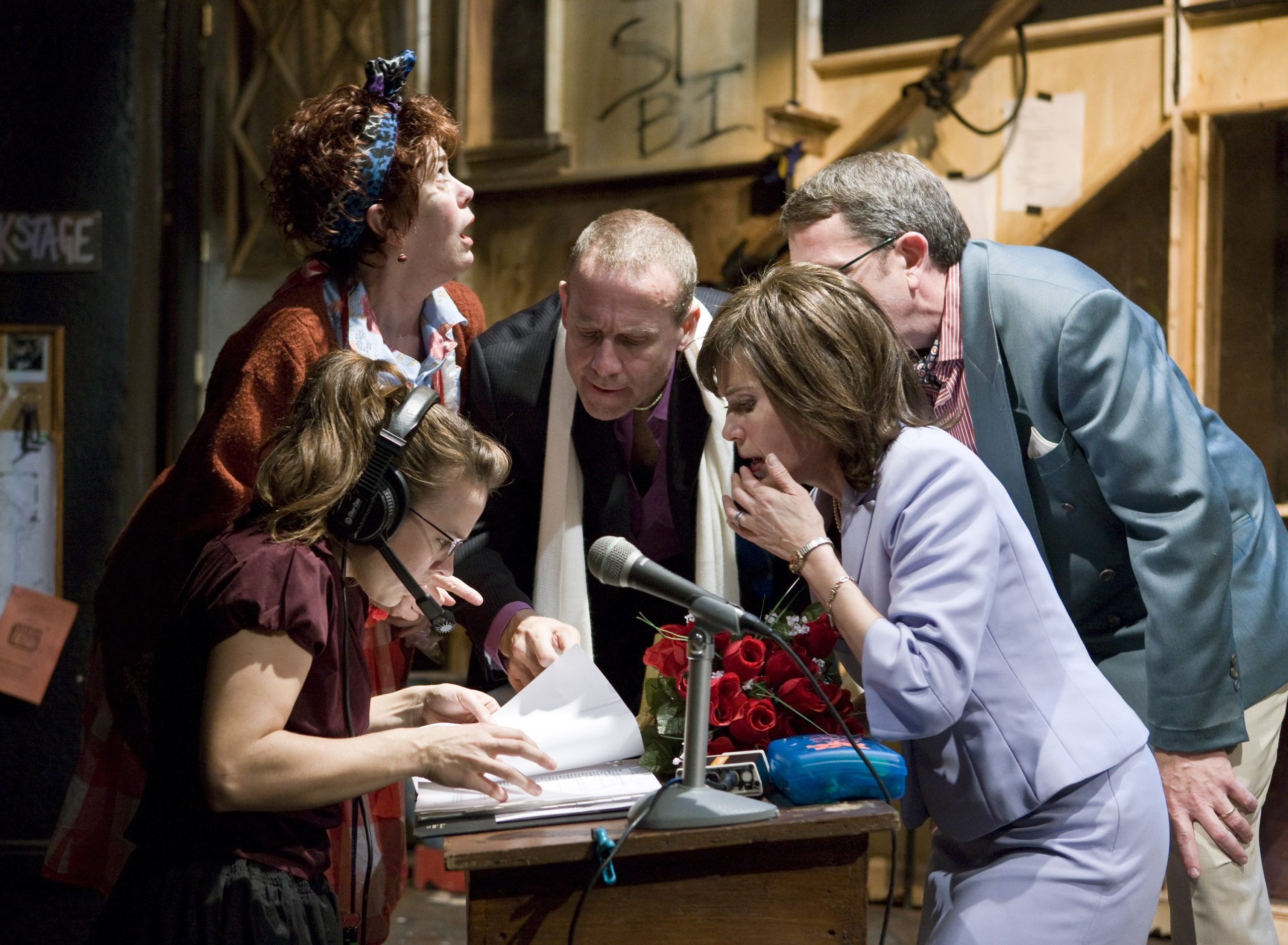
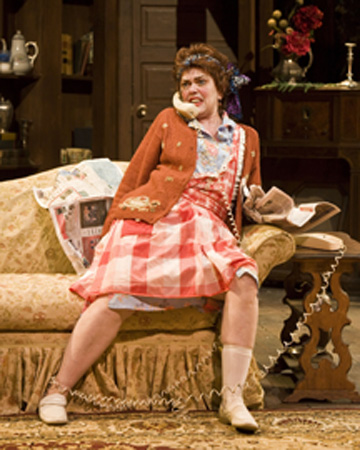
‘Noises Off’ ensemble | Photo by Craig Schwartz / A Noise Within

A Noise Within (ANW) culminates its 2018-2019 season with another staging of ‘Noises Off’ that’s guaranteed to make audiences laugh their socks off. This smash hit production of Michael Frayn’s riotous comedy will run on a limited engagement from May 21 through June 9.

Frayn’s joyfully out-of-control British farce features an under-rehearsed and over-worked cast and crew with a penchant for drama more personal than professional, preparing for the world premiere of a new play aptly titled ‘Nothing On.’ As the production progresses, the bumbling cast brings the house down – literally.

Reprising his role as Garry Lejeune, is Kasey Mahaffy, who was recently awarded by the Los Angeles Drama Critics Circle (LADCC) ‘Best Lead Performance’ for his role as Rosencrantz in ANW’s production of ‘Rosencrantz and Guildenstern Are Dead.’ ANW also won the McCulloh Award for ‘Best Revival for Rosencrantz and Guildenstern Are Dead’ and Geoff Elliott won for ‘Best Direction’ for the play.

Kasey Mahaffy in his winning performance of Rosencrantz | Photo by Craig Schwartz / A Noise Within

Still basking from his newly received honor, Mahaffy sits down with me to talk about being a resident artist (RA) at ANW, ‘Noises Off,’ winning the LADCC award, and how theatre changed his life.

“I always knew I wanted to be an actor. My parents had cable and, when I was really young, I would watch a lot of Tom Hanks comedies like ‘Splash’ and ‘The Money Pit.’ I wanted to do what he was doing. But that was as far as that went. I wasn’t talented at anything; I couldn’t do sports – I couldn’t catch a pop fly, I couldn’t run. I was pretty good at Nintendo but that was about it. I felt worthless; I was an insecure, fat, gay (but didn’t know it) kid. In junior high, I was picked apart, shoved in lockers, and called faggot. Children would chase me after school and every day I would come home crying. I spent two years in agony, sobbing and wishing I could snap my fingers and disappear. I don’t want to trivialize it, but I was so sad, depressed, and scared of bullies that I contemplated suicide. I didn’t just want to hide, I wanted to disappear. In my heart if this was what life was, I didn’t want to be a part of it anymore.”

“But I stuck with it through that summer before high school and then I saw this group of people in high school putting on a play, which prompted me to audition for the theatre program,” continues Mahaffy. “I got into my first play which was ‘Dr. Doolittle’ where I was Monkey #3. It was my premiere and I was hooked! I instantly had a family who told me that I had value, that I had something to contribute to the group. They laughed at my jokes and said I was handsome. It was the first time in my life someone thought I was handsome! There wasn’t even a question, I knew I was home. That was when I was 13 and this year I’m going to be 40 and it will be my home for the rest of my life. Theatre illuminated a way out for me; it’s the place that made me feel good and trust myself.”

Mahaffy, a Portland, Oregon native, went on to earn his BFA in Acting from Southern Oregon University. He completed an Actors’ Ensemble Internship at the Pacific Conservatory for the Performing Arts (PCPA) in Santa Maria, California then moved to New York City and did regional theatre for three or four years before coming to Los Angeles.

“I did the Hollywood schlog and some plays, but mostly I worked in retail,” Mahaffy reveals. “I was miserable at selling women’s shoes at Bloomingdale’s and that’s the worst thing you could ever wish on someone to do. My entire life changed when Geoff (Elliott) and Julia (Rodriguez-Elliott) invited me to be an RA at A Noise Within because that meant my day job was theatre. I didn’t have to wait a table again, sell shoes, or work in a mall. I could come here and do what I love and make money and have insurance. I can still get to audition and work for TV. I personally feel that I’m the luckiest actor in this town.”

Mahaffy as Garry Lejeune | Photo by Craig Schwartz / A Noise Within

The role of Garry Lejeune was one he had dreamed of. Mahaffy says, “I’ve wanted to play this part for 23 years. I originally saw ‘Noises Off’ when I was in high school – three acts of an ensemble running up and down stairs, tripping around, and telling the funniest jokes that I’ve ever heard. I looked at the guy who played Garry and I thought, ‘That! That’s the role I want! But it took 23 years for me to get it. I’ve auditioned for many productions of it and have been offered Tim, the stage manager, two different times in my career and turned them down. Nothing against him, Tim is a great part but I didn’t want to be in a play where I was watching my dream role be done by somebody else. I knew that Garry was the role for me. Geoff and Julia took a chance on me. I’ve played some really great supporting parts here but up until then, that was the biggest thing they’d given me. From day one, I knew who he was, what I wanted to do with it, and where I wanted to take it.

“Last year we had half the rehearsal time because it was a remount and most of the cast had already done it. But I was new and I had, arguably, the hardest and biggest role. I had a condensed period to memorize all my lines. It was a crazy rehearsal process. This sounds so tacky, but I think the thing that helped me get there quickly was that intense desire to play this part. Of course, Geoff and Julia, co-directing it and having experienced this play a few times before, gave me pointers on what to avoid and the pitfalls. You really have to pay attention to Michael Frayn’s direction particularly in Act 2 which has practically no words, just running around backstage. It’s wild. You can put your own spin to these roles but it’s all in his script. You have to do what’s written or you get off track and the whole thing falls down like a house of cards.

“It went so well, but it was one of the hardest things I’d ever done. I had to be in peak physical shape – I had never been in that shape my whole life so I’m kind of excited to get back to it so I can get abs again. I do three hours of cardio and I could eat anything I want during the show, which is fabulous. But it’s tough on the body – three hours of non-stop running and shouting. I have to fall down a flight of stairs twice – pants on, pants off, and shoelaces tied. It’s pretty taxing but worth it.”

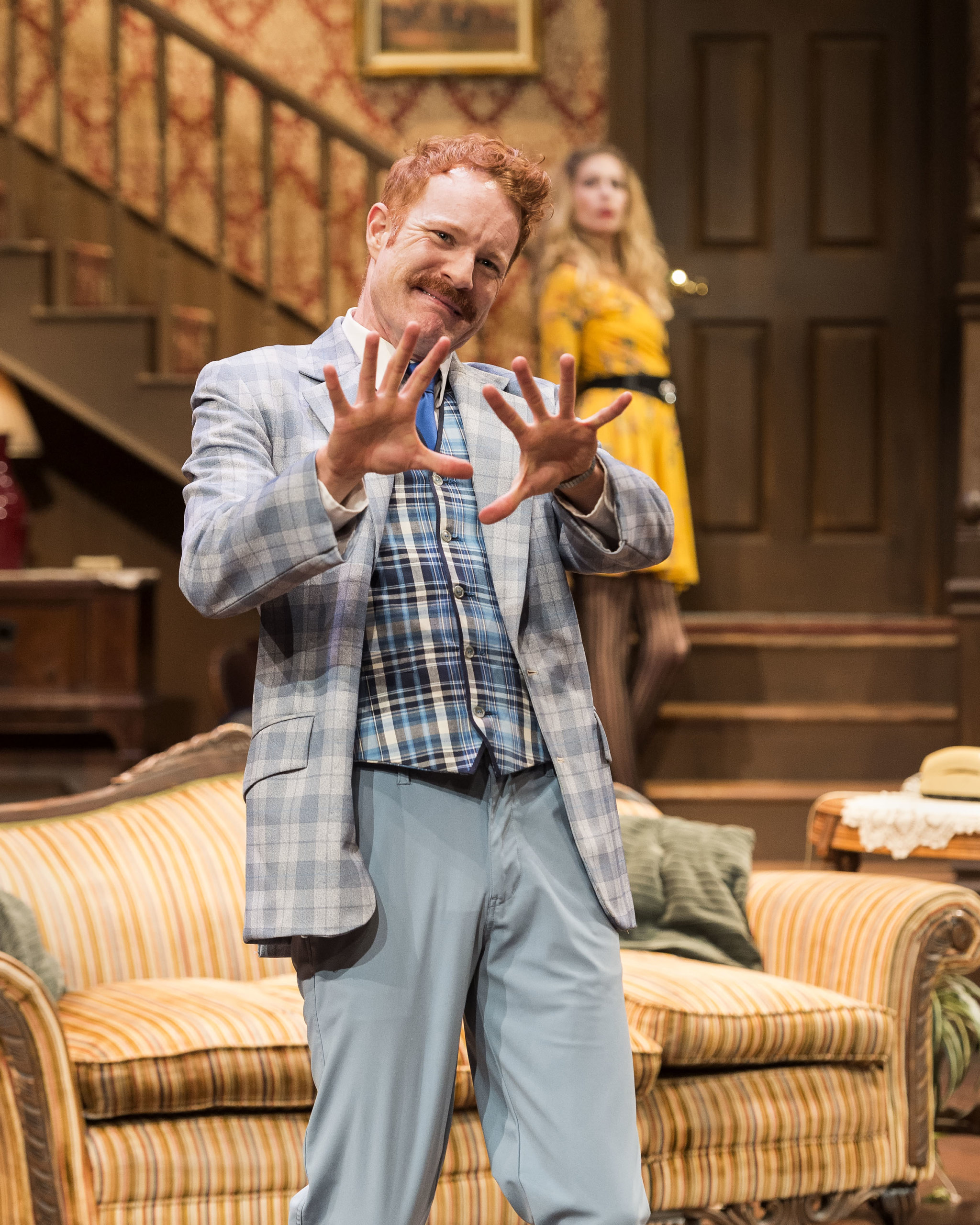
While the actors put in so much physical exertion, they make it look like they’re having fun on stage and the audience never catches them sweating. ‘Noises Off’ is really a play made to showcase ANW’s ensemble work but the show belongs to Mahaffy’s Garry. He’s the one who’s doing the most on stage, trying to right all the wrongs, and keeping the show on track. He also has the best punch lines.

Rafael Golstein (left) and Kasey Mahaffy (right) in ‘Rosencrantz and Guildenstern are Dead’ | Photo by Craig Schwartz / A Noise Within

Mahaffy is extremely proud to be at ANW. He says, “We’re pushing and stretching ourselves to do the shows. This company has always been incredible but, in the last five or six years, I’ve felt that they’re leaping into a new level of excellence. Julia is fantastic, she can tell a story while making everything visually stunning. Geoff, whom I had never been directed by and then got directed by him two shows in a row – ‘Rosencrantz and Guildenstern Are Dead’ and ‘Glass Menagerie,’ – is an actor’s director. As an actor himself, he knows how to speak like an actor and how to deliver a note, so he gets these acting ensembles just singing. They’re in a really exciting place artistically and our productions are more ambitious. Audiences can tell. They come up to us and say ‘We’ve been subscribers for ten years and the shows are great, but they’ve gotten better and better the last three or four years and we’re bringing in people!’

“A Noise Within opened doors for me. I’d never been up for anything before now and I just won the L.A. Drama Critics Circle Award a couple of weeks ago for ‘Rosencrantz and Guildenstern.’ I tied with Tom Hanks! He’s my idol! Watching him in movies all those years ago made me want to be an actor – it sort of looped back around. He wouldn’t remember me but I’ve met him a few times, mostly during catering jobs when I served him shrimp, and he’s just as lovely as you think he is. It would be a dream come true to work with him one day. But it was a neat moment, particularly, to call home and tell my mom ‘I just won best actor in L.A. and I tied with Tom Hanks!,’ and my mom going, ‘What the f– are you talking about? Wha….’ I’m sorry, I know I sound really smug, but it was just this really glorious moment for me.”

In the last two years, Mahaffy has done frequent TV guest appearances, like NCIS. Additionally, he’s had some life-changing auditions for a network series – they were at the point where it was him and another actor. And while they didn’t work out, he knows it was a matter of time so he has to keep away at it.

Mahaffy adds, “I’ve also done a couple of those Wix commercials, which were filmed in Tel Aviv, Israel. I had to fly there – it was really beautiful and exotic and fun. Next month I’m going to Hong Kong to do a play. I’m flying around the world to do art; I’m getting closer and closer with those TV jobs. My TV agent is so supportive – they come out here and see our plays. So when they see ‘Noises Off’ they know how to pitch me and call casting directors and producers and say, ‘Listen, you’ve got to come over and see this kid fall down a flight of stairs,’ and they do. Ever since I became an RA here, my life has been expanding and I owe this company the world for that.”

‘Noises Off’ ensemble | Photo by Craig Schwartz / A Noise Within

As to roles he would like to play someday, Mahaffy discloses, “I’ll tell you an interesting story. My other dream role was Tom in ‘The Glass Menagerie’ and they offered it to Raf (Rafael Goldstein, a resident artist an ANW). He’s my brother so it was fine, but I was going to be a little bit jealous nevertheless. Geoff said, ‘I want you to play the ‘gentleman caller.’’ I read it 15 years ago and I just remember him as the guy who comes in, kisses Laura, and they dance and then he leaves. But in the rehearsal of that show, I realized Jim is the role I want to do, not Tom. There are so many pockets and corners of this character that you could explore. I had the time of my life playing the ‘gentleman caller’ because of that, which surprised me.

“I’ve only got a few more years left to play Prior in ‘Angels in America.’ It’s another role I’ve been chasing around for 20 years. There have been other opportunities where I’ve almost gotten it, but it wasn’t quite right. But, who knows, maybe they’ll do it here one day. I’m not egotistical enough to think they’d do a show based on their RA or do star vehicles for people. But we have a whole group of RAs and we can do ‘Angels in America’ here – it’s one of the hardest shows to put on and it hasn’t been done in L.A.

“Coming from the theatre, I like shows that have different layers – those which are actor and character-driven, like ‘Russian Doll.’ I don’t know if you’ve seen it on Netflix, but the tone of ‘Russian Doll’ is very much like what I enjoy – dark, funny, quirky, and surprising. A dream would be a series on HBO. People who create for cable, like Allan Ball, who did ‘Six Feet Under’ and ‘True Blood’ for HBO, want to get to the nitty gritty of stuff and his characters express their ugliness and their pain in the most truthful manner possible. You really can’t do that with network because they’re worried about advertisers and if they’re going to push away people in the mid-west.”

“Being able to play a variety of roles is one of the blessings of being at A Noise Within. And to win an award for a show that was like an existential treatise on death – what happens when people disappear from your life – not long after my brother’s passing meant a lot. I dedicated that show to his memory, he was with me the entire time. And then there’s ‘Noises Off’ where you carry boxes and fall down stairs – they couldn’t be any more different in tone. But that’s why we do theatre and the fun of being an RA is that you could do crazy, dark things one show and then walk around wearing a big mustache and make an idiot of yourself. By the way, I based the look of my character off of Burt Reynolds – I was going for a ginger Burt Reynolds. My character loves getting all the ladies so I grew that mustache and it was my homage to Burt,” Mahaffy says with mirth.

The same day that Mahaffy and I meet, A Noise Within announced the theme for its 2019-2020 season, an event as highly anticipated as it was closely guarded, that all the resident artists were on pins and needles to learn their fate. ‘They Played With Fire’ season begins with the California premiere of Nick Dear’s adaptation of the chilling fable by Mary Shelley, ‘Frankenstein’ (August 11 to September 8, 2019) to be directed by Boston Court Pasadena’s Artistic Director Michael Michetti.

As if to underscore the diversity of acting parts he tackles and his versatility in inhabiting these characters, Mahaffy will be taking on the role of Victor Frankenstein. I can’t wait to see what he does with it!

A Spectacular ‘Argonautika’ Sails at a Noise Within

Originally published on 22 April 2019 in the Pasadena Independent, Arcadia Weekly, and Monrovia Weekly

Veralyn Jones (left) as Hera and Trisha Miller (right) as Athena | Photo by Craig Schwartz / A Noise Within

Pasadenans have until May 5 to catch A Noise Within’s (ANW) spectacular production of ‘Argonautika,’ before it sails into the sunset. An epic theatrical journey by Tony Award-winning director and playwright Mary Zimmerman, it made its world premiere in 2006 at Chicago’s Lookingglass Theatre.

Directed by ANW’s Producing Artistic Director Julia Rodriguez-Elliott, ‘Argonautika’ is a modern take on the classic Greek myth ‘The Voyage of Jason and the Argonauts’ which tells about his quest for the Golden Fleece. It features an ensemble of multi-talented actors led by Ty Mayberry as Jason, Trisha Miller as Athena, Veralyn Jones as Hera, and many others.

In this story, the Greek goddesses Athena and Hera are collaborators in their common goal to help Jason. Miller and Jones share scenes for the better part of the show and have such a wonderful time. On a recent mid-morning, they chat with us about this production, their roles, and how proud they are to be on the show.

As if proving just how in sync they are, Miller and Jones exclaim at the same time, “We had never been on stage together before now, we met at the audition.”

“Veralyn and I bonded from day one, which was great because so much of the challenge of the show was trying to figure out who we are in this mix,” begins Miller. “There’s such an interesting order in a show like this where there are immortal goddesses and semi-gods. And then there are the Argonauts. The first couple of weeks of rehearsals we had so many conversations about what exactly does it mean to be a goddess.”

The interaction between Miller and Jones on stage is such a delight to watch as they seem like two friends who are comfortable with each other. And, as in true relationships, there are bound to be some disagreements. There’s one scene when the displeasure on Athena’s face is utterly hilarious to behold.

“Our characters have little spats throughout the show because we have completely different ways of approaching the problem,” elucidates Miller. “Athena is very methodical, she’s very much into strategy and she’s an anti-romantic. So when Hera comes up with the idea to go to Aphrodite, Athena thinks ‘That’s the last person I want to see at this point.’ Hera uses love to get Medea to go along with their plan, and Athena’s thinking ‘Oh this is going to be a terrible idea.’ I loved showing not real anger but playful exasperation.”

Jones pipes in, “Exactly! Like you say, Athena’s all methodical. And I think Hera is all emotion, she’s very vengeful. That’s such an amusing dynamic.”

Both Jones and Miller credit Rodriguez-Elliott for this show’s unique vision.

“In the published version of the script, Mary Zimmerman wrote that she struggled whether or not to put how she created all these monsters in the first production because she said so much of the fun of theatre is problem-solving and figuring things out,” Miller explains. “I think this was the perfect show for Julia because what she does best, I think, is coming up with a lot of inventive design and movement. And that’s the magic of this show!”

Ty Mayberry (left) as Jason and Angela Gulner (right) as Medea | Photo by Craig Schwartz / A Noise Within

“It’s interesting, you said that,” observes Jones. “When I first read the script, I wondered how Julia was envisioning how everything that’s in the script was going to materialize on the stage. Then there are also moments when we appear some place by flying in. Not having seen the production before, I tried finding photographs but there wasn’t that much out there. So, as an actor, you just have to wait and trust that the director has a vision, and she did. Not being in her head, you don’t know initially how all this is going to happen. But as we started rehearsing, and day after day, it was very clear for her. She just kind of put it out there and somehow we got it; it all came together.

“They did a lot of pre-production work; I think she said they had been working on this for five months prior to rehearsals. She had all hands on deck for this show. It’s a huge production! People told me when they saw it they had no idea they were coming in to see all the acrobats and gymnasts – someone falling from the sky and all that. There’s even a dragon, and I’m always so charmed by that dragon.”

Miller discloses, “Julia mentioned before that Mary Zimmerman’s work has a very strong directorial DNA to it in how she writes and uses her actors. I had done her ‘Metamorphoses’ before at a theatre in Dallas and it has the same sort of style to it. I joked to Julia one time that I’ve been chasing the Mary Zimmerman dragon ever since because I had so much fun doing that production. There’s so much humanity and camaraderie in her work too. This story is so much about determination and that meshes with what we all love about doing theater in the first place.”

“… Being able to collaborate in ensemble work,” interjects Jones. “We’re part of something bigger than life. That’s what I love about this show – the idea that we’re all in this to start the process and finish it. Everyone’s in sync; that’s true ensemble work. I see those Argonauts out there and how they throw their bodies into what they’re doing. I’m in total awe of the production I’m in, which I find exciting.”

“You’re absolutely right,” concurs Miller. “There are moments when there’s such precision in this show so that, like you said, if any movement is off, it takes so much focus from everybody. There’s one point in the show right when the ship launches and I’m up on the bridge with all the Argonauts and they start rowing … there’s all this movement and choreography that’s so precise. People are jumping down from the bridge and climbing up and down ladders, it’s to the second – you have to be precise. And it’s really, really difficult, but when it all comes together there’s no greater feeling in the world.”

“The scope of this production is bigger,” Miller claims. “I didn’t see the original ‘Argonautika’ but I do know that they didn’t use silks. The sea monster was completely different – I think it was just fabric and two eyeballs. I believe Mary Zimmerman only had a month to write and put it together, which is how she usually works. I think the benefit of us having more time is that Julia was able to find and use all the talent she needed to realize her vision. She has a cast that includes Marc (Leclerc), who’s actually a stuntman and can come down from the rafters, Cassandra (Marie Murphy) who can sing and act while she’s hanging upside down from a silk rope, and Richy (Storrs) who can play every instrument you hand him. She brought in a movement coach, Stephanie Shroyer, and Ken (Merckx, Jr.) who’s the fight choreographer.”

“This piece is really made for ANW in terms of how they want to utilize their physical space on and off the stage,” Jones supplies. “This is the big type of ensemble work they like to do; although this is far more ambitious than anything I’ve seen them do. That they have two other shows in repertory just makes it all the more incredible.

“It’s crazy backstage. There’s as much going on there as on stage. We only have three crew members and they do so much – running to get us what we need, move props and sets. They’re also the dragon puppeteers and they have to light the lanterns. They are multi-tasking in a big, big way.”

The ensemble | Photo by Craig Schwartz / A Noise Within

Asked if Rodriguez-Elliott gave specific directions in what she wanted to see from each character, Jones responds, “You, as the actor, have to come in with the knowledge about the character and bring that to her so she can direct you. She clarified that Hera is a goddess and that she’s the queen of heaven. So my task is to figure out how to play that physically and emotionally in world of this play. For me, the character unfolds itself as I go along. What I learn about the character informs me how to perform it for the audience.”

“For me, Athena has such a strong point of view about how she approaches things,” answers Miller. “She wants to think things through before making a decision, which is completely different from Hera’s. That’s a fun dynamic to have. But also, it was really helpful for this show knowing what our costumes were going to be like from the beginning. On the first day of rehearsal, our costume designer Jenny (Foldenauer) gave a presentation so we knew what we were going to be wearing. All the armor that Athena’s wearing gives the feeling that she’s powerful but, at the same time, it also restricts movement. So, for me, a lot of that was finding economy of movement and stillness. I think that also reflects who Athena is, someone with an intense focus. Part of my rehearsal process is just paring down my action and making everything  purposeful and well thought-out.”

As to what they want the audience to feel when they leave the theatre, Jones declares, “Hera has a sense of who she is. Right or wrong, she goes after what she wants. I want women in the audience to be empowered – to know that she has the ability to take her destiny in her own hands. I’d love for women to feel they could rule – that they could take their own power and do with it what they will. I’d love for them to have that sense of ownership of purpose in their physical and emotional power. Hopefully, it’s directed in the right way.”

To which, Miller says, “That’s a good answer and it’s true. All three of us here are actually parents to daughters and that’s so much more important for me now – to play strong female characters for young women to emulate.

“Let me add that our dramaturge Miranda came in to talk to us about Greek mythology and the characters and what she found in this play that was important ,‘The whole play is about the humanity, the dogged determination, and the camaraderie within this voyage, and community to take care of each other.’ That’s so much what I hope people leave with. And I think the last scene of the play’s so beautiful where the Argonauts become the stars and constellations. They went on this great journey that they were so uncertain of, but they did it. They pulled together through sheer will, camaraderie, and determination. They were able to take control of their destiny and they’re still watching over us. I’m so proud of this show and it’s thrilling to be part of it.”

This could very well be ANW’s most extravagant production yet – complete with an actor dropping down from the rafters, another one singing as she hangs upside down from a silk rope, an unexpectedly likeable dragon, and a ferocious sea monster. It is a feat of inventiveness and creativity that is sure to entertain and please an audience used to lavish sets. That ‘Argonautika’ also imparts a message of empowerment for all women only makes it a show no one would want to miss!

‘The Glass Menagerie’ Stirs at A Noise Within

Originally published on 4 March 2019 in the Pasadena Independent, Arcadia Weekly, and Monrovia Weekly

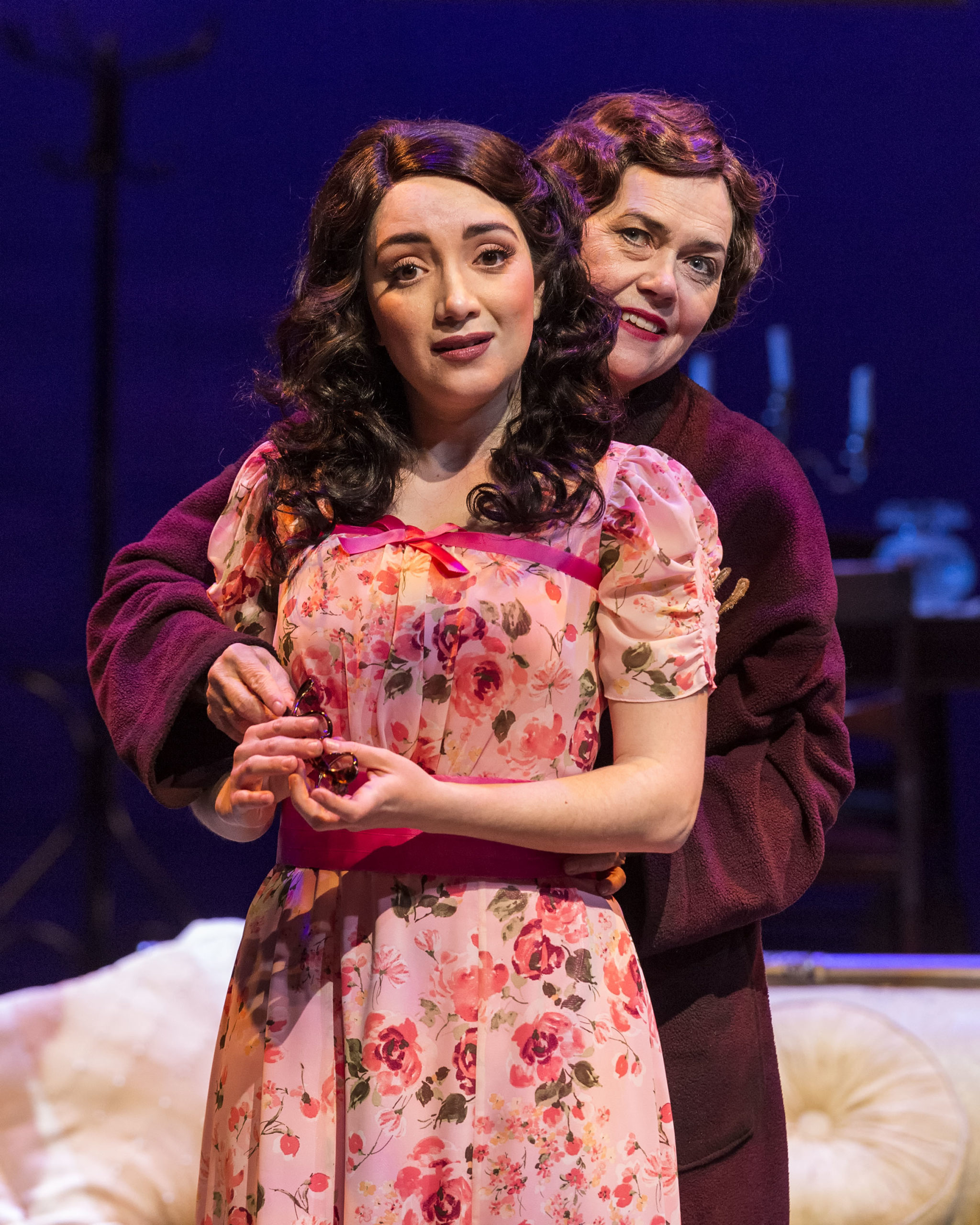
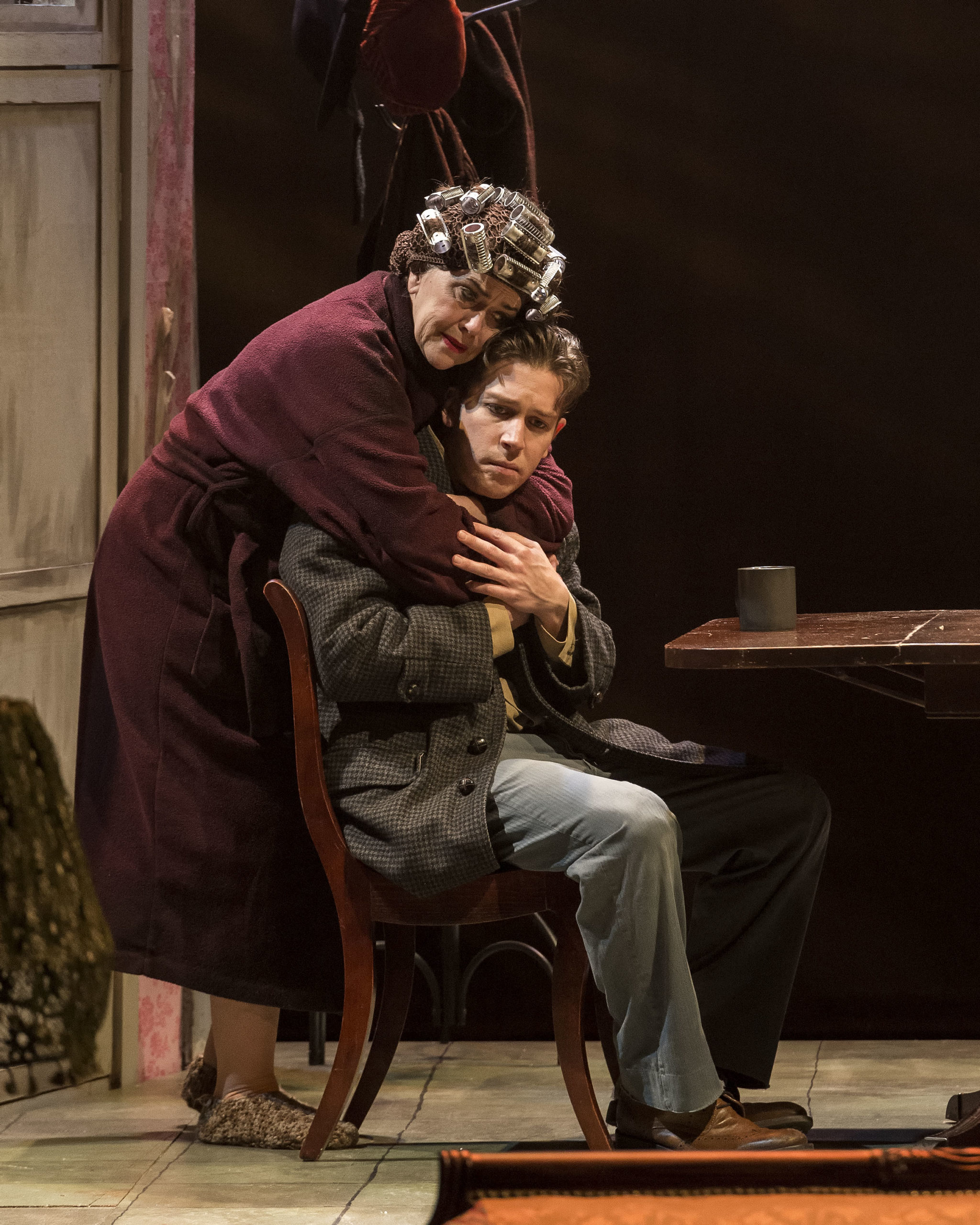
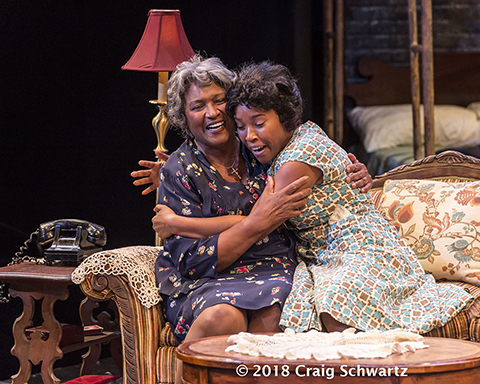
Kasey Mahaffy and Erika Soto in a pivotal scene | Photo by Craig Schwartz / A Noise Within

‘The Glass Menagerie,’ the autobiographical play that launched Tennessee Williams to great renown, takes off at A Noise Within (ANW) from February 24 through April 26. It made its debut in 1944 in Chicago, moved to Broadway a year later, and earned Williams the New York Drama Critics’ Circle Award.

In the play, an innocuous visit from a potential suitor unsettles the sheltered Wingfield family. At the center of this drama is matriarch Amanda who fiercely protects her adult children from the harshness of others, oblivious to the likelihood that her eccentricities are the biggest threat to their well-being.

First produced by ANW during its 1997-1998 season, it was directed by Julia Rodriguez-Elliott and starred Geoff Elliott narrating as Tom Wingfield, with Deborah Strang as the imposing matriarch Amanda Wingfield.

This re-staging of ‘The Glass Menagerie’ is helmed by Producing Artistic Director Geoff Elliott and features four resident artists – Deborah Strang returns as Amanda, Rafael Goldstein as Tom Wingfield and the narrator from whose memory the story is told, Erika Soto as Laura Wingfield, and Kasey Mahaffy as the gentleman caller, Jim O’Connor.

Soto, one of ANW’s two newly installed resident artists (the other is Kasey Mahaffy, who shares the stage with her in the play), talks about the play, her role, and the challenges in inhabiting the character of Laura.

“I found ‘Glass Menagerie’ moving in its mundane complexity; it’s so revelatory of American psyche,” Soto says. “Even as the play has a resonant theme, it was inspired by Tennessee Williams’s specific experience – as a writer, as a gay man, and as a reluctant patriarch and caretaker of his family.”

Erika Soto (left) and Deborah Strang (right) | Photo by Craig Schwartz/ A Noise Within

“Laura is the foil to Amanda’s energy,” Soto describes. “If Amanda is this almost ridiculous force – this hurricane – Laura is the eye of the storm. Tom, as the narrator, is navigating in and out of this experience. And you see that as he moves in and out of the house; he’s the one with the mobility even if that comes with consequences. He’s the one yearning to escape from this place. Tom breaks free externally while Laura does it internally; she navigates the storm by going within. She lives in her own little world, which is an oasis, with the music she listens to and her glass menagerie, which she has such a devotion for. That has given her an inner strength, whether that’s for better or for worse. It’s her coping mechanism and what makes her function in society. It’s her survival instinct – to cocoon, and that’s her safe space.”

“In the beginning, I struggled connecting with Laura because she was written as someone who is so shy, so afraid, so apologetic,” reveals Soto. “She wanted to disappear, to placate, and to do whatever is necessary to keep the calm. And I am so not like that. At all. That was more challenging than I ever thought. If this role had come years ago, when I was in my early 20s, I would have said ‘Easy-peasy! I know what that feels like.’ But those years are now in the rearview mirror. The 30-year old me is vivacious and alive, an activist and a feminist. But, then again, it wouldn’t be called acting if I were to play someone exactly like me. And, having had my share of playing the ingénue, I have that well to draw from.”

Adds Soto, “Laura’s physical limitation, which we have decided was the result of her bout of polio, helps put me in a vulnerable place and rationalizes my need to feel safe. She lives in a world where the boxes are very different and are a lot smaller – there are only so many places she could go and there’s only so much power she has. I made those the parameters around which to work.

“Thankfully, Tennessee Williams didn’t write static characters with linear lives. Laura has an immense arc in the course of a night. In fact, in this story, I see her journey as being a full circle. She starts in a place and experiences something she never expected to. Through circumstance, and tragedy in a way, she comes back. And there’s a kind of peace to that … it’s sort of a melancholy peace. And I think that is what’s so heartbreaking. You meet this person, and you imagine she’s going to reach that crescendo, and burst off the page.”

Deborah Strang and Rafael Goldstein | Photo by Craig Schwartz / A Noise Within

“That said, I choose not to think of Laura as a victim because I don’t find that interesting,” Soto discloses. “To see any woman as a victim is very lame to me in terms of actionable character. I see her as a response to her environment – a product of her time and space. She is just like any of us, responding to people in our lives and the hand we’re dealt, with our own personal insecurities and resistance.”

“I feel you should have a big ‘spoiler alert’ disclaimer at the beginning of your article,” Soto cautions before continuing. “I think Laura does have a moment where she takes a chance and tries to embody someone she hadn’t even imagined she could be. To me, someone who takes authority over her own experience can never be a victim.”

As she inhabited the role, Soto discovered something about Laura that she didn’t know going in. She divulges, “It wasn’t until I started to think about her inner life, and the kind of strength it takes to survive a mother like Amanda, that made me appreciate her. That’s quite interesting and complex. Then I thought, here’s a man writing about these ridiculous women. Maybe if a woman had written Amanda and Laura, they wouldn’t be such polar opposites and so extreme. It wasn’t genuine femininity but stereotypical ideas of femininity – the aggressive, bite-your-head-off, hysterical mother and the trembling, terrified, apologetic, little doe of a daughter. Women are none of these things!”

“I had never read the play before now, nor have I seen it performed, and I like it that way,” Soto confesses. “As embarrassing as it is to admit ignorance about something so iconic, I prefer having a blank slate – to discover it and it being fresh for me so that my performance also translates that way to the audience – rather than having to live up to decades of expectation, or to deliver lines with a precious quality, which is not real to the character. The characters in this play don’t know they’re iconic, they’re just people.

“But I have to honor who Tennessee Williams perceived in telling the story about his sister because it was his reality. It’s his story and that’s what we’re telling. Even if, ideally, I want to apply the things I try to practice in my daily life to the stories I’m telling. And it’s only a piece of a puzzle as well, it’s her piece, along with Amanda’s, and Tom’s, and the gentleman caller’s – all these parts tell a bigger story.”

Rafael Goldstein and Deborah Strang | Photo by Craig Schwartz / A Noise Within

Asked what the audience would find relevant, Soto pauses to consider the question before responding, “I personally relate a lot to Tom in his churning, boiling, and brimming fire where he feels something’s got to give. I think that’s fascinating to watch. Tom says ‘I’m boiling inside; I’m ready for adventure. I’m tired of watching other people having it.’ He talks a lot about the impending war and that war is when the common man can have his adventure. He also mentions movies, he’s constantly wanting to go to the movies. This would resonate in Los Angeles, especially in our media-driven world, where we’re watching people from our TV screens, our phones, and laptops. We could relate that to our idolization of celebrity, stars, and the fantastical world we see in films. I love his idea that we sit there and watch other people have adventures and live fantastical lives. That, to me, is such a call to action.”

Soto confesses she hasn’t really thought about the audience takeaway in great depth, but concedes, “It isn’t necessarily a feel-good play but I hope they’re moved. I want for them to react the same way I do after watching a movie or a play … to say ‘I know! Me too!’ Whatever that is – it could be ‘I know, me too, I also feel extremely depressed’ or ‘I know, me too, I have that kind of mom or that kind of relationship with my mom.’ I feel that’s why we tell stories. And however you want theatre to be, it’s all therapeutic, it’s catharsis. I  hope the play strikes a chord and, in doing so, is vibrational enough that it shifts something, or validates them in some way.”

“And I think that’s why we go to the theatre and why stories are valuable to us as human beings. It’s such a ritualistic thing we do – gathering in groups in a particular space. How different is that from, I don’t know, church? It’s a community of people enjoying a common experience.  There’s something strange and magical about,” Soto concludes.

While ‘The Glass Menagerie’ was specific to Tennessee Williams’s upbringing, the feeling of being constrained by societal expectations or being stuck in a rut is something most of us can relate to. Lest the play engender resignation and hopelessness may it, instead, impel us to take the reins and change course. That sense of personal agency is key to owning our life.

‘Othello’ Takes the Stage at A Noise Within

Originally published on 5 February 2019 in the Pasadena Independent, Arcadia Weekly, and Monrovia Weekly

(Left to right): Michael Manuel, Wayne T. Carr, and Angela Gulner | Photo by Daniel Reichert

William Shakespeare’s ‘Othello,’ A Noise Within’s fifth production in its 2018-2019 season, will be on stage from February 10 through April 28. Directed by Jessica Kubzansky, it stars Wayne T. Carr in the title role, Angela Gulner as Desdemona, Tania Verafield as Emilia, and Michael Manuel as Iago.

Manuel graciously agrees to share with us his thoughts about this classic play and the character he is about to inhabit. He recalls, “I did Othello 20 years ago and I played Cassio; this time I’m Iago. Any time you play a bad guy you can’t think of the character as bad. Even the most evil people believe they’re doing the best they could under the circumstances.

“I just finished doing Toby Belch, in ‘Twelfth Night,’ at the Alley Theatre in Houston. He’s a character who’s like Cassio – the big, drunk, funny guy. And I knew I was going to be doing this so I got to thinking ‘what triggers people into different behaviors?’ What, for instance, drives some to drink?

“For Iago, there are events that push him into that place where he’s just coping with everything that’s happening to him. There’s an inherent frustration, feeling ‘less than’ and being slighted, in some way, that he hasn’t gotten what he deserves. But, on some level, he tells himself  ‘Of course, I can’t get it – I don’t look as Cassio does, I don’t speak as well as Cassio does, I don’t have the same upbringing that Cassio has.’”

This is a role Manuel is sympathetic to. He says, “I have a love for characters who might be described as having a grievance of sorts … a chip on their shoulder might not be accurate, but someone who’s trying to prove he’s worthy of being. I gravitate towards characters who weren’t born into privilege and make something of their lives.

“I recently did Lopakhin in ‘The Cherry Orchard’ and he’s someone who resonates with me. He used to be the grounds man of the land which he now owns. When he was a lowly worker, everyone had nicknames for him; so now his attitude is ‘you should have treated me nicely because now you all work for me.”

Michael Manuel with Wayne T. Carr | Photo by Daniel Reichert

Continues Manuel, “The other day, among the cast, we were talking about class and perception. We were discussing how Cassio is someone who’s got everything. I went to Yale and there’s a perception that I’m somehow smart or rich. Truth is, I came from a blue-collar background and the neighborhood I grew up in wasn’t the best.

“Just like Lopakhin, my classmates’ parents were teachers, attorneys, and professionals. Growing up, I was embarrassed to tell people that my Dad worked as a garbage collector. But there came a point when I realized that everyone has value and what was shameful was that I hadn’t recognized it until then. Now I’m very proud to let people know what he did for a living!”

Because he played Cassio before and is now taking on the role of Iago, Manuel has a chance to look at both characters on opposite perspectives. He says, “Looking back, I don’t really remember much about that first time I did ‘Othello.’ I did Cassio when I was fresh out of college when I felt I knew everything there was to know, that I’ve figured it all out. Then, I finally grasped that I hardly knew anything; there are so many other layers in both characters that I learned from just living 20 more years since.”

The passage of time has helped Manuel give a more layered interpretation of Iago. “First of all, I’m older and I’ve accepted the fact that I don’t know everything; I no longer harbor that resentment in being told what to do. So now I have a vulnerability because I don’t have to pretend to know more than I do.

“Of course, the trap is that when you’re older you also think you know everything because you’ve gained more experience. So you’re always in the same boat – there’s always someone older or wiser no matter what their age is. I would say my Iago then would have been different from my Iago now,” Manuel expounds.

“It’s funny, this is only my second time doing ‘Othello,’” discloses Manuel. “While ‘Hamlet’ I’ve done five times, ‘Lear’ thrice, ‘Midsummer Night’s Dream’ I’ve done probably six or seven times, on occasion playing the same character. But there’s so much to mine in this. Since I have never fully figured it out, there’s always something new.

“Jessica’s vision for Iago is that he’s honestly sharing his feelings. I would like to be able to convince everyone on that stage that I’m being truthful and that I believe in everything I’m saying. People can tell when someone isn’t sincere. I think Iago understands people – he might not be book smart but he is clever. I’m sure if people saw his resume, they would say, ‘Of course, he shouldn’t get that high in the military, he isn’t someone who could be elevated to an upper rank.’”

(Left to right): Angela Gulner, Wayne T. Carr, Tania Verafield, and Michael Manuel | Photo by Daniel Reichert

Asked if he wants audiences to hate or empathize with Iago, Manuel replies, “I want people to see that they’re no different than I. I want them to understand there was no other way for me to behave. The challenge is that when a character does something bad he has to check in with the audience – that’s why there’s a lot of soliloquies. He tells the audience what he’s going through and then asks ‘What would you do if you were in my place?’ And follow that up with, ‘You know you’d do exactly as I’m doing’ or, at the very least, ‘You’re thinking of doing the same thing I’m doing right now.’

“In the soliloquies, I’m basically saying ‘There’s nothing wrong with that I’m doing; I’m telling people exactly the truth.’ How they hear it and how they deal with it is up to them. Part of what I would like for the audience to say is, ‘I wanted to hate him but I like him’ or ‘I can’t believe I like someone who’s so awful.’

“I wouldn’t go so far as justifying my actions, so much as showing our commonality. That we share all the same feelings – they’re what make us humans. We plan the way our lives would go and then something happens so we have to adjust. And one of the things Iago does better than most is that he’s a great improviser. He’s in constant firefights and each one requires a different tactic. As we all do, Iago reacts in the moment. I think that’s what makes these characters so fascinating.

Manuel adds, “I break down what Iago is saying and what people are saying about him. I think his choice of words reveal a lot. There are some people he addresses as ‘thee’ or ‘thou’ versus ‘you’ or ‘your’ he uses with others. Shakespeare is a master of language and he uses a combination of word sounds to signify emotions and motives. I could spend my whole life trying to figure out how to play a part and still discover something I haven’t seen the first time.”

However many Shakespeare productions Manuel has been in, each performance of the same play is different. He explains, “It’s really the conceit of the play – it depends on the actors and the message the director wants to impart. This ‘Othello’ is set in 2019 so that has given me a different perspective; it also informs the character’s actions. Wayne’s ‘Othello’ is very different from Chuck’s, the actor who played that part in the first ‘Othello’ I was involved in. As Iago, my relationship to this ‘Othello’ changed too.

“Yet, it doesn’t matter what period this ‘Othello’ is set in. Shakespeare’s plays have endured through the years because they’re timeless. Everything that was relevant at that time is still relevant today. The feelings that we have – jealousy, anger, revenge, pettiness – all these are innate in everyone, then and now. That’s the reason for classical theater – the message resonates with everyone.”

We can all agree with Manuel. Shakespeare’s genius is that he perfectly captures the essence and the complexity of human behavior. When we watch his plays, we recognize ourselves and empathize with the characters on stage – we are all capable of heroic actions as much as we succumb to deplorable deeds. And that, ultimately, our doing or undoing comes down to how we choose to act at any given moment.

‘Rosencrantz and Guildenstern are Dead’ Comes to Life at A Noise Within

Originally published on 8 October 2018 in the Pasadena Independent, Arcadia Weekly, and Monrovia Weekly

Pictured left to right: Rafael Goldstein and Kasey Mahaffy. – Photo by Craig Schwartz

Tom Stoppard’s ‘Rosencrantz and Guildenstern are Dead’ was first performed at the Edinburgh Festival Fringe (The Fringe) in 1967 to great acclaim. It established him as one of the greatest playwrights in modern times and his work, which puts to the fore two of Shakespeare’s minor characters in ‘Hamlet,’ has been staged throughout the western world.

Pasadenans will get to experience Stoppard’s brilliance when ‘Rosencrantz and Guildenstern are Dead’ goes on stage at A Noise Within from October 7 to November 18. Directed by ANW Producing Director, Geoff Elliott, it stars resident artists Kasey Mahaffy as Rosencrantz and Rafael Goldstein as Guildenstern.

A Nosie Within distinguishes itself as one of the few repertory theatre organizations with a resident company. The resident actors’ genuine regard for one another manifests itself on stage and makes for richer, more nuanced performances.

“Rafael and I have known each other for four years,” Mahaffy discloses. “We know each other’s secrets, we’re two halves of the same coin. So we started the foundation from day one, jumping off from a place that some actors could only be familiar with on opening night.”

“I’ve worked with him in about half a dozen plays and I have admired him greatly as an artist. But our joke was that we never shared a word together. Even in ‘Henry V,’ where he played the king and I was the dauphin from France, his mortal enemy, we didn’t share a minute of stage time. We just never got a moment together. Finally, they threw us a bone. Now all we do is hang out and we’re sick of other,” quips Mahaffy.

“But, seriously, I’m grateful every day that Rafael is my screen partner and my safety net,” Mahaffy says hastily. “He’s incredibly prepared and diligent, which I expected coming in. He’s always fun to hang out with and joke with backstage.”

“What I like about Kasey is that he’s a grounding presence for me,” declares Goldstein. “I tend to spin off into the abyss. And Kasey is very practical; he listens and he responds. Every actor needs that and I have it in spades with him. His sense of humor leavens the existential morass that we find ourselves in in this play. He has all the laugh lines, as well. It’s been nice to sort of play the straight man to his comic character.”

“Like in any true functioning relationship, these two individuals, while widely different, need each other,” Mahaffy elucidates. “Guildenstern is a cerebral, logistical, driven character. And Rosencrantz is all fart jokes. But what’s so cool in Stoppard’s writing is that when one character  loses perspective and spins out, and both of us do it multiple times on the show, the other one immediately rises to the challenge and rescues the other. Every single moment in this play is a scale that he and I are leveling.”

Pictured left to right: Rafael Goldstein, Paul David Story, and Kasey Mahaffy | Photo by Craig Schwartz

‘Rosencrantz and Guildenstern are Dead’ is not new to Mahaffy. “When I was doing my undergraduate thesis back in 2000, I had the role of Guildenstern. It’s amazing to hear those words again 18 years later. The dialogue is just fast, fast, fast, boom, boom, boom, like a tennis match. The problem is, sometimes I say his lines. It’s been 18 years but it sticks in the brain. So one of the great things about playing with him is that he’s shown me how to do that part. And how terribly bad I was when I did it then,” he admits with a laugh.

Goldstein says, “The virtue of him having done it before is that he was able to warn me about the pitfalls of this role too, and how to navigate them. He has something of a map to guide me about the play generally, like how the audience would react. Granted, that would change, but it’s something to have in the back of my head.”

Revisiting the play almost two decades later has given Mahaffy a better, deeper sense of it. “It is the heart of what I want to talk about today. The play, while told through comedy and existential theatrical device, is a treatise on life. More specifically, it is about these two characters who are stuck and are searching for their next move. They’re waiting for signs from the universe, other people, other souls, to tell them what they should do next. Like most of us, they are terrified about mortality and death. When I performed this at 20 years old, I was saying the words but I didn’t have a visceral understanding of their significance.

“This summer, my brother passed away prematurely, at 42 years old, and left a wife and two daughters. My parents were devastated and I’ve been reeling from it since. It made me think about what it means to me as a brother and as a son. As an artist, I have to put my life on stage no matter what’s going on in my life, whether it’s good or bad. There’s the line in the play …”

And Goldstein supplies the line, “There is no applause, there is only silence.”

“Yes. When you die, there is no applause, only silence and second hand clothes,” picks up Mahaffy. “Tom Stoppard is a certifiable genius. You can say those things when you’re in college but it’s not until you’re a 39-year-old man holding your brother’s shoes which were gifted to you … these second-hand shoes … that the gut punch meaning to the lines is actually delivered.”

“The theme of the play is Rosencrantz’s and Guildenstern’s imminent death,” Goldstein addresses further. “They know something is amiss, but they have an inkling, as we all do. We have an understanding that death is coming. And it’s every human’s journey how to reconcile the ultimate irrationality of our own demise. Moving through the world with that knowledge, how does one confront the absurdities of everyday life? How does one control aspects of one’s life to better comprehend the current situation? There is the questioning which activates a lot of philosophical ideas.”

“Tom Stoppard’s characters are people seeking agency in their life,” describes Mahaffy. “He wants to explore the questions ‘Are we subjugated to fate?’ ‘Are we tools at the hand  of God?’ ‘Or do we have our own power?’ ‘Are we the captain of our own ship?’ That’s the crux of what he wrote at 26 years old. He was still a baby! Such genius!”

Pictured left to right: Rafael Goldstein, Wesley Mann, and Kasey Mahaffy | Photo by Craig Schwartz

Goldstein enlarges on that thought, “The question, ‘Are we the captain of our ship, or are we set on a predetermined path?’ is completely outside of our understanding and perception. Are we just being moved along inexorably towards a predetermined end and no matter what we do, no matter what flailing action we might take to avoid certainties, we’re going to meet our end? You know, you can do as many push-ups as you want, you’re still gonna die!

“The play focuses on two minor characters in Hamlet. The title comes from a line in it, ‘Rosencrantz and Guildenstern are dead.’ There is no question. But to them, there has to be a possibility of reprieve, which they’re searching for in the entire play.”

Expounds Mahaffy, “The characters are determined to take a grip of their circumstances. They  wonder if they should turn right instead of left, forward or backward. They ask The Player, ‘What do we do? We don’t know how to act.’ And The Player answers, ‘Relax. Respond. That’s all we can do as humans.’

“This is a play about language and dialogue. Our set, even as it’s beautifully designed, is quite simple. It’s pretty much a stage with lights. I think it’s going to be a major treat for anyone who appreciates language and humor. And I want to make this clear, you don’t have to know Shakespeare. We don’t speak in Shakespeare vernacular. We talk like two people in 2018. It’s wildly funny and terribly heartbreaking all at once. It’s everything you want theater to be.”

“We’ll be wearing clothes that convey an Elizabethan flavor, but the way we speak to one another in the play is thoroughly recognizable,” Goldstein emphasizes. “Geoff Elliott, our director, has stressed for us to understand the words and communicate them as simply as we can. There is very little varnish to the way we interact with each other. It’s unadorned and straightforward. It’s two people just trying to survive and using the other person as a buoy, or a sounding board. That’s invaluable direction given the philosophical themes of the play. This is undeniably one of the greatest plays in the past century and I think people will come way from the production appreciating that.”

Even if not everyone agrees with Goldstein’s assertion, the one indisputable certainty is that Tom Stoppard didn’t let Rosencrantz and Guildenstern go down without a fight.

‘A Picture of Dorian Gray’ Depicts the Outcomes of Disregard for Consequences

Originally published on 24 September 2018 in the Pasadena Independent, Arcadia Weekly, and Monrovia Weekly

Dorian Gray | Courtesy photo / A Noise Within

‘A Picture of Dorian Gray,’ a play adapted from Oscar Wilde’s novella ‘The Picture of Dorian Gray,’ goes on stage from September 23 to November 16 at A Noise Within in Pasadena. Adapted and directed by Boston Court Pasadena’s Co-Artistic Director, Michael Michetti, its three main characters are Colin Bates as Dorian Gray, Frederick Stuart as Lord Henry Wotton, and Amin El Gamal as Basil Hallward.

Wilde’s Dorian Gray is so entranced by the beauty of his own portrait that he sells his soul to preserve his youth and pays a price. Michetti’s adaptation, first produced at Boston Court Pasadena in 2006, explores the idolization of beauty and youth in an intimate, psychological journey. Avoiding the Gothic horror approach to the tale altogether, it follows instead the consequences of Dorian’s hedonistic lifestyle.

Explains Michetti of the remount, “When I did ‘A Picture of Dorian Gray’ 12 years ago at Boston Court, it was really successful and I was very proud of it. But I really didn’t think I was done with it and I thought this would be an opportunity to come back to it.

“The theatre space and timing are different. It’s a new collaboration with a whole new set of actors, with specific experiences and talents they bring to the production. However, the political and thematic content we’re dealing with now are the same things I was interested in exploring 12 years ago. That said, several things have transpired since – for one, gays have achieved marriage equality. So this play is thematically timely to me.

“The script has basically the same approach and ideas; I’ve added some things but not significant ones. Part of what this adaptation is embracing in the Oscar Wilde original is Dorian’s sexual orientation, an aspect many adaptations have erased. In fact, there wasn’t any hint of it in the 1945 film version. That was one of the things that was important for me to restore.”

“A lot of the people who read the novella thought of it as a Gothic horror story,” Michetti adds. “However, I think that was the least interesting part of the story. There’s obviously a supernatural and dark element to it but, for me, Wilde wrote a very psychologically truthful tale about what it was like to pursue pleasure without regard to the consequences. Because Dorian has great privilege of wealthy and beauty, it’s easier for him to get the things he wants in life. He spends a great part of his life causing damage to people.

“Following its dramaturgy, this is a cautionary tale. At the end of the novel, Dorian grasps that the toll of leading such hedonistic life was too great and he decides, too late, to make a change. But he definitely is realizing the consequences of his past behavior, is regretting it, and is atoning for it. It’s a reminder that we should stop to consider the people around us and the contributions we’re making to humankind.”

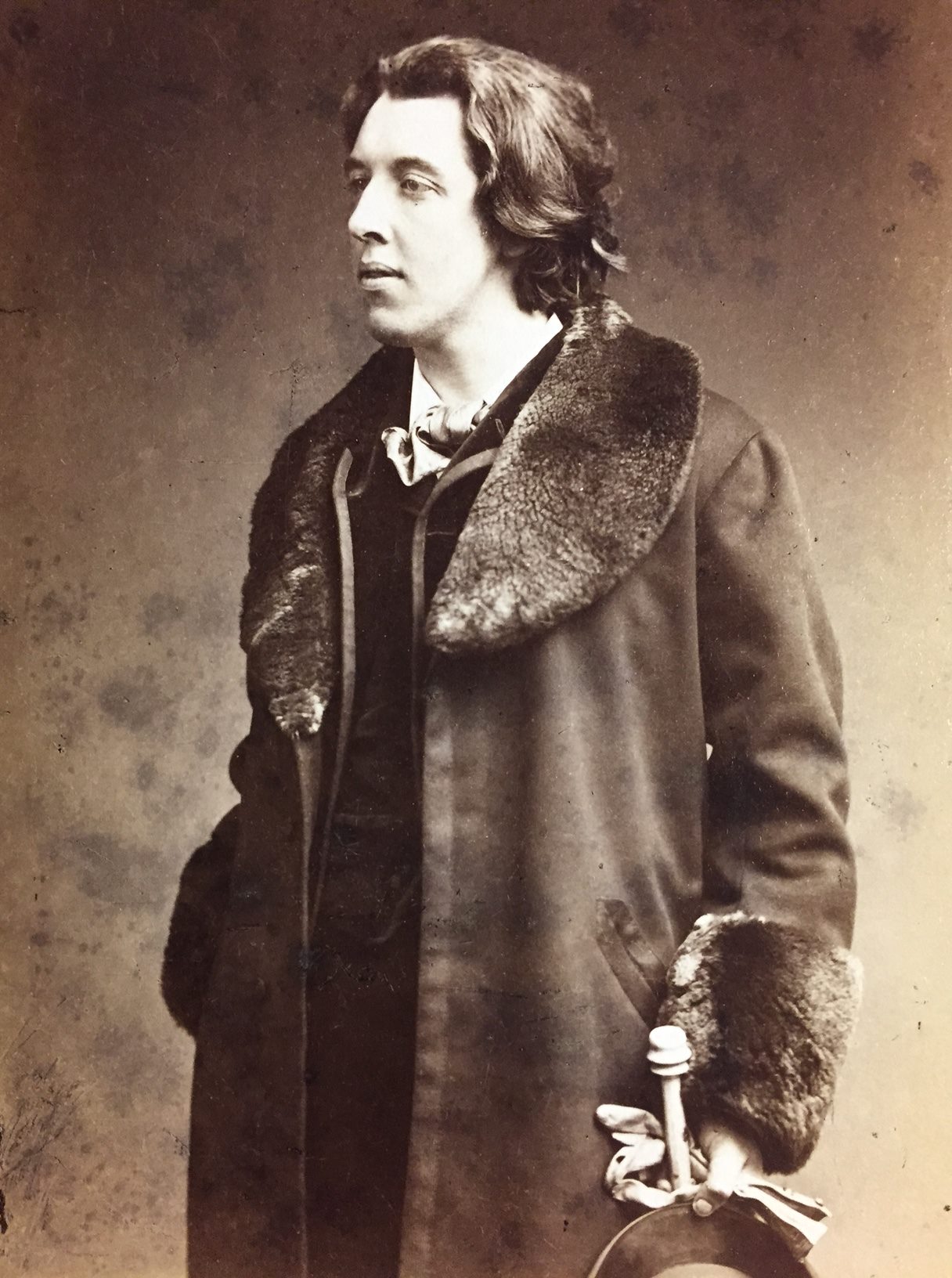
A Portrait of Oscar Wilde | Courtesy photo

“Here’s an  interesting point – pursuit of pleasure, acquisition of beautiful things, appreciation of beauty – those were components of the aestheticism in the late 1870s,” Michetti expounds. “Aestheticism values art more than social and political themes: art for art’s sake. Oscar Wilde was considered one of the most prominent proponents of it. He was, at the time, a big celebrity who embraced it and became the public face for the movement.

“The aesthetic movement is a hedonistic approach to life. So while the novel’s protagonist is pursing these things, Oscar Wilde is saying there’s a price to pay for following these theories to their logical end.”

Oscar Wilde once said  that ‘Dorian Gray’s’ three central characters are all aspects of himself: “Basil Hallward is what I think I am; Lord Henry what the world thinks of me; Dorian is what I would like to be – in other ages, perhaps.”

Michetti finds Wilde’s description fascinating. “There is something thought-provoking about the three characters as a triumvirate. Within that, Harry is the proponent of the movement and he stands by it to the end. He says we can’t change, we are who we are; and he doesn’t want Dorian to change because he believes aestheticism is worth pursing at whatever cost. Meanwhile, Basil is destroyed in the course of the play. And Dorian is the one who develops a conscience and decides to change.

“There are three actors playing the three different characters who are all aspects of Oscar Wilde. There’s that remarkable bond they carry with them during all that time. They are people who care very much for one another.

“When the play begins Harry and Basil have been long-time friends, they were in school together. Basil meets and falls for Dorian and introduces him to Harry – it’s a triangle with connections as well as conflicts. As soon as Harry comes into Dorian’s life, Basil becomes a third wheel. We have talked a lot with the three actors about the fact that there are reflecting and mirroring between them, yet the characteristics of the actors and the characters are very distinctive.

“Basil and Dorian are contrasts in a lot of ways. Dramaturgically and psychologically, Basil is the embodiment of Dorian’s conscience – he’s the one who wants Dorian to behave righteously, to take responsibility for his actions, and to lead an honest and fulfilling life. Dorian reaches a point of being so fearful of the consequences that he avoids Basil and their friendship suffers for it. Ultimately, I think, the reason for Dorian’s big conversion is the recognition that killing Basil is a big loss and he has a lot of guilt over that. He comes to an appreciation for what Basil wants for him to see in the world.”

Michetti continues, “The second metaphor in the story is Dorian’s portrait which is both aging and taking on the physical manifestation of his sins so that he isn’t affected.  I find that symbolism a little too simple because even though his appearance isn’t affected, Dorian has guilt and fear beneath. But there’s something addictive about his continuing pursuit of pleasure, beauty, and experiences. It’s almost that of an addict getting a high for a while, then he crashes, and he begins again. That is very much the cycle that Dorian is deeply in.”

This adaptation of ‘A Picture of Dorian Gray’ does not show the portrait at all, which could be a tough sell to the audience who can’t actually see it.

Michael Michetti | Courtesy photo / A Noise Within

“The reason I decided not to have the picture is that, in most adaptations, when the portrait is shown and the effect it’s had on it, the whole revelation is a little cheesy to me,” rationalizes Michetti. “I never got convinced because it should be terrifying and it always fell short of what I had imagined. And then, too, how grotesque could you make it so we could understand his moral decay and give it the right impact?

“Previous adaptations emphasized the horror aspects instead of the psychological feature. There is undeniably a supernatural element to it; you can’t tell the story without that. However, I didn’t really want to be focusing on that but on the humanity of it. I think the audience will hear the story in a different way because of how we’re framing it. And focusing on the psychological instead of the supernatural is what makes that possible. I hope that our audiences understand that kind of storytelling and find it dynamic and compelling.”

Michetti says further, “The story has universal themes. I think we are all guilty of the things that Dorian does – we all want to stay young, we all feel that sense of loss when we begin to age, we all seek pleasure to try to numb the feelings of fear or failure. While Dorian is an antihero, we can relate to him and we see ourselves reflected in him. We may not go to the extreme that he does, but we comprehend some of the temptations he had. I would like our audience to treat it as an admonition to make different choices because we see how badly Dorian’s life ends.

“At the same time, I hope that, in the adaptation of the play and the depiction of the character, we find him appealing and relatable before we find his behavior repellent. While Dorian doesn’t begin as the shining example of magnanimity, he is a very relatable person before he begins his decline.

“Finally, I would like people, who feel they know the story, to be taken aback – to think they heard it in a new way. I would like to make them recognize other aspects of it they had not previously been conscious of, or didn’t know were there. For me it all comes back to the appreciation of Wilde and how inspired this novel is, how deeply he understands humanity. That we can use his words and tell the story that feels fresh and relevant in the 21st century is surprising for a work that’s 125 years old.”

Basil is played by Amin El Gamal, whom Michetti had not previously worked with. He states, “Amin has auditioned for me before and I’ve seen his work as a fan. He was definitely the first person I thought of.”

Basil (back) paints a portrait of Dorian (foreground) as Harry looks on | Photo by Craig Schwartz

El Gamal confesses, “I never read the book in school and didn’t come across it until after college. I have never been in a production of Dorian Gray before but I know the trope about the picture that ages.

“It was very insightful of Michael to have thought of me in the role of Basil. He’s a character I think I relate to strongly, although I’ve never seen productions where the characteristics brought out in this adaptation were showcased. I was really excited to be approached for a role where I can share my existential qualities, which I was surprised that Michael has perceived.

“When he sent the script to me, I was astonished and, quite frankly, I felt exposed. But it has also been a delight because my goal as a person of color is not to play my ethnicity but to use my resources and my qualities as a person as the basis for my art. I felt that Michael acknowledged that. I was disappointed that I couldn’t do it because the script came too late – I was already committed to another project.”

Interjects Michetti, “I cast another actor but he dropped out. So I approached Amin again and, by that time, his project had fallen apart. So this feels like fate.”

“As excited as I was to play this character, I was also afraid of what that psyche would unearth for me,” El Gamal continues. “Fortunately, the process has been fruitful. I really feel that an actor’s main tool is his life experience, but there are times when I have to use my imagination. This play really required that creativity.

“I’m very sensitive to the fact that people can be like Basil or Harry. I can certainly relate to both Harry’s wanting to pursue his goals with enthusiasm in the same way that I appreciate Basil’s sense of morality. But there has to be a balance to not be overburdened with the morals and live life to the fullest.”

“Michael challenged me to find more complexity in the characters,” discloses El Gamal. “He didn’t want us to depict Basil and Harry as the angel and the devil on Dorian’s shoulder. That the evil and the good are not too far apart, there’s a grey area where a person can be both. Basil certainly isn’t perfect. Both characters had an important role in Dorian’s life – if it wasn’t for Basil, he wouldn’t have met Harry.”

“Basil is very passive in the beginning of the story,” says El Gamal of his character. “When Dorian starts pursuing worldly pleasures, he pulls away – he leaves the country and isn’t a part of Dorian’s life for a while. He goes through a drought in his art after Dorian basically abandoned their relationship. He might have resorted to drug and substance abuse, he’s alone and lonely. Although he still has a deep love for Dorian and when he sees the deterioration of the portrait, he stages an intervention.

“But through it all, he’s not a victim. His character arc is hopeful – he’s planning on opening a studio in Paris where he would create his next masterpiece – despite its sad ending. It was a productive life cut short. I hope I am able to convey everything that is going on with Basil.”

“Oscar Wilde anticipated homosexuality as an identity, the idea of two men being in love,” marvels El Gamal. “Basil embodies that identity at a time when that wasn’t recognized.”

In his depiction of Basil, El Gamal wants the audience to leave the theatre with something to reflect on. “I think in today’s social media and selfie-obsessed culture, people can feel disposable and we can forget to be respectful and communicative. I hope Basil, as a sort of advocate for kindness and basic human decency, reminds audiences to take a little better care of themselves and each other.”

Would that El Gamal’s wish is realized and the moral Michetti advances in ‘A Picture of Dorian Gray’ is heeded to make us a deliberate and thoughtful society.   

A Noise Within’s ‘Noises Off’ has Audiences in Stitches

Originally published on 23 April 2018 in the Pasadena Independent, Arcadia Weekly, and Monrovia Weekly

“Noises Off” ensemble | Photo by Craig Schwartz

Imagine a hapless group of actors gamely putting on a production aptly titled ‘Nothing On,’ from an abysmal material as each of their personal drama gets in the way and you have one screwball of a play that is as insanely hilarious as it is eerily true to life.

This is Michel Frayn’s joyfully out-of-control British farce, ‘Noises Off,’ and will be on stage at A Noise Within (ANW) from Saturday, April 21 to Sunday, May 20, 2018. Directed by Julia Rodriguez-Elliott and Geoff Elliott, it features most of the original cast from the play’s previous productions.

“‘Noises Off’ is truly one of our signature productions, with audience members returning to see it two or more times,” says Elliott. Rodriguez-Elliott adds, “Everything about the deft physical and verbal interplay between actors is ideal for our focus on ensemble work.”

First produced by ANW in their Glendale location, it was hugely popular that they brought it back another year. When they moved to Pasadena they presented it during their first season as an add-on production on a limited run.

Continues Rodriguez-Elliott, “It’s been about six or seven years since we last did it. For our 25th year anniversary, just for fun, we asked people what shows we had done that they would like to see again and ‘Noises Off’ got the most votes.

However, ‘Noises Off’ was doing a big production in London then so we couldn’t get the rights to it to mount it in time for our anniversary season. Fortunately, we were able to last year. And since we still have the same cast and they’re playing the same characters they did in the first two productions, we didn’t have to spend as much time to prepare for it.”

Elliott also discloses, “We’ve put off remounting ‘Noises Off,’ because we didn’t have the technical ability to put it on a spinning stage. We really wanted to remount it this year so we decided to redesign the set. In the first act the audience is watching the front of the set, in the second act the action takes place at the back of the set, and the third act is again the front of the set. Because of that, it needed to be presented on its own and not as part of a repertory.”

“It is one of the funniest farce, if not the funniest, ever written,” pronounces Elliott. “It’s a love letter to the theatre because it’s essentially about all of the things that can go wrong when people are trying to put a production together. For actors it’s especially close to the heart because we’ve all gone through some version of it. Michael Frayn is so brilliant in creating comic timing and sidesplitting situations. It’s really a work of genius.”

“It’s a repertory group rehearsing a play that’s about to open the next night and they’re not ready,” explains Rodriguez-Elliott. “In the first act, we are observing the colorful characters who are part of a company – there’s one actor who isn’t terribly bright, one who has a temper, another is an alcoholic who gets lost and they can’t find him. In the second act, the set turns and you’re watching them in a performance of ‘Nothing On’ from the back stage perspective so you see them as they make their entrance.”

“This is happening as they’re in the middle of the tour,” Elliott interjects. “By the second act they’ve been together for about a month and half. Everything that could possibly go awry, as personalities clash, has gone awry. The two leads are having an affair and one of them refuses to go on stage and it gets worse from there. It’s just insane!”

Rodriguez-Elliott continues, “By the third act, when the set is turned once more to the front, it’s hell in a handbasket. They’ve been touring for six months and by then some of them aren’t talking to each other so it becomes another whole new level of disaster.”

Dotty Otley | Photo by Craig Schwartz

“When we were first rehearsing it, people who had done this production in the past were telling me ‘You’re going to have such a good time; audiences just die watching this play,” recalls Elliott. “There were so many people telling me that, that I began to get spooked that we’ll be jinxed shortly because I thought, ‘Surely our production can’t be as funny as they kept saying. The expectation was too much.’ But once we got out there, the audiences just went wild and it was infectious. You were having such a great time because the audience was as well. And it turned out to be exactly what people had been prognosticating all along. It’s probably the most fun I’d ever had on stage.”

Illustrates Elliott, “I play the role of the director and most of the time the cast doesn’t know if it’s Geoff, the director, or Lloyd, the character I play, who’s talking. Or if it’s Jeremy, the actor, who’s talking to them or the Frederick character he’s playing. Apollo Dukakis, in the role of an older actor Selsdon, calls his lines exactly as Apollo does. It’s spooky.”

“And here’s an interesting bit of trivia,” says Rodriguez-Elliott. “Michael Frayn was watching a play he had written being rehearsed. He sat backstage for a bit and he thought what was happening there was more interesting than what was going on onstage. That was the impulse for him to write ‘Noises Off.’”

“It was a Lynn Redgrave play that was being rehearsed,” Elliott elucidates. “And he thought there was more drama going on backstage. One of the endearing things about this play is that all of these actors are such survivalists they would do almost anything to make their entrance, to keep the show going. They’re taking axes at each other but they’ll drop them when they have to make an entrance. And it’s true, the show must go on. This is that to the hilt, it’s so sweet.”

“The beauty of a rep company is the familiarity you have with the rest of the cast,” Elliott begins to say. “And the play is all about that – people who have been together and have worked together for a long time. That is so relatable. We’ve all been in productions where someone misses an entrance, or something’s gone wrong and people backstage are troubleshooting,” Rodriguez-Elliott finishes for him.

“One of the reasons I think this was a very popular production is that we really concentrated on finding the honesty, the authenticity of the situations theatre people work in,” clarifies Elliott. “We didn’t approach it as a send-up. It’s not only incredibly funny but we have sympathy for all these people. We recognize all these people, all the drama and the group dynamics that we’ve all been a part of.”

“The play they’re in is terrible and they are nobly putting on a show that doesn’t even make sense. But they’re trying hard to make it work and are truly investing in it. There’s this one character who’s not the sharpest tool in the shed and even when the world is exploding she’s still doing what she has rehearsed,” chuckles Rodriguez-Elliott.

Elliott declares, “You can feel the joy in the room because the actors are having fun and the audience is in it with them. The actors themselves are laughing when they get backstage because of the wonderfully infectious audience reaction.”

ANW has just announced the theme of the 2018-2019 season, ‘Let Me in.’ Elliott describes, “It’s about the fundamental human desire to be included, to be accepted. All the plays are about people struggling for that and the things that happen to them and those around them as they strive to have a door open. It’s a very timely issue. We all want to be acknowledged, to not be ignored or be treated as something other than being a part of the human race. Whether it’s Don Quixote of ‘Man of La Mancha’, Dorian Gray, Rosencrantz and Guildenstern, Othello, Wingfield family of ‘Glass Menagerie,’ or Jason of ‘Argonautika.’ That’s the common vein running in all these plays.

‘Man of La Mancha’ will be another play that will run solo, not in repertory. It will play middle of August through early September. That was a big hit for us when we did it this season and this was an opportunity to bring the show back for those who didn’t get to see it or would like to see it again. It’s the same production and will have the same cast.

The show had been a tremendous experience for us. We had a number of people in the cast who had never worked with us before because they were more musical theatre people. So for them to be able to approach it as actors was something novel and extraordinary for them to do. When we reached out to them to tell them we were bringing it back and asked if they wanted to return for it, everyone answered within twelve hours.

That was pretty much how our resident artists responded to our remount of ‘Noises Off.’ Although the themes of the two plays couldn’t be any more different, audiences, nevertheless, will feel a strong reaction to each.”

It is the contagious feeling and exuberant spirit that we will experience that make ‘Noises Off’ as uproariously brilliant as it is unabashedly zany. Prepare to laugh till your sides hurt.

‘A Raisin in the Sun’ at A Noise Within Portrays the American Dream

Originally published on 12 March 2018 in the Pasadena Independent, Arcadia Weekly, and Monrovia Weekly

Saundra McClain and Ben Cain | Photo by Craig Schwartz

It is an American dream – to get an education, earn a fair wage, own a home, and live a life of dignity. In this land of opportunity that seems attainable. There are people, however, to whom the realization of that dream is elusive.

This is the theme of Lorraine Hansberry’s seminal play ‘A Raisin in the Sun,’ which debuted on Broadway in 1959. The title is derived from a line in ‘Harlem,’ a poem by Langston Hughes, ‘What happens to a dream deferred? Does it dry up like a raisin in the sun?’

There has been a renewed interest in ‘A Raisin in the Sun’ of late. According to American Theatre magazine, it is one of the ten most produced plays of the current season. And it is on stage at A Noise Within from February 25 to April 8, 2018 in repertory with Henry V. Directed by accomplished actor and director Gregg T. Daniel, its cast includes Saundra McClain as the matriarch of the Younger family; with Ben Cain as Walter Lee, Toya Turner as Ruth, Sarah Hollis as Beneatha, and Sam Christian as Travis.

On a recent afternoon, Daniel and McClain sat down to share their thoughts about the play, what it means to be a person of color in today’s political climate, and what they hope they are able to convey to their audience.

Neither Daniel nor McClain has staged it before but both are familiar with ‘A Raisin in the Sun.’ Says Daniel, “This play came out around the time of the Civil Rights Movement. It was very significant in that it was the first play written by an African American woman staged on Broadway and which was later adapted into a movie.”

Adds McClain, “My generation grew up with this play – in college the first monologue I learned  was from it. More recently, I was involved in the stage reading of ‘A Raisin in the Sun’ here. It was an amazing experience; we got a standing ovation after the show.”

“They got such tremendous response when they did the reading two years ago,” continues Daniel, “which compelled Geoff and Julia to mount a full production. They contacted me because I had just finished directing ‘Le Blanc.’

Lorraine wrote ‘Raisin in the Sun’ in 1959, wherein she portrayed an African-American family with seemingly competing dreams that threaten to tear them apart and what they come up against as they try to better themselves. Everyone reacted to it saying ‘I didn’t know that was happening to black families until I saw it on stage.’ The floodgates opened after that; it altered American theatre forever.

Saundra McClain with Toya Turner. Photo by Craig Schwartz

One thing that’s different about our production is the humor which a lot of people said they didn’t expect to see. The role of Mama has been played as a heavy character – stern, aggressive, and judgmental. That disposition is the very opposite to Saundra’s who has such joie de vivre; she’s so vibrant and alive.

Right at the outset, Saundra was my first choice for the role because as dysfunctional a family as the Younger household is, they love each other. They have moments of cheerfulness and moments of levity, and she could bring all that to this play. Our Mama is very joyful; she has a lot more laughs than has been depicted in previous plays. You could clearly see that she loves Walter; she’s not bullying or bludgeoning.

‘Raisin’ was set in 1959 so it reflected that scary and worrying period in history. But there was no reason for us to do it that way. And we live in interesting times, with #Black Lives Matter and #Oscar So White. We still have racial issues but they’re of our time so we want to be emblematic of our present challenges.

Change is costly – it’s always bloody and violent. It took courageous people like Martin Luther King, Malcom X, and Robert Kennedy to stand up and advocate for change. But lest we forget, we’ve had a black president since then which proves we have evolved in terms of political consciousness.

That said, I feel like we’re reverting to the era of divisiveness with families ripped apart and social support withdrawn. People of conscience should rise up and say, ‘Enough, this isn’t what American is all about!’ There needs to be consequences when you verbalize bigotry and hate.”

McClain opines, “It’s a universal play that speaks not only to African-Americans but to Latinos, Muslims, immigrants, all people of color in our society right now all over the world. There’s a white nationalist sentiment currently going on and it’s a little bit frightening. This small group of people are afraid of the change that’s taking over now, of not being the superior race. But there is no superior race, it’s the human race.

Every day that I’m in this play, I get a better understanding of Mama and her relationship to her children, especially to her son, that I didn’t know before. Mama is uneducated; she is devout about her religion and everything beyond the bible has to be wrong. She is very supportive of her daughter Beneatha who is a little bit like her. But because of all her education, Beneatha turns against God. That is the change I don’t like.

On the other hand, Mama thinks that Walter is irresponsible. He drinks and doesn’t adequately provide for his family. He’s still dependent on Mama so he isn’t his own man. And while he’s so right about so many things he goes about it the wrong way. He doesn’t have the knowledge nor the sophistication to realize his dreams. It’s only at the end of the play that I finally give him respect.

This iteration of ‘Raisin’ gives it a ‘now’ perspective because we’re focusing it on Walter instead of Mama. Young black men today can relate to him – it’s open season for them in our current political climate. During today’s student matinee, some of them didn’t get the references in the first act. But in the second act when I beat up on Walter, you could hear a pin drop. And then there were sniffles in the audience. After the matinee one of the boys came up to me, shook my hand, and said, ‘This reminds me so much of my family. I wish my grandmother had seen this play.’”

Daniel adds, “There are certain cultural themes that they understand. This generation isn’t quite as burdened as we were because, if anything, they have been the outcome of all the civil rights movements. When I was in college there weren’t very many black students. We have come a long way in so many respects.

But, as in times past, it is our country’s youth who will lead the charge for reform. They are vocal about how unfair it is when they’re judged by the way they dress, or how they talk, or for their lack of education. This generation is more aware of social justice and is at the forefront of societal movements. They know what they need to do to achieve quality of life.

This is a very American play. It reflects the dreams of every human being in this nation – Mama wants a house and a garden of her own; Beneatha wishes to become a doctor; Walter aspires to upward mobility. Which one of us wouldn’t understand what they’re reaching for?

We want the audience to see that everyone’s potential deserves to be realized, that if they work on it, they have an equal shot at achieving it without impediment – whether it’s due to racist laws, or their economic stature. We have to appreciate that if we deny one person’s dream because he’s black or he’s gay, that affects us all. That’s a tragedy.”

Ben Cain with Sam Christian | Photo by Craig Schwartz

“I wanted to focus on Walter because he has the biggest journey, he goes the farthest,” Daniel expounds. “At the start of the play Walter is a miserable human being. What he wants drives them apart because he’s simplistic, almost like a child with his grand dreams. He’s looking for an easy way out of their situation, to benefit without putting in the work.

In the end Walter realizes that he needs to be the role model for the next generation, for his son. It’s the catalyst that gets him on the road to transformation. He declines the offer from the Clybourne Park Association because he doesn’t want to teach his son that swindlers win. In this golden moment – like the rainbow after the rain – he decides not to lose is soul. His arc is the most transformed. By the time he decides to reject the money, there isn’t a dry eye in the audience.”

Lorraine Hansberry, a woman of color and a playwright ahead of her time, is a visionary unparalleled. Her jewel of a play, ‘A Raisin in the Sun,’ is an uplifting tale of one family’s struggle that ultimately ends triumphantly. It is a hopeful, positive story which shows that individuals, however imperfect and flawed, will find the wisdom to do the right thing for the people they love. It is a revelation to inspire us all.