Save the Graves in El Dorado County Tells Long-forgotten Stories

Also published on 30 September 2024 on Hey SoCal

Photo courtesy of Mike Roberts | Save the Graves

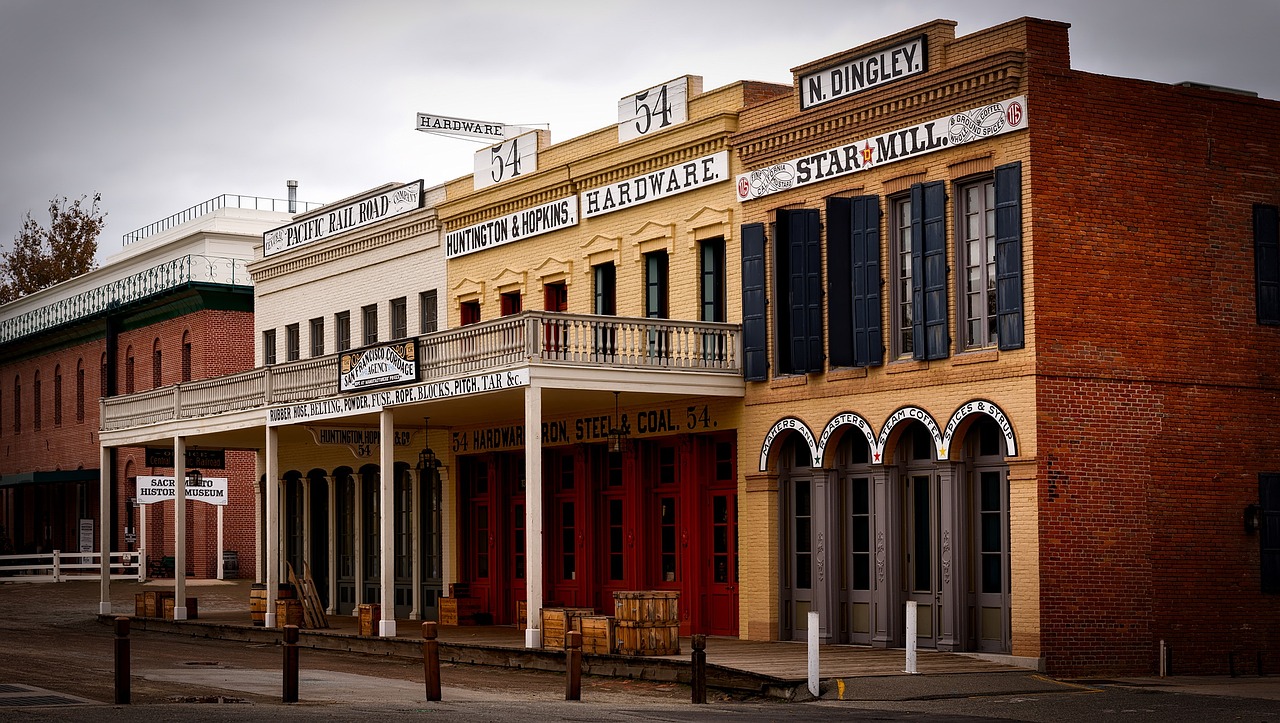
El Dorado County is famously recognized as the place where California’s Gold Rush began. According to historical accounts, on January 24, 1848, James W. Marshall discovered gold on the south fork of the American River in the valley known to the Nisenan Indians as Cullumah (beautiful valley). That momentous instance not only helped shape California’s future, it reinvigorated the country’s economy as well.    

Courtesy photo

Towards the end of the 1880s another historical, albeit little-known, event transpired in El Dorado County – the public hangings that sent shock waves across Placerville.

Based on newspapers articles at the time, a reputedly wealthy farmer John Lowell was murdered on March 24, 1888 during a robbery at his ranch near Mormon Island in El Dorado County. Three men were convicted of first degree murder – John Henry Meyer, a 27-year-old immigrant from Germany; John Olson, a 24-year-old Norwegian native immigrant; and William Drager, a 41-year-old immigrant from Germany.

Meyer was hanged on November 30, 1888. Olson and Drager – who steadfastly claimed throughout the trial that they weren’t involved in the murder of Lowell – were hanged on October 16, 1889. These were the last legal hangings and among the last public executions in California.   

Hangings were not uncommon in the United States back then; Placerville had been referred to as “hangtown” since the Gold Rush days. However, Olson and Drager’s sentence galvanized the whole town into action because Placerville residents felt they had not been complicit in the murder, and the death penalty was too harsh for their actual crime.
Courtesy photo

Over 425 townspeople – including the district attorney who prosecuted the case, the sheriff, and nine of the 12 jurors – signed a petition requesting the sentence be reduced to life imprisonment. It was, however, rejected and the pardon turned down. It fell upon El Dorado County sheriff James Madison Anderson to carry out the sentence and, for years, that an injustice might have been done weighed heavily on him.

His great-great-granddaughter M.G. Rawls – a retired Pasadena lawyer and author of fantasy trilogy books “The Sorts of Pasadena Hollow” – delves into this event and gives readers an intimate look at the victim, the killers, the crime, and the hangings. She chronicles the details of the case and then reaches her own conclusions about this long-forgotten and rarely discussed episode in Placerville’s past in her book called “Hanging Justice,” scheduled to publish in October 2025.

In the course of her extensive research, Rawls traveled to El Dorado County several times and visited the gravesites of her ancestors at Placerville Union Cemetery. During one of her trips there she found out about Save the Graves.
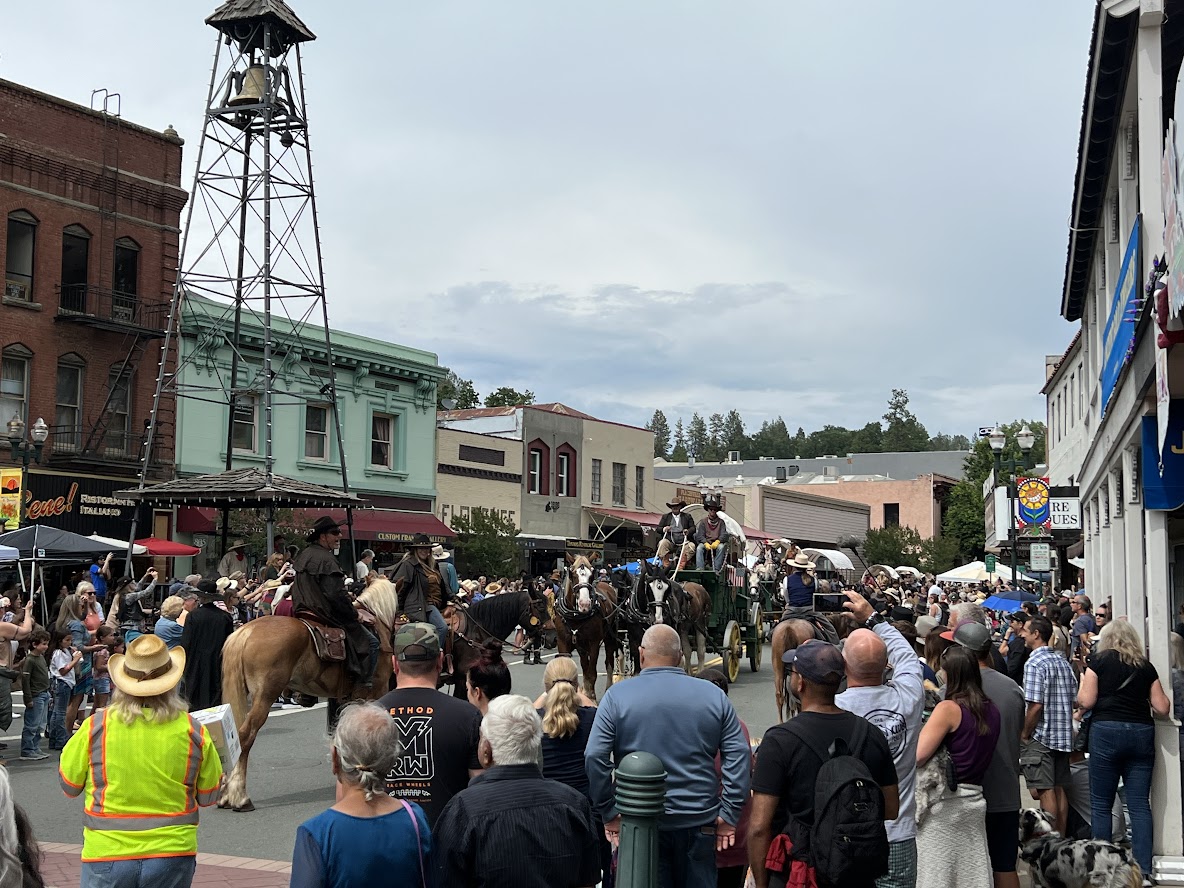
Placerville Wagon Train Event 2023 | Photo courtesy of Save the Graves

Conceived in 2019 by Mike Roberts and his wife Michele Martin, Save the Graves is a non-profit organization with a mission to restore, preserve, and celebrate El Dorado County’s historic cemetery and the stories they contain.

Speaking by phone, Roberts begins just as he does all his talks about Save the Graves. “Some people discover at some point in their lives that they have a peculiar fondness for old cemeteries. And I am one of those people. I’ve always been fascinated by them and drawn to them. It turned out there’s a word for people like us — taphophiles.”

“When I was walking my dog one day, I came upon this cemetery near my home and realized that what was once a beautiful place had gone to seed,” Roberts recounts. “No one was cutting the grass and the trash cans were overflowing. There’s so much history beneath these headstones yet no one was taking an interest in preserving it. So I took it upon myself to do that.”
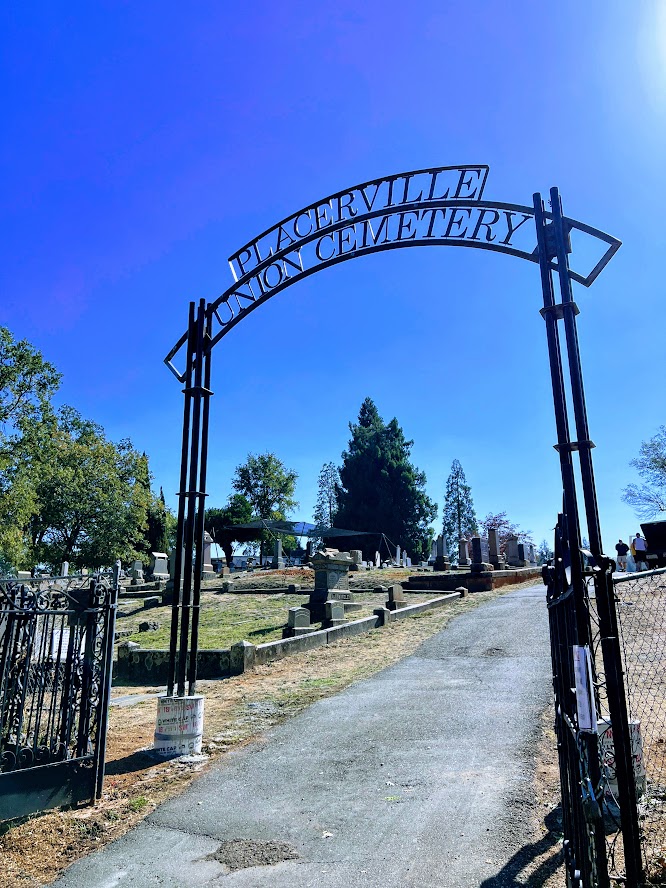
New signage at Placervile Union Cemetery | Photo courtesy of Save the Graves

Roberts explains, “There are several ‘Friends of’ organizations in several cities, so I tried to create ‘Friends of Union Cemetery.’ To attract people into joining the group, I wrote a piece about the history of Union Cemetery, had it published in the local paper, and apprised readers that I was holding a couple of formation meetings and gave the times and dates.”

“One of those people who showed up was a retired PR executive for a utilities company who told me he was part of something similar to this in Long Beach called Save the Graves. The Historical Society was involved and they did theatrical portrayals of local historical characters buried in the cemetery. They researched and wrote scripts; the actors rehearsed and wore costumes authentic to the era. They charged money for the performances which people loved  because they learned about the town’s history; that enabled them to raise funds to restore the cemetery. He had already committed to do some work for the Placerville Park but offered to help as soon as he finished that project,” recalls Roberts.

“I had forgotten about it until he called me two years later and asked if I was still interested in collaborating,” Roberts continues. “Coincidentally, a theatre professional he had previously performed with in Long Beach had just arrived in Placerville and he recruited him to get involved. They got us a grant and the three of us partnered up and launched our first production. As challenging as it was to stage a show at a cemetery, we pulled it off and it was very well received in the community. We held the second production and then we had a pandemic.”
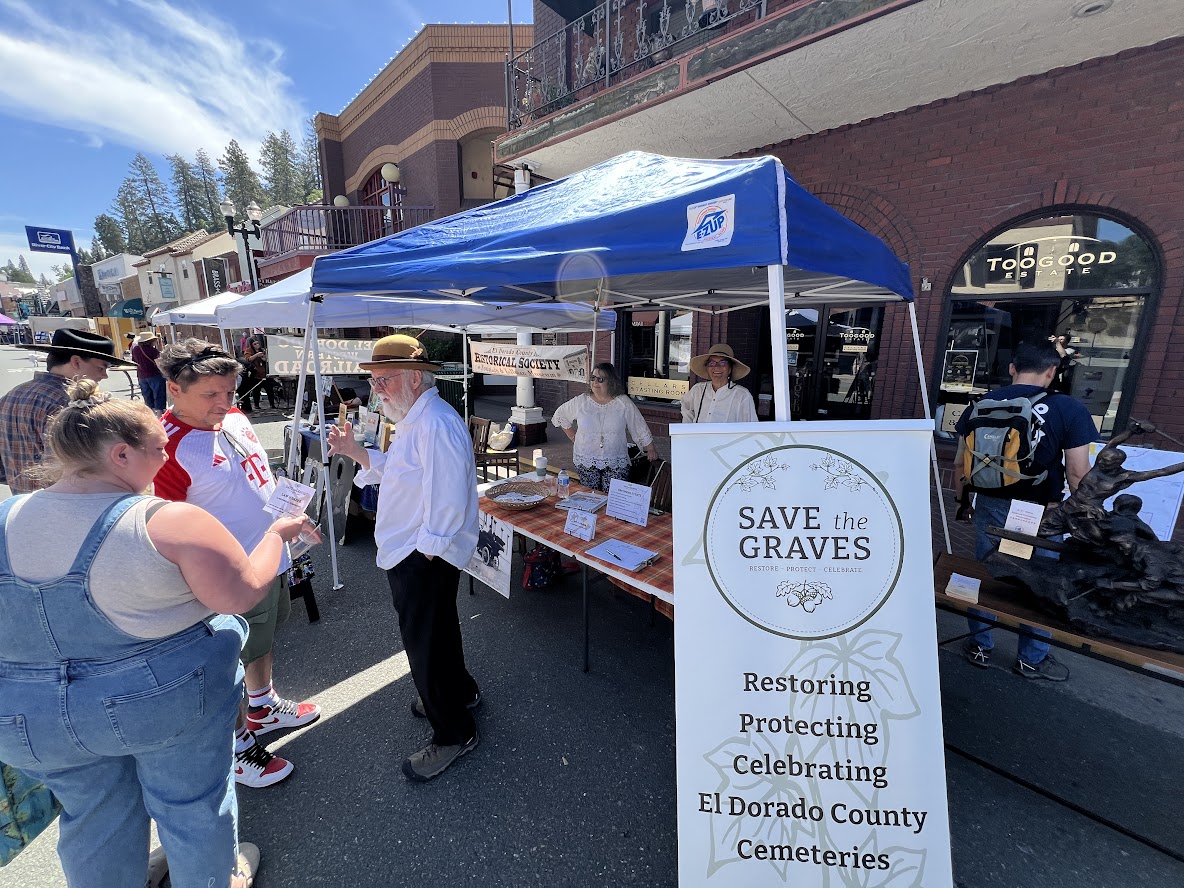
Mike Roberts (in white shirt and black trousers) at a Save the Graves booth | Photo courtesy of Save the Graves

These two gentlemen Roberts teamed up with eventually moved on to do theatrical productions elsewhere, leaving Roberts to focus on his original objective.        

Says Roberts, “I was everywhere doing fundraising and cemetery improvement projects, running volunteer groups, as well as doing repair and restoration work myself. What bothered me most were the broken headstones. The county that managed the cemetery wouldn’t let me touch anything because of the liability. Heaven forbid the county gets sued by someone because I cleaned their ancestor’s grave! So I circumvented a potential lawsuit by checking the genealogy of the people buried there and choosing to repair the headstones of those with no relatives in Placerville.”

Using money they’d raised, Roberts paid $3,000 to a sympathetic local cemetery operator who agreed to get 18 of the headstones off the ground. And that made a huge difference. Instead of merely explaining to people what he was trying to accomplish, it gave him something concrete to show when he asked for donations. It also made fundraising easier the following year.

According to Roberts, the real fundraising vehicle is the program for the annual event. They started out with a four-page leaflet and last year they printed a 48-page magazine with a glossy cover and inside were advertisements about local shops and proprietors interspersed with the schedule of activities.
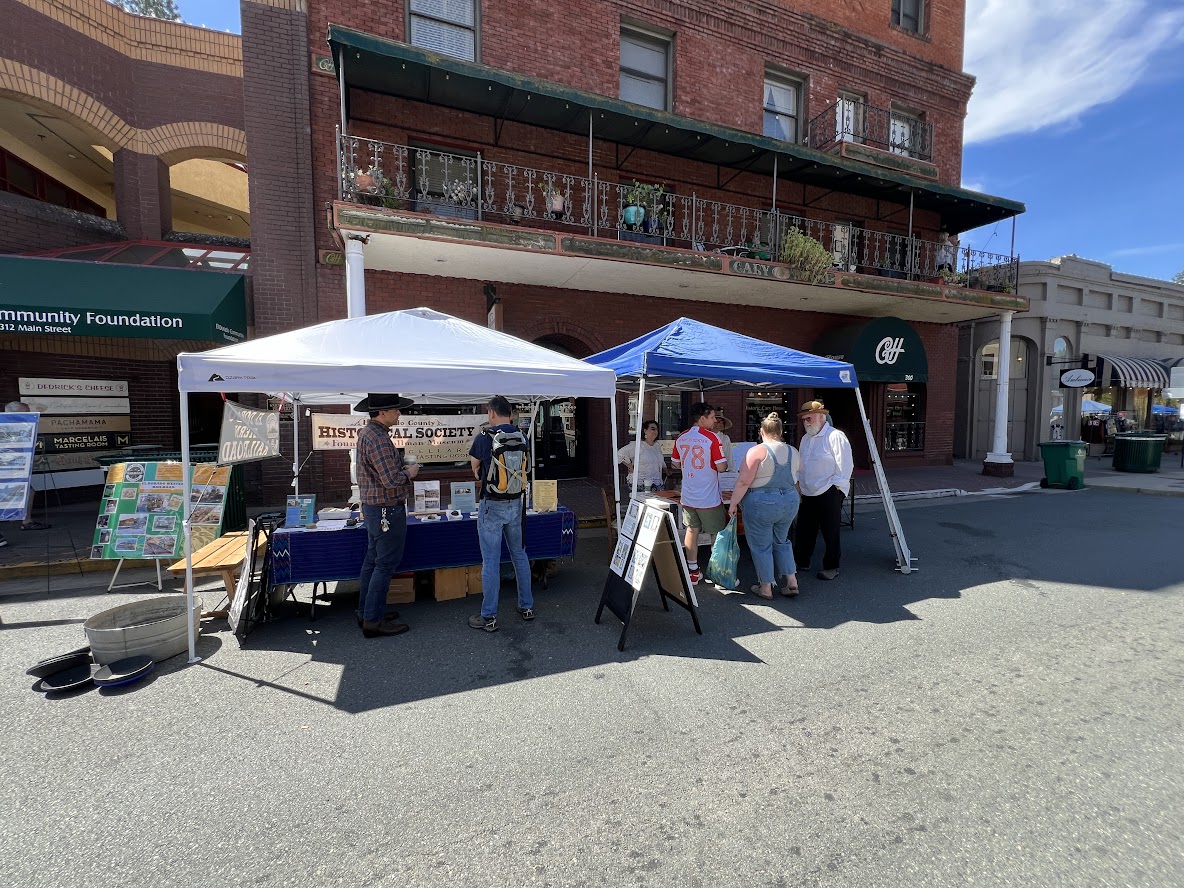
A Historical Society booth at a Placerville event | Photo courtesy of Save the Graves

These days, when Roberts tries to sell advertising space he’s asked about readership and circulation figures, which makes him laugh. He no longer has to do door-to-door solicitations; he reaches out by email. But when he does go out to see potential advertisers, he’s always wholeheartedly welcomed. People comment on how beautiful the cemetery looks.

In the six years since he and Martin established Save the Graves, Roberts has become something of a local luminary. He attends the downtown merchants association meetings and listens to some of the problems they encounter and helps find solutions. He has been giving two-hour talks about Save the Graves before various groups.
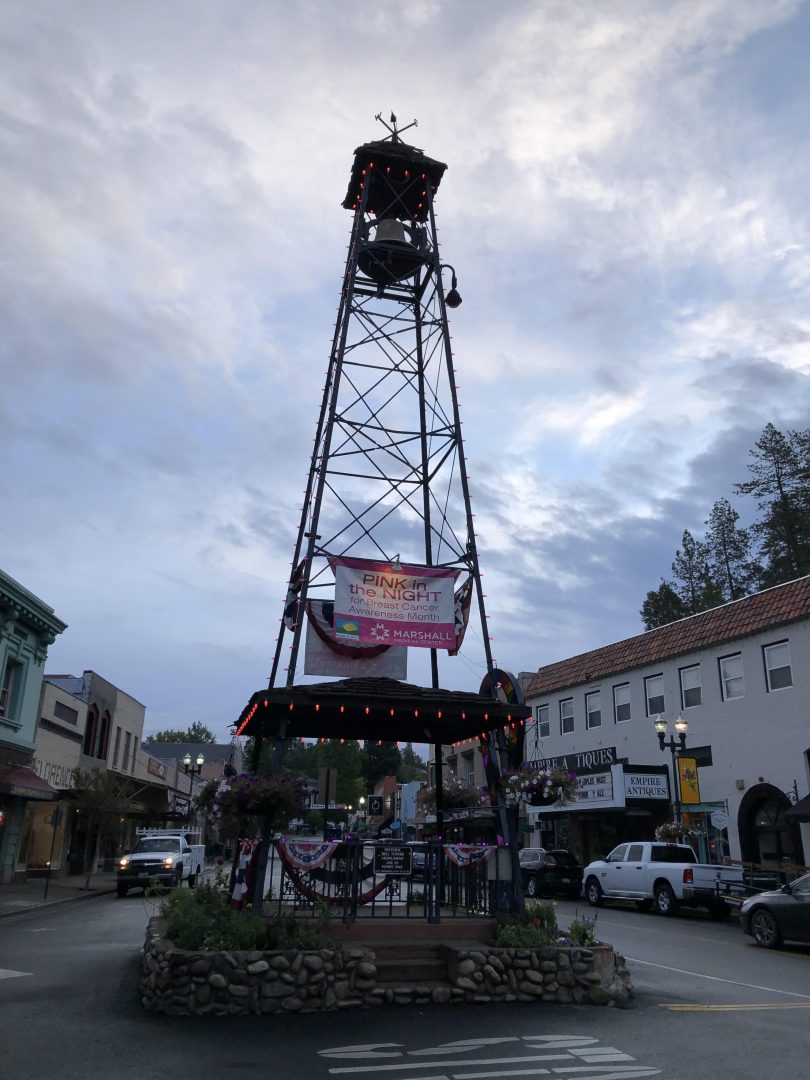
Placerville bell tower | Photo by M.G. Rawls / Save the Graves

“Last year we incorporated Save the Graves as a non-profit organization and that enabled us to apply for funding and we got our first big one – a $5,000 grant,” Roberts says happily. “The County Board of Supervisors gave us $10,000. We’ve been receiving donations from many people in the community, I’m so humbled. This year one of the descendants of a Placerville sheriff also sent us money. I didn’t know we had prominent historical figures in our town – we’d lost track of them.”

“We now have the luxury of having the money to take care of the cemetery,” declares Roberts. “The headstone cleaning can be done by volunteers so the funds go into fixing more complicated issues, like accessibility and terrain problems, crumbling copings along the walkways, etc. We’ve gotten a lot of damaging lichens out of old headstones and we’ve posted all sorts of interpretive signs that tell stories of these places to engage people who wander through.”

“Save the Graves is as much about building community as it is about fixing the cemetery,” Roberts emphasizes. “Historic cemeteries strengthen the fabric of our community by building  connections between people. Part of that requires that you know something about those who are buried – and we accomplish that through our theatrical productions, biographical stories we post, and a Find the Grave QR code the general public can scan with their smart phones. We’re building connections to the people who are here now and to the place they live – that’s community. It starts to grow and we eventually connect with each other.”  

“Placerville’s demographics are shifting with folks from big, congested cities moving in because they can buy an acre of land and enjoy nature and wildlife. And guess what else they like – old cemeteries! And they’re willing to help out,” Roberts enthuses.      
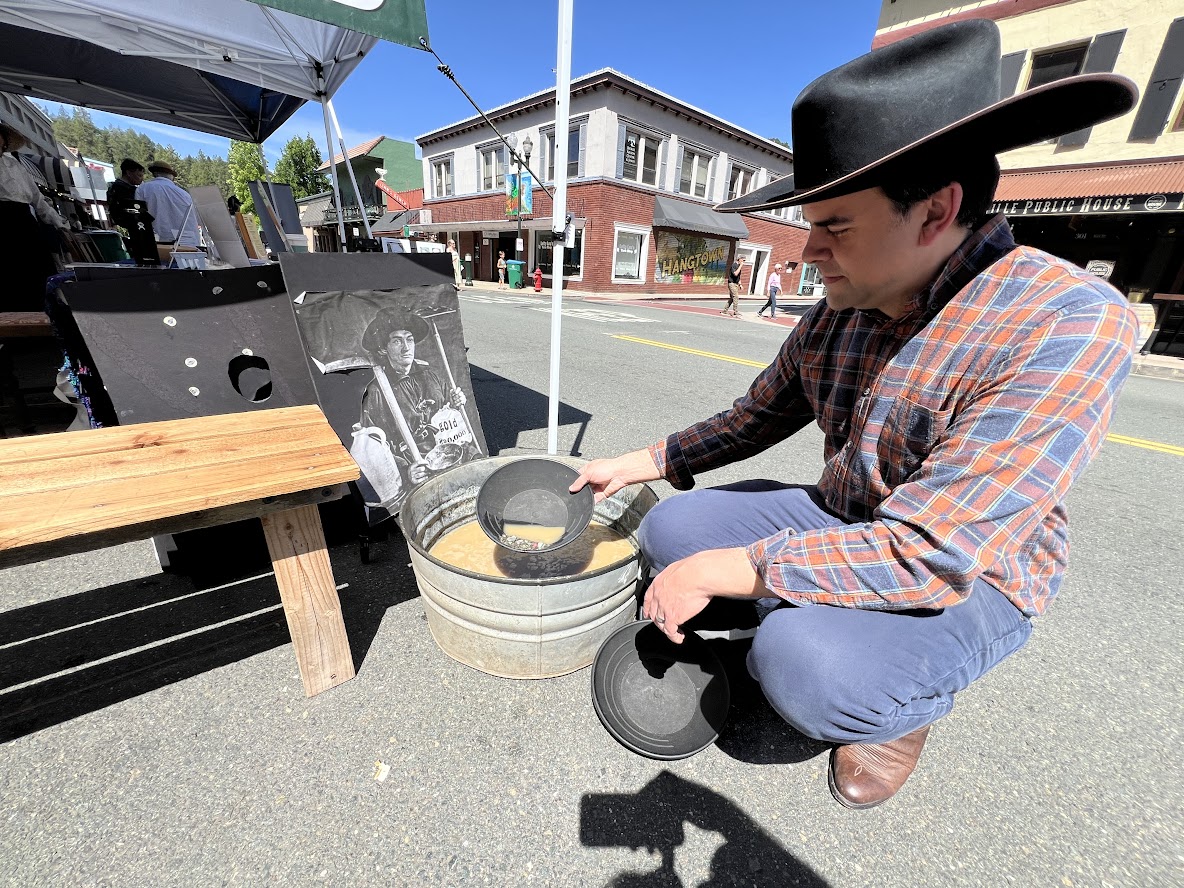
Vendor showing gold flakes panned in Placerville | Photo of courtesy Save the Graves

Two of those transplants to Placerville are Jacob Rigoli and Sean Manwaring with whom Rawls  got acquainted when she went to see the house her great grandfather used to live in – which they now owned.     

Relates Manwaring, “Jacob and I first met Meg in October 2021. At that time we were restoring the historic residence colloquially known as ‘Judge Thompson House,’ named after her great grandfather, Superior Court Justice George Thompson. It was also the childhood home of her grandmother Virginia Thompson Gregg. Before that, her great-great-grandparents lived in the circa 1862 home, making it the residence of three generations of her family. Her mother and uncles visited the home in their youth with her grandmother.”

“It was Meg who introduced us to Save the Graves,” Manwaring clarifies. “The following year, we joined the planning committee and assisted with the annual event and fundraiser. Although I’m not a Placerville native, I grew up in Northern California, frequently visiting old mining camps and Gold Rush towns with my family. I have fond memories of Placerville. Like her, my husband Jacob and I are descendants of pioneers who arrived in California either just before or during the Gold Rush.”

“We quickly bonded with Meg over our shared enthusiasm and deep appreciation for all things related to early California history. Since then, she has become a dear friend, and we truly understand her passion for preserving her family’s legacy,” states Manwaring.
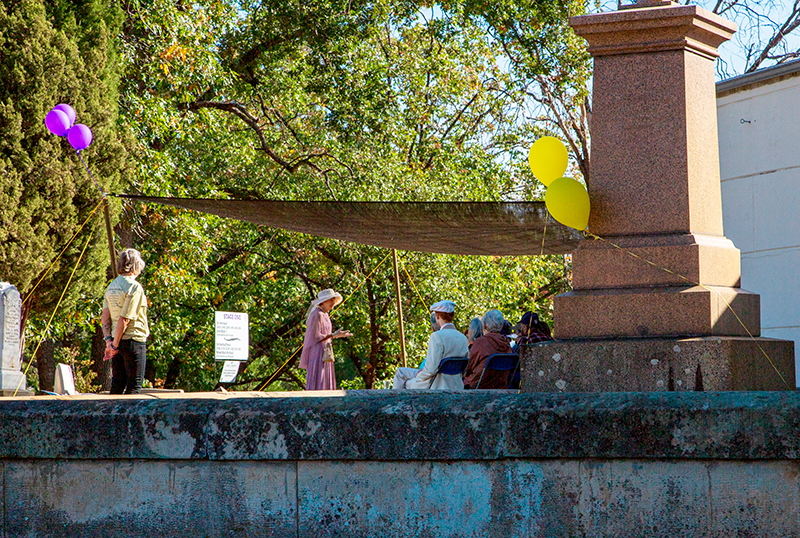
2023 Save the Graves theatrical performance | Photo courtesy of Save the Graves

“The work of Save the Graves is vital in preserving not only our local history but also the stories of California’s pioneering women,” informs Manwaring. “Last year, we featured one such remarkable figure: Mollie Wilcox Hurd. Born in Placerville in 1870, Mollie’s life took an unexpected turn when she married Frank Stoddard, nephew of Elizabeth Stoddard Huntington, the first wife of Central Pacific Railroad magnate Collis P. Huntington.”

Collis P. Huntington’s nephew, Henry Huntington, and his wife Arabella founded Huntington Library, Art Museum, and Botanical Gardens – a beloved institution in the San Gabriel Valley in Southern California.    

“Frank’s family connections and career in the railroad industry propelled Mollie into the elite social circles of Los Angeles,” Manwaring continues. “While in Los Angeles, she served as President of the Los Angeles Florence Crittenton Home, which was established to help women and children in need. Beyond raising their two children, Mollie dedicated herself to philanthropic endeavors, particularly advocating for women’s and children’s rights. She played a pivotal role in securing state legislation requiring fathers to pay child support regardless of marital status.”

Mollie and Frank Stoddard were married for 25 years. Following her divorce from him and after their children had grown, she married her old friend – Los Angeles area senator, Henry M. Hurd. She remained deeply connected to her Placerville relatives. She was a founding member of the Placerville Shakespeare Club, generously bequeathing a donation to build their historic building upon her death in 1929. Mollie and Senator Hurd are both buried in the Placerville Union Cemetery.
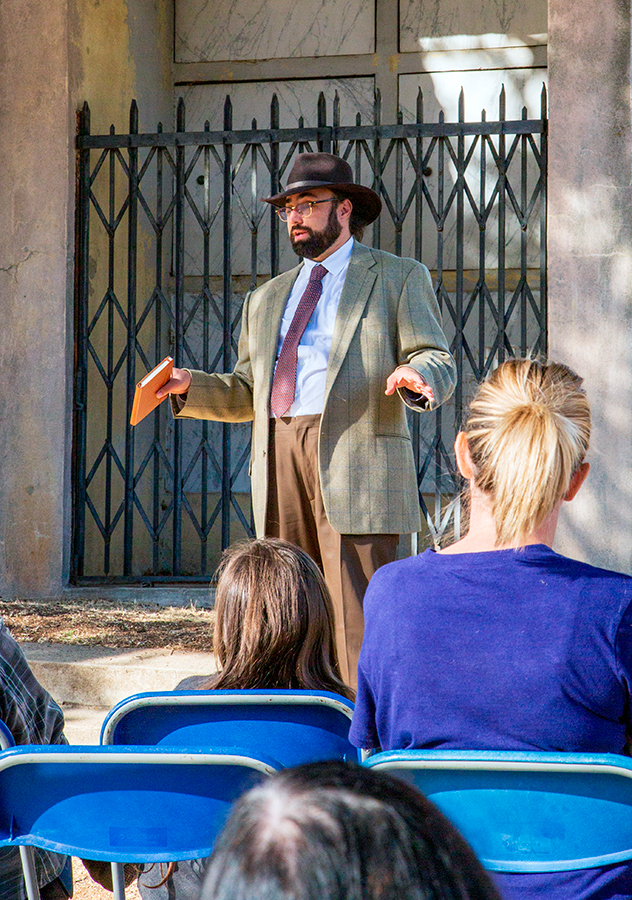
A 2023 Save the Graves theatrical performance | Photo courtesy of Save the Graves

“This year’s show called ‘Law and Order, to be held on October 19, will focus on four notable crimes that occurred in El Dorado County between 1855 and 1903,” Manwaring explains. “Each crime will be presented through historical portrayals, featuring two key figures – ranging from perpetrators to victims, and from law enforcement to members of the press. Attendees will gain insight on both the community and the justice system.”

Describes Manwaring, “The portrayals are historically accurate and performed graveside – often near the burial sites of the pioneers being depicted – and actors wear period costume. One featured crime is the John Lowell murder of 1888, in which Meg’s great-great-grandfather Sheriff James Madison Anderson testified during the trial and guarded the accused. Additionally, her great-great-uncle, Marcus Percival Bennett, served as the district attorney. The case haunted both men for years.”

“Jacob and I contributed to the research and organization for this year’s event,” Manwaring adds. “He will serve as a stage manager and I’ll portray Marcus Bennett. We are just two of the many volunteers who help put on this annual event at Placerville Union Cemetery. Mike and Michelle are the driving force behind the fundraiser that helps preserve the cemetery and the stories of those buried there.”
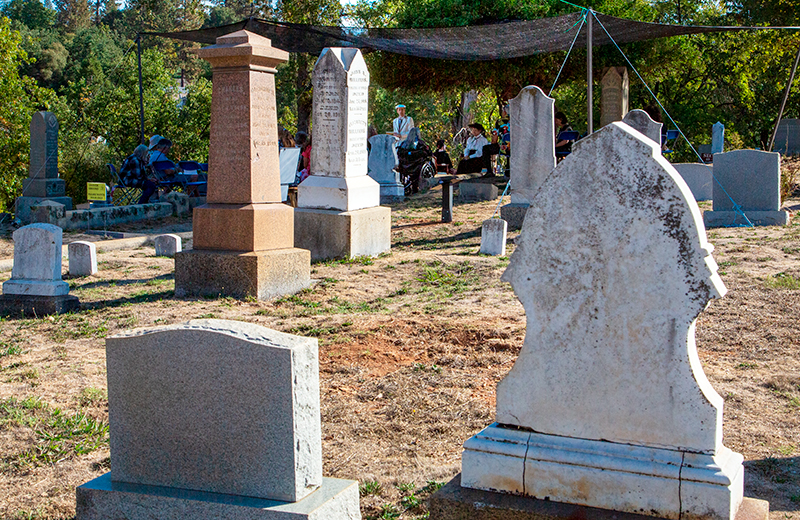
Save the Graves performance is usually held near the grave site of the historical person being honored | Photo courtesy of Save the Graves

“Meg’s research has unearthed a forgotten story,” pronounces Manwaring. “It’s fascinating to discover the events that shaped the townspeople and the motivations of those involved in the John Lowell murder trial. She’s helping our community discover this important chapter in our history.”

Indeed a significant event transpired over a century ago at Placerville that residents there today may know nothing about. Roberts admitted as much when he said he didn’t know about Sheriff Anderson. But through the organization he and Martin created, they are learning about these episodes in their local history and making them unforgettable.        

Visiting Scottsdale (Arizona) in the Spring

Also published on 13 May 2024 on Hey SoCal

Magenta penstemon flowers with red rock formation in background | Photo by Brianna Chu / Hey SoCal

It had been five years since I traveled out of the country so when I got an invitation to attend a wedding in Scottsdale, I gladly accepted. Located in Phoenix’s metropolitan area, Scottsdale was founded in 1894 by retired U.S. Army chaplain Winfield Scott and was incorporated in 1951 with a population of 2,000. While it’s only in a neighboring state, it nonetheless offers a change of atmosphere and scenery.

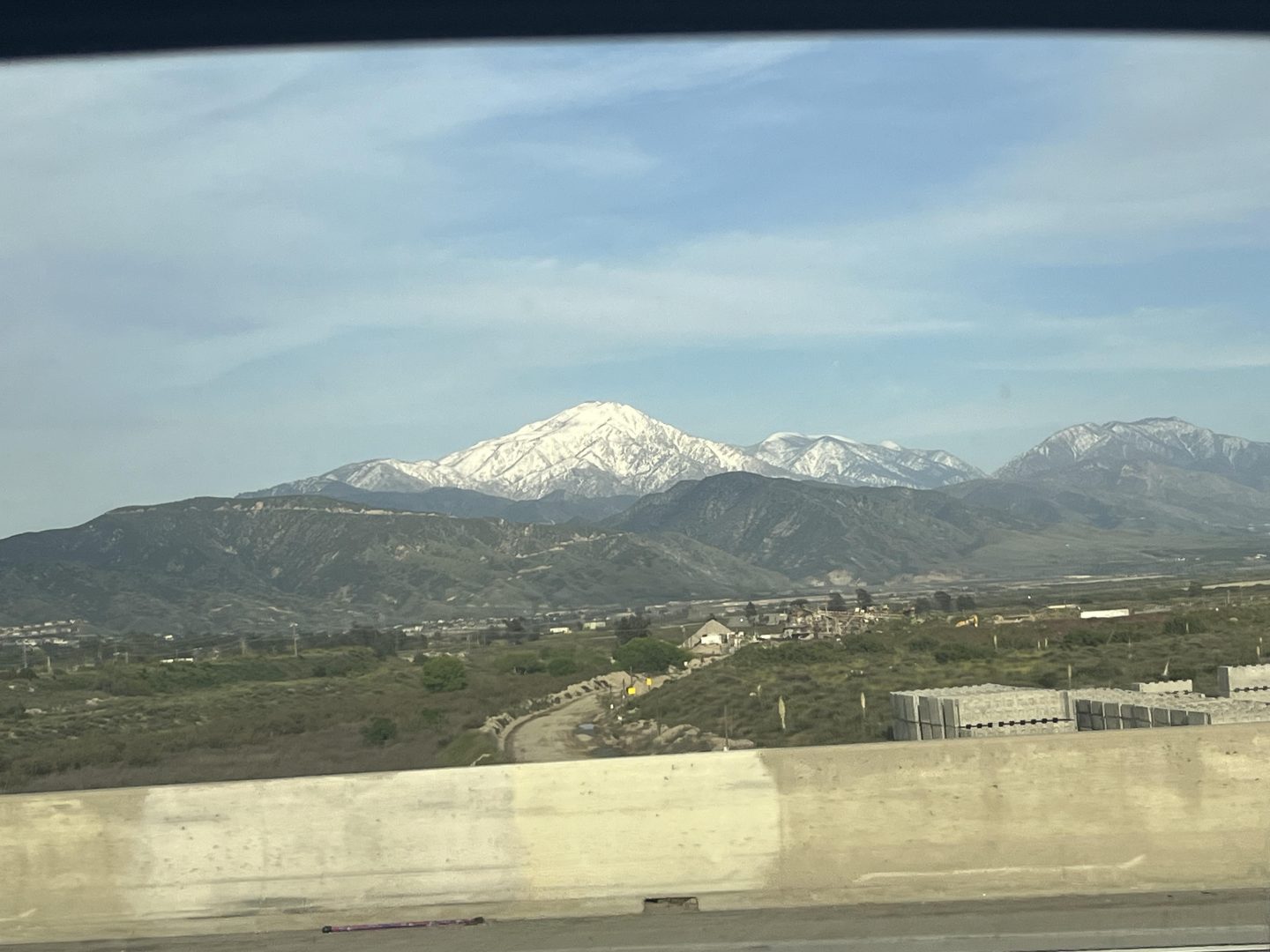
The snow-capped San Gabriel Mountains | Photo by May S. Ruiz / Hey SoCal

Excited to take a long road trip, my daughter, her husband, and I set out from Pasadena on a pleasant Thursday morning in April to spend a long weekend to discover Scottsdale. The majestic snow-capped San Gabriel Mountains along the 210 and 10 freeways were a sight to behold! As we got past Palm Springs to the other desert cities and the freeway became a two-lane thoroughfare, we were struck with how vast California is – there’s so much land and empty space!

The freeway turned into a four-lane road when we reached Buckeye and we were right in the midst of the evening rush. The big rigs that shared the road with us the last few hundred miles were soon lost with all the other cars driven by people trying to get home after a long workday. While the freeway was crowded, traffic was moving at a moderately fast speed and we soon arrived at our destination – Scottsdale.

Red rock formations near the Arizona state line | Photo by May S. Ruiz / Hey SoCal

We checked in at The Scott Resort & Spa, a boutique hotel that’s independently owned and managed. Intentionally eschewing cookie-cutter lodging chains with no distinct personality, we were thrilled that the bride and groom chose it as their wedding venue. I learned that it used to be the Firesky Resort & Spa and went through a major renovation when Marc & Rose Hospitality acquired it. The hotel retained the property’s existing Spanish Revival architecture but injected a Bauhaus vibe for a hip and modern ambience. It seems to attract a young crowd – millennials and Gen Zs enjoying a night out about town. I noticed a majority of staying guests were couples instead of families.             

The lobby of The Scott Resort & Spa | Photo by May S. Ruiz / Hey SoCal

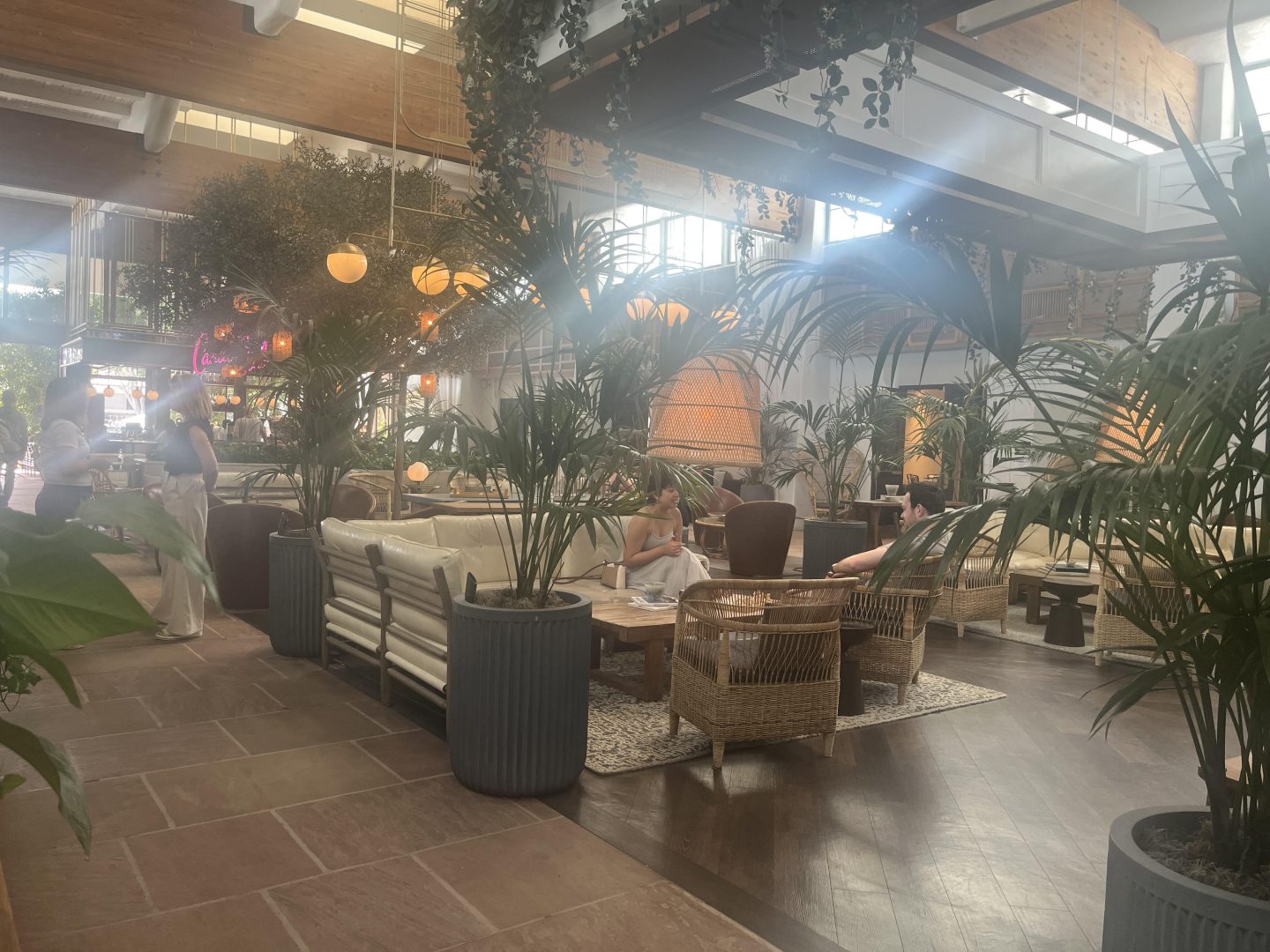
A narrow bench next to the entrance doors is set up as a sideboard, laden with two large glass jars of cold water and iced tea to quench guests’ thirst when they arrive or as they head out. The expansive lobby has separate seating areas dotted with rattan chairs and semi-upholstered couches. Long coffee tables invite guests to linger and enjoy a game of backgammon or chess. There are several potted plants and abundant greenery everywhere. The back hallway opens out into a center patio and pool area that guests navigate to get to their rooms which are housed in a separate two-story building. The suites and rooms – which have private patios and balconies –  are simply appointed with warm wood furniture and old world bronze, conveying a luxurious Sonoran style.        

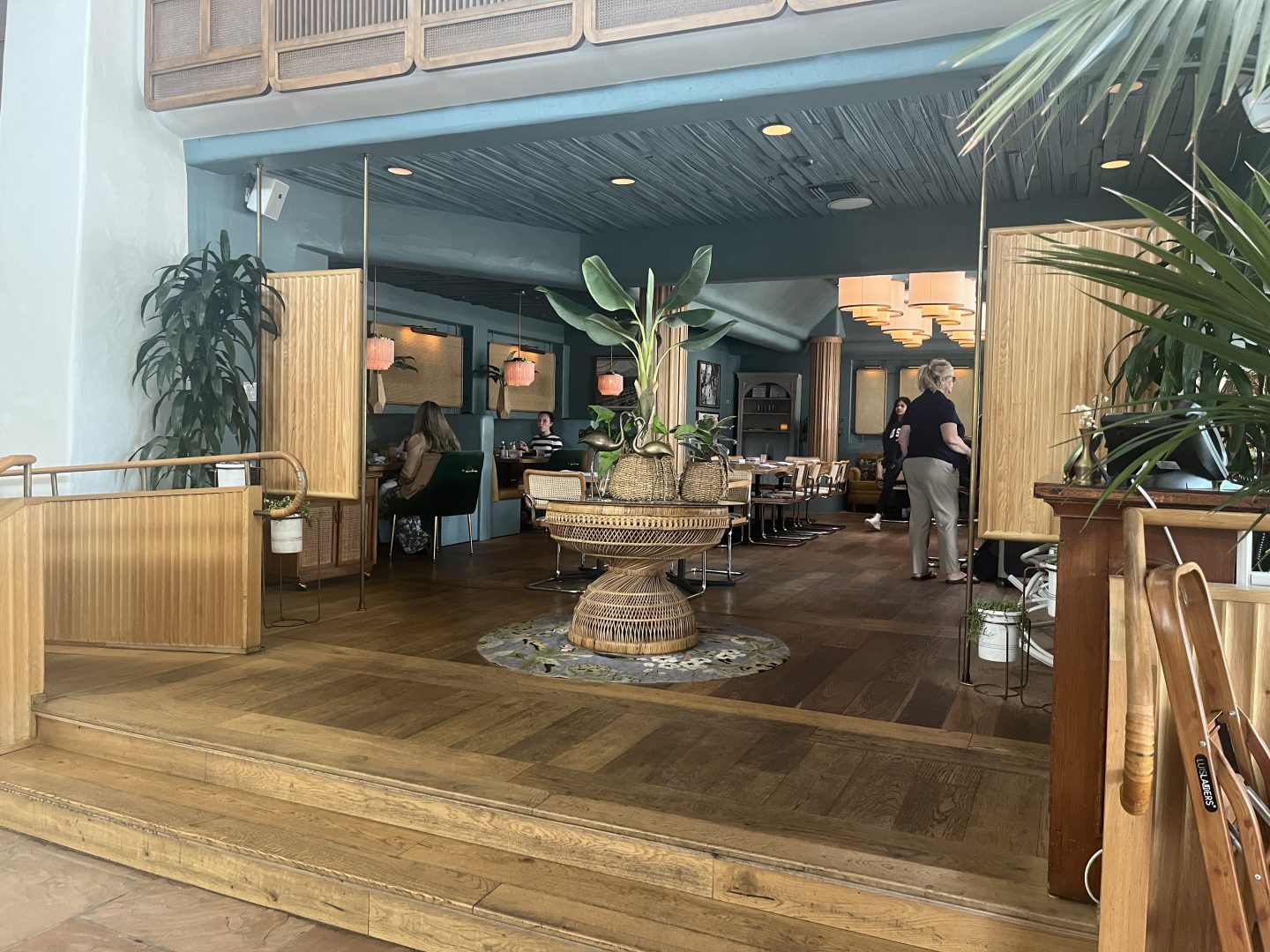
I had prepared an itinerary for our little adventure so I was saddened that we had to miss the first item on it – the Art District’s Thursday Night Artwalk. After our long drive we were simply too tired. So we got settled in our rooms and shortly after met downstairs at the hotel’s Canal Club for dinner. The restaurant is dimly lit, quite intimate and cozy, and we enjoyed a delicious meal. While the food weren’t exceptional, they were better than standard hotel fare and were prepared using fresh local harvest.

Canal Club at The Scott Resort & Spa | Photo by May S. Ruiz

After a restful night, we ate a hearty breakfast at the Canal Club and were ready to see Scottsdale’s Old Town. However, we were delayed when family we hadn’t seen in a while stopped by our table. An hour later than planned, we headed out. We took advantage of the complimentary shuttle service The Scott offers. Logan, a very enthusiastic and upbeat young man (he looked like a high-schooler working there part-time and seemed to get even younger the more we saw him), drove us half a mile away and dropped us off at what he referred to as P.F. Chang loop at the Waterfront District. I found out afterwards that the P.F. Chang restaurant chain, which I always thought originated in L.A., first opened in Scottsdale.     

Waterfront District | Photo by May S. Ruiz / Hey SoCal

Old Town Scottsdale, an area that’s a little over one square-mile, is vibrant and alive with several art galleries, museums, restaurants, Southwestern storefronts, public art installations, and landmarks. It was named after Winfield Scott, who in 1888 bought 640 acres of Sonoran desert farmland and turned it into what is now a bustling district that honors and memorializes Scottsdale’s storied past.

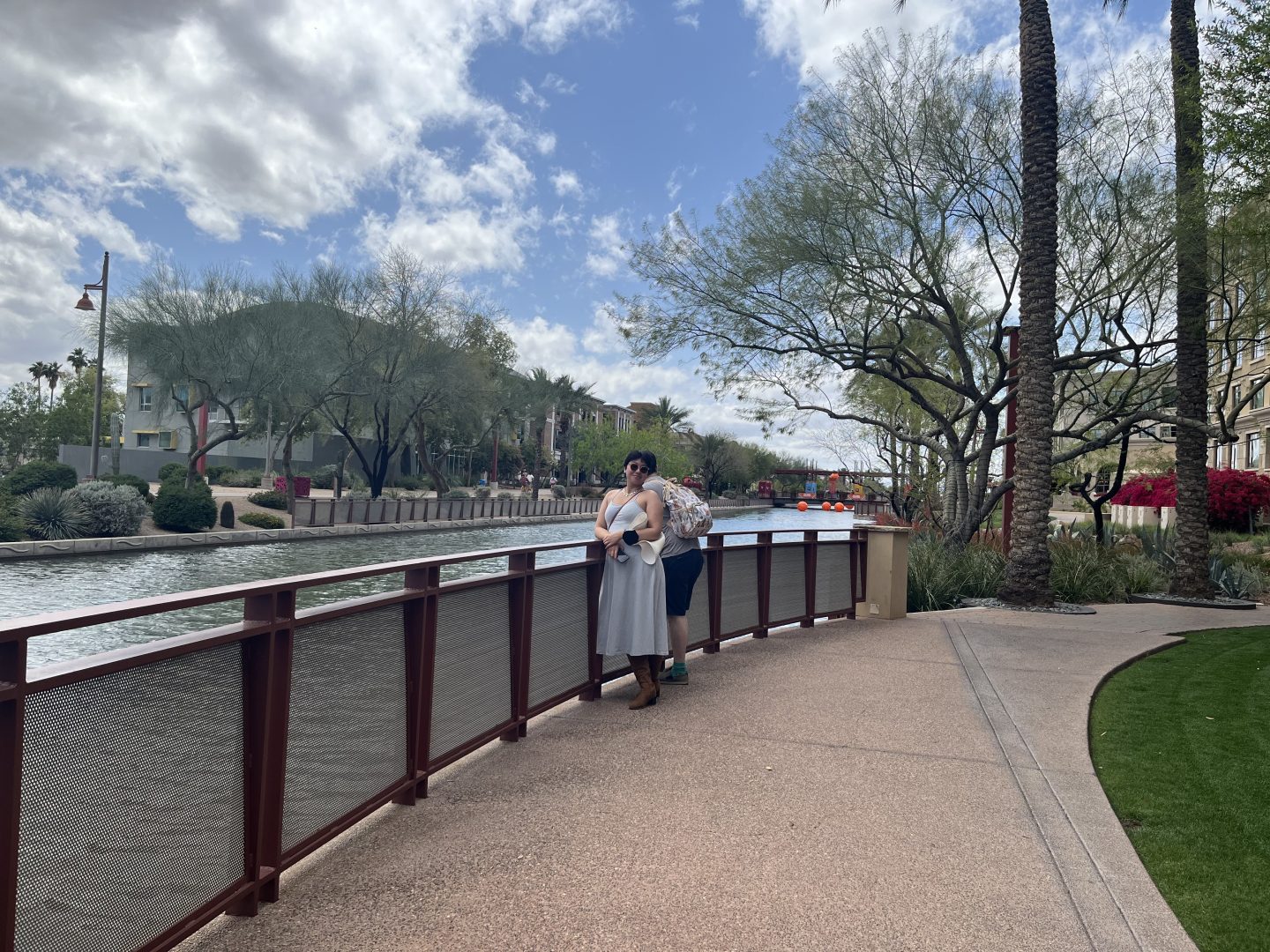
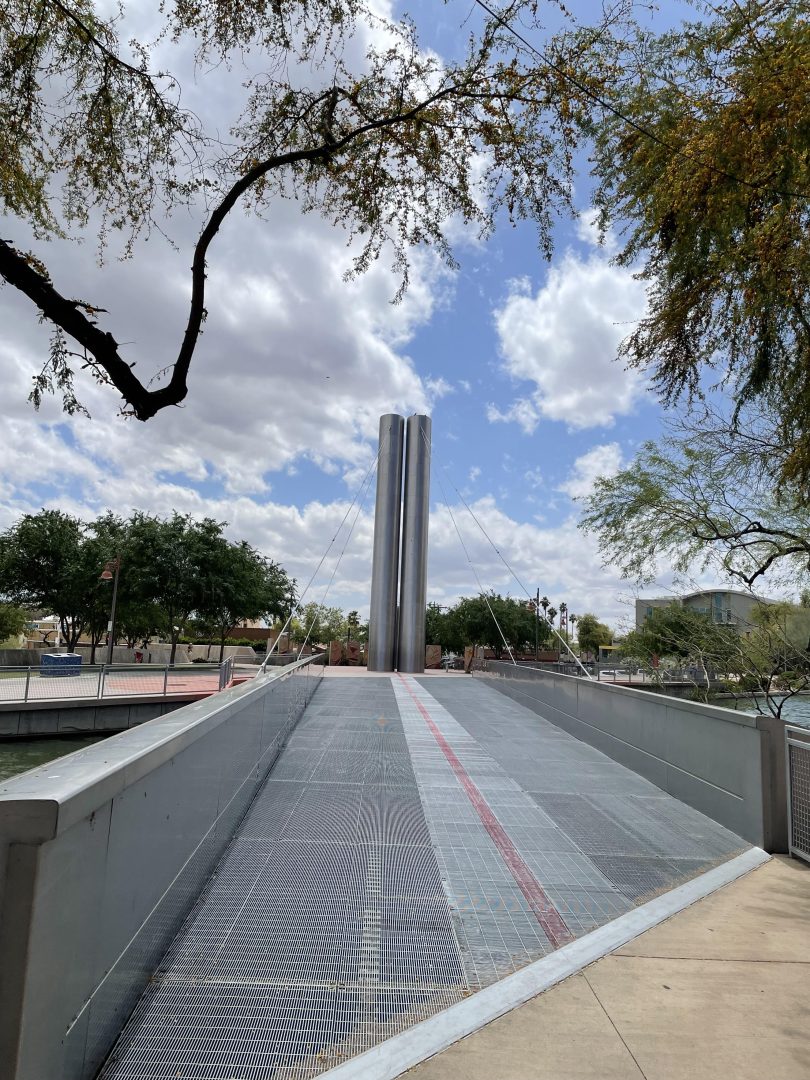
We took a leisurely walk at Solstice Park where the Soleri Bridge and Plaza are located. A pioneer of mid-century architecture, Paolo Soleri lived in Scottsdale from 1955 until his death in 2013. He was fascinated by the movement of the earth around the sun and how the sun’s position in the sky could be utilized for natural climate control. So he envisioned a bridge that is more than a passageway and connection between one side of the canal to the other; he positioned it like a sundial that synchronizes with the sun on winter and summer solstices. According to a knowledgeable staffer at the Scottsdale tourist center, it is the only bridge ever erected out of over 100 that he designed in his lifetime.

Soleri Bridge and Plaza | Photo by Brianna Chu / Hey SoCal

Soleri’s Goldwater Bell Assembly, named after the Goldwater Store in Scottsdale where it previously hung, is a towering structure at Solstice Park. It was constructed entirely by Paolo Soleri at Cosanti – his former residence, gallery, and studio which is now an Arizona Historic site – and reflects his life’s work in architecture and ecology. The bell was part of his first U.S. retrospective at the Corcoran Gallery in Washington, DC.  

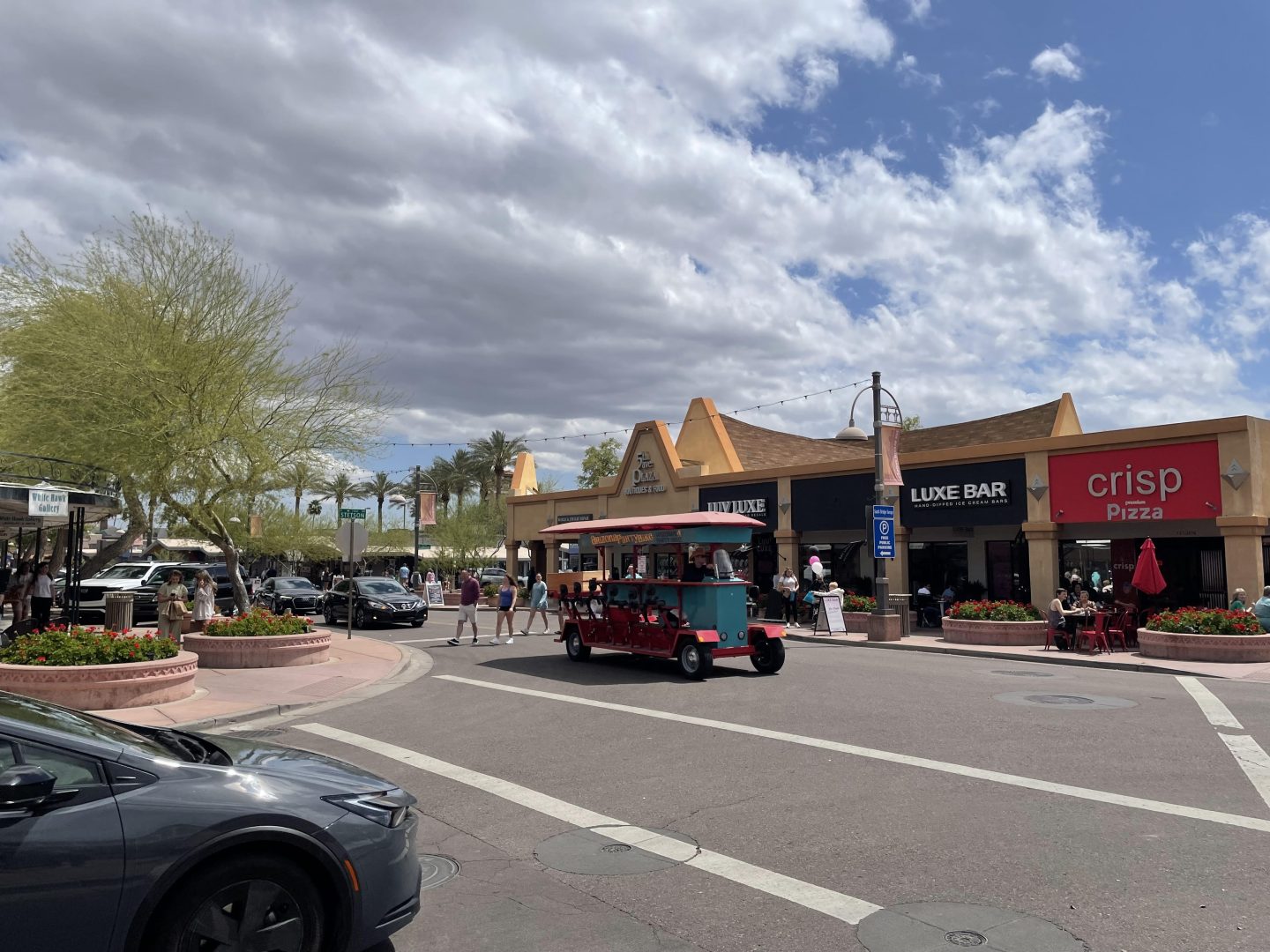
Fifth Avenue Shopping District | Photo by Brianna Chu / Hey SoCal

Some notable Old Town landmarks include the Little Red Schoolhouse which was built in 1909 for $4,500 and is now home to the Scottsdale Historical Museum; Old Adobe Mission on the southeast corner of First and Brown Avenue, constructed in 1933 of 14,000 adobe blocks made on site, functioned as Scottsdale’s only Catholic Church for many residents; Cavalliere’s Blacksmith Shop, the first blacksmith shop which opened in 1910, is still owned and operated by the Cavalliere family; Sugar Bowl Ice Cream Parlor, a converted Western Auto Service shop, serves treats and American food.

This wouldn’t be the Southwest without taverns and Old Town doesn’t disappoint. Rusty Spur Saloon, once Farmer’s State Bank of Scottsdale which opened on Main Street in 1921 and closed during the Depression, now holds liquor instead of U.S. currency; Porters Western Saloon, housed in what used to be Scottsdale’s first post office from 1929 to 1949, still has the familiar brick walls and crystal chandeliers but its staff has traded selling stamps for craft cocktails like the Sonoran Sunset and Postmaster.           

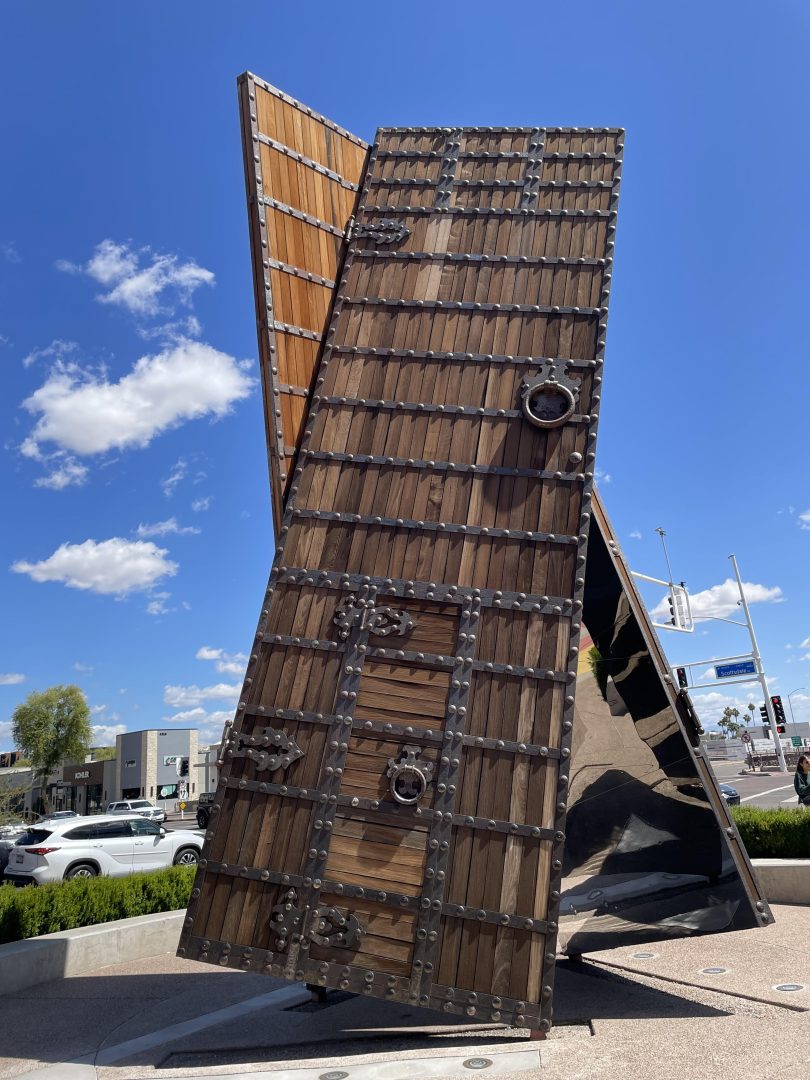
Donald Lipski’s “The Doors” | Photo by Brianna Chu / Hey SoCal

Old Town’s popular attractions include Scottsdale Artists’ School, the Museum of Contemporary Art, the Center for the Performing Arts, Museum of the West, Fashion Square, and Scottsdale Stadium – home base for the San Francisco Giants during the Cactus League Spring Training.     

Inside “The Doors” | Photo by Brianna Chu / Hey SoCal

Public art installations abound in Old Town. Donald Lipski’s colossal work called The Doors – 28-foot-tall mirrored panels – invites people to experience what it’s like to stand inside a kaleidoscope. Louise Nevelson’s Windows to the West, dedicated in 1973, is the artist’s first large-scale work in the Southwest. James Turrell’s Knight Rise is a “skyspace” installation that frames the sky as pure color and displays the changing light of day. Robert Indiana’s Love sculpture, conceived when America was consumed by the Vietnam War, is a symbol for peace. John Randall Nelson’s One-Eyed Jack, a 26-foot-tall painted sculpture inspired by the legendary desert “jackalope,” bounded into Old Town in 2018.   

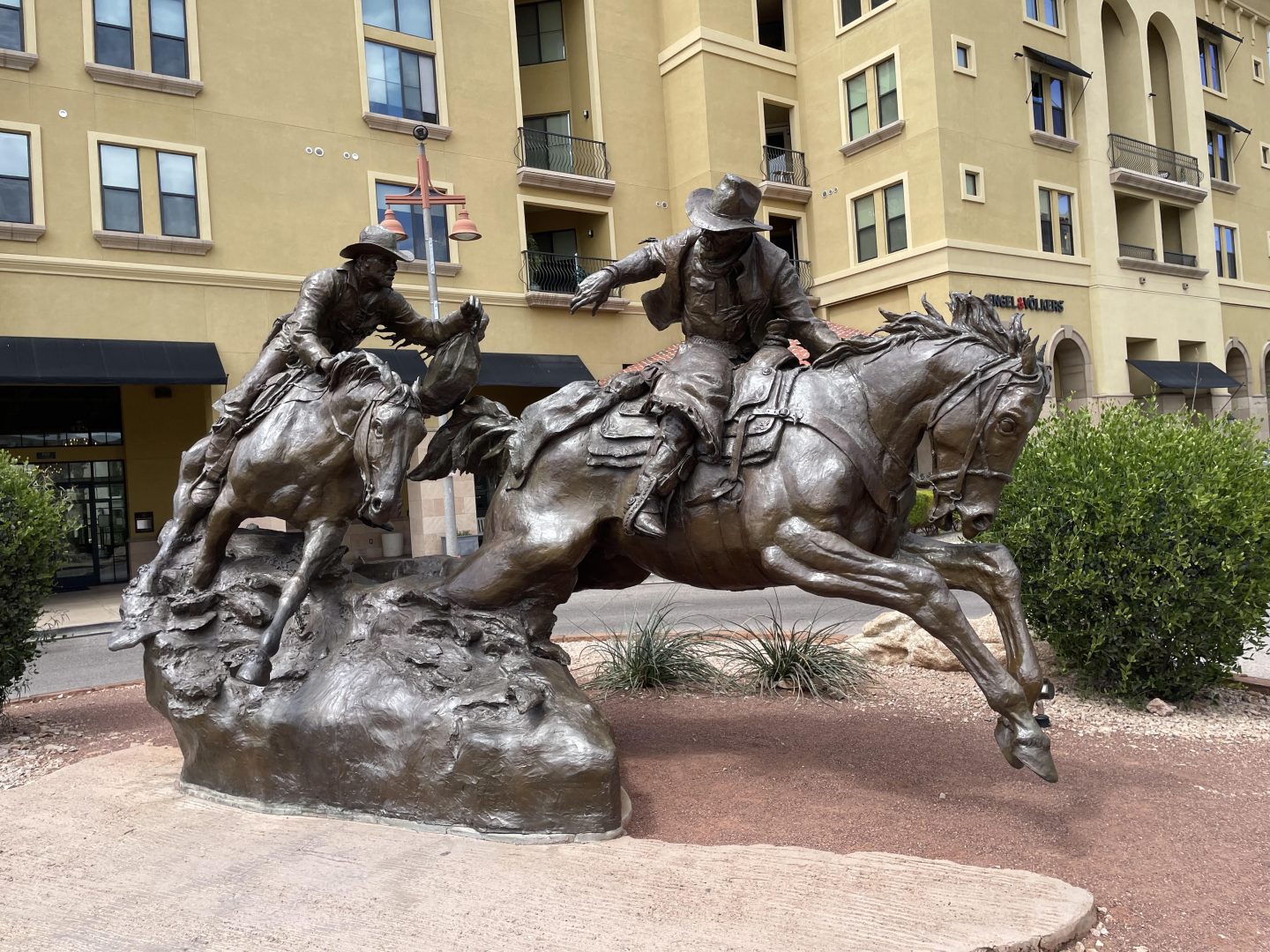
Herb Mignery’s “Passing the Legacy” | Photo by Brianna Chu / Hey SoCal

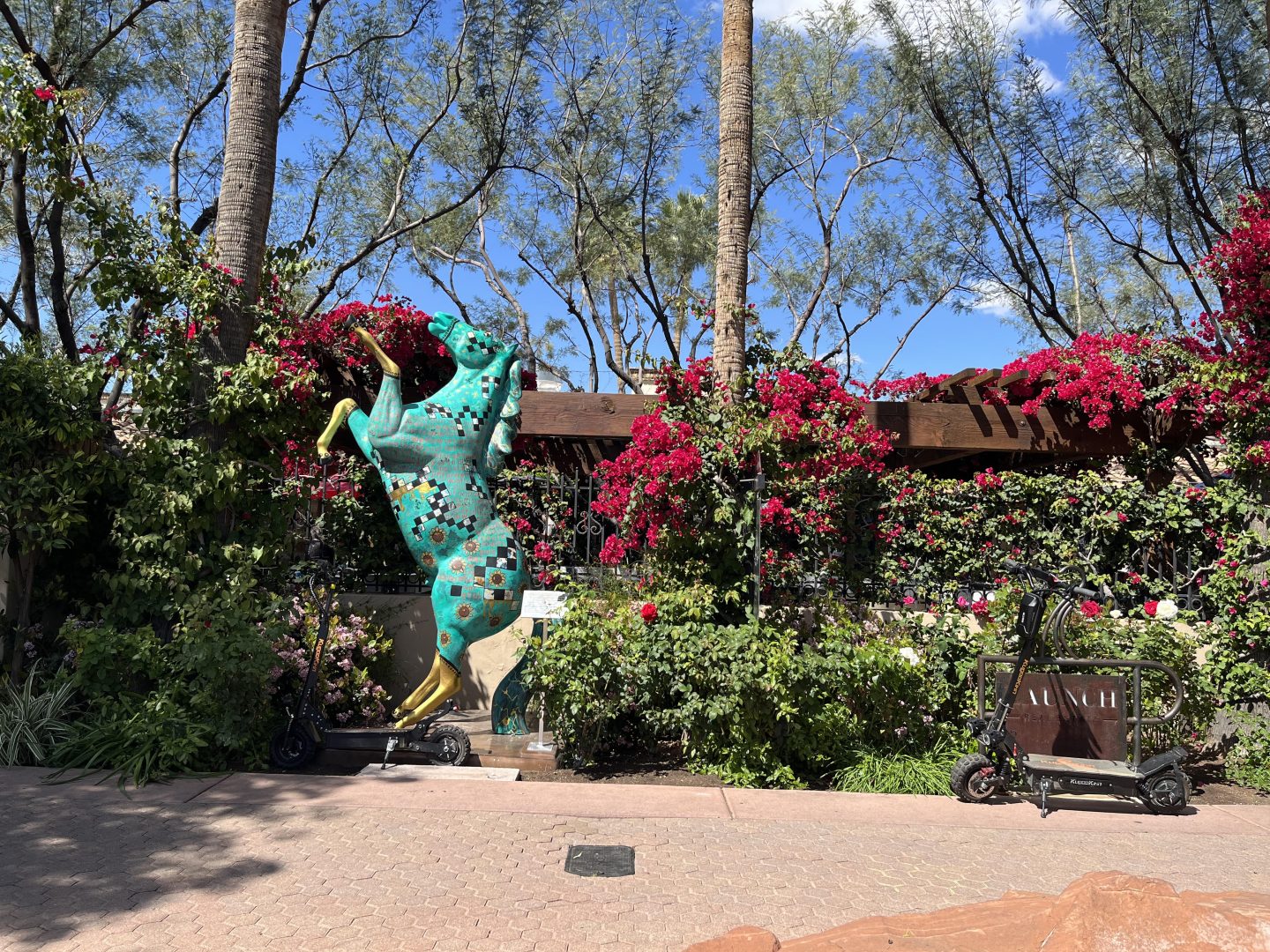
Impressive horse-themed sculptures reflect the city’s history. Herb Mignery’s Passing the Legacy, a life-size bronze, portrays a vintage Pony Express rider and a contemporary Hashknife Pony Express rider handing off the mail depicting the Old West meeting the New West. Ed Mell’s  Jack Knife, a massive bronze of a bucking bronco, is a nod to Scottsdale western heritage and is the city’s official seal. George-Ann Tognoni’s The Yearlings, three bronze yearlings galloping full stride, is a monument to wild horses and an icon of the free spirit of the American West.         

Bob Parks Horse Fountain | Photo by Brianna Chu / Hey SoCal

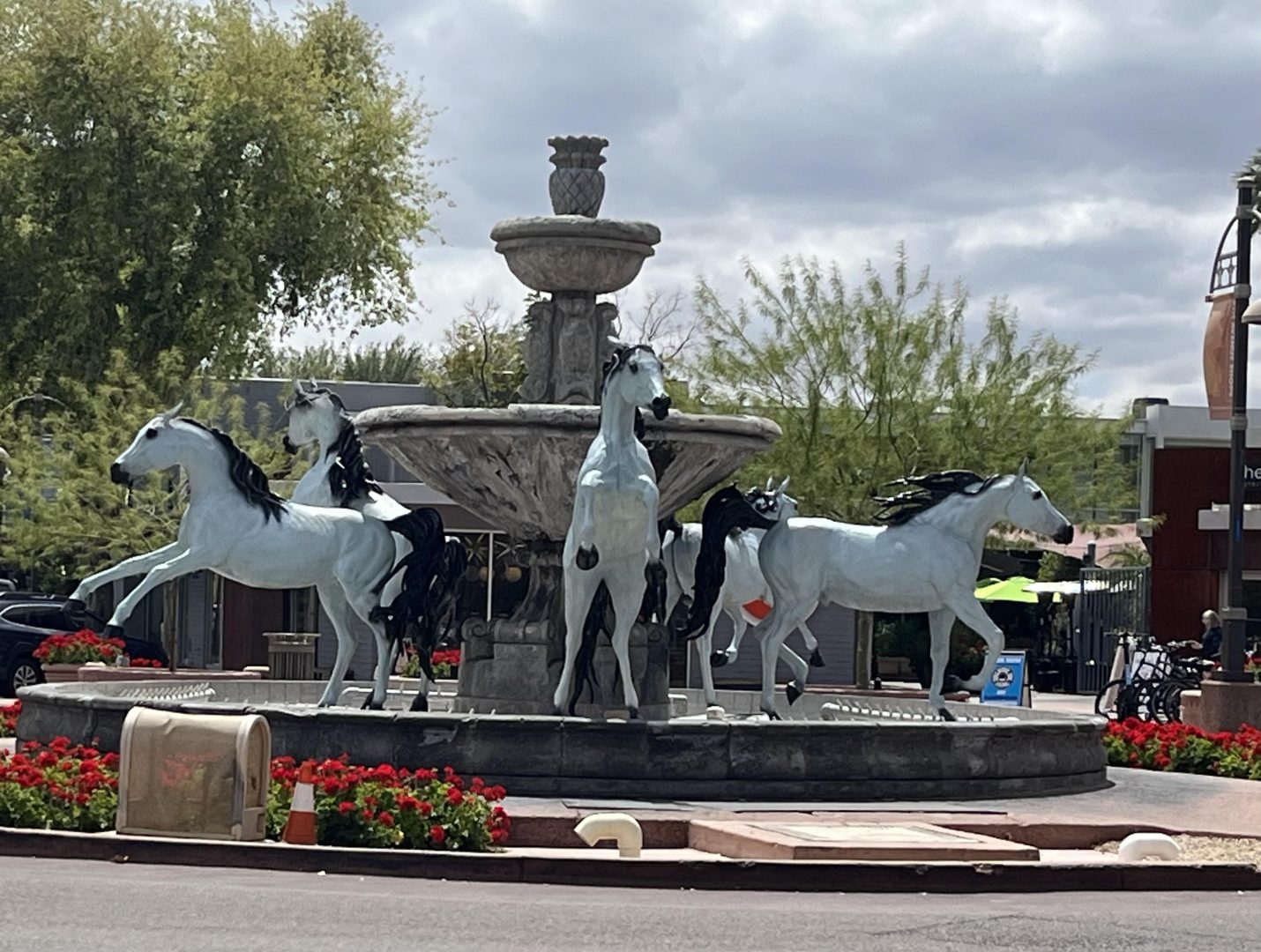
In the center of the Fifth Avenue/Marshall Way roundabout is the famous Bob Parks Horse Fountain, which was donated by artist and gallery owner Bob Parks in 1989 in an effort to attract visitors to the area. Leaping from the fountain are five champion Arabian horses sculpted after horse breeder Tom Chauncey’s award-winning Arabians. It’s a fitting homage to Scottsdale’s legacy as the center of Arabian horse breeding in America.

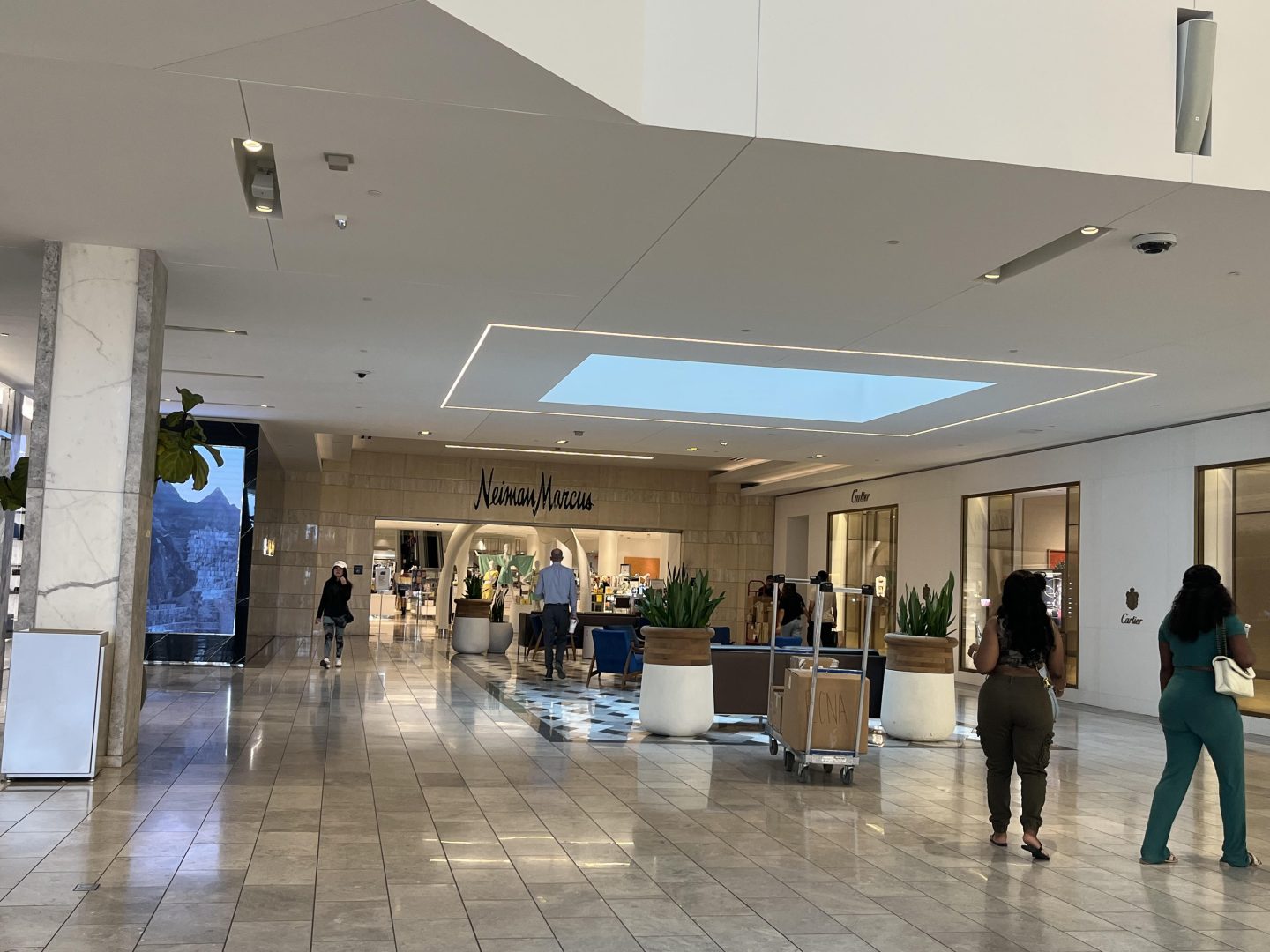
Fashion Square beckoned to us and off we went to discover what stores are within. Occupying this magnificent building are purveyors of designer apparels, fashionable accessories, and luxury goods, like Gucci, Louis Vuitton, and Rolex; renowned restaurants, including Nobu, Ocean 44, and Francine; popular anchor stores Neiman Marcus, Nordstrom, Macy’s and Dillard’s. Caesars Republic Scottsdale, the 11-story first non-gaming hotel from Caesars Entertainment, is adjacent to it.

Fashion Square | Photo by Brianna Chu / Hey SoCal

After we had our fill of window-shopping, we got a hankering for a snack so we ambled to Jeni’s for ice cream. It was no surprise that the place was packed – their frozen treats were decadently delicious!

The Scott’s shuttle service to took us back to the hotel after 3:00; we barely had time to freshen up and change for the 4:00 wedding. The sun was shining, the temperature pleasant and cool, when big raindrops suddenly started falling right at 4:00. We watched in amazement as a parade of hotel staff deftly carried bouquets and flower arrangements indoors. It is a testament to their efficiency that the wedding ceremony transpired at 4:30 in an alternate venue. It was quite lovely! The dinner and dance reception that followed was very delightful.

Schmooze Cafe | Photo by Brianna Chu / Hey SoCal

The following morning we took the shuttle service and went to Old Town once more in search of food. There was a long wait at both the Breakfast Club and The Montauk but we found a place called Schmooze for Breakfast and got outdoor seating at their patio that’s filled with gorgeous flowering plants and vines.

Fully sated, we called the hotel’s trusty shuttle service to deposit us back at our lodgings and then we drove to the botanical garden.

A kitchen space in the Plants & People of the Sonoran Desert Trail | Photo by Brianna Chu / Hey SoCal

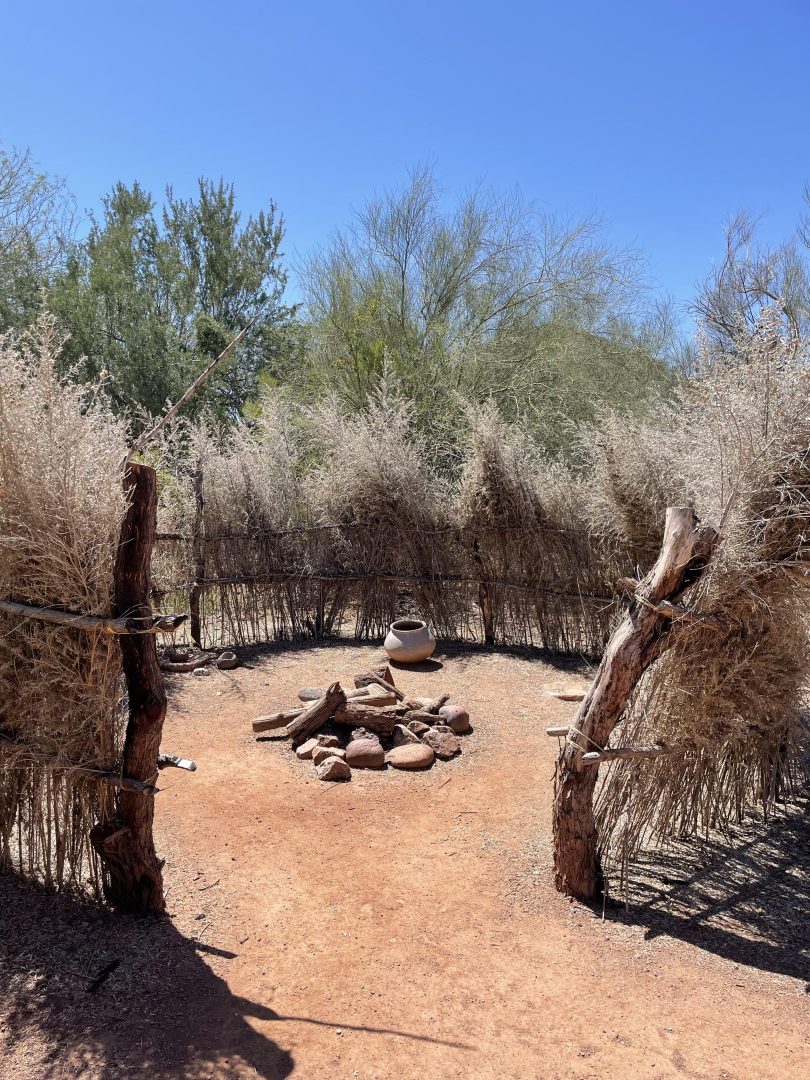
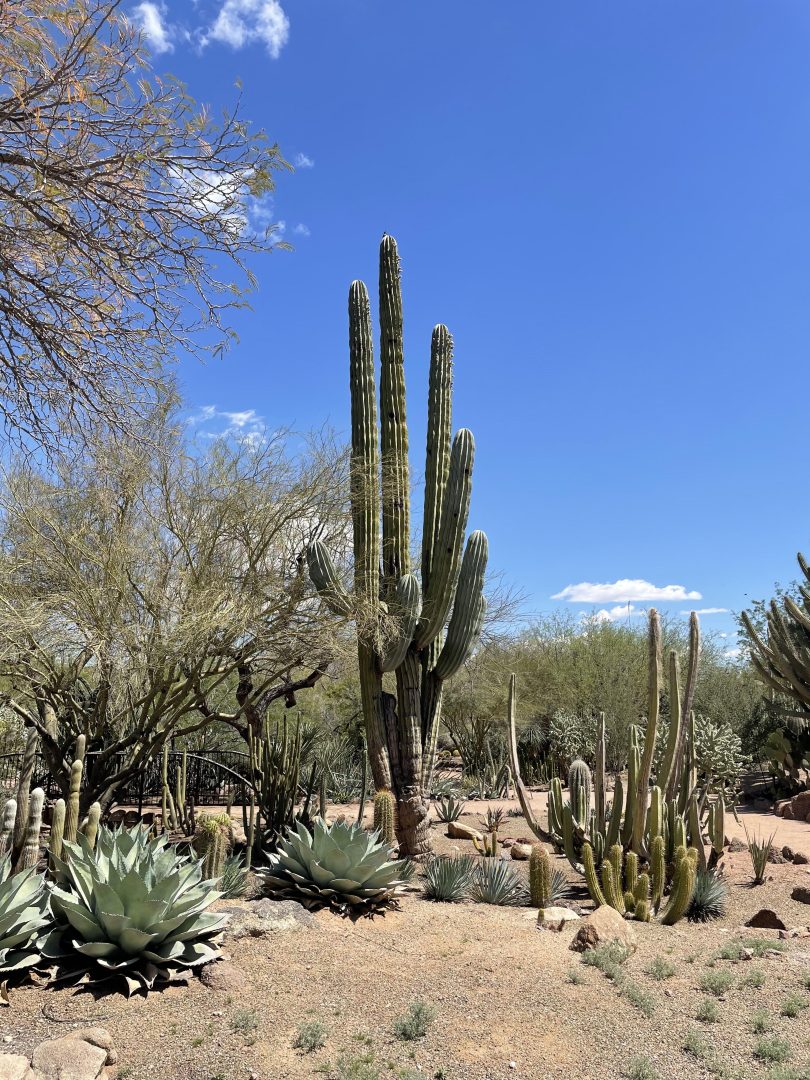
Celebrating its 85th anniversary, the Desert Botanical Garden boasts five trails – four of which are about a third of a mile – to stroll in. We wandered on the Discovery Trail, which features a wide variety of cacti and succulents as well as historic plant collections. Along the Harriet K. Maxwell Desert Wildflower Trail, we meandered through vibrant blooms and came upon bees, butterflies, hummingbirds, and other pollinators that play important roles in thriving desert ecosystems. On the Center for Desert Living Trail, the shortest stretch at one-tenth of a mile, we discovered fragrant herbs, vegetable beds, and shady spots to relax in. We found out how plants and animals survive on the Sonoran Desert Nature Trail. Along the Plants & People of the Sonoran Desert Trail, we walked through five different desert habitats and learned how indigenous people have used native plants for food, fiber, and shelter.

Saguaro cacti at the Discovery Trail | Photo by Brianna Chu / Hey SoCal

Later in the afternoon we took in Western Spirit: Scottsdale’s Museum of the West in Old Town. Built on what was once the Loloma Transit Station, the two-story museum showcases the art, culture, and history of 19 states in the American West, Western Canada, and Mexico. The 43,000 square-foot museum opened in January 2015 – the realization of Herb Drinkwater’s dream who served as Scottsdale mayor from 1980 to 1996.

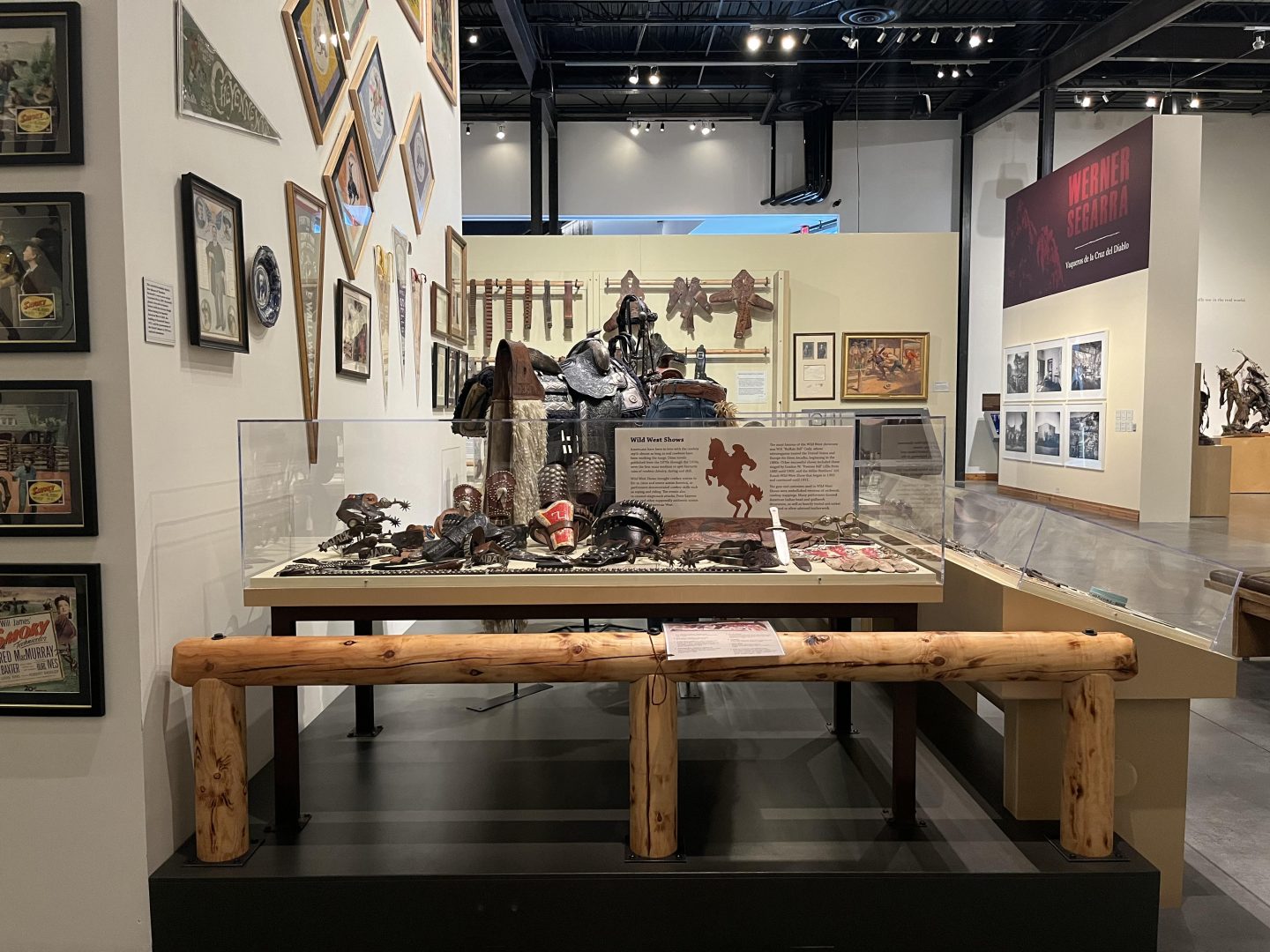
A permanent display of Southwestern artifacts | Photo by May S. Ruiz / Hey SoCal

Within the compact space are enlightening current exhibitions and permanent presentations. Inner Light: The Art of Tom Gilleon, a 70-year painting career retrospective featuring 12 oil paintings on loan from Walt Disney Imagineering, is showing until August 25, 2024 On view through October 2024 are the William Matthews’s plein air watercolors, and other mediums – album covers, murals, and ephemera that demonstrate his contributions in global art. The works of Warner Segarra, a Puerto Rican of German descent, is on view until May 19, 2024: a collection of photographs captured over 30 years shows the world of vaqueros.

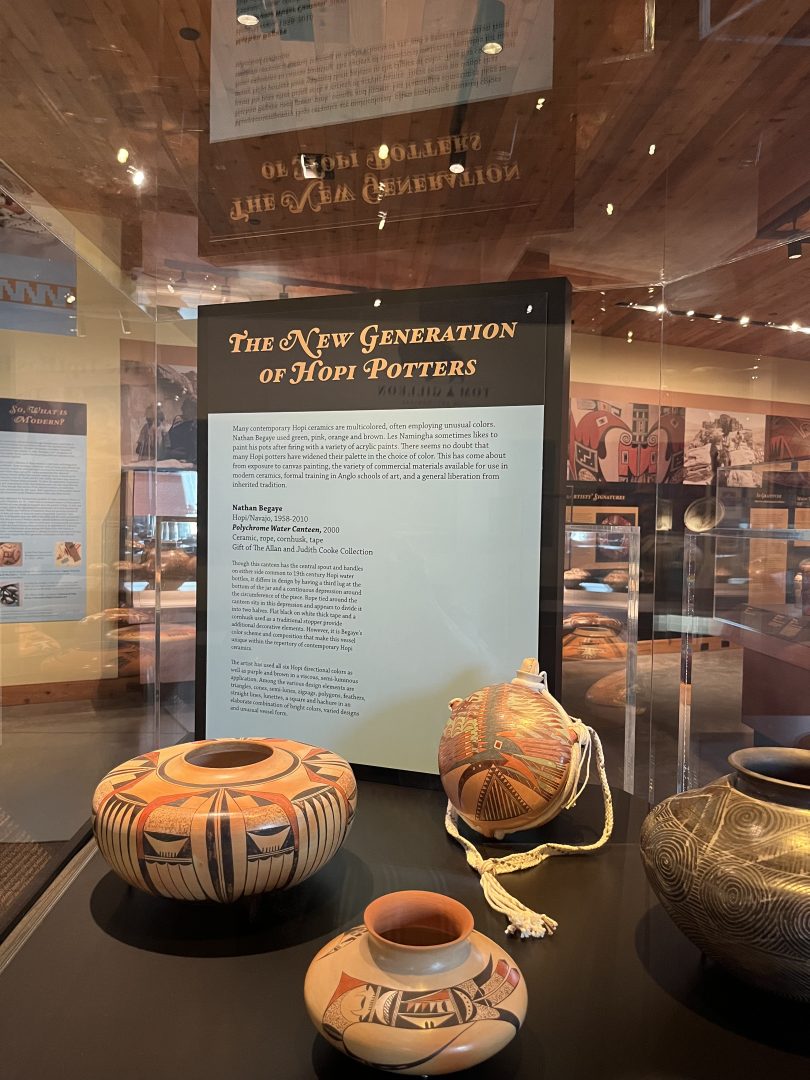
Canvas of Clay: Hopi Pottery Masterworks from the Allan and Judith Cooke Collection | Photo by May S. Ruiz / Hey SoCal

We marveled at the numerous ongoing displays that tell stories of the American West – Rails Building America, an exploration of the transformative power of railroads in shaping the Southwest; The A.P. Hays Spirit of the West Collection, an assortment of revolvers, rifles, saddles, knives, holsters, chaps, badges, and more; Dazzling Array: The Richard A. Gates Collection of Native American Jewelry; Courage & Crossroads: A Visual Journey through the American West; Canvas of Clay: Hopi Pottery Masterworks from the Allan and Judith Cooke Collection; Collecting Stories: John Coleman Bronzes from the Collection of Frankie and Howard Alper. 

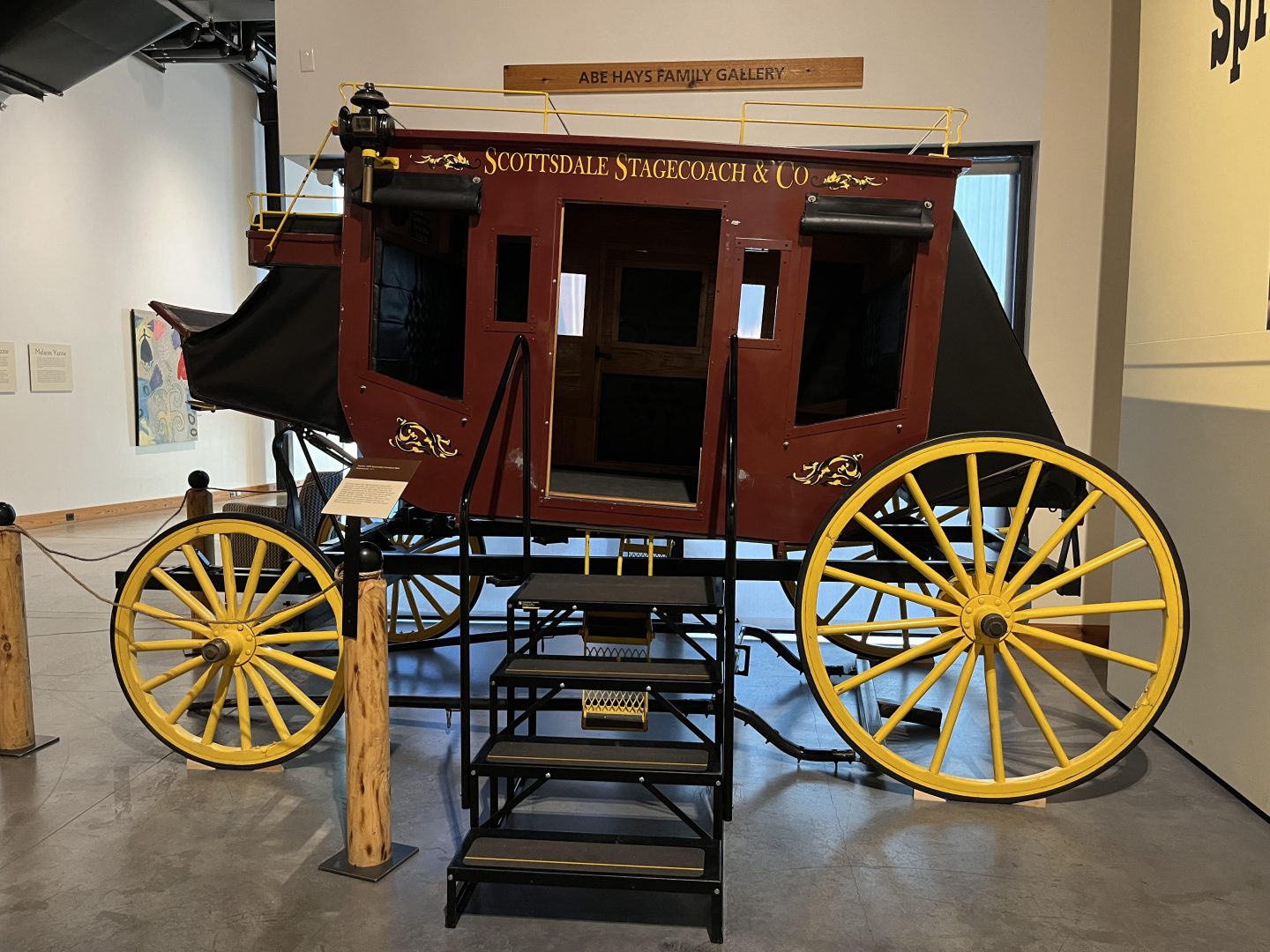
A stagecoach display | Photo by May S. Ruiz / Hey SoCal

A museum staffer announced we had ten minutes to complete our tour before closing time so we headed downstairs. We got back to the hotel, started packing for our drive home the next day, and made plans for dinner. As it was Saturday evening, restaurants were crowded and fully booked. We lucked out with Farm & Craft, a trendy but casual place known for healthy and sustainable food and fun cocktail concoctions. They even have a good selection of fruit-infused teas which I happily sampled. We had a delightful meal served by their pleasant and attentive staff. Having been told there’s a separate stomach for dessert, we walked to Jeni’s after dinner to once again indulge in their delicious ice cream.

On Sunday morning we ate a hearty brunch and did a final check of our rooms. The ever eager and helpful Logan took our luggage out to our car. It had been a fabulous long weekend – we had the best time in this gloriously picturesque city! But, alas, our adventure was at an end. Goodbye, Scottsdale!                         

Enjoy Culinary Delights at Taste of Little Italy San Diego

Also published on 23 April 2024 on Hey SoCal

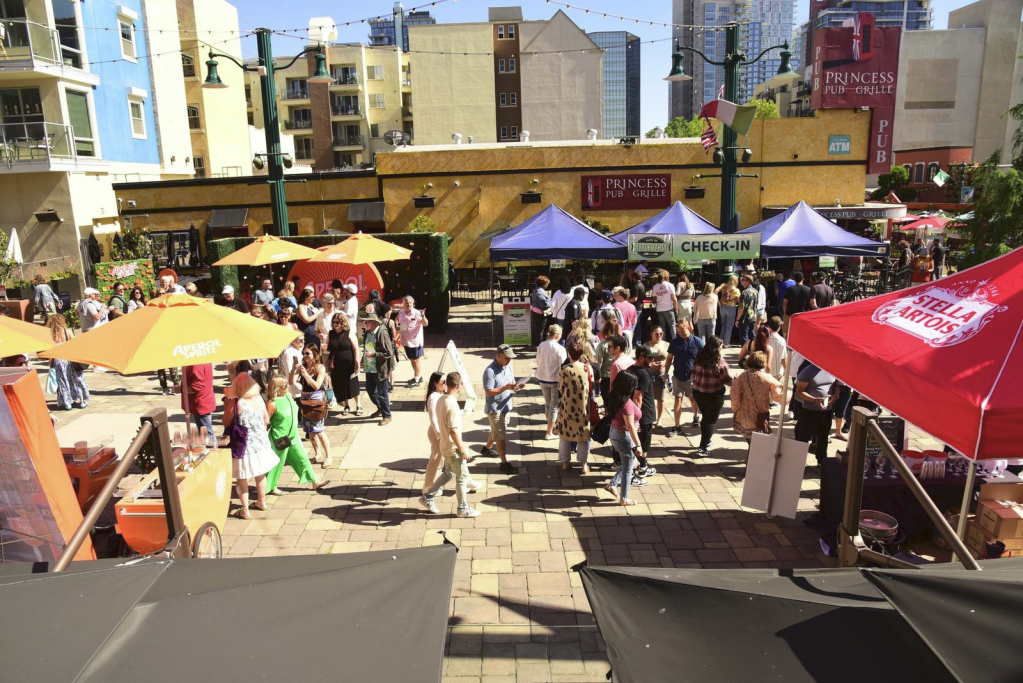
Thinking of traveling to San Diego this summer? Make sure you schedule your trip to include the Taste of Italy event which returns for two nights of delicious bites on June 18 and 19, 2024. First held in 2018, this famous foodie experience features restaurant exploration, live music, and memorable dishes.

From 4:00 to 8:00 pm on Tuesday, June 18, and Wednesday, June 19, visitors to Little Italy can immerse themselves in a gastronomic journey that spans 40 square blocks. Each day of the event brings a new culinary adventure, with different selections available from 20+ restaurants in the neighborhood. From classic pizza and pasta to gourmet burgers and sushi, this dynamic approach guarantees a fresh and exciting experience for both loyal patrons and newcomers.

Photo courtesy of Little Italy Association

While other Little Italies in the United States have declined because of the growth of other adjacent ethnic neighborhoods, San Diego’s Little Italy has remained a vibrant symbol of the remarkable contributions Italians have made to this country. Since the 1920s, it has been a stable ethnic business and residential community; it represents Downtown San Diego’s oldest continuous-neighborhood business district.

However, the area’s history is not without its dark period. At one time, more than 6,000 Italian families lived in Little Italy and toiled to build San Diego into the global hub of the tuna industry. When the tuna industry on the West Coast waned and 35% of Little Italy was torn down during the construction of Interstate-5 freeway, the neighborhood suffered nearly thirty years of neglect. Then, in the early 1990s established property owners and family-run business proprietors decided to take their fate into their own hands.

New Italian American and non-Italian business owners opened retail and professional spaces while creative builders and architects constructed beautiful developments. That it is today a model urban neighborhood not just in San Diego but also for the handful of Little Italies remaining throughout the country is a lesson in a community’s resilience.

Photo courtesy of Little Italy Association

This remarkable accomplishment can be credited mostly to the Little Italy Association (LIA), which was established in 1996 during the time of the revitalization of the Downtown area. The only district management corporation of its kind for any Little Italy neighborhood in the United States, it is run by a board of directors comprising 29 individual who represent property owners, residents, businesses, and the community at large. It advocates on behalf of its members’ best interests in matters of public safety, beautification, promotion, and economic development, while preserving the unique cultural resources of the area. Since its inception, it has been re-energizing this neighborhood while telling the story of Little Italy to its visitors through public art displays and amazing piazzas.

Visitors to Little Italy for the event will check in at the vibrant Piazza della Famiglia, where they will receive their exclusive Taste Passport. With this passport, attendees will embark on a culinary adventure, visiting a wide range of restaurants, checking off as they stop, to savor their curated “tastes” while they stroll through the neighborhood. For those who prefer a more leisurely experience, ample seating will be available at the Piazza della Famiglia, complemented by live music at Piazza della Famiglia and Piazza Basilone.

Photo courtesy of Little Italy Association

Curt Brooker of FUSE Events, which partners with the association to make this a successful endeavor, tells the origins of Taste of Little Italy. “There are many neighborhoods that hold ‘Taste of’ events, but Little Italy quickly started to showcase a growing number of restaurants that were being recognized throughout San Diego. The Little Italy Association decided to create an event that brought people into the neighborhood so they can sample the variety of restaurant options old and new.” 

“Taste of Little Italy began as a one day event and featured a handful of restaurants,” Brooker explains. “As the restaurant numbers grew, two routes were created on the same day with about 15 restaurants each. We were getting feedback from attendees that they just couldn’t eat so much food in one night. Now, Taste is a two day event that features approximately 20 restaurants each day. Tickets are $55 each day – it’s a great value for being able to try that many restaurants in a night.” 

“The number of restaurants have increased over the years and we continue to add new concepts as they come into Little Italy,” continues Brooker. “The restaurants are a true partner in this event and we make it a priority to not make it a burden on the restaurant or staff. We limit the number of tickets sold each day to 750. Over the two-day event, a total of 1500 tickets are sold.”

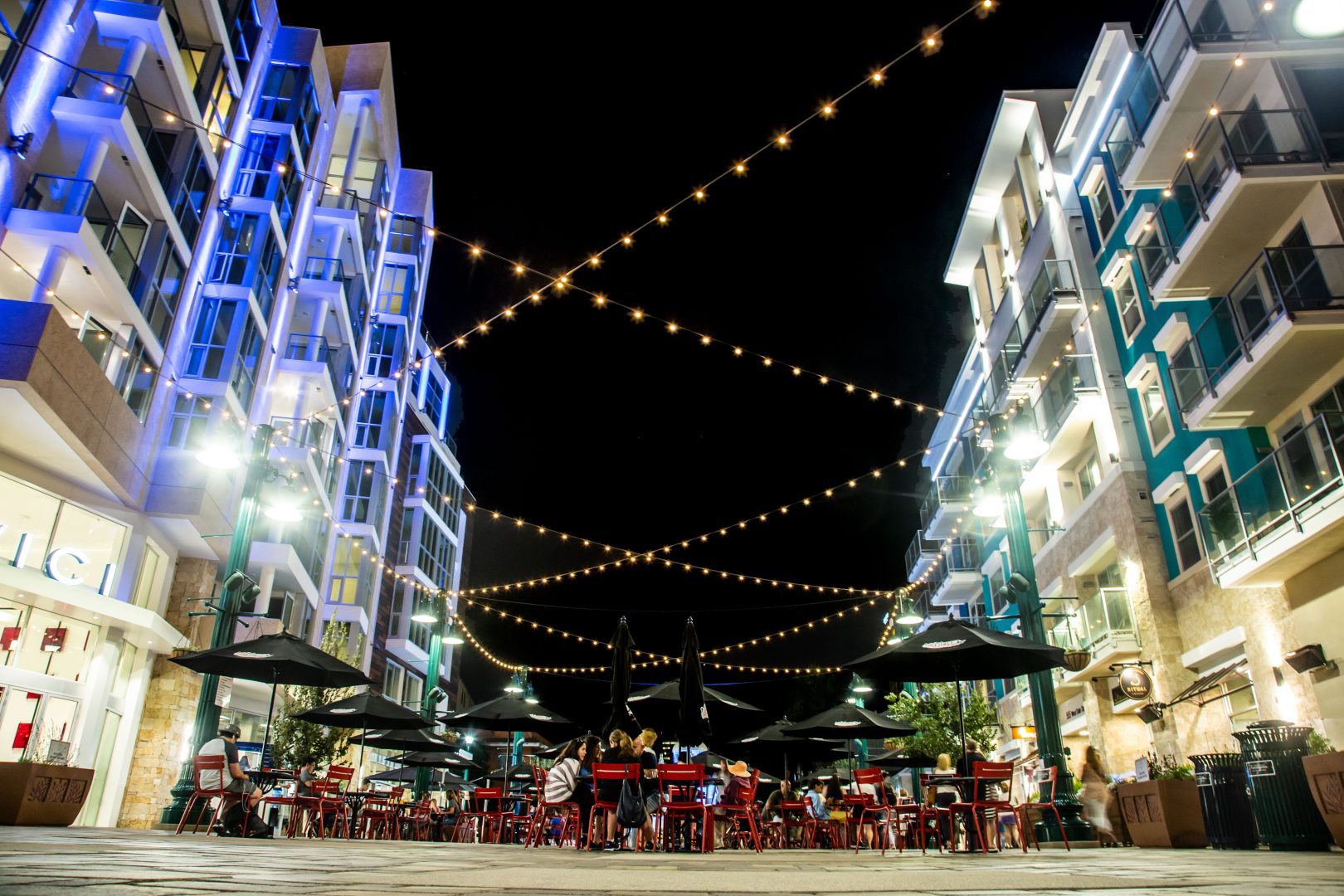
Pizza della Familia at night / Photo courtesy of Little Italy Association

Brooker says they are constantly making changes and adjustments to improve the event throughout its existence. “The Piazza della Familia has been the biggest change over the years. We now have this wonderful space to hold the registration area and have sponsor activations to enhance the attendee experience.”

Food and drinks aren’t the only things visitors can enjoy at Taste of Italy. Brooker clarifies, “We want to make each night an experience. So along with the food and drinks that are offered on the routes, we have live music placed throughout the neighborhood to give it that fun foodie vibe. Of course, we have a lot of the same restaurants participate each year, but there are new options that change year to year. Also, our sponsors bring new experiences each year. We’ve had a full ‘beer garden’ one year thanks to Birra Moretti and last year we had fun photo opportunities courtesy of Campari. We’ll again have new and fun activities for attendees this year in the Piazza.”

The community spirit which has made this little corner of San Diego flourish in spite of the economic downturn and global catastrophe was on full display a few years ago. Recalls Brooker, “One of the most memorable Taste of Little Italy events was during COVID. The neighborhood was quiet and the restaurants had obviously slowed down. We came up with a very unique idea that allowed people to enjoy the restaurants with a ‘Take Home Edition’ Taste concept. We had four nights where we curated a four course meal from four different restaurants. One restaurant  provided an appetizer, another the main course, dessert and a paired drink. It was a fun way during COVID to still enjoy Little Italy’s restaurants by taking home a variety of options from multiple restaurants.” 

Photo courtesy of Little Italy Association

Planning Taste of Little Italy is year-round. Brooker states, “Once the event ends, we are taking surveys and brainstorming how to make it a little better. Then it’s back to communicating with the restaurants on what to expect next year. There’s no Master Chef that leads the event; restaurant and bar owners have to secure their spot by February and our team works with them to try and bring as much variety as possible and highlight what each restaurant does best.”

There’s no fee for restaurants to participate and all the funds raised during the event go the Little Italy Association. The money is then used to help keep the streets clean, maintain the beautiful flowers and trees, and support the businesses with marketing and promotions.  

Taste of Little Italy is hugely popular and it’s a big attraction in San Diego. Says Brooker. “People try to walk up on the day of the event to buy tickets and are disappointed that we are sold out. I would recommend buying tickets as early as possible.”

So don’t miss out! Purchase your Taste of Italy ticket now and take a leisurely two-and-a-half-hour drive to San Diego for an unforgettable culinary experience.                        

Welcome Spring with PICNIC + FLOWERS

Also published on 8 February 2024 on Hey SoCal

       The Flower Fields in Carlsbad | Photo courtesy of Diana Rose Photography

After the cold weather and rain we’ve had, one can’t help but wish for spring to arrive. And what could be a lovelier way to bask in the mild Southern California sunshine than with a picnic and a walk on a field of vibrant blooms?    

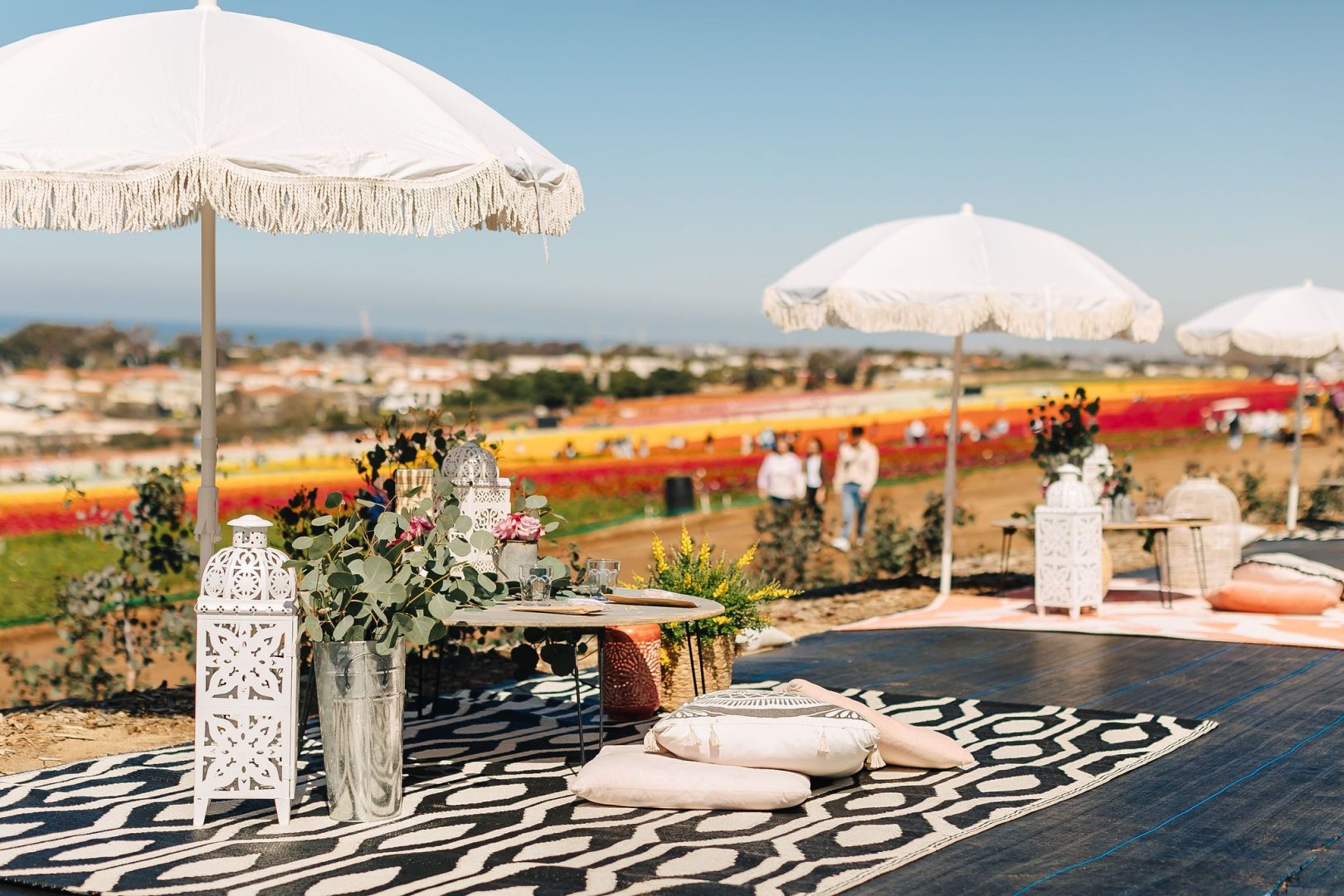
Pop Up Picnic Co. provides just that with their PICNIC + FLOWERS event when they return this year from March 23 to May 12, 2024. Against a backdrop of The Flower Fields in Carlsbad and the San Diego coastline beyond, picnickers will enjoy an elevated outdoors experience with curated bites, live music, and stunning views. The event will take place every Saturday and Sunday with seatings available between 11am and 2pm.

While several other picnic pop up companies have appeared in recent years, Lauren Kimmons is proud to have founded the original. She talks by phone about the origins of this popular event, “I created Pop Up Picnic as a promotional idea for Valentine’s Day 2012 to create buzz for the wedding + design business that I owned at that time. People loved it! We did them on request for several years and even when I sold that business in 2016, I never stopped getting requests for Pop Up Picnics. In 2018, I relaunched the service as Pop Up Picnic Co and we’ve been helping people get together ever since.”

Photo courtesy of Diana Rose Photography

Successful endeavors are usually products of an inventive mind, an entrepreneurial spirit, and serendipity, as PICNIC + FLOWERS proves. Kimmons explains, “PICNIC + FLOWERS was a nebulous dream of mine and it all came to fruition because of a great networking opportunity and a gracious, creative, fearless lady: Joni Miringoff of The Flower Fields. Joni happened to see my company included in press for the San Diego Tourism Authority Accelerator (Pop Up Picnic Co was an inaugural cohort member) and we just hit it off! That meeting set my business on a completely novel direction. I am forever grateful to SDTA and Joni for setting me on this new path.”

Kimmons says 1,195 people booked the weekend event in 2023, which encouraged her to return this year. And as she has always done, she does a lot of planning and prep work to ensure the event runs smoothly. She describes “I’m a big believer in systems. There are lots of details and  logistics that go into planning an event like this and the biggest thing is staying organized and starting early. There are a few key areas where we focus in the months leading up to P+F: logistics, guest experience, supplies, marketing, and staffing. Luckily, we have the blueprint from last year so we have the added benefit of seeing what works (and what doesn’t) and making adjustments from there. We’re a tiny but mighty team of just three full-time staff members. As the event comes closer we’ll add about five more team members.”

That’s not to say it was easy from the get-go. She says, “The biggest challenge was believing I could do it. But like anything, it’s just one foot in front of the other. That’s where my background in weddings really honed my talent for logistics and planning. We just take everything one step at a time. This year, I just hope it lives up to the success of last year! We’re adding new features and amenities for the guests like more shaded areas, increasing the menu, adding dessert, and including private parking. All these features come with new challenges but we’re up for the task!”

Photo courtesy of Diana Rose Photography

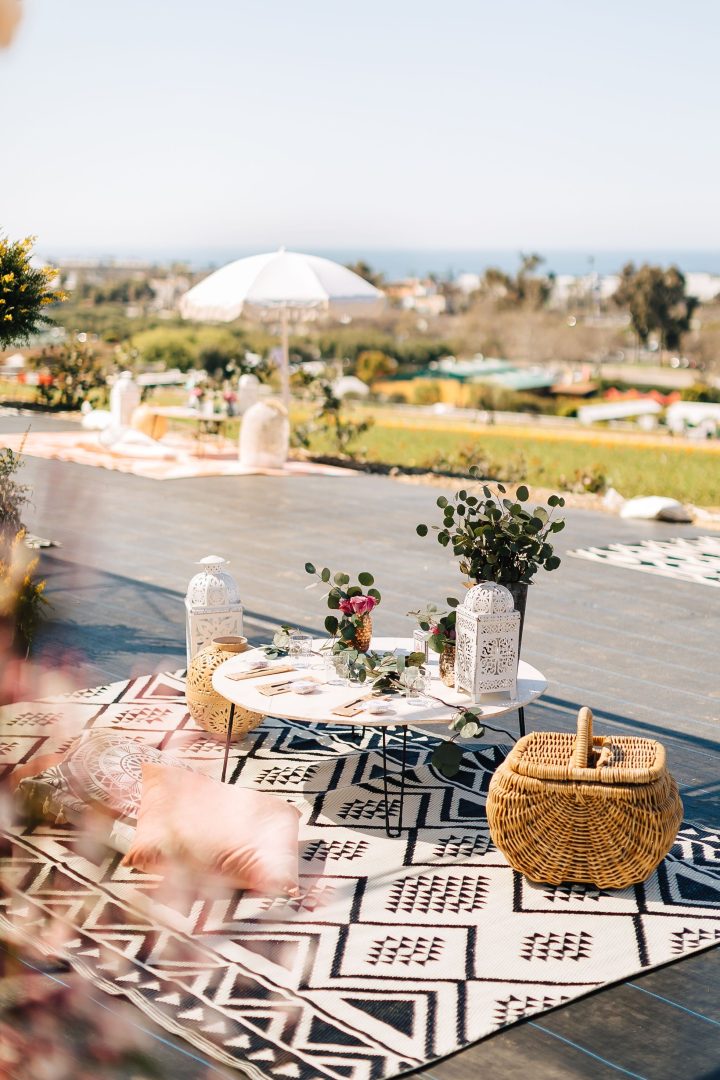
This pop up picnic isn’t only offered in Carlsbad. Kimmons clarifies, “We have picnics in several locations! Pop Up Picnic Co’s main service is picnics for parties of 2-25 guests throughout San Diego. We call them Pop Up Picnics, a term we coined way back in 2012. We have two styles – BOHO with low seating and ORIGINAL with farm tables and bistro chairs. We can pop-up at the beach, a park, your home and lots of other places.”

“We would love to have our guests come back again in 2024 and we’re offering a couple bonuses for our previous guests which will all go out to our email subscribers,” says Kimmons. “We’re adding some enhancements this year including a private entrance and dedicated PICNICS + FLOWERS parking which means more time enjoying the fields! PICNICS + FLOWERS guests will also receive free wagon rides, expanded shade structures, a family-fun zone with lawn games, and expanded pre-fixe menu with picnic-inspired tea sandwiches, an assortment of seasonal salads, charcuterie for the table and mini fruit pies for dessert. Moreover, we’re making the experience more inviting for families, on top of giving discounted kids tickets, we’ve created a really fun, picnic-themed kids menu with cheese sandwiches, fruit + kid-friendly, nut-free snacks. We also have custom PICNICS + FLOWERS activity packs with coloring pages and a scavenger hunt and lawn games in our family-friendly play area.”  

Photo courtesy of Diana Rose Photography

The culinary offerings at this year’s event are set to delight attendees. Guests will receive an individual box containing a tasting menu with a variety of options to choose from, including cucumber chive sandwiches, chickpea smash sandwiches, ham and tomato sandwiches, three seasonal side salad choices, mini charcuterie, and delightful fruit pies on a stick for dessert. Refreshing beverages will accompany the delectable bites such as hibiscus-lemon aguas frescas and mint-infused water. Children will be served a child-friendly meal comprising cheese sandwiches, fruit, and dessert.

While the charming picnics have limited seating times of one hour, guests are encouraged to linger and explore The Flower Fields at their leisure and enjoy their complimentary wagon rides. Games at the tables add to the entertainment, allowing attendees to savor the experience with family and friends. For those bringing their children, a family-fun zone will be open for play.  

It’s never too early to plan for fun things to do and new places to visit this spring. Make PICNIC + FLOWERS one of your exciting new adventures!    


La Jolla Concours d’Elegance Offers a Spectacular and Unforgettable Weekend Getaway

Also published on 29 January 2024 on Hey SoCal

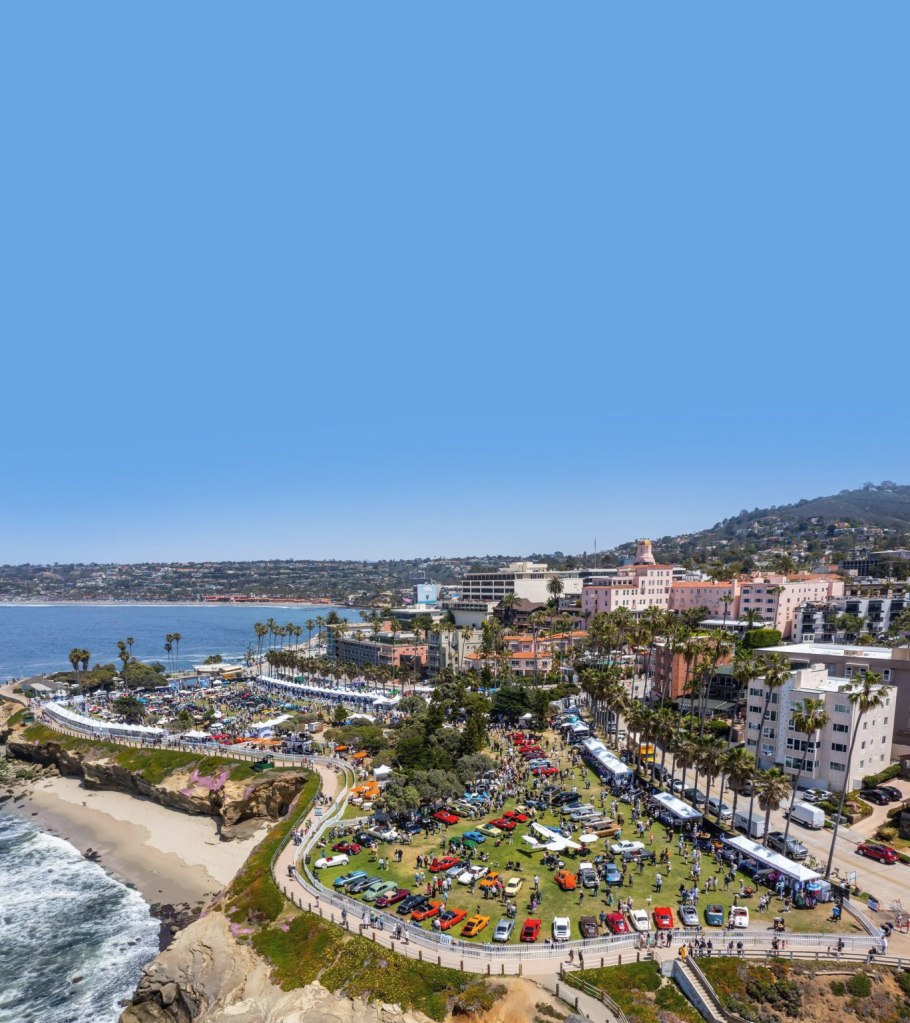
Photo courtesy of La Jolla Concours d’Elegance

Located about 120 miles south of Pasadena, La Jolla is a wealthy seaside community with a population of approximately 50,000 or close to a third of Pasadena’s. It occupies seven miles of coastline and is home to several venerable educational foundations, including the Scripps Institute of Oceanography and University of California San Diego; historic buildings like the La Jolla Woman’s Club and La Jolla Recreational Center; renowned sports venues such as Torrey Pines Golf course and La Jolla Beach and Tennis Club.     

It is also the breathtaking setting for the Annual La Jolla Concours d’Elegance, which will be held this year from April 19 to 21. Presented by LPL Financial and major sponsors Panerai, Mercedes Benz, and Sotheby’s, among others, it will showcase classic automobiles from the Roaring ’20s and Glamorous ’30s. Celebrating its 18th year, it is recognized as the premier automotive lifestyle event.

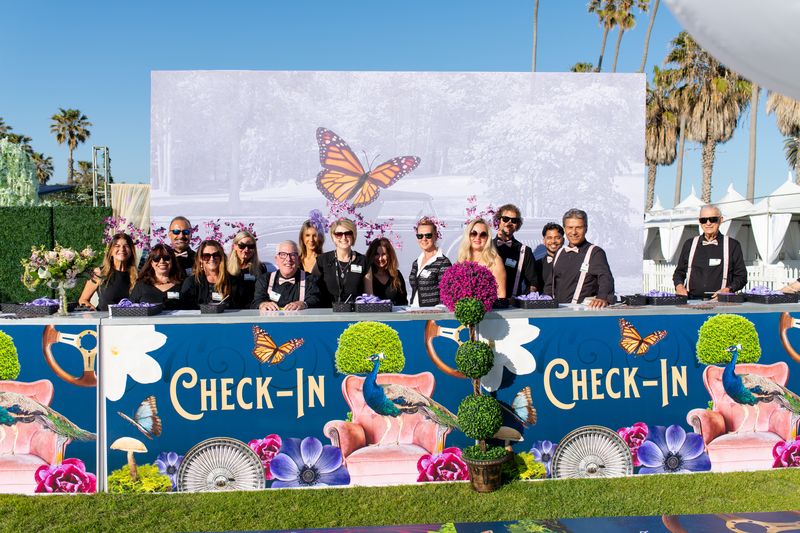
Photo courtesy of La Jolla Concours d’Elegance

Speaking by phone, event chair Michael Dorvillier talks about the event’s humble beginnings and how it evolved into one of the most prestigious classic automobile showcases in the country. He relates, “It was created 20 years ago as the La Jolla Motor Cars Classic by a group of community leaders and merchants with the primary objective of bringing business into La Jolla in the month of January when things are usually really, really quiet. Then sometime in 2011 or 2012 the original founders handed ownership of the show to the La Jolla Historical Society.”

“Incidentally, the historical society’s executive director at the time was a friend of mine and didn’t know anything about cars,” adds Dorvillier. “The founding group knew I was a car collector – I would always go to the show because it was in my own backyard. I put in a car once; it was always a fun thing for me to do. They also knew I was passionate about the community and I had relationships in the car world. I was asked to step in and be part of the committee that oversaw the event. I was at a point in my professional career when I was financially stable and I wanted to find something I could donate time and money to.”

A wealth manager offering financial services, Dorvillier has lived in La Jolla for the past 35 years. It was where he raised his kids and established his business. Buying and collecting old cars, tinkering with them and showing them, became a lifelong hobby when he bought his first car – his dad’s 1969 Camaro – which he retrofitted with fancy wheels and a modern motor.

Dorvillier continues, “I joined the committee the first year to observe and soak up as much information as I could about this event as it stood then and what its future could look like. And I realized very quickly they had this really great little car show, but it was on a concours venue at this amazing location – Ellen Browning Scripps Park. No other organization can have that entire  park for a weekend to themselves, but the show had been there long enough that they kind of had that in their back pocket. However, I wasn’t going to put in my time and energy for a local car show held once a year on a Sunday; I wanted to do a proper concours. Thus, in 2013, the three-day weekend getaway called La Jolla Concours d’Elegance was born.”

Photo courtesy of La Jolla Concours d’Elegance

“When we converted it to a concours, we needed to have judges. Today we have 75 volunteer judges who are from different parts of the U.S., and six or seven of them come from overseas. They’re all specialists in the cars they judge and they want to have La Jolla on their resumé. There are, in fact, quite a few high-end concours around the world. You can go to many different ones around the globe and see world-class cars that travel from concours to concours. But what makes us stand out and garner global attention is the experience we offer. Our tagline is ‘world-class cars, world-class experience.’    

And La Jolla Concours d’Elegance has certainly lived up to that claim. Dorvillier remarks, “Last year, we had 21 Duesenbergs on display. Most of them were 1 of 1 – meaning they only ever made one of them. Every single screw, wire, and leather seat was exactly what it would have been when the car was built new. The first five or six Duesenbergs in the line-up were probably worth $100-M. These are pieces of art! They’re very rare, beautiful automobiles. You don’t have to like cars to come to our show and love it and want to come back. You’re looking at art and history.”

The three-day getaway experience has an impressive array of activities with every amenity imaginable. Much thought and planning have gone into this year’s event, starting with the cover art for the posters, programs, tickets, banners, and other promotional materials. Official La Jolla Concours artist Scott Jacobs, prominent for his incredible photorealistic paintings of motorcycles and automobiles, will continue to astound as he paints the 1937 Rolls-Royce Phantom III from the Aaron Wiess collection.

The 1937 Rolls-Royce Phantom III epitomizes the luxury and engineering prowess of pre-war Rolls-Royce. This model, replacing the Phantom II, is distinguished as the only V12 Rolls-Royce until 1998’s Silver Seraph. Among the 721 V12 Phantom III chassis built from 1936 to 1939, this particular vehicle is a testament to the era’s peak in automotive luxury and design. Its heart, an aluminum-alloy V12 7.32-liter engine, is a marvel of its time, featuring a dual ignition system with two distributors and 24 spark plugs. Enhanced by Ace wheel discs for aesthetics and practicality, the car also boasts advanced features like on-board jacking and the Bijour lubrication system. Scott Jacobs’s portrayal of this iconic vehicle in his artwork not only captures its elegance and sophistication, but also serves as a tribute to the artistry and grandeur of the automotive and artistic crafts of the era.    

Photo courtesy of La Jolla Concours d’Elegance

Instead of featuring a single marque, the 2024 Concours celebrates a vast range of makes and models from the transformative era of the 1920s and 1930s, including Bugatti, Duesenberg, Packard, Bentley, Rolls Royce, and more. From sleek Art Deco designs to the powerful engines found within, these vehicles will transport spectators back to a time of innovation, luxury, and boundless enthusiasm for automotive craftsmanship.

An exquisite collection of automobiles will also be on display including:

  • 1932 Chrysler CP8 (Robert Schlesier): A marvel of engineering with only 5 surviving examples of the original 251 built. Debuting at the La Jolla Concours after extensive restoration, this car boasts a unique transmission.
  • 1930 Ruxton (The Nethercutt Museum): Of the 96 produced, fewer than 20 survive. The Ruxton’s distinctive striped paint job highlighted its low profile.
  • 1937 Rolls Royce Phantom III V-12 (Thrupp & Maberly): Originally commissioned by Sir Kameshwar, Maharajah of Bahadur, this vehicle was a highlight at the 2003 Pebble Beach Concours.
  • 1965 Alfa Romeo Giulia SS (Mark Angotta): A rarity in black, among the 1,400 built, this model stands out for its stunning livery.
  • 1955 Jaguar D-Type: Once owned by Hollywood comedian and writer Jack Douglas, this is one of only 71 ever made.
  • 1973 250 cc Husqvarna Trials Bike: A rare find in the USA, with only 200 initially imported.
  • Aston Martin DB5: Celebrated as the “Most Famous Car in the World,” renowned for its iconic role in the James Bond film ‘Goldfinger.’
  • Fiat 1500 GT by Ghia (Kipland Howard): An extremely rare model, with only 36 imported to the USA and fewer than 50 known to survive worldwide. Its appearance at the La Jolla Concours marks its American debut.
  • 1962 Triumph Italia 2000 Vignale (Kurt & Sharon Oblinger): Designed by Giovani Michelotti and built by Vignale, this is one of the only 328 ever produced.
Photo courtesy of La Jolla Concours d’Elegance

The world-class experience begins on Friday, April 19, with a VIP Party from 6:00 to 10:00 pm at Ellen Browning Scripps Park. Guests will immerse themselves in live music, savor artistically crafted cocktails from a hosted bar, relish gourmet delights from 20 of San Diego’s top restaurants, and participate in an exciting live auction featuring unique items.

On Saturday, April 20, guests will take part in an intimate and exclusive experience from 7:00 am to 2:00 pm. They will start the day by visiting remarkable car collections followed by a driving tour of the dramatic scenery of San Diego. A sumptuous lunch awaits them at the private venue.

Later that day, “Porsches on Prospect” goes on from 5:00 to 9:00 pm. Guests will witness 75 magnificent Porsches lining Prospect Street, and enjoy the village’s vibrant atmosphere, featuring live music, exclusive retail offers, gallery openings, restaurant specials, and much more.

On Sunday, April 21, from 9:00 am to 4:00 pm, guests will get a once-in-a-lifetime chance to view over 200 spectacular and rare vehicles that will be displayed at Ellen Browning Scripps Park on the La Jolla Cove lawn along the breathtaking Pacific Coast. They will indulge in the Champagne and Honey Tasting Garden and other unique experiences throughout the day. They will enjoy live music, visit exclusive vendors, and be treated to refreshing beers and cocktails – all while surrounded by an extraordinary display of cars. Moreover, they will watch a vintage flyover along the coast!

Photo courtesy of La Jolla Concours d’Elegance

That the little La Jolla car show has gone on to the become the dazzling and sought-after weekend party is not lost on Dorvillier. He enthuses, “When I took over as chairman, I jokingly said to someone one day ‘Every time I say to my wife let’s go to this car show this weekend, her response is do we really have to go to another one of those?’ It’s usually the last thing a non-car person wants to do. So we purposefully created an experience where if the husband was the car guy and the wife was sick of going to car shows, she was going to be dragging him back next year. And we have succeeded!”

Dorvillier quickly points out that he didn’t accomplish this feat by himself – there are 24 individuals that make up the committee who share the credit. He says, “Laurel McFarlane of McFarlane Promotions is the event coordinator and she’s been involved with this show from Day One. As the event grew, I spread out the responsibilities so there are now two components: the ‘talent,’ which are the cars; and the business aspect, which encompasses fundraising and sponsors, and the parties. While I oversee the entire project, I focus on the business side and my co-chair Bob Kerner runs the talent side. He has a team underneath him that ensures everything that’s related to the cars is perfect and topnotch – finding the cars and judges, for instance. We’re very discerning when it comes to cars, we don’t take any automobile that comes in. The selection team goes through all the cars and makes sure they’re authentic and original, worthy of having on the field. The executive committee, along with the car selection committee and the chief judge, decide on the marque.”

The La Jolla Concours d’Elegance is actually a year-long endeavor. Dorvillier explains, “We start over the minute one show ends. We didn’t hold it during the pandemic, but in October of 2021 we organized a golf tournament that raised the money we needed to pay for our expenses during the two years we were off. There are costs associated with this event and we needed to generate enough revenue while we sat on the sidelines so the Historical Society wouldn’t get adversely affected.”

Photo courtesy of La Jolla Concours d’Elegance

A unique event in this year’s celebration is the Mille Miglia at La Jolla which Dorvillier is excited about. He says, “Hagerty, the largest insurance company in the car industry, owns the California Mille, which is a 1,000-mile race that started in Italy and is still held there to this day. (The iconic car racing event was begun by Counts Aymo Maggi and Franco Mazzotti in 1927). Hagerty has reinvented that race here in the United States and this year they’re starting the Mille Miglia at La Jolla at the Concours. On Monday morning, all those cars participating in that race – I believe there are about a hundred – will take off on their 1,000-mile race over five days through Southern California. All the cars are classic Ferraris, Lamborghinis, and Maseratis  from the ‘50s and early’60s era.” 

It has been a little more than a decade since Dorvillier took the reins of what is now La Jolla Concours d’Elegance. And in that time, he has met many wealthy yet unassuming people who are just taking in the joys of seeing the most beautiful cars in one place. He marvels, “My best memories involve the people that I’ve met in the car hobby world. When you come to our event, you’re standing there looking at a Bugatti or a Duesenberg that costs anywhere from $10-M to $20-M and you’re talking to the owner. You have no idea that that person is a billionaire other than the fact that he owns that car. They’re just very down-to-earth people who are truly passionate about their hobby, which is collecting and preserving these pieces of art.”

Photo courtesy of La Jolla Concours d’Elegance

“For a long time, La Jolla was a sleepy town. But the Concours d’Elegance has livened things up for our community,” declares Dorvillier. “It has helped tourism – people usually arrive on a Thursday and stay for the weekend. Last year we were able to fill 800 hotel rooms; visitors dined in participating restaurants, shopped at clothing stores and various retail establishments, and went into museums. (There were 2,500 attendees in the Sunday events but there were several free events during the weekend so the total attendance was much higher) I’m proud to have played a small role in putting La Jolla back on the international map.” 

“That said, I didn’t do this all by myself,” Dorvillier emphasizes. “Indeed it takes a village to make this happen – we have a dedicated team year-round and 250 volunteers on the weekend of the event. And I want to make sure they get the recognition they deserve.”

Dorvillier and his team have stopped at nothing to put on a once-in-a-lifetime experience. What could be more spectacular than driving down to La Jolla on a beautiful Friday morning this spring with clear blue skies above and the pristine waters of the Pacific Ocean on the horizon and then spending the weekend at the La Jolla Concours d’Elegance? It promises to be one weekend affair to remember! 

Taking in the Rarefied Atmosphere of Oxford

Originally published on 23 September 2019 in the Pasadena Independent, Arcadia Weekly, and Monrovia Weekly

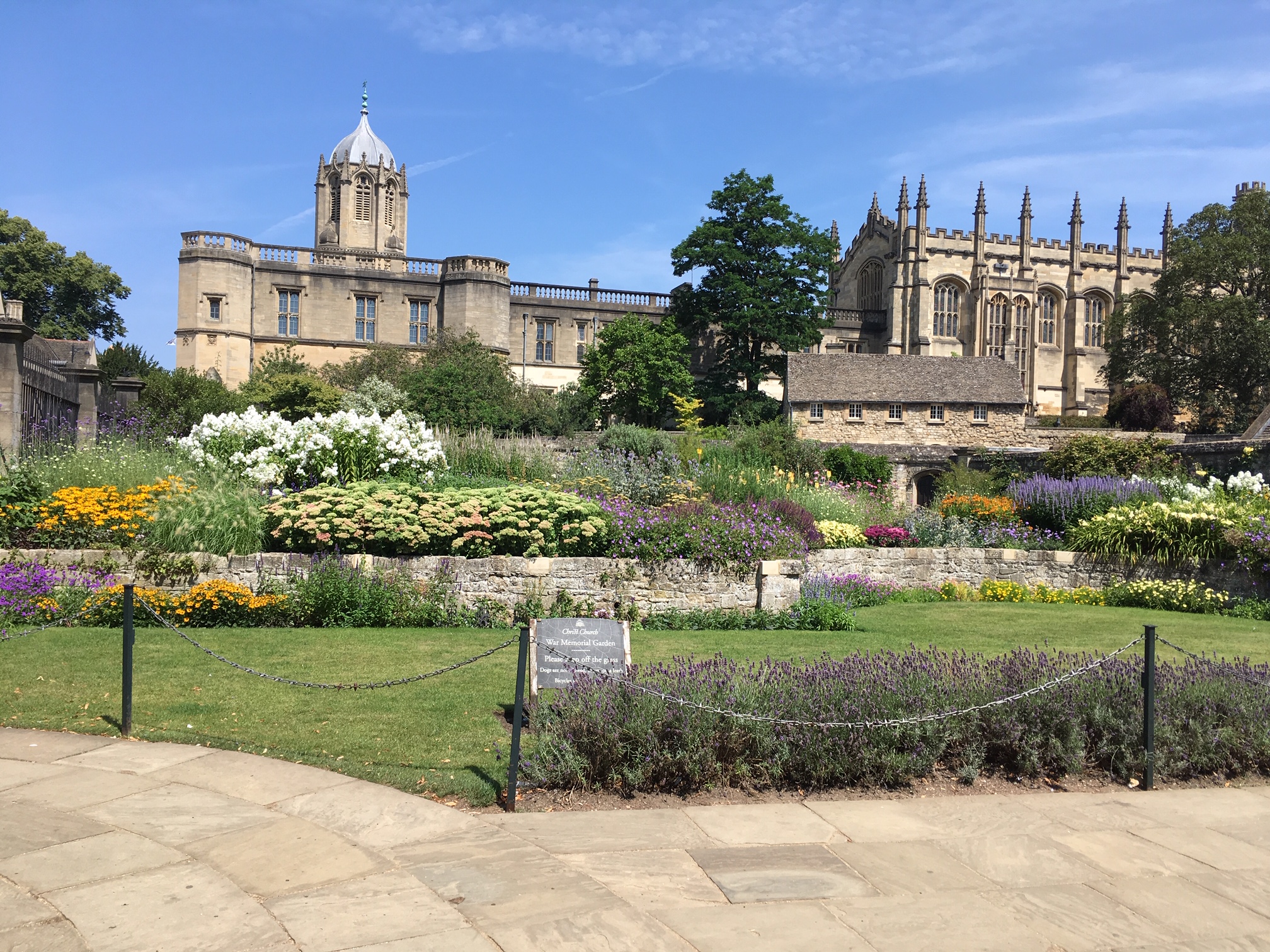
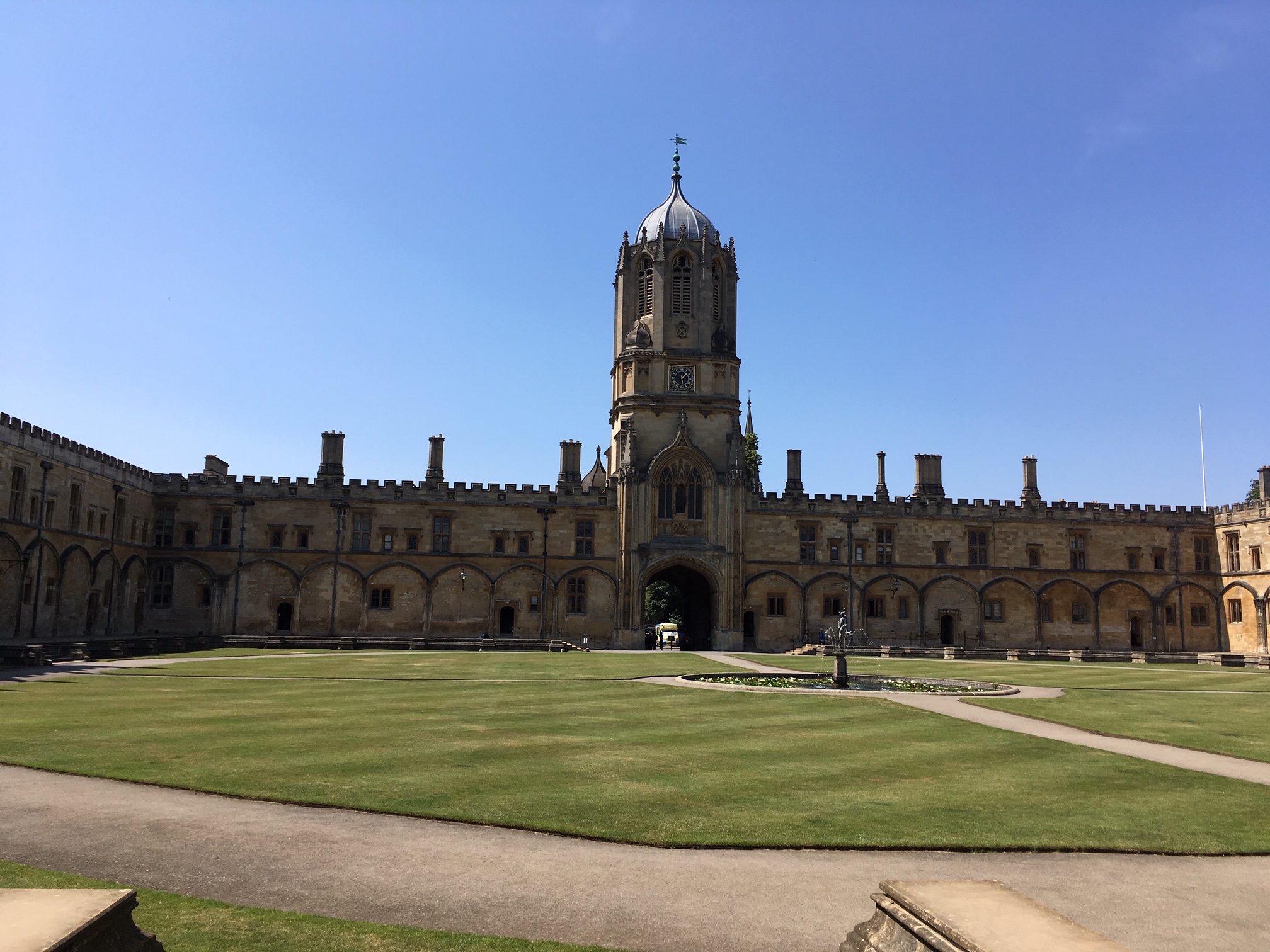
Christ Church College | Courtesy photo

Oxford, England, located in Oxfordshire (51 miles north of London), is best known for its university – the oldest in the English-speaking world and, quite possibly, the most esteemed institution of higher learning on earth. There was some form of teaching there as far back as 1096. Unlike at other university towns, the University of Oxford was there before the area was settled in, so the town was built around the school.

The first time I went to Oxford, 29 years ago, it was during the spring and it seemed like the quintessential college town. This time around, however, the atmosphere was as widely different as night and day.

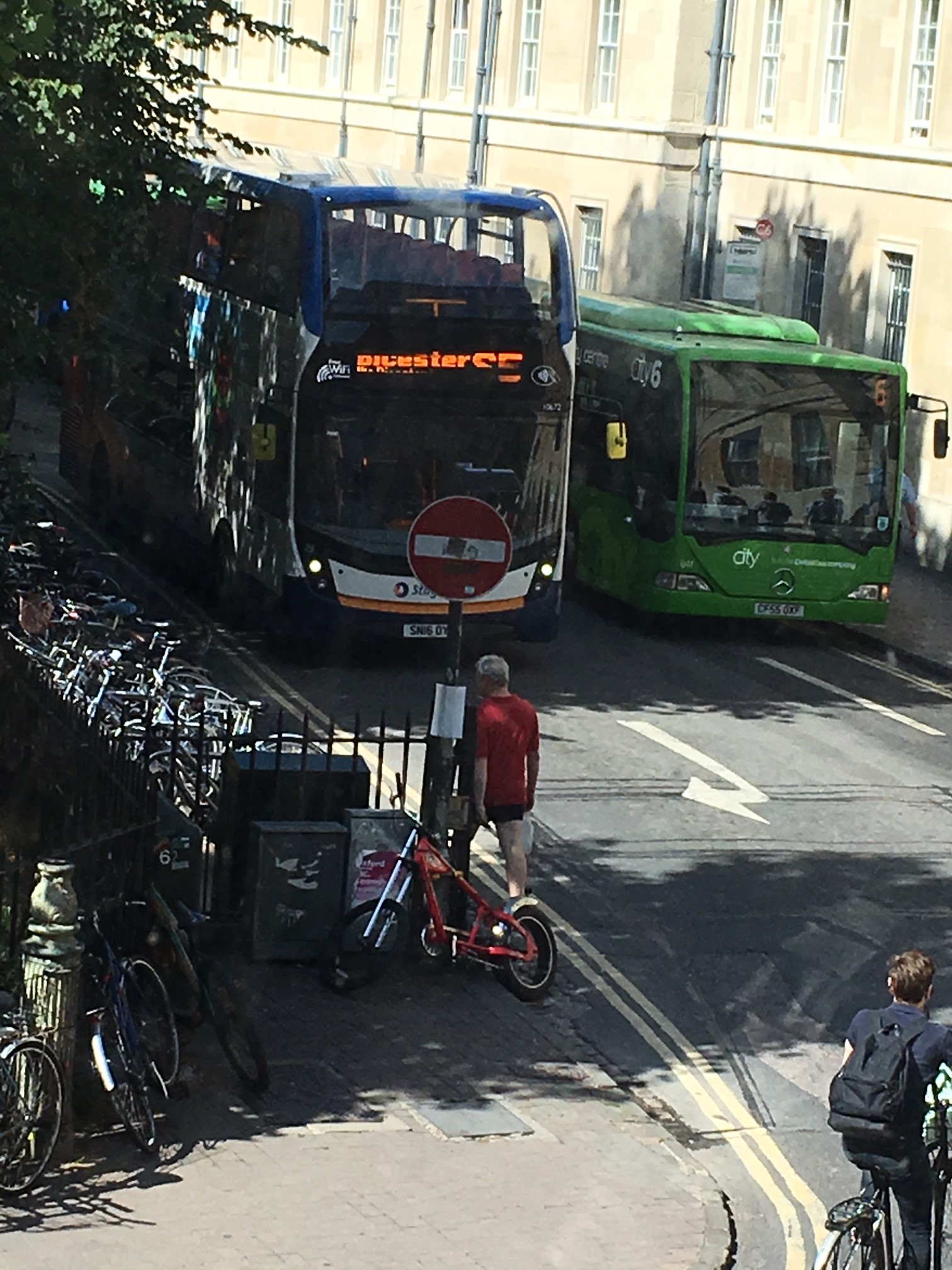
My two young companions and I arrived in Oxford around 2:45 in the afternoon, having left Cambridge on the 13:30 train from London Kings Cross. Immediately, as we alighted, we felt the contrast between the two cities. Whereas Cambridge was calm even with tourists visiting for a few days and kith and kin descending into town for graduation week, Oxford buzzed with incessant activity and teemed with humanity jostling for space. Dozens of tourist vehicles, double-decker buses, taxis, and cars of all models and makes greeted us when we got out of the station. There were people milling every which way and vendors selling all sorts of souvenir items. It was a veritable circus.

It was also an uncommonly hot summer day for England where it’s usually cold and grey. We happened to be traveling there in one of their rare heatwaves. Thankfully, we were already in Oxford when Cambridge registered a temperature of 38.7C (101.7F), the highest ever-recorded in the U.K. (it beat the previous UK record of 38.5C set in Kent in 2003). But it wasn’t that less hot in Oxford either – it was 37C (98.6F).

But the situation only became worse when we got to the Van Brugh, a boutique hotel which was formerly a residence, and we found out it had no air conditioning (a fact they did not disclose on their website)! The building was ill-equipped for the soaring temperatures and the staff was woefully unprepared to allay the situation. The rooms were 32.7C (90.86F) at night and, for security reasons, the windows wouldn’t open more than a few inches. The electric fans and buckets of ice the staff provided didn’t do much to ease our discomfort.

We stayed outdoors sightseeing for as long as possible but there was no escaping the heat. We walked around town with the big umbrellas the hotel kept in every room, for the downpours that are normally expected, and we used them to shield us from the sun. We must have looked ludicrous. However, we saw several Asian tourists who had the same idea – it was like being back home in the San Gabriel Valley. In fact, it seemed like all the tourists were Asians!

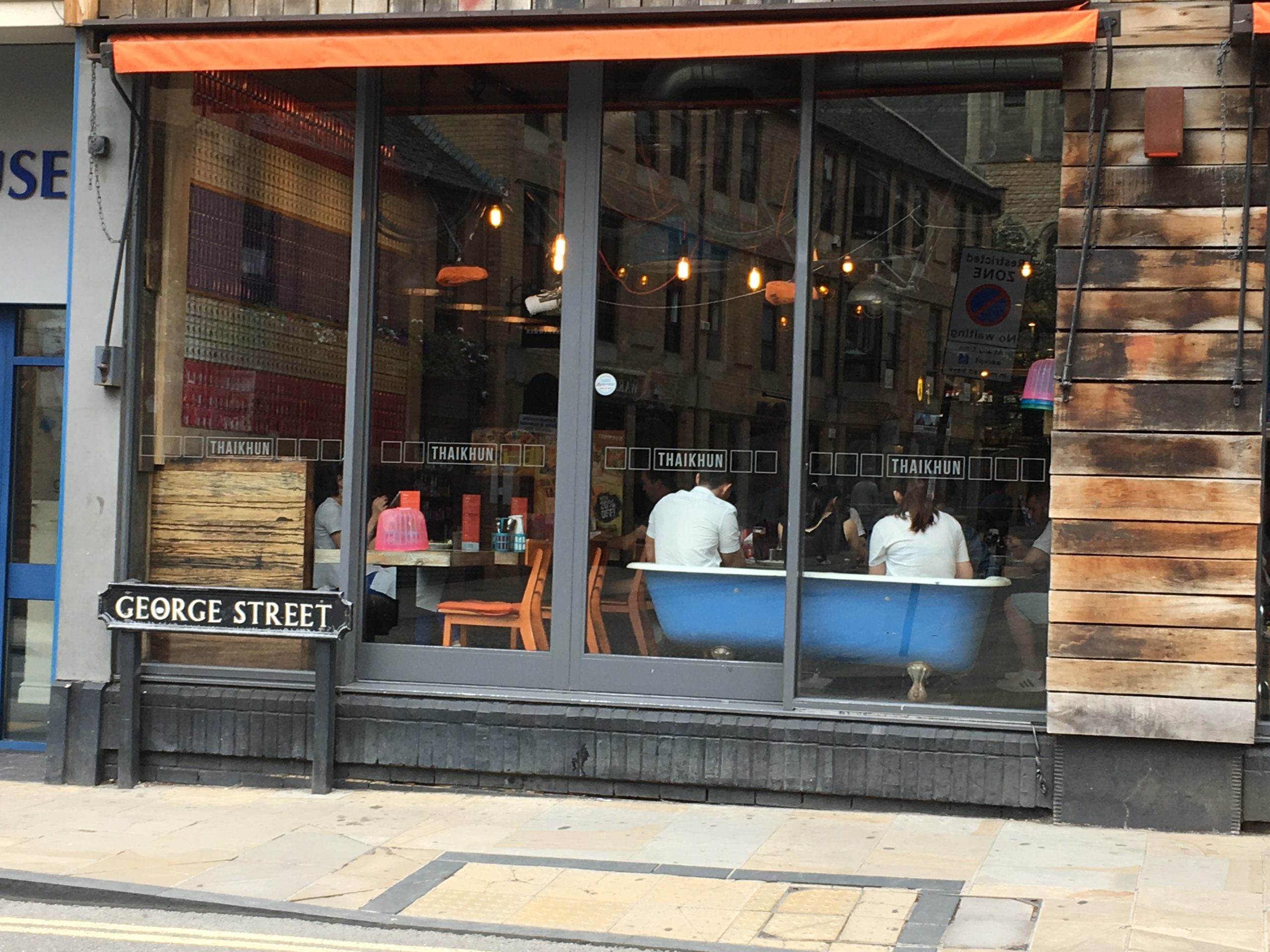
This Thai restaurant on George Street has a bathtub for seating | Photo by May S. Ruiz / Beacon Media News

Happily, Van Brugh is located on St Michaels Street, off of George Street, and is central to all the places we wanted to go. We spent that first day meandering and decided to get an early dinner at Cote Brasserie on George Street as we made our way back to the hotel.

Oxford is a very popular tourist destination, with themed ‘Official Walking Tours’ to fit everyone’s interest. There’s the two-hour tour of the university’s most iconic buildings. Fans of the British detective series ‘Inspector Morse Lewis’ and ‘Endeavour’ can take a two-hour tour of the various locations used in the show. And then there are the ‘Official Harry Potter Highlights Tour of Oxford’ and the ‘Harry Potter and Alice in Wonderland Official Oxford Tour.’

Opting not to join any official tour, we set out on our own to see the various sights. Our first stop was Christ Church Cathedral and College – paradoxically the largest of Oxford colleges combined with the smallest cathedral in England. While Christ Church isn’t the oldest college (that claim belongs to University College), it is, arguably, the most prestigious.

Christ Church Cathedral and College | Photo by May S. Ruiz / Beacon Media News

Christ Church Cathedral’s and College’s architecture, population, and way of life have been a source of inspiration for many authors and filmmakers. Lewis Carroll studied, taught, and lived at Christ Church for 47 years and his ‘Alice’ was Alice Liddell, the daughter of the Dean at that time. In the Dining Hall, on the left-hand wall, the fifth window from the entrance bears portraits of Alice and creatures from ‘Alice in Wonderland.’

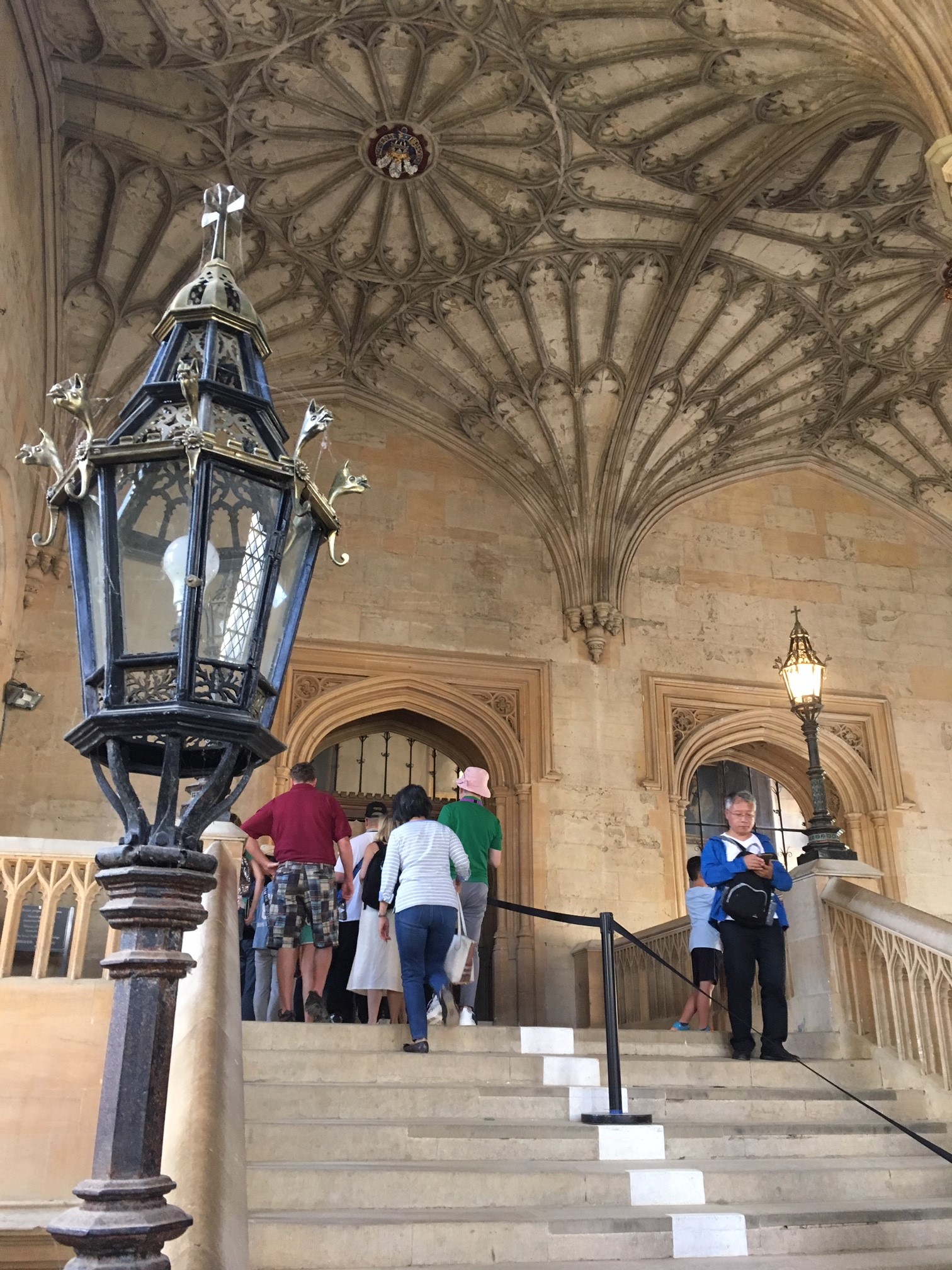
The Quad, Cloister, and Hall Staircase have been used in several films. Harry Potter fans will recognize the tops of the Hall Staircase where Professor McGonagall welcomes Harry, Hermione, Ron, and their classmates to Hogwarts. The Cloister is where Harry is shown the Quidditch trophy his dad won when he was a seeker. The Great Hall was replicated in a studio to become Hogwarts Hall.

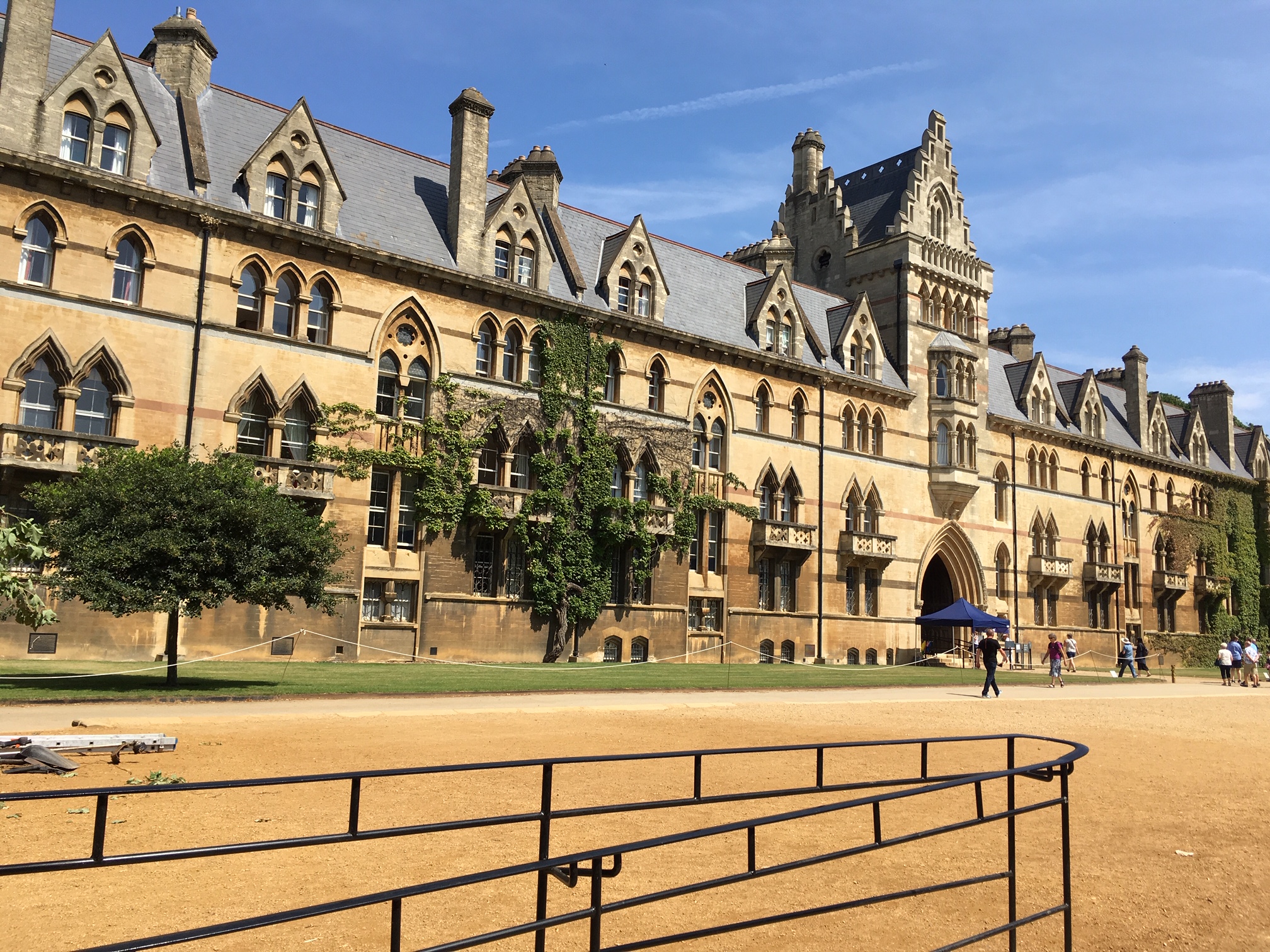
Christ Church Meadow Entrance. | Photo by May S. Ruiz / Beacon Media News

We entered Christ Church through the Meadow and the Meadow Building bordered by the rivers Cherwell and Thames. The limestone path was lined with glorious blooms and made for an extremely pleasant walk, even on this hot and humid day.

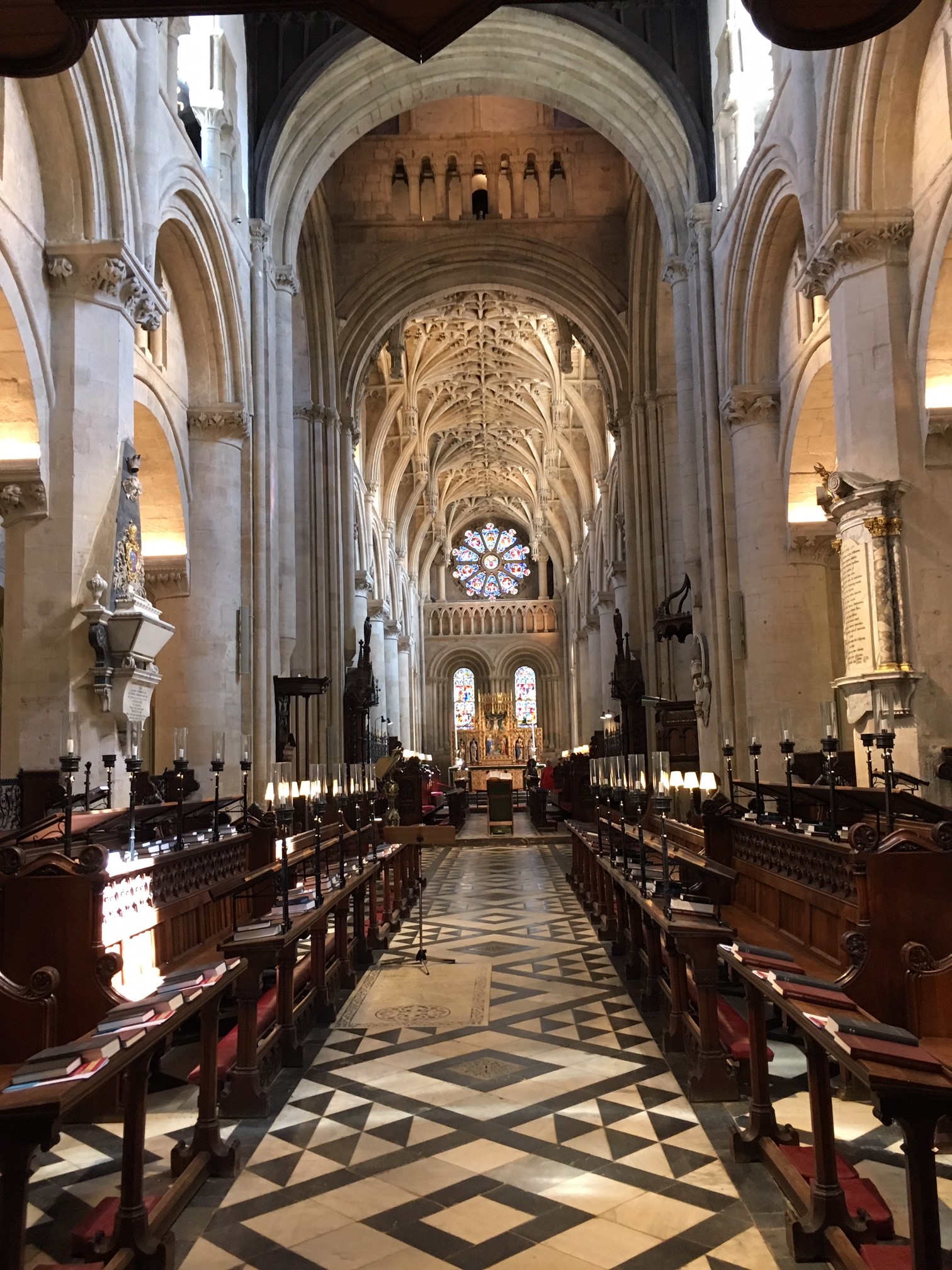
The cathedral, which was originally the church of St Frideswide’s Priory, the patron saint of Oxford, was built in 1120. In 1522, Thomas Cardinal Wolsey selected the priory as the site for his proposed college and founded the cathedral as the college chapel (a dual role that’s unique in the Church of England). The choir has been there since 1526 when John Taverner was the organist and master of choristers. It was refounded in 1546 by Henry VIII when he established the College.

According to the Christ Church Information booklet, much of this ancient priory church was rebuilt between 1170 and 1190. The Cathedral used to extend towards the space where Tom Quad now stands but Cardinal Wolsey knocked down three bays of the name to accommodate the College.

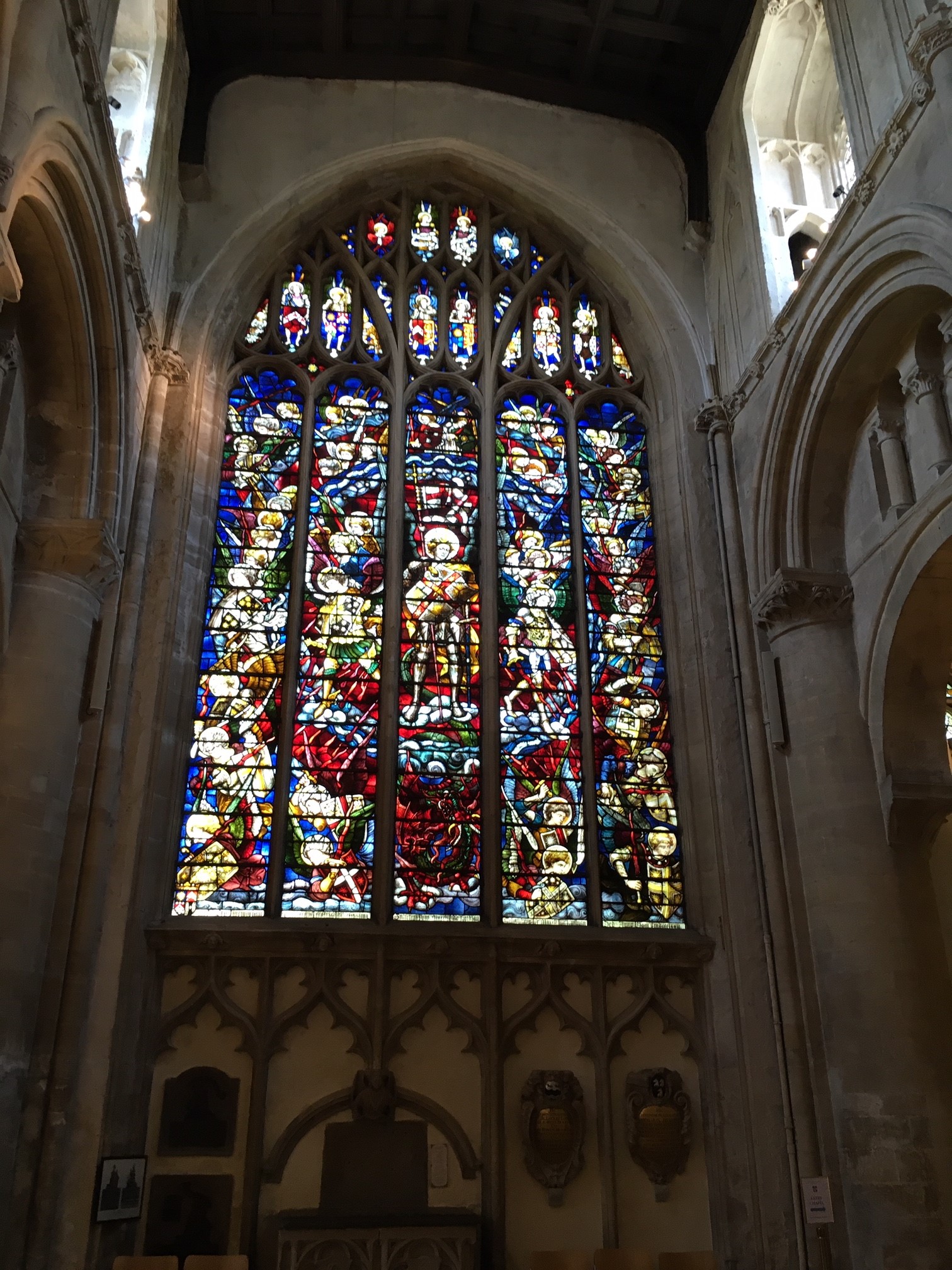
The Jonah Window (made in 1630 by Abraham van Linge) is remarkable in that only the figure of Jonah is made of stained glass – the rest consists of small panels of painted glass, showing the city of Nineveh in minute detail. In the North Transept, the St Michael Window (created by Clayton & Bell in 1870) is the Cathedral’s largest. It contains Victorian glass that shows the Archangel Michael leading his army of angels to defeat the devil, who is depicted as a dragon beneath St Michael’s feet. The window also illustrates a scene from Revelation, the final book in the Bible.

St Michael Window | Photo by May S. Ruiz / Beacon Media News

What is believed to be either The Watching Loft or a Chantry Chapel, dating from the 1500s, is an exquisite example of medieval woodwork. Not far from the shrine is the Bell Chapel. It has an altar and a free-standing cross carved from its base made in memory of Bishop George Bell who, in 1942, opposed the bombing of German cities. Near the High Altar is the Bishop’s seat, indicating that this is the mother church of the Oxford Diocese.

The Cathedral’s vaulted ceiling is its chief architectural glory. Its striking ribs splay out from 12 stone lanterns which appear to hang miraculously in mid-air. Small interconnecting ‘lierne’ ribs in the center of the vault create eight-pointed stars, forming an image of heaven.

Located in the northeast corner is the Latin Chapel where the shrine of St Frideswide is found. The oldest monument in the Cathedral, it once held the relics of the saint but was smashed when King Henry commanded in 1538 that all monasteries be destroyed. He was then reburied nearby. The fragments of his shrine were discovered down a well and subsequently pieced together over 350 years later.

In the South Transept can be found the medieval Becket Window, the oldest in the Cathedral. It contains a rare panel illustrating the martyrdom of Archbishop Thomas Becket, who died at Canterbury Cathedral in 1170. He is shown kneeling between a monk and the four knights who murdered him. The panel was defaced in the 16th century in order to protect it from Henry VIII’s orders to destroy all images of Thomas Becket; the original face of Becket is now missing.

The Cloister, like the Cathedral, is part of the original Priory of St Frideswide, which stood here before the college was built. Human remains from the time of St Frideswide (8th century AD) were found in the central plot. The olive tree, a traditional symbol of peace, and the fountain are contemporary additions to the Cloister and mark the threshold of the Cathedral’s sacred space.

Christ Church Cathedral | Photo by May S. Ruiz / Beacon Media News

We were sitting in the Cathedral for the 12:00 Prayer when the priest asked everyone present to pray for the poor who are suffering from hunger, for refugees who are looking for safe haven, and for those being persecuted for their religious beliefs. And, lastly, he asked that we pray for Boris Johnson, who had just been elected as the new Prime Minister, so that he may find guidance to do what’s right for the U.K. An Oxonian himself (he attended Balliol College, one of the oldest colleges), Johnson was voted President of the Oxford Union in 1986.

How apt that we should be at this very Cathedral, on the 23rd of July, when my daughter’s English husband (who was her fiancé then) found out that the U.K. may indeed be in dire need of the world’s prayers. That he was soon to be wed and immigrating to the U.S. didn’t come as too great a comfort since his entire family lives in England.

From the Cathedral, we went to Christ Church College, which students endearingly refer to as ‘the house’ because it’s their home when they’re in Oxford – it’s where they live, eat, and study. It has several architecturally significant structures, including Tom Tower designed by Sir Christopher Wren, England’s most renowned architect. It is reputed to be the second wealthiest college after St John’s. It counts William Penn (the founder of Pennsylvania), C.L. Dodgson (whom we know as Lewis Carroll), Edward VII (when he was Prince of Wales), and 14 Prime Ministers, among its illustrious alumni.

The Great Staircase | Photo by Brianna Chu / Beacon Media News

We climbed the Great Staircase channeling Harry Potter and company even as we were cognizant of its greater significance. A door at the bottom of the staircase has the words ‘No Peel’ studded into it – a protest against the Home Secretary, Sir Robert Peel, who in 1829 proposed greater freedom for Catholics. Ironically, Peel was a Christ Church alumnus.

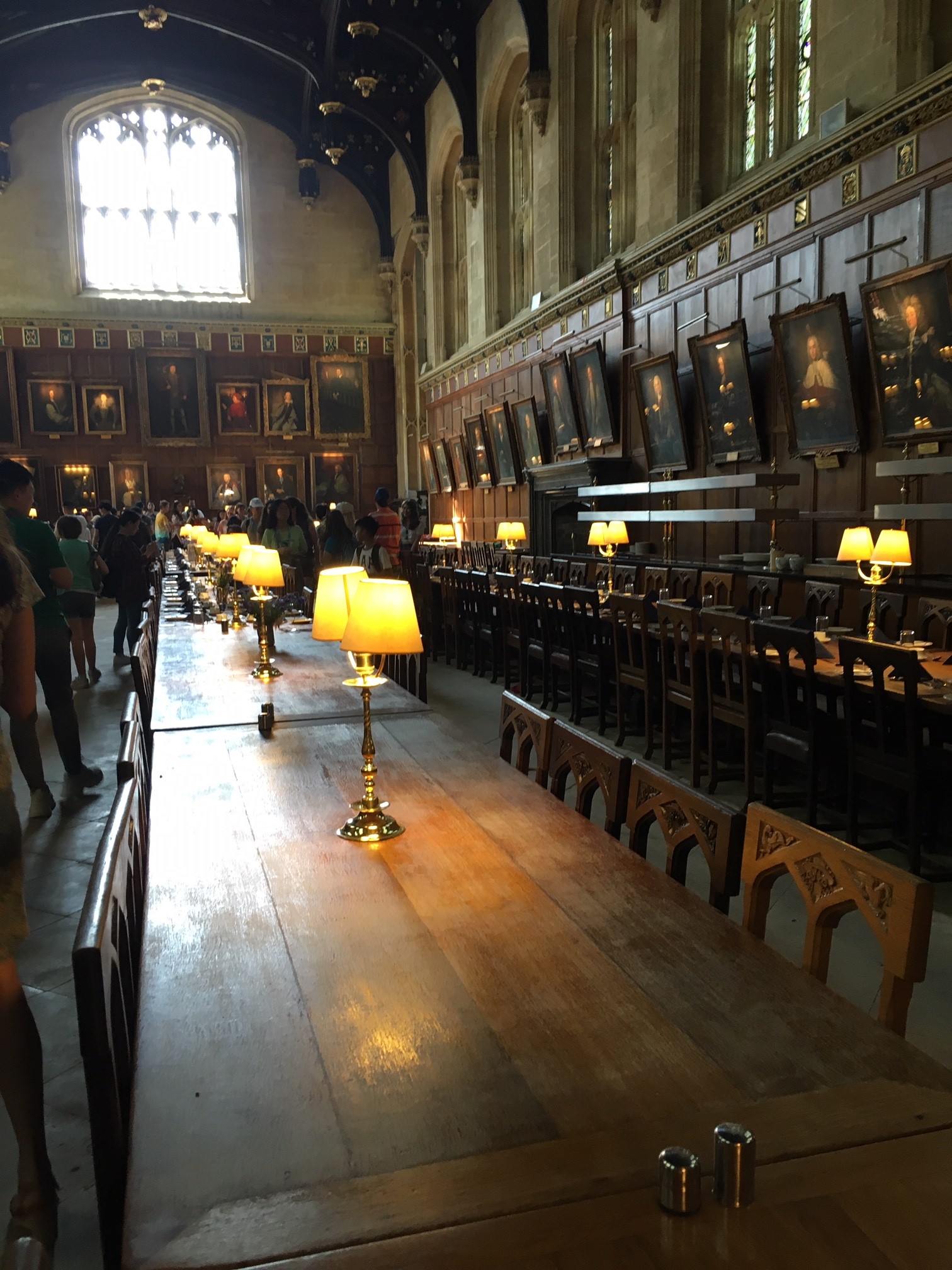
The Great Staircase leads into the Great Hall, the center of college life. It is where the academic community congregates to dine every day and where banquets are held on special occasions. Breakfast, lunch (brunch during weekends), and dinner are eaten there so the hall is closed during those times. We were there right after it reopened after lunch and there were still trays, carts, and signage for beverage choices – traces of the meal which had been recently served – which seemed quite mundane in the backdrop of this resplendent space.

The Great Dining Hall | Photo by May S. Ruiz / Beacon Media News

There are two dinner sittings: Informal Hall at 6:20 pm and Formal Hall at 7:20 pm and usually consist of a two- or three-course meal. During Formal Hall the academic community wears gowns, an undergraduate student says a Latin Grace at the lectern, and senior members dine at High Table. Wine, beer, and other drinks can be bought before dinner from the adjacent Buttery.

It is the largest pre-Victorian age college hall in either Oxford or Cambridge and seats as many as 300 people. Overhead is a magnificent hammerbeam ceiling and portraits of famous members, including a few of the 14 Prime Ministers educated at Christ Church, adorn the walls. Because Christ Church is a Royal Foundation, the reigning British Monarch acts as the representative of the Founder and is known as its ‘Visitor.’ A bust of her Majesty Queen Elizabeth II, as well as a portrait of the college’s founder King Henry VIII, can be seen behind the High Table.
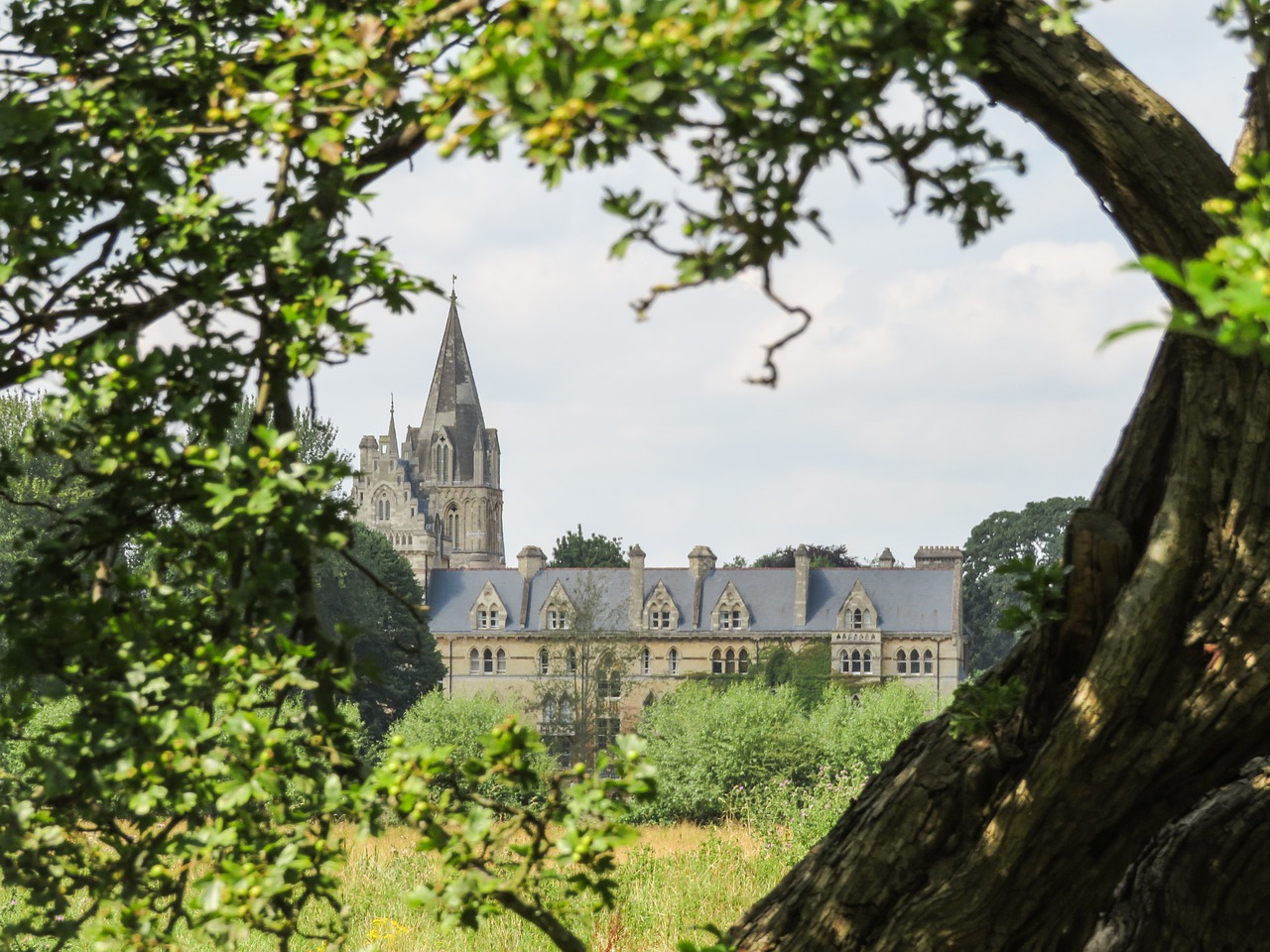
As we passed back down the Hall Staircase, we came out onto the Tom Quad, originally called ‘the Great Quadrangle’ because of its grand scale. It is the largest in Oxford, measuring 79.5 x 80.5 meters. It was renamed ‘Tom Quad’ in the 17th century, after the six-ton bell ‘Great Tom’ was installed in Sir Christopher Wren’s new tower.

The Tom Quad – North Corner, the raised walkway around the Great Quadrangle, was meant to be roofed to form an enormous cloister as Cardinal Wolsey envisioned but was never completed. The arch shapes around the walls and protruding bases are all that remain. The new chapel Wolsey intended to build for his college along the north side of the quadrangle was never realized either. For 100 years the north side remained completely open with townspeople and cattle passing by on a muddy lane.

Tom Quad | Photo by May S. Ruiz / Beacon Media News

In contrast to the Gothic splendor of Tom Quad lies the classical sophistication of Peckwater Quad. These elegant 18th century buildings lie on the site of a medieval inn, which was run by the Peckwater family. Undergraduate accommodation is available in the symmetrical structures occupying the three sides of the quad. On the fourth side is a stunning library.

With all the tourists moving about it was hard to remember that students live and study there. I can’t imagine how they can actually study, though, with so much activity and noise going on around them.

There is a Christ Church Picture Gallery, which apparently has one of the most noteworthy private collections of Old Master paintings and drawings in Great Britain. But, alas, we were pressed for time and we wanted to see other places so we skipped it.

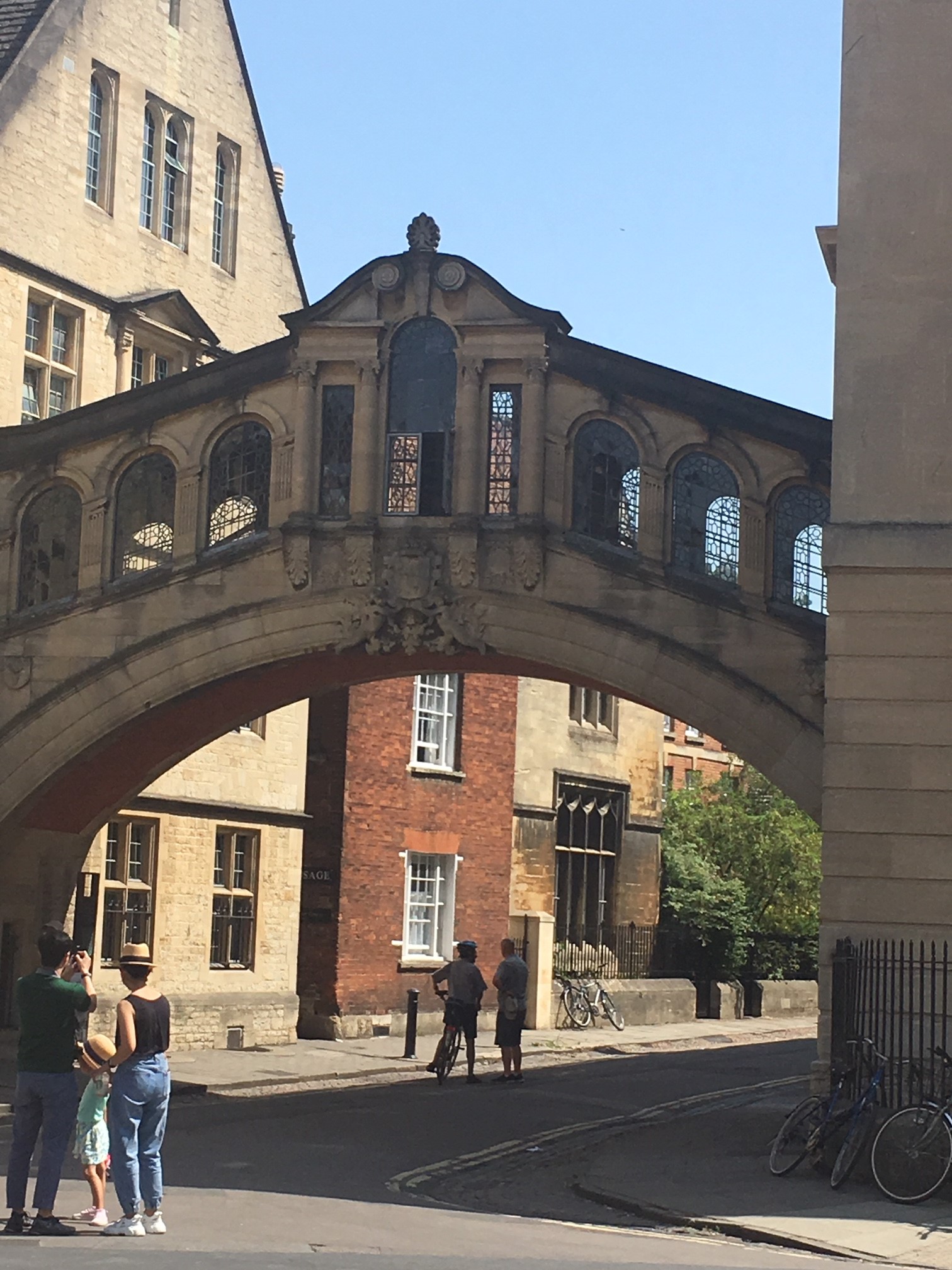
Oxford’s Bridge of Sighs | Photo by May S. Ruiz / Beacon Media News

We walked by Hertford Bridge, a city landmark, which is a skyway that connects two parts of Hertford College over New College Lane. It is often referred to as the Bridge of Sighs although it resembles not the original Bridge of Sighs in Venice but the Rialto Bridge. (Interestingly, Cambridge also has its own Bridge of Sighs). In one scene in the Harry Potter films, Draco Malfoy says to Harry ‘You won’t last 10 seconds’ under a tree. That tree is inside the grounds of New College and it can be seen from the Bridge of Sighs when you look at a certain angle.

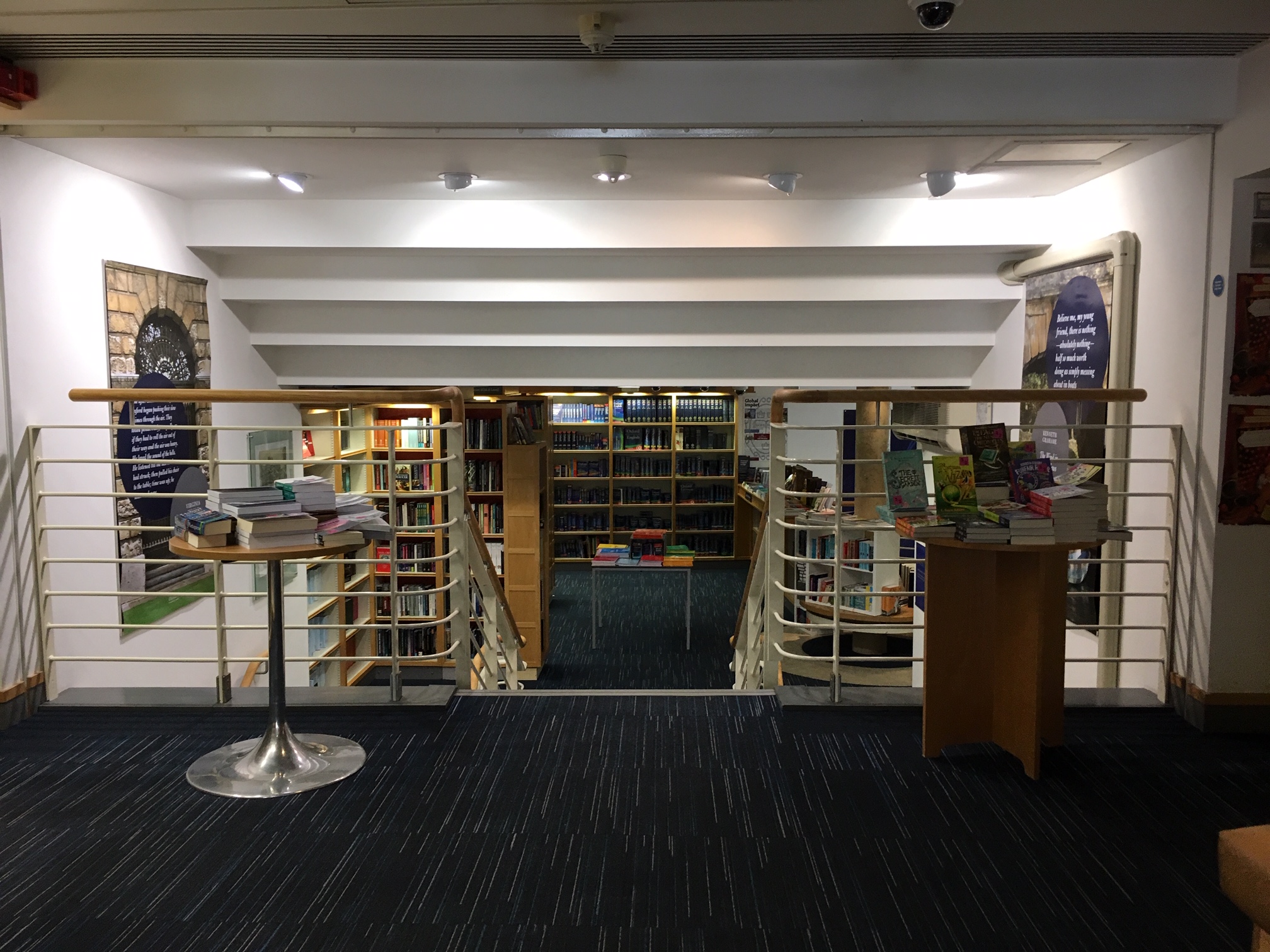
You can’t go to Oxford without going to the renowned Oxford University Press. Besides being  the university’s official publisher of all research materials, books, and publications for its academics and students, it also prints more than 6,000 titles globally in a variety of formats. Its range covers English language teaching materials, children’s books, journals, scholarly monographs, printed music, higher education textbooks, and schoolbooks. Its most famous publication, as everyone knows, is the Oxford English Dictionary (or the OED, as it is commonly referred to), the definitive record of the English language.

Inside Oxford University Press | Photo by May S. Ruiz / Beacon Media News

We lingered for hours to skim through some of their publications, to marvel at the 20-volumed OED, to buy some books and book bags and, I’m embarrassed to say, to escape the heat.

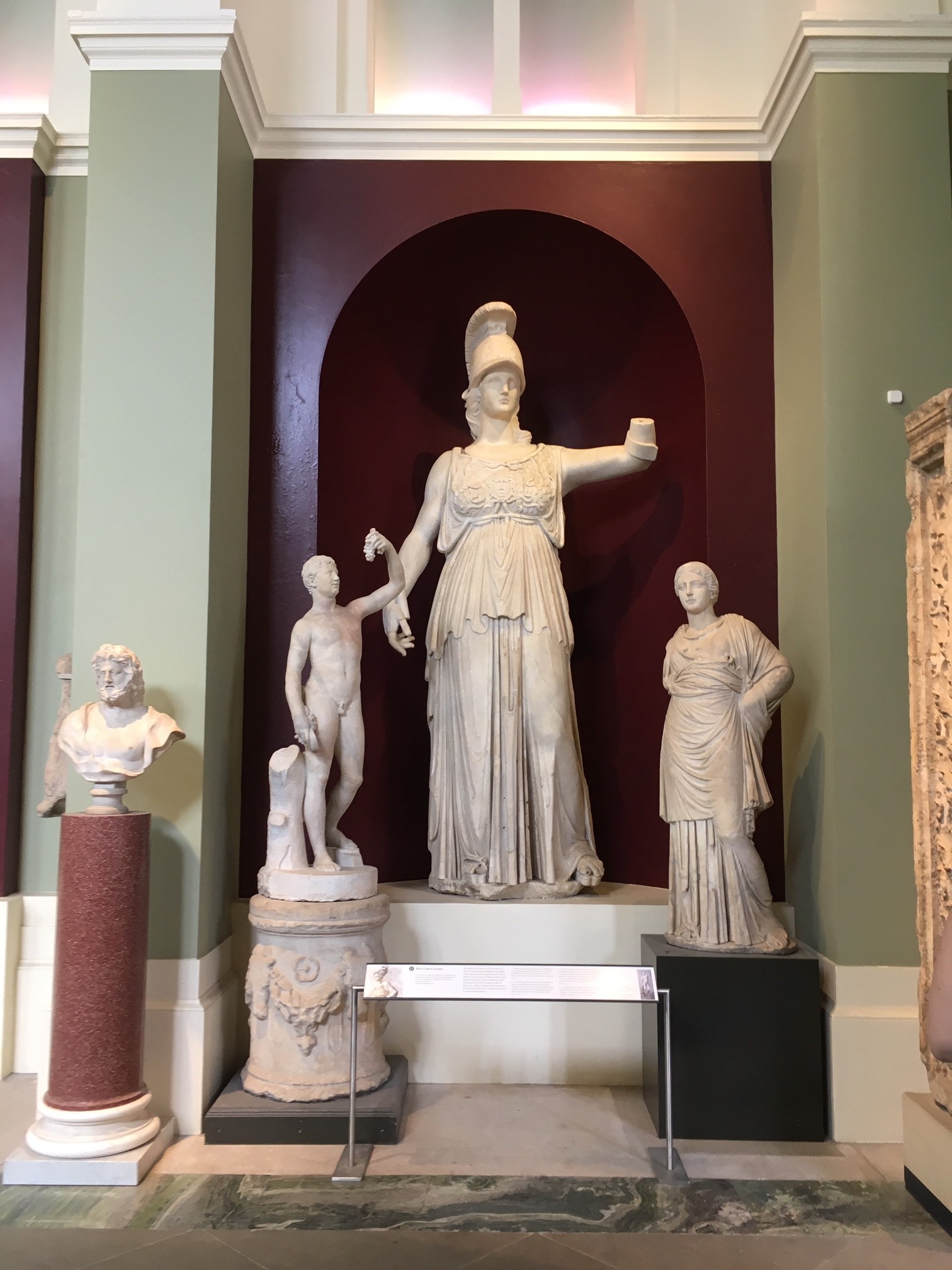
If you’ve ever been to the U.K. then you would know Tesco, their version of a Von’s or Ralph’s supermarket, except much smaller. I love their jute grocery bags and we stopped there the next day to buy a couple on our way to the Ashmolean Museum. The museum is named after Elias Ashmole, a celebrated antiquary, officer of arms, astrologer, and alchemist. He gifted his collection to the University of Oxford on the proviso that a suitable repository was constructed to house it. It opened its doors on the 21st of May 1683, making it Britain’s first public museum. Originally sited on Broad Street, it was relocated to its present location on Beaumont Street and completely redeveloped in 2009.

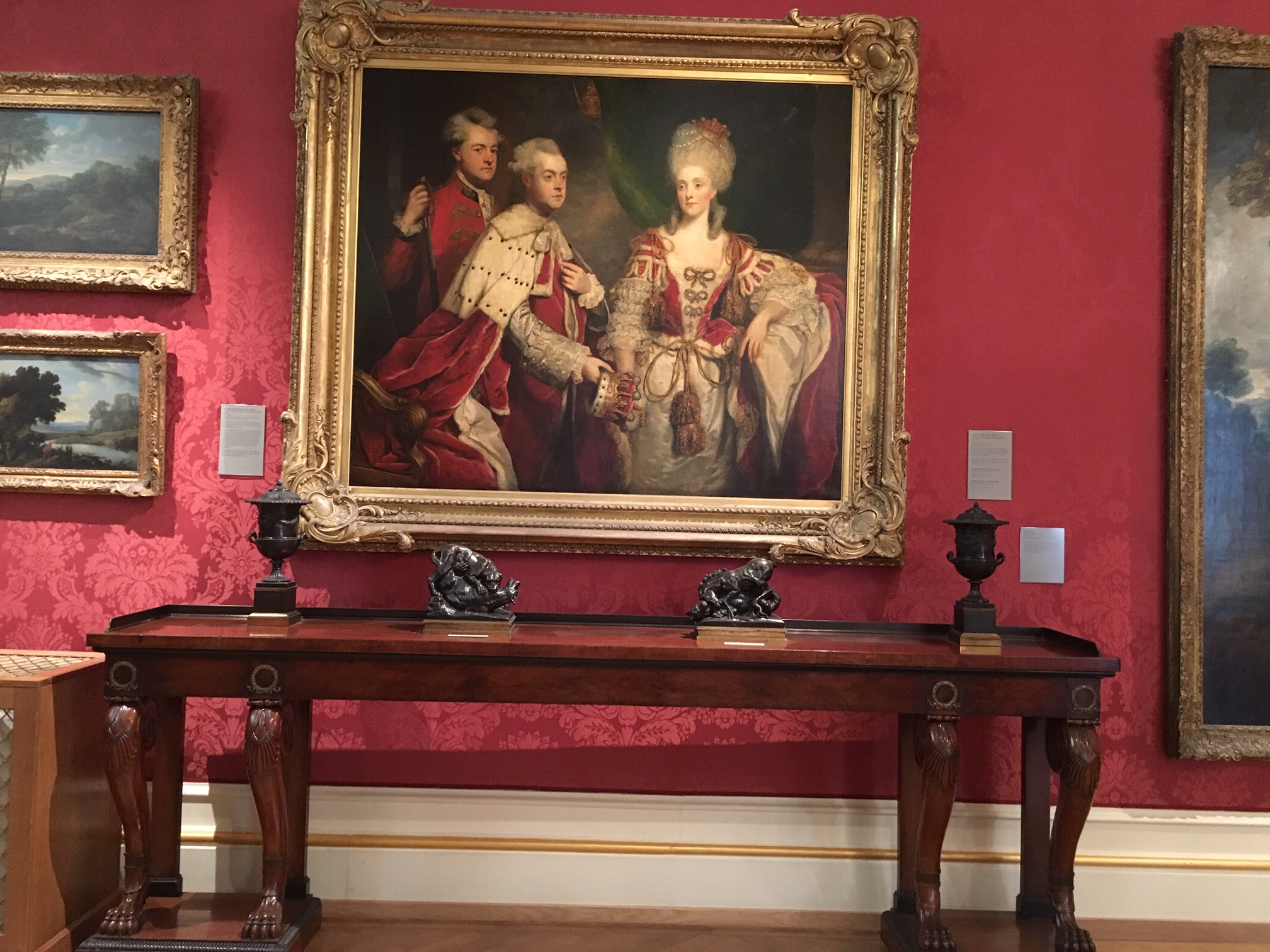
According to the Ashmolean souvenir book, it now ranks as one of the world’s great collections of art and archeology with an extraordinary range of objects from prehistory to the present day spanning Antiquities, Western and Eastern art, Coins and Casts. And that assertion is not an exaggeration. Visitors to the museum will be treated to a staggering amount of treasures and wealth found within.

Roman statues at the Ashmolean’s Level 1 | Photo by May S. Ruiz / Beacon Media News

On level 1, which explores the past, we beheld displays on Eastern art paintings, India from AD 600, Islamic Middle East, Medieval Cyprus, the Mediterranean world, and Mughal India. Level G is all about the ancient world – the Aegean, ancient Cyprus, ancient Egypt and Sudan, ancient Near East, the cast gallery, China to AD 800, Chinese paintings, European prehistory, Greek and Roman sculpture, India to AD 600, and Italy before Rome.

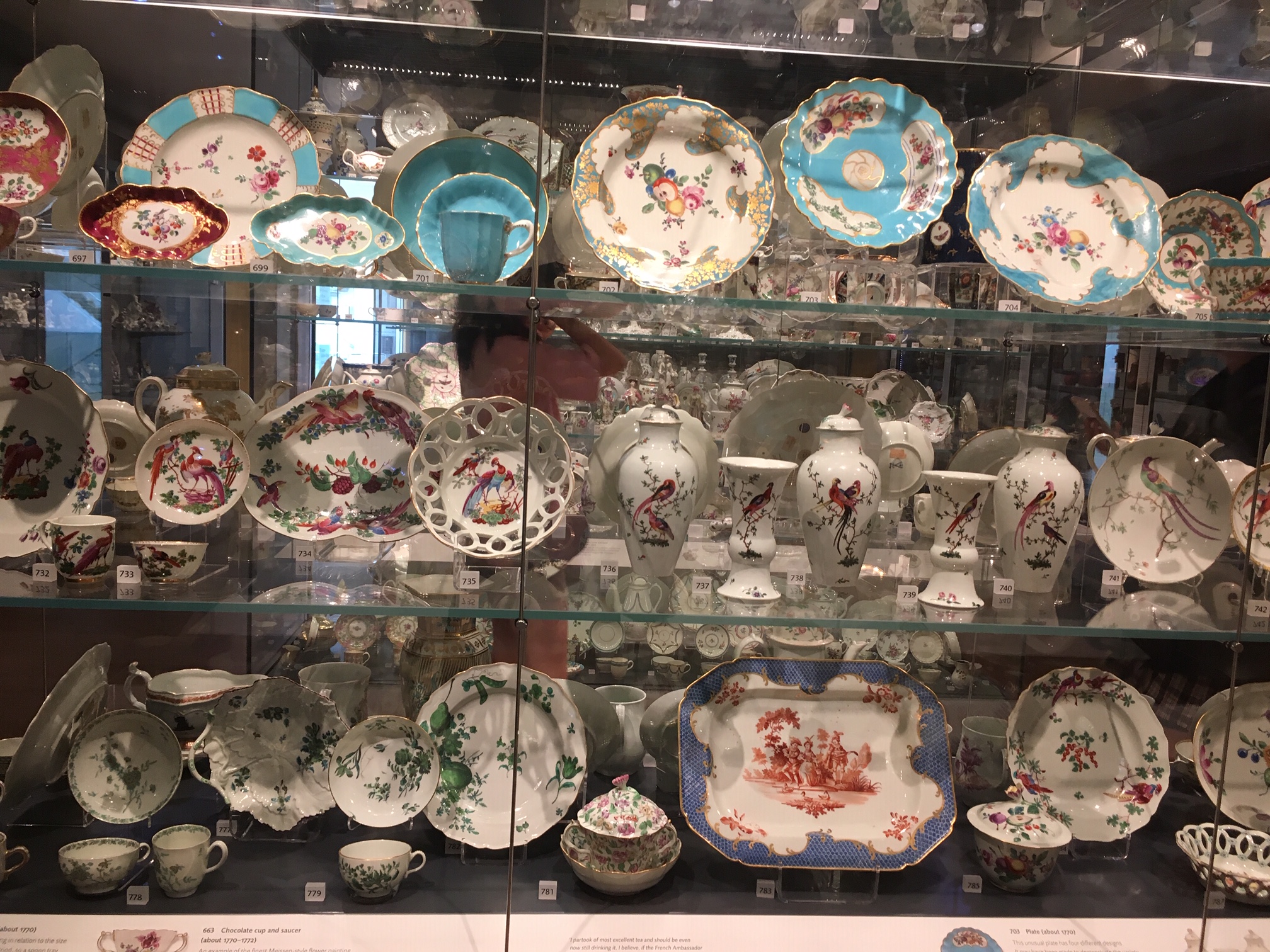
Level 2 has European ceramics | Photo by May S. Ruiz / Beacon Media News

Level 2 is where West Meets East – there are 18th century art, arts of the Renaissance, Baroque art, Britain and Italy, China from AD 800, Dutch and Flemish art, early Italian art, England from 400-1600, European art and ceramics, Japan from 1600-1850, music and tapestry, oil sketches, and still-life paintings.

Level 3’s 19th century art | Photo by May S. Ruiz / Beacon Media News

Special exhibitions are held on level 3 but it’s not usually open to the public so we went to level 3M which is dedicated to European art from 1800 to the present day –19th century art, De Morgan ceramics, modern art, Pissarro, pre-Raphaelites, Sickert and his contemporaries.

We spent several hours there and I can’t say that I was able to take it all in. The sheer number of floors to climb, galleries to enter, display cases to peer into, and captions to read, were mind-boggling. It was also laid out rather weirdly – with some collections which seemed to be misplaced. Additionally, there were so many twists and turns in the museum that it was easy for people to get lost.

Looking down onto the street from a Waterstones window seat | Photo by May S. Ruiz / Beacon Media News

From the Ashmolean we headed to Waterstones Oxford where it’s called ‘The Bookshop on the Corner’ because it’s inside William Baker House, located on the corner of Cornmarket Street and The Broad. After all the walking we did at the museum, it was a relief to sit down and read in one of the nooks. I found a great window seat on the third floor, from where I watched all the people and traffic below.

The following day was our last full day in Oxford and we squeezed in several sights. First on our list was the Bodleian Library at Old Schools Quad on Broad Street. The world’s largest academic library, it has six million books and one million maps. We met our tour guide at the Divinity School, which is attached to the Bodleian Library. It is a medieval building and room, the oldest surviving structure, and is used for oral exams and discussions on religion. It served as the infirmary in four Harry Potter films, and as the ballroom where Professor McGonagall taught students how to dance in ‘The Goblet of Fire.’

Divinity School | Courtesy photo

Our guide told us to store our handbags and all or belongings in a locked storage place. We were given earphones so we could hear her because, she reminded us, it is a working library and she had to speak at barely above a whisper. It was such a pity that taking photos was strictly prohibited (any device which could take pictures were kept under lock and key); it would have been such a thrill to have photos of places we recognize from watching Harry Potter movies. In fact, she carried a binder that contained laminated photos of the scenes from the films which she showed us.

She then took us to the Duke Humfreys Library, located above Divinity School. The oldest reading room in the Bodleian, it is divided into the original medieval section, the Arts End, and the Selden End, containing maps, music, and pre-1641 rare books. The books in the oldest part are housed in oak bookcases at right angles to the walls on either side. The ceilings are fitted with panels painted with the arms of the university.

Duke Humfreys Library | Courtesy photo

It was named after Humphrey of Lancaster, first Duke of Gloucester, a younger son of Henry IV. A connoisseur of literature, he commissioned the translation of classical works from Greek into Latin. He bequeathed his collection of 281 books to the University of Oxford upon his death in 1447, a generous donation since the university had merely 20 books (!) at the time. Only three of his original books remain in the library today.

The Humferys Library was used as the Hogwarts Library in the Harry Potter films. In ‘The Sorcerer’s Stone,’ Harry, wearing his invisibility cloak, steals into the restricted section at night to look for information about the alchemist Nicolas Flamel.

The Radcliffe Camera | Photo by May S. Ruiz / Beacon Media News

After our guided tour of the Bodleian, we walked to the Radcliffe Camera (Camera means ‘room’ in Latin), also known as ‘Rad Cam’ or ‘The Camera.’ It is a stunning structure designed by James Gibbs in neo-classical style built in 1749 to hold the Radcliffe Science Library. It was named after Dr John Radcliffe who donated the funds to build it and is now the principal reading room of the Bodleian.

We stopped in at Weston Library across the street which houses a large collection of rare and antiquarian books. It also has a souvenir shop where one can purchase Bodleian and Radcliffe Camera mementos.

Inside the Sheldonian Theatre | Photo by Brianna Chu / Beacon Media News

The Sheldonian Theatre was our next destination. Designed by Sir Christopher Wren, it was erected between 1664 and 1669, and has been described as one of the architectural jewels of Oxford. It is the ceremonial hall of the University of Oxford where graduations are held and is the venue for other university activities like lectures and concerts. Its most interesting feature is  the eight-sided cupola in the center of the roof which has large windows on all sides that provide breathtaking views across central Oxford.

We then walked to the Oxford Covered Market, which reminded me of the Grand Central Market in Downtown L.A. It is where one can find over 50 independent traders selling gift items, clothing and shoes, fashion accessories, fresh flowers, prepared food, various beverages, and fresh produce and meat.

However, we didn’t find anything we wanted to eat or buy so we strolled to the shopping mall and went inside M & S. I hadn’t been to a Marks & Spencer store in almost three decades and thought it would be fun to see if I still remembered what it looked like. Nothing much had changed since except for the prices, which, understandably have gone higher. We had afternoon tea with Victoria sponge cake.

The Old Bank Hotel | Photo by May S. Ruiz / Beacon Media News

For our last evening in town we had dinner at Quod Restaurant and Bar at the Old Bank Hotel on Oxford’s famous High. Formerly a banking hall which was transformed by owner Jeremy Mogford, it boasts a show-stopping onyx bar and a stylish terrace. The delicious food and impeccable service at the Quod are matched only by the impressive and eclectic collection of modern art by young British artists such as Sandra Blow, Craigie Aitchinson, and Damien Hirst that hang on the walls.

It had been a lovely, albeit short, trip to Oxford. And while our visit was marked by extreme heat, it didn’t detract from our enjoyment. It’s a bustling city filled with tourists but when you get inside the colleges, there is that rarefied air you’d expect from an institution as revered as it is. I don’t know that it can ever be replicated. There is, after all, only one university called Oxford.

Enjoying the Charms of Cambridge

Originally published on 26 August 2019 in the Pasadena Independent, Arcadia Weekly, and Monrovia Weekly

King’s College, Cambridge | Photo by May S. Ruiz / Beacon Media News

I love college towns – they’re typically alive with students either hurrying off to lecture, tutorial, or the library, or leisurely heading out for a cup of tea with friends. Mingling with the young crowd are usually tourists with a map in hand, trying unsuccessfully to find a specific site on the ‘Places to See While in (fill in the blank) Guide.’ Inevitably, they would have to ask one of the students to point them in the right direction.

Fortunately, we had a ‘personal’ guide during our visit to the beautiful city of Cambridge, England in mid-July; we definitely didn’t look like bewildered tourists. My daughter and I spent a week in town to attend her fiancé’s graduation (for his second Master’s degree) and he took us around.

Most Americans have heard of the University of Oxford but are not very familiar with Cambridge. These two universities have had rivalries dating back centuries. And while Oxford benefits from name recognition, Cambridge is considered the most prestigious in the United Kingdom. In the last decade the top three universities in the UK were Cambridge, Oxford (both in England), and St Andrews (in Scotland) until this year, when the League Table ranked St Andrews second to Cambridge and ahead of Oxford.

The River Cam | Photo by Brianna Chu / Beacon Media News

A university city and the county town of Cambridgeshire, Cambridge lies on the River Cam, about 50 miles north of London. While it’s better known for its university, there was already a settlement there before the arrival of scholars who were fleeing from the riots in Oxford in 1209 to find refuge. Thus, the university was founded.

The early colleges were established by the church and then by monarchs who wanted to create learning institutions. Surprisingly, for a university that for so long admitted only men, six of the colleges were even begun by women.

Before long, Cambridge became embroiled in religious and political dramas as when Henry VIII dissolved the monasteries and when his daughter Mary Tudor got backlash for her religious retaliations.

It was in Cambridge that English military and political leader Oliver Cromwell found many Royalist adversaries during the Civil War (1642-1651). He sent his henchmen to destroy treasures in the colleges’ chapels, which he called Catholic superstitious symbolisms.

Mixed in with these power struggles were riots instigated by townspeople who were fed up with the inequalities between the privileged colleges and their own poverty. (To this day, there is evidence of disparity as homeless people roam the streets – a jarring contrast against a backdrop of opulent buildings.)

As in all college towns, there is a mutual relationship between ‘Town & Gown.’ Students provide income to the universities and tourists are a source of livelihood for locals. Cambridge has approximately 125,000 permanent residents but it welcomes three million visitors annually who come to experience the amazing beauty, culture, and history it offers.

King Cross Station’s Harry Potter Gift Shop | Photo by May S. Ruiz / Beacon Media News

Our weeklong stay began when we arrived at London’s Heathrow Airport, from where we boarded the Heathrow Express to Paddington Station. Another train ride took us to King’s Cross Station. King’s Cross figures prominently in the Harry Potter books and films because it is from the station’s platform 9 ¾ that students take the Hogwarts Express. The Network Rail has taken advantage of this – it is now a tourist attraction. For 30 pounds, Harry Potter fans can have their picture taken as they pretend to push a shopping cart into the wall. Really.

For 30 pounds Harry Potter fans can have their picture taken pushing a cart towards the wall | Photo by May S. Ruiz / Beacon Media News

From King’s Cross we hopped on the GWR (Great Western Railway) for our non-stop journey to Cambridge. We stayed at the Tamburlaine Hotel, which is literally across the street from the train station. I don’t usually comment on the hotel where we stay, lest readers get the impression that this is a paid promotion for it, but will make an exception this time because I’m excited to acquaint you with Tamburlaine.

The Tamburlaine hotel lobby | Photo by May S. Ruiz / Beacon Media News

A boutique hotel, the Tamburlaine isn’t huge and impersonal like chain hotels. It looks more like a big, welcoming residence where you’ll want to invite your friends to hang out. Upon entering the lobby on the ground floor, comfortable sofas beckon you to sit by the fire. Shelves stacked with old, leather-bound books complete the warm ambience. This place is just like my own house – there are books everywhere – and I instantly felt at home!

The first floor of Tamburlaine Hotel | Photo by May S. Ruiz / Beacon Media News

The first floor (which is actually the second) is a public space divided into several seating areas. One section has a long table which can be utilized for a conference or a meeting; there’s also a corner alcove where a couple can relax in front of some bookshelves. My favorite spot is an armchair next to the window where I sat to alternately read a book and watch people walking on the street level below.

However, I didn’t travel all the way to Cambridge to read a book; I wanted to explore the city. Let me preface this ‘travelogue’ by saying that my two young companions and I had to tailor our sight-seeing around graduation activities that I mentioned earlier. So, if you’ve ever been to Cambridge and are familiar with the town’s lay-out, you might notice that there were times when there was no rhyme or reason to how we went about our adventure.

The city’s lay-out | Photo by May S. Ruiz / Beacon Media News

We arrived in Cambridge at midafternoon and we simply unpacked and took it easy. The town center is two miles away, which is quite a trek for Southern Californians (who are notorious for parking nearest to the building entrance because we’re too lazy to walk). Happily, we were in no hurry, so we simply meandered and observed all the fascinating things amidst us.

Brown’s Brasserie & Bar | Photo by May S. Ruiz / Beacon Media News

Dinner was at Brown’s Brasserie & Bar, a delightful restaurant which faces the Fitzwilliam Museum on Trumpington Road, the main thoroughfare. It’s quite popular among locals and tourists and could get really crowded but we were smart enough to make reservations. Its extensive menu has several options for every diner’s food requirement, including vegan, vegetarian, and gluten-free fare. I always opt for a prix fixe meal because it gives me a tasting of courses at a great price. I would definitely recommend it, in case you visit Cambridge and dine at Brown’s.

The following day we went to the Fitzwilliam Museum to incorporate my companions’ visit with a friend there. Unlike in the United States where museums charge anywhere from $20 to $25 for admission, in the United Kingdom people get in free.

Cambridge’s Fitzwilliam Museum | Photo by May S. Ruiz / Beacon Media News

Here’s a brief history and description. In 1816, Richard, seventh Viscount Fitzwilliam and keen art collector, bequeathed his library and paintings to the University. He also gave 100,000 pounds to build a place to house half a million treasures of national and international significance, covering Egyptian, Roman, and Greek collections.

Coins, ceramics, and textiles are likewise displayed. Medievalists and artillery enthusiasts will find an impressive array of armors and weapons. The museum has a vast collection of ancient and modern manuscripts – John Keats’s ‘Ode to a Nightingale,’ a valuable series of Handel manuscripts, and autographed compositions by Purcell, Bach, and Mozart. My favorite Gallery is the one that holds various paintings ranging from Rembrandt and Rubens, to Picasso and Barbara Hepworth.

Today the Fitzwilliam is hailed as ‘one of the greatest art collections in England and a monument of the first importance.’ I can attest that the claim is not without merit.

A view of King’s College from ‘The Backs’ | Photo by Brianna Chu / Beacon Media News

Being an education writer, I was interested to see at least one college. Cambridge has a total of 31 colleges but, since we were there on a limited time, we chose to tour only King’s College and Chapel. It was established in 1441 by King Henry VI, when he was all of 19 years old. He also founded Eton School and, until 1873, King’s College exclusively accepted Eton students who were automatically granted a degree without having to take the exams. Many notable personalities graduated from here – Britain’s first Prime Minister Robert Walpole and renowned computer scientist and logician Alan Turing, among them.

King’s has inspired many a poet to sing its praises. And for good reason – it is a magnificent structure! But as grand as it is, the young King Henry’s original plans were even grander, which included a giant lake. No one knows who the architect was, but Reginald Ely was the master-mason who oversaw the work on the building. It is arguably the most photographed Cambridge college.

One of numerous stained glass windows in King’s Chapel | Photo by May S. Ruiz / Beacon Media News

Construction on the Chapel began in 1446 when King Henry laid the first stone but he never saw it finished – that would happen 90 years and four kings later. It is hailed as one of the finest examples of late Perpendicular Gothic English architecture.

We didn’t go inside Trinity College but it’s the grandest of all the colleges in Cambridge and if you’re ever there, I hope you get a chance to visit it. It was founded by King Henry VIII in 1546; its chapel was completed by his daughter Mary; and its library was designed, free of charge, by one of the most highly-acclaimed English architects in history, Sir Christopher Wren. It likewise has the lofty reputation of educating 32 Nobel Prize winners and alumni, including Sir Isaac Newton, Alfred Lord Tennyson, and HRH Prince Charles. According to lore, the poet Lord Byron once enraged college authorities by bathing in the fountain in front. There is also a small apple tree on the lawn which is descended from the one whose falling fruit enlightened Newton about the concept of gravity.

St Catharine’s College | Photo by May S. Ruiz / Beacon Media News

Until his graduation, my daughter’s fiancé was attending St Catharine’s (students refer to it as St Cath’s) and he proudly showed us the college. It was established in 1473 by Robert Wodelark, the third Provost of King’s College. Some of its alumni include John Addenbrooke, who founded Cambridge’s famous hospital, and known film personalities – Sir Ian McKellen, Rebecca Hall, Ben Miller, among others.

While we weren’t able to squeeze in visiting other colleges, we glimpsed several of them as we made our daily walks around town.

Every tourist should see the River Cam, as we did. It has had a major influence on this town for 2,000 years. Cambridge became rich from trading because it was accessible from the sea; small boats used the river as a trade route before the advent of the railway. Today River Cam is the site for recreational activity and the shallow boats which were once used for transporting goods and animals are now utilized for punting.

The Xu Zhimo Garden | Photo by Brianna Chu / Beacon Media News

It is said that all Cambridge seniors punt here one last time before they graduate. It’s so memorable that one King’s College alumnus, Xu Zhimo, who later became a renowned Chinese poet, refers to it in a poem he wrote, ‘Taking Leave of Cambridge Again.’  He is immortalized in a small garden near King’s Bridge. In 2018 a stone of white Beijing marble that displays the first and last two lines of his ode was installed. Stone steps, on which the rest of his poem is carved, wind around the garden and end at a ‘yin and yang’ formation.

Here is a portion of his poem translated:

Softly I am leaving,
Just as softly as I came;
I softly wave goodbye
To the clouds in the western sky.

The golden willows by the riverside
Are young brides in the setting sun;
Their glittering reflections on the shimmering river
Keep undulating in my heart.

The green tape grass rooted in the soft mud
Sways leisurely in the water;
I am willing to be such a waterweed
In the gentle flow of the River Cam.

Called the China-UK Friendship Garden, or Xu Zhimo Garden, it is a tranquil space during the summer months when tourists flock to the area. We lingered there to escape the unexpected heat wave.

Lingering at the Xu Zhimo Garden | Photo by May S. Ruiz / Beacon Media News

The River Cam is located in the area to the east of Queen’s Road where several colleges back on to it. Aptly called ‘The Backs,’ it is very picturesque that some claim the view is one of the top ten in England. A portion of it is a field where cows leisurely graze and freely roam, a charmingly surprising sight. Sometimes an entire herd will decide to venture on the path, to the consternation of students who get held up on their way to class, as they wait for the cows to disperse.

Cows freely roam at ‘The Backs’ | Photo by Tom Williams / Beacon Media News

You can’t miss the Market on Crescent Street; you’re bound to come upon it as you wander around the city. For over 1,000 years, it has been a source of food and goods for locals, students, and tourists. From one day to the next, the market has an ever-changing coterie of vendors selling a wide array of items – fruits and vegetables, souvenirs that range from fridge magnets to sweatshirts, freshly baked breads and pastries or fresh from-the-oven pizzas. We enjoyed some blueberries and smoothies and perused the interesting things displayed on the stalls; I bought a few tchotchkes to take home.

We weren’t there in the mornings to see the sellers set up shop but we saw them pack up almost every single afternoon (at 5:00) during our week in Cambridge. It was quite amazing to watch them efficiently load their things – stalls and all – into vehicles of every make and model.

Interspersed between our Cambridge walks was a drive to the cathedral city of Ely, about 14 miles away. A quaint town, it is the 9th least populated city in the United Kingdom. Its most famous attraction is the Ely Cathedral, which predates the town. Built when Ely was a small settlement, the town grew around it.

Ely Cathedral | Photo by May S. Ruiz / Beacon Media News

In fact, one can get to the cathedral by walking past a small town square. Local retailers – from plumbing suppliers to stationers, gardening stores to souvenir shops, pizza parlors to cold creameries – dot the periphery while tables and chairs are neatly arranged in the center. I can imagine townspeople gathering there at the end of their workday or after Sunday service. It’s reminiscent of a time before the tech age, when people weren’t merely texting each other.

The central octagonal tower is the most distinctive and celebrated feature of Ely cathedral. Lady Chapel, a large free-standing edifice, is linked to the north aisle of the chancel by a covered walkway. The West Tower is open for those who like climbing heights; tours are held at intervals and are led by guides who tell the history of the cathedral.

From the South Triforium at Ely Cathedral, one can walk up a spiral staircase and visit the Stained Glass Museum on the second level. It has a collection of stained glass windows of national importance from the 13th century to the present.

Oliver Cromwell’s house | Photo by May S. Ruiz / Beacon Media News

A short stroll away from Ely Cathedral is the house where Oliver Cromwell and his family lived from 1636-1647. It is a half-timbered building that once served as the vicarage for the nearby St Mary’s Church. It is the only surviving Cromwell residence other than Hampton Court Palace in London. For several years it was a pub aptly called ‘Cromwell’s Arms.’ Today it is a visitor attraction and is the Ely Tourist Information Centre.

Everywhere I go, I end up stopping at a bookstore and Waterstone’s is my favorite one of all. It’s a prettier version of Barnes & Noble and you can find one in all major cities in the U.K. It usually occupies several stories, with each level dedicated to specific book genres. It has nooks, seating areas, and window seats where one can spend several glorious hours of uninterrupted reading.

Being bibliophiles, we made an appointment to visit The Parker Library at Corpus Christie College. It is significant in that it is the only library in Cambridge with a single benefactor, Matthew Parker. He was born in 1504 in Norwich to a prosperous weaver (weaving was a major industry in Medieval East Anglia).

The Parker Library | Photo by May S. Ruiz / Beacon Media News

Parker was believed to have attended Corpus Christi in 1520 and was elected Bible clerk of the college in 1521. He graduated in 1525 and was ordained as a priest in 1527. Because of family connections in Norwich, he became chaplain to Queen Anne Boleyn, second wife of King Henry VIII. Among the medieval collections in the library is a volume of autographed letters he assembled and indexed himself, with original specimens of correspondence from prominent  figures of Lutheranism and English Reform – Anne Boleyn, Erasmus, Luther, Melanchthon, Calvin, and others.

As we left Corpus Christie, we espied several tourists taking pictures of a rather strange sight on the corner of Bene’t Street. A more recent fascination, the Corpus Clock never fails to attract a large crowd since its installation in 2008. Conceived and funded by John C. Taylor, it took design engineer Stuart Huxley and a team of 250 people five years to create. It was unveiled by physicist Stephen Hawking.

While it looks futuristic, the Corpus Clock honors the skills of 17th and 18th century clockmakers, as well as six new patented inventions. No computers are involved; the only electricity used is to wind the mechanism and light the LEDs that display the time in hours, minutes, and seconds. Taylor wanted to show how a clock works by turning the mechanism inside out, to reveal the largest ‘grasshopper escapement’ in the world.

The Corpus Clock on Bene’t Street | Photo by May S. Ruiz / Beacon Media News

The sinister grasshopper-like creature on top of the Corpus Clock is a ‘Chronophage’ (time-eater) sculpted by Matthew Sanderson. Every 15 minutes it raises its tail threateningly, before finally stinging each hour to death, to the sound of a chain rattling into a wooden coffin. It has an unnerving, irregular movement – sometimes the pendulum will pause and the LEDs flash, slowly at first, then chase as if to catch up. It’s all quite brilliantly deceiving because the clock, in fact, reads accurately every five minutes.

From Bene’t Road, we crossed King’s Parade and went to Ryder and Amies. One of the best known university outfitting companies, it has been serving the university for over 120 years under the management of one family. It is an integral part of university life – providing students with neckties, hoodies, pins, among other things. The windows display a striking array of college colors and clothing. It’s also a place to get all kinds of mementos and I left the shop with a bagful of souvenirs and an empty wallet. Sigh.

Afternoon tea at Fitzbillies is an English indulgence in its finest form | Photo by May S. Ruiz / Beacon Media News

We were told that we should never leave Cambridge without going to Fitzbillies on Trumpington Street. This fabulous cake shop and restaurant has been making the city a happier place since 1922. A cup of tea and some sweets sounded like a wonderful idea after a day of sightseeing and shopping. And true to what has been advertised, our tea experience at Fitzbillies was an English indulgence in its finest form.

Students emerge from St Catharine’s, process along King’s Parade, enter the Senate House, and leave from its side door into the Passage as graduates | Photo by May S. Ruiz / Beacon Media News

Graduations are held at the Senate House on King’s Parade. Successful students process along King’s Parade from their college, enter the imposing building, and leave from its side door into Senate House Passage as graduates. My daughter’s fiancé graduated at Senate House on the 19th of July. It was indeed quite moving to watch him and his classmates as they emerged St Catharine’s and went through this time-honored ritual.

The Church of the Holy Sepulchre on Trinity Street | Photo by May S. Ruiz / Beacon Media News

To celebrate his graduation, we decided to have dinner at The Ivy on Trinity Street. We took a meandering route from our hotel and, walking along Round Church Street, chanced upon the Church of the Holy Sepulchre. Also called The Round Church (I don’t know if it was named that because of the street or vice-versa), it is the second oldest building in Cambridge and one of only four round churches in England. The shape emulates its counterpart in Jerusalem. While it has changed much over the years – before the 1800s its tower was polygonal; the shape of its windows has been modified; and, during World War II, the east window was destroyed by a bomb – but the original ring of arches, decorated by curious stone faces, remains.

The Ivy Brasserie on Trinity Street | Photo by May S. Ruiz / Beacon Media News

A sumptuous dinner at the fabulous Ivy was the perfect cap to an extraordinary week in this beautiful city. While Cambridge is home to the best university in the United Kingdom and is a popular tourist attraction, it has retained all the charms and atmosphere of a small town. That magnificent, soaring structures abound only adds to its uniqueness, making for one unforgettable experience.

Basking in Summer’s Glorious Sun in St Andrews, Scotland

Originally published on 20 August 2018 in the Pasadena Independent, Arcadia Weekly, and Monrovia Weekly

Abundant green plants in St Andrews Botanic Garden contrast with the centuries-old, stone-clad structures of the University of St Andrews | Photo by May S. Ruiz / Beacon Media News

St Andrews, in Scotland, is notorious for horizontal rains and arctic winds. My first visit there, in July of 2013, was marked by sporadic downpours and grey skies. The following year, I was there for three weeks of mostly gloomy weather in the middle of August. Last year, there was a hurricane when I got there during the height of summer.

It was such a delightful surprise to spend the greater part of June this year in St Andrews and experience sunlight. In fact, the sun rose at 3:00 in the morning and didn’t set until past 10:00 at night. I just couldn’t get enough of it; I availed of the glorious weather by taking in the outdoor sights.

St Andrews Castle is actually in ruins so a tour of it is generally outside. What remains of it are the walls, the tower, the ‘bottle dungeon,’ and the mine and counter-mine. But its stunning location right next to the North Sea makes it a breathtaking tourist destination.

Unlike other European castles, which were primarily residences of the monarchy, St Andrews Castle was an ecclesiastic center inhabited by the powerful bishops and archbishops of Scotland in the 1200s and 1300s.

Its history is as remarkable, bloody, and controversial as its occupants. In the 1400s the Scottish royals were associated with the bishops and, in consequence, with the castle. King James I was educated by Bishop Henry Wardlaw, who founded the University of St Andrews in 1413. James II chose a later bishop, James Kennedy, to be his advisor. In 1445, James III was born in the castle.

The entry gate to St Andrews Castle | Photo by May S. Ruiz / Beacon Media News

St Andrews Castle was likewise used as a prison which housed not only local criminals under the bishop’s jurisdiction but other prominent figures, including David Stuart (the Duke of Rothesay, heir apparent to the throne of Great Britain which, today, is Prince Charles) in 1402, and Duke Murdoch in 1425. In 1478, Archbishop Patrick Graham was declared insane and was confined in his own castle.

During the Scottish Reformation, St Andrews Castle was the site of religious persecution when Scottish Protestants were punished with cruel and public deaths. In 1546, David Beaton, the Archbishop of Glasgow, imprisoned Protestant preacher George Wishart in the tower and on March 1, ordered him burned at stake in front of the castle walls. Wishart supporters avenged his death on May 26 when they gained entry, overcame the garrison, murdered Cardinal Beaton, and hung his body from his window on the castle’s front.

Protestants used the castle as a shelter where they established the first Protestant congregation in Scotland and the Regent James Hamilton ordered a long siege. In 1546, attackers dug a mine through solid rock to attack while defenders tunneled a counter-mine.

In 1547, John Knox, the leader of the Scottish Reformation, entered the castle during a ceasefire and served as the garrison’s preacher for the remainder of the siege. This temporary peace ended when the French fleet bombarded the castle, which fell unprotected.

St Andrews Castle was rebuilt by Archbishop John Hamilton but, after his death in 1571, it was inhabited by a succession of constables. Attempts to reestablish religious power in Scotland failed and, in 1689, William of Orange abolished the office of the bishop. The castle was rendered useless and quickly deteriorated; parts of it were used in repairing the pier.

The ruins of St Andrews Cathedral | Photo by May S. Ruiz / Beacon Media News

The rare bright and warm day was the perfect antidote to what I learned about the castle. I headed out to St Andrews Cathedral but its history isn’t any cheerier than the castle’s. Built in 1158, it was the base of the Medieval Catholic Church in Scotland and the seat of the Archdiocese of St Andrews.

Inevitably, its past is intricately linked with the Castle. Incited by the preaching of John Knox, a Protestant mob ransacked St Andrews Cathedral during the Scottish Reformation and completely destroyed its interior. Whatever was left of it was used as building material for the town.

Long ago the largest cathedral and most magnificent church in Scotland, what stands for St Andrews Cathedral today are the ruins of the nave and St Rule’s Tower. Nonetheless, it continues to be a significant reminder of the influence it once wielded as the symbol of Catholicism.

Tourists looking to find a destination that doesn’t recall depressing times would do well to head to St Andrews Botanic Garden, as I did. Located on the southern edge of town at Kinnes Burn, it is sometimes referred to as St Andrews’ hidden gem. And for good reason.

The modest entrance to the garden is in sharp contrast to that of The Huntington‘s in San Marino, which has a tall, imposing gate that suggests what to expect within. Visitors to St Andrews Botanic Garden, however, will be pleasantly surprised to discover an 18-acre paradise.

Native and exotic plants abound in St Andrews Botanic Garden | Photo by May S. Ruiz / Beacon Media News

Previously founded by the University of St Andrews in 1889 on the grounds of St Mary’s College, it was moved to its current location in the early 1960s. Mindful of the harsh Scottish climate, the designer structured a dense barrier of pine trees along the western edge, with many shrubs and trees around the site, to provide protection for the plants.

It is a wonderland of native and exotic plants laid out in zones of woodland, meadow, shrubbery herbaceous bedding, ponds, a rockery, and a butterfly house. In the greenhouses, I was thrilled to find myself surrounded by familiar plants – the very same ones in my backyard. There were anthuriums and lilies, cacti and aloe veras, birds of paradise and sago palms. It was easy to be deceived into thinking I was in Pasadena.

I marveled at the ponds with small waterfalls, walked on the impressive expanse of green meadow, and climbed up a rockery. This is a side of St Andrews I had never seen before and it offered me a vastly different perspective.

St Andrews doesn’t only have centuries-old, stone-clad structures; it also has abundant, green flora. The town isn’t all about honoring and preserving the past, but also about building and tending the future. The image that conjures is as heartwarming as it is astonishing.

Venice’s Gifts to the World are as Unique as the City Itself

Originally published on 15 August 2018 in the Pasadena Independent, Arcadia Weekly, and Monrovia Weekly

Venice in the Storm and a Venetian mask wearer | Courtesy photo

One of life’s greatest pleasures is being able to travel to different places to gain various experiences. Some people aspire to visit every state in our vast country, while others aim bigger and want to see every continent in the world.

For me, travel isn’t motivated by being able to tick off a list of dream destinations or having bragging rights to the number of countries I’ve been to. It’s about enjoying the local cuisine, experiencing another culture, and marveling at the sights – everything that makes the place unique from all others.

Italy is one country I am happy to go back to again and again. Who doesn’t like Italian food? It must be the most popular cuisine on this planet. Pizza, by far, outsells any other food item out there. And how can you say ‘no’ to a delicious dish of spaghetti with meatballs?

There isn’t any one quintessential Italian city; each region has something worthy of the amazement it engenders. Many travelers like Milan – it is a global fashion and design center; an important European financial base; and a cultural hub.

To countless others, Tuscany is an Italian paradise. One American author, Frances Mayes, wrote a memoir which chronicled how she bought and renovated a house in Cortona. Her book, ‘Under the Tuscan Sun,’ published in 1996 was subsequently turned into a movie and inspired many to visit, even reside, there.

Florence is definitely the place to see if you’re in Tuscany, though. It is the most populous area in the region. The birthplace of The Renaissance, Florence offers so much in terms of art and architecture.

Rome, Italy’s capital, is the most cosmopolitan of all Italian cities. The ruins of the Colosseum, the Pantheon, the Forum are reminders that it once was a formidable empire. For Roman Catholics, a visit to Rome is at the top of the list. It is where the Vatican, the seat of Catholicism, is located.

A painted palazzo facade on the Grand Canal | Photo by May S. Ruiz / Beacon Media News

One place that is distinct from any other Italian city is Venice. Seasoned travelers will even tell you it is the most un-Italian city. Because it separated itself from the rest of Italy to escape invaders during medieval times, it had to establish itself as an independent state. Its location made it a maritime power. At the same time, it afforded access to other influences which added to its wealth of arts, architecture, and culture.

Since I absolutely love pasta vongole and tiramisu, both of which are typically Venetian, I don’t need any other reason to go back to Venice. But a trip to this dazzling city on the water is definitely all the more enriching because of its long history and glorious past.

A visit to Venice is intentional. You can only get to it by vaporetto (waterbus or water taxi); it isn’t one of those sites you just happen to be driving through. It is a safe place for tourists – unlike in other busy cities, you can enjoy walking at night without the anxiety of getting mugged. There are very few violent crimes in Venice so you won’t have to fear for your life. However, there are pickpockets, just like in any other crowded city. So you have to be mindful of where you put your valuables and you have to be aware of your surroundings.

The trip to the hotel by vaporetto is the most spectacular half-hour ride one can have during sunset, when the amber light is filtered through pillow-y clouds. It is the most dramatic introduction to the beauty that awaits the traveler.

Arriving in Venice at sunset | Photo by May S. Ruiz / Beacon Media News

My two young companions and I got to Hotel Colombina in the early evening and we immediately unpacked. We crossed the footbridge a few steps away from the hotel and saw The Bridge of Sighs to our left.

We followed the path most people were taking and found ourselves right in the middle of Piazza San Marco (St. Mark’s Square) and beheld all the magnificent buildings therein – the Basilica di San Marco (St. Mark’s Basilica), Palazzo Ducale (Doge’s Palace), the Procuratie, the Campanile (Belltower), and Torre dell’Orologio (Clocktower). We were in the heart of the city!

As close as Hotel Colombina is to the activities going on at Piazza San Marco, however, its location is surprisingly quiet. There isn’t much pedestrian traffic near it and the footbridge provides an excellent backdrop for picture-taking.

Venice produced renowned artists. The palaces we visited contained the most spectacular works of Italy’s greatest artists – Bellini, Canaletto, Canova, Tintoretto, Veronese, among others. Even the humblest homes in this city boast of priceless paintings by famous painters.

Moorish influences, not seen in other Italian edifices, are on display at St Mark’s Basilica with its mosaics, the arches on its façade, and the Islamic lanterns on top of the dome. Former residences like the Doge’s Palace and Ca’ d’Oro, and the fondacoes (trading factories and warehouses) have architectural elements that reflect those of mosques. They are all reminders that Venice was once a trade center that linked the Adriatic and Mediterranean Seas to Constantinople, Egypt, and Syria.

It’s impossible to see everything here unless you’re staying for a while. One way to take in the grandeur of Venice is a boat ride around the lagoon, as we did. A gondola ride is also a must if you want a more leisurely outing. Not all gondoliers sing as they paddle on the canal but they are always happy to oblige.

One of the many trattorias in Venice | Photo by May S. Ruiz / Beacon Media News

Italy is known for its delicious food and Venice abounds with trattorias and ristorantes. You don’t have to eat at expensive restaurants with fancy dress codes, your most satisfying gastronomic experience can be found in the hole-in-the-wall trattorias.

While Venice isn’t known for pizza like Naples or Sicily, we ate excellent pizza at the very popular Rosso Pomodoro.

Seafood is the specialty of Venice and every restaurant has an abundance of dishes to showcase their fresh catch. As determined as I was to try out many different varieties of it, I am addicted to pasta alle vongole (Italian noodles with clams) so I mostly ate that with either spaghetti or linguini.

The lagoon is the source of the local fishes in Venice, like sardele (pilchards), sardon (anchovies), sgombo (mackerel), and go (grass goby). However, if you’re not adventurous, restaurants offer other fish we know, including tuna and salmon; and some we don’t see too often, like cuttlefish and squid. Both of them have black ink, which can be strange, but they’re rather tasty. And the calamari anywhere we went was outstanding. Mussels and shrimps are also readily available at the market and served at restaurants.

Tiramisu, a decadent dessert which we might have first heard of in the 1993 romantic comedy  ‘Sleepless in Seattle’ starring Tom Hanks and Meg Ryan, became an instant fad that almost every restaurant had it on their dessert menu. It’s not quite as popular now among foodies but in Venice, where tiramisu originated, it will never go out of style. It is a dessert mainstay and it was the perfect ending to every meal I ate there.

A store selling Venetian masks in all colors and sizes | Courtesy photo

Venice is called the ‘City of Masks’ and you can find masks everywhere – from the biggest and most elaborate one that hides your entire face, to the simpler and smaller variety that covers mostly the eye area. They are made of papier–mache and are decorated with fabric, feather, fur, or gems.

The history of the Venetian mask goes back centuries when they were used as a disguise for people who were indulging in promiscuous or indulgent activities. Later on, they became the emblem of the Carnevale (Carnival), a pageant and street fair celebrating hedonism, which is still held every year at Piazza San Marco.

We weren’t going to leave Venice without bringing home an authentic Venetian mask but determining which to buy was tough. There were so many choices and each one so beautiful and colorful. In the end, what decided it for us was the size because it had to fit in a suitcase. Even then, packing the mask proved to be a challenge because of its shape.

Venice is also widely known for Murano glass. Historians believe Italian glassmaking began in the 8th century but it was in 1291 that Murano, located almost a mile away from the main city, became the center for it when glassmakers were ordered to move their foundries to the nearby island to protect Venice’s mostly wooden buildings from fires.

Murano glassmakers became the island’s most prominent citizens. By the 14th century they were so esteemed that they were allowed to wear swords, enjoyed immunity from prosecution by the Venetian state, and their daughters were permitted to marry into Venice’s most affluent families. Marriage between a glassmaker and a nobleman’s daughter was considered a good match.

We made an expedition to the New Murano Gallery to see how the exquisite Murano masterpieces are individually made. Our knowledgeable gallery guide told us glassmaking is still a respected artisan profession that’s handed down between generations.

Murano glassmakers still use the traditional process developed a thousand years ago | Photo by May S. Ruiz / Beacon Media News

That morning we observed glassmaking artists create drinking glasses for a special order. We were told each piece in the set costs 110 Euros. That price seemed steep, but we deemed it equitable after we watched what the process for making it entailed.

Each artist has his own distinctive style and the pride he takes in his work is admirable. The New Murano Gallery displays all their products in an upstairs room with a dedicated area for each glassmaker. The pieces vary in size and come in spectacular colors. The intricacy and value of each work of art is reflected in the price tag too.
Some artists are known for a particular motif – fishes, equines, seahorses, and so on. They are truly magnificent sculptures and are a sight to see! Other lesser-priced items are presented according to type of glassware – wine goblets, drinking glasses, coffee and tea sets, Asian figurines, etc.

The gallery takes precautions with regard to guarding the integrity of their original products so picture-taking is not allowed upstairs. Each item is signed by the glassmaker and a certificate is issued as proof of authenticity.

Buyers of Murano Glass come from all over the world. That morning several groups from different countries were also there. Our guide, a polyglot, gave the tour and answered questions in languages besides English.

Judging by the number of orders the gallery gets, Murano Glass is still much-coveted. We saw huge packages ready for shipment with addresses in the United States and in other continents. Care is taken to guarantee the ordered items arrive in their destination safely. Each purchase is covered by insurance and Murano Gallery will replace any damaged piece without charge. Each order is also documented and saved on their computer so that if, years later, one piece in a set gets broken the owner can call the gallery with the order number and an exact item can be made.

There are several glassmakers on Murano and their merchandise can claim to be Murano Glass as long as they carry the trademark ‘Vetro Artistico Murano.’ It certifies that the products have been made there using traditional artistic methods born and developed on the island over a thousand years.

Lace is another Venetian product and lace-making is considered both an art and a tradition on the island of Burano. It began in the 16th century during the ‘Rinascimento,’ a period of artistic and cultural awakening and became as important as Murano Glass. Lace became a symbol of wealth and class as only aristocrats could afford to purchase it.

Competition from foreign makers selling cheap lace in the 1700s led to a sharp decline in lace-making. Then in the 1800s machinery industrialized lace production. However, handmade lace can still be found and purchased today in Burano, where a professional college for lace-making has been opened to protect this art and tradition.

The Campanile and Basilica di San Marco from the Canal | Photo by May S. Ruiz / Beacon Media News

Venice is the venue for La Biennale di Venezia (Venice Film Festival), which is celebrating its 75th anniversary. Held on the island of Lido, it is one of the ‘Big Three’ film festivals alongside the Cannes Film Festival and Berlin International Film Festival.

From the 29th of August to the 8th of September this year, Venice will welcome thousands of people in the film industry as well as movie buffs. Because it is held in the Fall, the reception participating movies get from film critics has become a more accurate indication of what movies will be in the Academy Awards line up.

The magnificence of Venice is clearly evident to the 55,000 tourists who descend on this jewel of a city every single day. It is one travel destination that will remain unforgettable for me. Each time I visit, I see another aspect to it and I’m awed by its beauty all over again. But even those who haven’t been there are touched by it in some way. Venice’s influence – whether it’s related to art, clothing, food, or movies – reaches far and wide.

Venetians call their city ‘Serenissima’ – the Most Serene Republic – not because it’s peaceful (the presence of so many tourists guarantees it’s anything but quiet) but because it still reigns supreme. And Venice’s gifts to the world are as unique as the city itself; they are a reflection of the splendor that is Venice.

Behold the Magnificence of Venice

Originally published on 31 July 2018 in the Pasadena Independent, Arcadia Weekly, and Monrovia Weekly

Venice, with the city’s red-tiled rooftops, viewed from the Clocktower | Photo by May S. Ruiz / Beacon Media News

Venice: It’s called ‘City of Bridges,’ ‘City of Canals,’ ‘City of Masks,’ ‘City of Water,’ ‘City of Gondolas,’ and ‘Queen of the Adriatic.’ But however many different ways we want to think of it, there is one thing we can universally agree on – Venice is quite unlike any other city in the world.

Built on more than a hundred islands in a lagoon on the Adriatic Sea, Venice floats on the water. It has no roads to speak of, only canals and bridges, and the mode of transportation is either the water bus or water taxi. Its main thoroughfare, the Grand Canal, is lined with magnificent Renaissance and Gothic palaces. The lagoon and a part of the city are listed as a UNESCO World Heritage site.

According to historians, Venice was ‘born’ on the 25th of March 421, the feast of the Annunciation, when people fleeing from the barbarian invasions built the first settlements. It was merely an unhealthy swamp at the time, whose inhabitants scraped a living by fishing and salt production.

In 697 the Byzantines realized Venice’s potential and built the duchy of Venice. By the year 1000 it established itself as a major maritime power alongside Amalfi, Genoa, and Pisa. These principalities maintained political autonomy, their money was accepted throughout the Mediterranean basin, and they participated in the Crusades with their own fleet.

All this led to Venice’s ascension as an empire which, at the height of its glory, extended from Bergamo in the north to the entire Dalmatian Coast and to the Greek Coast. From the 13th century up to the end of the 17th century it was also an important center of commerce and art. The wealth that Venetians accumulated during their years of prosperity is displayed by the enormous and stunning palaces that they built.

It was in the 18th century that the decline of Venice began. When Napoleon and his army invaded the city on the 12th of May 1797, no one resisted. In fact, many thought he was bringing new ideas of democracy. Venice then alternated being a French and Austrian territory.

A bus stop on the Grand Canal | Photo by May S. Ruiz / Beacon Media News

Today, Venice is a small city with about 60,000 inhabitants that attracts millions of tourists to make it fill past capacity. That it is singularly different makes it one of the most popular destinations in the world, which has been both a blessing and a curse. Its infrastructure endures much wear and tear from the trampling of feet; its tidal levels are lowering and the city is sinking; many houses are uninhabited during most part of the year, so they don’t get constant maintenance.

The thought that this city may one day be underwater is one reason most of us want to go there. But whatever motive urges us, we will never be disappointed. Venice offers the most breathtaking vista of historic structures and a rich culture uniquely its own.

A tour of Venice starts from the Marco Polo airport, if arriving by air, which is how my two young companions and I traveled. From there we took a water taxi to Hotel Colombina, which is located one bridge over from the Bridge of Sighs and is a five-minute walk to Piazza San Marco.

We were only staying in Venice for four days so we decided to spend most of that time taking in the sights at Piazza San Marco. This tour guide focuses on the structures one can find within this area, which Napoleon legendarily referred to as “the drawing room of Europe.”

Walking around Piazza San Marco | Photo by May S. Ruiz / Beacon Media News

St. Mark’s Square, the piazza’s English name, is the symbol of Venice and is considered one of the most beautiful squares in the world. It is also the only real ‘square’ in the city – all the others are called ‘campi.’

Venice’s political and religious center, St. Mark’s Square is trapezoid in shape and is framed by St. Mark’s Basilica, the Doges Palace, the Clocktower, the Bell Tower (Campanile), the Procuratie, the Library, and the Correr Museum (Museo Correr). Numerous kiosks selling anything from souvenir items, to postcards, to hats and parasols, dot the Square. Along its perimeters are countless trattorias, gelaterias, and name-brand retail stores. It is also where the internationally renowned annual Carnival (Carnevale) takes place.

When I first visited Venice 20 years ago, St. Mark’s Square was also inhabited by a teeming mass of pigeons attracted to the area because tourists fed them. Ten years ago, city officials  banned the feeding of these birds so there are now far fewer pigeons mingling with people. The Basilica’s exterior has also since been repainted and looks much more impressive, as befits its lofty image.
The writer in front of St. Mark’s Basilica | Photo by Brianna Chu

St. Mark’s Basilica, located at the eastern end of the Square, has seen several reconstructions over the centuries. In 832, a first basilica was built to house the remains of Mark the Evangelist from Alexandria. It was burned down in 976 and rebuilt in 978 by Doge Pietro Orseolo I.

Further reconstruction in 1063 by Domenico Contarini, with influences from Byzantine, Gothic, and Romanesque designs, led to today’s St. Mark Basilica. Connected to the Doge’s Palace, it was originally the chapel of the Doge. In 1807 it became the cathedral church of the Roman Catholic Archdiocese of Venice. Its opulence, marked by gold ground mosaics, made it a status symbol of Venetian wealth and power in the 11th century. A low tower houses St. Mark’s Treasure and has a high altar of gold.

A rigid dress code prohibits people in shorts or outfits exposing legs above the knees, those baring their arms, and women showing cleavage, from coming in. Paper ponchos and skirts are available at the entrance for people to wear before entering the Basilica. Taking photos, whether using a camera or a cell phone, is not allowed at all.

Above the portal of the basilica are perched the four gilded bronze horses of St. Mark, installed on the balcony in 1254. Also known as the ‘Triumphal Quadriga,’ they were part of the loot sacked by the Venetians from Constantinople during the Fourth Crusade. They were replaced in 1977 by replicas, with the originals kept inside the basilica, to save them from further damage caused by air pollution.

To the right of St. Mark’s Basilica is the Procuratie Vecchie, with a double loggia in the Venetian-Byzantine style. It was built in the 12th century under Doge Sebastiano Ziani during the Republic to house the apartments of the Procurators of San Marco. It has an expanse of almost 500 feet and a portico of 50 arches.

The original Procuratie was partly damaged by fire at the beginning of the 16th century. It was demolished and rebuilt and was completed in 1538. Connected to the Procuratie are the Museo Correr, the Museo del Risorgimento, and Museo Archeologico, the administrative department of the Musei Civici and part of the Biblioteca Nazionale Marciana (Marciana National Library). These buildings were originally utilized by Napoleon for receptions and later were reserved for the use of the kings of Italy.

One of the Imperial Rooms at Museo Correr | Photo by May S. Ruiz / Beacon Media News

Museo Correr houses the Imperial Rooms, decorated in the style popularized during the Hapsburg period and some elements from the Napoleonic age. Next to the Imperial Rooms is the dining room for non-official occasions such as ‘work’ meetings of the Government cabinet, and as an antechamber to the Lombardy-Venetia Throne Room. The Throne Room functioned alternately as a waiting room for those seeking an audience with the Emperor or Empress.

The next rooms, none less ornate or embellished, are for the Empress’s private use – the Bathroom, the Study, The Boudoir, and The Bed Chamber. There is an antechamber of the apartments, which was a passageway from the rooms of Empress Elisabeth and Emperor Franz Joseph. It has a balcony which gives a breathtaking view of the Royal Gardens, looking towards the Basin of St. Mark’s, and the island of San Giorgio.

An oval-shaped Neoclassical room is the junction between the palace’s public rooms and the royal apartments. When Franz Joseph and Elisabeth were staying there, it served as the Royals’ casual dining room where they ate breakfast, lunch, and dinner.

The Neoclassical Rooms were part of the 2015 Restoration Project to recondition the Antonio Canova Collection at Museo Correr. Italian sculptor Canova, who was famous for his marble sculptures, is regarded as the greatest of Neoclassical artists. Born in Venice on the 13th of October 1822, his works were inspired by the Baroque and the Classical Revival. The Ballroom at Museo Correr houses the most striking of Canova’s sculptures – Orpheus and Eurydice, Daedalus and Icarus, and Paride (or Paris. In Greek mythology, his elopement with Helen, Queen of Sparta, precipitated the Trojan War).

The Golden Staircase at Doge’s Palace | Photo by May S. Ruiz / Beacon Media News

The Doge’s Palace, the residence of the doges, stands where the Grand Canal flows into the lagoon. It was the heart of Venice, the symbol of its might and supremacy. Like the other structures on the Square, it is the product of complex reconstructions – which commenced in the 14th century, coinciding with the reorganization of the entire area. It opened as a museum in 1923, one of the eleven cultural and artistic buildings managed by the Fondazione Musei Civici di Venezia.

Imposing in its aspect, the façade of the Doges Palace is a grand example of floral Gothic decorated with white and rose-colored geometric shapes. It has a double row of arcades in the lower levels, typical of the Venetian fondaco palaces. Large lancet windows sit above, capped by a lace-like parapet of Oriental cresting.

A big interior courtyard and a spectacular Giant’s Staircase were our first clues of the lavishness within. Once inside, we went up the Golden Staircase, the breathtaking golden stucco-decorated vault which was formerly used only by Magistrates and important people. No ceiling or wall in the Doge’s Palace has been spared from artistic depictions of notable historic or biblical event. The extravagance and opulence are overwhelming!

The Armory Rooms have a collection of historical weapons and armaments used by the Palace’s guards. Some of them are 15th and 16th century suits of armor, swords, halberds, quivers, and crossbows. Room IV contains examples of 16th and 17th century firearms and instruments of torture.

Our visit to the Doge’s Palace ended at the prisons. We crossed the infamous Bridge of Sighs, the covered walkway that connects the palace to the walled-in chambers used to lock up criminals. The bridge was named for the sighs the prisoners breathed as they took their last look at freedom through the small windows.

Sunset in Venice | Photo by May S. Ruiz / Beacon Media News

On the north side of St. Mark’s Square is the Clocktower, built at the end of the 15th century as the doorway to the Mercerie, one of the city’s main streets. It also served as a landmark visible from the lagoon to demonstrate the wealth and glory of Venice. Above the arch is a large enameled clockface showing the hours, the moon phases, a sundial, and signs of the zodiac. On top of it is a small balcony with the three Magi; and above are the Moors, the two bronze figures which, to this day, strike the hours by hammering on the bell.

The Campanile, or Bell Tower, is the most recognizable representation of Venice. Standing at 323 feet tall, it is the tallest structure and was used as a lighthouse or a look-out tower. Its five bells marked the important moments in the republic’s history, including the start and the end of the workday, the meetings of the Great Council, and the assemblies of the senate.

Our short tour of Venice gave us a glimpse of the city’s long history and glorious past. It was a lovely reminder that the city isn’t stagnant but is at once timeless and ageless. And although it no longer has the power and sovereignty it once boasted of, its grace and beauty will forever hold us captive.

This resplendent city on the water – with its fascinating bridges and canals, magnificent palaces and structures – continues to charm, to enchant, and to entice people the world over into its warm embrace.

[